As scholars, we believe in the study, exchange and debate of ideas. But recently we have become concerned by the direction that the debate about what methods teachers should use to help kids learn to read has taken.
Phonics is a method of teaching reading that emphasizes getting kids to decode individual letters and groups of letters and to connect them with the sounds they make, such as connecting the letter “a” with the sound it makes in the words “cat” or “ate.”
This approach was developed in the mid-19th century by experimental psychologists who held that reading was a linear, bottom-up process involving rote learning of letters, sounds, words, sentences, then comprehension.
These days, phonics-first advocates call their favored approach “the science of reading.” They say it has been proven to work through rigorous scientific testing. They dismiss all other methods.
While phonics, or other teaching strategies, may work effectively in one context, it does not guarantee the same results with different teachers or students. For example, if a child does not learn in a linear way or have the visual or auditory processing skills needed to learn letters and sounds, phonics may not be a reliable approach.
These strategies include sounding out a word using phonics knowledge, looking at the pictures, skipping the word and coming back to it after reading the rest of the sentence, and thinking about what would make sense.
A comprehensive approach also includes providing time for studying spoken language, including vocabulary and spelling. It also calls for providing explicit comprehension instruction through having kids respond to texts through writing, talking, acting it out or drawing. Teaching higher-order critical thinking skills , such as prediction and reflection about stories, helps kids get the hang of reading as well.
Perhaps ironically and despite the decades-long and sometimes heated debate over what teaching methods work best, there are no reliable data about which methods U.S. teachers use most to teach kids.
A Dec. 3 EdWeek article by Madeline Will, for example, discusses former elementary teacher’s Mary Sacchetti’s experience using “an intensive phonics based program” to help a second grade student named “Juan.” The boy was identified as requiring special education.
Will indicates that Juan “knew about half of his consonant sounds and none of his vowels.” She reports that Juan made reading gains after phonics interventions, although she doesn’t share the specifics.
The article questions why Sacchetti and other teachers are not always prepared to offer phonics interventions since, Will writes, this approach to teaching reading is rooted in science.
Comprehensive approach
The answer is that other methods for teaching reading are also backed by ample evidence.
Similarly, the National Council of Teachers of English recently issued a Statement on the Teaching of Reading that brought together multiple research studies to define teaching reading as an evolving complex process that cannot be reduced to one skill or a linear set of skills.
This research underscores the important role that learning to understand texts based on your own experiences can play when kids learn to read. It also highlights the importance of a comprehensive approach that includes fluency, oral language, writing, spelling, phonics, vocabulary and comprehension – and that readers learn to read by reading widely.
In addition, kids benefit from reading different kinds of texts, including online, interactive content from web apps or e-books.
Just like each child, family and teacher grows over time, reading methods should too because there is more than one good way to teach a kid how to read.
]]>
By Kindel Turner Nash, UMBC and Leah Panther, Mercer University We are literacy professionals, former reading teachers who now prepare college and graduate students to teach kids how to read....https://umbc.edu/stories/theres-more-than-one-good-way-to-teach-kids-how-to-read/https://beta.my.umbc.edu/api/v0/pixel/news/119967/guest@my.umbc.edu/f425a6d43dbd8a6ce922258f0f191147/api/pixelcahssdiscoveryeducationthe-conversationUMBC News & Magazinehttps://beta.my.umbc.edu/groups/umbc-news-magazinehttps://assets1-beta.my.umbc.edu/system/shared/avatars/groups/000/001/943/24435aa6207c452e7bc15cc74b42c7bb/xsmall.png?1748556657https://assets1-beta.my.umbc.edu/system/shared/avatars/groups/000/001/943/24435aa6207c452e7bc15cc74b42c7bb/original.png?1748556657https://assets2-beta.my.umbc.edu/system/shared/avatars/groups/000/001/943/24435aa6207c452e7bc15cc74b42c7bb/xxlarge.png?1748556657https://assets2-beta.my.umbc.edu/system/shared/avatars/groups/000/001/943/24435aa6207c452e7bc15cc74b42c7bb/xlarge.png?1748556657https://assets3-beta.my.umbc.edu/system/shared/avatars/groups/000/001/943/24435aa6207c452e7bc15cc74b42c7bb/large.png?1748556657https://assets1-beta.my.umbc.edu/system/shared/avatars/groups/000/001/943/24435aa6207c452e7bc15cc74b42c7bb/medium.png?1748556657https://assets2-beta.my.umbc.edu/system/shared/avatars/groups/000/001/943/24435aa6207c452e7bc15cc74b42c7bb/small.png?1748556657https://assets1-beta.my.umbc.edu/system/shared/avatars/groups/000/001/943/24435aa6207c452e7bc15cc74b42c7bb/xsmall.png?1748556657https://assets2-beta.my.umbc.edu/system/shared/avatars/groups/000/001/943/24435aa6207c452e7bc15cc74b42c7bb/xxsmall.png?1748556657UMBC News & Magazine00falseTue, 21 Jan 2020 18:36:04 -0500Baltimore Sun names UMBC a top place to work and Pres. Hrabowski #1 in leadership
The Baltimore Sun has again named UMBC one of the “Top Workplaces” in the Baltimore region. UMBC is ranked #12 among all large employers in the area, and is the only university and only government institution featured on the list.
New this year, the Sun named UMBC President Freeman A. Hrabowski the top leader among the region’s large employers (tied for the #1 spot). A profile of President Hrabowski announcing this honor highlights his “focus on the power of education to transform lives.”
In an interview with the Sun, President Hrabowski explained his commitment to a shared leadership approach and to building an inclusive community that values all of its members. “While we have collective and individual goals, and we are committed to moving toward them, we also understand the fundamental truth that nothing is more important than the people who make up the organization,” Hrabowski said.
Hrabowski greets family of Marc Zupan, assoc. prof. of mechanical engineering, ahead of the 2017 Presidential Faculty and Staff Awards ceremony where Zupan received the Presidential Teaching Faculty Award.
He continued:
At UMBC, we understand that culture is reflected in the questions we ask, the priorities we set, the achievements we recognize, and so many other aspects of daily life on campus. […] I never think just about my influence on our culture, but instead reflect on the ways that all of us at UMBC — students, faculty and staff — create this culture by supporting and influencing each other. We encourage each other to “be our best selves,” and we also recognize there are times when all of us need support. In this way, we show we are determined to overcome the odds, set high aspirations and dream about the possibilities.
Echoing themes of his book The Empowered University, Hrabowski also noted, “Healthy organizations are made up of people who are empowered to look in the mirror to recognize strengths, and also opportunities for improvement. Effective leaders inspire others to want to be better than they are.”
Faculty, staff, student, and alumni leaders connect at the annual UMBC Retreat.
This honor was announced in December 2019. It follows UMBC’s recognition as one of the Chronicle of Higher Education’s“Great Colleges to Work For” for the tenth year. The Chronicle honored UMBC specifically for confidence in senior leadership and for employees’ sense of respect and appreciation.
Featured image: President Hrabowski with UMBC mascot True Grit, celebrating Selection Sunday, March 2018. All photos by Marlayna Demond ’11 for UMBC.
]]>
The Baltimore Sun has again named UMBC one of the “Top Workplaces” in the Baltimore region. UMBC is ranked #12 among all large employers in the area, and is the only university and only government...https://umbc.edu/stories/baltimore-sun-names-umbc-a-top-place-to-work-and-pres-hrabowski-1-in-leadership/https://beta.my.umbc.edu/api/v0/pixel/news/119968/guest@my.umbc.edu/1ec60b7d606d19efb7685b4e07e37a44/api/pixelcampuscommunityUMBC News & Magazinehttps://beta.my.umbc.edu/groups/umbc-news-magazinehttps://assets1-beta.my.umbc.edu/system/shared/avatars/groups/000/001/943/24435aa6207c452e7bc15cc74b42c7bb/xsmall.png?1748556657https://assets1-beta.my.umbc.edu/system/shared/avatars/groups/000/001/943/24435aa6207c452e7bc15cc74b42c7bb/original.png?1748556657https://assets2-beta.my.umbc.edu/system/shared/avatars/groups/000/001/943/24435aa6207c452e7bc15cc74b42c7bb/xxlarge.png?1748556657https://assets2-beta.my.umbc.edu/system/shared/avatars/groups/000/001/943/24435aa6207c452e7bc15cc74b42c7bb/xlarge.png?1748556657https://assets3-beta.my.umbc.edu/system/shared/avatars/groups/000/001/943/24435aa6207c452e7bc15cc74b42c7bb/large.png?1748556657https://assets1-beta.my.umbc.edu/system/shared/avatars/groups/000/001/943/24435aa6207c452e7bc15cc74b42c7bb/medium.png?1748556657https://assets2-beta.my.umbc.edu/system/shared/avatars/groups/000/001/943/24435aa6207c452e7bc15cc74b42c7bb/small.png?1748556657https://assets1-beta.my.umbc.edu/system/shared/avatars/groups/000/001/943/24435aa6207c452e7bc15cc74b42c7bb/xsmall.png?1748556657https://assets2-beta.my.umbc.edu/system/shared/avatars/groups/000/001/943/24435aa6207c452e7bc15cc74b42c7bb/xxsmall.png?1748556657UMBC News & Magazine00falseFri, 17 Jan 2020 21:13:44 -0500Room for rent near UMBC
Location: Walking distance to UMBC about 5 minutes.
If interesting, please contact me :
text 4432979266 to me for the message and tell your name and your email@UMBC.edu, I will back to you ASAP. Thanks!
]]>
There will be bedrooms available in January 2020 price :about $400 /month + utilities (average $50/month/per month)+ wifi $10/per month Location: Walking distance to UMBC about 5 minutes....https://beta.my.umbc.edu/api/v0/pixel/news/89724/guest@my.umbc.edu/821699c1f2e30cc91d500c9368f49df8/api/pixelInternational Student and Scholar Services (ISSS)https://beta.my.umbc.edu/groups/ieshttps://assets4-beta.my.umbc.edu/system/shared/avatars/groups/000/000/431/46ad84ea8ba0baeed7c3faf29d1fd4ef/xsmall.png?1693323874https://assets3-beta.my.umbc.edu/system/shared/avatars/groups/000/000/431/46ad84ea8ba0baeed7c3faf29d1fd4ef/original.jpeg?1693323874https://assets1-beta.my.umbc.edu/system/shared/avatars/groups/000/000/431/46ad84ea8ba0baeed7c3faf29d1fd4ef/xxlarge.png?1693323874https://assets1-beta.my.umbc.edu/system/shared/avatars/groups/000/000/431/46ad84ea8ba0baeed7c3faf29d1fd4ef/xlarge.png?1693323874https://assets4-beta.my.umbc.edu/system/shared/avatars/groups/000/000/431/46ad84ea8ba0baeed7c3faf29d1fd4ef/large.png?1693323874https://assets3-beta.my.umbc.edu/system/shared/avatars/groups/000/000/431/46ad84ea8ba0baeed7c3faf29d1fd4ef/medium.png?1693323874https://assets1-beta.my.umbc.edu/system/shared/avatars/groups/000/000/431/46ad84ea8ba0baeed7c3faf29d1fd4ef/small.png?1693323874https://assets4-beta.my.umbc.edu/system/shared/avatars/groups/000/000/431/46ad84ea8ba0baeed7c3faf29d1fd4ef/xsmall.png?1693323874https://assets3-beta.my.umbc.edu/system/shared/avatars/groups/000/000/431/46ad84ea8ba0baeed7c3faf29d1fd4ef/xxsmall.png?1693323874IES Marketplace00trueFri, 17 Jan 2020 15:19:21 -0500UMBC researchers find many countries will not meet ambitious forest restoration goals without support
The U.N. and other international organizations agree that forest restoration is a critical part of the collective global effort to combat climate change, reduce extinctions, and improve the lives of people in rural communities. Dozens of nations have pledged to restore 230 million hectares of forest so far as part of projects such as the Bonn Challenge and REDD+. The Bonn Challenge goal is to restore 350 million hectares by 2030.
The leaders behind this work agree that ambitious goals are important if humanity is going to avoid the worst effects of climate change. However, a new paper in Conservation Letters has generated the first comprehensive data set that describes how countries are doing so far—and it’s not looking good. The paper looked at 62 countries that have made restoration commitments, and reports that 54 percent of the Bonn Challenge’s goal area for 2020 has not yet been pledged. It then digs into the data to understand why some countries are doing better than others, and what could help those that are struggling.
Matt Fagan and Joshua Slaughter ’22, computer engineering, examine data for a prior research project that stimulated the new Conservation Letters paper. Photo by Marlayna Demond ’11 for UMBC.
Aiming high
The authors found that most of the gap between goals and reality exists in the global South, a group of nations generally south of the equator previously referred to as developing countries. These are also the countries that pledged to restore the greatest amounts of land, the paper reports. For example, Rwanda pledged to restore 81 percent of its total land area, and Burundi pledged 79 percent. One-third of the countries pledged greater than 10 percent of their total area, which would require significant shifts in land use and food production.
The authors hypothesize multiple reasons for the large pledges from global South countries. “It could be that global South countries are more aware of the risks they face from climate change, and are therefore more interested in doing something about it,” says Matthew Fagan, assistant professor of geography and environmental systems at UMBC and lead author on the paper. “They also generally have lower labor and land costs, making it easier for them to do restoration.” On the other hand, they could be trying to access more dollars from international donor organizations to reach these aspirational goals, or could have underestimated the challenges of restoration at that scale.
Maggie Holland in the Amazon region of Ecuador, where she has conducted forest conservation research for the past decade. Photo courtesy Maggie Holland.
The paper also attempted to predict which countries would have the greatest difficulty meeting their goals based on a dozen factors the team analyzed, such as population growth, government corruption, and previous deforestation rates.
Justin Drew ’20, computer science, and a co-author on the paper, compiled the data for all 12 factors by writing computer code to pull quantitative information from public international databases. He also scoured the internet for information on individual countries’ progress. Drew collected reliable information on the 12 factors for all 62 countries making restoration commitments, and progress information for 12 of them. “When we asked how they did based on these twelve factors, we found they did about as well as we expected,” says Fagan. Countries with the lowest combined score considering all the implementation factors tended to be farther from meeting their goals.
Local engagement
But all is not lost. “We’ve identified countries that need help” to achieve their ambitious environmental goals, says Fagan. “It’s clear that there’s a whole set of countries that are facing headwinds, and if we expect them to be able to accomplish their goals, then the international community needs to support them.”
Increased financial aid is important, but so are other means of support. That might mean providing technical tools and training to help governments and local communities make informed decisions about restoration efforts. Above all, it means listening to local communities’ needs and working in collaboration to create solutions.
“Restoration efforts have a better chance of achieving sustained improvement when local communities have a voice early in the process, feel empowered to participate actively throughout, and can experience direct and long-term benefits from these efforts,” says Maggie Holland. She is an associate professor of geography and environmental systems at UMBC and a co-author on the paper.
Maggie Holland (center, rear) interviews a group of farmers in the Amazon about the forests on their properties. Photo courtesy Maggie Holland.
In one location, the best solution might be planting trees on agricultural land, such as shade-grown coffee. Other places, it might be tree plantations, reclaiming agricultural land for forest, or thinning existing forests to prevent fires.
“Different efforts will yield different benefits for mitigating climate change, for helping people, for restoring ecosystem health and conserving biodiversity,” Holland says. She suggests that more social science research on the results of different strategies is needed to deploy them most effectively.
There are other, less direct, efforts that can also have a huge effect on forests. “Even if countries haven’t necessarily made big strides in restoration, in some cases they’re making big policy changes that will hopefully result in restoration in the longer term,” Fagan says. For example, bringing electricity to more rural communities reduces the need for fuel wood and charcoal. That reduces forest loss while also improving human health by removing smoke from homes.
Investing in the foundation
Ultimately, the researchers argue that while it may sound good to pledge huge areas of land, that might not be the best strategy to reach the goals of combating climate change, improving people’s lives, and protecting species from extinction. If countries feel pressured to meet their ambitious goals, they might employ the easiest restoration strategies, such as thinning forest. The U.S., for example, has already met its goal of 15 million hectares, and the vast majority of it was through this method. That may have some beneficial effects, like decreasing the chance of forest fires, but it’s not the same as planting trees on agricultural land or shifting land use patterns.
Maggie Holland runs a focus group with farmers in Ecuador. Photo courtesy Maggie Holland.
In addition to supporting countries in need, “I think the wealthier countries need to get on this bandwagon and do more themselves as well,” Fagan says. Ambitious, but realistic, and locally appropriate goals are the best way to succeed, Fagan and Holland agree.
Overall, Fagan is “guardedly optimistic.” “There’s a lot of potential and a lot of interesting policy work going on. I believe, though, that there’s a time to build your castles in the air, and now it’s time to put foundations under them. We’re underinvesting in the foundations, and we need to spend more international aid money on helping countries figure out how to meet these commitments,” he says.
“I’d like to hope that this article helps generate more support for that kind of work,” Fagan shares, “because I think it is possible to make this kind of change.”
Banner image: Maggie Holland (far left) and Lee Blaney (second from right), associate professor of chemical, biochemical, and environmental engineering, about to plant trees at a coffee plantation in Costa Rica with a group of UMBC students. Photo courtesy Maggie Holland.
]]>
The U.N. and other international organizations agree that forest restoration is a critical part of the collective global effort to combat climate change, reduce extinctions, and improve the lives...https://umbc.edu/stories/umbc-researchers-find-many-countries-will-not-meet-ambitious-forest-restoration-goals-without-support/https://beta.my.umbc.edu/api/v0/pixel/news/119969/guest@my.umbc.edu/588fa1d4c2d236d902d2537e8d6643b2/api/pixelcahssgespage1policy-and-societyresearchUMBC News & Magazinehttps://beta.my.umbc.edu/groups/umbc-news-magazinehttps://assets1-beta.my.umbc.edu/system/shared/avatars/groups/000/001/943/24435aa6207c452e7bc15cc74b42c7bb/xsmall.png?1748556657https://assets1-beta.my.umbc.edu/system/shared/avatars/groups/000/001/943/24435aa6207c452e7bc15cc74b42c7bb/original.png?1748556657https://assets2-beta.my.umbc.edu/system/shared/avatars/groups/000/001/943/24435aa6207c452e7bc15cc74b42c7bb/xxlarge.png?1748556657https://assets2-beta.my.umbc.edu/system/shared/avatars/groups/000/001/943/24435aa6207c452e7bc15cc74b42c7bb/xlarge.png?1748556657https://assets3-beta.my.umbc.edu/system/shared/avatars/groups/000/001/943/24435aa6207c452e7bc15cc74b42c7bb/large.png?1748556657https://assets1-beta.my.umbc.edu/system/shared/avatars/groups/000/001/943/24435aa6207c452e7bc15cc74b42c7bb/medium.png?1748556657https://assets2-beta.my.umbc.edu/system/shared/avatars/groups/000/001/943/24435aa6207c452e7bc15cc74b42c7bb/small.png?1748556657https://assets1-beta.my.umbc.edu/system/shared/avatars/groups/000/001/943/24435aa6207c452e7bc15cc74b42c7bb/xsmall.png?1748556657https://assets2-beta.my.umbc.edu/system/shared/avatars/groups/000/001/943/24435aa6207c452e7bc15cc74b42c7bb/xxsmall.png?1748556657UMBC News & Magazine00falseFri, 17 Jan 2020 12:48:54 -0500UMBC’s Pelton and Daniel are developing light-driven chips to enable super-fast computing
By combining their expertise in physics and chemistry, Matt Pelton and Marie-Christine Daniel are working toward the next big leap in computing. Both are engaged in photonics research, which is “the idea of using light—photons—to do information processing instead of using electrons like you do in electronics,” explains Pelton, associate professor of physics at UMBC.
Using light rather than electrons, as in fiber-optic telecommunication cables, is “faster, and you can send a lot more information,” Pelton says. However, no computer today runs exclusively on photons. “The huge pipeline of data coming down optical fibers all has to be converted to an electrical signal and then distributed to all the different processors in the computer. That’s the big power and time bottleneck,” Pelton says.
“If you could do as much of the function of the computer chip as possible using photons instead of electrons, then you would be able to use less power and do things more efficiently,” he says. “So there’s a big push to try to bring photonics down to the single chip scale.”
That’s where this interdisciplinary duo comes in. They’re working to develop a unique combination of existing chemical structures to enable photon-driven computer functionality even in the computer’s most fundamental building blocks. A new three-year grant from the National Science Foundation will enable Pelton and Daniel to make faster progress on their project and involve more students.
Marie-Christine Daniel (right) and UMBC chemistry Ph.D. student Chanda Lowrance in Daniel’s lab. Photo by Diane Zeenny.
A new kind of switch
Daniel and Pelton’s novel technique depends on being able to reliably create very specific chemical structures. By binding two types of known structures in a particular arrangement, they can create a kind of on-off switch.
At its most basic level, a computer is just a lot of these switches. Whether they use ones and zeros, light and dark, or something else, the pattern of the switches encodes information. The new kind of switch that Daniel and Pelton are devising is different from what computers use now, because it relies on photons rather than electrons.
The light-driven structures Daniel and Pelton are working to build are made of quantum dots and metal nanoparticles. Quantum dots are tiny crystals only about 20 atoms in diameter. They’re made of semiconductor elements, similar to the silicon that powers electronics, and they can be designed to emit certain wavelengths (colors) of light. They’re even used in some televisions. The metal nanoparticles are larger, usually a few thousand atoms in diameter. They also appear as different colors based on the light they reflect and absorb, but they don’t emit their own light.
Through computer simulations, Pelton and Ph.D. student Vijin Veetil have demonstrated that by binding two rod-shaped nanoparticles (“nanorods”) and a quantum dot together in a specific way, their interaction can produce a structure that allows light to pass straight through both the dot and particle, when it would normally be scattered. Transmitting the light creates a transparent state rather than an opaque one. That switch from transparent to opaque, which can be controlled by an external beam of light, is exactly the kind of switch that could encode information in a computer.
Matt Pelton in the lab. Photo by Marlayna Demond ’11 for UMBC.
Getting it just right
For this to work, Pelton and Daniel need to successfully construct molecular structures consisting of a single quantum dot stuck between two nanorods.
“It needs to be that configuration,” says Daniel, associate professor of chemistry and biochemistry, who is bringing on chemistry Ph.D. student Chanda Lowrance to help her tackle this project. “The quantum dot alone, or the nanoparticles alone, will not induce the transparency effect.”
And just any quantum dot bound to any nanoparticle is not sufficient. They need to have specific sizes and shapes, so that the wavelength of light that the quantum dot absorbs, and the wavelength that the nanoparticle scatters, are very similar, Daniel explains. Then, “they can interact very efficiently and create that transparency.”
“That’s essentially the goal of this project—to take these structures from a cartoon to something we can actually make,” Daniel says. “And making this is not easy.” If Daniel, Pelton, and their students can do it, though, they’ll be setting the stage for a revolution in computing.
From random to reliable
Previous research has shown that it’s fairly straightforward to get the nanoparticles and dots to clump together in groups. “But we need to get just one of them. And we don’t want it to bind just anywhere. It has to be right there,” Pelton says. “That’s the big challenge.”
A procedure that allows metal particles and dots to bind together randomly does result in a very small number of structures in the desired configuration. When scientists tested those lucky few for the transparency effect, they matched results predicted by Pelton’s simulations, proving this technique can work.
Now, the challenge is producing a larger number of these structures. “When we’re synthesizing these things, we don’t want just a few of them to be the right structure; we want the majority of them to be the right structure,” Pelton says. “We need the ability to make them in much larger numbers, in order to be able to optimize them.”
This is what the team is working on now. Their goal is that “by the end of the project we’ll have shown that we can make these things reliably, in larger numbers, and that we can use them as an on-off switch,” Pelton says.
Marie-Christine Daniel (left) and Renee Suzich, an undergraduate from St. Mary’s College of Maryland at UMBC for a summer research experience, at work in Daniel’s lab. Photo by Diane Zeenny.
The power of teamwork
“I didn’t know if this was going to work when we started,” Pelton says. But considering their progress so far, and the impact this new funding will have on accelerating their work, today Daniel and Pelton are optimistic about the future of light-based computing and other applications for their joint research.
While the work poses significant challenges, “of course it’s a big opportunity, too,” Pelton says. In addition to the duo’s goal to create light-driven computer chips, there could be other scenarios where it would be beneficial to combine nanoparticles. Different configurations could generate new and useful physical and chemical properties for all kinds of applications.
Daniel and Pelton recognize the importance of their collaboration for the success of this work. Pelton’s theoretical and simulation expertise as well as his ability to do single-particle measurements, and Daniel’s in-depth knowledge of the chemistry and ability to find a way to make specific structures, have all been critical.
“This is not something that any physicist or chemist could do alone,” Daniel reflects. “It takes both.”
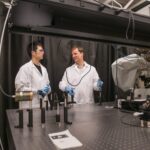
Banner image: Matt Pelton (right) and Haixu Leng, Ph.D. ’19, physics. Photo by Marlayna Demond ’11 for UMBC.
]]>
By combining their expertise in physics and chemistry, Matt Pelton and Marie-Christine Daniel are working toward the next big leap in computing. Both are engaged in photonics research, which is...https://umbc.edu/stories/umbcs-pelton-and-daniel-are-developing-light-driven-chips-to-enable-super-fast-computing/https://beta.my.umbc.edu/api/v0/pixel/news/119970/guest@my.umbc.edu/817f335d9b6241eacaf06cb6e39720d0/api/pixelchembiochemcnmsinterdisciplinaryphysicsresearchscience-and-technologyUMBC News & Magazinehttps://beta.my.umbc.edu/groups/umbc-news-magazinehttps://assets1-beta.my.umbc.edu/system/shared/avatars/groups/000/001/943/24435aa6207c452e7bc15cc74b42c7bb/xsmall.png?1748556657https://assets1-beta.my.umbc.edu/system/shared/avatars/groups/000/001/943/24435aa6207c452e7bc15cc74b42c7bb/original.png?1748556657https://assets2-beta.my.umbc.edu/system/shared/avatars/groups/000/001/943/24435aa6207c452e7bc15cc74b42c7bb/xxlarge.png?1748556657https://assets2-beta.my.umbc.edu/system/shared/avatars/groups/000/001/943/24435aa6207c452e7bc15cc74b42c7bb/xlarge.png?1748556657https://assets3-beta.my.umbc.edu/system/shared/avatars/groups/000/001/943/24435aa6207c452e7bc15cc74b42c7bb/large.png?1748556657https://assets1-beta.my.umbc.edu/system/shared/avatars/groups/000/001/943/24435aa6207c452e7bc15cc74b42c7bb/medium.png?1748556657https://assets2-beta.my.umbc.edu/system/shared/avatars/groups/000/001/943/24435aa6207c452e7bc15cc74b42c7bb/small.png?1748556657https://assets1-beta.my.umbc.edu/system/shared/avatars/groups/000/001/943/24435aa6207c452e7bc15cc74b42c7bb/xsmall.png?1748556657https://assets2-beta.my.umbc.edu/system/shared/avatars/groups/000/001/943/24435aa6207c452e7bc15cc74b42c7bb/xxsmall.png?1748556657UMBC News & Magazine00falseThu, 16 Jan 2020 21:17:11 -0500UMBC and UMB partner to become Maryland’s first “age-friendly” universities
The University of Maryland, Baltimore County (UMBC) and the University of Maryland, Baltimore (UMB) are partnering to become Maryland’s first “age-friendly” universities. They join fifty-eight institutions worldwide that make up the Age-Friendly University (AFU) Global Network, led by Dublin City University in Ireland.
Universities earn the “age-friendly” designation by committing to ten guiding principles related to opportunities and resources that support active and healthy aging. The initiative is inspired by the World Health Organization’s age-friendly cities movement.
“What I love about the UMB and UMBC connection is that we draw many people together for a greater good. This is an interdisciplinary journey to address aging through a policy, business management, life sciences, entrepreneurship, and technology lens,” said UMBC President Freeman Hrabowski at a kickoff event for the partnership.
“This is about mindset,” he continued. “It is a challenge that we face in our society to rethink how we think about aging and pull people into the work to listen to those perspectives. The more we grapple with these challenges, the more joy we will have in our societies.”
UMB Interim President Bruce Jarrell, said, “This worthy endeavor amplifies the many ways our institutions work separately and in collaboration to support healthy aging.” For example, UMB is developing an Academy of Lifelong Learning and, together, UMBC and UMB offer a gerontology doctoral program.
(L to R) Bradley; Amy Berman, John Schumacher, director of the gerontology graduate program, and Brandt.
The launch event included representatives from UMBC’s Erickson School of Aging Studies and the Peter Lamy Center on Drug Therapy and Aging at UMB’s School of Pharmacy, as well as UMB’s campus-wide Center for Research on Aging. Joining President Hrabowski were Jay A. Perman (then UMB president, and now the chancellor of the University System of Maryland) and Robert L. Caret (then USM chancellor).
Today I was pleased to join @UMBaltimore Pres. @JayPerman & @UMBC Pres. Freeman Hrabowski to kick-off the Age Friendly University Initiative. As the U.S. median age is increasing, universities should promote intergenerational learning & focus research on needs of an aging society pic.twitter.com/S6V9vBZoGP
Members of the UMBC-UMB steering committee for this project also participated in the announcement. These include faculty, staff, and student ambassadors who will help move this work forward on each campus.
Building on each other’s strengths
UMBC and UMB are the first universities in the State of Maryland to receive the AFU distinction. Each is positioned to implement the ten principles of the program in unique ways.
Together, UMBC and UMB offer a geriatrics and gerontology education and research doctoral program through UMBC’s Center for Aging Studies. UMBC’s Erickson School of Aging Studies also offers bachelor’s and master’s degrees and certificate programs educating the next generation of leaders in the business of longevity.
At UMB, students and faculty focus on the needs of older adults through medicine, nursing, pharmacy, social work, and other fields. Nicole Brandt, executive director of the Lamy Center and a professor of pharmacy practice and science, says, “UMB, with its six professional schools and graduate school, addresses real-world health and social issues affecting the human condition and has a strong history of teaching, research, and service activities related to aging.”
The principles of an Age-Friendly University are also embodied through the activities of UMB centers such as the Center for Research on Aging, based at the UM School of Medicine; the Biology and Behavior Across the Lifespan Organized Research Center, based at the UM School of Nursing; and the Lamy Center. And UMB’s interprofessional education efforts, such as the Aging in Place program and Stepping On fall prevention program, will continue to engage older residents of West Baltimore while also educating the future workforce.
“Being part of the Age-Friendly Global University Network is the perfect opportunity for UMBC and the State of Maryland to put a fresh lens on how society perceives aging in a population that is growing at rates we have never seen before,” shares Dana Bradley, dean of UMBC’s Erickson School of Aging Studies.
“I am excited to be at the forefront of preparing students to develop innovative products and services across all industries in the longevity economy,” says Bradley. “Together, we can support a healthier and stronger society.”
Banner image: UMBC and UMB Age-Friendly University steering committee. All images by Matthew D’agostino for UMB.
]]>
The University of Maryland, Baltimore County (UMBC) and the University of Maryland, Baltimore (UMB) are partnering to become Maryland’s first “age-friendly” universities. They join fifty-eight...https://umbc.edu/stories/umbc-and-umb-partner-to-become-marylands-first-age-friendly-universities/https://beta.my.umbc.edu/api/v0/pixel/news/119971/guest@my.umbc.edu/9ec6af0290ff583d5764719b9b82d6ab/api/pixelcahssericksonschoolgerontologypolicy-and-societyUMBC News & Magazinehttps://beta.my.umbc.edu/groups/umbc-news-magazinehttps://assets1-beta.my.umbc.edu/system/shared/avatars/groups/000/001/943/24435aa6207c452e7bc15cc74b42c7bb/xsmall.png?1748556657https://assets1-beta.my.umbc.edu/system/shared/avatars/groups/000/001/943/24435aa6207c452e7bc15cc74b42c7bb/original.png?1748556657https://assets2-beta.my.umbc.edu/system/shared/avatars/groups/000/001/943/24435aa6207c452e7bc15cc74b42c7bb/xxlarge.png?1748556657https://assets2-beta.my.umbc.edu/system/shared/avatars/groups/000/001/943/24435aa6207c452e7bc15cc74b42c7bb/xlarge.png?1748556657https://assets3-beta.my.umbc.edu/system/shared/avatars/groups/000/001/943/24435aa6207c452e7bc15cc74b42c7bb/large.png?1748556657https://assets1-beta.my.umbc.edu/system/shared/avatars/groups/000/001/943/24435aa6207c452e7bc15cc74b42c7bb/medium.png?1748556657https://assets2-beta.my.umbc.edu/system/shared/avatars/groups/000/001/943/24435aa6207c452e7bc15cc74b42c7bb/small.png?1748556657https://assets1-beta.my.umbc.edu/system/shared/avatars/groups/000/001/943/24435aa6207c452e7bc15cc74b42c7bb/xsmall.png?1748556657https://assets2-beta.my.umbc.edu/system/shared/avatars/groups/000/001/943/24435aa6207c452e7bc15cc74b42c7bb/xxsmall.png?1748556657UMBC News & Magazine00falseThu, 16 Jan 2020 16:15:52 -0500UMBC researchers work to support first responders through NSF-funded stress-response technology
Researchers from UMBC’s departments of information systems (IS) and emergency health services (EHS) are joining forces to help improve the lives of first responders. Through a $370,000 grant from the National Science Foundation, they are using a wristband to collect stress level information from first responders during simulations that mimic on-call situations. The researchers are developing a visual display system for the data to aid first responders in understanding and reflecting on how they react to stressful situations.
This information will ultimately enable those who train and support firefighters, police officers, and paramedics to help these first responders manage highly stressful situations. Their goal is to reduce the stress-induced health challenges that professionals in these fields can experience.
Building a research team
Andrea Kleinsmith, principal investigator, and J. Lee Jenkins, co-principal investigator, are leading a team of researchers for this project. The core group also includes co-investigators Helena Mentis, and Gary Williams ‘04 and M.S. ‘19, emergency health services. Kleinsmith and Mentis are IS faculty and Jenkins and Williams are EHS faculty. Mentis is also an associate dean in UMBC’s College of Engineering and Information Technology, and Jenkins is the chair of the EHS department.
UMBC researchers and instructors observing students in the emergency health services program as they complete a simulation. Photo by Raquel Hamner ’21, visual arts, for UMBC.
The initial phase of the project focuses on EHS juniors and seniors taking a course that includes emergency response simulations. The students on the project team collect physiological data that indicates the stress levels of simulation participants. The information they gather is informing the development of the system.
“One of the devices that we’re using to collect the data is an E4 wristband by Emaptica,” explains Kleinsmith. “It has sensors that collect data every quarter of a second, recording different physiological responses like heart rate, electrodermal activity, and skin temperature.”
Kleinsmith notes, “We collect this information along with the video of the simulation.” She hopes this will enable the team to develop a visual display for first-responder trainees to review their own stress-response information, to see how they work together as a team, and to see the connections between those two things. This will be an important first step in helping them limit and better manage on-the-job stress.
Clothilde Natividad ‘19, emergency health services, participated in the research program last year. She returns periodically to assist current students who are now enrolled in the class. “One of my best experiences as a student was being part of that research study,” shares Natividad. As a participant, she was impressed by seeing that researchers in the field are aware of the stress first responders experience and are working to do something about it.
Helping first-responders respond to their own stress levels
The project places UMBC researchers at the cutting edge of IS and EHS fields with a collaboration designed to improve health outcomes for first responders. “The innovation component is not that we don’t know how to track stress or give data back to people,” says Mentis. “The part that no one has brought together until now is about collaborative teamwork in a stressful environment, and the first responders being capable of recognizing their own stress reactions and understanding how to respond when in the field and afterward.”
The researchers aren’t just observing the paramedic trainees and their instructors. They are in continuous dialogue with them as they work to determine what the stress information display will look like and what features they would find most helpful.
The information gathered so far on the stress responses of simulation participants is still very raw, but it’s already proving useful. Program graduates have shared that “EHS simulation preparation is very close to the real world,” says Williams. Having experience completing these team-based simulations, and now receiving data about their bodies’ stress responses to the simulations, helps them to recognize stress, to “remain calm when they are on call,” and to work effectively on teams.
Williams notes, “Once trainees have graduated and are in the field with a real patient,” the goal is that “they know what to do and their stress levels are not as high.”
Innovating to save lives
The long-term impact of this project goes beyond the classroom and into the field, where high rates of stress can impact the health of first responders and their families.
“You can imagine the daily stress that EMTs, firefighters, and police officers have is tremendous. The effect that it has on their life, wellbeing, and health is enormous, with heart attacks, strokes, and suicide,” says Kleinsmith. “If we could find ways of improving their resilience by decreasing their stress response through education, that would enormously improve the health and lives of first responders.”
Students in the emergency health services program complete a simulation. Photo by Raquel Hamner ’21, visual arts, for UMBC.
As the project continues through the rest of this academic year, the researchers will get ever closer to seeing that desired impact. Over the next several months, they will continue to run team-based simulations, gather data, and continue processing the data to inform the physical design of the system and to see how having stress response information can change the experience of EHS trainees, as individuals and teams.
Word of the project is already beginning to reach the EMS community. Kleinsmith and Williams recently spoke at the International EMS Research Symposium in Louisiana, where they received the Best Oral Presentation award for their talk on how paramedic team emotional intelligence impacts performance.
Banner image: Students in UMBC’s emergency health services program have the wearable sensors set up before a simulation. Photo by Raquel Hamner ’21, visual arts, for UMBC. Story written by Megan Hanks, and Catalina Dansberger Duque.
]]>
Researchers from UMBC’s departments of information systems (IS) and emergency health services (EHS) are joining forces to help improve the lives of first responders. Through a $370,000 grant from...https://umbc.edu/stories/umbc-researchers-work-to-support-first-responders-through-nsf-funded-stress-response-technology/https://beta.my.umbc.edu/api/v0/pixel/news/119972/guest@my.umbc.edu/b649b4645d102b5556ebbd2c59758d9c/api/pixelcahsscoeitehsispolicy-and-societyscience-and-technologyUMBC News & Magazinehttps://beta.my.umbc.edu/groups/umbc-news-magazinehttps://assets1-beta.my.umbc.edu/system/shared/avatars/groups/000/001/943/24435aa6207c452e7bc15cc74b42c7bb/xsmall.png?1748556657https://assets1-beta.my.umbc.edu/system/shared/avatars/groups/000/001/943/24435aa6207c452e7bc15cc74b42c7bb/original.png?1748556657https://assets2-beta.my.umbc.edu/system/shared/avatars/groups/000/001/943/24435aa6207c452e7bc15cc74b42c7bb/xxlarge.png?1748556657https://assets2-beta.my.umbc.edu/system/shared/avatars/groups/000/001/943/24435aa6207c452e7bc15cc74b42c7bb/xlarge.png?1748556657https://assets3-beta.my.umbc.edu/system/shared/avatars/groups/000/001/943/24435aa6207c452e7bc15cc74b42c7bb/large.png?1748556657https://assets1-beta.my.umbc.edu/system/shared/avatars/groups/000/001/943/24435aa6207c452e7bc15cc74b42c7bb/medium.png?1748556657https://assets2-beta.my.umbc.edu/system/shared/avatars/groups/000/001/943/24435aa6207c452e7bc15cc74b42c7bb/small.png?1748556657https://assets1-beta.my.umbc.edu/system/shared/avatars/groups/000/001/943/24435aa6207c452e7bc15cc74b42c7bb/xsmall.png?1748556657https://assets2-beta.my.umbc.edu/system/shared/avatars/groups/000/001/943/24435aa6207c452e7bc15cc74b42c7bb/xxsmall.png?1748556657UMBC News & Magazine00falseWed, 15 Jan 2020 14:26:56 -0500UMBC’s Top Highlights of 2019
As UMBC welcomes 2020, we celebrate the student successes, athletic achievements, research breakthroughs, and community news that made 2019 a year to remember.
Retriever Nation
Whether it was on the field, on the court, or in the pool, UMBC’s Retrievers set out to shatter records in 2019. After being predicted to finish last in the America East, women’s softball stunned by clinching the title for the first time in program history. First-year standout Courtney Coppersmith, biochemistry and molecular biology, was named UMBC softball’s first-ever All-American. She was also the first person in America East history to be named both Pitcher of the Year and Rookie of the Year in the same season.
UMBC softball celebrates a landmark victory over Stony Brook to capture the America East title. Photo courtesy of UMBC Athletics.
Global learning experiences
In 2019, Retrievers discovered more ways to explore the world. Faculty-led summer trips gave students the opportunity to earn college credits through immersive experiences in Wales, Spain, France, Italy, and Colombia. Also, as part of a pilot program this year, nearly 30 new Retrievers jump-started their college career through Dawg Days Abroad in England. And 14 UMBC students and recent alumni received Fulbright U.S. Student Program awards — a new university record.
Brian Souders Ph.D. ’09, language, literacy, and culture, Fulbright coordinator, (left) with recipients.
Student achievements
Students also earned major recognition for their contributions to communities in Baltimore and around the globe, and for their promise as emerging leaders in a range of fields.
Evan Avila ‘20, economics, was awarded a Harry S. Truman Scholarship, the fourth recipient in UMBC history. Avila shared, “I want to pursue a career in economics to inform policy that can dismantle structural barriers to economic equality for immigrant communities.” Maheen Haq ‘20, global studies and economics, was named a Newman Civic Fellow for her work supporting people facing discrimination in Baltimore and abroad. The Cyber Dawgs, UMBC’s Cyber Defense Team, beat out over 100 teams to be named the U.S. Department of Energy’s CyberForce Competition national champion.
Evan Avila (center) with (l-r) Simon Stacey, director of the Honors College, and UMBC Truman Selection Committee members Lori Hardesty, David Hoffman, April Householder, and Brian Souders.
New faces and spaces
UMBC’s Interdisciplinary Life Sciences Building (ILSB) officially opened in the fall. The new facility offers features that set it apart as a space for learning, and set up students and faculty for transformative moments of discovery.
The ILSB atrium offers spaces to study or just relax. The art installation and a floating staircase add a whimsical, creative feel.
Off campus, the doors of OCA Mocha—a student-developed coffee shop and community gathering space in downtown Arbutus—opened in November. And we gave a big #RetrieverNation welcome to Brian Barrio, UMBC’s new director of athletics, physical education, and recreation.
New members of Retriever Nation gather for an incoming student photo during Welcome Week.
Research with impact, at all scales
From launching a satellite into space to sequencing the genes for spider glue, the UMBC community made exciting breakthroughs in 2019.
Sarah Stellwagen, assistant research scientist in biology, published the first-ever complete sequence of two genes that allow spiders to produce glue—a sticky, modified version of spider silk that keeps a spider’s prey stuck in its web. A NASA-funded satellite that UMBC’s Vanderlei Martins, physics, developed in collaboration with Space Dynamics Laboratory launched from NASA’s Wallops Flight Facility to the International Space Station in November.
Mustafa Al-Adhami M.S. ‘15, Ph.D. ‘20, mechanical engineering, developed a rapid bacterial-detection test that can assess, within an hour, if a patient has an infection. His test can also help physicians determine which antibiotics should be used to help fight the infection at a fraction of the price of the current antibiotic susceptibility test. This impressive breakthrough won Al-Adhami first place at the national Three-Minute Thesis competition.
Erle Ellis, geography and environmental systems, worked with colleagues to survey archaeologists across the globe to better understand human land use over time.
In the arts, UMBC Magazine highlighted the groundbreaking work of Chelsea Pace, assistant professor of theatre, a national expert on best practices for staging intimacy in theatre and film. Shortly afterward, she was featured in a major New York Times Magazine piece on intimacy coordinators.
Sarah Stellwagen with her pet baby orange-kneed tarantula.
Building on a legacy of excellence
UMBC’s Meyerhoff Scholars Program has long been recognized as a national leader at the forefront of efforts to increase diversity in STEM fields. Last summer, hundreds of Meyerhoff alumni gathered in Baltimore to celebrate the vision of philanthropist Robert E. Meyerhoff. Celebrations continued throughout the weekend as members of the Meyerhoff Scholar community shared how the program helped guide them to where they are today.
The program also reached an exciting new milestone. The Chan Zuckerberg Initiative (CZI) announced that it has awarded $6.9 million to replicate UMBC’s Meyerhoff Scholars Program at UC San Diego and UC Berkeley. This work builds on successful Meyerhoff replications at Penn State and UNC-Chapel Hill, supported by the Howard Hughes Medical Institute. These programs and more are also highlighted in The Empowered University, a new book by President Freeman Hrabowski, Provost Philip J. Rous, and Peter H. Henderson that brings UMBC’s story to readers around the world.
And in an exciting story of local impact, Maryland’s latest PARCC test results revealed that Baltimore City schools partnering with UMBC have seen dramatic growth in student math performance. Joshua Michael ’10, political science, and assistant director of UMBC’s Sherman STEM Teacher Scholars Program, provided insight on this work.
Naomi Mburu ’18 (left), chemical engineering, stops for a selfie with Talmesha Richards ‘04 (right), chemical engineering and mathematics, during the Meyerhoff celebration.
Alumni leadership and inspiration
What our students accomplish at UMBC is only the beginning. Their lives as alumni continue to inspire after they leave campus. This year, several Retrievers shared their stories of parlaying their college internships into full-time positions, thanks to the support they received from UMBC’s Career Center.
UMBC Magazine profiled alumna Karyn Swann ‘92, sociology, whose daughter is carrying on her basketball and academic legacy. Lyric Swann ‘23, visual arts, is following (and running and dribbling) in her mom’s footsteps and getting noticed during her first year at UMBC. Mimi Dietrich ‘70, American studies, was in UMBC’s first graduating class and hasn’t stopped working since. In March, the Maryland Historical Society launched a year-long retrospective of Dietrich’s national acclaimed quilts at its Baltimore headquarters.
Several alumni also began new, high-profile leadership positions. Adrienne Jones ‘76, psychology, made history when she was sworn in as Maryland Speaker of the House, the first African American and first woman to serve in this role. Letitia Dzirasa ‘03, M11, biological sciences, was appointed Baltimore’s new health commissioner, presiding over the health department’s annual budget of $150 million.
Adrienne A. Jones ‘76, psychology, celebrates UMBC’s 50th anniversary.
Retriever fever
We love adding new fans to #RetrieverNation and 2019 gave us an impawssibly cute one. UMBC’s police department welcomed Chip, the new campus comfort dog, in September. Along with her handler, Sergeant Jamie Cheatem, Chip helps to provide comfort during midterms, finals, and high-stress situations.
Comfort dog Chip eagerly greets students on campus.
Banner image: UMBC swim team members underwater. All photos by Marlayna Demond ‘11 unless otherwise noted.
]]>
As UMBC welcomes 2020, we celebrate the student successes, athletic achievements, research breakthroughs, and community news that made 2019 a year to remember. Retriever Nation Whether it was...https://umbc.edu/stories/umbcs-top-highlights-of-2019/https://beta.my.umbc.edu/api/v0/pixel/news/119973/guest@my.umbc.edu/6f572754ce580b0fd40e25293690e0e3/api/pixelalumniamericanstudiesathleticscahsscampuscnmscoeitcommunityhrabowskipage1researchundergradresearchUMBC News & Magazinehttps://beta.my.umbc.edu/groups/umbc-news-magazinehttps://assets1-beta.my.umbc.edu/system/shared/avatars/groups/000/001/943/24435aa6207c452e7bc15cc74b42c7bb/xsmall.png?1748556657https://assets1-beta.my.umbc.edu/system/shared/avatars/groups/000/001/943/24435aa6207c452e7bc15cc74b42c7bb/original.png?1748556657https://assets2-beta.my.umbc.edu/system/shared/avatars/groups/000/001/943/24435aa6207c452e7bc15cc74b42c7bb/xxlarge.png?1748556657https://assets2-beta.my.umbc.edu/system/shared/avatars/groups/000/001/943/24435aa6207c452e7bc15cc74b42c7bb/xlarge.png?1748556657https://assets3-beta.my.umbc.edu/system/shared/avatars/groups/000/001/943/24435aa6207c452e7bc15cc74b42c7bb/large.png?1748556657https://assets1-beta.my.umbc.edu/system/shared/avatars/groups/000/001/943/24435aa6207c452e7bc15cc74b42c7bb/medium.png?1748556657https://assets2-beta.my.umbc.edu/system/shared/avatars/groups/000/001/943/24435aa6207c452e7bc15cc74b42c7bb/small.png?1748556657https://assets1-beta.my.umbc.edu/system/shared/avatars/groups/000/001/943/24435aa6207c452e7bc15cc74b42c7bb/xsmall.png?1748556657https://assets2-beta.my.umbc.edu/system/shared/avatars/groups/000/001/943/24435aa6207c452e7bc15cc74b42c7bb/xxsmall.png?1748556657UMBC News & Magazine00falseThu, 09 Jan 2020 18:06:40 -0500Baltimore Bonds
If you had the chance to interview someone you look up to, what would you ask? Sydney Fryer ’22, psychology, had the opportunity this fall when she sat down for a chat with fellow Sondheim Scholar Alicia Wilson ’04, political science. (The Sondheim program is celebrating its 20th anniversary this year, by the way!) Fryer came ready to find out more about Wilson and her trajectory from growing up in Baltimore City to being a Retriever (and winning a prestigious Truman Scholarship), to becoming vice president for Economic Development at Johns Hopkins University.
Sydney Fryer:
I, like you, am a Baltimore girl. The city has changed a lot since I was a child. What is your view about all the development that happened over the years in Baltimore?
Alicia Wilson:
Growing up in Baltimore, I’d hear about development projects at Harbor East but I didn’t have any real concept of what it meant other than brick and mortar. Development is complicated; historically development has been about the building of buildings rather than the building of community.
But the reality is, there are local people living adjacent to those developments and they should be part of the calculation of how we design, create, and impact the existing landscape. As we think about development in the city, we always need to keep an eye on what is good for the people.
I think everyone agrees vacant homes need to be developed. Life needs to be developed. Things need to be developed. Even if they were great at their time, things evolve. Cities evolve. The needs of people evolve.
Fryer:
What are some things college students can do to help the state of things when we find they are not up to code in our city?
Wilson:
Students have the luxury of time, passion, and resources. You’re in a place that allows you to look at a problem, learn about it, and have a great amount of time to figure out how to solve it. Students have a huge role in changing things and shaking it up. Don’t diminish your youth and ability to bring forth a new, fresh perspective on things people have been looking at for years.
Pick the problem you are passionate about and apply what you are learning about. Make the uncomfortable statements. Learn through the process. Take a position and advocate; be open to having your position challenged and shifted to get the results you want.
Fryer:
Is being a public servant hard?
Wilson:
There are enormous challenges out there but I find joy in serving. You have to take the time to replenish yourself. Many times you will want to solve everything with a sense of urgency because you believe the work demands it. But the reality is, you need to be a soldier in that fight for a long time. You can’t burn yourself out at the expense of a cause. You have to pace yourself.
Fryer:
How did being a Truman Scholar shape your journey?
Wilson:
Being a Truman Scholar really opened me up to thinking about how I see issues in my community on a much more national/global scale. Food deserts aren’t just about being very neighborhood-centric. It’s about what happens on the national scale and what happens on the global stage which allows food deserts to happen in Baltimore. We have to see the interconnectedness between our plight here and the plight of people in rural America and across the world. The Truman Scholarship gave me a big platform to work on these issues and help create positive change for all people in our country.
Fryer:
What was the greatest takeaway from all of your education?
Wilson:
My time at UMBC was blessed because I was able to be friends with and be mentored by Walter Sondheim. He was vibrant with passion, vigor, and intellect. Walter was thoughtful about how he was going to contribute to the city and the world in a way, I think, which would ignite young people today. He didn’t have a self-serving agenda. He was pure about being effective in the world.
I think understanding to live with purity in service to others was something that gelled at UMBC, which I think has been helpful.
*****
Header photo by Marlayna Demond ’11.
]]>
If you had the chance to interview someone you look up to, what would you ask? Sydney Fryer ’22, psychology, had the opportunity this fall when she sat down for a chat with fellow Sondheim Scholar...https://umbc.edu/stories/baltimore-bonds/https://beta.my.umbc.edu/api/v0/pixel/news/119974/guest@my.umbc.edu/003bffb6d38a2bbc1ae4ee8fa2ab6276/api/pixelcahssfall-2019impactperspectivessondheim-scholarUMBC News & Magazinehttps://beta.my.umbc.edu/groups/umbc-news-magazinehttps://assets1-beta.my.umbc.edu/system/shared/avatars/groups/000/001/943/24435aa6207c452e7bc15cc74b42c7bb/xsmall.png?1748556657https://assets1-beta.my.umbc.edu/system/shared/avatars/groups/000/001/943/24435aa6207c452e7bc15cc74b42c7bb/original.png?1748556657https://assets2-beta.my.umbc.edu/system/shared/avatars/groups/000/001/943/24435aa6207c452e7bc15cc74b42c7bb/xxlarge.png?1748556657https://assets2-beta.my.umbc.edu/system/shared/avatars/groups/000/001/943/24435aa6207c452e7bc15cc74b42c7bb/xlarge.png?1748556657https://assets3-beta.my.umbc.edu/system/shared/avatars/groups/000/001/943/24435aa6207c452e7bc15cc74b42c7bb/large.png?1748556657https://assets1-beta.my.umbc.edu/system/shared/avatars/groups/000/001/943/24435aa6207c452e7bc15cc74b42c7bb/medium.png?1748556657https://assets2-beta.my.umbc.edu/system/shared/avatars/groups/000/001/943/24435aa6207c452e7bc15cc74b42c7bb/small.png?1748556657https://assets1-beta.my.umbc.edu/system/shared/avatars/groups/000/001/943/24435aa6207c452e7bc15cc74b42c7bb/xsmall.png?1748556657https://assets2-beta.my.umbc.edu/system/shared/avatars/groups/000/001/943/24435aa6207c452e7bc15cc74b42c7bb/xxsmall.png?1748556657UMBC News & Magazine00falseWed, 08 Jan 2020 15:37:42 -0500High-Tech Gift Harnesses Data for Athletes
When UMBC Men’s Soccer Coach Anthony Adams traveled to Canada for a former player’s wedding, he didn’t expect to come away from the trip with a significant donation to the team. But then again, he wasn’t all that surprised; his players usually found ways to give back.
The gift came from Liam Paddock ’12, psychology and sociology, who played soccer at UMBC from 2009 to 2012. After catching up with Adams at the wedding of teammate Milovan Kapor ’13, economics, Paddock asked if there was anything the team needed—after all, UMBC Men’s Soccer had made a huge impact on his life. “They backed me in hard times, connected me with the right people, and continued to give me opportunities throughout my years there,” he says. “So, now I’m in a position to, giving back to UMBC Men’s Soccer makes sense.”
Adams immediately thought of the VX system, a wearable piece of technology that helps players track their movements and their heart rates. Adams hoped to get his hands on the technology to better train his athletes.
“As much as we can, we want to be on the cutting edge. Science is a big part of sports, and this is information we didn’t have in the past,” Adams explains. “Monitoring systems [were] just the next logical step for us.”
Ryan Becher, a midfielder, drives the ball down the field during a game against Incarnate Word.
The VX System, and others like it, has become invaluable to many soccer teams because it can be used to foresee possible injuries, says Adams. This technology, which players don under their jerseys during practice and games, lets coaches see important pieces of performance data, all of which are presented via simple, comprehensive metrics on the system’s custom software. An unusually high heart rate, for example, can indicate that a player may be fatigued and at greater risk for a muscular injury.
Ryan Becher, ’23, a midfielder, used the VX system as a part of another team, prior to coming to UMBC. “The training staff noticed my numbers were getting lower, so they started to talk to me,” he remembers. He ended up having some back problems and being unable to play for two months, but he believes the situation could have gotten much worse if his coaches hadn’t known to intervene so early.
On top of aiding with injury prevention, the VX system also helps players improve their gameplay. Though the UMBC team has only been using the technology since the start of this season, Ryan’s brother and fellow teammate, Jackson Becher, ’22, psychology, has already found these functions useful. “We get my max heart rate, how fast I’m sprinting, how often I’m sprinting, and how far I’m running,” he says. “So being able to look at that makes it easier for me to understand where I need to be and what I need to do to improve.”
Adams says that giving back is part of the soccer team’s DNA, and the coach doesn’t shy away from asking alumni to pitch in. This past season, the team needed a new couch for their locker room, but didn’t have the money to buy one. Adams sent out an email to soccer team alumni and, within 30 minutes, three alumni had replied, collectively donating enough to cover the cost of the couch.
But this relationship with alumni goes far beyond donations. For Paddock, the friendships he made while playing for UMBC became some of the most important in his life. “There is a genuine sense of family,” he explains. “And while I think that term gets thrown around, I feel it every time I go back to Baltimore.”
— Johanna Alonso ’20
*****
All photos courtesy of UMBC Athletics.
]]>
When UMBC Men’s Soccer Coach Anthony Adams traveled to Canada for a former player’s wedding, he didn’t expect to come away from the trip with a significant donation to the team. But then again, he...https://umbc.edu/stories/high-tech-gift-harnesses-data-for-athletes/https://beta.my.umbc.edu/api/v0/pixel/news/119975/guest@my.umbc.edu/9d7d47ea5e1e98d1f16c3a7334d07d08/api/pixelalumniathleticsfall-2019impactmens-soccerUMBC News & Magazinehttps://beta.my.umbc.edu/groups/umbc-news-magazinehttps://assets1-beta.my.umbc.edu/system/shared/avatars/groups/000/001/943/24435aa6207c452e7bc15cc74b42c7bb/xsmall.png?1748556657https://assets1-beta.my.umbc.edu/system/shared/avatars/groups/000/001/943/24435aa6207c452e7bc15cc74b42c7bb/original.png?1748556657https://assets2-beta.my.umbc.edu/system/shared/avatars/groups/000/001/943/24435aa6207c452e7bc15cc74b42c7bb/xxlarge.png?1748556657https://assets2-beta.my.umbc.edu/system/shared/avatars/groups/000/001/943/24435aa6207c452e7bc15cc74b42c7bb/xlarge.png?1748556657https://assets3-beta.my.umbc.edu/system/shared/avatars/groups/000/001/943/24435aa6207c452e7bc15cc74b42c7bb/large.png?1748556657https://assets1-beta.my.umbc.edu/system/shared/avatars/groups/000/001/943/24435aa6207c452e7bc15cc74b42c7bb/medium.png?1748556657https://assets2-beta.my.umbc.edu/system/shared/avatars/groups/000/001/943/24435aa6207c452e7bc15cc74b42c7bb/small.png?1748556657https://assets1-beta.my.umbc.edu/system/shared/avatars/groups/000/001/943/24435aa6207c452e7bc15cc74b42c7bb/xsmall.png?1748556657https://assets2-beta.my.umbc.edu/system/shared/avatars/groups/000/001/943/24435aa6207c452e7bc15cc74b42c7bb/xxsmall.png?1748556657UMBC News & Magazine00falseTue, 07 Jan 2020 19:37:07 -0500