Wearable sensors and infrared cameras: Introducing UMBC’s User Studies Lab
UMBC’s Interactive Systems Research Center (ISRC) has obtained new equipment designed for the precise study of human movement, perception, and emotion. The User Studies Lab, which includes the Motion Lab and the Perception Lab, has installed new technology through a National Science Foundation grant including a Vicon motion capture system. The Vicon system records a subject’s movement using infrared cameras and small, wearable markers affixed with tape that the cameras can track. Andrea Kleinsmith, principal investigator, explains that with this system, tiny, lightweight reflective markers illuminate when the cameras flash. The cameras then capture the reflected light and transmit the information so location and movement can be extrapolated and researchers can study a subject’s movement.
Briana Norwood ’20, dance, wearing the markers that allow infrared cameras to capture the subject’s position in space.
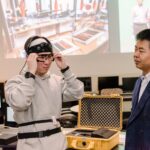
This lab is a shared research space, primarily used by the College of Engineering and Information Technology (COEIT), but also open to others across the university. Other equipment includes wearable research tools such as virtual reality headsets, wristbands that record physiological signals, and eye-tracking sensors that are both fixed and wearable.
Glasses that allow eye-tracking data to be collected.
Kleinsmith, an assistant professor of information systems, explains that the newly outfitted User Studies Lab will enable students and faculty to expand the collaborative research being done across COEIT departments.
Andrea Kleinsmith gives a tour of the Perception Lab to attendees.
Helena Mentis, associate dean for academic programs and learning in COEIT, and associate professor of information systems, anticipates that the 793 square foot space will also be valuable resources for students and faculty university-wide. In particular, she sees the labs as helping faculty to integrate teaching and research, and to think more expansively about their work.
These spaces “will help increase interdisciplinarity and build bridges across ideas,” Mentis said at the kick-off celebrating the new equipment.
Helena Mentis, left, and Erin Lavik, associate dean for research and faculty development in COEIT.
During the event, Briana Norwood ’20, dance, demonstrated how the motion-capture system works. Affixed to her clothes were 39 small, wearable, retroreflective markers. Around the room, near the ceiling, 12 infrared cameras tracked the 3D position of the markers as Norwood moved throughout the space.
As Norwood danced in the room, a colorful model of a person moved in unison on a computer screen in the adjacent control room. Kleinsmith explained how the precise 3D coordinate data transmitted to that computer could be analyzed in any number of ways.
Briana Norwood ’20, dance, at the opening of the ISRC.
During the opening event, Foad Hamidi, assistant professor of information systems, and his students also provided tours of another ISRC-affiliated lab, the Designing pARticipAtory futurEs (DARE) lab. They offered an overview of the 3D printing tools in the lab, also available for use by other researchers on campus, and explained current research that utilizes those tools.
[nivoslider id=”45052″]
This new equipment in the User Studies Lab represents a next step in the ongoing growth of interactive systems research infrastructure in the Interactive Systems Research Center (ISRC) at UMBC. Prior to this recent award, faculty received NSF funding in 2007 for biometric research equipment and a COEIT Strategic Plan Instrumentation Grant in 2016 to revitalize the User Studies Lab.
“Motion and sensing of motion is all around us,” says Vandana Janeja, interim chair and professor of information systems. “This lab enables us to harness the precise study of movement and perception, which will open up doors of collaborations across many different disciplines that are interested in its study. Collaborative work through this lab will bring us closer in our joint pursuit of knowledge of human behavior and interaction with and through technology.”
Banner image: Briana Norwood demonstrates the newly-installed technology during the User Studies Lab event. All photos by Britney Clause ’11.
]]>
UMBC’s Interactive Systems Research Center (ISRC) has obtained new equipment designed for the precise study of human movement, perception, and emotion. The User Studies Lab, which includes the...https://umbc.edu/stories/wearable-sensors-and-infrared-cameras-introducing-umbcs-user-studies-lab/https://beta.my.umbc.edu/api/v0/pixel/news/119960/guest@my.umbc.edu/1bc0847db77008ce634d7cea5c20adbb/api/pixelcoeitisscience-and-technologyUMBC News & Magazinehttps://beta.my.umbc.edu/groups/umbc-news-magazinehttps://assets1-beta.my.umbc.edu/system/shared/avatars/groups/000/001/943/24435aa6207c452e7bc15cc74b42c7bb/xsmall.png?1748556657https://assets1-beta.my.umbc.edu/system/shared/avatars/groups/000/001/943/24435aa6207c452e7bc15cc74b42c7bb/original.png?1748556657https://assets2-beta.my.umbc.edu/system/shared/avatars/groups/000/001/943/24435aa6207c452e7bc15cc74b42c7bb/xxlarge.png?1748556657https://assets2-beta.my.umbc.edu/system/shared/avatars/groups/000/001/943/24435aa6207c452e7bc15cc74b42c7bb/xlarge.png?1748556657https://assets3-beta.my.umbc.edu/system/shared/avatars/groups/000/001/943/24435aa6207c452e7bc15cc74b42c7bb/large.png?1748556657https://assets1-beta.my.umbc.edu/system/shared/avatars/groups/000/001/943/24435aa6207c452e7bc15cc74b42c7bb/medium.png?1748556657https://assets2-beta.my.umbc.edu/system/shared/avatars/groups/000/001/943/24435aa6207c452e7bc15cc74b42c7bb/small.png?1748556657https://assets1-beta.my.umbc.edu/system/shared/avatars/groups/000/001/943/24435aa6207c452e7bc15cc74b42c7bb/xsmall.png?1748556657https://assets2-beta.my.umbc.edu/system/shared/avatars/groups/000/001/943/24435aa6207c452e7bc15cc74b42c7bb/xxsmall.png?1748556657UMBC News & Magazine00falseWed, 05 Feb 2020 16:49:45 -0500The Carnegie Foundation honors UMBC as a leading community-engaged university
The Carnegie Foundation for the Advancement of Teaching has honored UMBC with its distinguished Carnegie Community Engagement Classification. This classification acknowledges UMBC faculty, staff, students, and community partners for their deep commitment to strengthening the bonds between campus and community.
UMBC is one of only 67 public colleges and universities in the U.S. just announced as receiving this honor. To date, 359 U.S. institutions hold this classification. These institutions “are doing exceptional work to forward their public purpose in and through community engagement that enriches teaching and research while also benefiting the broader community,” says Mathew Johnson, executive director of Brown University’s Swearer Center for Public Engagement, the administrative and research home for the classification.
This achievement required a rigorous self-study of UMBC’s work with communities in Greater Baltimore and beyond. That process involved more than 120 members of the UMBC community as well as dozens of community partners.
Joby Taylor (in yellow coat), Ph.D. ’05, language, literacy, and culture, director of UMBC’s Shriver Peaceworker Program, participates in a leadership development activity with Shriver Peaceworker Fellows. Photo courtesy of Charlotte Keniston, MFA ’14, intermedia and digital art, associate director of the Peaceworker Program.
This recognition is a testament to UMBC’s unwavering support for increasing equity in the Baltimore region and in communities nationally and internationally through work that honors existing sources of community strength, fosters investments in communities, and actively works to address disparities in health outcomes, education, and other core issues.
Preparing public servants
The Shriver Center has stood at the center of UMBC’s community engagement work for decades, preparing and connecting faculty, staff, and students from all academic programs with community partners. The Shriver Center’s applied learning experiences have helped thousands of students to develop as community-minded agents of change and hundreds of partner organizations to meet their goals.
2018-19 UMBC France-Merrick Scholars. Photo by Raquel Hammer ’20.
“Carnegie’s definition of community engagement emphasizes the importance of reciprocity and mutual benefits in the partnerships that are created,” explains Michele Wolff, director of the Shriver Center. “Shriver Center programs ask us to think about how we can make our partnerships more authentic, to effectively meet the needs of all involved. In this way, the longstanding approach of the Shriver Center also reflects the Carnegie Foundation’s principles of reciprocity and mutuality.”
Maggie Holland (center, back row), associate professor of geography and environmental systems, interviews a group of farmers in the Amazon about the forests on their properties. Photo courtesy Maggie Holland.
Investing in change
BreakingGround is one long-standing UMBC community engagement initiative with significant impacts, both on and off-campus. This initiative supports work by students, staff, and faculty to address issues they care about, as innovative coalition builders, problem solvers, and agents of social transformation. Examples of projects funded by BreakingGround include environmental justice initiatives and work to improve Baltimore City’s aging water infrastructure.
David Hoffman (left), director of the Center for Democracy and Civic Life, with UMBC students in a class on democracy and civic engagement.
The Baltimore Traces project, a collaborative teaching initiative in the arts and humanities, amplifies the community voices of Baltimore residents and neighborhoods through various media. This key example of community-engaged teaching, which has been recognized by the National Humanities Alliance, has produced short video documentaries, a website, an interactive map, and radio programming that aired on Baltimore’s WEAA 88.9 FM.
Baltimore community members and UMBC students participate in the Baltimore Traces Mapping project. Photo courtesy of UMBC’s New Media Studio.
Scholarship and teaching rooted in community engagement also play a significant role in the social sciences at UMBC. In the Sondheim Public Affairs Scholars Program, for example, students spend years honing their skills as future public servants and advocates in local, national, and international communities. Recent UMBC graduate Maheen Haq, global studies and economics, is a Sondheim Scholar who has worked to support communities facing discrimination, from Syria to Baltimore.
Maheen Haq (left) giving out toys to children in a Syrian refugee camp. Photo courtesy of Haq with permission from Helping Hand for Relief and Development.
UMBC also trains future scientists and engineers to conduct community-based research. The National Science Foundation-supported Bahama Oriole Project, a collaborative research initiative with Bahamian scientists and conservationists, works to save the critically endangered Bahama Oriole. An affordable infant incubator that originated in a UMBC engineering course is now in clinical trials in India and recently won the 2019 Global Health Research Award from the Academic Pediatric Association. And UMBC’s Engineers Without Borders student group has taken trips to Kenya and Costa Rica, working collaboratively with local communities and local university students to improve access to clean water.
Maggie Holland (far left); Lee Blaney (second from right), associate professor of chemical, biochemical, and environmental engineering; and UMBC students prepare to plant trees in Costa Rica. Photo courtesy of Maggie Holland.
UMBC is also invested in the local community immediately surrounding campus. Recently, the university celebrated the opening of OCA Mocha, the brainchild of students in an entrepreneurship class. OCA stands for Opportunities for Community Alliances. The coffee house and community activity space is located a few minutes from UMBC’s main campus and has already found success hosting UMBC and non-university groups and bringing them together in conversation.
Co-founders of OCA Mocha (l-r): Krishna Gohel ’18, biological sciences; Deep Patel ’19, biological sciences and financial economics; and Michael Berardi ’19, media and communications studies, with community leaders.
“Thanks to the Carnegie application process, we know the extent and the depth of the community-engaged work that UMBC students, faculty, and staff have achieved over the last five decades,” shares Scott Casper, dean of the College of Arts, Humanities, and Social Sciences. “The Carnegie classification is an opportunity to celebrate that work. It’s also an opportunity to keep growing—coordinating this work to understand better the impacts of our community-engaged partnerships for our faculty, staff, students, alumni, and our partners.”
Jennifer Mata-McMahon (third from left), associate professor of early childhood education, working with Baltimore City teachers at the Sherman Center for Early Learning in Urban Communities’ summer institute.
“Community engagement and a strong sense of purpose are at the heart of UMBC teaching, learning, and research,” says President Freeman Hrabowski. “The Carnegie Community Engagement Classification is a reflection of our values and our character. It affirms that together we can achieve great things locally, nationally, and internationally.”
Featured photo: Sherman STEM Teacher-Scholar, Vanessa Gonzalez ’19, American studies, works with Lakeland Elementary/Middle School students. All photos by Marlayna Demond ’11 for UMBC unless noted.
]]>
The Carnegie Foundation for the Advancement of Teaching has honored UMBC with its distinguished Carnegie Community Engagement Classification. This classification acknowledges UMBC faculty, staff,...https://umbc.edu/stories/the-carnegie-foundation-honors-umbc-as-a-leading-community-engaged-university/https://beta.my.umbc.edu/api/v0/pixel/news/119961/guest@my.umbc.edu/ac5e10ca5609cd82084ff92dd8d5c079/api/pixelbiologycahsscnmscoeitcommunityengineeringpage1policy-and-societyrankingsscience-and-technologyshrivercentersondheimscholarsUMBC News & Magazinehttps://beta.my.umbc.edu/groups/umbc-news-magazinehttps://assets1-beta.my.umbc.edu/system/shared/avatars/groups/000/001/943/24435aa6207c452e7bc15cc74b42c7bb/xsmall.png?1748556657https://assets1-beta.my.umbc.edu/system/shared/avatars/groups/000/001/943/24435aa6207c452e7bc15cc74b42c7bb/original.png?1748556657https://assets2-beta.my.umbc.edu/system/shared/avatars/groups/000/001/943/24435aa6207c452e7bc15cc74b42c7bb/xxlarge.png?1748556657https://assets2-beta.my.umbc.edu/system/shared/avatars/groups/000/001/943/24435aa6207c452e7bc15cc74b42c7bb/xlarge.png?1748556657https://assets3-beta.my.umbc.edu/system/shared/avatars/groups/000/001/943/24435aa6207c452e7bc15cc74b42c7bb/large.png?1748556657https://assets1-beta.my.umbc.edu/system/shared/avatars/groups/000/001/943/24435aa6207c452e7bc15cc74b42c7bb/medium.png?1748556657https://assets2-beta.my.umbc.edu/system/shared/avatars/groups/000/001/943/24435aa6207c452e7bc15cc74b42c7bb/small.png?1748556657https://assets1-beta.my.umbc.edu/system/shared/avatars/groups/000/001/943/24435aa6207c452e7bc15cc74b42c7bb/xsmall.png?1748556657https://assets2-beta.my.umbc.edu/system/shared/avatars/groups/000/001/943/24435aa6207c452e7bc15cc74b42c7bb/xxsmall.png?1748556657UMBC News & Magazine00falseWed, 29 Jan 2020 20:50:41 -0500Hidden by a pleasant scent: The health consequences of flavor in e-cigarettes
Five million users are middle and high school students. Some are as young as 11, although it’s illegal to sell vaping products to anyone under 21.
Especially for kids, much of the lure is flavor. E-cigarettes offer attractive smells and tastes. Fruit, mint, candy and dessert flavors are the favorites, and studies suggest they ignite the desire to vape. That’s why the Trump administration just banned the sale of those sweet flavors from cartridge-based e-cigs, the delivery method most popular with teens.
One of us (Weihong) is a chemosensory neurobiologist, and the other (Rakaia) is a research assistant in my lab. Put simply, we study how the sensory systems and brain react to chemical stimulation. With e-cigarettes, we are focusing on how the enticing flavors ensnare our children.
But our studies have shown that the effect of flavor goes beyond the pleasure they may bring – the flavorings themselves may actually harm tissue.
These ads extol the virtues of flavored cigarettes.
Flavors enhance e-cig appeal
The tobacco industry has long been using flavorings make their products more palatable; it added menthol to cigarettes nearly a century ago.
Today, the allure of flavors in e-cigarettes bring potential health consequences, and kids are particularly vulnerable. E-cigarettes can put adolescents at risk for respiratory, cardiopulmonary diseases, brain disorders and cancers.
About 20,000 flavored e-liquids are on the market – countless combinations of hundreds of flavoring molecules extracted from natural ingredients or artificially made. The vast majority are volatile odor chemicals, perceived not by taste, but by smell.
Your olfactory system, with far more sensitivity than your taste buds, can distinguish more than 10,000 smells. During vaping, a flavoring enters our nose, and like any agreeable scent, immediately evokes the fond memories and pleasant emotions associated with the aroma. Vanillin, a popular e-cigarette flavoring, smells like dessert; ethyl maltol, a flavoring used in many foods, has a candy-like odor. The user, comforted and calmed, savors the moment – then goes back for more.
But e-cigarette vapor also contains nicotine, heavy metals and formaldehyde, as pungent as they are harmful. Mixing in delectable flavorings disguises their unpleasantness, much like the cherry additive that camouflages the otherwise medicinal taste of children’s cough syrup.
Yet perceptions of irritation and pain in the nose, mouth, and throat serve as warning signals, the body’s cautionary bells and whistles evolved over millions of years. A bitter taste might originate from a toxic plant; irritation in the nose or respiratory tract indicates the inhaled substance is potentially harmful.
But now that flavorings in e-cigarette mask the warning signals, many consumers have been lulled into believing vaping is benign. They rate mint flavors as safer, though they are not. And instead of irritation from the e-cigarette prompting a cough – an action that removes harmful stimuli from the airway – the flavorings instead dampen the user’s sensory alarms and protective reactions. The risk of chemically induced injury, along with nicotine abuse, is increased.
How flavors themselves may be toxic
Although the U.S. Food and Drug Administration has acknowledged some flavorings as “safe for consumption,” its label dodges a critical distinction. Safe for consumption does not mean safe for inhalation. While scientists still haven’t confirmed the inhalation toxicity for all flavorings, the latest research reveals some disturbing evidence.
Flavor molecules, reacting with the propylene glycol in the e-liquid, can produce metabolites, or intermediate substances that are part of metabolic reactions, that are irritating to the respiratory system. Long-term exposure to irritants can lead to chronic cough; inflammation; hyper-reactive airway (wheezing, shortness of breath); edema (swelling in the arms, hands, legs or feet); and acute lung damage.
Some flavorings, inhaled chronically or at high levels, are already known to cause serious and sometimes deadly respiratory illnesses. Diacetyl, a buttery flavor used in processed foods – notably some popcorn products – causes “popcorn lung,” an irreversible disease that affects factory workers exposed daily to the compound.
Many e-liquids contain diacetyl; an analysis found the substance in 39 out of 51 tested e-cigarette samples. In about half the samples, the estimated daily consumption was above safety limits.
Patients with EVALI exhibit a significant number of these symptoms, and all were attributed to vaping. In one survey, users reported cough (40.0%); dry or irritated mouth or throat (31.0%); dizziness or lightheadedness (27.1%); headache or migraine (21.9%); or shortness of breath (18.1%).
Similar health problems have been reported by patients with chemically induced sick building syndrome. This implies that e-cigarette users share common health problems with those suffering from chemical exposure.
What about long-term vaping?
Ongoing chemical exposure, especially at high doses, can cause olfactory dysfunction, including a reduced sense of smell. This encourages chronic e-cigarette users to choose stronger-flavored e-liquids to receive a sufficient buzz. In turn, more potent e-liquids generate more irritation and damage to the nose, lungs and lower airway.
The health effects of e-cigarette exposure go beyond the sensory and respiratory systems. Mint and candy flavors are more than chemical accessories that enhance a harmless experience. They shape our behavior, perhaps for a lifetime.
Our government is making progress towards keeping teens away from e-cigarettes. Now, long-term research is needed to fully comprehend the adverse health effects and toxicity of flavorings and other chemical substances in the e-cigarette vapor to prevent the potentially catastrophic effects of vaping.
]]>
By Weihong Lin, Professor of Biological Sciences, and Rakaia Kenney, Research Assistant, UMBC Millions of Americans are vaping, and some are getting sick. Since June 2019, 2,711 have been...https://umbc.edu/stories/hidden-by-a-pleasant-scent-the-health-consequences-of-flavor-in-e-cigarettes/https://beta.my.umbc.edu/api/v0/pixel/news/119962/guest@my.umbc.edu/d4cda8e3f75f07175e20a9c65648b97a/api/pixelbiologycnmsdiscoverythe-conversationUMBC News & Magazinehttps://beta.my.umbc.edu/groups/umbc-news-magazinehttps://assets1-beta.my.umbc.edu/system/shared/avatars/groups/000/001/943/24435aa6207c452e7bc15cc74b42c7bb/xsmall.png?1748556657https://assets1-beta.my.umbc.edu/system/shared/avatars/groups/000/001/943/24435aa6207c452e7bc15cc74b42c7bb/original.png?1748556657https://assets2-beta.my.umbc.edu/system/shared/avatars/groups/000/001/943/24435aa6207c452e7bc15cc74b42c7bb/xxlarge.png?1748556657https://assets2-beta.my.umbc.edu/system/shared/avatars/groups/000/001/943/24435aa6207c452e7bc15cc74b42c7bb/xlarge.png?1748556657https://assets3-beta.my.umbc.edu/system/shared/avatars/groups/000/001/943/24435aa6207c452e7bc15cc74b42c7bb/large.png?1748556657https://assets1-beta.my.umbc.edu/system/shared/avatars/groups/000/001/943/24435aa6207c452e7bc15cc74b42c7bb/medium.png?1748556657https://assets2-beta.my.umbc.edu/system/shared/avatars/groups/000/001/943/24435aa6207c452e7bc15cc74b42c7bb/small.png?1748556657https://assets1-beta.my.umbc.edu/system/shared/avatars/groups/000/001/943/24435aa6207c452e7bc15cc74b42c7bb/xsmall.png?1748556657https://assets2-beta.my.umbc.edu/system/shared/avatars/groups/000/001/943/24435aa6207c452e7bc15cc74b42c7bb/xxsmall.png?1748556657UMBC News & Magazine00falseWed, 29 Jan 2020 14:28:26 -0500U.S. Army Cyber Center of Excellence selects UMBC Training Centers to design a cyber curriculum for soldiers
The U.S. Army recently selected UMBC Training Centers as the sole recipient of an award to develop a novel cybersecurity curriculum for soldiers. The 70-week-long program will train soldiers for a new military role, as cyberspace capabilities developer technicians.
Several companies and institutions were invited to apply for the award, but UMBC was the only recipient selected, explains Kent Malwitz, president of UMBC Training Centers. This relatively rare move by the Army affirms the quality of UMBC Training Centers’ proposal and existing programs.
Kent Malwitz. Photo courtesy of Kent Malwitz.
This new project builds on UMBC Training Centers’ long history of providing world-class technical training to the military and intelligence community. It follows recent work in delivering similar programs to support cybersecurity operations at Fort Meade in Maryland, and Fort Gordon in Georgia.
Expanding programs to meet demand for cyber experts
The new course of study will expand upon existing programs that UMBC Training Centers has presented to soldiers in shorter time frames. In 2013, the Training Centers piloted an intensive 11-week program, says Homer Minnick, director of the Department of Defense programs at UMBC Training Centers. In order to excel in that course, Minnick explains, students need to have a deep understanding of programming languages. There was interest in longer courses that could give students more hands-on lab experience with programming and fulfill the Army’s skill requirements.
Homer Minnick. Photo courtesy of Homer Minnick.
Two years later, UMBC Training Centers launched the Tool Developer Qualification Course (TDQC), a 32-week version of the prior pilot program. In addition to a full 22 weeks of classroom instruction, the expanded program provides 10 weeks of project work, including a robust capstone component.
The 32-week long program has produced 90 graduates, and there are currently 20 students enrolled in the seventh cohort from the Army and Marine Corps. Minnick notes that students have the opportunity to develop a cybersecurity foundation and also to apply the skills they learn in the classroom to situations they may encounter in the world. The new 70-week program will yield graduates with even more highly advanced skills and extensive experience.
Serving active-duty military and beyond
An increased demand for skilled cybersecurity professionals within the military means that training opportunities for service members in these areas are more important than ever, says Minnick. He explains, “The Army has recognized the need for this program, and the importance of making it an institutional program.”
UMBC Training Centers is a not-for-profit owned by UMBC that offers professional and technical training in areas such as data science, cybersecurity, cloud computing, software development, project management and leadership and innovation. Training Centers has long served the United States military, including active duty and transitioning soldiers, veterans, and their family members seeking to begin or advance their careers in technology.
A classroom at the UMBC Training Centers. Photo by Marlayna Demond ’11 for UMBC.
In addition to scaling the 32-week program up to 70 weeks, Minnick looks forward to modifying existing intensive programs to meet the changing needs of the Army and to support the learning of enlisted soldiers and others.
Training Centers’ Certified Cyber Analyst Operator program was initially developed to help the military build its cybersecurity capabilities, and is now being offered to soldiers who are preparing to exit the military and begin the next phase of their careers, as well as to civilians changing careers.
Coming soon this year, UMBC Training Centers will launch a certificate in software development to provide people careers or changing careers with “an accelerated way to enter the field of software development,” says Malwitz. In addition to working with enlisted soldiers, he looks forward to helping retired military personnel and others access “the opportunity to begin a career in this high demand, financially lucrative field.”
Banner image: The UMBC Training Centers. Photo courtesy of UMBC Training Centers.
]]>
The U.S. Army recently selected UMBC Training Centers as the sole recipient of an award to develop a novel cybersecurity curriculum for soldiers. The 70-week-long program will train soldiers for a...https://umbc.edu/stories/u-s-army-cyber-center-of-excellence-selects-umbc-training-centers-to-design-a-cyber-curriculum-for-soldiers/https://beta.my.umbc.edu/api/v0/pixel/news/119963/guest@my.umbc.edu/f261b4986df120cef396f28b29560249/api/pixelcampuscybersecurityscience-and-technologytrainingcentersUMBC News & Magazinehttps://beta.my.umbc.edu/groups/umbc-news-magazinehttps://assets1-beta.my.umbc.edu/system/shared/avatars/groups/000/001/943/24435aa6207c452e7bc15cc74b42c7bb/xsmall.png?1748556657https://assets1-beta.my.umbc.edu/system/shared/avatars/groups/000/001/943/24435aa6207c452e7bc15cc74b42c7bb/original.png?1748556657https://assets2-beta.my.umbc.edu/system/shared/avatars/groups/000/001/943/24435aa6207c452e7bc15cc74b42c7bb/xxlarge.png?1748556657https://assets2-beta.my.umbc.edu/system/shared/avatars/groups/000/001/943/24435aa6207c452e7bc15cc74b42c7bb/xlarge.png?1748556657https://assets3-beta.my.umbc.edu/system/shared/avatars/groups/000/001/943/24435aa6207c452e7bc15cc74b42c7bb/large.png?1748556657https://assets1-beta.my.umbc.edu/system/shared/avatars/groups/000/001/943/24435aa6207c452e7bc15cc74b42c7bb/medium.png?1748556657https://assets2-beta.my.umbc.edu/system/shared/avatars/groups/000/001/943/24435aa6207c452e7bc15cc74b42c7bb/small.png?1748556657https://assets1-beta.my.umbc.edu/system/shared/avatars/groups/000/001/943/24435aa6207c452e7bc15cc74b42c7bb/xsmall.png?1748556657https://assets2-beta.my.umbc.edu/system/shared/avatars/groups/000/001/943/24435aa6207c452e7bc15cc74b42c7bb/xxsmall.png?1748556657UMBC News & Magazine00falseTue, 28 Jan 2020 18:17:15 -0500Teaching among trees: Field research project grows UMBC partnership with community colleges
When Caitlin Beckjord stepped onto campus for the first time as a UMBC student in fall 2019, she felt energized and prepared to succeed, thanks to a unique, new summer program on urban forestry.
Earlier in the summer, six Howard Community College (HCC) students, including Beckjord, participated in the Baltimore Forest Patches Summer Research Collaboration. This unique pilot project between UMBC and HCC is designed to expand research opportunities for community college students, provide important data on urban forests, and ease students’ transition to UMBC. It also serves to build and strengthen the kinds of relationships that were forged between UMBC and HCC faculty during the STEM Transfer Student Success Initiative (t-STEM).
During the provost-funded pilot, HCC students enrolled in research courses instructed by HCC faculty Will Gretes and Cheryl Campo. Then they participated in fieldwork under the mentorship of UMBC faculty and graduate students. Once they learned about research design and forest ecology in the classroom, they headed outdoors to work in patches of green space across Baltimore City. During their fieldwork, they participated in a practicum course through UMBC’s Shriver Center to help them reflect on their experience.
Caitlin Beckjord among Phragmites reeds, an invasive species prevalent in Maryland.
The students are encouraged to return to this forest project for multiple summers, developing more expertise and taking more responsibility each time. Those who transfer to UMBC come in already engaged in a research project and connected to members of the campus community.
“It’s a great example of the relationships we’re building with the community colleges,” says Sarah Jewett, director of transfer innovations in research and practice. “What I love about this program is that it utilizes curricular infrastructure that’s in place at the community colleges, and networks and research expertise here at UMBC. We’re really drawing on the assets at both institutions to make this work.” In particular, Howard Community College’s Dean of Science, Engineering, and Technology Patti Turner was an instrumental partner who made the pilot possible and continues to collaborate with UMBC on a variety of projects.
Caitlin Beckjord scrambles on a tree in one of the project’s study sites.
At home in the forest
The experience opened students’ eyes to the life of an urban forest. After learning about what species they might find, the students took inventory of the plants present and their abundance in forest patches across Baltimore City. Carol Frimpong, who is studying life science and computer science at HCC, became particularly interested in fungi and bacteria along the way.
“This introduced me to environmental microbiology,” she says. “I didn’t realize there was a subfield of microbiology that focuses on the environment. So I hope to go into more of that.”
For Laura Wortman, the experience has changed her relationship with nature. “I feel like I know more about the forest,” she shares, “and I feel more at home there now that I know different trees and groundcovers.”
Matthew Baker, professor of geography and environmental systems (GES) at UMBC, mentored the students in the program. “Hearing these stories is the best part of my job,” he says. “Most professors get involved in the work that they do because they want to see others be inspired the way they were. It’s really rewarding to listen to students who have found something they enjoyed in this experience.”
Laura Wortman collects data in a forest patch.
Connections across campuses
The program created opportunities for faculty, graduate student mentors, and participating students to build meaningful relationships with one another. For Beatriz Shobe, who is in the GES Ph.D. program at UMBC, the program confirmed her interest in teaching and fieldwork. “I found that teaching in an interactive, hands-on way is a good skill to have that can be beneficial for both traditional classroom teaching as well as community outreach and engagement,” Shobe says.
Shobe’s teaching resonated with Wortman. “Just hearing Beatriz talk about her research was really interesting, because I’d never talked to someone in a casual context before about their research,” Wortman says. “She told us what had gone wrong with her research, and how that changed the entire trajectory of the project.” She explains, “I learned all this stuff that you wouldn’t hear from someone just presenting on their paper, and that was really enlightening.”
As a result of participating in the program, Wortman is now interested in transferring to UMBC to pursue a combined bachelor’s/master’s degree in GES.
Laura Wortman (left) and Caitlin Beckjord doing fieldwork together.
Caitlin Beckjord ‘22, geography and environmental systems,already knew she was passionate about research when she joined the program, and it helped her make connections at UMBC. “Meeting with Dr. Baker and Dr. Jewett allowed me to ask questions about UMBC’s classes and opportunities, and get more in-depth campus tours where I was introduced to several other UMBC professors, students, and advisors,” she shares.
This fall, Beckjord transferred to UMBC, and the experience continues to offer benefits. “Learning how to identify trees and ground cover and work with soils has put me at an advantage in my forest ecology class at UMBC,” she says. Beckjord also has a built-in community on campus; she connects with students and faculty she met during the program on a daily basis.
Laura Wortman (left) and Carol Frimpong back at UMBC after conducting fieldwork.
Commitment to conservation
In addition impacting the students and educators involved, this program also contributes to scientists’ understanding of urban forests, through the data the students collect.
Baker has been working for the last seven years “to study urban forest patches and understand their composition, their structure, how they’re managed, and how these factors will affect their future,” he says. “We work to provide information to the public through Baltimore Green Space so that they can inform forest stewards and local community members,” such as private landowners whose property includes forest patches. “At the same time, we’ve been asking questions about urban forest patches in general, and developing techniques for studying them and mapping them in concert with the USDA Forest Service.”
This work is important because urban green space and cohabitation of humans with wildlife are critical to modern environmental conservation. Sometimes the research manifests as big findings about the makeup of urban woods and how to preserve or restore them. At other times, the results are more personal.
Carol Frimpong (center) takes a measurement while Laura Wortman (left) looks on and Beatriz Shobe (right) records the result.
As they were gathering important scientific data and learning about research methods, the students in this program also enjoyed the chance to connect with nature in their daily lives. Growing evidence suggests this kind of experience is critical for our physical and mental health, and for growing the next generation’s commitment to conservation.
“I often go on walks, and there is this one beautiful tree I always sit under, but I never knew what it was before this summer,” Frimpong shares. “But then I looked at it recently and I realized it was a red maple.” She’s also learned the names of local birds and, with her new interest in fungi, mushrooms. Growing thoughtful, she shares, “It’s good to know them by name.”
Banner image: A scene from Patapsco Valley State Park in Baltimore County. Photo by Matthew Beziat, used under CC BY-NC 2.0.
All other photos are courtesy of Caitlin Beckjord.
]]>
When Caitlin Beckjord stepped onto campus for the first time as a UMBC student in fall 2019, she felt energized and prepared to succeed, thanks to a unique, new summer program on urban forestry....https://umbc.edu/stories/teaching-among-trees-field-research-project-grows-umbc-partnership-with-community-colleges/https://beta.my.umbc.edu/api/v0/pixel/news/119964/guest@my.umbc.edu/6f833da67b959f1b903dcea573733409/api/pixelcahssgespolicy-and-societyscience-and-technologyundergradresearchUMBC News & Magazinehttps://beta.my.umbc.edu/groups/umbc-news-magazinehttps://assets1-beta.my.umbc.edu/system/shared/avatars/groups/000/001/943/24435aa6207c452e7bc15cc74b42c7bb/xsmall.png?1748556657https://assets1-beta.my.umbc.edu/system/shared/avatars/groups/000/001/943/24435aa6207c452e7bc15cc74b42c7bb/original.png?1748556657https://assets2-beta.my.umbc.edu/system/shared/avatars/groups/000/001/943/24435aa6207c452e7bc15cc74b42c7bb/xxlarge.png?1748556657https://assets2-beta.my.umbc.edu/system/shared/avatars/groups/000/001/943/24435aa6207c452e7bc15cc74b42c7bb/xlarge.png?1748556657https://assets3-beta.my.umbc.edu/system/shared/avatars/groups/000/001/943/24435aa6207c452e7bc15cc74b42c7bb/large.png?1748556657https://assets1-beta.my.umbc.edu/system/shared/avatars/groups/000/001/943/24435aa6207c452e7bc15cc74b42c7bb/medium.png?1748556657https://assets2-beta.my.umbc.edu/system/shared/avatars/groups/000/001/943/24435aa6207c452e7bc15cc74b42c7bb/small.png?1748556657https://assets1-beta.my.umbc.edu/system/shared/avatars/groups/000/001/943/24435aa6207c452e7bc15cc74b42c7bb/xsmall.png?1748556657https://assets2-beta.my.umbc.edu/system/shared/avatars/groups/000/001/943/24435aa6207c452e7bc15cc74b42c7bb/xxsmall.png?1748556657UMBC News & Magazine00falseMon, 27 Jan 2020 16:02:50 -0500Baltimore Field School: The Andrew W. Mellon Foundation supports UMBC’s inclusive approach to community-based research
UMBC’s College of Arts, Humanities, and Social Sciences (CAHSS) is pleased to announce the launch of a fourteen-month initiative to promote diversity, inclusion, and social justice in the public humanities, supported by a $125,000 grant from The Andrew W. Mellon Foundation. The project, Strengthening UMBC’s Public Humanities Infrastructure: The Baltimore Field School,will create a framework for faculty to collaborate with community organizations in building ethical and sustainable research and teaching projects focused on public humanities.
A new view of public humanities
The Baltimore Field School is coordinated by UMBC’s Orser Center for the Study of Place, Community, and Culture and led by Nicole King, associate professor of American Studies and director of the Orser Center,and CAHSS Dean Scott Casper. It aims to advance UMBC’s humanistic scholarship and teaching, rooted in deep and meaningful engagement with communities and neighborhoods.
“We want to think differently about how public humanities work can be done by reflecting on what ethical community-university partnerships look like,” says King.
King’s 2017 Learning from Lexington students hosted their Zine Launch + Open Mic at Lexington Market. Image by Kimberly Zerfas. Photo by Marlayna Demond ’11 for UMBC.
“This collaborative process takes a great deal of time, listening, and building trust,” King explains. “The people living and working in city neighborhoods and building grassroots organizations should be centered in the process of defining challenges and ways to address them in Baltimore and cities like it.”
UMBC students interview a local business owner.
The field school’s three pillars
This new initiative is rooted in three pillars. First, it seeks to enhance the understanding and visibility of communities in South and Southwest Baltimore, including their cultures and the challenges they face, from a variety of humanities-centered methods. Second, it will cultivate a national model of effective ethical humanities research, teaching, and learning about Baltimore and cities like it. Finally, it will expand UMBC’s infrastructure of engagement for public humanities research and teaching based in Baltimore.
This project builds on previous innovative humanities work at UMBC, supported by The Mellon Foundation. In 2017, The Mellon Foundation provided a five-year, $750,000 grant for UMBC’s Dresher Center for the Humanities and CAHSS to create the Inclusion Imperative. The project was designed to grow a regional community of scholars committed to diversity in the humanities. It has also sought to expand community-engaged humanities research and teaching around issues of race, equity, inclusion, and justice.
An arabber sells produce form a horse-drawn cart in Baltimore.
“Faculty, staff, and students in the humanities have for many years been at the forefront of UMBC’s engagement with communities in and around Baltimore,” says Casper. “Thanks to this support from The Mellon Foundation, we look forward to deepening our work and strengthening its foundations across disciplines and beyond individual projects.”
To meet these goals, the Orser Center’s advisory committee and graduate students will convene, listen to, and plan with community organizations on an ongoing basis. They will also work with community partners to develop ethical principles for public humanities research and teaching. This information will be used to develop and execute a planning pilot of the Field School in summer 2020 and a Community Fellows Program in public humanities in fall 2020.
“The Baltimore Field School is a powerful standard for our community-focused work across campus and part of UMBC’s vision to Extend Beyond,” shared President Freeman Hrabowski,in voicing his support for the project. “It is rooted in UMBC’s proud history of diversity, inclusion, and social justice, and it helps us put those commitments into action in our local communities.”
Banner image: Discover Baltimore group tour of historic Lexington Market, UMBC summer session 2017, by Marylana Demond ’11 for UMBC. All other photos are courtesy of Bill Shewbridge, media and communications studies, from the Baltimore Traces project, unless otherwise noted.
]]>
UMBC’s College of Arts, Humanities, and Social Sciences (CAHSS) is pleased to announce the launch of a fourteen-month initiative to promote diversity, inclusion, and social justice in the public...https://umbc.edu/stories/baltimore-field-school-the-andrew-w-mellon-foundation-supports-umbcs-inclusive-approach-to-community-based-research/https://beta.my.umbc.edu/api/v0/pixel/news/119965/guest@my.umbc.edu/0a9266acdb7cc0563cb4217401e2ef28/api/pixelamericanstudiescahssdreshercentermajorawardmcspage1policy-and-societyresearchUMBC News & Magazinehttps://beta.my.umbc.edu/groups/umbc-news-magazinehttps://assets1-beta.my.umbc.edu/system/shared/avatars/groups/000/001/943/24435aa6207c452e7bc15cc74b42c7bb/xsmall.png?1748556657https://assets1-beta.my.umbc.edu/system/shared/avatars/groups/000/001/943/24435aa6207c452e7bc15cc74b42c7bb/original.png?1748556657https://assets2-beta.my.umbc.edu/system/shared/avatars/groups/000/001/943/24435aa6207c452e7bc15cc74b42c7bb/xxlarge.png?1748556657https://assets2-beta.my.umbc.edu/system/shared/avatars/groups/000/001/943/24435aa6207c452e7bc15cc74b42c7bb/xlarge.png?1748556657https://assets3-beta.my.umbc.edu/system/shared/avatars/groups/000/001/943/24435aa6207c452e7bc15cc74b42c7bb/large.png?1748556657https://assets1-beta.my.umbc.edu/system/shared/avatars/groups/000/001/943/24435aa6207c452e7bc15cc74b42c7bb/medium.png?1748556657https://assets2-beta.my.umbc.edu/system/shared/avatars/groups/000/001/943/24435aa6207c452e7bc15cc74b42c7bb/small.png?1748556657https://assets1-beta.my.umbc.edu/system/shared/avatars/groups/000/001/943/24435aa6207c452e7bc15cc74b42c7bb/xsmall.png?1748556657https://assets2-beta.my.umbc.edu/system/shared/avatars/groups/000/001/943/24435aa6207c452e7bc15cc74b42c7bb/xxsmall.png?1748556657UMBC News & Magazine00falseThu, 23 Jan 2020 19:44:57 -0500Shared Room Available NOW!$262.50, girls only, on transit lines
Shared master bedroom and bathroom available NOW! Located in the Catonsville Area, across the street from Giant and CVS, and on the Paradise and Courtney Rd. transit lines (Wilkens and Maiden Choice stop.) 5 minute drive from campus.
Rent is $262.50 a month, with utilities ranging from $30-55. The lease ends July 1st, with option to renew. Room is shared with one other female undergraduate student, and the house is shared with three other girls (not including roommate.) Therefore, this is only available for girls.
Attached are pictures of the house and room that is available. Please note that there are multiple pets within the house (cat, two lizards, and a rabbit.) The atmosphere of the house is quiet and comfortable, as well as the neighborhood.
We are looking to fill this room immediately, so if you are interested, contact Tara Manzari at tmanzar1@umbc.edu
]]>
Shared master bedroom and bathroom available NOW! Located in the Catonsville Area, across the street from Giant and CVS, and on the Paradise and Courtney Rd. transit lines (Wilkens and Maiden...Imagehttps://assets2-beta.my.umbc.edu/system/shared/attachments/d8b9b62d09c897adc076f91557ee610d/6a0caf05/news/000/089/807/0668a01b2098b4335c37c1a1ac0dd71a/house1.jpeg?1579745627https://beta.my.umbc.edu/api/v0/pixel/news/89807/guest@my.umbc.edu/09b7d75965f8ec3be6d79be921e75cd5/api/pixelInternational Student and Scholar Services (ISSS)https://beta.my.umbc.edu/groups/ieshttps://assets4-beta.my.umbc.edu/system/shared/avatars/groups/000/000/431/46ad84ea8ba0baeed7c3faf29d1fd4ef/xsmall.png?1693323874https://assets3-beta.my.umbc.edu/system/shared/avatars/groups/000/000/431/46ad84ea8ba0baeed7c3faf29d1fd4ef/original.jpeg?1693323874https://assets1-beta.my.umbc.edu/system/shared/avatars/groups/000/000/431/46ad84ea8ba0baeed7c3faf29d1fd4ef/xxlarge.png?1693323874https://assets1-beta.my.umbc.edu/system/shared/avatars/groups/000/000/431/46ad84ea8ba0baeed7c3faf29d1fd4ef/xlarge.png?1693323874https://assets4-beta.my.umbc.edu/system/shared/avatars/groups/000/000/431/46ad84ea8ba0baeed7c3faf29d1fd4ef/large.png?1693323874https://assets3-beta.my.umbc.edu/system/shared/avatars/groups/000/000/431/46ad84ea8ba0baeed7c3faf29d1fd4ef/medium.png?1693323874https://assets1-beta.my.umbc.edu/system/shared/avatars/groups/000/000/431/46ad84ea8ba0baeed7c3faf29d1fd4ef/small.png?1693323874https://assets4-beta.my.umbc.edu/system/shared/avatars/groups/000/000/431/46ad84ea8ba0baeed7c3faf29d1fd4ef/xsmall.png?1693323874https://assets3-beta.my.umbc.edu/system/shared/avatars/groups/000/000/431/46ad84ea8ba0baeed7c3faf29d1fd4ef/xxsmall.png?1693323874IES Marketplace00trueWed, 22 Jan 2020 21:17:53 -0500UMBC’s Jiaqi Gong receives $1M NIH grant for wearable sensor to help breast cancer survivors maintain complex medication schedules
After patients with breast cancer finish their treatment, they are prescribed daily medications to prevent cancer recurrence. There are many factors that impact whether patients take their medications as prescribed, from medication cost and access to ability to keep track of a complex medication schedule.
“Despite the life-saving benefits of these medications, rates of adherence are low,” explains Jiaqi Gong, assistant professor of information systems at UMBC. He’s trying to change that and, in turn, to reduce rates of cancer recurrence.
Understanding behaviors
Gong is working with researchers at the University of Virginia and San Diego State University to study the links among a broad range of factors that can influence medication-taking behavior in breast cancer survivors. The research is being funded by a four-year grant that totals more than $1 million from the National Institutes of Health.
The goal of the project is to design an intelligent, wearable sensor system for breast cancer survivors to help them more closely follow their prescribed medication routine, he explains. The study homes in on the times patients take medications each day. Why? Patients who do not take their medications at the same time each day can develop health issues in the future, such as kidney disease.
Jiaqi Gong. Photo by Marlayna Demond ’11 for UMBC.
“This interdisciplinary team will develop a new paradigm in dynamic monitoring and modeling of medication adherence,” says Gong. “We will focus on understanding the links between environmental, personal, and behavioral contexts of medication-taking behavior.”
“Since coming on board I have been involved in data analysis and preliminary literature reviews. I have focused on analyzing data derived from previous questionnaires and sensor monitoring,” explains Akiri Surely, Ph.D. ‘22, human centered computing. “Eventually, the hope is that this research will provide an innovative way to improve medication adherence among breast cancer survivors in years to come.”
Identifying patterns
The project includes three phases. First, the team will develop a system to monitor when patients take their medication. The system will rely on wearable sensors that are connected to each patient’s smartphone. Gong explains that the system will provide researchers with continuous data that will help them to identify patterns related to taking the medications.
The wearable sensors being used in Jiaqi Gong’s research. Photo by Marlayna Demond ’11 for UMBC.
Once the system has been developed, a small group of breast cancer survivors will begin phase two: using the devices to track when they take their medications. This will give the researchers an opportunity to identify and analyze patterns in how they take medications using real data. After the pilot, phase three will begin: testing the system with a larger number of breast cancer survivors.
This work is one of the first attempts to deliver personalized interventions to increase medication adherence. Although the study focuses on breast cancer survivors specifically, Gong hopes the findings will have a broader impact. He explains, “By increasing our understanding of medication adherence in breast cancer survivors, we hope this study will provide a general framework that can apply to chronic diseases beyond breast cancer.”
Banner image: Jiaqi Gong, right, working with Dae-young Leroy Kim, Ph.D. ’25, information systems, and Xishi Zhu ’23, information systems. Photo by Marlayna Demond ’11 for UMBC.
]]>
After patients with breast cancer finish their treatment, they are prescribed daily medications to prevent cancer recurrence. There are many factors that impact whether patients take their...https://umbc.edu/stories/umbcs-jiaqi-gong-receives-1m-nih-grant-for-wearable-sensor-to-help-breast-cancer-survivors-maintain-complex-medication-schedules/https://beta.my.umbc.edu/api/v0/pixel/news/119966/guest@my.umbc.edu/464e431eea0389e62a3193971a53e199/api/pixelcoeitispage1science-and-technologyUMBC News & Magazinehttps://beta.my.umbc.edu/groups/umbc-news-magazinehttps://assets1-beta.my.umbc.edu/system/shared/avatars/groups/000/001/943/24435aa6207c452e7bc15cc74b42c7bb/xsmall.png?1748556657https://assets1-beta.my.umbc.edu/system/shared/avatars/groups/000/001/943/24435aa6207c452e7bc15cc74b42c7bb/original.png?1748556657https://assets2-beta.my.umbc.edu/system/shared/avatars/groups/000/001/943/24435aa6207c452e7bc15cc74b42c7bb/xxlarge.png?1748556657https://assets2-beta.my.umbc.edu/system/shared/avatars/groups/000/001/943/24435aa6207c452e7bc15cc74b42c7bb/xlarge.png?1748556657https://assets3-beta.my.umbc.edu/system/shared/avatars/groups/000/001/943/24435aa6207c452e7bc15cc74b42c7bb/large.png?1748556657https://assets1-beta.my.umbc.edu/system/shared/avatars/groups/000/001/943/24435aa6207c452e7bc15cc74b42c7bb/medium.png?1748556657https://assets2-beta.my.umbc.edu/system/shared/avatars/groups/000/001/943/24435aa6207c452e7bc15cc74b42c7bb/small.png?1748556657https://assets1-beta.my.umbc.edu/system/shared/avatars/groups/000/001/943/24435aa6207c452e7bc15cc74b42c7bb/xsmall.png?1748556657https://assets2-beta.my.umbc.edu/system/shared/avatars/groups/000/001/943/24435aa6207c452e7bc15cc74b42c7bb/xxsmall.png?1748556657UMBC News & Magazine00falseWed, 22 Jan 2020 18:09:32 -0500There’s more than one good way to teach kids how to read
As scholars, we believe in the study, exchange and debate of ideas. But recently we have become concerned by the direction that the debate about what methods teachers should use to help kids learn to read has taken.
Phonics is a method of teaching reading that emphasizes getting kids to decode individual letters and groups of letters and to connect them with the sounds they make, such as connecting the letter “a” with the sound it makes in the words “cat” or “ate.”
This approach was developed in the mid-19th century by experimental psychologists who held that reading was a linear, bottom-up process involving rote learning of letters, sounds, words, sentences, then comprehension.
These days, phonics-first advocates call their favored approach “the science of reading.” They say it has been proven to work through rigorous scientific testing. They dismiss all other methods.
While phonics, or other teaching strategies, may work effectively in one context, it does not guarantee the same results with different teachers or students. For example, if a child does not learn in a linear way or have the visual or auditory processing skills needed to learn letters and sounds, phonics may not be a reliable approach.
These strategies include sounding out a word using phonics knowledge, looking at the pictures, skipping the word and coming back to it after reading the rest of the sentence, and thinking about what would make sense.
A comprehensive approach also includes providing time for studying spoken language, including vocabulary and spelling. It also calls for providing explicit comprehension instruction through having kids respond to texts through writing, talking, acting it out or drawing. Teaching higher-order critical thinking skills , such as prediction and reflection about stories, helps kids get the hang of reading as well.
Perhaps ironically and despite the decades-long and sometimes heated debate over what teaching methods work best, there are no reliable data about which methods U.S. teachers use most to teach kids.
A Dec. 3 EdWeek article by Madeline Will, for example, discusses former elementary teacher’s Mary Sacchetti’s experience using “an intensive phonics based program” to help a second grade student named “Juan.” The boy was identified as requiring special education.
Will indicates that Juan “knew about half of his consonant sounds and none of his vowels.” She reports that Juan made reading gains after phonics interventions, although she doesn’t share the specifics.
The article questions why Sacchetti and other teachers are not always prepared to offer phonics interventions since, Will writes, this approach to teaching reading is rooted in science.
Comprehensive approach
The answer is that other methods for teaching reading are also backed by ample evidence.
Similarly, the National Council of Teachers of English recently issued a Statement on the Teaching of Reading that brought together multiple research studies to define teaching reading as an evolving complex process that cannot be reduced to one skill or a linear set of skills.
This research underscores the important role that learning to understand texts based on your own experiences can play when kids learn to read. It also highlights the importance of a comprehensive approach that includes fluency, oral language, writing, spelling, phonics, vocabulary and comprehension – and that readers learn to read by reading widely.
In addition, kids benefit from reading different kinds of texts, including online, interactive content from web apps or e-books.
Just like each child, family and teacher grows over time, reading methods should too because there is more than one good way to teach a kid how to read.
]]>
By Kindel Turner Nash, UMBC and Leah Panther, Mercer University We are literacy professionals, former reading teachers who now prepare college and graduate students to teach kids how to read....https://umbc.edu/stories/theres-more-than-one-good-way-to-teach-kids-how-to-read/https://beta.my.umbc.edu/api/v0/pixel/news/119967/guest@my.umbc.edu/f425a6d43dbd8a6ce922258f0f191147/api/pixelcahssdiscoveryeducationthe-conversationUMBC News & Magazinehttps://beta.my.umbc.edu/groups/umbc-news-magazinehttps://assets1-beta.my.umbc.edu/system/shared/avatars/groups/000/001/943/24435aa6207c452e7bc15cc74b42c7bb/xsmall.png?1748556657https://assets1-beta.my.umbc.edu/system/shared/avatars/groups/000/001/943/24435aa6207c452e7bc15cc74b42c7bb/original.png?1748556657https://assets2-beta.my.umbc.edu/system/shared/avatars/groups/000/001/943/24435aa6207c452e7bc15cc74b42c7bb/xxlarge.png?1748556657https://assets2-beta.my.umbc.edu/system/shared/avatars/groups/000/001/943/24435aa6207c452e7bc15cc74b42c7bb/xlarge.png?1748556657https://assets3-beta.my.umbc.edu/system/shared/avatars/groups/000/001/943/24435aa6207c452e7bc15cc74b42c7bb/large.png?1748556657https://assets1-beta.my.umbc.edu/system/shared/avatars/groups/000/001/943/24435aa6207c452e7bc15cc74b42c7bb/medium.png?1748556657https://assets2-beta.my.umbc.edu/system/shared/avatars/groups/000/001/943/24435aa6207c452e7bc15cc74b42c7bb/small.png?1748556657https://assets1-beta.my.umbc.edu/system/shared/avatars/groups/000/001/943/24435aa6207c452e7bc15cc74b42c7bb/xsmall.png?1748556657https://assets2-beta.my.umbc.edu/system/shared/avatars/groups/000/001/943/24435aa6207c452e7bc15cc74b42c7bb/xxsmall.png?1748556657UMBC News & Magazine00falseTue, 21 Jan 2020 18:36:04 -0500Baltimore Sun names UMBC a top place to work and Pres. Hrabowski #1 in leadership
The Baltimore Sun has again named UMBC one of the “Top Workplaces” in the Baltimore region. UMBC is ranked #12 among all large employers in the area, and is the only university and only government institution featured on the list.
New this year, the Sun named UMBC President Freeman A. Hrabowski the top leader among the region’s large employers (tied for the #1 spot). A profile of President Hrabowski announcing this honor highlights his “focus on the power of education to transform lives.”
In an interview with the Sun, President Hrabowski explained his commitment to a shared leadership approach and to building an inclusive community that values all of its members. “While we have collective and individual goals, and we are committed to moving toward them, we also understand the fundamental truth that nothing is more important than the people who make up the organization,” Hrabowski said.
Hrabowski greets family of Marc Zupan, assoc. prof. of mechanical engineering, ahead of the 2017 Presidential Faculty and Staff Awards ceremony where Zupan received the Presidential Teaching Faculty Award.
He continued:
At UMBC, we understand that culture is reflected in the questions we ask, the priorities we set, the achievements we recognize, and so many other aspects of daily life on campus. […] I never think just about my influence on our culture, but instead reflect on the ways that all of us at UMBC — students, faculty and staff — create this culture by supporting and influencing each other. We encourage each other to “be our best selves,” and we also recognize there are times when all of us need support. In this way, we show we are determined to overcome the odds, set high aspirations and dream about the possibilities.
Echoing themes of his book The Empowered University, Hrabowski also noted, “Healthy organizations are made up of people who are empowered to look in the mirror to recognize strengths, and also opportunities for improvement. Effective leaders inspire others to want to be better than they are.”
Faculty, staff, student, and alumni leaders connect at the annual UMBC Retreat.
This honor was announced in December 2019. It follows UMBC’s recognition as one of the Chronicle of Higher Education’s“Great Colleges to Work For” for the tenth year. The Chronicle honored UMBC specifically for confidence in senior leadership and for employees’ sense of respect and appreciation.
Featured image: President Hrabowski with UMBC mascot True Grit, celebrating Selection Sunday, March 2018. All photos by Marlayna Demond ’11 for UMBC.
]]>
The Baltimore Sun has again named UMBC one of the “Top Workplaces” in the Baltimore region. UMBC is ranked #12 among all large employers in the area, and is the only university and only government...https://umbc.edu/stories/baltimore-sun-names-umbc-a-top-place-to-work-and-pres-hrabowski-1-in-leadership/https://beta.my.umbc.edu/api/v0/pixel/news/119968/guest@my.umbc.edu/1ec60b7d606d19efb7685b4e07e37a44/api/pixelcampuscommunityUMBC News & Magazinehttps://beta.my.umbc.edu/groups/umbc-news-magazinehttps://assets1-beta.my.umbc.edu/system/shared/avatars/groups/000/001/943/24435aa6207c452e7bc15cc74b42c7bb/xsmall.png?1748556657https://assets1-beta.my.umbc.edu/system/shared/avatars/groups/000/001/943/24435aa6207c452e7bc15cc74b42c7bb/original.png?1748556657https://assets2-beta.my.umbc.edu/system/shared/avatars/groups/000/001/943/24435aa6207c452e7bc15cc74b42c7bb/xxlarge.png?1748556657https://assets2-beta.my.umbc.edu/system/shared/avatars/groups/000/001/943/24435aa6207c452e7bc15cc74b42c7bb/xlarge.png?1748556657https://assets3-beta.my.umbc.edu/system/shared/avatars/groups/000/001/943/24435aa6207c452e7bc15cc74b42c7bb/large.png?1748556657https://assets1-beta.my.umbc.edu/system/shared/avatars/groups/000/001/943/24435aa6207c452e7bc15cc74b42c7bb/medium.png?1748556657https://assets2-beta.my.umbc.edu/system/shared/avatars/groups/000/001/943/24435aa6207c452e7bc15cc74b42c7bb/small.png?1748556657https://assets1-beta.my.umbc.edu/system/shared/avatars/groups/000/001/943/24435aa6207c452e7bc15cc74b42c7bb/xsmall.png?1748556657https://assets2-beta.my.umbc.edu/system/shared/avatars/groups/000/001/943/24435aa6207c452e7bc15cc74b42c7bb/xxsmall.png?1748556657UMBC News & Magazine00falseFri, 17 Jan 2020 21:13:44 -0500

 Briana Norwood ’20, dance, wearing the markers that allow infrared cameras to capture the subject’s position in space.
 Glasses that allow eye-tracking data to be collected.
 Andrea Kleinsmith gives a tour of the Perception Lab to attendees.
 Helena Mentis, left, and Erin Lavik, associate dean for research and faculty development in COEIT.
 Briana Norwood ’20, dance, at the opening of the ISRC.