Latest global and national rankings name UMBC a leading university, from engineering and biology to public policy
UMBC is again one of the top 500 universities in the world, according to the QS World University Rankings. In their recently released subject area rankings, UMBC is noted globally in the broad category of life sciences and medicine, performing particularly well in biological sciences. The world rankings also recognize UMBC for strengths in computer science and information systems and in physics and astronomy.
“UMBC’s College of Engineering and Information Technology (COEIT) has been incredibly successful in recruiting great teachers and researchers as faculty,” says Keith J Bowman, dean of COEIT. “It is gratifying that employers and our colleagues recognize the quality of our programs and our people.”
UMBC performed among the top 8.8% U.S. universities in the global ranking and ranked #68 among U.S. doctoral universities.
The newly released U.S. Newsgraduate program rankings highlight UMBC as having some of the best engineering programs in the U.S. The publication recognizes a broad range of UMBC engineering focus areas, including environmental, computer, chemical, electrical, and mechanical engineering.
In the humanities and social sciences, the UMBC School of Public Policy is listed as offering one of the top 100 public policy graduate programs in the nation.
Business First also just released its annual ranking of 500 four-year public institutions across the U.S. UMBC is one of the top two public universities in Maryland, and ranked #53 in the nation, improving by six places from last year.
Banner image: UMBC logo on campus. Photo by Marlayna Demond ’11 for UMBC.
]]>
UMBC is again one of the top 500 universities in the world, according to the QS World University Rankings. In their recently released subject area rankings, UMBC is noted globally in the broad...
https://umbc.edu/stories/latest-global-and-national-rankings-name-umbc-a-leading-university-from-engineering-and-biology-to-public-policy/
https://beta.my.umbc.edu/api/v0/pixel/news/119929/guest@my.umbc.edu/d5fb7c531aa51484d37f8b7fdbb2a0ab/api/pixel
coeit
community
publicpolicy
rankings
UMBC News & Magazine
https://beta.my.umbc.edu/groups/umbc-news-magazine
https://assets1-beta.my.umbc.edu/system/shared/avatars/groups/000/001/943/24435aa6207c452e7bc15cc74b42c7bb/xsmall.png?1748556657
https://assets1-beta.my.umbc.edu/system/shared/avatars/groups/000/001/943/24435aa6207c452e7bc15cc74b42c7bb/original.png?1748556657
https://assets2-beta.my.umbc.edu/system/shared/avatars/groups/000/001/943/24435aa6207c452e7bc15cc74b42c7bb/xxlarge.png?1748556657
https://assets2-beta.my.umbc.edu/system/shared/avatars/groups/000/001/943/24435aa6207c452e7bc15cc74b42c7bb/xlarge.png?1748556657
https://assets3-beta.my.umbc.edu/system/shared/avatars/groups/000/001/943/24435aa6207c452e7bc15cc74b42c7bb/large.png?1748556657
https://assets1-beta.my.umbc.edu/system/shared/avatars/groups/000/001/943/24435aa6207c452e7bc15cc74b42c7bb/medium.png?1748556657
https://assets2-beta.my.umbc.edu/system/shared/avatars/groups/000/001/943/24435aa6207c452e7bc15cc74b42c7bb/small.png?1748556657
https://assets1-beta.my.umbc.edu/system/shared/avatars/groups/000/001/943/24435aa6207c452e7bc15cc74b42c7bb/xsmall.png?1748556657
https://assets2-beta.my.umbc.edu/system/shared/avatars/groups/000/001/943/24435aa6207c452e7bc15cc74b42c7bb/xxsmall.png?1748556657
UMBC News & Magazine
0
0
false
Tue, 31 Mar 2020 19:47:47 -0400
UMBC psychology faculty work to prevent intimate partner violence and support survivors

UMBC’s psychology faculty closely collaborate with communities on research to prevent intimate partner and gender-based violence and to support survivors. Their work to transform systems is earning support from government agencies and colleagues in their field, with new awards that will enable them to have an even greater impact.
Meeting the needs of the community
Chris Murphy, a professor of clinical psychology, has received a $420,000 grant from the Department of Justice’s Office on Violence Against Women. The three-year grant will fund a research collaboration with the Gateway Program at the House of Ruth Maryland in Baltimore City to assess their Batterer Intervention Program (BIP) supportive services model.
The 26-week court-ordered rehabilitation program is designed to hold offenders of intimate partner violence (IPV) accountable and to maintain survivors’ safety. It focuses on changing participants’ violent behavior through lessons about power and control as well as nonviolent strategies for communication.
“We know that one abusive partner can create multiple victims and, if they have children, they begin a generational cycle that is difficult to interrupt,” says Lisa Nitsch ‘01, psychology, a social worker and director of training and education at the House of Ruth Maryland. “It is time for us to stop asking why victims choose to stay in abusive relationships and start asking why abusive partners feel entitled to terrorize their victims.”
To better meet the needs of the communities they serve, the Gateway Program developed a culturally sensitive approach to their BIPs over the last two years. Through that process, they found that BIPs don’t usually address several issues impacting clients, such as past trauma, mental health, employment, or parenting.
In collaboration with a number of city agencies, the Gateway Program developed a supportive services model to complement the BIP. This includes optional on-site services related to mental health, parenting, and employment. By addressing these intersecting needs, the Gateway program aims to reduce IPV.
“We have to find more effective ways of addressing abusive partners and engaging them in a change process,” saysNitsch. “We are invested in this project because it is essential to our mission ‘to lead the fight to end intimate partner violence.’”
When Murphy heard about the Gateway Program’s new supportive services model, he offered to develop an assessment to evaluate its effectiveness. “A lot of the field has focused on holding offenders accountable for their behavior, but not necessarily what will make them less likely to engage in abuse or violence,” explains Murphy.
A team approach to IPV research
Murphy brought together a team from across disciplines and institutions to help design a holistic assessment. The team includes Tara Richards, co-principal investigator, assistant professor in the School of Criminology and Criminal Justice at the University of Nebraska, Omaha; Charvonne Holliday, assistant professor in the Johns Hopkins Bloomberg School of Public Health; and Nitsch,who is also aboard member of the National Resource Center on Domestic Violence.
The program evaluation is a three-part process. Murphy and his team will first assess if there is a decrease in IPV incidents among offenders in the Gateway Program after they’ve participated solely in the Batterer Intervention Program. Second, they will examine if there is also a decrease among clients who choose to access additional support services. Third, they will assess the challenges and values that clients express, and if how they receive services fits their expectations and needs.
“We have been working with the Gateway Program for over a year to collaboratively develop the assessments needed to determine who will benefit the most from certain services,” says Murphy.
Richards explains that to identify clients’ needs the team assesses factors such as substance abuse, low educational attainment, and antisocial behavior, which are correlated with criminal behaviors among other types of offenders. She explains her role as evaluating how integrating knowledge of those factors and of abusive behaviors “with a culturally sensitive curriculum to help develop individualized services” can reduce recidivism. She explains, “We can’t separate these issues and expect to get the best outcomes.”
In addition to this research, Murphy also offers training on motivational communication strategies for service providers, to increase the likelihood that their clients will utilize the available services.
The results will be used to improve the delivery of Gateway Program services. They will also inform other programs nationwide, and inform training materials for service providers in other agencies.
“Those of us who work in this field know intimate partner violence tends to carry on through generations,” says Murphy. “If we can stop someone now from being abusive who is in their twenties and has young children, it can benefit everyone else in their family and system.”
Community-based participatory research with survivors of gender-based violence
Nkiru Nnawulezi, assistant professor of psychology, has received the Linda Saltzman New Investigator Award for her work with communities to support survivors of gender-based violence. The award is funded by the Center for Disease Control Foundation, Futures Without Violence, and RALIANCE. It honors her ongoing research and will be formally announced at the 2020 National Conference on Health and Domestic Violence in late April.

Nnawulezi.
Photo courtesy of Nnawulezi.
“The award is such an honor because it isn’t just my work, but also the communities I work with. It’s about the people who I have a privilege to know and be surrounded by,” says Nnawulezi. “It is a community honor.”
The accolade acknowledges her work using transformative Community-Based Participatory Research (CBPR) to evaluate the systems and institutions that serve survivors of gender-based violence. Her work in this field spans from her dissertation, through her time as a UMBC Postdoctoral Fellow for Faculty Diversity, to her current scholarship as an assistant professor of community psychology.
Nnawulezi explains that transformative CBPR focuses on shifting the status quo from institutionally-focused research to community-driven research where the community acts on its power and determines what knowledge is generated and how it is used.
She works with survivors to research structures and policies related to domestic violence housing programs. When it comes to her specific focus in that area, she explains, “As a community, the survivors and practitioners decide what they want to research. It may be understanding what it takes for survivors to experience power, whether the organizational policies and culture create a loss of power, or if they support survivors having and using power.”
A focus on intersectional identities
Nnawulezi specializes in working with survivors with intersectional identities and community-based practitioners, exploring how survivors navigate institutions intended to support them. This includes survivors who are people of color, living with HIV, queer and trans, low-income, homeless or housing insecure, experiencing addiction, or experiencing severe mental illnesses.
She finds transformative CBPR to be particularly suited to working with survivors with histories of multiple marginalizations because it questions why and how researchers can support communities facing multiple forms of oppression. This approach dismantles the traditional views of psychologists as altruistic professionals saving people in need, she explains. Instead, it moves toward supporting the liberation of historically marginalized communities by challenging systems of oppression and creating social change with community members.
“The purpose of my work can be summed up by this quote from Lilla Watson, an aboriginal elder, activist and educator,” shares Nnawulezi. “If you have come here to help me you are wasting your time, but if you have come because your liberation is bound up with mine, then let us work together.”
Banner image: Murphy. Photo by Marlayna Demond ’11 for UMBC.
]]>
UMBC’s psychology faculty closely collaborate with communities on research to prevent intimate partner and gender-based violence and to support survivors. Their work to transform systems is...
https://umbc.edu/stories/umbc-psychology-faculty-work-to-prevent-intimate-partner-violence-and-support-survivors/
https://beta.my.umbc.edu/api/v0/pixel/news/119930/guest@my.umbc.edu/f94429fd4e9d744d20ffeac092e174c9/api/pixel
cahss
policy-and-society
psychology
research
UMBC News & Magazine
https://beta.my.umbc.edu/groups/umbc-news-magazine
https://assets1-beta.my.umbc.edu/system/shared/avatars/groups/000/001/943/24435aa6207c452e7bc15cc74b42c7bb/xsmall.png?1748556657
https://assets1-beta.my.umbc.edu/system/shared/avatars/groups/000/001/943/24435aa6207c452e7bc15cc74b42c7bb/original.png?1748556657
https://assets2-beta.my.umbc.edu/system/shared/avatars/groups/000/001/943/24435aa6207c452e7bc15cc74b42c7bb/xxlarge.png?1748556657
https://assets2-beta.my.umbc.edu/system/shared/avatars/groups/000/001/943/24435aa6207c452e7bc15cc74b42c7bb/xlarge.png?1748556657
https://assets3-beta.my.umbc.edu/system/shared/avatars/groups/000/001/943/24435aa6207c452e7bc15cc74b42c7bb/large.png?1748556657
https://assets1-beta.my.umbc.edu/system/shared/avatars/groups/000/001/943/24435aa6207c452e7bc15cc74b42c7bb/medium.png?1748556657
https://assets2-beta.my.umbc.edu/system/shared/avatars/groups/000/001/943/24435aa6207c452e7bc15cc74b42c7bb/small.png?1748556657
https://assets1-beta.my.umbc.edu/system/shared/avatars/groups/000/001/943/24435aa6207c452e7bc15cc74b42c7bb/xsmall.png?1748556657
https://assets2-beta.my.umbc.edu/system/shared/avatars/groups/000/001/943/24435aa6207c452e7bc15cc74b42c7bb/xxsmall.png?1748556657
UMBC News & Magazine
0
0
false
Mon, 30 Mar 2020 18:16:05 -0400
Three UMBC student researchers receive prestigious Goldwater Scholarships

Three UMBC students have been named Barry Goldwater Scholars for the 2020 – 2021 academic year, earning one of the most prestigious scholarships available to U.S. undergraduates. This is the second time that three UMBC students have received Goldwater Scholarships in the same year.
The Barry Goldwater Scholarship and Excellence in Education Program seeks to provide the United States with “a continuing source of highly qualified scientists, mathematicians, and engineers.” UMBC’s Goldwater Scholars include Jordan Troutman ‘21, M29, computer science and mathematics; Dominique Brooks ‘21, M29, biological sciences; and Olumide Fagboyegun ‘21, M29, biochemistry. They will receive substantial scholarship funding that advances their undergraduate work and supports their educational paths.
“We are so proud of UMBC’s Goldwater Scholars. Each student will make significant contributions to their respective fields, as future Ph.D.s,” says April Householder, director of undergraduate research and prestigious scholarships at UMBC.
“Their research—in neuroscience, genetics, and machine learning bias—is timely and important,” Householder says. “We can’t wait to see where they will take it with the help of this scholarship.”
Brooks, Fagboyegun, and Troutman are among the 396 winners selected this year. More than 1,300 students applied from 461 institutions across the country.
This year, the Goldwater Scholarship modified their nomination guidelines and allowed each institution to send forward up to five nominees, with one spot specifically designated for a transfer student. Fagboyegun is the first UMBC transfer student to receive a Goldwater.
Jordan Troutman: Eliminating biases in computer algorithms
Troutman currently serves as student commissioner for the Maryland Higher Education Commission (MHEC), and is committed to both research and leadership. His research, at the intersection of technology and policy, focuses on eliminating biases in computer algorithms.

Jordan Troutman. Photo by Marlayna Demond ’11 for UMBC.
Troutman explains that artificial intelligence and machine learning have changed how the world operates in complex ways. Those impacts aren’t uniformly positive or equitable. Built by people, these technologies can include discriminatory biases that can impact how people are treated and cared for.
“It is so exciting to see a student who is such a strong scientist doing work that has extensive applications in everything from how banks determine home loan acceptance to recidivism rates for prisoners of color,” says Householder.
At UMBC, Troutman works alongside James Foulds, assistant professor of information systems. He has also completed research experiences at Rutgers University and the University of California, Berkeley, and is passionate about using his work to improve society.
“Receiving the Barry Goldwater Scholarship provides me with a stronger sense of confidence in my ability to research topics that have a significant impact on all people,” he says. “Being a Goldwater Scholar reminds me that I will always and forever be a curious scientist.”
Outside of the classroom, Troutman has been involved with UMBC’s chapter of the National Society of Black Engineers (NSBE), where he serves as the conference planning chair. UMBC’s NSBE chapter supports the NSBE Jr. chapter in Howard County. Troutman and the chapter support middle school and high school students through tutoring, workshops, tours, and other activities. He also helps Baltimore City College students prepare for the SATs.
Additionally, Troutman serves on UMBC’s Undergraduate Student Advisory Council, where he advises the vice president for Undergraduate Academic Affairs on important university decisions that affect students.
Support from the UMBC community, including fellow students applying for the Goldwater, has been important to Troutman throughout the process. “Dr. Householder has been pivotal in encouraging me to apply for scholarships like the Goldwater,” he shares. He adds that the Honors College and Meyerhoff Scholars Program encouraged him to apply for the scholarship and helped him refine his career goals.
The application process for the Goldwater Scholarship enabled Troutman to push himself beyond his comfort zone and what he thought he could achieve. “Eventually, after I got comfortable with my uncertainty, I understood that I had nothing to lose. It is better to try and not win than not try at all,” he says, adding, “When one UMBC student wins, I think we all win. And when three students win, that says something powerful about UMBC.”
Dominique Brooks: Developmental biology research and developing as a researcher
Dominique Brooks developed an interest in genes from a young age. She shares that growing up as a light-skinned African American child, she felt different than her mostly dark-skinned classmates. She wondered how that physical difference came to be, which led to a curiosity about how genes worked.

Dominique Brooks. Photo courtesy of Dominique Brooks.
At UMBC, Brooks’s curiosity about genes and gene expression led her to the developmental biology lab of Rachel Brewster, professor of biological sciences. She has worked with Brewster for the last two years and intends to earn a Ph.D. in genetics. Her goal is to launch a career as a researcher in gene therapy or genetic engineering.
“My mentors, Dr. Brewster and UMBC graduate student Maki Negesse, push me to exceed beyond my own expectations,” she shares. “They challenge me to take on various projects while encouraging me to overcome moments of failure in the lab.”
Brooks is involved in research through the Meyerhoff, MARC U*STAR, and HHMI Scholars programs. For Brooks, the community generated through these scholars programs has been critical to her success.
“My peers will forever keep me motivated and focused on achieving my academic and career goals,” Brooks says. “I would also like to thank the staff members of these programs for caring about my future and providing a nurturing environment for me to seek guidance.”
Brooks has received awards for her research posters at the Annual Biomedical Research Conference for Minority Students and UMBC’s Undergraduate Research Symposium in the Chemical and Biological Sciences. She is also highly engaged in leadership, service, and mentoring through several organizations.
Brooks serves as a student justice in UMBC’s Office of Student Conduct and Community Standards and tutors for UMBC’s introductory biology courses. She also volunteers with the Global Brigades international service organization and the student-led STAR STEM outreach program.
When selecting potential Goldwater Scholar candidates, “Dominique emerged because of her strong academic record, impressive research, international service, and community engagement,” Householder says. “She is a STEM leader who will definitely go on to give back to the community and represent Goldwater, and UMBC, well.”
Brooks is already successful by any measure. But “being named a Goldwater Scholar signifies my potential to become a successful researcher in the STEM field,” she says, “which has given me confidence in my ability to be a leader in the field of genetics.”
Olumide Fagboyegun: Tackling neurological disorders and impostor syndrome
Olumide Fagboyegun came to UMBC after graduating from Anne Arundel Community College as its valedictorian in 2018, and has focused his research on how the brain works.

Olumide Fagboyegun at his graduation from Anne Arundel Community College. Photo by Larry Canner.
Fagboyegun has worked with both Erin Green, assistant professor of biological sciences at UMBC, and John Cirrito, associate professor of neurology at Washington University in St. Louis (WashU). Doing research has fueled his desire to pursue basic science on brain function, in hopes of contributing to improved therapies for neurological disorders such as Parkinson’s and Alzheimer’s diseases.
Through research and the other opportunities he has pursued, Fagboyegun has also always kept top of mind supporting other underrepresented students in STEM. He shares that as an African American, he is all too familiar with the challenges that underrepresented minority students can face in STEM and in broader U.S. culture.
Fagboyegun talks about struggling with impostor syndrome, but the research he has done at UMBC and WashU has helped build his confidence. Now, he wants to pass that on to others through his career as a researcher and mentor—and he’s already putting that plan into action.
Fagboyegun served as a STEM Ambassador and supplemental instruction leader for general chemistry at Anne Arundel Community College. He participates in the STAR STEM outreach program at UMBC. He is also a member of the Sigma Lambda Alpha Honor Society, a Meyerhoff and MARC U*STAR Scholar, and part of the LSAMP program.
Participating in formal and informal mentorship roles “gave me a significant appreciation for mentorship and the influence a single individual can have on a person’s success,” Fagboyegun shares. “I’ve rarely felt greater joy than when students would email me or come to me in person talking about their success on an exam or their interest in science.”
With the Goldwater Scholarship, Fagboyegun is well-aware of his capacity to serve as a role model for other underrepresented minority students in STEM, and especially transfer students from all backgrounds. “This [scholarship] is a sign to other community college transfer students that such an accomplishment is definitely within reach,” he says, “and that UMBC has the ability to help them achieve it.”
That UMBC support has included mentors such as Peter DeCrescenzo, who coordinatesLSAMP; Keith Harmon, director of the Meyerhoff Scholars Program; Jackie King, associate director of MARC U*STAR; and Fagboyegun’s research mentors.
“All of these individuals have been instrumental in helping me understand that I have the ability to pursue whatever goals I set my mind to,” Fagboyegun shares. “They’ve given me opportunities to grow and succeed, and have helped me paint an image of the kind of mentor I will tirelessly work to become.”
From artificial intelligence to human brain function and development, undergraduate scholars at UMBC make meaningful contributions to research. With support from mentors across campus, and now as Goldwater Scholars, Troutman, Brooks, and Fagboyegun will continue to make scientific advances.
Just as importantly, they will also advance the cultures of their disciplines to be more inclusive. They aim to produce a ripple effect, encouraging future talented students from underrepresented groups to pursue STEM research careers.
Banner image: UMBC’s library and pond.
Story written by Sarah Hansen and Megan Hanks.
]]>
Three UMBC students have been named Barry Goldwater Scholars for the 2020 – 2021 academic year, earning one of the most prestigious scholarships available to U.S. undergraduates. This is the...
https://umbc.edu/stories/three-umbc-student-researchers-receive-prestigious-goldwater-scholarships/
https://beta.my.umbc.edu/api/v0/pixel/news/119931/guest@my.umbc.edu/79fe7fdce0721ed82d8a00c659633d1f/api/pixel
biology
chemistry
cnms
coeit
csee
mathstat
page1
science-and-technology
UMBC News & Magazine
https://beta.my.umbc.edu/groups/umbc-news-magazine
https://assets1-beta.my.umbc.edu/system/shared/avatars/groups/000/001/943/24435aa6207c452e7bc15cc74b42c7bb/xsmall.png?1748556657
https://assets1-beta.my.umbc.edu/system/shared/avatars/groups/000/001/943/24435aa6207c452e7bc15cc74b42c7bb/original.png?1748556657
https://assets2-beta.my.umbc.edu/system/shared/avatars/groups/000/001/943/24435aa6207c452e7bc15cc74b42c7bb/xxlarge.png?1748556657
https://assets2-beta.my.umbc.edu/system/shared/avatars/groups/000/001/943/24435aa6207c452e7bc15cc74b42c7bb/xlarge.png?1748556657
https://assets3-beta.my.umbc.edu/system/shared/avatars/groups/000/001/943/24435aa6207c452e7bc15cc74b42c7bb/large.png?1748556657
https://assets1-beta.my.umbc.edu/system/shared/avatars/groups/000/001/943/24435aa6207c452e7bc15cc74b42c7bb/medium.png?1748556657
https://assets2-beta.my.umbc.edu/system/shared/avatars/groups/000/001/943/24435aa6207c452e7bc15cc74b42c7bb/small.png?1748556657
https://assets1-beta.my.umbc.edu/system/shared/avatars/groups/000/001/943/24435aa6207c452e7bc15cc74b42c7bb/xsmall.png?1748556657
https://assets2-beta.my.umbc.edu/system/shared/avatars/groups/000/001/943/24435aa6207c452e7bc15cc74b42c7bb/xxsmall.png?1748556657
UMBC News & Magazine
0
0
false
Mon, 30 Mar 2020 17:35:03 -0400
UMBC researchers offer knowledge, innovation during the time of COVID-19
At a time when information and misinformation are coming at us from all directions, and everyone is looking for answers, UMBC researchers are stepping up. They’re working hard to answer pressing questions about COVID-19 and sharing their expertise to help the public stay healthy and make informed decisions. By taking time to share their knowledge with local, national, and global communities, UMBC researchers are fulfilling our critical mission as a public university.
Lucy Wilson, professor of emergency health systems and an infectious disease expert, has been speaking regularly with leading national news outlets. She’s offered sobering analysis of what to expect in the days and weeks ahead, as well as practical advice to help people limit coronavirus exposure, like removing rings and switching to glasses from contacts.
As the number of cases in Washington, D.C., began to surge in mid-March, Wilson offered a reminder about the impact of social distancing. “Whatever numbers [of COVID-19 cases] we are seeing today reflect the transmission that was occurring one to two weeks ago,” Wilson told The Washington Post. “We shouldn’t be surprised by numbers continuing to increase, and we also shouldn’t discredit the effect of social distancing until we’ve given it time to take effect.”
Wilson has also talked about the importance of protecting the nation’s healthcare workers in The New York Times and the need to ramp up testing, also in the Post.
Dispelling rumors, sharing truths
Other faculty members are writing their own articles to help the public better understand issues in the news. Jeffrey Gardner, associate professor of biological sciences, explained “Why vodka won’t protect you from coronavirus, and four other things to know about hand sanitizer” in The Conversation. The article has been viewed more than 275,000 times across 44 different publishers. Almost overnight it has become the third most popular UMBC-authored article of all time in The Conversation.
Katherine Seley-Radtke, professor of chemistry and biochemistry, addressed whether the drug chloroquine is safe to use against COVID-19 in “5 questions answered about a promising, problematic and unproven use for an antimalarial drug.” The article, which calls on her seven years of research on coronaviruses and her career as a medicinal chemist, has been viewed more than 233,000 times across 49 publishers. It is UMBC’s all-time fifth-most-read Conversation article.

Katherine Seley-Radtke. Photo courtesy of Seley-Radtke.
Both Radtke’s and Gardner’s articles give readers useful and accessible information they can apply today.
Other UMBC experts are helping the public understand COVID-19’s effects on our communities, and how people can better support each other. John Fritz, associate vice president for instructional technology, has contributed to the conversation around the rapid transition from in-person to online learning. In the Baltimore Sun, he called the shift “a big step for a university like ours,” requiring flexibility and creativity. He also noted the importance of focusing on the needs of students who might not yet have access to the tools they need for distance learning.
Charissa Cheah, professor of psychology, is leading a new NSF-funded research project addressing how Chinese-American communities are experiencing discrimination related to COVID-19, and how they are coping. “The negative impact of infectious diseases on psychological health is understudied but highly significant,” Cheah says. Shimei Pan, assistant professor of information systems, will lead the study’s analysis of outbreak-related social media.
 Charissa Cheah. Photo by Marlayna Demond ’11 for UMBC.
Alumni focused on vaccine development, testing
UMBC alumni have taken lead roles in the record-paced development of a vaccine to prevent COVID-19. Kizzmekia Corbett ’08, M16, biological sciences, has led a team working on the vaccine at the National Institute of Allergy and Infectious Diseases. She and her teammates, including Olubukola Abiona ‘17, M25, biochemistry and molecular biology, received the genetic sequence of the virus early this year and developed a potential vaccine within two months.
They’ve since passed their findings to Darian Cash ’02, M10, chemistry, at the biotech company Moderna. Moderna is already administering phase I clinical trials with volunteers in Washington state.
On top of her research, Corbett has also been actively discussing her work with the media, including The New York Times, NPR, and Bloomberg News.
 Kizzmekia Corbett (center front) with her NIAID research team. Photo courtesy Kizzmekia Corbett.
Corbett, Abiona, and Cash thank the Meyerhoff Scholars program for helping them get to where they are as researchers, and to handle the intense pressures of the moment. “The Meyerhoff program not only showed me the Ph.D. pathway, but also provided mentorship and guidance to make it achievable,” Cash says. “Now, I use the skills the program taught me, such as public speaking and critical thinking, in my role as a scientist at Moderna.”
Corbett and Abiona draw on UMBC President Freeman Hrabowski’s consistent exhortation to “Focus, focus, focus,” Corbett says. “The UMBC connection and the training we received there, for both of us, has been instrumental in how we are operating right now,” she adds.
By bringing their expertise to bear in solving the COVID-19 crisis, these researchers are helping the United States and the world move through this uncharted territory.
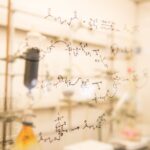
Banner image: Chemical reactions sketched on a fume hood in Katherine Seley-Radtke’s laboratory. Photo by Marlayna Demond ’11 for UMBC.
]]>
At a time when information and misinformation are coming at us from all directions, and everyone is looking for answers, UMBC researchers are stepping up. They’re working hard to answer pressing...
https://umbc.edu/stories/umbc-researchers-offer-knowledge-innovation-during-the-time-of-covid-19/
https://beta.my.umbc.edu/api/v0/pixel/news/119932/guest@my.umbc.edu/8cd750278ba11940b5d5026517a78cdd/api/pixel
alumni
biology
cahss
chembiochem
cnms
coeit
community
covidresearch
cr
ehs
is
meyerhoffscholars
page1
policy-and-society
psychology
science-and-technology
UMBC News & Magazine
https://beta.my.umbc.edu/groups/umbc-news-magazine
https://assets1-beta.my.umbc.edu/system/shared/avatars/groups/000/001/943/24435aa6207c452e7bc15cc74b42c7bb/xsmall.png?1748556657
https://assets1-beta.my.umbc.edu/system/shared/avatars/groups/000/001/943/24435aa6207c452e7bc15cc74b42c7bb/original.png?1748556657
https://assets2-beta.my.umbc.edu/system/shared/avatars/groups/000/001/943/24435aa6207c452e7bc15cc74b42c7bb/xxlarge.png?1748556657
https://assets2-beta.my.umbc.edu/system/shared/avatars/groups/000/001/943/24435aa6207c452e7bc15cc74b42c7bb/xlarge.png?1748556657
https://assets3-beta.my.umbc.edu/system/shared/avatars/groups/000/001/943/24435aa6207c452e7bc15cc74b42c7bb/large.png?1748556657
https://assets1-beta.my.umbc.edu/system/shared/avatars/groups/000/001/943/24435aa6207c452e7bc15cc74b42c7bb/medium.png?1748556657
https://assets2-beta.my.umbc.edu/system/shared/avatars/groups/000/001/943/24435aa6207c452e7bc15cc74b42c7bb/small.png?1748556657
https://assets1-beta.my.umbc.edu/system/shared/avatars/groups/000/001/943/24435aa6207c452e7bc15cc74b42c7bb/xsmall.png?1748556657
https://assets2-beta.my.umbc.edu/system/shared/avatars/groups/000/001/943/24435aa6207c452e7bc15cc74b42c7bb/xxsmall.png?1748556657
UMBC News & Magazine
0
0
false
Mon, 30 Mar 2020 16:23:42 -0400
Jovan James ’13 Breaks Through at Sundance

For an independent filmmaker, recognition from the Sundance Film Festival is a big deal. This past January, Jovan James ’13, visual arts, along with co-director Elegance Bratton, presented their short film Buck at Sundance to an appreciative crowd of industry insiders.
“It was incredible because you wonder when you make your work if someone is going to care about this, will it matter?” said James recently upon hearing the news that the film was selected for Sundance. “It feels great to be seen, to know that you are doing the right thing by telling stories that you want to tell, and not compromising.”
Getting to Sundance is an incredible accomplishment on its face, as well as an important opportunity to network within a key professional community. For James it could also mean an auspicious entrance to a career in film, considering the results of early support from the Sundance Institute – think Ryan Coogler’s Fruitvale Station, Paul Thomas Anderson’s Hard Eight, or Quentin Tarantino’s Reservoir Dogs.
 Jovan James. Photo by Michael Ori.
Motivated to Make a Difference
Completed in 2019, Buck is James’ MFA thesis film – the culmination of his graduate studies in the NYU Tisch School for the Arts Graduate Film program. It is a story about a young black man, Lynn, caught in the throes of a depressive fugue. Seeking escape, he resorts to debauchery with an older white lover Richard. But, rather than joy, he discovers that happiness is a more complicated proposition.
Aware of the mental health crisis facing the black gay community – noted by a rise in suicide rates and drug addiction as the rate of HIV infection hovers at 50% – James approached this project from a very personal perspective. He wanted Buck to tell a story that could speak to this community – his community – and suggest a way towards a different outcome.
Young black men like Gemmel Moore, who was in the news after overdosing in the home of wealthy white political donor Ed Buck, were on the minds of the directors as they selected a title for their film, they said, along with the commodification of black male bodies, as the term references black male slaves and black male sex workers.
The Through Line: Collaboration
As a transfer student to UMBC from CCBC Essex, James lived on campus and enjoyed the grit of the community. He often found himself among other dedicated students working at all hours in the Fine Arts Building, making short films for classes and with close friends throughout his time at UMBC.
“A lot of my path, of course, began at UMBC…I met a lot of interesting people on campus…and I left the country on the study abroad program (in Milan, Italy in 2012 at Università Cattolica del Sacro Cuore), that was a big moment in my life.” He goes on to recount the sense at UMBC that to be great you had to work really, really hard and want success. “I’m thankful for that – it really gave me my sense of determination, and allowed me to experiment.”
Once at NYU, there was pressure to follow the “auteur model” of filmmaking, but the egoism in the approach went against the way he wants to lead. Collaboration has been an important element of his filmmaking, ever since the early days at UMBC and throughout production of the three short films he has released – The Jump Off (2017) and Tadpole (2018) preceded Buck – since entering the program at NYU. Bratton and his husband, producer and costume designer Chester Algernal Gordon, have become key collaborators.
Assistant professor Susan McCully recalls James from her playwriting class: “He was always front and center in class – completely focused. He challenged me frequently; it was always the kind of defiance that I yearn for from my students. His questioning was always about his growth, not about him protecting his ego. I’ve been following his journey through NYU and now in the world. I’m not surprised by his success. I’m proud that his work is ‘out’ and defiant and about people growing in the world.”
 Jovan James on set. Photo by Dawn Hall.
Bringing the Work Home
James currently lives in L.A. while interning at Bad Robot Productions in a coveted year-long internship program that gives him direct access to people who can help his career. (He recently had an opportunity to screen Buck for his colleagues, including Bad Robot head J.J. Abrams!) But, James can’t wait to share Buck in Baltimore, where so much of his inspiration comes from. News of an upcoming screening in Baltimore is forthcoming.
All three of James’ films have been shot in Baltimore and he hopes to shoot his first feature in his hometown. Buck was recently named an official selection of the 22nd Annual Maryland Film Festival and will be screened during the festival’s revised virtual edition from June 12 to 21.
“There are so many environments in Maryland that I want to use,” said James.“I want to bring that love and attention to my city…and money, jobs, and mentorship programs to teach kids to gaff, do sound, costumes, AD and also to direct, write and produce their stories!”
* * * * *
Header image: James (left) on set with his crew. Photo by Dawn Hall.
See more from Jovan James on Instagram and Twitter.
]]>
For an independent filmmaker, recognition from the Sundance Film Festival is a big deal. This past January, Jovan James ’13, visual arts, along with co-director Elegance Bratton, presented their...
https://umbc.edu/stories/jovan-james-13-breaks-through-at-sundance/
https://beta.my.umbc.edu/api/v0/pixel/news/119933/guest@my.umbc.edu/9aa2f18c21e5f5cde2a74908ac484680/api/pixel
alumni
cahss
visual-arts
UMBC News & Magazine
https://beta.my.umbc.edu/groups/umbc-news-magazine
https://assets1-beta.my.umbc.edu/system/shared/avatars/groups/000/001/943/24435aa6207c452e7bc15cc74b42c7bb/xsmall.png?1748556657
https://assets1-beta.my.umbc.edu/system/shared/avatars/groups/000/001/943/24435aa6207c452e7bc15cc74b42c7bb/original.png?1748556657
https://assets2-beta.my.umbc.edu/system/shared/avatars/groups/000/001/943/24435aa6207c452e7bc15cc74b42c7bb/xxlarge.png?1748556657
https://assets2-beta.my.umbc.edu/system/shared/avatars/groups/000/001/943/24435aa6207c452e7bc15cc74b42c7bb/xlarge.png?1748556657
https://assets3-beta.my.umbc.edu/system/shared/avatars/groups/000/001/943/24435aa6207c452e7bc15cc74b42c7bb/large.png?1748556657
https://assets1-beta.my.umbc.edu/system/shared/avatars/groups/000/001/943/24435aa6207c452e7bc15cc74b42c7bb/medium.png?1748556657
https://assets2-beta.my.umbc.edu/system/shared/avatars/groups/000/001/943/24435aa6207c452e7bc15cc74b42c7bb/small.png?1748556657
https://assets1-beta.my.umbc.edu/system/shared/avatars/groups/000/001/943/24435aa6207c452e7bc15cc74b42c7bb/xsmall.png?1748556657
https://assets2-beta.my.umbc.edu/system/shared/avatars/groups/000/001/943/24435aa6207c452e7bc15cc74b42c7bb/xxsmall.png?1748556657
UMBC News & Magazine
0
0
false
Fri, 27 Mar 2020 15:39:27 -0400
Could chloroquine treat coronavirus? 5 questions answered about a promising, problematic and unproven use for an antimalarial drug

by Katherine Seley-Radtke, Professor of Chemistry and Biochemistry, UMBC, and President-Elect of the International Society for Antiviral Research
Read Seley-Radtke’s April 3rd update of this story here.
An Arizona man died, and his wife was hospitalized, after taking a form of chloroquine, which President Trump has touted as an effective treatment for COVID-19. The couple decided to self-medicate with chloroquine phosphate, which they had on hand to kill parasites in their fish, after hearing the president describe the drug as a “game changer.”
Dr. Anthony Fauci, head of NIH’s National Institute for Allergies and Infectious Diseases, quickly corrected the statement, explaining that Trump’s comments were based on anecdotes and not a controlled clinical trial.
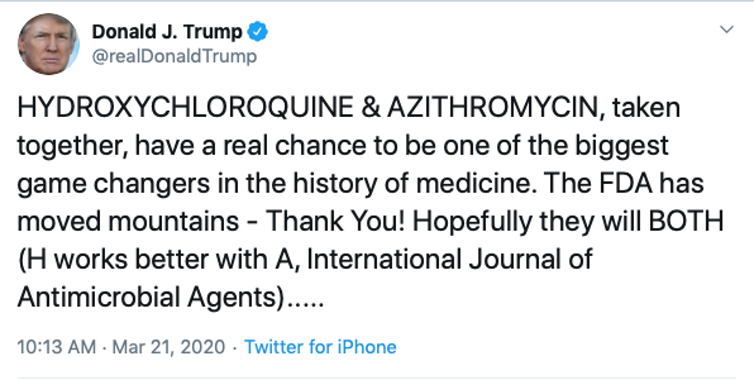 Donald Trump’s Twitter feed.
@realDonaldTrump
I am a medicinal chemist who specializes in discovery and development of antiviral drugs, and I have been actively working on coronaviruses for seven years.
However, because I am a scientist and I deal in facts and evidence-based medicine, I am concerned about the sweeping statements the president has been making regarding the use of chloroquine or the closely related hydroxychloroquine, both antimalarial drugs, as cures for COVID-19. So let’s examine the facts.
What are chloroquine and hydroxychloroquine?
These are both FDA-approved antimalarial drugs that have been in use for many years. Chloroquine was originally developed in 1934 at the pharmaceutical company Bayer and used in World War II to prevent malaria.
Although the FDA has not approved its use for these conditions, both chloroquine and hydroxychloroquine are also used to treat rheumatoid arthritis and lupus.
What triggered talk that this drug might work?
After the initial outbreak of MERS in 2012, scientists conducted random screens of thousands of approved drugs to identify one that might block MERS infection. Several drugs, including chloroquine, showed the ability to block coronaviruses from infecting cells in vitro. But these drugs were not extensively pursued because ultimately they did not show enough activity to be considered further.
When the new coronavirus appeared, many drugs that had shown some initial promise against the related coronaviruses MERS and SARS were at the top of the list as worthy of further evaluation as possible treatments.
So the science is real, and a number of labs around the world are now investigating these drugs and testing them in clinical trials in the U.S., France and China. But so far, there is no consensus about whether the drugs are safe and effective for treating COVID-19, as it is still very early in the testing process.
Why would antimalarial drugs work on a virus?
It is still unclear how the chloroquines (or any antimalarial drug) would work against COVID-19, which is a virus. Malaria is caused by Plasmodium parasites that are spread by mosquitoes, whereas COVID-19 is caused by the SARS-CoV-2 virus.
Viral infections and parasitic infections are very different, and so scientists wouldn’t expect what works for one to work for the other. It has been suggested that the chloroquines can change the acidity at the surface of the cell, thereby preventing the virus from infecting it.
It’s also possible chloroquines help activate the immune response. One study that was just published tested hydroxychloroquine in combination with an antibacterial drug (azithromycin), which worked better to stop the spread of the infection than hydroxychloroquine alone. However it’s only one preliminary study that was done on a limited test group.
Do other drugs show promise?
To my knowledge, no other antimalarial drugs have shown any meaningful activity against treating coronaviruses. However, another potential drug has risen to the forefront. Remdesivir, developed by Gilead Pharmaceuticals, seems to be highly effective at preventing viruses – including coronaviruses such as SARS and MERS, and filoviruses such as Ebola – from replicating.
In late February the National Institute for Allergy and Infectious Diseases launched a clinical trial for Remdesivir. And this month Gilead launched two phase III trials of the drug in medical centers in Asia.
Should I start taking them to ward off coronavirus?
Absolutely not. Chloroquine and hydroxychloroquine have not been appropriately evaluated in controlled studies, not to mention that they have numerous and, in some cases, very deadly side effects.
No one should take a drug that has not been proven to be safe and effective for a disease or condition for which it is not approved. There are just so many issues that can arise, from side effects to serious toxicity and death due to possible interactions with other medications and other underlying health conditions.
So until these or any drugs have been shown to be effective against SARS-CoV-2 in clinical trials and have been approved by the FDA, no one should be self-medicating.
* * * * *
[You need to understand the coronavirus pandemic, and we can help. Read our newsletter.]
Katherine Seley-Radtke, Professor of Chemistry and Biochemistry and President-Elect of the International Society for Antiviral Research, University of Maryland, Baltimore County
Header image: An employee in Nantong, China, checks the production of chloroquine phosphate, an old drug for the treatment of malaria. Feature China/Barcroft Media via Getty Images
This article is republished from The Conversation under a Creative Commons license. Read the original article.
]]>
by Katherine Seley-Radtke, Professor of Chemistry and Biochemistry, UMBC, and President-Elect of the International Society for Antiviral Research Read Seley-Radtke’s April 3rd update of this...
https://umbc.edu/stories/could-chloroquine-treat-coronavirus-5-questions-answered-about-a-promising-problematic-and-unproven-use-for-an-antimalarial-drug/
https://beta.my.umbc.edu/api/v0/pixel/news/119934/guest@my.umbc.edu/17d082b44e3c06233c4b581546903512/api/pixel
chemistry-and-biochemistry
covidresearch
discovery
the-conversation
UMBC News & Magazine
https://beta.my.umbc.edu/groups/umbc-news-magazine
https://assets1-beta.my.umbc.edu/system/shared/avatars/groups/000/001/943/24435aa6207c452e7bc15cc74b42c7bb/xsmall.png?1748556657
https://assets1-beta.my.umbc.edu/system/shared/avatars/groups/000/001/943/24435aa6207c452e7bc15cc74b42c7bb/original.png?1748556657
https://assets2-beta.my.umbc.edu/system/shared/avatars/groups/000/001/943/24435aa6207c452e7bc15cc74b42c7bb/xxlarge.png?1748556657
https://assets2-beta.my.umbc.edu/system/shared/avatars/groups/000/001/943/24435aa6207c452e7bc15cc74b42c7bb/xlarge.png?1748556657
https://assets3-beta.my.umbc.edu/system/shared/avatars/groups/000/001/943/24435aa6207c452e7bc15cc74b42c7bb/large.png?1748556657
https://assets1-beta.my.umbc.edu/system/shared/avatars/groups/000/001/943/24435aa6207c452e7bc15cc74b42c7bb/medium.png?1748556657
https://assets2-beta.my.umbc.edu/system/shared/avatars/groups/000/001/943/24435aa6207c452e7bc15cc74b42c7bb/small.png?1748556657
https://assets1-beta.my.umbc.edu/system/shared/avatars/groups/000/001/943/24435aa6207c452e7bc15cc74b42c7bb/xsmall.png?1748556657
https://assets2-beta.my.umbc.edu/system/shared/avatars/groups/000/001/943/24435aa6207c452e7bc15cc74b42c7bb/xxsmall.png?1748556657
UMBC News & Magazine
0
0
false
Wed, 25 Mar 2020 17:11:16 -0400
Remembering Maurice Berger
Dear UMBC Community,
It is with great sadness that we share with you the passing of Dr. Maurice Berger, chief curator and research professor at UMBC’s Center for Art, Design and Visual Culture (CADVC), who died Sunday, March 22, in Craryville, New York from complications of COVID-19. A path-breaking art historian and curator, Maurice was a fierce advocate for social justice and an exceptionally caring human being. Through his exhibitions and writings, he compelled us to look honestly at issues of race, inequity, and their representations in visual culture.
Dr. Berger resided in New York City and was last on the UMBC campus on January 30.
“Maurice was a beloved member of the UMBC community, one of our most admired and productive scholars,” said UMBC President Freeman A. Hrabowski, III. “For many of us, he was even more than that. He was a special colleague and friend. We will always remember him as a brilliant voice for the arts and justice. The UMBC community so admired him because we shared the same values. He believed in the dignity of humankind and the power of art and history to open our eyes.”
Maurice began his career at UMBC in 1992, organizing a highly successful traveling exhibition entitled
Ciphers of Identity. Since that time, he organized major traveling exhibition projects for the CADVC, including the first traveling retrospectives of noted artists Adrian Piper and Fred Wilson, and the celebrated exhibition
For All the World to See: Visual Culture and the Struggle for Civil Rights, which was organized in partnership with the Smithsonian National Museum of African American History and Culture.
“Mr. Berger is uniquely qualified to lead people through this type of historical reexamination,” remarked The Baltimore Sun in reviewing For All the World to See. “He is critical of labels but identifies himself, among many other things, as Jewish and gay and counts the things he saw growing up among African-American children in a housing project on Manhattan’s Lower East Side as some of his most formative experiences. ‘Every time I do a show,’ says Mr. Berger, ‘I extend my hand to each and every [viewer] and say, I’ll take your hand and help you walk through this.’”
The full reach of Maurice’s creative and scholarly work was remarkable and difficult to quantify. To him, it was every bit as important for his message to touch people in Waconia, Minnesota, or Moscow, Idaho (where For All the World to See was exhibited) as urban centers like Baltimore or New York. He published books, wrote articles, engaged in online events, curated exhibitions, and would engage in conversation with any willing participant.
As chief curator for the CADVC, Maurice played a pivotal role in organizing important exhibition and publication partnerships for the CADVC with cultural institutions such as the Jewish Museum in New York, the International Center for Photography, Yale University Press, The Studio Museum of Harlem, and the Gordon Parks Foundation. His final project with the CADVC, The Museum of the Old Colony, an art installation by Pablo Delano, was exhibited on campus in spring 2020.
In 2018, he received the International Center of Photography’s Infinity Award for Critical Writing and Research for his column
Race Stories, which appeared monthly in
The New York Times. Race Stories explored the relationship of photography to concepts and social issues about race usually neglected by mainstream media. To facilitate the research and creation of Race Stories, Maurice received an Arts Writers Grant from the Andy Warhol Foundation in 2014.
In acknowledgment of his groundbreaking work, Maurice received major grants and awards from the National Endowment for the Humanities, National Endowment for the Arts, Association of Art Museum Curators, the International Association of Art Critics, and an Emmy Award nomination.
Maurice’s publications and exhibitions on race and gender in the United States won international recognition. His writings appeared in Artforum, Art in America, Aperture, National Geographic, Village Voice, Brooklyn Rail, Pen America, Wired, and the Los Angeles Times. His books included White Lies: Race and the Myths of Whiteness (Farrar, Straus and Giroux, 1999), a finalist for the Horace Mann Bond Book Award of the W.E.B. Du Bois Institute for Afro-American Research, Harvard University; and For All the World to See: Visual Culture and the Struggle for Civil Rights (Yale, 2010).
Countless colleagues of Maurice’s in UMBC’s CADVC, department of visual arts, College of Arts, Humanities, and Social Sciences, and elsewhere in the UMBC community have voiced their deep appreciation of his scholarly, as well as personal, contributions to the university. He will be sorely missed.
Maurice is survived by his husband, Marvin Heiferman, known to many in the UMBC community for his work as a senior visiting scholar and organizer of the “Seeing Science” project. Memorial plans will be announced.
Scott Casper, Dean, College of Arts, Humanities and Social Sciences
Symmes Gardner, Executive Director, Center for Art, Design and Visual Culture
]]>
Dear UMBC Community, It is with great sadness that we share with you the passing of Dr. Maurice Berger, chief curator and research professor at UMBC’s Center for Art, Design and Visual Culture...
https://umbc.edu/stories/remembering-maurice-berger/
https://beta.my.umbc.edu/api/v0/pixel/news/119935/guest@my.umbc.edu/938128595996add933829edf052e8d0e/api/pixel
in-memorium
rss
UMBC News & Magazine
https://beta.my.umbc.edu/groups/umbc-news-magazine
https://assets1-beta.my.umbc.edu/system/shared/avatars/groups/000/001/943/24435aa6207c452e7bc15cc74b42c7bb/xsmall.png?1748556657
https://assets1-beta.my.umbc.edu/system/shared/avatars/groups/000/001/943/24435aa6207c452e7bc15cc74b42c7bb/original.png?1748556657
https://assets2-beta.my.umbc.edu/system/shared/avatars/groups/000/001/943/24435aa6207c452e7bc15cc74b42c7bb/xxlarge.png?1748556657
https://assets2-beta.my.umbc.edu/system/shared/avatars/groups/000/001/943/24435aa6207c452e7bc15cc74b42c7bb/xlarge.png?1748556657
https://assets3-beta.my.umbc.edu/system/shared/avatars/groups/000/001/943/24435aa6207c452e7bc15cc74b42c7bb/large.png?1748556657
https://assets1-beta.my.umbc.edu/system/shared/avatars/groups/000/001/943/24435aa6207c452e7bc15cc74b42c7bb/medium.png?1748556657
https://assets2-beta.my.umbc.edu/system/shared/avatars/groups/000/001/943/24435aa6207c452e7bc15cc74b42c7bb/small.png?1748556657
https://assets1-beta.my.umbc.edu/system/shared/avatars/groups/000/001/943/24435aa6207c452e7bc15cc74b42c7bb/xsmall.png?1748556657
https://assets2-beta.my.umbc.edu/system/shared/avatars/groups/000/001/943/24435aa6207c452e7bc15cc74b42c7bb/xxsmall.png?1748556657
UMBC News & Magazine
0
0
false
Wed, 25 Mar 2020 15:00:57 -0400
Extraordinary Times and Extraordinary Community
March 20, 2020
Dear Members of the UMBC Community,
Many are calling this period a defining moment for humankind, and history will judge us by how we respond. As the COVID-19 crisis continues to unfold, we want you to know how proud we are of the ways that our community of inquiring minds has already been adapting. Thank you for all that you are doing to support one another, your families, and fellow citizens during these challenging times.
Campus leaders are meeting daily to navigate this rapidly changing reality, and we are working closely with USM Chancellor Jay Perman, other System campuses, and shared governance groups to plan necessary transitions in teaching, learning, research, and the daily life of our campus community.
We have had difficult decisions to make, and we have made them with the understanding that the health and safety of our community must be our top priority. In partnership with the University System of Maryland, we have determined that this means extending distance learning for the remainder of the spring semester. During this time, UMBC will remain open for student support services and business operations. In accordance with guidance provided by the Governor, employees will continue to work remotely whenever possible.
To our undergraduate and graduate students: We know you have been concerned with what happens next, and we are all feeling for you and with you. There is so much you hoped to do this semester, and it is such a disappointment to have these plans interrupted. Online instruction begins on Monday, March 23, and will continue throughout the semester. Faculty have been working with the Division of Information Technology and each other to ensure the highest quality of instruction.
To the Class of 2020, in particular, please know we recognize how hard you have worked to achieve your goals. We are very sorry that we will not be holding in-person Commencement ceremonies this spring. We know how difficult this is for you, your families, and your friends. Just know this is not the end. We may not be having the in-person ceremony, but we will find ways of recognizing you and celebrating your achievements.
A special thank you to our faculty and staff who have been doing everything they can to provide emotional, academic, and other types of support to our students.Over the coming weeks, patience and understanding will be essential as all of us adjust to these changes. We know that many students, faculty, and staff have questions, and we are committed to providing information and support. Pressing concerns we have heard include the following.
- We know that the shift to distance learning may have financial implications for students and families. We are working closely with USM to establish a system for refunds. We will announce more details in the days to come. Students with immediate resource concerns are encouraged to contact covid19@umbc.edu.
- Students who normally live on campus will soon receive information about the process for safely retrieving their belongings. Until this is established, students who have left campus for spring break will continue to be unable to access their residence halls. Students with an urgent need to retrieve items from their residence halls prior to this announcement may contact Residential Life.
We appreciate your patience and partnership as we move forward together in this new reality. Most important, we hope all of you and your families remain safe and healthy.
We will continue to communicate regularly, and we encourage you to visit UMBC’s COVID-19 website at covid19.umbc.edu for prevention steps, updates, and resources. Urgent questions can be sent to covid19@umbc.edu.
We leave you with these words from Jeanne Rikkers:
May we who are merely inconvenienced,
Remember those whose lives are at stake.
May we who have no risk factors,
Remember the most vulnerable.
May we who have the luxury of working from home,
Remember those who must choose between preserving their health or making their rent.
May we who have flexibility to care for our children when their schools close,
Remember those who have no options.
May we who have to cancel our trips,
Remember those that have no safe place to go.
May we who are losing our margin money in the tumult of the economic market,
Remember those who have no margin at all.
May we who settle in for a quarantine at home,
Remember those who have no home.
As fear grips our country,
Let us choose LOVE.
She concludes by noting that this is a time when we cannot physically wrap our arms around each other, and yet we certainly can find ways of providing a ‘loving embrace’ to our neighbors.
President Freeman Hrabowski and Provost Philip Rous
]]>
March 20, 2020 Dear Members of the UMBC Community, Many are calling this period a defining moment for humankind, and history will judge us by how we respond. As the COVID-19 crisis...
https://umbc.edu/stories/extraordinary-times-and-extraordinary-community/
https://beta.my.umbc.edu/api/v0/pixel/news/119936/guest@my.umbc.edu/438b8691fc768350968b0348d29fb4aa/api/pixel
impact
resilience
UMBC News & Magazine
https://beta.my.umbc.edu/groups/umbc-news-magazine
https://assets1-beta.my.umbc.edu/system/shared/avatars/groups/000/001/943/24435aa6207c452e7bc15cc74b42c7bb/xsmall.png?1748556657
https://assets1-beta.my.umbc.edu/system/shared/avatars/groups/000/001/943/24435aa6207c452e7bc15cc74b42c7bb/original.png?1748556657
https://assets2-beta.my.umbc.edu/system/shared/avatars/groups/000/001/943/24435aa6207c452e7bc15cc74b42c7bb/xxlarge.png?1748556657
https://assets2-beta.my.umbc.edu/system/shared/avatars/groups/000/001/943/24435aa6207c452e7bc15cc74b42c7bb/xlarge.png?1748556657
https://assets3-beta.my.umbc.edu/system/shared/avatars/groups/000/001/943/24435aa6207c452e7bc15cc74b42c7bb/large.png?1748556657
https://assets1-beta.my.umbc.edu/system/shared/avatars/groups/000/001/943/24435aa6207c452e7bc15cc74b42c7bb/medium.png?1748556657
https://assets2-beta.my.umbc.edu/system/shared/avatars/groups/000/001/943/24435aa6207c452e7bc15cc74b42c7bb/small.png?1748556657
https://assets1-beta.my.umbc.edu/system/shared/avatars/groups/000/001/943/24435aa6207c452e7bc15cc74b42c7bb/xsmall.png?1748556657
https://assets2-beta.my.umbc.edu/system/shared/avatars/groups/000/001/943/24435aa6207c452e7bc15cc74b42c7bb/xxsmall.png?1748556657
UMBC News & Magazine
0
0
false
Sat, 21 Mar 2020 17:40:00 -0400
Vodka won’t protect you from coronavirus, and 4 other things to know about hand sanitizer

by Jeffrey Gardner, Associate Professor of Biological Sciences, UMBC
Editor’s note: As concern about coronavirus grows, hand sanitizer is in high demand. Biologist Jeffrey Gardner explains why alcohol is a key ingredient in hand sanitizer, and why he doesn’t recommend making your own supply at home.
1. Why is alcohol the main ingredient in most hand sanitizers?
Alcohol is effective at killing different types of microbes, including both viruses and bacteria, because it unfolds and inactivates their proteins. This process, which is called denaturation, will cripple and often kill the microbe because its proteins will unfold and stick together. Heat can also denature some proteins – for example, when you cook an egg, the solidified egg whites are denatured proteins.
2. Alcohol doesn’t kill some microbes very well – why not?
There are different types of bacteria and viruses, and some types are more easily killed by alcohol. For example, E. coli bacteria, which can cause foodborne illness and other infections, are very effectively killed by alcohol at concentrations over 60%. Differences in the outside surface of various bacteria make alcohol sanitization more effective against some of them than others.
Similarly, some viruses have an outer wrapping, which is called an envelope, while others are non-enveloped. Alcohol is effective at killing enveloped viruses, including the coronavirus, but is less effective at killing non-enveloped viruses.
Whether you are trying to kill bacteria or viruses, many research studies have found that an alcohol concentration of 60% or greater is needed to be effective.
3. If 60% alcohol is good, is 100% better?
Surprisingly, no. Protein denaturation actually works faster when a small amount of water is mixed with the alcohol. And pure alcohol would evaporate too quickly to effectively kill bacteria or viruses on your skin, especially during winter when the air is less humid.
Using 100% alcohol also would dry your skin out very quickly and cause it to become irritated. That might cause you to not sanitize your hands as frequently as needed. This is why most hand sanitizers contain emollients, which are mixtures that help soften and moisturize your skin.
4. Are homemade hand sanitizers a good idea?
In my view, no. You may see do-it-yourself formulas online, including some that use vodka. However, vodka is typically 80 proof, which means it’s only 40% alcohol. That’s not high enough to effectively kill microbes.
The rubbing alcohol you have in your bathroom for cuts and scrapes might seem like a good alternative, but if you are already near a sink, the best choice is to wash your hands with soap and hot water.
5. Does hand sanitizer expire?
Most commercial hand sanitizers are effective for a couple of years when they are stored properly, and are marked with expiration dates. One thing to keep in mind is that alcohol is volatile, which means that over time the alcohol will slowly evaporate and the sanitizer will lose its ability to effectively kill viruses and bacteria. However, with hand sanitizer in such high demand now, you’re unlikely to buy one that is expired.
* * * * *
[You’re smart and curious about the world. So are The Conversation’s authors and editors. You can get our highlights each weekend.]
Jeffrey Gardner, Associate Professor of Biological Sciences, University of Maryland, Baltimore County
This article is republished from The Conversation under a Creative Commons license. Read the original article.
Header image: Soap and hot water is the best way to clean your hands, but sanitizer is a good second choice.
AP Photo/Ric Feld
]]>
by Jeffrey Gardner, Associate Professor of Biological Sciences, UMBC Editor’s note: As concern about coronavirus grows, hand sanitizer is in high demand. Biologist Jeffrey Gardner explains why...
https://umbc.edu/stories/vodka-wont-protect-you-from-coronavirus-and-4-other-things-to-know-about-hand-sanitizer/
https://beta.my.umbc.edu/api/v0/pixel/news/119937/guest@my.umbc.edu/71060ce23857f8cbeb70ab6dbcfb54ff/api/pixel
biology
cnms
covidresearch
discovery
the-conversation
UMBC News & Magazine
https://beta.my.umbc.edu/groups/umbc-news-magazine
https://assets1-beta.my.umbc.edu/system/shared/avatars/groups/000/001/943/24435aa6207c452e7bc15cc74b42c7bb/xsmall.png?1748556657
https://assets1-beta.my.umbc.edu/system/shared/avatars/groups/000/001/943/24435aa6207c452e7bc15cc74b42c7bb/original.png?1748556657
https://assets2-beta.my.umbc.edu/system/shared/avatars/groups/000/001/943/24435aa6207c452e7bc15cc74b42c7bb/xxlarge.png?1748556657
https://assets2-beta.my.umbc.edu/system/shared/avatars/groups/000/001/943/24435aa6207c452e7bc15cc74b42c7bb/xlarge.png?1748556657
https://assets3-beta.my.umbc.edu/system/shared/avatars/groups/000/001/943/24435aa6207c452e7bc15cc74b42c7bb/large.png?1748556657
https://assets1-beta.my.umbc.edu/system/shared/avatars/groups/000/001/943/24435aa6207c452e7bc15cc74b42c7bb/medium.png?1748556657
https://assets2-beta.my.umbc.edu/system/shared/avatars/groups/000/001/943/24435aa6207c452e7bc15cc74b42c7bb/small.png?1748556657
https://assets1-beta.my.umbc.edu/system/shared/avatars/groups/000/001/943/24435aa6207c452e7bc15cc74b42c7bb/xsmall.png?1748556657
https://assets2-beta.my.umbc.edu/system/shared/avatars/groups/000/001/943/24435aa6207c452e7bc15cc74b42c7bb/xxsmall.png?1748556657
UMBC News & Magazine
0
0
false
Fri, 13 Mar 2020 18:14:50 -0400
UMBC historian Anne Rubin examines food scarcity in the Confederate South through NEH fellowship

“Historians know that the Confederacy ran out of food by the end of the Civil War, and it shouldn’t have because it was an agricultural society,” says Anne Rubin, professor of history at UMBC. “I want to understand the causes of this, and the lived experience of different social classes during this time.”
Rubin has just received a 2020 – 2021 National Endowment for the Humanities (NEH) fellowship to write a book examining how food shortages in the South affected wealthy and poor people, both white and black, during and after the Civil War, ultimately shaping Southern foodways.
 Anne Rubin. Photo by Marlayna Demond ’11 for UMBC.
Rubin’s award follows an NEH grant received last year by her colleague Susan McDonough, assistant professor of history, whose award supported more inclusive research on medieval women.
Everyday documents as research tools
A resurgence in the popularity of Southern foods inspired Rubin to take a closer look at Southerners’ experiences with food during the Civil War. “There is a real nostalgia when people talk about heritage pork and heritage grains,” she reflects. “I want to cut through that. This kind of reverence for the past does not include a conversation of who was preparing the food or any of the racialized aspects of Southern cooking.”
Rubin will research the differences between rural and urban food scarcity, and how that scarcity was felt by people at different places in society. There were white elites that for the first time had to manage with ingredients they deemed subpar. There were also enslaved people who had to continue cooking for elite whites and for themselves with less and less food.
Rubin will also explore the experiences of poor whites, who may have already had to adjust their diets drastically as resources waned, and the 500,000 African Americans who fled to the Union Army, where they were given inadequate rations and suffered from sickness and malnutrition. All of these changes influenced the strategies Southerners used to modify traditional recipes, replacing inaccessible ingredients with alternatives.

A page from Mrs. Prudence M. Sutherland’s handwritten cookbook. Virginia Museum of History and Culture. Photo courtesy of Rubin.
“A lot of the scarcity has to do with questions of supply,” explains Rubin. “Research shows that wealthy people in the South who were used to cooking with white flour and white sugar began to make substitutions with ingredients usually reserved for the poor, like molasses and cornmeal.” Recipe adaptations were recorded in homemade recipe books, letters, diaries, relief receipts, and ration logs from army camps.
Her research thus far also shows that the adaptations made by elite white Southerners became a way to show allegiance with the Confederacy. Southerners accepted not being able to have coffee and were willing to make other sacrifices as long as it meant the Confederacy could keep fighting.
“These responses create a narrative of patriotism and nationalism around food,” shares Rubin. “There is an intention of using food and the history of food as a way to express loyalty to the Confederacy. But the experience of African Americans, poor whites, and elites varied drastically.”
Surviving famine and starvation
Two key questions Rubin hopes to answer focus on the management of food: Why did an agricultural society struggle to feed its citizens? And how did people survive the compounding effects of the 1867 famine that followed the Civil War, caused by crop failure?
“Part of my research is looking at the response of the Freedmen’s Bureau to feed African Americans. I also explore the work of elite Northerners providing relief,” explains Rubin.
Next, she will travel to archives in North Carolina, Louisiana, and other states in the South to piece together a social network analysis. This will help her better understand those affected by food scarcity in the South, those who provided help, who was receiving help, and what kind of help they were receiving.

Rations issued by the Freedmen’s Bureau at Fort Smith Arkansas, June-July, 1867. National Archives. Photo courtesy of Rubin.
The historian’s toolbox
Rubin teaches a Civil War and Reconstruction class as well as two Southern history classes—one that goes through the Civil War and one that starts with emancipation. She wants to share with her students the research methods she is using to develop this book, to broaden their sense of how we can learn about the past by looking beyond military history.
“I research people who don’t always leave letters or diaries, but can be found through a receipt for the food they were given,” says Rubin. “I want students to think of food history as another tool in the historian’s toolbox—that you can look at a recipe and you can piece together a whole social network from it.”
This approach to history is also reflected in Rubin’s work as associate director of UMBC’s Imaging Research Center, known for providing visually immersive websites and exhibits that bring a greater understanding to historical events.
Continuing excellence in historical research
Rubin’s award is one of several that faculty in the history department have received this year, honoring and advancing their scholarship in a broad range of subject areas.
Constantine Vaporis will soon be a fellow in residence at the Institute for Advanced Study in Princeton, New Jersey. Vaporis is both a professor of history and director of Asian studies. He will research portraits of Samurai in early modern Japan.
Christy Chapin, associate professor of history, has won an American Council of Learned Societies fellowship for her research on flexible finance. She previously received a Kluge Fellowship to study the banking and finance collections at the U.S. Library of Congress.
Banner image: Rubin at The Humanities Teaching Lab: Frederick Douglass Day. Photo by Marlayna Demond ’11 for UMBC.
]]>
“Historians know that the Confederacy ran out of food by the end of the Civil War, and it shouldn’t have because it was an agricultural society,” says Anne Rubin, professor of history at UMBC. “I...
https://umbc.edu/stories/umbc-historian-anne-rubin-examines-food-scarcity-in-the-confederate-south-through-neh-fellowship/
https://beta.my.umbc.edu/api/v0/pixel/news/119938/guest@my.umbc.edu/3fcf089b66e2d05116b3ae9feda8118f/api/pixel
cahss
history
policy-and-society
research
UMBC News & Magazine
https://beta.my.umbc.edu/groups/umbc-news-magazine
https://assets1-beta.my.umbc.edu/system/shared/avatars/groups/000/001/943/24435aa6207c452e7bc15cc74b42c7bb/xsmall.png?1748556657
https://assets1-beta.my.umbc.edu/system/shared/avatars/groups/000/001/943/24435aa6207c452e7bc15cc74b42c7bb/original.png?1748556657
https://assets2-beta.my.umbc.edu/system/shared/avatars/groups/000/001/943/24435aa6207c452e7bc15cc74b42c7bb/xxlarge.png?1748556657
https://assets2-beta.my.umbc.edu/system/shared/avatars/groups/000/001/943/24435aa6207c452e7bc15cc74b42c7bb/xlarge.png?1748556657
https://assets3-beta.my.umbc.edu/system/shared/avatars/groups/000/001/943/24435aa6207c452e7bc15cc74b42c7bb/large.png?1748556657
https://assets1-beta.my.umbc.edu/system/shared/avatars/groups/000/001/943/24435aa6207c452e7bc15cc74b42c7bb/medium.png?1748556657
https://assets2-beta.my.umbc.edu/system/shared/avatars/groups/000/001/943/24435aa6207c452e7bc15cc74b42c7bb/small.png?1748556657
https://assets1-beta.my.umbc.edu/system/shared/avatars/groups/000/001/943/24435aa6207c452e7bc15cc74b42c7bb/xsmall.png?1748556657
https://assets2-beta.my.umbc.edu/system/shared/avatars/groups/000/001/943/24435aa6207c452e7bc15cc74b42c7bb/xxsmall.png?1748556657
UMBC News & Magazine
0
0
false
Tue, 10 Mar 2020 21:20:26 -0400
 Photo by Carl Mikoy. Used under
  Photo by Kyler Kwock. Used under