UMBC researchers receive a Fast Grant to study antivirals’ effectiveness against COVID-19

Katherine Seley-Radtke, professor of chemistry and biochemistry, has received a six-month Fast Grant to test antiviral compounds developed in her lab for effectiveness against COVID-19. Collaborators on the grant include Chuck Bieberich, professor of biological sciences at UMBC, and colleagues at Johns Hopkins University and Cornell University.
“A normal NIH grant takes almost a year from submission to receiving the money, and in this time of crisis, we don’t have that luxury,” Seley-Radtke says. “The Fast Grants program awards funding in days, thus allowing us to get critical results immediately.” The Fast Grants are funded by a consortium of entrepreneurs, investors, and innovators, and applications are judged by a panel of biomedical experts.
The grants have only been given to the most promising projects that can return results quickly. Many have gone to some of the most prestigious research institutions in the world, including Stanford University, MIT, and Columbia University. “We are honored to be included in such company,” Seley-Radtke says.
 Chuck Bieberich, professor of biological sciences, has expertise in animal trials and will collaborate with Seley-Radtke on the antiviral research.
A flexible approach
Seley-Radtke’s research has already shown that her compounds act powerfully against viruses such as Ebola, MERS, SARS, Zika, Dengue, and other human coronaviruses that cause cold symptoms. The compounds work similarly to Remdesivir, another antiviral compound undergoing trials for its efficacy against COVID-19. Seley-Radtke’s compounds are distinctive in that their structure allows them to adopt different shapes, affording them several advantages over Remdesivir.
These “fleximers,” as Seley-Radtke has named them, interfere with two different viral enzymes that the virus needs to replicate; Remdesivir interferes with just one. The fleximers stop the viral enzymes without harming very similar human ones, which is critical to making the compounds safe, Seley-Radtke explains.
The fleximers can also avoid being rendered inactive by a coronavirus defense mechanism. Coronaviruses have a special enzyme that seeks out and removes unnatural compounds that the virus has mistakenly incorporated into its replication process. The fleximers’ ability to take on different shapes protects them from this defense. The compounds’ flexibility also helps them maintain potency in the face of viral resistance.
“Given that recent reports suggest more than 40 different strains of SARS CoV-2 are currently circulating, the ability to avoid resistant mechanisms will be critical for developing a clinically relevant antiviral,” Seley-Radtke says.
 Nia’mani Robinson ’21 conducts research in Katherine Seley-Radtke’s lab.
Gathering crucial data
These compounds have already shown activity against SARS COV-2 in test tubes, but there are still many steps in the journey toward an approved drug for human use, including studies in animals and then human trials.
“Our efforts for the Fast Grant award will be focused on obtaining the critical animal data needed to move these potent compounds toward clinical trials,” Seley-Radtke says. “Although we have been working on SARS, MERS, and human coronaviruses for a number of years, the awarding of these funds is indeed validation of the importance of our work. And it is particularly important given the urgency due to the ongoing pandemic.”
Seley-Radtke has also been active in sharing her expertise in the media, including writing articles for The Conversation that have garnered nearly 800,000 reads. She has also spoken with news outlets such as theBBC,Washington Post,NPR,Washington Examiner, and many more.
Banner image: Katherine Seley-Radtke. Photo by Matt Radtke.
Other photos by Marlayna Demond ’11 for UMBC.
]]>
Katherine Seley-Radtke, professor of chemistry and biochemistry, has received a six-month Fast Grant to test antiviral compounds developed in her lab for effectiveness against COVID-19....
https://umbc.edu/stories/umbc-researchers-receive-a-fast-grant-to-study-antivirals-effectiveness-against-covid-19/
https://beta.my.umbc.edu/api/v0/pixel/news/119900/guest@my.umbc.edu/e847fa1b63a865accc92a18ef6c07a00/api/pixel
chembiochem
cnms
covidresearch
page1
research
science-and-technology
UMBC News & Magazine
https://beta.my.umbc.edu/groups/umbc-news-magazine
https://assets1-beta.my.umbc.edu/system/shared/avatars/groups/000/001/943/24435aa6207c452e7bc15cc74b42c7bb/xsmall.png?1748556657
https://assets1-beta.my.umbc.edu/system/shared/avatars/groups/000/001/943/24435aa6207c452e7bc15cc74b42c7bb/original.png?1748556657
https://assets2-beta.my.umbc.edu/system/shared/avatars/groups/000/001/943/24435aa6207c452e7bc15cc74b42c7bb/xxlarge.png?1748556657
https://assets2-beta.my.umbc.edu/system/shared/avatars/groups/000/001/943/24435aa6207c452e7bc15cc74b42c7bb/xlarge.png?1748556657
https://assets3-beta.my.umbc.edu/system/shared/avatars/groups/000/001/943/24435aa6207c452e7bc15cc74b42c7bb/large.png?1748556657
https://assets1-beta.my.umbc.edu/system/shared/avatars/groups/000/001/943/24435aa6207c452e7bc15cc74b42c7bb/medium.png?1748556657
https://assets2-beta.my.umbc.edu/system/shared/avatars/groups/000/001/943/24435aa6207c452e7bc15cc74b42c7bb/small.png?1748556657
https://assets1-beta.my.umbc.edu/system/shared/avatars/groups/000/001/943/24435aa6207c452e7bc15cc74b42c7bb/xsmall.png?1748556657
https://assets2-beta.my.umbc.edu/system/shared/avatars/groups/000/001/943/24435aa6207c452e7bc15cc74b42c7bb/xxsmall.png?1748556657
UMBC News & Magazine
0
0
false
Wed, 06 May 2020 22:13:36 -0400
Remdesivir Explained – What Makes This Drug Work Against Viruses?
By Katherine Seley-Radtke, professor, Chemistry and Biochemistry, UMBC
With the FDA approving Gilead’s Remdesivir as an emergency use treatment for the most acute cases of COVID-19, many people are wondering what type of a drug it is.
Remdesivir is a member of one of the oldest and most important classes of drugs – known as nucleoside analogue. Currently there are more than 30 of these types of drugs that have been approved for use in treating viruses, cancers, parasites, as well as bacterial and fungal infections, with many more currently in clinical and preclinical trials.
I am a medicinal chemist who has worked in design and synthesis of these important drug treatments for over 30 years. I have written numerous reviews over the years about these drugs and their structure and function, and as a result have had many inquiries lately from friends, family and others not in the field asking me to explain what exactly is it about Remdesivir that makes it so effective, but also why it is so interesting. Understanding why means digging into the biochemistry of this class of drugs.
Fake genetic building blocks
The reason nucleoside analogues and a similar group called nucleotide analogues are so effective is that they resemble the naturally occurring molecules known as nucleosides – cytidine, thymidine, uridine, guanosine and adenosine. These are the essential building blocks for the DNA and RNA that carry our genetic information and play critical roles in our body’s biological processes.
Slight differences in the chemical structure of these analogues from naturally occurring compounds make them effective as drugs. If an organism like a virus incorporates a nucleoside analogue into its genetic material, rather than the real thing, even small changes to the structure of these building blocks prevent the regular chemistry from happening and ultimately foils the ability of the virus to replicate.
The basic structure of a nucleoside includes a sugar group and a base (A, C, G, T or U), and in the case of a nucleotide, a group containing a phosphate which is a collection of oxygen and phosphorus atoms.
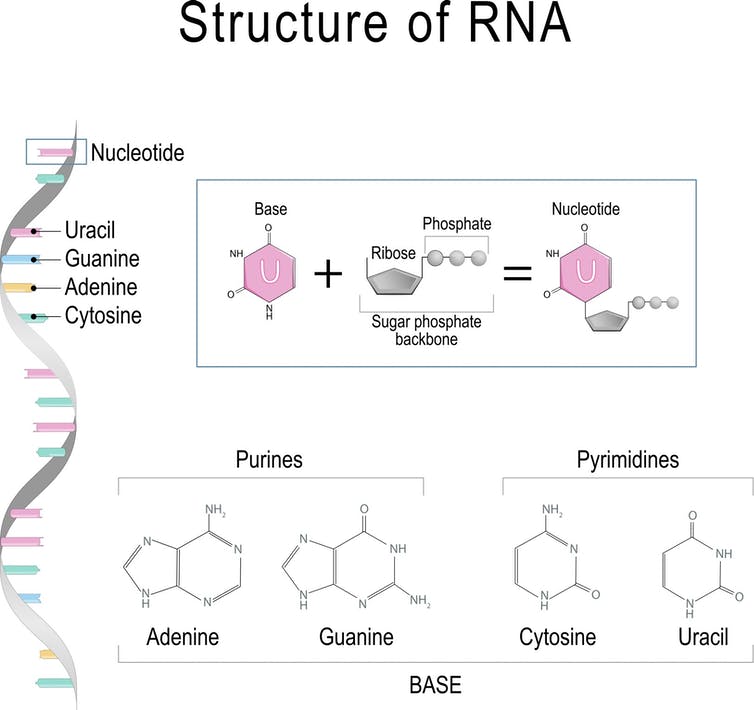 Every building block of DNA is made from three parts: a sugar, a base (A, C, G, or T) and a phosphate group. Every building block of RNA is made from (A, C, G, or U). ttsz / Getty Images
The first nucleoside analogues were approved for medicinal use in the 1950s. The early nucleosides had only simple modifications, typically either to the sugar or the base, while today’s nucleosides, such as Remdesivir, typically have several modifications to their structure. These modifications are essential to their therapeutic activity.
How does Remdesivir work as antiviral therapeutic?
This activity occurs because nucleoside/tide analogues mimic the structure of a natural nucleoside or nucleotide such that they are recognized by, for example, viruses. Due to those structural modifications, however, they stop or interrupt viral replication, which stops the virus from multiplying and infecting more cells in the body.
As a result, they are known as direct-acting antivirals, and this is the case for Remdesivir, which works by blocking the coronavirus’s RNA polymerase – one of the key enzymes that this virus needs to replicate its genetic material (RNA) and proliferate in our bodies. Remdesivir works when the enzyme replicating the genetic material for a new generation of viruses accidentally grabs this nucleoside analogue rather than the natural molecule and incorporates it into the growing RNA strand. Doing this essentially blocks the rest of the RNA from being replicated; this in turn prevents the virus from multiplying.
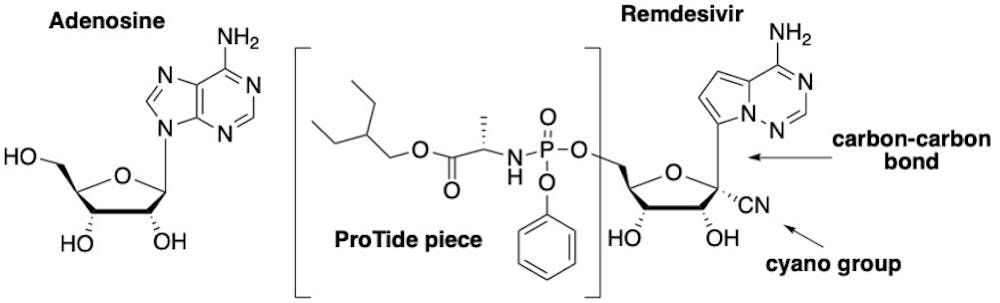
The drug Remdesivir is basically an altered version of the natural building block adenosine – which is essential for DNA and RNA. Comparing the structure of Remdesivir with adenosine, one can see there are three key modifications that make it effective.
The first is that Remdesivir, as it is administered, is not the actual active drug; it is actually a “prodrug,” meaning it must be modified once in the body before it becomes an active drug. Prodrugs are used for many reasons, including protecting a drug until it reaches its site of action. The active form of Remdesivir contains three phosphate groups; it is this form that is recognized by the virus’s RNA polymerase enzyme.
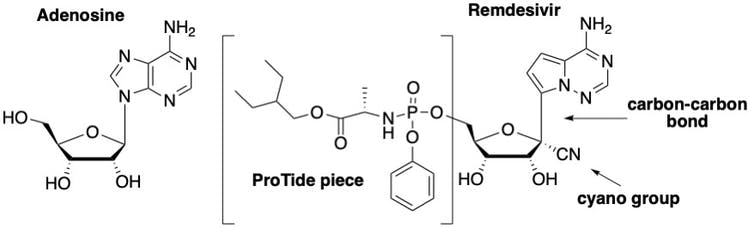 A naturally occurring nucleotide (left) which is a building block of RNA and DNA and Remdesivir (right) which is a variation on its natural counterpart. Katherine Seley-Radtke, CC BY-SA
The second important modification on Remdesivir is the carbon-nitrogen (CN) group attached to the sugar. Once Remdesivir is incorporated into the RNA growing chain, the presence of this CN group causes the shape of the sugar to pucker, which, in turn, distorts the shape of the RNA strand such that only three more nucleotides can be added. This terminates the production of the RNA strand and is what ultimately sabotages the replication of the virus.
The third important structural feature which makes Remdesivir differ from adenosine is the change of one particular chemical bond on the molecule. Rather than a bond linking a carbon and nitrogen atoms, chemists replaced the nitrogen with another carbon, creating a carbon-carbon bond. This is critical to the success of this drug because coronaviruses have a special enzyme that recognizes unnatural nucleosides and clips them out. But by changing this chemical bond, Remdesivir cannot be removed by the enzyme, allowing it to stay in the growing chain and block replication.
Remdesivir trials
Remdesivir originally was found during a drug discovery program at Gilead to search for inhibitors of the hepatitis C virus, which is another RNA virus. Although Gilead ultimately selected a different nucleoside analogue for treatment of hepatitis the company tested the drug to see if it was effective against other RNA viruses. Remdesivir exhibited potent activity against Ebola and Middle Eastern respiratory virus, among others.
Now the drug is being tested against the SAR-CoV-2 virus in the first clinical trial launched in the United States.
According to the NIH, patients who received Remdesivir had a faster recovery compared to those who received placebo; 11 days compared with 15 days for those who received the placebo. “Results also suggested a survival benefit, with a mortality rate of 8.0% for the group receiving Remdesivir versus 11.6% for the placebo group,” according to the NIH press release.
While these results are preliminary, there are a plethora of clinical trials underway across the world. Regardless, a certain amount of caution is still needed. As noted by Dr. Anthony Fauci on NBC’s “Today” show, “the antiviral drug Remdesivir is the first step in what we project will be better and better drugs coming along” to treat COVID-19, but cautioned, “This is not the total answer.”
I share this view with many other scientists in the field. No matter what those results ultimately show, Remdesivir will mostly certainly be part of a cocktail of drugs, just as is standard for treating other viruses such as HIV and hepatitis C.
A combination, or cocktail, of drugs will provide a more effective and more complete therapy that blocks the virus from replicating. The other benefit of such a drug cocktail is that it lowers the chance the virus will develop resistance to the therapy. In the meantime, these early results for Remdesivir are proving to be an important source of hope for many of us across the world as we wait for this pandemic to subside.
******
[You need to understand the coronavirus pandemic, and we can help. Read The Conversation’s newsletter.]
Header image: Photo by ULRIC PERREY/POOL/AFP via Getty Images.
Katherine Seley-Radtke, Professor of Chemistry and Biochemistry and President-Elect of the International Society for Antiviral Research, University of Maryland, Baltimore County
Disclosure statement: Dr. Katherine Seley-Radtke has previously consulted for Gilead Sciences and owns Gilead Sciences stock. She currently receives funding from the National Institutes of Health (NIH), the National Institute of General Medicine (NIGMS), the National Institute of Allergies and Infectious Diseases (NIAID). She is the President-elect of the International Society for Antiviral Research (ISAR) and is the Secretary and former President of the International Society of Nucleosides, Nucleotides & Nucleic Acids (IS3NA), both non-profit scientific professional societies.
This article is republished from The Conversation under a Creative Commons license. Read the original article.
]]>
By Katherine Seley-Radtke, professor, Chemistry and Biochemistry, UMBC With the FDA approving Gilead’s Remdesivir as an emergency use treatment for the most acute cases of COVID-19, many...
https://umbc.edu/stories/remdesivir-explained-what-makes-this-drug-work-against-viruses/
https://beta.my.umbc.edu/api/v0/pixel/news/119901/guest@my.umbc.edu/997bfe579684771042b88b060e098539/api/pixel
cnms
covid-19
covidresearch
discovery
the-conversation
UMBC News & Magazine
https://beta.my.umbc.edu/groups/umbc-news-magazine
https://assets1-beta.my.umbc.edu/system/shared/avatars/groups/000/001/943/24435aa6207c452e7bc15cc74b42c7bb/xsmall.png?1748556657
https://assets1-beta.my.umbc.edu/system/shared/avatars/groups/000/001/943/24435aa6207c452e7bc15cc74b42c7bb/original.png?1748556657
https://assets2-beta.my.umbc.edu/system/shared/avatars/groups/000/001/943/24435aa6207c452e7bc15cc74b42c7bb/xxlarge.png?1748556657
https://assets2-beta.my.umbc.edu/system/shared/avatars/groups/000/001/943/24435aa6207c452e7bc15cc74b42c7bb/xlarge.png?1748556657
https://assets3-beta.my.umbc.edu/system/shared/avatars/groups/000/001/943/24435aa6207c452e7bc15cc74b42c7bb/large.png?1748556657
https://assets1-beta.my.umbc.edu/system/shared/avatars/groups/000/001/943/24435aa6207c452e7bc15cc74b42c7bb/medium.png?1748556657
https://assets2-beta.my.umbc.edu/system/shared/avatars/groups/000/001/943/24435aa6207c452e7bc15cc74b42c7bb/small.png?1748556657
https://assets1-beta.my.umbc.edu/system/shared/avatars/groups/000/001/943/24435aa6207c452e7bc15cc74b42c7bb/xsmall.png?1748556657
https://assets2-beta.my.umbc.edu/system/shared/avatars/groups/000/001/943/24435aa6207c452e7bc15cc74b42c7bb/xxsmall.png?1748556657
UMBC News & Magazine
0
0
false
Wed, 06 May 2020 14:19:16 -0400
Room for rent near UMBC
There will be bedrooms available for summer break or fall semester student(lease 9 months or longer)
price : $420 /month about(depend on room) + utilities (average $50/month/per month)+ wifi $10/per month
Location: Walking distance to UMBC about 5 minutes.
If interesting, please contact me with your name and your umbc email address;
my e-mail is ; lidimin@gmail.com (please write "Re room")
]]>
There will be bedrooms available for summer break or fall semester student(lease 9 months or longer) price : $420 /month about(depend on room) + utilities (average $50/month/per month)+...
https://beta.my.umbc.edu/api/v0/pixel/news/92792/guest@my.umbc.edu/5d748e2fcb1199bb46637f75948a11aa/api/pixel
International Student and Scholar Services (ISSS)
https://beta.my.umbc.edu/groups/ies
https://assets4-beta.my.umbc.edu/system/shared/avatars/groups/000/000/431/46ad84ea8ba0baeed7c3faf29d1fd4ef/xsmall.png?1693323874
https://assets3-beta.my.umbc.edu/system/shared/avatars/groups/000/000/431/46ad84ea8ba0baeed7c3faf29d1fd4ef/original.jpeg?1693323874
https://assets1-beta.my.umbc.edu/system/shared/avatars/groups/000/000/431/46ad84ea8ba0baeed7c3faf29d1fd4ef/xxlarge.png?1693323874
https://assets1-beta.my.umbc.edu/system/shared/avatars/groups/000/000/431/46ad84ea8ba0baeed7c3faf29d1fd4ef/xlarge.png?1693323874
https://assets4-beta.my.umbc.edu/system/shared/avatars/groups/000/000/431/46ad84ea8ba0baeed7c3faf29d1fd4ef/large.png?1693323874
https://assets3-beta.my.umbc.edu/system/shared/avatars/groups/000/000/431/46ad84ea8ba0baeed7c3faf29d1fd4ef/medium.png?1693323874
https://assets1-beta.my.umbc.edu/system/shared/avatars/groups/000/000/431/46ad84ea8ba0baeed7c3faf29d1fd4ef/small.png?1693323874
https://assets4-beta.my.umbc.edu/system/shared/avatars/groups/000/000/431/46ad84ea8ba0baeed7c3faf29d1fd4ef/xsmall.png?1693323874
https://assets3-beta.my.umbc.edu/system/shared/avatars/groups/000/000/431/46ad84ea8ba0baeed7c3faf29d1fd4ef/xxsmall.png?1693323874
IES Marketplace
0
0
true
Sun, 03 May 2020 10:59:09 -0400
Retrievers on the Front Lines of the Pandemic

By Susan Thornton Hobby
Every time a coronavirus patient is released from St. Barnabas Hospital in the Bronx, a song plays over the loudspeaker: “St. Barnabas for All of Us.”
Trent Gabriel ’14, biochemistry and molecular biology, has heard the catchy tune several times, but not enough. Doctors call St. Barnabas a coronavirus “war zone,” with most of its clinics for specialties such as pediatrics and psychiatry now lined with bed after bed of patients with COVID-19. The hiss and click of ventilators fills the halls.
Gabriel is a dental resident who until mid-March handled routine and emergency dentistry at St. Barnabas. When the pandemic hit, Gabriel was pressed into service, filling in gaps when hospital staff were sick or overburdened. Among other jobs, he has tested doctors for coronavirus, taken vitals of COVID-19 patients, and filled prescriptions.
The pandemic necessitates fighting on all fronts. UMBC alumni and students are in the thick of that battle—testing hospital staff for the virus, screening patients at a Red Cross, riding in ambulances as an EMT, and many other roles.
Testing Medical Workers to Save Patients
When the pandemic closed St. Barnabas’ dental clinic, Gabriel was first assigned to test staff for coronavirus.
“It was really surprising how many had a good chance that they had COVID,” says Gabriel. “It hit the hospital really fast. These are doctors who know how to use PPE [personal protective equipment], and they’re getting sick.”
 Trent Gabriel, center, works as a dental resident at St. Barnabas Hospital in the Bronx. Since the pandemic, Gabriel has been testing staff for the virus, working in the pharmacy, and taking vital signs of patients. Photo courtesy of Gabriel.
Several staff, including a trauma surgeon and two nurses who both were supposed to have retired but stayed at St. Barnabas to help, have died from the disease. Gabriel’s worry that he’ll become infected is ever-present.
“A lot of us have a fatalistic attitude,” Gabriel says. “We’re getting exposed every day. It’s going to happen. You just hope that it’s later, and we’ve figured out how to treat it.”
How to Train a Hero
“Many of our faculty, students, and staff are participating in an active role in the COVID-19 response, treating patients on the ambulance, in the field, in the emergency department, and providing consultation to direct response,” explains J. Lee Jenkins, chair of the Department of Emergency Health Services at UMBC.
To prepare for just this kind of health crisis, leaders in medical and traumatic emergency services serve as faculty members and mentors to provide practical experiences for the 80 undergraduate and 35 graduate students in the program, Jenkins says.
 For the Graduate Experience Achievement Research Symposium in 2019, emergency health services graduate student Sanaz Taherzadeh and classmates demonstrate the proper use of personal protective equipment, concentrating on the Ebola crisis that was happening then. Photo courtesy of Taherzadeh.
“While serving as an emergency physician, I’ve personally seen the toll that this virus has taken on our first responders, our nation’s emergency public health system, our patients, our students and faculty,” says Jenkins, who is an emergency medicine physician at Johns Hopkins Hospital and a faculty member in emergency medicine at JHU’s School of Medicine.
“Our nation’s emergency departments and EMS systems have been stretched past our limits in both physical and supply capacity as the front-liners bravely handle the physical and emotional needs of both themselves and the patients,” Jenkins shares. “Those in EMS and in the hospital continue to go to work, to take care of patients, then we come home to our families, each time worrying that we may have brought home this disease.”
Why engage in this risky profession? “We are here to serve, to go where we are needed,” adds Jenkins. “This is why our department, EHS, exists, to educate the next generation of these heroes.”
The Right Skills for a Crisis
Current EHS student Sanaz Taherzadeh says her life has prepared her for a pandemic. As a teenager, she watched her grandfather battle cancer in her native Iran and decided to become a nurse. After years working as an operating room nurse in Tehran, when a 2017 earthquake devastated the mountainous region of Kermanshah, Taherzadeh traveled there to triage and treat victims.
“I had to be brave, calm, and honest so that people could trust me and rely on me,” Taherzadeh remembers.
In 2019, Taherzadeh started her master’s in emergency health services concentrating in epidemiology at UMBC. For her graduate research, she has given presentations on personal protection equipment and coronavirus. All the threads of her knowledge—disaster medicine, epidemiology, and protective equipment—culminated when this coronavirus became a pandemic.

 Top: Sanaz Taherzadeh volunteers at a Baltimore Red Cross donation center, assessing donors before their blood is drawn. Photos courtesy of Taherzadeh. Bottom: At the 2019 Graduate Experience Achievement Research Symposium, emergency health services graduate student Sanaz Taherzadeh and classmates presented on the proper use of personal protective equipment.
Taherzadeh, set to graduate in December, volunteers as a surgical support technician for the University of Maryland Shock Trauma Center, as well as for the Red Cross, where she assists victims at sites of disasters, and screens patients at blood donation centers to ensure they are healthy.
Even though Iran and the United States do not have a good diplomatic relationship, says Taherzadeh, and she worries about being deported, the nurse believes her place is here.
“Regardless of what our nationality is, what country we live in, or what religion we have, I believe we are human beings and now is the time that everyone in the world should work together to overcome this disease pandemic,” Taherzadeh says.
“Hard not to tear up”
Maggie Kemper ’14, biology, remembers her first patient with COVID-19. He arrived in mid-March, just after she and the rest of the nursing staff at Johns Hopkins Hospital had converted their Intensive Care Unit to an exclusively COVID-19 unit.
“He was pretty notable,” Kemper remembers, talking on an infrequent day off from her twelve-hour shifts at the hospital. “We had been hearing the patients would be older, immune-suppressed. But this guy was younger, a bodybuilder, no known health issues. It threw all of us for a loop. He was literally the opposite of what we’d been hearing. He was very sick, it was touch and go.”
 Maggie Kemper and her fellow nurses in a converted COVID-19 exclusive unit at Johns Hopkins Hospital. Photos courtesy of Kemper.
But finally, the last week in April, the patient had recovered enough for staff to discharge him after weeks on a ventilator. The disease had transformed him. Kemper says, “he came in jacked, and now he’s very skinny.” He will likely need rehabilitative care, his lungs were severely damaged, and he can’t live alone for a while, she says.
“We gave him a standing ovation,” Kemper says. “It was hard not to tear up.”
Like all of emergency medicine, Kemper and her unit have been learning on the fly about COVID-19—how they must put patients on their bellies to help the blood and oxygen flow to their lungs, how they should try to have patients breathe on their own as long as they can without putting them on ventilators, how it’s hard to guess, now, which patients are going to recover, and which aren’t.
The disease is taking its toll on the staff as well. Kemper is working her usual shifts, plus overtime because the unit is usually full to its capacity of 24 patients, “the sickest of the sick,” she says. And because she shouldn’t remove her protective gear, which gives her rashes around her ears and neck, she goes long stretches without eating or drinking. And she worries about getting infected herself.
“Initially I was very scared,” Kemper said. “Now I’m too tired to be scared.”
But Kemper is also thinking about her patients, who can’t have visitors, and who are debilitated with the disease. So she started an art campaign. Kemper spread the word in her Hampden neighborhood, and to friends and family, to have people send in drawings and letters. Kemper then laminated the pieces so the art could be sterilized, and hung them all over the unit and in patients’ rooms.
“It’s so overwhelming,” Kemper said. “Kids are sending in drawings and letters that say ‘I love you,’ and they don’t even know these people.”
Be Prepared
First-year emergency services and theatre dual major Jack Bez is just beginning his studies at UMBC, but is already using his skills. For 18 months, Bez has worked as an EMT with the Gamber & Community Fire Company. When campus closed, the Eagle Scout chose to live at the firehouse instead of moving home, to avoid exposing his parents to the coronavirus.
 Jack Bez at the Gamber & Community Fire Company, where he moved after campus closed. Photo courtesy of Bez.
Between responding to several ambulance calls a day, Bez is keeping up with his studies in theatre. He hung sleeping bags from a top bunk in the firehouse to fashion a sound booth in which he could record his sound production assignments.
Though Bez hasn’t yet treated a confirmed coronavirus patient, he has trained on prevention techniques and decontamination, and is activated with Maryland Medical Reserve Corps.
“All I know is that I’m content with being able to help people who need it, whether it’s COVID or not,” Bez says simply.
Looking Forward to “Normal”
When the pandemic crisis first began flooding hospitals with patients, but New York City hadn’t yet been put on lockdown, Gabriel remembers emerging from the subway after a long day of testing other doctors for coronavirus. Beside his subway stop was a public park, packed with kids and parents on a beautiful spring day. He remembers being afraid.
The pandemic, Gabriel says, “turns everything that makes us human on its head. Is it that bad to go to a park? We take for granted the things that keep us together.”
When Gabriel finishes his rotation at St. Barnabas this year, he’ll head to Boston University to complete specialty training and a program in crowns and dentures. He’ll be learning the aesthetics of making people’s smiles better, the layering of porcelains on implant teeth, full-mouth dentures on complex cases.
“Something calm and safe,” Gabriel says with a laugh. “Compared to now.”
Catherine Borg contributed to this story.
Header image courtesy of Jack Bez.
]]>
By Susan Thornton Hobby Every time a coronavirus patient is released from St. Barnabas Hospital in the Bronx, a song plays over the loudspeaker: “St. Barnabas for All of Us.” Trent...
https://umbc.edu/stories/retrievers-on-the-front-lines-of-the-pandemic/
https://beta.my.umbc.edu/api/v0/pixel/news/119902/guest@my.umbc.edu/34babb84b7bd0de2436a41c18e0e5813/api/pixel
alumni
covid-19
covidresearch
ehs
resilience
umbctogether
UMBC News & Magazine
https://beta.my.umbc.edu/groups/umbc-news-magazine
https://assets1-beta.my.umbc.edu/system/shared/avatars/groups/000/001/943/24435aa6207c452e7bc15cc74b42c7bb/xsmall.png?1748556657
https://assets1-beta.my.umbc.edu/system/shared/avatars/groups/000/001/943/24435aa6207c452e7bc15cc74b42c7bb/original.png?1748556657
https://assets2-beta.my.umbc.edu/system/shared/avatars/groups/000/001/943/24435aa6207c452e7bc15cc74b42c7bb/xxlarge.png?1748556657
https://assets2-beta.my.umbc.edu/system/shared/avatars/groups/000/001/943/24435aa6207c452e7bc15cc74b42c7bb/xlarge.png?1748556657
https://assets3-beta.my.umbc.edu/system/shared/avatars/groups/000/001/943/24435aa6207c452e7bc15cc74b42c7bb/large.png?1748556657
https://assets1-beta.my.umbc.edu/system/shared/avatars/groups/000/001/943/24435aa6207c452e7bc15cc74b42c7bb/medium.png?1748556657
https://assets2-beta.my.umbc.edu/system/shared/avatars/groups/000/001/943/24435aa6207c452e7bc15cc74b42c7bb/small.png?1748556657
https://assets1-beta.my.umbc.edu/system/shared/avatars/groups/000/001/943/24435aa6207c452e7bc15cc74b42c7bb/xsmall.png?1748556657
https://assets2-beta.my.umbc.edu/system/shared/avatars/groups/000/001/943/24435aa6207c452e7bc15cc74b42c7bb/xxsmall.png?1748556657
UMBC News & Magazine
0
0
false
Sat, 02 May 2020 01:30:00 -0400
Virtual URCAD Puts Student Research on Broad Display

Nothing in Undergraduate Research and Creative Achievement Day’s twenty-four year history could have prepared its organizers and participants for the challenge presented in spring 2020, as COVID-19 pushed what would have been a heavily-attended event into a virtual space online.
Using a technology called VoiceThread, student researchers uploaded poster presentations, performances, and visual artwork, adding commentary and responding to questions from the online audience—mimicking the in-person experience—and URCAD XXIV transformed from a single day into a week-long event stretching from April 22 to 29.
Keisha John ’03, biochemistry and molecular biology, provided a video message about leadership with integrity for URCAD XXIV’s opening remarks as the annual alumni guest speaker. A former Meyerhoff Scholar, she is now associate dean for diversity and inclusion in the Graduate School of Arts and Sciences at the University of Virginia.
“Hosting URCAD online gave students a new skill set, which involved producing a virtual presentation — an ability that they will absolutely need going forward in their future academic and professional lives, given the huge cultural shift that has happened due to the coronavirus pandemic,” said April Householder, director of undergraduate research and prestigious scholarships in the Division of Undergraduate Academic Affairs.
“The students really jumped in with both feet to the new technology and made some really dynamic presentations. They created voiceovers for their posters, made videos, and converted their live performances to the web. And they did that in a very condensed amount of time with a very short learning curve.”
URCAD usually attracts about 2,500 attendees, but this year’s online event far surpassed that number. The URCAD site was viewed 18,771 times—more than 8,200 times on the first day alone—and 2,971 unique users logged in, with visitors from as far away as the United Kingdom and South Korea. The VoiceThreads were viewed 3,750 times (with Angela Endres, visual arts, leading the pack at 97 views) and collected 2,671 comments (with Kenneth M’Bale, media and communication studies, topping out at 52).
Although URCAD has come to a close, the 251 online presentations will remain online until September 4 so the university community and beyond may continue to explore the remarkable depth of student research and creative achievement.
#UMBCalumni speaker, Keisha John '03, biochemistry and molecular biology, kicked off #umbcURCAD 2020. In order to have an impact in during these uncertain times, Keisha recommends we: continue to learn, never stop living, and never stop leading. https://t.co/aNPUek4CW3
— UMBC (@UMBC) April 22, 2020
Creative solutions in engineering and medicine
In presentations in disciplines ranging from environmental engineering to information systems, students in the College of Engineering and Information Technology shared insights from their research.
Fatima Talib ’20, chemical engineering, working alongside Mariajose Castellanos, senior lecturer in chemical, biochemical and environmental engineering, researched how to produce clean water and energy through an existing engineering process.
“I became interested in this topic when I heard about billboards that use natural humidity to produce drinkable water in Peru. I realized there was a disadvantage in countries that lack humidity,” Talib says. Her presentation focused on how organic waste, such as food waste and paper, can be used to create potable water, electricity, and fertilizer, while minimizing the production of carbon dioxide.
Yianni Karabatis ’21, computer science, presented his work on using deep learning to more accurately diagnose breast cancer. Karabatis, who worked with Konstantinos Kalpakis, associate professor of computer science and electrical engineering, explained that a significant percentage of people will be diagnosed with breast cancer in their life, and it is important to have a trustworthy system in place to correctly make these diagnoses.
“The goal of this project is to increase diagnosis accuracy, while refining interpretation of difficult cases and reducing fatigue and increasing efficiency of pathologists,” he shares. He developed a Convolutional Neural Network, a system of computation inspired by the human brain, which after the first round of training achieved 88% validation accuracy.
Transcending the gallery and theatre
While live performances and in-person exhibitions and screenings were not possible this year, the VoiceThread platform gave rise to a deeper look into the scholarly research and technical processes that go into creative works across the arts.
In her presentation “Authorship and Animation,” Linehan Artist Scholar Olivia Mills ’20, visual arts, challenged the notion of animated film projects as big studio productions, noting direct access to tools and audience is within grasp for independent filmmakers. She presented a compelling overview of the production processes for her animated film, Creatures in Crisis, commenting that “this process is a marathon in nature, requiring patience and multitasking with the unique and time-consuming challenges animation presents.” Her hope is to inspire others to overcome technical challenges or skill barriers to authoring one’s own animated story.
In A Mile in My Cleats, a short documentary film by Linehan Artist Scholar Courtney Culp ’20, visual arts, four black female athletes at UMBC reflect on their experiences as Division I athletes in basketball, volleyball, lacrosse, and track and field (freshman Tyler Moore, freshman Carmen Freeman, senior Zoë Pekins, and sophomore Ariella Garcia, respectively). In the film, each student shares personal anecdotes revealing the questions and pressures they have endured as black athletes. They also share the cues—from media representation, microaggressions, sexism and the ever-present undercurrents of racism—on what society expects from them.
“Overall my biggest takeaway was realizing that through my documentary, I was able to give others the space they needed to share their stories of what it’s like being a black female athlete,” says Culp. She “finished the project with an immense amount of new knowledge of my craft and closer relationships with my peers at UMBC.” Culp’s film was shown earlier this year at the annual Race and Sports Day at the National Civil Rights Museum in Memphis.
Linehan Artist Scholar Emily Godfrey ’20, dance, presented her work terminal, with choreography that explores the individual choice forced upon family members when a family dynamic is drastically changed forever. “The piece is intentionally left open-ended, leaving the audience to reflect, react, and invoke discussion,” shares Godfrey. “So long as the work resonates with the viewer, the experience is what matters, not the presentation of a theme.”
Just prior to URCAD, Godfrey’s work was presented at the gala of the American College Dance Festival’s Mid Atlantic North Conference, along with Giving Skin by Teresa Whittemore ’20, dance.
Seeking greater understanding
In a world with many uncertainties, UMBC students in the humanities and social sciences seek greater understanding through research on global, national, and local topics including environmental change, presidential electability, and food insecurity in Baltimore City.
Cameron Rybacki ’20, political science, wanted to understand her peers’ voting behavior during a highly controversial presidential election year. In Rybacki’s research project, Assessing the Electability of U.S. Presidential Candidates, she surveyed twenty-five peers to predict how they would vote, and how they chose a candidate. The preliminary findings showed that this group of college-age voters were most likely to choose candidates based on their party identification.
Nihira Mugamba ’22, political science, presented her research on Establishing Food Inequality In Baltimore City: The Influence Of Race And Poverty On Food Insecurity, drawing from data sources from a range of Baltimore City government organizations, Johns Hopkins Livable Future data, and interviews with local food justice organizations. She seeks to understand how structural racism has affected food accessibility in Baltimore’s black communities.
Mugamba is also the 2020 recipient of the Newman Civic Fellowship which acknowledges students’ commitments to educational access and responsible citizenship.
 Students show off their interdisciplinary work On Thin Ice, a film about global warming.
Paul Ocone ’20, individualized study; Lauren Patel ’20, environmental science; Sangita Ramaswamy ’20, biological sciences; Tori Nelson ’20, environmental science, collaborated to produce the interdisciplinary work On Thin Ice. This sixteen-minute film, formatted as a sphere, tells the story of global warming through videos of changing natural habitats and heat maps.
BUILDing confidence
UMBC’s NIH-funded STEM BUILD program intends to increase the diversity of the workforce in biomedical sciences, and six BUILD Trainees presented at URCAD XXIV.
The research of Shehar Yar Awan ’20, biological sciences, who works with Erin Green, assistant professor of biological sciences, focused on SET5, a yeast protein that has a counterpart in humans. Awan intends to increase understanding of SET5’s activity in cells, which has been linked to tumor formation. “Thanks to the STEM BUILD team’s constant academic and emotional support, I was able to effectively organize and present two years of my undergraduate research,” Awan shares.
“STEM BUILD prepared me through two Summer Bridges by teaching me how to create posters and present them,” shares Sara Reagan ’21, biological sciences and psychology. “I really felt confident making my URCAD poster on my own due to my summer experiences.” She conducts research at Johns Hopkins University on the long-term outcomes for individuals with Tourette’s Syndrome, a condition that causes severe motor or verbal tics, such as throat-clearing or repeating certain words.
Victor Omoniyi ’20, biological sciences, was also well-positioned to present at URCAD because of his prior training and experience with STEM BUILD. “STEM BUILD has supported me in my research in many ways, from funding my trip to present research at the Annual Biomedical Research Conference for Minority Students in California last year, to ensuring that I found the right mentor to conduct research with,” Omoniyi says. He uses fruit flies to study neurodegenerative disorders with Fernando Vonhoff, assistant professor of biological sciences.
“I was proud to showcase my hard work on a virtual platform,” adds Ena Oboh ’21, biological sciences. She conducted research with Rachel Brewster, professor of biological sciences. Oboh’s project focuses on how certain genes may allow zebrafish embryos to survive for long periods without oxygen, which has implications for everything from organ transplants to cancer.
“STEM BUILD has supported and prepared me for events like URCAD since I was a freshman,” Oboh says, “and gave me the tools necessary to seek advice during the process of preparation.”
Looking forward
Administrators and professors who have worked for months with presenting students applauded their efforts, especially given the sudden change in presentation methods.
“In these challenging times, our students’ dedication to carry on and participate in URCAD is nothing short of remarkable,” says Katharine Cole, vice provost and dean of Undergraduate Academic Affairs. “Their grit, enthusiastic imaginations, hard work and unwavering commitment in the face of challenge is a reflection of their resilience, determination and immense talent.”
The UMBC community now looks forward to URCAD XXV in spring 2021 with hope that crowds will once again fill the University Ballroom and studios in the Fine Arts and the Performing Arts and Humanities Building.
Engage with student work from URCAD XXIV online here through September 4, 2020.
Catherine Borg, Catalina Dansberger Duque, Sarah Hansen, M.S. ’15, and Megan Hanks Mastrola contributed to this article.
Header image from Emily Godfrey’s work, terminal. Image by Marlayna Demond ’11 for UMBC Magazine.
]]>
Nothing in Undergraduate Research and Creative Achievement Day’s twenty-four year history could have prepared its organizers and participants for the challenge presented in spring 2020, as...
https://umbc.edu/stories/virtual-urcad-puts-student-research-on-broad-display/
https://beta.my.umbc.edu/api/v0/pixel/news/119903/guest@my.umbc.edu/c5021f137a9957d2b4dc8d2b6f7ee0b6/api/pixel
campus-life
research
resilience
umbctogether
undergraduate-research
UMBC News & Magazine
https://beta.my.umbc.edu/groups/umbc-news-magazine
https://assets1-beta.my.umbc.edu/system/shared/avatars/groups/000/001/943/24435aa6207c452e7bc15cc74b42c7bb/xsmall.png?1748556657
https://assets1-beta.my.umbc.edu/system/shared/avatars/groups/000/001/943/24435aa6207c452e7bc15cc74b42c7bb/original.png?1748556657
https://assets2-beta.my.umbc.edu/system/shared/avatars/groups/000/001/943/24435aa6207c452e7bc15cc74b42c7bb/xxlarge.png?1748556657
https://assets2-beta.my.umbc.edu/system/shared/avatars/groups/000/001/943/24435aa6207c452e7bc15cc74b42c7bb/xlarge.png?1748556657
https://assets3-beta.my.umbc.edu/system/shared/avatars/groups/000/001/943/24435aa6207c452e7bc15cc74b42c7bb/large.png?1748556657
https://assets1-beta.my.umbc.edu/system/shared/avatars/groups/000/001/943/24435aa6207c452e7bc15cc74b42c7bb/medium.png?1748556657
https://assets2-beta.my.umbc.edu/system/shared/avatars/groups/000/001/943/24435aa6207c452e7bc15cc74b42c7bb/small.png?1748556657
https://assets1-beta.my.umbc.edu/system/shared/avatars/groups/000/001/943/24435aa6207c452e7bc15cc74b42c7bb/xsmall.png?1748556657
https://assets2-beta.my.umbc.edu/system/shared/avatars/groups/000/001/943/24435aa6207c452e7bc15cc74b42c7bb/xxsmall.png?1748556657
UMBC News & Magazine
0
0
false
Sat, 02 May 2020 00:50:02 -0400
Tough Times, Smart Planning

As the magnitude of the COVID-19 pandemic first began to reach headlines in March, many peoples’ first thoughts were of their and their loved ones’ health. But, in the days that followed, another shock wave hit, revealing drops in world markets that threatened the savings of young and old alike.
As a financial advisor, Bryan Kelly ’92, economics, took the news very personally. But then he quickly jumped to action, setting up a series of web-based “fireside chats” to keep people informed in a way that only he could.
For financially-savvy Retrievers like Kelly, helping their community get through this latest challenge just makes good sense. Here are a few examples of how our community is reaching together to offer sound advice on money, careers, and more.
Share your own stories of Retriever Resilience by using #UMBCTogether on social media, and read more at umbc.edu/together.
A Matter of Trust
Kelly grew up in a small town where everyone knew their neighbors, including the beloved local doctor. Think Norman Rockwell, and you’ll get the picture.
“I went from painting his fences and tending to his flower beds to being his financial advisor and planner. I told him I wanted to be him, but in financial planning,” says Kelly, who wound up becoming founding partner at The Kelly Group, a family-focused financial planning business.
And so, when the pandemic hit, Kelly did what he did during the October 2008 recession—he offered “a reassuring voice” and delivered an hour-long financial chat to almost 300 clients and friends from his Darlington home. “And no, I’m not in my pajamas,” he joked, lightening the mood before getting into some very serious advice.
“It is at times like these that people under tremendous pressure are overcome with fear and tend to make mistakes that can affect them for years,” he told the group as he also wrote in his hometown paper, the Aegis.
Kelly credits UMBC economics professor emeritus Chuck Peake for “teaching me what investing means,” and for being “one of my pillars.”
“We want to serve as a guiding light to help prevent these mistakes, and perhaps even help you find opportunities in this adversity,” he says.
Building Blocks
Under normal circumstances, the prospect of managing one’s finances and getting a job out of college is stressful enough. Add to that a global pandemic, and college students are understandably nervous. That’s why campus experts are doubling down and going virtual to make sure students have the best footing possible.
UMBC’s FinancialSmarts program, a financial literacy education program, offers students the chance to participate in online and virtual courses and workshops, earn digital badges, and engage with alumni coaches who can help them practice their skills.
“We know that if our students are to realize the full benefit of their UMBC degrees, they will need to make good, sound financial decisions along the way,” says Hannah Sadollah ’19, psychology, program specialist for financial literacy and education. “FinancialSmarts was developed to give students the tools necessary to make informed and effective decisions about their finances. Our goal is to provide students with timely and relevant resources so that they are as well-prepared to manage their budgets, bank accounts, assets, and debt as they are to master their academic pursuit.”
In April, more than 180 students took part in Money Smart Week, an interactive series of online workshops offering everything from a Jeopardy!-style financial wellness game to “Adulting 101” and a “Credit Cafe.” Knowing that almost 70 percent of Americans have less than $1,000 in savings, and understanding the nervousness about meeting basic financial needs during the pandemic, Sadollah and her colleagues are passionate about helping students become financially literate.
“With the rise in unemployment claims due to the pandemic we are reminded of the importance of saving at least three months living expenses if you are salaried, and at least six monthsif you are self-employed,” she says. “Financial literacy is an important and necessary life skill. In a time where we are hyper focused on our health, it’s important for us to recognize the effect our finances have on mental, emotional, and physical health.”
Meanwhile, as an unsteady job market looms, the Career Center has been proactively working with students to brush up their search skills and find internships and full-time employment. Even from afar, the center is offering plenty of one-on-one advising, as well as a full calendar of virtual career-related events, including alumni panels, employer recruiting sessions, and workshops on everything from acing remote interviews, moving from internships into full-time employment, and personal branding, says center director Christine Routzahn.
“Some students are naturally concerned about their internship and career plans,” says Routzahn. “Our Career Center team is committed to making sure that students know we are available and are here to help when ready.”
Routzahn and her colleagues are actively encouraging students to reflect on their values and career aspirations while also taking time to practice self care and find opportunities to sharpen skills that will make them stand out to employers. Later this summer, the Career Center will offer a virtual career fair in collaboration with other Maryland Career Consortium institutions, offering direct connections to organizations looking to hire.
Washington Post columnist and UMBC Parent Michelle Singletary gives a shout out to the UMBC Career Center around the three-minute mark.
“During these uncertain times, you may naturally have concerns about your career plans. Remember that you are not alone and that many students are sharing a similar experience,” advises Routzahn. “We are all in this together and the Career Center team is here for you. Even though the road ahead may not be easy, there are still a lot of opportunities out there to gain great experience.”
Connections Matter
As the owner of 3 Pillars Co., a events and business consulting firm, Lois Sarfo-Mensah ’15, emergency health services, is used to working hard to stay afloat—and helping other businesses do the same. In her side gig as ambassador of the Baltimore chapter of Ladies Get Paid (LGP), she extends even further, creating networks for advocacy and support for working women, many of whom are understandably concerned right now.
“The greatest concern is what is next,” she says. “It is such an unsettling time and there is hesitation on pivoting to careers or businesses, staying put until it is over, or focusing on development during this time at home. Each having their own implications—especially financially.”
While there has been hope among many small business owners about federal and state grant and loan programs, the processes have not been easy to navigate. Going forward, coming together as a community will be more important than ever, says Sarfo-Mensah, who through LGP is working on creating events such as community conversations and virtual happy hours to allow for connection and discussion of grief and trauma brought on by the pandemic.
“From the onset of this virus and the news of the slowdown to shutdown of many industries, I have been steadfast with anyone I have spoken to about this change that we need to be on the side of solution and support rather than reaction,” she says.
“We have to support each other… whether it is referring business owners, supporting local, keeping engaged with community efforts such as PPE production, and sharing out the information you receive to any one who may need it…. This way everyone can be starting from the same place or be as equitable as possible.”
* * * * * *
Header image by bruce mars on Unsplash
]]>
As the magnitude of the COVID-19 pandemic first began to reach headlines in March, many peoples’ first thoughts were of their and their loved ones’ health. But, in the days that followed, another...
https://umbc.edu/stories/tough-times-smart-planning/
https://beta.my.umbc.edu/api/v0/pixel/news/119904/guest@my.umbc.edu/cd20deb6277c18a7c78f69d92e953a5c/api/pixel
impact
resilience
spring-2020
umbctogether
UMBC News & Magazine
https://beta.my.umbc.edu/groups/umbc-news-magazine
https://assets1-beta.my.umbc.edu/system/shared/avatars/groups/000/001/943/24435aa6207c452e7bc15cc74b42c7bb/xsmall.png?1748556657
https://assets1-beta.my.umbc.edu/system/shared/avatars/groups/000/001/943/24435aa6207c452e7bc15cc74b42c7bb/original.png?1748556657
https://assets2-beta.my.umbc.edu/system/shared/avatars/groups/000/001/943/24435aa6207c452e7bc15cc74b42c7bb/xxlarge.png?1748556657
https://assets2-beta.my.umbc.edu/system/shared/avatars/groups/000/001/943/24435aa6207c452e7bc15cc74b42c7bb/xlarge.png?1748556657
https://assets3-beta.my.umbc.edu/system/shared/avatars/groups/000/001/943/24435aa6207c452e7bc15cc74b42c7bb/large.png?1748556657
https://assets1-beta.my.umbc.edu/system/shared/avatars/groups/000/001/943/24435aa6207c452e7bc15cc74b42c7bb/medium.png?1748556657
https://assets2-beta.my.umbc.edu/system/shared/avatars/groups/000/001/943/24435aa6207c452e7bc15cc74b42c7bb/small.png?1748556657
https://assets1-beta.my.umbc.edu/system/shared/avatars/groups/000/001/943/24435aa6207c452e7bc15cc74b42c7bb/xsmall.png?1748556657
https://assets2-beta.my.umbc.edu/system/shared/avatars/groups/000/001/943/24435aa6207c452e7bc15cc74b42c7bb/xxsmall.png?1748556657
UMBC News & Magazine
0
0
false
Fri, 01 May 2020 16:38:51 -0400
UMBC to receive $7.7 M for U-RISE, a research training program focused on STEM leadership
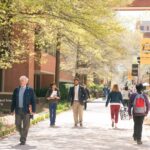
Since it launched at UMBC in 1997, the MARC U*STAR Program has connected nearly 500 hundred UMBC students with research opportunities and invaluable support. After years of remarkable results, the program is now at an important moment of transition.
MARC U*STAR stands for Maximizing Access to Research Careers Undergraduate Student Training in Academic Research. The NIH program was founded on three key elements that are proven to increase students’ persistence and success in research careers, especially for students from underrepresented groups in biomedical sciences. These elements include recognizing and recruiting outstanding, passionate students; offering excellent research mentorship; and providing strong administrative support and advising.
A striking 95 percent of UMBC’s MARC U*STAR Scholars have graduated with STEM degrees, around double the national rate for students who begin STEM programs. And 87 percent have continued their education in graduate programs, with 79 percent pursuing Ph.D., M.D./Ph.D., or M.D. degrees. UMBC’s MARC U*STAR graduates have been almost five times more likely to attend graduate school than their academically comparable peers.
 MARC U*STAR Scholar Robin Bailey ’20, biological sciences, with her research poster at UMBC’s Undergraduate Research and Creative Achievement Day (URCAD) in 2018. Photo by Phyllis Robinson.
“If I was not a part of the MARC program, I would not be where I am today,” says Robin Bailey ’20, biological sciences. Today, she is about to graduate from UMBC having presented her research at national conferences and written two academic papers. She spent a summer researching at Harvard, and now has committed to pursuing her Ph.D. in cellular and molecular biology at the University of Pennsylvania’s Perelman School of Medicine.
Bailey’s experience is a familiar one in UMBC’s MARC U*STAR program. This unequivocal, long-term success is not an accident.
Growth mindset
As the final year of the current MARC U*STAR grant comes to a close this May, UMBC has received a new five-year grant from the NIH. This new grant is part of the Undergraduate Research Training Initiative for Student Enhancement (U-RISE). It will build on the strong legacy of MARC U*STAR at UMBC, providing $7.7 million over five years to support the same activities offered by MARC U*STAR, plus a few more.
“The MARC grant is 23 years old, and it’s had great success,” says Phyllis Robinson, program director for MARC U*STAR at UMBC and lead on the new U-RISE grant. “So we’re going to take all the good things, and then add a few new things.”
MARC U*STAR provides students intensive academic advising and funding for conference travel and toward tuition. Advising includes traditional guidance on course selection, as well as support in preparing for and obtaining research positions and help with the graduate school application process. Monthly lectures from external STEM professionals connect the scholars with experts in various fields and give them opportunities to network.
 MARC U*STAR Scholar Andreas Seas ’17, biochemical engineering, gives a presentation at URCAD 2016.
Nurturing student passion
Perhaps most importantly, the MARC program helps create a sense of community among the scholars. “Being a part of the MARC family is advantageous not only because you’re getting extra support to go to conferences, but you’re surrounded by all these people that are interested in science and want to improve people’s lives with science,” reflects Andreas Seas ’17, biochemical engineering.
Seas particularly notes the support of Lasse Lindahl, Robinson’s predecessor; Jackie King, associate director of the MARC U*STAR program at UMBC; and his peers and research mentors. Today, Seas is pursuing an M.D./Ph.D. degree at Duke University.
“The MARC program solidified my love for research and science,” adds Erwin Cabrera ’10, biological sciences. “It provided me with the mentoring and one-on-one advising that was pivotal in my success at UMBC.” Cabrera is paying that mentorship forward in his current role as director of the Research Aligned Mentorship Program at Farmingdale State College in New York.

MARC U*STAR Scholar Erwin Cabrera ’10, biological sciences. Photo courtesy Erwin Cabrera.
Resilience on the rise
The new U-RISE funding will offer all of the same programming as MARC for up to 35 students per year. On top of that, U-RISE Scholars will participate in two training workshops. One will examine rigor and reproducibility in research. The other will focus on how to work with big data, which has become ubiquitous in so many research fields. U-RISE will also fund training for faculty mentors in how to best support their diverse mentees.
Current MARC Scholars will be able to continue with the program through graduation.
 Phyllis Robinson (center) with Paula Johnson, president of Wellesley College (left), and UMBC valedictorian and MARC U*STAR Scholar Eudorah Vital ’18, biochemistry and molecular biology, at Commencement.
This is all heartening news for Bailey. “The MARC program has provided me with countless opportunities to improve my skills in the laboratory and develop a scientific mind. The program also pushes MARC Scholars to show proof of these skills at scientific conferences,” she says. “Where I once lacked confidence in my ability to think critically and present publicly, I now have a resilient drive to overcome obstacles.”
Until now, “for students who want to pursue a research career in biomedical sciences, the MARC program has been the place to be,” Bailey says. Now, that place will be U-RISE.
While the name will be new after 2020, the work and commitment of faculty mentors and advising staff will hold steady. Under Robinson’s leadership, they’ll continue to help UMBC students see themselves as future leading scientists and find their paths to research careers.
Banner image: Academic Row at UMBC in springtime. All photos by Marlayna Demond ’11 for UMBC unless otherwise noted.
]]>
Since it launched at UMBC in 1997, the MARC U*STAR Program has connected nearly 500 hundred UMBC students with research opportunities and invaluable support. After years of remarkable results, the...
https://umbc.edu/stories/umbc-to-receive-7-7-m-for-u-rise-a-research-training-program-focused-on-stem-leadership/
https://beta.my.umbc.edu/api/v0/pixel/news/119905/guest@my.umbc.edu/452556dc367ccd402ef5e1557f9b0797/api/pixel
biology
cbee
cnms
coeit
community
marcustar
science-and-technology
undergradresearch
UMBC News & Magazine
https://beta.my.umbc.edu/groups/umbc-news-magazine
https://assets1-beta.my.umbc.edu/system/shared/avatars/groups/000/001/943/24435aa6207c452e7bc15cc74b42c7bb/xsmall.png?1748556657
https://assets1-beta.my.umbc.edu/system/shared/avatars/groups/000/001/943/24435aa6207c452e7bc15cc74b42c7bb/original.png?1748556657
https://assets2-beta.my.umbc.edu/system/shared/avatars/groups/000/001/943/24435aa6207c452e7bc15cc74b42c7bb/xxlarge.png?1748556657
https://assets2-beta.my.umbc.edu/system/shared/avatars/groups/000/001/943/24435aa6207c452e7bc15cc74b42c7bb/xlarge.png?1748556657
https://assets3-beta.my.umbc.edu/system/shared/avatars/groups/000/001/943/24435aa6207c452e7bc15cc74b42c7bb/large.png?1748556657
https://assets1-beta.my.umbc.edu/system/shared/avatars/groups/000/001/943/24435aa6207c452e7bc15cc74b42c7bb/medium.png?1748556657
https://assets2-beta.my.umbc.edu/system/shared/avatars/groups/000/001/943/24435aa6207c452e7bc15cc74b42c7bb/small.png?1748556657
https://assets1-beta.my.umbc.edu/system/shared/avatars/groups/000/001/943/24435aa6207c452e7bc15cc74b42c7bb/xsmall.png?1748556657
https://assets2-beta.my.umbc.edu/system/shared/avatars/groups/000/001/943/24435aa6207c452e7bc15cc74b42c7bb/xxsmall.png?1748556657
UMBC News & Magazine
0
0
false
Wed, 29 Apr 2020 16:17:33 -0400
With new leadership, bwtech@UMBC builds on legacy of innovation for public good

Imagine you’ve got an amazing idea—a piece of biotech or a cyber solution, for instance—with the potential to really help people in need.
Now, picture a community that helps you accomplish the steps to turn that idea into a successful business. Researchers and eager students to work out the kinks. The camaraderie of creative entrepreneurs to energize you. And partners with the business chops to help you take your idea to market.
Since launching 30 years ago as the first university research park in Maryland, bwtech@UMBC has nurtured more than 130 companies and their big ideas, bringing more than 1,800 jobs to Baltimore County and generating 4,500 direct and indirect jobs and $700 million in labor income and business sales for the state, according to an assessment by the Sage Policy Group in 2019.
As the world takes on the challenges of the COVID-19 crisis, bwtech finds itself in the position to innovate in more ways than ever. Amid it all, bwtech’s new executive director Aaron Miscenich is ready to help bwtech make an even bigger impact in Maryland and beyond.
“We will emerge from this period strong, but with a new definition of ’normal,’” says Miscenich, who previously helped launch the New Orleans BioInnovation Center in the wake of Hurricane Katrina. He notes that bwtech steadily added jobs through the 2008 recession and recovery years, and expects the community to remain strong.
“Working with UMBC’s diverse research base, talented entrepreneurs, and strong partner organizations, bwtech has achieved fantastic results. I think we have the opportunity to bring our community closer together and to learn more about what we can do for one another.”
Building Bridges to Success
A wooden footpath links UMBC’s main campus to bwtech North, the second of bwtech’s two campuses. Winding past Pig Pen Pond, it’s a convenient link between two centers of creative energy, and also the perfect metaphor for the relationship between these two enterprises.
“University research can contain tremendous market potential but often needs someone to facilitate that commercialization process,” says Miscenich, who took over for longtime executive director Ellen Hemmerly after her retirement this spring.
“Many times you have researchers who are not experienced entrepreneurs, you have students looking for real-world experiences to complement their course studies, and you have alumni that are looking for ways to bring their talents back to the university,” he says.
All of the groups converge at bwtech, along with entrepreneurs from around the globe, and the research and technology community provides assets that help them meet their goals. A recent beneficiary of this partnership is Soobum Lee, associate professor of mechanical engineering at UMBC, whose work with windmills and energy harvesting earned him a Maryland Innovation Initiative (MII) grant.
MII, a research commercialization project established by the state and five universities, including UMBC, opened up the opportunity for Lee to work with bwtech “site miners,” who help facilitate the application process for faculty inventors and accelerate their path to commercialization. As of this January, UMBC faculty have secured a total of 42 MII awards, valued at more than $4.4 million, resulting in 16 start-up companies.
bwtech also houses a number of UMBC alumni-owned businesses at its two campuses, many of which partner with professors and also bring in undergraduate and graduate students as interns. Jeehye Yun ’97, computer science, founding CEO at RedShred on the bwtech north campus, notes that these relationships have paid off for her company.
“As a part of the bwtech community, we’ve had the opportunity to develop long-standing relationships with UMBC faculty and students to advance our innovative research and impact,” she says.
The same is true for Mike Adelstein ’96, biochemistry and molecular biology, who sees a strong future for his company Potomac Photonics at his bwtech south campus location.
“Even though we’re growing, we want to keep our headquarters here [at bwtech] because it’s a great place to be,” he says. “bwtech’s environment spurs innovation and drives the success that we’re having right now.”
And by pairing new business with established ones, bwtech’s “Start here. Grow here. Stay here.” philosophy makes for a welcoming environment at any stage of growth.
“We can take these companies, introduce them to industry professionals, capital sources, and other groups that help reduce the risk of failure and increase the potential of the company’s products and services,” Miscenich says.

Challenging Times
As the realities of the COVID-19 pandemic took hold earlier this spring, many in the bwtech community quickly began working on ways of creating solutions.
AthenaES switched from its regular work of protein manufacturing to instead focus on making hand sanitizer. Both New Horizons Diagnostics and Synaptic Research began working to develop rapid testing kits. And while Potomac Photonics normally focuses on microfabrication, Mike Adelstein quickly shifted gears to produce face shields for a hospital in the Bronx.
Miscenich, with his 15 years as president of the New Orleans BioInnovation Center, understands the importance of close connections among partners during challenging times. Although he has not yet been able to work from his office on Research Park Drive due to the pandemic and travel restrictions, Miscenich is spending much of his time checking on his entrepreneurs from afar to make sure they have what they need to stay strong.
“We’re maintaining one-on-one contact through our facilities’ team and trying to maintain programming that will keep our entrepreneurs connected with the park,” he says. “We’ve been holding video ’socials,’ we’ve hosted speakers, and we’re reaching out to understand their individual needs. Our hope is that we can learn from this challenge and keep in place the mechanisms that allow us to work together as a community.”
Miscenich says bwtech companies have displayed a great ability to adapt to change and to step up to challenges. His role, he says, “is to help these companies to alter their course when necessary and to bring reliable resources for them to use. Our intent is to continue to use these resources to add value to our clients and support their ongoing growth.”
Community is Key
Another key element of bwtech’s success—and one that drew Miscenich from New Orleans—is the business community’s connections to Baltimore, Washington, and its next-door neighbors, Catonsville and Arbutus. Many of the companies’ 1,800-plus workers call these towns home.
The campus also lies just up the road from BWI-Thurgood Marshall Airport, Ft. George G. Meade, the National Security Agency, the National Institute of Standards and Technology, and the National Institutes of Health, putting it in a perfect spot to create partnerships with groups in need of cybersecurity, life sciences, and engineering solutions.
“An innovation district, or research park, is not just a group of buildings that sit idle throughout the day and night,” says Miscenich. That means encouraging true engagement between business and the surrounding communities.

Matt Roberson, Director of SC&H Capital, and a member of the bwtech board, knows how important those local connections are. He is raising his family nearby in Catonsville, and is looking forward to great things at bwtech.
“bwtech is an important part of the UMBC story, and growth in the area,” he says. “I’d like to see it continue to grow and foster opportunities for students, Catonsville and Arbutus residents, and businesses, in general.”
Baltimore County Executive John A. Olszewski Jr., Ph.D. ’17, public policy, notes the important role bwtech has played in the state, calling it a “true Maryland success story.”
“For the last 30 years, bwtech has strengthened our economy by giving big ideas the room they need to grow. By bridging higher education and business, bwtech at UMBC positions Maryland as an economic powerhouse within the region,” he says. “I couldn’t be prouder of what this community brings to Baltimore County.”
Miscenich says he’s looking forward to learning more about what the Greater Baltimore region has to offer. Even more, he looks ahead to continuing to build opportunities for the bwtech and UMBC communities.
“UMBC and bwtech have clearly worked very hard and have made incredible strides in building companies out of the university,” says Miscenich.
“I look forward to bringing bwtech even closer to the programming and culture of the university, attracting more partners into the ecosystem that has been created by bwtech, and attracting more resources in the development of our infrastructure.”
For more information about bwtech@UMBC’s community of entrepreneurs, visit https://www.bwtechumbc.com/community/.
Images by Marlayna Demond ’11 or Corey Jennings ’10 for UMBC unless otherwise noted.
]]>
Imagine you’ve got an amazing idea—a piece of biotech or a cyber solution, for instance—with the potential to really help people in need. Now, picture a community that helps you accomplish...
https://umbc.edu/stories/with-new-leadership-bwtechumbc-builds-on-legacy-of-innovation-for-public-good/
https://beta.my.umbc.edu/api/v0/pixel/news/119906/guest@my.umbc.edu/4710605b7e3263e7a92d7552c2217486/api/pixel
biochemistry
bwtech-at-umbc
computerscience
discovery
graduateschool
resilience
UMBC News & Magazine
https://beta.my.umbc.edu/groups/umbc-news-magazine
https://assets1-beta.my.umbc.edu/system/shared/avatars/groups/000/001/943/24435aa6207c452e7bc15cc74b42c7bb/xsmall.png?1748556657
https://assets1-beta.my.umbc.edu/system/shared/avatars/groups/000/001/943/24435aa6207c452e7bc15cc74b42c7bb/original.png?1748556657
https://assets2-beta.my.umbc.edu/system/shared/avatars/groups/000/001/943/24435aa6207c452e7bc15cc74b42c7bb/xxlarge.png?1748556657
https://assets2-beta.my.umbc.edu/system/shared/avatars/groups/000/001/943/24435aa6207c452e7bc15cc74b42c7bb/xlarge.png?1748556657
https://assets3-beta.my.umbc.edu/system/shared/avatars/groups/000/001/943/24435aa6207c452e7bc15cc74b42c7bb/large.png?1748556657
https://assets1-beta.my.umbc.edu/system/shared/avatars/groups/000/001/943/24435aa6207c452e7bc15cc74b42c7bb/medium.png?1748556657
https://assets2-beta.my.umbc.edu/system/shared/avatars/groups/000/001/943/24435aa6207c452e7bc15cc74b42c7bb/small.png?1748556657
https://assets1-beta.my.umbc.edu/system/shared/avatars/groups/000/001/943/24435aa6207c452e7bc15cc74b42c7bb/xsmall.png?1748556657
https://assets2-beta.my.umbc.edu/system/shared/avatars/groups/000/001/943/24435aa6207c452e7bc15cc74b42c7bb/xxsmall.png?1748556657
UMBC News & Magazine
0
0
false
Tue, 28 Apr 2020 23:53:37 -0400
UMBC’s Jianwu Wang receives NSF CAREER Award to help climate scientists make discoveries from massive, complex data sets

Jianwu Wang, assistant professor of information systems, is the most recent UMBC faculty member to receive a prestigious CAREER Award from the National Science Foundation (NSF). Wang’s NSF grant totals more than $500,000 over five years. It will support his work to develop more efficient and reproducible causality analytics for use in climate science.
Understanding cause and effect is fundamental to research in many disciplines. There are some unique challenges in using climate data to discover cause-effect relationships. Wang explains that Earth changes so rapidly that climate scientists studying it must continuously capture a huge volume of data. Each point in time yields distinct information about the planet’s environment, and there is no way to retest the climate to confirm causal relationships.

Jianwu Wang. Photo courtesy of Wang.
Rapidly available climate data can be challenging for researchers to keep up with, explains Wang. “Computation and data techniques have become the third and fourth paradigm for science in many disciplines,” he says. “The novel computational and data science techniques we will study through this award could help climate or Earth scientists to quickly find interesting patterns from data and use data to conduct hypothesis testing.”
Using big data to study Earth
Wang is exploring new ways of applying artificial intelligence and data science to studying Earth and its climate system. He has collaborated with faculty across UMBC, including in the physics department and the Joint Center for Earth Systems Technology, where he is an affiliated faculty member. These connections have helped him better understand the needs of climate scientists.
Recent advances in artificial intelligence and data science give hope to studying Earth from a data-driven perspective. Yet climate scientists are challenged by the need to process terabytes of data collected about Earth, Wang has learned. The data’s volume and complexity can make it very difficult to examine, which could mean missed opportunities for insights.
Wang hopes that his work will help climate scientists better understand the data they have already collected, and find better ways to test their causality-related hypotheses. The end goal of the research is to develop a climate causality analytics platform that is scalable and reproducible.
Research opportunities for students
As he plans next steps, Wang is particularly looking forward to providing students with research opportunities. He will connect with graduate and undergraduate students through UMBC’s Center for Women in Technology, McNair Scholars program, and Louis Stokes Alliances for Minority Participation (LSAMP) program. He will also connect with local high school students through UMBC’s Shriver Center.
The range of perspectives these students bring will help Wang address the challenges posed by climate data, ultimately making it more useful and accessible. “We expect our research will help climate scientists efficiently discover causal relationships from complex climate datasets and easily share their findings with others,” he explains.
“These findings could help us better understand how Earth’s climate system works,” Wang says. “Eventually, they could help us better predict and adapt to many specific climate-related events, such as extreme heatwaves, droughts, and floods.”
Banner image: The California Current System. Photo by: NASA/Goddard/Suomin-NPP/VIIRS, used under CC 2.0.
]]>
Jianwu Wang, assistant professor of information systems, is the most recent UMBC faculty member to receive a prestigious CAREER Award from the National Science Foundation (NSF). Wang’s NSF grant...
https://umbc.edu/stories/umbcs-jianwu-wang-receives-nsf-career-award-to-help-climate-scientists-make-discoveries-from-massive-complex-data-sets/
https://beta.my.umbc.edu/api/v0/pixel/news/119907/guest@my.umbc.edu/f6ea1708e9a64bfe7fa0f7a0b82cb024/api/pixel
coeit
is
majoraward
research
science-and-technology
UMBC News & Magazine
https://beta.my.umbc.edu/groups/umbc-news-magazine
https://assets1-beta.my.umbc.edu/system/shared/avatars/groups/000/001/943/24435aa6207c452e7bc15cc74b42c7bb/xsmall.png?1748556657
https://assets1-beta.my.umbc.edu/system/shared/avatars/groups/000/001/943/24435aa6207c452e7bc15cc74b42c7bb/original.png?1748556657
https://assets2-beta.my.umbc.edu/system/shared/avatars/groups/000/001/943/24435aa6207c452e7bc15cc74b42c7bb/xxlarge.png?1748556657
https://assets2-beta.my.umbc.edu/system/shared/avatars/groups/000/001/943/24435aa6207c452e7bc15cc74b42c7bb/xlarge.png?1748556657
https://assets3-beta.my.umbc.edu/system/shared/avatars/groups/000/001/943/24435aa6207c452e7bc15cc74b42c7bb/large.png?1748556657
https://assets1-beta.my.umbc.edu/system/shared/avatars/groups/000/001/943/24435aa6207c452e7bc15cc74b42c7bb/medium.png?1748556657
https://assets2-beta.my.umbc.edu/system/shared/avatars/groups/000/001/943/24435aa6207c452e7bc15cc74b42c7bb/small.png?1748556657
https://assets1-beta.my.umbc.edu/system/shared/avatars/groups/000/001/943/24435aa6207c452e7bc15cc74b42c7bb/xsmall.png?1748556657
https://assets2-beta.my.umbc.edu/system/shared/avatars/groups/000/001/943/24435aa6207c452e7bc15cc74b42c7bb/xxsmall.png?1748556657
UMBC News & Magazine
0
0
false
Tue, 28 Apr 2020 16:55:45 -0400
Scholar-athlete grads draw on resilience forged in challenging times
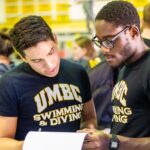
Kennedy Lamb and Jethro Ssengonzi are finishing their final semester with uncertainty about the world, but also a sense of hope. To cope with the challenges of graduating during the COVID-19 pandemic, they are drawing on resilience built through past challenges they’ve faced as UMBC scholar-athletes.
On the surface, Lamb ‘20, English, and Ssengonzi ‘20, mechanical engineering, didn’t have much in common when they arrived on campus. Lamb brought her academic and softball talents from the town of Mexico, New York, 35 miles north of Syracuse. Ssengonzi left Cary, North Carolina, to become a Meyerhoff Scholar and member of the Retriever swimming and diving team. Both connected early on with mentors who would support them in their most difficult moments.
Academics “kept me going”
In high school, Lamb was a Syracuse.com three-time First Team All-League softball player. She was also student council president and a student member of her local Board of Education. Her drive, leadership, and commitment to community fit with UMBC’s culture, but she struggled in her first year on campus. Lamb played in just nine games as a Retriever freshman and nearly did not return the next fall.
 Lamb at NCAA Regionals, May 2019. Photo by Joshua R. Gateley, courtesy of UMBC Athletics.
“Coming from upstate New York to Maryland with no connections, no family or friends, or really any form of support, was extremely difficult,” said Lamb. “I suffered from anxiety and depression that wasn’t diagnosed until my junior year of college. I truly almost pulled the plug and dropped out on numerous occasions, but I couldn’t give up on my dream of playing DI softball.”
Lamb credits two mentors in particular for helping her over the hump during that tumultuous freshman year. Assistant Athletic Director Abbie Day served as her first athletics’ academic advisor. Science writer Sarah Hansen, M.S. ‘15, biological sciences, a communications manager in UMBC’s Office of Institutional Advancement, helped guide her toward new opportunities for her writing.
 Kennedy Lamb enters a UMBC Transit bus for an assignment as a UMBC Magazine intern. Photo by Marlayna Demond ’11 for UMBC.
“In a way, my grades are what kept me going—I always knew I had that to fall back on,” says Lamb. “I loved all of my classes at UMBC and I knew the professors wanted me to succeed.”
“I took a great deal of pride in my GPA freshman year—and well, all of the years—because I knew if athletics was frustrating me, or something in my personal life wasn’t going quite right, I always had school to keep me motivated and focused,” she shares. That focus would pay off.
“I’ve had to adjust”
Ssengonzi came to UMBC after a distinguished swimming career at Green Hope High School. In addition to being a Meyerhoff Scholar, he quickly engaged with UMBC’s Grand Challenge Scholars Program. The program, which began just as he arrived at UMBC, gives students opportunities to work on multi-disciplinary teams to tackle some of the most pressing issues facing society today.
 Ssengonzi during URCAD 2018 at UMBC. Photo by Leo Buoye ’19.
Ssengonzi’s sophomore year started off strong. Beyond swimming and coursework, he presented his summer research at the UMBC Undergraduate Research and Creative Achievement Day in 2018.
 Ssengonzi presents his research at URCAD in April 2018. Photo by Marlayna Demond ’11 for UMBC.
But throughout that 2017-18 year, Ssengonzi struggled as his father, Robert, was diagnosed with cancer. Robert lost his battle with the disease in the fall of 2018. Dealing with day to day life at school while staying engaged with family was difficult.
“The last three years or so have been tough on my family,” Ssengonzi says. “I’ve had to adjust to many things. Fortunately, I’ve been able to forge ahead with the help of several people.”
He credits his massive swimming and diving family and his fellow Meyerhoff Scholars for their support throughout his UMBC journey. He also thanks mentors Maria Sanchez, professor of the practice in mechanical engineering and COEIT’s director of education and outreach, and adjunct professor Joseph Washington, Ph.D. ‘15, mechanical engineering.
“Most importantly, he cares about people”
Ssengonzi flourished over the past two years. The team selected him as one of their captains in 2019-20. And despite dealing with a troublesome quad injury, he posted lifetime bests in all of his swims. His last moments in the water as a Retriever were spent celebrating the team’s third consecutive America East championship.
 Ssengonzi represents UMBC in competition. Photo by Zoe Pekins.
“Jethro is driven and focused, sensitive and hard-working, and most importantly, he cares about people,” said head swimming and diving coach Chad Cradock ‘97, psychology.
 Ssengonzi celebrates a strong swim on the path to UMBC winning the 2019 men’s and women’s swimming and diving America East championships. Photo by Colleen Humel, courtesy of Ssengonzi.
During spring break, Ssengonzi returned to North Carolina. He has not been back to campus since the COVID-19 pandemic struck. But he feels fortunate to stay connected with Retriever Nation remotely, and is already looking forward to his next steps.
Ssengonzi will pursue a Ph.D. in civil engineering at nearby North Carolina State University this fall. There, he will focus on the restoration and improvement of urban infrastructure. It’s a topic fueled by his involvement with UMBC’s Grand Challenge Scholars Program.
Path to the championship
Lamb has also enjoyed tremendous growth and success since connecting with mentors and building her community of support. She was one of nine students selected to participate in the first UMBC Interdisciplinary CoLab in summer 2018. Her three-member team worked closely with the UMBC Sustainability Office and Climate Action Steering Committee. They created four engaging informational videos on the importance of environmental sustainability at UMBC.
Under the direction of CoLab founder Carole McCann, professor and chair of gender, women’s and sexuality studies, Lamb also launched an independent project. She produced, directed, and filmed the video that UMBC now uses to publicize the CoLab program.
 Lamb running near the Albin O. Kunh Library during a video shoot. Photo by Marlayna Demond ’11 for UMBC.
On the field, Lamb played in a career-high 27 games in 2019. But it was her steady, veteran leadership that helped the Retrievers to an improbable run to capture the 2019 America East Championship and compete in the NCAA Tournament.
There, she also received the America East Elite 18 award. This honor recognizes the student-athlete with the highest GPA in each America East championship game.
 Lamb (center, in visor) celebrates the 2019 America East Championship win with her teammates. Photo by Stephen McLaughlin, America East.
“Kennedy Lamb is one of the hardest working, most caring, dedicated student-athletes I have had the privilege to work with over the years,” said head coach Chris Kuhlmeyer. “She is a prime example to all student-athletes at UMBC and across the nation of what it takes to live an exemplary life academically, athletically, and personally.”
 Lamb receives America East Elite 18 award. Photo by Stephen McLaughlin, America East.
Like many seniors, the COVID-19 outbreak has delayed Kennedy’s post-graduation plans. She awaits news about graduate school and internship opportunities in science writing at leading institutes.
High achievement with strong support
Athletic Director Brian Barrio sees Lamb and Ssengonzi’s experiences as reflecting something essential about the values of UMBC and UMBC Athletics. “The magnificent performance of Retriever student-athletes in the classroom speaks volumes about the values of this department and of UMBC as a whole,” he says. “I could not be more proud of the young men and women who put the work in to achieve these GPAs while also competing for championships on the playing fields.”
This fall, UMBC’s seventeen teams combined for a school-record grade-point average of 3.19 and 46 student-athletes earned President’s List honors (4.00 GPA). In addition to Lamb and Ssengonzi, two other UMBC scholar-athletes were valedictorian candidates for the Class of 2020.

Abbey Farmer. Photo by UMBC Athletics.
Abigail “Abbey” Farmer, who hails from nearby Crofton, Maryland, is a dual major in health administration and policy and psychology. Before college, she swam with the Retriever Aquatics Club. Now, she is graduating in just three years with a 4.0 and as an active swimmer. She will begin a master’s degree in public policy at UMBC in the fall. And she’ll continue her swimming career.
Ilia Rattsev is completing his B.S. degree in bioinformatics and computational biology, along with a minor in computer science and a certificate of language studies in German. Rattsev came to UMBC from Moscow, Russia. He recently earned Eastern College Athletic Conference Swimmer of the Meet honors and the America East Elite 18 Award as the top student athlete at the championships, with a 3.97 GPA.
Rattsev has completed research in the lab of Maricel Kann, associate professor of biological sciences, where he developed a passion for cancer research. After graduation, he plans to continue his career in cancer research. He’s currently weighing graduate school and lab research options.
 UMBC’s Ilia Rattsev, Jeremy Gates, Jack Carlisle, and Jethro Ssengonzi (l-r) accept the trophy for the 2020 America East Championship on behalf of UMBC men’s swimming and diving; Feb. 16, 2020. Photo by Brian Foley for America East.
Barrio’s mind is always on how to support UMBC’s student-athletes in reaching their goals, whether that’s in the lab, on the field, or in their communities. For now, that support reaches students from a distance, but he’s already thinking ahead to when competition resumes post-pandemic.
“The next time you come watch our teams compete,” Barrio says, “take a minute to reflect on how hard these Retrievers are working in all phases of their lives.”
Featured image: Jethro Ssengonzi (r) with fellow swimmer Diego Morales ’23 (l) at a home meet. Photo by Ian Feldmann ’20, courtesy of UMBC Athletics.
Article written by Steve Levy, associate athletic director for athletic communications.
]]>
Kennedy Lamb and Jethro Ssengonzi are finishing their final semester with uncertainty about the world, but also a sense of hope. To cope with the challenges of graduating during the COVID-19...
https://umbc.edu/stories/scholar-athlete-grads-draw-on-resilience-forged-in-challenging-times/
https://beta.my.umbc.edu/api/v0/pixel/news/119908/guest@my.umbc.edu/0c5470d67ed0984d4d2558a82243b3d4/api/pixel
arts-and-culture
biology
cahss
classof2020
coeit
community
english
meche
meyerhoffscholars
page1
science-and-technology
undergradresearch
UMBC News & Magazine
https://beta.my.umbc.edu/groups/umbc-news-magazine
https://assets1-beta.my.umbc.edu/system/shared/avatars/groups/000/001/943/24435aa6207c452e7bc15cc74b42c7bb/xsmall.png?1748556657
https://assets1-beta.my.umbc.edu/system/shared/avatars/groups/000/001/943/24435aa6207c452e7bc15cc74b42c7bb/original.png?1748556657
https://assets2-beta.my.umbc.edu/system/shared/avatars/groups/000/001/943/24435aa6207c452e7bc15cc74b42c7bb/xxlarge.png?1748556657
https://assets2-beta.my.umbc.edu/system/shared/avatars/groups/000/001/943/24435aa6207c452e7bc15cc74b42c7bb/xlarge.png?1748556657
https://assets3-beta.my.umbc.edu/system/shared/avatars/groups/000/001/943/24435aa6207c452e7bc15cc74b42c7bb/large.png?1748556657
https://assets1-beta.my.umbc.edu/system/shared/avatars/groups/000/001/943/24435aa6207c452e7bc15cc74b42c7bb/medium.png?1748556657
https://assets2-beta.my.umbc.edu/system/shared/avatars/groups/000/001/943/24435aa6207c452e7bc15cc74b42c7bb/small.png?1748556657
https://assets1-beta.my.umbc.edu/system/shared/avatars/groups/000/001/943/24435aa6207c452e7bc15cc74b42c7bb/xsmall.png?1748556657
https://assets2-beta.my.umbc.edu/system/shared/avatars/groups/000/001/943/24435aa6207c452e7bc15cc74b42c7bb/xxsmall.png?1748556657
UMBC News & Magazine
0
0
false
Tue, 28 Apr 2020 04:07:10 -0400