Conversations that Matter

By Michele Wojciechowski
In 1980, while spending the summer with family in South Carolina, 13-year-old Karsonya “Dr. Kaye” Wise Whitehead noticed that the corner grocery store owner had kept up the “Whites Only” and “Colored Only” signs. She was offended and wanted him to take them down. The teen decided to stage her first protest. She told her grandmother that she was going to march every day in front of his store until he took the signs down.
The proprietor took them down from the counter. But he later had them framed and put on the wall to make them “art.”
“My grandmother gave me a similar framed ‘Colored Seating Only’ sign so that I would always remember that moment in my life,” says Whitehead, Ph.D. ’09, language, literacy, and culture.
While she didn’t get the exact result that she wanted, Whitehead did see that her actions could make a direct change in her community. This lesson would guide Whitehead as she found ways to amplify her voice.

“It changed my life,” Whitehead says of the language, literacy, and culture program. “I knew that I wanted to be in a field where I could research, write about, and teach Black women’s history.”
After living in New York City—working first at MTV and then at a PBS affiliate making documentary films—Whitehead, along with her husband Johnnie and their sons, Kofi and Amir, moved to Baltimore 16 years ago. She taught in Baltimore City middle schools for four years and was named Maryland History Teacher of the Year before she left to pursue her Ph.D. in language, literacy, and culture in 2006 at UMBC.
From teacher to student
In 2005, Whitehead was still working as a teacher when a friend sent her copies of the 1863–1865 diaries of Emilie Davis. “I started reading the diaries at night, and when I realized that I was reading the diaries of a free black woman, I knew that I wanted to transcribe and publish them,” recalls Whitehead. Because she didn’t know how to do this kind of work, she started looking into Ph.D. programs that could guide her.
Whitehead settled on UMBC, remembering the impression President Freeman Hrabowski had made on her years before after hearing him speak at an event. “Like most people, I was amazed by the depth of his passion, his ability to take complicated issues and make them understandable, his desire to get [people] motivated to push beyond their comfort zone, and his dedication to helping Black students—and all students of color—receive their doctoral degrees,” she says. “When I decided to apply to a doctoral program, the only place I wanted to attend was UMBC.”
“Dr. Wise Whitehead’s commitment to both local and national social justice issues exhibits the best of UMBC,” says Kimberly Moffitt, associate professor and LLC program director, “and how we work to support our graduate students in their desires to excel and thrive beyond a classroom setting.”
“It changed my life,” Whitehead says of the language, literacy, and culture program. “I knew that I wanted to be in a field where I could research, write about, and teach Black women’s history.”
And that writing Whitehead wanted to do about Emilie Davis? It became her dissertation as well as her first book, Notes from a Colored Girl: the Civil War Pocket Diaries of Emilie Frances Davis.
Taking it to the airwaves
In 2015, Whitehead was approached by Beverly Burke, then-news director of WEAA, 88.9, out of Morgan State University, about coming on to do one- or two-minute African American history spots on the station. At first, she appeared monthly, but then Whitehead began getting requests to come on other hosts’ shows and progressed to being a guest host. Three years ago, the station’s general manager Malarie Pinkard Pierre approached Whitehead with the idea of giving her an afternoon slot for her own talk show.
Whitehead was thrilled.
Her show, “Today with Dr. Kaye” runs on WEAA, Monday through Friday from 3 to 5 p.m. “It’s unbelievable! That’s prime drive time, when you’ve got three generations in the car listening,” says Whitehead. “To be in that time slot is really exciting. The reception has been phenomenal.”
Whitehead is one of only a handful of black women in the country who have afternoon drive time radio talk shows. Building on the blocks of her early activist efforts and her continued education at UMBC, Whitehead knows that her voice has power. At the start of every show, she begins with, “We have conversations that matter.”
“[We have] conversations that are designed to challenge us, to make us think, to make us laugh, and sometimes to make us cry,” explains Whitehead, who wants her radio show to help make changes in Baltimore. “When I got into doing this show, I made a commitment to speak to, with, and for the people of Baltimore City.”
Whitehead says that her listeners range in age from young children to 85-year-olds, and because the show is on Facebook Live, she has listeners from all over, including callers from Alaska, Canada, and Jamaica. “I tell people that we have a two-hour window where they can come and wrestle with some questions with us and join us at the kitchen table,” says Whitehead.
In addition to her radio show, Whitehead writes a bi-monthly column for the AFRO, op-eds for The Baltimore Sun, and works full-time as an associate professor of communications and African American studies at Loyola University.
While she loves her activist work, Whitehead admits that her greatest joy is being a wife and mom. “Before I had the show, I was a black mommy activist. I was involved in a lot to help my sons…to help carve out a world where they can get home safe,” she recalls.
“Baltimore is a city that’s in a lot of pain, and people are searching for someone who’s going to tell them the truth, listen to them, and fight for and with them. I’ve made a lot of good friends and colleagues who are willing to do battle with me,” says Whitehead. “I’ve fallen in love with this city, and I’m willing to fight to bring about changes.”
*****
All photos courtesy of Karsonya Wise Whitehead Ph.D. ’09.
]]>
By Michele Wojciechowski In 1980, while spending the summer with family in South Carolina, 13-year-old Karsonya “Dr. Kaye” Wise Whitehead noticed that the corner grocery store owner had kept...
https://umbc.edu/stories/conversations-that-matter/
https://beta.my.umbc.edu/api/v0/pixel/news/119893/guest@my.umbc.edu/0e8b1f1957da2ae655fe228ab01ea83c/api/pixel
cahss
language-literacy-and-culture
perspectives
UMBC News & Magazine
https://beta.my.umbc.edu/groups/umbc-news-magazine
https://assets1-beta.my.umbc.edu/system/shared/avatars/groups/000/001/943/24435aa6207c452e7bc15cc74b42c7bb/xsmall.png?1748556657
https://assets1-beta.my.umbc.edu/system/shared/avatars/groups/000/001/943/24435aa6207c452e7bc15cc74b42c7bb/original.png?1748556657
https://assets2-beta.my.umbc.edu/system/shared/avatars/groups/000/001/943/24435aa6207c452e7bc15cc74b42c7bb/xxlarge.png?1748556657
https://assets2-beta.my.umbc.edu/system/shared/avatars/groups/000/001/943/24435aa6207c452e7bc15cc74b42c7bb/xlarge.png?1748556657
https://assets3-beta.my.umbc.edu/system/shared/avatars/groups/000/001/943/24435aa6207c452e7bc15cc74b42c7bb/large.png?1748556657
https://assets1-beta.my.umbc.edu/system/shared/avatars/groups/000/001/943/24435aa6207c452e7bc15cc74b42c7bb/medium.png?1748556657
https://assets2-beta.my.umbc.edu/system/shared/avatars/groups/000/001/943/24435aa6207c452e7bc15cc74b42c7bb/small.png?1748556657
https://assets1-beta.my.umbc.edu/system/shared/avatars/groups/000/001/943/24435aa6207c452e7bc15cc74b42c7bb/xsmall.png?1748556657
https://assets2-beta.my.umbc.edu/system/shared/avatars/groups/000/001/943/24435aa6207c452e7bc15cc74b42c7bb/xxsmall.png?1748556657
UMBC News & Magazine
0
0
false
Wed, 13 May 2020 21:11:58 -0400
What Is a Clinical Trial? A Health Policy Expert Explains

ByZoe McLaren, associate professor, public policy, UMBC
A commonly used malaria drug was recently proposed as a treatment for COVID-19 during a White House press briefing, even though it hadn’t yet been properly evaluated in clinical trials or approved for this use. Does the urgency of the current pandemic give doctors a good reason to skip evaluation and rush an untested drug to patients?
The field of medicine considers randomized-controlled trials, also known as “clinical trials,” as the gold standard for assessing the effectiveness of new treatments. These studies set up a fair test for treatments and enable researchers to rule out alternate explanations. Without randomized-controlled trial evidence to guide them, doctors risk wasting resources on ineffective treatments or causing harm to patients.
What is a randomized-controlled trial?
A controlled trial means that study participants are split into two groups: One group is given the treatment and the other (the control group) is not. The control group may be given a placebo that mimics the actual treatment, but does not contain the treatment being tested.
For example, a sugar pill or an injection of saline solution may be used instead of a dose of the drug. This ensures the only meaningful difference between the two groups is whether they received the treatment or not.
The control group helps researchers learn what would have happened to the treatment group if they hadn’t received the treatment. For example, some patients may recover on their own. Researchers need to know how often this happens, so they don’t attribute all recoveries to the effect of the treatment.
Study participants are randomly assigned to one group or the other, a process similar to a coin toss. Just as a coin toss is equally likely to end up heads or tails, study participants are equally likely to end up in the treatment or the control group. With enough study participants, this results in two groups that closely resemble each other. The only difference is that one group got “heads” while the other got “tails.”
The randomization of randomized-controlled trials with large enough samples ensures that all possible differences are accounted for, even those that may not be observed, such as genetic traits.
If the treatment and control groups are similar at the start of the study but end up with different outcomes, the treatment is the most likely cause. The randomized-controlled trial allows researchers to rule out alternative explanations.
What if patients aren’t randomly assigned?
If doctors were allowed to choose which patients received the treatment, it’s likely the treatment and control groups would not resemble each other, making it much harder to rule out different factors at play.
For example, malaria drugs aren’t approved for use against COVID-19, but may be prescribed to patients under the Food and Drug Administration’s “expanded access” program. It allows certain drugs to be used as a last resort to treat seriously ill patients when no other treatments are available.
These “last resort” patients are frailer than those who had a milder form of the disease or who responded well to other treatments. When you’re comparing very sick patients to healthier patients, the effect of the treatment is hard to see because it may be obscured by important differences such as age, diet, cigarette use, heart disease or obesity.
If frail patients on treatment fared significantly better than strong patients without it, researchers could conclude the treatment was effective. But this situation is extremely rare, which is why doctors generally can’t draw valid conclusions about a drug’s effectiveness in a “last resort” situation. Too many other factors are likely at play.
Some researchers may be able to use sophisticated statistics techniques to account for the differences between frail and strong patients. But there is a long list of potential differences between frail and strong patients, so it is hard to address them all. Gauging the quality of such statistical analysis is also difficult, so these studies should be viewed with skepticism.
Approving drugs prematurely
Without results from randomized-controlled trials, doctors can’t be sure whether a potential new treatment will help patients, harm them or prove ineffective.
The case of the malaria drug hydroxychloroquine as a potential treatment for COVID-19 underscores this concern. In an early wave of optimism, doctors prescribed and some even stockpiled so much hydroxychloroquine that pharmacies reported shortages of the drug. Within weeks however, randomized-controlled trials demonstrated that not only was this treatment ineffective against COVID-19, it also caused some patients to develop serious heart rhythm problems. Prematurely prescribing this treatment to all but the “last resort” cases instilled false hope, wasted medical resources and, most importantly, put patients at risk.
*****
Zoe McLaren, Associate Professor of Public Policy, University of Maryland, Baltimore County
[You need to understand the coronavirus pandemic, and we can help. Read The Conversation’s newsletter.]
This article is republished from The Conversation under a Creative Commons license. Read the original article.
Header image: Yulia Reznikov/Movement via Getty Images
]]>
ByZoe McLaren, associate professor, public policy, UMBC A commonly used malaria drug was recently proposed as a treatment for COVID-19 during a White House press briefing, even though it...
https://umbc.edu/stories/what-is-a-clinical-trial-a-health-policy-expert-explains/
https://beta.my.umbc.edu/api/v0/pixel/news/119894/guest@my.umbc.edu/492dea0e82a322f7d9a1fada0f26ffbb/api/pixel
covidresearch
discovery
publicpolicy
the-conversation
UMBC News & Magazine
https://beta.my.umbc.edu/groups/umbc-news-magazine
https://assets1-beta.my.umbc.edu/system/shared/avatars/groups/000/001/943/24435aa6207c452e7bc15cc74b42c7bb/xsmall.png?1748556657
https://assets1-beta.my.umbc.edu/system/shared/avatars/groups/000/001/943/24435aa6207c452e7bc15cc74b42c7bb/original.png?1748556657
https://assets2-beta.my.umbc.edu/system/shared/avatars/groups/000/001/943/24435aa6207c452e7bc15cc74b42c7bb/xxlarge.png?1748556657
https://assets2-beta.my.umbc.edu/system/shared/avatars/groups/000/001/943/24435aa6207c452e7bc15cc74b42c7bb/xlarge.png?1748556657
https://assets3-beta.my.umbc.edu/system/shared/avatars/groups/000/001/943/24435aa6207c452e7bc15cc74b42c7bb/large.png?1748556657
https://assets1-beta.my.umbc.edu/system/shared/avatars/groups/000/001/943/24435aa6207c452e7bc15cc74b42c7bb/medium.png?1748556657
https://assets2-beta.my.umbc.edu/system/shared/avatars/groups/000/001/943/24435aa6207c452e7bc15cc74b42c7bb/small.png?1748556657
https://assets1-beta.my.umbc.edu/system/shared/avatars/groups/000/001/943/24435aa6207c452e7bc15cc74b42c7bb/xsmall.png?1748556657
https://assets2-beta.my.umbc.edu/system/shared/avatars/groups/000/001/943/24435aa6207c452e7bc15cc74b42c7bb/xxsmall.png?1748556657
UMBC News & Magazine
0
0
false
Wed, 13 May 2020 13:41:13 -0400
UMBC students create products to meet community needs at Cangialosi Business Innovation Competition

Four UMBC student groups vied for the top prize in the finals of this year’s Cangialosi Business Innovation Competition (CBIC), held entirely online for the first time on April 30. Their projects ranged across industries, from fashion to artificial intelligence.
A pair of judges from the Baltimore Angels selected the finalists from among nearly 20 ideas submitted earlier in the semester. In advance of the event, each team prerecorded a seven-minute-long pitch video. They then participated in a live online Q&A with the judges.
The first prize winner was a familiar team, which first drew attention after winning the Alex. Brown Center for Entrepreneurship’s Idea Competition in the fall. After that early recognition for their project concept, they grew it into a prototype that once again captured the judges’ imaginations.
Helping kids communicate
The $3,000 first prize went to Octotalk, presented by Emma Neubert ‘21 biochemistry, and Scott Hart ‘22, visual arts. Neubert and Hart developed an interactive tool in the form of a plush octopus that children who are nonverbal can use to communicate their needs, thoughts, and feelings. Neubert hopes Octotalk will help children interact with people in a simple, comforting, and effective way.
Holding a prototype in her pitch video, Neubert explained Octotalk’s eight buttons, one on each tentacle. There are buttons for “yes,” “no,” and “I don’t know” responses. The other five buttons can be programmed through an app. The system is built in the Arduino platform. It is easily customizable, which allows teachers to change the options as a child’s needs and abilities change and grow, Neubert says.
The Octotalk team thinks this fills an important gap in the market because there is no similar communication device that is soft, friendly, and affordable. Most assistive communication devices for children are expensive electronics, like tablets, Neubert explains.
Next, Hart and Neubert hope to work with child development experts to optimize Octotalk. “We hope to have psychologists and counselors working with us to bring the greatest possible interactive experiences to the children using them, before moving them to homes and other caregiving situations,” explains Hart.
Connecting communities with healthy food
Second-place winners Laura Holland ‘22, computer science,and Niky Sicilia ‘21, business technology administration, joined forces after presenting individual projects at UMBC’s Idea Competition in fall 2019. Together, they developed Greater Plate, an app that helps people find healthier and more affordable meal alternatives to fast food in their local areas.

Niky Sicilia and Laura Holland. Photo courtesy of the Alex. Brown Center for Entrepreneurship.
Greater Plate helps address food insecurity in Baltimore City, where many low-income people do not have a grocery store within a quarter mile of their home, and don’t have transportation to access a store, says Holland. Connecting people with nourishing food options is essential to improving community health, she explains.
Through Greater Plate, local businesses will offer reduced price meals to app users, who can then select meals that fall within a set price range. Users will also be able to pre-order meals and purchase meal plans, which could offer additional cost savings. “For all of the meal plans, the cost per meal will be roughly equivalent to the cost of an average fast food meal,” explains Holland. “The meals will be as convenient as fast food, but they will be better quality.”
“With Greater Plate, we also want to lead the way in connecting people in Baltimore City with better ways to support and engage in local business,” Holland says.
To ensure vendors have a steady stream of income, they’ll have the option to sell market-rate priced meals in addition to reduced-price meal options. This will also help meet the needs of a range of users, whether they are driven primarily by convenience, supporting local businesses, eating healthy, or accessing affordable meals. They hope to work with other local groups already working on local dining and food access issues.
Affordable modest fashion
Third-place winner Noha Darwish ‘20, psychology, pitched Madina Girl, a modest fashion company. The concept is inspired by her experience as a Muslim woman who has trouble finding clothing that is stylish, comfortable, modest, and affordable.
“Growing up, I always expressed myself through fashion but I always felt limited because there weren’t options for me on the market,” says Darwish. “I felt invisible in the eye of mainstream fashion, so I started to create clothes for myself, and people loved my designs, which was how Madina Girl was born.”
Darwish calls the challenge of finding clothes that meet her needs “the compensating game.” For every clothing item bought, she will often have to purchase another item to pair it with, to reach the level of modesty she’s seeking. “Madina Girl was created so that modestly-dressing women do not have to choose between modesty and style,” explains Darwish
In her pitch for Madina Girl, Darwish noted that the modest fashion market is expected to reach $300 billion in 2022. Many of the companies already in this space, she suggests, don’t necessarily meet the needs of Muslim women in the United States. “At Madina Girl, we pride ourselves on our American designs, that are created for the American girl by the American girl.”
“It brings me so much fulfillment to know that my team and I are creating something that people really need and that brings them joy,” she says.
Identifying pain points in research
Akshay Peshave, M.S. ‘14, Ph.D. ‘20, computer science, earned fourth place for Karotene, a platform that connects researchers with information and data they need to do their work. The project is inspired by his Ph.D. research, which focuses on how machines can be taught to gather knowledge like people. Peshave explained that researchers often face challenges when searching for information to support their work. “Every time I have an idea in my head of what I am looking for, I need to translate it into a language that the search engine understands,” Peshave says. Then, once those results appear, he has to manually filter the results based on his needs.
To alleviate some of this time and frustration, Peshave developed Karotene. This tool combines artificial intelligence with natural language queries to streamline the process of searching for information, and it can connect with any textual search engine Pershave will use the CBIC funding to help support cloud costs for a pilot of Karotene.
“It was very important that we continue to offer this competition this year even though it could not be held in person,” says Vivian Armor ‘73, American Studies, director of the Alex. Brown Center for Entrepreneurship. “These student entrepreneurs are serious about their business ideas and the competition provided both seed funding to help them launch and also valuable feedback from experienced judges. Going forward, the Alex. Brown Center will continue to provide ongoing support to assist them in making their dreams a reality.”
Banner image: Noha Darwish with the Madina Girl logo. Photo courtesy of Darwish.
]]>
Four UMBC student groups vied for the top prize in the finals of this year’s Cangialosi Business Innovation Competition (CBIC), held entirely online for the first time on April 30. Their projects...
https://umbc.edu/stories/umbc-students-create-products-to-meet-community-needs-at-cangialosi-business-innovation-competition/
https://beta.my.umbc.edu/api/v0/pixel/news/119895/guest@my.umbc.edu/0798ad0bf95d36bbb335eeb1235d6d74/api/pixel
alexbrowncenter
chembiochem
cnms
coeit
community
csee
is
policy-and-society
psychology
science-and-technology
visualarts
UMBC News & Magazine
https://beta.my.umbc.edu/groups/umbc-news-magazine
https://assets1-beta.my.umbc.edu/system/shared/avatars/groups/000/001/943/24435aa6207c452e7bc15cc74b42c7bb/xsmall.png?1748556657
https://assets1-beta.my.umbc.edu/system/shared/avatars/groups/000/001/943/24435aa6207c452e7bc15cc74b42c7bb/original.png?1748556657
https://assets2-beta.my.umbc.edu/system/shared/avatars/groups/000/001/943/24435aa6207c452e7bc15cc74b42c7bb/xxlarge.png?1748556657
https://assets2-beta.my.umbc.edu/system/shared/avatars/groups/000/001/943/24435aa6207c452e7bc15cc74b42c7bb/xlarge.png?1748556657
https://assets3-beta.my.umbc.edu/system/shared/avatars/groups/000/001/943/24435aa6207c452e7bc15cc74b42c7bb/large.png?1748556657
https://assets1-beta.my.umbc.edu/system/shared/avatars/groups/000/001/943/24435aa6207c452e7bc15cc74b42c7bb/medium.png?1748556657
https://assets2-beta.my.umbc.edu/system/shared/avatars/groups/000/001/943/24435aa6207c452e7bc15cc74b42c7bb/small.png?1748556657
https://assets1-beta.my.umbc.edu/system/shared/avatars/groups/000/001/943/24435aa6207c452e7bc15cc74b42c7bb/xsmall.png?1748556657
https://assets2-beta.my.umbc.edu/system/shared/avatars/groups/000/001/943/24435aa6207c452e7bc15cc74b42c7bb/xxsmall.png?1748556657
UMBC News & Magazine
0
0
false
Tue, 12 May 2020 17:45:55 -0400
Room for Rent
I'm looking for a female roommate to rent the second room in a two bedroom apartment. (The rent would be $627 plus utilities).
The apartment is located in Catonsville, and is just a 10 minute drive from UMBC and downtown Baltimore. I'm looking for someone who is quiet, clean, and generally keeps to themselves. A graduate student or young professional would be ideal.
]]>
I'm looking for a female roommate to rent the second room in a two bedroom apartment. (The rent would be $627 plus utilities). The apartment is located in Catonsville, and is just a 10 minute...
https://beta.my.umbc.edu/api/v0/pixel/news/93064/guest@my.umbc.edu/15c37a728ef2555816f571180cfdf1fc/api/pixel
International Student and Scholar Services (ISSS)
https://beta.my.umbc.edu/groups/ies
https://assets4-beta.my.umbc.edu/system/shared/avatars/groups/000/000/431/46ad84ea8ba0baeed7c3faf29d1fd4ef/xsmall.png?1693323874
https://assets3-beta.my.umbc.edu/system/shared/avatars/groups/000/000/431/46ad84ea8ba0baeed7c3faf29d1fd4ef/original.jpeg?1693323874
https://assets1-beta.my.umbc.edu/system/shared/avatars/groups/000/000/431/46ad84ea8ba0baeed7c3faf29d1fd4ef/xxlarge.png?1693323874
https://assets1-beta.my.umbc.edu/system/shared/avatars/groups/000/000/431/46ad84ea8ba0baeed7c3faf29d1fd4ef/xlarge.png?1693323874
https://assets4-beta.my.umbc.edu/system/shared/avatars/groups/000/000/431/46ad84ea8ba0baeed7c3faf29d1fd4ef/large.png?1693323874
https://assets3-beta.my.umbc.edu/system/shared/avatars/groups/000/000/431/46ad84ea8ba0baeed7c3faf29d1fd4ef/medium.png?1693323874
https://assets1-beta.my.umbc.edu/system/shared/avatars/groups/000/000/431/46ad84ea8ba0baeed7c3faf29d1fd4ef/small.png?1693323874
https://assets4-beta.my.umbc.edu/system/shared/avatars/groups/000/000/431/46ad84ea8ba0baeed7c3faf29d1fd4ef/xsmall.png?1693323874
https://assets3-beta.my.umbc.edu/system/shared/avatars/groups/000/000/431/46ad84ea8ba0baeed7c3faf29d1fd4ef/xxsmall.png?1693323874
IES Marketplace
0
0
true
Tue, 12 May 2020 04:30:04 -0400
Tue, 12 May 2020 04:30:31 -0400
First Light—UMBC-Developed Satellite Successfully Launches

AFTER YEARS IN DEVELOPMENT, AND MONTHS OF WAITING, A UMBC-DEVELOPED MINI SATELLITE LAUNCHED INTO SPACE STUDIES CLIMATE AND AIR QUALITY, PROVING PERSISTENCE PAYS OFF.
In the early morning hours of Saturday, November 2, 2019, a few hundred guests at the NASA Wallops Flight Facility gathered at the VIP launch viewing site—a grassy pad near a large tent. Sitting on metal bleachers and in camping chairs, they gazed upward. The NASA Antares rocket and the Northrop Grumman Cygnus capsule stared back at them from two miles away, more than 14 stories high and loaded with supplies for the International Space Station (ISS). Also on board were more than 30 “cubesats”—small satellites no bigger than large loaves of bread—all of them containing scientific instruments their makers hoped would contribute to a better understanding of our world.
One cubesat, the Hyper-Angular Rainbow Polarimeter (HARP), has been a labor of love for a small group of dedicated UMBC scientists and engineers for the last five years. There were times when they weren’t sure if HARP would ever get to space, but the big moment had finally arrived. Today, HARP was headed up. Way up.
Around 9:55 a.m., the crowd quieted. Their thoughtful silence spoke to years of late nights, early mornings, sighs and tears, hugs and high-fives. They thought back to team meetings with frantic napkin scribbling, spacecraft models made of children’s toys when an idea struck at home, and big dreams.
UMBC’s Roberto Borda, one of the core engineers for HARP, stood at the front of the viewing area, his arms around his wife. “It’s happening, it’s happening!” he whispered excitedly in her ear. Other team members stood nearby with their spouses, children, and friends.
The crowd collectively held its breath and squinted across open fields at the rocket, which was backed almost directly by the low morning sun. And then, finally, it got loud. Really loud. The silent guests watched as Antares and Cygnus roared to life, 440,000 pounds of oxygen fueling eight massive explosions generating upwards of a million pounds of thrust.
 The Antares rocket, with Cygnus resupply spacecraft onboard, launches from NASA’s Wallops Flight Facility. Photo Credit: (NASA/Bill Ingalls)
At exactly 9:59:37, right on schedule, the rocket burst from its restraints and bolted upward into the sky. Cheers erupted, and the nervous tension dissipated as the rocket rose ever higher. Within four minutes, it was 100 miles above the Earth, headed to the space station at 17,000 miles per hour.
A few minutes later, champagne bottles popped and the celebration began.
Observing particles in Earth’s atmosphere
The HARP satellite’s unique sensors will collect new kinds of information about clouds and tiny particles in Earth’s atmosphere, such as wildfire smoke, desert dust, and human-generated pollutants. These particles, collectively known as aerosols, have a multitude of effects on the global climate and the health of organisms. For example, rain droplets condense around the particles, so they play a role in global precipitation. The particles can also reflect light away from Earth as well as trap energy inside Earth’s atmosphere, which both affect climate. And pollutants can lead to various respiratory ailments in humans and other animals.
With its innovative design, HARP is able to observe the particles from many angles at once to give scientists a more comprehensive view of what’s going on in the atmosphere. The new data will equip scientists with information they need to better understand climate and air quality concerns.
“HARP is really a technology demonstration mission,” explains Vanderlei Martins, the lead researcher on HARP and director of UMBC’s Earth and Space Institute, “but our goal is to also do some science with the data.”
-
 The stripes on this image HARP collected of the Mediterranean represent the many wavelengths of light, from near infrared to blue, that HARP’s sensors can detect. The HARP team will combine hundreds of images like these to create smooth depictions of areas all around the world.
-
 The bright white stripes in these minimally-processed images HARP collected represent an operational test. They indicate that the three sensors on HARP are all working and that they are properly aligned.
The team includes engineers, physicists, and mathematicians from UMBC and Space Dynamics Laboratory (SDL) in Utah—which designed the exterior parts of the satellite that would carry the UMBC instrument into space. “As an engineer, I’m looking to develop technology that can make the science happen,” says Dominik Cieslak, an assistant research scientist with the Joint Center for Earth Systems Technology (JCET), a UMBC partnership with NASA.
Other UMBC team members are developing algorithms to effectively analyze the data that will eventually be arriving in huge quantities. Cieslak notes that the data could be used in new ways for years to come as researchers develop new algorithms and computing power continues to grow.
Awaiting “first light”
“We’re going to celebrate every step,” Martins said on the morning of the rocket launch. He was careful to note that the launch was just one step—a particularly exciting one—in a lengthy sequence. Only when the satellite was safely orbiting Earth and sending back data would he and his team know whether HARP was working the way they intended.
Despite the additional steps to come, the launch was “a big milestone,” said Brent McBride ’14, physics, a current Ph.D. student in atmospheric physics. With the setbacks the project had experienced over five years, to arrive at launch day was “a wonderful thing.”
 Roberto Borda, one of the core engineers on the HARP project, anticipates the launch with his wife, Carolina Napp Avelli. Photo by Sarah Hansen, M.S. ’15.
Cieslak acknowledged that going forward, “there are many ways for things to go wrong—but there is only one way for everything to go right.”
To increase the likelihood of things going right, before the rocket launch the team tested HARP many times on two different kinds of aircraft that fly at high and low altitudes, to ensure the instrument was working properly. But still, says Borda, “It’s a different beast going in a plane versus going to space.”
If every step in HARP’s journey went perfectly, it would be sending back images from space—the first of which the team calls “first light”—within a few months. “I’ll really, really celebrate when we get the first light,” Martins said.
A hero’s journey
Two days after it launched from Wallops, on Monday, November 4, the Cygnus capsule made it safely to the ISS—another step completed. Then, the team waited with anticipation until astronauts were available to release it into orbit. Finally, after multiple delays, on February 19, 2020, UMBC community members gathered in the Physics Building to watch a live stream of the release.
“We are 55 seconds from jettison,” came the voice over the internet. Once again, the crowd fell silent as the clock ticked down. At the prescribed moment, the group witnessed a small blob silently exit the launch tube and float slowly into space. HARP was the 100th cubesat ever launched by NASA. The successful ISS release was another necessary step—if less dramatic than the rocket launch—along HARP’s journey.
Then, more waiting. Even if HARP was collecting data, if it couldn’t send that data back to scientists on Earth, all would have been for naught. Thankfully, a little over a week after HARP’s release, Earth-bound instrumentation at Wallops successfully established a connection with the satellite.
 Vanderlei Martins, Roberto Borda, and Dominik Cieslak with HARP at UMBC. Photo by Marlayna Demond ’11.
Still, the team didn’t know then if HARP was actually working. Under normal circumstances, the team would have gotten an answer to that question within a few more weeks, by mid-March. But that was just as COVID-19 began to wreak widespread havoc in the United States. So, more waiting for the HARP team. NASA, UMBC, and Space Dynamics Laboratory employees scrambled to figure out how to operate the satellite from their homes, and competition for data transfer time on ground-based instruments became ever steeper, as NASA’s capacity dwindled.
Finally, on April 15, 2020, a full nine weeks after HARP’s release from the ISS, almost six months after its launch on the Antares rocket, and nine months since anyone on the HARP team had actually laid hands on the instrument—not to mention the years and years of research, design, and construction of HARP itself—it came. First light. And it was perfect.
Moment of Truth
A week later, Martins perused the first fully-processed image, which happened to be of the Mediterranean region. The outline of Italy was clearly visible. He started out as any scientist would, making careful, objective observations: “There are no defects. So far, there are zero issues with the UMBC payload. It is working as designed, and so far, it has exactly the same performance as we had in the lab.”
Slowly, it started to sink in. Every setback, every time he and his team had put off celebrating, every time he had tempered his enthusiasm in anticipation of first light… Well, here it was. First light. Then, it came out in a rush:
“You know, the last time we touched the sensor was last September. It has been shipped, it has been transported, it was launched in a rocket to the space station, it was released from the space station…All those things happened and we had no idea how people were treating it… is it contaminated? Is it broken? And so far… everything is perfect.” His smile grew broader.
“Now, it is operating in space. HARP is a demonstration of a new technology that was completely developed at UMBC, and it is now operating in space. It’s working, it’s performing, it’s showing everything we expected and that we’ve been working toward for the last 10 years…So it’s fantastic.”
True Teamwork
Karl Steiner, UMBC’s vice president for research, was thrilled to witness his first NASA rocket launch as HARP leapt into the sky on November 2. “To have seen Vanderlei and his team work on this as long as I’ve known them, and know the amount of work and sacrifice they’ve put in, the chance to be with them on this important day…” He trailed off, brimming with emotion. “It’s a very special day for the team and for UMBC.”
Steiner’s pride only grew as HARP continued its journey. “This successful launch of the HARP CubeSat is the latest achievement in a long string of impactful scientific and technical milestones from UMBC and its Earth and Space Institute,” he shared. “We can’t wait to explore the scientific data that HARP will make accessible.”
 Even though they couldn’t get VIP passes for the special launch viewing area, a number of Martins’ undergraduates came along to Virginia for the experience. Photo by Sarah Hansen, M.S. ’15.
No team deserves this success more than Martins’. After every setback, they never gave up. Even when the instrument was damaged during testing, Cieslak brought it back to UMBC from Space Dynamics Laboratory in Utah, completely deconstructed it, cleaned it, and put it back together. “It turned out that after that operation, the instrument was working better than before,” Martins said. “To me, that’s a testament to my team.” Always rising to the occasion. Always coming back stronger.
Persistence pays off
Yet, even after achieving first light, and proving that this technology—which is unlike any ever deployed in space—can work, the team isn’t resting on its laurels. HARP2 is well underway, and is scheduled for launch on NASA’s PACE mission in 2021. HARP2 will have bigger scientific goals, and even better optical, electrical, and mechanical systems.
Much of HARP2’s infrastructure is being designed by UMBC students, who have dubbed themselves “the space coders.” The HARP2 team includes three Ph.D. students, one master’s student, and eight undergraduate students—seven from UMBC and one from Towson University. The HARP team also included two high school students.
 The team toasts the successful launch with bottles of Harp. Photo courtesy of Sarah Hansen, M.S., ’15.
All this looking forward provides powerful motivation for a dedicated team. But looking back is important, too. At a pizza party after the rocket launch, the team members reminisced about the time they’ve spent together—some as many as 15 years on other projects and five years on HARP.
“Life can surprise you. Even five years ago I couldn’t have imagined I’d be here today. So keep dreaming,” said Cieslak. “Keep dreaming.”
******
Header image designed by Dusten Wolff ’13.
]]>
AFTER YEARS IN DEVELOPMENT, AND MONTHS OF WAITING, A UMBC-DEVELOPED MINI SATELLITE LAUNCHED INTO SPACE STUDIES CLIMATE AND AIR QUALITY, PROVING PERSISTENCE PAYS OFF. In the early morning...
https://umbc.edu/stories/umbc-developed-satellite-is-successfully-launched-into-space/
https://beta.my.umbc.edu/api/v0/pixel/news/119896/guest@my.umbc.edu/882c395cb2a76bade619dee42994a380/api/pixel
cnms
discovery
spring-2020
UMBC News & Magazine
https://beta.my.umbc.edu/groups/umbc-news-magazine
https://assets1-beta.my.umbc.edu/system/shared/avatars/groups/000/001/943/24435aa6207c452e7bc15cc74b42c7bb/xsmall.png?1748556657
https://assets1-beta.my.umbc.edu/system/shared/avatars/groups/000/001/943/24435aa6207c452e7bc15cc74b42c7bb/original.png?1748556657
https://assets2-beta.my.umbc.edu/system/shared/avatars/groups/000/001/943/24435aa6207c452e7bc15cc74b42c7bb/xxlarge.png?1748556657
https://assets2-beta.my.umbc.edu/system/shared/avatars/groups/000/001/943/24435aa6207c452e7bc15cc74b42c7bb/xlarge.png?1748556657
https://assets3-beta.my.umbc.edu/system/shared/avatars/groups/000/001/943/24435aa6207c452e7bc15cc74b42c7bb/large.png?1748556657
https://assets1-beta.my.umbc.edu/system/shared/avatars/groups/000/001/943/24435aa6207c452e7bc15cc74b42c7bb/medium.png?1748556657
https://assets2-beta.my.umbc.edu/system/shared/avatars/groups/000/001/943/24435aa6207c452e7bc15cc74b42c7bb/small.png?1748556657
https://assets1-beta.my.umbc.edu/system/shared/avatars/groups/000/001/943/24435aa6207c452e7bc15cc74b42c7bb/xsmall.png?1748556657
https://assets2-beta.my.umbc.edu/system/shared/avatars/groups/000/001/943/24435aa6207c452e7bc15cc74b42c7bb/xxsmall.png?1748556657
UMBC News & Magazine
0
0
false
Tue, 12 May 2020 01:06:25 -0400
Three UMBC student veterans adapt to a new mission: teaching science and math online

Graduating UMBC students Christine Crisostomo, Emily Satterfield, and Benjamin Park had expected that this May they would be finishing their student teacher internships in person. They would be leading classroom instruction in secondary schools across Maryland. COVID-19 changed all that, as they had to pivot quickly to an online teaching environment.
But as military veterans, these student teachers are used to managing stressful and rapidly changing situations. They have drawn on skills and strategies from their years in the military to support their students and their own families during this time.
After first serving their country in the armed forces, “they have chosen to serve again by being teachers,” says Cheryl North, clinical assistant professor of education. “I am proud of them. All of them are going to be an asset to their schools, and their students are going to get outstanding teachers.”
Unique school, special opportunity
Crisostomo ‘20, chemistry and modern languages, linguistics, and intercultural communication,came to UMBC after eight years of service as a language analyst in the U.S. Navy. She chose UMBC because of its strong chemistry teaching program. Plus, “UMBC felt like an environment that supported adult learners and veterans,” says Crisostomo.
For her, the partnership UMBC has with Fort Meade High School has offered a unique opportunity. Fort Meade High School is the only school in the country that is on military property but is managed by a county school system. The school includes a mixture of military and civilian families.
Crisostomo’s military experience helped her understand the challenges that children of military families face. Her passion for chemistry made her an engaging science teacher. In addition, thanks to her background in linguistics, she knows five languages and has been able to support many English Language Learners (ELL) at the school. These strengths provided an opportunity for her to serve as a lead teacher early on, guiding a classroom of students.
Learning to teach during COVID-19 school closures
Soon after COVID-19 began to affect Maryland, the state changed how it would deliver public education. As a student teacher, Crisostomo didn’t have immediate access to the teaching software. Once she could access the system, she had to develop strategies to help her ELL families, who were struggling with online materials posted in English.
Thanks to her experience in the military, though, she was confident that she’d find a way to make it work. She would support her students and successfully complete her internship.
“I knew there would be a solution… I may have some frustration, but I can’t worry about something I don’t have control over,” says Crisostomo. “In the military you develop skills to adapt to a change in plans and unforeseen problems, and how to step up. Teachers have to use the same skills.”
Everything under one roof
Satterfield, M.A.T. ‘20, misses the classroom. She misses interacting with her students in real time. But she’s also found ways to make it work.

Satterfield while serving in the U.S. Marine Corps.
Photo courtesy of Satterfield.
Even before public schools moved online due to the pandemic, Satterfield had a tight schedule. She managed her own course work while also planning and delivering lessons at Chesapeake High School, supporting her third-grader with special needs, and keeping up with her toddler.
At night she would complete her course work, plan her lessons, and manage her family’s needs. It was a juggle, but the skills she brought from her time in the U.S. Marine Corps and the support of the UMBC community helped make it all possible.
“I couldn’t have earned a 4.0 and kept balance in my life without the support of the education faculty,” says Satterfield. “It wasn’t only technicalities of teaching that they helped me with, but they helped me through my own son’s Individualized Education Program process and always truly listened when life became overwhelming.”
Now, her life as a student, teacher, and parent are all under one roof. There are no clear schedules anymore, for her family or the families of students she is teaching.

Satterfield with one of her two children.
Photo courtesy of Satterfield.
As Satterfield sees her own third-grader struggle with how to complete and submit lessons online, she knows her students must also be struggling. She has shifted focus to primarily offering support to students outside of the regular 8 a.m. – 3 p.m. school hours.
Preparing for a new normal
Satterfield is leaning on her military training to persevere by preparing for a new normal. Faced with her husband’s shipping orders to North Carolina this summer and the uncertainty of COVID-19, she prepared her lessons far in advance. By the time public schools officially closed, she was ahead of the curve.
Satterfield also completed online teacher development courses in Google Classrooms and online learning. And she maintains clear communication with her mentor teacher and her professors.
“I was a little stressed at the beginning, but life comes and goes, and it is constantly changing. You never know what you are going to do,” says Satterfield. “I offer my own students the same empathy and support the UMBC education faculty have given me. Any time my mentor needs anything and students need me I am there for them.”
Finding a path to teaching
Park ’19, mathematics, and M.A.T. ‘20, left the U.S. Army after five years of service and began his studies at UMBC soon after. He felt UMBC was a great fit for him because of the diversity he experienced in the Army. “Our differences make our lives richer, so why not celebrate them,” he shares.

Park (right) in the Army.
Photo courtesy of Park.
When Park arrived at UMBC as an undergraduate, he was confident in his love of mathematics, but didn’t yet clearly see his path as a teacher. Still, UMBC’s education department quickly noticed his skill in helping his peers understand complex math problems.
Park remembers his professors encouraging him many times to consider teaching. With the support of Christopher Rakes, associate professor of education, he eventually took the leap, committing fully to pursuing the M.A.T. and becoming a high school math teacher.
“Ben is quite simply one of the finest students with whom I have had the privilege of working. His intellectual curiosity exemplifies the best of scientific inquiry, which he instills into his mathematics classes,” shares Rakes. “He is dedicated to helping his students see mathematics as a way of thinking and a tool for understanding the world, not just a series of algorithms to memorize.”
“You have to pivot and adapt”
Park’s approach to teaching is grounded in his experience as a child struggling with dyslexia in an education system that was not able to identify or address his needs. Determined to not be left behind, Park discovered that he was able to understand concepts if he could break things down by starting at the end and working his way back.
In the Army, he continued to grow and to hone his self-discipline. His mentors share that all of these qualities and experiences combined make him a dedicated, empathetic, and successful aspiring teacher.

Park (center) with fellow student teachers at his baby shower.
Photo courtesy of Park.
Park sees the shift from in-person to online teaching not as a challenge, but as an adaptation needed to fulfill a mission. “No battle plan survives a battle. Going to class, going to a physical building, teaching students, and having the students in that building all day so they can receive a proper education—that was the original battle plan,” he explains. “Things change and you have to pivot and adapt.”
“The first priority is the students,” Park says. “I think that is the main axiom that we need to focus on.”

Park (left) with his family.
Photo courtesy of Park.
Learning how to learn
Working alongside Park at home is his wife, Elpiniki Park, who is also a teacher. They manage their classrooms and two young children, in addition to Park’s course work, which means working day and night.
Park’s chief goal now is to help his students learn how to learn in their new environment. Recalling his own challenges in school, it is a mission that is close to his heart.
“It is more important right now to teach them how to study math individually, than to teach the subject,” shares Park. “Learning how to learn gives a good foundation. Then we can pivot and increase the probability of student success.”
“We are going to make it work,” he emphasizes. “We are going to make sure kids get educated.”
Banner image: True Grit statue on graduation day. Photo by Marlayna Demond ’11.
]]>
Graduating UMBC students Christine Crisostomo, Emily Satterfield, and Benjamin Park had expected that this May they would be finishing their student teacher internships in person. They would be...
https://umbc.edu/stories/three-umbc-student-veterans-adapt-to-a-new-mission-teaching-k-12-science-and-math-online/
https://beta.my.umbc.edu/api/v0/pixel/news/119897/guest@my.umbc.edu/958fbda14a8bda8c3687966105250f0d/api/pixel
cahss
classof2020
education
mlli
policy-and-society
science-and-technology
UMBC News & Magazine
https://beta.my.umbc.edu/groups/umbc-news-magazine
https://assets1-beta.my.umbc.edu/system/shared/avatars/groups/000/001/943/24435aa6207c452e7bc15cc74b42c7bb/xsmall.png?1748556657
https://assets1-beta.my.umbc.edu/system/shared/avatars/groups/000/001/943/24435aa6207c452e7bc15cc74b42c7bb/original.png?1748556657
https://assets2-beta.my.umbc.edu/system/shared/avatars/groups/000/001/943/24435aa6207c452e7bc15cc74b42c7bb/xxlarge.png?1748556657
https://assets2-beta.my.umbc.edu/system/shared/avatars/groups/000/001/943/24435aa6207c452e7bc15cc74b42c7bb/xlarge.png?1748556657
https://assets3-beta.my.umbc.edu/system/shared/avatars/groups/000/001/943/24435aa6207c452e7bc15cc74b42c7bb/large.png?1748556657
https://assets1-beta.my.umbc.edu/system/shared/avatars/groups/000/001/943/24435aa6207c452e7bc15cc74b42c7bb/medium.png?1748556657
https://assets2-beta.my.umbc.edu/system/shared/avatars/groups/000/001/943/24435aa6207c452e7bc15cc74b42c7bb/small.png?1748556657
https://assets1-beta.my.umbc.edu/system/shared/avatars/groups/000/001/943/24435aa6207c452e7bc15cc74b42c7bb/xsmall.png?1748556657
https://assets2-beta.my.umbc.edu/system/shared/avatars/groups/000/001/943/24435aa6207c452e7bc15cc74b42c7bb/xxsmall.png?1748556657
UMBC News & Magazine
0
0
false
Mon, 11 May 2020 18:13:28 -0400
Alumni Business Q&A: Fearless

UMBC alumni businesses are doing what they can to stay strong and build community during these troubled times. UMBC Magazine will be publishing occasional interviews with alumni business owners to show their resilience in the face of this global pandemic.
Find more alumni businesses at the UMBC Alumni Business Directory.
* * * * * *
Powered by a number of UMBC alumni, Fearless is a digital services firm in Baltimore. Partner John Foster ’04, computer engineering, tells us about the ways the company is giving back, and what it means to thoroughly understand the “why” of what you do.
Can you tell us a little bit about what you do? What’s your favorite part of the work?
I manage the day-to-day operation at Fearless. We are a full-stack digital services firm in Baltimore that delivers sleek, modern, and user-friendly software designed to push the boundaries of possibility. It’s our mission to build software with a soul–tools that empower communities and make a difference–so we can create a world where good software powers the things that matter. As one of Fearless’ earliest team members, I’ve seen the company from many different perspectives, first as a software engineer then moving into executive team roles as Fearless has become a company of 100+ people.

How do you connect your work back to your experience at UMBC?
Fearless has many UMBC alumni. CEO Delali Dzirasa ’04, computer engineering, is a Retriever and we used to joke that a prerequisite for working at Fearless was a UMBC degree. Candace Campbell ’19, computer science, is a DevOps engineer working on solutions for the Small Business Administration in the midst of COVID19.
In these tough times, how do you keep going? What inspires you?
Simon Sinek often talks about starting with “why” as the root for anything you want to do in life that has purpose. For Fearless that “why” is our Culture, Customers, and Community. So connecting our employees “why” to our customers and community “why” keeps us going. Knowing that our people really want to make an impact in the world and finding ways to do that for our customers and community is all inspiring and keeps Fearless moving forward.
Are there specific ways you’re giving back to the community right now? Tell us about it!
Giving back has always been an important part of Fearless. Throughout the year we partner with nonprofits and other organizations in Baltimore that help Baltimore City students. We like to be the first people to raise our hand. Help is needed in our city. Now that is more important than ever. We are working with our community partners to identify their needs and how best we can serve them and the people they work with. Fearless has also launched a community hours initiative, where team members get eight hours of paid time for volunteering and other community service projects. Team members are using the time now to sew mask covers for healthcare workers and others are donating blood to the American Red Cross. It’s a small gesture but we also bought coffee for all of the hospitals in COVID-19 testing sites in Montgomery, Alabama. Montgomery is the site of our second office and even though we can’t be with our Southern team right now, we want them to know we support them and the city.

What advice would you give to others looking to start their own business?
Businesses are formed in their owners’ and founders’ image. For the best businesses, that image is rooted deeply in a person’s “why.” Before you take even the smallest of baby steps be certain that your passion translates into your personal “why.” By doing so, it will get you through the rough times or times where you doubt yourself.
Header image: Foster, at right. Images courtesy of John Foster.
]]>
UMBC alumni businesses are doing what they can to stay strong and build community during these troubled times. UMBC Magazine will be publishing occasional interviews with alumni business owners to...
https://umbc.edu/stories/alumni-business-qa-fearless/
https://beta.my.umbc.edu/api/v0/pixel/news/119898/guest@my.umbc.edu/0d0872ced4432a83d075570d809514a9/api/pixel
alumni
alumnibusiness
csee
resilience
UMBC News & Magazine
https://beta.my.umbc.edu/groups/umbc-news-magazine
https://assets1-beta.my.umbc.edu/system/shared/avatars/groups/000/001/943/24435aa6207c452e7bc15cc74b42c7bb/xsmall.png?1748556657
https://assets1-beta.my.umbc.edu/system/shared/avatars/groups/000/001/943/24435aa6207c452e7bc15cc74b42c7bb/original.png?1748556657
https://assets2-beta.my.umbc.edu/system/shared/avatars/groups/000/001/943/24435aa6207c452e7bc15cc74b42c7bb/xxlarge.png?1748556657
https://assets2-beta.my.umbc.edu/system/shared/avatars/groups/000/001/943/24435aa6207c452e7bc15cc74b42c7bb/xlarge.png?1748556657
https://assets3-beta.my.umbc.edu/system/shared/avatars/groups/000/001/943/24435aa6207c452e7bc15cc74b42c7bb/large.png?1748556657
https://assets1-beta.my.umbc.edu/system/shared/avatars/groups/000/001/943/24435aa6207c452e7bc15cc74b42c7bb/medium.png?1748556657
https://assets2-beta.my.umbc.edu/system/shared/avatars/groups/000/001/943/24435aa6207c452e7bc15cc74b42c7bb/small.png?1748556657
https://assets1-beta.my.umbc.edu/system/shared/avatars/groups/000/001/943/24435aa6207c452e7bc15cc74b42c7bb/xsmall.png?1748556657
https://assets2-beta.my.umbc.edu/system/shared/avatars/groups/000/001/943/24435aa6207c452e7bc15cc74b42c7bb/xxsmall.png?1748556657
UMBC News & Magazine
0
0
false
Fri, 08 May 2020 15:21:31 -0400
Rewriting the Rules of Academia in the Age of COVID-19

Some classes translate better to remote learning than others. There was no way for students in Adam Mendelson’s advanced lighting design class to emulate the experience of programming and running massive lighting rigs from their homes. But, as it turns out, there are lessons about lighting design to be learned even in one’s own bedroom.
Mendelson, a senior lecturer in the Theatre Department, and his students discovered this after one of their projects—design lights to accompany a reading of a poem—had to be transferred to online. Students were given the option to complete the project using online simulation software or take a hands-on approach by using the lights sources available in their house.
The DIY students used whatever materials they had on hand, from Christmas lights to flashlights to simply opening or closing the blinds of a window. About half of the class went this route, enlisting the help of family members and housemates to flip switches or plug lights in on cue, one even used their dog as a lighting model.
This experimental assignment has proven successful; Mendelson was pleased with the creativity and innovation his students have shown. “One person used three or four different desk lamps that they put different colored light bulbs in,” he says. Another student used t-shirts and papers to change the colors of flashlights. “He took apart a shoebox and he put five chess pieces in it and that was the surface he was lighting,” Mendselson says. “It was really beautiful.”
-
 Created by Adeayo Adenusi ’20.
-
 Created by Carrie Edick ’21.
“As a lighting designer for a theatrical or a live event, every single thing that lights up is in your purview,” says Mendelson as a takeaway from the at-home version of this assignment. “Sometimes it’s something you can control and sometimes it’s not,” he explains, using green “exit” signs in a space as an example of something that the lighting designer might have to account for. “The key to lighting design is controlling the light and putting the light where you want it to go.”
Other assignments have been more challenging to translate to a distance-learning format; traditionally, students in the class have the opportunity to light a live dance performance, but those shows were canceled. Nothing can replace that live experience, says Mendelson. “That objective of being in the room and having to make quick decisions and all of that is practically impossible to recreate.” Instead, he is asking students to attend a supplemental webinar or online class to help fill in the knowledge gaps left behind by the sudden pivot to online learning.
Testing the Waters
Suzanne Braunschweig, a senior lecturer in the department of Geography and Environmental Systems and director of the Interdisciplinary Science Program, has also faced the challenge of transferring hands-on lessons into a digital space. Science 100: Water, An Interdisciplinary Study, the GEP lab science course she teaches, usually involves traveling to the creeks and streams on campus to collect data, but, because of the dangers of COVID-19, many students can no longer even go into their backyards to collect data.
The solution, Braunschweig has found, is to give her students virtual lab assignments that mirror the course’s in-person labs as closely as possible. One assignment, for instance, typically involves going to a nearby stream to find and identify benthic macroinvertebrates—small organisms that live in the bottoms of lakes and streams. In the virtual lab, students will still go through the same steps of identification that they would in person, albeit using high-quality photographs rather than real organisms.
 In a typical Science 100 class, like this one in Spring 2018, students test the water in the Library and Pig Pen ponds. Photo by Marlayna Demond ’11.
According to Braunschweig, the analysis aspect of the lab will also be essentially the same as it would be in a traditional classroom setting: “Based on the assemblage of critters that you find, you can then make conclusions about the quality of the stream from which they would’ve come.” Usually, she notes, students are excited to find that the streams on campus are “in good shape.”
Transitioning to running online labs has been far from a solo project—Braunschweig’s colleague Susan Schreier and several teaching assistants have assisted with finding virtual materials and making sure the labs run smoothly. She has also utilized a number of invaluable online resources, such as data collected by local nonprofit Blue Water Baltimore.
As part of its mission to restore the quality of Baltimore’s waterways, Blue Water Baltimore maintains a database of information about the health of Baltimore’s rivers and streams. This data has proven to be a “godsend,” says Braunschweig, replacing data students would have sampled from streams around the Baltimore area.
“It’s not doing hands-on work, but they still have the ability to analyze data, and put things in context for the greater Baltimore area in terms of water quality,” Braunschweig says.
Braunschweig knows that most of her students take Science 100 to fulfill a general education requirement, but she’s found that they are still giving their all, even remotely.
“They show up, they stick around, they actually try to work through the lab material during their lab time,” Braunschweig says. “I really admire them for sticking to that because it’s hard, under the current circumstances.”
Lending a (Virtual) Hand
While instructors of hands-on courses knew from the start how difficult this pivot would be, Kate Drabinski, lecturer of Gender, Women’s, + Sexuality Studies, never could have anticipated how much she still had to learn about online teaching. After all, she had years of experience with teaching online and hybrid courses, and had even signed up to help train her fellow professors how to use various distance learning technologies.

But the technical side of things didn’t turn out to be the biggest challenge for faculty to navigate, Drabinski says. “The faculty I worked with needed to know that what they were planning to do was a good idea and would work,” she explains. “They needed to hear that we could do this, that we were all unsure of what our new classrooms would look like, and that we would be able to find strategies that would work to keep us and our students moving forward in a time of great uncertainty.”
For Drabinski’s own classes, the strategy has been to decrease the amount of work students have to complete. “We don’t all have equal access to technology, workspaces, time, or other resources to learn best, and my workload has to respect those differences,” she says. She also knows that it can be difficult for students to give schoolwork their full attention when they are contending with the realities of the COVID-19 pandemic, such as losing their jobs or having to take care of sick family members.
She has also opted to use a synchronous learning approach paired with recorded lectures. That way, she meets with her students in Blackboard Collaborate during her regularly scheduled class times but each student can decide whether they prefer to come to class or watch the video later.
“This approach builds structure for those who need it while recognizing that others have different needs,” Drabinski explains.
Continuing Connections
UMBC professors aren’t the only ones leading the charge into remote learning. Atom Zerfas ’13, mathematics, M.A., ’14, education and teaching, a math teacher at Pikesville High School, played a pivotal role in introducing the students at PHS to how the final quarter of the school year would play out. He created a video to help guide students through what their new class schedule would look like, how they would access online materials, and how they would get in contact with their instructors.
He decided to make the video after seeing how stressful the transfer to remote learning was on the teachers’ end. “It was extremely overwhelming for us, functioning adults who are supposed to be able to ‘be the calm’ for our students,” he explains. “I couldn’t imagine what it would have been like to be a student in any grade, wondering what this means for them. I wanted to provide as many answers that I could, as soon as I could.”
 A screen grab from Zerfas’s remote learning instructional video.
Zerfas originally made the three-and-a-half minute video for the students in his classes, but then restructured it so that the entire school could use it as a resource. Later, he found out that teachers at other high schools were using his video, despite it being tailored to how PHS, specifically, was restructuring its curriculum.
Online teaching isn’t entirely new to Zerfas. He has been uploading recorded lectures for a few years now in an effort to support students who missed class or just need a refresher on the material. The videos he is making now, however, have a purpose beyond education; he wants them to be a beacon for his students.
Video lectures give Zerfas the chance to say “Hi,” he says, and “let my students know that I’m thinking about them, and show them that I’m here if they need me for anything. I know a number of other teachers are dressing up, wearing wigs, or trying to make it as fun as they can. It really comes down to use trying to reconnect with our students, support them, and restore a sense of normalcy and joy.”
In addition to keeping in contact with his students, Zerfas has also been making sure to maintain another important connection these past few weeks: “I’m lucky to have been part of UMBC’s Sherman program because I’ve been connecting with a lot of my cohort members recently, and we’ve just been checking in with each other and being as supportive as we can.”
Making Permanent Change
Though distance learning will not always be necessary, instructors at UMBC and beyond are proving that they are capable of delivering online lessons that are compelling, stimulating, and sometimes even fun for students. Perhaps this unusual semester will give way to lasting, innovative teaching practices, from providing recorded lectures to maintaining more open lines of communication between professors and students.
Ultimately, though, the biggest takeaway lies not in any particular teaching strategy or technological tool. Rather, what we all must learn from this pandemic is that the UMBC community is strong enough to overcome great adversity—but only when we are able to be patient and understanding of each other’s unique challenges and circumstances.
“Not all students have the ability to study or do their [homework] in peace. It’s just more noticeable now,” Zerfas says. “That doesn’t mean to stop offering resources or to stop pushing your kids to do more, but to differentiate lessons more and not to penalize the kids who couldn’t do it.”
*****
Header image: Pig Pen Pond, a common Science 100 site, sits between campus and bwtech@UMBC.
]]>
Some classes translate better to remote learning than others. There was no way for students in Adam Mendelson’s advanced lighting design class to emulate the experience of programming and running...
https://umbc.edu/stories/rewriting-the-rules-of-academia-in-the-age-of-covid-19/
https://beta.my.umbc.edu/api/v0/pixel/news/119899/guest@my.umbc.edu/34d838f3ae7ce9f377261ec30ecaaf2b/api/pixel
campus-life
covid-19
covidresearch
professorsnottomiss
spring-2020
umbctogether
UMBC News & Magazine
https://beta.my.umbc.edu/groups/umbc-news-magazine
https://assets1-beta.my.umbc.edu/system/shared/avatars/groups/000/001/943/24435aa6207c452e7bc15cc74b42c7bb/xsmall.png?1748556657
https://assets1-beta.my.umbc.edu/system/shared/avatars/groups/000/001/943/24435aa6207c452e7bc15cc74b42c7bb/original.png?1748556657
https://assets2-beta.my.umbc.edu/system/shared/avatars/groups/000/001/943/24435aa6207c452e7bc15cc74b42c7bb/xxlarge.png?1748556657
https://assets2-beta.my.umbc.edu/system/shared/avatars/groups/000/001/943/24435aa6207c452e7bc15cc74b42c7bb/xlarge.png?1748556657
https://assets3-beta.my.umbc.edu/system/shared/avatars/groups/000/001/943/24435aa6207c452e7bc15cc74b42c7bb/large.png?1748556657
https://assets1-beta.my.umbc.edu/system/shared/avatars/groups/000/001/943/24435aa6207c452e7bc15cc74b42c7bb/medium.png?1748556657
https://assets2-beta.my.umbc.edu/system/shared/avatars/groups/000/001/943/24435aa6207c452e7bc15cc74b42c7bb/small.png?1748556657
https://assets1-beta.my.umbc.edu/system/shared/avatars/groups/000/001/943/24435aa6207c452e7bc15cc74b42c7bb/xsmall.png?1748556657
https://assets2-beta.my.umbc.edu/system/shared/avatars/groups/000/001/943/24435aa6207c452e7bc15cc74b42c7bb/xxsmall.png?1748556657
UMBC News & Magazine
0
0
false
Thu, 07 May 2020 01:04:13 -0400
UMBC researchers receive a Fast Grant to study antivirals’ effectiveness against COVID-19

Katherine Seley-Radtke, professor of chemistry and biochemistry, has received a six-month Fast Grant to test antiviral compounds developed in her lab for effectiveness against COVID-19. Collaborators on the grant include Chuck Bieberich, professor of biological sciences at UMBC, and colleagues at Johns Hopkins University and Cornell University.
“A normal NIH grant takes almost a year from submission to receiving the money, and in this time of crisis, we don’t have that luxury,” Seley-Radtke says. “The Fast Grants program awards funding in days, thus allowing us to get critical results immediately.” The Fast Grants are funded by a consortium of entrepreneurs, investors, and innovators, and applications are judged by a panel of biomedical experts.
The grants have only been given to the most promising projects that can return results quickly. Many have gone to some of the most prestigious research institutions in the world, including Stanford University, MIT, and Columbia University. “We are honored to be included in such company,” Seley-Radtke says.
 Chuck Bieberich, professor of biological sciences, has expertise in animal trials and will collaborate with Seley-Radtke on the antiviral research.
A flexible approach
Seley-Radtke’s research has already shown that her compounds act powerfully against viruses such as Ebola, MERS, SARS, Zika, Dengue, and other human coronaviruses that cause cold symptoms. The compounds work similarly to Remdesivir, another antiviral compound undergoing trials for its efficacy against COVID-19. Seley-Radtke’s compounds are distinctive in that their structure allows them to adopt different shapes, affording them several advantages over Remdesivir.
These “fleximers,” as Seley-Radtke has named them, interfere with two different viral enzymes that the virus needs to replicate; Remdesivir interferes with just one. The fleximers stop the viral enzymes without harming very similar human ones, which is critical to making the compounds safe, Seley-Radtke explains.
The fleximers can also avoid being rendered inactive by a coronavirus defense mechanism. Coronaviruses have a special enzyme that seeks out and removes unnatural compounds that the virus has mistakenly incorporated into its replication process. The fleximers’ ability to take on different shapes protects them from this defense. The compounds’ flexibility also helps them maintain potency in the face of viral resistance.
“Given that recent reports suggest more than 40 different strains of SARS CoV-2 are currently circulating, the ability to avoid resistant mechanisms will be critical for developing a clinically relevant antiviral,” Seley-Radtke says.
 Nia’mani Robinson ’21 conducts research in Katherine Seley-Radtke’s lab.
Gathering crucial data
These compounds have already shown activity against SARS COV-2 in test tubes, but there are still many steps in the journey toward an approved drug for human use, including studies in animals and then human trials.
“Our efforts for the Fast Grant award will be focused on obtaining the critical animal data needed to move these potent compounds toward clinical trials,” Seley-Radtke says. “Although we have been working on SARS, MERS, and human coronaviruses for a number of years, the awarding of these funds is indeed validation of the importance of our work. And it is particularly important given the urgency due to the ongoing pandemic.”
Seley-Radtke has also been active in sharing her expertise in the media, including writing articles for The Conversation that have garnered nearly 800,000 reads. She has also spoken with news outlets such as theBBC,Washington Post,NPR,Washington Examiner, and many more.
Banner image: Katherine Seley-Radtke. Photo by Matt Radtke.
Other photos by Marlayna Demond ’11 for UMBC.
]]>
Katherine Seley-Radtke, professor of chemistry and biochemistry, has received a six-month Fast Grant to test antiviral compounds developed in her lab for effectiveness against COVID-19....
https://umbc.edu/stories/umbc-researchers-receive-a-fast-grant-to-study-antivirals-effectiveness-against-covid-19/
https://beta.my.umbc.edu/api/v0/pixel/news/119900/guest@my.umbc.edu/e847fa1b63a865accc92a18ef6c07a00/api/pixel
chembiochem
cnms
covidresearch
page1
research
science-and-technology
UMBC News & Magazine
https://beta.my.umbc.edu/groups/umbc-news-magazine
https://assets1-beta.my.umbc.edu/system/shared/avatars/groups/000/001/943/24435aa6207c452e7bc15cc74b42c7bb/xsmall.png?1748556657
https://assets1-beta.my.umbc.edu/system/shared/avatars/groups/000/001/943/24435aa6207c452e7bc15cc74b42c7bb/original.png?1748556657
https://assets2-beta.my.umbc.edu/system/shared/avatars/groups/000/001/943/24435aa6207c452e7bc15cc74b42c7bb/xxlarge.png?1748556657
https://assets2-beta.my.umbc.edu/system/shared/avatars/groups/000/001/943/24435aa6207c452e7bc15cc74b42c7bb/xlarge.png?1748556657
https://assets3-beta.my.umbc.edu/system/shared/avatars/groups/000/001/943/24435aa6207c452e7bc15cc74b42c7bb/large.png?1748556657
https://assets1-beta.my.umbc.edu/system/shared/avatars/groups/000/001/943/24435aa6207c452e7bc15cc74b42c7bb/medium.png?1748556657
https://assets2-beta.my.umbc.edu/system/shared/avatars/groups/000/001/943/24435aa6207c452e7bc15cc74b42c7bb/small.png?1748556657
https://assets1-beta.my.umbc.edu/system/shared/avatars/groups/000/001/943/24435aa6207c452e7bc15cc74b42c7bb/xsmall.png?1748556657
https://assets2-beta.my.umbc.edu/system/shared/avatars/groups/000/001/943/24435aa6207c452e7bc15cc74b42c7bb/xxsmall.png?1748556657
UMBC News & Magazine
0
0
false
Wed, 06 May 2020 22:13:36 -0400
Remdesivir Explained – What Makes This Drug Work Against Viruses?
By Katherine Seley-Radtke, professor, Chemistry and Biochemistry, UMBC
With the FDA approving Gilead’s Remdesivir as an emergency use treatment for the most acute cases of COVID-19, many people are wondering what type of a drug it is.
Remdesivir is a member of one of the oldest and most important classes of drugs – known as nucleoside analogue. Currently there are more than 30 of these types of drugs that have been approved for use in treating viruses, cancers, parasites, as well as bacterial and fungal infections, with many more currently in clinical and preclinical trials.
I am a medicinal chemist who has worked in design and synthesis of these important drug treatments for over 30 years. I have written numerous reviews over the years about these drugs and their structure and function, and as a result have had many inquiries lately from friends, family and others not in the field asking me to explain what exactly is it about Remdesivir that makes it so effective, but also why it is so interesting. Understanding why means digging into the biochemistry of this class of drugs.
Fake genetic building blocks
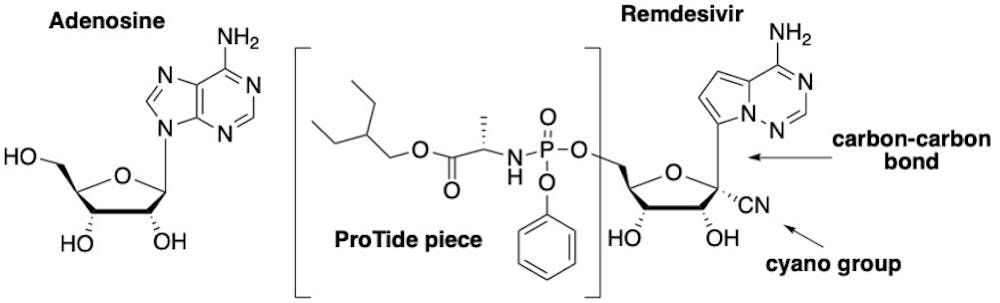
The reason nucleoside analogues and a similar group called nucleotide analogues are so effective is that they resemble the naturally occurring molecules known as nucleosides – cytidine, thymidine, uridine, guanosine and adenosine. These are the essential building blocks for the DNA and RNA that carry our genetic information and play critical roles in our body’s biological processes.
Slight differences in the chemical structure of these analogues from naturally occurring compounds make them effective as drugs. If an organism like a virus incorporates a nucleoside analogue into its genetic material, rather than the real thing, even small changes to the structure of these building blocks prevent the regular chemistry from happening and ultimately foils the ability of the virus to replicate.
The basic structure of a nucleoside includes a sugar group and a base (A, C, G, T or U), and in the case of a nucleotide, a group containing a phosphate which is a collection of oxygen and phosphorus atoms.
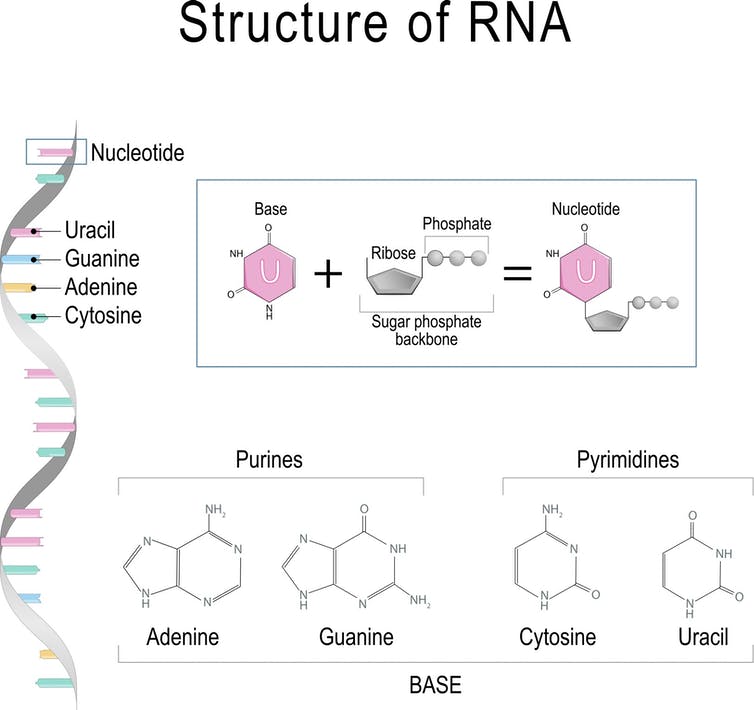 Every building block of DNA is made from three parts: a sugar, a base (A, C, G, or T) and a phosphate group. Every building block of RNA is made from (A, C, G, or U). ttsz / Getty Images
The first nucleoside analogues were approved for medicinal use in the 1950s. The early nucleosides had only simple modifications, typically either to the sugar or the base, while today’s nucleosides, such as Remdesivir, typically have several modifications to their structure. These modifications are essential to their therapeutic activity.
How does Remdesivir work as antiviral therapeutic?
This activity occurs because nucleoside/tide analogues mimic the structure of a natural nucleoside or nucleotide such that they are recognized by, for example, viruses. Due to those structural modifications, however, they stop or interrupt viral replication, which stops the virus from multiplying and infecting more cells in the body.
As a result, they are known as direct-acting antivirals, and this is the case for Remdesivir, which works by blocking the coronavirus’s RNA polymerase – one of the key enzymes that this virus needs to replicate its genetic material (RNA) and proliferate in our bodies. Remdesivir works when the enzyme replicating the genetic material for a new generation of viruses accidentally grabs this nucleoside analogue rather than the natural molecule and incorporates it into the growing RNA strand. Doing this essentially blocks the rest of the RNA from being replicated; this in turn prevents the virus from multiplying.
The drug Remdesivir is basically an altered version of the natural building block adenosine – which is essential for DNA and RNA. Comparing the structure of Remdesivir with adenosine, one can see there are three key modifications that make it effective.
The first is that Remdesivir, as it is administered, is not the actual active drug; it is actually a “prodrug,” meaning it must be modified once in the body before it becomes an active drug. Prodrugs are used for many reasons, including protecting a drug until it reaches its site of action. The active form of Remdesivir contains three phosphate groups; it is this form that is recognized by the virus’s RNA polymerase enzyme.
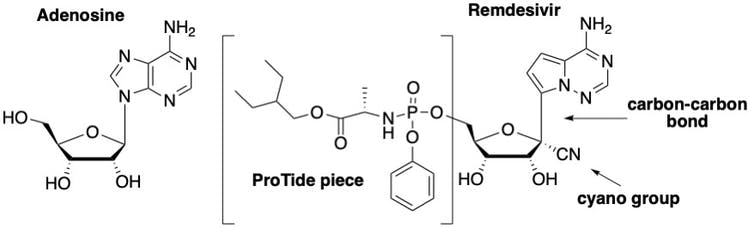 A naturally occurring nucleotide (left) which is a building block of RNA and DNA and Remdesivir (right) which is a variation on its natural counterpart. Katherine Seley-Radtke, CC BY-SA
The second important modification on Remdesivir is the carbon-nitrogen (CN) group attached to the sugar. Once Remdesivir is incorporated into the RNA growing chain, the presence of this CN group causes the shape of the sugar to pucker, which, in turn, distorts the shape of the RNA strand such that only three more nucleotides can be added. This terminates the production of the RNA strand and is what ultimately sabotages the replication of the virus.
The third important structural feature which makes Remdesivir differ from adenosine is the change of one particular chemical bond on the molecule. Rather than a bond linking a carbon and nitrogen atoms, chemists replaced the nitrogen with another carbon, creating a carbon-carbon bond. This is critical to the success of this drug because coronaviruses have a special enzyme that recognizes unnatural nucleosides and clips them out. But by changing this chemical bond, Remdesivir cannot be removed by the enzyme, allowing it to stay in the growing chain and block replication.
Remdesivir trials
Remdesivir originally was found during a drug discovery program at Gilead to search for inhibitors of the hepatitis C virus, which is another RNA virus. Although Gilead ultimately selected a different nucleoside analogue for treatment of hepatitis the company tested the drug to see if it was effective against other RNA viruses. Remdesivir exhibited potent activity against Ebola and Middle Eastern respiratory virus, among others.
Now the drug is being tested against the SAR-CoV-2 virus in the first clinical trial launched in the United States.
According to the NIH, patients who received Remdesivir had a faster recovery compared to those who received placebo; 11 days compared with 15 days for those who received the placebo. “Results also suggested a survival benefit, with a mortality rate of 8.0% for the group receiving Remdesivir versus 11.6% for the placebo group,” according to the NIH press release.
While these results are preliminary, there are a plethora of clinical trials underway across the world. Regardless, a certain amount of caution is still needed. As noted by Dr. Anthony Fauci on NBC’s “Today” show, “the antiviral drug Remdesivir is the first step in what we project will be better and better drugs coming along” to treat COVID-19, but cautioned, “This is not the total answer.”
I share this view with many other scientists in the field. No matter what those results ultimately show, Remdesivir will mostly certainly be part of a cocktail of drugs, just as is standard for treating other viruses such as HIV and hepatitis C.
A combination, or cocktail, of drugs will provide a more effective and more complete therapy that blocks the virus from replicating. The other benefit of such a drug cocktail is that it lowers the chance the virus will develop resistance to the therapy. In the meantime, these early results for Remdesivir are proving to be an important source of hope for many of us across the world as we wait for this pandemic to subside.
******
[You need to understand the coronavirus pandemic, and we can help. Read The Conversation’s newsletter.]
Header image: Photo by ULRIC PERREY/POOL/AFP via Getty Images.
Katherine Seley-Radtke, Professor of Chemistry and Biochemistry and President-Elect of the International Society for Antiviral Research, University of Maryland, Baltimore County
Disclosure statement: Dr. Katherine Seley-Radtke has previously consulted for Gilead Sciences and owns Gilead Sciences stock. She currently receives funding from the National Institutes of Health (NIH), the National Institute of General Medicine (NIGMS), the National Institute of Allergies and Infectious Diseases (NIAID). She is the President-elect of the International Society for Antiviral Research (ISAR) and is the Secretary and former President of the International Society of Nucleosides, Nucleotides & Nucleic Acids (IS3NA), both non-profit scientific professional societies.
This article is republished from The Conversation under a Creative Commons license. Read the original article.
]]>
By Katherine Seley-Radtke, professor, Chemistry and Biochemistry, UMBC With the FDA approving Gilead’s Remdesivir as an emergency use treatment for the most acute cases of COVID-19, many...
https://umbc.edu/stories/remdesivir-explained-what-makes-this-drug-work-against-viruses/
https://beta.my.umbc.edu/api/v0/pixel/news/119901/guest@my.umbc.edu/997bfe579684771042b88b060e098539/api/pixel
cnms
covid-19
covidresearch
discovery
the-conversation
UMBC News & Magazine
https://beta.my.umbc.edu/groups/umbc-news-magazine
https://assets1-beta.my.umbc.edu/system/shared/avatars/groups/000/001/943/24435aa6207c452e7bc15cc74b42c7bb/xsmall.png?1748556657
https://assets1-beta.my.umbc.edu/system/shared/avatars/groups/000/001/943/24435aa6207c452e7bc15cc74b42c7bb/original.png?1748556657
https://assets2-beta.my.umbc.edu/system/shared/avatars/groups/000/001/943/24435aa6207c452e7bc15cc74b42c7bb/xxlarge.png?1748556657
https://assets2-beta.my.umbc.edu/system/shared/avatars/groups/000/001/943/24435aa6207c452e7bc15cc74b42c7bb/xlarge.png?1748556657
https://assets3-beta.my.umbc.edu/system/shared/avatars/groups/000/001/943/24435aa6207c452e7bc15cc74b42c7bb/large.png?1748556657
https://assets1-beta.my.umbc.edu/system/shared/avatars/groups/000/001/943/24435aa6207c452e7bc15cc74b42c7bb/medium.png?1748556657
https://assets2-beta.my.umbc.edu/system/shared/avatars/groups/000/001/943/24435aa6207c452e7bc15cc74b42c7bb/small.png?1748556657
https://assets1-beta.my.umbc.edu/system/shared/avatars/groups/000/001/943/24435aa6207c452e7bc15cc74b42c7bb/xsmall.png?1748556657
https://assets2-beta.my.umbc.edu/system/shared/avatars/groups/000/001/943/24435aa6207c452e7bc15cc74b42c7bb/xxsmall.png?1748556657
UMBC News & Magazine
0
0
false
Wed, 06 May 2020 14:19:16 -0400