UMBC and Baltimore’s Lakeland Elementary/Middle School launch innovative online summer math program

UMBC’s Sherman STEM Teacher Scholars Program has launched an intensive virtual math incubator for Lakeland Elementary/Middle School in Baltimore City this summer. The free, voluntary five-week program is a math intervention for 150 Lakeland students in third through eighth grade. The program seeks to prevent summer learning loss, which could increase this year, intensified by COVID-19’s impact on student learning during the school year.
“With the changes this spring to learning, the UMBC/Lakeland Summer Math Program has allowed us to make up ground and get a head start with students in a targeted approach to math instruction,” says Lakeland Principal Najib Jammal. “This partnership lets us plan for students’ needs this fall knowing that 150 of our students had access to high-quality math instruction the summer.”
Jammal recently spoke about the collaboration in an interview for the segment “Staving Off Summer Slide” on WYPR’s On The Record.
The summer program was designed to also have a lasting impact beyond improving specific STEM skills. Lakeland teachers and UMBC partners are helping Lakeland students develop a positive math identity that will carry them forward into higher level math courses.
Moving online
The summer STEM program was originally designed to be held in person. COVID-19 both increased the need for the program and required Lakeland to move instruction online, decreasing student–teacher and peer interactions. To counter this challenge, program organizers knew they’d need more teachers to decrease the student–teacher ratio and reach more students overall.
 A rug in Lydia Coley’s classroom during her student teaching internship.
The Goldseker Foundation and Baltimore Children’s Youth Fund (BCYF) provided the funding needed to implement the program online and to hire more teachers. Their financial support also expanded the program from the initial 60 rising fourth through sixth graders to 150 rising third through eighth-grade students.
This creative intervention has three priorities: whole child development, math identity development, and math growth. The program is implemented under the direction of Josh Michael ‘10, political science and education, assistant director of UMBC’s Sherman STEM Teachers Scholars Program, in collaboration with five Baltimore City school teachers and twelve interns from the Sherman Scholars program.
Whole child development
UMBC has fostered a strong partnership with Lakeland for more than five years. It has supported Lakeland’s wrap-around academic and community services through the Sherman STEM Teachers Scholars Program, the Sherman Center for Early Learning in Urban Communities, and the Shriver Center Literacy Fellows program. Through additional collaboration with area community groups and companies, such as Northrop Grumman, Lakeland has built a safe and supportive community where students can thrive socially and academically.
The summer program also relies on a firm foundation of strong teacher, student, family, and community relationships. The Sherman STEM Teacher Scholars serve as program leaders. In this role, they dedicate the majority of their day to fostering relationships with students and their families through video chats, phone calls, texts, and emails.
 Coley’s classroom during her student teaching internship.
These program leaders coach the three Lakeland teachers who serve as program facilitators, including one UMBC alumna. Former Sherman Scholar Molly Hart, M.A.T. ‘19, elementary education, is now a sixth grade math teacher at Lakeland and serves as a facilitator for the summer STEM program.
“The program’s support system is incredible,” shares Haleemat Adekoya ‘23, political science. She says this experience has made her aware of the importance of consistent communication in the classroom.
If a student is absent one day, her priority is to get in touch with their family as soon as possible. “Every time I let a student and their family know they were missed, as an intricate part of the classroom community, they’ve shown up the next day and actively engaged.”
This structure of robust support is cultivating strong student and family relationships and student participation. Out of 150 enrolled students, an average of 120 consistently engage in math instruction and STEM activities each day. Nearly 100 percent engage each week. Once students feel supported and are engaged, teachers can then move forward to focus on further developing students’ math identity and math skills.
Math identity
Historically many Black, Latinx, and first-generation students, as well as English Language Learners (ELL) and students experiencing economic hardship, have faced obstacles in math achievement. Limited public school resources, insufficient access to quality culturally relevant instruction, and high social/emotional stresses have created learning gaps at lower grades, which often deepen in upper grades.
For many students, negative experiences in trying to build fundamental math skills have impeded their development of a positive math identity. Math identity is a student’s perception of their ability to perform well in math. It has been shown to impact math performance.

Coley’s classroom during her student teaching internship.
These factors have also contributed to a lack of diversity in STEM fields, reinforcing the negative stereotype that underrepresented students can’t do math regardless of the resources available to them. As a result, underrepresented students are less likely to feel confident enough to pursue higher level math courses. This further limits their access to a variety of academic, career, and social opportunities.
“I am terrified of math even though I was given all the support and resources to excel in math,” explains Adekoya. “Josh Michael and Lydia Coley give me the support and confidence to lean into this opportunity and not give in to imposter syndrome. I have to lead by example.”
Lydia Coley ’20, American studies, valedictorian of UMBC’s most recent graduating class, is also a program leader and a Sherman Scholar alumna. She is a first-year, sixth grade math teacher at Maree G. Farring Elementary/Middle School in Baltimore City.
Me, myself, and math
Lakeland serves 1,000 Pre-K to eighth-grade students. The majority come from underrepresented populations in STEM fields. They are less likely to have a positive math identity. Black students make up 32 percent of the school, 62 percent are Latinx, 42 percent are English Language Learners, 11 percent receive special education services, and most students come from low-income families.
The summer program aims to help Lakeland students break the cycle of underrepresentation. Immersing students in a safe and nurturing space encourages them to engage in the math learning process. It also broadens and strengthens their math skills and fosters a positive math identity.
Through daily interactive synchronous video lessons, based on common core standards, program leaders teach, model, and provide individualized instruction. Students develop a toolkit of strategies that build the confidence needed to take risks and see mistakes as learning opportunities.
 Coley’s classroom during her student teaching internship.
Program facilitator Iliana Hernandez, a fifth-year, third grade math and dual-language teacher at Lakeland, provides program leaders with best practices to support ELL learners. She admits her own fears of math in elementary school. “I don’t want my students to fear math like I did,” shares Hernandez. “When students stay connected and feel valued and cared for their confidence grows and they feel ready to learn.”
Math growth
With this foundation in place, rigorous math instruction can move forward. Program Director Carly Harkins leads the team in curriculum development and instruction. Under her guidance, program facilitators coach program leaders in weekly lesson planning, lesson delivery, assessments, and student support. After daily class, students practice independently through proven online learning tools wherever they are on their math journey.
The program also provides hands-on experience to help students apply what they are learning. Josh Massey, the STEM facilitator, works with Michael and Harkins to create hands-on STEM activities for students.
Massey ‘18, computer engineering, and M.A.T. ‘19, technology education, is a first-year computer science teacher at the Baltimore Polytechnic Institute in Baltimore City. He creates 150 STEM kits weekly, and helps deliver them to students’ homes. Each kit includes the materials needed to complete a project. They tie into the week’s topic, like circuits or small machines.

Adekoya showing the circuit flashlight STEM Kit project.
Photo courtesy of Adekoya.
Students first work on the project independently and then share their process in class. Each student is then the proud owner of something they have built themselves. These projects help support both math growth and a positive math identity.
Access to a bright future
When Michael sees students participating in these activities, he sees them as accessing the building blocks they’ll use to excel in the years ahead.
UMBC and Lakeland partners hope this extra support will ensure more Lakeland students will be better prepared for Algebra I when they enter eighth grade. Why? “Algebra I is a key academic gateway,” says Michael. “There is strong evidence that successfully completing Algebra I in eighth grade is related to higher math achievement in high school and attainment in college.”
Michael notes that it’s long been the case that students of color have had less access to Algebra I in eighth grade. He shares, “Our goal is to provide that access by helping students believe success in math is for them.”
Banner image: A math chart in Coley’s classroom during her student teaching internship. All images by Marlayna Demond ’11 unless otherwise noted.
]]>
UMBC’s Sherman STEM Teacher Scholars Program has launched an intensive virtual math incubator for Lakeland Elementary/Middle School in Baltimore City this summer. The free, voluntary five-week...
https://umbc.edu/stories/umbc-and-baltimores-lakeland-elementary-middle-school-launch-innovative-online-summer-math-program/
https://beta.my.umbc.edu/api/v0/pixel/news/119827/guest@my.umbc.edu/3db479bb9c38fac56547ece54e817530/api/pixel
americanstudies
cahss
coeit
education
history
page1
policy-and-society
politicalscience
resilience
shermanscholars
UMBC News & Magazine
https://beta.my.umbc.edu/groups/umbc-news-magazine
https://assets1-beta.my.umbc.edu/system/shared/avatars/groups/000/001/943/24435aa6207c452e7bc15cc74b42c7bb/xsmall.png?1748556657
https://assets1-beta.my.umbc.edu/system/shared/avatars/groups/000/001/943/24435aa6207c452e7bc15cc74b42c7bb/original.png?1748556657
https://assets2-beta.my.umbc.edu/system/shared/avatars/groups/000/001/943/24435aa6207c452e7bc15cc74b42c7bb/xxlarge.png?1748556657
https://assets2-beta.my.umbc.edu/system/shared/avatars/groups/000/001/943/24435aa6207c452e7bc15cc74b42c7bb/xlarge.png?1748556657
https://assets3-beta.my.umbc.edu/system/shared/avatars/groups/000/001/943/24435aa6207c452e7bc15cc74b42c7bb/large.png?1748556657
https://assets1-beta.my.umbc.edu/system/shared/avatars/groups/000/001/943/24435aa6207c452e7bc15cc74b42c7bb/medium.png?1748556657
https://assets2-beta.my.umbc.edu/system/shared/avatars/groups/000/001/943/24435aa6207c452e7bc15cc74b42c7bb/small.png?1748556657
https://assets1-beta.my.umbc.edu/system/shared/avatars/groups/000/001/943/24435aa6207c452e7bc15cc74b42c7bb/xsmall.png?1748556657
https://assets2-beta.my.umbc.edu/system/shared/avatars/groups/000/001/943/24435aa6207c452e7bc15cc74b42c7bb/xxsmall.png?1748556657
UMBC News & Magazine
0
0
false
Fri, 24 Jul 2020 18:55:04 -0400
Vacancy in house
A room available for rent on yearly lease.
One room available for rent at 1218 Elmridge Avenue. Walking distance from UMBC , wies, highs and giants. The rent is $425 for single occupancy and $305 each for double occupancy plus utilities for one year lease period for either male or female. Lease starting 1st August 2020.
Contact - +14432486146
]]>
One room available for rent at 1218 Elmridge Avenue. Walking distance from UMBC , wies, highs and giants. The rent is $425 for single occupancy and $305 each for double occupancy plus utilities...
https://www.trulia.com/p/md/baltimore/1218-elm-ridge-ave-1-baltimore-md-21229--2361159188
Photo
#
https://beta.my.umbc.edu/api/v0/pixel/news/94448/guest@my.umbc.edu/477b4ada356664380c39f5e7182b2435/api/pixel
International Student and Scholar Services (ISSS)
https://beta.my.umbc.edu/groups/ies
https://assets4-beta.my.umbc.edu/system/shared/avatars/groups/000/000/431/46ad84ea8ba0baeed7c3faf29d1fd4ef/xsmall.png?1693323874
https://assets3-beta.my.umbc.edu/system/shared/avatars/groups/000/000/431/46ad84ea8ba0baeed7c3faf29d1fd4ef/original.jpeg?1693323874
https://assets1-beta.my.umbc.edu/system/shared/avatars/groups/000/000/431/46ad84ea8ba0baeed7c3faf29d1fd4ef/xxlarge.png?1693323874
https://assets1-beta.my.umbc.edu/system/shared/avatars/groups/000/000/431/46ad84ea8ba0baeed7c3faf29d1fd4ef/xlarge.png?1693323874
https://assets4-beta.my.umbc.edu/system/shared/avatars/groups/000/000/431/46ad84ea8ba0baeed7c3faf29d1fd4ef/large.png?1693323874
https://assets3-beta.my.umbc.edu/system/shared/avatars/groups/000/000/431/46ad84ea8ba0baeed7c3faf29d1fd4ef/medium.png?1693323874
https://assets1-beta.my.umbc.edu/system/shared/avatars/groups/000/000/431/46ad84ea8ba0baeed7c3faf29d1fd4ef/small.png?1693323874
https://assets4-beta.my.umbc.edu/system/shared/avatars/groups/000/000/431/46ad84ea8ba0baeed7c3faf29d1fd4ef/xsmall.png?1693323874
https://assets3-beta.my.umbc.edu/system/shared/avatars/groups/000/000/431/46ad84ea8ba0baeed7c3faf29d1fd4ef/xxsmall.png?1693323874
IES Marketplace
0
0
true
Fri, 24 Jul 2020 14:37:21 -0400
Making coronavirus testing easy, accurate and fast is critical to ending the pandemic – the US response is falling far short
By Zoe McLaren, associate professor of public policy, UMBC
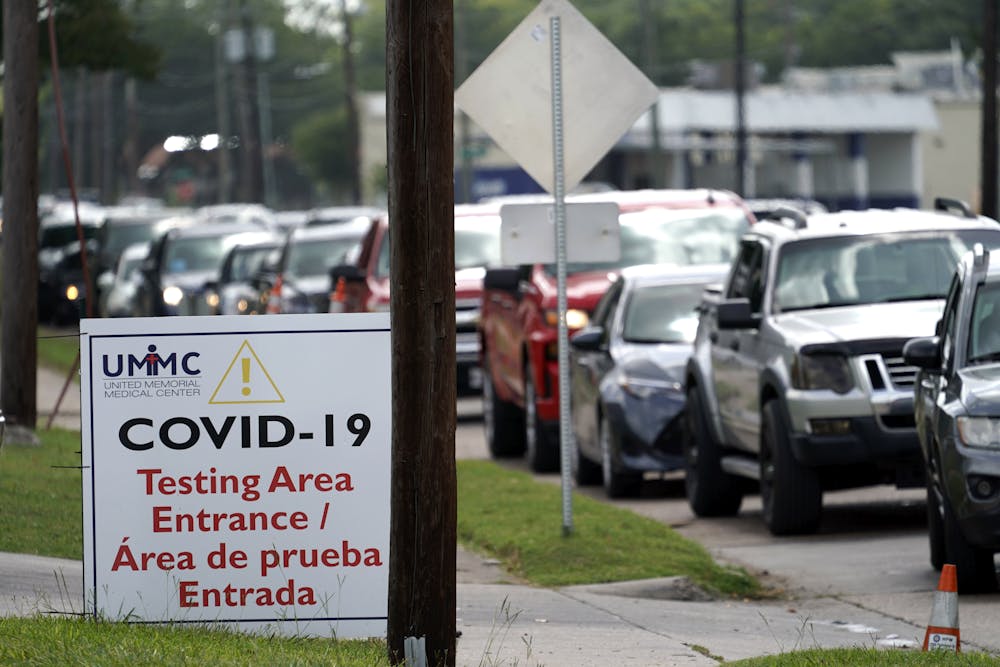
For many people in the U.S., getting tested for COVID-19 is a struggle. In Arizona, testing sites have seen lines of hundreds of cars stretching over a mile. In Texas and Florida, some people were waiting for five hours for free testing.
The inconvenience of these long waits alone discourages many people from getting tested. With the surge in cases, many public testing sites have been reaching maximum capacity within hours of opening, leaving many people unable to get tested for days. Those that do get tested often face a week-long wait to get their test results.
Every person who isn’t tested could be spreading COVID-19 unknowingly. These overstretched testing programs are a weak link in the U.S. pandemic response.
I study public health policy to combat infectious disease epidemics. The key to overcoming this pandemic is to slow transmission of the virus by preventing contagious people from infecting others. A widespread quarantine would accomplish this, but is economically and socially burdensome. Testing offers a way to identify contagious people so they can be isolated to prevent the spread of the disease. This is especially important for COVID-19 because an estimated 40% or more of all people infected with SARS-CoV-2 have few or no symptoms so testing is the only way to identify them.
Some states are doing much better than others. But as a whole, the U.S. is falling far short of the amount of testing needed to control the pandemic. What are the challenges the U.S. is facing? And what is the way forward?
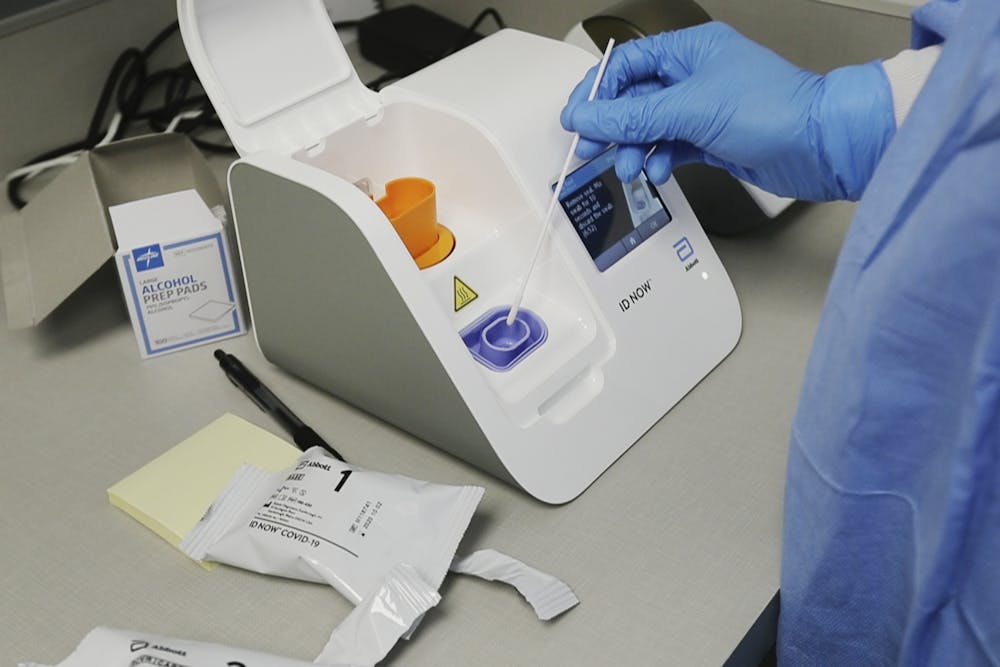
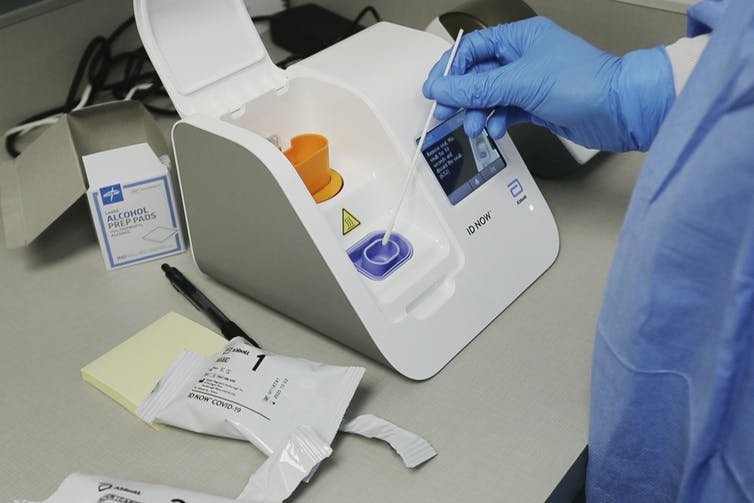 Currently, rapid tests that take about 15 minutes to process are a quick and easy way to diagnose COVID-19 infections, but there are concerns about accuracy. AP Photo/Carlos Osorio
Testing should be free, easy, fast and accurate
The ultimate goal of testing is for everyone, regardless of symptoms, to know at all times whether they are infected with the coronavirus. To achieve this level of testing, tests should be free, very easy to perform and provide accurate results quickly.
Ideally, free COVID-19 tests would be delivered to everyone directly. The tests would be simple to perform – like a saliva test – and would give a perfectly accurate result within minutes. Everyone could test themselves weekly or anytime they were going to be in close contact with other people.
In this ideal scenario, most, if not all, contagious people would be detected before they could spread the virus to others. And because of the rapid results, there would be no burden of quarantining between doing the test and getting the result.
Researchers are working on better-quality tests, but access is a problem of infrastructure, not science. Right now, nowhere in the U.S. comes close to meeting surging demand for testing.
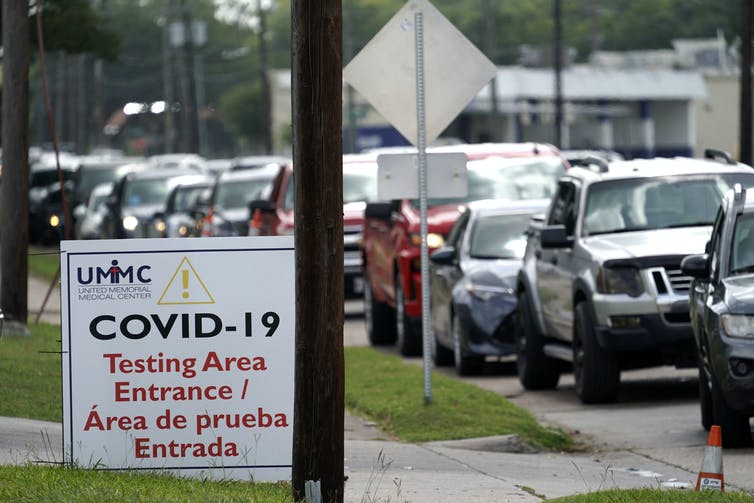 Long lines, slow turnaround times for results and shortages of testing capacity all make Texas one of the worst places to get a test in the U.S. AP Photo/David J. Phillip
One of the worst cases: Texas
The difficulty of getting a COVID-19 test varies by state, but currently, people in Texas face some of the biggest obstacles, which results in far fewer tests being done than is needed to control the pandemic.
First, Houston – which is experiencing a surge in cases – and many testing sites across the state recommend or offer testing only to people who have symptoms, were exposed to a COVID-19 case or are a member of a high-risk group.
Even people recommended for testing still face challenges. It is possible to request an appointment for a free COVID-19 test, but testing facilities can handle only so many patients a day and testing slots fill up quickly. Even if someone gets an appointment, they may face an hours-long wait at the testing site.
Finally, public health experts recommend that people who may have been exposed to COVID-19 should quarantine at home for 14 days or until they receive a negative test result. In Texas, patients are supposed to get results through an online portal in three to five days, but many labs have been taking seven to nine days to return results. These long delays mean people face a much higher burden of quarantining while waiting for results.
All of these challenges make it clear that Texas is simply not testing enough people to keep the spread of COVID-19 in check.
To gauge the success of COVID-19 testing programs, epidemiologists use a measure called test positivity. This is simply the percentage of tests that come back positive. The lower the test positivity, the better, because that means very few cases are going undetected. A high test-positivity rate is usually a sign that only the sickest people are getting tested and many cases are being missed.
The World Health Organization guidelines say that if more than 1 out of 20 COVID-19 tests comes back positive – a test positivity of more than 5% – this is an indication that a lot of cases are not diagnosed and the epidemic is not under control. Texas currently has a test-positivity of around 16%, which means that a lot of infected people are not getting tested and may be unknowingly spreading the disease.
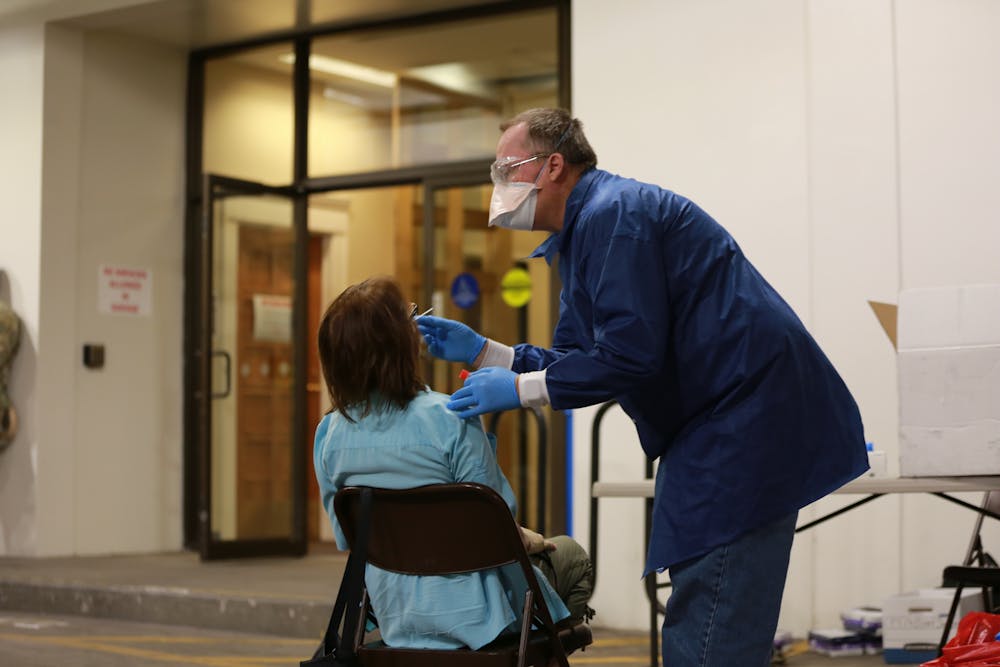
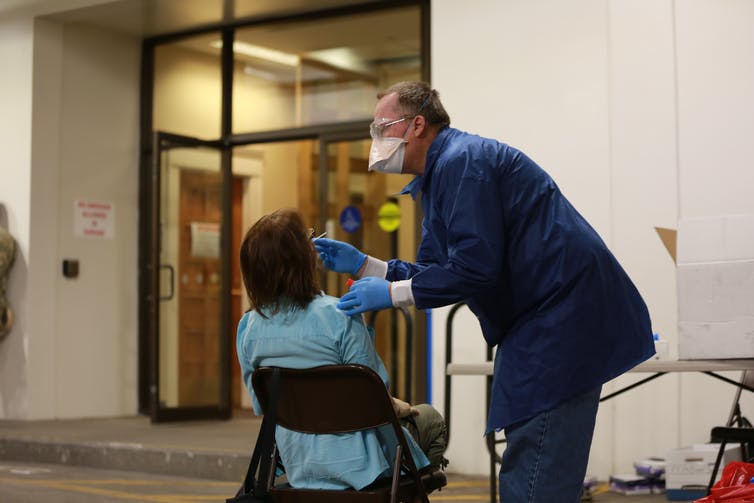 In New Mexico, it is relatively easy to get a test, so more people are getting tested. AP Photo/Cedar Attanasio
One of the best cases: New Mexico
In stark contrast to Texas is New Mexico, which has one of the strongest testing programs in the U.S.
First, public health officials there encourage everyone to get tested for COVID-19 regardless of symptoms or exposure. The state has also prohibited health providers from charging patients for tests. People seeking a test have the option to walk in or to make an appointment ahead of time, whichever is more convenient.
All of this relatively good access to testing has resulted in one of the highest per capita testing rates in the country, at over 20,000 tests per 100,000 people, and a test-positivity rate of around 4%. New Mexico’s testing program is diagnosing a relatively high proportion of cases despite the state experiencing a recent surge.
[Expertise in your inbox. Sign up for The Conversation’s newsletter and get expert takes on today’s news, every day.]
New Mexico still has room for improvement. Long lines, wait times and limited capacity are becoming more common as cases surge, but the foundation of a strong testing program has helped the state cope with the increase in cases.
The big-picture problems
The pre-pandemic infectious disease testing capabilities in the U.S. are clearly unable to meet the current demand. A nationwide response is needed, and there are three things that Congress, the federal government and local governments can do to help ensure COVID-19 tests will be easy to get, fast and accurate.
First, Congress can provide funding to stimulate the testing supply chain, scale up existing testing programs and promote innovation in test development. Second, governments can improve the management and coordination of testing programs to more efficiently use existing resources. And third, innovative testing methods that reduce the need for lab capacity – like paper-strip tests and pooled testing – need be approved and implemented more quickly.
Every little improvement in testing capabilities means more COVID-19 cases can be caught before the virus is transmitted. And slowing the spread of the virus is the key to overcoming the pandemic.
* * * * *
Zoe McLaren, Associate Professor of Public Policy, University of Maryland, Baltimore County
This article is republished from The Conversation under a Creative Commons license. Read the original article.
]]>
By Zoe McLaren, associate professor of public policy, UMBC For many people in the U.S., getting tested for COVID-19 is a struggle. In Arizona, testing sites have seen lines of hundreds of...
https://umbc.edu/stories/making-coronavirus-testing-easy-accurate-and-fast-is-critical-to-ending-the-pandemic-the-us-response-is-falling-far-short/
https://beta.my.umbc.edu/api/v0/pixel/news/119828/guest@my.umbc.edu/d2d99aef7f34b5049f039d912b2ab097/api/pixel
discovery
publicpolicy
the-conversation
UMBC News & Magazine
https://beta.my.umbc.edu/groups/umbc-news-magazine
https://assets1-beta.my.umbc.edu/system/shared/avatars/groups/000/001/943/24435aa6207c452e7bc15cc74b42c7bb/xsmall.png?1748556657
https://assets1-beta.my.umbc.edu/system/shared/avatars/groups/000/001/943/24435aa6207c452e7bc15cc74b42c7bb/original.png?1748556657
https://assets2-beta.my.umbc.edu/system/shared/avatars/groups/000/001/943/24435aa6207c452e7bc15cc74b42c7bb/xxlarge.png?1748556657
https://assets2-beta.my.umbc.edu/system/shared/avatars/groups/000/001/943/24435aa6207c452e7bc15cc74b42c7bb/xlarge.png?1748556657
https://assets3-beta.my.umbc.edu/system/shared/avatars/groups/000/001/943/24435aa6207c452e7bc15cc74b42c7bb/large.png?1748556657
https://assets1-beta.my.umbc.edu/system/shared/avatars/groups/000/001/943/24435aa6207c452e7bc15cc74b42c7bb/medium.png?1748556657
https://assets2-beta.my.umbc.edu/system/shared/avatars/groups/000/001/943/24435aa6207c452e7bc15cc74b42c7bb/small.png?1748556657
https://assets1-beta.my.umbc.edu/system/shared/avatars/groups/000/001/943/24435aa6207c452e7bc15cc74b42c7bb/xsmall.png?1748556657
https://assets2-beta.my.umbc.edu/system/shared/avatars/groups/000/001/943/24435aa6207c452e7bc15cc74b42c7bb/xxsmall.png?1748556657
UMBC News & Magazine
0
0
false
Fri, 24 Jul 2020 13:26:53 -0400
UMBC completes pilot COVID-19 testing in preparation for fall semester

UMBC recently completed its first round of pilot COVID-19 testing, in preparation for the Retriever community’s gradual return to campus in the coming weeks and months. The pilot invited participation from faculty, staff, and students who are approved to be on campus this summer. Over the course of two days, July 13 and 14, University Health Services (UHS) completed 325 COVID-19 tests and shared educational material on how to prevent the spread of COVID-19 in our community.
Of the 321 results received so far, five employees and two students tested positive for COVID-19. This translates to a 2.18 percent positivity rate, compared to the current Maryland state positivity rate of 4.49 percent.
UMBC completed pilot COVID-19 testing on campus July 13 and 14, 2020.
Responding to positive results
In cases where positive results were found, University Health Services asked individuals to self-isolate for 10 days and consult with their primary care physician, even if asymptomatic. UHS also connected with Baltimore County public health officials to complete contact tracing for positive individuals.
Employees who are self-isolating have also been advised that they can access leave through the Families First Coronavirus Response Act (FFCRA) by contacting UMBC Human Resources.
 Face mask signage at UMBC.
Expanding public health measures
As UMBC approaches the fall, COVID-19 testing, daily symptom tracking, and online health and safety training will continue to expand. In the coming weeks, additional employees and students who are approved to work, teach, or live on campus will receive information about these next steps, including how to schedule a free COVID-19 test.
 President Freeman Hrabowski takes part in pilot COVID-19 testing at UMBC.
The University will not ask students, faculty, and staff who continue to work and study fully remotely to complete COVID-19 tests or to track symptoms. However, UMBC will continue to provide resources to help all UMBC community members stay informed about what the University is doing and what they can do to support everyone’s health, safety, and wellbeing.
 SGA President Mehrshad Fahim Devin participates in the COVID-19 testing pilot.
In a recent interview with the Baltimore Business Journal (BBJ), Nancy Young, vice president of student affairs, emphasized the importance of minimizing COVID-19 spread through an array of strategies. These include encouraging community members to practice physical distancing, hand washing, and mask wearing, and creating safety protocols and signage to support those who will be on campus.
 Nancy Young (left) with True Grit and Kate Tracy (right) at UMBC’s COVID-19 testing pilot, July 13, 2020. Young and True Grit hold thermometers distributed for free at the event.
“We hope testing and tracing will be our last measures of protection,” Young told the BBJ. “They are essential,” she says, “but ultimately part of a much larger community-based strategy.”
Featured image: True Grit in a UMBC face mask. All photos by Marlayna Demond ’11 for UMBC.
]]>
UMBC recently completed its first round of pilot COVID-19 testing, in preparation for the Retriever community’s gradual return to campus in the coming weeks and months. The pilot invited...
https://umbc.edu/stories/umbc-completes-pilot-covid-19-testing-in-preparation-for-fall-semester/
https://beta.my.umbc.edu/api/v0/pixel/news/119829/guest@my.umbc.edu/74b6e1d7b8c098efb1cdbe646e8d9446/api/pixel
campus
community
UMBC News & Magazine
https://beta.my.umbc.edu/groups/umbc-news-magazine
https://assets1-beta.my.umbc.edu/system/shared/avatars/groups/000/001/943/24435aa6207c452e7bc15cc74b42c7bb/xsmall.png?1748556657
https://assets1-beta.my.umbc.edu/system/shared/avatars/groups/000/001/943/24435aa6207c452e7bc15cc74b42c7bb/original.png?1748556657
https://assets2-beta.my.umbc.edu/system/shared/avatars/groups/000/001/943/24435aa6207c452e7bc15cc74b42c7bb/xxlarge.png?1748556657
https://assets2-beta.my.umbc.edu/system/shared/avatars/groups/000/001/943/24435aa6207c452e7bc15cc74b42c7bb/xlarge.png?1748556657
https://assets3-beta.my.umbc.edu/system/shared/avatars/groups/000/001/943/24435aa6207c452e7bc15cc74b42c7bb/large.png?1748556657
https://assets1-beta.my.umbc.edu/system/shared/avatars/groups/000/001/943/24435aa6207c452e7bc15cc74b42c7bb/medium.png?1748556657
https://assets2-beta.my.umbc.edu/system/shared/avatars/groups/000/001/943/24435aa6207c452e7bc15cc74b42c7bb/small.png?1748556657
https://assets1-beta.my.umbc.edu/system/shared/avatars/groups/000/001/943/24435aa6207c452e7bc15cc74b42c7bb/xsmall.png?1748556657
https://assets2-beta.my.umbc.edu/system/shared/avatars/groups/000/001/943/24435aa6207c452e7bc15cc74b42c7bb/xxsmall.png?1748556657
UMBC News & Magazine
0
0
false
Fri, 24 Jul 2020 03:40:54 -0400
Why Hydroxychloroquine and Chloroquine Don’t Block SARS-CoV-2 Infection of Human Lung Cells

By Katherine Seley-Radtke, professor, Chemistry and Biochemistry, UMBC
The big idea
A paper came out in Nature on July 22 that further underscores earlier studies that show that neither the malaria drug hydroxychloroquine nor chloroquine prevents SARS-CoV-2 – the virus that causes COVID-19 – from replicating in lung cells.
Most Americans probably remember that hydroxychloroquine became the focus of numerous clinical trials following the president’s statement that it could be a “game changer.” At the time, he appeared to base this statement on anecdotal stories, as well as a few early and very limited studies that hydroxychloroquine seemed to help patients with COVID-19 recover.
Many in the antiviral field, including myself, questioned the validity of both, and in fact, one of the papers was later disparaged by the scientific society and the editor of the journal that published it.
Since then, HQC has had a bumpy ride. It was initially approved by the FDA for emergency use. The FDA then quickly reversed its decision when numerous reports of deaths caused by heart arrhythmias emerged. That news brought many clinical trials to a halt. Regardless, some scientists continued to study it in hopes of finding a cure for this deadly virus.
How the work was done
The new study was carried out by scientists in Germany who tested HCQ on a collection of different cell types to figure out why this drug doesn’t prevent the virus from infecting humans.
Their findings clearly show that that HQC can block the coronavirus from infecting kidney cells from the African green monkey. But it does not inhibit the virus in human lung cells – the primary site of infection for the SARS-CoV-2 virus.
In order for the virus to enter a cell, it can do so by two mechanisms – one, when the SARS-CoV-2 spike protein attaches to the ACE2 receptor and inserts its genetic material into the cell. In the second mechanism, the virus is absorbed into some special compartments in cells called endosomes.
Depending on the cell type, some, like kidney cells, need an enzyme called cathepsin L for the virus to successfully infect them. In lung cells, however, an enzyme called TMPRSS2 (on the cell surface) is necessary. Cathepsin L requires an acidic environment to function and allow the virus to infect the cell, while TMPRSS2 does not.
In the green monkey kidney cells, both hydroxychloroquine and chloroquine decrease the acidity, which then disables the cathepsin L enzyme, blocking the virus from infecting the monkey cells. In human lung cells, which have very low levels of cathepsin L enzyme, the virus uses the enzyme TMPRSS2 to enter the cell. But because that enzyme is not controlled by acidity, neither HCQ and CQ can block the SARS-CoV-2 from infecting the lungs or stop the virus from replicating.
Why it matters
This matters for several reasons. One, much time and money has been spent studying a drug that many scientists said from the very beginning was not going to be effective in killing the virus.
The second reason is that the studies that have reported antiviral activity for hydroxychloroquine were not in epithelial lung cells. Thus, their results are not relevant to properly studying SARS-CoV-2 infections in humans.
What’s next?
As scientists proceed with investigating new drugs as well as trying to repurpose old ones, like hydroxychloroquine, it is critical that researchers take the time to think about their study design.
In short, those of us involved in antiviral drug development should all take a lesson from this study. It is important not only to focus our efforts on pursuing drugs that will directly shut down viral replication, but also to study the virus in the primary site of infection.
*****
Katherine Seley-Radtke, Professor of Chemistry and Biochemistry and President-Elect of the International Society for Antiviral Research, University of Maryland, Baltimore County
This article is republished from The Conversation under a Creative Commons license. Read the original article.
[Deep knowledge, daily. Sign up for The Conversation’s newsletter.]
Header image: Chloroquine is an antimalarial drug originally developed in 1934; it doesn’t block coronavirus infection in humans. Brasil2 / Getty Images
]]>
By Katherine Seley-Radtke, professor, Chemistry and Biochemistry, UMBC The big idea A paper came out in Nature on July 22 that further underscores earlier studies that show that neither...
https://umbc.edu/stories/why-hydroxychloroquine-and-chloroquine-dont-block-sars-cov-2-infection-of-human-lung-cells/
https://beta.my.umbc.edu/api/v0/pixel/news/119830/guest@my.umbc.edu/aac42b16107b287baef610ce4b56c7f2/api/pixel
chemistry-and-biochemistry
cnms
covidresearch
discovery
the-conversation
UMBC News & Magazine
https://beta.my.umbc.edu/groups/umbc-news-magazine
https://assets1-beta.my.umbc.edu/system/shared/avatars/groups/000/001/943/24435aa6207c452e7bc15cc74b42c7bb/xsmall.png?1748556657
https://assets1-beta.my.umbc.edu/system/shared/avatars/groups/000/001/943/24435aa6207c452e7bc15cc74b42c7bb/original.png?1748556657
https://assets2-beta.my.umbc.edu/system/shared/avatars/groups/000/001/943/24435aa6207c452e7bc15cc74b42c7bb/xxlarge.png?1748556657
https://assets2-beta.my.umbc.edu/system/shared/avatars/groups/000/001/943/24435aa6207c452e7bc15cc74b42c7bb/xlarge.png?1748556657
https://assets3-beta.my.umbc.edu/system/shared/avatars/groups/000/001/943/24435aa6207c452e7bc15cc74b42c7bb/large.png?1748556657
https://assets1-beta.my.umbc.edu/system/shared/avatars/groups/000/001/943/24435aa6207c452e7bc15cc74b42c7bb/medium.png?1748556657
https://assets2-beta.my.umbc.edu/system/shared/avatars/groups/000/001/943/24435aa6207c452e7bc15cc74b42c7bb/small.png?1748556657
https://assets1-beta.my.umbc.edu/system/shared/avatars/groups/000/001/943/24435aa6207c452e7bc15cc74b42c7bb/xsmall.png?1748556657
https://assets2-beta.my.umbc.edu/system/shared/avatars/groups/000/001/943/24435aa6207c452e7bc15cc74b42c7bb/xxsmall.png?1748556657
UMBC News & Magazine
0
0
false
Thu, 23 Jul 2020 19:07:18 -0400
UMBC historian Constantine Vaporis brings samurai scholarship to the public through TED-Ed animation

UMBC’s Constantine Vaporis, professor of history, has partnered with TED-Ed Animations to produce A Day In The Life of A Teenage Samurai. This original video draws from over thirty years of scholarship Vaporis has completed on Japanese history and culture. The video is part of TED’s award-winning youth education program whose mission is to “amplify and capture the work of the world’s greatest teachers.” It currently has over 550,000 views.
The life of a samurai
“The creative process for the video required about eight months and involved me as the writer and educator in collaboration with a large creative and technical team,” shares Vaporis, the first UMBC history professor to have his research animated. “It was crafted in a style that is meant to be engaging to young viewers, historically truthful, but not photorealistic.”
The video is set in Kôchi, Japan in 1800. It is a brief window into the fictional life of 16-year-old Mori Banshirô, a samurai in training who aspires to be an artist. Banshirô’s journey takes place during the Edo period (1603 – 1868), which is the focus of Vaporis’s research.
During this time, samurai also served as government officials, teachers, masters of the tea ceremony, and artists. In his latest book, Samurai. An Encyclopedia of Japan’s Cultured Warriors (ABC/CLIO, 2019), Vaporis explores the life, practice, and history of these warriors.
Vaporis continues to partner with TED-Ed. TED-Ed has invited him to be a regular collaborator on future videos about Japan. He has already critiqued two other animations.
Decades researching Japanese history
In addition to his appointment in history, Vaporis has also served as the founding director of UMBC’s Asian studies program and is an affiliate professor of gender, women’s, and sexuality studies. This year he is one of forty scholars selected from around the world as a 2020 – 2021 fellow in residence in the School of Historical Studies at the Institute for Advanced Study in Princeton, NJ. During his fellowship Vaporis will work on his sixth book, Sword and Brush: Portraits of Samurai in Early Modern Japan.
Funding for Vaporis’s early research in Japan was through a Fulbright Scholars Award and a National Endowment for the Humanities Fellowship for College Teachers. He lived in Japan for seven years, completing archival research through these and additional fellowships.
This led to the books Breaking Barriers: Travel and the State in Early Modern Japan (Harvard University Press, 1995); Tour of Duty: Samurai, Military Service in Edo and the Culture of Early Modern Japan (University of Hawai’i Press, 2009); Nihonjin to sankin kôtai [The Japanese and Alternate Attendance] (Kashiwa shobô, 2010); and Voices of Early Modern Japan: Contemporary Accounts of Daily Life During the Age of the Shoguns (ABC/CLIO, 2012; Routledge, 2014, 2020).
Banner image: Constantine Vaporis at UMBC. Photo by Marlayna Demond ’11 for UMBC.
]]>
UMBC’s Constantine Vaporis, professor of history, has partnered with TED-Ed Animations to produce A Day In The Life of A Teenage Samurai. This original video draws from over thirty years of...
https://umbc.edu/stories/umbc-historian-constantine-vaporis-brings-samurai-scholarship-to-the-public-through-ted-ed-animation/
https://beta.my.umbc.edu/api/v0/pixel/news/119831/guest@my.umbc.edu/c74245b2528025737e754c0c30947c01/api/pixel
arts-and-culture
asianstudies
cahss
cahssresearch
gwst
history
policy-and-society
UMBC News & Magazine
https://beta.my.umbc.edu/groups/umbc-news-magazine
https://assets1-beta.my.umbc.edu/system/shared/avatars/groups/000/001/943/24435aa6207c452e7bc15cc74b42c7bb/xsmall.png?1748556657
https://assets1-beta.my.umbc.edu/system/shared/avatars/groups/000/001/943/24435aa6207c452e7bc15cc74b42c7bb/original.png?1748556657
https://assets2-beta.my.umbc.edu/system/shared/avatars/groups/000/001/943/24435aa6207c452e7bc15cc74b42c7bb/xxlarge.png?1748556657
https://assets2-beta.my.umbc.edu/system/shared/avatars/groups/000/001/943/24435aa6207c452e7bc15cc74b42c7bb/xlarge.png?1748556657
https://assets3-beta.my.umbc.edu/system/shared/avatars/groups/000/001/943/24435aa6207c452e7bc15cc74b42c7bb/large.png?1748556657
https://assets1-beta.my.umbc.edu/system/shared/avatars/groups/000/001/943/24435aa6207c452e7bc15cc74b42c7bb/medium.png?1748556657
https://assets2-beta.my.umbc.edu/system/shared/avatars/groups/000/001/943/24435aa6207c452e7bc15cc74b42c7bb/small.png?1748556657
https://assets1-beta.my.umbc.edu/system/shared/avatars/groups/000/001/943/24435aa6207c452e7bc15cc74b42c7bb/xsmall.png?1748556657
https://assets2-beta.my.umbc.edu/system/shared/avatars/groups/000/001/943/24435aa6207c452e7bc15cc74b42c7bb/xxsmall.png?1748556657
UMBC News & Magazine
0
0
false
Thu, 23 Jul 2020 18:46:41 -0400
UMBC’s Gloria Chuku is named the 2020 – 21 Lipitz Professor for her research on the Igbo people of Nigeria
Gloria Chuku, chair andprofessor of Africana studies, has been named UMBC’s Lipitz Professor of the College of Arts, Humanities, and Social Sciences (CAHSS) for 2020 – 21. This distinguished professorship, funded by Roger C. Lipitz and the Lipitz Family Foundation, recognizes and supports innovative teaching and research. During her professorship, Chuku will carry out research for her new book project, Becoming Igbo in Nigeria and the Diaspora: A History of Ethnic Identity Formation and Negotiation.
 UMBC faculty and staff retreat, summer 2017. Photo by Marlayna Demond ’11.
“I am humbled and grateful for my colleagues’ recognition of my contributions to the Africana studies department, CAHSS, and UMBC; to my profession; and to the fields of Igbo and Nigerian histories, African studies, and gender studies,” shares Chuku. “I feel validated.”
In the span of thirty years, Chuku’s internationally-renowned scholarship and teaching has explored the topics of ethno-nationalism, gender, economics, decolonization, conflict, and African-centered epistemological traditions of the Igbo people, the third largest ethnic group in Nigeria.
Scholarship on Igbo culture
Chuku will spend time studying the Commonwealth and African manuscripts at Oxford University’s Bodleian Libraries in the coming year. She will also do archival research at The National Archives in London. Chuku will then return to the United States to review the unpublished papers on the Igbo people at the Melville J. Herskovits Library of African Studies at Northwestern University.
This research will inform the writing of Chuku’s second book, about the processes of Igbo ethnic identity formation, negotiation, and integration across time. This includes Igbo identity within Nigeria and the global diaspora.
Chuku’s first book, Igbo Women and Economic Transformation in Southeastern Nigeria, 1900 – 1960 (Routledge, 2005), remains the most comprehensive study on Igbo women, covering all Igbo subculture zones. As a result of her work she was the first woman to receive the prestigious Ali Mazrui Award for Scholarship and Research Excellence in 2017.This international award recognizes a pre-eminent scholar of African studies for their research and scholarly achievement.

Chuku’s 2017 Ali Mazrui Award.
Photo courtesy of Chuku.
Enriching UMBC
In addition to her research, Chuku has been a vibrant part of the UMBC community. As affiliate professor in gender, women’s, and sexuality studies and language, literacy, and culture, she has served on their undergraduate and doctoral program advisory committees, respectively. She has also served on the Provost’s Advisory Committee on Interdisciplinary Activities.
In 2018 Chuku organized an international conference at UMBC on the history and legacy of women’s roles in the Nigeria-Biafra War. The conference brought renowned scholars and activists from Nigeria, South Africa, Germany, England, Canada, and the United States to UMBC.
UMBC students have also benefited from the intellectual and cultural opportunities Chuku has cultivated at the University. Chuku revived UMBC’s participation in the Model African Union and created the annual Taste of Africa, a celebration of Black History Month and African cultural heritage through unique cuisine and culinary traditions.

Model African Union (2020) in front of the Embassy of Liberia. Photo courtesy of Chuku.
More broadly within the University System of Maryland (USM), Chuku also serves on the executive council of the USM Women’s Forum.

USM Women’s Forum 2019 retreat.
Photo courtesy of Natasha Rodriguez.
Liptz Lecture
Similar to previous Lipitz Professorship recipients, Chuku will share her work with the campus community through the Lipitz Lecture. The lecture is the culminating event of the professorship, part of the Humanities Forum lecture series hosted by the Dresher Center for the Humanities.
Chuku follows Jessica Berman, professor of English and director of the Dresher Center for the Humanities, the 2019 – 2020 Lipitz Professor, and Dan Bailey, a professor of visual arts who focuses on animation and interactive media, the 2018 – 2019 recipient.
“Dr. Chuku is recognized worldwide as a leader in her field,” shares CAHSS Dean Scott Casper. “Her service to UMBC and the national and international research community is wide-ranging and deep. I am delighted that she is this year’s recipient of the Lipitz Professorship.”
Banner image: Chuku at UMBC. Photo courtesy of Marlayna Demond ’11 for UMBC.
]]>
Gloria Chuku, chair andprofessor of Africana studies, has been named UMBC’s Lipitz Professor of the College of Arts, Humanities, and Social Sciences (CAHSS) for 2020 – 21. This distinguished...
https://umbc.edu/stories/umbcs-gloria-chuku-is-named-the-2020-21-lipitz-professor-for-her-research-on-the-igbo-people-of-nigeria/
https://beta.my.umbc.edu/api/v0/pixel/news/119832/guest@my.umbc.edu/b5838e000968f9d14d37e1d040d07400/api/pixel
africanastudies
cahss
cahssresearch
dreshercenter
english
gwst
international
llc
policy-and-society
visualarts
UMBC News & Magazine
https://beta.my.umbc.edu/groups/umbc-news-magazine
https://assets1-beta.my.umbc.edu/system/shared/avatars/groups/000/001/943/24435aa6207c452e7bc15cc74b42c7bb/xsmall.png?1748556657
https://assets1-beta.my.umbc.edu/system/shared/avatars/groups/000/001/943/24435aa6207c452e7bc15cc74b42c7bb/original.png?1748556657
https://assets2-beta.my.umbc.edu/system/shared/avatars/groups/000/001/943/24435aa6207c452e7bc15cc74b42c7bb/xxlarge.png?1748556657
https://assets2-beta.my.umbc.edu/system/shared/avatars/groups/000/001/943/24435aa6207c452e7bc15cc74b42c7bb/xlarge.png?1748556657
https://assets3-beta.my.umbc.edu/system/shared/avatars/groups/000/001/943/24435aa6207c452e7bc15cc74b42c7bb/large.png?1748556657
https://assets1-beta.my.umbc.edu/system/shared/avatars/groups/000/001/943/24435aa6207c452e7bc15cc74b42c7bb/medium.png?1748556657
https://assets2-beta.my.umbc.edu/system/shared/avatars/groups/000/001/943/24435aa6207c452e7bc15cc74b42c7bb/small.png?1748556657
https://assets1-beta.my.umbc.edu/system/shared/avatars/groups/000/001/943/24435aa6207c452e7bc15cc74b42c7bb/xsmall.png?1748556657
https://assets2-beta.my.umbc.edu/system/shared/avatars/groups/000/001/943/24435aa6207c452e7bc15cc74b42c7bb/xxsmall.png?1748556657
UMBC News & Magazine
0
0
false
Thu, 23 Jul 2020 18:32:49 -0400
UMBC’s Dipanjan Pan receives two NIH grants to continue rapid COVID-19 testing research

Dipanjan Pan, professor of chemical, biochemical, and environmental engineering, has received two new grants from the National Institutes of Health to support research poised to improve COVID-19 testing.
Pan and his team recently developed an experimental diagnostic test to rapidly detect the novel coronavirus causing COVID-19, potentially as early as the first day of infection. The test shows results visually, through a color change visible with the naked eye when the virus is present. Their preliminary results were published in the journal ACS Nano, and the biosensors behind this work have generated substantial academic and commercial interest.
Pan received funding from the National Institute of Biomedical Imaging and Bioengineering (NIBIB) to support the development of a mediated colorimetric biosensor. This technology greatly reduces the possibility of misinterpreting the results of COVID-19 sensing tests.
“These awards are very timely. Two back-to-back grants from NIBIB will help me to further develop and optimize the technology and help cover the cost for conducting a clinical study for validation purposes,” says Pan. “The key here is the fine balance between the accuracy of the results and the ability of the testing platform to provide a rapid response.”
The second grant will support Pan’s work to develop a COVID-19 diagnostic platform that will work like a home-based glucometer. Currently, with limitations in sample collection and transportation, it often takes several days for patients to receive their COVID-19 test results. The delay between when the test is taken and when the results are available can lead to the continued spread of the virus.
To reduce the time between when a person takes a COVID-19 test and receives their results, Pan will develop a test that includes an electrochemical biosensor that can detect the virus in about 3 minutes. If patients can receive their results within minutes of taking the test, Pan notes, they can quickly self-isolate and avoid exposing others to the virus.
Pan explains that the test will limit the possibility for inaccurate results. “We adopted a molecularly targeted approach to detect RNA from the virus. Since every living organism has unique RNA, targeting a distinctive genetic material of COVID-19 causative virus SARS-CoV-2 ensures remarkable accuracy and specificity,” he says.
In addition to his appointment at UMBC, Pan is a professor of diagnostic radiology and nuclear medicine and pediatrics at the University of Maryland School of Medicine as part of his dual appointment with the University of Maryland, Baltimore.
Banner image: UMBC’s Interdisciplinary Life Sciences Building. Photo by Marlayna Demond ’11 for UMBC.
]]>
Dipanjan Pan, professor of chemical, biochemical, and environmental engineering, has received two new grants from the National Institutes of Health to support research poised to improve COVID-19...
https://umbc.edu/stories/umbcs-dipanjan-pan-receives-two-nih-grants-to-continue-rapid-covid-19-testing-research/
https://beta.my.umbc.edu/api/v0/pixel/news/119833/guest@my.umbc.edu/7a9f6b5c2f8473c4c809c63ce05064a5/api/pixel
cbee
coeit
covidresearch
science-and-technology
UMBC News & Magazine
https://beta.my.umbc.edu/groups/umbc-news-magazine
https://assets1-beta.my.umbc.edu/system/shared/avatars/groups/000/001/943/24435aa6207c452e7bc15cc74b42c7bb/xsmall.png?1748556657
https://assets1-beta.my.umbc.edu/system/shared/avatars/groups/000/001/943/24435aa6207c452e7bc15cc74b42c7bb/original.png?1748556657
https://assets2-beta.my.umbc.edu/system/shared/avatars/groups/000/001/943/24435aa6207c452e7bc15cc74b42c7bb/xxlarge.png?1748556657
https://assets2-beta.my.umbc.edu/system/shared/avatars/groups/000/001/943/24435aa6207c452e7bc15cc74b42c7bb/xlarge.png?1748556657
https://assets3-beta.my.umbc.edu/system/shared/avatars/groups/000/001/943/24435aa6207c452e7bc15cc74b42c7bb/large.png?1748556657
https://assets1-beta.my.umbc.edu/system/shared/avatars/groups/000/001/943/24435aa6207c452e7bc15cc74b42c7bb/medium.png?1748556657
https://assets2-beta.my.umbc.edu/system/shared/avatars/groups/000/001/943/24435aa6207c452e7bc15cc74b42c7bb/small.png?1748556657
https://assets1-beta.my.umbc.edu/system/shared/avatars/groups/000/001/943/24435aa6207c452e7bc15cc74b42c7bb/xsmall.png?1748556657
https://assets2-beta.my.umbc.edu/system/shared/avatars/groups/000/001/943/24435aa6207c452e7bc15cc74b42c7bb/xxsmall.png?1748556657
UMBC News & Magazine
0
0
false
Thu, 23 Jul 2020 15:42:12 -0400
Student cost to attend UMBC reduced for Fall 2020 semester
The cost to attend UMBC will decrease 22 percent compared to last fall for in-state undergraduate students registered for courses offered by the main campus. UMBC’s Student Business Services Office notes that student bills will reflect stable tuition rates for undergraduate and graduate, resident and non-resident students, and decreased fees.
Mandatory fees for each full-time undergraduate student enrolled at the main campus will decrease by $1,304 as a result of remote operations during the COVID-19 pandemic. Undergraduates will pay only the technology fee and 50 percent of the University Commons and student activity fees, which support ongoing services and programming for students learning both on campus and off.
“The value of a UMBC degree remains high because of the quality of teaching, research, and support for students,” says UMBC President Freeman Hrabowski. “We understand that many students and families face financial pressures as a result of the pandemic, and we have taken this into consideration in setting costs for the fall semester.”
Mandatory fees for each graduate student will decrease by $101 per credit. All graduate students will only be charged the technology fee and 50 percent of both the University Commons and graduate program fees. These support ongoing activities focused on student success in academics and research.
Mandatory fees for students at UMBC’s Shady Grove campus will include only the Shady Grove auxiliary fee and the technology fee. The facilities fee is not being charged this fall.
Need-based aid
Despite negative financial impacts on the University resulting from the pandemic, need-based aid for eligible students will continue to be a priority, notes Vice President for Administration and Finance Lynne Schaefer. “Need-based financial aid has increased 40 percent over the past five years, allowing an additional 1,000 students to receive support,” she says.
In addition, thanks to private contributions from alumni, faculty, staff, and friends of the University, the Stay Black and Gold Emergency Fund and The Fund for UMBC have generated $150,000 in emergency need-based aid for students. Students with financial concerns are encouraged to contact their financial aid counselor. Financial aid counselors are assigned by a student’s last name; a list is located on the Financial Aid webpage.
Featured image: UMBC’s new Interdisciplinary Life Sciences Building in summer 2020. Photo by Marlayna Demond ’11 for UMBC.
]]>
The cost to attend UMBC will decrease 22 percent compared to last fall for in-state undergraduate students registered for courses offered by the main campus. UMBC’s Student Business Services...
https://umbc.edu/stories/student-cost-to-attend-umbc-reduced-for-fall-2020-semester/
https://beta.my.umbc.edu/api/v0/pixel/news/119834/guest@my.umbc.edu/fffe1adea6abe99ffd8e2b83d1842c05/api/pixel
campus
community
page1
UMBC News & Magazine
https://beta.my.umbc.edu/groups/umbc-news-magazine
https://assets1-beta.my.umbc.edu/system/shared/avatars/groups/000/001/943/24435aa6207c452e7bc15cc74b42c7bb/xsmall.png?1748556657
https://assets1-beta.my.umbc.edu/system/shared/avatars/groups/000/001/943/24435aa6207c452e7bc15cc74b42c7bb/original.png?1748556657
https://assets2-beta.my.umbc.edu/system/shared/avatars/groups/000/001/943/24435aa6207c452e7bc15cc74b42c7bb/xxlarge.png?1748556657
https://assets2-beta.my.umbc.edu/system/shared/avatars/groups/000/001/943/24435aa6207c452e7bc15cc74b42c7bb/xlarge.png?1748556657
https://assets3-beta.my.umbc.edu/system/shared/avatars/groups/000/001/943/24435aa6207c452e7bc15cc74b42c7bb/large.png?1748556657
https://assets1-beta.my.umbc.edu/system/shared/avatars/groups/000/001/943/24435aa6207c452e7bc15cc74b42c7bb/medium.png?1748556657
https://assets2-beta.my.umbc.edu/system/shared/avatars/groups/000/001/943/24435aa6207c452e7bc15cc74b42c7bb/small.png?1748556657
https://assets1-beta.my.umbc.edu/system/shared/avatars/groups/000/001/943/24435aa6207c452e7bc15cc74b42c7bb/xsmall.png?1748556657
https://assets2-beta.my.umbc.edu/system/shared/avatars/groups/000/001/943/24435aa6207c452e7bc15cc74b42c7bb/xxsmall.png?1748556657
UMBC News & Magazine
0
0
false
Wed, 22 Jul 2020 02:38:49 -0400
UMBC develops future STEM teachers, researchers through pilot program pairing high school and college students
This fall, Kimani Reed will enter UMBC as a new student in the pre-nursing program, but she’s already a member of the UMBC community. Through a partnership between UMBC and Cristo Rey Jesuit High School in Baltimore, Reed worked on campus one day a week throughout her high school career, gaining experience in several UMBC offices.
“From freshman year all the way through senior year, I met new people at UMBC who always supported me,” Reed says. When she worked in the UMBC Shriver Center, she shares, “The warm welcome I felt when I walked through the doors on the first day already made UMBC feel like home.”
Reed’s connection to The Shriver Center will continue this fall. She has chosen to participate in the Shriver Living Learning Community, a residential community for students committed to pursuing service-learning and community engagement.
Championing student success
Knowing she had her eye on a medical career, Reed’s UMBC mentors frequently pointed her toward programming that would help her reach her goal. So when her supervisor at the Shriver Center, Lori Hardesty, associate director of applied learning and engagement, found out about a special pilot program in the life sciences, she immediately recommended it to Reed.
Hua Lu, professor of biological sciences, led the pilot, and Reed jumped at the chance to work with her. She and Shaojie Chen ’21, chemistry, made up one of four student teams, each with one UMBC student and one local high school student.
Each team participated in a weeklong program in the summer of 2019 funded by the National Science Foundation and organized by Lu. The Research Training for Future Science Teachers and High School Students (RTTS) program has two goals: to create early research opportunities for high school students interested in STEM and to better prepare the next generation of STEM educators.
 Kimani Reed (left) and Shaojie Chen work together in Hua Lu’s lab during the summer program in 2019.
Transformative experiences
That’s how Reed found herself spending her 17th birthday, on a Friday in June last summer, in Hua Lu’s plant genetics lab at UMBC. She arrived by 8:30 a.m. to add the finishing touches to her presentation with Chen on CDF3, a protein found in arabidopsis plants.
Chen and the other UMBC participants were Sherman STEM Teacher Scholars. The Sherman program prepares undergraduates to be culturally responsive and compassionate educators, and many scholars work in Baltimore City. Their partners were all high school students, with the other three (beyond Reed) coming from Baltimore City College High School.
When Lu looks at Reed, Chen, and the other program participants, she sees the future of STEM teaching and learning. “I think we need to provide early, discipline-specific training for our future teachers,” she says. And for the high school participants, “It’s a lot of work, but when you see you can provide this many students with a hands-on experience, it’s definitely worth it.”
Lu is learning from these students’ experiences as she prepares for the program’s next iteration. The pandemic prevented her from running the program in person in 2020, but she is excited for it to relaunch in 2021.
Digging deeper
Based on Reed’s recent study of genetics in high school biology, sometimes she mentored Chen, rather than the other way around. The pair spent the week exploring the structure and function of CDF3 through hands-on laboratory work and research in scientific online databases.
 Ben Lockwood (right) and Youssef Maroud work together during the summer program in 2019. Photo by Hua Lu.
“I learned that molecules do so many different things. I knew they were complex, but looking at them up close through the different databases and digging deeper, I learned so much more,” Reed says. “This experience further confirmed my desire to pursue a medical-related career.” Reed has chosen nursing, after giving the biology major her full consideration thanks to her experience with “Mama Lu,” the students’ nickname for Lu based on her supportive attitude.
Whether a student ends up pursuing research or not, Lu says, an experience like this summer program can be a useful eye-opener about what a research career would be like.
Research for teachers
Ben Lockwood ’20, biological sciences, came at the experience from a different angle—he’s long known he wanted to pursue a teaching career. He was initially skeptical of a research experience, but thanks to the program’s team-based approach, he found it rewarding.
“I definitely feel like I gained from this research experience. And I think it was because I got to do it alongside a high school student,” Lockwood says. “It furthered my understanding of the science content, but it also helped grow my teaching skills, and pair them together, which I hadn’t experienced before.”
Working together with his partner, Youssef Maroud, got Lockwood thinking about “how I would approach labs and experimentation in the classroom,” he says. For example, he began to consider how he might partner with local labs and universities “to provide an upper-level lab environment that offers access to things the high school students wouldn’t normally do.”
Both the high school and UMBC students learned quite a bit about how important it is to use equipment correctly and carefully, and to record results thoroughly and accurately. A technique like pipetting is fairly simple, but also essential, they learned, especially when working with expensive or rare chemicals.
As a result, “Practicing professionalism in the lab is something that I hope to teach my students,” Lockwood says. “And I definitely know from this experience that I have to first provide students with a technical foundation. How can they come up with a procedure if they don’t know the capabilities of each piece of equipment? And how can they carry it out if they don’t know how to use the equipment?”
If Lockwood is any example, “This program is developing better teachers for society,” Lu says, “which will have a positive impact on future students and STEM professionals.”

Hua Lu. Photo by Marlayna Demond ’11 for UMBC.
Lasting bonds
The experience in Lu’s lab was a win for everyone in the pilot program. “The high school students brought so much energy to the lab,” Lu says. “They showed a passion for biology, and you’d see those lightbulb moments.”
The relationships the pairs formed were also a meaningful part of the experience. “I still text with my partner from time to time,” Lockwood says. Building their relationship was “easy, natural, and fun,” he adds. One of the reasons Lockwood wants to teach is to mentor students who may be struggling to find their way, so “being able to establish that relationship with Youssef was very affirming. And I look forward to being a mentor to many more students in the future.”
That’s exactly what Lu hopes students get out of the program: an understanding of not just how to do lab research, but also of how important relationships are to learning and discovery in science.
As Reed begins her UMBC career, she’s excited to extend the relationships she’s already formed at UMBC and to create new ones. “It meant a lot to me to be part of this, because I still got to stay where I felt at home—because I consider UMBC a home away from home—but I also got to make new family with the people I met,” Reed says. “Now I have a really large family and support system through UMBC, and I am so excited to see what I can do with all of them helping me grow.”
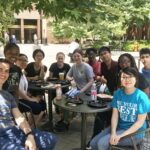
Banner image: Summer program participants and other members of Hua Lu’s lab enjoy lunch together on campus in summer 2019. From left to right: Ben Lockwood ’20; Malaysia McGinnis ’20; Min Gao, postdocotoral fellow; Hua Lu; Cora Bainum, Baltimore City College High School; Jessica Allison, Ph.D. student; Allen Stallings, Baltimore City College High School; Shaojie Chen ’21; Kimani Reed, Cristo Rey Jesuit High School; Riki Egoshi ’20 (front); Youssef Maroud, Baltimore City College High School. Photo courtesy Hua Lu.
]]>
This fall, Kimani Reed will enter UMBC as a new student in the pre-nursing program, but she’s already a member of the UMBC community. Through a partnership between UMBC and Cristo Rey Jesuit High...
https://umbc.edu/stories/umbc-develops-future-stem-teachers-researchers-through-pilot-program-pairing-high-school-and-college-students/
https://beta.my.umbc.edu/api/v0/pixel/news/119835/guest@my.umbc.edu/1f341bbd5eafc9fe9d5cedbcc69f9116/api/pixel
biology
cnms
community
science-and-technology
shermanscholars
shrivercenter
UMBC News & Magazine
https://beta.my.umbc.edu/groups/umbc-news-magazine
https://assets1-beta.my.umbc.edu/system/shared/avatars/groups/000/001/943/24435aa6207c452e7bc15cc74b42c7bb/xsmall.png?1748556657
https://assets1-beta.my.umbc.edu/system/shared/avatars/groups/000/001/943/24435aa6207c452e7bc15cc74b42c7bb/original.png?1748556657
https://assets2-beta.my.umbc.edu/system/shared/avatars/groups/000/001/943/24435aa6207c452e7bc15cc74b42c7bb/xxlarge.png?1748556657
https://assets2-beta.my.umbc.edu/system/shared/avatars/groups/000/001/943/24435aa6207c452e7bc15cc74b42c7bb/xlarge.png?1748556657
https://assets3-beta.my.umbc.edu/system/shared/avatars/groups/000/001/943/24435aa6207c452e7bc15cc74b42c7bb/large.png?1748556657
https://assets1-beta.my.umbc.edu/system/shared/avatars/groups/000/001/943/24435aa6207c452e7bc15cc74b42c7bb/medium.png?1748556657
https://assets2-beta.my.umbc.edu/system/shared/avatars/groups/000/001/943/24435aa6207c452e7bc15cc74b42c7bb/small.png?1748556657
https://assets1-beta.my.umbc.edu/system/shared/avatars/groups/000/001/943/24435aa6207c452e7bc15cc74b42c7bb/xsmall.png?1748556657
https://assets2-beta.my.umbc.edu/system/shared/avatars/groups/000/001/943/24435aa6207c452e7bc15cc74b42c7bb/xxsmall.png?1748556657
UMBC News & Magazine
0
0
false
Mon, 20 Jul 2020 13:48:18 -0400