UMBC study reveals gender bias in bird song research and impact of women on science

A revolutionary group of scientists has been rethinking for two decades how we understand bird song, with women leading the way. Several of these scientists are from UMBC, and their latest research has revealed findings not just about birds, but about bird researchers.
Elaborate bird song had been considered mostly a male trait for centuries, famously discussed by Charles Darwin. But Karan Odom, Ph.D. ’16, biological sciences, published a landmark paper on female bird song in 2014 that helped change that viewpoint. Odom’s study found that as many as 70 percent of female birds sing. Her extensive research also established firmly that both sexes almost certainly sang in the common ancestor of all bird species—a radical idea in ornithology.
 Karan Odom, Ph.D. ’16, with a Troupial Oriole, a species where both sexes sing. Photo by Kevin Omland.
Odom conducted research at UMBC with Kevin Omland, professor of biological sciences, whose lab has led much of the research in this area. Now, a new paper led by Casey Haines ’19, biological sciences, has documented what the Omland group and others have suspected all along: Women are more likely than men to be authors, and even more likely to be first authors (research leads), on papers about female bird song. Therefore, it is largely women who have reshaped this classical field of study.
The findings, published this week in Animal Behaviour, suggest that a diverse group of researchers is critical for scientific innovation. Diversity could also help build a more accurate and complete understanding of bird biology and other fields.
A fresh perspective
Haines and Omland completed the research with co-authors Odom and another Omland lab member, Evangeline Rose, Ph.D. ’20, biological sciences. They examined 59 bird song papers published between 1997 and 2016.
 Casey Haines ’19 (left) and Evangeline Rose, Ph.D. ’20, banding birds, such as this Eastern Bluebird, at a field research site in Maryland. Photo courtesy Casey Haines.
The researchers found that women made up 56 percent of all authors on female bird song papers, compared with only 40 percent of authors of general bird song papers. Women held 68 percent of first-author positions on female bird song papers, but only 44 percent of first-author positions on general bird song papers. This means men were 24 percentage points less likely than women to lead a study on female bird song, and 16 percent less likely to contribute to a female song study in any way, compared with their contributions to general bird song papers.
“I believe this paper is a great example of how diversity expands the type of research scientists are doing,” Haines says. “Female bird song research has been underrepresented in the literature until only recently. A diverse pool of researchers may result in new questions being asked and new approaches to answering those questions. I would love to see this type of research applied in other areas of STEM.”
Kevin Omland discusses the importance of diversity in science, using his lab’s bird song research as a case study, at UMBC’s GRIT-X 2019.
Other research cited in the new paper has found that women are more likely to study female animals (including humans), which have been historically understudied, as well as species that have gotten less attention in research. Female authors also publish more often with women co-authors, opening doors to greater funding and opportunities for more women in science.
More generally, research has shown that diversity among scientists leads to greater creativity in questions, ideas, and methods.
A starting point
Omland acknowledges that this kind of study is outside his lab’s avian evolution wheelhouse, but he hopes it will spark further conversations. “We’re able to add an important data point to these discussions,” he says. And while the new paper has been in the works for some time, “In this moment, this research seems to have gained an increased weight.”
Haines and colleagues acknowledge that their study is imperfect. For example, “Our data represent gender in a binary framework, which is not reflective of society, potentially resulting in mis-gendering authors who are non-binary or gender minorities,” the paper states. “Gender minority authors make important contributions to science and are a vital part of increasing diversity. We recommend that more-detailed future studies provide opportunities for authors to self-identify their gender to avoid the possibility of mis-gendering.”

Casey Haines ’19 with an Eastern Bluebird at a field site in Maryland. Photo courtesy Casey Haines.
Even with its limitations, the paper provides an important glimpse into gender dynamics in ornithology. For an emerging researcher like Haines, it was an eye-opening experience.
“Personally, it was amazing to find that the percentage of women who hold first-author positions on female bird song has increased so much within the last 20 years,” Haines says. “I think it speaks volumes on how far both female bird song and women in science have come.”
Creating space for new leaders
Haines herself is on a path to pursue graduate study in animal behavior based on her experience in the Omland lab. “Working with Dr. Omland, Evangeline, and the rest of the Omland lab was definitely the most memorable and enjoyable part of my time at UMBC,” she says.
Omland has a history of nurturing undergraduate researchers. In fact, Haines’s paper is the tenth peer-reviewed journal article published with an undergraduate first author from his lab. “Undergraduate researchers have really influenced the trajectory of our lab’s research by making consistent, significant contributions,” Omland says.
“It’s essential that we continue to build environments where researchers from all backgrounds are encouraged to explore new ideas and ask new questions,” Omland says. “Not only will this enable them to reach their potential as scientists, but it is also essential to expanding our knowledge of the world around us.”
Banner image: Kevin Omland, rear, goes birdwatching on campus with a few of his students. Photo by Marlayna Demond ’11 for UMBC.
]]>
A revolutionary group of scientists has been rethinking for two decades how we understand bird song, with women leading the way. Several of these scientists are from UMBC, and their latest...
https://umbc.edu/stories/umbc-study-reveals-gender-bias-in-bird-song-research-and-impact-of-women-on-science/
https://beta.my.umbc.edu/api/v0/pixel/news/119809/guest@my.umbc.edu/f610133a12d817ad7f2dd43b31bbea2b/api/pixel
biology
cnms
diversityandinclusion
page1
research
science-and-technology
UMBC News & Magazine
https://beta.my.umbc.edu/groups/umbc-news-magazine
https://assets1-beta.my.umbc.edu/system/shared/avatars/groups/000/001/943/24435aa6207c452e7bc15cc74b42c7bb/xsmall.png?1748556657
https://assets1-beta.my.umbc.edu/system/shared/avatars/groups/000/001/943/24435aa6207c452e7bc15cc74b42c7bb/original.png?1748556657
https://assets2-beta.my.umbc.edu/system/shared/avatars/groups/000/001/943/24435aa6207c452e7bc15cc74b42c7bb/xxlarge.png?1748556657
https://assets2-beta.my.umbc.edu/system/shared/avatars/groups/000/001/943/24435aa6207c452e7bc15cc74b42c7bb/xlarge.png?1748556657
https://assets3-beta.my.umbc.edu/system/shared/avatars/groups/000/001/943/24435aa6207c452e7bc15cc74b42c7bb/large.png?1748556657
https://assets1-beta.my.umbc.edu/system/shared/avatars/groups/000/001/943/24435aa6207c452e7bc15cc74b42c7bb/medium.png?1748556657
https://assets2-beta.my.umbc.edu/system/shared/avatars/groups/000/001/943/24435aa6207c452e7bc15cc74b42c7bb/small.png?1748556657
https://assets1-beta.my.umbc.edu/system/shared/avatars/groups/000/001/943/24435aa6207c452e7bc15cc74b42c7bb/xsmall.png?1748556657
https://assets2-beta.my.umbc.edu/system/shared/avatars/groups/000/001/943/24435aa6207c452e7bc15cc74b42c7bb/xxsmall.png?1748556657
UMBC News & Magazine
0
0
false
Tue, 25 Aug 2020 21:25:05 -0400
Single house near UMBC
There will be bedrooms available for summer break or fall semester student(lease 9 months or longer)
price : $410 /month about(depend on room) + utilities (average $50/month/per month)+ wifi $10/per month
Location: Walking distance to UMBC about 5 minutes.
If interesting, please contact me with your name and your umbc email address;
my e-mail is ; lidimin@gmail.com (please write "Re room" via your email@umbc.edu)

A literary magazine with Taco Bell as its touchstone? It’s actually not as cheesy as it sounds. Unwrap one of the two existing volumes and find: An essay that examines the Taco Bell Chalupa and its relationship to NBA basketball. A poem that goes into a Taco Bell bathroom stall to look at addiction. A Crunch Wrap Medical Chart written by a nursing student.
That an American studies alum created a literary magazine centered on a shared piece of Americana—the fast food chain Taco Bell—should surprise no one. After all, MM Carrigan ’04, founder of Taco Bell Quarterly, often tells people that an American studies (AMST) degree “taught me how to consider, examine, think.” Carrigan uses this foundation in creative writing by “telling the stories of objects and places, and rigorously examining how they operate inside of me. That’s also a description of AMST, in a nutshell.”
UMBC Magazine: How would you describe Taco Bell Quarterly to your mom?
MM Carrigan: Well, my mom always wished for me to create something popular. I think many writers will relate to the idea that our moms just want us to write one of those best sellers or make millions self publishing on Amazon. So I would excitedly tell her, Mom: I made a popular Taco Bell magazine where all the writing is about Taco Bell!
UMBC: Now, how would you describe it to Taco Bell executives?
MC: The New Yorker covered in nacho cheese.
UMBC: When did the idea occur to you to start a literary publication devoted to this fast food restaurant?
MC: In the spring of 2019. One of those late morning ideas after the second cup of coffee hits.
UMBC: Your first two volumes have been prolific! Have you been surprised by the variety of ways people can write about Taco Bell?
MC: Not surprised—I trust writers, I trust in the brilliance of writers. As writers, we continuously approach the same subjects over and over: love, grief, loneliness. I believe Taco Bell is another one of those subjects we can approach over and over.
UMBC: What’s one or two of your favorite pieces?
MC: From Volume 2, Jake Bailey’s “Psychosis at the Bell” excited me, a punk poem exploring schizophrenia and Taco Bell. Terry Horstman’s “Malik for the Win,” is a traditional piece of longform sports writing, through the lens of a basketball Taco Bell promotion. I just love how we get a range of writing.
 An undated photo of MM Carrigan ’04, courtesy of Carrigan.
UMBC: In another interview, you mention being surprised that people took the first call for submissions seriously—why do you think they did?
MC: I was a nobody. I didn’t have a large platform or back catalog of clever tweets. I was just a single writer, with an absurd idea. There isn’t really a space or community for the “nobodies,” so when I invited them to come hang in the metaphorical parking lot of a Taco Bell, I think writers latched on right away.
UMBC: In a time where our country seems endlessly divided over life-or-death issues, Taco Bell feels like a universal, shared American experience. How do you think we can foster more shared experiences like this?
MC: We used to gather around the television to watch a man walk on the moon, or Michael Jackson moonwalk. We shared those cultural moments together. But as our interests and lives become increasingly niche, we seem to only share large scale tragedies together. We must continue to seek out those places, experiences, objects we can still share as a whole. We must look in surprising places.
UMBC: What sort of writing did you do while at UMBC?
MC: I dabbled in bad poetry and short stories. But as weird as it sounds, I found my voice writing American studies papers. There were never any tests in AMST. It was all writing, all talking, all the time. I took a lot more creative liberties in my prose than I should have in academic papers, but I always received the nicest feedback from professors telling me how much they enjoyed reading my work.
I could have walked away jaded after studying the broad history of American systems, institutions, and culture. Instead, I walked away wanting to tell these stories in dynamic ways.
UMBC: Did any one faculty or staff member encourage you in a way that’s stuck with you?
MC: I’m very lucky to have been taught by such a dynamic, passionate group of American studies professors in the early 2000s. A moment that sticks with me, is Dr. Ed Orser reading a passage from a book, and weeping in front of the class, so moved by what he had read. That was the passion and emotion they brought to the material. I could have walked away jaded after studying the broad history of American systems, institutions, and culture. Instead, I walked away wanting to tell these stories in dynamic ways.
UMBC: Other than submitting to Taco Bell Quarterly, what’s advice you’d give to upcoming graduates interested in the arts?
MC: Live mas, dream mas. Your dreams are heavy to carry. It would be easier to discard them, and go into something more practical. You’re more of a workhorse, so keep lugging, keep dreaming. You’ll be good.

Five months after moving classes online due to the COVID-19 pandemic, the UMBC community is preparing for a fall semester unlike any before. UMBC has been gradually transitioning to limited on-campus research and creative activity since June. When the fall semester starts on August 27, a small proportion of Retrievers will live, study, and work on campus, after completing detailed health and safety requirements. Most classes and work continue to progress remotely, using tools and approaches enhanced throughout the summer months.
To create a roadmap for the fall, UMBC has relied on a strong tradition of community collaboration, bringing together committees of faculty, staff, and students to address every aspect of campus activity. In this way, UMBC can continue to live out its strong commitment to inclusive excellence and provide a distinctive academic and social experience during this unprecedented time. UMBC leaders are also in regular communication with the University System of Maryland (USM), and local and state leaders, about new policies guiding campus health and safety efforts.
For Joshua Gray ’22, dance, who will be living on campus during the fall semester, knowing that so many people have been involved in discussions about community health and safety, as well as supporting student success, is reassuring. “I could tell that no decision was made without many people in the room,” Gray says.
COVID-19 testing and symptom tracking
All students, faculty, and staff who are approved to return to campus for the fall semester are required to take a COVID-19 test and submit their results prior to the start of the semester. They are also required to complete daily online symptom tracking beginning 14 days before arriving on campus. Symptom tracking will continue throughout the semester.
 Signage on campus reminding people to wear face coverings. Photo by Marlayna Demond ‘11 for UMBC.
In addition to these University System of Maryland requirements, UMBC is also requiring all returning Retrievers to complete an online health and safety training. Students will also be required to read and sign a new community agreement focused on actions to decrease the risk of COVID-19 transmission on campus.
Health and safety protocols
At a virtual town hall for UMBC staff held on July 1, Lenn Caron, assistant vice president for Facilities Management, described several measures UMBC is taking to minimize the spread of COVID-19.
UMBC’s Facilities Management office has been working closely with campus leadership and ABM, the custodial company contracted by UMBC, to ensure that spaces and buildings are continually sanitized. This includes cleaning all high-touch surfaces multiple times per day, such as restrooms, elevators and elevator buttons, handrails, and doorknobs.
ABM staff have received specialized training on how to safely and effectively sanitize and disinfect spaces on campus. They also are supplied with masks, gloves, and other protective gear in order to protect themselves from possible contact with COVID-19.
 Signage on campus about preventing the spread of COVID-19. Photo by Marlayna Demond ‘11 for UMBC.
In preparation for additional Retrievers to be on campus this fall, Facilities Management has also installed dozens of hand sanitizing and cleaning stations. New signage will remind those on campus to wear a mask and to physically distance.
In addition to the total number of people on campus being limited, UMBC is limiting the number of people allowed in specific lab, office, and classroom spaces, and modifying spaces as needed to support physical distancing. UMBC is also providing masks to all staff who are required to be on campus to complete their jobs.
Preparing to learn online
This fall, 89 percent of courses will be held fully online, 9 percent will be hybrids (including one or more in-person class sessions) and 2 percent will be in-person. No classes will be held on-campus after Thanksgiving break. Previously on-campus courses will resume virtually after that time. Residence halls will also not reopen after Thanksgiving break, as a safety precaution.
Tirzah Khan ’20, information systems, is looking forward to the fall semester, but also knows she will have to implement a new routine and boundaries so she can minimize interruptions and distractions while studying at home. Khan typically commutes to campus, but this semester will be taking classes online. She says that she is used to living with her parents and brother, but she misses her commute. Before the pandemic, that travel time helped her set mental boundaries between school and home.
Khan explains that she’s approaching the fall semester with the mindset that she can’t fully prepare herself for the semester. Because there is so much unknown about how COVID-19 will unfold in the coming months, she is focusing on being adaptable.
 The Welcome Week boxes. Photo by Marlayna Demond ‘11 for UMBC.
As an information systems major, Khan explains that many of her classes had online components even when classes were in person. However, the second half of the spring 2020 semester, when classes moved online abruptly in response to the pandemic, posed challenges. Khan says it took thought and creativity to find new ways to stay in touch with friends and classmates and to connect with faculty.
The importance of building connections has shaped UMBC’s in-person, hybrid, and online course offerings for the fall, as well as strategies to support students.
Preparing to teach online
Several criteria helped campus leaders determine which courses would be held in-person, online, or as a hybrid this fall. These factors included whether courses required special spaces, equipment, or material that could not be reproduced in an online environment. Other considerations included whether courses involved research projects or creative activities that would require in-person work. Some community-building classes, like First-Year Seminars, will also be held fully or partially in-person.
All instructors teaching in-person or hybrid courses will have plans in place to accommodate students who are unable to come to campus, or do not feel comfortable doing so.
Last spring, UMBC faculty had to rapidly shift courses that were originally designed for face-to-face instruction to a remote format in a matter of days. In contrast, fall online classes have been intentionally designed for online instruction, and faculty have been building their online teaching skills throughout the summer.
Hundreds of faculty across all departments have participated in UMBC’s Planning Instructional Variety for Online Teaching (PIVOT) training this summer. PIVOT training helps instructors take a deliberate approach to preparing effective and engaging online courses and creating collaborative classroom experiences.
“Since May, we have engaged well over 300 faculty who took the PIVOT training program, which is based on nationally recognized Quality Matters Standards for effective online course design,” says Sarah Shin, associate provost for academic affairs. “About 450 instructors are participating in more intensive, and discipline-based PIVOT+ learning communities that are facilitated by expert faculty.”
In addition, Shin notes, “our faculty are supported by our Faculty Development Center and Division of Information Technology with expertise in online and hybrid instructional technology, course design, and assessment.”
Building community
UMBC’s residence halls will be at less than 50 percent capacity during the fall semester and on-campus events will be designed with strict safety measures in mind. Still, UMBC is focused on providing a robust student experience beyond the classroom, and community-building is key.
“At each point in planning for the fall, we’ve been very thoughtful about the decisions we’re making and how they impact the community,” says Nancy Young, vice president for student affairs. “Our ability to work across offices, and look at our students’ mental, physical, emotional, and spiritual health as a whole, has been crucial.”
Continuing to build community among students is important to Khan, Gray, and Tess McRae ’21, individualized studies, who are each involved in groups on campus that facilitate connections.
McRae is an intern in UMBC’s Center for Democracy and Civic Life, and has been thinking about what the Center’s community-focused events might look like this coming semester. Staff and students in the Center for Democracy and Civic Life (CDCL) have met regularly throughout the summer to plan meaningful events that will be held online during the fall. These include events related to the 2020 election and online Change Makers Dinners that will create space for community conversations among students and local leaders.
Gray, who is also involved in the CDCL, agrees that creating opportunities for students, faculty, and staff to connect with each other is an important element of the UMBC experience. Khan is involved in CDCL and is also the vice president for design for UMBC’s Student Events Board (seb). She shares that (seb) is actively discussing how to engage both students who are living on campus and students who are completing their courses virtually, through positive community experiences.
Collaboration and innovation
Staff in UMBC Campus Life, CDCL, Off-Campus Student Services, Residential Life, and Identity, Inclusion & Belonging areas have similarly been working to develop events and activities that will engage all students, in person and online. To support virtual events throughout the semester, UMBC’s Division of Information Technology has integrated WebEx teams into the myUMBC platform. This will allow student organizations, as well as offices across UMBC, to engage with community members and stay connected throughout the semester.
Behind the scenes of the student experience, faculty and staff have been working throughout the summer to support all aspects of the UMBC community while navigating pandemic-related challenges. Most faculty and staff members will continue to work remotely during the fall semester, with many juggling care for children and other family members. Human Resources has responded with information and resources to support flexibility for faculty and staff balancing these commitments, including the Families First Coronavirus Response Act (FFCRA).
Through collaboration and innovation, the UMBC community is prepared for a semester that will focus on supporting and celebrating all community members. Relationships are more important than ever, emphasized President Freeman Hrabowski at the latest faculty and staff town hall event, held on August 19. “I want to thank all of you for all that you’re doing,” he said. “Being part of a community means that you’re connected to everyone else.”
Banner image: Black and gold confetti. Photo by Marlayna Demond ’11 for UMBC.
]]>
Five months after moving classes online due to the COVID-19 pandemic, the UMBC community is preparing for a fall semester unlike any before. UMBC has been gradually transitioning to limited...
https://umbc.edu/stories/retrievers-focus-on-community-to-prepare-for-a-fall-semester-unlike-any-before/
https://beta.my.umbc.edu/api/v0/pixel/news/119811/guest@my.umbc.edu/01bf631482157295dd755c8f38d9f3d1/api/pixel
campus
community
resilience
UMBC News & Magazine
https://beta.my.umbc.edu/groups/umbc-news-magazine
https://assets1-beta.my.umbc.edu/system/shared/avatars/groups/000/001/943/24435aa6207c452e7bc15cc74b42c7bb/xsmall.png?1748556657
https://assets1-beta.my.umbc.edu/system/shared/avatars/groups/000/001/943/24435aa6207c452e7bc15cc74b42c7bb/original.png?1748556657
https://assets2-beta.my.umbc.edu/system/shared/avatars/groups/000/001/943/24435aa6207c452e7bc15cc74b42c7bb/xxlarge.png?1748556657
https://assets2-beta.my.umbc.edu/system/shared/avatars/groups/000/001/943/24435aa6207c452e7bc15cc74b42c7bb/xlarge.png?1748556657
https://assets3-beta.my.umbc.edu/system/shared/avatars/groups/000/001/943/24435aa6207c452e7bc15cc74b42c7bb/large.png?1748556657
https://assets1-beta.my.umbc.edu/system/shared/avatars/groups/000/001/943/24435aa6207c452e7bc15cc74b42c7bb/medium.png?1748556657
https://assets2-beta.my.umbc.edu/system/shared/avatars/groups/000/001/943/24435aa6207c452e7bc15cc74b42c7bb/small.png?1748556657
https://assets1-beta.my.umbc.edu/system/shared/avatars/groups/000/001/943/24435aa6207c452e7bc15cc74b42c7bb/xsmall.png?1748556657
https://assets2-beta.my.umbc.edu/system/shared/avatars/groups/000/001/943/24435aa6207c452e7bc15cc74b42c7bb/xxsmall.png?1748556657
UMBC News & Magazine
0
0
false
Thu, 20 Aug 2020 18:55:29 -0400
Princeton Review highlights UMBC’s dedicated students, engaging faculty
UMBC’s dedication to inspiring a community of inquiring minds is apparent in Princeton Review’s new profile of the University, featured in The Best 386 Colleges, 2021 edition.
The University’s profile highlights Retrievers’ reputation for taking education seriously, while staying engaged in campus life and issues they care about. Students told Princeton Review, “UMBC is a place where it is cool to be smart, and everything about the campus, including the students, exudes ‘nerd-chic.’”
“To put it simply, UMBC made it onto The Princeton Review list because of our amazing students,” says Lee Blaney, associate professor of chemical, biochemical, and environmental engineering and UMBC’s 2020–2023 Presidential Teaching Professor. “The list is developed through responses to student surveys, and so we (quite literally) have to thank our students for this honor, which highlights the excellent academic and social community that all of us have built at UMBC.”
Faculty who connect with students
The review also spotlights UMBC faculty for their open-door culture and willingness to mentor undergraduates. Student respondents agreed that the university has “extremely intelligent professors that have a knack for inspiring the students.” They said, “UMBC is a place where professors aren’t just talking heads.”
 From left to right: Lee Blaney, Cameron Sloan ’21, and Ouriel Ndalamba ’23 in the lab in 2019.
Blaney sees what the students are describing as “UMBC truly embracing the social mission of a university, namely to educate and train students to be knowledgeable, capable, and socially responsible leaders.”
“In many ways,” continues Blaney, “this mission starts with UMBC professors who teach students to become change agents in the classroom, the lab, and the community. We’re betting on our students to change the world. It’s for this reason that UMBC professors dedicate so much time and effort to teaching and mentoring.”
New international rankings
UMBC has also recently been named on several international lists of top universities.
The institution ranks in the top 3.5 percent out of 20,000 universities worldwide according to the Center for World University Rankings’ new list for 2020 – 21.
The 2020 Times Higher Education Golden Age ranking places UMBC in the top 150 global universities established between 50 and 80 years ago. The Golden Age ranking highlights universities that have made an exceptional impact while still being relatively young institutions.
Times Higher Education notes that this Golden Age is characterized by rapid university expansion and increasing investment in research. The ranking prioritizes research strength.
 UMBC Albin O’Kuhn Library in springtime.
According to the QS World University ranking, UMBC performed among the top 8.8 percent of U.S. universities in the world this year. UMBC ranked #68 among U.S. doctoral universities in the latest ranking. QS listed “diversity and internationalization” as the University’s strongest category.
“UMBC is able to foster such a robust inclusive community because our leadership and the entire UMBC community fundamentally understand that diversity and inclusion are inseparable from educational excellence,” says Katharine H. Cole, vice provost and dean of Undergraduate Academic Affairs.
Cole shares, “We are a welcoming community to all students and work diligently to uncover inequities in order to provide sustainable educational practices that support our core institutional mission of inclusive excellence.”
Featured image: A view across the Quad in Spring 2020. All photos by Marlayna Demond ’11.
]]>
UMBC’s dedication to inspiring a community of inquiring minds is apparent in Princeton Review’s new profile of the University, featured in The Best 386 Colleges, 2021 edition. The...
https://umbc.edu/stories/princeton-review-highlights-umbcs-dedicated-students-engaging-faculty/
https://beta.my.umbc.edu/api/v0/pixel/news/119812/guest@my.umbc.edu/7b9334eaeca9591636952cdf377db768/api/pixel
campus
community
page1
rankings
UMBC News & Magazine
https://beta.my.umbc.edu/groups/umbc-news-magazine
https://assets1-beta.my.umbc.edu/system/shared/avatars/groups/000/001/943/24435aa6207c452e7bc15cc74b42c7bb/xsmall.png?1748556657
https://assets1-beta.my.umbc.edu/system/shared/avatars/groups/000/001/943/24435aa6207c452e7bc15cc74b42c7bb/original.png?1748556657
https://assets2-beta.my.umbc.edu/system/shared/avatars/groups/000/001/943/24435aa6207c452e7bc15cc74b42c7bb/xxlarge.png?1748556657
https://assets2-beta.my.umbc.edu/system/shared/avatars/groups/000/001/943/24435aa6207c452e7bc15cc74b42c7bb/xlarge.png?1748556657
https://assets3-beta.my.umbc.edu/system/shared/avatars/groups/000/001/943/24435aa6207c452e7bc15cc74b42c7bb/large.png?1748556657
https://assets1-beta.my.umbc.edu/system/shared/avatars/groups/000/001/943/24435aa6207c452e7bc15cc74b42c7bb/medium.png?1748556657
https://assets2-beta.my.umbc.edu/system/shared/avatars/groups/000/001/943/24435aa6207c452e7bc15cc74b42c7bb/small.png?1748556657
https://assets1-beta.my.umbc.edu/system/shared/avatars/groups/000/001/943/24435aa6207c452e7bc15cc74b42c7bb/xsmall.png?1748556657
https://assets2-beta.my.umbc.edu/system/shared/avatars/groups/000/001/943/24435aa6207c452e7bc15cc74b42c7bb/xxsmall.png?1748556657
UMBC News & Magazine
0
0
false
Thu, 20 Aug 2020 15:21:16 -0400
In the Work-From-Home Battle for Space, Women Are the Reluctant Nomads

By Elizabeth Patton, assistant professor, Media and Communication Studies, UMBC
It’s just past 10 a.m. and my partner, on his third virtual meeting today, is working non-stop in our home office. My son has taken over the family room to attend a virtual science camp and video-editing classes and to play video games. I now realize that this will be his work space to attend distance learning classes in the fall.
For this reason, each morning, I find myself carrying my laptop and tea around my house trying to find a quiet place to work. Before the pandemic, I never needed a dedicated space at home for work. But now I’m faced with teaching online this fall and won’t have access to my campus office, which closed in March.
With Google announcing that its 200,000 employees can work from home until June 2021 – and Twitter, Square and Slack announcing that employees could still continue working remotely after the pandemic ends – I’m sure others find themselves in the same boat of not having their own dedicated professional workspace.
And as I explain in my recent book on the social history of the home office, historically, it’s been women who have been the ones left searching for space.
The emergence of the ‘chamber room’
To better understand the makeshift nature of workspaces in the home – and why the spaces are often gendered – it’s important to look at how the home office first emerged as a distinct space.
In the 18th century, three separate spheres of domestic activity started to appear in middle-class and wealthy single-family homes. There was a social area for hosting guests, such as dining and living rooms; a service zone, which included the kitchen, cellar and laundry areas; and a sleeping area, which was the most private part of the house.
What we now call the home office emerged from generically named “chamber” rooms used by both men and women prior to the 19th century. The majority of the chamber rooms were later simply labeled “bedrooms” on builders’ floor plans. However, beginning in the 19th century, some of these spaces depicted on floor plans were interchangeably referred to as the library, den or study.
By the late 19th century, the study became primarily a space reserved for male professionals to conduct business at home, indulge in scholarly pursuits and entertain friends. For example, clergy, merchants and doctors needed a study or “interview room” because their work was more likely to be conducted at home.
The study was often separated from the private zones of the house and placed as close to the front door as possible – in the home’s social zone – to maintain family privacy.
But then, in the early 20th century, the study largely disappeared from standard, middle-class homes, which were getting smaller, remaining only in houses built for upper-middle-class professionals, creative professionals and the wealthy.
Selling the idea of working from home
Even though the study was a male space for leisure and occasional work, the home was largely seen – and championed – as a place that fostered family life.
Yet companies that sold office supplies saw the home as an untapped market. All they needed to do was convince Americans that being able to work from home was a form of convenience. Through advertisements, these companies encouraged Americans to create distinct spaces for work that needed to be properly outfitted with office equipment.
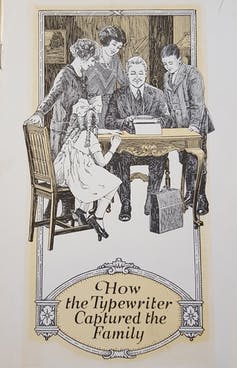 An early ad for the portable typewriter. Remington Rand Papers: Advertising and Sales Promotion Department—Typewriter Division; Hagley Museum, Wilmington, Del., Author provided
For example, in 1921, Remington Rand began marketing portable typewriters, with advertisements that tried to sell consumers on the idea of flexibility and the ability to work in the comfort of one’s home. And in the 1950s, Bell Telephone teamed up with the builders of middle-class homes to market the installation of additional telephone lines as a way to combine work and leisure under one roof.
When PCs replaced typewriters, computer companies such as Apple and IBM geared their ads towards professionals, depicting their products as tools that would allow them to telecommute, run a business out of the home or make it easier for their kids to complete homework.
Separate but unequal spaces
As these technologies started appearing in more and more homes, families started to wonder where to put them.
Popular culture offered some models. In the sitcom “Leave It to Beaver,” the study of the father, Ward Cleaver, is equipped with bookshelves, a globe, two leather chairs, a desk and a telephone. It’s a place where Ward occasionally works from home in the evening and relaxes during the weekend.
By then, however, most middle-class homes lacked studies.
Furthermore, during the postwar period, typewriter and telephone companies didn’t just advertise their products to men. They also sought to entice middle-class women into using their products to better manage tasks like corresponding with schools, insurance brokers and doctors, as well as keeping family records and paying bills. However, unlike men, women’s workspaces in advertisements, newspapers and on television were often depicted as a planning desk in the kitchen or as a little desk in the master bedroom. Rarely, if ever, did they have their own space.
Where to put office equipment was another issue. Placing it in the master bedroom interfered with the perceived functions of the bedroom: intimacy and relaxation. A PC in the living room competed with the television, while office equipment in the kitchen or dining room impeded the ability to work uninterrupted by other family members. For these reasons, advertisements and computing magazines in the 1980s began to recommend new spaces dedicated exclusively to PCs, such as the home office or a “hobby room.”
The home office works well as a quiet room to concentrate and work, but in homes that do have one – and when both partners are at home, as is increasingly the case – that space often defaults to the man.
In the end, all those companies’ advertising dollars paid off. We were working from home in greater numbers before the pandemic, and the number has since risen as offices around the country shuttered. But we’re still stuck with the same issues of too much work and not enough space to do it – with women often getting the short end of the stick.
*****
Elizabeth Patton, Assistant Professor of Media and Communication Studies, University of Maryland, Baltimore County
This article is republished from The Conversation under a Creative Commons license. Read the original article.
[Deep knowledge, daily. Sign up for The Conversation’s newsletter.]
Header image: Ward Cleaver of the popular sitcom ‘Leave It to Beaver’ in his study. Universal Pictures
]]>
By Elizabeth Patton, assistant professor, Media and Communication Studies, UMBC It’s just past 10 a.m. and my partner, on his third virtual meeting today, is working non-stop in our home...
https://umbc.edu/stories/in-the-work-from-home-battle-for-space-women-are-the-reluctant-nomads/
https://beta.my.umbc.edu/api/v0/pixel/news/119813/guest@my.umbc.edu/1ee34487211b3eb257ada6cfe7a2639a/api/pixel
covidresearch
discovery
mcs
media-and-communication-studies
the-conversation
UMBC News & Magazine
https://beta.my.umbc.edu/groups/umbc-news-magazine
https://assets1-beta.my.umbc.edu/system/shared/avatars/groups/000/001/943/24435aa6207c452e7bc15cc74b42c7bb/xsmall.png?1748556657
https://assets1-beta.my.umbc.edu/system/shared/avatars/groups/000/001/943/24435aa6207c452e7bc15cc74b42c7bb/original.png?1748556657
https://assets2-beta.my.umbc.edu/system/shared/avatars/groups/000/001/943/24435aa6207c452e7bc15cc74b42c7bb/xxlarge.png?1748556657
https://assets2-beta.my.umbc.edu/system/shared/avatars/groups/000/001/943/24435aa6207c452e7bc15cc74b42c7bb/xlarge.png?1748556657
https://assets3-beta.my.umbc.edu/system/shared/avatars/groups/000/001/943/24435aa6207c452e7bc15cc74b42c7bb/large.png?1748556657
https://assets1-beta.my.umbc.edu/system/shared/avatars/groups/000/001/943/24435aa6207c452e7bc15cc74b42c7bb/medium.png?1748556657
https://assets2-beta.my.umbc.edu/system/shared/avatars/groups/000/001/943/24435aa6207c452e7bc15cc74b42c7bb/small.png?1748556657
https://assets1-beta.my.umbc.edu/system/shared/avatars/groups/000/001/943/24435aa6207c452e7bc15cc74b42c7bb/xsmall.png?1748556657
https://assets2-beta.my.umbc.edu/system/shared/avatars/groups/000/001/943/24435aa6207c452e7bc15cc74b42c7bb/xxsmall.png?1748556657
UMBC News & Magazine
0
0
false
Mon, 17 Aug 2020 14:52:04 -0400
UMBC students complete internships virtually amid COVID-19 pandemic

Each summer, hundreds of UMBC students complete summer internships to get hands-on experience related to their majors and career goals. The COVID-19 pandemic has moved many networking opportunities and jobs online, including some internships. Still, undergraduate and graduate students from across the University have spent the summer developing their skills and connections virtually.
UMBC’s Career Center continues to offer students a range of services for each stage of their journey. This includes virtual career coaching appointments to discuss topics such as possible career paths and how to gain work experience or prep for an interview. Students are invited to participate in ongoing events and programs including UMBC’s Virtual Fall Career & Internship Fair, Industry Inside Scoop Panels, online networking opportunities with companies, and skill-building webinars about branding, virtual interviews, and the job search process.
“Although life is different in this economy, our UMBC students are continuing to engage in various applied learning experiences and remaining proactive in their job and internship searches,” says Christine Routzahn, director of the UMBC Career Center. “We, as a UMBC community, are all committed to students’ career success. Our team is looking forward to the fall semester start and working with amazing employer partners and alumni to connect UMBC student talent to opportunities to support their career journeys ahead.”
Kacie Lawrence, associate director of internships and employment in UMBC’s Career Center, says that it’s always important for students to have experiences related to their specific career goals, but that it’s becoming even more so during the pandemic. “Now more than ever, it’s crucial that recent graduates enter the job market with career-relevant experience,” she says. “Employers are getting creative as they adapt their internship, co-op, and research programs to online platforms. The Career Center is here to help students make the most of these virtual opportunities.”
UMBC News sat down with students completing internships in the arts, business, tech, law, and elsewhere to learn more about how embracing new formats is allowing them to learn and connect with mentors and peers in creative ways.
Sharing expertise with local businesses
Thomas Southerland ‘22, financial economics, was eager to pursue an internship at JPMorgan Chase & Co. after he came across several opportunities there while exploring his options last year. This summer, Southerland is working virtually as an apprentice in JPMorgan’s Advancing Black Pathways Apprenticeship Program, which he learned about through the company’s website. After graduation, he plans to work in consulting or in the financial service industry.

Thomas Southerland. Photo courtesy of Southerland.
UMBC News: Can you talk about what your internship experience has been like?
Southerland: My internship program was designed to keep us engaged and informed regardless of if it was virtual or not. Although it is incredibly difficult to sit in front of a screen for eight hours a day, the program managers have done an excellent job keeping us busy and engaged. The on-boarding process was also simple; we needed to get acclimated to the new JPMorgan system and the desktop we would be working on. Due to the pandemic, I wasn’t able to work in their Plano, Texas location and I wasn’t able to meet the rest of the apprentices in person.
UMBC News: What has been the most rewarding part of your internship so far?
Southerland: During these last four weeks, we have worked on a business case project where we served as consultants for The Harbor Bank of Maryland to give them recommendations on how they could increase adoption for their electronic banking products. After our research, we presented in front of a panel of judges from JPMorgan and Harbor Bank. My group and I spent a lot of time working on the project and making sure we were ready to present in front of the judges. It took hours after work and time on the weekends to prepare, and we did very well. Seeing everything come together after all of our hard work was incredibly rewarding. I was also given the opportunity to speak about my experience with the project manager during our virtual celebration at the end of the program.
Using learned skills in industry settings
Themi Cologer ‘20, computer science, completed an internship at T. Rowe Price last summer, and was eager to complete another internship to advance his skills in data science. This summer, he finds himself interning virtually for T. Rowe Price, which he found out about and applied to through UMBCworks. As an intern, Cologer is relying on his knowledge of C#, SQL, and React Javascript to build a website that creates an interface and environment that is easy for T. Rowe Price employees to access.

Themi Cologer. Photo courtesy of Cologer.
UMBC News: How does this internship connect to your major and career goals?
Cologer: I am a computer science major with a focus in data science. Being able to do front-end development in a professional setting really is sharpening my coding skills and teaching me how to present code in a corporate environment.
UMBC News: What’s it been like to intern virtually?
Cologer: My experience so far has been excellent! It can be a little harder to communicate effectively in a virtual environment. Networking is definitely different as it’s harder to coordinate a time to meet over email then being able to ask someone to grab lunch or coffee in person. Luckily, I am in a field where I am able to work effectively in a telework environment.
UMBC News: What has been the most rewarding part of your internship so far?
Cologer: I’m enjoying being able to work for a great company, and learn more about the world of software development.
Fostering connections in Baltimore’s art community
Amelia Torres ‘22, media and communications studies, is interning at Maryland Art Place (MAP) in Baltimore, where she is helping with everything from communications and web upkeep, to assisting with the behind-the-scenes organization of virtual exhibits. Torres is responsible for helping draft social media posts, which are important for keeping local artists aware of opportunities that MAP and other galleries in Baltimore offer.

Amelia Torres working at her virtual internship from her grandparents’ house. Photo courtesy of Torres.
Her internship is entirely virtual, but she says that her supervisor has made community-building a priority among the interns. Torres learned about the internship at MAP from Kacie Lawrence. After graduation, Torres plans to combine her passion for organization and communication in a career in public health policy. She is considering pursuing a master’s degree in social work.
UMBC News: What kinds of projects did you work on during your internship?
Torres: The task of creating and organizing Google documents and folders was very important because it helped MAP keep track of all the artists that have participated in exhibitions during 2020. I also was able to help my fellow interns, and Caitlin Gill, program manager and registry coordinator at MAP, with cross-checking artist information for [MAP’s] “Out of Order” online auction. It was important to make sure that artists’ names were spelled correctly and that there were dimensions for their artwork so people bidding online knew exactly where they could put their newly purchased artwork! Lastly, I was also able to research artist opportunities to keep the Resource Bulletin on the MAP website updated for August.
UMBC News: How has completing your internship virtually impacted the connections that you’ve been able to establish?
Torres: This internship was conducted entirely online, which left out the opportunity to meet my fellow interns, but Gill utilized Google Chat, which allowed us to help each other and to communicate whenever we needed. The on-boarding process included watching training videos that helped me learn how to edit and update our website, and how to link external sources when posting on the Resource Bulletin. I find that the pandemic changed this internship slightly because if I was physically at MAP, I would have been able to help greet guests and even help Gill when she was taking photos of the exhibits.

The lobby of the Maryland Art Place (MAP). Photo courtesy of Torres.
UMBC News: What was the most rewarding part of your internship?
Torres: I find the most rewarding part of this internship was being a part of an organization that is diverse and inclusive. MAP is creative in the kinds of exhibitions it presents such as “Merkin Dream” or the “SEEN: 20 Years of Baltimore Music Photography” exhibition. MAP shares history in a modern way and I was totally psyched to be a part of that. It’s also an organization that supports Baltimore artists and other art galleries in Baltimore. I also feel it is important to mention that Gill really helped modify the internship to my interests…[like] looking into opportunities that local artists can participate in.
Exploring the machine learning industry
As a graduate student, Hao Chen, Ph.D. ‘20, electrical engineering, is spending the summer interning at Intel Corporation. He was supposed to be in California, but due to COVID-19 he is working remotely from Baltimore. At UMBC, Chen’s research focuses on machine learning and signal processing. The internship at Intel appealed to Chen because he wanted to see what machine learning looks like in the industry.

Hao Chen. Photo courtesy of Chen.
UMBC News: What tasks and projects are you working on during your internship?
Chen: During the internship, I have two tasks: one is building the data generation model related to radar, wireless sensing, and signal processing systems; the other one is doing some research on developing state-of-the-art deep learning algorithms and implementing them. In other words, math and coding are important to this position.
UMBC News: Can you talk about what your internship has been like? How has completing the internship virtually impacted the connections that you’ve been able to establish with folks where you’re interning?
Chen: The most valuable experience is, when I fell behind in the schedule, I learned how to get better teamwork to make up the lost time. Because of this remote-working situation, I did not communicate well with my mentor at the beginning.
Not only my mentor, but the whole team, is very supportive and gives me suggestions. That is very surprising and encouraging to me. In this virtual internship, I learned the importance of contacting the mentor more frequently. There would be very little interaction, and they cannot see you, if you are quiet.
UMBC News: What has been the most rewarding part of your internship so far?
Chen: This internship helped me understand industrial teamwork better and cowork with others better. The managers/team leaders in the industry play an important role in the team. They need to be strict with the results and give a clear direction on how to get the product. The team members cooperate with each other and make the most of the time.
Exploring both sides of the courtroom
For the past two semesters, Rehman Liaqat ‘23, political science and global studies, interned at the Baltimore City State’s Attorney’s Office. This experience, Liaqat says, allowed him to understand the judicial system from one perspective, but he also wanted to get a more well-rounded experience in the courtroom.
“As I am a member of [UMBC’s] ‘community of inquiring minds,’ I wanted to know more and to do more,” he explains, which led him to his current internship with the Maryland Office of the Public Defender (OPD) in Salisbury, MD. The Office of the Public Defender has jurisdiction in four counties and manages cases from felonies to misdemeanors, and also provides counsel for people who are unable to afford private services.
Liaqat plans to pursue a law career, and hopes to make a difference by working against social injustice.

Rehman Liaqat. Photo courtesy of Liaqat.
UMBC News: What have you been working on during your internship? How has working virtually changed the experience?
Liaqat: Part of the daily routine at the office includes following assistant public defenders through dockets, which are multiple scheduled court hearings at a certain time in the district court, and observing trials for more serious offenses in the circuit court. Along with experiencing how real cases are conducted and proceeded, I am also working on confidential projects, and am an acting research assistant for case briefings and [I am] assisting with ongoing trials.
My first few days were beyond overwhelming. Somehow, it felt like the “good” kind of overwhelming. Time would fly by, and I would still be motivated to think about future cases and ongoing trials that I could assist with. Along with the experience, I’ve met individuals who I’d now call my mentors as they are not just helping me understand and interpret the law but actually practice it.

Rehman Liaqat outside the State of Maryland courthouse.. Photo courtesy of Liaqat.
UMBC News: Can you talk about how the pandemic has impacted your experience?
Liaqat: Although some resources for the office have been restored, many ongoing trials and proceedings have been postponed until October or mid-November due to the outbreak and employees are encouraged to impose minimum contact, wear masks, and try to not stay in the office for too long. My first few weeks at the office involved work that was mostly virtual due to COVID-19 restrictions, but things are improving and we’re staying optimistic.
UMBC News: What has been the most rewarding part of your internship so far?
Liaqat: The most rewarding aspect of the internship has been the clients I meet every day while working with public defenders. I’m not just learning about their stories and what’s going on in their lives, but also helping them through some of their darkest days. It’s an honor and a privilege to be involved and to make a difference every day.
Expanding skills to prepare for a career in medicine
Sarron Seyoum ‘21, biological sciences, is eager to learn as much as she can about research. Over the summer, she interned at the Institute of Marine and Environmental Technology (IMET), a University System of Maryland research institute that includes faculty from UMBC, the University of Maryland, Baltimore, and the University of Maryland Center for Environmental Science.
Seyoum learned about this internship opportunity during a meeting with Susan Hindle, assistant director of internships and employment at the UMBC Career Center. After graduation, Seyoum plans to pursue a career in medicine.

Sarron Seyoum. Photo courtesy of Seyoum.
UMBC News: What tasks and projects are you working on during your internship?
Seyoum: Right now we are working on determining the biodiversity of both prokaryotic and eukaryotic species in Baltimore’s Inner Harbor by using both sequence and video data. I was using COXI DNA barcodes to determine the biodiversity of the metazoic population within the Baltimore Harbor in hopes of learning their role in the harbor. The general practical use of determining biodiversity would be to better understand the harbor and its ecological problems so, in the long run, we could come up with solutions to clean up the harbor using natural means.
UMBC News: How did your internship change due to the pandemic?
Seyoum: Due to the pandemic our internship has been moved online which means we do not get to experience sequencing or data collection in the wet labs, so instead we get to do bioinformatics. We perform most of our work through daily Zoom meetings along with various websites that help us determine the taxonomy of our sequences.
UMBC News: What has been the most rewarding part of your internship so far?
Seyoum: Our mentors have especially been extremely patient and considerate of the different levels of education everyone has. I’m hoping to continue working alongside them during the fall and maybe spring semester as this has been a great experience and I believe I can learn more.
Banner image: A person typing on a computer. Photo by Marlayna Demond ’11 for UMBC.
]]>
Each summer, hundreds of UMBC students complete summer internships to get hands-on experience related to their majors and career goals. The COVID-19 pandemic has moved many networking...
https://umbc.edu/stories/umbc-students-complete-internships-virtually-amid-covid-19-pandemic/
https://beta.my.umbc.edu/api/v0/pixel/news/119814/guest@my.umbc.edu/f8070f487a6777b20c44ca2f46fcf8af/api/pixel
biology
cahss
careercenter
cnms
coeit
community
csee
economics
globalstudies
mcs
page1
politicalscience
UMBC News & Magazine
https://beta.my.umbc.edu/groups/umbc-news-magazine
https://assets1-beta.my.umbc.edu/system/shared/avatars/groups/000/001/943/24435aa6207c452e7bc15cc74b42c7bb/xsmall.png?1748556657
https://assets1-beta.my.umbc.edu/system/shared/avatars/groups/000/001/943/24435aa6207c452e7bc15cc74b42c7bb/original.png?1748556657
https://assets2-beta.my.umbc.edu/system/shared/avatars/groups/000/001/943/24435aa6207c452e7bc15cc74b42c7bb/xxlarge.png?1748556657
https://assets2-beta.my.umbc.edu/system/shared/avatars/groups/000/001/943/24435aa6207c452e7bc15cc74b42c7bb/xlarge.png?1748556657
https://assets3-beta.my.umbc.edu/system/shared/avatars/groups/000/001/943/24435aa6207c452e7bc15cc74b42c7bb/large.png?1748556657
https://assets1-beta.my.umbc.edu/system/shared/avatars/groups/000/001/943/24435aa6207c452e7bc15cc74b42c7bb/medium.png?1748556657
https://assets2-beta.my.umbc.edu/system/shared/avatars/groups/000/001/943/24435aa6207c452e7bc15cc74b42c7bb/small.png?1748556657
https://assets1-beta.my.umbc.edu/system/shared/avatars/groups/000/001/943/24435aa6207c452e7bc15cc74b42c7bb/xsmall.png?1748556657
https://assets2-beta.my.umbc.edu/system/shared/avatars/groups/000/001/943/24435aa6207c452e7bc15cc74b42c7bb/xxsmall.png?1748556657
UMBC News & Magazine
0
0
false
Mon, 17 Aug 2020 13:46:53 -0400
Rapid Screening Tests That Prioritize Speed Over Accuracy Could Be Key to Ending the Coronavirus Pandemic

By Zoë McLaren, associate professor, Public Policy, University of Maryland, Baltimore County
Broad access to testing is one of the most powerful tools to keep the COVID-19 pandemic under control until there’s an effective vaccine in use. Diagnostic testing, which is used in medical settings to determine whether someone is infected with the coronavirus, is costly, slow and overstretched in the U.S. But that’s not the only type of test that can be used.
I study public health policy to combat infectious disease epidemics. To slow the spread of the virus, public health programs need to catch more COVID-19 cases and catch them before they spread. Innovative screening tests offer promise because they are inexpensive, rapid, easily mass produced and don’t require laboratory processing. They can be implemented at large scale for frequent testing in schools, workplaces, airports and even at home. With screening tests, huge numbers of people could be tested regularly and contagious people would be identified before they could spread the virus far and wide.
What is screening testing?
Ideally, the U.S. could provide frequent, accurate diagnostic testing to the whole population, but diagnostic capacity is struggling to keep up with demand. Screening tests make it possible to test large groups of people frequently, including those without any symptoms.
Screening tests are designed to work in a similar way to the X-ray screening of carry-on baggage at airports. X-ray screening is imperfect – some harmless items may prompt a more thorough search and some dangerous items might slip through – but it is fast enough to screen every bag and good enough to catch the majority of potential weapons.
The key, for any screening test, is that it must have a consistent rate of false positives and false negatives. If the user knows exactly how accurate it is, then they can correctly interpret their likelihood of having COVID-19. The Food and Drug Administration generally verifies the test accuracy during the approval process, but it could also be done by another government agency.
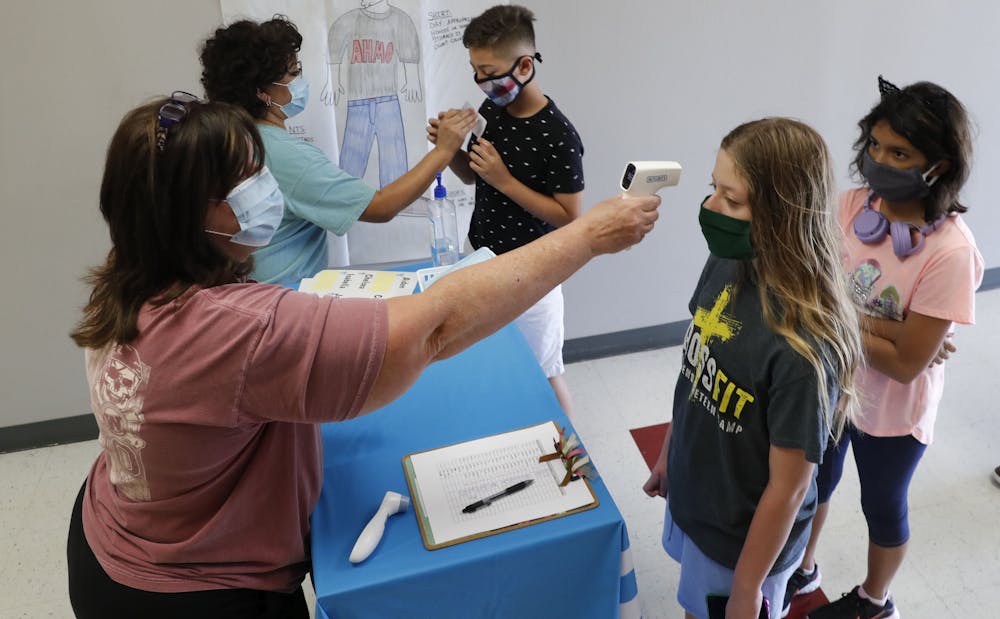
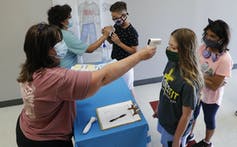 Temperature checks are one form of screening, but miss many COVID-19 cases since 40% of infected people are asymptomatic. AP Photo/LM Otero, File
Many fields of public health employ screening test strategies. For example, thermometer-based screening was used during the SARS and Ebola epidemics. Unfortunately, temperature checks miss a lot of COVID-19 cases because an estimated 40% of people with COVID-19 show no symptoms at all. Many COVID-19 reopening plans incorporate temperature checks since they will catch some cases, but a better screening method is needed.
Which tests work for COVID-19 screening?
Several COVID-19 screening tests that cost $1 to $5 each and give a result in around 15 minutes have been developed, and many more are in the pipeline. These tests don’t require a laboratory and can be processed on-site. Many use antigen-based testing, which detects specific proteins on the surface of the virus.
Screening tests come in many different forms. The FDA recently granted Emergency Use Authorization (EUA) to Quidel and BD for antigen tests that use a small portable point-of-care machine to process samples. Though Quidel reports accuracy rates above 95%, the FDA cautions that the rate could be lower because the test hasn’t undergone the full FDA approval process.
One of the most versatile options for testing is the saliva-based paper-strip test, which only requires a paper strip and a test tube. It could easily be used at home.
Moderately accurate screening tests still reduce transmission
Many inexpensive COVID-19 screening tests may not be as accurate as diagnostic tests. But screening tests with even moderate levels of accuracy can actually still effectively slow the spread of the virus, as long as the results are interpreted correctly.
Here’s how this works.
First, frequent testing catches the vast majority of cases. Someone who is infected but gets a false-negative and slips through the cracks is likely to be caught the next time they’re tested. For a test that misses 20% of positive cases, the chance of an infected person getting two false negatives in a row may be as low as 4%. It’s like bailing a boat with a leaky bucket: You just have to bail more quickly to get the job done.
Second, most people who get false-negative results are unlikely to be contagious. Antigen-based screening tests are good at detecting the high virus levels needed to be contagious. By design, screening tests sacrifice accuracy where it matters least to achieve low costs, speed and ease of use.
Finally, those who get a screening test need to know how to interpret the results. Diagnostic tests can tell you whether you’re infected with a high level of certainty. An inexpensive screening test is not as certain, but is still useful. For example, a positive result would mean that you have a high chance of being contagious, in which case you may want to take a diagnostic test for confirmation and quarantine if possible in the meantime. A negative result would mean that you have a low chance of being contagious, but it couldn’t be ruled out. In this case, it would still be important to stay vigilant about COVID-19 transmission.
While screening tests are not as accurate as diagnostic tests, they are a big improvement over flying blind because they provide useful information about whether someone is contagious. The weather report may not be able to tell you with certainty whether it will rain or not, but it can tell you whether it’s a good idea to bring an umbrella.
What’s preventing widespread use of screening tests?
Several companies are ready to scale up production of screening tests. The primary barrier is the delay in government approval. It’s difficult for screening tests like saliva-based paper-strip tests to achieve the performance required for approval as a COVID-19 diagnostic test while remaining inexpensive and easy enough to allow for widespread and frequent testing. By creating new approval pathways specifically for screening tests, the FDA or another government agency could quickly put more of these tests into use.
Those who see the potential of rapid screening tests are already taking action. A group of governors plan to secure rapid tests that have been granted an Emergency Use Authorization without waiting for full FDA approval. This will make it easier for those states to get back to in-person school and work safely. It is no exaggeration to say that innovative screening tests are a game-changing tool to fight the coronavirus and keep it at bay.
*****
Zoë McLaren, Associate Professor of Public Policy, University of Maryland, Baltimore County
This article is republished from The Conversation under a Creative Commons license. Read the original article.
[Research into coronavirus and other news from science Subscribe to The Conversation’s new science newsletter.]
Header image: Vaidas Bucys/EyeEm via Getty Images
]]>
By Zoë McLaren, associate professor, Public Policy, University of Maryland, Baltimore County Broad access to testing is one of the most powerful tools to keep the COVID-19 pandemic under...
https://umbc.edu/stories/rapid-screening-tests-that-prioritize-speed-over-accuracy-could-be-key-to-ending-the-coronavirus-pandemic/
https://beta.my.umbc.edu/api/v0/pixel/news/119815/guest@my.umbc.edu/14ba6fa09355bed8479701622ab25332/api/pixel
covidresearch
discovery
public-health
public-policy
the-conversation
UMBC News & Magazine
https://beta.my.umbc.edu/groups/umbc-news-magazine
https://assets1-beta.my.umbc.edu/system/shared/avatars/groups/000/001/943/24435aa6207c452e7bc15cc74b42c7bb/xsmall.png?1748556657
https://assets1-beta.my.umbc.edu/system/shared/avatars/groups/000/001/943/24435aa6207c452e7bc15cc74b42c7bb/original.png?1748556657
https://assets2-beta.my.umbc.edu/system/shared/avatars/groups/000/001/943/24435aa6207c452e7bc15cc74b42c7bb/xxlarge.png?1748556657
https://assets2-beta.my.umbc.edu/system/shared/avatars/groups/000/001/943/24435aa6207c452e7bc15cc74b42c7bb/xlarge.png?1748556657
https://assets3-beta.my.umbc.edu/system/shared/avatars/groups/000/001/943/24435aa6207c452e7bc15cc74b42c7bb/large.png?1748556657
https://assets1-beta.my.umbc.edu/system/shared/avatars/groups/000/001/943/24435aa6207c452e7bc15cc74b42c7bb/medium.png?1748556657
https://assets2-beta.my.umbc.edu/system/shared/avatars/groups/000/001/943/24435aa6207c452e7bc15cc74b42c7bb/small.png?1748556657
https://assets1-beta.my.umbc.edu/system/shared/avatars/groups/000/001/943/24435aa6207c452e7bc15cc74b42c7bb/xsmall.png?1748556657
https://assets2-beta.my.umbc.edu/system/shared/avatars/groups/000/001/943/24435aa6207c452e7bc15cc74b42c7bb/xxsmall.png?1748556657
UMBC News & Magazine
0
0
false
Fri, 14 Aug 2020 16:42:23 -0400
Why Does Some Rain Fall Harder Than Other Rain?

By Jeffrey B. Halverson, professor, Geography & Environmental Systems, Associate Dean of the Graduate School, UMBC

Curious Kids is a series for children of all ages. If you have a question you’d like an expert to answer, send it to curiouskidsus@theconversation.com.
Why does some rain fall harder than other rain? – Naomi B., age 9, San Fancisco, California
There are some days when the rain falls peacefully and gently, nourishing the Earth. But on some other days the rain comes down in a torrential downpour that meteorologists like me call a cloudburst. Standing outside in one of these intense rainstorms can feel like being smothered in a heavy, wet towel. These storms can flood the lands below them and lead to great destruction.
So what causes this difference?
All rain comes from a combination of two things: moisture in the air – usually in the form of clouds – and currents of air moving upwards. As moist air rises up through a cloud, the air cools and the water in it turns into tiny raindrops.
This is the same thing that happens when you can see your breath on a cold evening. The temperature change from warm to cool causes water droplets to form in your breath.
In a cloud, these tiny raindrops are very light and float as the rising air pushes them up. But the higher they go, the larger and heavier they get. Eventually, they get so heavy that they fall to the Earth as rain.
 All-day drizzles come from steady storms that don’t have much upward wind flow. AP Photo/Matt Rourke
Cold air storms are steady and slow
Cold air can hold much less moisture than warm air, so wintertime clouds don’t have much water in them; they are thin and layered rather than puffy and tall and full of water.
Since cold air likes to sink to the ground, it’s difficult to get that air to rise quickly, so these wintertime clouds have only gentle upward air currents. As these slow currents sweep up through the thin clouds that don’t have much moisture, small raindrops form. Gravity easily pulls them down against the air current before they get too big. When clouds are thin and the air is moving slowly, you get nice calm rain.
 Massive thunderstorms called supercells can form when the right weather ingredients come together. Greg Lundeen/NOAA
Thunderstorms and big winter storms are quick and intense
Hard rainstorms happen when there is a lot of moisture in the air and the air moves upwards very fast. Summer thunderstorms are the perfect example.
The warm, moist air rises very quickly – like a hot air balloon – and can be moving as fast as 30 to 40 miles per hour. The air also holds much more moisture than winter clouds – up to five times as much.
All of this creates very tall, thick clouds that are full of moisture. Water droplets form quickly as the air moves up through the clouds. But since the wind is blowing upwards so fast, the droplets can get huge before gravity drags them down to Earth. When the weight of all the water droplets gets to be too much for the wind, the wind current collapses, and all the raindrops in the cloud come crashing down at once. These are summer thunderstorms.
Thunderstorms can drop one, two or even three inches of rain in less than an hour. These sudden torrential downpours, called cloudbursts, can lead to flash flooding that can overflow streams and roads and trap people wherever they are.
Thankfully, because thunderstorms are so violent and relatively small, they don’t last very long. Once the rain falls from the clouds and squashes the upward air currents, the clouds disappear and you often see a nice blue sky.
Of course, winter can deliver some strong storms too – especially over the warmer ocean water. When strong winter storms drop lots of heavy rain, the same principles are at work: lots of moisture in the air, fast upwards wind currents and tall clouds.
No two rainstorms are ever the same. Sometimes clouds can rain so hard it feels like you are standing in the shower. Other times they bring only a nice peaceful drizzle. Now, whether you are soaked or singing in the rain, you’ll know why.
Hello, curious kids! Do you have a question you’d like an expert to answer? Ask an adult to send your question to curiouskidsus@theconversation.com.
Please tell us your name, age and the city where you live. We won’t be able to answer every question, but we will do our best.
Jeffrey B. Halverson, Professor of Geography & Environmental Systems, Associate Dean of the Graduate School, University of Maryland, Baltimore County
This article is republished from The Conversation under a Creative Commons license. Read the original article.
Header image: David Pinzer Photography/Moment via Getty Images
[The Conversation’s science, health and technology editors pick their favorite stories. Weekly on Wednesdays.]
]]>
By Jeffrey B. Halverson, professor, Geography & Environmental Systems, Associate Dean of the Graduate School, UMBC Curious Kids is a series for children of all ages. If you have a...
https://umbc.edu/stories/why-does-some-rain-fall-harder-than-other-rain/
https://beta.my.umbc.edu/api/v0/pixel/news/119816/guest@my.umbc.edu/681711836e1b23f84c7f4a585882389c/api/pixel
discovery
geography-and-environmental-systems
theconversation
UMBC News & Magazine
https://beta.my.umbc.edu/groups/umbc-news-magazine
https://assets1-beta.my.umbc.edu/system/shared/avatars/groups/000/001/943/24435aa6207c452e7bc15cc74b42c7bb/xsmall.png?1748556657
https://assets1-beta.my.umbc.edu/system/shared/avatars/groups/000/001/943/24435aa6207c452e7bc15cc74b42c7bb/original.png?1748556657
https://assets2-beta.my.umbc.edu/system/shared/avatars/groups/000/001/943/24435aa6207c452e7bc15cc74b42c7bb/xxlarge.png?1748556657
https://assets2-beta.my.umbc.edu/system/shared/avatars/groups/000/001/943/24435aa6207c452e7bc15cc74b42c7bb/xlarge.png?1748556657
https://assets3-beta.my.umbc.edu/system/shared/avatars/groups/000/001/943/24435aa6207c452e7bc15cc74b42c7bb/large.png?1748556657
https://assets1-beta.my.umbc.edu/system/shared/avatars/groups/000/001/943/24435aa6207c452e7bc15cc74b42c7bb/medium.png?1748556657
https://assets2-beta.my.umbc.edu/system/shared/avatars/groups/000/001/943/24435aa6207c452e7bc15cc74b42c7bb/small.png?1748556657
https://assets1-beta.my.umbc.edu/system/shared/avatars/groups/000/001/943/24435aa6207c452e7bc15cc74b42c7bb/xsmall.png?1748556657
https://assets2-beta.my.umbc.edu/system/shared/avatars/groups/000/001/943/24435aa6207c452e7bc15cc74b42c7bb/xxsmall.png?1748556657
UMBC News & Magazine
0
0
false
Thu, 13 Aug 2020 12:49:39 -0400
UMBC-led team receives Dept. of Energy grant to advance nuclear fusion energy research

UMBC’s Carlos Romero-Talamas is leading a group of researchers in designing and building a machine to produce nuclear fusion energy. The project is one of just 15 new initiatives selected for support through the U.S. Department of Energy’s Advanced Research Projects Agency-Energy program. The researchers will use the $4 million grant to develop and build a centrifugal mirror that can conduct electricity and will generate energy from fusion reactions.
The team’s goal is to use what is essentially a rotating magnetic mirror machine to produce energy from nuclear fusion, explains Romero-Talamas, associate professor of mechanical engineering. “This type of nuclear energy is considered the ‘holy grail’ of energy sources because of its inexpensive and abundant fuel supply,” he says. He adds that fusion energy does not emit greenhouse gases.
Design and fabrication
The research team includes researchers from both UMBC and the University of Maryland, College Park (UMD). The device they will design and build will fill a large laboratory at UMD’s Energy Research Facility.
Romero-Talamas explains that the power system will consist of hundreds of large, high-voltage capacitors and electromagnets. It will also include active controls to prevent the magnets from overheating. There will also be a separate space for machine controls, because researchers will not be in the equipment room while conducting experimental runs, as a safety precaution.
 The preliminary design of the vessel and supports. Image courtesy of Romero-Talamas.
The research team will design the vacuum chamber and coils, which will be fabricated by experienced suppliers. The vacuum chamber will be approximately the length of two midsize cars. However, it will weigh a lot more than that, Romero-Talamas explains. The entire structure will be more than seven feet tall.
Solving long-standing questions
Romero-Talamas will collaborate with Adil Hassam, Tim Koeth, Brian Beaoduin, and Ian Abel, all UMD faculty serving as co-PIs. He and the team will also work with undergraduate and graduate students from both universities.
As the PI, Romero-Talamas will direct the research project, and will play a significant role in the engineering design and construction of the technology. UMD faculty and students will take the lead on equipment safety and certification.
 Carlos Romero-Talamas presenting at an event. Photo by Marlayna Demond ’11 for UMBC.
“Our efforts are aimed at not only solving long-standing physics questions regarding the possibility of confining thermonuclear plasmas with centrifugal mirrors, but to help in the technology transfer to market and make fusion energy a commercial reality,” Romero-Talamas says.
The researchers will measure the density of the particles, specifically how many particles the team is able to make rotate at a high speed inside the vacuum chamber. They will also measure the temperature and speed of the particles.
Impact in fusion energy field
Romero-Talamas says that he has been interested in fusion energy since he was a graduate student at Caltech. “Initially, I wanted to work in plasma rocket engines, but when I took a plasma physics class, fusion energy seemed very exciting, important, and urgent to me,” he recalls. “Since then, the study of plasma physics aimed toward helping fusion energy become a reality has been central to my research.”
In nuclear fusion, energy is released when two nuclei collide at high speeds. Romero-Talamas points out that the act of fusing nuclei is difficult to accomplish. Like magnets, when ions are brought close to one another they begin to repel, which makes the high-speed collision important to overcome the repulsion and make fusion energy a success, he says.
Fusion energy can be generated from water and lithium, and doesn’t require many additional resources. It requires a small amount of material compared to traditional energy extraction methods, like burning fossil fuels, says Romero-Talamas. When a fusion reactor launches particles at each other at a high speed, their collisions can generate temperatures that are nearly 10 times hotter than the center of the sun.
Romero-Talamas and his research team will also work with experts at Virginia Tech and the Princeton Plasma Physics Laboratory on simulations needed for this work. And students will be involved in every step of the research, from design and construction to presenting findings at conferences and in peer-reviewed journal articles.
This effort, which we call the Centrifugal Mirror Fusion Experiment, is an important step towards the realization of commercial fusion energy, Romero-Talamas explains. “A commercial reactor based on our concept would be relatively compact with respect to other fusion contenders, lowering the cost and time to market,” he says. “While there will be important materials and engineering questions that will need to be addressed before scaling up to a commercial reactor, we will address the most important physics questions that could put us in a path to a demo reactor in years, not decades. We are very excited to be working on a truly transformational technology that will enable a virtually inexhaustible energy source with very small impact to our planet.”
Banner image: Carlos Romero-Talamas. Photo by Marlanya Demond ‘11 for UMBC.
]]>
UMBC’s Carlos Romero-Talamas is leading a group of researchers in designing and building a machine to produce nuclear fusion energy. The project is one of just 15 new initiatives selected for...
https://umbc.edu/stories/umbc-led-team-receives-dept-of-energy-grant-to-advance-nuclear-fusion-energy-research/
https://beta.my.umbc.edu/api/v0/pixel/news/119817/guest@my.umbc.edu/de7eb7f57106751f0758ce9fb7055bcd/api/pixel
coeit
meche
research
science-and-technology
UMBC News & Magazine
https://beta.my.umbc.edu/groups/umbc-news-magazine
https://assets1-beta.my.umbc.edu/system/shared/avatars/groups/000/001/943/24435aa6207c452e7bc15cc74b42c7bb/xsmall.png?1748556657
https://assets1-beta.my.umbc.edu/system/shared/avatars/groups/000/001/943/24435aa6207c452e7bc15cc74b42c7bb/original.png?1748556657
https://assets2-beta.my.umbc.edu/system/shared/avatars/groups/000/001/943/24435aa6207c452e7bc15cc74b42c7bb/xxlarge.png?1748556657
https://assets2-beta.my.umbc.edu/system/shared/avatars/groups/000/001/943/24435aa6207c452e7bc15cc74b42c7bb/xlarge.png?1748556657
https://assets3-beta.my.umbc.edu/system/shared/avatars/groups/000/001/943/24435aa6207c452e7bc15cc74b42c7bb/large.png?1748556657
https://assets1-beta.my.umbc.edu/system/shared/avatars/groups/000/001/943/24435aa6207c452e7bc15cc74b42c7bb/medium.png?1748556657
https://assets2-beta.my.umbc.edu/system/shared/avatars/groups/000/001/943/24435aa6207c452e7bc15cc74b42c7bb/small.png?1748556657
https://assets1-beta.my.umbc.edu/system/shared/avatars/groups/000/001/943/24435aa6207c452e7bc15cc74b42c7bb/xsmall.png?1748556657
https://assets2-beta.my.umbc.edu/system/shared/avatars/groups/000/001/943/24435aa6207c452e7bc15cc74b42c7bb/xxsmall.png?1748556657
UMBC News & Magazine
0
0
false
Mon, 10 Aug 2020 13:48:45 -0400