UMBC’s Elizabeth Patton dives into history of remote work with “Easy Living: The Rise of the Home Office”
Elizabeth Patton’s new book Easy Living: The Rise of the Home Office (2020, Rutgers University Press) explores how Americans think about the modern home office and why. Patton’s book is a historical view of how marketing and popular media have shaped how mostly white, heterosexual, upper-middle-class families in the United States have talked about working from home. Due to COVID-19, remote work has hit unprecedented highs, but Patton’s scholarship reveals that it’s far from a new idea.
“I was interested in learning about how people talked about working from home from the early 19th century to today,” says Patton, an assistant professor of media and communication studies at UMBC. “I wanted to understand how certain public figures, technology and real estate companies, film and TV contributed to these conversations and shaped today’s idea of working from home.”
Patton explains this phenomenon, as her family redefines work spaces during COVID-19, in her latest article: “In the work-from-home battle for space, women are the reluctant nomads.” Originally published by The Conversation, the article has been republished by CNN, Fast Company, and others, reaching nearly 140,000 reads so far.
The gendered home office
Patton’s research reveals how early-19th century advertising and media portrayed women in two traditionally private spaces: the kitchen and the bedroom. This shifted during WWII as ads encouraged women to work jobs men had to leave behind. However, by the 1950s many women were expected to leave careers and return to domesticity.
Patton found advertising campaigns from phone companies motivating women to work more efficiently by having a phone line installed in the kitchen and in the bedroom. “Typewriter ads also encouraged women to work as typists from their kitchen office,” shares Patton. “This work was not to advance a career but to support their household economy.”
Men, on the other hand, occupied the public space in the home—the living room or den—to work, relax, or entertain. Patton’s research also describes how advertising and media discussed the work men brought home from the office as a way for them to maintain a work-life balance, especially with the rise of long commutes. Real estate and furniture ads lured urban families to the suburbs with the promise of a garage or a home office to give men more family time and bigger kitchens to help women more efficiently run their household.
Hollywood’s influence
Patton made a particularly compelling, unexpected discovery during her research at the Library of Congress: evidence of the influence of Hugh Hefner, the founder and editor-in-chief of Playboy magazine. Hefner played a significant role in conceptualizing the modern work-from-home lifestyle, the bachelor pad, and the “man cave.”
“While he is an extremely problematic figure, there is no denying his influence in this area,” explains Patton. Research shows how Hefner used advances in phone, computer, television, and architecture to conceptualize private and public home spaces for a successful work-life balance, making commutes irrelevant.
Family life on TV
Bill Cosby, a disgraced public figure, helped transform the portrayal of men and women having successful careers and a thriving family life on television, says Patton.
“The Cosby Show was a primetime family show that created an aspirational lifestyle,” shares Patton. “It was a very purposeful portrayal of how men, working as doctors, lawyers, or writers, could have a successful and fulfilling work-life balance while at the same time supporting their wives in leaving the home to pursue similar careers.”
Patton also shares how it wasn’t until the 1980s and early 1990s, with second-wave feminism, that women were more frequently portrayed in advertising and popular media as having a career outside of the home or having a home office. Still, these portrayals were seen as controversial, especially when central female characters were single working mothers. And if women had to bring work home, their office was still the kitchen.
COVID-19 and the home office evolution
Patton’s book comes at an unprecedented time when many adults and children have had to shift their work and learning spaces from the public office and school to the private home. This change has reopened questions about private and public work spaces and work-life balance, as well as class, equity, and access.
“I’m always thinking about who is missing or left out in the conversation. I’m telling this history, but this history is not possible without depending on people of color and people working in service jobs,” explains Patton. “This is where class and race intersect. And it is necessary to keep this idea of working from home going, even more so now with a pandemic.”
Banner image: Patton on campus in academic row. Photo by Marlayna Demond ’11.
]]>
Elizabeth Patton’s new book Easy Living: The Rise of the Home Office (2020, Rutgers University Press) explores how Americans think about the modern home office and why. Patton’s book is a...
https://umbc.edu/stories/umbcs-elizabeth-patton-dives-into-history-of-remote-work-with-easy-living-the-rise-of-the-home-office/
https://beta.my.umbc.edu/api/v0/pixel/news/119799/guest@my.umbc.edu/25ba035472c5b4b2bddab492d808deb4/api/pixel
cahss
mcs
page1
policy-and-society
research
UMBC News & Magazine
https://beta.my.umbc.edu/groups/umbc-news-magazine
https://assets1-beta.my.umbc.edu/system/shared/avatars/groups/000/001/943/24435aa6207c452e7bc15cc74b42c7bb/xsmall.png?1748556657
https://assets1-beta.my.umbc.edu/system/shared/avatars/groups/000/001/943/24435aa6207c452e7bc15cc74b42c7bb/original.png?1748556657
https://assets2-beta.my.umbc.edu/system/shared/avatars/groups/000/001/943/24435aa6207c452e7bc15cc74b42c7bb/xxlarge.png?1748556657
https://assets2-beta.my.umbc.edu/system/shared/avatars/groups/000/001/943/24435aa6207c452e7bc15cc74b42c7bb/xlarge.png?1748556657
https://assets3-beta.my.umbc.edu/system/shared/avatars/groups/000/001/943/24435aa6207c452e7bc15cc74b42c7bb/large.png?1748556657
https://assets1-beta.my.umbc.edu/system/shared/avatars/groups/000/001/943/24435aa6207c452e7bc15cc74b42c7bb/medium.png?1748556657
https://assets2-beta.my.umbc.edu/system/shared/avatars/groups/000/001/943/24435aa6207c452e7bc15cc74b42c7bb/small.png?1748556657
https://assets1-beta.my.umbc.edu/system/shared/avatars/groups/000/001/943/24435aa6207c452e7bc15cc74b42c7bb/xsmall.png?1748556657
https://assets2-beta.my.umbc.edu/system/shared/avatars/groups/000/001/943/24435aa6207c452e7bc15cc74b42c7bb/xxsmall.png?1748556657
UMBC News & Magazine
0
0
false
Fri, 04 Sep 2020 21:33:24 -0400
Research Under the Same Roof
Sitting together, side-by-side in a video call, it’s easy to see the familial resemblance between Susan Sonnenschein, professor, Applied Developmental Psychology, and Elyse Grossman, M.P.P. ’08, Ph.D. ’14, public policy. However, similar facial features, matching bold colors, and statement necklaces aside, it’s the back-and-forth interaction that gives the duo away as mother and daughter.
A playful sense of ease to gently correct, pause the conversation, or reassert herself comes naturally to each woman, who understands their own dynamic better than most research pairs.
During the COVID-19 pandemic, Grossman has been staying with her mother and sister Julie in their Rockville townhome, sheltering-in-place together. Grossman cooks gourmet meals; Sonnenshein insists they stay up-to-date on cultural events by attending performances and tours online. And one more thing—they combined their research interests to create a nation-wide survey that looks at the stresses on parents during the period of distance learning and what role this has played in their alcohol consumption. Sonnenschein and Grossman are sharing the task of writing several papers drawn from the data, and a brief version of their findings, “Parents with Children Forced to Do School at Home Are Drinking More,” was recently published in The Conversation.
All in the Family
Unlike her sister Julie Grossman, who teaches psychology alongside Sonnenschein at UMBC (and is assisting in coding the data from their joint survey), Elyse Grossman had no interest in studying her mother’s area of expertise. However, as her undergraduate years at Cornell passed, she found herself graduating with a degree in psychology.
“I ended up really enjoying it, but it was funny,” says Grossman. “I had always been very adamant that I was never going to go into psychology.” Sonnenschein chimes in, “and when I brought that up afterwards she said, ‘Well I always knew I would.’” They exchange looks.
 In 2018, Grossman won the “Keeping It Safe” Community Service Award for her work at preventing and reducing alcohol use among those under age. And of course, her mother was there to support her. All photos courtesy of Grossman and Sonnenschein.
At Cornell, Grossman already knew she wanted to get a law degree afterward, assuming she’d work with patent law, based on her science-focused undergrad. But as she shifted toward a new degree plan, Grossman discovered her research interest in alcohol policy.
Rethinking Drinking Traditions
Traditionally, end-of-the-year classes at Cornell were celebrated by students and their families on Slope Day, Grossman shares. However, more recently, Slope Day had become a day marked by excess drinking where rules regarding minors were often ignored. Grossman recounts a Slope Day she attended. “The first person who went to the hospital [for alcohol poisoning] was a 13-year old girl who had a note in her pocket that said, ‘I allow my daughter to go to Slope Day.’”
According to Grossman, the local hospital canceled all of their elective procedures that day to address the influx of patients from the university. This sparked Grossman’s interest in alcohol policy and public health. Now a policy fellow at the Johns Hopkins Bloomberg School of Public Health and a senior legal policy advisor at a consulting firm, Grossman specializes in researching state alcohol policies. But, it began with Slope Day. “I really got involved with rethinking this event, and we worked to change it from a day about drinking to a day about music and fun and food with alcohol.”
A Survey of Overlapping Interests
Sonnenschein, whose degree is in developmental psychology, describes her scholarly interest in educational formation and the factors that facilitate or interfere with a child’s development in language, literacy, and mathematics. “And that’s what I’ve done research for for years,” says Sonnenschein. “Then there was COVID, and the whole nation basically turned to homeschooling or distance learning. And that intrigued me.”
-
 Grossman gave two presentations in October 2019 at the National Alcohol Beverage Control Association 25th Annual Administrator’s Conference in Denver.
-
 Sonnenschein gave a presentation at the Headstart Conference in Ocean City, Maryland, in 2018 on the importance of supporting and engaging children in math learning at home.
Meanwhile, Grossman—who is also an adjunct instructor at UMBC’s Honors College—noticed an uptick in memes on social media with variations on the theme “Well, when I get out of COVID I’ll either be an excellent cook, an alcoholic, or both.” Past research, says Grossman, shows that “when there’s traumatic, emotional, or stressful events, alcohol consumption generally increases two to three years after the event, for example, after 9/11, Hurricane Katrina, et cetera. So this is something that really interested me, seeing how COVID-19 was affecting stress and alcohol consumption now and whether we’ll see the same increase in two to three years.”
Here Sonnenschein and Grossman discovered the perfect overlap of their research—were parents who were suddenly responsible for their child’s educational growth turning to alcohol more often?
From their online survey, completed in May 2020 by 361 parents with children under 18 years old currently living with them, the research duo found that “parents who are stressed by having to help their children with distance learning during the COVID-19 pandemic drink seven more drinks per month than parents who do not report feeling stressed by distance learning.” Furthermore, they write inThe Conversation, “These stressed parents are also twice as likely to report binge drinking at least once over the prior month than parents who are not stressed, according to our results.”
Parents’ roles have not only shifted, say Sonnenschein and Grossman, but they’ve multiplied. “In addition to being parents, they’re teachers, they’re employees, they’re coaches, they’re motivators,” says Grossman. “And all of this happened relatively quickly,” Sonnenschein adds.
Making Sense of the Unexpected
Sonnenschein and Grossman are eager to see where their research leads them next while they continue to share homemade meals and online cultural events.
 The family in Vilnius, Lithuania, in 2016, while waiting for a bus to Riga, Latvia. Sonnenschein likes to joke that the coldest winter she ever spent was a summer in Vilnius.
“It’s been neat to see how our research and perspectives overlap,” says Grossman. “We have different styles and different backgrounds, so it’s been interesting just to see how all that works together and to learn from each other.”
“This is a moment in time that I believe is going to change the world,” says Sonnenschein. “And I’ve always thought when some unexpected event occurs, we should contribute to try to make sense of it.”
*****
Learn more about UMBC Graduate School’s Applied Developmental Psychology program or the available specializations in the School of Public Policy. The Graduate School is currently accepting applications through December 1 for a fall 2021 start date.
Header image: From left to right: Julie Grossman, Susan Sonnenschein, and Elyse Grossman at the International Society for the Study of Behavioural Development (ISSBD) Conference in Vilnius, Lithuania, in 2016. All three presented.
]]>
Sitting together, side-by-side in a video call, it’s easy to see the familial resemblance between Susan Sonnenschein, professor, Applied Developmental Psychology, and Elyse Grossman, M.P.P. ’08,...
https://umbc.edu/stories/researching-alcohol-consumption-and-distance-education-stresses-as-mother-and-daughter/
https://beta.my.umbc.edu/api/v0/pixel/news/119800/guest@my.umbc.edu/aae30728fe29fdc8ab3730c0f8a1b74b/api/pixel
covidresearch
discovery
psychology
public-policy
the-conversation
umbctogether
UMBC News & Magazine
https://beta.my.umbc.edu/groups/umbc-news-magazine
https://assets1-beta.my.umbc.edu/system/shared/avatars/groups/000/001/943/24435aa6207c452e7bc15cc74b42c7bb/xsmall.png?1748556657
https://assets1-beta.my.umbc.edu/system/shared/avatars/groups/000/001/943/24435aa6207c452e7bc15cc74b42c7bb/original.png?1748556657
https://assets2-beta.my.umbc.edu/system/shared/avatars/groups/000/001/943/24435aa6207c452e7bc15cc74b42c7bb/xxlarge.png?1748556657
https://assets2-beta.my.umbc.edu/system/shared/avatars/groups/000/001/943/24435aa6207c452e7bc15cc74b42c7bb/xlarge.png?1748556657
https://assets3-beta.my.umbc.edu/system/shared/avatars/groups/000/001/943/24435aa6207c452e7bc15cc74b42c7bb/large.png?1748556657
https://assets1-beta.my.umbc.edu/system/shared/avatars/groups/000/001/943/24435aa6207c452e7bc15cc74b42c7bb/medium.png?1748556657
https://assets2-beta.my.umbc.edu/system/shared/avatars/groups/000/001/943/24435aa6207c452e7bc15cc74b42c7bb/small.png?1748556657
https://assets1-beta.my.umbc.edu/system/shared/avatars/groups/000/001/943/24435aa6207c452e7bc15cc74b42c7bb/xsmall.png?1748556657
https://assets2-beta.my.umbc.edu/system/shared/avatars/groups/000/001/943/24435aa6207c452e7bc15cc74b42c7bb/xxsmall.png?1748556657
UMBC News & Magazine
0
0
false
Fri, 04 Sep 2020 16:23:39 -0400
Bedrock to treetops: NSF awards $4.8M to urban environment study led by UMBC’s Claire Welty
There is an essential resource constantly flowing beneath our feet: groundwater. Urban denizens may not think about it often, or at all, because they don’t rely on wells, “but it’s still there,” says hydrologist Claire Welty, and it’s critical to understanding the health of urban ecosystems.
Welty is director of UMBC’s Center for Urban Environmental Research and Education (CUERE) and a professor of chemical, biochemical, and environmental engineering. Groundwater is just one piece of a complicated puzzle that she and her team will work to put together over the next five years. A $4.8 million Critical Zone Collaborative Network grant from the National Science Foundation will make the large-scale project possible. The grant will support researchers at UMBC and eight other institutions that are part of the UMBC-led Urban Critical Zone Cluster.
Welty’s team will explore Earth’s critical zone, which extends from the tops of trees to the base of weathered bedrock, in urban centers along the Eastern Seaboard. In particular, they’re interested in how natural, geological processes occurring below the Earth’s surface and human-driven processes interact. Human influences include road salt application, polluted stormwater runoff, and soil-disturbing construction. These factors can all significantly influence urban water quality, water chemistry, and weathering processes.
Most Critical Zone grants are for work in more pristine wilderness areas, because the added effects of urban processes make the research more complicated. But, Welty says, “that’s the most interesting part.”
 The Earth’s critical zone extends from the treetops down to bedrock below ground. Image by the National Science Foundation.
Focus on the Fall Zone
The research will take place in four East Coast cities: Philadelphia, Baltimore, Washington, and Raleigh. The researchers strategically selected these urban centers because they align in a north-to-south corridor along what geologists call the “Fall Zone.” The Fall Zone exists at the transition from the Piedmont to the Coastal Plain, and is an area of intense interest for geologists.
“We think of this landscape as ancient, but recent research has led to a different understanding about how the Fall Zone in our region has evolved,” says geomorphologist Andrew Miller, UMBCprofessor of geography and environmental systems and a collaborator on the new grant. Glaciers to the region’s north played a role, and “human activity has also caused profound changes,” Miller says. “All of this forms the background for the work we are planning to do on this project.”
 Miller (left) and Welty in Catonsville at one of their research field sites. Photo by Victor Fulda.
Philadelphia to Raleigh: An urban corridor
The Fall Zone’s unique topography made it a natural place for some of the first American cities to emerge. Dramatic elevation changes characterize the Fall Zone, “so that’s where waterfalls formed, providing hydropower, so mills were set up,” Welty explains. Population centers grew up around the mills. Elevation changes at the Fall Zone boundary also limited water transport further inland, making it the natural place to build port cities. Today’s I-95 corridor links these urban centers.
The north-south corridor also gives the researchers an opportunity to examine how climate affects the movement of substances, such as sediment and dissolved materials, through the natural and built environments. Natural and human-introduced substances can affect everything from water quality to how quickly the bedrock wears away over time.
Of the four cities, Raleigh is distinct in ways that offer unique opportunities. As a younger city, it’s laid out differently. It may also have newer water, sewer, and other systems that could affect its underground properties in ways that differ from older, industrial cities like Baltimore and Philadelphia.
 The U.S. Northeast and mid-Atlantic at night, showing the urban corridor. Image courtesy NASA Earth Observatory, by Joshua Stevens.
Long-term legacy
Baltimore, in particular, is well-suited to host this research, because scientists have collected environmental data on the region for over twenty years through the Baltimore Ecosystem Study Long-Term Ecological Research Project (BES). The BES team has installed scientific instruments all over the region. Students, faculty, and sensors have been recording data consistently for decades, painting a picture of Baltimore’s watershed, ecology, and social issues related to the environment.
However, “the subsurface has for the most part been ignored,” Welty says. With funding from other sources, she and her field assistants have drilled 35 monitoring wells—but there’s more to be learned.
“We’ve got all this incredible science that’s been going on for 20 years of the BES,” Welty says. With the Critical Zone grant, “Now we want to look at the subsurface to complement all the data and information and instrumentation—you name it, we have it,” Welty says. “We think it’s really important to marry these two together.”
In addition to adding more and different data to an already huge archive, the Baltimore-based team also plans to leverage their existing data in new ways. “We’re going to use stream chemistry as a window into the subsurface,” Welty says. The researchers will also examine land use patterns and analyze bedrock and soil cores. Tools that act like an x-ray or MRI will enable them to visualize the structure and properties of the subsurface that are impossible to observe directly.
 Baltimore skyline. Photo by Adam Lindquist, used under CC-BY-NC 2.0.
Putting science into practice
Urban groundwater processes fascinate Welty. She’s driven by a fundamental desire to better understand what’s going on underneath cities in the Fall Zone. And there are practical reasons why this work is important, too.
“At UMBC, we’re always interested in informing policy with the scientific projects we do,” she says. “We have strong relationships with partners in Baltimore, and folks in the other cities do as well. They pay attention to what we do.”
Those relationships work in both directions. Sometimes the research informs new policies around development, water treatment, or salt use. Other times, questions from regional leaders inspire additional research, including student projects.
Some public concerns have involved hazards to the urban drinking water supply and salinization of streams, which could be detrimental to wildlife. “We’re making connections and providing a foundation of knowledge,” Welty says, so policymakers can make decisions grounded in science.
In addition, Alan Berkowitz from the Cary Institute is on the team to help bring these important ideas to K-12 students. Berkowitz will work with the researchers to develop an Earth science module for local schools, which will eventually be available to educators nationwide. Berkowitz will also work with the team to develop a citizen science program focused on the urban critical zone theme.
“Alan has his ear to the ground on what the schools are interested in, and he knows how to make that translation from the scientific project to this kind of outreach,” Welty says. This work will bring the project full circle, inspiring another generation of minds to explore the world beneath their feet.
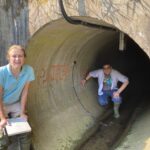
Banner image: Claire Welty (left) and Andrew Miller at a field research site in Catonsville. The site is a buried stream that doubles as a storm drain and is part of a restoration project. Photo by Victor Fulda, an engineering technician in UMBC’s chemical, biochemical, and environmental engineering department.
]]>
There is an essential resource constantly flowing beneath our feet: groundwater. Urban denizens may not think about it often, or at all, because they don’t rely on wells, “but it’s still there,”...
https://umbc.edu/stories/bedrock-to-treetops-nsf-awards-4-8m-to-urban-environment-study-led-by-umbcs-claire-welty/
https://beta.my.umbc.edu/api/v0/pixel/news/119801/guest@my.umbc.edu/178c230cb8be7e31515048d7b62f7845/api/pixel
cahss
cbee
coeit
cuere
ges
research
science-and-technology
UMBC News & Magazine
https://beta.my.umbc.edu/groups/umbc-news-magazine
https://assets1-beta.my.umbc.edu/system/shared/avatars/groups/000/001/943/24435aa6207c452e7bc15cc74b42c7bb/xsmall.png?1748556657
https://assets1-beta.my.umbc.edu/system/shared/avatars/groups/000/001/943/24435aa6207c452e7bc15cc74b42c7bb/original.png?1748556657
https://assets2-beta.my.umbc.edu/system/shared/avatars/groups/000/001/943/24435aa6207c452e7bc15cc74b42c7bb/xxlarge.png?1748556657
https://assets2-beta.my.umbc.edu/system/shared/avatars/groups/000/001/943/24435aa6207c452e7bc15cc74b42c7bb/xlarge.png?1748556657
https://assets3-beta.my.umbc.edu/system/shared/avatars/groups/000/001/943/24435aa6207c452e7bc15cc74b42c7bb/large.png?1748556657
https://assets1-beta.my.umbc.edu/system/shared/avatars/groups/000/001/943/24435aa6207c452e7bc15cc74b42c7bb/medium.png?1748556657
https://assets2-beta.my.umbc.edu/system/shared/avatars/groups/000/001/943/24435aa6207c452e7bc15cc74b42c7bb/small.png?1748556657
https://assets1-beta.my.umbc.edu/system/shared/avatars/groups/000/001/943/24435aa6207c452e7bc15cc74b42c7bb/xsmall.png?1748556657
https://assets2-beta.my.umbc.edu/system/shared/avatars/groups/000/001/943/24435aa6207c452e7bc15cc74b42c7bb/xxsmall.png?1748556657
UMBC News & Magazine
0
0
false
Wed, 02 Sep 2020 16:23:32 -0400
Will the New 15-Minute COVID-19 Test Solve US Testing Problems?
By Zoë McLaren, associate professor, Public Policy, UMBC
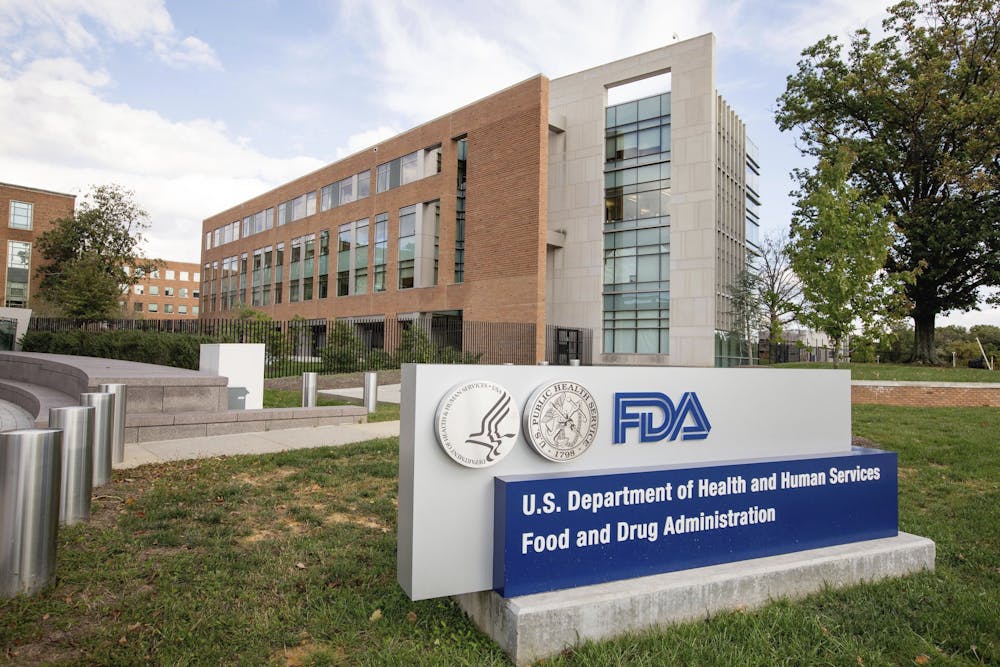
On Aug. 26, the Food and Drug Administration granted an Emergency Use Authorization to a new rapid antigen test for COVID-19 called the BinaxNOW test.
I study public health policy to combat infectious disease epidemics. Testing is one of the most powerful tools available to fight the spread of COVID-19. The new test is inexpensive, rapid and easy to use. It will massively scale up access to testing, but hurdles remain in achieving widespread, frequent COVID-19 testing.
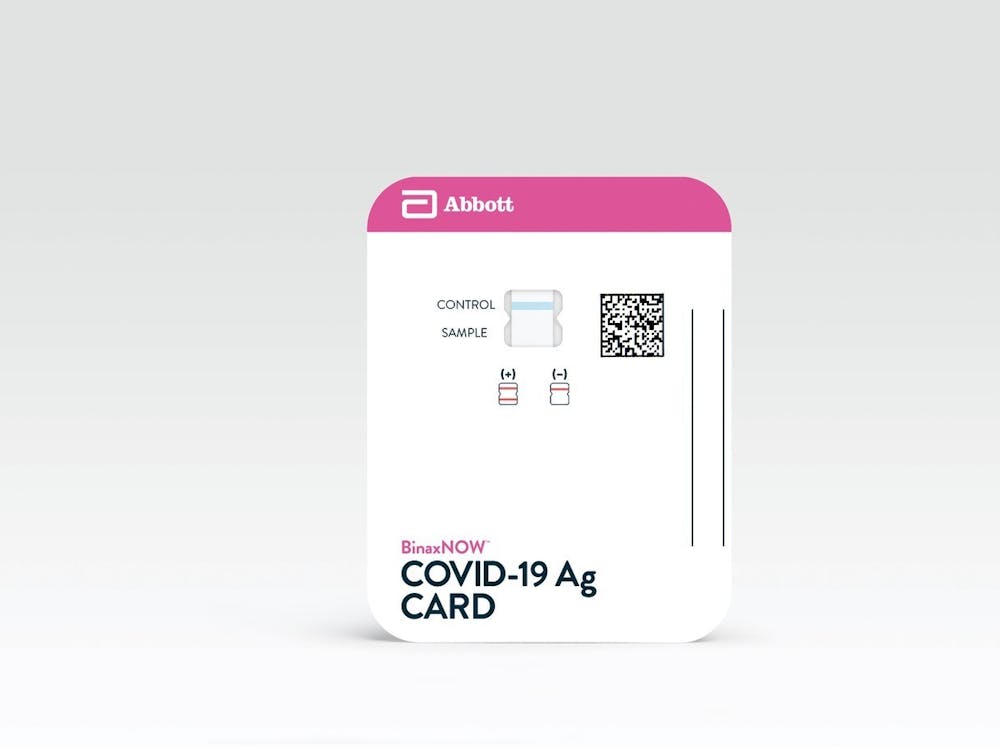
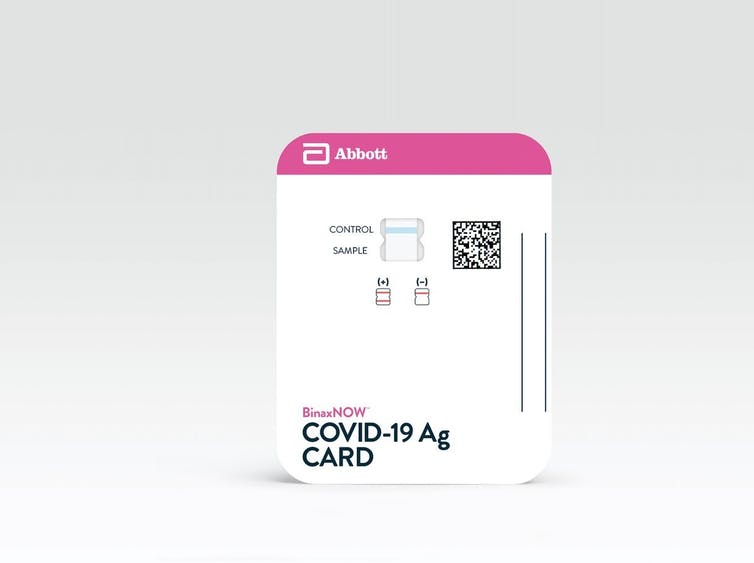 The Abbott BinaxNOW rapid antigen test claims to give results in 15 minutes. Abbott
What type of test is BinaxNOW?
The credit-card-sized test is an antigen test that detects a specific viral protein from SARS-CoV-2. It costs US$5 and doesn’t require a lab or a machine for processing.
Performing the test is simple. A health care worker or technician would use a swab to collect a sample from less than 1 inch inside the nostril. They would then combine the sample with a few drops of chemicals inside the test card. Within 15 minutes, the test strip would show a positive or negative result. The test is also paired with an app that produces a digital code that can be scanned to show proof of a recent negative COVID-19 test.
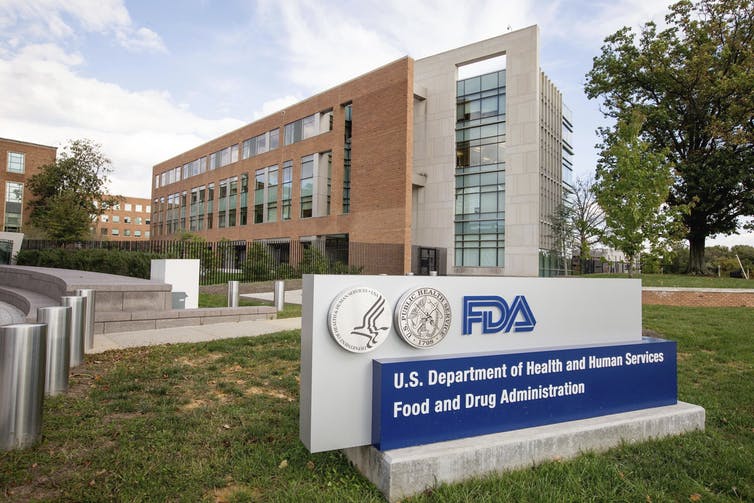 The FDA granted emergency use authorization for the test, but only for use on patients with symptoms of COVID-19. AP Photo/Andrew Harnik, File
What does the Emergency Use Authorization allow for?
The BinaxNOW test is currently only authorized for patients who have had COVID-19 symptoms for seven days or less, which is when virus levels in the body are likely to be high. It must be prescribed by a physician and performed by a trained technician or other health care worker.
The PCR test for COVID-19 is currently widely used and considered the gold standard, but requires patient samples to be sent to a lab and can take days to provide results. The new antigen test is designed to be a cheap and quick alternative to PCR testing for diagnostic purposes in a medical setting. It would add critical capacity to an overstretched testing system.
The emergency use authorization provides preliminary authorization for doctors to prescribe the antigen test while the full FDA approval process is ongoing. The authorization could be revoked if the test is not as accurate or reliable as expected.
How accurate is this test?
Abbott, the health technology company that produces the test, reports that when patients had symptoms the test was in agreement with PCR testing for 97.1% for COVID-19 positive cases and 98.5% for COVID-19 negative cases. This is high enough for diagnostic settings where accuracy is critical.
However, the true accuracy could be lower because the performance testing group was only 102 people and the accuracy hasn’t been validated by the FDA as part of the full approval process. There will inevitably be some false negatives and false positives with the BinaxNOW test since accuracy isn’t 100%, but the FDA will monitor the data to make sure the test meets the reported accuracy.
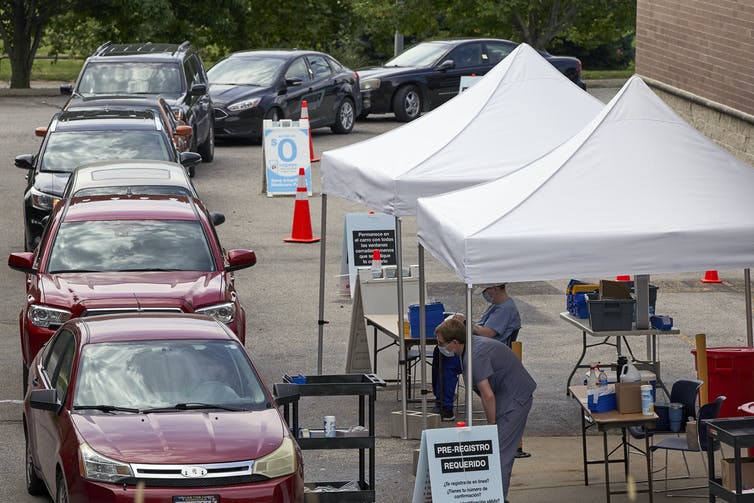 Long lines and slow turnaround times have limited access to testing, but the new Abbott test should be far easier and faster. AP Photo/Nati Harnik
Can this test be used for widespread screening?
The BinaxNOW test is cheap, rapid, able to be mass-produced and easy to use outside a lab. This makes it a promising candidate for widespread screening. However, the test is currently only authorized for people with COVID-19 symptoms.
This is an obstacle because an estimated 40% of all COVID-19 cases are asymptomatic and these people likely don’t know that they’re contagious. To maximize the effectiveness of any COVID-19 screening program, it is important to test people whether they have symptoms or not.
Health care providers are able to prescribe the BinaxNOW test for asymptomatic patients for off-label use, but health officials don’t yet know how accurate the test is when performed on asymptomatic people.
Is this test a game-changer?
The massive expansion of testing access made possible by the BinaxNOW test will almost surely outweigh the downsides of a small number of inaccurate results. Abbott plans to manufacture 50 million tests per month starting in October. This will quickly exceed the 76 million COVID-19 tests the U.S. has performed over the last six months.
Widespread, frequent testing is effective at slowing the spread of the coronavirus. The new testing capacity made possible by the authorization of this rapid antigen test represents a major advance in bringing the pandemic under control.
*****
Zoë McLaren, Associate Professor of Public Policy, University of Maryland, Baltimore County
This article is republished from The Conversation under a Creative Commons license. Read the original article.
[Get the best of The Conversation, every weekend. Sign up for our weekly newsletter.]
Header image: AP Photo/Elaine Thompson
]]>
By Zoë McLaren, associate professor, Public Policy, UMBC On Aug. 26, the Food and Drug Administration granted an Emergency Use Authorization to a new rapid antigen test for COVID-19 called...
https://umbc.edu/stories/will-the-new-15-minute-covid-19-test-solve-us-testing-problems/
https://beta.my.umbc.edu/api/v0/pixel/news/119802/guest@my.umbc.edu/9191486c86bdab5ae24bb5a2daae56e3/api/pixel
covidresearch
discovery
public-policy
UMBC News & Magazine
https://beta.my.umbc.edu/groups/umbc-news-magazine
https://assets1-beta.my.umbc.edu/system/shared/avatars/groups/000/001/943/24435aa6207c452e7bc15cc74b42c7bb/xsmall.png?1748556657
https://assets1-beta.my.umbc.edu/system/shared/avatars/groups/000/001/943/24435aa6207c452e7bc15cc74b42c7bb/original.png?1748556657
https://assets2-beta.my.umbc.edu/system/shared/avatars/groups/000/001/943/24435aa6207c452e7bc15cc74b42c7bb/xxlarge.png?1748556657
https://assets2-beta.my.umbc.edu/system/shared/avatars/groups/000/001/943/24435aa6207c452e7bc15cc74b42c7bb/xlarge.png?1748556657
https://assets3-beta.my.umbc.edu/system/shared/avatars/groups/000/001/943/24435aa6207c452e7bc15cc74b42c7bb/large.png?1748556657
https://assets1-beta.my.umbc.edu/system/shared/avatars/groups/000/001/943/24435aa6207c452e7bc15cc74b42c7bb/medium.png?1748556657
https://assets2-beta.my.umbc.edu/system/shared/avatars/groups/000/001/943/24435aa6207c452e7bc15cc74b42c7bb/small.png?1748556657
https://assets1-beta.my.umbc.edu/system/shared/avatars/groups/000/001/943/24435aa6207c452e7bc15cc74b42c7bb/xsmall.png?1748556657
https://assets2-beta.my.umbc.edu/system/shared/avatars/groups/000/001/943/24435aa6207c452e7bc15cc74b42c7bb/xxsmall.png?1748556657
UMBC News & Magazine
0
0
false
Tue, 01 Sep 2020 13:19:54 -0400
1 in 10 US Students Are English Learners

By Jennifer Mata-McMahon, associate professor, Education, UMBC
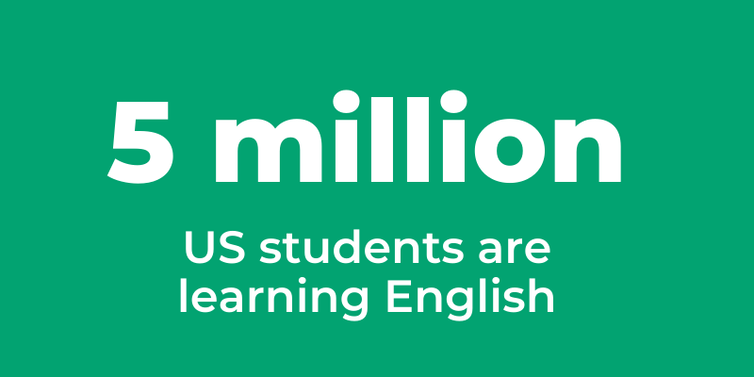
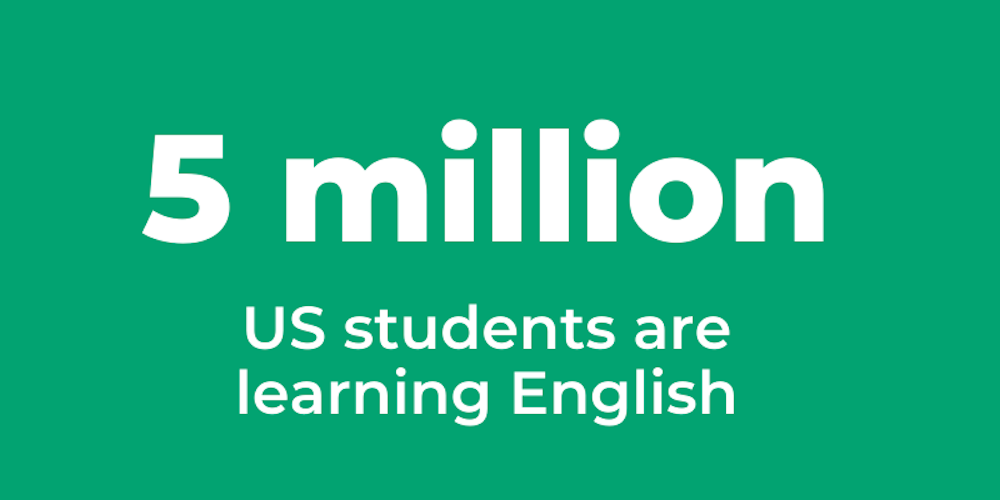
More than 1 in 10 of the nation’s approximately 50 million public school students speak a native language other than English, according to the latest federal data. Roughly 3 in 4 of these English learners speak Spanish.
The percentage of U.S. students who are learning how to speak English has grown significantly in recent years, rising from 8% in fall of 2000 to 10% by 2017, the data indicate.
The prevalence of these students varies greatly across the country, ranging from 0.8% in West Virginia to 19.2% in California. The share of English learners is highest among young children, hovering around 16% between kindergarten and second grade. Typically, younger children have less exposure than older students to English because they are primarily communicating with relatives in their native languages. By the time students are nearing high school graduation, the percentage of English learners drops to 4.6%.
Students who remain fluent in their native language while learning to speak English become bilingual, which has many advantages. Bilingual people tend to be better at connecting with others from different ethnic backgrounds and cultures. They are also better at solving problems.
Once they grow up, bilingual adults often have better job opportunities and may earn higher salaries than those who no longer speak their native language. Also, research indicates that being bilingual can increase creativity and heighten cognitive ability.
Researchers have found that attending dual-language programs, where instructional time is split between English and another language (oftentimes Spanish), attended by both native and non-native English speakers, help children become bilingual. But only 35 states offered these programs, according to the Department of Education’s latest data.
Without those opportunities, English learners tend to stop being fluent in their first language when they reach high school and miss out on all the benefits of becoming bilingual students.
*****
Jennifer Mata-McMahon, Associate Professor of Education, University of Maryland, Baltimore County
This article is republished from The Conversation under a Creative Commons license. Read the original article.
Header image: Dual-language instruction can help children grow up to be bilingual. Robyn Beck/AFP via Getty Images
[Get facts about coronavirus and the latest research. Sign up for The Conversation’s newsletter.]
]]>
By Jennifer Mata-McMahon, associate professor, Education, UMBC More than 1 in 10 of the nation’s approximately 50 million public school students speak a native language other than...
https://umbc.edu/stories/1-in-10-us-students-are-english-learners/
https://beta.my.umbc.edu/api/v0/pixel/news/119803/guest@my.umbc.edu/9d257f3f4c1c9035bd93698a2c6fc525/api/pixel
discovery
education
the-conversation
UMBC News & Magazine
https://beta.my.umbc.edu/groups/umbc-news-magazine
https://assets1-beta.my.umbc.edu/system/shared/avatars/groups/000/001/943/24435aa6207c452e7bc15cc74b42c7bb/xsmall.png?1748556657
https://assets1-beta.my.umbc.edu/system/shared/avatars/groups/000/001/943/24435aa6207c452e7bc15cc74b42c7bb/original.png?1748556657
https://assets2-beta.my.umbc.edu/system/shared/avatars/groups/000/001/943/24435aa6207c452e7bc15cc74b42c7bb/xxlarge.png?1748556657
https://assets2-beta.my.umbc.edu/system/shared/avatars/groups/000/001/943/24435aa6207c452e7bc15cc74b42c7bb/xlarge.png?1748556657
https://assets3-beta.my.umbc.edu/system/shared/avatars/groups/000/001/943/24435aa6207c452e7bc15cc74b42c7bb/large.png?1748556657
https://assets1-beta.my.umbc.edu/system/shared/avatars/groups/000/001/943/24435aa6207c452e7bc15cc74b42c7bb/medium.png?1748556657
https://assets2-beta.my.umbc.edu/system/shared/avatars/groups/000/001/943/24435aa6207c452e7bc15cc74b42c7bb/small.png?1748556657
https://assets1-beta.my.umbc.edu/system/shared/avatars/groups/000/001/943/24435aa6207c452e7bc15cc74b42c7bb/xsmall.png?1748556657
https://assets2-beta.my.umbc.edu/system/shared/avatars/groups/000/001/943/24435aa6207c452e7bc15cc74b42c7bb/xxsmall.png?1748556657
UMBC News & Magazine
0
0
false
Fri, 28 Aug 2020 13:24:05 -0400
UMBC welcomes a remarkable class in an exceptional year

The start of UMBC’s academic year may look a little different from years past, but Retriever pride remains steady as ever. New students won’t get to experience walking through a tunnel of cheering faculty and staff on way to Convocation this fall, but the Retriever community has been working hard to show the incoming class just how important they are through special online events, personal messages, and even a new welcome box full of UMBC gear.
 UMBC spirit pack for new students. Photo by Marlayna Demond ’11 for UMBC.
A masterclass in grit
The newest pack of Retrievers includes over 1,600 first-year students and nearly 1,000 transfer students. They’ve set impressive academic standards for themselves, with an average SAT score of 1266 for the class of 2024. Just as important are the strengths they bring to UMBC that are less easily quantified.
These new Retrievers come to UMBC after a challenging spring, working through a quick transition to a virtual environment and missing important milestones, like in-person high school graduation. In managing these challenges and confronting uncertainties about the future, they have forged a class with a shared sense of unity before ever setting foot on campus.
“I am extremely excited about this year’s entering class of students, especially in light of the challenges many faced related to COVID-19 as they finalized their college choice,” says Dale Bittinger ’16, M.P.P., assistant vice provost of undergraduate admissions, orientation, and school partnerships.
“Even in a remote environment, our new students were able to appreciate our sense of community, its values, and the opportunities here,” says Bittinger. “These factors played a key role in their decision to attend UMBC. I look forward to all they have to contribute to our campus community.”
Welcoming international students
In a meaningful trend for UMBC, this year’s class saw an increase in international students.
“I am very excited to welcome UMBC’s new international students to our academic community,” says David Di Maria, associate vice provost for international education. “UMBC continues to attract the best and brightest minds from around the world, even in a mostly online environment.”
 David Di Maria in the UMBC Commons. Photo by Marlayna Demond ’11 for UMBC.
Tchuissi Mbu Nyamsi is enrolled in UMBC’s M.P.S. program in data science at the Universities at Shady Grove.She shared her international path to UMBC at the university’s annual Fall Opening Meeting on August 20, emphasizing key UMBC values: honoring diversity and the importance of empowerment and grit.
 Tchuissi Mbu Nyamsi speaking at the Fall Opening Meeting.
“I want to empower and inspire the younger generation by demonstrating that everything is possible if you are laser-focused and strategically work hard,” Nyamsi said. “As a cosmopolitan woman who has lived in Brazil, Spain, and now the U.S., I also want to highlight the importance of being open-minded to different cultures, and the importance of learning new languages.”
Appreciating connections
Typically, UMBC’s Fall Opening Meeting attracts around 300 participants. This year, nearly 900 faculty, staff, and students registered for the community event, held a week before the start of classes. More than a thousand excited messages poured in from the community, in celebration of the start of fall, through social media and the event’s live chat.
UMBC President Freeman Hrabowski addressed the community from a popular piece of public art on campus, called The Forum, located near UMBC’s Performing Arts and Humanities Building. He said, “It is significant that we decided to make these statements here at The Forum…because The Forum is built to build community, to give us an opportunity to talk about the big ideas, and to appreciate our connecting through the arts, to each other.”
After hearing from President Hrabowski and other campus leaders, the UMBC community jumped in to let new Retrievers know that they’ll be supported through every step of their UMBC journey, and offered advice to welcome them.
Words of welcome
UMBC celebrated Convocation on August 26, including joyful remarks from faculty, staff, and students, and a special Retriever pinning ceremony. Student Government Association (SGA) leaders Mehrshad Devin ‘22, biology and physics, SGA president, and Calista Ogburn ‘21, public health, SGA communications director, shared memories of their first year on campus, and offered heartfelt words of advice to new students.
 Mehrshad Devin ‘22, biology and physics, and Calista Ogburn ‘21, public health, getting on-campus COVID testing with an assist from True Grit. Photo by Marlayna Demond ’11 for UMBC.
In her first year on campus, Ogburn said, “I learned about the importance of having friends that help with my growth.” She continued, “most of my friends today are from the student organizations I discovered during my freshman year.”

Leondra Turman ‘95, information systems, and her husband Stephen Turman ‘96, psychology, moved their first-year daughter Mia into Leondra’s old dorm. Photo courtesy of Turman family.
Change the world
Lee Blaney, associate professor of chemical, biochemical, and environmental engineering and UMBC’s 2020–2023 Presidential Teaching Professor, didn’t want new students to miss out on the opportunity to be grilled by a professor. He addressed students during virtual Convocation asking, “Who knows what they want to do with their life? Who’s nervous about being online this semester?”
 Lee Blaney in his UMBC lab. Photo by Marlayna Demond ’11 for UMBC.
These may seem like daunting questions, but the overwhelming response was that, no matter how you answered, you’re not alone. Blaney shared that he wasn’t sure of his own life path until half-way through his undergraduate experience, and it was connecting with the right professor that made the difference.
 Lee Blaney, and Daniel Ocasio ’17, chemical engineering, working in the lab.
“I can tell you that your professors have been working hard to adapt to this new situation,” said Blaney. “My best advice to you is to show up—be present in class and with your new peers. Ask questions. Let your professors know what’s working and what’s not working. This is a new world for us, and we’re going to need to work together to move you forward with your education and your career goals, so you can go out and change the world.”
Banner image: UMBC spirit box. Photo by Marlayna Demond ’11 for UMBC.
]]>
The start of UMBC’s academic year may look a little different from years past, but Retriever pride remains steady as ever. New students won’t get to experience walking through a tunnel of cheering...
https://umbc.edu/stories/umbc-welcomes-a-remarkable-class-in-an-exceptional-year/
https://beta.my.umbc.edu/api/v0/pixel/news/119804/guest@my.umbc.edu/4faaa34cef204217633db8e8e5d0b830/api/pixel
campus
community
page1
UMBC News & Magazine
https://beta.my.umbc.edu/groups/umbc-news-magazine
https://assets1-beta.my.umbc.edu/system/shared/avatars/groups/000/001/943/24435aa6207c452e7bc15cc74b42c7bb/xsmall.png?1748556657
https://assets1-beta.my.umbc.edu/system/shared/avatars/groups/000/001/943/24435aa6207c452e7bc15cc74b42c7bb/original.png?1748556657
https://assets2-beta.my.umbc.edu/system/shared/avatars/groups/000/001/943/24435aa6207c452e7bc15cc74b42c7bb/xxlarge.png?1748556657
https://assets2-beta.my.umbc.edu/system/shared/avatars/groups/000/001/943/24435aa6207c452e7bc15cc74b42c7bb/xlarge.png?1748556657
https://assets3-beta.my.umbc.edu/system/shared/avatars/groups/000/001/943/24435aa6207c452e7bc15cc74b42c7bb/large.png?1748556657
https://assets1-beta.my.umbc.edu/system/shared/avatars/groups/000/001/943/24435aa6207c452e7bc15cc74b42c7bb/medium.png?1748556657
https://assets2-beta.my.umbc.edu/system/shared/avatars/groups/000/001/943/24435aa6207c452e7bc15cc74b42c7bb/small.png?1748556657
https://assets1-beta.my.umbc.edu/system/shared/avatars/groups/000/001/943/24435aa6207c452e7bc15cc74b42c7bb/xsmall.png?1748556657
https://assets2-beta.my.umbc.edu/system/shared/avatars/groups/000/001/943/24435aa6207c452e7bc15cc74b42c7bb/xxsmall.png?1748556657
UMBC News & Magazine
0
0
false
Thu, 27 Aug 2020 23:01:49 -0400
UMBC’s Tulay Adali receives prestigious Humboldt Research Award for advanced data analysis at Paderborn University
UMBC’s Tulay Adali, professor of computer science and electrical engineering (CSEE) and distinguished university professor, has received the prestigious Humboldt Research Award. The Alexander von Humboldt Foundation describes the award as presented to scholars “whose fundamental discoveries, new theories, or insights have had a significant impact on their own discipline and who are expected to continue producing cutting-edge achievements in the future.”

Tulay Adali. Photo courtesy of Adali.
Adali is director of UMBC’s Machine Learning for Signal Processing Lab. Her research focuses on developing flexible methods for data fusion. These innovative methods enable researchers to extract powerful features from multi-modal data by letting them fully interact with and inform each other.
A main application area of her work has been medical image analysis, where these features are used in diagnosis as well as treatment planning and evaluation. Adali and her research collaborators are also exploring applications of these methods in remote sensing, misinformation detection, and gesture and video analysis.
A years-long research collaboration
Humboldt Award recipients spend up to one year conducting collaborative research at institutions in Germany. Adali plans to continue to work with her longtime collaborator Peter Schreier, who is based in Paderborn University. Through a research connection that has spanned many years, Adali says that her lab and Schreier’s continue to have wonderful synergy.
Together, Adali and Schreier have worked to address problems such as data-driven discovery of relationships in multi-modal data, and in particular, when the sample sizes are small. “This is a key practical problem in many applications, especially in the medical domain,” Adali shares. She notes that this provides an important starting point for their current work.
“Things are moving along, even though I could not travel this summer, as we started having weekly research meetings between our groups,” Adali says. “This is a valuable experience for my students. In the past, we had hosted Schreier and his students here at UMBC, some of my students had met Schreier and his students at conferences before, and these initial physical connections matter. I am hoping we will all be able to travel again, soon.”
Receiving the award
As a Humboldt Award recipient, Adali was invited to attend a gathering in June with her fellow awardees, hailing from universities around the world. Due to COVID-19, the event was moved online. Awardees had an opportunity to meet the German president virtually as part of the event.
While she wishes the event could have been held in person, Adali says that it gave her an exciting opportunity to connect with other Humboldt awardees and learn more about scientist and explorer Alexander von Humboldt.
In 2015, Curtis Menyuk, professor of CSEE, received a Humboldt Award.
Banner image: Tulay Adali, fourth from left, with the members of her lab. Photo courtesy of Adali.
]]>
UMBC’s Tulay Adali, professor of computer science and electrical engineering (CSEE) and distinguished university professor, has received the prestigious Humboldt Research Award. The Alexander von...
https://umbc.edu/stories/umbcs-tulay-adali-receives-prestigious-humboldt-research-award-for-advanced-data-analysis-at-paderborn-university/
https://beta.my.umbc.edu/api/v0/pixel/news/119805/guest@my.umbc.edu/b6ac8254beff8f257d4cca29b1fbf4f4/api/pixel
coeit
csee
science-and-technology
UMBC News & Magazine
https://beta.my.umbc.edu/groups/umbc-news-magazine
https://assets1-beta.my.umbc.edu/system/shared/avatars/groups/000/001/943/24435aa6207c452e7bc15cc74b42c7bb/xsmall.png?1748556657
https://assets1-beta.my.umbc.edu/system/shared/avatars/groups/000/001/943/24435aa6207c452e7bc15cc74b42c7bb/original.png?1748556657
https://assets2-beta.my.umbc.edu/system/shared/avatars/groups/000/001/943/24435aa6207c452e7bc15cc74b42c7bb/xxlarge.png?1748556657
https://assets2-beta.my.umbc.edu/system/shared/avatars/groups/000/001/943/24435aa6207c452e7bc15cc74b42c7bb/xlarge.png?1748556657
https://assets3-beta.my.umbc.edu/system/shared/avatars/groups/000/001/943/24435aa6207c452e7bc15cc74b42c7bb/large.png?1748556657
https://assets1-beta.my.umbc.edu/system/shared/avatars/groups/000/001/943/24435aa6207c452e7bc15cc74b42c7bb/medium.png?1748556657
https://assets2-beta.my.umbc.edu/system/shared/avatars/groups/000/001/943/24435aa6207c452e7bc15cc74b42c7bb/small.png?1748556657
https://assets1-beta.my.umbc.edu/system/shared/avatars/groups/000/001/943/24435aa6207c452e7bc15cc74b42c7bb/xsmall.png?1748556657
https://assets2-beta.my.umbc.edu/system/shared/avatars/groups/000/001/943/24435aa6207c452e7bc15cc74b42c7bb/xxsmall.png?1748556657
UMBC News & Magazine
0
0
false
Thu, 27 Aug 2020 16:58:51 -0400
UMBC STEM BUILD students conduct and present viral research in reimagined summer program
The 19 members of UMBC’s STEM BUILD Cohort 5 and their instructors had been looking forward to a summer wet lab experience. When that wasn’t possible due to the COVID-19 pandemic, they worked together to convert their eight-week, in-person program into a successful online learning experience unlike anything they’d tried before.
“It was different,” says Maria Cambraia, postdoctoral teaching fellow in the STEM BUILD program and one of the instructors, “but we kept the main goal. We wanted to offer them an authentic research experience, and we did.”
Independent exploration
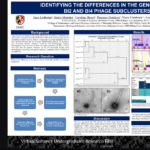
This year, BUILD Trainees worked in groups to analyze the genomes of bacteriophages, viruses that infect bacterial cells. They also viewed and analyzed phages that previous UMBC students had isolated, including some that were unknown to science before the students discovered them. After some initial analysis, each group came up with its own research question to explore using bioinformatics tools.
“Students gain exposure to research techniques in the Bioanalytical Phage Module, but the larger benefit is their experience in self-directed research without predefined results,” says Steven Caruso, principal lecturer of biological sciences. “Because participants are engaging in real research, the experience is different every year.”
 Caroline Moore ’23 (left, offset) presents her team’s research at SURF. (Screenshot from the SURF website)
Caruso has been teaching the Phage Hunters lab to UMBC students since 2008, and he adapted the full-length course for STEM BUILD five years ago. “This experience prepares them for their next step, working with an individual mentor in their own lab,” he says. “It also allows them additional opportunity for productive collaboration with their peers, and for scientific communication during lab meetings and poster presentations.”
Feedback for success
At the end of the eight weeks, the students presented their findings at UMBC’s virtual Summer Undergraduate Research Fest (SURF). The VoiceThread platform allowed students to give and receive feedback in written, audio, and video format, all in real time.
“Leading up to SURF we practiced using VoiceThread and got tons of helpful feedback from our instructors,” shares Caroline Moore ’23, biological sciences. Even though the online format made some things more difficult, she adds, “I think having such a supportive cohort and instructors helped me push through and end up creating an amazing presentation.”
In addition to practicing with the platform, students presented updates on their work every week throughout the summer and got support with designing their posters. “Dr. Cambraia gave detailed feedback, which allowed us to develop skills for creating the abstracts and posters,” shares Angela Kim ’23, chemical engineering.
“We needed to teach them not just how to present, but instead, ‘This is how you present, and this is how you make it effective online,’” Cambraia says.
 Steven Caruso. Photo by Marlayna Demond ’11 for UMBC.
The students also received helpful feedback at SURF itself. “The questions our group received made me think about what can be improved in our research and gave me some ideas for future research as well,” Kim says. Sharath Velliyamattam ‘23, biological sciences, adds, “I learned from this experience to give visual cues, how to engage my audience, and I learned to interact with different types of people, from faculty to students.”
A new field and new confidence
The Bioanalytical Phage Module introduced many of the students to bioinformatics—and bioinformatics tools—for the first time. “The online bioinformatic work with our phage genomes was really interesting,” says Kevin Gibbons ’23, biological sciences. “I never thought I’d be interested in computational or bioinformatic work, but I feel like I gained a lot of skills that will be helpful no matter what type of research I do in the future.”
For Grace Tugado ’23, chemical engineering, the experience sparked a powerful interest in phages. “Whenever I went out with my family on hikes, I brought up phages and what we learned in lecture,” she says.
Overall, “I think this research opportunity has helped me become more confident in my ability to communicate in a research group and has made me better prepared to work collaboratively,” Moore says.
 Angela Kim ’23 (left, offset) presents her research at SURF. (Screenshot from the SURF website)
Building connections
In addition to collaborating with their groups, Cohort 5 students had the opportunity to interact with previous BUILD classes. Cohorts 4 and 5 spent more than two hours discussing their experiences in a virtual meeting. Cohort 6, entering as first-year students this fall, also commented substantially on Cohort 5’s SURF posters.
Through those exchanges, “We really got a behind-the-scenes view of undergraduate research at UMBC,” Velliyamattam says. Throughout the summer, they also became part of it.
These students faced an unusual challenge: conducting independent research, in groups, all online. By the end of the summer, the students improved their presentation skills, learned about a new area of life science, and conquered new online analytical tools. They also bonded more closely as a group—strengthening relationships that will see them through challenges long after the pandemic is over.
Banner image: UMBC’s Biological Sciences Building along Academic Row, where STEM BUILD students would have traditionally completed their summer research experience. Photo by Marlayna Demond ’11 for UMBC.
]]>
The 19 members of UMBC’s STEM BUILD Cohort 5 and their instructors had been looking forward to a summer wet lab experience. When that wasn’t possible due to the COVID-19 pandemic, they worked...
https://umbc.edu/stories/umbc-stem-build-students-conduct-and-present-viral-research-in-reimagined-summer-program/
https://beta.my.umbc.edu/api/v0/pixel/news/119806/guest@my.umbc.edu/766210f609ba065195c5636885b1b702/api/pixel
biology
cnms
science-and-technology
stembuild
undergradresearch
UMBC News & Magazine
https://beta.my.umbc.edu/groups/umbc-news-magazine
https://assets1-beta.my.umbc.edu/system/shared/avatars/groups/000/001/943/24435aa6207c452e7bc15cc74b42c7bb/xsmall.png?1748556657
https://assets1-beta.my.umbc.edu/system/shared/avatars/groups/000/001/943/24435aa6207c452e7bc15cc74b42c7bb/original.png?1748556657
https://assets2-beta.my.umbc.edu/system/shared/avatars/groups/000/001/943/24435aa6207c452e7bc15cc74b42c7bb/xxlarge.png?1748556657
https://assets2-beta.my.umbc.edu/system/shared/avatars/groups/000/001/943/24435aa6207c452e7bc15cc74b42c7bb/xlarge.png?1748556657
https://assets3-beta.my.umbc.edu/system/shared/avatars/groups/000/001/943/24435aa6207c452e7bc15cc74b42c7bb/large.png?1748556657
https://assets1-beta.my.umbc.edu/system/shared/avatars/groups/000/001/943/24435aa6207c452e7bc15cc74b42c7bb/medium.png?1748556657
https://assets2-beta.my.umbc.edu/system/shared/avatars/groups/000/001/943/24435aa6207c452e7bc15cc74b42c7bb/small.png?1748556657
https://assets1-beta.my.umbc.edu/system/shared/avatars/groups/000/001/943/24435aa6207c452e7bc15cc74b42c7bb/xsmall.png?1748556657
https://assets2-beta.my.umbc.edu/system/shared/avatars/groups/000/001/943/24435aa6207c452e7bc15cc74b42c7bb/xxsmall.png?1748556657
UMBC News & Magazine
0
0
false
Wed, 26 Aug 2020 22:05:18 -0400
UMBC alumnus Mark Doms is appointed chief economist of the Congressional Budget Office

UMBC alumnus Mark Doms ‘85, economics and mathematics, has been appointed chief economist of the Congressional Budget Office (CBO). Doms will be one of the leads of the agency that provides Congress with objective, nonpartisan, and high quality information about the economic and financial impacts of existing laws, new laws, and policies under consideration.
“It is really important to get the best information so policymakers can decide which path to move forward on,” explains Doms, who has served as an economics expert for over three decades.
“At CBO we strive to provide high quality, nonpartisan information so Congress can make their decisions,” Doms says. “We believe that better information makes better decisions, especially now, with the huge, adverse economic impacts of COVID-19.”
His team helps provide Congress with data to better understand ongoing public policy issues such as living conditions, government assistance, and poverty. Through quantitative analysis, the agency is able to look at different facets of an issue by asking questions about what is known, what needs to be known, and what may not be known. CBO projections and analysis provide valuable insights into complex issues, allowing for in-depth understanding of the costs and benefits of various policies.

Roy Meyers.
Photo by Marlayna Demond ’11.
Doms is one of four UMBC alumni currently serving in the Congressional Budget Office. Kate Green ‘05, information systems, is a human resource specialist. Jorge Salazar ‘02, graphic design, is a visual Information and data visualization specialist. Ryan Mutter ‘01, M.A., economics, and Ph.D. ‘06, public policy is a principal analyst in the Health, Retirement, and Long-Term Analysis Division of CBO. And Roy Meyers, professor of political science, was an analyst at CBO before joining UMBC.
The power of math and economics
Doms’s love of mathematics is a personal passion he fostered in high school and immersed himself in while at UMBC. He also remembers spending time at UMBC learning the computing and analytical skills needed to conduct research, and collect and analyze data.
“All of my professors at UMBC were inspiring,” shares Doms. “What was most valuable to me was their insistence that we learn a quantitative approach to inform policy not just from books, but from the real world,” he says.

Mark Doms in front of the U.S. Capitol.
Photo courtesy of Doms.
Doms also benefited from the professional experience of UMBC faculty in understanding the world from a quantitative lens. “Most of my professors had hands-on experience working with policymakers in Washington, D.C.,” he recalls. “They were able to share an invaluable insider’s perspective.”
From them he learned the power of research and data analysis to help inform policy and the challenges they present.
Quantitative analysis for the greater good
In addition to quantitative analysis skills, Doms also notes the importance of communication skills to anyone wanting to enter the field of economics. He appreciates the skills he learned in his English and philosophy classes, which help him communicate important ideas with different audiences. For Doms, the best data and analysis in the world is not of service if it can’t be communicated clearly to a general audience.
After UMBC, Doms earned a Ph.D. in economics from the University of Wisconsin–Madison.
He then served in the U.S. Census Bureau and the Board of Governors of The Federal Reserve as an economist. He was also the senior economist for The Federal Reserve Bank of San Francisco.

Mark Doms at alumni awards.
Photo by Marlayna Demond ’11.
Doms was appointed and confirmed by the U.S. Senate as the under secretary for economic affairs at the U.S. Department of Commerce under the Obama administration. He has also worked at Japan’s largest investment bank and at the Organisation for Economic Co-operation and Development in France. In 2018 UMBC recognized his leadership in the field of economics with an Outstanding Alumnus in Natural and Mathematical Sciences Award.
Strength in diversity
In his decades of experience, Doms has always studied and worked with people from diverse backgrounds. He sees diversity as a necessary aspect of strong teams that produce great ideas.
Doms encourages students interested in economics to study abroad and become fluent in another language. While his travel and language experience happened on the job, he has seen the benefits of having these experiences early on in a field that requires an understanding of interconnected global issues.
For Doms, diversity in the economic field is key to helping communities learn more from one another and address today’s major challenges. He welcomes students from all backgrounds to apply to the CBO’s summer internship program and he actively engages in helping diversify CBO’s workforce.
“I really enjoy that I can use the economics, math, and communications skills I learned at UMBC and elsewhere to help us understand the world just a little bit better,” says Doms.
Banner image: Doms in front of the U.S. Capitol. Photo by Tim Lordan .
]]>
UMBC alumnus Mark Doms ‘85, economics and mathematics, has been appointed chief economist of the Congressional Budget Office (CBO). Doms will be one of the leads of the agency that provides...
https://umbc.edu/stories/umbc-alumnus-mark-doms-is-appointed-chief-economist-of-the-congressional-budget-office/
https://beta.my.umbc.edu/api/v0/pixel/news/119807/guest@my.umbc.edu/27a8f7551593e731f1dfd31aef06f5c5/api/pixel
alumni
cahss
cnms
economics
mathstat
policy-and-society
UMBC News & Magazine
https://beta.my.umbc.edu/groups/umbc-news-magazine
https://assets1-beta.my.umbc.edu/system/shared/avatars/groups/000/001/943/24435aa6207c452e7bc15cc74b42c7bb/xsmall.png?1748556657
https://assets1-beta.my.umbc.edu/system/shared/avatars/groups/000/001/943/24435aa6207c452e7bc15cc74b42c7bb/original.png?1748556657
https://assets2-beta.my.umbc.edu/system/shared/avatars/groups/000/001/943/24435aa6207c452e7bc15cc74b42c7bb/xxlarge.png?1748556657
https://assets2-beta.my.umbc.edu/system/shared/avatars/groups/000/001/943/24435aa6207c452e7bc15cc74b42c7bb/xlarge.png?1748556657
https://assets3-beta.my.umbc.edu/system/shared/avatars/groups/000/001/943/24435aa6207c452e7bc15cc74b42c7bb/large.png?1748556657
https://assets1-beta.my.umbc.edu/system/shared/avatars/groups/000/001/943/24435aa6207c452e7bc15cc74b42c7bb/medium.png?1748556657
https://assets2-beta.my.umbc.edu/system/shared/avatars/groups/000/001/943/24435aa6207c452e7bc15cc74b42c7bb/small.png?1748556657
https://assets1-beta.my.umbc.edu/system/shared/avatars/groups/000/001/943/24435aa6207c452e7bc15cc74b42c7bb/xsmall.png?1748556657
https://assets2-beta.my.umbc.edu/system/shared/avatars/groups/000/001/943/24435aa6207c452e7bc15cc74b42c7bb/xxsmall.png?1748556657
UMBC News & Magazine
0
0
false
Wed, 26 Aug 2020 17:27:26 -0400
UMBC’s first virtual conference on inclusive language engages hundreds of education professionals from around the world

UMBC hosted “The Evolving World of Inclusive Language” on June 10, 2020, at a moment of intense focus on anti-racism and inclusion in higher education. The event was organized by Catalina Sofia Dansberger Duque of UMBC’s Office of Institutional Advancement in partnership with Montgomery College and supported by the CASE District II Venture Capital Fund.
The virtual inclusive language conference, UMBC’s first virtual conference, was initially planned as an in-person event for 50 higher education communicators from across the mid-Atlantic. Following COVID-19, the event moved online. And with increased recognition of the importance of the inclusive language, the number of participants quickly jumped.
By the day of the online event, nearly 800 people from across the U.S. and around the world had registered. They represented universities near UMBC, like Towson University and Morgan State University, and as far away as Canada and England. Around 250-300 participants joined each of the day’s six sessions.
A call to action

DàVida Plummer,
DàVida Plummer, dean of the Scripps Howard School of Journalism and Communications and assistant vice president for marketing and media at Hampton University, provided the conference keynote address. She spoke of the importance of this moment in history, reflecting on both the COVID-19 pandemic and increasing support for the Black Lives Matter movement. She noted the duty that communicators and media professionals have to not only evolve language, but to be agents of change by writing stories that reflect the lived experiences of the communities they want to represent.
“To acknowledge that Black lives matter, that abuse of power must be stopped” is paramount, shared Plummer, “and for journalists the world over, we must capture this reality, tell our stories, and maintain objectivity.”
She further noted that communicators must evolve the language they use by respecting how each person identifies themselves and speaking with and about each other with empathy and dignity. To accomplish this, Plummer explained, we must become vigilant of the everyday phrases that subtly perpetuate injustice and inequality. This includes common use of “white,” and “light” to describe positive things, and “black” or “dark” to describe negative things.
“I hope that the words that follow will help us change and make a change for the good for everyone who walks this earth in our time—every gender and every ethnicity,” said Plummer. “We should try to set a sustainable precedent.”
Leading by example
Candace Dodson-Reed ‘96, English, chief of staff in the Office of the President and executive director of the Office of Equity and Inclusion (OEI), and Ever Hanna, OEI training and case manager, provided the UMBC staff keynote. Dodson-Reed opened by bringing attention to the importance of language when speaking out against systemic racism. She then read the names of Black people recently killed by police: George Floyd, Breonna Taylor, Ahmaud Arbery, Tony McDade, and Sandra Bland.

Candace Dodson-Reed
Dodson-Reed focused her address on campus leaders’ responsibility to assure that university communications are responsive and speak to the needs of their communities. She pointed to the intentional and clear use of the words “social justice,” “inclusive excellence,” and “civic engagement” in UMBC’s own vision statement as a set of guiding principles for communications. She also encouraged participants to directly include the communities they wish to reach by listening and involving them in the communication process.
“Being collaborative, as you address such big societal challenges, is not simple,” said Dodson-Reed. “But the decision to use inclusive language in our vision helped guide our response as a campus community,” says Dodson-Reed.
Disrupting exclusivity
Ever Hanna’s remarks asked the audience to not just think about using inclusive language, but also make a conscious choice to disrupt entrenched processes that lead to exclusion. “If you have ever had to confront a privilege that you have, you may be familiar with the concept of being uncomfortable and learning to disrupt something that you thought was normal or easy,” said Hanna.

Ever Hanna
They reinforced that for inclusive language to continue to evolve it is essential to take into account intersectionality. Hanna, who identifies as a trans and non-binary person, provided examples of how gendered language, such as sister and brother, can exclude people because it is so entrenched in binary language norms.
Hanna also pointed out, “We sometimes communicate exclusivity by not giving information.” Having intentional conversations and sharing tools are necessary to gain a deeper understanding of practicing inclusive language.
Hanna says all of these efforts are necessary to create and sustain inclusive language practices. And more importantly, they empower people to disrupt and interrupt exclusive language. “In order to be in solidarity with the people in our lives we need to change the way we do those things,” they noted.
Watch the introduction and keynote presentations.
Inclusive language best practices
The conference continued with five sessions delving deeper into inclusive language practices within specific communities. Each session included a panel or a speaker, plus time for questions and answers. Participants used the Q&A opportunities to learn how to apply inclusive language best practices within their institutions.

Sharon Bland
Sharon Bland, chief equity and inclusion officer for Montgomery College, presented on “Creating Inclusive Communities Among Students, Employees, Alumni, and Trustee Boards through Equity Dialogues.”
UMBC faculty and staff led the four other sessions. “Inclusive Language for Students and Staff” was presented by Jasmine Lee, director of inclusive excellence for the Division of Student Affairs; Lisa M. Gray, associate director of diversity and inclusion for Campus Life; Carlos Turcios ’14, psychology, M.A. ’17, sociology, coordinator for student diversity and inclusion for Campus Life; and Vladimir Rodriguez, assistant director of Off-Campus Student Services.

J. Enscoe
Christine Mallinson, professor of language, literacy, and culture (LLC), and director of the Center for Social Science Scholarship, and J. Inscoe, LLC Ph.D. candidate in language, literacy, and culture, presented on “Gender-Inclusive Language and the LGBTQ Community” (video coming soon). Drew Holladay, assistant professor of English, led the “Disability, Neurodiversity, and Practicing Inclusion” session.
Randianne Leyshon ’09, modern languages and linguistics, assistant editor of UMBC Magazine, and Amelia Meman ’15, gender and women’s studies, assistant director of the Women’s Center, ended the day with a session on “How to Create and Maintain an Inclusive Language Style Guide.”
To access all presenter slide decks, session recordings, and additional information visit the inclusive language conference page.
Banner image: Bench on academic row dedicated to Walter Sondheim. All photos by Marlayna Demond ’11.
Videos will soon be available through YouTube.
]]>
UMBC hosted “The Evolving World of Inclusive Language” on June 10, 2020, at a moment of intense focus on anti-racism and inclusion in higher education. The event was organized by Catalina Sofia...
https://umbc.edu/stories/umbcs-first-virtual-conference-on-inclusive-language-engages-hundreds-of-education-professionals-from-around-the-world/
https://beta.my.umbc.edu/api/v0/pixel/news/119808/guest@my.umbc.edu/2eeb76cdf962ff40bf09299738283e42/api/pixel
cahss
community
cs3
diversityandinclusion
english
gwst
llc
policy-and-society
psychology
research
sociology
womenscenter
UMBC News & Magazine
https://beta.my.umbc.edu/groups/umbc-news-magazine
https://assets1-beta.my.umbc.edu/system/shared/avatars/groups/000/001/943/24435aa6207c452e7bc15cc74b42c7bb/xsmall.png?1748556657
https://assets1-beta.my.umbc.edu/system/shared/avatars/groups/000/001/943/24435aa6207c452e7bc15cc74b42c7bb/original.png?1748556657
https://assets2-beta.my.umbc.edu/system/shared/avatars/groups/000/001/943/24435aa6207c452e7bc15cc74b42c7bb/xxlarge.png?1748556657
https://assets2-beta.my.umbc.edu/system/shared/avatars/groups/000/001/943/24435aa6207c452e7bc15cc74b42c7bb/xlarge.png?1748556657
https://assets3-beta.my.umbc.edu/system/shared/avatars/groups/000/001/943/24435aa6207c452e7bc15cc74b42c7bb/large.png?1748556657
https://assets1-beta.my.umbc.edu/system/shared/avatars/groups/000/001/943/24435aa6207c452e7bc15cc74b42c7bb/medium.png?1748556657
https://assets2-beta.my.umbc.edu/system/shared/avatars/groups/000/001/943/24435aa6207c452e7bc15cc74b42c7bb/small.png?1748556657
https://assets1-beta.my.umbc.edu/system/shared/avatars/groups/000/001/943/24435aa6207c452e7bc15cc74b42c7bb/xsmall.png?1748556657
https://assets2-beta.my.umbc.edu/system/shared/avatars/groups/000/001/943/24435aa6207c452e7bc15cc74b42c7bb/xxsmall.png?1748556657
UMBC News & Magazine
0
0
false
Wed, 26 Aug 2020 02:06:51 -0400