bwtech@UMBC receives Economic Development Administration grant to launch cybersecurity venture fellowship program
Today, bwtech@UMBC, UMBC, and the University System of Maryland (USM) announced receiving a major grant from the U.S. Department of Commerce’s Economic Development Administration to create the Maryland New Venture Fellowship for Cybersecurity. The grant totals more than $1.3 million, with nearly $600,000 in federal funding, which will be used over a three-year period.
The Fellowship will support the development of cybersecurity companies in Maryland, and will increase connections among technologists, mentors, and faculty at institutions across the state.
This new program will enable cybersecurity entrepreneurs to work together to create technologies and other cyber solutions that impact society, including utilities, infrastructure, and critical information systems. These entrepreneurs will include teams composed of graduate students interested in entrepreneurship, experienced entrepreneurs serving as mentors, and faculty from Maryland universities.
The north campus of bwtech@UMBC.
Bringing new talent into a thriving sector
Maryland is home to major U.S. innovation centers in cyber and data science including the National Security Agency, Defense Information Systems Agency, and U.S. Cyber Command. This program will capitalize on cyber research and development that is already happening in Maryland. It will also work to identify and address gaps, including the need for well-trained entrepreneurs with an innovative mindset and fresh perspectives, essential to Maryland maintaining its position as a leader in cybersecurity.
With these needs in mind, bwtech and USM have designed the program to empower and support diverse entrepreneurs and researchers who will create new technologies and ideas to secure the nation’s interests, and create economic opportunities and jobs.
“Cybersecurity is one of Maryland’s most important industry sectors and a great source of economic strength for our state,” said Maryland Commerce Secretary Kelly M. Schulz. “This new initiative will support entrepreneurship and provide more incredible talent to the state’s cybersecurity workforce.”
Immersive entrepreneurial experience
During the first year of the grant, the Fellowship will focus on commercializing technologies at several universities within USM, including UMBC.
“The Fellowship provides a much needed entrepreneurial resource to the faculty and technologists developing cybersecurity tools, while providing an immersive entrepreneurial experience for graduate students at UMBC and across the University System of Maryland,” says Megan Wahler, director of entrepreneurial services at bwtech@UMBC.
“Across our region, there are incredible technologies being developed in our universities to protect our infrastructure, supply chains, and our national security and we must do all we can ensure they succeed,” says Baltimore County Executive Johnny Olszewski, Ph.D. ‘17, public policy.
The Fellowship program will then expand to include other Maryland institutions in the second year. In the third year, it will begin connecting with people who work at federal agencies.
“Maryland is home to some of the world’s greatest minds in cybersecurity,” says J. Thomas Sadowski ‘89, political science, USM vice chancellor for economic development. He notes, “this program will help leverage this talent, foster collaboration, facilitate new venture creation and get our ideas to market.”
Banner image: the entrance to bwtech@UMBC. Photos by Marlayna Demond ’11 for UMBC.
]]>
Today, bwtech@UMBC, UMBC, and the University System of Maryland (USM) announced receiving a major grant from the U.S. Department of Commerce’s Economic Development Administration to create the...https://umbc.edu/stories/bwtechumbc-receives-economic-development-administration-grant-to-launch-cybersecurity-venture-fellowship-program/https://beta.my.umbc.edu/api/v0/pixel/news/119781/guest@my.umbc.edu/c0041ebe1c098b5ac8e4eaf66b12bd79/api/pixelbwtechcommunityentrepreneurshipscience-and-technologyUMBC News & Magazinehttps://beta.my.umbc.edu/groups/umbc-news-magazinehttps://assets1-beta.my.umbc.edu/system/shared/avatars/groups/000/001/943/24435aa6207c452e7bc15cc74b42c7bb/xsmall.png?1748556657https://assets1-beta.my.umbc.edu/system/shared/avatars/groups/000/001/943/24435aa6207c452e7bc15cc74b42c7bb/original.png?1748556657https://assets2-beta.my.umbc.edu/system/shared/avatars/groups/000/001/943/24435aa6207c452e7bc15cc74b42c7bb/xxlarge.png?1748556657https://assets2-beta.my.umbc.edu/system/shared/avatars/groups/000/001/943/24435aa6207c452e7bc15cc74b42c7bb/xlarge.png?1748556657https://assets3-beta.my.umbc.edu/system/shared/avatars/groups/000/001/943/24435aa6207c452e7bc15cc74b42c7bb/large.png?1748556657https://assets1-beta.my.umbc.edu/system/shared/avatars/groups/000/001/943/24435aa6207c452e7bc15cc74b42c7bb/medium.png?1748556657https://assets2-beta.my.umbc.edu/system/shared/avatars/groups/000/001/943/24435aa6207c452e7bc15cc74b42c7bb/small.png?1748556657https://assets1-beta.my.umbc.edu/system/shared/avatars/groups/000/001/943/24435aa6207c452e7bc15cc74b42c7bb/xsmall.png?1748556657https://assets2-beta.my.umbc.edu/system/shared/avatars/groups/000/001/943/24435aa6207c452e7bc15cc74b42c7bb/xxsmall.png?1748556657UMBC News & Magazine00falseMon, 05 Oct 2020 17:45:14 -0400Finish Line in Sight
With classes predominantly online this fall, former students who’ve had to pause their studies are re-enrolling at UMBC with graduation as their goal.
When Nick Martorelli, management of aging services, originally stepped away from taking classes at UMBC in 2015 to help take care of his mother as she underwent kidney failure, he had no way of knowing that he’d ever return to his degree. He certainly couldn’t have guessed that his experience setting up his mother’s daily, overnight dialysis would offer him a leg up in his studies.
Martorelli with his mother, Florence, who goes by Frosty. Photo courtesy of Martorelli.
“One thing I noticed when taking care of my mom—I had to learn a lot of directions for medication and nutrition, sterilizing the room for dialysis,” says Martorelli. “I had to memorize how to set up the dialysis. You had to really be focused the whole time and after doing that for two years, now I’m a lot more focused taking classes, and I can really pick up things more quickly.”
In mid-August, Martorelli and other Retrievers who had earned at least 60 credits and were in good standing academically but were not currently enrolled in classes received an offer to return to the University to finish their remaining degree requirements. Yvette Mozie-Ross ’88, vice provost for enrollment management and planning, says a similar correspondence is sent out each semester to those close to degree completion but who remain unenrolled. But the pandemic changed one key element of their communication—like almost every other attendee, students could now return to school online.
The online incentive, says Martorelli, changed his whole perspective. Within a week of getting the mailer, Martorelli—who lives in Missouri—was signed up for a full load of classes and anticipates graduating in May 2021. The finish line is in sight.
Relying on a great support system
Headshot courtesy of Broderick.
The summer of 2020 started one way and ended in quite another, Kelly Broderick, gender, women’s, and sexuality studies (GWST), puts it simply. Let go in June from her position as box office manager at Baltimore Center Stage due to the cancellation of their season, Broderick found herself facing a momentous birthday while questioning what life had in store for her next.
“It felt like all these universal things were dropping on me telling me I had to go back to school,” says Broderick, who only has three requirements to complete before graduation.
Within two weeks of receiving the Finish Line brochure inviting her to return to her studies, Broderick was re-enrolled and ready to finish a chapter of her life she had started in 1998 when she matriculated at Towson University immediately following high school. Broderick eventually left school to work, creating a career in retail and eventually box office management. When she first arrived at UMBC in 2012, it was as an adult learner and she worked to make a place for herself at UMBC, especially through spearheading adult scholars programming at the Women’s Center.
Throughout the process of getting signed up for classes, Broderick reached out to her old contacts in GWST and to Jess Myers, director of the Women’s Center. “She really helped me out,” says Broderick. “She helped me find a small scholarship that assisted with books and other necessities. This process is just reminding me of what a great support system UMBC has. I have all these people that are supporting me in this and it feels really good.”
Broderick with Jess Myers representing The Women’s Center. Photo courtesy of Broderick.
After six years away from the classroom, Broderick says she’s excited to jump back into a learning environment—and receiving one of the senior completion grants offered through Mozie-Ross’s office certainly helped. “Everything has the bright and shiny factor on it again. Which is really nice,” she adds.
At the end in 2014, when Broderick paused her studies, she was dealing with some burnout, she says, and like Martorelli, her parents were facing health challenges that required her attention. “But now, I’m definitely feeling that new school excitement again, and it’s fun to be using that side of my brain again.”
“A lot of this for me is a personal thing,” says Broderick. “I just want to know I can finish my degree. Although I’ve mostly moved past the point in my career where it affects me to not have a degree, because of my experience, I’m excited to not have that be a hurdle in my future job search.”
Serving our most vulnerable students
According to Mozie-Ross, of the 2,700 former students who received the Finish Line outreach, 123 students re-enrolled. “They have busy lives,” shares Mozie-Ross, “and they don’t fit nicely and neatly into this traditional brick and mortar structure…and so to be able to announce to this audience that just about all of our courses are now online—you’re right near the finish line—they just responded. It’s like we spoke to them.”
Martorelli and Broderick back up Mozie-Ross’s data that the majority of the students to return were originally transfers. “That tells you a lot about our transfer population. They have lives, they have jobs, things get in the way…. When you think about who we are serving through this campaign, we’re serving our most vulnerable students,” says Mozie-Ross. She adds, that women and minority student populations represent a larger than expected portion of the Finish Line returnees when compared to the overall UMBC student population.
“We have an obligation to do this,” says Mozie-Ross. “This is exactly why we’re in higher ed.”
Designing a unique career trajectory
For Christopher Lee, one class stands between him and his degree, although the missing course hasn’t stopped his impressive career trajectory as a user experience (UX) professional. Now a UX content strategist for Facebook, Lee saw the Finish Line program as the perfect last step to his unique path to his diploma, and ultimately a necessary stepping stone to pursuing his master’s in library science.
Headshot courtesy of Christopher Lee.
For Lee, psychology, extenuating family circumstances interrupted his final requirement for his English minor. He and his mother were facing eviction from their home when he was a junior, he says, and “I was pulling from a limited amount of time and attention and effort, and naturally one thing had to give. That thing turned out to be school.”
Even with an incomplete transcript, Lee was able to make inroads in his career. He found his first job through a UMBC career fair and with that experience was able to apply for a content strategy apprenticeship in Brooklyn with the design agency Huge. Part of his takeaway from this training period was learning to understand information organization and see the relationship of different digital elements and the way the user interacts with the content. “You’re really thinking through the psychology of how people are internalizing information,” explains Lee.
Now enrolled in his final class, Public Speaking and Democratic Participation, Lee says the online format has some surprisingly successful aspects. The small group discussions in Blackboard Collaborate are often robust, says Lee, wryly noting that they have quite the current material to be working with this semester. In addition to no end of discussion topics, Lee shares that the class “has created an environment where people feel comfortable sharing their perspectives.”
At UMBC, Lee continues, “there has been no lack of people who have been supportive, who have seen the potential in me when at times it was unrealized or unseen by others. There was always a genuine concern for my well-being.”
Everyone has their own path
For Briana Lucia Capuano, social work,the online option to finish her two final degree requirements has not only made graduating while caring for her four children a possibility, it also saved her four hours of a daily commute when she was attending classes at UMBC and living in southern Maryland.
Capuano’s last semester was in spring 2019, when she found out she was pregnant with her son Lucca. “This exciting development for our family,” says Capuano, “meant that I would be taking another year away from school to care for him.”
Capuano with her son, Lucca. Photo courtesy of Capuano.
Sharing a house during the pandemic with two school-aged children, a toddler, Lucca—who is almost one now—and a working spouse hasn’t been easy, says Capuano. “I honestly didn’t believe I’d ever get to the end, but with COVID-19 and more classes offered online, it seemed like the perfect opportunity to finish up with all I have going on.”
“If there’s one piece of advice I could give any student in college,” shares Capuano, “it’s that everyone has a different path, so don’t compare your progress to anyone else’s. Just go at your own speed, and stay positive because your goals are achievable.”
Understanding what’s at stake
Lee summarizes the Finish Line program best: “We’re growing and expanding our understanding of what it means to be successful. Despite the fact that I took a slightly different pathway to where I’m headed, and someone else might take a less winding route—I’m glad there’s a system at UMBC to support that.”
Martorelli with his father, Salvatore, on campus several years ago. Photo courtesy of Martorelli.
From an institutional perspective, Mozie-Ross sees so much value in having students with a range of life experience participating in the classroom experience. “I think they set the tone, and they set the standards for the academic experience because they are far more focused and grateful for the opportunity to further their education.”
Martorelli agrees with Mozie-Ross’s assessment. As a long-term caretaker, the perspective he brings to his management of aging services courses is not a hypothetical case study—it’s truly a matter of life or death. This cohort of students, emphasizes Mozie-Ross, understands that there’s something at stake.
In 2019, UMBC and the University of Baltimore were designated as Maryland’s first “age-friendly” universities for supporting non-traditionally aged students. The Finish Line program is another way UMBC is upholding its promise to encourage and advocate for students wherever they are on life’s continuum.
“It speaks to the work we’re doing to meet these diverse populations of students where they are,” concludes Mozie-Ross. “The fact is that their lives may have required that they disrupt their education for a little bit, but we’ve…leveraged this moment in time, during COVID-19, when most of our classes are online, and gone out and pulled them back in.”
*****
Interested in pursuing your degree at UMBC or returning to your studies here? Visit our undergraduate admissions page to learn more.
Header image taken in 2018 by Marlayna Demond ’11.
]]>
With classes predominantly online this fall, former students who’ve had to pause their studies are re-enrolling at UMBC with graduation as their goal. When Nick Martorelli, management of...https://umbc.edu/stories/finish-line-in-sight/https://beta.my.umbc.edu/api/v0/pixel/news/119782/guest@my.umbc.edu/0e4afe1cb35e464c3e7ca5b3d79a6612/api/pixelcampus-lifefinish-linegender-and-womens-studiesmanagement-of-aging-servicespsychologysocial-workUMBC News & Magazinehttps://beta.my.umbc.edu/groups/umbc-news-magazinehttps://assets1-beta.my.umbc.edu/system/shared/avatars/groups/000/001/943/24435aa6207c452e7bc15cc74b42c7bb/xsmall.png?1748556657https://assets1-beta.my.umbc.edu/system/shared/avatars/groups/000/001/943/24435aa6207c452e7bc15cc74b42c7bb/original.png?1748556657https://assets2-beta.my.umbc.edu/system/shared/avatars/groups/000/001/943/24435aa6207c452e7bc15cc74b42c7bb/xxlarge.png?1748556657https://assets2-beta.my.umbc.edu/system/shared/avatars/groups/000/001/943/24435aa6207c452e7bc15cc74b42c7bb/xlarge.png?1748556657https://assets3-beta.my.umbc.edu/system/shared/avatars/groups/000/001/943/24435aa6207c452e7bc15cc74b42c7bb/large.png?1748556657https://assets1-beta.my.umbc.edu/system/shared/avatars/groups/000/001/943/24435aa6207c452e7bc15cc74b42c7bb/medium.png?1748556657https://assets2-beta.my.umbc.edu/system/shared/avatars/groups/000/001/943/24435aa6207c452e7bc15cc74b42c7bb/small.png?1748556657https://assets1-beta.my.umbc.edu/system/shared/avatars/groups/000/001/943/24435aa6207c452e7bc15cc74b42c7bb/xsmall.png?1748556657https://assets2-beta.my.umbc.edu/system/shared/avatars/groups/000/001/943/24435aa6207c452e7bc15cc74b42c7bb/xxsmall.png?1748556657UMBC News & Magazine00falseFri, 02 Oct 2020 19:22:36 -0400UMBC’s Tara LeGates is first runner-up for prestigious international neurobiology prize
Tara LeGates, assistant professor of biological sciences, has been named first runner-up for the prestigious, international Eppendorf and Science Prize for Neurobiology, a competition for researchers under 35 that recognizes outstanding neurobiology research. Science published her winning essay today, which describes LeGates’s research for a 2018 paper published in Nature.
Experiments for her work took more than four years and resulted in groundbreaking discoveries about the neurological basis for reward-seeking behavior. LeGates’s work may pave the way for new, more targeted treatments for mental health disorders including depression and addiction.
“I’m really interested in how the brain integrates a lot of different kinds of information to regulate complex behaviors, such as seeking rewards,” LeGates says. “A number of different processes all have to come together to successfully obtain rewards, which requires that different brain regions communicate with each other.”
A new approach to more targeted treatments
LeGates’s 2018 paper explored the details of a specific communication pathway between two brain regions: the hippocampus and the nucleus accumbens. She found that this particular synapse (a connection between the two) is pivotal to reward-seeking behavior in mice. This mechanism is highly conserved across species, including in humans.
A neuron in the nucleus accumbens, from LeGates’s research. Image courtesy Tara LeGates.
When reward-seeking behavior goes into overdrive, addiction can occur—where an individual continually seeks a particular reward, even if there are harmful consequences. If reward-seeking behavior is inhibited, however, depressive symptoms can result. That can manifest as someone no longer enjoying activities they used to find rewarding, such as spending time with friends or exercising.
The most common treatments for depression rely on drugs that indirectly target neurons involved in reward seeking, LeGates explains. Because they work indirectly, these drugs often take weeks to show any effect. They can also upset the chemical balance elsewhere in the brain in undesirable ways.
A better understanding of the specific brain regions and synapses involved in reward seeking could make feasible much more direct forms of treatment, such as targeted deep brain stimulation or, eventually, new medications. That kind of advance could bring relief to more people, more quickly, and avoid some of the most dangerous side effects of current treatments.
“There’s this increasingly popular hypothesis in the field that the strength of synapses, like ones between the hippocampus and the nucleus accumbens, are really what underlies depression,” LeGates says. “In depression, you have a weakening of these synapses, and antidepressants currently on the market act indirectly to restore them. By identifying the specific synapse involved, it would allow for a more targeted approach to treating disorders like depression.”
Peeling back the layers
Moving forward, LeGates would like to further explore the way the brain works to regulate reward-seeking behavior. Her Nature paper found that several things have to go right for a mouse to find something rewarding, remember where it experienced the reward, and then seek it out again, but the relationships between the components of the rewards-seeking process are still a bit murky.
From right: Tara LeGates with her postdoctoral advisor, Scott Thompson; co-author Mark Kvarta; and lab member Adam Van Dyke. Photo courtesy Tara LeGates.
For example, a stimulus such as the company of a fellow mouse may be rewarding in the moment. If the connection between the nucleus accumbens and the hippocampus is blocked during the interaction, however, the mouse won’t remember where it had that rewarding experience. On the other hand, if that brain connection is stimulated even without the presence of a physical reward, the mouse will prefer the location where the brain stimulation occurred.
“The nucleus accumbens receives input from the hippocampus, and that’s important for conveying those contextual cues,” LeGates says. Her further work will continue to tease out the complexities of reward seeking.
Helping students flourish
In addition to her contributions to neurobiology, LeGates is committed to creating an inclusive lab environment for UMBC students.
“I’m working on building a really strong research program where students are flourishing,” she says. Her work as a researcher and educator focuses on “not only making significant scientific contributions, but building young, independent scientists” who can both have a positive experience and achieve their goals.
LeGates joined the UMBC faculty in 2019. “Overall, UMBC, and especially the biological sciences department, has been incredibly supportive ,” she says. “I am truly grateful to work in such a wonderful environment amongst amazing colleagues and brilliant students.”
One of those colleagues, Phyllis Robinson, professor of biological sciences, is a champion for LeGates and is confident she will continue to make a major impact in her field. “UMBC is fortunate to have such a rising star in the field of neuroscience. Tara did groundbreaking work as a graduate student at Johns Hopkins University and as a postdoc at the University of Maryland School of Medicine,” Robinson says. “I am certain she will bring the same intelligence and insight to her own lab at UMBC.”
Banner image: Tara LeGates in the UMBC Interdisciplinary Life Sciences Building. Photo by Melissa Penley-Cormier.
]]>
Tara LeGates, assistant professor of biological sciences, has been named first runner-up for the prestigious, international Eppendorf and Science Prize for Neurobiology, a competition for...https://umbc.edu/stories/umbcs-tara-legates-is-first-runner-up-for-prestigious-international-neurobiology-prize/https://beta.my.umbc.edu/api/v0/pixel/news/119783/guest@my.umbc.edu/a745e46e59be1f410dc7a5296d12fdac/api/pixelbiologycnmspage1researchscience-and-technologyUMBC News & Magazinehttps://beta.my.umbc.edu/groups/umbc-news-magazinehttps://assets1-beta.my.umbc.edu/system/shared/avatars/groups/000/001/943/24435aa6207c452e7bc15cc74b42c7bb/xsmall.png?1748556657https://assets1-beta.my.umbc.edu/system/shared/avatars/groups/000/001/943/24435aa6207c452e7bc15cc74b42c7bb/original.png?1748556657https://assets2-beta.my.umbc.edu/system/shared/avatars/groups/000/001/943/24435aa6207c452e7bc15cc74b42c7bb/xxlarge.png?1748556657https://assets2-beta.my.umbc.edu/system/shared/avatars/groups/000/001/943/24435aa6207c452e7bc15cc74b42c7bb/xlarge.png?1748556657https://assets3-beta.my.umbc.edu/system/shared/avatars/groups/000/001/943/24435aa6207c452e7bc15cc74b42c7bb/large.png?1748556657https://assets1-beta.my.umbc.edu/system/shared/avatars/groups/000/001/943/24435aa6207c452e7bc15cc74b42c7bb/medium.png?1748556657https://assets2-beta.my.umbc.edu/system/shared/avatars/groups/000/001/943/24435aa6207c452e7bc15cc74b42c7bb/small.png?1748556657https://assets1-beta.my.umbc.edu/system/shared/avatars/groups/000/001/943/24435aa6207c452e7bc15cc74b42c7bb/xsmall.png?1748556657https://assets2-beta.my.umbc.edu/system/shared/avatars/groups/000/001/943/24435aa6207c452e7bc15cc74b42c7bb/xxsmall.png?1748556657UMBC News & Magazine00falseFri, 02 Oct 2020 18:21:12 -0400IEW Event Proposal Form Now Live!Priority Deadline 10/15
Some exciting International Education Week updates and details ahead!
Official IEW 2020 Dates Announced:
International Education Week 2020 Dates: November 16 - November 20
This year our team is offering 2 deadlines for proposal submissions. Proposal forms should only take your team about 15 minutes to complete. Deadlines for proposals are to ensure
First round deadline: Thursday October 15 - If you would like to guarantee your event appears on IEW marketing materialplease submit your proposal by Tuesday October 13.
Second round deadline: Tuesday, October 27 : If you are still interested in proposing an event after the first round, there's still time. However we cannot guarantee that your event will appear in all marketing materials or receive a preferred time slot if submitted after the first round deadline.
International Education Week is for everybody! Let's bring the world to UMBC!
The International Education Week committee is encouraging all areas of campus to get involved in IEW 2020. We want to celebrate our international community, support international initiatives on campus, and share international experiences with domestic students and community they might not otherwise be exposed to.
As you begin thinking about IEW, consider the following:
With a virtual event, you can also reach a wider audience. As you propose an event you will be able to indicate which audiences you would like to target. This could be faculty, staff, current students, prospective students (domestic and international) and/or the wider UMBC community.
Events come in a variety of forms, including virtual activities, presentations, lectures and more. Interested in hosting, but not sure how to get started? The IEW committee is here to help you plan next steps.
As always, if you have any questions, please contact the committee at iew@umbc.edu. We look forward to receiving your proposals. Lets bring the world to UMBC!
]]>
Some exciting International Education Week updates and details ahead! Official IEW 2020 Dates Announced: International Education Week 2020 Dates: November 16 - November 20 Now Open!...https://beta.my.umbc.edu/api/v0/pixel/news/96281/guest@my.umbc.edu/83cfa233bd7518402ddbf3219c5e2e8b/api/pixelInternational Education Weekhttps://beta.my.umbc.edu/groups/iewhttps://assets4-beta.my.umbc.edu/system/shared/avatars/groups/000/001/526/85153144817f7683d85f0e6a1bbd4fa2/xsmall.png?1756474962https://assets2-beta.my.umbc.edu/system/shared/avatars/groups/000/001/526/85153144817f7683d85f0e6a1bbd4fa2/original.png?1756474962https://assets4-beta.my.umbc.edu/system/shared/avatars/groups/000/001/526/85153144817f7683d85f0e6a1bbd4fa2/xxlarge.png?1756474962https://assets3-beta.my.umbc.edu/system/shared/avatars/groups/000/001/526/85153144817f7683d85f0e6a1bbd4fa2/xlarge.png?1756474962https://assets3-beta.my.umbc.edu/system/shared/avatars/groups/000/001/526/85153144817f7683d85f0e6a1bbd4fa2/large.png?1756474962https://assets2-beta.my.umbc.edu/system/shared/avatars/groups/000/001/526/85153144817f7683d85f0e6a1bbd4fa2/medium.png?1756474962https://assets3-beta.my.umbc.edu/system/shared/avatars/groups/000/001/526/85153144817f7683d85f0e6a1bbd4fa2/small.png?1756474962https://assets4-beta.my.umbc.edu/system/shared/avatars/groups/000/001/526/85153144817f7683d85f0e6a1bbd4fa2/xsmall.png?1756474962https://assets3-beta.my.umbc.edu/system/shared/avatars/groups/000/001/526/85153144817f7683d85f0e6a1bbd4fa2/xxsmall.png?1756474962International Education Weekhttps://assets3-beta.my.umbc.edu/system/shared/thumbnails/news/000/096/281/7811130ce09710703e01e43649b64024/xxlarge.jpg?1601652865https://assets1-beta.my.umbc.edu/system/shared/thumbnails/news/000/096/281/7811130ce09710703e01e43649b64024/xlarge.jpg?1601652865https://assets1-beta.my.umbc.edu/system/shared/thumbnails/news/000/096/281/7811130ce09710703e01e43649b64024/large.jpg?1601652865https://assets4-beta.my.umbc.edu/system/shared/thumbnails/news/000/096/281/7811130ce09710703e01e43649b64024/medium.jpg?1601652865https://assets1-beta.my.umbc.edu/system/shared/thumbnails/news/000/096/281/7811130ce09710703e01e43649b64024/small.jpg?1601652865https://assets2-beta.my.umbc.edu/system/shared/thumbnails/news/000/096/281/7811130ce09710703e01e43649b64024/xsmall.jpg?1601652865https://assets4-beta.my.umbc.edu/system/shared/thumbnails/news/000/096/281/7811130ce09710703e01e43649b64024/xxsmall.jpg?160165286500trueFri, 02 Oct 2020 11:35:31 -0400Mon, 05 Oct 2020 14:56:29 -0400International Education Week 2020!
UMBC International Education Services (IES) and the English Language Institute (ELI) have begun planning International Education Week 2020! IEW is a joint initiative between the US Department of State and the Department of Education hosted by universities annually in mid-November. It’s an opportunity to highlight international initiatives on campus, celebrate the international student population, and expose domestic students to international experiences they would not otherwise know.
International Education Week: November 16-20, 2020
IES and the ELI are looking to form a planning committee for International Education Week, and we would like a member(s) of your department to be a part of it. This committee will organize and promote UMBC’s International Education Week. They will ensure the week creates a fun, engaging, and educational week of programming for all members of the UMBC community. Currently, the committee meets biweekly and is in the early stages of the planning process
If you are interested in joining the IEW Planning Committee please email iew@umbc.edu as soon as possible!
Event Proposal Submissions:
If no member of your department is able to join the planning committee, we are still strongly encouraging all departments across campus to get involved by hosting a virtual event, for students (current and prospective), staff, faculty and/or the wider UMBC community during IEW. A separate email will be sent at that time, with additional information on all things planning IEW Proposals and Events
IEW also supports and helps to further promote the university-wide effort towards internationalization. For further information regarding International Education Week contact us atiew@umbc.edu. Additionally, you may visit the official website at https://iew.state.gov/ and see the attached infographic.
We hope you're inspired and energized to bring the world to UMBC!
]]>
UMBC International Education Services (IES) and the English Language Institute (ELI) have begun planning International Education Week 2020! IEW is a joint initiative between the US Department of...Flyerhttps://assets4-beta.my.umbc.edu/system/shared/attachments/0baf11ff94dd35c9aefbffcbcfdcda5d/6a0c15f1/news/000/096/280/87ac16090afbb27bf6982ea983654181/UMBC IEW Infographic.pdf?1601652759https://beta.my.umbc.edu/api/v0/pixel/news/96280/guest@my.umbc.edu/e042f7e8b9886afc58e232d9974f6223/api/pixelInternational Education Weekhttps://beta.my.umbc.edu/groups/iewhttps://assets4-beta.my.umbc.edu/system/shared/avatars/groups/000/001/526/85153144817f7683d85f0e6a1bbd4fa2/xsmall.png?1756474962https://assets2-beta.my.umbc.edu/system/shared/avatars/groups/000/001/526/85153144817f7683d85f0e6a1bbd4fa2/original.png?1756474962https://assets4-beta.my.umbc.edu/system/shared/avatars/groups/000/001/526/85153144817f7683d85f0e6a1bbd4fa2/xxlarge.png?1756474962https://assets3-beta.my.umbc.edu/system/shared/avatars/groups/000/001/526/85153144817f7683d85f0e6a1bbd4fa2/xlarge.png?1756474962https://assets3-beta.my.umbc.edu/system/shared/avatars/groups/000/001/526/85153144817f7683d85f0e6a1bbd4fa2/large.png?1756474962https://assets2-beta.my.umbc.edu/system/shared/avatars/groups/000/001/526/85153144817f7683d85f0e6a1bbd4fa2/medium.png?1756474962https://assets3-beta.my.umbc.edu/system/shared/avatars/groups/000/001/526/85153144817f7683d85f0e6a1bbd4fa2/small.png?1756474962https://assets4-beta.my.umbc.edu/system/shared/avatars/groups/000/001/526/85153144817f7683d85f0e6a1bbd4fa2/xsmall.png?1756474962https://assets3-beta.my.umbc.edu/system/shared/avatars/groups/000/001/526/85153144817f7683d85f0e6a1bbd4fa2/xxsmall.png?1756474962International Education Weekhttps://assets1-beta.my.umbc.edu/system/shared/thumbnails/news/000/096/280/5b565f36b9ea786186b7e4e2aeecf617/xxlarge.jpg?1601652791https://assets4-beta.my.umbc.edu/system/shared/thumbnails/news/000/096/280/5b565f36b9ea786186b7e4e2aeecf617/xlarge.jpg?1601652791https://assets1-beta.my.umbc.edu/system/shared/thumbnails/news/000/096/280/5b565f36b9ea786186b7e4e2aeecf617/large.jpg?1601652791https://assets1-beta.my.umbc.edu/system/shared/thumbnails/news/000/096/280/5b565f36b9ea786186b7e4e2aeecf617/medium.jpg?1601652791https://assets4-beta.my.umbc.edu/system/shared/thumbnails/news/000/096/280/5b565f36b9ea786186b7e4e2aeecf617/small.jpg?1601652791https://assets4-beta.my.umbc.edu/system/shared/thumbnails/news/000/096/280/5b565f36b9ea786186b7e4e2aeecf617/xsmall.jpg?1601652791https://assets1-beta.my.umbc.edu/system/shared/thumbnails/news/000/096/280/5b565f36b9ea786186b7e4e2aeecf617/xxsmall.jpg?160165279100trueFri, 02 Oct 2020 11:33:23 -0400Research team led by UMBC’s Mark Marten studies how fungal cells respond to stress, repair broken cell walls
Mark Marten, professor and chair of chemical, biochemical, and environmental engineering, is collaborating with researchers at the University of Connecticut and the University of Manitoba to study how fungal cells respond to stress and repair their cell walls. Marten and his collaborators identified three coordinated pathways involved in the response to cell wall stress in filamentous fungi.
Numerous species of filamentous fungi are pathogens that can make people sick, especially people who are immunocompromised. Different species of fungi play an important role in the development of pharmaceuticals and enzymes, and agriculture, where fungi can help improve the quality of soil and make nutrients more readily available for crops, explains Marten. By understanding how cells work and respond to stress, researchers can reverse-engineer processes that could have a broad range of applications.
A photo of Marten’s lab in fall 2019. Photo by Melissa Penley Cormier.
Understanding how cells respond to stress
Marten and his collaborators Ranjan Srivastava, University of Connecticut, and Steven Harris, University of Manitoba, recently received over $1.2 million in grant funding from the National Science Foundation (NSF) to further explore how filamentous fungi repair their cell walls when exposed to stressors. This work will build upon previous NSF-supported research completed by the team. Molecular and Cellular Proteomicshas just published their findings on critical cellular processes triggered when cells respond to environmental stress. Cynthia Chelius, Ph.D. ‘19, chemical engineering, is the first author on the paper.
Mark Marten. Photo courtesy of Marten.
To understand how the fungal cell walls respond to environmental stressors, Marten and his team studied what he describes as the cell’s “software”—rules that control how the cell behaves. When fungi experience stress, Marten’s team found an increase in the number of septa created. Like bulkheads in a ship, septa prevent catastrophic loss of cellular cytoplasm if there’s a break in the cell wall. “When you stress cells, they sense it and try to protect themselves,” Marten explains. He adds that fungi try to repair damage to their cell walls so that they can resume normal growth and function.
The study used a multi-omic methodology, which researchers say can be applied to studying how signaling networks in cells work in general. The methodology allowed researchers to get a more detailed understanding of how cells respond to stressors. They found that when cell walls experience stress, there is a coordinated response through various pathways. By combining short time-scale phosphoproteomic sampling and longer scale transcriptomic sampling, the researchers were able to see a broader view of how cells respond to stress.
Gene regulation
Moving forward, the team looks forward to examining how the parts of the fungal cell are assembled and how fungal gene regulatory networks function. They hope to understand how proteins in cells interact with each other, and how cells can turn on and off certain parts of their DNA to respond to stress.
“We were excited to see the results from this paper, as they both revealed a novel connection between different aspects of gene regulation in fungi and served as the basis for a new hypothesis regarding gene regulation in our most recent NSF Collaborative Research Award,” says Marten.
Banner image: UMBC’s Engineering building, left, and ITE building. Photo by Marlayna Demond ’11 for UMBC.
]]>
Mark Marten, professor and chair of chemical, biochemical, and environmental engineering, is collaborating with researchers at the University of Connecticut and the University of Manitoba to study...https://umbc.edu/stories/research-team-led-by-umbcs-mark-marten-studies-how-fungal-cells-respond-to-stress-repair-broken-cell-walls/https://beta.my.umbc.edu/api/v0/pixel/news/119784/guest@my.umbc.edu/09636d8c2e01f4f04345095cdcd13c72/api/pixelcbeecoeitscience-and-technologyUMBC News & Magazinehttps://beta.my.umbc.edu/groups/umbc-news-magazinehttps://assets1-beta.my.umbc.edu/system/shared/avatars/groups/000/001/943/24435aa6207c452e7bc15cc74b42c7bb/xsmall.png?1748556657https://assets1-beta.my.umbc.edu/system/shared/avatars/groups/000/001/943/24435aa6207c452e7bc15cc74b42c7bb/original.png?1748556657https://assets2-beta.my.umbc.edu/system/shared/avatars/groups/000/001/943/24435aa6207c452e7bc15cc74b42c7bb/xxlarge.png?1748556657https://assets2-beta.my.umbc.edu/system/shared/avatars/groups/000/001/943/24435aa6207c452e7bc15cc74b42c7bb/xlarge.png?1748556657https://assets3-beta.my.umbc.edu/system/shared/avatars/groups/000/001/943/24435aa6207c452e7bc15cc74b42c7bb/large.png?1748556657https://assets1-beta.my.umbc.edu/system/shared/avatars/groups/000/001/943/24435aa6207c452e7bc15cc74b42c7bb/medium.png?1748556657https://assets2-beta.my.umbc.edu/system/shared/avatars/groups/000/001/943/24435aa6207c452e7bc15cc74b42c7bb/small.png?1748556657https://assets1-beta.my.umbc.edu/system/shared/avatars/groups/000/001/943/24435aa6207c452e7bc15cc74b42c7bb/xsmall.png?1748556657https://assets2-beta.my.umbc.edu/system/shared/avatars/groups/000/001/943/24435aa6207c452e7bc15cc74b42c7bb/xxsmall.png?1748556657UMBC News & Magazine00falseWed, 30 Sep 2020 12:44:04 -0400Teaching Kids to Read During the Coronavirus Pandemic: 5 Questions Answered
Keisha Allen and Kindel Nash research how kids learn to read and prepare future teachers at the University of Maryland Baltimore County. They are also raising children of their own. Here, they answer five questions many families and teachers may have about what they are seeing with virtual learning for early childhood education.
1. How do most kids learn to read?
Nash: Long before they enter kindergarten, most kids can “read” the words they encounter in their favorite books or around their home, on street signs and anywhere else they go.
Allen: Establishing routines that involve reading can help, such as reading them books – whether they are printed on paper or accessed through digital devices – and letting them watching others read. For example, my 1-year-old pretends that she can read because she often sees her 6-year-old brother reading.
Nash: Making reading fun can also develop a love of reading. Before my four kids, who are now teenagers, went to school, for example, they loved to hear their dad read aloud stories like Virginia Hamilton’s “Taily-po” in a scary, mysterious voice. “Taily-po,” part of Hamilton’s “The People Could Fly” collection, is a folk tale about a “peculiar” creature that has lost its tail. All four love reading and are avid readers now.
Allen: Eventually, usually in kindergarten and first grade, kids begin to read the words, but only the most basic and simple ones. Finally, ideally by third grade, they start to read fluently – the technical term for being able to read quickly while comprehending the text.
2. Does social distancing make it harder to teach reading?
Allen: Social distancing could pose real challenges. This is because learning to read is an inherently social activity. Also, when children attend school in person, most reading instruction happens between teachers and other students.
Nash: Social distancing can be overcome if families and educators work together during this time. If educators do a better job of involving families, some children will probably learn to read more quickly learning to read more quickly than before.
Allen: It’s also important for teachers to consider and build upon the reading routines that families already have at home like those mentioned above. My local library has a subscription to Ready Rosie. This research-based parenting curriculum is intended to help families get children ready to enter elementary school.
3. What’s potentially at stake?
Nash: Many families and teachers are worried that children will fall behind during the coronavirus pandemic. In terms of reading, this concern is quite reasonable, given that only 35% of fourth graders could read at or above their grade level before the pandemic, according to a federal standardized test.
Allen: As an educator and a Black mother, however, my greatest fear is that remote learning will turn my 6-year-old son away from learning altogether. Children of color are disproportionately negatively impacted by schooling. I fear that instruction that is not engaging in an online context will manifest in my son’s teacher not recognizing his brilliance through the computer screen, especially if it is not legible in the ways some teachers view kids or have been taught to evaluate student knowledge.
Nash: Similarly, I fear that the way teachers either do or don’t engage my Black multiracial teens could have a lasting academic impact on their attitudes and feelings about school. I am concerned that this might one day affect their ability to get into the college they want or to access honors or AP courses in the future.
4. What role do teachers usually play?
Allen: Teachers ideally get to know their students well, which enables them to become familiar with each child’s strengths and interests. That makes it easier to select books and other texts that students will enjoy reading themselves or having someone else read to them over and over. Reading books and passages again and again is a great way to develop students’ fluency and comprehension.
Nash: It works best when teachers sometimes pause while reading books aloud. It is also helpful when teachers have students discuss what’s happening in small groups, schedule time daily for students to practice reading on their own and let kids choose what they read. Other good strategies include teaching students letters and sounds, making children familiar with what the most common English words, such as “the,” “was” and “you,” look like when they are written out, and sharing strategies for figuring out how to comprehend words that are spelled in tricky ways.
Some of these teaching techniques are, of course, easier to do with remote learning than others.
Allen: It’s also important for teachers of young children to check in on their students, use practices that are humanizing and caring, and do what they can to meet any immediate needs. One good example of meeting immediate needs is Alicia Arce-Boardman, an author of books for teachers and a bilingual teacher of third graders at Northern Parkway School in Long Island. She considered it so important for her students to have books in hand so that they were not just reading words on a screen that she personally delivered two books to each of her 16 students before the school year started.
One way that young children learn to read and write is by emphasizing the sounds at the beginning and the end of words.
5. How can family members and other guardians help?
Nash: It will help a great deal if families see themselves as partners with their child’s teachers and appreciate how everyday activities can support the process of learning how to read. For example, families can seek out books that feature characters from their children’s favorite television shows and read them with their kids. Further, Netflix, PBS Kids and Amazon Prime Video have an extensive library of shows that teach reading skills. For families with young children who allow recreational screen time, these programs can strengthen reading skills.
Allen: Being mindful of a child’s personality and interests also helps. I was blown away listening to my son read an “Elephant and Piggy” book by children’s author Mo Willems. He read with fluency and excitement that was not visible when they just practiced sight words – words like “does” and “know” that can’t be sounded out. I have followed up by getting him an age-appropriate graphic novel and other books that cater to his sense of humor.
Families can can also use digital tools to provide opportunities for kids to create and write their own stories. I have downloaded blank comic books and other materials from the internet to make reading and writing fun for my son.
Nash: With virtual learning, it’s so important to provide space and time for children to share stories, books and writing creations with friends, neighbors and loved ones in person or even via video.
If families try harder to make reading at home a fun and routine activity, and teachers can partner and engage with families more than before, we don’t believe that virtual learning has to be an obstacle to learning how to read. Done right, it might actually do the job better.
]]>
By Keisha McIntosh Allen, assistant professor, Education, UMBC, and Kindel Turner Nash, associate professor, Early Childhood Education, UMBC Keisha Allen and Kindel Nash research how kids...https://umbc.edu/stories/teaching-kids-to-read-during-the-coronavirus-pandemic-5-questions-answered/https://beta.my.umbc.edu/api/v0/pixel/news/119785/guest@my.umbc.edu/0422c07984a8e1a41c5f455bbb63aa65/api/pixelcahssdiscoveryearly-childhood-educationeducationthe-conversationUMBC News & Magazinehttps://beta.my.umbc.edu/groups/umbc-news-magazinehttps://assets1-beta.my.umbc.edu/system/shared/avatars/groups/000/001/943/24435aa6207c452e7bc15cc74b42c7bb/xsmall.png?1748556657https://assets1-beta.my.umbc.edu/system/shared/avatars/groups/000/001/943/24435aa6207c452e7bc15cc74b42c7bb/original.png?1748556657https://assets2-beta.my.umbc.edu/system/shared/avatars/groups/000/001/943/24435aa6207c452e7bc15cc74b42c7bb/xxlarge.png?1748556657https://assets2-beta.my.umbc.edu/system/shared/avatars/groups/000/001/943/24435aa6207c452e7bc15cc74b42c7bb/xlarge.png?1748556657https://assets3-beta.my.umbc.edu/system/shared/avatars/groups/000/001/943/24435aa6207c452e7bc15cc74b42c7bb/large.png?1748556657https://assets1-beta.my.umbc.edu/system/shared/avatars/groups/000/001/943/24435aa6207c452e7bc15cc74b42c7bb/medium.png?1748556657https://assets2-beta.my.umbc.edu/system/shared/avatars/groups/000/001/943/24435aa6207c452e7bc15cc74b42c7bb/small.png?1748556657https://assets1-beta.my.umbc.edu/system/shared/avatars/groups/000/001/943/24435aa6207c452e7bc15cc74b42c7bb/xsmall.png?1748556657https://assets2-beta.my.umbc.edu/system/shared/avatars/groups/000/001/943/24435aa6207c452e7bc15cc74b42c7bb/xxsmall.png?1748556657UMBC News & Magazine00falseFri, 25 Sep 2020 16:07:52 -0400Wall Street Journal and Times Higher Education name UMBC a top university, excelling in student engagement
UMBC has again been named one of the top U.S. universities in this year’s newly-released Wall Street Journal/Times Higher Education (THE) College Ranking. The ranking describes itself as “designed to put graduate success and student learning at its heart.” UMBC comes in at #270 nationwide, and in the top 800 worldwide.
UMBC welcome pack for new students, fall 2020.
Areas of leadership
Across key areas measured, UMBC performs particularly well in student engagement and campus environment.
A portion of the ranking relies on the THE Student Survey, which reflects feedback from 170,000 U.S. college students on their educational journeys. UMBC’s strength in student engagement reflects feedback from this survey. This includes positive ratings from students on how likely they are to recommend the university to family or friends. It also includes their views on if courses are challenging and to what extent UMBC supports critical thinking.
Under environment, UMBC has particularly strong scores in student and faculty diversity. This echoes UMBC’s recent U.S. News rankings. In addition to naming UMBC #11 for undergraduate teaching and #9 for innovation nationally, U.S. News again recognized UMBC as one of the top schools in the nation for ethnic diversity.
International rankings
UMBC has also recently appeared in other prominent rankings by international groups, including other rankings by London-based THE. The 2020 Times Higher Education Golden Age ranking places UMBC in the top 150 global universities established between 50 and 80 years ago. This ranking highlights universities that have made an exceptional impact while still being relatively young institutions.
Featured image: UMBC’s Albin O. Kuhn Library, 2016. Photo by Marlayna Demond ’11 for UMBC.
]]>
UMBC has again been named one of the top U.S. universities in this year’s newly-released Wall Street Journal/Times Higher Education (THE) College Ranking. The ranking describes itself as “designed...https://umbc.edu/stories/wall-street-journal-and-times-higher-education-name-umbc-a-top-university-excelling-in-student-engagement/https://beta.my.umbc.edu/api/v0/pixel/news/119786/guest@my.umbc.edu/9ebad32a6a338a5b51645dee5fc87d0a/api/pixelcommunitypage1rankingsUMBC News & Magazinehttps://beta.my.umbc.edu/groups/umbc-news-magazinehttps://assets1-beta.my.umbc.edu/system/shared/avatars/groups/000/001/943/24435aa6207c452e7bc15cc74b42c7bb/xsmall.png?1748556657https://assets1-beta.my.umbc.edu/system/shared/avatars/groups/000/001/943/24435aa6207c452e7bc15cc74b42c7bb/original.png?1748556657https://assets2-beta.my.umbc.edu/system/shared/avatars/groups/000/001/943/24435aa6207c452e7bc15cc74b42c7bb/xxlarge.png?1748556657https://assets2-beta.my.umbc.edu/system/shared/avatars/groups/000/001/943/24435aa6207c452e7bc15cc74b42c7bb/xlarge.png?1748556657https://assets3-beta.my.umbc.edu/system/shared/avatars/groups/000/001/943/24435aa6207c452e7bc15cc74b42c7bb/large.png?1748556657https://assets1-beta.my.umbc.edu/system/shared/avatars/groups/000/001/943/24435aa6207c452e7bc15cc74b42c7bb/medium.png?1748556657https://assets2-beta.my.umbc.edu/system/shared/avatars/groups/000/001/943/24435aa6207c452e7bc15cc74b42c7bb/small.png?1748556657https://assets1-beta.my.umbc.edu/system/shared/avatars/groups/000/001/943/24435aa6207c452e7bc15cc74b42c7bb/xsmall.png?1748556657https://assets2-beta.my.umbc.edu/system/shared/avatars/groups/000/001/943/24435aa6207c452e7bc15cc74b42c7bb/xxsmall.png?1748556657UMBC News & Magazine00falseThu, 24 Sep 2020 15:41:37 -0400How Can Smoke from West Coast Fires Cause Red Sunsets in New York?
By Jeffrey B. Halverson, professor, Geography and Environmental Systems, associate dean, Graduate School, UMBC
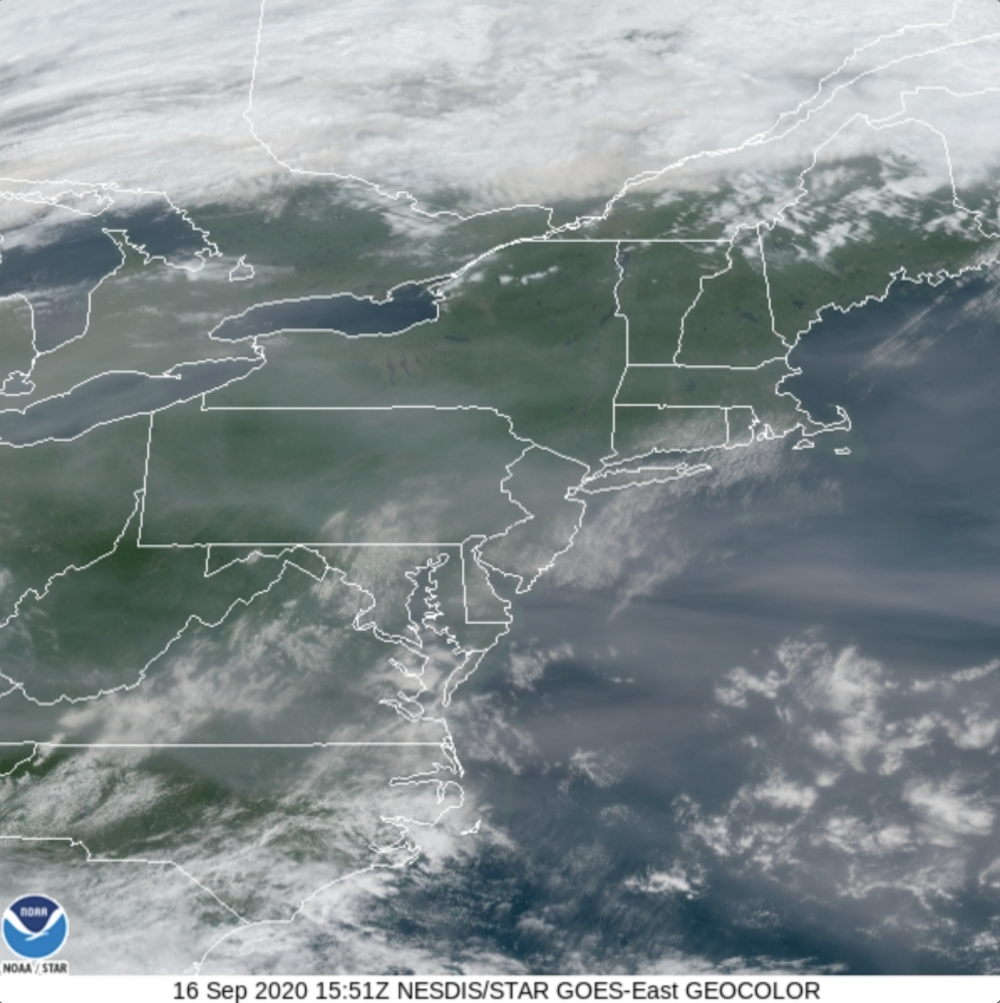
If you are one of the millions of people in the Midwest and Eastern U.S. who turned your gaze toward the sky recently, you may have noticed the sun shining through an odd, milky haze. This widespread opaque veil was caused not by clouds, but rather by smoke from wildfires in the Western U.S.
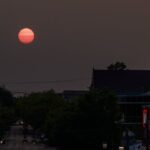
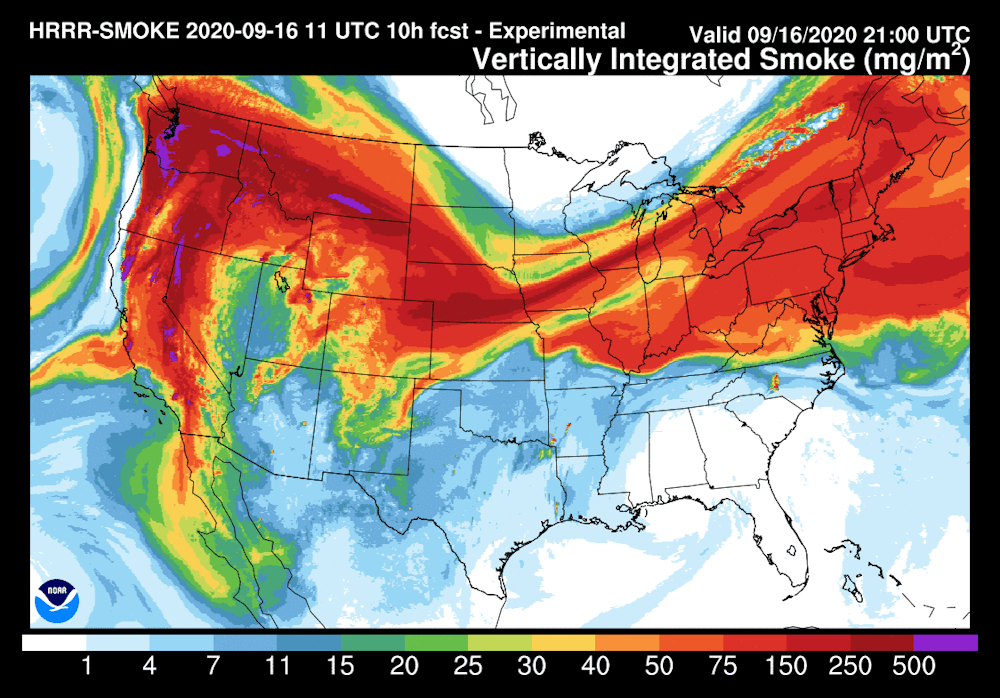
The smoke was cruising by in the middle levels of the atmosphere many thousands of feet above the ground. While far too high to smell, it caused spectacularly hued sunsets from New York to D.C. to Missouri.
The thin haze, easily visible in this satellite photo over Pennsylvania and New York, is smoke that traveled over a thousand miles on air currents from the fires on the West Coast. NOAA
Red sky at night
Lasting for about a week from Sept. 12 to Sept. 19, the smoke could be seen in satellite images as wisps and patches of light gray and was especially apparent over the darkly contrasting water of the Atlantic.
Soot particles are much larger than air molecules and are more adept at scattering the yellow, orange and red wavelengths of sunlight. The enhanced oranges, pinks and reds during sunset occur when the Sun’s rays have to travel through more smoke. That happens when the Sun is very low near the horizon rather than when it is directly overhead, hence the fiery sunsets.
How has all that smoke migrated so far? Blame this on the vagaries of the jet stream.
The jet stream is a high-altitude belt of fast wind that sails from west to east around the hemisphere in the middle latitudes. The jet stream is always present, but its wind speeds and exact path around the globe vary daily.
Smoke, highlighted by the darker colors, follows the course of the jet stream once it gets high enough into the atmosphere. NOAA
In early September, the jet stream’s path abruptly dipped south, draping it through the Western states. When this happened, the air current picked up the rising plumes of smoke and transported them across the U.S. in a layer of air between 10,000 and 20,000 feet above sea level. As the smoke layer raced eastward at up to 100 mph, it spread over cities along the way – dimming the Sun and creating red sunsets.
A connected world
Smoke isn’t the only aerosol that can sail around the Earth on wind currents. Pollution from China regularly travels to the U.S., where it’s been detected along the East Coast. Fine dusts lofted from the Sahara Desert in Africa can be swept westward to the Southeastern U.S., as happened just a few months ago.
After a week of hazy skies, a large air mass from Canada blew into the East Coast bringing in smoke-free air. But the Western U.S. fire season continues, and if the jet stream dips south again, the East could experience additional blasts of smoke-laden air. The globe may be vast, but wind currents connect us all.
]]>
By Jeffrey B. Halverson, professor, Geography and Environmental Systems, associate dean, Graduate School, UMBC If you are one of the millions of people in the Midwest and Eastern U.S. who...https://umbc.edu/stories/how-can-smoke-from-west-coast-fires-cause-red-sunsets-in-new-york/https://beta.my.umbc.edu/api/v0/pixel/news/119787/guest@my.umbc.edu/e9d920697b80aee36f496674c4e59b71/api/pixelclimate-changediscoverygesthe-conversationUMBC News & Magazinehttps://beta.my.umbc.edu/groups/umbc-news-magazinehttps://assets1-beta.my.umbc.edu/system/shared/avatars/groups/000/001/943/24435aa6207c452e7bc15cc74b42c7bb/xsmall.png?1748556657https://assets1-beta.my.umbc.edu/system/shared/avatars/groups/000/001/943/24435aa6207c452e7bc15cc74b42c7bb/original.png?1748556657https://assets2-beta.my.umbc.edu/system/shared/avatars/groups/000/001/943/24435aa6207c452e7bc15cc74b42c7bb/xxlarge.png?1748556657https://assets2-beta.my.umbc.edu/system/shared/avatars/groups/000/001/943/24435aa6207c452e7bc15cc74b42c7bb/xlarge.png?1748556657https://assets3-beta.my.umbc.edu/system/shared/avatars/groups/000/001/943/24435aa6207c452e7bc15cc74b42c7bb/large.png?1748556657https://assets1-beta.my.umbc.edu/system/shared/avatars/groups/000/001/943/24435aa6207c452e7bc15cc74b42c7bb/medium.png?1748556657https://assets2-beta.my.umbc.edu/system/shared/avatars/groups/000/001/943/24435aa6207c452e7bc15cc74b42c7bb/small.png?1748556657https://assets1-beta.my.umbc.edu/system/shared/avatars/groups/000/001/943/24435aa6207c452e7bc15cc74b42c7bb/xsmall.png?1748556657https://assets2-beta.my.umbc.edu/system/shared/avatars/groups/000/001/943/24435aa6207c452e7bc15cc74b42c7bb/xxsmall.png?1748556657UMBC News & Magazine00falseTue, 22 Sep 2020 16:24:46 -0400Baltimore Sun honors Pres. Hrabowski’s leadership through Business and Civic Hall of Fame
The Baltimore Sun is celebrating UMBC President Freeman Hrabowski as a 2020 Business and Civic Hall of Fame honoree. A special feature in The Sun highlights important moments in Hrabowski’s life and career, and his impact as one of the nation’s top higher education leaders.
“For over 30 years, University of Maryland, Baltimore County President Freeman A. Hrabowski III has walked Academic Row, the main stretch of campus lined by academic buildings, stopping students he knows by name outside of buildings to chat about their studies and lives,” the paper notes, sharing a scene familiar to many in the UMBC community. Hrabowski explained that “getting to know more than just students’ names is part of the human experience, something he learned from his parents who were educators themselves.”
President Hrabowski with Orientation Peer Advisors, summer 2018.
The publication describes Hrabowski’s involvement in the 1963 Children’s Crusade, his early work in higher education, and his lifelong focus on educational equity. “His civic-minded outlook led him to focus on equity to ensure that UMBC would provide an equal-opportunity education to everyone,” TheSun notes.
Transformational leaders
This year, the Hall of Fame recognizes 13 leaders “for their transformational efforts to improve our community.” In addition to Hrabowski, several have important connections to UMBC. Marin Alsop, who served as music director for the Baltimore Symphony Orchestra for 14 years, received an honorary doctor of fine arts degree from UMBC in 2019. Mary Ann Scully has volunteered with the Alex. Brown Center for Entrepreneurship and the UMBC Board of Visitors.
Marin Alsop receives an honorary doctorate at UMBC’s spring 2019 commencement.
Mary-Ann and Walter D. “Wally” Pinkard Jr. are longtime partners of UMBC, primarily through the France-Merrick Foundation, which has supported UMBC France-Merrick Scholars and the UMBC Sondheim Scholars Program. The France-Merrick Foundation also enabled the University to create a green roof on the UMBC Administration Building in support of environmental and sustainability initiatives.
Hope for the future
The Sun’s Hall of Fame feature highlights comments from numerous state leaders. In Hrabowski’s profile, University System of Maryland Chancellor Jay Perman and Speaker of the Maryland House of Delegate Adrienne Jones ’76, psychology, comment on his confidence and pride in UMBC students and alumni.
Speaker of the Maryland House of Delegates Adrienne Jones with President Freeman Hrabowski at a UMBC event honoring her election as speaker, 2019.
“And even now,” at a moment of uncertainty and new challenges, “President Hrabowski proudly talks of hope for the future,” the paper shares. “As an educator, he believes that part of UMBC’s mission is to prepare students to become leaders while also understanding the importance of history, what it means to have a healthy democracy, how to be civically engaged.”
Most important, Hrabowski told The Sun, is “understanding that our future does not depend on one person, but on all of us.”
The Sun designated The Choice Program at UMBC as its charitable partner this year, and will donate a portion of the Hall of Fame publication proceeds to support the program’s work. The Choice Program provides case management, resources, and empowering opportunities for Maryland youth.
Featured image: President Hrabowski addresses UMBC graduating class of 2018.All photos by Marlayna Demond ’11 for UMBC.
]]>
The Baltimore Sun is celebrating UMBC President Freeman Hrabowski as a 2020 Business and Civic Hall of Fame honoree. A special feature in The Sun highlights important moments in Hrabowski’s life...https://umbc.edu/stories/baltimore-sun-honors-pres-hrabowskis-leadership-through-business-and-civic-hall-of-fame/https://beta.my.umbc.edu/api/v0/pixel/news/119788/guest@my.umbc.edu/2c2341a2cecc25b1f6e11eb48f1b1572/api/pixelcommunityhrabowskimajorawardpage1UMBC News & Magazinehttps://beta.my.umbc.edu/groups/umbc-news-magazinehttps://assets1-beta.my.umbc.edu/system/shared/avatars/groups/000/001/943/24435aa6207c452e7bc15cc74b42c7bb/xsmall.png?1748556657https://assets1-beta.my.umbc.edu/system/shared/avatars/groups/000/001/943/24435aa6207c452e7bc15cc74b42c7bb/original.png?1748556657https://assets2-beta.my.umbc.edu/system/shared/avatars/groups/000/001/943/24435aa6207c452e7bc15cc74b42c7bb/xxlarge.png?1748556657https://assets2-beta.my.umbc.edu/system/shared/avatars/groups/000/001/943/24435aa6207c452e7bc15cc74b42c7bb/xlarge.png?1748556657https://assets3-beta.my.umbc.edu/system/shared/avatars/groups/000/001/943/24435aa6207c452e7bc15cc74b42c7bb/large.png?1748556657https://assets1-beta.my.umbc.edu/system/shared/avatars/groups/000/001/943/24435aa6207c452e7bc15cc74b42c7bb/medium.png?1748556657https://assets2-beta.my.umbc.edu/system/shared/avatars/groups/000/001/943/24435aa6207c452e7bc15cc74b42c7bb/small.png?1748556657https://assets1-beta.my.umbc.edu/system/shared/avatars/groups/000/001/943/24435aa6207c452e7bc15cc74b42c7bb/xsmall.png?1748556657https://assets2-beta.my.umbc.edu/system/shared/avatars/groups/000/001/943/24435aa6207c452e7bc15cc74b42c7bb/xxsmall.png?1748556657UMBC News & Magazine00falseFri, 18 Sep 2020 20:30:57 -0400

 The north campus of bwtech@UMBC.
 Martorelli with his mother, Florence, who goes by Frosty. Photo courtesy of Martorelli.
 Headshot courtesy of Broderick.
 Broderick with Jess Myers representing The Women’s Center. Photo courtesy of Broderick.
 Headshot courtesy of Christopher Lee.
 Capuano with her son, Lucca. Photo courtesy of Capuano.
 Martorelli with his father, Salvatore, on campus several years ago. Photo courtesy of Martorelli.

 A neuron in the nucleus accumbens, from LeGates’s research. Image courtesy Tara LeGates.
 From right: Tara LeGates with her postdoctoral advisor, Scott Thompson; co-author Mark Kvarta; and lab member Adam Van Dyke. Photo courtesy Tara LeGates.

 A photo of Marten’s lab in fall 2019. Photo by Melissa Penley Cormier.
 Mark Marten. Photo courtesy of Marten.
 UMBC welcome pack for new students, fall 2020.

 President Hrabowski with Orientation Peer Advisors, summer 2018.
 Marin Alsop receives an honorary doctorate at UMBC’s spring 2019 commencement.
 Speaker of the Maryland House of Delegates Adrienne Jones with President Freeman Hrabowski at a UMBC event honoring her election as speaker, 2019.