UMBC receives $900K from Maryland E-nnovation Initiative Fund to bolster Sinha Professorship in Statistics

Professor Bimal Sinha, who founded UMBC’s statistics department in 1985, is a beloved and decorated faculty member who has helped transform UMBC into a national leader in statistics education. He’s also transformed the lives of countless students, some of whom have gone on to become leading statisticians around the globe.
After more than 30 years at UMBC, in 2015, Sinha and his family decided to take their commitment to the university even further. Sinha and his sons, Jit and Shomo Sinha, pledged $750,000 to create the Dr. Bimal Sinha Professorship in Statistics at UMBC. The professorship will permanently fund a new statistics faculty position at UMBC. The family was joined in their commitment by 40 alumni and friends of the university. This summer the total endowment stood at $900,000.
This week, the Maryland E-nnovation Initiative Fund (MEIF), administered by the Maryland Department of Commerce, announced that it would match the amount currently pledged to the endowment with an additional $900,000. That will bring the total endowment of the professorship to $1.8 million. The fund is still open to receiving additional contributions to optimize the MEIF match and strengthen the endowment long into the future.
“Bringing the MEIF to UMBC will further enhance the university’s statistics program and its reputation, increasing our ability to recruit talented faculty and students from diverse backgrounds,” shared President Freeman Hrabowski.
 Bimal Sinha (left) and Yehenew Kifle, assistant professor of statistics at UMBC (center), with N.M. Mokgalongs, president of University of Limpopo, South Africa, at the 4th African International Conference on Statistics. Photo courtesy Yehenew Kifle.
Statisticians in demand
The department’s researchers specialize in many areas, including machine learning and big data analysis. The work of statisticians is often behind the scenes of headlines about other fields, such as cybersecurity, artificial intelligence, genomics, and drug development. According to the Bureau of Labor Statistics, statistics is one of the fastest growing career fields in the nation.
By supporting the Sinha Endowed Professorship, “MEIF is playing a crucial role in connecting philanthropy to the economic development mission of Maryland’s research universities,” shares Greg Simmons, vice president for institutional advancement. “MEIF is a compelling resource to universities and research parks like bwtech@UMBC as we work to build Maryland’s innovation economy.”
Teamwork delivers
Putting together the proposal for the MEIF funding demonstrated the teamwork ethos at UMBC. New Associate Vice President for Alumni Engagement and Development Stacey Sickels Locke, who assumed her role in May, spearheaded the effort. With close collaboration from the College of Natural and Mathematical Sciences and the mathematics and statistics department, the team was able to rapidly develop a compelling proposal ahead of a tight deadline.
 Bimal Sinha (foreground, right) speaks with young scholars at the 4th African International Conference on Statistics in Limpopo, South Africa. Photo courtesy Yehenew Kifle.
In addition to thanking Locke, Simmons, and Dean Bill LaCourse of the College of Natural and Mathematical Sciences, “I would like to thank and applaud the entire statistics faculty for springing into action and making this grant application possible,” shared Animikh Biswas, professor and chair of mathematics and statistics. “Their strong effort resulted in our proposal being funded.”
“Finding out that the MEIF grant had been funded was wonderful news, which is desperately needed in these difficult times,” LaCourse says. “I’m proud of the outstanding efforts of the faculty in statistics and Animikh’s leadership. The endowed professorship is an honor Bimal richly deserves after decades of meaningful contributions to UMBC.”
Supporting scholars of the future
The UMBC community also values this grant as a chance to recognize the impact Sinha has had on the university, his field, and students around the world.
“Kudos to Dean Bill LaCourse for his leadership, and to Professor Bimal Sinha for his amazing body of work,” Hrabowski shares. “Bimal has not only engaged in groundbreaking research for decades, but has also produced and championed an impressive number of influential Black statisticians throughout Africa.”
Sinha has spearheaded the African International Conference on Statistics, held in a different African country each year since 2014. In 2018, UMBC signed a memorandum of understanding with the University of Limpopo in South Africa to foster collaboration and exchange. A number of graduate students from African countries have also flourished with Sinha’s mentorship.
 Bimal Sinha gives the opening address at the 4th African International Conference on Statistics at the University of Limpopo, South Africa, in 2017. Photo courtesy Yehenew Kifle.
Sinha’s sons remember that beyond his academic accolades, the way their father has always interacted with his mentees is what made the deepest impression—whether meeting international students at the airport or inviting groups of students to their family home for dinner.
“We are proud of the contributions our father has made to the Department of Mathematics and Statistics,” Jit and Shomo shared in a statement. “Equally importantly, we believe that now more than ever, the health and growth of public higher education institutions such as UMBC play a pivotal role in advancing opportunities for the next generation of students.”
Leaving a legacy
Today, Sinha finds himself in the enviable position of approaching the sunset of his career knowing that he has made a significant positive impact on the lives of countless people, from his students and colleagues to his family. The results of his compassion, his leadership, and his generosity will ripple even farther than his impressive contributions to the field of statistics.
“When I joined UMBC in 1985, I could not have imagined the growth and success the university would go on to experience over the subsequent 35 years. I feel honored and fortunate to have played a small role in the evolution of this beloved institution,” Sinha says. “I am grateful to my colleagues, students, collaborators, friends and administrators for their partnership. Through this gift, I want to ensure that future generations of leading scholars will view UMBC as an attractive home to advance their contributions to the field of statistics.”
To learn more about ways to support UMBC, visit giving.umbc.edu.
Banner image: President Freeman Hrabowski (pointing), Bimal Sinha (foreground), and Duguma Adugna, President of Aris University in Ethiopia, take in the view from the roof of the UMBC Administration Building in October 2019. Photo courtesy Yehenew Kifle.
]]>
Professor Bimal Sinha, who founded UMBC’s statistics department in 1985, is a beloved and decorated faculty member who has helped transform UMBC into a national leader in statistics education....
https://umbc.edu/stories/umbc-receives-900k-from-maryland-e-nnovation-initiative-fund-to-endow-sinha-e-nnovate-chair-in-statistics/
https://beta.my.umbc.edu/api/v0/pixel/news/119771/guest@my.umbc.edu/11f9756e291bbaa3c7e8887495b2412f/api/pixel
cnms
mathstat
science-and-technology
UMBC News & Magazine
https://beta.my.umbc.edu/groups/umbc-news-magazine
https://assets1-beta.my.umbc.edu/system/shared/avatars/groups/000/001/943/24435aa6207c452e7bc15cc74b42c7bb/xsmall.png?1748556657
https://assets1-beta.my.umbc.edu/system/shared/avatars/groups/000/001/943/24435aa6207c452e7bc15cc74b42c7bb/original.png?1748556657
https://assets2-beta.my.umbc.edu/system/shared/avatars/groups/000/001/943/24435aa6207c452e7bc15cc74b42c7bb/xxlarge.png?1748556657
https://assets2-beta.my.umbc.edu/system/shared/avatars/groups/000/001/943/24435aa6207c452e7bc15cc74b42c7bb/xlarge.png?1748556657
https://assets3-beta.my.umbc.edu/system/shared/avatars/groups/000/001/943/24435aa6207c452e7bc15cc74b42c7bb/large.png?1748556657
https://assets1-beta.my.umbc.edu/system/shared/avatars/groups/000/001/943/24435aa6207c452e7bc15cc74b42c7bb/medium.png?1748556657
https://assets2-beta.my.umbc.edu/system/shared/avatars/groups/000/001/943/24435aa6207c452e7bc15cc74b42c7bb/small.png?1748556657
https://assets1-beta.my.umbc.edu/system/shared/avatars/groups/000/001/943/24435aa6207c452e7bc15cc74b42c7bb/xsmall.png?1748556657
https://assets2-beta.my.umbc.edu/system/shared/avatars/groups/000/001/943/24435aa6207c452e7bc15cc74b42c7bb/xxsmall.png?1748556657
UMBC News & Magazine
0
0
false
Wed, 21 Oct 2020 14:06:58 -0400
Proposed Student Visa Policy Could Hinder US Competitiveness

By David L. Di Maria, associate vice provost, International Education, UMBC
In an effort to crack down on international students and scholars who overstay their visas, the Trump administration is seeking to implement a new set of rules that would make it more difficult for them to remain in the U.S.
Among other things, the proposed rules would require students and scholars from certain countries to leave within either two or four years. This would be irrespective of whether or not they’ve completed their degrees and research. Only those who could prove a “compelling” reason to stay longer would be allowed to do so.
But the rule, which has already drawn more than 20,000 comments from the public, comes with a steep price tag. It would also undermine America’s interest in attracting talent from abroad and, ironically, it would do little to actually curtail the problem of visa overstays that it purports to solve. That is my analysis as a higher education administrator who specializes in international education.
Time limits
The Department of Homeland Security’s proposed tighter restrictions are outlined in a 256-page document.
Which of the two new proposed maximum time limits – two or four years – would apply would depend on various criteria. Currently, these students and scholars are admitted for “duration of status,” which means they may stay for as long as their academic endeavors require, as long as they follow the terms of their visa.
Things that would subject a student or scholar to a two-year cap include being from certain countries, pursuing particular courses of study and whether or not their university fully participates in E-Verify, a web-based federal document verification system.
There are other changes as well.
For instance, students will have 30 days – half the time currently allotted – to leave the country after completing their academic program. Any petitions for extensions of stay would need to be approved by U.S. Citizenship and Immigration Services. Certain activities, such as participating in off-campus internships, would be prohibited while this paperwork was pending.
This new process also would require students and scholars to pay US$455 in new filing fees.
Enough time?
Federal data show it takes four years and four months, on average, to complete a bachelor’s degree. In fact, only 44% of first-time, full-time students attending a four-year institution in 2012 completed a bachelor’s degree within four years. For international students, 52% graduate within four years. That means nearly half of all international students take more than four years to finish college.
There are many reasons students often require more than four years to graduate. Those reasons could range from pursuing more than one major to being involved in extracurricular activities or having family obligations.
For graduate students, it could be that the research they are doing has been delayed for some reason. In fact, the National Science Foundation reports that it takes an average of five years and 10 months to complete a doctorate.
The uncertainty over whether or not a degree could be completed within the time limits set by the proposed rule would further weaken the ability of the U.S. to attract global academic talent.
Visa overstays by the numbers
The proposed rule builds upon the Trump administration’s more than 400 attempts to reshape the U.S. immigration system through executive actions.
While a key argument used to justify the proposed changes is that people who overstay visas may endanger national security, the government estimates that just 1.52% of all international students and exchange visitors overstay. The actual rate may be even lower given that the government overestimates overstays because of a lack of capacity to properly record departures.
Close tabs
International students and scholars are very closely tracked by their colleges and universities. While the proposed rule would add additional caseloads to an already overwhelmed government agency and a paper-based immigration system that the Department of Homeland Security itself describes as “outdated,” it may do little to prevent overstays. On the contrary, I believe the new rule may force some students to make the impossible choice between committing an overstay and abandoning their educational dream.
In June, U.S. Citizenship and Immigration Services announced that it faced a $1.2 billion shortfall. Over the next decade, DHS estimates the cost to implement the new rule will be as high as $2 billion. While filing fees for extension requests will help USCIS increase revenue, research shows that estimates for costs of compliance with a new regulation are often incomplete.
DHS predicts the higher education sector will lose $93 million during the first year of the rule and roughly $30 million each year thereafter because of staff time spent on training, implementation and supporting petitions for longer stays.
Other federal and state agencies, such as divisions of motor vehicles, as well as employers needing to reverify employment eligibility on a more regular basis, will face similar burdens.
In the end, I believe the economy will lose billions should the new restrictions further accelerate the decline in international enrollment.
Implications for U.S. competitiveness
Global competition in science and technology is increasing.
Consider the rise of other nations in critical areas such as artificial intelligence, quantum computing and synthetic biology.
This has serious implications for economic and national security. Specifically, the most scientifically and technologically advanced nations tend to dominate global market share in innovative industries, as measured by leading companies, exports and foreign direct investments. They also have the most advanced military capabilities, ranging from autonomous unmanned vehicles to hypersonic and directed-energy weapons.
Additionally, some nations are using the current political climate to lure foreign talent away from the U.S.
The role of international students
International students play a critical role in helping the nation excel in science and technology.
Their enrollment helps universities continue to offer STEM majors and graduate programs. These majors and programs benefit U.S. students and employers.
Consider that 1 in 3 people with science and engineering jobs in the U.S. were born in another country. This includes more than half of all biomedical researchers and nearly a quarter of pharmaceutical manufacturing industry employees.
While many international students leave the country after earning their degree, those who choose to stay provide a source of high-skilled talent that ensures our country remains globally competitive in science and technology.
*****
David L. Di Maria, Associate Vice Provost for International Education, University of Maryland, Baltimore County
Header image: The proposed policy mainly targets students from the Middle East and African nations. Brothers91/E+ via Getty Images Plus
[Deep knowledge, daily.Sign up for The Conversation’s newsletter.]
This article is republished from The Conversation under a Creative Commons license. Read the original article.
]]>
By David L. Di Maria, associate vice provost, International Education, UMBC In an effort to crack down on international students and scholars who overstay their visas, the Trump...
https://umbc.edu/stories/proposed-student-visa-policy-could-hinder-us-competitiveness/
https://beta.my.umbc.edu/api/v0/pixel/news/119772/guest@my.umbc.edu/2e3b2b47a667ace140d65163f9a460d8/api/pixel
ies
international
perspectives
the-conversation
UMBC News & Magazine
https://beta.my.umbc.edu/groups/umbc-news-magazine
https://assets1-beta.my.umbc.edu/system/shared/avatars/groups/000/001/943/24435aa6207c452e7bc15cc74b42c7bb/xsmall.png?1748556657
https://assets1-beta.my.umbc.edu/system/shared/avatars/groups/000/001/943/24435aa6207c452e7bc15cc74b42c7bb/original.png?1748556657
https://assets2-beta.my.umbc.edu/system/shared/avatars/groups/000/001/943/24435aa6207c452e7bc15cc74b42c7bb/xxlarge.png?1748556657
https://assets2-beta.my.umbc.edu/system/shared/avatars/groups/000/001/943/24435aa6207c452e7bc15cc74b42c7bb/xlarge.png?1748556657
https://assets3-beta.my.umbc.edu/system/shared/avatars/groups/000/001/943/24435aa6207c452e7bc15cc74b42c7bb/large.png?1748556657
https://assets1-beta.my.umbc.edu/system/shared/avatars/groups/000/001/943/24435aa6207c452e7bc15cc74b42c7bb/medium.png?1748556657
https://assets2-beta.my.umbc.edu/system/shared/avatars/groups/000/001/943/24435aa6207c452e7bc15cc74b42c7bb/small.png?1748556657
https://assets1-beta.my.umbc.edu/system/shared/avatars/groups/000/001/943/24435aa6207c452e7bc15cc74b42c7bb/xsmall.png?1748556657
https://assets2-beta.my.umbc.edu/system/shared/avatars/groups/000/001/943/24435aa6207c452e7bc15cc74b42c7bb/xxsmall.png?1748556657
UMBC News & Magazine
0
0
false
Tue, 20 Oct 2020 13:25:34 -0400
Struggle for justice and change: Karsonya Wise Whitehead presents UMBC’s 42nd annual Du Bois lecture

Karsonya “Kaye” Wise Whitehead will present UMBC’s 42nd annual W. E. B. Du Bois lecture on the intersection of COVID-19, systemic racism, and anti-racist action.
Whitehead, Ph.D. ‘09, language, literacy, and culture, is an associate professor of communication and African American studies at Loyola University Maryland. She is also the award-winning radio host of “Today With Dr. Kaye” on WEAA. Her talk, “Black COVID Stories, Black Lives Matter, and Protest: A Conversation about the Ongoing Struggle for Justice and Change,” will examine the long-term societal impacts of today’s conversations about anti-Blackness, anti-racism, policing, and justice in the context of Du Bois’s research.
“I want to talk about how we can have these difficult conversations not just around race but around antiracism, White supremacy, and police brutality,” shares Whitehead. “We will take Du Bois’s work to explore people’s experiences in this country. It’s about who gets to say who they are as an American, what that looks like, and what it means in the broader picture.”
Being Black in America
Du Bois’s scholarship on double consciousness addressed what it meant to be Black in America at the beginning of the 20th century. He used this concept to describe how Black Americans had to continually be conscious of themselves both through their own eyes and through the lens of a racist, oppressive White society.
Whitehead notes that Du Bois was arguing for the right of Black men to vote; the end of separate but equal public spaces; the right of Black people to live, speak, and be anywhere; and equal enforcement of the law. She says these rights were seen as extremely radical for the early 1900s and, unfortunately, are still radical today.
 W. E. B. Du Bois. Photo from creative commons.
“What Black America is demanding today is the same as what Du Bois was demanding more than a century ago,” shares Whitehead. “On the eve of 2021 we are still fighting against White supremacy, voter suppression, and police brutality, and fighting for access to the table.”
In the wake of ongoing violence against Black people, Whitehead notes that Black America is asking America to be more responsive and more responsible in its treatment of Black and Brown people. She shares, “We will use his lens to have a 21st century conversation on how we move forward as a nation.”
Where to find Dr. Kaye’s work

Karsonya “Kaye” Wise Whitehead.
Photo courtesy of Whitehead.
In addition to her other work, Whitehead is also a columnist for The Afro newspaper and the founding executive director of the Emilie Frances Davis Center for Education, Research, and Culture. She is the author of four award-winning books. These include Notes from a Colored Girl: The Civil War Pocket Diaries of Emilie Frances Davis; Race Brave; Letters to My Black Sons: Raising Boys in a Post-Racial America; and Sparking the Genius: The Carter G. Woodson Lecture. She is also a documentary filmmaker and a former Baltimore City middle school teacher, recipient of the 2006-07 Maryland History Teacher of the Year Award.
Register to attend the 42nd annual W. E. B. Du Bois lecture, to be held virtually on Wednesday, November 11, 2020, 6 p.m. – 7 p.m. This Humanities Forum event is presented by UMBC’s Africana studies department. It is co-sponsored by the Center for Social Science Scholarship and the Dresher Center for the Humanities.
Banner image: Whitehead presents at GRIT-X during UMBC’s 50th anniversary celebration. Photo by Jim Burger for UMBC.
]]>
Karsonya “Kaye” Wise Whitehead will present UMBC’s 42nd annual W. E. B. Du Bois lecture on the intersection of COVID-19, systemic racism, and anti-racist action. Whitehead, Ph.D. ‘09,...
https://umbc.edu/stories/struggle-for-justice-and-change-karsonya-wise-whitehead-presents-umbcs-42nd-annual-du-bois-lecture/
https://beta.my.umbc.edu/api/v0/pixel/news/119773/guest@my.umbc.edu/1a7de08add213ebce16e8260e39d8fb0/api/pixel
africanastudies
community
llc
page1
policy-and-society
UMBC News & Magazine
https://beta.my.umbc.edu/groups/umbc-news-magazine
https://assets1-beta.my.umbc.edu/system/shared/avatars/groups/000/001/943/24435aa6207c452e7bc15cc74b42c7bb/xsmall.png?1748556657
https://assets1-beta.my.umbc.edu/system/shared/avatars/groups/000/001/943/24435aa6207c452e7bc15cc74b42c7bb/original.png?1748556657
https://assets2-beta.my.umbc.edu/system/shared/avatars/groups/000/001/943/24435aa6207c452e7bc15cc74b42c7bb/xxlarge.png?1748556657
https://assets2-beta.my.umbc.edu/system/shared/avatars/groups/000/001/943/24435aa6207c452e7bc15cc74b42c7bb/xlarge.png?1748556657
https://assets3-beta.my.umbc.edu/system/shared/avatars/groups/000/001/943/24435aa6207c452e7bc15cc74b42c7bb/large.png?1748556657
https://assets1-beta.my.umbc.edu/system/shared/avatars/groups/000/001/943/24435aa6207c452e7bc15cc74b42c7bb/medium.png?1748556657
https://assets2-beta.my.umbc.edu/system/shared/avatars/groups/000/001/943/24435aa6207c452e7bc15cc74b42c7bb/small.png?1748556657
https://assets1-beta.my.umbc.edu/system/shared/avatars/groups/000/001/943/24435aa6207c452e7bc15cc74b42c7bb/xsmall.png?1748556657
https://assets2-beta.my.umbc.edu/system/shared/avatars/groups/000/001/943/24435aa6207c452e7bc15cc74b42c7bb/xxsmall.png?1748556657
UMBC News & Magazine
0
0
false
Mon, 19 Oct 2020 20:03:58 -0400
Remembering Sharon Doherty-Ritter
It is with deep sadness that we recognize the passing of Sharon Doherty-Ritter, the Director of Management Advisory Services (MAS), on October 12, 2020. Sharon came to UMBC in 2001 as a management analyst in the newly formed Management Advisory Services office, and was named Director in 2014. She received her B.S. degree in accounting from the University of Maryland, College Park and she was a Certified Public Accountant. She obtained her MBA degree from the University of Maryland Global Campus in 2013.
Sharon came to UMBC with a wealth of experience in the fields of accounting and auditing, having worked for a number of years in the private sector and with the State Office of Legislative Audit. Through Sharon’s efforts and expertise, management of internal and external audits, improved internal controls and fraud training, and compliance improvement efforts were significantly strengthened. She also played a major role in the public-private partnerships (P3) for Walker Avenue Apartments and Erickson and Harbor Halls. Erickson and Harbor Halls eventually became the first P3 project in the University System of Maryland to be completely paid off and Sharon was a key player in this achievement.
As a colleague, she demonstrated her expertise and professionalism but was also pragmatic and supportive. She was a well-respected and trusted representative for UMBC with auditors from the State, USM and external granting agencies and foundations. She forged strong working relationships with units across campus and was often sought out for advice.
Sharon will be remembered with respect and affection by the many colleagues who benefitted from her kindly wisdom and generous support. She was always available to help formulate possible solutions or identify next steps. Her commitment and dedication to UMBC was demonstrated on a daily basis and she will be greatly missed.
Lynne C. Schaefer, Vice President for Administration and Finance
Terry Cook, Senior Associate Vice President for Administrative Services
]]>
It is with deep sadness that we recognize the passing of Sharon Doherty-Ritter, the Director of Management Advisory Services (MAS), on October 12, 2020. Sharon came to UMBC in 2001 as a management...
https://umbc.edu/stories/remembering-sharon-doherty-ritter/
https://beta.my.umbc.edu/api/v0/pixel/news/119774/guest@my.umbc.edu/86bcdd0251917dee31c2c663d535c400/api/pixel
in-memorium
rss
UMBC News & Magazine
https://beta.my.umbc.edu/groups/umbc-news-magazine
https://assets1-beta.my.umbc.edu/system/shared/avatars/groups/000/001/943/24435aa6207c452e7bc15cc74b42c7bb/xsmall.png?1748556657
https://assets1-beta.my.umbc.edu/system/shared/avatars/groups/000/001/943/24435aa6207c452e7bc15cc74b42c7bb/original.png?1748556657
https://assets2-beta.my.umbc.edu/system/shared/avatars/groups/000/001/943/24435aa6207c452e7bc15cc74b42c7bb/xxlarge.png?1748556657
https://assets2-beta.my.umbc.edu/system/shared/avatars/groups/000/001/943/24435aa6207c452e7bc15cc74b42c7bb/xlarge.png?1748556657
https://assets3-beta.my.umbc.edu/system/shared/avatars/groups/000/001/943/24435aa6207c452e7bc15cc74b42c7bb/large.png?1748556657
https://assets1-beta.my.umbc.edu/system/shared/avatars/groups/000/001/943/24435aa6207c452e7bc15cc74b42c7bb/medium.png?1748556657
https://assets2-beta.my.umbc.edu/system/shared/avatars/groups/000/001/943/24435aa6207c452e7bc15cc74b42c7bb/small.png?1748556657
https://assets1-beta.my.umbc.edu/system/shared/avatars/groups/000/001/943/24435aa6207c452e7bc15cc74b42c7bb/xsmall.png?1748556657
https://assets2-beta.my.umbc.edu/system/shared/avatars/groups/000/001/943/24435aa6207c452e7bc15cc74b42c7bb/xxsmall.png?1748556657
UMBC News & Magazine
0
0
false
Fri, 16 Oct 2020 20:55:06 -0400
UMBC’s Jack Suess to receive 2020 EDUCAUSE Leadership Award

UMBC Vice President for Information Technology Jack Suess will soon receive one of the highest national recognitions offered to professionals in his field: the EDUCAUSE Leadership Award.
EDUCAUSE is a nonprofit association that focuses on information technology (IT) in higher education and includes more than 2,300 member colleges, universities, and groups. Suess ‘81, mathematics, M.S. ‘94, information systems, will receive the award during the EDUCAUSE Annual Conference, which will be held virtually this month.
“This is a tremendous honor for me. Given that my entire career has been at UMBC, it also is testament to the innovative and collaborative culture of the UMBC community,” Suess says. “In particular, I want to highlight the technology leadership of my Division of Information Technology colleagues. Through all of their efforts, UMBC is looked at as a model for the use of technology in higher education.”
Collaborative leadership
Suess was nominated and selected to receive the Leadership Award for his commitment to innovation and advancing research and scholarship in technology. He is also being honored for creating a culture of collaboration and opportunity among faculty, staff, students, and other higher education stakeholders, and for his work in diversity, equity and inclusion.
“Leaders around the country admire Jack’s valuable contributions to IT and higher education. He is a fine example of enlightened leadership,” says UMBC President Freeman Hrabowski. “We all know Jack leads effectively by serving selflessly. What makes him most extraordinary is that his emotional intelligence matches his impressive technical skills.”
Career of service
Suess has been involved with EDUCAUSE for more than two decades, serving on a variety of committees before joining the board of directors in 2014 and serving as chair of the board in 2018. Currently, Suess serves on the IMSglobal Board of Directors, which he chaired from 2015 to 2020. He is a former member of the Internet2 Board of Directors, where he received the inaugural Internet2 Presidential Leadership Award in 2011.
At UMBC, Suess has previously received the UMBC Presidential Staff Award (2004) and the UMBC Alumni Volunteer Award (2000). He served on the inaugural advisory board for UMBC’s Center for Women in Technology from 1998 to 2013.
Banner image: Jack Suess. Photo by Marlayna Demond ’11 for UMBC.
]]>
UMBC Vice President for Information Technology Jack Suess will soon receive one of the highest national recognitions offered to professionals in his field: the EDUCAUSE Leadership Award. ...
https://umbc.edu/stories/umbcs-jack-suess-to-receive-2020-educause-leadership-award/
https://beta.my.umbc.edu/api/v0/pixel/news/119775/guest@my.umbc.edu/9903eb1ac55e0f7c58b1268d891bfb2b/api/pixel
alumni
campus
community
staff
UMBC News & Magazine
https://beta.my.umbc.edu/groups/umbc-news-magazine
https://assets1-beta.my.umbc.edu/system/shared/avatars/groups/000/001/943/24435aa6207c452e7bc15cc74b42c7bb/xsmall.png?1748556657
https://assets1-beta.my.umbc.edu/system/shared/avatars/groups/000/001/943/24435aa6207c452e7bc15cc74b42c7bb/original.png?1748556657
https://assets2-beta.my.umbc.edu/system/shared/avatars/groups/000/001/943/24435aa6207c452e7bc15cc74b42c7bb/xxlarge.png?1748556657
https://assets2-beta.my.umbc.edu/system/shared/avatars/groups/000/001/943/24435aa6207c452e7bc15cc74b42c7bb/xlarge.png?1748556657
https://assets3-beta.my.umbc.edu/system/shared/avatars/groups/000/001/943/24435aa6207c452e7bc15cc74b42c7bb/large.png?1748556657
https://assets1-beta.my.umbc.edu/system/shared/avatars/groups/000/001/943/24435aa6207c452e7bc15cc74b42c7bb/medium.png?1748556657
https://assets2-beta.my.umbc.edu/system/shared/avatars/groups/000/001/943/24435aa6207c452e7bc15cc74b42c7bb/small.png?1748556657
https://assets1-beta.my.umbc.edu/system/shared/avatars/groups/000/001/943/24435aa6207c452e7bc15cc74b42c7bb/xsmall.png?1748556657
https://assets2-beta.my.umbc.edu/system/shared/avatars/groups/000/001/943/24435aa6207c452e7bc15cc74b42c7bb/xxsmall.png?1748556657
UMBC News & Magazine
0
0
false
Fri, 16 Oct 2020 12:16:40 -0400
Amy Coney Barrett May Be the Next Woman on the Supreme Court – but Does a Nominee’s Gender Matter?

By Susan M. Sterett, professor, Public Policy UMBC
President Donald Trump has so far appointed fewer women as federal judges than any president since Ronald Reagan. In the Senate confirmation hearings now underway for Amy Coney Barrett, Republic senators have repeatedly pointed out that the president is appointing a woman to the Supreme Court.
I am a scholar of the politics of courts who has studied the demand for greater gender and ethnic diversity on courts around the world. Research shows gender diversity in the judiciary matters – but not because women and men necessarily judge differently.
Women on the bench
Jimmy Carter was the first president to take gender diversity in the courts seriously. The federal bench was “almost entirely male and white” when Carter entered office in 1977, according to professors Rorie Solberg and Eric N. Waltenberg. In his four years as president, Carter appointed women to more than 15% of the available federal district court positions.
Reagan appointed far fewer women by percentage to the federal courts than Carter – just 10% of his nominees between 1981 and 1989 were women – but answered concerns about that by putting the first woman on the United States Supreme Court, appointing Sandra Day O’Connor in 1981.
Later presidents went on to appoint more women to the judiciary, including the Supreme Court. Presidents Clinton and Obama appointed a greater percentage of women to federal courts than either President George H.W. Bush or George W. Bush.
For years now, political scientists have looked at judges’ rulings to see if they can identify differences in outcomes based on their gender, particularly in the lower courts, which hear more cases than the Supreme Court.
But women do not all agree on legal issues any more than men do. What differences researchers have found – for example in how judges handle immigration cases – can be explained by work experience. If women more often entered immigration courts after first working as immigration lawyers while men more often started as prosecutors, that could account for what appear to be gender-based differences.
Both men and women both learn from their lives, including in ways that will affect how they judge. When people ask about gender and judges, many have women in mind. But men also have life experiences that contribute to how they judge. Untangling gender or race from work, life and education experience – and from the political party of the president who appointed them – is messy.
Antonin Scalia served both President Richard Nixon and President Gerald Ford before he became a Supreme Court justice, an experience most analysts argue shaped his legal interpretations about executive power. But Scalia wouldn’t have had that experience if he weren’t a man. So did his judgment reflect his experience or his gender?
The case for diversity
No matter how you answer that question, diversity of life experience is one reason gender representation on the bench matters.
Here’s another: Not seeing women in leadership roles feeds beliefs that women do not belong in leadership roles. And exemplars – such as the only woman in a high-level position – are vulnerable to harsh judgments that arise from discriminatory beliefs based on their gender.
These biased expectations are very difficult to change.
As more women hold positions in fields dominated by men, like the law, however, it becomes more difficult to believe that all women are essentially the same and easier to assess them based on their work. Furthermore, research shows teams of people with more diverse life experiences often come up with more ways to address a problem.
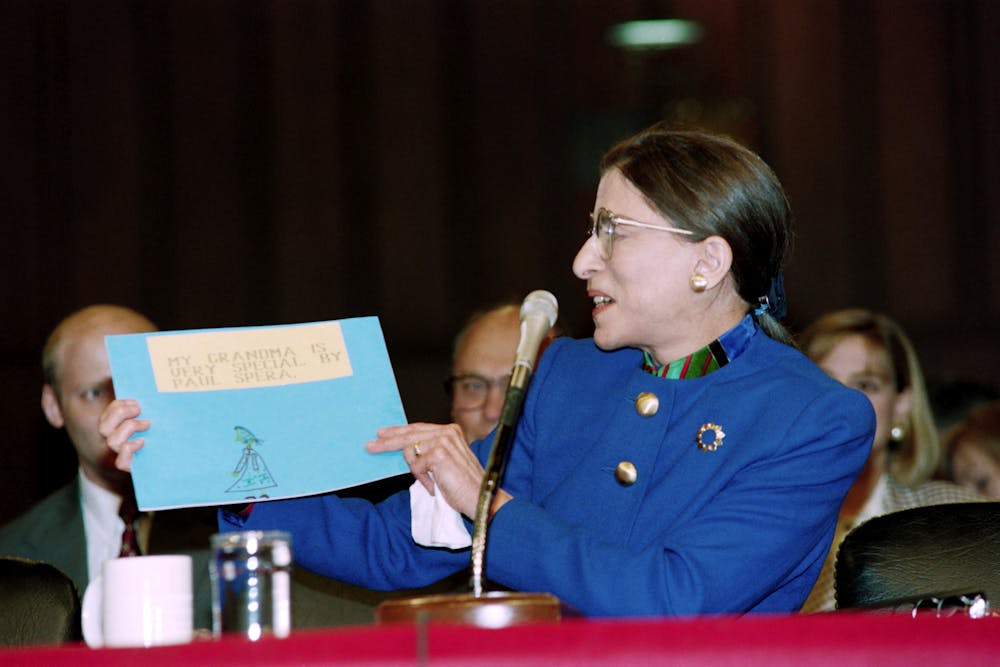
Employing women equally in political positions, including on courts, is also a critical aspect of women’s hard-won equality. Gender diversity is one result of increasing expectations that politics and law not discriminate based on sex – an achievement Ruth Bader Ginsburg helped secure.
That right, explicitly, does not hinge on gender-based differences in behavior. Women can and do vote however they choose because they are equal citizens. They can and do serve on juries, just as men do, without giving a reason for why they should.
Four women – Justices Sandra Day O’Connor, Ruth Bader Ginsburg, Sonia Sotomayor and Elena Kagan – have now served on the small, slow-to-change Supreme Court, each with their different way of interpreting the law. So Americans are free to assess, and even disagree with, the legal interpretation of a Supreme Court nominee like Judge Barrett without feeling they’re simultaneously judging all women.
Justice Ginsburg and Judge Barrett
Barrett and Ginsburg could not be more different.
Justice Ginsburg began her career advocating for gender equality with the American Civil Liberties Union’s Women’s Rights Project, a project she organized. Over her many decades on the bench she became a feminist icon, inspiring movies and a children’s book.
Judge Barrett, in contrast, has been a judge since only 2017, making it difficult to assess her legal interpretation. But she is backed by the leading conservative advocacy group, the Federalist Society, which the Trump administration relies upon to identify judicial nominees. The Federalist Society is pro-guns, anti-abortion and anti-business regulation.
As a law professor, Barrett wrote articles that give clues to how she might judge. She has criticized the Supreme Court’s decision upholding part of the Affordable Care Act, for example. And some abortion advocates cite her writing on how to weigh legal precedent to argue she would be willing to overturn earlier court decisions that protect reproductive rights.
These big differences between Justice Ginsburg and Judge Barrett – not simply their shared gender – would characterize Barrett’s work on the Supreme Court.
*****
Susan M. Sterett, Professor of Public Policy, University of Maryland, Baltimore County
Header image: Trump with 7th U.S. Circuit Judge Amy Coney Barrett and her family Sept. 26 at the White House. Chip Somodevilla/Getty Images
This article is republished from The Conversation under a Creative Commons license. Read the original article.
[Like what you’ve read? Want more?Sign up for The Conversation’s daily newsletter.]
]]>
By Susan M. Sterett, professor, Public Policy UMBC President Donald Trump has so far appointed fewer women as federal judges than any president since Ronald Reagan. In the Senate confirmation...
https://umbc.edu/stories/amy-coney-barrett-may-be-the-next-woman-on-the-supreme-court-but-does-a-nominees-gender-matter/
https://beta.my.umbc.edu/api/v0/pixel/news/119776/guest@my.umbc.edu/61785c2ea78570e861b929486d29705d/api/pixel
perspectives
public-policy
supreme-court-of-the-united-states
the-conversation
UMBC News & Magazine
https://beta.my.umbc.edu/groups/umbc-news-magazine
https://assets1-beta.my.umbc.edu/system/shared/avatars/groups/000/001/943/24435aa6207c452e7bc15cc74b42c7bb/xsmall.png?1748556657
https://assets1-beta.my.umbc.edu/system/shared/avatars/groups/000/001/943/24435aa6207c452e7bc15cc74b42c7bb/original.png?1748556657
https://assets2-beta.my.umbc.edu/system/shared/avatars/groups/000/001/943/24435aa6207c452e7bc15cc74b42c7bb/xxlarge.png?1748556657
https://assets2-beta.my.umbc.edu/system/shared/avatars/groups/000/001/943/24435aa6207c452e7bc15cc74b42c7bb/xlarge.png?1748556657
https://assets3-beta.my.umbc.edu/system/shared/avatars/groups/000/001/943/24435aa6207c452e7bc15cc74b42c7bb/large.png?1748556657
https://assets1-beta.my.umbc.edu/system/shared/avatars/groups/000/001/943/24435aa6207c452e7bc15cc74b42c7bb/medium.png?1748556657
https://assets2-beta.my.umbc.edu/system/shared/avatars/groups/000/001/943/24435aa6207c452e7bc15cc74b42c7bb/small.png?1748556657
https://assets1-beta.my.umbc.edu/system/shared/avatars/groups/000/001/943/24435aa6207c452e7bc15cc74b42c7bb/xsmall.png?1748556657
https://assets2-beta.my.umbc.edu/system/shared/avatars/groups/000/001/943/24435aa6207c452e7bc15cc74b42c7bb/xxsmall.png?1748556657
UMBC News & Magazine
0
0
false
Thu, 15 Oct 2020 13:23:55 -0400
UMBC’s Kindel Nash’s new book shares best practices for culturally sustaining teaching in early education

UMBC’s Kindel Nash, associate professor of education, and colleagues have produced one of the first books to address culturally sustaining literacy education in early childhood, Toward Culturally Sustaining Teaching (Routledge 2020). The book shares findings from the first cohort of the Professional Dyads of Culturally Relevant Teaching (PDCRT) program. This program pairs educators who are interested in developing culturally relevant literacy practices in diverse pre-K, kindergarten, first, and second grade classrooms.
The PDCRT program is supported by the Early Childhood Education Assembly of the National Council of Teachers of English, and purposefully elevates the work of teachers and researchers of color. All participants in the cohort central to the book, with the exception of Nash, were educators and researchers of color.
Nash edited the book with Crystal Polite Glover, associate professor of early childhood education at Winthrop University in South Carolina, and Bilal Polson, principal at Northern Parkway school in Long Island, NY, who also participated in PDCRT.
Defining culturally sustaining teaching
Culturally sustaining pedagogy, Nash explains, focuses on countering structures that systematically erase the culture and language of communities of color.
Nash notes that widely adopted practices in early childhood education view communities of color from a highly problematic deficit mindset. “Culturally sustaining teaching is a conscious decision to teach and work within communities of color from an asset mindset,” she says. This framework has been widely researched in secondary education but, Nash notes, little has been done in early childhood until now.
H. Samy Alim and Django Paris are recognized for developing foundational scholarship in this field. Alim is the David O. Sears Presidential Endowed Chair in the Social Sciences and professor of anthropology and African American studies at the University of California, Los Angeles, and the founding director of the Center for Race, Ethnicity, and Language. Paris is the inaugural James A. and Cherry A. Banks Professor of Multicultural Education and director of the Banks Center for Educational Justice in the University of Washington College of Education.
“Culturally sustaining pedagogy is about revitalizing and transforming, about ultimately undoing schooling as we know it to return to and imagine anew the ways our communities have sustained and must sustain each other, our society, our planet,” Paris writes in the book’s foreword. “As we continue to build together, I remain grateful for projects like this book, which are part of our collective effort to sustain the world we need, with our ancestors, our young ones, our elders, forward.”
Sustaining success for all
The book provides in-depth examples from the experiences of the first PDCRT cohort, which paired four highly successful early childhood educators with researchers across the U.S. The researchers found that the teachers they were paired with were already applying this framework without previous training.
Patricia Piña, a dual-language early childhood educator in Kansas City, Missouri, was Nash’s PDCRT partner. Piña valued and connected the culture and language of her predominantly Latinx classroom by using different culturally sustaining teaching strategies. She created bilingual books and made assessments language-accessible. Among other strategies, she also used translanguaging daily—communicating concepts and ideas via different cultural frameworks in a student’s native language.
Piña’s students experienced great success developing age-expected skills in English and Spanish across all subjects. However, as successful as Piña was as an educator, she ultimately left teaching after a young child who spoke Spanish in the classroom was referred for special education services after being tested in English. This experience had unfortunately happened many times over her teaching career.
Tackling an inequitable system
Piña’s experience is one many teachers of color have to face. They must not only be their own advocate in a profession dominated by white teachers and administrators, but they must also often be the only advocate for students of color, Nash says. It is something she has witnessed frequently in eight years of research with high-performing urban teachers.
“The dominant ideas about schooling are connected to Western individualistic notions of learning that broadly support how White American students learn,” explains Nash. “It is a very inequitable system.”
Nash feels that there is still a long journey to successfully implement culturally sustaining teaching in the U.S. education system, particularly for White teachers who primarily work with other White educators. Further, she explains that it is not enough for White teachers to have close relationships with people of color. She notes, “White educators must unlearn the deep feelings about communities of color they have been socialized to have in a system built on slavery and White supremacy.”
Unlearning racism
Nash hopes educators understand that this is why recruitment and retention of educators of color benefits everyone. “White educators and researchers will not be able to apply culturally sustaining teaching if they are only working with other White teachers in reflecting on their Whiteness,” says Nash.
Her book is an example of the impact teachers can have when they commit to this work. “This includes not only changing how we teach,” she says, “but whom we teach with.”
Banner image: Kindel Nash. Photo by Arionna Gonsalves ’19, media and communication studies and modern languages, linguistics, and intercultural communication.
]]>
UMBC’s Kindel Nash, associate professor of education, and colleagues have produced one of the first books to address culturally sustaining literacy education in early childhood, Toward Culturally...
https://umbc.edu/stories/umbcs-kindel-nashs-new-book-shares-best-practices-for-culturally-sustaining-teaching-in-early-education/
https://beta.my.umbc.edu/api/v0/pixel/news/119777/guest@my.umbc.edu/40ffea9d655e091fda019af5f8e8fee6/api/pixel
cahss
cahssresearch
diversityandinclusion
education
page1
policy-and-society
UMBC News & Magazine
https://beta.my.umbc.edu/groups/umbc-news-magazine
https://assets1-beta.my.umbc.edu/system/shared/avatars/groups/000/001/943/24435aa6207c452e7bc15cc74b42c7bb/xsmall.png?1748556657
https://assets1-beta.my.umbc.edu/system/shared/avatars/groups/000/001/943/24435aa6207c452e7bc15cc74b42c7bb/original.png?1748556657
https://assets2-beta.my.umbc.edu/system/shared/avatars/groups/000/001/943/24435aa6207c452e7bc15cc74b42c7bb/xxlarge.png?1748556657
https://assets2-beta.my.umbc.edu/system/shared/avatars/groups/000/001/943/24435aa6207c452e7bc15cc74b42c7bb/xlarge.png?1748556657
https://assets3-beta.my.umbc.edu/system/shared/avatars/groups/000/001/943/24435aa6207c452e7bc15cc74b42c7bb/large.png?1748556657
https://assets1-beta.my.umbc.edu/system/shared/avatars/groups/000/001/943/24435aa6207c452e7bc15cc74b42c7bb/medium.png?1748556657
https://assets2-beta.my.umbc.edu/system/shared/avatars/groups/000/001/943/24435aa6207c452e7bc15cc74b42c7bb/small.png?1748556657
https://assets1-beta.my.umbc.edu/system/shared/avatars/groups/000/001/943/24435aa6207c452e7bc15cc74b42c7bb/xsmall.png?1748556657
https://assets2-beta.my.umbc.edu/system/shared/avatars/groups/000/001/943/24435aa6207c452e7bc15cc74b42c7bb/xxsmall.png?1748556657
UMBC News & Magazine
0
0
false
Mon, 12 Oct 2020 17:01:49 -0400
Repatriating the archives: Lumbee scholars find their people and bring them home

By Ashley Minner, professor of the practice, American studies, UMBC, and Jessica R. Locklear, University of North Carolina at Chapel Hill
Following World War II, thousands of Lumbee Indians migrated from their tribal homeland in rural North Carolina to industrialized cities, including Baltimore and Philadelphia.
Seeking work and a better quality of life, they formed distinct Lumbee communities. They brought their foods – cornbread, collards, pastry. They brought their singing and strong work ethic. They became business owners. They founded churches and urban Indian Centers.
Their lives and contributions became part of the historical record and cultural landscapes of these places, but over time, a complex set of factors have resulted in the movement and displacement of the people themselves.
We are Lumbee scholars Ashley Minner from Baltimore and Jessica Locklear from Philadelphia. We have mined local archives in search of our forebears. We’ve found news articles, photographs, maps and even video footage documenting relatives and friends who often have no idea they are represented in collections.
As safeguarders of history, institutional archives necessarily have rules in place to govern access to their collections. Many of the materials are also subject to copyright, and the rights are owned by the creators of the materials or their employers. In other words, a photographer or the company the photographer was working for would own the rights to a specific photograph.
Faced with restrictions as to how the memories we found can be accessed and shared, we ask: Who has the right to the archives? What are our obligations both as tribal citizens and public-facing researchers when we find “our people” in them?
Ashley Minner, Baltimore
When Lumbee Indians moved to Baltimore, they settled in an area on the east side of town bridging the neighborhoods of Washington Hill and Upper Fells Point. The blocks of brick row houses with marble steps looked nothing like the rural home they left behind, but as other ethnic communities had done before them, they made this place their own.
In 2018, I hit the archives in earnest, anxious to corroborate stories shared by my elders about “the reservation” they had formed there in their youth.
They described a landscape intimately familiar to me, where places I grew up – the Baltimore American Indian Center and South Broadway Baptist Church – are still open and operating. But their stories were filled with names of businesses and people I didn’t know because this area has been continually transformed since then.
 View of South Broadway from the Baltimore American Indian Center. Photo by Colby Ware for OSI Baltimore, 2014
One of the first and richest sources of documentation I found was the Baltimore News American newspaper photo archive. There were forgotten images of community leaders, legends and even relatives.
My immediate impulse was to share the photos via social media so our people could enjoy them as well. To share them legally, I needed permission from the Hearst Corporation, which owns the copyright, which I eventually got, months later.
In the meantime, I ran into Hannah Locklear, another Lumbee woman from Baltimore. She cried happy tears when I showed her one of the archival images I had saved on my phone. There was her great-grandma, Margie Chavis, young, standing on the stoop of the Baltimore American Indian Center. Along with our memories, images from archives like these are sometimes all that remain.
A fellow researcher alerted me to a September 1957 Ebony magazine article – “Mystery People of Baltimore: Neither red, nor black, nor white. Strange ‘Indian’ tribe lives in world of its own.”
A grainy print copy is available at Baltimore’s Enoch Pratt Free Library. I noticed right away that one of the featured photos – taken at a youth social dance and captioned “Typical Indian girl” – was my Aunt Jeanette. Just 14 years old, she was neither interviewed nor told how her photo would be used.
With great celebration, the Ebony and Jet Magazine photo archives were recently donated to the National Museum of African American History and Culture and the Getty Research Institute so they would be “widely accessible to researchers, scholars and the public.” But those archives aren’t publicly available yet.
Incredibly, a copy of the magazine itself was listed in the collections of a London prop shop. I bought it and brought it home to Aunt Jeanette.
She carefully opened the yellowed, oversized magazine and delightedly found a teenage version of herself inside, along with photos of other Lumbee young people, new on the Baltimore scene, playing at youth centers, sitting on stoops, lounging in Patterson Park.
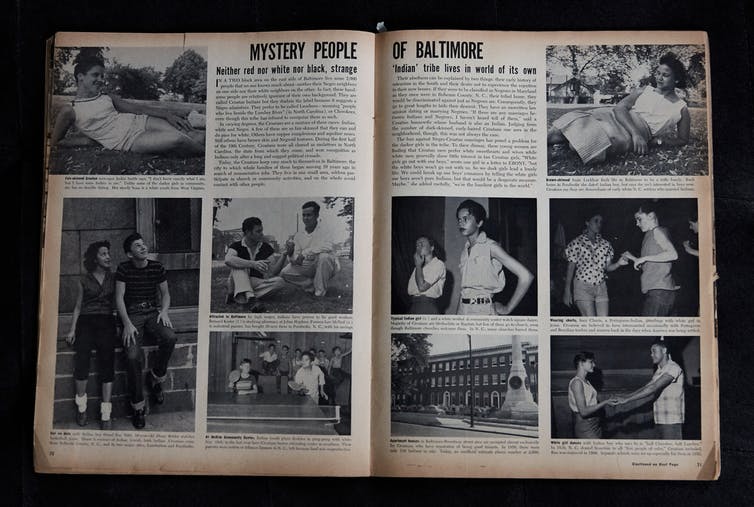 ‘Mystery People of Baltimore’ spread, Ebony, 1957. Photo by Sean Scheidt ’05, visual arts
Despite the hurtful context of the article, Ebony managed to capture a special time for our community. These are some of the only images we have of “the reservation” in its heyday.
Unfortunately, they are available only to those who can wait an indeterminate period of time until they’re made publicly available, and then navigate the bureaucracy of the institution where they’re housed.
Jessica Locklear, Philadelphia
Unlike Baltimore, there was no “reservation” in Philadelphia. Here, Lumbees settled in pockets across the city, yet found ways to forge a sense of community. When I started my research, I doubted there would be evidence of Philadelphia’s Lumbee community in any archives. I was wrong.
While searching the archives of the Philadelphia Inquirer newspaper, I found a story about a Lumbee man named Thessely Campbell who was set to star in a 1984 PBS documentary. Campbell moved from Fairmont, North Carolina, to Philadelphia in 1952 and found employment as a welder at the Budd Company.
Obtaining a copy of this documentary was a lengthy process. The closest available copy was at a university library over 320 miles away. “The Work I’ve Done” focuses on Campbell’s retirement, but also documents Philadelphia’s Lumbee community, including footage shot inside the Native American Freewill Baptist Church, where Campbell was a minister.
 Screenshot showing the Native American Freewill Baptist Church, where Campbell was a minister. ‘The Work I’ve Done.’ Blue Ridge Mountain Films, Directed by Kenneth Fink, 1984.
In 2019, I conducted an oral history interview with Campbell’s wife, Helen. She wanted a DVD copy of the film to keep and share with family. It was at this moment I asked: What is my obligation to pass along material that is available to me, as a scholar, to those who may not be able to access it otherwise?
I felt strongly a copy of this film belonged in the hands of the family represented in it. Asserting a claim of fair use, I made Ms. Helen a copy, and I’m glad I did – she passed away a few months later.
More recently, I stumbled upon a digital copy of the documentary made available by the Internet Archive, a nonprofit dedicated to universal access of archival materials. However, “accessible” does not always mean findable.
In sifting through various archival records, I occasionally find photos of familiar faces, which I try to share with those individuals or families. Most people are tickled to find they are in the archives, and most enjoy being able to view and share images they would not have found themselves.
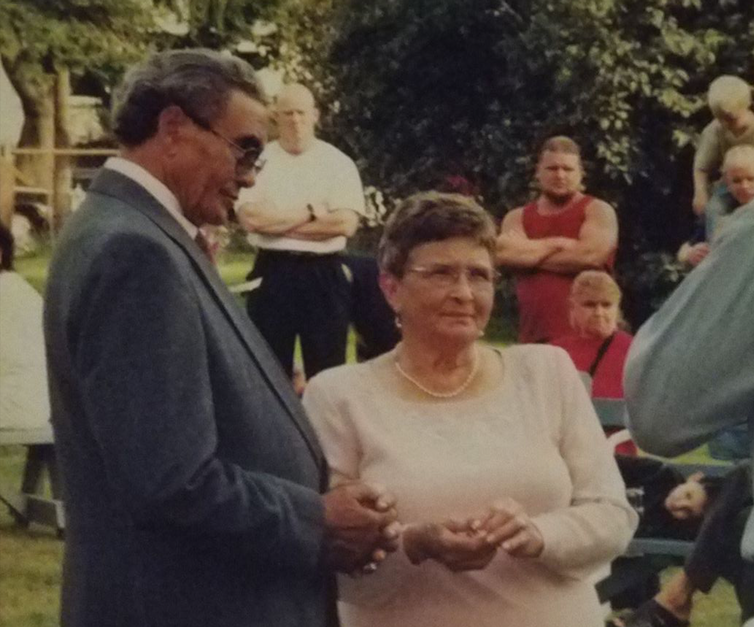 Rev. Thessely Campbell and Helen Campbell. Photo courtesy of Maria Luisa Rios.
Accountability in two directions
The renowned Lumbee scholar Malinda Maynor Lowery writes of being “bound by two sets of ethics that overlap heavily: A Lumbee’s obligation demands accountability to the people who have lived history, and a historian’s responsibility demands accountability to the widest possible sources.”
As tribal citizens and scholars doing public-facing work, we consider ourselves similarly bound. We search for “our people” far and wide. When we find them in archives, we feel obligated to bring them home to their families.
Knowing our people will not access archives as we do, through libraries, universities and museum collections, we meet them where they are – in their homes, out in the world, and on social media.
Repatriating the archives isn’t always about removing materials from institutional care. It’s making sure the people whose lives and cultures are represented in collections know they are there, and ensuring they have the ability to view and share these materials as they see fit. When materials are returned to their communities of origin, they become reactivated.
If we have the ability to give a woman – or a whole community – the opportunity to disarm a hurtful encounter of their youth, and to allow public affirmation of their beauty and true history, we will. If we can return a walking, talking, preaching, singing father, husband and minister to his people, we will.
We are dedicated to sharing the rich histories of former Lumbee neighborhoods with present generations. Bringing archival materials directly to our people presents opportunities to interact with our shared past – and that informs our future.
Ashley Minner, Professor of the Practice, Department of American Studies, University of Maryland, Baltimore County and Jessica R. Locklear, Ph.D. Student in History, University of North Carolina at Chapel Hill
This article is republished from The Conversation under a Creative Commons license. Read the original article.
Header Image: Jeanette W. Jones holds the September 1957 issue of Ebony magazine, which features the article ‘Mystery People of Baltimore: Neither red, nor black, nor white. Strange ‘Indian’ tribe lives in world of its own.’ She is pictured at center, with her hand on her hip. Photo by Sean Scheidt ’05, visual arts
]]>
By Ashley Minner, professor of the practice, American studies, UMBC, and Jessica R. Locklear, University of North Carolina at Chapel Hill Following World War II, thousands of Lumbee Indians...
https://umbc.edu/stories/repatriating-the-archives-lumbee-scholars-find-their-people-and-bring-them-home/
https://beta.my.umbc.edu/api/v0/pixel/news/119778/guest@my.umbc.edu/6222fa6fdd6484e9fe6332be3deade23/api/pixel
discovery
the-conversation
UMBC News & Magazine
https://beta.my.umbc.edu/groups/umbc-news-magazine
https://assets1-beta.my.umbc.edu/system/shared/avatars/groups/000/001/943/24435aa6207c452e7bc15cc74b42c7bb/xsmall.png?1748556657
https://assets1-beta.my.umbc.edu/system/shared/avatars/groups/000/001/943/24435aa6207c452e7bc15cc74b42c7bb/original.png?1748556657
https://assets2-beta.my.umbc.edu/system/shared/avatars/groups/000/001/943/24435aa6207c452e7bc15cc74b42c7bb/xxlarge.png?1748556657
https://assets2-beta.my.umbc.edu/system/shared/avatars/groups/000/001/943/24435aa6207c452e7bc15cc74b42c7bb/xlarge.png?1748556657
https://assets3-beta.my.umbc.edu/system/shared/avatars/groups/000/001/943/24435aa6207c452e7bc15cc74b42c7bb/large.png?1748556657
https://assets1-beta.my.umbc.edu/system/shared/avatars/groups/000/001/943/24435aa6207c452e7bc15cc74b42c7bb/medium.png?1748556657
https://assets2-beta.my.umbc.edu/system/shared/avatars/groups/000/001/943/24435aa6207c452e7bc15cc74b42c7bb/small.png?1748556657
https://assets1-beta.my.umbc.edu/system/shared/avatars/groups/000/001/943/24435aa6207c452e7bc15cc74b42c7bb/xsmall.png?1748556657
https://assets2-beta.my.umbc.edu/system/shared/avatars/groups/000/001/943/24435aa6207c452e7bc15cc74b42c7bb/xxsmall.png?1748556657
UMBC News & Magazine
0
0
false
Fri, 09 Oct 2020 14:31:16 -0400
As demand for telemedicine swells, UMBC researchers develop strategies to scale-up services

After years of gradual expansion, telemedicine has grown dramatically during the COVID-19 pandemic, allowing patients to consult with medical professionals from a distance, without traveling to an office or hospital. But the availability of telemedicine has not yet risen to meet demand, says UMBC’s Helena Mentis, associate professor of information systems (IS).

Helena Mentis. Photo by Marlayna Demond for UMBC.
New strategies are needed to scale-up telemedicine, and more entry-level medical professionals require training on how to provide care to patients virtually. Such training is particularly challenging when clinicians sharing their knowledge are in different locations than the people being trained. A UMBC team is taking on these challenges.
UMBC researchers have received a nearly $150,000 planning grant from the National Science Foundation (NSF) to study how telemedicine can be scaled more effectively, including meeting the complex training needs of medical professionals. Mentis, who is also an associate dean in the College of Engineering and Information Technology, is the principal investigator (PI) on the grant. She will work with Andrea Kleinsmith, assistant professor of IS; Anita Komlodi, associate professor of IS; Gary Williams, clinical coordinator in emergency health services; and Christine Yee, former assistant professor of economics, now an economist at Boston University and the Partnered Evidence-based Policy Resource Center, who are all co-PIs.

Anita Komlodi at an event in February 2020. Photo by Britney Clause ’11.
Mentis explains that this grant is an extension of her work on surgical telemedicine, which was the focus of her NSF CAREER award in 2016. “Whereas my prior work was on one physician communicating with one physician, this grant is looking at how we can scale the benefits of telemedicine with a hub and spoke model,” she says.
Addressing big ideas
The grant is part of NSF’s Big Ideas initiative, which focuses on “ten bold, long-term research and process ideas that identify areas for future investment at the frontiers of science and engineering.” Mentis explains that this research is specifically related to the Future of Work at the Human-Technology Frontier.
The research team will begin building a framework to better understand telemedicine through three approaches. First, they will develop and host a workshop for emergency healthcare leaders and educators, people who develop telemedicine systems, and health economists to discuss existing telemedicine challenges and identify possible innovative solutions.

Andrea Kleinsmith gives a tour of the Perception Lab in February 2020. Photo by Britney Clause ’11.
Second, they will complete an exploratory study to assess the cognitive, communicative, and affective loads experienced by telemedicine professionals in the field and by seasoned clinicians as they lead telemedicine training. Interviews with emergency medical services (EMS) professionals from the greater Baltimore region will provide data for this component.
The final element of this work will be for the research team to connect with community partners to understand the challenges of telemedicine-at-scale. They will also examine how expanding telemedicine could impact the EMS workforce and healthcare costs
Yee explains that through the grant, there will be interviews conducted with EMS managers to find out how they identified and hired their current workforce. “We hope to learn about the expenses related to the current practice of off-site emergency services and transportation to hospitals and other medical institutions,” she says. “We also will be interviewing current and potential EMTs and paramedics about their considerations regarding the EMS career path, including training, burnout, compensation, and risks.”
Developing scalable solutions
The researchers will interview EMS professionals in greater Baltimore to learn about the challenges they face when providing care through telemedicine. They will also examine how telemedicine might offer an entry-level pathway for high school graduates who are interested in pursuing a healthcare career.

Gary Williams. Photo courtesy of Williams.
Williams explains that in early 2019, EMS 2050 was released. This guide informs EMS leaders and educators about the future of the field, and one of the guiding principles is a focus on being adaptable and innovative. “The document speaks specifically about telemedicine and EMS and how we improve patient care by bringing this technology to the forefront,” he says. “The timing is perfect with receiving this grant and the release of EMS 2050. We need this type of research to start making changes and finding new ways to provide patient care to everyone, no matter where they live.”
The existing EMS infrastructure and educational pathways explored through this process will inform the team’s recommendations for scaling telemedicine. By finding new ways to meet high demand for telemedicine services, the team hopes to relieve some of the strain on emergency medical technicians and other healthcare providers who are stretched beyond capacity.
“We began this work with the intention to impact healthcare in the far off future, but as we have seen in the past 6 months, that future is here now,” says Mentis. “Equitable, scalable, and affordable healthcare are of paramount importance and this grant is a huge step in working with our healthcare partners to identify sustainable change.”
Banner image: Telemedicine consultation equipment. Photo by Sergio Santos, used under CC 2.0.
]]>
After years of gradual expansion, telemedicine has grown dramatically during the COVID-19 pandemic, allowing patients to consult with medical professionals from a distance, without traveling to an...
https://umbc.edu/stories/as-demand-for-telemedicine-swells-umbc-researchers-develop-strategies-to-scale-up-services/
https://beta.my.umbc.edu/api/v0/pixel/news/119779/guest@my.umbc.edu/0b7e825f7dc76a6990adbad227f0e1f1/api/pixel
cahss
coeit
economics
ehs
is
policy-and-society
science-and-technology
UMBC News & Magazine
https://beta.my.umbc.edu/groups/umbc-news-magazine
https://assets1-beta.my.umbc.edu/system/shared/avatars/groups/000/001/943/24435aa6207c452e7bc15cc74b42c7bb/xsmall.png?1748556657
https://assets1-beta.my.umbc.edu/system/shared/avatars/groups/000/001/943/24435aa6207c452e7bc15cc74b42c7bb/original.png?1748556657
https://assets2-beta.my.umbc.edu/system/shared/avatars/groups/000/001/943/24435aa6207c452e7bc15cc74b42c7bb/xxlarge.png?1748556657
https://assets2-beta.my.umbc.edu/system/shared/avatars/groups/000/001/943/24435aa6207c452e7bc15cc74b42c7bb/xlarge.png?1748556657
https://assets3-beta.my.umbc.edu/system/shared/avatars/groups/000/001/943/24435aa6207c452e7bc15cc74b42c7bb/large.png?1748556657
https://assets1-beta.my.umbc.edu/system/shared/avatars/groups/000/001/943/24435aa6207c452e7bc15cc74b42c7bb/medium.png?1748556657
https://assets2-beta.my.umbc.edu/system/shared/avatars/groups/000/001/943/24435aa6207c452e7bc15cc74b42c7bb/small.png?1748556657
https://assets1-beta.my.umbc.edu/system/shared/avatars/groups/000/001/943/24435aa6207c452e7bc15cc74b42c7bb/xsmall.png?1748556657
https://assets2-beta.my.umbc.edu/system/shared/avatars/groups/000/001/943/24435aa6207c452e7bc15cc74b42c7bb/xxsmall.png?1748556657
UMBC News & Magazine
0
0
false
Thu, 08 Oct 2020 18:46:12 -0400
UMBC duo using math to reveal how and why cells move with new NSF grant

Cell migration—how, when, and why cells move—has important implications for understanding development and diseases such as blood cell disorders, rheumatoid arthritis, and metastatic cancer. Michelle Starz-Gaiano, associate professor of biological sciences, has learned a great deal about cell migration from observing Drosophila melanogaster, the humble fruit fly, in her lab. She’s also learned that experimental tools have their limitations.
“We have fantastic genetic tools in Drosophila, and we have great live imaging, so we can get pretty far doing that,” Starz-Gaiano says. “But then we encounter things that we can’t explain.”
That’s where her decade-plus collaboration with Brad Peercy, associate professor of mathematics, comes in. In their partnership, Peercy develops mathematical models to represent the movement of cells across developing eggs in the fly ovary. Now, a three-year, $370,000 NSF grant will support the duo as they combine their expertise to further explore the regulation of cell movement.
“I think this project has really big implications for how we think about development and how organs and tissues function,” Starz-Gaiano says, “because it’s looking at aspects that people haven’t yet paid attention to.”
A fresh perspective
Scientists can learn a lot about cell migration through experimental approaches like those Starz-Gaiano employs. However, some experiments are too complex or too expensive to attempt without a powerful reason to believe they will reveal new and useful information.
Turning to mathematical modeling has been particularly helpful for pointing wet lab scientists in the right direction before they invest in complicated experiments. “The collaboration has been incredible in making the best predictions for how to explain confusing results. It’s enabled us to narrow down the set of things to test,” Starz-Gaiano says.

Brad Peercy working from home this fall. Photo courtesy Brad Peercy.
For example, cell migration in the fruit fly ovary happens in several complex stages. Chemical signaling and the geometry of the ovary both play a role in regulating the process. “There are lots of different interesting features that are ripe for having a mathematical framework put around them,” Peercy says, “and the math can sometimes point to looking at something a little bit differently than biologists might otherwise.”
Now the challenge is that the math has pointed to certain attributes of the migration process that may be impossible to test in a live organism with today’s technology. “The models that Brad’s group has made are so compelling that now we have to figure out if we can show that biologically,” Starz-Gaiano says. “That’s a big focus of some of the work in the lab now.”
Uncharted territory
This new grant focuses on the math side of the work. Peercy and Starz-Gaiano have been collaborating since 2008, when they partnered to work with undergraduates as part of the former, NSF-funded Interdisciplinary Training for Undergraduates in Biological and Mathematical Sciences program.
Since then, Peercy and his team have developed several models for different aspects of the cell migration process. The next step is “integrating some of the models that we’ve already developed into a more comprehensive model of the system,” he explains. For that, Peercy and Starz-Gaiano will benefit from the computational expertise of Matthias Gobbert, professor of mathematics, who is another co-investigator on the grant. He will help make the computational processing more efficient, and therefore feasible in a reasonable amount of time.
Another aim of the project is to further investigate a set of chemical reactions, known as a signaling cascade, involved in triggering cell migration. “The signaling cascade that the model is for is very well conserved across species, and it’s implicated in a lot of human diseases,” Starz-Gaiano says. “The model pointed to a certain kind of regulation that hasn’t been very well explored, so we want to follow up on that.”
 Michelle Starz-Gaiano in the UMBC Biological Sciences Building. Photo by Marlayna Demond ’11 for UMBC.
The team will also work to better understand how the restricted space of the egg chamber affects how cells and chemical signals move, and how that affects cell migration. “Being able to map that complicated geometry into a computational framework is something we’re interested in,” Peercy says. For this part of the project, they’re collaborating with Tagide deCarvalho, director of UMBC’s Keith R. Porter Imaging Facility.
Looking at the space between cells is a new area of research. “People haven’t done that,” Starz-Gaiano says. “They just think this one sends a signal and that one gets it and it’s over, and we’re saying, well, what happens in between?” Failure of a signal to reach its final destination can contribute to some birth defects, Starz-Gaiano explains. She also wonders if the same could be true for some cancers.
A new approach
As scientific discovery marches onward, researchers in fields that were once seemingly disparate find themselves relying on each other more and more. “The biology is insufficient to capture what’s going on, so we need different approaches,” Starz-Gaiano says.
Collaborations between researchers in different fields can be tricky to navigate, as each side learns to speak a new language and engage in different ways of thinking. But when everyone involved is on board, the results can be groundbreaking.
“You see strong collaborations between experimentalists and theoreticians when they are willing to sit in uncomfortable situations,” Peercy says. That might mean a biologist thinking about differential equations or a mathematician trying to understand the reproductive process of a fruit fly.
Peercy and Starz-Gaiano’s easy rapport and long history of working together makes it clear that they’ve crossed that bridge and are comfortable taking on the unknown together. They recognize the benefits that combining their unique research skill sets can offer.
“The only way that you can solve complex problems now is to use multiple strategies at the same time,” Starz-Gaiano says. “And increasingly, that’s what we’re faced with in biology—these problems are too complicated for one method to tackle them.”
Banner image: Michelle Starz-Gaiano (right) works with Jeffrey Inen ’18 in her lab. Photo by Marlayna Demond ’11 for UMBC.
]]>
Cell migration—how, when, and why cells move—has important implications for understanding development and diseases such as blood cell disorders, rheumatoid arthritis, and metastatic cancer....
https://umbc.edu/stories/umbc-duo-using-math-to-reveal-how-and-why-cells-move-with-new-nsf-grant/
https://beta.my.umbc.edu/api/v0/pixel/news/119780/guest@my.umbc.edu/cbefb6d06bdc1a31f1cd7e18471324d9/api/pixel
biology
cnms
mathstat
research
science-and-technology
UMBC News & Magazine
https://beta.my.umbc.edu/groups/umbc-news-magazine
https://assets1-beta.my.umbc.edu/system/shared/avatars/groups/000/001/943/24435aa6207c452e7bc15cc74b42c7bb/xsmall.png?1748556657
https://assets1-beta.my.umbc.edu/system/shared/avatars/groups/000/001/943/24435aa6207c452e7bc15cc74b42c7bb/original.png?1748556657
https://assets2-beta.my.umbc.edu/system/shared/avatars/groups/000/001/943/24435aa6207c452e7bc15cc74b42c7bb/xxlarge.png?1748556657
https://assets2-beta.my.umbc.edu/system/shared/avatars/groups/000/001/943/24435aa6207c452e7bc15cc74b42c7bb/xlarge.png?1748556657
https://assets3-beta.my.umbc.edu/system/shared/avatars/groups/000/001/943/24435aa6207c452e7bc15cc74b42c7bb/large.png?1748556657
https://assets1-beta.my.umbc.edu/system/shared/avatars/groups/000/001/943/24435aa6207c452e7bc15cc74b42c7bb/medium.png?1748556657
https://assets2-beta.my.umbc.edu/system/shared/avatars/groups/000/001/943/24435aa6207c452e7bc15cc74b42c7bb/small.png?1748556657
https://assets1-beta.my.umbc.edu/system/shared/avatars/groups/000/001/943/24435aa6207c452e7bc15cc74b42c7bb/xsmall.png?1748556657
https://assets2-beta.my.umbc.edu/system/shared/avatars/groups/000/001/943/24435aa6207c452e7bc15cc74b42c7bb/xxsmall.png?1748556657
UMBC News & Magazine
0
0
false
Tue, 06 Oct 2020 18:52:51 -0400