HackUMBC goes virtual in a big way, attracting over 1,000 students

More than 1,000 students from institutions across the country and around the world—from as far away as Kazakhstan, Albania, Spain, and Nigeria—logged onto their computers for a 36-hour hackathon organized by UMBC students, November 13-15.
HackUMBC’s events typically draw huge crowds overflowing conference spaces. This year, the event was held virtually for the first time due to COVID-19. HackUMBC President Anuhya Challagundla ‘21, information systems, says that she was pleased to see participation remain so strong.

Anuhya Challagundla. Photo courtesy of Challagundla.
Challagundla explains that the HackUMBC team was able to connect participants with each other through the HackUMBC Discord channel launched the week before the event. There, they formed teams and discussed ideas for hacks under the themes of connection, healthcare, education, equity, and hobbies (as well as a general track to allow for limitless creativity).
Collaboration in virtual environments
Participants developed web, mobile, desktop, and hardware projects. While independent participants were allowed, students were encouraged to form teams of 2-4 people to make it a collaborative experience.
Perry Vinner ’21, information systems, an organizer on the HackUMBC team, created a virtual campus that was based on UMBC in the Gather.Town platform. The virtual UMBC featured tents and other spaces that allowed participants to move from one place to another easily. Over the course of the weekend, approximately 2,700 viewers tuned in to experience a livestream of the online event.
The event also featured an interactive online space to access resources and event elements beyond the competition, including a career fair, a hallmark of HackUMBC.
Innovative spirit
HackUMBC alumni judged entries based on 3-minute videos that each team submitted. They evaluated the projects’ creativity, technical difficulty, usefulness, and professional “polish.” The judges were able to speak directly with their top three teams to learn more about the hacks that they created and to determine the winners of each category.
A team of UMBC students developed Office Hour Bot, a streamlined way to hold online office hours when face-to-face meetings are not possible. The bot, which was created using Discord, allows people to take on various roles within the platform, like professor, teaching assistant, and student. Office Hour Bot allows faculty and teaching assistants to open and close their office hours, and prioritizes students in the queue depending on a range of criteria. It also prevents students not in a course from joining the office hours designated for that course.
Another student team developed a video calling platform that matches people into group calls in real-time. The Dinner for 4 Strangers app matches individuals based on mutual interests and allows them to connect via video calls. The app provides participants with prompts and ideas to guide conversations, as a way to establish connections and have meaningful interactions with each other. Creators of the app how it will help users combat loneliness and isolation, especially during the COVID-19 pandemic.
A third hack the judges recognized was Expen, a budgeting app that allows users to track and chart their income and expenses. Expen also allows users to scan barcodes of items, rather than having to manually enter product details, and to search for items that are already in the system.
Unique prize for collaboration tech
T. Rowe Price, one of HackUMBC’s top sponsors, invited students to develop a hack that addressed the theme of collaboration technology. Each member of the winning team in this category would receive a unique prize: a chance to connect with a professional in their field.
The Best Use of Collaboration Technology prize went to the Office Hour Bot team, including Gabby Khan ‘22, computer science; Oliver Dininno ‘22, computer science; and Eddie Nieberding ‘22, computer science. T. Rowe Price representatives had an opportunity to meet with Khan, Dininno, and Nieberding to learn about Office Hours Bot during HackUMBC. In early 2021, the company will schedule a personalized virtual meeting for each student with a member of their Technology Management Committee, based on areas of interest.
Benefits of hybrid event
Thanks to the student organizers’ innovative spirit and ability to pivot to an online format, Challagundla says, “It was a super fun and exciting event.” It also had unexpected benefits, allowing more students to participate and to establish connections with companies, regardless of where they or those employers were located.
Even if the event can be in person next year, she says, it will likely be a hybrid event to replicate the most valuable elements of the online format.
Banner image: The virtual UMBC town that the HackUMBC organizers created online.
]]>
More than 1,000 students from institutions across the country and around the world—from as far away as Kazakhstan, Albania, Spain, and Nigeria—logged onto their computers for a 36-hour hackathon...
https://umbc.edu/stories/hackumbc-goes-virtual-in-a-big-way-attracting-over-1000-students/
https://beta.my.umbc.edu/api/v0/pixel/news/119742/guest@my.umbc.edu/fb4cc7df698a6c8bc14503a2828e613c/api/pixel
coeit
community
science-and-technology
UMBC News & Magazine
https://beta.my.umbc.edu/groups/umbc-news-magazine
https://assets1-beta.my.umbc.edu/system/shared/avatars/groups/000/001/943/24435aa6207c452e7bc15cc74b42c7bb/xsmall.png?1748556657
https://assets1-beta.my.umbc.edu/system/shared/avatars/groups/000/001/943/24435aa6207c452e7bc15cc74b42c7bb/original.png?1748556657
https://assets2-beta.my.umbc.edu/system/shared/avatars/groups/000/001/943/24435aa6207c452e7bc15cc74b42c7bb/xxlarge.png?1748556657
https://assets2-beta.my.umbc.edu/system/shared/avatars/groups/000/001/943/24435aa6207c452e7bc15cc74b42c7bb/xlarge.png?1748556657
https://assets3-beta.my.umbc.edu/system/shared/avatars/groups/000/001/943/24435aa6207c452e7bc15cc74b42c7bb/large.png?1748556657
https://assets1-beta.my.umbc.edu/system/shared/avatars/groups/000/001/943/24435aa6207c452e7bc15cc74b42c7bb/medium.png?1748556657
https://assets2-beta.my.umbc.edu/system/shared/avatars/groups/000/001/943/24435aa6207c452e7bc15cc74b42c7bb/small.png?1748556657
https://assets1-beta.my.umbc.edu/system/shared/avatars/groups/000/001/943/24435aa6207c452e7bc15cc74b42c7bb/xsmall.png?1748556657
https://assets2-beta.my.umbc.edu/system/shared/avatars/groups/000/001/943/24435aa6207c452e7bc15cc74b42c7bb/xxsmall.png?1748556657
UMBC News & Magazine
0
0
false
Mon, 23 Nov 2020 20:23:49 -0500
UMBC chemical engineering students take second place in national Jeopardy competition

Last weekend, four UMBC students earned second prize in the national Jeopardy competition hosted virtually by the American Institute of Chemical Engineers (AIChE). The team competed against 12 other teams at the national level after winning the Mid-Atlantic regional competition in October.
UMBC’s team included Cameron Sloan ‘21, Nicholas Balasus ‘21, Ellie Vonderhorst ‘22, and Chris Ashby ‘21, all chemical engineering majors. Sloan is chair of the Jeopardy project in UMBC’s student chapter of AIChE, the professional organization for chemical engineers. He explains that participating in the competition was an important moment for the group, though the move to an online format wasn’t ideal.
 Members of the AIChE team preparing for the virtual competition with faculty advisors and peers. Photo courtesy of Mariajose Castellanos.
“Competing virtually had its challenges, for sure, but all in all it was a fantastic experience,” says Sloan. “I wish we would have had the opportunity to meet our competitors and be able to speak to them, rather than just seeing their digitized faces on our screens.”
Preparing for virtual competition
To prepare for the national competition, each team member created a board featuring unique chemical engineering questions. Their goal was to get exposure to a diverse range of question types on a broad range of topics. Faculty in chemical, biochemical, and environmental engineering (CBEE) also submitted questions to help the team practice.
Mariajose Castellanos, senior lecturer in CBEE, is the faculty advisor for the UMBC chapter of AIChE. She calls UMBC’s second-place finish at the national level “an extraordinary accomplishment” and also notes that this was actually UMBC’s first time at the national competition. They competed against both the University of Southern California (2019 winner) and Iowa State University (2019 finalist).
“I am rejoicing in the grit and greatness shown by our chemical engineering students,” says Castellanos, “during a semester that has challenged us at many different levels.”
Banner image: The UMBC campus in the fall. Photo by Marlayna Demond ’11 for UMBC.
]]>
Last weekend, four UMBC students earned second prize in the national Jeopardy competition hosted virtually by the American Institute of Chemical Engineers (AIChE). The team competed against 12...
https://umbc.edu/stories/umbc-chemical-engineering-students-take-second-place-in-national-jeopardy-competition/
https://beta.my.umbc.edu/api/v0/pixel/news/119743/guest@my.umbc.edu/9ad27167acb10a2976a450d23a4a4c13/api/pixel
cbee
coeit
science-and-technology
UMBC News & Magazine
https://beta.my.umbc.edu/groups/umbc-news-magazine
https://assets1-beta.my.umbc.edu/system/shared/avatars/groups/000/001/943/24435aa6207c452e7bc15cc74b42c7bb/xsmall.png?1748556657
https://assets1-beta.my.umbc.edu/system/shared/avatars/groups/000/001/943/24435aa6207c452e7bc15cc74b42c7bb/original.png?1748556657
https://assets2-beta.my.umbc.edu/system/shared/avatars/groups/000/001/943/24435aa6207c452e7bc15cc74b42c7bb/xxlarge.png?1748556657
https://assets2-beta.my.umbc.edu/system/shared/avatars/groups/000/001/943/24435aa6207c452e7bc15cc74b42c7bb/xlarge.png?1748556657
https://assets3-beta.my.umbc.edu/system/shared/avatars/groups/000/001/943/24435aa6207c452e7bc15cc74b42c7bb/large.png?1748556657
https://assets1-beta.my.umbc.edu/system/shared/avatars/groups/000/001/943/24435aa6207c452e7bc15cc74b42c7bb/medium.png?1748556657
https://assets2-beta.my.umbc.edu/system/shared/avatars/groups/000/001/943/24435aa6207c452e7bc15cc74b42c7bb/small.png?1748556657
https://assets1-beta.my.umbc.edu/system/shared/avatars/groups/000/001/943/24435aa6207c452e7bc15cc74b42c7bb/xsmall.png?1748556657
https://assets2-beta.my.umbc.edu/system/shared/avatars/groups/000/001/943/24435aa6207c452e7bc15cc74b42c7bb/xxsmall.png?1748556657
UMBC News & Magazine
0
0
false
Mon, 23 Nov 2020 17:32:35 -0500
Sam Patterson, UMBC’s newest Rhodes Scholar, plans to transform transportation
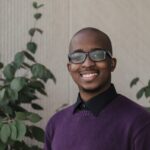
Sam Patterson ’21, M29, is now the second student in UMBC history to receive a Rhodes Scholarship. Only 32 American students are awarded the prestigious scholarship each year, which supports graduate study at the University of Oxford in England.
Patterson will pursue an M.Sc. in the Nature, Society, and Environmental Governance program at Oxford focusing on the economics of transportation. This research area will take full advantage of his three undergraduate degrees from UMBC. This spring, Patterson will earn bachelor of science degrees in mathematics and statistics and a bachelor of arts in economics.
A Meyerhoff Scholar and member of the Honors College, Patterson has steadily nurtured his interest in transportation economics at UMBC and through intensive summer internships. He conducted research supported by the Alfred P. Sloan Foundation at Harvard University with the Harvard Leadership Alliance and at the University of Chicago’s Booth School of Business. Most recently, at the National Bureau of Economic Research, he evaluated trends in transportation changes in urban centers due to the pandemic.
A strong network of support has been a cornerstone of Patterson’s UMBC experience. “From the Meyerhoff Scholars program to the Honors College to Dr. Householder to Naomi Mburu [UMBC’s first Rhodes Scholar] to my recommenders and mock interviewers and beyond, I’ve never had so many people on my team before, pushing me to achieve something I’m pursuing,” Patterson shares.
A commitment to equity
Patterson’s mentors all point out how his intelligence, drive, and charisma are balanced by a deep humility and desire to pursue the common good—a core expectation of Rhodes Scholars.
“Sam has an exceptionally fine mind, and couples to it diligence and determination,” shares Simon Stacey, director of the UMBC Honors College. “He has a genuine capacity for identification with others, and a deep commitment to justice, equity, and equality.”
That commitment translates to Patterson’s research—current and future—in transportation economics. “Sam has a strong interest in economic research that can inform the debate on public policy questions,” says Tim Gindling, professor of economics.
“Sam is a deep critical thinker who looks at car culture and considers its effects not only on the environment, but also in how it shapes access to education, work, healthcare, food, and culture,” adds April Householder, director of prestigious scholarships. “He raises questions about how class and race intersect with suburban and city planning to limit people’s lives.”
Community connections
Sam’s instructors also appreciate the way he approaches his coursework, which goes far beyond how he maintains a 4.0 GPA. “His obvious interest and earnest engagement inspire students around him, contributing to the classroom community,” shares Liz Stanwyck, senior lecturer in mathematics and statistics. “He was equally comfortable in applied and theoretical classes, always willing to speak up but also a great listener, drawing his peers out and helping to develop ideas.”
Beyond the classroom, Patterson is a dedicated community member who values connecting with and supporting others. He performs and produces music and has volunteered with Creative Coders, an afterschool program that teaches coding skills to middle school students.
As a newcomer to Baltimore when he joined the UMBC community four years ago, Patterson has taken full advantage of the opportunities the area offers and managed to maintain interests outside of his demanding academic schedule.
“I found new hobbies, interests, and activities that I hadn’t really considered before; now they’re key to keeping me relaxed and centered,” Patterson shares. “Producing music with Retriever Music Society and running their instrumental group, JOIS, has been one of my greatest pleasures here. Going down to Arbutus and perusing the shelves of Now and Then Music and Universal Comics has been essential to my weekends and birthdays.”
A transformative opportunity
Originally from Marietta, Georgia, Patterson’s education and internships have taken him around the U.S. However, he has never traveled abroad, so the Rhodes Scholarship offers a unique opportunity for him to broaden his perspective by studying in the U.K. and visiting other European countries. He hopes to further deepen his understanding of challenges—and potential solutions—related to a range of transportation systems.
“I’m so excited to go to the U.K.! I think it will do wonders for my research when I experience the European perspective on public transportation and its place in society and sustainability,” Patterson says. “There are so many brilliant academics at Oxford that I’m raring to meet. I just feel so fortunate to be where I am and to be going where I’m going.”
After Oxford, Patterson already has plans to attend Harvard University for a Ph.D. Before he gets there, though, Patterson and his mentors have no doubt the Rhodes experience will be transformative.
“The Rhodes Scholarship is a life-changing opportunity for exceptional young people with the potential to make a difference for good in the world. Sam has that mixture of grit and excellence that is the best of what UMBC represents,” Householder says. “His experience in the U.K. will enrich not only his academic path, but also his personal journey in so many profound ways. I can’t wait to see what he will accomplish.”
]]>
Sam Patterson ’21, M29, is now the second student in UMBC history to receive a Rhodes Scholarship. Only 32 American students are awarded the prestigious scholarship each year, which supports...
https://umbc.edu/stories/sam-patterson-umbcs-newest-rhodes-scholar-plans-to-transform-transportation/
https://beta.my.umbc.edu/api/v0/pixel/news/119744/guest@my.umbc.edu/8665c1f7f23bf23c61b975ddd5a2c164/api/pixel
cahss
classof2021
cnms
community
economics
majoraward
mathstat
page1
policy-and-society
undergradresearch
UMBC News & Magazine
https://beta.my.umbc.edu/groups/umbc-news-magazine
https://assets1-beta.my.umbc.edu/system/shared/avatars/groups/000/001/943/24435aa6207c452e7bc15cc74b42c7bb/xsmall.png?1748556657
https://assets1-beta.my.umbc.edu/system/shared/avatars/groups/000/001/943/24435aa6207c452e7bc15cc74b42c7bb/original.png?1748556657
https://assets2-beta.my.umbc.edu/system/shared/avatars/groups/000/001/943/24435aa6207c452e7bc15cc74b42c7bb/xxlarge.png?1748556657
https://assets2-beta.my.umbc.edu/system/shared/avatars/groups/000/001/943/24435aa6207c452e7bc15cc74b42c7bb/xlarge.png?1748556657
https://assets3-beta.my.umbc.edu/system/shared/avatars/groups/000/001/943/24435aa6207c452e7bc15cc74b42c7bb/large.png?1748556657
https://assets1-beta.my.umbc.edu/system/shared/avatars/groups/000/001/943/24435aa6207c452e7bc15cc74b42c7bb/medium.png?1748556657
https://assets2-beta.my.umbc.edu/system/shared/avatars/groups/000/001/943/24435aa6207c452e7bc15cc74b42c7bb/small.png?1748556657
https://assets1-beta.my.umbc.edu/system/shared/avatars/groups/000/001/943/24435aa6207c452e7bc15cc74b42c7bb/xsmall.png?1748556657
https://assets2-beta.my.umbc.edu/system/shared/avatars/groups/000/001/943/24435aa6207c452e7bc15cc74b42c7bb/xxsmall.png?1748556657
UMBC News & Magazine
0
0
false
Sun, 22 Nov 2020 14:49:50 -0500
Welcoming Retrievers Back Home
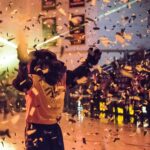
When the NCAA canceled the 2020 spring and fall championship seasons due to the pandemic, UMBC Athletic Director Brian Barrio created a new game plan for Athletics communication staff: create UMBC’s first-ever Letterwinners Club. Similar to other universities’ clubs, the Retriever Letterwinners Club looks to welcome alumni home to UMBC by creating a network to connect them with current student-athletes and UMBC Athletics.
“I think it’s going to be a unique opportunity for student-athlete alumni from all walks of life, every sport that UMBC Athletics has ever sponsored, to really be able to connect and come together as one family,” says Assistant Director for Annual Giving Seth Nagle.
Athletic communications staff also used the launch as an opportunity to update data on athletes throughout the years. Led by Communications Director Steve Levy ’85, interdisciplinary studies, the staff dug through every athletic team’s roster since the start of UMBC Athletics in 1966 to create a full list of club members. Levy’s 30-plus years at UMBC has made him an indispensable resource. This longterm knowledge of Retriever Athletics is particularly helpful for team rosters prior to 1995—these lists are not available online and their accuracy is reliant on whoever put the media guide together for the team that year.
 UMBC’s Down and Dirty Dawg pep band plays in 2017. Photo by Marlayna Demond ’11.
Going through UMBC Athletics’ archives helped ensure that all former student-athletes were automatically inducted into the Letterwinners Club. Current student-athletes will become members at the end of their final year playing for UMBC. The club also includes alumni members of spirit teams like the Down and Dirty Dawg Band and Dance Team.
Nagle explained that the club is UMBC Athletics’ way to thank alumni for their contributions to its various sponsored programs over the years.
“Letterwinners clubs are fairly common around the nation, and it was definitely something we wanted to implement at UMBC just to really show our gratitude for all the dedication, time, blood, sweat, and tears that you put in as a student-athlete during their time here,” says Nagle.
No matter how long ago an alum played for or cheered on UMBC Athletics, Barrio wants them to know that they are part of the Retriever family.
If you played here 35 years ago, then you are part of the family today. Period.
— Brian Barrio, Athletics Director
“And we want to get through to our current student-athletes as well that, you know, you’ve chosen to be a part of the Retriever family and, because of that commitment you made, we’re going to give it back to you for the rest of your life.”
Barrio emphasized that alumni are “Retrievers for life.” In the release of the Letterwinners Club at the virtual Retriever Athletics Fall 2020 State of the Department meeting, Barrio reinforced that UMBC is home no matter whether you played only for a season, you were last on the roster, or an All-American.
“It’s so important from a culture standpoint that all our former student-athletes understand that they’re always welcome here, and they can always come back,” says Barrio. “And they don’t have to explain who they are, and it doesn’t have to be through their old coach.”
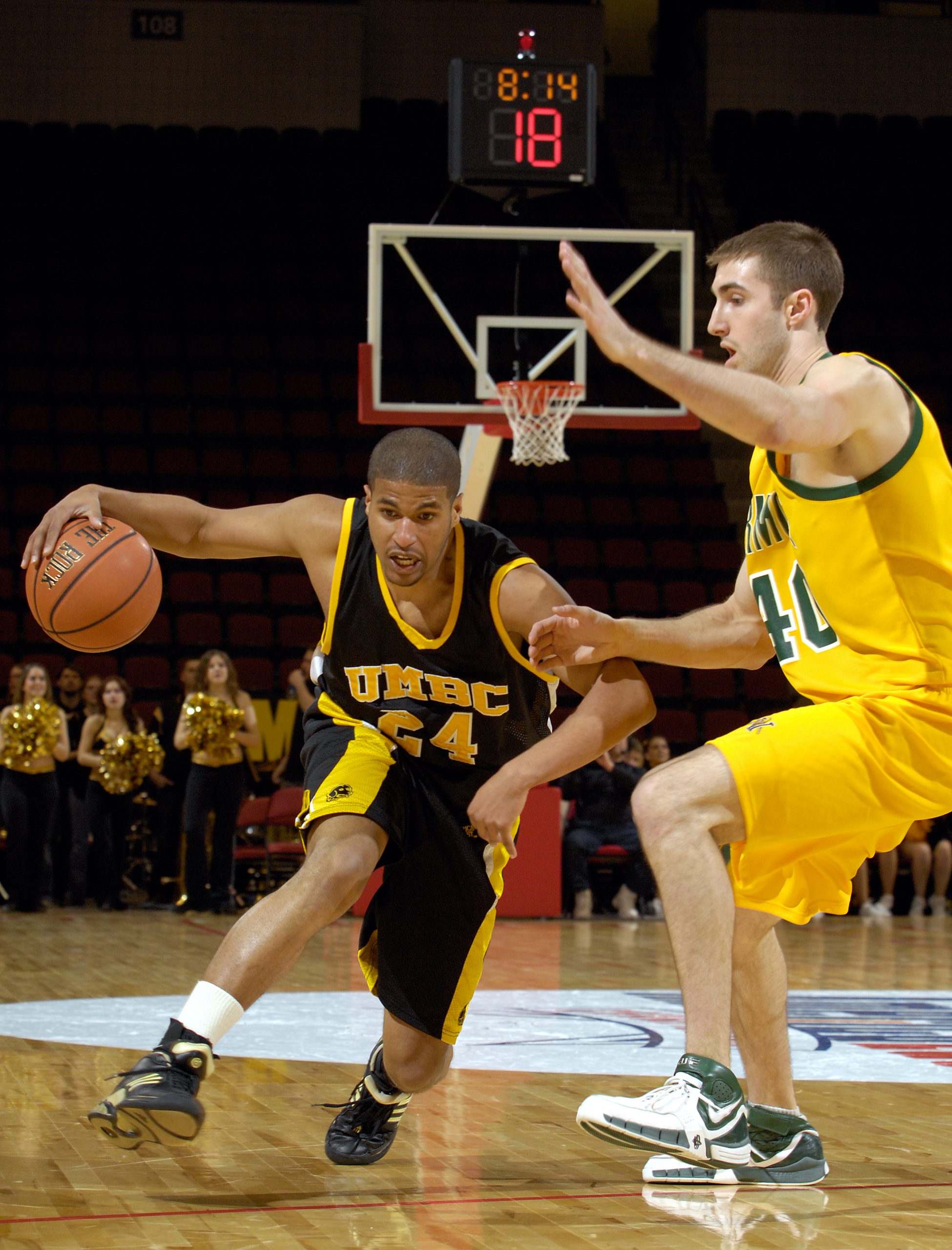
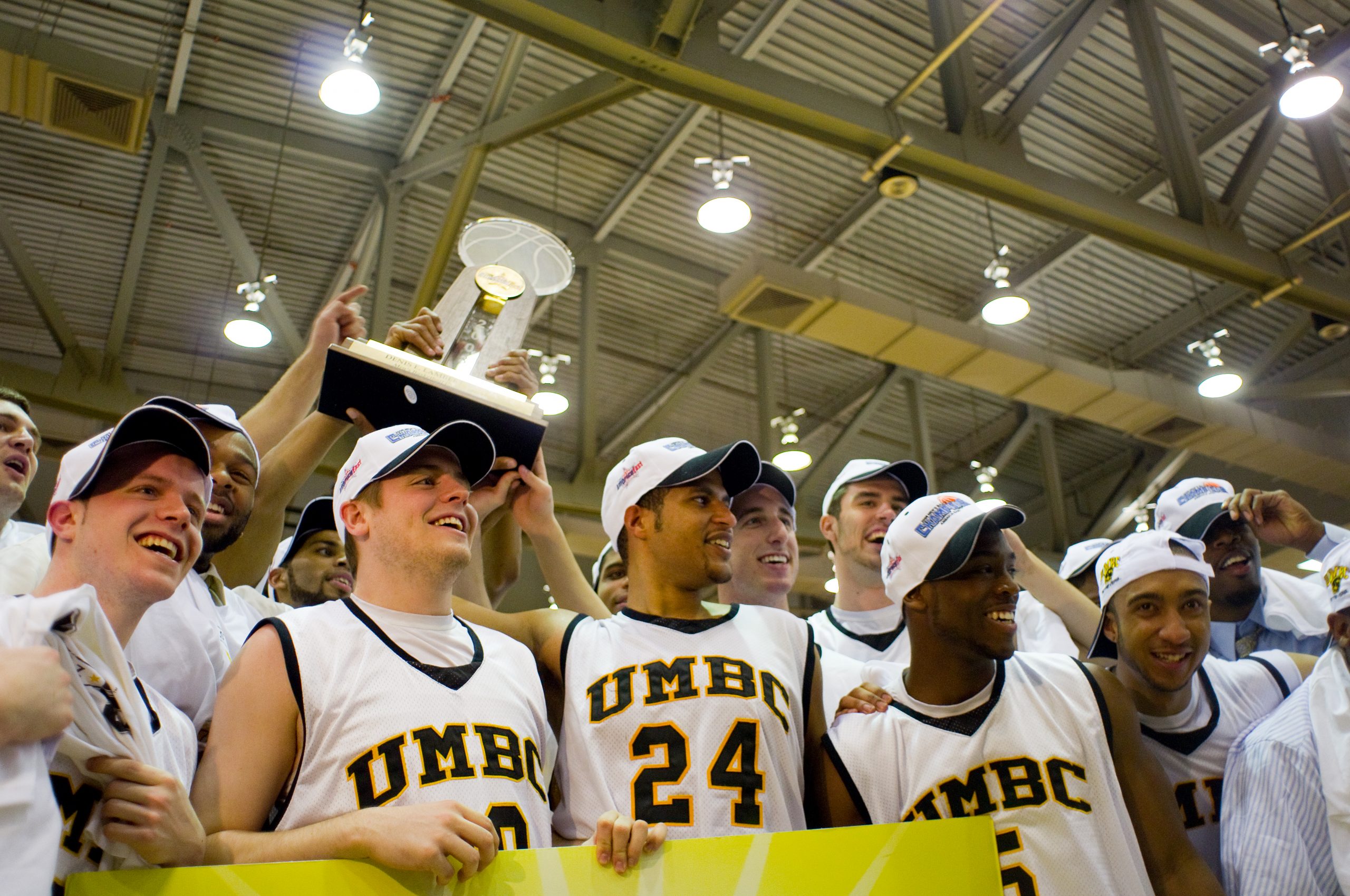
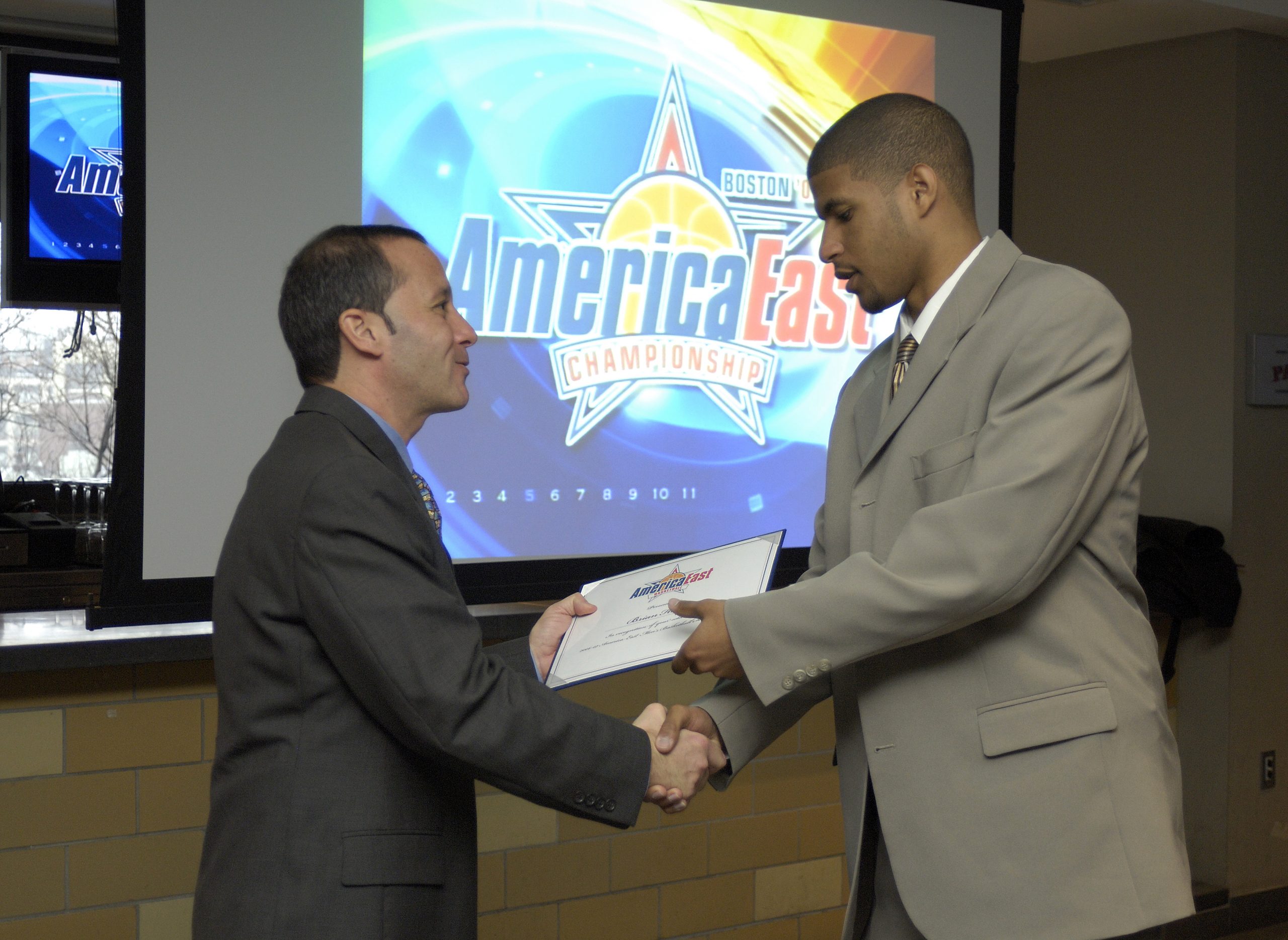
Brian Hodges ’07, financial economics and American studies, M.A. ’10, economic policy analysis,and UMBC men’s basketball alum, says he has always bled black and gold. Throughout his time as a student-athlete at UMBC, Hodges made many connections to the University and the UMBC community. He continued to maintain these connections through a period of membership on UMBC’s Alumni Board of Directors and as an avid fan of the men’s basketball team—even driving to Charlotte, North Carolina, to watch their historic NCAA upset.
Brian Hodges (#24) competed for the 2008 UMBC men’s basketball team which won the America East Conference Championship, beating the University of Hartford and sending them to the first round of the NCAA Championships. Photos courtesy of UMBC Athletics.
“I am very much a strong advocate of UMBC and am very proud of my degrees,” says Hodges.
The announcement of UMBC’s Letterwinners Club gave Hodges a means to further connect with the UMBC community. Specifically, the club connected him with his former teammates as well as all the men’s basketball players that came after him.
“I was elated when I first read about the Letterwinners Club and started thinking about all of the possibilities that could result from its creation,” says Hodges. “It will definitely assist in connecting me with the University in a different way.”
While Athletics is doing due diligence to reach out to alumni, they can also register themselves through Athletics’ website. Barrio emphasized the importance of having as many alumni as possible register to be members.
“Behind each one of those names is a great story, it’s somebody’s life story,” says Barrio. “And so, the way I look at it, we’ve got hundreds of life stories out there waiting to be discovered.”
Learn more about the Letterwinners Club.
*****
Header image: True Grit pumps up the crowd at the 2018 UMBC men’s basketball celebration. Photo by Marlayna Demond ’11.
]]>
When the NCAA canceled the 2020 spring and fall championship seasons due to the pandemic, UMBC Athletic Director Brian Barrio created a new game plan for Athletics communication staff: create...
https://umbc.edu/stories/welcoming-retrievers-back-home/
https://beta.my.umbc.edu/api/v0/pixel/news/119745/guest@my.umbc.edu/ed56625301a3a7fe4b38e6083abb893e/api/pixel
alumni
fall-2020
news
umbc-athletics
umbc-retrievers
UMBC News & Magazine
https://beta.my.umbc.edu/groups/umbc-news-magazine
https://assets1-beta.my.umbc.edu/system/shared/avatars/groups/000/001/943/24435aa6207c452e7bc15cc74b42c7bb/xsmall.png?1748556657
https://assets1-beta.my.umbc.edu/system/shared/avatars/groups/000/001/943/24435aa6207c452e7bc15cc74b42c7bb/original.png?1748556657
https://assets2-beta.my.umbc.edu/system/shared/avatars/groups/000/001/943/24435aa6207c452e7bc15cc74b42c7bb/xxlarge.png?1748556657
https://assets2-beta.my.umbc.edu/system/shared/avatars/groups/000/001/943/24435aa6207c452e7bc15cc74b42c7bb/xlarge.png?1748556657
https://assets3-beta.my.umbc.edu/system/shared/avatars/groups/000/001/943/24435aa6207c452e7bc15cc74b42c7bb/large.png?1748556657
https://assets1-beta.my.umbc.edu/system/shared/avatars/groups/000/001/943/24435aa6207c452e7bc15cc74b42c7bb/medium.png?1748556657
https://assets2-beta.my.umbc.edu/system/shared/avatars/groups/000/001/943/24435aa6207c452e7bc15cc74b42c7bb/small.png?1748556657
https://assets1-beta.my.umbc.edu/system/shared/avatars/groups/000/001/943/24435aa6207c452e7bc15cc74b42c7bb/xsmall.png?1748556657
https://assets2-beta.my.umbc.edu/system/shared/avatars/groups/000/001/943/24435aa6207c452e7bc15cc74b42c7bb/xxsmall.png?1748556657
UMBC News & Magazine
0
0
false
Fri, 20 Nov 2020 16:40:20 -0500
No Artist Stands Alone
Lockdown, quarantine, shelter in place—a new vocabulary defines this period of our lives that requires us to maintain space to protect one another. Alone, we spend our time consuming or creating art and media, but many are also having to reinvent how we share that pleasure with others.
We see comedians attempting to navigate satire from living rooms; movie releases being delayed in hopeful anticipation of a less restrictive future; and book tours being curtailed for long awaited novels. For other artists, this public pause has engendered a more private creativity—a book of poems examining anti-Asian racism, lush and gentle photographs of essential medical personnel in their personal protective equipment, a step back from the stage to perform a play over Zoom.
In facing a pandemic that’s disrupted the normal rhythms of open mics and art exhibits, these Retrievers have continued their craft, carving out unique ways to then share their creations.
Can we shape and share art in community even during a global pandemic? The answer is continually a resounding yes.
An exhibit in unusual circumstances
 Headshot provided by Hannah Basher.
As Hannah Bashar ’20, art history and biology, worked to curate pieces for campus-adjacent coffee shop OCA Mocha’s Art During the Time of COVID-19 exhibit, she found herself inspired by the unique ways the contributing artists had drawn from the isolation and monotony of recent months to create impactful art.
“Some artists find inspiration in their new and changed landscapes and environments,” says Bashar, OCA Mocha’s former arts intern. She cites pieces by photographer Julie Miller, which depict the strikingly empty urban areas that the artist passed in her walks through Silver Spring.
Other works featured in the exhibit were influenced by changes in routine; during the pandemic, Miller picked up the practice of joomchi, a centuries-old Korean art medium that involves layering paper in order to create unique shapes and textures. Miller’s artist statement describes the process of joomchi as meditative and “perfect for a day of isolation.”
Bashar wasn’t necessarily seeking art that made deep philosophical arguments about the pandemic. Instead, she wanted to display works that she thought viewers could relate to. “OCA Mocha stands for the community and it’s a strong force within the Arbutus community, so I want people to walk in and feel as though they can relate to what is on the walls,” she explains.
 Artist Julie Miller picked up the practice of joomchi, a centuries-old Korean art medium that
 i
nvolves layering paper in order to create unique shapes and textures. Photo courtesy of OCA Mocha.
This means the exhibit ranges from powerful celebrations of Black women’s resiliency in textured acrylic paintings by Kathleen McPartland to playful textiles, like a diploma box filled with a yarn rug made to look like a pizza by April Berardi ’16, modern languages and linguistics.
Bashar, who plans to pursue a career not in curation but emergency medicine, says that the unusual circumstances of this show made it an especially meaningful one to end her two-semester-long internship. “My own experience curating this show paralleled the theme of the exhibition, which is about how COVID has caused us to adapt and change with the times,” she says. “I felt like my experience curating the show was, in fact, part of the show itself.”
— Johanna Alonso ’20
Comic relief
Umar Khan knew he had a chance with the crowd when he kicked off his stand-up comedy career a decade ago as a student—most of the faces in the audience were his friends and fellow Retrievers, gathered around the Sports Center stage on the second floor of The Commons. “I think there were like eight people there, and I remember walking away thinking it went well, although I’m sure if I watched it now…” Khan trails off.
“All comics will tell you this, but we have to be some of the most delusional people in the world,” laughs Khan ’10, psychology. “What person in their right mind thinks they can captivate an audience of strangers for a set amount of time and on top of that make them audibly laugh?”
-
 Khan performing at a backyard comedy show in August 2020. Photos courtesy of Khan.

Armed with a notebook full of jokes he cringes at now, Khan performed at UMBC a few more times during his senior year. He kept going after that, making inroads into the DC comedy scene, maturing his content and honing his stage presence, filming his own special, performing shows almost every night while pursuing his day job as an elementary/middle school psychologist in Baltimore City. Fast forward 10 years, and COVID-19 hit comedy like so many other arts and industries.
“Now with COVID, everyone is having to take steps back,” says Khan. “If you used to sell out theaters, well, when is anyone going to pack a theater again? So now you’re going into comedy clubs. And the people headlining comedy clubs are getting pushed down to the next level. And it just keeps going.”
“I’m so thankful I have a career—my immigrant parents were right,” Khan laughs, “dreams are stupid. You gotta get a government job with benefits and a pension.”
In August, Khan was able to return to the stage, in a backyard show following pandemic protocols. “People are so hungry for entertainment and there’s so much going on in the world right now, says Khan. “We were pushing the line and people were loving it. It was so fun.”
“You can tell people just want to feel some sense of community and a comedy show offers you that community because you’re all laughing at the same thing. And you can leave and talk about the show—sharing the experience. It will be one of those shows we’ll look back on and be like, ‘oh remember when we had to do that during COVID?’”
— Randianne Leyshon ’09
Chocopies for world peace
In an era where simply eating inside a restaurant is considered risky behavior, there was no way an art installation that invites thousands of guests to share in consuming a huge pile of South Korean snack cakes could go on as planned.
Thus, Mina Cheon’s Eat Chocopie Together project, which was shown physically at the Busan Biennale 2018 in South Korea and had been slated to open at the Lincoln Center in June 2020, had to be postponed. But Cheon, M.F.A. ’02, imaging and digital arts, and her collaborators knew that, as the pandemic raged on around the world, the installation’s themes of love, peace, and unity were more relevant than ever.
 Cheon shows a map of North and South Korea, where people in both countries participated in the art project. Photo courtesy of Cheon.
To safely bring the project into the age of COVID-19, Cheon created a website, EatChocopieTogether.com, that allows friends to email one another digital versions of the marshmallow-filled treat. The chocopies are represented by graphics modeled after real chocopie wrappers but newly designed by the artist and emblazoned with one of five words: love, peace, share, eat, or unite. The recipient can “eat” the snack by clicking the graphic, and each chocopie sent and received contributes $2 to the Korean American Community Foundation COVID-19 Action Fund.
“It’s an extended version of the original. It’s taking all the inspiration, the sentiment, the spirit of Eat Chocopie Together, but going virtual allowed us to explore the different packaging with the multiple themes” and to fundraise, Cheon says. As of September, the project reached its $5,000 goal.
The original meaning of the installation lies in the history of the chocopie; the confection is incredibly popular in both South Korea and North Korea, despite being banned in the latter country. Sharing chocopies is “meant to bring awareness of the two Koreas working towards peace and unification,” according to a press release published by Asia Society Triennal.
 Cheon stands in front of 100,000 chocopies at a 2018 exhibit in South Korea. Photo courtesy of Cheon.
The virtual version of the project emphasizes an even more global message, according to Cheon. “We are socially distanced and separated, but we can still connect,” she says. “That was such a big, empowering idea, that we could still heal through our virtual connection.”
— Johanna Alonso ’20
Art by appointment
Bonnie Crawford describes looking at art like a religious experience. So when COVID-19 interrupted her life, she realized that what she missed most was experiencing art with her friends. Over the course of a month, Crawford, M.F.A. ’08, imaging and digital arts, invited people by appointment to view her work of dental floss weavings in the shed in her backyard.
“There’s a unique mindset when someone is looking at art,” says Crawford, who didn’t want people to lose out on that opportunity during the various stages of lockdown.
 Bonnie Crawford’s dental floss weavings ranged in size from a quilt to a pocket
square. She displayed the art in her emptied out shed. Photo courtesy of Crawford.
Crawford was worried at the beginning of the pandemic that she would possibly never make art again; she was finding it meaningless. Her weavings had usually been a way for her to channel creative energy, so she reinvisioned how to share her work with others which gave her renewed purpose.
Crawford’s dental floss weavings grew from the work she does on her Instagram feed, @brushhouse, where she shares pictures of her family brushing their teeth, sometimes including a guest appearance from a friend. The weavings extended from her desire to do more formal work. They range from small enough to fit in a wallet to a tall floss weaving that hangs like a tapestry.
“I would go to my studio until I had to use the bathroom,” Crawford laughs. This meant driving across the city to go at home, wanting to err on the side of caution in the face of a novel virus. In this way, Crawford slowly made progress on her largest dental floss weaving. When she was finished, she asked her sons and boyfriend to clear out their things from the shed and then got to installing.
The exhibition was up for about a month, available for viewing on Thursdays, Fridays, and Saturdays. Using an app to schedule appointment slots, in total 90 people came to see her work. “I hoped that it fulfilled that spiritual need for others like it did for me,” she says.
— Imani Spence ’16
All the world’s a digital stage
Like most things that cannot be held in person due to the coronavirus pandemic, theater has found its virtual home on Zoom.
These digital performances can be quite similar to the existing practice of staged readings, in which actors deliver their lines with little to no sets or costumes, often while sitting. But to tell some uniquely 2020 stories, some actors, playwrights, and directors have taken this medium to a new level.
Among them is Jurdan “JC” Payne ’21, theatre, who has spent the past few months performing in virtual plays featuring casts located throughout the country. Most recently, in a ten-minute play called High, Low, Uh-Oh, Payne is one of two characters on a video chat. He calls to wish a friend happy birthday, unable to celebrate in person due to COVID-19.
 Payne looks forward to the return to a real stage, but is making most of the virtual options during the pandemic. Photo courtesy of Payne.
It was the first time Payne had ever used his own house as a set and his own possessions—ketchup mixed with water to simulate blood and a sock puppet through which he sang “Happy birthday,” for example—as props. Most of the props weren’t listed in the script; instead, Payne used whatever he had laying around the house to supplement the existing material.
(And yes, that does mean he already owned a sock puppet with googly eyes).
“It was kind of new territory for me,” he says. “It’s different from being on stage, but also really different from filming a short film or a commercial.”
 Pre-pandemic stage photo courtesy of Payne.
Another element of working in theater that has changed in recent months are auditions, says Payne. Whereas actors were once expected to dedicate 8- to 10-hour-long days to auditioning, the pandemic has solidified the fact that virtual auditions can be just as effective and informative as in-person ones, signaling a welcome shift from the traditional long audition days.
“I hope that eventually theaters will adopt that practice moving forward,” Payne says. Still, he notes that a self-tape, as they’re called in the industry, can be challenging because it requires the auditioner to act as lightning designer, cinematographer, and director, all while trying to perform.
“It’s like learning a new language,” he says.
— Johanna Alonso ’20
Community of poets
Calista Ogburn ’21, health administration and policy, began writing poetry as a way to orient herself in a new environment. As a high school sophomore in Seoul, South Korea—after moving from Vietnam—Ogburn was looking for community so she joined a public speaking club that introduced her to speech tournaments and poetry readings.
At UMBC, Ogburn has continued to use poetry as a means of making a home for herself. She credits Lia Purpura, writer in residence at UMBC, with helping her reimagine her poetry and her process as a writer. Ogburn, who is the communications director for the Student Government Association, also connected with other students in the Retriever Poets, a student group that encourages poetry through open mics and workshops. Ogburn’s first book of poetry, a splash of yellow, edited by fellow Retriever Morgan Mullings, media and communications studies, was published just for Ogburn and her friends; a project to prove to herself what she could accomplish.
 Ogburn poses with her books of poetry. Photo from calista-ogburn.com.
Ogburn’s second book of poetry was for a broader audience. Written in the beginning stages of COVID-19, this is it addresses racism towards Asian Americans, on personal and institutional levels as misunderstandings about the virus have influenced people. As a senior health administration and policy major watching a public health and political crisis, she felt called to action.
“My hope,” Ogburn shares, “is that these poems can touch those who are feeling loss, loneliness, or the combined grief and rage of experiencing racism.”
 Promotional book photo courtesy of Ogburn.
this is it was a group effort, says Ogburn, praising Mullings, who also edited this volume. Support from other Retriever Poets helped push Ogburn to truly confront the emotions that she was feeling, and gave confidence to her voice. Since her time in South Korea,Ogburn realizes that she’s “always had a community of poets.”
— Imani Spence ’16
Meant to be connected
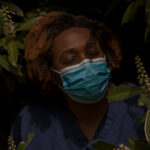
To counter her anxiety in the time of COVID, Jill Fannon, M.F.A. ’11, imaging and digital arts, decided to photograph people who are responding to the pandemic directly—healthcare workers. Her collection, Care in the Garden, features these essential workers in quiet intimate moments outside of the hospital.
“We’re meant to be connected and we affect each other, deeply,” says Fannon, who doesn’t see this project about the art of photography as much as about capturing a moment. She has found herself asking “What will we want to know about COVID-19 50 years from now?”
When Fannon began her project in April 2020, many people didn’t expect that the country would still be facing a pandemic half a year later. Her work, Fannon says, has kept her from experiencing what many people are calling “quarantine fatigue.”
It’s been a special experience, Fannon shares, for her to meet these medical professionals in these intimate moments. While most people are working from home, healthcare workers are forced to do everything possible to keep their work from coming home with them, mentally and physically. For these healthcare workers, concerned about transmission to their families, this has transformed their spaces drastically. One of the subjects of the photo series described to Fannon how she would take all her clothes off outside her home, throw them in the laundry, and shower before touching her family.
Photography has always been a way Fannon expresses herself and finds joy, but in this moment, she wanted to use them for the greater good—showing the humanity of essential personnel even hidden behind their PPE. The contrast between their face shields, scrubs, and the lush scenery tells a powerful story about how people are finding stillness and peace during a health crisis.
— Imani Spence ’16
*****
Header image by Jill Fannon, M.F.A. ’11.
]]>
Lockdown, quarantine, shelter in place—a new vocabulary defines this period of our lives that requires us to maintain space to protect one another. Alone, we spend our time consuming or creating...
https://umbc.edu/stories/no-artist-stands-alone/
https://beta.my.umbc.edu/api/v0/pixel/news/119746/guest@my.umbc.edu/a58772c9b81c11ba276a05470da97423/api/pixel
fall-2020
feature
imda
impact
oca-mocha
photo-essay
UMBC News & Magazine
https://beta.my.umbc.edu/groups/umbc-news-magazine
https://assets1-beta.my.umbc.edu/system/shared/avatars/groups/000/001/943/24435aa6207c452e7bc15cc74b42c7bb/xsmall.png?1748556657
https://assets1-beta.my.umbc.edu/system/shared/avatars/groups/000/001/943/24435aa6207c452e7bc15cc74b42c7bb/original.png?1748556657
https://assets2-beta.my.umbc.edu/system/shared/avatars/groups/000/001/943/24435aa6207c452e7bc15cc74b42c7bb/xxlarge.png?1748556657
https://assets2-beta.my.umbc.edu/system/shared/avatars/groups/000/001/943/24435aa6207c452e7bc15cc74b42c7bb/xlarge.png?1748556657
https://assets3-beta.my.umbc.edu/system/shared/avatars/groups/000/001/943/24435aa6207c452e7bc15cc74b42c7bb/large.png?1748556657
https://assets1-beta.my.umbc.edu/system/shared/avatars/groups/000/001/943/24435aa6207c452e7bc15cc74b42c7bb/medium.png?1748556657
https://assets2-beta.my.umbc.edu/system/shared/avatars/groups/000/001/943/24435aa6207c452e7bc15cc74b42c7bb/small.png?1748556657
https://assets1-beta.my.umbc.edu/system/shared/avatars/groups/000/001/943/24435aa6207c452e7bc15cc74b42c7bb/xsmall.png?1748556657
https://assets2-beta.my.umbc.edu/system/shared/avatars/groups/000/001/943/24435aa6207c452e7bc15cc74b42c7bb/xxsmall.png?1748556657
UMBC News & Magazine
0
0
false
Fri, 20 Nov 2020 16:24:12 -0500
Students reflect on UMBC’s top-ten finish in national democracy challenge and post-election community conversations
UMBC has placed ninth nationwide in the 2020 ALL IN Campus Democracy Challenge voting pledge competition. More than 600 colleges and universities participate in the ALL IN Campus Democracy Challenge, which encourages college students to pledge to vote based on evidence that when people make public pledges, they are more likely to follow through.
“These rankings speak to what people already know: UMBC is a national model for community engagement,” says President Freeman A. Hrabowski. “We’re proud of the work being done through our Center for Democracy and Civic Life, and we are grateful to all of our community members who took the pledge to vote in the 2020 election.”
Cast Your Whole Vote campaign
Launched in November 2018, UMBC’s Center for Democracy and Civic Life (CDCL) helps students develop the knowledge, skills, and approaches for deep and effective civic engagement and community work. The Center is led by Director David Hoffman, Ph.D. ’13, language, literacy, and culture (LLC), and Assistant Director Romy Hübler ‘09, modern languages and linguistics, M.A. ‘11, intercultural communication, Ph.D. ‘15, LLC.
 Romy Hübler and David Hoffman in 2019. Photo by Alexis Harris ’19 media and communication studies and visual arts.
During the fall 2020 semester, Hoffman, Hübler, and the Center’s interns, along with University partners, organized a campus-wide Cast Your Whole Vote campaign, featuring voting and election events and resources. The events drew nearly 800 members of the UMBC community. As part of that programming, UMBC students, faculty, and staff members trained as facilitators to organize more than 20 additional post-election community discussions. Under the theme Together Beyond November, these conversations helped participants renew their connections and support each other in this challenging time.
“It’s important to vote, but also to recognize voting as just one way to make a difference in our communities and nation,” share Hoffman and Hübler. “UMBC’s Cast Your Whole Vote campaign encouraged members of the UMBC community to learn about issues, engage in civil conversations, and contribute their time and talent to building a better world on Election Day and every day. We are grateful to the many departments, student organizations, and campus leaders who worked with us.”
Charis Lawson ’21, English, CDCL political engagement intern, shares her motivation for voting in 2020.
The UMBC community will learn how many students actually voted in the 2020 national election in a 2021 report by the National Survey of Learning, Voting, and Engagement.
Interview with student leaders
To learn more about student experiences in UMBC’s Cast Your Whole Vote campaign and election programming, UMBC News spoke with three student leaders: Tirzah Khan ‘21, information systems, is the connection corps intern with the Center for Democracy and Civic Life; Logan Lineburg ‘22, M30, biochemistry and molecular biology, is director of the Department of Executive Initiatives for the Student Government Association; and Meghan Lynch ‘18, political science, and M.P.P. ‘21, is the chair of legislative concerns for the Graduate Student Association.
UMBC News: Why is the ALL-IN pledge so important?
Khan: It’s important to be intentional about voting and hold each other accountable for participating in the voting process, especially on college campuses, where ideas about civic engagement are integral to the personal and professional development that students leave with. The knowledge that there is power in community is something that UMBC students learn pretty quickly because of the unique environment here, and I think it’s necessary to extend that knowledge to voting and social change.
 Tirzah Khan in the UMBC Commons. Photo courtesy of Khan.
Lineburg: The ALL-IN pledge to me means that my involvement doesn’t end once I’ve cast my ballot. There are many important ways that one can engage with their community and politics, whether it is protesting, writing letters to legislators, or even simply having conversations with family and friends about the way we feel our nation is evolving, all of which are important for progress and growth.
Lynch: The ALL-IN pledge is a powerful reminder of how important it is to be an engaged and informed voter. The pledge reminds all of us of the importance of making a plan to vote. For Maryland residents, there were quite a few ways to cast your ballot this election, so this tool prompted voters to think about what would work best for them.
UMBC News: What does UMBC’s top 10 ALL IN ranking say to you about our community?
Khan: It says a lot to me about our campus’ values and needs—that our campus community is more important to us than ever, that we are dedicated to impacting the world outside our bubble, that we aim to ensure our voices are heard. I was still in high school during the last presidential election season so I’m not sure what that was like at UMBC, but the weeks leading up to this election illustrated just how much our community is willing to do for one another.
Lineburg: Knowing that our university has placed within the top two percent of colleges and universities really speaks to our campus’s commitment to excellence. We are passionate, educated, and empowered, and together, we all push for what is right.
Lynch: UMBC also shows up and gives that grit and greatness! I believe we have a thoughtful, intentional, and dedicated community who leads through action. In many spaces at UMBC, we talk about equity and justice, so it was reassuring to know that we put those principles into action such as through voting.
Tess McRae ’21, individualized studies, shared her first voting experience and how that impacted her perspective on civic engagement.
UMBC News: Why was participating in the Cast Your Whole Vote campaign or election-related events important to you?
Khan: One of the central ideas in the Cast Your Whole Vote campaign is that, while voting is incredibly valuable, there are so many other ways to affect social change besides voting. As someone who is not eligible to vote, that messaging felt really relevant to my experiences and passions.
I often feel excluded from election-related events and conversations because of my ineligibility. This is terrible because non-citizens, incarcerated people, and formerly incarcerated people are some of the most vulnerable members of our communities, especially during election years.
In turn, it felt amazing to be seen and included in this campus-wide campaign. The realization that my voice matters, my actions matter, and my story matters—especially during an election year—is what drove me to get involved in planning Election Night Extravaganza, and to participate in the Together Beyond November: (Re)building Community after Election 2020 facilitator training.
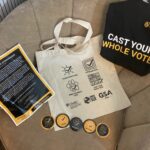
 Cast Your Whole Vote campaign gear. Photo courtesy of the CDCL.
Lineburg: Being a part of the planning committee and speaking with other student leaders from different organizations and scholars programs was fantastic. Knowing that despite our vastly different backgrounds and future goals we are all able to unite to educate and inform our campus community about voting is thrilling.
As a third-year student, I can attest that UMBC’s efforts to educate and empower its students is supreme. At UMBC, every person has the capacity to make great change, and with incredibly supportive faculty, staff, and fellow students, I feel it would be nearly impossible to find a goal or dream that is unachievable here.
UMBC News: What were your favorite moments from the campaign and why?
Lynch: As someone who studies politics and policy, being involved with a community that encourages political participation is paramount. In these virtual times, I’ve been finding myself seeking out spaces to connect with others. The campaign has had a lot of wonderful events, like the Change Makers Dinners and debate watch parties that made these stressful, isolating times more manageable.
On Election Night in particular, we began our evening on Discord (a group-chatting platform) and then moved over to WebEx to hear from President Hrabowski and Vice President for Student Affairs Nancy Young. I could feel the energy and excitement from seeing everyone’s faces in the WebEx room. It was important to me to participate because we had to be creative about being in community, and the experience on WebEx on Election Night hopefully made the night more enjoyable for many.
UMBC News: How was the student response to the events?
Khan: This Election Day was more of an Election Week, I think students appreciated having non-judgmental, non-partisan spaces to process their feelings. Also, the idea that civic life and civic engagement extends far beyond voting and elections was something that I believe resonated with a lot of people and allowed them to feel comfortable in expressing their fears about the election.
Lynch: I could tell that students wanted to find spaces to talk and share their thoughts on the election. They were actively engaging with each other and seemed to be enjoying it. We had stressful and overwhelming moments to work through, but the students had such grace in taking time to understand and work through it all.
Meghan Lynch shares why she finds voting meaningful and other ways to be engaged.
UMBC News: What was it like to try to engage students virtually instead of in-person?
Khan: It was both more difficult and more rewarding than normal for me. Students have never been more in need of connection and community, but they’ve also never been more difficult to reach. There are so many layers of exhaustion and trauma that our community is facing right now, and it’s really hard to get through to people. Nobody wants to be in meetings and on camera more than they absolutely have to.
At the same time, though, we are all so incredibly lonely and scared right now. So despite how difficult it got as the election neared, I knew it was important to keep pushing and keep hosting spaces for students to build community around our shared election fears.
There’s something that the Center for Democracy and Civic Life says—“physical distance, civic proximity.” I’ve thought about this idea a lot since March, and it’s sort of become central to my work right now. We’ve never been further away from one another as a community, but the need for us to be closer has never been more important. I find that when we’re able to come together and help each other through sharing our fears and experiences and stories, we’re able to have an impact that is far beyond anything I experienced pre-pandemic.
Lineburg: Although engaging in the virtual world is challenging for many reasons, I believe that still having a space to connect with others is essential. The limitations of online engagement are not pleasurable, but from what I’ve heard from those I’ve spoken with, continuing to allow for interactions and conversations, especially during such stressful times, is and was greatly appreciated.
 Logan Lineburg puts together Cast Your Whole Vote giveaway bags. Photo courtesy CDCL.
UMBC News: What was your experience as a facilitator for a post-election conversation group?
Lynch: I led a post-election conversation with graduate students which was incredibly fulfilling. Some of the general trends were being intentional about healing and renewing relationships, longing for being in physical space with others, the necessity of having “uncomfortable” conversations, and this being the only opportunity they’ve had to process the election results with their peers. Needless to say, the consensus afterwards was that we wanted more events.
 Meghan Lynch at UMBC in 2018. Photo by Marlayna Demond ’11 for UMBC.
Khan: I’m pretty new to facilitation—especially in such stressful circumstances—so I was incredibly anxious going into both of the conversations that I facilitated. Through the Center for Democracy and Civic Life, I led one group of UMBC faculty and staff…and I led one group with some of my incredible peers at the Student Events Board. Both conversations were incredibly impactful and surprising, but in entirely different ways.
I was floored by the depth of thought that each participant brought. Some of the people were complete strangers to me, but almost immediately, they were willing to be so incredibly open, authentic and vulnerable about their election-related fears and hopes. It was a truly moving experience for me to be holding all of their emotions along with my own, and to know that I had given them my emotions to hold in return.
See the Center for Democracy and Civic Life on myUMBC for future events and additional reflections and resources.
Article written by Eleanor Lewis, communication specialist in the Division of Student Affairs.
Featured image: Cast Your Whole Vote gift bag. Photo courtesy of the CDCL.
]]>
UMBC has placed ninth nationwide in the 2020 ALL IN Campus Democracy Challenge voting pledge competition. More than 600 colleges and universities participate in the ALL IN Campus Democracy...
https://umbc.edu/stories/students-reflect-on-umbcs-top-ten-finish-in-national-democracy-challenge-and-post-election-community-conversations/
https://beta.my.umbc.edu/api/v0/pixel/news/119747/guest@my.umbc.edu/fdd866d9eddf96aaf2d94daadac7d6bd/api/pixel
campus
civic
community
page1
UMBC News & Magazine
https://beta.my.umbc.edu/groups/umbc-news-magazine
https://assets1-beta.my.umbc.edu/system/shared/avatars/groups/000/001/943/24435aa6207c452e7bc15cc74b42c7bb/xsmall.png?1748556657
https://assets1-beta.my.umbc.edu/system/shared/avatars/groups/000/001/943/24435aa6207c452e7bc15cc74b42c7bb/original.png?1748556657
https://assets2-beta.my.umbc.edu/system/shared/avatars/groups/000/001/943/24435aa6207c452e7bc15cc74b42c7bb/xxlarge.png?1748556657
https://assets2-beta.my.umbc.edu/system/shared/avatars/groups/000/001/943/24435aa6207c452e7bc15cc74b42c7bb/xlarge.png?1748556657
https://assets3-beta.my.umbc.edu/system/shared/avatars/groups/000/001/943/24435aa6207c452e7bc15cc74b42c7bb/large.png?1748556657
https://assets1-beta.my.umbc.edu/system/shared/avatars/groups/000/001/943/24435aa6207c452e7bc15cc74b42c7bb/medium.png?1748556657
https://assets2-beta.my.umbc.edu/system/shared/avatars/groups/000/001/943/24435aa6207c452e7bc15cc74b42c7bb/small.png?1748556657
https://assets1-beta.my.umbc.edu/system/shared/avatars/groups/000/001/943/24435aa6207c452e7bc15cc74b42c7bb/xsmall.png?1748556657
https://assets2-beta.my.umbc.edu/system/shared/avatars/groups/000/001/943/24435aa6207c452e7bc15cc74b42c7bb/xxsmall.png?1748556657
UMBC News & Magazine
0
0
false
Thu, 19 Nov 2020 21:15:35 -0500
US colleges report a 43% decline in new international student enrollment, and not just because of the pandemic
By David L. Di Maria, associate vice provost for international education UMBC
For the fourth year in a row, the number of international students enrolled at U.S. colleges and universities has declined. This is according to data released this month by the State Department and the Institute of International Education.
The fact that the decline largely took place during Donald Trump’s presidency is no mere coincidence. The Trump administration has tightened restrictions on who can study here and has also sent signals that students from abroad are not welcome.
As the Trump administration comes to an end, the new international enrollment data serve as sort of a failing grade for an administration that claimed international education would be a top priority. The Trump administration also made commitments to increase the number of international students in the U.S. and boasted of having spent more on recruiting international students than any other administration in history.
Important as it is to have global perspectives at American colleges and universities, the steady decline in international enrollment is about more than that. As a specialist in international education, I know that the continued decrease in students from abroad will negatively affect U.S. students and the American economy.
Still over 1 million
There are currently just over one 1 million international students studying in the U.S. This has been the case since 2015. This current figure includes 851,957 students enrolled at higher education institutions and 223,539 people engaged in Optional Practical Training, a program that allows recent international graduates to remain in the U.S. temporarily to obtain work or volunteer experience related to their major, according to data I analyzed from the Institute of International Education.
The Optional Practical Training is important to consider when you examine trends in international enrollment in the era of Trump. The reason is that the true impact of the Trump administration on international enrollment is masked by Obama-era policies that permitted more international students to remain in the U.S. for longer periods through the Optional Practical Training program.
As these people complete their training programs, the total number of international students will likely once again dip below the 1 million mark.
Where they are from
While the students came from more than 220 countries and territories, China and India accounted for 53% of the total, the data show.
About one-third of international students – 34.8% – enrolled in graduate-level coursework. The next-biggest group was those enrolled in bachelor’s degree programs – 33.1%. Associate degree and non-degree studies accounted for 5.9% and 5.4%, respectively, of international student enrollment in the U.S. The remaining 20.8% were participating in Optional Practical Training.
Just over half of all students from abroad – 52% – pursued majors in science, technology, engineering and mathematics, or STEM.
How they pay for school
At the undergraduate level, 83.9% of international students rely on personal and family income to pay for their education in the U.S.
Five percent rely on a foreign government or university, and 0.4% rely on a foreign private sponsor. In all, 89.3% are pumping money from abroad into the U.S. economy, while the remaining 10.7% rely primarily on funding from a U.S. source. At the graduate level, 60.7% of international students rely primarily on international funds, since 36.5% received funding from their college in the U.S. These graduate students usually get this funding in exchange for helping faculty with grant-funded research projects or helping teach undergraduate courses in their discipline. The remaining 2.8% received funding from other U.S. sources.
Most of the money spent by international students – 55% – is spent within the higher education sector. This in turn helps colleges support high-tech academic programs. It also helps keep tuition lower for students from the U.S.
But a drop in international students doesn’t hurt just colleges’ bottom lines – it harms local economies as well.
When you subtract all funding from U.S. sources, one analysis found, international students still contributed US$38.7 billion to the U.S. economy in 2019. These dollars supported 415,996 American jobs, based on an economic analysis.
Also, consider that 18% of every dollar spent by international students goes to apartment rentals and other forms of accommodation; 11% goes to restaurants, 9% to retail and the rest to other sectors of the economy.
No matter how you slice the data, the fact remains that international students make positive contributions to the U.S. economy. In fact, 1 in 4 $1 billion startup companies in the U.S. had a founder who first arrived on a student visa.
Looking forward
Many international students have reacted positively to the victory of President-elect Joseph Biden and Vice President-elect Kamala Harris.
Nevertheless, I believe it will take years to reverse the trend of declining international enrollment that intensified under Trump.
It is true that there was a decline during the last year of the Obama administration, but that was mostly due to the fact that the Brazilian and Saudi governments curtailed major study-abroad scholarship programs for their citizens. This resulted in a drop of 10,586 in Brazilian students and 8,670 fewer Saudi students between 2014 and 2016. The situation got worse as the U.S. came to be seen by international students as an unwelcoming nation under Trump.
After the pandemic
The Institute of International Education also partnered with nine other higher education associations to assess international student enrollment amid the COVID-19 crisis. The most alarming facts from the survey are a 43% drop in new international student enrollment and a 16% reduction in total international enrollment in the fall of 2020. The study also found that 1 in 5 international students are reportedly studying online from abroad, and roughly 40,000 international students have chosen to defer their enrollment to a future term.
All said, the findings reflect a lot of uncertainty for the future of U.S. colleges, which were already – before the COVID-19 pandemic began – anticipating that overall enrollment will drop by more than 15% after the year 2025 because of record-low birthrates in the U.S. that began in 2008 and continue to this day.
Some experts attribute this decline in the birthrate to the 2008 financial crisis. People may simply have delayed having children or had fewer children because of that era’s economic hardships. And 17 years later, in 2025, there are bound to be fewer students and more empty seats in college classrooms.
The economic impact of the COVID-19 pandemic is estimated to be three times worse than the 2008 financial crisis. Consequently, colleges could experience another major decrease in overall enrollment caused by similar demographic changes by 2037. Success in recruiting students from abroad will be key to offsetting these declines.
*****
David L. Di Maria, Associate Vice Provost for International Education, University of Maryland, Baltimore County
Header image: Two students walk on campus in Fall 2020. Photo by Marlayna Demond ’11.
This article is republished from The Conversation under a Creative Commons license. Read the original article.
]]>
By David L. Di Maria, associate vice provost for international education UMBC For the fourth year in a row, the number of international students enrolled at U.S. colleges and universities has...
https://umbc.edu/stories/us-colleges-report-a-43-decline-in-new-international-student-enrollment-and-not-just-because-of-the-pandemic/
https://beta.my.umbc.edu/api/v0/pixel/news/119748/guest@my.umbc.edu/bca1633155c37f1e81c78d5314b2f5bb/api/pixel
discovery
ies
international
the-conversation
UMBC News & Magazine
https://beta.my.umbc.edu/groups/umbc-news-magazine
https://assets1-beta.my.umbc.edu/system/shared/avatars/groups/000/001/943/24435aa6207c452e7bc15cc74b42c7bb/xsmall.png?1748556657
https://assets1-beta.my.umbc.edu/system/shared/avatars/groups/000/001/943/24435aa6207c452e7bc15cc74b42c7bb/original.png?1748556657
https://assets2-beta.my.umbc.edu/system/shared/avatars/groups/000/001/943/24435aa6207c452e7bc15cc74b42c7bb/xxlarge.png?1748556657
https://assets2-beta.my.umbc.edu/system/shared/avatars/groups/000/001/943/24435aa6207c452e7bc15cc74b42c7bb/xlarge.png?1748556657
https://assets3-beta.my.umbc.edu/system/shared/avatars/groups/000/001/943/24435aa6207c452e7bc15cc74b42c7bb/large.png?1748556657
https://assets1-beta.my.umbc.edu/system/shared/avatars/groups/000/001/943/24435aa6207c452e7bc15cc74b42c7bb/medium.png?1748556657
https://assets2-beta.my.umbc.edu/system/shared/avatars/groups/000/001/943/24435aa6207c452e7bc15cc74b42c7bb/small.png?1748556657
https://assets1-beta.my.umbc.edu/system/shared/avatars/groups/000/001/943/24435aa6207c452e7bc15cc74b42c7bb/xsmall.png?1748556657
https://assets2-beta.my.umbc.edu/system/shared/avatars/groups/000/001/943/24435aa6207c452e7bc15cc74b42c7bb/xxsmall.png?1748556657
UMBC News & Magazine
0
0
false
Thu, 19 Nov 2020 16:57:06 -0500
Leadership in Action – The Hrabowskis Participate in Vaccine Trial
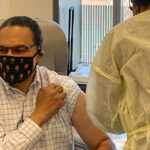
UMBC President Freeman Hrabowski and his wife Jackie recently volunteered to take part in a 25-month clinical trial of the COVID-19 vaccine invented by alumna Kizzmekia Corbett ’08, M16, biological sciences, with her team at the Vaccine Research Center at the National Institute of Allergy and Infectious Diseases. We talked with the Hrabowskis to learn more about why being a part of this historic trial is so important to them both.
UMBC Magazine: Why did you decide to volunteer for this trial?
Jackie Hrabowski: Well, it’s for a couple of reasons, starting with the fact that this pandemic has affected minorities, and African Americans specifically, more directly than most. And so, it’s important for us to be represented in the solution. If we’re looking for cures, we need to be involved and to be able to step up to that, despite all of the fears. The second reason, of course, is that the person who is developing this vaccine is a UMBC alum, and we’re very proud of her. And we always believe in supporting our students. We know that they’re the best at whatever it is that they decide to do. So those are the primary reasons…but I also think we need to be role models and walk the talk. If we say it’s important to do this, we need to be able to demonstrate it through our actions, not just with our words.
 Kizzmekia Corbett ’08, M16, biological sciences, calls out UMBC as her best career decision yet.
Freeman Hrabowski: Exactly. We’re seeing people of color and particularly African Americans dying at higher proportions, higher rates than anyone from this disease right now. And we need to help find the solutions. And right now the vaccine our alumna Kizzmekia Corbett has developed is very promising. And, as Jackie says, of those to whom much is given much should be required. And we feel very fortunate to be in that position right now. I have been the beneficiary of so much support from so many people that we want to do our part during this time.
And of course many Black people will say, yeah, but we know about these studies. I grew up with Tuskegee study. So, I recognize the prejudice that was shown and the abuse by the medical and scientific community towards Blacks in the past. But the question is, what do we do now? Right now we need this vaccine for everyone. And the encouraging news is that we can see people of all races involved in the development and the implementation of this plan for this vaccine.
UMBC Magazine: You both clearly understand how important it is to set a good example.
Jackie Hrabowski: It’s like the story of my dad growing up in rural Virginia. He and my mom were always out in the community helping people. We didn’t have a lot of money, but it was about giving our time and our effort…and supporting people as much as we can. And growing up, I was always there in the background, running with him, taking somebody somewhere, giving them something. And so as I got to be a little older…I asked my dad, why do we have to always be the ones going and taking people and doing things for people? And he looked at me, and he just quietly said, “Because we can.”
Freeman Hrabowski: I just love that…. It just gives me goosebumps. And you know, there are certainly a lot of limitations about things that we can’t do. We often don’t do as much as we can…but this is a time when we, as human beings, have a responsibility to step up to the plate for the public good, for the common good. This is the time when we need to be focused on people beyond ourselves.
*****
Retrievers are on the front lines of COVID-19 research.
UMBC faculty and alumni have been putting their expertise to use since the beginning of the pandemic. In addition to Kizzmekia Corbett’s vaccine work, Kaitlyn Sadtler ’11, biological sciences, is orchestrating a 10,000-participant study at the National Institutes of Health to look for antibodies to SARS-CoV-2 in volunteers’ blood, allowing the research team to estimate just how many people have been infected across the country—whether they had symptoms or not.
Zoë McLaren, associate professor of public policy, writes about how COVID-19 cases are surging upward around the U.S. but rapid testing might allow a turnaround by a massive scale-up of testing. Katherine Seley-Radtke, professor of chemistry and biochemistry, chimes in her expertise to explain what makes some drugs work against viruses and how others aren’t effective treatment of SARS-CoV-2.
Header image and video courtesy of the University of Maryland School of Medicine. Learn more about volunteering for the clinical trial.
]]>
UMBC President Freeman Hrabowski and his wife Jackie recently volunteered to take part in a 25-month clinical trial of the COVID-19 vaccine invented by alumna Kizzmekia Corbett ’08, M16,...
https://umbc.edu/stories/vaccine-trial/
https://beta.my.umbc.edu/api/v0/pixel/news/119749/guest@my.umbc.edu/9858ff8adf334f614a467762bcade868/api/pixel
covidresearch
fall-2020
perspectives
up-on-the-roof-meyerhoff
UMBC News & Magazine
https://beta.my.umbc.edu/groups/umbc-news-magazine
https://assets1-beta.my.umbc.edu/system/shared/avatars/groups/000/001/943/24435aa6207c452e7bc15cc74b42c7bb/xsmall.png?1748556657
https://assets1-beta.my.umbc.edu/system/shared/avatars/groups/000/001/943/24435aa6207c452e7bc15cc74b42c7bb/original.png?1748556657
https://assets2-beta.my.umbc.edu/system/shared/avatars/groups/000/001/943/24435aa6207c452e7bc15cc74b42c7bb/xxlarge.png?1748556657
https://assets2-beta.my.umbc.edu/system/shared/avatars/groups/000/001/943/24435aa6207c452e7bc15cc74b42c7bb/xlarge.png?1748556657
https://assets3-beta.my.umbc.edu/system/shared/avatars/groups/000/001/943/24435aa6207c452e7bc15cc74b42c7bb/large.png?1748556657
https://assets1-beta.my.umbc.edu/system/shared/avatars/groups/000/001/943/24435aa6207c452e7bc15cc74b42c7bb/medium.png?1748556657
https://assets2-beta.my.umbc.edu/system/shared/avatars/groups/000/001/943/24435aa6207c452e7bc15cc74b42c7bb/small.png?1748556657
https://assets1-beta.my.umbc.edu/system/shared/avatars/groups/000/001/943/24435aa6207c452e7bc15cc74b42c7bb/xsmall.png?1748556657
https://assets2-beta.my.umbc.edu/system/shared/avatars/groups/000/001/943/24435aa6207c452e7bc15cc74b42c7bb/xxsmall.png?1748556657
UMBC News & Magazine
0
0
false
Wed, 18 Nov 2020 20:39:18 -0500
No, soaring COVID-19 cases are not due to more testing – they show a surging pandemic
By Zoë McLaren, associate professor, public policy, UMBC
COVID-19 cases are surging upward around the U.S., reaching 100,000 daily cases for the first time on Nov. 4 and 150,000 only eight days later. Some believe this increase in reported is a result of increases in testing, as more than 1.5 million tests are performed every day in the U.S. But the evidence is clear that these high numbers reflect a true increase in the number of COVID-19 infections.
Hospitalizations, deaths and test-positivity rates are going up. Taken together, this means that serious COVID-19 illness is on the rise and cases are being undercounted.
Steep increases in hospitalizations and deaths
Rather than being an artifact of changes in testing policy, the rise in cases reflects ongoing transmission and serious illness.
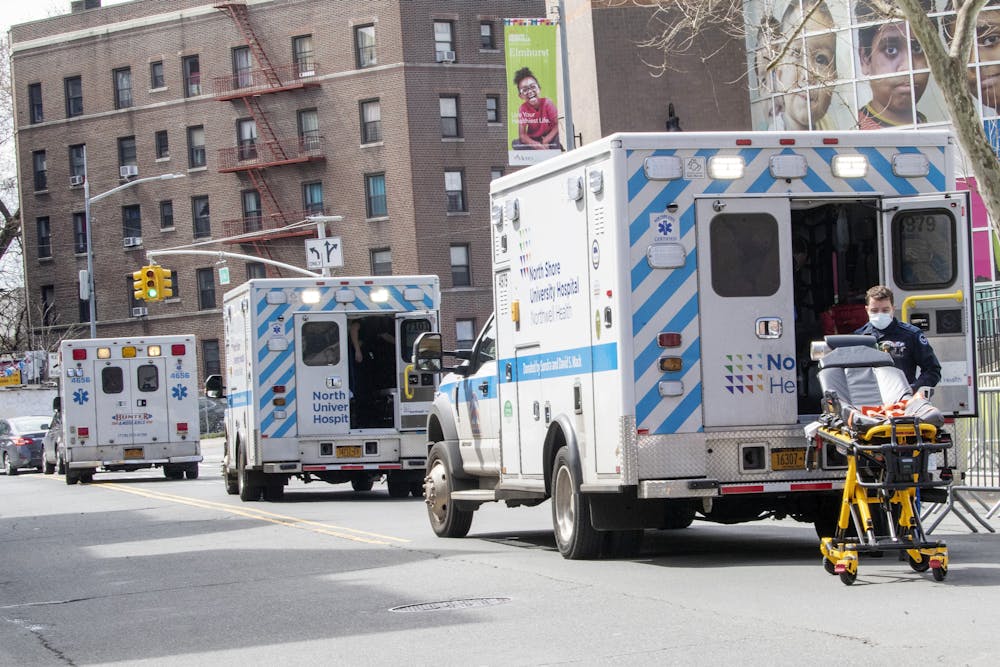
Even as COVID-19 treatments have improved and death rates have fallen, record-breaking levels of hospitalizations are already overwhelming ICUs in many parts of the country. Hospitalizations and deaths will continue to climb even if the surge in new cases abates because the majority of cases are diagnosed before serious illness develops. Today’s new infections will add to the death toll for weeks to come.
These hospitalizations and deaths represent confirmed COVID-19 infections. A COVID-19 diagnosis for hospitalized cases must be justified based on symptoms and test results. COVID-19 is simply the only plausible explanation for ongoing high hospitalization and death rates.
High and rising test positivity
High and rising test-positivity rates provide more evidence that COVID-19 is spreading uncontrollably around the country.
Test positivity is the percentage of all COVID-19 tests for active infection that come back positive. For example, Iowa’s test-positivity rate of 51.7% as of Nov. 17 means that for every 100 COVID-19 tests performed, 51 are positive.
Test positivity tells public health officials whether a testing program is casting a wide enough net to catch the majority of COVID-19 cases.
A high test-positivity rate indicates that the people getting tested are mostly those who have symptoms or think they’ve been exposed to someone with COVID-19. But people can be infected or contagious even if they aren’t showing symptoms. A low test-positivity rate means that access to testing is wide enough to reach large numbers of people who may not know they have the coronavirus. This greatly increases the chances of diagnosing people without symptoms or known exposure who may nonetheless be infected.
The World Health Organization recommends a goal of 5% test positivity or less, but test-positivity rates in many parts of the U.S. are well above that. As of Nov. 17, 44 states had test-positivity rates above 5%, meaning their testing programs were not casting a broad enough net and were likely missing many undiagnosed cases.
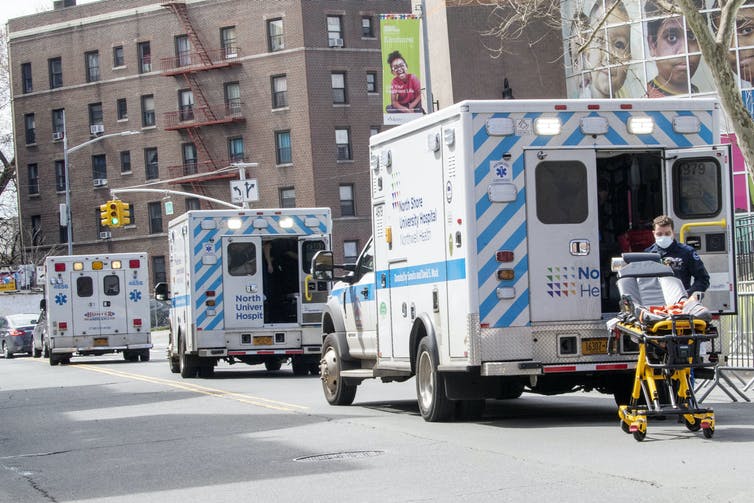 Hospitalizations and deaths are also rising, though they lag behind increases in diagnoses. AP Photo/Mary Altaffer
Things are worse than they seem
The data on hospitalizations, deaths and test positivity clearly show that the worst of the surge is yet to come. High test-positivity rates mean the current confirmed case numbers are undercounting total cases.
A test-positivity rate above 25%, as is the case in several states, implies there may be more than 10 times as many cases in the population as have been diagnosed. Many of these undetected cases may be contagious even though they have no symptoms, which further contributes to the spread of the virus. Considering the lag between new cases and hospitalization or death, the current surge does not bode well for the coming winter.
Overstretched testing programs
The record-breaking surge in COVID-19 cases and hospitalizations around the U.S. represents a true increase in infections and serious illness rather than an increase in testing. In fact, high test-positivity rates show that cases are undercounted because of limited access to testing. Hospitalizations and deaths will continue to rise in the weeks ahead.
Overstretched testing programs remain a weak link in the U.S. pandemic response. Diagnosing cases – and catching them as early as possible – will help cut off transmission chains of the deadly virus. When people learn they’re infected, they’re more likely to take necessary precautions to avoid exposing family, friends and others to the virus. Contrary to what some ill-informed people may be saying, the U.S. should be expanding access to testing to curb the spread of COVID-19. More testing would actually be a crucial step toward finally getting the virus under control.
*****
Zoë McLaren, Associate Professor of Public Policy, University of Maryland, Baltimore County
This article is republished from The Conversation under a Creative Commons license. Read the original article.
Header image: Access to testing had been improving across the U.S., but as cases increase, more testing is needed. AP Photo/Bebeto Matthews
]]>
By Zoë McLaren, associate professor, public policy, UMBC COVID-19 cases are surging upward around the U.S., reaching 100,000 daily cases for the first time on Nov. 4 and 150,000 only eight...
https://umbc.edu/stories/no-soaring-covid-19-cases-are-not-due-to-more-testing-they-show-a-surging-pandemic/
https://beta.my.umbc.edu/api/v0/pixel/news/119750/guest@my.umbc.edu/9a5eb8b104ec8e127ae127847b4976e3/api/pixel
covidresearch
perspectives
the-conversation
UMBC News & Magazine
https://beta.my.umbc.edu/groups/umbc-news-magazine
https://assets1-beta.my.umbc.edu/system/shared/avatars/groups/000/001/943/24435aa6207c452e7bc15cc74b42c7bb/xsmall.png?1748556657
https://assets1-beta.my.umbc.edu/system/shared/avatars/groups/000/001/943/24435aa6207c452e7bc15cc74b42c7bb/original.png?1748556657
https://assets2-beta.my.umbc.edu/system/shared/avatars/groups/000/001/943/24435aa6207c452e7bc15cc74b42c7bb/xxlarge.png?1748556657
https://assets2-beta.my.umbc.edu/system/shared/avatars/groups/000/001/943/24435aa6207c452e7bc15cc74b42c7bb/xlarge.png?1748556657
https://assets3-beta.my.umbc.edu/system/shared/avatars/groups/000/001/943/24435aa6207c452e7bc15cc74b42c7bb/large.png?1748556657
https://assets1-beta.my.umbc.edu/system/shared/avatars/groups/000/001/943/24435aa6207c452e7bc15cc74b42c7bb/medium.png?1748556657
https://assets2-beta.my.umbc.edu/system/shared/avatars/groups/000/001/943/24435aa6207c452e7bc15cc74b42c7bb/small.png?1748556657
https://assets1-beta.my.umbc.edu/system/shared/avatars/groups/000/001/943/24435aa6207c452e7bc15cc74b42c7bb/xsmall.png?1748556657
https://assets2-beta.my.umbc.edu/system/shared/avatars/groups/000/001/943/24435aa6207c452e7bc15cc74b42c7bb/xxsmall.png?1748556657
UMBC News & Magazine
0
0
false
Wed, 18 Nov 2020 15:46:04 -0500
Chasing Antibodies

Today, many Americans are asking themselves versions of this question: “Was that bad cough I had in January COVID-19?” Without comprehensive nationwide testing, it’s been impossible to measure in real time the total number of Americans who have been exposed to SARS-CoV-2, the virus that causes COVID-19. However, there is another way to come up with a reliable estimate, and Kaitlyn Sadtler ’11, biological sciences, is leading the charge.
The 10,000-participant study Sadtler is orchestrating at the National Institutes of Health (NIH) will look for antibodies to SARS-CoV-2 in volunteers’ blood, allowing the research team to estimate just how many people have been infected across the country—whether they had symptoms or not. The research team used U.S. Census data to select a representative sample of Americans based on factors such as age, sex, race, and geographic location. The project originated with a Twitter conversation about how Sadtler could use her expertise to support the current crisis.
 Portrait by Bret Hartman/TED.
“I think that a lot of people, including anyone with an immunology background, or a relation to infectious disease, was just sitting there thinking, ‘Okay, what can I do to help in this situation?’” says Sadtler, an Earl Stadtman tenure-track investigator at the National Institute of Biomedical Imaging and Bioengineering, a division of the NIH. “Because that’s what scientists want to do—we’re problem solvers, we love puzzles.”
“Mail-in blood”
The original plan was to collect a few hundred samples from the DC metro area. But bringing hundreds of people to NIH to draw their blood would increase the risk of spreading the coronavirus. Instead, they mailed volunteers finger-prick test kits they could use at home and then send back.
“Once we had that realization that we could mail in blood, the study expanded very rapidly,” Sadtler says. However, even she and her team didn’t expect the overwhelming response to their call for volunteers. More than 400,000 people emailed expressing interest, which necessitated writing code to sort through the volunteers’ information and ensure a representative sample.
Sadtler’s team and partners at the University of Alabama-Birmingham and University of Pittsburgh enrolled 11,000 volunteers and sent them their test kits. Then, Sadtler’s team collected and analyzed the samples as they were delivered to her laboratory at the NIH. By the end of September, the team had finished measuring antibodies in more than 10,000 samples, their target number.
Now, they’re analyzing the data, and they hope to have the information publicly available in the coming weeks. The results, Sadtler says, “will give us a statistically robust viewpoint of how many people have actually probably had this thing.”
Digging through the data
There are other questions the data can help answer, too, like how the disease differentially affects certain groups. Because volunteers supplied a range of information about themselves, the researchers can start to tease out the roles of different demographic factors on the disease.
For example, the virus has disproportionately affected Black people in the United States. Sadtler’s data may help explain whether race itself correlates with a greater chance of disease exposure and poor outcomes, or if effects of the disease more closely track factors like education level, employment status, or access to healthcare, which often follow racial lines in the U.S.
“There’s a lot to dig out of the data. Our team plans on releasing useful data as quickly as possible, but we will be mining and analyzing this data set for months to come,” Sadtler says.
Engineering mindset
So what comes next? “We do it again—twice,” Sadtler deadpans. The National Cancer Institute’s Serological Sciences Network has granted funding to repeat the study with the same participants six months and 12 months after the first round. Among other things, the repetition will allow the research team to see how the antibody response changes over time. That information will help determine whether booster doses will be required for an eventual vaccine, as they are for some other diseases whose immune responses fade, and potentially start answering some questions about re-infection rates.

Sadtler, right, at her UMBC graduation with her mom and sister, Samantha Bennett ’09.
The COVID-19 study aligns with Sadtler’s other projects, which focus on the body’s immune response to medical device implants and wound healing. Her work sits at the interface of engineering and immunology, and she works closely with people from a range of academic backgrounds. “I end up feeling like a bit of a translator sometimes,” she says.
It’s her “engineering mindset,” as Sadtler describes it, that’s helped her succeed. She says she’s always asking, “Is there an easier way that we could approach this? Is there an engineering solution to this problem?” which helps her come up with novel solutions other biologists might not initially consider.
A wide lens
Sadtler in part credits her broad education at UMBC for her ability to bridge different fields. “Something that I really liked about UMBC was that it was so focused on undergraduate education, and really making it a good environment for undergraduates to learn,” she says.
She took courses like plant physiology, physics, and organic chemistry, all of which she loved. “I was able to experience biology as a whole, and learn different ways that different fields learn within biology, so I could figure out what my niche was,” she says.
In Sadtler’s last semester, Tamra Mendelson, professor of biological sciences and her academic advisor, offered her a position working on her research. So, “Before starting a postbac in immunology at the NIH, before going into just focusing on cells in a petri dish in the lab, I was out in gaiters helping collect fish in streams across Maryland,” Sadtler recalls. “I loved the opportunity to see what the evolution and ecology side of biology was like, and I really enjoyed it.”
Retriever refresh
 Sadtler, center, with her rugby teammates.
Sadtler’s UMBC experience wasn’t all academic. She played on the women’s rugby team for almost all of her four years, half of them with her sister, Samantha Bennett ’09, biological sciences. “It was a great outlet and a great group of women,” she says. “I still keep in touch with women from the team.”
Fortunately, Sadtler and her sister got along well. “I loved having my sister in the same university as me,” Sadtler shares. They even purposely took a psychology class together during Sadtler’s sophomore year.
Now, Sadtler can’t wait to return to the campus, once it’s safe to do so, to witness big changes like the addition of the Performing Arts and Humanities Building, the UMBC Event Center, and the Interdisciplinary Life Sciences Building. But her top priority is visiting the UMBC Bookstore to refresh her Retriever wardrobe.
Whatever the reason, and no matter how busy she is with her important research, Sadtler will always be a Retriever wanting to come home, she says. “I can’t wait to make my way back to UMBC.”
******
Retrievers are on the front lines of COVID-19 research.
UMBC faculty and alumni have been putting their expertise to use since the beginning of the pandemic. In addition to Kaitlyn Sadtler‘s NIH study, Kizzmekia Corbett ’08, M16, biological sciences, is moving her vaccine work forward, with a 95 percent efficacy rate. UMBC President Freeman Hrabowski and his wife Jackie are participants in the Moderna vaccine trial, showing what leadership looks like in action.
Zoë McLaren, associate professor of public policy, writes about how COVID-19 cases are surging upward around the U.S. but rapid testing might allow a turnaround by a massive scale-up of testing. Katherine Seley-Radtke, professor of chemistry and biochemistry, chimes in her expertise to explain what makes some drugs work against viruses and how others aren’t effective treatment of SARS-CoV-2.
Header image: Kaitlyn Sadtler on stage at her TED talk. Phot by Ryan Lash/TED.
]]>
Today, many Americans are asking themselves versions of this question: “Was that bad cough I had in January COVID-19?” Without comprehensive nationwide testing, it’s been impossible to measure in...
https://umbc.edu/stories/chasing-antibodies/
https://beta.my.umbc.edu/api/v0/pixel/news/119751/guest@my.umbc.edu/3f99f6386d38b57af80948f8999893c6/api/pixel
cnms
covidresearch
discovery
fall-2020
UMBC News & Magazine
https://beta.my.umbc.edu/groups/umbc-news-magazine
https://assets1-beta.my.umbc.edu/system/shared/avatars/groups/000/001/943/24435aa6207c452e7bc15cc74b42c7bb/xsmall.png?1748556657
https://assets1-beta.my.umbc.edu/system/shared/avatars/groups/000/001/943/24435aa6207c452e7bc15cc74b42c7bb/original.png?1748556657
https://assets2-beta.my.umbc.edu/system/shared/avatars/groups/000/001/943/24435aa6207c452e7bc15cc74b42c7bb/xxlarge.png?1748556657
https://assets2-beta.my.umbc.edu/system/shared/avatars/groups/000/001/943/24435aa6207c452e7bc15cc74b42c7bb/xlarge.png?1748556657
https://assets3-beta.my.umbc.edu/system/shared/avatars/groups/000/001/943/24435aa6207c452e7bc15cc74b42c7bb/large.png?1748556657
https://assets1-beta.my.umbc.edu/system/shared/avatars/groups/000/001/943/24435aa6207c452e7bc15cc74b42c7bb/medium.png?1748556657
https://assets2-beta.my.umbc.edu/system/shared/avatars/groups/000/001/943/24435aa6207c452e7bc15cc74b42c7bb/small.png?1748556657
https://assets1-beta.my.umbc.edu/system/shared/avatars/groups/000/001/943/24435aa6207c452e7bc15cc74b42c7bb/xsmall.png?1748556657
https://assets2-beta.my.umbc.edu/system/shared/avatars/groups/000/001/943/24435aa6207c452e7bc15cc74b42c7bb/xxsmall.png?1748556657
UMBC News & Magazine
0
0
false
Tue, 17 Nov 2020 21:34:28 -0500