How to Throw a Hammer
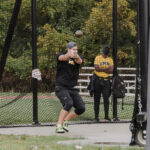
with Andrew Haberman ’21, computer science, and Davina Orieukwu, assistant Track & Field coach
It’s widely accepted that you need to practice a skill for 10,000 hours before becoming an expert. Andrew Haberman ’21, computer science, has a different number in mind—20,000 throws. Twenty-five throws a practice, five days of practice a week, 10 months out of the year for four years. And even after that, he knows that success is never final. So he makes another throw.
Along with shot put, weight, and discus throws, Haberman specializes in the hammer throw. This is not a tool from your dad’s shed. For men’s regulation competition, it’s a 16lb metal ball attached by a steel wire to a grip. While the object of this competition is—like all throwing competitions—to launch your object the farthest, with hammer throw speed is also a big factor.
-
 Andrew Haberman
-
 Davina Orieukwu
As part of track and field, throwing is more obscure than some events, but UMBC has a storied history in this discipline. Cleopatra Borel ’02, interdisciplinary studies, is a four-time Olympian shot putter representing Trinidad and Tobago, placing 7th in Brazil in 2016.
On the practice field, again and again, the rhythmic sound of Haberman’s shoes scuffing the throwing circle are followed by a thunk as the hammer lands in the grass, a rooster tail of dirt following each toss. Haberman and his throwing coach, Davina Orieukwu, talk through foot placement, chest height, release angle, and many other minute readjustments to his technique. Over and over, Orieukwu reminds him, “push the hammer all the way around,” to get the most efficient throw. So how does anyone get to 20,000 throws? Start with the first one.
Tools of the Trade
-
A hammer—This implement is a 8.8lb (for women) or 16lb (for men) metal ball on a wire with a handhold. But in a pinch, other heavy implements attached to a chain and grip will work.
-
Wide open space—this is not a sport to practice near a lot of windows.
-
Upper body strength—this would be helpful to start, but you can always build it up while you practice.
-
A coach or mentor—no YouTube video can substitute for hands-on guidance.
Haberman’s career record toss is 55.06m (180.6 ft). That is approximately as long as the Leaning Tower of Pisa is tall. Illustration by Jim Lord ’99.
Step 1 — Hammer time
First acquire a hammer or throwing implement. These aren’t the most accessible pieces of equipment like a pair of running shoes or a soccer ball. Hammer throw isn’t a part of most high school track and field teams, but Haberman’s coach at Century in Carroll County had access to some of the heavy equipment and allowed the throwing athlete to practice on his own. Haberman saw the hammer throw as a way to extend his athletic career, gaining experience in a more uncommon discipline to make him a more attractive athlete to colleges.
But you don’t need a regulation hammer to start off. During practice, Orieukwu has Haberman and another throwing athlete, sophomore Thomas Hamby, use a variety of weighted objects. First, Haberman warms up with a literal ball and chain. This implement weighs twice as much as the hammer he’ll use in competition, so he’s gaining strength and developing better technique by handing the heavier object. Hamby throws a hefty chain looped around a handle to start.
Step 2 — When, not if, you fall, get back up again
Hone your technique. Maybe at first this is watching YoutTube tutorials by world class athletes or binging compilations of “fails,” to see all the ways that things could go wrong. As Orieukwu repeats during practice, “losing connection with the ground is losing connection with the ball.” For the uninitiated, stumbling or falling down is to be expected in the beginning. Imagine this: you are trying to balance your body while swinging a weighted ball over your head twice and then spinning anywhere from three to five times (called “the wind”), building up momentum to the moment of release. The faster the speed of your spins, the more velocity your hammer has.
 Orieukwu gives Haberman pointers for his foot placement and when to release the hammer.
Everyone, says Haberman—even with four years of experience—loses control of the ball. The key, he notes: “Be as relaxed as possible, but strong and intentional at the same time.”
Step 3 — Arm & hammer
Learn better form. Haberman says his STEM background certainly helps, as he thinks through the physics of the pull of the hammer as his body rotates to gain speed. Orieukwu tells him to watch his “flat 2.” Haberman knows that means during his second rotation, “my hammer rises really high in my orbit, so that keeps me from throwing farther,” he says.
As the ball increases velocity with each turn, it’s important to retain a triangular shape with your arms—your chest forming the base, your arms the two legs of the isosceles triangle, and the hammer at the vertex. If the hammer gets ahead or behind your triangle, you’re in trouble, says Haberman.
Step 4 — Pass it forward
Start mentoring others. So much of hammer throwing is a mind game, shares Haberman, who credits older team members with helping him learn good habits early on: relax, make jokes during practice, and stay neutral to avoid emotional highs and lows which can derail an athlete. Hamby, who just picked up the hammer throw in fall 2020, says that Haberman, now a senior, is his go-to source for advice.
 Haberman, a senior, and Hamby, a sophomore, discuss throwing techniques.
The older athlete sees his responsibility and tries not to pass long throwing neuroses. “I consistently think I can do better, but sometimes that works against me,” says Haberman. “Thomas picks up on my attitude and I don’t want it to negatively affect him.”
With that, he lifts the hammer, executes the wind, and completes another throw—number 20,001 and counting.
*****
Header image: Haberman practices with Orieukwu looking on. All photos by Marlayna Demond ’11.
]]>
with Andrew Haberman ’21, computer science, and Davina Orieukwu, assistant Track & Field coach It’s widely accepted that you need to practice a skill for 10,000 hours before becoming an...
https://umbc.edu/stories/how-to-throw-a-hammer/
https://beta.my.umbc.edu/api/v0/pixel/news/119733/guest@my.umbc.edu/28caea069fd0fddc26f7664d1653224a/api/pixel
athletics
campus-life
fall-2020
how-to
UMBC News & Magazine
https://beta.my.umbc.edu/groups/umbc-news-magazine
https://assets1-beta.my.umbc.edu/system/shared/avatars/groups/000/001/943/24435aa6207c452e7bc15cc74b42c7bb/xsmall.png?1748556657
https://assets1-beta.my.umbc.edu/system/shared/avatars/groups/000/001/943/24435aa6207c452e7bc15cc74b42c7bb/original.png?1748556657
https://assets2-beta.my.umbc.edu/system/shared/avatars/groups/000/001/943/24435aa6207c452e7bc15cc74b42c7bb/xxlarge.png?1748556657
https://assets2-beta.my.umbc.edu/system/shared/avatars/groups/000/001/943/24435aa6207c452e7bc15cc74b42c7bb/xlarge.png?1748556657
https://assets3-beta.my.umbc.edu/system/shared/avatars/groups/000/001/943/24435aa6207c452e7bc15cc74b42c7bb/large.png?1748556657
https://assets1-beta.my.umbc.edu/system/shared/avatars/groups/000/001/943/24435aa6207c452e7bc15cc74b42c7bb/medium.png?1748556657
https://assets2-beta.my.umbc.edu/system/shared/avatars/groups/000/001/943/24435aa6207c452e7bc15cc74b42c7bb/small.png?1748556657
https://assets1-beta.my.umbc.edu/system/shared/avatars/groups/000/001/943/24435aa6207c452e7bc15cc74b42c7bb/xsmall.png?1748556657
https://assets2-beta.my.umbc.edu/system/shared/avatars/groups/000/001/943/24435aa6207c452e7bc15cc74b42c7bb/xxsmall.png?1748556657
UMBC News & Magazine
0
0
false
Wed, 02 Dec 2020 21:48:13 -0500
Exploring Every Angle: Climate Research at UMBC
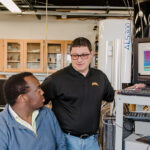
Researchers across UMBC are using unique, interdisciplinary approaches to explore global environmental challenges. Here are just three examples.
Lipi Mukherjee, Ph.D. ’20, atmospheric physics, developed an algorithm to identify the abundance and type of particles present just under the surface of the ocean. Her algorithm is 6,000 times faster than previous methods.
 (left to right:) Anthony Bratt, Lipi Mukherjee, Dr. Pengwang Zhai, and Dr. Meng Gao, courtesy of the UMBC Atmospheric and Oceanic Optics Group.
“That’s the difference between impossible and doable,” says Mukherjee’s advisor, Pengwang Zhai, assistant professor of physics. Mukherjee trained her model to identify different particle types using neural network technology, rather than relying on existing observational data. This method “has the reliability as well as the speed” today’s scientists need, Mukherjee explains.
The model, which analyzes data collected by orbiting satellites, mostly detects colored dissolved organic matter (CDOMs). Some of these particles can be poisonous to sea life. They can also serve as a proxy for carbon stored in the ocean, which is important to understand in the context of climate change.
Zhai is excited to continue to validate Mukherjee’s model. He’ll also use her model to analyze data coming from three instruments that will launch with NASA’s PACE mission in 2024, including UMBC’s own HARP2.
Mukherjee has moved on to a position at the National Center for Atmospheric Research. She’s applying her knowledge of neural networks to interpret magnetic and thermodynamic properties of the sun’s atmosphere, which can lead to solar flares that interrupt GPS tracking and telecommunication systems. “That’s the beauty of the physics Ph.D.,” Zhai says. “You may not work on the exact same topic after you graduate, but your skill set is highly relevant.”
Answers in the air
Ruben Delgado, assistant research professor at the Joint Center for Earth Systems Technology (JCET), a UMBC partnership with NASA, studies a different resource: our air. Since a major air quality study over Chesapeake Bay in 2011, UMBC has gained national prominence for air quality research. Delgado’s group uses data collected by aircraft, satellites, and ground-based systems to understand where, when, and how much of certain pollutants appear near ground level.
The research led to new regulation that has decreased air pollution in the region. Impressed, the federal Environmental Protection Agency asked UMBC in 2016 to serve as the central hub for a fast-growing network of instruments. Delgado and his students analyze air quality data coming in from sites across the U.S. and Canada.
 Delgado, third from left, with a group of physics students in 2019 next to the observatory on the roof of the physics building. Photo by Marlayna Demond ’11.
The instruments at different sites produce raw data that look slightly different. It’s up to the computer science majors on the team to find ways to analyze it all efficiently and then visualize the results in a way that makes sense to the end user.
Some of the students regularly post their findings on a website affectionately known as the “Smog Blog.” During the worst of this fall’s fires in the West, officials from Pennsylvania called to check on the status of blog posts. The governor expected daily updates on how the smoke was affecting local air quality—and their team was relying on the Smog Blog.
“That’s when we give the wake up call to the students: ‘By the way, your work is being used by government officials,’” Delgado says. “Some of them might not have previously thought at all that their coding skills would be useful for environmental research. It’s a point of pride for the students that their work is being used and highlighted.”
Phytoplankton to polar bears
Rather than collecting data at a distance via satellites, Nicole Trenholm spends much of her time on small boats in the Arctic Ocean, exploring everything from ocean currents to algal blooms to microplastics in ice cores. After earning a bachelor’s in geology, research missions to the Arctic with NASA made her want to pursue an advanced degree.
“I was seeing things and making connections, but I was just a data delivery girl at the time,” Trenholm says. “I wanted to go back to school and learn how to lead the science myself.”
 Trenholm on a research site. Photo courtesy of the Department of Geography and Environmental Systems.
Trenholm has a passion for messy questions about the relationships between melting Arctic glaciers and changes in the surrounding biological communities, from phytoplankton to polar bears. Those interests brought her to UMBC, where she is a Ph.D. student co-advised by geography and environmental systems professor Jeff Halverson and JCET scientist Kevin Turpie.
Trenholm is taking advantage of her fieldwork experience to bridge the gap between climate data collected from afar and ecological data collected on the ground. “I’m doing my best to not go one direction or the other, but really try to stay in between and help solve these crossover questions,” she says.
“Glacier melt isn’t just influencing sea level rise—it’s also influencing the future health of marine ecosystems, fisheries, water quality—all this kind of stuff,” Trenholm adds. “And that’s a story that hasn’t been fully investigated at this point.”
On her next research cruise, she’ll be the only graduate student aboard with a group of senior researchers exploring currents in the Beaufort Sea north of Alaska. The trip will be exciting and educational, but it doesn’t come without risk.
“This is going to be one of the nastier times of year to be up in the oceans,” Trenholm says. “We’ll be out there fighting the seas, collecting data. I’ll be wearing a hard hat and be soaking wet most of the time.”
But she’ll be doing important work, gathering information to help scientists better understand our changing world. And, in the true spirit of a committed scientist, she continues, “It’ll be fun. I brought some audio books and my ukulele.”
*****
Learn more about Retrievers’ roles in researching climate change in the Arctic in this fall 2020 feature On Thin Ice.
Header imager: Delgado, standing, works with students in his lab in 2019. Photo by Marlayna Demond ’11.
]]>
Researchers across UMBC are using unique, interdisciplinary approaches to explore global environmental challenges. Here are just three examples. Lipi Mukherjee, Ph.D. ’20, atmospheric...
https://umbc.edu/stories/exploring-every-angle-climate-research-at-umbc/
https://beta.my.umbc.edu/api/v0/pixel/news/119734/guest@my.umbc.edu/b53a6dade15361cf3a2dbcbf23d29187/api/pixel
cnms
discovery
fall-2020
ges
physics
professorsnottomiss
sidebar
UMBC News & Magazine
https://beta.my.umbc.edu/groups/umbc-news-magazine
https://assets1-beta.my.umbc.edu/system/shared/avatars/groups/000/001/943/24435aa6207c452e7bc15cc74b42c7bb/xsmall.png?1748556657
https://assets1-beta.my.umbc.edu/system/shared/avatars/groups/000/001/943/24435aa6207c452e7bc15cc74b42c7bb/original.png?1748556657
https://assets2-beta.my.umbc.edu/system/shared/avatars/groups/000/001/943/24435aa6207c452e7bc15cc74b42c7bb/xxlarge.png?1748556657
https://assets2-beta.my.umbc.edu/system/shared/avatars/groups/000/001/943/24435aa6207c452e7bc15cc74b42c7bb/xlarge.png?1748556657
https://assets3-beta.my.umbc.edu/system/shared/avatars/groups/000/001/943/24435aa6207c452e7bc15cc74b42c7bb/large.png?1748556657
https://assets1-beta.my.umbc.edu/system/shared/avatars/groups/000/001/943/24435aa6207c452e7bc15cc74b42c7bb/medium.png?1748556657
https://assets2-beta.my.umbc.edu/system/shared/avatars/groups/000/001/943/24435aa6207c452e7bc15cc74b42c7bb/small.png?1748556657
https://assets1-beta.my.umbc.edu/system/shared/avatars/groups/000/001/943/24435aa6207c452e7bc15cc74b42c7bb/xsmall.png?1748556657
https://assets2-beta.my.umbc.edu/system/shared/avatars/groups/000/001/943/24435aa6207c452e7bc15cc74b42c7bb/xxsmall.png?1748556657
UMBC News & Magazine
0
0
false
Wed, 02 Dec 2020 19:31:34 -0500
On Thin Ice
For UMBC alum Nathan Kurtz, the only thing scarier than a surprise visit from a polar bear is a melting ice cap.
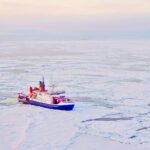
When the Polarstern set sail from northern Norway in September 2019, it was looking to get stuck in the ice. But this goal—a death knell for so many historic exploration ships—would be much harder for this modern research vessel to accomplish due to a shrinking ice pack.
The Polarstern was embarking on history’s largest scientific expedition to the Arctic to date. But before the first wave of scientists could start their research, they had to find a suitably robust ice pack, known as a floe, to make their home. This is harder than it sounds in the rapidly warming Arctic. An increasing amount of ice doesn’t survive the summer, which means boats have to travel further north in search of suitably thick ice. But after a nearly two-week journey from Norway, the Polarstern had found its mark.
And this is how Nathan Kurtz, M.S. ’07, Ph.D. ’09, atmospheric physics, ended up standing guard on some floating ice 300 miles from the North Pole armed with a rifle and a mandate to keep an eye out for polar bears.
 Kurtz, pictured on the ice next to research apparatus, courtesy of Kurtz.
Kurtz was part of the first wave of more than 600 scientists from 20 different countries who over the course of the year cycled through the ship as it drifted more than 1500 miles locked in a massive sheet of ice. The goal of the Multidisciplinary drifting Observatory for the Study of Arctic Climate (MOSAiC) expedition was to better understand the link between the Arctic environment and climate change.
Polar bear lookout was “not something I saw myself doing when I was in grad school,” says Kurtz, who didn’t see any bears that day, but by the time he returned to civilization a month later he’d had his fill. “However, UMBC really did prepare me to face challenges,” says Kurtz. “For me, grad school was hard, but it helped me with self-confidence—that this can be done and I can do this.”
Neither Kurtz nor his shipmates had traveled all the way to the Arctic to be polar bear sentinels. It was just a necessary part of the journey that allowed them to do their real job: collecting massive amounts of data on the woefully understudied polar environment. Over the course of its Arctic sojourn, the Polarstern hosted scientists studying everything from zooplankton beneath the ice to the clouds floating above it.
But for Kurtz, the ice itself was the main attraction.
From Icy Moons to Polar Ice Caps
Kurtz’s arrival in the Arctic was the culmination of over a decade of research studying Arctic floes from afar. But his original focus was ice even farther away—the icy moons of Jupiter. A shift in funding from NASA had Kurtz pivot his focus from astrophysics to earth sciences. “But physics applies to the moons of Jupiter and to the Earth,” Kurtz puts it dryly, “so it wasn’t so difficult to switch my focus.”
One of Kurtz’s advisors at UMBC, Raymond Hoff, professor emeritus, says UMBC students are uniquely positioned to lead in atmospheric physics, considered a unique subset in a field that often prioritizes astronomy or astrophysics. UMBC’s relationship with the Earth Science Division of NASA Goddard Space Flight Center to form the Joint Center for Earth Systems Technology allows students to play an active role in ongoing research.
 Scientific teams conduct research at a coring site on MOSAiC ice floe. Alfred-Wegener-Institute / Esther Horvath (CC-BY 4.0)
Hoff himself brought valuable Arctic experience to his classroom, and Kurtz remembers being struck by his advisor’s journeys to the Arctic in the early 1980s. “What amazed me about the Arctic was the stark and pristine beauty of the landscape,” says Hoff. “Even at -45ºF, you would find yourself outside marvelling at the ice crystals which fell out of clear blue skies as any water vapor there would freeze and fall out on your parka.” For about 20 years, Hoff measured pollution at Alert, Northwest Territories, Canada, about as far north as he could get on land. There, researchers discovered that sulfur pollution from Europe and Russia was getting into the high Arctic.
“As a result of our work,” shares Hoff, “the Arctic nations brought in scientific agreements to reduce the inputs of mid-latitudinal pollution going to the Arctic. Some of those pollutants were really surprising since they were pesticides which were used in the tropics. It brought home how small our planet is.”
Kurtz’s work four decades later would continue to rely on the cooperation of numerous stakeholders, as scientists collaborated to study—and perhaps stymie—global warming.
Bridging the Ice Knowledge Gap
As a graduate student, Kurtz worked on methods for determining sea ice thickness based on data from NASA’s ICESat, a polar observation satellite launched in 2003. After earning his Ph.D., Kurtz has continued his work on the properties of polar ice as a scientist at NASA Goddard’s Cryospheric Sciences Branch.
To understand how ice around the poles is changing and what this can tell us about the climate, Kurtz and his colleagues relied heavily on laser data from ICESat, a satellite that passed over the poles bouncing laser light off the ice 40 times per second to get a high resolution map of the sea ice thickness. But when ICESat’s last laser failed in 2009, NASA was left without a dedicated satellite to study the ice caps.
 Three scientists and a bear guard land on a new floe in a transportation device called a “mummy chair” to scout its potential for setting up research stations. Alfred-Wegener Institute / Lianna Nixon (CC-BY 4.0)
NASA’s solution was slightly more hands-on than a satellite—following the laser failure, NASA launched Operation IceBridge. Like ICESat, IceBridge used laser altimeters and radar to observe the Arctic ice sheet, except now they’d use a manned turboprop plane to accomplish the same thing.
Kurtz took over Operation IceBridge in 2015 and helmed the mission until 2018. Hoff shares a story of tuning in to NASA TV to see a story labeled incorrectly on the TV Guide channel as “Ice Bride.” It was really about IceBridge. “You have to laugh,” says Hoff. “I was happy to watch that story and see Nate standing on the ice in the Arctic talking about how important ice thickness is to our understanding of the progression of global warming.”
Each season, Kurtz would travel to the poles for weeks at a time to survey the ice from the air. In the Arctic, Kurtz and his team would depart from an airbase in Greenland and spend upward of eight hours per day in the fuselage of a plane as it zig-zagged back and forth across the Arctic Circle. They would pass the time monitoring the instruments, watching movies, or simply taking in the alien landscape below.
“The scenery outside was really amazing,” Kurtz says. “I never got tired of looking out the window.”
Even if Kurtz wanted to spend more time in the IceBridge plane, the extreme polar weather limited operations to about three months out of the year, which made it difficult to comprehensively survey the polar regions. The upshot was the plane could carry far more instruments than ICESat, including ice penetrating radars that could only work at low altitudes. In this sense IceBridge drastically improved NASA’s understanding of the dynamics of polar ice—but Kurtz wanted to get closer still.
Since 2018, Kurtz has been studying polar ice data sent back by NASA’s shiny new orbiter, ICESat-2, at Goddard Space Flight Center in Maryland. But when he heard about the MOSAiC mission, Kurtz saw a once-in-a-lifetime opportunity. “I had done the airborne work, but on the ground field work is so different,” he says. “Being there would give me a totally different view of how the ice forms and help inspire me to use airborne and satellite data in a different way.”
A New Era of Polar Exploration
One does not simply book a ticket on a month-long trip to the Arctic, of course. After securing the funding to participate in MOSAiC’s research program, Kurtz was required to participate in extensive training in New Hampshire and northern Alaska before departure. Over the course of several weeks in summer 2019, Kurtz along with fellow scientists learned how to shoot a rifle and a flare gun, escape from a sinking helicopter, orchestrate a sea rescue, and protect themselves from polar bears. They were also trained in the art of doing science in the Arctic, learning how to use a giant drill to extract an ice core and drive a snowmobile.
The extensive training was necessary to prepare the scientists for the brutal environment. During the Arctic winter, temperatures can dip dozens of degrees below zero and starting in mid-October the Polarstern would witness five months of total darkness.
 Arctic sea ice in September 2019. Alfred-Wegener-Institute / Sebastian Grote (CC-BY 4.0)
Kurtz recalls reading novels like Endurance, which chronicles explorer Ernest Shackleton’s harrowing efforts to reach the South Pole in 1914. “This book kept sticking in my head even though I felt safe on the ship. There were all kinds of modern communication in case we needed help or ran out of something or if there was some kind of emergency—we could at least talk to someone,” says Kurtz. “Shackleton and his group had none of that. I can’t even imagine.”
In this modern journey, participants would face some of the same challenges as past expeditions—unstable ice sheets, the threat of frostbite, the prospect of hungry bears, diminishing stores of fresh produce—along with new ones: they were limited to just 50 kilobytes of email data per day—barely enough to send a photo. But aside from a brief bout of seasickness during the passage from Norway, Kurtz quickly adapted to the life of a polar seafarer.
A Fresh Perspective on the Ice
To be sure, the days were both literally and figuratively long. When Kurtz and his crewmates arrived in the Arctic at the tail end of summer, the sun was hanging just below the horizon, casting the already alien landscape in a perpetual twilight glow. But given how much work there was to do, the extended daylight was a blessing. As the first of six expedition teams that cycled through the Polarstern that year, Kurtz and his colleagues were responsible for setting up dozens of experiments and research infrastructure that would be used by other scientists over the course of the year.
The nature of the field experiments that surrounded the ship speaks to the diverse expertise of the crew. Some of MOSAiC’s more far flung field sites were up to 30 miles away, accessible only by helicopter. Others took place thousands of feet above and below the ship, where dirigibles or underwater robots collected data and relayed it back to the surface.
 Polar bear mother and cub on starboard side of
 Polarstern
curiously looks at the ship. Alfred-Wegener-Institute / Lianna Nixon (CC-BY 4.0)
Kurtz’s experiments were just a few minutes’ walk from the Polarstern. They were designed to measure changes in the ice’s thickness, density, thermal conductivity, and other properties, which will serve as a ground truth for polar measurements taken from space. The dynamics of the Arctic floe have a lot to tell us about our planet; Kurtz’s experiments are helping us decipher its language.
Being on the ice gave Kurtz a refreshed perspective of an area he could previously only appreciate from satellite data or the window of a plane, both in terms of the immense scale and barren beauty of the Arctic landscape, and what it means to study the ice.
“Science by its nature is very dry and technical, so you’re not necessarily thinking about why something is important when you’re solving an equation, you just do it,” Kurtz says. “But going to take these measurements to make sure we understand what’s happening and what it means for the future put a very different context on the work I do.”
Kurtz says he was struck by the realization that his two elementary school-aged children—who loved to hear stories about his polar bear interactions again and again—will likely never see what he saw during his trip. The Arctic is warming much faster than the rest of the world and its ice sheet is receding at an alarming rate. Over the past few decades it has lost enough winter ice to cover Alaska, Texas, and Montana combined, and many of the regions that used to stay frozen during the summer are now ice-free. Scientists are only just beginning to understand how the Arctic affects and is affected by climate change, but the work of Kurtz and other MOSAiC scientists will fill in a crucial gap in that knowledge.
Kurtz’s retired advisor Hoff adds, “One thing UMBC can be very proud of is the number of its graduates and alumni who are contributing to decision making and making important decisions about the most critical issues which will affect the planet.”
—By Daniel Oberhaus
*****
Learn more about other ways UMBC staff and students are using their research to study and combat the effects of climate change.
Header Image: RV Polarstern in the Arctic. During the MOSAiC expedition the German research icebreaker Polarstern, which is operated by the Alfred Weggener Institute, drifts with the sea ice for a whole year, experiencing several months of polar night. Alfred-Wegener-Institute / Markus Rex (CC-BY 4.0)
]]>
For UMBC alum Nathan Kurtz, the only thing scarier than a surprise visit from a polar bear is a melting ice cap. When the Polarstern set sail from northern Norway in September 2019, it was...
https://umbc.edu/stories/on-thin-ice/
https://beta.my.umbc.edu/api/v0/pixel/news/119735/guest@my.umbc.edu/eff62b5e41130c5dad3ad08c913d1f0a/api/pixel
alumni
alumni-profile
cnms
fall-2020
feature
jcet
nasa-goddard-space-flight-center
physics
UMBC News & Magazine
https://beta.my.umbc.edu/groups/umbc-news-magazine
https://assets1-beta.my.umbc.edu/system/shared/avatars/groups/000/001/943/24435aa6207c452e7bc15cc74b42c7bb/xsmall.png?1748556657
https://assets1-beta.my.umbc.edu/system/shared/avatars/groups/000/001/943/24435aa6207c452e7bc15cc74b42c7bb/original.png?1748556657
https://assets2-beta.my.umbc.edu/system/shared/avatars/groups/000/001/943/24435aa6207c452e7bc15cc74b42c7bb/xxlarge.png?1748556657
https://assets2-beta.my.umbc.edu/system/shared/avatars/groups/000/001/943/24435aa6207c452e7bc15cc74b42c7bb/xlarge.png?1748556657
https://assets3-beta.my.umbc.edu/system/shared/avatars/groups/000/001/943/24435aa6207c452e7bc15cc74b42c7bb/large.png?1748556657
https://assets1-beta.my.umbc.edu/system/shared/avatars/groups/000/001/943/24435aa6207c452e7bc15cc74b42c7bb/medium.png?1748556657
https://assets2-beta.my.umbc.edu/system/shared/avatars/groups/000/001/943/24435aa6207c452e7bc15cc74b42c7bb/small.png?1748556657
https://assets1-beta.my.umbc.edu/system/shared/avatars/groups/000/001/943/24435aa6207c452e7bc15cc74b42c7bb/xsmall.png?1748556657
https://assets2-beta.my.umbc.edu/system/shared/avatars/groups/000/001/943/24435aa6207c452e7bc15cc74b42c7bb/xxsmall.png?1748556657
UMBC News & Magazine
0
0
false
Wed, 02 Dec 2020 19:30:19 -0500
Students focus on mental health and the environment in 2020 UMBC Idea Competition
Six student groups recently vied for the top prize in UMBC’s annual Idea Competition, presenting to a panel of alumni judges their innovative solutions to everyday challenges. The competition, hosted by UMBC’s Alex. Brown Center for Entrepreneurship, was held virtually for the first time due to the COVID-19 pandemic. This year’s winning ideas focused on physical and mental health and the environment.
“Even though we had to miss the excitement of an in-person competition this year, it was very important to hold the event to give our students the opportunity to showcase their creative ideas and get feedback from experienced entrepreneurs,” said Vivian Armor ‘73, American studies, director of the Alex. Brown Center for Entrepreneurship.
 Vivian Armor. Photo by Marlayna Demond ’11 for UMBC.
Connection between physical and mental health
Yvann Tientcheu ‘21, information systems, and his collaborators earned first place in the competition for Strive, an app designed to support physical and mental health and wellbeing. The concept for Strive (currently a web-based demo) is that users can enter a simple sentence about their mood. The sentence is run through IBM Watson, a highly robust artificial intelligence system, to assess the person’s current mood. The app then provides the person with a specific workout that aligns with their mood.
Tientcheu explains that the app seeks to move past one-size-fits-all solutions by flexibly responding to how a user feels at a given moment. It will also allow users to connect with each other and build community, he notes, which can be important for sustaining health practices.
Beyond individual users, “Our target market is the medical community,” Tientcheu said in his presentation. “We’re hoping to provide [healthcare providers] with a constant, continuously updated steam of data that shows the connection between [patients’] mental and physical health.”
“Strive was initially planned as a tool to share mental health resources to deal with the mental exhaustion caused by COVID-19,” explains Tientcheu. “As the idea evolved, we realized that there would come a time where the pandemic would be over, that most adults don’t get the recommended amount of exercise, and that physical fitness seems to be linked to mental health. We decided to refocus on offering a brand new service that catered to both physical and mental health.”
Tientcheu describes the project as “something we felt had more long-term viability, and a usefulness that would never be outlived if the idea were properly executed.”
Growth companion
The second place winners, and recipients of the Best Presentation award, were Andrew Park ‘21, interdisciplinary studies, and Tristan King ‘21, interdisciplinary studies, for their idea Sproutful. Park and King are passionate about digital technology, and were inspired to create a unique and whimsical way for people to find healthy coping mechanisms and to prioritize mental health during the COVID-19 pandemic.
The Sproutful System includes a plant container outfitted with sensors that transmit to a phone app, which also features daily guided meditations. The idea is that a person will care for themselves and their plant in a daily meditative practice that is both relaxing and rewarding.
The app guides a user through a meditation and, at the conclusion of the meditation, the app prompts the user to water their plant with the push of a button. Sensors on the plant container monitor water levels in the soil and a water reservoir, and prevent the plant from being overwatered.
“Sproutful is your very own personal meditation and growth companion,” Park explained to the judges. The app “creates a powerful connection between nature and your living space,” said King. “As you grow in your meditation habits, your new plant grows alongside you.”
Looking out for the planet
Robin Paranilam ‘22, computer engineering, presented Terra, which earned third place in the competition. Many people want to protect the environment but don’t know the positive steps they can take, he said. “Terra is an app that acts as a one-stop-shop for eco-friendly living,” he explained. It offers personalized actions that each user can take to protect the world around them.
The Terra app focuses on four aspects of protecting the environment: alternative energy, sustainable living, reducing carbon footprints, and eco-friendly eating. Each category provides tips and resources that people can use to be mindful of how their actions impact the planet. The Terra app will not only tailor resources for individual users, but also will encourage them to connect with other nearby users to make a collective impact.
“The fact that the winning ideas focused on well-being, community, relationships, and the environment shows how much our students care about others and the world around them,” says Armor, “and how much they want to make a difference.”
The winning group received $750 to continue to develop their idea, and the second and third place groups received $500 and $250, respectively. The team that received the Best Presentation award received $250. Each spring, the Alex. Brown Center for Entrepreneurship hosts the Cangialosi Business Innovation Competition.
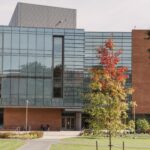
Banner image: UMBC’s campus in the fall. Photo by Marlayna Demond ‘11 for UMBC.
]]>
Six student groups recently vied for the top prize in UMBC’s annual Idea Competition, presenting to a panel of alumni judges their innovative solutions to everyday challenges. The competition,...
https://umbc.edu/stories/students-focus-on-mental-health-and-the-environment-in-2020-umbc-idea-competition/
https://beta.my.umbc.edu/api/v0/pixel/news/119736/guest@my.umbc.edu/8adfa250c885bcec3706d5a28ab7b83a/api/pixel
alexbrowncenter
coeit
community
csee
inds
is
UMBC News & Magazine
https://beta.my.umbc.edu/groups/umbc-news-magazine
https://assets1-beta.my.umbc.edu/system/shared/avatars/groups/000/001/943/24435aa6207c452e7bc15cc74b42c7bb/xsmall.png?1748556657
https://assets1-beta.my.umbc.edu/system/shared/avatars/groups/000/001/943/24435aa6207c452e7bc15cc74b42c7bb/original.png?1748556657
https://assets2-beta.my.umbc.edu/system/shared/avatars/groups/000/001/943/24435aa6207c452e7bc15cc74b42c7bb/xxlarge.png?1748556657
https://assets2-beta.my.umbc.edu/system/shared/avatars/groups/000/001/943/24435aa6207c452e7bc15cc74b42c7bb/xlarge.png?1748556657
https://assets3-beta.my.umbc.edu/system/shared/avatars/groups/000/001/943/24435aa6207c452e7bc15cc74b42c7bb/large.png?1748556657
https://assets1-beta.my.umbc.edu/system/shared/avatars/groups/000/001/943/24435aa6207c452e7bc15cc74b42c7bb/medium.png?1748556657
https://assets2-beta.my.umbc.edu/system/shared/avatars/groups/000/001/943/24435aa6207c452e7bc15cc74b42c7bb/small.png?1748556657
https://assets1-beta.my.umbc.edu/system/shared/avatars/groups/000/001/943/24435aa6207c452e7bc15cc74b42c7bb/xsmall.png?1748556657
https://assets2-beta.my.umbc.edu/system/shared/avatars/groups/000/001/943/24435aa6207c452e7bc15cc74b42c7bb/xxsmall.png?1748556657
UMBC News & Magazine
0
0
false
Tue, 01 Dec 2020 18:26:22 -0500
Reckoning with slavery: What a revolt’s archives tell us about who owns the past
By Marjoleine Kars, associate professor, history, UMBC
The consequences of 400 years of the Atlantic slave trade are still felt today. Untangling the power structures and systemic racism that came with slavery is ongoing, with police brutality, memorials to slave owners and reparations forming part of the discussion.
But as the United Nations marks Dec. 2 as the International Day for the Abolition of Slavery, a practice it notes “is not a merely a historic relic,” modern society also has to reckon with another question: Who has access to the records about slavery’s past?
I was struck by this question recently as I gave a Zoom talk in Guyana on my new book Blood on the River: A Chronicle of Mutiny and Freedom on the Wild Coast about a slave rebellion in Berbice, now Guyana, that took place in 1763-1764.
During the revolt, former slaves organized a government and controlled most of the colony for almost a year. The Dutch either fled altogether or holed up on a well-fortified sugar plantation near the coast. A regiment of European soldiers sent from neighboring Suriname mutinied and joined the rebels they had come to defeat. But obligated by treaties, indigenous peoples such as Carib and Arawak fought on the side of the Dutch. The revolt ended when the rebels, out of food and arms, were overpowered by enemies who had received an infusion of men and supplies from the Dutch Republic.
The uprising, unusual among Atlantic slave rebellions for its length, size and near success, is barely known outside Guyana. But even African-descended Guyanese, it turns out, know less than they would like. Almost 13,000 people, intrigued by new information about a foundational chapter in their history, had tuned in to watch my presentation on Facebook and Zoom.
A rare cache
First colonized in 1627 to trade with Amerindians, Berbice passed into the hands of an investment company 100 years later that exploited the colony, which was growing coffee, cacao and sugar.
Berbice became British Guyana in the early 19th century and gained independence as the English-speaking Cooperative Republic of Guyana in 1966. Modern-day Guyanese view the slave rebellion as the origin of their republican inclinations.
Yet, all of the records related to the rebellion – in fact, most of the country’s historical records – are in archives in London and The Hague.
The sources for the uprising are extensive. There are the usual colonial records, such as the colonial governor’s daily journal, letters from officials and merchants and military reports. They are tainted by self-interest, Euro-centrism and racism.
More rare in the history of Atlantic slavery are letters sent by rebel leader Kofi to his Dutch counterpart. An African from the Gold Coast who had been forcibly taken to Berbice as a child, Kofi sought to end the military conflict through diplomacy.
And then there are the extraordinary testimonies of 900 suspected rebels and bystanders. They were taken as part of the Dutch kangaroo court to investigate guilt in the rebellion and condemn people to the rack, the pyre and the gallows.
These records, too, are problematic. The people on the stand feared for their lives. A Dutch clerk translated their answers from Creole into Dutch, summarized them, and put them in the third person. Using them requires, like most historical records, great care.
Still, the testimonies represent the voices of African-Guyanese ancestors. But the manuscripts have lain in the Dutch National Archives since the 19th century. They are in standard Dutch rather than the Creole language of Dutch Berbice likely more prevalent among the enslaved population at the time, and their existence was heretofore unknown in Guyana.
Dodging rebellion
The copious records reveal not only the political course of the rebellion but how people felt about it. Many young men joined enthusiastically. Older people and Creoles (people born in the colony) had more to lose in terms of family and meager possessions and were more reluctant.
To remain on the sidelines, they lived quietly on their plantations, dodging anyone, whether Europeans, rebels or Amerindians, or by hiding in the savanna or rainforest until the coast was clear. They were motivated by a desire not only to survive but also to remain masterless and ungoverned.
In his letters to the Dutch, Kofi proposed dividing the colony in two. It seems likely that he intended to keep several sugar plantations in production, perhaps with forced labor, in order to participate in the world market. Some 30 years later, Haitian revolutionary Toussaint L’Ouverture, too, would force self-emancipated Haitians to work in the cane fields for similar reasons. Many ordinary Guyanese were not up for this.
Many revolt narratives would have us believe that people are eager to rebel, sharing a common vision of freedom. This is not always the case. It was not in the American Revolution, nor was it in Berbice.
An act of emancipation
At my Zoom lecture on Nov. 24, listeners asked many questions. But they were particularly interested in the court testimonies.
Why, some asked in the chat, were these records still housed in the National Archives in The Hague? Shouldn’t they have been gifted back, or better yet, transcribed and translated? That way, African-Guyanase would be able to interpret the records for themselves and tell their own stories.
As it happens, the Dutch National Archives recently put all of Berbice’s records online – but that does not solve the language problem. I was able to put my Guyanese host in touch with a staff member at the National Archives who seemed receptive to the idea of publishing a translation of the investigations in English.
Reckoning with slavery requires having access to the records of the past. After all, writing one’s own history, too, is an act of emancipation.
*****
Marjoleine Kars, Associate Professor of History, University of Maryland, Baltimore County
This article is republished from The Conversation under a Creative Commons license. Read the original article.
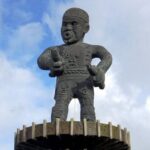
Header image: Statue of the Berbice slave revolt leader Kofi in Georgetown, Guyana. David Stanley – Flickr/WikiMedia, CC BY-SA
]]>
By Marjoleine Kars, associate professor, history, UMBC The consequences of 400 years of the Atlantic slave trade are still felt today. Untangling the power structures and systemic racism that...
https://umbc.edu/stories/reckoning-with-slavery-what-a-revolts-archives-tell-us-about-who-owns-the-past/
https://beta.my.umbc.edu/api/v0/pixel/news/119737/guest@my.umbc.edu/f31202786a91cc8e752b7cf7d678b508/api/pixel
cahss
discovery
history
the-conversation
UMBC News & Magazine
https://beta.my.umbc.edu/groups/umbc-news-magazine
https://assets1-beta.my.umbc.edu/system/shared/avatars/groups/000/001/943/24435aa6207c452e7bc15cc74b42c7bb/xsmall.png?1748556657
https://assets1-beta.my.umbc.edu/system/shared/avatars/groups/000/001/943/24435aa6207c452e7bc15cc74b42c7bb/original.png?1748556657
https://assets2-beta.my.umbc.edu/system/shared/avatars/groups/000/001/943/24435aa6207c452e7bc15cc74b42c7bb/xxlarge.png?1748556657
https://assets2-beta.my.umbc.edu/system/shared/avatars/groups/000/001/943/24435aa6207c452e7bc15cc74b42c7bb/xlarge.png?1748556657
https://assets3-beta.my.umbc.edu/system/shared/avatars/groups/000/001/943/24435aa6207c452e7bc15cc74b42c7bb/large.png?1748556657
https://assets1-beta.my.umbc.edu/system/shared/avatars/groups/000/001/943/24435aa6207c452e7bc15cc74b42c7bb/medium.png?1748556657
https://assets2-beta.my.umbc.edu/system/shared/avatars/groups/000/001/943/24435aa6207c452e7bc15cc74b42c7bb/small.png?1748556657
https://assets1-beta.my.umbc.edu/system/shared/avatars/groups/000/001/943/24435aa6207c452e7bc15cc74b42c7bb/xsmall.png?1748556657
https://assets2-beta.my.umbc.edu/system/shared/avatars/groups/000/001/943/24435aa6207c452e7bc15cc74b42c7bb/xxsmall.png?1748556657
UMBC News & Magazine
0
0
false
Tue, 01 Dec 2020 15:00:06 -0500
Meaningful Representation

Assigned an oral history project in 2007 for her master’s degree in community arts at Maryland Institute College of Art, Ashley Minner—now professor of the practice and folklorist in the Department of American Studies at UMBC—knew exactly who she would ask to interview. She walked across the street from her parents’ house and knocked on Uncle John’s door.
“There will never be a person like Uncle John,” says Minner, an enrolled member of the Lumbee Tribe of North Carolina. “I don’t know, he was just like that, always telling stories. He was a character. When he was younger, he had pork chop sideburns. He had a really thick Robeson County accent. He was a good man. I believe he was touched by God, he was—he is—a Lumbee Legend.”
Sharing their heritage with Baltimore
 Photo by Jill Fannon, M.F.A. ’11, for
 BmoreArt.
John Walker, if not a direct relative of Minner’s, played that role, telling her about their shared heritage and regaling her with stories of his youth in North Carolina, where many Lumbees moved from in the 1950s and ’60s to Baltimore in search of work. Minner’s subsequent research has helped tell the wider story of Lumbee migration to Baltimore, specifically to the neighborhoods of Upper Fells Point and Washington Hill, affectionately called “The Reservation.”
The original oral history project turned into a thesis of five artist books—which include transcriptions of five elders’ stories along with compiled photographs. This project grew into an exhibit at the Baltimore Museum of Industry in 2011 that featured five additional oral histories and cultural artifacts. It felt like the project could keep snowballing, says Minner. It was around this time, she noticed that more often the oral histories were being used at elders’ funerals.
“They became more precious after that,” she says, as the growing awareness of losing a generation began to sink in.
In fall 2019, Minner met with staff in UMBC Special Collections to discuss the creation of a home for her work and other Baltimore Lumbee related research and ephemera. To be housed in the Maryland Folklife Archives, Minner’s recordings will become part of “The Ashley Minner Collection,” along with other documents and photographs shared by tribal members.
Preserving people’s stories
“This collection really demonstrates how the University connects with the surrounding community in Baltimore,” says Beth Saunders, curator and head of UMBC’s Special Collections and Gallery. “In other words, we benefit from stronger ties to the community we serve. Ashley really dug into local archives and did the legwork and other researchers will be able to benefit from that.”
 Jeanette W. Jones holds a 1957 issue of
 Ebony
magazine, which features the article ‘Mystery People of Baltimore: Neither red, nor black, nor white. Strange ‘Indian’ tribe lives in world of its own.’ She is pictured at center, with her hand on her hip. Photo by Sean Scheidt ’05, visual arts.
Minner sees the archive as a necessary repository for stories and photographs, that otherwise might be lost as the Lumbees who previously lived and worked close together spread out into the counties surrounding Baltimore. “Ashley has a real, practical sense of the value of archives for preserving history and people’s stories,” says Saunders. “This new collection is an opportunity to preserve a part of that history that has been neglected and that she is bringing to broader awareness.”
Minner hopes the creation of the archive will encourage more Lumbees to dig into their past, while also finding pride in their present. ”We are made to feel as if we don’t belong on this landscape,” says Minner. “Many of our young people don’t know their history because frankly…their parents don’t know the history.”
“I think being able to point and explain and show pictures and ground them in the fact that our people have been here for close to a 100 years now and have really made contributions, that does something. That helps with security, self-esteem, and feeling empowered—like you do belong, like nobody lied to you. You are who you are.”
Ethics of community research
Minner bridges multiple spheres with her work—she’s an artist, a scholar, and also a granddaughter, a friend, a fellow tribal member. The only hat she can take off, as she puts it, is her UMBC hat. Otherwise, “what I’m doing and what I’m about is bigger than a job,” says Minner, “bigger than a job title or discipline.”
Part of having her feet in two worlds is training students how to develop holistic approaches to public scholarship and community collaboration. In Fall 2019, Minner was hired as the director of UMBC’s new public humanities minor. “We’re lifting up stories that get pushed to the margins,” says Minner. “And we spend a lot of time on ethics. The last thing I want to do is turn a bunch of college students loose on communities that might be harmed through the interaction.”
 The Baltimore American Indian Center, 113 S. Broadway, is the hub of cultural activities for area Indians. Photo by John Davis, The News American, October 24, 1985. Baltimore News American Photo Archive, Special Collections and University Archives, University of Maryland College Park. Permission granted for Minner’s use by the Hearst Corporation.
Minner is uniquely suited to the directorship, says Nicole King, associate professor and chair of the Department of American Studies. “Her broad range of experiences and skills, speaks to the many positions we all hold in our everyday lives. These human aspects are often flattened in an institutional context. Yet, Ashley is more than all of these credentials and roles because her practice focuses on seeing the humanity and beauty of everyday people and places. What Ashley offers to our students at UMBC is lived experiences that are both ordinary and extraordinary and an understanding of the connections between the two.”
From this perspective, Minner can see how outsiders often miss the mark when trying to tell the Baltimore Lumbee story. “They latch on to urban renewal and displacement,” explains Minner, “but the elders don’t see it that way. They’re not victims, that’s not the story they want to tell. It’s important to teach folks to listen deeply and to check in and make sure people are being represented the way they want to be represented.”
A memorable occasion
Minner has a story, one of her own that’s stuck with her as she’s watched her research expand through a process she describes as “pretty serendipitous.” Aunt Jeanette Walker Jones, Uncle John’s widow, says Minner, was instrumental in connecting Minner to her heritage. When Minner and her best friend, Nicole—Aunt Jeanette’s granddaughter—were 4 or 5 years old, she took them to have ribbon dresses made.
The fabric for the dresses was light pink with teepees on it and the ribbons adorning it were white, black, and hot pink, remembers Minner. They attended an event at the former Festival Hall downtown—an annual pow wow put on by the Baltimore American Indian Center. “We were out there hopping around; we didn’t know what we were doing. Some Indian guy looked at my mom, and when she nodded at him, he scooped me up and held my hand while I danced with him. I was like ‘ahhhh,’” she says, making an excitedly terrified face. “It was a thrill!”
******
Header image: The Inter-Tribal Restaurant was owned and operated by the Baltimore American Indian Center in the unit block of South Broadway. Photo courtesy of the Baltimore American Indian Center, provided by Minner.
]]>
Assigned an oral history project in 2007 for her master’s degree in community arts at Maryland Institute College of Art, Ashley Minner—now professor of the practice and folklorist in the...
https://umbc.edu/stories/meaningful-representation/
https://beta.my.umbc.edu/api/v0/pixel/news/119738/guest@my.umbc.edu/49b08a27a2100d4afcf70d7e26c953eb/api/pixel
american-studies
cahss
discovery
fall-2020
professorsnottomiss
public-humanities
UMBC News & Magazine
https://beta.my.umbc.edu/groups/umbc-news-magazine
https://assets1-beta.my.umbc.edu/system/shared/avatars/groups/000/001/943/24435aa6207c452e7bc15cc74b42c7bb/xsmall.png?1748556657
https://assets1-beta.my.umbc.edu/system/shared/avatars/groups/000/001/943/24435aa6207c452e7bc15cc74b42c7bb/original.png?1748556657
https://assets2-beta.my.umbc.edu/system/shared/avatars/groups/000/001/943/24435aa6207c452e7bc15cc74b42c7bb/xxlarge.png?1748556657
https://assets2-beta.my.umbc.edu/system/shared/avatars/groups/000/001/943/24435aa6207c452e7bc15cc74b42c7bb/xlarge.png?1748556657
https://assets3-beta.my.umbc.edu/system/shared/avatars/groups/000/001/943/24435aa6207c452e7bc15cc74b42c7bb/large.png?1748556657
https://assets1-beta.my.umbc.edu/system/shared/avatars/groups/000/001/943/24435aa6207c452e7bc15cc74b42c7bb/medium.png?1748556657
https://assets2-beta.my.umbc.edu/system/shared/avatars/groups/000/001/943/24435aa6207c452e7bc15cc74b42c7bb/small.png?1748556657
https://assets1-beta.my.umbc.edu/system/shared/avatars/groups/000/001/943/24435aa6207c452e7bc15cc74b42c7bb/xsmall.png?1748556657
https://assets2-beta.my.umbc.edu/system/shared/avatars/groups/000/001/943/24435aa6207c452e7bc15cc74b42c7bb/xxsmall.png?1748556657
UMBC News & Magazine
0
0
false
Wed, 25 Nov 2020 19:36:45 -0500
Poland’s anti-abortion push highlights pandemic risks to democracy

By Brian Grodsky, professor, Political Science, UMBC
Hundreds of thousands of Poles have taken to the streets since late October, defying bans on mass gatherings and risks from the COVID-19 pandemic to protest the government.
An immediate concern for protesters is the implementation of abortion regulations that would in effect end a woman’s choice to terminate a pregnancy in almost all cases.
But the demonstrations also, I argue, mark a concerted effort to protect Polish democracy from a deliberate attack by the ruling United Right coalition, led by the right-wing Law and Justice party known as PiS.
PiS has sought to tighten Poland’s already restrictive abortion laws since coming to power in 2015. After repeatedly failing to pass new abortion legislation, the party bypassed the democratically elected parliament and appealed to the unelected Constitutional Court to reinterpret the existing law. That court, packed with Law and Justice loyalists, criminalized abortion even in cases of severe fetal deformities on Oct. 22.
The latest move, according to members of the opposition and nonpartisan human rights observers, was an effort to push forward with a highly contentious agenda under the cover of COVID-19 restrictions. Hillary Margolis, senior women’s rights researcher at Human Rights Watch, said: “The chaos and anxiety surrounding COVID-19 shouldn’t be used as a distraction from harmful attempts to push through dangerous legislation.”
As a scholar who studies efforts to undermine democracy and has spent several years in Poland, I see echoes of PiS’s behavior elsewhere. Since the start of the COVID-19 pandemic, various authoritarian leaders, including Turkey’s President Recep Tayyip Erdogan and Cambodia’s Hun Sen, have been accused of using the global health disaster as a convenient tool to grab more power. The Poland case demonstrates how even purported democrats may be willing to use the emergency to push their agendas at a time when people’s democratic right to protest may be curtailed over concerns over the spread of disease.
Indeed, Polish Prime Minister Mateusz Morawiecki suggested that in protesting, those against the new restrictions were putting their mothers and fathers at risk from the disease.
Road to restrictions
PiS rose to power in the mid-2000s by claiming postcommunist elites had a stranglehold on the state and its various institutions. It was an anti-establishment party that promised to liberate ordinary Poles and embrace traditional Catholic values long associated with Polish identity. PiS’s decision to align itself closely with the church plays especially well in its nonurban base.
While PiS had its first taste of governing in a coalition that lasted from just 2005 to 2007, it was in 2015 that PiS won its first parliamentary majority. The party’s rise was fueled by its anti-migrant policies and promises to counter the “destructive ideology” of the LGBTQ community.
Since then, PiS also gained popularity by lavishing its constituents with generous welfare benefits, including higher pensions, tax breaks for low-income earners and a policy that pays parents to have more children. Thanks to these policies, PiS maintained its parliamentary majority in the 2019 elections, assisted by the support of the church.
Over its five years in power, PiS has been accused by critics of methodically attacking the basic liberal institutions Poland once so confidently modeled for others in the region. For example, the government has been accused of harassing nongovernmental organizations and limiting media freedoms.
It has also weakened state institutions, particularly the courts. At the start of this year, a group of Polish judges led thousands of people in a march against government efforts to undermine judicial independence. The judges were unable to stop PiS from stacking the Constitutional Tribunal with judges loyal to the party – and, it turns out, ready to implement the government’s abortion policies.
The abortion agenda
Poland’s democracy has remained vibrant enough to prevent PiS from successfully pushing through unpopular policies, including the legislation of a more restrictive abortion law. Although PiS holds a majority in the powerful lower house of parliament, for example, the opposition narrowly controls the weaker upper house.
Up until last month, Poland allowed abortions only as a result of fetal abnormalities, as well as rape, incest or a direct threat to the mother’s health. PiS attempts to tighten the laws in 2016 and 2017 failed amid public protests. Fewer than half of Poles support the draconian abortion rules pushed by PiS. This reflects the reality that while most Poles identify as Catholics, only a fraction are deeply religious.
This spring, in the run-up to presidential elections, legislators on the right acknowledged as much. Rather than fight for restrictions, they quietly sent a pending abortion bill back to committee. After President Andrzej Duda – supported by PiS – was reelected in July, lawmakers adopted a new strategy. They would skirt the democratically elected legislature and instead ask the Constitutional Tribunal they had stacked to reconsider the country’s existing 1993 abortion law.
Concerns over how PiS has changed the Polish judiciary – through measures including taking over the council that appoints judges and banning judges from criticizing the government – have grown in recent years. Earlier this year, Małgorzata Gersdorf, first president of the Supreme Court, went as far as to say that Poland is no longer “a democracy based on the rule of law.”
The Oct. 22 court decision to ban almost all abortions, even in cases of severe fetal deformities, ignited the opposition.
Democracy on the line
The timing of the decision – coming just as citizens were being advised to socially distance because of the pandemic – was, observers say, no mistake. The hundreds of thousands of Poles who took to the streets did so at great risk. With bans on public gatherings, protesters risk not only their health, but also fines of 5,000 to 30,000 złoty (nearly US$8,000). Hundreds were punished in the first days for disobeying the ban on gatherings and many more have been punished since.
The move to bypass democratic institutions amid a pandemic is eerily familiar to authoritarian watchers. Numerous authoritarian regimes have used COVID-19 to silence critics. What’s different is that Poland is still a democracy, albeit a flawed one. It is not authoritarian China, not even semi-authoritarian Hungary, where the country’s illiberal prime minister has severely undermined democracy during his decade in power.
And Poland is not the only democracy where leaders have been accused of trying to push through agendas while people may be distracted with fighting the pandemic.
In India, the ruling right-wing Bharatiya Janata Party has fueled conspiracy theories that the Muslim minority is intentionally spreading COVID-19. The United States has been accused of using the outbreak as an excuse to unlawfully expel unaccompanied migrant children. Israel has begun using data designed to track potential terrorists to track everyday citizens. And Australian police arrested Black Lives Matter participants protesting the deaths of aboriginal people in custody on the pretext that they breached coronavirus protection measures.
The risk is that as the coronavirus crisis drags on through the winter, leaders in democracies will continue to use the pandemic to take nondemocratic shortcuts to achieve their goals. They may be tempted to respond to public anger as the Polish prime minister did: “I am asking for these protests to be canceled because of the epidemic.”
The silver lining
Still, the recent Polish demonstrations – the largest since the trade union-led umbrella movement Solidarity’s showdown with Communists in the 1980s – demonstrate democracy’s potential resilience.
Indeed, democracy appears to be winning. After a week of protests President Duda suggested he might reintroduce less severe abortion legislation. A few days later, the government promised it would delay implementation of the ban. The cover of COVID-19 may not be enough for PiS to overcome democratic checks and balances in Poland, especially in the face of sustained protest and plummeting support.
*****
Brian Grodsky, Professor of Political Science, University of Maryland, Baltimore County
Header image: A protest in Poland. Photo by Michał Turkiewicz on Unsplash
This article is republished from The Conversation under a Creative Commons license. Read the original article.
]]>
By Brian Grodsky, professor, Political Science, UMBC Hundreds of thousands of Poles have taken to the streets since late October, defying bans on mass gatherings and risks from the COVID-19...
https://umbc.edu/stories/polands-anti-abortion-push-highlights-pandemic-risks-to-democracy/
https://beta.my.umbc.edu/api/v0/pixel/news/119739/guest@my.umbc.edu/8c5b8e39a0c36d482ccf43b34d97f9a6/api/pixel
cahss
perspectives
political-science
the-conversation
UMBC News & Magazine
https://beta.my.umbc.edu/groups/umbc-news-magazine
https://assets1-beta.my.umbc.edu/system/shared/avatars/groups/000/001/943/24435aa6207c452e7bc15cc74b42c7bb/xsmall.png?1748556657
https://assets1-beta.my.umbc.edu/system/shared/avatars/groups/000/001/943/24435aa6207c452e7bc15cc74b42c7bb/original.png?1748556657
https://assets2-beta.my.umbc.edu/system/shared/avatars/groups/000/001/943/24435aa6207c452e7bc15cc74b42c7bb/xxlarge.png?1748556657
https://assets2-beta.my.umbc.edu/system/shared/avatars/groups/000/001/943/24435aa6207c452e7bc15cc74b42c7bb/xlarge.png?1748556657
https://assets3-beta.my.umbc.edu/system/shared/avatars/groups/000/001/943/24435aa6207c452e7bc15cc74b42c7bb/large.png?1748556657
https://assets1-beta.my.umbc.edu/system/shared/avatars/groups/000/001/943/24435aa6207c452e7bc15cc74b42c7bb/medium.png?1748556657
https://assets2-beta.my.umbc.edu/system/shared/avatars/groups/000/001/943/24435aa6207c452e7bc15cc74b42c7bb/small.png?1748556657
https://assets1-beta.my.umbc.edu/system/shared/avatars/groups/000/001/943/24435aa6207c452e7bc15cc74b42c7bb/xsmall.png?1748556657
https://assets2-beta.my.umbc.edu/system/shared/avatars/groups/000/001/943/24435aa6207c452e7bc15cc74b42c7bb/xxsmall.png?1748556657
UMBC News & Magazine
0
0
false
Wed, 25 Nov 2020 14:51:38 -0500
It’s not just ABCs – preschool parents worry their kids are missing out on critical social skills during the pandemic

By Michele L. Stites, assistant professor, Early Childhood Education, UMBC and Susan Sonnenschein, professor, Applied Developmental Psychology, UMBC. Samantha H. Galczyk, graduate assistant, UMBC, contributed to this report.
As COVID-19 cases once again spike across the country, parents in school districts like New York City and Detroit face another weeks long stretch of remote learning. This often includes preschool parents, whose children range in age from 3 to 6 and are often too young to manage virtual learning on their own.
Many of these parents worry their children are missing out on important parts of the preschool experience – particularly opportunities to develop social, emotional and behavioral skills through interactions with teachers and other children.
As researchers who study children’s educational development, we know that preschool helps children develop important academic and social skills they will need for later school success. In April, we surveyed 166 parents of preschool children to examine what they felt was working – and not working – with distance learning. While the data haven’t been published yet, they give us important insights into virtual preschool.
Of the 166 parents who responded to our online survey, 73% said their preschool children were provided virtual learning opportunities during the COVID-19 crisis. The children were expected to devote 30 to 60 minutes a day to virtual classes. Two-thirds of parents said they supplemented the school lessons with in-home learning activities, although these primarily focused on reading, not math.
Thirty-seven percent of the parents felt children this age were too young to engage in online instruction without significant support from their caregivers. And 38% of parents reported not having the time to dedicate to distance learning while juggling the demands of work and other child care.
The parents we surveyed recognize that teachers and administrators are doing the best they can in this ever-changing and extraordinary situation. Their frustration and anxiety result from the virtual learning environment itself and the lack of resources to develop children’s social, emotional and behavioral learning along with early academic skills.
Preschool classrooms provide opportunities to build social skills like taking turns, waiting until others finish speaking and displaying empathy. These skills enable children to develop friendships, cope with challenges and have conversations with other children and adults.
Suggestions for parents
Based on the results of our survey, here are some ways parents can help make up for the shortcomings of virtual learning.
-
Play games. Games often teach reading and math skills, but more importantly, they allow for social development. Model turn-taking for the child and how to handle losing.
-
Take nature walks. Identifying objects and thinking about sounds, shapes and colors helps with early academics. But also take the time to have conversations. Talking about feelings is important, especially right now.
-
Read. It’s widely accepted that reading helps children, well, learn to read. But it also gives them world knowledge and makes for enjoyable interactions with others. And, it can be used as time to work on math skills like counting and shapes. (More math suggestions are available here.) From a social aspect, it’s a good time to talk about a character’s feelings and ask the child questions like, “How would you feel?” and “What would you do if you were this character?”
-
Make video calls. Set up virtual play dates allowing your child to talk to friends or relatives. Ask a grandparent to read a book with the child on FaceTime. Have the child play a game with a friend over Zoom.
-
Talk about your own feelings. Model coping and dealing with challenges with your child. Don’t be afraid to tell your child when you are sad or worried. Ask the child what they would do if they were feeling sad.
Suggestions for teachers
And here are some ways that preschool teachers can support parents in their children’s learning and development during COVID-19.
-
Help develop social skills. The parents we surveyed wanted short exercises to build social skills while students learn remotely. These activities would help students develop friendships, social norms and emotional awareness. For example, reading a book together as a class over Zoom and sharing personal experiences prompts natural conversation. Another idea is to send home stories in which a specific social dilemma like anger is discussed. Children can read and discuss the stories with a caregiver.
-
Offer supplementary materials. Parents said they are supplementing school lessons with in-home learning activities. However, these activities typically focused on reading, with less attention devoted to math. Over half of parents said they did reading activities on a regular basis, but only 33% said they worked on math skills – which often predict later school success. By supplying the resources and materials, teachers can take out the guesswork for parents.
-
Combine reading, math and social growth in short activities. For example, when sending home suggestions for books, point out where math opportunities – like counting certain items – and social dilemmas occur in the story. Combining lessons also makes it more efficient for parents to cover all three areas, which is important when they are balancing so many additional responsibilities.
Although academic instruction in preschool is important – and math especially should not be forgotten – teachers and parents agree that social interactions are critical at this age. And in a time of remote learning, social distancing and quarantines, keeping young children emotionally healthy, as well as physically healthy, is critical.
*****
Michele L. Stites, Assistant Professor of Early Childhood Education, University of Maryland, Baltimore County and Susan Sonnenschein, Professor, Applied Developmental Psychology, University of Maryland, Baltimore County Samantha H. Galczyk, graduate assistant, UMBC, contributed to this report.
Header image: Preschool is an opportunity to develop important social skills like taking turns, working in groups and making friends. John Tlumacki/The Boston Globe via Getty Images
This article is republished from The Conversation under a Creative Commons license. Read the original article.
]]>
By Michele L. Stites, assistant professor, Early Childhood Education, UMBC and Susan Sonnenschein, professor, Applied Developmental Psychology, UMBC. Samantha H. Galczyk, graduate assistant, UMBC,...
https://umbc.edu/stories/its-not-just-abcs-preschool-parents-worry-their-kids-are-missing-out-on-critical-social-skills-during-the-pandemic/
https://beta.my.umbc.edu/api/v0/pixel/news/119740/guest@my.umbc.edu/bbaf4498a4e04b132cbc54428b39b9c6/api/pixel
cahss
discovery
early-childhood-education
psychology
the-conversation
UMBC News & Magazine
https://beta.my.umbc.edu/groups/umbc-news-magazine
https://assets1-beta.my.umbc.edu/system/shared/avatars/groups/000/001/943/24435aa6207c452e7bc15cc74b42c7bb/xsmall.png?1748556657
https://assets1-beta.my.umbc.edu/system/shared/avatars/groups/000/001/943/24435aa6207c452e7bc15cc74b42c7bb/original.png?1748556657
https://assets2-beta.my.umbc.edu/system/shared/avatars/groups/000/001/943/24435aa6207c452e7bc15cc74b42c7bb/xxlarge.png?1748556657
https://assets2-beta.my.umbc.edu/system/shared/avatars/groups/000/001/943/24435aa6207c452e7bc15cc74b42c7bb/xlarge.png?1748556657
https://assets3-beta.my.umbc.edu/system/shared/avatars/groups/000/001/943/24435aa6207c452e7bc15cc74b42c7bb/large.png?1748556657
https://assets1-beta.my.umbc.edu/system/shared/avatars/groups/000/001/943/24435aa6207c452e7bc15cc74b42c7bb/medium.png?1748556657
https://assets2-beta.my.umbc.edu/system/shared/avatars/groups/000/001/943/24435aa6207c452e7bc15cc74b42c7bb/small.png?1748556657
https://assets1-beta.my.umbc.edu/system/shared/avatars/groups/000/001/943/24435aa6207c452e7bc15cc74b42c7bb/xsmall.png?1748556657
https://assets2-beta.my.umbc.edu/system/shared/avatars/groups/000/001/943/24435aa6207c452e7bc15cc74b42c7bb/xxsmall.png?1748556657
UMBC News & Magazine
0
0
false
Wed, 25 Nov 2020 14:38:23 -0500
BARD Fund honors UMBC’s Yonathan Zohar for aquaculture research with $12B global economic impact
The Binational Agricultural Research Development (BARD) Fund, a partnership program between the U.S. and Israel, has recognized Yonathan Zohar for the economic impact of his research. In a review of more than 1,300 projects funded by BARD in its 40-year existence, the selection committee found Zohar’s to be the project with the greatest impact.
Zohar’s research has enabled high-value commercial fish species such as Mediterranean seabream, European seabass (bronzino), salmon, and striped bass to be grown through hatchery-based aquaculture. This has resulted in an estimated $12 billion in economic growth. A virtual ceremony on November 10 recognized Zohar and representatives of two other projects.
Zohar, professor and chair of marine biotechnology at UMBC, received his first BARD grant in 1985 to investigate how fish reproduction is biologically controlled. Hatchery-based aquaculture was largely impossible at the time, because commercial species would not spawn in captivity. Instead, fish farmers relied on egg-bearing females collected from the wild to supply an often-unreliable source of eggs. Zohar’s work sought to help the aquaculture industry address this bottleneck by enabling captive reproduction.
“Without being able to complete the life cycle of the fish in captivity, namely producing eggs and juveniles, it is impossible to develop a reliable, reproducible, and cost-effective aquaculture industry of the species,” Zohar explains.
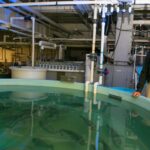
 Yoni Zohar (left) and Jorge Gomezjurado at the IMET Aquaculture Research Facility.
Never give up
A suite of environmental conditions initiates reproduction in the wild by triggering a series of hormonal responses. Rather than try to replicate a complex set of environmental factors in captivity, Zohar’s research aimed to determine how the necessary hormones were failing to initiate spawning in captive fish.
The result was surprisingly simple: He found a single hormone was responsible for jumpstarting a cascade of physiological processes that leads to reproduction, and this hormone malfunctioned in captivity. However, simply injecting captive fish with this hormone proved not enough to trigger reproduction.
Zohar was undeterred. Through painstaking, labor-intensive experiments (technology was much more limited in the 1980s), he found that the fish quickly degraded the injected hormone. It wasn’t staying in the fish’s system long enough to stimulate reproduction.
After additional years of difficult work, Zohar was able to generate versions of the hormone that wouldn’t degrade in the fish. With this treatment, some females produced eggs, but the results still weren’t reproducible enough to be viable on a large scale.
 The Institute of Marine and Environmental Technology, a collaboration between UMBC; University of Maryland, Baltimore; and University of Maryland Center for Environmental Science, in Baltimore’s Inner Harbor.
Transforming an industry
At this point, Zohar began to collaborate with Robert Langer, a chemical engineering professor at MIT and a pioneer in drug delivery systems. With a second round of funding from BARD in 1989, together they developed a delivery mechanism for the hormone that creates an extended-release effect, keeping the hormone in the fish’s system longer and—finally—reliably triggering reproduction.
For Langer, seeing his typically biomedical-focused work applied to the aquaculture industry is rewarding. “Now I’ve seen the drug delivery work that we started 46 years ago impact everything from the COVID-19 vaccine, to new treatments for cancer and heart disease, to cosmetics—and now aquaculture,” Langer says. “I’ve always felt the technology we developed would have a very broad impact and affect many fields, but the effect it has had on aquaculture would never have happened without the collaboration with Yoni.”
After developing the delivery system in Mediterranean seabream and Atlantic salmon, Zohar and colleagues successfully tweaked it for many other species. These advances enabled rapid growth and transformation in the aquaculture industry, delivering large amounts of a protein source and reducing overfishing of wild stocks.
 Yonathan Zohar at the IMET Aquaculture Research Center with one of the fish tanks.
Keeping the mission in mind
Zohar is originally from Israel and has been in the United States since 1990, and he has been both the Israeli and American collaborator on grants from BARD. “I was always interested in developing collaborations between the U.S. and Israel, so for me, it was a priority to apply for BARD grants over the years,” he says.
For three decades, Zohar has been a mainstay of the marine biotechnology research community in Maryland. He first took a role at the former Center of Marine Biotechnology (COMB) housed in the Columbus Center in Baltimore’s Inner Harbor. Later, he served as COMB director for 14 years. When COMB restructured into the Institute of Marine and Environmental Technology (IMET) in 2011, Zohar joined the UMBC faculty while also serving as IMET’s director for its first year. Today he is professor and chair of UMBC’s marine biotechnology department.
Throughout his career, Zohar has kept his mission in mind. “When COMB was founded, the mission was always research, education, and economic development. And IMET is the same. This has really been my emphasis, my focus, for all of my professional life,” he says. “I was always involved in research that addressed societal benefits. As one of the early directors of COMB, I really worked to develop this philosophy of basic to translational research.”
What has kept Zohar in Maryland for thirty years, working to address societal needs and support a growing economy through science? “I found the environment here very conducive to that mission, and very supportive of it,” Zohar says. “So, I stayed.”
Header image: Yonathan Zohar at the Aquaculture Research Center at the Institute of Marine and Environmental Technology. All photos by Marlayna Demond ’11 for UMBC.
]]>
The Binational Agricultural Research Development (BARD) Fund, a partnership program between the U.S. and Israel, has recognized Yonathan Zohar for the economic impact of his research. In a review...
https://umbc.edu/stories/bard-fund-honors-umbcs-yonathan-zohar-for-aquaculture-research-with-12b-global-economic-impact/
https://beta.my.umbc.edu/api/v0/pixel/news/119741/guest@my.umbc.edu/fb149d30a45f022a0558fb9436caff18/api/pixel
cnms
marinebiotech
research
science-and-technology
UMBC News & Magazine
https://beta.my.umbc.edu/groups/umbc-news-magazine
https://assets1-beta.my.umbc.edu/system/shared/avatars/groups/000/001/943/24435aa6207c452e7bc15cc74b42c7bb/xsmall.png?1748556657
https://assets1-beta.my.umbc.edu/system/shared/avatars/groups/000/001/943/24435aa6207c452e7bc15cc74b42c7bb/original.png?1748556657
https://assets2-beta.my.umbc.edu/system/shared/avatars/groups/000/001/943/24435aa6207c452e7bc15cc74b42c7bb/xxlarge.png?1748556657
https://assets2-beta.my.umbc.edu/system/shared/avatars/groups/000/001/943/24435aa6207c452e7bc15cc74b42c7bb/xlarge.png?1748556657
https://assets3-beta.my.umbc.edu/system/shared/avatars/groups/000/001/943/24435aa6207c452e7bc15cc74b42c7bb/large.png?1748556657
https://assets1-beta.my.umbc.edu/system/shared/avatars/groups/000/001/943/24435aa6207c452e7bc15cc74b42c7bb/medium.png?1748556657
https://assets2-beta.my.umbc.edu/system/shared/avatars/groups/000/001/943/24435aa6207c452e7bc15cc74b42c7bb/small.png?1748556657
https://assets1-beta.my.umbc.edu/system/shared/avatars/groups/000/001/943/24435aa6207c452e7bc15cc74b42c7bb/xsmall.png?1748556657
https://assets2-beta.my.umbc.edu/system/shared/avatars/groups/000/001/943/24435aa6207c452e7bc15cc74b42c7bb/xxsmall.png?1748556657
UMBC News & Magazine
0
0
false
Tue, 24 Nov 2020 23:38:30 -0500
HackUMBC goes virtual in a big way, attracting over 1,000 students

More than 1,000 students from institutions across the country and around the world—from as far away as Kazakhstan, Albania, Spain, and Nigeria—logged onto their computers for a 36-hour hackathon organized by UMBC students, November 13-15.
HackUMBC’s events typically draw huge crowds overflowing conference spaces. This year, the event was held virtually for the first time due to COVID-19. HackUMBC President Anuhya Challagundla ‘21, information systems, says that she was pleased to see participation remain so strong.

Anuhya Challagundla. Photo courtesy of Challagundla.
Challagundla explains that the HackUMBC team was able to connect participants with each other through the HackUMBC Discord channel launched the week before the event. There, they formed teams and discussed ideas for hacks under the themes of connection, healthcare, education, equity, and hobbies (as well as a general track to allow for limitless creativity).
Collaboration in virtual environments
Participants developed web, mobile, desktop, and hardware projects. While independent participants were allowed, students were encouraged to form teams of 2-4 people to make it a collaborative experience.
Perry Vinner ’21, information systems, an organizer on the HackUMBC team, created a virtual campus that was based on UMBC in the Gather.Town platform. The virtual UMBC featured tents and other spaces that allowed participants to move from one place to another easily. Over the course of the weekend, approximately 2,700 viewers tuned in to experience a livestream of the online event.
The event also featured an interactive online space to access resources and event elements beyond the competition, including a career fair, a hallmark of HackUMBC.
Innovative spirit
HackUMBC alumni judged entries based on 3-minute videos that each team submitted. They evaluated the projects’ creativity, technical difficulty, usefulness, and professional “polish.” The judges were able to speak directly with their top three teams to learn more about the hacks that they created and to determine the winners of each category.
A team of UMBC students developed Office Hour Bot, a streamlined way to hold online office hours when face-to-face meetings are not possible. The bot, which was created using Discord, allows people to take on various roles within the platform, like professor, teaching assistant, and student. Office Hour Bot allows faculty and teaching assistants to open and close their office hours, and prioritizes students in the queue depending on a range of criteria. It also prevents students not in a course from joining the office hours designated for that course.
Another student team developed a video calling platform that matches people into group calls in real-time. The Dinner for 4 Strangers app matches individuals based on mutual interests and allows them to connect via video calls. The app provides participants with prompts and ideas to guide conversations, as a way to establish connections and have meaningful interactions with each other. Creators of the app how it will help users combat loneliness and isolation, especially during the COVID-19 pandemic.
A third hack the judges recognized was Expen, a budgeting app that allows users to track and chart their income and expenses. Expen also allows users to scan barcodes of items, rather than having to manually enter product details, and to search for items that are already in the system.
Unique prize for collaboration tech
T. Rowe Price, one of HackUMBC’s top sponsors, invited students to develop a hack that addressed the theme of collaboration technology. Each member of the winning team in this category would receive a unique prize: a chance to connect with a professional in their field.
The Best Use of Collaboration Technology prize went to the Office Hour Bot team, including Gabby Khan ‘22, computer science; Oliver Dininno ‘22, computer science; and Eddie Nieberding ‘22, computer science. T. Rowe Price representatives had an opportunity to meet with Khan, Dininno, and Nieberding to learn about Office Hours Bot during HackUMBC. In early 2021, the company will schedule a personalized virtual meeting for each student with a member of their Technology Management Committee, based on areas of interest.
Benefits of hybrid event
Thanks to the student organizers’ innovative spirit and ability to pivot to an online format, Challagundla says, “It was a super fun and exciting event.” It also had unexpected benefits, allowing more students to participate and to establish connections with companies, regardless of where they or those employers were located.
Even if the event can be in person next year, she says, it will likely be a hybrid event to replicate the most valuable elements of the online format.
Banner image: The virtual UMBC town that the HackUMBC organizers created online.
]]>
More than 1,000 students from institutions across the country and around the world—from as far away as Kazakhstan, Albania, Spain, and Nigeria—logged onto their computers for a 36-hour hackathon...
https://umbc.edu/stories/hackumbc-goes-virtual-in-a-big-way-attracting-over-1000-students/
https://beta.my.umbc.edu/api/v0/pixel/news/119742/guest@my.umbc.edu/fb4cc7df698a6c8bc14503a2828e613c/api/pixel
coeit
community
science-and-technology
UMBC News & Magazine
https://beta.my.umbc.edu/groups/umbc-news-magazine
https://assets1-beta.my.umbc.edu/system/shared/avatars/groups/000/001/943/24435aa6207c452e7bc15cc74b42c7bb/xsmall.png?1748556657
https://assets1-beta.my.umbc.edu/system/shared/avatars/groups/000/001/943/24435aa6207c452e7bc15cc74b42c7bb/original.png?1748556657
https://assets2-beta.my.umbc.edu/system/shared/avatars/groups/000/001/943/24435aa6207c452e7bc15cc74b42c7bb/xxlarge.png?1748556657
https://assets2-beta.my.umbc.edu/system/shared/avatars/groups/000/001/943/24435aa6207c452e7bc15cc74b42c7bb/xlarge.png?1748556657
https://assets3-beta.my.umbc.edu/system/shared/avatars/groups/000/001/943/24435aa6207c452e7bc15cc74b42c7bb/large.png?1748556657
https://assets1-beta.my.umbc.edu/system/shared/avatars/groups/000/001/943/24435aa6207c452e7bc15cc74b42c7bb/medium.png?1748556657
https://assets2-beta.my.umbc.edu/system/shared/avatars/groups/000/001/943/24435aa6207c452e7bc15cc74b42c7bb/small.png?1748556657
https://assets1-beta.my.umbc.edu/system/shared/avatars/groups/000/001/943/24435aa6207c452e7bc15cc74b42c7bb/xsmall.png?1748556657
https://assets2-beta.my.umbc.edu/system/shared/avatars/groups/000/001/943/24435aa6207c452e7bc15cc74b42c7bb/xxsmall.png?1748556657
UMBC News & Magazine
0
0
false
Mon, 23 Nov 2020 20:23:49 -0500


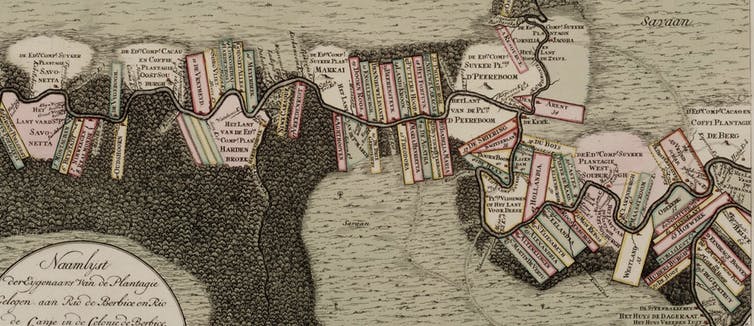 1742 map of Berbice River with plantations.
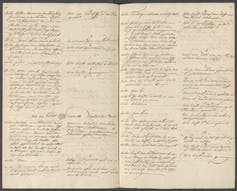 Page from investigation into Berbice revolt.