UMBC’s Faith Davis is named a 2021 Newman Civic Fellow for work on healthcare, food, and housing insecurity

Faith Davis ‘22, M30, sociology and biological sciences, grew up in Mechanicsville, a small town in Maryland. Her family regularly welcomed people in need of temporary housing into their home. This shaped her sense of how housing and income insecurity affect people, but did not prepare her for the shock she felt at seeing the scale of people living without housing in Washington D.C. while visiting the capital as a teenager.
That was a deciding moment for Davis. She wanted to understand the underlying factors of why homelessness persists widely and at such high rates, and she was determined to find sustainable interventions. She has invested the last three years researching food and housing insecurity both on campus and in Baltimore City, as well as working with community organizations to implement interventions. In recognition of her engaged leadership and long-term commitment to this work, Campus Compact Mid-Atlantic (CCMA) has named Faith Davis a 2021 Newman Civic Fellow.

Faith Davis.
Photo courtesy of Davis.
“While I have spent a great deal of my time at UMBC conducting scientific research and taking advanced chemistry and biology coursework, I have also tried to engage with the campus community and the surrounding community,” shares Davis, who is a Meyerhoff Scholar. “Being selected as this year’s Newman Civic Fellow means UMBC recognizes my efforts to change the world in a positive way.”

Davis (first row on the right) volunteering at the Meyerhoff Scholars Program 30th Anniversary Celebration.
Photo courtesy of Davis.
Davis is the most recent in a long line of UMBC students who have earned Newman Civic Fellowships in recognition of their dedication to public service. They include Nihira Mugamba ‘21, political science and Africana studies; Maheen Haq ‘20, global studies and economics; Stephanie Milani ‘19, computer science and psychology; Sophia Lopresti ‘17, global studies; Maxwell Poole ‘18, computer science; economics; and Kelly Cyr ‘12, biological sciences, and M.S. ’13, applied molecular biology.
Civic action
Davis joined UMBC’s Center for Democracy and Civic Life’s (CDCL) Alternative Spring Break (ASB) program as a participant in her first year on campus and as a leader every year after. ASB is an immersive learning experience in which participants explore the systemic and human dimensions of complex social issues in Baltimore. Through UMBC’s Shriver Center, ASB students participate in a service-learning course to learn how to best foster sustainable, long-term connections with local communities.

Faith Davis (back row, first on the left) at a community organization in Baltimore City
during ASB 2019.
Photo courtesy of Davis.
Her first ASB project focused on housing insecurity in Baltimore. “I learned that the most common causes of death for people experiencing homelessness are conditions that could have been easily treatable,” explains Davis.
As an ASB leader her sophomore and junior years, she helped design projects focused on how structural barriers to the availability of nutritious food impact residents’ overall health, education, and well-being in Baltimore, as well as approaches to achieving nutritional equity. Davis has also facilitated several of CDCL’s programs such as the Change Makers Dinners, where she leads discussions addressing nutrition and food access and on women’s political empowerment.

ASB 2019 symposium (Davis is first on the right).
Photo courtesy of David Hoffman.
Research to address healthcare access
Davis’s work in ASB increased her awareness of the challenges that people experiencing homelessnes face in accessing preventative healthcare and basic information about chronic health issues. “I had the opportunity to survey the health resources available in Baltimore City,” shares Davis. “There was a noticeable gap when it came to providing basic health information.”
Davis designed a research project to develop a model that could both assess individuals’ current state of health and connect them with groups who could follow up with free medical services. She received an Undergraduate Research Award in 2019 to gather and analyze health information from shelter residents at two homeless shelters in Baltimore City who volunteered to participate.
The data revealed that the population she surveyed frequently lacked access to consistent primary medical care and regular health screenings, where preventative medicine could reduce the risk of life-threatening emergencies. She was able to present the initial phase of the project at UMBC’s 2019 Undergraduate Research and Creative Achievement Day. Unfortunately, the project could not continue to its next phase due to COVID-19.
Examining food insecurity
In the fall of 2020, Davis was invited to join the Retriever Essentials on a research project analyzing food and housing insecurity at UMBC. Retriever Essentials is an organization led by faculty, staff, and students that tackles food insecurity in the UMBC community. Davis worked alongside Fariha Khalidshe, a CCMA AmeriCorps VISTA member serving with UMBC Retriever Essentials.
Together they compiled and analyzed data from surveys of faculty, staff, and students to determine the prevalence of food and housing insecurity at UMBC, the effectiveness of UMBC’s efforts to address these issues, and the impact of the pandemic on people’s housing and food access.

Davis (left) with her mentor from the Meyerhoff Scholars Summer Bridge program,
Rebekah Rashford ’18, M26, biological sciences, (center), and Davis’s former roommate,
Ridhi Chaudhary ’21, M30, biological sciences (right).
Photo courtesy of Davis.
“Faith is an outstanding member of our research team,” says Khalidshe. “She is an avid advocate for understanding food and housing justice by looking at the statistics and hearing people’s stories about their lived experiences.”
The research team found that a decrease in access to public transportation due to COVID-19 restrictions has been a significant barrier to people’s ability to access food. Additionally, Davis notes that limited income due to unemployment has also affected food and housing security, especially “because government support is decreasing while many people are still unemployed.”
Many organizations that support local communities’ food and housing needs rely heavily on volunteers to function, and have been impacted significantly by COVID-related shutdowns. “As these organizations suffered, more mutual aid networks have taken hold or grown,” explains Davis. “The pandemic has also led to people growing in community and supporting their neighbors, both through formal mutual aid networks and informally.”
HIV research
In addition to her research in housing and health insecurity, Davis also has interests in biomedical research. She is both a U-RISE Scholar and a Howard Hughes Medical Institute Scholar. She has worked with Distinguished University Professor and HHMI Investigator Michael Summers, chemistry and biochemistry, for three years, helping to examine the structure of the HIV-1 5` leader.
“The lab work is focused on determining an unsolved piece of the structure of the 5` leader of HIV-1’s genome, which is important because this area is what makes HIV so infectious,” explains Davis. “If we can determine the structure of this area, it could possibly inform cures or better treatments for HIV.”

Davis (second from the right) at a ABRCMS workshop she helped to facilitate.
Photo courtesy of Davis.
She presented her research on the structure of the HIV-1 5` leader at the American Society of Microbiology Annual Biomedical Research Conference for Minority Students. She also won a poster presentation award at UMBC’s Undergraduate Research Symposium in the Chemical and Biological Sciences and came in 2nd place in the poster presentation at UMBC’s Summer Undergraduate Research Fest. Davis presented her latest research at this year’s 25th UMBC Undergraduate Research and Creative Achievement Day.

Davis (left) with her co-researchers tied for URCAD’s 2021 “Best Overall Selfie” award.
Photo courtesy of April Householder, director of undergraduate research and prestigious scholarships .
Above and beyond
Davis’s passion for being an agent of change in her community extends well beyond her campus work. Through UMBC’s Shriver Center service learning community partnerships, she was placed as a volunteer at the St. Agnes Hospital Stroke Center in Baltimore County, collecting and recording patients’ vital signs and helping with administrative tasks. She is active as a tutor for Arbutus Achievers, a mentoring and college readiness program for middle school students at Arbutus Middle School in Baltimore County.
Among her leadership roles, Davis is the president of UMBC’s Phi Delta Epsilon Medical Fraternity, the secretary of the Ethics Bowl and the Catholic Retrievers, and is a member of the Physical Chemistry Club. While at UMBC, Davis also served on the Volunteer Rescue Squad In her hometown of Mechanicsville.
“Faith is someone who truly walks her talk. She is committed to making a difference through collaboration and engagement over the long haul,” say CDCL’s director, David Hoffman, Ph.D. ‘13, language, literacy and culture (LLC), and assistant director, Romy Hübler ‘09, modern languages and linguistics, M.A. ‘11, intercultural communication, and Ph.D. ‘15, LLC. “We are proud to work with her.”
Social change network
This type of long-term commitment to social change is precisely what the Newman Civic Fellowship honors. The year-long fellowship supports each recipient in further developing their social change and leadership skills through regional and state gatherings. Fellows are paired with mentors and become part of a national network of peers. They support each other in finding solutions for challenges facing communities locally, nationally, and internationally.
Davis has already met other Newman Fellows through online events. She has begun to volunteer in some of the new social justice organizations they introduced her to. She is grateful to be able to learn from previous Newman Fellows and join peers who, like her, are ready to lend their energy and expertise to move social justice work forward. Davis plans to pursue an M.D.-Ph.D. after graduating next year. She hopes these experiences will help inform her future work developing community programs to improve health outcomes for people experiencing poverty.
“My greatest hope for this fellowship is to connect with a large network of change-makers who I can learn from and be inspired by throughout my life,” says Davis. “I hope to eventually work together to create a better world.”
Banner image: Faith Davis (second from the right) with fellow 2019 ASB participants. Photo courtesy of Davis.
]]>
Faith Davis ‘22, M30, sociology and biological sciences, grew up in Mechanicsville, a small town in Maryland. Her family regularly welcomed people in need of temporary housing into their home....
https://umbc.edu/stories/umbcs-faith-davis-is-named-a-2021-newman-civic-fellow-for-work-on-healthcare-food-and-housing-insecurity/
https://beta.my.umbc.edu/api/v0/pixel/news/119638/guest@my.umbc.edu/016c6d52d22f398664ced14812e3ce62/api/pixel
biology
cahss
chembiochem
civic
cnms
community
cs3
meyerhoffscholars
policy-and-society
saph
shrivercenter
undergradresearch
UMBC News & Magazine
https://beta.my.umbc.edu/groups/umbc-news-magazine
https://assets1-beta.my.umbc.edu/system/shared/avatars/groups/000/001/943/24435aa6207c452e7bc15cc74b42c7bb/xsmall.png?1748556657
https://assets1-beta.my.umbc.edu/system/shared/avatars/groups/000/001/943/24435aa6207c452e7bc15cc74b42c7bb/original.png?1748556657
https://assets2-beta.my.umbc.edu/system/shared/avatars/groups/000/001/943/24435aa6207c452e7bc15cc74b42c7bb/xxlarge.png?1748556657
https://assets2-beta.my.umbc.edu/system/shared/avatars/groups/000/001/943/24435aa6207c452e7bc15cc74b42c7bb/xlarge.png?1748556657
https://assets3-beta.my.umbc.edu/system/shared/avatars/groups/000/001/943/24435aa6207c452e7bc15cc74b42c7bb/large.png?1748556657
https://assets1-beta.my.umbc.edu/system/shared/avatars/groups/000/001/943/24435aa6207c452e7bc15cc74b42c7bb/medium.png?1748556657
https://assets2-beta.my.umbc.edu/system/shared/avatars/groups/000/001/943/24435aa6207c452e7bc15cc74b42c7bb/small.png?1748556657
https://assets1-beta.my.umbc.edu/system/shared/avatars/groups/000/001/943/24435aa6207c452e7bc15cc74b42c7bb/xsmall.png?1748556657
https://assets2-beta.my.umbc.edu/system/shared/avatars/groups/000/001/943/24435aa6207c452e7bc15cc74b42c7bb/xxsmall.png?1748556657
UMBC News & Magazine
0
0
false
Tue, 11 May 2021 21:52:04 -0400
Access for All—Rising Together

Since 2009, as part of its Alumni Awards celebration, the UMBC Alumni Association has named one “Rising Star” recipient each year who exemplifies early career and professional achievement. In the coming weeks, we will spend some time with awardees from the past decade to see where they are now—and how they’ve grown in their fields while maintaining ties to UMBC. In this installment, UMBC Rising Stars Galina Madjaroff Reitz ’08, psychology, M.A. ’11, aging studies, Ph.D. ’18, human centered computing, and Sondheim Scholar Aaron Merki ’05, political science, discuss their mutual goal to uplift the dignity of elderly, cognitively impaired, and low-income individuals. Reitz is using tech to assist older folks and Merki is creating accessible communities through a different path—law and philanthropy.
Using tech the ‘right way’
Growing up in an intergenerational household helped focus her research with assistive devices, says Reitz, who received UMBC’s Rising Star award in 2016. Although during her childhood, she says, her family functioned without a lot of technology. “It was just stories,” Reitz clarifies. “It was a lot of talking to my grandparents, hearing their perspective on life, and getting a lot of advice, solicited or unsolicited,” she laughs, “but in retrospect, I’m actually kind of glad that we didn’t have so much tech around us. I think that really gave space for reflection and to kind of connect on a different level. But now that we are so consumed by it and it’s all around us, I think it has to be incorporated into our lives the right way.”
 Reitz confers with participants of her research into assistive technologies. Photo courtesy of Reitz.
Now, after teaching at UMBC for 12 years, Reitz is now the faculty program director of the University of Maryland’s College of Information Studies and also an affiliate faculty at the Trace Center, which develops technology with the end goal of increasing the accessibility of information and communication technologies for people with disabilities.
Finding intuitive tools
Reitz also consults for Google and Amazon on their Echo and Alexa products to make the tech more helpful for older, cognitively impaired adults. But she didn’t come up with this idea on her own. About six years ago, in a conversation with a research participant whose wife had dementia, Reitz asked him about what technologies he already used. When he mentioned Amazon Alexa, Reitz was immediately interested. It had so much potential—it was an intuitive tool already built for consumers and at a moderately affordable price point, two things that often inhibit the accessibility of assistive technology.
 Reitz with (from left) Dr. Judah Ronch, her mentor, President Freeman Hrabowski, and then-President of the UMBC Alumni Association John Becker ’01. Photo by Marlayna Demond ’11.
“For a long time we were developing tech that was, I think, infantilizing, and we didn’t understand the needs of older adults,” says Reitz, who explains that what older adults wanted was the devices they already used to better assist them. “So we’ve been really focused on building this ecosystem of tech that can support somebody—so they can stay in their home as long as possible, feel like themselves and continue to focus on their personhood versus just disease management.”
Long-lasting mentorship
 Headshot courtesy of Merki.
Merki, who was a Sondheim Public Affairs Scholar at UMBC, tries to carry the values of the program’s namesake and his mentor—the late Walter Sondheim—into his own work in creating accessible communities. Merki was just 17 when he first met Sondheim, but the 93-year-old civic leader made a lifelong impact on him. “Everything about him as a leader went contrary to what you might envision,” says Merki. “He was such a humble, gentle man, and everybody trusted him, which enabled him to get so much done.”
“We only provide grants to direct service providers—no policy, no research, no higher education, just direct services in the field of combating poverty,” says Merki.
Now, as managing director of programs and grants at The Weinberg Foundation—one of the largest grant makers in the older adults and aging space in the United States—Merki oversees approximately $130 million a year in grant distributions from the foundation, all focused on meeting the basic human needs of people experiencing poverty.
Staying connected
Like Reitz, Merki sees the need to ground himself in the experiences of the populations he’s working with. “It’s easy to become disconnected when you work in philanthropy,” says Merki, who was a Rising Star recipient in 2010. “It’s easy to get an inflated sense of your own importance and capacity for impact. And it’s important to remember that it’s not you who’s doing the real work on the ground, that you are simply a partner and a supporter for those nonprofit leaders, for those people who are out there meeting the needs of older adults and children and families every day.”
 Merki with Alicia Wilson ’04, right, and Paul Pineau and Susan Leviton, at the Alumni Award ceremony in 2010.
To combat distancing himself, Merki says he and his team go out in the field a lot. “We are traveling to the communities that we work in. We are meeting people and making sure that the projects that we’re funding are top notch. You really have to make it a priority to be with the people who your grants serve.”
Twenty years after meeting Sondheim, Merki says, “He is still a guiding force in my life, and I try to live up to his example. Walter’s life of service was focused on bettering the lives of other people, largely disadvantaged and vulnerable populations throughout Baltimore—he was just so fundamentally concerned with everyone else and the community at large, more than himself.”
Read more about other Retrievers rising together and stay tuned for more information about UMBC’s 32nd annual Alumni Awards in October.
]]>
Since 2009, as part of its Alumni Awards celebration, the UMBC Alumni Association has named one “Rising Star” recipient each year who exemplifies early career and professional achievement. In the...
https://umbc.edu/stories/access-for-all/
https://beta.my.umbc.edu/api/v0/pixel/news/119639/guest@my.umbc.edu/87763bc9a14aa032287560f9e66e7d0a/api/pixel
aging-studies
alumni
alumni-awards
erickson-school
human-centered-computer
political-science
psychology
rising-star
sondheim
spring-2021
UMBC News & Magazine
https://beta.my.umbc.edu/groups/umbc-news-magazine
https://assets1-beta.my.umbc.edu/system/shared/avatars/groups/000/001/943/24435aa6207c452e7bc15cc74b42c7bb/xsmall.png?1748556657
https://assets1-beta.my.umbc.edu/system/shared/avatars/groups/000/001/943/24435aa6207c452e7bc15cc74b42c7bb/original.png?1748556657
https://assets2-beta.my.umbc.edu/system/shared/avatars/groups/000/001/943/24435aa6207c452e7bc15cc74b42c7bb/xxlarge.png?1748556657
https://assets2-beta.my.umbc.edu/system/shared/avatars/groups/000/001/943/24435aa6207c452e7bc15cc74b42c7bb/xlarge.png?1748556657
https://assets3-beta.my.umbc.edu/system/shared/avatars/groups/000/001/943/24435aa6207c452e7bc15cc74b42c7bb/large.png?1748556657
https://assets1-beta.my.umbc.edu/system/shared/avatars/groups/000/001/943/24435aa6207c452e7bc15cc74b42c7bb/medium.png?1748556657
https://assets2-beta.my.umbc.edu/system/shared/avatars/groups/000/001/943/24435aa6207c452e7bc15cc74b42c7bb/small.png?1748556657
https://assets1-beta.my.umbc.edu/system/shared/avatars/groups/000/001/943/24435aa6207c452e7bc15cc74b42c7bb/xsmall.png?1748556657
https://assets2-beta.my.umbc.edu/system/shared/avatars/groups/000/001/943/24435aa6207c452e7bc15cc74b42c7bb/xxsmall.png?1748556657
UMBC News & Magazine
0
0
false
Tue, 11 May 2021 21:05:04 -0400
UMBC Cyber Dawgs defend title as Mid-Atlantic cyber champions

UMBC’s Cyber Dawgs took first place in the Mid-Atlantic Collegiate Cyber Defense Competition (MACCDC) earlier this month. The team participated in the competition virtually, working to protect their networks from simulated cyber threats and attacks. The Cyber Dawgs earned their win against teams including George Mason University and the University of Pittsburgh.
The team advanced to the national competition, vying for the title against Rochester Institute of Technology; the University of Texas at Austin, the University of Central Florida, and others. While UCF brought home the national title this year, RJ Joyce ‘18, M.S. ‘20, Ph.D. ‘23, computer science, says the team is already preparing for the next competition.
“This is my fourth year competing in the Collegiate Cyber Defense Competition and my first as team captain. I’m incredibly proud of my team, who put in countless hours of preparation, adapted quickly to unexpected situations during the competition, and placed 7th out of the 168 teams who competed across the nation,” he says. “We’re already making plans for how to improve next year!”
The Cyber Dawgs team includes Henry Budris ‘22, computer science; Nikola Bura ‘21, computer science; Rob Shovan ‘23, information systems; Richard Baldwin ‘23, computer science; Robert Joyce ‘18, M.S. ‘20, Ph.D. ‘23, computer science; Chris Hamer ‘22, mathematics; Adam Sachsel ‘21, computer science; and Chris Skane ‘21, computer science. Their advisors are Charles Nicholas, professor of computer science and electrical engineering (CSEE), and Rick Forno, senior lecturer in CSEE.
This is the fourth time in seven years that the Cyber Dawgs have won the MACCDC, including in 2020. The UMBC team won the national championship in 2017.
Banner image: A student working on a computer. Photo by Marlayna Demond ’11 for UMBC.
]]>
UMBC’s Cyber Dawgs took first place in the Mid-Atlantic Collegiate Cyber Defense Competition (MACCDC) earlier this month. The team participated in the competition virtually, working to protect...
https://umbc.edu/stories/umbc-cyber-dawgs-defend-title-as-mid-atlantic-cyber-champions/
https://beta.my.umbc.edu/api/v0/pixel/news/119640/guest@my.umbc.edu/15cb736541addbf85742213f67d5d60f/api/pixel
coeit
csee
science-and-technology
UMBC News & Magazine
https://beta.my.umbc.edu/groups/umbc-news-magazine
https://assets1-beta.my.umbc.edu/system/shared/avatars/groups/000/001/943/24435aa6207c452e7bc15cc74b42c7bb/xsmall.png?1748556657
https://assets1-beta.my.umbc.edu/system/shared/avatars/groups/000/001/943/24435aa6207c452e7bc15cc74b42c7bb/original.png?1748556657
https://assets2-beta.my.umbc.edu/system/shared/avatars/groups/000/001/943/24435aa6207c452e7bc15cc74b42c7bb/xxlarge.png?1748556657
https://assets2-beta.my.umbc.edu/system/shared/avatars/groups/000/001/943/24435aa6207c452e7bc15cc74b42c7bb/xlarge.png?1748556657
https://assets3-beta.my.umbc.edu/system/shared/avatars/groups/000/001/943/24435aa6207c452e7bc15cc74b42c7bb/large.png?1748556657
https://assets1-beta.my.umbc.edu/system/shared/avatars/groups/000/001/943/24435aa6207c452e7bc15cc74b42c7bb/medium.png?1748556657
https://assets2-beta.my.umbc.edu/system/shared/avatars/groups/000/001/943/24435aa6207c452e7bc15cc74b42c7bb/small.png?1748556657
https://assets1-beta.my.umbc.edu/system/shared/avatars/groups/000/001/943/24435aa6207c452e7bc15cc74b42c7bb/xsmall.png?1748556657
https://assets2-beta.my.umbc.edu/system/shared/avatars/groups/000/001/943/24435aa6207c452e7bc15cc74b42c7bb/xxsmall.png?1748556657
UMBC News & Magazine
0
0
false
Thu, 06 May 2021 17:31:20 -0400
Rising Together
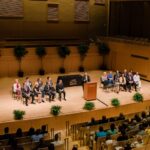
Since 2009, as part of its Alumni Awards celebration, the UMBC Alumni Association names one “Rising Star” recipient each year who exemplifies early career and professional achievement. Prior to our October 2021 award ceremony, we’re spending some time with awardees from the past decade to see where they are now—and how they’ve grown in their fields while maintaining ties to UMBC.
Software that Empowers the Community
In this installment, UMBC Rising Stars and Fearless coworkers Delali Dzirasa ’04, computer engineering, and Kelsey Krach ’14, anthropology, discuss their Retriever networks and the responsibility of working in the civic tech space. The vision for the software company was to provide digital services, but specifically tools that empower communities and create good change. “Software with a soul,” Dzirasa, CEO, says.
And their methods caught the attention of the Retriever community. In 2011, Dzirasa won the Rising Star award from the UMBC Alumni Association, and in 2019 Fearless project manager and designerKrach, won the same award for her contributions to human centered design. Here’s a little secret they both share—as members of Retriever-filled families, neither Dzirasa nor Krach initially saw themselves going to UMBC, but the campus won them over as high schoolers and the pair can’t help but hype their alma mater.
Access for All
This story follows UMBC Rising Stars Galina Madjaroff Reitz ’08, psychology, M.A. ’11, aging studies, Ph.D. ’18, human centered computing, and Sondheim Scholar Aaron Merki ’05, political science, as they discuss their mutual goal to uplift the dignity of elderly, cognitively impaired, and low-income individuals. Reitz is using tech to assist older folks and Merki is creating accessible communities through a different path—law and philanthropy.
Growing up in an intergenerational household helped focus her research with assistive devices, says Reitz, who received UMBC’s Rising Star award in 2016. Merki, who received the Rising Star in 2010, tries to carry the values of the Sondheim Program’s namesake and his mentor—the late civic leader Walter Sondheim—into his own work in creating accessible communities.
Creating Technology that Protects Us
As we embrace life in a technologically immersive world—scrolling out of habit or relying on a life-saving medical device—there’s a common question many of us have about the tech we’ve come to depend on: How can we best harness it to protect us? From malware and scams, but also from disease and unnecessary pain?
Here, UMBC Rising Stars Isaac Kinde’05, M13, biological sciences, and Christopher Valentino ’02, M.S. ’06, information systems, discuss their roles in the healthcare and defense industries, respectively. Both alumni discovered their passion for their work while at UMBC and have dedicated their careers to early prevention against disease and cyber warfare.
Building an Inclusive Workforce
“If a woman sets the table, everyone wants to pull up a seat,” says Alicia Wilson. “It’s important for women to set the table—to be in positions of leadership—so they can build a strong team.”
Indeed, the following Rising Star Alumni Award recipients have not just set the table, they’ve helped build it.
In this virtual conversation, UMBC Rising Stars Alicia Wilson ’04, political science, Nicole DeBlase ’06, financial economics, and Lauren Mazzoli Zavala ’15, computer science and mathematics, M.S. ’17, computer science, discuss their leadership roles in economic development, finance, and engineering and their concerted efforts to make these career paths more available to women and other underrepresented communities.
*****
Header image of the 2019 Alumni Award ceremony in the Linehan Concert Hall by Marlayna Demond ’11.
]]>
Since 2009, as part of its Alumni Awards celebration, the UMBC Alumni Association names one “Rising Star” recipient each year who exemplifies early career and professional achievement. Prior to...
https://umbc.edu/stories/rising-together/
https://beta.my.umbc.edu/api/v0/pixel/news/119641/guest@my.umbc.edu/31bcd4f07da1a3b4de0aa4ac5fa10e04/api/pixel
stories
UMBC News & Magazine
https://beta.my.umbc.edu/groups/umbc-news-magazine
https://assets1-beta.my.umbc.edu/system/shared/avatars/groups/000/001/943/24435aa6207c452e7bc15cc74b42c7bb/xsmall.png?1748556657
https://assets1-beta.my.umbc.edu/system/shared/avatars/groups/000/001/943/24435aa6207c452e7bc15cc74b42c7bb/original.png?1748556657
https://assets2-beta.my.umbc.edu/system/shared/avatars/groups/000/001/943/24435aa6207c452e7bc15cc74b42c7bb/xxlarge.png?1748556657
https://assets2-beta.my.umbc.edu/system/shared/avatars/groups/000/001/943/24435aa6207c452e7bc15cc74b42c7bb/xlarge.png?1748556657
https://assets3-beta.my.umbc.edu/system/shared/avatars/groups/000/001/943/24435aa6207c452e7bc15cc74b42c7bb/large.png?1748556657
https://assets1-beta.my.umbc.edu/system/shared/avatars/groups/000/001/943/24435aa6207c452e7bc15cc74b42c7bb/medium.png?1748556657
https://assets2-beta.my.umbc.edu/system/shared/avatars/groups/000/001/943/24435aa6207c452e7bc15cc74b42c7bb/small.png?1748556657
https://assets1-beta.my.umbc.edu/system/shared/avatars/groups/000/001/943/24435aa6207c452e7bc15cc74b42c7bb/xsmall.png?1748556657
https://assets2-beta.my.umbc.edu/system/shared/avatars/groups/000/001/943/24435aa6207c452e7bc15cc74b42c7bb/xxsmall.png?1748556657
UMBC News & Magazine
0
0
false
Thu, 06 May 2021 16:11:34 -0400
UMBC’s Jordan Troutman to continue algorithmic fairness research as Knight-Hennessy Scholar at Stanford
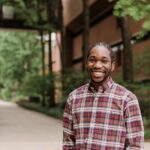
Jordan Troutman ’21, M29, computer science and mathematics, first discovered algorithmic fairness during a summer research program at Rutgers University after his first year at UMBC. The field focuses on how computer algorithms, such as those responsible for facial recognition or the content in our social media feeds, can foster fairness or unfairness. The effects include anything from attempting to identify someone who committed a crime to curating the content we see in ways that influence how we think about others.
“Because these algorithmic systems are being used to make a lot of life-changing decisions,” Troutman says, “now we have to make sure that the tools and technologies we’re developing have some type of guarantees or safeguards to make sure that they don’t have unintended consequences towards minority groups specifically, or just any unintended actions.”
When Troutman returned to UMBC from his summer at Rutgers, he sought out James Foulds, assistant professor of information systems. He’s researched these issues under Foulds’s mentorship for the past three years.
This fall, Troutman will take his research interests to Stanford University, where he’ll pursue a Ph.D. in computer science as UMBC’s first Knight-Hennessy Scholar. The international Knight-Hennessy Scholarship is open to students applying to graduate school at Stanford in any area of study. In addition to funding, it offers robust leadership and community-development training. Troutman was selected as exemplifying the scholarship’s core values: independence of thought, purposeful leadership, and civic mindedness.
Socially-minded scholarship
In the 2019 – 2020 academic year, Troutman represented the student perspective as a voting member of the Maryland Higher Education Commission (MHEC), which establishes policies for every college in the state. At UMBC, Troutman took on leadership roles in the Student Government Association (SGA), the National Society for Black Engineers (NSBE), and as a teaching assistant and tutor supporting fellow students. In 2020, he received another prestigious honor, the Barry Goldwater Scholarship.
 Jordan Troutman, left, and Dan Barnhart, former director of The Commons and student life at UMBC, who recommended Troutman apply for the MHEC position.
Troutman is a Meyerhoff Scholar and a member of the Honors College, and he’s one of two UMBC valedictorians for 2021. In addition to Rutgers, he’s conducted summer research at the University of California, Berkeley and in the Fairness, Accountability, Transparency, and Ethics (FATE) research group at Microsoft. Troutman has also been involved with UMBC’s Center for Democracy and Civic Life (CDCL), and he counts its director, David Hoffman, among his mentors.
“Jordan embodies the kind of creativity that transcends disciplinary boundaries, and has found dazzling ways to weave his social concerns into his scholarship,” Hoffman shares. “I’m confident he will thrive in the Knight-Hennessy program, and that we will have many more occasions to celebrate his civic contributions.”
Participating in leadership has also given Troutman the chance to get to know other leaders. His experience with MHEC demonstrated what true leadership looks like. “It’s really powerful to see how—when you are passionate about something, and you care about the people, and not the power or the position—you can do good work and effect good change.”
From intention to impact
With the Knight-Hennessy Scholarship, as well as a highly competitive Graduate Research Fellowship from the National Science Foundation, Troutman will have the freedom to pursue research of his choice at Stanford. He values the opportunity to be creative in his approach and thinks of his research as “computational social sciences”—interdisciplinary by definition. His computer science and math courses have prepared him for the work; so have courses in the liberal arts and his experiences with campus engagement.
Elective courses in philosophy “helped me understand broadly how to articulate these non-quantitative concepts,” such as fairness, Troutman says. A particular Honors College course about how the media uses faces and how we internalize what the faces represent stuck with him.
Social media algorithms “are everywhere. So if these algorithms are unfair in any way, then the way we’re consuming this media may not necessarily be representative of the world we live in,” Troutman says. “I think that’s a super important problem, and because I’ve taken these other classes, it’s given me a broader context of how important this problem is and has reaffirmed my interest in doing this kind of research.”
 Jordan Troutman, far left, attends a lab meeting in fall 2019 with James Foulds (right rear, green shirt) and his peers.
Troutman is looking forward to collaborating with the other Knight-Hennessy Scholars on some of these big ideas. He also appreciates the leadership training offered through the program, which he sees as being about “trying to figure out how to be a well-intentioned person, and then making really good work out of what your intentions are for the world.”
Supportive community
Troutman shares that several UMBC experiences were instrumental in helping him build his confidence and understand the powerful difference he can make.
Roles in SGA and participating in UMBC’s STRiVE student leadership retreat and Alternative Spring Break “helped me understand my own sense of agency and my ability to make an impact,” Troutman says. He realized that solving massive, intimidating problems often starts with a single person, and says, “Learning that has just made me believe that I literally could do anything.”
The Meyerhoff Scholars Program helped him internalize some of the same ideas. “Meyerhoff gave me this idea that you can really make a change in your life,” Troutman says. “You can be whoever you want to be. You just have to be active about it and to believe in yourself and use the support and community around you to get where you want to be.”
NSBE also played a role in Troutman’s growth. NSBE “helps students feel that they belong in science,” he says. “It’s helped to center me and to help me really understand what it means to build community. Now, I hope to go and help to foster more communities at these other places that I go in my life.”
And Foulds, his research mentor, “has given me really good insight, perspective, and guidance on how to do research, think about problems, and especially how to overcome a lot of different pitfalls that happen in research,” Troutman says.
 Jordan Troutman ’21
An ethical leader
All these programs, communities, and experiences are representative of the culture at UMBC, Troutman says. “You can really be yourself and be engaged and very intentional with people, and you can be as cool or kooky as you want—there’s a space for you at UMBC,” he says.
In the Knight-Hennessy application process, students submit a video addressed to their future Knight-Hennessy cohort. “Jordan’s video demonstrated how to do a gymnastics flip. Not the kind of thing you’d expect from a computer scientist—but it was a way to showcase his other interests and let his personality shine,” April Householder, director of undergraduate research and prestigious scholarships, observes. “Lately, UMBC has been winning very prestigious scholarships, and I think part of the success has to do with encouraging our students to be themselves throughout the process.”
“I think that’s the beauty of this school,” Troutman shares. “You can be whoever you want. And it’s not just something that you say to get people in here. It’s like, no, they’re actually backing it up with the things that they do. It’s really about the students.”
For Troutman, his research, civic engagement, and leadership are all about one thing: making positive social change.
“While Jordan was working in my lab, I was gratified to see his enthusiasm grow as he realized that his technical research could be a part of the efforts he was already making toward creating positive change in our society,” Foulds says. “Jordan is on a path toward becoming an ethical leader and a thought leader who can help steer the course of progress in AI technology in the right direction.”
Ultimately, Troutman says, “What I want to do is just help people see their ideas come true.”
Banner image: Jordan Troutman on UMBC’s Academic Row. All photos by Marlayna Demond ’11 for UMBC.
]]>
Jordan Troutman ’21, M29, computer science and mathematics, first discovered algorithmic fairness during a summer research program at Rutgers University after his first year at UMBC. The field...
https://umbc.edu/stories/umbcs-jordan-troutman-to-continue-algorithmic-fairness-research-as-knight-hennessy-scholar-at-stanford/
https://beta.my.umbc.edu/api/v0/pixel/news/119642/guest@my.umbc.edu/f102ef21857b9362360578f9db57e09b/api/pixel
civic
classof2021
cnms
coeit
community
csee
honorscollege
mathstat
meyerhoffscholars
page1
policy-and-society
science-and-technology
undergradresearch
UMBC News & Magazine
https://beta.my.umbc.edu/groups/umbc-news-magazine
https://assets1-beta.my.umbc.edu/system/shared/avatars/groups/000/001/943/24435aa6207c452e7bc15cc74b42c7bb/xsmall.png?1748556657
https://assets1-beta.my.umbc.edu/system/shared/avatars/groups/000/001/943/24435aa6207c452e7bc15cc74b42c7bb/original.png?1748556657
https://assets2-beta.my.umbc.edu/system/shared/avatars/groups/000/001/943/24435aa6207c452e7bc15cc74b42c7bb/xxlarge.png?1748556657
https://assets2-beta.my.umbc.edu/system/shared/avatars/groups/000/001/943/24435aa6207c452e7bc15cc74b42c7bb/xlarge.png?1748556657
https://assets3-beta.my.umbc.edu/system/shared/avatars/groups/000/001/943/24435aa6207c452e7bc15cc74b42c7bb/large.png?1748556657
https://assets1-beta.my.umbc.edu/system/shared/avatars/groups/000/001/943/24435aa6207c452e7bc15cc74b42c7bb/medium.png?1748556657
https://assets2-beta.my.umbc.edu/system/shared/avatars/groups/000/001/943/24435aa6207c452e7bc15cc74b42c7bb/small.png?1748556657
https://assets1-beta.my.umbc.edu/system/shared/avatars/groups/000/001/943/24435aa6207c452e7bc15cc74b42c7bb/xsmall.png?1748556657
https://assets2-beta.my.umbc.edu/system/shared/avatars/groups/000/001/943/24435aa6207c452e7bc15cc74b42c7bb/xxsmall.png?1748556657
UMBC News & Magazine
0
0
false
Thu, 06 May 2021 15:29:49 -0400
SPARK IV: A New World?

With galleries and exhibition spaces off limits because of the pandemic, it’s been a tough year for artists and art lovers alike. But now, UMBC artists are once again in the limelight at the annual SPARK pop-up gallery, a joint project with Towson University that can be enjoyed in person through June 26 at Maryland Art Place in downtown Baltimore. The exhibition, entitled SPARK IV: A New World?, is made possible through the sponsorship of PNC Bank, and expands on the light-based themes of past SPARK exhibitions to embrace the power of art to illuminate and inspire reflection and dialogue.
Information on visiting the gallery is available on UMBC’s Arts & Culture Calendar. A virtual opening reception for SPARK IV: A New World? will be held on Thursday, May 6 at 6 p.m., and will include a tour of the gallery. To attend this free event, please register in advance here.
-
 I’m Sorry by Monique Crabb, which the artist describes as “a soft and unstable monument to the unavoidable nature of loss and turmoil.”
-
 Occam’s Frame by Evan Tedlock.
SPARK IV presents the work of 24 UMBC and Towson University faculty and student artists or collaborative pairs. Through their artistic creations, the past year of the pandemic and longer timelines impacting our future are considered. After experiencing the chaos, upheaval, and uncertainty that dominated this past year, these artists help us see the world and consider how to cope, adapt, and persevere through whatever lies ahead.
“The act of discovery—delving into the idea, reflection, or space an artist creates with their work—is always the most inspiring aspect of curating,” remarks gallery curator Catherine Borg. ”That has been the case with the exhibition of SPARK, and the challenge as I considered more than 80 works from faculty and students from both UMBC and Towson.” As she selected the work to be displayed, five themes emerged that provided a structure to the exhibition: altered time, imagined places, future focus, climate horizon and equitable future.
Participating faculty and staff from UMBC include Evan Tedlock, Irene Chan, Kelley Bell, M.F.A. ’06, intermedia and digital arts (IMDA), and Melissa Penley Cormier, M.F.A. ’17, (IMDA), Lynn Cazabon, Samantha Sethi, Sarah G. Sharp, and Stephen Bradley. UMBC IMDA graduate students whose work is represented in the exhibition include Foster Reynolds-Santiago, Monique Crabb, Rahne Alexander, and Safiyah Cheatam. The art project of Kelley Bell and Melissa Penley Cormier, The Yonder Cabinet, in turn features artwork by UMBC’s Beth Yashnyk, Jim Doran, and Jenny O’Grady.
-
 I Am The End Of The Patriarchy And So Can You (center panel) by Rahne Alexander.
Of her work I Am The End Of The Patriarchy And So Can You, Rahne Alexander M.F.A. ’21, IMDA, remarks, “It’s a manifesto of sorts, comprised of catalyzing concepts and conclusions that have driven me as an artist, citizen, and woman. In most cases, a manifesto is written for the author first, and this is no exception. It’s an early 21st-century transfeminist statement of purpose, a letter of encouragement for my past self, and a travelogue of how I have arrived where I am today.”
-
 Women Looking/Camerawoman by Sarah G. Sharp.
Women Looking/Camerawoman by Sarah G. Sharp, assistant professor of visual arts, is part of a series of custom wallpaper designs based on images found in early underground feminist publications. “Among the discourse I expected to encounter when researching this material (abortion rights, the passage of the Equal Rights Amendment, etc.), I found many conversations about the revolutionary potential of the newly created component of cable television: public access television channels,” she shares. “Public access TV represents the first TV-based examples of what media theorists call ‘the many speaking to the many,’ and, in some ways, it was a precursor to today’s social media.”
-
 \I-Ching Cards/ by Irene Chan.
Irene Chan, associate professor of visual arts, created \I-Ching Cards/, an artist book—a set of interactive cards inspired by the I Ching or Book of Changes. As she describes her work, “The I-Ching, the Book of Changes is a 3000-year-old oracle Chinese divination tool that does not tell you what to do, but inspires you to answer your own questions—the activity is interactive. One is able to ‘read’ in infinite directions as it guides one through life.”
On May 14, May 28, and June 25 at 7 p.m., SPARK will present performances by Anna Kroll, M.F.A. ’23, IMDA, and Chloe Engel. Their work, entitled I Want To Be, takes place by telephone. In each performance, Kroll and Engel navigate a score in which they co-imagine events in a room. These are improvisational, spoken performances that have developed out of their collaborative practice of negotiating and refining scores to create imaginary realities. To attend the performance, audience members will call a phone number at a specific time, hear a welcome message, and then enter the “space.” A live captioned version will also be simultaneously available. Information on additional performances and events, including a video gallery, is forthcoming.
-
 Sueños de Iguana, by Foster Reynolds-Santiago, is a multimedia installation “where a family’s shared iguana dreams go to converse and create form. It is a place where I go to speak with my mother on the things that go unsaid about my transition, in a language I hope to create through texture and color.”
-
 The Yonder Cabinet by Kelley Bell and Melissa Penley Cormier, featuring artworks (L-R) by Beth Yashnyk, Bell, Penley Cormier, Jim Doran, and Jenny O’Grady.
Presenting an exhibition like SPARK IV: A New World? is an expensive undertaking, and for the fourth consecutive year PNC Bank has generously invested in the collaborative UMBC-TU project. “PNC has a legacy of investing in the arts, as we understand the economic, social, and civic impacts that a thriving arts and culture community have on our city,” says Laura Gamble, PNC regional president for Greater Maryland. “There are few better ways to support our community, at a time when it’s never been more necessary, than by supporting the arts, and specifically, Maryland Arts Place’s SPARK exhibition, which features the thought-provoking works of local students and faculty.”
The SPARK gallery at Maryland Art Place may be visited in person from 12 p.m. through 4 p.m., Tuesday through Saturday, through June 26. MAP is located at 218 West Saratoga Street between Park and Howard Streets in downtown Baltimore, with nearby on-street and garage parking. The exhibition can also be experienced virtually at sparkbaltimore.org.
Header image by Joseph Hyde.
]]>
With galleries and exhibition spaces off limits because of the pandemic, it’s been a tough year for artists and art lovers alike. But now, UMBC artists are once again in the limelight at the...
https://umbc.edu/stories/spark-iv-a-new-world/
https://beta.my.umbc.edu/api/v0/pixel/news/119643/guest@my.umbc.edu/06768ab94d6ce4a56c9b19efb0ecf77b/api/pixel
discovery
graduateschool
imda
visual-arts
UMBC News & Magazine
https://beta.my.umbc.edu/groups/umbc-news-magazine
https://assets1-beta.my.umbc.edu/system/shared/avatars/groups/000/001/943/24435aa6207c452e7bc15cc74b42c7bb/xsmall.png?1748556657
https://assets1-beta.my.umbc.edu/system/shared/avatars/groups/000/001/943/24435aa6207c452e7bc15cc74b42c7bb/original.png?1748556657
https://assets2-beta.my.umbc.edu/system/shared/avatars/groups/000/001/943/24435aa6207c452e7bc15cc74b42c7bb/xxlarge.png?1748556657
https://assets2-beta.my.umbc.edu/system/shared/avatars/groups/000/001/943/24435aa6207c452e7bc15cc74b42c7bb/xlarge.png?1748556657
https://assets3-beta.my.umbc.edu/system/shared/avatars/groups/000/001/943/24435aa6207c452e7bc15cc74b42c7bb/large.png?1748556657
https://assets1-beta.my.umbc.edu/system/shared/avatars/groups/000/001/943/24435aa6207c452e7bc15cc74b42c7bb/medium.png?1748556657
https://assets2-beta.my.umbc.edu/system/shared/avatars/groups/000/001/943/24435aa6207c452e7bc15cc74b42c7bb/small.png?1748556657
https://assets1-beta.my.umbc.edu/system/shared/avatars/groups/000/001/943/24435aa6207c452e7bc15cc74b42c7bb/xsmall.png?1748556657
https://assets2-beta.my.umbc.edu/system/shared/avatars/groups/000/001/943/24435aa6207c452e7bc15cc74b42c7bb/xxsmall.png?1748556657
UMBC News & Magazine
0
0
false
Tue, 04 May 2021 23:37:35 -0400
UMBC education faculty and partners work to humanize K-12 distance learning

When schools had to shift to distance learning due to COVID-19, UMBC’s Keisha McIntosh Allen, assistant professor of language and literacy education, and Kindel Turner Nash, associate professor of education, witnessed their own children face an incredibly challenging new reality. Like many of their peers in Baltimore City Public Schools, they experienced an overwhelming sense of isolation and a disconnect with the learning process in this new virtual environment.
Everything had changed, the researchers note, yet schools were attempting to move forward without the time and space to address the technological, social-emotional, economic, and health challenges teachers and students were experiencing.
“It was hard to see our children who normally are excited and engaged become withdrawn and disengaged,” shares Allen. “It was frustrating to everyone on the research team to hear about how Kindel’s kids lost a sense of direction they had before because there was no plan for equitably translating face-to-face instruction to the virtual space during a global crisis.”
 Keisha McIntosh Allen. Photo courtesy of Allen.
Allen and Nash took action. They developed a 15-month research project, ”Teaching through Coronavirus: Toward Cultivating Urgent Humanizing Distance Learning (HDL) Pedagogies,” with collaborators Sakeena Everett, assistant professor of education at the University of Georgia; and Kyla Thomas, independent educational consultant. The project received over $150,000 from the U.S. Department of Education Governors Emergency Education Relief Fund.
Knowledge sharing
“We knew that there were other parents and educators having the same challenges,” explains Nash. “But we also knew that there were many teachers who were naturally doing this humanizing work. It was about gathering that knowledge, sharing it, and putting it to action.”
 Kindel Turner Nash. Photo by Marlayna Demond ’11 for UMBC.
The research project is designed as a professional development training for 100 Baltimore City Public School teachers. It seeks to help them create or extend humanizing practices in their current classrooms. The diverse group of teachers participating is interested in reclaiming their classrooms as centers of connectedness, emotional wellbeing, and learning based on a commitment to critical social justice-oriented teaching.
“Humanizing pedagogy is a daily practice of transformation,” explains Everett. “It creates the conditions for all students to achieve at their highest potential by learning about and using their myriad linguistic, cultural, and familiar resources.”
Rethinking a disconnected system
Similar to how Allen and Nash witnessed their own children’s isolation, the research team also found that the 100 teachers who signed up to participate were feeling disconnected and overwhelmingly alone. This was especially the case for teachers of color working in a system shaped by structural inequalities and racism. On top of this, the teachers’ own communities and their students’ communities were highly affected by COVID-19.
The pandemic exacerbated the existing health, economic, and educational inequalities caused by structural racism, the teachers found. Some students had to manage work, home responsibilities, or caring for family members. This was all in addition to participating in online class and completing schoolwork in a limited space. Often those responsibilities conflicted with strict school schedules, creating more learning and social opportunity gaps, especially for students of color.

Kyla Thomas.
Photo courtesy of Thomas.
Thomas shares that teachers may have been aware of these hardships but may not have known of how to best support their students and themselves. She believes this is the perfect time to create a different approach to distance learning, and to teaching more broadly.
At the center of humanizing pedagogy is freedom from oppression and agency, Thomas explains. “We need to ask ourselves, what are we learning from this, what can we build, what are we doing to help students connect more authentically in a learning environment?” she says. “The shift to distance learning may not be ideal, but it does offer an opportunity for change in how we teach and learn regardless of setting.”
Humanizing research
As teacher-educator-researchers, Allen, Nash, Everett, and Thomas were intentional in embodying humanizing pedagogies as they designed and implemented each phase of their virtual research project. The first phase of the project was anchored in creating collaborative spaces for teachers with the most experience in HDL pedagogies to share their knowledge so that other educators could learn from them.
“The team believes that by learning from teachers as they teach through COVID-19, they will move closer to ultimately disrupting educational inequities and reimagine a healthy, liberating, student-centered vision of teaching youth of color,” says Everett.

Sakeena Everett.
Photo courtesy of Everett.
The other project phases delved deep into a continuous cycle of learning, implementation, reflection, sharing, and listening.
The team wanted the professional training itself to mirror what a classroom would look like if HDL pedagogies were practiced. To do this they created small virtual pods of ten teachers. Each group included teachers from all grade levels and teaching experiences. Within each pod some teachers were new to humanizing pedagogy. Others had some familiarity or significant experience with HDL pedagogies. The advanced teachers, all but one of whom are teachers of color, co-facilitated the pods along with one of the researchers.
“We value the humanizing practices that are often embedded in the teaching practices of Black teachers,” explains Allen. “This is an opportunity for them to lead and share their knowledge, which is often overlooked by teacher evaluations that do not acknowledge these approaches to teaching.”
Opening space for agency
The researchers also wanted to value the teachers’ commitment to the project. The professional development met all requirements for Baltimore City Public School teachers to earn six Achievement Units. These units accrue over a teacher’s career and create opportunities for them to advance along career pathways.
From beginning to end, the researchers share, they’ve designed their project to value teachers’ knowledge. Their goal is to demonstrate how teachers working together can create research-based solutions informed by teaching experience to better serve their students. Every step was a joint effort.
“It starts with how we as educators and researchers interact with each other and open space for agency,” says Nash. Seeing how teachers then express their agency to make changes in their classrooms is powerful to watch, she shares. “One of the teachers I worked with asked her principal to change her schedule because the current schedule didn’t meet the needs of her students. The principal changed it.”
Maximizing learning
Another benefit of the HDL professional development program is creating a vast peer support network for teachers in Baltimore City. They exchange ideas, expertise, and listen to each other’s challenges. They know that they are not alone even if they could not be together physically.
Pat Michael ‘20,global studies and mathematics, and M.A.T. ’21, mathematics education, is a project participant whose perspective on distance learning and online teaching tools changed through engaging with other teachers. Michael is one of seven UMBC students in the Sherman STEM Teacher Scholars Program to receive the training. Before this training, Michael felt the virtual environment would limit their ability to have engaging lessons and connect with students. HDL has helped them to think creatively about how they can teach online in a culturally relevant way.
“At the end of the day, technology serves as a tool. We can use it to recognize students’ full humanity,” says Michael.
Ultimately, HDL “is not a scripted curriculum. It is a lifestyle where we assume the best of our students,” shares Everett. “We are trying to find opportunities to maximize their potential and learning. It is a daily practice of freedom.”
Banner image: Person working on a laptop. Stock image. Mobile technology Photo by WOCinTechChat, CC BY 2.0
]]>
When schools had to shift to distance learning due to COVID-19, UMBC’s Keisha McIntosh Allen, assistant professor of language and literacy education, and Kindel Turner Nash, associate professor of...
https://umbc.edu/stories/umbc-education-faculty-and-partners-work-to-humanize-k-12-distance-learning/
https://beta.my.umbc.edu/api/v0/pixel/news/119644/guest@my.umbc.edu/7868b20c8afb92b76c6191cf1dd37f34/api/pixel
cahss
cahssresearch
diversityandinclusion
education
policy-and-society
UMBC News & Magazine
https://beta.my.umbc.edu/groups/umbc-news-magazine
https://assets1-beta.my.umbc.edu/system/shared/avatars/groups/000/001/943/24435aa6207c452e7bc15cc74b42c7bb/xsmall.png?1748556657
https://assets1-beta.my.umbc.edu/system/shared/avatars/groups/000/001/943/24435aa6207c452e7bc15cc74b42c7bb/original.png?1748556657
https://assets2-beta.my.umbc.edu/system/shared/avatars/groups/000/001/943/24435aa6207c452e7bc15cc74b42c7bb/xxlarge.png?1748556657
https://assets2-beta.my.umbc.edu/system/shared/avatars/groups/000/001/943/24435aa6207c452e7bc15cc74b42c7bb/xlarge.png?1748556657
https://assets3-beta.my.umbc.edu/system/shared/avatars/groups/000/001/943/24435aa6207c452e7bc15cc74b42c7bb/large.png?1748556657
https://assets1-beta.my.umbc.edu/system/shared/avatars/groups/000/001/943/24435aa6207c452e7bc15cc74b42c7bb/medium.png?1748556657
https://assets2-beta.my.umbc.edu/system/shared/avatars/groups/000/001/943/24435aa6207c452e7bc15cc74b42c7bb/small.png?1748556657
https://assets1-beta.my.umbc.edu/system/shared/avatars/groups/000/001/943/24435aa6207c452e7bc15cc74b42c7bb/xsmall.png?1748556657
https://assets2-beta.my.umbc.edu/system/shared/avatars/groups/000/001/943/24435aa6207c452e7bc15cc74b42c7bb/xxsmall.png?1748556657
UMBC News & Magazine
0
0
false
Fri, 30 Apr 2021 17:02:48 -0400
Times Higher Ed names UMBC top-10 U.S. leader and top-200 global leader in social and economic impact

UMBC has recently been named a global leader in two prominent international university rankings—one focused on economic and social impact and the other on research influence, academic distinction, and alumni leadership. Times Higher Education just named UMBC one of the world’s top 100 universities in efforts toward several sustainable development priorities. And today, the Center for World University Rankings (CWUR) included UMBC in the top 3.7% of its 2021-22 list.
“These impressive global rankings confirm something Marylanders have known all along, which is that UMBC is a world-class university,” says David Di Maria, associate vice provost for international education. “UMBC not only benefits the state of Maryland, but also benefits the world by working to address some of the most pressing challenges facing our planet.”
Advancing equity and sustainability
The Times Higher Ed Impact Rankings assess universities against the United Nations’ Sustainable Development Goals—17 global goals to move toward a better and more sustainable future. UMBC ranks among the top 200 universities overall and is one of the world’s top 100 universities in the areas of eliminating poverty (#63) and hunger (#91), improving gender equity (#46), improving clean water access and sanitation (#98), reducing inequalities in education (#55), supporting sustainable cities and communities (#83), responsible consumption and production (#23), and supporting land-based (#38) and aquatic (#15) ecosystems.
UMBC is participating in international conversations about how higher education can support sustainable development through education, research, and service. Prior to the COVID-19 pandemic, Provost Philip Rous attended a meeting with leaders of other public research universities and senior officials of the United Nations in New York City to discuss this topic. This is just one piece of UMBC’s international partnership work, which also includes collaborations in more than 50 countries.
 Prior to the COVID-19 pandemic, Provost Philip Rous, on left side of table at the back, attended a meeting with leaders of other public research universities and senior officials of the United Nations. Photo by Jonas Haertle at the United Nations Institute for Training and Research.
Looking specifically at U.S. institutions committed to this work, UMBC ranks 10th in the Times Higher Ed Impact Ranking. Nationally, UMBC ranks #4 in gender equity, #5 in supporting decent work and economic growth, and #5 in reducing inequalities in education. In environmental measures, UMBC ranks #2 among U.S. institutions for responsible consumption and production, #3 for supporting aquatic ecosystems, and #5 for supporting land-based ecosystems.
Faculty and alumni leadership
The Center for World University Rankings include nearly 20,000 universities around the world, listed based on their academic performance. UMBC landed at 727 in the world, in the top 3.7% of higher education institutions rankings worldwide. In the U.S., UMBC was ranked at 175.
The ranking is based on a combination of four factors: quality of education, alumni employment, quality of faculty, and research performance. CWUR looks at metrics like alumni who have earned major academic distinctions and held top executive positions, and faculty research appearing in top-tier and highly influential journals.
“I am extremely proud of our UMBC community for earning this global recognition,” says Di Maria.
Banner image: Kevin Omland, rear, and his students birdwatch on campus. The Omland Lab focuses on avian evolution, behavior, and conservation. They study the critically endangered Bahama Oriole in close collaboration with the Bahamas National Trust. Photo by Marlayna Demond ’11 for UMBC.
]]>
UMBC has recently been named a global leader in two prominent international university rankings—one focused on economic and social impact and the other on research influence, academic distinction,...
https://umbc.edu/stories/times-higher-ed-names-umbc-top-10-u-s-leader-and-top-200-global-leader-in-social-and-economic-impact/
https://beta.my.umbc.edu/api/v0/pixel/news/119645/guest@my.umbc.edu/56af8169be7f13fcb4962cea51a394ef/api/pixel
community
international
rankings
UMBC News & Magazine
https://beta.my.umbc.edu/groups/umbc-news-magazine
https://assets1-beta.my.umbc.edu/system/shared/avatars/groups/000/001/943/24435aa6207c452e7bc15cc74b42c7bb/xsmall.png?1748556657
https://assets1-beta.my.umbc.edu/system/shared/avatars/groups/000/001/943/24435aa6207c452e7bc15cc74b42c7bb/original.png?1748556657
https://assets2-beta.my.umbc.edu/system/shared/avatars/groups/000/001/943/24435aa6207c452e7bc15cc74b42c7bb/xxlarge.png?1748556657
https://assets2-beta.my.umbc.edu/system/shared/avatars/groups/000/001/943/24435aa6207c452e7bc15cc74b42c7bb/xlarge.png?1748556657
https://assets3-beta.my.umbc.edu/system/shared/avatars/groups/000/001/943/24435aa6207c452e7bc15cc74b42c7bb/large.png?1748556657
https://assets1-beta.my.umbc.edu/system/shared/avatars/groups/000/001/943/24435aa6207c452e7bc15cc74b42c7bb/medium.png?1748556657
https://assets2-beta.my.umbc.edu/system/shared/avatars/groups/000/001/943/24435aa6207c452e7bc15cc74b42c7bb/small.png?1748556657
https://assets1-beta.my.umbc.edu/system/shared/avatars/groups/000/001/943/24435aa6207c452e7bc15cc74b42c7bb/xsmall.png?1748556657
https://assets2-beta.my.umbc.edu/system/shared/avatars/groups/000/001/943/24435aa6207c452e7bc15cc74b42c7bb/xxsmall.png?1748556657
UMBC News & Magazine
0
0
false
Mon, 26 Apr 2021 18:19:29 -0400
Remembering Dr. Thomas “Tom” Roth
We are deeply saddened to share that Dr. Thomas “Tom” Roth passed away on Sunday, April 18, at the age of 89. Tom devoted his career to UMBC students for over 25 years, first as a biological sciences professor, and later as Associate Vice President for Academic Affairs, before retiring in 1998 and transitioning to the role of emeritus professor.
Tom joined the UMBC community in 1972 and made significant contributions to building the university from the ground up. His creative approach to teaching cell biology and dedicated mentorship touched the lives of countless students and faculty members.
According to biological sciences chair, Phil Farabaugh, “He was a great colleague and a passionate teacher. He influenced generations of UMBC biology graduates and produced some terrific Ph.D. scientists as well.”
His most recognized research contribution was identifying coated pits as involved in receptor-mediated endocytosis during his doctoral work with Keith Porter, who later became chair of the biological sciences department and for whom the Keith Porter Imaging Facility is named. Tom’s pioneering doctoral work will ensure his name is known long into the future.
As one of the early biological sciences faculty members at UMBC, Tom helped build the department into a collegial community that persists today.
“Tom contributed significantly to the foundation of academic excellence at UMBC. He was brilliant, kind, and dignified,” President Hrabowski says. “Most important, he was always authentic in his interactions with both colleagues and students.” He will truly be missed.
Service arrangements will be made at a later time. His obituary can be read here. In lieu of flowers, please consider donating to the Candlelight Concert Society (where Tom was very active, serving as a past board member and sponsoring various events), or a charity of your choice.
]]>
We are deeply saddened to share that Dr. Thomas “Tom” Roth passed away on Sunday, April 18, at the age of 89. Tom devoted his career to UMBC students for over 25 years, first as a biological...
https://umbc.edu/stories/remembering-dr-thomas-tom-roth/
https://beta.my.umbc.edu/api/v0/pixel/news/119646/guest@my.umbc.edu/013f70d4b658d3eebd18e5951ce69686/api/pixel
in-memorium
rss
UMBC News & Magazine
https://beta.my.umbc.edu/groups/umbc-news-magazine
https://assets1-beta.my.umbc.edu/system/shared/avatars/groups/000/001/943/24435aa6207c452e7bc15cc74b42c7bb/xsmall.png?1748556657
https://assets1-beta.my.umbc.edu/system/shared/avatars/groups/000/001/943/24435aa6207c452e7bc15cc74b42c7bb/original.png?1748556657
https://assets2-beta.my.umbc.edu/system/shared/avatars/groups/000/001/943/24435aa6207c452e7bc15cc74b42c7bb/xxlarge.png?1748556657
https://assets2-beta.my.umbc.edu/system/shared/avatars/groups/000/001/943/24435aa6207c452e7bc15cc74b42c7bb/xlarge.png?1748556657
https://assets3-beta.my.umbc.edu/system/shared/avatars/groups/000/001/943/24435aa6207c452e7bc15cc74b42c7bb/large.png?1748556657
https://assets1-beta.my.umbc.edu/system/shared/avatars/groups/000/001/943/24435aa6207c452e7bc15cc74b42c7bb/medium.png?1748556657
https://assets2-beta.my.umbc.edu/system/shared/avatars/groups/000/001/943/24435aa6207c452e7bc15cc74b42c7bb/small.png?1748556657
https://assets1-beta.my.umbc.edu/system/shared/avatars/groups/000/001/943/24435aa6207c452e7bc15cc74b42c7bb/xsmall.png?1748556657
https://assets2-beta.my.umbc.edu/system/shared/avatars/groups/000/001/943/24435aa6207c452e7bc15cc74b42c7bb/xxsmall.png?1748556657
UMBC News & Magazine
0
0
false
Fri, 23 Apr 2021 20:48:55 -0400
Movie Madness: Film’s Big Dance
March in the United States is reserved for college basketball. Fans don their team’s colors as they root for them in the NCAA Division I basketball tournaments. For those without a team close to heart, they cheered as fifteenth seed Oral Roberts University beat powerhouse Ohio State University in the men’s tournament.
However, Dustin Fisher, ’98, visual and performing arts, was not only preoccupied with underdog basketball wins. While cheering on Villanova, Fisher rooted for The Night Before Christmas to take down Hamilton and for Inside Out to lose to Stand by Me. While watching March Madness, he took to his Movie Madness Facebook page to debate with fellow group members about whether Hamilton should even be considered a movie. Fisher’s March Madness is not about finding this year’s best basketball team; it’s about finding the best movie of all-time.
The Origin Story
Movie Madness is rooted in the early days of the internet, says Fisher, who founded the group based on an email column from 1998 and a blog he kept in 2003. Fisher would write about two movies he would watch back-to-back, comparing them and determining the best one. This led to his idea of pitting them against one another in an NCAA-style bracket. As former UMBC intramural sports assistant director, Fisher was always involved in athletics and felt it was natural to combine his passions for sports and movies through Movie Madness.
In 2013, 19 of Fisher’s friends filled out his first Movie Madness bracket on Facebook. Today, the Movie Madness community is over 2,000 strong, bringing UMBC and non-Retrievers together over a common passion.
The NCAA of Movies
Like the NCAA’s different conferences (most college sports fanatics are familiar with the Big Ten, the Atlantic Coast Conference, the Big Twelve, and the Southeastern Conference), Movie Madness uses genres as its different conference tournaments. While genres like action, horror, and romance are staples of Movie Madness, Fisher and other committee members add genres as the film industry becomes more diverse.
“Eight years ago, there were no conferences for LGBTQ and Civil Rights movies. These are things that I’ve seen the need for and have added,” says Fisher. “As the world grows, the group grows with it.”
Movies competing for the conference title are nominated by Movie Madness group members. As with the selection of the 68 teams for the NCAA tournament, the Movie Madness bracket features the winners of the 32 conferences and the next 34 most competitive movies determined by the group’s committee. This year’s tournament features movies like Thor: Ragnarok, Get Out, and Spider-Man: Into the Spider-verse, as well as recurring competitors like Jaws and Alien.
 The 2021 Movie Madness VII bracket with
 The Lord of the Rings: The Fellowship of the Ring
named this year’s winner. Screenshot provided by Fisher.
To ensure that the bracket and conversation change from year to year, any movies that make it to the Final Four are retired. “Otherwise Empire Strikes Back will play Star Wars: A New Hope in every single tournament, and it would be very boring,” explains Fisher.
While all movies are taken into consideration, Fisher acknowledges the group’s slight bias towards superhero movies, recent movies, and movies from the 80s and 90s.
“Many people seem to vote for movies that they’ve seen in the last couple years. This is why I figure Spider-Man: Into the Spider-verse, Hamilton, Hidden Figures, and Mad Max: Fury Road were the number one seeds in the tournament this year,” says Fisher. “But there’s also the ‘Oh my God, I remember this from my childhood!’ feeling that gives The Goonies and Field of Dreams probably more popularity than they deserve.”
Building Friendships One Debate at a Time
Conversation is essential to Movie Madness. For Movie Madness committee member Corey Johns ’11, American studies, media and communications, English, talking about movies in the group is a way to destress from his workday.
“It’s a tremendous way to just have fun online and to talk about things we like. We like movies, and this is a great way to just enjoy another aspect of them,” says Johns.
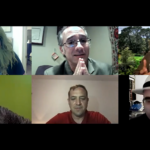
 The Movie Madness Board (from left to right and top to bottom) of Brett McKenzie, Fisher, Greg Stryker, Chris Mondichak, Justin West, and Johns wore costumes in one of their filmed meetings. Screenshot provided by Fisher.
Johns explains that Movie Madness, at least the active members of it, created such a tight-knit community that it has inside jokes. Johns stated that The Goonies is a running joke in the group as the most divisive movie. UMBC community and Movie Madness members could not help but use memes from UMBC’s win against the University of Virginia in 2018 after sixteenth seed Clue beat number one seed John Wick in one year’s tournament.
“We can immediately identify who the UMBC crowd is because we’re all tied together,” says Johns.
While the group is public to all and many active members are not affiliated with UMBC in any way, Johns and Fisher have met many UMBC alumni from different eras of UMBC through the group. The group is how Johns and Fisher met and how the pair met Movie Madness committee member Brett Mckenzie ’04, English.
“[Fisher and I] never knew each other at UMBC, but we throw out a lot of UMBC jokes that bring us together,” explains Johns. “We share the UMBC bond.”
“If I listed off my top 10 friends, Corey’s definitely on the list. We’ve spent so much time together. We’ve gotten to know each other so well,” says Fisher. “The group has definitely fostered some friendships that I would not have otherwise made.”
Beyond a Bracket
Fisher adds that, while the group started as a game, it has grown into a community of movie lovers spanning across generations of UMBC alumni and non-UMBC community members. As more people joined, Fisher, Johns, Mckenzie, and other committee members created ways to discuss movies on the page asides from the bracket to keep the community active.
“It’s very hard finding creative ways to spark a conversation,” said Fisher, but they still managed to create some buzz. Whether it be their spin on the game “You Don’t Know Jack” or videos debating who would win in a fight between characters like Thor from the Marvel series or Jack-Jack from The Incredibles, Fisher and Johns said that people engaged with the new content.
In one video debate, Johns did 15 costume changes in three minutes to argue that the Genie from Disney’s Aladdin would win. In another, Mckenzie wore a Captain Marvel costume to prove that she was the best superhero.
“[Those videos] really exploded our growth this year,” says Johns. “There was so much more activity. Instead of just the poll and voting, which is fun, but now you can have a conversation.”
As with most online groups, Movie Madness experienced growing pains as its membership increased. With more people outside his and his friends’ circles joining the group, Fisher had to assign admins to moderate conversations and prevent discussions from getting out of hand. Despite some struggles, Fisher and Johns said they are excited for the future of Movie Madness. While Fisher does not actively promote it on Facebook, he is happy to see new members.
“If people find this group, awesome,” said Fisher. “We’ll happily welcome you with open arms.” Just be prepared to have strong opinions about The Goonies.
]]>
March in the United States is reserved for college basketball. Fans don their team’s colors as they root for them in the NCAA Division I basketball tournaments. For those without a team close to...
https://umbc.edu/stories/movie-madness-films-big-dance/
https://beta.my.umbc.edu/api/v0/pixel/news/119647/guest@my.umbc.edu/67755f85a8d652c55eab52ffc591d668/api/pixel
alumni
american-studies
english
film
mcs
visual-and-performing-arts
UMBC News & Magazine
https://beta.my.umbc.edu/groups/umbc-news-magazine
https://assets1-beta.my.umbc.edu/system/shared/avatars/groups/000/001/943/24435aa6207c452e7bc15cc74b42c7bb/xsmall.png?1748556657
https://assets1-beta.my.umbc.edu/system/shared/avatars/groups/000/001/943/24435aa6207c452e7bc15cc74b42c7bb/original.png?1748556657
https://assets2-beta.my.umbc.edu/system/shared/avatars/groups/000/001/943/24435aa6207c452e7bc15cc74b42c7bb/xxlarge.png?1748556657
https://assets2-beta.my.umbc.edu/system/shared/avatars/groups/000/001/943/24435aa6207c452e7bc15cc74b42c7bb/xlarge.png?1748556657
https://assets3-beta.my.umbc.edu/system/shared/avatars/groups/000/001/943/24435aa6207c452e7bc15cc74b42c7bb/large.png?1748556657
https://assets1-beta.my.umbc.edu/system/shared/avatars/groups/000/001/943/24435aa6207c452e7bc15cc74b42c7bb/medium.png?1748556657
https://assets2-beta.my.umbc.edu/system/shared/avatars/groups/000/001/943/24435aa6207c452e7bc15cc74b42c7bb/small.png?1748556657
https://assets1-beta.my.umbc.edu/system/shared/avatars/groups/000/001/943/24435aa6207c452e7bc15cc74b42c7bb/xsmall.png?1748556657
https://assets2-beta.my.umbc.edu/system/shared/avatars/groups/000/001/943/24435aa6207c452e7bc15cc74b42c7bb/xxsmall.png?1748556657
UMBC News & Magazine
0
0
false
Fri, 23 Apr 2021 19:23:12 -0400
 Faith Davis. Photo courtesy of Davis.
 Faith Davis (back row, first on the left) at a community organization in Baltimore City
 ASB 2019 symposium (Davis is first on the right). Photo courtesy of David Hoffman.
 Davis (left) with her mentor from the Meyerhoff Scholars Summer Bridge program,
  Davis (second from the right) at a ABRCMS workshop she helped to facilitate.
  Davis (left) with her co-researchers tied for URCAD’s 2021 “Best Overall Selfie” award.


