UMBC’s newest grads leave a legacy of advocacy, inclusion, and support for fellow students
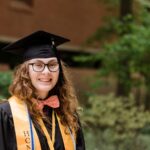
On the back of every UMBC black and gold ID card is a guide to essential emergency resources, including numbers for health, counseling, sexual assault, and suicide prevention helplines. The new card design was the result of student advocacy through UMBC’s Retriever Courage initiative, seeking to better prevent and respond to sexual assault and violence. And the person who suggested that change is Autumn Cook ‘21, M29, chemistry, and gender, women’s, and sexuality studies (GWST), graduating this week.
A Meyerhoff Scholar and Honors College student, Cook has been a tireless advocate for all UMBC students, with a focus on supporting survivors of sexual assault and helping trans students find and build community, in the sciences and at UMBC broadly.
Committing to visibility
“I was the first openly trans Meyerhoff Scholar in the history of the program and I quickly learned that I would have to build my own community of transgender scholars at UMBC,” Cook shares. “Without having any friends like me, I connected and built bridges with people who did. I was lucky enough to find more trans people through both the LBGTQ+ Student Union and its programming, and then through the Women’s Center.”
 Autumn Cook in front of the Women’s Center. Photo by Marlayna Demond ’11 for UMBC.
Cook launched the LBGTQ+ Student Union’s weekly trans discussion group, then worked to restart and become a co-facilitator of the Women’s Center’s trans discussion group, Spectrum. “I always make it a priority to be extremely visible because I want to demonstrate to other people that transgender people exist, transgender people can thrive, and transgender people can be successful,” they share.
“I want to potentially be a role model for other transgender people,” says Cook, “to show them that I can do it, therefore so can you.”
Calling for change
Thinking about the impact of the new campus ID design, Cook says, “I’m proud that every UMBC student, faculty, and staff member now carries that card and that it is part of a legacy I’m leaving behind at UMBC.”
Their legacy also extends to other important changes that impact the daily life on campus. For example, Cook joined UMBC community members in calling for updating and expanding all-gender restrooms, including multi-person restrooms. The first multi-person, all-gender restroom opened in Sherman Hall A Wing in June 2019 and more have followed across the campus.
Amelia Meman, assistant director of the Women’s Center and Cook’s supervisor and mentor, says Cook is an asset to campus who will be missed. “As a student heavily involved with the administration in advocating for this project and later ensuring accountability in implementation, Autumn has left an indelible mark on our campus by ensuring access for everyone–affirming all people’s gender diversity.”
 Autumn Cook on National Coming Out Day in 2019. Photo by Amelia Meman.
In recognition of their scholarship and advocacy work at UMBC, Cook received two Lavender Awards: LQBTQ+ Scholar of the Year in 2021 and Emerging Student Leader in 2020. As a GWST major, they received the Jo Ann E. Argersinger Academic Achievement Award for GWST in 2020 and 2021.
Helping students succeed in science
Cook also sees important interconnections between their two majors: GWST and chemistry. After graduating from UMBC, they will pursue their Ph.D. in chemistry at University of Illinois, Urbana-Champaign, but they see GWST as foundational in their work to boost inclusion in science.
“I’ll be able to use my degree to push through more advocacy work within the next step of my educational and professional journey,” says Cook. “Whether it’s conducting research after I finish my Ph.D., dictating science policy on a national level, or supporting transgender scientists, I want to continue to fight for my community.”
 Autumn Cook in front of the Meyerhoff Chemistry Building. Photo by Marlayna Demond ’11 for UMBC.
Cook plans to become a chemistry professor and has already completed research with Joseph Bennett, research assistant professor of chemistry, and became one of the department’s youngest teaching assistants (TAs). They tutored students in the Chemistry Tutorial Center, and for that work, received the 2021 Mittino Award for Service from the chemistry and biochemistry department.
“When I started in chemistry, I struggled a lot. But because of the time and effort other people put into helping me, I was able to grasp the knowledge on a really deep level,” says Cook. “Tutoring and TA’ing was at first a way to pay it back to those people who helped me, but it quickly turned into a passion.”
“Once I realized that teaching chemistry as a professor was what I wanted to do, I made sure to take every opportunity that I could,” they add. “Being able to help students succeed is extremely gratifying and rewarding.”
Finding opportunities to lead
Christian Figueroa ‘21, social work, and Henri Maindidze, ‘21, psychology, say building community for students at UMBC-Shady Grove has been at the heart of their undergraduate experiences.
A first-generation student who transferred from Montgomery College, Figueroa dedicated himself to helping create a culture of belonging at UMBC-Shady Grove. It all started in 2019 when he “took a chance” to run for a leadership role as vice president of UMBC-Shady Grove’s Social Work Student Association (SWSA).
Figueroa says that experience opened more doors and encouraged him to apply for additional opportunities, like representing UMBC on the Universities at Shady Grove (USG) Student Council. He also served on the UMBC-Shady Grove Peer Advisory Team, collaborating with faculty, staff, and current students on recruitment and retention events for transfer students.
 Christian Figueroa on the UMBC-Shady Grove campus. Photo courtesy of Figueroa.
After becoming SWSA co-president in 2020, Figueroa gained additional leadership experience and learned the importance of flexibility and creativity in building community during challenging times. When UMBC transitioned to virtual classes during the pandemic, he wanted to provide ways for social work students to stay connected.
Collaborating with co-president Mariandree Paiz ‘21, social work, and clinical instructor Jeanette Hoover (SWSA’s advisor), Figueroa developed community discussions focused on current events, featuring clinical instructor Nicole Belfiore. They also coordinated self-care nights and opportunities for students to do service work.
Serving communities
While committing so much time to leadership and supporting his fellow students, Figueroa took advantage of professional development opportunities offered by USG as well. He was selected to participate in the Montgomery County Department of Health and Human Services (DHHS) Interprofessional Scholar Program, which enables students to collaborate on real-world projects. Figueroa says the experience validated his desire to be a social worker.
After graduation, Figueroa will enter the master of social work program at the University of Maryland, Baltimore with advanced standing, and will specialize in behavioral health. He will serve as an intern with the Montgomery County Crisis Center, one of the sites he worked with as part of his DHHS Fellowship.
 Christian Figueroa on the UMBC-Shady Grove campus. Photo courtesy of Figueroa.
“Christian exemplifies our Retriever spirit and UMBC grit,” says Chelsea S. Moyer, director of UMBC-Shady Grove. “He is a committed and engaged student leader exhibiting the social work value of service. He gives generously of his time and talents and is genuinely enthusiastic about and driven to make a difference in the lives of others. Importantly, he serves as both a problem-solver and bridge-builder in helping to create and build an inclusive community at the Universities at Shady Grove.”
Making space for conversations
Maindidze, who received his associate’s degree from Montgomery College, says getting involved in campus life at UMBC-Shady Grove was always a given. Seeing opportunities to create connections to support fellow students, Maindidze took the initiative to make them happen. “As students, we have a unique responsibility to make a difference and we only get a few years to do so,” he says. “It’s important to make this time worthwhile and leave a lasting impact.”

Henri Maindidze. Photo courtesy of Maindidze.
As relationship-building became more challenging because of the pandemic, Maindidze decided to create a conversation space where members could address current issues, share their stories, and celebrate their diverse voices. In August 2020, he launched the Nine Tea podcast, a name combining the nine University System of Maryland institutions that make up USG with the expression “spill the tea.” Featuring topics such as social justice, race relations, and mental health, Nine Tea has already reached around 900 listeners.
Someone to rely on
For his senior year, Maindidze took classes at both UMBC’s main campus and UMBC-Shady Grove. He joined Off-Campus Student Services (OCSS) at the main campus as a Transfer Student Network leader and again looked for ways to build community during COVID-19.
Maindidze hosted events so main campus students could meet their peers at UMBC-Shady Grove and get to know one another, which he hopes will continue. He also mentored incoming transfer students, providing a connection as they navigated a new campus. “It was important to try to reach students and let them know they could rely on me to help them along the way,” he says.

Henri Maindidze. Photo courtesy of Maindidze.
Chloe Terrell, OCSS coordinator for transfer student success, says Maindidze’s mentees shared how helpful he was at guiding them through their first semester at UMBC. “Henri has been a crucial team member in OCSS. He brings a calm yet confident energy to any space he’s in,” says Terrell. “Henri’s work in OCSS will leave a legacy.”
Like Figueroa, Maindidze represented UMBC-Shady Grove as a member of the USG Student Council. He was also on the USG assessment committee and vice president of the UMBC-Shady Grove Psychology Student Association, participating in service projects, study groups, and speaking engagements.
After graduating, Maindidze will pursue his Ph.D. in industrial and organizational psychology at SUNY Albany. He plans to continue creating community-building initiatives and mentoring students. He shares, “I want to create welcoming spaces where I can help students and make sure they have what they need to be successful.”
Featured image: Autumn Cook in graduation regalia on Academic Row, May 2021. Photo by Marlayna Demond ’11 for UMBC.
Article written by Eleanor Lewis, communication specialist in the Division of Student Affairs.
]]>
On the back of every UMBC black and gold ID card is a guide to essential emergency resources, including numbers for health, counseling, sexual assault, and suicide prevention helplines. The new...
https://umbc.edu/stories/umbcs-newest-grads-leave-a-legacy-of-advocacy-inclusion-and-support-for-fellow-students/
https://beta.my.umbc.edu/api/v0/pixel/news/119628/guest@my.umbc.edu/bdbca95944d4acd3d148406ef2ce0aa4/api/pixel
cahss
chemistry
classof2021
cnms
community
gwst
page1
psychology
shadygrove
socialwork
womenscenter
UMBC News & Magazine
https://beta.my.umbc.edu/groups/umbc-news-magazine
https://assets1-beta.my.umbc.edu/system/shared/avatars/groups/000/001/943/24435aa6207c452e7bc15cc74b42c7bb/xsmall.png?1748556657
https://assets1-beta.my.umbc.edu/system/shared/avatars/groups/000/001/943/24435aa6207c452e7bc15cc74b42c7bb/original.png?1748556657
https://assets2-beta.my.umbc.edu/system/shared/avatars/groups/000/001/943/24435aa6207c452e7bc15cc74b42c7bb/xxlarge.png?1748556657
https://assets2-beta.my.umbc.edu/system/shared/avatars/groups/000/001/943/24435aa6207c452e7bc15cc74b42c7bb/xlarge.png?1748556657
https://assets3-beta.my.umbc.edu/system/shared/avatars/groups/000/001/943/24435aa6207c452e7bc15cc74b42c7bb/large.png?1748556657
https://assets1-beta.my.umbc.edu/system/shared/avatars/groups/000/001/943/24435aa6207c452e7bc15cc74b42c7bb/medium.png?1748556657
https://assets2-beta.my.umbc.edu/system/shared/avatars/groups/000/001/943/24435aa6207c452e7bc15cc74b42c7bb/small.png?1748556657
https://assets1-beta.my.umbc.edu/system/shared/avatars/groups/000/001/943/24435aa6207c452e7bc15cc74b42c7bb/xsmall.png?1748556657
https://assets2-beta.my.umbc.edu/system/shared/avatars/groups/000/001/943/24435aa6207c452e7bc15cc74b42c7bb/xxsmall.png?1748556657
UMBC News & Magazine
0
0
false
Tue, 18 May 2021 20:41:12 -0400
New UMBC grads find entrepreneurial ways to positively impact communities
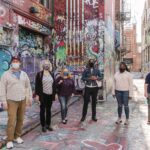
Kiaron Bailey will soon become the very first graduate of UMBC’s new master’s degree program in community leadership, a path she hadn’t envisioned for herself while working in finance just a few years ago. “From a very young age, my parents instilled in me the importance of giving back. I just didn’t realize that I could pursue that passion and actually sustain myself,” Bailey says. In deciding to make the career shift, “I kind of had a heart-to-heart with myself,” and she realized that entrepreneurship and community impact can go hand in hand.
Bailey learned about the program when she connected with Sonya Crosby at her place of worship. Today, Crosby is assistant vice provost for applied and off-campus programs, but at the time she was director of the Office of Professional Programs, which offered the new master’s degree. Crosby told Bailey about the practical emphasis of the program—how it combined coursework community-based service-learning—and Bailey knew it was what she was looking for.
 Bailey, second from left in second row, and her classmates in a virtual class. Photo courtesy of Bailey.
Appreciating the nuances
As someone who studied finance as an undergraduate—where one plus one equals two—Bailey found the nuanced world of community leadership a bit shocking, she says, laughing. She particularly enjoyed connecting with nonprofits in Baltimore City, using her skills to support their missions while learning more about running community-based organizations.
Next One Up helps Black male youth in their academics, including preparing for the SATs and other college prep. The nonprofit did not yet have a physical space, and Bailey researched possible locations, preparing them to strengthen their services and community connections post-pandemic.
 Bailey, second from right, with her classmates in Baltimore. Photo courtesy of Bailey.
She also worked with The Lazarus Rite, which helps formerly incarcerated people prepare for jobs, obtain gainful employment, learn about budgeting, and develop soft skills to support their success. Bailey developed a survey to help the organization prepare to apply for a grant, and analyzed the survey data.
UMBC’s community leadership program, “definitely helped me get a holistic perspective of what it actually takes to run an organization and the type of tenacity and creativity you need,” she says. Bailey currently works for the Interagency Commission on School Construction for the State of Maryland, and also serves as an administrator of programs and finance, and the liaison for the Maryland Board of Education. She plans to continue that while starting to build a nonprofit supporting physical, mental, and financial wellness.
Creative problem solver
When Princess Sara Njemanze ‘21, chemical engineering, came to UMBC as a freshman, she knew that she wanted to find opportunities to build and to support communities. She started by joining the Shriver Center’s Living Learning Community, a residential floor bringing together students focused on meaningful social change. The experience proved so significant that she remained connected to the group for four years, transitioning through roles as a peer mentor and then as a resident assistant. “It’s my life,” she says, smiling.
 Njemanze, second from right in second row, with her fellow Orientation Peer Advisors in 2018. Photo by Marlayna Demond ’11 for UMBC.
As she explored possibilities for her degree and career paths, Njemanze knew she enjoyed fixing problems through science and engineering and that she loved connecting with people. After meeting Vivian Armor ‘73, American studies, director of the Alex. Brown Center for Entrepreneurship, Njemanze decided to register for an entrepreneurship class. There, she got a chance to partner with students from all different majors and to come up with a product to pitch for a Shark Tank-style presentation. Before long, she added minors in both computer science and entrepreneurship to her degree.
As a France-Merrick Fellow, Njemanze worked with a group of her peers to create initiatives that work to address challenges in Baltimore City and Baltimore County. “Something that I’m really proud of that we worked on and saw the fruits was hosting a leadership program for high school students at Lansdowne High School,” she explains, adding that they asked the students to envision their ideal communities.
 Njemanze, fifth from right, and the France-Merrick 2018-2019 cohort. Photo by Raquel Hamner ’20.
The high school students came to UMBC for a day-long leadership training and created art that was displayed at OCA Mocha, a coffee shop and community gathering space in downtown Arbutus. Njemanze says the opportunity to connect with younger students was meaningful to her and impacted her UMBC experience.
 Njemanze, second from right in front row, with her classmates in Introduction to Intercultural Communication class. Photo courtesy of Njemanze.
During her time at UMBC, Njemanze interned at the Naval Surface Warfare Center, where she was offered a job that will begin after graduation, combining her passion for engineering and creative problem solving. Her long-term vision is creating a nonprofit to support underserved communities gain access to knowledge and skills such as financial literacy, college readiness, and leadership development.
Supporting mental health through tech
Tristan King ‘21, individualized studies, created his own path at UMBC after transferring from Howard Community College (HCC), where he earned an associates degree in computer science. While King was at HCC, he met Joshua Massey ‘14, individualized studies, who was teaching an entrepreneurship course. By talking with Massey during his office hours King learned that at UMBC he could design his own major, and he began to explore the possibilities.
King shares that his personal mental health struggles led him to create a major at UMBC that focused on how technology could support mental health and wellbeing. Through an emerging field called digital therapeutics, he explains, some health care providers are prescribing apps and websites to provide support and resources to people with depression and other mental health challenges.
 King testing the UMBC-UCI-Toyota research prototype. Photo by Sarah King.
At UMBC, King began learning more about tech and accessibility. He worked with Ravi Kuber, associate professor of information systems, on creating obstacle-detection tools so that blind runners could complete their runs independently and safely (research supported by Toyota). King also worked with Lee Boot, director of UMBC’s Imaging Research Center, on data visualization research.
In 2020, he participated in UMBC’s annual Idea Competition through the Alex. Brown Center for Entrepreneurship. His team earned second place for the Sproutful System, which includes a plant container outfitted with sensors that transmit to a phone app, helping the user know what their plant needs to thrive. The app also features daily guided meditations. The idea is that a person will care for themselves and their plant in a daily meditative practice that is both relaxing and rewarding.
 King, top, and his collaborator Andrew Park ’21, individualized studies, presenting at the Idea Competition in 2020.
King’s senior capstone project uses virtual reality to translate metaphor therapy to an immersive environment. “It looks at how people describe depression and anxiety, and sort of visualizes it,” he says. The project combined what he learned through health psychology coursework with his computer science skills, interest in supporting mental health, creativity, and ingenuity to yield a thought-provoking tool.
Energy and commitment
When Amina Mahmood ‘21, computer science, was younger, she would routinely get viruses on her family’s desktop computer while playing online games. Her computing skill set has certainly grown and changed over the years, but her passion for the field remains the same.
As she was applying to colleges, Mahmood focused on institutions with strong resources for students pursuing computer science. She felt elated when offered a spot in UMBC’s Cyber Scholars program, housed within the Center for Women in Technology. She wanted to make the most of each and every opportunity that came her way.
 Mahmood, right, at a CWIT event. Photo courtesy of Mahmood.
That is how Mahmood, as a new freshman at UMBC, found herself at the UMBC Career Center’s campus career fair, 10 copies of her resume in hand. She didn’t yet have work experience in computing, and wasn’t quite sure of the protocol, but she committed to handing out each one of those resumes before she left.
Before the end of the day, Mahmood connected with Huntress Labs, a start-up company based in bwtech@UMBC. Huntress Labs offered her an internship, and she worked there part-time through her sophomore year.
She also went on to complete internships at Parsons, a company that develops digital solutions in the security, defense, and infrastructure industries; Systems and Tech Research; and the Johns Hopkins University Applied Physics Lab. There, she will soon begin a full-time job as a cyber engineer, where she will focus on reverse engineering, one of her computing-related passions.
A world of opportunities
While completing her courses and interning, Mahmood took advantage of unique learning opportunities. She received a scholarship to attend the Grace Hopper Celebration, the world’s largest gathering of women in technology. She also studied abroad in the United Kingdom in spring 2020, traveling to Paris and London before the program ended early due to the emergence of COVID-19.
 Mahmood in Paris. Photo courtesy of Mahmood.
Mahmood’s approach of taking on new challenges with energy and commitment extended to other aspects of her life at UMBC. When she found that UMBC offered limited on-campus halal dining options, she worked with the Student Dining Advisory Committee to expand those options. In her junior year her tenacity paid off. UMBC opened Halal Shack as a permanent halal dining option in The Commons, also popular with vegetarian and vegan diners.
 Mahmood, third from right, at the ribbon cutting event opening Halal Shack in The Commons. Photo by UMBC Dining.
Knowing the potential of her organizing to positively impact other people motivated Mahmood to push forward the work until it became a reality. “I’m the youngest in my family, but what if I have a daughter or a nephew and they come to UMBC, what would I want them to experience?” she asked herself. “I just want to use my skill set and whatever I can do to be beneficial to other people.”
Gaining confidence as entrepreneur
Jason Jozwiak, M.S. ‘21, information systems, came to UMBC with a bachelor’s degree in fine arts, a decade working as a software developer, and two years teaching English in Ukraine through the Peace Corps. As a Peaceworker Fellow with UMBC’s Shriver Center, he had an opportunity to pursue his master’s degree in information systems while working part-time with Baltimore City’s Department of General Services, and completing a social change leadership program.
 Jozwiak (in blue hat) and fellow Peaceworkers in Baltimore, 2020. Photo by Charlotte Keniston.
Jozwiak began working with the City of Baltimore before the COVID-19 pandemic began, developing software to help his department digitize records. During the pandemic, the City began using that same software to record COVID-19 data to support contact tracing efforts.
That experience broadened his sense of the kinds of community impacts he could have through a career in computing. After graduation, he plans to expand his software development work in partnership with another emerging entrepreneur.
 Jozwiak giving a presentation related to his work with Baltimore City. Photo by James Trimarco of the Department of General Services.
“UMBC helped open my eyes to the possibilities and opportunities that are available,” says Jozwiak. “Entrepreneurship is something that I’ve been interested in for a long time. There are inherent risks involved and it’s kind of scary trying to piece it together. But I learned that I know what I’m doing. It helped give me the confidence.”
Finding community
Jameka Wiggins ‘21, chemical engineering, remembers when representatives from UMBC’s Center for Women in Technology (CWIT) visited her high school in Prince George’s County, Maryland. They offered a glimpse into the kind of experience she might have as a CWIT Scholar, including a tight-knit community of mutual support. She was accepted into the scholars program and says, simply, “CWIT was my community coming into UMBC. They always made sure we had a community of supporters, that we were engaged in the program, and that we felt welcome at the university.”
That community proved particularly important when Wiggins struggled with the transition to college life, worrying that she didn’t belong. Working through that challenging time motivated her to shift from focusing on lab research to engineering education itself as a career path.
 Wiggins, second from left, with Elfreda Atoe ’19, political science; Krystal Ogun, ’19, information systems; Alayla Stone-Abernathy ’20, health administration and policy; and Cheyenne Oliver ’20, biological sciences, at an event for The Lambda Phi Chapter of Alpha Kappa Alpha Sorority, Incorporated. Photo courtesy of Wiggins.
During her sophomore year, Wiggins, who is also a member of the UMBC chapter of the National Society of Black Engineers, decided that she wanted to gain research experience. She applied to the NSF’s Louis Stokes Alliance for Minority Participation (LSAMP) program, which supported her summer research on optimizing oleaginous yeast cell factories in UMBC’s chemical, biochemical, and environmental engineering department.
The next year she accessed a very different kind of experience as a Shattuck Fellow through the UMBC Career Center and as a participant in the Maryland Technology Internship Program for Entrepreneurship. These initiatives allowed her to intern multiple semesters for the start-up Athena Environmental Sciences, with Sheldon Broedel, associate director of UMBC’s master’s in professional studies in biotechnology program.
As she was exploring these opportunities, Wiggins realized that she was not the only student who would benefit from academic support outside of the classroom. She and a group of her peers worked with the UMBC Academic Success Center to provide tutors for upper-level engineering courses. And she also began looking at career pathways in engineering that were focused on community and belonging.
Change agent
In fall 2020, Wiggins, also a McNair Scholar, began working with Jamie Gurganus, associate director of engineering education, on a project that would shape her trajectory. They conducted research on the engineering mindset and experiences of Black first-year students, including those who are and are not in scholars programs.
Wiggins and Gurganus explored how to foster a sense of community among these students, which has been demonstrated to support resilience and degree attainment. Their study found that participants experienced particular challenges during the COVID-19 pandemic, such as isolation and difficulty finding their footing in classes.
 Wiggins, second from right, with Delegate Samuel Rosenberg, second from left, in Annapolis as a bill hearing. Photo courtesy of Wiggins.
In addition to her interest in supporting college students, Wiggins committed time to supporting younger students as well. She volunteered for the Refugee Youth Project’s College Journey Upward Mentoring Program (College JUMP), where she mentored a high school student in Baltimore City and helped her with the college admissions process. This experience led Wiggins to become a leader in the program, creating curricula for students and supporting mentors.
She also worked with some of her peers to create the LIFT Mentoring Program, which connects upper-level students with underclassmen in the same or similar majors to support informal mentorship and guidance outside of the classroom.
And along the way, she took on other leadership roles through UMBC’s Truth, Racial Healing, and Transformation Center and UMBC’s Inclusion Council.
These research, mentoring, and leadership experiences have inspired Wiggins to pursue a Ph.D. in engineering education. Her emphasis will be on developing undergraduate student support services to increase the retention and representation of underrepresented populations in engineering. “I will serve as a change agent,” she says.
Banner image: Kiaron Bailey, second from right, with her classmates in Baltimore. Photo courtesy of Bailey.
]]>
Kiaron Bailey will soon become the very first graduate of UMBC’s new master’s degree program in community leadership, a path she hadn’t envisioned for herself while working in finance just a few...
https://umbc.edu/stories/new-umbc-grads-find-entrepreneurial-ways-to-positively-impact-communities/
https://beta.my.umbc.edu/api/v0/pixel/news/119629/guest@my.umbc.edu/b5d4e100348ac4461677fa8df30efc6b/api/pixel
alexbrowncenter
bwtech-at-umbc
careercenter
cbee
classof2021
coeit
community
csee
entrepreneurship
inds
irc
is
shrivercenter
UMBC News & Magazine
https://beta.my.umbc.edu/groups/umbc-news-magazine
https://assets1-beta.my.umbc.edu/system/shared/avatars/groups/000/001/943/24435aa6207c452e7bc15cc74b42c7bb/xsmall.png?1748556657
https://assets1-beta.my.umbc.edu/system/shared/avatars/groups/000/001/943/24435aa6207c452e7bc15cc74b42c7bb/original.png?1748556657
https://assets2-beta.my.umbc.edu/system/shared/avatars/groups/000/001/943/24435aa6207c452e7bc15cc74b42c7bb/xxlarge.png?1748556657
https://assets2-beta.my.umbc.edu/system/shared/avatars/groups/000/001/943/24435aa6207c452e7bc15cc74b42c7bb/xlarge.png?1748556657
https://assets3-beta.my.umbc.edu/system/shared/avatars/groups/000/001/943/24435aa6207c452e7bc15cc74b42c7bb/large.png?1748556657
https://assets1-beta.my.umbc.edu/system/shared/avatars/groups/000/001/943/24435aa6207c452e7bc15cc74b42c7bb/medium.png?1748556657
https://assets2-beta.my.umbc.edu/system/shared/avatars/groups/000/001/943/24435aa6207c452e7bc15cc74b42c7bb/small.png?1748556657
https://assets1-beta.my.umbc.edu/system/shared/avatars/groups/000/001/943/24435aa6207c452e7bc15cc74b42c7bb/xsmall.png?1748556657
https://assets2-beta.my.umbc.edu/system/shared/avatars/groups/000/001/943/24435aa6207c452e7bc15cc74b42c7bb/xxsmall.png?1748556657
UMBC News & Magazine
0
0
false
Tue, 18 May 2021 14:36:51 -0400
UMBC together: Graduating Retrievers reflect on building community through conversations
When listeners tune in to the Retriever Tales podcast hosted by Tirzah Khan ‘21, information systems, who is graduating this week, they’ll hear UMBC voices sharing their journeys of finding and creating community. Moving, inspiring, funny, and thought-provoking, the show is a testament to Khan’s own UMBC experience and a broader culture of co-creating community at UMBC.
One key experience kick-started Khan’s growth as a student leader: STRiVE, a leadership for social impact retreat led by the Center for Democracy and Civic Life (CDCL). “Everything began for me when I went to STRiVE during my sophomore year,” she shares. “Before STRiVE, I stuck to myself and didn’t venture outside my comfort zone often. I gained so many insights about myself during the retreat, and I learned to reimagine the world as it could be.”

Tirzah Khan. Photo courtesy of Khan.
After returning from the retreat, Khan says, “I developed the confidence to get involved in other organizations,” like hackUMBC (becoming a design team lead) and the Student Events Board (as vice president for design). Along with STRiVE 2019 members Shrijana Khanal ’21, economics; Sofía Encarnación ’22, economics and mathematics; and Juhi Naik ’21, history and political science, she also founded the TEDxUMBC student organization, launching her work as a community storyteller.
Reimagining the world through stories
When Khan dives into something, she does it in a big way. She committed to UMBC community work through CDCL, serving as a ConnectionCorps intern to create Retriever Tales; helping to coordinate Election Night Extravaganza, an election night returns watch program; and joining other community members in facilitating and organizing “Together Beyond November” post-election discussions. She also participated in initiatives like the fall 2020 Cast Your Whole Vote campaign, featuring events to encourage the UMBC community to recognize voting as just one of many ways to make a difference.

Tirzah Khan. Photo courtesy of Khan.
Khan is passionate about the intersection of graphic design and social impact. She worked as a social media engagement and design intern with the Mosaic: Center for Culture and Diversity, and she has also been active with Retriever Immigrants United and the Women of Color Coalition.
In her final semester, Khan wanted to focus on bringing the UMBC experience to community members who had largely been away from campus for a year due to COVID-19. She brought the Retriever Tales podcast to life, featuring authentic conversations with Retrievers about what brought them to UMBC, what it means to them to be here, and what hopes they have for the UMBC community. Khan shares,“These conversations have truly reshaped my understanding of what it means to be part of a community, and what it means to be part of UMBC’s community.”
“As students we have the opportunity to try and mold UMBC’s future and its impact,” says Khan. “There’s this idea that I think describes UMBC’s culture really well: that we’re all co-creating UMBC. What that means is everyone here has the ability to help shape this institution in some way. We all have both the opportunity and the responsibility to create the UMBC that we want to see together.”
Visible, actionable change
Like Khan, graduating senior and Honors College member Brandon Liu ‘21, biological sciences and visual arts, says STRiVE and CDCL transformed his time at UMBC.
As a first-year student, Liu and friends Ella Hawkins ‘20, biochemistry and molecular biology, and Manny Ali, ‘20, computer engineering, who is hard of hearing, learned UMBC didn’t offer American Sign Language (ASL) classes or clubs, so they co-founded Sign of Life. The club teaches ASL and educates students interested in being more involved in the Deaf community. “This was my first experience collaborating with friends, reaching out to stakeholders, and making a visible, actionable change on something as large as a university campus community,” says Liu.
 Brandon Liu. Photo by Alexis Harris ‘19.
Building on that experience, Liu attended the STRiVE retreat in his second year at UMBC. Over the next three years he returned to STRiVE as the campus civic engagement intern, supporting faculty, staff, and student coaches who guided groups of undergraduate student participants.
“The Center’s Alternative Spring Break and STRiVE are the most important experiences I can recommend, especially for those who don’t feel like they have what it takes to make change or think that change doesn’t happen,” says Liu. “STRiVE transformed me from a student that kept my head down and didn’t think I was powerful enough, smart enough, connected enough to make change into someone who knew that coming as I am, I am already valuable and capable of affecting my communities.”
Strength in community
Those around Liu quickly began to see his impact and his potential as a leader. In 2018, he received the Lavender Award for Emerging LGBTQ+ Leader from the Initiatives for Identity, Inclusion, and Belonging. He kept his focus on community leadership and, today, says the agency students have at UMBC is what makes a UMBC education so valuable.
“As assistant speaker of the senate for our Student Government Association (SGA), one of my biggest responsibilities was coordinating undergraduate participation in UMBC’s shared governance committees,” says Liu. “I connected the undergraduate senators with chairs of key university committees, to make sure undergraduate voices were heard in campus decision-making.”
 Brandon Liu and other members of UMBC’s delegation at the 2018 Civic Learning and Democratic Engagement Meeting. Photo courtesy of Hoffman.
Seeing fellow students grow in their ownership of the UMBC community and learn to increase student agency on campus was both gratifying and motivating to continue the work, he shares.
“The real strength of UMBC is within the community,” says Liu. “I’ve been able to learn so much more about myself and surround myself with many other genuine, compassionate, caring, and active people. The academic rigor allows students to receive a valuable degree, but the community is what makes UMBC a home.”
 Front row (l-r): Tess McRae, Romy Hübler, Brandon Liu, and David Hoffman. Back row (l-r): Pat Michael and Timothy Farrell. Photo courtesy of Hoffman, 2019.
Liu is graduating as a Sherman STEM Teacher Scholar and will soon begin his master of arts in teaching for secondary biology at UMBC. He shares, “I know that UMBC values the same things I do. And with a master’s in teaching from UMBC I know I’ll be able to take on the responsibility of building and supporting communities in the schools and classrooms where I’ll teach in the future.”
Creating shared spaces
Meghan Lynch ‘18, political science, and M.P.P. ‘21, will soon become a double alumna of UMBC, after earning her master’s in public policy. She says she still thinks about one particular class on civic agency during her undergraduate years, which shaped her UMBC experience, her career path, and her perspective on the world. Her a-ha moment: “I realized that the idea of creating shared spaces and bringing democracy into the classroom was a very concrete way to realize the power we all have in every space,” she says.
Lynch describes UMBC as a place that supports, nurtures, and encourages political engagement in all forms. Creating spaces for community dialogue and mutual support was especially important during COVID-19 and the intense election cycle. As vice president of UMBC’s Graduate Student Association (GSA), Lynch is proud of how the group helped to offer space for dialogue and build community as a co-host for the CDCL’s “Together Beyond November” post-election discussions.
 Meghan Lynch. Photo by Poulomi Banerjee ‘16.
“Amidst all the fatigue and difficult news in the world, the Center, SGA, and GSA were able to coordinate very meaningful and well-attended events leading up to and after the election,” says Lynch. “It was clear that the UMBC community wanted to spend time coming together to think about our role in bringing about change and hearing about the issues. I left every one of these events feeling refreshed in a humble and grateful way.”
Resources for success
During the COVID-19 pandemic, Lynch and other GSA officers created a well-being committee, recognizing the importance of students’ mental, physical, and spiritual well-being. “We’ve had an excellent turnout to committee meetings in part because people are looking for a place to reflect on how to help each other,” she says.
“Amidst all the chaos and uncertainty, I’m so proud that GSA has found ways to connect students to the resources they need and serve as a gathering space–even virtually,” Lynch says. “I’m also proud of the strides we are making to ensure that graduate students are intentionally included in programming and other opportunities across campus.”
Creating community, Lynch reflects, “is a way for people from different departments across campus to collectively work towards solutions that benefit all of us.” And every new relationship or new project “starts from just one conversation,” she shares, so “there’s beauty in just talking with people.”
 Meghan Lynch and True Grit. Photo by Poulomi Banerjee ‘16.
After graduation, Lynch will teach an introductory political science class at UMBC and serve as the new director for the Catonsville Chamber of Commerce. She says, “I hope to take all of the transformative experiences I’ve had at UMBC beyond Hilltop Circle to help others realize their ability to make their communities better for everyone.”
One person who looks forward to seeing the impact of her work is CDCL Director David Hoffman Ph.D. ‘13, language, literacy, and culture. Hoffman shares that Lynch, Liu, and Khan all “embody the idea that we can bring our whole, unique selves to the work of shaping our communities.” He says, “Their contributions have helped make UMBC even more deeply and visibly what it has been all along: caring, inclusive, and engaged.”
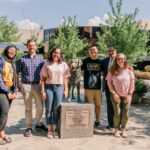
Featured image (l-r): Mariam Abalo-Toga, Roy Prouty, Anjali Dassarma, Brandon Liu, President Freeman Hrabowski, and Lilly Keplinger stand by True Grit, 2018. Photo by Marlayna Demond ’11 for UMBC.
Article written by Eleanor Lewis, communication specialist in the Division of Student Affairs.
]]>
When listeners tune in to the Retriever Tales podcast hosted by Tirzah Khan ‘21, information systems, who is graduating this week, they’ll hear UMBC voices sharing their journeys of finding and...
https://umbc.edu/stories/umbc-together-graduating-retrievers-reflect-on-building-community-through-conversations/
https://beta.my.umbc.edu/api/v0/pixel/news/119630/guest@my.umbc.edu/a9c7cde047268802ca3299e83938e6cb/api/pixel
biology
cahss
classof2021
cnms
coeit
community
honorscollege
is
page1
publicpolicy
visualarts
UMBC News & Magazine
https://beta.my.umbc.edu/groups/umbc-news-magazine
https://assets1-beta.my.umbc.edu/system/shared/avatars/groups/000/001/943/24435aa6207c452e7bc15cc74b42c7bb/xsmall.png?1748556657
https://assets1-beta.my.umbc.edu/system/shared/avatars/groups/000/001/943/24435aa6207c452e7bc15cc74b42c7bb/original.png?1748556657
https://assets2-beta.my.umbc.edu/system/shared/avatars/groups/000/001/943/24435aa6207c452e7bc15cc74b42c7bb/xxlarge.png?1748556657
https://assets2-beta.my.umbc.edu/system/shared/avatars/groups/000/001/943/24435aa6207c452e7bc15cc74b42c7bb/xlarge.png?1748556657
https://assets3-beta.my.umbc.edu/system/shared/avatars/groups/000/001/943/24435aa6207c452e7bc15cc74b42c7bb/large.png?1748556657
https://assets1-beta.my.umbc.edu/system/shared/avatars/groups/000/001/943/24435aa6207c452e7bc15cc74b42c7bb/medium.png?1748556657
https://assets2-beta.my.umbc.edu/system/shared/avatars/groups/000/001/943/24435aa6207c452e7bc15cc74b42c7bb/small.png?1748556657
https://assets1-beta.my.umbc.edu/system/shared/avatars/groups/000/001/943/24435aa6207c452e7bc15cc74b42c7bb/xsmall.png?1748556657
https://assets2-beta.my.umbc.edu/system/shared/avatars/groups/000/001/943/24435aa6207c452e7bc15cc74b42c7bb/xxsmall.png?1748556657
UMBC News & Magazine
0
0
false
Tue, 18 May 2021 02:48:57 -0400
UMBC softball wins America East championship, continues on to NCAA tournament

After five scoreless innings, UMBC softball pulled ahead in the bottom of the sixth to successfully defend their 2019 America East title with a 1-0 win over No.3 seed Stony Brook in the 2021 America East Championship this past Saturday.
Sierra Pierce ‘21, design, drove in the winning runs in the Retriever’s final two games. A Second Team All-Conference selection, Pierce earned a spot on the All-Championship Team for the third time and was named the tournament’s Most Outstanding Player.
 Shanel Stott ‘23, information systems, hits an RBI triple in the first-round win over UMass Lowell last Thursday.
“I felt honored to be named,” says Pierce of her Most Outstanding Player achievement. “There’s a lot of talent on our team and there were many teammates who deserved to be recognized. It really was a team effort out there.”
Julia Keffler ‘22, media and communications studies, also a Second Team All-Conference selection, was named to the All-Tournament Team thanks to her spectacular showing at the plate and on the base paths.
Return honors
In light of the pandemic and the impact it had on many student-athletes, the NCAA granted athletes an additional year of eligibility to players. Maddie Daigneau ‘21, media and communications studies, was the only senior who elected to return to finish out her senior season. She also earned a spot on the All-Championship Team after batting .333 with a run scored, a stolen base, and stellar play at shortstop.
“I am so thankful to have the opportunity to come back for a fifth year and be a part of the growth of this talented program,” says Daigneau.
 Coppersmith winds up to pitch against UMass Lowell.
Two-time America East Pitcher of the Year Courtney Coppersmith ’22, biochemistry, was the final Retriever to earn All-Championship Team honors, going 3-0 with just one run allowed and 25 strikeouts in three complete games. Coppersmith is the first student-athlete since 2001 to be a repeat America East Pitcher of the year.
Continuing a legacy
The victory earns UMBC its fourth-ever NCAA Tournament bid, and it’s the first of the four to be won at home. It was also the first championship win on campus for a Retrievers team since men’s soccer won the America East title at Retriever Soccer Park in 2014.
Despite returning almost its entire starting lineup from the 2019 championship team, the Retrievers were voted to finish third in the preseason coaches poll. UMBC then went on to go 11-5 in conference play, not only picking up its most conference wins in a season since 2009, but also winning its first-ever America East Regular Season championship, and earning the right to host the tournament.
 UMBC comes out victorious in the rematch of the 2019 America East Championship. Photo courtesy of America East.
Head coach Chris Kuhlmeyer became the first Retriever Softball coach to be named America East Coach of the Year, after leading UMBC to its first-ever America East Regular Season title earlier this month.
“This will be a season I will never forget,” says Kuhlmeyer. “From rallying to win the regular-season title, to coming through with two outs in the sixth inning of the conference tournament championship game, there are so many memories I will take away and more to be made.”
The road to Arizona
The Retrievers will travel to Tucson, Arizona to face No.11 Arizona this Friday, May 21, at 8:30 p.m. for the first round of NCAA tournament play. The other two teams in the double-elimination, four-team pod are Villanova and the University of Mississippi.
“Arizona is a great team and one of the most historic programs in our sport. To face off against them in the first round of the regionals is certainly very exciting, but at the same time our Dawgs are not showing up just to say we made it to a regional,” assures Kuhlmeyer. “We’re coming with the mindset we are going to compete and do what we have done all year: fight all the way to the end for a victory, one game at a time.”
 Ashley Della Guardia ’24, undergraduate studies, celebrates the America East win. Photo courtesy of America East.
An Arizona native, Daigneau will get to play in front of her family for the first time in her collegiate career.
“It’s the best feeling to play regionals at the place I first started playing softball and being able to play one of my last tournaments there as well,” shares Daigneau. “Arizona was the place that helped me meet all the wonderful people who have been a part of my softball journey. I can’t wait to see them watch our games live this weekend.”
Article written by Zach Seidel, director of athletics digital media. Featured image: UMBC softball poses with their America East trophy. Photo courtesy of America East. All additional photos courtesy of Marlayna Demond ‘11 unless otherwise noted.
]]>
After five scoreless innings, UMBC softball pulled ahead in the bottom of the sixth to successfully defend their 2019 America East title with a 1-0 win over No.3 seed Stony Brook in the 2021...
https://umbc.edu/stories/umbc-softball-wins-america-east-championship-continues-on-to-ncaa-tournament/
https://beta.my.umbc.edu/api/v0/pixel/news/119631/guest@my.umbc.edu/75e0b7024b6d800b228d57458cf13a1a/api/pixel
athletics
community
UMBC News & Magazine
https://beta.my.umbc.edu/groups/umbc-news-magazine
https://assets1-beta.my.umbc.edu/system/shared/avatars/groups/000/001/943/24435aa6207c452e7bc15cc74b42c7bb/xsmall.png?1748556657
https://assets1-beta.my.umbc.edu/system/shared/avatars/groups/000/001/943/24435aa6207c452e7bc15cc74b42c7bb/original.png?1748556657
https://assets2-beta.my.umbc.edu/system/shared/avatars/groups/000/001/943/24435aa6207c452e7bc15cc74b42c7bb/xxlarge.png?1748556657
https://assets2-beta.my.umbc.edu/system/shared/avatars/groups/000/001/943/24435aa6207c452e7bc15cc74b42c7bb/xlarge.png?1748556657
https://assets3-beta.my.umbc.edu/system/shared/avatars/groups/000/001/943/24435aa6207c452e7bc15cc74b42c7bb/large.png?1748556657
https://assets1-beta.my.umbc.edu/system/shared/avatars/groups/000/001/943/24435aa6207c452e7bc15cc74b42c7bb/medium.png?1748556657
https://assets2-beta.my.umbc.edu/system/shared/avatars/groups/000/001/943/24435aa6207c452e7bc15cc74b42c7bb/small.png?1748556657
https://assets1-beta.my.umbc.edu/system/shared/avatars/groups/000/001/943/24435aa6207c452e7bc15cc74b42c7bb/xsmall.png?1748556657
https://assets2-beta.my.umbc.edu/system/shared/avatars/groups/000/001/943/24435aa6207c452e7bc15cc74b42c7bb/xxsmall.png?1748556657
UMBC News & Magazine
0
0
false
Mon, 17 May 2021 19:49:52 -0400
UMBC expands arts opportunities for K-8 students in Baltimore through Charlesmead partnership

Two UMBC projects have taken flight this spring, designed to support the academic, creative, and social success of Baltimore City students through arts opportunities. Both projects are funded through the UMBC-Charlesmead Initiative for Arts Education, which was established in 2018 with a $500,000, five-year gift from the Charlesmead Foundation.
The partnership is designed to introduce or strengthen arts opportunities for K-8 students in Baltimore City Public Schools , especially those in Title I schools. The Charlesmead Foundation, which was established in 1987 and is based in Baltimore, primarily supports the arts, cultural programs, and education.
Music in Sandtown-Winchester
Daniel Pesca and Janice Jackson in the department of music have joined forces with the Carter School of Music at New Shiloh Baptist Church and the William Knabe Piano Institute to offer after-school and summer music classes to youth in the Sandtown-Winchester community. The New Shiloh Baptist Church is recognized as a key community and spiritual hub in its neighborhood. The non-profit Knabe Institute raises awareness of the cultural significance of the piano, and produces a major young artist piano competition that is held annually at UMBC.

Pesca (left). Photo by
Rosen-Jones Photography. Jackson (right).
Photo courtesy of Jackson.
The Charlesmead grant to Pesca and Jackson fully funds the musical education of ten students between the ages of 8 and 14 who face obstacles to music study. The participating students receive instruction in piano and choral music for two academic years and two summers, taught by Chinny Ohia, a member of the Carter School faculty for over twenty years and chair of music at Howard University, and UMBC alumnus and pianist Riccardo Jefferson ’20, music. The summer instruction will be hosted in part by UMBC’s Summer Enrichment Academy.
The Carter School hired Jefferson specifically to teach students in this cohort. This strengthens the connection between the school and UMBC, while providing Jefferson with an exceptional opportunity to launch his career as a professional musician and music educator. “These young musicians were brave enough to start their musical journey during a pandemic,” says Jefferson. “Somehow, someway, they’re moving through it, and it inspires me to match their determination in the classroom and in my own life.”
 Riccardo Jefferson. Photo by Willie Santiago, concert coordinator for UMBC.
Success despite challenges
The project faced and overcame significant challenges during the current academic year. A major initial expense was the purchase of ten high-quality keyboards for use at home by students. Members of the faculty and staff of the Carter School spent two days delivering the large keyboards and assembling them in the students’ homes.
Once instruction began, some students faced challenges accessing reliable internet connections, which required that they and their instructors be flexible and adjust their lesson schedules when necessary.
Plus, “each student started as an absolute beginner who had no previous experience with the piano or with reading music,” explains Pesca. “Learning to make music brings the students joy and uplift during these times of isolation, and some have shared that the one-on-one contact with their instructors is a high point in their week. Eight out of ten students stayed fully engaged in the program and achieved significant musical growth over the semester, an outstanding outcome under such trying circumstances.”
The pandemic continues to make it challenging for the organizers to fully implement the program as they initially envisioned. Pesca had hoped to bring the students to campus for UMBC’s 2021 Summer Enrichment Academy, but that program will be online due to health and safety guidelines. Similarly, the Knabe Institute’s activities are likely to take place remotely as well.
However, the organizers hope to incorporate in-person learning at both UMBC and the Knabe Institute for the program’s 2021-2022 academic year, providing students with an even more enriching experience.
Kultur Stories
Shriver Center Director Michele Wolff is working with Gail Prensky, founder of the Jüdische Kulturbund Project (Jewish Kulturbund), to bring its Kultur Stories Program to UMBC. Wolff and Prensky are collaborating with local and international theatre, visual arts, and digital storytelling educators, artists, and community leaders. Together, they are gathering girls from City Springs Elementary/Middle School in Baltimore City, Aktörerna school in Sweden, and Promised Land Secondary School in South Sudan to participate in a virtual digital storytelling experience.
Kultur Stories explores issues of oppression and response through music and art. The Project’s mission is to connect people through shared experiences, inspire a response to persecution through cultural expression, and encourage freedom of expression and culture. This mission spoke to the work Wolff carries out through the Shriver Center.
“Kulture Stories aligns seamlessly with our commitment to racial equity, inclusion, and social justice,” shares Wolff. “This collaboration gives us the opportunity to extend beyond our current network of partners to engage and give voice to more young people in schools in Baltimore City and in countries around the world.”
Grappling with oppression through art
Jewish Kulturbund works with artists and communities around the world to explore the themes of oppression, the arts, and human rights through a variety of media. These initiatives honor the story and legacy of Jüdische Kulturbund artists who performed across Germany between 1933 and 1941, before being forced into Nazi concentration camps. The organization recalls their performances as a reminder of the complex questions and danger artists must grapple with under oppressive situations.

Margot Neuhaus working on an art piece.
Photo courtesy of Michele Wolff.
With this purpose in mind, the design team developed an 8-week collaborative Kultur Stories Program among young girls in the United States, Sweden, and South Sudan. Pods of around 10 girls from each country are connecting virtually to learn about each other. They are reflecting on the impact of the pandemic on themselves and their communities and the oppression it has caused. They are also creating art and joining in discussions about human rights, and participating in mentoring sessions.
The students began meeting this spring. In one session, Margot Neuhaus, a visual artist based in Washington D.C., was invited to give a virtual presentation. She discussed how her art process has provided a way for her to express her pain and healing in relation to her family surviving the Holocaust in Poland and their fleeing to Mexico, where Neuhaus was born.
The presentation initiated a profound conversation about oppression across borders and time. The students from South Sudan related to the persecution and displacement that Neuhaus described. And the Swedish students found it impactful as well. “That session was so powerful for my group of students,” shares Jok Abraham Thon, founder and director of the Aktörerna School. “They spoke about differences in language, skin color, and religion being issues that separate and cause issues of hatred.”
Connecting through digital stories
Shekinah Davis, co-facilitator of the Charlesmead Initiative for Arts Education at UMBC, serves as a teacher’s assistant in the project. Davis, M.A. ‘21, intercultural communication, supports lead teachers in communication strategies and helps manage the flow of the virtual pods. As a Shriver Center Peaceworker Fellow, she brings experience working with international and local communities.

Shekinah Davis.
Photo courtesy of Davis.
“I was drawn to participate in the project to gain a perspective of how to guide young people through a virtual creative process,” explains Davis. “I hope to gain a deeper understanding of virtual collaborative art-making, especially to help express experiences about the impact of the pandemic and oppression.”
The K-8 students are also connecting with interns from UMBC, Montgomery College, and Baltimore Polytechnic Institute, a high school in Baltimore City. These interns are guiding the girls in using storytelling and digital art production to express their personal reactions to oppression and how to embrace freedom.
The digital storytelling tools are bringing together students who would otherwise not be able to meet. They are also expanding the students’ opportunities to make digital art, beyond what is available in their everyday school experiences.
Design intern Joyce Koo ‘24, graphic design, is inspired by the Judische Kulturbund Project. She sees it as an important step in her education and career. In addition to assisting with a teaching pod, she is creating graphics and other visuals for the project’s social media outreach. “I hope to connect to and grow in a global community of both experienced and rising artists,” shares Koo.
Banner image: “In Memoriam” and “Light Motives” by Margot Neuhaus. Photo courtesy of Michele Wolff.
This article was co-authored with UMBC’s Thomas Moore, director of arts and culture.
]]>
Two UMBC projects have taken flight this spring, designed to support the academic, creative, and social success of Baltimore City students through arts opportunities. Both projects are funded...
https://umbc.edu/stories/umbc-expands-arts-opportunities-for-k-8-students-in-baltimore-through-charlesmead-partnership/
https://beta.my.umbc.edu/api/v0/pixel/news/119632/guest@my.umbc.edu/4ed70c8e9fd70fb19ee1bd5640788f7c/api/pixel
arts-and-culture
cahss
diversityandinclusion
graduateschool
international
mlli
music
policy-and-society
shrivercenter
visualarts
UMBC News & Magazine
https://beta.my.umbc.edu/groups/umbc-news-magazine
https://assets1-beta.my.umbc.edu/system/shared/avatars/groups/000/001/943/24435aa6207c452e7bc15cc74b42c7bb/xsmall.png?1748556657
https://assets1-beta.my.umbc.edu/system/shared/avatars/groups/000/001/943/24435aa6207c452e7bc15cc74b42c7bb/original.png?1748556657
https://assets2-beta.my.umbc.edu/system/shared/avatars/groups/000/001/943/24435aa6207c452e7bc15cc74b42c7bb/xxlarge.png?1748556657
https://assets2-beta.my.umbc.edu/system/shared/avatars/groups/000/001/943/24435aa6207c452e7bc15cc74b42c7bb/xlarge.png?1748556657
https://assets3-beta.my.umbc.edu/system/shared/avatars/groups/000/001/943/24435aa6207c452e7bc15cc74b42c7bb/large.png?1748556657
https://assets1-beta.my.umbc.edu/system/shared/avatars/groups/000/001/943/24435aa6207c452e7bc15cc74b42c7bb/medium.png?1748556657
https://assets2-beta.my.umbc.edu/system/shared/avatars/groups/000/001/943/24435aa6207c452e7bc15cc74b42c7bb/small.png?1748556657
https://assets1-beta.my.umbc.edu/system/shared/avatars/groups/000/001/943/24435aa6207c452e7bc15cc74b42c7bb/xsmall.png?1748556657
https://assets2-beta.my.umbc.edu/system/shared/avatars/groups/000/001/943/24435aa6207c452e7bc15cc74b42c7bb/xxsmall.png?1748556657
UMBC News & Magazine
0
0
false
Fri, 14 May 2021 21:48:46 -0400
Career Q&A: Robert Deloatch ’11, M19
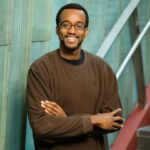
Every so often, we chat with an alum about what they do and how they got there. Robert Deloatch ’11, M19, computer science, has followed his research interests to an exciting job at Apple. We asked Robert about what his experience as a Meyerhoff Scholar means in his life today, and what he would say to a future scholar.
Q: What is your current job title and employer?
A: I am a Human Factors Engineer at Apple Inc.
Q: Tell us about your current job and what you enjoy most about it.
A: I manage a team of researchers who focus on applying user-centered design principles to design and develop Apple products. I collaborate with teams at Apple to come up with new ways to continue to enhance the customer experience. I enjoy the fast paced environment of Apple which allows for conducting research that leads to immediate customer impact.
Q: When you think about the “ripple effect” of the Meyerhoff Scholars Program, how do you see that playing out in your field and in your life?
A: I’ve been amazed at how the Meyerhoff Scholars Program has continued to affect my field and life. I’ve encountered researchers and faculty of color that were part of the Meyerhoff Scholars Program or programs that were modeled after Meyerhoff at conferences and internships. It’s been a reminder to me of the staying power of such a program and how it’s focus on leadership, diversity, and scholarship has been ingrained into my beliefs and relationships.
Q: Why is the Meyerhoff mission so important, not only to you, but to society?
A: The Meyerhoff mission is important because diversity in STEM is important. To generate the best ideas and solve complex problems requires discussion and being challenged. Having groups from various backgrounds and perspectives is foundational to promote useful discussion.
Q: What advice would you give to a student considering the program?
A: I would tell a student to follow the advice of your Meyerhoff staff. They have been instrumental in helping produce thousands of amazing scholars and have your best interest at heart. Listen to them.
Learn more about the Meyerhoff Scholars Program here.
]]>
Every so often, we chat with an alum about what they do and how they got there. Robert Deloatch ’11, M19, computer science, has followed his research interests to an exciting job at Apple. We...
https://umbc.edu/stories/career-qa-robert-deloatch-11-m9/
https://beta.my.umbc.edu/api/v0/pixel/news/119633/guest@my.umbc.edu/4cd30822664f76375c603032d56853ee/api/pixel
alumni
career-q-and-a
computer-science
meyerhoff
mhoff
UMBC News & Magazine
https://beta.my.umbc.edu/groups/umbc-news-magazine
https://assets1-beta.my.umbc.edu/system/shared/avatars/groups/000/001/943/24435aa6207c452e7bc15cc74b42c7bb/xsmall.png?1748556657
https://assets1-beta.my.umbc.edu/system/shared/avatars/groups/000/001/943/24435aa6207c452e7bc15cc74b42c7bb/original.png?1748556657
https://assets2-beta.my.umbc.edu/system/shared/avatars/groups/000/001/943/24435aa6207c452e7bc15cc74b42c7bb/xxlarge.png?1748556657
https://assets2-beta.my.umbc.edu/system/shared/avatars/groups/000/001/943/24435aa6207c452e7bc15cc74b42c7bb/xlarge.png?1748556657
https://assets3-beta.my.umbc.edu/system/shared/avatars/groups/000/001/943/24435aa6207c452e7bc15cc74b42c7bb/large.png?1748556657
https://assets1-beta.my.umbc.edu/system/shared/avatars/groups/000/001/943/24435aa6207c452e7bc15cc74b42c7bb/medium.png?1748556657
https://assets2-beta.my.umbc.edu/system/shared/avatars/groups/000/001/943/24435aa6207c452e7bc15cc74b42c7bb/small.png?1748556657
https://assets1-beta.my.umbc.edu/system/shared/avatars/groups/000/001/943/24435aa6207c452e7bc15cc74b42c7bb/xsmall.png?1748556657
https://assets2-beta.my.umbc.edu/system/shared/avatars/groups/000/001/943/24435aa6207c452e7bc15cc74b42c7bb/xxsmall.png?1748556657
UMBC News & Magazine
0
0
false
Fri, 14 May 2021 17:03:53 -0400
Strong finish: UMBC student-athletes discuss support and resilience in “one of the toughest years”

Due to the pandemic, the NCAA has offered senior college athletes around the country a waiver to compete for an extra year. Many fourth-year student-athletes at UMBC and around the country will take advantage of this opportunity, but others decided to press forward with making the most of an unusual senior year before shifting gears to the next phase of their lives.
Among that group in Retriever Nation are a pair of lacrosse players, a swimmer, and a diver who will earn undergraduate degrees this month. All four are recognized for outstanding achievements during a very challenging time for student-athletes. And all four share that support from UMBC Athletics staff was instrumental in helping them reach their goals and move forward along their paths.
From sports to sports journalism
Nick Doyle ‘21, media and communication studies, has been a steady contributor for men’s lacrosse, including during UMBC’s America East championship run and NCAA Tournament win over Marist in 2019. He’s also a voice of UMBC Athletics, both on air and behind the scenes.
Doyle assisted with player interviews on “The Ryan Odom Report,” provided on-air analysis on women’s soccer’s streamed game broadcasts, and led social media takeovers for the men’s lacrosse Instagram account, among other projects. He also wrote game recaps, gained experience behind the camera, shadowed on-air talent, and learned how to construct a sports broadcast.
 UMBC lacrosse player Nick Doyle. Photo by John McCreary for UMBC Athletics.
“UMBC’s partnership with ESPN+ allowed me to receive hands-on experience inside the tech truck with producers, directors, replay personnel, and graphics,” says Doyle. The San Diego native worked for his hometown Padres’ flagship station in the summer of 2019 and put those recap writing skills to good use.
“UMBC Athletics has been an invaluable source of support, guidance, and confidence for me,” Doyle shares. “Since I introduced myself to Steve Levy [‘85, interdisciplinary studies], he has taken me under his wing and has done an amazing job getting me into positions of opportunity and experience.”
He also noted that Zach Seidel ‘12, media and communication studies, M.S. ‘15, human-centered computing; Dustin Roddy ‘14, American studies; and Shanna Moser have “all played instrumental roles in advancing my experience at UMBC, not just as a student-athlete, but in sports journalism.”
Doyle will pursue his master’s degree at the University of Maryland, College Park’s Philip Merrill School of Journalism in the fall.
Community leadership
Like Doyle, Cassie Evans ‘21, biological sciences and psychology, is a defender on the lacrosse field. She has started in all 33 UMBC’s women’s lacrosse contests since 2019 and earned America East All-Academic Team honors in 2020 and 2021. She’s also a 4.0 student who earned the UMBC psychology department’s 2020-21 Distinguished Achievement Award. And she got there, she says, thanks to the support of a caring advisor.
Evans serves on the executive board of the Student-Athlete Advisory Committee, for which former UMBC Athletics’ Academic Advisor Kristin Ferris served as staff advisor. “Kristin has always believed in me,” Evans shares. “I always went to her when I was stressed or struggling and she actively worked to create a plan of action that helped me approach problems with ease. She advocated for me in so many settings.”
 UMBC’s Cassie Evans (left) competes against Hartford. Photo by Gail Burton.
Ferris shared that Evans “has been tremendously effective as a community leader despite challenges faced by the COVID-19 pandemic.” In summer 2020, Evans coordinated a virtual 5k that raised over $2,000 for Baltimore’s Living Classrooms organization in support of anti-racism and social justice. She later organized an equipment drive for the Children’s Home, collecting over $3,300 of sports equipment and art supplies for displaced children.
Evans shares that Ferris introduced her to leadership opportunities she didn’t know existed, such as serving as the student-athlete representative on UMBC’s Athletics Policy Committee. Of Ferris, Evans says, “I respect her so much and have learned so much from her. She has taught me through her own actions the importance of work ethic, persistence, reliability, accountability, and determination.”
Currently studying for the MCAT, Evans will continue volunteer work in Baltimore and El Salvador prior to medical school. Her long-term career goal is to support those who do not have access to affordable medical treatment.
Team support
As a men’s swimming team captain for two years, Jeremy Gates ‘21, mechanical engineering, has spent a lot of time thinking about how to support his teammates in connecting with and taking care of each other and competing at a high level during a pandemic. Part of his approach was hosting outdoor, small-group team-building activities that met COVID-19 protocols. Another major piece was being present for other swimmers who needed one-on-one support.
“I have tried to make myself available for my teammates whenever they need it,” says Gates. While he doesn’t always know the perfect thing to say, he shares, “I have found that simply lending an ear as a friend is a good start.”
Gates also found it was important to reach out to others for support, and to make sure he was managing his own stress. “I am no help to anyone if I don’t take care of myself first,” he says. “The great thing about this team is that there are numerous people I can go to if I need someone to lean on.”
One person that Gates and his teammates leaned on was Brian Amenta, director of strength and conditioning. Amenta, a six-year UMBC veteran, completely revamped all 17 UMBC Athletics’ teams training regimens to meet COVID health and safety guidelines, and understood the pressures Gates was experiencing.
 UMBC swimmer Jeremy Gates. Photo by Ian Feldmann.
Amenta became a fixture in the lives of Gates and his teammates. Starting in fall 2020, Amenta worked with the team twice each week twice each week at 6 a.m., with dry land training. He provided Gates with a model for working effectively with a large group of student-athletes while supporting team members’ individual needs.
After graduation, Gates will reconnect with family in California before starting as a systems engineer through Northrop Grumman’s Pathways Program.
“One of the toughest years”
After injury-plagued sophomore and junior campaigns, diver Isabel Rayner ‘21, biological sciences, was looking forward to a strong finish to her UMBC career as team captain. Then came the COVID-19 pandemic. Rayner helped her team feel connected and supported at a time of great uncertainty. The cancellation of a meet in fall 2020, just three days before it was scheduled, was a particularly challenging setback.

UMBC diver Isabel Rayner. Photo courtesy of UMBC Athletics.
“My biggest goal in being captain is to make everyone feel that there is support all around them,” said Rayner. Her greatest challenge was taking care of herself. “I was so focused on making sure that everyone else was okay that I struggled to find a balance,” she says.
Rayner’s injuries started in her sophomore year—chronic bicep and shoulder strains and a sprained ankle in 2018-19. That same year, athletic trainer Meghan Sullivan (at UMBC since 2011) was assigned to the team. “Meghan has been there for me without fail,” says Rayner. “These injuries were never severe enough to keep me out of diving, but they did require physical therapy. I was in the training room every day with Meghan. And she was always there for emotional support.”
Last season, Rayner suffered a wrist injury when entering the water and was back in the training room daily. She was able to compete in the 2020 championships and climbed the ladder for the final time as a Retriever in an April 2021 meet, placing second on the three-meter board.
She’s grateful to Sullivan for helping her get to the podium one more time in her senior year. “Meghan has been invaluable to me and others as a support system while we’ve gone through one of the toughest years of our lives,” Rayner says.
After graduation, Rayner will work as a diving coach prior to graduate school.
Article written by Steve Levy, associate athletic director for athletic communications. Featured image: UMBC lacrosse player Nick Doyle. Photo by John McCreary for UMBC Athletics.
]]>
Due to the pandemic, the NCAA has offered senior college athletes around the country a waiver to compete for an extra year. Many fourth-year student-athletes at UMBC and around the country will...
https://umbc.edu/stories/strong-finish-umbc-student-athletes-discuss-support-and-resilience-in-one-of-the-toughest-years/
https://beta.my.umbc.edu/api/v0/pixel/news/119634/guest@my.umbc.edu/4946dc3754a64fa9e1940bc1027c50ea/api/pixel
athletics
biology
cahss
classof2021
cnms
coeit
community
mcs
meche
psychology
UMBC News & Magazine
https://beta.my.umbc.edu/groups/umbc-news-magazine
https://assets1-beta.my.umbc.edu/system/shared/avatars/groups/000/001/943/24435aa6207c452e7bc15cc74b42c7bb/xsmall.png?1748556657
https://assets1-beta.my.umbc.edu/system/shared/avatars/groups/000/001/943/24435aa6207c452e7bc15cc74b42c7bb/original.png?1748556657
https://assets2-beta.my.umbc.edu/system/shared/avatars/groups/000/001/943/24435aa6207c452e7bc15cc74b42c7bb/xxlarge.png?1748556657
https://assets2-beta.my.umbc.edu/system/shared/avatars/groups/000/001/943/24435aa6207c452e7bc15cc74b42c7bb/xlarge.png?1748556657
https://assets3-beta.my.umbc.edu/system/shared/avatars/groups/000/001/943/24435aa6207c452e7bc15cc74b42c7bb/large.png?1748556657
https://assets1-beta.my.umbc.edu/system/shared/avatars/groups/000/001/943/24435aa6207c452e7bc15cc74b42c7bb/medium.png?1748556657
https://assets2-beta.my.umbc.edu/system/shared/avatars/groups/000/001/943/24435aa6207c452e7bc15cc74b42c7bb/small.png?1748556657
https://assets1-beta.my.umbc.edu/system/shared/avatars/groups/000/001/943/24435aa6207c452e7bc15cc74b42c7bb/xsmall.png?1748556657
https://assets2-beta.my.umbc.edu/system/shared/avatars/groups/000/001/943/24435aa6207c452e7bc15cc74b42c7bb/xxsmall.png?1748556657
UMBC News & Magazine
0
0
false
Fri, 14 May 2021 13:39:55 -0400
An Interrupted Education, Completed

In the late 1960s, Bob Bolton ’70, mathematics, caught glimpses of his mother around UMBC’s new relatively small campus. While he was heading to or from class, he’d spot her in the French Department, where Elinora Bolton ’70, French, was getting her undergraduate degree, or in the library, studying.
“It was quieter than at home,” Bolton says, laughing. He had nine brothers and sisters, and most of them still lived in their Elkridge home at the time.
In spring of 1970, Bob in his cap and gown followed his 52-year-old mother, in her own commencement regalia, across the stage. Mother and son were awarded their undergraduate degrees in the same first graduating class of UMBC.
-
 Elinora Bolton in 1944.
-
 Elinora Bolton in 2004.
“I was so proud of her,” said Bolton, the second son in the family and now the chief executive officer of an actuarial firm. “I didn’t really appreciate then how hard it was for her.”
A tribute to the matriarch
In 2018, Bolton wanted to honor his mother, and all his family. So he endowed the Bolton Family Scholarship, to support two students annually in UMBC’s Individualized Studies Program (INDS), with stipends of $1,000 a semester. “Education was the most important thing” to his parents, Bolton says, though they were agnostic about their fields of study. “They gave us no particular direction, they just made sure we were well educated.”
Bolton explains that he chose to give the scholarship to INDS majors to reflect the breadth of interests of the Bolton family members who attended UMBC, studying everything from math and music to French, sociology, and geography.
“The INDS program is grateful for the generosity of the Bolton family,” says Carrie Sauter ’96, psychology, INDS assistant director. “Their commitment to support the INDS student community offers a wonderful family tribute of hard work and success.”
An international childhood
Born into Baltimore society in the elegant townhouse that is now the Brewer’s Art restaurant, Elinora Bowdoin moved to France at age 7 with her mother and sister after her parents’ divorce, according to Steve Bolton, her son and family historian. At 18, Elinora was presented in a flowing white dress to King George VI, Steve says. She studied at the Sorbonne in Paris for 18 months, but the onset of World War II and her mother’s death interrupted her education.
Elinora and her sister returned to Baltimore in 1939. “Feeling foreign” and a bit at sea, Steve says. The sisters kept themselves busy with becoming nationally ranked as tennis doubles champions, and attending balls at elegant locations, such as the Alcazar Hotel (now the Baltimore School for the Arts), where Elinora met her future husband in 1940.
 Elinora and Robert Bolton in an undated photo.
Robert Harrison Bolton was a pilot in the Army Air Corps and married Elinora on a three-day pass. Their first child was born in 1944, and for more than 20 years, Elinora stayed home to raise her children. The family remembers her as an energetic mother, an indifferent cook, and an avid reader.
“She did have the life of the mind,” Steve says.
A family tradition
The same year her tenth and final child entered kindergarten, Elinora started at UMBC. Her records from the Sorbonne were lost in the war, so she began again at the beginning. Almost tripped up by having to kill and dissect a frog in a biology course, Elinora persevered for four years while her “well-trained” children looked after one another when she was on campus, Bob says.
After her graduation from UMBC, she remained close friends with May Roswell, a UMBC founder who established the modern languages department. Elinora went on to earn her master’s degree in French literature at the University of Maryland, College Park, and teach for decades at UMBC, College Park, and Catholic University. She died in 2012 at the age of 92.
Following mother and son’s trailblazing graduation, the family has established a legacy at UMBC. In 1975, Chris, another of Elinora’s sons graduated with a degree in sociology, and in 1986 her two youngests, Andy and Jim, graduated together with degrees in music and sociology, respectively. Her granddaughter Erin Bolton, geography, graduated from UMBC in 1999.
Education is a family tradition. At their childhood home, complete with a family goat and all those siblings, the brothers remember their mother’s books and papers spread out on the dining room table, evidence of her life of the mind. But mostly Elinora studied outside her house. It was quieter.
— Susan Thornton Hobby
*****
Header image of Elinora Bolton with her husband Robert and their 10 children in 2002. All photos courtesy of the Bolton family.
]]>
In the late 1960s, Bob Bolton ’70, mathematics, caught glimpses of his mother around UMBC’s new relatively small campus. While he was heading to or from class, he’d spot her in the French...
https://umbc.edu/stories/an-interrupted-education-completed/
https://beta.my.umbc.edu/api/v0/pixel/news/119635/guest@my.umbc.edu/0c02b5054214e01fd1b199c3233c4d4b/api/pixel
alumni-profile
french
giving
impact
inds
mathematics
spring-2021
UMBC News & Magazine
https://beta.my.umbc.edu/groups/umbc-news-magazine
https://assets1-beta.my.umbc.edu/system/shared/avatars/groups/000/001/943/24435aa6207c452e7bc15cc74b42c7bb/xsmall.png?1748556657
https://assets1-beta.my.umbc.edu/system/shared/avatars/groups/000/001/943/24435aa6207c452e7bc15cc74b42c7bb/original.png?1748556657
https://assets2-beta.my.umbc.edu/system/shared/avatars/groups/000/001/943/24435aa6207c452e7bc15cc74b42c7bb/xxlarge.png?1748556657
https://assets2-beta.my.umbc.edu/system/shared/avatars/groups/000/001/943/24435aa6207c452e7bc15cc74b42c7bb/xlarge.png?1748556657
https://assets3-beta.my.umbc.edu/system/shared/avatars/groups/000/001/943/24435aa6207c452e7bc15cc74b42c7bb/large.png?1748556657
https://assets1-beta.my.umbc.edu/system/shared/avatars/groups/000/001/943/24435aa6207c452e7bc15cc74b42c7bb/medium.png?1748556657
https://assets2-beta.my.umbc.edu/system/shared/avatars/groups/000/001/943/24435aa6207c452e7bc15cc74b42c7bb/small.png?1748556657
https://assets1-beta.my.umbc.edu/system/shared/avatars/groups/000/001/943/24435aa6207c452e7bc15cc74b42c7bb/xsmall.png?1748556657
https://assets2-beta.my.umbc.edu/system/shared/avatars/groups/000/001/943/24435aa6207c452e7bc15cc74b42c7bb/xxsmall.png?1748556657
UMBC News & Magazine
0
0
false
Thu, 13 May 2021 20:39:05 -0400
Retrievers buck ‘traditional’ timelines and redefine success
Evangeline Kirigua—mother, grandmother, immigrant, community college transfer student, civic entrepreneur—might have felt like the epitome of a “non-traditional” college student, but as she got closer to other Returning Women Scholars in the Women’s Center at UMBC, she realized that her “different” story might not be so different after all.
Navigating school during the pandemic hasn’t been effortless for anyone, but the wealth of online classes has made it easier for adult learners (ages 25 and up) to think about returning for an unfinished degree, as seen through the success of the UMBC Finish Line program. This unusual time also marks a good period to pause and reevaluate how UMBC approaches the terms “traditional” and “non-traditional” students.
 Kirigua, center in blue dress with white collar, with other Returning Women Scholars and President Freeman Hrabowski. Photo courtesy of The Women’s Center.
As with many public research universities, nearly 50 percent of UMBC’s 11,000 undergraduates are transfer students, “so the notion that transfer students are ‘non-traditional’ is actually far from the truth,” says Chloe Terrell, UMBC’s Transfer Student Success coordinator in Off-Campus Student Services (OCSS). “Transfer students bring a wealth of knowledge and experiences to our campus,” she continues. “Without them, we wouldn’t be the vibrant community we are.”
Understanding your own worth
As a student at Prince George’s Community College (PGCC), Sandra Crespin-Melgar ’21, social work, was really excited about what she heard from Katie Morris, the program director at UMBC at the Universities of Shady Grove and an instructor of social work, about transfering to UMBC. Crespin-Melgar, a first-generation student, immigrant, and adult learner, had been nervous about pursuing her bachelor’s degree, even though she knew that was her goal.
 Headshot of Sandra Crespin-Melgar, courtesy of The Women’s Center.
“When I started to learn more about UMBC,” says Crespin-Melgar, “I liked that they put forth the effort to create a space that provided belonging to all students. And that was something that really attracted me—the different ways of creating community on campus.”
Talking with Morris, Ph.D. ’21, language, literacy, and culture, not only led Crespin-Melgar to apply to UMBC, but also to major in social work. “I’m someone who has gone through different experiences in higher ed,” says Crespin-Melgar. “And I think that people who come from immigrant communities, there’s a lot of things that we have to tackle as far as dealing with imposter syndrome or feeling like we don’t belong. Even that fear of applying, you ask yourself, ‘Am I worthy enough to be in those spaces or am I worthy enough to even succeed?’”
Seek help, give help
Crespin-Melgar, who is also a Returning Women Scholar, suggests that other students with similar doubts find support at the Counseling Center. “Talking with someone who can really listen to what you’re going through and can relate to some of the struggles as a person of color, or as a woman—there’s a lot that goes into owning those spaces and feeling like, ‘yes, I belong here and I’m working to receive my degree because I put so much work into it and there’s no less value in my work than anyone else.’ That’s my biggest take-away from my journey as an undergrad at UMBC.”
 Crespin-Melgar at an event hosted by The Women’s Center. Photo courtesy of The Women’s Center.
While finishing her degree, Crespin-Melgar is also working in recruitment and admissions at PGCC. This fall, she will pursue a master’s of social work at the University of Maryland, Baltimore. She says that her experience at UMBC has made her want to continue to work in higher education, helping guide other first-generation students and Latinx students like herself through the complicated process of college.
“I feel really prepared and confident that I’m walking away from a school that really lives up to their words,” says Crespin-Melgar. “They told me what they were going to do for me, and they did it.”
The backbone of UMBC
At UMBC’s Shady Grove campus, “All the students are transfer students,” explains Katie Morris. “A majority are working and balancing family responsibilities, and they all have a life outside of school,” she says. “Shady Grove provides a place for students who are in this similar situation to see others like them, build a community, connect with faculty, learn in the classroom, and find success if they make the commitment to their learning and attaining their degree.”
 Students mingle at the Shady Grove campus in 2019. Photo by Marlayna Demond ’11.
Across UMBC’s campuses, 80 percent of transfer students come in from community colleges, versus other four-year institutions. This makes the community college transfer experience a common way of joining the UMBC community.
OCSS serves commuter, transfer, veteran, and adult-learner student populations. “Often,” Chloe Terrell says, “we’re referred to as the hub for ‘non-traditional’ students, but my time here has shown me that the students we serve are the backbone of UMBC.”
A break for mental health
In that respect, Ting Huang ’21, psychology, followed a well-worn path to UMBC, even if it felt less straightforward at the time. Despite a full-ride to a four-year college right out of high school, Huang made the decision to attend Montgomery College to better suit the needs of her family. She also knew about the Transfer Student Alliance, which helps smooth the application process to certain Maryland schools after obtaining an associate’s degree.

Headshot provided by Ting Huang.
Huang thought the process was going smoothly, despite the stress she was feeling. But a frequent customer at the restaurant where Huang worked helped gently reframe her perspective when she asked if Huang was feeling OK. She looked much thinner than usual, the customer said.
“I thought, well, if a stranger seemed to care about me, maybe I could care about me,” says Huang. She called her high school mentor to talk through this revelation, then went home and closed her transfer application for a semester.
When Huang did enroll at UMBC, she was drawn to study social psychology because of her own experiences. “I feel that my own psyche is really impacted by my upbringing and by my interactions with my family and the world around me—especially as a first-gen immigrant, like the transition from being a child in China to being a teenager in the U.S.,” says Huang.
 Huang, top middle, at an online family game night with her fellow McNair scholars. Photo courtesy of Huang.
At UMBC, she became a McNair Scholar. The program provides mentorship and community for low-income, first-generation college students, and students from other underrepresented groups, while helping them hone their research tools to potentially pursue doctoral degrees. “The McNair program makes me feel like I can accomplish the graduate process,” says Huang. Next, she will pursue a master’s degree in experimental psychology at Towson University, with the long-term goal of teaching psychology at the university level.
Building confidence
Alicyn Curtis ’21, modern languages and linguistics, originally matriculated to UMBC in 2011, but left her studies after three years. “I liked what I was studying, especially Korean, but I didn’t have the drive or passion at the time,” says Curtis. “I’m one of those people who can’t simply do things because it looks good on a résumé. If I’m going to do anything, I’m going to do it because I like it. So I was very depressed and lost and needed to take some time off.”

Alicyn Curtis in Korea while she was teaching abroad. Photo courtesy of Curtis.
Curtis had the opportunity to move to Korea for three years, and she took it. She taught English there, but realized that in order to progress in that career, she’d need to finish her degree. In fall 2020, Curtis re-enrolled at UMBC having a more clear goal for her studies. With the help of her Korean advisor, Kyung-Eun Yoon, she is graduating after two final semesters.
“Being abroad built my confidence in myself,” says Curtis. “When I first started at UMBC, I was very shy and standoffish. I didn’t really reach out to other people—I just went to school and went home. But this time around, I thought, if I can live in a different country for three years and navigate around in a different language, I can do anything. And I brought that sense of competence with me when I returned to campus.”
 Curtis poses with one of the symbols of Seoul. Photo courtesy of Curtis.
For the past year, Curtis has worked as a peer advisor in the Education Abroad office, encouraging more students to gain life skills and confidence overseas when the pandemic permits. Overall, of her time back at UMBC, Curtis says, “I never felt alienated because I’m technically ‘non-traditional.’ I felt just like a regular student on campus.”
Lifelong learners
Gayle Chapman ’21 also found a home in modern languages and linguistics, but that’s not the only home she has on campus. She’s worked at UMBC since 2002, and is now the assistant controller in Financial Services.
Chapman earned her master’s in public policy in 2011. A decade later, she is earning a second undergraduate degree in Russian. Her sons are also UMBC alumni: Daniel Chapman ’02, mathematics, ’03, physics; and David Chapman ’06, M.S. ’08, Ph.D. ’12, computer science—an assistant professor of computer science and electrical engineering at UMBC.
 Headshot courtesy of Gayle Chapman.
“I am not your traditional student, but a lifelong learner,” shares Chapman, who is also a member of the Russian Club and sings in the UMBC Russian Choir. “It is vitally important, in my opinion, to continue to broaden your knowledge and perspective of this world, and there is no better way than to study a major language and culture in our world.”
Chapman is in good company among other lifelong learners at UMBC. Jim Kruger ’13, political science, M.P.P. ’14, will complete his Ph.D. in public policy this spring at the age of 71. Kruger, spent his career in waste management and after retirement wanted to impact that field as a researcher. That goal, in addition to his love of learning, kept him coming back to the classroom.
 Jim Kruger and his wife Kathy on the bench they donated to UMBC. Photo by Marlayna Demond ’11.
During Kruger’s time on campus, UMBC and the University of Maryland, Baltimore partnered to become Maryland’s first “age-friendly” universities. They join 58 institutions worldwide that make up the Age-Friendly University Global Network, led by Dublin City University in Ireland.
No one “right” way
When Kirigua moved from Kenya to the United States in 2002, she put all her time and effort into finding a job and helping her children adjust to a new country. She told herself she’d attend to her own education after her son Joel graduated from college. True to her own word, before she heard Michelle Obama give the graduation address to her son’s college in 2016, Kirigua had enrolled at Montgomery College.

Kirigua with her son Joel (in pink) and his friends at the Lincoln Memorial in D.C.
“For me, personally, if you have something that you have a purpose to do—if you don’t do it—you owe yourself something,” says Kirigua. Pursuing higher education became her priority. “When you’re making that sacrifice, you don’t feel like someone is making you do it. You know you’re doing it for yourself.”
After transferring to UMBC in 2018, Kirigua has found fellowship through the Returning Women Scholars program—it’s been encouraging to hear the other students’ stories. “I thought that this was just me,” says Kirigua, “but there are others like me and who have had to face even more challenging situations.”
“When an adult learner thinks they’re the only one in the classroom, it can make them feel like maybe they don’t belong,” says Jess Myers, Women’s Center director. “Perhaps it may reinforce that their experience is the ‘wrong way’ to do college. So, when you put 20-25 adult learners in a room and give them the space to center their experiences of being older, being parents, having a full life before coming to UMBC, it feels…magical. I see some students struggle with their journeys and then once they hear from someone who is like them, an automatic sense of solidarity forms.”
 Kirigua with Jess Myers at a USM Women’s Forum Conference. Photo courtesy of Myers.
That sense of connection has spurred Kirigua forward. After graduating this month, she will continue on at UMBC, pursuing a master’s in public policy.
Featured image: Chloe Terrell, left, in the center for Off-Campus Student Services in 2019. Photo by Marlayna Demond ’11.
]]>
Evangeline Kirigua—mother, grandmother, immigrant, community college transfer student, civic entrepreneur—might have felt like the epitome of a “non-traditional” college student, but as she got...
https://umbc.edu/stories/retrievers-buck-traditional-timelines-and-redefine-success/
https://beta.my.umbc.edu/api/v0/pixel/news/119636/guest@my.umbc.edu/2d09e3642b02f5eb61e4b7e410f4fe8a/api/pixel
cahss
classof2021
community
international
mlli
page1
political-science
psychology
publicpolicy
shadygrove
socialwork
womenscenter
UMBC News & Magazine
https://beta.my.umbc.edu/groups/umbc-news-magazine
https://assets1-beta.my.umbc.edu/system/shared/avatars/groups/000/001/943/24435aa6207c452e7bc15cc74b42c7bb/xsmall.png?1748556657
https://assets1-beta.my.umbc.edu/system/shared/avatars/groups/000/001/943/24435aa6207c452e7bc15cc74b42c7bb/original.png?1748556657
https://assets2-beta.my.umbc.edu/system/shared/avatars/groups/000/001/943/24435aa6207c452e7bc15cc74b42c7bb/xxlarge.png?1748556657
https://assets2-beta.my.umbc.edu/system/shared/avatars/groups/000/001/943/24435aa6207c452e7bc15cc74b42c7bb/xlarge.png?1748556657
https://assets3-beta.my.umbc.edu/system/shared/avatars/groups/000/001/943/24435aa6207c452e7bc15cc74b42c7bb/large.png?1748556657
https://assets1-beta.my.umbc.edu/system/shared/avatars/groups/000/001/943/24435aa6207c452e7bc15cc74b42c7bb/medium.png?1748556657
https://assets2-beta.my.umbc.edu/system/shared/avatars/groups/000/001/943/24435aa6207c452e7bc15cc74b42c7bb/small.png?1748556657
https://assets1-beta.my.umbc.edu/system/shared/avatars/groups/000/001/943/24435aa6207c452e7bc15cc74b42c7bb/xsmall.png?1748556657
https://assets2-beta.my.umbc.edu/system/shared/avatars/groups/000/001/943/24435aa6207c452e7bc15cc74b42c7bb/xxsmall.png?1748556657
UMBC News & Magazine
0
0
false
Wed, 12 May 2021 20:39:50 -0400
UMBC celebrates 25th Undergraduate Research and Creative Achievement Day with an expanded global audience

UMBC’s 25th Undergraduate Research and Creative Achievement Day (URCAD) reached more viewers than ever before, with visitors connecting online from as far away as Spain, Indonesia, Nigeria, Brazil, Bhutan, Germany, and the U.K.. Audiences logged more than 11,000 visits (compared with 8,000 in 2020) and posted more than 3,500 comments over the course of the week-long event.

Winner of URCADs “Best Selfie With The Number “25”
Angelika Albertorio ’21, English and dance.
“While we are eager to get back to the live event, there are definitely aspects of the online event that have widened the scope of URCAD,” says April Householder, director of undergraduate research and prestigious scholarships. “Presenters were able to invite friends and family members from other countries to view their presentations, and invite international scholars as potential future collaborators.”
Over 350 students presented projects, from novel artistic work to lab research to analysis of historical archives. The questions they asked reflected engagement with significant challenges and opportunities of today.
Anti-Asian racism
Zoe Hwang, English, was inspired to study the history of Koreans in Baltimore after reading a chapter about Korean immigrant communities in the city written by Aletheia Hyun-Jin Shin in the book Baltimore Revisited. Then COVID-19 happened and with it came a rise in hate crimes toward members of Asian communities in the United States. “I’m scared to go outside,” shares Hwang, who is Korean and lives in Maryland. “I was surprised that so many people thought this was new and were unaware of the history of racism toward the Asian community.”
She decided to widen the scope of her research for URCAD. In “We Were Never Welcome Here: How American History Predicted the Rise of Racism and Xenophobia During COVID-19,” Hwang uses archival posters and newspapers to contextualize racism toward Chinese and Japanese communities in the U.S. from 1850 to the present, while demonstrating how negative sentiments about one Asian community have often translated into violence for other Asian communities. “I want to continue to educate others about the diversity of the Asian community and the dangers of lumping the people and cultures under a single term,” says Hwang.
Connecting Baltimore
When COVID struck, many Baltimore families without internet access were completely disconnected from much-needed services that had moved online, and were disconnected from their communities. In fall 2020, Foad Hamidi, assistant professor of information systems, received NSF funding to research this problem in collaboration with the Digital Harbor Foundation and Project Waves, providing affordable internet service in Baltimore. Hamidi and Nora McDonald, research assistant professor of information systems, led a study to understand the experiences of low-income Baltimore families without broadband access, and student researchers played a major role in the work.

The Project Waves team installing a sector antenna in downtown Baltimore City.
Photo courtesy of Project Waves.
Hamidi says a lot has changed from when they started the project. “The preliminary findings have found that participants and partners value connectivity that is affordable, that can be used with social distancing, is offered by grassroots community organizations, and is private,” he shares.
Working on project Waves has been a humbling and a very rewarding experience for Karina Lopez-Brown ‘21, information systems. “Our research in Project Waves demonstrated to me that it doesn’t matter the level of knowledge or expertise that we have,” says Lopez-Brown, “we just need to be willing to share our knowledge to help our community.”
In addition to Lopez-Brown, the student team included seniors Rushaad Wright, business technology administration, and Daniel Laguna, information systems, as well as Lydia Stamato, a doctoral student in human-centered computing.
For Laguna, the project has been an opportunity to strengthen relationships with his peers and mentors and to collaborate with the Baltimore City community. “In these times where we have had to remain physically distant from one another it’s been easy to feel isolated from the world,” says Laguna. “But all of these connections have really helped me feel closer to the rest of the world.”
Conversation with squeegee kids
Growing up in Baltimore City, Sydney Fryer ’22, psychology, was accustomed to seeing young Black boys and men standing on downtown street corners ready with squeegees, trying to earn money by cleaning car windshields. Fryer saw the “Squeegee Kids” as a positive part of Baltimore City’s culture and economy but knew some residents and visitors didn’t share this sentiment.

Sydney Fryer.
Photo by Marlayna Demond ’11 for UMBC.
In “Decriminalizing (and Re-Humanizing) the ‘Squeegee Kid,” Fryer used Baltimore Sun archives, social media data, and interviews with the youth to examine the criminalization of these young men over forty years of city history. “Sydney’s methodology was designed to recognize the crucial role that discourse and policy play in shaping young people’s daily experiences,” says Dena Aufseeser, assistant professor of geography and environmental systems.
Fryer found that White boys and men doing similar work were seen as entrepreneurial while “Squeegee Kids” were often described through unsubstantiated narratives about crime and violence. She says her interviews revealed that, “many of them are working to buy clothes, food, books, and to help their families,” so what they earn often goes right back into the city’s economy.
Understanding the structure of HIV
As COVID-19 vaccine research moved forward at light speed this past year, research on other pandemics continued to make steady progress. Three groups of students presented their research on HIV-1, the retrovirus that causes AIDS.
Michael Summers, Distinguished University Professor of chemistry and biochemistry and Howard Hughes Medical Institute investigator, mentored over a dozen students that contributed to two of the major collaborative projects presented at URCAD, focused on the structures of HIV-1 MAL junction conformers and the HIV-1 5′ leader. Faith Davis ‘22, sociology and biological sciences, is part of the second project and a 2021 Newman Civic Fellow.

Davis (left) with her co-researchers tied for URCAD’s 2021 “Best Overall Selfie” award.
Photo courtesy of April Householder, director of undergraduate research and prestigious scholarships.
“The work is focused on determining an unsolved piece of the structure of the 5` leader of HIV-1’s genome, which is what makes HIV so infectious,” she explains. “If the structure of this area can be determined, it could possibly inform cures or better treatments for HIV.”
Collaborative process
For UMBC’s video game designers, going virtual was not new. Marc Olano, associate professor of computer science and electrical engineering, mentored four projects presented at URCAD, each led by a group of about four students. They include Sword Shibe; Recurring Moment – A Time Travel Puzzle Platformer; Jump Starters, and the two-player Android and PC strategy game Hamster Toaster Checker. Students in UMBC’s computer science game development track collaborated with students in animation and interactive media to envision and begin developing the new games.
“The beauty of the CMSC 493 class is that it brings artists and programmers together and the management of the project is completely led by us,” says Kristian Mischke ‘21, computer science, the game designer for the Recurring Moment project.

A scene from Recurring Moment.
Image courtesy of Mischke.
In Sword Shibe, players take a dog with a sword through different paths. The student team that created it drew inspiration for its concept designs from Japanese culture, folklore, and legends. The dog in the game is also inspired by a Shiba Inu, which is a breed of hunting dog from Japan.
Olano worked to model the students’ project experience on the structure of the game design and development industry. “Students began working through ideas in small teams and worked their way through prototypes and onto a bigger team,” he explains. “In the game industry, you have to work collaboratively or you fail.”
Mischke explains how he would bounce ideas off the artists for visual appeal or about the game’s narrative arc. With the other programmers, he talked through implementation feasibility. “We all would give feedback and discuss adaptations together,” says Mischke. “Everyone on the team was able to be part of the process and apply their unique skill set.”
Thought-provoking animation
UMBC artists also shared short animated films through URCAD. These include projects like “Finding the Sun” and “Familiarity in Change,” which resonated with audiences.

Young’s avatar.
Courtesy of Young.
“Finding the Sun” was created by Michelle Young ‘21, visual arts, who directed, animated, and composed the music for the film. She took an interdisciplinary approach by combining her illustration, design, 2D animation, and sound design skills to explore the themes of self-worth and self-acceptance.
The girl in the movie wakes up to a dark world and goes in search of the sun, says Young, only to find out she is the light in the world—that she is enough. “I was hoping that the simplicity of the character would allow the viewer to put themselves in their shoes,” she explains. “I wanted to create something that was meaningful and encouraging to people wherever they are in this difficult time in our lives.”
“Familiarity in Change” shows viewers imagery of various locations, such as an empty beach and snowy park, that express a desolate feeling. However, by pairing those images with peaceful music, creator Angela Endres ‘22, visual arts, transforms the mood to serenity and comfort.
Endresfinds meaning in showing the emptiness of these places, which prior to COVID would have been enjoyed by family and friends coming together. “Isolation has made me see the beauty in everyday life,” she shared in her URCAD talk. “The world has changed and that’s OK.”
Banner image: A scene from Michelle Young’s short film “Finding the Sun.” Image courtesy of Young.
]]>
UMBC’s 25th Undergraduate Research and Creative Achievement Day (URCAD) reached more viewers than ever before, with visitors connecting online from as far away as Spain, Indonesia, Nigeria,...
https://umbc.edu/stories/umbc-celebrates-the-25th-undergraduate-research-and-creative-achievement-day-with-an-expanded-global-audience/
https://beta.my.umbc.edu/api/v0/pixel/news/119637/guest@my.umbc.edu/65dfaf8d60c48038f5cd90721ba37421/api/pixel
arts-and-culture
biology
cahss
cnms
coeit
csee
diversityandinclusion
english
ges
interdisciplinary
international
policy-and-society
psychology
saph
science-and-technology
undergradresearch
urcad
visualarts
UMBC News & Magazine
https://beta.my.umbc.edu/groups/umbc-news-magazine
https://assets1-beta.my.umbc.edu/system/shared/avatars/groups/000/001/943/24435aa6207c452e7bc15cc74b42c7bb/xsmall.png?1748556657
https://assets1-beta.my.umbc.edu/system/shared/avatars/groups/000/001/943/24435aa6207c452e7bc15cc74b42c7bb/original.png?1748556657
https://assets2-beta.my.umbc.edu/system/shared/avatars/groups/000/001/943/24435aa6207c452e7bc15cc74b42c7bb/xxlarge.png?1748556657
https://assets2-beta.my.umbc.edu/system/shared/avatars/groups/000/001/943/24435aa6207c452e7bc15cc74b42c7bb/xlarge.png?1748556657
https://assets3-beta.my.umbc.edu/system/shared/avatars/groups/000/001/943/24435aa6207c452e7bc15cc74b42c7bb/large.png?1748556657
https://assets1-beta.my.umbc.edu/system/shared/avatars/groups/000/001/943/24435aa6207c452e7bc15cc74b42c7bb/medium.png?1748556657
https://assets2-beta.my.umbc.edu/system/shared/avatars/groups/000/001/943/24435aa6207c452e7bc15cc74b42c7bb/small.png?1748556657
https://assets1-beta.my.umbc.edu/system/shared/avatars/groups/000/001/943/24435aa6207c452e7bc15cc74b42c7bb/xsmall.png?1748556657
https://assets2-beta.my.umbc.edu/system/shared/avatars/groups/000/001/943/24435aa6207c452e7bc15cc74b42c7bb/xxsmall.png?1748556657
UMBC News & Magazine
0
0
false
Wed, 12 May 2021 19:04:27 -0400
 Autumn Cook in front of the Women’s Center. Photo by Marlayna Demond ’11 for UMBC.
 Autumn Cook on National Coming Out Day in 2019. Photo by Amelia Meman.
 Autumn Cook in front of the Meyerhoff Chemistry Building. Photo by Marlayna Demond ’11 for UMBC.
 Christian Figueroa on the UMBC-Shady Grove campus. Photo courtesy of Figueroa.
 Christian Figueroa on the UMBC-Shady Grove campus. Photo courtesy of Figueroa.
 Henri Maindidze. Photo courtesy of Maindidze.


