Remembering Dr. Robert P. Burchard
It is with sorrow that we note the passing of Dr. Robert P. Burchard, professor emeritus of biological sciences. Bob believed in the potential of the young university that he joined during its first year. A campus leader for decades, he served as president of the faculty senate, interim chair of his department, and as interim dean of the College of Arts and Sciences.
Bob arrived on campus in January 1967, fresh from the Peace Corps, where he had taught microbiology in Nigeria and had conducted research on tsetse flies. He was at that time a young scholar, having earned a B.A. from Brown University in 1960, an M.Sc. from Brown in 1962, and his Ph.D. at the University of Minnesota in 1965. He recalled that creating UMBC’s new biology curriculum from scratch was invigorating: “It was a great experiment. And we were excited about what we were doing. There was a sense that we were all a part of a pioneering educational experience.”
He soon became a popular figure not only in his own department, but also across the campus, building relationships with faculty staff, and students. During the Vietnam War, he participated in teach-ins. In 1981, the UMBC student body voted him “Most Outstanding Teacher.”
An energetic advocate for campus beautification and the natural environment, Bob wrote frequent letters to The Retriever Weeklyencouraging students to take more pride in the campus’s appearance, and tirelessly urged the administration to improve the university’s landscape. In the 1990s, he partnered with Sandy Parker, chair of geography and environmental systems, to preserve Pig Pen Pond, now a centerpiece of the 50-acre Conservation and Environmental Research Area (CERA).
“Bob was the epitome of the academic and scholar—a great department citizen,” recollects Bob’s colleague of more than thirty years, Philip Farabaugh, professor of biological sciences. “He had a deep commitment to the department and to UMBC, and served both the department as interim chair and the university as acting dean of the old College of Arts and Sciences. I know that he worked very hard in those posts and made a great difference in the development of the department and university. Bob was also a scholar in the true sense of the word. He was devoted to the study of his research organisms, the gliding bacteria, and was well regarded by his scientific peers. He was also a gentleman in the truest sense of that word. He was invariably kind and was someone you could rely and depend on. He made the department a better place.”
Although Bob’s research focused on microbiology—he continued to publish into the 2000s—he believed in a broad education for all members of the university, including its faculty and staff. “I’m part of a university community,” he said. “We’re here not only to further our own academic interests, but to broaden our horizons. There’s pleasure in learning something new. I would like to think that all our faculty are renaissance scholars.”
Wendy Salkind, emeritus professor of theatre who served as chair of her department during Bob’s tenure as interim dean, recalls, “Bob consistently appeared at the performances of theatre, dance, and music, he attended gallery openings, and he always spoke about the importance of integrating the arts into the life of the campus. He worked tirelessly with each of the arts departments to educate himself about the challenges that were created in a university that, early on, did not have sophisticated arts facilities. He wanted to know how the students learned, why the topics were selected for the public, and he applauded with delight the successes of the students who excited their audiences with performances and showings.”
When Diane Lee, director of the Wisdom Institute and former vice-provost and dean of undergraduate education, considered going into administration, she turned to Bob Burchard for advice. “As I was making the decision whether or not to go into administration, I asked him to reflect on his decision to go into administration. Long story short, he said he realized that he could continue to make a difference, and maybe one with wider impact than at the department or classroom level.”
She adds, reflecting on Bob’s character, “Bob Burchard was one of those people who gave sage advice, but importantly when I think of Bob it was his desire to make a difference and contribute to the lives of others. So that is how I recall Bob Burchard. Trustworthy, smart, thoughtful, kind, honest, a person of integrity, all those good qualities wrapped up into one very, very fine person and terrific educator.”
A philanthropist at heart, Bob became a consistent donor to the university. “I grew up in an environment where you give when you can,” he said. “I wanted to give back to an institution that has supported me.” He and his wife, Ann Burchard ’82, became members of the 1966 Society, which recognizes donors who have included the University in their estate plans, and were regular contributors to the annual fund.
Bob’s family suggests that contributions in his memory be made to CARE, to the Albin O. Kuhn Library & Gallery, or to the arts or sciences at UMBC. A celebration of life service may be planned for the near future.
President Freeman Hrabowski
Provost Philip Rous
Dean of the College of Natural and Mathematical Sciences William LaCourse
]]>
It is with sorrow that we note the passing of Dr. Robert P. Burchard, professor emeritus of biological sciences. Bob believed in the potential of the young university that he joined during its...
https://umbc.edu/stories/remembering-dr-robert-p-burchard/
https://beta.my.umbc.edu/api/v0/pixel/news/119552/guest@my.umbc.edu/ac5255953ea959e84d97a727d3cc7e50/api/pixel
in-memorium
rss
UMBC News & Magazine
https://beta.my.umbc.edu/groups/umbc-news-magazine
https://assets1-beta.my.umbc.edu/system/shared/avatars/groups/000/001/943/24435aa6207c452e7bc15cc74b42c7bb/xsmall.png?1748556657
https://assets1-beta.my.umbc.edu/system/shared/avatars/groups/000/001/943/24435aa6207c452e7bc15cc74b42c7bb/original.png?1748556657
https://assets2-beta.my.umbc.edu/system/shared/avatars/groups/000/001/943/24435aa6207c452e7bc15cc74b42c7bb/xxlarge.png?1748556657
https://assets2-beta.my.umbc.edu/system/shared/avatars/groups/000/001/943/24435aa6207c452e7bc15cc74b42c7bb/xlarge.png?1748556657
https://assets3-beta.my.umbc.edu/system/shared/avatars/groups/000/001/943/24435aa6207c452e7bc15cc74b42c7bb/large.png?1748556657
https://assets1-beta.my.umbc.edu/system/shared/avatars/groups/000/001/943/24435aa6207c452e7bc15cc74b42c7bb/medium.png?1748556657
https://assets2-beta.my.umbc.edu/system/shared/avatars/groups/000/001/943/24435aa6207c452e7bc15cc74b42c7bb/small.png?1748556657
https://assets1-beta.my.umbc.edu/system/shared/avatars/groups/000/001/943/24435aa6207c452e7bc15cc74b42c7bb/xsmall.png?1748556657
https://assets2-beta.my.umbc.edu/system/shared/avatars/groups/000/001/943/24435aa6207c452e7bc15cc74b42c7bb/xxsmall.png?1748556657
UMBC News & Magazine
0
0
false
Tue, 28 Sep 2021 13:01:14 -0400
Forbes ranks UMBC among the nation’s top 50 public universities

Forbes lists UMBC among the nation’s top 150 colleges—and top 50 public universities—in new rankings announced this month. UMBC is also among the top three public universities in Maryland on the list, alongside University of Maryland, College Park, and the U.S. Naval Academy.
Historically, Forbes has focused its America’s Top Colleges ranking on how much money students make after college. This year the pandemic motivated the publication to broaden their approach. They expanded their metrics to also include accessibility and affordability. This better recognized the strengths of public universities that pair academic rigor and value.
 Students attend a seminar in the Dresher Center for the Humanities, 2016.
National model
For the first time, a public university appeared as Forbes’s number one university. The top-ranked school, UC Berkeley, is one of the many leading institutions nationwide that looks to UMBC as a model. In 2019 UC Berkeley implemented the SEED Scholars Honors Program, modeled on UMBC’s gold-standard Meyerhoff Scholars Program, which focuses on increasing diversity in STEM.
 Abby Cruz ‘18, biological sciences, a Meyerhoff affiliate and MARC U*STAR Scholar, works in Fernando Vonhoff’s biology lab.
The success of public universities like UMBC on this year’s America’s Top Colleges list also connects with a point that UMBC President Freeman Hrabowski often emphasizes, about college access and achievement. “We are saying to the country and to young people that you don’t have to be rich to be the very best,” he recently said. “Middle class institutions can produce some of the best thinkers in the world.”
Written by Charis Lawson ’20, English, communications specialist. All photos by Marlayna Demond ’11 for UMBC.
]]>
Forbes lists UMBC among the nation’s top 150 colleges—and top 50 public universities—in new rankings announced this month. UMBC is also among the top three public universities in Maryland on the...
https://umbc.edu/stories/forbes-ranks-umbc-among-the-nations-top-50-public-universities/
https://beta.my.umbc.edu/api/v0/pixel/news/119553/guest@my.umbc.edu/46883558f60170055da1f919fce0245d/api/pixel
campus
community
rankings
UMBC News & Magazine
https://beta.my.umbc.edu/groups/umbc-news-magazine
https://assets1-beta.my.umbc.edu/system/shared/avatars/groups/000/001/943/24435aa6207c452e7bc15cc74b42c7bb/xsmall.png?1748556657
https://assets1-beta.my.umbc.edu/system/shared/avatars/groups/000/001/943/24435aa6207c452e7bc15cc74b42c7bb/original.png?1748556657
https://assets2-beta.my.umbc.edu/system/shared/avatars/groups/000/001/943/24435aa6207c452e7bc15cc74b42c7bb/xxlarge.png?1748556657
https://assets2-beta.my.umbc.edu/system/shared/avatars/groups/000/001/943/24435aa6207c452e7bc15cc74b42c7bb/xlarge.png?1748556657
https://assets3-beta.my.umbc.edu/system/shared/avatars/groups/000/001/943/24435aa6207c452e7bc15cc74b42c7bb/large.png?1748556657
https://assets1-beta.my.umbc.edu/system/shared/avatars/groups/000/001/943/24435aa6207c452e7bc15cc74b42c7bb/medium.png?1748556657
https://assets2-beta.my.umbc.edu/system/shared/avatars/groups/000/001/943/24435aa6207c452e7bc15cc74b42c7bb/small.png?1748556657
https://assets1-beta.my.umbc.edu/system/shared/avatars/groups/000/001/943/24435aa6207c452e7bc15cc74b42c7bb/xsmall.png?1748556657
https://assets2-beta.my.umbc.edu/system/shared/avatars/groups/000/001/943/24435aa6207c452e7bc15cc74b42c7bb/xxsmall.png?1748556657
UMBC News & Magazine
0
0
false
Fri, 24 Sep 2021 17:32:53 -0400
Patricia Young’s new book explores emerging ed-tech trends and how COVID has changed the future of the field

COVID-19 has fast-forwarded tech innovation, propelling millions of people to shift, nearly overnight, to virtual learning, remote work, and online health care. Patricia Young’s new book, Human Specialization in Design and Technology: The Current Wave for Learning, Culture, Industry, and Beyond (2021, Routledge), traces moments in history that have sparked or dampened innovation in instructional design and technology across industries.
Young, an associate professor of education at UMBC, examines the impact of those innovations on our current political, social, health, economic, and educational climate. She also provides insight on how to move forward more effectively, particularly in the education space.
“COVID has already changed the way we think and approach technology innovation,” says Young. “These are reasons why educational technologies and technology-enhanced learning must keep pace with trends in design and technology.”
Instructional technology
Young’s work over the last seventeen years at UMBC has centered around innovation in instructional technology. Her research integrates her background in media and communications with education to study culture-specific information and communication technologies.
During research for her second book, for example, Young led an instructional design software project in collaboration with UMBC’s Nilanjan Banerjee, professor of computer science and electrical engineering. They mentored fifteen computer science graduate students in developing prototypes for a mobile learning analytics tool, Proticy.
The goal of the software, which is still in its prototype phase, is to provide professors with pedagogical strategies to diminish bias and increase student retention. It also offers measurement tools to reduce bias in faculty evaluations.
In the process of creating prototypes, the students gained knowledge and experience in product design and developing an instructional technology application. The project has also helped them experience the client and designer relationship.
 Young (L) and Deborah Kabura Kariuki (R).
Computational thinking
Young’s first book, Instructional Design Frameworks and Intercultural Models (IGI, 2009), outlines the Culture Base Model as a framework for designing information and communication technologies. In the book, Young examines culture through several lenses: anthropological, psychological, and scientific.
Since then, her scholarship has continued to grow, examining the limitations and paradoxes of instructional technologies, and how they can be improved.
“At the same time we are encouraging diverse students to learn, we are also saying, through technology, ‘Your culture and the knowledge that you bring into the classroom is not valid here. There is only one way to learn this skill’,” says Young. “Innovative technology for a socially just world is a critical need in this time in history.”
And this isn’t just about higher education, Young points out. In 2019, she received a Sherman Center for Early Learning in Urban Communities Faculty Research Fellow award along with co-investigator Deborah Kabura Kariuki, clinical instructor of computer science education. Their research project studies how to infuse a culture-based computational thinking curriculum in urban preschools. Young and Kariuki are partnering with the Judith P. Hoyer Center Early Learning Hub at Lakeland Elementary/Middle School and community daycare centers to complete the study this academic year.
 (L to R) Kabura Kariuki; Shana Rochester, Sherman Center research associate; Jennifer Mata-McMahon, associate professor of education and director of the Sherman Center; and Young discuss a project.
Kariuki notes the importance of the project. “Students today are digital natives and think about creating, not memorizing,” she says. “Helping students build a computational thinking toolkit means they will be able to choose from a variety of approaches to solve a problem, increasing opportunities for engagement and success.”
“The study is timely and innovative,” says Mavis Sanders, professor of education and prior director of the Sherman Center. “The ability to problem-solve in a thoughtful and systematic way is an invaluable life skill. Dr. Young and Ms. Kariuki’s study explores how best to build this capacity among young learners in culturally responsive ways.”
Looking in the mirror
This year, Young has been promoted to full professor and named the special assistant for strategy and innovation in the College of Arts, Humanities, and Social Sciences (CAHSS). In this role, she will work with CAHSS Interim Dean Kimberly Moffitt, faculty, and staff to design and implement Looking in the Mirror, a year-long faculty-led discussion series focused on strengthening community.
“Patricia will work with me to cultivate a return to a more inclusive community that shows continued progress from the campus we left in March 2020, when COVID required us to shift to remote learning,” shares Moffitt. “I’m excited about her expertise and willingness to guide us through programmatic initiatives, such as Looking in the Mirror.”
The faculty- and staff-led discussion series will consider new approaches to strengthen the CAHSS community, benefiting from Young’s expertise in innovative, culture-based pedagogy.
After two decades of researching the process of innovation, Young is excited for her new role as the special assistant for strategy and innovation. She describes it as an opportunity to create programming that brings personal and institutional culture together for the benefit of all community members.
“Sometimes we are so focused on what is, that we can’t innovate past today,” says Young. “We have to engage everyone for who they are as a whole, not just as an end-user. COVID has shown us that collaborative problem-solving is the only way to create a future where inclusion, access, and equity are the norm from which we innovate.”
Banner image: Patricia Young. All photos by Marlayna Demond ’11 for UMBC.
]]>
COVID-19 has fast-forwarded tech innovation, propelling millions of people to shift, nearly overnight, to virtual learning, remote work, and online health care. Patricia Young’s new book, Human...
https://umbc.edu/stories/patricia-youngs-new-book-explores-emerging-ed-tech-trends-and-how-covid-has-changed-the-future-of-the-field/
https://beta.my.umbc.edu/api/v0/pixel/news/119554/guest@my.umbc.edu/dc292c9942570c3b38f8a25be6320f98/api/pixel
cahss
coeit
csee
education
page1
policy-and-society
science-and-technology
shermancenter
UMBC News & Magazine
https://beta.my.umbc.edu/groups/umbc-news-magazine
https://assets1-beta.my.umbc.edu/system/shared/avatars/groups/000/001/943/24435aa6207c452e7bc15cc74b42c7bb/xsmall.png?1748556657
https://assets1-beta.my.umbc.edu/system/shared/avatars/groups/000/001/943/24435aa6207c452e7bc15cc74b42c7bb/original.png?1748556657
https://assets2-beta.my.umbc.edu/system/shared/avatars/groups/000/001/943/24435aa6207c452e7bc15cc74b42c7bb/xxlarge.png?1748556657
https://assets2-beta.my.umbc.edu/system/shared/avatars/groups/000/001/943/24435aa6207c452e7bc15cc74b42c7bb/xlarge.png?1748556657
https://assets3-beta.my.umbc.edu/system/shared/avatars/groups/000/001/943/24435aa6207c452e7bc15cc74b42c7bb/large.png?1748556657
https://assets1-beta.my.umbc.edu/system/shared/avatars/groups/000/001/943/24435aa6207c452e7bc15cc74b42c7bb/medium.png?1748556657
https://assets2-beta.my.umbc.edu/system/shared/avatars/groups/000/001/943/24435aa6207c452e7bc15cc74b42c7bb/small.png?1748556657
https://assets1-beta.my.umbc.edu/system/shared/avatars/groups/000/001/943/24435aa6207c452e7bc15cc74b42c7bb/xsmall.png?1748556657
https://assets2-beta.my.umbc.edu/system/shared/avatars/groups/000/001/943/24435aa6207c452e7bc15cc74b42c7bb/xxsmall.png?1748556657
UMBC News & Magazine
0
0
false
Wed, 22 Sep 2021 14:36:35 -0400
UMBC’s Jack Suess and instructional tech team earn national awards for leadership, innovation

Jack Suess, vice president for information technology at UMBC, has received a 2021 Capital CEO of the Year ORBIE Award. Suess ‘81, mathematics, M.S. ‘94, information systems, has been part of the UMBC community for more than 40 years. As a university leader, he has spearheaded transformative technology initiatives. His work includes advancing the use of technology in courses, operational systems, and student success initiatives in ways that have fundamentally reshaped the UMBC experience for all community members.
“What makes this award special is that it truly recognizes the work of our entire Division of Information Technology (DoIT),” Suess says. “Our team’s work, particularly in helping the university quickly shift to remote learning last year, due to COVID, reflects a spirit of empathy and collaboration. This spirit has made IT true partners in the university’s success, not just technology experts.”
“I won this award as the leader of the division, but really this is an award that belongs to everyone in DoIT,” he shares.
Innovative solutions advance opportunities
Under Suess’s leadership, UMBC’s Division of Information Technology has developed innovative solutions to a very broad range of technology needs. The COVID-19 pandemic in particular significantly changed how faculty, staff, and students utilized and relied on technology to teach, work, and learn.
 Jack Suess, right, at the 2021 Fall Opening Meeting.
“Our leadership relied on robust data Suess’s team had collected to provide the information and insights needed to safely reopen the campus for research and in-person learning opportunities,” says UMBC President Freeman Hrabowski. “Without his forethought and his team’s commitment and creativity, we could not have provided the level of education, innovation, and critical research for which UMBC is known.”
In 2020, Suess received the EDUCAUSE Leadership Award for his success as a leader in the field and for advancing UMBC’s reputation as leader in higher education.
Honoring a transformative online teaching initiative
DoIT’s instructional technology team recently received an award specifically recognizing this essential, innovative work during the transition to remote learning. The Online Learning Consortium (OLC) is honoring the team with an Effective Practice Award for the UMBC’s Planning Instructional Variety for Online Teaching (PIVOT) program.
 Victor Adebanjo ’23, mechanical engineering, was a student worker in the Division of Information Technology during the pandemic.
The PIVOT program was developed last year in collaboration with faculty across all three colleges and UMBC’s Faculty Development Center to help faculty provide students with engaging online courses. The program guided faculty through the elements of course design for the virtual space, as well as how to teach effectively online. Faculty who participated in PIVOT also connected with peer mentors who provided insight into pedagogy and the technology used.
The OLC is recognizing the DoIT instructional technology team for developing digital educational tools that elevated UMBC’s efforts to continue to offer exceptional courses to students throughout the remote learning period of the pandemic. The Consortium evaluated UMBC’s PIVOT program against its five pillars of quality in digital education, and sought out peer reviews. They found that the PIVOT program was strong in all five areas: learning effectiveness, scale, access, faculty satisfaction, and student satisfaction. More than 70% of UMBC faculty utilized the program, and it received positive feedback from the participants.
Mariann Hawken, acting director of instructional technology, led PIVOT program development and will accept the award at the OLC Accelerate conference in October.
Banner image: Jack Suess, right, and a few of his colleagues. All photos by Marlayna Demond ’11 for UMBC.
]]>
Jack Suess, vice president for information technology at UMBC, has received a 2021 Capital CEO of the Year ORBIE Award. Suess ‘81, mathematics, M.S. ‘94, information systems, has been part of the...
https://umbc.edu/stories/umbcs-jack-suess-and-instructional-tech-team-earn-national-awards-for-leadership-innovation/
https://beta.my.umbc.edu/api/v0/pixel/news/119555/guest@my.umbc.edu/96881aed53d863cc38a456f849bdd7e7/api/pixel
campus
coeit
community
is
mathstat
meche
science-and-technology
staff
UMBC News & Magazine
https://beta.my.umbc.edu/groups/umbc-news-magazine
https://assets1-beta.my.umbc.edu/system/shared/avatars/groups/000/001/943/24435aa6207c452e7bc15cc74b42c7bb/xsmall.png?1748556657
https://assets1-beta.my.umbc.edu/system/shared/avatars/groups/000/001/943/24435aa6207c452e7bc15cc74b42c7bb/original.png?1748556657
https://assets2-beta.my.umbc.edu/system/shared/avatars/groups/000/001/943/24435aa6207c452e7bc15cc74b42c7bb/xxlarge.png?1748556657
https://assets2-beta.my.umbc.edu/system/shared/avatars/groups/000/001/943/24435aa6207c452e7bc15cc74b42c7bb/xlarge.png?1748556657
https://assets3-beta.my.umbc.edu/system/shared/avatars/groups/000/001/943/24435aa6207c452e7bc15cc74b42c7bb/large.png?1748556657
https://assets1-beta.my.umbc.edu/system/shared/avatars/groups/000/001/943/24435aa6207c452e7bc15cc74b42c7bb/medium.png?1748556657
https://assets2-beta.my.umbc.edu/system/shared/avatars/groups/000/001/943/24435aa6207c452e7bc15cc74b42c7bb/small.png?1748556657
https://assets1-beta.my.umbc.edu/system/shared/avatars/groups/000/001/943/24435aa6207c452e7bc15cc74b42c7bb/xsmall.png?1748556657
https://assets2-beta.my.umbc.edu/system/shared/avatars/groups/000/001/943/24435aa6207c452e7bc15cc74b42c7bb/xxsmall.png?1748556657
UMBC News & Magazine
0
0
false
Tue, 21 Sep 2021 15:22:44 -0400
How to make comparing prices of an MRI or colonoscopy as easy as shopping for a new laptop

by Morgan Henderson, Senior Data Scientist, and Morgane Mouslim, Policy Analyst, The Hilltop Institute, UMBC
Health researchers have long argued that the key to reining in surging health care costs is to tackle the high prices of services, and one potential way to do this is to provide patients with price transparency.
That is, if people know how much a procedure such as a colonoscopy or MRI will cost, they’re more likely to shop around for a better price, just as they do for a wide variety of consumer products. This could, theoretically, increase competition among health care providers and result in lower overall prices for everybody.
A new federal regulation that took effect in January 2021 is supposed to do just that by requiring hospitals to post prices of all their services and procedures. But researchers, including us, have found that the vast majority of hospitals haven’t been complying with the rule.
This prompted the Biden administration to crack down in July by increasing fines for noncompliance.
As health policy analysts, we agree that hospitals need to do more in order for the new regulation to succeed. But the regulation itself needs to be fixed if comparing the price of an appendectomy is ever going to be as easy as shopping for a computer.
Hospital pricing is murky
The Centers for Disease Control and Prevention estimates that almost 33 cents of every dollar spent on health care in the U.S. goes to hospitals – and that’s excluding what your doctor bills you separately.
But hospital pricing isn’t just expensive. It’s also murky.
Typically, patients don’t pay hospital bills themselves. Rather, health insurance companies pay most of the bills for patients’ care at agreed-upon amounts that are the result of hospital-insurer negotiations. Different insurers negotiate different rates with different hospitals, which can cause the price of a single procedure to vary widely.
For example, Beaumont Hospital-Royal Oak in Royal Oak, Michigan, bills Blue Cross $728 for a colonoscopy, but makes Humana pay $1,801. The University of Mississippi Medical Center, based in Jackson, Mississippi, charges Cigna $1,463 for the same procedure, while Aetna pays $2,144.
Numbers like these led lawmakers to demand greater price transparency when they crafted the Affordable Care Act in 2009. But it took a long time for regulators to come up with the rule and resolve legal challenges. And finally on Jan. 1, 2021, the Centers for Medicare & Medicaid Services’ price transparency regulation took effect.
Put simply, the regulation requires almost all hospitals in the U.S. – about 6,000 – to disclose the prices they charge to insurers for every item and service they provide in machine-readable data files.
Instead of a profusion of confidential, negotiated rates determining the cost of care behind the scenes, patients are supposed to now have information at their fingertips to determine, ahead of time, their cost of care at a given hospital.
This should, in theory, allow them to choose the lowest-cost location for their care. And self-insured companies and insurers themselves could use the same information to bargain more aggressively with hospitals.
While the jury is still out on whether transparency alone can meaningfully slow the soaring cost of health care in the U.S., there is some evidence that it can work.
New Hampshire created a hospital price transparency tool in 2005 that resulted in modest cost savings, according to a 2019 study.
But any potential policy effect hinges on hospitals actually posting their prices – which, for the most part, they have not.
Hospitals flouting the rule
Several hospital associations sued the government in 2019, calling the new rule unconstitutional.
But even after losing their final appeal in December 2020, most hospitals have simply ignored the rule or posted very limited data.
We found that some hospitals post no data file at all. Others have posted a data file, but without all the required elements – such as cash discounts and prices negotiated with specific insurers. Others posted data files with the correct elements, but only for a handful of items and services. Finally, still others post data files that contain discrepancies, are not downloadable or are very difficult to find on their websites.
The number of hospitals that fully comply with all aspects of the regulation is very small: less than 6%, according to one recent study.
After the White House said it would step up enforcement of the rule, the Centers for Medicare & Medicaid Services began sending out warning letters to noncompliant hospitals, and it is currently conducting a compliance audit. Additionally, the maximum penalty for noncompliance was recently increased from $300 per day to $5,500 per day for large hospitals.
Patients need an app for that
But even if the hospitals were in full compliance, it wouldn’t matter without a way for consumers to actually compare prices.
The current regulations do not require standardization of the files that hospitals post. As a result, the files that we examined use a wide variety of formats, names and terms that are incompatible.
For price transparency to work, the data needs to be clean, standardized and simple to use so that one can easily compare prices across procedures, payers and hospitals – and even over time. A good example is how the Affordable Care Act established insurance marketplaces, which standardized and simplified health insurance plans.
But even if the data were standardized and comparable, it wouldn’t be much use to patients unless there’s a website or app that they can use to see how much two nearby hospitals charge for a specific procedure.
The jury is still out on whether price transparency will lead to a reduction in hospital prices, but it’ll never work unless there’s greater compliance and an easy way for patients and others to efficiently use the data.
* * * * *
[Get the best of The Conversation, every weekend. Sign up for our weekly newsletter.]
Morgan Henderson, Senior Data Scientist, University of Maryland, Baltimore County and Morgane Mouslim, Policy Analyst, University of Maryland, Baltimore County
This article is republished from The Conversation under a Creative Commons license. Read the original article.
Header Image: A new rule is intended to let patients comparison shop for hospital services. Black Lollipop/iStock via Getty Images
]]>
by Morgan Henderson, Senior Data Scientist, and Morgane Mouslim, Policy Analyst, The Hilltop Institute, UMBC Health researchers have long argued that the key to reining in surging health care...
https://umbc.edu/stories/how-to-make-comparing-prices-of-an-mri-or-colonoscopy-as-easy-as-shopping-for-a-new-laptop/
https://beta.my.umbc.edu/api/v0/pixel/news/119556/guest@my.umbc.edu/26adc0a54c261d49a29e61145c5fa98c/api/pixel
discovery
hilltopinstitute
the-conversation
UMBC News & Magazine
https://beta.my.umbc.edu/groups/umbc-news-magazine
https://assets1-beta.my.umbc.edu/system/shared/avatars/groups/000/001/943/24435aa6207c452e7bc15cc74b42c7bb/xsmall.png?1748556657
https://assets1-beta.my.umbc.edu/system/shared/avatars/groups/000/001/943/24435aa6207c452e7bc15cc74b42c7bb/original.png?1748556657
https://assets2-beta.my.umbc.edu/system/shared/avatars/groups/000/001/943/24435aa6207c452e7bc15cc74b42c7bb/xxlarge.png?1748556657
https://assets2-beta.my.umbc.edu/system/shared/avatars/groups/000/001/943/24435aa6207c452e7bc15cc74b42c7bb/xlarge.png?1748556657
https://assets3-beta.my.umbc.edu/system/shared/avatars/groups/000/001/943/24435aa6207c452e7bc15cc74b42c7bb/large.png?1748556657
https://assets1-beta.my.umbc.edu/system/shared/avatars/groups/000/001/943/24435aa6207c452e7bc15cc74b42c7bb/medium.png?1748556657
https://assets2-beta.my.umbc.edu/system/shared/avatars/groups/000/001/943/24435aa6207c452e7bc15cc74b42c7bb/small.png?1748556657
https://assets1-beta.my.umbc.edu/system/shared/avatars/groups/000/001/943/24435aa6207c452e7bc15cc74b42c7bb/xsmall.png?1748556657
https://assets2-beta.my.umbc.edu/system/shared/avatars/groups/000/001/943/24435aa6207c452e7bc15cc74b42c7bb/xxsmall.png?1748556657
UMBC News & Magazine
0
0
false
Fri, 17 Sep 2021 13:11:27 -0400
International labor economist Tim Gindling is named UMBC’s 2021 – 2022 Liptz Professor

UMBC has named Tim Gindling, professor of economics, the 2021 – 2022 Lipitz Professor of the College of Arts, Humanities, and Social Sciences (CAHSS). This endowed professorship celebrates, acknowledges, and sponsors cutting-edge research and teaching. This honor recognizes Gindling’s international leadership in research to support the capacity of developing economies to meet populations’ long-term needs. During the award year, he will move forward on collaborative research in Latin America and China.
“This is a prestigious award within the UMBC community,” shares Gindling. “I feel especially honored given the impressive accomplishments of previous Lipitz professors.”
Lipitz professors from the prior three years include Gloria Chuku, chair and professor of Africana Studies (2020-21); Jessica Berman, professor of English and director of the Dresher Center for the Humanities (2019-20); and Dan Bailey, a professor of visual arts who focuses on animation and interactive media (2018-19).
“This professorship will help Tim continue his research in wages, work, poverty, and income distribution in Latin America and East Asia,” says UMBC’s David Mitch, chair and professor of economics. “It brings to the forefront the importance of his research and its impact at an international level, which is in large part due to his ability to foster successful research collaborations.” This includes research partnerships in Costa Rica, El Salvador, Nicaragua, Colombia, Canada, China, and Taiwan.
 David Mitch (right) with incoming fall 2021 economics students.
Gindling will work on two main projects during his professorship. First, he will collaborate with the United Nations University World Institute for Development Economics Research (UNU-WIDER) in Helsinki, Finland on a global research project on informal work. Then, in spring 2022, he will return to China to continue a research collaboration on income inequality. There he will work with Linxiang Ye, a professor of economics and dean at the Nanjing University of Economics and Finance.
Transforming informal work
In 2019, Gindling was invited by UNU-WIDER to collaborate with them and Gary Fields from Cornell University to direct the project Transforming Informal Work and Livelihoods. They are gathering research from more than 25 developing economies from every region of the world on how workers who are self-employed, or who work for others as informal employees, access government-sponsored health care benefits and other worker protections. The team will publish a series of peer-reviewed papers on the research. They will also produce an edited volume on their findings, published by Oxford University Press in 2022, and co-edited by Gindling, Fields, and Kunal Sen, director of the UNU-WIDER, and others.
“The pandemic has highlighted the very difficult circumstances that informal workers face in their working lives,” shares Sen. “UNU-WIDER’s project ‘Transforming Informal Work and Livelihoods’ sheds light on the livelihoods of informal workers, and the prospects they have for moving to better jobs.”
Latin American economics
In addition to helping to direct the project, reviewing papers from researchers around the world, and co-editing the book project, Gindling has also co-authored three articles to contribute to the project.
One of the papers, “Heterogeneous informality in Costa Rica and Nicaragua,” has been submitted for publication in a special issue of the Journal of Development Studies. It was co-authored with Enrique Alaniz, an economist and research director at the Fundación Internacional para el Desafío Económico Global in Nicaragua, as well as UMBC international public policy doctoral students Catherine Mata M.A. ‘28, economics and Diego Rojas. Both are former researchers at the Institute of Research in Economic Sciences at the Universidad de Costa Rica.
 (L to R) Maria Bernedo Del Carpio, assistant professor of economics, Rojas, Mata, and Gindling. Photo by Marlyana Demond for UMBC.
“This project has been a great vehicle for me to apply what I have learned in my master’s and doctoral programs at UMBC,” says Mata. “I’ve worked closely with a senior researcher and participated in high-level conferences with experts in the field—valuable preparation for my own dissertation and later job search after graduation.”
Mata is also working on education research as a research assistant for Jane Lincove, associate professor of public policy. Rojas is currently a consultant for the Office of the Chief Economist for Latin America and the Caribbean at the World Bank.
The other two papers will be published in the book. “Transforming informal work and livelihoods in Costa Rica and Nicaragua” is co-authored by the same four researchers. “Self-employment and labour market dynamics of men and women in El Salvador and Nicaragua” is written by Gindling, Alaniz, and Alma Espino, a professor of economics and a researcher at the Universidad de la República Uruguay.
Global partnerships
Gindling’s work has garnered significant international recognition, which has, in turn, opened doors to more collaborative research opportunities. Gindling has been a non-resident senior research fellow at UNU-WIDER since 2019. For over a decade, he has been a research fellow at the Institute for the Study of Labor in Bonn, Germany. He has also worked at the Institute for Research in Economic Science at the University of Costa Rica for thirty-three years as a non-resident researcher, where he also served as a Fulbright U.S. Scholar in 1992 and again from 2001 to 2003.
In addition to his research and teaching, Gindling has also served as a research consultant to the World Bank, the International Labour Office, the Canadian International Development Research Centre, the United Nations Development Programme, the United States Agency for International Development (USAID), and the governments of Costa Rica and Honduras.
The World Bank published his book Toward More Efficient and Effective Public Social Spending in Central America in 2017. Gindling co-authored itwith World Bank researchers Pablo Acosta, program leader for human development in Brazil; Rita Almeida, lead economist and human development program leader for Central America; and Christine Lao Pena, senior human development economist.
Economic effects of immigration policy
In addition to advancing international development economics, Gindling also studies the relationship between immigrants and education in the United States. As with his international projects, Gindling has joined forces with research partners to better understand the economic effects of U.S. immigration policy.
His policy brief “Private and Government Fiscal Costs and Benefits of the Maryland Dream Act” looked at how the Maryland Dream Act affects in-state tuition rates at Maryland state colleges and universities for undocumented immigrants. He co-authored this study with Marvin Mendel, emeritus professor of public policy and former director of UMBC’s Maryland Institute for Policy Analysis and Research.
Gindling received funding from the Spencer Foundation to expand the research nationally with Lisa Dickson, associate professor of economics at UMBC. He also worked with counselors at Northwest High School in Prince George’s County, Maryland, to assess how immigrant family separation affects students in the classroom. For that project, he partnered with Sara Poggio, associate professor of modern languages, linguistics, and intercultural communications, and founder and co-chair of the International Migration Section of the national Latin American Studies Association.
Advising future innovators
The lessons Gindling has learned through his international research and partnerships directly benefit his UMBC students. He has mentored and advised hundreds of students like Rojas and Mata, helping them build their careers, with a focus on innovatively addressing economic inequalities.
One of these students, Anna Gifty Opoku-Agyeman, M26, ‘19, mathematics, co-founded the first conference for Black women in economics: the Sadie T.M. Alexander Conference for Economics and Related Fields. The conference led her to co-found the Sadie Collective, the first non-profit focused on supporting Black women in economics, finance, data science, and policy at all phases of their careers. In 2020, the UN Convention on the Elimination of All Forms of Discrimination Against Women awarded Opoku-Agyeman a Women’s Rights Award in the Social Justice category. Previous recipients include U.S. Vice President Kamala Harris and Nancy Pelosi, Speaker of the U.S. House of Representatives. Opoku-Agyeman is currently a graduate student at the Harvard Kennedy School.
 Opoku-Agyeman (right) presenting Diane Herz, vice president, director of human services, and chief diversity officer of Mathematica Policy Research, with a plaque of appreciation for hosting the first Sadie T.M. Alexander Conference.
Gindling has great memories of advising Ruby Lu ‘94, economics and mentoring her as part of UMBC’s first cohort of McNair Summer Research scholars. Lu conducted research on discrimination against women and the wage gap between men and women in Taiwan. “At the time I was also conducting research on Taiwan and I shared my data with her for the project,” says Gindling, who has kept in touch with her since she left UMBC.
Lu earned a master’s degree in international economics at Johns Hopkins. In 2005, she co-founded the Beijing-based venture firm DCM China. In 2019, she started her own firm, Atypical Ventures, to fund “ambitious entrepreneurs who want to build lasting companies that have a positive impact on our society.” Her investment in China’s e-commerce, software, and healthcare industries has helped to grow companies and create over 300,000 skilled jobs.
Impact across UMBC
Since 1988, Gindling has also lent his support and expertise by serving on over twenty-five UMBC committees related to faculty searches and tenure, graduate and undergraduate admissions, and department and program needs in public policy, interdisciplinary studies, Africana studies, and global studies.
“The international scope of Tim’s work brings unique and important lessons in economics research and collaboration for UMBC students,” says Kimberly Moffitt, interim dean of CAHSS. “Students have applied this rigor and passion to create new paths in the field and support measures that can improve economic policy in developing countries through collaborative research. The Lipitz professorship celebrates his decades of dedication and his vision for economics at UMBC.”
Banner image: Tim Gindling. Photo courtesy of Gindling.
]]>
UMBC has named Tim Gindling, professor of economics, the 2021 – 2022 Lipitz Professor of the College of Arts, Humanities, and Social Sciences (CAHSS). This endowed professorship celebrates,...
https://umbc.edu/stories/international-labor-economist-tim-gindling-is-named-umbcs-2021-2022-liptz-professor/
https://beta.my.umbc.edu/api/v0/pixel/news/119557/guest@my.umbc.edu/2cf0c3abc38ec6f5f63bf3da68c2f4da/api/pixel
africanastudies
cahss
cahssresearch
cs3
dreshercenter
economics
english
international
policy-and-society
publicpolicy
UMBC News & Magazine
https://beta.my.umbc.edu/groups/umbc-news-magazine
https://assets1-beta.my.umbc.edu/system/shared/avatars/groups/000/001/943/24435aa6207c452e7bc15cc74b42c7bb/xsmall.png?1748556657
https://assets1-beta.my.umbc.edu/system/shared/avatars/groups/000/001/943/24435aa6207c452e7bc15cc74b42c7bb/original.png?1748556657
https://assets2-beta.my.umbc.edu/system/shared/avatars/groups/000/001/943/24435aa6207c452e7bc15cc74b42c7bb/xxlarge.png?1748556657
https://assets2-beta.my.umbc.edu/system/shared/avatars/groups/000/001/943/24435aa6207c452e7bc15cc74b42c7bb/xlarge.png?1748556657
https://assets3-beta.my.umbc.edu/system/shared/avatars/groups/000/001/943/24435aa6207c452e7bc15cc74b42c7bb/large.png?1748556657
https://assets1-beta.my.umbc.edu/system/shared/avatars/groups/000/001/943/24435aa6207c452e7bc15cc74b42c7bb/medium.png?1748556657
https://assets2-beta.my.umbc.edu/system/shared/avatars/groups/000/001/943/24435aa6207c452e7bc15cc74b42c7bb/small.png?1748556657
https://assets1-beta.my.umbc.edu/system/shared/avatars/groups/000/001/943/24435aa6207c452e7bc15cc74b42c7bb/xsmall.png?1748556657
https://assets2-beta.my.umbc.edu/system/shared/avatars/groups/000/001/943/24435aa6207c452e7bc15cc74b42c7bb/xxsmall.png?1748556657
UMBC News & Magazine
0
0
false
Tue, 14 Sep 2021 16:04:52 -0400
UMBC to receive $10 million from NASA to support sun and space environment research

UMBC is part of a new consortium that has received $64.1 million from NASA to establish the Partnership for Heliophysics and Space Environment Research (PHaSER) and fund it for the next five years. UMBC will receive $10 million from the award to move forward the next phase of heliophysics research at the university.
Heliophysics researchers study the Sun and how it affects and interacts with the solar system, including its role in space weather. The Catholic University of America leads the PHaSER consortium, which also includes University of Maryland, College Park (UMD); George Mason University; Howard University; and the Universities Space Research Association.
The UMBC arm of PHaSER will replace the Goddard Planetary and Heliophysics Institute (GPHI), a cooperative agreement between NASA, UMD, and UMBC that UMBC has led for the last 10 years. Both GPHI and PHaSER support missions run by the NASA Goddard Space Flight Center’s Heliophysics Science Division (HSD). Recent GPHI research has included identification of a phenomenon known as the Terminator, which helps describe sun cycles and could improve decade-scale weather forecasts.
“The primary purpose of PHaSER is to collaboratively support the HSD in studying plasma processes in our solar system and developing new missions and instruments,” says Jan Merka. He served as GPHI director and will now direct the UMBC arm of PHaSER. “UMBC has a long tradition of working with NASA and HSD,” Merka adds, noting that in the last year alone GPHI funded 30 full-time researchers, 15 of them at UMBC.

GPHI director, and now PHaSER director at UMBC, Jan Merka. Photo by Marlayna Demond ’11 for UMBC.
All hands on deck
“The mission of the heliophysics division is to study the transport of energy, in the form of particles and radiation from the sun through interplanetary space and its effects on Earth’s atmosphere and ionosphere,” saysBob Robinson, the director of PHaSER and research professor of physicsat Catholic University. PHaSER will support that mission through a multi-pronged approach targeting a range of initiatives.
For example, PHaSER’s goals include nurturing early-career and underrepresented researchers. Specific programs designed to do that will be a hallmark of the new center, including student internships and funding for postdocs. PHaSER support will also help sustain and strengthen partnerships across institutions and with NASA researchers. It will fund visiting scientists and sabbaticals for established faculty, and offer conference hosting and organization.
“PHaSER represents a network as much as a partnership, and we will leverage the many linkages the member institutions have to help move HSD scientific and technical projects forward,” the group said in its proposal.
“Cooperative agreements like GPHI and PHaSER enable closer connections between NASA and universities, which simplifies sharing ideas and performing joint research and technology development,” Merka adds. He emphasizes, “Another significant benefit is connecting students with research opportunities and mentors in heliophysics.”
The new partnership will enable institutions to hire more researchers in specialty heliophysics fields. Plus, in addition to supporting researchers, the PhaSER proposal calls for staff at NASA and the partner institutions to be directly engaged in planning, technology development, and implementation for PHaSER projects.
By supporting heliophysics researchers, students, and staff, PHaSER will empower people at all career levels and from all backgrounds to contribute new knowledge about the Sun and how it affects processes in the solar system.

This image shows some of the ways that space weather can affect technologies such as airplanes, GPS systems, and the power grid. Credit: NASA
Tradition of partnership
The strength of UMBC’s relationship with NASA goes beyond GPHI and PHaSER. The Joint Center for Earth Systems Technology (JCET), a similar partnership housed at UMBC, recently celebrated its 25th anniversary. And a third partnership, the Center for Space Science and Technology (CSST), recently received a funding renewal and enhancement.
JCET scientists, engineers, and statisticians conduct research on Earth and its atmosphere, while CSST supports researchers who study distant celestial bodies and phenomena. Both centers are housed at UMBC, which is one of the top 100 public universities in the U.S. for NASA funding.
“We are very proud of this new multi-institutional partnership with NASA Goddard,” says Karl Steiner, vice president for research at UMBC. “The new PHaSER program will not only continue to enhance our heliophysics research capability, but also provide unique opportunities for UMBC faculty and students to work in this important field.”
Banner image: A terminator event, a phenomenon discovered by GPHI researcher Robert Leamon, on the Sun in 2011. The three different colors (added by researchers) represent three temperatures. Photo courtesy of NASA Solar Dynamics Observatory.
]]>
UMBC is part of a new consortium that has received $64.1 million from NASA to establish the Partnership for Heliophysics and Space Environment Research (PHaSER) and fund it for the next five...
https://umbc.edu/stories/umbc-to-receive-10-million-from-nasa-to-support-sun-and-space-environment-research/
https://beta.my.umbc.edu/api/v0/pixel/news/119558/guest@my.umbc.edu/4ca3131c9a13df3f200fae59cf0b1e1c/api/pixel
gphi
majoraward
research
science-and-technology
UMBC News & Magazine
https://beta.my.umbc.edu/groups/umbc-news-magazine
https://assets1-beta.my.umbc.edu/system/shared/avatars/groups/000/001/943/24435aa6207c452e7bc15cc74b42c7bb/xsmall.png?1748556657
https://assets1-beta.my.umbc.edu/system/shared/avatars/groups/000/001/943/24435aa6207c452e7bc15cc74b42c7bb/original.png?1748556657
https://assets2-beta.my.umbc.edu/system/shared/avatars/groups/000/001/943/24435aa6207c452e7bc15cc74b42c7bb/xxlarge.png?1748556657
https://assets2-beta.my.umbc.edu/system/shared/avatars/groups/000/001/943/24435aa6207c452e7bc15cc74b42c7bb/xlarge.png?1748556657
https://assets3-beta.my.umbc.edu/system/shared/avatars/groups/000/001/943/24435aa6207c452e7bc15cc74b42c7bb/large.png?1748556657
https://assets1-beta.my.umbc.edu/system/shared/avatars/groups/000/001/943/24435aa6207c452e7bc15cc74b42c7bb/medium.png?1748556657
https://assets2-beta.my.umbc.edu/system/shared/avatars/groups/000/001/943/24435aa6207c452e7bc15cc74b42c7bb/small.png?1748556657
https://assets1-beta.my.umbc.edu/system/shared/avatars/groups/000/001/943/24435aa6207c452e7bc15cc74b42c7bb/xsmall.png?1748556657
https://assets2-beta.my.umbc.edu/system/shared/avatars/groups/000/001/943/24435aa6207c452e7bc15cc74b42c7bb/xxsmall.png?1748556657
UMBC News & Magazine
0
0
false
Tue, 14 Sep 2021 15:41:03 -0400
UMBC is a 2021 Great College to Work For…in every category

In the Great Colleges to Work For rankings announced today, UMBC is not just featured on the Honor Roll, it has been recognized in every single award category. The Chronicle of Higher Education publishes this list each fall. This is UMBC’s 12th consecutive year on the list, and 10th year on the Honor Roll.
The 70 U.S. colleges and universities selected for recognition this year are those most highly rated by employees through a survey by ModernThink. The ten categories of achievement include:
- job satisfaction and support
- compensation and benefits
- professional development
- mission and pride
- supervisor/department chair effectiveness
- confidence in senior leadership
- faculty and staff well-being
- shared governance
- faculty experience
- diversity, inclusion and belonging
President Freeman Hrabowski, who recently announced his spring 2022 retirement, often speaks about UMBC’s strong sense of community and commitment to shared governance. “I have been so fortunate to be at a university that values people,” he recently shared with Inside Higher Ed.
 Dr. Hrabowski, and Dr. Brittini Brown, assistant vice president for student affairs, during move-in weekend.
Speaking to the importance of mutual respect, clear communications, and transparency, he said, “We need leaders who believe in their institutions and we need institutions who will believe in their leaders. That doesn’t mean that we always agree, but it means that we believe in authenticity and integrity and speaking the truth.”
“It is gratifying to witness UMBC’s continued recognition by Great College to Work For,” says Valerie Thomas, UMBC’s chief human resources officer. “It’s my belief that because we are intentional about our focus on respect for everyone, employees can do their best in their roles. One major strength is shared governance. Listening to every voice helps us retain talent. And, our continued recognition as a great employer helps us attract new talent.”
Reconnecting with each other
Over the past year and a half, UMBC has worked to maintain strong connections while many employees were working remotely. Now, as many faculty and staff have returned to campus, there is an emphasis on reestablishing partnerships, growing relationships, and better getting to know new team members hired during the remote work period.
 UMBC staff and faculty at an event in 2019.
“As we enter into an exciting transition year at UMBC, it’s no surprise that we continue to be featured as a ‘Great College to Work For,’” says Jessica Wyatt, president of UMBC’s Professional Staff Senate and assistant director of alumni relations. “There are opportunities to vision new futures based on the traditions and successes of our past.”
During the pandemic, many faculty and staff connected with each other accessed essential resources and information through the UMBC Together group. Employees also actively worked through shared governance groups to contribute their voices to planning around COVID and to discuss other important and challenging issues.
 Songon An, associate professor of chemistry and biochemistry, and undergraduate student.
“As Faculty Senate President during the pandemic and the repeated instances of political and racial violence that took place in 2020 and 2021, I had the privilege of witnessing firsthand how the leadership came together to ensure that our community felt safe and to model a zero-tolerance approach to social and racial injustice,” says Orianne Smith, president of UMBC’s Faculty Senate and associate professor of English.
“I’ve always thought that UMBC is a great college to work for but this past year convinced me that UMBC goes above and beyond in prioritizing our people over and above all other considerations,” Smith says. “I feel lucky to work here.”
Sustaining the campus
Throughout the pandemic, a small but dedicated number of faculty and staff continued coming to campus. They helped sustain campus systems and services both for those students who did need to remain on campus during COVID and to be ready for the larger community’s return this fall.
These include employees from areas as diverse as dining services, residential life, UMBC Police, athletics, facilities management and UMBC Preschool. Also on campus were several researchers, carrying forward work related to COVID and beyond.
 Rachel Faulkner, chef at True Grit’s, and John Burgoon, director of resident dining, together at True Grit’s.
“It is not surprising to me that UMBC continues to be included in the Great College to Work For list,” says Melody Wright, president of UMBC’s Nonexempt Staff Senate and academic business services specialist in biological sciences. “I have worked for UMBC for 10 of those 12 years on the list. It is times like the ones we are experiencing right now—seeing people pull together for the common good of our campus, our work environment, our community—that remind me why I chose to work for UMBC in the first place.”
“It is not just a place to work, it is a community in which shared governance thrives,” says Wright, “and I am honored to be a part of it.”
Banner image: UMBC staff welcome students to campus during move-in weekend. All photos by Marlayna Demond ’11 for UMBC.
]]>
In the Great Colleges to Work For rankings announced today, UMBC is not just featured on the Honor Roll, it has been recognized in every single award category. The Chronicle of Higher Education...
https://umbc.edu/stories/great-colleges-to-work-for-2021/
https://beta.my.umbc.edu/api/v0/pixel/news/119559/guest@my.umbc.edu/78afad157b1e89409ee996c0cb8ff539/api/pixel
campus
community
rankings
UMBC News & Magazine
https://beta.my.umbc.edu/groups/umbc-news-magazine
https://assets1-beta.my.umbc.edu/system/shared/avatars/groups/000/001/943/24435aa6207c452e7bc15cc74b42c7bb/xsmall.png?1748556657
https://assets1-beta.my.umbc.edu/system/shared/avatars/groups/000/001/943/24435aa6207c452e7bc15cc74b42c7bb/original.png?1748556657
https://assets2-beta.my.umbc.edu/system/shared/avatars/groups/000/001/943/24435aa6207c452e7bc15cc74b42c7bb/xxlarge.png?1748556657
https://assets2-beta.my.umbc.edu/system/shared/avatars/groups/000/001/943/24435aa6207c452e7bc15cc74b42c7bb/xlarge.png?1748556657
https://assets3-beta.my.umbc.edu/system/shared/avatars/groups/000/001/943/24435aa6207c452e7bc15cc74b42c7bb/large.png?1748556657
https://assets1-beta.my.umbc.edu/system/shared/avatars/groups/000/001/943/24435aa6207c452e7bc15cc74b42c7bb/medium.png?1748556657
https://assets2-beta.my.umbc.edu/system/shared/avatars/groups/000/001/943/24435aa6207c452e7bc15cc74b42c7bb/small.png?1748556657
https://assets1-beta.my.umbc.edu/system/shared/avatars/groups/000/001/943/24435aa6207c452e7bc15cc74b42c7bb/xsmall.png?1748556657
https://assets2-beta.my.umbc.edu/system/shared/avatars/groups/000/001/943/24435aa6207c452e7bc15cc74b42c7bb/xxsmall.png?1748556657
UMBC News & Magazine
0
0
false
Tue, 14 Sep 2021 13:47:50 -0400
UMBC’s Matthew Baker gets to the root of how trees cool cities
Extreme heat is on the rise, and people in urban areas with minimal tree canopy are especially susceptible to its harmful effects. Urban tree planting projects have proliferated in recent years, because trees are associated with lower urban temperatures, are relatively low-cost, and offer numerous benefits beyond cooling. A new study in Environmental Research Lettersdescribes nuances of how trees affect temperature in cities. The research findings could have a major public impact by helping urban planners reap the greatest benefits from tree planting efforts and protect their most vulnerable residents.
“Urban heat is a big deal, and tree canopy can help,” says Matthew Baker, second author on the study and a professor of geography and environmental systems at UMBC. Trees can shade heat-trapping surfaces, such as roads, roofs, and sidewalks. Transpiration from trees is also important to consider, but has gotten less attention. In transpiration, trees release water through their leaves that cools the air when it evaporates.
Both shading and transpiration are important contributors to cooling-by-trees, but they offer the greatest benefits in different conditions. “Different kinds of canopy do different kinds of work,” explains Baker, who also serves as associate dean for faculty affairs in the College of Arts, Humanities, and Social Sciences at UMBC. For example, trees above paved surfaces function differently than those above unpaved surfaces.
The new paper, which was funded by the National Science Foundation’s Geography and Spatial Sciences program, found that all the differences the researchers examined affect the role that trees play in cooling. Understanding which kinds of canopy could help the greatest number of residents most during heat events could improve quality of life in cities—and even save lives.

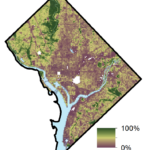
A figure from the paper by Matthew Baker and lead author Michael Alonzo visualizes the distribution of canopy cover in Washington, DC.
Canopy type matters
Baker and colleagues, including lead author Michael Alonzo at American University, analyzed more than 70,000 air temperature measurements collected on a hot summer day in 2018 in Washington, DC. They collected data using sensors attached to vehicles in the pre-dawn hours, during afternoon peak heat, and in the evening along different routes throughout the city.
In addition to looking at the effect of time of day, the researchers separated “hard canopy” (tree canopy above impervious surfaces, such as streets or rooftops) and “soft canopy” (tree canopy above unpaved surfaces, such as in yards or parks). They further divided soft canopy into patches (larger canopies found in large parks and forests) and “distributed” canopy (such as individual trees spread out among backyards or at a ball field).
Overall, and in agreement with previous studies, total tree canopy reduced temperature at every time tested. The amount of cooling increased linearly as the percentage of canopy cover in a location increased. For example, with 50 percent tree cover, the cooling effect was about twice as large as at 25 percent tree cover. The greatest overall effect was in the afternoon, when trees reduced the temperature by 1.8 degrees Celsius (3.2 degrees Fahrenheit).

An example of a forest patch, or clump. Clumped canopy demonstrated the ability to retain its lower temperatures even in afternoon heat. Photo by Michael Alonzo.
Cooler nights thanks to soft canopy
While the overall findings seem clear, once the researchers separated the different kinds of canopy, it got more complicated. Baker says, “The big story is that all tree canopy does not behave the same way, and soft canopy is more effective by far.”
For example, Baker notes that soft canopy seemed to do a better job cooling in the evening (more than 3 degrees Celsius) than in the afternoon. The authors suspect that’s because some trees shut off transpiration during peak heat to conserve water, and then start transpiring again in the evening. The evening bump could also be a side effect of the distribution of soft canopy throughout the city.
Hard canopy offered a slight cooling benefit (0.2 degrees Celsius) in the afternoon, even at less than 25 percent coverage, whereas soft canopy offered no apparent benefit at such a small amount of coverage. However, hard canopy created a very slight warming effect overnight, likely by trapping heat rising from hard surfaces.

Trees whose crowns hang over pavement or rooftops are examples of hard canopy. Photo by Michael Alonzo.
Missing the forest for the trees
Larger patches and more distributed forms of soft canopy also offer different benefits, but both produce significant cooling effects. Clumped patches were better at retaining their cooling effect in the peak afternoon heat, when distributed canopy was less effective. By contrast, distributed canopy cooling approached the effect of larger patches in the pre-dawn and evening, possibly because, with long shadows from low sun angles, distributed trees shade more of their surroundings.
Overall, “if you can increase the soft canopy, you are much more likely to reduce temperatures,” Baker says. Clumped soft canopy might be the most effective overall for cooling, because it retains its temperature reduction throughout peak heat and its cooling effects can extend to nearby areas beyond the clump’s boundary.
However, Baker also notes that distributed canopy is more accessible for many urban residents, who can more easily plant or maintain trees in yards than find the space for a microforest, so distinguishing the likely benefits of different kinds of canopy is important. “Of course” he says, “not everyone who needs the benefits of trees has a yard.”
Still, he emphasizes, “the benefits of a forest go well beyond the trees,” so “you can’t replace a forest with street trees.”
Strategies for the future
Urban tree-planting programs have the right idea, Baker suggests, because urban heat risk is almost certain to get worse and trees work to cool urban neighborhoods. But to make those efforts as effective as possible, more knowledge is needed about the relative benefits of different kinds of tree canopy.
Findings like those in this new research “affect how we might strategize future planting and woodland management,” Baker says. More nuanced understanding can help tree-planting programs, community groups, and individual residents make decisions about how to invest limited resources—in planting more street trees, yard trees, or forested tracts, but especially by protecting existing forest patches in and out of urban parks.
Header image: Matthew Baker at UMBC. Photo by Marlayna Demond ’11 for UMBC.
]]>
Extreme heat is on the rise, and people in urban areas with minimal tree canopy are especially susceptible to its harmful effects. Urban tree planting projects have proliferated in recent years,...
https://umbc.edu/stories/umbcs-matthew-baker-digs-deeper-into-the-cooling-benefits-of-urban-trees/
https://beta.my.umbc.edu/api/v0/pixel/news/119560/guest@my.umbc.edu/1ab3b106898732e68ede9a1c81d8fe28/api/pixel
cahss
ges
policy-and-society
research
science-and-technology
UMBC News & Magazine
https://beta.my.umbc.edu/groups/umbc-news-magazine
https://assets1-beta.my.umbc.edu/system/shared/avatars/groups/000/001/943/24435aa6207c452e7bc15cc74b42c7bb/xsmall.png?1748556657
https://assets1-beta.my.umbc.edu/system/shared/avatars/groups/000/001/943/24435aa6207c452e7bc15cc74b42c7bb/original.png?1748556657
https://assets2-beta.my.umbc.edu/system/shared/avatars/groups/000/001/943/24435aa6207c452e7bc15cc74b42c7bb/xxlarge.png?1748556657
https://assets2-beta.my.umbc.edu/system/shared/avatars/groups/000/001/943/24435aa6207c452e7bc15cc74b42c7bb/xlarge.png?1748556657
https://assets3-beta.my.umbc.edu/system/shared/avatars/groups/000/001/943/24435aa6207c452e7bc15cc74b42c7bb/large.png?1748556657
https://assets1-beta.my.umbc.edu/system/shared/avatars/groups/000/001/943/24435aa6207c452e7bc15cc74b42c7bb/medium.png?1748556657
https://assets2-beta.my.umbc.edu/system/shared/avatars/groups/000/001/943/24435aa6207c452e7bc15cc74b42c7bb/small.png?1748556657
https://assets1-beta.my.umbc.edu/system/shared/avatars/groups/000/001/943/24435aa6207c452e7bc15cc74b42c7bb/xsmall.png?1748556657
https://assets2-beta.my.umbc.edu/system/shared/avatars/groups/000/001/943/24435aa6207c452e7bc15cc74b42c7bb/xxsmall.png?1748556657
UMBC News & Magazine
0
0
false
Mon, 13 Sep 2021 21:21:32 -0400
UMBC sets the national standard in 2022 U.S. News Best Colleges rankings

As UMBC welcomes the largest incoming class in its history, the 2022 U.S. News and World Report Best Colleges rankings affirm UMBC’s position as one of the top universities in the nation. UMBC is among the best of the best in both undergraduate teaching and innovation, and distinguished in several other key areas.
U.S. News ranks UMBC #6 among all U.S. universities for undergraduate teaching this year. This recognition honors the unwavering commitment of UMBC’s faculty and staff in helping students navigate a largely virtual and hybrid curriculum during the COVID pandemic. UMBC is the only Maryland public university to appear on the list.
UMBC has advanced to number #6 on the Most Innovative Universities list, just ahead of Stanford. Joining UMBC in the top 10 are institutions like MIT and Carnegie Mellon. UMBC is the only Maryland university on the list this year.
“What has always set UMBC apart is the people,” says President Freeman Hrabowski. “Year after year, these rankings illustrate the many ways in which our faculty and staff work to support the success and well-being of our students.”
These honors reflect UMBC’s emphasis on constantly evolving to more effectively support student success. The University Innovation Alliance (UIA) announced UMBC as its newest member earlier this year. The pioneering consortium of 13 select public research universities boosts student success through sharing and scaling approaches that work.
 Amanda Knapp (center) and Katharine H. Cole (second from right) meet with students in the Academic Success Center in 2019.
“It’s our responsibility to understand the challenges students face at the most granular level possible, and to provide resources to help them reach their goals,” says Katharine H. Cole, UMBC’s vice provost and dean of Undergraduate Academic Affairs.
Top honors
In addition to these rankings and recognition as a top national university, UMBC is also a top-100 Best Public University and Best Value University. And U.S. News spotlights UMBC on its lists of top universities for ethnic diversity and for veterans.
“UMBC’s continued leadership in the rankings is a testament to our unwavering commitment to excellence,” says Yvette Mozie-Ross ’88, UMBC’s vice provost for Enrollment Management and Planning. “We provide opportunities and support for all students to succeed.”
 Students enjoy Involvement Fest 2021.
The Best Value designation is especially meaningful for many in the UMBC community, which is known for welcoming talented first-generation college students, transfer students, and others with financial considerations in mind. Recently quoted in The Washington Post, President Hrabowski hassaid, “The significance of our success is that we are saying to the country and to young people that you don’t have to be rich to be the very best. Middle class institutions can produce some of the best thinkers in the world.”
Excellence in engineering and computer science
U.S. News also recognizes UMBC as a top-100 institution for both undergraduate engineering and computer science programs. This comes as no surprise to campus leaders, given the success of graduates in these areas.
In addition to UMBC producing alumni like Clemson University President James P. Clements ’85, computer science, M.S. ’91, Ph.D. ’93, operations analysis, and Rhodes Scholar Naomi Mburu M26, ‘18, chemical engineering, new National Science Foundation (NSF) data on UMBC graduates reveal exciting findings.
“According to NSF data, UMBC is the number one baccalaureate institution for African American undergraduates who go on to earn Ph.D.s in the natural sciences and engineering, as well as doctorates in the life sciences, mathematics, and computer science,” report Hrabowski and Peter Henderson, senior advisor to the president.
 President Freeman Hrabowski waves to students during Convocation 2021.
Also exemplifying this excellence are UMBC’s Goldwater Scholars. The Barry Goldwater Scholarship and Excellence in Education Program supports talented undergraduates in strategic STEM areas. UMBC set a university record by producing four Goldwater Scholars in 2021-22—in computer engineering, physics, mathematics, and bioinformatics. Today, UMBC is one of the highest-producing universities for Goldwater Scholars in the nation.
UMBC has also become synonymous for excellence in cybersecurity. Governor Larry Hogan announced the launch of the Maryland Institute for Innovative Computing (MIIC) at UMBC during a cybersecurity summit in Annapolis over the summer. And the UMBC Cyber Dawgs again took home first place in the Mid-Atlantic Collegiate Cyber Defense Competition (MACCDC) in May. The virtual competition held this past spring marks the fourth time in seven years that the Cyber Dawgs have won the MACCDC.
 COEIT students, faculty, and staff at the 2019 COEIT Celebration. Photo by Chris Ferenzi Photography.
“The faculty, staff, and graduate assistants in our college have given their all to supporting our undergraduate students through the pandemic,” says Keith Bowman, dean of the College of Engineering and Information Technology (COEIT). “That the success of our programs and students is so highly considered by colleagues is truly gratifying.”
High-impact research
UMBC’s strength across a range of rankings reflects how the university emphasizes both teaching and research as complementary priorities. Faculty bring their research into the classroom and also engage students at all levels in moving research forward. At UMBC, one of the top 100 public universities in federal research funding, this particularly includes public impact research that connects with communities and has a tangible effect on people’s lives.
For example, faculty have closely involved students in recent research to improve accessible COVID-19 testing technologies, help low-income Baltimore families access the internet during COVID, strengthen teacher preparation programs, and develop algorithms for drones surveying sites of natural disasters. And they are creating new research opportunities for students every day, like fieldwork studying arachnids.
Faculty and staff also help students build on their UMBC research experiences by pursuing hands-on opportunities to apply what they are learning beyond UMBC.
 Grace Tugado, right, works in the SeeTrue Technology lab with her mentor Kinneret Rand-Yadin, company founder and CEO.
Speaking to Inside Higher Edrecently, Pres. Hrabowski echoed the importance of faculty who are deeply invested in the experiences and success of students. He shared, “Educators must focus on creating an environment in which it is great to be loving learning.”
Through this approach, the publication notes, Pres. Hrabowski and UMBC have “built a legacy challenging the assumption that only prestigious, wealthy colleges foster educational excellence.”
Header image: Amanda Knapp, associate vice provost of UAA, meets with a student in the Academic Success Center in 2019. All images by Marlayna Demond ’11 unless otherwise noted.
]]>
As UMBC welcomes the largest incoming class in its history, the 2022 U.S. News and World Report Best Colleges rankings affirm UMBC’s position as one of the top universities in the nation. UMBC is...
https://umbc.edu/stories/us-news-2022/
https://beta.my.umbc.edu/api/v0/pixel/news/119561/guest@my.umbc.edu/c24d7b382bfdbd159e73fc62c03d5b5d/api/pixel
campus
community
page1
rankings
UMBC News & Magazine
https://beta.my.umbc.edu/groups/umbc-news-magazine
https://assets1-beta.my.umbc.edu/system/shared/avatars/groups/000/001/943/24435aa6207c452e7bc15cc74b42c7bb/xsmall.png?1748556657
https://assets1-beta.my.umbc.edu/system/shared/avatars/groups/000/001/943/24435aa6207c452e7bc15cc74b42c7bb/original.png?1748556657
https://assets2-beta.my.umbc.edu/system/shared/avatars/groups/000/001/943/24435aa6207c452e7bc15cc74b42c7bb/xxlarge.png?1748556657
https://assets2-beta.my.umbc.edu/system/shared/avatars/groups/000/001/943/24435aa6207c452e7bc15cc74b42c7bb/xlarge.png?1748556657
https://assets3-beta.my.umbc.edu/system/shared/avatars/groups/000/001/943/24435aa6207c452e7bc15cc74b42c7bb/large.png?1748556657
https://assets1-beta.my.umbc.edu/system/shared/avatars/groups/000/001/943/24435aa6207c452e7bc15cc74b42c7bb/medium.png?1748556657
https://assets2-beta.my.umbc.edu/system/shared/avatars/groups/000/001/943/24435aa6207c452e7bc15cc74b42c7bb/small.png?1748556657
https://assets1-beta.my.umbc.edu/system/shared/avatars/groups/000/001/943/24435aa6207c452e7bc15cc74b42c7bb/xsmall.png?1748556657
https://assets2-beta.my.umbc.edu/system/shared/avatars/groups/000/001/943/24435aa6207c452e7bc15cc74b42c7bb/xxsmall.png?1748556657
UMBC News & Magazine
0
0
false
Mon, 13 Sep 2021 12:00:57 -0400
 Students attend a seminar in the Dresher Center for the Humanities, 2016.
 Abby Cruz ‘18, biological sciences, a Meyerhoff affiliate and MARC U*STAR Scholar, works in Fernando Vonhoff’s biology lab.


