Paving the Way in Python-Tracking

Jennifer Hewitt ’18, physics, didn’t know that her casual interest in reptiles would lead to a one-of-a-kind study that helps snake hunters track down Burmese pythons in the Florida Everglades.
Hewitt, a doctoral candidate at the University of Central Florida (UCF), and fellow researchers at UCF CREOL, The College of Optics and Photonics, are using near-infrared (NIR) cameras to detect and identify Burmese pythons. The snakes, which can reach up to 26 feet in length and 200 pounds, have threatened the native species in the Everglades since they were first introduced into the region in the late 1990s by the hands of irresponsible exotic pet owners and breeders. Since then, previous studies have shown that pythons have caused a drop in the number of common native species—such as raccoons, opossums, and rabbits—by more than 90 percent.
 Headshot of Hewitt in Florida. All photos courtesy of Hewitt unless otherwise noted.
Working around natural camouflage
Hewitt, who is a part of CREOL’s Infrared Systems and Imaging Group, led the python-tracking study, which was published in Applied Optics earlier this year. Her work is paving the way in decreasing the pesky python problem in the Everglades, while further advancing optics research and system design.
The Maryland native joined the project to build off of the work that was already being done in analyzing the spectral reflectivity characterizations of pythons—which would then allow the NIR camera to effectively circumvent the python’s natural camouflage.
“We went to a local zoo and took spectral measurements of the [snake] hide so that we could take a look at their reflectivity,” said Hewitt. “We compared that to similar spectral measurements of plant life, both the living and dead, that are local to the region. We noticed that there is a pretty good contrast between the pythons and the background in the NIR starting at around 750 nanometers and longer.” At lower ranges, said Hewitt, there isn’t very much visible difference between python and plant.
Hewitt collected images of pythons in different locations and with different background scenery. She then conducted a human perception test on volunteers to evaluate the effectiveness of the system she developed.
“For both day and night conditions, volunteers were able to detect the pythons further away with NIR than with visible imagery [basically, the naked eye]. From here, we are continuing to fine tune the camera system to further improve the detection rate,” Hewitt shared in a press release announcing her published study.
The study’s results showed that the enhanced contrast from the NIR enabled participants to detect pythons at 20 percent longer ranges than the use of visible imagery. Hewitt’s research could potentially be later used to develop automated snake detection systems.
Early beginnings in optics
Hewitt is no stranger to capturing and analyzing imaging data. While pursuing her undergraduate degree at UMBC, she worked in Eileen Meyer’s physics lab studying black hole imaging and the structure of jets emitted from the black holes. Meyer, associate professor in UMBC’s Department of Physics, advised Hewitt during her undergraduate career and immediately recognized her aptitude in understanding the physics and mathematics of interferometry, which is used in astronomy for radio-wavelength observations.
“I first noticed [Hewitt’s] aptitude in my junior optical lab course, where she wrote the most beautiful lab reports I ever saw in the course. After she joined the research group, Hewitt very quickly mastered the ‘art’ of analyzing astronomy images made at radio wavelengths,” said Meyer. “She made so many useful images for our archive that we still regularly use them today.”
 Pictures of pythons taken with near-infrared (NIR) cameras.
Even though Hewitt shared that she was initially interested in being an astronomer, Meyer encouraged the young physicist to explore optics graduate programs after taking notice of her success in optics research.
“I knew right away from seeing her work in my optics lab that she had talent for research—conscientiousness, clarity of thought, and an analytical mind. I am beyond happy to see how well Hewitt is doing,” Meyers said. “I am particularly grateful that UMBC supports undergraduate research so well.”
Hewitt was a 2017 – 2018 recipient of UMBC’s Undergraduate Research Award for her work “Characterizing Hotspots of Extragalactic Jets and the Connection Between Jet Speed and Let Power.” While her current research pursuits have gone in a different direction, Hewitt shared that she “liked what I was doing in astronomy, but I very much prefer the field work that I’m doing as a more closer-to-earth scientist.”
Supporting a growing demographic in physics
Hewitt doesn’t take it lightly that she’s among the small percentage of women who have a career in physics. According to the American Institute of Physics, in 2017, women earned 21 percent of physics bachelor’s degrees and 20 percent of physics doctorates. At UCF, Hewitt said women comprised about one-third of the physics classes.
 Jennifer Hewitt with tracking equipment in the field.
Hewitt’s mother, Jeanne Toussaint, works in systems engineering and shared with her daughter the drastic difference of the number of women currently in physics compared to when she was a student.
“I find myself doing the mental tally of how many of us women there are,” said Hewitt, “and my mother says that’s already far better than what I used to have. She said that maybe one or two women were in her classrooms, and sometimes she was the only one.”
Hewitt’s hoping to add to the growing demographic of women working in her industry. Her snake-tracking research will be used by the Florida Fish and Wildlife Conservation Commission on a project that will possibly assist professional hunters with locating Burmese pythons. Her work has already garnered attention from major research entities. Hewitt was awarded a scholarship by the U.S. Air Force and will work in the Air Force’s research labs after she graduates from UCF.
“It’s going to be a huge change from what I’m currently doing because most of my research has been applied to single band imagery,” Hewitt noted. “I’m hopefully going to be using a lot of the stuff that I’ve learned for overall general system design to assist with some of the research that they’re doing in the labs.”
— Adriana Fraser
Header image: Portrait of a Burmese Python, Python bivittatus curling on a branch.
ID 153913085 © Dwiputra18 | Dreamstime.com
]]>
Jennifer Hewitt ’18, physics, didn’t know that her casual interest in reptiles would lead to a one-of-a-kind study that helps snake hunters track down Burmese pythons in the Florida Everglades....
https://umbc.edu/stories/paving-the-way-in-python-tracking/
https://beta.my.umbc.edu/api/v0/pixel/news/119514/guest@my.umbc.edu/71e76ae507d26a100d38858484b4f0f0/api/pixel
alumni
cnms
discovery
fall-2021
physics
UMBC News & Magazine
https://beta.my.umbc.edu/groups/umbc-news-magazine
https://assets1-beta.my.umbc.edu/system/shared/avatars/groups/000/001/943/24435aa6207c452e7bc15cc74b42c7bb/xsmall.png?1748556657
https://assets1-beta.my.umbc.edu/system/shared/avatars/groups/000/001/943/24435aa6207c452e7bc15cc74b42c7bb/original.png?1748556657
https://assets2-beta.my.umbc.edu/system/shared/avatars/groups/000/001/943/24435aa6207c452e7bc15cc74b42c7bb/xxlarge.png?1748556657
https://assets2-beta.my.umbc.edu/system/shared/avatars/groups/000/001/943/24435aa6207c452e7bc15cc74b42c7bb/xlarge.png?1748556657
https://assets3-beta.my.umbc.edu/system/shared/avatars/groups/000/001/943/24435aa6207c452e7bc15cc74b42c7bb/large.png?1748556657
https://assets1-beta.my.umbc.edu/system/shared/avatars/groups/000/001/943/24435aa6207c452e7bc15cc74b42c7bb/medium.png?1748556657
https://assets2-beta.my.umbc.edu/system/shared/avatars/groups/000/001/943/24435aa6207c452e7bc15cc74b42c7bb/small.png?1748556657
https://assets1-beta.my.umbc.edu/system/shared/avatars/groups/000/001/943/24435aa6207c452e7bc15cc74b42c7bb/xsmall.png?1748556657
https://assets2-beta.my.umbc.edu/system/shared/avatars/groups/000/001/943/24435aa6207c452e7bc15cc74b42c7bb/xxsmall.png?1748556657
UMBC News & Magazine
0
0
false
Thu, 02 Dec 2021 21:55:25 -0500
UMBC After Dark

Life doesn’t pause when classes end and the sun goes down. Instead, students grab a cup of coffee and find a million ways to follow their interests. Whether dancing, studying over pizza, or keeping delicate plants alive in the labs—our campus is abuzz 24/7. We sent staff writer Charis Lawson ’20 and editorial interns Anna Lee ’22 and Eric Widemann ’21 off into the night with UMBC Magazine photographer Marlayna Demond ’11 to explore it all.
Especially in the Dark, UMBC Rolls On
D-Hall Basketball Court
Every evening from 8 p.m. to 2 a.m., steady streams of students fill the dining hall at True Grit’s Late Night. Some come strictly for the food, others to socialize. Some come for a study break, others come to study.
Just outside the dining hall, an entirely different scene presents itself. Playful shouts radiate from the basketball court. As night arrives, so does cool, crisp air—but students have found a way to keep warm by engaging in a hotly contested pick-up basketball game. This happens here almost every night.
But tonight, something else is particularly eye-catching. Whizzing just above the ground, the wheels of roller skates radiate bright rainbow colors, and laughter and chatter follow the lights much in the way that sound usually follows light.
 Maddie Mills-Snyder ’25 and Leah Jupiter ’25 practice their roller skating on the basketball court near True Grit’s.
“I roller skate on campus every single day, as often as I can, sometimes even to or in class,” says Maddie Mills-Snyder ’25, undecided, AKA “Rex” to the thousands of followers of her roller skating-centric Instagram.
Skating after dark presents a unique opportunity “because that’s when we get to skate to late night with our light-up wheels,” says Mills-Snyder, sharing the court with Leah Jupiter ’25, biology, who loves the energy and cool breezes of nighttime skating.
 The basketball court near True Grit’s is home to all types of sports.
“I love learning new tricks and showing off. I love when people ask us to show them a trick. Rex and I have also created a few dances to popular songs like ‘Bad’ by Michael Jackson,” continues Jupiter. Both love this court but also take advantage of any flat surface, really—the Commons garage, or elsewhere around campus.
Both agreed the best part of skating is the community it brings. So if you’re looking to light up the night on campus, lace up your skates and you’ll be sure to find a welcoming scene.
“I love empowering other skaters,” says Mills-Snyder.
– Eric Widemann ’21
Run for Your Life
Campus-wide
All across campus, darkness camouflages hoards of young adults chasing one another and defending themselves with Nerf darts and rolled-up socks. If that sounds like a childish game, Humans vs. Zombies (HvZ) members would agree with you. HvZ members are not known for taking themselves seriously.
While many members have described HvZ as a glorified game of tag, there is a lot more to it than that, the members explain. “An average mission starts with a briefing where we learn about our mission and what we’re expected to do in order to win. Most people start ‘human’ but some start ‘zombie.’ Humans start strong and more often than not, human victory feels like it’ll be a piece of cake,” notes Henry Denny ’23, mechanical engineering. Usually, the humans have to rethink that sentiment as the hoard of zombies grows.
HvZ has a decade-long legacy on campus, organizing night missions, Saturday games, missions that span across other colleges, and even week-long missions that run 24/7. The result? A tight-knit community like no other. Kyle Mosier ’20, computer science and mathematics, M.S. ’22 computer science talks about how during the pandemic, having a group of friends to eat with several times a day on campus was so important.
Even after the missions are complete, it doesn’t mean everything is over. They often head over to D-Hall (as their human selves, not their zombie selves) for non-brain-related snacks and to tell stories from the night and club lore, stories that have been passed down from years ago.
– Charis Lawson ’20
Bringing Your A-Game
UMBC Game Room
Whoever controls the playlist in the Game Room has queued a selection of upbeat songs, only rivaled in volume by the smacking of billiard balls and rhythmic bouncing coming from the pingpong tables.
Tonight, more or less every billiards table is in use, and the pingpong tables are playing host to some intense rallies. Ayush Nigam ’24, computer science, plays pingpong or billiards two to three times a week and enjoys the “dark-ish warm vibe” of the space after hours.
 The Game Room offers billiards, pingpong, video games, and other amusements.
Justin Nguyen ’24, biochemistry, is among the gamers, as he is many nights of the week. Around him, enthusiastic players of all sorts blow off steam with their favorite video games or practice their angles on the pool tables.
“Whenever my friends and I come [here], it’s to play pingpong. We love the competitiveness– it gets the blood flowing,” he continues. “I love hanging out with friends.”
– Eric Widemann ’21
Late Night Pick-Me-Up
UMBC Shuttle Route
Holly Knott clutches the microphone of the CB radio on her shuttle dashboard. “319 BWI 10-8,” Knott says. It’s 6:20 p.m. and the code signals to the others working in the UMBC Transit office that her bus is in service and she is about to start her five-hour shift.
She’s headed to BWI, a run she completes five times a night. The darkness makes it hard to know how much time has passed sometimes, but she fixes her concentration on the road before her and keeps her eyes wide open.
“When students get on, I try to turn the music up a little bit for them.” Most nights, Knott is playing 97.1—her favorites include the classics from the ’80s and ’90s and earlier hits from the Temptations. “I tell people I’m a young person with an old soul,” Knott adds with a smile.
 Driver Holly Knott says hello to shuttle riders as she begins the night shift.
“Everybody here is very welcoming,” says Knott, who started at UMBC in August 2021. “The students, they greet you. ‘Have a good day.’ ‘Have a good night.” Some even said, ‘Be careful out there.’”
Knott looks forward to the day the protective plastic curtain around the driver’s seat can come down and it’s safe to have prolonged conversations with some of the regulars. Until then, she finds other little ways to return the warmth. She welcomes students and makes sure she turns towards them when they board. She tries to make sure to park super close to the curb so that students have easy access to the bus.
Knott enjoys working late at night, but it’s 11:12 pm, so she leisurely drives the bus into its proper parking spot. Once again, she grabs the microphone of her CB radio. “319 BWI 10-7.” she says, indicating that the 319 bus trip to BWI has ended and the bus is no longer in service.
– Charis Lawson ’20
Making the Rounds
Chester Hall, West Hill Apartments
It’s 10:25 p.m. and Lead Residential Assistant (RA) Hager Younes ’22, biology, is grateful to wrap up her rounds on a quiet note. Anything can happen in this job. But even when it isn’t easy, the bonds she has formed with her residents help her through—just as her former RA did for her.
When she came to UMBC in 2018 as an out-of-state student, Younes felt isolated from friends, family, and any sense of stability. However, through the efforts of her Erickson Hall RA Princess Sara Njemanze ’21, chemical engineering, Younes soon felt welcomed and part of a community. That is why she works so hard to instill that same sense of community in her residents and her fellow RAs.
 Resident Assistant Hager Younes ’22 shares a moment with her residents.
Younes loves getting creative, posting, “Would you rather?” boards to spark hours-long conversations and organizing an on-going gathering where students drink tea, eat snacks, and just talk.
“I feel like everyone is so human deprived. People are wanting to come to any and every event.” Younes says, commenting on the sheer turnout of events this semester. One thing that always makes the students happy? Visits from Chip, the campus comfort dog.
“When she would come through, you could just hear doors opening down the hall.”
– Charis Lawson ’20
Studying Over Sushi
Hissho Sushi, The Commons
Late-night studying means late-night snacking. And while you’ll find students squeezing in cram sessions pretty much everywhere around campus in the wee hours, one newer option is over sashimi and California rolls.
Soft chatter fills the second floor of The Commons, as students share company and a meal with one another. The zesty scent of orange chicken fills the air and the brightly illuminated sushi refrigerator invites in curious students, especially at this hour. While by day The Commons is rather loud, the nighttime calm is the perfect environment to do some studying
 Late-night sushi always hits the spot!
“I study late with friends, so it’s definitely become convenient,” says Erin Hamner ’22, geography and environmental science.
To top it off, the staff here is so friendly—even through the masks, you can make out the smiles.
– Eric Widemann ’21
Dance Like No One Can See You
University Center Hallway, Ground Level
UMBC’s University Center appears quiet and empty, with students retiring for the night with Chick-fil-A or Starbucks in their hands. But if you listen closely, you’ll hear the faint thump of bass and upbeat hip-hop music emanate from the first floor. Most of the building has gone to sleep, but Major Definition dances on to the beat.
Major Def’s executive director, Timothy Huynh ’22, computer science, wasn’t sure what dance meant to him when he joined the club. But Huynh’s connection and dedication has since grown, as he now considers dance to be essential to his well-being and weekly schedule.
 Major Definition turns up the bass as it takes over a hallway in the UC for a late-night practice session.
Prior to the pandemic, Major Def would meet at the UC three evenings a week. Even after their practices turned virtual, they continued working just as hard to put together concept videos in small teams. While Major Def plans on slowly getting back into the swing of things with the in-person semester, their energy remains just as contagious.
“When you’re really passionate about dance or you’re just looking forward to dancing with each other, the hours really don’t matter because they go by really quickly and you’re not even looking at the time,” says Huynh.
The club’s practices take place in an uplifting, supportive environment where teammates offer feedback to one another and embrace each other’s unique styles. From quick twists and turns, hand gestures, facial expressions, and smooth movements from head to toe, the dancers are precise and tell stories of their own.
 While Major Definition found a way to stay connected virtually during the pandemic, they’re excited to practice in person again.
After practice, dancers form a circle and put their hands in for a chant before dismissal. Later, you might see the team stay back to chat with each other, show off their new choreography, or head out to grab some bubble tea.
“Even if you don’t see yourself growing in terms of dance, your other teammates can see it. And it’s really beautiful being able to see that progression,” Huynh says.
– Anna Lee ’22
Midnight Melodies
Fine Arts, Room 306
A single voice enchants you. Despite being faint, almost whisked away by the wind, the voice is clear. Another voice joins the first and then another until a whole group of voices are expertly switching from synchronization to harmonization, each moment a new voice coming to the forefront. Sonia Anger ’22, mathematics and psychology, with her clear soprano, blends with the talents around her.
The Cleftomaniacs made a name for themselves when they placed first in the 2018 Mid-Atlantic Quarterfinals at the International Championship of Collegiate A Cappella. When Anger got involved with the co-ed performance group her first year at UMBC, the club was the breath of fresh air she needed.
After a year spent serving with Americorps, Anger felt disconnected from her peers, but from the moment she auditioned, despite her own anxiety, she could see how welcoming and friendly the group was and she wanted to be a part of it. Anger talks about the Cleftomaniacs like the group is her own family. While they spend a lot of time together outside of club activities, performing is her favorite part.
 Harmonies blend and echo as the Cleftomaniacs practice their songs in Fine Arts, Room 306
When the group splits up to work on individual voice parts late at night, she frequently finds herself practicing in empty classrooms, hallways, and stairwells of ITE. Afterward, she often walks with her friends to the dorms or Late Night at True Grit’s only to continue singing.
“We would be singing outside of SUS [Susquehanna dorm] in the middle of December and people would be like, ‘You know you can go inside right?’ but we were stubborn and we just wanted to have fun,” says Anger.
– Charis Lawson ’20
Eyes to the Stars
UMBC Observatory and Lawn
It’s easy in an academic environment to keep your head in a book—or more likely, in front of a screen. The Astronomy Club, however, asks you to look up.
“I love taking walks at night around campus– it is very freeing.” says Tara O’Donnell ’24, physics. As she looked up into the night sky, O’Donnell—president of the Astronomy Club— and fellow members found solace in the vast cosmos. Despite loving the atmosphere of campus at night and the view of the stars and the moon, most of her first year at UMBC was virtual. “My experience was sitting in my room doing classes through Blackboard, so my opportunity to connect more fully with the UMBC community was through the Astronomy Club,” says O’Donnell.
On a gorgeous night, Astronomy Club members enjoy open spaces and fun conversation.
Now the Astronomy Club once again meets in person, and their meetings range from discussing major space news like the Perseverance landing on Mars or making use of the telescope in the observatory on top of the Physics building to playing games like Jeopardy, watching movies, and hosting special guests and debates.
The Astronomy Club has maintained a thriving community. Late into the night, you can find O’Donnell and her friends looking up into the sky contemplating ideas as big as the universe itself.
– Charis Lawson ’20
Burning the Midnight Oil
Biological Sciences Building, Hua Lu Lab
When the sun has gone down, plants are just as active as they are during the day. Like humans, they have an internal clock that prompts responses to environmental stimuli such as light, temperature, and unwanted visitors like pathogens. If left unaddressed, these pathogens can be detrimental to plant health and reduce crop yield in agricultural fields. In UMBC’s Biological Sciences building, the members of Professor Hua Lu’s lab study the role of the circadian clock in plant defense against these outside invaders.
That explains the brown, cushiony sofa to the side of the room. Because students have had to monitor the plants every four hours for previous projects, Lu’s office has become the go-to snooze spot for overnight stays. Jessica Allison, a graduate student at the Lu lab, even remembers finding a sleeping bag under her desk after joining the team.
 Graduate Jessica Allison tends to the flora in the Hua Lu Lab.
The plants that Allison and the other lab members use in their research, thale cress (Arabidopsis thaliana), seem to sit peacefully in the large chambers they’re stored in. But much more is happening beneath the surface of these wispy, flowering plants.
For her project, Allison regularly conducts a process called a luminescence assay where 96 thale cress seedlings are first planted into a well plate. The plates are then placed into chambers, where the plants are only exposed to light. Allison finally examines how the absence of dark conditions affects plants’ circadian clocks.
Even after the lab members have gone home, this process continues to run throughout the night. The next day, Allison uses a machine called a plate reader once an hour to check the plates for gene expression patterns—graphs that depict the activity of the plants’ internal clocks.
“We test a lot of genes like that, and we knock out some genes and see if it affects others. We let that run 24/7,” Allison explains.
For now, Allison hasn’t had to stay overnight to check up on the plants on a set schedule. But she expects to be making good use of the couch when the time comes.
– Anna Lee ’22
All-Nighters Welcome
Retriever Learning Center, Albin O. Kuhn Library
At 8 p.m. as the rest of the library closes for the night, students begin heading to the 24/7 Retriever Learning Center (RLC). The white lights of the RLC beam down on notebooks and bright laptop screens. Students clack away at their keyboards and scribble down notes from the formula-ridden whiteboards beside them. Some have earphones in, dedicated to finishing the assignment due at midnight, while others study all night in larger groups to tackle content for an upcoming exam.
 Peer through the windows of the Retriever Learning Center, and you’ll see learning happening 24/7.
Among them are information systems majors Ahsan Baig ’24, Devanshi Patel ’24, Emilien Tchuosi ’24, and Nazim Elliott ’22, who are working on a group project for their information systems class. Baig loves the fact that you don’t have to whisper here. The RLC’s whiteboards and portable chairs are also a plus, as the group mentions how practical they are for studying. Tchuosi especially appreciates having a place where she feels compelled to get work done.
“I come here on a daily basis just because it pressures me to study…. So when I come here, I actually study instead of watching YouTube videos,” Tchuosi says, eliciting laughter from her group mates.
Shawn Parker, a building manager at the library, is dedicated to making the RLC more secure and conducive to student learning. With students as a top priority, Parker works to provide accessible furniture and ensure students’ safety within the building. This was also students’ vision for the RLC when plans for an accessible learning space began in 2006. With support from the university, the overnight learning center became a reality.
Parker hopes that the center can continue equipping students with the resources to collaborate on all sorts of projects.
“It’s a brighter day for students when they’re listened to and understood. But most importantly, you have to hear what they’re saying to understand what they’re asking for. And that’s what I try to do best,” says Parker.
– Anna Lee ’22
*****
All photos taken by Marlayna Demond
]]>
Life doesn’t pause when classes end and the sun goes down. Instead, students grab a cup of coffee and find a million ways to follow their interests. Whether dancing, studying over pizza, or...
https://umbc.edu/stories/umbc-after-dark/
https://beta.my.umbc.edu/api/v0/pixel/news/119515/guest@my.umbc.edu/7d8d20d009a619f4ad523a1d9bafc5b1/api/pixel
astronomy-club
campus-life
cleftomaniacs
fall-2021
humans-vs-zombies
majordefinition
residential-life
shuttle
umbc
umbc-magazine
UMBC News & Magazine
https://beta.my.umbc.edu/groups/umbc-news-magazine
https://assets1-beta.my.umbc.edu/system/shared/avatars/groups/000/001/943/24435aa6207c452e7bc15cc74b42c7bb/xsmall.png?1748556657
https://assets1-beta.my.umbc.edu/system/shared/avatars/groups/000/001/943/24435aa6207c452e7bc15cc74b42c7bb/original.png?1748556657
https://assets2-beta.my.umbc.edu/system/shared/avatars/groups/000/001/943/24435aa6207c452e7bc15cc74b42c7bb/xxlarge.png?1748556657
https://assets2-beta.my.umbc.edu/system/shared/avatars/groups/000/001/943/24435aa6207c452e7bc15cc74b42c7bb/xlarge.png?1748556657
https://assets3-beta.my.umbc.edu/system/shared/avatars/groups/000/001/943/24435aa6207c452e7bc15cc74b42c7bb/large.png?1748556657
https://assets1-beta.my.umbc.edu/system/shared/avatars/groups/000/001/943/24435aa6207c452e7bc15cc74b42c7bb/medium.png?1748556657
https://assets2-beta.my.umbc.edu/system/shared/avatars/groups/000/001/943/24435aa6207c452e7bc15cc74b42c7bb/small.png?1748556657
https://assets1-beta.my.umbc.edu/system/shared/avatars/groups/000/001/943/24435aa6207c452e7bc15cc74b42c7bb/xsmall.png?1748556657
https://assets2-beta.my.umbc.edu/system/shared/avatars/groups/000/001/943/24435aa6207c452e7bc15cc74b42c7bb/xxsmall.png?1748556657
UMBC News & Magazine
0
0
false
Thu, 02 Dec 2021 18:17:16 -0500
Sherman Scholars Live Out Founder’s Legacy

In Baltimore City, middle schoolers are making roller coasters out of insulation tubing and tape. High schoolers are dunking basketballs to learn math equations. And not too far away at UMBC, the Sherman STEM Teacher Scholars are prepping to spread even more innovative, inclusive lessons throughout city schools.
The Sherman STEM Teacher Scholars Program began in the fall of 2007 thanks to the generosity of philanthropists George and Betsy Sherman. The goal of the program is to support scholars to become culturally responsive and compassionate STEM educators in historically underserved, urban schools.
 George and Betsy Sherman at the celebration of the Meyerhoff Scholars Program 30th anniversary in 2019. Photo by Jim Berger.
“They’re working in the school buildings that people tend to shy away from because they’ve got those ‘bad kids’ or they don’t have a lot of resources. Our scholars are gravitating to those spaces,” says program director Rehana Shafi.
George Sherman passed away earlier this year but the legacy he left continues to be felt in the lives of the scholars who bear his name. Fourteen years later, the program supports 80 current scholars who will one day join the 140 program alumni who are teaching in high needs schools in Baltimore and throughout the region. All scholars receive scholarships towards their education as well as advising and coaching to embody the Sherman Program’s values.
Putting the fun in active learning
Ben Davis ’11, biological sciences, M.A.T. ’13, was one of the first Sherman scholars to enter the workforce. Today he is teaching at KIPP Ujima Village Academy in Baltimore, where he tries to make sure his middle school science students do one hands-on project a week like making the roller coasters out of household materials or dissecting sharks or frogs. “The kids are able to use scalpels and surgical scissors and… look inside and see what’s going on, [asking] is this similar to what we see in a human or is this different?” says Davis.
 Davis on campus with a group of his students. Photo courtesy of Davis.
Davis has also started a summer program to get middle-school girls onto the UMBC campus to attend college courses and engage in lab work like discovering a virus, sequencing its DNA, and even naming it. “They’re building that skill of optimism and grit and growth mindset,” he says.
Sherman scholar Maria Packard ’19, mathematics, M.A.T. ’20, meanwhile, is at Green Street Academy in Baltimore challenging the stigma that math is boring. She has her 11th graders shooting basketball hoops for extra points, giving Algebra 2 an unexpectedly exciting and competitive edge for students she cherishes.
Both Davis’ and Packard’s jobs were made possible through connections made in the Sherman Program. Davis also credits Shafi and other Sherman staff with giving him much-needed support and guidance. “[Shafi] was the person really there every step of the way—she was there for me no matter if it was something that had to do with teaching or science or life,” he says.
Connecting with different lived experiences
Shafi has been with the program since its beginning, guiding it as it evolved from smaller to larger cohorts of students who are likely to teach in urban or other historically underserved schools. To prepare scholars for this, the Sherman Program requires applied learning experiences or volunteering in local classrooms. The program also provides coursework that helps scholars reflect on their own cultural lens and to understand the historical context of schooling in Baltimore. Experiences like this make space for scholars to embrace the humility required to listen to “kids whose own lived experiences are generally different from their own,” says Shafi.
That aspect of cultural humility and social responsibility is what drew Haleemat Adekoya ’22, political science, to UMBC. “I can’t engage my student in academics if I’m not engaging their mind and their soul,” says Adekoya, who plans to be an elementary school teacher who nurtures her students’ identities. “I’m not going to just start talking to you and teaching you—I cannot push you to where I think you should be or your biggest potential without engaging your community and the communities you come from,” she says.
Left, Adekoya with Dr. Darryl Williams, superintendent of Baltimore County Public Schools. Right, Packard teaching her students.
Helping the Sherman scholars reach their own potential was important to George Sherman, says Shafi, and part of that is the scholarship money that helps keep scholars focused on learning. “He profoundly cared about people and their ability to be successful,” she says.
Today, the people in the Sherman program help each other succeed in a close-knit community, Packard says. Alumni get together to chat, discuss books on social issues, and support each other with advice in a challenging field.
Adekoya, student member of the Maryland Higher Education Commission, is optimistic about her future and that of the program. “I see the legacy of the Sherman program as a seed—it’s been planted and people will continue to water that seed…it will be one of those trees in a folk tale that does not die out because the community and the people who have benefited from its impact see the importance of that tree living beyond generations,” she says.
— Karen Stysley
*****
Header image of Adekoya in the classroom, courtesy of the Sherman STEM Teacher Scholars Program.
]]>
In Baltimore City, middle schoolers are making roller coasters out of insulation tubing and tape. High schoolers are dunking basketballs to learn math equations. And not too far away at UMBC, the...
https://umbc.edu/stories/sherman-scholars-live-out-founders-legacy/
https://beta.my.umbc.edu/api/v0/pixel/news/119516/guest@my.umbc.edu/41e570483af637510c78a023b689dc4d/api/pixel
biological-sciences
education
fall-2021
impact
m-a-t
mathematics
political-science
sherman-stem-teacher-scholars-program
teaching
UMBC News & Magazine
https://beta.my.umbc.edu/groups/umbc-news-magazine
https://assets1-beta.my.umbc.edu/system/shared/avatars/groups/000/001/943/24435aa6207c452e7bc15cc74b42c7bb/xsmall.png?1748556657
https://assets1-beta.my.umbc.edu/system/shared/avatars/groups/000/001/943/24435aa6207c452e7bc15cc74b42c7bb/original.png?1748556657
https://assets2-beta.my.umbc.edu/system/shared/avatars/groups/000/001/943/24435aa6207c452e7bc15cc74b42c7bb/xxlarge.png?1748556657
https://assets2-beta.my.umbc.edu/system/shared/avatars/groups/000/001/943/24435aa6207c452e7bc15cc74b42c7bb/xlarge.png?1748556657
https://assets3-beta.my.umbc.edu/system/shared/avatars/groups/000/001/943/24435aa6207c452e7bc15cc74b42c7bb/large.png?1748556657
https://assets1-beta.my.umbc.edu/system/shared/avatars/groups/000/001/943/24435aa6207c452e7bc15cc74b42c7bb/medium.png?1748556657
https://assets2-beta.my.umbc.edu/system/shared/avatars/groups/000/001/943/24435aa6207c452e7bc15cc74b42c7bb/small.png?1748556657
https://assets1-beta.my.umbc.edu/system/shared/avatars/groups/000/001/943/24435aa6207c452e7bc15cc74b42c7bb/xsmall.png?1748556657
https://assets2-beta.my.umbc.edu/system/shared/avatars/groups/000/001/943/24435aa6207c452e7bc15cc74b42c7bb/xxsmall.png?1748556657
UMBC News & Magazine
0
0
false
Mon, 29 Nov 2021 20:02:58 -0500
Drop in students who come to the US to study could affect higher education and jobs

By David L. Di Maria, associate vice provost for International Education, UMBC
Driven largely by the global pandemic, the number of international students enrolled at U.S. colleges and universities fell by 15% – or 161,401 students – from 2019 to 2020. However, early data for 2021 indicate the number might bounce back soon. This is according to new data from the Institute of International Education and the U.S. State Department.
As a university administrator who specializes in international higher education, I see six important takeaways to consider.
1. A record decrease
While a drop was expected due to the disruptions caused by the COVID-19 global pandemic, which included international travel restrictions and suspension of U.S. visa services, the number of international students in the U.S. has actually been declining since 2016.
The decrease in 2020, however, is the largest on record based on data dating back to 1948.
Enrollments are down across all fields of study at both the undergraduate and graduate levels, which fell by 14.2% and 12.1%, respectively. Meanwhile, more than half of all international students come from just two countries: China and India. About 1 in 3 international students in the U.S. are from China, and about 1 in 5 are from India. For context, the third-most represented nation is South Korea, which accounts for about 1 out of every 25 international students in the U.S.
2. A rebound is evident, but it may not last
While the overall number of international students dropped in fall 2020, a preliminary snapshot points to a 68% increase in the number of students beginning their studies in fall 2021 compared with a year earlier. This increase, which cannot be confirmed until a more comprehensive census is released in 2022, suggests a possible rebound is occurring.
Nonetheless, it is important to understand that the rebound reflected in these data undoubtedly includes some of the nearly 40,000 international students who were admitted for fall 2020 but had to defer their studies due to the pandemic.
Given that most admission offers may be deferred for only one year, it is reasonable to assume that fall 2020 deferrals helped fuel fall 2021 gains. So any increase in 2021 could be a temporary spike and not necessarily a sign that international student enrollments will reverse their downward trend.
3. Other nations’ losses may be the US’ gains
Another factor fueling the reported surge in new international enrollments within the U.S. for fall 2021 is that the U.S. experienced less competition from abroad.
In addition to a delayed vaccine rollout across countries in Europe, some nations have been entirely off-limits since the start of the pandemic. For instance, China and Australia, the world’s fourth- and fifth-most popular study destinations, respectively, have both remained closed to international students since the start of the pandemic, causing students who would otherwise have traveled to these countries to switch destinations in pursuit of in-person learning.
In August 2021, Australia reported more than 200,000 fewer international students than a year earlier, before the pandemic began. While Australia will allow international students to return starting on Dec. 1, 2021, it remains uncertain when China might reopen its borders to students.
4. Less funding for STEM graduate programs
Many U.S. universities would find it difficult to maintain graduate programs in science, technology, engineering and mathematics, or STEM, without international students. This is made clear by a 2021 report showing that international students constitute the majority of full-time graduate students in many STEM fields. For example, at the graduate level, international students are 82% of all petroleum engineering students, 74% of all electrical engineering students and 72% of all computer and information sciences students.
While some might think these figures mean U.S. students are being crowded out, research reveals that international student enrollment actually helps increase U.S. enrollment. Consider that international students pay higher tuition than their U.S. classmates, which helps pay for enrolling more American students.
5. Fewer US jobs
Beyond usually paying a higher tuition, international students spend money off campus as well. In fact, they spend on just about everything that U.S. students do, from apartments and transportation to insurance and technology. In much of the country, local and state sales taxes are paid on top of these purchases.
These dollars add up to the point that for every three international students, one U.S. job is created or supported by their spending. The 2020 enrollment drop-off means 109,679, or 26.4%, fewer U.S. jobs were supported by international students in 2020 than in 2019.
6. Fewer highly skilled workers
International students who work internships or get practical training also serve as a valuable pool of talent for U.S. employers struggling to hire workers in highly skilled areas, such as science and engineering.
According to the U.S. Chambers of Commerce, the shortage of highly skilled workers is a key factor holding back economic recovery from the effects of the pandemic. A healthy talent pool in the U.S. also has implications for global competitiveness, as other nations, such as China and Russia, aim to increase their scientific and technological capabilities.
National concern
Economics aside, international students make many other valuable contributions to the U.S. These include increasing cultural diversity on college campuses, enhancing learning in the classroom and promoting positive diplomatic relations with other countries. While the U.S. remains the world’s top choice for international students, it continues to lose ground to other nations vying to attract foreign talent.
Consider that from 2000 to 2020 the U.S. share of the world’s international students fell from 28% to 20%. How could this be? Unlike the next four most popular destinations, the United Kingdom, Canada, China and Australia, the U.S. lacks a national strategy for recruiting and retaining international students.
Earlier in 2021, the Biden-Harris administration signaled that may be changing. Specifically, the U.S. secretaries of education and state released a Joint Statement on Principles in Support of International Education. In that statement, they committed to a number of actions, such as implementing new policies and procedures aimed at ensuring the U.S. remains the top destination for global talent.
More recently, several major U.S. higher education associations called for a national strategy to reverse the international enrollment decline.
While it is still too early to predict if a unified strategy would actually reverse international student enrollment declines at U.S. colleges and universities, the idea of a coordinated national approach could help position the U.S. to compete for the world’s best and brightest minds.
*****
David L. Di Maria, Associate Vice Provost for International Education, University of Maryland, Baltimore County
Header image: Declines in the enrollment of international students span all fields of study. Vladimir Vladimirov/E+ via Getty Images
All photos courtesy of Marlayna Demond ’11 unless otherwise noted.
This article is republished from The Conversation under a Creative Commons license. Read the original article.
]]>
By David L. Di Maria, associate vice provost for International Education, UMBC Driven largely by the global pandemic, the number of international students enrolled at U.S. colleges and...
https://umbc.edu/stories/drop-in-students-who-come-to-the-us-to-study-could-affect-higher-education-and-jobs/
https://beta.my.umbc.edu/api/v0/pixel/news/119517/guest@my.umbc.edu/945125ea01caa9ab033f8cfce46ccd7a/api/pixel
cge
international-education-services
perspectives
the-conversation
UMBC News & Magazine
https://beta.my.umbc.edu/groups/umbc-news-magazine
https://assets1-beta.my.umbc.edu/system/shared/avatars/groups/000/001/943/24435aa6207c452e7bc15cc74b42c7bb/xsmall.png?1748556657
https://assets1-beta.my.umbc.edu/system/shared/avatars/groups/000/001/943/24435aa6207c452e7bc15cc74b42c7bb/original.png?1748556657
https://assets2-beta.my.umbc.edu/system/shared/avatars/groups/000/001/943/24435aa6207c452e7bc15cc74b42c7bb/xxlarge.png?1748556657
https://assets2-beta.my.umbc.edu/system/shared/avatars/groups/000/001/943/24435aa6207c452e7bc15cc74b42c7bb/xlarge.png?1748556657
https://assets3-beta.my.umbc.edu/system/shared/avatars/groups/000/001/943/24435aa6207c452e7bc15cc74b42c7bb/large.png?1748556657
https://assets1-beta.my.umbc.edu/system/shared/avatars/groups/000/001/943/24435aa6207c452e7bc15cc74b42c7bb/medium.png?1748556657
https://assets2-beta.my.umbc.edu/system/shared/avatars/groups/000/001/943/24435aa6207c452e7bc15cc74b42c7bb/small.png?1748556657
https://assets1-beta.my.umbc.edu/system/shared/avatars/groups/000/001/943/24435aa6207c452e7bc15cc74b42c7bb/xsmall.png?1748556657
https://assets2-beta.my.umbc.edu/system/shared/avatars/groups/000/001/943/24435aa6207c452e7bc15cc74b42c7bb/xxsmall.png?1748556657
UMBC News & Magazine
0
0
false
Mon, 29 Nov 2021 18:50:35 -0500
UMBC continues to advance biotech in Maryland through new $900K biomanufacturing grant
A growing list of programs and partnerships is positioning UMBC as a leader in developing Maryland’s biotech and biomanufacturing workforce. UMBC has just received a $900,000 grant from the National Institute for Innovation in Manufacturing Biopharmaceuticals (NIIMBL) to develop and implement a short-term biomanufacturing career training program. Four universities, all classified as minority-serving institutions (MSIs), received funding for similar programs, which will be adapted from a curriculum first developed at Texas A&M University.
UMBC will offer the biomanufacturing training program at its Universities at Shady Grove (USG) campus in Rockville, Maryland. It will be similar to UMBC’s Biotech Boot Camp, which trained people who had lost their jobs during the pandemic for new careers in biotech. The boot camp has run twice so far, both times focusing on cell culture techniques and broader “wet lab” skills.
Montgomery County government and WorkSource Montgomery partnered with UMBC to offer the original boot camps at no cost to the students. The new biomanufacturing training program will also be free to participants the first time it is offered, thanks to the support from NIIMBL.
The biotech industry is booming in the BioHealth Capital Region, which ranks #4 among the top biopharma clusters in the country. The pandemic has drawn even more attention to the biopharma industry, so the need for qualified local workers in a range of biotech roles has never been greater.
“We are driven by the vision that Maryland can be a leader in biotech,” says Bill LaCourse, dean of the College of Natural and Mathematical Sciences (CNMS) at UMBC. “We’re establishing strong pathways to develop the workforce, where students and professionals have an array of choices about how to get to the biotech career they want and that the region needs.”

A participant in the Biotech Boot Camp at USG in February 2021 practices their pipetting technique. Photo by Annica Wayman.
Opportunities at every level
The new NIIMBL program is just one of those choices. UMBC’s Translational Life Science Technology (TLST) bachelor’s degree program, fully launched in 2019 in partnership with Montgomery College, was the college’s first new major developed in response to the growing need for biotech workforce development in the region. The TLST program bridges fundamental knowledge in the life sciences with industry-specific applications, practical laboratory skills, and an understanding of the regulatory process for biopharmaceuticals.
“The launch of the TLST program has led to a lot of education and partnership opportunities,” says Annica Wayman ’99, M6, mechanical engineering, and associate dean for Shady Grove affairs in CNMS. “It’s allowed UMBC to address gaps in the workforce that already existed, and that became even more prominent with the pandemic. We jumped in to help to fill those gaps in a variety of ways.”
The TLST program, which has just launched a bioinformatics track, dovetails with the Master of Professional Studies in Biotechnology, also offered at USG. The master’s program is ideal for both recent TLST program graduates and professionals already in biotech seeking to advance their careers.
“We’re trying to build the education pathway that runs in parallel with the career pathways for students in biotech,” Wayman says.

Participants in the Biotech Boot Camp at USG, Feb 2021. Photo by Annica Wayman.
Engaging with industry
UMBC has also cultivated a growing number of partnerships with individuals, industry, government agencies, and regional community colleges that strengthen its offerings. A Biotechnology Advisory Committee includes representatives from companies such as Kite Pharma, Catalent, AstraZeneca, and American Gene Technologies, all of which have facilities in the region. Agencies like the National Institutes of Health (NIH) and National Institute of Standards and Technology (NIST) are also on the committee.
“They’re helping us to refine our curriculum to make sure we’re educating students on the things that industry needs,” Wayman says. “They’re also helping us determine what other gaps we could fill.”
For example, another huge growth area is biomanufacturing process development. With increasing automation and the need for large-scale production of some biopharmaceutical products, there are opportunities to improve the way biomanufacturing facilities operate.
UMBC’s biotech curricula often directly touch industry, as well. TLST courses regularly include guest lecturers from regional companies, and students must complete an internship in order to graduate. TLST classes have also included interviewing support and networking sessions with potential employers, such as members of the Frederick Innovative Technology Center, Inc.
 (l to r): Annica Wayman, Antonio Moreira, Keith Bowman, Bill LaCourse. Photo by Marlayna Demond ’11 for UMBC at the grand opening of the BSE building at USG.
Productive partnerships
UMBC’s new partnership with Aberdeen Proving Ground (APG), the U.S. Army facility near Aberdeen, Maryland, will further enhance opportunities for students across the region. APG has built a robust relationship with Harford Community College, while UMBC already has a thriving relationship with Montgomery College and has been deepening its relationship with Frederick Community College. The new APG partnership, still in its early stages, will create opportunities to enhance UMBC’s relationship with Harford Community College, as well.
“We’ve now built this education partnership alliance with Aberdeen Proving Ground, because we’re looking to provide a pathway for these students through their biotech career,” Wayman says. “They can go from Harford Community College to the TLST program, and have Aberdeen be that partner running throughout who provides experiential opportunities and eventually jobs for these students.”

UMBC’s Interdisciplinary Life Sciences Building offers state-of-the-art spaces for research and teaching. Photo by Marlayna Demond ’11 for UMBC.
An economic engine
Antonio Moreira, vice provost for academic affairs, has seen the potential for Maryland to be a biotechnology leader for years, with UMBC as a major driver of growth. Maryland’s strength “is the result of a life sciences ecosystem that includes federal agencies, major research universities, hundreds of biotechnology companies and strong community colleges,” he says. While this growth has been in process for some time, he notes that the pandemic has brought the need for a robust biotech sector into sharp relief.
“As a component of the Maryland biotechnology ecosystem, UMBC is a major resource for preparing the workforce needed to develop and manufacture critical therapies,” Moreira explains. Given a shortage in this workforce, “the students graduating from the universities need to be prepared to hit the ground running as they join these biotechnology companies.”
The innovative partnerships UMBC is developing with industry, government, and community colleges are creating opportunities for students to gain the complex skills needed to contribute to the growing biotech industry and to pursue careers in high-demand fields. “All these projects, programs, and partnerships are helping fulfill the mission of UMBC as an economic engine and source of workforce development in the state,” Dean LaCourse says.
“We are implementing our shared vision to build a workforce for the biotech industry right here, with the people in Maryland,” LaCourse continues. “We want Maryland businesses to look out their windows to find that workforce that they need—and it’s looking good.”
Header image: Charmaine Hipolito ’20 (right) and Titina Sirak ’20, both graduates of the TLST program, use the microscopes in a teaching lab at the Universities at Shady Grove in 2019. Photo by Marlayna Demond ’11 for UMBC.
]]>
A growing list of programs and partnerships is positioning UMBC as a leader in developing Maryland’s biotech and biomanufacturing workforce. UMBC has just received a $900,000 grant from the...
https://umbc.edu/stories/umbc-continues-to-advance-biotech-in-maryland-through-new-900k-biomanufacturing-grant/
https://beta.my.umbc.edu/api/v0/pixel/news/119518/guest@my.umbc.edu/9f9eedd07c0f342a8ed6967aac0ff235/api/pixel
cnms
science-and-technology
shadygrove
tlst
UMBC News & Magazine
https://beta.my.umbc.edu/groups/umbc-news-magazine
https://assets1-beta.my.umbc.edu/system/shared/avatars/groups/000/001/943/24435aa6207c452e7bc15cc74b42c7bb/xsmall.png?1748556657
https://assets1-beta.my.umbc.edu/system/shared/avatars/groups/000/001/943/24435aa6207c452e7bc15cc74b42c7bb/original.png?1748556657
https://assets2-beta.my.umbc.edu/system/shared/avatars/groups/000/001/943/24435aa6207c452e7bc15cc74b42c7bb/xxlarge.png?1748556657
https://assets2-beta.my.umbc.edu/system/shared/avatars/groups/000/001/943/24435aa6207c452e7bc15cc74b42c7bb/xlarge.png?1748556657
https://assets3-beta.my.umbc.edu/system/shared/avatars/groups/000/001/943/24435aa6207c452e7bc15cc74b42c7bb/large.png?1748556657
https://assets1-beta.my.umbc.edu/system/shared/avatars/groups/000/001/943/24435aa6207c452e7bc15cc74b42c7bb/medium.png?1748556657
https://assets2-beta.my.umbc.edu/system/shared/avatars/groups/000/001/943/24435aa6207c452e7bc15cc74b42c7bb/small.png?1748556657
https://assets1-beta.my.umbc.edu/system/shared/avatars/groups/000/001/943/24435aa6207c452e7bc15cc74b42c7bb/xsmall.png?1748556657
https://assets2-beta.my.umbc.edu/system/shared/avatars/groups/000/001/943/24435aa6207c452e7bc15cc74b42c7bb/xxsmall.png?1748556657
UMBC News & Magazine
0
0
false
Tue, 23 Nov 2021 19:07:49 -0500
UMBC’s Lavik and Bieberich develop new approach to nanoparticles that stop internal bleeding
When a person experiences a trauma that leads to significant bleeding, the first few minutes are critical. It’s important that they receive intravenous medication quickly to control the bleeding, but delivering the medication at the right rate can prove challenging. Slower infusions can cause fewer negative reactions, but the medication might not work fast enough, particularly in the case of a serious trauma.
Four UMBC researchers have developed a unique way of modifying the surfaces of nanoparticles within these life-saving medications to provide infusions that can be delivered more quickly, but with a reduced risk of negative reactions. Infusion reactions can cause a range of symptoms, such as rashes and inflammatory responses. This can include anaphylaxis, a life-threatening respiratory failure. Up until this point, the seriousness of these reactions has limited the use of promising nanomedicines, and reducing the likelihood of adverse reactions could be game-changing.
 Erin Lavik (right) working in the lab with a student in 2018.
The core of the issue
In a paper recently published in Nano Letters, Erin Lavik, professor of chemical, biochemical, and environmental engineering; Chuck Bieberich, professor of biological sciences; Nuzhat Maisha, Ph.D. ‘21, chemical engineering; and Michael Rubenstein, M.S. ‘14, Ph.D. ‘22, biological sciences, discuss their novel approach to the research. They focused on the core material of the nanoparticles delivered to patients.
“We found that using a polyurethane core reduced the markers associated with infusion reactions,” explains Lavik, who is also the associate dean for research and faculty development in UMBC’s College of Engineering and Information Technology.
Currently, 7% of people experience infusion reactions, the authors note in their paper. “These reactions…limit the treatments available in a substantial portion of patients,” they explain.
 Chuck Bieberich.
“We, like most of the field, have spent a lot of time trying to modify the surfaces of nanoparticles to modulate the reaction,” says Lavik. She shares that while that approach does help to a degree, going a step further by changing the core material appears to have a greater impact.
The research conducted by Lavik, Bieberich, and their colleagues lays the groundwork for future testing of preclinical models using nanocapsules to stop internal bleeding. Lavik explains that collaboration was an important element of this work, especially being able to conduct the research in UMBC’s Interdisciplinary Life Sciences Building.
 The ILSB (at left) in the fall.
Banner image: Erin Lavik, left, working in the lab in 2018. All photos by Marlayna Demond ’11 for UMBC.
]]>
When a person experiences a trauma that leads to significant bleeding, the first few minutes are critical. It’s important that they receive intravenous medication quickly to control the bleeding,...
https://umbc.edu/stories/umbcs-lavik-and-bieberich-develop-new-approach-to-nanoparticles-that-stop-internal-bleeding/
https://beta.my.umbc.edu/api/v0/pixel/news/119519/guest@my.umbc.edu/7d0b5ba777e0a55b8dabf79f5cd9dfc4/api/pixel
cbee
coeit
science-and-technology
UMBC News & Magazine
https://beta.my.umbc.edu/groups/umbc-news-magazine
https://assets1-beta.my.umbc.edu/system/shared/avatars/groups/000/001/943/24435aa6207c452e7bc15cc74b42c7bb/xsmall.png?1748556657
https://assets1-beta.my.umbc.edu/system/shared/avatars/groups/000/001/943/24435aa6207c452e7bc15cc74b42c7bb/original.png?1748556657
https://assets2-beta.my.umbc.edu/system/shared/avatars/groups/000/001/943/24435aa6207c452e7bc15cc74b42c7bb/xxlarge.png?1748556657
https://assets2-beta.my.umbc.edu/system/shared/avatars/groups/000/001/943/24435aa6207c452e7bc15cc74b42c7bb/xlarge.png?1748556657
https://assets3-beta.my.umbc.edu/system/shared/avatars/groups/000/001/943/24435aa6207c452e7bc15cc74b42c7bb/large.png?1748556657
https://assets1-beta.my.umbc.edu/system/shared/avatars/groups/000/001/943/24435aa6207c452e7bc15cc74b42c7bb/medium.png?1748556657
https://assets2-beta.my.umbc.edu/system/shared/avatars/groups/000/001/943/24435aa6207c452e7bc15cc74b42c7bb/small.png?1748556657
https://assets1-beta.my.umbc.edu/system/shared/avatars/groups/000/001/943/24435aa6207c452e7bc15cc74b42c7bb/xsmall.png?1748556657
https://assets2-beta.my.umbc.edu/system/shared/avatars/groups/000/001/943/24435aa6207c452e7bc15cc74b42c7bb/xxsmall.png?1748556657
UMBC News & Magazine
0
0
false
Tue, 23 Nov 2021 14:13:20 -0500
UMBC volleyball successfully defends America East title, advances to NCAA Championship
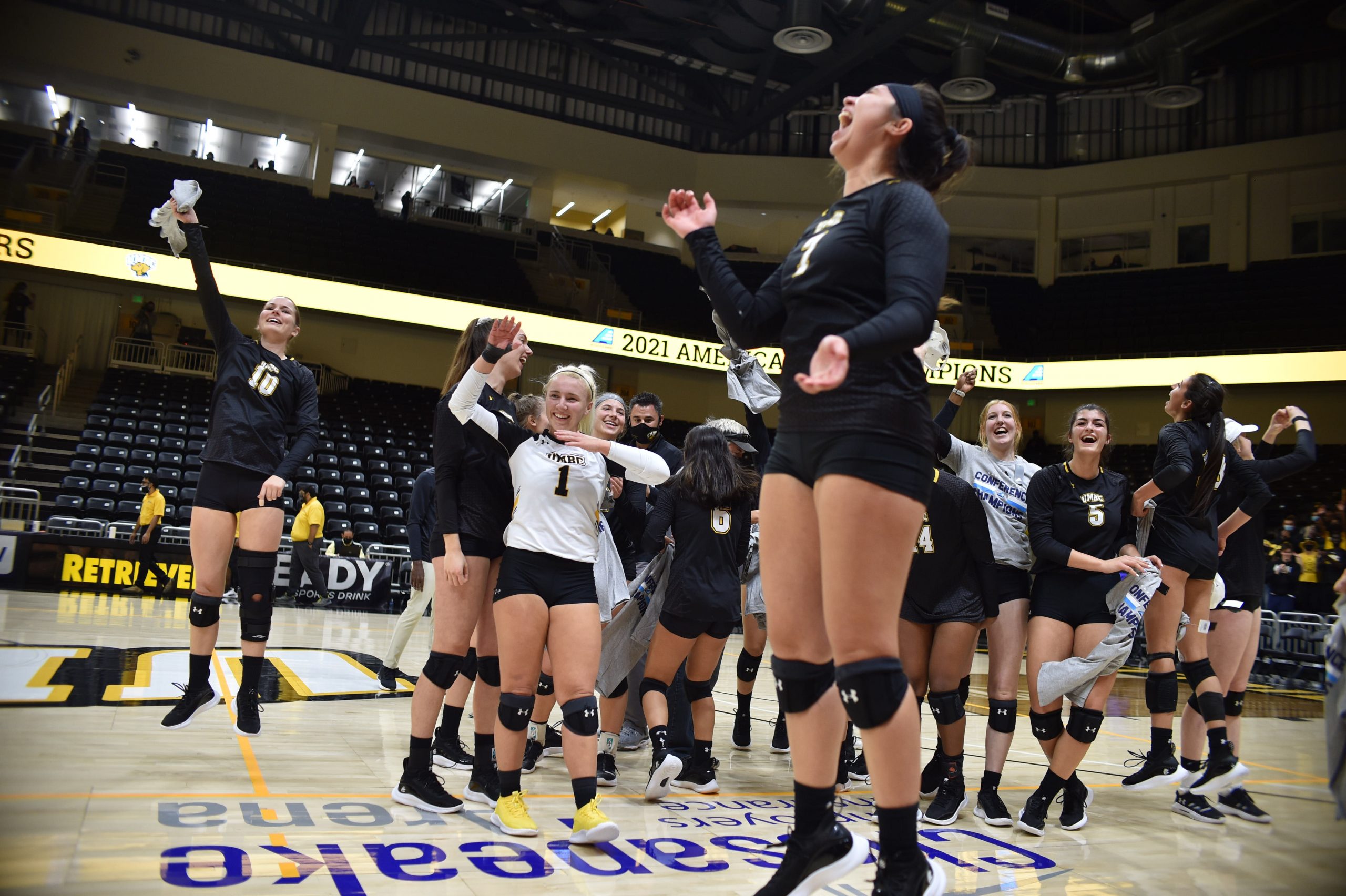
An honor so nice, they had to do it twice. This weekend, UMBC women’s volleyball defended their America East title. Now, they will advance to the NCAA Championship for the fourth time in program history.
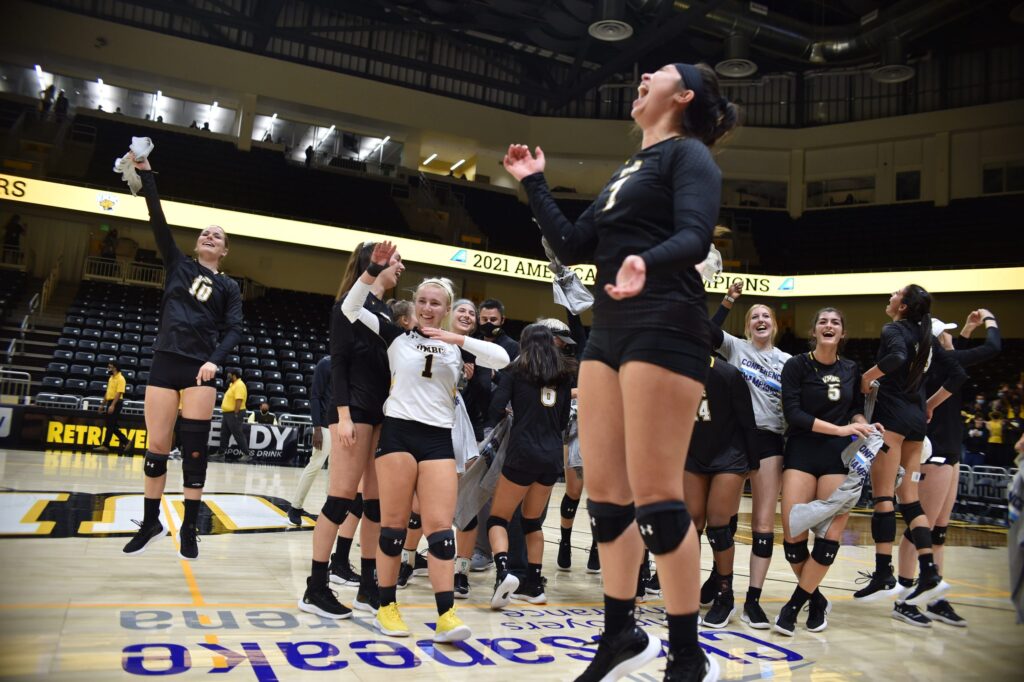 Retrievers jumping for joy after winning the America East Championship for the second-straight season.
In a hard-fought battle against fourth-seeded Stony Brook on Friday night, the Retrievers rallied in five sets and took the semi-final round of the America East Championship. Returning to Chesapeake Employers Insurance Arena on Saturday, fans were on their feet as UMBC rebounded from a 2-0 deficit to win the final three sets against No. 2 seed University at Albany, and again capture the America East Championship.
This match-up may have felt familiar for supporters. Due to competition schedules impacted by COVID, it was only seven months ago that UMBC traveled to UAlbany to take on the Great Danes and win their first America East title.
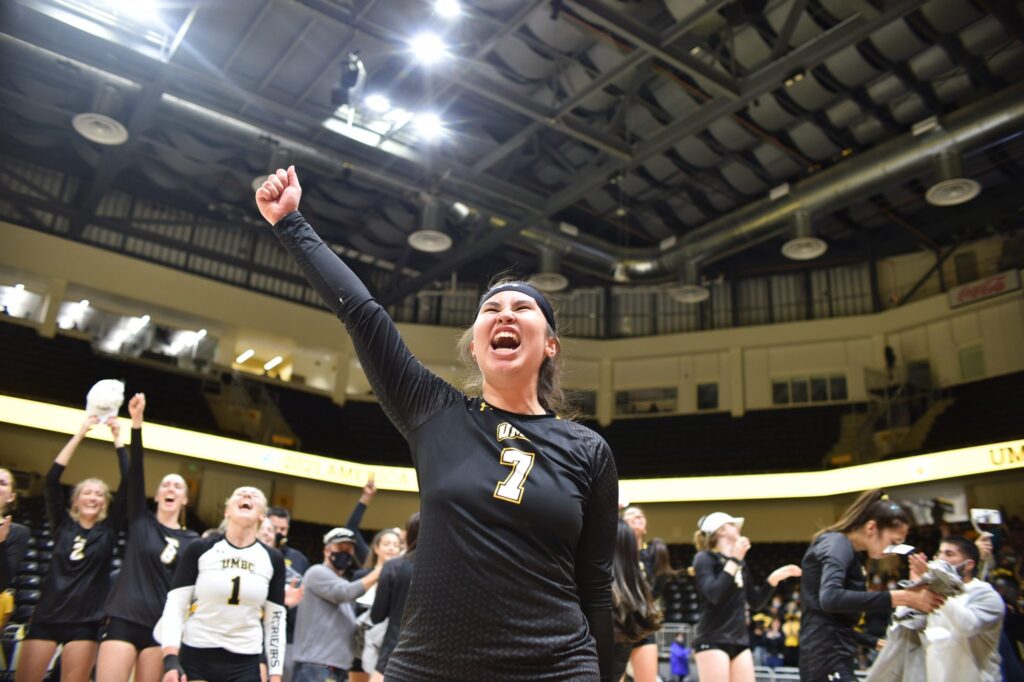 Sophomore Aysia Miller is all smiles after Saturday’s game.
“I couldn’t be more proud of this group. The leadership, work ethic, love for one another and pride for UMBC has shown throughout the whole season,” says head coach Cristina Robertson.
Not only did UMBC defend their title, they also earned their place in the record books. When the regular season came to a close in mid-November, the Retrievers officially became the sixth team in program history to have a perfect, undefeated season.
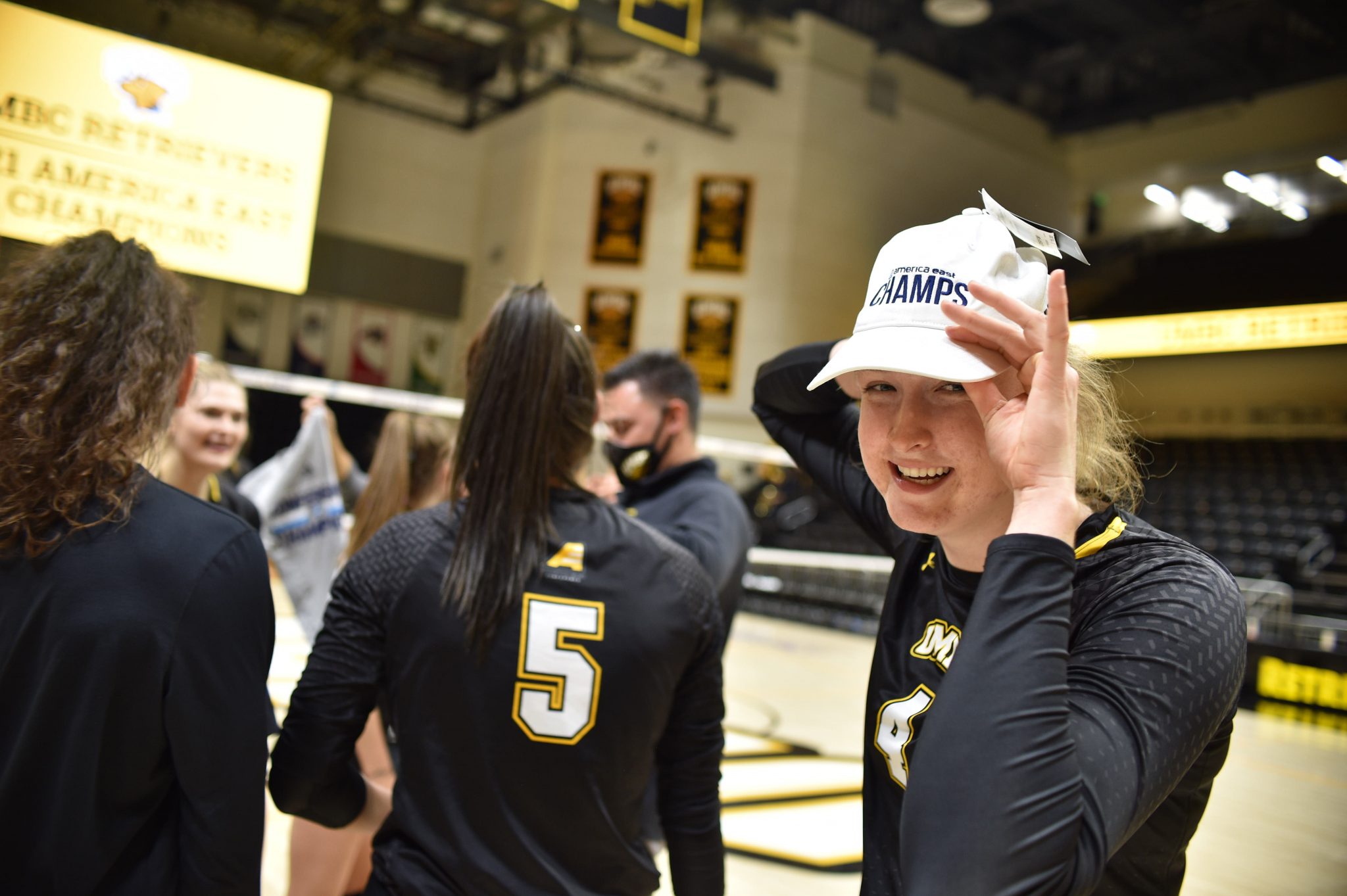
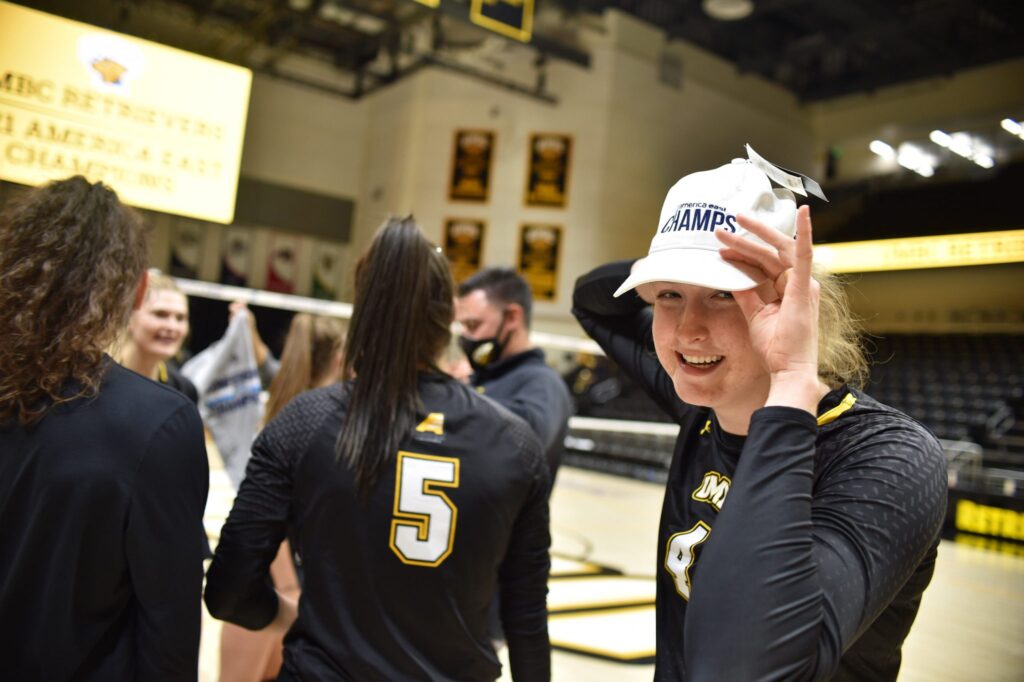 Graduate student Grace Rigsbee shows off the new apparel.
In addition to this honor, UMBC also posted the fourth undefeated record in NCAA Division I conference play and became the third team in the conference to finish 12-0 or better in 20 years.
Key players
Andjelija Draskovic ‘23, psychology, made an impressive showing this season, capturing America East Setter of the Week a league-best tying five times. The Serbian setter earned America East Tournament Most Outstanding Player honors and was joined on the All-Tournament team by Beste Ayhan ’24 and Aysia Miller ‘24, biological sciences.
First-year student Mia Bilusic, biochemistry, is already making her mark on the team, earning America East Rookie of the Year honors and All-Conference First Team honors. She saved her best for the playoffs, recording a career-high 29 kills and 16 digs in the semifinals, and then adding 23 kills on .300 hitting in the championship.
Emily Ferketic ’23, physics, was awarded the America East Elite 18 Award as the top performing student athlete in the championships.
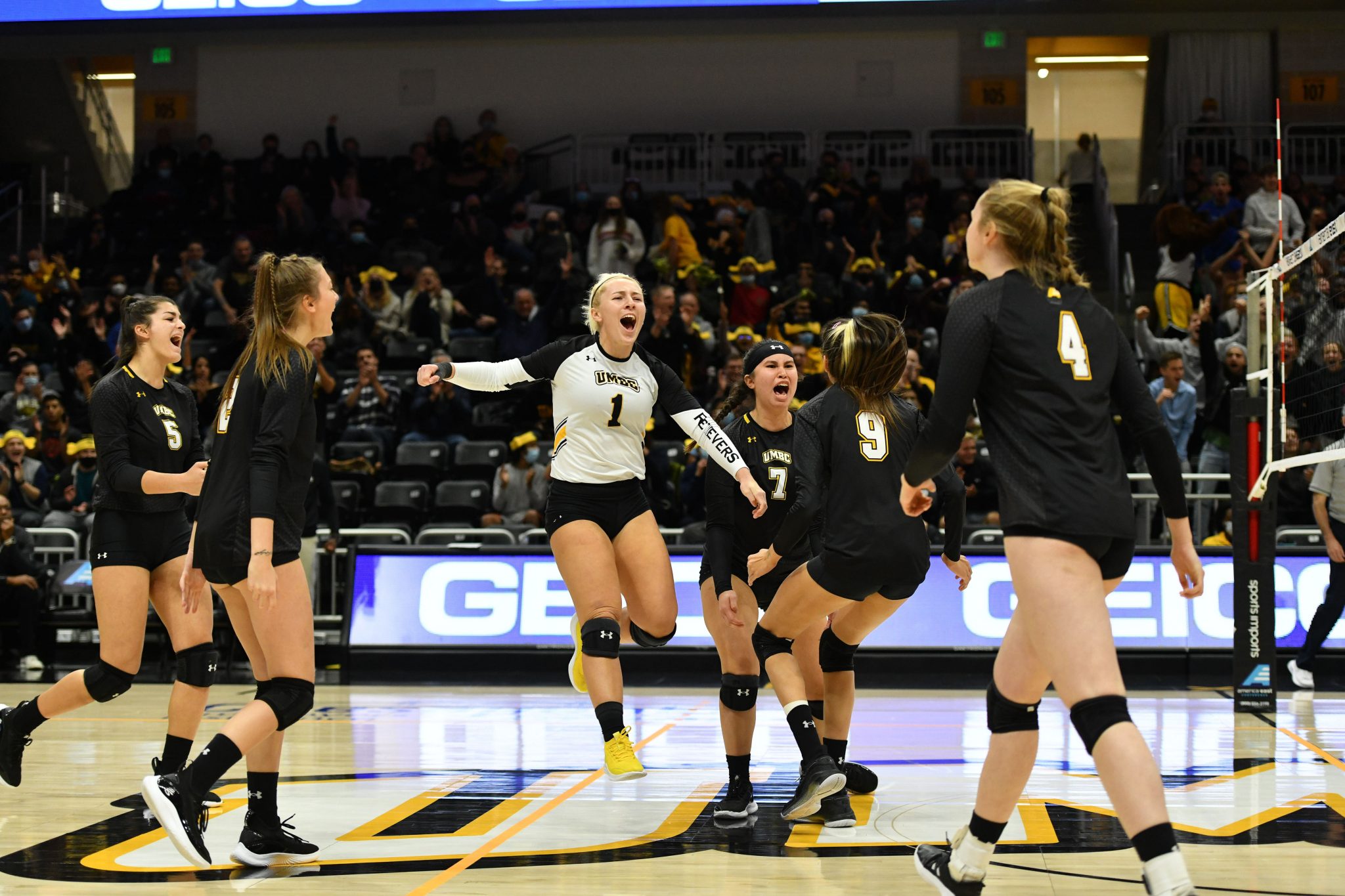
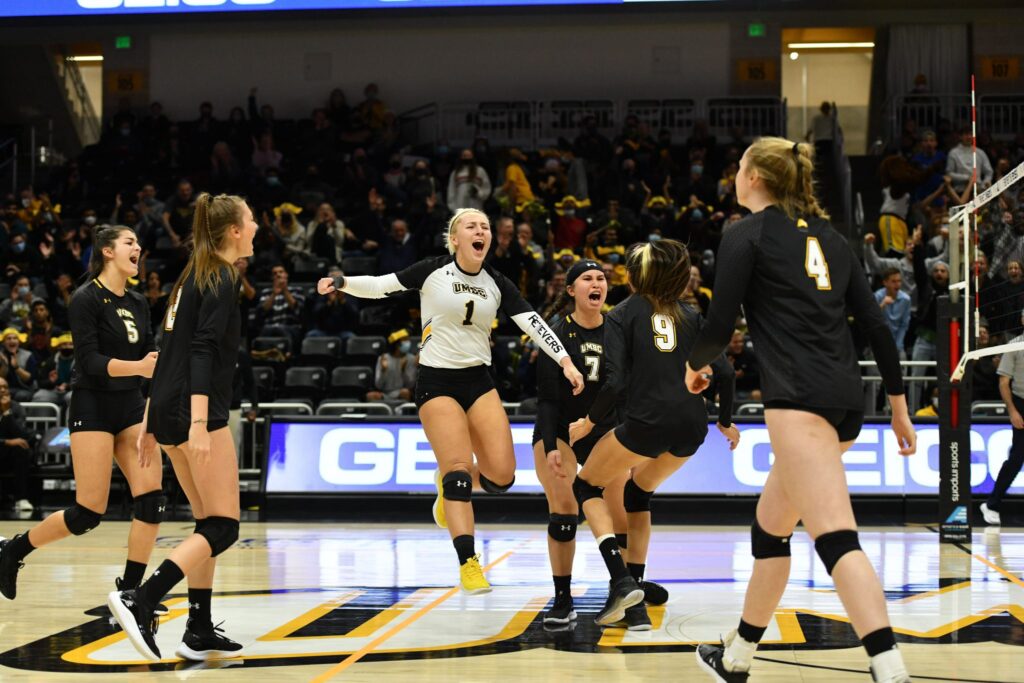 Teter celebrates with teammates on the court.
Graduate student libero Loren Teter, entrepreneurship, innovation, and leadership, continues to make strong contributions on the court. Teter’s 511 digs are currently the fourth-most in a single season in school history and she’s only the second Retriever in program history to be named America East Defensive Specialist of the Year.
“Between sets two and three of that championship game, there was a shift in our team’s demeanor,” says Teter. “We weren’t going to come this far, to only come this far. It was the perfect ending to a perfect regular season.”
For the second season in a row, Robertson and her staff were named America East Coaching Staff of the Year.
“Many thanks to Retriever Nation who showed up in full force and cheered us into winning another conference title,” says Robertson. “UMBC is a special place with special people and we are privileged to be a part of it.”
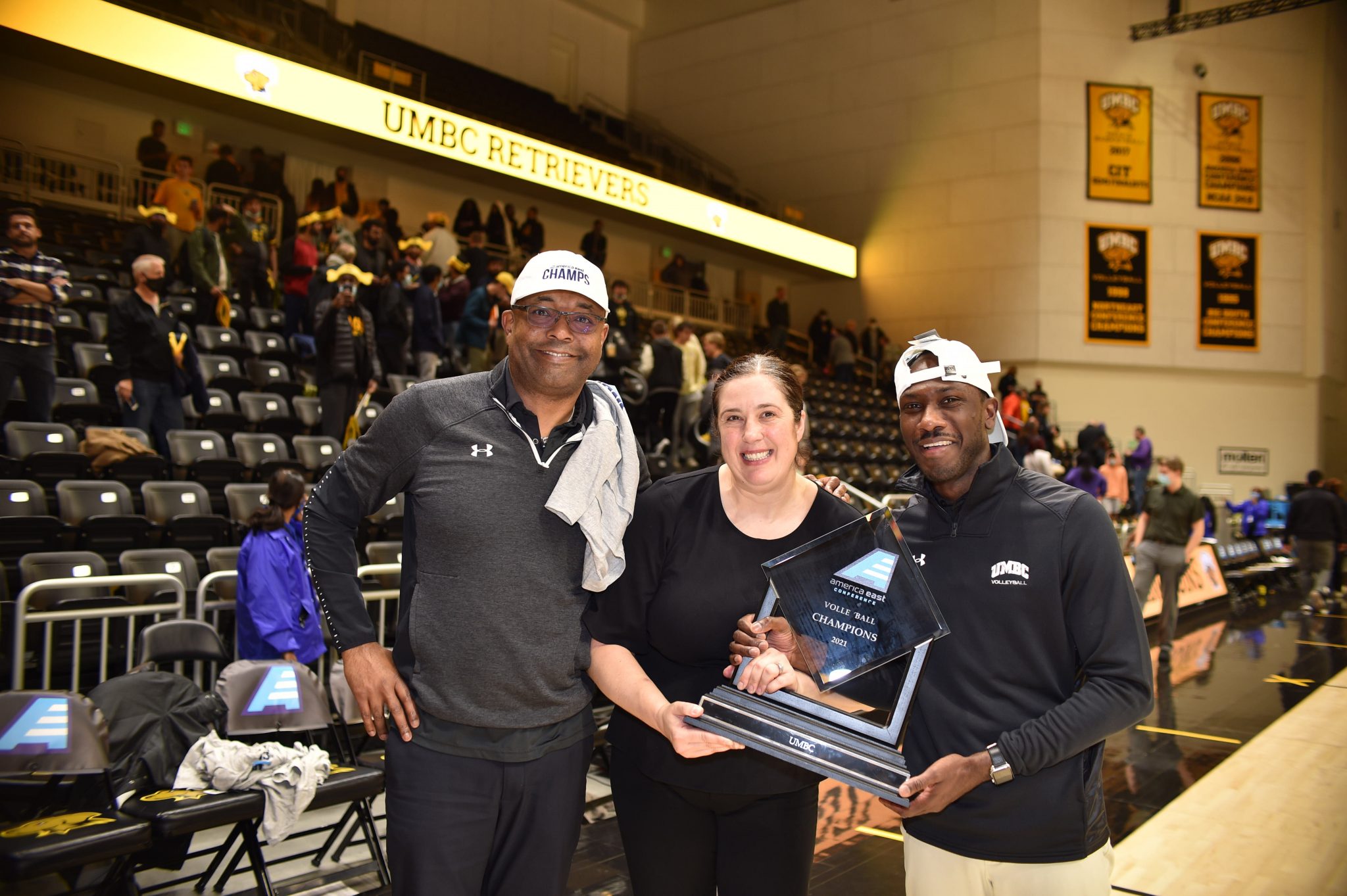
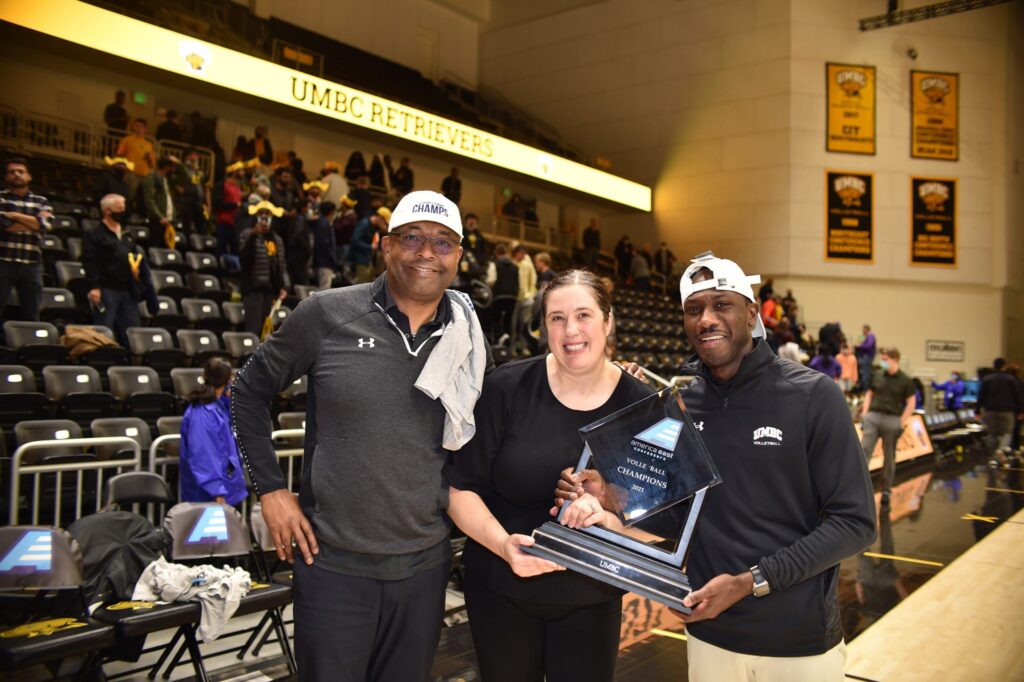 Robertson and UMBC volleyball coaching staff with their America East trophy.
UMBC will battle Pittsburgh on Friday, December 3 at 7 p.m. EST for the first round of NCAA tournament play. Follow all the action on Twitter.
Banner image: UMBC women’s volleyball with America East trophy. All photos courtesy of Ian Feldmann ‘21.
]]>
An honor so nice, they had to do it twice. This weekend, UMBC women’s volleyball defended their America East title. Now, they will advance to the NCAA Championship for the fourth time in program...
https://umbc.edu/stories/umbc-volleyball-successfully-defends-america-east-title-advances-to-ncaa-championship/
https://beta.my.umbc.edu/api/v0/pixel/news/119520/guest@my.umbc.edu/eee06beeba2ed6e89311cd718ae16f56/api/pixel
athletics
community
UMBC News & Magazine
https://beta.my.umbc.edu/groups/umbc-news-magazine
https://assets1-beta.my.umbc.edu/system/shared/avatars/groups/000/001/943/24435aa6207c452e7bc15cc74b42c7bb/xsmall.png?1748556657
https://assets1-beta.my.umbc.edu/system/shared/avatars/groups/000/001/943/24435aa6207c452e7bc15cc74b42c7bb/original.png?1748556657
https://assets2-beta.my.umbc.edu/system/shared/avatars/groups/000/001/943/24435aa6207c452e7bc15cc74b42c7bb/xxlarge.png?1748556657
https://assets2-beta.my.umbc.edu/system/shared/avatars/groups/000/001/943/24435aa6207c452e7bc15cc74b42c7bb/xlarge.png?1748556657
https://assets3-beta.my.umbc.edu/system/shared/avatars/groups/000/001/943/24435aa6207c452e7bc15cc74b42c7bb/large.png?1748556657
https://assets1-beta.my.umbc.edu/system/shared/avatars/groups/000/001/943/24435aa6207c452e7bc15cc74b42c7bb/medium.png?1748556657
https://assets2-beta.my.umbc.edu/system/shared/avatars/groups/000/001/943/24435aa6207c452e7bc15cc74b42c7bb/small.png?1748556657
https://assets1-beta.my.umbc.edu/system/shared/avatars/groups/000/001/943/24435aa6207c452e7bc15cc74b42c7bb/xsmall.png?1748556657
https://assets2-beta.my.umbc.edu/system/shared/avatars/groups/000/001/943/24435aa6207c452e7bc15cc74b42c7bb/xxsmall.png?1748556657
UMBC News & Magazine
0
0
false
Tue, 23 Nov 2021 14:00:15 -0500
Finding Your Voice in Fanfiction

 Headshot of Sauro by Marlayna Demond ’11.
Your favorite heroes are joining forces to fight Thanos in Avengers: Endgame. Suddenly, you watch as one by one, they are dropped off on Sesame Street in New York City. You’re seeing the story unfold on the page because you’re creating a merged universe as an exercise to enhance your English language skills. What will happen next? Only you know.
This interplay of fanfiction in language learning and instruction is what Shannon Sauro, associate professor of education and faculty member in the Teaching English to Speakers of Other Languages (TESOL) program at UMBC, strives to showcase in her reading and writing courses. (Indeed, one of Sauro’s students proved that they could merge the Avengers and Sesame Street into one universe for a fanfiction project.)
Fandoms exist in numerous forms, whether related to movies, TV shows, novels, music, video games, or other aspects of pop culture. But how is it relevant to teaching and learning? As Sauro explains, quoting fan studies scholar Mark Duffett, a fan is “someone who has a strong, positive emotional connection to someone or something famous.” Her students come from different backgrounds with these connections under their belt, which makes it easier for them to form an emotional connection to the work as it unfolds. This ultimately helps them gain new language skills.
Learning for fun
Prior to moving to the U.S., Sauro lived and taught in Sweden, where she noticed that many students used fanfiction to develop their English language skills. These students took part not only in consuming media in English, but also discussing this media in their own fandom communities.
 Maryland language teachers take part in a workshop on fanfiction for foreign language teaching held by the UMBC TESOL program in November of 2019. Photo courtesy of Sauro, standing.
“We can see different cultural attitudes around fiction writing, and I found this refreshing in Sweden because in the Swedish national curriculum, they emphasize the learning of foreign languages not just for work, but also pleasure and the consumption of cultural products [and] self-expression,” shares Sauro. “So writing fanfiction is something you do with language. It’s not considered frivolous or not academic.”
In the U.S., this integration of fanfiction into language learning may not look as familiar to students and instructors. But fanfiction can enable students’ creativity while building on necessary reading and writing skills.
Gaining appreciation for the craft
 Headshot courtesy of BB Kim.
Language-learning classes often stress the importance of reading and analyzing canonical texts to hone skills. But fanfiction allows students to play around with literary tropes, dialogue, plot, and character development—all within the context of their favorite fandom. BB Kim ’22, a TESOL graduate student, would have never guessed that she’d be writing about the Disney film, Frozen, for a fanfiction project in Teaching Reading and Writing to ESOL/Bilingual Students.
As an ESOL instructor herself, Kim saw the potential of fanfiction to engage students in fun, creative ways. But that didn’t mean she wasn’t skeptical at first about the idea of rewriting the plot of an existing movie.
Kim’s realization arrived only after she finished writing her take on Frozen. With a single click, she published her story on a fanfiction website for a real audience to read and leave comments on (imagine if Elsa embraced her powers from the start instead of hiding them away!). Kim wasn’t expecting her work to receive such attention, but seeing it on the website gave her an undeniable sense of accomplishment.
Kim was especially appreciative of Sauro’s clear and organized instruction, as the students weren’t pushed into the realm of fanfiction without preparation beforehand. “I feel like it was a nice brain break from taking classes that are more theory-based… So it was definitely memorable,” says Kim, adding that Sauro’s teaching style has served as a model for how she conducts her own classes.
Finding yourself in the story
Sauro asks her students to interpret an author’s writing style and incorporate it into their own. Elements like structure and word choice require attention to linguistic detail, making the study of fanfiction quite the endeavor.
The three-country project, FanTALES, in which Sauro was a contributor, has set out to tackle just this. With the collaboration of researchers and teachers from Sweden, Belgium, and Germany, the project has materialized as an online platform providing learning materials to students and instructors. What sets it apart from traditional language education is its emphasis on storytelling (i.e., fanfiction and interactive fiction), digital literacy, and multilingual avenues of learning and interacting with other language users. Students are given a platform to creatively and critically express their identities and perspectives through writing.
 Language teachers and trainers participate in the 2019 FanTALES workshop held in Valencia, Spain, as part of the International Conference on Intercultural Learning in the Digital Age. Photo courtesy of Sauro, right.
“By inviting students to either play with the text, transform it, put themselves in it, or merge it with something they actually like, it gets them more engaged and involved with the text and more likely to commit that time to it,” says Sauro, who incorporates materials from FanTALES into the fanfiction project she assigns to students. Even after the students have written and published their stories, she asks them to reflect on the choices they made throughout the writing process. The bigger takeaways that some students gain reveal the value of personalized storytelling.
“I think for me the takeaway is don’t be afraid to do something different… Don’t be afraid to shy away and be creative and allow students to learn in different ways—to be flexible, to be open-minded,” says Kim.
What Sauro hopes for her students, in addition to increased language skills, is to recognize how they can write themselves into a text to express their truths and experiences.
“Often when working with language learners, or young people in general with any different background, you can see that there are certain texts that get reified and selected as a canon, but they don’t represent all the lived experiences in society or in the classroom,” says Sauro. “And fanfiction is a way to give students a voice to talk back to that text, to correct that text, and to write themselves into the canon, into the literature, and into the media that their society or their classrooms celebrate and value.”
******
Header image: Sauro connects with a student in her office. Photo by Marlayna Demond ’11.
]]>
Headshot of Sauro by Marlayna Demond ’11. Your favorite heroes are joining forces to fight Thanos in Avengers: Endgame. Suddenly, you watch as one by one, they are dropped off on Sesame...
https://umbc.edu/stories/finding-your-voice-in-fanfiction/
https://beta.my.umbc.edu/api/v0/pixel/news/119521/guest@my.umbc.edu/2a31fa0430b33333c437e0ba95c43129/api/pixel
discovery
education
esol
fall-2021
fanfiction
language-learning
teaching
tesol
UMBC News & Magazine
https://beta.my.umbc.edu/groups/umbc-news-magazine
https://assets1-beta.my.umbc.edu/system/shared/avatars/groups/000/001/943/24435aa6207c452e7bc15cc74b42c7bb/xsmall.png?1748556657
https://assets1-beta.my.umbc.edu/system/shared/avatars/groups/000/001/943/24435aa6207c452e7bc15cc74b42c7bb/original.png?1748556657
https://assets2-beta.my.umbc.edu/system/shared/avatars/groups/000/001/943/24435aa6207c452e7bc15cc74b42c7bb/xxlarge.png?1748556657
https://assets2-beta.my.umbc.edu/system/shared/avatars/groups/000/001/943/24435aa6207c452e7bc15cc74b42c7bb/xlarge.png?1748556657
https://assets3-beta.my.umbc.edu/system/shared/avatars/groups/000/001/943/24435aa6207c452e7bc15cc74b42c7bb/large.png?1748556657
https://assets1-beta.my.umbc.edu/system/shared/avatars/groups/000/001/943/24435aa6207c452e7bc15cc74b42c7bb/medium.png?1748556657
https://assets2-beta.my.umbc.edu/system/shared/avatars/groups/000/001/943/24435aa6207c452e7bc15cc74b42c7bb/small.png?1748556657
https://assets1-beta.my.umbc.edu/system/shared/avatars/groups/000/001/943/24435aa6207c452e7bc15cc74b42c7bb/xsmall.png?1748556657
https://assets2-beta.my.umbc.edu/system/shared/avatars/groups/000/001/943/24435aa6207c452e7bc15cc74b42c7bb/xxsmall.png?1748556657
UMBC News & Magazine
0
0
false
Mon, 22 Nov 2021 21:36:12 -0500
Resiliency of Student Leaders Keeps Clubs Alive
President of the System Administration and Software Development Club (SAD Club) Nikola Bura ’22, computer science, and former vice president—now “keeper of the (non-alcoholic) drinks”—Henry Budris ’22, computer science, talk fondly of the quirky origins of their student org. SAD Club came into existence in 2019 with lighthearted and humorous ambitions (thus the funny titles). Over time, however, it has expanded into a meaningful place to learn about software development, finding ways to thrive even as other student orgs have had to adapt their approach to community in order to maintain membership during the switch to virtual in 2020.
The relentless positive energy from Bura and Budris certainly helped keep things going, but both always had the sense that their club was one that could work in a fully online format. “We’re computer people,” says Bura, with a chuckle.“All of the computer classes can be done online, so we were definitely in a good position to continue our organization virtually.”
Budris adds that a new goal for SAD is bringing in people who are brand new to the field of software development. “We want people to know, if you’re new to this, we can teach you cool things.”
Other student groups have found different ways to ride out the changing pandemic guidelines to keep their communities intact. It comes as no surprise that these Retriever club leaders found unique pathways to keep their clubs connected.
Preserving the essence of community
Another relatively new club, the Association of Black Artists (ABA) announced its presence for the first time in the fall of 2019.
“The idea was to have us all collaborate because the arts department here is relatively small, and then the population of Black students within each department is even smaller. So we were focused on just creating a place or a safe space where all of us can come together and share our own experiences, art, and even possibly having collaborations with different members,” says President Kayla Massey ’22, dance and information systems, an initial member of the executive board.
 ABA’s executive board from left to right: Joshua Gray, Tochi Nwachinemere, Obinna Ezejiofor, and Kayla Massey. Photo taken by Julianna Falcon, ’24.
Much like SAD club, ABA didn’t have much of a history leading into the transition to the virtual world. They did, however, have two or three in person meetings before getting sent home. “It was devastating for us. We were new, fresh, and exciting,” notes Massey.
 “Chisom” by Tochi Nwachinemere.
Prior to COVID-19, about 15 – 20 members met once a week in the evenings at the Performing Arts and Humanities building. “ We’d feed off each other’s energy, just enjoy being in the same room with each other,” says Massey.“ But when COVID first hit, everyone was just trying to figure out what was next. We took a hiatus for the rest of the semester, but we did continue meeting as a board just to make sure that we kept a sense of community.”
The only reality you know
Meanwhile, Vice President Tochi Nwachinemere’s ’24, biology, entire experience with the Association of Black Artists has been a virtual one.
“I don’t really know any other way. The online format we had to do during COVID, wasn’t my favorite. When you have so many classes and things you need to take care of, it’s hard to convince people to participate in something they technically don’t have to do.” Nwachinemere notes.
Massey is looking forward to the fall, when some of their meetings will resume in person—and she’s not worried about the future of ABA. “In terms of the longevity of the club, I am not worried at all, and it is because of Tochi. With everything she’s experienced within the club, the fact that she’s working with the people who started this club, and just with her personality, she’s got this, she’ll be great. She understands the mission,” says Massey.
How must the show go on?
Unlike new clubs like SAD and ABA, the dance group Major Definition is practically a campus landmark. Founded in 2005, Major Definition is well-known for their vibrant hip-hop dance performances and competitions, but how could a dance organization continue its craft online?
According to Timothy Huynh ’22, computer science, executive director since fall 2020, it was quite a process, riddled with highs and lows. “Our last practice before the shift to online was just before spring break, which initially was extended by just two weeks. It’s funny, because we were thinking, ‘These next two weeks, we’re just going to have people send in videos of themselves practicing the set. And then after those two weeks we’re going to return, and get back to practicing right away again.’ Then that fell through,” he says.
 Major Definition practices in the bottom hallway of the UC in 2021. Photo by Marlayna Demond ’11.
The following months continued to put Huynh and Major Definition to the test. “Typically we plan for a semester before it even starts. When we were sent home indefinitely we decided to end the season early, because we really couldn’t do anything without it being a last second solution, and I always prefer quality over a rushed solution,” says Huynh
Nevertheless, there was some joy at the end of a tough semester. “We still had our end of the semester choreo-showcase where members can show off the choreography that they worked on in a show-and-tell style and we just cheer each other on. We managed to do that virtually and it was really nice to watch all the videos together at the same time,” says Huynh.
Trial and error, in the name of success
Major Definition developed an impressive, and aesthetically pleasing online presence during the pandemic, amping up their Instagram and YouTube output with stand-out production quality.
Now that student organizations have more freedom in how they meet, Major Definition is set to return to one thing for sure. “No matter what, we’re going to be having in person practices, because at this point we have to. But for online dance classes and auditions, we are adopting a hybrid approach to maximize our accessibility to those who aren’t comfortable or are unavailable for in person meetings,” says Huynh.
The organization has plans for a big semester once the ball is rolling. “We have pre-audition workshops which are basically dance classes for anyone who’s interested in auditioning, or just interested in taking a dance class. Beyond that, throughout the semester we typically offer free public dance classes to UMBC and beyond called public classes,” Huynh says.
While there were certainly doubts about this semester’s potential at some point, Major Definition now looks poised to have a productive semester.
“We have gotten lots of interest from Involvement Fest and our recent performance at the Fall Fest Friday event. It is reassuring to see all of the people excited about our group.”
A new trajectory for SAD
Despite the group’s growing success, Bura and Budris’s tenure in SAD started auspiciously. “When this club was handed over to Henry and me in spring 2020, I got the sense that it was a bit of a joke, in the sense of ‘hey you know what’d be funny? Let’s start a sysadmin club with a bunch of meme roles that we can assign our officers to,” says Bura.
“We kind of ran with the meme aspect of it,” says Budris, “but now it’s actually turned into an official club. We’re trying to keep that sense of ‘this isn’t a super serious club,’ but we do meaningful things.”
SAD, like other clubs, relies on the tenacity of its members to stay relevant and spread the word about their activities. “After virtual Involvement Fest we had one new person join us, and they brought a bunch of their friends,” says Budris. With the influx of new members, SAD club has developed new objectives to open up what comes next.
“I think the main goal we’d like to implement is bringing in people who are brand new to the field instead of making this a club that’s ‘only for experts,’” clarifies Budris. “We want people to know, if you’re new, we can teach you cool things.”
 SAD Club’s table at the Fall ’21 Involvement Fest.
After having their first meeting on September 10, offered both in-person and virtually, to maximize accessibility, Bura sums up the situation best. “I’m really proud that we have our club, we had to do a lot to get where we are right now.”
******
Header image: Student groups adjust to an outdoor Involvement Fest in 2021. Photo by Marlayna Demond ’11.
]]>
President of the System Administration and Software Development Club (SAD Club) Nikola Bura ’22, computer science, and former vice president—now “keeper of the (non-alcoholic) drinks”—Henry Budris...
https://umbc.edu/stories/resiliency-of-student-leaders-keeps-clubs-alive/
https://beta.my.umbc.edu/api/v0/pixel/news/119522/guest@my.umbc.edu/f555b82e30912fb48e4a4eb7a1945e15/api/pixel
campus-life
UMBC News & Magazine
https://beta.my.umbc.edu/groups/umbc-news-magazine
https://assets1-beta.my.umbc.edu/system/shared/avatars/groups/000/001/943/24435aa6207c452e7bc15cc74b42c7bb/xsmall.png?1748556657
https://assets1-beta.my.umbc.edu/system/shared/avatars/groups/000/001/943/24435aa6207c452e7bc15cc74b42c7bb/original.png?1748556657
https://assets2-beta.my.umbc.edu/system/shared/avatars/groups/000/001/943/24435aa6207c452e7bc15cc74b42c7bb/xxlarge.png?1748556657
https://assets2-beta.my.umbc.edu/system/shared/avatars/groups/000/001/943/24435aa6207c452e7bc15cc74b42c7bb/xlarge.png?1748556657
https://assets3-beta.my.umbc.edu/system/shared/avatars/groups/000/001/943/24435aa6207c452e7bc15cc74b42c7bb/large.png?1748556657
https://assets1-beta.my.umbc.edu/system/shared/avatars/groups/000/001/943/24435aa6207c452e7bc15cc74b42c7bb/medium.png?1748556657
https://assets2-beta.my.umbc.edu/system/shared/avatars/groups/000/001/943/24435aa6207c452e7bc15cc74b42c7bb/small.png?1748556657
https://assets1-beta.my.umbc.edu/system/shared/avatars/groups/000/001/943/24435aa6207c452e7bc15cc74b42c7bb/xsmall.png?1748556657
https://assets2-beta.my.umbc.edu/system/shared/avatars/groups/000/001/943/24435aa6207c452e7bc15cc74b42c7bb/xxsmall.png?1748556657
UMBC News & Magazine
0
0
false
Mon, 22 Nov 2021 21:22:24 -0500
How to Chill Out
With Joella Lubaszewski ’10, theatre, UMBC’s coordinator in fitness and wellness
In the hustle and bustle of exams, family dinners, and everyday life, it can be easy to forget to take time for yourself—time that isn’t spent thinking about the errands you need to run or the emails cluttering your inbox. One could argue that Ferris Bueller said it best when he reminded us, “Life moves pretty fast. If you don’t stop and look around once in a while, you could miss it.”
A great way to reconnect, relax, and recenter is through yoga. UMBC’s coordinator in fitness and wellness, Joella Lubaszewski ’10, theatre, has spent hundreds of hours getting certified so she can teach you the art of finding your calm.
Tools of the Trade:
- A willingness to try (seriously, that’s it): “There are a lot of different types of yoga and ways to practice, you don’t necessarily need anything special,” says Lubaszewski.
- Optional: Yoga mat and yoga blocks.
Step 1: Get Started!
So frequently people seem to think they need to have a certain level of flexibility or balance to get started (or the right wardrobe), but Lubaszewski wants to assure newbies this is not the case.
“I think anybody can do yoga in some capacity,” says Lubaszewski. “There are a lot of different kinds of yoga. Maybe you’re never going to put your foot behind your head, that doesn’t mean you’re not doing yoga. Maybe for you it’s more of the meditation or the act of practicing.”
She encourages those who are new to try a few studios and a few classes before throwing in the towel—the RAC offers quite a few options, too. Having trouble getting started? Try journaling or reading beforehand to ease yourself into the class and center your focus.
Step 2: Find Your Space
Wouldn’t it be cool to have a full yoga studio in your home? Yes. Is that feasible? Maybe not, but it’s okay to dream big. The good news is you don’t need a fancy space or equipment to get started. The rise of online classes has made it easier than ever to take a virtual class from virtually anywhere.
“Some days your practice will be just from your bed in your pajamas and some days it will be on the floor, it just depends on what you need that day,” says Lubaszewski.
The important thing is finding a space that’s yours. One of the biggest challenges that comes with starting is focusing on your practice. You may find that you concentrate better when you’re in an in-person class with others, a live video with an instructor, a pre-recorded class you can do at your own speed, or even just working through your own flow.
Step 3: Find What Works for You
If you’re trying yoga for the first time and can’t seem to get the hang of it, you’re not the only one. Lubaszewski recalls that when she first started practicing she admits she thought it was, “a little boring,” but as she integrated it into her regular routine, she fell in love with it.
You don’t need to have a reason to start or set an intention to start your practice that day. “It’s such a personal thing; if you have a clear reason and intention, sure, you can think about that. If you don’t, maybe you’ll figure it out along the way, but it’s not a problem if you don’t,” she assures new students.
Step 4: Turn Your Brain Off
“I say this during savasana [the final resting pose of almost every class]—try not to think that as soon as class is over you’re going to get changed and go to the grocery store and run your errands,” Lubaszewski encourages. “Just stop, don’t think for a minute.”
We know this one is easier said than done, but if you’re really going to let yourself relax, you’re going to have to channel your inner Elsa and “let it go.” There are so few occasions when we’re actually encouraged not to think, but this helps to reflect on the work you just did and capture the last vestiges of peace before returning to real life.
 Through recurring events like Mindfulness Mondays, UMBC students and staff are encouraged to find ways to breathe and relax. Here, RAC fitness instructor Erica Sligh ’20, biological sciences, leads a yoga class next to the Library Pond in 2019.
Brain still stuck on a hamster wheel of thoughts? Lubaszewski suggests making an inventory of all the things you can feel—your legs on the mat, your arms at your sides, the fabric of your clothes, etc.
Step 5: Practice Makes Perfect
Even after over a decade of practice, Lubaszewski still doesn’t consider herself an expert (hence why it’s called a practice). For her, the appeal is that you can do it every day but still find new and different ways to suit your needs.
“One of the reasons I really love yoga is that it can be whatever you need, when you need it. Sometimes it’s sitting down for an intense 90-minute workout, sometimes it’s 30 seconds of just breathing because you’re feeling overwhelmed.”
Step 6: Recapture Your Peace Throughout the Day
As you start to condition yourself to take time throughout the day, it can get easier to recapture some of those feelings of peace, even without rolling out your mat.
“It can be easy to wake up and jump into all the things you have to do,” says Lubaszewski, “but giving yourself permission to stop and focus for a second can calm you down and change the trajectory of your day.”
*****
All photos by Marlayna Demond ’11.
]]>
With Joella Lubaszewski ’10, theatre, UMBC’s coordinator in fitness and wellness In the hustle and bustle of exams, family dinners, and everyday life, it can be easy to forget to take time...
https://umbc.edu/stories/how-to-chill-out/
https://beta.my.umbc.edu/api/v0/pixel/news/119523/guest@my.umbc.edu/30b616998c15522f27391813a75e6433/api/pixel
campus-life
fall-2021
how-to
rac
theatre
yoga
UMBC News & Magazine
https://beta.my.umbc.edu/groups/umbc-news-magazine
https://assets1-beta.my.umbc.edu/system/shared/avatars/groups/000/001/943/24435aa6207c452e7bc15cc74b42c7bb/xsmall.png?1748556657
https://assets1-beta.my.umbc.edu/system/shared/avatars/groups/000/001/943/24435aa6207c452e7bc15cc74b42c7bb/original.png?1748556657
https://assets2-beta.my.umbc.edu/system/shared/avatars/groups/000/001/943/24435aa6207c452e7bc15cc74b42c7bb/xxlarge.png?1748556657
https://assets2-beta.my.umbc.edu/system/shared/avatars/groups/000/001/943/24435aa6207c452e7bc15cc74b42c7bb/xlarge.png?1748556657
https://assets3-beta.my.umbc.edu/system/shared/avatars/groups/000/001/943/24435aa6207c452e7bc15cc74b42c7bb/large.png?1748556657
https://assets1-beta.my.umbc.edu/system/shared/avatars/groups/000/001/943/24435aa6207c452e7bc15cc74b42c7bb/medium.png?1748556657
https://assets2-beta.my.umbc.edu/system/shared/avatars/groups/000/001/943/24435aa6207c452e7bc15cc74b42c7bb/small.png?1748556657
https://assets1-beta.my.umbc.edu/system/shared/avatars/groups/000/001/943/24435aa6207c452e7bc15cc74b42c7bb/xsmall.png?1748556657
https://assets2-beta.my.umbc.edu/system/shared/avatars/groups/000/001/943/24435aa6207c452e7bc15cc74b42c7bb/xxsmall.png?1748556657
UMBC News & Magazine
0
0
false
Mon, 22 Nov 2021 20:45:32 -0500
 Headshot of Hewitt in Florida. All photos courtesy of Hewitt unless otherwise noted.