As spiritualism’s popularity grows, photographer Shannon Taggart takes viewers inside the world of séances, mediums and orbs

By Beth Saunders, Curator and Head of Special Collections and Gallery, UMBC
The word séance conjures images of darkened rooms, entranced mediums, strange occurrences and spirit voices. For many contemporary audiences, these visions might seem like something out of the past, or perhaps a movie, rather than a living belief system.
For the past 20 years, American photographer Shannon Taggart has explored modern spiritualism, a religion whose adherents believe in communication with the dead.
Her photographic series “Séance,” which was recently on view at the Albin O. Kuhn Gallery at the University of Maryland, Baltimore County, provides a window into this often misunderstood religion.
As a curator and art historian who has researched apparition photographs and the art of conspiracy theory, I was drawn to Taggart’s images because they offer a lens through which to examine the role of spirituality in modern life.
In an era defined by a global pandemic, heightened political division and the planetary threat of climate change, I wonder: Is spiritualism due for a major resurgence?
Spiritualism comes knocking
Spiritualism emerged near Rochester, New York, in 1848 when two sisters, Kate and Margaret Fox, claimed to hear a mysterious rapping at their bedroom wall. The adolescents claimed to communicate through a system of knocks with the spirit of a man who had died in the house years earlier. News of the phenomenon traveled quickly, and the girls appeared before crowds demonstrating their purported abilities.
Soon, reports of similar phenomena occurring across the United States appeared in the press, and the possibility of speaking with the deceased fueled the popular imagination.
Spiritualism first grew in private. People who channeled communication with the dead, called mediums, operated out of their homes, where they would organize séance circles, gatherings in which a small group attempted to make contact with the spirit world.
Over time, spiritualists started appearing publicly at conventions and outdoor summer camp meetings. By the 1870s, they began to put down roots, founding like-minded communities and centers of study, such as the spiritualist colony of Lily Dale, New York, established in 1879.
In addition to holding séances, spiritualists practice healings and believe in the gift of prophecy. Mediums say they convey messages from the dead to the living, including reports about the future.
Many spiritualists hoped to make utopian visions of the future a reality in the present by supporting progressive political causes such as abolitionism, women’s rights and Indigenous rights.
Notably, spiritualism gave women an unprecedented role in religion, providing an audience and a platform to deliver messages both personal and political. Suffragists Marion H. Skidmore, Elizabeth Cady Stanton and Susan B. Anthony all spoke at Lily Dale. The views of spiritualists thus represented a radical break from traditional religious and political authority.
Ghosts in the machine
The Fox sisters’ purported ability to communicate with the dead became known as “the spiritual telegraph,” referencing the then-recent invention by Samuel B. Morse. As spiritualism developed, adherents embraced technology as tools for spirit communication and to prove the existence of spirits.
Photography became “the perfect medium” with which to create an iconography of spiritualism. Whether it was through astronomical, microscopic or X-ray photography, cameras could render the unseen visible. Despite the proliferation of altered photographs in the 19th century, the photograph’s status as a truthful representation of reality remained – and, one might argue, continues to remain – largely intact.
Photography also played a leading role in the 19th century’s memorial culture, since the camera could freeze time and render absent loved ones present, if only as a visual trace.
The American Civil War brought death at an unprecedented scale into people’s living rooms through the pages of the illustrated press. Black attire, mourning jewelry and the genre of post-mortem photography were commonplace in a culture of grieving.
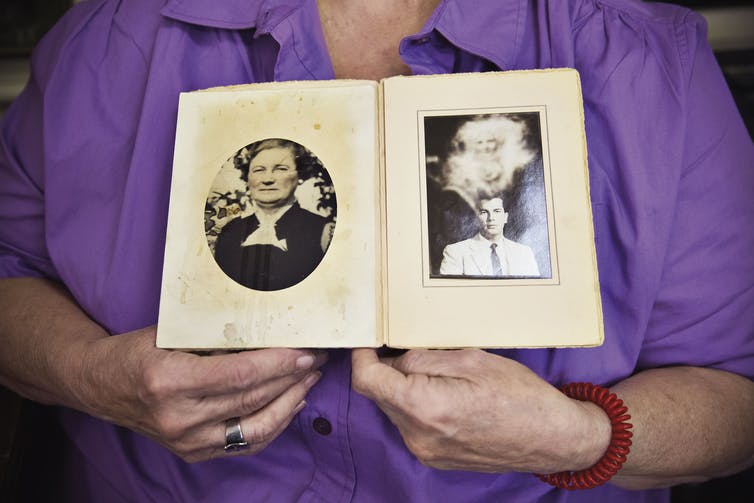 Sandy Candy Eppinger’s family spirit photographs, which show her brother Eugene Candy with the spirits of their grandmother Ethel Philips and great aunt Helen Thompson, at Lily Dale, New York, in 2015. © Shannon Taggart. Courtesy of the Artist, Author provided
In the 1860s, New York portrait photographer William Mumler and his wife, Hannah Mumler, a medium, offered portrait sessions in which spirits of the sitters’ loved ones appeared to manifest in the resulting photographs.
Mumler’s spectacular portraits also raised the specter of hucksterism. The photographer was charged with fraud by claimants who argued he faked the photographs, and none other than showman P.T. Barnum gave evidence for the prosecution.
In the early 20th century, Sherlock Holmes creator Sir Arthur Conan Doyle famously rallied to defend British medium Ada Emma Deane, who was also accused of faking spirit photographs.
The double-sided coin of belief and skepticism haunts these historical examples; nonetheless, the psychological impact of these images among the grieving remained powerful.
Spiritualist revivals
History seems to suggest that catastrophic loss of life can spur renewed interest in spiritualist beliefs.
Perhaps it’s no coincidence that the Mumlers’ portraits became all the rage amid the devastation of the U.S. Civil War, while Deane’s popularity peaked in the wake of World War I and the flu pandemic.
Has the pervading sense of uncertainty induced by the COVID-19 pandemic triggered another spiritualist revival?
Alternative belief structures, including astrology and tarot, seem to have experienced a resurgence, reaching new audiences through the internet and social media.
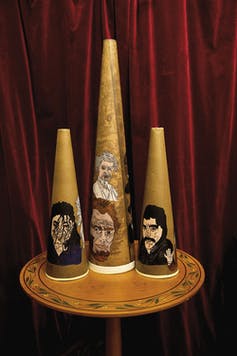 Séance trumpets featuring celebrity spirit guides, including Michael Jackson and Freddie Mercury, hand-painted by medium Sylvia Howarth, in England in 2013. © Shannon Taggart. Courtesy of the Artist., Author provided
Recently, a number of mediums have become famous thanks to their endorsements by celebrity clientele. Some mediums claim to be able to channel stars from the grave, from Louis Armstrong to Elvis Presley.
While modern mediums have their detractors, their eager adoption of television and the internet is a logical step for a religion that has always embraced new technologies.
What was once seen as a niche subculture or the domain of late-night 1-900 call-in shows has gone mainstream: Psychic businesses were a US$2 billion industry in 2018.
Shannon Taggart’s ‘Séance’
This new spirituality has influenced pop culture as well as high art; the Guggenheim’s 2019 retrospective of Swedish artist and mystic Hilma af Klint was the most-visited exhibition in the museum’s history, drawing over 600,000 viewers.
New York Times art critic Roberta Smith argued that the exhibition’s impact amounted to a “psychic and historical shift” in the art world. Smith’s use of the word “psychic” is apt; the exhibition was a watershed not only for restoring to primacy women’s role in the development of abstract painting, but also for re-centering the spiritual within art.
Taggart’s photographs, meanwhile, explore present-day practices, sites and objects of spiritualism.
Allowing chance and automation to guide camera experiments, she reveals processes of transformation and altered states through blurred effects, halos of light and doubling in images that reference historical spirit photographs.
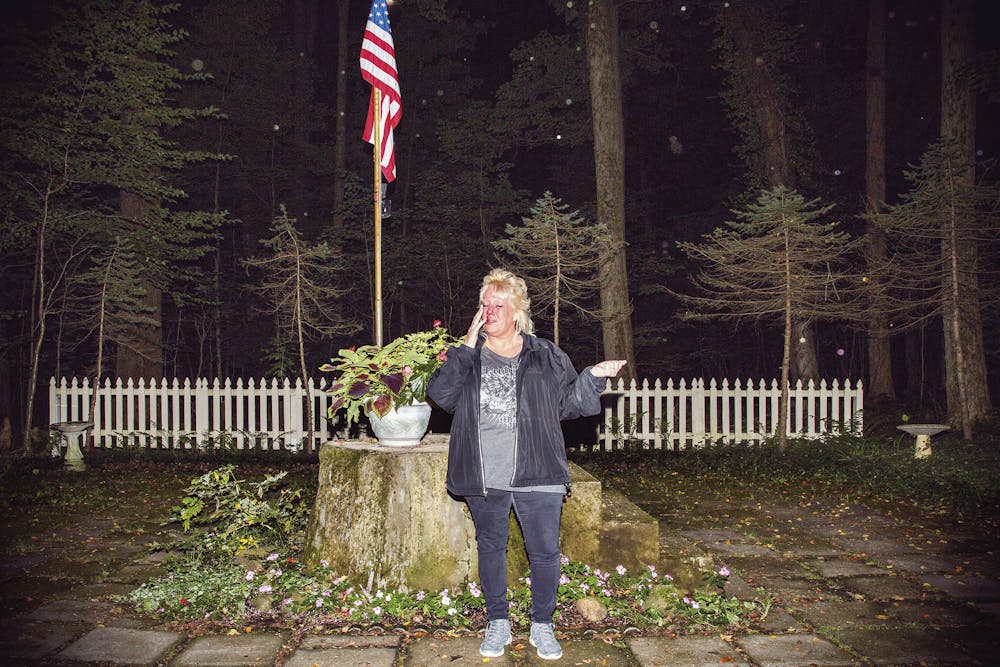
In one image, for example, a grieving mother raises her arms into a darkened sky dotted with circles of light known as orbs. Orb photography is a recent innovation within spirit photography in which practitioners call upon spirits to manifest orbs, which are then captured by digital cameras. Orb photography is another example of the ambiguity of spirit photographs: Does it channel the supernatural, or simply capture reflections of dust on the camera lens?
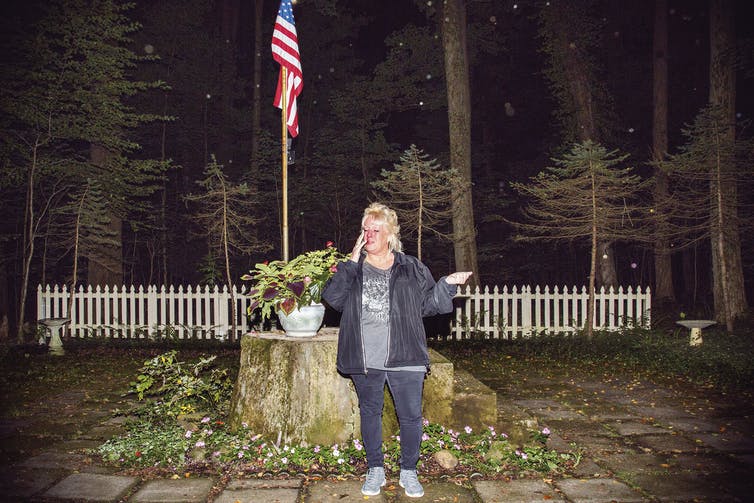 Kim Kitchen calls to her deceased daughter Casey and asks her for orbs in Lily Dale, New York, in 2014. © Shannon Taggart. Courtesy of the Artist, Author provided
For Taggart, that question is largely beside the point. Her aim is to remain truthful to the psychological experience of spiritualism, to make visible what is ineffable.
Taggart’s photographs recover the marginalized history of spiritualism at a moment when the religion feels once again on the verge of a resurgence.
As Taggart is fond of saying, “You don’t have to take spiritualism literally to take it seriously.”
*****
Disclosure statement: Beth Saunders does not work for, consult, own shares in or receive funding from any company or organization that would benefit from this article, and has disclosed no relevant affiliations beyond their academic appointment.
This article is republished from The Conversation under a Creative Commons license. Read the original article here.
Header image: Table-tipping workshop with mediums Jane and Chris Howarth in Erie, Pennsylvania, in 2014. © Shannon Taggart. Courtesy of the Artist., Author provided
]]>
By Beth Saunders, Curator and Head of Special Collections and Gallery, UMBC The word séance conjures images of darkened rooms, entranced mediums, strange occurrences and spirit voices. For...
https://umbc.edu/stories/as-spiritualisms-popularity-grows-photographer-shannon-taggart-takes-viewers-inside-the-world-of-seances-mediums-and-orbs/
https://beta.my.umbc.edu/api/v0/pixel/news/119494/guest@my.umbc.edu/39b74fb9dd3b28f7beea6b413058c864/api/pixel
aok-gallery
discovery
religion-and-spirituality
special-collections
the-conversation
UMBC News & Magazine
https://beta.my.umbc.edu/groups/umbc-news-magazine
https://assets1-beta.my.umbc.edu/system/shared/avatars/groups/000/001/943/24435aa6207c452e7bc15cc74b42c7bb/xsmall.png?1748556657
https://assets1-beta.my.umbc.edu/system/shared/avatars/groups/000/001/943/24435aa6207c452e7bc15cc74b42c7bb/original.png?1748556657
https://assets2-beta.my.umbc.edu/system/shared/avatars/groups/000/001/943/24435aa6207c452e7bc15cc74b42c7bb/xxlarge.png?1748556657
https://assets2-beta.my.umbc.edu/system/shared/avatars/groups/000/001/943/24435aa6207c452e7bc15cc74b42c7bb/xlarge.png?1748556657
https://assets3-beta.my.umbc.edu/system/shared/avatars/groups/000/001/943/24435aa6207c452e7bc15cc74b42c7bb/large.png?1748556657
https://assets1-beta.my.umbc.edu/system/shared/avatars/groups/000/001/943/24435aa6207c452e7bc15cc74b42c7bb/medium.png?1748556657
https://assets2-beta.my.umbc.edu/system/shared/avatars/groups/000/001/943/24435aa6207c452e7bc15cc74b42c7bb/small.png?1748556657
https://assets1-beta.my.umbc.edu/system/shared/avatars/groups/000/001/943/24435aa6207c452e7bc15cc74b42c7bb/xsmall.png?1748556657
https://assets2-beta.my.umbc.edu/system/shared/avatars/groups/000/001/943/24435aa6207c452e7bc15cc74b42c7bb/xxsmall.png?1748556657
UMBC News & Magazine
0
0
false
Wed, 22 Dec 2021 18:59:28 -0500
UMBC research group tackles ongoing hurdles to efficient solar power tech
Two new papers from Can Ataca’s research group at UMBC set the stage for further advances in solar power and other renewable energy technologies. Daniel Wines, Ph.D. candidate in physics, led research using computational modeling to explain surprising properties of materials with potential for use in solar cells. Gracie Chaney, Ph.D. candidate in physics, led a project that used machine learning to characterize a new type of material that could improve lithium ion batteries.
Solving a puzzle
Wines’s paper, published in Applied Materials and Interfaces, will make it easier to design the best material for certain technologies that require energy transfer, from solar cells to LEDs. A research group at Arizona State University led by Sefaattin Tongay had run experiments on a class of materials called perovskites, which have a crystal structure well-suited to a range of engineered materials. They are an attractive candidate for use in solar cells, but the group was struggling to interpret its results.
Tongay and graduate student Han Li, the lead author on the paper, thought Ataca’s group might be able to figure out what was happening by modeling their experiments. They were right. By running computational simulations, Wines was able to confirm the group’s findings and determine the underlying physics causing Li’s surprising observations.
Under pressure
Li was studying how perovskites performed under different amounts of physical pressure. Pressure can change how electrons move through a material, which in turn changes the ideal conditions for generating electricity. In solar cell applications, for example, pressure can affect which frequencies of light will most efficiently produce power when they strike the material.
“It’s all about tuning the structure for the sunlight spectrum,” says Ataca, assistant professor of physics. “You want to absorb at certain frequencies so that you will have the best efficiency if you were making a photovoltaic cell from this.”
Both Wines and Li found that when the perovskite took a one-dimensional form, where the molecules are bound together in a long line, the amount of energy required to initiate conduction decreased linearly as pressure increased. However, in two-dimensional perovskites, which look more like a flat plane, there was an initial decrease, and then at a certain level of pressure, the required energy increased again. That inflection point was what puzzled Li, and where the simulations at UMBC became crucial.

This portion of figure 1 from Wines’s paper shows the atomic structure of the perovskite he and colleagues studied in its one-dimensional (left) and two-dimensional forms.
Structural change
Simulating the experiments allowed Wines to examine the structure of the perovskite crystals at each pressure level. He found that in one-dimensional perovskites, the primary structure stayed constant, but “stretched” as the pressure increased. However, in the two-dimensional perovskites, “there’s a critical point where there’s a phase transition, and there’s a certain rotation of some of the bonds and atoms,” Wines explains. That transition fundamentally changed the properties of the crystal, and explained the unusual observations.
Understanding why the properties changed at a molecular level will make it much easier to determine the best combination of structure and pressure for different applications of perovskite materials. While it might be possible to determine their properties with experiments alone, using computational simulations will make the discovery process much faster and less resource-intensive.
Two-faced materials
While Wines’s work may help develop solar cells that are more efficient at collecting the sun’s energy, Chaney’s research, also published in Applied Materials and Interfaces, looks at the next step—how to store that energy. “The sun doesn’t always shine, and sometimes it shines too much during the day and overwhelms the grid,” she says. “So we need something to store all that excess energy in the daytime and release it at night and on cloudy days. That’s why we need to improve batteries.”
Lithium ion batteries work by storing positively-charged lithium ions, which can be moved between electrodes inside the battery to generate electric current. A class of materials called transition metal dichalcogenides, or TMDs, are often used in lithium ion batteries to store lithium ions.
TMDs usually take the form of a molecular sandwich: two chalcogens (elements from a column on the right side of the periodic table) surround an atom from the transition metal family (several columns in the center of the periodic table). These sandwiches can form a plane, called a monolayer, or the layers can be stacked on top of each other to form a 3D structure.
Typical TMDs have the same atom on the top and bottom of the sandwich. But Chaney’s study investigated “Janus” materials, which have a different element on each side. These materials are named after Janus, the two-faced god in Roman mythology. “It’s not a typical TMD, and that’s what makes this special,” Chaney says. Her study looked at six different combinations of top and bottom elements.
 Current members of Ataca’s lab group. From left to right: Akram Ibrahim, Gracie Chaney, undergraduate Brenna Turnbull, postdoc Yelda Kadioglu, Daniel Wines, and Can Ataca. Photo courtesy Can Ataca.
Narrowing the “circle of searching”
Chaney and Akram Ibrahim, another Ph.D. candidate in Ataca’s group, used machine learning to predict the properties of the different combinations. One key property was how tightly the lithium ions would bind to the material. That’s important, “because we want the lithium not to escape from the 2D material where we are storing it,” Ibrahim says. “So we are searching for materials that lithium binds to strongly.”
Using machine learning to find the best composition for battery materials “saves a lot of time and resources,” Ibrahim says. After using the model to identify high-potential materials, only then would the lab use more energy- and time-intensive methods to get an even more accurate and detailed understanding of the materials’ properties. By using the model, Ibrahim says, “we have narrowed down the circle of searching.”
“Something that was really interesting was that the lithium transport and the binding energy really depended on which side you looked at,” Chaney says. The machine learning model was able to predict those differences, suggesting it is useful for better understanding both Janus materials and traditional TMDs.
Using computational models to learn more about how these materials store and transport lithium ions can inform future experimental studies to improve battery efficiency. That information could guide advances in anything from solar power storage to electric vehicle range.
Impact of collaboration
It may be some time before this research finds its way into solar panels or batteries. However, growing the fundamental understanding of how materials function – how they interact with light or store lithium ions – makes future technological advances possible.
“There’s being able to synthesize the material reliably, and then understanding the physics of the material itself and how you can tune the properties,” Wines says—which is where his and Chaney’s work is now. “Then, after that, implementing it into devices and testing the devices in the lab are the next steps” before technologies with the new material can be produced on a large scale.
Along the way, modeling and experiments complement each other, which is why collaborations like the one between the UMBC and Arizona State research groups are so valuable. “There’s a need for both kinds of research at every stage,” Wines says.
Header image: Current and former members of the Ataca lab group. From left: Former postdoc Fatih Ersan; Can Ataca; Gracie Chaney; Jaron Kropp, Ph.D. ’20; and Daniel Wines. Photo by Marlayna Demond ’11.
]]>
Two new papers from Can Ataca’s research group at UMBC set the stage for further advances in solar power and other renewable energy technologies. Daniel Wines, Ph.D. candidate in physics, led...
https://umbc.edu/stories/umbc-research-group-tackles-ongoing-hurdles-to-efficient-solar-power-tech/
https://beta.my.umbc.edu/api/v0/pixel/news/119495/guest@my.umbc.edu/1312916854cdd8d369ed0efda5c20dd4/api/pixel
cnms
gradresearch
physics
research
science-and-technology
UMBC News & Magazine
https://beta.my.umbc.edu/groups/umbc-news-magazine
https://assets1-beta.my.umbc.edu/system/shared/avatars/groups/000/001/943/24435aa6207c452e7bc15cc74b42c7bb/xsmall.png?1748556657
https://assets1-beta.my.umbc.edu/system/shared/avatars/groups/000/001/943/24435aa6207c452e7bc15cc74b42c7bb/original.png?1748556657
https://assets2-beta.my.umbc.edu/system/shared/avatars/groups/000/001/943/24435aa6207c452e7bc15cc74b42c7bb/xxlarge.png?1748556657
https://assets2-beta.my.umbc.edu/system/shared/avatars/groups/000/001/943/24435aa6207c452e7bc15cc74b42c7bb/xlarge.png?1748556657
https://assets3-beta.my.umbc.edu/system/shared/avatars/groups/000/001/943/24435aa6207c452e7bc15cc74b42c7bb/large.png?1748556657
https://assets1-beta.my.umbc.edu/system/shared/avatars/groups/000/001/943/24435aa6207c452e7bc15cc74b42c7bb/medium.png?1748556657
https://assets2-beta.my.umbc.edu/system/shared/avatars/groups/000/001/943/24435aa6207c452e7bc15cc74b42c7bb/small.png?1748556657
https://assets1-beta.my.umbc.edu/system/shared/avatars/groups/000/001/943/24435aa6207c452e7bc15cc74b42c7bb/xsmall.png?1748556657
https://assets2-beta.my.umbc.edu/system/shared/avatars/groups/000/001/943/24435aa6207c452e7bc15cc74b42c7bb/xxsmall.png?1748556657
UMBC News & Magazine
0
0
false
Fri, 17 Dec 2021 17:19:46 -0500
Sold-out supplies, serving a public need and other adventures of doing science during a pandemic – 4 researchers share their experiences

By Erin Lavik, Professor of Chemical, Biochemical, and Environmental Engineering, UMBC; Nilanjan Banerjee, Associate Professor of Computer Science and Electrical Engineering, UMBC; Christian L’Orange, Colorado State University; and Tony Schmitz, University of Tennessee
Closures, remote work, supply chain issues and changing priorities have affected almost everyone’s lives at some point during the nearly two years of the coronavirus pandemic. The process of science itself was no exception. The many people who do the lab work, experiments and human studies that further scientific knowledge all faced challenges – many of which were unexpected.
To understand how the pandemic changed the process of science, we asked four researchers about their experiences over the past two years.
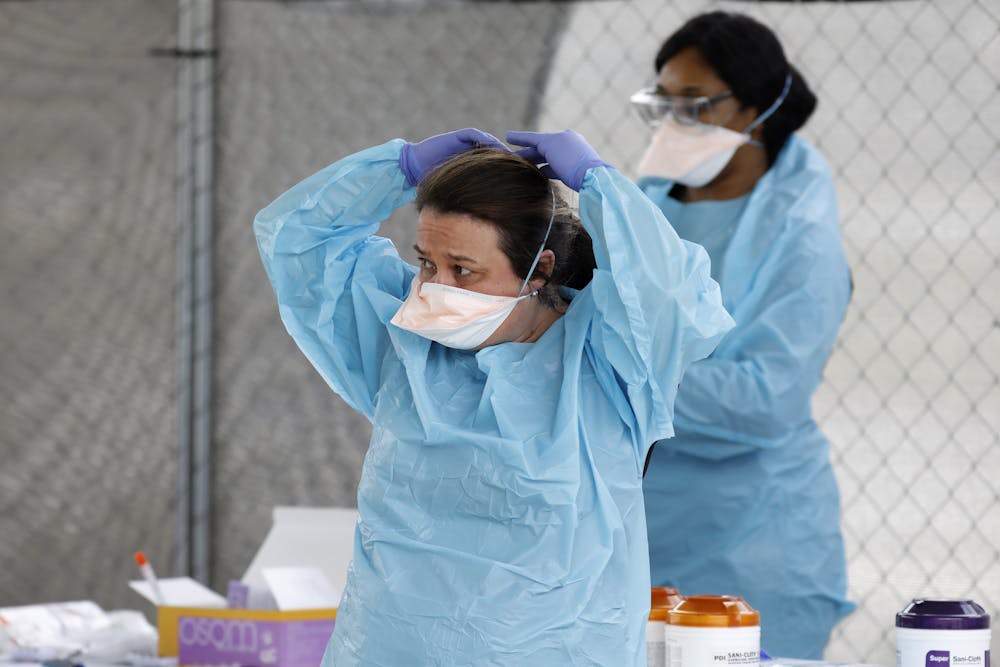
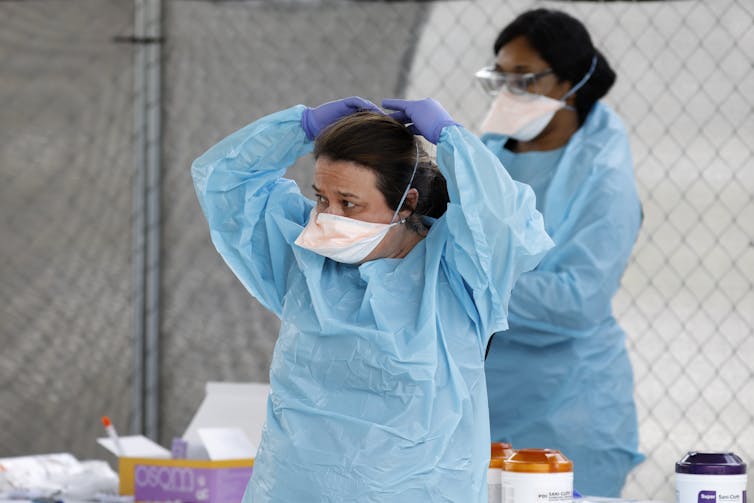 Early in the pandemic, a lot of scientific testing needed to be done to understand how masks could protect health care workers. AP Photo/Mic Smith
Balancing public needs with science and mentorship
Christian L’Orange, Assistant Research Professor of Mechanical Engineering, Colorado State University
I am an engineer and aerosol scientist. People used to return a look of confusion when I said that, and prospective engineering students rarely had any idea that aerosol science was even an area of research. That all changed with COVID-19.
In March 2020, as the world was being told to stay home in the first weeks of the lockdown, the university and my lab were asked by the Colorado governer’s office to test masks being purchased for front-line workers.
In a matter of days, we pivoted all of our time to testing masks. This came at the cost of our research: Everything was put on hold. Nevertheless, we were proud to do it. I have had few experiences more gratifying than knowing I was making a difference in a time of need – however bittersweet.
A big reason I do the job I do is my love for research and the opportunity to mentor students. COVID-19 took both of those away for nearly two years. Research has begun again, and students are returning to the lab, but we won’t get that time back.
My colleagues and I were able to respond to the governor’s request for mask testing only because of the skills and experience that come from years of being in the lab – but what could those skills have led to if we hadn’t lost the past two years? What more could my students have achieved if they hadn’t lost that time?
Despite the good we have done, those questions still bother me.
However, I am optimistic that the pandemic might end up being good for aerosol research. I no longer get blank stares when I mention airborne particles, and maybe this pandemic will attract new bright students to a field about which I am so passionate.
 Scientific supplies – from chemicals to plastic containers – were all affected by supply chain issues. AP Photo/Noah Berger
Resource sharing to overcome supply chain issues
Erin Lavik, Professor of Chemical, Biochemical and Environmental Engineering, University of Maryland, Baltimore County
My lab – where my colleagues and I study biomaterials to control bleeding, deliver drugs and build tissues – was shut down in March 2020 because of the coronavirus. When labs on campus began to reopen that June, we worked with a skeleton crew to restart our projects.
We expected there to be challenges getting certain supplies and chemicals that were necessary for vaccine production, but I was utterly surprised by how hard it was to get everything. Plasticware that we use in experiments became impossible to find. Many chemicals were back-ordered for months, if not years.
To keep scientific projects moving forward, my lab and many others on campus have banded together and have been sharing supplies and looking after one another’s projects. Because of unexpected sudden quarantines, we cannot afford to just do our work – we need to know what others are doing and be willing and able to step in at a moment’s notice to complete a chemical reaction, take care of some cells in a petri dish or record important data.
The challenges of limited supplies and quarantines are not over and may even be getting worse. But through the collaborative systems my colleagues and I have built, we have been able to keep research moving forward, albeit at a slower pace. And like everyone, we have all gotten better at the process of collaborating remotely, too.
Teaching the public directly
Tony Schmitz, Professor of Mechanical, Aerospace and Biomedical Engineering, University of Tennessee, Knoxville
The challenges of the pandemic are significant and continuing, but my personal experience at the intersection of COVID-19 and science has been unexpectedly positive.
I run the Machine Tool Research Center and study ways to improve and speed up the process of manufacturing parts. Machining is important because it remains a critical process for manufactured products, but the U.S. workforce is in sharp decline. When the University of Tennessee transitioned from in-person to online instruction, this new time away from the office gave me the opportunity to produce video and written content that explains the science and modern skills of machining to a lay audience.
The online training I developed is like a flight simulator for machining. No prior experience is necessary, and it provides step-by-step instructions for computer-aided manufacturing skills. It explains the geometry and physics of machining and simulates the real-world vibrations and sounds of making parts.
I was not alone in having time on my hands though. Disruptions to education and the supply chain provided time for both students and manufacturing professionals to explore the online training I made. In one sense, the two factors created the perfect storm for nontraditional learning in machining, and the response has been fantastic. Since its launch in December 2021, 1,756 people have registered for the class, and 676 people completed it. These participants comprised 36% industry workers and 64% students and represented 47 states.
It has been fantastic to have an opportunity to teach machining in a unique way to a broader audience, and I will continue to do so. The Department of Defense is funding the effort, and in the future I plan to grow the network and add in-person training locations that complement the online instruction. Despite the many hardships the shutdowns caused, this would not have been possible in a normal year.
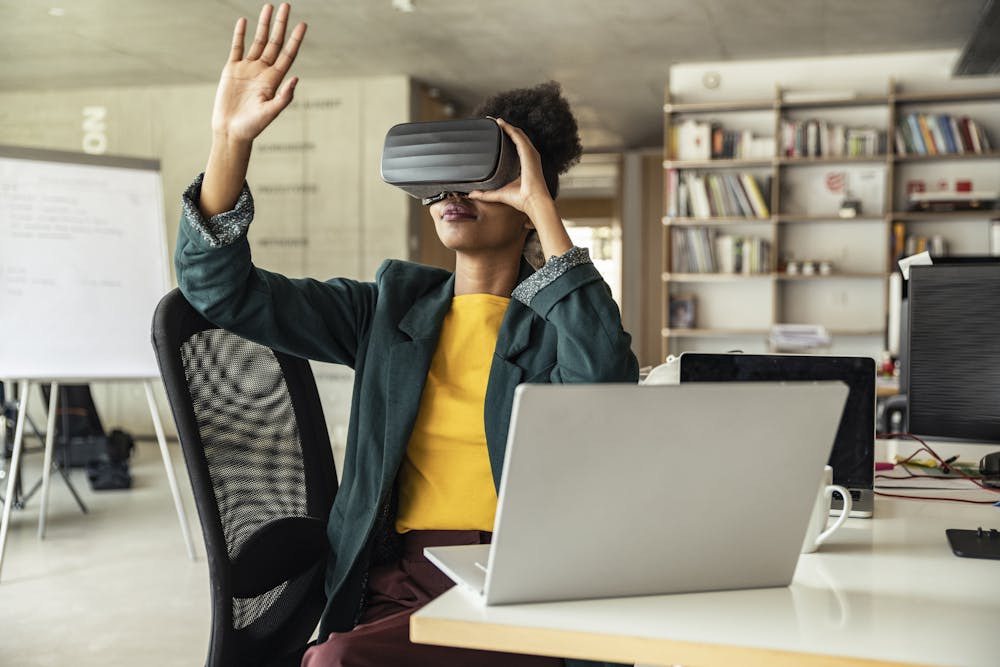
 Virtual reality can mimic many in-person experiences. Westend61 via Getty Images
Using tech when you can’t meet in person
Nilanjan Banerjee, Professor of Computer Science and Electrical Engineering, University of Maryland, Baltimore County
At the Mobile Pervasive and Sensor Systems Lab, my colleagues and I seek to understand how people’s physical states – like stress, for example – affect the performance of a group. To study this, we need to collect physiological data like heart rate and heart rate variability from subjects while they play group games in person.
Unfortunately, having people meet in person to play games has been impossible for much of the past two years, thanks to the coronavirus. For many situations, remote conference tools can get the job done even if they are a bit more tiring than meeting in person. But a Zoom call simply can’t emulate the immersive environment required for group games and the physical responses that I study.
If my colleagues and I wanted to continue our research, we needed an immersive but safe way for our study participants to interact. So, we developed virtual reality games. Over the months that we relied on virtual reality, my colleagues and I realized that not only did these games work, in fact, they turned out to be better than in-person games because the virtual environment is completely free of distractions.
[Over 140,000 readers rely on The Conversation’s newsletters to understand the world. Sign up today.]
Developing virtual reality games and making them as realistic as possible is not cheap. But compared with a normal in-person study, this is a simple, inexpensive and effective platform to study how people in groups perform under different conditions. Since it allows our team to study these things without the need for subjects to be in the same room all at once, we plan to continue using this platform for future large-scale studies even post-pandemic.
Christian L’Orange, Assistant Research Professor of Mechanical Engineering, Colorado State University; Erin Lavik, Professor of Chemical, Biochemical, and Environmental Engineering, University of Maryland, Baltimore County; Nilanjan Banerjee, Associate Professor of Computer Science and Electrical Engineering, University of Maryland, Baltimore County, and Tony Schmitz, Professor of Mechanical, Aerospace and Biomedical Engineering, University of Tennessee
This article is republished from The Conversation under a Creative Commons license. Read the original article.
Header Image: Like much else, scientific labs have been shut down by the pandemic. Cavan Images/Cavan via Getty Images
]]>
By Erin Lavik, Professor of Chemical, Biochemical, and Environmental Engineering, UMBC; Nilanjan Banerjee, Associate Professor of Computer Science and Electrical Engineering, UMBC; Christian...
https://umbc.edu/stories/sold-out-supplies-serving-a-public-need-and-other-adventures-of-doing-science-during-a-pandemic-4-researchers-share-their-experiences-3/
https://beta.my.umbc.edu/api/v0/pixel/news/119496/guest@my.umbc.edu/967334d5b557c24b3893284ad87eca60/api/pixel
discovery
UMBC News & Magazine
https://beta.my.umbc.edu/groups/umbc-news-magazine
https://assets1-beta.my.umbc.edu/system/shared/avatars/groups/000/001/943/24435aa6207c452e7bc15cc74b42c7bb/xsmall.png?1748556657
https://assets1-beta.my.umbc.edu/system/shared/avatars/groups/000/001/943/24435aa6207c452e7bc15cc74b42c7bb/original.png?1748556657
https://assets2-beta.my.umbc.edu/system/shared/avatars/groups/000/001/943/24435aa6207c452e7bc15cc74b42c7bb/xxlarge.png?1748556657
https://assets2-beta.my.umbc.edu/system/shared/avatars/groups/000/001/943/24435aa6207c452e7bc15cc74b42c7bb/xlarge.png?1748556657
https://assets3-beta.my.umbc.edu/system/shared/avatars/groups/000/001/943/24435aa6207c452e7bc15cc74b42c7bb/large.png?1748556657
https://assets1-beta.my.umbc.edu/system/shared/avatars/groups/000/001/943/24435aa6207c452e7bc15cc74b42c7bb/medium.png?1748556657
https://assets2-beta.my.umbc.edu/system/shared/avatars/groups/000/001/943/24435aa6207c452e7bc15cc74b42c7bb/small.png?1748556657
https://assets1-beta.my.umbc.edu/system/shared/avatars/groups/000/001/943/24435aa6207c452e7bc15cc74b42c7bb/xsmall.png?1748556657
https://assets2-beta.my.umbc.edu/system/shared/avatars/groups/000/001/943/24435aa6207c452e7bc15cc74b42c7bb/xxsmall.png?1748556657
UMBC News & Magazine
0
0
false
Fri, 17 Dec 2021 15:42:17 -0500
Tahir Hemphill merges hip-hop, computing, and cultural analysis as UMBC’s first postdoctoral fellow in the visual arts

UMBC’s Postdoctoral Fellowship for Faculty Diversity received over 500 applications this year, despite a pandemic that moved the entire process online for the first time. Emerging from that incredibly talented applicant pool was Tahir Hemphill, visual arts, who came to UMBC this fall as the inaugural Fellow for Faculty Diversity in the Visual Arts. This new track is specifically designed to support creative and artistic practitioners.
Hemphill is one of two Postdoctoral Fellows for Faculty Diversity to join UMBC’s College of Arts, Humanities, and Social Sciences this fall. He has developed a multifaceted practice as a creative technologist, multimedia artist, and design researcher. He uses his varied backgrounds in engineering and the arts to create graphic designs and projects that inform audiences about the world in which they live.

Tahir Hemphill, inaugural Fellow for Faculty Diversity in the Visual Arts. Photo courtesy of Tahir Hemphill.
“I was groomed to be an electrical engineer,” Hemphill says. “So the physical sciences—chemistry, math, physics—play an important role in how I see, view, and understand the world.” Much of his current work utilizes computational analysis to explore what is usually unseeable in the semantic structures within large bodies of archival text, working especially within the world of hip-hop.
Developing his focus
Coming of age in the 1980s, Hemphill divided his time between practicing various elements of hip-hop culture and exploring cyberspace via a dial-up modem. A fundamental affinity between hip-hop culture and hacking would define the trajectory of his professional and creative life.
Starting in middle school, he accessed engineering-oriented opportunities to build and create, acquiring tech knowledge and skills. At the same time, hip-hop’s “golden era” informed his perspectives on popular culture and politics. He has synthesized the theoretical frameworks behind these two educational influences into his current creative endeavors.
Over the past 20 years, as an artist who works with technology, Hemphill has found inspiration in scientific work that pushes investigation to artistic limits and artistic work that pushes repetition towards scientific method. His reverence for the scientific method as well as his irreverent tinkering with it fuel this productive tension between art and technology.
A distinctive career path
Hemphill arrived at UMBC with broad experience in higher education, commercial design, and the non-profit sector. After earning a B.A. in Spanish language from Morehouse College, a strategic planning certificate from Miami Ad School, and a M.S. in communications design from the Pratt Institute, he went on to receive a Creative Research Fellowship at Carnegie Mellon University and a Hiphop Archive Fellowship at the W.E.B. Du Bois Institute for African and African American Research at Harvard University.
He has served as the Harissios Papamarkou Chair in Education at the John W. Kluge Center at the Library of Congress, and as Behavioral Science Resident at the Rockefeller Foundation Bellagio Center.
In the commercial sector, artist residencies at Spotify and Autodesk Pier 9 have recognized his creative work. He’s also received grants from the National Endowment for the Arts and the Saul Zaentz Innovation Fund. Additionally, the Talk to Me exhibition at the Museum of Modern Art in New York features his work.
Hip-hop as a lens on culture
In recent years, Hemphill’s work has concentrated on the intersection of hip-hop and data, manifested especially by the Rap Research Lab, a creative technology studio he founded to explore rap as a cultural indicator. The lab uses a hip-hop framework to develop new ways for people to engage with data and culture.
“Hip-hop is the most influential art form in the world today,” asserts Hemphill. “Whenever there’s an uprising in a country, there’s been a hip-hop song that goes along with it. People around the world tend to tap into the part that was for expressing opinions, revolution, going against the status quo.”
A Mapper’s Delight
In a recent presentation through UMBC’s Center for Innovation, Research, and Creativity in the Arts (CIRCA), Hemphill shared details on A Mapper’s Delight, an interactive virtual and augmented reality tool.
“It’s a sculptural data visualization,” Hemphill says, “and it’s built on a semantic relationship of hundreds of thousands of rap lyrics. It shows how…rappers cover the globe with their lyrics with references to cities, neighborhoods, regions.” He shares that “it looks at the geography of language and hip-hop, and creating language as political exercise.”
“All the projects, all the products that we build, sit on top of the rap almanac, and that’s a database of transcription and linguistic analysis—lyrics from about a million rap songs from 1979 to current day,” says Hemphill. A Mapper’s Delight analyzes those songs through algorithms. Once source material is in the database, “you can do a search for ‘power,’ and find every rapper that raps about power, where in the world they rap about power, when they rapped about power, the context,” he explains.
A Mapper’s Delight has added content in around 30 languages in the past year, says Hemphill, “so it’s truly a big data hip-hop cultural project.”
Mercedez Dunn, sociology, anthropology, and public health, is also a 2021-22 Postdoctoral Fellow for Faculty Diversity at UMBC. Learn about her work in this profile.
Header image: Tahir Hemphill speaks at TEDYouth in November 2014, Brooklyn Museum, Brooklyn, New York. Photo: Ryan Lash/TED. Attribution-NonCommercial 2.0 Generic license.
]]>
UMBC’s Postdoctoral Fellowship for Faculty Diversity received over 500 applications this year, despite a pandemic that moved the entire process online for the first time. Emerging from that...
https://umbc.edu/stories/tahir-hemphill-merges-hip-hop-computing-and-cultural-analysis-as-umbcs-first-postdoctoral-fellow-in-the-visual-arts/
https://beta.my.umbc.edu/api/v0/pixel/news/119497/guest@my.umbc.edu/ee6ceacc74328fdf40e987de006d4236/api/pixel
arts-and-culture
cahss
cahssresearch
visualarts
UMBC News & Magazine
https://beta.my.umbc.edu/groups/umbc-news-magazine
https://assets1-beta.my.umbc.edu/system/shared/avatars/groups/000/001/943/24435aa6207c452e7bc15cc74b42c7bb/xsmall.png?1748556657
https://assets1-beta.my.umbc.edu/system/shared/avatars/groups/000/001/943/24435aa6207c452e7bc15cc74b42c7bb/original.png?1748556657
https://assets2-beta.my.umbc.edu/system/shared/avatars/groups/000/001/943/24435aa6207c452e7bc15cc74b42c7bb/xxlarge.png?1748556657
https://assets2-beta.my.umbc.edu/system/shared/avatars/groups/000/001/943/24435aa6207c452e7bc15cc74b42c7bb/xlarge.png?1748556657
https://assets3-beta.my.umbc.edu/system/shared/avatars/groups/000/001/943/24435aa6207c452e7bc15cc74b42c7bb/large.png?1748556657
https://assets1-beta.my.umbc.edu/system/shared/avatars/groups/000/001/943/24435aa6207c452e7bc15cc74b42c7bb/medium.png?1748556657
https://assets2-beta.my.umbc.edu/system/shared/avatars/groups/000/001/943/24435aa6207c452e7bc15cc74b42c7bb/small.png?1748556657
https://assets1-beta.my.umbc.edu/system/shared/avatars/groups/000/001/943/24435aa6207c452e7bc15cc74b42c7bb/xsmall.png?1748556657
https://assets2-beta.my.umbc.edu/system/shared/avatars/groups/000/001/943/24435aa6207c452e7bc15cc74b42c7bb/xxsmall.png?1748556657
UMBC News & Magazine
0
0
false
Fri, 17 Dec 2021 02:59:03 -0500
UMBC’s Fernando Tormos-Aponte is named an Early Career Faculty Innovator for research on energy inequality

The National Center for Atmospheric Research (NCAR) has named Fernando Tormos-Aponte, assistant professor of public policy and political science, an Early Career Faculty Innovator–one of 12 across the nation. He will receive funding for two years of research, partnering with NCAR scientists to examine energy inequality in the wake of disasters. His focus is on improving disaster resource allocation by incorporating assessments of social vulnerability.
Connecting Faculty Innovators and their students with NCAR researchers is a core element of the program, generating novel scholarship with a clear public impact. “It expands the reach of NCAR science, broadens participation from minority serving institutions, and increases the capacity of NCAR to do actionable and convergent research,” says Everette Joseph, NCAR director.
Measuring energy inequality
Tormos-Aponte came to UMBC in 2019 as Postdoctoral Fellow for Faculty Diversity, but his disaster work began two years earlier.
When hurricanes Irma and María hit Puerto Rico in 2017, with sustained winds of 250 km per hour, the island lost power and experienced heavy damage. Power restoration took over 425 days. Vulnerable communities who were already facing economic, health, and social disparities were placed in greater peril. Tormos-Aponte and a team of researchers wanted to investigate if the allocation of power restoration resources favored privileged communities and those who supported the local governing political party, ahead of vulnerable communities.
The team gathered data using utility company records, in-person interviews, and archival government documents, as well as hurricane weather data. They also created a new social vulnerability index because the CDC’s current tool is not designed for minority-majority and predominantly Spanish-speaking regions like Puerto Rico.
Tormos-Aponte worked with Gustavo García-López, a researcher at the University of Coimbra in Portugal, and Mary Angelica Painter, a graduate instructor at University of Missouri–St. Louis, to design the Puerto Rico Social Vulnerability Index. “What makes our index different,” he explains, “is that it is designed to capture the variation of vulnerability within majority-minority groups at the frontline of extreme weather events.”
Data-driven policy recommendations
The team published their initial findings in Energy Policy and explained them further in The Washington Post earlier this year. They found that after Irma and María, Puerto Rico restored power faster to those who supported the ruling party and to more privileged communities. Additionally, communities in densely populated areas and that were near essential services received faster assistance.
The team suggests future energy disaster relief restoration methods should prioritize socially vulnerable and politically marginal groups. In 2017, these communities waited longer for power restoration, despite their greater vulnerability to harm during disasters, exacerbating inequalities.
Intersectionality and social change
Tormos-Aponte’s scholarship also explores the challenges of and opportunities for intersectionality as a mobilizing approach in grassroots movements and institutions to end systems of oppression. He co-authored a case study in Latinas and the Politics of Urban Spaces (Routledge, 2021) about the Colectiva Feminista en Construcción, an anti-colonial, Black, feminist collective in Puerto Rico. Co-author Shariana Ferrer-Núñez, scholar-activist and co-founder of the organization, worked with him to document and share their process of developing feminist intersectional awareness and practice.
In PR, Colectiva Feminista en Construcción organizers arrived at an intersectional organizing approach through experiences of exclusion and marginalization within the Puerto Rican Left. 3/6
]]>
The National Center for Atmospheric Research (NCAR) has named Fernando Tormos-Aponte, assistant professor of public policy and political science, an Early Career Faculty Innovator–one of 12 across...
https://umbc.edu/stories/umbcs-fernando-tormos-aponte-is-named-an-early-career-faculty-innovator-for-research-on-energy-inequality/
https://beta.my.umbc.edu/api/v0/pixel/news/119498/guest@my.umbc.edu/1232b3424563e81ea54af320e2b2e2bb/api/pixel
cahss
cahssresearch
diversityandinclusion
majoraward
policy-and-society
politicalscience
publicpolicy
UMBC News & Magazine
https://beta.my.umbc.edu/groups/umbc-news-magazine
https://assets1-beta.my.umbc.edu/system/shared/avatars/groups/000/001/943/24435aa6207c452e7bc15cc74b42c7bb/xsmall.png?1748556657
https://assets1-beta.my.umbc.edu/system/shared/avatars/groups/000/001/943/24435aa6207c452e7bc15cc74b42c7bb/original.png?1748556657
https://assets2-beta.my.umbc.edu/system/shared/avatars/groups/000/001/943/24435aa6207c452e7bc15cc74b42c7bb/xxlarge.png?1748556657
https://assets2-beta.my.umbc.edu/system/shared/avatars/groups/000/001/943/24435aa6207c452e7bc15cc74b42c7bb/xlarge.png?1748556657
https://assets3-beta.my.umbc.edu/system/shared/avatars/groups/000/001/943/24435aa6207c452e7bc15cc74b42c7bb/large.png?1748556657
https://assets1-beta.my.umbc.edu/system/shared/avatars/groups/000/001/943/24435aa6207c452e7bc15cc74b42c7bb/medium.png?1748556657
https://assets2-beta.my.umbc.edu/system/shared/avatars/groups/000/001/943/24435aa6207c452e7bc15cc74b42c7bb/small.png?1748556657
https://assets1-beta.my.umbc.edu/system/shared/avatars/groups/000/001/943/24435aa6207c452e7bc15cc74b42c7bb/xsmall.png?1748556657
https://assets2-beta.my.umbc.edu/system/shared/avatars/groups/000/001/943/24435aa6207c452e7bc15cc74b42c7bb/xxsmall.png?1748556657
UMBC News & Magazine
0
0
false
Wed, 15 Dec 2021 17:36:46 -0500
Wed, 15 Dec 2021 17:36:46 -0500
A new approach to environmental research may improve global management of common pool resources

Sustainable management of common pool resources (CPRs) such as water, forests, clean air, and fisheries is a global concern that’s getting increased attention in the context of climate change. All over the world local communities manage CPRs, and these institutions are especially important in regions where government capacity to protect CPRs is limited. Despite decades of observational studies, it is unclear what features determine successful local CPR governance models. This is because of the challenge of isolating which variables make these models successful. New research has made headway on this challenge.
UMBC’s Maria Bernedo Del Carpio, assistant professor of economics, and colleagues have conducted a field experiment to isolate one feature of local CPR governance: externally supported, technology-facilitated community monitoring. Bernedo Del Carpio has collaborated on the research with Francisco Alpizar, professor and chair of the Environmental and Natural Resource Economics Group at Wageningen University, and Paul J. Ferraro, Bloomberg Distinguished Professor of Human Behavior and Public Policy at Johns Hopkins University.
They initiated their study in Costa Rica, to isolate and test community monitoring, publishing the results in the Proceedings of the National Academy of Sciences (PNAS) earlier this year. Jointly with scholars in the U.S, Canada, the U.K., Kenya, and China, they then implemented the approach in six other countries. The results, also published in PNAS, are promising.
“These studies allow us to directly see how community-based monitoring can support more desirable natural resource management outcomes and to analyze the ways to attain those outcomes,” says Bernedo Del Carpio. “Monitoring a natural resource or an institution can generate valuable information that will improve governance, but it is necessary to engage decision-makers and the community.”

Maria Del Carpio and UMBC’s
Tim Gindling, professor of economics.
Community monitoring of CPRs
In Costa Rica, Bernedo Del Carpio, Alpizar, and Ferraro worked with community-based water management organizations (CBWMOs) in 16 communities in the Pacific coast and northern plains regions. These areas have long dry seasons and progressively decreasing water access.
Using SIMA, a water monitoring smartphone app designed by the authors, monitors collected and reported information about residents’ experiences with water service. This included interruptions in fresh water service, water clarity, water’s unusual taste or smell, leaks, unauthorized use of water connections, and land use around water sources.
The app produced weekly summaries that were shared with the CBWMOs and the rest of the community over a period of nine months. After one year, measures of water use showed small effects in the desired directions: reductions in groundwater pumping, better water quality, and more satisfied users.
The team then partnered with scholars from several other universities to implement randomized controlled trials of community monitoring in other contexts. This stage of the research included 747 communities in six countries. The features of the community monitoring programs, the experimental designs, and the outcome variables were harmonized across sites to facilitate comparison of data over time.
With the use of a variety of technologies, monitors collected and reported data on groundwater in arid regions of Brazil; surface water in urban China; and forests in rural Liberia, Peru, and Uganda. For example, community monitors used a well water level sensor in Brazil. In Peru, a smartphone app transmitted monthly remote-sensed early deforestation alerts to monitors.
Community and global impacts
The meta-analysis of the results shows that community monitoring can improve CPR management in different contexts, even when the monitoring is externally-supported.
This research is distinctive in both its ability to isolate the effect of community monitoring and to test it across different contexts. It offers important insights with tangible public impacts. The results provide evidence of the effectiveness of externally-supported community monitoring. They also contribute to an emerging literature that uses multisite trials to study causal effects.
“Understanding how we can make institutions and governance more effective is essential for successfully addressing the most important policy challenges of the twenty-first century,” says Ferraro. “We believe this study is an exemplar of how such an understanding can be more effectively generated by careful field testing using the very best scientific practices.”
Featured image: Maria Bernedo Del Carpio. All Photos by Marlayna Demond ’11 for UMBC.
]]>
Sustainable management of common pool resources (CPRs) such as water, forests, clean air, and fisheries is a global concern that’s getting increased attention in the context of climate change. All...
https://umbc.edu/stories/a-new-approach-to-environmental-research-may-improve-global-management-of-common-pool-resources/
https://beta.my.umbc.edu/api/v0/pixel/news/119499/guest@my.umbc.edu/0ca3f04561ba5974931f42a34fe00546/api/pixel
cahss
cahssresearch
economics
international
policy-and-society
UMBC News & Magazine
https://beta.my.umbc.edu/groups/umbc-news-magazine
https://assets1-beta.my.umbc.edu/system/shared/avatars/groups/000/001/943/24435aa6207c452e7bc15cc74b42c7bb/xsmall.png?1748556657
https://assets1-beta.my.umbc.edu/system/shared/avatars/groups/000/001/943/24435aa6207c452e7bc15cc74b42c7bb/original.png?1748556657
https://assets2-beta.my.umbc.edu/system/shared/avatars/groups/000/001/943/24435aa6207c452e7bc15cc74b42c7bb/xxlarge.png?1748556657
https://assets2-beta.my.umbc.edu/system/shared/avatars/groups/000/001/943/24435aa6207c452e7bc15cc74b42c7bb/xlarge.png?1748556657
https://assets3-beta.my.umbc.edu/system/shared/avatars/groups/000/001/943/24435aa6207c452e7bc15cc74b42c7bb/large.png?1748556657
https://assets1-beta.my.umbc.edu/system/shared/avatars/groups/000/001/943/24435aa6207c452e7bc15cc74b42c7bb/medium.png?1748556657
https://assets2-beta.my.umbc.edu/system/shared/avatars/groups/000/001/943/24435aa6207c452e7bc15cc74b42c7bb/small.png?1748556657
https://assets1-beta.my.umbc.edu/system/shared/avatars/groups/000/001/943/24435aa6207c452e7bc15cc74b42c7bb/xsmall.png?1748556657
https://assets2-beta.my.umbc.edu/system/shared/avatars/groups/000/001/943/24435aa6207c452e7bc15cc74b42c7bb/xxsmall.png?1748556657
UMBC News & Magazine
0
0
false
Wed, 15 Dec 2021 16:45:07 -0500
Then & Now—Cicada Invasion
The world has changed a lot over the past 17 years; smartphones have found their way into everyone’s pockets, social media has taken over traditional media, video rental stores like Blockbuster have made way for streaming services like Netflix.
Things at UMBC have changed, too. The Chesapeake Employers Insurance Arena is now home to UMBC Athletics and world renowned musical acts. The Performing Arts and Humanities Building has a gorgeous presence on campus. And our men’s basketball team shocked the nation, becoming a household name. The list goes on.
Now imagine, while all of those things have happened, the cicadas have only changed guard twice.
The 2004 appearance of the screeching locusts only warranted one story in the-then Retriever Weekly. But this year’s cicadas got a celebrity welcome—it’s possible that the doldrums of the pandemic particularly set the stage for this year’s cicada pandemonium.
When they first arrived, it was as if aliens made their first landing on earth. Their mammoth physique and prehistoric appearance took some getting used to. Soon, they were everywhere, both wreaking havoc and making friends.
Rachel Wesley ’22, visual arts, describes her first interaction with a cicada this summer as nothing less than alarming. “I looked over my shoulder and it was there staring at me with those outward pointing eyes. I didn’t freak out but it was a deep breath and I was like ‘okaaay’. They’re so big,” she says.
But before long, the intimidation factor dwindled. “By the end of summer, I was actually picking them up with my hand,” says Wesley, the painter behind UMBC’s new Retriever-themed cicada sculpture, a part of the Formstone Castle Collective’s Cicada Parade-a, a Baltimore-based public art installation of plaster insects. “If they were on the sidewalk, I put them into a bush to get them away from the sidewalk,” says Wesley.
When the next swarm visits UMBC in 2038, this brood will have faded in our memories, and their comeback will surely feel like aliens have first landed on earth yet again.
Special thanks to Creative Services senior designer Jill Blum who purchased “Harold” the cicada to be painted and donated to UMBC for posterity.
*****
Photos of Rachel Wesley and the cicada courtesy of Marlayna Demond ’11.
]]>
The world has changed a lot over the past 17 years; smartphones have found their way into everyone’s pockets, social media has taken over traditional media, video rental stores like Blockbuster...
https://umbc.edu/stories/then-now-cicada-invasion/
https://beta.my.umbc.edu/api/v0/pixel/news/119500/guest@my.umbc.edu/1faaf8e16d8a35b140cf1f8a1c800338/api/pixel
campus-life
cicadas
commonvision
fall-2021
then-and-now
visual-arts
UMBC News & Magazine
https://beta.my.umbc.edu/groups/umbc-news-magazine
https://assets1-beta.my.umbc.edu/system/shared/avatars/groups/000/001/943/24435aa6207c452e7bc15cc74b42c7bb/xsmall.png?1748556657
https://assets1-beta.my.umbc.edu/system/shared/avatars/groups/000/001/943/24435aa6207c452e7bc15cc74b42c7bb/original.png?1748556657
https://assets2-beta.my.umbc.edu/system/shared/avatars/groups/000/001/943/24435aa6207c452e7bc15cc74b42c7bb/xxlarge.png?1748556657
https://assets2-beta.my.umbc.edu/system/shared/avatars/groups/000/001/943/24435aa6207c452e7bc15cc74b42c7bb/xlarge.png?1748556657
https://assets3-beta.my.umbc.edu/system/shared/avatars/groups/000/001/943/24435aa6207c452e7bc15cc74b42c7bb/large.png?1748556657
https://assets1-beta.my.umbc.edu/system/shared/avatars/groups/000/001/943/24435aa6207c452e7bc15cc74b42c7bb/medium.png?1748556657
https://assets2-beta.my.umbc.edu/system/shared/avatars/groups/000/001/943/24435aa6207c452e7bc15cc74b42c7bb/small.png?1748556657
https://assets1-beta.my.umbc.edu/system/shared/avatars/groups/000/001/943/24435aa6207c452e7bc15cc74b42c7bb/xsmall.png?1748556657
https://assets2-beta.my.umbc.edu/system/shared/avatars/groups/000/001/943/24435aa6207c452e7bc15cc74b42c7bb/xxsmall.png?1748556657
UMBC News & Magazine
0
0
false
Tue, 14 Dec 2021 16:18:24 -0500
When Real-World Problems Drive the Work
Natural disasters leave layers of industrial and economic damage in their wake—not to mention loss of life. In order to better combat the next unforeseen event, data is collected immediately after floods, hurricanes, and other weather-related tragedies. But when Maryam Rahnemoonfar, associate professor of information systems, was in graduate school, she had to cull through this data manually. Eager to combine her interests in civil engineering, remote sensing, and computer science in a meaningful way, Rahnemoonfar began developing an algorithm that could automatically assess and understand the post-disaster data.
Along with her colleagues, Rahnemoonfar began working with the Humanitarian Robotics and Artificial Intelligence at Texas A&M University, where she was faculty before coming to UMBC. Rahnemoonfar explains that various types of robots including unmanned aerial vehicles and robots on the ground and on water are used to collect data, but the data needed to be analyzed closely.
“The data collected is not AI ready,” Rahnemoonfar explains, noting that in order to make the data about natural disasters more useful, it needs to be annotated and trained. The data helps determine the level of damage caused by these events, including what type of response team is needed and the immediacy of the need.
The next step, she says, is to develop an AI and machine learning algorithm to assess the images collected by the robots. However, this work is not without challenges. The images collected were not of easily-identifiable objects, explains Rahnemoonfar, so it took more time to develop algorithms that could distinguish a damaged building from a road that was washed out, for example.
By applying AI and machine learning techniques to the data collected, Rahnemoonfar explains that it allows people to thoroughly assess damage and issues that need to be addressed such as flooding, destroyed buildings, or to detect debris.
Research with community impact
Over time, Rahnemoonfar worked with collaborators to develop the first high-level data, called FloodNet. As a publicly available data set, it drew the attention of people around the world who were interested in using FloodNet in their cities and towns.
Officials in Germany connected with Rahnemoonfar because they were interested in utilizing the FloodNet dataset to train their algorithms to recognize natural disasters throughout the country. “For any future natural disaster, you need similar data sets to train your algorithms,” she explains. “This is the importance of the data set that we prepared.”
 From left to right: Jianwu Wang, Maryam Rahnemoonfar, and Masoud Yari presenting on NSF HDR Institute for Harnessing Data and Model Revolution in the Polar Regions.
“For me, it’s important to know that the research I do has value and impacts the communities after natural disasters,” Rahnemoonfar says, noting that she is eager to continue to analyze large data sets so that the data available more widely.
The next generation of experts
Rahnemoonfar’s commitment to helping communities recently expanded when she received a significant grant from the National Science Foundation, which allows her to make a bigger impact around the world. In September 2021, NSF announced the launch of the NSF HDR Institute for Harnessing Data and Model Revolution in the Polar Regions (iHARP), which Rahnemoonfar is leading as the principal investigator. She and her collaborators will use similar tools from creating FloodNet like data science, machine learning, and AI to analyze enormous volumes of climate data, along with Arctic and Antarctic observations, in ways that could help populations prepare for and respond to climate change risks.
Climate scientists rely on data that are incredibly challenging to disentangle, she explains, and AI offers solutions to analyzing these large datasets. “It is so exciting to be selected as one of the five HDR institutes in the nation, however, this comes with huge responsibility,” she says. “We are the first data science and machine learning institute in the world that is dedicated to research in polar regions.”
The researchers involved with this grant will reduce uncertainties in projecting sea level rise by combining physics modeling, machine learning techniques, and data analysis. The results of their work will inform policymaking to address national and global priorities related to the climate crisis, explains Rahnemoonfar.
The solutions that are developed through the iHARP work will have applications beyond environmental issues. Rahnemoonfar anticipates the team’s research will impact the future of medicine, autonomous driving, and remote sensing, and that the students working on the project will become the next generation of experts addressing these global issues.
*****
All photos by Marlayna Demond ’11.
]]>
Natural disasters leave layers of industrial and economic damage in their wake—not to mention loss of life. In order to better combat the next unforeseen event, data is collected immediately after...
https://umbc.edu/stories/climate-focused-data-2/
https://beta.my.umbc.edu/api/v0/pixel/news/119501/guest@my.umbc.edu/0300b7b1b38ac4de0bc044748e1b6488/api/pixel
coeit
discovery
fall-2021
information-systems
UMBC News & Magazine
https://beta.my.umbc.edu/groups/umbc-news-magazine
https://assets1-beta.my.umbc.edu/system/shared/avatars/groups/000/001/943/24435aa6207c452e7bc15cc74b42c7bb/xsmall.png?1748556657
https://assets1-beta.my.umbc.edu/system/shared/avatars/groups/000/001/943/24435aa6207c452e7bc15cc74b42c7bb/original.png?1748556657
https://assets2-beta.my.umbc.edu/system/shared/avatars/groups/000/001/943/24435aa6207c452e7bc15cc74b42c7bb/xxlarge.png?1748556657
https://assets2-beta.my.umbc.edu/system/shared/avatars/groups/000/001/943/24435aa6207c452e7bc15cc74b42c7bb/xlarge.png?1748556657
https://assets3-beta.my.umbc.edu/system/shared/avatars/groups/000/001/943/24435aa6207c452e7bc15cc74b42c7bb/large.png?1748556657
https://assets1-beta.my.umbc.edu/system/shared/avatars/groups/000/001/943/24435aa6207c452e7bc15cc74b42c7bb/medium.png?1748556657
https://assets2-beta.my.umbc.edu/system/shared/avatars/groups/000/001/943/24435aa6207c452e7bc15cc74b42c7bb/small.png?1748556657
https://assets1-beta.my.umbc.edu/system/shared/avatars/groups/000/001/943/24435aa6207c452e7bc15cc74b42c7bb/xsmall.png?1748556657
https://assets2-beta.my.umbc.edu/system/shared/avatars/groups/000/001/943/24435aa6207c452e7bc15cc74b42c7bb/xxsmall.png?1748556657
UMBC News & Magazine
0
0
false
Mon, 13 Dec 2021 21:38:31 -0500
Hero of the Year: TIME honors UMBC alum Kizzmekia Corbett, COVID-19 vaccine leader
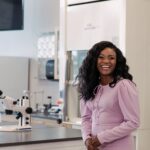
TIME magazine’s famed Person of the Year issue today announced Kizzmekia Corbett as a Hero of the Year for her leadership in developing the COVID-19 vaccine. Corbett ’08, M16, biological sciences and sociology, served as the scientific lead of the Vaccine Research Center’s coronavirus team in the U.S. National Institute of Allergy and Infectious Diseases. There, she developed new mRNA technology used by Moderna’s COVID-19 vaccine and others, playing a pivotal role in the global fight against the virus.
“The scientific process gives us confidence that we can overcome even our most challenging problems,” says Bill LaCourse, dean of the College of Natural and Mathematical Sciences. “As we face the ongoing COVID pandemic, it is important that TIME is honoring the often unseen work of scientists who provide us with hope for the future.”
Vaccine scientists are TIME’s 2021 Heroes of the Year #TIMEPOY https://t.co/8qAiVzxRPP pic.twitter.com/pxee2faWdL
— TIME (@TIME) December 13, 2021
Corbett is honored alongside three other vaccine scientists, including Barney Graham. Graham serves as deputy director of the Vaccine Research Center and the chief of the Viral Pathogenesis Laboratory. He is known for his commitment to mentoring emerging scientists. Corbett initially worked in his lab during her UMBC years as a Meyerhoff Scholar and NIH Scholar.
In the spirit of the Meyerhoff program, Corbett has carried on that commitment to mentorship by welcoming scientists like Olubukola Abiona ’17, M25, biochemistry and molecular biology, to contribute to her lab’s research.
Addressing health disparities
Motivating Corbett’s work is a deep commitment to health equity, informed by her sociology studies at UMBC. “Vaccines have the potential to be the equalizer of health disparities, especially around infectious diseases,” she recently explained in Nature.
“Dr. Corbett and her work exemplify the tremendous value of blending biological sciences and social sciences to solve the world’s problems,” says Kimberly Moffitt, interim dean of the College of Arts, Humanities, and Social Sciences. “Her commitment to public health continues to be fostered by the teachings of sociological theory and the understanding of social inequities. We cannot be more proud of her example and her proven success at mastering the complexities of science with the human experience centered.”
 Dr. Kizzmekia Corbett at UMBC. Photo by Marlayna Demond ’11 for UMBC.
Since the launch of the COVID-19 vaccine, Corbett has joined the faculty of Harvard’s T.H. Chan School of Public Health, where she will continue vaccine development work. TIME writes that mRNA vaccines don’t just represent an important path out of the current pandemic, “but also a new approach to quelling future ones.” The profile notes, “Already, vaccine makers are testing mRNA-based vaccines against influenza, potentially making them more effective, safer and easier to produce.”
Learn more about Dr. Corbett’s UMBC journey and path to becoming the first Black woman in the world to invent a vaccine in UMBC Magazine. Earlier profiles are available in the Washington Post and Baltimore Sun.
Featured image: Kizzmekia Corbett. Photo by Marlayna Demond ’11 for UMBC.
]]>
TIME magazine’s famed Person of the Year issue today announced Kizzmekia Corbett as a Hero of the Year for her leadership in developing the COVID-19 vaccine. Corbett ’08, M16, biological sciences...
https://umbc.edu/stories/hero-of-the-year-time-honors-umbc-alum-kizzmekia-corbett-covid-19-vaccine-leader/
https://beta.my.umbc.edu/api/v0/pixel/news/119502/guest@my.umbc.edu/dd31abd080aaca7d101fcff05cc62d2f/api/pixel
alumni
meyerhoffscholars
page1
policy-and-society
science-and-technology
UMBC News & Magazine
https://beta.my.umbc.edu/groups/umbc-news-magazine
https://assets1-beta.my.umbc.edu/system/shared/avatars/groups/000/001/943/24435aa6207c452e7bc15cc74b42c7bb/xsmall.png?1748556657
https://assets1-beta.my.umbc.edu/system/shared/avatars/groups/000/001/943/24435aa6207c452e7bc15cc74b42c7bb/original.png?1748556657
https://assets2-beta.my.umbc.edu/system/shared/avatars/groups/000/001/943/24435aa6207c452e7bc15cc74b42c7bb/xxlarge.png?1748556657
https://assets2-beta.my.umbc.edu/system/shared/avatars/groups/000/001/943/24435aa6207c452e7bc15cc74b42c7bb/xlarge.png?1748556657
https://assets3-beta.my.umbc.edu/system/shared/avatars/groups/000/001/943/24435aa6207c452e7bc15cc74b42c7bb/large.png?1748556657
https://assets1-beta.my.umbc.edu/system/shared/avatars/groups/000/001/943/24435aa6207c452e7bc15cc74b42c7bb/medium.png?1748556657
https://assets2-beta.my.umbc.edu/system/shared/avatars/groups/000/001/943/24435aa6207c452e7bc15cc74b42c7bb/small.png?1748556657
https://assets1-beta.my.umbc.edu/system/shared/avatars/groups/000/001/943/24435aa6207c452e7bc15cc74b42c7bb/xsmall.png?1748556657
https://assets2-beta.my.umbc.edu/system/shared/avatars/groups/000/001/943/24435aa6207c452e7bc15cc74b42c7bb/xxsmall.png?1748556657
UMBC News & Magazine
0
0
false
Mon, 13 Dec 2021 21:28:34 -0500
UMBC swimming and diving makes waves at ECAC Winter Championships

It may be cold outside, but competition was heating up in the pool last weekend as UMBC men’s and women’s swimming and diving dominated the Eastern College Athletic Conference (ECAC) 2021 Winter Championships.
Capturing 15 out of 20 events, UMBC men’s swimming and diving took home first place in the meet. With a difference of 1,896 points, the Retrievers eclipsed runner-up Long Island University (LIU).
 A swimmer shows off new hardware after the ECAC meet.
“I could not be more pleased with how the team competed at the ECAC meet,” says head coach Matt Donovan. “We are in a tremendous position for this time of year and we are all excited for what is still to come.”
The UMBC women’s swimming and diving team earned the runner-up spot in last weekend’s competition, only narrowly missing the win to Columbia. Both of the ladies’ medley relay quartets took home golds in new meet record times.
Swimming laps around the competition
Kai Wisner ‘22, mechanical engineering, was named Swimmer of the Meet, and head coach Donovan and staff received Coaching Staff of the Meet honors.
“As a coaching staff, we presented this team with a lot of new training concepts this fall. It is truly impressive with how quickly they mastered these goals,” says Donovan.
 Wisner with his Swimmer of the Meet trophy.
Will Henrickson, ‘23, media & communication studies, earned Diver of the Meet accolades, as he triumphed on both the 1-meter and 3-meter boards.
Niklas Weigelt ‘23, fine arts, set a new meet record in the 100 freestyle with a time of 43.87. A foursome from UMBC also locked down a new meet record with their 2:58.60 time in the 400 free relay.
Jenna Gwinn ‘23, public health, captured first in both the 100 and 200 breastroke competitions.
“I’m super excited and proud of how our team competed this past weekend. We’ve been pushing each other to bring out the best in one another and I believe we showed that,” says Weigelt.
Both teams return to the pool in January and you can follow all the action on Twitter.
Banner image: men’s and women’s swimming and diving celebrate their ECAC victories. All photos by Marlayna Demond ’11 for UMBC.
]]>
It may be cold outside, but competition was heating up in the pool last weekend as UMBC men’s and women’s swimming and diving dominated the Eastern College Athletic Conference (ECAC) 2021 Winter...
https://umbc.edu/stories/umbc-swimming-and-diving-makes-waves-at-ecac-winter-championships/
https://beta.my.umbc.edu/api/v0/pixel/news/119503/guest@my.umbc.edu/64bc4f313eab68536afb640719413935/api/pixel
athletics
community
UMBC News & Magazine
https://beta.my.umbc.edu/groups/umbc-news-magazine
https://assets1-beta.my.umbc.edu/system/shared/avatars/groups/000/001/943/24435aa6207c452e7bc15cc74b42c7bb/xsmall.png?1748556657
https://assets1-beta.my.umbc.edu/system/shared/avatars/groups/000/001/943/24435aa6207c452e7bc15cc74b42c7bb/original.png?1748556657
https://assets2-beta.my.umbc.edu/system/shared/avatars/groups/000/001/943/24435aa6207c452e7bc15cc74b42c7bb/xxlarge.png?1748556657
https://assets2-beta.my.umbc.edu/system/shared/avatars/groups/000/001/943/24435aa6207c452e7bc15cc74b42c7bb/xlarge.png?1748556657
https://assets3-beta.my.umbc.edu/system/shared/avatars/groups/000/001/943/24435aa6207c452e7bc15cc74b42c7bb/large.png?1748556657
https://assets1-beta.my.umbc.edu/system/shared/avatars/groups/000/001/943/24435aa6207c452e7bc15cc74b42c7bb/medium.png?1748556657
https://assets2-beta.my.umbc.edu/system/shared/avatars/groups/000/001/943/24435aa6207c452e7bc15cc74b42c7bb/small.png?1748556657
https://assets1-beta.my.umbc.edu/system/shared/avatars/groups/000/001/943/24435aa6207c452e7bc15cc74b42c7bb/xsmall.png?1748556657
https://assets2-beta.my.umbc.edu/system/shared/avatars/groups/000/001/943/24435aa6207c452e7bc15cc74b42c7bb/xxsmall.png?1748556657
UMBC News & Magazine
0
0
false
Mon, 13 Dec 2021 18:30:59 -0500
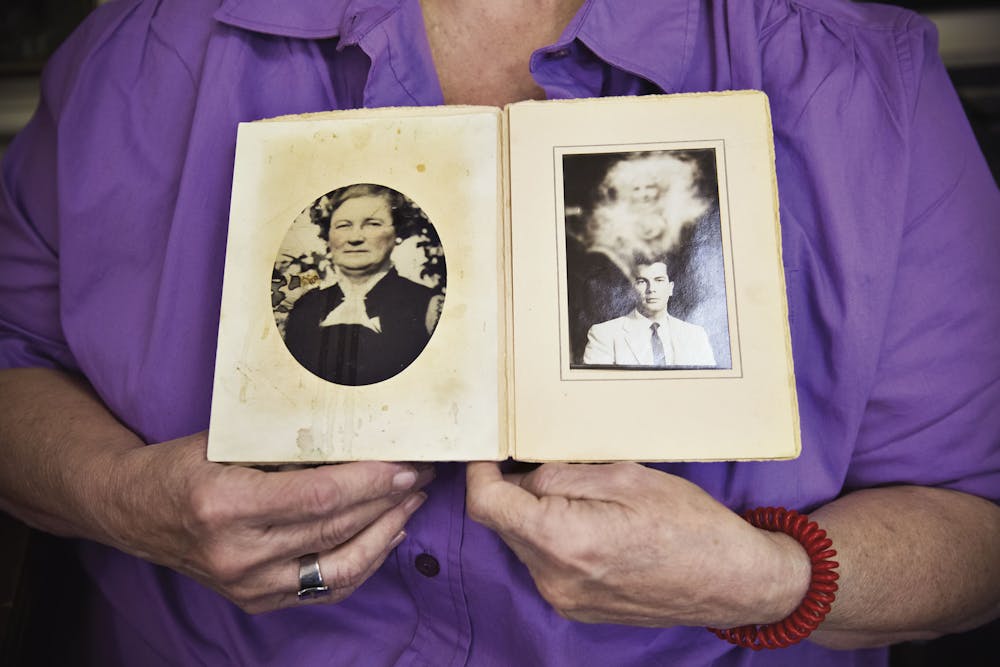 Sandy Candy Eppinger’s family spirit photographs, which show her brother Eugene Candy with the spirits of their grandmother Ethel Philips and great aunt Helen Thompson, at Lily Dale, New York, in 2015. © Shannon Taggart. Courtesy of the Artist, Author provided
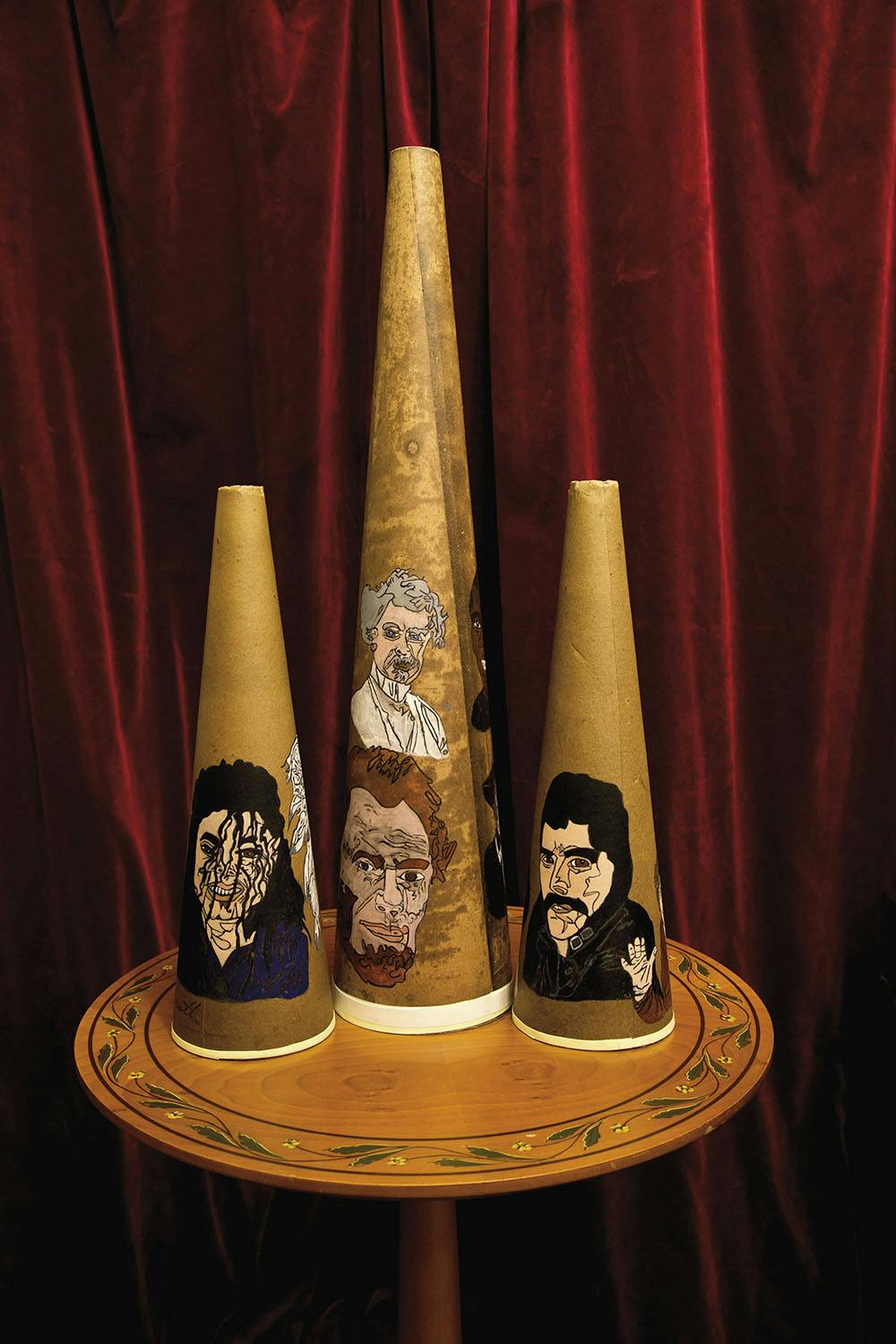 Séance trumpets featuring celebrity spirit guides, including Michael Jackson and Freddie Mercury, hand-painted by medium Sylvia Howarth, in England in 2013. © Shannon Taggart. Courtesy of the Artist., Author provided
 Kim Kitchen calls to her deceased daughter Casey and asks her for orbs in Lily Dale, New York, in 2014. © Shannon Taggart. Courtesy of the Artist, Author provided