Ten million reads: UMBC researchers hit milestone in sharing knowledge through The Conversation
UMBC researchers regularly share their work and expertise with the public through The Conversation—a nonprofit news outlet that provides current, informative content to news publications worldwide, free of charge. This week, these authors have hit a milestone: 224 Conversation articles written by 125 different UMBC researchers have earned a cumulative 10 million reads.
The stories offer context to current events, explain natural phenomena, introduce new research in an accessible way, and more. There’s even a Curious Kids section to answer the youngest readers’ questions.
The 10 million reads milestone demonstrates the commitment of UMBC researchers to sharing their expertise with the broader community. It also shows that UMBC researchers are helping meet public demand for high-quality content on timely topics.
“The Conversation helps us contribute to our public service mission as a public university,” says Karl V. Steiner, vice president for research. “This milestone underscores the importance of academic researchers actively participating in the public discourse of complex issues.”
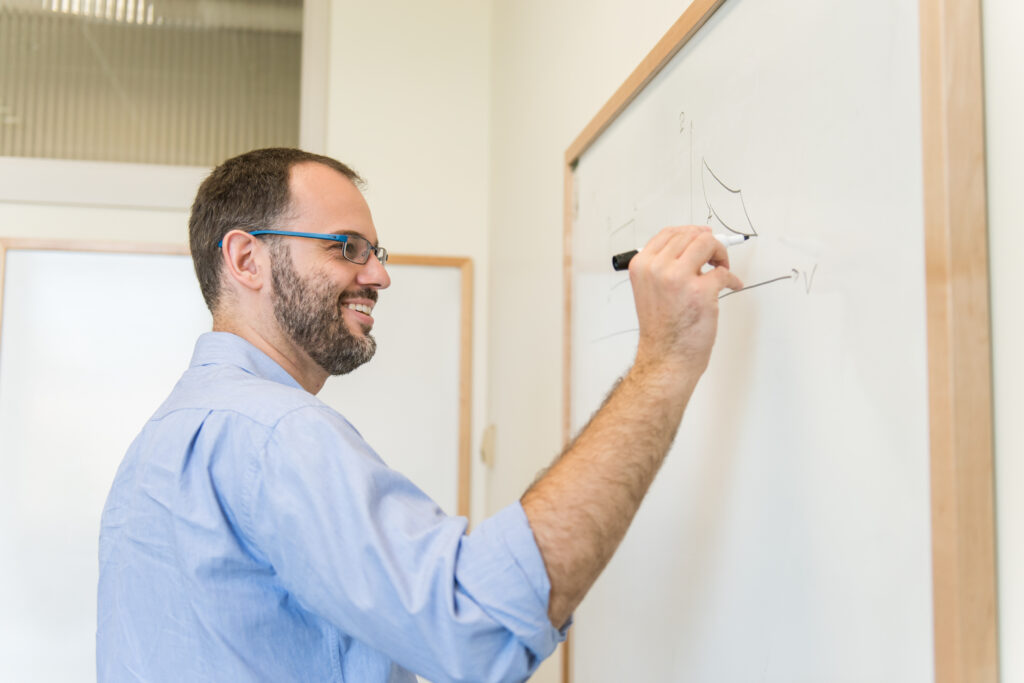
Sebastian Deffner, physics, wrote a piece for The Conversation in 2017 explaining static electricity. Every winter, when dry air and static increase, the article gets a fresh boost of views. Photo by Marlayna Demond ’11 for UMBC.
Career impact
Many readers have likely seen articles from The Conversation without realizing it, due to the free-to-republish model. Top republishers of UMBC’s Conversation content include Quartz, Smithsonian Magazine, Fast Company, Scientific American, Business Insider, andCNN, along with countless local newspapers around the nation. And these articles often inspire additional original news coverage on faculty research as well.

Charissa Cheah’s April 2021 Conversation article on anti-Asian violence and school safety was followed by related coverage on NBC News and WYPR. Photo by Crystal Tseng, courtesy Charissa Cheah.
The Conversation has a global impact. Forty-two percent of readers of UMBC-authored Conversation articles are based outside the U.S. Many of these readers are based in Canada, India, Australia, the United Kingdom, France, the Philippines, and Singapore, among other nations. They access both English-language content and UMBC articles that have been translated into other languages, such as Spanish and French.
The authors benefit, too. “Working with The Conversation taught me the ropes of writing for the general public,” says Zoë McLaren, associate professor of public policy. “It helped me develop a reputation as a respected COVID-19 expert. And it helped develop the skills I needed to be able to write for FiveThirtyEight, WIRED and The New York Times. The editors at The Conversation are knowledgeable and helpful and a real pleasure to work with.”
McLaren has written nine Conversation articles on topics like the role of rapid tests for COVID-19 and how the clinical trials process works.
Katherine Seley-Radtke, professor of chemistry and biochemistry, has also had success with The Conversation. “The experience of writing several pieces for The Conversation has had a significant impact on my career,” she says. “Since publishing my first piece at the beginning of the pandemic, I have given more than 60 interviews for print, radio, and television.”
As a medicinal chemist whose research group focuses on antiviral drug development, Seley-Radtke says, “it is important to have these types of platforms to help educate and inform the public.”
From technical to accessible
Even research areas that aren’t frequently in the news can find an enthusiastic audience on The Conversation. Preminda Jacob, associate professor of visual arts and associate dean of the College of Arts, Humanities, and Social Sciences, has discovered this first-hand. With her expertise in the history of modern and contemporary art, Jacob’s articles in The Conversation have helped the public better understand artists’ social and political impacts.
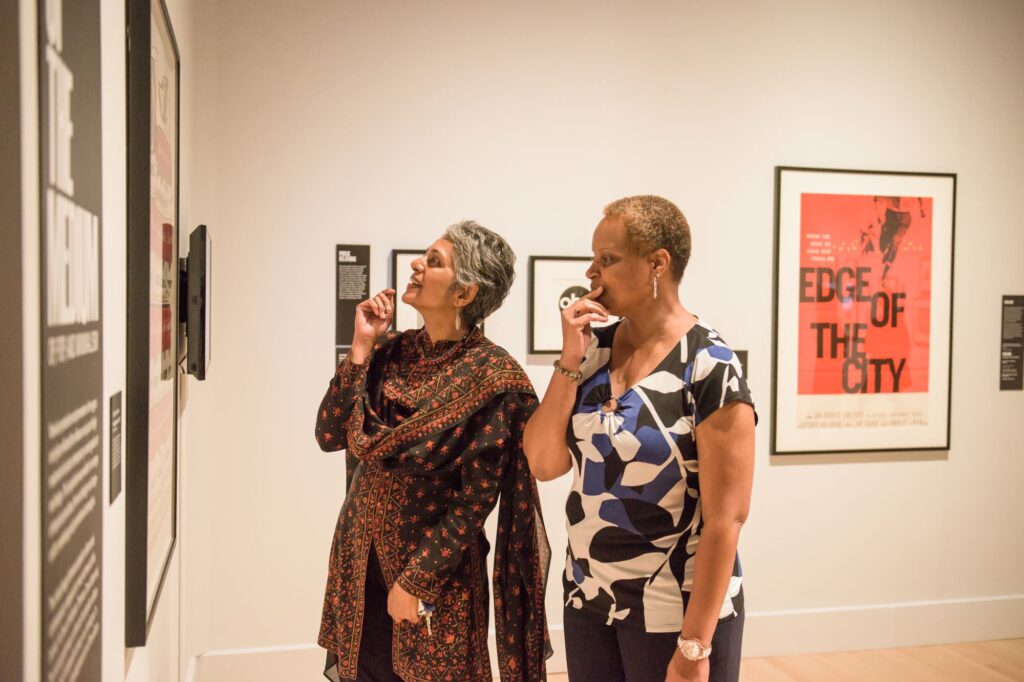
Preminda Jacob (l) and Andrea Lorick (r) at at exhibition at UMBC’s Center for Art, Design, and Visual Culture. Photo by Marlayna Demond ’11 for UMBC.
Mercedes Burns, assistant professor of biological sciences, studies the evolution of reproductive systems in arachnids commonly referred to as daddy longlegs. She published an article about the ability of some animal species to reproduce with just one parent’s genetic material. Published just before Christmas with the title “Virgin births from parthenogenesis,” the story garnered a huge readership. It subsequently appeared on CNN, Gizmodo, IFLScience, and more.
“I enjoy the challenge of taking technical writing and making it accessible for a wider audience,” says Burns, who is also very active within the science community on Twitter. She in part credits that public engagement for additional opportunities to comment on stories for The New York Times, The Atlantic, Science News, and Smithsonian Magazine.
Burns’s Conversation editor “gave me clear feedback over just two sessions, so I could easily make the changes she suggested,” she says. “All in all, I was glad to have a broader venue for my research, and the process wasn’t too complicated or time-consuming. I would certainly write a Conversation article again.”
Fostering public understanding
Richard Forno, principal lecturer and director of the cybersecurity graduate program, is one of UMBC’s most frequent contributors to The Conversation, writing on topics from election security to ransomware attacks. Forno views sharing his expertise as a civic duty, given cybersecurity threats facing the public. He sees The Conversation as an excellent way to connect with a broad range of readers.
“To me, what’s refreshing about The Conversation‘s role in the world—and why I appreciate contributing to it—is their commitment to providing easily accessible and jargon-free exploration and objective analysis of often-complex issues, technology, and events,” Forno says.
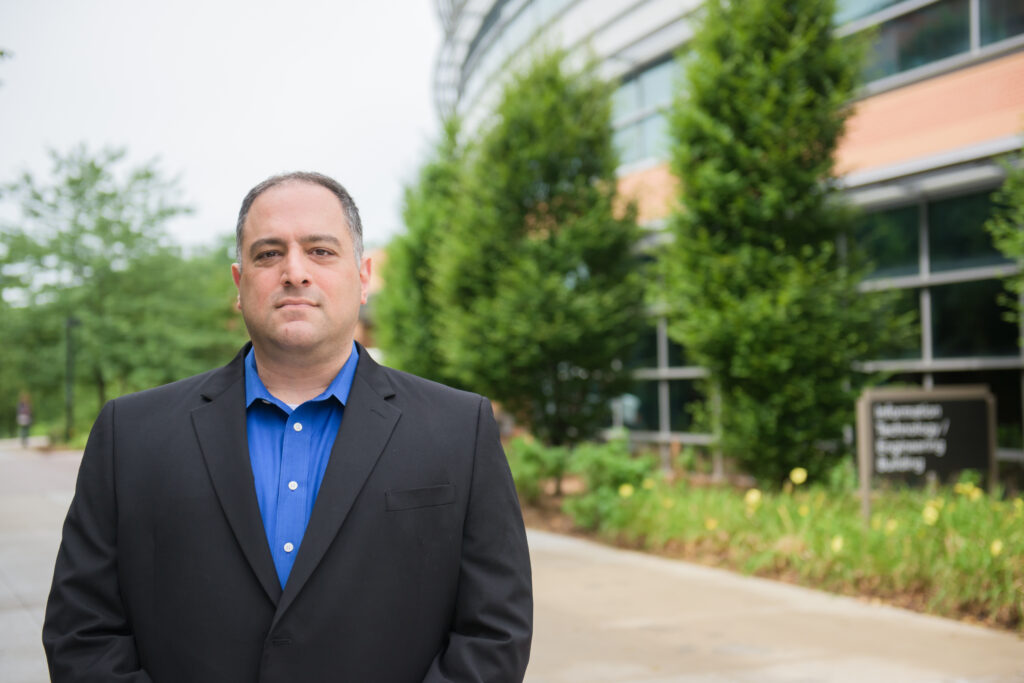
Richard Forno outside the Information Technology and Engineering Building. Photo by Marlayna Demond ’11 for UMBC.
For example, an article by Priyanka Ranade ’18, M.S. ’19, information systems, a Ph.D. student in computer science, and Anupam Joshi and Tim Finin, professors of computer science and electrical engineering, discusses how artificial intelligence can generate fake reports about medical research, cyberattacks, and more, that fool even cybersecurity experts. Public understanding and vigilance around cybersecurity is critical in today’s world, but the issues can seem opaque to those outside the field unless communicated clearly.
“The Conversation reminds academics, researchers, and other experts that knowledge discovery is just as important as how it’s conveyed to others,” Forno says. “This work is so important to fostering public understanding and supporting a more informed global citizenry.”
Banner image: Mercedes Burns (right) and Sarah Stellwagen at work in Burns’s laboratory. Photo by Marlayna Demond ’11 for UMBC.
]]>
UMBC researchers regularly share their work and expertise with the public through The Conversation—a nonprofit news outlet that provides current, informative content to news publications...
https://umbc.edu/stories/ten-million-reads-umbc-researchers-hit-milestone-in-sharing-knowledge-through-the-conversation/
https://beta.my.umbc.edu/api/v0/pixel/news/119466/guest@my.umbc.edu/0e228e0d31c7ce4ea3b40f5577e24360/api/pixel
biology
cahss
chembiochem
cnms
coeit
community
csee
cybersecurity
is
news
page1
physics
psychology
publicpolicy
research
visualarts
UMBC News & Magazine
https://beta.my.umbc.edu/groups/umbc-news-magazine
https://assets1-beta.my.umbc.edu/system/shared/avatars/groups/000/001/943/24435aa6207c452e7bc15cc74b42c7bb/xsmall.png?1748556657
https://assets1-beta.my.umbc.edu/system/shared/avatars/groups/000/001/943/24435aa6207c452e7bc15cc74b42c7bb/original.png?1748556657
https://assets2-beta.my.umbc.edu/system/shared/avatars/groups/000/001/943/24435aa6207c452e7bc15cc74b42c7bb/xxlarge.png?1748556657
https://assets2-beta.my.umbc.edu/system/shared/avatars/groups/000/001/943/24435aa6207c452e7bc15cc74b42c7bb/xlarge.png?1748556657
https://assets3-beta.my.umbc.edu/system/shared/avatars/groups/000/001/943/24435aa6207c452e7bc15cc74b42c7bb/large.png?1748556657
https://assets1-beta.my.umbc.edu/system/shared/avatars/groups/000/001/943/24435aa6207c452e7bc15cc74b42c7bb/medium.png?1748556657
https://assets2-beta.my.umbc.edu/system/shared/avatars/groups/000/001/943/24435aa6207c452e7bc15cc74b42c7bb/small.png?1748556657
https://assets1-beta.my.umbc.edu/system/shared/avatars/groups/000/001/943/24435aa6207c452e7bc15cc74b42c7bb/xsmall.png?1748556657
https://assets2-beta.my.umbc.edu/system/shared/avatars/groups/000/001/943/24435aa6207c452e7bc15cc74b42c7bb/xxsmall.png?1748556657
UMBC News & Magazine
0
0
false
Mon, 07 Mar 2022 21:35:09 -0500
Mon, 07 Mar 2022 21:35:09 -0500
Charting His Own Map for Success
Donovin Acaro Smith ’21, geography and environmental studies, was 11 years old when he did something bold, but not out of the ordinary for him. It was a sunny day. His school was taking a class trip to the local swimming pool, and parents were welcome to join. Smith’s mother Sonia, thought there was a problem. As far as she knew, her son didn’t know how to swim; he however, disagreed. Along with some buddies, he sprinted and leaped into the pool water, as his mom screamed, “Noooooooo, Donovin!”
But surprisingly, he wasn’t drowning, or even floating. He was swimming. It was a concerning, yet proud moment for his doting mother.
As he grew older, Smith would find himself surviving other sink and swim moments in life—two gunshot wounds as a teenager left him with anxiety and PTSD that would stop him from leaving his house for a year. And just last year, he overcame another obstacle he previously thought insurmountable: graduating from college.
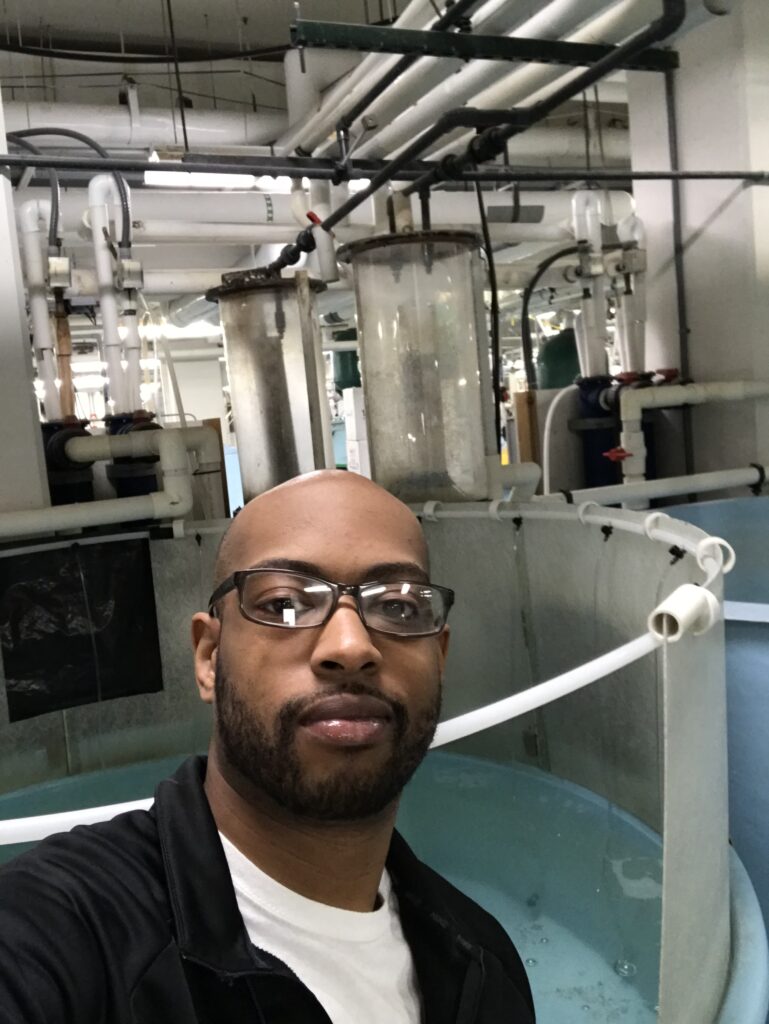 Smith while interning at the Institute of Marine and Environmental Technology (IMET).
Reimagining his future
In his late 20s, Smith followed in his maternal grandmother’s footsteps and pursued a new life focused around one goal: getting a four-year college degree. By the time he was 32, and after five internships in his field, he had a diploma in his hand and an unstoppable urge to keep moving forward.
Through his internships and connections in the Retriever Learning Center and Student Disability Services, Smith developed invaluable relationships with the people around him.
Matthew Baker, professor of geography and environmental systems, and associate dean of the College of Arts, Humanities, and Social Sciences, and Smith’s mentor and teacher says, “given the challenges he faced at the outset of his undergraduate program at UMBC, what he’s achieved is probably one of the greatest success stories that I’ve experienced in my 20 years of instruction.”
Growth pains
Even though he grew up just 20 minutes away from UMBC, the institution wasn’t on Smith’s radar as a young man.
At 18, when some kids were moving into their college dorm rooms, Smith told his mom he was heading to a cookout with some friends, just minutes away from his grandmother’s place. Later that same night, he called to say that he was on his way to the hospital. He’d been shot twice, once in his left thigh, and once in his lower ribcage.
The pain didn’t hit him right away, perhaps because gunshots weren’t new to Smith—when he was a child, he witnessed his father being shot.
“Not to sound like a tough guy, but I guess those experiences from my dad numbed me—he was set up when I was four. Somebody came in and shot him and he fell off the balcony and ever since then he’s been a parapelegic. So when it happened to me,” says Smith, “it didn’t really hurt. I was just trying to control my breathing so I could make it to the hospital.”
Even after surviving his gunshot wounds, Smith says he struggled to find purpose and meaning in his life. Smith’s mother recalls, “after Donovin got shot, for like a year he wouldn’t go out. He stayed in so much he ended up having a vitamin D deficiency.”
“Whatever lifestyle [my father] indulged in at the time, I saw those things firsthand,” says Smith of his teenage years. “I guess once you keep seeing the same things over and over, it just sorta keeps resonating in you, so when I got to that age, I wanted to do the same thing,” even though his father frequently warned him away from it.
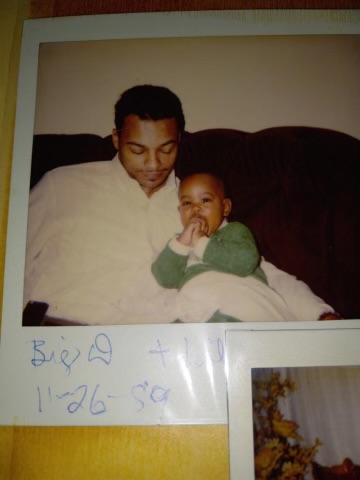

 Family photos from Smith’s childhood. All photos courtesy of Smith unless otherwise noted.
“Some things I was doing I didn’t feel right about, or I felt bad about. Maybe because of those circumstances, I was confused about what it means to be a human being,” he says.
But he kept the right people around him from the start. His mother’s positive influence, and the love and support of other family members helped Smith through his most turbulent years.
A new mindset for a new environment
Smith wishes his interest in academics had started in high school. “I remember I used to walk into class, only thinking about getting through the day, I didn’t care what I learned about,” he says. “When I finally got to college, and I was in chemistry class, I could see how excited those students were to be in there. I just thought to myself, ‘Wow man, this is foreign to me.’ I wish I developed that attitude way earlier.”
At first, he only saw higher education as a way to please his family, but eventually it became Smith’s own passion. When he graduated from high school, Smith enrolled in the Community College of Baltimore County (CCBC), eventually earning an associate’s degree. He then applied to a few four year institutions. When he got into UMBC, he recalls his mother saying, “Wow Donovin! You gotta do it.”
“At first, I was just [going to college] to keep my mother and grandmother off my back, and to try and make my father happy, to make sure he knew that I’m grateful for some of the mistakes he made for me to be where I’m at. Then, when I started believing this was real, and not some kind of unrealistic reach or a joke, I knew I was doing it for myself, too,” says Smith.
A humble approach to learning
But before he got to that stage, he had to work to adapt to a new atmosphere and new environment. “The biggest obstacle to be honest, for me, was building up my self-esteem and feeling comfortable in my own skin. My first couple of years were rough. Like I might get a B or a C and then maybe like two D’s or an E,” shares Smith. “I was going to tutoring, I was trying. But I noticed when my self-esteem went up, my grades improved and I skyrocketed and I never looked back.”
The moment he started believing he could succeed at UMBC inversely began after failing GES 286, a mapping class. He retook the class a second time with a friend, and “I felt way more comfortable,” says Smith. “When I started excelling in that class, that’s when I started feeling like I could do it,” he says.

 Smith meets with Baker on a recent visit to campus. Photos by Marlayna Demond ’11.
Smith says he regularly reached out to friends for help studying and found a private tutor through Student Disability Services (SDS). “The Retriever Learning Center is where I did the majority of my tutoring and it was really helpful. But having anxiety and PTSD, I had to get my questions off. I was trying to survive,” Smith says.
“But sometimes with so many students attending, there wasn’t enough time for me to get as much help as I wanted. Thankfully I was able to get accommodation from SDS who granted me an individual tutor which made a big difference.”
“One of the things that has impressed me about Donovin the entire time that he was here was his resilience,” says Baker in GES, “his ability to bounce back from challenges, his perseverance and his absolute, unwavering dedication towards reaching his goals and because of those things it was really easy to support him, and it became an obligation to see that he did well.”
Also helpful was Smith’s fearlessness in regards to asking questions.
“He was always really clear about why he was asking what he was asking, and what he was trying to understand,” says Baker. “I think he was also willing to be humble about what he was learning so that he didn’t let embarrassment get in the way of his learning. As a result he made remarkable progress.”
Interning his way up
Smith, who is currently looking for a position in the conservation and environmental management field, began mastering these skills in a series of five internships.
In his first, under the wing of Baker, he researched sediment pollution in the Patapsco River. He also worked as a lab technician at the Institute of Marine and Environmental Technology. His most recent internship before graduation was at the Smithsonian Environmental Research Center, looking at the environmental influences on barnacles.
“The most rewarding part for me was working next to and being close to doctors and biologists every day, asking them as many questions as I wanted so I could really learn from them,” says Smith. “It taught me that you have to keep building your skills, learning how to compile fragments of information that might coincide with one another,” he continues.
Today, Smith sees his graduation from UMBC as his life’s crowning achievement. He describes his educational experience as a microcosm of his life as a whole. “There was a point at UMBC where my grades were looking so bad that I was about to switch to community college and try to come back. One of my highlights was being able to turn that around and just survive the tough academic atmosphere,” says Smith, who credits his mom, Baker, his friends, and some of UMBC’s organizations who helped him succeed.
To anyone that finds themselves in a similar position to the one he was in before attending UMBC, Smith recommends perseverance: “Give yourself a chance, and time to grow on your own. Separate yourself from your friends and environment and try to look at life from as many positive angles as possible.”
Looking at her son’s achievements today, Smith’s mother Sonia says, “He’s on his way, he is on his way.”
*****
Header image: Baker and Smith meet up on campus in 2022. Photo by Marlayna Demond ’11.
]]>
Donovin Acaro Smith ’21, geography and environmental studies, was 11 years old when he did something bold, but not out of the ordinary for him. It was a sunny day. His school was taking a class...
https://umbc.edu/stories/charting-his-own-map-for-success/
https://beta.my.umbc.edu/api/v0/pixel/news/119467/guest@my.umbc.edu/b630ddb4556d31be73d545c721ebf33c/api/pixel
alumni
ges
magazine
non-traditional-student
retriever-learning-center
student-disability-services
UMBC News & Magazine
https://beta.my.umbc.edu/groups/umbc-news-magazine
https://assets1-beta.my.umbc.edu/system/shared/avatars/groups/000/001/943/24435aa6207c452e7bc15cc74b42c7bb/xsmall.png?1748556657
https://assets1-beta.my.umbc.edu/system/shared/avatars/groups/000/001/943/24435aa6207c452e7bc15cc74b42c7bb/original.png?1748556657
https://assets2-beta.my.umbc.edu/system/shared/avatars/groups/000/001/943/24435aa6207c452e7bc15cc74b42c7bb/xxlarge.png?1748556657
https://assets2-beta.my.umbc.edu/system/shared/avatars/groups/000/001/943/24435aa6207c452e7bc15cc74b42c7bb/xlarge.png?1748556657
https://assets3-beta.my.umbc.edu/system/shared/avatars/groups/000/001/943/24435aa6207c452e7bc15cc74b42c7bb/large.png?1748556657
https://assets1-beta.my.umbc.edu/system/shared/avatars/groups/000/001/943/24435aa6207c452e7bc15cc74b42c7bb/medium.png?1748556657
https://assets2-beta.my.umbc.edu/system/shared/avatars/groups/000/001/943/24435aa6207c452e7bc15cc74b42c7bb/small.png?1748556657
https://assets1-beta.my.umbc.edu/system/shared/avatars/groups/000/001/943/24435aa6207c452e7bc15cc74b42c7bb/xsmall.png?1748556657
https://assets2-beta.my.umbc.edu/system/shared/avatars/groups/000/001/943/24435aa6207c452e7bc15cc74b42c7bb/xxsmall.png?1748556657
UMBC News & Magazine
0
0
false
Mon, 07 Mar 2022 20:00:42 -0500
Mon, 07 Mar 2022 20:00:42 -0500
Battles Over Book Bans Reflect Conflicts from the 1980s
By Fred L. Pincus, Emeritus Professor of Sociology, UMBC
A conservative leader found fault with how “respect for our nation’s heritage” had been mostly stripped from the textbooks of public schools.
“From kindergarten right through the total school system, it almost seems as if classroom textbooks are designed to negate what philosophies previously had been taught,” the conservative leader lamented. “[M]any textbooks are actually perverting the minds of literally millions of students.”
A teachers organization shot back, saying the underlying motive for some attacks against books has “unquestionably been racial.”
This might sound like a back-and-forth from recent debates over removing books from school classrooms and libraries. Often, critical race theory – an academic framework for understanding racism – has been at the center of these debates. But in reality, both quotes are more than 40 years old.
Religious influence on politics
The first quote came from a 1981 book by the Rev. Jerry Falwell titled “Listen, America!” Falwell, founder of the Moral Majority, was one of the leaders of the book-banning efforts of the 1980s. It was during this period – with Ronald Reagan in the White House – that Christian fundamentalists became a growing influence in conservative American politics.
The second quote comes from a 1981 publication of the National Council of Teachers of English, “The Students’ Right to Read.” The council was one of the major groups opposing Falwell and other conservatives.
 AOK Library stacks, photo by Marlayna Demond ’11.
The attacks on books in the 1980s bear similarities to the current attacks. Both object to the critical teaching about race and racism, historical as well as contemporary. Both accuse schools of tearing down America and weakening patriotism. Both object to teaching about gender roles, sexual orientation and alternative models of the family. Conservative institutions like the Heritage Foundation have been involved in both periods.
There are also important differences between the two periods. The 1980s bogeyman was secular humanism, because it argued that human beings can define their own morality without the use of religion. Falwell and others claimed that public schools were anti-Christian because they taught students that they didn’t have to use the Bible as a standard for right and wrong. Chaos would result, the Christian fundamentalists asserted, if everyone had to determine their own morality.
In a way reminiscent of the so-called Scopes Monkey Trial in 1925, conservatives objected to the teaching of evolution as a fact, rather than a theory. Instead, they wanted biology textbooks to give equal space to the so-called scientific theory of creationism, which holds that God created the universe.
A new bogeyman
In 2022, of course, the bogeyman is critical race theory. Emerging from critical legal theory taught in law schools, critical race theory argues that white supremacy has been embedded in American legal and educational institutions since the time of slavery.
Right-wing critics have made a number of erroneous allegations about critical race theory: that it is taught in public schools; that it is Marxist; that it is intended to make whites feel guilty; and more. The Heritage Foundation has published “How to Identify Critical Race Theory” as a guide to help parents evaluate books and curricula by looking for words like “systemic racism,” “white privilege” and “social construction or race.”
In fact, these concepts predated critical race theory, which came on the scene in the late 1970s and 1980s. Activist Stokely Carmichael – also known as Kwame Ture – and political scientist Charles V. Hamilton discussed institutional racism in “Black Power: The Politics of Liberation in America” in 1967. “Institutional racism” and “structural racism” are very similar to “systemic racism.”
 AOK Library book display with a sign that says “Read books by Black Women.” Photo by Marlayna Demond ’11.
“White privilege” was discussed by W.E.B. Du Bois in the early 20th century and by civil rights activists in the 1950s and 1960s. Another term associated with critical race theory, “the social construction of race,” was used by anthropologists like Franz Boas back in the 1950s.
New interpretations
Critical race theorists took these and other concepts, reinterpreted them and applied them to the American legal system. Scholars in education have done the same in trying to understand education as an institution. After 40-plus years of teaching and writing about race and diversity, I know that it is impossible to accurately discuss American racial conflict without using these concepts. But that’s what many lawmakers would have American educators do.
According to a Pen America report, a nonprofit that advocates for freedom of expression in literature, 156 “educational gag order” bills in 39 states have been introduced since January 2021. Twelve have become law in 10 states, and 113 are pending in 35 states. As of March 2022, at least seven states specifically ban the teaching of critical race theory. “Cumulatively,” says the Pen report, “they represent a national assault on our education system, censoring both what teachers can say and what students may learn.”
Of course, some white students – and other students, too, for that matter – will feel uncomfortable upon learning not only about the history of American racism but also its present manifestations. Reality is sometimes uncomfortable.
That’s where good teaching comes in. Good teaching means taking the students’ age into account. It also means being supportive of students who may feel uncomfortable or guilty about certain events in American history.
I always tell students: “You are not responsible for what happened in the past. You are responsible to decide what you plan to do in the present and the future.”
*****
Fred L. Pincus, Emeritus Professor of Sociology, University of Maryland, Baltimore County
Header Image: At least seven states have banned the teaching of critical race theory. Smith Collection/Gado/Getty Images
]]>
By Fred L. Pincus, Emeritus Professor of Sociology, UMBC A conservative leader found fault with how “respect for our nation’s heritage” had been mostly stripped from the textbooks of public...
https://umbc.edu/stories/battles-over-book-bans-reflect-conflicts-from-the-1980s/
https://beta.my.umbc.edu/api/v0/pixel/news/119468/guest@my.umbc.edu/562788f64587502a8e2e63d314823f8c/api/pixel
discovery
education
magazine
sociology
the-conversation
UMBC News & Magazine
https://beta.my.umbc.edu/groups/umbc-news-magazine
https://assets1-beta.my.umbc.edu/system/shared/avatars/groups/000/001/943/24435aa6207c452e7bc15cc74b42c7bb/xsmall.png?1748556657
https://assets1-beta.my.umbc.edu/system/shared/avatars/groups/000/001/943/24435aa6207c452e7bc15cc74b42c7bb/original.png?1748556657
https://assets2-beta.my.umbc.edu/system/shared/avatars/groups/000/001/943/24435aa6207c452e7bc15cc74b42c7bb/xxlarge.png?1748556657
https://assets2-beta.my.umbc.edu/system/shared/avatars/groups/000/001/943/24435aa6207c452e7bc15cc74b42c7bb/xlarge.png?1748556657
https://assets3-beta.my.umbc.edu/system/shared/avatars/groups/000/001/943/24435aa6207c452e7bc15cc74b42c7bb/large.png?1748556657
https://assets1-beta.my.umbc.edu/system/shared/avatars/groups/000/001/943/24435aa6207c452e7bc15cc74b42c7bb/medium.png?1748556657
https://assets2-beta.my.umbc.edu/system/shared/avatars/groups/000/001/943/24435aa6207c452e7bc15cc74b42c7bb/small.png?1748556657
https://assets1-beta.my.umbc.edu/system/shared/avatars/groups/000/001/943/24435aa6207c452e7bc15cc74b42c7bb/xsmall.png?1748556657
https://assets2-beta.my.umbc.edu/system/shared/avatars/groups/000/001/943/24435aa6207c452e7bc15cc74b42c7bb/xxsmall.png?1748556657
UMBC News & Magazine
0
0
false
Mon, 07 Mar 2022 16:01:47 -0500
Mon, 07 Mar 2022 16:01:47 -0500
Economic Sanctions May Deal Fatal Blow to Russia’s Already-Weak Domestic Opposition

By Brian Grodsky, professor, Political Science, UMBC
The West has responded to Russia’s invasion of Ukraine by imposing harsh economic sanctions.
Most consequentially, key Russian banks have been cut out of the SWIFT payments messaging system, making financial transactions much more difficult. The United States, European Union and others also moved to freeze Russian Central Bank reserves. And U.S. President Joe Biden is weighing a total ban on Russian oil imports.
These sanctions are aimed at generating opposition from both Russian President Vladimir Putin’s inner circle and everyday Russians. As a scholar who studies regime change, I believe the risk is that they will actually drive the Kremlin’s weak opposition further into obscurity.
A ‘punishment logic’
Economic sanctions follow a “punishment logic”: Those feeling economic pain are expected to rise up against their political leaders and demand a change in policies.
Everyday Russians have already felt the pain from the newest sanctions. The ruble plummeted in value, and Russia’s stock market dipped. The effects of Western sanctions were seen in the long lines at ATMs as Russians tried to pull out their cash before it was lost.
But the odds of an uprising are not great. Empirical research suggests that sanctions rarely generate the sorts of damage that compel their targets to back down. Their greatest chance of success is when they are used against democratic states, where opposition elites can mobilize the public against them.
In authoritarian regimes like Putin’s, where average citizens are the most likely to suffer, sanctions usually do more to hurt the opposition than help it.
How Putin has quelled dissent
Putin has used a variety of tools to try to quell domestic opposition over the past two decades.
Some of these were subtle, such as tweaking the electoral system in ways that benefit his party. Others were less so, including instituting constitutional changes that allow him to serve as president for years to come.
But Putin has not stopped at legislative measures. He has long been accused of murdering rivals, both at home and abroad. Most recently, Putin has criminalized organizations tied to the opposition and has imprisoned their leader, Alexei Navalny, who was the target of two assassination attempts.
Despite a clampdown on activism, Russians have repeatedly proved willing to take to the streets to make their voices heard. Thousands demonstrated in the summer and fall of 2020 to support a governor in the Far East who had beaten Putin’s pick for the position only to be arrested, ostensibly for a murder a decade and a half earlier. Thousands more came out last spring to protest against Navalny’s detention.
Putin has even begun facing challenges from traditionally subservient political parties, such as the Communist Party and the nationalist Liberal Democratic Party.
Flickers of opposition
Importantly, Putin has occasionally shown a willingness to back down and change his policies under pressure. In other words, as much as Putin has limited democracy in Russia, opposition has continued to bubble up.
The result is a president who feels compelled to win over at least a portion of his domestic audience. This was clear in the impassioned address Putin made to the nation setting the stage for war. The fiery hourlong speech falsely accused Ukrainians of genocide against ethnic Russians in eastern Ukraine. “How long can this tragedy continue? How much longer can we put up with this?” Putin asked his nation.
Since Russia invaded Ukraine, Russians have continued to show their willingness to stand up to Putin. Thousands have gathered to protest the war in Ukraine, despite risking large fines and jail time.
They have been aided by a network of “hacktivists” outside Russia using a variety of tactics to overcome the Kremlin’s mighty propaganda machine. These groups have blocked Russian government agencies and state news outlets from spreading false narratives.
Controlling the narrative
Despite these public showings, the liberal opposition to Putin is undoubtedly weak. In part, this is because Putin controls state television, which nearly two-thirds of Russians watch for their daily news. Going into this war, half of Russians blamed the U.S. and NATO for the increase in tensions, with only 4% holding Russia responsible.
This narrative could be challenged by the large number of Russians – 40% – who get their information from social media. But the Kremlin has a long track record of operating in this space, intimidating tech companies and spreading false stories that back the government line. Just on Friday state authorities said they would block access to Facebook, which around 9% of Russians use.
Putin has already shown he can use his information machine to convert past Western sanctions into advantage. After the West sanctioned Russia for its 2014 takeover of Crimea, Putin deflected blame for Russians’ economic pain from himself to foreign powers. The result may have fallen short of the classic “rally around the flag” phenomenon, but on balance Putin gained politically from his first grab on Ukraine. More forceful economic sanctions this time around may unleash a broader wave of nationalism.
More importantly, sanctions have a long track record of weakening political freedoms in the target state. As the situation in Russia continues to deteriorate, Putin will likely crack down further to stamp out any signs of dissent.
And former Russian president Dmitry Medvedev reacted to the country’s expulsion from the Council of Europe by suggesting Russia might go back on its human rights promises.
 Authorities blocked access to the website of Russian TV channel Dozhd, and the chief editor has fled the country. AP Photo/Denis Kaminev
Another casualty of the war
This has already begun.
In the first week of the war, Russian authorities arrested more than 7,000 protesters. They ramped up censorship and closed down a longtime icon of liberal media, the Ekho Moskvy radio station. The editor of Russia’s last independent TV station, TV Dozhd, also announced he was fleeing the country.
Russia already ranked near the bottom – 150 out of 180 – in the latest Reporters Without Borders assessment of media freedom. And a new law, passed on March 4, 2022, punishes the spread of “false information” about Russia’s armed forces with up to 15 years in jail.
Ironically, then, the very sanctions that encourage Russians to attack the regime also narrow their available opportunities to do so.
Ultimately, the opposition seen on the streets in Russia today and perhaps in the coming weeks may be the greatest show of strength that can be expected in the near future.
The West may have better luck using targeted sanctions against those in Putin’s inner circle, including Russia’s infamous oligarchs. But with their assets hidden in various pots around the world, severely hurting these actors may prove difficult.
Even in the best of circumstances, economic sanctions can take years to have their desired effect. For Ukrainians, fighting a brutal and one-sided war, the sanctions are unlikely to help beyond bolstering morale.
The danger is that these sanctions may also make average Russians another casualty in Putin’s war.
*****
Header image: Russian police have detained thousands of Russians who have taken to the streets to protest the invasion of Ukraine.AP Photo/Dmitri Lovetsky
Brian Grodsky, Professor of Political Science, University of Maryland, Baltimore County
This article is republished from The Conversation under a Creative Commons license. Read the original article.
]]>
By Brian Grodsky, professor, Political Science, UMBC The West has responded to Russia’s invasion of Ukraine by imposing harsh economic sanctions. Most consequentially, key Russian banks...
https://umbc.edu/stories/economic-sanctions-may-deal-fatal-blow-to-russias-already-weak-domestic-opposition/
https://beta.my.umbc.edu/api/v0/pixel/news/119469/guest@my.umbc.edu/d1230fef373d3220892f2464e2d54c1e/api/pixel
discovery
magazine
political-science
russian
the-conversation
UMBC News & Magazine
https://beta.my.umbc.edu/groups/umbc-news-magazine
https://assets1-beta.my.umbc.edu/system/shared/avatars/groups/000/001/943/24435aa6207c452e7bc15cc74b42c7bb/xsmall.png?1748556657
https://assets1-beta.my.umbc.edu/system/shared/avatars/groups/000/001/943/24435aa6207c452e7bc15cc74b42c7bb/original.png?1748556657
https://assets2-beta.my.umbc.edu/system/shared/avatars/groups/000/001/943/24435aa6207c452e7bc15cc74b42c7bb/xxlarge.png?1748556657
https://assets2-beta.my.umbc.edu/system/shared/avatars/groups/000/001/943/24435aa6207c452e7bc15cc74b42c7bb/xlarge.png?1748556657
https://assets3-beta.my.umbc.edu/system/shared/avatars/groups/000/001/943/24435aa6207c452e7bc15cc74b42c7bb/large.png?1748556657
https://assets1-beta.my.umbc.edu/system/shared/avatars/groups/000/001/943/24435aa6207c452e7bc15cc74b42c7bb/medium.png?1748556657
https://assets2-beta.my.umbc.edu/system/shared/avatars/groups/000/001/943/24435aa6207c452e7bc15cc74b42c7bb/small.png?1748556657
https://assets1-beta.my.umbc.edu/system/shared/avatars/groups/000/001/943/24435aa6207c452e7bc15cc74b42c7bb/xsmall.png?1748556657
https://assets2-beta.my.umbc.edu/system/shared/avatars/groups/000/001/943/24435aa6207c452e7bc15cc74b42c7bb/xxsmall.png?1748556657
UMBC News & Magazine
0
0
false
Mon, 07 Mar 2022 15:27:36 -0500
Beyond Midlife: Kathy Marmor’s new artwork explores memory and embodiment for women in midlife

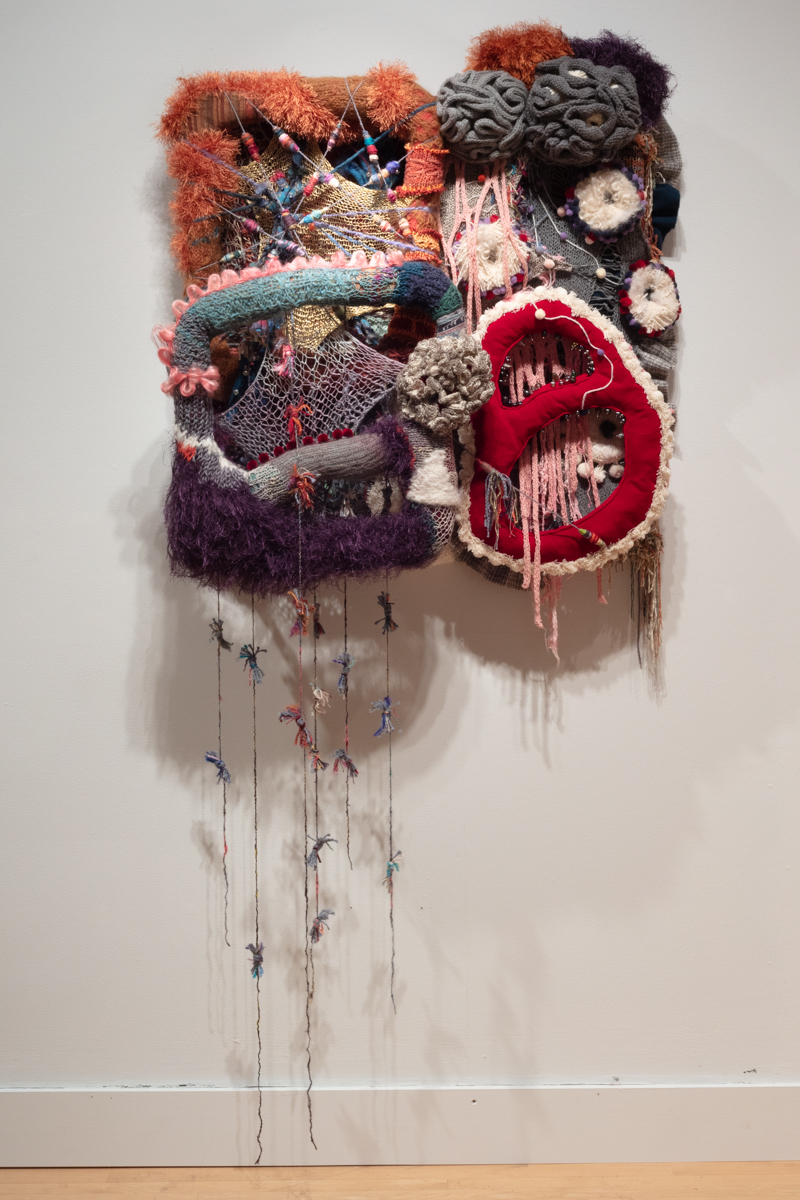
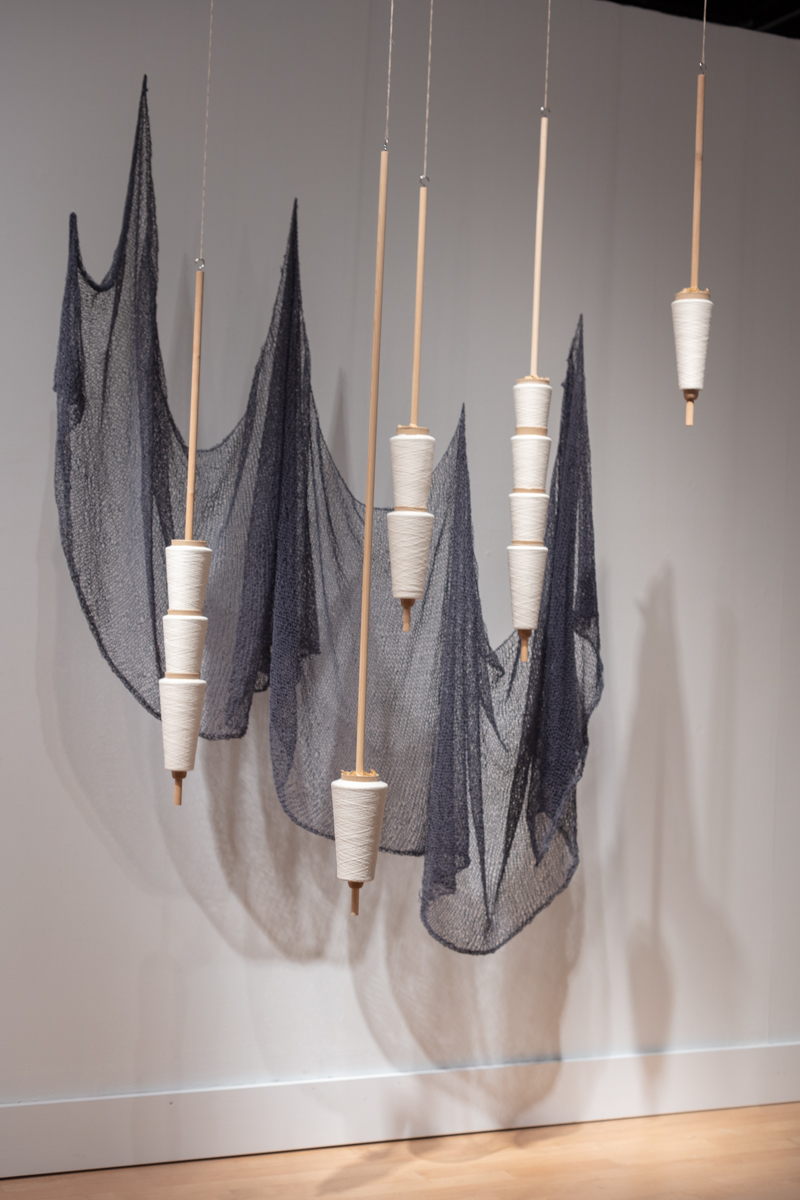
Western culture remains terrified of aging, particularly for women, but that fear doesn’t stop any of us from actually aging. Kathy Marmor, associate professor of visual arts at UMBC, delves into the heart of these anxieties with a pair of innovative collaborative works, collectively titled Beyond Midlife: What’s Lost, What’s Gained, on view at the Center for Art, Design and Visual Culture (CADVC) on the UMBC campus through March 12.
Marmor’s new work appears as part of the CADVC’s Spectrum: 2022 Visual Arts Faculty exhibition, which also features works by UMBC visual arts faculty Lisa Moren and Lynn Cazabon.
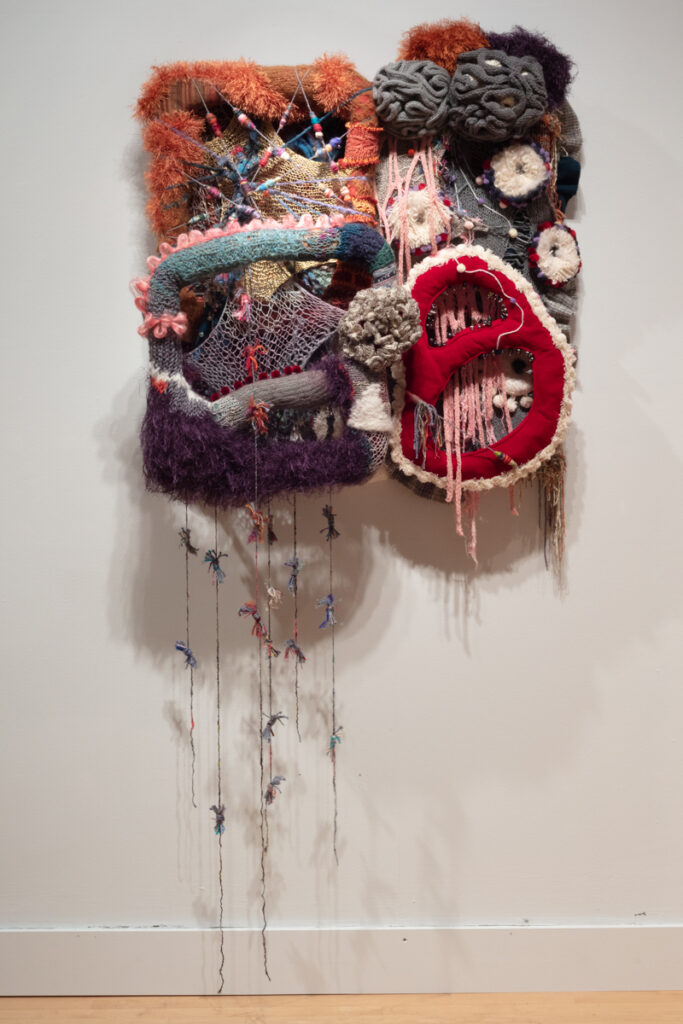 Unspooling Cognition. Photo by Heather Braxton.
While Marmor typically works alone, in recent years she’s begun a series of collaborations. “I thought it would be interesting to work with women from UMBC. [Penny Rheingans] and I had talked about working together when I first came to UMBC, but timelines didn’t work out.” Marmor said. “I knew Robin [Farabaugh] as a writer and I really wanted to work with a writer because I often use text in my work. The timing was good for them both.”
Unspooling is a textile-based installation created with Rheingans—a former professor of computer science and director of the Center for Women in Technology at UMBC who is now on the faculty at the University of Maine.
“I’ve worked for a long time with technology, using computers to mediate the environment, using sensors and interaction with people’s presence,” said Marmor. “This new work is a pause or break from technology. We wanted people to come in and get a different sense of the body. We see that there’s a decay, or a sense of unspooling, and unwrapping of daily life.”
Rheingans, an accomplished knitter, added new dimensions to the work.
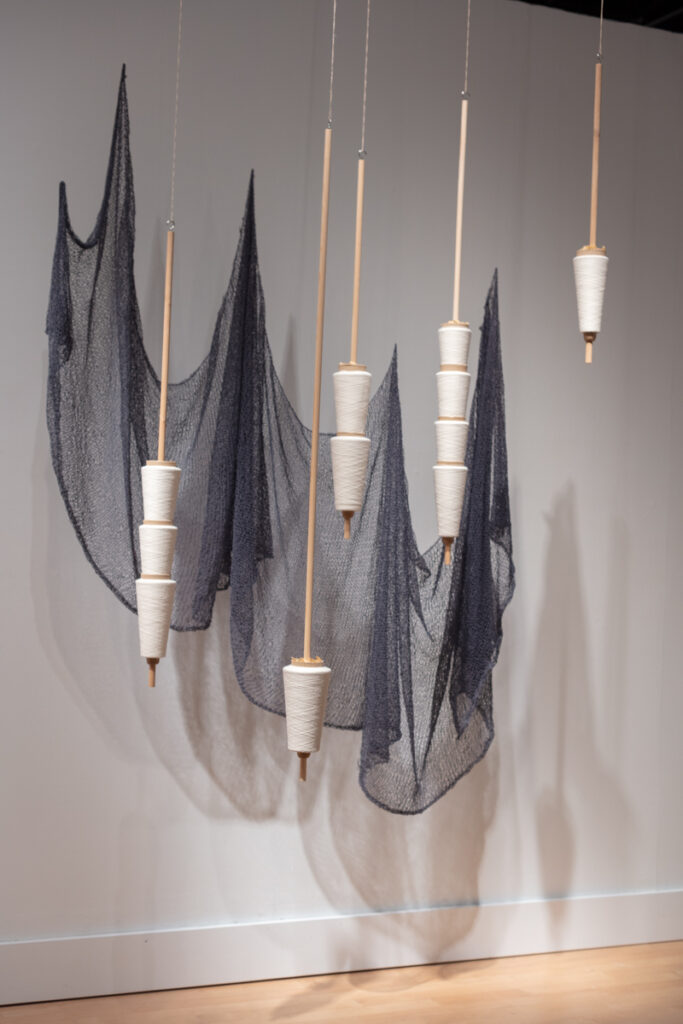 Unspooling Self. Photo by Heather Braxton.
“She’s a fabulous knitter, and a dedicated collector,” said Marmor. “She gave me all these materials to work with. I fell in love with yarn. It’s a really accessible material, fun to work with and it hinged on craft. My work has always been tactile and sculptural, but this was change for me.”
Comprising four vivid mixed-media sculptures, the piece charts vulnerabilities of aging women, including cognition, reproduction, appearance, self and autonomy. Echoing Suzanne Valadon’s “The Blue Room,” which depicts a middle-aged woman reclining on a day bed, together the pieces form an abstract portrait of a complete body.
“The Blue Room’ is one of my favorite paintings by a woman about being a woman, present and in her body,” Marmor says.
The second piece, Philomela’s Thread: a Commonplace book, was created with Robin Farabaugh, an essayist and former senior lecturer in UMBC’s English department. Consisting of ten prints and a single channel video, the pieces draw on the classic Greek tragedy of Philomela, a princess who was violently silenced.
“I really wanted to work with a writer because I often use text in my work,” said Marmor. “[Farabaugh] had never worked with a visual artist before, so it was an adventure.”
Historically, commonplace books were kept by men as personal compendiums of knowledge. Notable men like John Locke and Thomas Jefferson were famous for their commonplace books as reference works and historical documents. Women, Marmor notes, also kept commonplace books, but they tended to serve a different purpose.
“Women were taught to read, but not allowed to go on with education, so one way in which women taught themselves and had a sense of themselves is by keeping commonplace books,” said Marmor. “They’d put many things in them, recipes, letters, scriptures, writings and poems they would come across, these miscellanies of their lives. That’s how women understood themselves.”
 A close up of three prints from Philomela’s Thread: a Commonplace Book. Photo by Heather Braxton.
The ten prints in Philomela’s Thread combine abstract images that simultaneously recall Hilma af Klint and Alexander Calder, peppered with Farabaugh’s text.
“Robin wrote these beautiful words which we distilled so that each one is about paper, thread and voice through the centuries,” said Marmor. “I really wanted to make it clear that the way in which women have recorded the stories of their lives has changed over time. We depicted the digital stylus to ask how will the life experiences of women be preserved now in this contemporary digital age?”
The four-minute video loop that stands as the centerpiece of Philomela’s Thread takes a more linear narrative form, centering on a story of love and loss.
“It’s moving through the story of a woman’s desire for her sexuality, getting older, and then the loss of her family. I think it really captures our understanding of the world, like a memory, or an inner space,” said Marmor.
Marmor’s work remains on display through March 12, with a closing reception 5 p.m. to 7 p.m. March 10. For those who are unable to visit the gallery in person, the entire Spectrum 2022 exhibition can be viewed via the CADVC website.
Header image: Philomela’s Thread: a Commonplace Book — 10 gouache and giclee prints that depict a multiplicity of threads that make up a woman’s life and a single channel video that voices to her inner thoughts. Photo by Heather Braxton.
]]>
Western culture remains terrified of aging, particularly for women, but that fear doesn’t stop any of us from actually aging. Kathy Marmor, associate professor of visual arts at UMBC, delves into...
https://umbc.edu/stories/beyond-midlife-kathy-marmors-new-artwork-explores-memory-and-embodiment-for-women-in-midlife/
https://beta.my.umbc.edu/api/v0/pixel/news/119470/guest@my.umbc.edu/dd62d63a45edc29766ac6dc6e90c975f/api/pixel
cadvc
computer-science
discovery
english
magazine
visual-arts
UMBC News & Magazine
https://beta.my.umbc.edu/groups/umbc-news-magazine
https://assets1-beta.my.umbc.edu/system/shared/avatars/groups/000/001/943/24435aa6207c452e7bc15cc74b42c7bb/xsmall.png?1748556657
https://assets1-beta.my.umbc.edu/system/shared/avatars/groups/000/001/943/24435aa6207c452e7bc15cc74b42c7bb/original.png?1748556657
https://assets2-beta.my.umbc.edu/system/shared/avatars/groups/000/001/943/24435aa6207c452e7bc15cc74b42c7bb/xxlarge.png?1748556657
https://assets2-beta.my.umbc.edu/system/shared/avatars/groups/000/001/943/24435aa6207c452e7bc15cc74b42c7bb/xlarge.png?1748556657
https://assets3-beta.my.umbc.edu/system/shared/avatars/groups/000/001/943/24435aa6207c452e7bc15cc74b42c7bb/large.png?1748556657
https://assets1-beta.my.umbc.edu/system/shared/avatars/groups/000/001/943/24435aa6207c452e7bc15cc74b42c7bb/medium.png?1748556657
https://assets2-beta.my.umbc.edu/system/shared/avatars/groups/000/001/943/24435aa6207c452e7bc15cc74b42c7bb/small.png?1748556657
https://assets1-beta.my.umbc.edu/system/shared/avatars/groups/000/001/943/24435aa6207c452e7bc15cc74b42c7bb/xsmall.png?1748556657
https://assets2-beta.my.umbc.edu/system/shared/avatars/groups/000/001/943/24435aa6207c452e7bc15cc74b42c7bb/xxsmall.png?1748556657
UMBC News & Magazine
0
0
false
Thu, 03 Mar 2022 18:01:17 -0500
Ukraine Conflict Brings Cybersecurity Risks to US Homes, Businesses

By Richard Forno, principal lecturer, Cybersecurity, and assistant director, UMBC Cybersecurity Center
All cybersecurity is local, regardless of the world situation. That means it’s personal, too – in Americans’ homes, computers and online accounts. As violence spreads thousands of miles away from the U.S., my strong recommendation is that all Americans remain vigilant and check on their own cybersecurity.
While organizations reinforce their cybersecurity posture during this period of geopolitical tension, I also suggest people regularly ensure their computer, mobile devices and software are updated, double-check that all passwords are secure and all key accounts are protected by two-factor authentication. Beware that phishing attacks may increase, seeking to trick people into clicking links that grant attackers access to computer systems. These are a few simple steps that can help increase one’s cybersecurity preparedness both now and for the future.
Recent Russian-linked cyberattacks, including against energy pipelines, federal government services, and attacks on local governments, first responders, hospitals and private corporations, show the potential for Russian cyber warriors to put U.S. civilians at risk. All these entities should be more vigilant over the coming days.
In the days before Russia invaded Ukraine, a series of cyberattacks disrupted Ukrainian government and business websites – despite Ukraine’s cyberdefense teams’ being prepared to defend against them.
With many Americans working from home because of the pandemic, the U.S. is more vulnerable than it might have been otherwise: Home networks and computers are often less protected than those at an office – which makes them enticing targets.
Russian cyber capabilities, and threats from Russian President Vladimir Putin, mean that what might look like random technical glitches on personal computers, websites and home networks may not be accidental. They could be precursors to – or actual parts of – a larger cyberattack. Therefore, ongoing vigilance is more crucial than ever.
*****
Richard Forno, Principal Lecturer, Cybersecurity and Assistant Director, UMBC Cybersecurity Center, University of Maryland, Baltimore County
Header image: Regular Americans could find themselves targets of Russian cyberwarfare. Roberto Westbrook via Getty Images
This article is republished from The Conversation under a Creative Commons license. Read the original article.
]]>
By Richard Forno, principal lecturer, Cybersecurity, and assistant director, UMBC Cybersecurity Center All cybersecurity is local, regardless of the world situation. That means it’s personal,...
https://umbc.edu/stories/ukraine-conflict-brings-cybersecurity-risks-to-us-homes-businesses/
https://beta.my.umbc.edu/api/v0/pixel/news/119471/guest@my.umbc.edu/2138f7aaf78a6f8570a13375d60abe0e/api/pixel
cybersecurity
discovery
magazine
the-conversation
UMBC News & Magazine
https://beta.my.umbc.edu/groups/umbc-news-magazine
https://assets1-beta.my.umbc.edu/system/shared/avatars/groups/000/001/943/24435aa6207c452e7bc15cc74b42c7bb/xsmall.png?1748556657
https://assets1-beta.my.umbc.edu/system/shared/avatars/groups/000/001/943/24435aa6207c452e7bc15cc74b42c7bb/original.png?1748556657
https://assets2-beta.my.umbc.edu/system/shared/avatars/groups/000/001/943/24435aa6207c452e7bc15cc74b42c7bb/xxlarge.png?1748556657
https://assets2-beta.my.umbc.edu/system/shared/avatars/groups/000/001/943/24435aa6207c452e7bc15cc74b42c7bb/xlarge.png?1748556657
https://assets3-beta.my.umbc.edu/system/shared/avatars/groups/000/001/943/24435aa6207c452e7bc15cc74b42c7bb/large.png?1748556657
https://assets1-beta.my.umbc.edu/system/shared/avatars/groups/000/001/943/24435aa6207c452e7bc15cc74b42c7bb/medium.png?1748556657
https://assets2-beta.my.umbc.edu/system/shared/avatars/groups/000/001/943/24435aa6207c452e7bc15cc74b42c7bb/small.png?1748556657
https://assets1-beta.my.umbc.edu/system/shared/avatars/groups/000/001/943/24435aa6207c452e7bc15cc74b42c7bb/xsmall.png?1748556657
https://assets2-beta.my.umbc.edu/system/shared/avatars/groups/000/001/943/24435aa6207c452e7bc15cc74b42c7bb/xxsmall.png?1748556657
UMBC News & Magazine
0
0
false
Thu, 24 Feb 2022 20:18:17 -0500
Thu, 24 Feb 2022 20:18:17 -0500
$21M Sherman Family Foundation gift supports UMBC’s bold commitment to PreK-12 research, teaching, and learning

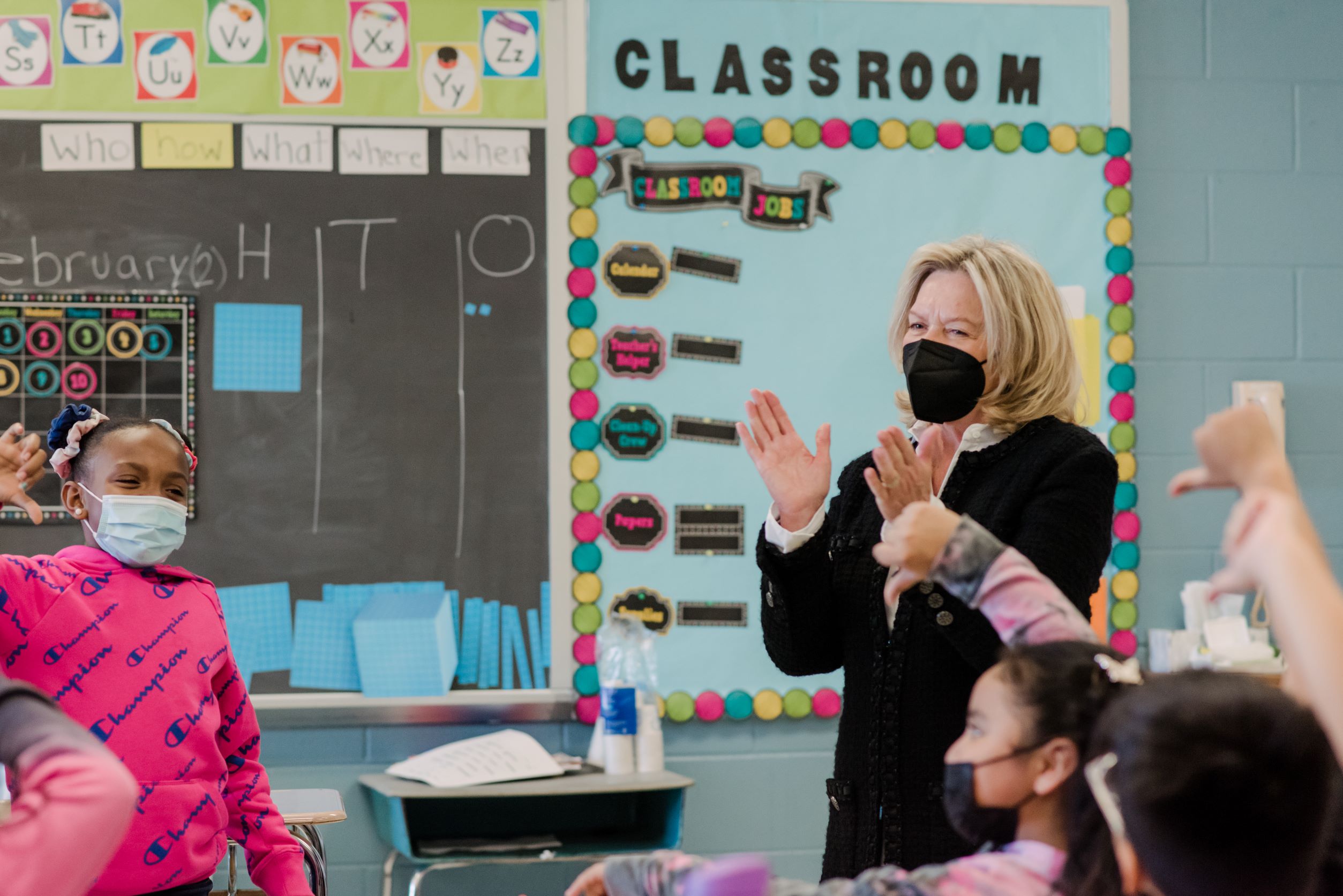
The largest gift in the history of UMBC—a $21 million donation from the Sherman Family Foundation—will dramatically expand the reach and impact of the university’s K-12 and early childhood education work. The transformational gift will provide funding to launch the Betsy & George Sherman Center as a national model to advance excellence in urban schools. This new center will expand and integrate UMBC’s work in teacher preparation, school partnerships, and applied research focused on early childhood education and improving learning outcomes for Baltimore’s students.
“If universities are to be major contributors to the development of society, they have to be involved with the schools and with neighborhoods and with communities,” says UMBC President Freeman Hrabowski. “Betsy and the Sherman Family Foundation have provided us with invaluable resources to make this collaborative work possible.”
“This gift represents a clear and bold commitment to developing teachers that can better support future generations of students in Baltimore City, especially in early learning and STEM,” said Sonja Brookins Santelises, chief executive officer of Baltimore City Public Schools. “It also expands the research partnership between City Schools and the university in ways that will further enhance teaching and learning in our community. We are excited about this next great step.”
Investing in education
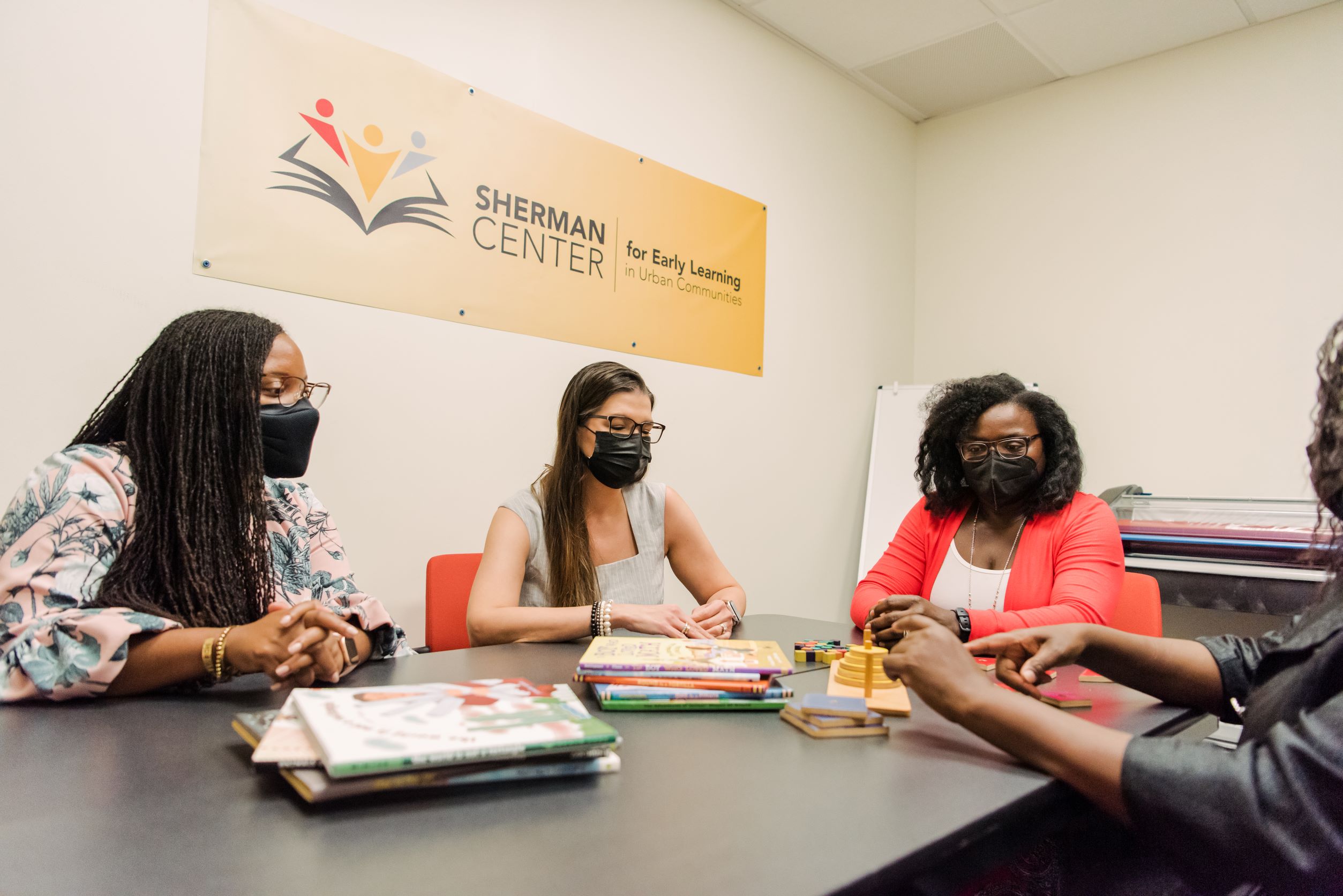
Prior gifts from the Sherman Family Foundation supported the launch of UMBC’s Sherman Center for Early Learning in Urban Communities as well as the Sherman STEM Teacher Scholars program, which prepares UMBC students as culturally responsive and compassionate STEM educators. The Betsy & George Sherman Center will include these programs and more.

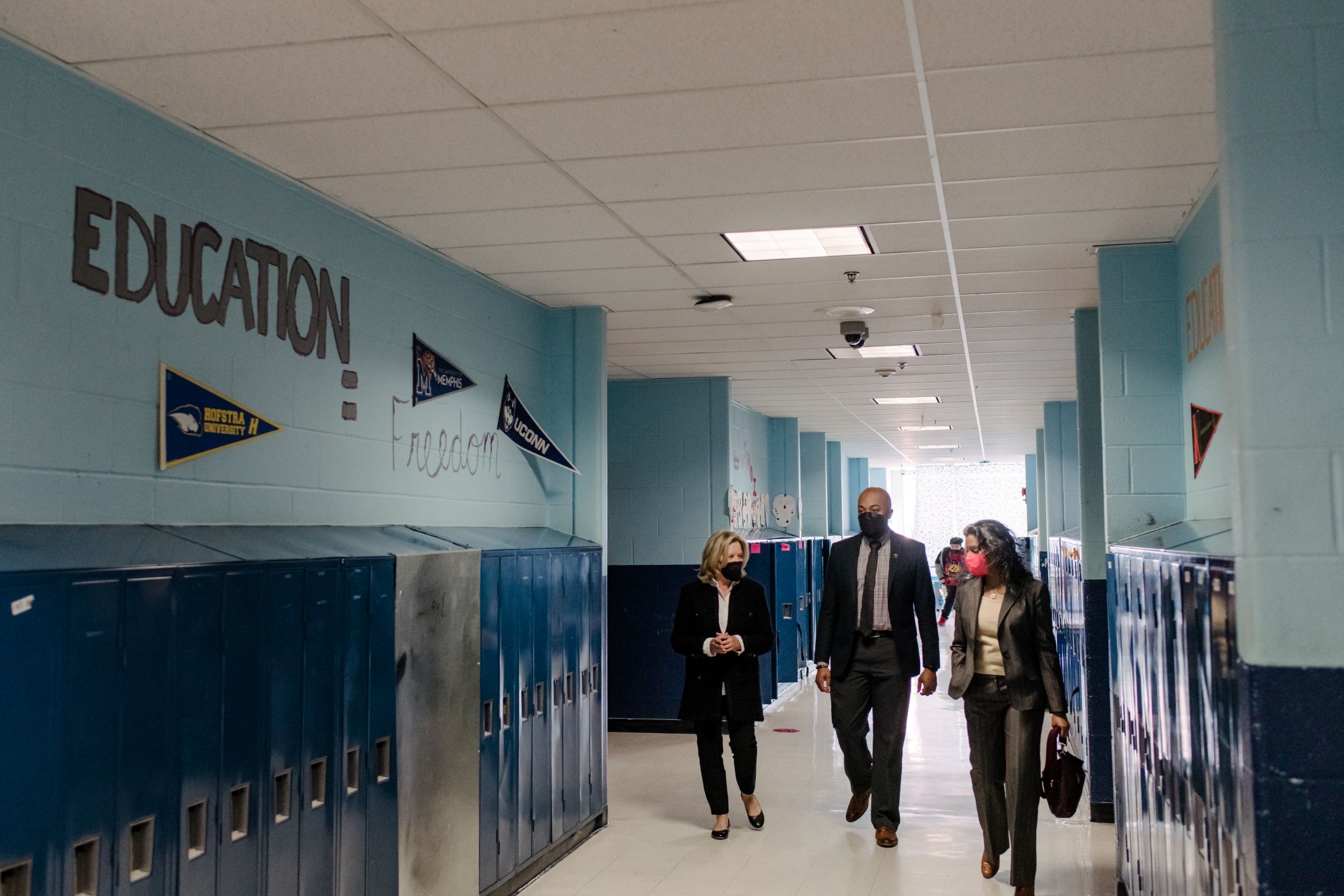
President Freeman Hrabowski and Betsy Sherman with students at Lakeland Elementary/Middle School.
Betsy and George Sherman’s philanthropy in STEM education has been inspired by Mrs. Sherman’s career in early childhood education and the late Mr. Sherman’s experience as an engineer and business leader. Their family foundation has now invested more than $38 million in UMBC’s education initiatives.
The Shermans have shared with UMBC a deep commitment to children’s equal access to high-quality education and a supportive community. “It is our job as the adults in the community to offer them an opportunity to grow in a way that will support them,” says Mrs. Sherman. “When a university is connected to a city, children thrive, families thrive.”

Betsy Sherman joins in a rhyming practice activity with students at Lakeland.
Meeting STEM needs
The Sherman STEM Teacher Scholars program, founded with the support of the Shermans in 2006, prepares UMBC undergraduate and graduate students from all majors to become highly qualified PreK-12 teachers with a focus on STEM education.
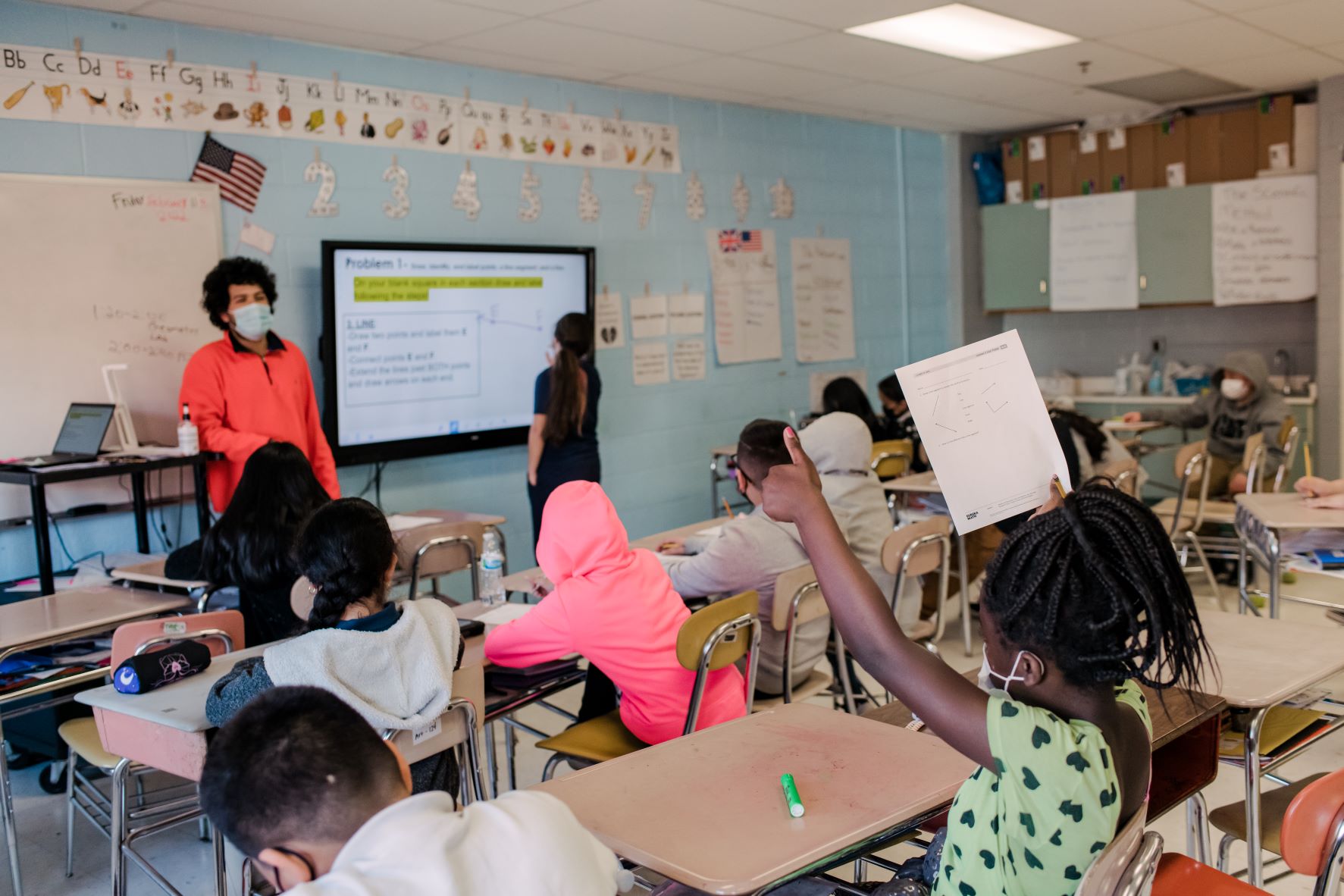
Lakeland Elementary/Middle School, in south Baltimore, was the first school to partner with UMBC through this program. Over the past decade, it has become a model of a full-service community school in Baltimore City. Among other exciting results, Lakeland now has a Community and STEAM Center, and the school has seen notable increases in students’ math test scores.
 Gustavo Sanabria
 ’22, American studies, and current Sherman Scholar, is completing a certificate in elementary education while serving as a long-term 4th-grade substitute teacher.
The Sherman Scholars program now partners with ten schools to promote academic achievement through professional development for teachers and intensive tutoring for students. For example, more than 90 UMBC students, including Sherman Scholars and others, provide evidence-based math tutoring for over 350 elementary and middle school students in several schools across Baltimore. Early data show this approach is working.
Moving the needle
Rehana Shafi, director of the Sherman Scholars program, remembers the program’s first steps with fondness. “It started off with an investment that we wanted to use to figure out, with the right sorts of support in place—teacher professional development, after school activities for kids, and community engagement—how could we really move the needle for Lakeland’s students and their families,” explains Shafi.
 (L-R) Betsy Sherman, with Corey Carter, and Rehana Shafi at Lakeland.
In 2021, the program graduated 22 scholars, 19 of whom are teaching in Baltimore City. Over the past 15 years (since 2007), the program has yielded 170 educators who are now teaching across the Baltimore region, the state of Maryland, and beyond, often in the most vulnerable school communities. An additional 20 conditionally certified teachers have been supported since 2020–educators meeting critical classroom needs while working to complete M.A.T. degrees.
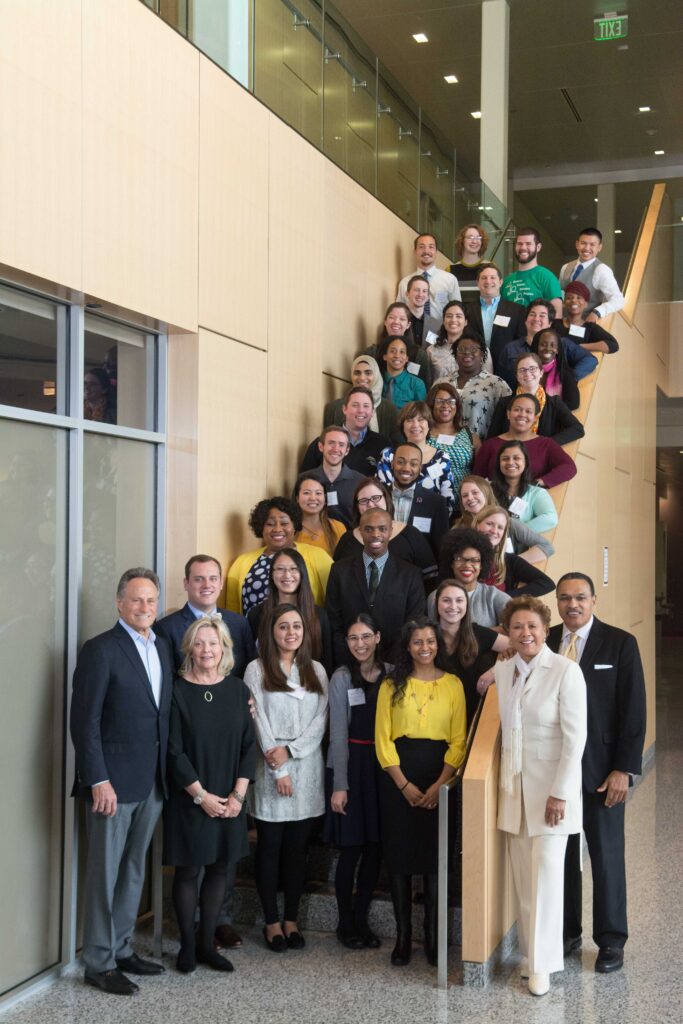
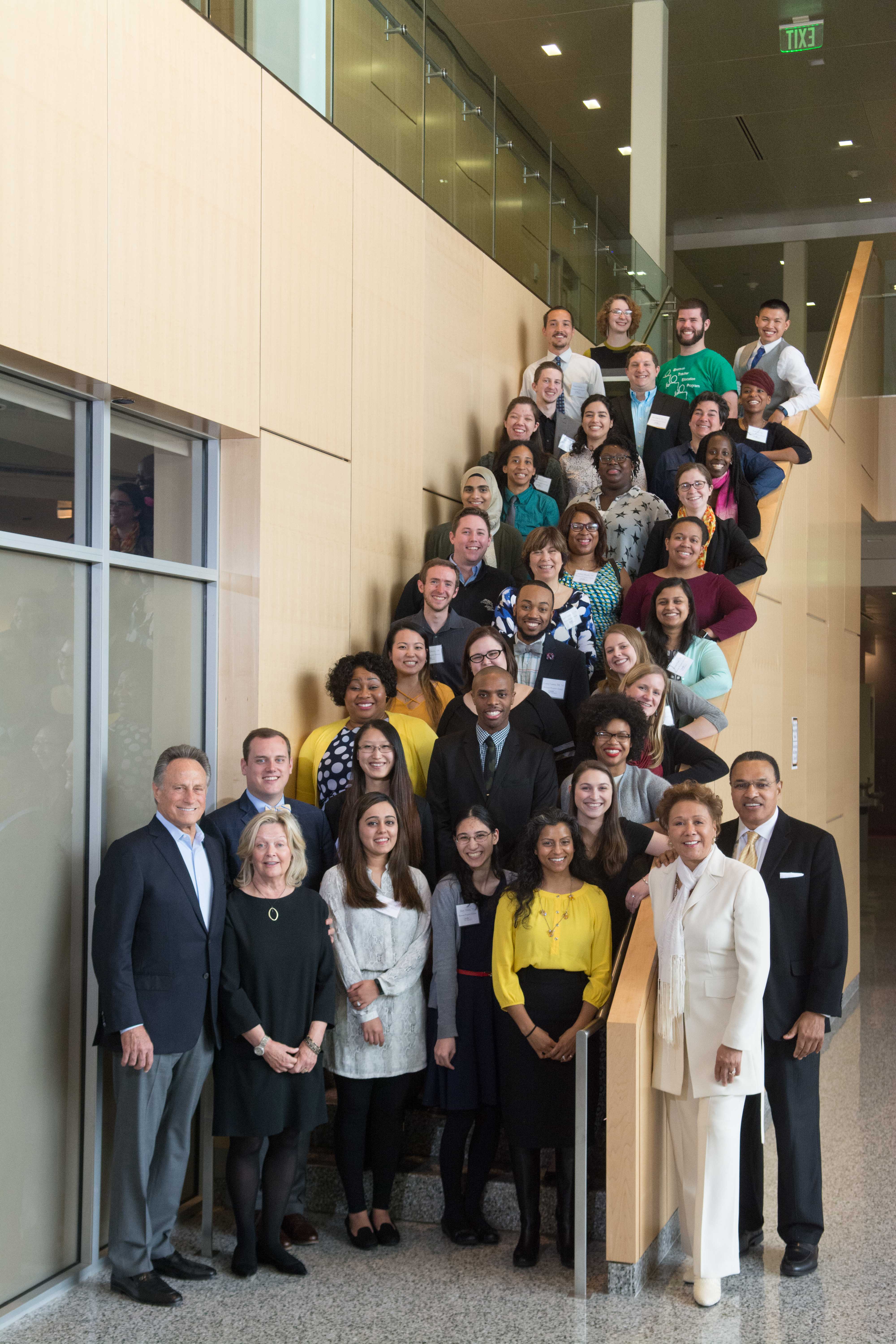
George and Betsy Sherman (front row, left) with President Freeman Hrabowski and Jacqueline Hrabowski (front row, right) next to Rehana Shafi (front row, in yellow) at the Sherman Scholars 10-year anniversary held on April 1, 2017.
More than a decade into the work, Shafi is proud of the strong collaborations that have developed. “Partnering with schools and with communities to walk together through the process of growth and dreaming and achieving…it’s what the work really is about,” she says.
Reflecting on this successful partnership model, she notes, “The work that we’re doing is ready to grow and expand, preparing even more teachers for classrooms across Maryland.”
Focus on early childhood
This new gift will also enable the expansion of UMBC’s early childhood programs. “I am excited to continue to grow our programming and further extend the impact and support for early childhood education,” shares Jennifer Mata-McMahon, director of the Sherman Center for Early Learning in Urban Communities and associate professor of early childhood education.

Lakeland community member at a Families, Libraries, and Early Literacy Project event.
In the last four years, the center has implemented four highly successful programs developed with and for teachers and families across five Baltimore City Schools: the Literacy Fellows Program in collaboration with UMBC’s Shriver Center, the Diverse Books Project, the Teacher Summer Institute, and the Families, Libraries, and Early Literacy Project. Hundreds of families have benefited from these programs.
UMBC’s students volunteer over 400 hundred hours a year in partner schools. Participating teachers receive research-based skill development and funding for teaching materials.
 Olivia Grimes
 ’19, individualized study, Sherman Scholar alum and former Sherman Center program assistant, at left, with a Lakeland family in 2020.
The center also invests in community-engaged early childhood research to evaluate learning interventions, academic growth, social-emotional wellbeing, behavioral outcomes, and education policy with faculty across the College of Arts, Humanities, and Social Sciences (CAHSS).
Through its annual Faculty Research Award program, the center provides funding for new research projects. Past recipients have studied topics like Judy Centers in Baltimore, reading interventions, and culture-based computational thinking in urban preschools. Prior awardees have shared with the public their high-impact community-engaged scholarship on different ways to teach kids to read and math skills to prepare children for kindergarten.
“The College remains inspired by the enduring commitment of the Sherman family to urban education. This gift affords CAHSS faculty with the resources needed to further education research and practice,” shares Kimberly Moffitt, interim dean of CAHSS and professor of language, literacy, and culture. She is thrilled that UMBC students will have even more opportunities to work with PreK-12 students throughout Baltimore who are “deserving of dedicated teachers who believe in their abilities and their aspirations for the future.”
“This gift lays out the charge and we stand ready to fulfill it,” says Moffitt.

(L -R)
Shana Rochester, the center’s assistant director and research associate,
with Mata-McMahon, and
Patricia Young, professor of education, and 2020 recipient of the Faculty Research Award.
Scaling and expanding programs
In addition to supporting research and classrooms directly, the center also advances the field by providing leadership development to early childhood educators across the state through the Maryland Early Childhood Leadership Program, which started its third cohort in 2021.
“The new funding will not only ensure the scaling of these programs, but also support new initiatives like Breathe2Think and the Sherman Center Research Conference,” says Mata-McMahon. She is leading the implementation of both programs to further support teachers’ well-being and develop teachers’ skills as action researchers.
“This is about sustainability over time and long-lasting impact in urban communities,” she says.
Full circle
The ripple effect of the Sherman family’s investment is beginning to come full circle. UMBC’s Sherman Scholar alumni are now teaching in Baltimore City classrooms and beyond, preparing the next generation of change-makers. And one scholar has returned to UMBC to share his on-the-ground experience with UMBC students just beginning their journey as future teachers.
Sherman Scholar alum Corey Carter ’08, biological sciences, ’10 M.A.T., taught in both Baltimore City and Baltimore County Public Schools after graduating from UMBC. In 2016, Baltimore County Public Schools honored him as Teacher of the Year. Seeking to expand his impact as an educator in a new way, he returned to UMBC to serve as assistant director of the Sherman Scholars program.

Corey Carter at Lakeland.
“I didn’t see myself in the classroom immediately when I came to UMBC,” says Carter. Without the Sherman STEM Teacher Scholars program, and the opportunities and guidance it provided, he isn’t sure that he would have found his way to the classroom. Now he sees the power of collaboration between universities and schools, fueled by philanthropy, to advance an education system truly centered around students and families.

Corey Carter leads a group activity at UMBC.
As Carter supports the work of the new Betsy & George Sherman Center, he’s excited to see it expand even further. “The impact that we all can bring when we come together to the table—with community, university, and school staff—is a really powerful example,” he says. “I look forward to building our vision together and seeing this energy and momentum spread throughout Baltimore.”
Banner image: Betsy Sherman at Lakeland Elementary/Middle School. All photos by Marlayna Demond ’11 for UMBC.
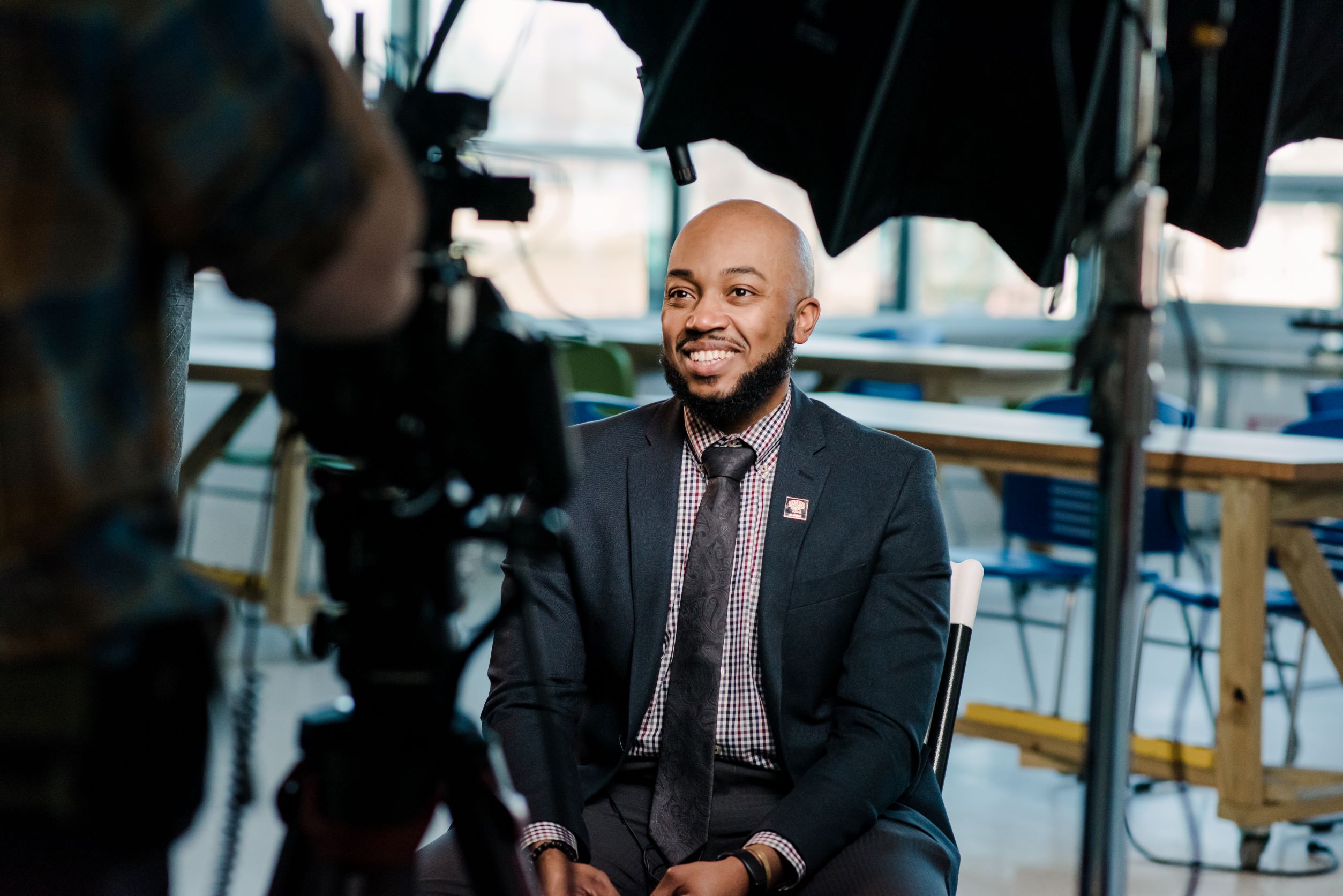
Video by Corey Jennings ’10 for UMBC.
]]>
The largest gift in the history of UMBC—a $21 million donation from the Sherman Family Foundation—will dramatically expand the reach and impact of the university’s K-12 and early childhood...
https://umbc.edu/stories/21m-sherman-family-foundation-gift-supports-umbcs-bold-commitment-to-prek-12-research-teaching-and-learning/
https://beta.my.umbc.edu/api/v0/pixel/news/119472/guest@my.umbc.edu/1b98fc95d8c7d959b99db46c024c3543/api/pixel
americanstudies
biology
cahss
community
education
inds
news
page1
science-and-tech
shermancenter
shermanscholars
UMBC News & Magazine
https://beta.my.umbc.edu/groups/umbc-news-magazine
https://assets1-beta.my.umbc.edu/system/shared/avatars/groups/000/001/943/24435aa6207c452e7bc15cc74b42c7bb/xsmall.png?1748556657
https://assets1-beta.my.umbc.edu/system/shared/avatars/groups/000/001/943/24435aa6207c452e7bc15cc74b42c7bb/original.png?1748556657
https://assets2-beta.my.umbc.edu/system/shared/avatars/groups/000/001/943/24435aa6207c452e7bc15cc74b42c7bb/xxlarge.png?1748556657
https://assets2-beta.my.umbc.edu/system/shared/avatars/groups/000/001/943/24435aa6207c452e7bc15cc74b42c7bb/xlarge.png?1748556657
https://assets3-beta.my.umbc.edu/system/shared/avatars/groups/000/001/943/24435aa6207c452e7bc15cc74b42c7bb/large.png?1748556657
https://assets1-beta.my.umbc.edu/system/shared/avatars/groups/000/001/943/24435aa6207c452e7bc15cc74b42c7bb/medium.png?1748556657
https://assets2-beta.my.umbc.edu/system/shared/avatars/groups/000/001/943/24435aa6207c452e7bc15cc74b42c7bb/small.png?1748556657
https://assets1-beta.my.umbc.edu/system/shared/avatars/groups/000/001/943/24435aa6207c452e7bc15cc74b42c7bb/xsmall.png?1748556657
https://assets2-beta.my.umbc.edu/system/shared/avatars/groups/000/001/943/24435aa6207c452e7bc15cc74b42c7bb/xxsmall.png?1748556657
UMBC News & Magazine
0
0
false
Thu, 24 Feb 2022 18:00:09 -0500
One-on-one: A conversation about UMBC’s global community

Praise Lasekan ‘25 checked off two major items from his to-do list this academic year: he traveled over 6,000 miles from Nigeria to the U.S. for the first time and he became a Retriever.
Lasekan’s cousin encouraged him to include UMBC on his list of top U.S. colleges to consider, and he was thrilled by what he saw. His decision was easy, he says. At UMBC he could study at the U.S. university of his choice, with the added bonus of living with some of his Nigerian family in Baltimore, home to an active Nigerian community.

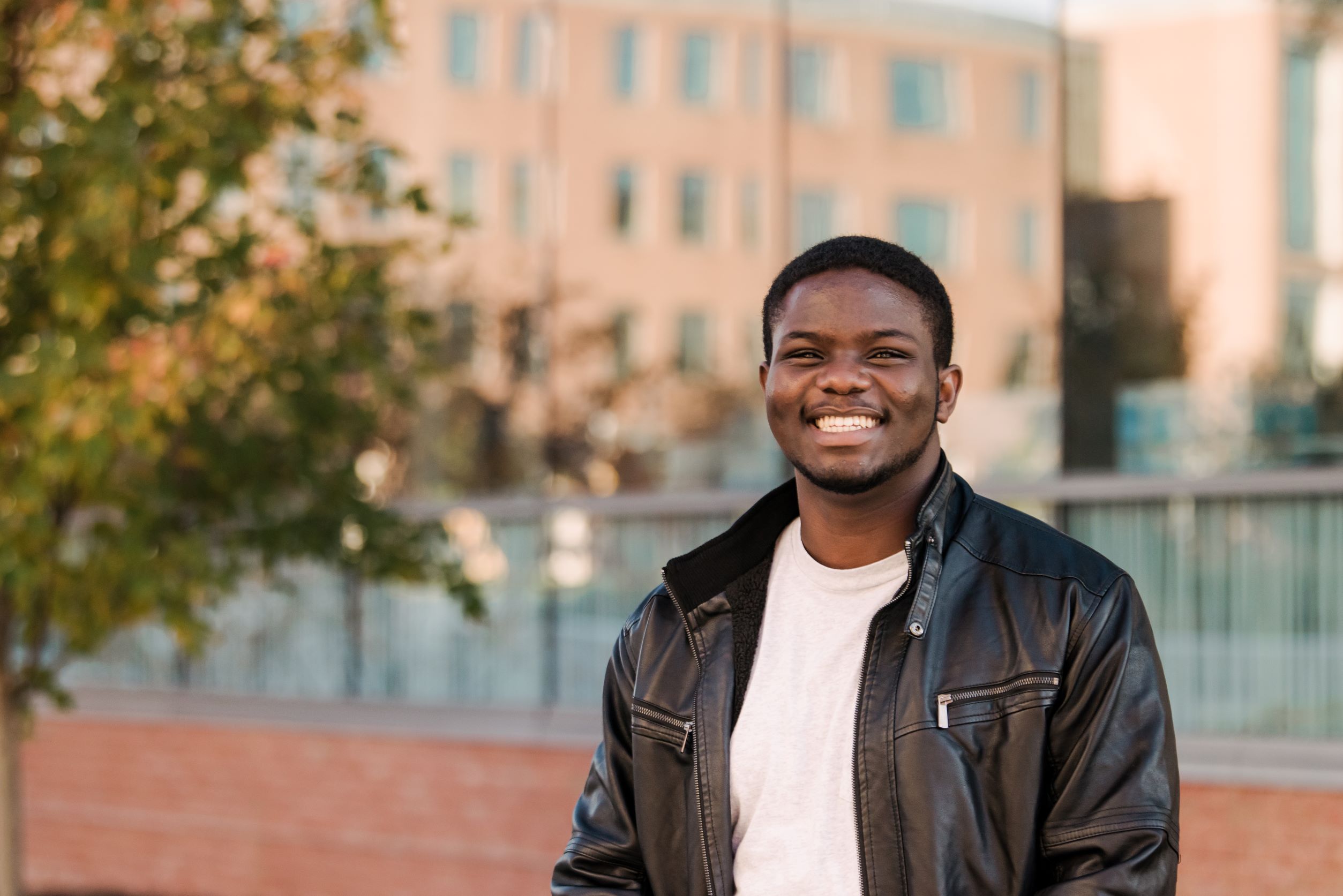
Praise Lasekan
A few months prior to Lasekan’s arrival at UMBC, Adam Julian moved to Baltimore from North Carolina to join UMBC’s new Center for Global Engagement (CGE). He serves as director of international student and scholar services at the Center, which is the first point of contact for over 1,000 international students at UMBC. CGE provides support and advising on everything from the visa process and travel to enrolling in classes and accessing campus resources.
 Adam Julian
Lasekan and Julian met through the Center for Global Engagement, and UMBC News brought them together for a conversation about their first year at UMBC.
A conversation with Adam and Praise
Adam: Praise, why did you choose UMBC?
Praise: What really caught my attention is the way UMBC loves undergraduates participating in research, which is something of importance to me. I also saw that UMBC actually accepts Black people. I read in an article that UMBC graduates the most Black students in the sciences that go on to get a Ph.D.
Praise: And why did you choose to come to UMBC?
Adam: I came to UMBC because of the opportunity that’s here for international education. Over the last couple of years UMBC has undergone a process of aligning its global education goals and broader university-wide goals. I was looking for an opportunity to be a part of something that’s really growing and developing. I wanted a chance to help build and grow CGE.
Adam: What are you hoping to do in your first year, in your second year?
Praise: In my first year I want to learn about the environment, learn how things run, and explore majors that interest me. Then, for my second year, when I see research that really interests me, I’ll speak to the professor. I like that, at UMBC, if I like something that the professor is teaching, I can ask them questions and do research on it. This is the first time I’ve had professors who welcome questions.

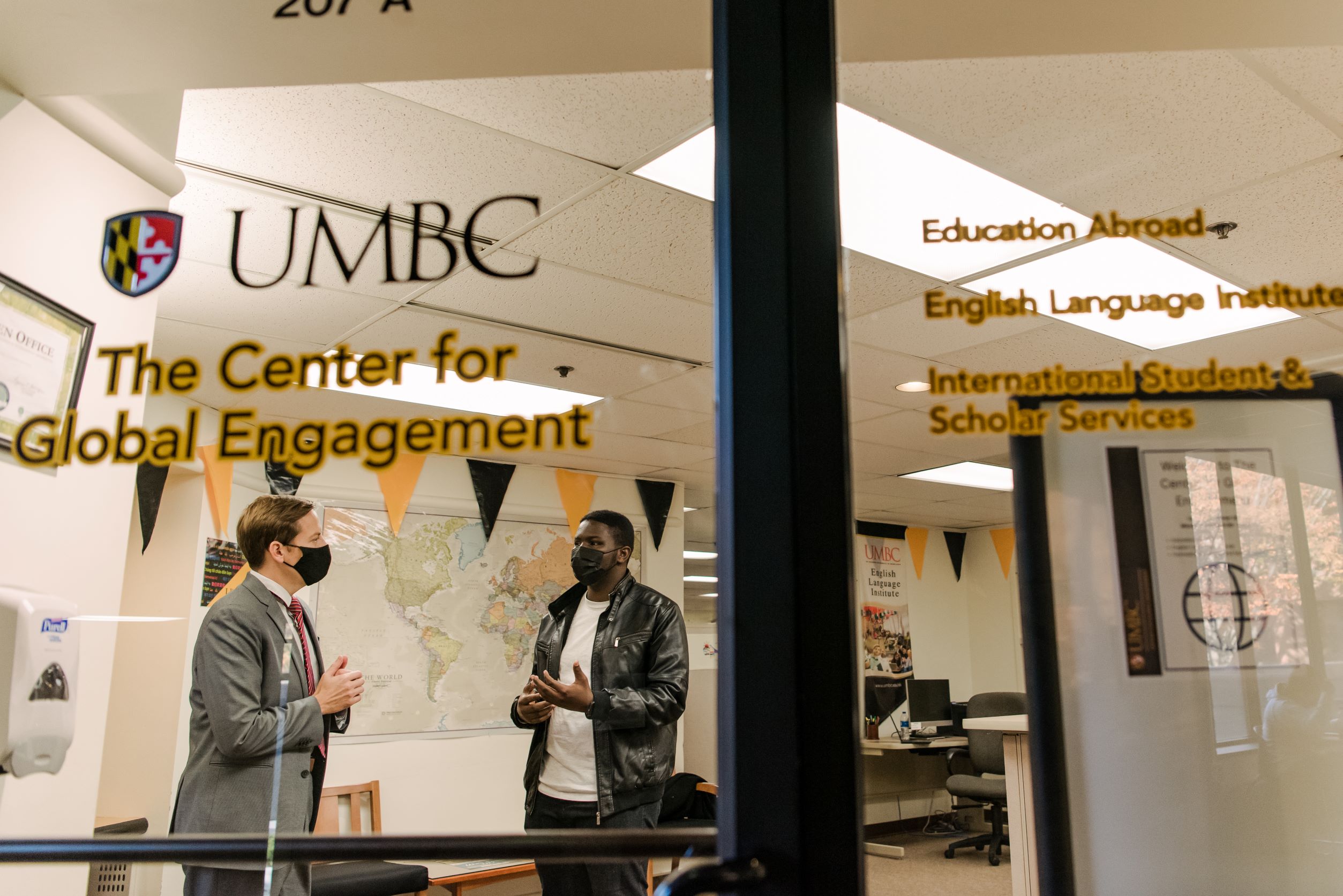
Julian (l) and Lasekan (r)
Adam: What are some of your goals around research?
Praise: I’d love to learn the process. I went to a secondary school that had a very investigative environment. I saw people perform different experiments, but I didn’t really understand it until I participated in one and then I fell in love with research as a way to address the world’s problems.
Praise: What have you enjoyed most so far in your time at UMBC?
Adam: Having the opportunity to work with students like you in their journey, and ultimately lead to a better world, is what gets me up in the morning. I think UMBC is a great place to have more opportunities to do that.
Praise: Are there any special people involved in all this who help you along your journey?
Adam: Yes, from senior leadership on down, the Center for Global Engagement has the support of the campus community. In particular, we have a lot of different student organizations that are really an essential part of creating a community for international students. What we have here at UMBC is a network of people who are here to help each other achieve their personal, professional, and academic goals. It’s special.
Adam: What are your impressions of the United States? Have you been before? What’s different than you thought it would be? What surprised you?
Praise: Actually, this is my first time in the United States. I’ve been in Nigeria my whole life. I’m a born and bred Nigerian. I think movies made me think that the U.S. would be a very different place. I got here and saw that the sky is still the same as in Nigeria, but the way things run is quite different. I’m still a young man, so it’s very easy to adapt. That’s the main reason why I’m here: to learn.
A hub for global connections
The CGE serves as a hub for students, faculty, and staff who are interested in engaging with the world. Through partnership with the Division of Professional Studies, UMBC’s English Language Institute became a part of the CGE, making it a one-stop shop for international students. Additionally, the CGE’s U.S. Fulbright Program and Education Abroad programs, which resumed this January after a pause during COVID-19, offer UMBC students, faculty, and staff special and rigorous opportunities for learning, research, and engagement experiences on nearly every continent.
Even with the challenges that COVID-19 presents, the CGE continues to provide support to help UMBC students access global learning opportunities.
Over the past few years, the CGE has partnered with other campus leaders to help UMBC grow its global connections as a strategic priority. In November 2021, the Association of Public Land-Grant Universities (APLU) recognized this work, honoring UMBC with its Gold Award in Leadership and Pervasiveness for Internationalization.
The Education Abroad office will hold its next Study Abroad 101 online session on February 21, 2022. The CGE is located at UMBC’s University Center, Room 207.
Header image: and Praise Lasekan (L) and Adam Julian inside the UMBC Commons. All photos by Marlayna Demond ’11 for UMBC.
]]>
Praise Lasekan ‘25 checked off two major items from his to-do list this academic year: he traveled over 6,000 miles from Nigeria to the U.S. for the first time and he became a Retriever....
https://umbc.edu/stories/one-on-one-a-conversation-about-umbcs-global-community/
https://beta.my.umbc.edu/api/v0/pixel/news/119473/guest@my.umbc.edu/312e95e57352a0298308880c8605548e/api/pixel
cge
community
international
majoraward
news
page1
UMBC News & Magazine
https://beta.my.umbc.edu/groups/umbc-news-magazine
https://assets1-beta.my.umbc.edu/system/shared/avatars/groups/000/001/943/24435aa6207c452e7bc15cc74b42c7bb/xsmall.png?1748556657
https://assets1-beta.my.umbc.edu/system/shared/avatars/groups/000/001/943/24435aa6207c452e7bc15cc74b42c7bb/original.png?1748556657
https://assets2-beta.my.umbc.edu/system/shared/avatars/groups/000/001/943/24435aa6207c452e7bc15cc74b42c7bb/xxlarge.png?1748556657
https://assets2-beta.my.umbc.edu/system/shared/avatars/groups/000/001/943/24435aa6207c452e7bc15cc74b42c7bb/xlarge.png?1748556657
https://assets3-beta.my.umbc.edu/system/shared/avatars/groups/000/001/943/24435aa6207c452e7bc15cc74b42c7bb/large.png?1748556657
https://assets1-beta.my.umbc.edu/system/shared/avatars/groups/000/001/943/24435aa6207c452e7bc15cc74b42c7bb/medium.png?1748556657
https://assets2-beta.my.umbc.edu/system/shared/avatars/groups/000/001/943/24435aa6207c452e7bc15cc74b42c7bb/small.png?1748556657
https://assets1-beta.my.umbc.edu/system/shared/avatars/groups/000/001/943/24435aa6207c452e7bc15cc74b42c7bb/xsmall.png?1748556657
https://assets2-beta.my.umbc.edu/system/shared/avatars/groups/000/001/943/24435aa6207c452e7bc15cc74b42c7bb/xxsmall.png?1748556657
UMBC News & Magazine
0
0
false
Fri, 18 Feb 2022 18:29:31 -0500
UMBC men’s swimming and diving recaptures America East 2022 Championship

For those who insist 13 is an unlucky number, UMBC men’s swimming and diving is here to prove otherwise. Last weekend, the Retrievers reclaimed the 2022 America East Championship title to win their 13th championship out of 15 appearances.
Four days of intense battle at Worcester Polytechnic Institute (WPI) in Massachusetts culminated in a sweep of the men’s six events in the final day of competition. After narrowly falling to Binghamton for the championship last year, the Retrievers posted 921.5 total points to runner-up Binghamton’s 874.5.
UMBC women’s swimming and diving earned second place at their championship meet.
Collecting hardware
Niklas Weigelt ‘23, economics, reclaimed the meet’s Outstanding Swimmer award for the second year in a row.
“I’m very proud to be part of this program,” says Weigelt. “The progress we’ve made in the past year is unbelievable. The team came together to make the 2022 championships one to remember.”
 Weigelt poses with the America East Outstanding Swimmer plaque.
Oliver Gassmann ‘25, undergraduate studies, earned Outstanding Rookie honors in his first year of competition. Luka Zuric ‘22, statistics, closed out his senior year with the David Alexander Coaches’ award for most points earned over four league championship meets.
UMBC women’s team just missed their championship win, ultimately coming in second place with 752.5 points. Caroline Sargent ‘22, psychology, earned the Outstanding Swimmer award and captured the 200 backstroke, posting the only women’s meet record to be broken in the championships.
 Feb. 13, 2022; Worcester, Massachusetts, USA; during the 2022 America East Swimming Championship at the WPI Sports and Recreation Center. Photo by Brian Foley for Foley-Photography.com.
“I am very honored and excited to be named Swimmer of the Meet,” says Sargent. “I’m really grateful for my teammates and coaches for pushing me and I can’t wait to see what comes next.”
Coaching honors
With a short tenure but a big impact, head coach Matt Donovan and his staff collected men’s Coaching Staff of the Year honors. Despite this only being Donovan’s second season at the helm, the crew also took home the Coaching Staff of the Meet award in December during the Eastern College Athletic Conference (ECAC) 2021 Winter Championships.
“Since the end of last year’s championship, this men’s team has had one singular focus,” says Donovan. “It was very impressive to see how focused they’ve remained over this past year. We’ve had our share of ups and downs but they never wavered from their ultimate goal. It was truly an impressive feat.”
Read more UMBC Athletics news at umbcretrievers.com.
Header image: The UMBC men’s swimming and diving team celebrates their America East Championship win. All photos courtesy of the America East Conference. Author contributions by Steve Levy, associate athletics director.
]]>
For those who insist 13 is an unlucky number, UMBC men’s swimming and diving is here to prove otherwise. Last weekend, the Retrievers reclaimed the 2022 America East Championship title to win...
https://umbc.edu/stories/umbc-mens-swimming-and-diving-recaptures-america-east-2022-championship/
https://beta.my.umbc.edu/api/v0/pixel/news/119474/guest@my.umbc.edu/998b1bce3c3188c0d0b68d8def2db88d/api/pixel
athletics
community
news
UMBC News & Magazine
https://beta.my.umbc.edu/groups/umbc-news-magazine
https://assets1-beta.my.umbc.edu/system/shared/avatars/groups/000/001/943/24435aa6207c452e7bc15cc74b42c7bb/xsmall.png?1748556657
https://assets1-beta.my.umbc.edu/system/shared/avatars/groups/000/001/943/24435aa6207c452e7bc15cc74b42c7bb/original.png?1748556657
https://assets2-beta.my.umbc.edu/system/shared/avatars/groups/000/001/943/24435aa6207c452e7bc15cc74b42c7bb/xxlarge.png?1748556657
https://assets2-beta.my.umbc.edu/system/shared/avatars/groups/000/001/943/24435aa6207c452e7bc15cc74b42c7bb/xlarge.png?1748556657
https://assets3-beta.my.umbc.edu/system/shared/avatars/groups/000/001/943/24435aa6207c452e7bc15cc74b42c7bb/large.png?1748556657
https://assets1-beta.my.umbc.edu/system/shared/avatars/groups/000/001/943/24435aa6207c452e7bc15cc74b42c7bb/medium.png?1748556657
https://assets2-beta.my.umbc.edu/system/shared/avatars/groups/000/001/943/24435aa6207c452e7bc15cc74b42c7bb/small.png?1748556657
https://assets1-beta.my.umbc.edu/system/shared/avatars/groups/000/001/943/24435aa6207c452e7bc15cc74b42c7bb/xsmall.png?1748556657
https://assets2-beta.my.umbc.edu/system/shared/avatars/groups/000/001/943/24435aa6207c452e7bc15cc74b42c7bb/xxsmall.png?1748556657
UMBC News & Magazine
0
0
false
Tue, 15 Feb 2022 19:21:16 -0500
The Spirit of Giving

With the newly surging pandemic in 2020, UMBC’s Stay Black and Gold Emergency Fund quickly became a strong source of financial assistance for students and families in need. Poulomi Banerjee ’16, M.P.P. ’21, recalls the moment during last year’s Black & Gold Rush Giving Day when all U.S. states and territories made a donation to UMBC.
Banerjee was just in her first year as the assistant director of Annual Giving when she witnessed firsthand the impact giving could have on students. The 2,782 people who generously donated that year were a testament to that fact. Although the year had also been challenging for her, Banerjee saw that everything she had gone through to plan UMBC’s giving day was worth it to plan and experience something so unforgettable.
“It’s really nice seeing the number of donors keep increasing year after year…It means that people are really invested in the community and they believe in UMBC, and that in turn helps me believe in the university more as well,” Banerjee says.
A Retriever foundation
Outside of yearly Black & Gold Rush activities, people in the UMBC community often give back to the university by donating to programs and scholarships they believe in. Through her role in UMBC’s Annual Giving office, Banerjee embodies the spirit of giving and paving the way for growth at UMBC.
After receiving a bachelor’s in health administration and policy in 2016, Banerjee decided to stay at UMBC to pursue a master’s in public policy while working as the development and alumni coordinator in the university’s Office of Institutional Advancement (OIA). Just before finishing her master’s degree in May 2021, she took on her new position in OIA. As a current Ph.D. student in public policy, Banerjee has to balance both her student and leadership roles at UMBC.
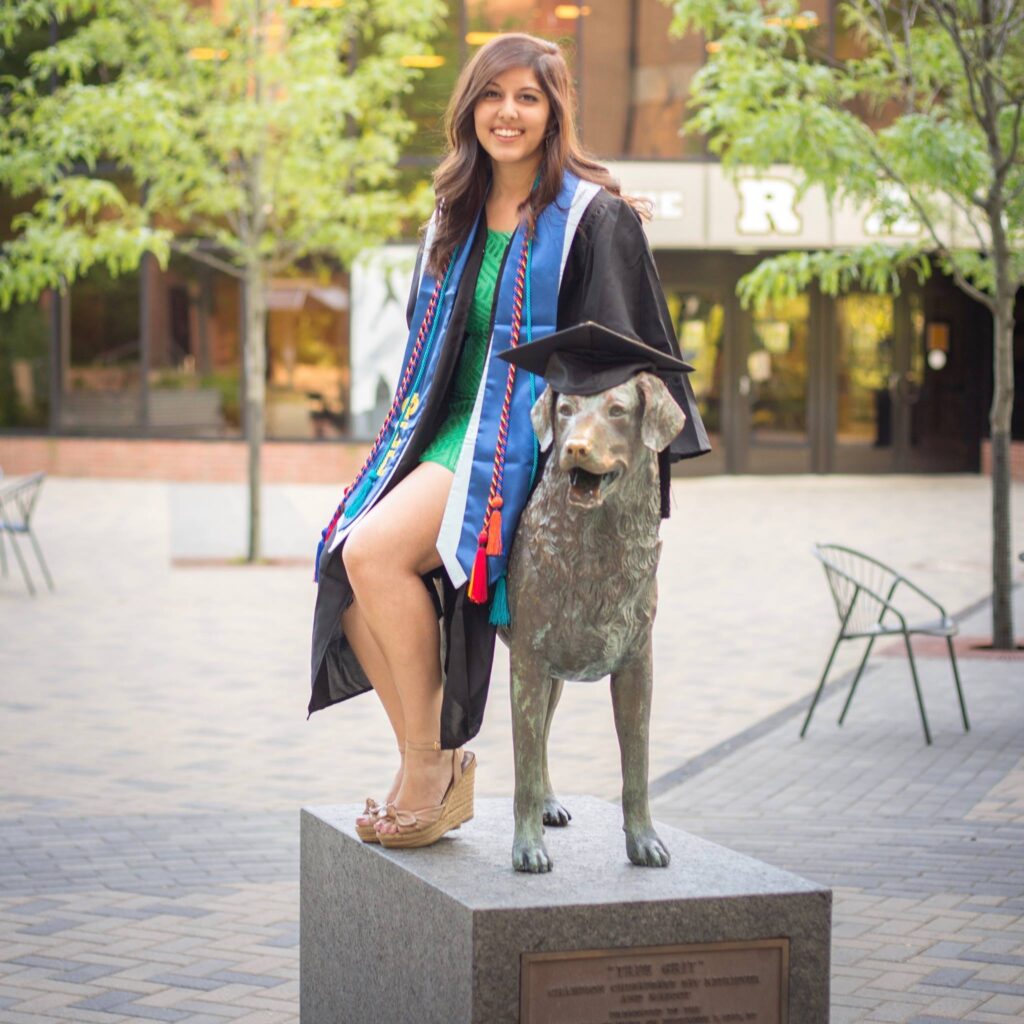
 Banerjee celebrates her undergraduate commencement (left, photo courtesy of Banerjee) and her master’s graduation (right).
“It’s so hard to wrap my mind around how incredible UMBC is going to be in fifty more years knowing how incredible it is now. It might be unusual to have three degrees from one school, but I wouldn’t change anything,” says Banerjee.
Staying at UMBC after her undergraduate studies ignited Banerjee’s love for the institution and helped cultivate her passion for public policy and its applications to the nonprofit world. Her commitment to community engagement first began in high school, when she founded a service learning program for high schoolers to engage in conversations about healthy relationships. During an internship in college, Banerjee took the opportunity to oversee the same program. From there, she knew she was passionate about connecting to people in the UMBC community. Developing the necessary leadership skills to do so was just the first step.
While Banerjee attended the SGA-led leadership retreat, STRiVE, during her undergraduate years, she befriended people who taught her how she could make change on both the community and university level. Through her participation and leadership in clubs such as seb and SGA, Banerjee eventually discovered OIA and learned about ways she could contribute to the university as an alumna.
In her first OIA position as the development and alumni coordinator, Banerjee planned alumni receptions across the country and, after her first year in the role, created a plan to turn the events into what is now the RetriEVER Grateful Tour. When Banerjee joined the Chapter of Young Alumni and eventually stepped into the role of vice president, she ran the chapter’s social media account and helped oversee event planning for the chapter’s annual Wine Tasting & Silent Auction fundraiser, a networking event for alumni to reconnect with others in the Baltimore community.
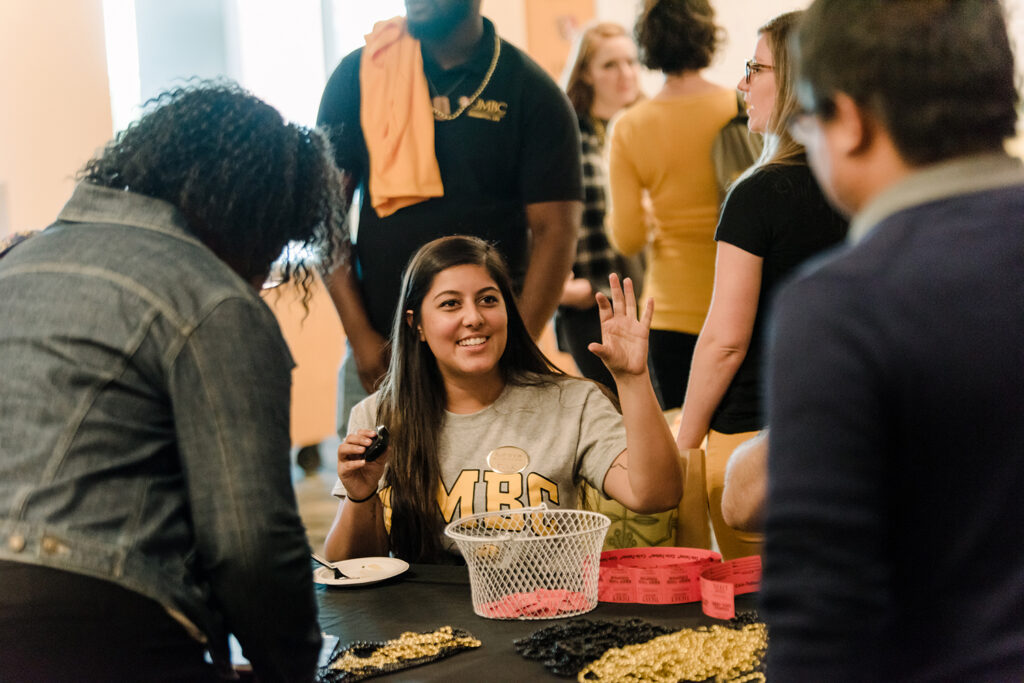
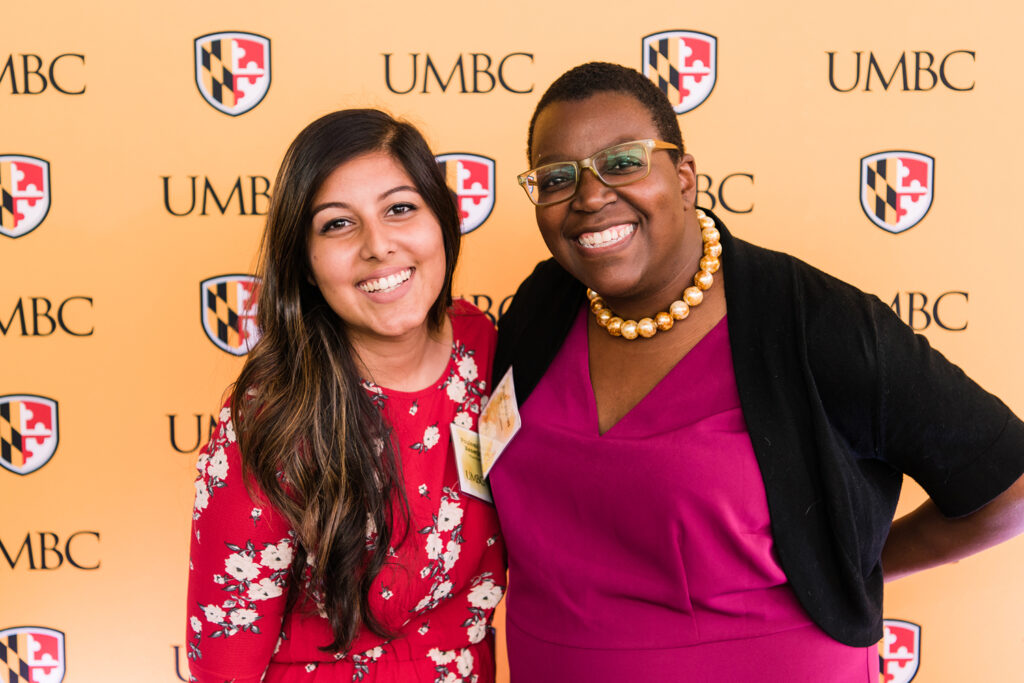
 Banerjee at different campus events in her OIA roles.
Through these previous experiences with working with and for alumni, Banerjee has learned the importance of networking—a skill that she still finds crucial in her current role involving alumni engagement and fundraising.
Making a tangible impact
Banerjee’s work as assistant director of Annual Giving involves supporting campus communities through fundraising, including crowdfunding and other forms of student organization fundraising. She interacts with students to help them figure out their organization’s goals, determine how much money is needed to support their endeavors, and brainstorm ways to raise the money.
Although the task of asking for financial support is not always an easy one, Banerjee mentions that her own background as a student has equipped her with a helpful perspective when reaching out to people in the UMBC community.
“I feel like donations are everyone’s biggest fear when they graduate. They don’t want to hear from me and they don’t want to be asked for money. And I get it—I graduated with loans from UMBC…so when someone emails me back saying ‘I have loans, I can’t give,’ I totally understand. And it’s really helpful for me to talk to them from that perspective,” says Banerjee.
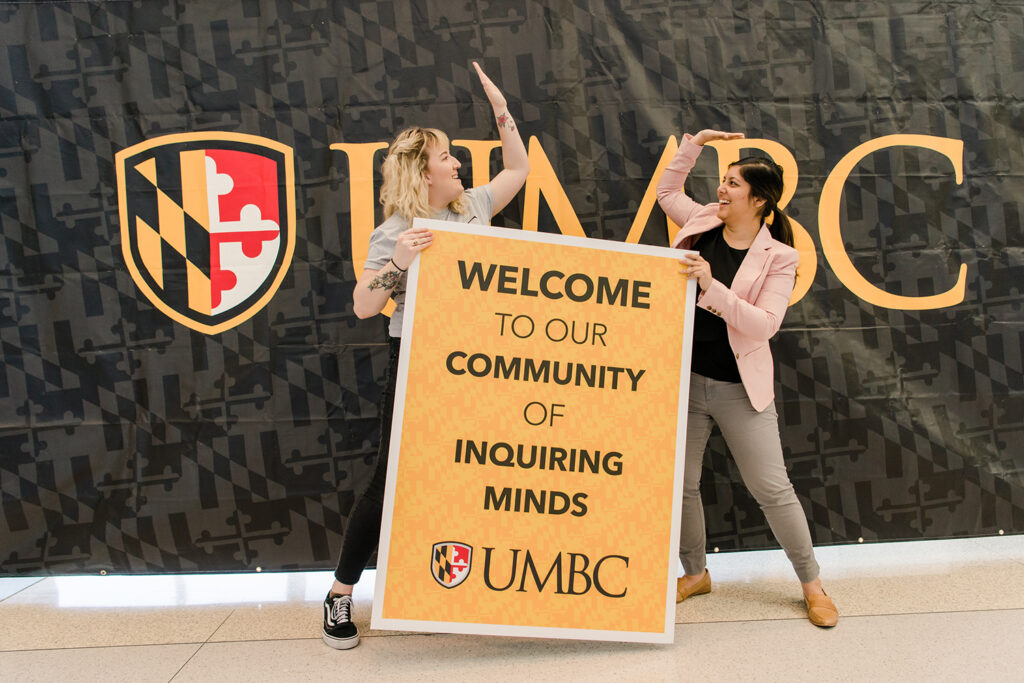 Banerjee with her friend and fellow alumna Emma Muccioli ’14, media and communication studies.
For every person who is able to make a contribution, Banerjee and her colleagues make an active effort to stay connected with them and remain transparent about where their donations are going. During Black & Gold Rush activities, for example, people can make online donations to programs or communities they want to see grow.
“It’s an honor when people do give us their philanthropy, and we have the responsibility to help them know how those dollars are working,” says Greg Simmons, M.P.P. ’04, vice president for Institutional Advancement and someone who Banerjee considers a mentor.
 Headshot of Simmons
Tackling a whole new world
Taking on a new role would have been a daunting task for many, but Banerjee dove head first into the unknown. While noting that she didn’t have much fundraising experience prior to the position, she brought up how Simmons believed in her abilities to lead.
“When I asked her to take the role she’s taking now, it was clear to me that everything that everybody had said about her was true,” says Simmons, who has worked at UMBC for more than 25 years. “She was incredibly smart and a fast learner…She throws herself into the work and is not afraid to ask questions. She has a passion for this place, which is so exciting. She tells you the truth, even if it’s sometimes hard for her. And I think the last thing is that she’s got this extraordinary optimism. She’s a realist, but she sees what’s possible with things.”
Simmons is not alone in his praise of Banerjee’s skillset. After her outstanding work with the Stay Black & Gold Emergency Fund in 2020 and 2021—from creating applications for students during the pandemic to overseeing the application reviewal and awarding process—she was awarded the 2022 Rising Star Award this spring for the Council for Advancement and Support of Education (CASE) in the mid-Atlantic district. This award is given to professionals who exhibit leadership potential in various areas including philanthropy and alumni relations.
Simmons adds that Banerjee’s dedication took center stage during Black & Gold Rush in 2021. From navigating a different technology platform, scaling and communicating the program, and making sure people could easily make contributions online, Banerjee played a pivotal role in getting the fund off the ground on a hard and fast deadline.
The gift of giving marches on
This year, Black & Gold Rush will take place for 36 hours spanning February 16 to 17. In celebration of President Freeman Hrabowski’s retirement from and commitment to UMBC, Black & Gold Rush will feature a new initiative, the Freeman A. Hrawboski, III, Endowment for Student Excellence fund.
“The great thing about Black & Gold Rush is that it is not about how big the gift is. It’s about how many people are involved. So you don’t need to make a $500 gift to make an impact. You can make a $10 gift and still make an impact,” notes Banerjee.
 Banerjee at the 2019 Giving Day event.
Moving forward, Banerjee has high hopes for the future of UMBC and is thrilled to take her skills and connections to wherever she may go next. With a particular interest in the nonprofit world, Banerjee is excited to see how she can continue building on what she’s learned as a three-degree Retriever.
“I feel like UMBC helped me get to the point where I will have several doors open for me when I finish this last degree, and I’m going to figure out what that means for me when I’m there,” Banerjee says.
“Poulomi is gaining skills and tools through the things she’s doing, but she’s already got all the ability and wisdom that she needs to be successful in a whole range of opportunities in the future,” says Simmons. “So I can’t wait to watch and see where she ends up.”
******
All photos by Marlayna Demond ’11, unless otherwise noted.
]]>
With the newly surging pandemic in 2020, UMBC’s Stay Black and Gold Emergency Fund quickly became a strong source of financial assistance for students and families in need. Poulomi Banerjee ’16,...
https://umbc.edu/stories/the-spirit-of-giving-2/
https://beta.my.umbc.edu/api/v0/pixel/news/119475/guest@my.umbc.edu/5dd341461e22edfb29ef60aadc69724e/api/pixel
alumni
blackandgoldrush
giving-day
happ
m-p-p
magazine
UMBC News & Magazine
https://beta.my.umbc.edu/groups/umbc-news-magazine
https://assets1-beta.my.umbc.edu/system/shared/avatars/groups/000/001/943/24435aa6207c452e7bc15cc74b42c7bb/xsmall.png?1748556657
https://assets1-beta.my.umbc.edu/system/shared/avatars/groups/000/001/943/24435aa6207c452e7bc15cc74b42c7bb/original.png?1748556657
https://assets2-beta.my.umbc.edu/system/shared/avatars/groups/000/001/943/24435aa6207c452e7bc15cc74b42c7bb/xxlarge.png?1748556657
https://assets2-beta.my.umbc.edu/system/shared/avatars/groups/000/001/943/24435aa6207c452e7bc15cc74b42c7bb/xlarge.png?1748556657
https://assets3-beta.my.umbc.edu/system/shared/avatars/groups/000/001/943/24435aa6207c452e7bc15cc74b42c7bb/large.png?1748556657
https://assets1-beta.my.umbc.edu/system/shared/avatars/groups/000/001/943/24435aa6207c452e7bc15cc74b42c7bb/medium.png?1748556657
https://assets2-beta.my.umbc.edu/system/shared/avatars/groups/000/001/943/24435aa6207c452e7bc15cc74b42c7bb/small.png?1748556657
https://assets1-beta.my.umbc.edu/system/shared/avatars/groups/000/001/943/24435aa6207c452e7bc15cc74b42c7bb/xsmall.png?1748556657
https://assets2-beta.my.umbc.edu/system/shared/avatars/groups/000/001/943/24435aa6207c452e7bc15cc74b42c7bb/xxsmall.png?1748556657
UMBC News & Magazine
0
0
false
Mon, 14 Feb 2022 21:48:15 -0500
Mon, 14 Feb 2022 21:48:15 -0500
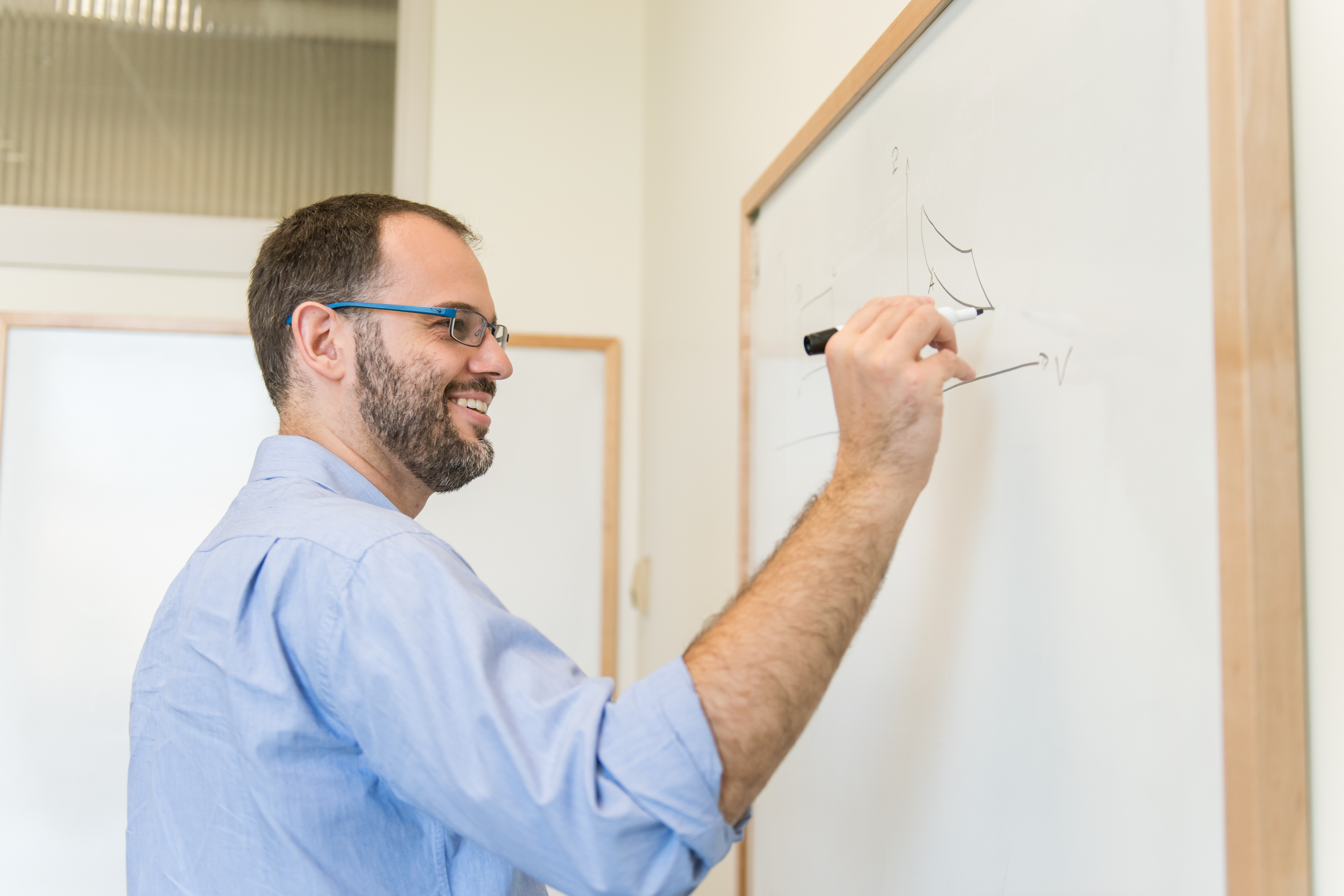 Sebastian Deffner, physics, wrote a piece for The Conversation in 2017 explaining static electricity. Every winter, when dry air and static increase, the article gets a fresh boost of views. Photo by Marlayna Demond ’11 for UMBC.
  Charissa Cheah’s April 2021 Conversation article on anti-Asian violence and school safety was followed by related coverage on NBC News and WYPR. Photo by Crystal Tseng, courtesy Charissa Cheah.
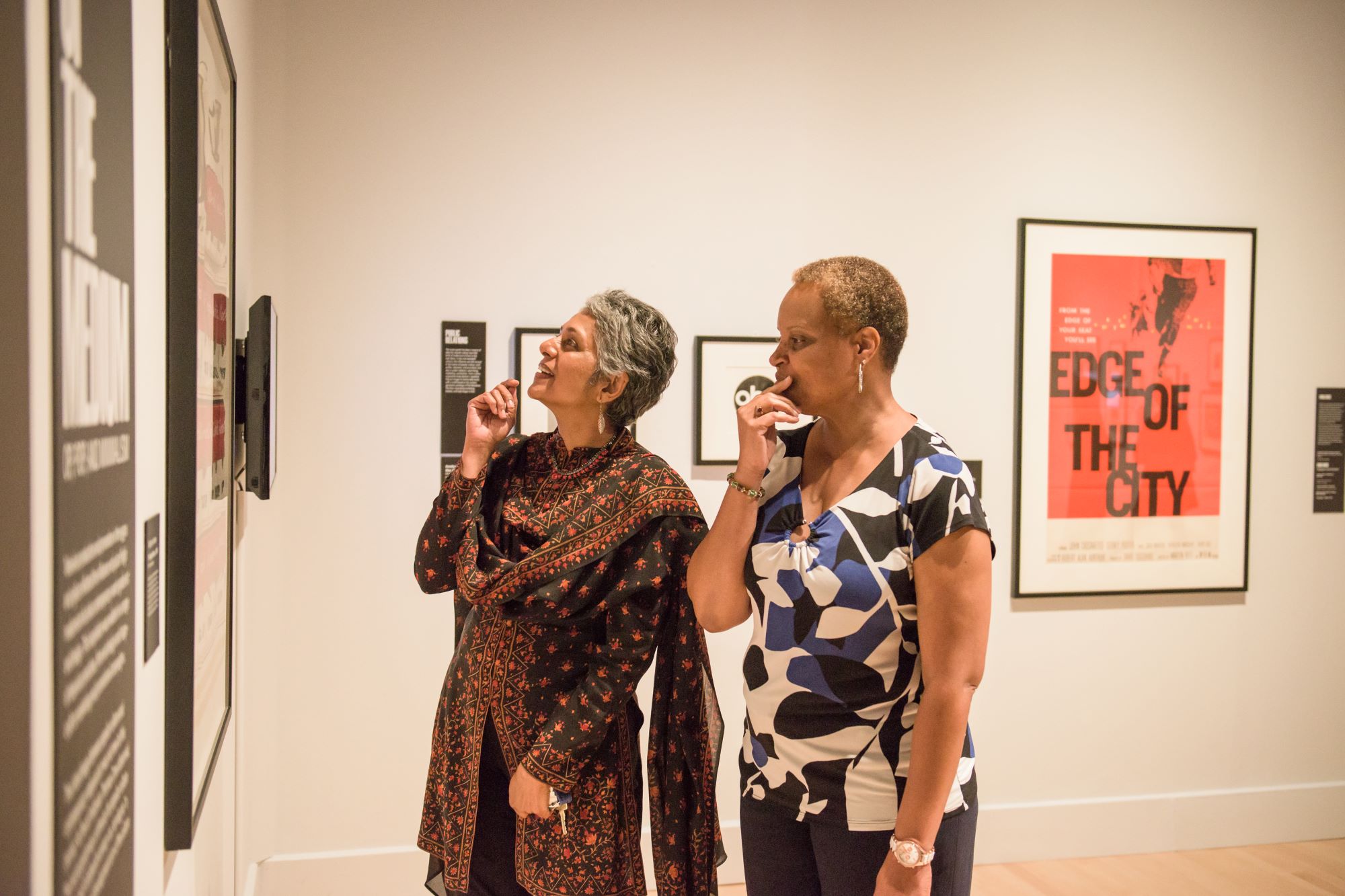 Preminda Jacob (l) and Andrea Lorick (r) at at exhibition at UMBC’s Center for Art, Design, and Visual Culture. Photo by Marlayna Demond ’11 for UMBC.
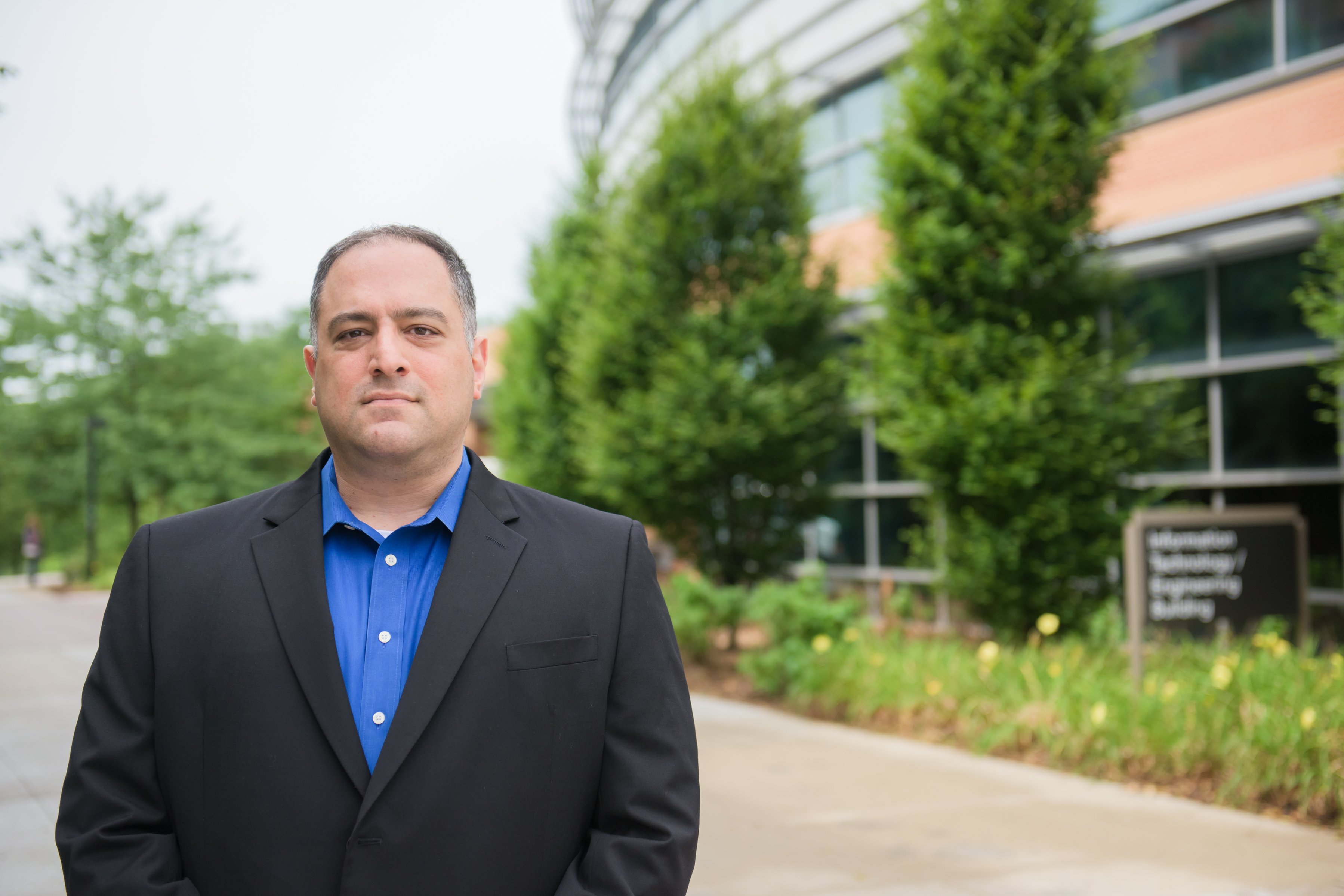 Richard Forno outside the Information Technology and Engineering Building. Photo by Marlayna Demond ’11 for UMBC.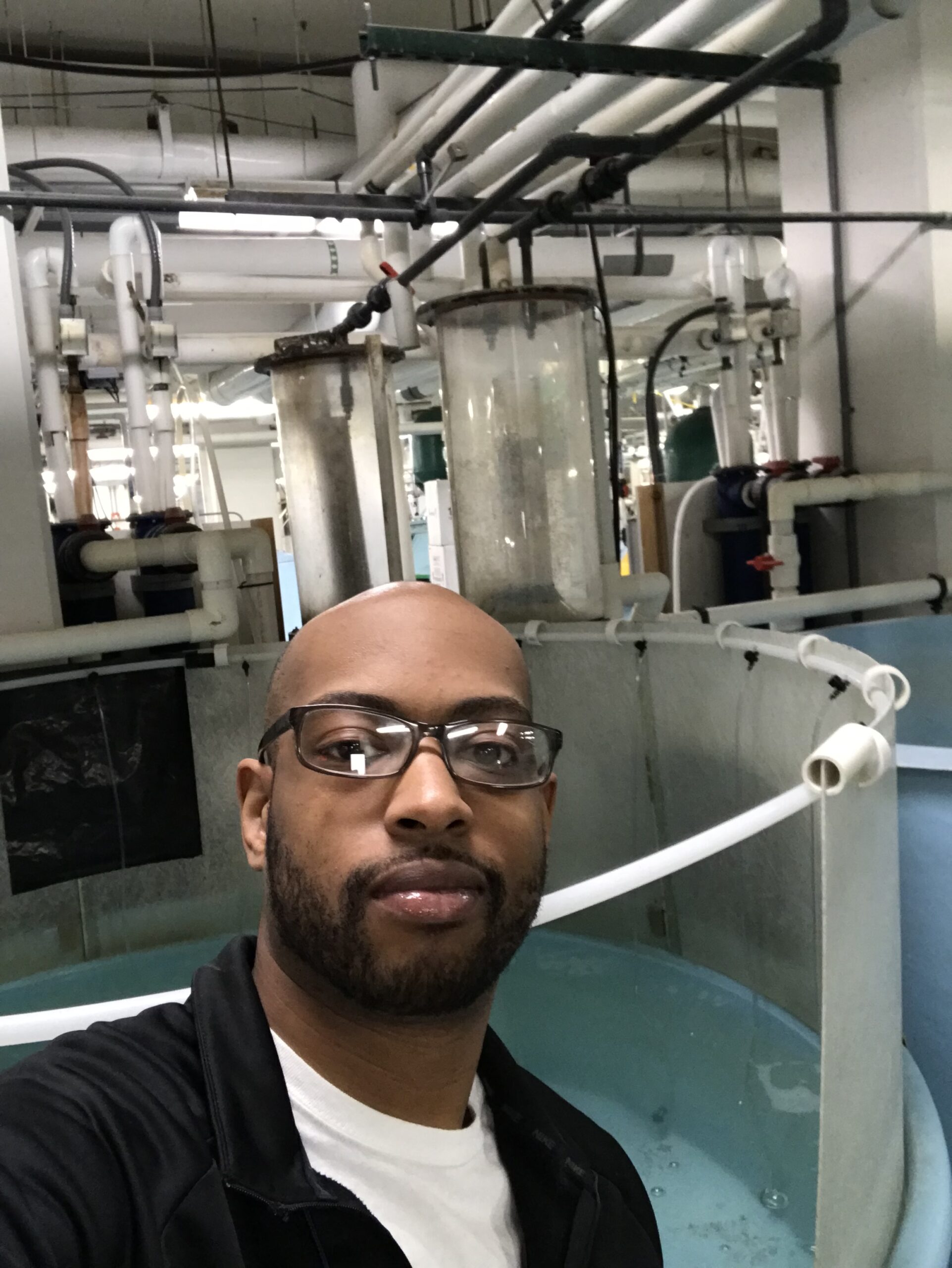


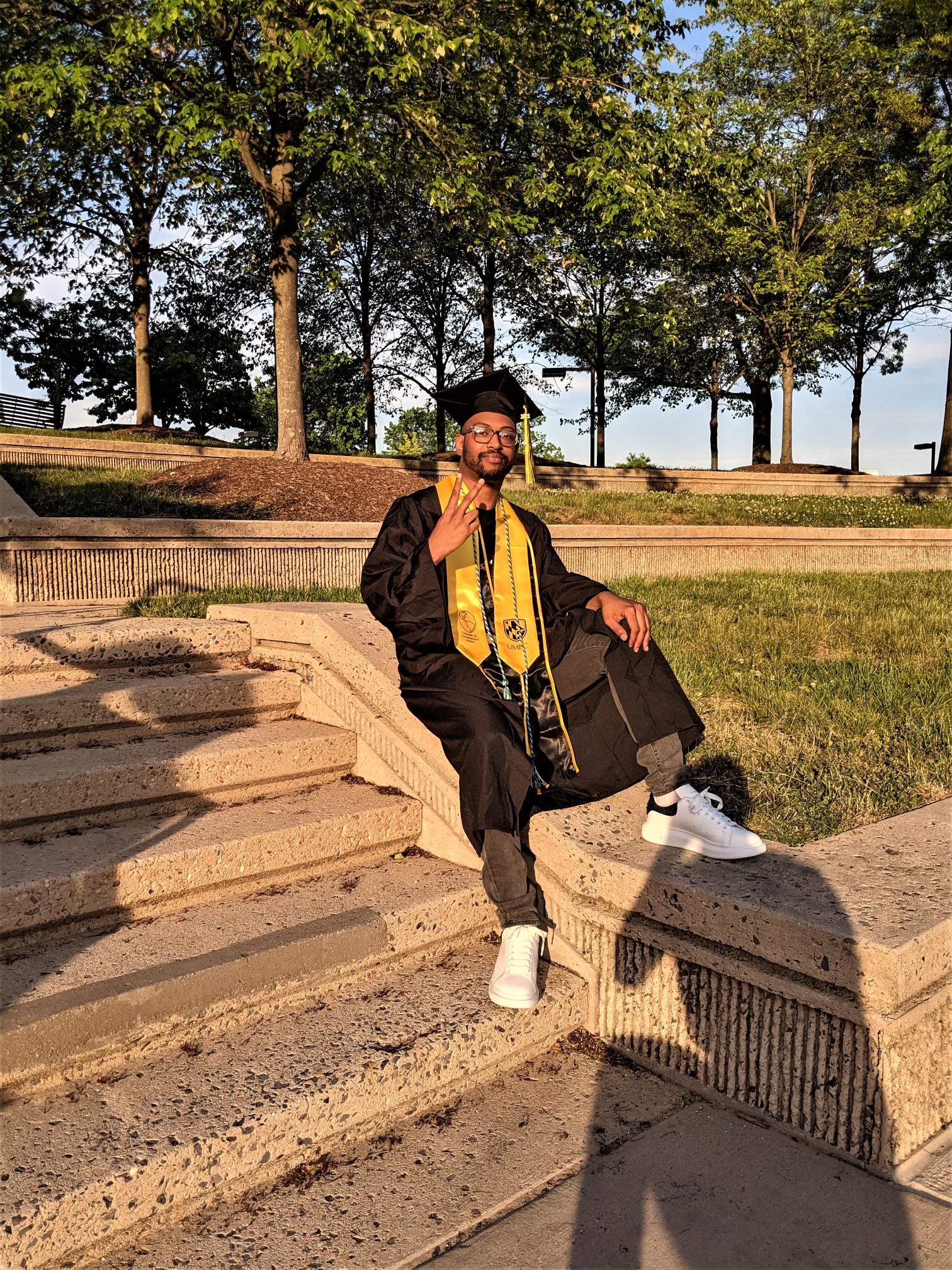


 Russian opposition leader Alexei Navalny has been behind bars since early 2021.