Valerie Sheares Ashby named next president of UMBC, arriving from Duke in August 2022
The University System of Maryland (USM) Board of Regents has appointed Valerie Sheares Ashby as the next president of UMBC. She will become UMBC’s sixth chief executive on August 1, 2022, following current UMBC President Freeman A. Hrabowski’s retirement from UMBC. She will be the first woman to serve in this role.
 Dr. Valerie Sheares Ashby. Photo by Shaun King, Duke U.
Sheares Ashby will join UMBC from her current position as dean of Duke University’s Trinity College of Arts & Sciences, where she has served since 2015. She received her B.A. and Ph.D degrees in chemistry from the University of North Carolina at Chapel Hill (UNC) and completed postdoctoral research at Universitat Mainz in Germany. She came to Duke from UNC, where she served on the faculty since 2003 and chaired the chemistry department from 2012 to 2015.
While at UNC, Sheares Ashby served on the university’s Arts & Sciences Foundation Board of Directors and Research Advisory Council, and chaired the College of Arts & Sciences Faculty Diversity Task Force. She also directed UNC’s National Science Foundation (NSF) Alliance for Graduate Education and the Professoriate, working to increase the number of underrepresented students completing doctoral degrees and becoming professors in STEM and social, behavioral, and economic sciences.
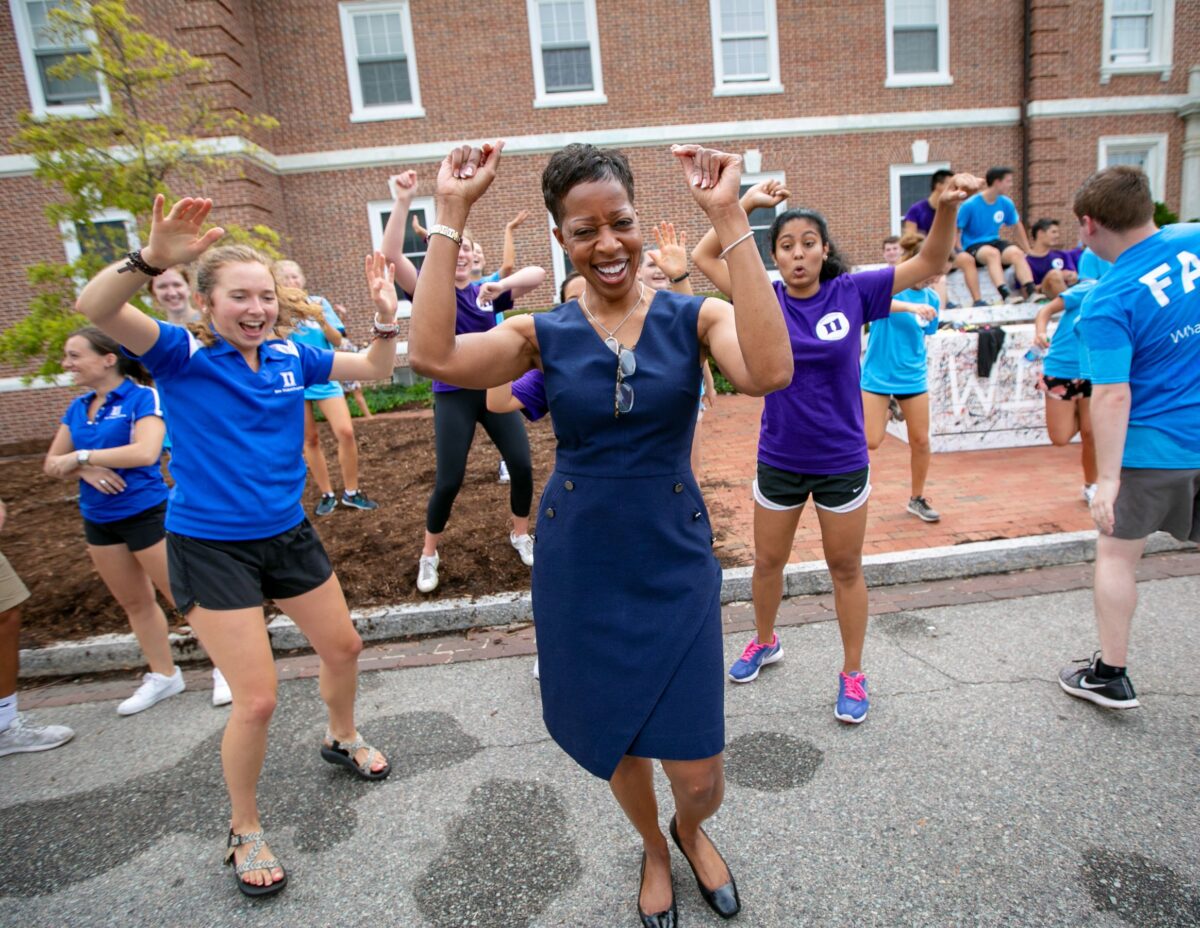 Dr. Valerie Sheares Ashby with students at move-in day. Photo courtesy of Duke University.
“It is an incredible honor to be asked to lead a university that has excelled in so many ways that are essential both nationally and to me personally—particularly in regards to foregrounding inclusive excellence,” Sheares Ashby says.
Selection process
Sheares Ashby was selected as UMBC’s next president through an intensive national search chaired by USM Regent Michelle Gourdine. The USM Board of Regents conducted the search, and a diverse group of UMBC faculty, staff, students, alumni, and community members served on the search committee.
“Dr. Sheares Ashby is clearly the impressive scholar and dynamic leader we need to build on the strong foundation of inclusive excellence at UMBC,” says USM Board Chair Linda R. Gooden. “UMBC is a jewel—nationally and internationally recognized for its innovative teaching and pathbreaking research. All of this success is due to the dedication and hard work of President Hrabowski and his outstanding team. The Board of Regents knows this legacy will be in good hands with Dr. Sheares Ashby.”
“I am grateful to the UMBC presidential search committee, chaired by Regent Michelle Gourdine, for finding such a distinguished leader among so many great candidates,” says Gooden.
“I’m excited to see how Dr. Sheares Ashby’s vision will shape the next chapter for UMBC,” says USM Chancellor Jay A. Perman. “Without question, she has the experience and the attributes needed to grow UMBC’s academic and research prominence, and she’s steeped in the culture of inclusive excellence that has made the university a national exemplar of access, equity, and achievement. It’s hard to imagine finding a better fit for a school whose future is as bright as UMBC’s.”
Legacy of momentum
President Hrabowski announced his anticipated retirement from UMBC in August 2021. The university has risen to national prominence over his three decades of leadership. In February, the Carnegie Classification of Institutions of Higher Education recognized UMBC as a doctoral university with very high research activity, popularly known as Research 1 (or R1). UMBC is now one of three R1s in Maryland, joining Johns Hopkins University and University of Maryland, College Park.
In January 2020, UMBC received Carnegie Community Engagement Classification in recognition of a deep commitment to strengthening the bonds between campus and community. UMBC also recently joined the University Innovation Alliance, a consortium of public research universities focused on student success. U.S. News consistently ranks UMBC among the nation’s top leading institutions for both innovation and undergraduate teaching.
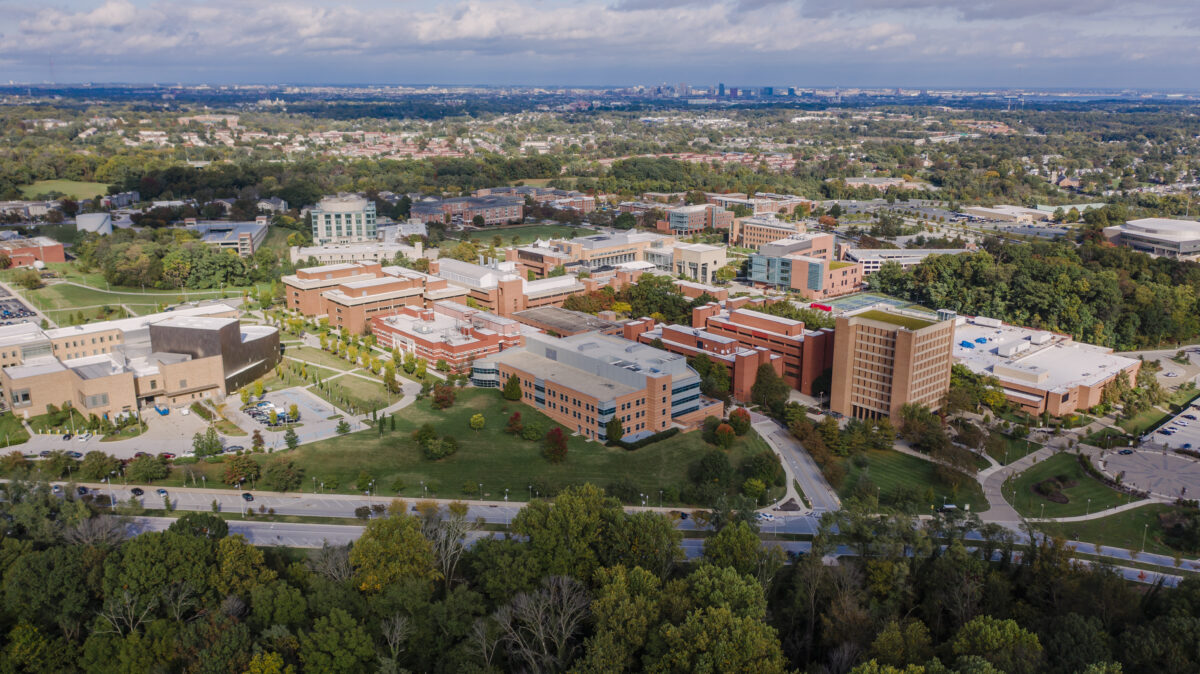 Aerial view of UMBC, with the Baltimore City skyline in the distance.
Together, these honors highlight that at UMBC top-quality education and research go hand-in-hand, and community engagement is essential to both.
“To follow President Freeman Hrabowski is a distinct privilege, as he has been a role model for so many in higher education over the last 30 years, including myself,” Sheares Ashby says. “His extraordinary leadership and dedication to UMBC ensures that I am arriving at a university that is already performing at a very high level. There is no ceiling on what we can achieve from here.”
Welcoming UMBC’s next president
“My colleagues and I are thrilled to learn of this great news,” says President Hrabowski. “Dr. Sheares Ashby is nationally known as a chemist and as a proven academic leader across the liberal arts and sciences. We are very fortunate to have attracted such a talented visionary executive. She is both brilliant and a wonderful human being.”
Sheares Ashby’s research in synthetic polymer chemistry emphasizes designing and synthesizing materials for biomedical uses. She is the recipient of an NSF Faculty Early Career Development Award, DuPont Young Faculty Award, 3M Young Faculty Award, and numerous other teaching and research awards.
She is also a university leader committed to elevating all disciplines. As dean at Trinity College, she increased the national and global prominence of the humanities and social sciences by investing in faculty- and student-driven strategic areas. And she completed the Duke Forward campaign, exceeding the college’s $435 million fundraising goal by $45 million. This included $200 million raised for financial aid.
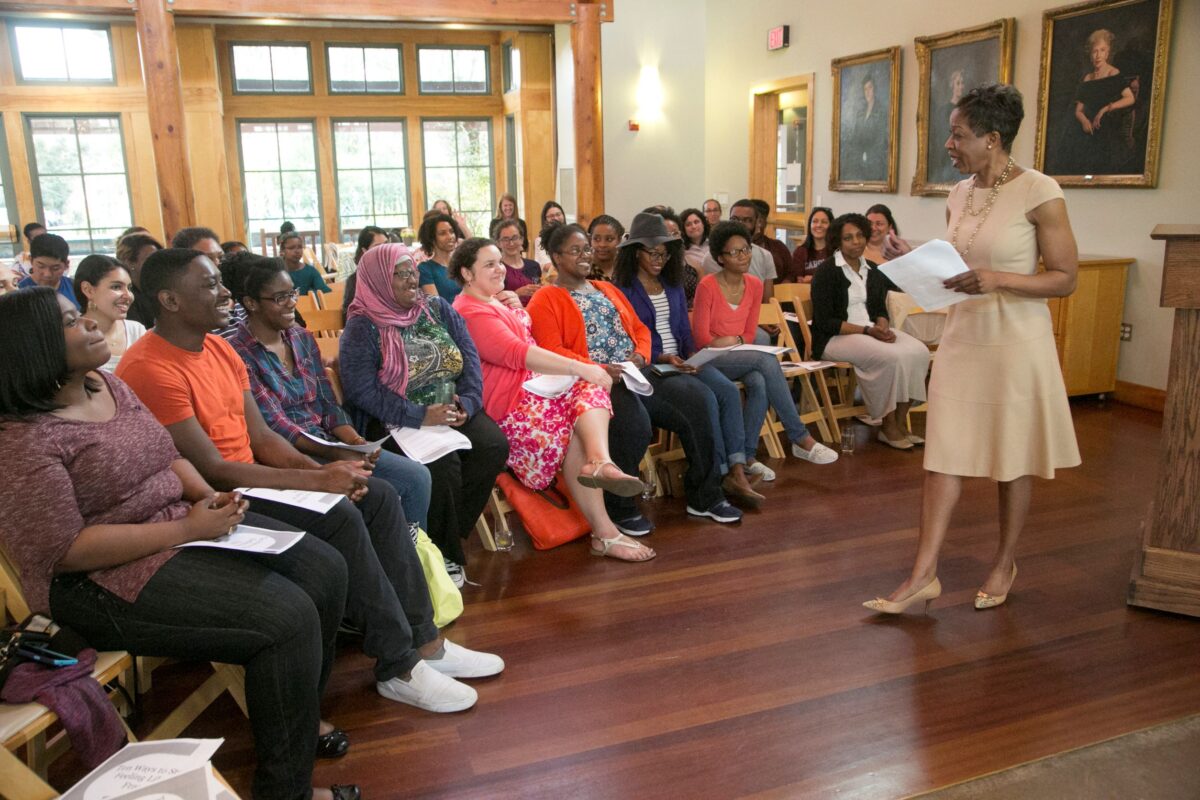 Dr. Valerie Sheares Ashby speaks with students. Photo courtesy of Duke University.
Sheares Ashby has shown a deep commitment to supporting students of all backgrounds, elevating public impact research across all fields, prioritizing effective teaching and learning, and creating a welcoming and supportive university community. In these ways, her work closely aligns with UMBC’s values and strategic priorities.
“I have tremendous respect for all the members of the UMBC community,” Sheares Ashby says, “and I am looking forward to working in partnership with the students, faculty, staff, alumni, and friends who are the heart of this institution.”
Featured image: UMBC’s presidential medallion. Photo by Marlayna Demond ’11 for UMBC.
]]>
The University System of Maryland (USM) Board of Regents has appointed Valerie Sheares Ashby as the next president of UMBC. She will become UMBC’s sixth chief executive on August 1, 2022,...
https://umbc.edu/stories/valerie-sheares-ashby-named-next-president-of-umbc/
https://beta.my.umbc.edu/api/v0/pixel/news/119456/guest@my.umbc.edu/deb4f79218f3a3d19c14955079d28f62/api/pixel
campus
community
news
page1
UMBC News & Magazine
https://beta.my.umbc.edu/groups/umbc-news-magazine
https://assets1-beta.my.umbc.edu/system/shared/avatars/groups/000/001/943/24435aa6207c452e7bc15cc74b42c7bb/xsmall.png?1748556657
https://assets1-beta.my.umbc.edu/system/shared/avatars/groups/000/001/943/24435aa6207c452e7bc15cc74b42c7bb/original.png?1748556657
https://assets2-beta.my.umbc.edu/system/shared/avatars/groups/000/001/943/24435aa6207c452e7bc15cc74b42c7bb/xxlarge.png?1748556657
https://assets2-beta.my.umbc.edu/system/shared/avatars/groups/000/001/943/24435aa6207c452e7bc15cc74b42c7bb/xlarge.png?1748556657
https://assets3-beta.my.umbc.edu/system/shared/avatars/groups/000/001/943/24435aa6207c452e7bc15cc74b42c7bb/large.png?1748556657
https://assets1-beta.my.umbc.edu/system/shared/avatars/groups/000/001/943/24435aa6207c452e7bc15cc74b42c7bb/medium.png?1748556657
https://assets2-beta.my.umbc.edu/system/shared/avatars/groups/000/001/943/24435aa6207c452e7bc15cc74b42c7bb/small.png?1748556657
https://assets1-beta.my.umbc.edu/system/shared/avatars/groups/000/001/943/24435aa6207c452e7bc15cc74b42c7bb/xsmall.png?1748556657
https://assets2-beta.my.umbc.edu/system/shared/avatars/groups/000/001/943/24435aa6207c452e7bc15cc74b42c7bb/xxsmall.png?1748556657
UMBC News & Magazine
0
0
false
Mon, 04 Apr 2022 14:34:13 -0400
Mon, 04 Apr 2022 14:34:13 -0400
We are RetriEVER Grateful
With the conclusion of the Grit & Greatness campaign and three decades of leadership from retiring President Freeman A. Hrabowski, III, UMBC has many reasons to feel grateful. Alumni from all across the nation are gathering to celebrate our community, the impact we’ve made together, and the spirit of inclusive excellence that will drive our work for years to come.
Here are some highlights from the RetriEVER Grateful Tour. Learn more and sign up for upcoming dates here.
Annapolis Reception
The RetriEVER Grateful Tour kicked off on Thursday, March 3, 2022.UMBC alumni and friends gathered at Governor Calvert House in Annapolis, Maryland where Dr. Hrabowski was joined on stage by Dr. Kimberly Moffitt, Dean of the College of Arts, Humanities, and Social Sciences, for an intimate conversation.
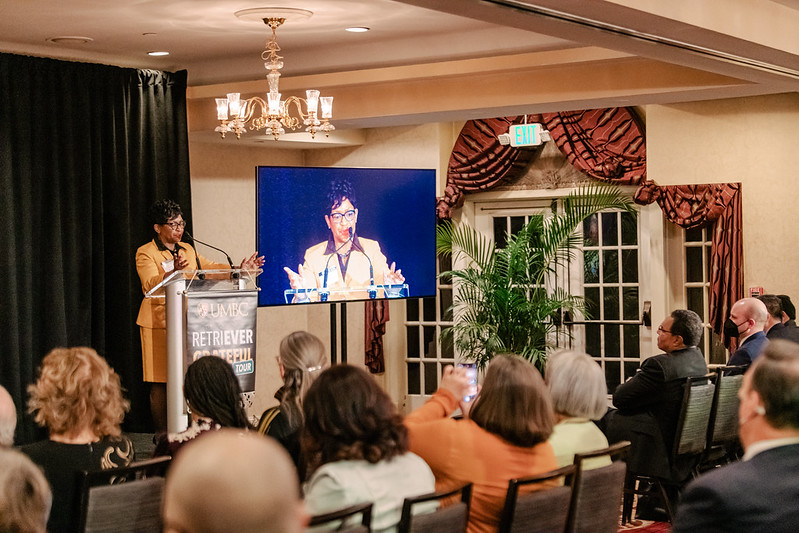 Maryland Speaker of the House Adrienne A. Jones ’76, psychology, addresses guests at the Annapolis reception. Photo by Marlayna Demond ’11.

The Universities at Shady Grove (Rockville) Reception
On Monday, March 7, 2022, the Universities at Shady Grove community paid tribute to Dr. Hrabowski. Click here for a copy of the program with the speaker lineup.
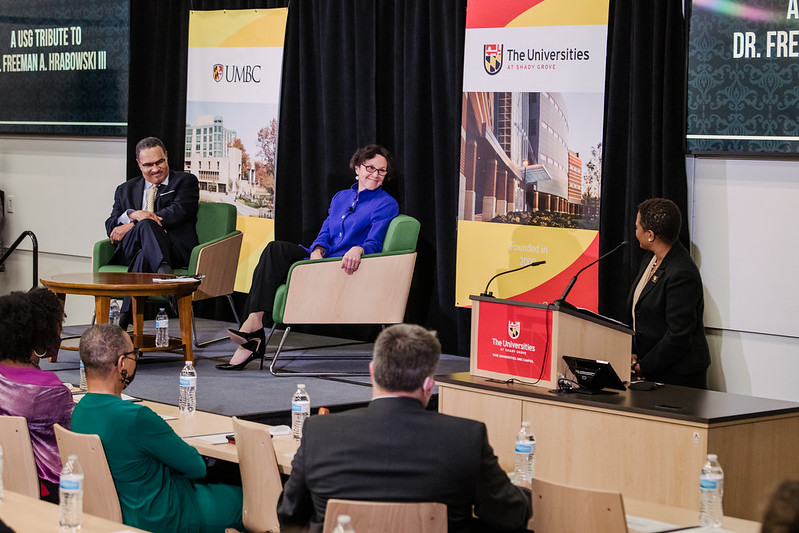 Anne Khademian (center), executive director of the Universities at Shady Grove, and Anika Wayman ’99, M6, mechanical engineering (right), associate dean for Shady Grove affairs in CNMS, talk with President Hrabowski at the USG event. Photo by Marlayna Demond ’11.
Hidden Waters Reception
On Thursday, March 10, 2022, Dr. Hrabowski met with local community leaders at an intimate reception at Hidden Waters, the estate of the Chancellor of the University of Maryland.
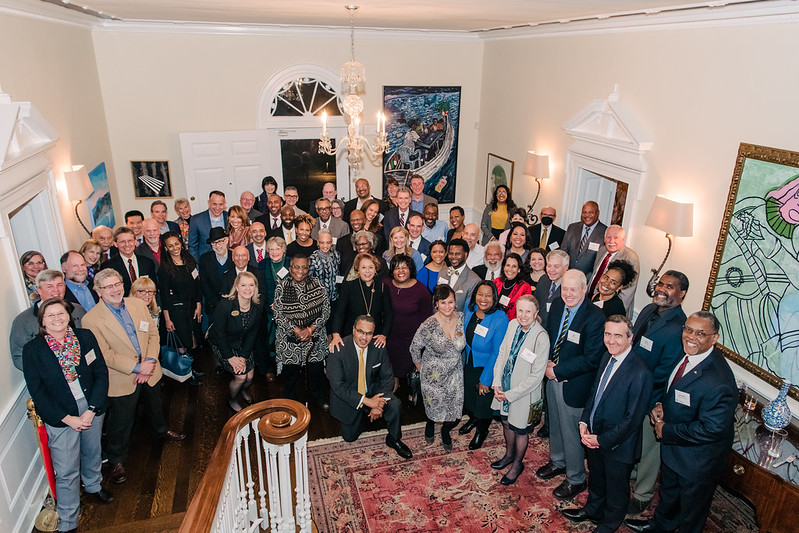 Guests enjoy the Hidden Waters reception. Photo by Marlayna Demond ’11.
San Francisco Reception
On Wednesday, March 16, 2022, the RetriEVER Grateful Tour made its way west to join UMBC alumni and friends in San Francisco, California. A conversation between Dr. Hrabowski and Jack Suess ’81, M.S. ’94, Vice President of Information Technology and CIO, highlighted the evening’s program.
 Jack Suess ’81, mathematics, and M.S. ’95, information systems, vice president of Information Technology and CIO, talks with President Hrabowski. Photo by Barak Shrama.
Seattle Reception
On Thursday, March 17, 2022, the RetriEVER Grateful Tour hit its second West Coast venue, the Museum of History & Industry in Seattle, Washington. Once again, the program featured a conversation between Dr. Hrabowski and CIO Jack Seuss.
 Guests enjoy the conversation at the Seattle stop of the RetriEVER Grateful Tour. Photo by Nata Worry Photography (Renata Steiner).
Raleigh-Durham Reception
On Thursday, March 31, the RetriEVER Grateful Tour headed south to Raleigh-Durham. The reception featured a virtual Q&A between Dr. Hrabowski and Keith Harmon, director of the Meyerhoff Scholars Program.
 UMBC alumni and friends joined Pres. Hrabowski and Keith Harmon, Director of the Meyerhoff Scholars Program in Raleigh-Durham on March 31, at the Washington Duke Inn as part of the RetriEVER Grateful Tour. Photo by Dave Kuhn.
Washington, DC, Reception
On Thursday, April 7, the RetriEVER Grateful Tour made its way to our nation’s capital, Washington, DC, and the American Association for the Advancement of Science. The program featured a conversation between Dr. Hrabowski and Dr. Yvette Mozie-Ross ’88, vice provost for Enrollment Management and Planning.
 UMBC alumni and friends joined Pres. Hrabowski and Dr. Yvette Mozie-Ross ’88, vice provost for Enrollment Management and Planning in Washington, DC, at the American Association for the Advancement of Science. Photo by Marlayna Demond ’11.
Philadelphia Reception
UMBC alumni and friends flocked to Philadelphia on Monday, April 11 for the last leg of the RetriEVER Grateful Tour. The program featured a conversation between Dr. Hrabowski and Dr. Pat McDermott, Vice Provost for Faculty Affairs.
 Sharing a moment with Philadelphia-area alumni and friends.
New York City Reception
The RetriEVER Grateful Tour concluded with a stop at Glasshouse Chelsea in New York City on Tuesday, April 12. The program featured a conversation between Dr. Hrabowski and Greg Simmons, M.P.P. ’04, Vice President of Institutional Advancement.
 Retrievers from all over the New York area gathered to wish Dr. Hrabowski well.
* * * * *
Stay tuned for highlights from more stops on the RetriEVER Grateful Tour!
Header image: Guests enjoy the Hidden Waters reception. Photo by Marlayna Demond ’11.
]]>
With the conclusion of the Grit & Greatness campaign and three decades of leadership from retiring President Freeman A. Hrabowski, III, UMBC has many reasons to feel grateful. Alumni from all...
https://umbc.edu/stories/we-are-retriever-grateful/
https://beta.my.umbc.edu/api/v0/pixel/news/119457/guest@my.umbc.edu/c843decf4933611cd767603bc1b1b230/api/pixel
alumni
freeman-hrabowski
magazine
retrievergrateful
UMBC News & Magazine
https://beta.my.umbc.edu/groups/umbc-news-magazine
https://assets1-beta.my.umbc.edu/system/shared/avatars/groups/000/001/943/24435aa6207c452e7bc15cc74b42c7bb/xsmall.png?1748556657
https://assets1-beta.my.umbc.edu/system/shared/avatars/groups/000/001/943/24435aa6207c452e7bc15cc74b42c7bb/original.png?1748556657
https://assets2-beta.my.umbc.edu/system/shared/avatars/groups/000/001/943/24435aa6207c452e7bc15cc74b42c7bb/xxlarge.png?1748556657
https://assets2-beta.my.umbc.edu/system/shared/avatars/groups/000/001/943/24435aa6207c452e7bc15cc74b42c7bb/xlarge.png?1748556657
https://assets3-beta.my.umbc.edu/system/shared/avatars/groups/000/001/943/24435aa6207c452e7bc15cc74b42c7bb/large.png?1748556657
https://assets1-beta.my.umbc.edu/system/shared/avatars/groups/000/001/943/24435aa6207c452e7bc15cc74b42c7bb/medium.png?1748556657
https://assets2-beta.my.umbc.edu/system/shared/avatars/groups/000/001/943/24435aa6207c452e7bc15cc74b42c7bb/small.png?1748556657
https://assets1-beta.my.umbc.edu/system/shared/avatars/groups/000/001/943/24435aa6207c452e7bc15cc74b42c7bb/xsmall.png?1748556657
https://assets2-beta.my.umbc.edu/system/shared/avatars/groups/000/001/943/24435aa6207c452e7bc15cc74b42c7bb/xxsmall.png?1748556657
UMBC News & Magazine
0
0
false
Wed, 30 Mar 2022 12:24:08 -0400
Wed, 30 Mar 2022 12:24:08 -0400
U.S. News names UMBC graduate programs among the nation’s best
U.S. News announced its 2023 Best Graduate School rankings today, including outstanding UMBC graduate programs across all three colleges. Top fields where UMBC excels range from computer science and several types of engineering to psychology and statistics. Among UMBC’s 14 Best Graduate School rankings for 2023 are seven top-100 programs.
This recognition honors UMBC faculty, staff, and students’ combined commitment to excellence, says President Freeman Hrabowski. “These rankings reflect the energy and creativity of our colleagues and students,” he shares. “We’re very proud of everyone involved.”
To develop the rankings, U.S. News combined quantitative data and expert opinions on the reputations of over 2,000 programs, gathering input from more than 23,000 deans, program directors, senior faculty, and other leaders.
Continued success in engineering
UMBC’s engineering programs ranked in the top 100, both broadly and in multiple subfields. Overall, UMBC engineering jumped up 9 spots to rank 99th, tied with the University of Oklahoma and Illinois Institute of Technology. UMBC’s environmental engineering graduate program moved up to 55th. The university also ranked 77th in chemical engineering, 89th in computer engineering, 99th in mechanical engineering, and 113th in electrical engineering.
Additionally, U.S. News ranked UMBC’s graduate programs in computer science 74th in the nation.
 Erin Lavik, chemical, biochemical, and environmental engineering, (left) works with a graduate student in her lab in 2017. Photo by Marlayna Demond ’11 for UMBC.
This recognition and the forward momentum it represents come at an important moment for the university. UMBC marks the 30th anniversary of the College of Engineering and Information Technology (COEIT) this year.
“COEIT’s continued success and UMBC’s newly designated R1 status are a testament to our outstanding students, staff, and faculty, and support from our campus,” says COEIT Dean Keith J Bowman. “Investments in UMBC by our state and our corporate partners have enabled the continued ascendance of programs across UMBC.”
Strength in natural and mathematical sciences
Today’s rankings also honor programs from UMBC’s College of Natural and Mathematical Sciences (CNMS), including mathematics (54th), statistics (54th), biological sciences (119th), chemistry (115th), and physics (95th). The statistics program joins top-55 institutions like University of Chicago, Penn State, Virginia Tech, and University of Virginia.
 Weihong Lin, biological sciences, (right) works with students in the lab in 2018. Photo by Marlayna Demond ’11 for UMBC.
“The U.S. News graduate program rankings reflect many years of effort and dedication by the faculty, staff, and students in the college. Their commitment to world-class research, mentoring, and inclusive excellence provides the foundation for UMBC’s growing reputation as an R1 university,” says CNMS Dean Bill LaCourse. “I am grateful that our programs are receiving the recognition that they deserve.”
Excellence in social sciences
In the social sciences, UMBC’s psychology graduate programs came in at 122. UMBC joins fellow top-125 universities in psychology ranging from Johns Hopkins and Rutgers to University of Delaware and American University.
Additionally, UMBC is 140th in the interdisciplinary category of geology. This U.S. News ranking includes fields ranging from environmental sciences—part of UMBC’s College of Arts Humanities and Social Sciences (CAHSS)—to geophysics.
 Chris Hawn, geography and environmental systems, (center) and their graduate students in the ILSB in 2019. Photo by Marlayna Demond ’11 for UMBC.
“The departments of geography and environmental systems and psychology consistently elevate the work of the social sciences in our College and at UMBC,” says CAHSS Dean Kimberly R. Moffitt. “I am most appreciative of the tremendous efforts of the faculty, staff, and students that are reflected in these rankings and are worthy of such recognition.”
UMBC’s strength in research has helped grow graduate programs in all colleges. “We are so proud of our focused development in research and graduate education,” says Janet Rutledge, vice provost and dean of the Graduate School. “This growth has led to our recent R1 classification as well as these graduate program rankings, which reflect UMBC’s overall excellence as a leading public research university.”
Banner image: Nilanjan Banerjee, computer science and electrical engineering, (right) working with a student in the lab in 2018. Photo by Marlayna Demond ’11 for UMBC.
]]>
U.S. News announced its 2023 Best Graduate School rankings today, including outstanding UMBC graduate programs across all three colleges. Top fields where UMBC excels range from computer science...
https://umbc.edu/stories/u-s-news-names-umbc-graduate-programs-among-the-nations-best/
https://beta.my.umbc.edu/api/v0/pixel/news/119458/guest@my.umbc.edu/5dd252c9f635ffbb5aaa8bc3c59831a2/api/pixel
cahss
cnms
coeit
community
news
page1
policy-and-society
rankings
science-and-tech
UMBC News & Magazine
https://beta.my.umbc.edu/groups/umbc-news-magazine
https://assets1-beta.my.umbc.edu/system/shared/avatars/groups/000/001/943/24435aa6207c452e7bc15cc74b42c7bb/xsmall.png?1748556657
https://assets1-beta.my.umbc.edu/system/shared/avatars/groups/000/001/943/24435aa6207c452e7bc15cc74b42c7bb/original.png?1748556657
https://assets2-beta.my.umbc.edu/system/shared/avatars/groups/000/001/943/24435aa6207c452e7bc15cc74b42c7bb/xxlarge.png?1748556657
https://assets2-beta.my.umbc.edu/system/shared/avatars/groups/000/001/943/24435aa6207c452e7bc15cc74b42c7bb/xlarge.png?1748556657
https://assets3-beta.my.umbc.edu/system/shared/avatars/groups/000/001/943/24435aa6207c452e7bc15cc74b42c7bb/large.png?1748556657
https://assets1-beta.my.umbc.edu/system/shared/avatars/groups/000/001/943/24435aa6207c452e7bc15cc74b42c7bb/medium.png?1748556657
https://assets2-beta.my.umbc.edu/system/shared/avatars/groups/000/001/943/24435aa6207c452e7bc15cc74b42c7bb/small.png?1748556657
https://assets1-beta.my.umbc.edu/system/shared/avatars/groups/000/001/943/24435aa6207c452e7bc15cc74b42c7bb/xsmall.png?1748556657
https://assets2-beta.my.umbc.edu/system/shared/avatars/groups/000/001/943/24435aa6207c452e7bc15cc74b42c7bb/xxsmall.png?1748556657
UMBC News & Magazine
0
0
false
Tue, 29 Mar 2022 13:22:36 -0400
Tue, 29 Mar 2022 13:22:36 -0400
Local governments are attractive targets for hackers and are ill-prepared
By Richard Forno, principal lecturer, Computer Science and Electrical Engineering, UMBC
President Joe Biden on March 21, 2022, warned that Russian cyberattacks on U.S. targets are likely, though the government has not identified a specific threat. Biden urged the private sector: “Harden your cyber defenses immediately.”
It is a costly fact of modern life that organizations from pipelines and shipping companies to hospitals and any number of private companies are vulnerable to cyberattacks, and the threat of cyberattacks from Russia and other nations makes a bad situation worse. Individuals, too, are at risk from the current threat.
Local governments, like schools and hospitals, are particularly enticing “soft targets” – organizations that lack the resources to defend themselves against routine cyberattacks, let alone a lengthy cyber conflict. For those attacking such targets, the goal is not necessarily financial reward but disrupting society at the local level.
From issuing business licenses and building permits and collecting taxes to providing emergency services, clean water and waste disposal, the services provided by local governments entail an intimate and ongoing daily relationship with citizens and businesses alike. Disrupting their operations disrupts the heart of U.S. society by shaking confidence in local government and potentially endangering citizens.
In the crosshairs
Local governments have suffered successful cyberattacks in recent years. These include attacks on targets ranging from 911 call centers to public school systems. The consequences of a successful cyberattack against local government can be devastating.
I and other researchers at University of Maryland, Baltimore County have studied the cybersecurity preparedness of the United States’ over 90,000 local government entities. As part of our analysis, working with the International City/County Management Association, we polled local government chief security officers about their cybersecurity preparedness. The results are both expected and alarming.
Among other things, the survey revealed that nearly one-third of U.S. local governments would be unable to tell if they were under attack in cyberspace. This is unsettling; nearly one-third of local governments that did know whether they were under attack reported being attacked hourly, and nearly half at least daily.
Ill-equipped
Lack of sound IT practices, let alone effective cybersecurity measures, can make successful cyberattacks even more debilitating. Almost half of U.S. local governments reported that their IT policies and procedures were not in line with industry best practices.
In many ways, local governments are no different from private companies in terms of the cybersecurity threats, vulnerabilities and management problems they face. In addition to those shared cybersecurity challenges, where local governments particularly struggle is in hiring and retaining the necessary numbers of qualified IT and cybersecurity staff with wages and workplace cultures that can compare with those of the private sector or federal government.
Additionally, unlike private companies, local governments by their nature are limited by the need to comply with state policies, the political considerations of elected officials and the usual perils of government bureaucracy such as balancing public safety with the community’s needs and corporate interests. Challenges like these can hamper effective preparation for, and responses to, cybersecurity problems – especially when it comes to funding. In addition, much of the technology local communities rely on, such as power and water distribution, are subject to the dictates of the private sector, which has its own set of sometimes competing interests.
Large local governments are better positioned to address cybersecurity concerns than smaller local governments. Unfortunately, like other soft targets in cyberspace, small local governments are much more constrained. This places them at greater risk of successful cyberattacks, including attacks that otherwise might have been prevented. But the necessary, best-practice cybersecurity improvements that smaller cities and towns need often compete with the many other demands on a local community’s limited funds and staff attention.
Getting the basics right
Whether they are victimized by a war on the other side of the world, a hacktivist group promoting its message or a criminal group trying to extort payment, local governments in the U.S. are enticing targets. Artificial intelligence hacking tools and vulnerabilities introduced by the spread of smart devices and the growing interest in creating “smart cities” put local governments even more at risk.
There’s no quick or foolproof fix to eliminate all cybersecurity problems, but one of the most important steps local governments can take is clear: Implement basic cybersecurity. Emulating the National Institute of Standards and Technology’s national cybersecurity framework or other industry accepted best practices is a good start.
I believe government officials, especially at the local level, should develop and apply the necessary resources and innovative technologies and practices to manage their cybersecurity risks effectively. Otherwise, they should be prepared to face the technical, financial and political consequences of failing to do so.
*****
Header image: Hackers can disrupt local government services, like this library in Willmar, Texas. The town suffered a cyberattack in August 2019. AP Photo/Tony Gutierrez
Richard Forno, Principal Lecturer in Computer Science and Electrical Engineering, University of Maryland, Baltimore County
This article is republished from The Conversation under a Creative Commons license. Read the original article.
]]>
By Richard Forno, principal lecturer, Computer Science and Electrical Engineering, UMBC President Joe Biden on March 21, 2022, warned that Russian cyberattacks on U.S. targets are likely,...
https://umbc.edu/stories/local-governments-are-attractive-targets-for-hackers-and-are-ill-prepared/
https://beta.my.umbc.edu/api/v0/pixel/news/119459/guest@my.umbc.edu/d8a57eaf01d6cceca31f400e66388fa8/api/pixel
csee
cybersecurity
discovery
magazine
the-conversation
UMBC News & Magazine
https://beta.my.umbc.edu/groups/umbc-news-magazine
https://assets1-beta.my.umbc.edu/system/shared/avatars/groups/000/001/943/24435aa6207c452e7bc15cc74b42c7bb/xsmall.png?1748556657
https://assets1-beta.my.umbc.edu/system/shared/avatars/groups/000/001/943/24435aa6207c452e7bc15cc74b42c7bb/original.png?1748556657
https://assets2-beta.my.umbc.edu/system/shared/avatars/groups/000/001/943/24435aa6207c452e7bc15cc74b42c7bb/xxlarge.png?1748556657
https://assets2-beta.my.umbc.edu/system/shared/avatars/groups/000/001/943/24435aa6207c452e7bc15cc74b42c7bb/xlarge.png?1748556657
https://assets3-beta.my.umbc.edu/system/shared/avatars/groups/000/001/943/24435aa6207c452e7bc15cc74b42c7bb/large.png?1748556657
https://assets1-beta.my.umbc.edu/system/shared/avatars/groups/000/001/943/24435aa6207c452e7bc15cc74b42c7bb/medium.png?1748556657
https://assets2-beta.my.umbc.edu/system/shared/avatars/groups/000/001/943/24435aa6207c452e7bc15cc74b42c7bb/small.png?1748556657
https://assets1-beta.my.umbc.edu/system/shared/avatars/groups/000/001/943/24435aa6207c452e7bc15cc74b42c7bb/xsmall.png?1748556657
https://assets2-beta.my.umbc.edu/system/shared/avatars/groups/000/001/943/24435aa6207c452e7bc15cc74b42c7bb/xxsmall.png?1748556657
UMBC News & Magazine
0
0
false
Mon, 28 Mar 2022 17:32:05 -0400
Mon, 28 Mar 2022 17:32:05 -0400
Older Americans are given the wrong idea about online safety – here’s how to help them help themselves
By Helena M. Mentis, professor, Information Systems, UMBC and Nora McDonald, assistant professor, Information Technology, University of Cincinnati
Recently, the U.S. Social Security Administration sent out an email to subscribers of its official blog explaining how to access social security statements online. Most people know to be suspicious of seemingly official emails with links to websites asking for credentials.
But for older adults who are wary of the prevalence of scams targeting their demographic, such an email can be particularly alarming since they have been told that the SSA never sends emails. From our research designing cybersecurity safeguards for older adults, we believe there is legitimate cause for alarm.
This population has been schooled in a tactical approach to online safety grounded in fear and mistrust – even of themselves – and focused on specific threats rather than developing strategies that enable them to be online safely. Elders have been taught this approach by organizations they tend to trust, including nonprofits that teach older adults how to use technology.
These organizations promote a view of older adults as highly vulnerable while also encouraging them to take gratuitous risks in defending themselves. As information technology researchers, we believe it doesn’t need to be this way.
Older adults and online safety
Older adults may be at heightened risk of cybersecurity breaches and fraudulent behavior because they lack experience with internet technology and represent a financially attractive target. Older adults may also be more susceptible because they struggle with their confidence in using technology even as they recognize its benefits.
We have been developing technology tools that help aging Americans maintain their own online safety no matter what challenges they may face, including cognitive decline. To do so, we needed to understand what and how the people we study are learning about cybersecurity threats and what strategies they are being taught to reduce their vulnerabilities.
We have found that older adults attempt to draw on personal experience to develop strategies to reduce privacy violations and security threats. For the most part, they are successful at detecting threats by being on the lookout for activities they did not initiate — for example, an account they do not have. However, outside experts have an inordinate amount of influence on those with less perceived ability or experience with technology.
What ‘experts’ are telling older Americans
Unfortunately, the guidance that older adults are getting from those who presumably have authority on the matter is less than ideal.
Perhaps the loudest of those voices is the AARP, a U.S. advocacy group that has been carrying out a mission to “empower” individuals as they age for over six decades. In that time, it has established a commanding print and online presence. Its magazine reached over 38 million mailboxes in 2017, and it is an effective advocacy group.
What we found was that the AARP communiqués on cybersecurity use storytelling to create cartoonish folktales of internet deception. A regularly featured diet of sensational titles like “Grandparent Gotchas,” “Sweepstakes Swindles” and “Devilish Diagnoses” depict current and emerging threats.
 Much of the cybersecurity advice given to elders fosters the cartoonish misconception that flesh-and-blood scam artists lurk in their midst. 5m3photos/Moment via Getty Images
These scenarios appeal to readers the way crime shows have historically appealed to TV audiences: by using narrative devices to alarm and thrill. Ultimately they also delude viewers by leaving them with the misconception that they can use what they’ve learned in those stories to defend themselves against criminal threats.
Folktales and foibles
One job of folktales is to spell out the hazards that a culture wants its members to learn in childhood. But by presenting cyber-risk as a set of ever-evolving stories that focuses on particular risks, the AARP shifts attention away from basic principles to anecdotes. This requires its members to compare their online experiences with specific stories.
Readers are implicitly encouraged to assess the plausibility of particular scenarios with questions like, Is it possible that I have any unpaid back taxes? And, Do I actually have an extended warranty? It requires people to catalogue each of these stories and then work out for themselves each time whether an unsolicited message is a real threat based on its content, rather than the person’s circumstances.
No, it’s not personal
Through this inventory of stories and characters, we also found that the AARP was personalizing what is, at root, a set of structural threats, impersonal by nature. The stories often characterize scammers as people in the reader’s very midst who use local news to manipulate older adults.
Real threats are not “sweepstake swindlers” or “Facebook unfriendlies,” with a live scam artist sensitive to the needs and foibles of each intended victim. There is rarely a human relationship between the cyber-scammer and the victim — no con artists behind the notorious “grandparents scam.” The AARP bulletins and advisories imply that there is — or, at least, implicitly foster that old-fashioned view of a direct relationship between swindler and victim.
Don’t engage
Perhaps even more worrisome, AARP advisories appear to encourage investigation into scenarios, when engagement of any sort puts people at risk.
In one post alerting people to “8 Military-Themed Imposter Scams,” they discuss “prices too good to be true,” when the very concept of buying a car on Craigslist, or an “active-duty service member” urgently selling a car, should be a red flag discouraging any form of engagement.
Internet users of any age, but especially more vulnerable populations, should be urged to withdraw from threats, not be cast as sleuths in their own suspense stories.
Protecting older adults in the age of surveillance capitalism
In order to reduce everyone’s risk while online, we believe it’s important to provide a set of well-curated principles rather than presenting people with a set of stories to learn. Everyone exposed to threats online, but especially those most at risk, needs a checklist of cautions and strong rules against engagement whenever there is doubt.
In short, the best strategy is to simply ignore unsolicited outreach altogether, particularly from organizations you don’t do business with. People need to be reminded that their own context, behaviors and relationships are all that matter.
Because, in the end, it’s not just about tools, it’s about worldview. Ultimately, for everyone to make effective, consistent use of security tools, people need a theory of the online world that educates them about the rudiments of surveillance capitalism.
We believe people should be taught to see their online selves as reconstructions made out of data, as unreal as bots. This is admittedly a difficult idea because people have a hard time imagining themselves as separate from the data they generate, and recognizing that their online lives are affected by algorithms that analyze and act on that data.
But it is an important concept — and one that we see older adults embracing in our research when they tell us that while they are frustrated with receiving spam, they are learning to ignore the communications that reflect “selves” they don’t identify with.
*****
Nora McDonald, Assistant Professor of Information Technology, University of Cincinnati and Helena M. Mentis, Professor of Information Systems, University of Maryland, Baltimore County
Header image: Telling elders scary stories about online scammers is not the best way to keep them safe. Olga Gavrilenko/EyeEm via Getty.
This article is republished from The Conversation under a Creative Commons license. Read the original article.
]]>
By Helena M. Mentis, professor, Information Systems, UMBC and Nora McDonald, assistant professor, Information Technology, University of Cincinnati Recently, the U.S. Social Security...
https://umbc.edu/stories/older-americans-are-given-the-wrong-idea-about-online-safety-heres-how-to-help-them-help-themselves/
https://beta.my.umbc.edu/api/v0/pixel/news/119460/guest@my.umbc.edu/49e1a40c6bb02edc921faf3640e73a11/api/pixel
cybersecurity
discovery
information-systems
magazine
the-conversation
UMBC News & Magazine
https://beta.my.umbc.edu/groups/umbc-news-magazine
https://assets1-beta.my.umbc.edu/system/shared/avatars/groups/000/001/943/24435aa6207c452e7bc15cc74b42c7bb/xsmall.png?1748556657
https://assets1-beta.my.umbc.edu/system/shared/avatars/groups/000/001/943/24435aa6207c452e7bc15cc74b42c7bb/original.png?1748556657
https://assets2-beta.my.umbc.edu/system/shared/avatars/groups/000/001/943/24435aa6207c452e7bc15cc74b42c7bb/xxlarge.png?1748556657
https://assets2-beta.my.umbc.edu/system/shared/avatars/groups/000/001/943/24435aa6207c452e7bc15cc74b42c7bb/xlarge.png?1748556657
https://assets3-beta.my.umbc.edu/system/shared/avatars/groups/000/001/943/24435aa6207c452e7bc15cc74b42c7bb/large.png?1748556657
https://assets1-beta.my.umbc.edu/system/shared/avatars/groups/000/001/943/24435aa6207c452e7bc15cc74b42c7bb/medium.png?1748556657
https://assets2-beta.my.umbc.edu/system/shared/avatars/groups/000/001/943/24435aa6207c452e7bc15cc74b42c7bb/small.png?1748556657
https://assets1-beta.my.umbc.edu/system/shared/avatars/groups/000/001/943/24435aa6207c452e7bc15cc74b42c7bb/xsmall.png?1748556657
https://assets2-beta.my.umbc.edu/system/shared/avatars/groups/000/001/943/24435aa6207c452e7bc15cc74b42c7bb/xxsmall.png?1748556657
UMBC News & Magazine
0
0
false
Thu, 24 Mar 2022 15:30:17 -0400
Thu, 24 Mar 2022 15:30:17 -0400
Smart devices spy on you – 2 computer scientists explain how the Internet of Things can violate your privacy
By Roberto Yus, assistant professor, Computer Science, UMBC, and Primal Pappachan, Penn State
Have you ever felt a creeping sensation that someone’s watching you? Then you turn around and you don’t see anything out of the ordinary. Depending on where you were, though, you might not have been completely imagining it. There are billions of things sensing you every day. They are everywhere, hidden in plain sight – inside your TV, fridge, car and office. These things know more about you than you might imagine, and many of them communicate that information over the internet.
Back in 2007, it would have been hard to imagine the revolution of useful apps and services that smartphones ushered in. But they came with a cost in terms of intrusiveness and loss of privacy. As computer scientists who study data management and privacy, we find that with internet connectivity extended to devices in homes, offices and cities, privacy is in more danger than ever.
Internet of Things
Your appliances, car and home are designed to make your life easier and automate tasks you perform daily: switch lights on and off when you enter and exit a room, remind you that your tomatoes are about to go bad, personalize the temperature of the house depending on the weather and preferences of each person in the household.
To do their magic, they need the internet to reach out for help and correlate data. Without internet access, your smart thermostat can collect data about you, but it doesn’t know what the weather forecast is, and it isn’t powerful enough to process all of the information to decide what to do.
But it’s not just the things in your home that are communicating over the internet. Workplaces, malls and cities are also becoming smarter, and the smart devices in those places have similar requirements. In fact, the Internet of Things (IoT) is already widely used in transport and logistics, agriculture and farming, and industry automation. There were around 22 billion internet-connected devices in use around the world in 2018, and the number is projected to grow to over 50 billion by 2030.
What these things know about you
Smart devices collect a wide range of data about their users. Smart security cameras and smart assistants are, in the end, cameras and microphones in your home that collect video and audio information about your presence and activities. On the less obvious end of the spectrum, things like smart TVs use cameras and microphones to spy on users, smart lightbulbs track your sleep and heart rate, and smart vacuum cleaners recognize objects in your home and map every inch of it.
Sometimes, this surveillance is marketed as a feature. For example, some Wi-Fi routers can collect information about users’ whereabouts in the home and even coordinate with other smart devices to sense motion.
Manufacturers typically promise that only automated decision-making systems and not humans see your data. But this isn’t always the case. For example, Amazon workers listen to some conversations with Alexa, transcribe them and annotate them, before feeding them into automated decision-making systems.
But even limiting access to personal data to automated decision making systems can have unwanted consequences. Any private data that is shared over the internet could be vulnerable to hackers anywhere in the world, and few consumer internet-connected devices are very secure.
Understand your vulnerabilities
With some devices, like smart speakers or cameras, users can occasionally turn them off for privacy. However, even when this is an option, disconnecting the devices from the internet can severely limit their usefulness. You also don’t have that option when you’re in workspaces, malls or smart cities, so you could be vulnerable even if you don’t own smart devices.
Therefore, as a user, it is important to make an informed decision by understanding the trade-offs between privacy and comfort when buying, installing and using an internet-connected device. This is not always easy. Studies have shown that, for example, owners of smart home personal assistants have an incomplete understanding of what data the devices collect, where the data is stored and who can access it.
Governments all over the world have introduced laws to protect privacy and give people more control over their data. Some examples are the European General Data Protection Regulation (GDPR) and California Consumer Privacy Act (CCPA). Thanks to this, for instance, you can submit a Data Subject Access Request (DSAR) to the organization that collects your data from an internet-connected device. The organizations are required to respond to requests within those jurisdictions within a month explaining what data is collected, how it is used within the organization and whether it is shared with any third parties.
Limit the privacy damage
Regulations are an important step; however, their enforcement is likely to take a while to catch up with the ever-increasing population of internet-connected devices. In the meantime, there are things you can do to take advantage of some of the benefits of internet-connected without giving away an inordinate amount of personal data.
If you own a smart device, you can take steps to secure it and minimize risks to your privacy. The Federal Trade Commission offers suggestions on how to secure your internet-connected devices. Two key steps are updating the device’s firmware regularly and going through its settings and disabling any data collection that is not related to what you want the device to do. The Online Trust Alliance provides additional tips and a checklist for consumers to ensure safe and private use of consumer internet-connected devices.
If you are on the fence about purchasing an internet-connected device, find out what data it captures and what the manufacturer’s data management policies are from independent sources such as Mozilla’s Privacy Not Included. By using this information, you can opt for a version of the smart device you want from a manufacturer that takes the privacy of its users seriously.
*****
Roberto Yus, Assistant Professor of Computer Science, University of Maryland Baltimore County and
Primal Pappachan, Postdoctoral Scholar in Computer Science, Penn State
Header Image: Appliances that make your life easier could also put your privacy at risk. Eric Kayne/AP Images for Samsung
This article is republished from The Conversation under a Creative Commons license. Read the original article.
]]>
By Roberto Yus, assistant professor, Computer Science, UMBC, and Primal Pappachan, Penn State Have you ever felt a creeping sensation that someone’s watching you? Then you turn around and you...
https://umbc.edu/stories/smart-devices-spy-on-you-2-computer-scientists-explain-how-the-internet-of-things-can-violate-your-privacy/
https://beta.my.umbc.edu/api/v0/pixel/news/119461/guest@my.umbc.edu/a81eb483fd8b6c457a483f6179b32d95/api/pixel
computer-science
discovery
magazine
the-conversation
UMBC News & Magazine
https://beta.my.umbc.edu/groups/umbc-news-magazine
https://assets1-beta.my.umbc.edu/system/shared/avatars/groups/000/001/943/24435aa6207c452e7bc15cc74b42c7bb/xsmall.png?1748556657
https://assets1-beta.my.umbc.edu/system/shared/avatars/groups/000/001/943/24435aa6207c452e7bc15cc74b42c7bb/original.png?1748556657
https://assets2-beta.my.umbc.edu/system/shared/avatars/groups/000/001/943/24435aa6207c452e7bc15cc74b42c7bb/xxlarge.png?1748556657
https://assets2-beta.my.umbc.edu/system/shared/avatars/groups/000/001/943/24435aa6207c452e7bc15cc74b42c7bb/xlarge.png?1748556657
https://assets3-beta.my.umbc.edu/system/shared/avatars/groups/000/001/943/24435aa6207c452e7bc15cc74b42c7bb/large.png?1748556657
https://assets1-beta.my.umbc.edu/system/shared/avatars/groups/000/001/943/24435aa6207c452e7bc15cc74b42c7bb/medium.png?1748556657
https://assets2-beta.my.umbc.edu/system/shared/avatars/groups/000/001/943/24435aa6207c452e7bc15cc74b42c7bb/small.png?1748556657
https://assets1-beta.my.umbc.edu/system/shared/avatars/groups/000/001/943/24435aa6207c452e7bc15cc74b42c7bb/xsmall.png?1748556657
https://assets2-beta.my.umbc.edu/system/shared/avatars/groups/000/001/943/24435aa6207c452e7bc15cc74b42c7bb/xxsmall.png?1748556657
UMBC News & Magazine
0
0
false
Mon, 14 Mar 2022 16:27:57 -0400
Mon, 14 Mar 2022 16:27:57 -0400
Settler Colonialism Helps Explain Current Events
By John Rennie Short, professor, School of Public Policy, UMBC
Global flashpoints, including the Russian invasion of Ukraine and Chinese actions in Xinjiang, share a common background: a previous history of invasion and occupation.
The northwestern region of Xinjiang, for example, became an autonomous region under Chinese rule in 1955. Officially known as the Xinjiang Uyghur Autonomous Region, this mainly Turkic, Muslim area is viewed by the Chinese as a possible threat to China’s security and territorial integrity.
The government in Beijing encouraged mass migration of Han Chinese into Xinjiang, which fomented resentment among the local Uyghur people. After clashes in 2009 that caused more than 200 deaths and a 2013 terrorist attack in Tiananmen Square, the Chinese cracked down with aggressive policing and extreme surveillance. Hundreds of thousands of Uyghurs have been jailed, more than 1 million detained in “reeducation camps,” and China has been accused of genocide.
These tactics of invasion and occupation can also be seen in the way 250,000 Russians moved to Crimea after it was annexed in 2014.
Academics sometimes refer to these tactics as “settler colonialism.” As a strategy of subjugation, it has many historical precedents and it provides an important lens for understanding geopolitics in various parts of today’s world.
Two types of empire
History is studded with empires. Broadly speaking, there are two types.
British rule in India exemplifies an empire of control, where imperialists extract wealth and resources without large-scale emigration from the colonizing country. The importation of the wealth of India, especially its textiles, was an essential requirement of Britain’s Industrial Revolution.
There are also empires of settlement that occupy colonial territories by moving in large numbers of settlers. Across the world, especially in the lightly settled open grasslands of Australia and the Americas, the original inhabitants were displaced and marginalized as their homeland was taken by treaty, sale, guile and theft.
The process often involved brute force or ethnic cleansing as land was seized and handed over to immigrants. In Australia, the British justified colonization by declaring the continent “terra nullius” – that is, empty and uninhabited.
Settler colonies were used to safeguard the edges of empires. A policy used by the Qing dynasty (1644-1912) that moved ethnic Chinese settlers into recently captured territory is still used today in Tibet and Xinjiang. Both imperial Russia and the former Soviet Union encouraged citizens to settle border regions, so today at least 20% of the population of Ukraine is ethnic Russian.
Settler colonialism
Many settler empires rose in the 18th and 19th centuries and continued well into the 20th century. In Africa, for example, settler societies were established by the British in Kenya, the French in Algeria and the Dutch in South Africa.
The colonists who moved in, often in large numbers, were typically white Europeans who took control over the land, lives and economy of Indigenous peoples. There were exceptions, though. In Liberia, Black Americans settled in the land of Black Africans; in Israel, mainly Jewish immigrants took over the land of Arab populations; and in China, the majority Han people moved into non-Han areas.
My research into the interactions between Indigenous people and European settlers in North America and resistance to cultural integration by an Indigenous art movement in central Australia has offered me a different way to view history. Looking at the past through a lens of settler colonialism substantially changes how we view histories of many countries, including Australia, Canada, New Zealand, South Africa and the U.S.
Today’s issues, viewed through a colonial lens
Most settler societies are steeped in a prejudiced history in which racial categories define who has power. One strategy has been to make full citizenship available only to settlers and their offspring. Some of the more extreme examples include racialized rule in South Africa that created brutal apartheid and traumatized generations of aboriginal Australians.
There is also a long history of child abuse, with Indigenous children taken from their homes to be assimilated into settler society. Emerging evidence of these practices, including those experienced by Indigenous children in Canada’s residential schools, is helping to rewrite the history books from the Indigenous – rather than just from the settler – perspective.
By restricting immigration, some countries – including Australia, Canada and the U.S., among others – have tried to maintain their racial or ethnic identities and their power. Many of these policies were weakened only in recent years.
But in acts of amazing resilience, Indigenous societies have resisted cultural assimilation, political marginalization and economic insecurity.
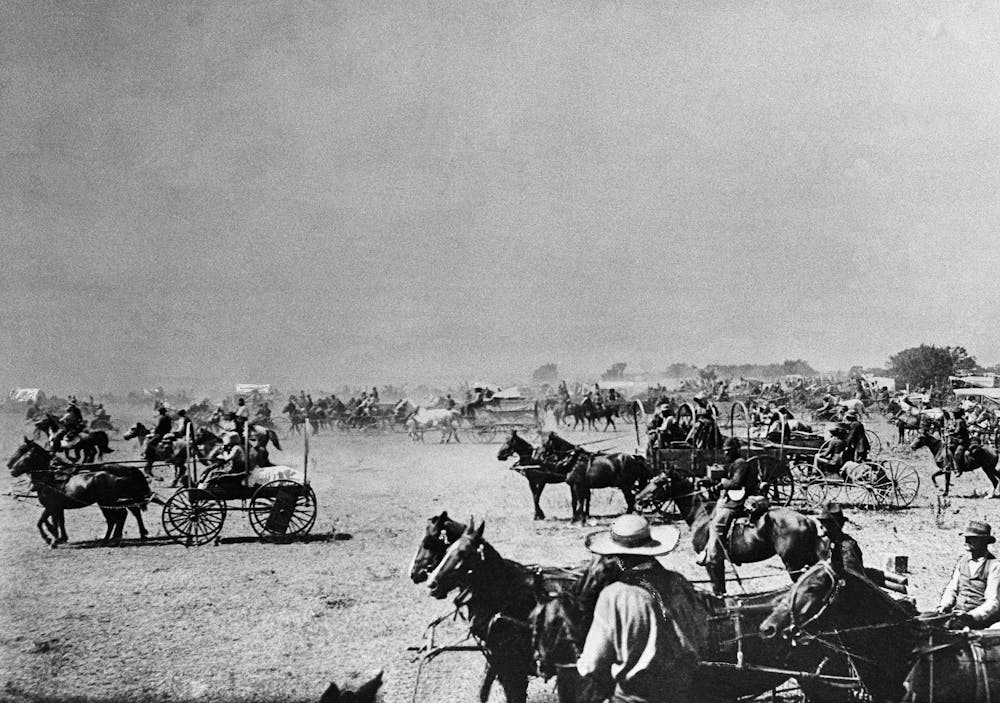
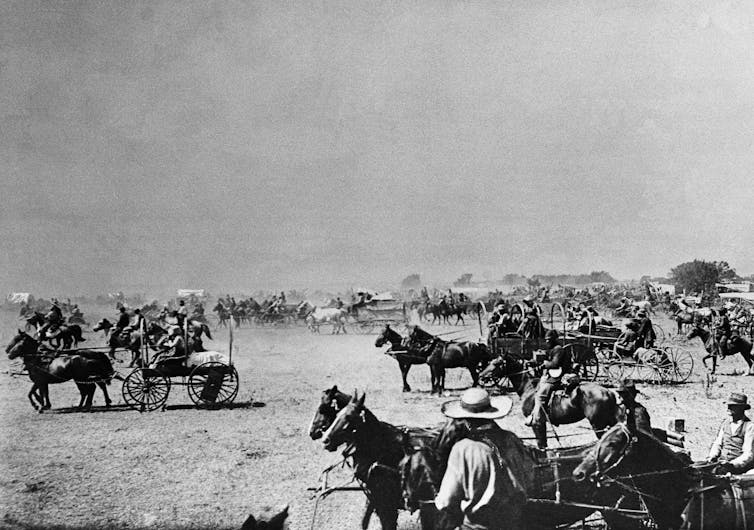 Settlers raced into what was then known as ‘Indian Territory’ as the sound of a gunshot opened the area to white settlement on Sept. 16, 1893. The land rush marked the early beginnings of the state of Oklahoma. AP Photo/A.A. Forbes
Land is a key issue, as Indigenous groups continue to pursue land claims and resist land grabs. From ongoing Mapuche claims in Chile to aboriginal Australians’ successful campaign to overturn the legality of “terra nullius,” land seized by settlers is being disputed.
New facts and greater awareness of the racist nature of settler societies are challenging the triumphalist view of progress. New information is providing a darker understanding of the impact of settler colonialism on Indigenous peoples, including ethnic genocide and the devastating impacts of the loss of both land and cultural identity.
This isn’t just history. Unequal, brutal treatment of settlers and indigenous peoples continues in today’s settler societies, not least of all in Xinjiang and in Ukraine.
*****
Header image: Demonstration for the rights of the Uyghurs in Berlin, 2020. Leonhard Lenz, Wikimedia Commons , CC BY-SA
John Rennie Short, Professor, School of Public Policy, University of Maryland, Baltimore County
This article is republished from The Conversation under a Creative Commons license. Read the original article.
]]>
By John Rennie Short, professor, School of Public Policy, UMBC Global flashpoints, including the Russian invasion of Ukraine and Chinese actions in Xinjiang, share a common background: a...
https://umbc.edu/stories/settler-colonialism-helps-explain-current-events/
https://beta.my.umbc.edu/api/v0/pixel/news/119462/guest@my.umbc.edu/630f9d7df5400cda2863b8c56bc8a55d/api/pixel
discovery
magazine
public-policy
the-conversation
UMBC News & Magazine
https://beta.my.umbc.edu/groups/umbc-news-magazine
https://assets1-beta.my.umbc.edu/system/shared/avatars/groups/000/001/943/24435aa6207c452e7bc15cc74b42c7bb/xsmall.png?1748556657
https://assets1-beta.my.umbc.edu/system/shared/avatars/groups/000/001/943/24435aa6207c452e7bc15cc74b42c7bb/original.png?1748556657
https://assets2-beta.my.umbc.edu/system/shared/avatars/groups/000/001/943/24435aa6207c452e7bc15cc74b42c7bb/xxlarge.png?1748556657
https://assets2-beta.my.umbc.edu/system/shared/avatars/groups/000/001/943/24435aa6207c452e7bc15cc74b42c7bb/xlarge.png?1748556657
https://assets3-beta.my.umbc.edu/system/shared/avatars/groups/000/001/943/24435aa6207c452e7bc15cc74b42c7bb/large.png?1748556657
https://assets1-beta.my.umbc.edu/system/shared/avatars/groups/000/001/943/24435aa6207c452e7bc15cc74b42c7bb/medium.png?1748556657
https://assets2-beta.my.umbc.edu/system/shared/avatars/groups/000/001/943/24435aa6207c452e7bc15cc74b42c7bb/small.png?1748556657
https://assets1-beta.my.umbc.edu/system/shared/avatars/groups/000/001/943/24435aa6207c452e7bc15cc74b42c7bb/xsmall.png?1748556657
https://assets2-beta.my.umbc.edu/system/shared/avatars/groups/000/001/943/24435aa6207c452e7bc15cc74b42c7bb/xxsmall.png?1748556657
UMBC News & Magazine
0
0
false
Mon, 14 Mar 2022 16:20:24 -0400
Mon, 14 Mar 2022 16:20:24 -0400
Kimberly R. Moffitt named dean of UMBC’s College of Arts, Humanities, and Social Sciences
Kimberly R. Moffitt is the new dean of UMBC’s College of Arts, Humanities, and Social Sciences (CAHSS). Moffitt, a professor of language, literacy, and culture (LLC) and affiliate professor of Africana studies, has served as interim dean since August 2020, leading CAHSS through the challenges of COVID-19 while achieving several notable milestones.
As Provost Philip Rous shared in his announcement to the university community, “Moffitt has served with distinction as interim dean of the College by providing outstanding leadership during one of the most challenging times for our entire campus community.”
Dean Moffitt earned a Ph.D. in mass communication/media studies from Howard University and holds an M.A. in mass communication from Boston University and B.A. in political science from UNC-Charlotte.
Moffitt began her career at UMBC in 2006 as an assistant professor of American studies and she became director of the LLC program in 2018. She is UMBC’s first Black dean of a college. She brings an exceptional record of leadership in shared governance, having previously served as president and vice president of UMBC’s Faculty Senate, among other key leadership roles.
“The campus is delighted by the appointment of Dr. Moffitt as dean—in many ways, she represents the best of UMBC,” shares President Freeman Hrabowski. “Most importantly, she will be a strong voice for the arts, humanities, and social sciences, both on and off campus.”

Dean Moffitt interviewing President Hrabowski at the 2022 RetriEVER Grateful Tour.
“I am excited about the opportunity to continue serving the College of Arts, Humanities, and Social Sciences,” says Dean Moffitt. “As a communication scholar I’m hopeful to use my expertise to elevate the great scholarship of our faculty colleagues and the initiatives carried out by our staff for all to see, learn, and experience.”
Dedication to CAHSS
As interim dean, Moffitt led a series of key projects to advance and support faculty and student research, teaching and learning, and development.
Moffitt and co-PI Patrice McDermott, vice provost for faculty affairs, received a $3 million grant from the Andrew W. Mellon Foundation to launch Breaking the M.O.L.D. (Mellon/Maryland Opportunities for Leadership Development) with partners Morgan State University and the University of Maryland, College Park. This program will develop a pipeline to higher ed leadership for scholars in the arts and humanities. It will focus on interested faculty members at the rank of associate and full professor, particularly women faculty and Black, Hispanic, and American Indian/Alaska Native faculty.

Dean Moffitt and Patrice McDermott, 2021.
Speaking of the project collaborators, Moffitt shared, “This experienced team of diverse senior leaders has an opportunity to create a structural answer to elevate diverse leaders from the arts and humanities. This will enable faculty to apply distinct knowledge, skills, and perspectives to address our communities’ needs as leaders at their respective institutions.”
Moffitt has long been committed to diversity, equity, and inclusion at UMBC and in Baltimore. Following the recent global call for social justice for Black lives and rise of anti-racist work Moffitt developed the “Looking in the Mirror” speaker series with Patricia Young, professor of education and special assistant to the dean for strategy and innovation. Over the past two semesters, UMBC faculty and staff have discussed topics related to microaggressions, mental health in academia, equity, and systemic racism to create strategies for moving forward as a college.
Additionally, she has led a redesign of the CAHSS website to better reflect the college’s vast range of majors, programs, and diverse student and faculty scholarship. In fall 2021 and spring 2022, Moffitt also spearheaded faculty media workshops to provide faculty with strategies and resources to share their work with the greater public.
Commitment to Baltimore
Moffitt is also known for her dedication to Baltimore. Her community-engaged work has benefited Baltimore families and community organizations.
In addition to being a board member of Maryland Humanities and the Greater Baltimore Cultural Alliance, she is a founding board member of the Baltimore Collegiate School for Boys. The school aims to “provide the finest liberal arts education possible to Baltimore’s next generation of young men, ensuring that they will become global citizens trained to learn, lead, and serve our community, our nation, and our world.”
As a frequent guest host on WYPR’s former The Marc Steiner Show, she has spoken about race, politics, education, and culture in Baltimore. She has also shared her work through The Baltimore Sun and other local media outlets, reaching broad public audiences.

(L-R) Marc Steiner; Kimberly Moffitt; Kalima Young, assistant professor of electronic media and film at Towson University; and Nathan Connolly, the Herbert Baxter Adams associate professor of history at Johns Hopkins University, on “
The Black Panther: Academic and Visceral Readings” episode.
Photo courtesy of The Marc Steiner Show.
National engagement
In conjunction with her collaborations in Baltimore, Moffitt has also taken her scholarship to national audiences. This includes her work on mediated representations of marginalized groups as well as the politicized nature of Black hair.
Moffitt is co-editor of Blackberries and Redbones: Critical Articulations of Black Hair/Body Politics in Africana Communities. She also co-created the Black Hair Syllabus with Tunisia Lumpkin, a language, literature, and culture doctoral student. This is the first website with resources and scholarship about Black hair in media, business, children’s literature, and more.
This February, she launched ColorStuck? a podcast interrogating color and hair politics among Diasporic Black women.
Dean Moffitt has published numerous articles and book chapters, as well as five co-edited volumes. In addition to Blackberries and Redbones, these include Michelle Obama and the FLOTUS Effect: Platform, Presence, and Agency (2019), Gladiators in Suits: Race, Gender, and the Politics of Representation in Scandal (2019), The Obama Effect: Multidisciplinary Renderings of the 2008 Campaign (2010) and The 1980s: A Transitional Decade? ( 2011).

Moffitt doing research.
Her work on media representation includes exploration of the Black body in Disney programming (presented at Grit-X 2018) and the impact of colorism on Black girls and mother-daughter relationships. Moffitt serves as vice president of the National Association for Media Literacy Education as a national expert in this field.

Dean Moffitt speaking at UMBC’s Grit-X 2021.
Next steps
As dean, Moffitt looks forward to collaborating with colleagues to promote innovative interdisciplinary teaching and research, as well as fruitful partnerships. She recently contributed to UMBC securing the largest-ever gift in university history – $21 million from the Sherman Family Foundation to support UMBC’s K-12 and early childhood education work.
The largest gift in UMBC history will go toward educational research, teacher preparation and partnerships with Baltimore city schools. https://t.co/BRZoguot3J
— The Baltimore Sun (@baltimoresun) February 24, 2022
Also, with Moffitt as interim dean, UMBC established its first endowed professorship in economics, with a $1 million gift plus a $1 million Maryland state match in memory of Fred and Virginia Pausch. Moving this work forward will be a priority.

Dean Moffitt with
Tim Gindling, professor of economics, and
Denise Meringolo, associate professor of history and acting director of UMBC’s Dresher Center for the Humanities.
“On behalf of our faculty, staff, students and the UMBC leadership team I would like to take this opportunity to thank Dean Moffitt for her hard work and commitment as interim dean and welcome her to her new permanent position,” says Provost Rous.
“I look forward to being a part of UMBC’s bright future as a newly-designated R1 institution that has much to offer higher education and our students,” says Moffitt.
Featured image: Kimberly Moffitt. All photos by Marlayna Demond ’11 unless otherwise noted.
]]>
Kimberly R. Moffitt is the new dean of UMBC’s College of Arts, Humanities, and Social Sciences (CAHSS). Moffitt, a professor of language, literacy, and culture (LLC) and affiliate professor of...
https://umbc.edu/stories/kimberly-r-moffitt-named-dean-of-umbcs-college-of-arts-humanities-and-social-sciences/
https://beta.my.umbc.edu/api/v0/pixel/news/119463/guest@my.umbc.edu/5401c29384607ce4fb9da28b2ac89e2f/api/pixel
africanastudies
arts-and-culture
cahss
cahssresearch
llc
news
page1
policy-and-society
UMBC News & Magazine
https://beta.my.umbc.edu/groups/umbc-news-magazine
https://assets1-beta.my.umbc.edu/system/shared/avatars/groups/000/001/943/24435aa6207c452e7bc15cc74b42c7bb/xsmall.png?1748556657
https://assets1-beta.my.umbc.edu/system/shared/avatars/groups/000/001/943/24435aa6207c452e7bc15cc74b42c7bb/original.png?1748556657
https://assets2-beta.my.umbc.edu/system/shared/avatars/groups/000/001/943/24435aa6207c452e7bc15cc74b42c7bb/xxlarge.png?1748556657
https://assets2-beta.my.umbc.edu/system/shared/avatars/groups/000/001/943/24435aa6207c452e7bc15cc74b42c7bb/xlarge.png?1748556657
https://assets3-beta.my.umbc.edu/system/shared/avatars/groups/000/001/943/24435aa6207c452e7bc15cc74b42c7bb/large.png?1748556657
https://assets1-beta.my.umbc.edu/system/shared/avatars/groups/000/001/943/24435aa6207c452e7bc15cc74b42c7bb/medium.png?1748556657
https://assets2-beta.my.umbc.edu/system/shared/avatars/groups/000/001/943/24435aa6207c452e7bc15cc74b42c7bb/small.png?1748556657
https://assets1-beta.my.umbc.edu/system/shared/avatars/groups/000/001/943/24435aa6207c452e7bc15cc74b42c7bb/xsmall.png?1748556657
https://assets2-beta.my.umbc.edu/system/shared/avatars/groups/000/001/943/24435aa6207c452e7bc15cc74b42c7bb/xxsmall.png?1748556657
UMBC News & Magazine
0
0
false
Fri, 11 Mar 2022 21:30:40 -0500
Fri, 11 Mar 2022 21:30:40 -0500
UMBC’s Riadul Islam receives NSF funding to secure cars against communication system attacks
As vehicles become more advanced, opportunities increase for hackers to remotely attack their embedded systems, creating significant safety concerns for drivers and passengers. Riadul Islam, assistant professor of computer science and electrical engineering at UMBC, received a $200,000 grant from the National Science Foundation to study how to better detect and protect against these cyber attacks.
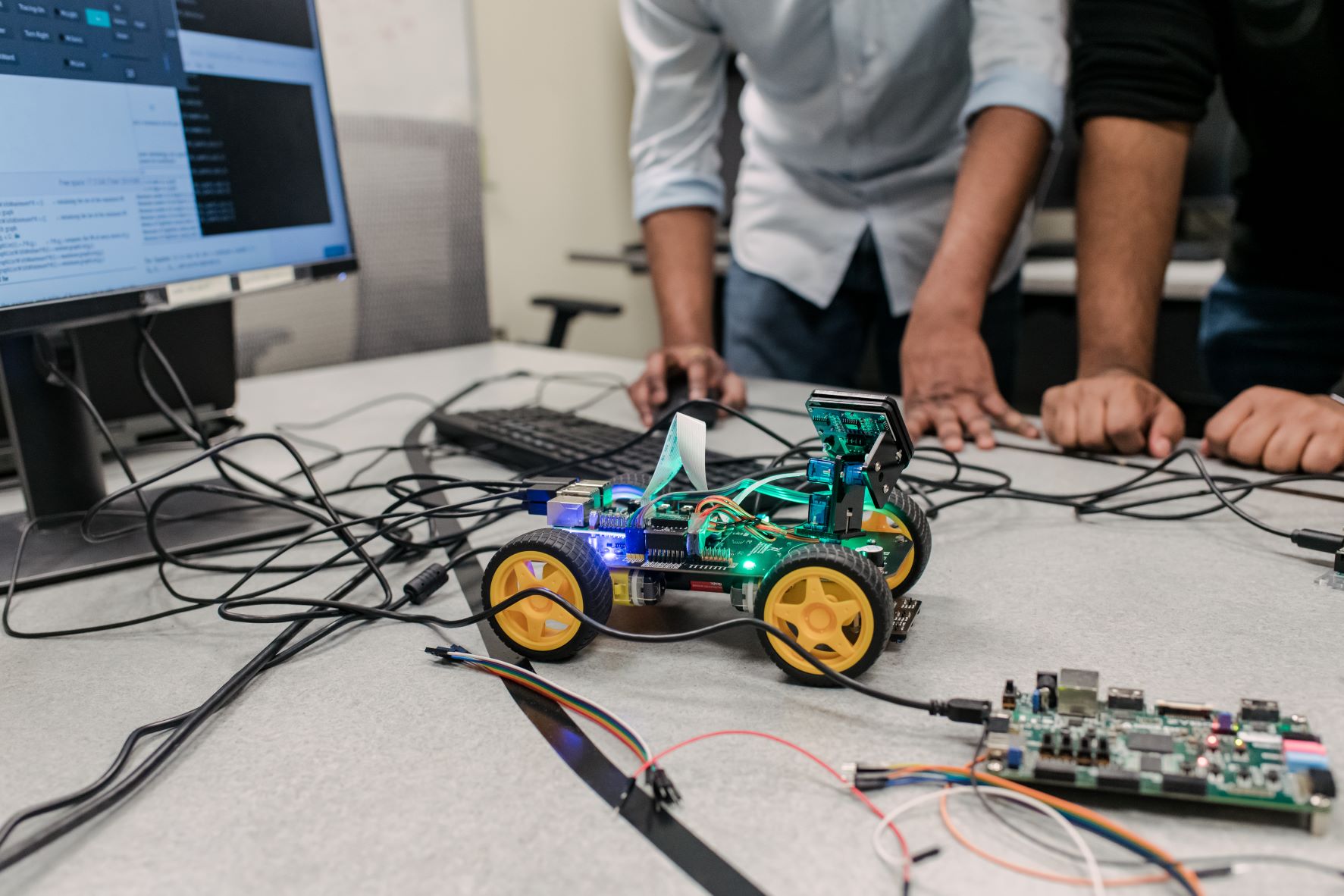
 A model vehicle that Islam and his team are using in their research.
Today’s cars include complex electronic systems that interact and communicate with each other in order to operate properly. For example, steering and braking systems rely on internal communications and must also effectively communicate with other systems and networks in the vehicle to function properly.
Issues arise when communications between systems are interrupted, or when external players intentionally hack into these systems. “Remote attacks can jam the communication systems,” Islam explains, which can pose dangers.
Improving safety
To detect potential issues that can put people at risk, Islam and his team are developing data graphs that chart out messages and signals among a vehicle’s systems. They will next build an attacker detection algorithm based on that analysis.

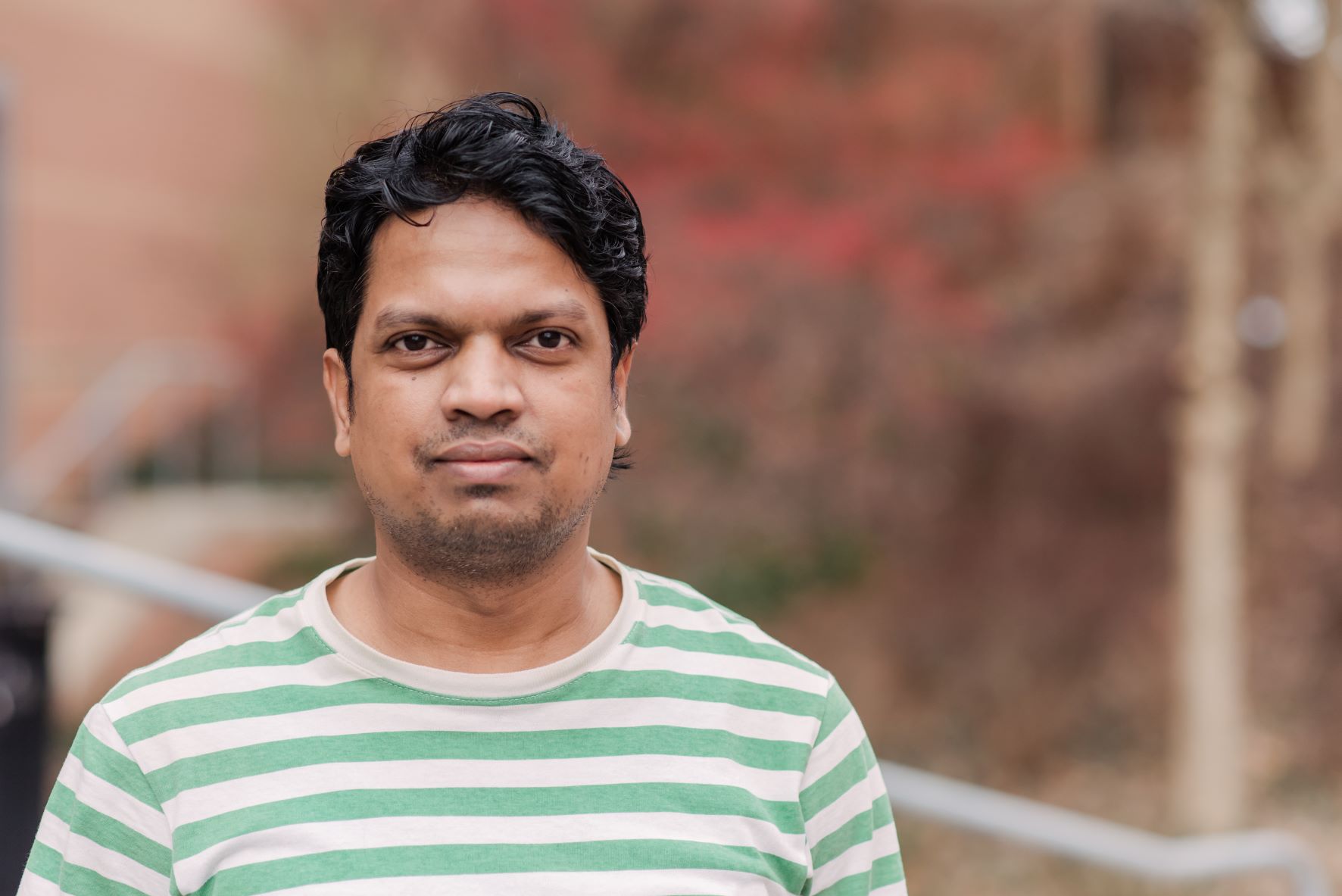
Riadul Islam.
This approach to detecting attacks will fundamentally change how people can analyze the enormous amount of data that modern vehicles generate. And it’s essential that people become more aware of this data and start to manage it, says Islam. He explains that vehicles with advanced driver-assistance systems, more common today than ever before, are more vulnerable to being hacked. “Anyone can take over a car remotely,” he says. “It’s a huge safety concern.”
Boosting public confidence in autonomous cars
Dhandeep Challagundla ‘22, computer engineering,and Sri Ranga Sai Krishna Tummala, M.S ‘25, computer science,are working alongside Islam on this research. Challagundla is primarily working on energy-efficient computing, while Tummala is building a testbed for collecting sensor data from vehicular networks.
“Vehicular security is the primary key to maintaining the integrity of the automated driving systems, which can significantly boost public confidence in future autonomous cars,” explains Tummala.
 Dr. Riadul Islam, right, in the lab with students.
This research will also integrate novel neural architectures to manage humongous data generated by vehicle electronic control units and provide real-time training and inference platform to tackle unknown issues, says Islam.
Detecting and classifying images
In addition to the funding from NSF, Islam received funding through the Maryland Innovation Initiative (MII), and from the Maryland Industrial Partnership (MIPS). He is collaborating with Ryan Robucci, associate professor of computer science and electrical engineering, and industrial partner Oculi on a project funded by the MIPS.
Their work will focus on developing algorithms that allow cameras to more accurately detect and classify images. Through this work, Islam and Robucci are working to create a software platform to support the design of an energy-efficient spiking neural network that can be implemented in conventional vision sensors.
“Both the MII and MIPS research will directly impact Maryland’s economy,” explains Islam. “The MII research will also improve the security of our transportation systems, and MIPS will concentrate on energy-efficient imaging considering public safety and privacy.”
Banner image: Dr. Riadul Islam, right, in the lab with students. All photos by Marlayna Demond ’11 for UMBC.
]]>
As vehicles become more advanced, opportunities increase for hackers to remotely attack their embedded systems, creating significant safety concerns for drivers and passengers. Riadul Islam,...
https://umbc.edu/stories/umbcs-riadul-islam-receives-nsf-funding-to-secure-cars-against-communication-system-attacks/
https://beta.my.umbc.edu/api/v0/pixel/news/119464/guest@my.umbc.edu/b6c5cf04582cf24c7a2255166362dd41/api/pixel
coeit
csee
news
science-and-tech
UMBC News & Magazine
https://beta.my.umbc.edu/groups/umbc-news-magazine
https://assets1-beta.my.umbc.edu/system/shared/avatars/groups/000/001/943/24435aa6207c452e7bc15cc74b42c7bb/xsmall.png?1748556657
https://assets1-beta.my.umbc.edu/system/shared/avatars/groups/000/001/943/24435aa6207c452e7bc15cc74b42c7bb/original.png?1748556657
https://assets2-beta.my.umbc.edu/system/shared/avatars/groups/000/001/943/24435aa6207c452e7bc15cc74b42c7bb/xxlarge.png?1748556657
https://assets2-beta.my.umbc.edu/system/shared/avatars/groups/000/001/943/24435aa6207c452e7bc15cc74b42c7bb/xlarge.png?1748556657
https://assets3-beta.my.umbc.edu/system/shared/avatars/groups/000/001/943/24435aa6207c452e7bc15cc74b42c7bb/large.png?1748556657
https://assets1-beta.my.umbc.edu/system/shared/avatars/groups/000/001/943/24435aa6207c452e7bc15cc74b42c7bb/medium.png?1748556657
https://assets2-beta.my.umbc.edu/system/shared/avatars/groups/000/001/943/24435aa6207c452e7bc15cc74b42c7bb/small.png?1748556657
https://assets1-beta.my.umbc.edu/system/shared/avatars/groups/000/001/943/24435aa6207c452e7bc15cc74b42c7bb/xsmall.png?1748556657
https://assets2-beta.my.umbc.edu/system/shared/avatars/groups/000/001/943/24435aa6207c452e7bc15cc74b42c7bb/xxsmall.png?1748556657
UMBC News & Magazine
0
0
false
Fri, 11 Mar 2022 14:02:53 -0500
Fri, 11 Mar 2022 14:02:53 -0500
UMBC’s Deepa Madan develops bendable zinc-based batteries
Rechargeable alkaline batteries are readily available at many stores and pharmacies, but they are rigid and cannot be used in slim or small devices that require batteries. Deepa Madan, assistant professor of mechanical engineering, and her research team are working to develop zinc-chitosan gel-based batteries that are enclosed in flexible plastic. This would revolutionize how consumers power devices they use every day.

Deepa Madan.
Zinc, chitosan, and manganese dioxide—all components of the gel-based batteries—are abundantly available and are safe for people and animals to be around, Madan explains. Zinc-based air battery technology is already used to create small, rigid batteries, like those used in hearing aids. For this new technology, she envisions a broader array of possible forms and uses, particularly for wearable health monitoring devices.
Madan’s work has received a phase 1 award from the Maryland Innovation Initiative (MII). The MII is a partnership between the State of Maryland and five academic research institutions in Maryland, including UMBC, which promotes the commercialization of research conducted at the universities involved. It helps to get innovative products to consumers more quickly.
Improving battery safety
The goal of this work is to develop a flexible, rechargeable zinc battery (RZB) prototype that can be used in wearable devices such as watches, wireless headphones, and health devices. “By demonstrating the unique advantages of safety and design flexibility—which enables larger battery footprint and, hence, better performance—we expect to enable RZB commercialization and gain market share for wearable health monitoring devices,” Madan explains.
Enhanced durability is an additional benefit of the RZB technology. These batteries can continue to safely generate power even if they are punctured, bent, or cut.
During testing, Madan and her students poked six holes in the plastic that contained the battery. They found that the holes reduced the power generated from 100 percent to about 88 percent. The remaining power was still enough to power a small light.
 Deepa Madan, left, in the lab with three students.
“I have always been interested in exploring eco- and user-friendly principles in research,” says Aswani Poosapati, Ph.D. ‘20, mechanical engineering. “After meeting with Dr. Madan, I saw how we can adapt these concepts to make a unique, highly-performing battery, to make a difference in people’s lives. This experience allowed me to see myself as a researcher and has also spurred my desire to explore more.”
The results of this research are promising, Madan says. Initial results show battery performance at levels comparable to existing products. With this finding and several additional benefits, she hopes to quickly move toward bringing these new batteries to market.
Banner image: Deepa Madan, right, in her lab in the ILSB. All photos by Marlayna Demond ’11 for UMBC.
]]>
Rechargeable alkaline batteries are readily available at many stores and pharmacies, but they are rigid and cannot be used in slim or small devices that require batteries. Deepa Madan, assistant...
https://umbc.edu/stories/umbcs-deepa-madan-develops-bendable-zinc-based-batteries/
https://beta.my.umbc.edu/api/v0/pixel/news/119465/guest@my.umbc.edu/ef180a61ac84f1d86e5ca3de721f4907/api/pixel
coeit
meche
news
page1
research
science-and-tech
UMBC News & Magazine
https://beta.my.umbc.edu/groups/umbc-news-magazine
https://assets1-beta.my.umbc.edu/system/shared/avatars/groups/000/001/943/24435aa6207c452e7bc15cc74b42c7bb/xsmall.png?1748556657
https://assets1-beta.my.umbc.edu/system/shared/avatars/groups/000/001/943/24435aa6207c452e7bc15cc74b42c7bb/original.png?1748556657
https://assets2-beta.my.umbc.edu/system/shared/avatars/groups/000/001/943/24435aa6207c452e7bc15cc74b42c7bb/xxlarge.png?1748556657
https://assets2-beta.my.umbc.edu/system/shared/avatars/groups/000/001/943/24435aa6207c452e7bc15cc74b42c7bb/xlarge.png?1748556657
https://assets3-beta.my.umbc.edu/system/shared/avatars/groups/000/001/943/24435aa6207c452e7bc15cc74b42c7bb/large.png?1748556657
https://assets1-beta.my.umbc.edu/system/shared/avatars/groups/000/001/943/24435aa6207c452e7bc15cc74b42c7bb/medium.png?1748556657
https://assets2-beta.my.umbc.edu/system/shared/avatars/groups/000/001/943/24435aa6207c452e7bc15cc74b42c7bb/small.png?1748556657
https://assets1-beta.my.umbc.edu/system/shared/avatars/groups/000/001/943/24435aa6207c452e7bc15cc74b42c7bb/xsmall.png?1748556657
https://assets2-beta.my.umbc.edu/system/shared/avatars/groups/000/001/943/24435aa6207c452e7bc15cc74b42c7bb/xxsmall.png?1748556657
UMBC News & Magazine
0
0
false
Wed, 09 Mar 2022 13:40:45 -0500
Wed, 09 Mar 2022 13:40:45 -0500