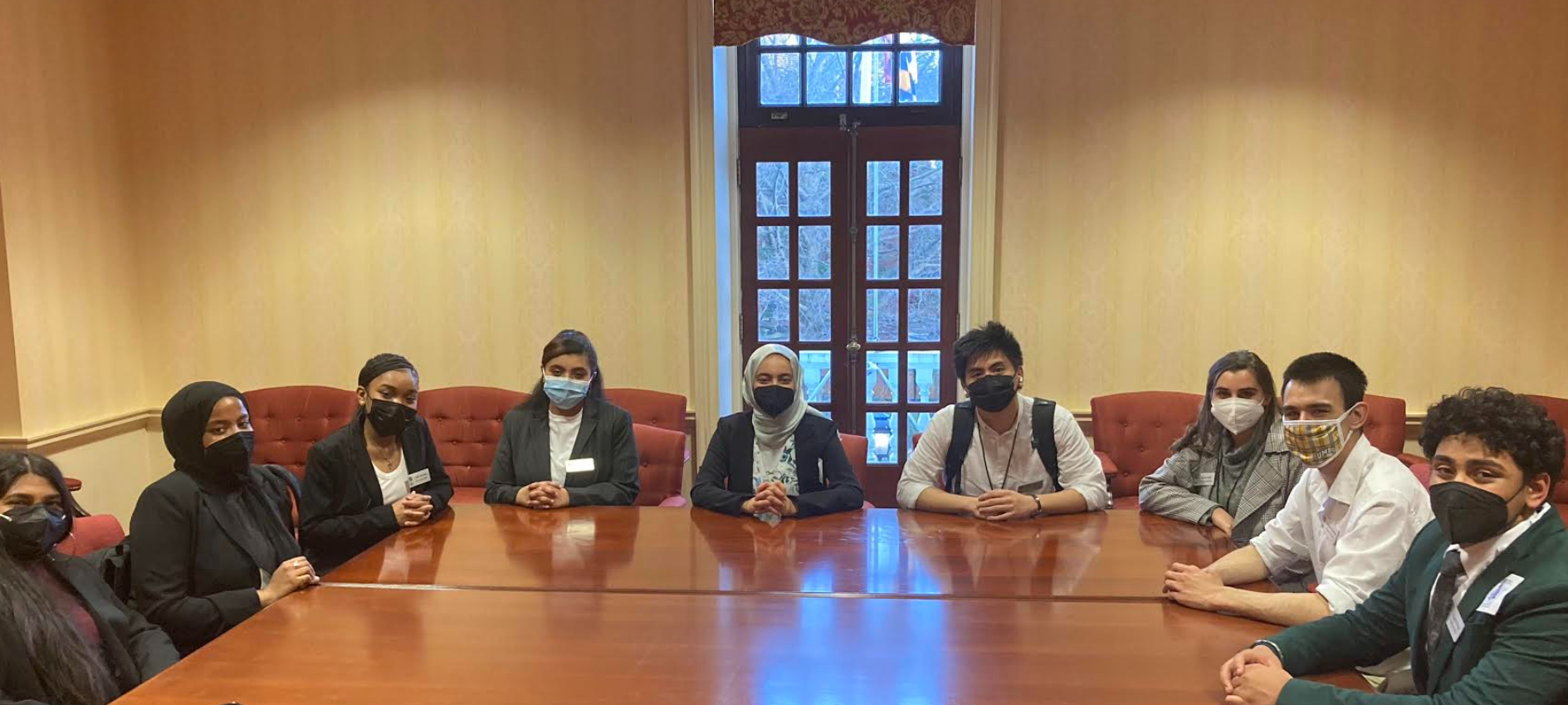
Exploring Pathways to Social Change
In a large room, around 30 participants sat in two semi-circles of foldable chairs facing a panel of people invested in Baltimore and connected to UMBC. Despite the perfect spring break weather, these UMBC students weren’t on vacation. Instead, they gathered around three blue coffee-stained rugs of different shades and sizes with brightly marked poster paper on the walls depicting the community standards like “Take space when you need it,” “Listen non-judgmentally,” and “Don’t be afraid to ask questions.” Pens move steadily across the pages of students’ decorated notebooks.
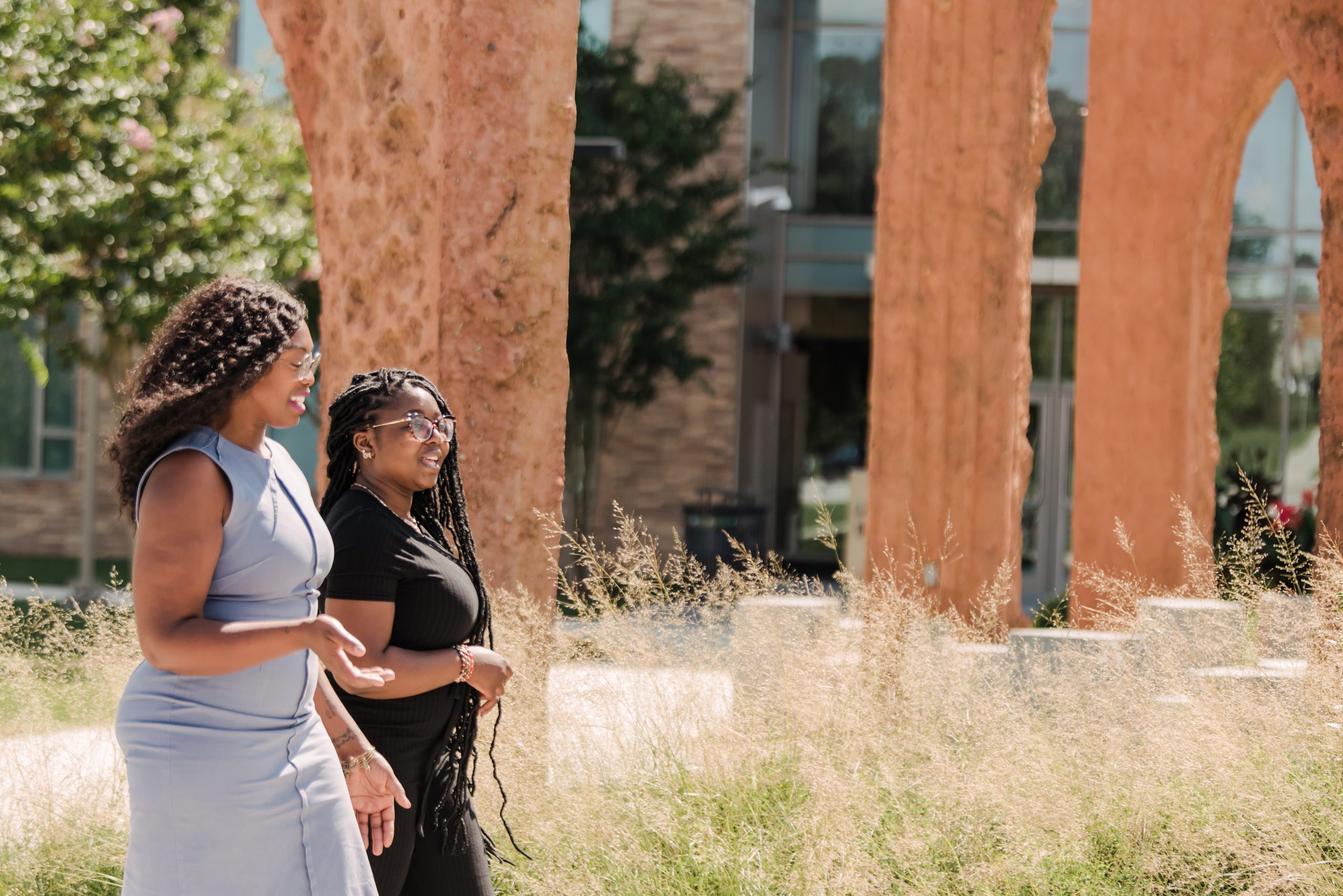
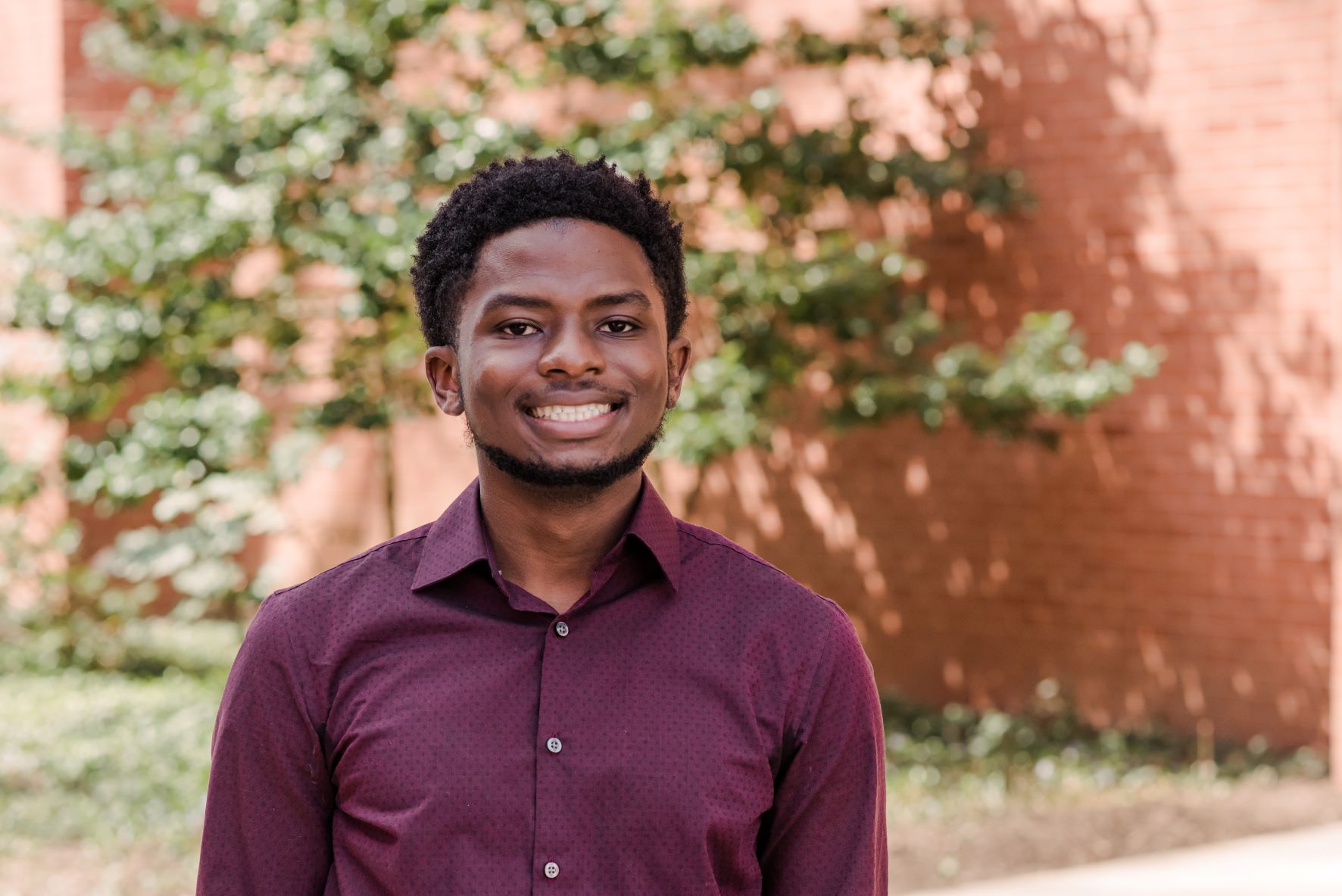
It was the first day of Alternative Spring Break (ASB), a week-long program hosted by the Center for Democracy and Civic Life and coordinated by Faith Davis ’22, sociology and biological sciences, the Center’s community civic engagement intern. “Our program is student-led, so it evolves and takes new forms every year,” explains Davis. “By staying in Baltimore, we are able to equip participants with the tools and knowledge to contribute to sustainable change regarding the social issue their group focuses on. We believe that students are capable contributors to a better world, and ASB orients them to become aware of that.”
“Alternative Spring Break is about opening the door to sustained engagement in Baltimore,” said David Hoffman, Ph.D. ’13, language, literacy, and culture (LLC), and Romy Hübler ’09, modern languages and linguistics, M.A. ’11, intercultural communications, Ph.D. ’15, LLC, director and associate director ofthe Center, respectively.“Participants learn about the systemic and human dimensions of issues affecting the city, make connections with people doing creative and important work, and discover opportunities to make their own meaningful contributions.”
Learning to ask good questions
This year ASB consisted of three student-led groups: Immigrant Health Equity, K-12 Education Equity, and Transformative Justice. The first session of the week: “Contextualizing Baltimore,” allowed for all of the students to engage with the content together. Campus and community leaders discussed the reality of Baltimore City as separate from the negative stereotypes that are sometimes associated with it.
“Baltimore has a very rich history… the persistence of the negative narratives are by design,” Eric Ford, director of the Choice Program shared. “When you hear stuff you should always question what people mean and who it’s coming from. Ask questions not just of people with the title, but also with the people who don’t.”
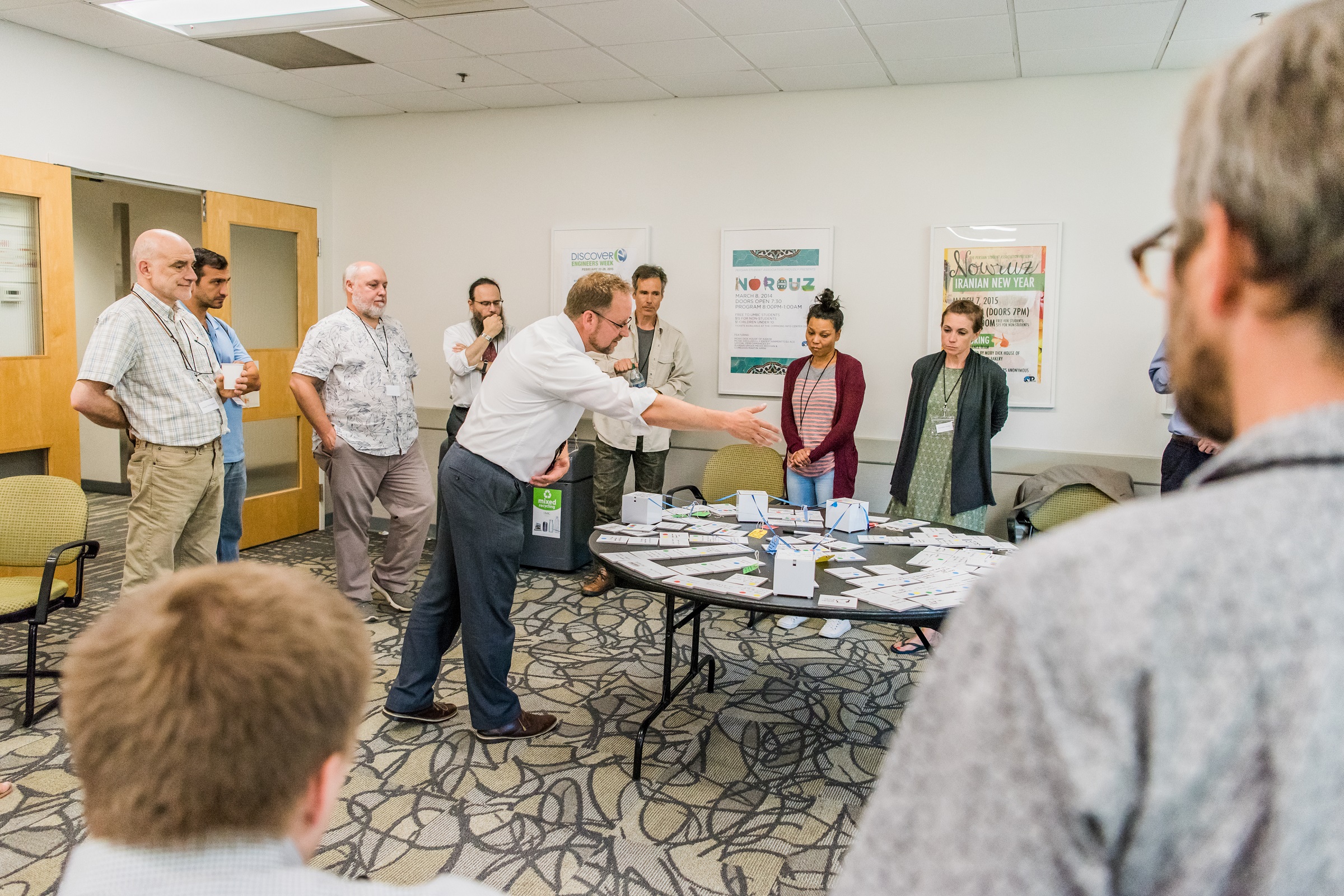
 David Hoffman introduces panelists, from l-r: Eric Ford, and UMBC professors Jodi Kelber-Kaye, Kate Drabinski, and Felipe Filomeno.
Throughout the week, UMBC students in each of the ASB groups would follow Ford’s exhortation and ask hard questions—of their community guides and also of themselves, ultimately using the week to begin building relationships with organizations focused on education, provision of services, and advocacy.
Approaching education critically
As Retrievers know, learning is a continuous process, and the Immigrant Health Equity group exemplified that by seeking more in-depth knowledge of the immigrant communities in Baltimore. They traveled to a small museum situated next to a beautiful little church to hear a speech about immigrant trends from the beginning of America to current times.
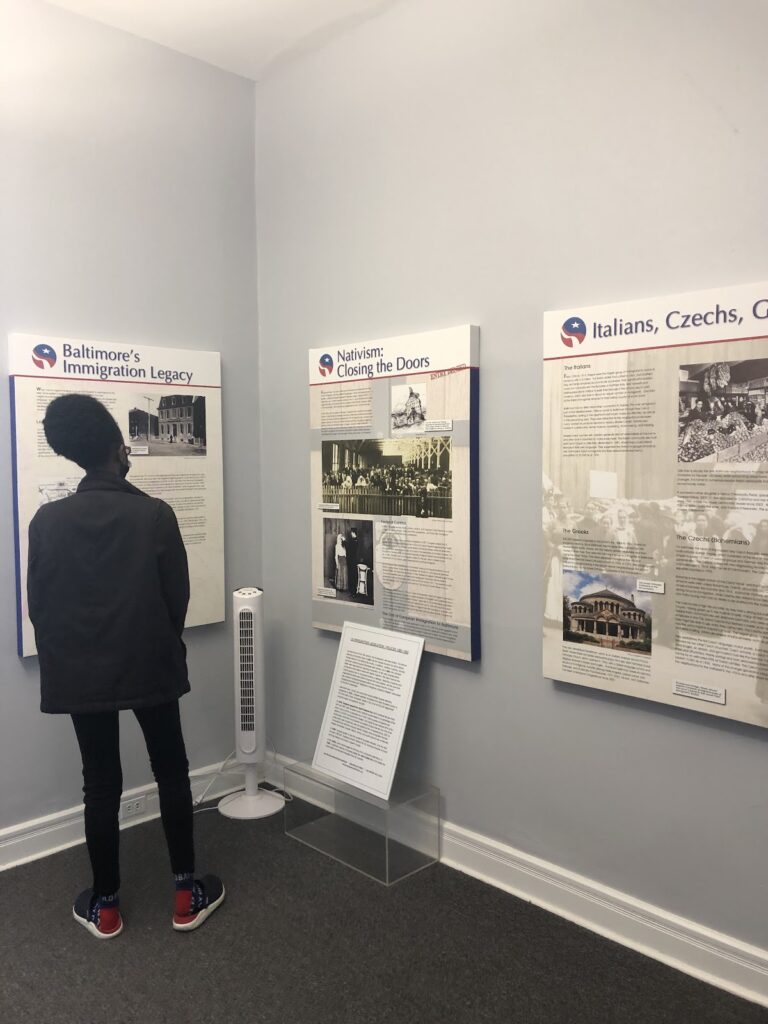
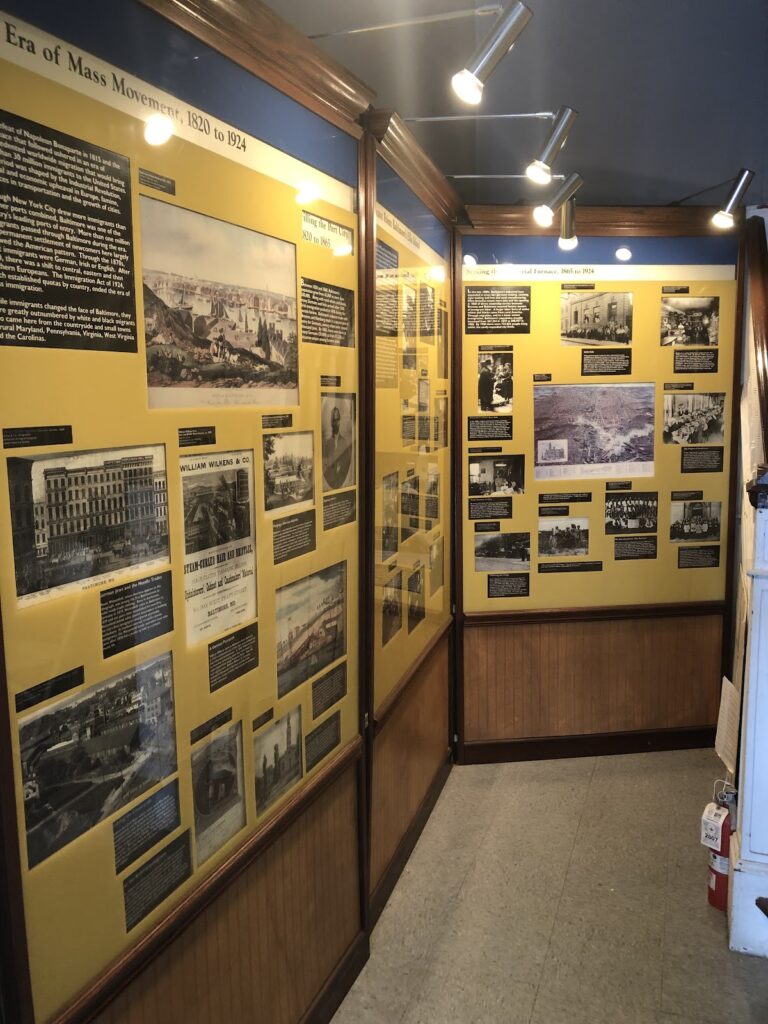
 Inside the museum, students gather around the different stations before heading into the city.
At the end of the lecture, Mokeira Nyakoe ’23, health administration and policy—one of the student leaders—shot her hand up, inspiring others to follow. Students raised critical questions about the information they were given and continued to interact with the docent as they queried for more in-depth information on Black immigrant experiences and the historical context and impact on current immigrant restrictions. After the facilitation ended, students actively reflected on the history they heard—and didn’t hear—by traveling to different parts of Baltimore with immigrant communities and supporting local businesses.
New ways to dream
Learning in many ways is a foundation for bringing about the changes you want to see. The Transformative Justice group went to meet with H.O.P.E (Helping Oppressed People Excel) an organization dedicated to providing relief and advocacy for previously incarcerated individuals.
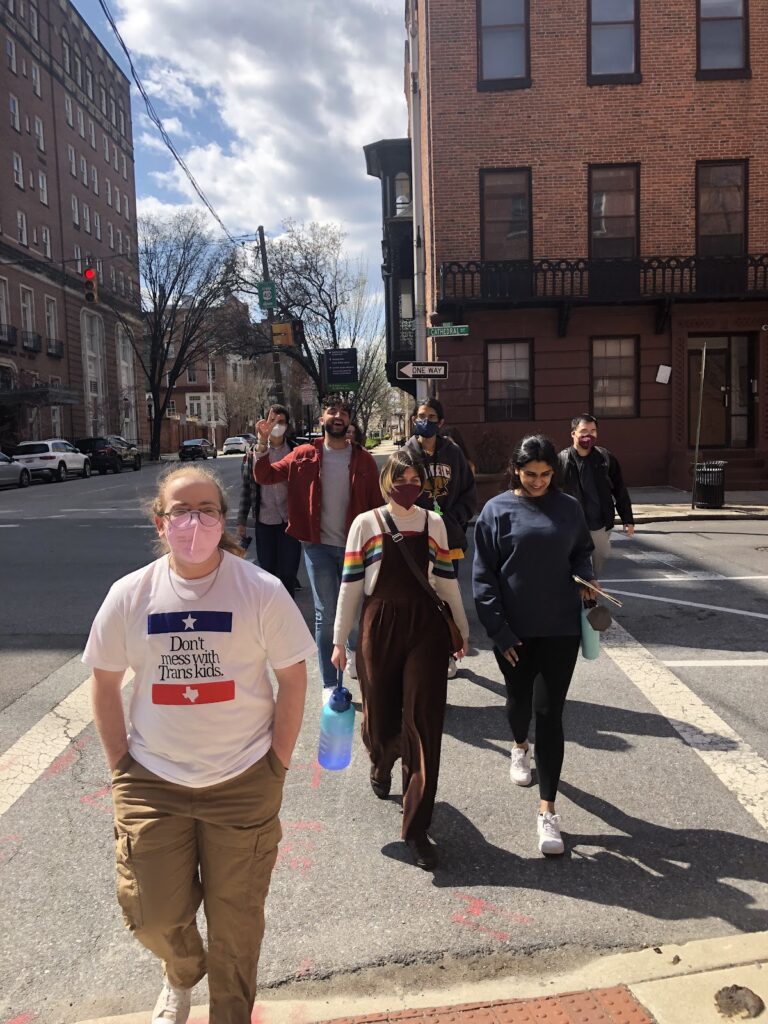
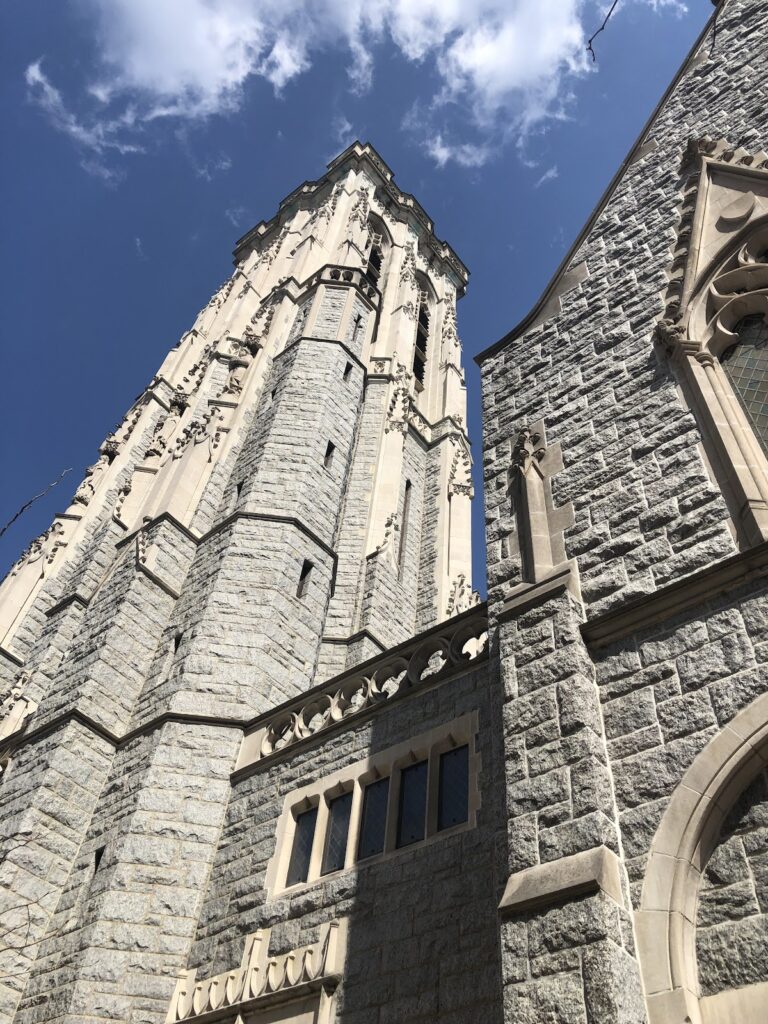 Students walk to Emmanuel Episcopal Church where H.O.P.E operates.
Antoin Quarles, the founder of H.O.P.E, met with the students in midtown Baltimore, guiding them through an ornate building that reached for the heavens. Inside, the walls held both the solemn faces of long-dead church leaders and colorful Black Lives Matter flyers with pictures of Quarles standing side-by-side with Maryland leaders.
Quarles started the session by sharing his past. What started as a heartbreaking story—the result of generational trauma and systemic racism which had transformed the streets of Baltimore into “a battleground” and left Quarles in prison multiple times—eventually evolved into a story of direct advocacy, when Quarles founded H.O.P.E. “Whether it be finding housing, auto insurance, or a job, prison puts a noose around your neck which you can never escape from,” Quarles relayed.
 The Transformative Justice group poses with Quarles in the center.
While also assisting with resources like expungements, clothes, and backpacks, the organization’s main focus is advocacy. Spearheaded by Quarles, the organization fights for changes in housing, insurance, job market, and hospitals relating to the treatment of formerly incarcerated individuals. “Before, I wouldn’t ask myself, ‘Did I like prison? Did I consider [going to prison] normal? Was I scared?’ Those were questions I didn’t ask myself,” says Quarles. “But now, I would lose my mind because of the freedom I have learned to have for myself. Before, I felt comfortable living terribly.” Quarles sees it as his life’s work to support other released folks in walking down a different path.
As UMBC students listened to Quarles’ overview of what H.O.P.E has accomplished, ASB student leader Wendy Zhang ’23, psychology and economics, immediately inquired on how students could get more involved. “The way you dream is determined by what you are exposed to,” reflected Shaniah Reece ’23, information systems, as the students sat arranged in a semicircle around Quarles.
A need-based community approach
Meanwhile, the K-12 Educational Equity group toured Lakeland Elementary and Middle School. Colorful artwork decorated almost every inch of the school and the students conversed freely in Spanish and English. The school was described by the ASB students as a “happy and inviting” place.
Ramona Dowdell, the community school coordinator, explained the importance of a community school. Lakeland Elementary and Middle is interwoven with the surrounding neighborhoods, which largely are home to an underserved Central American immigrant population. On top of the academic work that a school usually does, Lakeland—in partnership with UMBC and other organizations—also provides bilingual education, a food pantry, communal baby showers, college advising, giveaways of backpacks, uniforms, and more. Because the school is connected to the parents and guardians of their students in multiple ways, Lakeland can provide programs and resources based on their unique needs.
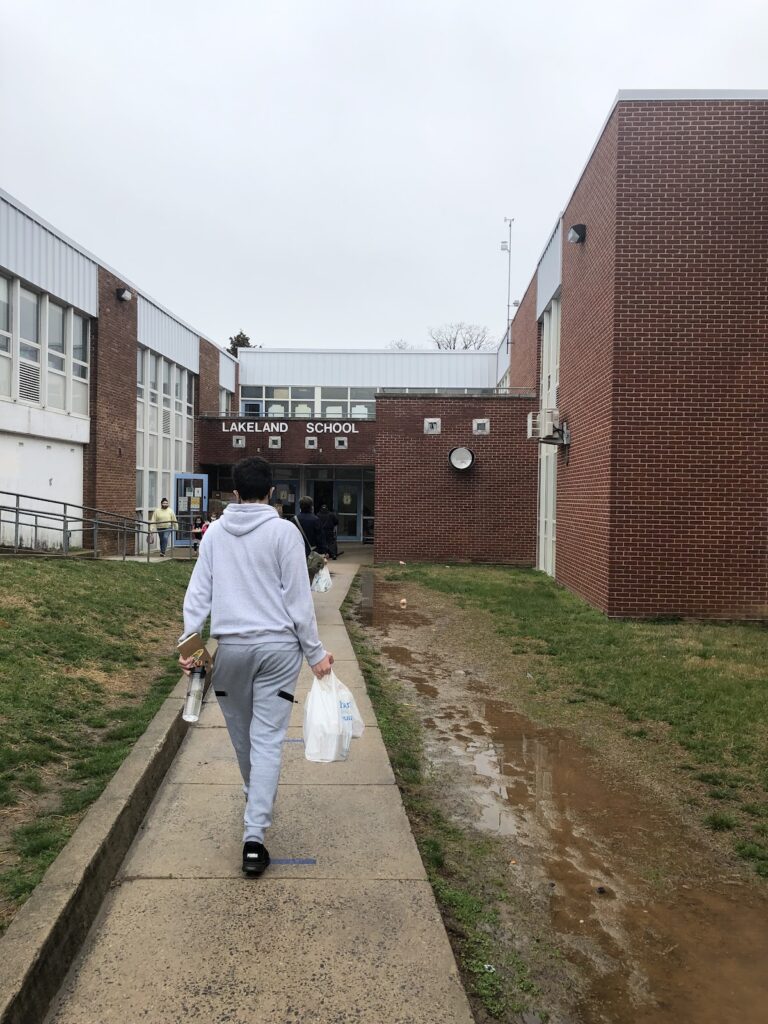
 ASB students tour Lakeland.
During the tour, ASB participants walked past the MedStar mobile health center to unload a van full of grocery bags to a table set up right outside the school, where people from the community could grab what they needed. UMBC students saw the patch of dirt that come spring would transform into a garden, a soundproof studio where kids could record songs, and space for residents of the area to do their laundry.
Throughout their time there, students were warmly welcomed and given more information from the principal, Dowdell, and Brian Francoise, project director of Lakeland Community and the STEAM Center, one of the many members of UMBC tied to the community of Lakeland.
While reflecting on the group’s experience, Karen Griffin ’23, biology, began to ask more questions like, “Why is there not a push to have more community schools around Baltimore? What would my childhood, as someone who grew up low-income in Baltimore City, have looked like if my neighborhood had a community school?”
Investing in the communities around you
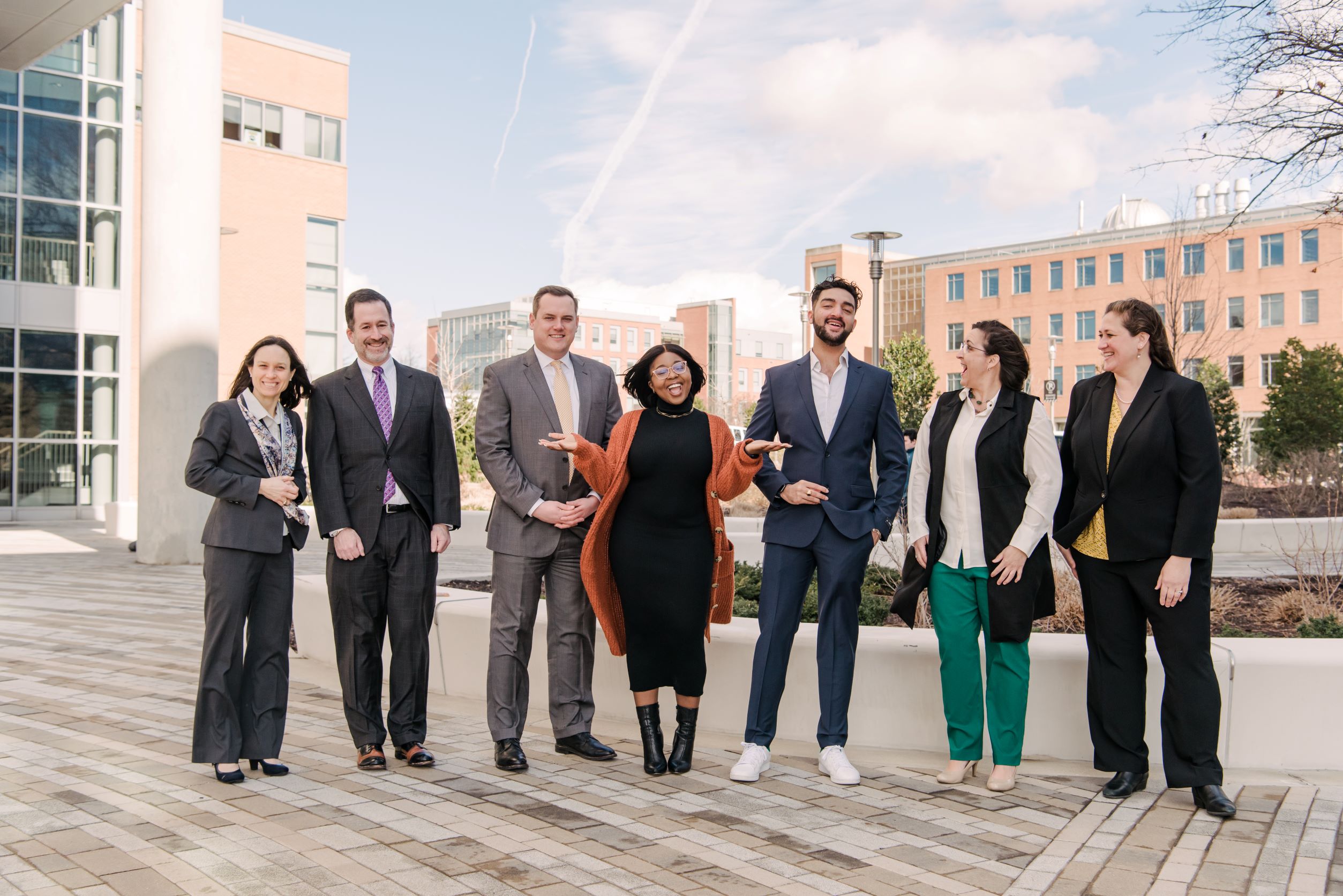
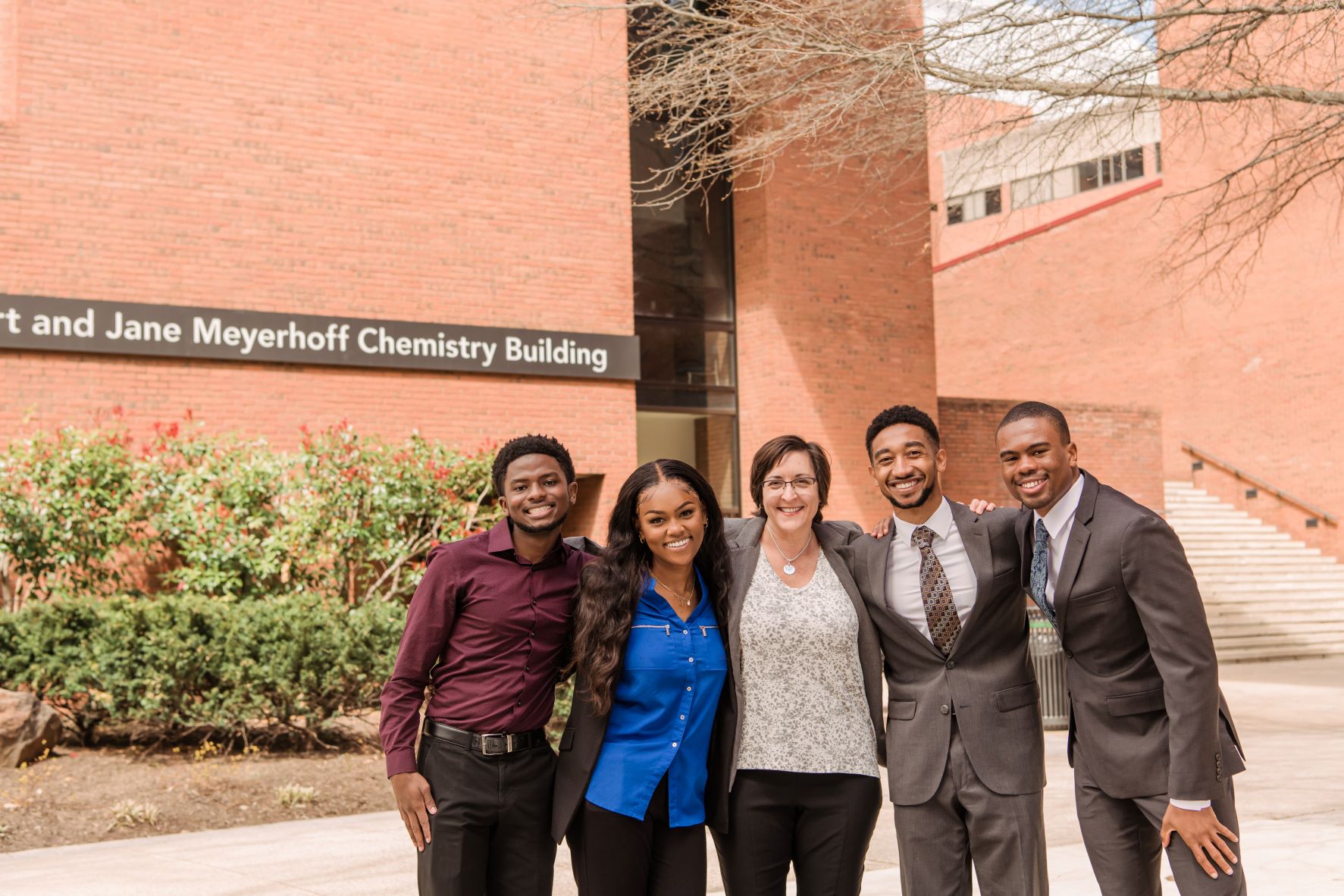
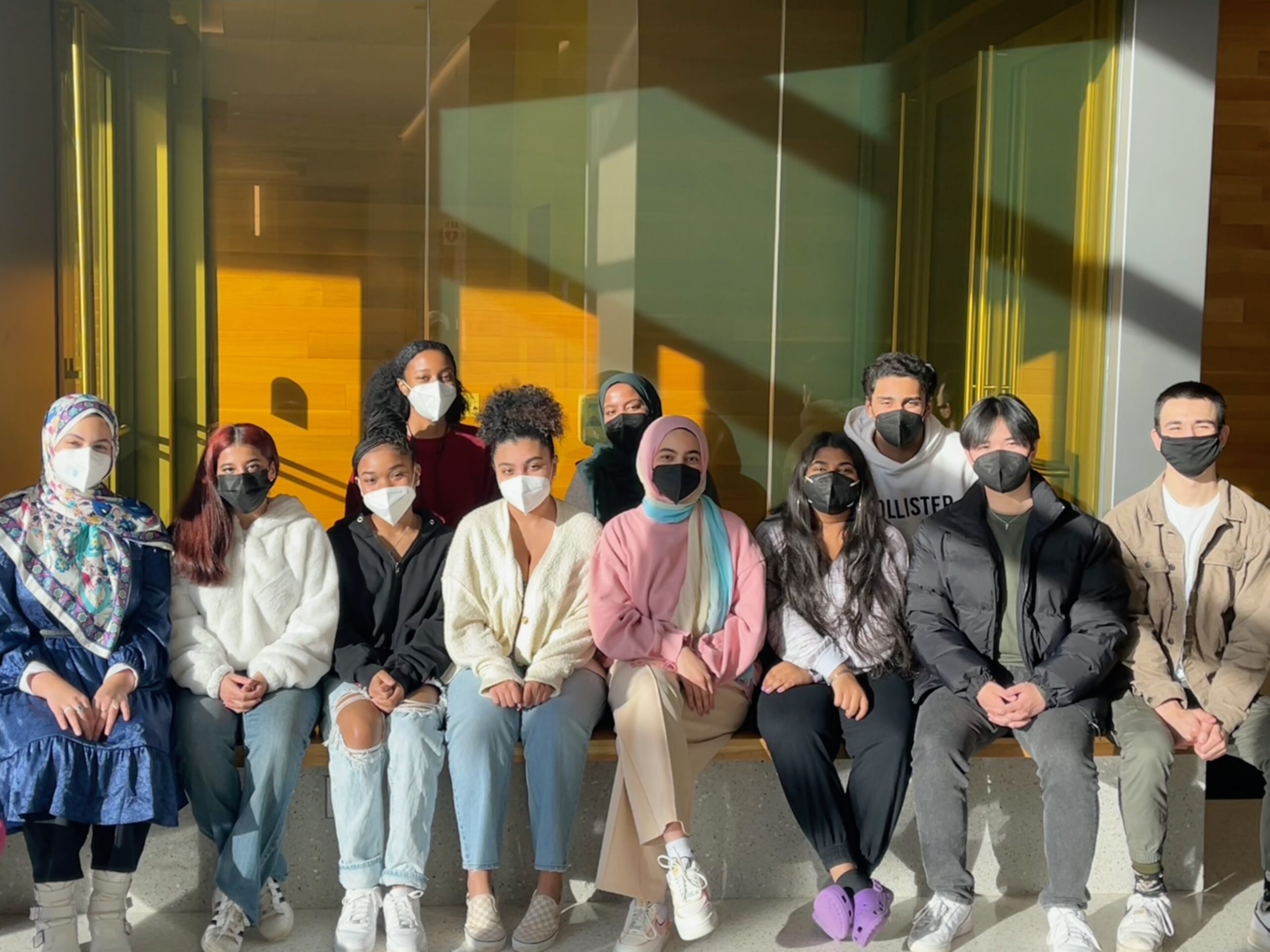
 ASB participants, leaders, and staff from the Center for Democracy and Civic Life pose together at the end of the week.
UMBC’s 2022 ASB took the first steps of building and maintaining long-term relationships with Baltimore organizations and deconstructing the idea of the city that often finds its way to the front pages. Together, participants unpacked ways to build trust with the respective communities their groups worked with, while not assuming what those needs are.
“The idea of an ‘Alternative Spring Break’ on college campuses has been around since the 1980s and was meant to provide students with a meaningful alternative to going to the beach all week” explains Davis, the student organizer. “The idea has since been commercialized, and many schools travel to a location, hours away, do service with an organization, and then return to their home campus. The ASB program at UMBC is unique because the goal is not to find something to fill your spring break but to use your spring break as an introduction to how meaningful change is made in Baltimore City.”
*****
Header image provided by the Center for Democracy and Civic Life.
All other photos by Charis Lawson ’20.
]]>
In a large room, around 30 participants sat in two semi-circles of foldable chairs facing a panel of people invested in Baltimore and connected to UMBC. Despite the perfect spring break weather,...
https://umbc.edu/stories/deconstructing-ideas-about-service/
https://beta.my.umbc.edu/api/v0/pixel/news/119446/guest@my.umbc.edu/a2f6cb794a7dfd6978d9b774584035e2/api/pixel
alternative-spring-break
asb
baltimore
campus-life
center-for-democracy-and-civic-life
magazine
UMBC News & Magazine
https://beta.my.umbc.edu/groups/umbc-news-magazine
https://assets1-beta.my.umbc.edu/system/shared/avatars/groups/000/001/943/24435aa6207c452e7bc15cc74b42c7bb/xsmall.png?1748556657
https://assets1-beta.my.umbc.edu/system/shared/avatars/groups/000/001/943/24435aa6207c452e7bc15cc74b42c7bb/original.png?1748556657
https://assets2-beta.my.umbc.edu/system/shared/avatars/groups/000/001/943/24435aa6207c452e7bc15cc74b42c7bb/xxlarge.png?1748556657
https://assets2-beta.my.umbc.edu/system/shared/avatars/groups/000/001/943/24435aa6207c452e7bc15cc74b42c7bb/xlarge.png?1748556657
https://assets3-beta.my.umbc.edu/system/shared/avatars/groups/000/001/943/24435aa6207c452e7bc15cc74b42c7bb/large.png?1748556657
https://assets1-beta.my.umbc.edu/system/shared/avatars/groups/000/001/943/24435aa6207c452e7bc15cc74b42c7bb/medium.png?1748556657
https://assets2-beta.my.umbc.edu/system/shared/avatars/groups/000/001/943/24435aa6207c452e7bc15cc74b42c7bb/small.png?1748556657
https://assets1-beta.my.umbc.edu/system/shared/avatars/groups/000/001/943/24435aa6207c452e7bc15cc74b42c7bb/xsmall.png?1748556657
https://assets2-beta.my.umbc.edu/system/shared/avatars/groups/000/001/943/24435aa6207c452e7bc15cc74b42c7bb/xxsmall.png?1748556657
UMBC News & Magazine
0
0
false
Fri, 15 Apr 2022 18:16:54 -0400
Fri, 15 Apr 2022 18:16:54 -0400
UMBC’s Cynthia Matuszek receives NSF CAREER Award to study how robots understand spoken language

Robots are becoming increasingly capable of complex tasks and are moving into roles that previously could only be done by people, in sectors like healthcare, education, and elder care. UMBC’s Cynthia Matuszek has received a National Science Foundation (NSF) CAREER Award to study how robots learn about the physical world from spoken language to improve how they work with people. The grant totals nearly $550,000 over five years.
There are robots that can do household chores, distribute medications, and even tutor students in various subjects. Matuszek, assistant professor of computer science and electrical engineering, explains that as robots become more ubiquitous, it is important that they are trained to interact naturally and equitably with the people around them.
Training robots to respond to the real world
Scientists train robots in a range of ways, including developing algorithms that allow them to respond to real-world interactions and to learn through experience. But there are challenges. As machine learning algorithms are made by people, they replicate human biases, which can lead to unfair outcomes.
An overarching goal of Matuszek’s Interactive Robotics and Language Lab is to increase the usability and fairness of robots. Through the CAREER Award, Matuszek and her students will focus on creating training algorithms for robots that enable them to interact with humans in equitable, accessible ways.
The work will start with gathering a large dataset of spoken language from a demographically diverse population. Matuszek and her team will then teach robots to understand that language through a combination of speech and inputs from sensors, such as cameras.
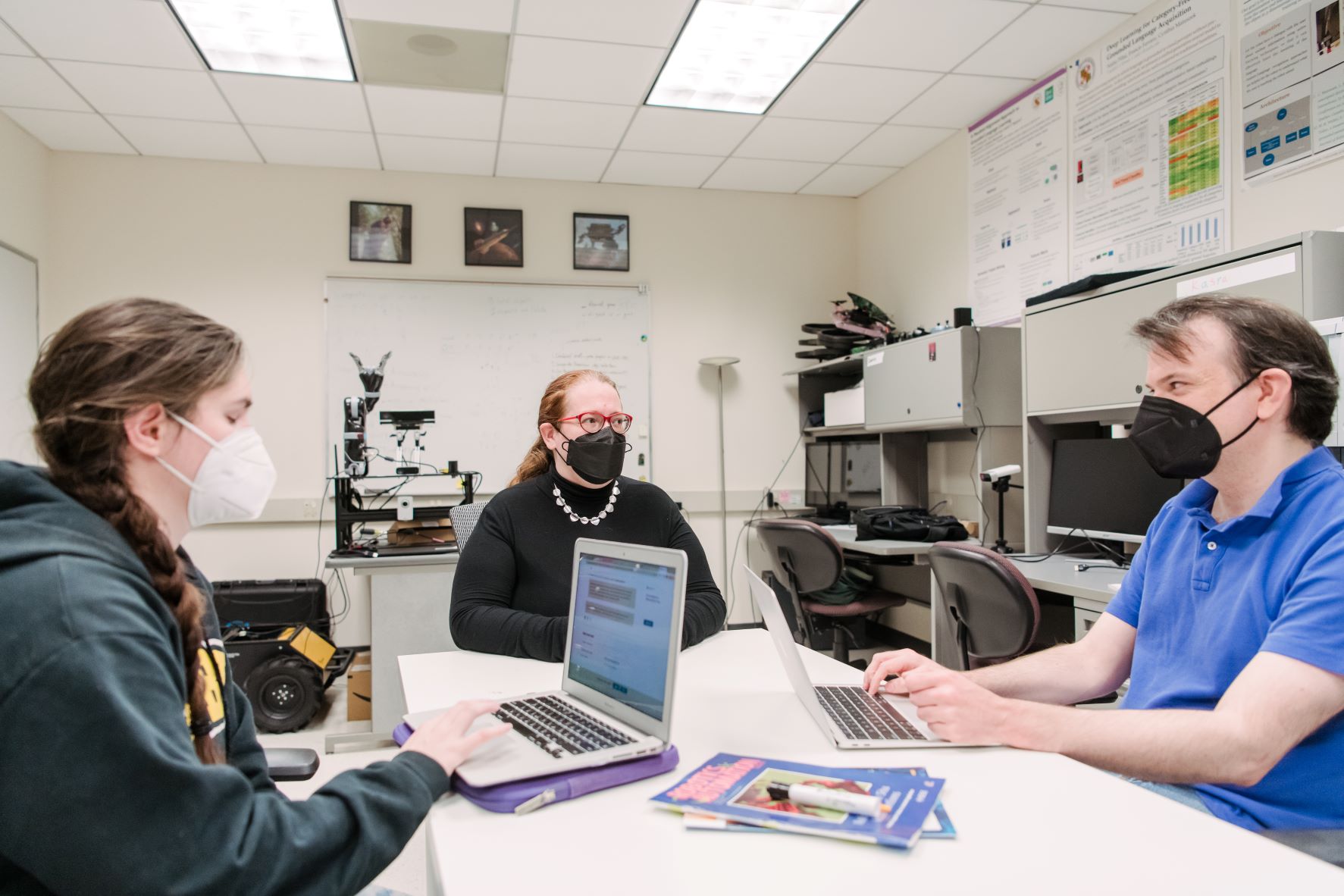
 Cynthia Matuszek, center, with Nadezhda Bzhilyanskaya ’19, M.S. ’25, computer science, and Padraig Higgins, Ph.D. ’23, computer science, in the lab.
This is similar to how people learn about new things from explanations given while they interact with the world using their senses. Through this approach, robots will be trained to understand how people talk about things, while avoiding some of the representation problems present in current large learned AI models.
Matuszek says that while robots can provide value in human spaces, their usefulness is limited if they are only accessible to technology experts. Making robots that can process plain spoken language and respond appropriately will be key to their success.
“This is science that I’m excited about getting pushed forward. And having external reinforcement is a great feeling,” she says.
UMBC faculty consistently recognized
Matuszek’s award is the 41st CAREER award received by UMBC faculty since NSF established the program in 1995. Faculty in departments across campus, from chemical, biochemical, and environmental engineering to physics to chemistry and biochemistry, have received CAREER awards.
UMBC faculty in the College of Engineering and Information Technology (COEIT) have earned several of these grants. Last year, James Foulds, assistant professor of information systems,received a CAREER Award to support his research on improving the fairness and robustness of AI algorithms. Matuszek’s award is the 15th CAREER Award for UMBC’s computer science and electrical engineering faculty.
“Dr. Matuszek’s focus is on ensuring successful communication in noisy, real world, and diverse contexts,” says Keith J Bowman, dean of COEIT. “That includes contexts ensuring aging individuals can maintain their independence and a higher quality of life in their elder years.”
“It’s certainly a big honor to receive a CAREER Award,” says Matuszek. “Receiving the award reinforces that the work I’m doing has value.”
Banner image: Cynthia Matuszek. All photos by Marlayna Demond ’11 for UMBC.
]]>
Robots are becoming increasingly capable of complex tasks and are moving into roles that previously could only be done by people, in sectors like healthcare, education, and elder care. UMBC’s...
https://umbc.edu/stories/umbcs-cynthia-matuszek-receives-nsf-career-award-to-study-how-robots-understand-spoken-language/
https://beta.my.umbc.edu/api/v0/pixel/news/119447/guest@my.umbc.edu/dd34c264fb72b6a9c6c3cbd99957d0d3/api/pixel
coeit
csee
majoraward
news
page1
science-and-tech
UMBC News & Magazine
https://beta.my.umbc.edu/groups/umbc-news-magazine
https://assets1-beta.my.umbc.edu/system/shared/avatars/groups/000/001/943/24435aa6207c452e7bc15cc74b42c7bb/xsmall.png?1748556657
https://assets1-beta.my.umbc.edu/system/shared/avatars/groups/000/001/943/24435aa6207c452e7bc15cc74b42c7bb/original.png?1748556657
https://assets2-beta.my.umbc.edu/system/shared/avatars/groups/000/001/943/24435aa6207c452e7bc15cc74b42c7bb/xxlarge.png?1748556657
https://assets2-beta.my.umbc.edu/system/shared/avatars/groups/000/001/943/24435aa6207c452e7bc15cc74b42c7bb/xlarge.png?1748556657
https://assets3-beta.my.umbc.edu/system/shared/avatars/groups/000/001/943/24435aa6207c452e7bc15cc74b42c7bb/large.png?1748556657
https://assets1-beta.my.umbc.edu/system/shared/avatars/groups/000/001/943/24435aa6207c452e7bc15cc74b42c7bb/medium.png?1748556657
https://assets2-beta.my.umbc.edu/system/shared/avatars/groups/000/001/943/24435aa6207c452e7bc15cc74b42c7bb/small.png?1748556657
https://assets1-beta.my.umbc.edu/system/shared/avatars/groups/000/001/943/24435aa6207c452e7bc15cc74b42c7bb/xsmall.png?1748556657
https://assets2-beta.my.umbc.edu/system/shared/avatars/groups/000/001/943/24435aa6207c452e7bc15cc74b42c7bb/xxsmall.png?1748556657
UMBC News & Magazine
0
0
false
Fri, 15 Apr 2022 13:05:16 -0400
Fri, 15 Apr 2022 13:05:16 -0400
Undefining life: UMBC’s Stephen Freeland offers fresh perspective on life’s origins

What if no single moment in time pinpoints when life began on Earth? What if, instead, life has unfolded continuously through time, making it impossible to know—and, perhaps, not even worth asking—at which precise moment matter on Earth became what we call “life”? That’s the argument presented in a new perspectives article published in Journal of the Royal Society Interface by Stephen Freeland, director of UMBC’s individualized study program and a computational astrobiologist focused on life’s origins.
Freeland’s argument challenges the concept of the RNA world hypothesis, for decades the leading paradigm for explaining how life arose on Earth. In the RNA world hypothesis, RNA was the first to arise of the three core molecule types necessary for life as we know it: DNA, RNA, and proteins. Traditional versions of the RNA world hypothesis posit that originally RNA both self-replicated and carried out chemical reactions—critical processes for life. Later in life’s evolution, DNA and proteins, respectively, largely took over those functions.
However, over the last several years, even RNA world enthusiasts “are in retreat from the idea that it all begins with RNA,” Freeland says. Acceptance is growing for the potential existence of “pre-RNA” compounds that could have been important stepping-stones on the way to life.
“But this paper is trying to say something more subversive,” Freeland says. Not only was RNA not first, he argues, “Even precursors to RNA evolved many steps into the process.” Perhaps, rather than identifying a single point where life began, “it all traces back in a seamless ad infinitum progression,” Freeland says. “That’s a very different way of thinking about the universe from the way that I was raised to think about it.”
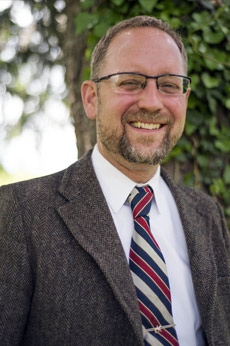
Stephen Freeland. Photo courtesy of UMBC’s Individualized Study Program.
Paradigm shift
Emerging cracks in the RNA world hypothesis have opened Freeland and others’ minds to questioning other long-accepted paradigms. For example, traditionally, complex things are expected to break down into smaller, more stable components over time to reach equilibrium. But it’s not that simple.
In some physical systems, Freeland notes, a constant input of energy can cause building blocks of matter to spontaneously form more-complex structures. Researchers call these phenomena “active matter,” “self-organizing matter,” or other, related terms. This lack of consensus over terminology demonstrates how new a concerted focus on these systems is.
These self-organizing systems don’t defy fundamental physics principles, but they do require a shift in perspective. One must avoid applying assumptions made about systems at rest (without energy input) to understand why a more complex and ordered system would be more stable than a simple, disordered one. As it turns out, there is more than one way to think about equilibrium.
“Traditionally, we have tended to study life’s emergence from a particular equilibrium perspective, and that’s become a paradigm so deep that we’ve forgotten it’s even a paradigm,” Freeland says. Focusing on the ways matter moves and organizes itself, and why, rather than on stability and disorder, “is a different way of thinking about physics that’s so exciting.”
 Freeland (center) leads a discussion at an evaluation workshop for a previous Ideas Lab. Freeland is co-leading a new Ideas Lab in June 2022. It will bring together scholars from several seemingly disparate fields that are all relevant to studying the origins of life. Photo by Marlayna Demond ’11 for UMBC.
Window of change
Freeland argues that the physicists asking these questions, the biologists and chemists studying life’s origins, and researchers in other fields, such as artificial life, have more in common than they might realize, despite their fundamentally different views on things like how to define “equilibrium” in physical systems. However, at present they barely understand one another well enough to perceive their connections, he argues. He believes they could usefully collaborate more to tackle these huge questions of how the universe works.
“There’s low-hanging fruit here,” Freeland says, “if we can acknowledge that people outside our normal spheres are working on something relevant to us, then if we could only learn to communicate, we might find we are already a lot further ahead than we think we are.”
To encourage that communication, Freeland received a $226,000 grant from the Templeton Foundation to bring 30 international scholars in biochemistry, non-equilibrium physics, and artificial life to Prague, Czech Republic in June. He is organizing the event in close collaboration with colleagues at University of Tokyo, Georgia Tech, and Charles University in Prague. The attendees will explore what they have in common, develop new research questions, and compete for access to major funding to pursue their ideas.
As momentum builds in the scientific community to reconsider the primacy of the RNA world hypothesis, Freeland believes “a window of change is here” to ask big questions in new ways. And yet, even acknowledging that RNA was not the beginning of life would be just “a side effect of the more interesting point,” Freeland says, “—that there’s an awful lot we don’t know about how all this fits together.”
Header image: The Frederick Douglass Memorial Bridge in Washington, DC looks like DNA when viewed with its reflection at night. Researchers from a range of fields continue to debate when DNA arose in the sequence of events leading to life as we know it. Photo by Miki Jourdan, used under CC BY-NC-ND 2.0.
]]>
What if no single moment in time pinpoints when life began on Earth? What if, instead, life has unfolded continuously through time, making it impossible to know—and, perhaps, not even worth...
https://umbc.edu/stories/undefining-life-umbcs-stephen-freeland-offers-fresh-perspective-on-lifes-origins/
https://beta.my.umbc.edu/api/v0/pixel/news/119448/guest@my.umbc.edu/d4923d6143b4446c2ca2c478675255c0/api/pixel
inds
news
research
science-and-tech
UMBC News & Magazine
https://beta.my.umbc.edu/groups/umbc-news-magazine
https://assets1-beta.my.umbc.edu/system/shared/avatars/groups/000/001/943/24435aa6207c452e7bc15cc74b42c7bb/xsmall.png?1748556657
https://assets1-beta.my.umbc.edu/system/shared/avatars/groups/000/001/943/24435aa6207c452e7bc15cc74b42c7bb/original.png?1748556657
https://assets2-beta.my.umbc.edu/system/shared/avatars/groups/000/001/943/24435aa6207c452e7bc15cc74b42c7bb/xxlarge.png?1748556657
https://assets2-beta.my.umbc.edu/system/shared/avatars/groups/000/001/943/24435aa6207c452e7bc15cc74b42c7bb/xlarge.png?1748556657
https://assets3-beta.my.umbc.edu/system/shared/avatars/groups/000/001/943/24435aa6207c452e7bc15cc74b42c7bb/large.png?1748556657
https://assets1-beta.my.umbc.edu/system/shared/avatars/groups/000/001/943/24435aa6207c452e7bc15cc74b42c7bb/medium.png?1748556657
https://assets2-beta.my.umbc.edu/system/shared/avatars/groups/000/001/943/24435aa6207c452e7bc15cc74b42c7bb/small.png?1748556657
https://assets1-beta.my.umbc.edu/system/shared/avatars/groups/000/001/943/24435aa6207c452e7bc15cc74b42c7bb/xsmall.png?1748556657
https://assets2-beta.my.umbc.edu/system/shared/avatars/groups/000/001/943/24435aa6207c452e7bc15cc74b42c7bb/xxsmall.png?1748556657
UMBC News & Magazine
0
0
false
Thu, 14 Apr 2022 16:20:22 -0400
Thu, 14 Apr 2022 16:20:22 -0400
UMBC’s Haleemat Adekoya receives prestigious Truman Scholarship for education advocacy

Haleemat Adekoya ‘23, political science, received a surprise phone call last Tuesday morning. On the line were both UMBC President Freeman Hrabowski and Valerie Sheares Ashby, who just one day earlier was announced as UMBC’s next president. They were calling together to share, with heartfelt congratulations, her selection as a 2022 Truman Scholar.
Adekoya has spent the last year preparing to apply for the renowned national scholarship focused on public service. After a series of rigorous interviews, the Harry S. Truman Scholarship Foundation announced Adekoya as one of just 58 students nationwide to receive the award. Adekoya is UMBC’s fifth Truman Scholar.
“I am incredibly proud of Haleemat. Her authenticity, sincerity and humility permeate everything she does,” says Carolyn Forestiere, professor of political science. “I feel very fortunate to have worked with this extraordinary young person as her professor at UMBC, and I know she will excel at whatever she decides to do with her future.”
The Foundation selected recipients from a pool of over 700 applicants who showed a strong record of public service and also submitted a policy proposal addressing a concerning issue in society. Scholars receive $30,000 to attend the graduate school of their choice, as well as access to public service programs, mentorship, and job opportunities within the federal government.
“It is an honor and a pleasure to know that I have been named a 2022 Truman Scholar. All I can say is Glory be to God and to my village, thank you forever,” says Adekoya. “I look forward to continuing to engage in my commitment to cultivate transformative learning spaces and elevating the voices of Black children and celebrating their brilliance.”
Two finalists
This year also marked the second time two UMBC students reached the final round of Truman Scholar selection. In addition to Adekoya, Rehman Liaqat ‘22, political science, was also chosen as a finalist.
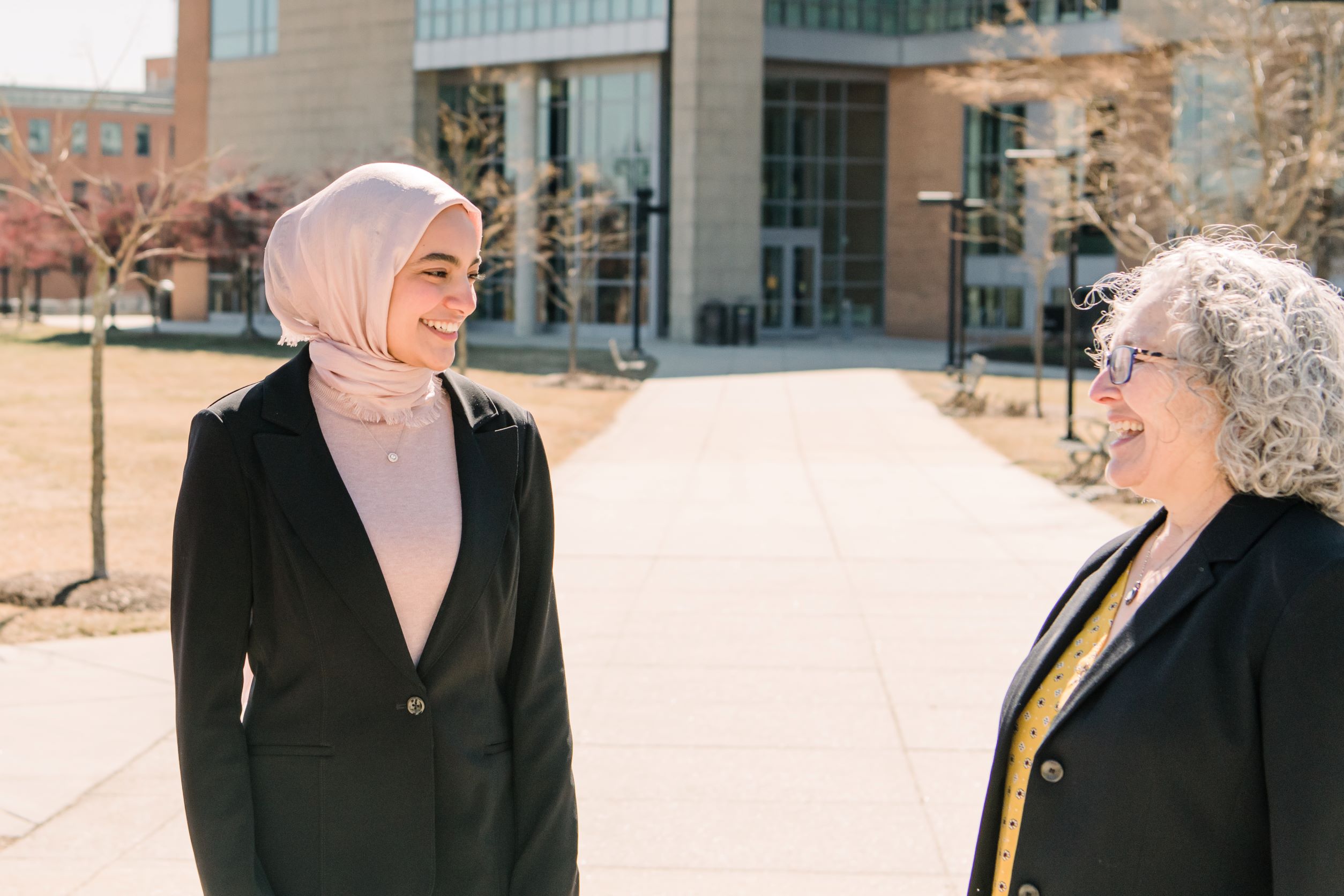
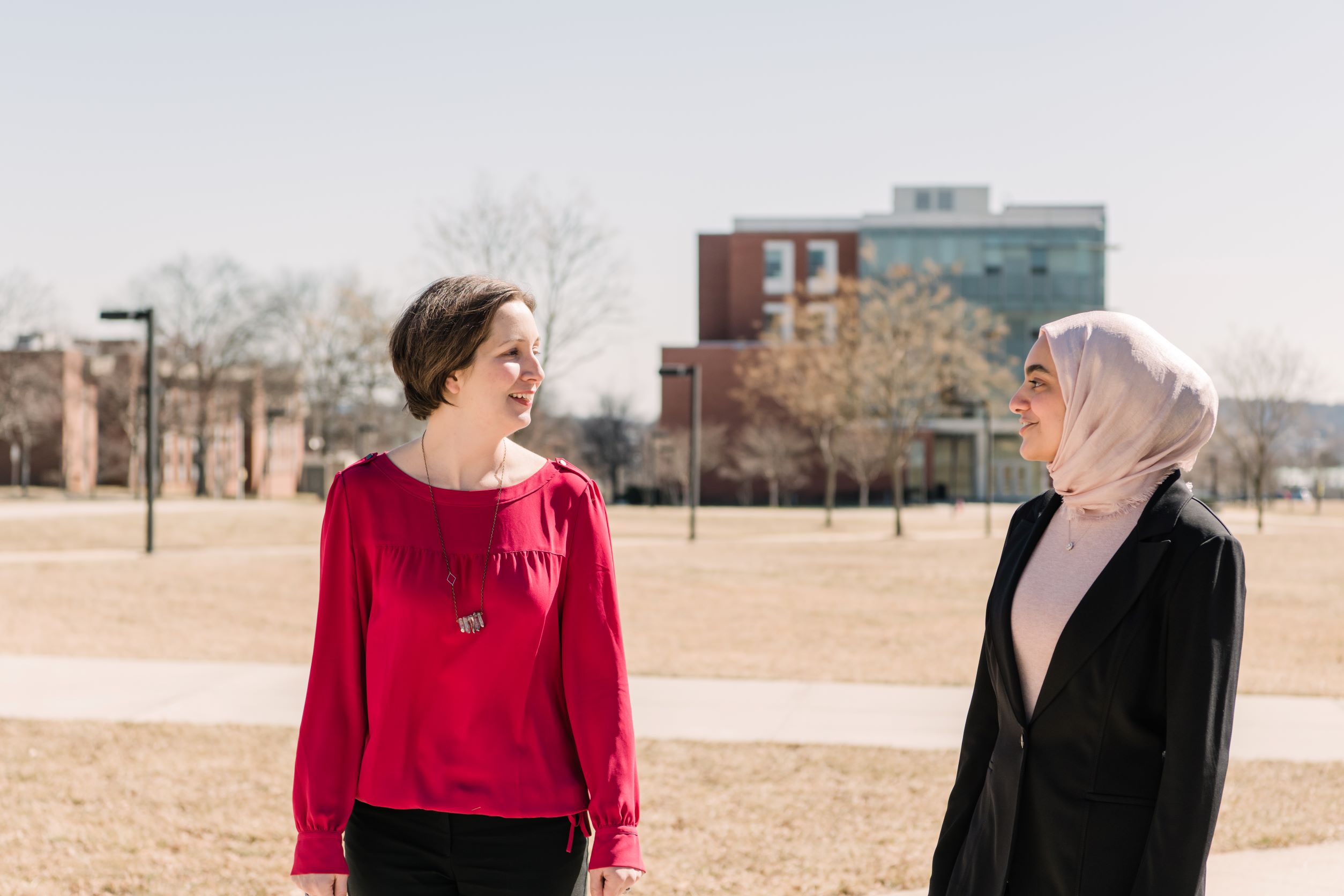
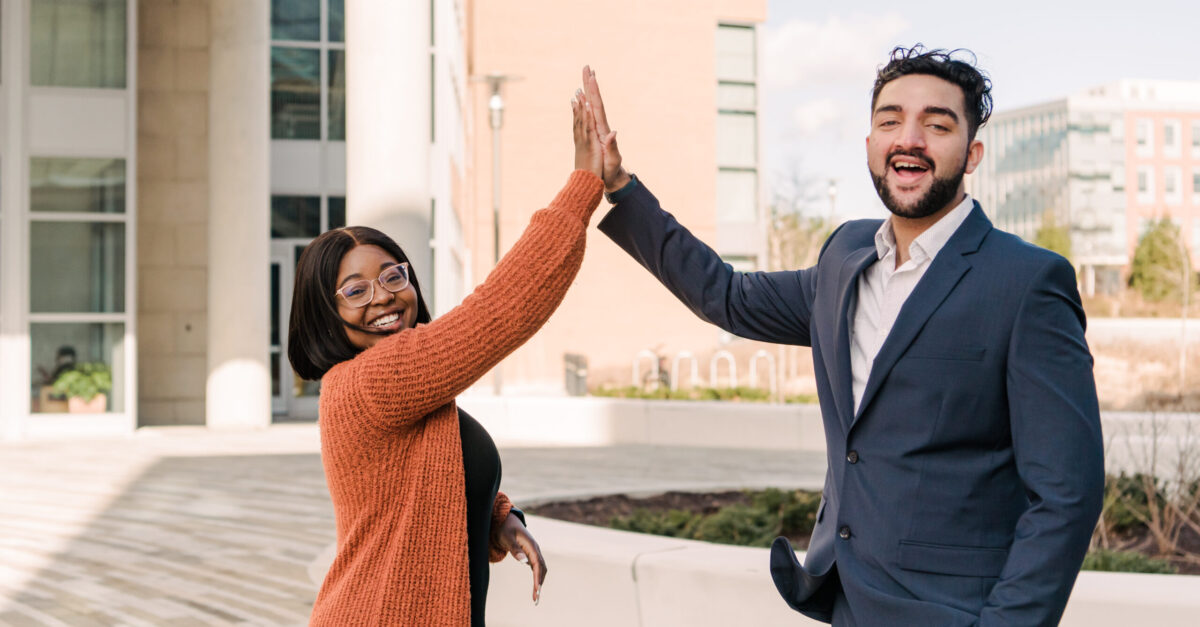 Haleemat Adekoya and Rehman Liaqat 2022. (Marlayna Demond ’11/UMBC)
“Having two finalists is a huge honor for UMBC,” says April Householder, director of undergraduate research and prestigious scholarships. “With only 58 winners selected, that means that our students are highly competitive for this award.” Other institutions with multiple finalists include Duke, Harvard, MIT, and Stanford.
Liaqat and Adekoya are macro thinkers who have learned to both identify everyday problems at a local level and work towards systemic solutions. Liaqat has focused on legal advocacy while Adekoya’s interest is in education reform. Their steadfast commitment to personal growth in service of numerous communities made them strong candidates for the 2022 Truman Scholarship.
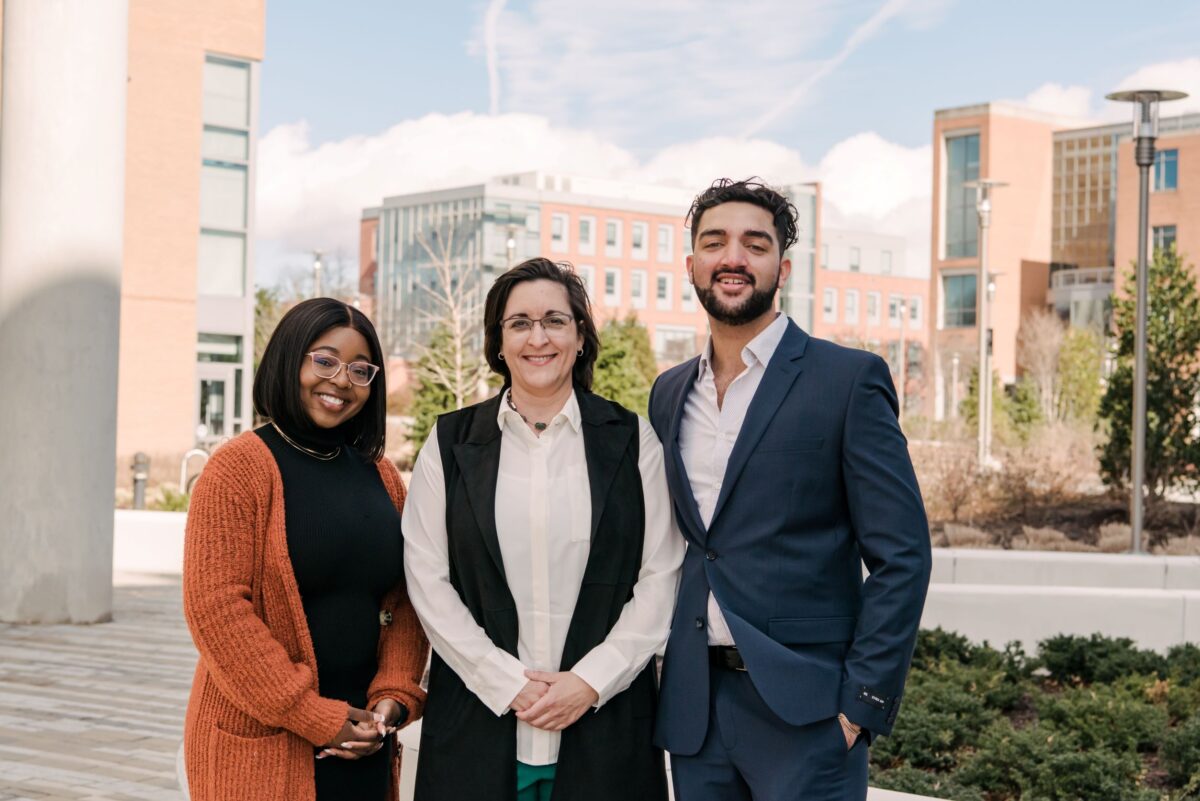 Adekoya (l), Householder (c), and Liaqat (r).
“Haleemat and I both began our journeys at UMBC serving with the Shriver Center, and now, we are both following a pathway towards lifelong public service,” says Liaqat. “This national recognition highlights the fact that UMBC is indeed a magical place that fosters community leaders and passionate public servants, such as Haleemat.”
“This journey has only solidified what UMBC is all about: a community of care and ‘true grit’ towards transformative excellence,” he reflects.
“To have been nominated as one of the two Truman Scholarship finalists is an experience that still has me on cloud nine. Words cannot describe how grateful I am to have been able to experience the scholarship process with someone as incredible as Rehman,” says Adekoya. “I am confident that the better world we reimagine is more than possible because of revolutionary, compassionate, and devoted dreamers like him.”
Collective vision
When Adekoya reflects on her path leading to the Truman Scholarship she sees the combined hard work of Baltimore City and County Public School teachers and students, her UMBC family, and the Sherman STEM Teacher Scholars Program. Their collective vision for sustainable and intentional full-service community schools propels her to think of education reform as an everyday practice.
“Education is said to be the most powerful tool one can use to change the world. However, our current education system excludes many Black students from experiencing such a transformative tool,” reflects Adekoya. “As an education advocate for Black students, I hope to one day develop multi-faceted strategies that address the flaws within our education system.”
Driving change
With this goal in mind, Adekoya participated in the launch of UMBC’s Sherman STEM Teacher Scholars Program intensive virtual math incubator for 150 students at Lakeland Elementary/Middle School in Baltimore City during the first COVID summer. Concurrently, she served as an intern at the Maryland State Department of Education, with the Student, Family, and School Support Committee, in 2020 – 2021. The Maryland Higher Education Commission (MHEC) then chose Adekoya as student representative, serving on its Education Policy Committee and Outreach, Grants, and Financial Assistance Committee for 2021 – 2022.
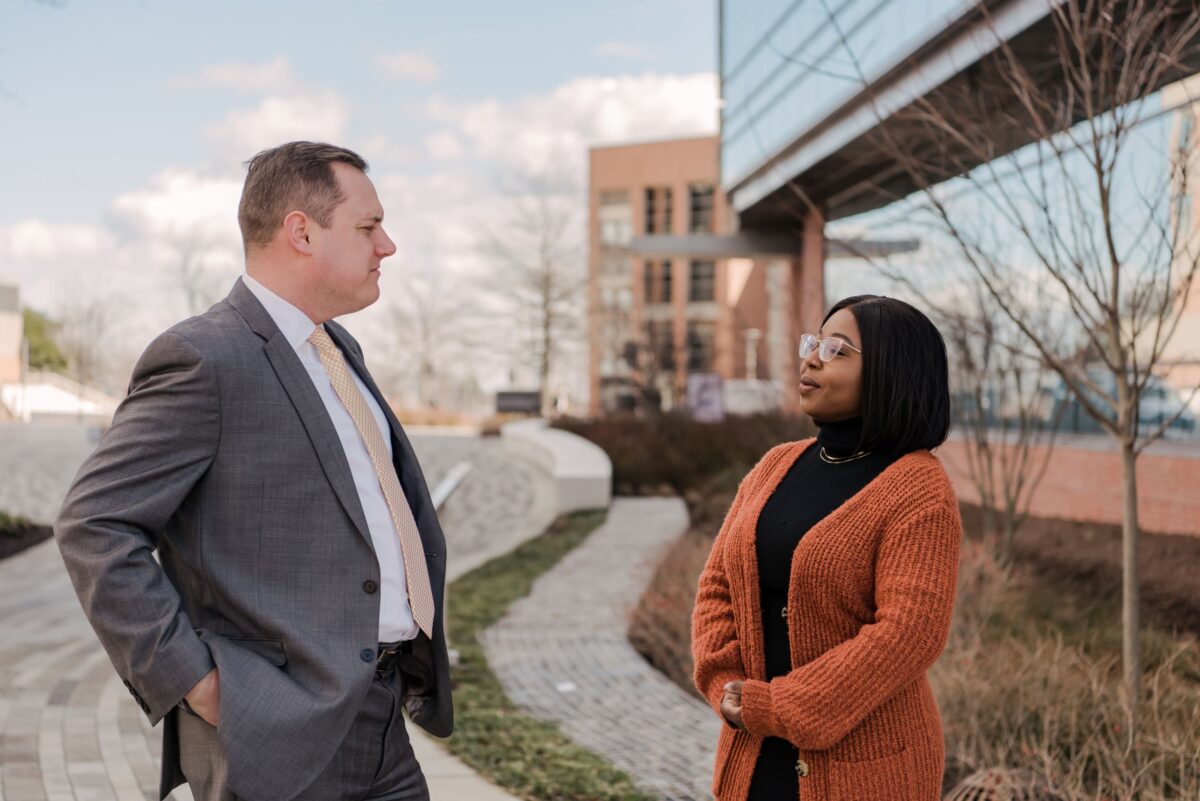 Adekoya (r) with Josh Michael ’10, political science and education, director of Baltimore school partnerships for UMBC’s Sherman STEM Teacher Scholars Program.
In 2019, prior to joining UMBC, Baltimore County Government awarded Adekoya with the “Young Woman of the Year” award for her community-engaged work as a member of the Superintendent’s Student Advisory Council; a mentor in a STEM program for girls; a local coordinator for the From Prison Cells to PhD program; and as founder of Dare2Bee, an empowerment organization for girls ages 9 – 18.
“Haleemat is such a strong and compassionate leader. One of the things that inspires me most about her is her commitment to others,” says her mentor Jasmine Lee, director of inclusive excellence in UMBC’s Division of Student Affairs.
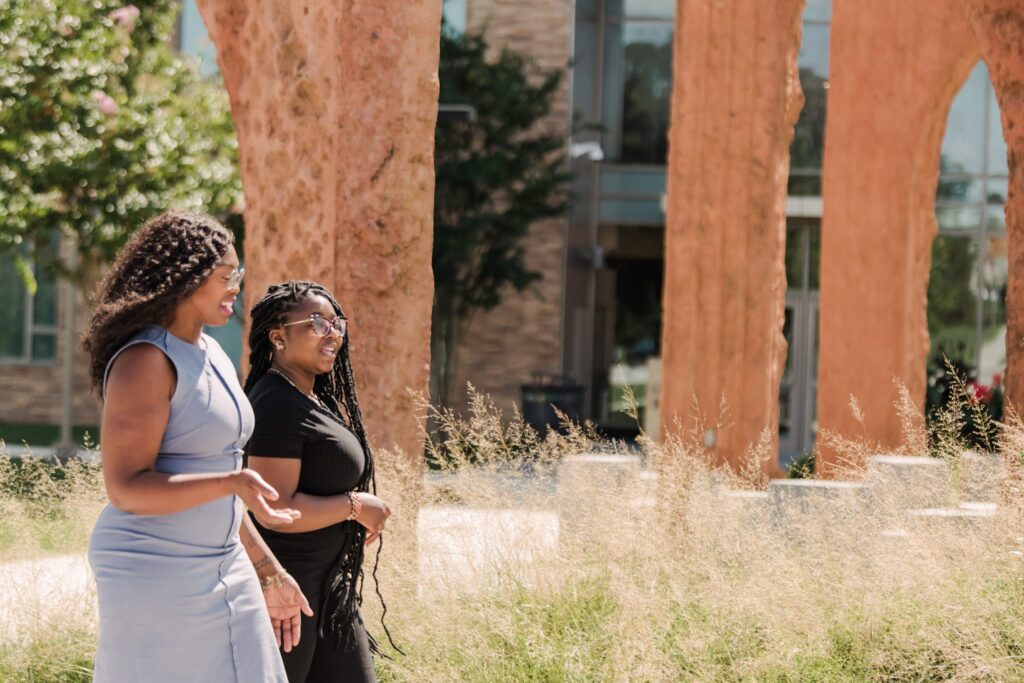 Adekoya (r) with Jasmine Lee.
“She’s not a leader because she’s ‘ahead of the pack’…but instead because she is concerned about everyone making it,” Lee shared when Adekoya was named MHEC student commissioner. “She seems to move from the front to the back, and throughout the middle, empowering everyone to move at their own pace.”
Striving together
Liaqat, a political science major, came to the United States from Pakistan when he was eleven. He spent his teen years in Salisbury, on Maryland’s eastern shore. His time was split between school and working at OC Quickstop, one of three family-owned gas stations.
He earned recognition for supporting his local community and came to UMBC ready to build connections and his leadership skills. He soon also discovered a love of constitutional law, and a commitment to promoting human rights internationally.
In addition to being named a Truman Scholar finalist, he has also earned the inaugural Campus Compact Mid-Atlantic Civic Fellow award. He is completing his master’s in public policy through an accelerated program at UMBC, at the same time as his undergraduate degree. Next, he will next enter a four-year joint degree program (MPP/JD) at the McCourt School of Public Policy and the Georgetown University Law Center.
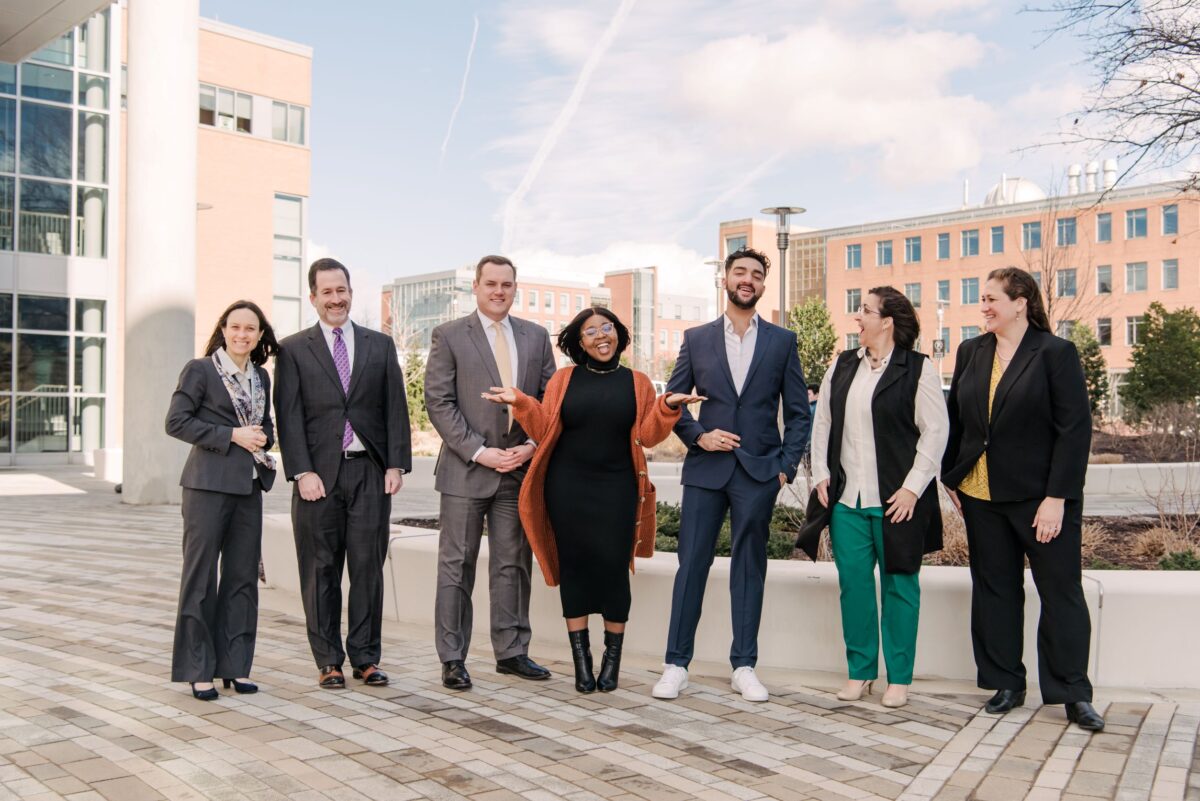 Adekoya and Liqat (center) with their mentors: (l-r) Laura Antkowiak, associate professor of political science and director of the Sondheim Scholars Program; David Hoffman, Ph.D. ’13, language, literacy, and culture, director of the Center for Democracy and Civic Life; Michael; Householder; and Lori Hardesty, associate director of applied learning and engagement at the Shriver Center.
Householder says Adekoya’s win and Liaqat’s recognition as a finalist are “a testament to the hard work of these students” and the support they receive from programs like the Sondheim Public Affairs Scholars and Sherman STEM Teacher Scholars, as well as the Honors College, Undergraduate Research and Prestigious Scholarships, and the Shriver Center.
“This is a community that provides rich experiences for our students,” says Householder. “Those experiences spark their passions for becoming public servants and using their well-honed talents to help others.”
Featured image: Haleemat Adekoya. All photos by Marlayna Demond ’11 for UMBC.
]]>
Haleemat Adekoya ‘23, political science, received a surprise phone call last Tuesday morning. On the line were both UMBC President Freeman Hrabowski and Valerie Sheares Ashby, who just one day...
https://umbc.edu/stories/umbcs-haleemat-adekoya-receives-prestigious-truman-scholarship-for-education-advocacy/
https://beta.my.umbc.edu/api/v0/pixel/news/119449/guest@my.umbc.edu/b89895f67caf32aeb7f4896c6a3a7022/api/pixel
cahss
cahssresearch
honorscollege
majoraward
news
page1
policy-and-society
politicalscience
shermanscholars
shrivercenter
sondheimscholars
UMBC News & Magazine
https://beta.my.umbc.edu/groups/umbc-news-magazine
https://assets1-beta.my.umbc.edu/system/shared/avatars/groups/000/001/943/24435aa6207c452e7bc15cc74b42c7bb/xsmall.png?1748556657
https://assets1-beta.my.umbc.edu/system/shared/avatars/groups/000/001/943/24435aa6207c452e7bc15cc74b42c7bb/original.png?1748556657
https://assets2-beta.my.umbc.edu/system/shared/avatars/groups/000/001/943/24435aa6207c452e7bc15cc74b42c7bb/xxlarge.png?1748556657
https://assets2-beta.my.umbc.edu/system/shared/avatars/groups/000/001/943/24435aa6207c452e7bc15cc74b42c7bb/xlarge.png?1748556657
https://assets3-beta.my.umbc.edu/system/shared/avatars/groups/000/001/943/24435aa6207c452e7bc15cc74b42c7bb/large.png?1748556657
https://assets1-beta.my.umbc.edu/system/shared/avatars/groups/000/001/943/24435aa6207c452e7bc15cc74b42c7bb/medium.png?1748556657
https://assets2-beta.my.umbc.edu/system/shared/avatars/groups/000/001/943/24435aa6207c452e7bc15cc74b42c7bb/small.png?1748556657
https://assets1-beta.my.umbc.edu/system/shared/avatars/groups/000/001/943/24435aa6207c452e7bc15cc74b42c7bb/xsmall.png?1748556657
https://assets2-beta.my.umbc.edu/system/shared/avatars/groups/000/001/943/24435aa6207c452e7bc15cc74b42c7bb/xxsmall.png?1748556657
UMBC News & Magazine
0
0
false
Thu, 14 Apr 2022 11:36:01 -0400
Thu, 14 Apr 2022 11:36:01 -0400
UMBC Responds to Putin’s War in Ukraine

On February 24, just one day after a Russian holiday celebrating the “defenders of the Fatherland,” Russian President Vladimir Putin ordered his military forces to invade Ukraine. The ensuing assault catalyzed a mass of destruction and action.
In the classroom of Kyiv-born Vira Zhdanovych, an instructor of Russian at UMBC, students are using their language skills to take in information from different perspectives. Zhdanovych notes that both her students and colleagues from the Department of Modern Languages, Linguistics, and Intercultural Communication (MLLI) reached out to her during the first days of the invasion and have been extremely supportive since.
“Like everyone, I have been very upset and confused by Putin’s invasion of Ukraine,” says Zhdanovych. “This was especially difficult for me because I am from Kyiv and have relatives who were forced to evacuate. Fortunately, my immediate family—my sister, niece and nephew—have made it out, though my brother-in-law remained behind to defend Kyiv. I also have many friends who are still in Kyiv and in surrounding areas and I worry about them each day.”
Additional faces and voices of those impacted have since risen to the surface through several virtual UMBC town halls that highlight Ukrainian American voices as well as faculty experts on the region.
UMBC professors and students share their expertise
In the early weeks following the initial invasion, UMBC’s Center for Social Sciences Scholarship, History Department, and the Political Science Department hosted a virtual discussion about the history leading up to the current crisis, as well as the political and economic impacts that it is having today on surrounding countries and globally. Present at the panel were Devin Hagerty and Brian Grodsky, professors of political science and affiliate faculty in Asian studies, and Mirjam Voerkelius, assistant professor of history. Joining them were three undergraduate students who shared their personal experiences and reactions to the current climate in Ukraine.
 Hagerty (standing) teaching a global studies course. All photos by Marlayna Demond ’11, unless otherwise noted.
Maria Kutishcheva ’24, political science and MLLI, shared that the conflict has had a devastating effect on her family. With relatives in both Ukraine and Russia, Kutishcheva talked about two sides of the crisis from a personal standpoint, mentioning the divisions that have been deepened by Russian propaganda. She ended her story on a compelling note: inaccurate portrayals of the war cannot keep up with reality, but Ukraine still needs our continued attention and support.
Although it can be difficult to absorb everything that has happened leading up to the crisis, the Retriever community is fortunate to have students and faculty who can provide insight on the subject. Many people, especially those with personal ties to the situation, have been deeply affected and wish to stay informed through their communities—a desire that was again met by UMBC’s second virtual discussion about Asia’s influence on the Russia-Ukraine War in mid-March.
Brian Carlson, head of the Global Security Team of the Think Tank at the Center for Security Studies, returning panelists Brian Grodsky and Devin Hagerty, and Meredith Oyen, associate professor of history and director of UMBC’s Asian studies program, led the discussion and helped answer attendees’ questions about global relations across Asia and Europe. Carlson opened up the discussion by describing Russia’s ties to China.
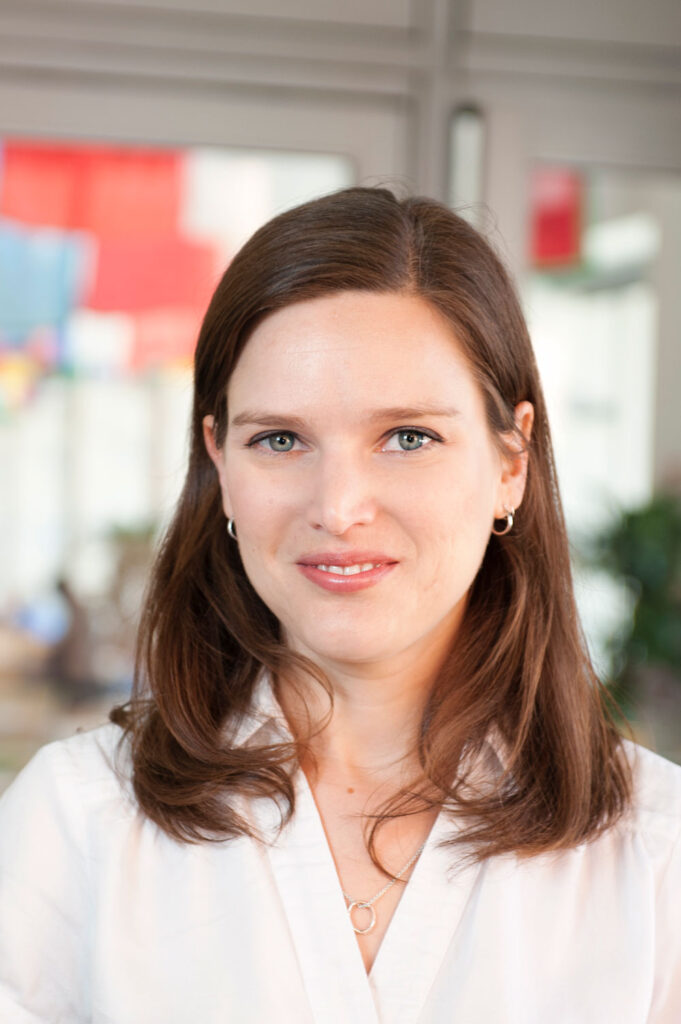 Meredith Oyen
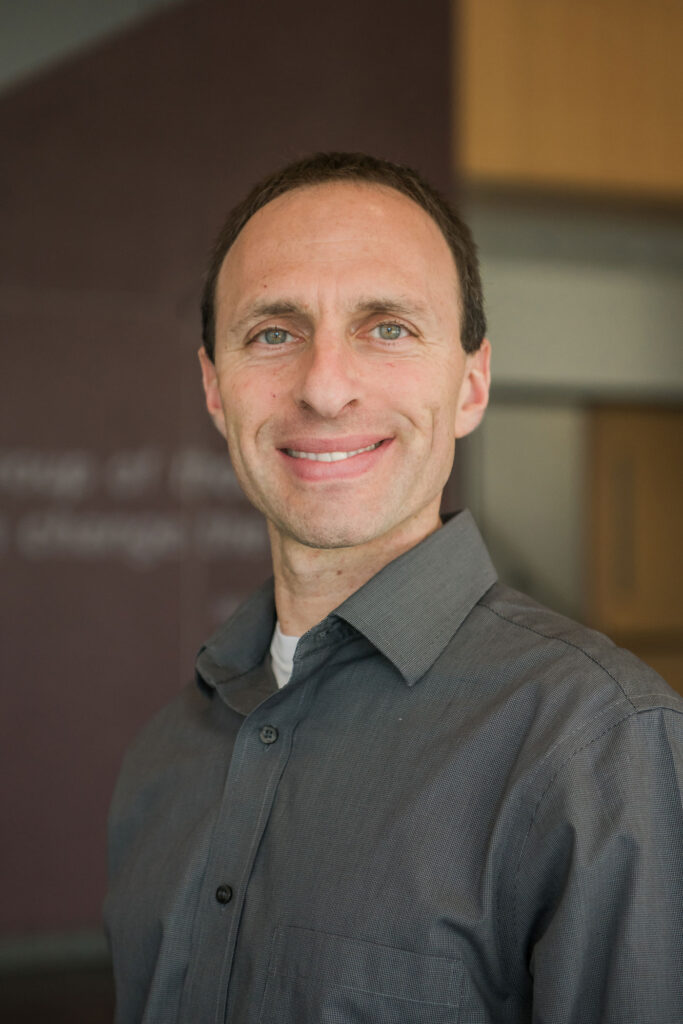 Brian Grodsky
“China has played an important, enabling role in Russia’s actions in Ukraine. China and Russia have built a close partnership based on a common desire to oppose the United States in aspects of the existing international order,” says Carlson. “In early February, just weeks before the invasion…they issued a joint declaration in which they said their partnership had no limits and there were no forbidden areas of cooperation.”
Although, he adds, “China has probably been surprised by the ineptitude of the invasion and by the fierceness of the Ukrainian resistance.”
Grodsky, the chair of the political science department, was next to share his expertise about Central Asia’s response, or lack thereof, to the Russian invasion of Ukraine. “Not surprisingly,” Grodsky notes, “Central Asia has been neutral in its reaction to the invasion. Russia expected a lot more support than it got, but this really reflects a long-standing foreign policy to balance stronger powers in the region.”
Grodsky, expanding on an earlier article he wrote about economic sanctions on Russia, added that economic links were becoming more difficult for Central Asian countries to maintain with Russia. These sanctions, he stated, would likely lead to political instability in the region.
Ongoing conversations provide support
Broad conversations about geographic implications of the Russian military aggression combined with personal stories of Ukrainian displacement and resistance are ongoing and they won’t end soon. Students, staff, and faculty, including Zhdanovych and those present at the panels, are speaking from personal and informational standpoints to put a face to the people who are struggling and fighting in Ukraine. But Zhdanovych points out that we also shouldn’t forget about those in Russia.
“I think that it is important to emphasize that not all Russians—particularly those in the U.S.—support this invasion. I know many, many Russians in the greater community and do not know of one who supports this invasion. I think of this as Putin’s invasion of Ukraine, rather than Russia’s invasion,” Zhdanovych says.
With this mindset moving forward, we can strive to build networks of support and to grow together as multiple communities all impacted by this crisis. Though the future ahead remains uncertain, there is strength in the voices and actions that stretch across and beyond UMBC.
UMBC supports Ukrainians: If you’re interested in supporting Ukrainian students, scholars, and artists at risk, UMBC’s Center for Global Engagement recommends giving to an established organization, like IIE.” In April, President Biden announced a new initiative to support Ukrainians. Welcome.us, an organization of which UMBC is a member, has created a new website that contains information about this initiative as well as various ways to help Ukrainians.
******
Header image: Photo on Pexel by Mathias P.R. Reding
]]>
On February 24, just one day after a Russian holiday celebrating the “defenders of the Fatherland,” Russian President Vladimir Putin ordered his military forces to invade Ukraine. The ensuing...
https://umbc.edu/stories/umbc-responds-to-putins-war-in-ukraine/
https://beta.my.umbc.edu/api/v0/pixel/news/119450/guest@my.umbc.edu/0e2495bac50e528fa14b7900a1369c39/api/pixel
asian-studies
campus-life
cge
cs3
history
magazine
mlli
political-science
russian
ukraine
webfeature
UMBC News & Magazine
https://beta.my.umbc.edu/groups/umbc-news-magazine
https://assets1-beta.my.umbc.edu/system/shared/avatars/groups/000/001/943/24435aa6207c452e7bc15cc74b42c7bb/xsmall.png?1748556657
https://assets1-beta.my.umbc.edu/system/shared/avatars/groups/000/001/943/24435aa6207c452e7bc15cc74b42c7bb/original.png?1748556657
https://assets2-beta.my.umbc.edu/system/shared/avatars/groups/000/001/943/24435aa6207c452e7bc15cc74b42c7bb/xxlarge.png?1748556657
https://assets2-beta.my.umbc.edu/system/shared/avatars/groups/000/001/943/24435aa6207c452e7bc15cc74b42c7bb/xlarge.png?1748556657
https://assets3-beta.my.umbc.edu/system/shared/avatars/groups/000/001/943/24435aa6207c452e7bc15cc74b42c7bb/large.png?1748556657
https://assets1-beta.my.umbc.edu/system/shared/avatars/groups/000/001/943/24435aa6207c452e7bc15cc74b42c7bb/medium.png?1748556657
https://assets2-beta.my.umbc.edu/system/shared/avatars/groups/000/001/943/24435aa6207c452e7bc15cc74b42c7bb/small.png?1748556657
https://assets1-beta.my.umbc.edu/system/shared/avatars/groups/000/001/943/24435aa6207c452e7bc15cc74b42c7bb/xsmall.png?1748556657
https://assets2-beta.my.umbc.edu/system/shared/avatars/groups/000/001/943/24435aa6207c452e7bc15cc74b42c7bb/xxsmall.png?1748556657
UMBC News & Magazine
0
0
false
Tue, 12 Apr 2022 20:12:39 -0400
Tue, 12 Apr 2022 20:12:39 -0400
Four UMBC students receive Goldwater Scholarship for STEM research, tying prior record

Four UMBC students have been named 2022-23 Goldwater Scholars, tying the university’s past record, set just last year. This year’s recipients are Christopher Slaughter ‘23, computer engineering; Rachel Myers ‘23, chemical engineering; Tobi Majekodunmi ‘23, mechanical engineering; and D’Juan Moreland ‘23, biological sciences and music. UMBC had more winners this year than any other institution in the state of Maryland.
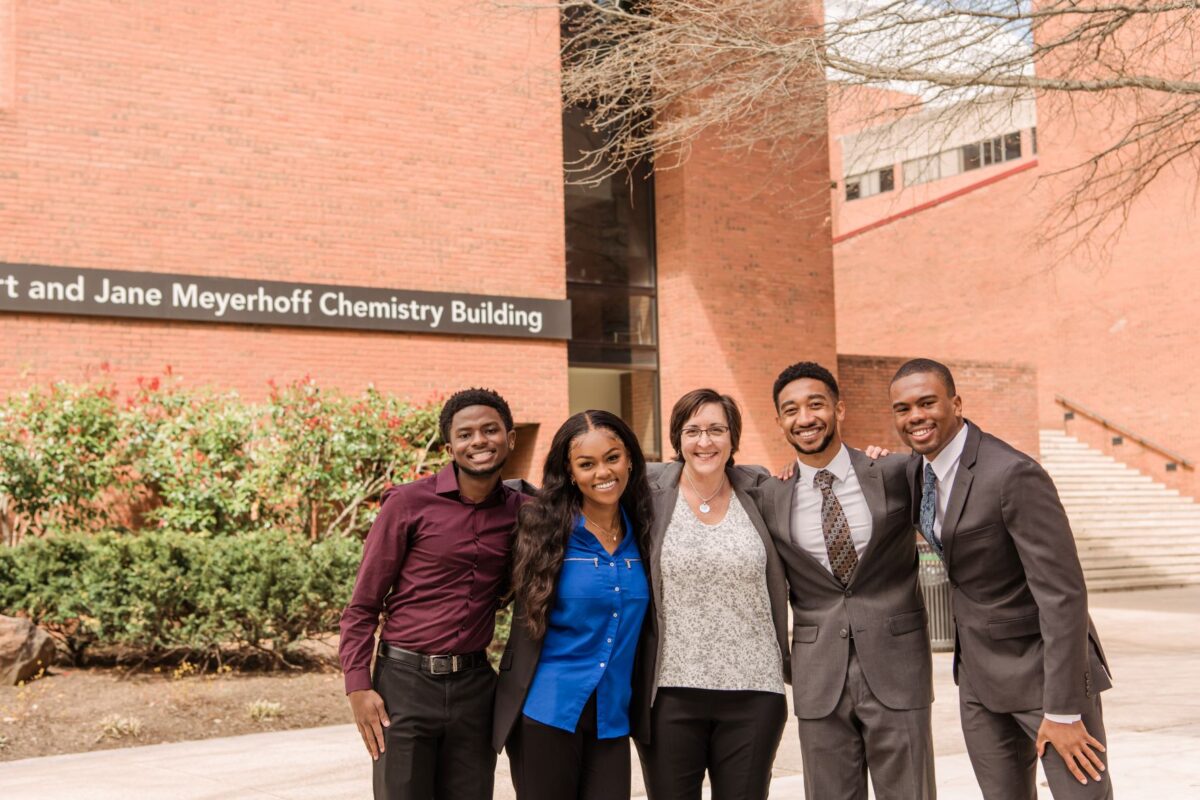 Moreland, Myers, April Householder, Slaughter, and Majekodunmi.
“Having a full slate of four Goldwater Scholars selected for the second year in a row is an incredible achievement for the student-scholars, the faculty and staff who support them, and the university as a whole,” says April Householder, director of Undergraduate Research and Prestigious Scholarships. “It means that STEM education at UMBC is preparing our students to be the best in the nation.”
The Barry Goldwater Scholarship and Excellence in Education Program is designed to provide the United States with “a continuing source of highly qualified scientists, mathematicians, and engineers” to move the nation forward. More than 1,200 students applied from over 425 institutions across the country this year. The program selected a total of 417 scholars to receive Goldwater scholarships for 2022-23.
Aspiring minds
Goldwater Scholars each receive substantial scholarship funding that advances their undergraduate work and educational paths. The program focuses on students pursuing research, and many past scholars have published and presented their work as early as their undergraduate years.
This was a major draw for Slaughter, who has been involved in UMBC research since high school. He currently is working with Govind Rao, professor of chemical, biochemical, and environmental engineering, to develop an automatic glucose monitoring system using an optical biosensor. “Research has always played a huge role in my life,” Slaughter says. “That’s why I find myself in the position that I’m in today, because I fell in love with research and bioengineering. Receiving the Goldwater is so affirming—it means that I am recognized as one of most promising aspiring minds in STEM.”
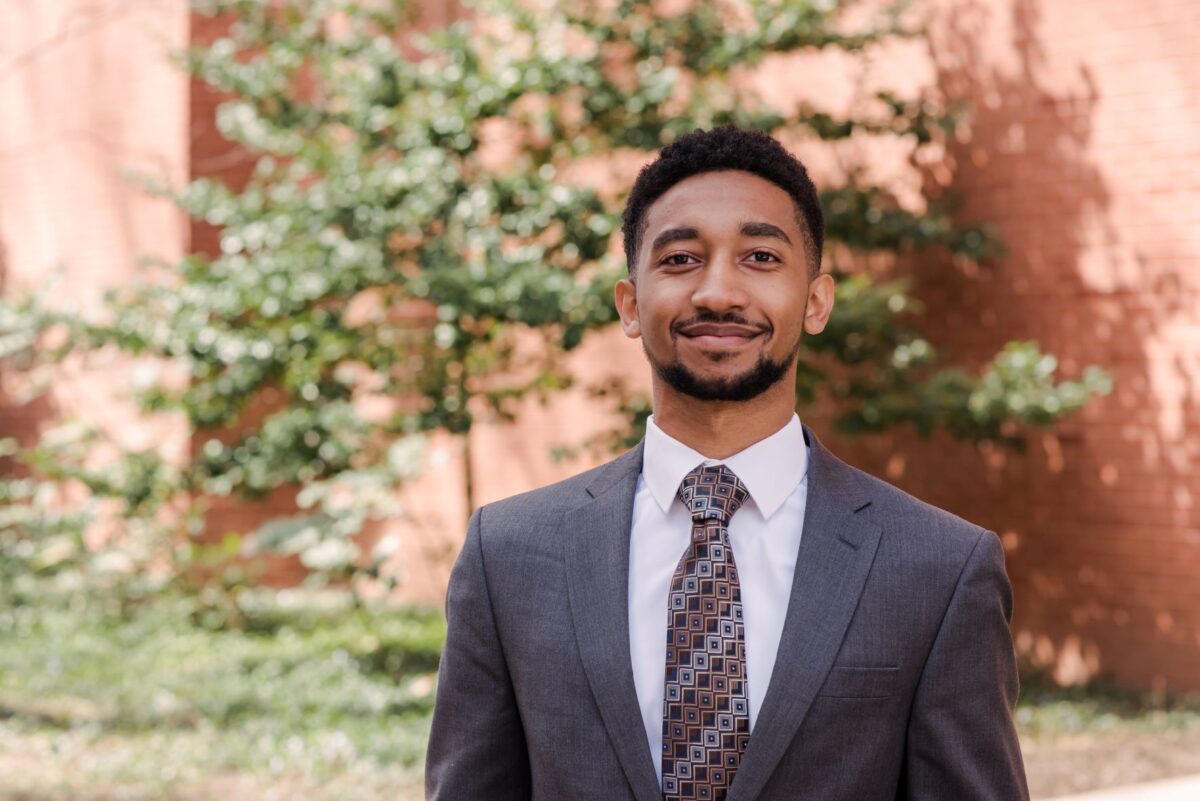 Christopher Slaughter.
When Slaughter learned that he had been selected for the scholarship, it brought tears to his eyes, he shares. It has renewed his commitment to pursuing research, even when presented with obstacles. And he can’t wait to meet the Goldwater community that will help him surpass those obstacles. “I am looking forward to connecting with other Goldwater Scholars and joining their network, and to meeting other scholars who are in similar fields,” he says.
Importance of mentorship
The process of applying for and receiving a Goldwater Scholarship was more than two years in the making for UMBC’s recipients. Majekodunmi applied to be nominated for the Goldwater during his sophomore year, but it wasn’t until his junior year that he was formally nominated by UMBC. Leading up to the deadline, Majekodunmi spent several hours each night developing and refining his application.
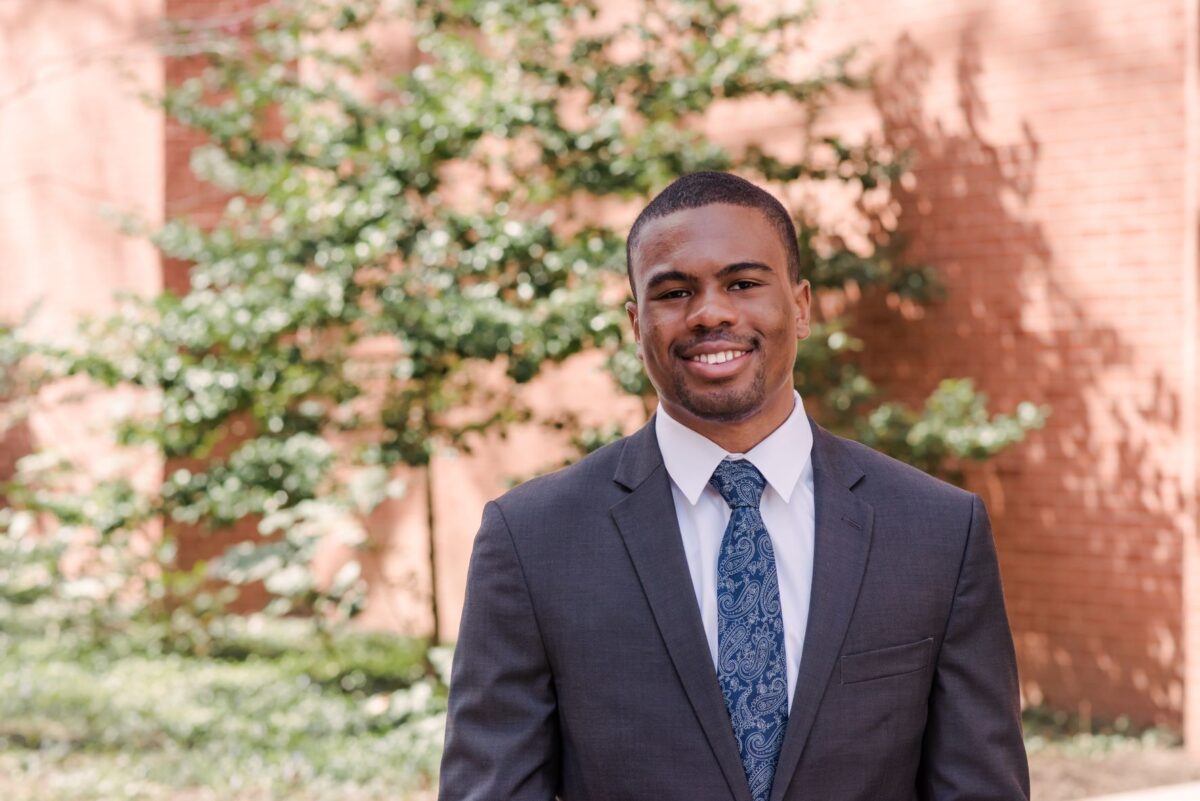 Tobi Majekodunmi.
“The most pivotal contributions to my essays came from several of my mentors, some of whom were previous Goldwater awardees. They took time out of their busy schedules to review my work and provide helpful feedback,” he says. “Although arduous and filled with many late nights, participating in this process has strengthened and increased my confidence in my technical writing skills.”
All four of this year’s recipients say their respective mentors played an important role in supporting them during the application process and preparing them to compete for the award. And those mentors are now sharing in the students’ excitement. Moreland says that the first people he reached out to after hearing the news of his Goldwater Scholars were his mentor and research advisors.
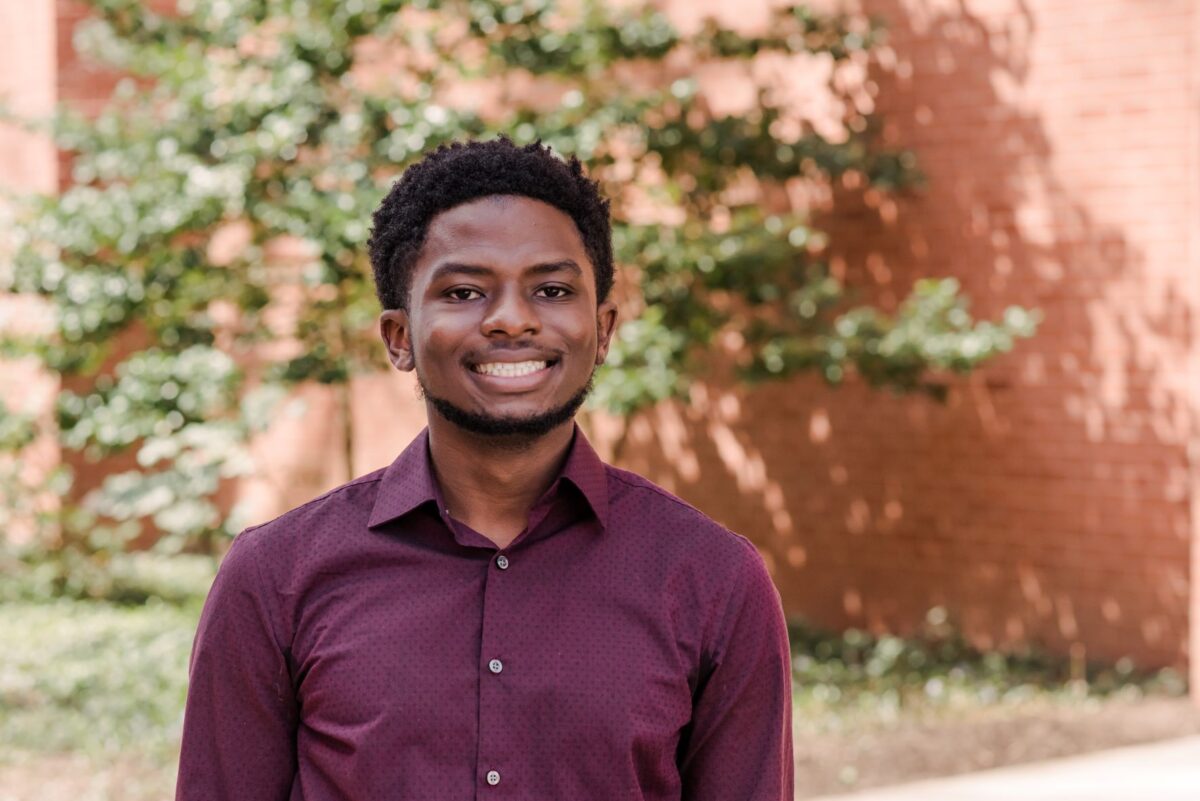 D’Juan Moreland.
Representation matters
Like Majekodunmi and Moreland, Myers shares that she was supported by mentors, family, advisors, and fellow students throughout the Goldwater application. She was at the National Society of Black Engineers Convention with Majekodunmi and Slaughter when she received the email announcing that she received the award.
“I was absolutely elated and felt so honored,” she recalls. “All I could think was, ‘Wow, what I represent matters. What my fellow awardees represent matters,’” Myers says.
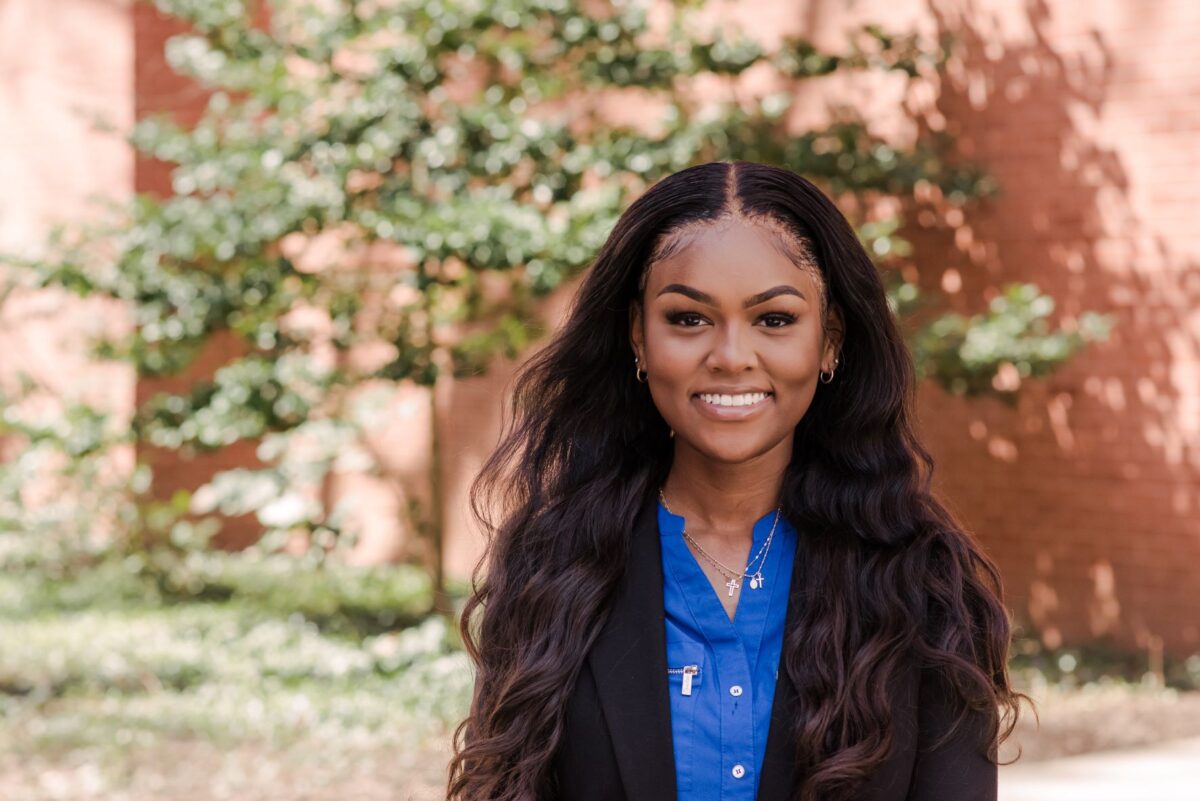 Rachel Myers.
Reflecting on the power of that moment, she shares, “I just imagined a young black girl from a community like mine, seeing me in this position and saying to herself, ‘So I can definitely do that too,’ just as I’ve said when I met women like Dr. Kizzmekia Corbett in high school or Dr. Lola Eniola-Adefeso during my freshman year at UMBC.”
Both Corbett ‘08, biological sciences and sociology, and Eniola-Adefeso ‘99, chemical engineering, are alumni of UMBC and the Meyerhoff Scholars Program who have made enormous contributions to biomedical research at a global scale. “I’m just excited to be another catalyst for other people’s dreams becoming a reality,” says Myers, “just as Dr. Corbett and Dr. Eniola-Adefeso have been for me.”
Majekodunmi similarly shares, “Becoming a Goldwater Scholar awardee is a celebration of the many influences in my life that have contributed to my development and success. To name a few, there are my family, teachers, mentors, and the Meyerhoff Scholars Program.”
He reflects, “My success is made possible because of their support, inspiration, and wisdom.”
Banner image: UMBC’s 2022 Goldwater Scholars. From left, Tobi Majekodunmi, Christopher Slaughter, D’Juan Moreland, and Rachel Myers. All photo by Marlayna Demond ’11 for UMBC.
]]>
Four UMBC students have been named 2022-23 Goldwater Scholars, tying the university’s past record, set just last year. This year’s recipients are Christopher Slaughter ‘23, computer engineering;...
https://umbc.edu/stories/four-umbc-students-receive-goldwater-scholarship-for-stem-research-tying-prior-record/
https://beta.my.umbc.edu/api/v0/pixel/news/119451/guest@my.umbc.edu/888a2851bae907004eb12d9bfde10483/api/pixel
biology
cahss
cbee
cnms
coeit
csee
majoraward
meche
meyerhoffscholars
music
news
page1
science-and-tech
UMBC News & Magazine
https://beta.my.umbc.edu/groups/umbc-news-magazine
https://assets1-beta.my.umbc.edu/system/shared/avatars/groups/000/001/943/24435aa6207c452e7bc15cc74b42c7bb/xsmall.png?1748556657
https://assets1-beta.my.umbc.edu/system/shared/avatars/groups/000/001/943/24435aa6207c452e7bc15cc74b42c7bb/original.png?1748556657
https://assets2-beta.my.umbc.edu/system/shared/avatars/groups/000/001/943/24435aa6207c452e7bc15cc74b42c7bb/xxlarge.png?1748556657
https://assets2-beta.my.umbc.edu/system/shared/avatars/groups/000/001/943/24435aa6207c452e7bc15cc74b42c7bb/xlarge.png?1748556657
https://assets3-beta.my.umbc.edu/system/shared/avatars/groups/000/001/943/24435aa6207c452e7bc15cc74b42c7bb/large.png?1748556657
https://assets1-beta.my.umbc.edu/system/shared/avatars/groups/000/001/943/24435aa6207c452e7bc15cc74b42c7bb/medium.png?1748556657
https://assets2-beta.my.umbc.edu/system/shared/avatars/groups/000/001/943/24435aa6207c452e7bc15cc74b42c7bb/small.png?1748556657
https://assets1-beta.my.umbc.edu/system/shared/avatars/groups/000/001/943/24435aa6207c452e7bc15cc74b42c7bb/xsmall.png?1748556657
https://assets2-beta.my.umbc.edu/system/shared/avatars/groups/000/001/943/24435aa6207c452e7bc15cc74b42c7bb/xxsmall.png?1748556657
UMBC News & Magazine
0
0
false
Fri, 08 Apr 2022 13:25:19 -0400
Fri, 08 Apr 2022 13:25:19 -0400
UMBC faculty and staff award recipients place community at the core of their success
At UMBC’s 2022 Presidential Faculty and Staff Awards (PFASA), Tamra Mendelson, professor of biological sciences and recipient of the 2022 – 2025 Presidential Teaching Professor Award, said she loves “getting to the core of a concept” in her research and teaching. In her large introductory biology courses, which Mendelson has been teaching with humor, creativity, and enthusiasm since her arrival on campus in 2006, the concept might be an idea like natural selection. But as awardee after awardee addressed the audience, both in person and online, it became clear that all shared the same “core concept” of UMBC: community.
“Teaching and research make me want to come to work every day, but it’s the community here, and Dr. Hrabowski in particular, who’ve made me want to come to UMBC every day,” Mendelson said.
Yonathan Zohar, professor and chair of marine biotechnology and the 2022 – 2025 Presidential Research Professor, added, “This recognition is not about me, it’s about us,” adapting the opening quote from President Hrabowski’s book, The Empowered University. Zohar’s work, nurtured diligently over more than three decades, has in the last few years brought in more than $10 million dollars of research funding, earned international awards, and is poised to reimagine the seafood industry as we know it.
And yet, Zohar says, “None of my research accomplishments would have been possible without the ‘about us’ spirit at UMBC—the spirit that together we can make everything and anything happen.”
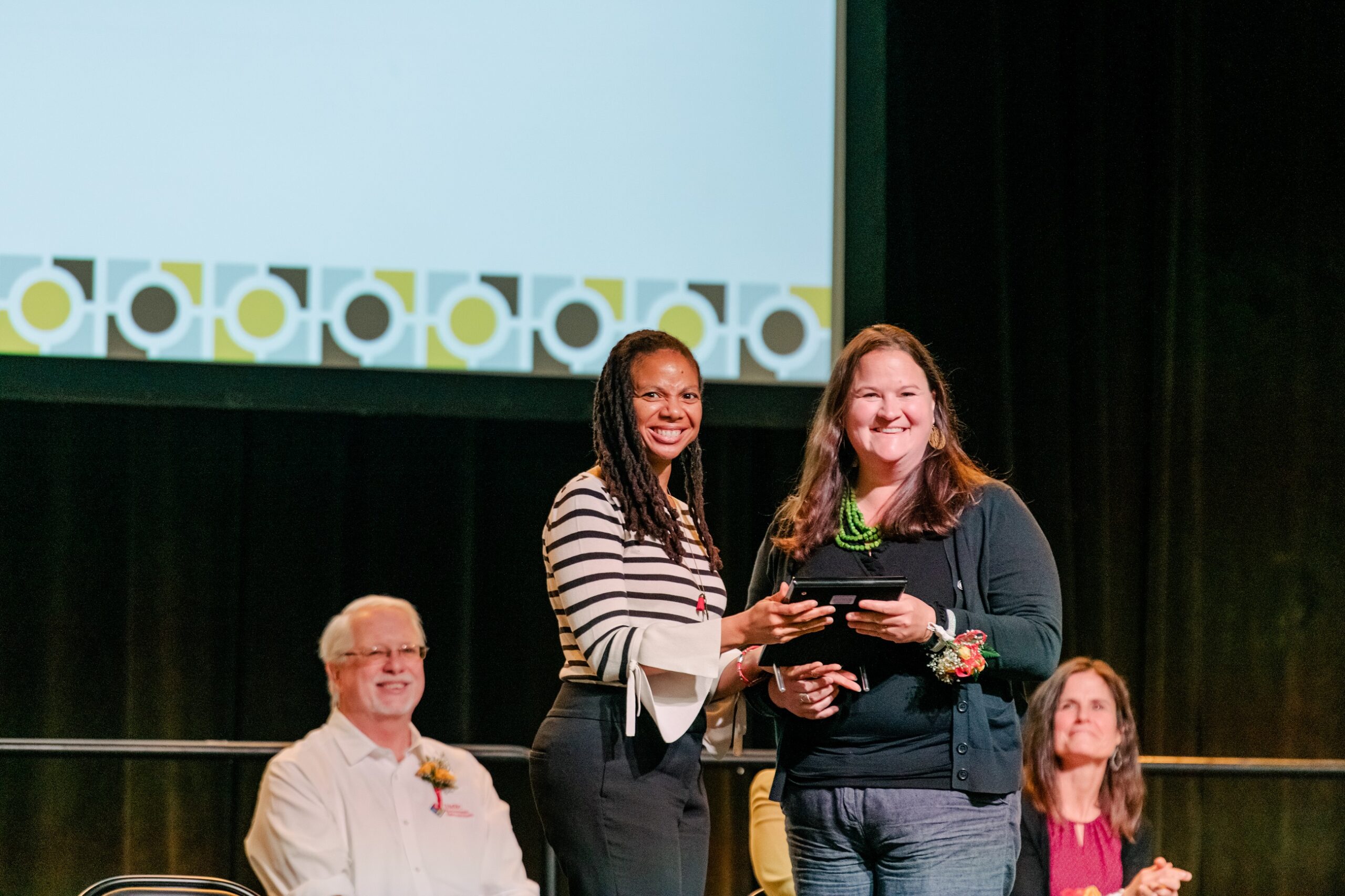
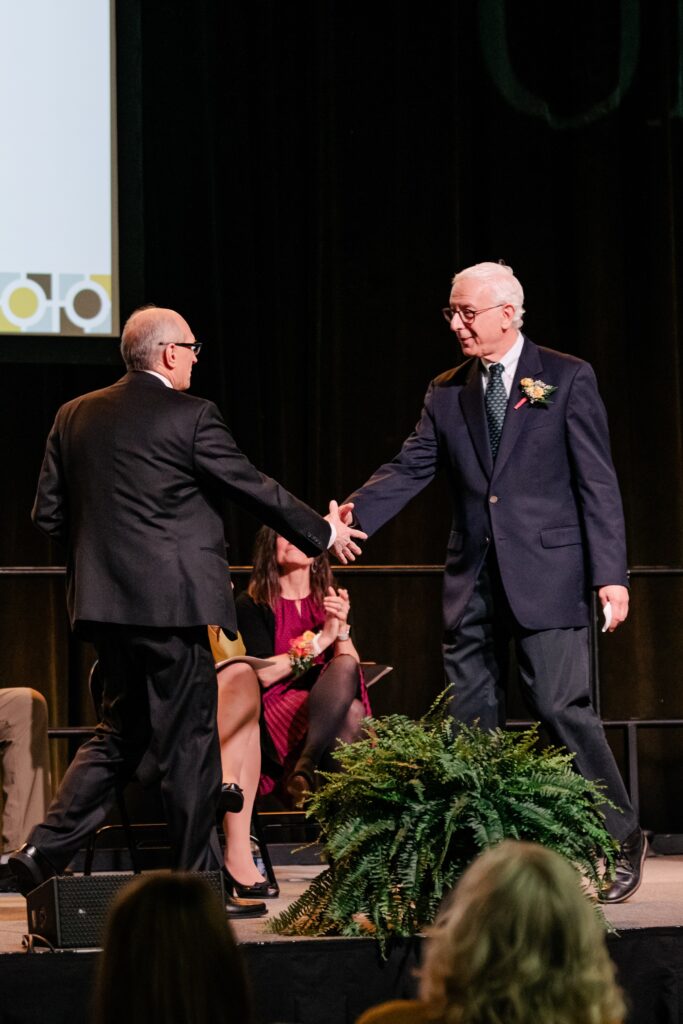 Yonathan Zohar, right, accepts his award from Bill LaCourse, dean of the College of Natural and Mathematical Sciences.
Supporting each other
Helena Dahlen, executive administrative assistant in the Division of Information Technology and the 2022 – 2023 Presidential Distinguished Staff Award for Non-exempt Staff recipient, recalled becoming an active member of the community when she started at UMBC in 2015. She joined book clubs, participated in wellness events, attended lectures, and more.
“It felt like I had moved into a small community,” she says. “Almost like a village, surrounded by brilliant people of all ages.” The supportive environment has allowed Dahlen to do her best work at UMBC and to give back. She generously contributes her energy to programs like Retriever Essentials and the Maryland Charity Campaign, and she serves as president of the Non-exempt Staff Senate.
Finally, Michael Pound, director of environmental safety and health and the 2022 – 2023 Presidential Distinguished Staff Award recipient, got to the heart of the matter. Recalling the challenges of managing the university’s response to the pandemic with a team of dedicated colleagues, he says, “I just couldn’t be prouder to work with these great folks.”
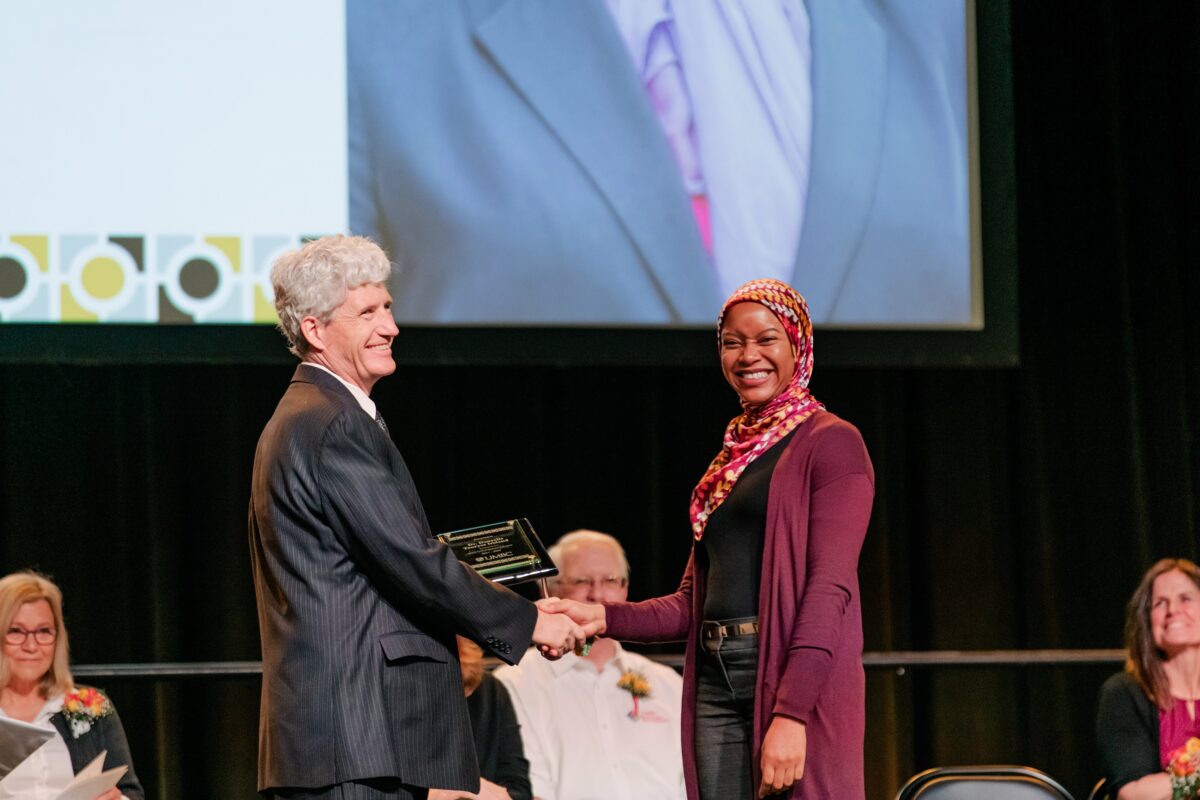 Danyelle Ireland, right, accepts her award from Marc Olano, associate dean of academic programs and learning in the College of Engineering and IT.
Beyond imagination
The UMBC community, all of the awardees emphasized, has grown through years of thoughtful care and collaboration. It’s taken decades to cultivate the UMBC ethos of community support and shared leadership.
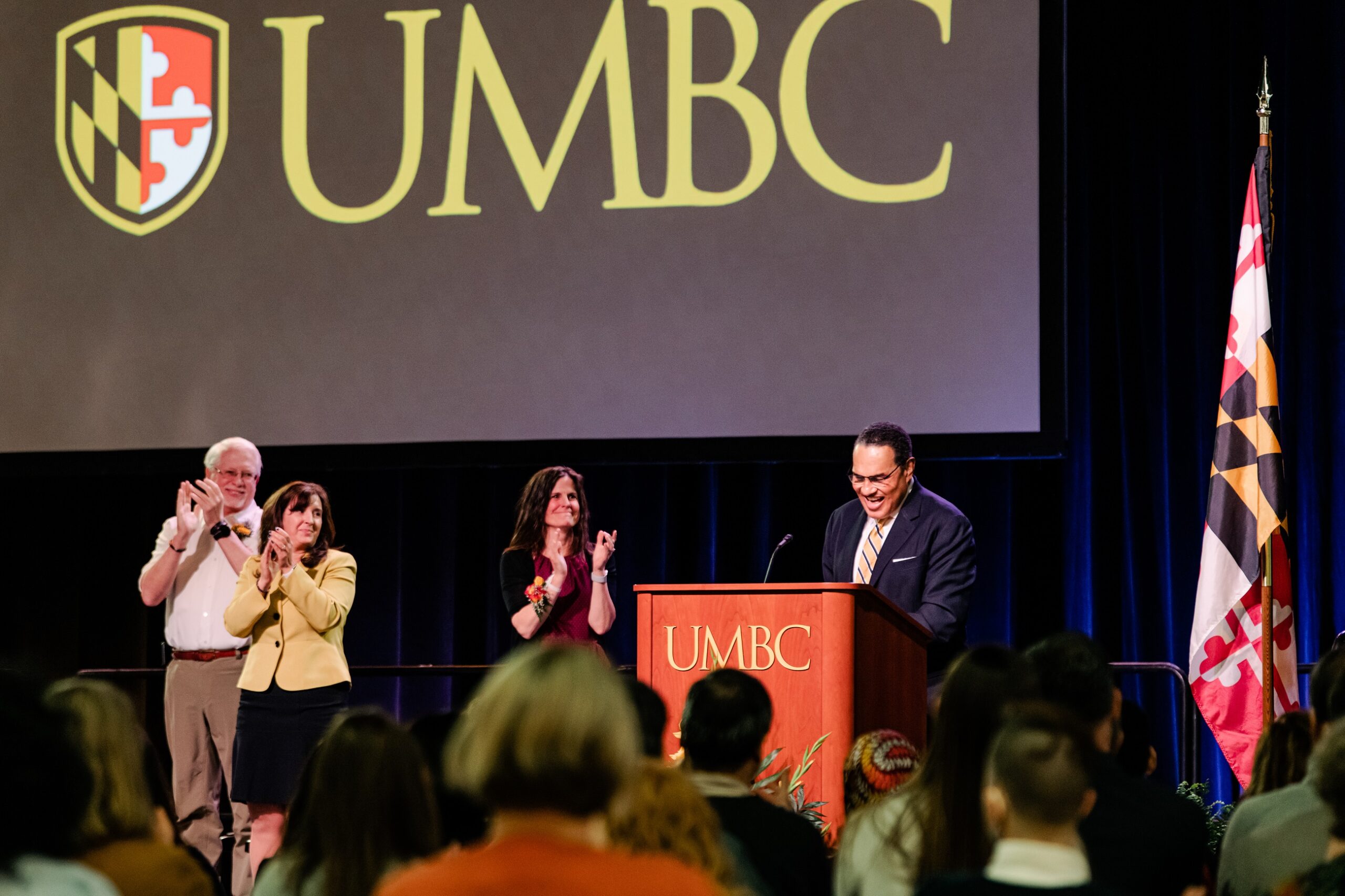
“It’s hard to express how far we’ve come,” reflected President Hrabowski, as he offered remarks at his final PFASA as UMBC president. “Growing up, I could never have imagined the concept of UMBC—people from all over the world coming to study, to seek the truth, to get to know people different from themselves.”
UMBC’s newest awardees highlighted how that vision has become a reality, and Pres. Hrabowski honored all that they have contributed. “Leadership isn’t about one person at the top; it’s about what we all do,” Hrabowski said. “When we say we care about UMBC, what we’re saying is we care about each other.”
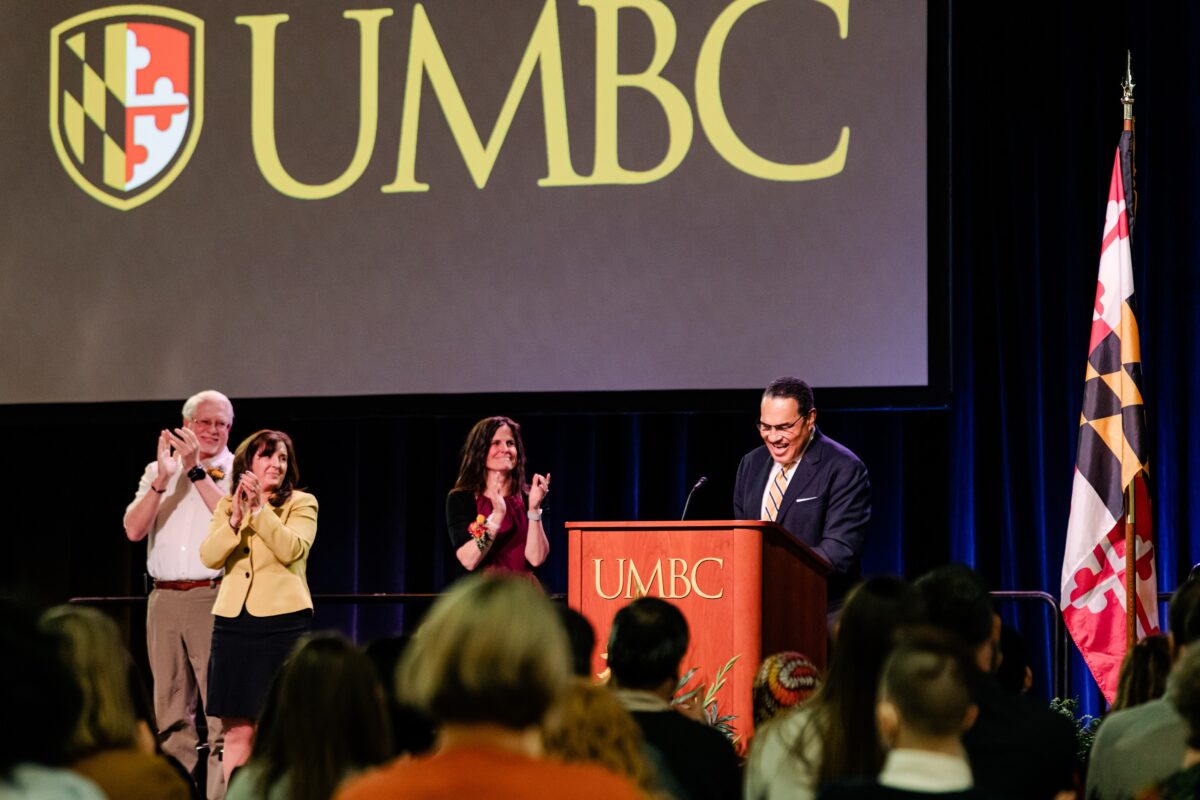 The audience applauds President Hrabowski as he makes remarks at his final Presidential Faculty and Staff Awards.
Honoring excellence
UMBC’s other named awards honor members of the UMBC community who embody the university’s ethos, such as Diane Lee, retired vice provost and dean of undergraduate education; Marilyn E. Demorest, professor emerita of psychology and former vice provost for faculty affairs; and Teresa Lupinek, the late former executive administrative assistant to the president. This year’s recipients include:
Mark Berczynski, M.S. ’17, lecturer, engineering and computing education program
Diane M. Lee Teaching Award
Danyelle Tauryce Ireland, associate director, Center for Women in Technology
Jakubik Family Endowment Staff Award
Nichole Zang Do, M.A. ’15, program management specialist, biological sciences
Karen L. Wensch Endowment Award for Outstanding Non-exempt Staff
C. Jill Randles, assistant vice provost and assistant dean, Academic Engagement and Transition Programs
Teresa Lupinek Endowment Award
Tamara Bhalla, associate professor, American studies
Marilyn E. Demorest Award for Faculty Advancement
Margaret Holland, associate professor, geography and environmental systems
Marilyn E. Demorest Award for Faculty Advancement
Narsingh B. Singh, research professor, chemistry and biochemistry, and affiliate faculty, computer science and electrical engineering
UMBC Research Faculty Excellence Award
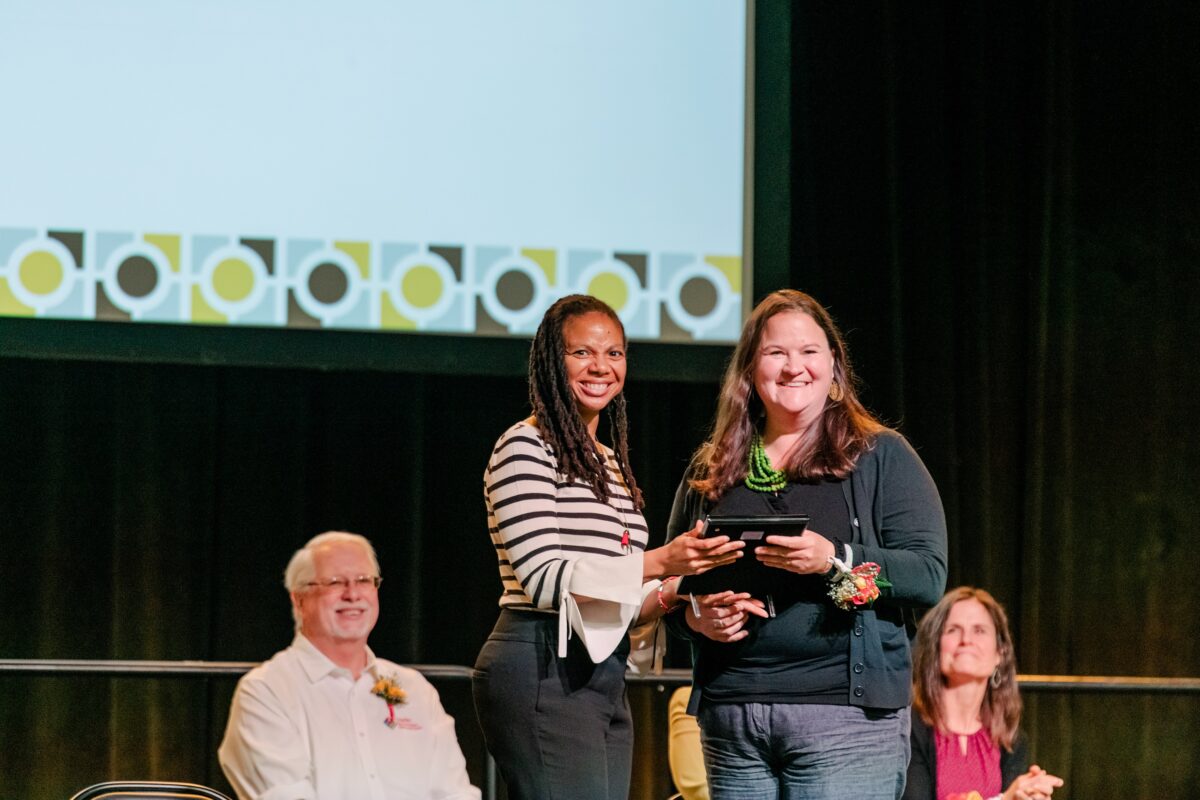 Margaret Holland, right, accepts her award from Kimberly Moffitt, dean of the College of Arts, Humanities, and Social Sciences.
USM Board of Regents awardees
This year, UMBC also had two University System of Maryland (USM) Board of Regents Award recipients. These awards represent the highest honor bestowed on faculty and staff across the USM by the Board of Regents. Awardees are selected by the Council of University System Staff and approved by the Board. The awards recognize faculty and staff for excellence in teaching; research, scholarship, and creative activity; public service; mentoring; or innovation.
UMBC has received an outsize share of these awards over the years, demonstrating the strength of our faculty and staff across all areas of achievement. This year, Marjoleine Kars, professor of history, received the 2022 USM Board of Regents Award for Excellence in Scholarship. Her latest book, Blood on the River: A Chronicle of Mutiny and Freedom on the Wild Coast, has received widespread acclaim for its discussion of a nearly successful rebellion of enslaved African and Indigenous people in the Dutch colony of Berbice in the 1860s.
Lee Blaney, associate professor of chemical, biochemical, and environmental engineering, received the 2022 USM Board of Regents Award for Excellence in Teaching. Blaney has received awards previously for exceptional mentoring and for engaging his students in high-impact research. His laboratory focuses on contaminants of emerging concern, such as compounds found in pharmaceuticals and personal care products, in waterways such as Chesapeake Bay.
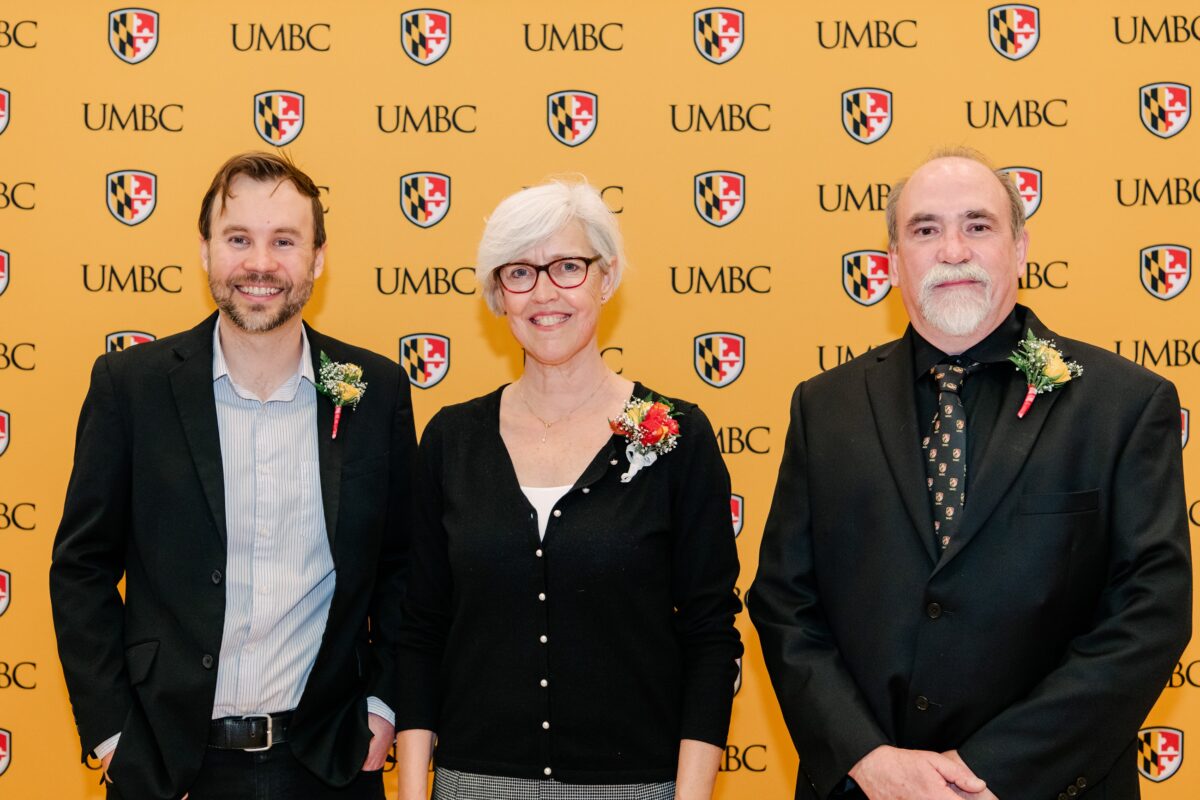 From left to right: Lee Blaney, Marjoleine Kars, and Victor Fulda.
Celebrating together
This year’s ceremony was the first in-person PFASA event since 2019. With that in mind, the ceremony also honored awardees from 2020 and 2021.
Victor Fulda, engineering technician, chemical, biochemical, and environmental engineering
2021 University System of Maryland Board of Regents Award for Exceptional Contribution to the Institution or Unit to which the Person Belongs
Jamie Gurganus ‘04, M.S. ‘11, Ph.D. ‘20; faculty, mechanical engineering; associate director, engineering education initiatives; and director, Center for the Integration of Research, Teaching, and Learning
2020 – 2021 Diane M. Lee Teaching Award
Jonathan Zwi, instructor and affiliate artist, music
2020 – 2021 Diane M. Lee Teaching Award
Header image: Recipients of awards who accepted them in person at this year’s PFASA. From left to right: Marjoleine Kars, Michael Pound, Jamie Gurganus, Maggie Holland, Nichole Zang Do, Jill Randles, Danyelle Ireland, Tamra Mendelson, Yonathan Zohar, Helena Dahlen, Freeman Hrabowski, Tamara Bhalla, Victor Fulda, Jonanthan Zwi, Narsingh Singh, Lee Blaney, Philip Rous.
All photos by Marlayna Demond ’11 for UMBC.
]]>
At UMBC’s 2022 Presidential Faculty and Staff Awards (PFASA), Tamra Mendelson, professor of biological sciences and recipient of the 2022 – 2025 Presidential Teaching Professor Award, said she...
https://umbc.edu/stories/umbc-faculty-and-staff-award-recipients-place-community-at-the-core-of-their-success/
https://beta.my.umbc.edu/api/v0/pixel/news/119452/guest@my.umbc.edu/f95ae1b8548d27f329239aad427f3da5/api/pixel
americanstudies
biology
cahss
cbee
chemistry
cnms
coeit
community
csee
cwit
ges
history
marinebiotech
music
news
UMBC News & Magazine
https://beta.my.umbc.edu/groups/umbc-news-magazine
https://assets1-beta.my.umbc.edu/system/shared/avatars/groups/000/001/943/24435aa6207c452e7bc15cc74b42c7bb/xsmall.png?1748556657
https://assets1-beta.my.umbc.edu/system/shared/avatars/groups/000/001/943/24435aa6207c452e7bc15cc74b42c7bb/original.png?1748556657
https://assets2-beta.my.umbc.edu/system/shared/avatars/groups/000/001/943/24435aa6207c452e7bc15cc74b42c7bb/xxlarge.png?1748556657
https://assets2-beta.my.umbc.edu/system/shared/avatars/groups/000/001/943/24435aa6207c452e7bc15cc74b42c7bb/xlarge.png?1748556657
https://assets3-beta.my.umbc.edu/system/shared/avatars/groups/000/001/943/24435aa6207c452e7bc15cc74b42c7bb/large.png?1748556657
https://assets1-beta.my.umbc.edu/system/shared/avatars/groups/000/001/943/24435aa6207c452e7bc15cc74b42c7bb/medium.png?1748556657
https://assets2-beta.my.umbc.edu/system/shared/avatars/groups/000/001/943/24435aa6207c452e7bc15cc74b42c7bb/small.png?1748556657
https://assets1-beta.my.umbc.edu/system/shared/avatars/groups/000/001/943/24435aa6207c452e7bc15cc74b42c7bb/xsmall.png?1748556657
https://assets2-beta.my.umbc.edu/system/shared/avatars/groups/000/001/943/24435aa6207c452e7bc15cc74b42c7bb/xxsmall.png?1748556657
UMBC News & Magazine
0
0
false
Thu, 07 Apr 2022 22:12:22 -0400
Thu, 07 Apr 2022 22:12:22 -0400
UMBC researchers discover genes linked to medication response, laying foundation for precision medicine

A new study published in Genes may eventually give doctors the ability to make better-informed decisions about which medications to prescribe for older adults. The research, led by Mariann Gabrawy, Ph.D. ’18, biological sciences, in the lab of UMBC Prof. Jeff Leips, found associations between particular genes and individuals’ responses to a common blood pressure medication, Lisinopril. The drug also sometimes improves mobility and physical performance in older adults—but sometimes it makes things worse.
Better understanding the relationship between genetics and drug responses would help doctors prescribe drugs they know are likely to help, rather than relying on trial and error. Moving forward, researchers could employ the same experimental process Gabrawy used for other drugs.
“Our genetics matters,” says Gabrawy, who completed the research at UMBC as part of her Ph.D. dissertation as a Meyerhoff Graduate Fellow, with a UMBC-Johns Hopkins research team. “Humans don’t all react the same to various prescription medications. So it’s really important to be able to look at an individual patient and figure out if some particular medication is going to work for them or not.”
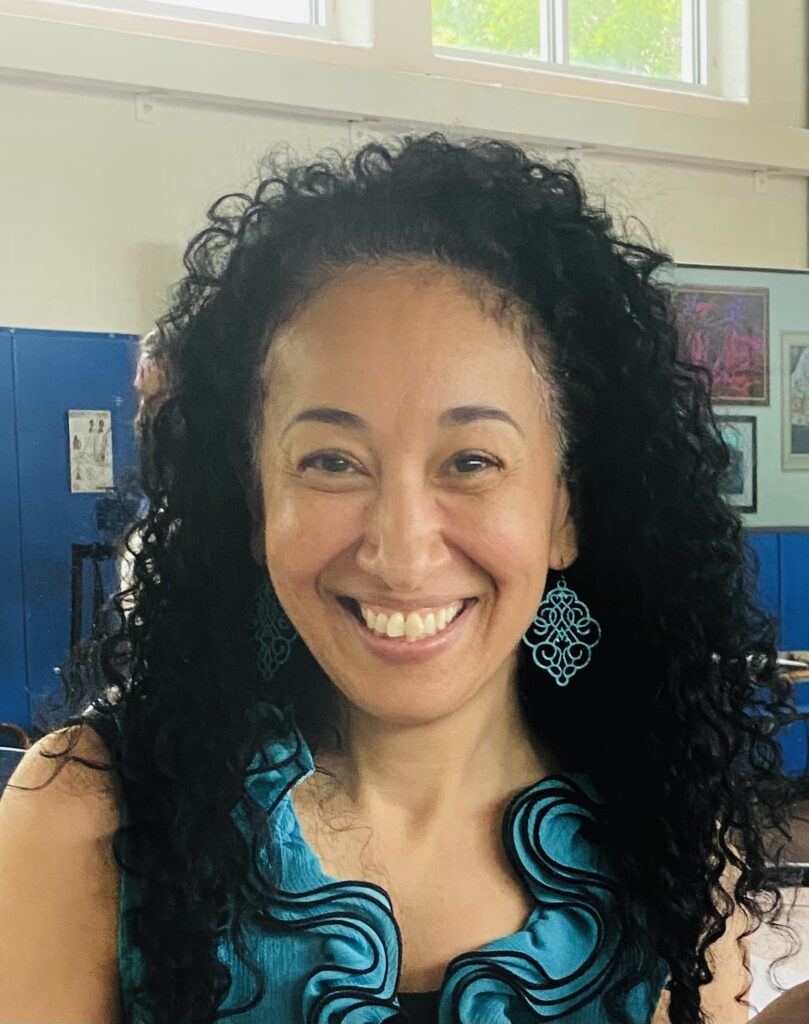 Mariann Gabrawy. Photo courtesy Mariann Gabrawy.
 Jeff Leips. Photo by Marlayna Demond ’11 for UMBC.
Super flies
Gabrawy’s study tested the effects of Lisinopril on more than 10,000 individuals’ ability to walk and climb. What made a study of such massive scale possible? The individuals were fruit flies. Gabrawy and a team of UMBC undergraduates used a unique experimental technique to test each individual fly’s walking and climbing ability multiple times. Gabrawy developed the technique and debuted it in a previous paper.
Why is it useful to study drug responses in fruit flies? Humans and fruit flies share about 75 percent of the genes involved in disease, Gabrawy says. And the genes that she and colleagues identified as relevant to the drug response all have parallel genes in humans.
Flies also have a short lifespan, they’re inexpensive, and they’re easy to take care of, making them ideal for laboratory work. Plus, as a workhorse model species, there are hundreds of well-defined genetic lines of fruit flies that are easy to acquire, and genetic tools are readily available to apply to the fly genome.
However, of course, “You can’t just jump from a fly study to a human study,” Gabrawy says. The likely next step for studying the relationships between Lisinopril and different genes would be a mouse study, to eventually be followed by human studies. But by looking at so many flies, and identifying important gene candidates, this study “lays down a necessary foundation,” Gabrawy says.
 Flies in a vial in Jeff Leips’s laboratory. Photo by Marlayna Demond ’11 for UMBC.
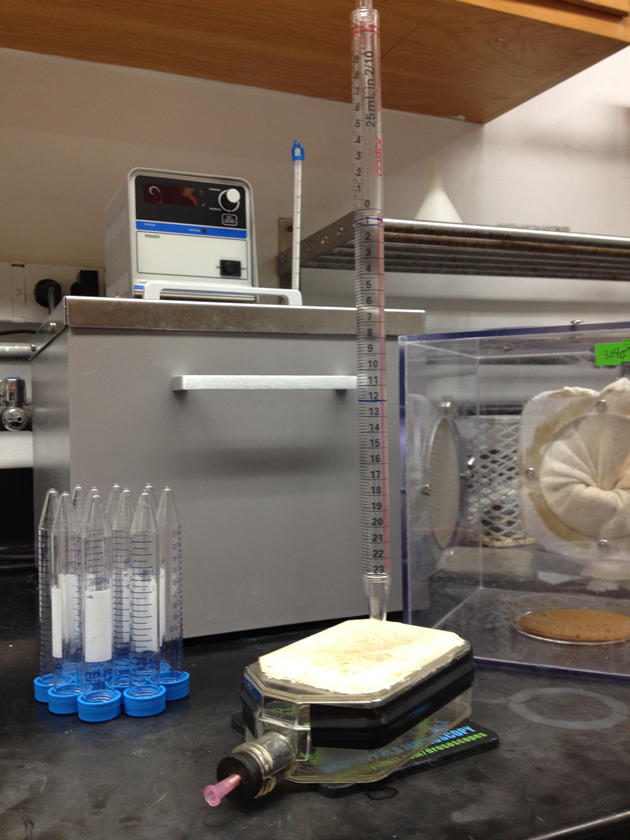 Mariann Gabrawy’s innovative setup for measuring the walking speed of individual flies. Photo courtesy Mariann Gabrawy.
Breaking down silos
The project also deepened ties between UMBC and Johns Hopkins University. Gabrawy was co-advised by Leips at UMBC and Peter Abadir, associate professor of geriatric medicine at Hopkins, during her Ph.D. Both are authors on the new paper.
“Research now is never one person or one research group working in a silo,” Abadir says. “I love how this research allowed us to break down the silos between UMBC and Hopkins and see the great things that each of us is doing on our campuses and what we can learn from each other.”
For example, “Mariann was able to take measures that we carry out in humans and create an analogous measure in fruit flies,” Abadir says. “That’s the beauty of working together.”
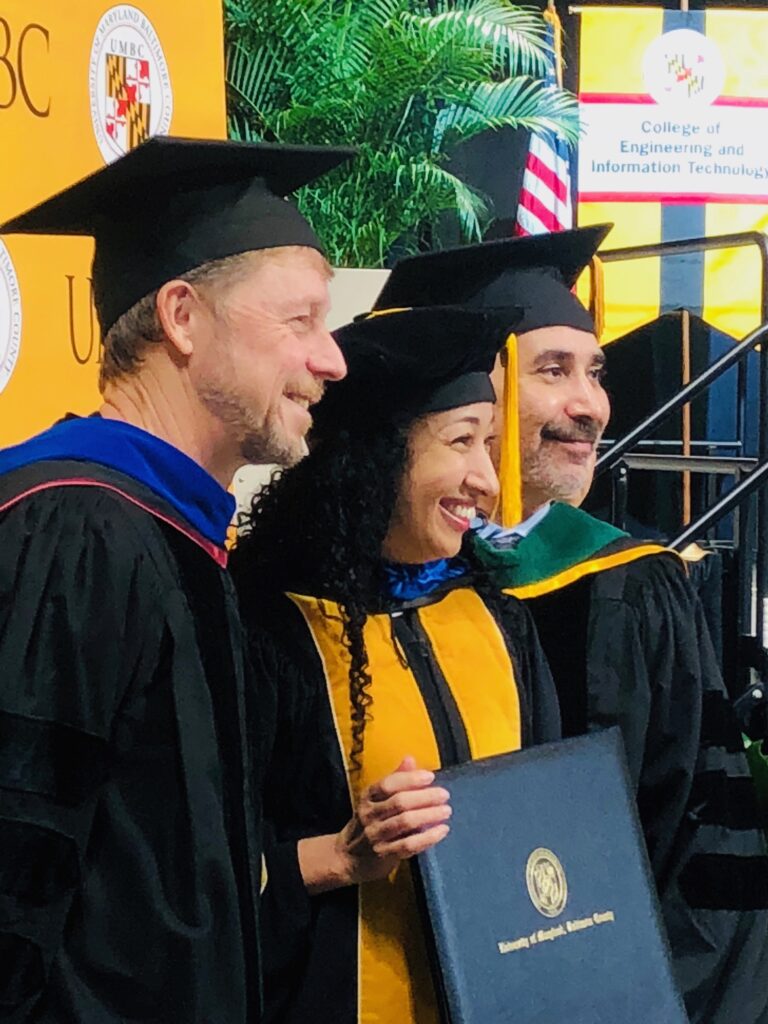
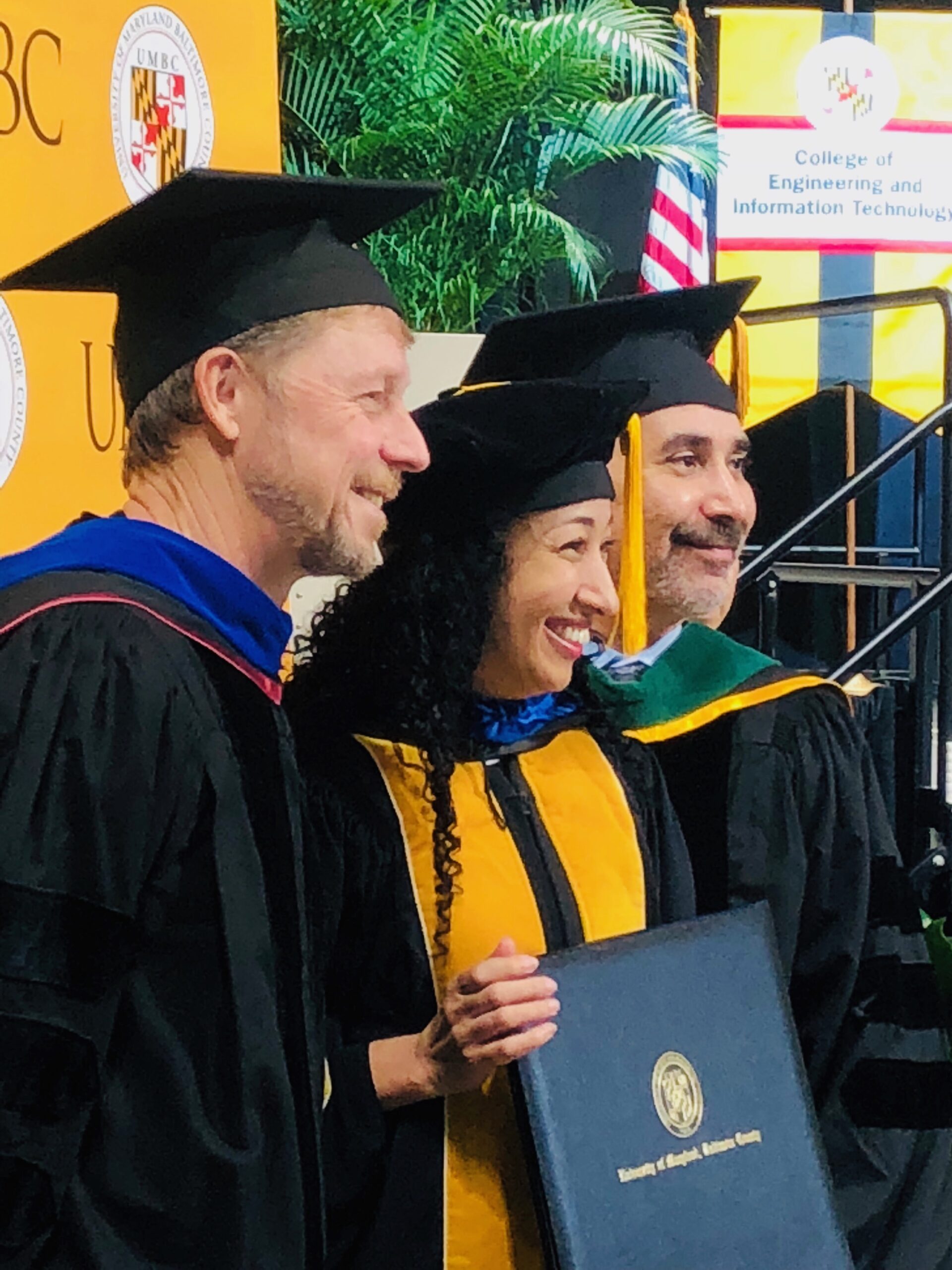
From left to right: Jeff Leips, Mariann Gabrawy, and Peter Abadir celebrate with Gabrawy at her UMBC graduation. Photo courtesy Mariann Gabrawy.
A close-knit team
Abadir was also impressed by the strength of the undergraduate researchers at UMBC, several of whom are authors on the new paper.
Leips has supported undergraduates in his research group for decades. “Kudos to them for not just doing the day-to-day work, but also contributing intellectually to the research,” Leips says of the undergraduate authors. “That’s one of the strengths of UMBC and the student population here—they really engage with the research and become real researchers.”
Gabrawy trained all 17 undergraduates who supported the work herself. Because of their efforts, collecting data took only one year, when it otherwise would have taken at least three. She still keeps in touch with her students; a few even followed her to Johns Hopkins as volunteer research assistants when she completed a postdoctoral fellowship there. Today, most of the 17 are pursuing medical or graduate school.
“It’s a beautiful thing to see that they have also found their own successes within and beyond UMBC,” Gabrawy says, “and to know that I’ve been a part of that in some small way. Mentoring has always been very important to me.”
Gabrawy has taken that spirit to her current role as a lecturer at St. Paul College in Minnesota. She is currently applying for funding to grow the college’s undergraduate research program.

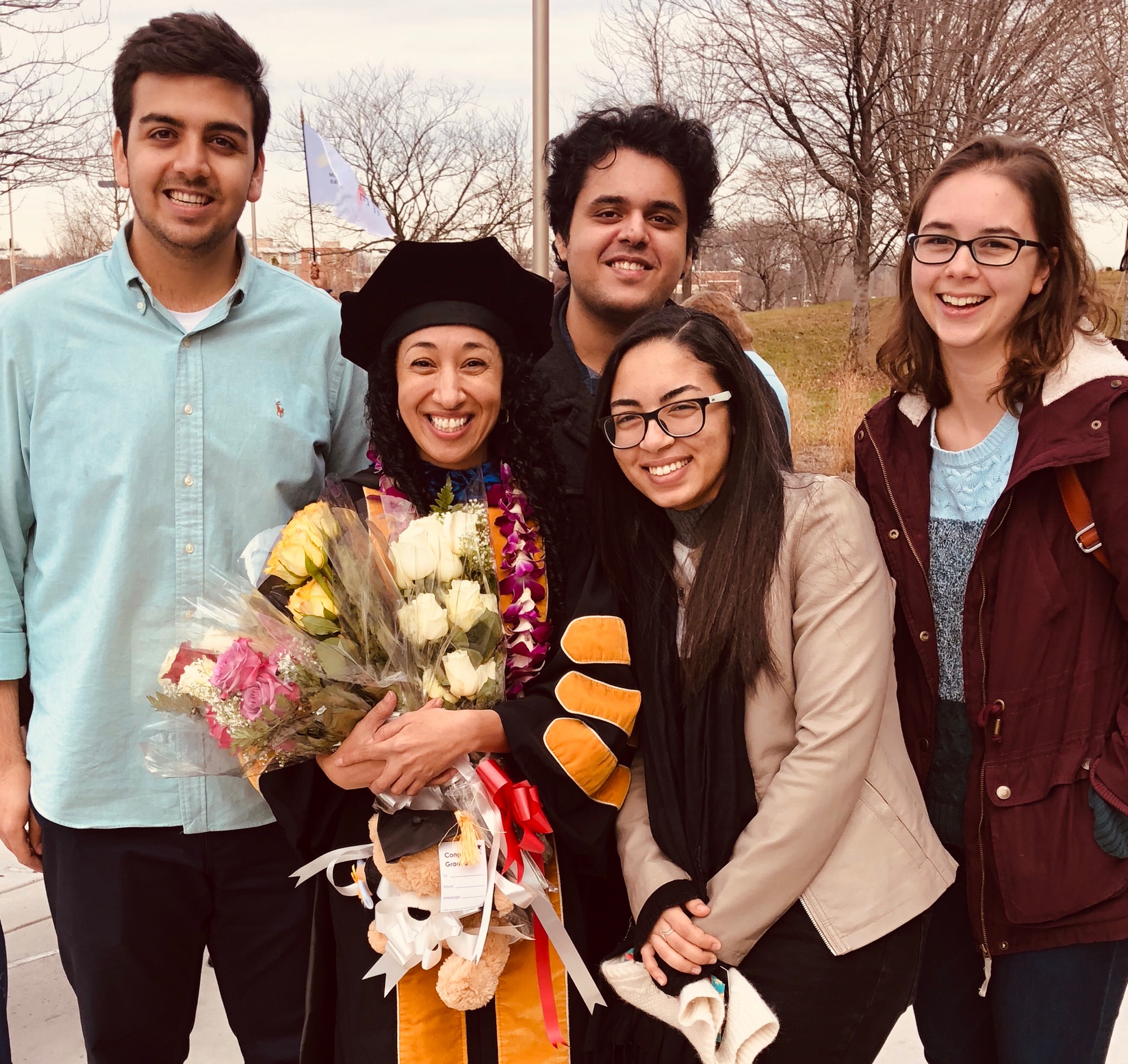
Mariann Gabrawy, second from left, with four of the 17 undergraduates who contributed to the current paper. Photo courtesy Mariann Gabrawy.
Limitless possibilities
Gabrawy is focused on teaching for now, but there are plenty of opportunities to extend the work in her new paper. “One avenue of future work is to look at the mechanism,” Leips says. “We have this tie between genes and traits, but how exactly does that work at the molecular level?”
Whether or not Gabrawy and Leips pursue that question themselves, they’ve set the stage for others to do so. “The coolest part is the ability to share our findings and our data,” Gabrawy says. “We’ve provided really very important fundamental information to other scientists out there. The possibilities for future work are truly limitless.”
Header image: A student in Jeff Leips’s laboratory observes fruit flies under a microscope. Photo by Marlayna Demond ’11 for UMBC.
]]>
A new study published in Genes may eventually give doctors the ability to make better-informed decisions about which medications to prescribe for older adults. The research, led by Mariann...
https://umbc.edu/stories/umbc-researchers-discover-genes-linked-to-medication-response-laying-foundation-for-precision-medicine/
https://beta.my.umbc.edu/api/v0/pixel/news/119453/guest@my.umbc.edu/48af5a880c274c44010866f8b1a07fc2/api/pixel
alumni
biology
cnms
gradresearch
news
research
science-and-tech
UMBC News & Magazine
https://beta.my.umbc.edu/groups/umbc-news-magazine
https://assets1-beta.my.umbc.edu/system/shared/avatars/groups/000/001/943/24435aa6207c452e7bc15cc74b42c7bb/xsmall.png?1748556657
https://assets1-beta.my.umbc.edu/system/shared/avatars/groups/000/001/943/24435aa6207c452e7bc15cc74b42c7bb/original.png?1748556657
https://assets2-beta.my.umbc.edu/system/shared/avatars/groups/000/001/943/24435aa6207c452e7bc15cc74b42c7bb/xxlarge.png?1748556657
https://assets2-beta.my.umbc.edu/system/shared/avatars/groups/000/001/943/24435aa6207c452e7bc15cc74b42c7bb/xlarge.png?1748556657
https://assets3-beta.my.umbc.edu/system/shared/avatars/groups/000/001/943/24435aa6207c452e7bc15cc74b42c7bb/large.png?1748556657
https://assets1-beta.my.umbc.edu/system/shared/avatars/groups/000/001/943/24435aa6207c452e7bc15cc74b42c7bb/medium.png?1748556657
https://assets2-beta.my.umbc.edu/system/shared/avatars/groups/000/001/943/24435aa6207c452e7bc15cc74b42c7bb/small.png?1748556657
https://assets1-beta.my.umbc.edu/system/shared/avatars/groups/000/001/943/24435aa6207c452e7bc15cc74b42c7bb/xsmall.png?1748556657
https://assets2-beta.my.umbc.edu/system/shared/avatars/groups/000/001/943/24435aa6207c452e7bc15cc74b42c7bb/xxsmall.png?1748556657
UMBC News & Magazine
0
0
false
Thu, 07 Apr 2022 19:03:03 -0400
Thu, 07 Apr 2022 19:03:03 -0400
Black and Gold, Through and Through
For a university only in its 55th year, there are a surprising number of personnel who’ve been around for a good percentage of that time. So while Anthony Adams’ 25 years as assistant and then associate head soccer coach might have college sports observers and coaching aficionados scratching their heads, to those inside of #RetrieverNation, it’s just another “Hilltop Circle Tale.”
Throughout the nation, UMBC’s associate head coach is just one of two reported program assistants whose current NCAA Division I coaching tenures have reached the quarter-century mark.
If that distinction isn’t enough, Adams ’97, history, works under his college coach, Head Soccer Coach Pete Caringi Jr. and alongside Pete Caringi III, a UMBC All American, who was born during Adams’ freshman playing season.
“I am unbelievably thankful for all the things that have happened here,” said Adams. “I got a chance to play and then coach Division I soccer when I was 22 years old.”
The Early Years
Adams prepped at Calvert Hall—coincidentally (or not), the Caringis’ alma mater—and attended UMBC as part of his future mentor’s first full recruiting class in the fall of 1992. Nicknamed “Tank,” the Dundalk, Maryland, native was the consummate steady defender who started every game in 1994 and 1995.
While at Calvert Hall and early in his playing career at UMBC, Adams had coached his younger brother’s team and a youth team that would feature future Retrievers such as Billy Nelson ’01 and P.J. Wakefield ’02. But the history major planned on going the teaching route and was student-teaching when he got “the call” from Caringi Jr. in the spring of 1997.
 From l to r: Sam DeBone, Pete Caringi Jr., Brian Rowland, Anthony Adams, Pete Caringi III pose before a 2018 game versus Temple. Rowland ’03 is the head coach for the Temple University Owls. All photos courtesy of UMBC Athletics unless otherwise noted.
Adams served as an assistant coach from 1997-99, earning a first-year salary of $8,000. Caringi put him on a plane for England in that first year and he came back with defender Andrew Wells ’02 and midfielder James Hamilton ’02. The duo were key cogs on a team that would earn the program’s first NCAA Division I Championship appearance in 1999.
Wells would go on to earn all-league honors in the Northeast Conference during all four years on Hilltop Circle and a UMBC Hall of Fame selection.
“When I met Anthony in May 1998 in a hotel in Blackpool, England, I met a quiet, unassuming guy with a determination in his eye,” said Wells, who currently works for Capstone ISG, Inc. in Hunt Valley, Maryland, as a regional claims manager. “I put all of my trust in him when he sold me on coming to UMBC and I have never regretted for a moment that decision.”
Wells adds, “over the past 23 years, I have watched Anthony grow into one of the top college soccer coaches in America and while he is not as quiet and unassuming as he used to be, that determination in his eyes is still there. It was a pleasure to be a part of Anthony’s journey as a coach and even more of a pleasure to now call him a friend.”
All About the Family
Adams earned the program’s first full-time assistant coaching gig in the fall of 2000.
“I was fortunate to realize it was my passion,” said Adams, recalling those early years. “As hard as it was, it didn’t seem like work. I had really supportive parents. Without their support, I wouldn’t have started it.”
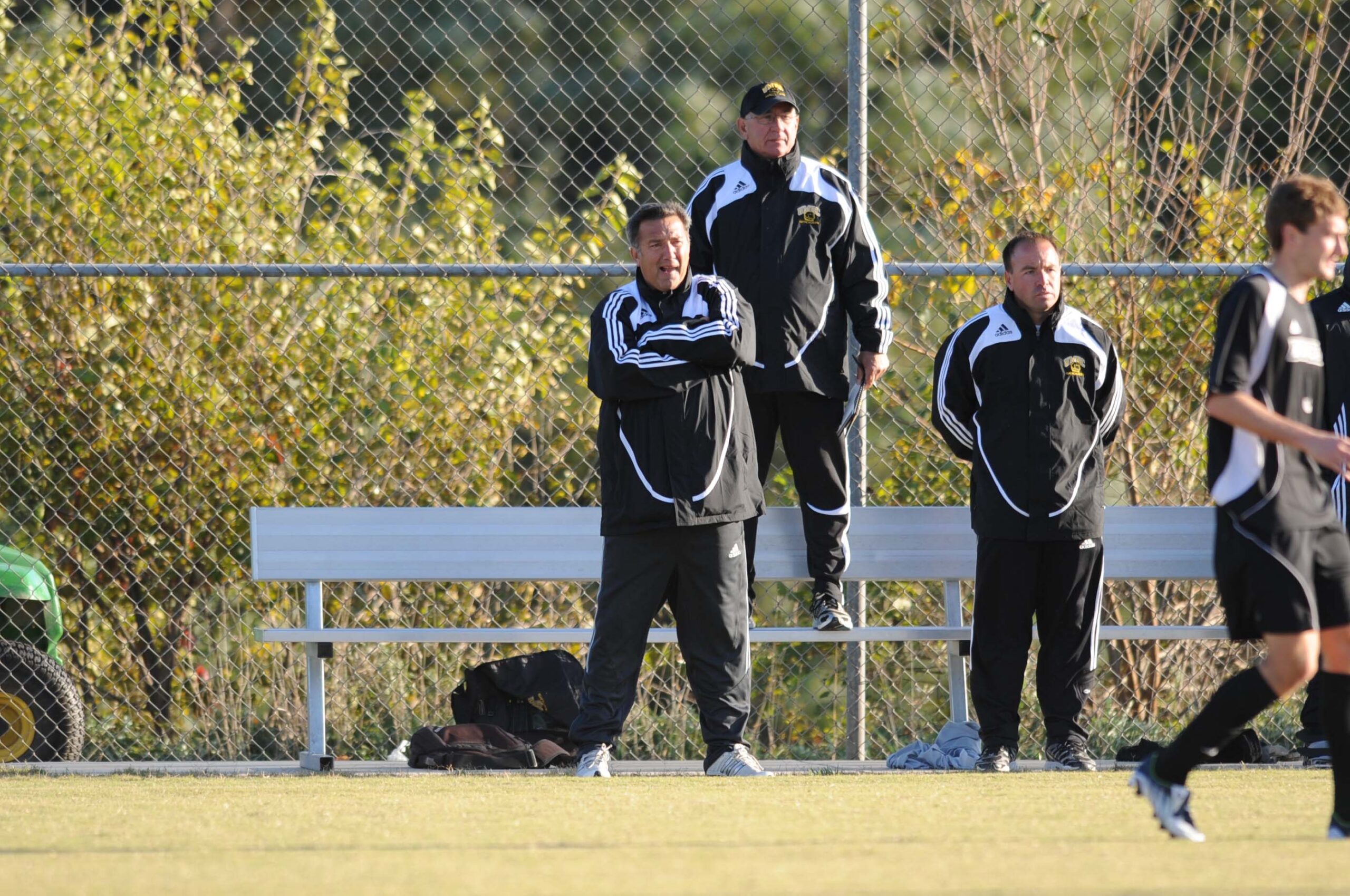
 From l to r: Pete Caringi Jr., Sam DeBone, and Anthony Adams look on in a rare afternoon game at Retriever Soccer Park.
The Retrievers continued to experience success in the first decade of the 2000s and Adams earned accolades as one of the nation’s top assistant coaches. He was a finalist for several head coaching positions, but he met the former Stephanie Pippin, who had joined UMBC’s sports medicine staff in 2001. They were married four years later, and celebrated the additions of Isabella and Caroline in 2007 and 2010, respectively.
“Once we got married and had our first child, I didn’t seriously consider any job offers after that,” said Adams about other coaching positions.“I’m in a really good situation here. Do I have that itch to be a head coach? Yes, I have for about 20 years. But, at a certain point, it stopped being about me and it started to be about my family.”
The Retriever Way
Under Caringi Jr., Adams and long-time volunteer assistant coach Sam DeBone, the Retrievers built a program that won a Northeast Conference title in 1999 and earned a Top 20 ranking in 2000. The move to the tougher America East Conference in 2003 provided a greater challenge, but by 2010, “The Retriever Way” of mixing primarily local players along with a few international standouts again paid dividends. UMBC won four of five America East titles from 2010-2014, concluding with the remarkable College Cup (national semi-finals) appearance in 2014.
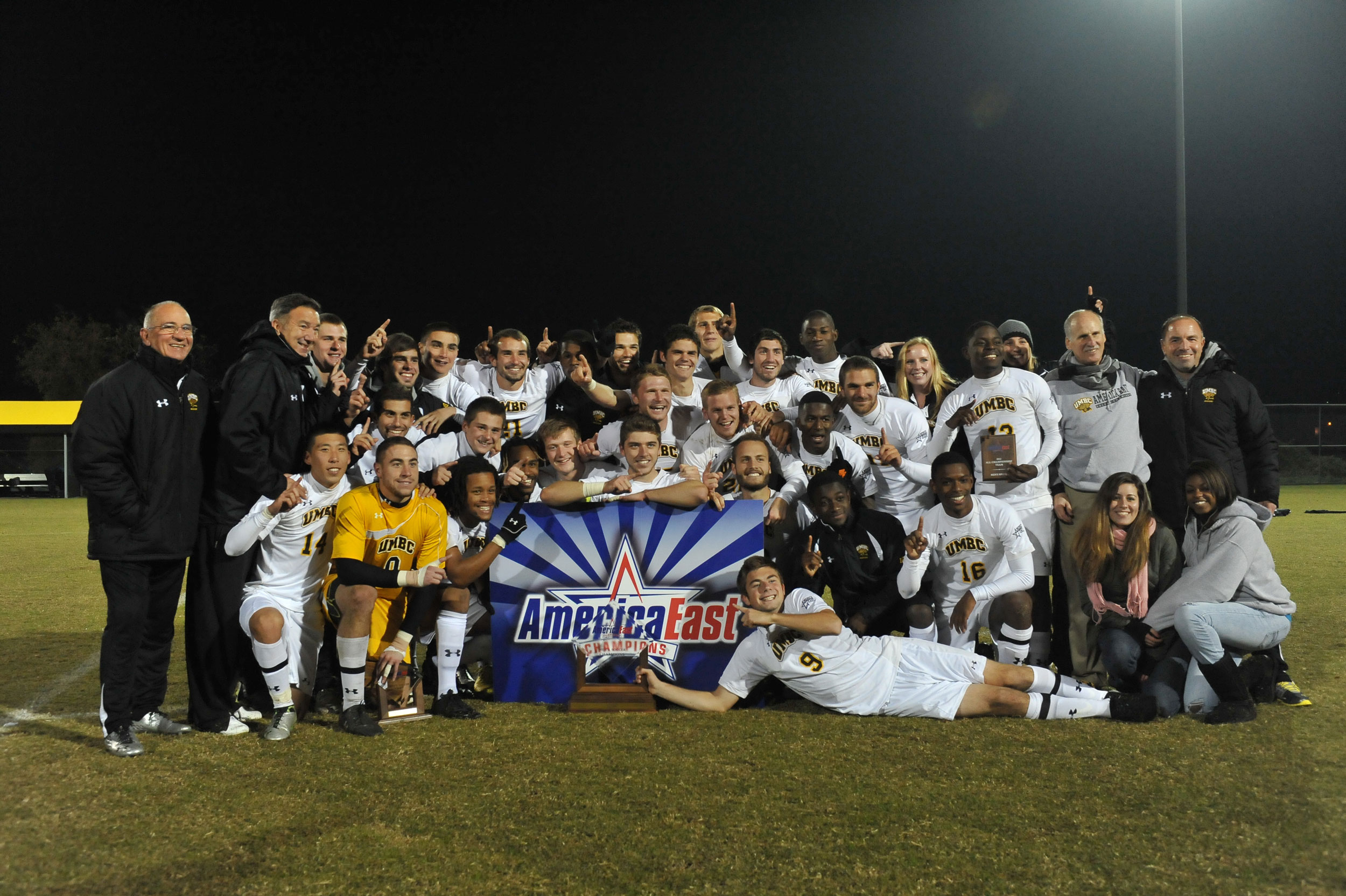
 The 2012 America East Champions.
“I definitely got emotional when UMBC made the penalty kick at Creighton,” said Adams of the shot that sent the Retrievers to Cary, North Carolina, for the College Cup. “It was a tribute to all those players that came before, the Steve Zerhusens, the Woodard brothers, the Bobby Wagners and so many more. It was also a message to those people over all of the years that said it couldn’t be done by UMBC.”
And the success carries on as, despite a small venue in the cozy Retriever Soccer Park, UMBC ranks amongst the nation’s Top 25 in attendance nearly every fall.
Bigger than a Job
Adams gives his mentor full credit for the success of the program. “He always preaches family but that’s what it is. Being at UMBC is bigger than the job for me. The relationships are more important to me than anything.”
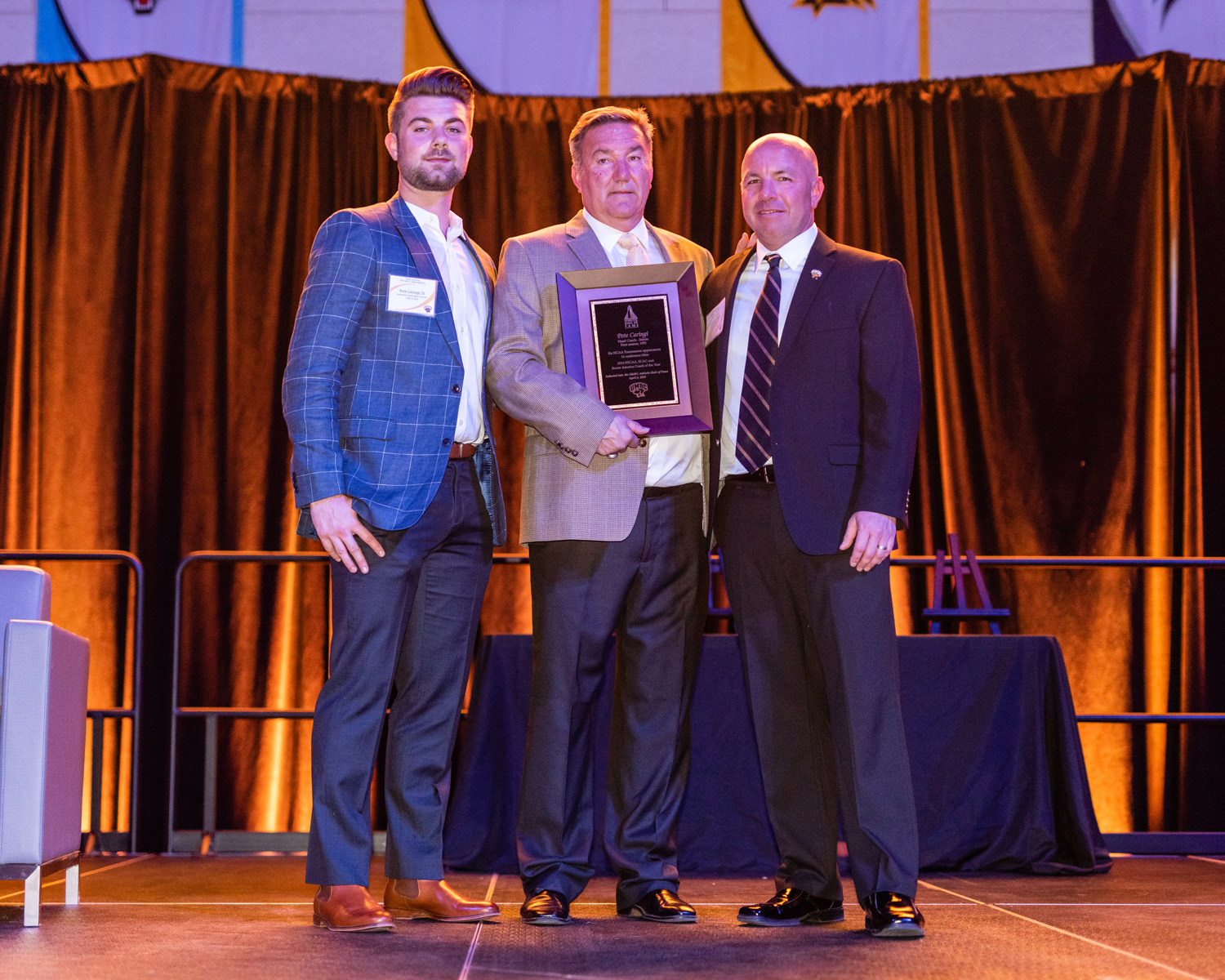
 At Coach Caringi’s 2019 UMBC Athletics Hall of Fame induction. Pete Caringi III, Pete Caringi Jr., and Anthony Adams. Photo by Ian Feldmann ’21.
“Anthony has given his heart and soul to the program,” said Caringi Jr., at his own UMBC Hall of Fame induction ceremony in 2019. “I really do believe that we are a great combination. I know you [Adams] always have my back and I always have your back and we have one goal, to make UMBC a great program.”
“I am amazed at what this place has turned into,” said Adams.
******
I wish to dedicate this article to the memory of one of my mentors, Jeff Seidel, ‘84. A frequent contributor to UMBC Magazine, Jeff asked me for a potential topic and we agreed that an article featuring Coach Adams would be highly appropriate. Like Coach Adams, Jeff bled black and gold, but, being a true professional, he always wrote objectively when covering the Retrievers for The Baltimore Sun.
Thirty-six years ago, Jeff passed the baton to me when I became sports editor of The Retriever. I didn’t drop it then and I will not drop it now. I miss my friend.
— Steve Levy, ‘85
Header image: Associate Head Coach Anthony Adams directs his defense in a 2012 game.
]]>
For a university only in its 55th year, there are a surprising number of personnel who’ve been around for a good percentage of that time. So while Anthony Adams’ 25 years as assistant and then...
https://umbc.edu/stories/black-and-gold-through-and-through/
https://beta.my.umbc.edu/api/v0/pixel/news/119454/guest@my.umbc.edu/34572625eb95b343b45e4569170cab4b/api/pixel
alumni
athletics
history
magazine
mens-soccer
UMBC News & Magazine
https://beta.my.umbc.edu/groups/umbc-news-magazine
https://assets1-beta.my.umbc.edu/system/shared/avatars/groups/000/001/943/24435aa6207c452e7bc15cc74b42c7bb/xsmall.png?1748556657
https://assets1-beta.my.umbc.edu/system/shared/avatars/groups/000/001/943/24435aa6207c452e7bc15cc74b42c7bb/original.png?1748556657
https://assets2-beta.my.umbc.edu/system/shared/avatars/groups/000/001/943/24435aa6207c452e7bc15cc74b42c7bb/xxlarge.png?1748556657
https://assets2-beta.my.umbc.edu/system/shared/avatars/groups/000/001/943/24435aa6207c452e7bc15cc74b42c7bb/xlarge.png?1748556657
https://assets3-beta.my.umbc.edu/system/shared/avatars/groups/000/001/943/24435aa6207c452e7bc15cc74b42c7bb/large.png?1748556657
https://assets1-beta.my.umbc.edu/system/shared/avatars/groups/000/001/943/24435aa6207c452e7bc15cc74b42c7bb/medium.png?1748556657
https://assets2-beta.my.umbc.edu/system/shared/avatars/groups/000/001/943/24435aa6207c452e7bc15cc74b42c7bb/small.png?1748556657
https://assets1-beta.my.umbc.edu/system/shared/avatars/groups/000/001/943/24435aa6207c452e7bc15cc74b42c7bb/xsmall.png?1748556657
https://assets2-beta.my.umbc.edu/system/shared/avatars/groups/000/001/943/24435aa6207c452e7bc15cc74b42c7bb/xxsmall.png?1748556657
UMBC News & Magazine
0
0
false
Wed, 06 Apr 2022 19:45:50 -0400
Wed, 06 Apr 2022 19:45:50 -0400
UMBC’s Farah Helal, longtime student advocate, is named USM student regent
“Educators genuinely want what is best for their students,” says Farah Helal ’24, the newly appointed 2022 University System of Maryland (USM) student regent. “Student representatives provide educators and policymakers with the perspective needed to ensure the student voice is valued and understood throughout the decision-making process.”
Governor Hogan announced Farah Helal’s appointment to the USM Board of Regents as a student regent in February and she was formally confirmed in March. She will serve as one of two USM student regents from July 1, 2022 through June 30, 2024, including as a voting member during her second year.
Helal will represent the USM student voice in meetings and committees working on issues that impact the system’s twelve institutions. Key topics involve setting tuition and fee rates, approving new degree programs, and approving capital and operating budgets.
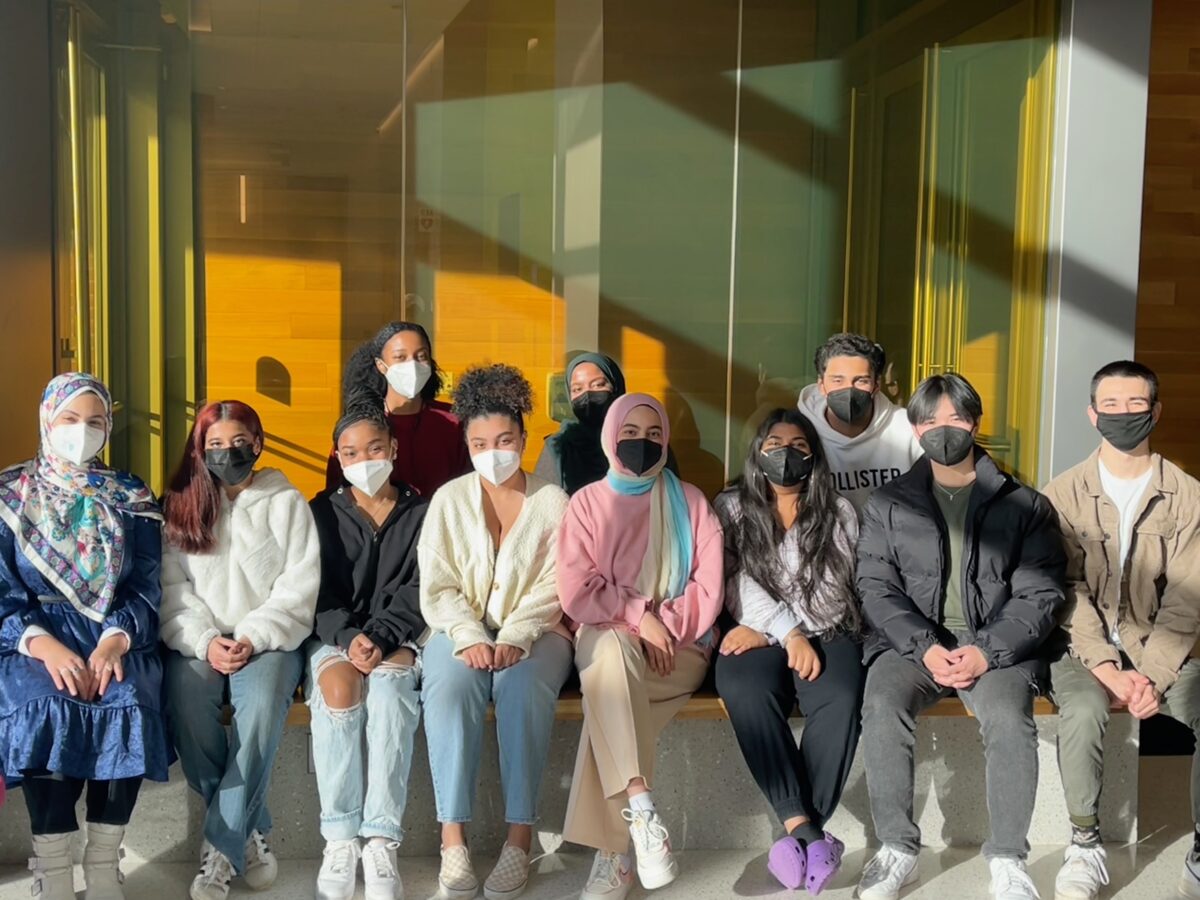 Farah Helal, center, with members of UMBC’s SGA Government Affairs Committee.
Photo courtesy of Helal.
“I recognize the value and impact of having accurate representation,” says Helal. “This appointment comes with a great deal of responsibility, but the value and benefit to my community makes it worth it.”
Focusing on structural changes
Helal is eager to represent Maryland college students at a time when students are in need of additional support and resources. In addition to focus areas guided by student input, there are three areas of improvement she would like to help address.
First, she wants to support initiatives that address how students have experienced the pandemic. This includes shifts in their learning experiences as well as evolving concerns regarding health and safety.
Like many of her peers, Helal is experiencing the pandemic during a heightened social justice movement. Her second focus area highlights college students’ commitments to challenging structural barriers to diversity, equity, and inclusion.
“My generation is proactive in creating the social change we want to see within our institutions,” says Helal. “This will require the university system to effectively address issues with curriculum and infrastructure that perpetuate inequalities on our campuses.”
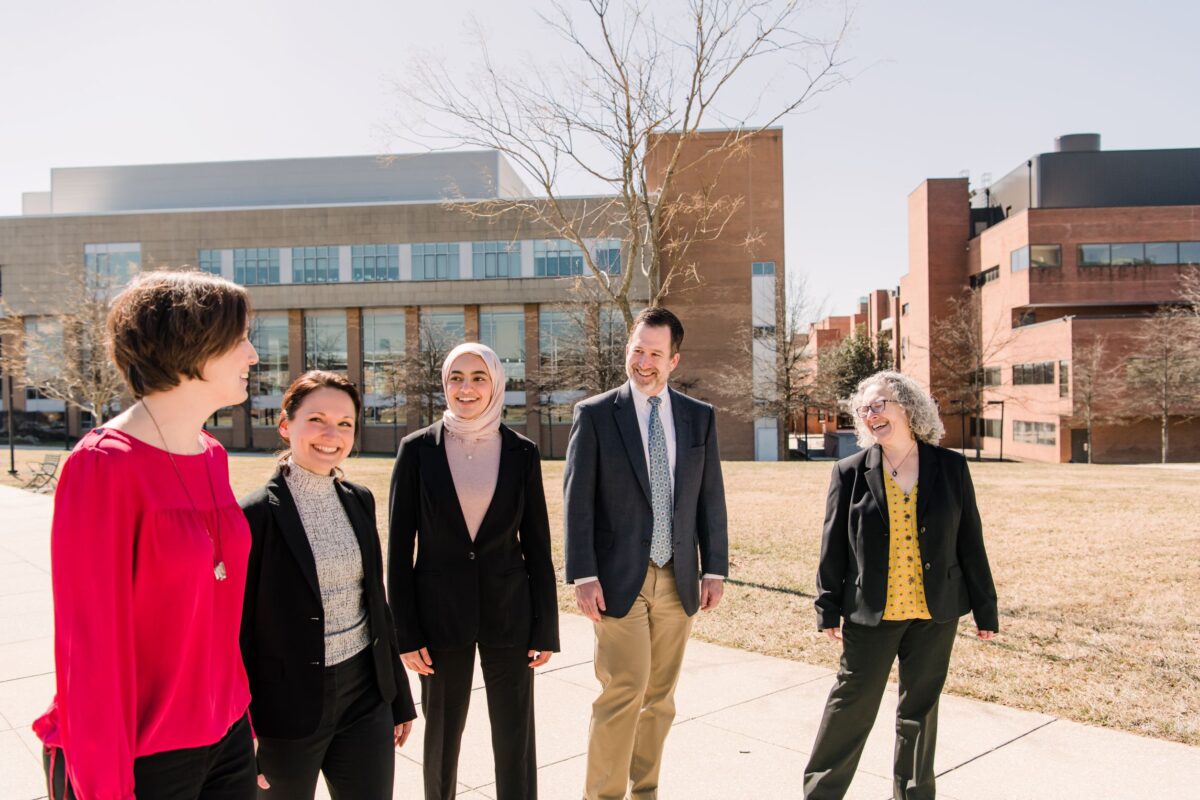 Helal (center) with UMBC faculty and staff from the Sondheim Scholars Program, the Center for Democracy and Civic Life, and the Honors College.
Her third area of focus is student mental health and wellbeing. Helal notes that having grown up in an “electronically dependent society with the influence of social media” has created a culture of constant communication where every type of news is immediate. This constant flow of vast quantities of information is straining student mental health and wellbeing, she suggests, particularly when combined with work, academic, and personal stressors. Helal looks forward to collaborating with the board and community members to improve mental health resources on USM campuses.
Leading with experience
Helal is a Sondheim Public Affairs Scholar in UMBC’s Honors College, majoring in global studies and political science. She also holds a variety of leadership positions at UMBC that have helped her prepare for serving community needs.
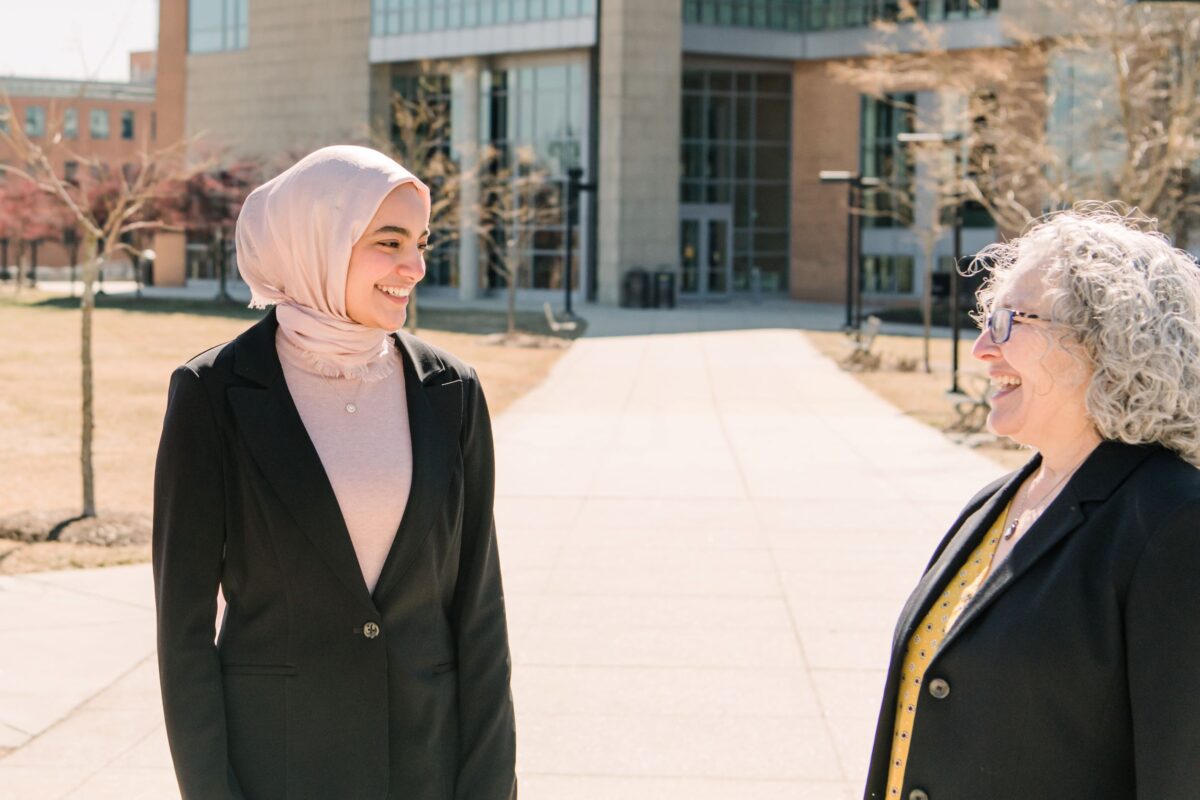 Helal with her academic advisor, Julie Oakes, assistant director of curriculum and retention for the Honors College.
She also serves as director of the Government Affairs Committee for UMBC’s undergraduate Student Government Association. One of her roles is as chief lobbyist pursuing SGA’s county, state, and federal agenda.
“Farah consistently goes well beyond the requirements and makes meaningful contributions to all that she is involved in,” says Jessica Cook, associate director of the Sondheim Scholars Program. “Farah has breathed new life into SGA’s government affairs work and has earned everyone’s respect.”
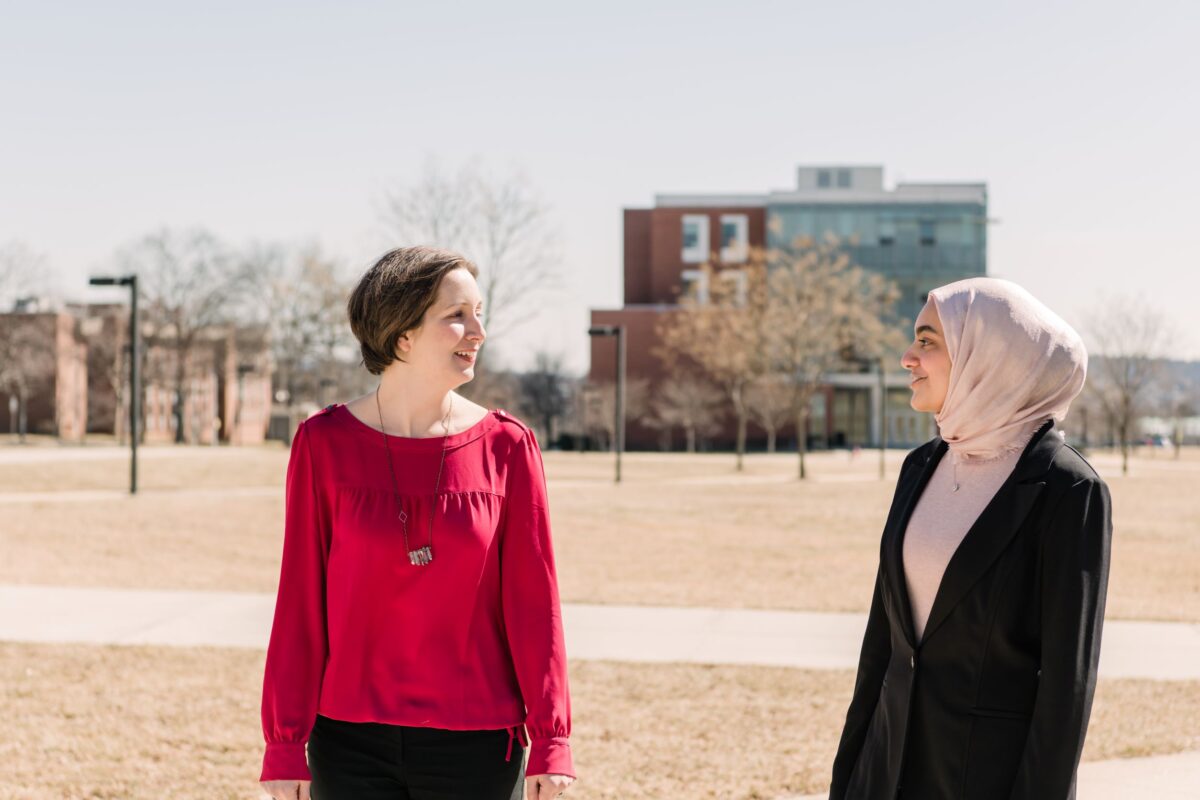 Jessica Cook (l) with Farah Helal (r).
Helal notes the committee was able to bring a bill for consideration before the Maryland General Assembly to increase wages for the incarcerated people who are working for Maryland Correctional Enterprises. It is an issue many USM students care about and want to change, she says.
UMBC’s Candace Martinez-Doane, assistant director of leadership and governance for Campus Life, is Helal’s SGA advisor. She has seen Helal care deeply about those around her and strive to ensure their voices are heard.
“Part of that work has been to help her committee members refocus when their work stalls or hits roadblocks,” explains Martinez-Doane. “She does her research and works with kindness and tact in a way that has shown her maturity and skill.”
Beyond UMBC
On the USM Student Council, Helal advocates for student-led legislation as co-director of government relations. She also collaborates with USM institutions on their legislative agendas and coordinates the legislative activities of the Student Council within the Maryland General Assembly and the Office of the Governor.
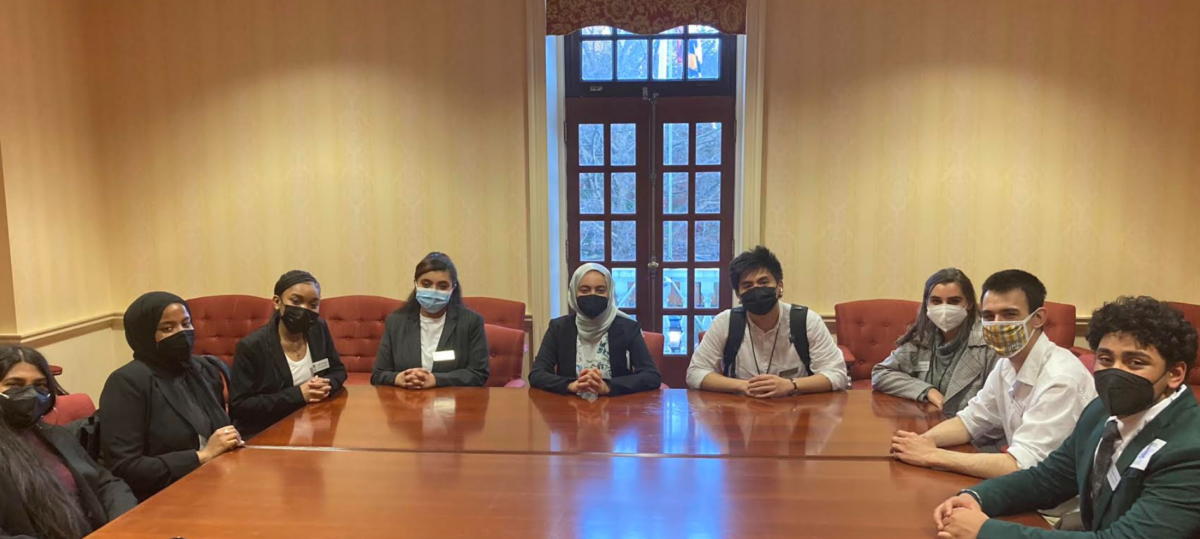 Helal, center, with members of UMBC’s SGA Government Affairs Committee at the Maryland Senate. Photo courtesy of Helal.
Helal also remains dedicated to Howard County, where she is from, as a student representative on the Diversity, Equity and Inclusion Advisory Committee of the Howard County Public School System. The group is part of Howard County’s High School Advisory Council to the Superintendent.
Value of reflection
Helal’s focus on raising awareness about students’ mental health and wellbeing has been a longtime commitment. In high school she ran a two-year research project to study how academic stress impacts students’ mental and physical health and academic success.
The study helped Helal understand how important it is to stop and assess wellbeing before burning out. On a personal level, she learned that the quality of her work is dependent on how well she takes care of herself, and she encourages others to think about this connection.
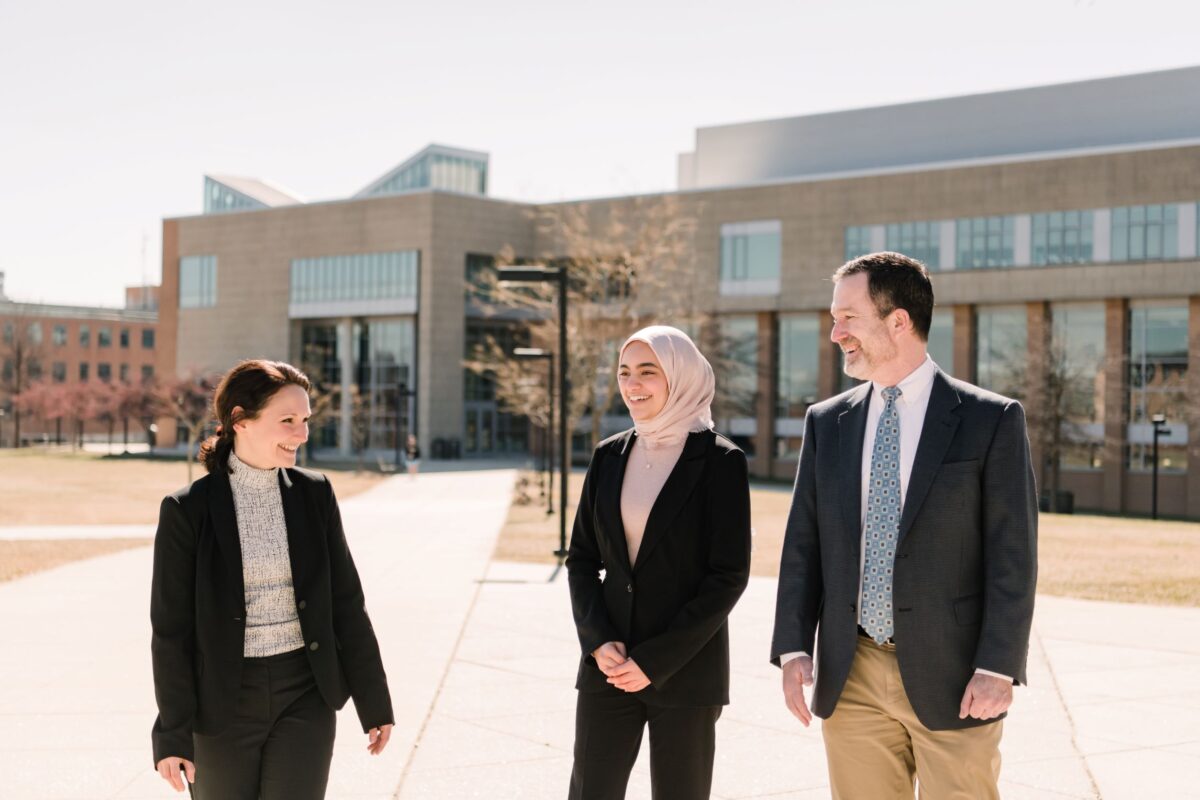 Helal (center) with Romy Hübler ‘09, modern languages and linguistics, M.A. ‘11, intercultural communication, Ph.D. ‘15, language, literacy, and culture (LLC), left, and David Hoffman, Ph.D. ’13, LLC, right. As associate director and director of the Center for Democracy and Civic Life, they have provided Helal with guidance in her civic engagement work on and off campus.
Helal uses daily reflection exercises as a tool to help assess the impact of her work and her needs, and she encourages her peers to do so as well. She also notes the importance of enjoying life outside of school and work, to keep perspective. Spending time with her family, taking time to have fun, and being active in her Egyptian, Arab, and Muslim communities are all activities that reenergize her.
“I constantly reflect about the time, effort, and energy it takes to work towards something that is meaningful, impactful, and purposeful,” says Helal. “Pausing to reflect and take part in my community is how I ensure my work is aligned with my purpose and intentions, and stays consistent with what I initially set out to be—a student voice for positive change.”
Featured photo: Farah Helal. All photos by Marlayna Demond ’11 for UMBC unless otherwise indicated.
]]>
“Educators genuinely want what is best for their students,” says Farah Helal ’24, the newly appointed 2022 University System of Maryland (USM) student regent. “Student representatives provide...
https://umbc.edu/stories/umbcs-farah-helal-longtime-student-advocate-is-named-usm-student-regent/
https://beta.my.umbc.edu/api/v0/pixel/news/119455/guest@my.umbc.edu/165a218f1a50e0fb95ce6f0020ddfb34/api/pixel
cahss
civic
community
globalstudies
honorscollege
news
page1
policy-and-society
political-science
sondheimscholars
UMBC News & Magazine
https://beta.my.umbc.edu/groups/umbc-news-magazine
https://assets1-beta.my.umbc.edu/system/shared/avatars/groups/000/001/943/24435aa6207c452e7bc15cc74b42c7bb/xsmall.png?1748556657
https://assets1-beta.my.umbc.edu/system/shared/avatars/groups/000/001/943/24435aa6207c452e7bc15cc74b42c7bb/original.png?1748556657
https://assets2-beta.my.umbc.edu/system/shared/avatars/groups/000/001/943/24435aa6207c452e7bc15cc74b42c7bb/xxlarge.png?1748556657
https://assets2-beta.my.umbc.edu/system/shared/avatars/groups/000/001/943/24435aa6207c452e7bc15cc74b42c7bb/xlarge.png?1748556657
https://assets3-beta.my.umbc.edu/system/shared/avatars/groups/000/001/943/24435aa6207c452e7bc15cc74b42c7bb/large.png?1748556657
https://assets1-beta.my.umbc.edu/system/shared/avatars/groups/000/001/943/24435aa6207c452e7bc15cc74b42c7bb/medium.png?1748556657
https://assets2-beta.my.umbc.edu/system/shared/avatars/groups/000/001/943/24435aa6207c452e7bc15cc74b42c7bb/small.png?1748556657
https://assets1-beta.my.umbc.edu/system/shared/avatars/groups/000/001/943/24435aa6207c452e7bc15cc74b42c7bb/xsmall.png?1748556657
https://assets2-beta.my.umbc.edu/system/shared/avatars/groups/000/001/943/24435aa6207c452e7bc15cc74b42c7bb/xxsmall.png?1748556657
UMBC News & Magazine
0
0
false
Tue, 05 Apr 2022 13:17:28 -0400
Tue, 05 Apr 2022 13:17:28 -0400


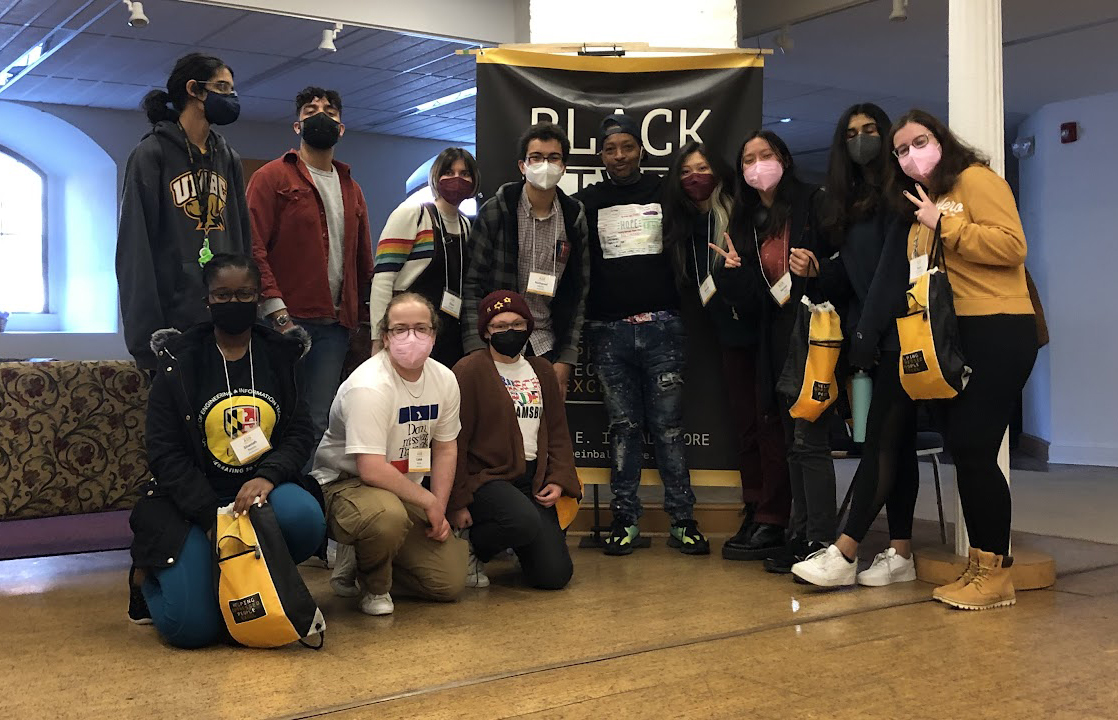 The Transformative Justice group poses with Quarles in the center.

 ASB participants, leaders, and staff from the Center for Democracy and Civic Life pose together at the end of the week.