Beyond “plant trees!”: UMBC research finds tree plantations encroaching on essential ecosystems

Trees store carbon, filter the air, create habitat, and supply a host of other benefits for animals and people. Planting the right trees, in the right places, in consultation with local communities, can support goals like addressing climate change and improving lives. However, new research led by Matthew Fagan, assistant professor of geography and environmental systems at UMBC, finds that some trees planted in the tropics may be doing more harm than good.
The study, published in Nature Sustainability, examined the increase in tree cover across the global tropics between 2000 and 2012. Fagan and colleagues found that, surprisingly, tree cover gains during that period were equally attributable to natural forest regrowth and the creation of tree plantations. The most common tree plantation species were rubber, eucalyptus, and oil palm.
Tree plantations are not always harmful to the environment, and even much-maligned oil palm can be farmed sustainably, Fagan explains. However, the study found that 92 percent of new tree plantations were in biodiversity hotspots, threatening a range of plant and animal species. Also, 14 percent of plantations were in arid biomes, where trees are unlikely to thrive and likely to damage existing ecosystems. And tree plantations had encroached into 9 percent of accessible protected areas in the humid tropics, such as national parks.
“Ecologists have been sounding the alarm on this for over a decade,” Fagan says. “But no one’s had a hard number about how much this is actually happening.”
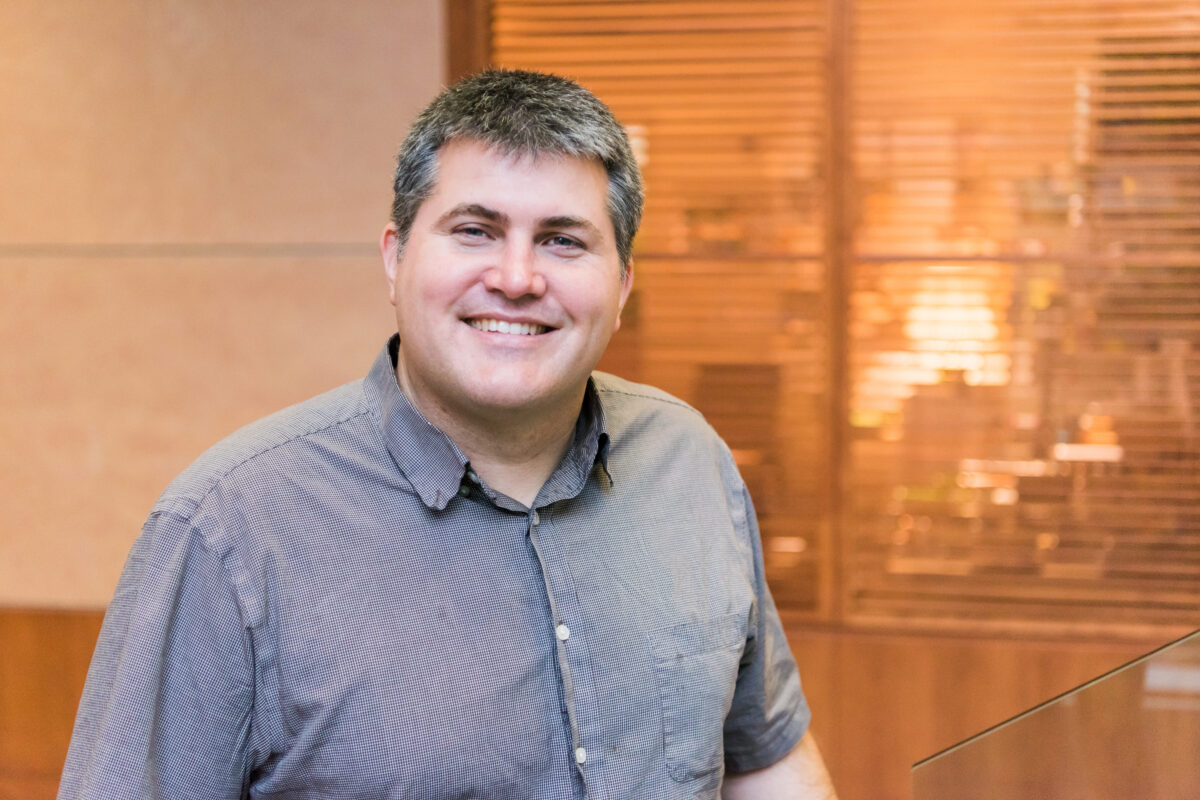 Matthew Fagan (Marlayna Demond ’11/UMBC)
When tree planting is lose-lose
In recent years, dozens of nations have committed to restoring large areas of forest. Tree plantations make up 45 percent of commitments to the Bonn Challenge, an international initiative to restore degraded and deforested landscapes. But Fagan is concerned that these plantations may have unintended consequences.
For example, China has undertaken a massive tree-planting effort at the edge of the Gobi desert, and many African countries have committed to planting trees at the transition between the Sahara desert and Sahel grassland. The goal is to prevent desert expansion, but the plantings can cause harm. Disturbing the soil releases carbon, and trees are water hogs. They end up “killing off the grassland that was there, and then they often die of drought,” Fagan says. In these situations, tree planting is lose-lose.
Similarly, in Brazil, soy farmers moved out of the Amazon and into the Cerrado, one of the world’s largest savannas. Pine and eucalyptus tree farms followed. The Cerrado supports a wealth of biodiversity, and the carbon it stores underground rivals rainforest carbon sequestration, Fagan explains. Tree crops in the Cerrado may count toward Brazil’s reforestation commitment, but could actually be a step backward in mitigating climate change and biodiversity loss.
“In the U.S., we have a huge area of relatively wet woods, and we tend to idolize planting trees as sort of the ultimate environmental act,” Fagan says. “But there’s a lot of value in grasslands and savannas that we don’t necessarily see. And when you plant trees, you essentially destroy that ecosystem.”
In response to his team’s new research, “I would really like to see governments around the world reassess their restoration plans,” Fagan says, “or at least be more transparent when their plans involve tree planting, especially in areas that may not be appropriate for planting trees.”
 A plantation of non-native Melina trees in Costa Rica (Matthew Fagan)
Park or plantation?
Fagan’s new paper also revealed the extent to which tree plantations are invading protected areas. The problem was so bad that he had to overhaul the algorithm his team used to differentiate between data representing natural forest regrowth and tree plantations.
Initially, the algorithm used park boundaries as a proxy for natural forest regrowth areas. But it wasn’t working. To figure out what was wrong, Fagan spot-checked 20 parks, and found that three had multiple plantations inside them. That got him curious.
Six weeks later, he had manually checked for plantations in every park in the tropics. When he found plantations, he either redrew the park’s boundaries or, if the park was too compromised, removed it from the data completely. Using the resulting new maps, the algorithm could detect natural forest regrowth versus tree plantations with more than 90 percent accuracy.
“It was very disturbing to see there were just so many parks that were compromised,” Fagan says.
The new maps allowed the team to find many more regrowth areas and plantations than expected from government estimates. Several UMBC undergraduates are authors on the paper because of their contributions to this data analysis. Each student manually checked at least 1,000 patches, some as many as 3,000.
“In the end, the tropics is a much more modified place than we were expecting,” Fagan says. “There’s a whole host of reasons that we see these encroachments, but they’re definitely happening all over the world. We see a steady erosion of these parks by plantations, and the industry is just getting started.”
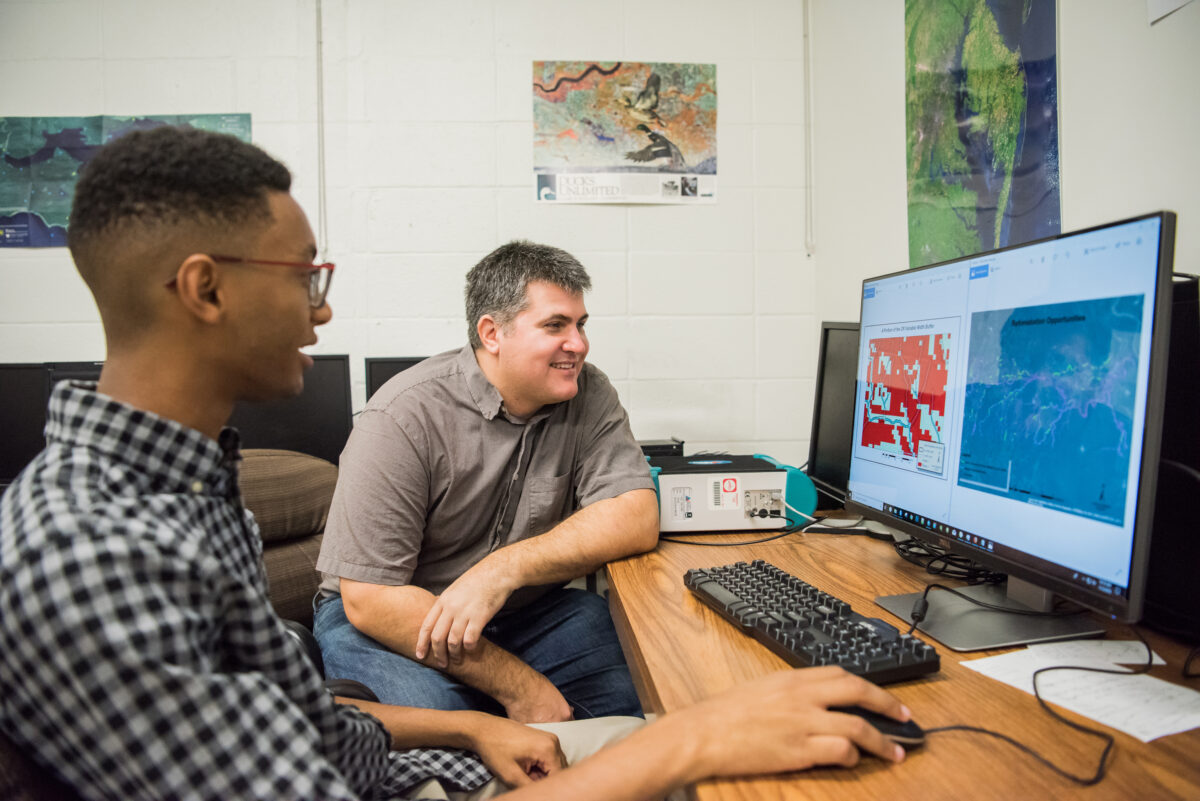 Matthew Fagan (right) and Joshua Slaughter ’22, computer engineering, who was a co-author on the current paper, examine data for a study on the longevity of secondary forests in Latin America. (Marlayna Demond ’11/UMBC)
Reason for hope
When setting out on this research, the team had a simple question: How many planted trees are there in the world? “It seemed like a strange thing not to know,” Fagan says. As the work progressed, they asked whether trees were being planted where they shouldn’t be and whether plantations were expanding into parks. They’ve found the results concerning, but they also have reason for hope.
Trees can do a lot of good, and planting more of them can be a significant factor in addressing the impacts of climate change. But it has to be done right. “This paper shows it’s possible to monitor natural forest versus plantation at a global scale,” Fagan says, “so we can encourage the results we want and discourage results we don’t want.”
He also hopes the results will inspire everyone to be more conscious of where their products—from paper to food to shampoo to tires—come from, and to demand that companies producing those products in tree plantations adopt more sustainable practices.
“If we make our choices en masse, it does shift the direction that these companies go in,” Fagan says. And despite our love for trees in the U.S., he notes, forests are not the only ecosystems that can help mitigate the effects of climate change and biodiversity loss. Savannas and prairies also have an important role to play.
“We need to be cognizant that not all tree planting is beneficial for the ecosystem involved,” Fagan says. “The right tree in the right place is the right answer.”
]]>
Trees store carbon, filter the air, create habitat, and supply a host of other benefits for animals and people. Planting the right trees, in the right places, in consultation with local...
https://umbc.edu/stories/beyond-plant-trees-umbc-research-finds-tree-plantations-encroaching-on-essential-ecosystems/
https://beta.my.umbc.edu/api/v0/pixel/news/125758/guest@my.umbc.edu/9804479d74e2b6f2bb876a0eaca1b229/api/pixel
cahss
ges
policy-and-society
research
science-and-tech
UMBC News & Magazine
https://beta.my.umbc.edu/groups/umbc-news-magazine
https://assets1-beta.my.umbc.edu/system/shared/avatars/groups/000/001/943/24435aa6207c452e7bc15cc74b42c7bb/xsmall.png?1748556657
https://assets1-beta.my.umbc.edu/system/shared/avatars/groups/000/001/943/24435aa6207c452e7bc15cc74b42c7bb/original.png?1748556657
https://assets2-beta.my.umbc.edu/system/shared/avatars/groups/000/001/943/24435aa6207c452e7bc15cc74b42c7bb/xxlarge.png?1748556657
https://assets2-beta.my.umbc.edu/system/shared/avatars/groups/000/001/943/24435aa6207c452e7bc15cc74b42c7bb/xlarge.png?1748556657
https://assets3-beta.my.umbc.edu/system/shared/avatars/groups/000/001/943/24435aa6207c452e7bc15cc74b42c7bb/large.png?1748556657
https://assets1-beta.my.umbc.edu/system/shared/avatars/groups/000/001/943/24435aa6207c452e7bc15cc74b42c7bb/medium.png?1748556657
https://assets2-beta.my.umbc.edu/system/shared/avatars/groups/000/001/943/24435aa6207c452e7bc15cc74b42c7bb/small.png?1748556657
https://assets1-beta.my.umbc.edu/system/shared/avatars/groups/000/001/943/24435aa6207c452e7bc15cc74b42c7bb/xsmall.png?1748556657
https://assets2-beta.my.umbc.edu/system/shared/avatars/groups/000/001/943/24435aa6207c452e7bc15cc74b42c7bb/xxsmall.png?1748556657
UMBC News & Magazine
0
0
false
Mon, 06 Jun 2022 11:20:00 -0400
Mon, 06 Jun 2022 11:20:00 -0400
Carrying on a Philanthropic Legacy

Behind every story of giving lies a story about someone’s generosity. For Hema Gowda ’01, biological sciences, this story was about continuing a generational legacy through philanthropy.
“My mom came to this country in the late ’60s, and education was a huge foundation for her in propelling her forward,” says Gowda, a Prince George’s County native who works in pharmaceutical research.
“When she retired, she set up endowments at [The University of Maryland,] College Park in the name of her parents because they were the ones that pushed her for higher education. She is the person she is today because of them…So I’d always been inspired by that and wanted to give back to UMBC because it was the foundation for my career.”
UMBC’s Alumni Endowment Scholarship Fund presents the perfect opportunity for alumni to give back to the university by directly contributing to the success of students in their undergraduate years. In Gowda’s case, the fund allowed her to follow in her mom’s charitable footsteps by establishing the Gowda Scholarship Endowment for UMBC in 2016 (and a similar scholarship at the University of Maryland School of Pharmacy in 2015) to help students interested in pursuing graduate studies in pharmacy find success at UMBC.
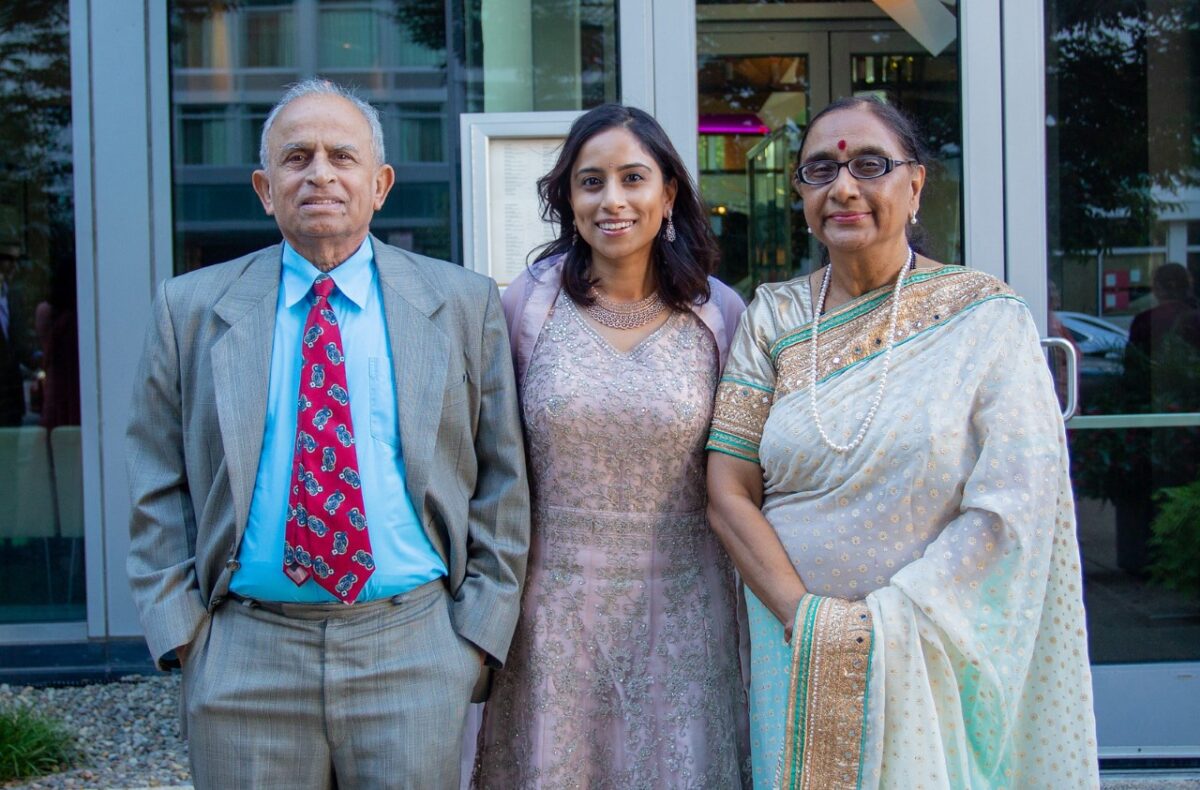 Hema Gowda ’01, center, shares a moment with her parents, Mrs. Vijayalakshmi and Dr. Kusumadhara Gowda. (Image courtesy of Gowda.)
Defining her path
Even as an undergraduate, Gowda knew she wanted to give back to her alma mater, but it took her longer to decide what she really wanted to study at UMBC. When it came to deciding a major, she wanted to pursue the sciences after having been involved in a science and technology program at Eleanor Roosevelt High School. But even after deciding that certain routes like medical school were not for her, it took more steps to narrow down what path called out to her most.
Gowda applied to the University of Maryland School of Pharmacy in her senior year at UMBC and entered the next stage of her academic career. Prior to graduation in 2005, she caught sight of a posting for an editorial internship at the American Society of Health-System Pharmacists —an experience that would eventually lead her to a medical writing position at a medical communications agency in the Philadelphia area the following year. There, Gowda collaborated with pharmaceutical and biotechnology companies to help develop their clinical trial publications and scientific communications for products that were marketed or in development.
After about five years at the agency, Gowda joined the biopharmaceutical company, Incyte, and gained experience in the company’s medical affairs and clinical development groups. This latter opportunity allowed her to take advantage of the communication skills and clinical expertise she had gained through her previous positions and educational experience.
In April 2020, a month into the pandemic, Gowda started her new position as a global development scientist director at AstraZeneca.
“I collaborate with colleagues from many other functions to execute registrational clinical trials in lung cancer. We conduct the trials globally, and gather and submit data for regulatory agencies in hopes of getting new drugs approved for different types of cancers,” explains Gowda.
Gowda’s journey down multiple routes in pharmacy has shown that taking the time to figure out the right path was not at all a setback. Even if it took a bit longer for her to settle on the research route, Gowda did not regret any of the experiences she had gained along the way.
“Each segment of my career helped define my path a little bit better,” Gowda puts it.
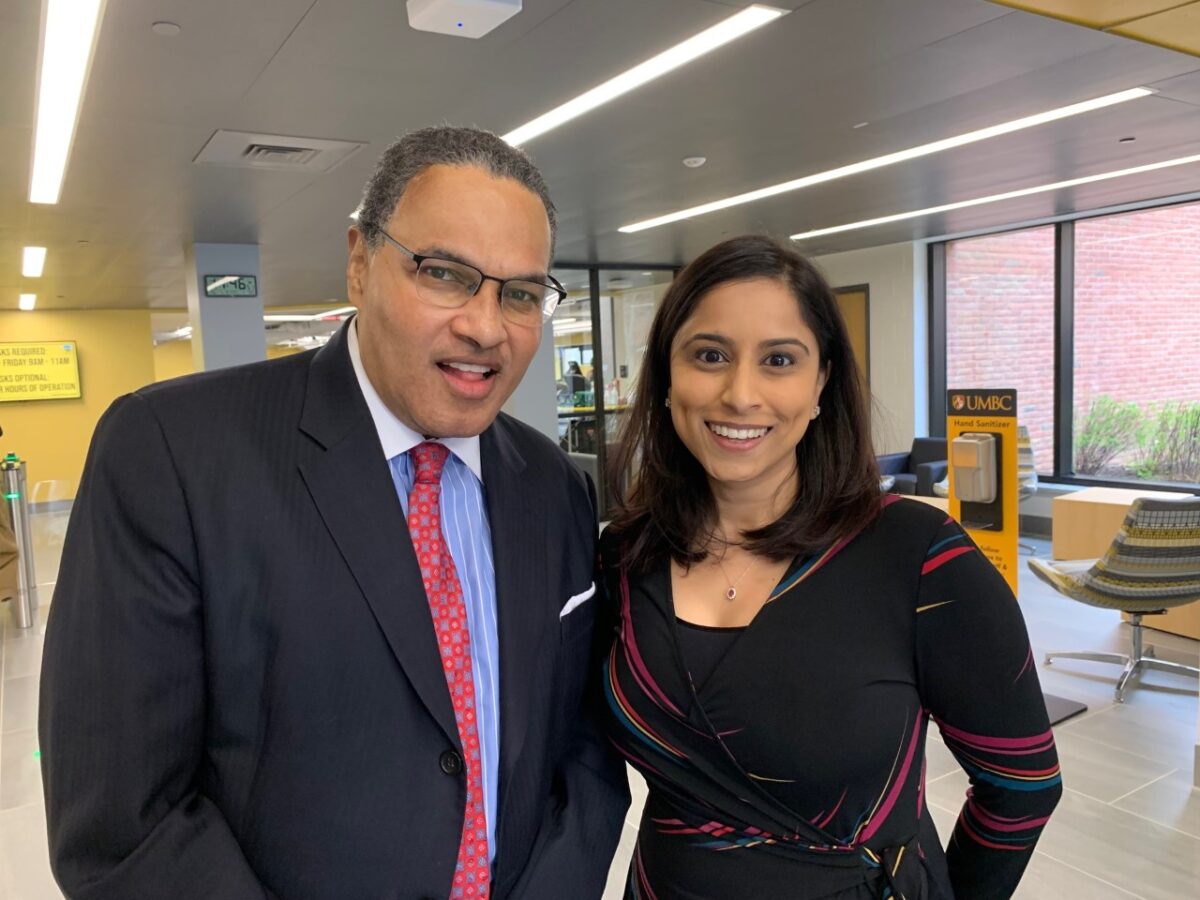 Gowda, right, chats with UMBC president Freeman Hrabowski. (Image courtesy of Gowda.)
Reconnecting to her foundations
The Gowda Scholarship Endowment, open to students interested in pursuing a career in the pharmaceutical sciences, gives preference to students who graduated from a Prince George’s County high school or current residents of the county. On top of wanting to give back to the school system that helped build the foundation for her career, Gowda hopes the scholarship will benefit students who are juggling their responsibilities in the D.C. region.
In describing the time during the pandemic when she met virtually with her first scholar, Adam Kouyate ’22, biological sciences, Gowda says, “[My scholar] was brimming with excitement…and to me, it’s a small amount, but I know it’s a lot for them. And maybe 10 or 20 years from now, that might inspire them to do something similar.”
“Because of this scholarship, I was able to work less hours during the school year and focus more on classes and finding myself.”
– Adam Kouyate ’22
The scholarship lifted a huge burden off Kouyate’s shoulders during a period of burnout. At the time she applied, Kouyate was working at a music store to help pay her tuition. Because she wanted to cover most of the tuition costs on her own, the scholarship allowed her to do so with only $200 coming from her parents. Kouyate was extremely grateful to have been chosen as a scholar, as it also meant she no longer needed to turn to student loans.
“Because of this scholarship, I was able to work less hours during the school year and focus more on classes and finding myself. Though I did end up switching from pharmacy to nursing, this scholarship gave me the peace of mind to focus on what I really wanted to do with my life,” says Kouyate.
Kouyate graduated from UMBC this past spring and will be attending the University of Maryland School of Nursing’s Master’s-Level Entry-Into-Nursing Clinical Nurse Leader program in the fall.
A second recipient of the scholarship, who graduated from Eleanor Roosevelt High School, is also currently studying at UMBC with plans to pursue a graduate degree in pharmacy.
Setting up lifetimes of success
Gowda’s connection to UMBC isn’t just limited to the endowed scholarship, but can be seen through her interactions with friends from her undergraduate days, connections to relatives interested in attending UMBC, and sponsored events such as the Endowed Scholarship Luncheon that is hosted annually at UMBC.
Now and moving forward, Gowda hopes to echo a legacy of giving that has been modeled by her mother as well as inspired by familiar faces at UMBC. Most importantly, she is eager to pass on a future of giving to her scholars—a future that may consist of trial and error, but also with valuable experiences along the way.
“It’s the gift that I want to keep giving, and I can only hope that this small amount for a semester or a year sets them up for a lifetime of success.”
]]>
Behind every story of giving lies a story about someone’s generosity. For Hema Gowda ’01, biological sciences, this story was about continuing a generational legacy through philanthropy. “My...
https://umbc.edu/stories/carrying-on-a-philanthropic-legacy/
https://beta.my.umbc.edu/api/v0/pixel/news/125731/guest@my.umbc.edu/30e5b1d629596f38290c95be093eb18c/api/pixel
alumni-profile
biological-sciences
cnms
impact
magazine
summer-2022
UMBC News & Magazine
https://beta.my.umbc.edu/groups/umbc-news-magazine
https://assets1-beta.my.umbc.edu/system/shared/avatars/groups/000/001/943/24435aa6207c452e7bc15cc74b42c7bb/xsmall.png?1748556657
https://assets1-beta.my.umbc.edu/system/shared/avatars/groups/000/001/943/24435aa6207c452e7bc15cc74b42c7bb/original.png?1748556657
https://assets2-beta.my.umbc.edu/system/shared/avatars/groups/000/001/943/24435aa6207c452e7bc15cc74b42c7bb/xxlarge.png?1748556657
https://assets2-beta.my.umbc.edu/system/shared/avatars/groups/000/001/943/24435aa6207c452e7bc15cc74b42c7bb/xlarge.png?1748556657
https://assets3-beta.my.umbc.edu/system/shared/avatars/groups/000/001/943/24435aa6207c452e7bc15cc74b42c7bb/large.png?1748556657
https://assets1-beta.my.umbc.edu/system/shared/avatars/groups/000/001/943/24435aa6207c452e7bc15cc74b42c7bb/medium.png?1748556657
https://assets2-beta.my.umbc.edu/system/shared/avatars/groups/000/001/943/24435aa6207c452e7bc15cc74b42c7bb/small.png?1748556657
https://assets1-beta.my.umbc.edu/system/shared/avatars/groups/000/001/943/24435aa6207c452e7bc15cc74b42c7bb/xsmall.png?1748556657
https://assets2-beta.my.umbc.edu/system/shared/avatars/groups/000/001/943/24435aa6207c452e7bc15cc74b42c7bb/xxsmall.png?1748556657
UMBC News & Magazine
1
0
false
Fri, 03 Jun 2022 14:42:27 -0400
Fri, 03 Jun 2022 14:42:27 -0400
Deaths and injuries in road crashes are a ‘silent epidemic on wheels’

John Rennie Short, Professor, School of Public Policy, UMBC
The COVID-19 pandemic has generated mind-numbing statistics over the past two years: half a billion cases, 6 million deaths, 1 million in the U.S. alone. But another, less-publicized global scourge preceded it and is likely to outlast it: traffic deaths and injuries.
Around 1.35 million people die each year on the world’s roads, and another 20 million to 50 million are seriously injured. Half of these deaths and many of the injuries involve pedestrians, cyclists and motorcyclists – the most vulnerable users of roads and streets.
Around the world, someone dies from a road accident every 25 seconds. The head of the United Nations Road Safety Fund has called road deaths and injuries a “silent epidemic on wheels”.
I have studied cities and urban policy for many years, including transportation and road safety. In my view, making transportation systems safer is feasible and isn’t rocket science. The key is for governments to prioritize safer roads, speeds and vehicles, and to promote policies such as traffic calming that are known to reduce the risk of crashes.
The costs
It may seem like hyperbole to talk about road deaths as equivalent to pandemic diseases, but the numbers make the case. Road fatalities are now the top cause of death for children and young adults worldwide between the ages of 5 and 29, and the seventh-leading cause of death overall in low-income countries.
Crashes cause serious economic harm to victims and their families, as well as to the broader society. A 2019 study estimated that between 2015 and 2030, road injuries will cost the global economy almost $1.8 trillion.
Because death and injury rates are highest in low- and middle-income countries, dangerous roads add to the costs of being poor and are a major inhibitor of economic growth. That is why one of the U.N.‘s Sustainable Development Goals is to halve the number of global deaths and injuries from traffic incidents by 2030.
More deaths in lower-income countries
There is considerable variation in traffic fatality rates worldwide. Road traffic death rates range from 27 per 100,000 population in Africa to only 7 per 100,000 in Europe.
Richer nations have had mass automobile traffic longer than lower-income countries, so they have had more time to develop strategies and tactics to reduce accidents and fatalities. For example, in 1937 – in an era when traffic death in the streets of cities like New York was considered a routine part of metropolitan life – the U.S. road death rate was 31 per 100,000. That’s about the same as today’s rate in the Democratic Republic of the Congo.
Lower-income countries tend to have vehicles that are less safe; poorer roads; more vulnerable road users, such as pedestrians and cyclists, sharing urban space with vehicles; and poorer medical care, which means injury can more easily lead to death. These nations also have less ability to introduce or enforce traffic laws.
 Traffic in Manila, Philippines. John Rennie Short, CC BY-ND
Traffic incidents in higher-income counties often only involve one or two people. In lower-income countries, incidents tend to involve multiple passengers.
For example, in 2021 in the Democratic Republic of the Congo, a fuel truck collided with a crowded bus 110 miles outside the capital of Kinshasa, killing 33 people. Deadly road incidents are frequent in the DRC, where the roads are poor, there are many unsafe older vehicles, many drivers are not properly trained and drinking and driving is common.
For many middle-income countries, the challenge is a very rapid increase in vehicular traffic as the population becomes more urban and more people earn enough money to buy motorcycles and cars. This quick rise can overwhelm the carrying capacity of urban roads.
In the US, less regulation and more deaths
There also are differences among richer countries. In 1994, Europe and the United States had the same traffic death rates, but by 2020 Americans were over three times more likely to die on the road than Europeans. https://www.youtube.com/embed/jLMm83I4dqc?wmode=transparent&start=0 Traffic deaths in the U.S. rose by more than 10% from 2020 to 2021.
Today, 12 people are killed in traffic per 100,000 annually in the U.S., compared to 4 per 100,000 in the Netherlands and Germany, and only 2 per 100,000 in Norway. The difference reflects more aggressive programs across Europe to reduce speeds, greater investment in mass transit and stricter drunk driving enforcement.
The U.S. doesn’t just lag behind other rich countries in promoting road safety. In recent years, traffic deaths in the U.S. have increased. After a gradual reduction over 50 years, fatalities soared to a 16-year high in 2021 when almost 43,000 people died. Pedestrian deaths hit a 40-year high at 7,500.
What caused this surge in deaths? Roads were less busy during COVID-19 lockdowns, but proportionately more people engaged in riskier behaviors, including speeding, drinking and driving, distracted driving and not using seat belts.
Cyclist and pedestrian traffic deaths were rising even before the pandemic, as cities encouraged walking and biking without providing adequate infrastructure. Painting a white line on a busy street is not a substitute for providing a fully protected, designated bicycle lane.
Two harmful narratives about traffic safety
Two narratives often cloud discussions of traffic fatalities. First, calling these events “accidents” normalizes what I view as a slaughter of innocents. It is part of the cult of automobility and the primacy that the U.S. affords to fast-moving vehicular traffic.
Automobility has created a special form of space – roads and highways – where deaths and injuries are considered “accidents.” In my view, this is an extreme form of environmental injustice. Historically disadvantaged groups and poorer communities are overrepresented in traffic deaths and injuries.
The second misleading narrative holds that nearly all road deaths and injuries are caused by human error. Public officials regularly blame poor drivers, distracted pedestrians and aggressive bicyclists for street deaths.
People do take too many risks. In recent years, AAA’s annual traffic safety culture survey has found that a majority of drivers view unsafe driving behaviors, such as texting while driving or speeding on highways, as extremely or very dangerous. But significant numbers of drivers report engaging in those behaviors anyway.
But as urban studies expert David Zipper has pointed out, a persistent myth often cited by government agencies and the media asserts that 94% of accidents in the U.S. are caused by individual drivers. This bloated figure has successfully shifted responsibility away from other factors such as car design, traffic infrastructure and the need for more effective public policies. https://www.youtube.com/embed/vTRPg6wqjn4?wmode=transparent&start=0 Former New York City transportation commissioner Janette Sadik-Khan visits a street in Queens that was closed to cars during the COVID-19 pandemic. Advocates are campaigning to make the closure permanent.
Governments have the tools
As I see it, road traffic deaths and injuries are not accidents. They are incidents that can be prevented and reduced. Doing that will require governments and urban planners to reimagine transportation systems not just for speed and efficiency, but also for safety and livability.
That will mean protecting motorcyclists, bicyclists and pedestrians from vehicular traffic and reducing traffic speed on urban roads. It also will require better road design, enforcement of traffic laws that make the roads safer, and more effective and enforceable measures that promote safety devices like seat belts, child restraints, and helmets for bikers and motorcyclists.
Unlike the COVID-19 pandemic, making streets safer doesn’t require designing new solutions in laboratories. What’s needed is the will to apply tools that have been shown to work.
* * * * *
John Rennie Short, Professor, School of Public Policy, University of Maryland, Baltimore County
This article is republished from The Conversation under a Creative Commons license. Read the original article.
]]>
John Rennie Short, Professor, School of Public Policy, UMBC The COVID-19 pandemic has generated mind-numbing statistics over the past two years: half a billion cases, 6 million deaths, 1...
https://umbc.edu/stories/deaths-and-injuries-in-road-crashes-are-silent-epidemic/
https://beta.my.umbc.edu/api/v0/pixel/news/125670/guest@my.umbc.edu/a215cb28a21ad28eacadcd4ef241f51c/api/pixel
cahss
discovery
magazine
publicpolicy
the-conversation
UMBC News & Magazine
https://beta.my.umbc.edu/groups/umbc-news-magazine
https://assets1-beta.my.umbc.edu/system/shared/avatars/groups/000/001/943/24435aa6207c452e7bc15cc74b42c7bb/xsmall.png?1748556657
https://assets1-beta.my.umbc.edu/system/shared/avatars/groups/000/001/943/24435aa6207c452e7bc15cc74b42c7bb/original.png?1748556657
https://assets2-beta.my.umbc.edu/system/shared/avatars/groups/000/001/943/24435aa6207c452e7bc15cc74b42c7bb/xxlarge.png?1748556657
https://assets2-beta.my.umbc.edu/system/shared/avatars/groups/000/001/943/24435aa6207c452e7bc15cc74b42c7bb/xlarge.png?1748556657
https://assets3-beta.my.umbc.edu/system/shared/avatars/groups/000/001/943/24435aa6207c452e7bc15cc74b42c7bb/large.png?1748556657
https://assets1-beta.my.umbc.edu/system/shared/avatars/groups/000/001/943/24435aa6207c452e7bc15cc74b42c7bb/medium.png?1748556657
https://assets2-beta.my.umbc.edu/system/shared/avatars/groups/000/001/943/24435aa6207c452e7bc15cc74b42c7bb/small.png?1748556657
https://assets1-beta.my.umbc.edu/system/shared/avatars/groups/000/001/943/24435aa6207c452e7bc15cc74b42c7bb/xsmall.png?1748556657
https://assets2-beta.my.umbc.edu/system/shared/avatars/groups/000/001/943/24435aa6207c452e7bc15cc74b42c7bb/xxsmall.png?1748556657
UMBC News & Magazine
0
0
false
Tue, 31 May 2022 14:14:23 -0400
Tue, 31 May 2022 14:14:23 -0400
Pres. Freeman Hrabowski honors Class of 2022 at final commencement as UMBC leader

Nearly 1,800 students walked across the stage at Chesapeake Employers Insurance Arena this week during UMBC’s 78th graduate and undergraduate commencement ceremonies. After pausing to receive their congratulatory elbow bumps from President Freeman Hrabowski and other leaders, they could breathe a sigh of relief, knowing their hard work and perseverance paid off.
After another unprecedented year, many of the commencement speeches touched upon the resilience and drive of the Class of 2022. Their time at UMBC was marked by tradition and change, a new normal and questioning “what is normal?,” and a collective focus on supporting each other and having a positive impact.
Joel Tyson ‘18, chemical engineering, president of UMBC’s Graduate Student Association, addressed master’s and Ph.D. graduates saying, “I’ve seen you reach forward for help and for mentorship, looking ahead not just at a path of personal success, but a path in service of making the world a better place.”
Encouraging graduates to build upon the lessons they learned at UMBC, honorary degree recipient Judge Ricardo Zwaig ‘77, Spanish, said, “Whatever your calling, the elevation of humanity should be your primary goal regardless of boundaries.”
A legacy of mentorship
This year, six Retriever alumni were awarded honorary degrees and served as distinguished speakers during the ceremonies. Now in their own established careers, they’ve continued the UMBC tradition of paying it forward as mentors.
Kafui Dzirasa’01, M8, chemical engineering, mentioned what an impactful mentor President Hrabowski has been to him. “Every time I tripped and fell, when the world saturated me with adversity and tribulation, he would gently reach back his hand and pull me forward with a word of encouragement,” he recalled.
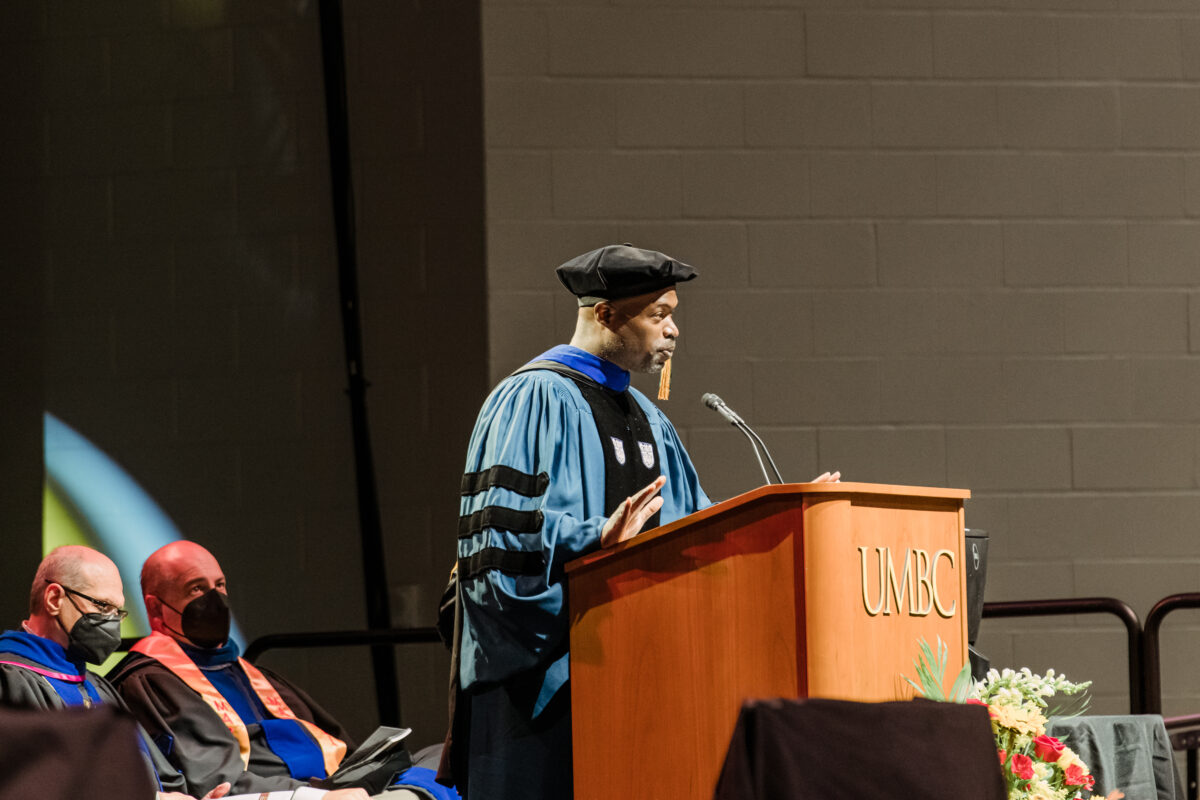 Dzirasa addresses the master’s and Ph.D. students. (Marlayna Demond ’11/UMBC)
“As Doc’s grandmother would tell him, the higher you go, the more people will try to pull you down,” Dzirasa said. He went on to let the audience know with levity that that’s “the modern day translation of ‘haters gonna hate.’ And when they do, it’s the mentors that will be there to sustain you. They are a refuge in the midst of the storm.”
The speakers promised to keep that legacy of support going amongst themselves, as well. In a tweet, Kaitlyn Sadtler’11, biological sciences, responded to a shout-out from fellow speaker Kizzmekia Corbett’08, M16, biological sciences and sociology, saying, “I credit you to being a huge reason why I’m on this list. Your email saying ‘Hey there’s another UMBC alum at NIH doing some COVID work’ was a catalyst. I’ll do my best to pay it forward.”
Combining potential with support
Corbett delivered her remarks by video, as she was at a meeting with Nobel Laureates at the time of commencement. She has often commented on the profound role President Hrabowski and other mentors have had on her life and career, and has carried that forward through mentoring emerging scientists.
Focusing on what people can achieve when they have support and a belief in themselves, she shared, “I hope you dare to dream so big that no one else can imagine the possibility. I hope that you take this degree and you make this world a better place. I hope for you scientists out there, that you take this degree and you cure cancer. I hope for you humanitarians that you stop world hunger. And I hope that you live and I hope that you love.”
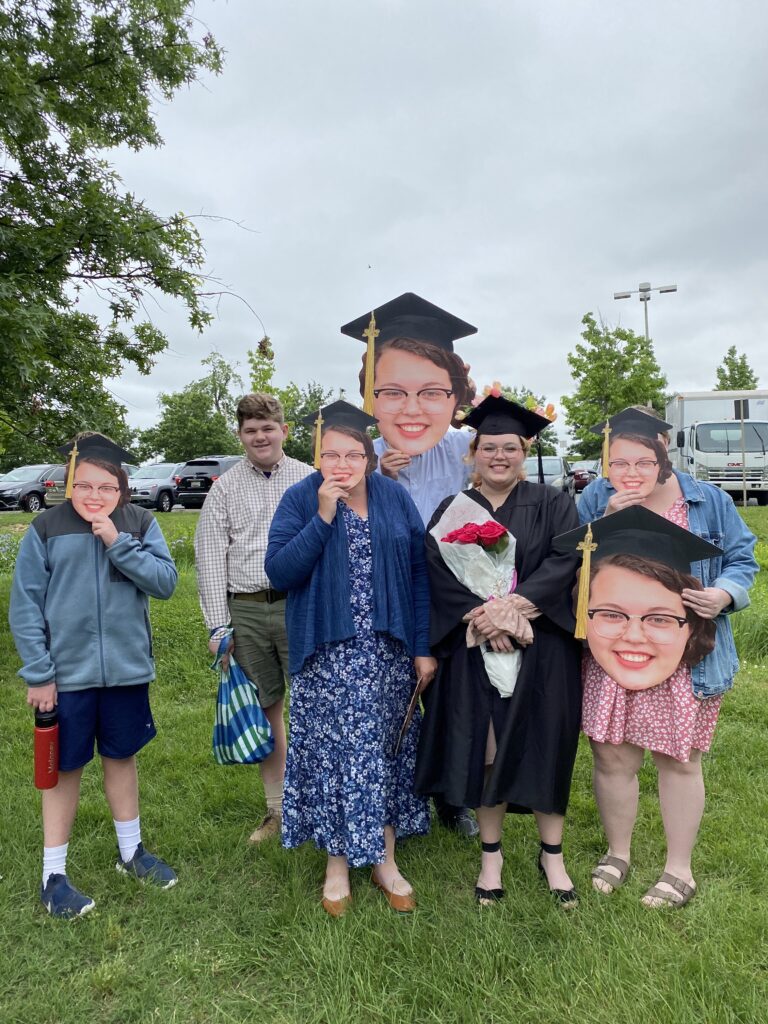 Reilly Moloney ’22, visual arts, poses with Reilly Moloney and Reilly Moloney and Reilly Moloney and Reilly Moloney after the commencement ceremony. (Kait McCaffrey/UMBC)
Co-valedictorian Shahreen Zannat ‘22, biological sciences, also spotlighted the greatness that students and communities can achieve with the right support.
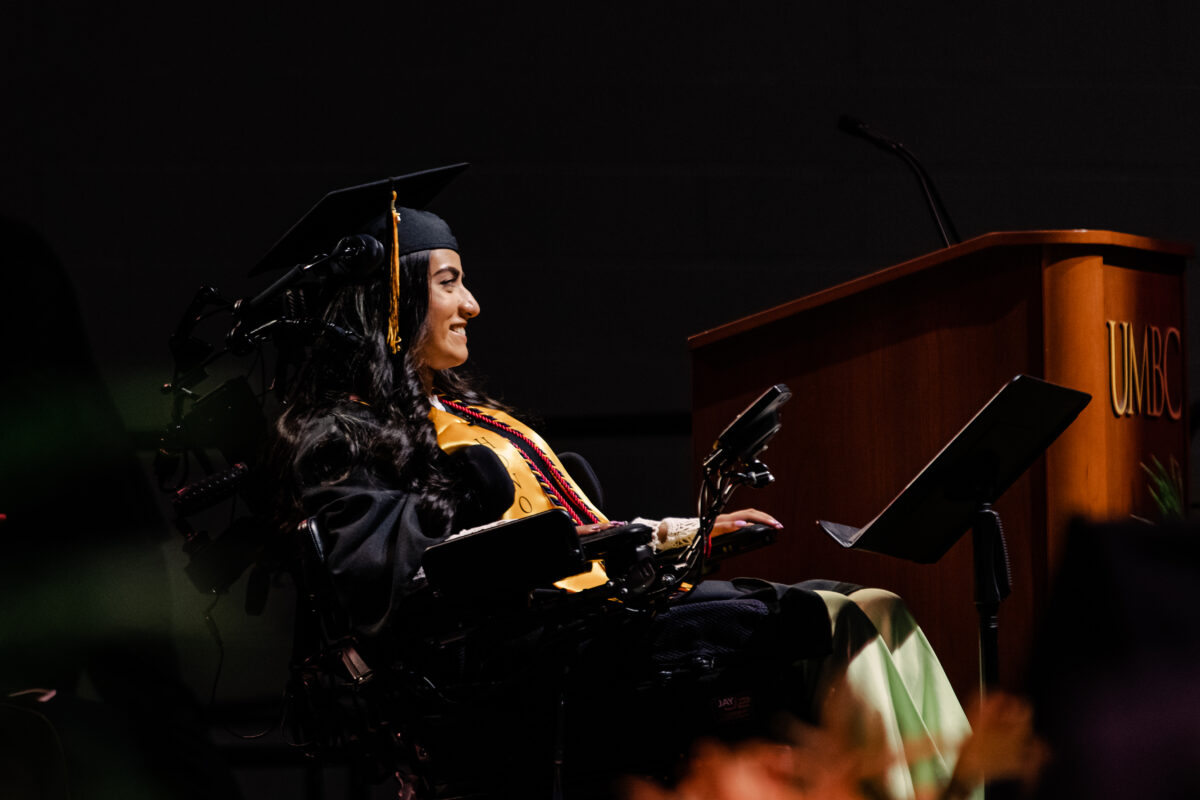 Zannat addresses her classmates during the afternoon commencement ceremony. (Marlayna Demond ’11/UMBC)
“Our journey at UMBC was not one we took alone—advisors came to our rescue during moments of panic, professors connected us with their networks for employment opportunities, and all of the support staff ensured our safety and well-being on campus,” said Zannat. “This support has helped shape leaders, resulting in international recognition of UMBC’s innovative research, creative teaching methods, and its cultural and ethnic diversity.”
Sadtler recognized that support can also come from unlikely places saying, “You will meet people that will bring out the best and worst in you. Learn from both because if you don’t get lost, you will never find your way.”
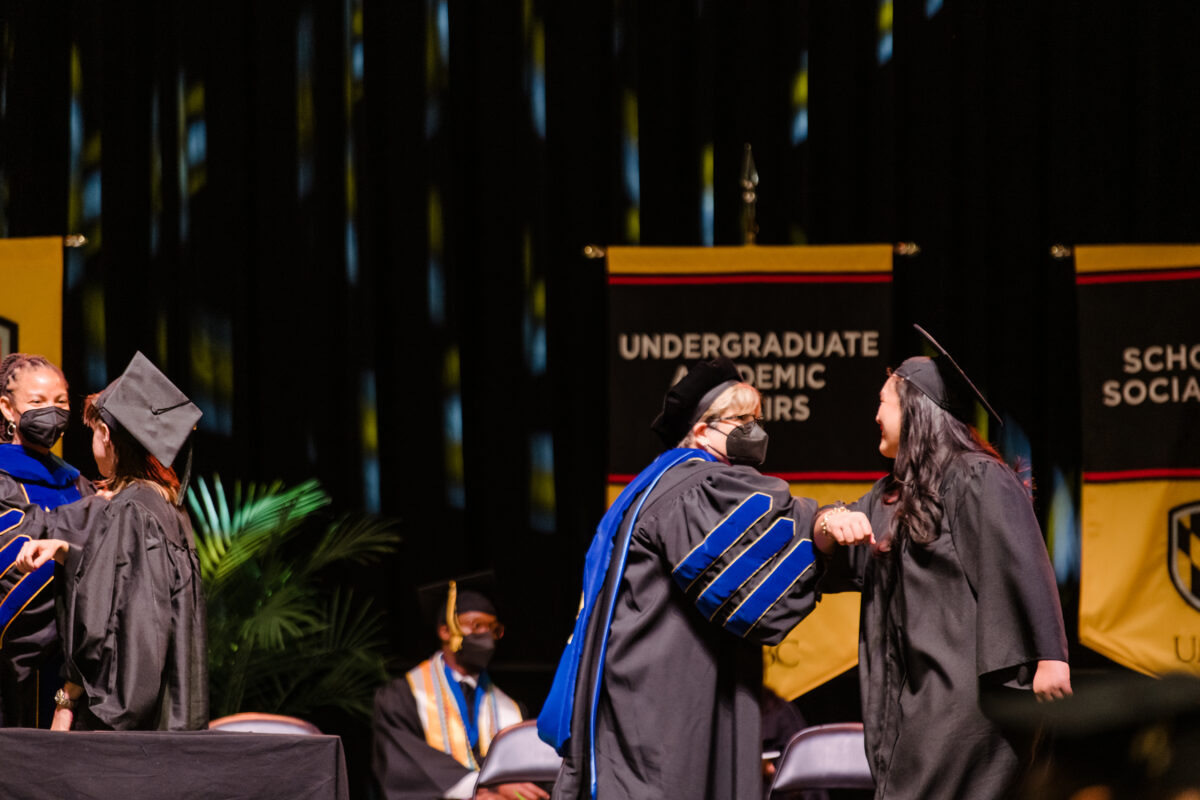 A graduate stops for an elbow bump on the commencement stage. (Marlayna Demond ’11/UMBC)
The importance of you
While many speakers touched on the idea of mutual support and “paying it forward,” others recognized the need to couple that with taking care of oneself.
Co-valedictorian Viola Lis ‘21, psychology, reminded her classmates that, “To make a difference once we leave UMBC, we have to be doing the things that bring us joy, the things we find fulfilling and meaningful. Otherwise, our imprint will be faint. In order to show up for others, you have to show up for yourself first.”
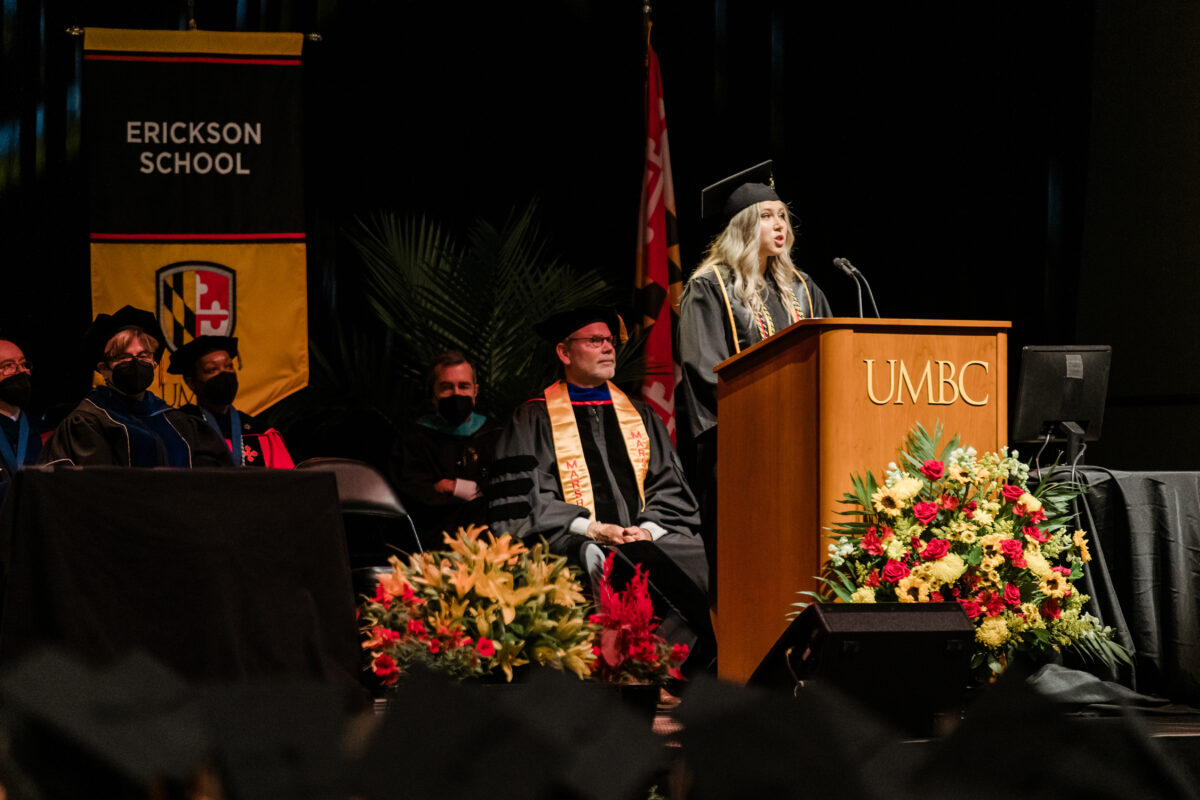 Co-valedictorian Viola Lis addresses the crowd. (Marlayna Demond ’11/UMBC)
Echoing these statements, honorary degree recipient Mark Doms’86, economics and mathematics, admitted that the road would be hard for graduates, but implored them to listen to themselves and their abilities.
“You will hit roadblocks, setbacks will blindside you,” he said. “But please, don’t surrender to self-doubt. Instead, persevere. You are extremely gifted and, please, don’t deprive us of your gifts.”
Tiffany Holmes, M.F.A. ’99, imaging and digital arts,was once a student who thought she had her life figured out. But as she shared in her address, the “key message to you today is to have a plan that is endlessly adaptable. Work hard at something that brings you joy, and your path will lead you somewhere fascinating that is just right for you.”
The places you will go
The ceremonies were bittersweet—an important moment of transition for both the graduates and President Hrabowski.
“In many ways, today we’re really celebrating two commencements: all of you, most of you, who graduated in four years. And then the second commencement is my buddy Freeman. Now, it took him 31 years to finish his work,” joked Mike Gill from the University System of Maryland Board of Regents.
Gill went on to share the news of a significant new way in which Hrabowski’s legacy would be carried forward: the $1.5 billion Freeman Hrabowski Scholars Program just launched by the Howard Hughes Medical Institute.
Dr. Hrabowski (@umbc) sees the last of his graduates across the stage today, and then BOOM @HHMINEWS names a young investigator scholars program after him… https://t.co/HV26BzP8XK
The way my mentors are retiring into their purposes is purely aspirational.
]]>
Nearly 1,800 students walked across the stage at Chesapeake Employers Insurance Arena this week during UMBC’s 78th graduate and undergraduate commencement ceremonies. After pausing to receive...
https://umbc.edu/stories/freeman-hrabowski-honors-class-of-2022-at-final-commencement/
https://beta.my.umbc.edu/api/v0/pixel/news/125644/guest@my.umbc.edu/6af52a7641286ad069ad4057f2de6c50/api/pixel
biological-sciences
cahss
chemeng
class-of-2022
cnms
coeit
community
economics
hrabowski
meche
modern-languages-and-linguistics
news
UMBC News & Magazine
https://beta.my.umbc.edu/groups/umbc-news-magazine
https://assets1-beta.my.umbc.edu/system/shared/avatars/groups/000/001/943/24435aa6207c452e7bc15cc74b42c7bb/xsmall.png?1748556657
https://assets1-beta.my.umbc.edu/system/shared/avatars/groups/000/001/943/24435aa6207c452e7bc15cc74b42c7bb/original.png?1748556657
https://assets2-beta.my.umbc.edu/system/shared/avatars/groups/000/001/943/24435aa6207c452e7bc15cc74b42c7bb/xxlarge.png?1748556657
https://assets2-beta.my.umbc.edu/system/shared/avatars/groups/000/001/943/24435aa6207c452e7bc15cc74b42c7bb/xlarge.png?1748556657
https://assets3-beta.my.umbc.edu/system/shared/avatars/groups/000/001/943/24435aa6207c452e7bc15cc74b42c7bb/large.png?1748556657
https://assets1-beta.my.umbc.edu/system/shared/avatars/groups/000/001/943/24435aa6207c452e7bc15cc74b42c7bb/medium.png?1748556657
https://assets2-beta.my.umbc.edu/system/shared/avatars/groups/000/001/943/24435aa6207c452e7bc15cc74b42c7bb/small.png?1748556657
https://assets1-beta.my.umbc.edu/system/shared/avatars/groups/000/001/943/24435aa6207c452e7bc15cc74b42c7bb/xsmall.png?1748556657
https://assets2-beta.my.umbc.edu/system/shared/avatars/groups/000/001/943/24435aa6207c452e7bc15cc74b42c7bb/xxsmall.png?1748556657
UMBC News & Magazine
0
0
false
Fri, 27 May 2022 16:12:03 -0400
Fri, 27 May 2022 16:12:03 -0400
HHMI launches $1.5 billion Freeman Hrabowski Scholars program to support diversity, innovation in biomedical research
Today, the Howard Hughes Medical Institute (HHMI) launched the Freeman Hrabowski Scholars Program to help build a scientific workforce that more fully reflects our increasingly diverse country. The $1.5 billion program honors UMBC President Freeman A. Hrabowski, III for his decades of leadership in growing and diversifying the pipeline of Ph.D.-level researchers, most prominently through UMBC’s Meyerhoff Scholars Program.
Alumni leading the way
UMBC is now the nation’s #1 producer of Black bachelor’s degree recipients who go on to earn a Ph.D. in the natural sciences and engineering, and this program builds on that legacy.
Meyerhoff Scholars alumni have earned 385 Ph.D.s, 155 medical degrees, and more than 300 master’s degrees (as of April 2022). More than 370 additional Meyerhoff alumni are currently enrolled in graduate and professional school. Students who became Meyerhoff Scholars are more than five times more likely to have completed or be currently enrolled in a STEM Ph.D. program than students who were accepted to the program but declined. Several universities across the country, including Penn State and UNC Chapel Hill, have successfully replicated the program, with support from HHMI and others.
Meyerhoff alumni include such rising stars as Kafui Dzirasa ’01, M8, chemical engineering, associate professor at Duke and an HHMI Investigator, and Kizzmekia Corbett ‘08, M16, biological sciences and sociology, lead of the NIH team that developed the technology for the mRNA COVID-19 vaccines, and now assistant professor at Harvard.
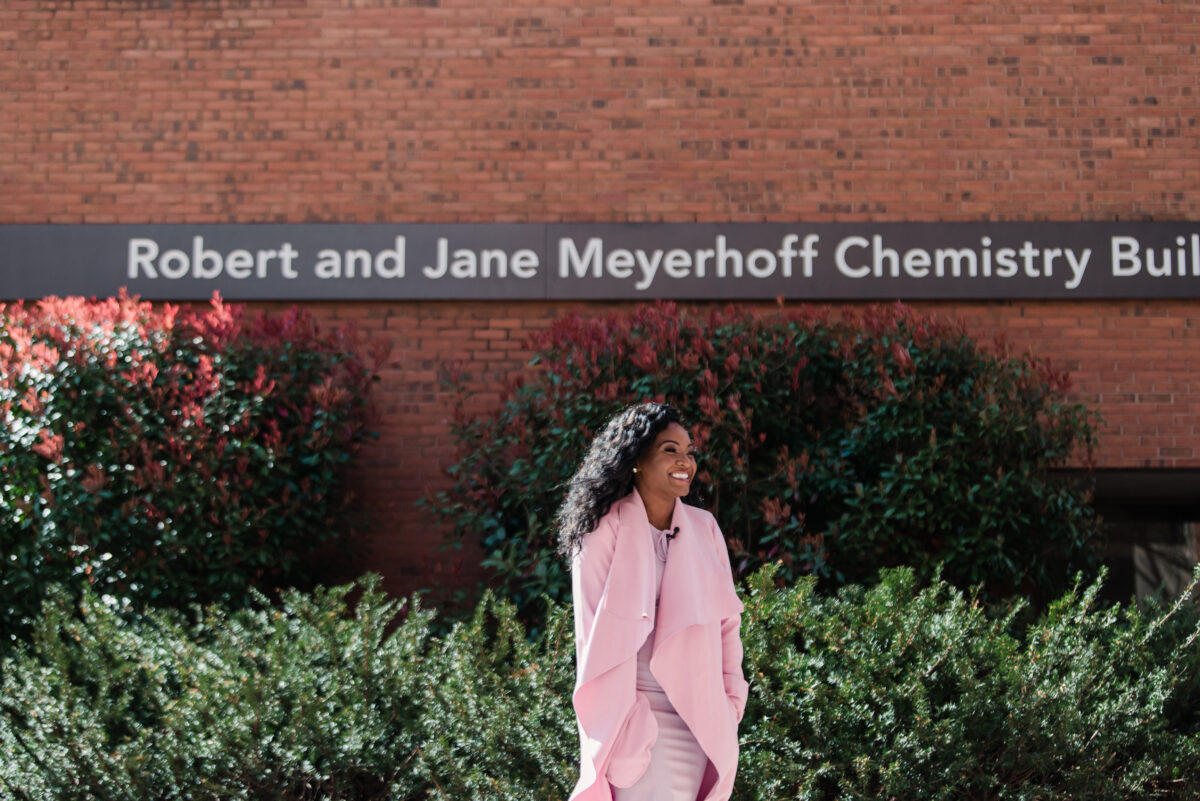
Kizzmekia Corbett visited campus in 2021 for an interview with CNN. (Marlayna Demond ’11/UMBC)
As it has gained momentum, the Meyerhoff program has had an important ripple effect. Many Meyerhoff alumni today are cultivating diverse, inclusive research groups of their own, where they support undergraduate and graduate students on their way to careers in STEM.
HHMI has designed the new Freeman Hrabowski Scholars Program to ensure that early career faculty have resources and support to become both leaders in their research fields and effective leaders and mentors of trainees from racial and ethnic backgrounds currently underrepresented in U.S. science. These are just the sort of researchers who may have come up through a Meyerhoff alumni-led laboratory, and will now be in a strong position to build their own research groups.
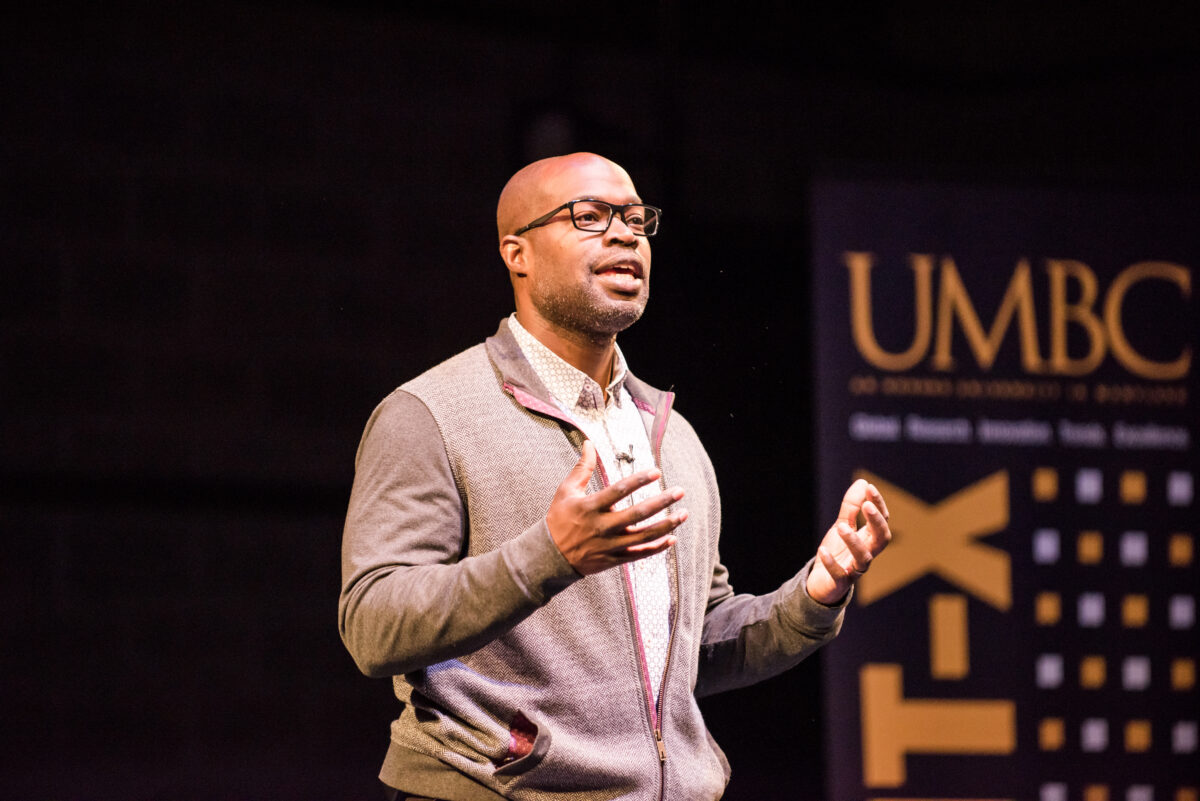
Kafui Dzirasa presents at UMBC’s GRIT-X talks in 2017. (Marlayna Demond ’11/UMBC)
Changing the face of science
With the Freeman Hrabowski Scholars Program, HHMI expects to hire and support up to 150 early career faculty over the next 20 years. The program will select 30 Scholars every other year for the next decade. Each Scholar will be appointed to a five-year term, renewable once with evaluation. Scholars will receive up to $8.6 million over 10 years, including full salary, benefits, a research budget, and scientific equipment.
In addition, Scholars will participate in professional development to advance their leadership and mentorship skills. They’ll also be included in HHMI’s community of scientists, educators, and students for scientific meetings, networking, and other opportunities.
“For academic science to thrive in an increasingly diverse world, we need to attract and support scientists from a wide variety of racial and ethnic backgrounds,” says HHMI President Erin O’Shea. “Early career faculty play a key role because they are the leaders of tomorrow. We’re excited to support talented early career scientists dedicated to a model of excellence in science that combines innovative scientific research and intentional, inclusive development of postdocs, students, and other lab members.”
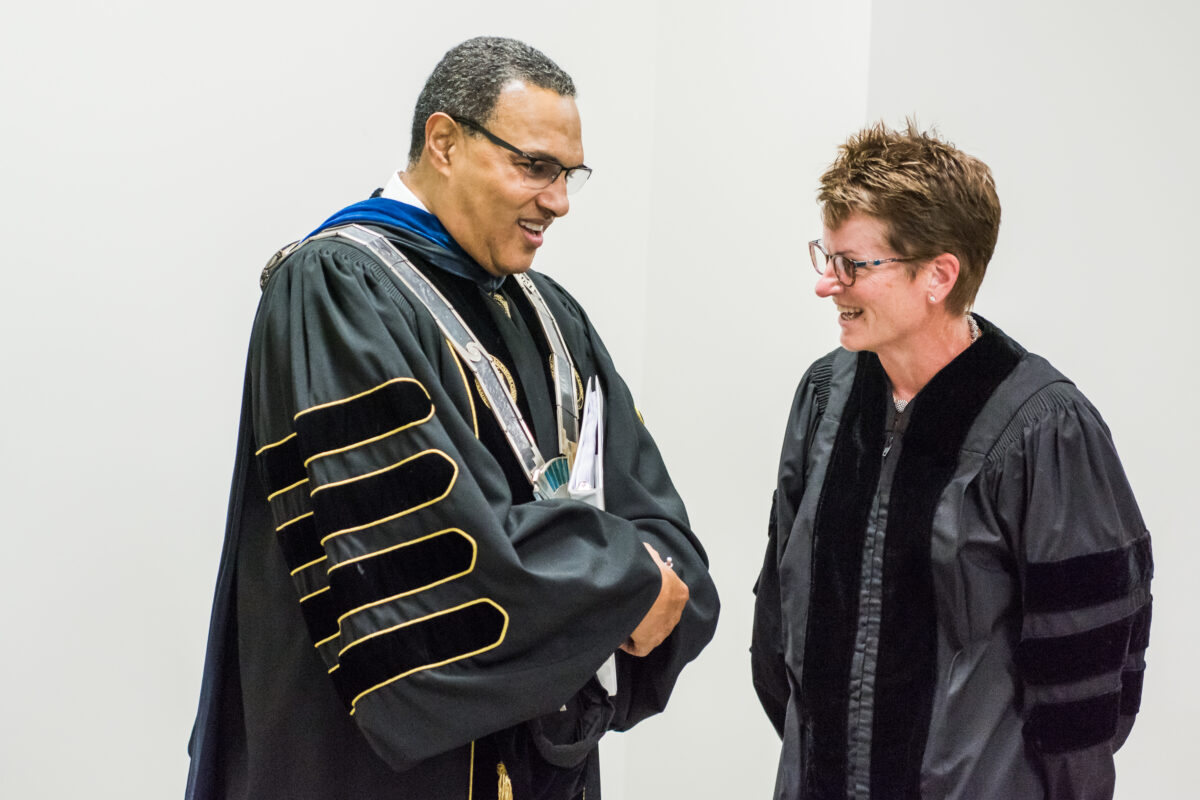 President Freeman Hrabowski (left) and Erin O’Shea, president of HHMI, talk backstage at UMBC Commencement in 2018, where O’Shea was one of the speakers. (Marlayna Demond ’11/UMBC)
It’s especially meaningful that HHMI, the largest private funder of biomedical research in the nation, has taken up this effort. President Hrabowski was moved to learn that HHMI wanted to name their latest and biggest endeavor to diversify the scientific workforce in honor of his decades of service.
“We should all be encouraged by HHMI’s commitment to changing the face of science in America,” Hrabowski says. “This initiative shows what is possible when an institution is guided by its values and by evidence of what works. I am deeply honored to be connected with HHMI and with this new program.”
To learn more, see additional coverage from HHMI and in The Washington Post, Baltimore Sun, Science, WYPR, Inside Higher Ed, and The Chronicle of Higher Education.
]]>
Today, the Howard Hughes Medical Institute (HHMI) launched the Freeman Hrabowski Scholars Program to help build a scientific workforce that more fully reflects our increasingly diverse country....
https://umbc.edu/stories/hhmi-launches-1-5-billion-freeman-hrabowski-scholars-program-to-support-diversity-innovation-in-biomedical-research/
https://beta.my.umbc.edu/api/v0/pixel/news/125614/guest@my.umbc.edu/edd6a5dc924989cb4f3744cdad5787e0/api/pixel
community
diversityandinclusion
hrabowski
majoraward
meyerhoffscholars
science-and-tech
UMBC News & Magazine
https://beta.my.umbc.edu/groups/umbc-news-magazine
https://assets1-beta.my.umbc.edu/system/shared/avatars/groups/000/001/943/24435aa6207c452e7bc15cc74b42c7bb/xsmall.png?1748556657
https://assets1-beta.my.umbc.edu/system/shared/avatars/groups/000/001/943/24435aa6207c452e7bc15cc74b42c7bb/original.png?1748556657
https://assets2-beta.my.umbc.edu/system/shared/avatars/groups/000/001/943/24435aa6207c452e7bc15cc74b42c7bb/xxlarge.png?1748556657
https://assets2-beta.my.umbc.edu/system/shared/avatars/groups/000/001/943/24435aa6207c452e7bc15cc74b42c7bb/xlarge.png?1748556657
https://assets3-beta.my.umbc.edu/system/shared/avatars/groups/000/001/943/24435aa6207c452e7bc15cc74b42c7bb/large.png?1748556657
https://assets1-beta.my.umbc.edu/system/shared/avatars/groups/000/001/943/24435aa6207c452e7bc15cc74b42c7bb/medium.png?1748556657
https://assets2-beta.my.umbc.edu/system/shared/avatars/groups/000/001/943/24435aa6207c452e7bc15cc74b42c7bb/small.png?1748556657
https://assets1-beta.my.umbc.edu/system/shared/avatars/groups/000/001/943/24435aa6207c452e7bc15cc74b42c7bb/xsmall.png?1748556657
https://assets2-beta.my.umbc.edu/system/shared/avatars/groups/000/001/943/24435aa6207c452e7bc15cc74b42c7bb/xxsmall.png?1748556657
UMBC News & Magazine
0
0
false
Thu, 26 May 2022 08:24:10 -0400
Thu, 26 May 2022 08:24:10 -0400
UMBC’s student innovation competition winners share tips for aspiring entrepreneurs
Student teams recently gathered at Betamore, a Baltimore-based entrepreneurship and coworking space, to battle in the final round of UMBC’s annual Cangialosi Business Innovation Competition. Greg Cangialosi ‘96, English, founded the competition in 2014 to provide UMBC student entrepreneurs with a chance to pitch innovative ideas to a panel of judges, and to get advice and support in developing their concepts.
This year’s competition included two distinct tracks: technology and innovation, and social impact. The top three ideas in each track received funding to help move their ventures forward.
The live event included competitors from all three UMBC colleges who pitched a diverse range of ideas. Here, some of the participants share advice for other students who are interested in entrepreneurship but may not be sure where to begin.
Tip 1: Pursue what you love
Mahmoud Shalby ‘23, computer science, says that in order to be a successful entrepreneur you have to be passionate about your concept to stay motivated through challenging times. Shalby and his collaborator Faheel Kamran ‘22, computer engineering, took first place in the technology and innovation track for their idea Haven, which is an encrypted, privacy-focused cloud storage service.
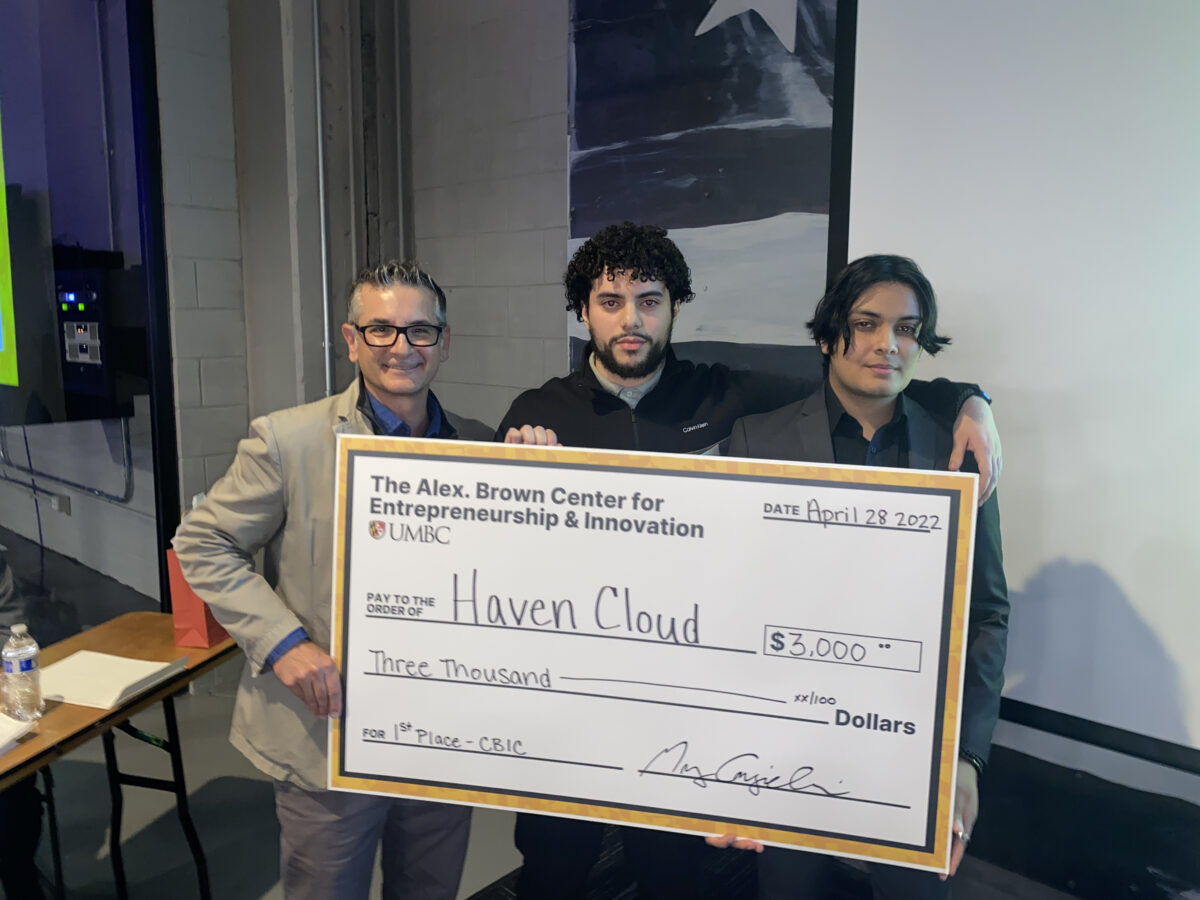
Mahmoud Shalby and Faheel Kamran at the event. (Alex. Brown Center for Entrepreneurship.)
“The best tip I’d share about entrepreneurship is to love what you do. It might seem simple and intuitive, but it’s a necessary component of the entrepreneurial journey that you have to consciously take into account,” Shalby says. “There’ll be countless sleepless nights, functions you have to miss, friends that you won’t see. The only way you can endure all of that is to fully love what you do.”
Tip 2: Don’t fear failure
Basil Udo ‘22, biochemistry and molecular biology, placed third in the technology and innovation track for his idea Xeddy, a marketplace for digital assets, coupons, and collectables. Udo explains that entrepreneurship provides learning opportunities, often when things don’t work out as expected.
“Learning from experience means you need to experience. Let go of the fear of failure because growth requires failure,” he says. “The earlier you start”—even if you aren’t initially successful—“the sooner you win.”
Tip 3: Match a problem with a solution
Michael Chapman ‘23, mechanical engineering, took first place in the social impact track for his idea Seeker. It’s a toy that provides individuals with dyspraxia—a common neurological disorder affecting movement—the ability to participate in activities that their peers enjoy.
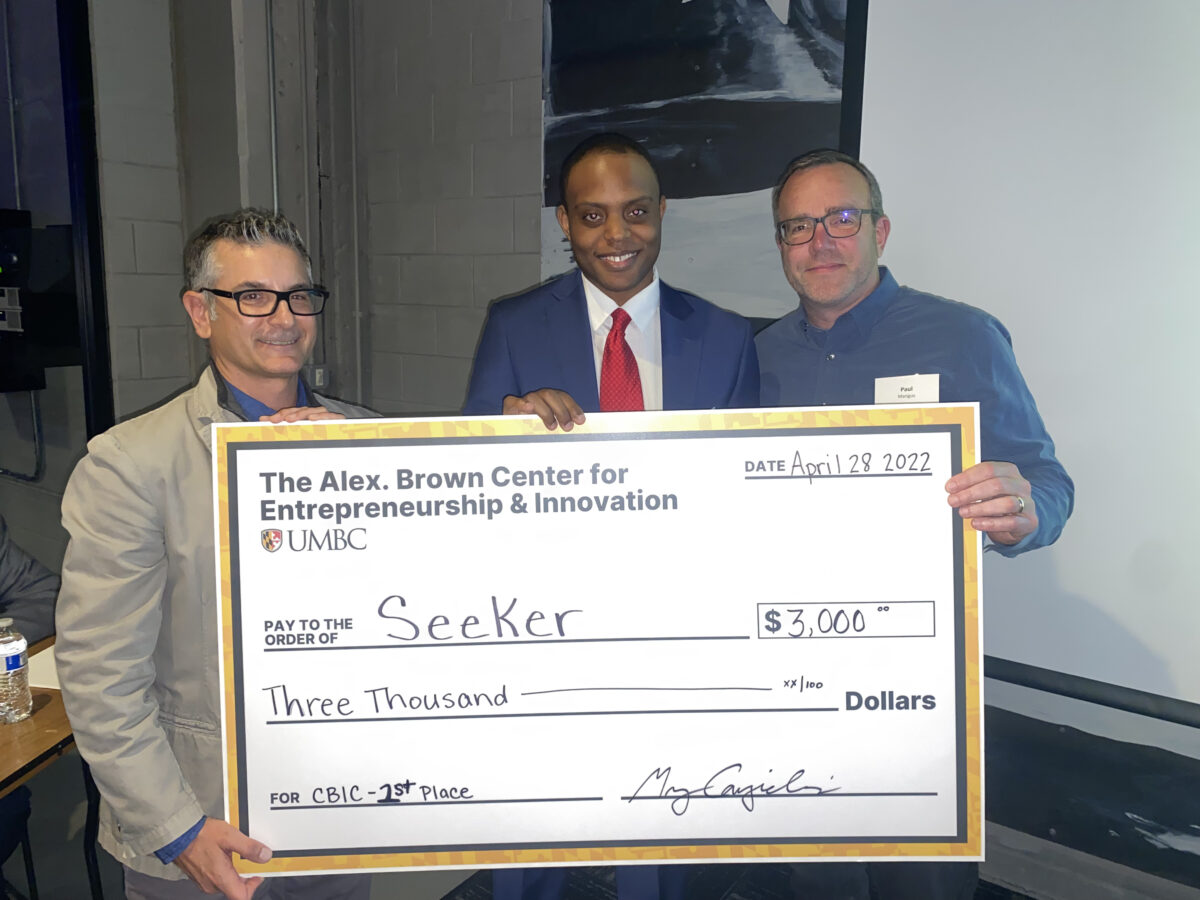
Michael Chapman, center, at the Cangialosi Business Innovation Competition. (Alex. Brown Center for Entrepreneurship.)
Chapman says that the world is full of problems to be addressed. “Entrepreneurship is simply the discovery of the one problem that resonates with you and its accompanying solution,” he says. “If you are able to find a way to market your solution for a problem people experience, then you are well on your way to becoming an entrepreneur.”
Tip 4: Know your value
Kayla Massey ‘22, dance and information systems, placed second in the social impact track for her idea Pennies for Pointe, which works to increase the participation of underrepresented populations in dance. She says that in order to be a successful entrepreneur, you have to believe in your idea fully, and see it as valuable.
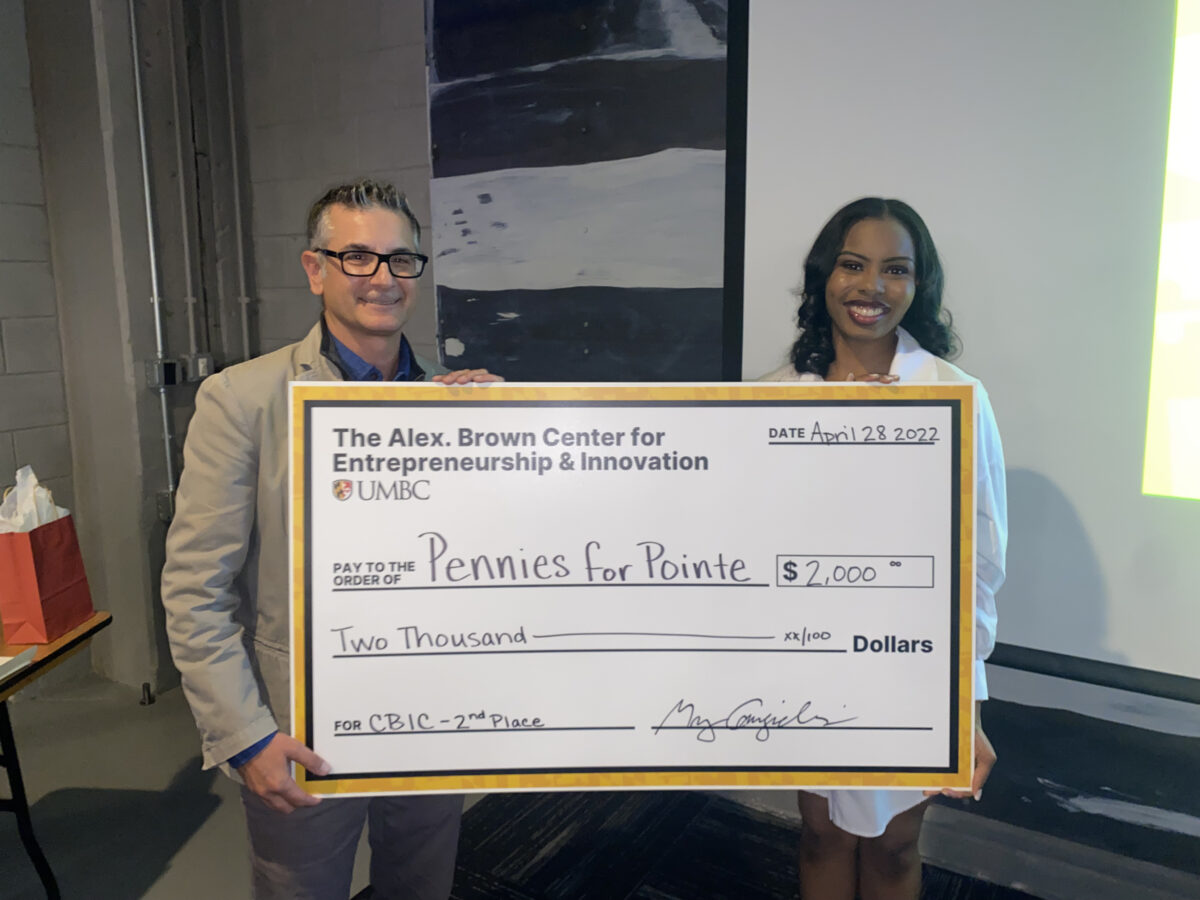
Kayla Massey, right, with Greg Cangialosi after the event. (Alex. Brown Center for Entrepreneurship.)
“How you see yourself and your organization is how other people see you,” Massey explains. “Always believe that your idea is valuable, and be certain that no matter how many people are doing something similar to what you want to do, there is nobody who can do it quite like you.”
Massey has experience expressing that confidence in sharing her work, beyond the entrepreneurship competition. Her dance piece Between You and Me was selected to be performed at the American College Dance Association’s virtual gala event held in early May. The American College Dance Association is an organization that promotes the talent and creativity of prominent college and university dance departments. A panel of judges selected Massey’s piece for performance out of more than 50 submissions.
Tip 5: Take action
Tamara Buchanan M.S. ‘22, health information technology, earned third place in the social impact track for PlusOne Technology, which allows individuals to search for transportation for medical appointments. She explains that a solid idea matters, but taking action on that idea is essential.
“It’s great when an idea comes to your mind and you believe in it. But the worst thing you can do is to sit on it and never bring it into fruition,” she says. “Someone is waiting on your business to help change or elevate their life. So take action. Seek help and utilize all the entrepreneurship resources available to you at UMBC. Start today. You can do it.”
Other award winners at the event included Talon Schroeder ‘25, and Noah Masri ‘25, both studying computer science. They took second place in the technology and innovation track for their idea Crypto Briefcase, an all in one place to do anything web3.
Students interested in exploring entrepreneurship opportunities can explore the Alex. Brown Center for Entrepreneurship and Innovation to learn about upcoming events and competitions.
]]>
Student teams recently gathered at Betamore, a Baltimore-based entrepreneurship and coworking space, to battle in the final round of UMBC’s annual Cangialosi Business Innovation Competition. Greg...
https://umbc.edu/stories/umbcs-student-innovation-competition-winners-share-tips-for-aspiring-entrepreneurs/
https://beta.my.umbc.edu/api/v0/pixel/news/125607/guest@my.umbc.edu/9f8d7feed52fe70082beeb46fa42734d/api/pixel
alexbrowncenter
biochemistry
biology
cahss
cnms
coeit
community
csee
dance
english
entrepreneurship
is
meche
policy-and-society
science-and-tech
UMBC News & Magazine
https://beta.my.umbc.edu/groups/umbc-news-magazine
https://assets1-beta.my.umbc.edu/system/shared/avatars/groups/000/001/943/24435aa6207c452e7bc15cc74b42c7bb/xsmall.png?1748556657
https://assets1-beta.my.umbc.edu/system/shared/avatars/groups/000/001/943/24435aa6207c452e7bc15cc74b42c7bb/original.png?1748556657
https://assets2-beta.my.umbc.edu/system/shared/avatars/groups/000/001/943/24435aa6207c452e7bc15cc74b42c7bb/xxlarge.png?1748556657
https://assets2-beta.my.umbc.edu/system/shared/avatars/groups/000/001/943/24435aa6207c452e7bc15cc74b42c7bb/xlarge.png?1748556657
https://assets3-beta.my.umbc.edu/system/shared/avatars/groups/000/001/943/24435aa6207c452e7bc15cc74b42c7bb/large.png?1748556657
https://assets1-beta.my.umbc.edu/system/shared/avatars/groups/000/001/943/24435aa6207c452e7bc15cc74b42c7bb/medium.png?1748556657
https://assets2-beta.my.umbc.edu/system/shared/avatars/groups/000/001/943/24435aa6207c452e7bc15cc74b42c7bb/small.png?1748556657
https://assets1-beta.my.umbc.edu/system/shared/avatars/groups/000/001/943/24435aa6207c452e7bc15cc74b42c7bb/xsmall.png?1748556657
https://assets2-beta.my.umbc.edu/system/shared/avatars/groups/000/001/943/24435aa6207c452e7bc15cc74b42c7bb/xxsmall.png?1748556657
UMBC News & Magazine
0
0
false
Wed, 25 May 2022 16:02:15 -0400
Wed, 25 May 2022 16:02:15 -0400
NIDA EDUCATE program develops the next generation of addiction researchers

In 2021, the National Institute on Drug Abuse (NIDA) awarded UMBC more than $1 million over five years to create a program specifically for undergraduate scholars interested in research on substance abuse and addiction. A year after the program’s launch, it is thriving as students in fields as diverse as economics, computer science, and chemical engineering find ways to connect their interests to this important topic.
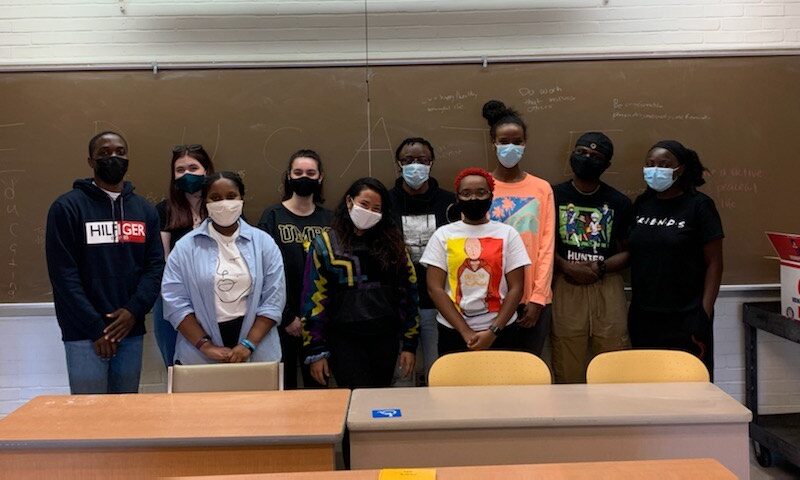
EDUCATE Scholars gathered for an end-of-semester social in spring 2022. (Image courtesy of Yetunde Oshagbemi)
“We need people from all walks of STEM to be able to approach problems to find solutions,” says Patrice Darby. She isprogram coordinator of special projects of the Meyerhoff Scholars Program and a co-lead on the grant, which is called Educating Diverse Undergraduates for Careers in Addiction and substance abuse research via Training Experiences (EDUCATE). The program supports a small, specialized group of Meyerhoff Scholars as EDUCATE Scholars. The grant is administered by UMBC’s College of Natural and Mathematical Sciences and led by the college’s dean, Bill LaCourse.
EDUCATE programming includes talks from researchers whose work touches addiction, as well as workshop series on science communication and on the tools needed to become a successful researcher. EDUCATE Scholars are also expected to participate in a sustained research experience with UMBC faculty mentors and to present their research at a conference. They also take an ethics course and receive intensive academic and career advising from program staff. Funding is available to support summer research experiences for EDUCATE Scholars as well.
“NIDA has really encouraged an interdisciplinary approach,” Darby says. That and the small size of each cohort means “we’re really able to tailor things to the students’ needs.”
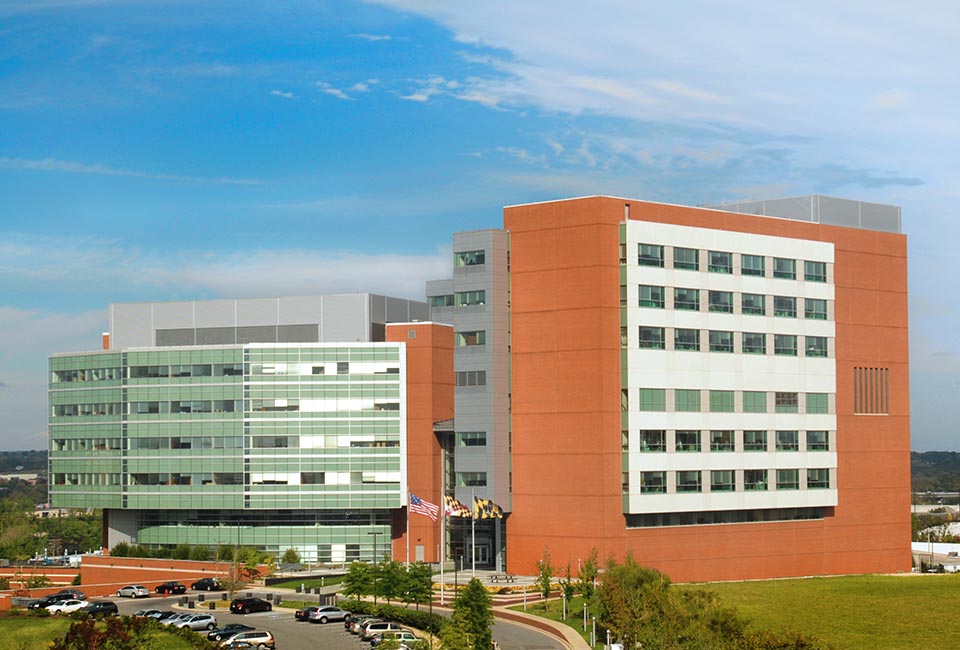 The National Institute on Drug Abuse in Baltimore. (NIDA)
Broader horizons
Yetunde Oshagbemi ’23, economics and mathematics, wants to study economic development in Nigeria, and she is interested in understanding how drug abuse has impacted development. Based on Oshagbemi’s interests, Darby invited an economist with a focus on drug abuse to speak to the scholars. In addition to speaking directly to Oshagbemi’s interest, this offered a fresh perspective for students in other majors.
The talk “reminded me that similar interests can be applied in different ways,” Oshagbemi says. The EDUCATE program as a whole “broadens your horizons and your views on the ways drug abuse is being studied in different disciplines. It’s allowed me to see that there are different ways to answer the questions I have about my interests.”
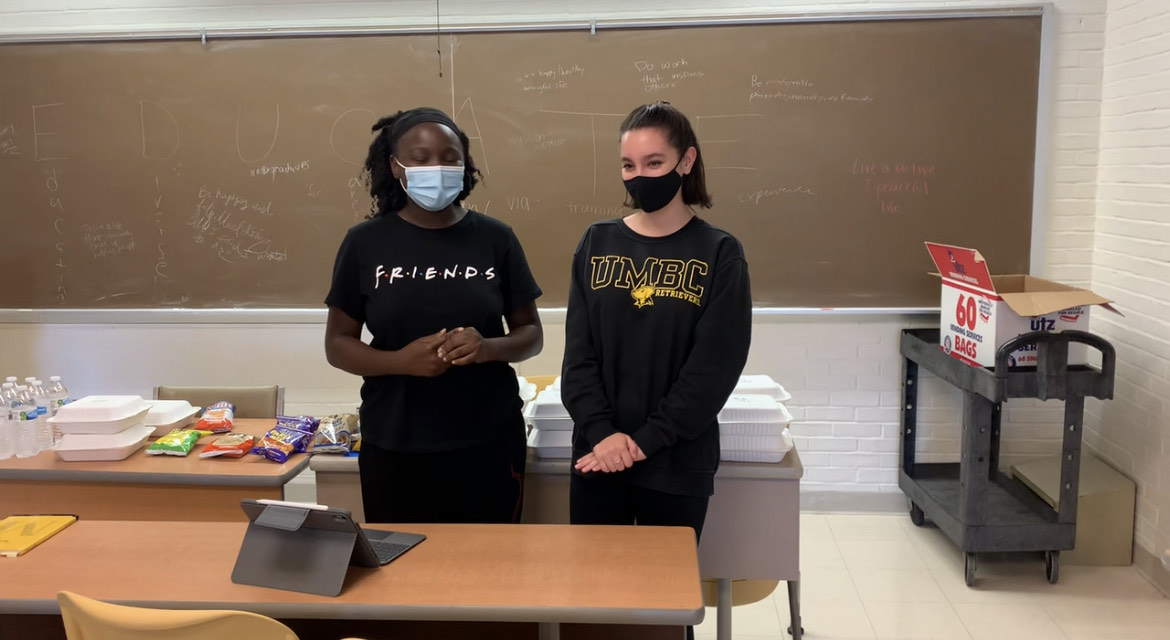 Yetunde Oshagbemi ’23, economics and mathematics (left), relaxes with another EDUCATE Scholar at a social event. (Image courtesy of Oshagbemi)
Oshagbemi conducts research with Zoë McLaren, professor of public policy, whose work includes studying infectious disease in developing countries. Oshagbemi also appreciates Darby’s mentorship. Darby helps “make sure that not only am I progressing academically, but my mental health is also doing well,” she says. “She tries to give you the best advice based on the type of person you are and the path you want to go on.”
Family inspiration
Mike Anoruo ’24, computer science,has also benefited from the mentorship and interdisciplinary nature of the program. Darby recommended he apply for a summer workshop at MIT on quantitative methods, which was eye-opening. “I learned a lot about biology and I was able to bring in my computer science knowledge,” Anoruo says.
Anoruo is inspired by his mother, who works at a crisis stabilization center for people who struggle with addiction and substance abuse. “Seeing her passion for it has made me really want to learn more about it,” he says. “From the MIT workshop, I was able to see that computer science has a lot of applications. So if I can find a way to make a difference the same way my mom is, I think I would really enjoy that.”
Knowing that there are so many ways to apply computer science, Anoruo is still considering his options for the future. “I really like being in the EDUCATE program because I get to look into different topics in drug addiction. I’m just trying to explore and see what I want to go into.”
A real contribution
Students who are not EDUCATE Scholars also benefit from the program.
Each year six students, a mix of Meyerhoff Scholars and STEM BUILD Trainees, have the opportunity to participate in research internships at NIDA through a supplement to the EDUCATE grant. STEM BUILD Trainee Precious Oyinloye ’23, chemical engineering, is completing a virtual internship this school year. Her project involves analyzing data to identify chemical compounds involved in addiction.
After learning how to code in the Python language as part of her NIDA experience, “I’m more curious about computer science,” she says. Plus, “being part of a research project offers a sense of fulfillment—I’m really contributing to science.”
Zoha Faraz ’22, psychology and biological sciences, also a STEM BUILD Trainee, used the opportunity to gain important research skills. “Through the internship, I was able to learn a lot about the research process, and I feel more confident in testing my research skills,” she says. “I think it also improved my scientific communication, because I had to make a presentation about my project.”

Zoha Faraz ’22, psychology and biological sciences (Image courtesy of Faraz)
A personalized experience
The EDUCATE program is small, with a maximum of six scholars per year. That allows the staff “to give our students a highly personalized experience,” Darby says.
Between the workshop-style trainings, faculty-mentored research, and availability of committed staff like Darby to offer guidance and feedback, the program is setting the EDUCATE Scholars up for success in whatever field they choose to pursue.
“You don’t have to research addiction to be able to influence addiction research,” Darby says. Addiction is, however, one of the topics that brings the scholars together. At a social event for EDUCATE students earlier this year, that connection was on full display, helping students deepen relationships they may rely on for support for years to come.
“It’s just different to have a special community,” Darby says, “to talk about the impacts of addiction and why our students care.”
]]>
In 2021, the National Institute on Drug Abuse (NIDA) awarded UMBC more than $1 million over five years to create a program specifically for undergraduate scholars interested in research on...
https://umbc.edu/stories/the-next-generation-of-addiction-researchers/
https://beta.my.umbc.edu/api/v0/pixel/news/125582/guest@my.umbc.edu/b72e18144ef0e3cd9ded5fa07df2ad6c/api/pixel
cahss
chemeng
cnms
coeit
csee
economics
mathstat
meyerhoffscholars
psychology
public-policy
science-and-tech
stembuild
undergradresearch
UMBC News & Magazine
https://beta.my.umbc.edu/groups/umbc-news-magazine
https://assets1-beta.my.umbc.edu/system/shared/avatars/groups/000/001/943/24435aa6207c452e7bc15cc74b42c7bb/xsmall.png?1748556657
https://assets1-beta.my.umbc.edu/system/shared/avatars/groups/000/001/943/24435aa6207c452e7bc15cc74b42c7bb/original.png?1748556657
https://assets2-beta.my.umbc.edu/system/shared/avatars/groups/000/001/943/24435aa6207c452e7bc15cc74b42c7bb/xxlarge.png?1748556657
https://assets2-beta.my.umbc.edu/system/shared/avatars/groups/000/001/943/24435aa6207c452e7bc15cc74b42c7bb/xlarge.png?1748556657
https://assets3-beta.my.umbc.edu/system/shared/avatars/groups/000/001/943/24435aa6207c452e7bc15cc74b42c7bb/large.png?1748556657
https://assets1-beta.my.umbc.edu/system/shared/avatars/groups/000/001/943/24435aa6207c452e7bc15cc74b42c7bb/medium.png?1748556657
https://assets2-beta.my.umbc.edu/system/shared/avatars/groups/000/001/943/24435aa6207c452e7bc15cc74b42c7bb/small.png?1748556657
https://assets1-beta.my.umbc.edu/system/shared/avatars/groups/000/001/943/24435aa6207c452e7bc15cc74b42c7bb/xsmall.png?1748556657
https://assets2-beta.my.umbc.edu/system/shared/avatars/groups/000/001/943/24435aa6207c452e7bc15cc74b42c7bb/xxsmall.png?1748556657
UMBC News & Magazine
0
0
false
Tue, 24 May 2022 16:52:34 -0400
Tue, 24 May 2022 16:52:34 -0400
Biden on Taiwan: Did he really commit US forces to stopping any invasion by China? An expert explains why, on balance, probably not
Meredith Oyen, Associate Professor of History and Asian Studies, UMBC
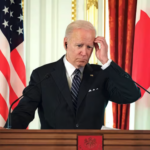
The White House has been left scrambling a little after President Joe Biden suggested on May 23, 2022, that the U.S. would intervene militarily should China attempt an invasion of Taiwan.
The comment, which Biden made during a trip to Japan, was taken by some observers as a deviation from the official U.S. line on Taiwan, in place for decades. But officials in Washington walked back that interpretation, saying instead that it only referred to military assistance.
Meredith Oyen, an expert on U.S.-China relations at the University of Maryland, Baltimore County, helps explain the background to Biden’s recent comments and untangles what should be read into his remarks – and what shouldn’t.
What did Biden say and why was it significant?
Asked if the U.S. was willing to get involved “militarily” in the event of an invasion of Taiwan, Biden replied, “yes.” A follow-up question saw the U.S. president add: “That’s the commitment we have made.”
By my count, this is the third time Biden has as president suggested that the U.S. will come to Taiwan’s aid militarily if the island is attacked. In 2021 he made similar remarks in an interview with ABC News and then again while taking part in a CNN town hall event.
But it is significant that this is the first time he has made the assertion while in Asia.
An important thing to note is that on each occasion he has made such a comment, it has been followed quite quickly by the White House walking back the remarks, by issuing statements along the lines of “what the president actually means is…” and stressing that this isn’t a shift away from the official U.S. policy on China or Taiwan.
However, the remarks and the clarifications have increased doubt over whether Biden is continuing the policy of “strategic ambiguity” on Taiwan.
What does ‘strategic ambiguity’ mean?
Strategic ambiguity has long been the U.S. policy toward Taiwan – really since the 1950s but certainly from 1979 onward. While it does not explicitly commit the U.S. to defending Taiwan in every circumstance, it does leaves open the option of American defensive support to Taiwan in the event of an unprovoked attack by China.
Crucially, the U.S. hasn’t really said what it will do – so does this support mean economic aid, supply of weapons or U.S. boots on the ground? China and Taiwan are left guessing if – and to what extent – the U.S. will be involved in any China-Taiwan conflict.
By leaving the answer to that question ambiguous, the U.S. holds a threat over China: Invade Taiwan and find out if you face the U.S. as well.
Traditionally, this has been a useful policy for the U.S., but things have changed since it was first rolled out. It was certainly effective when the U.S. was in a much stronger position militarily compared to China. But it might be less effective as a threat now that China’s military is catching up with the U.S.
Leading voices from U.S. allies in Asia, such as Japan, believe that “strategic clarity” might be a better option now – with the U.S. stating outright that it would defend Taiwan if the island is attacked.
So Biden’s comments could hint at this shift?
There does seem to be a pattern: Biden says something seemingly very clear on defending Taiwan, and that then gets walked back. If no one in Washington was walking back the comments then it would seem like an intentional shift in policy by the Biden administration.
But the fact that the White House has always been quick to clarify the comments suggests to me that it isn’t necessarily intentional. It seems like Biden is simply trying to signal more support for Taiwan, and perhaps reassure U.S. allies in Asia.
But I’m a historian, not a strategist. It could be that this is some advanced chess game that I can’t figure out.
What is the history of US relations with Taiwan?
After the victory of the Chinese Communist Party in 1949, the defeated Republic of China government withdrew to the island of Taiwan, located just 100 miles off the shore of Fujian province. And until the 1970s, the U.S. recognized only this exiled Republic of China on Taiwan as the government of China.
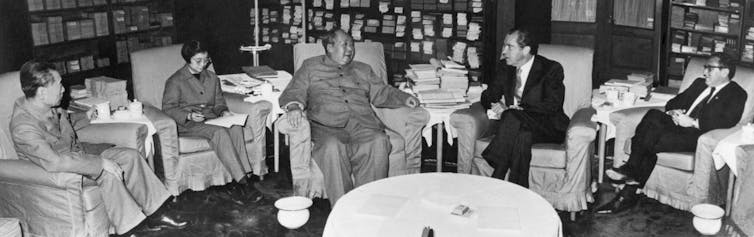 Nixon in China. Bettmann/Getty Images
But in 1971, the United Nations shifted recognition to the People’s Republic of China on the mainland. In 1972, President Richard Nixon made a now-famous trip to China to announce a rapprochement and sign the Shanghai Communique, a joint statement from communist China and the U.S. signaling a commitment to pursue formal diplomatic relations. A critical section of that document stated: “The United States acknowledges that all Chinese on either side of the Taiwan Strait maintain there is but one China and that Taiwan is a part of China. The United States Government does not challenge that position.”
The wording was crucial: the U.S. was not formally committing to a position on whether Taiwan was part of the China nation. Instead, it was acknowledging what the governments of either territory asserted – that there is “one China.”
Where does US commitment of military support for Taiwan come from?
After establishing formal diplomatic relations with China in 1979, the U.S. built an informal relationship with the ROC on Taiwan. In part to push back against President Jimmy Carter’s decision to recognize communist China, U.S. lawmakers passed the Taiwan Relations Act in 1979. That act outlined a plan to maintain close ties between the U.S. and Taiwan and included provisions for the U.S. to sell military items to help the island maintain its defense – setting the path for the policy of strategic ambiguity.
What has changed recently?
China has long maintained its desire for an eventual peaceful reunification of its country with the island it considers a rogue province. But the commitment to the principle of “one China” has become increasingly one-sided. It is an absolute for Beijing. But in Taiwan, however, resistance to the idea of reunification has grown amid a surge of support for moving the island toward independence.
Beijing has become more aggressive of late in asserting that Taiwan must be “returned to China.” Domestic politics plays a role in this. At times of internal instability in China, Beijing has sounded a more belligerent tone on relations between the two entities separated by the Taiwan Strait. We have seen this over the last year with Beijing sending military aircraft into Taiwan’s Air Defense Zone.
Meanwhile, Chinese assertion of increased authority over Hong Kong has damaged the argument for “one country, two system” as a means of peaceful reunification with Taiwan.
How has the US position shifted in the face of Beijing’s stance?
Biden has definitely been more openly supportive of Taiwan than previous presidents. He officially invited a representative from Taiwan to his inauguration – a first for an incoming president – and has repeatedly made it clear that he views Taiwan as an ally.
He also didn’t overturn the Taiwan Travel Act passed under the the previous administration of Donald Trump. This legislation allows U.S. officials to visit Taiwan in an official capacity.
So there has been a shift to a degree. But the White House is keen not to overstate any change. At heart, there is a desire by the U.S. to not stray from the Shanghai Communique.
So is an invasion of Taiwan likely?
I don’t think we are anywhere near that yet. Any invasion across the Taiwan Strait would be militarily complex. It also comes with risks of backlash from the international community. Taiwan would receive support from not only the U.S. – in an unclear capacity, given Biden’s remarks – but also Japan and likely other countries in the region.
Meanwhile, China maintains that it wants to see reintegration through peaceful means. As long as Taiwan doesn’t force the issue and declare independence unilaterally, I think there is tolerance in Beijing to wait it out. And despite some commentary to the contrary, I don’t think the invasion of Ukraine has raised the prospects of a similar move on Taiwan. In fact, given that Russia is now bogged down in a months-long conflict that has hit its military credibility and economy, the Ukraine invasion may actually serve as a warning to Beijing.
Meredith Oyen, Associate Professor of History and Asian Studies, University of Maryland, Baltimore County
This article is republished from The Conversation under a Creative Commons license. Read the original article.
]]>
Meredith Oyen, Associate Professor of History and Asian Studies, UMBC The White House has been left scrambling a little after President Joe Biden suggested on May 23, 2022, that the U.S....
https://umbc.edu/stories/biden-on-taiwan-did-he-really-commit-us-forces-to-stopping-any-invasion-by-china-an-expert-explains-why-on-balance-probably-not/
https://beta.my.umbc.edu/api/v0/pixel/news/125567/guest@my.umbc.edu/e14b928b918dbad2cf1b8ad4ac7cdbe3/api/pixel
asianstudies
discovery
history
magazine
the-conversation
UMBC News & Magazine
https://beta.my.umbc.edu/groups/umbc-news-magazine
https://assets1-beta.my.umbc.edu/system/shared/avatars/groups/000/001/943/24435aa6207c452e7bc15cc74b42c7bb/xsmall.png?1748556657
https://assets1-beta.my.umbc.edu/system/shared/avatars/groups/000/001/943/24435aa6207c452e7bc15cc74b42c7bb/original.png?1748556657
https://assets2-beta.my.umbc.edu/system/shared/avatars/groups/000/001/943/24435aa6207c452e7bc15cc74b42c7bb/xxlarge.png?1748556657
https://assets2-beta.my.umbc.edu/system/shared/avatars/groups/000/001/943/24435aa6207c452e7bc15cc74b42c7bb/xlarge.png?1748556657
https://assets3-beta.my.umbc.edu/system/shared/avatars/groups/000/001/943/24435aa6207c452e7bc15cc74b42c7bb/large.png?1748556657
https://assets1-beta.my.umbc.edu/system/shared/avatars/groups/000/001/943/24435aa6207c452e7bc15cc74b42c7bb/medium.png?1748556657
https://assets2-beta.my.umbc.edu/system/shared/avatars/groups/000/001/943/24435aa6207c452e7bc15cc74b42c7bb/small.png?1748556657
https://assets1-beta.my.umbc.edu/system/shared/avatars/groups/000/001/943/24435aa6207c452e7bc15cc74b42c7bb/xsmall.png?1748556657
https://assets2-beta.my.umbc.edu/system/shared/avatars/groups/000/001/943/24435aa6207c452e7bc15cc74b42c7bb/xxsmall.png?1748556657
UMBC News & Magazine
0
0
false
Tue, 24 May 2022 10:53:16 -0400
Tue, 24 May 2022 10:53:16 -0400
UMBC Global Ambassador Program Openings
Applications open through June 10th!
Applications are now open for the 22-23 UMBC Global Ambassador Program!
UMBC Global Ambassadors help to create a welcoming and inclusive community for new and prospective UMBC international students as they join our community! The position is open to current international students who have completed at least 1 full semester at UMBC.
(must use UMBC email to access)
Applications close: June 10 at 5:00pm ET
]]>
Applications are now open for the 22-23 UMBC Global Ambassador Program! UMBC Global Ambassadors help to create a welcoming and inclusive community for new and prospective UMBC international...
https://tinyurl.com/22-23Ambassador
https://beta.my.umbc.edu/api/v0/pixel/news/125558/guest@my.umbc.edu/202d1a2190deb198fa2f3660126f20d6/api/pixel
International Student and Scholar Services (ISSS)
https://beta.my.umbc.edu/groups/ies
https://assets4-beta.my.umbc.edu/system/shared/avatars/groups/000/000/431/46ad84ea8ba0baeed7c3faf29d1fd4ef/xsmall.png?1693323874
https://assets3-beta.my.umbc.edu/system/shared/avatars/groups/000/000/431/46ad84ea8ba0baeed7c3faf29d1fd4ef/original.jpeg?1693323874
https://assets1-beta.my.umbc.edu/system/shared/avatars/groups/000/000/431/46ad84ea8ba0baeed7c3faf29d1fd4ef/xxlarge.png?1693323874
https://assets1-beta.my.umbc.edu/system/shared/avatars/groups/000/000/431/46ad84ea8ba0baeed7c3faf29d1fd4ef/xlarge.png?1693323874
https://assets4-beta.my.umbc.edu/system/shared/avatars/groups/000/000/431/46ad84ea8ba0baeed7c3faf29d1fd4ef/large.png?1693323874
https://assets3-beta.my.umbc.edu/system/shared/avatars/groups/000/000/431/46ad84ea8ba0baeed7c3faf29d1fd4ef/medium.png?1693323874
https://assets1-beta.my.umbc.edu/system/shared/avatars/groups/000/000/431/46ad84ea8ba0baeed7c3faf29d1fd4ef/small.png?1693323874
https://assets4-beta.my.umbc.edu/system/shared/avatars/groups/000/000/431/46ad84ea8ba0baeed7c3faf29d1fd4ef/xsmall.png?1693323874
https://assets3-beta.my.umbc.edu/system/shared/avatars/groups/000/000/431/46ad84ea8ba0baeed7c3faf29d1fd4ef/xxsmall.png?1693323874
International Student and Scholar Services (ISSS)
https://assets1-beta.my.umbc.edu/system/shared/thumbnails/news/000/125/558/30002321329f8661423c9085b2bb397b/xxlarge.jpg?1653399603
https://assets1-beta.my.umbc.edu/system/shared/thumbnails/news/000/125/558/30002321329f8661423c9085b2bb397b/xlarge.jpg?1653399603
https://assets2-beta.my.umbc.edu/system/shared/thumbnails/news/000/125/558/30002321329f8661423c9085b2bb397b/large.jpg?1653399603
https://assets1-beta.my.umbc.edu/system/shared/thumbnails/news/000/125/558/30002321329f8661423c9085b2bb397b/medium.jpg?1653399603
https://assets3-beta.my.umbc.edu/system/shared/thumbnails/news/000/125/558/30002321329f8661423c9085b2bb397b/small.jpg?1653399603
https://assets1-beta.my.umbc.edu/system/shared/thumbnails/news/000/125/558/30002321329f8661423c9085b2bb397b/xsmall.jpg?1653399603
https://assets4-beta.my.umbc.edu/system/shared/thumbnails/news/000/125/558/30002321329f8661423c9085b2bb397b/xxsmall.jpg?1653399603
1
0
true
Tue, 24 May 2022 09:47:08 -0400
Tue, 24 May 2022 13:52:15 -0400
NIH awards UMBC $5.6M to support underrepresented graduate students in STEM
UMBC’s College of Natural and Mathematical Sciences will receive $5.6 million over five years from the National Institutes of Health to fund the Graduate Research Training Initiative for Student Enhancement (G-RISE). The program will support graduate students from underrepresented groups in STEM with up to three years of funding and an array of training opportunities. The goal is to help participants select and prepare for a range of career paths, in academia, industry, government, entrepreneurship, or beyond.
G-RISE will replace UMBC’s Initiative for Maximizing Student Development (IMSD) Meyerhoff Graduate Fellows program, which the NIH also funded. IMSD, under the direction of Michael Summers, Robert E. Meyerhoff Chair for Excellence in Research and Mentoring and Distinguished University Professor, has proven highly successful at supporting students in completing Ph.D. degrees in STEM.
Building on success
Since its launch in 1996, the IMSD program steadily gained momentum, enrolling and graduating a growing number of students. Over 150 UMBC participants have already earned their Ph.D. The program joined forces with the University of Maryland, Baltimore in 2007, and 64 participating UMB students have also earned a Ph.D. since then.
An impressive 98 percent of the graduates are working in STEM or continuing to pursue training opportunities. Students in the program have also authored more than 250 research papers, and they are listed as first authors on 60 percent of the papers from UMBC.
The IMSD program offered 18 fellowships per year across UMBC and UMB, but G-RISE, which UMBC will operate independently, ramps up NIH’s support. In the first year, nine UMBC students will receive funding, and in each of the next four years, G-RISE will support 25 UMBC students. G-RISE will also offer up to three years of funding per student.
“We’re really excited that the NIH has the confidence that we can do the work,” says Justine Johnson, co-lead on the new grant and associate director of the IMSD Meyerhoff Graduate Fellows Program.
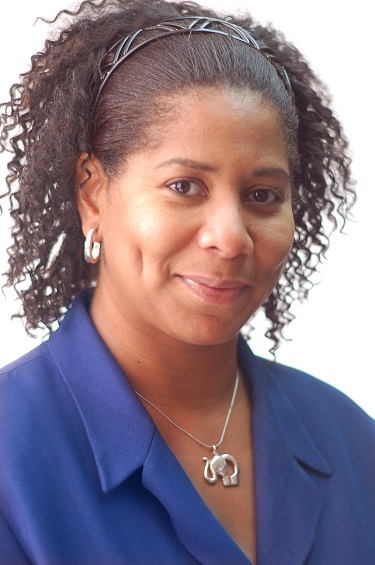
Justine Johnson (Courtesy of Johnson)
Choose your own adventure
For example, students will have access to workshops focused on exposure to career paths, quantitative analysis, teaching, mentoring, and the transition to the workplace. They’ll also take courses on the responsible conduct of research and methods to increase the reproducibility of results, both important skills for emerging researchers.
Many of the elements are program requirements for the students, but they will also have some flexibility depending on their chosen career paths and research field. “It’s a bit of an adventure,” Brewster says. “We will work with students to identify what best suits their skills and aspirations.”
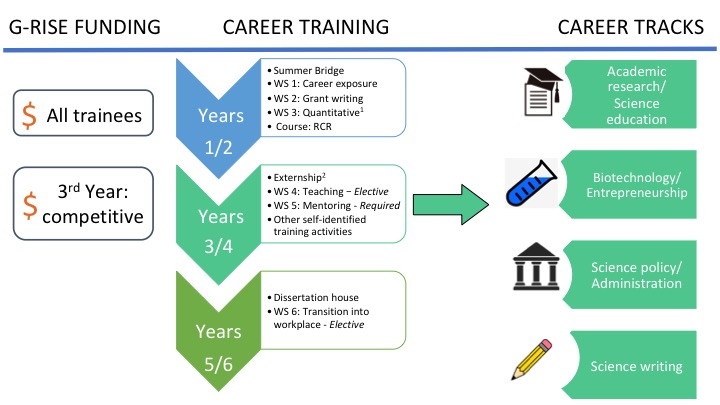
Flow chart representing the structure of the G-RISE program. Figure appears in the G-RISE grant proposal, courtesy Rachel Brewster.
Scaffolded support
The program emphasizes offering structured support to students interested in a wide range of career outcomes. To that end, students in their first year will participate in “a workshop to consider broadly a range of careers and identify a few that they’d like to explore in more detail,” Brewster says, “and then in years two and three we’ll encourage them to pick a career track.” Tracks include academic research and science education, biotechnology and entrepreneurship, science policy and administration, and science communication.
Once a student chooses a track, the program becomes even more personalized. “We will have more targeted meetings with them to explore in more detail ways they could make themselves more competitive for those career options,” Brewster says.
Each participant will also work with their UMBC research mentor to develop a proposal in their third year to support their career goals. For example, proposals might include pursuing an internship in industry or policy, or gaining research experience in a collaborator’s laboratory. The program also has resources to support students attending external professional development events and accessing training that fits their goals.
Committed faculty
A student’s faculty mentor also plays a major role in their development and ability to progress along their chosen career path. Today, more often than not, that path is not toward academia. Faculty who want to support students in pursuing a broad range of career goals can sometimes feel ill-equipped to do so, given their own backgrounds in academia.
To address this important challenge, G-RISE will also organize discussion sessions for faculty mentors to share strategies with each other for supporting students whose career goals differ from their own. Their conversations will also address best practices for mentoring students from a wide range of backgrounds.
“We all, faculty and students, will need to be willing to expand our vision of the purpose of graduate science education,” Brewster says. Then, “We’ll need to support the students in ways that help them achieve that full purpose. In some respects, we view G-RISE as a space where faculty and students can interface on these issues.”
While Brewster, Johnson, and the other co-leads want to facilitate exploration of all STEM careers, they also intend to encourage those interested to pursue academia. “We’re concerned,” Brewster says, “that with dwindling numbers of graduates entering the professoriate, there is a missed opportunity for the nation to benefit from the influx of ideas and perspectives that come with diversity.”
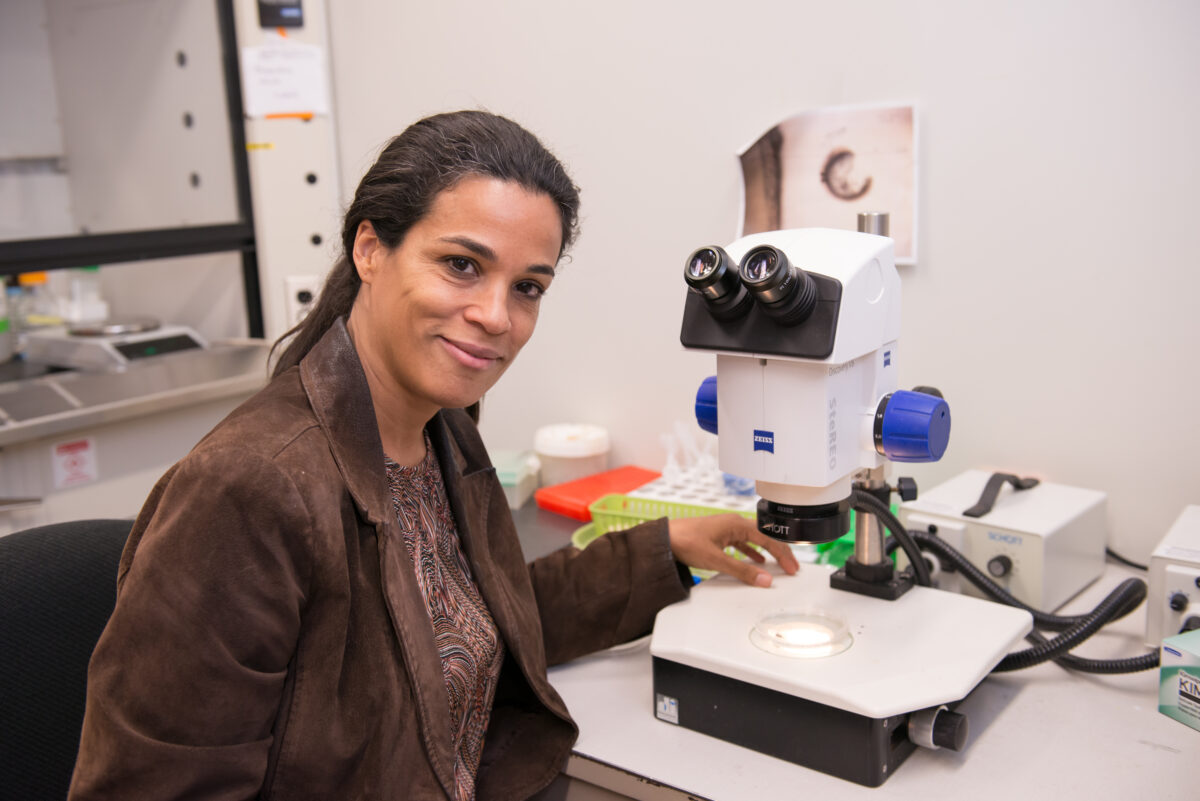
Rachel Brewster in her laboratory. (Marlayna Demond ’11/UMBC)
Taking the lead
Overall, Brewster and Johnson are excited to lead this new enterprise. They’re looking forward to leveraging the experience of its successful predecessor to support and widen training opportunities for historically underrepresented students in STEM fields. Both have been closely involved with the IMSD Meyerhoff Graduate Fellows Program, but they are taking the lead for the first time.
“Rachel is at the helm, and I’m right there with her,” Johnson says. These issues are so important to all of the co-leads, that even as Johnson acknowledges they’re heading into uncharted waters, she says, “We’re going to work so hard to knock this one out of the park.”
]]>
UMBC’s College of Natural and Mathematical Sciences will receive $5.6 million over five years from the National Institutes of Health to fund the Graduate Research Training Initiative for Student...
https://umbc.edu/stories/nih-awards-umbc-5-6m-to-support-underrepresented-graduate-students-in-stem/
https://beta.my.umbc.edu/api/v0/pixel/news/125504/guest@my.umbc.edu/d39e813bf8a28d29394eed5b6d8c6a60/api/pixel
cnms
coeit
diversityandinclusion
graduateschool
science-and-tech
UMBC News & Magazine
https://beta.my.umbc.edu/groups/umbc-news-magazine
https://assets1-beta.my.umbc.edu/system/shared/avatars/groups/000/001/943/24435aa6207c452e7bc15cc74b42c7bb/xsmall.png?1748556657
https://assets1-beta.my.umbc.edu/system/shared/avatars/groups/000/001/943/24435aa6207c452e7bc15cc74b42c7bb/original.png?1748556657
https://assets2-beta.my.umbc.edu/system/shared/avatars/groups/000/001/943/24435aa6207c452e7bc15cc74b42c7bb/xxlarge.png?1748556657
https://assets2-beta.my.umbc.edu/system/shared/avatars/groups/000/001/943/24435aa6207c452e7bc15cc74b42c7bb/xlarge.png?1748556657
https://assets3-beta.my.umbc.edu/system/shared/avatars/groups/000/001/943/24435aa6207c452e7bc15cc74b42c7bb/large.png?1748556657
https://assets1-beta.my.umbc.edu/system/shared/avatars/groups/000/001/943/24435aa6207c452e7bc15cc74b42c7bb/medium.png?1748556657
https://assets2-beta.my.umbc.edu/system/shared/avatars/groups/000/001/943/24435aa6207c452e7bc15cc74b42c7bb/small.png?1748556657
https://assets1-beta.my.umbc.edu/system/shared/avatars/groups/000/001/943/24435aa6207c452e7bc15cc74b42c7bb/xsmall.png?1748556657
https://assets2-beta.my.umbc.edu/system/shared/avatars/groups/000/001/943/24435aa6207c452e7bc15cc74b42c7bb/xxsmall.png?1748556657
UMBC News & Magazine
1
0
false
Fri, 20 May 2022 13:10:12 -0400
Fri, 20 May 2022 13:10:12 -0400


