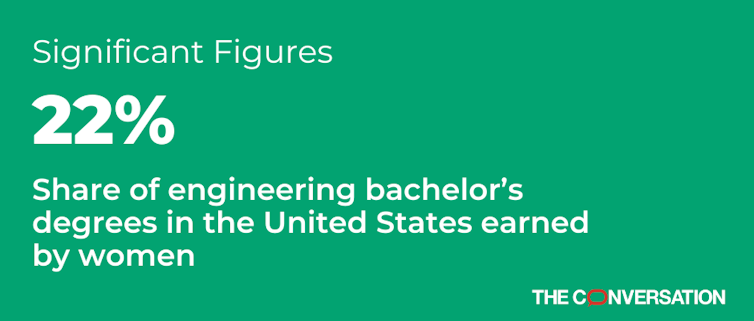
Only about 1 in 5 engineering degrees go to women

Danyelle Ireland, Associate Director of the Center for Women in Technology, and Research Assistant Professor in the Engineering and Computing Education Program, UMBC
 CC BY-ND
Despite various efforts to encourage more women to study STEM fields in college, the percentage of engineering bachelor’s degrees earned by women in the United States hasn’t increased much in the 21st century. Specifically, it has risen from 18% in 1998 to 22% in 2018.
Of all the fields in STEM – or science, technology, engineering and mathematics – the engineering workforce has the lowest proportion of women, at 14%.
That low participation matters for several reasons. Women are not only being left out of some of the highest-paying jobs in STEM, but companies are losing out as well. Research shows that gender-diverse teams make better business decisions than teams that are all-male.
So why aren’t women going into engineering? And what, if anything, can be done to help women who decide to study engineering stay the course? The Society of Women Engineers reports that over 32% of female STEM majors switch to another major. Research shows this rate is typically higher than the rate at which men leave engineering. Of those women who leave the engineering profession, 30% cite the workplace environment as the reason, the society reports. A 2017 study of over 5,000 women who earned bachelor’s degrees in engineering found that 10% never entered the field and 27% left the profession.
Colleges intervene
These are all issues I’ve been researching as associate director of the Center for Women in Technology at the University of Maryland, Baltimore County, or UMBC. In 2018, several colleagues and I found that computing and engineering students who are supported by the center graduate within four years at a rate of 61.2% – a than students who are not supported by the center. The center supports students through scholarships and extensive academic and social support; in the 2021-22 academic year, 73% of students supported were women. And recently two alumnae of the center – one in 2019 and one in 2022 – have become Fulbright Scholars.
The program at UMBC is by no means the only campus-based program in the nation that supports female students in their plans to enter engineering and computer science – two areas in which women are persistently underrepresented. Through my research, I have discovered that there are more than two dozen such programs or initiatives at colleges and universities throughout the nation. They include, for example, the Women in Engineering Program at University of Delaware, the Women in Science and Engineering program at North Carolina State University and the Advancing Women in Engineering program at the University of Pennsylvania.
To better understand the necessity of such programs, consider the abundance of research that has found women who study STEM report “chilly” and “negative” experiences in the classroom and on campus. This includes being subjected to gender-based harassment and a “perception that women are unable to ‘do science.’” Colleges also have long struggled with how to help women see themselves as part of the scientific community.
Proven strategies
It doesn’t have to be that way. Research shows that when female engineering students are mentored by female peers, they feel less anxious about their ability, have more positive academic experiences and are more likely to stick with STEM as a major. Peer-based tutoring has also been shown to help students get their grades up.
With support from an approximately $233,000 grant from the National Science Foundation, I have also been looking at what kinds of academic experiences and supports help female engineering students stay the course.
Based on my analysis of 356 female engineering students at UMBC from 2007 to 2016, what follows are preliminary findings from my National Science Foundation research:
1. High school math and grades make a difference
Starting college in a higher level of college math and having a higher high school GPA both help. Specifically, starting college at a higher level of college math – such as Advanced Calculus or Differential Equations – increases the likelihood of graduating with an engineering degree within five years by 8% over those who start at lower levels of college math. Having a higher high school GPA increases the likelihood even more.
To boost the number of women who earn engineering degrees, educators must help girls get on track at the high school level. This means establishing a strong record of success in their high school math and science courses.
2. Gateway engineering courses matter
By “gateway” courses, I mean classes that are required to officially declare the engineering major and that faculty identified as critical for success. In other words, classes that make or break an engineer. This would include courses such as Principles of Digital Design in computer engineering, Statics in mechanical engineering and Chemical Process Thermodynamics in chemical engineering.
I found that women who took more gateway engineering courses were less likely to leave their intended engineering major.
3. Freshman and sophomore years in college are critical
For those who eventually left engineering, making it through the first four semesters is critical. Among women students who left engineering, 59% – or about three out of five – did so during the first four semesters.
This points toward the need for colleges and universities to provide very deliberate academic and social supports – such as tutoring and mentoring – for female engineering students at the very start of their college careers.
If only 1 in 5 bachelor’s degrees in engineering are awarded to women, it may take these efforts and more to get the number anywhere close to being on par with the proportion that are awarded to men.
Danyelle Tauryce Ireland, Associate Director of the Center for Women in Technology and Research Assistant Professor in the Engineering and Computing Education Program, University of Maryland, Baltimore County
This article is republished from The Conversation under a Creative Commons license. Read the original article.
]]>
Danyelle Ireland, Associate Director of the Center for Women in Technology, and Research Assistant Professor in the Engineering and Computing Education Program, UMBC CC BY-ND Despite...
https://umbc.edu/stories/only-about-1-in-5-engineering-degrees-go-to-women/
https://beta.my.umbc.edu/api/v0/pixel/news/126004/guest@my.umbc.edu/8b0530912dfd6d97bc2bd83ae288f785/api/pixel
coeit
cwit
discovery
magazine
the-conversation
UMBC News & Magazine
https://beta.my.umbc.edu/groups/umbc-news-magazine
https://assets1-beta.my.umbc.edu/system/shared/avatars/groups/000/001/943/24435aa6207c452e7bc15cc74b42c7bb/xsmall.png?1748556657
https://assets1-beta.my.umbc.edu/system/shared/avatars/groups/000/001/943/24435aa6207c452e7bc15cc74b42c7bb/original.png?1748556657
https://assets2-beta.my.umbc.edu/system/shared/avatars/groups/000/001/943/24435aa6207c452e7bc15cc74b42c7bb/xxlarge.png?1748556657
https://assets2-beta.my.umbc.edu/system/shared/avatars/groups/000/001/943/24435aa6207c452e7bc15cc74b42c7bb/xlarge.png?1748556657
https://assets3-beta.my.umbc.edu/system/shared/avatars/groups/000/001/943/24435aa6207c452e7bc15cc74b42c7bb/large.png?1748556657
https://assets1-beta.my.umbc.edu/system/shared/avatars/groups/000/001/943/24435aa6207c452e7bc15cc74b42c7bb/medium.png?1748556657
https://assets2-beta.my.umbc.edu/system/shared/avatars/groups/000/001/943/24435aa6207c452e7bc15cc74b42c7bb/small.png?1748556657
https://assets1-beta.my.umbc.edu/system/shared/avatars/groups/000/001/943/24435aa6207c452e7bc15cc74b42c7bb/xsmall.png?1748556657
https://assets2-beta.my.umbc.edu/system/shared/avatars/groups/000/001/943/24435aa6207c452e7bc15cc74b42c7bb/xxsmall.png?1748556657
UMBC News & Magazine
1
0
false
Thu, 23 Jun 2022 11:24:11 -0400
Thu, 23 Jun 2022 11:24:11 -0400
What’s it Like When “Take Your Dog to Work Day” Is Every Day?
National Take Your Dog to Work Day might officially only be celebrated on the Friday after Father’s Day, but for Sergeant Jamie Cheatem of the UMBC Police Department, it’s every day. Coming up on their three-year anniversary this September (and a happy belated third birthday to Chip from June 23), Sgt. Cheatem and Chip, UMBC’s comfort dog, have quickly become an inseparable duo both on the job and at home.
As a comfort dog, Chip comes along to offer support when requested by individuals in emergency situations, help alleviate stress during finals and other trying high-pressure situations, and attend various campus events. We sat down with Sgt. Cheatem (and tried to sit down with Chip but the pull of lunch smells were just too strong) to hear what it’s really like bringing your dog to work as part of your job description.
Q: How do you and Chip handle your work-life balance?
A: It was a struggle at first because you never really leave work when your work is home with you. And we had to get acclimated to each other. Chip likes to ride in the front at work and when we’re at home, she goes in the back. We get home and she still wants to play and go visit because that’s part of her job on campus, but she has had to learn that it’s time to relax.
Q: What’s it been like for your family to have Chip join? I know your 10-year-old son, in particular, is a big part of her life.
A: My son is her biggest fan and so is my wife. We come home and you’d think Chip would still follow me around. No, she leaves me immediately. Especially during COVID, Chip really became Jamison’s study buddy and they’re inseparable when we’re at home.
Q: Okay, so we’ve established once you’re home, you do not exist. Harsh, Chip. Moving along…what’s a typical work day like for you both?
A: We get up early, I make our lunches and pack our work bags, and head to the office. As soon as we’re here, we do our first walk of the day around campus and do some training, including off-leash training. And yes, she does get to chase squirrels. After that, I do my work while she runs up and down the hallway and reminds everyone she’s here. She loves to wait for the copy machine to go off so she can grab and shred anything that gets printed. I hear a lot of “Stop, Chip! No, Chip! Come back!” And then a few more walks throughout the day.
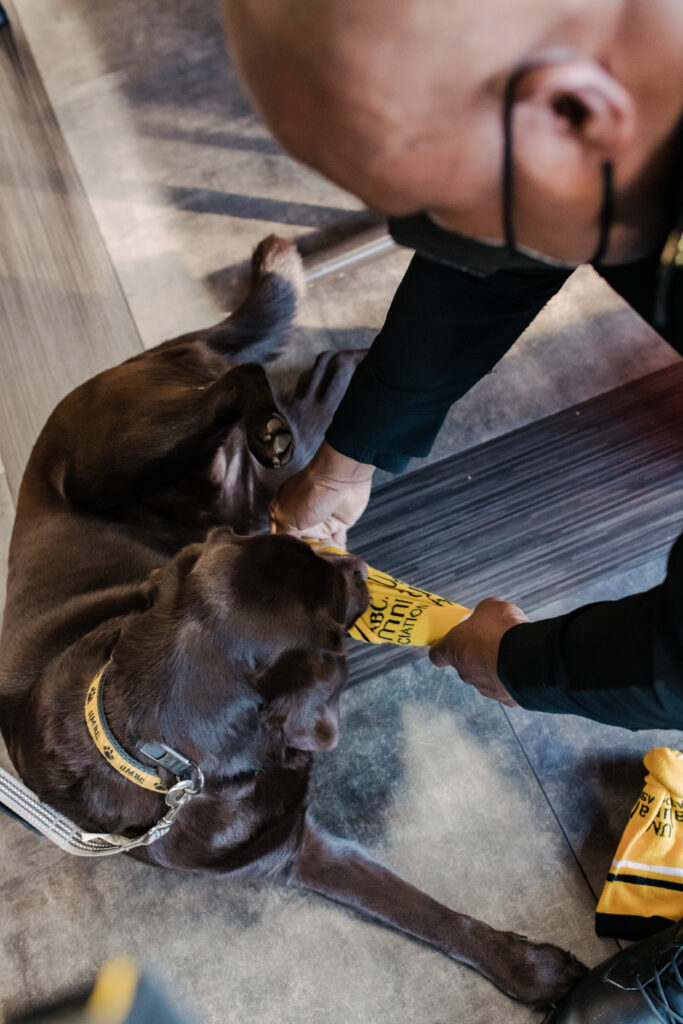 Chip and Sgt. Cheatem argue about the best way to model t-shirts. (Marlayna Demond ’11/UMBC)
Q: How many steps would you say you both get in each day?
A: By noon, we’re between 9-10,000 steps. By the end of the day, I usually average about 17-18,000 steps.
(Author’s note- I was proud of the 0.91 mile walk I did to and from the police station to conduct this interview…)
Q: Like all of us, I have to assume Chip hits that 2 p.m. wall. What treat gets her through the rest of the day?
A: Peanut butter-infused wafer chips. It doesn’t last long because it’s Chip, but she chews/inhales it immediately.
Q: What’s the best part about working with Chip?
A: I think it’s the joy she brings. As a police officer, no one is running to you to say, “Hey! How are you doing?” But anywhere I go on this campus with Chip, everybody from the staff to the President’s Office to students are flagging me down to yell, “It’s Chip!” Even our own officers are on the floor every day playing with Chip. It’s been really great to see that people now correlate this [police] uniform with her. She really has acted as a bridge between us and our campus community.
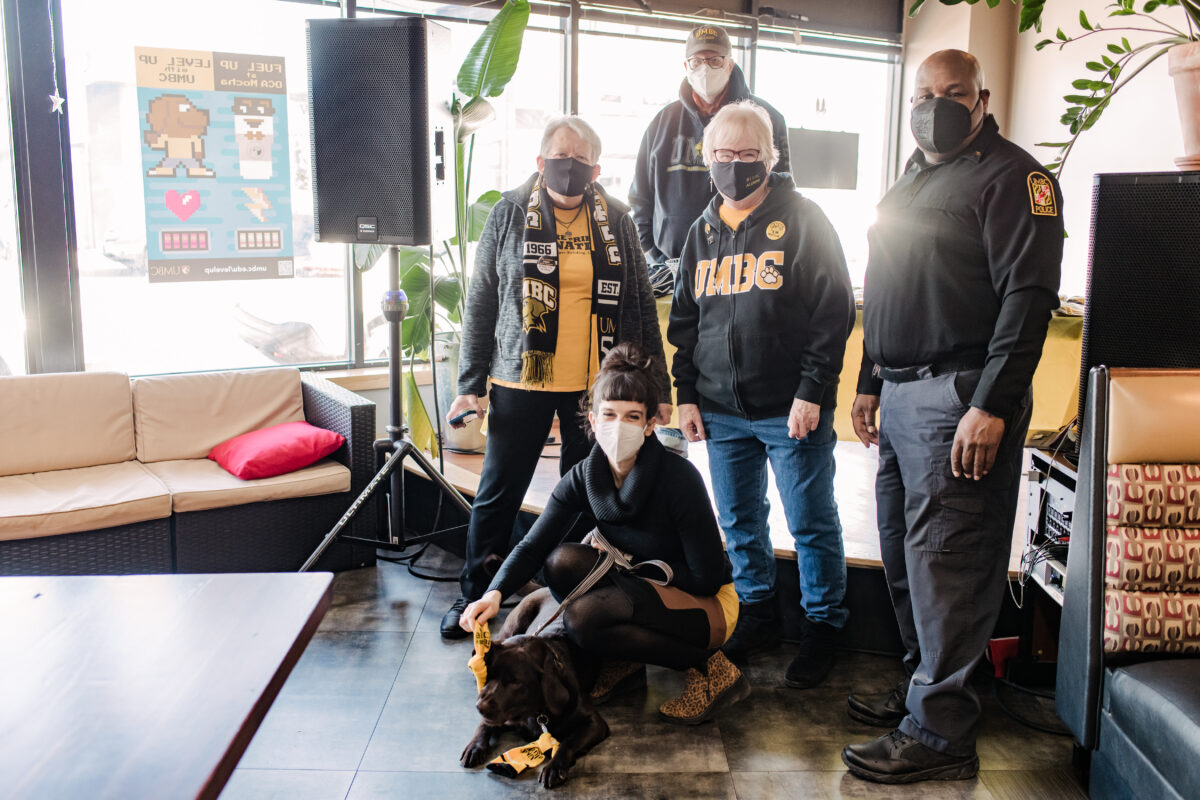 Sgt. Cheatem (far right) introduces Chip (on the ground) to member’s of UMBC’s first graduating class and her own fans. (Marlayna Demond ’11/UMBC)
Q: It’s easy for people to forget that Chip is more than just a cute face. (She glared at me here; I think she knows I meant to say “the cutest face.”) We brought her to campus to do a job and be a comfort dog. Have you seen her fulfilling that purpose?
A: She has absolutely done her job in diffusing high-pressure situations and providing comfort when we’re called in to help. There have been instances where just resting her head in someone’s lap has calmed an individual down. You really get to see the wonder of dogs. I see it every day, but it never gets old.
Q: Do you ever find it distracting to work with Chip?
A: Never. I’ve been in this business for 25 years and it’s the most fun I’ve ever had. I can walk across the campus and hear, “There’s Chip! Sergeant Cheatem, come back!” I’ve had students yell out a fourth-story window for us to wait (and we did). It has really made me think that anyone I need to work with or interact with that I wouldn’t normally, would be more inclined to help because Chip is that bridge.
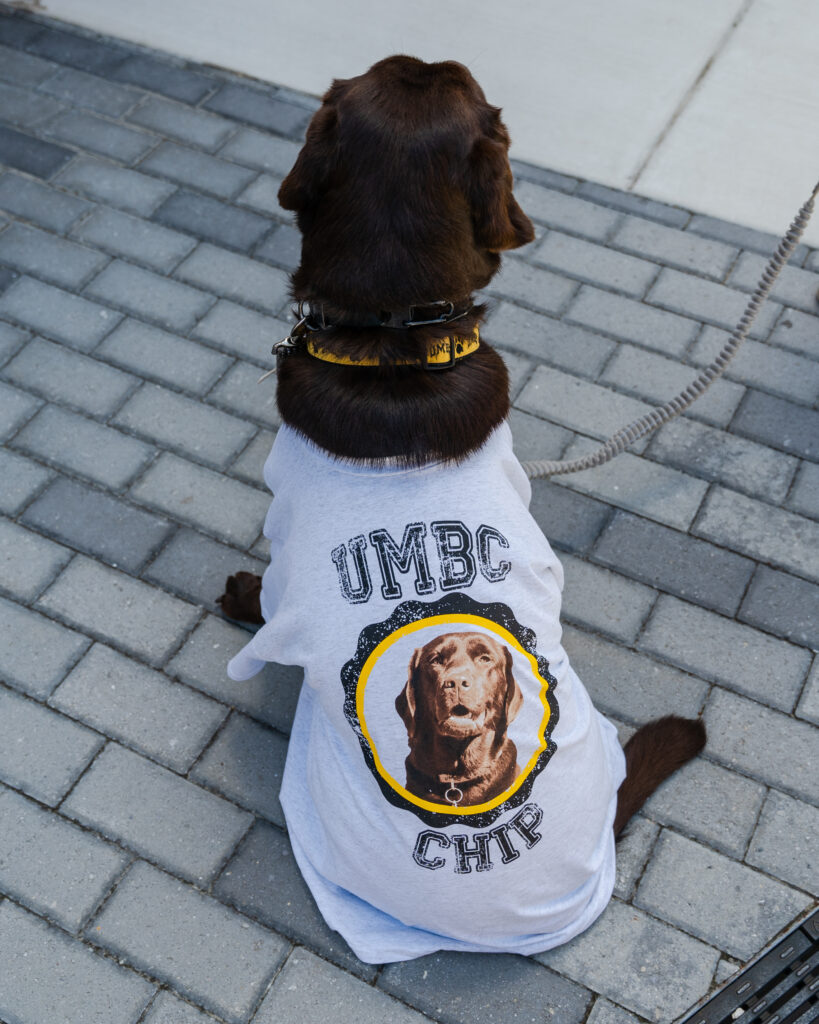 The fit is immaculate. (Jenna Beshara ’24, visual arts/UMBC)
Q: What’s the hardest part about working with Chip?
A: We can’t get to every event people want us to and that is the hardest thing. We jump around all over the place so we can try to make as much as possible work.
Q: In your professional opinion, would every workplace benefit from having a dog on site? And can I get it in writing to take back to my own supervisors?
A: Absolutely.
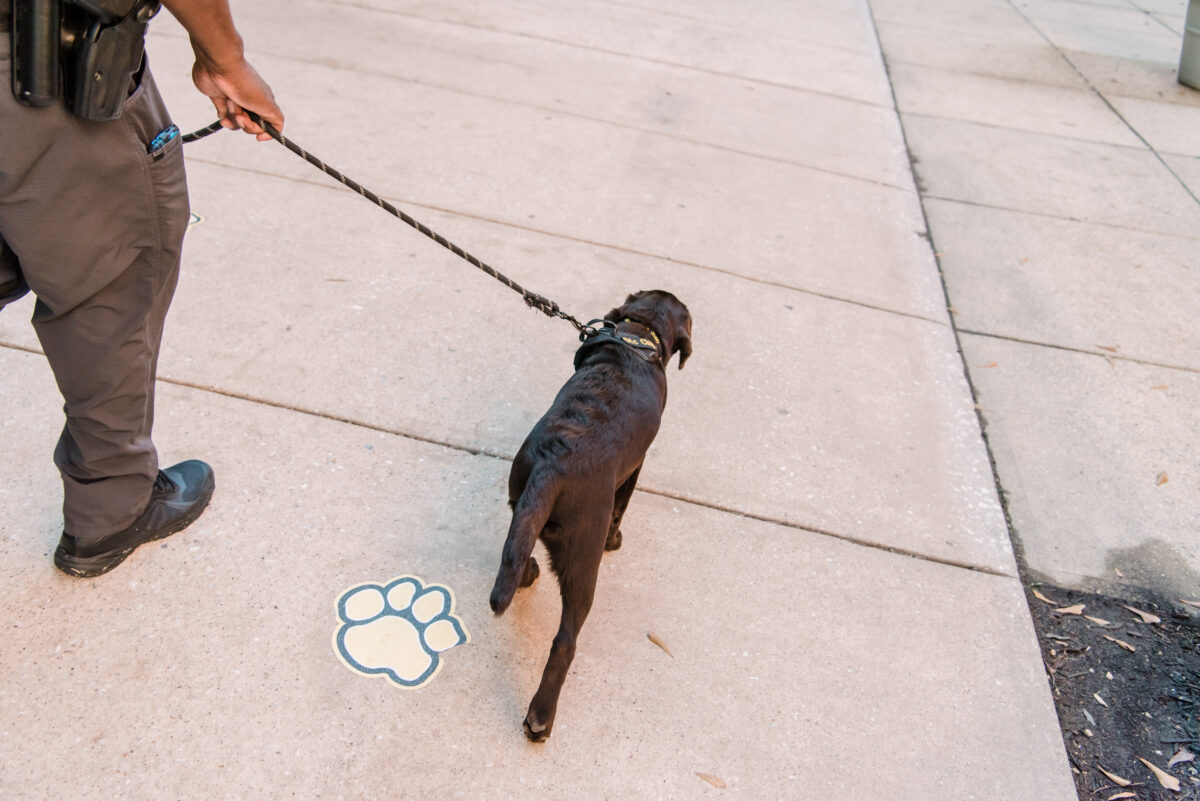 The work never ends. (Marlayna Demond ’11/UMBC)
And now you have it in writing. You’re welcome, Retrievers!
]]>
National Take Your Dog to Work Day might officially only be celebrated on the Friday after Father’s Day, but for Sergeant Jamie Cheatem of the UMBC Police Department, it’s every day. Coming up on...
https://umbc.edu/stories/take-your-dog-to-work-day/
https://beta.my.umbc.edu/api/v0/pixel/news/126000/guest@my.umbc.edu/5f772257e9c6a955597f03ebb1513537/api/pixel
campus-life
chip
community
magazine
UMBC News & Magazine
https://beta.my.umbc.edu/groups/umbc-news-magazine
https://assets1-beta.my.umbc.edu/system/shared/avatars/groups/000/001/943/24435aa6207c452e7bc15cc74b42c7bb/xsmall.png?1748556657
https://assets1-beta.my.umbc.edu/system/shared/avatars/groups/000/001/943/24435aa6207c452e7bc15cc74b42c7bb/original.png?1748556657
https://assets2-beta.my.umbc.edu/system/shared/avatars/groups/000/001/943/24435aa6207c452e7bc15cc74b42c7bb/xxlarge.png?1748556657
https://assets2-beta.my.umbc.edu/system/shared/avatars/groups/000/001/943/24435aa6207c452e7bc15cc74b42c7bb/xlarge.png?1748556657
https://assets3-beta.my.umbc.edu/system/shared/avatars/groups/000/001/943/24435aa6207c452e7bc15cc74b42c7bb/large.png?1748556657
https://assets1-beta.my.umbc.edu/system/shared/avatars/groups/000/001/943/24435aa6207c452e7bc15cc74b42c7bb/medium.png?1748556657
https://assets2-beta.my.umbc.edu/system/shared/avatars/groups/000/001/943/24435aa6207c452e7bc15cc74b42c7bb/small.png?1748556657
https://assets1-beta.my.umbc.edu/system/shared/avatars/groups/000/001/943/24435aa6207c452e7bc15cc74b42c7bb/xsmall.png?1748556657
https://assets2-beta.my.umbc.edu/system/shared/avatars/groups/000/001/943/24435aa6207c452e7bc15cc74b42c7bb/xxsmall.png?1748556657
UMBC News & Magazine
0
0
false
Thu, 23 Jun 2022 09:55:22 -0400
Thu, 23 Jun 2022 09:55:22 -0400
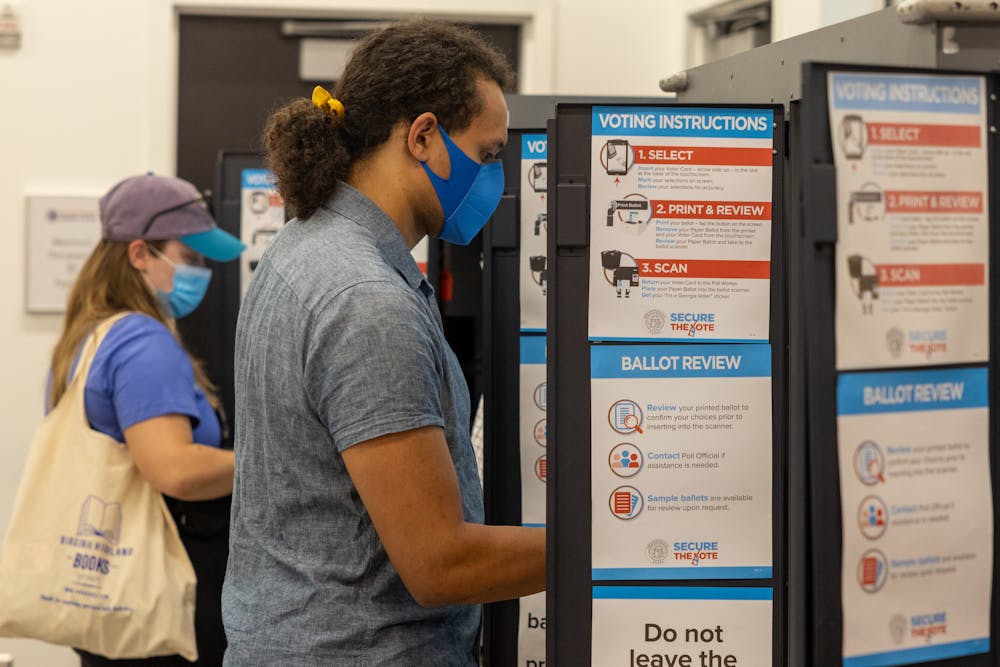
Trump-endorsed candidates would generally win even without his support – and that’s usually the case with all political endorsements

Ian Anson, Associate Professor of Political Science, UMBC.
Over the past few months, many journalists and pundits have credited the power of Donald Trump’s endorsements with determining the winners of Republican primaries.
Trump has made 203 candidate endorsements in the 2022 election cycle so far, targeting state, congressional, gubernatorial and even local races.
Based on the numbers alone, receiving a “Trump bump” seems like a surefire way to win an election. So far, 94% of Trump’s favored candidates have won their Republican primaries.
But as a political scientist who studies voting and public opinion, I have my doubts about the true power of Trump’s endorsements. Instead, it is more likely that most of the candidates Trump has chosen to endorse were already on track to win their respective races.
Political science says that endorsements do occasionally matter for determining election outcomes. But in most cases, their effects are far less potent than commentators might expect.
This is because endorsements are not made in a vacuum. Much like the endorsements of interest groups and political parties, the so-called “Trump bump” is mostly a reflection of the attributes a candidate already had before the endorsement.
Backing the winners
Candidates’ electoral fortunes mostly stem from whether they’re incumbents, which political party they belong to, their ideology and their political savvy. In turn, these attributes also determine who gets endorsed by prominent groups and people.
For this reason, Trump’s endorsements are an excellent lesson in what scholars call “reverse causality.” This is what happens when people mistake a phenomenon’s effects for its cause, like thinking that people holding umbrellas have caused it to rain. In this case, reverse causality implies that Trump’s favorite candidates are not more likely to win because of his endorsement.
To be sure, candidate endorsements can act as valuable cues for voters seeking to make informed decisions. Voters might think to themselves, “If this person, whom I trust and like, supports a candidate, then I should trust and like the candidate too.” This is especially true in elections in which little is known about the contenders.
 Trump endorsed former Sen. David Purdue, seen here, in the 2022 GOP primary for governor in Georgia. But the incumbent, Brian Kemp, won the nomination.
AP Photo/John Bazemore
Such mental shortcuts allow voters with limited knowledge of the candidates to vote according to their preferences. But in most cases, endorsements do little to persuade voters to shift their support from one candidate to another.
The real sources of the ‘Trump bump’
There are at least three other reasons that many of Trump’s favored candidates are finding success in 2022.
First, most of Trump’s endorsed candidates already hold office. This gives them a distinct electoral advantage. Only one of the congressional incumbents whom Trump endorsed lost in the primary. That candidate, Rep. Madison Cawthorn in North Carolina, chose to run in a new congressional district, partially scuttling his incumbency advantage.
The stellar performance of Trump-backed incumbents is unsurprising, because incumbents already have a nearly 100% chance of winning primaries. The rare primary upset of an incumbent, like the one that elected New York Democratic Rep. Alexandria Ocasio-Cortez in 2018, normally sends shock waves through the political landscape.
Of course, Trump has also endorsed some challengers. Research shows that challengers raise more money if they receive high-profile endorsements. Trump’s endorsement might have had a similar effect.
But longtime incumbents often have even deeper pockets, making them difficult for challengers to defeat. The record reflects this reality: Of the nine Trump-endorsed challengers who have gone up against incumbents in primaries thus far, only three have managed to win.
Trump endorsements are also likely determined by a candidate’s quality, which can be defined as the extent to which a candidate possesses the skills, reputation and resources – including money – to win elections. High-quality candidates normally contest only those elections they know they can win. Key endorsers like Trump stake their reputation on their support for candidates, meaning they are probably choosy about whom to endorse. This helps to explain why not all vocally pro-Trump candidates have received his official blessing.
Finally, a candidate’s ideology plays an important role in determining winners, losers and support from endorsers. Trump is likely to endorse conservative candidates who align with his policy preferences – though not always. Successful conservative candidates run in districts and states with many conservative voters. Trump’s endorsement will merely clarify these voters’ affinity for the candidate, while reaffirming others’ decision to vote for someone else.
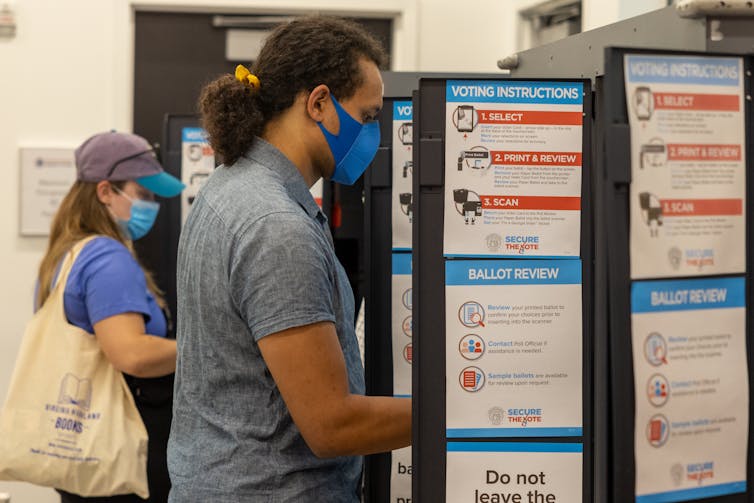 Many elements influence how a person votes, and an endorsement is not usually decisive. Here, voters in Atlanta, Ga., on primary election day, May 24, 2022.
Nathan Posner/Anadolu Agency via Getty Images
No endorsement, no problem for Republicans in ‘22
Before assigning Trump the credit for boosting candidates in the upcoming 2022 general election, observers should recognize the notorious difficulty of proving causation in the realm of electoral politics. 2022 is primed to be a banner year for Republican candidates, whether they receive a nod from Trump or not.
Midterm election years are almost always tough contests for the party of the incumbent president. Voters associate candidates down the ballot with the president’s performance in office. After an early honeymoon phase, presidential approval often slumps as midterm elections near, damaging the chances of congressional candidates.
A volatile economy is also bad news for the party of the incumbent. While presidents’ actions might not have much effect on national and global economic conditions, many voters blame the incumbent party anyway.
These factors combine to heavily favor Republican candidates this year. Trump’s endorsements are far less important for voting behavior than the political and economic context of this year’s elections.
Hopefully, when it comes time to discuss the reasons that some candidates won and others lost, commentators will keep these lessons from voting behavior research in mind.
Ian Anson, Associate Professor of Political Science, University of Maryland, Baltimore County
This article is republished from The Conversation under a Creative Commons license. Read the original article.
]]>
Ian Anson, Associate Professor of Political Science, UMBC. Over the past few months, many journalists and pundits have credited the power of Donald Trump’s endorsements with determining the...
https://umbc.edu/stories/trump-endorsed-candidates/
https://beta.my.umbc.edu/api/v0/pixel/news/125942/guest@my.umbc.edu/3d9f4596db0e46ad1149b3afaef4f8c5/api/pixel
cahss
cahssresearch
cs3
discovery
magazine
politicalscience
the-conversation
UMBC News & Magazine
https://beta.my.umbc.edu/groups/umbc-news-magazine
https://assets1-beta.my.umbc.edu/system/shared/avatars/groups/000/001/943/24435aa6207c452e7bc15cc74b42c7bb/xsmall.png?1748556657
https://assets1-beta.my.umbc.edu/system/shared/avatars/groups/000/001/943/24435aa6207c452e7bc15cc74b42c7bb/original.png?1748556657
https://assets2-beta.my.umbc.edu/system/shared/avatars/groups/000/001/943/24435aa6207c452e7bc15cc74b42c7bb/xxlarge.png?1748556657
https://assets2-beta.my.umbc.edu/system/shared/avatars/groups/000/001/943/24435aa6207c452e7bc15cc74b42c7bb/xlarge.png?1748556657
https://assets3-beta.my.umbc.edu/system/shared/avatars/groups/000/001/943/24435aa6207c452e7bc15cc74b42c7bb/large.png?1748556657
https://assets1-beta.my.umbc.edu/system/shared/avatars/groups/000/001/943/24435aa6207c452e7bc15cc74b42c7bb/medium.png?1748556657
https://assets2-beta.my.umbc.edu/system/shared/avatars/groups/000/001/943/24435aa6207c452e7bc15cc74b42c7bb/small.png?1748556657
https://assets1-beta.my.umbc.edu/system/shared/avatars/groups/000/001/943/24435aa6207c452e7bc15cc74b42c7bb/xsmall.png?1748556657
https://assets2-beta.my.umbc.edu/system/shared/avatars/groups/000/001/943/24435aa6207c452e7bc15cc74b42c7bb/xxsmall.png?1748556657
UMBC News & Magazine
0
0
false
Fri, 17 Jun 2022 14:40:12 -0400
Fri, 17 Jun 2022 14:40:12 -0400
Rethinking collaborative public humanities research in New Orleans and Baltimore

If you were looking for Sarah Fouts in New Orleans, chances are you would find her at one of the many taco trucks or pop-up food vendors across the city, chatting with locals. Relationship-building is at the core of her work, which focuses on the experiences of Black, Central American, and Mexican food industry workers in post-Katrina New Orleans.
Fouts is an assistant professor of American studies at UMBC who earned her Ph.D. in Latin American studies at Tulane University. For more than a decade, she has volunteered for, collaborated with, and supported the work of grassroots organizations in New Orleans. Now, she is working with long-time partners there on an exciting new project.
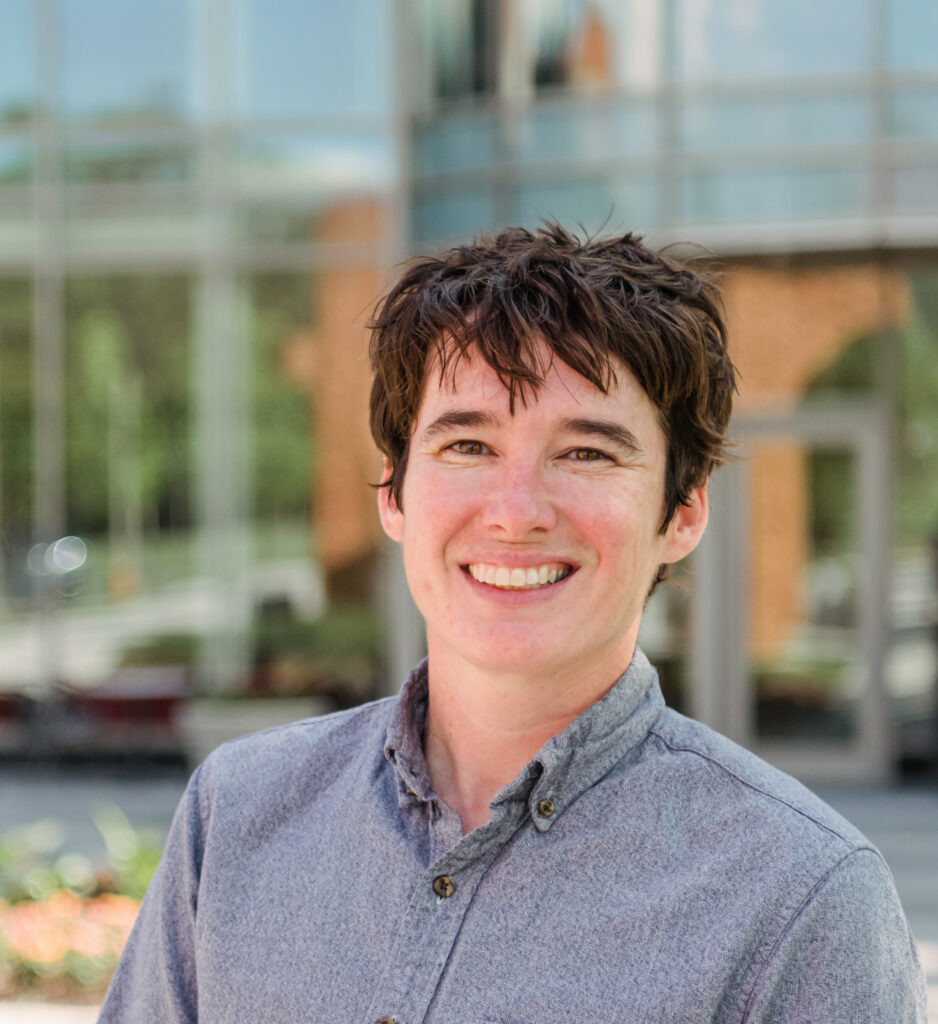 Sarah Fouts. (Marlayna Demond ’11/UMBC)
The Whiting Foundation has awarded a $50,000 Public Engagement Fellowship to Fouts along with local organizers Toya Ex Lewis and Fernando López to implement Project Neutral Grounds: At the Intersection of People, Street Food, and the Hustle. Lewis is the organizer of Project Hustle, born in New Orleans, and López is a Mexican-born documentarian. The three partners have worked together since 2013. Their latest collaboration will bring together Black, Brown, LGBTQ+, and immigrant food vendors in New Orleans to celebrate, share, and document their experiences and histories.
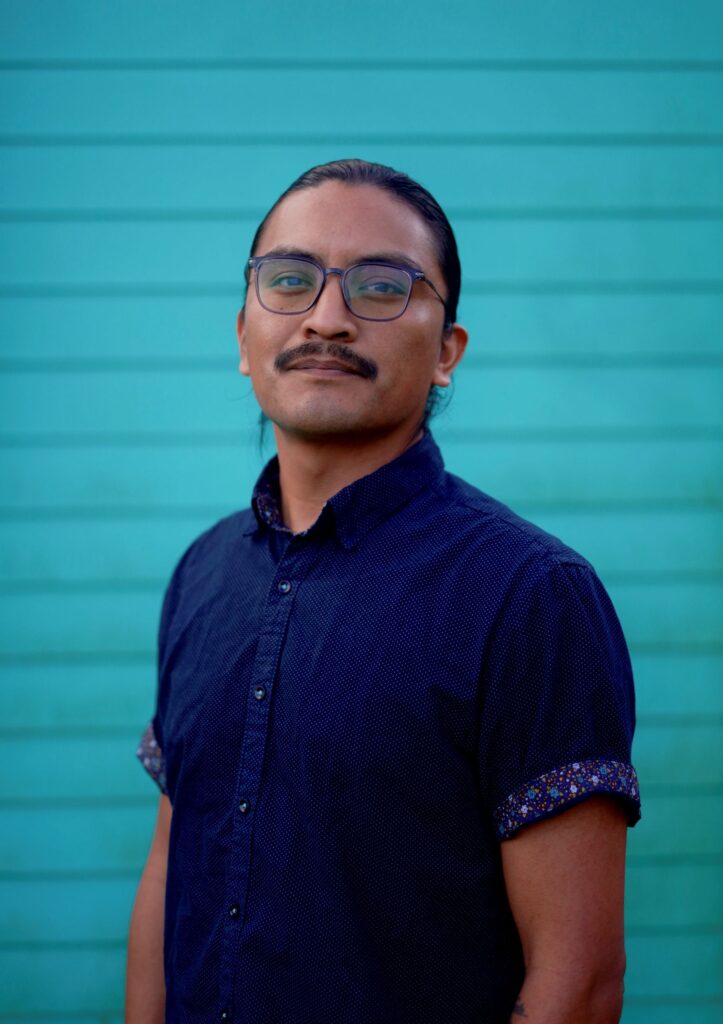 Fernando López. (Photo by López)
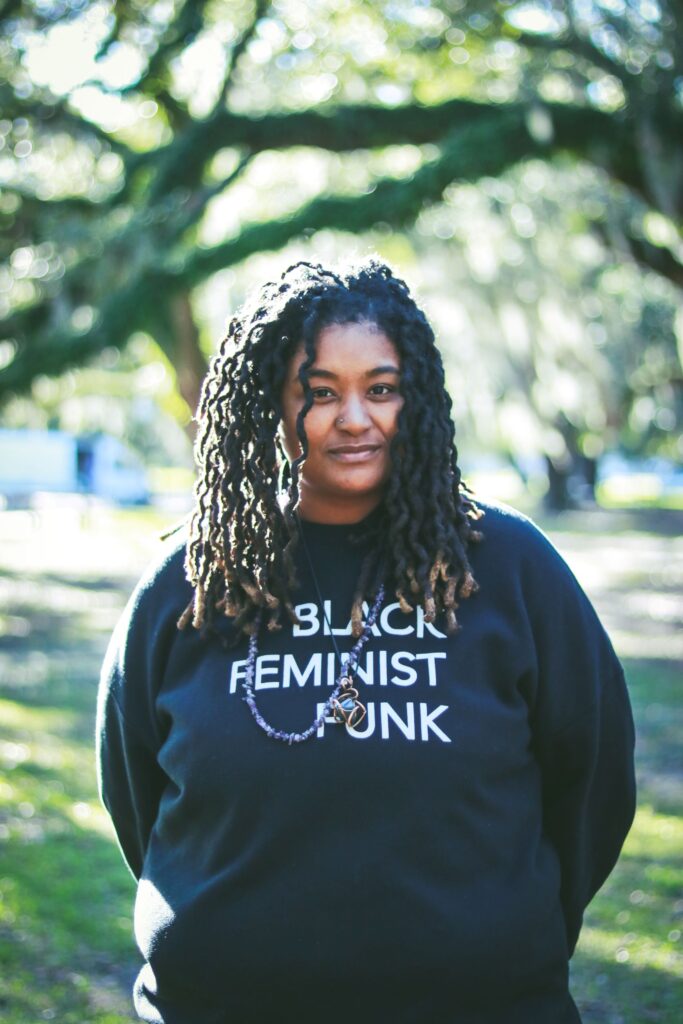 Toya Ex Lewis. (Photo by López)
“In collaboration with Black and Brown food vendors, Project Neutral Ground will showcase the culture, complexities, and potential futures of post-disaster economies,” says Fouts. “We seek to dismantle barriers and foster dialogue to build networks across factors like race, gender, and class in order to foment an understanding of these vendors as they occupy and vie for city spaces.”
Sharing community history
New Orleans has a rich history and culture of street food vendors, particularly led by the city’s Black community. In 2005, Hurricane Katrina devastated New Orleans with wind speeds of over 100 miles per hour and a monumental storm surge that flooded 80% of the city. Many Black and Brown vendors were forced to leave their homes and businesses or find new ways to continue to live and work. Central American food vendors migrated to the city to help fill the void.
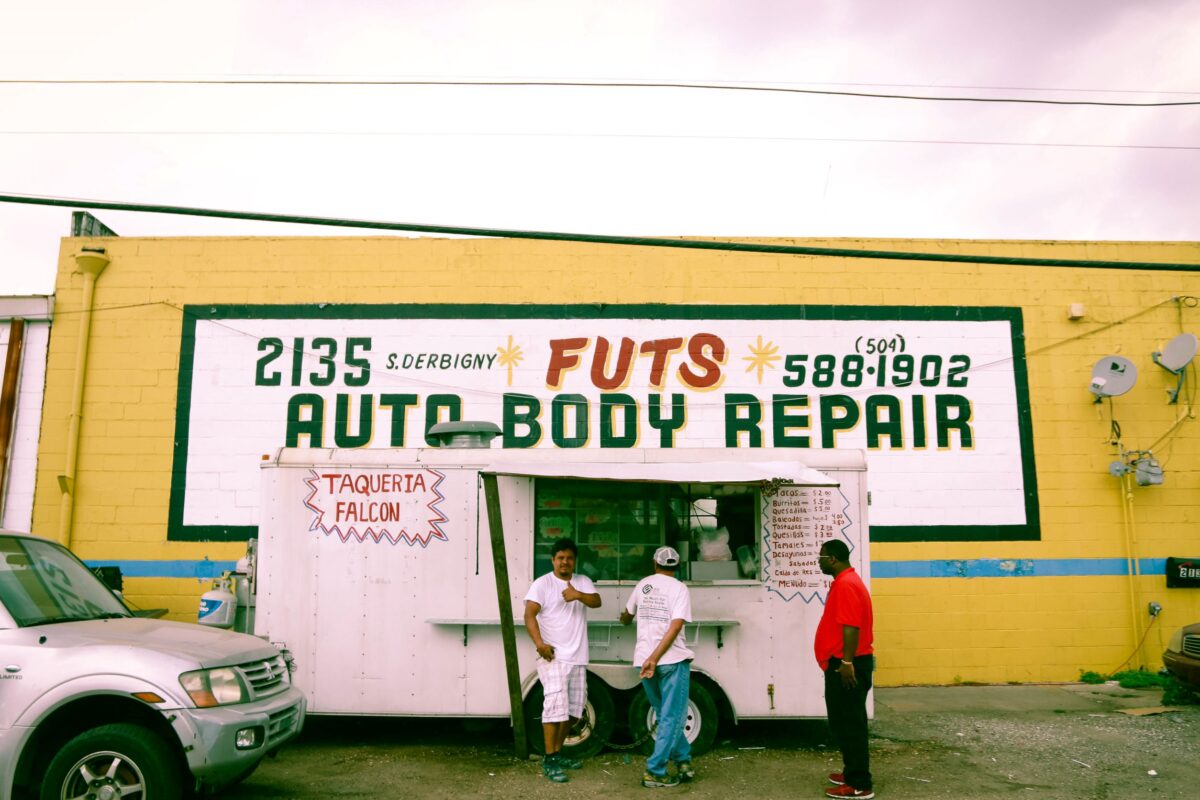 New Orleans taco truck. (Photo by Fernando López)
Now, almost 20 years after Katrina, New Orleans street vendor culture is a mixture of traditional and modern takes on Soul Food and Latin food representative of its burgeoning Black and Brown communities. The success of taco trucks and Soul Food pop-ups has raised complex questions about food truck regulation, worker rights, immigration issues, and local vs. tourist experiences that often pit these communities against each other.
The Whiting Foundation funding will help Fouts, the project director; Lewis, the organizing director; and López, the creative director, work in collaboration with the Southern Food and Beverage Museum to document and share the history, culture, cuisine, and personal journeys of ten food vendors in post-Katrina New Orleans food culture.
Collaborative storytelling
The team will first film and photograph the vendors cooking a dish of their choice at the Southern Food and Beverage Museum. A follow-up filming will document a “day in the life” of each food vendor. Finally, an audio recording will capture personal oral history interviews. Over the course of the year, López and Lewis will use the footage to develop ten mini-documentaries showcasing each vendor’s story.
 (l-r): López with food vendor and Fouts filming at the Southern Food and Beverage Museum. (Photo by Fernando López)
Fouts, Lewis, and local artist SheRa Phillips will work with students in Fouts’s UMBC Public Humanities course in fall 2022 to convert these stories into a zine that highlights historic and contemporary vendor stories, maps of where street food vendors are, a historical timeline of street vending in New Orleans, and recipes. Vendors will also be able to give the zine to their customers, helping to share this important part of New Orleans history with new audiences.
“This is a way for native New Orleanians to have opportunities to tell our own stories,” says Lewis, “instead of the usual extractive way our stories get taken and told for us.”
The Project Neutral Grounds digital and physical collection of stories will be on exhibit and archived at the Southern Food and Beverage Museum to share with future generations of locals, vendors, visitors, and public humanities scholars.
Public humanities in Baltimore
Since joining the faculty of UMBC, Fouts has also connected with Baltimore communities. The American Council of Learned Societies has awarded Fouts; Nicole King, professor and chair of American studies; and Tahira Mahdi, adjunct professor of psychology, a public engagement grant of over $150,000 to support their innovative public humanities work. The award, supported by the National Endowment for the Humanities, will fund the development and implementation of the project Baltimore Field School (BFS) 2.0: Undoing & Doing Anew in Public Humanities at UMBC 2022 – 2023.
Fouts, King, and Mahdi will work with community members, UMBC graduate students, and faculty to continue developing frameworks for community engagement between local communities and academia that have long-term benefits for local communities in particular.
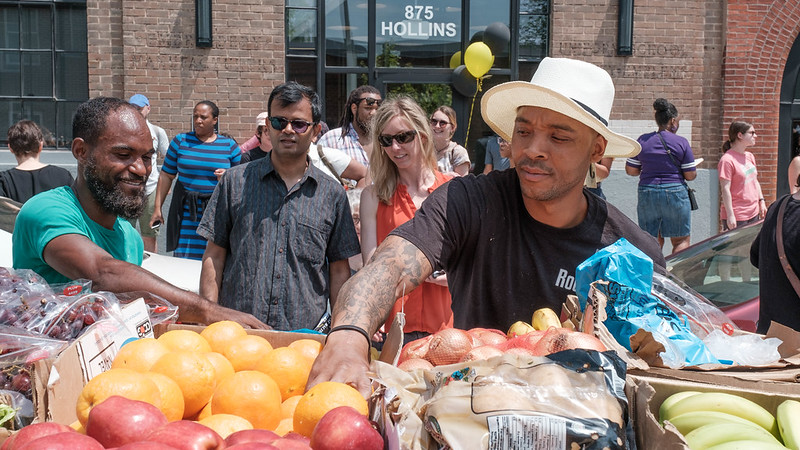 An arabber sells produce form a horse-drawn cart in Baltimore. (Bill Shewbridge/UMBC, Baltimore Traces project)
“This collaborative process takes a great deal of time, listening, and building trust,” King explains. “The people living and working in city neighborhoods and building grassroots organizations should be centered in the process of defining challenges and ways to address them in Baltimore and cities like it.”
 West Baltimore street walking tour with Curtis Eaddy. (Bill Shewbridge/UMBC, Baltimore Traces project)
The award will broaden the reach of the Baltimore Field School (BFS), launched through a $125,000 grant from the Andrew W. Mellon Foundation in 2020. BFS creates a framework for faculty to collaborate with community organizations in building ethical and sustainable research and teaching projects focused on public humanities.
“ACLS is proud to support these outstanding examples of publicly engaged, community-centered scholarship,” says ACLS President Joy Connolly. “Direct engagement with communities beyond the walls of academia is essential to the continued creation of knowledge for the public good. At the same time, these programs will help in expanding our definitions of humanistic scholarship and in contributing to solutions for a brighter future for all.”
]]>
If you were looking for Sarah Fouts in New Orleans, chances are you would find her at one of the many taco trucks or pop-up food vendors across the city, chatting with locals....
https://umbc.edu/stories/strong-public-humanities-in-new-orleans-strong/
https://beta.my.umbc.edu/api/v0/pixel/news/125939/guest@my.umbc.edu/bce533f66624f9128a426aff09b16c6b/api/pixel
americanstudies
baltimore
cahss
cahssresearch
community
news
policy-and-society
psychology
public-humanities
UMBC News & Magazine
https://beta.my.umbc.edu/groups/umbc-news-magazine
https://assets1-beta.my.umbc.edu/system/shared/avatars/groups/000/001/943/24435aa6207c452e7bc15cc74b42c7bb/xsmall.png?1748556657
https://assets1-beta.my.umbc.edu/system/shared/avatars/groups/000/001/943/24435aa6207c452e7bc15cc74b42c7bb/original.png?1748556657
https://assets2-beta.my.umbc.edu/system/shared/avatars/groups/000/001/943/24435aa6207c452e7bc15cc74b42c7bb/xxlarge.png?1748556657
https://assets2-beta.my.umbc.edu/system/shared/avatars/groups/000/001/943/24435aa6207c452e7bc15cc74b42c7bb/xlarge.png?1748556657
https://assets3-beta.my.umbc.edu/system/shared/avatars/groups/000/001/943/24435aa6207c452e7bc15cc74b42c7bb/large.png?1748556657
https://assets1-beta.my.umbc.edu/system/shared/avatars/groups/000/001/943/24435aa6207c452e7bc15cc74b42c7bb/medium.png?1748556657
https://assets2-beta.my.umbc.edu/system/shared/avatars/groups/000/001/943/24435aa6207c452e7bc15cc74b42c7bb/small.png?1748556657
https://assets1-beta.my.umbc.edu/system/shared/avatars/groups/000/001/943/24435aa6207c452e7bc15cc74b42c7bb/xsmall.png?1748556657
https://assets2-beta.my.umbc.edu/system/shared/avatars/groups/000/001/943/24435aa6207c452e7bc15cc74b42c7bb/xxsmall.png?1748556657
UMBC News & Magazine
0
0
false
Fri, 17 Jun 2022 07:52:00 -0400
Fri, 17 Jun 2022 07:52:00 -0400
UMBC’s 2022 Fulbright student scholars will travel the world to explore difficult questions
Eight recent UMBC graduates and alumni will soon travel to countries across three continents as 2022 Fulbright U.S. Student scholars. They include emerging leaders in education, astrophysics, cybersecurity, human rights, and more, and they are excited to explore difficult questions through fresh perspectives.
The Fulbright Program is the U.S. government’s flagship international exchange program. UMBC was named a Fulbright Top Producing Institution in 2019 – 2020. In the last decade, UMBC has received over 60 Fulbright U.S. Student Program awards for research and teaching placements in Africa, Asia and the Pacific, the Middle East, South America, and Europe.
Creating new paths
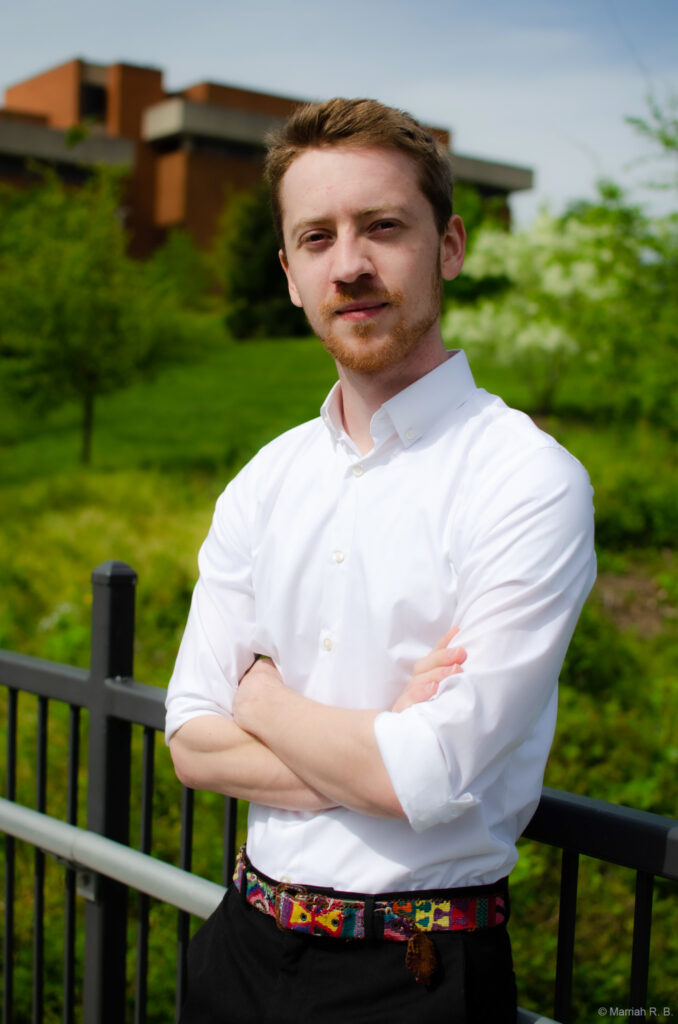 Caleb Jacobson.
(Image courtesy of Jacobson)
This year marks UMBC’s first Fulbright awards to El Salvador and to the UK. Caleb Jacobson ’21, global studies, and M.A. ’23, sociology, will research human rights and the transition to peace in post-conflict El Salvador. Kaitlyn Keaton ’22, computer engineering, a Cyber Scholar in the Center for Women In Technology, will head to Newcastle University (NU) in North East England to complete a master’s in cybersecurity. NU is recognized jointly by the UK’s National Cyber Security Center and the Engineering and Physical Sciences Research Council as an Academic Centre of Excellence in cyber security research.
Keaton has focused on making the most of her college education by pursuing a wide range of learning experiences. She has held competitive software engineering internships at General Dynamics Mission and Systems and Northrop Grumman Mission Systems, and has participated in Capture the Flags cybersecurity competitions, but this will be her first learning experience abroad.
As a Cyber Scholar and Tau Beta Pi Engineering Honors Society member, Keaton is determined to further develop the skills necessary to be on the cutting edge of cybersecurity research. She is also committed to creating new pathways for more women and girls to be leaders in engineering.
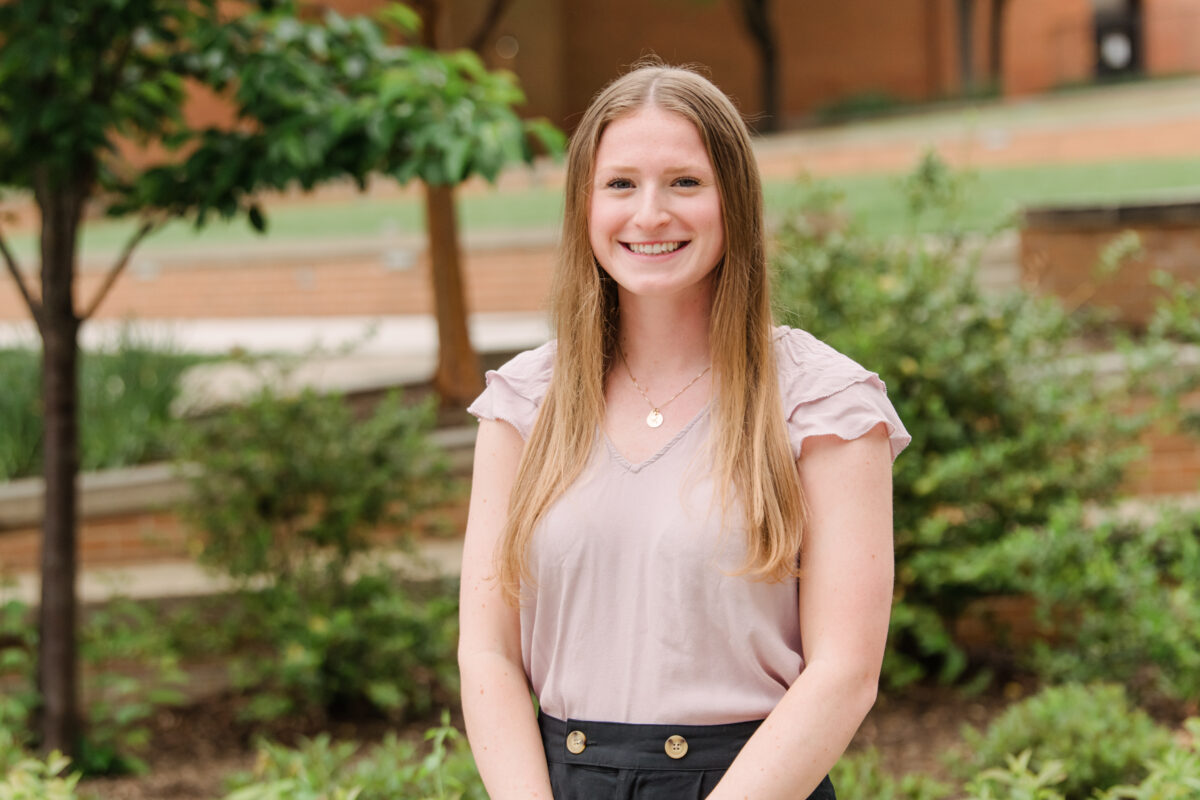 Kaitlyn Keaton. (Marlayna Demond ’11/UMBC)
“I want to inspire and encourage even more girls and young women to join the cybersecurity world,” says Keaton. “There is a critical need to get girls interested at younger ages to show them they can do it too.”
Intercultural understanding in medicine
Maryam Elhabashy ’21, anthropology, developed an interest in the process of healing early in her life while surrounded by a family of physicians. In high school, she shadowed a physician at a hospital and saw instances where patients’ cultural backgrounds sometimes conflicted with the physician’s concerns. She wondered if a lack of intercultural understanding in medicine can get in the way of good medical care, leading to health disparities.
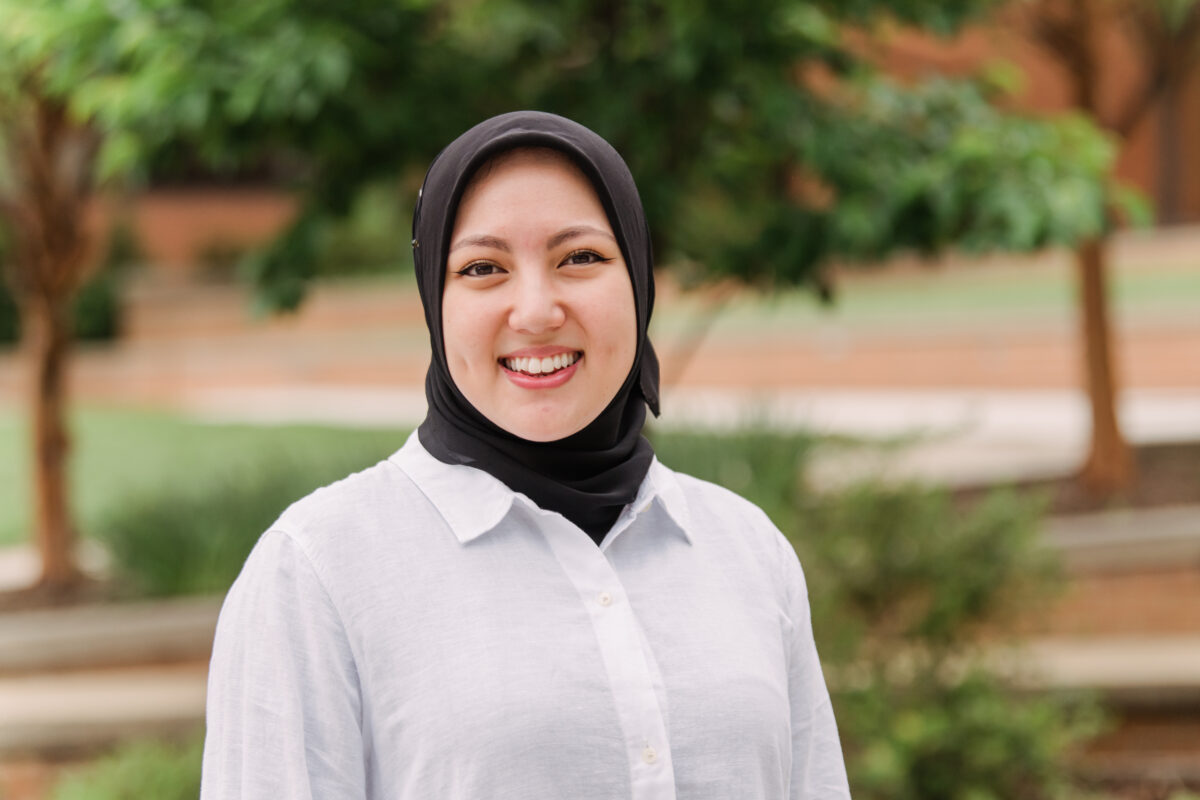 Maryam Elhabashy. (Marlayna Demond ’11/UMBC)
Elhabashy found an answer in listening to culturally diverse perspectives. As a student of anthropology with a focus on medical anthropology, she found that listening to people’s stories can help physicians develop empathy. This is one way to ensure patients feel heard, understood, and are able to navigate medical processes that can give them access to the best care possible.
While at UMBC, Elhabashy received an Undergraduate Research Award to research “Cupping and Wellness Among Muslims In the Baltimore-Washington Area.” She also served as a research assistant in sociology, anthropology, and public health (SAPH), studying physical activity among older African Americans in Baltimore.
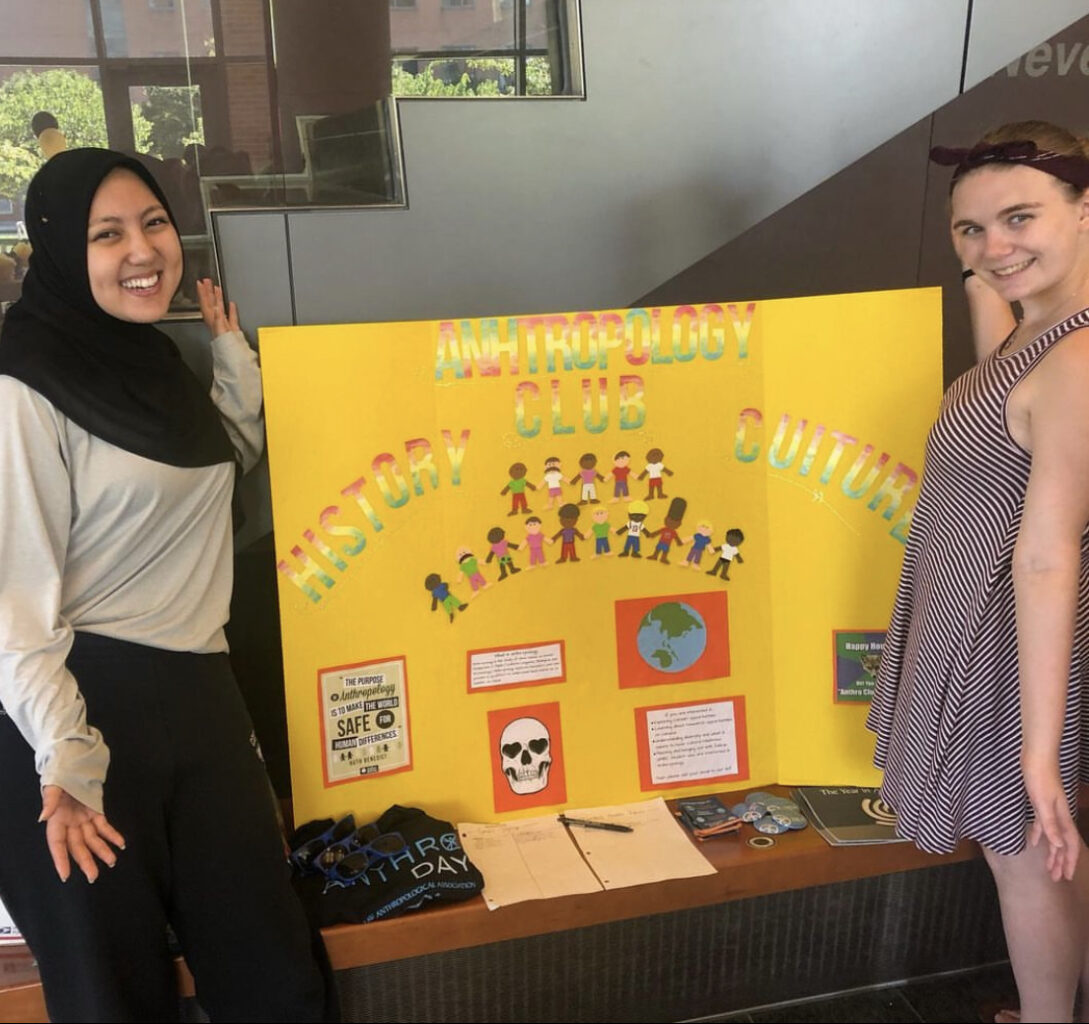 Elhabashy presenting with the Anthropology Club at SAPH’s Welcome Week Open House. (Image courtesy of Elhabashy)
After graduating, Elhabashy worked at Rutgers University as a research assistant studying tobacco and e-cigarette use among minority populations. In the past year, she interned at the Amgen Scholar Program at the National Institute of Health, working with leading biomedical scientists to identify and address health disparities as a potential result of societal, cultural, and environmental influences.
During her Fulbright year, Elhabashy will live in Kuwait City to work on her research project at Kuwait University titled, “Faith, Family, Food, and Fitness: Exploring Trends of Obesity Amongst Kuwaiti Women.”
“I hope to one day be at the forefront of a movement towards truly personalized medicine that embraces individuality and intercultural communication as a foundational tenet of the field,” she notes. “I hope my experience in Kuwait will serve as a strong foundation for this work.”
Latine teachers needed
Adrianna-Marie Urbina-Ruiz ’21, mathematics, and M.A.T., secondary education, was raised in Montgomery County, Maryland, but her roots are in Venezuela. She remembers only having four Hispanic teachers growing up. All were Spanish language teachers and supported her academic and personal growth. However, Urbina-Ruiz felt some of her other teachers had lower expectations of her, limiting her opportunities, and she saw other Hispanic students struggle with this same experience.
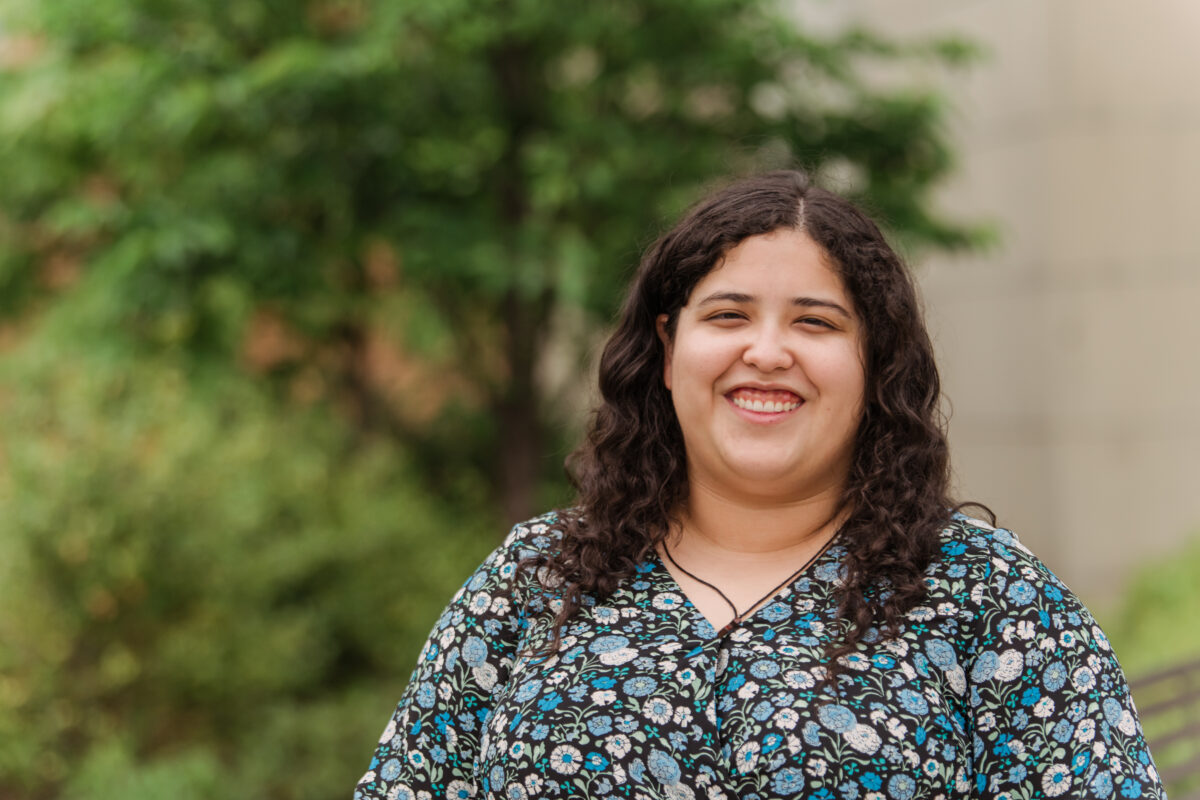 Adrianna-Marie Urbina-Ruiz. (Marlayna Demond ’11/UMBC)
“Many Hispanic students learning English and those who are bilingual have been seen as having limited academic knowledge, limited potential,” says Urbina-Ruiz. “I want to stop that narrative.”
At UMBC, Urbina-Ruiz met Bonny Tighe, a senior lecturer of mathematics, who encouraged her to become a math major and a math teacher through the Sherman STEM Teacher Scholars Program.
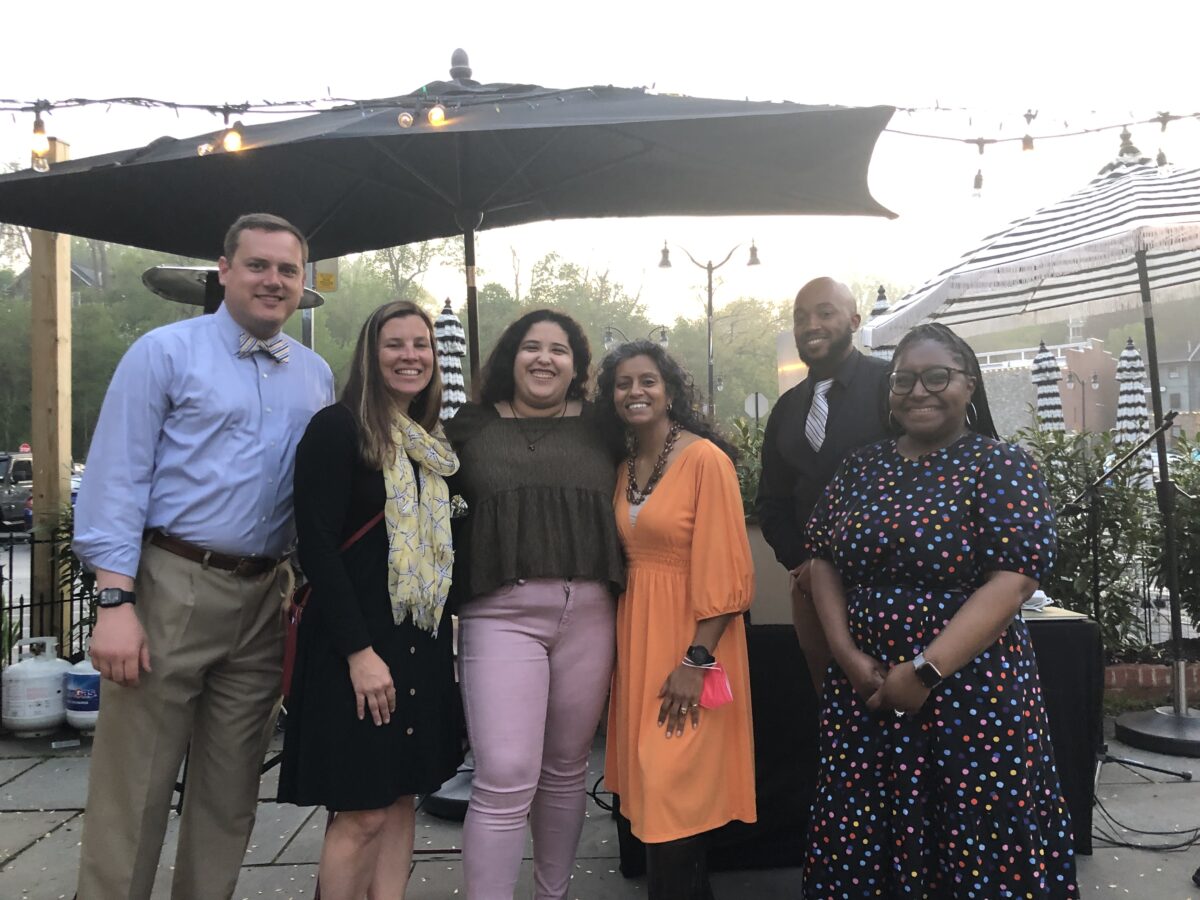 Urbina-Ruiz (in pink) with the Sherman STEM Teacher Scholar Program staff. (Image courtesy of Urbina-Ruiz)
“I will never forget walking into her office hours for the first time. She recognized me as having one of the highest grades in her Calculus I class,” says Urbina-Ruiz. “She and the Sherman staff had confidence that I would rise to any challenge. They built a strong foundation for my success.”
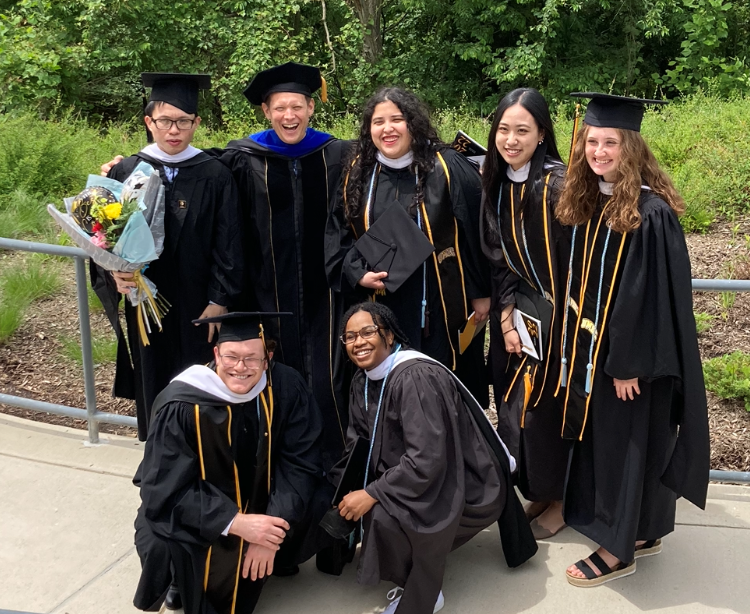 Urbina-Ruiz (standing row, center).
(Image courtesy of Urbina-Ruiz)
Urbina-Ruiz also completed a master’s in teaching and earned a certificate in teaching English to Speakers of Other Languages while student-teaching at Lakeland Elementary/Middle School in Baltimore City, which serves many Hispanic families. “I want to have as many tools at my disposal to make my classroom as accessible as possible,” says Urbina-Ruiz. “I want to be the Latine STEM teacher I never had.”
Urbina-Ruiz will work towards creating her first Collaborative Online International Learning program during her Fulbright year. She will connect college students at the Universidad Industrial de Santander in Colombia with students in Maryland while teaching English. “Latine teachers are needed around the world,” says Urbina-Ruiz.
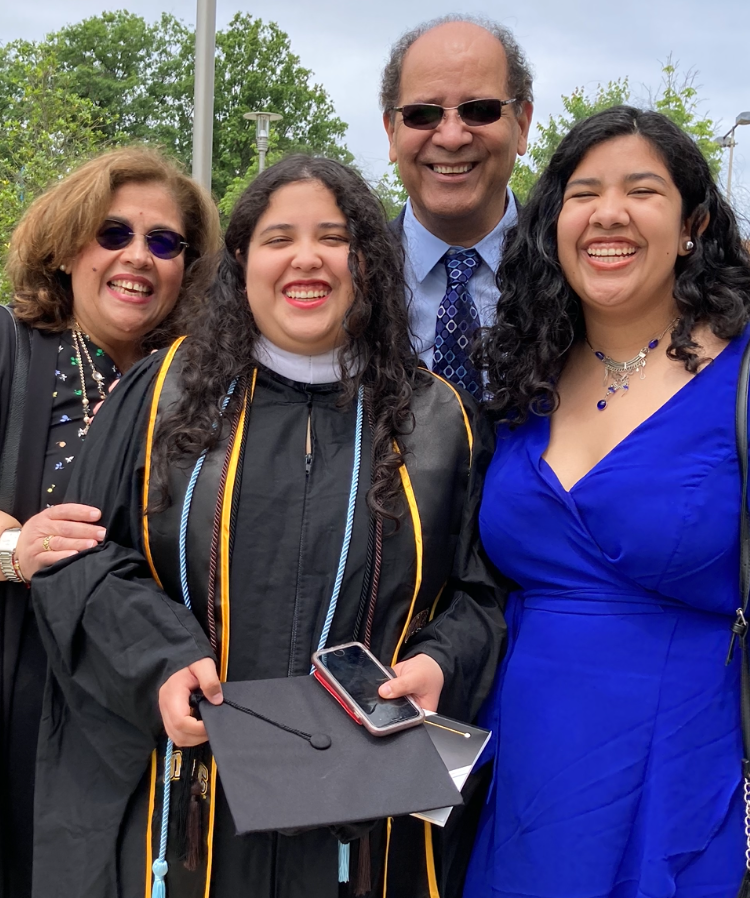 Urbina-Ruiz (wearing cap and gown) with her family at her master’s graduation. (Image courtesy of Urbina-Ruiz)
Urbina-Ruiz plans to return to teach in Baltimore City Public Schools where there is a high demand for bilingual Hispanic teachers.
Representation in science
Similar to Elhabashy, Maithily Diana Díaz ’21, biology and modern languages, linguistics, and intercultural communication, is pursuing a career focused on health equity. As a first-generation student, Díaz encourages other Latinos to go to college and to be ambitious even if it means they are in spaces where they are the only Latino, something she has experienced as a Latina in STEM.
“I’m usually the only Latina, but now it means something more,” says Díaz. “Now, it’s just the jump of saying Latinos can be scientists, researchers, physicians. If we believe in ourselves then someone else will too. And once that door is opened, then who knows how far we can go.”
Díaz recently moved to Tijuana, Mexico to work at a non-profit health clinic serving a largely refugee and migrant population. For the past school year she has been teaching science and medicine to predominantly Hispanic and African American K-12 students for Refugee Health Alliance in Harlem, while completing remote research in mental health at the Johns Hopkins School of Public Health.
During her Fulbright year, Díaz will complete a master’s in immunology and work on cancer research at the French National Institute of Health while mentoring undergraduate students at Sorbonne University. .
“It’s a dream come true that someone like me received a Fulbright at such prestigious institutions. My students were shocked,” says Díaz. “I want more and I intend to achieve it. But at the end of the day, this is for my community.”
While in France, Díaz will work with researchers seeking to identify more effective means of treating soft tissue sarcomas. The findings may reveal potentially novel immunotherapy targets for a variety of cancers.
As a linguist with proficiency in English, Spanish, French, Portuguese, and Russian, Díaz knows her ability to successfully communicate across multiple cultures and languages can lead to greater opportunities. She wants to show Latinos what can happen when they value their multicultural and multilingual lives as assets.
Following her Fulbright, Díaz plans to pursue an M.D., promoting equity in both research and healthcare.
Global education and disability
 Mimi Yaldram in traditional Pakistani dress. (Image courtesy of Yaldram)
Mimi Yaldram ’20, history, is very familiar with the process of acclimating to a new culture and country. When she was seven years old, her family left their home in Karachi, Pakistan for the United States to seek better mental health services.
“We came in 1999 right before 9/11,” says Yaldram. “It was a lot to manage the racism towards my Muslim family while learning how to live, study, access services, and work in the U.S.”
This experience inspired Yaldram’s passion for living and learning within multiple cultures, religions, and languages, which she began to explore at Montgomery College. There she held numerous executive student leadership roles and traveled abroad to Ethiopia, where she researched the influence of India on ancient trade routes and currency.
 Yaldram in Ethiopia next to an ancient stone head sculpture of the Olmec civilization of Mexico. (Image courtesy of Yaldram)
In 2017, Yaldram joined UMBC’s Shady Grove campus, embarking on new student leadership opportunities, including serving as president of the Student History Association and studying abroad in Denmark. She learned about Viking history and participated in a dance project focusing on Danish pop dances and Pakistani Bollywood dances.
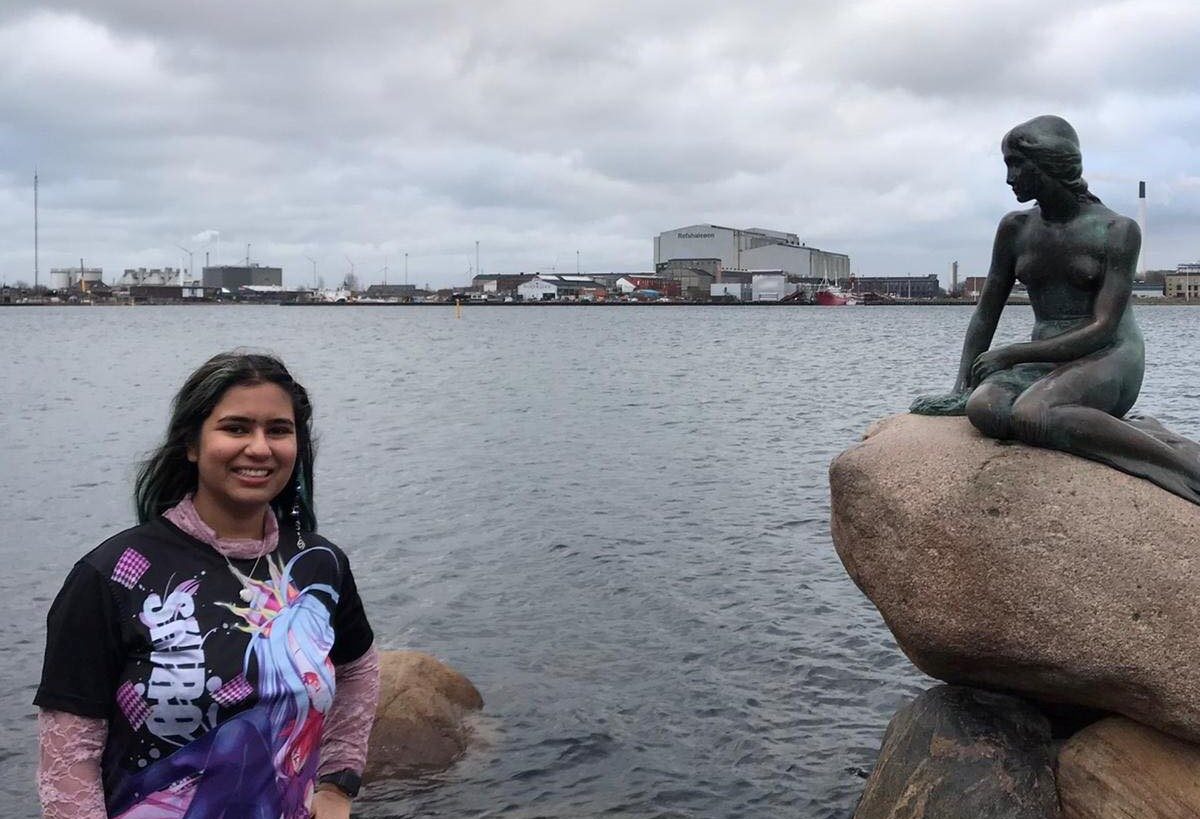 Yaldram next to a sculpture of the Little Mermaid in Copenhagen, Denmark. (Image courtesy of Yaldram)
Yaldram identifies as a student with a mental health disability, and she is passionate about advocating for and teaching other students with disabilities and neurological differences. For the past two years, she has tutored students with autism spectrum disorder on strengthening their writing, communication, and social skills.
Now that she has earned her both her Teaching English as a Second Language and mental health first-aid certifications, she is ready to spend her Fulbright year teaching English in Taiwan. She is excited to be part of Taiwan’s goal to become a bilingual nation by 2030 by raising English proficiency. She also looks forward to sharing her skills in disability education and services while teaching.
“My dream is to make a positive impact on immigrant communities by utilizing my own experiences and education,” says Yaldram. “I hope to make a difference and bring that to the Fulbright program in Taiwan.”
Yaldram plans on a career at the intersection of global education, social justice, and disability beginning with humanitarian work in Pakistan after her Fulbright experience.
Korean world influence
Chemutai Wangui Nganga ’21, global studies, comes from a Kenyan family in the United States. During elementary school, she lived in Kenya for four years where she improved her Swahili skills and learned more about her Kenyan culture. When she moved back to the U.S., her family settled in Howard County, Maryland, home to numerous international communities, especially a thriving Korean community. Nganga learned about the influence the Korean economy, cuisine, music, art, and technology have had on the world.
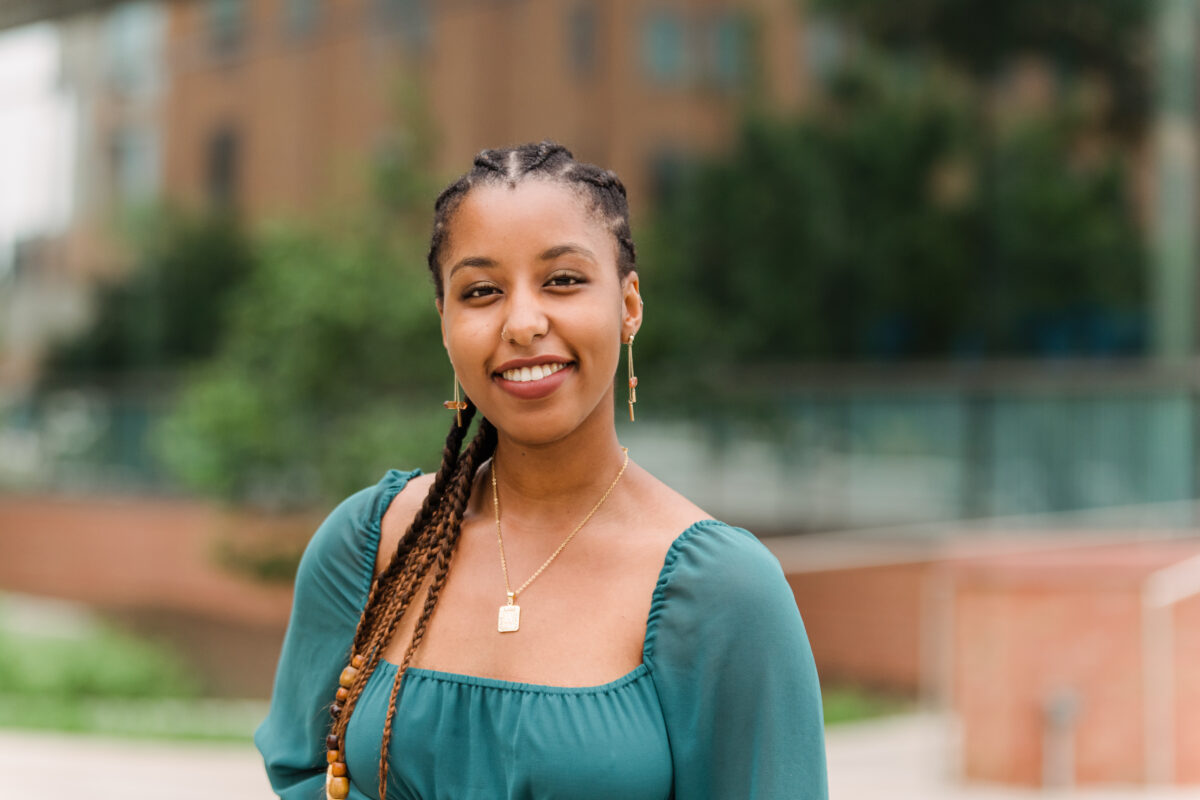 Chemutai Wangui Nganga. (Marlayna Demond ’11/UMBC)
Living in a diverse community, led Nganga to major in global studies at UMBC. She gained a greater understanding of the opportunities and conflicts of globalization and decided to focus on international politics and French. Her Asian studies courses increased her interest in Korean culture, which led her to pursue a Fulbright year in South Korea.
“For me, Korea is a full step into a new world,” says Nganga, who will be teaching English. “It is another chance to push the boundaries of my worldview as well as serve others.” She plans to explore a career path in foreign service on her return to the U.S.
Stellar research
As a burgeoning astrophysicist, Kaitlyn Szekerczes ’22, physics, lives and breathes for exploring the infinite universe. She didn’t know that all those nights stargazing on her deck with her dad and discussing the plausibility of science fiction shows would lead her to pursue a career in space science research.
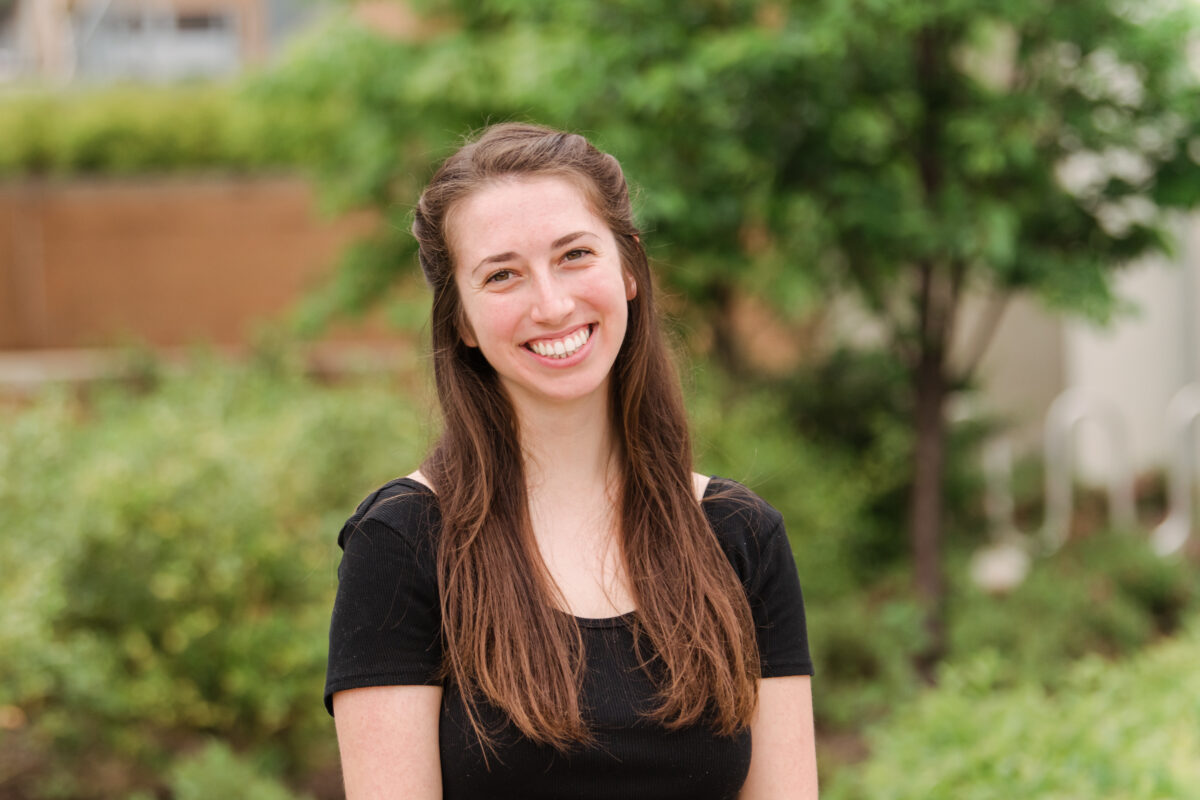 Kaitlyn Szekerczes. (Marlayna Demond ’11/UMBC)
“I was always fascinated by the questions we were not able to answer. We are not even close to knowing nearly everything when it comes to astronomy,” says Szekerczes. “My goal is to contribute to answering lesser-known big and challenging research questions.”
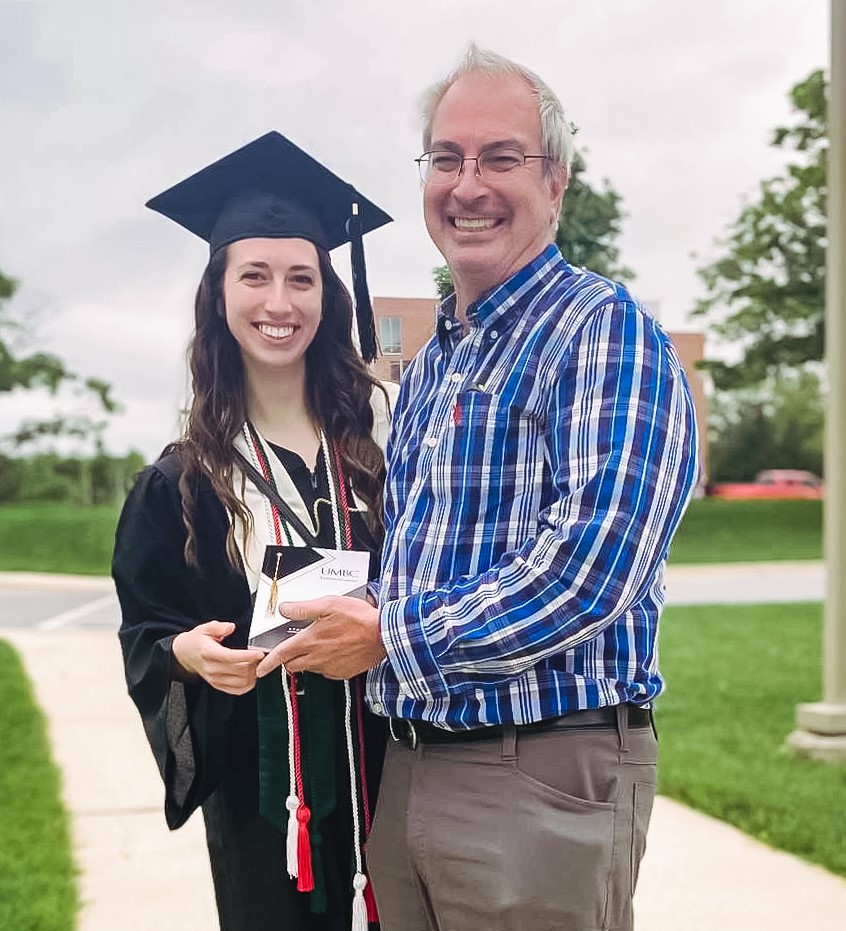 Szekerczes (l) with her dad.
(Image courtesy of Szekerczes)
Szekerczes will lead a project on gravitational lensing of tidal disruption events at the Max-Planck Institute for Astrophysics in Garching, Germany. It will be the first study to apply the technique of gravitational lensing—the bending of light by gravity—to researching tidal disruption events, which are events that happen when a supermassive black hole tidally disrupts a star.
“My dream job is to work as an astrophysicist for NASA,” says Szekerczes. “UMBC was the perfect fit for me because I was encouraged to pursue my passion for tackling challenging unanswered questions. I was also given the resources and support to piece together the puzzle of how to work towards my goals.”
After returning from Germany, Szekerczes will begin a Ph.D. program in astrophysics at Penn State University in fall 2023.
]]>
Eight recent UMBC graduates and alumni will soon travel to countries across three continents as 2022 Fulbright U.S. Student scholars. They include emerging leaders in education, astrophysics,...
https://umbc.edu/stories/umbc-2022-fulbright-student-scholars/
https://beta.my.umbc.edu/api/v0/pixel/news/125930/guest@my.umbc.edu/ba2dfd241a4dc3b3530386c46cc83d0a/api/pixel
anthropology
biology
cahss
cahssresearch
cnms
coeit
community
computer-engineering
cwit
education
globalstudies
history
international-stories
mathematics
mlli
news
physics
policy-and-society
research
saph
science-and-tech
shermanscholars
UMBC News & Magazine
https://beta.my.umbc.edu/groups/umbc-news-magazine
https://assets1-beta.my.umbc.edu/system/shared/avatars/groups/000/001/943/24435aa6207c452e7bc15cc74b42c7bb/xsmall.png?1748556657
https://assets1-beta.my.umbc.edu/system/shared/avatars/groups/000/001/943/24435aa6207c452e7bc15cc74b42c7bb/original.png?1748556657
https://assets2-beta.my.umbc.edu/system/shared/avatars/groups/000/001/943/24435aa6207c452e7bc15cc74b42c7bb/xxlarge.png?1748556657
https://assets2-beta.my.umbc.edu/system/shared/avatars/groups/000/001/943/24435aa6207c452e7bc15cc74b42c7bb/xlarge.png?1748556657
https://assets3-beta.my.umbc.edu/system/shared/avatars/groups/000/001/943/24435aa6207c452e7bc15cc74b42c7bb/large.png?1748556657
https://assets1-beta.my.umbc.edu/system/shared/avatars/groups/000/001/943/24435aa6207c452e7bc15cc74b42c7bb/medium.png?1748556657
https://assets2-beta.my.umbc.edu/system/shared/avatars/groups/000/001/943/24435aa6207c452e7bc15cc74b42c7bb/small.png?1748556657
https://assets1-beta.my.umbc.edu/system/shared/avatars/groups/000/001/943/24435aa6207c452e7bc15cc74b42c7bb/xsmall.png?1748556657
https://assets2-beta.my.umbc.edu/system/shared/avatars/groups/000/001/943/24435aa6207c452e7bc15cc74b42c7bb/xxsmall.png?1748556657
UMBC News & Magazine
0
0
false
Thu, 16 Jun 2022 15:23:06 -0400
Thu, 16 Jun 2022 15:23:06 -0400
A Season of Change for the CADVC

For more than 30 years, Symmes Gardner has worked with the Center for Art, Design and Visual Culture (CADVC) at UMBC, and in that time helped transform the gallery into an internationally-recognized hub for art, research, and technology on the UMBC campus.
Gardner retires this month having hosted historic retrospectives of artists like Adrian Piper, Kate Millett, and Fred Wilson, while simultaneously supporting annual student and faculty exhibitions. Notably, every major CADVC exhibition has been accompanied by a catalog designed in collaboration with Visual Arts faculty. A majority of these catalogs remain available through the CADVC website.
Rebecca Uchill, who has served as director of community engagement initiatives at the College of Visual and Performing Arts at UMass Dartmouth, will begin as director of CADVC on July 1, bringing with her a commitment to carry on CADVC’s tradition of exceptional art and engagement.
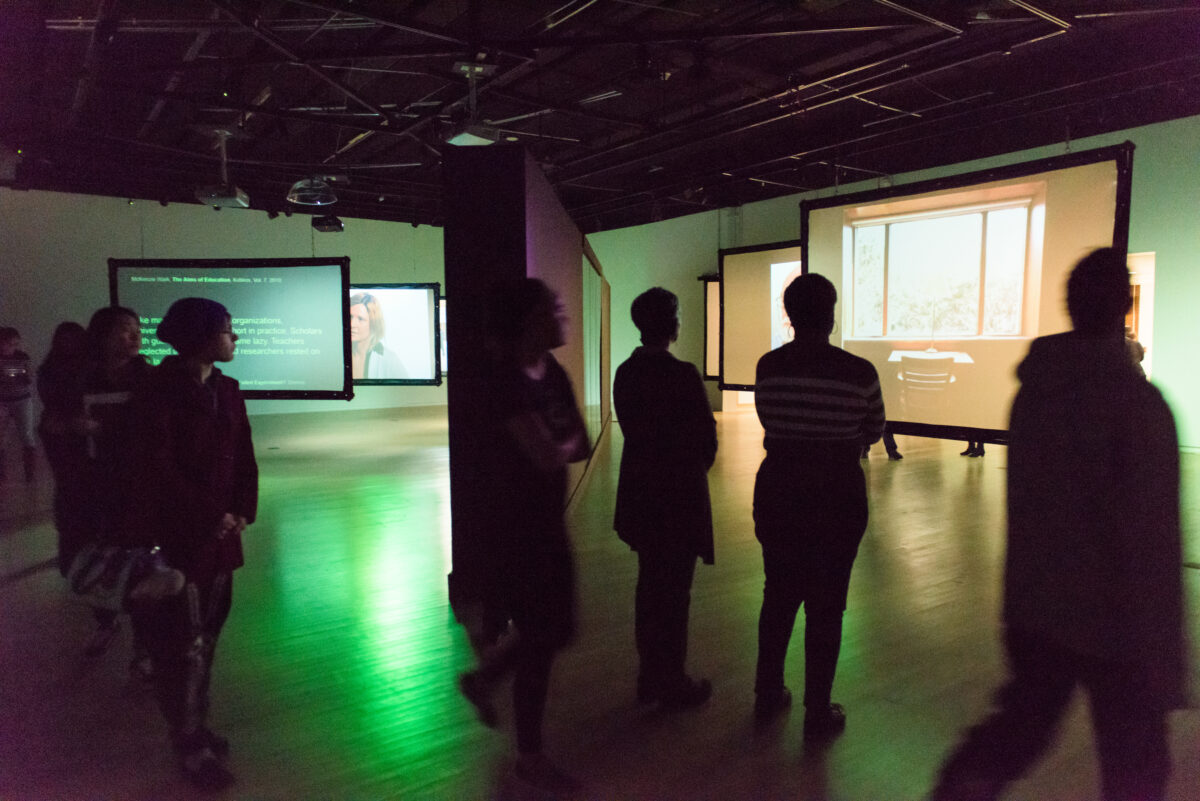 Guests enjoy the Antoni Muntadas — Activating Artifacts: About Academia exhibit in 2017. (Marlayna Demond ’11/UMBC)
Putting the CADVC on the map
Gardner’s tenure with the CADVC began in 1989, and he took over directorial responsibilities after founding director David Yager left for a position at UC Santa Cruz.
“I feel really fortunate and lucky,” Gardner says. “We had had a good team from the beginning, and were allowed a fair degree of autonomy to investigate and grow.”
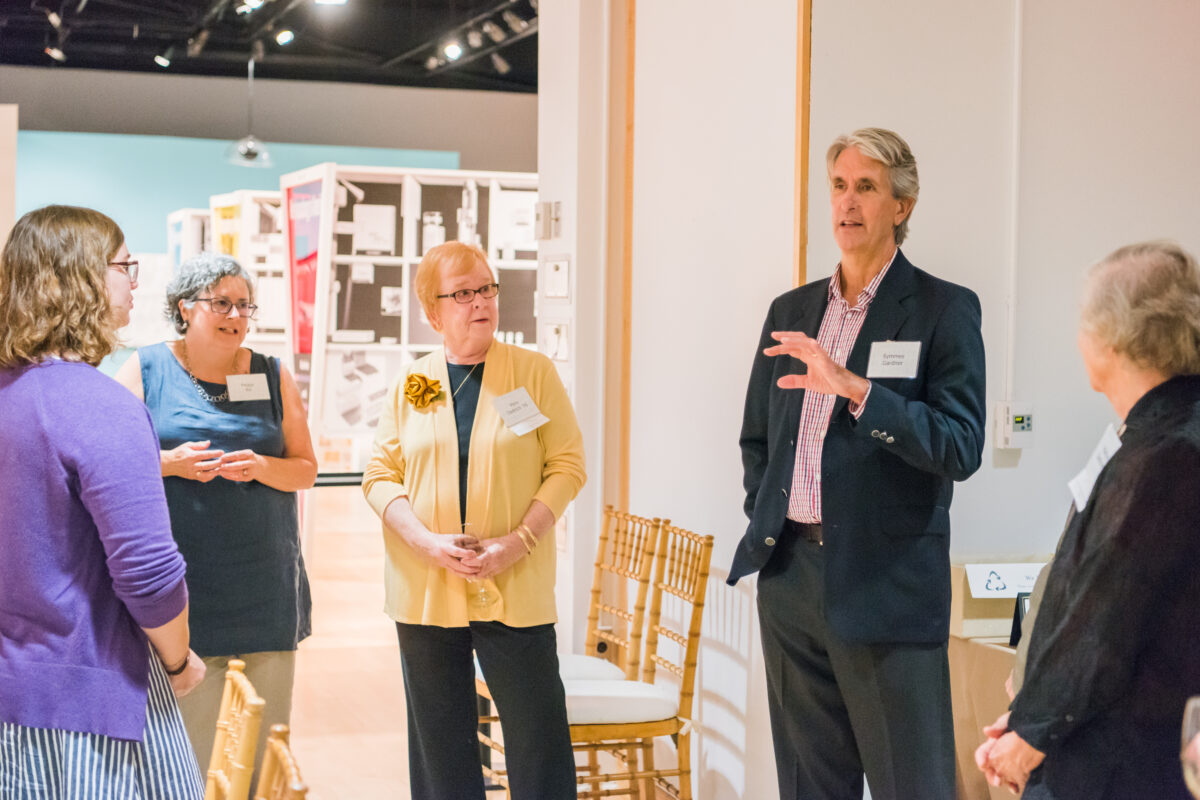 Symmes Gardner, center right, outgoing director of CADVC, shares a behind-the scenes look at an exhibit with UMBC alumni. (Marlayna Demond ’11/UMBC)
Gardner’s team included the curatorial contributions of Maurice Berger, the influential art historian whose work radically advanced the dialogue about the ways museums and archives dealt with race prior to his death in March 2020. Berger’s numerous contributions to the CADVC included curating For All The World To See: Visual Culture and the Struggle for Civil Rights, which came to the CADVC in 2012-2013 after opening at the Smithsonian, and later traveled around the United States. This legendary exhibition remains available to view via the CADVC website.
“Maurice really challenged us to bring together traveling exhibitions that were incredibly timely,” says Gardner. “That really helped the CADVC and put us on the map, and the university allowed us to conduct ourselves like we’re in a laboratory.”
Under Gardner’s guidance, the CADVC also expanded its reach beyond its gallery walls, including numerous touring exhibitions as well as the Joseph Beuys Sculpture Park, created in 2001 as a tribute to Beuys’ 7000 Oaks project on the south side of the UMBC campus.
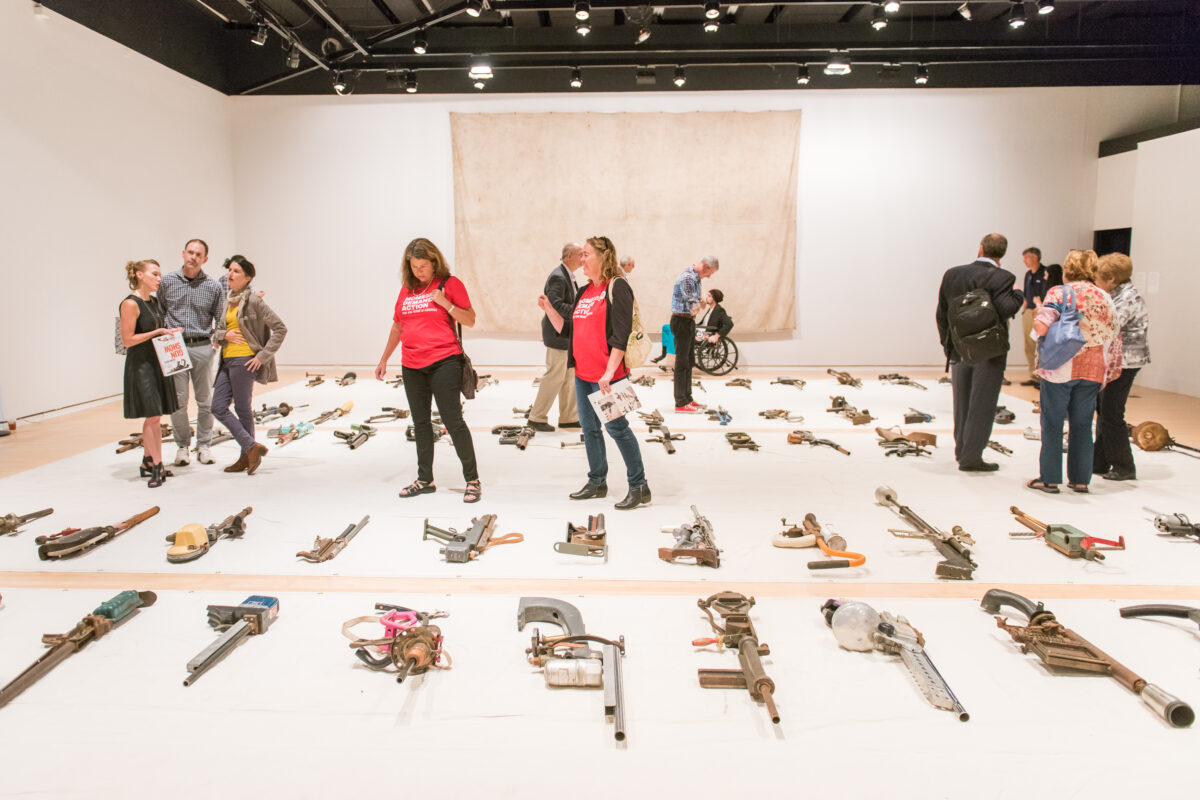 At 2017’s Gun Show, artist David Hess presented dozens of life-size sculptures of assault rifles made from what he calls “rescued” objects – ranging from an old black sneaker and vintage turquoise sewing machine, to a raggedy crutch and pink Barbie bike frame – to foster dialogue around gun violence.
Room to grow
Gardner’s departure leaves the CADVC’s legacy in good hands. Rebecca Uchill, an art historian and curator who most recently served as director of community engagement initiatives at UMass Dartmouth, arrives this summer ready to build on an already impressive career.
Last year at UMass Dartmouth, Uchill curated a celebration of the life and work of renowned multimedia artist Nancy Holt, complete with the first posthumous presentation of Holt’s 1982 immersive work Electrical System in the United States and presenting new research into Holt’s 1991 public sculpture Spinwinder.
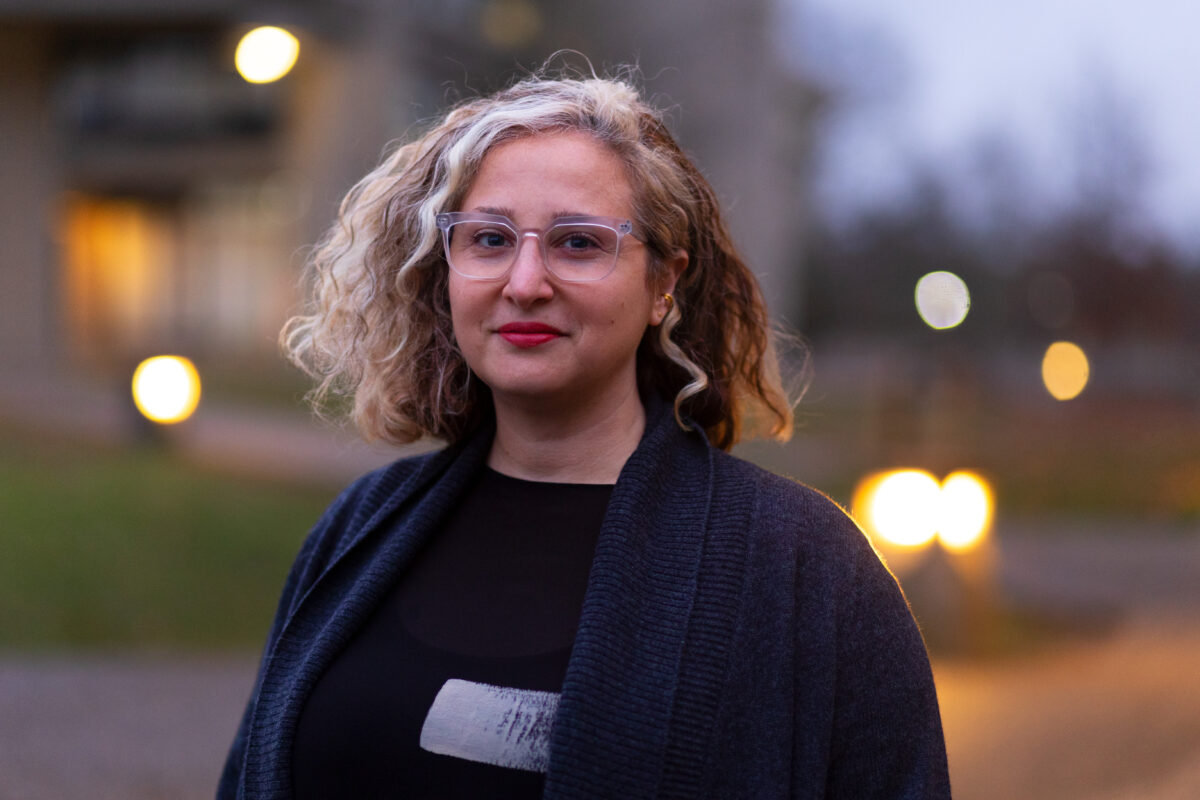 Rebecca Uchill (Courtesy of Uchill)
To recreate Holt’s elaborate Electrical System, the Nancy Holt: Massachusetts team included electrical engineering students who took on the project as a capstone project, bending conduit to showcase the infrastructure of electricity via Holt’s darkened gallery environment.
Uchill worked with the National Park Service in revitalizing Holt’s Spinwindersculpture on the UMass Dartmouth campus through a new tour that connected Holt’s legacy with the Massachusetts textile industry.
“I am interested in what the public presentation of art and visual culture can mean to a university campus environment,” says Uchill. “I think it’s an important part of any academic, interdisciplinary, social, community minded public-facing discussion that work is accessible for a broader general public.”
Previously, Uchill was a Mellon Postdoctoral Fellow with the Center for Art, Science & Technology (CAST) at MIT, where she co-edited two publications: Experience: Culture, Cognition, and the Common Sense (2016) and Being Material (2019).
Uchill has curated exhibitions at Harvard University, the Indianapolis Museum of Art, and MASS MoCA. Her publication CV includes serving as editor of Art Journal Open, as well as scholarly publications in Architectural Theory Review, Journal of Art Historiography, and Journal of Curatorial Studies.
“UMBC is a cool, nerdy place, and I really thrive in that kind of environment,” says Uchill. “CADVC is part of that culture, and builds on that research-centered mission, which excites me. I wouldn’t be in the business of working in the arts if I didn’t think that they were the most important tools for reflecting on and understanding what’s happening in the world.”
Learn more about upcoming events at CADVC here.
]]>
For more than 30 years, Symmes Gardner has worked with the Center for Art, Design and Visual Culture (CADVC) at UMBC, and in that time helped transform the gallery into an...
https://umbc.edu/stories/a-season-of-change-for-cadvc/
https://beta.my.umbc.edu/api/v0/pixel/news/125911/guest@my.umbc.edu/26853c71eff3117ef2d4f54f14bee744/api/pixel
arts-calendar
cadvc
discovery
magazine
UMBC News & Magazine
https://beta.my.umbc.edu/groups/umbc-news-magazine
https://assets1-beta.my.umbc.edu/system/shared/avatars/groups/000/001/943/24435aa6207c452e7bc15cc74b42c7bb/xsmall.png?1748556657
https://assets1-beta.my.umbc.edu/system/shared/avatars/groups/000/001/943/24435aa6207c452e7bc15cc74b42c7bb/original.png?1748556657
https://assets2-beta.my.umbc.edu/system/shared/avatars/groups/000/001/943/24435aa6207c452e7bc15cc74b42c7bb/xxlarge.png?1748556657
https://assets2-beta.my.umbc.edu/system/shared/avatars/groups/000/001/943/24435aa6207c452e7bc15cc74b42c7bb/xlarge.png?1748556657
https://assets3-beta.my.umbc.edu/system/shared/avatars/groups/000/001/943/24435aa6207c452e7bc15cc74b42c7bb/large.png?1748556657
https://assets1-beta.my.umbc.edu/system/shared/avatars/groups/000/001/943/24435aa6207c452e7bc15cc74b42c7bb/medium.png?1748556657
https://assets2-beta.my.umbc.edu/system/shared/avatars/groups/000/001/943/24435aa6207c452e7bc15cc74b42c7bb/small.png?1748556657
https://assets1-beta.my.umbc.edu/system/shared/avatars/groups/000/001/943/24435aa6207c452e7bc15cc74b42c7bb/xsmall.png?1748556657
https://assets2-beta.my.umbc.edu/system/shared/avatars/groups/000/001/943/24435aa6207c452e7bc15cc74b42c7bb/xxsmall.png?1748556657
UMBC News & Magazine
0
0
false
Wed, 15 Jun 2022 14:21:34 -0400
Wed, 15 Jun 2022 14:21:34 -0400
Simons Foundation provides $2.5M to support UMBC Meyerhoff Scholars, plans New York replication

The Simons Foundation and its sister organization, Simons Foundation International, have pledged $2.5 million over five years to support the Meyerhoff Scholars Program. Continued partnership between UMBC and Simons will also generate opportunities for program alumni and support Meyerhoff replication efforts at other institutions.
For almost 30 years, the Simons Foundation has worked to support advances in mathematics and basic science by funding external scientists and, more recently, through research at its own Flatiron Institute in New York City. Simons has also done outreach work through the Math for America program, which seeks to enhance the math and science literacy of children in New York City public schools. The gift to UMBC, however, represents a new emphasis on supporting the development of a diverse pipeline of STEM professionals.
Partnering to diversify STEM
“I have long admired the UMBC Meyerhoff program for its significant impact on training outstanding students from diverse backgrounds. It is an important model for other universities, and its alumni are at the forefront of scientific research,” says David Spergel, president of the Simons Foundation and Simons Foundation International. “I am proud that the Simons Foundation and Simons Foundation International can partner with UMBC through support of this program.”
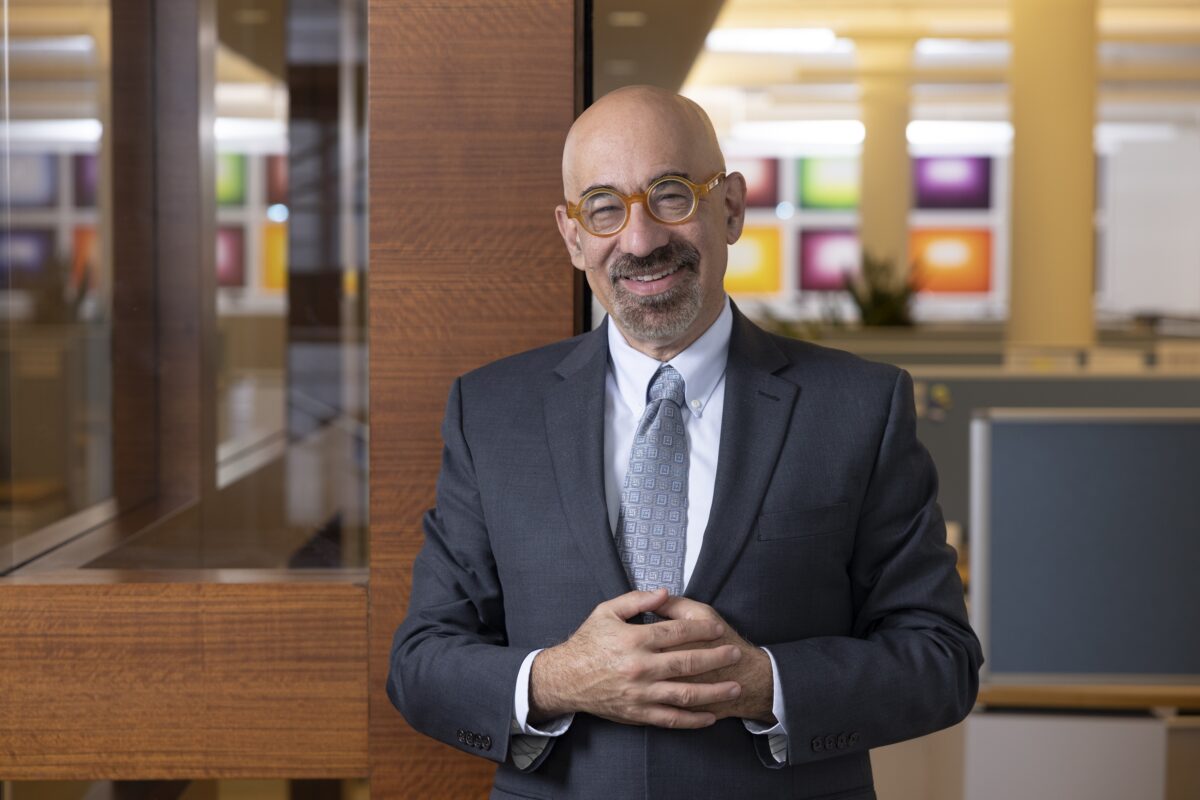 David Spergel, president of Simons Foundation and Simons Foundation International and a longtime admirer of President Hrabowski and the Meyerhoff Scholars Program (courtesy of Simons Foundation)
Craig Wesley, manager of diversity, equity, and inclusion at the Simons Foundation, has also been following President Freeman Hrabowski’s work for years. When Wesley started in his role a little over a year ago, he undertook a study to see what programs existed that were already successfully helping diversify the STEM pipeline. The Meyerhoff Scholars program jumped out as a leader in that space.
“The vision became, how could we replicate that model here in the New York area?” Wesley says. “We needed to find the right institutional partner to launch this work.” As it turned out, UMBC was the perfect fit.
Immediate impact
The new partnership will also create summer research opportunities for Meyerhoff Scholars at the Flatiron Institute. Naiyah Lewis ’23, M31, computer science,is already in New York for a summer internship with Natalie Sauerwald, a Flatiron Research Fellow with a focus on computational techniques in genomics.
This new grant will support scholarships for Meyerhoff Scholars and serve as a dedicated funding source for Summer Bridge, a cornerstone of the Meyerhoff experience undertaken by Scholars before their first year at UMBC. During Summer Bridge, Scholars bond as a community and internalize what it means to be a Meyerhoff Scholar. This includes the values of collaboration, leadership, service, professionalism, and academic excellence—alongside hard work and grit.
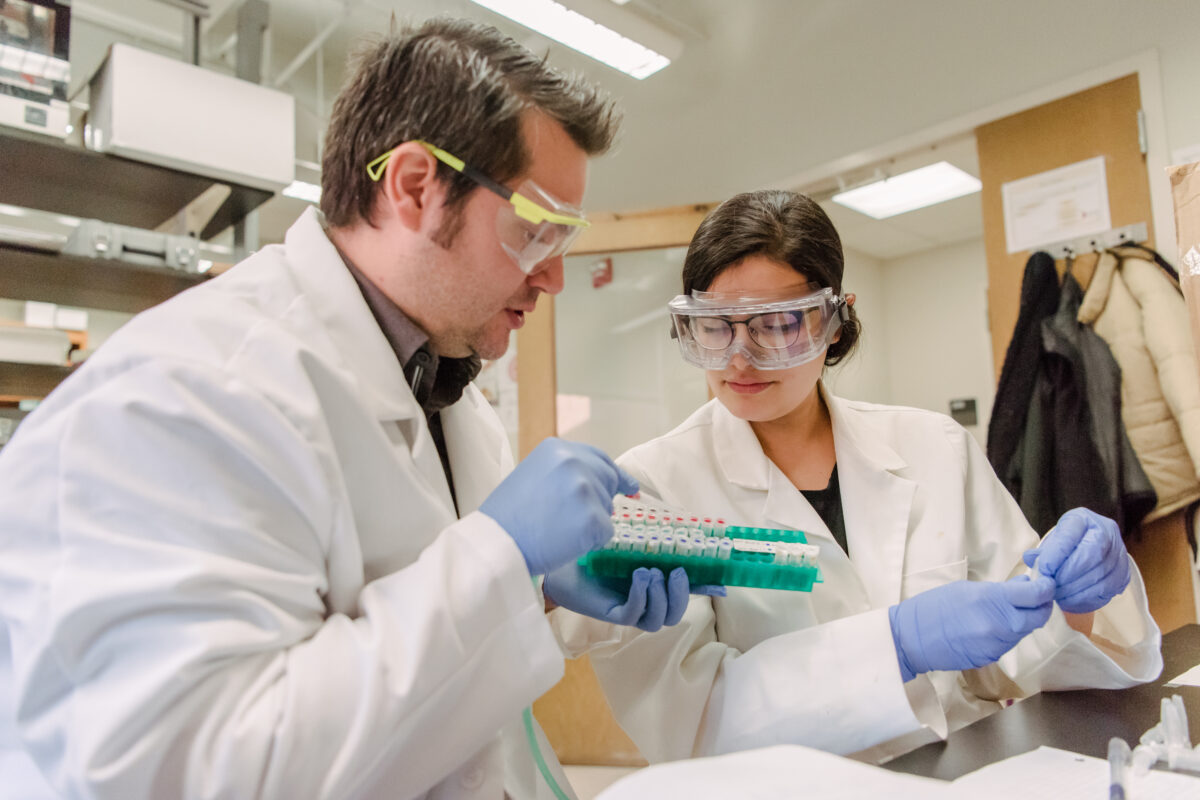 Abby Cruz ’18, biological sciences, a Meyerhoff affiliate and MARC U*STAR Scholar, conducts research with Fernando Vonhoff. (Marlayna Demond ’11/UMBC)
Meyerhoff alumni will also benefit. They will be invited to apply for Transition to Independence Awards through the Simons Collaboration on the Global Brain and the Simons Collaboration on Plasticity and the Aging Brain. These large awards target Ph.D. and M.D./Ph.D. scientists from underrepresented groups who are currently in training positions and seeking tenure-track roles. Postdoctoral positions may also be available for Meyerhoff Scholar alumni at the Flatiron Institute.
“UMBC and Meyerhoff are excited to partner with the Simons Foundation in advancing our efforts to promote inclusive excellence and diversify the nation’s STEM workforce,” says Keith Harmon, director of the Meyerhoff Scholars Program.
Ripple effect—amplified
In addition to helping individual students and alumni, the growing partnership between UMBC and Simons will also advance a larger, shared goal of both institutions: launching more programs modeled on the Meyerhoff Scholars. UMBC staff and faculty involved with Meyerhoff will work with SUNY Stony Brook to create a Meyerhoff-like program within the public university system in New York.
“We are committed to helping increase the diversity of the STEM workforce,” Spergel says. “We see our collaboration with UMBC as key to helping us reach that goal through partnerships, in part by helping to adapt the Meyerhoff model at Stony Brook.”
As the partnership between UMBC and the Simons Foundation develops, the institutions hope their collaborative work will amplify the ripple effect already occurring across the country as Meyerhoff alumni advance in their careers. As more students get to experience the support offered by Meyerhoff and programs like it, they, too, will join the ranks of these alumni and make their own impact.
]]>
The Simons Foundation and its sister organization, Simons Foundation International, have pledged $2.5 million over five years to support the Meyerhoff Scholars Program. Continued partnership...
https://umbc.edu/stories/simons-fdn-provides-2-5m-to-meyerhoff-scholars/
https://beta.my.umbc.edu/api/v0/pixel/news/125859/guest@my.umbc.edu/51ec2fe4de20e0d4c400dd9e5dadf18f/api/pixel
community
diversityandinclusion
meyerhoffscholars
science-and-tech
uncategorized
UMBC News & Magazine
https://beta.my.umbc.edu/groups/umbc-news-magazine
https://assets1-beta.my.umbc.edu/system/shared/avatars/groups/000/001/943/24435aa6207c452e7bc15cc74b42c7bb/xsmall.png?1748556657
https://assets1-beta.my.umbc.edu/system/shared/avatars/groups/000/001/943/24435aa6207c452e7bc15cc74b42c7bb/original.png?1748556657
https://assets2-beta.my.umbc.edu/system/shared/avatars/groups/000/001/943/24435aa6207c452e7bc15cc74b42c7bb/xxlarge.png?1748556657
https://assets2-beta.my.umbc.edu/system/shared/avatars/groups/000/001/943/24435aa6207c452e7bc15cc74b42c7bb/xlarge.png?1748556657
https://assets3-beta.my.umbc.edu/system/shared/avatars/groups/000/001/943/24435aa6207c452e7bc15cc74b42c7bb/large.png?1748556657
https://assets1-beta.my.umbc.edu/system/shared/avatars/groups/000/001/943/24435aa6207c452e7bc15cc74b42c7bb/medium.png?1748556657
https://assets2-beta.my.umbc.edu/system/shared/avatars/groups/000/001/943/24435aa6207c452e7bc15cc74b42c7bb/small.png?1748556657
https://assets1-beta.my.umbc.edu/system/shared/avatars/groups/000/001/943/24435aa6207c452e7bc15cc74b42c7bb/xsmall.png?1748556657
https://assets2-beta.my.umbc.edu/system/shared/avatars/groups/000/001/943/24435aa6207c452e7bc15cc74b42c7bb/xxsmall.png?1748556657
UMBC News & Magazine
0
0
false
Fri, 10 Jun 2022 16:19:43 -0400
Fri, 10 Jun 2022 16:19:43 -0400
Creating new antiviral drugs: Katherine Seley-Radtke’s innovative “fleximer” research to receive $3.5M from NIH

The National Institute of Allergy and Infectious Diseases, part of the National Institutes of Health, recently awarded nine research consortia a total of $577 million to create Antiviral Drug Discovery (AViDD) Centers for Pathogens of Pandemic Concern. UMBC’s Katherine Seley-Radtke, professor of chemistry and biochemistry, is contributing her innovative work on more flexible antiviral compounds to this effort.
Seley-Radtke is a member of the consortium led by University of North Carolina—Chapel Hill, which will receive a total of $65 million over five years to work on five separate projects. UMBC is guaranteed $2.2 million for the first three years, with another $1.3 million to come for the final two years if the projects are making satisfactory progress.
The unique consortium structure includes an international, interdisciplinary team of academic researchers in virology, immunology, chemistry, and biology, and corporate partners. Their goals are ambitious, with increased urgency due to the COVID-19 pandemic.
“Many people in the antiviral field had been pushing for many years, warning people that this kind of viral pandemic could happen,” says Seley-Radtke, who is also president of the International Society for Antiviral Research. “We have to be better prepared. And that’s the point of the AViDD program—to quickly get us to the point where we have broad spectrum, small molecule antivirals that can be stockpiled, can be orally administered, and can be shipped to every corner of the Earth.”
Flexible fighters
Seley-Radtke is in a strong position to contribute to the development of compounds that can fight a wide range of viruses. She first invented compounds called fleximers in 2000. Fleximers are modified forms of an established class of antiviral drugs called nucleoside analogues—with a very useful twist.
“The thing that’s clever about the fleximers, is because they’re flexible, they can adjust to a binding site to obtain better binding than a normal rigid nucleoside analogue would,” Seley-Radtke says. That means they can be more effective against a virus that has accumulated some mutations, or even against different viruses that have similar, but not identical, structures.
For example, acyclovir is an antiviral drug used against herpes. Acyclovir itself isn’t effective against any viruses of pandemic concern, but a fleximer based on its basic structure “shows incredible activity” against several viruses of interest, Seley-Radtke says. A drug that can target multiple viruses is exactly the kind of “broad spectrum” treatment researchers are seeking.
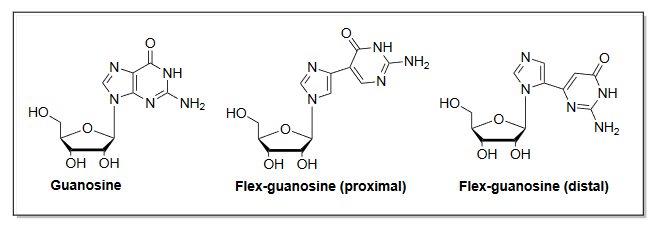 An example of fleximers. Guanosine (left) is the traditional nucleoside analogue, and the two structures on the right are fleximers. The fleximers’ structure allows them to wrap around other compounds and bind more tightly. (Image courtesy of Seley-Radtke)
Beyond generating a single drug that can tackle multiple viral threats, the consortium is also working toward combination therapies. In these treatments, multiple drugs are packaged together, as is common for HIV medications.
“Combination therapy is critical,” Seley-Radtke says. Because these therapies attack several parts of a virus at once, she explains, they can “exponentially cut down the chances of the virus developing resistance to the treatment. That’s why we’re looking for not just one broad spectrum inhibitor, but a combination of things that can be used together to fight whatever rears its ugly head.”
Katherine Seley-Radtke discusses her research at UMBC’s annual TED-style GRIT-X talks in 2021.
Fast-tracked progress
The structure of the consortium makes it uniquely suited to address the team’s goals efficiently. Having academic researchers and industry partners working together “will facilitate things moving much faster than the normal process,” Seley-Radtke says. “There’s a workflow.”
Her lab will “decide what the target’s going to be. Then we design the compounds, we make the compounds, and then we send them off to the next lab to be tested for activity” against viruses of interest, she explains.
If the initial testing detects any winners, another consortium partner will produce the compounds at scale so they can run more tests. If after that the compounds are still showing promise, they’ll be sent on to clinical trials through the pharmaceutical company partners. It all happens in a coordinated, pre-planned sequence.
“I’m really grateful to be able to participate in such high-impact work,” Seley-Radtke says. “It’s an amazing opportunity and it’s a brilliant concept.”
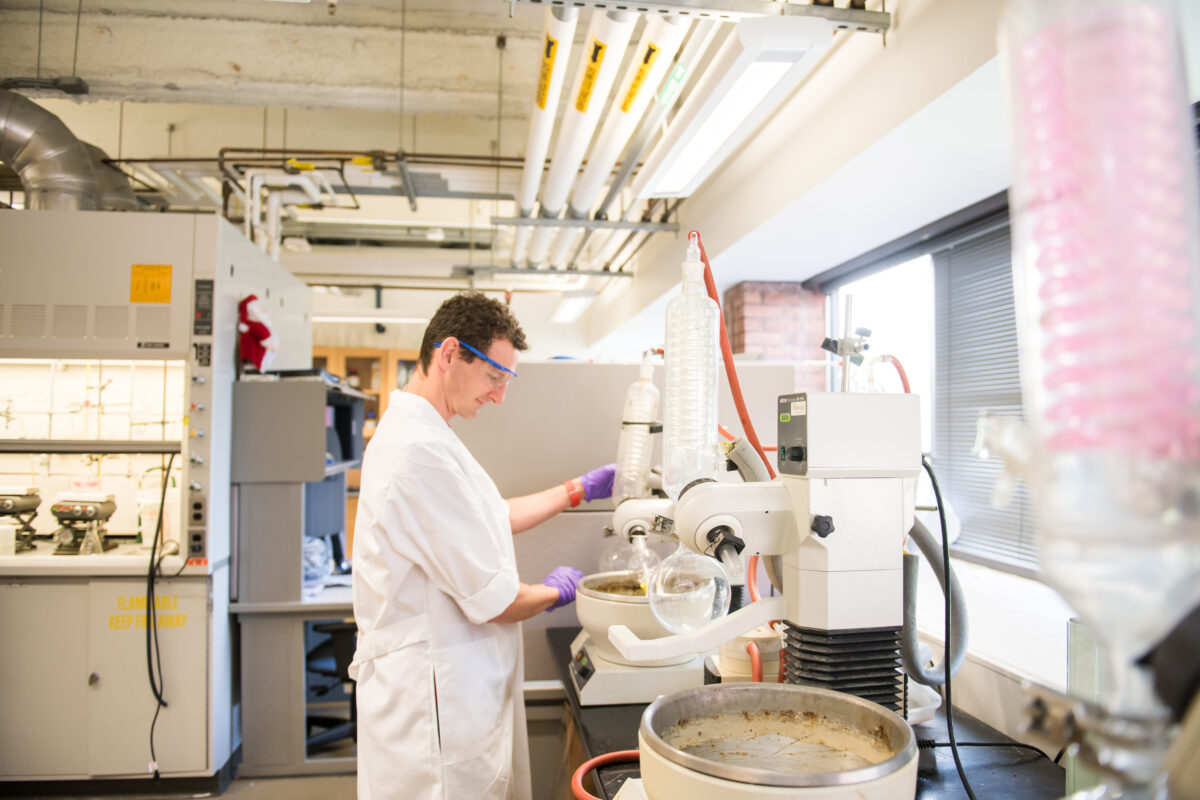 A student conducts research in Seley-Radtke’s laboratory. (Marlayna Demond ’11/UMBC)
Proactive approach
Seley-Radtke will work on two of the five projects in the consortium. One will focus on SARS-Cov2, dengue fever, and other viruses in the flavivirus family. These RNA viruses are most often spread by ticks and mosquitoes. Another project focuses on filoviruses, which include diseases like Ebola and Marburg virus disease, known for causing severe hemorrhagic fevers.
The members of the different projects will meet with each other and with NIH regularly to gauge progress and keep everyone on track. The goal is to develop individual drugs with activity against many viruses, and combination therapies, quickly.
“It is definitely within reach, and not just with my compounds,” Seley-Radtke says. “The AViDD centers are a fantastic effort. I applaud NIH for putting the money into this program and recognizing we’ve got to stop being reactive and be proactive.”
]]>
The National Institute of Allergy and Infectious Diseases, part of the National Institutes of Health, recently awarded nine research consortia a total of $577 million to create Antiviral Drug...
https://umbc.edu/stories/antiviral-research-receives-3-5m-from-nih/
https://beta.my.umbc.edu/api/v0/pixel/news/125856/guest@my.umbc.edu/9a5f5ef8aa630dbfe7bb01332f660bf2/api/pixel
chembiochem
chemistry
cnms
news
research
science-and-tech
UMBC News & Magazine
https://beta.my.umbc.edu/groups/umbc-news-magazine
https://assets1-beta.my.umbc.edu/system/shared/avatars/groups/000/001/943/24435aa6207c452e7bc15cc74b42c7bb/xsmall.png?1748556657
https://assets1-beta.my.umbc.edu/system/shared/avatars/groups/000/001/943/24435aa6207c452e7bc15cc74b42c7bb/original.png?1748556657
https://assets2-beta.my.umbc.edu/system/shared/avatars/groups/000/001/943/24435aa6207c452e7bc15cc74b42c7bb/xxlarge.png?1748556657
https://assets2-beta.my.umbc.edu/system/shared/avatars/groups/000/001/943/24435aa6207c452e7bc15cc74b42c7bb/xlarge.png?1748556657
https://assets3-beta.my.umbc.edu/system/shared/avatars/groups/000/001/943/24435aa6207c452e7bc15cc74b42c7bb/large.png?1748556657
https://assets1-beta.my.umbc.edu/system/shared/avatars/groups/000/001/943/24435aa6207c452e7bc15cc74b42c7bb/medium.png?1748556657
https://assets2-beta.my.umbc.edu/system/shared/avatars/groups/000/001/943/24435aa6207c452e7bc15cc74b42c7bb/small.png?1748556657
https://assets1-beta.my.umbc.edu/system/shared/avatars/groups/000/001/943/24435aa6207c452e7bc15cc74b42c7bb/xsmall.png?1748556657
https://assets2-beta.my.umbc.edu/system/shared/avatars/groups/000/001/943/24435aa6207c452e7bc15cc74b42c7bb/xxsmall.png?1748556657
UMBC News & Magazine
3
0
false
Fri, 10 Jun 2022 15:38:01 -0400
Fri, 10 Jun 2022 15:38:01 -0400
Global Ambassador applications closing soon!
Submit an application before June 10 at 5:00pm ET
Applications are now open for the 22-23 UMBC Global Ambassador Program!
UMBC Global Ambassadors help to create a welcoming and inclusive community for new and prospective UMBC international students as they join our community! The position is open to current international students who have completed at least 1 full semester at UMBC.
(must use UMBC email to access)
Applications close: June 10 at 5:00pm ET
]]>
Applications are now open for the 22-23 UMBC Global Ambassador Program! UMBC Global Ambassadors help to create a welcoming and inclusive community for new and prospective UMBC international...
https://beta.my.umbc.edu/api/v0/pixel/news/125834/guest@my.umbc.edu/727c14af84fca2bbc8594c86b514a61f/api/pixel
International Student and Scholar Services (ISSS)
https://beta.my.umbc.edu/groups/ies
https://assets4-beta.my.umbc.edu/system/shared/avatars/groups/000/000/431/46ad84ea8ba0baeed7c3faf29d1fd4ef/xsmall.png?1693323874
https://assets3-beta.my.umbc.edu/system/shared/avatars/groups/000/000/431/46ad84ea8ba0baeed7c3faf29d1fd4ef/original.jpeg?1693323874
https://assets1-beta.my.umbc.edu/system/shared/avatars/groups/000/000/431/46ad84ea8ba0baeed7c3faf29d1fd4ef/xxlarge.png?1693323874
https://assets1-beta.my.umbc.edu/system/shared/avatars/groups/000/000/431/46ad84ea8ba0baeed7c3faf29d1fd4ef/xlarge.png?1693323874
https://assets4-beta.my.umbc.edu/system/shared/avatars/groups/000/000/431/46ad84ea8ba0baeed7c3faf29d1fd4ef/large.png?1693323874
https://assets3-beta.my.umbc.edu/system/shared/avatars/groups/000/000/431/46ad84ea8ba0baeed7c3faf29d1fd4ef/medium.png?1693323874
https://assets1-beta.my.umbc.edu/system/shared/avatars/groups/000/000/431/46ad84ea8ba0baeed7c3faf29d1fd4ef/small.png?1693323874
https://assets4-beta.my.umbc.edu/system/shared/avatars/groups/000/000/431/46ad84ea8ba0baeed7c3faf29d1fd4ef/xsmall.png?1693323874
https://assets3-beta.my.umbc.edu/system/shared/avatars/groups/000/000/431/46ad84ea8ba0baeed7c3faf29d1fd4ef/xxsmall.png?1693323874
International Student and Scholar Services (ISSS)
https://assets1-beta.my.umbc.edu/system/shared/thumbnails/news/000/125/834/825d85fd6305bbca9bdebcdbcebc8a78/xxlarge.jpg?1654795852
https://assets1-beta.my.umbc.edu/system/shared/thumbnails/news/000/125/834/825d85fd6305bbca9bdebcdbcebc8a78/xlarge.jpg?1654795852
https://assets4-beta.my.umbc.edu/system/shared/thumbnails/news/000/125/834/825d85fd6305bbca9bdebcdbcebc8a78/large.jpg?1654795852
https://assets3-beta.my.umbc.edu/system/shared/thumbnails/news/000/125/834/825d85fd6305bbca9bdebcdbcebc8a78/medium.jpg?1654795852
https://assets1-beta.my.umbc.edu/system/shared/thumbnails/news/000/125/834/825d85fd6305bbca9bdebcdbcebc8a78/small.jpg?1654795852
https://assets1-beta.my.umbc.edu/system/shared/thumbnails/news/000/125/834/825d85fd6305bbca9bdebcdbcebc8a78/xsmall.jpg?1654795852
https://assets4-beta.my.umbc.edu/system/shared/thumbnails/news/000/125/834/825d85fd6305bbca9bdebcdbcebc8a78/xxsmall.jpg?1654795852
0
0
true
Thu, 09 Jun 2022 13:37:14 -0400
As global travel expands, UMBC faculty and staff earn Fulbright awards for research, collaboration abroad
Four UMBC faculty and staff members have received highly competitive Fulbright awards to conduct research and establish important connections around the world over the next year. UMBC’s new recipients of Fulbright U.S. Scholar awards are Shimei Pan, associate professor of information systems, and Corrie Parks, assistant professor of visual arts, and Tiffany Thames Copeland, adjunct faculty in Africana studies. Nancy Young, vice president for student affairs, has received a Fulbright International Education Administrators Award. They will travel to Germany, Austria, Ghana, and France, respectively.
They follow on the heels of Helena Mentis, professor of information systems, who will soon return from a Fulbright experience in Denmark, working with the University of Copenhagen’s Human-Centered Computing research group.
“The Fulbright U.S. Scholar Program sends up to 900 U.S. faculty members throughout the world to conduct research or teach their subject, as well as participate in cultural exchange during their time in their host countries,” explains Brian Souders, associate director of global engagement opportunities in UMBC’s Center for Global Engagement.
“UMBC has a long tradition of faculty receiving this prestigious award, with 14 UMBC scholars earning this award over the past decade,” he notes. “Receiving three of these awards and an administrators award in a single year is quite exciting.”
Eliminating bias, increasing fairness
Pan will spend six months at the Heidelberg Institute for Theoretical Studies and Heidelberg University in Germany. There she will conduct research related to natural language processing, which is a subfield of artificial intelligence (AI). Her research at UMBC focuses on developing natural language processing models trained on large amounts of text, including content from social media, and she is eager to collaborate with fellow researchers in Germany.
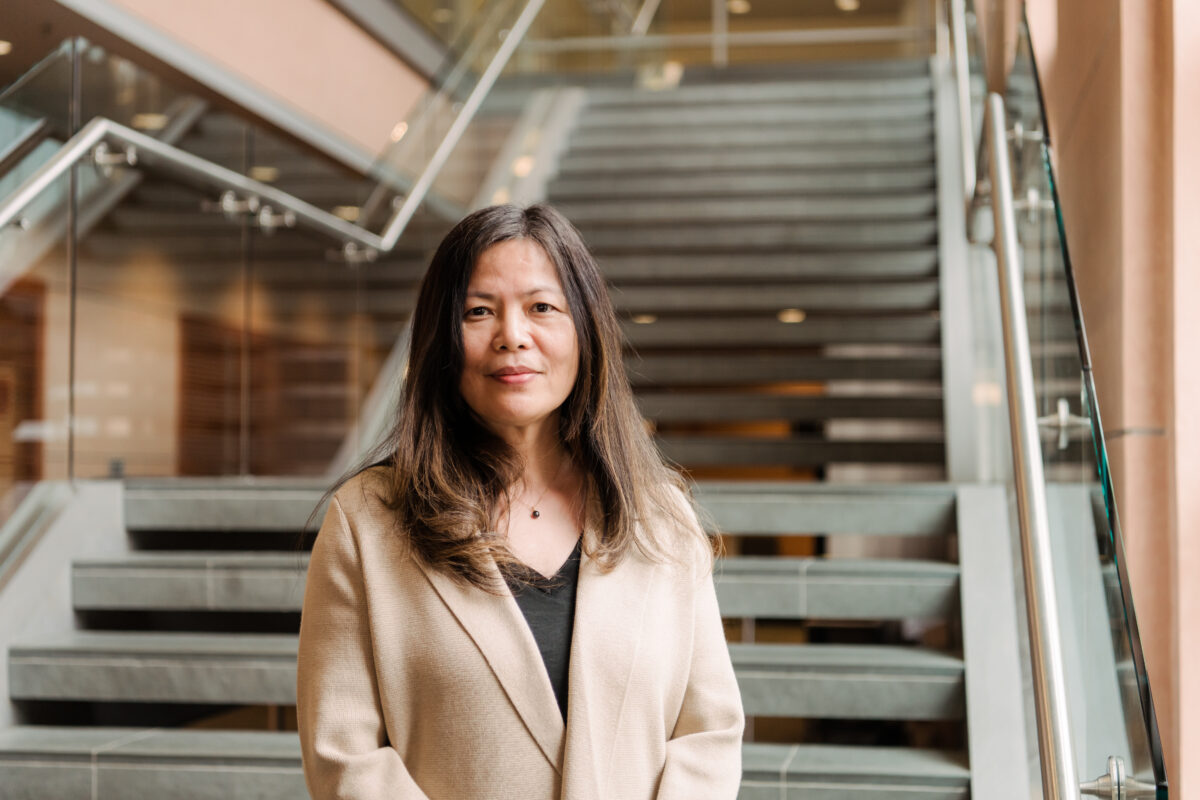 Shimei Pan. (Marlayna Demond ’11/UMBC)
“I’m excited about the project because it’s a continuation of my recent interests on responsible AI,” she says. “In the past we focused on making the technology more powerful and efficient, but for the last five years or so I’ve been working to address bias and increase fairness.”
“AI algorithms impact people’s daily lives,” says Pan, in explaining the importance of making these algorithms as equitable as possible. Because artificial intelligence technology is created by people and trained on human-produced data, it will inherit people’s biases. Pan is working to identify, assess, and mitigate various social biases encoded in large natural language processing models trained on massive text collections.
Focusing on the details
Parks will spend two months as an artist in residence at the Q21/MuseumsQuartier in Vienna. She will partner with ASIFA Austria, the International Animated Film Association in Vienna, to create an installation. She uses sand animation and other specialized animation techniques to explore broader themes. “My work examines small details and asks questions about the role of the individual in the collective or big picture,” addressing climate change and social issues, Parks explains.
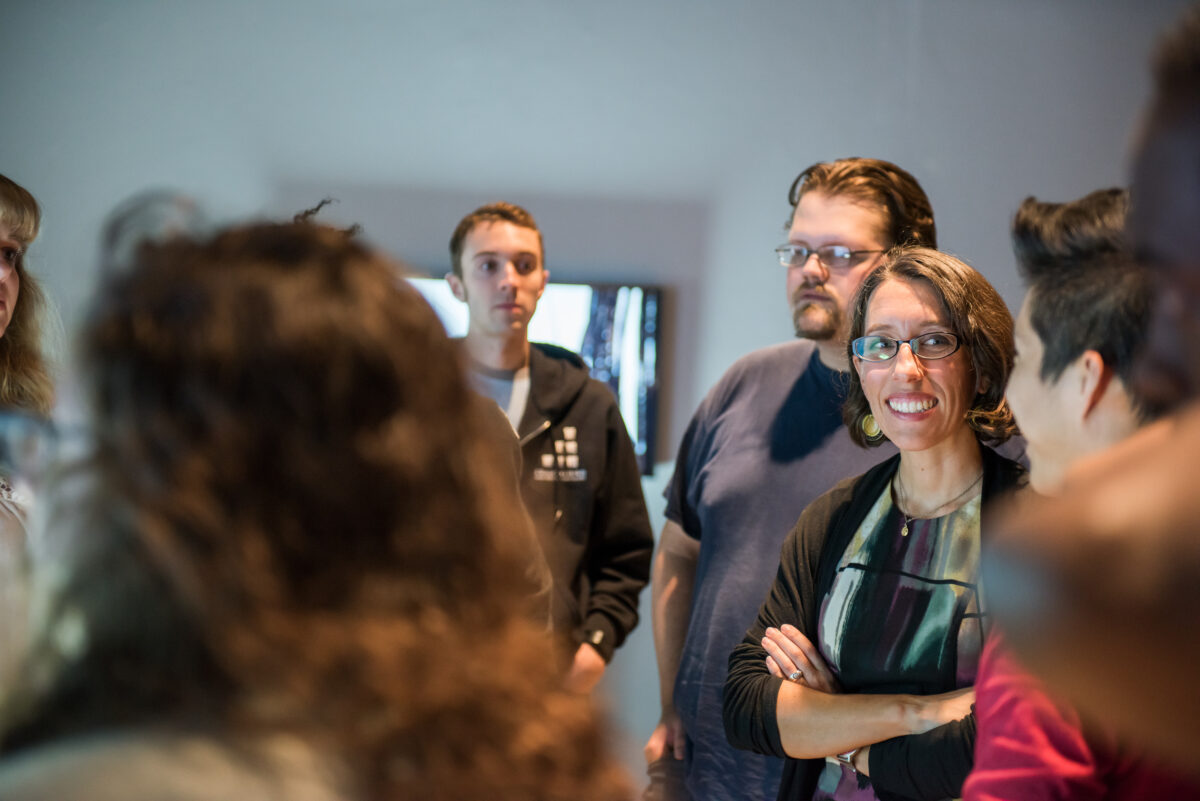 Corrie Parks, right, at a CADVC event. (Marlayna Demond ’11/UMBC)
This is not the first time that Parks has received a Fulbright award. She spent time in New Zealand when she was a student pursuing her master in fine arts degree. She sees these immersive artist residencies as unique opportunities to make significant “creative leaps,” focusing exclusively on her art.
During her time in Austria, Parks will create a work for a public installation space in the center of a building that is both old and contemporary. While she will create her installation independently, she will work with collaborators on coding interactive and visualization elements of the work.
Cultural exchange, diaspora research
Thames Copeland will complete her Fulbright award in Ghana where she will study the experiences and impacts of people in the African Diaspora “returning” to Ghana in the last century. “I am humbled to receive this Fulbright U.S. Scholars award to Ghana for the 2022-2023 academic year,” she says. “I am looking forward to the cultural exchange experience and investigating the Back to Africa Movement of the 21st century, as I research how the African Diaspora ‘returnees’ to Ghana continue in the fight for liberation.”
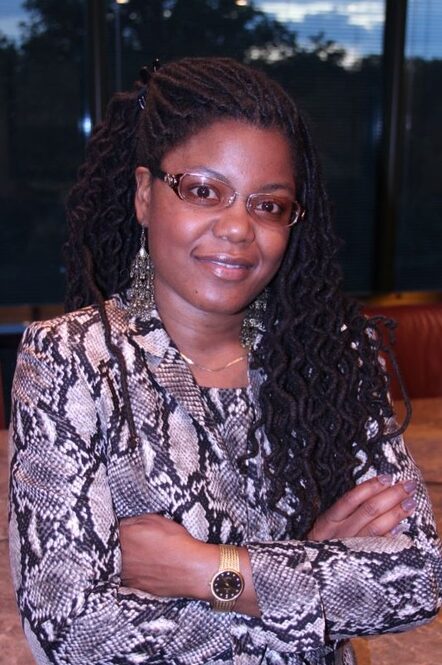 Tiffany Thames Copeland. (Image courtesy of Thames Copeland)
She has been an adjunct faculty member in the Africana studies department at UMBC since January 2021.
Seeing the world differently
Young is part of the first group selected for the Fulbright International Education Administrators program since the COVID-19 pandemic began. She was named a finalist before the pandemic and, now that the program has resumed, she will be one of twelve U.S. administrators from across the country to spend two weeks in France, connecting with contacts in French higher education, government, and administration.
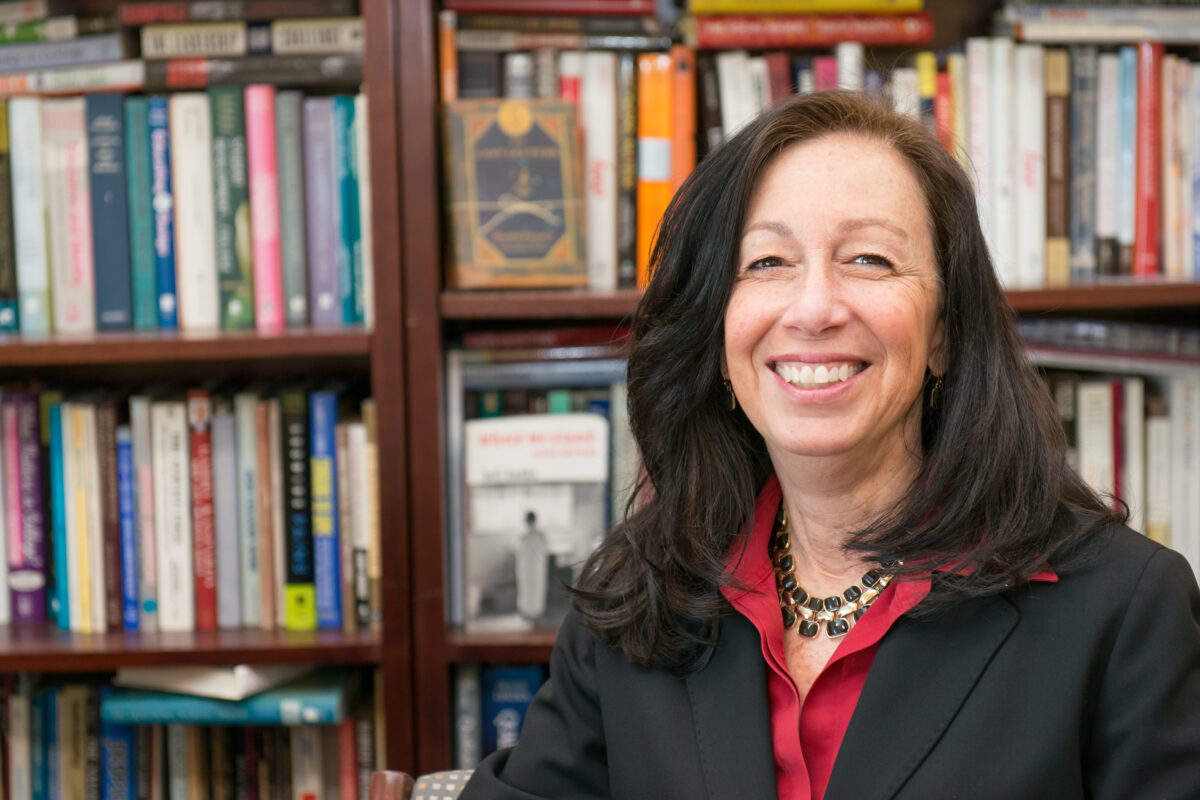 Nancy Young. (Marlayna Demond ’11/UMBC)
“I am excited to engage in an experience that I think will challenge me to grow and see the world differently,” Young says. She looks forward to establishing relationships with new colleagues and developing a deeper understanding of other education systems, and she is eager to apply what she learns from the Fulbright experience to her work at UMBC.
Young has been interested in the Fulbright program since early in her career. She shares that support from colleagues at UMBC, including Souders and David Di Maria, associate vice provost for international education, was instrumental in making her goal a reality.
In addition to this honor, Young was also recently recognized as one of the Maryland Daily Record’s Top 100 Women. She has also been featured by the Chronicle of Higher Education as a leading voice on the future of Student Affairs.
]]>
Four UMBC faculty and staff members have received highly competitive Fulbright awards to conduct research and establish important connections around the world over the next year. UMBC’s new...
https://umbc.edu/stories/umbc-faculty-staff-earn-fulbright-awards/
https://beta.my.umbc.edu/api/v0/pixel/news/125770/guest@my.umbc.edu/0edc5c42e9a1c4cb77e1c63ef3a41510/api/pixel
arts-and-culture
cahss
coeit
community
international-stories
is
majoraward
news
research
science-and-tech
studentaffairs
visualarts
UMBC News & Magazine
https://beta.my.umbc.edu/groups/umbc-news-magazine
https://assets1-beta.my.umbc.edu/system/shared/avatars/groups/000/001/943/24435aa6207c452e7bc15cc74b42c7bb/xsmall.png?1748556657
https://assets1-beta.my.umbc.edu/system/shared/avatars/groups/000/001/943/24435aa6207c452e7bc15cc74b42c7bb/original.png?1748556657
https://assets2-beta.my.umbc.edu/system/shared/avatars/groups/000/001/943/24435aa6207c452e7bc15cc74b42c7bb/xxlarge.png?1748556657
https://assets2-beta.my.umbc.edu/system/shared/avatars/groups/000/001/943/24435aa6207c452e7bc15cc74b42c7bb/xlarge.png?1748556657
https://assets3-beta.my.umbc.edu/system/shared/avatars/groups/000/001/943/24435aa6207c452e7bc15cc74b42c7bb/large.png?1748556657
https://assets1-beta.my.umbc.edu/system/shared/avatars/groups/000/001/943/24435aa6207c452e7bc15cc74b42c7bb/medium.png?1748556657
https://assets2-beta.my.umbc.edu/system/shared/avatars/groups/000/001/943/24435aa6207c452e7bc15cc74b42c7bb/small.png?1748556657
https://assets1-beta.my.umbc.edu/system/shared/avatars/groups/000/001/943/24435aa6207c452e7bc15cc74b42c7bb/xsmall.png?1748556657
https://assets2-beta.my.umbc.edu/system/shared/avatars/groups/000/001/943/24435aa6207c452e7bc15cc74b42c7bb/xxsmall.png?1748556657
UMBC News & Magazine
0
0
false
Mon, 06 Jun 2022 15:35:38 -0400
Mon, 06 Jun 2022 15:34:06 -0400