UMBC to co-lead new Baltimore Social-Environmental Collaborative with $2.3M grant
American cities face environmental challenges that are exacerbated by climate change, from air and water quality issues to flooding and heat. Low-income neighborhoods and areas that were previously subject to racial redlining often experience these effects more intensely.
A new program supported by the U.S. Department of Energy (DoE) has funded Urban Integrated Field Laboratories in three American cities (including Baltimore) to generate resilience-enhancing solutions to urban climate challenges in collaboration with community organizations. The Baltimore-centered consortium, named the Baltimore Social-Environmental Collaborative (BSEC), will receive $24.5 million through the program. UMBC will receive $2.3 million of this larger grant.
Leading UMBC’s work on the project is Claire Welty, professor of chemical, biochemical, and environmental engineering and director of the Center for Urban Environmental Research and Education (CUERE). Johns Hopkins University leads the overall project, which also includes collaborators at the Pennsylvania State University, Morgan State University, the National Renewable Energy Laboratory, Drexel University, and the University of Virginia.
“This Baltimore Social-Environmental Collaborative is an important program during a critical time for our region, for our state, and for our planet,” says Karl V. Steiner, vice president for research at UMBC. “I am pleased that Baltimore was selected to serve as a representative metropolitan area for the climate challenges faced by many mid-sized industrial cities across the U.S.”
Listening to the community
Welty and UMBC colleagues such as Andrew Miller, professor of geography and environmental systems, bring decades of expertise in environmental monitoring to the project through their individual research and the Baltimore Ecosystem Study (BES). Originally funded as one of only two urban Long-Term Ecological Research (LTER) sites in the U.S., the BES has compiled massive datasets on the Baltimore region’s watershed, ecology, and sociological issues related to the environment for more than 20 years. The new BSEC will bring opportunities to expand this work in fresh directions.
“The exciting thing is leading from the needs of the community. To me, that’s what’s different about this,” Welty says. “What we want to try to do is partner with the communities to come up with solutions to these climate impact problems, and then what we’re bringing to the table are our tools to implement that.”
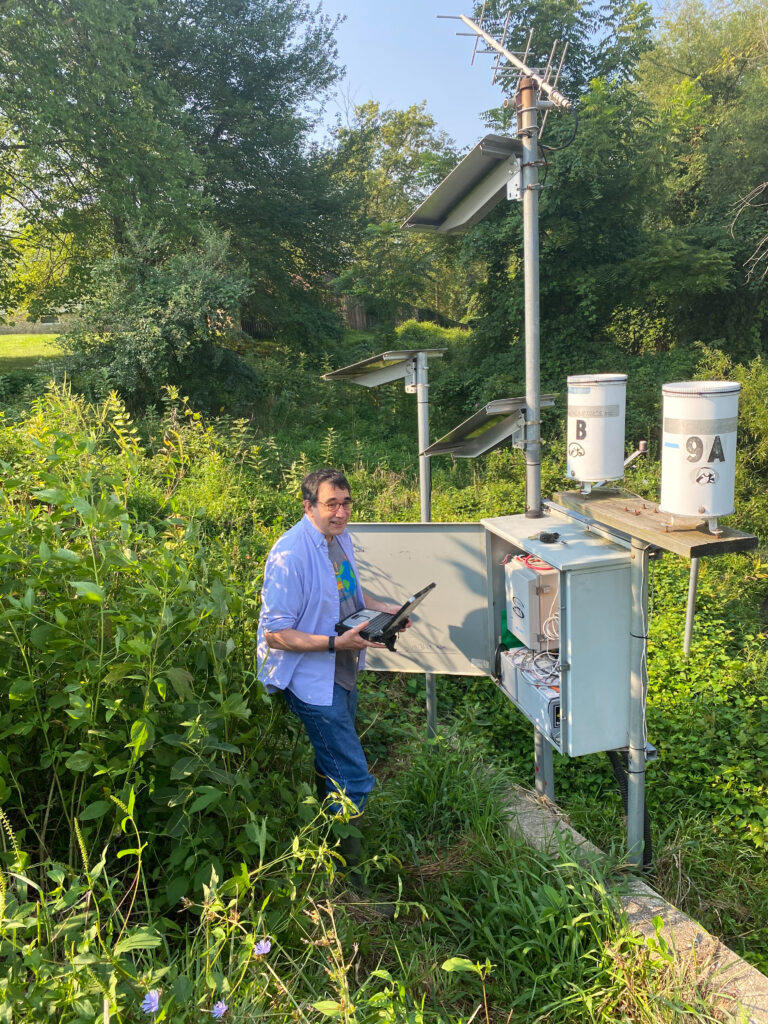 Andrew Miller checks on a water sampling station in Catonsville, MD. (Victor Fulda/UMBC)
Welty and Miller bring expertise in understanding patterns of water quality, flood and groundwater modeling, and rainfall patterns and how they are changing. UMBC also brings experience interacting with local agencies, such as the Baltimore City Department of Public Works and Maryland Department of the Environment. Other institutions in the consortium bring complementary expertise, such as overall climate forecasting, an understanding of how climate impacts intersect with issues of public health, and experience building trust with community groups.
“Among us, we think we have tools that can be applied to solve these problems,” Welty says. “We’re not imposing our tools on community groups, though, or telling them what their problems are. They’re telling us, and we’re responding with support and resources.”
Adding nuance
Welty, Miller, and others have spent decades generating models and collecting on-the-ground (and sometimes underground) observations of water quality, flow, and more in the Baltimore region. They will continue that work with the BSEC, and with input from communities, prioritize certain issues or geographic areas.
The BSEC will also fund deployment of new sensors at existing Baltimore Ecosystem Study stream sampling stations in the Gwynns Falls watershed . These stations have a 22-year record of weekly water quality sampling, and the new sensors will add data on other parameters at 15-minute intervals, 24 hours a day, seven days a week. The data will be accessible in near- real time, on only about a one-hour delay.
The BES data is “the best urban water quality data set in the world. This is not meant to replace that, but to add nuance,” Welty says. For example, Baltimore streams have struggled with inundation from road salt in the winter. “You might miss the peak of a salt event with weekly sampling,” Welty says, but finer scale sampling would easily identify it in the data.
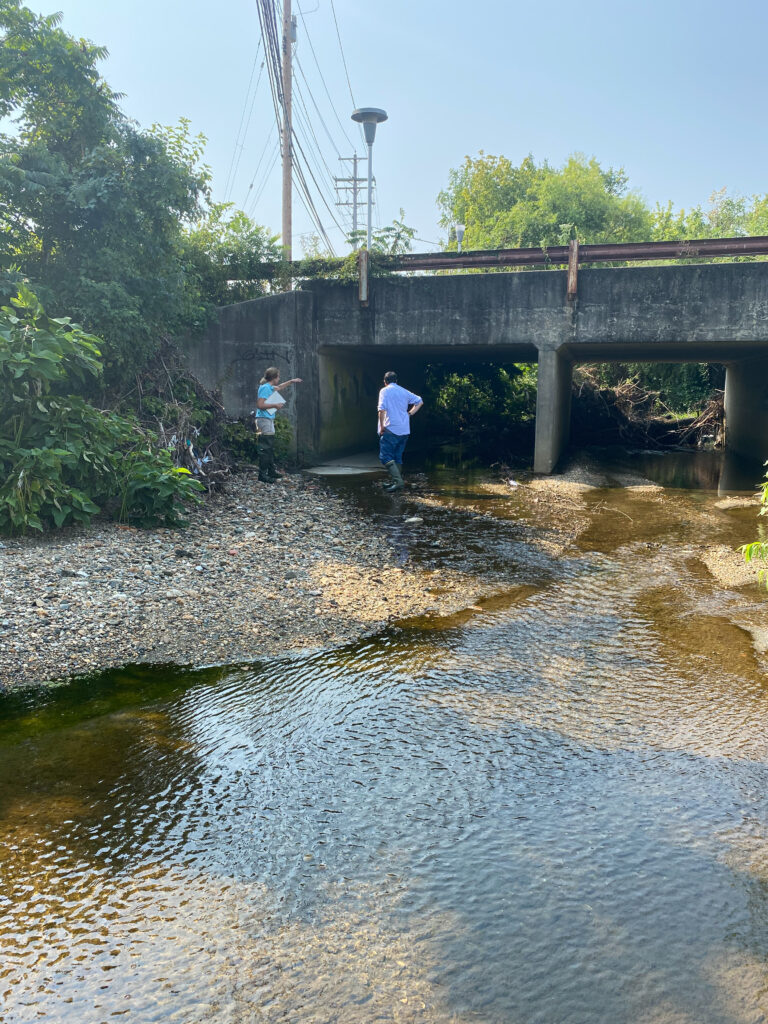 Claire Welty (left) and Andrew Miller check out one of their study sites in Woodlawn, MD. (Victor Fulda/UMBC)
A giant puzzle to put together
The BSEC is a unique project that brings together wide-ranging expertise to address pressing urban needs. “The guiding objective of the BSEC process is to produce the urban climate science needed to inform community-guided, equitable pathways for climate action,” says Ben Zaitchik, professor of Earth and planetary sciences at Johns Hopkins and the overall project lead. “In doing so, we address a number of fundamental urban science questions from across natural science and social science disciplines.”
UMBC’s Steiner adds, “This partnership with John Hopkins University and other research institutions is building upon our strong and long-term record of environmental research and educational initiatives here at UMBC. It will both challenge and enable us to explore equitable climate solutions.”
While the exact priorities and concerns that local communities will bring to the forefront are unknown, the BSEC group plans to bring their tools to bear in a way that best serves the people of Baltimore. Building coalitions with researchers and community members, learning the communities’ needs, and then finding the best ways to address them “is like a giant puzzle to put together,” Welty says. “It’s going to be exciting to see how it all unfolds.”
]]>
American cities face environmental challenges that are exacerbated by climate change, from air and water quality issues to flooding and heat. Low-income neighborhoods and areas that were...
https://umbc.edu/stories/social-environmental-collab-wins-2-3m-grant/
https://beta.my.umbc.edu/api/v0/pixel/news/128185/guest@my.umbc.edu/ff69f44dc2b56dfdfa416165651d0253/api/pixel
cahss
cahssresearch
cbee
cuere
ges
news
policy-and-society
rca-1
research
science-and-tech
UMBC News & Magazine
https://beta.my.umbc.edu/groups/umbc-news-magazine
https://assets1-beta.my.umbc.edu/system/shared/avatars/groups/000/001/943/24435aa6207c452e7bc15cc74b42c7bb/xsmall.png?1748556657
https://assets1-beta.my.umbc.edu/system/shared/avatars/groups/000/001/943/24435aa6207c452e7bc15cc74b42c7bb/original.png?1748556657
https://assets2-beta.my.umbc.edu/system/shared/avatars/groups/000/001/943/24435aa6207c452e7bc15cc74b42c7bb/xxlarge.png?1748556657
https://assets2-beta.my.umbc.edu/system/shared/avatars/groups/000/001/943/24435aa6207c452e7bc15cc74b42c7bb/xlarge.png?1748556657
https://assets3-beta.my.umbc.edu/system/shared/avatars/groups/000/001/943/24435aa6207c452e7bc15cc74b42c7bb/large.png?1748556657
https://assets1-beta.my.umbc.edu/system/shared/avatars/groups/000/001/943/24435aa6207c452e7bc15cc74b42c7bb/medium.png?1748556657
https://assets2-beta.my.umbc.edu/system/shared/avatars/groups/000/001/943/24435aa6207c452e7bc15cc74b42c7bb/small.png?1748556657
https://assets1-beta.my.umbc.edu/system/shared/avatars/groups/000/001/943/24435aa6207c452e7bc15cc74b42c7bb/xsmall.png?1748556657
https://assets2-beta.my.umbc.edu/system/shared/avatars/groups/000/001/943/24435aa6207c452e7bc15cc74b42c7bb/xxsmall.png?1748556657
UMBC News & Magazine
0
0
false
Tue, 04 Oct 2022 16:22:06 -0400
Tue, 04 Oct 2022 16:22:06 -0400
Art, Life, and Spirit—Oletha DeVane Retrospective at The CADVC
Artist retrospectives have been a significant part of the history of the Center for Art, Design and Visual Culture. Since opening on the UMBC campus more than 30 years ago, the CADVC has delivered retrospectives of visionary artists like Fred Wilson, Adrian Piper, Kate Millett, and more.
This fall, multidisciplinary artist Oletha DeVane joins these esteemed ranks with a new retrospective of her work, Oletha DeVane: Spectrum of Light and Spirit, now on view at the CADVC through December 17. It’s an exciting show for DeVane, a prolific artist and educator who has been a staple of Maryland’s cultural landscape for more than 50 years.
“I’m honored, and I don’t think it was expected,” says DeVane. “There was a real sense of commitment [by the CADVC] to do the work, and, that’s what I felt was important — the commitment to to take on a project like this. It’s not simple when you have so many variables and mediums happening in a space.”
The myriad artworks in Spectrum of Light and Spirit span DeVane’s prolific career, including paintings, works on paper, video artworks, and interactive sculpture. Curator Lowery Stokes Sims worked closely with the CADVC to bring all the pieces together into a cohesive whole, and to develop the interactive elements allow visitors to participate directly in the development of some of the artworks – and occasionally with DeVane herself.
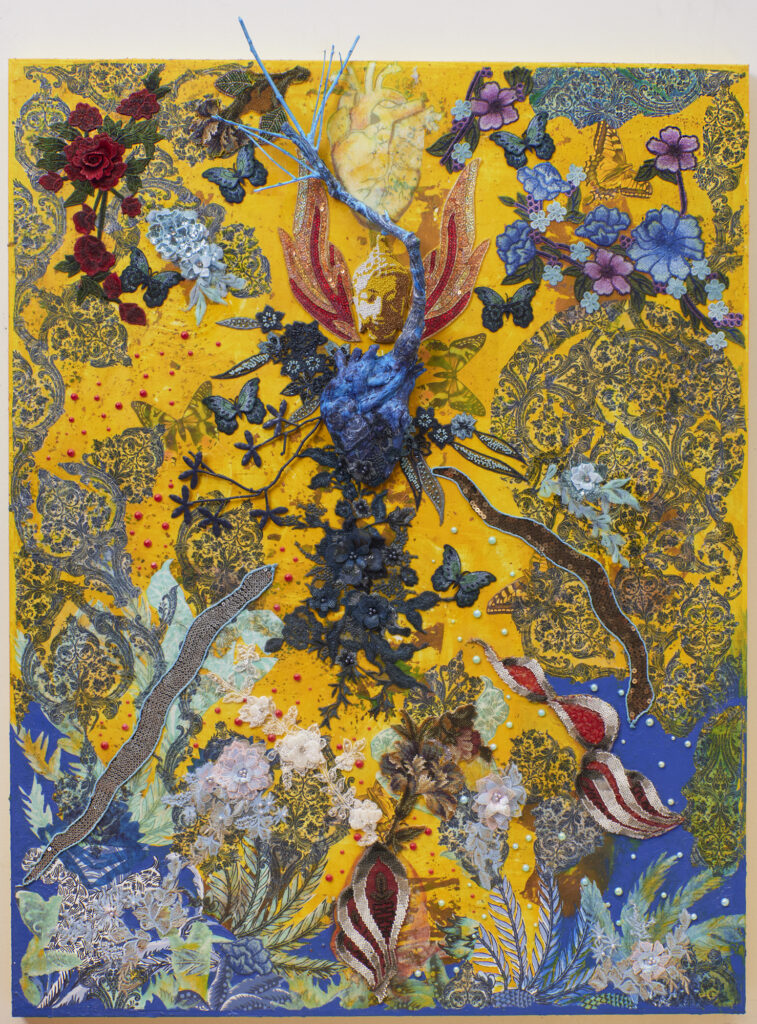 Garden of the Heart, 2021, mixed media, 47 x 36 inches. Photo by Mitro Hood.
“Lowery is a curator who’s worked extensively with African American subjects and artists, and she’s a good friend as well,” says DeVane. “I’m so glad I asked her to curate, because she was able to carry the through line of what the work itself has been about over the last 50 years, and that was good for me.”
Sims’ curatorial perspective makes powerful connections between DeVane’s works in the gallery space.
“Oletha DeVane is a way finder and a storyteller,” Sims says. “Over the last five decades as she has traveled in Asia, Africa, and the Caribbean, she has been inspired by the stories and characters she encounters, bringing the unexpected to light, while finding new nuances in the old and familiar, and unexpected correlations among those varied cultures.”
Art and outreach
Spectrum of Light and Spirit marks the first exhibition at the CADVC under the guidance of newly-appointed director Rebecca Uchill, who took over after the retirement of long-time director Symmes Gardner.
“It is a true honor for me to have joined CADVC as this important exhibition came into being,” Uchill says. “Oletha DeVane is an artist of incredible vision and artistic range, and a key figure in art and education in our region. We have much to look forward to in the robust exhibition programming, which will include a series of activations of Nkisi Woman-Universal Nkisi, a community-engaged sculptural project by DeVane on view in the CADVC amphitheater.”
A nkisi is a power figure rooted in Congolese culture, imbued with sacred energy by the community where it is created. Over the course of the exhibition, visitors to DeVane’s large-scale nkisi sculpture will be invited to add beads to its surface. DeVane herself will periodically participate in these activations, including hour-long sessions slated for October 6, 8, and 29.
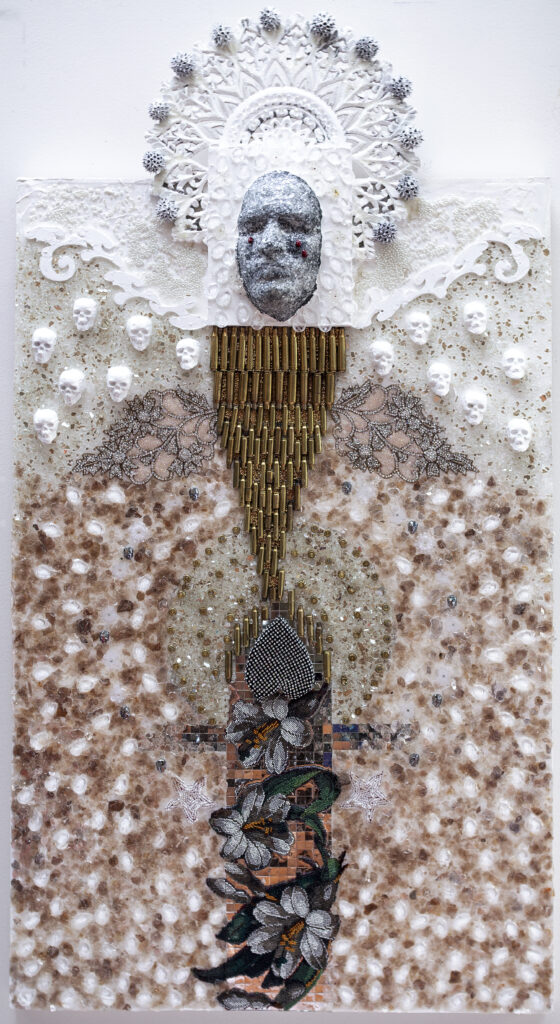 Subsumed by Whiteness, 2020, mixed media, 56 x 40 inches. Photo by Mitro Hood.
“The concept of nkisi to me is about power figures, and a female power figure is sometimes unusual,” says DeVane. “The idea is that they are oriented towards community, you know, in terms of how one begins this whole process of healing. How do you achieve justice in a community? How do you approach nature? What is it that we value? All those questions to me were a part of the nkisi spirit.”
In addition to the sculptural and painting works in the exhibit, DeVane’s video works, Beyond Bars: Prison Women Speak, created in collaboration with writer and media personality Tadia Rice, have been updated for this exhibition. The videos make for a profound dialogue with Prison Nation, the photography show on view across campus at the Albin O. Kuhn Library Gallery through October 14.
“[Prison Nation] is pretty phenomenal. I was really impressed because the black and white photos are just beautiful,” says DeVane. “Ours is a little different. I chose to set up the photographs and the videos with the idea that the women would be interviewed from the past, the present and the future. It’s really about setting up an opportunity for people to understand that these women are in situations where they’re incarcerated, and happen to have had lives prior, and would like to go back to those lives. Just as our society begins to grapple with the issues around how our prison system works, we have to continue this work.”
* * * * *
Spectrum of Light and Spirit is on view at the CADVC through December 17. For more information about the exhibit and associated events, visit the CADVC website at https://cadvc.umbc.edu/oletha-devane/
]]>
Artist retrospectives have been a significant part of the history of the Center for Art, Design and Visual Culture. Since opening on the UMBC campus more than 30 years ago, the CADVC has delivered...
https://umbc.edu/stories/art-life-and-spirit-oletha-devane-retrospective-at-the-cadvc/
https://beta.my.umbc.edu/api/v0/pixel/news/128170/guest@my.umbc.edu/35bf602f277b8e5a6e81dc313ebf6148/api/pixel
cadvc
discovery
magazine
visualarts
UMBC News & Magazine
https://beta.my.umbc.edu/groups/umbc-news-magazine
https://assets1-beta.my.umbc.edu/system/shared/avatars/groups/000/001/943/24435aa6207c452e7bc15cc74b42c7bb/xsmall.png?1748556657
https://assets1-beta.my.umbc.edu/system/shared/avatars/groups/000/001/943/24435aa6207c452e7bc15cc74b42c7bb/original.png?1748556657
https://assets2-beta.my.umbc.edu/system/shared/avatars/groups/000/001/943/24435aa6207c452e7bc15cc74b42c7bb/xxlarge.png?1748556657
https://assets2-beta.my.umbc.edu/system/shared/avatars/groups/000/001/943/24435aa6207c452e7bc15cc74b42c7bb/xlarge.png?1748556657
https://assets3-beta.my.umbc.edu/system/shared/avatars/groups/000/001/943/24435aa6207c452e7bc15cc74b42c7bb/large.png?1748556657
https://assets1-beta.my.umbc.edu/system/shared/avatars/groups/000/001/943/24435aa6207c452e7bc15cc74b42c7bb/medium.png?1748556657
https://assets2-beta.my.umbc.edu/system/shared/avatars/groups/000/001/943/24435aa6207c452e7bc15cc74b42c7bb/small.png?1748556657
https://assets1-beta.my.umbc.edu/system/shared/avatars/groups/000/001/943/24435aa6207c452e7bc15cc74b42c7bb/xsmall.png?1748556657
https://assets2-beta.my.umbc.edu/system/shared/avatars/groups/000/001/943/24435aa6207c452e7bc15cc74b42c7bb/xxsmall.png?1748556657
UMBC News & Magazine
0
0
false
Tue, 04 Oct 2022 11:30:10 -0400
Tue, 04 Oct 2022 11:30:10 -0400
Music Man

Devin Walker ’89, political science, is a man with a plan. And a cause and a vision and a passion.
Oh, and a Grammy nomination.
“Uncle Devin, the Children’s Drumcussionist,” as he’s known professionally, was nominated for a Grammy for Best Children’s Music Album in 2022 as a member of the 1 Tribe Collective, one of his many top-level endeavors that center around education, music, and young people.
He’s the musical muscle and co-owner of The Uncle Devin Show, an interactive musical experience for children that uses percussion instruments to inspire both fun and critical thinking.


Walker also runs a training course, “Racism in Children’s Music: Liberating Music for the Black Child,” and he has created an online music radio program for children called WEE Nation Radio, streaming R&B, funk, hip-hop, jazz, go-go, reggae, calypso, and world music, all created for children and families.
But the roots of many such accomplishments, says Walker, can be traced back to his years at UMBC.
Behind the Music
Although music has always been a passion, Walker saw majoring in political science as an opportunity to probe systemic inequities and effect meaningful change.
“I was very active in the student movement back in the 80s,” he said. “Understanding the politics of everything really gave me the keen awareness to start to look for those things inside of whatever I was involved in.”
Those sharpened critical-thinking skills came in handy when he found himself researching a film called Ethnic Notions through UMBC’s Albin O. Kuhn Library.
The Emmy-winning 1987 documentary peels back the anodyne veneer of familiar songs, books, cartoons, and movies meant for children to reveal their poisonously racist stereotypes, themes, and origins.
Even the sing-song silliness “Eeny, Meeny, Miny, Moe,” the film notes, originally alludes to the capture of African Americans fleeing enslavement.
“I was blown away,” Walker said. “I had no idea that there was a dark history” to so many songs, along with all the many stereotype-perpetuating movies and other media.
Taking a New Tack
“So the seed was planted,” he said. “But even then, I didn’t think about coming in and really making a contribution to changing [the direction of children’s music] until around 2007.”
It was at this point, Walker said, that he truly began to understand firsthand the unique influence that music can have—for good or ill—on children. He and his wife Lolita Johnson Walker, whom he met at UMBC, don’t have children, but his sister had four, and he spent time with them every week.

“Every Wednesday, it was Uncle Devin’s time,” Walker said, and that time included lots of music. But he remembered all too well the veiled racism of traditional songs he had researched as a UMBC student.
Neither did he want his nieces and nephews to soak up too much of the wrong adult pop music.
“I couldn’t let them listen to all that music, because it just wasn’t appropriate,” Walker said. “And so I said, I’ll create my own music for them. And as they got older, I said, let me record it so they can have a memory of it.”
Things snowballed from there, according to Walker. His nieces and nephews started playing the music for their friends, and the friends started asking Walker to record more songs, and people started asking him to perform for children and families.
Music with New Meaning
During Walker’s college days, he said, “I used to always participate in all of the [UMBC] talent shows. But it was all just us having fun. I never thought of it as a profession or anything like that.”
In fact, Cynthia M. Hill, a retired UMBC associate provost, remembers Walker primarily as a driven student.
“I met Devin when he participated in the Learning Resources Center’s academic support program for incoming UMBC freshmen,” Hill said. “He was impressive because he was anxious to learn and worked hard.”
But because they were both members of the UMBC gospel choir, she also knew firsthand that he had a professional-level musical talent. He even got to play with Dizzy Gillespie: The jazz giant visited UMBC in 1985, when Walker was a first-year student.
And although he worked full-time after graduation, helping to investigate and resolve workplace issues covered by the Equal Employment Opportunity Commission on behalf of both public- and private-sector employers, he continued to play with local bands.
And as Walker’s deep love of music—with the training and talent to match—continued to grow, he focused more and more of his prodigious energy into the journey that became The Uncle Devin Show, creating positive songs set to infectious beats such as “No Such Thing as Good or Bad Hair.”
“I try to find a way to help—not to tell children what to think, but to teach them how to think,” Walker said; he sees music as the key.
“We have a perfect tool here to help our children navigate these very difficult waters of life right now, and in a fun, entertaining, and engaging way,” he said “That’s really what my goal is.”
]]>
Devin Walker ’89, political science, is a man with a plan. And a cause and a vision and a passion. Oh, and a Grammy nomination. “Uncle Devin, the Children’s Drumcussionist,” as he’s...
https://umbc.edu/stories/music-man/
https://beta.my.umbc.edu/api/v0/pixel/news/128147/guest@my.umbc.edu/c3abda977c8917d680ecd9d48dd8db04/api/pixel
alumni
cahss
magazine
music
polisci
UMBC News & Magazine
https://beta.my.umbc.edu/groups/umbc-news-magazine
https://assets1-beta.my.umbc.edu/system/shared/avatars/groups/000/001/943/24435aa6207c452e7bc15cc74b42c7bb/xsmall.png?1748556657
https://assets1-beta.my.umbc.edu/system/shared/avatars/groups/000/001/943/24435aa6207c452e7bc15cc74b42c7bb/original.png?1748556657
https://assets2-beta.my.umbc.edu/system/shared/avatars/groups/000/001/943/24435aa6207c452e7bc15cc74b42c7bb/xxlarge.png?1748556657
https://assets2-beta.my.umbc.edu/system/shared/avatars/groups/000/001/943/24435aa6207c452e7bc15cc74b42c7bb/xlarge.png?1748556657
https://assets3-beta.my.umbc.edu/system/shared/avatars/groups/000/001/943/24435aa6207c452e7bc15cc74b42c7bb/large.png?1748556657
https://assets1-beta.my.umbc.edu/system/shared/avatars/groups/000/001/943/24435aa6207c452e7bc15cc74b42c7bb/medium.png?1748556657
https://assets2-beta.my.umbc.edu/system/shared/avatars/groups/000/001/943/24435aa6207c452e7bc15cc74b42c7bb/small.png?1748556657
https://assets1-beta.my.umbc.edu/system/shared/avatars/groups/000/001/943/24435aa6207c452e7bc15cc74b42c7bb/xsmall.png?1748556657
https://assets2-beta.my.umbc.edu/system/shared/avatars/groups/000/001/943/24435aa6207c452e7bc15cc74b42c7bb/xxsmall.png?1748556657
UMBC News & Magazine
0
0
false
Mon, 03 Oct 2022 15:42:37 -0400
Mon, 03 Oct 2022 15:42:37 -0400
Meet a Retriever – Emily Faber, Ph.D. student in atmospheric physics

Meet Emily Faber, M.S. ’21, atmospheric physics, who is currently pursuing her doctorate in the same at UMBC. Emily is a first-generation college student who is also very involved as a student leader in the College of Natural and Mathematical Sciences. Take it away, Emily!
Q: What brought you to UMBC in the first place?
A: I came to UMBC for the department I am in. I knew I wanted to study Earth Science and I had a physics background so Atmospheric Physics is where I thought I could do the most good in the world. UMBC is also really well connected with the NASA and NOAA centers in the DMV area and I knew that is where I want to work, so it was a perfect match!
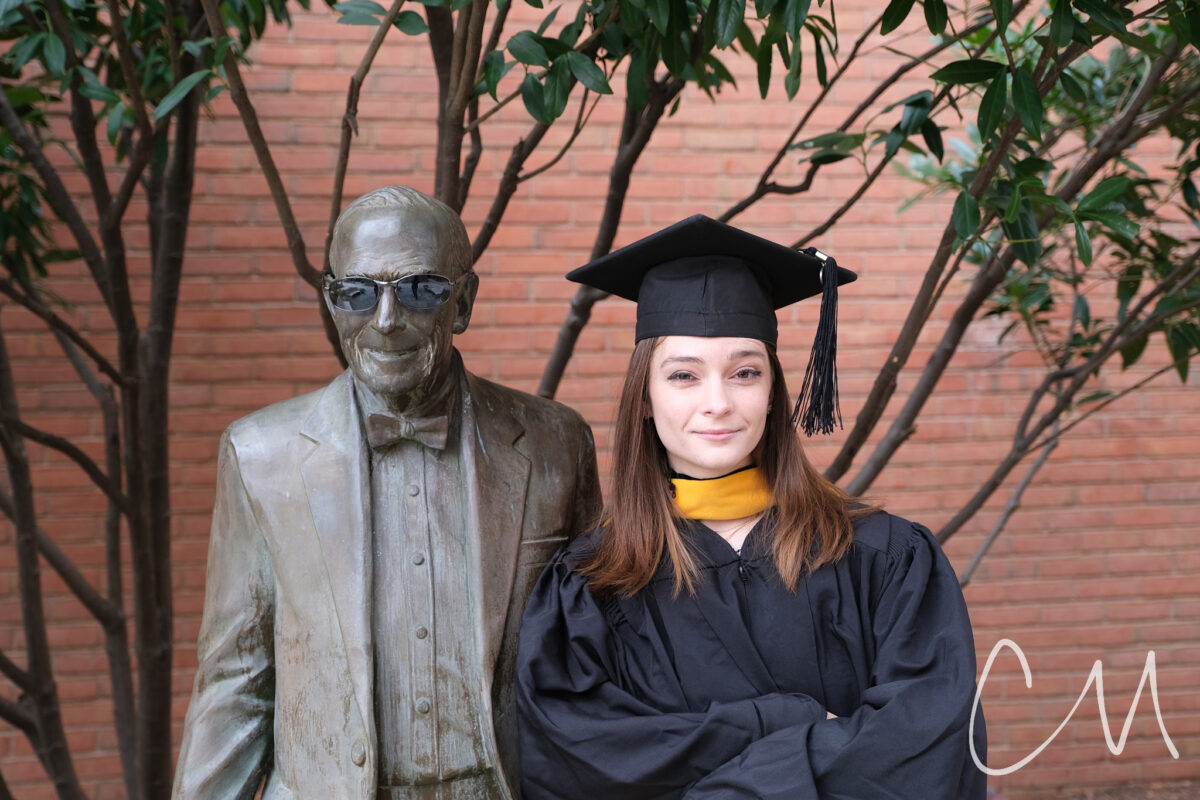 Faber poses with UMBC’s statue of Baltimore changemaker Walter Sondheim while celebrating the completion of her master’s degree in atmospheric physics. Photo courtesy of Faber.
Q: What’s the one thing you’d want someone who hasn’t joined the UMBC community to know about the support you find here?
A: It’s here! sometimes it seems hidden but there are people here that I’ve found that would do whatever they could to help me if I needed it. And I’ve seen them pull off some pretty amazing things for other students too! PROMISE, GSA (Graduate Student Association), individual faculty, and the deans are all great and supportive people!
“I knew I wanted to study Earth Science and I had a physics background so Atmospheric Physics is where I thought I could do the most good in the world. UMBC is also really well connected with the NASA and NOAA centers in the DMV area and I knew that is where I want to work, so it was a perfect match!”
Emily Faber, M.S. ’21, atmospheric physics
Q: Tell us about someone in the community who has inspired you or supported you, and how they did it.
A: I know, cheesy, but my advisor, Dr. Adriana Rocha Lima is a really great supporter of mine. They say you should find a mentor, a sponsor, and a coach, and Dr. Rocha Lima is really great at being all three for me! She explains things when I don’t understand without judgment, connects me with people and conferences in our field, and gives me advice when I need it. Find a great advisor; they are out there!
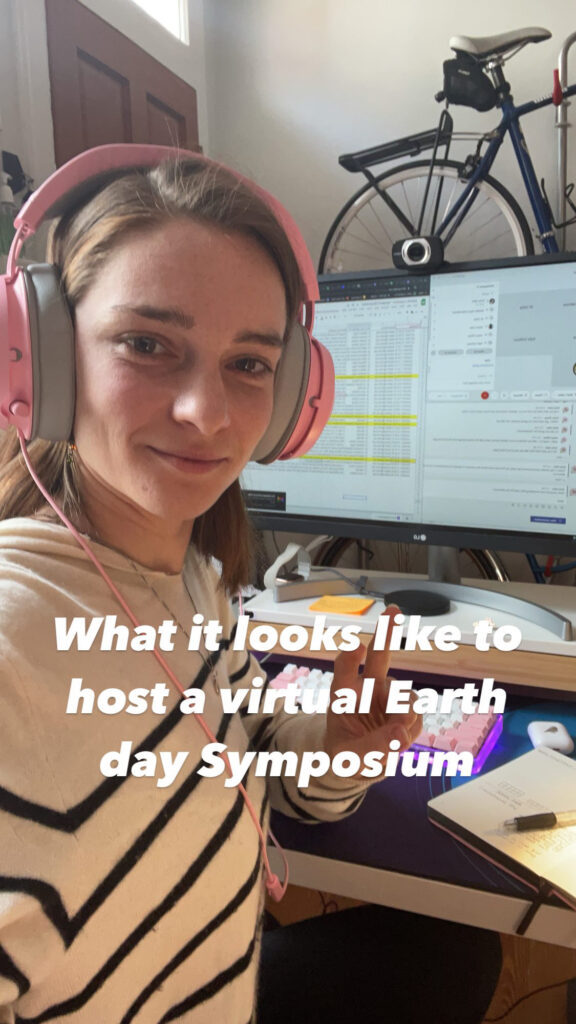 Faber shares an Instagram selfie from when she planned and hosted the first international Earth Day Symposium with the UMBC atmospheric physics department.
Q: Tell us about what you love about the atmospheric physics program or an organization you’re involved in.
A: I love how my program works with outside researchers and is really committed to Earth science as a whole. We routinely work with people from national lab offices that will hire our students one day and it really makes an impact in the skill sets we as students learn!
Q: What clubs and orgs are you a part of and why?
A: I’m a Graduate Student Association senator and Graduate Student Success Committee (GSSC) co-chair. I also help run the Graduate Gender-minorities in Physics group. In both of these I get to help people through their graduate school experience and help lift the graduate community up! I love seeing students succeed and hate seeing them struggle because they don’t find a resource that they need. These roles help me plug people in when they need help and that is incredibly rewarding for me!
* * * * *
UMBC’s greatest strength is its people. When people meet Retrievers and hear about the passion they bring, the relationships they create, the ways they support each other, and the commitment they have to inclusive excellence, they truly get a sense of our community. That’s what “Meet a Retriever” is all about.
Learn more about how UMBC can help you achieve your goals.
]]>
Meet Emily Faber, M.S. ’21, atmospheric physics, who is currently pursuing her doctorate in the same at UMBC. Emily is a first-generation college student who is also very involved as a student...
https://umbc.edu/stories/meet-a-retriever-emily-faber-atmospheric-physics/
https://beta.my.umbc.edu/api/v0/pixel/news/128044/guest@my.umbc.edu/e5a138b4273e9be71a77e228d9eaef54/api/pixel
cnms
graduateschool
impact
magazine
meet-a-retriever
perspectives
physics
UMBC News & Magazine
https://beta.my.umbc.edu/groups/umbc-news-magazine
https://assets1-beta.my.umbc.edu/system/shared/avatars/groups/000/001/943/24435aa6207c452e7bc15cc74b42c7bb/xsmall.png?1748556657
https://assets1-beta.my.umbc.edu/system/shared/avatars/groups/000/001/943/24435aa6207c452e7bc15cc74b42c7bb/original.png?1748556657
https://assets2-beta.my.umbc.edu/system/shared/avatars/groups/000/001/943/24435aa6207c452e7bc15cc74b42c7bb/xxlarge.png?1748556657
https://assets2-beta.my.umbc.edu/system/shared/avatars/groups/000/001/943/24435aa6207c452e7bc15cc74b42c7bb/xlarge.png?1748556657
https://assets3-beta.my.umbc.edu/system/shared/avatars/groups/000/001/943/24435aa6207c452e7bc15cc74b42c7bb/large.png?1748556657
https://assets1-beta.my.umbc.edu/system/shared/avatars/groups/000/001/943/24435aa6207c452e7bc15cc74b42c7bb/medium.png?1748556657
https://assets2-beta.my.umbc.edu/system/shared/avatars/groups/000/001/943/24435aa6207c452e7bc15cc74b42c7bb/small.png?1748556657
https://assets1-beta.my.umbc.edu/system/shared/avatars/groups/000/001/943/24435aa6207c452e7bc15cc74b42c7bb/xsmall.png?1748556657
https://assets2-beta.my.umbc.edu/system/shared/avatars/groups/000/001/943/24435aa6207c452e7bc15cc74b42c7bb/xxsmall.png?1748556657
UMBC News & Magazine
0
0
false
Fri, 30 Sep 2022 08:28:48 -0400
Fri, 30 Sep 2022 08:28:48 -0400
Reconnect with Your Retriever Pride at Homecoming 2022

Every year, Retrievers of all ages (including some actual Retriever pups) and community members gather together for UMBC’s Homecoming—and as always, this year has something for everyone. Designed to span two weeks (October 7 through 16) to accommodate all the festivities, “it’s an opportunity to think differently about what the concept of Homecoming actually is,” says Jess Wyatt, associate director of Alumni Engagement and one of the event organizers.
“For a lot of folks at UMBC, it’s coming back to a department, coming back to a social group, coming back to a physical space, coming back to an experience.”
Here’s how we make Homecoming our own at UMBC.
Revisiting student favorites
Homecoming is a special time for current students to celebrate their return for another year of classes and welcome first-year students into the fold. Keeping with tradition, the annual bonfire will kick off Homecoming on October 7, when students gather on Erickson Field for food, giveaways, and great company. After the bonfire, students can roll out their blankets on the lawn and cap the night with an outdoor movie screening.
 (Marlayna Demond ’11/UMBC)
The following week, Erickson Field will be transformed into a carnival ground—students get to preview the fun first, and on Saturday, October 15, the whole Retriever community is invited to play and ride, enjoy the petting zoo, food trucks, and more. Check out the full calendar of events for a packed day of activities, including an ice cream social hour and the hit Puppy Parade. All good dogs are welcome to join, with especially well-dressed pups participating in a special costume contest.
Welcoming back alumni
Alumni are always welcome back on UMBC’s campus, and Homecoming is a great opportunity to revisit your Retriever roots. If you ask Ron Pettie ’82, English, and his wife Christine, it’s all about reconnecting. “It’s a chance to come back and see what the school is doing now,” they’ll tell you. Through the years, the Petties have made a point to return to UMBC each October and are enthusiastic to talk about the close soccer wins, sharing a corndog, and trying to keep up on the rides with their two little nieces.
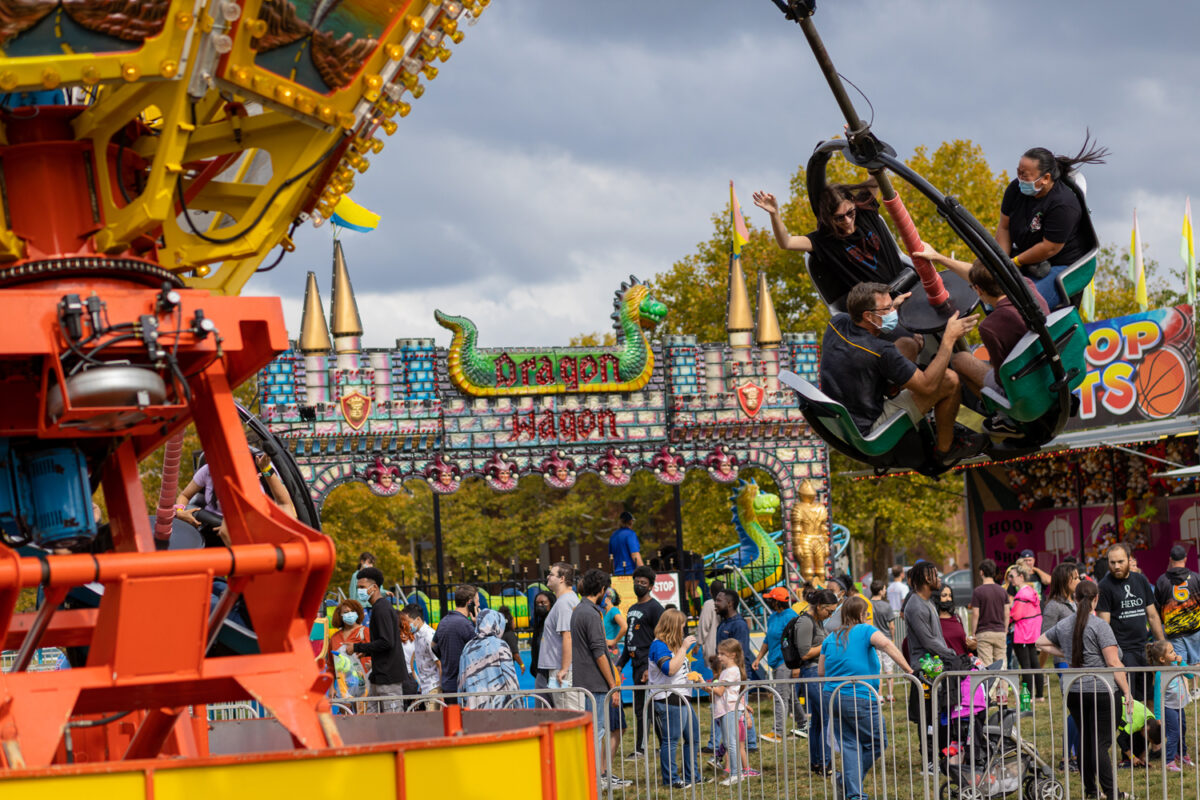 (Kiirstn Pagan/UMBC)
This year, Retrievers of all backgrounds will find a variety of events geared specifically toward them. Alumni will enjoy reunions, socials after sports games, compelling talks at GRIT-X, relaxation at the beer garden, and so much more. A recent addition for alumni is a Homecoming get-together at UMBC at the Universities at Shady Grove (October 8). And returning after a hiatus, is the Retriever 5k Dawg Chase and Fun Run (October 15), welcoming all runners and walkers.
Spending time with family
Homecoming at UMBC is an event for Retrievers to enjoy with their families, and the Family Breakfast (October 15) is our time to celebrate where we come from, the people we love, and how UMBC nurtures those connections.
 (Marlayna Demond ’11/UMBC)
 (Marlayna Demond ’11/UMBC)
“We have a lot of non-traditional age students, students who are parents, [and] students who live in a multi-generational household,” says Wyatt. As such, Homecoming has been planned with students, alumni, and families of all types in mind. Pettie and family see Homecoming as a way to encourage their nieces to make connections for their future college careers while having a lot of fun at the same time. No two Retrievers are the same, and Homecoming is an opportunity to celebrate that.
“Homecoming isn’t just a work project for a lot of us, it’s the thing that we bring our families to every year,” says Wyatt. “It’s really just seeing the best of everything that UMBC has to offer.”
Catch a game
If you’re looking to show some school spirit, week one of Homecoming is stocked full of sporting events, beginning with the Athletics Hall of Fame induction ceremony (October 7). Dress up in your favorite Retriever swag and come cheer for our basketball, lacrosse, soccer, volleyball, and softball teams across both weekends. Alumni will also step out onto the field to go head to head in a women’s lacrosse game, as well as a double header softball game–and don’t forget to stay afterwards for a BBQ! Whether you want to cheer or work up a sweat yourself, there’s always an opportunity to get moving at Homecoming.
With all this in mind, anticipation is in the air. “All the Homecoming events continue to evolve and are top notch,” says Pettie. “We always look forward to it.”
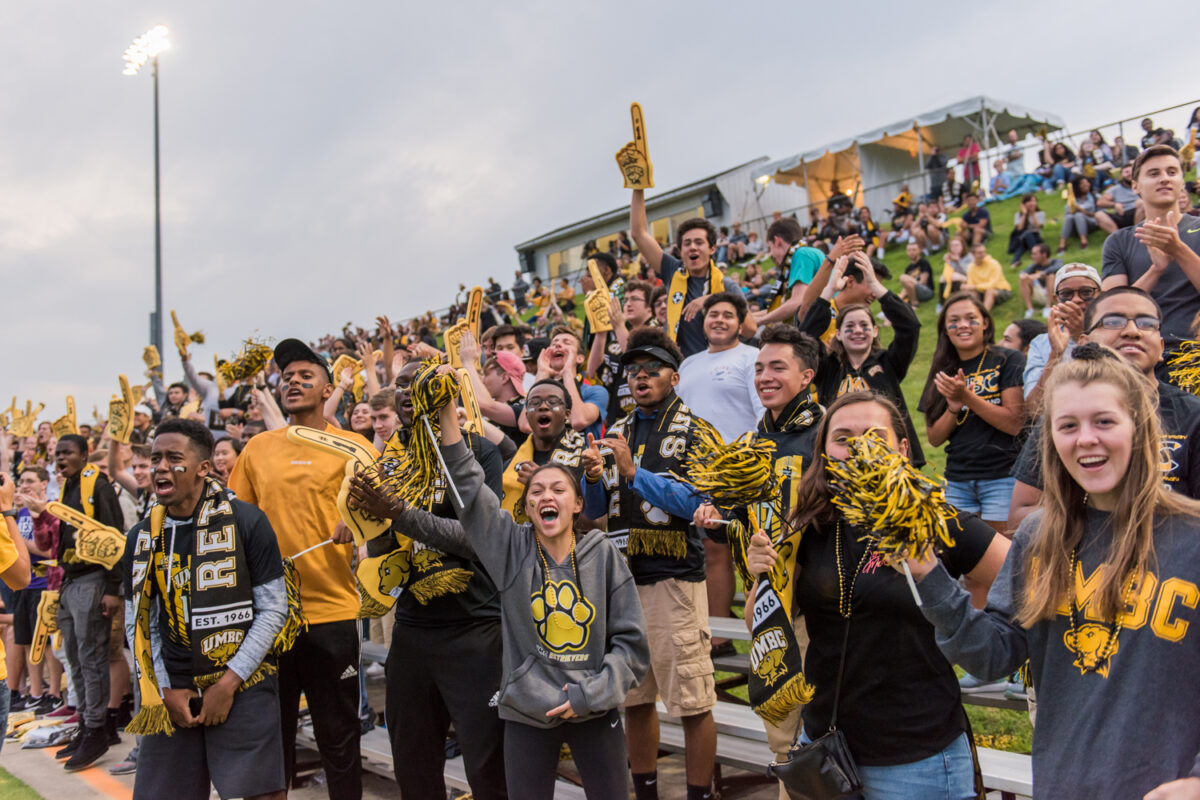 (Marlayna Demond ’11/UMBC)
Homecoming events are spread across two weeks, October 7 through 16. Make sure to check out the full schedule of activitiesin advance, including any events that require registration, like Athletic events, Family Breakfast, and the 5k.
]]>
Every year, Retrievers of all ages (including some actual Retriever pups) and community members gather together for UMBC’s Homecoming—and as always, this year has something for everyone. Designed...
https://umbc.edu/stories/reconnect-with-your-retriever-pride-at-homecoming-2022/
https://beta.my.umbc.edu/api/v0/pixel/news/127964/guest@my.umbc.edu/5d8d2cf58783f8d6917611e046df1c52/api/pixel
campus-life
homecoming22
magazine
UMBC News & Magazine
https://beta.my.umbc.edu/groups/umbc-news-magazine
https://assets1-beta.my.umbc.edu/system/shared/avatars/groups/000/001/943/24435aa6207c452e7bc15cc74b42c7bb/xsmall.png?1748556657
https://assets1-beta.my.umbc.edu/system/shared/avatars/groups/000/001/943/24435aa6207c452e7bc15cc74b42c7bb/original.png?1748556657
https://assets2-beta.my.umbc.edu/system/shared/avatars/groups/000/001/943/24435aa6207c452e7bc15cc74b42c7bb/xxlarge.png?1748556657
https://assets2-beta.my.umbc.edu/system/shared/avatars/groups/000/001/943/24435aa6207c452e7bc15cc74b42c7bb/xlarge.png?1748556657
https://assets3-beta.my.umbc.edu/system/shared/avatars/groups/000/001/943/24435aa6207c452e7bc15cc74b42c7bb/large.png?1748556657
https://assets1-beta.my.umbc.edu/system/shared/avatars/groups/000/001/943/24435aa6207c452e7bc15cc74b42c7bb/medium.png?1748556657
https://assets2-beta.my.umbc.edu/system/shared/avatars/groups/000/001/943/24435aa6207c452e7bc15cc74b42c7bb/small.png?1748556657
https://assets1-beta.my.umbc.edu/system/shared/avatars/groups/000/001/943/24435aa6207c452e7bc15cc74b42c7bb/xsmall.png?1748556657
https://assets2-beta.my.umbc.edu/system/shared/avatars/groups/000/001/943/24435aa6207c452e7bc15cc74b42c7bb/xxsmall.png?1748556657
UMBC News & Magazine
0
0
false
Tue, 27 Sep 2022 13:49:18 -0400
Tue, 27 Sep 2022 13:49:18 -0400
New UMBC research finds that viruses may have “eyes and ears” on us

New UMBC-led research in Frontiers in Microbiology suggests that viruses are using information from their environment to “decide” when to sit tight inside their hosts and when to multiply and burst out, killing the host cell. The work has implications for antiviral drug development.
A virus’s ability to sense its environment, including elements produced by its host, adds “another layer of complexity to the viral-host interaction,” says Ivan Erill, professor of biological sciences and senior author on the new paper. Right now, viruses are exploiting that ability to their benefit. But in the future, he says, “we could exploit it to their detriment.”
Not a coincidence
The new study focused on bacteriophages—viruses that infect bacteria, often referred to simply as “phages.” The phages in the study can only infect their hosts when the bacterial cells have special appendages, called pili and flagella, that help the bacteria move and mate. The bacteria produce a protein called CtrA that controls when they generate these appendages. The new paper shows that many appendage-dependent phages have patterns in their DNA where the CtrA protein can attach, called binding sites. A phage having a binding site for a protein produced by its host is unusual, Erill says.
Even more surprising, Erill and the paper’s first author Elia Mascolo, a Ph.D. student in Erill’s lab, found through detailed genomic analysis that these binding sites were not unique to a single phage, or even a single group of phages. Many different types of phages had CtrA binding sites—but they all required their hosts to have pili and/or flagella to infect them. It couldn’t be a coincidence, they decided.
The ability to monitor CtrA levels “has been invented multiple times throughout evolution by different phages that infect different bacteria,” Erill says. When distantly related species demonstrate a similar trait, it’s called convergent evolution—and it indicates that the trait is definitely useful.
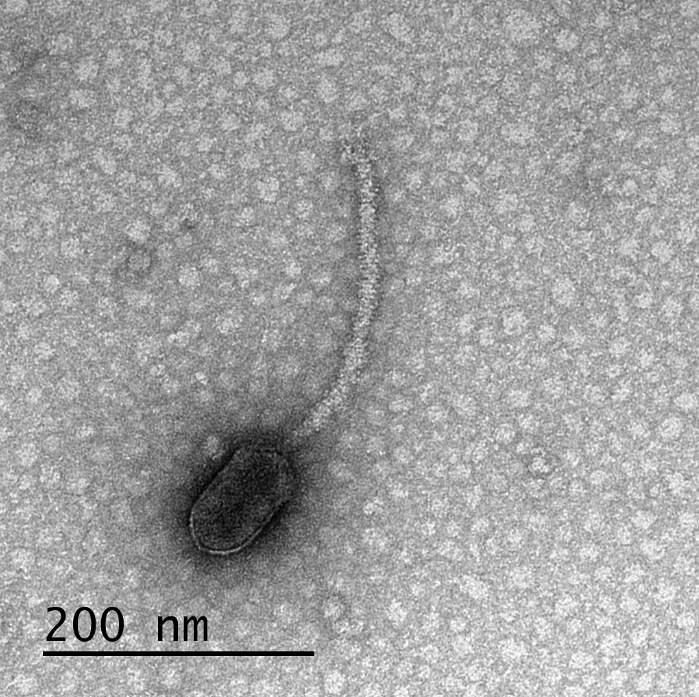 A delta phage, the first identified in the new study to have binding sites for CtrA. (Transmission Electron Microscope image captured by Tagide deCarvahlo at UMBC’s Keith Porter Imaging Facility)
Timing is everything
Another wrinkle in the story: The first phage in which the research team identified CtrA binding sites infects a particular group of bacteria called Caulobacterales. Caulobacterales are an especially well-studied group of bacteria, because they exist in two forms: a “swarmer” form that swims around freely, and a “stalked” form that attaches to a surface. The swarmers have pili/flagella, and the stalks do not. In these bacteria, CtrA also regulates the cell cycle, determining whether a cell will divide evenly into two more of the same cell type, or divide asymmetrically to produce one swarmer and one stalk cell.
Because the phages can only infect swarmer cells, it’s in their best interest only to burst out of their host when there are many swarmer cells available to infect. Generally, Caulobacterales live in nutrient-poor environments, and they are very spread out. “But when they find a good pocket of microhabitat, they become stalked cells and proliferate,” Erill says, eventually producing large quantities of swarmer cells.
So, “We hypothesize the phages are monitoring CtrA levels, which go up and down during the life cycle of the cells, to figure out when the swarmer cell is becoming a stalk cell and becoming a factory of swarmers,” Erill says, “and at that point, they burst the cell, because there are going to be many swarmers nearby to infect.”
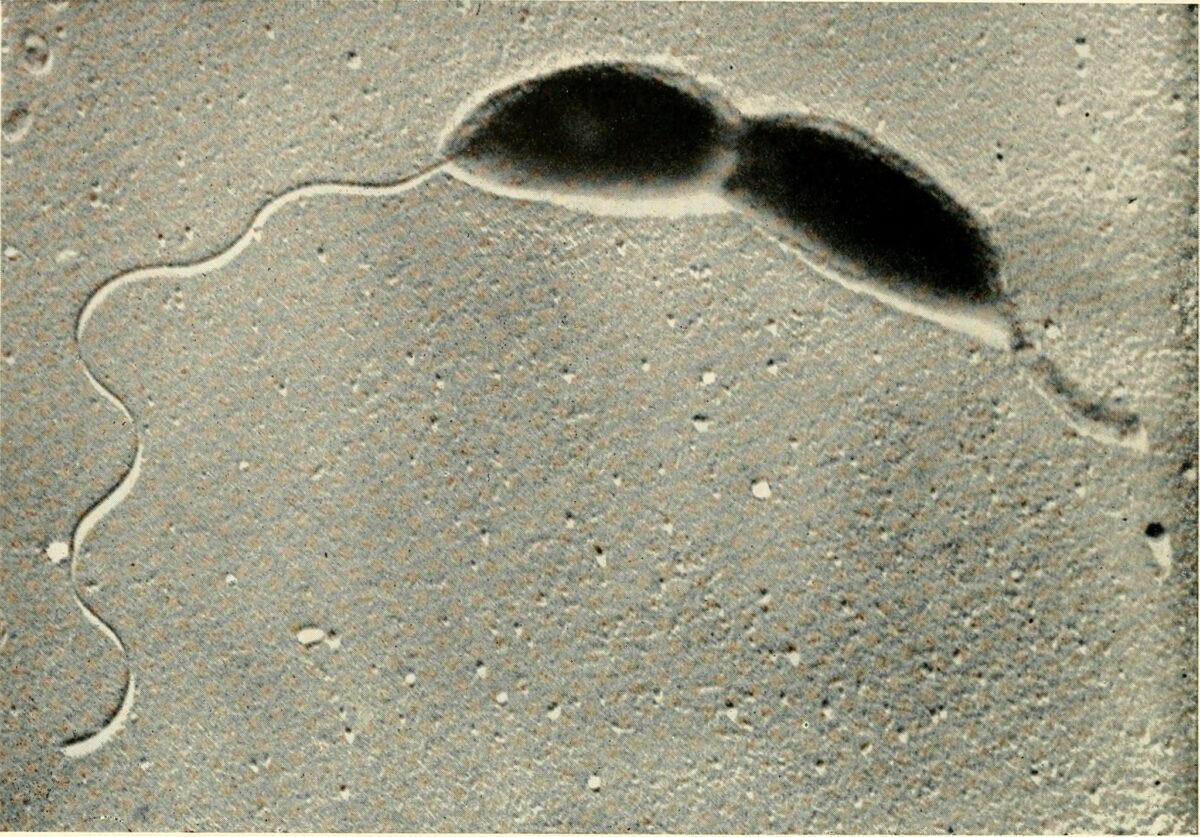 A Caulobacter bacterium divides, producing a stalked cell (right) and a swarmer cell with a flagellum (left). (public domain)
Listening in
Unfortunately, the method to prove this hypothesis is labor-intensive and extremely difficult, so that wasn’t part of this latest paper—although Erill and colleagues hope to tackle that question in the future. However, the research team sees no other plausible explanation for the proliferation of CtrA binding sites on so many different phages, all of which require pili/flagella to infect their hosts. Even more interesting, they note, are the implications for viruses that infect other organisms—even humans.
“Everything that we know about phages, every single evolutionary strategy they have developed, has been shown to translate to viruses that infect plants and animals,” he says. “It’s almost a given. So if phages are listening in on their hosts, the viruses that affect humans are bound to be doing the same.”
There are a few other documented examples of phages monitoring their environment in interesting ways, but none include so many different phages employing the same strategy against so many bacterial hosts.
This new research is the “first broad scope demonstration that phages are listening in on what’s going on in the cell, in this case, in terms of cell development,” Erill says. But more examples are on the way, he predicts. Already, members of his lab have started looking for receptors for other bacterial regulatory molecules in phages, he says—and they’re finding them.
New therapeutic avenues
The key takeaway from this research is that “the virus is using cellular intel to make decisions,” Erill says, “and if it’s happening in bacteria, it’s almost certainly happening in plants and animals, because if it’s an evolutionary strategy that makes sense, evolution will discover it and exploit it.”
For example, to optimize its strategy for survival and replication, an animal virus might want to know what kind of tissue it is in, or how robust the host’s immune response is to its infection. While it might be unsettling to think about all the information viruses could gather and possibly use to make us sicker, these discoveries also open up avenues for new therapies.
“If you are developing an antiviral drug, and you know the virus is listening in on a particular signal, then maybe you can fool the virus,” Erill says. That’s several steps away, however. For now, “We are just starting to realize how actively viruses have eyes on us—how they are monitoring what’s going on around them and making decisions based on that,” Erill says. “It’s fascinating.”
]]>
New UMBC-led research in Frontiers in Microbiology suggests that viruses are using information from their environment to “decide” when to sit tight inside their hosts and when to multiply and...
https://umbc.edu/stories/viruses-may-have-eyes-and-ears-on-us/
https://beta.my.umbc.edu/api/v0/pixel/news/127881/guest@my.umbc.edu/9673d1475078dedc8f49c338ae97fe96/api/pixel
biology
cnms
news
research
science-and-tech
UMBC News & Magazine
https://beta.my.umbc.edu/groups/umbc-news-magazine
https://assets1-beta.my.umbc.edu/system/shared/avatars/groups/000/001/943/24435aa6207c452e7bc15cc74b42c7bb/xsmall.png?1748556657
https://assets1-beta.my.umbc.edu/system/shared/avatars/groups/000/001/943/24435aa6207c452e7bc15cc74b42c7bb/original.png?1748556657
https://assets2-beta.my.umbc.edu/system/shared/avatars/groups/000/001/943/24435aa6207c452e7bc15cc74b42c7bb/xxlarge.png?1748556657
https://assets2-beta.my.umbc.edu/system/shared/avatars/groups/000/001/943/24435aa6207c452e7bc15cc74b42c7bb/xlarge.png?1748556657
https://assets3-beta.my.umbc.edu/system/shared/avatars/groups/000/001/943/24435aa6207c452e7bc15cc74b42c7bb/large.png?1748556657
https://assets1-beta.my.umbc.edu/system/shared/avatars/groups/000/001/943/24435aa6207c452e7bc15cc74b42c7bb/medium.png?1748556657
https://assets2-beta.my.umbc.edu/system/shared/avatars/groups/000/001/943/24435aa6207c452e7bc15cc74b42c7bb/small.png?1748556657
https://assets1-beta.my.umbc.edu/system/shared/avatars/groups/000/001/943/24435aa6207c452e7bc15cc74b42c7bb/xsmall.png?1748556657
https://assets2-beta.my.umbc.edu/system/shared/avatars/groups/000/001/943/24435aa6207c452e7bc15cc74b42c7bb/xxsmall.png?1748556657
UMBC News & Magazine
0
0
false
Fri, 23 Sep 2022 10:53:01 -0400
Fri, 23 Sep 2022 10:53:01 -0400
UMBC and University of Maryland School of Medicine receive $13.7M NIH FIRST grant to increase faculty diversity
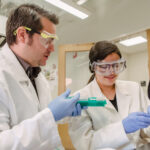
UMBC and the University of Maryland School of Medicine (UMSOM) have received a five-year, $13.7 million grant from the National Institutes of Health (NIH) to enhance recruitment and training of junior faculty from groups underrepresented in biomedical science. Funding is through the NIH Common Fund Faculty Institutional Recruitment for Sustainable Transformation (FIRST) program, which was founded last year to support efforts to hire groups of diverse, early-career research faculty.
The grant will enable the universities to hire a group of four faculty members at UMBC and six at UMSOM, each of whom will have cross-campus appointments at both institutions.
“Faculty hired under UM-FIRST will advance our teaching and research missions and serve as leaders for institutional change as we pursue our vision of a diverse professoriate,” says William LaCourse, dean of the College of Natural and Mathematical Sciences and professor of chemistry and biochemistry at UMBC. “These faculty and those who follow will also serve as role models for future generations of underrepresented students.”
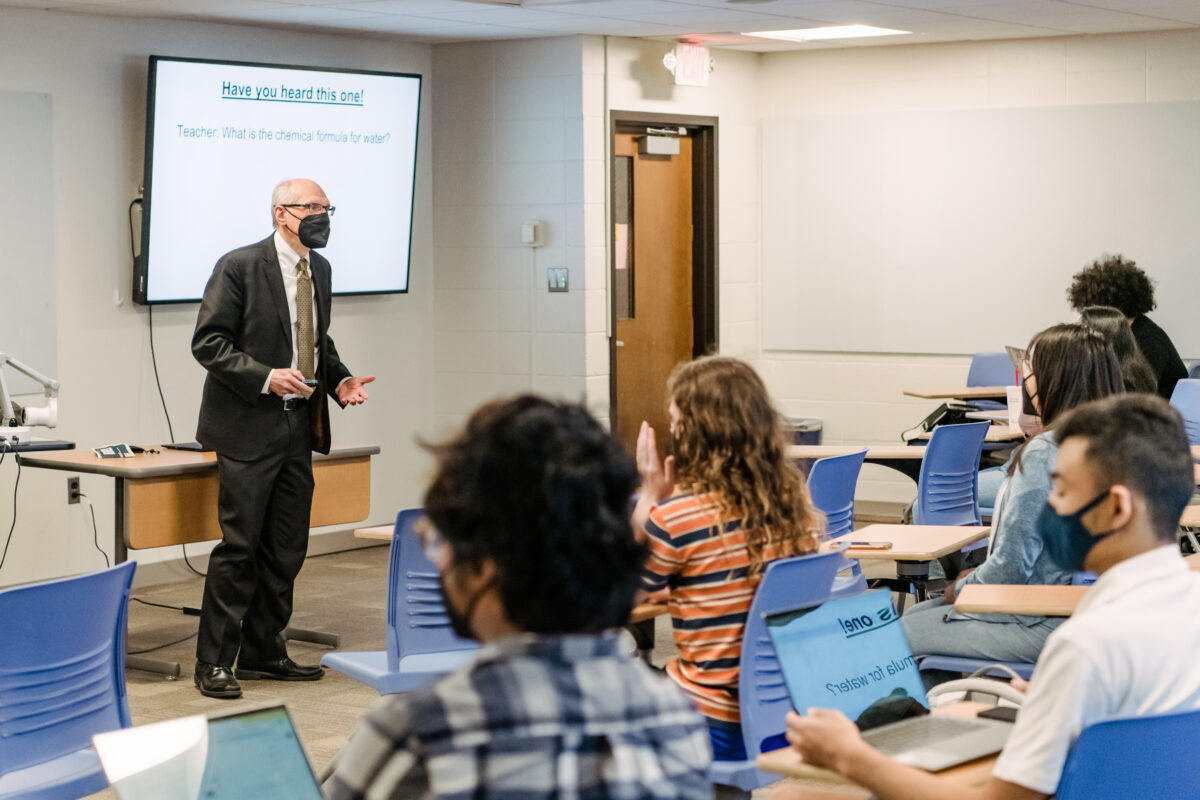 Dean William LaCourse teaches Chemistry 100 in spring 2022. (Marlayna Demond ’11/UMBC)
Fostering culture change
The grant aims to build self-reinforcing communities of scientists committed to diversity and inclusive excellence through the recruitment of early-career faculty who are competitive for assistant professor positions and have demonstrated commitment to promoting diversity and inclusion. UMSOM and UMBC will measure their progress against clearly defined metrics of institutional culture change, diversity, and inclusion to determine if hiring efforts and other evidence-based strategies are achieving the program’s goals.
The grant “is designed to foster sustainable culture change and promote inclusive excellence by enabling us to hire a diverse cohort of new faculty and to support faculty development, mentoring, and promotion opportunities,” says James Kaper, the lead on the grant and the James and Carolyn Frenkil Distinguished Dean’s Professor, vice dean for Academic Affairs, and chair of microbiology and immunology at UMSOM.
Building on a legacy of inclusion
The NIH FIRST grant builds on UMBC’s highly esteemed Meyerhoff Scholars Program, launched more than 30 years ago, which has led UMBC to become a leading university for developing underrepresented STEM undergraduates. UMBC is now the nation’s number #1 producer of Black undergraduates who go on to complete a PhD in the natural sciences or engineering and #1 for Black undergraduates who complete an M.D./Ph.D.
 Nykia Walker, a Pre-professoriate Fellow in biological sciences, studies how breast tumors initiate metastasis. (Image courtesy of Nykia Walker)
At the same time that UMBC excels in educating undergraduates, the university is also classified as one of only 146 R1 (“very high research activity”) institutions in the nation.
UMBC’s efforts to promote faculty diversity in STEM include the PROMISE Academy and ADVANCE, which has increased women faculty in STEM by 70 percent at UMBC since 2003.
The College of Natural and Mathematical Sciences’ Pre-professoriate Fellowship offers incoming faculty two-year appointments as research assistant professors, with structured mentoring and other scaffolds for success. Faculty who came to UMBC through this program in biological sciences, physics, and chemistry have already been converted to tenure-track assistant professors.
Unwavering dedication
The recent $10M INCLUDES grant awarded to UMBC further builds a robust, diverse pipeline in STEM at UMBC by supporting postdocs from underrepresented groups, and the PROMISE Allegiance for Graduate Education and the Professoriate (AGEP) program offers professional development and community to all graduate students and postdocs at UMBC and throughout the University System of Maryland.
UMSOM’s efforts to promote a diverse STEM and health-science pipeline include the UMB CURES program for middle and high school students, several internship and summer research programs for college students, and multiple post-graduate training programs that give underrepresented minority scholars direct experience in a laboratory setting.
Like many of these other initiatives, “The true strength of UM-FIRST,” LaCourse says, “ is in the unwavering dedication of the leadership, faculty, and staff of these two institutions to inclusive excellence and social justice.”
]]>
UMBC and the University of Maryland School of Medicine (UMSOM) have received a five-year, $13.7 million grant from the National Institutes of Health (NIH) to enhance recruitment and training of...
https://umbc.edu/stories/13-7m-nih-grant-to-increase-faculty-diversity/
https://beta.my.umbc.edu/api/v0/pixel/news/127879/guest@my.umbc.edu/0eeebdb2f330f00829cd9817044d91ec/api/pixel
cnms
coeit
diversityandinclusion
majoraward
meyerhoffscholars
news
science-and-tech
UMBC News & Magazine
https://beta.my.umbc.edu/groups/umbc-news-magazine
https://assets1-beta.my.umbc.edu/system/shared/avatars/groups/000/001/943/24435aa6207c452e7bc15cc74b42c7bb/xsmall.png?1748556657
https://assets1-beta.my.umbc.edu/system/shared/avatars/groups/000/001/943/24435aa6207c452e7bc15cc74b42c7bb/original.png?1748556657
https://assets2-beta.my.umbc.edu/system/shared/avatars/groups/000/001/943/24435aa6207c452e7bc15cc74b42c7bb/xxlarge.png?1748556657
https://assets2-beta.my.umbc.edu/system/shared/avatars/groups/000/001/943/24435aa6207c452e7bc15cc74b42c7bb/xlarge.png?1748556657
https://assets3-beta.my.umbc.edu/system/shared/avatars/groups/000/001/943/24435aa6207c452e7bc15cc74b42c7bb/large.png?1748556657
https://assets1-beta.my.umbc.edu/system/shared/avatars/groups/000/001/943/24435aa6207c452e7bc15cc74b42c7bb/medium.png?1748556657
https://assets2-beta.my.umbc.edu/system/shared/avatars/groups/000/001/943/24435aa6207c452e7bc15cc74b42c7bb/small.png?1748556657
https://assets1-beta.my.umbc.edu/system/shared/avatars/groups/000/001/943/24435aa6207c452e7bc15cc74b42c7bb/xsmall.png?1748556657
https://assets2-beta.my.umbc.edu/system/shared/avatars/groups/000/001/943/24435aa6207c452e7bc15cc74b42c7bb/xxsmall.png?1748556657
UMBC News & Magazine
0
0
false
Fri, 23 Sep 2022 09:46:03 -0400
Fri, 23 Sep 2022 09:46:03 -0400
What We Love About UMBC
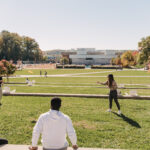
The start of the school year means new beginnings. For most, this looks like new classes and friends—new experiences and opportunities. UMBC’s new president is even experiencing a whole chapter of firsts! But among the new beginnings, some things never change. This is what we love about UMBC:
We bond over new experiences
In the classroom and in student clubs, Retrievers take pride in finding ways to connect with each other. “People are more open to learning about different things than you would think, like different cultures,” says Sara Motamedi ’23, mathematics, who has found her classmates to be truly inquisitive and open minded. “I never expected it to be so diverse, which is awesome,” says Michael Washington ’23, media and communication studies, who enjoys playing basketball at the Retriever Activities Center (RAC) in his free time.
 Sara Motamedi and fellow Retriever Maggie Taylan
Some students bond over a game in the RAC, others might find a home in high level debate. UMBC’s intellectual sports teams include the top Mock Trial team in the nation. More than 250+ student organizations and clubs can connect you to the larger community: from Retriever Music Society to HackUMBC to Meditation at UMBC, students can engage with their interests, majors, and cultures alongside one another. Bolstered by a bevy of academic and social support systems, like the Academic Success Center and the new Center for Well-Being, each Retriever can find something they love here on campus.
We make it a point to explore campus and beyond
One of the keys to academic success is decompressing, and Retrievers know how to relax in style. One of UMBC’s major hubs is The Commons, where students meet between classes to socialize and grab a bite to eat. Students hang out in the Sports Zone—where they might catch a game on the projector or an open mic performance—and the gameroom, where they play pool, ping pong, and video games. On the 530-acre campus, many students find their own personal spots to take a breather. “I always found the tunnel between the Chesapeake Arena and The Commons parking garage to be a chill place where I can sit and draw quietly,” says Krista Mitchell ’23, English.
After classes and on weekends, students often use the free transit system to explore nearby Catonsville and Arbutus, where UMBC-affiliated and alumni-operated coffee shop OCA Mocha can be found. “OCA Mocha is UMBC’s local place to hang out,” says Shawn Abraham ’24, political science. “Their study hours for students are really helpful.” In addition to drinks and treats, OCA Mocha showcases local artists in its gallery and hosts live events that are open to all.
We find ways to succeed together
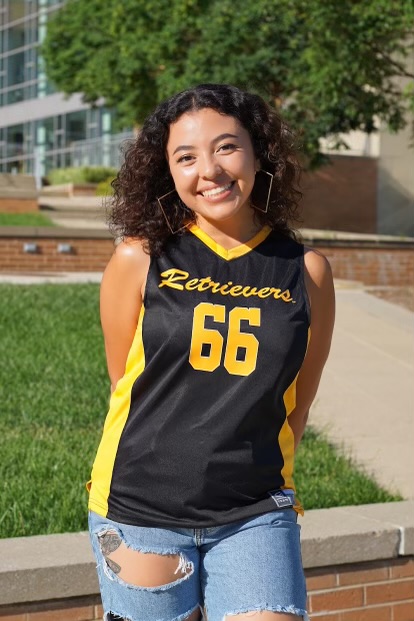 Camila Rudas
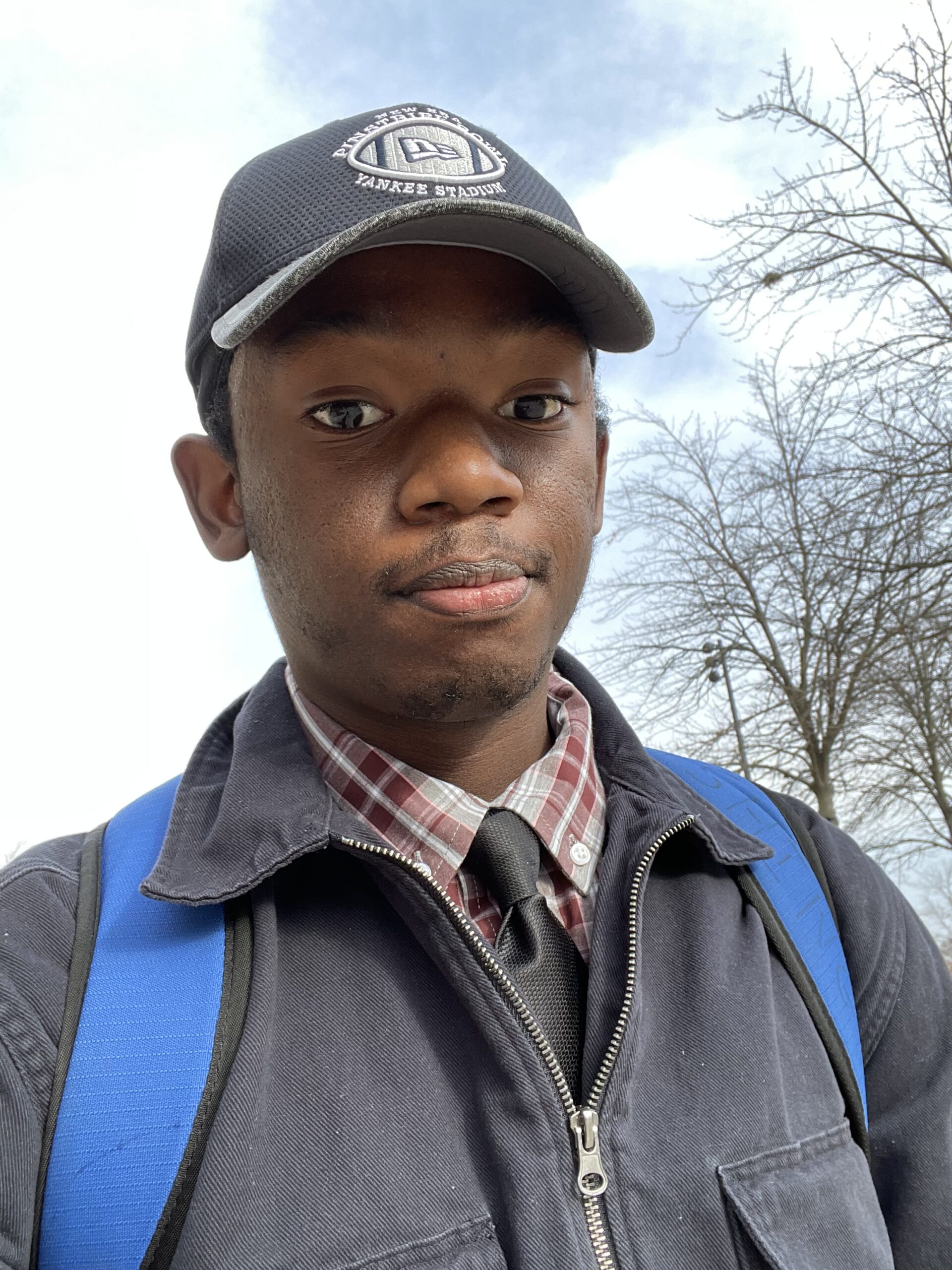 Michael Washington
For Camila Rudas ’22, biology and English, UMBC is defined by its community—people who embrace each other, look towards the future, and ask tough questions. In her eyes, this all starts with the professor. “They are always there to uplift students. Honestly, I feel like they are there to guide, instead of simply teach,” says Rudas, who has seen faculty go the extra mile—whether that’s collaborating with students through office hours, sharing internship opportunities, or providing research mentorship. UMBC’s students connect with faculty and staff in addition to their professors, though. “What surprised me most about UMBC was how personable my advisors have been,” says Maya Babu ’23, political science. “They honestly go above and beyond to help you succeed.”
As the school year gears up, UMBC’s students have a lot to return to—and plenty of new experiences waiting. Not least of which is welcoming and connecting with our new president, Dr. Valerie Sheares Ashby. “It’s cool,” says Motamedi. “She’s a woman of color in STEM—she’s just like me.”
]]>
The start of the school year means new beginnings. For most, this looks like new classes and friends—new experiences and opportunities. UMBC’s new president is even experiencing a whole chapter of...
https://umbc.edu/stories/what-we-love-about-umbc/
https://beta.my.umbc.edu/api/v0/pixel/news/127821/guest@my.umbc.edu/c083c3a992770ffa177fd5e177cc654d/api/pixel
campus-life
magazine
oca-mocha
rac
UMBC News & Magazine
https://beta.my.umbc.edu/groups/umbc-news-magazine
https://assets1-beta.my.umbc.edu/system/shared/avatars/groups/000/001/943/24435aa6207c452e7bc15cc74b42c7bb/xsmall.png?1748556657
https://assets1-beta.my.umbc.edu/system/shared/avatars/groups/000/001/943/24435aa6207c452e7bc15cc74b42c7bb/original.png?1748556657
https://assets2-beta.my.umbc.edu/system/shared/avatars/groups/000/001/943/24435aa6207c452e7bc15cc74b42c7bb/xxlarge.png?1748556657
https://assets2-beta.my.umbc.edu/system/shared/avatars/groups/000/001/943/24435aa6207c452e7bc15cc74b42c7bb/xlarge.png?1748556657
https://assets3-beta.my.umbc.edu/system/shared/avatars/groups/000/001/943/24435aa6207c452e7bc15cc74b42c7bb/large.png?1748556657
https://assets1-beta.my.umbc.edu/system/shared/avatars/groups/000/001/943/24435aa6207c452e7bc15cc74b42c7bb/medium.png?1748556657
https://assets2-beta.my.umbc.edu/system/shared/avatars/groups/000/001/943/24435aa6207c452e7bc15cc74b42c7bb/small.png?1748556657
https://assets1-beta.my.umbc.edu/system/shared/avatars/groups/000/001/943/24435aa6207c452e7bc15cc74b42c7bb/xsmall.png?1748556657
https://assets2-beta.my.umbc.edu/system/shared/avatars/groups/000/001/943/24435aa6207c452e7bc15cc74b42c7bb/xxsmall.png?1748556657
UMBC News & Magazine
0
0
false
Wed, 21 Sep 2022 10:29:14 -0400
Wed, 21 Sep 2022 10:29:14 -0400
Biden again indicates that US will defend Taiwan ‘militarily’ – does this constitute a change in policy?

Meredith Oyen, Associate Professor of History and Asian Studies, UMBC.
President Joe Biden has – not for the first time – suggested that the U.S. would intervene “militarily” should China attempt an invasion of Taiwan.
In an interview with CBS’s “60 Minutes” on Sept. 18, 2022, Biden vowed to protect the island in the face of any attack. Pressed if that meant the U.S. getting “involved militarily,” the president replied: “Yes.”
The comments appear to deviate from the official U.S. line on Taiwan, in place for decades. But White House officials said the remarks did not represent any change in Taiwan policy.
Meredith Oyen, an expert on U.S.-China relations at the University of Maryland, Baltimore County, helps explain the background to Biden’s comments and untangles what should be read into his remarks – and what shouldn’t.
What did Biden say and why was it significant?
In an exchange on “60 Minutes,” Biden was asked directly if the U.S. would “come to Taiwan’s defense” if it were attacked by China. He replied: “Yes, we have a commitment to do that.” He also confirmed that U.S. intervention would be military.
By my count, this is the fourth time Biden as president has suggested that the U.S. will come to Taiwan’s aid militarily if the island is attacked. In 2021 he made similar remarks in an interview with ABC News and then again while taking part in a CNN town hall event. And earlier this year he said something similar while in Japan, marking the first time he has made the assertion while in Asia.
On each occasion he has made such a comment, it has been followed quite quickly by the White House’s walking back the remarks, by issuing statements along the lines of “what the president actually means is …” and stressing that this isn’t a shift away from the official U.S. policy on China or Taiwan.
But I think that with each incident it is harder to prevaricate about Biden’s comments being an accident, or suggest that he in some way misspoke. I think it is clear at this point that Biden’s interpretation of the Taiwan Relations Act – which since 1979 has set out the parameters of U.S. policy on the island – is that it allows for a U.S. military response should China invade. And despite White House claims to the contrary, I believe that does represent a departure from the long-standing policy of “strategic ambiguity” on Taiwan.
What does ‘strategic ambiguity’ mean?
Strategic ambiguity has long been the U.S. policy toward Taiwan – really since the 1950s, but certainly from 1979 onward. While it does not explicitly commit the U.S. to defending Taiwan in every circumstance, it does leave open the option of American defensive support to Taiwan in the event of an unprovoked attack by China.
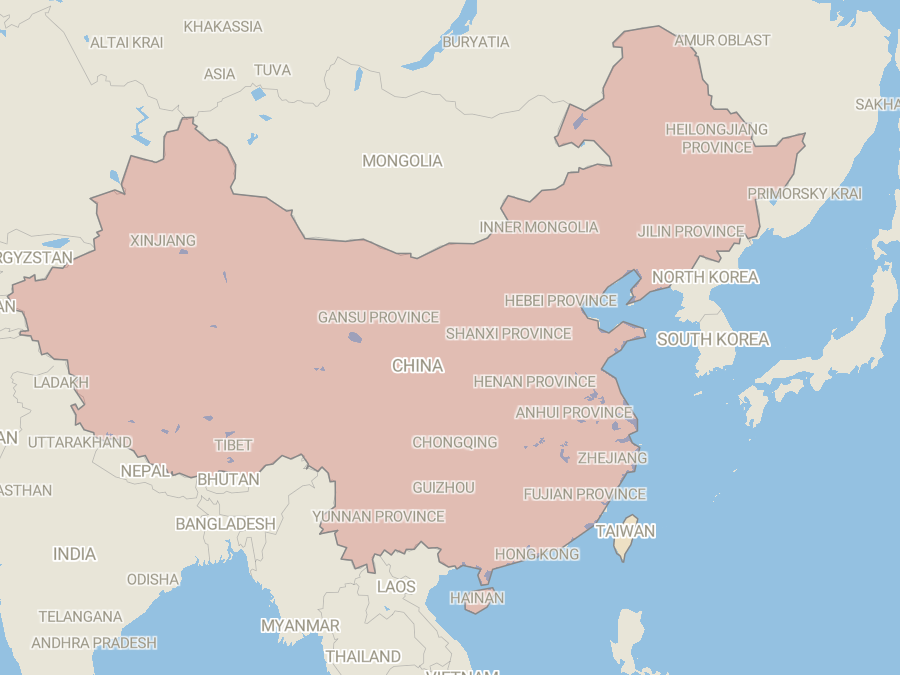 Map: The Conversation, CC-BY-ND @OpenStreetMap contributors.
Crucially, the U.S. hasn’t really said what it will do – so does this support mean economic aid, supply of weapons or U.S. boots on the ground? China and Taiwan are left guessing if – and to what extent – the U.S. will be involved in any China-Taiwan conflict.
By leaving the answer to that question ambiguous, the U.S. holds a threat over China: Invade Taiwan and find out if you face the U.S. as well.
Traditionally, this has been a useful policy for the U.S., but things have changed since it was first rolled out. It was certainly effective when the U.S. was in a much stronger position militarily compared with China. But it might be less effective as a threat now that China’s military is catching up with the U.S.
Leading voices from U.S. allies in Asia, such as Japan, believe that “strategic clarity” might be a better option now – with the U.S. stating outright that it would defend Taiwan if the island were attacked.
What is the history of US relations with Taiwan?
After the victory of the Chinese Communist Party in 1949, the defeated Republic of China government withdrew to the island of Taiwan, located just 100 miles off the shore of Fujian province. And until the 1970s, the U.S. recognized only this exiled Republic of China on Taiwan as the government of China.
 Nixon in China. Bettmann/Getty Images
But in 1971, the United Nations shifted recognition to the People’s Republic of China on the mainland. In 1972, President Richard Nixon made a now-famous trip to China to announce a rapprochement and sign the Shanghai Communique, a joint statement from Communist China and the U.S. signaling a commitment to pursue formal diplomatic relations. A critical section of that document stated: “The United States acknowledges that all Chinese on either side of the Taiwan Strait maintain there is but one China and that Taiwan is a part of China. The United States Government does not challenge that position.”
The wording was crucial: The U.S. was not formally committing to a position on whether Taiwan was part of the China nation. Instead, it was acknowledging what the governments of either territory asserted – that there is “one China.”
Where does US commitment of military support for Taiwan come from?
After establishing formal diplomatic relations with China in 1979, the U.S. built an informal relationship with the ROC on Taiwan. In part to push back against President Jimmy Carter’s decision to recognize Communist China, U.S. lawmakers passed the Taiwan Relations Act in 1979. That act outlined a plan to maintain close ties between the U.S. and Taiwan and included provisions for the U.S. to sell military items to help the island maintain its defense – setting the path for the policy of strategic ambiguity.
What has changed recently?
China has long maintained its desire for an eventual peaceful reunification of its country with the island it considers a rogue province. But the commitment to the principle of “one China” has become increasingly one-sided. It is an absolute for Beijing. In Taiwan, however, resistance to the idea of reunification has grown amid a surge of support for moving the island toward independence.
Beijing has become more aggressive of late in asserting that Taiwan must be “returned to China.” Domestic politics plays a role in this. At times of internal instability in China, Beijing has sounded a more belligerent tone on relations between the two entities separated by the Taiwan Strait. We have seen this over the past year with Beijing sending military aircraft into Taiwan’s Air Defense Zone.
Meanwhile, Chinese assertion of increased authority over Hong Kong has damaged the argument for “one country, two systems” as a means of peaceful reunification with Taiwan.
How has the US position shifted in the face of Beijing’s stance?
Biden has definitely been more openly supportive of Taiwan than previous presidents. He officially invited a representative from Taiwan to his inauguration – a first for an incoming president – and has repeatedly made it clear that he views Taiwan as an ally.
He also didn’t overturn the Taiwan Travel Act passed under the the previous administration of Donald Trump. This legislation allows U.S. officials to visit Taiwan in an official capacity.
In August 2022, U.S. House Speaker Nancy Pelosi visited Taiwan, making her the highest-profile U.S. politician to go to the island in decades.
Meanwhile, for the second time, Biden in his “60 Minutes” interview indicated a belief that it was up to Taiwan to decide its future, departing slightly from the usual line that the U.S. doesn’t support changes to the status quo. However, Biden has also said he does not support a unilateral declaration of independence from Taiwan.
So there has been a shift to a degree. But the White House is keen not to overstate any change. At heart, there is a desire by the U.S. to not stray from the Shanghai Communique.
So is an invasion of Taiwan likely?
The current rhetoric from the U.S. and response from China do raise the risk of conflict, but I don’t think we are at that point yet. Any invasion across the Taiwan Strait would be militarily complex. It also comes with risks of backlash from the international community. Taiwan would receive support from not only the U.S. – in an unclear capacity, given Biden’s remarks – but also Japan and likely other countries in the region.
Meanwhile, China maintains that it wants to see reintegration through peaceful means. As long as Taiwan doesn’t force the issue and declare independence unilaterally, I think there is tolerance in Beijing to wait it out. And despite some commentary to the contrary, I don’t think the invasion of Ukraine has raised the prospects of a similar move on Taiwan. In fact, given that Russia is now bogged down in a monthslong conflict that has hit its military credibility and economy, the Ukraine invasion may actually serve as a warning to Beijing.
This is an update to an article that was originally published on May 24, 2022.
This article is republished from The Conversation under a Creative Commons license. Read the original article.
]]>
Meredith Oyen, Associate Professor of History and Asian Studies, UMBC. President Joe Biden has – not for the first time – suggested that the U.S. would intervene “militarily” should China...
https://umbc.edu/stories/biden-again-indicates-that-us-will-defend-taiwan-militarily/
https://beta.my.umbc.edu/api/v0/pixel/news/127756/guest@my.umbc.edu/2e57e1ff30b15ff9ad42ebb620e16b7e/api/pixel
asianstudies
cahss
cahssresearch
cs3
discovery
history
international
magazine
UMBC News & Magazine
https://beta.my.umbc.edu/groups/umbc-news-magazine
https://assets1-beta.my.umbc.edu/system/shared/avatars/groups/000/001/943/24435aa6207c452e7bc15cc74b42c7bb/xsmall.png?1748556657
https://assets1-beta.my.umbc.edu/system/shared/avatars/groups/000/001/943/24435aa6207c452e7bc15cc74b42c7bb/original.png?1748556657
https://assets2-beta.my.umbc.edu/system/shared/avatars/groups/000/001/943/24435aa6207c452e7bc15cc74b42c7bb/xxlarge.png?1748556657
https://assets2-beta.my.umbc.edu/system/shared/avatars/groups/000/001/943/24435aa6207c452e7bc15cc74b42c7bb/xlarge.png?1748556657
https://assets3-beta.my.umbc.edu/system/shared/avatars/groups/000/001/943/24435aa6207c452e7bc15cc74b42c7bb/large.png?1748556657
https://assets1-beta.my.umbc.edu/system/shared/avatars/groups/000/001/943/24435aa6207c452e7bc15cc74b42c7bb/medium.png?1748556657
https://assets2-beta.my.umbc.edu/system/shared/avatars/groups/000/001/943/24435aa6207c452e7bc15cc74b42c7bb/small.png?1748556657
https://assets1-beta.my.umbc.edu/system/shared/avatars/groups/000/001/943/24435aa6207c452e7bc15cc74b42c7bb/xsmall.png?1748556657
https://assets2-beta.my.umbc.edu/system/shared/avatars/groups/000/001/943/24435aa6207c452e7bc15cc74b42c7bb/xxsmall.png?1748556657
UMBC News & Magazine
0
0
false
Mon, 19 Sep 2022 16:07:15 -0400
Mon, 19 Sep 2022 16:07:15 -0400
Students in UMBC’s ICARE program connect scientific research with community

Bats as biomonitors, community connections to the zero-waste movement, and oyster aquaculture are just a few of the topics that students in UMBC’s Interdisciplinary Consortium for Applied Research in the Environment (ICARE) master’s program are exploring through Baltimore-centered community-engaged research. As the first cohort in the program heads into their second and final year, they are excited about their work and looking ahead to becoming the next generation of environmental science leaders.
“B” is for bat
Chris Blume, M.S. ’23, geography and environmental systems,has studied bobcats, bees, and birds. So when he came to ICARE, he jokes, “I had to choose another ‘b’ animal.” Jokes aside, in his undergraduate and working experience, Blume found that “the social aspect was missing” in conservation science, which often focused on wildlife. “And that’s what drew me to ICARE, because it seemed like there was a focus on the community.”
In his project, Blume is using bats as biomonitors to detect levels of heavy metals in different neighborhoods across Baltimore. “Because of their biology and their ecology, they make great biomonitors in rural environments,” he says, “but I wanted to see how that works in urban places.”
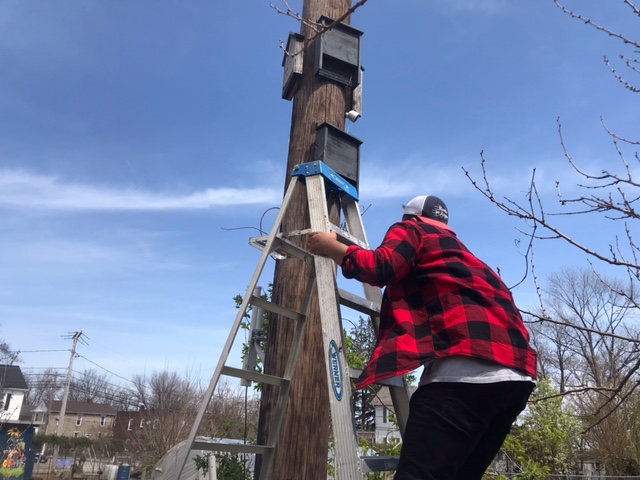 Bat boxes are most successful when they get ample direct sunlight and are about 15 – 20 feet off the ground.
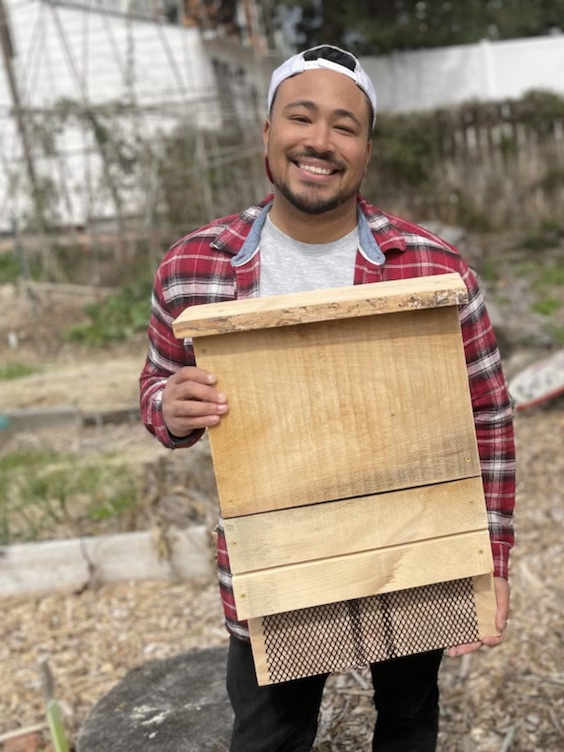 Chris Blume shows off one of his bat boxes before installing it.
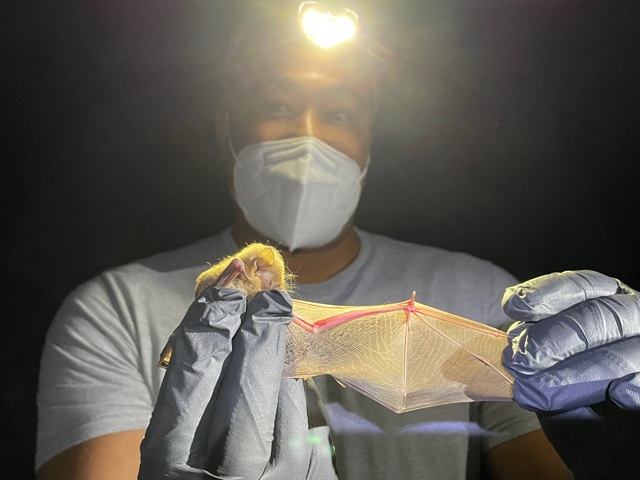 Chris Blume examines a bat from one of his bat boxes.
How can bats provide information about heavy metals? Through their guano (poop). “I have literally a fridge with a bunch of guano,” he says, waiting for analysis later this fall. In addition to the guano analysis, Blume is giving away bat boxes to local residents and offering evening “bat walks” to teach local Baltimoreans about these important native critters. He’s also created citizen science opportunities by posting acoustic recordings of bat calls on a public website, where anyone can listen and help identify which bat species show up where.
In the future, Blume wants to pursue a Ph.D. and continue his bat research, as well as continue to create citizen science and community engagement opportunities.
Building the bridge
Natalia Figueredo, M.S. ’23, geography and environmental systems, has always been community-oriented, influenced by her early childhood in Bolivia and her teenage years in Queens, New York. In New York, she noticed that “there were all these big projects going on in communities, and the community didn’t ask for them,” she says. She wanted to do something different.
After working with the Ironbound Community Corporation in Ironbound, New Jersey, she became passionate about doing inclusive research for mutual benefit, and ICARE was a perfect fit to advance her career. “What interested me about this program,” she says, “is that it was trying to build that bridge between scientific research and community engagement.”
Figueredo’s research project focuses on engaging South Baltimore residents in the zero-waste movement, in the context of recent battles over a nearby trash incinerator. She is also working closely with partners at the Global Alliance for Incinerator Alternatives (GAIA) and the South Baltimore Community Land Trust, in addition to her faculty mentor Maggie Holland, associate professor of geography and environmental systems.
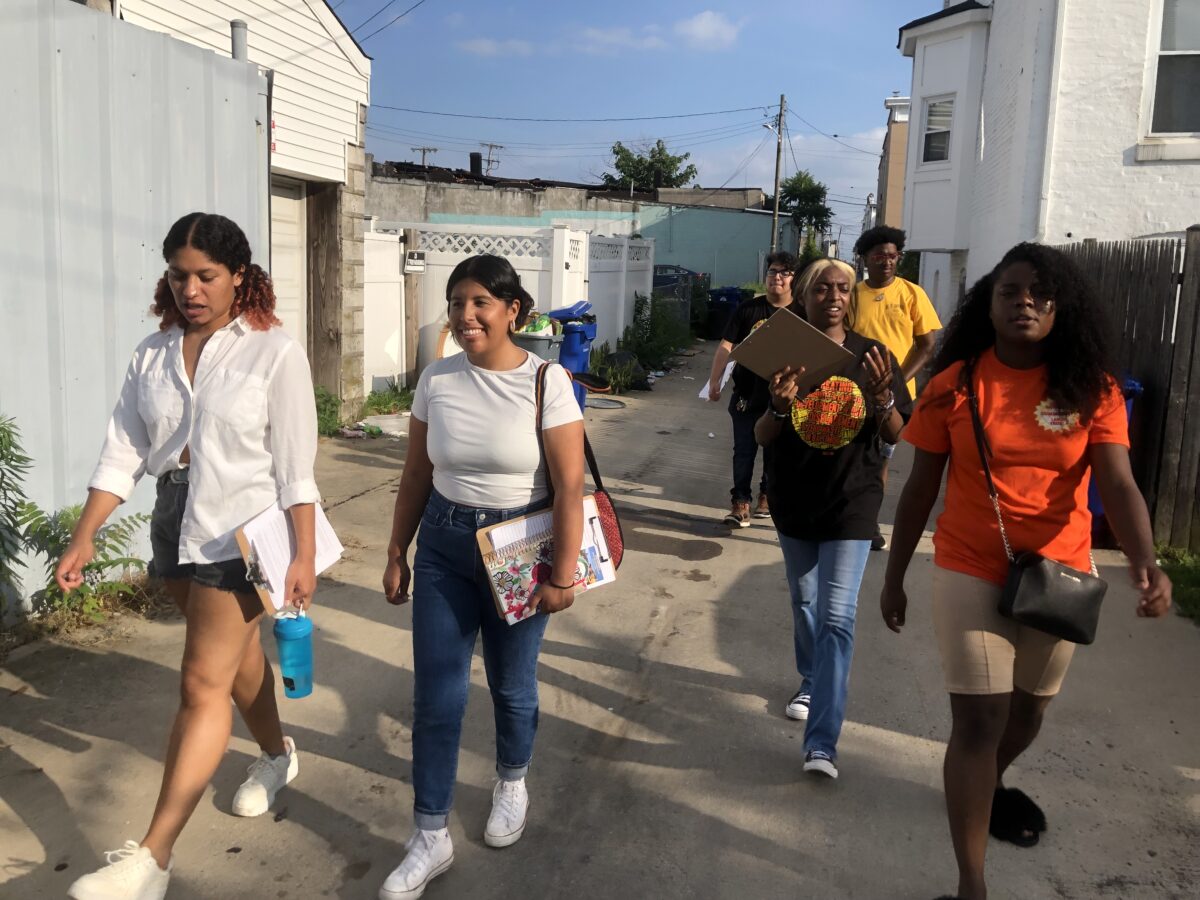 Natalia Figueredo (second from left) meets with members of the South Baltimore Community Land Trust. (Courtesy of Figueredo)
Figueredo is surveying residents from across the city about their waste management practices and access to the zero-waste movement. She’s also interviewing South Baltimore community leaders and conducting focus groups with neighborhood residents. Figueredo hopes to find out whether they feel supported in pursuing zero-waste goals and to learn what local knowledge and practices already exist related to the movement—whether or not the residents identify them as such.
Research always comes with bumps in the road, but overall Figueredo has had a rewarding experience so far. She wanted to choose a graduate program where people would champion and support her, she says—“and that’s definitely how I feel with the ICARE team.”
Putting research into practice
Darryl Acker-Carter, M.S. ’23, marine, estuarine, and environmental science, is studying a new method of oyster aquaculture with partners at the company Solar Oysters. Traditionally, oysters have been cultivated in wire baskets at the water’s surface. A new system, called the Solar Oyster Production System (SOPS), uses a solar-powered ladder structure to rotate the baskets through the entire water column. The goal is to produce healthier, more-uniform oysters in less space. At the end of the growing season this fall, Acker-Carter will compare oyster size, survival rate, and meat-to-shell ratio of oysters in the experimental rotating ladders, non-rotating ladders, and traditional surface-only baskets at a site in Curtis Bay, in south Baltimore.
Acker-Carter has been interested in oysters for several years. “I like social science, but I also like the biological side of things, and I saw that nexus through oysters,” he says. To some, how to best cultivate oysters may seem like a purely scientific question, but “when you actually get down to, ‘Let’s make some change,’ it’s all social science,” Acker-Carter says, “because it’s all managing people and their perspective about how to harvest oysters and their relationships to natural resources.”
The ICARE program has helped Acker-Carter see how research fits into community engagement. “I used to think research was very isolated,” he says, “but in ICARE, you’re putting that research into practice. You can create benefit in the community by doing the research, and giving people access to that data.”
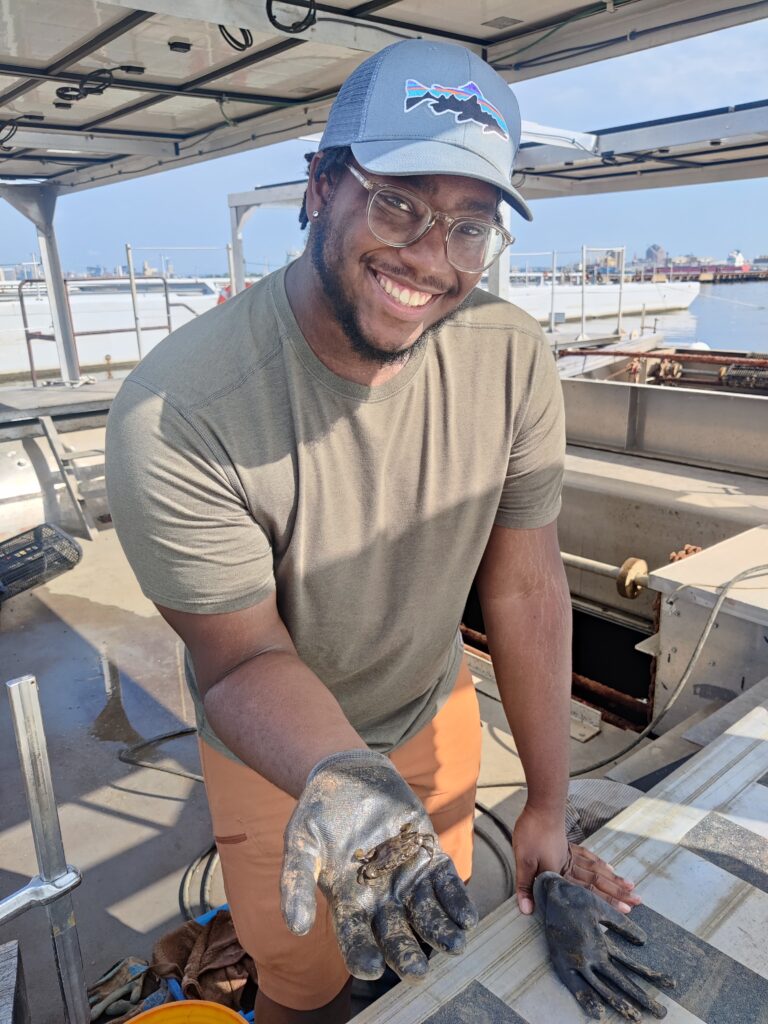 Darryl Acker-Carter holds a very small blue crab on a boat.
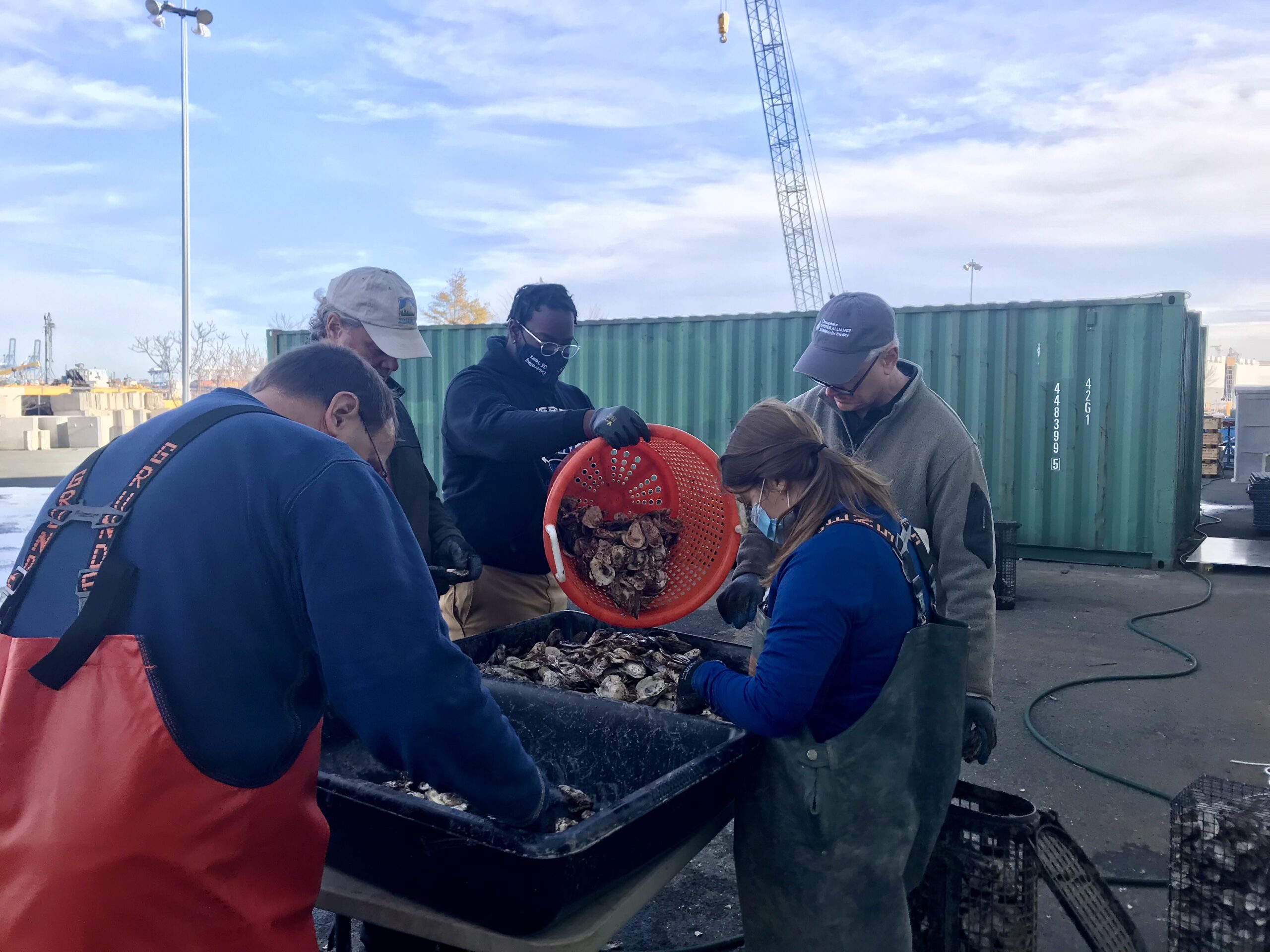 Darryl Acker-Carter (holding orange bucket) helps harvest oysters.
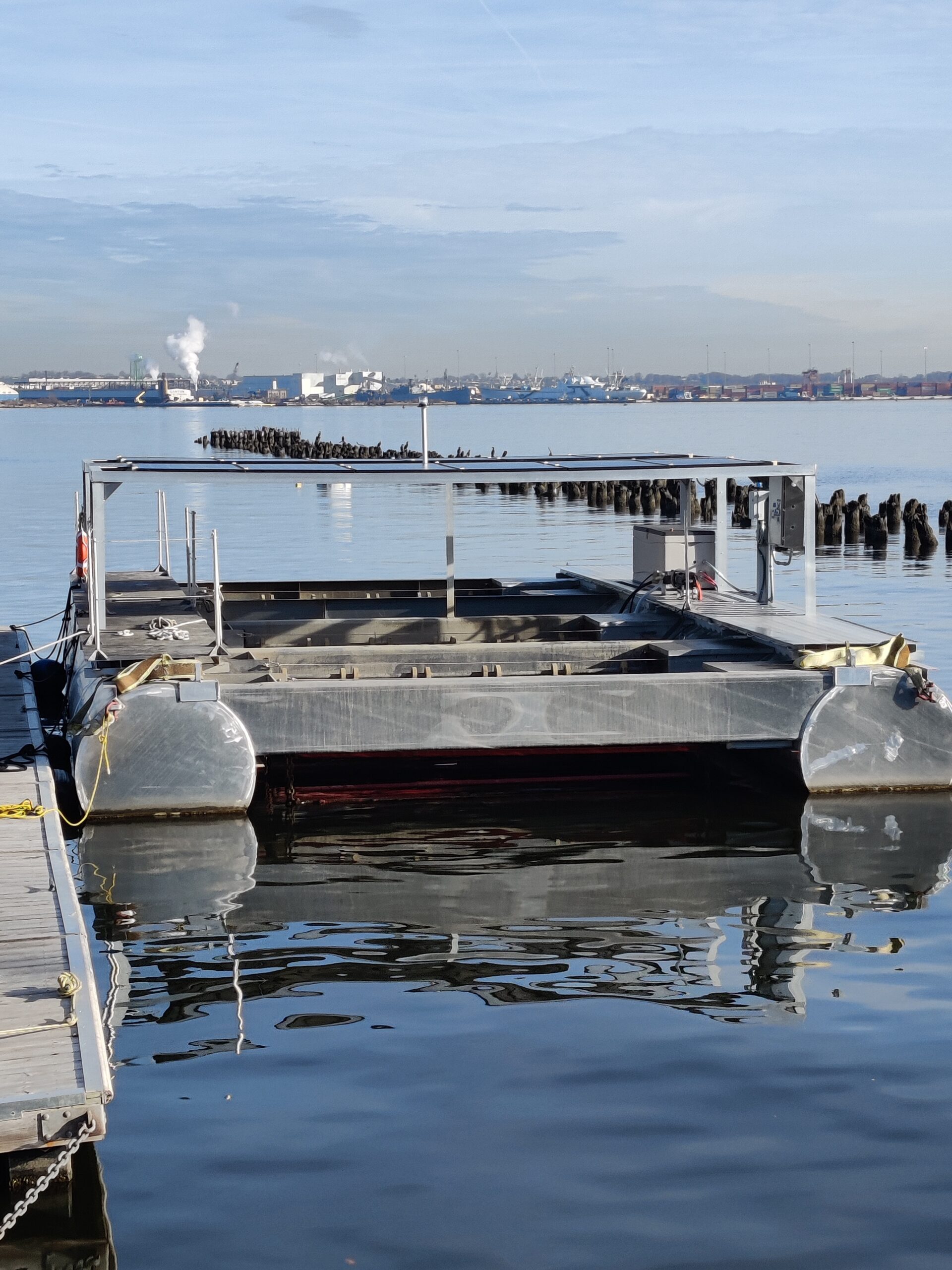 A surface view of the rotating solar-powered aquaculture system used in Darryl Acker-Carter’s research project.
Committed to community
For program leader Tamra Mendelson, professor of biological sciences, ICARE is exceeding expectations. “I am thrilled with how the program is going,” she says. “The students themselves are so strong. They are motivated. They are engaged. They are very sharp, and they’ve bonded as a cohort, which makes us really happy. I do think that’s a huge secret to success—having students feel like they are part of a network of peers supporting each other.”
The community partners have also been critical for the program’s success. One session led by Stephen Freeland, director of the individualized study program at UMBC, brought students and partners together for a brainstorming session across projects and topic areas, embodying the program’s commitment to bridging science and community. “Just bringing everyone to the table, literally, and helping everyone see that their voice is equally important in solving these environmental problems and doing the research was really powerful,” Mendelson says.
Mendelson shares that she and her fellow faculty have also been developing their community-engagement skills in working alongside their students. “I’m amazed at how important relationships are, and trust,” Mendelson says. “Building relationships with members of the community has been much more interesting and complicated than I expected. It’s work. But it’s good work.”
That community engagement piece makes ICARE different from other environmental science programs, explains Kevin Omland, professor of biological sciences. “We’re definitely tackling different issues in different places than lots of environmental science has, even 10 or 20 years ago,” he says, “so it’s really satisfying to see that coming into place.”
“ICARE fulfills so many of the stated missions and goals of UMBC—to connect with community, to address the climate crisis, to increase diversity and inclusion,” Mendelson says. She looks forward to working with the second cohort of ICARE students, who started this fall, preparing them for successful careers in environmental science and leading local change.
]]>
Bats as biomonitors, community connections to the zero-waste movement, and oyster aquaculture are just a few of the topics that students in UMBC’s Interdisciplinary Consortium for Applied Research...
https://umbc.edu/stories/icare-program-connects-science-with-community/
https://beta.my.umbc.edu/api/v0/pixel/news/127733/guest@my.umbc.edu/c00e1e50a2c77d7a36e63fdfcc52f2ae/api/pixel
biology
cahss
cnms
ges
gradresearch
news
policy-and-society
rca-2
science-and-tech
UMBC News & Magazine
https://beta.my.umbc.edu/groups/umbc-news-magazine
https://assets1-beta.my.umbc.edu/system/shared/avatars/groups/000/001/943/24435aa6207c452e7bc15cc74b42c7bb/xsmall.png?1748556657
https://assets1-beta.my.umbc.edu/system/shared/avatars/groups/000/001/943/24435aa6207c452e7bc15cc74b42c7bb/original.png?1748556657
https://assets2-beta.my.umbc.edu/system/shared/avatars/groups/000/001/943/24435aa6207c452e7bc15cc74b42c7bb/xxlarge.png?1748556657
https://assets2-beta.my.umbc.edu/system/shared/avatars/groups/000/001/943/24435aa6207c452e7bc15cc74b42c7bb/xlarge.png?1748556657
https://assets3-beta.my.umbc.edu/system/shared/avatars/groups/000/001/943/24435aa6207c452e7bc15cc74b42c7bb/large.png?1748556657
https://assets1-beta.my.umbc.edu/system/shared/avatars/groups/000/001/943/24435aa6207c452e7bc15cc74b42c7bb/medium.png?1748556657
https://assets2-beta.my.umbc.edu/system/shared/avatars/groups/000/001/943/24435aa6207c452e7bc15cc74b42c7bb/small.png?1748556657
https://assets1-beta.my.umbc.edu/system/shared/avatars/groups/000/001/943/24435aa6207c452e7bc15cc74b42c7bb/xsmall.png?1748556657
https://assets2-beta.my.umbc.edu/system/shared/avatars/groups/000/001/943/24435aa6207c452e7bc15cc74b42c7bb/xxsmall.png?1748556657
UMBC News & Magazine
0
0
false
Mon, 19 Sep 2022 12:58:20 -0400
Mon, 19 Sep 2022 12:58:20 -0400
