Celebrating Retriever Achievements

The weeks around Homecoming offer multiple ways for the UMBC community to reconnect with our Retriever pride and celebrate the accomplishments of our amazing alumni. Two marquee events during this time are the UMBC Athletic Hall of Fame Induction and Alumni Awards ceremonies.
Athletics’ legacy of excellence
The UMBC Athletics Hall of Fame first launched in the 1970s and was later made an annual ceremony in 1990. This celebratory event recognizes UMBC community members for their athletic excellence and contribution to the university. To date, 129 members have been enshrined. And this year, Brian Barrio, UMBC Director of Athletics, made a key change, moving the popular event to Homecoming weekend to capitalize on the #RetrieverNation excitement.
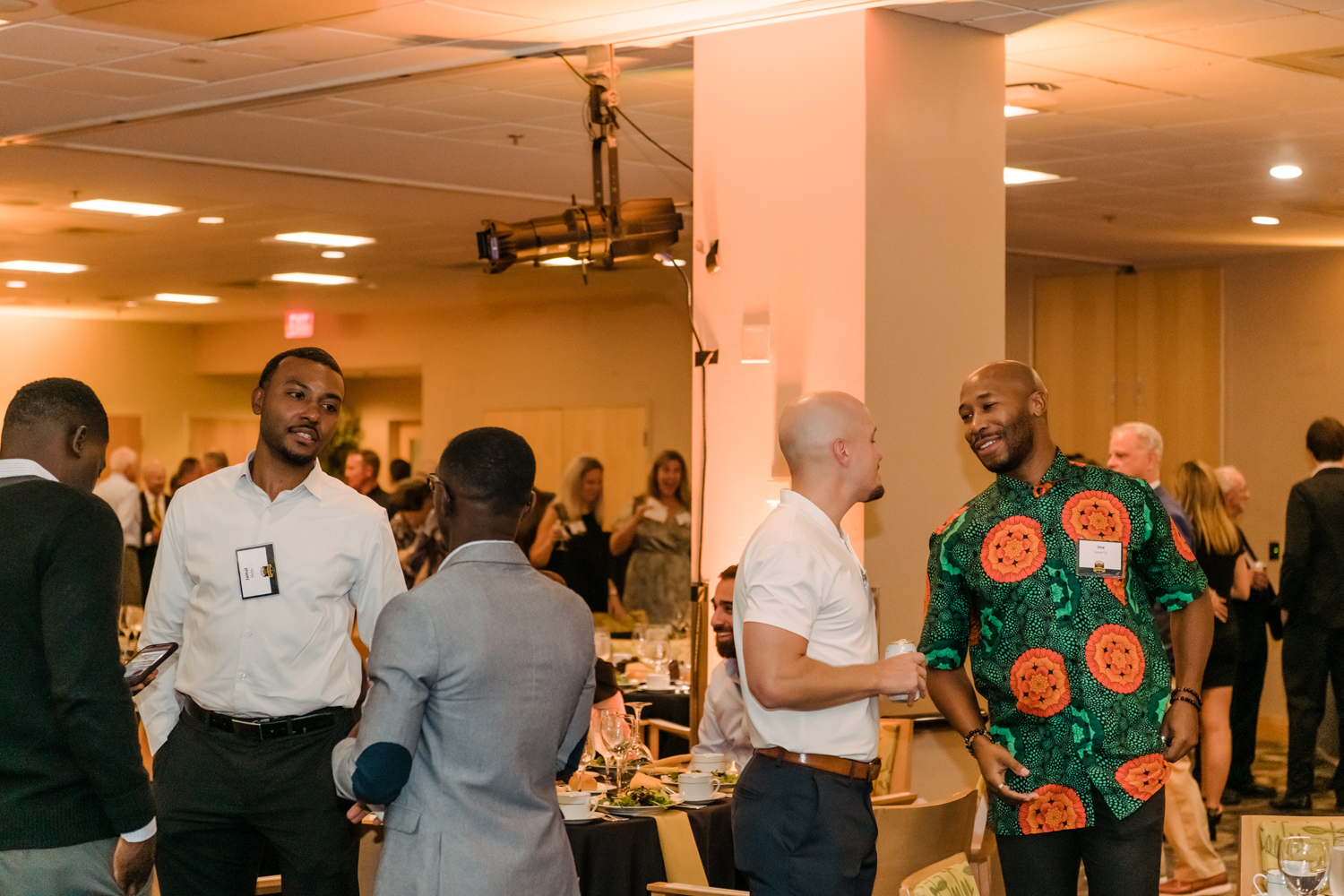
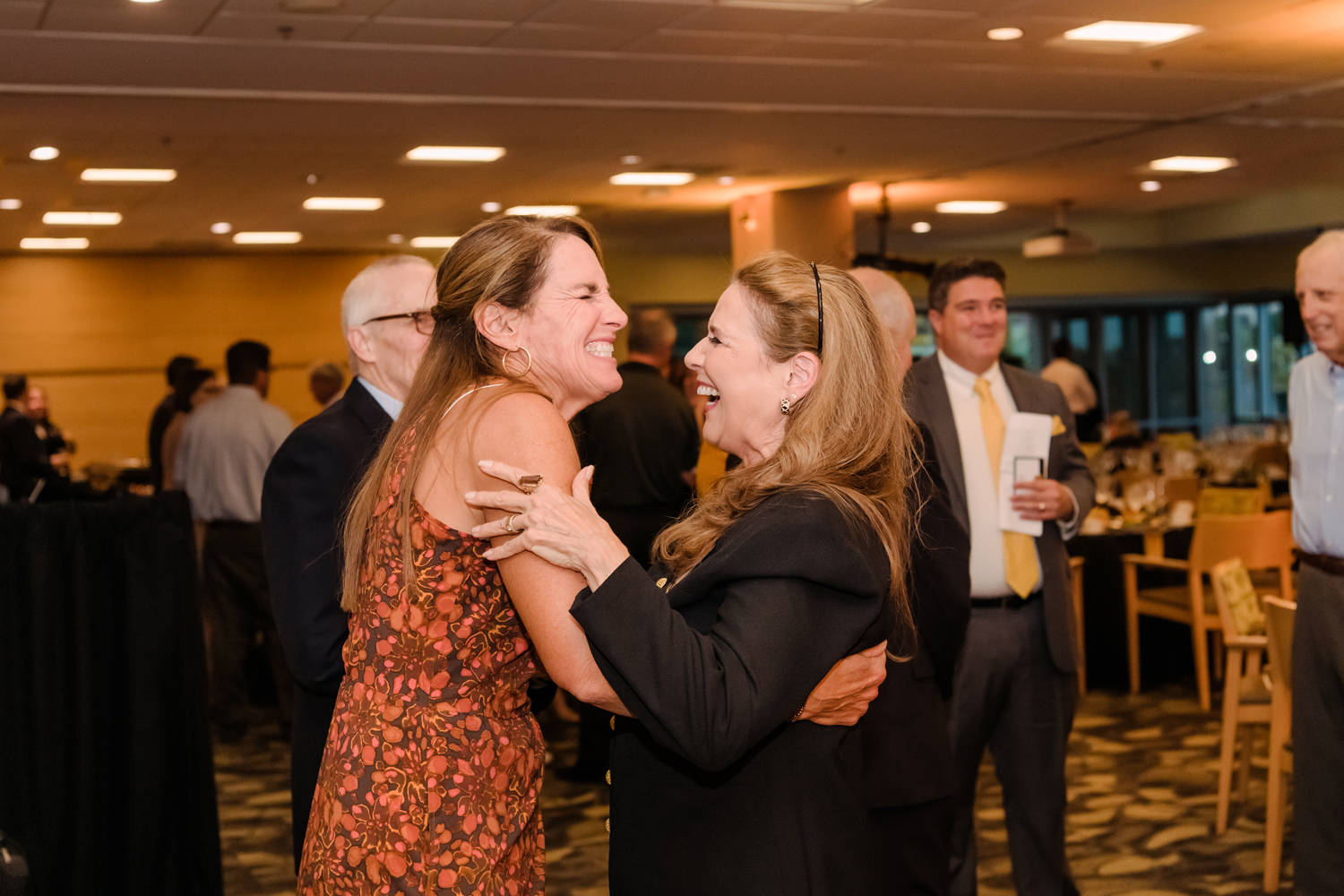
“We are thrilled that the Athletics Hall of Fame has been moved to the Homecoming weekend, and grateful to UMBC’s Office of Alumni Engagement who have been great partners in the re-launch of this event,” says Barrio. After postponing the event for two years due to COVID 19, says Barrio, Athletics is eager to celebrate their community. “This class is a diverse and talented group that set high standards of excellence for Retriever Nation.”
The 22nd edition of the Hall of Fame inductions took place on Friday, October 7, in UMBC’s Skylight Room honoring:
-
Steve Levy ’85, interdisciplinary studies—associate director of Athletics/director of athletic communications, 1986 – present
-
Dana Eberly Keiner ’97, biological sciences—volleyball, 1993 – 1996
-
Jean Salkeld Battista ’98, sociology—softball, 1997 – 1998
-
Mohamed Hussein ’14, mechanical engineering, M.S. ’17, systems engineering—swimming, 2011 – 2014
-
Levi Houapeu ’15, financial economics—men’s soccer, 2007 – 2010
-
Mercedes Jackson ’15, psychology—track and field, 2011 – 2015)
 Steve Levy ’85 and his family at the Hall of Fame induction. (Marlayna Demond ’11/UMBC)
Recognizing alumni excellence
Later in October, UMBC will celebrate another cadre of Retrievers at the 2022 Alumni Awards, hosted by the UMBC Alumni Association Board of Directors. This year’s ceremony and reception takes place on Thursday, October 27, at 6:30 p.m. in UMBC’s Earl and Darielle Linehan Concert Hall.
“This is one of my favorite events because it brings the UMBC community together in such a beautiful way,” says Stanyell Odom, Director of Alumni Engagement. “We are proud to continue to support the Alumni Association and its board of directors in this annual celebration of excellence.”
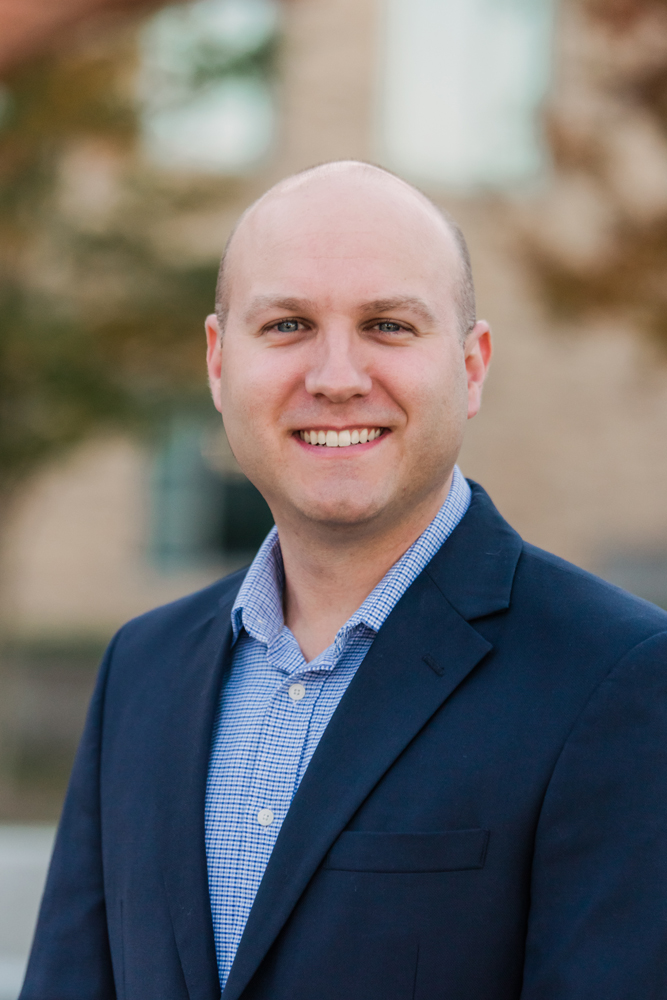
Brian Frazee (Marlayna Demond ’11/UMBC)
Three different types of awards are given to alumni during the ceremony: Outstanding Alumni of the Year awards (by major or field affiliation), Distinguished Service, and Rising Star (Young Alumni). The alumni board also recognizes one Outstanding Faculty member who has demonstrated commitment to student success beyond the classroom.
“The UMBC Alumni Association Board of Directors is excited to honor our 2022 Alumni Award winners,” says Brian Frazee ’11, political science, M.P.P. ’12. “This year’s honorees represent the very best of our alumni community, and their contributions are making a difference all over the world.”
This year’s awardees are:
-
Dr. Josiah Dykstra, Ph.D. ’13, computer science—Outstanding Alumnus in Engineering & Information Technology
-
Dr. Karsonya ‘Kaye’ Wise Whitehead, Ph.D. ’09, language, literacy and culture— Outstanding Alumna in the Humanities
-
Dr. Joy Haley, Ph.D. ’01, chemistry—Outstanding Alumna in Natural & Mathematical Sciences
-
Dr. Keith Elder, Ph.D. ’02, health policy, policy sciences—Outstanding Alumnus in Social & Behavioral Sciences
-
McKenzie Chinn ’06, theatre—Outstanding Alumna in Visual & Performing Arts
-
Benjamin Garmoe ’13, political science—Distinguished Service
-
Stefanie Mavronis ’12, media and communication studies, political science—Rising Star
-
Dr. Carolyn Forestiere, Professor of Political Science—Outstanding Faculty
Learn more about the 2022 Alumni Award winners and register for the event.
]]>
The weeks around Homecoming offer multiple ways for the UMBC community to reconnect with our Retriever pride and celebrate the accomplishments of our amazing alumni. Two marquee events during this...
https://umbc.edu/stories/celebrating-retriever-achievements/
https://beta.my.umbc.edu/api/v0/pixel/news/128556/guest@my.umbc.edu/ee152d91a32d4c360b51fa16c70a55bf/api/pixel
alumni
alumni-awards-2022
athletics
hall-of-fame
homecoming-2022
magazine
retrievernation
UMBC News & Magazine
https://beta.my.umbc.edu/groups/umbc-news-magazine
https://assets1-beta.my.umbc.edu/system/shared/avatars/groups/000/001/943/24435aa6207c452e7bc15cc74b42c7bb/xsmall.png?1748556657
https://assets1-beta.my.umbc.edu/system/shared/avatars/groups/000/001/943/24435aa6207c452e7bc15cc74b42c7bb/original.png?1748556657
https://assets2-beta.my.umbc.edu/system/shared/avatars/groups/000/001/943/24435aa6207c452e7bc15cc74b42c7bb/xxlarge.png?1748556657
https://assets2-beta.my.umbc.edu/system/shared/avatars/groups/000/001/943/24435aa6207c452e7bc15cc74b42c7bb/xlarge.png?1748556657
https://assets3-beta.my.umbc.edu/system/shared/avatars/groups/000/001/943/24435aa6207c452e7bc15cc74b42c7bb/large.png?1748556657
https://assets1-beta.my.umbc.edu/system/shared/avatars/groups/000/001/943/24435aa6207c452e7bc15cc74b42c7bb/medium.png?1748556657
https://assets2-beta.my.umbc.edu/system/shared/avatars/groups/000/001/943/24435aa6207c452e7bc15cc74b42c7bb/small.png?1748556657
https://assets1-beta.my.umbc.edu/system/shared/avatars/groups/000/001/943/24435aa6207c452e7bc15cc74b42c7bb/xsmall.png?1748556657
https://assets2-beta.my.umbc.edu/system/shared/avatars/groups/000/001/943/24435aa6207c452e7bc15cc74b42c7bb/xxsmall.png?1748556657
UMBC News & Magazine
0
0
false
Tue, 18 Oct 2022 11:21:37 -0400
Tue, 18 Oct 2022 11:21:37 -0400
How Bob Dylan used the ancient practice of ‘imitatio’ to craft some of the most original songs of his time

Raphael Falco, Professor of English, UMBC
Over the course of six decades, Bob Dylan steadily brought together popular music and poetic excellence. Yet the guardians of literary culture have only rarely accepted Dylan’s legitimacy.
His 2016 Nobel Prize in Literature undermined his outsider status, challenging scholars, fans and critics to think of Dylan as an integral part of international literary heritage. My new book, “No One to Meet: Imitation and Originality in the Songs of Bob Dylan,” takes this challenge seriously and places Dylan within a literary tradition that extends all the way back to the ancients.
I am a professor of early modern literature, with a special interest in the Renaissance. But I am also a longtime Dylan enthusiast and the co-editor of the open-access Dylan Review, the only scholarly journal on Bob Dylan.
After teaching and writing about early modern poetry for 30 years, I couldn’t help but recognize a similarity between the way Dylan composes his songs and the ancient practice known as “imitatio.”
Poetic honey-making
Although the Latin word imitatio would translate to “imitation” in English, it doesn’t mean simply producing a mirror image of something. The term instead describes a practice or a methodology of composing poetry.
The classical author Seneca used bees as a metaphor for writing poetry using imitatio. Just as a bee samples and digests the nectar from a whole field of flowers to produce a new kind of honey – which is part flower and part bee – a poet produces a poem by sampling and digesting the best authors of the past.
 To Seneca, the poetry writing process was akin to a bee making honey. K_Thalhofer/iStock via Getty Images
Dylan’s imitations follow this pattern: His best work is always part flower, part Dylan.
Consider a song like “A Hard Rain’s A-Gonna Fall.” To write it, Dylan repurposed the familiar Old English ballad “Lord Randal,” retaining the call-and-response framework. In the original, a worried mother asks, “O where ha’ you been, Lord Randal, my son? / And where ha’ you been, my handsome young man?” and her son tells of being poisoned by his true love.
In Dylan’s version, the nominal son responds to the same questions with a brilliant mixture of public and private experiences, conjuring violent images such as a newborn baby surrounded by wolves, black branches dripping blood, the broken tongues of a thousand talkers and pellets poisoning the water. At the end, a young girl hands the speaker – a son in name only – a rainbow, and he promises to know his song well before he’ll stand on the mountain to sing it.
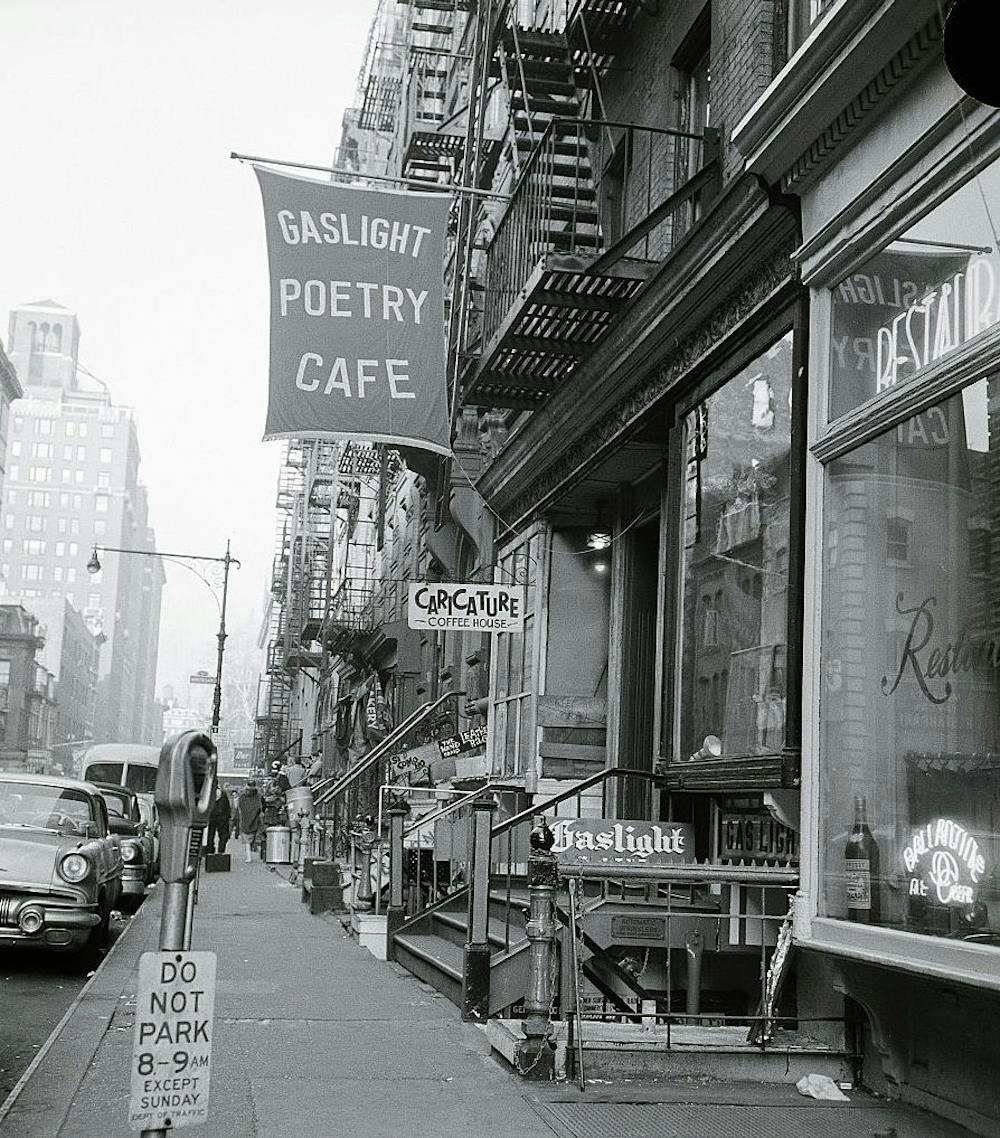
“A Hard Rain’s A-Gonna Fall” resounds with the original Old English ballad, which would have been very familiar to Dylan’s original audiences of Greenwich Village folk singers. He first sang the song in 1962 at the Gaslight Cafe on MacDougal Street, a hangout of folk revival stalwarts. To their ears, Dylan’s indictment of American culture – its racism, militarism and reckless destruction of the environment – would have echoed that poisoning in the earlier poem and added force to the repurposed lyrics.
Drawing from the source
Because Dylan “samples and digests” songs from the past, he has been accused of plagiarism.
This charge underestimates Dylan’s complex creative process, which closely resembles that of early modern poets who had a different concept of originality – a concept Dylan intuitively understands. For Renaissance authors, “originality” meant not creating something out of nothing, but going back to what had come before. They literally returned to the “origin.” Writers first searched outside themselves to find models to imitate, and then they transformed what they imitated – that is, what they found, sampled and digested – into something new. Achieving originality depended on the successful imitation and repurposing of an admired author from a much earlier era. They did not imitate each other, or contemporary authors from a different national tradition. Instead, they found their models among authors and works from earlier centuries.
In his book “The Light in Troy,” literary scholar Thomas Greene points to a 1513 letter written by poet Pietro Bembo to Giovanfrancesco Pico della Mirandola.
“Imitation,” Bembo writes, “since it is wholly concerned with a model, must be drawn from the model … the activity of imitating is nothing other than translating the likeness of some other’s style into one’s own writings.” The act of translation was largely stylistic and involved a transformation of the model.
Romantics devise a new definition of originality
However, the Romantics of the late 18th century wished to change, and supersede, that understanding of poetic originality. For them, and the writers who came after them, creative originality meant going inside oneself to find a connection to nature.
As scholar of Romantic literature M.H. Abrams explains in his renowned study “Natural Supernaturalism,” “the poet will proclaim how exquisitely an individual mind … is fitted to the external world, and the external world to the mind, and how the two in union are able to beget a new world.”
Instead of the world wrought by imitating the ancients, the new Romantic theories envisioned the union of nature and the mind as the ideal creative process. Abrams quotes the 18th-century German Romantic Novalis: “The higher philosophy is concerned with the marriage of Nature and Mind.”
The Romantics believed that through this connection of nature and mind, poets would discover something new and produce an original creation. To borrow from past “original” models, rather than producing a supposedly new work or “new world,” could seem like theft, despite the fact, obvious to anyone paging through an anthology, that poets have always responded to one another and to earlier works.
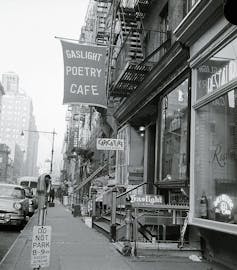 Dylan performed at New York City’s Gaslight Cafe, a popular folk music venue. Bettmann/Getty Images
Unfortunately – as Dylan’s critics too often demonstrate – this bias favoring supposedly “natural” originality over imitation continues to color views of the creative process today.
For six decades now, Dylan has turned that Romantic idea of originality on its head. With his own idiosyncratic method of composing songs and his creative reinvention of the Renaissance practice of imitatio, he has written and performed – yes, imitation functions in performance too – over 600 songs, many of which are the most significant and most significantly original songs of his time.
To me, there is a firm historical and theoretical rationale for what these audiences have long known – and the Nobel Prize committee made official in 2016 – that Bob Dylan is both a modern voice entirely unique and, at the same time, the product of ancient, time-honored ways of practicing and thinking about creativity.
This article is republished from The Conversation under a Creative Commons license. Read the original article.
]]>
Raphael Falco, Professor of English, UMBC Over the course of six decades, Bob Dylan steadily brought together popular music and poetic excellence. Yet the guardians of literary culture have...
https://umbc.edu/stories/how-bob-dylan-used-the-ancient-practice-of-imitatio-to-craft-some-of-the-most-original-songs-of-his-time/
https://beta.my.umbc.edu/api/v0/pixel/news/128534/guest@my.umbc.edu/83f9e1a2f7d64359348641f01de7e61e/api/pixel
cahss
cahssresearch
discovery
english
magazine
UMBC News & Magazine
https://beta.my.umbc.edu/groups/umbc-news-magazine
https://assets1-beta.my.umbc.edu/system/shared/avatars/groups/000/001/943/24435aa6207c452e7bc15cc74b42c7bb/xsmall.png?1748556657
https://assets1-beta.my.umbc.edu/system/shared/avatars/groups/000/001/943/24435aa6207c452e7bc15cc74b42c7bb/original.png?1748556657
https://assets2-beta.my.umbc.edu/system/shared/avatars/groups/000/001/943/24435aa6207c452e7bc15cc74b42c7bb/xxlarge.png?1748556657
https://assets2-beta.my.umbc.edu/system/shared/avatars/groups/000/001/943/24435aa6207c452e7bc15cc74b42c7bb/xlarge.png?1748556657
https://assets3-beta.my.umbc.edu/system/shared/avatars/groups/000/001/943/24435aa6207c452e7bc15cc74b42c7bb/large.png?1748556657
https://assets1-beta.my.umbc.edu/system/shared/avatars/groups/000/001/943/24435aa6207c452e7bc15cc74b42c7bb/medium.png?1748556657
https://assets2-beta.my.umbc.edu/system/shared/avatars/groups/000/001/943/24435aa6207c452e7bc15cc74b42c7bb/small.png?1748556657
https://assets1-beta.my.umbc.edu/system/shared/avatars/groups/000/001/943/24435aa6207c452e7bc15cc74b42c7bb/xsmall.png?1748556657
https://assets2-beta.my.umbc.edu/system/shared/avatars/groups/000/001/943/24435aa6207c452e7bc15cc74b42c7bb/xxsmall.png?1748556657
UMBC News & Magazine
0
0
false
Mon, 17 Oct 2022 13:42:10 -0400
Mon, 17 Oct 2022 13:42:10 -0400
BBC at 100: a trusted international news source, but it’s important to remember whose values it reflects
Jessica Berman, Director of the Dresher Center for the Humanities, Professor of English; Gender Women’s & Sexuality Studies; and Language, Literacy and Culture, UMBC.
As the BBC turns 100 we should celebrate its extraordinary history as a public service broadcaster bringing news and other programming to audiences around the globe. In 2020-2021 the BBC announced that its World Service achieved its highest-ever audience, with an average of close to 500 million listeners globally each week. The BBC brings news to audiences in more than 40 languages, with newer additions like Igbo, Pidgin, and Yoruba growing in strength each year.
Older people among us still remember tuning into the BBC World Service radio as a prime source for allied news during the second world war. Its long history of offering reliable information to those in conflict zones or under censorship continues, as shown by its strengthening of programming in Russian and Arabic in recent years. Since its founding in 1932, the BBC’s international output has been crucial to those seeking fair, honest and comprehensive news and cultural broadcasts around the world.
At the same time, as scholar Simon Potter notes, the BBC’s World Service has always been a vehicle for British soft power. In 1932, when the BBC first embarked on its Empire service, founding director John Reith called it:
A unique opportunity to foster bonds of understanding and friendship between the peoples of Britain’s scattered dominions and the mother country, and to bring to Britons overseas the benefits already enjoyed by the British public at home.
Reith had advocated for such a service since the beginning of the BBC, making clear the political and social dimension of its founding mission. Although the BBC is a public-service corporation separate from the British government and has seen its fair share of conflicts with those in power, its mission has been and continues to be informed by British values and interconnected to Britain’s future.
Empire Radio
The rise of Empire Radio in the 1930s and 1940s shows how the BBC navigated the conflicting roles of bringing the benefits of broadcasting to listeners in the British colonies while forging stronger bonds across the empire. Given a mission to educate, inform and entertain, the Empire Service (later World Service) developed programs to reach those in the colonies and dominions and allow them to access British civilisation and its values. As Potter puts it, “the BBC voluntarily participated in the overseas projection of Britishness as part of its public-service remit”.
For example, the Eastern Service gathered many celebrated writers into its ranks, with George Orwell directing the India Section from 1941 to 1943. A photograph shows Orwell with famous writers T.S. Eliot and William Empson and emerging figures from across the empire, including Indian writer Mulk Raj Anand and Jamaican writer Una Marson at work on a literary magazine called “The Voice” for broadcast to India. Peter Kalliney argues that these gatherings at the BBC were crucial for building networks of colonial and metropolitan writers. Orwell certainly hoped that programs like “Through Eastern Eyes” or “We Speak to India” would bring east and west together.
And yet, the programming was often naïve and Anglocentric. For instance, The Voice highlighted T.S. Eliot reading his difficult poem Little Giddings which demanded advanced literacy in English, not attained by many Indians at the time. Many programs relied on listeners to be interested in life in London and the progress of the second world war from the British perspective.
By contrast, my research has shown that All India Radio (AIR), India’s developing public broadcasting network modelled on the BBC, offered a wider range of programming focused on Indian listeners, their concerns and their regional languages and cultures. AIR devoted airtime to Indian music and developed cadres of performers to produce radio plays in Indian languages.
The program listings of The Indian Listener, AIR’s official magazine, in the early 1940s show excerpts from the Mahabharata, Indian classical music, a Hindustani lecture on religion in public life, a feature on the changing role of women and programmes for villagers in Tamil, Telugu, or Bengali. There was news analysis in multiple languages. In other words, AIR was more varied, more in-tune with local languages and interests and resisted the primacy of the BBC’s civilising mission.
Caribbean Voices
BBC radio programming for the Caribbean was never as extensive as it was for India nor did a regional broadcaster emerge in the colonial West Indies. But during the 1940s and 1950s it broadcast the celebrated weekly Caribbean Voices programme, which was founded in 1943 by poet, journalist and editor, Una Marson.
This helped to develop the careers of many of the best writers from the region, including Sam Selvon and Dereck Walcott. Caribbean Voices would champion local writing and language, spoken on air by those from the islands, in a way no other entity had done before.
But, as in India, the BBC’s Caribbean programming was also meant to extend the British connection throughout the region, especially during wartime. It arose from Marson’s “morale-boosting” earlier program West Indies Calling for people from the islands serving the war effort and continued to be part of a constellation of broadcasts for the region meant to knit the islands to each other and to Britain.
While these programmes sometimes acknowledged differences across the islands, they also reflect the British government’s interest in treating the West Indies as a single region in response to unrest as well as the threat of growing US power in the Caribbean. The BBC’s regional approach and its limitations can help us see both the promise and failures of the West Indian Federation, the short-lived political union between various islands in the Caribbean between 1958 and 1962.
These examples point to the complex relationship between the BBC’s Empire Service and British political interests which have implications for today. Never a direct vehicle for government power, the broadcaster nevertheless has participated in advancing “Britishness” around the globe.
As we mark the BBC’s centenary and celebrate the continuing achievements of the World Service, we should remember how British soft power has often guided its history and insist that it is able to operate independently now and into the future.
This article is republished from The Conversation under a Creative Commons license. Read the original article.
]]>
Jessica Berman, Director of the Dresher Center for the Humanities, Professor of English; Gender Women’s & Sexuality Studies; and Language, Literacy and Culture, UMBC. As the BBC turns 100...
https://umbc.edu/stories/bbc-at-100-a-trusted-international-news-source-but-its-important-to-remember-whose-values-it-reflects/
https://beta.my.umbc.edu/api/v0/pixel/news/128529/guest@my.umbc.edu/5fadd674629551d1c10ec37ac91bdc6e/api/pixel
cahss
cahssresearch
discovery
dreshercenter
english
international
magazine
UMBC News & Magazine
https://beta.my.umbc.edu/groups/umbc-news-magazine
https://assets1-beta.my.umbc.edu/system/shared/avatars/groups/000/001/943/24435aa6207c452e7bc15cc74b42c7bb/xsmall.png?1748556657
https://assets1-beta.my.umbc.edu/system/shared/avatars/groups/000/001/943/24435aa6207c452e7bc15cc74b42c7bb/original.png?1748556657
https://assets2-beta.my.umbc.edu/system/shared/avatars/groups/000/001/943/24435aa6207c452e7bc15cc74b42c7bb/xxlarge.png?1748556657
https://assets2-beta.my.umbc.edu/system/shared/avatars/groups/000/001/943/24435aa6207c452e7bc15cc74b42c7bb/xlarge.png?1748556657
https://assets3-beta.my.umbc.edu/system/shared/avatars/groups/000/001/943/24435aa6207c452e7bc15cc74b42c7bb/large.png?1748556657
https://assets1-beta.my.umbc.edu/system/shared/avatars/groups/000/001/943/24435aa6207c452e7bc15cc74b42c7bb/medium.png?1748556657
https://assets2-beta.my.umbc.edu/system/shared/avatars/groups/000/001/943/24435aa6207c452e7bc15cc74b42c7bb/small.png?1748556657
https://assets1-beta.my.umbc.edu/system/shared/avatars/groups/000/001/943/24435aa6207c452e7bc15cc74b42c7bb/xsmall.png?1748556657
https://assets2-beta.my.umbc.edu/system/shared/avatars/groups/000/001/943/24435aa6207c452e7bc15cc74b42c7bb/xxsmall.png?1748556657
UMBC News & Magazine
0
0
false
Mon, 17 Oct 2022 13:08:17 -0400
Mon, 17 Oct 2022 13:08:17 -0400
UMBC researchers build next-gen satellite tech to examine Earth’s atmosphere

The first Hyper-Angular Rainbow Polarimeter (HARP) was a nano-satellite about as big as a loaf of bread. Developed by Vanderlei Martins, professor of physics, and his team of scientists and engineers at UMBC’s Earth and Space Institute, the HARP cubesat launched to the International Space Station in November 2019 and was released into orbit in February 2020. HARP spent over two years collecting first-of-its-kind data on Earth’s atmosphere, and finally deorbited in April 2022.
But that was just the beginning. Soon, HARP2 will be part of NASA’s Plankton, Aerosol, Cloud, ocean Ecosystem (PACE) mission. And the HARP team is preparing now to compete for a spot on the future NASA Atmosphere Observing System (AOS) mission as MegaHARP.
From the HARP cubesat, “We have data now on clouds. We have data over the ocean. We have data over land surfaces in a way that we never had before,” Martins says. The instrument was so impressive that the American Institute of Aeronautics and Astronautics named it SmallSat Mission of the Year in August 2021. “Now,” Martins says, “we are using HARP data to develop algorithms and methodologies that we will use for these other missions.”
Proving it works
On its 27-month flight, HARP’s unique sensors collected new kinds of information about clouds and tiny particles in Earth’s atmosphere, such as wildfire smoke, desert dust, and human-generated pollutants. These particles, collectively known as aerosols, have many effects on the global climate and the health of organisms. The data may inform refined climate models or strategies to reduce the effects of air pollution.
HARP also broke ground in the way it collects data. HARP captures images, but “it’s not a camera that takes pictures. It’s something a lot more sophisticated,” Martins explains. “It’s taking thousands of these pictures and recombining them in a way that becomes a multi-dimensional scientific data set.”
A single composite image generated by HARP can contain the information from up to 1,000 original images. Each image and its information are extractable from the composite, which allows researchers to look at many different parameters depending on their goals.
“The HARP cubesat allowed us to prove that the idea we had of how to create the composite images worked,” Martins says.
 The stripes on this image HARP collected of the Mediterranean represent the many wavelengths of light, from near infrared to blue, that HARP’s sensors can detect. The HARP team combined hundreds of images like these to create smooth depictions of areas all around the world. (courtesy of Vanderlei Martins)
Opening the path
HARP’s physical design is also innovative. A single instrument with no moving parts houses the sensors and algorithms used to process all the different data types. That’s a big benefit for any instrument facing the harsh environment of space.
“For us, HARP was a pathfinder,” Martins says. “It was funded as a technology demonstration. So we launched HARP to demonstrate that this technology is possible, and to open the path for other missions that are coming after that.”
HARP2 is already taking advantage of lessons learned from HARP. It will fly on NASA’s PACE mission in 2024, but the team must deliver their instrument to the Goddard Space Flight Center this October.
“HARP2 is basically an advanced copy of the instrument payload in the HARP cubesat,” Martins says. Everything from calibration systems to the raw materials has undergone improvements.
Plus, due to greater availability of technical resources on the larger PACE mission compared to the original cubesat, Martins explains, “HARP2 in five hours will collect as much data as HARP cubesat collected in two years.”
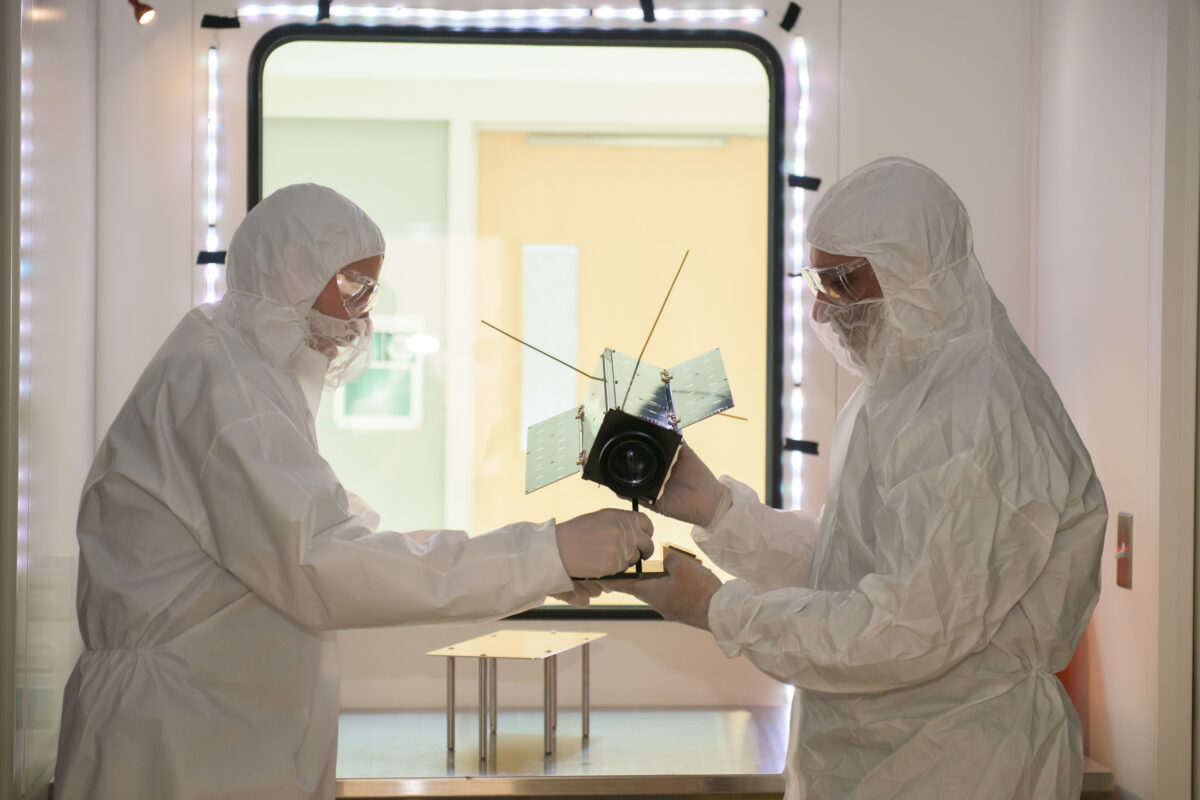 Researchers work on the HARP cubesat in a clean room. (Marlayna Demond/UMBC)
Launching satellites and careers
Since its inception, HARP has also lived up to UMBC’s mission to educate students and support the regional economy and workforce. Undergraduate and graduate students played key roles in the research, design, and construction phases for HARP and now HARP2.
“Relationships with federal agencies like NASA, all the work that we do with private companies around us, plus the training of students, who then go on to lead the same field they were working in, all fit very well the goals of our public research university,” Martins says.
Through HARP, HARP2, and early preparation for MegaHARP, every iteration of the project has prepared students for successful careers, proven new technologies, and generated new knowledge about the world. But, as an educator, perhaps the most rewarding part for Martins is seeing his students grow, find success, and then reach back to help others.
“We are seeing with HARP a full cycle. Students were involved in the inception of the idea for HARP from the beginning,” he says. “And today, students who were there working on HARP at the beginning are now in positions at NASA supporting the next generation.”
]]>
The first Hyper-Angular Rainbow Polarimeter (HARP) was a nano-satellite about as big as a loaf of bread. Developed by Vanderlei Martins, professor of physics, and his team of scientists and...
https://umbc.edu/stories/umbc-builds-next-gen-satellite-tech/
https://beta.my.umbc.edu/api/v0/pixel/news/128481/guest@my.umbc.edu/34ffd78318b57b5919988484353130bb/api/pixel
cnms
esi
news
physics
rca-2
research
science-and-tech
UMBC News & Magazine
https://beta.my.umbc.edu/groups/umbc-news-magazine
https://assets1-beta.my.umbc.edu/system/shared/avatars/groups/000/001/943/24435aa6207c452e7bc15cc74b42c7bb/xsmall.png?1748556657
https://assets1-beta.my.umbc.edu/system/shared/avatars/groups/000/001/943/24435aa6207c452e7bc15cc74b42c7bb/original.png?1748556657
https://assets2-beta.my.umbc.edu/system/shared/avatars/groups/000/001/943/24435aa6207c452e7bc15cc74b42c7bb/xxlarge.png?1748556657
https://assets2-beta.my.umbc.edu/system/shared/avatars/groups/000/001/943/24435aa6207c452e7bc15cc74b42c7bb/xlarge.png?1748556657
https://assets3-beta.my.umbc.edu/system/shared/avatars/groups/000/001/943/24435aa6207c452e7bc15cc74b42c7bb/large.png?1748556657
https://assets1-beta.my.umbc.edu/system/shared/avatars/groups/000/001/943/24435aa6207c452e7bc15cc74b42c7bb/medium.png?1748556657
https://assets2-beta.my.umbc.edu/system/shared/avatars/groups/000/001/943/24435aa6207c452e7bc15cc74b42c7bb/small.png?1748556657
https://assets1-beta.my.umbc.edu/system/shared/avatars/groups/000/001/943/24435aa6207c452e7bc15cc74b42c7bb/xsmall.png?1748556657
https://assets2-beta.my.umbc.edu/system/shared/avatars/groups/000/001/943/24435aa6207c452e7bc15cc74b42c7bb/xxsmall.png?1748556657
UMBC News & Magazine
0
0
false
Fri, 14 Oct 2022 12:32:28 -0400
Fri, 14 Oct 2022 12:32:28 -0400
UMBC humanities faculty pursue groundbreaking archival research through over $135,000 in prestigious fellowships

Humanities faculty Elizabeth Patton, Mirjam Voerkelius, and Amy Froide have received prestigious research fellowships totaling over $135,000 to explore archives and reveal new findings about unique historical events in the United States, Soviet Union, and United Kingdom. Their research will help further book manuscripts that will share new perspectives on African American leisure travel during Jim Crow, Darwinism in the Soviet Union, and financial fraud in the early stock market involving women investors in 18th-century England.
As an art historian, Preminda Jacob, an associate professor and associate dean of the College of Arts, Humanities, and Social Sciences, compares scholarship in the humanities to detective work. “Humanities research requires painstaking, patient piecing together of clues to develop narratives that have the power to subvert, or challenge accepted knowledge about a historical period or contemporary phenomenon,” says Jacob.
“The work is vastly time-consuming,” she explains. “It might require proficiency in one or more foreign languages, and entail years spent on a research site. Furthermore, the ‘evidence’ housed in archives, related by informants, or gathered from research sites, is often incomplete or biased. It is the scholar’s task to imaginatively reconstruct what was undocumented or left unsaid and to shine a light on the parts that were hidden, ignored, or missing.”
Cutting-edge humanities research
Over the past five years alone, UMBC’s cutting-edge humanities research has garnered funding from major sponsors that include the American Council of Learned Societies, the Carnegie Corporation of New York, the Institute of Advanced Study, the Institute of Citizens & Scholars (Mellon Foundation), Harvard’s Loeb Classical Library Foundation, the National Endowment for the Humanities (NEH), and the Whiting Foundation.
UMBC’s Dresher Center for the Humanities provides key support to faculty engaging in major scholarly and public projects. Rachel Brubaker, director of program administration at the Dresher Center, works with faculty one on one to identify and successfully apply for research funding.
 (l-r:) Brubaker and Christopher K. Tong, an assistant professor of modern languages, linguistics, and intercultural communication, discuss the Henry Luce Foundation and the American Council of Learned Societies Early Career Fellowship in China Studies, which Tong received in 2021. Brubaker provided support and guidance during the application process. (Marlayna Demond ’11/UMBC)
“The Dresher Center directs faculty to funding sources that further important humanities research,” says Patton, an associate professor of media and communication studies. “They get to know you and your interests and provide essential feedback—that has been an indispensable source of support and encouragement to me.”
Segregated leisure
Patton’s current research started with a picture found among her grandmother’s family photos. In the stack was a picture of her uncle at the 1964 New York World’s Fair. Patton was surprised because he lived in Philadelphia—a long way to travel at that time and a risky journey. This image defied the dangers, risks, and humiliation that were not limited to Southern states for African Americans traveling during Jim Crow.
Patton’s mother shared details of their trip to the World’s Fair, opening a door into a world where African American families and individuals enjoyed travel, counter to the media’s portrayal of vacations and other leisure trips as experiences exclusively for white Americans.
She developed a new research project: “Representation as a Form of Resistance: Documenting African-American Spaces of Leisure during the Jim Crow Era.” This research examines the history of Black leisure and tourism in the U.S. through the perspective of marketing and advertising to put into context lingering forms of racism that still affect Black tourism on platforms like Airbnb.
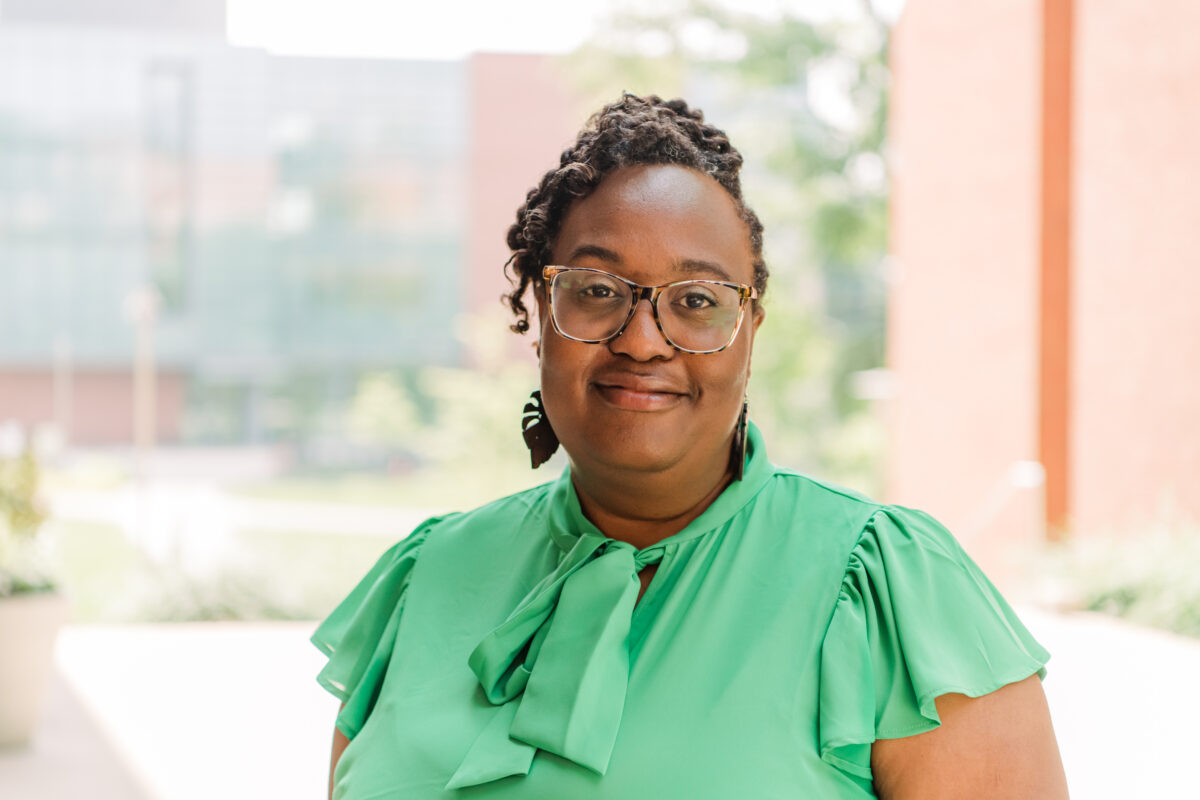 Elizabeth Patton. (Marlayna Demond ’11/UMBC)
“This research focuses on how media—such as advertisements, guidebooks, newspapers, magazines, film, photographs, home videos, and social media—have been used to document and promote leisure practices as a form of covert resistance,” says Patton. “It provides a counter-narrative to consumption-based and white-washed popular representations of tourism.”
Archival research
Patton has already begun traveling to archives with funding from the NEH, joint funding from Duke University’s John W. Hartman Center for Sales, Advertising & Marketing History and the John Hope Franklin Research Center for African American History and Culture, and UMBC’s CAHSS Research Fund. In collaboration with an archivist at the National Museum of American History Archives Center, Patton has reviewed the museum’s cold storage for photographic negatives from the 1920s and 1930s to view photographs of African Americans engaging in leisure activities and early advertising featuring African Americans. She has also reviewed Langston Hughes’s travel memoirs during Jim Crow and his time with Zora Neale Hurston at Yale University’s Beinecke Library.
The Smithsonian National Museum of African American History’s Great Migration Home Movie Project and African American Home Movie Archive have presented Patton with an opportunity to look through an extensive collection of home movies as well, offering another kind of personal perspective. Patton has also explored papers on city planning and major events like the World’s Fair, to understand how spaces were shaped by race and class and how leisure in New York became segregated, using the African American Studies collections at the Schomburg Center for Research in Black Culture and at the New York Public Library Rare Books Division, Manuscripts and Archives Division.
“I have found hundreds of examples of spaces where there is a history of people of color using those spaces, desegregating those spaces, or creating their own spaces for leisure and travel,” says Patton. “These rich data sources will help me tell the invisible history of African American leisure through historical methods, discourse analysis, semiotics, and oral history.”
The Soviet Union and Darwinism
Voerkelius’s book project, “Evolution in Times of Revolution: Darwinism, Nature and Society,” explores Soviet attitudes towards nature through the conflicted history of Darwinism in the Soviet Union. Voerkelius, assistant professor of history, explores this history through the lens of the State Darwin Museum in Russia.
Established in 1907, the museum has survived revolutions, political upheavals, world wars, polarizing schools of thought about Darwinism, and now a pandemic. Through it all, the museum has been a pillar of research, dissemination of science, and education pivotal to the Soviet Union’s theories, beliefs, discourse, and actions around evolution.
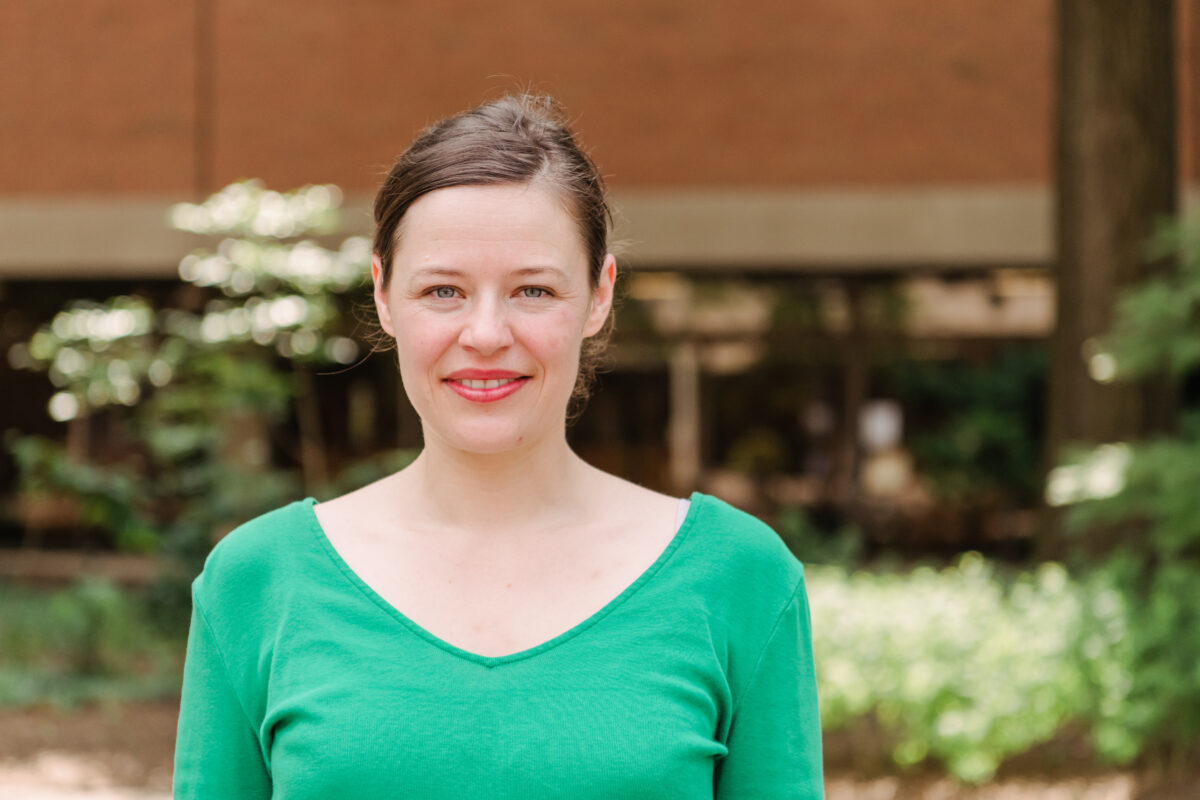 Mirjam Voerkelius. (Marlayna Demond ’11/UMBC)
“The Darwin Museum offers a comprehensive case study on attitudes towards the natural world in the Soviet Union and the underlying vision of the place of humankind within nature,” says Voerkelius.
This project builds on research completed in Russia at the State Archive of the Russian Federation, the archive of the State Darwin Museum, the Central Archive of the City of Moscow, and the Russian State Archive of the Economy, as well as the Jena University Archives in Germany.
Voerkelius was scheduled to return to Russia to further her archival research and complete her book. Due to the current war between Ukraine and Russia, Voerkelius cannot access these archives. To further her work, Voerkelius has received a $55,000 Kluge Fellowship from the John W. Kluge Center at the Library of Congress. As one of twelve fellows from around the world, she will have direct access to the Library’s extensive collection on the Soviet Union
“Working with the Library of Congress’s Russian Collection will allow me to consult published primary sources, which is essential for the completion of my manuscript,” says Voerkelius. With the help of these sources, she will place the Moscow State Darwin Museum’s research and narrative about Darwinism in a broader context.
“I hope to contribute to scholarly debate on the Soviet Union’s approach to science, evolutionary theory, and its broader impact on the environment,” she says.
Following the money
The idea for Froide’s new research project came from an unexpected find during eight years of research for her third book, Silent Partners: Women as Public Investors during Britain’s Financial Revolution, 1690-1750 (Oxford University Press, 2016).
Silent Partners focused on the role of women investors in England’s financial revolution and how women played a critical role in Britain’s rise to economic, military, and colonial dominance in the 18th century. Within the newspapers, government documents, and bookkeeping records she examined, Froide, professor and chair of history, found another story: a rare account of a stock market crash in 1732, wrought with fraud, embezzlement, forgery, and thievery.
Her new project, “The Charitable Corporation: A Cautionary Tale of Financial Fraud in Eighteenth-Century Britain,” will be a research-based narrative aimed at a wide audience about a group of investors, largely women, who invested in the microlending Charitable Corporation and the events around its collapse.
In her visit to England’s National Archives and Parliamentary Archives, Froide found lists of the Charitable Corporation shareholders petitioning the House of Lords and the House of Commons for a bailout. Some of the first petitioners were women, indicating they were active participants in seeking retribution politically and socially.
 Amy Froide. (Marlayna Demond ’11/UMBC)
“This bailout doesn’t look much different from what we see in the 20th and 21st centuries,” says Froide. “Investors felt capitalism had not worked and wanted the government to step in. The various records from the parliamentary investigation found that the directors were committing fraud and because corporations and individual stockholders were equally liable at the time they both had to pay.”
“This story is interesting economically and will provide a lot of historical background for economic historians and economists,” she notes. “Much of what we think is so modern was actually happening three centuries ago in the early days of the stock market.”
Secrets without borders
Froide’s search through the Royal Archives led to a surprising discovery. She found evidence of a long-held suspicion by historians that the Charitable Corporation was funneling money to the Jacobites, a religious and political group that wanted to restore King James III to the British throne after the Glorious Revolution of 1688-89 toppled the Roman Catholic Stuarts.
“I began searching through the Stuart Papers in the British Library, which holds the personal and official correspondence of British monarchs,” says Froide. “I uncovered proof that the Jacobite ‘Pretender,’ James III, knew of the company and that he made contacts with officers of the Charitable Corporation who seem to have promised monetary support to fund his return to the throne and other acts of rebellion.”
Now, the story has led her to the largest repository of British documents outside of England—the Huntington Library in San Marino, California—as a research fellow. The Huntington Library Fellowship program is one of the largest and most distinguished fellowship programs for the support of humanities scholarship in the United States. Every year approximately 200 fellows from all over the world conduct advanced humanities research using The Huntington’s collections.
As a Huntington Library Fletcher Jones Foundation Fellow, Froide has received $50,000 to support a year at the Huntington Library archives to research and analyze documents and begin writing her book about the Charitable Corporation. The Huntington Library documents will allow Froide to reconstruct contemporary views of the financial scandal. She hopes the papers will lend further insights into the politicians, revolutionaries, investors, royalty, smugglers, and everyday people whose lives, willingly or not, were a part of creating and dismantling the business.
“My challenge is to write a story that shows you the political and economic context of the late 18th century in a way that is appealing to everyone. You can only do that if you have really good stories,” says Froide. “This is very labor-intensive work. There isn’t a specific file with all the answers in one language or in one country. But if you are a library or archive rat like me, you pursue all the threads to that great story.”
]]>
Humanities faculty Elizabeth Patton, Mirjam Voerkelius, and Amy Froide have received prestigious research fellowships totaling over $135,000 to explore archives and reveal new findings about...
https://umbc.edu/stories/umbc-humanities-faculty-pursue-groundbreaking-research/
https://beta.my.umbc.edu/api/v0/pixel/news/128409/guest@my.umbc.edu/7d56864c9bbdffe3e42d4b86a51c7309/api/pixel
arts-and-culture
cahss
cahssresearch
dreshercenter
history
international
majoraward
mcs
news
policy-and-society
rca-2
UMBC News & Magazine
https://beta.my.umbc.edu/groups/umbc-news-magazine
https://assets1-beta.my.umbc.edu/system/shared/avatars/groups/000/001/943/24435aa6207c452e7bc15cc74b42c7bb/xsmall.png?1748556657
https://assets1-beta.my.umbc.edu/system/shared/avatars/groups/000/001/943/24435aa6207c452e7bc15cc74b42c7bb/original.png?1748556657
https://assets2-beta.my.umbc.edu/system/shared/avatars/groups/000/001/943/24435aa6207c452e7bc15cc74b42c7bb/xxlarge.png?1748556657
https://assets2-beta.my.umbc.edu/system/shared/avatars/groups/000/001/943/24435aa6207c452e7bc15cc74b42c7bb/xlarge.png?1748556657
https://assets3-beta.my.umbc.edu/system/shared/avatars/groups/000/001/943/24435aa6207c452e7bc15cc74b42c7bb/large.png?1748556657
https://assets1-beta.my.umbc.edu/system/shared/avatars/groups/000/001/943/24435aa6207c452e7bc15cc74b42c7bb/medium.png?1748556657
https://assets2-beta.my.umbc.edu/system/shared/avatars/groups/000/001/943/24435aa6207c452e7bc15cc74b42c7bb/small.png?1748556657
https://assets1-beta.my.umbc.edu/system/shared/avatars/groups/000/001/943/24435aa6207c452e7bc15cc74b42c7bb/xsmall.png?1748556657
https://assets2-beta.my.umbc.edu/system/shared/avatars/groups/000/001/943/24435aa6207c452e7bc15cc74b42c7bb/xxsmall.png?1748556657
UMBC News & Magazine
0
0
false
Wed, 12 Oct 2022 08:33:07 -0400
Wed, 12 Oct 2022 08:33:07 -0400
Meet a Retriever – Sharon Johnson, retired Meyerhoff Scholars Program staff

Meet Sharon Johnson, a dedicated member of the Meyerhoff Scholars Program staff for more than 17 years. Now retired, Sharon has chosen to continue to support UMBC with a planned gift that will focus on the program and students she loves so dearly. Thanks for sharing your story, Sharon…take it away!
Q: What brought you to UMBC in the first place?
A: I was hired as the business manager for the Meyerhoff Scholars Program after previously working at NASA. Many of my colleagues at NASA thought this would be a good fit for me and my skillset, and encouraged me to apply. I was very interested in diversity and the STEM pipeline and wanted to work with gifted and talented students.
Q: What was it like working with the Meyerhoff Program for so long?
A: I loved working with the Meyerhoff students, alumni, parents, faculty, staff, and UMBC colleagues and administrators. Meyerhoff staff members were committed and dedicated as we carried out our duties, and guided and inspired scholars. We worked closely together and I enjoyed our cameraderie. It was wonderful to see the scholars grow and achieve their aspirations. The relationships continued after graduation from UMBC. I was a part of something truly special that was changing the world!I made many friends with whom I am still in contact.
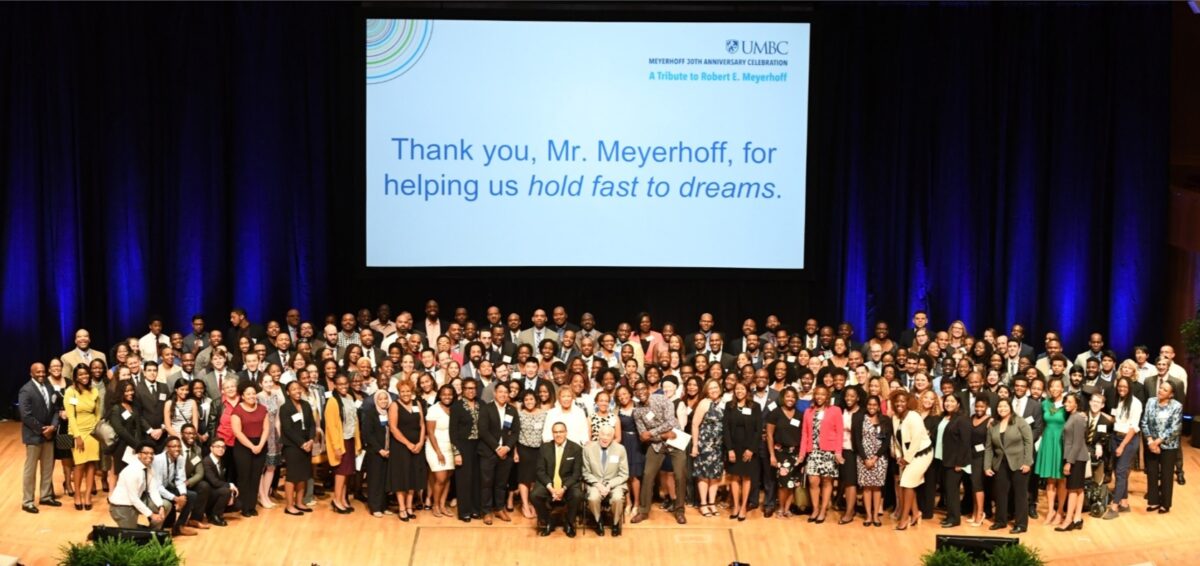 A moment from the Meyerhoff Scholars Program’s 30th anniversary celebration in 2019. Photo by Jim Burger.
Q: Tell us about someone who really made a difference in your life while you were at UMBC.
A: I’d like to mention two people. [President Emeritus] Dr. [Freeman] Hrabowski supported me and the Meyerhoff Scholars program. He co-founded an awesome program that has been replicated across the country, and he inspired me and other donors to financially support UMBC.
And LaMont Toliver, former Program Director and my supervisor, was dedicated to the program. His belief in the model, program, and students inspired me. Working for the program was a life-changing opportunity.
I thought back to my undergraduate years and I felt compelled to help provide funding to scholars experiencing financial hardships and to impact future generations of Meyerhoff scholars. My hope is that I will be able to help future scholars achieve their academic goals and dreams.
Sharon Johnson
Retired staff, Meyerhoff Scholars Program
Q: You recently decided to make a planned gift in support of the Meyerhoff Scholars Program. What motivated you to do that?
A: I experienced financial hardships and challenges firsthand during my childhood and in completing my bachelor’s degree. I believe in the Meyerhoff Scholars Program’s vision and mission and am proud of the program’s success. Many scholars had shortfalls between their expenses and aid/scholarships and were seeking other funding sources to close their gaps. Many also faced personal/family circumstances that kept them from graduating on schedule and achieving their academic dreams. I thought back to my undergraduate years and I felt compelled to help provide funding to scholars experiencing financial hardships and to impact future generations of Meyerhoff Scholars. My hope is that I will be able to help future scholars achieve their academic goals and dreams.
* * * * *
UMBC’s greatest strength is its people. When people meet Retrievers and hear about the passion they bring, the relationships they create, the ways they support each other, and the commitment they have to inclusive excellence, they truly get a sense of our community. That’s what “Meet a Retriever” is all about.
Learn more about how UMBC can help you achieve your goals.
Learn more about how to make a planned gift to UMBC.
]]>
Meet Sharon Johnson, a dedicated member of the Meyerhoff Scholars Program staff for more than 17 years. Now retired, Sharon has chosen to continue to support UMBC with a planned gift that will...
https://umbc.edu/stories/sharon-johnson-meyerhoff-scholars-donor/
https://beta.my.umbc.edu/api/v0/pixel/news/128397/guest@my.umbc.edu/fba1b4f80e10da7f75ec18a2af883d16/api/pixel
impact
magazine
meet-a-retriever
meyerhoffscholars
perspectives
UMBC News & Magazine
https://beta.my.umbc.edu/groups/umbc-news-magazine
https://assets1-beta.my.umbc.edu/system/shared/avatars/groups/000/001/943/24435aa6207c452e7bc15cc74b42c7bb/xsmall.png?1748556657
https://assets1-beta.my.umbc.edu/system/shared/avatars/groups/000/001/943/24435aa6207c452e7bc15cc74b42c7bb/original.png?1748556657
https://assets2-beta.my.umbc.edu/system/shared/avatars/groups/000/001/943/24435aa6207c452e7bc15cc74b42c7bb/xxlarge.png?1748556657
https://assets2-beta.my.umbc.edu/system/shared/avatars/groups/000/001/943/24435aa6207c452e7bc15cc74b42c7bb/xlarge.png?1748556657
https://assets3-beta.my.umbc.edu/system/shared/avatars/groups/000/001/943/24435aa6207c452e7bc15cc74b42c7bb/large.png?1748556657
https://assets1-beta.my.umbc.edu/system/shared/avatars/groups/000/001/943/24435aa6207c452e7bc15cc74b42c7bb/medium.png?1748556657
https://assets2-beta.my.umbc.edu/system/shared/avatars/groups/000/001/943/24435aa6207c452e7bc15cc74b42c7bb/small.png?1748556657
https://assets1-beta.my.umbc.edu/system/shared/avatars/groups/000/001/943/24435aa6207c452e7bc15cc74b42c7bb/xsmall.png?1748556657
https://assets2-beta.my.umbc.edu/system/shared/avatars/groups/000/001/943/24435aa6207c452e7bc15cc74b42c7bb/xxsmall.png?1748556657
UMBC News & Magazine
0
0
false
Tue, 11 Oct 2022 15:50:10 -0400
Tue, 11 Oct 2022 15:50:10 -0400
Non-Linear Paths to Leadership
Francisco Cartagena describes his academic journey as unorthodox. Now an employee for the City of Gaithersburg, Cartagena started his educational path as an undocumented student. While charting numerous challenges, Cartagena ’19, political science, M.P.S. ’22, cybersecurity, also found ample opportunities for growth along the way, becoming an effective leader of social change at UMBC at The Universities at Shady Grove.
Cartagena arrived with his family from El Salvador as a preteen. In 2009, he graduated from high school and set out to Montgomery College to pursue his associate’s degree in general studies—a goal that would take him a decade to accomplish because of his legal status. There, Cartagena joined the college’s Latino Student Union and together they advocated for the Maryland Dream Act—a statute that would allow undocumented high school students to pay for in-state college tuition.
“That experience really exposed me to the political science environment and how policy, with momentum, people, and activism, can actually be changed,” says Cartagena, who hopes eventually to leverage his role in local government to share the message that there are many attainable pathways to and through higher education.
Finding his momentum
Prior to the Maryland Dream Act’s passing in 2012, Cartagena was paying the international student rate for community college classes. To him, pursuing a bachelor’s degree seemed like a faraway dream.
“There were some instances when I couldn’t attend school or when I could only attend one class,” reflects Cartagena. “But it gave me that momentum to say, ‘I’m just going to keep at it.’”
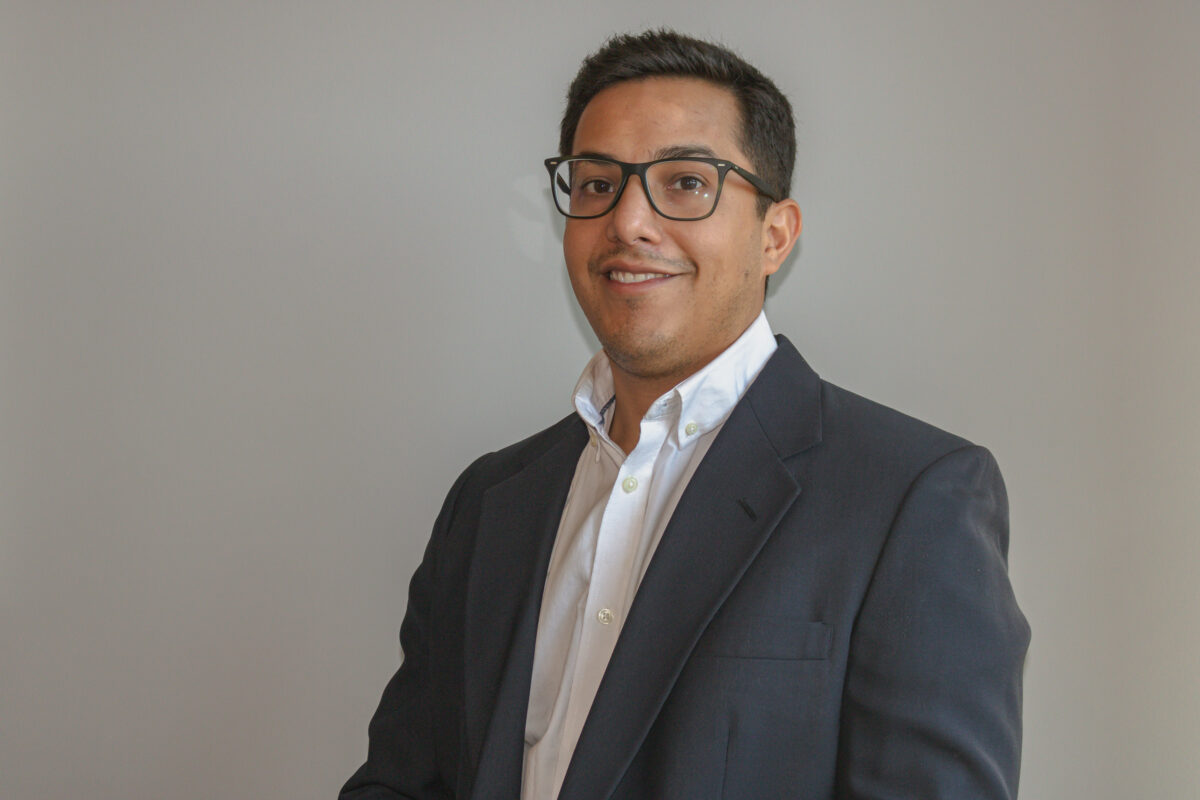
Francisco Cartagena
At Montgomery College, Cartagena learned about the UMBC-Shady Grove campus and its political science program. As a full-time working adult, he believed that UMBC-Shady Grove would be a good fit. With an extra push from his wife Cora Trelles Cartagena ’12, social work, Cartagena reached out to Sunil Dasgupta, political science program director and professor at UMBC-Shady Grove, to find out more.
To Cartagena’s surprise, Dasgupta asked a question that would sell him on applying: “Why do you think you can complete this program?” Motivated by the challenge, Cartagena pushed forward and eventually proved that he would do more than succeed—he would lead.
“Francisco is somebody that intuitively knew the importance of politics in transforming and changing our lives,” says Dasgupta. “I think part of the reason that happens is because he comes from an immigrant family. When you’re in that position, you quickly realize you have to master this if you want to help yourself, your family, and your community.”
An uplifting environment
Cartagena saw The Universities at Shady Grove (USG) as a place to practice his role in politics. As one of two students representing UMBC on the Student Government Association’s executive board, he learned more about the funding process at USG, the development of programs on campus, and the ins-and-outs of university partnerships.
“When you have an environment with multiple people from different schools, you can truly see the different backgrounds, their intent, and how people process things,” Cartagena says.
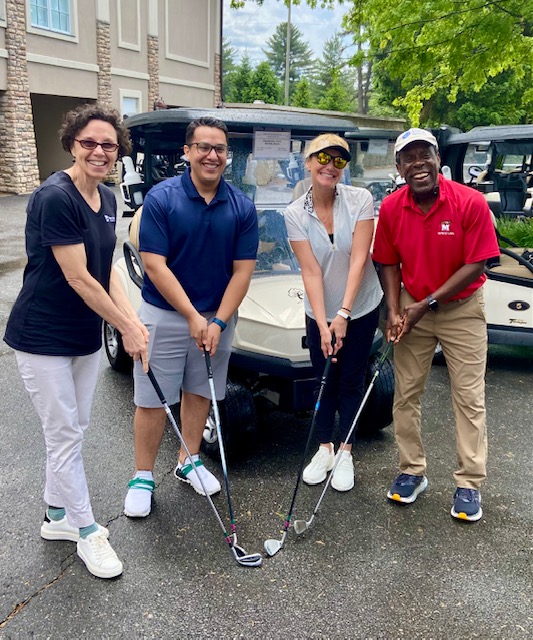 From left to right: Anne Khademian, USG Executive Director; Cartagena; Crystal Townsend, President & CEO of Healthcare Initiative Foundation; Kevin Beverly, Chair of the USG Board of Advisors.
When Cartagena attended USG’s job fair and spotted a table for Congressman Jamie Raskin’s office staffed by a fellow Latina, he saw a vision for his future. “At the time, a career in government or interning for a government official was so far-fetched, whether because of my status or my prior experiences. It was something I would just dream of,” explains Cartagena, who wound up spending the summer splitting his internship between Raskin’s Rockville office and his congressional office on the Hill—two experiences that propelled his career in government.
“I still pinch myself because I’m a first-generation immigrant who came here from El Salvador with my parents…To be able to represent the county I grew up in—it was a bunch of mixed feelings that were finally culminating into something very positive,” says Cartagena.
In 2018, Cartagena started with a role in the City of Gaithersburg’s human resources department and in 2021, transitioned to his current role as an I.T. project manager. Now, he oversees applications, business needs from different departments, and processes in the technology sector.
Continuing to lead
In 2019, as a master’s student studying cybersecurity at UMBC-Shady Grove, Cartagena continued his ongoing involvement on campus, joining the Graduate School Council and USG’s Advisory Board.
During his final year in the program, Cartagena received a phone call from Dasgupta, who was creating an interactive bot to help Maryland voters identify political candidates most aligned with their values. He hoped that the bot, along with his podcast, I Hate Politics, would serve as informative tools. But realizing that a significant portion of the county was Spanish speaking, he enlisted Cartagena’s help.
“The first person I called was Francisco. And it wasn’t a small job; it was pages and pages of translation,” Dasgupta says, adding that they only had about a couple of weeks to complete the project before elections began. Still, Cartagena took on the translation task without hesitation.
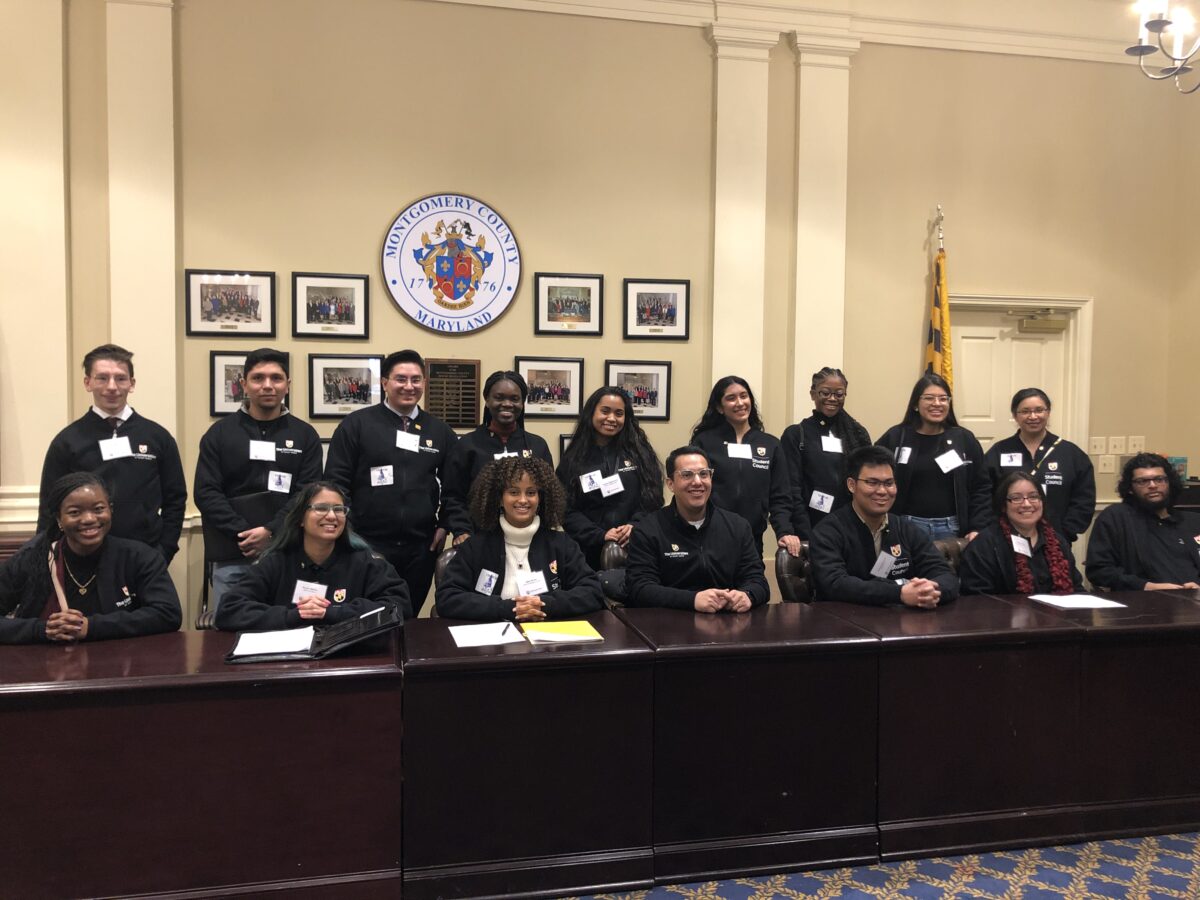 Cartagena and the USG Undergrad and Graduate Student Councils attend the State of Maryland House Appropriations meeting to advocate for the funding of USG by the State.
“That kind of collaboration uplifts UMBC and the community,” notes Dasgupta. “We continue to work with our students and alumni, and those interactions are very revitalizing. We find meaning through those relationships.”
Cartagena notes he wouldn’t have made it this far without the resources and opportunities he found at UMBC-Shady Grove. “If there was a change I could recommend, it would be showing students and adult learners that there are other pathways for you to get that Ph.D., get that bachelor’s, or get that associate degree,” says Cartagena. “I think oftentimes students are afraid; it’s an investment of money and time, and you don’t know if you’re going to make it through…but you will find your niche if you stick it out.”
]]>
Francisco Cartagena describes his academic journey as unorthodox. Now an employee for the City of Gaithersburg, Cartagena started his educational path as an undocumented student. While charting...
https://umbc.edu/stories/non-linear-paths-to-leadership/
https://beta.my.umbc.edu/api/v0/pixel/news/128360/guest@my.umbc.edu/b123bad86a3a147da7d64e0596278539/api/pixel
alumni
cybersecurity
magazine
politicalscience
shadygrove
universities-at-shady-grove
UMBC News & Magazine
https://beta.my.umbc.edu/groups/umbc-news-magazine
https://assets1-beta.my.umbc.edu/system/shared/avatars/groups/000/001/943/24435aa6207c452e7bc15cc74b42c7bb/xsmall.png?1748556657
https://assets1-beta.my.umbc.edu/system/shared/avatars/groups/000/001/943/24435aa6207c452e7bc15cc74b42c7bb/original.png?1748556657
https://assets2-beta.my.umbc.edu/system/shared/avatars/groups/000/001/943/24435aa6207c452e7bc15cc74b42c7bb/xxlarge.png?1748556657
https://assets2-beta.my.umbc.edu/system/shared/avatars/groups/000/001/943/24435aa6207c452e7bc15cc74b42c7bb/xlarge.png?1748556657
https://assets3-beta.my.umbc.edu/system/shared/avatars/groups/000/001/943/24435aa6207c452e7bc15cc74b42c7bb/large.png?1748556657
https://assets1-beta.my.umbc.edu/system/shared/avatars/groups/000/001/943/24435aa6207c452e7bc15cc74b42c7bb/medium.png?1748556657
https://assets2-beta.my.umbc.edu/system/shared/avatars/groups/000/001/943/24435aa6207c452e7bc15cc74b42c7bb/small.png?1748556657
https://assets1-beta.my.umbc.edu/system/shared/avatars/groups/000/001/943/24435aa6207c452e7bc15cc74b42c7bb/xsmall.png?1748556657
https://assets2-beta.my.umbc.edu/system/shared/avatars/groups/000/001/943/24435aa6207c452e7bc15cc74b42c7bb/xxsmall.png?1748556657
UMBC News & Magazine
0
0
false
Mon, 10 Oct 2022 16:05:54 -0400
Mon, 10 Oct 2022 16:05:54 -0400
REPOST: UMBC Transit Workshop 10/14
UMBC, home and all things in-between
This is an event created by the OCSS department in partnership with UMBC Transit. Fill out the form below with all your transit related questions (bus schedules, transit tracker, MTA Commuter bus, discounted bus pass etc.) and they will be answered during the workshop. We will be providing pizzas, drinks and good conversations.
]]>
This is an event created by the OCSS department in partnership with UMBC Transit. Fill out the form below with all your transit related questions (bus schedules, transit tracker, MTA Commuter bus,...
https://my3.my.umbc.edu/groups/ocss/events/110832
https://beta.my.umbc.edu/api/v0/pixel/news/128349/guest@my.umbc.edu/a846abe7a8948b6d58fc134d4b5fc0fe/api/pixel
International Student and Scholar Services (ISSS)
https://beta.my.umbc.edu/groups/ies
https://assets4-beta.my.umbc.edu/system/shared/avatars/groups/000/000/431/46ad84ea8ba0baeed7c3faf29d1fd4ef/xsmall.png?1693323874
https://assets3-beta.my.umbc.edu/system/shared/avatars/groups/000/000/431/46ad84ea8ba0baeed7c3faf29d1fd4ef/original.jpeg?1693323874
https://assets1-beta.my.umbc.edu/system/shared/avatars/groups/000/000/431/46ad84ea8ba0baeed7c3faf29d1fd4ef/xxlarge.png?1693323874
https://assets1-beta.my.umbc.edu/system/shared/avatars/groups/000/000/431/46ad84ea8ba0baeed7c3faf29d1fd4ef/xlarge.png?1693323874
https://assets4-beta.my.umbc.edu/system/shared/avatars/groups/000/000/431/46ad84ea8ba0baeed7c3faf29d1fd4ef/large.png?1693323874
https://assets3-beta.my.umbc.edu/system/shared/avatars/groups/000/000/431/46ad84ea8ba0baeed7c3faf29d1fd4ef/medium.png?1693323874
https://assets1-beta.my.umbc.edu/system/shared/avatars/groups/000/000/431/46ad84ea8ba0baeed7c3faf29d1fd4ef/small.png?1693323874
https://assets4-beta.my.umbc.edu/system/shared/avatars/groups/000/000/431/46ad84ea8ba0baeed7c3faf29d1fd4ef/xsmall.png?1693323874
https://assets3-beta.my.umbc.edu/system/shared/avatars/groups/000/000/431/46ad84ea8ba0baeed7c3faf29d1fd4ef/xxsmall.png?1693323874
OCSS
3
0
true
Mon, 10 Oct 2022 15:01:58 -0400
Meet a Retriever – Evangeline Kirigua ’21, political science

Meet Evangeline Kirigua ’21, political science, who transferred from Montgomery College and is now working as an intake officer with the Maryland Department of Transportation. Evangeline, who returned to school in her 50s, recently created a scholarship in honor of her parents to give assistance to students studying political science at UMBC at The Universities at Shady Grove. Thanks for sharing your story, Evangeline!
Q: What’s one essential thing you’d want another Retriever to know about you?
A: Procrastination is a dream killer. Don’t do tomorrow what you can do today. As long as there is a minute in your day, use it. Tomorrow is not promised.
Q: What brought you to UMBC at The Universities at Shady Grove and what you love about the political science department, in particular?
A: I came to UMBC because when I was taking a class in International Studies at Montgomery College, the professor spoke highly about UMBC’s Political Science program. Political Science just speaks my language. I am passionate about civic engagement. I do not get it when people tell me that they do not vote: at the same time complaining about things in their community that are going wrong or not done. This led me to start a forum called Diaspora Initiative for Civic Engagement, to encourage voter registration.
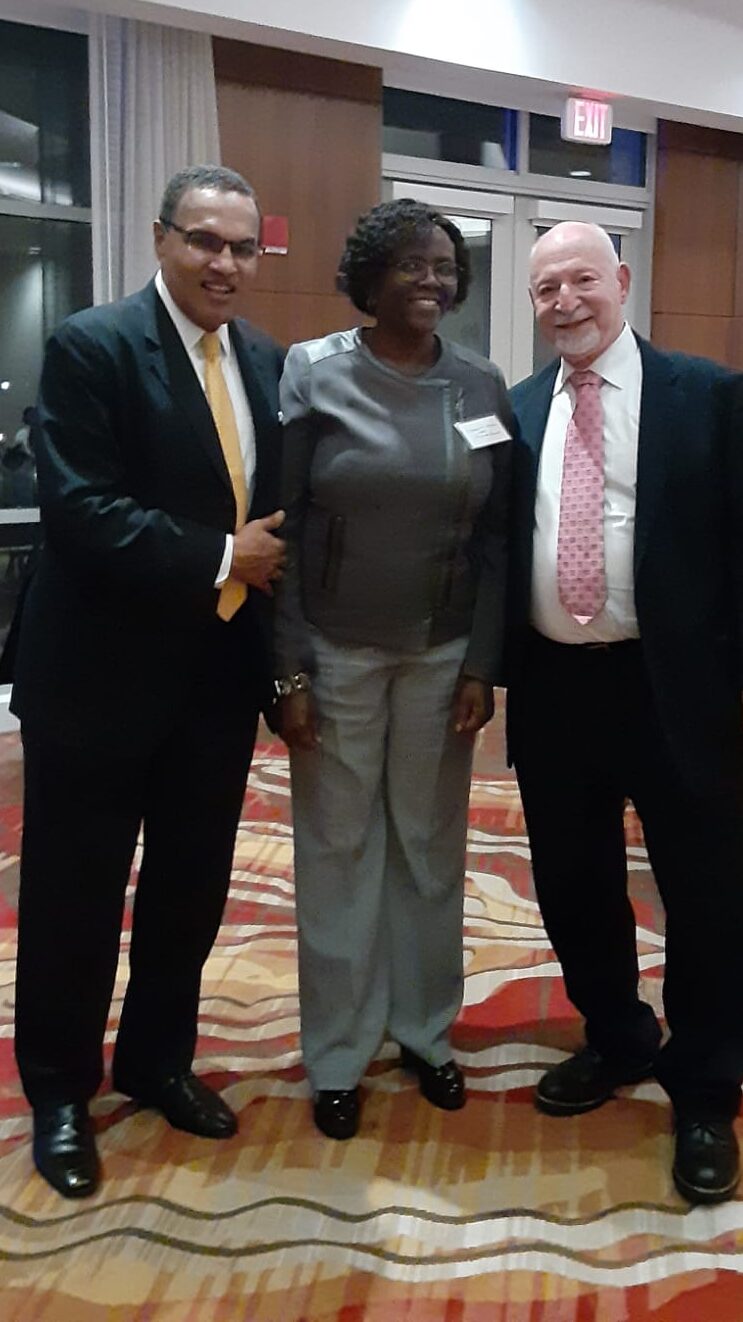 At left: With UMBC President Emeritus Hrabowski and USG Executive Director Emeritus Stewart Edelstein at the 2019 Regents Dinner. Photo courtesy of Kirigua.
Q: Tell us about someone in the community who has inspired you or supported you, and how they did it.
A: My forever guardian angel is Dr. Brigid Starkey, Head of Global Studies. I thoroughly enjoyed her class, American Foreign Policy. Dr. Starkey believed in me and encouraged me to do an independent study. Her support unleashed in me a tenacity that I never knew I had.
 At right, Kirigua (center) poses with classmates Ketsia Muteba (left) and Tatiana Mendez after they complete a class project. Photo courtesy of Kirigua.
Q: We understand you’re a donor. What do you support and why?
A: I have founded a scholarship in honor of my parents: the Ernest & Adelina Kirigua Scholarship. It is to benefit minority students pursuing Political Science at UMBC/USG.
Evangeline Kirigua (@UMBC Political Science at USG '21) signing the agreement for the new Ernest & Adelina Kirigua Scholarship. Evangeline returned to school in her 50s and established the scholarship to help students like her succeed at USG. Learn more: https://t.co/S0EF5avVbA pic.twitter.com/ZOLTp9hb1c
— USG (@UatShadyGrove) August 1, 2022
Q: What’s the one thing you’d want someone who hasn’t joined the UMBC community to know about the support you find here?
A: The Retriever spirit is real. I chose UMBC over other schools that had promised me almost 100 percent free tuition. I have never doubted my decision. Bring your dream: UMBC will help you build it, or help you dream.
]]>
Meet Evangeline Kirigua ’21, political science, who transferred from Montgomery College and is now working as an intake officer with the Maryland Department of Transportation. Evangeline, who...
https://umbc.edu/stories/meet-a-retriever-evangeline-kirigua-21-political-science/
https://beta.my.umbc.edu/api/v0/pixel/news/128347/guest@my.umbc.edu/6f28f7d7bb105ecf2dcbb2afd10f42a3/api/pixel
alumni
cahss
giving
impact
magazine
meet-a-retriever
perspectives
politicalscience
universities-at-shady-grove
UMBC News & Magazine
https://beta.my.umbc.edu/groups/umbc-news-magazine
https://assets1-beta.my.umbc.edu/system/shared/avatars/groups/000/001/943/24435aa6207c452e7bc15cc74b42c7bb/xsmall.png?1748556657
https://assets1-beta.my.umbc.edu/system/shared/avatars/groups/000/001/943/24435aa6207c452e7bc15cc74b42c7bb/original.png?1748556657
https://assets2-beta.my.umbc.edu/system/shared/avatars/groups/000/001/943/24435aa6207c452e7bc15cc74b42c7bb/xxlarge.png?1748556657
https://assets2-beta.my.umbc.edu/system/shared/avatars/groups/000/001/943/24435aa6207c452e7bc15cc74b42c7bb/xlarge.png?1748556657
https://assets3-beta.my.umbc.edu/system/shared/avatars/groups/000/001/943/24435aa6207c452e7bc15cc74b42c7bb/large.png?1748556657
https://assets1-beta.my.umbc.edu/system/shared/avatars/groups/000/001/943/24435aa6207c452e7bc15cc74b42c7bb/medium.png?1748556657
https://assets2-beta.my.umbc.edu/system/shared/avatars/groups/000/001/943/24435aa6207c452e7bc15cc74b42c7bb/small.png?1748556657
https://assets1-beta.my.umbc.edu/system/shared/avatars/groups/000/001/943/24435aa6207c452e7bc15cc74b42c7bb/xsmall.png?1748556657
https://assets2-beta.my.umbc.edu/system/shared/avatars/groups/000/001/943/24435aa6207c452e7bc15cc74b42c7bb/xxsmall.png?1748556657
UMBC News & Magazine
0
0
false
Mon, 10 Oct 2022 13:53:44 -0400
Wed, 26 Oct 2022 13:53:00 -0400
UMBC’s Viswanathan uses the Moon’s craters to track its shifting poles over 4.25 billion years
A new study published in Planetary Science Journalhas determined how the Moon’s poles have shifted over more than 4 billion years, a phenomenon known as “true polar wander.” To trace the poles over time, the research team examined the combined effects of more than 5,000 craters on the Moon’s surface.
Each impact, and the subsequent crater, changed the distribution of mass on the Moon slightly. To rebalance, the Moon would have rotated just a little, without its axis moving in space. As a result, the axis would pass through the Moon at slightly different locations—the new poles.
“All this cratering is like a record” of the Moon’s history, says Vishnu Viswanathan, assistant research scientist with UMBC’s Center for Space Sciences and Technology (CSST), a university partnership with NASA’s Goddard Space Flight Center. Viswanathan co-led the study with David Smith, a research scientist at the Massachusetts Institute of Technology.
Water on the Moon?
 Vishnu Viswanathan (Image courtesy of Viswanathan)
The study found that over approximately 4.25 billion years, the Moon’s poles wandered 10 degrees in latitude, or 186 miles, from the influence of cratering. Over the past 3.8 billion years, the poles have not wandered more than 2 degrees, or 37 miles. Such a moderate amount of polar wander would have created relatively stable conditions in the Moon’s polar regions over an extended period. That stability likely contributed to favorable conditions for resources such as frozen water.
Scientists have detected ice in colder, shadowed regions near the Moon’s poles. However, its amount and age is unknown. If the poles had moved substantially and frequently over time, any ice would repeatedly be exposed to sunlight and likely lost to sublimation—the process of a solid converting directly to a gas, like dry ice on Earth. With greater stability of the poles over billions of years, there would be more time for water to accumulate near the Moon’s present-day poles.
Stepping back in time
To calculate each crater’s effect on the location of the Moon’s poles, the research team relied heavily on a map of the Moon’s gravitational field, which defines the force of gravity at each point on the Moon’s surface. Sander Goossens, a former UMBC CSST scientist and a co-author on the new paper, developed the map previously using data from NASA’s GRAIL mission, which flew over the surface of the Moon in 2012.
The two GRAIL satellites measured anomalies in the distribution of mass on the Moon (such as craters), to a resolution of a few kilometers. The satellites’ detection is comparable to the way that a driver can feel the rise and fall as they pass over speed humps or potholes, Viswanathan explains.
Using Goossens’s map, Viswanathan and his team figured out a way to mathematically remove each crater’s individual effect, or signature, on the Moon’s gravitational field. The team started by sequentially removing 185 large craters whose ages are known, partly based on samples collected from NASA’s Apollo Moon missions. At each step going backward in time, they recalculated the presumed location of the Moon’s poles, creating a history of the poles’ location as they moved through time—the polar wander.
For the rest of the craters, most of them small, the research team removed their signatures from the gravity field and randomly distributed them through time. The team’s model is designed so more impacts occur in the early history of the Moon, because it’s understood that impacts were more frequent during that period. By running this simulation again and again, they were able to estimate the path of the Moon’s poles based on its cratering history.
This animation traces the “polar wander” of the Moon’s poles from about 4.25 billion years ago to the present day. (NASA Scientific Visualization Studio)
The Moon’s origin story
Moving forward, the new research may increase understanding of the formation of the Moon and the solar system in general. Information from the study about the shape of the Moon at different time points could help refine understanding of the Moon’s orbital path at those times. Also, shortly after the Moon formed, it was much closer to Earth and spinning faster. The contribution of small craters to the Moon’s shape could help add more detail to our understanding of how it reached its current location.
Viswanathan is excited about NASA’s Artemis mission, which will likely collect more samples from previously unvisited craters near the Moon’s south pole. “More samples from more craters would tell us quite a lot about the Moon’s cratering history,” he says. Knowing accurate ages of the large craters, including the largest, the South Pole-Aitken basin, would help refine the polar wander model. Information about the craters’ composition could increase understanding of resources—such as water—present on the Moon.
The project has also been an opportunity for Viswanathan and his team to grow and gain new expertise. An astronomer and a planetary geodesist who has researched other aspects of the Moon, Viswanathan came to the project with the beginnings of the math needed to track the poles based on the gravitational field. “But I had very little idea of these craters’ names before,” he says. “So it was a nice way to familiarize with them.”
The project, and especially the close collaboration with colleagues, has also served as an anchor for him throughout the pandemic. He shares, “I was so invested in the project for the last nearly three years. This kept me sane.”
]]>
A new study published in Planetary Science Journalhas determined how the Moon’s poles have shifted over more than 4 billion years, a phenomenon known as “true polar wander.” To trace the poles...
https://umbc.edu/stories/moons-poles-tracked-over-4-25-billion-years/
https://beta.my.umbc.edu/api/v0/pixel/news/128202/guest@my.umbc.edu/8be98c829136af6bc9bb64215bb58233/api/pixel
csst
news
research
science-and-tech
UMBC News & Magazine
https://beta.my.umbc.edu/groups/umbc-news-magazine
https://assets1-beta.my.umbc.edu/system/shared/avatars/groups/000/001/943/24435aa6207c452e7bc15cc74b42c7bb/xsmall.png?1748556657
https://assets1-beta.my.umbc.edu/system/shared/avatars/groups/000/001/943/24435aa6207c452e7bc15cc74b42c7bb/original.png?1748556657
https://assets2-beta.my.umbc.edu/system/shared/avatars/groups/000/001/943/24435aa6207c452e7bc15cc74b42c7bb/xxlarge.png?1748556657
https://assets2-beta.my.umbc.edu/system/shared/avatars/groups/000/001/943/24435aa6207c452e7bc15cc74b42c7bb/xlarge.png?1748556657
https://assets3-beta.my.umbc.edu/system/shared/avatars/groups/000/001/943/24435aa6207c452e7bc15cc74b42c7bb/large.png?1748556657
https://assets1-beta.my.umbc.edu/system/shared/avatars/groups/000/001/943/24435aa6207c452e7bc15cc74b42c7bb/medium.png?1748556657
https://assets2-beta.my.umbc.edu/system/shared/avatars/groups/000/001/943/24435aa6207c452e7bc15cc74b42c7bb/small.png?1748556657
https://assets1-beta.my.umbc.edu/system/shared/avatars/groups/000/001/943/24435aa6207c452e7bc15cc74b42c7bb/xsmall.png?1748556657
https://assets2-beta.my.umbc.edu/system/shared/avatars/groups/000/001/943/24435aa6207c452e7bc15cc74b42c7bb/xxsmall.png?1748556657
UMBC News & Magazine
0
0
false
Wed, 05 Oct 2022 08:28:05 -0400
Wed, 05 Oct 2022 08:28:05 -0400