<?xml version="1.0"?>
<News hasArchived="false" page="1" pageCount="1" pageSize="10" timestamp="Sun, 19 Apr 2026 02:59:17 -0400" url="https://beta.my.umbc.edu/groups/instructional-technology/posts.xml?tag=testing">
<NewsItem contentIssues="true" id="132445" important="false" status="posted" url="https://beta.my.umbc.edu/groups/instructional-technology/posts/132445">
<Title>Respondus Helps Curtail Cheating while Protecting Privacy</Title>
<Tagline>Supported tools to address your high stakes assessment needs</Tagline>
<Body>
<![CDATA[
    <div class="html-content">As technology continues to advance, traditional classroom practices are enhanced with technologies. In-class assessments that used to take up valuable time are often administered through Blackboard, allowing for more efficient use of class time. However, while at-home activities have their benefits, they can be compromised by various internet resources like Chegg, CourseHero, and ChatGPT, which may help students misrepresent their academic abilities.<br><br><a href="https://wiki.umbc.edu/pages/viewpage.action?pageId=87884496" rel="nofollow external" class="bo">Respondus Lockdown Browser (RLDB</a>) is a tool designed to reduce students' opportunities for academic misconduct during assessments, including high-stakes testing offered through Blackboard. The application disables a test taker's computer from performing certain actions, including taking screenshots, opening additional web pages or search engines, accessing particular network traffic, and generally restricting the opportunities for students to receive outside help. <br><br>RLDB can also operate in conjunction with <a href="https://wiki.umbc.edu/label/faq/respondus-monitor" rel="nofollow external" class="bo">Respondus Monitor</a>, which leverages an end user's computer camera and AI for real-time proctoring. Monitor can be viewed live by the instructor through a web conferencing platform, or the system records the student taking the test so the instructor can view later.<br><br>There are four simple steps to take to turn on the Lockdown Browser: <br><ol><li>Create the assessment, whether <a href="https://help.blackboard.com/Learn/Instructor/Ultra/Tests_Pools_Surveys/Create_Tests_and_Surveys" rel="nofollow external" class="bo">test</a> or <a href="https://help.blackboard.com/Learn/Instructor/Ultra/Assignments/Create_and_Edit_Assignments" rel="nofollow external" class="bo">assignment </a></li><li><a href="https://wiki.umbc.edu/x/3QKVB" rel="nofollow external" class="bo">Enable the settings</a> via the Respondus Lockdown Browser dashboard for the specific assessment</li><li>Select Respondus Lockdown Browser for the assessment</li><li>Save the settings</li></ol><br>Once enabled, the Blackboard assessment will require students to use LockDown Browser. They will need to <a href="https://wiki.umbc.edu/x/roWxBw" rel="nofollow external" class="bo">download a specific installation</a> of the Lockdown Browser that is unique to UMBC. NOTE: Despite rumors to the contrary, RLDB is not <a href="https://wiki.umbc.edu/pages/viewpage.action?pageId=176521697" rel="nofollow external" class="bo">malware</a> and Monitor is designed to safeguard <a href="https://wiki.umbc.edu/pages/viewpage.action?pageId=176521703" rel="nofollow external" class="bo">users' privacy</a>.<br><br>Depending on your course, students will <a href="https://wiki.umbc.edu/x/BQb9Aw" rel="nofollow external" class="bo">access the quiz directly</a> from Blackboard (Ultra) or the Lockdown Browser (Original). TIP: If your assessment requires students to write a lengthy response, the <a href="https://wiki.umbc.edu/x/8BXBBQ" rel="nofollow external" class="bo">answer window can be enlarged</a>.<br><br>Although they're not for everyone, the Respondus Tools can be <a href="https://doit.umbc.edu/news/?id=91035" rel="nofollow external" class="bo">a game-changer</a> for instructors. Both of these tools help reduce the opportunity for cheating, in much the same way one walking around their classroom keeps students' eyes on their own tests. They are not, however, panacea, as students set on circumventing measures to support academic honesty will surely always find ways around one's best laid plans even and perhaps particularly in face-to-face settings. It is important to note, though, that both of these tools are supported by the UMBC's Division of Information Technology (DoIT). <br><br>In the lead-up to mid-term season, but also throughout the year, please remember that consulting and design support from DoIT staff are only an <a href="https://rt.umbc.edu/" rel="nofollow external" class="bo">RT ticket</a> away.<br><br><br><div>~By <a href="https://doit.umbc.edu/itnm/staff/penniston/" rel="nofollow external" class="bo">Tom Penniston</a> &amp; <a href="https://doit.umbc.edu/itnm/staff/hawken/" rel="nofollow external" class="bo">Mariann Hawken</a></div><div><br></div><div><br></div><div>* <a href="https://www.freepik.com/free-vector/online-test-concept-illustration_13246756.htm#query=test&amp;position=34&amp;from_view=search&amp;track=robertav1_2_sidr" rel="nofollow external" class="bo">Image by storyset</a> on Freepik</div></div>
]]>
</Body>
<Summary>As technology continues to advance, traditional classroom practices are enhanced with technologies. In-class assessments that used to take up valuable time are often administered through...</Summary>
<Website>https://doit.umbc.edu/post/132445/</Website>
<TrackingUrl>https://beta.my.umbc.edu/api/v0/pixel/news/132445/guest@my.umbc.edu/941ff5b63fcd3150c0129330278e2e5b/api/pixel</TrackingUrl>
<Tag>assessment</Tag>
<Tag>hawken</Tag>
<Tag>lockdown-browser</Tag>
<Tag>online-learning</Tag>
<Tag>penniston</Tag>
<Tag>respondus</Tag>
<Tag>respondus-monitor</Tag>
<Tag>security</Tag>
<Tag>testing</Tag>
<Group token="instructional-technology">Instructional Technology</Group>
<GroupUrl>https://beta.my.umbc.edu/groups/instructional-technology</GroupUrl>
<AvatarUrl>https://assets2-beta.my.umbc.edu/system/shared/avatars/groups/000/001/164/dec3b026b81ee6d890a8f82f75c94a2e/xsmall.png?1446126703</AvatarUrl>
<AvatarUrl size="original">https://assets1-beta.my.umbc.edu/system/shared/avatars/groups/000/001/164/dec3b026b81ee6d890a8f82f75c94a2e/original.png?1446126703</AvatarUrl>
<AvatarUrl size="xxlarge">https://assets2-beta.my.umbc.edu/system/shared/avatars/groups/000/001/164/dec3b026b81ee6d890a8f82f75c94a2e/xxlarge.png?1446126703</AvatarUrl>
<AvatarUrl size="xlarge">https://assets1-beta.my.umbc.edu/system/shared/avatars/groups/000/001/164/dec3b026b81ee6d890a8f82f75c94a2e/xlarge.png?1446126703</AvatarUrl>
<AvatarUrl size="large">https://assets1-beta.my.umbc.edu/system/shared/avatars/groups/000/001/164/dec3b026b81ee6d890a8f82f75c94a2e/large.png?1446126703</AvatarUrl>
<AvatarUrl size="medium">https://assets4-beta.my.umbc.edu/system/shared/avatars/groups/000/001/164/dec3b026b81ee6d890a8f82f75c94a2e/medium.png?1446126703</AvatarUrl>
<AvatarUrl size="small">https://assets3-beta.my.umbc.edu/system/shared/avatars/groups/000/001/164/dec3b026b81ee6d890a8f82f75c94a2e/small.png?1446126703</AvatarUrl>
<AvatarUrl size="xsmall">https://assets2-beta.my.umbc.edu/system/shared/avatars/groups/000/001/164/dec3b026b81ee6d890a8f82f75c94a2e/xsmall.png?1446126703</AvatarUrl>
<AvatarUrl size="xxsmall">https://assets3-beta.my.umbc.edu/system/shared/avatars/groups/000/001/164/dec3b026b81ee6d890a8f82f75c94a2e/xxsmall.png?1446126703</AvatarUrl>
<Sponsor>Instructional Technology</Sponsor>
<ThumbnailUrl size="xxlarge">https://assets2-beta.my.umbc.edu/system/shared/thumbnails/news/000/132/445/efb7edc144b2683a51095303e734afc3/xxlarge.jpg?1680904692</ThumbnailUrl>
<ThumbnailUrl size="xlarge">https://assets2-beta.my.umbc.edu/system/shared/thumbnails/news/000/132/445/efb7edc144b2683a51095303e734afc3/xlarge.jpg?1680904692</ThumbnailUrl>
<ThumbnailUrl size="large">https://assets3-beta.my.umbc.edu/system/shared/thumbnails/news/000/132/445/efb7edc144b2683a51095303e734afc3/large.jpg?1680904692</ThumbnailUrl>
<ThumbnailUrl size="medium">https://assets2-beta.my.umbc.edu/system/shared/thumbnails/news/000/132/445/efb7edc144b2683a51095303e734afc3/medium.jpg?1680904692</ThumbnailUrl>
<ThumbnailUrl size="small">https://assets3-beta.my.umbc.edu/system/shared/thumbnails/news/000/132/445/efb7edc144b2683a51095303e734afc3/small.jpg?1680904692</ThumbnailUrl>
<ThumbnailUrl size="xsmall">https://assets1-beta.my.umbc.edu/system/shared/thumbnails/news/000/132/445/efb7edc144b2683a51095303e734afc3/xsmall.jpg?1680904692</ThumbnailUrl>
<ThumbnailUrl size="xxsmall">https://assets3-beta.my.umbc.edu/system/shared/thumbnails/news/000/132/445/efb7edc144b2683a51095303e734afc3/xxsmall.jpg?1680904692</ThumbnailUrl>
<PawCount>4</PawCount>
<CommentCount>0</CommentCount>
<CommentsAllowed>true</CommentsAllowed>
<PostedAt>Mon, 10 Apr 2023 08:57:38 -0400</PostedAt>
<EditAt>Mon, 10 Apr 2023 08:59:08 -0400</EditAt>
</NewsItem>

<NewsItem contentIssues="true" id="119360" important="false" status="posted" url="https://beta.my.umbc.edu/groups/instructional-technology/posts/119360">
<Title>Akindi Importer Tool Available on 7/1</Title>
<Tagline>Write Questions in MS Word and Quickly Add to Blackboard</Tagline>
<Body>
<![CDATA[
    <div class="html-content">In the spirit of promoting academic integrity in testing, faculty in both <a href="https://doit.umbc.edu/news/post/117418/" rel="nofollow external" class="bo">Biology</a> and <a href="https://doit.umbc.edu/itnm/post/97023/" rel="nofollow external" class="bo">Chemistry</a> have been leveraging <a href="https://wiki.umbc.edu/x/CoI6B" rel="nofollow external" class="bo">large question pools</a> in their courses. Beginning July 1, the Akindi Importer tool will be live and supported by DoIT as the newest addition to our assessment tool suite that also includes Akindi bubble sheet. This web-based platform helps faculty create large question pools for Blackboard courses.<div><br></div><div>A <a href="https://wiki.umbc.edu/x/6KuEC" rel="nofollow external" class="bo">new series of FAQs on the Akindi Importer</a> is now available. Supported question types include multiple choice, multiple answer, open ended question, fill in the blank, and matching. </div><div><br></div><div>The Akindi Importer is particularly useful for faculty who wish to create large Blackboard question pools efficiently and quickly.  Instead of manually creating one question at a time, faculty can create  assessment questions in Microsoft Word and use the Akindi Importer (via web browser) to upload the resulting QTI file to the course. Once imported, the Akindi QTI file may be used with other assessment features such as  randomization of questions or answers, and random blocks that limit the number of questions displayed from a pool. Unlike Respondus 4.0, Akindi Importer is available to all faculty regardless of their desktop's operating system. 
    </div><div><br></div><div><div>As always, if you have any questions about teaching, learning, and technology at UMBC, please consider the following options:</div><div><br></div><div><ul><li><a href="http://pivot.umbc.edu/" rel="nofollow external" class="bo">PIVOT</a> | <a href="https://doit.umbc.edu/itnm/academic-continuity/" rel="nofollow external" class="bo">Academic Continuity</a> | <a href="https://fdc.umbc.edu/teaching/keep-on-teaching/" rel="nofollow external" class="bo">Keep On Teaching</a> | <a href="https://doit.umbc.edu/students" rel="nofollow external" class="bo">Student Technology Resources</a></li><li><a href="http://www.umbc.edu/faq" rel="nofollow external" class="bo">Check our extensive FAQ collection</a> </li><ul><li><a href="https://wiki.umbc.edu/x/LohnB" rel="nofollow external" class="bo">What's new in Ultra?</a> | <a href="https://wiki.umbc.edu/x/bwrSAQ" rel="nofollow external" class="bo">Known Issues</a> </li></ul><li><a href="http://my.umbc.edu/go/request-help" rel="nofollow external" class="bo">Open a ticket via RT</a></li><li>Follow the <a href="http://my.umbc.edu/groups/instructional-technology" rel="nofollow external" class="bo">Instructional Technology</a> &amp; <a href="http://my.umbc.edu/groups/doit" rel="nofollow external" class="bo">DoIT</a> myUMBC groups</li><li><a href="http://doit.umbc.edu/itnm/staff/" rel="nofollow external" class="bo">Request a consult</a> with <a href="http://doit.umbc.edu/itnm/staff" rel="nofollow external" class="bo">instructional technology staff</a></li></ul></div></div></div>
]]>
</Body>
<Summary>In the spirit of promoting academic integrity in testing, faculty in both Biology and Chemistry have been leveraging large question pools in their courses. Beginning July 1, the Akindi Importer...</Summary>
<Website>https://doit.umbc.edu/post/119246/</Website>
<TrackingUrl>https://beta.my.umbc.edu/api/v0/pixel/news/119360/guest@my.umbc.edu/876b0a31677c2a57d2efc3dd209f6d54/api/pixel</TrackingUrl>
<Tag>akindi</Tag>
<Tag>assessment</Tag>
<Tag>blackboard</Tag>
<Tag>qti</Tag>
<Tag>question-bank</Tag>
<Tag>question-pool</Tag>
<Tag>sullivan</Tag>
<Tag>testing</Tag>
<Group token="instructional-technology">Instructional Technology</Group>
<GroupUrl>https://beta.my.umbc.edu/groups/instructional-technology</GroupUrl>
<AvatarUrl>https://assets2-beta.my.umbc.edu/system/shared/avatars/groups/000/001/164/dec3b026b81ee6d890a8f82f75c94a2e/xsmall.png?1446126703</AvatarUrl>
<AvatarUrl size="original">https://assets1-beta.my.umbc.edu/system/shared/avatars/groups/000/001/164/dec3b026b81ee6d890a8f82f75c94a2e/original.png?1446126703</AvatarUrl>
<AvatarUrl size="xxlarge">https://assets2-beta.my.umbc.edu/system/shared/avatars/groups/000/001/164/dec3b026b81ee6d890a8f82f75c94a2e/xxlarge.png?1446126703</AvatarUrl>
<AvatarUrl size="xlarge">https://assets1-beta.my.umbc.edu/system/shared/avatars/groups/000/001/164/dec3b026b81ee6d890a8f82f75c94a2e/xlarge.png?1446126703</AvatarUrl>
<AvatarUrl size="large">https://assets1-beta.my.umbc.edu/system/shared/avatars/groups/000/001/164/dec3b026b81ee6d890a8f82f75c94a2e/large.png?1446126703</AvatarUrl>
<AvatarUrl size="medium">https://assets4-beta.my.umbc.edu/system/shared/avatars/groups/000/001/164/dec3b026b81ee6d890a8f82f75c94a2e/medium.png?1446126703</AvatarUrl>
<AvatarUrl size="small">https://assets3-beta.my.umbc.edu/system/shared/avatars/groups/000/001/164/dec3b026b81ee6d890a8f82f75c94a2e/small.png?1446126703</AvatarUrl>
<AvatarUrl size="xsmall">https://assets2-beta.my.umbc.edu/system/shared/avatars/groups/000/001/164/dec3b026b81ee6d890a8f82f75c94a2e/xsmall.png?1446126703</AvatarUrl>
<AvatarUrl size="xxsmall">https://assets3-beta.my.umbc.edu/system/shared/avatars/groups/000/001/164/dec3b026b81ee6d890a8f82f75c94a2e/xxsmall.png?1446126703</AvatarUrl>
<Sponsor>Instructional Technology</Sponsor>
<ThumbnailUrl size="xxlarge">https://assets4-beta.my.umbc.edu/system/shared/thumbnails/news/000/119/360/e15894f5df1034cf1b7486418ac3dadd/xxlarge.jpg?1652278738</ThumbnailUrl>
<ThumbnailUrl size="xlarge">https://assets3-beta.my.umbc.edu/system/shared/thumbnails/news/000/119/360/e15894f5df1034cf1b7486418ac3dadd/xlarge.jpg?1652278738</ThumbnailUrl>
<ThumbnailUrl size="large">https://assets2-beta.my.umbc.edu/system/shared/thumbnails/news/000/119/360/e15894f5df1034cf1b7486418ac3dadd/large.jpg?1652278738</ThumbnailUrl>
<ThumbnailUrl size="medium">https://assets3-beta.my.umbc.edu/system/shared/thumbnails/news/000/119/360/e15894f5df1034cf1b7486418ac3dadd/medium.jpg?1652278738</ThumbnailUrl>
<ThumbnailUrl size="small">https://assets3-beta.my.umbc.edu/system/shared/thumbnails/news/000/119/360/e15894f5df1034cf1b7486418ac3dadd/small.jpg?1652278738</ThumbnailUrl>
<ThumbnailUrl size="xsmall">https://assets3-beta.my.umbc.edu/system/shared/thumbnails/news/000/119/360/e15894f5df1034cf1b7486418ac3dadd/xsmall.jpg?1652278738</ThumbnailUrl>
<ThumbnailUrl size="xxsmall">https://assets4-beta.my.umbc.edu/system/shared/thumbnails/news/000/119/360/e15894f5df1034cf1b7486418ac3dadd/xxsmall.jpg?1652278738</ThumbnailUrl>
<PawCount>3</PawCount>
<CommentCount>0</CommentCount>
<CommentsAllowed>true</CommentsAllowed>
<PostedAt>Wed, 11 May 2022 10:25:00 -0400</PostedAt>
</NewsItem>

<NewsItem contentIssues="true" id="119246" important="false" status="posted" url="https://beta.my.umbc.edu/groups/instructional-technology/posts/119246">
<Title>UMBC Migrates from Scantron to Akindi</Title>
<Tagline>New Platform Easier to Use and Supports Campus-Wide Analysis</Tagline>
<Body>
<![CDATA[
    <div class="html-content"><div>Last year, DoIT <a href="https://doit.umbc.edu/news/?id=101680" rel="nofollow external" class="bo">announced</a> the pilot of a tool called <a href="https://doit.umbc.edu/news/?id=101680" rel="nofollow external" class="bo">Akindi</a>, which serves as a Scantron alternative and allows instructors to print and score bubble sheets from any local printer/scanner. There has been nearly full campus-wide adoption since this time (while faculty also continue to <a href="https://doit.umbc.edu/news/?id=97023" rel="nofollow external" class="bo">use Blackboard for online exams</a>). In Fall 2019, the TSC graded 354 Scantron tests. In just two years, that number was down to 16 tests scored in Fall 2021, and we've only graded 4 tests during the current term. At the same time, we've seen 52 faculty members deploy Akindi in their courses across 242 assessments, and scanning nearly 21,000 bubble sheets. On April 1, Jordan Wilson scanned <a href="https://doit.umbc.edu/news/?id=118291" rel="nofollow external" class="bo">Akindi's 9 millionth bubble sheet</a> from Exam 1 in their CHEM 102L Introductory Chemistry Lab course. <br></div><div><br></div><blockquote><div>"Scanning the bubble sheets in the department [is] easy and very convenient. Akindi always gives very detailed statistics related to student performance." <br>~ Math &amp; Stats Faculty Member</div></blockquote><div><br></div><strong>After reviewing survey data of faculty who have used Akindi in their courses, coupled with the potential for pedagogical innovation, DoIT will only  support Akindi  assessments as of July 1, 2022.</strong><br><div><strong><br></strong></div>The primary benefits from this transition are improved flexibility and ease of use for faculty, and scalable analytics for the university. In particular, UMBC's adoption of Akindi provides additional insights into the relationship between testing, course design, and student success. DoIT has completed an initial exploratory analysis of these data.<br><br>Given the available data, in general, the test design did not appear to predict DFW rates. However, controlling for test features, there is an impact of <a href="https://doit.umbc.edu/analytics/community/events/event/101263/" rel="nofollow external" class="bo">course design</a> on DFW rates, which has a much more consequential relationship with DFW rates than does the internal consistency of the assessments, or other test attributes. The level of student engagement in a course, as measured by proxy using Bb course interactions, also reduces the potential for negative outcomes. <br><br>Future analyses would benefit from more diverse testing pools including additional courses, departments, and colleges. It may also be possible to join Akindi and Bb assessment data to get a more comprehensive view of the relationship between course outcomes and various indicators of assessment design. <br><div><br></div><div>~By <a href="https://doit.umbc.edu/itnm/staff/penniston/" rel="nofollow external" class="bo">Tom Penniston</a> &amp; <a href="https://doit.umbc.edu/itnm/staff/collin-sullivan/" rel="nofollow external" class="bo">Collin Sullivan</a><br></div><br></div>
]]>
</Body>
<Summary>Last year, DoIT announced the pilot of a tool called Akindi, which serves as a Scantron alternative and allows instructors to print and score bubble sheets from any local printer/scanner. There...</Summary>
<Website>https://doit.umbc.edu/post/119246/</Website>
<TrackingUrl>https://beta.my.umbc.edu/api/v0/pixel/news/119246/guest@my.umbc.edu/8cac2e21dbddbe34a4dcb3b8935ef0e1/api/pixel</TrackingUrl>
<Tag>akindi</Tag>
<Tag>penniston</Tag>
<Tag>scantron</Tag>
<Tag>sp2022</Tag>
<Tag>sullivan</Tag>
<Tag>testing</Tag>
<Group token="instructional-technology">Instructional Technology</Group>
<GroupUrl>https://beta.my.umbc.edu/groups/instructional-technology</GroupUrl>
<AvatarUrl>https://assets2-beta.my.umbc.edu/system/shared/avatars/groups/000/001/164/dec3b026b81ee6d890a8f82f75c94a2e/xsmall.png?1446126703</AvatarUrl>
<AvatarUrl size="original">https://assets1-beta.my.umbc.edu/system/shared/avatars/groups/000/001/164/dec3b026b81ee6d890a8f82f75c94a2e/original.png?1446126703</AvatarUrl>
<AvatarUrl size="xxlarge">https://assets2-beta.my.umbc.edu/system/shared/avatars/groups/000/001/164/dec3b026b81ee6d890a8f82f75c94a2e/xxlarge.png?1446126703</AvatarUrl>
<AvatarUrl size="xlarge">https://assets1-beta.my.umbc.edu/system/shared/avatars/groups/000/001/164/dec3b026b81ee6d890a8f82f75c94a2e/xlarge.png?1446126703</AvatarUrl>
<AvatarUrl size="large">https://assets1-beta.my.umbc.edu/system/shared/avatars/groups/000/001/164/dec3b026b81ee6d890a8f82f75c94a2e/large.png?1446126703</AvatarUrl>
<AvatarUrl size="medium">https://assets4-beta.my.umbc.edu/system/shared/avatars/groups/000/001/164/dec3b026b81ee6d890a8f82f75c94a2e/medium.png?1446126703</AvatarUrl>
<AvatarUrl size="small">https://assets3-beta.my.umbc.edu/system/shared/avatars/groups/000/001/164/dec3b026b81ee6d890a8f82f75c94a2e/small.png?1446126703</AvatarUrl>
<AvatarUrl size="xsmall">https://assets2-beta.my.umbc.edu/system/shared/avatars/groups/000/001/164/dec3b026b81ee6d890a8f82f75c94a2e/xsmall.png?1446126703</AvatarUrl>
<AvatarUrl size="xxsmall">https://assets3-beta.my.umbc.edu/system/shared/avatars/groups/000/001/164/dec3b026b81ee6d890a8f82f75c94a2e/xxsmall.png?1446126703</AvatarUrl>
<Sponsor>Instructional Technology</Sponsor>
<ThumbnailUrl size="xxlarge">https://assets2-beta.my.umbc.edu/system/shared/thumbnails/news/000/119/246/dfa83f5b9e36e484d337c4970a044739/xxlarge.jpg?1651853113</ThumbnailUrl>
<ThumbnailUrl size="xlarge">https://assets1-beta.my.umbc.edu/system/shared/thumbnails/news/000/119/246/dfa83f5b9e36e484d337c4970a044739/xlarge.jpg?1651853113</ThumbnailUrl>
<ThumbnailUrl size="large">https://assets3-beta.my.umbc.edu/system/shared/thumbnails/news/000/119/246/dfa83f5b9e36e484d337c4970a044739/large.jpg?1651853113</ThumbnailUrl>
<ThumbnailUrl size="medium">https://assets1-beta.my.umbc.edu/system/shared/thumbnails/news/000/119/246/dfa83f5b9e36e484d337c4970a044739/medium.jpg?1651853113</ThumbnailUrl>
<ThumbnailUrl size="small">https://assets4-beta.my.umbc.edu/system/shared/thumbnails/news/000/119/246/dfa83f5b9e36e484d337c4970a044739/small.jpg?1651853113</ThumbnailUrl>
<ThumbnailUrl size="xsmall">https://assets4-beta.my.umbc.edu/system/shared/thumbnails/news/000/119/246/dfa83f5b9e36e484d337c4970a044739/xsmall.jpg?1651853113</ThumbnailUrl>
<ThumbnailUrl size="xxsmall">https://assets4-beta.my.umbc.edu/system/shared/thumbnails/news/000/119/246/dfa83f5b9e36e484d337c4970a044739/xxsmall.jpg?1651853113</ThumbnailUrl>
<PawCount>7</PawCount>
<CommentCount>0</CommentCount>
<CommentsAllowed>true</CommentsAllowed>
<PostedAt>Fri, 06 May 2022 15:28:47 -0400</PostedAt>
<EditAt>Wed, 07 Sep 2022 14:01:06 -0400</EditAt>
</NewsItem>

<NewsItem contentIssues="true" id="119088" important="false" status="posted" url="https://beta.my.umbc.edu/groups/instructional-technology/posts/119088">
<Title>SP22 Survey Shines Light on Faculty Testing</Title>
<Tagline>Key themes: academic integrity, accommodations, testing ctr.</Tagline>
<Body>
<![CDATA[
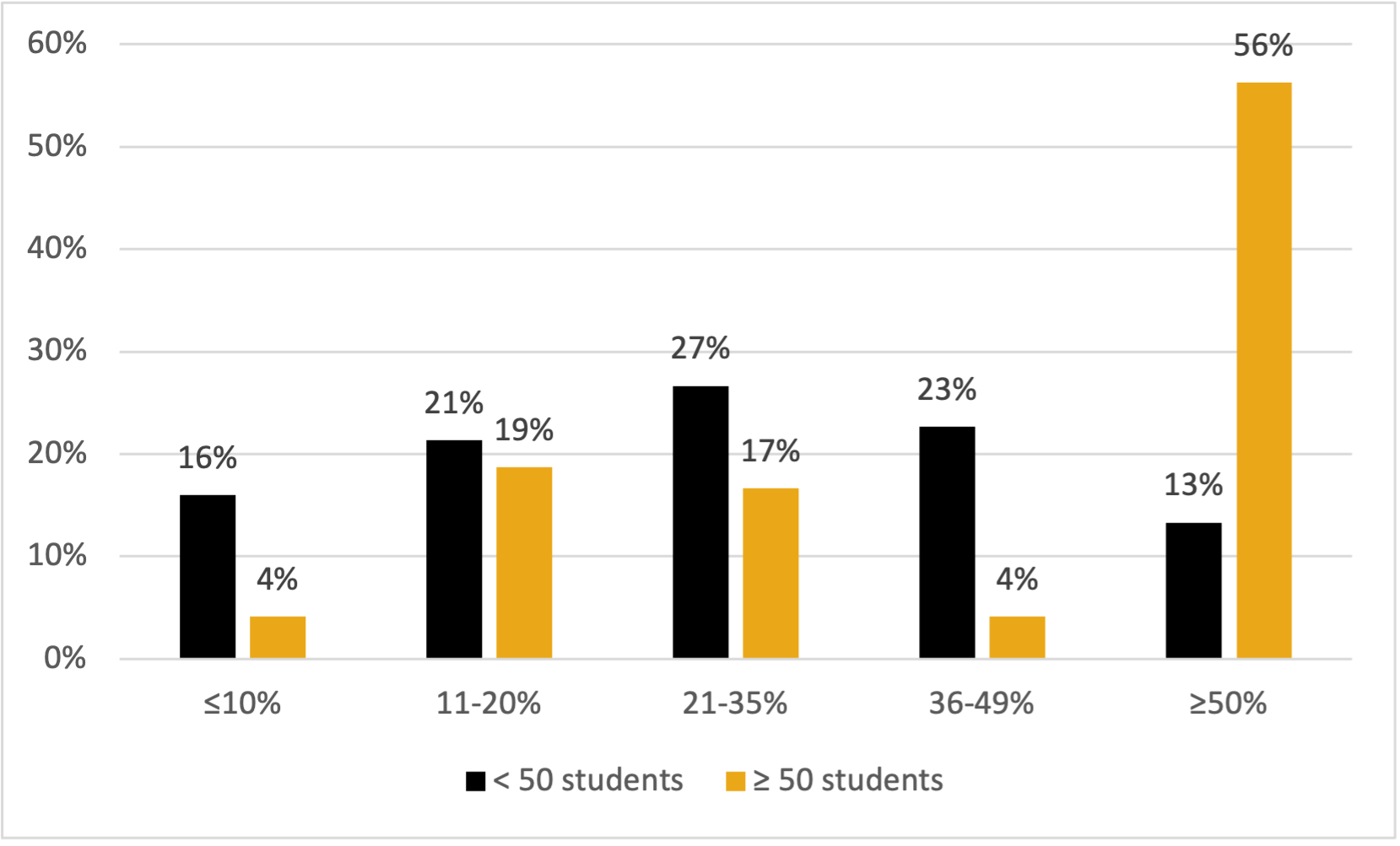
    <div class="html-content">In an effort to gather information on how faculty design and administer tests, DoIT collaborated with the Faculty Development Center (FDC) and Student Disability Services (SDS) to create and distribute a short survey to all 941 instructional faculty teaching in Spring 22. There were 157 complete submissions, representing a 17% response rate. Of these survey participants, 78% were full-time faculty, and about half (54%) were Associate, Assistant, or Full Professor. Almost all were from CAHSS (48%), CNMS (24%), or COEIT (22%), and 86% primarily teach undergraduate students.<br><br><div>The quantitative data, as illustrated below in <em>Figure 1</em>, indicate that faculty teaching larger courses and those teaching courses with high percentages of the overall grade contingent on a small number of tests (i.e., high-stakes testing) are considerably more concerned about academic integrity. Also, the survey's open responses suggest instructors believe assessments are important, but were not of a single voice in regards to balancing formative and summative approaches in face-to-face and virtual environments. <br></div><div><br></div><div><strong>Figure 1: Percent of Final Grade from High-stakes Testing, by Course Enrollment</strong></div><img src="https://my3.my.umbc.edu/groups/instructional-technology/posts/119088/attachments/43292" style="max-width: 100%; height: auto;"><br><div><br></div><div>The majority of respondents (59%) taught classes of 50 or fewer students, and about one in five (19%) taught classes with more than 100 students. Additionally, of those instructors teaching courses with at least half of their students' final grades determined by high-stakes tests, 72% agreed or strongly agreed that "Academic integrity on high-stake assessments is a major concern in my course(s)." That same level of sentiment is shared with less than half (49%) of instructors with grading schemas that are not as dependent on high-stakes testing.</div><br>Academic integrity is approached in several ways, including the use of psychology (lecturing students and/or acknowledgment of an "honor" statement or pledge) and overall design of the assessments, such as question banks, randomization, synchronous testing, and, in direct conflict with student accomodation concerns, time constraints.<sup>1</sup> These approaches are carried out in two different environments: in-person and online. In the case of the former, respondents indicated traditional means of face-to-face proctoring. With the latter, instructors may use Blackboard, along with the Respondus Lockdown Browser, and potentially the Monitor option. Other respondents described having their students turn their computer cameras on during the assessments. Plagiarism checkers such as SafeAssign and Turnitin are also leveraged.<br><br>There is an acknowledgement by some, however, that there may not be anything that can be done to fully redress issues concerning academic integrity "other than theatrics." As one respondent noted, "it is impossible to keep students from posting the questions (from memory) on the Internet as soon as they are done with their own test." Some stated, however, that they believe their tests are relatively impervious to cheating due to the tailoring and formatting of the questions. Others stated they didn't think they have a big problem with cheating, or did little to curtail it beyond making sure students aren't using their phones or looking at other students' papers, which can be of particular concern when rooms are at full seating capacity.<br><br>The student disability-based testing accommodations described universally involve faculty providing more time on assessments for individual students, or through the course of the pandemic, expanding the testing window for all students. Few faculty indicated a pervasiveness of need, with some emphasizing how few occurrences of student accommodations they've received in their teaching careers. Additionally, multiple respondents seemed to be under the false impression that SDS has a testing center to support this need, rather than just ad hoc space allocation that is only available for SDS registered students with disabilities. Meaning it is not for general make up test proctoring for all students, can only seat 15 students at a time, and has computer stations only intended for specialized assistive technology needs..<br><br>Interestingly, when asked about the possibility of a dedicated UMBC testing center, only 14% of respondents teaching 50 or more students don't believe a testing center would help them; none of the respondents teaching more than 100 students are of that opinion. In fact, several respondents voiced support for this kind of facility, with one saying "I would be THRILLED for a testing center at UMBC!"<br><br>Some faculty, however, never use high-stakes testing. They may choose not to due to a lack of familiarity or experience with it (e.g., having begun teaching during the pandemic), while other instructors stated they did not believe in using high-stakes assessments on pedagogical grounds, or employ qualitatively graded assessments, such as case studies or written assessments, rather than discrete answer assessments. These types of assessments, of course, can still be high stakes, although much more difficult to scale for larger classes than multiple choice bubble sheets. Other faculty described offering more "smaller" assignments or quizzes. One respondent specifically cited their PIVOT training for adoption of this "best practice."<sup>2</sup> Of those who did make use of high-stakes assessments, some stated they were important to encourage students' motivation to learn. "You have to have some high-stakes testing to get students to study," responded one instructor.<br><br><div>In short, faculty vary in their approach to testing, but there are similarities based on course enrollment size and discipline/college. Also, adoption of a testing center could potentially benefit faculty conducting testing, particularly in high-stakes/enrollment environments to support academic integrity and accessibility needs.</div><div><br></div><div>[1] As one respondent points out, "Many institutions also offer disability accommodations within a broader testing center, which helps to reduce stigma for students with disabilities."<br></div><div>[2] About one in five respondents are now offering fewer high stakes tests since the pandemic shift to online learning.<br></div><div><br></div><div>~By <a href="https://doit.umbc.edu/itnm/staff/penniston/" rel="nofollow external" class="bo">Tom Penniston</a><br></div></div>
]]>
</Body>
<Summary>In an effort to gather information on how faculty design and administer tests, DoIT collaborated with the Faculty Development Center (FDC) and Student Disability Services (SDS) to create and...</Summary>
<Website>https://doit.umbc.edu/post/119088/</Website>
<AttachmentKind>Image</AttachmentKind>
<AttachmentUrl>https://assets3-beta.my.umbc.edu/system/shared/attachments/45dac06f0257ded0b518dc7274ac2a37/69e47d45/news/000/119/088/91ae48805e8e96055d454f043054059b/graph.png?1651516050</AttachmentUrl>
<Attachments>
<Attachment kind="Image" url="https://beta.my.umbc.edu/groups/instructional-technology/posts/119088/attachments/43292"></Attachment>
</Attachments>
<TrackingUrl>https://beta.my.umbc.edu/api/v0/pixel/news/119088/guest@my.umbc.edu/ae416d0c70ca650c993873d57b444f0b/api/pixel</TrackingUrl>
<Tag>doit</Tag>
<Tag>fdc</Tag>
<Tag>high-stakes</Tag>
<Tag>itnm</Tag>
<Tag>penniston</Tag>
<Tag>sds</Tag>
<Tag>testing</Tag>
<Group token="instructional-technology">Instructional Technology</Group>
<GroupUrl>https://beta.my.umbc.edu/groups/instructional-technology</GroupUrl>
<AvatarUrl>https://assets2-beta.my.umbc.edu/system/shared/avatars/groups/000/001/164/dec3b026b81ee6d890a8f82f75c94a2e/xsmall.png?1446126703</AvatarUrl>
<AvatarUrl size="original">https://assets1-beta.my.umbc.edu/system/shared/avatars/groups/000/001/164/dec3b026b81ee6d890a8f82f75c94a2e/original.png?1446126703</AvatarUrl>
<AvatarUrl size="xxlarge">https://assets2-beta.my.umbc.edu/system/shared/avatars/groups/000/001/164/dec3b026b81ee6d890a8f82f75c94a2e/xxlarge.png?1446126703</AvatarUrl>
<AvatarUrl size="xlarge">https://assets1-beta.my.umbc.edu/system/shared/avatars/groups/000/001/164/dec3b026b81ee6d890a8f82f75c94a2e/xlarge.png?1446126703</AvatarUrl>
<AvatarUrl size="large">https://assets1-beta.my.umbc.edu/system/shared/avatars/groups/000/001/164/dec3b026b81ee6d890a8f82f75c94a2e/large.png?1446126703</AvatarUrl>
<AvatarUrl size="medium">https://assets4-beta.my.umbc.edu/system/shared/avatars/groups/000/001/164/dec3b026b81ee6d890a8f82f75c94a2e/medium.png?1446126703</AvatarUrl>
<AvatarUrl size="small">https://assets3-beta.my.umbc.edu/system/shared/avatars/groups/000/001/164/dec3b026b81ee6d890a8f82f75c94a2e/small.png?1446126703</AvatarUrl>
<AvatarUrl size="xsmall">https://assets2-beta.my.umbc.edu/system/shared/avatars/groups/000/001/164/dec3b026b81ee6d890a8f82f75c94a2e/xsmall.png?1446126703</AvatarUrl>
<AvatarUrl size="xxsmall">https://assets3-beta.my.umbc.edu/system/shared/avatars/groups/000/001/164/dec3b026b81ee6d890a8f82f75c94a2e/xxsmall.png?1446126703</AvatarUrl>
<Sponsor>Instructional Technology</Sponsor>
<ThumbnailUrl size="xxlarge">https://assets3-beta.my.umbc.edu/system/shared/thumbnails/news/000/119/088/b77b1b6769516e44273d6690970ff019/xxlarge.jpg?1651504119</ThumbnailUrl>
<ThumbnailUrl size="xlarge">https://assets4-beta.my.umbc.edu/system/shared/thumbnails/news/000/119/088/b77b1b6769516e44273d6690970ff019/xlarge.jpg?1651504119</ThumbnailUrl>
<ThumbnailUrl size="large">https://assets4-beta.my.umbc.edu/system/shared/thumbnails/news/000/119/088/b77b1b6769516e44273d6690970ff019/large.jpg?1651504119</ThumbnailUrl>
<ThumbnailUrl size="medium">https://assets1-beta.my.umbc.edu/system/shared/thumbnails/news/000/119/088/b77b1b6769516e44273d6690970ff019/medium.jpg?1651504119</ThumbnailUrl>
<ThumbnailUrl size="small">https://assets2-beta.my.umbc.edu/system/shared/thumbnails/news/000/119/088/b77b1b6769516e44273d6690970ff019/small.jpg?1651504119</ThumbnailUrl>
<ThumbnailUrl size="xsmall">https://assets4-beta.my.umbc.edu/system/shared/thumbnails/news/000/119/088/b77b1b6769516e44273d6690970ff019/xsmall.jpg?1651504119</ThumbnailUrl>
<ThumbnailUrl size="xxsmall">https://assets1-beta.my.umbc.edu/system/shared/thumbnails/news/000/119/088/b77b1b6769516e44273d6690970ff019/xxsmall.jpg?1651504119</ThumbnailUrl>
<PawCount>6</PawCount>
<CommentCount>0</CommentCount>
<CommentsAllowed>true</CommentsAllowed>
<PostedAt>Mon, 02 May 2022 13:30:19 -0400</PostedAt>
<EditAt>Mon, 02 May 2022 14:56:49 -0400</EditAt>
</NewsItem>

</News>