Learn how QM Standards Ensure Quality in Online Course Design in the Applying the QM Rubric (APPQMR) Workshop
Online workshop offered Jan. 6-27 by UMBC and Salisbury
Individuals interested in learning about the underlying principles behind the QM Rubric may be enrolled into QM’s flagship workshop, Applying the QM Rubric (APPQMR), that will be offered January 6-27, 2026 in an asynchronous online format.
In this three-week workshop, participants will learn the critical elements of the QM quality assurance process and how to draft helpful recommendations as they apply the Rubric to an actual course.
Target Audience
QM's workshop on the QM Rubric (Higher Education, 7th edition) and its use in the design of online and hybrid courses is intended for a broad audience, including full time and adjunct faculty, instructional designers, administrators, or students enrolled in approved UMBC programs.
It is particularly helpful to those new to QM or are considering the adoption of a quality assurance process for online and hybrid learning. The workshop offers hands-on experiences as participants apply what they have learned to review components of a course and draft helpful recommendations based on QM Standards.
The workshop is recommended for:
Learning Objectives
After completing this workshop, participants will be able to:
- Identify the origin and scope of Quality Matters.
- Identify the critical elements of the QM quality assurance program, including the QM Rubric (HE, 7th edition), materials, processes, and administrative components.
- Apply the QM Higher Education Rubric, 7th ed., to review online courses.
- Make decisions on whether the demo course meets selected QM Rubric Specific Review Standards.
- Apply the concept of alignment.
- Draft helpful recommendations for course improvement by citing Annotations from the QM Rubric and evidence from the course.
The APPQMR is the prerequisite for QM's Higher Ed Peer Reviewer Course, which is required to become a QM-Certified Peer Reviewer. Since 2019, more than 50 UMBC faculty, staff, and students have completed the APPQMR workshop. Several UMBC faculty have gone on to become QM-Certified Peer Reviewers or Master Reviewers.
Workshop Details and Schedule
- Format & Schedule: Workshop format is asynchronous online via Canvas. *NOTE: This workshop is not self-paced. It has firm due dates for all required assignments and revisions. Potential participants should review QM's Schedule & Checklist in advance of being enrolled. The schedule outlines expectations and required deadlines. Certified facilitators review, offer feedback, and grade activities.
- Time commitment: A minimum of 7-9 hours per week is recommended for achieving the learning objectives. The schedule includes daily time estimates to help participants manage their time and stay on track.
- Course Length: Three weeks, excluding holidays (January 6-27, 2026)
Enrollment
To be enrolled into this workshop or if you have additional questions, please contact Dr. Susan Biro, one of UMBC's QM coordinators, no later than 12 PM, Friday, January 2.
(Image: Decorative, Quality Matters logo)
]]>
Individuals interested in learning about the underlying principles behind the QM Rubric may be enrolled into QM’s flagship workshop, Applying the QM Rubric (APPQMR), that will be offered January...
https://my3.my.umbc.edu/groups/instructional-technology/posts/154426
https://beta.my.umbc.edu/api/v0/pixel/news/154426/guest@my.umbc.edu/78cc1f5668b87ae4d15799a28a4fe7e3/api/pixel
appqmr
appqmr-workshop
biro
qm
quality-matters
wi26
Instructional Technology
https://beta.my.umbc.edu/groups/instructional-technology
https://assets2-beta.my.umbc.edu/system/shared/avatars/groups/000/001/164/dec3b026b81ee6d890a8f82f75c94a2e/xsmall.png?1446126703
https://assets1-beta.my.umbc.edu/system/shared/avatars/groups/000/001/164/dec3b026b81ee6d890a8f82f75c94a2e/original.png?1446126703
https://assets2-beta.my.umbc.edu/system/shared/avatars/groups/000/001/164/dec3b026b81ee6d890a8f82f75c94a2e/xxlarge.png?1446126703
https://assets1-beta.my.umbc.edu/system/shared/avatars/groups/000/001/164/dec3b026b81ee6d890a8f82f75c94a2e/xlarge.png?1446126703
https://assets1-beta.my.umbc.edu/system/shared/avatars/groups/000/001/164/dec3b026b81ee6d890a8f82f75c94a2e/large.png?1446126703
https://assets4-beta.my.umbc.edu/system/shared/avatars/groups/000/001/164/dec3b026b81ee6d890a8f82f75c94a2e/medium.png?1446126703
https://assets3-beta.my.umbc.edu/system/shared/avatars/groups/000/001/164/dec3b026b81ee6d890a8f82f75c94a2e/small.png?1446126703
https://assets2-beta.my.umbc.edu/system/shared/avatars/groups/000/001/164/dec3b026b81ee6d890a8f82f75c94a2e/xsmall.png?1446126703
https://assets3-beta.my.umbc.edu/system/shared/avatars/groups/000/001/164/dec3b026b81ee6d890a8f82f75c94a2e/xxsmall.png?1446126703
Instructional Technology
https://assets1-beta.my.umbc.edu/system/shared/thumbnails/news/000/154/426/80fbbdb619b4ac42d9d30e5d2856be76/xxlarge.jpg?1762880155
https://assets2-beta.my.umbc.edu/system/shared/thumbnails/news/000/154/426/80fbbdb619b4ac42d9d30e5d2856be76/xlarge.jpg?1762880155
https://assets4-beta.my.umbc.edu/system/shared/thumbnails/news/000/154/426/80fbbdb619b4ac42d9d30e5d2856be76/large.jpg?1762880155
https://assets2-beta.my.umbc.edu/system/shared/thumbnails/news/000/154/426/80fbbdb619b4ac42d9d30e5d2856be76/medium.jpg?1762880155
https://assets3-beta.my.umbc.edu/system/shared/thumbnails/news/000/154/426/80fbbdb619b4ac42d9d30e5d2856be76/small.jpg?1762880155
https://assets1-beta.my.umbc.edu/system/shared/thumbnails/news/000/154/426/80fbbdb619b4ac42d9d30e5d2856be76/xsmall.jpg?1762880155
https://assets2-beta.my.umbc.edu/system/shared/thumbnails/news/000/154/426/80fbbdb619b4ac42d9d30e5d2856be76/xxsmall.jpg?1762880155
(Image: Decorative, Quality Matters logo)
1
0
true
Wed, 12 Nov 2025 11:36:16 -0500
Wed, 17 Dec 2025 10:58:08 -0500
Accessibility, UDL & Quality Matters: Your Blueprint for Inclusive Teaching and Quality Course Design
Practical steps to make content accessible and inclusive
As part of the 19th annual National Distance Learning Week (NDLW), Instructional Technology will offer a series of sessions that underscore the importance and context of digital accessibility, how to create your own digital accessibility action plan, and how proactively using Quality Matters General Standard 8 (Accessibility & Usability) with the core principles of Universal Design for Learning (UDL) can support course accessibility and inclusive teaching practices.
Monday, November 3, 2025 (12 pm - 12:50 pm)Digital Accessibility 101: Principles and Practices
What is digital accessibility, and why does it matter in your course? If a student couldn't access your materials, would you know what to do -- or how to fix it? Join this session to learn the foundational principles of digital accessibility, legal context, and core practices. We'll share tips for creating accessible images and Blackboard content, and where to find training support.
Session Objectives
Explain the importance of digital accessibility in higher education.
Describe basic steps faculty can take to improve course accessibility.
Define alternative text and best practices for writing descriptive alt text
Review accessibility settings available in Blackboard courses and organizations
Whether you're building a new course or updating old materials, this virtual session will give you practical steps to get started.
Tuesday, November 4, 2025 (12 pm - 12:50 pm)
Design Accessible Courses: Leverage UDL and Quality Matters Standard 8 for Content Remediation and Inclusive Learning Experiences
Creating accessible and inclusive courses requires thoughtful consideration of diverse learning styles and strategies that foster engaging learning experiences. The foundational concepts of Universal Design for Learning (UDL)—providing multiple means of Representation, Action and Expression, and Engagement—are strongly supported by the Quality Matters (QM) Higher Education Rubric, specifically General Standard 8: Accessibility and Usability.
Session Objectives
Explain alignment between QM Standard 8 and the three core principles of UDL.
Apply remediation techniques for text and images (QM 8.3, 8.4) after identifying course barriers with a course accessibility report from Anthology Ally.
Develop a "plus-one" action plan to implement UDL by modifying one course component to offer flexible learning options.
By proactively reviewing QM Standard 8 and using UDL's core principles, you can move beyond accessibility compliance to intentionally building an inclusive learning environment for all students.
Thursday, November 6, 2025 (12 pm - 12:50 pm)
Create your Digital Accessibility Action Plan
Whether you are beginning or continuing your journey to create or remediate accessible content, this session will help you define your personalized action plan to improve digital accessibility in your course. Participants will leave with clear next steps to implement digital accessibility best practices.
Session Objectives
Identify technology tools like Anthology Ally for creating or remediating digital content
Describe 3 easy fixes for common PDF accessibility issues identified by Ally
Recall strategies for creating or remediating PDF files to improve accessibility
Create an action plan to support accessibility goals in your course, including appropriate technologies
In this session, participants will have the chance to create an action plan that reflects on the changes they have already made and identifies next steps or resources to keep building an inclusive digital learning environment.
Register for Free NDLW Events
This year's NDLW events take place November 3-7, 2025. All sessions are free to attend, but require registration via USDLA.
Connect with Instructional Technology
As always, if you have any questions about teaching, learning, and technology, please consider the following options:
]]>
As part of the 19th annual National Distance Learning Week (NDLW), Instructional Technology will offer a series of sessions that underscore the importance and context of digital accessibility, how...
https://my3.my.umbc.edu/groups/instructional-technology/posts/153858/edit
https://beta.my.umbc.edu/api/v0/pixel/news/153858/guest@my.umbc.edu/9dbccf896b1040bd5698cf52c32e25ba/api/pixel
accessibility
action-plan
biro
da
digital-accessibility
fa25
inclusive
ndlw
qm
udl
Instructional Technology
https://beta.my.umbc.edu/groups/instructional-technology
https://assets2-beta.my.umbc.edu/system/shared/avatars/groups/000/001/164/dec3b026b81ee6d890a8f82f75c94a2e/xsmall.png?1446126703
https://assets1-beta.my.umbc.edu/system/shared/avatars/groups/000/001/164/dec3b026b81ee6d890a8f82f75c94a2e/original.png?1446126703
https://assets2-beta.my.umbc.edu/system/shared/avatars/groups/000/001/164/dec3b026b81ee6d890a8f82f75c94a2e/xxlarge.png?1446126703
https://assets1-beta.my.umbc.edu/system/shared/avatars/groups/000/001/164/dec3b026b81ee6d890a8f82f75c94a2e/xlarge.png?1446126703
https://assets1-beta.my.umbc.edu/system/shared/avatars/groups/000/001/164/dec3b026b81ee6d890a8f82f75c94a2e/large.png?1446126703
https://assets4-beta.my.umbc.edu/system/shared/avatars/groups/000/001/164/dec3b026b81ee6d890a8f82f75c94a2e/medium.png?1446126703
https://assets3-beta.my.umbc.edu/system/shared/avatars/groups/000/001/164/dec3b026b81ee6d890a8f82f75c94a2e/small.png?1446126703
https://assets2-beta.my.umbc.edu/system/shared/avatars/groups/000/001/164/dec3b026b81ee6d890a8f82f75c94a2e/xsmall.png?1446126703
https://assets3-beta.my.umbc.edu/system/shared/avatars/groups/000/001/164/dec3b026b81ee6d890a8f82f75c94a2e/xxsmall.png?1446126703
Instructional Technology
https://assets2-beta.my.umbc.edu/system/shared/thumbnails/news/000/153/858/5dec09eccc059c206d6c2612e32bce13/xxlarge.jpg?1761245564
https://assets4-beta.my.umbc.edu/system/shared/thumbnails/news/000/153/858/5dec09eccc059c206d6c2612e32bce13/xlarge.jpg?1761245564
https://assets2-beta.my.umbc.edu/system/shared/thumbnails/news/000/153/858/5dec09eccc059c206d6c2612e32bce13/large.jpg?1761245564
https://assets3-beta.my.umbc.edu/system/shared/thumbnails/news/000/153/858/5dec09eccc059c206d6c2612e32bce13/medium.jpg?1761245564
https://assets3-beta.my.umbc.edu/system/shared/thumbnails/news/000/153/858/5dec09eccc059c206d6c2612e32bce13/small.jpg?1761245564
https://assets4-beta.my.umbc.edu/system/shared/thumbnails/news/000/153/858/5dec09eccc059c206d6c2612e32bce13/xsmall.jpg?1761245564
https://assets2-beta.my.umbc.edu/system/shared/thumbnails/news/000/153/858/5dec09eccc059c206d6c2612e32bce13/xxsmall.jpg?1761245564
A human figure with outstretched arms inside a circle of two curved arrows, suggesting movement. Below the figure are two words: digital accessibility.
3
0
true
Thu, 23 Oct 2025 17:36:32 -0400
Wed, 29 Oct 2025 13:51:31 -0400
Learn how to apply the QM Rubric to online course design in Applying the QM Rubric (APPQMR) Workshop
Online workshop offered Oct. 7-28 by Salisbury and UMBC
Faculty or staff interested in learning about the underlying principles behind the QM Rubric may be enrolled into QM’s flagship workshop, Applying the QM Rubric (APPQMR), that will be offered October 7-28 in an asynchronous online format.
In this three-week workshop, participants will learn the critical elements of the QM quality assurance process and how to draft helpful recommendations as they apply the Rubric to an actual course.
Target Audience
QM's workshop on the QM Rubric (Higher Education, 7th edition) and its use in reviewing the design of online and hybrid courses is intended for a broad audience, including but not limited to faculty, instructional designers, administrators, and adjunct instructors.
It is particularly helpful to those new to QM or are considering the adoption of a quality assurance process for online and hybrid learning. The workshop offers hands-on experiences as participants apply what they have learned to review components of a course and draft helpful recommendations based on QM Standards.
The workshop is recommended for:
- Those looking to understand the QM Rubric and course review process.
- Those who wish to complete the Higher Ed Peer Reviewer Course.
Learning Objectives
After completing this workshop, participants will be able to:
- Identify the origin and scope of Quality Matters.
- Identify the critical elements of the QM quality assurance program, including the QM Rubric (HE, 7th edition), materials, processes, and administrative components.
- Apply the QM Higher Education Rubric, 7th ed., to review online courses.
- Make decisions on whether the demo course meets selected QM Rubric Specific Review Standards.
- Apply the concept of alignment.
- Draft helpful recommendations for course improvement by citing Annotations from the QM Rubric and evidence from the course.
The APPQMR is the prerequisite for the Peer Reviewer Course, which is required to become a QM-Certified Peer Reviewer. Since 2019, 41 UMBC faculty and staff have completed the APPQMR workshop. Several have gone on to become QM-Certified Peer Reviewers or Master Reviewers.
Details and Workshop Schedule
- Format & Schedule: Asynchronous online delivery via Canvas. NOTE: The APPQMR workshop is not a self-paced learning experience. Certified facilitators review and grade activities following QM’s Course Schedule & Checklist. It is recommended that potential participants review the schedule in advance of being enrolled. The schedule outlines expectations for reviewing content and includes deadlines for submitting required activities.
- Time commitment: A minimum of 7-9 hours per week is recommended for achieving the learning objectives. The schedule includes daily time estimates to help participants manage their time and stay on track.
- Course Length: Three weeks, excluding holidays (October 7-28)
Enrollment
To be enrolled into this workshop or for additional questions, please contact Dr. Susan Biro, one of UMBC's QM coordinators, no later than 12 PM, Friday, October 3.
(Image: Decorative, Quality Matters logo)
]]>
Faculty or staff interested in learning about the underlying principles behind the QM Rubric may be enrolled into QM’s flagship workshop, Applying the QM Rubric (APPQMR), that will be offered...
https://my3.my.umbc.edu/groups/instructional-technology/posts/152218
https://beta.my.umbc.edu/api/v0/pixel/news/152218/guest@my.umbc.edu/485a72ef4ce5b33380fcaf4253e4199b/api/pixel
appqmr
appqmr-workshop
biro
qm
quality-matters
Instructional Technology
https://beta.my.umbc.edu/groups/instructional-technology
https://assets2-beta.my.umbc.edu/system/shared/avatars/groups/000/001/164/dec3b026b81ee6d890a8f82f75c94a2e/xsmall.png?1446126703
https://assets1-beta.my.umbc.edu/system/shared/avatars/groups/000/001/164/dec3b026b81ee6d890a8f82f75c94a2e/original.png?1446126703
https://assets2-beta.my.umbc.edu/system/shared/avatars/groups/000/001/164/dec3b026b81ee6d890a8f82f75c94a2e/xxlarge.png?1446126703
https://assets1-beta.my.umbc.edu/system/shared/avatars/groups/000/001/164/dec3b026b81ee6d890a8f82f75c94a2e/xlarge.png?1446126703
https://assets1-beta.my.umbc.edu/system/shared/avatars/groups/000/001/164/dec3b026b81ee6d890a8f82f75c94a2e/large.png?1446126703
https://assets4-beta.my.umbc.edu/system/shared/avatars/groups/000/001/164/dec3b026b81ee6d890a8f82f75c94a2e/medium.png?1446126703
https://assets3-beta.my.umbc.edu/system/shared/avatars/groups/000/001/164/dec3b026b81ee6d890a8f82f75c94a2e/small.png?1446126703
https://assets2-beta.my.umbc.edu/system/shared/avatars/groups/000/001/164/dec3b026b81ee6d890a8f82f75c94a2e/xsmall.png?1446126703
https://assets3-beta.my.umbc.edu/system/shared/avatars/groups/000/001/164/dec3b026b81ee6d890a8f82f75c94a2e/xxsmall.png?1446126703
Instructional Technology
https://assets3-beta.my.umbc.edu/system/shared/thumbnails/news/000/152/218/801081995723a7cfcc8da12753989f1e/xxlarge.jpg?1757427748
https://assets4-beta.my.umbc.edu/system/shared/thumbnails/news/000/152/218/801081995723a7cfcc8da12753989f1e/xlarge.jpg?1757427748
https://assets1-beta.my.umbc.edu/system/shared/thumbnails/news/000/152/218/801081995723a7cfcc8da12753989f1e/large.jpg?1757427748
https://assets2-beta.my.umbc.edu/system/shared/thumbnails/news/000/152/218/801081995723a7cfcc8da12753989f1e/medium.jpg?1757427748
https://assets1-beta.my.umbc.edu/system/shared/thumbnails/news/000/152/218/801081995723a7cfcc8da12753989f1e/small.jpg?1757427748
https://assets4-beta.my.umbc.edu/system/shared/thumbnails/news/000/152/218/801081995723a7cfcc8da12753989f1e/xsmall.jpg?1757427748
https://assets4-beta.my.umbc.edu/system/shared/thumbnails/news/000/152/218/801081995723a7cfcc8da12753989f1e/xxsmall.jpg?1757427748
(Image: Decorative, Quality Matters logo)
3
0
false
Tue, 09 Sep 2025 10:49:31 -0400
Tue, 09 Sep 2025 13:09:51 -0400
Exploring the Journey from QM Course Certification to becoming a Master Reviewer
Louise Murray shares insights as first faculty to pursue MR
Louise Murray, Clinical Associate Professor and Director of Undergraduate Programs at the Erickson School of Aging Studies, recently became UMBC’s first faculty member to become certified as a QM Master Reviewer.
This recent achievement builds on Murray’s long-standing experience with Quality Matters Standards as the guiding framework for designing online courses. In order to earn Master Reviewer certification, Murray first had to first complete the Applying the QM Rubric workshop, followed by QM’s Peer Reviewer Course, and then serve on two QM course review teams. Once eligible to become a Master Reviewer, Murray completed QM’s Higher Ed Master Reviewer Certification.
She was also among the faculty who completed the QM Impact (QMI) pilot program in 2021. Through that experience, Murray earned QM Certification for AGNG 355: The Experience of Dementia. It is one of UMBC's 19 QM-certified courses.
A Natural Progression
Driven by “a passion for the quality assurance process in education,” Murray said she embraced the transition to online teaching early in her career. She was introduced to the QM framework at a prior institution, calling it a “pivotal motivator” as early training offered a structure and pathway to enhance her skills in online course design. At UMBC, Murray continued learning and applying the QM Rubric, noting that becoming a Peer Reviewer and having opportunities to participate on QM Review teams allowed her to review how others use the Rubric and increased her confidence to pursue Master Reviewer certification.

Murray emphasized the importance of having institutional support by noting that Dean Dana Burr Bradley at the Erickson School of Aging Studies and her colleagues “were very supportive, providing the time and resources needed for the QM training” and course review opportunities.
Bradley said Murray's recent accomplishment is indicative of her dedication to quality course design: “We are so proud of Dr. Murray and are pleased that she is able to share her expertise with the QM community. The Erickson School has been at the forefront of distance/online work, and Louise has led our efforts to ensure we meet our students where they are and need to be.”
Transforming the Student Experience
Murray has submitted two courses for QM review, beginning with a course in 2017 at another institution. While that course did not achieve full certification, the process was invaluable. Achieving QM certification at UMBC solidified her commitment to quality online course design.
Murray pointed to how QM-designed courses foster better learning experiences for her students, even beyond the online environment. “Applying alignment and structure benefits students in both online and face-to-face courses,” she noted. For instructors, the upfront intentionality of QM allows more focus on mentorship and guidance during the course itself. For students, it ensures clarity and purpose, ultimately boosting engagement and providing tools for success.
Advice for Faculty Interested in QM
Murray said the journey with QM is an investment, but one that pays dividends in both teaching and learning. “It’s time-efficient for instructors, and students can navigate the course without frustration. Everything has a purpose, and that transparency helps engagement," she explained.
A Commitment to Continuous Improvement
Looking ahead, Murray envisions an expanded role with QM at UMBC, including taking additional courses through the review process and supporting colleagues in online course design. With many courses offered online at the Erickson School, Murray sees potential to serve as a resource for faculty striving to enhance their course quality and the student experience.
Reflecting on the resources available at UMBC, Murray noted the collaborative support from DoIT, the Faculty Development Center, and learning communities. “The investment in QM and teaching is about continuous improvement,” Murray said. “Our curriculum is dynamic, and we’re always looking to grow and refine it.”
(Image: Decorative, the QM logo)
This article focuses on ways to leverage features in Ultra to ensure your course is designed to optimize student learning and ensure students feel welcome and prepared, especially at the start of the term. Part 2 will feature Ultra’s progress tracking tools and effective strategies for student identification, outreach, and support.
A student’s first impression of your course, and their learning opportunities throughout the course, are influenced initially by course design. A clutter-free environment helps students focus on the course and avoid confusion. In addition, students’ learning opportunities can be enhanced by using Blackboard Ultra design features to welcome and orient them within the first critical weeks of the semester and ensure they are on track and able to locate content, engage with one another, get help, and submit assignments.
During emergency-remote instruction in 2020, a survey of more than 500 UMBC courses taught by instructors who completed the PIVOT+ professional development program found students reported enjoying taking classes that were well organized and planned. More than 85% of students agreed or strongly agreed that PIVOT+ courses flowed in a logical format. About 90% of students agreed or strongly agreed that course requirements were clear, while 83% agreed or strongly agreed that assignment instructions were clear.
Using the ‘Start Here’ Module
Every Blackboard course shell at UMBC is created with a “Start Here” module already in place. Within this module are placeholders for the syllabus, instructor information, and eLearning and academic resources. This module can also contain critical orientation information to let students know what to expect in your course, how to navigate, help set the tone for the course, and provide opportunities to establish teaching and social presence (Quality Matters, 2024; Wengier, 2022).
Welcoming and Orienting Students
When it comes to designing the welcome experience for learners, Quality Matters General Standard 1: Course Overview & Introduction (HE Rubric, 7th ed.), offers researched-backed effective practices for orienting students to the course and instructor expectations for communication, feedback, grading, and use of Blackboard.
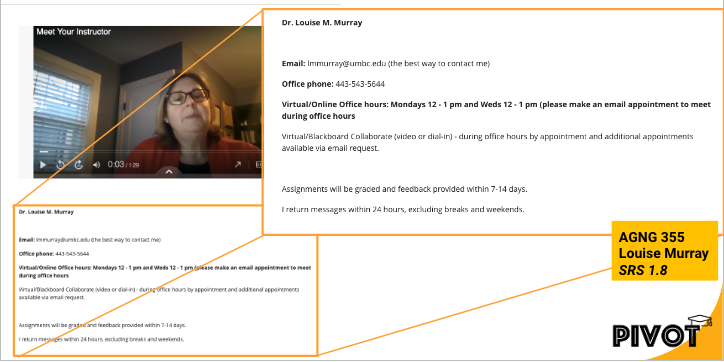
In the QM-certified course AGNG 355, instructor Louise Murray (pictured above) includes a pre-recorded, narrated, and captioned PowerPoint to provide students with a visual tour of the course and communication expectations. This allows students to see and hear the instructor and complements the text Murray provides about email, phone, office hours, and response times.
There are many ways to welcome and introduce students to your course, including steps you can take before the semester even starts, such as sending a welcome email or announcement. These messages can stay available for students through the duration of the course.
Some instructors send a pre-survey to students before the semester starts to determine prior knowledge or experience. In addition, you may want to prepare a Frequently Asked Questions (FAQs) resource to address the most common student questions, share tips on time management, and remind students how to access technology and resources.
Consider that there are effective options to consider for welcoming and orienting students that create learning opportunities at the beginning of the course including:
- Accessing a welcome video or course tour (pre-recorded)
- Reading an instructor’s introduction
- Introducing themselves in a Discussion forum or VoiceThread
- Using the “Ask the Professor” discussion forum to ask clarifying questions
- Completing a syllabus quiz
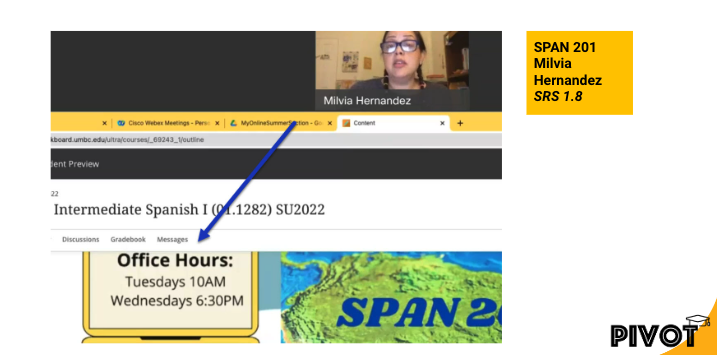
In the Quality Matters certified course SPAN 201 (pictured above) instructor Milvia Hernandez pre-records a brief video that complements text in Blackboard. More importantly, students can also see and hear Hernandez as she welcomes them in both Spanish and English and explains the course structure and cadence.
About Quality Matters
Grounded in evidence-based practice research, peer review, and collegiality, Quality Matters (QM) is used by more than 40,000 educators and instructional designers worldwide to strengthen online and blended course design.
At UMBC, 19 courses have earned QM certification for online course design and represent more than half of the QM-certified courses in the University System of Maryland.
References:
- Quality Matters. (2024, September 9). QM Rubrics & Standards.
- Wengier, S. (2022). The start here module: Creating a first day impression in an online language class (EJ1346021).
DoIT's Manager of Online Learning, Dr. Susan Biro, has been selected to serve on the Quality Matters Academic Advisory Council (QMAAC) for a three-year term beginning January 1, 2024. The Council provides guidance to and oversight of the programmatic directions and initiatives of Quality Matters.
QMAAC members represent an institution or organization's interests and viewpoint to QM; provide guidance on QM to ensure QM's long-term sustainability and success; help to review new initiatives and act in an advisory role for new projects; and disseminate QM-related information, materials, and opportunities to others.
Biro came to UMBC in May 2019 as Coordinator, Online Learning with more than 20 years of experience in distance education, including accreditation, program management, faculty support, and online student support and retention.
"I was introduced to Quality Matters early in my higher education career," said Biro. "QM has been an integral part of how we do the important work of supporting faculty in designing effective online and hybrid learning environments. It's an honor to have been selected and I look forward to working with my QM colleagues on initiatives and projects."

Biro currently serves as one of UMBC's QM Coordinators. She is also QM-certified as a Course Review Manager, a Peer Reviewer, and Independent Online APPQMR Facilitator.
About the QM Academic Advisory Council
Created in 2004 during the grant phase of Quality Matters, the Council has evolved in purpose and composition. The QMAAC's 15 members include representatives of QM subscriber schools, QM senior staff, and online and blended learning leaders who provide a national perspective.
The Council is chaired by Dr. Morris Thomas, Assistant Provost for Digital and Online Learning and Director, Center for Excellence in Teaching, Learning, and Assessment at Howard University.
Biro is one of five new members selected to serve on QMAAC. The others are Julian King, M.Ed., Instructional Designer & Quality Matters Coordinator, Center for the Advancement of Learning, University of the District of Columbia; Katherine McAlvage, Ph.D., Associate Director, Faculty Development and Support, Oregon State University; Antoinette R. Miller, Ph.D., Professor and Department Chair, Psychology, Clayton State University; and, Alicia Reed, Director of eLearning and Instructional Innovation Center, Laredo College.
About Quality Matters at UMBC
A total of 18 faculty have earned Quality Matters certification of their online or hybrid courses following rigorous peer reviews as part of the Quality Matters Impact (QMI) program. To date, more than half of the QM-certified courses in the University System of Maryland are from UMBC.
For more information about Quality Matters at UMBC, including course reviews, please contact Dr. Susan Biro (sbiro@umbc.edu).
]]>
DoIT's Manager of Online Learning, Dr. Susan Biro, has been selected to serve on the Quality Matters Academic Advisory Council (QMAAC) for a three-year term beginning January 1, 2024. The Council...
https://my3.my.umbc.edu/groups/instructional-technology/posts/138785
https://beta.my.umbc.edu/api/v0/pixel/news/138785/guest@my.umbc.edu/355e4d7d77611f6972e70f46b239572f/api/pixel
biro
online-learning
qm
qmaac
quality-matters
Instructional Technology
https://beta.my.umbc.edu/groups/instructional-technology
https://assets2-beta.my.umbc.edu/system/shared/avatars/groups/000/001/164/dec3b026b81ee6d890a8f82f75c94a2e/xsmall.png?1446126703
https://assets1-beta.my.umbc.edu/system/shared/avatars/groups/000/001/164/dec3b026b81ee6d890a8f82f75c94a2e/original.png?1446126703
https://assets2-beta.my.umbc.edu/system/shared/avatars/groups/000/001/164/dec3b026b81ee6d890a8f82f75c94a2e/xxlarge.png?1446126703
https://assets1-beta.my.umbc.edu/system/shared/avatars/groups/000/001/164/dec3b026b81ee6d890a8f82f75c94a2e/xlarge.png?1446126703
https://assets1-beta.my.umbc.edu/system/shared/avatars/groups/000/001/164/dec3b026b81ee6d890a8f82f75c94a2e/large.png?1446126703
https://assets4-beta.my.umbc.edu/system/shared/avatars/groups/000/001/164/dec3b026b81ee6d890a8f82f75c94a2e/medium.png?1446126703
https://assets3-beta.my.umbc.edu/system/shared/avatars/groups/000/001/164/dec3b026b81ee6d890a8f82f75c94a2e/small.png?1446126703
https://assets2-beta.my.umbc.edu/system/shared/avatars/groups/000/001/164/dec3b026b81ee6d890a8f82f75c94a2e/xsmall.png?1446126703
https://assets3-beta.my.umbc.edu/system/shared/avatars/groups/000/001/164/dec3b026b81ee6d890a8f82f75c94a2e/xxsmall.png?1446126703
Instructional Technology
https://assets4-beta.my.umbc.edu/system/shared/thumbnails/news/000/138/785/fddfdee1c39441de2057a024bafdb747/xxlarge.jpg?1707329892
https://assets3-beta.my.umbc.edu/system/shared/thumbnails/news/000/138/785/fddfdee1c39441de2057a024bafdb747/xlarge.jpg?1707329892
https://assets3-beta.my.umbc.edu/system/shared/thumbnails/news/000/138/785/fddfdee1c39441de2057a024bafdb747/large.jpg?1707329892
https://assets2-beta.my.umbc.edu/system/shared/thumbnails/news/000/138/785/fddfdee1c39441de2057a024bafdb747/medium.jpg?1707329892
https://assets1-beta.my.umbc.edu/system/shared/thumbnails/news/000/138/785/fddfdee1c39441de2057a024bafdb747/small.jpg?1707329892
https://assets4-beta.my.umbc.edu/system/shared/thumbnails/news/000/138/785/fddfdee1c39441de2057a024bafdb747/xsmall.jpg?1707329892
https://assets3-beta.my.umbc.edu/system/shared/thumbnails/news/000/138/785/fddfdee1c39441de2057a024bafdb747/xxsmall.jpg?1707329892
13
3
true
Wed, 07 Feb 2024 14:37:00 -0500
Accessible Course Design Supports Diverse Learning Styles
Save the dates! Accessibility Workshop and Bb Ally Webinar
Creating accessible courses requires thoughtful consideration of diverse learning styles and strategies that result in fostering engaging learning experiences for all students. These strategies include leveraging Universal Design for Learning principles to guide course design that offers variety to all learners.
Faculty can utilize Blackboard Ally to provide multiple content formats and empower students to use Ally's alternative formats to meet their learning styles. Additional resources about course usability and accessibility, including the chance to connect with peers, can be accessed by using your QM login to enroll in the Accessibility and Usability Resource Site (AURS).
Highlights of these approaches include the following:
Universal Design for Learning Guidelines
- Review UDL guidelines that support offering multiple means of representation to learners by employing various formats such as text, audio, and visual materials to accommodate diverse learning preferences.
- Foster engagement by incorporating interactive elements, discussions, or hands-on activities that cater to visual, auditory, and kinesthetic learners.
- Ask yourself these key questions about learner engagement, representation, action and expression when designing a module or unit in your course.
- Implement UDL incrementally and intentionally. Refer to scholarly works like Behling & Tobin (2018) for guidance. They encourage faculty to think of UDL as "plus-one thinking about the interactions in your course" (p. 134). For example, is there just one more way you can help students stay on task, give them information, or demonstrate skills? The answers can help unlock a UDL strategy for your course.
Bb Ally for Remediation, Alt Text
- Explore accessibility tools and built-in features that allow you to cater to students with different abilities. For example, Ally is a tool available in Blackboard Ultra that improves the accessibility of courses by scanning course content, generating an Accessibility Report, and providing tools to fix accessibility issues.
- Use Ally's Instructor Feedback Panel to preview content and prioritize remediation.
- Consider Ally's powerful alternative format options and let students know they can download content in multiple formats that give them choices in how they watch, read, or listen.
QM's Accessibility and Usability Resource Site
- Register for free access to Quality Matters Accessibility and Usability Resource Site (AURS), the go-to resource for educators to address key accessibility and usability concerns. Log into MyQM, or create your QM account. After successfully logging in, use the side navigation menu to select "Workshop-Register" and self-enroll in AURS (last item on the workshop list).
- Explore resources, videos, and best practices on topics like UDL, alternative text, captions, hyperlinks, accessible MS Office products, readability, accessible PDFs, accessible course design, and inclusive teaching practices.
- Connect with colleagues through AURS discussion forums to seek and incorporate feedback to refine course design that supports an inclusive learning experience.
Save the dates!
Instructional Technology will offer an accessibility workshop in January and a Bb Ally webinar in February to share best practices in course accessibility and usability. To learn more and register for an event, follow us on myUMBC.
This year's National Distance Learning Week 2022 Lunchtime Series (November 7-11) at UMBC created space for candid conversations about online learning. These conversations featured 11 panelists who represented faculty, staff, and students sharing their challenges, accomplishments, and lessons learned.
Instructional Technology will continue hosting monthly candid conversations about online learning starting in spring 2023. Follow us on myUMBC for the latest information about dates, times, and guests.
If you missed one of these candid conversations during National Distance Learning Week check out the session takeaways below or watch/listen to the recorded session.
Monday, November 7th topic: What does good course design look like? (session recording)
- Panelists:Dr. Louise Murray, Director, Undergraduate Programs and Clinical Associate Professor in the Erickson School of Aging Studies; Mr. Gary Williams Jr., Senior Lecturer, Emergency Health Services Department and Clinical Coordinator, Paramedic Concentration; Dr. Eileen O'Brien, Director, College Teaching & Learning Science (CTLS) Post Master's Certificate Program; and, Dr. John Schumacher, Professor, Department of Sociology, Anthropology, and Public Health, Co-Director Doctoral Program in Gerontology.
- Key takeaways: Faculty shared their experiences in online course design and how the Quality Matters framework strengthened their design after taking a course through a formal course review. The rigor of the QM peer-review process also presented faculty with challenges in understanding, learning, and designing for new technologies and methods of designing learning. As they applied what they learned about effective online course design, faculty shared that students reported a clearer understanding of what was expected in the online course, where to find content, and how they were going to be assessed.
Tuesday, November 8th topic: How do we engage disconnected students? (session recording)
- Panelists:Gary Rozanc, Assistant Professor Graphic Design, Department of Visual Arts (CAHSS); Nancy McAllister, Adjunct Professor of Environmental Science, Geography & Environmental Systems Department (CAHSS); and Dr. Sarah Bass, Lecturer of Chemistry, Department of Chemistry & Biochemistry (CNMS).
- Key takeaways: Faculty shared how their approach to engaging online students evolved from the start of the pandemic to more recent practices. During the fall of 2020, engaging students meant using multiple methods to help online students connect with one other, instructor, and content. In the fall of 2022 with a return to campus, our panelists reported rethinking how they use technology in-person. Today's students enter college with more experience and comfort using technology and perhaps with a different motivation for learning. Panelists noted that how they taught pre-pandemic may not align with today's first-year students who are seeing the work they'll be doing in the future happening in asynchronous and remote formats. Our panelists asked, what does this mean to engagement in any class format and the ways students are choosing to learn post-pandemic?
Wednesday, November 9 topic: How do we counter the myths of online learning? (session recording)
- Panelists: Thirandie Bambaradeniya, Director of Sustainability, Student Government Association (UMBC 23); Dr. Tara Carpenter, Principal Lecturer, Department of Chemistry & Biochemistry; Dr. Toby Gouker, Acting Graduate Program Director, Engineering Management; and Dr. Delana Gregg, Director of Academic Learning Resources, Assessment, and Analysis.
- Key takeaways: When it comes to the myth that online learning is easy, panelists were in agreement that online learning is not easier than in-person as it requires students to be even more disciplined in managing their time and asking for help. Debunking the myth that online students don't interact with each other or the instructor, our panelists noted that teaching online is often more intensive and intentional, as students cannot 'hide' in the back of the online classroom. When it comes to the myth that everyone cheats in an online course, panelists said faculty have since created multiple ways for students to be tested, including more formative or open-note assignments. In considering where UMBC could go with online learning, panelists noted that online learning has long been a useful tool for decades and in a post-pandemic time, it remains a viable choice for many students. They would encourage UMBC to consider how we can provide online learning effectively and continue to put services in place to help support our online learners.
As always, if you have any questions about teaching, learning, and technology at UMBC, please consider the following options:
myUMBC post image: 2022 National Distance Learning Week Logo
]]>
This year's National Distance Learning Week 2022 Lunchtime Series (November 7-11) at UMBC created space for candid conversations about online learning. These conversations featured 11 panelists...
https://my3.my.umbc.edu/groups/instructional-technology/posts/129092/
https://beta.my.umbc.edu/api/v0/pixel/news/129189/guest@my.umbc.edu/44e7643b947c7a8784dcbcdd4ecaf50c/api/pixel
myths-online
ndlw
ndlw-2022
online-learning
qm
qm-experience
student-engagement
Instructional Technology
https://beta.my.umbc.edu/groups/instructional-technology
https://assets2-beta.my.umbc.edu/system/shared/avatars/groups/000/001/164/dec3b026b81ee6d890a8f82f75c94a2e/xsmall.png?1446126703
https://assets1-beta.my.umbc.edu/system/shared/avatars/groups/000/001/164/dec3b026b81ee6d890a8f82f75c94a2e/original.png?1446126703
https://assets2-beta.my.umbc.edu/system/shared/avatars/groups/000/001/164/dec3b026b81ee6d890a8f82f75c94a2e/xxlarge.png?1446126703
https://assets1-beta.my.umbc.edu/system/shared/avatars/groups/000/001/164/dec3b026b81ee6d890a8f82f75c94a2e/xlarge.png?1446126703
https://assets1-beta.my.umbc.edu/system/shared/avatars/groups/000/001/164/dec3b026b81ee6d890a8f82f75c94a2e/large.png?1446126703
https://assets4-beta.my.umbc.edu/system/shared/avatars/groups/000/001/164/dec3b026b81ee6d890a8f82f75c94a2e/medium.png?1446126703
https://assets3-beta.my.umbc.edu/system/shared/avatars/groups/000/001/164/dec3b026b81ee6d890a8f82f75c94a2e/small.png?1446126703
https://assets2-beta.my.umbc.edu/system/shared/avatars/groups/000/001/164/dec3b026b81ee6d890a8f82f75c94a2e/xsmall.png?1446126703
https://assets3-beta.my.umbc.edu/system/shared/avatars/groups/000/001/164/dec3b026b81ee6d890a8f82f75c94a2e/xxsmall.png?1446126703
Instructional Technology
https://assets3-beta.my.umbc.edu/system/shared/thumbnails/news/000/129/189/3630d13a906eeb62571ac860127ac827/xxlarge.jpg?1668462461
https://assets3-beta.my.umbc.edu/system/shared/thumbnails/news/000/129/189/3630d13a906eeb62571ac860127ac827/xlarge.jpg?1668462461
https://assets4-beta.my.umbc.edu/system/shared/thumbnails/news/000/129/189/3630d13a906eeb62571ac860127ac827/large.jpg?1668462461
https://assets3-beta.my.umbc.edu/system/shared/thumbnails/news/000/129/189/3630d13a906eeb62571ac860127ac827/medium.jpg?1668462461
https://assets3-beta.my.umbc.edu/system/shared/thumbnails/news/000/129/189/3630d13a906eeb62571ac860127ac827/small.jpg?1668462461
https://assets3-beta.my.umbc.edu/system/shared/thumbnails/news/000/129/189/3630d13a906eeb62571ac860127ac827/xsmall.jpg?1668462461
https://assets2-beta.my.umbc.edu/system/shared/thumbnails/news/000/129/189/3630d13a906eeb62571ac860127ac827/xxsmall.jpg?1668462461
4
0
true
Mon, 14 Nov 2022 17:04:49 -0500
Mon, 28 Nov 2022 13:36:30 -0500
Free Half-Day Virtual Conference on Quality Matters on Feb 9
Gain insight into Active/Applied Research on Online Learning
Quality Matters is offering
a free half-day conference on February 9, 2021, focused on research-supported best practices with takeaways to apply in your own work. Listen to experts from the QM community present on Active/Applied Research on Online Learning and Quality Assurance in the space of a single afternoon.
Each session will provide attendees with one or more application-based takeaways and a handout. Topics include:
Session 1 - 1:40 - 2:30 p.m. Eastern- Developing a Framework for Quality Online Course Videos: What Does the Research Say?
- Student perspective 2.0: Where do we go from here?
- Enhancing Accessibility of Online Courses: Course Development Practices and Tools
Session 2 - 2:40 - 3:30 p.m. Eastern- Reconstructing the Table: Designing Culturally Affirming Online Learning Communities at an HBCU Through Quality Matters
- Implementing High Impact Practices on Campus and Online: Research, Resources, and Requests
- Building Momentum for QM Implementation at your Institution - Tips for Transitioning
Session 3 - 3:40 - 4:30 p.m. Eastern- Improving Course Design Quality Through Online Graduate Student Evaluations
- Using Data for Our Continuous Improvement and Yours
- K-12 Teachers & Professional Development Needs: What the Research Uncovered
Session descriptions are available at
the conference page. Participants will receive session links via email the day before the conference.
Registration is free, but you must have a QM account affiliated with UMBC.
- Go to the registration page.
- Click Register for Session.
- At the next screen, check the box for the cancellation/refund policy.
- Click continue.
- Enter your email address. QM will check the system for your account.
If you do not have an account, QM will walk you through the process of creating an account.
- Fill out the form with your information. When you get to the institution, enter our campus identity EXACTLY as you see here: University of Maryland-Baltimore County
If you have questions about Quality Matters at UMBC, please open an RT ticket to contact QM Coordinators: Dr. Mariann Hawken or Dr. Susan Biro.
]]>
Quality Matters is offering a free half-day conference on February 9, 2021, focused on research-supported best practices with takeaways to apply in your own work. Listen to experts from the QM...
https://my3.my.umbc.edu/groups/instructional-technology/posts/98854
https://beta.my.umbc.edu/api/v0/pixel/news/98854/guest@my.umbc.edu/ca9c6bf41c60f2851a95b24244d950cf/api/pixel
conference
hybrid
online-learning
qm
quality-matters
research
Instructional Technology
https://beta.my.umbc.edu/groups/instructional-technology
https://assets2-beta.my.umbc.edu/system/shared/avatars/groups/000/001/164/dec3b026b81ee6d890a8f82f75c94a2e/xsmall.png?1446126703
https://assets1-beta.my.umbc.edu/system/shared/avatars/groups/000/001/164/dec3b026b81ee6d890a8f82f75c94a2e/original.png?1446126703
https://assets2-beta.my.umbc.edu/system/shared/avatars/groups/000/001/164/dec3b026b81ee6d890a8f82f75c94a2e/xxlarge.png?1446126703
https://assets1-beta.my.umbc.edu/system/shared/avatars/groups/000/001/164/dec3b026b81ee6d890a8f82f75c94a2e/xlarge.png?1446126703
https://assets1-beta.my.umbc.edu/system/shared/avatars/groups/000/001/164/dec3b026b81ee6d890a8f82f75c94a2e/large.png?1446126703
https://assets4-beta.my.umbc.edu/system/shared/avatars/groups/000/001/164/dec3b026b81ee6d890a8f82f75c94a2e/medium.png?1446126703
https://assets3-beta.my.umbc.edu/system/shared/avatars/groups/000/001/164/dec3b026b81ee6d890a8f82f75c94a2e/small.png?1446126703
https://assets2-beta.my.umbc.edu/system/shared/avatars/groups/000/001/164/dec3b026b81ee6d890a8f82f75c94a2e/xsmall.png?1446126703
https://assets3-beta.my.umbc.edu/system/shared/avatars/groups/000/001/164/dec3b026b81ee6d890a8f82f75c94a2e/xxsmall.png?1446126703
Instructional Technology
https://assets2-beta.my.umbc.edu/system/shared/thumbnails/news/000/098/854/8089af32cb1a7ad8340c2c8cdc6963d4/xxlarge.jpg?1612185460
https://assets4-beta.my.umbc.edu/system/shared/thumbnails/news/000/098/854/8089af32cb1a7ad8340c2c8cdc6963d4/xlarge.jpg?1612185460
https://assets2-beta.my.umbc.edu/system/shared/thumbnails/news/000/098/854/8089af32cb1a7ad8340c2c8cdc6963d4/large.jpg?1612185460
https://assets3-beta.my.umbc.edu/system/shared/thumbnails/news/000/098/854/8089af32cb1a7ad8340c2c8cdc6963d4/medium.jpg?1612185460
https://assets3-beta.my.umbc.edu/system/shared/thumbnails/news/000/098/854/8089af32cb1a7ad8340c2c8cdc6963d4/small.jpg?1612185460
https://assets4-beta.my.umbc.edu/system/shared/thumbnails/news/000/098/854/8089af32cb1a7ad8340c2c8cdc6963d4/xsmall.jpg?1612185460
https://assets2-beta.my.umbc.edu/system/shared/thumbnails/news/000/098/854/8089af32cb1a7ad8340c2c8cdc6963d4/xxsmall.jpg?1612185460
2
0
true
Mon, 01 Feb 2021 08:37:34 -0500
USM OnTrack: New Quality Matters January Workshops Added!
Sign up now for these newly added workshops for 2021!
USM OnTrack has added additional Quality Matters workshops in high-demand topics for the January 2021!
Quality Matters January 2021 Workshops
Registration Now Open!
Registration is now open for our January Quality Matters workshop series. These dedicated workshops are being offered at no cost to all USM faculty through USM OnTrack. Please note workshops have a maximum registration of 30 people, so please encourage your colleagues to register early.
2-Step Instructions for Self-Registering for USM OnTrack QM Workshops
Date | Time | Title | Description |
Tuesday, January 5, 2021 | 9:00-11:00 a.m. | Introductions and Overviews: Helping Learners Get Started | This workshop explores methods you can use to ensure your learners get off on the right foot. Participants will learn why it is important to provide clear instructions for learners on how to get started in the course, how to navigate the site, the purpose of the course, posting a self-introduction, and having learners introduce themselves. The participants will create a mock-up of a “Getting Started” page and a “Self-Introduction” during the workshop. |
Tuesday, January 5, 2021 | 1:00-3:00 p.m. | Active Learning Strategies | This workshop explores learning preferences, active learning, and strategies to promote active learning in online or blended courses. Participants will determine their own learning reference, discuss active learning, discuss types of interaction and determine how to select active learning activities that align with their course-level/module-level objectives. Participants will complete an Alignment Check worksheet using their own objectives to incorporate active learning. |
Wednesday, January 6, 2021 | 9:00-11:00 a.m. | Developing Activities to Engage Your Learners | In this workshop, participants discuss ways to engage learners through activities that vest them in their learning. Group activities that align with the course objectives and require active learner involvement will be discussed. Participants will explore how to align learning activities with learning objectives, discuss challenges and opportunities around active group projects, identify methods of designing group work that engage learners, and problem solve different methods and examples for creating engaging online group activities. |
Wednesday, January 6, 2021 | 1:00-3:00 p.m. | Setting Expectations and Learner Support: Helping Learners be Successful | This workshop addresses the importance of providing learners with online interaction guidelines, required policies explaining learner and instructor expectations, technology requirements and technical skills they will need, and how to locate and access Learner Support Services. Participants will create the following four statements during the workshop, “Netiquette Guidelines for Discussion Activities,” an “Attendance Policy,” a statement for “Technology Requirements and Skills,” and a statement about one of these Services (Technical, Accessibility, Student, or Academic Support). |
Thursday, January 7, 2021 | 9:00-11:00 a.m. | Rethinking Content for Online Classroom | This workshop will present considerations and strategies for online course content, including reconceptualizing traditional lectures, attending to content strategy, aligning content to learning objectives, and elevating teaching presence. Participants will leave with concrete, actionable takeaways for creating online instructional material, locating Open Educational Resources (OER), and ensuring that materials are aligned with assessments. |
Thursday, January 7, 2021 | 1:00-3:00 p.m. | Communicating New Policies for Online Courses | This workshop explores classroom and institution policies you can include right away to ensure your learners are successful and stay on the right track. You will create a netiquette policy and an attendance policy and locate the privacy policy for a tool you’re currently using in your online or blended course. |
Tuesday, January 12, 2021 | 9:00-11:00 a.m. | Creating Accessible Word Docs | This workshop prepares participants to create accessible documents using Microsoft Word. Microsoft Word is one of the most widely used word processing applications. Instructors use Microsoft Word to share documents with their learners but may not be aware of the accessibility issues learners with disabilities may be confronted with. Learn how to use the accessibility features in Word to quickly create documents that will be usable for the majority of your students. |
Tuesday, January 12, 2021 | 1:00-3:00 p.m. | Creating Accessible PDF Documents and Forms | This workshop prepares participants to create accessible PDF documents and forms. Portable Document Format (PDF) is an open standard for electronic document exchange. Learners can view PDFs on any platform including mobile. PDFs look just like the original document and retain the source file information but are only as accessible as the original file. |
Wednesday, January 13, 2021 | 9:00-11:00 a.m. | Ensuring Accessible Multimedia | This workshop explains how to use YouTube videos, animations, and audio as engaging instructional materials that are accessible. These tools should be beneficial to all your students. But are they? Students who are deaf or ESL can miss audio content that is not presented in alternative form. Blind students will miss visual content that is not presented in an alternative form. |
Wednesday, January 13, 2021 | 1:00-3:00 p.m. | Captioning Videos | This workshop explores how to use YouTube and Amara to add closed captioning quickly and easily to videos. Closed captioning your videos will not only benefit learners with disabilities but can improve learning for learners with a range of other needs or strengths. During the workshop, you'll add closed captions to a video you are currently using or want to include in your course. Participants need a YouTube account prior to the workshop and need to have a video uploaded to their account to close caption. For Amara, participants need to have an account created and the URL of a video they want to close caption for a course they are teaching. |
Thursday, January 14, 2021 | 9:00-11:00 a.m. | Providing Accessible Web Content | This workshop will help you develop accessible web content for your blended or online course. Learn the importance and methods for providing accessible content for all your learners. During this session you will learn the basics of HTML, creating good alt-tags or captions for images, graphs, and tables, and alternative methods for developing content that relies on color for communicating. |
Thursday, January 14, 2021 | 1:00-3:00 p.m. | Communicating New Policies for Online Courses | This workshop explores classroom and institution policies you can include right away to ensure your learners are successful and stay on the right track. You will create a netiquette policy and an attendance policy and locate the privacy policy for a tool you’re currently using in your online or blended course. |
There is no cost for any USM faculty or staff member to attend these workshops, but each workshop does have a 30-person limit, so please sign up as soon as possible!
QM Coordinator information:
Dr. Sherri Braxton - University of Maryland-Baltimore County
]]>
USM OnTrack has added additional Quality Matters workshops in high-demand topics for the January 2021! Quality Matters January 2021 Workshops Registration Now Open! Registration is...
https://www.usmd.edu/cai/register-qm-workshops
https://beta.my.umbc.edu/api/v0/pixel/news/97145/guest@my.umbc.edu/3edb3d27c0d60490e933c3220a5f083d/api/pixel
online-learning
professional-development
qm
quality-matters
usm
Instructional Technology
https://beta.my.umbc.edu/groups/instructional-technology
https://assets2-beta.my.umbc.edu/system/shared/avatars/groups/000/001/164/dec3b026b81ee6d890a8f82f75c94a2e/xsmall.png?1446126703
https://assets1-beta.my.umbc.edu/system/shared/avatars/groups/000/001/164/dec3b026b81ee6d890a8f82f75c94a2e/original.png?1446126703
https://assets2-beta.my.umbc.edu/system/shared/avatars/groups/000/001/164/dec3b026b81ee6d890a8f82f75c94a2e/xxlarge.png?1446126703
https://assets1-beta.my.umbc.edu/system/shared/avatars/groups/000/001/164/dec3b026b81ee6d890a8f82f75c94a2e/xlarge.png?1446126703
https://assets1-beta.my.umbc.edu/system/shared/avatars/groups/000/001/164/dec3b026b81ee6d890a8f82f75c94a2e/large.png?1446126703
https://assets4-beta.my.umbc.edu/system/shared/avatars/groups/000/001/164/dec3b026b81ee6d890a8f82f75c94a2e/medium.png?1446126703
https://assets3-beta.my.umbc.edu/system/shared/avatars/groups/000/001/164/dec3b026b81ee6d890a8f82f75c94a2e/small.png?1446126703
https://assets2-beta.my.umbc.edu/system/shared/avatars/groups/000/001/164/dec3b026b81ee6d890a8f82f75c94a2e/xsmall.png?1446126703
https://assets3-beta.my.umbc.edu/system/shared/avatars/groups/000/001/164/dec3b026b81ee6d890a8f82f75c94a2e/xxsmall.png?1446126703
Instructional Technology
https://assets2-beta.my.umbc.edu/system/shared/thumbnails/news/000/097/145/de60e6e06b840b903318c377e2026536/xxlarge.jpg?1604355419
https://assets3-beta.my.umbc.edu/system/shared/thumbnails/news/000/097/145/de60e6e06b840b903318c377e2026536/xlarge.jpg?1604355419
https://assets1-beta.my.umbc.edu/system/shared/thumbnails/news/000/097/145/de60e6e06b840b903318c377e2026536/large.jpg?1604355419
https://assets2-beta.my.umbc.edu/system/shared/thumbnails/news/000/097/145/de60e6e06b840b903318c377e2026536/medium.jpg?1604355419
https://assets3-beta.my.umbc.edu/system/shared/thumbnails/news/000/097/145/de60e6e06b840b903318c377e2026536/small.jpg?1604355419
https://assets1-beta.my.umbc.edu/system/shared/thumbnails/news/000/097/145/de60e6e06b840b903318c377e2026536/xsmall.jpg?1604355419
https://assets1-beta.my.umbc.edu/system/shared/thumbnails/news/000/097/145/de60e6e06b840b903318c377e2026536/xxsmall.jpg?1604355419
3
0
false
Mon, 02 Nov 2020 17:20:12 -0500