MS defense: Akshaya Iyengar, Estimating Temporal...
Full Title: MS defense: Akshaya Iyengar, Estimating Temporal Boundaries for Twitter Events
MS Thesis Defense
Estimating Temporal Boundaries For Events Using Social Media Data
Akshaya Iyengar
10:00am Wednesday, 15 June 2011, ITE 325b
Social media websites like Twitter, Flickr and YouTube generate a high volume of user generated content as a major event occurs. Our goal is to automatically determine as accurately as possible when an event starts and when it ends by analyzing the content of social media data. Estimating these temporal boundaries segments the event-related data into three major phases: the buildup to the event, the event itself, and the post-event effects and repercussions.
We describe a technique that estimates the temporal boundaries of anticipated events and helps to monitor changes as events unfold. In our approach we train a multiclass support vector machine (SVM) to classify event data into the aforementioned phases. We then discuss an algorithm for choosing the two class boundaries, such that the total error is minimized. We apply our technique to six events – Hurricane Igor (2010), Superbowl XLV (2011), three games from ICC Cricket World Cup 2011 and the Royal Wedding (2011). We train individual classifies for each of these events. Finally we train a general classifier and compare its performance with the individual classifiers.
The contributions of this research are presenting a set of features for detecting temporal boundaries of events, determining a reasonable value of tradeoff parameter for multiclass SVMs, evaluating the effect of smoothing SVM predictions using sliding window of different sizes and presenting the results of our approach on real event data gathered from Twitter. Our approach can potentially be used to detect the presence and scope of significant sub-events occurring during the course of an event. When applied to natural disasters and man-made disturbances, the derived data can help organizations involved in mediation efforts to track and analyze evolving events.
]]>
Full Title: MS defense: Akshaya Iyengar, Estimating Temporal Boundaries for Twitter Events MS Thesis Defense Estimating Temporal Boundaries For Events Using Social Media Data Akshaya...
http://www.cs.umbc.edu/2011/06/ms-defense-akshaya-iyengar-on-twitter-events/
https://beta.my.umbc.edu/api/v0/pixel/news/7238/guest@my.umbc.edu/f0b8e45e5f641c9776865f60ae17a249/api/pixel
computer-science
graduate
news
research
talks
Computer Science and Electrical Engineering
https://beta.my.umbc.edu/groups/csee
https://assets3-beta.my.umbc.edu/system/shared/avatars/groups/000/000/099/d117dca133c64bf78a4b7696dd007189/xsmall.png?1314043393
https://assets1-beta.my.umbc.edu/system/shared/avatars/groups/000/000/099/d117dca133c64bf78a4b7696dd007189/original.png?1314043393
https://assets1-beta.my.umbc.edu/system/shared/avatars/groups/000/000/099/d117dca133c64bf78a4b7696dd007189/xxlarge.png?1314043393
https://assets4-beta.my.umbc.edu/system/shared/avatars/groups/000/000/099/d117dca133c64bf78a4b7696dd007189/xlarge.png?1314043393
https://assets3-beta.my.umbc.edu/system/shared/avatars/groups/000/000/099/d117dca133c64bf78a4b7696dd007189/large.png?1314043393
https://assets1-beta.my.umbc.edu/system/shared/avatars/groups/000/000/099/d117dca133c64bf78a4b7696dd007189/medium.png?1314043393
https://assets2-beta.my.umbc.edu/system/shared/avatars/groups/000/000/099/d117dca133c64bf78a4b7696dd007189/small.png?1314043393
https://assets3-beta.my.umbc.edu/system/shared/avatars/groups/000/000/099/d117dca133c64bf78a4b7696dd007189/xsmall.png?1314043393
https://assets3-beta.my.umbc.edu/system/shared/avatars/groups/000/000/099/d117dca133c64bf78a4b7696dd007189/xxsmall.png?1314043393
Computer Science and Electrical Engineering
3
0
false
Thu, 09 Jun 2011 13:12:22 -0400
MS Defense: Face Recognition for Mass Disaster Victims
MS Thesis Defense
Face Recognition using Gabor Jets for Images of Mass Disaster Victims
Kavita Dabke
11:00am Friday, 10 June 2011, ITE 325B
Mass disasters such as earthquakes, tsunamis, floods, landslides, blizzards and other natural calamities affect a large number of people in a short time duration. After such emergencies occur, people affected need medical aid and are admitted into hospitals. In such conditions, it becomes difficult to locate one's family members and friends. Hospitals and medical centers take triage pictures of people getting admitted for their records. The content of these images could be very disturbing for some people to see. Such pictures cannot be posted on notification walls or internet websites for people to identify their missing family members or friends. This thesis addresses this problem by developing methods for searching triage image databases using query images provided by friends or family of missing people. The dataset for this thesis consists of mug shot images of people affected by calamity. These are also called the triage images. The test dataset consist of clean or regular mug shot images of people.
To automate the process of locating missing people, our thesis has a goal of developing a face recognition system based on Gabor Jets to match a clean image to the existing triage images. Here, a clean image means a mug shot image of a person where all features such as eyebrows, eyes, nose, lips, skin, ears, etc. are seen. The system aims at pulling up the exact match from the triage dataset into the top N matches filtered out based on a similarity measure. Face recognition has been studied for clean images, where all features are visible. We have developed a system to work on the domain of triage images by experimenting with existing Gabor Jets-based similarity measures and modifying the algorithm to best fit our needs.
]]>
MS Thesis Defense Face Recognition using Gabor Jets for Images of Mass Disaster Victims Kavita Dabke 11:00am Friday, 10 June 2011, ITE 325B Mass disasters such as earthquakes, tsunamis,...
http://www.cs.umbc.edu/2011/06/ms-defense-face-recognition-for-mass-disaster-victims/
https://beta.my.umbc.edu/api/v0/pixel/news/7226/guest@my.umbc.edu/39cfb711a1cbc0cabd10357ffd141b56/api/pixel
computer-science
graduate
news
research
talks
Computer Science and Electrical Engineering
https://beta.my.umbc.edu/groups/csee
https://assets3-beta.my.umbc.edu/system/shared/avatars/groups/000/000/099/d117dca133c64bf78a4b7696dd007189/xsmall.png?1314043393
https://assets1-beta.my.umbc.edu/system/shared/avatars/groups/000/000/099/d117dca133c64bf78a4b7696dd007189/original.png?1314043393
https://assets1-beta.my.umbc.edu/system/shared/avatars/groups/000/000/099/d117dca133c64bf78a4b7696dd007189/xxlarge.png?1314043393
https://assets4-beta.my.umbc.edu/system/shared/avatars/groups/000/000/099/d117dca133c64bf78a4b7696dd007189/xlarge.png?1314043393
https://assets3-beta.my.umbc.edu/system/shared/avatars/groups/000/000/099/d117dca133c64bf78a4b7696dd007189/large.png?1314043393
https://assets1-beta.my.umbc.edu/system/shared/avatars/groups/000/000/099/d117dca133c64bf78a4b7696dd007189/medium.png?1314043393
https://assets2-beta.my.umbc.edu/system/shared/avatars/groups/000/000/099/d117dca133c64bf78a4b7696dd007189/small.png?1314043393
https://assets3-beta.my.umbc.edu/system/shared/avatars/groups/000/000/099/d117dca133c64bf78a4b7696dd007189/xsmall.png?1314043393
https://assets3-beta.my.umbc.edu/system/shared/avatars/groups/000/000/099/d117dca133c64bf78a4b7696dd007189/xxsmall.png?1314043393
Computer Science and Electrical Engineering
3
0
false
Wed, 08 Jun 2011 12:42:26 -0400
Wed, 08 Jun 2011 12:42:26 -0400
PhD proposal: Improving traffic flow forecasts for...
Full Title: PhD proposal: Improving traffic flow forecasts for road networks with data assimilation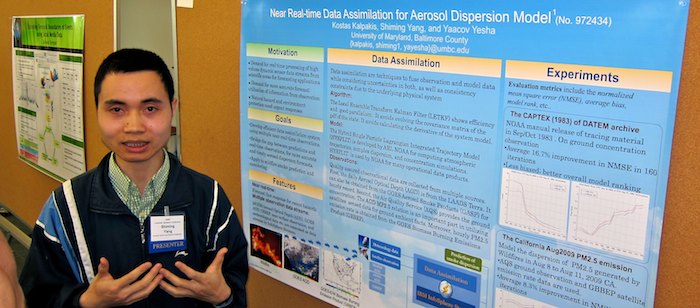
Ph.D. Dissertation Proposal
Improving traffic flow forecasts for road networks
with data assimilation
Shiming Yang
3:00pm Wednesday, 8 June 2011, ITE 325b
Macroscopic models for traffic flow in networks of roads are widely used in analyzing traffic phenomena and for the management and planning of transportation road systems. These models have various simplifying assumptions in order to be tractable. Moreover, we often have only partial and inaccurate knowledge of the model parameters. Consequently, there are modeling errors to be dealt with.
An approach to mitigate our partial knowledge and modeling uncertainties, is to collect measurements of the real traffic system and use computational methods to assimilate them with the model in order to derive more accurate forecasts of the state of the system.
In this proposal, we propose to design, develop, and analyze methods for assimilating measurements from road networks to improve the accuracy of short-term forecasting of traffic flow in road networks. The proposed methods will overcome challenges due to the non-linearity of traffic flow behavior, high dimensionality of the modeled state space, and anisotropic non-Gaussian modeling and measurement error processes.
Committee:
- Dr. Kostas Kalpakis (chair)
- Dr. Milton Halem
- Dr. Yaacov Yesha
- Dr. James Smith
]]>
Full Title: PhD proposal: Improving traffic flow forecasts for road networks with data assimilation Ph.D. Dissertation Proposal Improving traffic flow forecasts for road networks with data...
http://www.cs.umbc.edu/2011/06/phd-proposal-improving-traffic-flow-forecasts-for-road-networks-with-data-assimilation/
https://beta.my.umbc.edu/api/v0/pixel/news/7216/guest@my.umbc.edu/66547c39a73304c74051fac8a83f492a/api/pixel
computer-science
graduate
news
research
talks
Computer Science and Electrical Engineering
https://beta.my.umbc.edu/groups/csee
https://assets3-beta.my.umbc.edu/system/shared/avatars/groups/000/000/099/d117dca133c64bf78a4b7696dd007189/xsmall.png?1314043393
https://assets1-beta.my.umbc.edu/system/shared/avatars/groups/000/000/099/d117dca133c64bf78a4b7696dd007189/original.png?1314043393
https://assets1-beta.my.umbc.edu/system/shared/avatars/groups/000/000/099/d117dca133c64bf78a4b7696dd007189/xxlarge.png?1314043393
https://assets4-beta.my.umbc.edu/system/shared/avatars/groups/000/000/099/d117dca133c64bf78a4b7696dd007189/xlarge.png?1314043393
https://assets3-beta.my.umbc.edu/system/shared/avatars/groups/000/000/099/d117dca133c64bf78a4b7696dd007189/large.png?1314043393
https://assets1-beta.my.umbc.edu/system/shared/avatars/groups/000/000/099/d117dca133c64bf78a4b7696dd007189/medium.png?1314043393
https://assets2-beta.my.umbc.edu/system/shared/avatars/groups/000/000/099/d117dca133c64bf78a4b7696dd007189/small.png?1314043393
https://assets3-beta.my.umbc.edu/system/shared/avatars/groups/000/000/099/d117dca133c64bf78a4b7696dd007189/xsmall.png?1314043393
https://assets3-beta.my.umbc.edu/system/shared/avatars/groups/000/000/099/d117dca133c64bf78a4b7696dd007189/xxsmall.png?1314043393
Computer Science and Electrical Engineering
8
0
false
Tue, 07 Jun 2011 12:43:34 -0400
MS defense: Gas Detection and Concentration...
Full Title: MS defense: Gas Detection and Concentration Estimation via Mid-IR-based Gas Detection System Analysis Model
MSEE Thesis Defense
On Gas Detection and Concentration Estimation via
Mid-IR-based Gas Detection System Analysis Model
Yi Xin
2pm Monday, 6 June 2011, ITE 325
Due to recent development in laser technology and infrared spectroscopy, Laser-based spectroscopy (LAS) has been used in a wide range of research and application fields. A particular application of interest is mid-IR laser-based gas detection systems for health and environment assessment. The NSF-ERC Mid-Infrared Technologies for Health and Environment (MIRTHE) project has engineers and researchers from different areas. As a participant in MIRTHE, we study the performance analysis and improvement possibilities of the integrated sensing system.
Herein, we have improved the previously-developed statistical analysis model, and then used our statistical analysis model for a generic mid-IR pulsed-laser gas detection system to predict trace gas detection and concentration estimation performance, and their sensitivity to system parameters. Based on PNNL (Pacific Northwest National Laboratory) data and the Beer-Lambert law, we defined three main spectral peaks of a trace gas for detecting a target gas and evaluate 3-peak joint detection performance in terms of P_D vs. P_FA. For concentration estimation we used the relationship between gas transmittance (beta), molar absorptivity (epsilon), concentration (c), the sample-mean measurement (x_N) from the photo-detector, and number of samples (N) as the basis. Using the standard confidence interval method, we evaluated estimation reliability, and then analyzed estimation errors.
Simulated gas-detection and concentration-estimation results are presented for 17 trace gases at 1ppm and 1ppb concentrations.
Committee:
- Dr. Joel M. Morris (chair)
- Dr. Chuck LaBerge
- Dr. Gymama Slaughter
]]>
Full Title: MS defense: Gas Detection and Concentration Estimation via Mid-IR-based Gas Detection System Analysis Model MSEE Thesis Defense On Gas Detection and Concentration Estimation via...
http://www.cs.umbc.edu/2011/06/ms-defense-gas-detection-and-concentration-estimation-via-mid-ir-based-gas-detection-system-analysis-model/
https://beta.my.umbc.edu/api/v0/pixel/news/7187/guest@my.umbc.edu/49d55540610f00e2c6f5baf5fe18386c/api/pixel
defense
electrical-engineering
graduate
news
research
talks
Computer Science and Electrical Engineering
https://beta.my.umbc.edu/groups/csee
https://assets3-beta.my.umbc.edu/system/shared/avatars/groups/000/000/099/d117dca133c64bf78a4b7696dd007189/xsmall.png?1314043393
https://assets1-beta.my.umbc.edu/system/shared/avatars/groups/000/000/099/d117dca133c64bf78a4b7696dd007189/original.png?1314043393
https://assets1-beta.my.umbc.edu/system/shared/avatars/groups/000/000/099/d117dca133c64bf78a4b7696dd007189/xxlarge.png?1314043393
https://assets4-beta.my.umbc.edu/system/shared/avatars/groups/000/000/099/d117dca133c64bf78a4b7696dd007189/xlarge.png?1314043393
https://assets3-beta.my.umbc.edu/system/shared/avatars/groups/000/000/099/d117dca133c64bf78a4b7696dd007189/large.png?1314043393
https://assets1-beta.my.umbc.edu/system/shared/avatars/groups/000/000/099/d117dca133c64bf78a4b7696dd007189/medium.png?1314043393
https://assets2-beta.my.umbc.edu/system/shared/avatars/groups/000/000/099/d117dca133c64bf78a4b7696dd007189/small.png?1314043393
https://assets3-beta.my.umbc.edu/system/shared/avatars/groups/000/000/099/d117dca133c64bf78a4b7696dd007189/xsmall.png?1314043393
https://assets3-beta.my.umbc.edu/system/shared/avatars/groups/000/000/099/d117dca133c64bf78a4b7696dd007189/xxsmall.png?1314043393
Computer Science and Electrical Engineering
4
0
false
Fri, 03 Jun 2011 20:50:38 -0400
PhD proposal: Finding Story Chains in Newswire Articles
Ph.D. Dissertation Proposal
Finding Story Chains in Newswire Articles
Xianshu Zhu
1:30pm Thursday 2 June 2011, ITE 325B
Huge amounts of information are shared on the Internet every day, such as online newspapers, digital libraries, blogs, and social network messages. While there are some excellent search engines, such as Google, to assist in retrieving information by simply providing keywords, large volumes of unstructured search results returned by search engines make it hard to keep a clear picture of the evolution of an event. Moreover, in addition to events themselves, people may be more interested in finding out the hidden relationships among different events or causes and effects of an event. However, traditional search engines provide limited support for dealing with these sophisticated search tasks. In this dissertation, we try to enrich search options of existing search engines and organize search results in a more structured and meaningful way.
More specifically, we propose to develop a News Story Reader, with functionality similar to Google maps, that contains the following characteristics: (1) Search results are organized into groups of causes and impacts of events, thus helping web users navigate through the search results in a more directional and efficient way; (2) Enriched search options will allow users to search for correlations between two stories by selecting two articles as start and end points respectively producing a coherent story chain as output; (3) An interactive user interface will provide the functionality to zoom in and zoom out, and add via points to the search result.
In our preliminary work, we start with a relatively simple problem: given a start and an end article we want to find a chain of articles that coherently connect them together. We developed a random walk based algorithm that can find story chains that are coherent and relevant, and with low redundancy. We applied two intelligent pruning methods to reduce the size of the graph so that the algorithm is efficient. Moreover, our next goal is to find hierarchical story chains that can show evolution of stories at different levels of granularity. Thus, we further extended our current algorithm by using random walks on the word-document co-clustering graph with weights biased on name entities to find hierarchical story chains.
The contributions of this dissertation include (1) a News Story Reader system that can help alleviate the information overload problem; (2) design and development of two story chain finding algorithms; (3) exploration of methods that can find story chains on which news articles are connected via causes and impacts; (4) exploration of methods on story chain visualization.
Committee:
- Dr. Tim Oates (chair)
- Dr. Charles Nicholas
- Dr. Tim Finin
- Dr. Sergei Nirenburg
]]>
Ph.D. Dissertation Proposal Finding Story Chains in Newswire Articles Xianshu Zhu 1:30pm Thursday 2 June 2011, ITE 325B Huge amounts of information are shared on the Internet every day,...
http://www.cs.umbc.edu/2011/05/phd-proposal-finding-story-chains-in-newswire-articles/
https://beta.my.umbc.edu/api/v0/pixel/news/7141/guest@my.umbc.edu/b2c14816408284fe22adadc2a749f042/api/pixel
computer-science
graduate
news
research
Computer Science and Electrical Engineering
https://beta.my.umbc.edu/groups/csee
https://assets3-beta.my.umbc.edu/system/shared/avatars/groups/000/000/099/d117dca133c64bf78a4b7696dd007189/xsmall.png?1314043393
https://assets1-beta.my.umbc.edu/system/shared/avatars/groups/000/000/099/d117dca133c64bf78a4b7696dd007189/original.png?1314043393
https://assets1-beta.my.umbc.edu/system/shared/avatars/groups/000/000/099/d117dca133c64bf78a4b7696dd007189/xxlarge.png?1314043393
https://assets4-beta.my.umbc.edu/system/shared/avatars/groups/000/000/099/d117dca133c64bf78a4b7696dd007189/xlarge.png?1314043393
https://assets3-beta.my.umbc.edu/system/shared/avatars/groups/000/000/099/d117dca133c64bf78a4b7696dd007189/large.png?1314043393
https://assets1-beta.my.umbc.edu/system/shared/avatars/groups/000/000/099/d117dca133c64bf78a4b7696dd007189/medium.png?1314043393
https://assets2-beta.my.umbc.edu/system/shared/avatars/groups/000/000/099/d117dca133c64bf78a4b7696dd007189/small.png?1314043393
https://assets3-beta.my.umbc.edu/system/shared/avatars/groups/000/000/099/d117dca133c64bf78a4b7696dd007189/xsmall.png?1314043393
https://assets3-beta.my.umbc.edu/system/shared/avatars/groups/000/000/099/d117dca133c64bf78a4b7696dd007189/xxsmall.png?1314043393
Computer Science and Electrical Engineering
5
0
false
Tue, 31 May 2011 18:23:57 -0400
UMBC Game Developers Club to present work at...
Full Title: UMBC Game Developers Club to present work at Baltimore Gamescape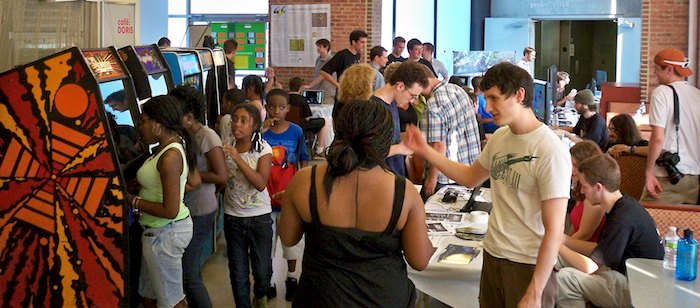
Gamescape is a visual arts exhibition showcasing video games and video game inspired artwork that will be held in Baltimore July 14-17 in conjunction with at Artscape. Developers and artists will demo and display games and game inspired art that they have created.
The UMBC Game Developer's Club will present four of its projects from the 2010-2011 academic year: Light, a 2-D puzzle platformer involving the manipulation of light; City of Gears, a 2-D steam punk hack and slash; Titan, a 3-D shooter where you use physics based weaponry to defeat your foes, and Slug 3D, a 3-D platformer where you must evade enemies using your unique abilities.
The Gamescape exhibition will include classic arcade machines, video game demos from local companies, panels on game development, and art related to video games. It will open on July 14, 2011 and run through the duration of Artscape: Friday, July 15 through 17, 2011. Gamescape will be located in the Pinkard Gallery located in the Bunting Center at the Maryland Institute College of Art.
Gamescape and Artscape are programs of the Baltimore Office of Promotion and the Arts on behalf of the Baltimore Festival of the Arts, Inc. Artscape is America’s largest free public arts festival featuring more than 150 artists, fashion designers, and craftspeople.
]]>
Full Title: UMBC Game Developers Club to present work at Baltimore Gamescape Gamescape is a visual arts exhibition showcasing video games and video game inspired artwork that will be held in...
http://www.cs.umbc.edu/2011/05/umbc-game-developers-club-to-present-work-at-baltimore-gamescape/
https://beta.my.umbc.edu/api/v0/pixel/news/7136/guest@my.umbc.edu/014a0e96b68fc9db60270c031509523e/api/pixel
computer-science
events
news
undergraduate
Computer Science and Electrical Engineering
https://beta.my.umbc.edu/groups/csee
https://assets3-beta.my.umbc.edu/system/shared/avatars/groups/000/000/099/d117dca133c64bf78a4b7696dd007189/xsmall.png?1314043393
https://assets1-beta.my.umbc.edu/system/shared/avatars/groups/000/000/099/d117dca133c64bf78a4b7696dd007189/original.png?1314043393
https://assets1-beta.my.umbc.edu/system/shared/avatars/groups/000/000/099/d117dca133c64bf78a4b7696dd007189/xxlarge.png?1314043393
https://assets4-beta.my.umbc.edu/system/shared/avatars/groups/000/000/099/d117dca133c64bf78a4b7696dd007189/xlarge.png?1314043393
https://assets3-beta.my.umbc.edu/system/shared/avatars/groups/000/000/099/d117dca133c64bf78a4b7696dd007189/large.png?1314043393
https://assets1-beta.my.umbc.edu/system/shared/avatars/groups/000/000/099/d117dca133c64bf78a4b7696dd007189/medium.png?1314043393
https://assets2-beta.my.umbc.edu/system/shared/avatars/groups/000/000/099/d117dca133c64bf78a4b7696dd007189/small.png?1314043393
https://assets3-beta.my.umbc.edu/system/shared/avatars/groups/000/000/099/d117dca133c64bf78a4b7696dd007189/xsmall.png?1314043393
https://assets3-beta.my.umbc.edu/system/shared/avatars/groups/000/000/099/d117dca133c64bf78a4b7696dd007189/xxsmall.png?1314043393
Computer Science and Electrical Engineering
8
0
false
Tue, 31 May 2011 12:36:59 -0400
PhD Proposal: Generating Linked Data by inferring the...
Full Title: PhD Proposal: Generating Linked Data by inferring the semantics of tables
Ph.D. Preliminary Examination
Generating Linked Data by inferring the semantics of tables
Varish Mulwad
9:30am Wednesday 25 May, 2011, ITE 325b
A vast amount of information is encoded in tables on the web, spreadsheets and databases. Considerable work has been focused on exploiting unstructured free text; however techniques that are effective for documents and free text do not work well with tables. In this research we present techniques to generate high quality linked data from tables by jointly inferring the semantics of column headers, table cell values (e.g., strings and numbers), relations between columns, augmented with background knowledge from open data sources such as the Linked Open Data cloud. We represent a table's meaning by mapping columns to classes from an appropriate ontology, linking cell values to literal constants or entities in the linked data cloud (existing or new) and discovering or and identifying relations between columns. The interpreted meaning is represented as linked RDF assertions. An initial evaluation of our preliminary baseline system demonstrate the feasibility of tackling the problem. Based on this work and its evaluation, we are further developing our framework grounded in the theory of graphical models and probabilistic reasoning.
Committee members:
- Dr. Tim Finin (chair)
- Dr. Anupam Joshi
- Dr. Tim Oates
- Dr. Yun Peng
- Dr. L V Subramaniam (IBM Research India)
- Dr. Indrajit Bhattacharya (Indian Institute of Science)
]]>
Full Title: PhD Proposal: Generating Linked Data by inferring the semantics of tables Ph.D. Preliminary Examination Generating Linked Data by inferring the semantics of tables Varish Mulwad...
http://www.cs.umbc.edu/2011/05/phd-proposal-generating-linked-data-by-inferring-the-semantics-of-tables/
https://beta.my.umbc.edu/api/v0/pixel/news/7074/guest@my.umbc.edu/0d4f3c907638e51d3c2e0ad73db79c00/api/pixel
computer-science
events
graduate
news
research
talks
Computer Science and Electrical Engineering
https://beta.my.umbc.edu/groups/csee
https://assets3-beta.my.umbc.edu/system/shared/avatars/groups/000/000/099/d117dca133c64bf78a4b7696dd007189/xsmall.png?1314043393
https://assets1-beta.my.umbc.edu/system/shared/avatars/groups/000/000/099/d117dca133c64bf78a4b7696dd007189/original.png?1314043393
https://assets1-beta.my.umbc.edu/system/shared/avatars/groups/000/000/099/d117dca133c64bf78a4b7696dd007189/xxlarge.png?1314043393
https://assets4-beta.my.umbc.edu/system/shared/avatars/groups/000/000/099/d117dca133c64bf78a4b7696dd007189/xlarge.png?1314043393
https://assets3-beta.my.umbc.edu/system/shared/avatars/groups/000/000/099/d117dca133c64bf78a4b7696dd007189/large.png?1314043393
https://assets1-beta.my.umbc.edu/system/shared/avatars/groups/000/000/099/d117dca133c64bf78a4b7696dd007189/medium.png?1314043393
https://assets2-beta.my.umbc.edu/system/shared/avatars/groups/000/000/099/d117dca133c64bf78a4b7696dd007189/small.png?1314043393
https://assets3-beta.my.umbc.edu/system/shared/avatars/groups/000/000/099/d117dca133c64bf78a4b7696dd007189/xsmall.png?1314043393
https://assets3-beta.my.umbc.edu/system/shared/avatars/groups/000/000/099/d117dca133c64bf78a4b7696dd007189/xxsmall.png?1314043393
Computer Science and Electrical Engineering
5
0
false
Tue, 24 May 2011 17:37:30 -0400
Context-Aware Middleware for Activity Recognition, MS...
Full Title: Context-Aware Middleware for Activity Recognition, MS defense, Radhika Dharurkar, 10:30am 5/19
MS Thesis Defense
Context-Aware Middleware for Activity Recognition
Radhika Dharurkar
10:30am Thursday, 19 May 2011, ITE 325B
Smartphones and other mobile devices have a simple notion of context largely restricted to temporal and spatial coordinates. Service providers and enterprise administrators can deploy systems incorporating activity and relations context to enhance the user experience, but this raises considerable collaboration, trust and privacy issues between different service providers. Our work is an initial step toward enabling devices themselves to represent, acquire and use a richer notion of context that includes functional and social aspects such as co-located social organizations, nearby devices and people, typical and inferred activities, and the roles people fill in them.
We describe a system that learns to recognize richer contexts using sensor data from a person's Android phone along with annotations on her calendar and general background knowledge. Geo-social locations include the concepts of 'home' and 'school' and can be extended to others like 'work' or 'a restaurant'.
Our framework combines data from the phone's sensors (GPS, WI-FI, Bluetooth, acceleration, proximity, etc.) with data mined from applications (e.g., calendar) to produce features that can be used in a machine learning system. Training data from several university students and staff was collected using a system that periodically prompted the user for her true geo-social location and activity. The resulting classifier models were used to predict the individual user's context from new sensor data. The data from a set of users was combined to create a generic model.
We report on an evaluation of the individual and generic models in the university setting for predicting context. Finally, we discuss how our extended context notion can be applied to many interesting applications for smart phone users.
Committee:
- Dr. Tim Finin (chair)
- Dr. Anupam Joshi
- Dr. Yelena Yesha
- Dr. Laura Zavala
]]>
Full Title: Context-Aware Middleware for Activity Recognition, MS defense, Radhika Dharurkar, 10:30am 5/19 MS Thesis Defense Context-Aware Middleware for Activity Recognition Radhika...
http://www.cs.umbc.edu/2011/05/context-aware-middleware-for-activity-recognitionms-defense-radhikadharurkar-1030am-519/
https://beta.my.umbc.edu/api/v0/pixel/news/6961/guest@my.umbc.edu/7a5a4728019954d880702109087e90a0/api/pixel
computer-science
graduate
news
research
talks
Computer Science and Electrical Engineering
https://beta.my.umbc.edu/groups/csee
https://assets3-beta.my.umbc.edu/system/shared/avatars/groups/000/000/099/d117dca133c64bf78a4b7696dd007189/xsmall.png?1314043393
https://assets1-beta.my.umbc.edu/system/shared/avatars/groups/000/000/099/d117dca133c64bf78a4b7696dd007189/original.png?1314043393
https://assets1-beta.my.umbc.edu/system/shared/avatars/groups/000/000/099/d117dca133c64bf78a4b7696dd007189/xxlarge.png?1314043393
https://assets4-beta.my.umbc.edu/system/shared/avatars/groups/000/000/099/d117dca133c64bf78a4b7696dd007189/xlarge.png?1314043393
https://assets3-beta.my.umbc.edu/system/shared/avatars/groups/000/000/099/d117dca133c64bf78a4b7696dd007189/large.png?1314043393
https://assets1-beta.my.umbc.edu/system/shared/avatars/groups/000/000/099/d117dca133c64bf78a4b7696dd007189/medium.png?1314043393
https://assets2-beta.my.umbc.edu/system/shared/avatars/groups/000/000/099/d117dca133c64bf78a4b7696dd007189/small.png?1314043393
https://assets3-beta.my.umbc.edu/system/shared/avatars/groups/000/000/099/d117dca133c64bf78a4b7696dd007189/xsmall.png?1314043393
https://assets3-beta.my.umbc.edu/system/shared/avatars/groups/000/000/099/d117dca133c64bf78a4b7696dd007189/xxsmall.png?1314043393
Computer Science and Electrical Engineering
3
0
false
Mon, 16 May 2011 16:35:50 -0400
Cybersecurity Webinar, 1pm Thur June 9

Dr. Rick Forno will discuss UMBC’s Cybersecurity programs and give updated details about the upcoming Maryland Cyber Challenge at a UMBC Cybersecurity Webinar at 1:00pm on Thursday June 9.
The webinar will describe the UMBC Cybersecurity programs, covering:
- Master of Professional Studies and graduate certificate program details
- Innovative curriculum highlights
- Convenient and flexible class schedules
- Opportunities for career development and professional advancement
Dr. Forno will also discuss the Maryland Cyber Challenge and Conference:
- Participate in a competition to find Maryland’s best minds in Cybersecurity
- Details will be given about the October 2011 Baltimore Conference
- How to get involved as a sponsor or partner and promote cybersecurity in Maryland!
The webinar is free but requires registration.
]]>
Dr. Rick Forno will discuss UMBC’s Cybersecurity programs and give updated details about the upcoming Maryland Cyber Challenge at a UMBC Cybersecurity Webinar at 1:00pm on Thursday June 9. The...
http://www.cs.umbc.edu/2011/05/cybersecurity-webinar-1pm-thur-june-9/
https://beta.my.umbc.edu/api/v0/pixel/news/6956/guest@my.umbc.edu/a08ea8abaead73dff3116814ccee9958/api/pixel
cybersecurity
graduate
news
research
Computer Science and Electrical Engineering
https://beta.my.umbc.edu/groups/csee
https://assets3-beta.my.umbc.edu/system/shared/avatars/groups/000/000/099/d117dca133c64bf78a4b7696dd007189/xsmall.png?1314043393
https://assets1-beta.my.umbc.edu/system/shared/avatars/groups/000/000/099/d117dca133c64bf78a4b7696dd007189/original.png?1314043393
https://assets1-beta.my.umbc.edu/system/shared/avatars/groups/000/000/099/d117dca133c64bf78a4b7696dd007189/xxlarge.png?1314043393
https://assets4-beta.my.umbc.edu/system/shared/avatars/groups/000/000/099/d117dca133c64bf78a4b7696dd007189/xlarge.png?1314043393
https://assets3-beta.my.umbc.edu/system/shared/avatars/groups/000/000/099/d117dca133c64bf78a4b7696dd007189/large.png?1314043393
https://assets1-beta.my.umbc.edu/system/shared/avatars/groups/000/000/099/d117dca133c64bf78a4b7696dd007189/medium.png?1314043393
https://assets2-beta.my.umbc.edu/system/shared/avatars/groups/000/000/099/d117dca133c64bf78a4b7696dd007189/small.png?1314043393
https://assets3-beta.my.umbc.edu/system/shared/avatars/groups/000/000/099/d117dca133c64bf78a4b7696dd007189/xsmall.png?1314043393
https://assets3-beta.my.umbc.edu/system/shared/avatars/groups/000/000/099/d117dca133c64bf78a4b7696dd007189/xxsmall.png?1314043393
Computer Science and Electrical Engineering
1
0
false
Mon, 16 May 2011 12:02:35 -0400
Equation Modeling in Resting State Motor Network in...
Full Title: Equation Modeling in Resting State Motor Network in Healthy Subjects, MS defense, Tejaswini Kavallappa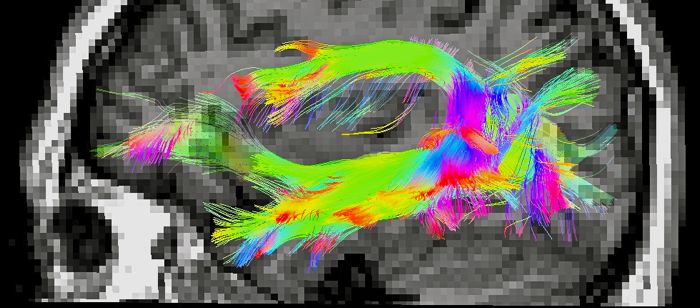
MSEE Thesis Defense
Reliability of Structural Equation Modeling in Examining Resting State Motor Network in Healthy Subjects
Tejaswini Kavallappa
3pm Monday, 16 May 2011, ITE 325
Resting state connectivity studies are of growing significance and interest in the current neuroimaging literature due to their potential in explaining various underlying brain mechanisms and, therefore, their utility in clinical applications. While functional connectivity has been extensively examined in the human brain, effective connectivity is a burgeoning field in functional neuroimaging studies, and there is an increased interest in quantifying effective connectivity that takes into account the directional influences of various brain regions active in a particular functional network. Studies have shown the presence of multiple functional networks in the resting state, which have been shown to be consistent across subjects and between sessions. However, this is not the case with resting state effective connectivity.
In this thesis we evaluate effective connectivity of the resting state motor network in normal subjects using structural equation modeling (SEM), a linear statistical analysis method. It has been shown that signals related to cardiac pulsatality and respiration effects can confound functional MRI results. Thus, we have investigated the effect of various filtering strategies on the reliability of effective connectivity measurements. Our thesis examined the effect of four methods of physiological filtering of resting state data:
- preprocessed data without any filtering,
- removal of prospectively recorded cardiac and respiratory fluctuations using RETROICOR,
- removal of global average signal from all the brain voxels time series,
- regressing out average signal of the white matter (WM) and cerebrospinal fluid (CSF), and
- temporal filtering to remove frequencies pertinent to cardiac and respiratory sources.
The resulting effect of each of these methods on the estimation of resting state motor network effective connectivity was examined in this thesis.
Committee:
- Dr. Joel M. Morris (chair)
- Dr. Rao P. Gullapalli (co-advisor)
- Dr. Tulay Adali
- Dr. Alan B. McMillan
]]>
Full Title: Equation Modeling in Resting State Motor Network in Healthy Subjects, MS defense, Tejaswini Kavallappa MSEE Thesis Defense Reliability of Structural Equation Modeling in Examining...
http://www.cs.umbc.edu/2011/05/equation-modeling-in-resting-state-motor-network-in-healthy-subjects-ms-defense-tejaswini-kavallappa/
https://beta.my.umbc.edu/api/v0/pixel/news/6921/guest@my.umbc.edu/ef7e1bfab8e85e6194cf19fa4403579b/api/pixel
electrical-engineering
graduate
news
research
talks
Computer Science and Electrical Engineering
https://beta.my.umbc.edu/groups/csee
https://assets3-beta.my.umbc.edu/system/shared/avatars/groups/000/000/099/d117dca133c64bf78a4b7696dd007189/xsmall.png?1314043393
https://assets1-beta.my.umbc.edu/system/shared/avatars/groups/000/000/099/d117dca133c64bf78a4b7696dd007189/original.png?1314043393
https://assets1-beta.my.umbc.edu/system/shared/avatars/groups/000/000/099/d117dca133c64bf78a4b7696dd007189/xxlarge.png?1314043393
https://assets4-beta.my.umbc.edu/system/shared/avatars/groups/000/000/099/d117dca133c64bf78a4b7696dd007189/xlarge.png?1314043393
https://assets3-beta.my.umbc.edu/system/shared/avatars/groups/000/000/099/d117dca133c64bf78a4b7696dd007189/large.png?1314043393
https://assets1-beta.my.umbc.edu/system/shared/avatars/groups/000/000/099/d117dca133c64bf78a4b7696dd007189/medium.png?1314043393
https://assets2-beta.my.umbc.edu/system/shared/avatars/groups/000/000/099/d117dca133c64bf78a4b7696dd007189/small.png?1314043393
https://assets3-beta.my.umbc.edu/system/shared/avatars/groups/000/000/099/d117dca133c64bf78a4b7696dd007189/xsmall.png?1314043393
https://assets3-beta.my.umbc.edu/system/shared/avatars/groups/000/000/099/d117dca133c64bf78a4b7696dd007189/xxsmall.png?1314043393
Computer Science and Electrical Engineering
2
0
false
Sun, 15 May 2011 09:27:26 -0400