UMBC ACM Tech Talk Series 10/24: Oates on Machine Learning
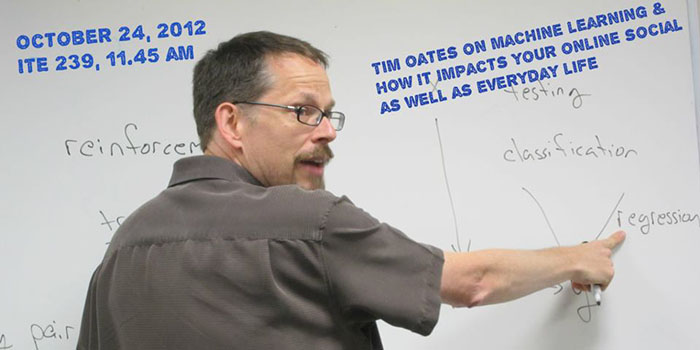
In the first talk of the UMBC ACM Student Chapter's Tech Talk Series, CSEE Prof. Tim Oates will talk about Machine Learning and how it makes an impact on your daily life.
Abstract :
Facebook has one billion users, there are more than 400 million tweets per day, and Google is approaching 5 billion searches per day. These companies and many of their brick and mortar counterparts are increasingly interested in what their data can tell them, and are hiring data scientists – people with a background in machine learning or data mining – at an astounding rate. In this talk I will briefly introduce the core concepts of machine learning, and describe some of its most interesting successes and some of the more mundane (though perhaps surprising) ways it impacts your life on a daily basis. Finally, I will conclude with a short overview of some successes of machine learning in my own lab, including producing textual descriptions of people in triage images involved in mass disasters, extracting scripts (stereotypical actions sequences) from massive text corpora, and predicting outcomes for victims of traumatic brain injury using vital signs time series.
Light refreshments will be served. Please RSVP via the event on Facebook.
Where: ITE Building, Room 239
Date : Wednesday October 24, 2012
Time 11.45 am – 12.45 pm
]]>
In the first talk of the UMBC ACM Student Chapter's Tech Talk Series, CSEE Prof. Tim Oates will talk about Machine Learning and how it makes an impact on your daily life. Abstract : ...http://www.csee.umbc.edu/2012/10/umbc-acm-tech-talk-series-1024-oates-on-machine-learning/https://beta.my.umbc.edu/api/v0/pixel/news/17845/guest@my.umbc.edu/506637d5e3a2251529ff99635c826e05/api/pixeleventsnewstalksComputer Science and Electrical Engineeringhttps://beta.my.umbc.edu/groups/cseehttps://assets3-beta.my.umbc.edu/system/shared/avatars/groups/000/000/099/d117dca133c64bf78a4b7696dd007189/xsmall.png?1314043393https://assets1-beta.my.umbc.edu/system/shared/avatars/groups/000/000/099/d117dca133c64bf78a4b7696dd007189/original.png?1314043393https://assets1-beta.my.umbc.edu/system/shared/avatars/groups/000/000/099/d117dca133c64bf78a4b7696dd007189/xxlarge.png?1314043393https://assets4-beta.my.umbc.edu/system/shared/avatars/groups/000/000/099/d117dca133c64bf78a4b7696dd007189/xlarge.png?1314043393https://assets3-beta.my.umbc.edu/system/shared/avatars/groups/000/000/099/d117dca133c64bf78a4b7696dd007189/large.png?1314043393https://assets1-beta.my.umbc.edu/system/shared/avatars/groups/000/000/099/d117dca133c64bf78a4b7696dd007189/medium.png?1314043393https://assets2-beta.my.umbc.edu/system/shared/avatars/groups/000/000/099/d117dca133c64bf78a4b7696dd007189/small.png?1314043393https://assets3-beta.my.umbc.edu/system/shared/avatars/groups/000/000/099/d117dca133c64bf78a4b7696dd007189/xsmall.png?1314043393https://assets3-beta.my.umbc.edu/system/shared/avatars/groups/000/000/099/d117dca133c64bf78a4b7696dd007189/xxsmall.png?1314043393Computer Science and Electrical Engineering50trueMon, 22 Oct 2012 16:21:47 -0400Making the Abstract Approachable: Teaching innovation in UMBC’s CSEE Department
Making the Abstract Approachable
How UMBC's Computer Science and Electrical Engineering Department is using innovative teaching techniques to engage and inspire undergraduates.
Gone are the days of stuffy lectures and drowsy students. At least, this is true of UMBC’s Computer Science and Electrical Engineering Department, where hands-on labs, industry simulations, new teaching methods, honors courses, and efforts to engage women and underrepresented minorities are being used to engage and inspire the next generation of Computer Scientists and Computer Engineers.
A Little Healthy Competition
For an abstract concept like Computer Science, getting your hands dirty with micro-chips and robots might be the secret to engaging students. Dr. Tim Oates’ Robotics course shows that a healthy dose of competition helps, too. Oates devised a semester-long, team-based competition where students build robots and then battle them. They’re called “Sumobots” (pictured right), named after the age-old Japanese sport, Sumo. Like its namesake, the victor of a sumobot battle is the last robot standing in the circular arena.
“The competition element definitely made it a lot of fun,” says Emily Scheerer (CS ’14) whose team’s robot—made from a servo motor, microcontroller, and plastic binder–was the worst functioning sumobot on the first day of class. After a trip to Home Depot for some sturdier parts and a few revisions, the robot climbed to the top ranking by the last day of class.
Despite cheering that can be heard from inside the classroom on competition days, the course is not just fun and games. “You still have to work for the ‘A’,” explains Mat Kurtz (ME, minor CS ’13), “but the way it’s set up, you want to work for the ‘A’”. Oates explains that having students build and program a robot helps bridge the gap between computer science theory its application.
A similar energy can be found in Introduction to Engineering Science (ENES 101), co-taught by CSEE professor of the practice Dr. Chuck LaBerge and Mechanical Engineering professor of the practice Dr. Anne Spence.
Dubbed the “cornerstone” course because it teaches the basics of engineering to all engineering students (Computer, Mechanical, Biochemical), the course puts students from these different disciplines together to leverage their skills on group projects.
For the past two years, the semester has ended with the AROW competition (Academy Robotics on the Water). Teams design a robotic boat (pictured left) that emulates tasks of the U.S. Coast Guard: tending a light house, placing navigation buoys, cleaning and recycling and oil spill – represented by ping-pong balls – and rescuing Lego fishermen who have fallen overboard. The teams are then judged on the basis of the cost-effectiveness of the various team designs. The winner is chosen based on efficiency and cost-effectiveness.
Build it and they will Come
Replacing lectures with hands-on design experience is a growing trend in Computer Engineering courses at UMBC. Take Programmable Logic Devices (CMPE 415), which teaches students how to program FPGA boards. Two years ago, Dr. Ryan Robucci revamped the course so students could get their hands on FPGA boards from day one.
“We gave them something they can touch,” explains Robucci, who also introduced a “games” theme to the class. Instead of programming the boards to carry out abstract tasks, students connect the boards to monitors and make them play simple video games like the 70’s Atari classic, Pong.
Robucci applied the same technique to C Programming and Embedded Systems (CMPE 331), a similar course that involves programming microcontrollers rather than FPGA boards. In this case, students must program the microcontroller to play a song through a set of speakers.
Robucci stresses that the benefit of hands-on programming is that it forces students to troubleshoot to ensure physical results. Students can’t focus on a single problem and ignore the rest—as they’re apt to do on paper–or they will miss out on a rousing game of pong.
In Dr. Gymama Slaughter’s Biosensor Technology (CMPE), student teams get to build and test their own biosensors (pictured right). This includes a trip to UMBC’s Cleanroom, located in the Technology Resource Center (TRC).
An emerging, multidisciplinary field, biomedical microsystesms (BioMEMS) is making strides with diabetes research. “The development of biosensors is a recent endeavor that is gradually replacing big and bulky laboratory-based diagnostics tools,” explains Slaughter. “Reliable and highly sensitive analytical devices for measuring different components in blood has allowed for patients with diabetes to be able to monitor their glucose levels at home.”
Dr. Fow Sen-Choa has a new Computer Engineering course in the works called “Experimental Techniques for Electrical and Computer Engineering” that will exposes students to basic technologies and laboratory techniques in the areas of wireless communications, optical communications, and bio-medical instrumentation.
Welcome to the "Real World"
CSEE courses that simulate what it’s like to work in the industry arm students with skills to help them thrive in the “real world.”
Take Chuck LaBerge’s Computer Engineering capstone course (CMPE 450/451), where Computer Engineering seniors are asked to apply what they have learned since freshman year. This semester, Dr. LaBerge is teaching the course in the same space as Dr.Anne Spence’s Mechanical Engineering senior capstone, allowing Computer and Mechanical engineers to collaborate.
“Dr. LaBerge ran the capstone class as though it was an engineering consulting firm in which he was the manager of several teams of engineers,” explains Jason Dunthorn (ME ’12), who was part of a team of mechanical engineering students who developed an ultrasonic transceiver to help the blind gauge nearby obstacles (pictured left).
Teams worked on projects for a third-party “customer” (generally a CSEE faculty member or external company), who specifies what they are looking for in a product. Throughout the year, the teams met with their customers to update them on their progress. If groups had trouble, they would seek out advice from other teams.
“This collaborative environment encouraged everyone to grow beyond what they were getting out of their own projects,” says Jason. “It was a wonderful success; Students felt enriched and strengthened.”
A special section of Dr. Susan Mitchell’s Software Design and Development (CSMC 345) course also follows the industry model. Last spring, Mitchell recruited her “customer” from Columbia-based tech company Next Century Corporation.
Made up of two teams of five students, the special section asked teams produce a visualization of how computer viruses spread geographically. As if they had been hired by the company, teams had to give regular updates every one to two weeks, sometimes in person, sometimes via Skype. Next Century even allowed the teams to use their own Wiki and a Configuration Management System, where they could structure their computer code.
Their midterm and final presentations were given in Next Century’s conference room, in front of the company’s president. “They were very nervous,” says Mitchell. Though chances are they’ll be less nervous when they do it for real a few years from now.
One-on-one contact with industry professionals is also an element of Dr. Marc Olano’s Senior Game Project (CMSC 493). A class for aspiring video game developers within UMBC’s Game Development Track, it brings together both Computer Science and Visual Arts students to create a playable video game by the semester’s end. “The final exam is a presentation of the finished games for 10-20 pros at a networking reception,” explains Olano.
SLUG (pictured right), a 2D flash game where the player must help a pink slug collect acorns while avoiding enemies: bees, birds and frogs, even won an award at the 2010 West Virginia Flash Festival.
“The core things (in addition to game development) the students learn during the class include working effectively with others with very different skills and backgrounds, scoping and planning development for a large project, and effective presentation skills through multiple presentations to the class and outsiders,” says Olano.
Teaching Tech with Tech
The “flipped-classroom” approach of Shawn Lupoli’s Programming Languages (CMSC 331) course replaces actual lectures with video lectures; The result is more class time that Lupoli can spend interacting with students.
“I find Mr. Lupoli’s approach much more friendly and easier to understand,” says Andrew Bosco (CS ’14). Despite the roughly 1.5 hours he spends watching videos and taking the online follow-up quiz, Andrew says the class is not more work than other classes; The time is just structured differently. “I’m spending time I would usually devote to studying watching videos.”
Introduced this Fall, the course is the first of its kind at UMBC. Lupoli spends hours writing and recording the videos, so that there is no gap between what the students learn online and what they learn in the classroom. Students come to class already knowing the material; They then use class time to ask questions and work collaboratively on projects.
Honors Seminars
It’s easy for technical subjects like Math and Computer Science to stick to an uninspired lecture-hall format, but the new Computer Science honors seminars are structured to celebrate discussion and student participation.
Dr. Anupam Joshi’s Security and Privacy in a Mobile Social World (HONR 300/ CMSC 491) explores how ubiquitous computing is effecting our personal privacy. Introduced last spring, the course discusses recent court cases like the United States. V. Jones case in which the government installed a GPS in a suspect’s car and monitored him without his knowledge.
As their final project, students were asked to look at Twitter feeds and predict whether the user was a Democrat or a Republican. Student predictions were 70-75% accurate. The point of the exercise, explains Joshi, was to help students realize how much of their personal information they could inadvertently be giving away using social media outlets like Facebook and Twitter.
Dr. Marie desJardin’s Computation, Complexity, and Emergence (HONR 300/ CMSC 491) course uses Computer Science to model and understand natural complex systems like bird flocks, ant colonies, coral colonies, the evolution of language, and weather systems.
“Many years ago, I read Gary Flake’s book The Computational Beauty of Nature and was completed fascinated by the concepts of fractals, chaos, and swarm systems, and how such simple individual behaviors could lead to such complex system behaviors,” explains desJardins, who started teaching the course last year. “…I had often thought of the ubiquity of these complex systems in the world around us would be a great launching point for engaging non-CS majors in understanding how relevant computational modeling can be to their own interests, and broadening the perspective of CS majors on the kinds of problems their training would enable them to work on.”
desJardins was also responsible for a new honors section for Introduction to Computers and Programming (CMSC 100), which she dubbed “Python Boot Camp.” A one-hour completely hands-on, very student-led interactive lab section, the course is meant to hook students who might never consider taking a hard-core programming class.
After students learn the basics of Python programming and using pseudocode to design an algorithmic solution to a problem, they are sent to the front of the room to solve a problem. “Just watching somebody else talk about programming, or even watching them write programs, is really not that effective in terms of actually learning to program," explains desJardins. “It’s one of those things you have to do.”
Computing for All
Making Computer Science and Computer Engineering accessible and enticing for students, especially underrepresented minorities in the field like women, minorities, and transfer students, has always been a priority of the department.
UMBC’s Center for Women in Technology (CWIT), directed by CSEE professor Dr. Penny Rheingans, has been focusing on this issue since the center came to be nearly 15 years ago. This summer, Dr. Rheingans received an NSF research award to develop and evaluate an innovative first-year seminar for computing majors aimed at increasing retention, completion, and success among students, especially women and those from underrepresented groups.
“Students arrive not really understanding which computing major is right for them,” explains Dr. Rheingans. She says that the course, Problem Solving and Computer Programming (IS 101Y/CMSC 104Y), which is being co-taught by herself and Dr. Susan Martin, Associate Director, CWIT, will overcome obstacles that prevent new students from sticking with Computer Science.
“Traditional computing programs generally spend the first semesters teaching skills (for example programming) without really talking much about the big picture, specifically the grand challenges of the field and the impact one can make on solving societal problems,” explains Rheingans. “This organization works fine for students with a love of programming, but not so well for those who see programming as a tool to achieve greater good.”
Students learn both technical skills–algorithmic problem solving, abstraction, programming, and analysis—and professional skills–time management, understanding learning styles, networking, working in teams, and presenting. They work together on a semester long team-based design, implementation, and evaluation project, which shows that working in teams is actually the norm in the industry.
Innovative teaching in UMBC’s Computer Science and Electrical Engineering department is the product of teachers who love the subject and want to make sure their students are similarly infatuated. The way to do that is by making the abstract approachable.
]]>
Making the Abstract Approachable How UMBC's Computer Science and Electrical Engineering Department is using innovative teaching techniques to engage and inspire undergraduates. Gone are...http://www.csee.umbc.edu/2012/10/thinking-outside-the-cpu-teaching-innovation-in-umbcs-csee-department/https://beta.my.umbc.edu/api/v0/pixel/news/17825/guest@my.umbc.edu/81b011a3035799814b48b8856cc8f578/api/pixelcomputer-engineeringcomputer-sciencenewsteaching-innovationundergraduateComputer Science and Electrical Engineeringhttps://beta.my.umbc.edu/groups/cseehttps://assets3-beta.my.umbc.edu/system/shared/avatars/groups/000/000/099/d117dca133c64bf78a4b7696dd007189/xsmall.png?1314043393https://assets1-beta.my.umbc.edu/system/shared/avatars/groups/000/000/099/d117dca133c64bf78a4b7696dd007189/original.png?1314043393https://assets1-beta.my.umbc.edu/system/shared/avatars/groups/000/000/099/d117dca133c64bf78a4b7696dd007189/xxlarge.png?1314043393https://assets4-beta.my.umbc.edu/system/shared/avatars/groups/000/000/099/d117dca133c64bf78a4b7696dd007189/xlarge.png?1314043393https://assets3-beta.my.umbc.edu/system/shared/avatars/groups/000/000/099/d117dca133c64bf78a4b7696dd007189/large.png?1314043393https://assets1-beta.my.umbc.edu/system/shared/avatars/groups/000/000/099/d117dca133c64bf78a4b7696dd007189/medium.png?1314043393https://assets2-beta.my.umbc.edu/system/shared/avatars/groups/000/000/099/d117dca133c64bf78a4b7696dd007189/small.png?1314043393https://assets3-beta.my.umbc.edu/system/shared/avatars/groups/000/000/099/d117dca133c64bf78a4b7696dd007189/xsmall.png?1314043393https://assets3-beta.my.umbc.edu/system/shared/avatars/groups/000/000/099/d117dca133c64bf78a4b7696dd007189/xxsmall.png?1314043393Computer Science and Electrical Engineering30trueMon, 22 Oct 2012 10:05:20 -0400Thu, 25 Oct 2012 10:05:20 -0400UMBC Cyberdawgs place 2nd at MDC3
The UMBC Cyberdawgs triumphed at the Maryland Cyber Challenge & Conference (MDC3) yesterday. The team placed second at the MDC3 finals, held Wednesday at the Baltimore Convention Center. This is the first year that UMBC’s Cyberdawgs have placed in MDC3. In its second year, it is already the state’s biggest Cybersecurity battle.
The UMBC winners include team captain Rob Waters, Brad Isbell, Christopher Moy, Jennifer Olk, Kevin Yu, and Patrick Ly. The win comes with a $2,000 cash prize for each student to be used to further their education and training in field of Cybersecurity.
First place went to the University of Maryland, College Park. “Throughout most of the day, UMBC and UMCP wrestled neck-in-neck for first place, and it was very, very close,” wrote Dr. Richard Forno, UMBC’s Cybersecurity graduate program director, in an e-mail announcement. “In a nutshell, UMBC entered 5 teams in the competition, 4 of them qualified for the finals, and 1 ‘took the silver’”.
The final challenge tasked teams with securing a number of systems on their own network while also attempting to gain (and keep) control of other “targets” that were provided as the day progressed. Points were earned by how well teams defended both their systems and those they gained control over.
]]>
The UMBC Cyberdawgs triumphed at the Maryland Cyber Challenge & Conference (MDC3) yesterday. The team placed second at the MDC3 finals, held Wednesday at the Baltimore Convention Center. This...http://www.csee.umbc.edu/2012/10/umbc-cyberwags-place-2nd-at-mdc3/https://beta.my.umbc.edu/api/v0/pixel/news/17704/guest@my.umbc.edu/853ebf2c14144c416b454cd97daf26f8/api/pixelcyberdawgscybersecuritymdc3newsComputer Science and Electrical Engineeringhttps://beta.my.umbc.edu/groups/cseehttps://assets3-beta.my.umbc.edu/system/shared/avatars/groups/000/000/099/d117dca133c64bf78a4b7696dd007189/xsmall.png?1314043393https://assets1-beta.my.umbc.edu/system/shared/avatars/groups/000/000/099/d117dca133c64bf78a4b7696dd007189/original.png?1314043393https://assets1-beta.my.umbc.edu/system/shared/avatars/groups/000/000/099/d117dca133c64bf78a4b7696dd007189/xxlarge.png?1314043393https://assets4-beta.my.umbc.edu/system/shared/avatars/groups/000/000/099/d117dca133c64bf78a4b7696dd007189/xlarge.png?1314043393https://assets3-beta.my.umbc.edu/system/shared/avatars/groups/000/000/099/d117dca133c64bf78a4b7696dd007189/large.png?1314043393https://assets1-beta.my.umbc.edu/system/shared/avatars/groups/000/000/099/d117dca133c64bf78a4b7696dd007189/medium.png?1314043393https://assets2-beta.my.umbc.edu/system/shared/avatars/groups/000/000/099/d117dca133c64bf78a4b7696dd007189/small.png?1314043393https://assets3-beta.my.umbc.edu/system/shared/avatars/groups/000/000/099/d117dca133c64bf78a4b7696dd007189/xsmall.png?1314043393https://assets3-beta.my.umbc.edu/system/shared/avatars/groups/000/000/099/d117dca133c64bf78a4b7696dd007189/xxsmall.png?1314043393Computer Science and Electrical Engineering180trueThu, 18 Oct 2012 08:53:44 -0400Thu, 18 Oct 2012 08:53:44 -0400Northrop Grumman Foundation and UMBC announce UMBC Cyber Scholars Program
The scholarship program will support 15 to 20 scholars each year, with a focus on women and underrepresented minorities. Along with financial support, scholars will have the opportunity to do advanced research, internships, and take both management-oriented and technical courses.
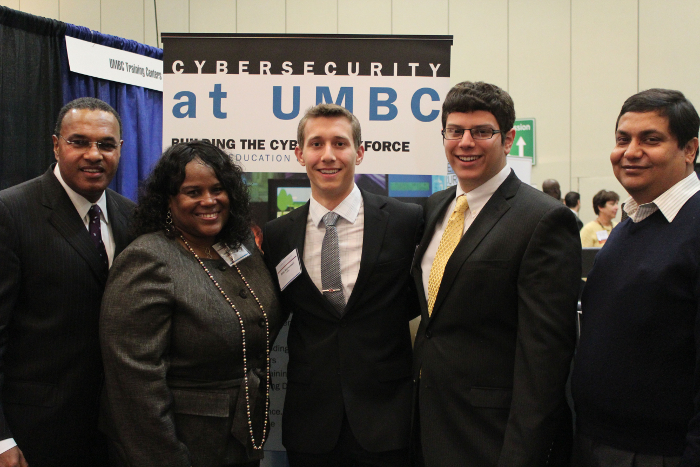
Northrop Grumman Foundation announced $1 million grant to launch the University of Maryland, Baltimore County Cyber Scholars program. Pictured from left are Freeman Hrabowski, president of UMBC; Sandra Evers-Manly, president of the Northrop Grumman Foundation; Alex Markowski, UMBC CWIT Scholar; Alec Pulianas, UMBC CWIT Scholar; and Anupam Joshi, director of UMBC’s Cybersecurity Center and head of the Cyber Scholars program.
]]>
UMBC is partnering with the Northrop Grumman Foundation to launch the UMBC Cyber Scholars Program. Funded by a generous $1 million grant from the Northrop Grumman Foundation, and facilitated by...http://www.csee.umbc.edu/2012/10/northrop-grumman-foundation-and-umbc-announce-umbc-cyber-scholars-program/https://beta.my.umbc.edu/api/v0/pixel/news/17663/guest@my.umbc.edu/cf5701d3ce388285833a667e159951f0/api/pixelcybersecuritynewsnothrop-grumman-foundationscholarshipsumbc-cyber-scholars-programComputer Science and Electrical Engineeringhttps://beta.my.umbc.edu/groups/cseehttps://assets3-beta.my.umbc.edu/system/shared/avatars/groups/000/000/099/d117dca133c64bf78a4b7696dd007189/xsmall.png?1314043393https://assets1-beta.my.umbc.edu/system/shared/avatars/groups/000/000/099/d117dca133c64bf78a4b7696dd007189/original.png?1314043393https://assets1-beta.my.umbc.edu/system/shared/avatars/groups/000/000/099/d117dca133c64bf78a4b7696dd007189/xxlarge.png?1314043393https://assets4-beta.my.umbc.edu/system/shared/avatars/groups/000/000/099/d117dca133c64bf78a4b7696dd007189/xlarge.png?1314043393https://assets3-beta.my.umbc.edu/system/shared/avatars/groups/000/000/099/d117dca133c64bf78a4b7696dd007189/large.png?1314043393https://assets1-beta.my.umbc.edu/system/shared/avatars/groups/000/000/099/d117dca133c64bf78a4b7696dd007189/medium.png?1314043393https://assets2-beta.my.umbc.edu/system/shared/avatars/groups/000/000/099/d117dca133c64bf78a4b7696dd007189/small.png?1314043393https://assets3-beta.my.umbc.edu/system/shared/avatars/groups/000/000/099/d117dca133c64bf78a4b7696dd007189/xsmall.png?1314043393https://assets3-beta.my.umbc.edu/system/shared/avatars/groups/000/000/099/d117dca133c64bf78a4b7696dd007189/xxsmall.png?1314043393Computer Science and Electrical Engineering60trueWed, 17 Oct 2012 10:24:41 -0400Wed, 17 Oct 2012 10:24:41 -0400Introducing the UMBC Center for Cybersecurity
The aim of the center is to provide both Maryland and the nation with academic and research leadership, collaboration, innovation, and outreach in this critical discipline by streamlining UMBC's academic, research, workforce development, and technology incubation activities to advance the University's position as a leading research university in cybersecurity-related disciplines.
The center is made up of UMBC faculty across many disciplines, including Computer Science, Information Systems, Public Policy, Mathematics and Statistics, and Physics. It will expand upon UMBC's pre-existing Cybersersecurity efforts like the Center for Information Security and Assurance (CISA), and the Cync Program run by the Cyber Incubator@bwtech.
In partnership with UMBC's Center for Women in Technology, the UMBC Center for Cybersecurity will also facilitate a new scholarship program called the UMBC Cyber Scholars program. Set to launch this January, the scholarship program is funded by a generous $1 million grant from the Northrop Grumman Foundation.
]]>
This morning, UMBC President Dr. Freeman Hrabowski announced the creation of the new UMBC Center for Cybersecurity. The aim of the center is to provide both Maryland and the nation with academic...http://www.csee.umbc.edu/2012/10/introducing-the-umbc-center-for-cybersecurity/https://beta.my.umbc.edu/api/v0/pixel/news/17664/guest@my.umbc.edu/d5700c6f2712afd0fe090ecaecbe2e40/api/pixelcybersecuritynewsComputer Science and Electrical Engineeringhttps://beta.my.umbc.edu/groups/cseehttps://assets3-beta.my.umbc.edu/system/shared/avatars/groups/000/000/099/d117dca133c64bf78a4b7696dd007189/xsmall.png?1314043393https://assets1-beta.my.umbc.edu/system/shared/avatars/groups/000/000/099/d117dca133c64bf78a4b7696dd007189/original.png?1314043393https://assets1-beta.my.umbc.edu/system/shared/avatars/groups/000/000/099/d117dca133c64bf78a4b7696dd007189/xxlarge.png?1314043393https://assets4-beta.my.umbc.edu/system/shared/avatars/groups/000/000/099/d117dca133c64bf78a4b7696dd007189/xlarge.png?1314043393https://assets3-beta.my.umbc.edu/system/shared/avatars/groups/000/000/099/d117dca133c64bf78a4b7696dd007189/large.png?1314043393https://assets1-beta.my.umbc.edu/system/shared/avatars/groups/000/000/099/d117dca133c64bf78a4b7696dd007189/medium.png?1314043393https://assets2-beta.my.umbc.edu/system/shared/avatars/groups/000/000/099/d117dca133c64bf78a4b7696dd007189/small.png?1314043393https://assets3-beta.my.umbc.edu/system/shared/avatars/groups/000/000/099/d117dca133c64bf78a4b7696dd007189/xsmall.png?1314043393https://assets3-beta.my.umbc.edu/system/shared/avatars/groups/000/000/099/d117dca133c64bf78a4b7696dd007189/xxsmall.png?1314043393Computer Science and Electrical Engineering90trueWed, 17 Oct 2012 10:05:51 -0400Wed, 17 Oct 2012 10:05:51 -0400Fall 2012 Letter From the Chair, Dr. Gary Carter
Welcome to the 2013 Academic Year. We have a lot to celebrate in our department. We welcome two new Assistant Professors: Nilanjan Banerjee and Jian Chen, and new Lecturer John Park. Dr. Banerjee directs UMBC’s new Mobile, Pervasive, and Sensor Systems Laboratory, which will carry out research that focuses on renewable energy driven devices. Dr. Chen specializes in visualization techniques that help scientists make better sense of their data. John Park has extensive indsutry experience in areas including operating systems, real-time control systems, artificial intelligence/machine learning, digital imaging and graphics, and bioinformatics. This Fall he will teach CMSC 104 and 201.
We will have a very busy recruiting season this year. We are searching for two lecturers in Computer Science and a third lecturer/Professor of Practice in Computer Science with expertise in CyberSecurity.
Our research efforts continue to remain strong and our expenditures were approximately at the $5 million level for last fiscal year. Our awards starting January 1, 2012 to date exceed $5.5 million! CSEE Professor Dr. Alan Sherman (PI) and Dr. Rick Forno (Co-PI), Graduate Program Director, Cybersecurity have received an NSF grant of $2.5 million over five years to fund 22 students studying Information Assurance (IA) and Cybersecurity. The scholarships are part of the Federal Cyber Scholarship for Service (SFS) program. UMBC CSEE Professor Penny Rheingans received an NSF research award, Transforming the Freshman Experience of Computing Majors, to develop and evaluate an innovative first-year seminar for computing majors aimed at increasing retention, completion, and success among students, especially women and those from underrepresented groups. Dr. Rheingans will serve as the principal investiga-tor for this three year project, which will also include Drs. Marie desJardins (CSEE), Carolyn Seaman (IS), and Susan Martin (CWIT).
Both the Computer Engineering and Computer Science undergraduate programs were successful in their ABET accreditation. Have a great Fall semester. Keep up to date by visiting www.csee.umbc.edu
-Gary
]]>
Welcome to the 2013 Academic Year. We have a lot to celebrate in our department. We welcome two new Assistant Professors: Nilanjan Banerjee and Jian Chen, and new Lecturer John Park. Dr. Banerjee...http://www.csee.umbc.edu/2012/10/fall-2012-letter-from-the-chair-dr-gary-carter/https://beta.my.umbc.edu/api/v0/pixel/news/17619/guest@my.umbc.edu/0ccc872cb3e892acd5772ae69b87250e/api/pixelchairs-notesnewsComputer Science and Electrical Engineeringhttps://beta.my.umbc.edu/groups/cseehttps://assets3-beta.my.umbc.edu/system/shared/avatars/groups/000/000/099/d117dca133c64bf78a4b7696dd007189/xsmall.png?1314043393https://assets1-beta.my.umbc.edu/system/shared/avatars/groups/000/000/099/d117dca133c64bf78a4b7696dd007189/original.png?1314043393https://assets1-beta.my.umbc.edu/system/shared/avatars/groups/000/000/099/d117dca133c64bf78a4b7696dd007189/xxlarge.png?1314043393https://assets4-beta.my.umbc.edu/system/shared/avatars/groups/000/000/099/d117dca133c64bf78a4b7696dd007189/xlarge.png?1314043393https://assets3-beta.my.umbc.edu/system/shared/avatars/groups/000/000/099/d117dca133c64bf78a4b7696dd007189/large.png?1314043393https://assets1-beta.my.umbc.edu/system/shared/avatars/groups/000/000/099/d117dca133c64bf78a4b7696dd007189/medium.png?1314043393https://assets2-beta.my.umbc.edu/system/shared/avatars/groups/000/000/099/d117dca133c64bf78a4b7696dd007189/small.png?1314043393https://assets3-beta.my.umbc.edu/system/shared/avatars/groups/000/000/099/d117dca133c64bf78a4b7696dd007189/xsmall.png?1314043393https://assets3-beta.my.umbc.edu/system/shared/avatars/groups/000/000/099/d117dca133c64bf78a4b7696dd007189/xxsmall.png?1314043393Computer Science and Electrical Engineering30trueTue, 16 Oct 2012 11:01:43 -0400Tue, 16 Oct 2012 11:01:43 -0400Penny Rheingans interviewed on WYPR for Ada Lovelace Day
CWIT Director and CSEE professor Penny Rheingans was interviewed by Sheila Kast on today's Maryland Morning show on WYPR as part of a segment on Ada Lovelace Day (October 16). You can listen to the WYPR interview here.
Ada Lovelace was an English mathematician and writer known for her work on Charles Babbage's early mechanical general-purpose computer in the mid nineteenth century. She is considered the "first computer programmer" because she was the first person to develop an algorithm intended to be executed by a machine. Ada Lovelace Day is about "sharing stories of women — whether engineers, scientists, technologists or mathematicians — who have inspired you to become who you are today. The aim is to create new role models for girls and women in these male-dominated fields by raising the profile of other women in STEM."
]]>
CWIT Director and CSEE professor Penny Rheingans was interviewed by Sheila Kast on today's Maryland Morning show on WYPR as part of a segment on Ada Lovelace Day (October 16). You can listen to...http://www.csee.umbc.edu/2012/10/penny-rheingans-interviewed-on-wypr-for-ada-lovelace-day/https://beta.my.umbc.edu/api/v0/pixel/news/17617/guest@my.umbc.edu/51ce82e4ef2631c2b73199649860e749/api/pixelfaculty-and-staffnewsComputer Science and Electrical Engineeringhttps://beta.my.umbc.edu/groups/cseehttps://assets3-beta.my.umbc.edu/system/shared/avatars/groups/000/000/099/d117dca133c64bf78a4b7696dd007189/xsmall.png?1314043393https://assets1-beta.my.umbc.edu/system/shared/avatars/groups/000/000/099/d117dca133c64bf78a4b7696dd007189/original.png?1314043393https://assets1-beta.my.umbc.edu/system/shared/avatars/groups/000/000/099/d117dca133c64bf78a4b7696dd007189/xxlarge.png?1314043393https://assets4-beta.my.umbc.edu/system/shared/avatars/groups/000/000/099/d117dca133c64bf78a4b7696dd007189/xlarge.png?1314043393https://assets3-beta.my.umbc.edu/system/shared/avatars/groups/000/000/099/d117dca133c64bf78a4b7696dd007189/large.png?1314043393https://assets1-beta.my.umbc.edu/system/shared/avatars/groups/000/000/099/d117dca133c64bf78a4b7696dd007189/medium.png?1314043393https://assets2-beta.my.umbc.edu/system/shared/avatars/groups/000/000/099/d117dca133c64bf78a4b7696dd007189/small.png?1314043393https://assets3-beta.my.umbc.edu/system/shared/avatars/groups/000/000/099/d117dca133c64bf78a4b7696dd007189/xsmall.png?1314043393https://assets3-beta.my.umbc.edu/system/shared/avatars/groups/000/000/099/d117dca133c64bf78a4b7696dd007189/xxsmall.png?1314043393Computer Science and Electrical Engineering50trueTue, 16 Oct 2012 09:51:39 -0400Tue, 16 Oct 2012 09:51:39 -0400CMPE Undergraduate Townhall Meeting, 10/19, 11:30
A CMPE Undergraduate Townhall Meeting will be held this Friday October, 19th from 11:30 AM – 1:00 PM in ITE 459. Please let your instructor in any undergraduate class know if you will be attending by Tues October,16th. We will be discussing course scheduling, BS/MS program, faculty research areas, undergraduate student participation in research labs, highlight about past research students and will have a 45 minute open discussion/Q&A session.
]]>
A CMPE Undergraduate Townhall Meeting will be held this Friday October, 19th from 11:30 AM – 1:00 PM in ITE 459. Please let your instructor in any undergraduate class know if you will be...http://www.csee.umbc.edu/2012/10/cmpe-undergraduate-townhall-meeting-1019-1130/https://beta.my.umbc.edu/api/v0/pixel/news/17612/guest@my.umbc.edu/398216b517981f0c9c4cf5eb6c7963d6/api/pixelcomputer-engineeringeventsnewsundergraduateComputer Science and Electrical Engineeringhttps://beta.my.umbc.edu/groups/cseehttps://assets3-beta.my.umbc.edu/system/shared/avatars/groups/000/000/099/d117dca133c64bf78a4b7696dd007189/xsmall.png?1314043393https://assets1-beta.my.umbc.edu/system/shared/avatars/groups/000/000/099/d117dca133c64bf78a4b7696dd007189/original.png?1314043393https://assets1-beta.my.umbc.edu/system/shared/avatars/groups/000/000/099/d117dca133c64bf78a4b7696dd007189/xxlarge.png?1314043393https://assets4-beta.my.umbc.edu/system/shared/avatars/groups/000/000/099/d117dca133c64bf78a4b7696dd007189/xlarge.png?1314043393https://assets3-beta.my.umbc.edu/system/shared/avatars/groups/000/000/099/d117dca133c64bf78a4b7696dd007189/large.png?1314043393https://assets1-beta.my.umbc.edu/system/shared/avatars/groups/000/000/099/d117dca133c64bf78a4b7696dd007189/medium.png?1314043393https://assets2-beta.my.umbc.edu/system/shared/avatars/groups/000/000/099/d117dca133c64bf78a4b7696dd007189/small.png?1314043393https://assets3-beta.my.umbc.edu/system/shared/avatars/groups/000/000/099/d117dca133c64bf78a4b7696dd007189/xsmall.png?1314043393https://assets3-beta.my.umbc.edu/system/shared/avatars/groups/000/000/099/d117dca133c64bf78a4b7696dd007189/xxsmall.png?1314043393Computer Science and Electrical Engineering20trueTue, 16 Oct 2012 08:16:36 -0400Tue, 16 Oct 2012 08:16:36 -0400talk: Energy Conservation in Biometric Algorithms
CSEE Colloquium
Energy Conservation in Biometric Algorithms
LCDR Robert Schultz
United States Naval Academy
1:00pm Friday, 19 October 2012, ITE 227
Whether using iris recognition to gain access to a secure facility or face recognition to unlock a cell phone, biometric signal processing is rapidly becoming a part of everyday life. Many algorithms are being implemented on portable devices that have a limited battery life. This talk will present some work, conducted at the USNA Center for Biometric Signal Processing, which indicates that significant energy savings can be obtained by using C versus Java and Integers versus software Floats in applications written for the Android operating system. A comparison of the effect of using Integers versus Floats on a modern iris recognition algorithm will also be presented.
LCDR Robert Schultz is a submarine officer that has been assigned as a Junior Permanent Military Professor of Electrical Engineering at the United States Naval Academy. His research interests include hyperspectral and biometric image processing. As a member of the USNA Center for Biometric Signal Processing, he has recently been working to identify more energy efficient methods for biometric algorithm implementation.
]]>
CSEE Colloquium Energy Conservation in Biometric Algorithms LCDR Robert Schultz United States Naval Academy 1:00pm Friday, 19 October 2012, ITE 227 Whether using iris recognition to gain...http://www.csee.umbc.edu/2012/10/talk-energy-conservation-in-biometric-algorithms/https://beta.my.umbc.edu/api/v0/pixel/news/17571/guest@my.umbc.edu/48045aaf323a3b143acbfe7a12746762/api/pixelcomputer-engineeringelectrical-engineeringeventsnewsresearchtalksComputer Science and Electrical Engineeringhttps://beta.my.umbc.edu/groups/cseehttps://assets3-beta.my.umbc.edu/system/shared/avatars/groups/000/000/099/d117dca133c64bf78a4b7696dd007189/xsmall.png?1314043393https://assets1-beta.my.umbc.edu/system/shared/avatars/groups/000/000/099/d117dca133c64bf78a4b7696dd007189/original.png?1314043393https://assets1-beta.my.umbc.edu/system/shared/avatars/groups/000/000/099/d117dca133c64bf78a4b7696dd007189/xxlarge.png?1314043393https://assets4-beta.my.umbc.edu/system/shared/avatars/groups/000/000/099/d117dca133c64bf78a4b7696dd007189/xlarge.png?1314043393https://assets3-beta.my.umbc.edu/system/shared/avatars/groups/000/000/099/d117dca133c64bf78a4b7696dd007189/large.png?1314043393https://assets1-beta.my.umbc.edu/system/shared/avatars/groups/000/000/099/d117dca133c64bf78a4b7696dd007189/medium.png?1314043393https://assets2-beta.my.umbc.edu/system/shared/avatars/groups/000/000/099/d117dca133c64bf78a4b7696dd007189/small.png?1314043393https://assets3-beta.my.umbc.edu/system/shared/avatars/groups/000/000/099/d117dca133c64bf78a4b7696dd007189/xsmall.png?1314043393https://assets3-beta.my.umbc.edu/system/shared/avatars/groups/000/000/099/d117dca133c64bf78a4b7696dd007189/xxsmall.png?1314043393Computer Science and Electrical Engineering00trueMon, 15 Oct 2012 09:29:34 -0400talk: The ‘Learning Health System’ as the Consummate Informatics Challenge
UMBC Information Systems Department
Fall 2012 Distinguished Lecture Series
The 'Learning Health System'
as the Consummate Informatics Challenge
Dr. Charles P. Friedman
Professor of Information and Public Health
Director of the Michigan Health Informatics Program
University of Michigan
11:00am 19 October 2012, ITE456, UMBC
It is widely recognized that the nation requires a Learning Health System (LHS) to provide higher quality, safer, and more affordable health care. An LHS is one that can routinely and securely aggregate data from disparate sources, convert the data to knowledge, and disseminate that knowledge, in actionable forms, to everyone who can benefit from it. Achieving a Learning Health System at national scale requires solution of a wide array of technology and policy problems and, as such, is the consummate challenge in health informatics. This presentation will describe the LHS, why it is vital to our future, the specific problems that must be addressed, and a pathway through which the nation might achieve an LHS.
Charles Friedman directs the Health Informatics program at the University of Michigan. Prior to joining the university in 2011, he was chief scientific officer of the Office of National Coordinator for Health Information Technology in the U.S. Department of Health and Human Services. From 2007-2009 he served as the nation’s deputy national coordinator for health IT. He has also held federal positions as associate director for research informatics and information technology at the National Heart Lung and Blood Institute at the National Institutes of Health and senior scholar at the National Library of Medicine. He led the creation of informatics programs during his professorships in medicine, information science, and biomedical engineering at the University of Pittsburgh and the University of North Carolina-Chapel Hill. He is the author of a well-known health informatics textbook and serves as associate editor of the Journal of the American Medical Informatics Association.
]]>
UMBC Information Systems Department Fall 2012 Distinguished Lecture Series The 'Learning Health System' as the Consummate Informatics Challenge Dr. Charles P. Friedman Professor of...http://www.csee.umbc.edu/2012/10/talk-the-learning-health-system-as-the-consummate-informatics-challenge/https://beta.my.umbc.edu/api/v0/pixel/news/17548/guest@my.umbc.edu/7e70359061608a73f43ca355fe531e05/api/pixelnewsresearchtalksComputer Science and Electrical Engineeringhttps://beta.my.umbc.edu/groups/cseehttps://assets3-beta.my.umbc.edu/system/shared/avatars/groups/000/000/099/d117dca133c64bf78a4b7696dd007189/xsmall.png?1314043393https://assets1-beta.my.umbc.edu/system/shared/avatars/groups/000/000/099/d117dca133c64bf78a4b7696dd007189/original.png?1314043393https://assets1-beta.my.umbc.edu/system/shared/avatars/groups/000/000/099/d117dca133c64bf78a4b7696dd007189/xxlarge.png?1314043393https://assets4-beta.my.umbc.edu/system/shared/avatars/groups/000/000/099/d117dca133c64bf78a4b7696dd007189/xlarge.png?1314043393https://assets3-beta.my.umbc.edu/system/shared/avatars/groups/000/000/099/d117dca133c64bf78a4b7696dd007189/large.png?1314043393https://assets1-beta.my.umbc.edu/system/shared/avatars/groups/000/000/099/d117dca133c64bf78a4b7696dd007189/medium.png?1314043393https://assets2-beta.my.umbc.edu/system/shared/avatars/groups/000/000/099/d117dca133c64bf78a4b7696dd007189/small.png?1314043393https://assets3-beta.my.umbc.edu/system/shared/avatars/groups/000/000/099/d117dca133c64bf78a4b7696dd007189/xsmall.png?1314043393https://assets3-beta.my.umbc.edu/system/shared/avatars/groups/000/000/099/d117dca133c64bf78a4b7696dd007189/xxsmall.png?1314043393Computer Science and Electrical Engineering20trueFri, 12 Oct 2012 17:02:51 -0400