<?xml version="1.0"?>
<News hasArchived="false" page="5" pageCount="37" pageSize="10" timestamp="Sat, 25 Apr 2026 01:28:58 -0400" url="https://beta.my.umbc.edu/groups/gestar2/posts.xml?page=5">
<NewsItem contentIssues="true" id="150594" important="false" status="posted" url="https://beta.my.umbc.edu/groups/gestar2/posts/150594">
<Title>Earth Day Symposium 2025 Photo Gallery</Title>
<Body>
<![CDATA[
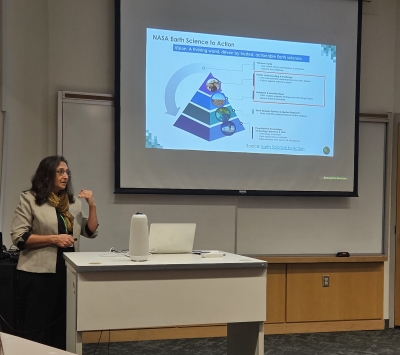
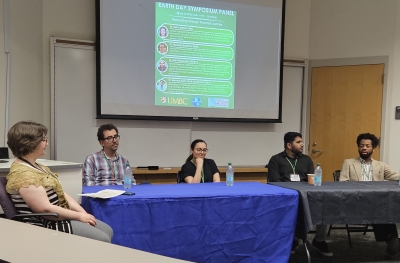
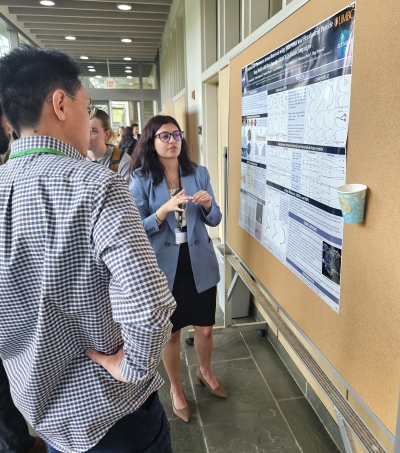
    <div class="html-content">UMBC's 9th Earth Day Symposium was held in late April 2025, and as we noted in a <a href="https://gestar2.umbc.edu/post/150170/" rel="nofollow external" class="bo">previous post</a>, the day was full of presentations from scientists, professors, an industry representative, and students. This year's theme was “Emerging Scientists Amid Policy Change.” We hope you enjoy our photo gallery. <div><br></div><div><h5>Guest Speakers:</h5><div><span>Dr. Zhibo Zhang, UMBC; Dr. Amita Mehta, UMBC/GSFC; Dr. Jack Kaye, NASA HQ; Dr. Dylan Powell, STC; and, Dr. Nakul Karle, Howard University.</span></div><div><div><img src="https://my3.my.umbc.edu/groups/gestar2/posts/150594/attachments/57451" width="300" height="300" style="max-width: 100%; height: auto;"></div><div><img src="https://my3.my.umbc.edu/groups/gestar2/posts/150594/attachments/57452" width="300" height="300" style="max-width: 100%; height: auto;"><div><img src="https://my3.my.umbc.edu/groups/gestar2/posts/150594/attachments/57453" width="300" height="300" style="max-width: 100%; height: auto;"></div><div><img src="https://my3.my.umbc.edu/groups/gestar2/posts/150594/attachments/57454" width="300" height="300" style="max-width: 100%; height: auto;"></div><div><img src="https://my3.my.umbc.edu/groups/gestar2/posts/150594/attachments/57455" width="300" height="300" style="max-width: 100%; height: auto;"></div><div><h5>EDS Symposium Panel:</h5><div><span>UMBC Moderator and Panel Members: Hannah Seppala; Dr. Henrique Barbosa, UMBC; Dr. Maria Molina, UMD; Dr. Anin Puthukkudy, UMBC/ESI; and, Dr. Maurice Roots, UMBC/NPP explore the theme "Navigating Change: Personal Journey."</span></div></div></div><div><img src="https://my3.my.umbc.edu/groups/gestar2/posts/150594/attachments/57456" style="max-width: 100%; height: auto;"><h5>UMBC Students' Poster Presentations:</h5><div><span></span>Photos: Greema Regmi; Hannah Seppala; Roshan Mishra; Kamal Aryal; Sharad Pandey; Soumik Sarker; and, Tony La Luna.</div><img src="https://my3.my.umbc.edu/groups/gestar2/posts/150594/attachments/57457" width="300" height="300" style="max-width: 100%; height: auto;"><div><img src="https://my3.my.umbc.edu/groups/gestar2/posts/150594/attachments/57458" width="300" height="300" style="max-width: 100%; height: auto;"></div><div><img src="https://my3.my.umbc.edu/groups/gestar2/posts/150594/attachments/57460" width="300" height="300" style="max-width: 100%; height: auto;"></div><div><img src="https://my3.my.umbc.edu/groups/gestar2/posts/150594/attachments/57459" width="300" height="300" style="max-width: 100%; height: auto;"></div><div><img src="https://my3.my.umbc.edu/groups/gestar2/posts/150594/attachments/57461" width="300" height="300" style="max-width: 100%; height: auto;"></div><div><img src="https://my3.my.umbc.edu/groups/gestar2/posts/150594/attachments/57462" width="300" height="300" style="max-width: 100%; height: auto;"><img src="https://my3.my.umbc.edu/groups/gestar2/posts/150594/attachments/57463" width="300" height="300" style="max-width: 100%; height: auto;"></div><h5><span>Poster Awards: </span></h5><div><span>(At Left and Right): Award Presenters Dr. Adriana Rocha Lima and Dr. Vanderlei Martins, both UMBC. (Middle): Soumik Sarker and Hannah Seppala (tied for 2nd), and Emily Faber (1st). Congratulations!</span></div><div><img src="https://my3.my.umbc.edu/groups/gestar2/posts/150594/attachments/57464" width="300" height="300" style="max-width: 100%; height: auto;"><h5>UMBC EDS Committee: </h5><p><span>(L-R): <a href="https://physics.umbc.edu/people/graduate-students/" rel="nofollow external" class="bo">Ronghao Wang, Roshan Mishra, Amanda Vieira dos Santos, Chetan Gurung, Sharad Pandey, Md Idris Ali, Eniola Oyedeji, and Tony La Luna</a>. Great job!</span></p></div><div><img src="https://my3.my.umbc.edu/groups/gestar2/posts/150594/attachments/57465" width="300" height="300" style="max-width: 100%; height: auto;"></div><div><em>(All photos by A. Houghton.)</em></div></div></div></div></div>
]]>
</Body>
<Summary>UMBC's 9th Earth Day Symposium was held in late April 2025, and as we noted in a previous post, the day was full of presentations from scientists, professors, an industry representative, and...</Summary>
<AttachmentKind>Photo</AttachmentKind>
<AttachmentUrl>https://assets1-beta.my.umbc.edu/system/shared/attachments/87dea39d128d479ddd0b1494ede9ad51/69ec511a/news/000/150/594/d28fda6d862ae4f14336f8544087570f/ZZhang intro_web.jpg?1749498878</AttachmentUrl>
<Attachments>
<Attachment kind="Photo" url="https://beta.my.umbc.edu/groups/gestar2/posts/150594/attachments/57451"></Attachment>
<Attachment kind="Photo" url="https://beta.my.umbc.edu/groups/gestar2/posts/150594/attachments/57452"></Attachment>
<Attachment kind="Photo" url="https://beta.my.umbc.edu/groups/gestar2/posts/150594/attachments/57453"></Attachment>
<Attachment kind="Photo" url="https://beta.my.umbc.edu/groups/gestar2/posts/150594/attachments/57454"></Attachment>
<Attachment kind="Photo" url="https://beta.my.umbc.edu/groups/gestar2/posts/150594/attachments/57455"></Attachment>
<Attachment kind="Photo" url="https://beta.my.umbc.edu/groups/gestar2/posts/150594/attachments/57456"></Attachment>
<Attachment kind="Photo" url="https://beta.my.umbc.edu/groups/gestar2/posts/150594/attachments/57457"></Attachment>
<Attachment kind="Photo" url="https://beta.my.umbc.edu/groups/gestar2/posts/150594/attachments/57458"></Attachment>
<Attachment kind="Photo" url="https://beta.my.umbc.edu/groups/gestar2/posts/150594/attachments/57459"></Attachment>
<Attachment kind="Photo" url="https://beta.my.umbc.edu/groups/gestar2/posts/150594/attachments/57460"></Attachment>
<Attachment kind="Photo" url="https://beta.my.umbc.edu/groups/gestar2/posts/150594/attachments/57461"></Attachment>
<Attachment kind="Photo" url="https://beta.my.umbc.edu/groups/gestar2/posts/150594/attachments/57462"></Attachment>
<Attachment kind="Photo" url="https://beta.my.umbc.edu/groups/gestar2/posts/150594/attachments/57463"></Attachment>
<Attachment kind="Photo" url="https://beta.my.umbc.edu/groups/gestar2/posts/150594/attachments/57464"></Attachment>
<Attachment kind="Photo" url="https://beta.my.umbc.edu/groups/gestar2/posts/150594/attachments/57465"></Attachment>
</Attachments>
<TrackingUrl>https://beta.my.umbc.edu/api/v0/pixel/news/150594/guest@my.umbc.edu/fb4ae9a99ff79f9e703fccb03a64b658/api/pixel</TrackingUrl>
<Tag>gestar2</Tag>
<Group token="gestar2">Goddard Earth Sciences Technology and Research II</Group>
<GroupUrl>https://beta.my.umbc.edu/groups/gestar2</GroupUrl>
<AvatarUrl>https://assets3-beta.my.umbc.edu/system/shared/avatars/groups/000/001/988/1dcee2628d726541e45f1ba8c31afe98/xsmall.png?1645477833</AvatarUrl>
<AvatarUrl size="original">https://assets1-beta.my.umbc.edu/system/shared/avatars/groups/000/001/988/1dcee2628d726541e45f1ba8c31afe98/original.png?1645477833</AvatarUrl>
<AvatarUrl size="xxlarge">https://assets1-beta.my.umbc.edu/system/shared/avatars/groups/000/001/988/1dcee2628d726541e45f1ba8c31afe98/xxlarge.png?1645477833</AvatarUrl>
<AvatarUrl size="xlarge">https://assets4-beta.my.umbc.edu/system/shared/avatars/groups/000/001/988/1dcee2628d726541e45f1ba8c31afe98/xlarge.png?1645477833</AvatarUrl>
<AvatarUrl size="large">https://assets2-beta.my.umbc.edu/system/shared/avatars/groups/000/001/988/1dcee2628d726541e45f1ba8c31afe98/large.png?1645477833</AvatarUrl>
<AvatarUrl size="medium">https://assets4-beta.my.umbc.edu/system/shared/avatars/groups/000/001/988/1dcee2628d726541e45f1ba8c31afe98/medium.png?1645477833</AvatarUrl>
<AvatarUrl size="small">https://assets1-beta.my.umbc.edu/system/shared/avatars/groups/000/001/988/1dcee2628d726541e45f1ba8c31afe98/small.png?1645477833</AvatarUrl>
<AvatarUrl size="xsmall">https://assets3-beta.my.umbc.edu/system/shared/avatars/groups/000/001/988/1dcee2628d726541e45f1ba8c31afe98/xsmall.png?1645477833</AvatarUrl>
<AvatarUrl size="xxsmall">https://assets3-beta.my.umbc.edu/system/shared/avatars/groups/000/001/988/1dcee2628d726541e45f1ba8c31afe98/xxsmall.png?1645477833</AvatarUrl>
<Sponsor>Goddard Earth Sciences Technology and Research II</Sponsor>
<ThumbnailUrl size="xxlarge">https://assets1-beta.my.umbc.edu/system/shared/thumbnails/news/000/150/594/a076dafeacb658b76eb089c238cf0f7f/xxlarge.jpg?1749662789</ThumbnailUrl>
<ThumbnailUrl size="xlarge">https://assets3-beta.my.umbc.edu/system/shared/thumbnails/news/000/150/594/a076dafeacb658b76eb089c238cf0f7f/xlarge.jpg?1749662789</ThumbnailUrl>
<ThumbnailUrl size="large">https://assets3-beta.my.umbc.edu/system/shared/thumbnails/news/000/150/594/a076dafeacb658b76eb089c238cf0f7f/large.jpg?1749662789</ThumbnailUrl>
<ThumbnailUrl size="medium">https://assets3-beta.my.umbc.edu/system/shared/thumbnails/news/000/150/594/a076dafeacb658b76eb089c238cf0f7f/medium.jpg?1749662789</ThumbnailUrl>
<ThumbnailUrl size="small">https://assets1-beta.my.umbc.edu/system/shared/thumbnails/news/000/150/594/a076dafeacb658b76eb089c238cf0f7f/small.jpg?1749662789</ThumbnailUrl>
<ThumbnailUrl size="xsmall">https://assets2-beta.my.umbc.edu/system/shared/thumbnails/news/000/150/594/a076dafeacb658b76eb089c238cf0f7f/xsmall.jpg?1749662789</ThumbnailUrl>
<ThumbnailUrl size="xxsmall">https://assets4-beta.my.umbc.edu/system/shared/thumbnails/news/000/150/594/a076dafeacb658b76eb089c238cf0f7f/xxsmall.jpg?1749662789</ThumbnailUrl>
<PawCount>1</PawCount>
<CommentCount>0</CommentCount>
<CommentsAllowed>false</CommentsAllowed>
<PostedAt>Wed, 11 Jun 2025 13:27:32 -0400</PostedAt>
<EditAt>Wed, 18 Jun 2025 17:02:20 -0400</EditAt>
</NewsItem>

<NewsItem contentIssues="false" id="150349" important="false" status="posted" url="https://beta.my.umbc.edu/groups/gestar2/posts/150349">
<Title>Thompson receives AGU Reviewer Award</Title>
<Body>
<![CDATA[
    <div class="html-content"><a href="https://gestar2.umbc.edu/directory/researchers-r-z/#Thompson" rel="nofollow external" class="bo">Anne Thompson</a> (610.0/UMBC) was recognized with a <a href="https://www.agu.org/honors/outstanding-reviewer" rel="nofollow external" class="bo">JGR-Atmospheres Reviewer Award by AGU</a>. According to the AGU site, "A robust peer review ensures that AGU maintains the highest integrity in our scientific discourse. We are truly thankful for the efforts of our reviewers." For information on AGU's Science Policy and Communications Awards, click <a href="https://www.agu.org/honors/science-policy-communication" rel="nofollow external" class="bo">here</a>. The list of the most recent awardees eventually will be on the AGU site, and will be published in <a href="https://agupubs.onlinelibrary.wiley.com/journal/21698996" rel="nofollow external" class="bo">JGR-Atmospheres</a> and/or in AGU's <em>Eos.</em> Congratulations!  <div><div><br></div></div></div>
]]>
</Body>
<Summary>Anne Thompson (610.0/UMBC) was recognized with a JGR-Atmospheres Reviewer Award by AGU. According to the AGU site, "A robust peer review ensures that AGU maintains the highest integrity in our...</Summary>
<TrackingUrl>https://beta.my.umbc.edu/api/v0/pixel/news/150349/guest@my.umbc.edu/7682c5f6f057e5db7c24cfab83dbd20b/api/pixel</TrackingUrl>
<Tag>gestar2</Tag>
<Group token="gestar2">Goddard Earth Sciences Technology and Research II</Group>
<GroupUrl>https://beta.my.umbc.edu/groups/gestar2</GroupUrl>
<AvatarUrl>https://assets3-beta.my.umbc.edu/system/shared/avatars/groups/000/001/988/1dcee2628d726541e45f1ba8c31afe98/xsmall.png?1645477833</AvatarUrl>
<AvatarUrl size="original">https://assets1-beta.my.umbc.edu/system/shared/avatars/groups/000/001/988/1dcee2628d726541e45f1ba8c31afe98/original.png?1645477833</AvatarUrl>
<AvatarUrl size="xxlarge">https://assets1-beta.my.umbc.edu/system/shared/avatars/groups/000/001/988/1dcee2628d726541e45f1ba8c31afe98/xxlarge.png?1645477833</AvatarUrl>
<AvatarUrl size="xlarge">https://assets4-beta.my.umbc.edu/system/shared/avatars/groups/000/001/988/1dcee2628d726541e45f1ba8c31afe98/xlarge.png?1645477833</AvatarUrl>
<AvatarUrl size="large">https://assets2-beta.my.umbc.edu/system/shared/avatars/groups/000/001/988/1dcee2628d726541e45f1ba8c31afe98/large.png?1645477833</AvatarUrl>
<AvatarUrl size="medium">https://assets4-beta.my.umbc.edu/system/shared/avatars/groups/000/001/988/1dcee2628d726541e45f1ba8c31afe98/medium.png?1645477833</AvatarUrl>
<AvatarUrl size="small">https://assets1-beta.my.umbc.edu/system/shared/avatars/groups/000/001/988/1dcee2628d726541e45f1ba8c31afe98/small.png?1645477833</AvatarUrl>
<AvatarUrl size="xsmall">https://assets3-beta.my.umbc.edu/system/shared/avatars/groups/000/001/988/1dcee2628d726541e45f1ba8c31afe98/xsmall.png?1645477833</AvatarUrl>
<AvatarUrl size="xxsmall">https://assets3-beta.my.umbc.edu/system/shared/avatars/groups/000/001/988/1dcee2628d726541e45f1ba8c31afe98/xxsmall.png?1645477833</AvatarUrl>
<Sponsor>Goddard Earth Sciences Technology and Research II</Sponsor>
<ThumbnailUrl size="xxlarge">https://assets3-beta.my.umbc.edu/system/shared/thumbnails/news/000/150/349/fc91db0e196189f3e66cefbdf6f892a7/xxlarge.jpg?1748547998</ThumbnailUrl>
<ThumbnailUrl size="xlarge">https://assets4-beta.my.umbc.edu/system/shared/thumbnails/news/000/150/349/fc91db0e196189f3e66cefbdf6f892a7/xlarge.jpg?1748547998</ThumbnailUrl>
<ThumbnailUrl size="large">https://assets2-beta.my.umbc.edu/system/shared/thumbnails/news/000/150/349/fc91db0e196189f3e66cefbdf6f892a7/large.jpg?1748547998</ThumbnailUrl>
<ThumbnailUrl size="medium">https://assets1-beta.my.umbc.edu/system/shared/thumbnails/news/000/150/349/fc91db0e196189f3e66cefbdf6f892a7/medium.jpg?1748547998</ThumbnailUrl>
<ThumbnailUrl size="small">https://assets1-beta.my.umbc.edu/system/shared/thumbnails/news/000/150/349/fc91db0e196189f3e66cefbdf6f892a7/small.jpg?1748547998</ThumbnailUrl>
<ThumbnailUrl size="xsmall">https://assets4-beta.my.umbc.edu/system/shared/thumbnails/news/000/150/349/fc91db0e196189f3e66cefbdf6f892a7/xsmall.jpg?1748547998</ThumbnailUrl>
<ThumbnailUrl size="xxsmall">https://assets1-beta.my.umbc.edu/system/shared/thumbnails/news/000/150/349/fc91db0e196189f3e66cefbdf6f892a7/xxsmall.jpg?1748547998</ThumbnailUrl>
<ThumbnailAltText>Anne Thompson wears a blue, brown, and white scarf and smiles at the camera.</ThumbnailAltText>
<PawCount>0</PawCount>
<CommentCount>0</CommentCount>
<CommentsAllowed>false</CommentsAllowed>
<PostedAt>Thu, 29 May 2025 15:48:06 -0400</PostedAt>
</NewsItem>

<NewsItem contentIssues="false" id="150350" important="false" status="posted" url="https://beta.my.umbc.edu/groups/gestar2/posts/150350">
<Title>Sutton's proposal selected for 2025 UMBC CIDER Award</Title>
<Body>
<![CDATA[
    <div class="html-content"><div><a href="https://gestar2.umbc.edu/directory/researchers-r-z/#Sutton" rel="nofollow external" class="bo">Jessica Sutton</a> (617/UMBC) is the Principal Investigator on the proposal "Identification of Virga Precipitation Events," which was among the proposals selected in 2025 for UMBC CIDER funding. Her Co-Investigators are <a href="https://gestar2.umbc.edu/directory/researchers-r-z/#Stanley" rel="nofollow external" class="bo">Thomas Stanley</a> (617/UMBC) and <a href="https://www.csee.umbc.edu/tejas-gokhale/" rel="nofollow external" class="bo">Tejas Gokhale</a> (Computer Science and Electrical Engineering/UMBC). </div><div><br></div><div>UMBC's <a href="https://my3.my.umbc.edu/groups/umbc-news-magazine/posts/149744/1b9d/55078d82664b5bf2ef434942ea706f0c/email/link?link=https%3A%2F%2Fresearch.umbc.edu%2Finternal-funding-opportunities%2F%23%3A%7E%3Atext%3DCenter%2520and%2520Institute%2Cwith%2520any%2520questions" rel="nofollow external" class="bo">Center and Institute Departmentally-Engaged Research</a> (CIDER) program's goal "includes supporting and promoting collaborative research between scholars based in one of UMBC’s affiliate centers and institutes and the university’s faculty researchers. Selected proposals are awarded up to $50,000 in seed funding for 18 months." </div><div><br></div><div>Dr. Sutton shared their project summary:</div><div><br></div><div><div>"Determining the causes of false detections from satellite-derived precipitation is of utmost importance due to the development and dependence of precipitation estimates in global water cycle modeling, weather forecasting, flood modeling, landslide hazard assessment, drought monitoring, watershed modeling, and climate modeling. One kind of false detection that needs to be addressed is virga or “dry precipitation events”. They are described as “dry precipitation events” because they are considered precipitation events that occur higher in the atmosphere but evaporate before reaching the surface. This means that every satellite-based precipitation product is affected by virga because of the way in which precipitation is derived from satellite remote sensors. Satellite-based precipitation estimates are derived from cloud temperatures, emission-based retrievals, and/or scattering-based retrievals. Regardless of whether satellite-based precipitation estimates are derived from VIS/IR, passive microwave, or both, they are derived from measurements within the atmosphere and not at the surface. As a result, any analysis or model that uses satellite-based precipitation as inputs is problematic.</div><div><br></div><div>The purpose of this collaboration is to (1) complete a proof-of-concept project to identify virga events using vertical profiles from ground radar and (2) apply for a National Science Foundation (NSF) grant to support future work. The proof of concept will include collection of a database of virga events at one radar ground station and building a machine learning tool for flagging virga events. The NSF grant will seek to determine the influence that virga precipitation has on global precipitation datasets and climate modeling."</div></div><div><br></div></div>
]]>
</Body>
<Summary>Jessica Sutton (617/UMBC) is the Principal Investigator on the proposal "Identification of Virga Precipitation Events," which was among the proposals selected in 2025 for UMBC CIDER funding. Her...</Summary>
<TrackingUrl>https://beta.my.umbc.edu/api/v0/pixel/news/150350/guest@my.umbc.edu/9ea4e74d36ed941de468271ba042d588/api/pixel</TrackingUrl>
<Tag>gestar2</Tag>
<Group token="gestar2">Goddard Earth Sciences Technology and Research II</Group>
<GroupUrl>https://beta.my.umbc.edu/groups/gestar2</GroupUrl>
<AvatarUrl>https://assets3-beta.my.umbc.edu/system/shared/avatars/groups/000/001/988/1dcee2628d726541e45f1ba8c31afe98/xsmall.png?1645477833</AvatarUrl>
<AvatarUrl size="original">https://assets1-beta.my.umbc.edu/system/shared/avatars/groups/000/001/988/1dcee2628d726541e45f1ba8c31afe98/original.png?1645477833</AvatarUrl>
<AvatarUrl size="xxlarge">https://assets1-beta.my.umbc.edu/system/shared/avatars/groups/000/001/988/1dcee2628d726541e45f1ba8c31afe98/xxlarge.png?1645477833</AvatarUrl>
<AvatarUrl size="xlarge">https://assets4-beta.my.umbc.edu/system/shared/avatars/groups/000/001/988/1dcee2628d726541e45f1ba8c31afe98/xlarge.png?1645477833</AvatarUrl>
<AvatarUrl size="large">https://assets2-beta.my.umbc.edu/system/shared/avatars/groups/000/001/988/1dcee2628d726541e45f1ba8c31afe98/large.png?1645477833</AvatarUrl>
<AvatarUrl size="medium">https://assets4-beta.my.umbc.edu/system/shared/avatars/groups/000/001/988/1dcee2628d726541e45f1ba8c31afe98/medium.png?1645477833</AvatarUrl>
<AvatarUrl size="small">https://assets1-beta.my.umbc.edu/system/shared/avatars/groups/000/001/988/1dcee2628d726541e45f1ba8c31afe98/small.png?1645477833</AvatarUrl>
<AvatarUrl size="xsmall">https://assets3-beta.my.umbc.edu/system/shared/avatars/groups/000/001/988/1dcee2628d726541e45f1ba8c31afe98/xsmall.png?1645477833</AvatarUrl>
<AvatarUrl size="xxsmall">https://assets3-beta.my.umbc.edu/system/shared/avatars/groups/000/001/988/1dcee2628d726541e45f1ba8c31afe98/xxsmall.png?1645477833</AvatarUrl>
<Sponsor>Goddard Earth Sciences Technology and Research II</Sponsor>
<ThumbnailUrl size="xxlarge">https://assets4-beta.my.umbc.edu/system/shared/thumbnails/news/000/150/350/8f2d71e5e777ba19d9ff6e5a73b25240/xxlarge.jpg?1748546817</ThumbnailUrl>
<ThumbnailUrl size="xlarge">https://assets2-beta.my.umbc.edu/system/shared/thumbnails/news/000/150/350/8f2d71e5e777ba19d9ff6e5a73b25240/xlarge.jpg?1748546817</ThumbnailUrl>
<ThumbnailUrl size="large">https://assets1-beta.my.umbc.edu/system/shared/thumbnails/news/000/150/350/8f2d71e5e777ba19d9ff6e5a73b25240/large.jpg?1748546817</ThumbnailUrl>
<ThumbnailUrl size="medium">https://assets1-beta.my.umbc.edu/system/shared/thumbnails/news/000/150/350/8f2d71e5e777ba19d9ff6e5a73b25240/medium.jpg?1748546817</ThumbnailUrl>
<ThumbnailUrl size="small">https://assets4-beta.my.umbc.edu/system/shared/thumbnails/news/000/150/350/8f2d71e5e777ba19d9ff6e5a73b25240/small.jpg?1748546817</ThumbnailUrl>
<ThumbnailUrl size="xsmall">https://assets2-beta.my.umbc.edu/system/shared/thumbnails/news/000/150/350/8f2d71e5e777ba19d9ff6e5a73b25240/xsmall.jpg?1748546817</ThumbnailUrl>
<ThumbnailUrl size="xxsmall">https://assets1-beta.my.umbc.edu/system/shared/thumbnails/news/000/150/350/8f2d71e5e777ba19d9ff6e5a73b25240/xxsmall.jpg?1748546817</ThumbnailUrl>
<ThumbnailAltText>Jessica Sutton smiles and wears a blue sweater.</ThumbnailAltText>
<PawCount>1</PawCount>
<CommentCount>0</CommentCount>
<CommentsAllowed>false</CommentsAllowed>
<PostedAt>Thu, 29 May 2025 15:27:57 -0400</PostedAt>
</NewsItem>

<NewsItem contentIssues="false" id="150347" important="false" status="posted" url="https://beta.my.umbc.edu/groups/gestar2/posts/150347">
<Title>Mkaouar included in recent GSFC Early Career Scientist Spotlights</Title>
<Body>
<![CDATA[
    <div class="html-content"><a href="https://gestar2.umbc.edu/directory/researchers-l-q/#Mkaouar" rel="nofollow external" class="bo">Ameni Mkaouar</a> (618/UMBC) is one of four scientists featured in the latest NASA GSFC Early Career Scientist Spotlights. The NASA Goddard Association of Postdoctoral and Early Career Scientists in the Sciences and Exploration Directorate (SED) compiles this monthly. The ECSS "highlight the research interests, science motivations, and achievements of the early career scientist community... ." Read more about <a href="https://science.gsfc.nasa.gov/600/ECSS/Ameni-Mkaouar/" rel="nofollow external" class="bo">Dr. Mkaouar</a> and the other scientists <a href="https://science.gsfc.nasa.gov/600/ECSS/index.html" rel="nofollow external" class="bo">here</a>!</div>
]]>
</Body>
<Summary>Ameni Mkaouar (618/UMBC) is one of four scientists featured in the latest NASA GSFC Early Career Scientist Spotlights. The NASA Goddard Association of Postdoctoral and Early Career Scientists in...</Summary>
<TrackingUrl>https://beta.my.umbc.edu/api/v0/pixel/news/150347/guest@my.umbc.edu/9d57d7c419d6fb4b482bfc1f7771bc9f/api/pixel</TrackingUrl>
<Tag>gestar2</Tag>
<Group token="gestar2">Goddard Earth Sciences Technology and Research II</Group>
<GroupUrl>https://beta.my.umbc.edu/groups/gestar2</GroupUrl>
<AvatarUrl>https://assets3-beta.my.umbc.edu/system/shared/avatars/groups/000/001/988/1dcee2628d726541e45f1ba8c31afe98/xsmall.png?1645477833</AvatarUrl>
<AvatarUrl size="original">https://assets1-beta.my.umbc.edu/system/shared/avatars/groups/000/001/988/1dcee2628d726541e45f1ba8c31afe98/original.png?1645477833</AvatarUrl>
<AvatarUrl size="xxlarge">https://assets1-beta.my.umbc.edu/system/shared/avatars/groups/000/001/988/1dcee2628d726541e45f1ba8c31afe98/xxlarge.png?1645477833</AvatarUrl>
<AvatarUrl size="xlarge">https://assets4-beta.my.umbc.edu/system/shared/avatars/groups/000/001/988/1dcee2628d726541e45f1ba8c31afe98/xlarge.png?1645477833</AvatarUrl>
<AvatarUrl size="large">https://assets2-beta.my.umbc.edu/system/shared/avatars/groups/000/001/988/1dcee2628d726541e45f1ba8c31afe98/large.png?1645477833</AvatarUrl>
<AvatarUrl size="medium">https://assets4-beta.my.umbc.edu/system/shared/avatars/groups/000/001/988/1dcee2628d726541e45f1ba8c31afe98/medium.png?1645477833</AvatarUrl>
<AvatarUrl size="small">https://assets1-beta.my.umbc.edu/system/shared/avatars/groups/000/001/988/1dcee2628d726541e45f1ba8c31afe98/small.png?1645477833</AvatarUrl>
<AvatarUrl size="xsmall">https://assets3-beta.my.umbc.edu/system/shared/avatars/groups/000/001/988/1dcee2628d726541e45f1ba8c31afe98/xsmall.png?1645477833</AvatarUrl>
<AvatarUrl size="xxsmall">https://assets3-beta.my.umbc.edu/system/shared/avatars/groups/000/001/988/1dcee2628d726541e45f1ba8c31afe98/xxsmall.png?1645477833</AvatarUrl>
<Sponsor>Goddard Earth Sciences Technology and Research II</Sponsor>
<ThumbnailUrl size="xxlarge">https://assets1-beta.my.umbc.edu/system/shared/thumbnails/news/000/150/347/ebe1409eafc22688c79ad492dfbbdbf3/xxlarge.jpg?1747860401</ThumbnailUrl>
<ThumbnailUrl size="xlarge">https://assets2-beta.my.umbc.edu/system/shared/thumbnails/news/000/150/347/ebe1409eafc22688c79ad492dfbbdbf3/xlarge.jpg?1747860401</ThumbnailUrl>
<ThumbnailUrl size="large">https://assets3-beta.my.umbc.edu/system/shared/thumbnails/news/000/150/347/ebe1409eafc22688c79ad492dfbbdbf3/large.jpg?1747860401</ThumbnailUrl>
<ThumbnailUrl size="medium">https://assets2-beta.my.umbc.edu/system/shared/thumbnails/news/000/150/347/ebe1409eafc22688c79ad492dfbbdbf3/medium.jpg?1747860401</ThumbnailUrl>
<ThumbnailUrl size="small">https://assets3-beta.my.umbc.edu/system/shared/thumbnails/news/000/150/347/ebe1409eafc22688c79ad492dfbbdbf3/small.jpg?1747860401</ThumbnailUrl>
<ThumbnailUrl size="xsmall">https://assets3-beta.my.umbc.edu/system/shared/thumbnails/news/000/150/347/ebe1409eafc22688c79ad492dfbbdbf3/xsmall.jpg?1747860401</ThumbnailUrl>
<ThumbnailUrl size="xxsmall">https://assets3-beta.my.umbc.edu/system/shared/thumbnails/news/000/150/347/ebe1409eafc22688c79ad492dfbbdbf3/xxsmall.jpg?1747860401</ThumbnailUrl>
<ThumbnailAltText>profile photo of ameni mkaouar smiling at camera</ThumbnailAltText>
<PawCount>0</PawCount>
<CommentCount>0</CommentCount>
<CommentsAllowed>false</CommentsAllowed>
<PostedAt>Wed, 21 May 2025 16:49:03 -0400</PostedAt>
</NewsItem>

<NewsItem contentIssues="false" id="150170" important="false" status="posted" url="https://beta.my.umbc.edu/groups/gestar2/posts/150170">
<Title>UMBC's Earth Day Symposium 2025</Title>
<Body>
<![CDATA[
    <div class="html-content"><p>The Earth Day Symposium (EDS) 2025 Planning Committee, led
    by <a href="https://gestar2.umbc.edu/graduate-research-assistants/#Mishra" rel="nofollow external" class="bo">Roshan Mishra</a>, organized a wonderful, informative all-day event, held on
    Friday, April 25, 2025, in UMBC’s Physics building. The 9<sup>th</sup> Annual
    EDS explored the theme “Emerging Scientists Amid Policy Change.” The day
    included talks, a panel discussion, and an industry spotlight session. Poster
    presentations were held in
    the afternoon, and the top 3 poster presenters received UMBC e-gift cards.</p>
    
    <p><a href="https://physics.umbc.edu/people/faculty/zhang/" rel="nofollow external" class="bo">Dr. Zhibo Zhang</a> kicked off the event with a review of the
    history of UMBC’s EDS, which was established in 2017 by UMBC’s Atmospheric
    Physics graduate program; more information is available <a href="https://eds.umbc.edu/" rel="nofollow external" class="bo">here</a>.<span> </span>The UMBC Physics Department and GESTAR II sponsored
    the event.</p>
    
    <p>Throughout the day, invited speakers from universities,
    NASA, and industry shared their research, experiences, and advice, particularly
    as it relates to early-career scientists and aspiring students. <a href="https://gestar2.umbc.edu/directory/researchers-l-q/#Mehta" rel="nofollow external" class="bo">Dr. Amita Mehta</a>
    (GESTAR II/UMBC) presented “Historical and Emerging NASA Missions for Societal
    Applications”; Dr. Dylan Powell presented on “Science and Technology
    Corporation (STC),” which also was the Industry Spotlight; <a href="https://science.nasa.gov/people/jack-kaye/" rel="nofollow external" class="bo">Dr. Jack Kaye</a> (NASA
    ESD) attended virtually from NASA HQ to present “Thoughts for Early Career
    Earth Scientists” (note, Dr. Kaye’s retirement party was that afternoon –
    congratulations!); <a href="https://hu-bc.org/personnel/" rel="nofollow external" class="bo">Dr. Nakul Karle</a> (Howard Univ.) presented “From Boundary
    Layer Turbulence to Virga Precipitation”; and, Dr. Zhibo Zhang (UMBC) presented
    “How not to write “bad” proposals.”</p>
    
    <p>Additionally, in the morning, the EDS Panel gathered to
    provide insight and respond to various questions from host <a href="https://physics.umbc.edu/people/graduate-students/" rel="nofollow external" class="bo">Hannah Seppala</a>. The
    panel discussion’s theme was “Navigating Change: Personal Journey,” and panel members were <a href="https://aosc.umd.edu/people/maria-molina" rel="nofollow external" class="bo">Dr. Maria Molina</a> (UMD), <a href="https://physics.umbc.edu/people/faculty/barbosa/" rel="nofollow external" class="bo">Dr. Henrique Barbosa</a> (Physics/UMBC), <a href="https://esi.umbc.edu/members-a-z/#Puthukkudy" rel="nofollow external" class="bo">Dr.
    Anin Puthukkudy</a> (ESI and GESTAR II), and <a href="https://science.gsfc.nasa.gov/earth/bio/maurice.roots" rel="nofollow external" class="bo">Dr. Maurice Roots</a> (Ph.D./UMBC/NPP).</p>
    
    <p>In the afternoon, for the “Industry Spotlight: STC”, <a href="https://www.stcnet.com/who-we-are/stc-senior-management/" rel="nofollow external" class="bo">Dr.
    Dylan Powell</a>, Director of NASA and NOAA Business Development and Operations at
    STC, discussed his background, which includes his degrees from UMBC in Atmospheric
    Physics, as well as his work with Lockheed Martin and NOAA. He discussed STC’s
    work with NASA and NOAA, particularly regarding Earth Sciences, Climate, and
    the Atmosphere. Dr. Powell also shared his lessons learned along his career path
    with the students in attendance. Learn more about STC <a href="https://www.stcnet.com/" rel="nofollow external" class="bo">here</a>.</p>
    
    <p>The EDS Poster Presentations were held in the 1<sup>st</sup>
    Floor Hallway of the Physics Building from 2:00pm-3:30pm; thank you to everyone
    who participated.</p>
    
    <p><a href="https://physics.umbc.edu/people/graduate-students/" rel="nofollow external" class="bo">Kamal Aryal</a>, “Initial validation of aerosol and ocean color data products from NASA PACE polarimeters using FastMAPOL/component retrieval algorithm”</p><p><a href="https://physics.umbc.edu/home/events/event/136383/" rel="nofollow external" class="bo">John Caporaletti</a>, “Proposed 5-Electron Charge Quadrupole Qubit”</p><p><a href="https://physics.umbc.edu/people/graduate-students/" rel="nofollow external" class="bo">Emily Faber</a>, “Investigation of the Impact of Alluvial Flows
    in the Unified Forecast System (UFS) Dust Scheme”</p>
    
    <p><a href="https://physics.umbc.edu/people/graduate-students/" rel="nofollow external" class="bo">Chetan Gurung</a>, “Identifying the Optimal WRF-ARW
    Configuration for the Wet Season in the Amazon Rainforest”</p><p><a href="https://physics.umbc.edu/people/graduate-students/" rel="nofollow external" class="bo">Eric Lowe</a>, “Improving the Signal in DEER with swept pulses”</p><p><a href="https://esi.umbc.edu/members-a-z/#McBride" rel="nofollow external" class="bo">Dr. Brent McBride</a> and others from ESI, “UMBC's AirHARP2 flies high in NASA's PACE-PAX field campaign”</p><p><a href="https://physics.umbc.edu/undergrad/undergrad_research/" rel="nofollow external" class="bo">John Melles</a>, “Direct Radiative Effect of Dust Aerosols using EMIT and PACE Observations”</p><p>Roshan Mishra, “Smoke Absorption Retrieval Algorithm using Critical Reflectance Method with Geostationary Satellite over North America”</p>
    
    <p><a href="https://physics.umbc.edu/people/graduate-students/" rel="nofollow external" class="bo">Sharad Pandey</a>, “Understanding PBL Dynamics and
    Thermodynamics in LLJ events over PECAN: Modeled and Observation”</p>
    
    <p><a href="https://physics.umbc.edu/people/graduate-students/" rel="nofollow external" class="bo">Greema Regmi</a>, “Combined Lidar-Polarimeter Aerosol Retrievals
    using Spheroidal and Hexahedral Particle Shape Models with Data from the
    ORACLES Field Campaigns”</p>
    
    <p><a href="https://alokg.umbc.edu/people/" rel="nofollow external" class="bo">Soumik Sarker</a>, “Spectrally Passive-Adaptive Radiative Cooling Using Sustainable Materials”</p><p>Hannah Seppala, “Developing a Lagrangian Frame
    Transformation on Satellite Data to Study Cloud Microphysical Transitions in
    Arctic Marine Cold Air Outbreaks”</p><p><a href="https://physics.umbc.edu/people/graduate-students/" rel="nofollow external" class="bo">Ronghao Wang</a>, “Analysis of the Composition and Mixing State of Polluted Dust Using Satellite Observations and Reanalysis Data”</p><p>After the votes were tallied, Emily Faber (Atmospheric
    Physics) won 1<sup>st</sup> Prize, and Hannah Seppala (Atmospheric Physics) and
    Soumik Sarker (Department of Mechanical Engineering) both won 2<sup>nd</sup>
    Prize (a tie!).</p>
    
    <p>Congratulations to this year’s EDS Committee Student Members
    on a successful, well-organized, and interesting day: Roshan Mishra, <a href="https://gestar2.umbc.edu/graduate-research-assistants/" rel="nofollow external" class="bo">Tony La Luna</a>, Chetan
    Gurung, <a href="https://physics.umbc.edu/people/graduate-students/" rel="nofollow external" class="bo">Eniola Oyedeji</a>, <a href="https://physics.umbc.edu/people/graduate-students/" rel="nofollow external" class="bo">Md Idris Ali</a>, Ronghao Wang, Sharad Pandey, and <a href="https://physics.umbc.edu/people/graduate-students/" rel="nofollow external" class="bo">Amanda
    Vieira dos Santos</a>.</p>
    
    <p>(Visit our EDS 2025 photo gallery <a href="https://gestar2.umbc.edu/post/150594/" rel="nofollow external" class="bo">here</a>!)</p></div>
]]>
</Body>
<Summary>The Earth Day Symposium (EDS) 2025 Planning Committee, led by Roshan Mishra, organized a wonderful, informative all-day event, held on Friday, April 25, 2025, in UMBC’s Physics building. The 9th...</Summary>
<TrackingUrl>https://beta.my.umbc.edu/api/v0/pixel/news/150170/guest@my.umbc.edu/c8b379b8f448bcfcd8bce00f069fbfa0/api/pixel</TrackingUrl>
<Tag>gestar2</Tag>
<Group token="gestar2">Goddard Earth Sciences Technology and Research II</Group>
<GroupUrl>https://beta.my.umbc.edu/groups/gestar2</GroupUrl>
<AvatarUrl>https://assets3-beta.my.umbc.edu/system/shared/avatars/groups/000/001/988/1dcee2628d726541e45f1ba8c31afe98/xsmall.png?1645477833</AvatarUrl>
<AvatarUrl size="original">https://assets1-beta.my.umbc.edu/system/shared/avatars/groups/000/001/988/1dcee2628d726541e45f1ba8c31afe98/original.png?1645477833</AvatarUrl>
<AvatarUrl size="xxlarge">https://assets1-beta.my.umbc.edu/system/shared/avatars/groups/000/001/988/1dcee2628d726541e45f1ba8c31afe98/xxlarge.png?1645477833</AvatarUrl>
<AvatarUrl size="xlarge">https://assets4-beta.my.umbc.edu/system/shared/avatars/groups/000/001/988/1dcee2628d726541e45f1ba8c31afe98/xlarge.png?1645477833</AvatarUrl>
<AvatarUrl size="large">https://assets2-beta.my.umbc.edu/system/shared/avatars/groups/000/001/988/1dcee2628d726541e45f1ba8c31afe98/large.png?1645477833</AvatarUrl>
<AvatarUrl size="medium">https://assets4-beta.my.umbc.edu/system/shared/avatars/groups/000/001/988/1dcee2628d726541e45f1ba8c31afe98/medium.png?1645477833</AvatarUrl>
<AvatarUrl size="small">https://assets1-beta.my.umbc.edu/system/shared/avatars/groups/000/001/988/1dcee2628d726541e45f1ba8c31afe98/small.png?1645477833</AvatarUrl>
<AvatarUrl size="xsmall">https://assets3-beta.my.umbc.edu/system/shared/avatars/groups/000/001/988/1dcee2628d726541e45f1ba8c31afe98/xsmall.png?1645477833</AvatarUrl>
<AvatarUrl size="xxsmall">https://assets3-beta.my.umbc.edu/system/shared/avatars/groups/000/001/988/1dcee2628d726541e45f1ba8c31afe98/xxsmall.png?1645477833</AvatarUrl>
<Sponsor>Goddard Earth Sciences Technology and Research II</Sponsor>
<ThumbnailUrl size="xxlarge">https://assets3-beta.my.umbc.edu/system/shared/thumbnails/news/000/150/170/75d92b0244bbe55dbdae3a4b9fcfe7dd/xxlarge.jpg?1747342979</ThumbnailUrl>
<ThumbnailUrl size="xlarge">https://assets4-beta.my.umbc.edu/system/shared/thumbnails/news/000/150/170/75d92b0244bbe55dbdae3a4b9fcfe7dd/xlarge.jpg?1747342979</ThumbnailUrl>
<ThumbnailUrl size="large">https://assets1-beta.my.umbc.edu/system/shared/thumbnails/news/000/150/170/75d92b0244bbe55dbdae3a4b9fcfe7dd/large.jpg?1747342979</ThumbnailUrl>
<ThumbnailUrl size="medium">https://assets2-beta.my.umbc.edu/system/shared/thumbnails/news/000/150/170/75d92b0244bbe55dbdae3a4b9fcfe7dd/medium.jpg?1747342979</ThumbnailUrl>
<ThumbnailUrl size="small">https://assets2-beta.my.umbc.edu/system/shared/thumbnails/news/000/150/170/75d92b0244bbe55dbdae3a4b9fcfe7dd/small.jpg?1747342979</ThumbnailUrl>
<ThumbnailUrl size="xsmall">https://assets3-beta.my.umbc.edu/system/shared/thumbnails/news/000/150/170/75d92b0244bbe55dbdae3a4b9fcfe7dd/xsmall.jpg?1747342979</ThumbnailUrl>
<ThumbnailUrl size="xxsmall">https://assets1-beta.my.umbc.edu/system/shared/thumbnails/news/000/150/170/75d92b0244bbe55dbdae3a4b9fcfe7dd/xxsmall.jpg?1747342979</ThumbnailUrl>
<ThumbnailAltText>Roshan Mishra wears a blue shirt and smiles at the camera.</ThumbnailAltText>
<PawCount>1</PawCount>
<CommentCount>0</CommentCount>
<CommentsAllowed>false</CommentsAllowed>
<PostedAt>Thu, 15 May 2025 17:09:13 -0400</PostedAt>
<EditAt>Wed, 11 Jun 2025 13:38:04 -0400</EditAt>
</NewsItem>

<NewsItem contentIssues="false" id="149796" important="false" status="posted" url="https://beta.my.umbc.edu/groups/gestar2/posts/149796">
<Title>GESTAR II Seminar Series, Thursday, May 8th, 11:00am</Title>
<Body>
<![CDATA[
    <div class="html-content"><div>Join us for a virtual seminar by <a href="https://www.fisheries.noaa.gov/contact/skylar-r-bayer-phd" rel="nofollow external" class="bo">Dr. Skylar Bayer</a>, NOAA Fisheries Alaska Regional Office. Her talk is titled "Alaska Regional Office Habitat Conservation Division: Essential Fish Habitat Science and Management."</div><div><br></div><div>Date and Time: Thursday, May 8, 2025 at 11:00am EST</div><div>Join us via <a href="https://teams.microsoft.com/l/meetup-join/19%3ameeting_M2Y3YmM3MWYtM2ZlNS00ZDczLWJmNWItZjEyMjYxYjEzMmVh%40thread.v2/0?context=%7b%22Tid%22%3a%227005d458-45be-48ae-8140-d43da96dd17b%22%2c%22Oid%22%3a%22a2a99eb0-e94c-4be0-a3ff-092096793f8c%22%7d" rel="nofollow external" class="bo">Teams</a>.</div><div><br></div><div><u>Abstract:</u></div><div>"NOAA Fisheries Alaska Regional Office (AKRO) Habitat Conservation Division (HCD) is responsible for identifying and conserving essential fish habitat (EFH) as mandated by the Magnuson-Stevens Fishery Conservation and Management Act. Our habitat conservation activities include protecting EFH, mitigating damage to and enhancing habitat affected by hydropower project construction and operations, removing invasive species, and restoring habitat that has been affected by development, oil spills, and other human activities. We focus on habitats used by federally-managed fish species located offshore, nearshore, in estuaries, and in freshwater areas important to migratory salmon. This presentation will primarily highlight our EFH databases and their applied use in the fishery management council process and consultations."</div><div><br></div><div><u>Biography:</u></div><div>Skylar Bayer is a marine habitat resource specialist in the NOAA Fisheries Alaska Regional Office. She is trained as a marine ecologist with expertise in shellfish population dynamics, invertebrate life history, fertilization ecology, extension work, and science communication. Prior to joining the Habitat Conservation Division, Skylar held a faculty position at Roger Williams University overseeing their Shellfish Program. In 2021, she studied Iceland scallop population dynamics as a Fulbright Scholar with Icelandic government scientists. She previously worked with NOAA as a NRC Postdoctoral Research Associate with the NMFS Milford Lab and as a Knauss Marine Policy Fellow in the U.S. Senate. She earned her Ph.D. in Marine Biology in 2017 from the University of Maine’s School of Marine Sciences, her M.Sc. from the MIT-WHOI Joint Program in Biological Oceanography in 2011, and her B.Sc. in Marine Biology from Brown University in 2008. She has worked with The Story Collider as a producer, a non-profit dedicated to science storytelling, since 2014.</div><div><br></div><div>For more information on the GESTAR II Seminar Series, click <a href="https://my3.my.umbc.edu/groups/gestar2/posts/148838/1b9d/b642aa74f6719d867b9a7b1f5af1c3d7/web/link?link=https%3A%2F%2Fmy3.my.umbc.edu%2Fgroups%2Fgestar2%2Fposts%2F147263%2F1b9d%2F6bd916f84c33cabdef1efeb7453c0a86%2Fweb%2Flink%3Flink%3Dhttps%253A%252F%252Fgestar2.umbc.edu%252Fgestar-ii-seminar-series%252F" rel="nofollow external" class="bo">here</a>.</div></div>
]]>
</Body>
<Summary>Join us for a virtual seminar by Dr. Skylar Bayer, NOAA Fisheries Alaska Regional Office. Her talk is titled "Alaska Regional Office Habitat Conservation Division: Essential Fish Habitat Science...</Summary>
<TrackingUrl>https://beta.my.umbc.edu/api/v0/pixel/news/149796/guest@my.umbc.edu/fdda275b766acfe44f559ec62d0d80ea/api/pixel</TrackingUrl>
<Tag>gestar2</Tag>
<Group token="gestar2">Goddard Earth Sciences Technology and Research II</Group>
<GroupUrl>https://beta.my.umbc.edu/groups/gestar2</GroupUrl>
<AvatarUrl>https://assets3-beta.my.umbc.edu/system/shared/avatars/groups/000/001/988/1dcee2628d726541e45f1ba8c31afe98/xsmall.png?1645477833</AvatarUrl>
<AvatarUrl size="original">https://assets1-beta.my.umbc.edu/system/shared/avatars/groups/000/001/988/1dcee2628d726541e45f1ba8c31afe98/original.png?1645477833</AvatarUrl>
<AvatarUrl size="xxlarge">https://assets1-beta.my.umbc.edu/system/shared/avatars/groups/000/001/988/1dcee2628d726541e45f1ba8c31afe98/xxlarge.png?1645477833</AvatarUrl>
<AvatarUrl size="xlarge">https://assets4-beta.my.umbc.edu/system/shared/avatars/groups/000/001/988/1dcee2628d726541e45f1ba8c31afe98/xlarge.png?1645477833</AvatarUrl>
<AvatarUrl size="large">https://assets2-beta.my.umbc.edu/system/shared/avatars/groups/000/001/988/1dcee2628d726541e45f1ba8c31afe98/large.png?1645477833</AvatarUrl>
<AvatarUrl size="medium">https://assets4-beta.my.umbc.edu/system/shared/avatars/groups/000/001/988/1dcee2628d726541e45f1ba8c31afe98/medium.png?1645477833</AvatarUrl>
<AvatarUrl size="small">https://assets1-beta.my.umbc.edu/system/shared/avatars/groups/000/001/988/1dcee2628d726541e45f1ba8c31afe98/small.png?1645477833</AvatarUrl>
<AvatarUrl size="xsmall">https://assets3-beta.my.umbc.edu/system/shared/avatars/groups/000/001/988/1dcee2628d726541e45f1ba8c31afe98/xsmall.png?1645477833</AvatarUrl>
<AvatarUrl size="xxsmall">https://assets3-beta.my.umbc.edu/system/shared/avatars/groups/000/001/988/1dcee2628d726541e45f1ba8c31afe98/xxsmall.png?1645477833</AvatarUrl>
<Sponsor>Goddard Earth Sciences Technology and Research II</Sponsor>
<ThumbnailUrl size="xxlarge">https://assets4-beta.my.umbc.edu/system/shared/thumbnails/news/000/149/796/84cfb4936a07f773d8b8e899f93b9c7a/xxlarge.jpg?1746463539</ThumbnailUrl>
<ThumbnailUrl size="xlarge">https://assets3-beta.my.umbc.edu/system/shared/thumbnails/news/000/149/796/84cfb4936a07f773d8b8e899f93b9c7a/xlarge.jpg?1746463539</ThumbnailUrl>
<ThumbnailUrl size="large">https://assets1-beta.my.umbc.edu/system/shared/thumbnails/news/000/149/796/84cfb4936a07f773d8b8e899f93b9c7a/large.jpg?1746463539</ThumbnailUrl>
<ThumbnailUrl size="medium">https://assets3-beta.my.umbc.edu/system/shared/thumbnails/news/000/149/796/84cfb4936a07f773d8b8e899f93b9c7a/medium.jpg?1746463539</ThumbnailUrl>
<ThumbnailUrl size="small">https://assets4-beta.my.umbc.edu/system/shared/thumbnails/news/000/149/796/84cfb4936a07f773d8b8e899f93b9c7a/small.jpg?1746463539</ThumbnailUrl>
<ThumbnailUrl size="xsmall">https://assets2-beta.my.umbc.edu/system/shared/thumbnails/news/000/149/796/84cfb4936a07f773d8b8e899f93b9c7a/xsmall.jpg?1746463539</ThumbnailUrl>
<ThumbnailUrl size="xxsmall">https://assets1-beta.my.umbc.edu/system/shared/thumbnails/news/000/149/796/84cfb4936a07f773d8b8e899f93b9c7a/xxsmall.jpg?1746463539</ThumbnailUrl>
<ThumbnailAltText>Dr. Skylar Bayer is smiling and standing in the snowy woods in Alaska.</ThumbnailAltText>
<PawCount>0</PawCount>
<CommentCount>0</CommentCount>
<CommentsAllowed>false</CommentsAllowed>
<PostedAt>Mon, 05 May 2025 12:48:45 -0400</PostedAt>
</NewsItem>

<NewsItem contentIssues="false" id="149732" important="false" status="posted" url="https://beta.my.umbc.edu/groups/gestar2/posts/149732">
<Title>GESTAR II Researchers featured in NASA 2024 Top Discoveries</Title>
<Body>
<![CDATA[
    <div class="html-content"><p>Each year, the <a href="https://science.nasa.gov/earth-science/programs/research-analysis/" rel="nofollow external" class="bo">Earth Science Division’s Research and
    Analysis Program</a> presents some of the year’s top discoveries, and for the year
    2024, the selection features research from several GESTAR II scientists, along
    with related publications.</p>
    
    <p><strong>Radiative effects of aerosols (AC)</strong></p>
    
    <p>Associated Publication: <a href="https://gestar2.umbc.edu/directory/researchers-r-z/#Yuan" rel="nofollow external" class="bo">Yuan, T.</a>, Song, H., Oreopoulos, L.
    et al. (2024). Abrupt reduction in shipping emission as an inadvertent
    geoengineering termination shock produces substantial radiative warming,
    Commun. Earth Environ., 5, 281 (2024). <a href="https://doi.org/10.1038/s43247-024-01442-3" rel="nofollow external" class="bo">https://doi.org/10.1038/s43247-024-01442-3</a>     </p>
    
    <p><strong>Impacts of New Satellite Instruments on Weather Prediction
    (WAD)</strong></p>
    
    <p>Associated Publication: <a href="https://gestar2.umbc.edu/directory/researchers-l-q/#McGrathSpangler" rel="nofollow external" class="bo">McGrath-Spangler, E. L.</a>, <a href="https://gestar2.umbc.edu/directory/researchers-l-q/%22Prive" rel="nofollow external" class="bo">N. C.
    Privé</a>, <a href="https://gestar2.umbc.edu/directory/researchers-l-q/#Karpowicz" rel="nofollow external" class="bo">B. M. Karpowicz</a>, I. Moradi, and A. K. Heidinger, 2024: Using OSSEs to
    evaluate GXS impact in the context of international coordination. J. Atmos.
    Ocean. Technol., 41, 261-278, <a href="https://doi.org/10.1175/JTECH-D-23-0141.1" rel="nofollow external" class="bo">https://doi.org/10.1175/JTECH-D-23-0141.1</a>.</p>
    
    <p><strong>Nitrate photolysis and the photochemistry of tropospheric
    ozone (AC)</strong></p>
    
    <p>Associated Publication: <a href="https://gestar2.umbc.edu/directory/researchers-r-z/#Shah" rel="nofollow external" class="bo">Shah, V.</a>, C. A. Keller, K. E.
    Knowland, A. Christiansen, L. Hu, H. Wang, X. Lu, B. Alexander, and D. J. Jacob
    (2024). Particulate nitrate photolysis as a possible driver of rising
    tropospheric ozone. Geophys. Res. Lett., 51, e2023GL107980. <a href="https://doi.org/10.1029/2023GL107980" rel="nofollow external" class="bo">https://doi.org/10.1029/2023GL107980</a></p>
    
    <p><strong>Multidecadal land reanalysis over High Mountain Asia
    showcases a pioneering multivariate land data assimilation system (WEC)</strong></p>
    
    <p>Associated Publication: <a href="https://gestar2.umbc.edu/directory/researchers-l-q/#Maina" rel="nofollow external" class="bo">Maina, F.Z.</a>, Xue, Y., Kumar, S.V. et
    al. Development of a multidecadal land reanalysis over High Mountain Asia. Sci
    Data 11, 827 (2024). <a href="https://doi.org/10.1038/s41597-024-03643-z" rel="nofollow external" class="bo">https://doi.org/10.1038/s41597-024-03643-z</a> </p>
    
    <p><strong>Insights into the Causes and Predictability of Atmospheric
    Rivers (CVC)</strong></p>
    
    <p>Associated Publication: Schubert, S., <a href="https://gestar2.umbc.edu/directory/researchers-a-f/#Chang" rel="nofollow external" class="bo">Y. Chang</a>, A. M. DeAngelis, <a href="https://gestar2.umbc.edu/directory/researchers-l-q/#Lim" rel="nofollow external" class="bo">Y.-K. Lim</a>, <a href="https://gestar2.umbc.edu/directory/researchers-r-z/#Thomas" rel="nofollow external" class="bo">N. P.
    Thomas</a>, R. D. Koster, M. G. Bosilovich, A. M. Molod, <a href="https://gestar2.umbc.edu/directory/researchers-a-f/#Collow" rel="nofollow external" class="bo">A. Collow</a>, and <a href="https://gestar2.umbc.edu/directory/researchers-a-f/#Dezfuli" rel="nofollow external" class="bo">A. Dezfuli</a>,
    2024. Insights into the Causes and Predictability of the 2022/23 California
    Flooding. Journal of Climate,<span> </span><a href="https://doi.org/10.1175/JCLI-D-23-0696.1" rel="nofollow external" class="bo">https://doi.org/10.1175/JCLI-D-23-0696.1</a></p>
    
    <p>Check out these and other <a href="https://science.nasa.gov/earth-science/programs/year-in-review/" rel="nofollow external" class="bo">top discoveries of 2024</a>!</p></div>
]]>
</Body>
<Summary>Each year, the Earth Science Division’s Research and Analysis Program presents some of the year’s top discoveries, and for the year 2024, the selection features research from several GESTAR II...</Summary>
<TrackingUrl>https://beta.my.umbc.edu/api/v0/pixel/news/149732/guest@my.umbc.edu/1de854522210ae55766117d92ae10f01/api/pixel</TrackingUrl>
<Tag>gestar2</Tag>
<Group token="gestar2">Goddard Earth Sciences Technology and Research II</Group>
<GroupUrl>https://beta.my.umbc.edu/groups/gestar2</GroupUrl>
<AvatarUrl>https://assets3-beta.my.umbc.edu/system/shared/avatars/groups/000/001/988/1dcee2628d726541e45f1ba8c31afe98/xsmall.png?1645477833</AvatarUrl>
<AvatarUrl size="original">https://assets1-beta.my.umbc.edu/system/shared/avatars/groups/000/001/988/1dcee2628d726541e45f1ba8c31afe98/original.png?1645477833</AvatarUrl>
<AvatarUrl size="xxlarge">https://assets1-beta.my.umbc.edu/system/shared/avatars/groups/000/001/988/1dcee2628d726541e45f1ba8c31afe98/xxlarge.png?1645477833</AvatarUrl>
<AvatarUrl size="xlarge">https://assets4-beta.my.umbc.edu/system/shared/avatars/groups/000/001/988/1dcee2628d726541e45f1ba8c31afe98/xlarge.png?1645477833</AvatarUrl>
<AvatarUrl size="large">https://assets2-beta.my.umbc.edu/system/shared/avatars/groups/000/001/988/1dcee2628d726541e45f1ba8c31afe98/large.png?1645477833</AvatarUrl>
<AvatarUrl size="medium">https://assets4-beta.my.umbc.edu/system/shared/avatars/groups/000/001/988/1dcee2628d726541e45f1ba8c31afe98/medium.png?1645477833</AvatarUrl>
<AvatarUrl size="small">https://assets1-beta.my.umbc.edu/system/shared/avatars/groups/000/001/988/1dcee2628d726541e45f1ba8c31afe98/small.png?1645477833</AvatarUrl>
<AvatarUrl size="xsmall">https://assets3-beta.my.umbc.edu/system/shared/avatars/groups/000/001/988/1dcee2628d726541e45f1ba8c31afe98/xsmall.png?1645477833</AvatarUrl>
<AvatarUrl size="xxsmall">https://assets3-beta.my.umbc.edu/system/shared/avatars/groups/000/001/988/1dcee2628d726541e45f1ba8c31afe98/xxsmall.png?1645477833</AvatarUrl>
<Sponsor>Goddard Earth Sciences Technology and Research II</Sponsor>
<ThumbnailUrl size="xxlarge">https://assets1-beta.my.umbc.edu/system/shared/thumbnails/news/000/149/732/3ee2de5d3fb92342f54cf2508b1697ca/xxlarge.jpg?1746205427</ThumbnailUrl>
<ThumbnailUrl size="xlarge">https://assets2-beta.my.umbc.edu/system/shared/thumbnails/news/000/149/732/3ee2de5d3fb92342f54cf2508b1697ca/xlarge.jpg?1746205427</ThumbnailUrl>
<ThumbnailUrl size="large">https://assets2-beta.my.umbc.edu/system/shared/thumbnails/news/000/149/732/3ee2de5d3fb92342f54cf2508b1697ca/large.jpg?1746205427</ThumbnailUrl>
<ThumbnailUrl size="medium">https://assets3-beta.my.umbc.edu/system/shared/thumbnails/news/000/149/732/3ee2de5d3fb92342f54cf2508b1697ca/medium.jpg?1746205427</ThumbnailUrl>
<ThumbnailUrl size="small">https://assets4-beta.my.umbc.edu/system/shared/thumbnails/news/000/149/732/3ee2de5d3fb92342f54cf2508b1697ca/small.jpg?1746205427</ThumbnailUrl>
<ThumbnailUrl size="xsmall">https://assets1-beta.my.umbc.edu/system/shared/thumbnails/news/000/149/732/3ee2de5d3fb92342f54cf2508b1697ca/xsmall.jpg?1746205427</ThumbnailUrl>
<ThumbnailUrl size="xxsmall">https://assets4-beta.my.umbc.edu/system/shared/thumbnails/news/000/149/732/3ee2de5d3fb92342f54cf2508b1697ca/xxsmall.jpg?1746205427</ThumbnailUrl>
<ThumbnailAltText>Forward-facing photos of GESTAR II scientists Erica McGrath-Spangler and Fadji Maina</ThumbnailAltText>
<PawCount>0</PawCount>
<CommentCount>0</CommentCount>
<CommentsAllowed>false</CommentsAllowed>
<PostedAt>Fri, 02 May 2025 13:06:18 -0400</PostedAt>
</NewsItem>

<NewsItem contentIssues="false" id="149665" important="false" status="posted" url="https://beta.my.umbc.edu/groups/gestar2/posts/149665">
<Title>Zheng to Receive 2025 Elsevier/JQSRT Goody Award</Title>
<Body>
<![CDATA[
    <div class="html-content"><p>Congratulations to <a href="https://gestar2.umbc.edu/directory/researchers-r-z/#Zheng" rel="nofollow external" class="bo">Jianyu (Kevin) Zheng</a> (613/UMBC), who has been selected to receive the 2025 Elsevier/JQSRT Richard M. Goody Award, in recognition of
    his outstanding achievements and contributions in the fields of atmospheric
    radiation and remote sensing as an early-career scientist. The award will be
    presented at the 21st Electromagnetic and Light Scattering Conference <a href="https://els2025.unime.it" rel="nofollow external" class="bo">(ELS-XXI)</a>
    in Milazzo, Italy on June 23-27, 2025, and it will consist of a certificate and a monetary prize.</p>
    
    <p>Established in 2013 by the Elsevier award program, this
    prestigious Elsevier/JQSRT (Journal of Quantitative Spectroscopy and Radiative
    Transfer) award is named after Richard M. Goody, whose pioneering research has
    had a profound and long-lasting impact on the disciplines of atmospheric
    radiation, remote sensing, and climate science. The <a href="https://www.sciencedirect.com/journal/journal-of-quantitative-spectroscopy-and-radiative-transfer/about/news/call-for-nominations-2025-elsevierjqsrt-richard-m-goody-award" rel="nofollow external" class="bo">Goody award</a> is competed through a
    nomination process for outstanding early-career scientists internationally. The
    evaluation from the selection committee is based on the overall achievements of
    the qualified nominee in the field of Atmospheric Radiation and Remote Sensing
    at their current career stage. </p>
    
    <p>Dr. Zheng is a postdoctoral research associate who
    earned his Ph.D. in <a href="https://physics.umbc.edu/grad/thesis/" rel="nofollow external" class="bo">Atmospheric Physics from UMBC</a> in December 2023. His
    research specializes in satellite remote sensing of atmospheric aerosols, with
    his particular expertise in mineral dust characterization using both passive
    and active satellite sensors. His research focuses on developing novel
    techniques that combine thermal infrared and Lidar observations to retrieve
    dust properties. Currently, Dr. Zheng is developing comprehensive multi-decadal
    remote-sensing observations of dust for earth science research and
    applications. His work has been recognized with several awards, including the
    Outstanding Scientific Achievement Award from NASA GSFC’s Climate and Radiation
    Laboratory, and the outstanding student presentation awards at AGU 2019 Fall
    Meeting and AMS 2022 Annual Meeting. He is an active member of the scientific
    community and was recently selected for the 2024 AMS Early Career Leadership
    Academy Cohort.</p>
    
    <p><em>We thank Dr. Zheng for his contributions to this news
    highlight.</em></p></div>
]]>
</Body>
<Summary>Congratulations to Jianyu (Kevin) Zheng (613/UMBC), who has been selected to receive the 2025 Elsevier/JQSRT Richard M. Goody Award, in recognition of his outstanding achievements and...</Summary>
<TrackingUrl>https://beta.my.umbc.edu/api/v0/pixel/news/149665/guest@my.umbc.edu/4c09ba632a1a29e98e388b26cc25c2e5/api/pixel</TrackingUrl>
<Tag>gestar2</Tag>
<Group token="gestar2">Goddard Earth Sciences Technology and Research II</Group>
<GroupUrl>https://beta.my.umbc.edu/groups/gestar2</GroupUrl>
<AvatarUrl>https://assets3-beta.my.umbc.edu/system/shared/avatars/groups/000/001/988/1dcee2628d726541e45f1ba8c31afe98/xsmall.png?1645477833</AvatarUrl>
<AvatarUrl size="original">https://assets1-beta.my.umbc.edu/system/shared/avatars/groups/000/001/988/1dcee2628d726541e45f1ba8c31afe98/original.png?1645477833</AvatarUrl>
<AvatarUrl size="xxlarge">https://assets1-beta.my.umbc.edu/system/shared/avatars/groups/000/001/988/1dcee2628d726541e45f1ba8c31afe98/xxlarge.png?1645477833</AvatarUrl>
<AvatarUrl size="xlarge">https://assets4-beta.my.umbc.edu/system/shared/avatars/groups/000/001/988/1dcee2628d726541e45f1ba8c31afe98/xlarge.png?1645477833</AvatarUrl>
<AvatarUrl size="large">https://assets2-beta.my.umbc.edu/system/shared/avatars/groups/000/001/988/1dcee2628d726541e45f1ba8c31afe98/large.png?1645477833</AvatarUrl>
<AvatarUrl size="medium">https://assets4-beta.my.umbc.edu/system/shared/avatars/groups/000/001/988/1dcee2628d726541e45f1ba8c31afe98/medium.png?1645477833</AvatarUrl>
<AvatarUrl size="small">https://assets1-beta.my.umbc.edu/system/shared/avatars/groups/000/001/988/1dcee2628d726541e45f1ba8c31afe98/small.png?1645477833</AvatarUrl>
<AvatarUrl size="xsmall">https://assets3-beta.my.umbc.edu/system/shared/avatars/groups/000/001/988/1dcee2628d726541e45f1ba8c31afe98/xsmall.png?1645477833</AvatarUrl>
<AvatarUrl size="xxsmall">https://assets3-beta.my.umbc.edu/system/shared/avatars/groups/000/001/988/1dcee2628d726541e45f1ba8c31afe98/xxsmall.png?1645477833</AvatarUrl>
<Sponsor>Goddard Earth Sciences Technology and Research II</Sponsor>
<ThumbnailUrl size="xxlarge">https://assets1-beta.my.umbc.edu/system/shared/thumbnails/news/000/149/665/33c2072d8eb56a4513680906a61e03ee/xxlarge.jpg?1746047789</ThumbnailUrl>
<ThumbnailUrl size="xlarge">https://assets2-beta.my.umbc.edu/system/shared/thumbnails/news/000/149/665/33c2072d8eb56a4513680906a61e03ee/xlarge.jpg?1746047789</ThumbnailUrl>
<ThumbnailUrl size="large">https://assets2-beta.my.umbc.edu/system/shared/thumbnails/news/000/149/665/33c2072d8eb56a4513680906a61e03ee/large.jpg?1746047789</ThumbnailUrl>
<ThumbnailUrl size="medium">https://assets1-beta.my.umbc.edu/system/shared/thumbnails/news/000/149/665/33c2072d8eb56a4513680906a61e03ee/medium.jpg?1746047789</ThumbnailUrl>
<ThumbnailUrl size="small">https://assets1-beta.my.umbc.edu/system/shared/thumbnails/news/000/149/665/33c2072d8eb56a4513680906a61e03ee/small.jpg?1746047789</ThumbnailUrl>
<ThumbnailUrl size="xsmall">https://assets1-beta.my.umbc.edu/system/shared/thumbnails/news/000/149/665/33c2072d8eb56a4513680906a61e03ee/xsmall.jpg?1746047789</ThumbnailUrl>
<ThumbnailUrl size="xxsmall">https://assets2-beta.my.umbc.edu/system/shared/thumbnails/news/000/149/665/33c2072d8eb56a4513680906a61e03ee/xxsmall.jpg?1746047789</ThumbnailUrl>
<ThumbnailAltText>A profile photo of Jianyu Zheng, postdoctoral research associate with GESTAR 2.</ThumbnailAltText>
<PawCount>0</PawCount>
<CommentCount>0</CommentCount>
<CommentsAllowed>false</CommentsAllowed>
<PostedAt>Wed, 30 Apr 2025 17:21:50 -0400</PostedAt>
</NewsItem>

<NewsItem contentIssues="true" id="149449" important="false" status="posted" url="https://beta.my.umbc.edu/groups/gestar2/posts/149449">
<Title>Spotlight on Landslide and Glacier Research by both Stanley and Ultee</Title>
<Body>
<![CDATA[
    <div class="html-content"><div>While one may not think about greenhouse gases and landslides in the same context, the <a href="null" rel="nofollow external" class="bo">2024 paper</a> “Landslide Hazard Is Projected to Increase Across High Mountain Asia” led by <a href="https://gestar2.umbc.edu/directory/researchers-r-z/#Stanley" rel="nofollow external" class="bo">Thomas Stanley</a> (617/UMBC) explored the link. Published in <em>Earth’s Future</em>, this study was the focus of the National Snow and Ice Data Center <a href="https://nsidc.org/news-analyses/news-stories/rising-risks-sliding-slopes-high-mountain-asia?utm_source=newsletter&amp;utm_medium=email&amp;utm_campaign=earthdata-discovery-022025" rel="nofollow external" class="bo">(NSIDC) Spotlight</a> “Rising risks of sliding slopes in High Mountain Asia” in early 2025. </div><div><br></div><div>One key question in the Spotlight article was “As climate shifts, likely weather patterns change, but by how much?” In turn, “The answer depends largely on human actions.” They discuss which factors Stanley’s team used to create “the landslide hazard indicator (LHI),” and one of the factors is SSPs (Shared Socioeconomic Pathways), “which group projections about emissions [which increase in relation to levels of fossil fuels] and mitigation efforts.” Given High Mountain Asia's (HMA) varied terrain and elevation, “Stanley and coauthors emphasized “the need for continued vigilance by engineers, planners, and emergency responders across High Mountain Asia.”” Consider the catastrophic effects of “the late-monsoon rainfall in late September 2024, which resulted in 100+ landslides across Nepal and overall 200+ deaths.” For further supplemental information, the research team released a <a href="https://nsidc.org/data/hma2_lhi/versions/1" rel="nofollow external" class="bo">data set</a>, available through the NSIDC DAAC.</div><div><br></div><div><em>Citation:</em> Stanley, T.A. (617/UMBC), R.B. Soobitsky, <a href="https://gestar2.umbc.edu/directory/researchers-a-f/#Amatya" rel="nofollow external" class="bo">P.M. Amatya</a> (617/UMBC), and D.B. Kirschbaum (610/GSFC). 2024. Landslide Hazard Is Projected to Increase Across High Mountain Asia. Earth’s Future 12(10): e2023EF004325. <a href="https://doi.org/10.1029/2023ef004325">https://doi.org/10.1029/2023ef004325</a>.</div><div><br></div><div>The article “Inter-model differences in 21st century glacier runoff for the world's major river basins,” of which <a href="https://gestar2.umbc.edu/directory/researchers-r-z/#Ultee" rel="nofollow external" class="bo">Lizz Ultee</a> (615/MSU) is second author, was selected as an <a href="https://tc.copernicus.org/articles/19/1491/2025/" rel="nofollow external" class="bo">Editor’s Highlight in <em>The Cryosphere</em></a>. The first author, Finn Wimberly, was working with her as an undergraduate research assistant. Dr. Ultee stated, “This study is the first comparison of glacier runoff to the world’s 75 major river basins, as simulated by three global glacier models.” These models are “the Global Glacier Evolution Model (GloGEM), Open Global Glacier Model (OGGM), and Python Glacier Evolution Model (PyGEM).” In discussing their challenge, methods, and goals, “uncertainties in projected glacier runoff from a multi-glacier-model ensemble have yet to be quantified. Here, we analyze the first estimate of glacier runoff projections for the three most advanced, globally capable glacier models, forced by an ensemble of CMIP6 GCMs and Shared Socioeconomic Pathways (SSPs), for 75 glaciated major river basins. For each basin, we analyze annual glacier runoff, the year of peak water, and seasonal runoff cycle projected by each glacier evolution model until the year 2100. [...] Ultimately, the study aims to summarize inter-model similarities and differences in runoff projections, discern general reasons for observed differences, and provide guidance for [those] seeking to incorporate readily available glacier model projections into future planning.”</div><div><div><br></div><div><em>Citation:</em> Wimberly, F., Ultee, L. (615/MSU), Schuster, L., Huss, M., Rounce, D. R., Maussion, F., Coats, S., Mackay, J., and Holmgren, E.: Inter-model differences in 21st century glacier runoff for the world's major river basins, The Cryosphere, 19, 1491–1511, <a href="https://doi.org/10.5194/tc-19-1491-2025">https://doi.org/10.5194/tc-19-1491-2025</a>, 2025.</div></div></div>
]]>
</Body>
<Summary>While one may not think about greenhouse gases and landslides in the same context, the 2024 paper “Landslide Hazard Is Projected to Increase Across High Mountain Asia” led by Thomas Stanley...</Summary>
<TrackingUrl>https://beta.my.umbc.edu/api/v0/pixel/news/149449/guest@my.umbc.edu/a3ef795db84c62914e47d40f3005c668/api/pixel</TrackingUrl>
<Tag>gestar2</Tag>
<Group token="gestar2">Goddard Earth Sciences Technology and Research II</Group>
<GroupUrl>https://beta.my.umbc.edu/groups/gestar2</GroupUrl>
<AvatarUrl>https://assets3-beta.my.umbc.edu/system/shared/avatars/groups/000/001/988/1dcee2628d726541e45f1ba8c31afe98/xsmall.png?1645477833</AvatarUrl>
<AvatarUrl size="original">https://assets1-beta.my.umbc.edu/system/shared/avatars/groups/000/001/988/1dcee2628d726541e45f1ba8c31afe98/original.png?1645477833</AvatarUrl>
<AvatarUrl size="xxlarge">https://assets1-beta.my.umbc.edu/system/shared/avatars/groups/000/001/988/1dcee2628d726541e45f1ba8c31afe98/xxlarge.png?1645477833</AvatarUrl>
<AvatarUrl size="xlarge">https://assets4-beta.my.umbc.edu/system/shared/avatars/groups/000/001/988/1dcee2628d726541e45f1ba8c31afe98/xlarge.png?1645477833</AvatarUrl>
<AvatarUrl size="large">https://assets2-beta.my.umbc.edu/system/shared/avatars/groups/000/001/988/1dcee2628d726541e45f1ba8c31afe98/large.png?1645477833</AvatarUrl>
<AvatarUrl size="medium">https://assets4-beta.my.umbc.edu/system/shared/avatars/groups/000/001/988/1dcee2628d726541e45f1ba8c31afe98/medium.png?1645477833</AvatarUrl>
<AvatarUrl size="small">https://assets1-beta.my.umbc.edu/system/shared/avatars/groups/000/001/988/1dcee2628d726541e45f1ba8c31afe98/small.png?1645477833</AvatarUrl>
<AvatarUrl size="xsmall">https://assets3-beta.my.umbc.edu/system/shared/avatars/groups/000/001/988/1dcee2628d726541e45f1ba8c31afe98/xsmall.png?1645477833</AvatarUrl>
<AvatarUrl size="xxsmall">https://assets3-beta.my.umbc.edu/system/shared/avatars/groups/000/001/988/1dcee2628d726541e45f1ba8c31afe98/xxsmall.png?1645477833</AvatarUrl>
<Sponsor>Goddard Earth Sciences Technology and Research II</Sponsor>
<ThumbnailUrl size="xxlarge">https://assets2-beta.my.umbc.edu/system/shared/thumbnails/news/000/149/449/7c9998da615cd8b07b532da7c34e2613/xxlarge.jpg?1745532201</ThumbnailUrl>
<ThumbnailUrl size="xlarge">https://assets1-beta.my.umbc.edu/system/shared/thumbnails/news/000/149/449/7c9998da615cd8b07b532da7c34e2613/xlarge.jpg?1745532201</ThumbnailUrl>
<ThumbnailUrl size="large">https://assets3-beta.my.umbc.edu/system/shared/thumbnails/news/000/149/449/7c9998da615cd8b07b532da7c34e2613/large.jpg?1745532201</ThumbnailUrl>
<ThumbnailUrl size="medium">https://assets2-beta.my.umbc.edu/system/shared/thumbnails/news/000/149/449/7c9998da615cd8b07b532da7c34e2613/medium.jpg?1745532201</ThumbnailUrl>
<ThumbnailUrl size="small">https://assets2-beta.my.umbc.edu/system/shared/thumbnails/news/000/149/449/7c9998da615cd8b07b532da7c34e2613/small.jpg?1745532201</ThumbnailUrl>
<ThumbnailUrl size="xsmall">https://assets4-beta.my.umbc.edu/system/shared/thumbnails/news/000/149/449/7c9998da615cd8b07b532da7c34e2613/xsmall.jpg?1745532201</ThumbnailUrl>
<ThumbnailUrl size="xxsmall">https://assets1-beta.my.umbc.edu/system/shared/thumbnails/news/000/149/449/7c9998da615cd8b07b532da7c34e2613/xxsmall.jpg?1745532201</ThumbnailUrl>
<PawCount>0</PawCount>
<CommentCount>0</CommentCount>
<CommentsAllowed>false</CommentsAllowed>
<PostedAt>Thu, 24 Apr 2025 18:04:27 -0400</PostedAt>
</NewsItem>

<NewsItem contentIssues="true" id="148838" important="false" status="posted" url="https://beta.my.umbc.edu/groups/gestar2/posts/148838">
<Title>GESTAR II Seminar Series, Thursday, April 10th, 11:00am</Title>
<Body>
<![CDATA[
    <div class="html-content"><div>Join us for a virtual seminar by <a href="https://atmos.uw.edu/faculty-and-research/core-faculty/lyatt-jaegle/" rel="nofollow external" class="bo">Dr. Lyatt Jaeglé</a>, Dept. of Atmospheric and Climate Science (University of Washington). Her talk is titled "Blowing snow over Arctic sea ice: Integrating modeling, field measurements, and satellite observations."</div><div><br></div><div>Date and Time: Thursday, April 10, 2025 at 11:00am EST</div><div>Join us via <a href="https://teams.microsoft.com/l/meetup-join/19%3ameeting_MDU0MTA0YTItZWUxOS00ZTZlLWFiMDktM2Y5ZGI5YjgyZjk4%40thread.v2/0?context=%7b%22Tid%22%3a%227005d458-45be-48ae-8140-d43da96dd17b%22%2c%22Oid%22%3a%22a2a99eb0-e94c-4be0-a3ff-092096793f8c%22%7d" rel="nofollow external" class="bo">Teams</a>.</div><div><br></div><div><u>Abstract:</u></div><div>"Blowing snow sublimation over Arctic sea ice is an important but under-constrained source of wintertime sea salt aerosol (SSA) and reactive halogens, with implications for polar tropospheric chemistry, cloud microphysics, and radiative forcing. In addition to influencing atmospheric composition, blowing snow sublimation removes snow from the surface, reducing snow accumulation on sea ice and modifying the surface energy budget. I will summarize our past work using chemical transport modeling to quantify blowing snow sublimation and its role as a source of SSA. I will then highlight on-going work using observations from the ICESat-2 satellite to provide new constraints on the frequency, extent, and sublimation fluxes of blowing snow over Arctic sea ice. Comparisons with MOSAiC in situ observations and SnowModel-LG simulations demonstrate the capability of ICESat-2 to map the spatial and temporal variability of blowing snow sublimation. These findings help bridge observational gaps and refine our understanding of the Arctic snow and atmospheric moisture budgets in a rapidly changing environment."</div><div><br></div><div><u>Biography:</u></div><div>Lyatt Jaeglé is a professor in the Department of Atmospheric and Climate Science at the University of Washington. She received her PhD from Caltech in 1996 and was a postdoctoral fellow at Harvard University before joining the University of Washington in 2000. Her research spans a range of topics: surface air quality, long-range transport of pollution, mercury biogeochemical cycling, upper troposphere/lower stratosphere chemistry, natural and anthropogenic sources of aerosols. Her research group uses chemical transport models to analyze ground-based, ship, aircraft, and satellite observations. She has participated in multiple NASA, NSF, and NOAA aircraft campaigns, with leadership roles in the NOMADSS, WINTER, and the upcoming GOTHAAM campaigns. She is the PI for the STRIVE satellite mission concept currently being considered for NASA’s Earth System Explorers Program.</div><div><br></div><div>For more information on the GESTAR II Seminar Series, click <a href="https://my3.my.umbc.edu/groups/gestar2/posts/147263/1b9d/6bd916f84c33cabdef1efeb7453c0a86/web/link?link=https%3A%2F%2Fgestar2.umbc.edu%2Fgestar-ii-seminar-series%2F" rel="nofollow external" class="bo">here</a>.</div></div>
]]>
</Body>
<Summary>Join us for a virtual seminar by Dr. Lyatt Jaeglé, Dept. of Atmospheric and Climate Science (University of Washington). Her talk is titled "Blowing snow over Arctic sea ice: Integrating modeling,...</Summary>
<TrackingUrl>https://beta.my.umbc.edu/api/v0/pixel/news/148838/guest@my.umbc.edu/75c07c709696d6361f90ae148ca2b01f/api/pixel</TrackingUrl>
<Tag>gestar2</Tag>
<Group token="gestar2">Goddard Earth Sciences Technology and Research II</Group>
<GroupUrl>https://beta.my.umbc.edu/groups/gestar2</GroupUrl>
<AvatarUrl>https://assets3-beta.my.umbc.edu/system/shared/avatars/groups/000/001/988/1dcee2628d726541e45f1ba8c31afe98/xsmall.png?1645477833</AvatarUrl>
<AvatarUrl size="original">https://assets1-beta.my.umbc.edu/system/shared/avatars/groups/000/001/988/1dcee2628d726541e45f1ba8c31afe98/original.png?1645477833</AvatarUrl>
<AvatarUrl size="xxlarge">https://assets1-beta.my.umbc.edu/system/shared/avatars/groups/000/001/988/1dcee2628d726541e45f1ba8c31afe98/xxlarge.png?1645477833</AvatarUrl>
<AvatarUrl size="xlarge">https://assets4-beta.my.umbc.edu/system/shared/avatars/groups/000/001/988/1dcee2628d726541e45f1ba8c31afe98/xlarge.png?1645477833</AvatarUrl>
<AvatarUrl size="large">https://assets2-beta.my.umbc.edu/system/shared/avatars/groups/000/001/988/1dcee2628d726541e45f1ba8c31afe98/large.png?1645477833</AvatarUrl>
<AvatarUrl size="medium">https://assets4-beta.my.umbc.edu/system/shared/avatars/groups/000/001/988/1dcee2628d726541e45f1ba8c31afe98/medium.png?1645477833</AvatarUrl>
<AvatarUrl size="small">https://assets1-beta.my.umbc.edu/system/shared/avatars/groups/000/001/988/1dcee2628d726541e45f1ba8c31afe98/small.png?1645477833</AvatarUrl>
<AvatarUrl size="xsmall">https://assets3-beta.my.umbc.edu/system/shared/avatars/groups/000/001/988/1dcee2628d726541e45f1ba8c31afe98/xsmall.png?1645477833</AvatarUrl>
<AvatarUrl size="xxsmall">https://assets3-beta.my.umbc.edu/system/shared/avatars/groups/000/001/988/1dcee2628d726541e45f1ba8c31afe98/xxsmall.png?1645477833</AvatarUrl>
<Sponsor>Goddard Earth Sciences Technology and Research II</Sponsor>
<ThumbnailUrl size="xxlarge">https://assets1-beta.my.umbc.edu/system/shared/thumbnails/news/000/148/838/989decf75c1ed4416dd0b543ead151f9/xxlarge.jpg?1744135835</ThumbnailUrl>
<ThumbnailUrl size="xlarge">https://assets2-beta.my.umbc.edu/system/shared/thumbnails/news/000/148/838/989decf75c1ed4416dd0b543ead151f9/xlarge.jpg?1744135835</ThumbnailUrl>
<ThumbnailUrl size="large">https://assets2-beta.my.umbc.edu/system/shared/thumbnails/news/000/148/838/989decf75c1ed4416dd0b543ead151f9/large.jpg?1744135835</ThumbnailUrl>
<ThumbnailUrl size="medium">https://assets3-beta.my.umbc.edu/system/shared/thumbnails/news/000/148/838/989decf75c1ed4416dd0b543ead151f9/medium.jpg?1744135835</ThumbnailUrl>
<ThumbnailUrl size="small">https://assets4-beta.my.umbc.edu/system/shared/thumbnails/news/000/148/838/989decf75c1ed4416dd0b543ead151f9/small.jpg?1744135835</ThumbnailUrl>
<ThumbnailUrl size="xsmall">https://assets1-beta.my.umbc.edu/system/shared/thumbnails/news/000/148/838/989decf75c1ed4416dd0b543ead151f9/xsmall.jpg?1744135835</ThumbnailUrl>
<ThumbnailUrl size="xxsmall">https://assets3-beta.my.umbc.edu/system/shared/thumbnails/news/000/148/838/989decf75c1ed4416dd0b543ead151f9/xxsmall.jpg?1744135835</ThumbnailUrl>
<PawCount>0</PawCount>
<CommentCount>0</CommentCount>
<CommentsAllowed>false</CommentsAllowed>
<PostedAt>Tue, 08 Apr 2025 14:11:11 -0400</PostedAt>
</NewsItem>

</News>