<?xml version="1.0"?>
<News hasArchived="false" page="13" pageCount="37" pageSize="10" timestamp="Mon, 27 Apr 2026 08:46:24 -0400" url="https://beta.my.umbc.edu/groups/gestar2/posts.xml?page=13">
<NewsItem contentIssues="true" id="142367" important="false" status="posted" url="https://beta.my.umbc.edu/groups/gestar2/posts/142367">
<Title>Shuman interviewed by BBC News, contributes to EO IOTD</Title>
<Body>
<![CDATA[
    <div class="html-content"><a href="https://gestar2.umbc.edu/directory/researchers-r-z/#Shuman" rel="nofollow external" class="bo">Christopher Shuman</a> (615/UMBC) was among four researchers interviewed by the BBC News World Service program "The Inquiry" for the segment titled <a href="https://www.bbc.co.uk/programmes/w3ct5xh8" rel="nofollow external" class="bo">"What Can the World's Biggest Iceberg Tell Us?"</a> In his segment, he discusses melt events, warm water beneath the ice sheets, and addresses the Arctic as well as Antarctica. Take a listen.<div><br></div><div>Additionally, Dr. Shuman contributed to the Earth Observatory Item of the Day (IOTD) in May, "<a href="https://earthobservatory.nasa.gov/images/152848/antarctic-ice-shelf-spawns-iceberg-a-83" rel="nofollow external" class="bo">Antarctic Ice Shelf Spawns Iceberg A-83</a>." This image shows the dramatic calving of the iceberg from the ice shelf. He "estimated that the iceberg spans about 375 square kilometers (145 square miles), which is about the same size as Portland, Oregon."</div><div><br></div><div>More recently, he provided image interpretation and science review to the EO IOTD, "<a href="https://earthobservatory.nasa.gov/images/152893/humboldt-glaciers-demise" rel="nofollow external" class="bo">Humboldt Glacier's Demise</a>." This item discusses Venezuela's total loss of its last existing glacier. </div></div>
]]>
</Body>
<Summary>Christopher Shuman (615/UMBC) was among four researchers interviewed by the BBC News World Service program "The Inquiry" for the segment titled "What Can the World's Biggest Iceberg Tell Us?" In...</Summary>
<TrackingUrl>https://beta.my.umbc.edu/api/v0/pixel/news/142367/guest@my.umbc.edu/330e156a80dece1c574d3d4bdb28f3bc/api/pixel</TrackingUrl>
<Tag>gestar2</Tag>
<Group token="gestar2">Goddard Earth Sciences Technology and Research II</Group>
<GroupUrl>https://beta.my.umbc.edu/groups/gestar2</GroupUrl>
<AvatarUrl>https://assets3-beta.my.umbc.edu/system/shared/avatars/groups/000/001/988/1dcee2628d726541e45f1ba8c31afe98/xsmall.png?1645477833</AvatarUrl>
<AvatarUrl size="original">https://assets1-beta.my.umbc.edu/system/shared/avatars/groups/000/001/988/1dcee2628d726541e45f1ba8c31afe98/original.png?1645477833</AvatarUrl>
<AvatarUrl size="xxlarge">https://assets1-beta.my.umbc.edu/system/shared/avatars/groups/000/001/988/1dcee2628d726541e45f1ba8c31afe98/xxlarge.png?1645477833</AvatarUrl>
<AvatarUrl size="xlarge">https://assets4-beta.my.umbc.edu/system/shared/avatars/groups/000/001/988/1dcee2628d726541e45f1ba8c31afe98/xlarge.png?1645477833</AvatarUrl>
<AvatarUrl size="large">https://assets2-beta.my.umbc.edu/system/shared/avatars/groups/000/001/988/1dcee2628d726541e45f1ba8c31afe98/large.png?1645477833</AvatarUrl>
<AvatarUrl size="medium">https://assets4-beta.my.umbc.edu/system/shared/avatars/groups/000/001/988/1dcee2628d726541e45f1ba8c31afe98/medium.png?1645477833</AvatarUrl>
<AvatarUrl size="small">https://assets1-beta.my.umbc.edu/system/shared/avatars/groups/000/001/988/1dcee2628d726541e45f1ba8c31afe98/small.png?1645477833</AvatarUrl>
<AvatarUrl size="xsmall">https://assets3-beta.my.umbc.edu/system/shared/avatars/groups/000/001/988/1dcee2628d726541e45f1ba8c31afe98/xsmall.png?1645477833</AvatarUrl>
<AvatarUrl size="xxsmall">https://assets3-beta.my.umbc.edu/system/shared/avatars/groups/000/001/988/1dcee2628d726541e45f1ba8c31afe98/xxsmall.png?1645477833</AvatarUrl>
<Sponsor>Goddard Earth Sciences Technology and Research II</Sponsor>
<ThumbnailUrl size="xxlarge">https://assets4-beta.my.umbc.edu/system/shared/thumbnails/news/000/142/367/42979e037d4c5151a0aad175a2589527/xxlarge.jpg?1717779013</ThumbnailUrl>
<ThumbnailUrl size="xlarge">https://assets1-beta.my.umbc.edu/system/shared/thumbnails/news/000/142/367/42979e037d4c5151a0aad175a2589527/xlarge.jpg?1717779013</ThumbnailUrl>
<ThumbnailUrl size="large">https://assets1-beta.my.umbc.edu/system/shared/thumbnails/news/000/142/367/42979e037d4c5151a0aad175a2589527/large.jpg?1717779013</ThumbnailUrl>
<ThumbnailUrl size="medium">https://assets3-beta.my.umbc.edu/system/shared/thumbnails/news/000/142/367/42979e037d4c5151a0aad175a2589527/medium.jpg?1717779013</ThumbnailUrl>
<ThumbnailUrl size="small">https://assets4-beta.my.umbc.edu/system/shared/thumbnails/news/000/142/367/42979e037d4c5151a0aad175a2589527/small.jpg?1717779013</ThumbnailUrl>
<ThumbnailUrl size="xsmall">https://assets3-beta.my.umbc.edu/system/shared/thumbnails/news/000/142/367/42979e037d4c5151a0aad175a2589527/xsmall.jpg?1717779013</ThumbnailUrl>
<ThumbnailUrl size="xxsmall">https://assets4-beta.my.umbc.edu/system/shared/thumbnails/news/000/142/367/42979e037d4c5151a0aad175a2589527/xxsmall.jpg?1717779013</ThumbnailUrl>
<PawCount>0</PawCount>
<CommentCount>0</CommentCount>
<CommentsAllowed>false</CommentsAllowed>
<PostedAt>Fri, 07 Jun 2024 12:51:15 -0400</PostedAt>
</NewsItem>

<NewsItem contentIssues="true" id="142324" important="false" status="posted" url="https://beta.my.umbc.edu/groups/gestar2/posts/142324">
<Title>Taha as Co-I on STRIVE, selected by Earth System Explorers</Title>
<Body>
<![CDATA[
    <div class="html-content">Congratulations to Co-I <a href="https://gestar2.umbc.edu/directory/researchers-r-z/#Taha" rel="nofollow external" class="bo">Ghassan Taha</a> (614/MSU) and the rest of the <a href="https://sites.google.com/uw.edu/strive/team" rel="nofollow external" class="bo">team</a> on the selection of "The Stratosphere Troposphere Response using Infrared Vertically-Resolved Light Explorer (STRIVE)," led by Lyatt Jaegle' (University of Washington). <div><br></div><div>STRIVE is one of four proposals selected by NASA's new Earth System Explorers Program to conduct one-year mission concept studies. After this initial year, NASA will review the studies and select two of the four to implement new satellite missions, "to go forward to launch with readiness dates expected in 2030 and 2032." <div><div><br></div><div>Learn more about the proposals selected in this <a href="https://www.nasa.gov/news-release/new-proposals-to-help-nasa-advance-knowledge-of-our-changing-climate/" rel="nofollow external" class="bo">NASA press release</a>, and explore more about the STRIVE spacecraft mission <a href="https://sites.google.com/uw.edu/strive/strive-home" rel="nofollow external" class="bo">here</a>. </div></div></div></div>
]]>
</Body>
<Summary>Congratulations to Co-I Ghassan Taha (614/MSU) and the rest of the team on the selection of "The Stratosphere Troposphere Response using Infrared Vertically-Resolved Light Explorer (STRIVE)," led...</Summary>
<TrackingUrl>https://beta.my.umbc.edu/api/v0/pixel/news/142324/guest@my.umbc.edu/5a78d8720cf34458ced05b3b0b3affb3/api/pixel</TrackingUrl>
<Tag>gestar2</Tag>
<Group token="gestar2">Goddard Earth Sciences Technology and Research II</Group>
<GroupUrl>https://beta.my.umbc.edu/groups/gestar2</GroupUrl>
<AvatarUrl>https://assets3-beta.my.umbc.edu/system/shared/avatars/groups/000/001/988/1dcee2628d726541e45f1ba8c31afe98/xsmall.png?1645477833</AvatarUrl>
<AvatarUrl size="original">https://assets1-beta.my.umbc.edu/system/shared/avatars/groups/000/001/988/1dcee2628d726541e45f1ba8c31afe98/original.png?1645477833</AvatarUrl>
<AvatarUrl size="xxlarge">https://assets1-beta.my.umbc.edu/system/shared/avatars/groups/000/001/988/1dcee2628d726541e45f1ba8c31afe98/xxlarge.png?1645477833</AvatarUrl>
<AvatarUrl size="xlarge">https://assets4-beta.my.umbc.edu/system/shared/avatars/groups/000/001/988/1dcee2628d726541e45f1ba8c31afe98/xlarge.png?1645477833</AvatarUrl>
<AvatarUrl size="large">https://assets2-beta.my.umbc.edu/system/shared/avatars/groups/000/001/988/1dcee2628d726541e45f1ba8c31afe98/large.png?1645477833</AvatarUrl>
<AvatarUrl size="medium">https://assets4-beta.my.umbc.edu/system/shared/avatars/groups/000/001/988/1dcee2628d726541e45f1ba8c31afe98/medium.png?1645477833</AvatarUrl>
<AvatarUrl size="small">https://assets1-beta.my.umbc.edu/system/shared/avatars/groups/000/001/988/1dcee2628d726541e45f1ba8c31afe98/small.png?1645477833</AvatarUrl>
<AvatarUrl size="xsmall">https://assets3-beta.my.umbc.edu/system/shared/avatars/groups/000/001/988/1dcee2628d726541e45f1ba8c31afe98/xsmall.png?1645477833</AvatarUrl>
<AvatarUrl size="xxsmall">https://assets3-beta.my.umbc.edu/system/shared/avatars/groups/000/001/988/1dcee2628d726541e45f1ba8c31afe98/xxsmall.png?1645477833</AvatarUrl>
<Sponsor>Goddard Earth Sciences Technology and Research II</Sponsor>
<ThumbnailUrl size="xxlarge">https://assets3-beta.my.umbc.edu/system/shared/thumbnails/news/000/142/324/542a4071435ab425e2e8b265ce626498/xxlarge.jpg?1717538692</ThumbnailUrl>
<ThumbnailUrl size="xlarge">https://assets1-beta.my.umbc.edu/system/shared/thumbnails/news/000/142/324/542a4071435ab425e2e8b265ce626498/xlarge.jpg?1717538692</ThumbnailUrl>
<ThumbnailUrl size="large">https://assets3-beta.my.umbc.edu/system/shared/thumbnails/news/000/142/324/542a4071435ab425e2e8b265ce626498/large.jpg?1717538692</ThumbnailUrl>
<ThumbnailUrl size="medium">https://assets2-beta.my.umbc.edu/system/shared/thumbnails/news/000/142/324/542a4071435ab425e2e8b265ce626498/medium.jpg?1717538692</ThumbnailUrl>
<ThumbnailUrl size="small">https://assets2-beta.my.umbc.edu/system/shared/thumbnails/news/000/142/324/542a4071435ab425e2e8b265ce626498/small.jpg?1717538692</ThumbnailUrl>
<ThumbnailUrl size="xsmall">https://assets4-beta.my.umbc.edu/system/shared/thumbnails/news/000/142/324/542a4071435ab425e2e8b265ce626498/xsmall.jpg?1717538692</ThumbnailUrl>
<ThumbnailUrl size="xxsmall">https://assets4-beta.my.umbc.edu/system/shared/thumbnails/news/000/142/324/542a4071435ab425e2e8b265ce626498/xxsmall.jpg?1717538692</ThumbnailUrl>
<PawCount>0</PawCount>
<CommentCount>0</CommentCount>
<CommentsAllowed>false</CommentsAllowed>
<PostedAt>Tue, 04 Jun 2024 18:06:34 -0400</PostedAt>
</NewsItem>

<NewsItem contentIssues="true" id="142010" important="false" status="posted" url="https://beta.my.umbc.edu/groups/gestar2/posts/142010">
<Title>GESTAR II Seminar Series, May 21 at 1pm</Title>
<Body>
<![CDATA[
    <div class="html-content"><div>Join us for a virtual seminar by <a href="https://www.psl.noaa.gov/people/mimi.hughes/" rel="nofollow external" class="bo">Dr. Mimi Hughes</a>, National Oceanic and Atmospheric Administration (NOAA). Her talk is titled "Too much and too little water: using hydrometeorological modeling to characterize and understand water extremes."</div><div><br></div><div>Date and Time: Tuesday, May 21, 2024 at 1:00pm EST</div><div>Join us via <a href="https://teams.microsoft.com/l/meetup-join/19%3ameeting_Yjg1MjkxYzktYzcwMC00MjA2LTg3MjEtZDJhYjhlYTJiZmMx%40thread.v2/0?context=%7b%22Tid%22%3a%227005d458-45be-48ae-8140-d43da96dd17b%22%2c%22Oid%22%3a%22c58e54ca-3561-4059-bb24-a8af64733329%22%7d" rel="nofollow external" class="bo">Teams</a>.</div><div><br></div><div><u>Abstract:</u> </div><div><div>"Hydrologic predictions and projections, necessary to plan for and mitigate hydrologic extremes, often require information from weather and climate models that is both unbiased and at finer resolution than native meteorological modeling sources provide. This presentation will focus on work done over the past several years to improve understanding and representation of hydrometeorological processes with the goal of improved predictions and projections of hydrologic extremes, in particular droughts and floods in the western United States. The talk will draw from three examples that demonstrate different aspects of our common approaches toward this broader goal. First, I will describe techniques we use to evaluate whether or not models sufficiently represent the processes we’re aiming to characterize with an example focused on drought monitoring. Second, an example focused on Western US precipitation projections from downscaled climate models will demonstrate how we provide confidence in results with physical process arguments, and detail some of the necessary choices taken to make a projection usable by end users. The talk will conclude with results from a study focused on understanding uncertainty in projections of Western US snow drought through the lens of a moderately high-resolution climate model large ensemble, to highlight areas where I think more work is needed." </div><div><br></div><div><u>Biography:</u></div></div><div><div><div>Dr. Mimi Hughes is a Research Meteorologist at NOAA’s Physical Sciences Laboratory where she leads the hydrometeorological modeling team in the Hydrology Applications Division. Mimi got her B.S. in Electrical Engineering and Mathematics from Penn State University, and her M.S. and PhD in Atmospheric and Oceanic Sciences at the University of California, Los Angeles. After her PhD, she began working at NOAA’s Earth Science Research Laboratory (ESRL), Physical Sciences Division, which is now the Physical Sciences Laboratory. She began working in PSL as a National Research Council Postdoctoral fellow, then continued as a CIRES research scientist, before becoming a federal employee in 2019.</div><div><br></div><div>Mimi's current research focuses on improving understanding and forecasts of hydrometeorological events that result in droughts and floods, especially in the contiguous United States, through investigations of model representation of critical physical processes. She diagnoses the ability of high-resolution models to properly represent physical processes key to hydrometeorological event simulation, working toward understanding the sensitivity of these processes to model configuration. She also focuses on improving our understanding of future projections of hydroclimate, especially in the mountainous western United States.</div><div><br></div><div>Mimi is currently serving on the Earth Science Women’s Network Associate Board, leading a team focusing on understanding mentorship needs of the ESWN community. She also serves as an Editor for the AMS Journal of Hydrometeorology. </div></div><div><br></div><div>For more information on the GESTAR II Seminar Series, click <a href="https://gestar2.umbc.edu/gestar-ii-seminar-series/" rel="nofollow external" class="bo">here</a>.</div></div></div>
]]>
</Body>
<Summary>Join us for a virtual seminar by Dr. Mimi Hughes, National Oceanic and Atmospheric Administration (NOAA). Her talk is titled "Too much and too little water: using hydrometeorological modeling to...</Summary>
<TrackingUrl>https://beta.my.umbc.edu/api/v0/pixel/news/142010/guest@my.umbc.edu/dc383c4605d1d97021e39a183c755098/api/pixel</TrackingUrl>
<Tag>gestar2</Tag>
<Group token="gestar2">Goddard Earth Sciences Technology and Research II</Group>
<GroupUrl>https://beta.my.umbc.edu/groups/gestar2</GroupUrl>
<AvatarUrl>https://assets3-beta.my.umbc.edu/system/shared/avatars/groups/000/001/988/1dcee2628d726541e45f1ba8c31afe98/xsmall.png?1645477833</AvatarUrl>
<AvatarUrl size="original">https://assets1-beta.my.umbc.edu/system/shared/avatars/groups/000/001/988/1dcee2628d726541e45f1ba8c31afe98/original.png?1645477833</AvatarUrl>
<AvatarUrl size="xxlarge">https://assets1-beta.my.umbc.edu/system/shared/avatars/groups/000/001/988/1dcee2628d726541e45f1ba8c31afe98/xxlarge.png?1645477833</AvatarUrl>
<AvatarUrl size="xlarge">https://assets4-beta.my.umbc.edu/system/shared/avatars/groups/000/001/988/1dcee2628d726541e45f1ba8c31afe98/xlarge.png?1645477833</AvatarUrl>
<AvatarUrl size="large">https://assets2-beta.my.umbc.edu/system/shared/avatars/groups/000/001/988/1dcee2628d726541e45f1ba8c31afe98/large.png?1645477833</AvatarUrl>
<AvatarUrl size="medium">https://assets4-beta.my.umbc.edu/system/shared/avatars/groups/000/001/988/1dcee2628d726541e45f1ba8c31afe98/medium.png?1645477833</AvatarUrl>
<AvatarUrl size="small">https://assets1-beta.my.umbc.edu/system/shared/avatars/groups/000/001/988/1dcee2628d726541e45f1ba8c31afe98/small.png?1645477833</AvatarUrl>
<AvatarUrl size="xsmall">https://assets3-beta.my.umbc.edu/system/shared/avatars/groups/000/001/988/1dcee2628d726541e45f1ba8c31afe98/xsmall.png?1645477833</AvatarUrl>
<AvatarUrl size="xxsmall">https://assets3-beta.my.umbc.edu/system/shared/avatars/groups/000/001/988/1dcee2628d726541e45f1ba8c31afe98/xxsmall.png?1645477833</AvatarUrl>
<Sponsor>Goddard Earth Sciences Technology and Research II</Sponsor>
<ThumbnailUrl size="xxlarge">https://assets2-beta.my.umbc.edu/system/shared/thumbnails/news/000/142/010/285b08d7b8f9a0c375a695a4e1578297/xxlarge.jpg?1715802908</ThumbnailUrl>
<ThumbnailUrl size="xlarge">https://assets2-beta.my.umbc.edu/system/shared/thumbnails/news/000/142/010/285b08d7b8f9a0c375a695a4e1578297/xlarge.jpg?1715802908</ThumbnailUrl>
<ThumbnailUrl size="large">https://assets3-beta.my.umbc.edu/system/shared/thumbnails/news/000/142/010/285b08d7b8f9a0c375a695a4e1578297/large.jpg?1715802908</ThumbnailUrl>
<ThumbnailUrl size="medium">https://assets4-beta.my.umbc.edu/system/shared/thumbnails/news/000/142/010/285b08d7b8f9a0c375a695a4e1578297/medium.jpg?1715802908</ThumbnailUrl>
<ThumbnailUrl size="small">https://assets1-beta.my.umbc.edu/system/shared/thumbnails/news/000/142/010/285b08d7b8f9a0c375a695a4e1578297/small.jpg?1715802908</ThumbnailUrl>
<ThumbnailUrl size="xsmall">https://assets4-beta.my.umbc.edu/system/shared/thumbnails/news/000/142/010/285b08d7b8f9a0c375a695a4e1578297/xsmall.jpg?1715802908</ThumbnailUrl>
<ThumbnailUrl size="xxsmall">https://assets2-beta.my.umbc.edu/system/shared/thumbnails/news/000/142/010/285b08d7b8f9a0c375a695a4e1578297/xxsmall.jpg?1715802908</ThumbnailUrl>
<PawCount>0</PawCount>
<CommentCount>0</CommentCount>
<CommentsAllowed>false</CommentsAllowed>
<PostedAt>Wed, 15 May 2024 15:56:24 -0400</PostedAt>
</NewsItem>

<NewsItem contentIssues="true" id="141987" important="false" status="posted" url="https://beta.my.umbc.edu/groups/gestar2/posts/141987">
<Title>GESTAR II researchers publish as lead and co-authors</Title>
<Body>
<![CDATA[
    <div class="html-content"><p>Over the past month, GESTAR II members have published as
    both lead authors and co-authors in a variety of publications. Select citations
    are below.</p>
    
    <p><a href="https://gestar2.umbc.edu/directory/researchers-a-f/#Clark" rel="nofollow external" class="bo">Clark, J. B.</a> (616/UMBC) and S. Schollaert Uz (2024), “Toward
    the future integration of land-to-ocean observing systems to characterize
    organic carbon fluxes from storms,” Estuarine Coastal Shelf Sci., <a href="https://doi.org/10.1016/j.ecss.2024.108694" rel="nofollow external" class="bo">https://doi.org/10.1016/j.ecss.2024.108694</a>.</p>
    
    <p><a href="https://gestar2.umbc.edu/directory/researchers-l-q/#JLee" rel="nofollow external" class="bo">Lee, J. N.</a> (613/UMBC), D. L. Wu, B. Thurairajah, Y. Hozumi, and
    T. Tsuda (2024), “The sensitivity of polar mesospheric clouds to mesospheric
    temperature and water vapor,” Rem. Sens., 16, 1563, <a href="https://doi.org/10.3390/rs16091563" rel="nofollow external" class="bo">https://doi.org/10.3390/rs16091563</a>.</p>
    
    <p><a href="https://gestar2.umbc.edu/directory/researchers-g-k/#Jethva" rel="nofollow external" class="bo">Jethva, H. T.</a> (614/MSU), O. Torres, R. A. Ferrare, S. P.
    Burton, A. L. Cook, D. B. Harper, C. A. Hostetler, J. Redemann, V. Kayetha, S.
    LeBlanc, K. Pistone, L. Mitchell, and C. J. Flynn (2024), “Retrieving UV–Vis
    spectral single-scattering albedo of absorbing aerosols above clouds from
    synergy of ORACLES airborne and A-train sensors”, Atmos. Meas. Tech., 17,
    2335–2366, <a href="https://doi.org/10.5194/amt-17-2335-2024" rel="nofollow external" class="bo">https://doi.org/10.5194/amt-17-2335-2024</a>.</p>
    
    <p><a href="https://gestar2.umbc.edu/directory/researchers-l-q/#FLiu" rel="nofollow external" class="bo">Liu, F.</a> (614/MSU), S. Beirle, J. Joiner, S. Choi, <a href="https://gestar2.umbc.edu/directory/researchers-r-z/#Tao" rel="nofollow external" class="bo">Z. Tao</a>
    (614/MSU), <a href="https://gestar2.umbc.edu/directory/researchers-g-k/#Knowland" rel="nofollow external" class="bo">K. E. Knowland</a> (610.1/MSU), S. J. Smith, D. Q. Tong, S. Ma, Z. T.
    Fasnacht, and T. Wagner (2024), “High-resolution mapping of nitrogen oxide
    emissions in large US cities from TROPOMI retrievals of tropospheric nitrogen
    dioxide columns,” Atmos. Chem. Phys., 24, 3717–3728, <a href="https://doi.org/10.5194/acp-24-3717-2024" rel="nofollow external" class="bo">https://doi.org/10.5194/acp-24-3717-2024</a>.</p>
    
    <p>Franz, B. A., <a href="https://gestar2.umbc.edu/directory/researchers-a-f/#Cetinic" rel="nofollow external" class="bo">I. Cetinić</a> (616/MSU), A. Ibrahim, and <a href="https://gestar2.umbc.edu/directory/researchers-r-z/#Sayer" rel="nofollow external" class="bo">A. M.
    Sayer</a> (616/UMBC) (2024), “Anomalous trends in global ocean carbon
    concentrations following the 2022 eruptions of Hunga Tonga-Hunga Ha’apai,” <span>Communications Earth &amp; Environment</span>,
    5, 247, <a href="https://doi.org/10.1038/s43247-024-01421-8" rel="nofollow external" class="bo">https://doi.org/10.1038/s43247-024-01421-8</a>.</p></div>
]]>
</Body>
<Summary>Over the past month, GESTAR II members have published as both lead authors and co-authors in a variety of publications. Select citations are below.    Clark, J. B. (616/UMBC) and S. Schollaert Uz...</Summary>
<TrackingUrl>https://beta.my.umbc.edu/api/v0/pixel/news/141987/guest@my.umbc.edu/c165e3d2c2e0f7118bd9c3060200bfaf/api/pixel</TrackingUrl>
<Tag>gestar2</Tag>
<Group token="gestar2">Goddard Earth Sciences Technology and Research II</Group>
<GroupUrl>https://beta.my.umbc.edu/groups/gestar2</GroupUrl>
<AvatarUrl>https://assets3-beta.my.umbc.edu/system/shared/avatars/groups/000/001/988/1dcee2628d726541e45f1ba8c31afe98/xsmall.png?1645477833</AvatarUrl>
<AvatarUrl size="original">https://assets1-beta.my.umbc.edu/system/shared/avatars/groups/000/001/988/1dcee2628d726541e45f1ba8c31afe98/original.png?1645477833</AvatarUrl>
<AvatarUrl size="xxlarge">https://assets1-beta.my.umbc.edu/system/shared/avatars/groups/000/001/988/1dcee2628d726541e45f1ba8c31afe98/xxlarge.png?1645477833</AvatarUrl>
<AvatarUrl size="xlarge">https://assets4-beta.my.umbc.edu/system/shared/avatars/groups/000/001/988/1dcee2628d726541e45f1ba8c31afe98/xlarge.png?1645477833</AvatarUrl>
<AvatarUrl size="large">https://assets2-beta.my.umbc.edu/system/shared/avatars/groups/000/001/988/1dcee2628d726541e45f1ba8c31afe98/large.png?1645477833</AvatarUrl>
<AvatarUrl size="medium">https://assets4-beta.my.umbc.edu/system/shared/avatars/groups/000/001/988/1dcee2628d726541e45f1ba8c31afe98/medium.png?1645477833</AvatarUrl>
<AvatarUrl size="small">https://assets1-beta.my.umbc.edu/system/shared/avatars/groups/000/001/988/1dcee2628d726541e45f1ba8c31afe98/small.png?1645477833</AvatarUrl>
<AvatarUrl size="xsmall">https://assets3-beta.my.umbc.edu/system/shared/avatars/groups/000/001/988/1dcee2628d726541e45f1ba8c31afe98/xsmall.png?1645477833</AvatarUrl>
<AvatarUrl size="xxsmall">https://assets3-beta.my.umbc.edu/system/shared/avatars/groups/000/001/988/1dcee2628d726541e45f1ba8c31afe98/xxsmall.png?1645477833</AvatarUrl>
<Sponsor>Goddard Earth Sciences Technology and Research II</Sponsor>
<ThumbnailUrl size="xxlarge">https://assets1-beta.my.umbc.edu/system/shared/thumbnails/news/000/141/987/4c1f7facb9d44e3ce319b03a62736288/xxlarge.jpg?1715722229</ThumbnailUrl>
<ThumbnailUrl size="xlarge">https://assets4-beta.my.umbc.edu/system/shared/thumbnails/news/000/141/987/4c1f7facb9d44e3ce319b03a62736288/xlarge.jpg?1715722229</ThumbnailUrl>
<ThumbnailUrl size="large">https://assets4-beta.my.umbc.edu/system/shared/thumbnails/news/000/141/987/4c1f7facb9d44e3ce319b03a62736288/large.jpg?1715722229</ThumbnailUrl>
<ThumbnailUrl size="medium">https://assets4-beta.my.umbc.edu/system/shared/thumbnails/news/000/141/987/4c1f7facb9d44e3ce319b03a62736288/medium.jpg?1715722229</ThumbnailUrl>
<ThumbnailUrl size="small">https://assets2-beta.my.umbc.edu/system/shared/thumbnails/news/000/141/987/4c1f7facb9d44e3ce319b03a62736288/small.jpg?1715722229</ThumbnailUrl>
<ThumbnailUrl size="xsmall">https://assets2-beta.my.umbc.edu/system/shared/thumbnails/news/000/141/987/4c1f7facb9d44e3ce319b03a62736288/xsmall.jpg?1715722229</ThumbnailUrl>
<ThumbnailUrl size="xxsmall">https://assets2-beta.my.umbc.edu/system/shared/thumbnails/news/000/141/987/4c1f7facb9d44e3ce319b03a62736288/xxsmall.jpg?1715722229</ThumbnailUrl>
<PawCount>0</PawCount>
<CommentCount>0</CommentCount>
<CommentsAllowed>false</CommentsAllowed>
<PostedAt>Tue, 14 May 2024 17:31:31 -0400</PostedAt>
</NewsItem>

<NewsItem contentIssues="true" id="141885" important="false" status="posted" url="https://beta.my.umbc.edu/groups/gestar2/posts/141885">
<Title>Campbell climbs 204-ft tower to install New Spectrometer NoX</Title>
<Body>
<![CDATA[
    <div class="html-content">A recent NASA Earth Observatory blog article, "<a href="https://earthobservatory.nasa.gov/blogs/fromthefield/2024/05/06/springtime-in-the-deciduous-forest/" rel="nofollow external" class="bo">Springtime in the Deciduous Forest</a>," details the work of <a href="https://gestar2.umbc.edu/directory/researchers-a-f/#PCampbell" rel="nofollow external" class="bo">Petya Campbell</a> (618/UMBC) and fellow researcher Greg Cain (National Ecology Observatory Network), along with <a href="https://gestar2.umbc.edu/directory/researchers-g-k/#Huemmrich" rel="nofollow external" class="bo">Fred Huemmrich</a> (618/UMBC). The feature from the ABoVE's Notes from the Field explains that Dr. Campbell and Mr. Cain were at the top of the 204-foot <a href="https://www.neonscience.org/field-sites/serc" rel="nofollow external" class="bo">SERC</a> flux tower to "install a new type of instrument, an automated spectrometer called a NoX (Near Infrared Box)." Read more about how researchers will utilize the data from the NoX, as well as their study of the measurements of carbon dioxide from the forest. <div><br></div><div>This particular tower is located within the Smithsonian Environmental Research Center in Edgewater, Maryland. Drs. Campbell and Huemmrich also have previously installed "similar instruments on flux towers in the arctic tundra and boreal forest." Learn more about the Arctic-Boreal Vulnerability Experiment (ABoVE) <a href="https://above.nasa.gov/" rel="nofollow external" class="bo">here</a>.</div></div>
]]>
</Body>
<Summary>A recent NASA Earth Observatory blog article, "Springtime in the Deciduous Forest," details the work of Petya Campbell (618/UMBC) and fellow researcher Greg Cain (National Ecology Observatory...</Summary>
<TrackingUrl>https://beta.my.umbc.edu/api/v0/pixel/news/141885/guest@my.umbc.edu/0aa4935757aa048f3cf1ac2735e47540/api/pixel</TrackingUrl>
<Tag>gestar2</Tag>
<Group token="gestar2">Goddard Earth Sciences Technology and Research II</Group>
<GroupUrl>https://beta.my.umbc.edu/groups/gestar2</GroupUrl>
<AvatarUrl>https://assets3-beta.my.umbc.edu/system/shared/avatars/groups/000/001/988/1dcee2628d726541e45f1ba8c31afe98/xsmall.png?1645477833</AvatarUrl>
<AvatarUrl size="original">https://assets1-beta.my.umbc.edu/system/shared/avatars/groups/000/001/988/1dcee2628d726541e45f1ba8c31afe98/original.png?1645477833</AvatarUrl>
<AvatarUrl size="xxlarge">https://assets1-beta.my.umbc.edu/system/shared/avatars/groups/000/001/988/1dcee2628d726541e45f1ba8c31afe98/xxlarge.png?1645477833</AvatarUrl>
<AvatarUrl size="xlarge">https://assets4-beta.my.umbc.edu/system/shared/avatars/groups/000/001/988/1dcee2628d726541e45f1ba8c31afe98/xlarge.png?1645477833</AvatarUrl>
<AvatarUrl size="large">https://assets2-beta.my.umbc.edu/system/shared/avatars/groups/000/001/988/1dcee2628d726541e45f1ba8c31afe98/large.png?1645477833</AvatarUrl>
<AvatarUrl size="medium">https://assets4-beta.my.umbc.edu/system/shared/avatars/groups/000/001/988/1dcee2628d726541e45f1ba8c31afe98/medium.png?1645477833</AvatarUrl>
<AvatarUrl size="small">https://assets1-beta.my.umbc.edu/system/shared/avatars/groups/000/001/988/1dcee2628d726541e45f1ba8c31afe98/small.png?1645477833</AvatarUrl>
<AvatarUrl size="xsmall">https://assets3-beta.my.umbc.edu/system/shared/avatars/groups/000/001/988/1dcee2628d726541e45f1ba8c31afe98/xsmall.png?1645477833</AvatarUrl>
<AvatarUrl size="xxsmall">https://assets3-beta.my.umbc.edu/system/shared/avatars/groups/000/001/988/1dcee2628d726541e45f1ba8c31afe98/xxsmall.png?1645477833</AvatarUrl>
<Sponsor>Goddard Earth Sciences Technology and Research II</Sponsor>
<ThumbnailUrl size="xxlarge">https://assets3-beta.my.umbc.edu/system/shared/thumbnails/news/000/141/885/d37af04f55fcda817c9f5d7129f4dc75/xxlarge.jpg?1715372323</ThumbnailUrl>
<ThumbnailUrl size="xlarge">https://assets4-beta.my.umbc.edu/system/shared/thumbnails/news/000/141/885/d37af04f55fcda817c9f5d7129f4dc75/xlarge.jpg?1715372323</ThumbnailUrl>
<ThumbnailUrl size="large">https://assets2-beta.my.umbc.edu/system/shared/thumbnails/news/000/141/885/d37af04f55fcda817c9f5d7129f4dc75/large.jpg?1715372323</ThumbnailUrl>
<ThumbnailUrl size="medium">https://assets1-beta.my.umbc.edu/system/shared/thumbnails/news/000/141/885/d37af04f55fcda817c9f5d7129f4dc75/medium.jpg?1715372323</ThumbnailUrl>
<ThumbnailUrl size="small">https://assets2-beta.my.umbc.edu/system/shared/thumbnails/news/000/141/885/d37af04f55fcda817c9f5d7129f4dc75/small.jpg?1715372323</ThumbnailUrl>
<ThumbnailUrl size="xsmall">https://assets2-beta.my.umbc.edu/system/shared/thumbnails/news/000/141/885/d37af04f55fcda817c9f5d7129f4dc75/xsmall.jpg?1715372323</ThumbnailUrl>
<ThumbnailUrl size="xxsmall">https://assets3-beta.my.umbc.edu/system/shared/thumbnails/news/000/141/885/d37af04f55fcda817c9f5d7129f4dc75/xxsmall.jpg?1715372323</ThumbnailUrl>
<PawCount>1</PawCount>
<CommentCount>0</CommentCount>
<CommentsAllowed>false</CommentsAllowed>
<PostedAt>Fri, 10 May 2024 16:28:53 -0400</PostedAt>
</NewsItem>

<NewsItem contentIssues="true" id="141775" important="false" status="posted" url="https://beta.my.umbc.edu/groups/gestar2/posts/141775">
<Title>GESTAR II GRAs present posters during EDS</Title>
<Body>
<![CDATA[
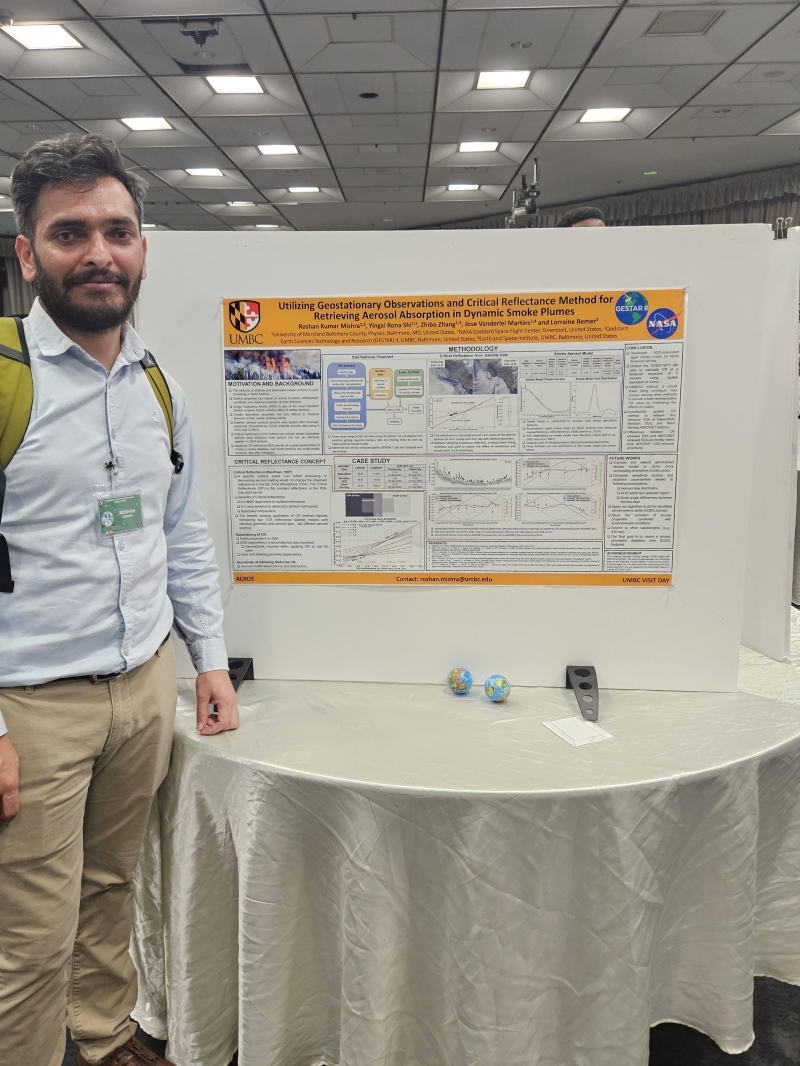
    <div class="html-content">On Monday, April 29th, as part of UMBC's Earth Day Symposium agenda, students presented posters on their research. Among those who presented were four <a href="https://gestar2.umbc.edu/graduate-research-assistants/" rel="nofollow external" class="bo">graduate research assistants</a> affiliated with GESTAR II who are working within <a href="https://physics.umbc.edu/people/graduate-students/" rel="nofollow external" class="bo">UMBC's Physics Department</a>. They discussed their research and next steps with attendees to the poster session. Congratulations on your hard work!<div> <img src="https://my3.my.umbc.edu/groups/gestar2/posts/141775/attachments/52183" style="max-width: 100%; height: auto;"></div><div><em>Kamal Aryal with his poster and with Dr. Zhibo Zhang.</em></div><div><br><div><img src="https://my3.my.umbc.edu/groups/gestar2/posts/141775/attachments/52180" style="max-width: 100%; height: auto;"></div><div><em>Adeleke Ademakinwa with his poster. </em></div><div><br></div><div><img src="https://my3.my.umbc.edu/groups/gestar2/posts/141775/attachments/52181" style="max-width: 100%; height: auto;"><br><div><em>Roshan Mishra with his poster.</em></div><div><br></div></div></div><div><img src="https://my3.my.umbc.edu/groups/gestar2/posts/141775/attachments/52182" style="max-width: 100%; height: auto;"></div><div><em>Emily Faber with her poster.</em></div><div><br></div><div>(Photos: A. Houghton)</div></div>
]]>
</Body>
<Summary>On Monday, April 29th, as part of UMBC's Earth Day Symposium agenda, students presented posters on their research. Among those who presented were four graduate research assistants affiliated with...</Summary>
<AttachmentKind>Photo</AttachmentKind>
<AttachmentUrl>https://assets2-beta.my.umbc.edu/system/shared/attachments/d89ee842de6bb7c378452efd8357464d/69ef5aa0/news/000/141/775/3ef2c0cfd2ff3c8da3a043a79cd406ce/Adeleke web.jpg?1715106189</AttachmentUrl>
<Attachments>
<Attachment kind="Photo" url="https://beta.my.umbc.edu/groups/gestar2/posts/141775/attachments/52180"></Attachment>
<Attachment kind="Photo" url="https://beta.my.umbc.edu/groups/gestar2/posts/141775/attachments/52181"></Attachment>
<Attachment kind="Photo" url="https://beta.my.umbc.edu/groups/gestar2/posts/141775/attachments/52182"></Attachment>
<Attachment kind="Photo" url="https://beta.my.umbc.edu/groups/gestar2/posts/141775/attachments/52183"></Attachment>
</Attachments>
<TrackingUrl>https://beta.my.umbc.edu/api/v0/pixel/news/141775/guest@my.umbc.edu/9373519e4da43b8cfccc0bba8cf87886/api/pixel</TrackingUrl>
<Tag>gestar2</Tag>
<Group token="gestar2">Goddard Earth Sciences Technology and Research II</Group>
<GroupUrl>https://beta.my.umbc.edu/groups/gestar2</GroupUrl>
<AvatarUrl>https://assets3-beta.my.umbc.edu/system/shared/avatars/groups/000/001/988/1dcee2628d726541e45f1ba8c31afe98/xsmall.png?1645477833</AvatarUrl>
<AvatarUrl size="original">https://assets1-beta.my.umbc.edu/system/shared/avatars/groups/000/001/988/1dcee2628d726541e45f1ba8c31afe98/original.png?1645477833</AvatarUrl>
<AvatarUrl size="xxlarge">https://assets1-beta.my.umbc.edu/system/shared/avatars/groups/000/001/988/1dcee2628d726541e45f1ba8c31afe98/xxlarge.png?1645477833</AvatarUrl>
<AvatarUrl size="xlarge">https://assets4-beta.my.umbc.edu/system/shared/avatars/groups/000/001/988/1dcee2628d726541e45f1ba8c31afe98/xlarge.png?1645477833</AvatarUrl>
<AvatarUrl size="large">https://assets2-beta.my.umbc.edu/system/shared/avatars/groups/000/001/988/1dcee2628d726541e45f1ba8c31afe98/large.png?1645477833</AvatarUrl>
<AvatarUrl size="medium">https://assets4-beta.my.umbc.edu/system/shared/avatars/groups/000/001/988/1dcee2628d726541e45f1ba8c31afe98/medium.png?1645477833</AvatarUrl>
<AvatarUrl size="small">https://assets1-beta.my.umbc.edu/system/shared/avatars/groups/000/001/988/1dcee2628d726541e45f1ba8c31afe98/small.png?1645477833</AvatarUrl>
<AvatarUrl size="xsmall">https://assets3-beta.my.umbc.edu/system/shared/avatars/groups/000/001/988/1dcee2628d726541e45f1ba8c31afe98/xsmall.png?1645477833</AvatarUrl>
<AvatarUrl size="xxsmall">https://assets3-beta.my.umbc.edu/system/shared/avatars/groups/000/001/988/1dcee2628d726541e45f1ba8c31afe98/xxsmall.png?1645477833</AvatarUrl>
<Sponsor>Goddard Earth Sciences Technology and Research II</Sponsor>
<ThumbnailUrl size="xxlarge">https://assets2-beta.my.umbc.edu/system/shared/thumbnails/news/000/141/775/51a0a06d8013037599fd6b0af96b7446/xxlarge.jpg?1715109304</ThumbnailUrl>
<ThumbnailUrl size="xlarge">https://assets2-beta.my.umbc.edu/system/shared/thumbnails/news/000/141/775/51a0a06d8013037599fd6b0af96b7446/xlarge.jpg?1715109304</ThumbnailUrl>
<ThumbnailUrl size="large">https://assets3-beta.my.umbc.edu/system/shared/thumbnails/news/000/141/775/51a0a06d8013037599fd6b0af96b7446/large.jpg?1715109304</ThumbnailUrl>
<ThumbnailUrl size="medium">https://assets4-beta.my.umbc.edu/system/shared/thumbnails/news/000/141/775/51a0a06d8013037599fd6b0af96b7446/medium.jpg?1715109304</ThumbnailUrl>
<ThumbnailUrl size="small">https://assets1-beta.my.umbc.edu/system/shared/thumbnails/news/000/141/775/51a0a06d8013037599fd6b0af96b7446/small.jpg?1715109304</ThumbnailUrl>
<ThumbnailUrl size="xsmall">https://assets4-beta.my.umbc.edu/system/shared/thumbnails/news/000/141/775/51a0a06d8013037599fd6b0af96b7446/xsmall.jpg?1715109304</ThumbnailUrl>
<ThumbnailUrl size="xxsmall">https://assets4-beta.my.umbc.edu/system/shared/thumbnails/news/000/141/775/51a0a06d8013037599fd6b0af96b7446/xxsmall.jpg?1715109304</ThumbnailUrl>
<PawCount>0</PawCount>
<CommentCount>0</CommentCount>
<CommentsAllowed>false</CommentsAllowed>
<PostedAt>Tue, 07 May 2024 15:16:21 -0400</PostedAt>
</NewsItem>

<NewsItem contentIssues="true" id="141738" important="false" status="posted" url="https://beta.my.umbc.edu/groups/gestar2/posts/141738">
<Title>UMBC's Earth Day Symposium includes GESTAR II scientists</Title>
<Body>
<![CDATA[
    <div class="html-content"><div>In April 2024, UMBC celebrated Earth Month, a change from last year's Earth Day event. On Monday, April 29th, the student-led Organizing Committee held the 8th Earth Day Symposium in the University Center Ballroom. GESTAR II Director <a href="https://gestar2.umbc.edu/leadership/#Ichoku" rel="nofollow external" class="bo">Charles Ichoku</a> delivered opening remarks, and <a href="https://gestar2.umbc.edu/directory/researchers-r-z/#Zhang" rel="nofollow external" class="bo">Zhibo Zhang</a> (GESTAR II/Physics/UMBC) discussed the history of the symposium (the first EDS was held in 2017). This year's symposium theme was "Monitoring Planetary Health," and the first speaker was <a href="https://esi.umbc.edu/members-a-z/" rel="nofollow external" class="bo">Vanderlei Martins</a> (Director, Earth and Space Institute). </div><div><br></div><div>Dr. Martins' presentation, "The PACE Satellite," detailed the evolution of the concept of the mission; originally, the satellite would have had only the Ocean Color Instrument. The PACE satellite is now in space with three instruments (OCI, HARP2, and SpexOne) that are complementary. He emphasized that this satellite "presents capabilities we've never had before." </div><div><br></div><div>The second speaker, Dr. Vanessa Vargas-Nguyen, delivered a presentation titled "The Chesapeake Bay Watershed." The third, fourth, and fifth speakers gave talks in the afternoon: Dr. Jin Wei, "Monitoring Air Pollution from Space"; Dr. Robert Foster, "Remote Sensing of Marine Plastic"; and Dr. Kandis Boyd, "The Power of Partnerships." The day also included a nature hike and a poster session. Following the speakers and poster awards, UMBC President Dr. Sheares Ashby delivered the closing remarks. </div><div><br></div><div>After the second speaker of the morning, scientists took the stage for the panel talk, "Planetary Health and PACE." The panelists were from GESTAR II/Morgan State, GESTAR II/UMBC, and NASA Goddard Space Flight Center: <a href="https://gestar2.umbc.edu/directory/researchers-a-f/#Cetinic" rel="nofollow external" class="bo">Ivona Cetinic'</a> (616/MSU); <a href="https://gestar2.umbc.edu/directory/researchers-a-f/#Craig" rel="nofollow external" class="bo">Susanne Craig</a> (616/UMBC); <a href="https://gestar2.umbc.edu/directory/researchers-r-z/#Zhai" rel="nofollow external" class="bo">Pengwang Zhai</a> (GESTAR II/UMBC/Physics); Jeremy Werdell and Kirk Knobelspiesse (both 616/GSFC). </div><div><br></div><div>When the panel members were asked what was most exciting about PACE, several mentioned the time and determination it took for PACE to come to existence, and embraced the growth of the PACE community and getting to know each other, as PACE and its data crosses many disciplines. Additional questions about PACE addressed the societal, economic, atmospheric, and oceanic benefits that data from PACE can provide (i.e., air quality, clean water information, health impacts on animals and humans), and the fact that all of this data may inform decision-makers of policies.</div><div><br></div><div>Panelists were asked what advice they had for students who may want to work at NASA, and they provided varied and valuable insight: remain tenacious and curious; be adaptable; learn to code and learn to communicate, take advantage of public speaking opportunities; learn open source, Python, data science, and computer skills; and, remember you are part of a team. </div><div><br></div><div>Posters were presented in the afternoon in the UC Ballroom, where students discussed their research with attendees. (See the related GESTAR II and ESI items from this portion of the day's events.) Congratulations and thanks to the Organizing Committee, speakers, attendees, and everyone who contributed to this final event of Earth Month at UMBC. Make every day Earth Day!</div><div>(Be sure to check out the <a href="https://umbc.edu/stories/8th-annual-earth-day-symposium/" rel="nofollow external" class="bo">UMBC News feature</a> on the 8th Earth Day Symposium.)</div><div><br></div><div><img src="https://my3.my.umbc.edu/groups/gestar2/posts/141738/attachments/52170" style="max-width: 100%; height: auto;"></div><div><em>Dr. Charles Ichoku presents opening remarks.</em></div><div><em><br></em></div><div><img src="https://my3.my.umbc.edu/groups/gestar2/posts/141738/attachments/52171" style="max-width: 100%; height: auto;"></div><div><em>Dr. Zhibo Zhang discusses the history of the Earth Day Symposium.</em></div><div><em><br></em></div><div><img src="https://my3.my.umbc.edu/groups/gestar2/posts/141738/attachments/52172" style="max-width: 100%; height: auto;"></div><div><em>Earth Day Symposium panelists discuss "Planetary Health and PACE."</em></div><div><em><br></em></div><div>(Photo credits: A. Houghton and K. Aryal)</div></div>
]]>
</Body>
<Summary>In April 2024, UMBC celebrated Earth Month, a change from last year's Earth Day event. On Monday, April 29th, the student-led Organizing Committee held the 8th Earth Day Symposium in the...</Summary>
<AttachmentKind>Photo</AttachmentKind>
<AttachmentUrl>https://assets3-beta.my.umbc.edu/system/shared/attachments/03d7a18d649c15c9050fbe02c94e5317/69ef5aa0/news/000/141/738/6417b92810a21b6564e7f015170dd262/charles at podium web.jpg?1715091321</AttachmentUrl>
<Attachments>
<Attachment kind="Photo" url="https://beta.my.umbc.edu/groups/gestar2/posts/141738/attachments/52170"></Attachment>
<Attachment kind="Photo" url="https://beta.my.umbc.edu/groups/gestar2/posts/141738/attachments/52171"></Attachment>
<Attachment kind="Photo" url="https://beta.my.umbc.edu/groups/gestar2/posts/141738/attachments/52172"></Attachment>
</Attachments>
<TrackingUrl>https://beta.my.umbc.edu/api/v0/pixel/news/141738/guest@my.umbc.edu/3c8d5e81f24e59d36c14fc99f6043975/api/pixel</TrackingUrl>
<Tag>gestar2</Tag>
<Group token="gestar2">Goddard Earth Sciences Technology and Research II</Group>
<GroupUrl>https://beta.my.umbc.edu/groups/gestar2</GroupUrl>
<AvatarUrl>https://assets3-beta.my.umbc.edu/system/shared/avatars/groups/000/001/988/1dcee2628d726541e45f1ba8c31afe98/xsmall.png?1645477833</AvatarUrl>
<AvatarUrl size="original">https://assets1-beta.my.umbc.edu/system/shared/avatars/groups/000/001/988/1dcee2628d726541e45f1ba8c31afe98/original.png?1645477833</AvatarUrl>
<AvatarUrl size="xxlarge">https://assets1-beta.my.umbc.edu/system/shared/avatars/groups/000/001/988/1dcee2628d726541e45f1ba8c31afe98/xxlarge.png?1645477833</AvatarUrl>
<AvatarUrl size="xlarge">https://assets4-beta.my.umbc.edu/system/shared/avatars/groups/000/001/988/1dcee2628d726541e45f1ba8c31afe98/xlarge.png?1645477833</AvatarUrl>
<AvatarUrl size="large">https://assets2-beta.my.umbc.edu/system/shared/avatars/groups/000/001/988/1dcee2628d726541e45f1ba8c31afe98/large.png?1645477833</AvatarUrl>
<AvatarUrl size="medium">https://assets4-beta.my.umbc.edu/system/shared/avatars/groups/000/001/988/1dcee2628d726541e45f1ba8c31afe98/medium.png?1645477833</AvatarUrl>
<AvatarUrl size="small">https://assets1-beta.my.umbc.edu/system/shared/avatars/groups/000/001/988/1dcee2628d726541e45f1ba8c31afe98/small.png?1645477833</AvatarUrl>
<AvatarUrl size="xsmall">https://assets3-beta.my.umbc.edu/system/shared/avatars/groups/000/001/988/1dcee2628d726541e45f1ba8c31afe98/xsmall.png?1645477833</AvatarUrl>
<AvatarUrl size="xxsmall">https://assets3-beta.my.umbc.edu/system/shared/avatars/groups/000/001/988/1dcee2628d726541e45f1ba8c31afe98/xxsmall.png?1645477833</AvatarUrl>
<Sponsor>Goddard Earth Sciences Technology and Research II</Sponsor>
<ThumbnailUrl size="xxlarge">https://assets3-beta.my.umbc.edu/system/shared/thumbnails/news/000/141/738/2b230fba6cbcc441ebbf001903a3c671/xxlarge.jpg?1715102340</ThumbnailUrl>
<ThumbnailUrl size="xlarge">https://assets4-beta.my.umbc.edu/system/shared/thumbnails/news/000/141/738/2b230fba6cbcc441ebbf001903a3c671/xlarge.jpg?1715102340</ThumbnailUrl>
<ThumbnailUrl size="large">https://assets1-beta.my.umbc.edu/system/shared/thumbnails/news/000/141/738/2b230fba6cbcc441ebbf001903a3c671/large.jpg?1715102340</ThumbnailUrl>
<ThumbnailUrl size="medium">https://assets1-beta.my.umbc.edu/system/shared/thumbnails/news/000/141/738/2b230fba6cbcc441ebbf001903a3c671/medium.jpg?1715102340</ThumbnailUrl>
<ThumbnailUrl size="small">https://assets1-beta.my.umbc.edu/system/shared/thumbnails/news/000/141/738/2b230fba6cbcc441ebbf001903a3c671/small.jpg?1715102340</ThumbnailUrl>
<ThumbnailUrl size="xsmall">https://assets3-beta.my.umbc.edu/system/shared/thumbnails/news/000/141/738/2b230fba6cbcc441ebbf001903a3c671/xsmall.jpg?1715102340</ThumbnailUrl>
<ThumbnailUrl size="xxsmall">https://assets4-beta.my.umbc.edu/system/shared/thumbnails/news/000/141/738/2b230fba6cbcc441ebbf001903a3c671/xxsmall.jpg?1715102340</ThumbnailUrl>
<PawCount>0</PawCount>
<CommentCount>0</CommentCount>
<CommentsAllowed>false</CommentsAllowed>
<PostedAt>Tue, 07 May 2024 13:19:54 -0400</PostedAt>
<EditAt>Tue, 07 May 2024 13:22:39 -0400</EditAt>
</NewsItem>

<NewsItem contentIssues="true" id="141676" important="false" status="posted" url="https://beta.my.umbc.edu/groups/gestar2/posts/141676">
<Title>Borda and Young receive 2024 UMBC Presidential Awards</Title>
<Body>
<![CDATA[
    <div class="html-content">On Wednesday, May 1, 2024, the UMBC 2024 Presidential Faculty and Staff Awards ceremony was held in the University Center Ballroom, and it was available to view virtually. President Valerie Sheares Ashby welcomed the awardees, family members, attendees, and everyone involved with creating a beautiful event. She shared each awardee's accomplishment and presented each one with an official plaque.<div><br></div><div><a href="https://gestar2.umbc.edu/directory/researchers-a-f/#Borda" rel="nofollow external" class="bo">Robert A. Fernandez Borda</a>, Senior Research Engineer, received the <a href="https://facultystaffawards.umbc.edu/award-descriptions/" rel="nofollow external" class="bo">2024 UMBC Research Faculty Excellence Award</a>. He was recognized for his work in "serving as the lead optical designer of the HARP polarimeter family (HARP2 is currently in space in NASA's PACE mission) and also leads the design of the FPGA firmware controlling the custom acquisition of the polarimeters." </div><div><br></div><div><a href="https://gestar2.umbc.edu/leadership/#Young" rel="nofollow external" class="bo">Margo Young</a>, Director, Earth and Space Research Administration, received the <a href="https://facultystaffawards.umbc.edu/award-descriptions/" rel="nofollow external" class="bo">2024 University System of Maryland Board of Regents Staff Award</a> for Effectiveness and Efficiency. In particular, "Her exceptional vision in developing ESRA, nurturing UMBC's important relationship with NASA, and her outstanding work as a leader in UMBC's vital program of research administration greatly contributed to naming UMBC as an R1 university."</div><div><br></div><div>More information about their accomplishments and other 2024 awardees can be found <a href="https://facultystaffawards.umbc.edu/" rel="nofollow external" class="bo">here</a>. Congratulations to you both on these well-deserved recognitions!</div><div><br></div><div><img src="https://my3.my.umbc.edu/groups/gestar2/posts/141676/attachments/52132" style="max-width: 100%; height: auto;"></div><div><em>Roberto Borda with President Sheares Ashby.</em> </div><div><br></div><div><img src="https://my3.my.umbc.edu/groups/gestar2/posts/141676/attachments/52133" style="max-width: 100%; height: auto;"></div><div><em>Margo Young with President Sheares Ashby.</em></div><div><em><br></em></div><div>(Photo credits: A. Houghton)</div></div>
]]>
</Body>
<Summary>On Wednesday, May 1, 2024, the UMBC 2024 Presidential Faculty and Staff Awards ceremony was held in the University Center Ballroom, and it was available to view virtually. President Valerie...</Summary>
<AttachmentKind>Photo</AttachmentKind>
<AttachmentUrl>https://assets2-beta.my.umbc.edu/system/shared/attachments/a1a4c7992e44e91daaed362af132a4c5/69ef5aa0/news/000/141/676/4206ab9565b9eabee1af9d9bf573693a/Roberto with UMBC President 5.01.24 web.jpg?1714759089</AttachmentUrl>
<Attachments>
<Attachment kind="Photo" url="https://beta.my.umbc.edu/groups/gestar2/posts/141676/attachments/52132"></Attachment>
<Attachment kind="Photo" url="https://beta.my.umbc.edu/groups/gestar2/posts/141676/attachments/52133"></Attachment>
</Attachments>
<TrackingUrl>https://beta.my.umbc.edu/api/v0/pixel/news/141676/guest@my.umbc.edu/495537075dbfe8d315097ab5cdc099e5/api/pixel</TrackingUrl>
<Tag>gestar2</Tag>
<Group token="gestar2">Goddard Earth Sciences Technology and Research II</Group>
<GroupUrl>https://beta.my.umbc.edu/groups/gestar2</GroupUrl>
<AvatarUrl>https://assets3-beta.my.umbc.edu/system/shared/avatars/groups/000/001/988/1dcee2628d726541e45f1ba8c31afe98/xsmall.png?1645477833</AvatarUrl>
<AvatarUrl size="original">https://assets1-beta.my.umbc.edu/system/shared/avatars/groups/000/001/988/1dcee2628d726541e45f1ba8c31afe98/original.png?1645477833</AvatarUrl>
<AvatarUrl size="xxlarge">https://assets1-beta.my.umbc.edu/system/shared/avatars/groups/000/001/988/1dcee2628d726541e45f1ba8c31afe98/xxlarge.png?1645477833</AvatarUrl>
<AvatarUrl size="xlarge">https://assets4-beta.my.umbc.edu/system/shared/avatars/groups/000/001/988/1dcee2628d726541e45f1ba8c31afe98/xlarge.png?1645477833</AvatarUrl>
<AvatarUrl size="large">https://assets2-beta.my.umbc.edu/system/shared/avatars/groups/000/001/988/1dcee2628d726541e45f1ba8c31afe98/large.png?1645477833</AvatarUrl>
<AvatarUrl size="medium">https://assets4-beta.my.umbc.edu/system/shared/avatars/groups/000/001/988/1dcee2628d726541e45f1ba8c31afe98/medium.png?1645477833</AvatarUrl>
<AvatarUrl size="small">https://assets1-beta.my.umbc.edu/system/shared/avatars/groups/000/001/988/1dcee2628d726541e45f1ba8c31afe98/small.png?1645477833</AvatarUrl>
<AvatarUrl size="xsmall">https://assets3-beta.my.umbc.edu/system/shared/avatars/groups/000/001/988/1dcee2628d726541e45f1ba8c31afe98/xsmall.png?1645477833</AvatarUrl>
<AvatarUrl size="xxsmall">https://assets3-beta.my.umbc.edu/system/shared/avatars/groups/000/001/988/1dcee2628d726541e45f1ba8c31afe98/xxsmall.png?1645477833</AvatarUrl>
<Sponsor>Goddard Earth Sciences Technology and Research II</Sponsor>
<ThumbnailUrl size="xxlarge">https://assets1-beta.my.umbc.edu/system/shared/thumbnails/news/000/141/676/9e912a1888604c45c12cbba6f39e84cb/xxlarge.jpg?1714759461</ThumbnailUrl>
<ThumbnailUrl size="xlarge">https://assets3-beta.my.umbc.edu/system/shared/thumbnails/news/000/141/676/9e912a1888604c45c12cbba6f39e84cb/xlarge.jpg?1714759461</ThumbnailUrl>
<ThumbnailUrl size="large">https://assets4-beta.my.umbc.edu/system/shared/thumbnails/news/000/141/676/9e912a1888604c45c12cbba6f39e84cb/large.jpg?1714759461</ThumbnailUrl>
<ThumbnailUrl size="medium">https://assets4-beta.my.umbc.edu/system/shared/thumbnails/news/000/141/676/9e912a1888604c45c12cbba6f39e84cb/medium.jpg?1714759461</ThumbnailUrl>
<ThumbnailUrl size="small">https://assets4-beta.my.umbc.edu/system/shared/thumbnails/news/000/141/676/9e912a1888604c45c12cbba6f39e84cb/small.jpg?1714759461</ThumbnailUrl>
<ThumbnailUrl size="xsmall">https://assets4-beta.my.umbc.edu/system/shared/thumbnails/news/000/141/676/9e912a1888604c45c12cbba6f39e84cb/xsmall.jpg?1714759461</ThumbnailUrl>
<ThumbnailUrl size="xxsmall">https://assets3-beta.my.umbc.edu/system/shared/thumbnails/news/000/141/676/9e912a1888604c45c12cbba6f39e84cb/xxsmall.jpg?1714759461</ThumbnailUrl>
<PawCount>0</PawCount>
<CommentCount>0</CommentCount>
<CommentsAllowed>false</CommentsAllowed>
<PostedAt>Fri, 03 May 2024 14:07:35 -0400</PostedAt>
</NewsItem>

<NewsItem contentIssues="true" id="141401" important="false" status="posted" url="https://beta.my.umbc.edu/groups/gestar2/posts/141401">
<Title>GESTAR II Scientists participate in UMBC's Community Day</Title>
<Body>
<![CDATA[
    <div class="html-content">During UMBC’s Earth Month celebration, on Monday, April 22, GESTAR II participated in Community Day. Staffing two tables were <a href="https://gestar2.umbc.edu/directory/researchers-a-f/#Craig" rel="nofollow external" class="bo">Susanne Craig</a> (616/UMBC) and <a href="https://gestar2.umbc.edu/directory/researchers-l-q/#JLee" rel="nofollow external" class="bo">Jae Lee</a> (613/UMBC) from NASA Goddard Space Flight Center, along with <a href="https://gestar2.umbc.edu/directory/administrative-personnel/" rel="nofollow external" class="bo">Amy Houghton</a> (ESRA/UMBC) and <a href="https://gestar2.umbc.edu/directory/administrative-personnel/" rel="nofollow external" class="bo">Dominique Footes</a> (GESTAR II/SURA). <div><br></div><div>Dr. Craig of the Ocean Ecology Laboratory spoke with visitors and students about the <a href="https://pace.gsfc.nasa.gov/" rel="nofollow external" class="bo">PACE</a> satellite and what information the satellite’s instruments provide for researchers. Topics varied from when the satellite flies over UMBC to the depth of measurements in the ocean, as well as others. She also discussed the various goals of the PACE satellite. Dr. Lee of the Climate and Radiation Laboratory presented a large display of various items related to the <a href="https://eospso.nasa.gov/missions/total-and-spectral-solar-irradiance-sensor-2" rel="nofollow external" class="bo">TSIS-2</a> (Total and Spectral Solar Irradiance Sensor-2) mission and discussed her research of Sun-Climate interaction. She also talked about remote sensing and solar measurements with students who visited her table. </div><div><br></div><div>Ms. Houghton and Ms. Footes talked with students about the GESTAR II consortium, the variety of earth science research the center encompasses, and the opportunities for students to get involved with the center, whether by perusing the fellowship opportunities, reaching out to the scientists via the GESTAR II staff directory, or following the Goddard Earth Sciences Technology and Research (GESTAR) II group on myUMBC. A popular comment heard throughout the day was “I thought NASA just studied space.” GESTAR II thanks everyone for stopping by.</div><div><br></div><div><img src="https://my3.my.umbc.edu/groups/gestar2/posts/141401/attachments/52008" style="max-width: 100%; height: auto;"></div><div>Dr. Craig speaking with students.</div><div><br></div><div><img src="https://my3.my.umbc.edu/groups/gestar2/posts/141401/attachments/52009" style="max-width: 100%; height: auto;"></div><div>Dr. Craig speaking with <a href="https://gestar2.umbc.edu/graduate-research-assistants/" rel="nofollow external" class="bo">Kamal Aryal</a>, GESTAR II Graduate Research Assistant, and member of the UMBC Earth Month Organizing Committee. At left, students are talking with Dom Footes (not shown).</div><div><br></div><div><img src="https://my3.my.umbc.edu/groups/gestar2/posts/141401/attachments/52007" style="max-width: 100%; height: auto;"></div><div>Dr. Lee discussing the many TSIS-2 items on display with a student.</div><div><br></div><div><img src="https://my3.my.umbc.edu/groups/gestar2/posts/141401/attachments/52006" style="max-width: 100%; height: auto;"></div><div>Dr. Lee with <a href="https://gestar2.umbc.edu/leadership/" rel="nofollow external" class="bo">Dr. Charles Ichoku</a>, GESTAR II Director.</div><div><br></div><div><img src="https://my3.my.umbc.edu/groups/gestar2/posts/141401/attachments/52010" style="max-width: 100%; height: auto;"></div><div>By coincidence, <a href="https://gestar2.umbc.edu/gestar-ii-graduate-fellows-2023-2024/" rel="nofollow external" class="bo">Chhaya Kulkarni</a>, a GESTAR II Graduate Fellow, was at the table next to GESTAR II.</div></div>
]]>
</Body>
<Summary>During UMBC’s Earth Month celebration, on Monday, April 22, GESTAR II participated in Community Day. Staffing two tables were Susanne Craig (616/UMBC) and Jae Lee (613/UMBC) from NASA Goddard...</Summary>
<AttachmentKind>Photo</AttachmentKind>
<AttachmentUrl>https://assets1-beta.my.umbc.edu/system/shared/attachments/813ec7aae2cf37249d72931387889cc8/69ef5aa0/news/000/141/401/fcf9fae698226ebee1674492b5d9af49/Jae and Charles web.jpg?1714160064</AttachmentUrl>
<Attachments>
<Attachment kind="Photo" url="https://beta.my.umbc.edu/groups/gestar2/posts/141401/attachments/52006"></Attachment>
<Attachment kind="Photo" url="https://beta.my.umbc.edu/groups/gestar2/posts/141401/attachments/52007"></Attachment>
<Attachment kind="Photo" url="https://beta.my.umbc.edu/groups/gestar2/posts/141401/attachments/52008"></Attachment>
<Attachment kind="Photo" url="https://beta.my.umbc.edu/groups/gestar2/posts/141401/attachments/52009"></Attachment>
<Attachment kind="Photo" url="https://beta.my.umbc.edu/groups/gestar2/posts/141401/attachments/52010"></Attachment>
</Attachments>
<TrackingUrl>https://beta.my.umbc.edu/api/v0/pixel/news/141401/guest@my.umbc.edu/3eddf93e8cb9841f38d98262468e1ed5/api/pixel</TrackingUrl>
<Tag>gestar2</Tag>
<Group token="gestar2">Goddard Earth Sciences Technology and Research II</Group>
<GroupUrl>https://beta.my.umbc.edu/groups/gestar2</GroupUrl>
<AvatarUrl>https://assets3-beta.my.umbc.edu/system/shared/avatars/groups/000/001/988/1dcee2628d726541e45f1ba8c31afe98/xsmall.png?1645477833</AvatarUrl>
<AvatarUrl size="original">https://assets1-beta.my.umbc.edu/system/shared/avatars/groups/000/001/988/1dcee2628d726541e45f1ba8c31afe98/original.png?1645477833</AvatarUrl>
<AvatarUrl size="xxlarge">https://assets1-beta.my.umbc.edu/system/shared/avatars/groups/000/001/988/1dcee2628d726541e45f1ba8c31afe98/xxlarge.png?1645477833</AvatarUrl>
<AvatarUrl size="xlarge">https://assets4-beta.my.umbc.edu/system/shared/avatars/groups/000/001/988/1dcee2628d726541e45f1ba8c31afe98/xlarge.png?1645477833</AvatarUrl>
<AvatarUrl size="large">https://assets2-beta.my.umbc.edu/system/shared/avatars/groups/000/001/988/1dcee2628d726541e45f1ba8c31afe98/large.png?1645477833</AvatarUrl>
<AvatarUrl size="medium">https://assets4-beta.my.umbc.edu/system/shared/avatars/groups/000/001/988/1dcee2628d726541e45f1ba8c31afe98/medium.png?1645477833</AvatarUrl>
<AvatarUrl size="small">https://assets1-beta.my.umbc.edu/system/shared/avatars/groups/000/001/988/1dcee2628d726541e45f1ba8c31afe98/small.png?1645477833</AvatarUrl>
<AvatarUrl size="xsmall">https://assets3-beta.my.umbc.edu/system/shared/avatars/groups/000/001/988/1dcee2628d726541e45f1ba8c31afe98/xsmall.png?1645477833</AvatarUrl>
<AvatarUrl size="xxsmall">https://assets3-beta.my.umbc.edu/system/shared/avatars/groups/000/001/988/1dcee2628d726541e45f1ba8c31afe98/xxsmall.png?1645477833</AvatarUrl>
<Sponsor>Goddard Earth Sciences Technology and Research II</Sponsor>
<ThumbnailUrl size="xxlarge">https://assets3-beta.my.umbc.edu/system/shared/thumbnails/news/000/141/401/2dd056c5b089717280672f9f58276225/xxlarge.jpg?1714159555</ThumbnailUrl>
<ThumbnailUrl size="xlarge">https://assets4-beta.my.umbc.edu/system/shared/thumbnails/news/000/141/401/2dd056c5b089717280672f9f58276225/xlarge.jpg?1714159555</ThumbnailUrl>
<ThumbnailUrl size="large">https://assets4-beta.my.umbc.edu/system/shared/thumbnails/news/000/141/401/2dd056c5b089717280672f9f58276225/large.jpg?1714159555</ThumbnailUrl>
<ThumbnailUrl size="medium">https://assets3-beta.my.umbc.edu/system/shared/thumbnails/news/000/141/401/2dd056c5b089717280672f9f58276225/medium.jpg?1714159555</ThumbnailUrl>
<ThumbnailUrl size="small">https://assets4-beta.my.umbc.edu/system/shared/thumbnails/news/000/141/401/2dd056c5b089717280672f9f58276225/small.jpg?1714159555</ThumbnailUrl>
<ThumbnailUrl size="xsmall">https://assets2-beta.my.umbc.edu/system/shared/thumbnails/news/000/141/401/2dd056c5b089717280672f9f58276225/xsmall.jpg?1714159555</ThumbnailUrl>
<ThumbnailUrl size="xxsmall">https://assets2-beta.my.umbc.edu/system/shared/thumbnails/news/000/141/401/2dd056c5b089717280672f9f58276225/xxsmall.jpg?1714159555</ThumbnailUrl>
<PawCount>0</PawCount>
<CommentCount>0</CommentCount>
<CommentsAllowed>false</CommentsAllowed>
<PostedAt>Fri, 26 Apr 2024 15:50:03 -0400</PostedAt>
</NewsItem>

<NewsItem contentIssues="true" id="141394" important="false" status="posted" url="https://beta.my.umbc.edu/groups/gestar2/posts/141394">
<Title>GESTAR II Seminar Series, April 30th at 1:00pm</Title>
<Body>
<![CDATA[
    <div class="html-content"><div>Join us for a virtual seminar by <a href="https://atmos.ucla.edu/author/rfu/" rel="nofollow external" class="bo">Dr. Rong Fu</a>, Department of Atmospheric and Oceanic Sciences, University of California, Los Angeles. Her talk is titled "Understanding drought, heat waves and fire weather from weather to climate scales."</div><div><br></div><div>Date and Time: Tuesday, April 30, 2024 at 1:00pm EST</div><div>Join us via <a href="https://teams.microsoft.com/l/meetup-join/19%3ameeting_MDhhYTY4MTgtY2Y2Yy00MTJkLTk1MGItZTc5ZWI0YmU0NDM3%40thread.v2/0?context=%7b%22Tid%22%3a%227005d458-45be-48ae-8140-d43da96dd17b%22%2c%22Oid%22%3a%22c58e54ca-3561-4059-bb24-a8af64733329%22%7d" rel="nofollow external" class="bo">Teams</a>.</div><div><br></div><div><u>Abstract:</u> </div><div><div>"The National Earth System Prediction Capability (ESPC) aims to improve earth system prediction from sub-seasonal to decade scales, with emphasis on “seamless” prediction.  Yet, our understanding of weather-climate connection, especially in a changing climate, is still in its infancy.  For example, it is not clear what weather patterns are responsible for dry spells and heat waves during the warm season over continental United States (US), and which of these patterns are responsible for extreme droughts and stronger and longer fire season?  How do decadal climate variability and anthropogenic forced climate change affect the intensity and frequency of extreme fire weather? </div><div><br></div><div>In this seminar, I will report our studies that explore these questions through machine learning approaches.  To assess the influence of weather patterns on droughts and fire weather, we use multivariate Self-Organization Map to characterize the weather patterns responsible for dry and wet spells, their associated atmospheric thermodynamic condition and moisture transport, and their contributions to warm season droughts and decadal variability of the land surface aridity and fire weather.  We also use a constructed flow analogue approach to determine the relative influence of natural climate variability and anthropogenic forced change on the increase of fire weather and drought intensity and areas in recent decades over Western US, including those that contributed to the 2020 August Camp Fire, and 2020-2022 Western US drought.</div><div><br></div><div>The analyses suggest that, although many weather patterns can contribute to dry spells and moderate droughts, extreme droughts are largely caused by an increased frequency and persistence of a few leading weather patterns that are responsible for strong dry spells climatologically.  Thus, understand the causes behind the changes of these few weather patterns is central for determining predictability of the extreme droughts.  On the other hand, for the same weather patterns, the probability distributions of surface temperature and vapor pressure deficit (VPD) in the recent decades have changed significantly over the western US, leading to higher probability of fire weather and increased drought severity and areas, compared to earlier decades.  Consequently, at least two-thirds of the increase of the fire weather over western US during recent decades is attributable to climate change, whereas only one third or less of the increase of fire weather is attributable to changing weather patterns.  The increase of evaporative demand due to warming of surface temperature has become the main driver of increasing drought severity and area since 2000.  Thus, climate changes can have significant impact on weather and sub-seasonal dry spells and interannual droughts."</div><div><br></div><div><u>Biography:</u></div></div><div><div><div>Dr. Rong Fu is a professor in the Department of Atmospheric and Oceanic Sciences, the director of the Joint Institute of Regional Earth System Science and Engineering in University of California, Los Angeles. Her research focuses on the mechanisms that control droughts, rainfall seasonality and variability over Amazonian and North American regions, and how changes of global climate, local vegetation and biomass burning have influenced these processes in the recent past and will influence rainfall seasonality and droughts in the future. She received NSF CAREER and NASA New Investigator Awards, and the American Meteorological Society (AMS) Outstanding Achievement Award for biometeorology.  She is an elected member of National Academy of Engineering, and also an elected fellow of the AMS, the American Geophysical Union (AGU), and the American Association For the Advancement of Science (AAAS), respectively.  She served as the President of the Global Environmental Change Section (2015-2016) and Leadership Team of the AGU Council, and the Chair of the AAAS Atmosphere and Hydrosphere (2022), and a member of AAAS Council and its Executive Committee (2023). She is also a current AMS Council Member.  She has served on many national and international panels and co-led NOAA Drought Task Force IV.  She also serves as an Editor of Journal of Geophysical Research – Atmosphere.</div><div><br></div></div><div>For more information on the GESTAR II Seminar Series, click <a href="https://gestar2.umbc.edu/gestar-ii-seminar-series/" rel="nofollow external" class="bo">here</a>.</div></div></div>
]]>
</Body>
<Summary>Join us for a virtual seminar by Dr. Rong Fu, Department of Atmospheric and Oceanic Sciences, University of California, Los Angeles. Her talk is titled "Understanding drought, heat waves and fire...</Summary>
<TrackingUrl>https://beta.my.umbc.edu/api/v0/pixel/news/141394/guest@my.umbc.edu/93983daa149cf1bf756247925134f05c/api/pixel</TrackingUrl>
<Tag>gestar2</Tag>
<Group token="gestar2">Goddard Earth Sciences Technology and Research II</Group>
<GroupUrl>https://beta.my.umbc.edu/groups/gestar2</GroupUrl>
<AvatarUrl>https://assets3-beta.my.umbc.edu/system/shared/avatars/groups/000/001/988/1dcee2628d726541e45f1ba8c31afe98/xsmall.png?1645477833</AvatarUrl>
<AvatarUrl size="original">https://assets1-beta.my.umbc.edu/system/shared/avatars/groups/000/001/988/1dcee2628d726541e45f1ba8c31afe98/original.png?1645477833</AvatarUrl>
<AvatarUrl size="xxlarge">https://assets1-beta.my.umbc.edu/system/shared/avatars/groups/000/001/988/1dcee2628d726541e45f1ba8c31afe98/xxlarge.png?1645477833</AvatarUrl>
<AvatarUrl size="xlarge">https://assets4-beta.my.umbc.edu/system/shared/avatars/groups/000/001/988/1dcee2628d726541e45f1ba8c31afe98/xlarge.png?1645477833</AvatarUrl>
<AvatarUrl size="large">https://assets2-beta.my.umbc.edu/system/shared/avatars/groups/000/001/988/1dcee2628d726541e45f1ba8c31afe98/large.png?1645477833</AvatarUrl>
<AvatarUrl size="medium">https://assets4-beta.my.umbc.edu/system/shared/avatars/groups/000/001/988/1dcee2628d726541e45f1ba8c31afe98/medium.png?1645477833</AvatarUrl>
<AvatarUrl size="small">https://assets1-beta.my.umbc.edu/system/shared/avatars/groups/000/001/988/1dcee2628d726541e45f1ba8c31afe98/small.png?1645477833</AvatarUrl>
<AvatarUrl size="xsmall">https://assets3-beta.my.umbc.edu/system/shared/avatars/groups/000/001/988/1dcee2628d726541e45f1ba8c31afe98/xsmall.png?1645477833</AvatarUrl>
<AvatarUrl size="xxsmall">https://assets3-beta.my.umbc.edu/system/shared/avatars/groups/000/001/988/1dcee2628d726541e45f1ba8c31afe98/xxsmall.png?1645477833</AvatarUrl>
<Sponsor>Goddard Earth Sciences Technology and Research II</Sponsor>
<ThumbnailUrl size="xxlarge">https://assets2-beta.my.umbc.edu/system/shared/thumbnails/news/000/141/394/1ced200581e937115c842a999ccb4527/xxlarge.jpg?1714154105</ThumbnailUrl>
<ThumbnailUrl size="xlarge">https://assets4-beta.my.umbc.edu/system/shared/thumbnails/news/000/141/394/1ced200581e937115c842a999ccb4527/xlarge.jpg?1714154105</ThumbnailUrl>
<ThumbnailUrl size="large">https://assets1-beta.my.umbc.edu/system/shared/thumbnails/news/000/141/394/1ced200581e937115c842a999ccb4527/large.jpg?1714154105</ThumbnailUrl>
<ThumbnailUrl size="medium">https://assets4-beta.my.umbc.edu/system/shared/thumbnails/news/000/141/394/1ced200581e937115c842a999ccb4527/medium.jpg?1714154105</ThumbnailUrl>
<ThumbnailUrl size="small">https://assets4-beta.my.umbc.edu/system/shared/thumbnails/news/000/141/394/1ced200581e937115c842a999ccb4527/small.jpg?1714154105</ThumbnailUrl>
<ThumbnailUrl size="xsmall">https://assets1-beta.my.umbc.edu/system/shared/thumbnails/news/000/141/394/1ced200581e937115c842a999ccb4527/xsmall.jpg?1714154105</ThumbnailUrl>
<ThumbnailUrl size="xxsmall">https://assets4-beta.my.umbc.edu/system/shared/thumbnails/news/000/141/394/1ced200581e937115c842a999ccb4527/xxsmall.jpg?1714154105</ThumbnailUrl>
<PawCount>0</PawCount>
<CommentCount>0</CommentCount>
<CommentsAllowed>false</CommentsAllowed>
<PostedAt>Fri, 26 Apr 2024 13:57:16 -0400</PostedAt>
</NewsItem>

</News>