Congrats to our ESRA Personnel on Service Awards
ESRA would like to congratulate our team members who were recognized at the 2025 Service Awards Ceremony, held on Thursday, December 4, 2025 at the UMBC Retrievers Activity Center.
Cathy Manalansan, Executive Administrative Assistant I, has been with the State of Maryland for 35 years! Judith Laferriere, Financial Business Manager and Analyst, was recognized for 10 years with UMBC, and Valerie Casasanto, Program Coordinator (615/UMBC/ESI), is celebrating 20 years with UMBC!
Thank you for your professionalism and dedication to UMBC's mission and work with UMBC's Earth and Space Institute (ESI) and our NASA Goddard-affiliated centers, past and present: CSST, GEST, GESTAR II, GPHI (PHaSER), and JCET.
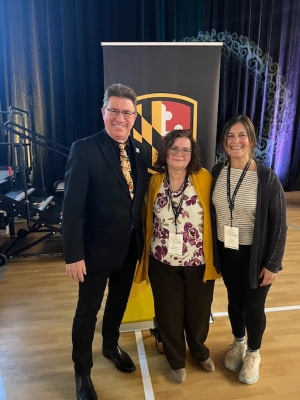
Photo: Dr. Karl Steiner, VP, UMBC's Office of Research & Creative Achievement (ORCA), Cathy Manalansan, and Valerie Casasanto together at the 2025 UMBC Service Awards Ceremony. Note, Judith Laferriere attended virtually. Photo Credit: M. Young.
2025 UMBC Service Awards logo, courtesy of UMBC's Office of HRSTM
From May 10-22, 2025, UMBC Earth and Space Institute
(ESI) faculty Dr. Vanderlei Martins, Dr. Lorraine Remer, Dr. Xiaoguang Xu, Dominik Cieslak, and Ian Decker led a special field campaign, based in Bolivia, to study the way sunlight reflects off mirror-like or homogenous natural surfaces.
Lake Titicaca and salt pan
Salar de Uyuni, two of the highest natural calibration sites in the world, are used by the Earth science community to update the calibration and monitor the performance of many remote sensing climate instruments on-orbit. The Hyper-Angular Rainbow Polarimeter (
HARP2), a multi-angle polarimeter instrument built at ESI, makes near-daily measurements of the region from NASA’s currently orbiting Plankton Aerosol Cloud ocean Ecosystem (PACE) satellite. The goal of this particular field campaign was to measure the lake and salt pan during PACE overpasses to validate HARP2 measurements. Extra measurements at different times and different geometries will help further characterize these sites for PACE and other current and future Earth observation missions.
The ESI group collaborated with Dr. Marcos Andrade at Universidad Mayor de San Andres in Bolivia to organize the campaign and charter a boat to launch a local drone, which would fly DroneHARP, a HARP2-like instrument, for the field measurements. For the campaign's first week, they focused on data from the Salar, which is extremely bright and white at all angles. The next week, the team obtained data over Lake Titicaca; at certain viewing angles, the lake’s smooth water surface acts like a mirror, resulting in sunglint. At these angles, the lake has a much stronger signal, and the signal’s width and brightness depend on the surface wind speed.
The team flew 28 flights in total over both targets. With real-time predictions from
ESI’s Drs. Anin Puthukkudy and Brent McBride at UMBC, DroneHARP flew underneath more than eight Earth science satellites as well, including NASA’s PACE, Terra, and Aqua, plus the European Space Agency’s Sentinel-2 and EarthCARE. In La Paz, Bolivia, Dr. Andrade’s team supported the DroneHARP measurements with ground-based sensors, including an Aerosol Robotic Network (AERONET) sun photometer, handheld microtops, and a Pandora ceilometer for trace gas estimation. This team also deployed a portable weather station to measure wind, temperature, humidity, and solar radiation.
Now, the ESI team is in the post-campaign phase. UMBC
Atmospheric Physics graduate students Tashin Ahammad and Connor Thompson are studying the geometric calibration (the relationship between each image pixel and its light path through the optics) and the accuracy of the internal monitoring unit (IMU), which logs the roll, pitch, and yaw of the drone. These steps are important to get DroneHARP data ready for science. In tandem, Drs. Xu and McBride along with Mr. Cieslak, Mr. Decker, and Mr. Ahammad are leading the quantitative calibration (i.e., the connection between the instrument pixel counts and the light energy being reflected from each target in the imagery). The final product is a dataset where every pixel is georectified on the Earth’s surface and contains a physical measurement of reflected energy.
The ESI team also plans to study the bi-directional reflectance (and polarized) distribution functions (BDRF and pBRDF) of the lake and salt flat with DroneHARP data. These metrics not only describe how much light is expected to scatter from a surface at a specific angle, they also can improve aerosol retrievals (which can be contaminated by surface reflections) or they can be used for vicarious calibration, the process of comparing HARP2 data to theoretical surface models to monitor and update data quality. However, DroneHARP measurements may not compare well with HARP2, unless we understand how spatial scale plays a role. For example, a single pixel for HARP2 is 5 km, which blurs much of the surface details, while DroneHARP can see hexagonal structures and small mounds on the salt flat surface as well as individual wave slopes on the lake – both of which are essential to understanding BDRF and pBRDF.
UMBC Computer Science undergraduate student Natalie McCourt is currently working with Dr. McBride to assess the salt flat from the HARP2 perspective. Ms. McCourt developed a mission-wide database that logged all HARP2 measurements of the Salar de Uyuni for later processing. This database will help the team understand how sunlight scatters off these surfaces throughout the year, how the salt flat scatters light differently after rain and in drought, will validate the DroneHARP data during the campaign days, and will clarify if any of the high-resolution surface features imaged by DroneHARP translate to the signal measured at the top of the atmosphere by HARP2.
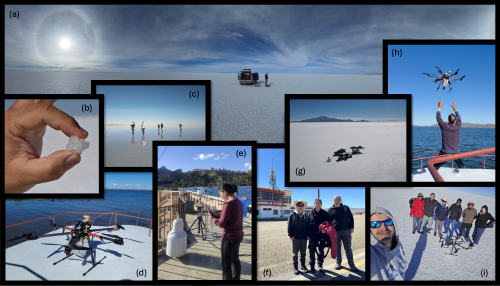
Photo collage:
(a) Panoramic of the Salar de Uyuni salt flat on a heavy cirrus day.
(b) Zoom of a cuboid salt crystal aggregate from the Salar de Uyuni.
(c) Dr. Lorraine Remer and Dominik Cieslak (foreground) walks on the water-covered Salar de Uyuni. After a rain, the salt flat becomes an “infinity mirror”.
(d) DroneHARP on the chartered boat, about to take measurements over Lake Titicaca.
(e) Undergraduate student Wara Carvajal taking calibration measurements with a microtop, near an AERONET sun photometer and a PANDORA.
(f) Drs. Richard Xu, Marcos Andrade, and Vanderlei Martins at the Uyuni Welcome Center.
(g) Snapshot of the Salar de Uyuni from DroneHARP 300 m in the atmosphere.
(h) Ian Decker catching the DroneHARP on the boat after a lake observation.
(i) Dominik Cieslak (foreground) with DroneHARP and the ESI and Bolivia field teams.
Photo credits: Members of ESI and Universidad Mayor de San Andres
The Earth and Space Institute at the University of Maryland, Baltimore County (UMBC) invites you to celebrate a significant milestone: 500 days of NASA’s Plankton, Aerosol, Cloud, ocean Ecosystem
(PACE) mission in space.
This special event will bring together scientists, collaborators, and enthusiasts to share insights, foster connections, and reflect on the achievements of the PACE mission—while also looking ahead to future research, expanded collaborations, and the next phase of discoveries in Earth and space science.
Details:
- Event: PACE 500 Celebration
- Date: Wednesday, August 20
- Time: 1:00 p.m. to 5:00 p.m.
- Location: UMBC ILSB Room 116
- Parking: Commons Garage ($), Stadium Lot, Admin Garage ($) for visitors. UMBC Campus Map is provided here.
*All guests must RSVP for event catering purposes using this link. Please note any dietary restrictions.
Schedule:
- 1:00 p.m. - 2:30 p.m. Refreshments, lab tours, and poster session (everyone is welcome to bring a poster)
- 2:30 p.m. - 5:00 p.m. Presentations and PACE Updates
- 5:00 p.m. Event Closing at Guinness Open Gate Brewery, 5001 Washington Blvd., Halethorpe, MD 21227. (Individuals are responsible for any beverages or food purchased at Guinness.)
We look forward to celebrating with you!
]]>
The Earth and Space Institute at the University of Maryland, Baltimore County (UMBC) invites you to celebrate a significant milestone: 500 days of NASA’s Plankton, Aerosol, Cloud, ocean Ecosystem...
Photo
https://assets3-beta.my.umbc.edu/system/shared/attachments/7f39d0b111fa5bdb9d5d0b8bd5ddc1cc/69f7312c/news/000/151/441/4ddc41b4191e585aa81256b6a6bcf2bd/ESI-logo-web.jpg?1754956418
https://beta.my.umbc.edu/api/v0/pixel/news/151441/guest@my.umbc.edu/c8a162ab451c88f16d3fb6b8bdfb640c/api/pixel
esi
Earth and Space Institute
https://beta.my.umbc.edu/groups/esi
https://assets4-beta.my.umbc.edu/system/shared/avatars/groups/000/002/124/0edf78e65ae95730e0c3687aa55486c5/xsmall.png?1708376163
https://assets1-beta.my.umbc.edu/system/shared/avatars/groups/000/002/124/0edf78e65ae95730e0c3687aa55486c5/original.png?1708376163
https://assets3-beta.my.umbc.edu/system/shared/avatars/groups/000/002/124/0edf78e65ae95730e0c3687aa55486c5/xxlarge.png?1708376163
https://assets3-beta.my.umbc.edu/system/shared/avatars/groups/000/002/124/0edf78e65ae95730e0c3687aa55486c5/xlarge.png?1708376163
https://assets3-beta.my.umbc.edu/system/shared/avatars/groups/000/002/124/0edf78e65ae95730e0c3687aa55486c5/large.png?1708376163
https://assets4-beta.my.umbc.edu/system/shared/avatars/groups/000/002/124/0edf78e65ae95730e0c3687aa55486c5/medium.png?1708376163
https://assets3-beta.my.umbc.edu/system/shared/avatars/groups/000/002/124/0edf78e65ae95730e0c3687aa55486c5/small.png?1708376163
https://assets4-beta.my.umbc.edu/system/shared/avatars/groups/000/002/124/0edf78e65ae95730e0c3687aa55486c5/xsmall.png?1708376163
https://assets4-beta.my.umbc.edu/system/shared/avatars/groups/000/002/124/0edf78e65ae95730e0c3687aa55486c5/xxsmall.png?1708376163
Earth and Space Institute
https://assets1-beta.my.umbc.edu/system/shared/thumbnails/news/000/151/441/70563bbb1bfa3c7d6852da9a846a5975/xxlarge.jpg?1754954038
https://assets4-beta.my.umbc.edu/system/shared/thumbnails/news/000/151/441/70563bbb1bfa3c7d6852da9a846a5975/xlarge.jpg?1754954038
https://assets4-beta.my.umbc.edu/system/shared/thumbnails/news/000/151/441/70563bbb1bfa3c7d6852da9a846a5975/large.jpg?1754954038
https://assets2-beta.my.umbc.edu/system/shared/thumbnails/news/000/151/441/70563bbb1bfa3c7d6852da9a846a5975/medium.jpg?1754954038
https://assets4-beta.my.umbc.edu/system/shared/thumbnails/news/000/151/441/70563bbb1bfa3c7d6852da9a846a5975/small.jpg?1754954038
https://assets1-beta.my.umbc.edu/system/shared/thumbnails/news/000/151/441/70563bbb1bfa3c7d6852da9a846a5975/xsmall.jpg?1754954038
https://assets1-beta.my.umbc.edu/system/shared/thumbnails/news/000/151/441/70563bbb1bfa3c7d6852da9a846a5975/xxsmall.jpg?1754954038
Triangular green and blue PACE logo
7
0
false
Tue, 12 Aug 2025 13:24:07 -0400
ESI’s new thermal vacuum chamber is up and running
This past week, members of the Earth & Space Institute finished commissioning their new thermal vacuum chamber (TVAC), a breathtaking piece of engineering—literally! In the aerospace industry, TVACs are used to simulate the space environment by evacuating the air in the chamber and cooling test articles to their on-orbit temperatures. In space, satellites operate in a vacuum, meaning they must manage heat in the absence of air. Thermal vacuum tests give engineers pre-launch insight into how their satellite’s thermal system will perform in orbit, whether it will survive the thermal environment, and how well thermal models predict the actual performance.
Photo: ESI presents its new thermal vacuum chamber (TVAC). Photo courtesy of D. Nelson.
Typically, TVAC testing needs to be outsourced to external labs, but ESI’s new chamber will allow these tests to happen right here at UMBC. For a group that designs and builds its own hardware in house, this is an important capability. Work began on this chamber over a year ago, after ESI was awarded a Maryland congressional grant. Designing, building, and testing this equipment was one of the main efforts the grant enabled—and it was no small effort. Everything from the chamber’s internal volume to its power requirements to the feasibility of moving it from the loading dock to the third floor of the Physics building was a consideration for the engineers.
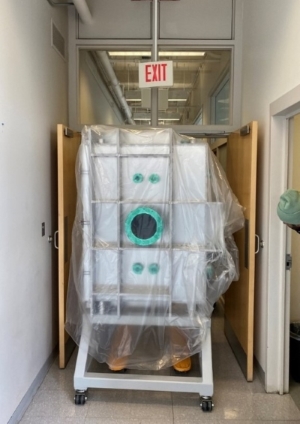
Photo: In UMBC's Physics building, there was just enough clearance to get the chamber through the 3rd floor corridor to the lab.
Photo courtesy of D. Nelson.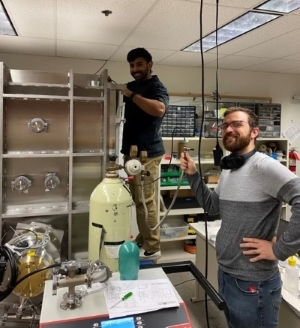 Photo:
 ESI interns Jacob Thomas (
UMBC ME graduate student) and Lars Sobieski (
UMBC ME undergraduate student) perform a leak check on the sealed chamber.
Photo courtesy of D. Nelson.
Since the chamber arrived in January 2025, ESI engineers and engineering interns have been hard at work building its plumbing and control system. Now, the TVAC is fully functional, able to reach pressures as low as 5*10-7 mBar—over 2 billion times lower than atmospheric pressure! Soon ESI will begin using this new facility to test electronics and optical sensors they plan to use in future space missions.
While it’s been a long journey already, this is only the beginning for ESI’s improved in-house space simulation and ground testing capabilities.
Photo, l - r: ESI interns Jacob Thomas and Lars Sobieski along with ESI engineers
Danny Nelson,
CJ Escobar, and
Dominik Cieslak all played roles designing, building, and commissioning the chamber.
Photo provided by D. Nelson.
(Thanks to Danny Nelson for providing this article!)
]]>
This past week, members of the Earth & Space Institute finished commissioning their new thermal vacuum chamber (TVAC), a breathtaking piece of engineering—literally! In the aerospace industry,...
Photo
https://assets3-beta.my.umbc.edu/system/shared/attachments/87ec6ce11979f05a4d32a12a78023849/69f7312c/news/000/151/403/18fd0c19f24e132a9ca0ed7a5ab42b47/TVAC finished product web.jpg?1754686036
https://beta.my.umbc.edu/api/v0/pixel/news/151403/guest@my.umbc.edu/88a311b04e319195f01463bfffbcedd5/api/pixel
esi
meche
Earth and Space Institute
https://beta.my.umbc.edu/groups/esi
https://assets4-beta.my.umbc.edu/system/shared/avatars/groups/000/002/124/0edf78e65ae95730e0c3687aa55486c5/xsmall.png?1708376163
https://assets1-beta.my.umbc.edu/system/shared/avatars/groups/000/002/124/0edf78e65ae95730e0c3687aa55486c5/original.png?1708376163
https://assets3-beta.my.umbc.edu/system/shared/avatars/groups/000/002/124/0edf78e65ae95730e0c3687aa55486c5/xxlarge.png?1708376163
https://assets3-beta.my.umbc.edu/system/shared/avatars/groups/000/002/124/0edf78e65ae95730e0c3687aa55486c5/xlarge.png?1708376163
https://assets3-beta.my.umbc.edu/system/shared/avatars/groups/000/002/124/0edf78e65ae95730e0c3687aa55486c5/large.png?1708376163
https://assets4-beta.my.umbc.edu/system/shared/avatars/groups/000/002/124/0edf78e65ae95730e0c3687aa55486c5/medium.png?1708376163
https://assets3-beta.my.umbc.edu/system/shared/avatars/groups/000/002/124/0edf78e65ae95730e0c3687aa55486c5/small.png?1708376163
https://assets4-beta.my.umbc.edu/system/shared/avatars/groups/000/002/124/0edf78e65ae95730e0c3687aa55486c5/xsmall.png?1708376163
https://assets4-beta.my.umbc.edu/system/shared/avatars/groups/000/002/124/0edf78e65ae95730e0c3687aa55486c5/xxsmall.png?1708376163
Earth and Space Institute
https://assets2-beta.my.umbc.edu/system/shared/thumbnails/news/000/151/403/5e66889d040a846dbcb59fc059a038bb/xxlarge.jpg?1754684682
https://assets4-beta.my.umbc.edu/system/shared/thumbnails/news/000/151/403/5e66889d040a846dbcb59fc059a038bb/xlarge.jpg?1754684682
https://assets4-beta.my.umbc.edu/system/shared/thumbnails/news/000/151/403/5e66889d040a846dbcb59fc059a038bb/large.jpg?1754684682
https://assets4-beta.my.umbc.edu/system/shared/thumbnails/news/000/151/403/5e66889d040a846dbcb59fc059a038bb/medium.jpg?1754684682
https://assets3-beta.my.umbc.edu/system/shared/thumbnails/news/000/151/403/5e66889d040a846dbcb59fc059a038bb/small.jpg?1754684682
https://assets4-beta.my.umbc.edu/system/shared/thumbnails/news/000/151/403/5e66889d040a846dbcb59fc059a038bb/xsmall.jpg?1754684682
https://assets4-beta.my.umbc.edu/system/shared/thumbnails/news/000/151/403/5e66889d040a846dbcb59fc059a038bb/xxsmall.jpg?1754684682
8
0
false
Fri, 08 Aug 2025 17:30:26 -0400
Fri, 08 Aug 2025 17:31:16 -0400
For ESI undergraduate engineer Lars Sobieski, space hardware is both tech and art
Lars Sobieski, undergraduate mechanical engineer at the Earth and Space Institute, spends his day developing hardware and testing for future climate satellites. At ESI, he designs and fabricates some of the ground support equipment (GSE) that will help calibrate future climate instruments, particularly the two-dimensional focal plane arrays (FPA). The FPA is the surface of a detector that collects light across millions of pixels and converts it into an image. ESI is developing FPAs for upcoming satellite instruments that are sensitive to ultraviolet (UV), visible (VIS), and shortwave infrared (SWIR) wavelengths. These are critical spectral ranges for studying Earth’s clouds, aerosols, land, ocean, and atmosphere.
A major type of testing that satellites and their detectors undergo before launch is thermal vacuum (TVAC) testing. In the lab, Mr. Sobieski and ESI faculty are preparing an industrial TVAC chamber, which can submit our space hardware to orbit temperatures (-20C to +20C) and space-like pressures (10-7 millibars and lower). This TVAC chamber was part of a major state grant to ESI, led by Maryland Senators Ben Cardin and Chris Van Hollen, to boost UMBC’s capacity to support new space and satellite projects.
Mr. Sobieski is currently helping to optimize the TVAC chamber for related testing. However, he explains, “Because the TVAC chamber will not be ready for use for some of the FPA tests, I was given the task of designing and building an enclosure that can fit the GSE needed for the UV/VIS FPA test. This enclosure will be purged with dry air to ensure that no condensation will form on the electronics as they are chilled to below the dewpoint. It must also isolate the FPA from electrostatic discharge and provide through-wall access points for power, data, pneumatics, and a liquid cooling loop.” This will be used to verify the operation of the FPA prior to testing it under day-night temperature swings or the low pressures of the orbit environment.
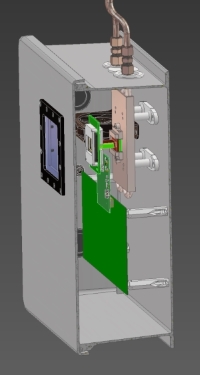
Photo: The full assembly of the UV/VIS FPA (center gray part) and associated electronics in a metal enclosure for electronics testing. Photo Credit: L. Sobieski/ESI.
Since March 2025, he took on a completely different project for ESI in parallel – developing a full-scale 3D-printed model of the HARP CubeSat, ESI’s first foray into small satellite technology for studying Earth’s climate. According to Mr. Sobieski, “The process involved using the existing CAD assembly of the CubeSat to create a new, simplified model from scratch to reduce the part count. While the actual CubeSat had a few thousand parts, the 3D-printable model has only nineteen.” After a few rounds of test prints, gluing, body-filling, sanding, and priming, Mr. Sobieski enlisted the help of his fiancée to do the detail brush painting. For the end result, the 3D model of the HARP CubeSat looks remarkably similar to what actually flew in space from 2020-2022.
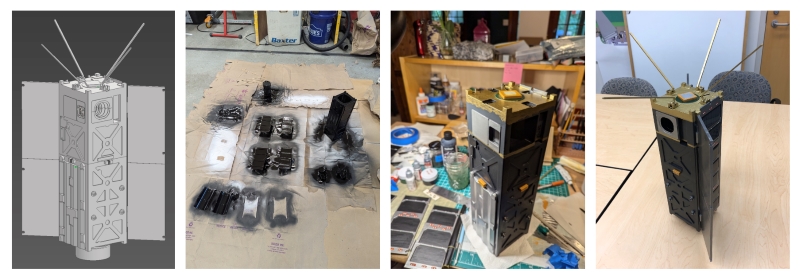
Photos: Process composite of the development of the HARP CubeSat 3D model. The monobloc model derived from the original satellite CAD file (left), components were primed (center left), painted to match the satellite (center right), and the final model (right). Photo Credit: L. Sobieski/ESI.
]]>
Lars Sobieski, undergraduate mechanical engineer at the Earth and Space Institute, spends his day developing hardware and testing for future climate satellites. At ESI, he designs and fabricates...
Photo
https://assets3-beta.my.umbc.edu/system/shared/attachments/f061563d0bd25c62c7fd668ae6017f67/69f7312c/news/000/151/112/a2a16ef634b4226ccfffd6853193fa56/HARPCubeSat_Process web.jpg?1753206262
https://beta.my.umbc.edu/api/v0/pixel/news/151112/guest@my.umbc.edu/a6ac25d34c07c6d6fcc915ac851397b4/api/pixel
esi
meche
Earth and Space Institute
https://beta.my.umbc.edu/groups/esi
https://assets4-beta.my.umbc.edu/system/shared/avatars/groups/000/002/124/0edf78e65ae95730e0c3687aa55486c5/xsmall.png?1708376163
https://assets1-beta.my.umbc.edu/system/shared/avatars/groups/000/002/124/0edf78e65ae95730e0c3687aa55486c5/original.png?1708376163
https://assets3-beta.my.umbc.edu/system/shared/avatars/groups/000/002/124/0edf78e65ae95730e0c3687aa55486c5/xxlarge.png?1708376163
https://assets3-beta.my.umbc.edu/system/shared/avatars/groups/000/002/124/0edf78e65ae95730e0c3687aa55486c5/xlarge.png?1708376163
https://assets3-beta.my.umbc.edu/system/shared/avatars/groups/000/002/124/0edf78e65ae95730e0c3687aa55486c5/large.png?1708376163
https://assets4-beta.my.umbc.edu/system/shared/avatars/groups/000/002/124/0edf78e65ae95730e0c3687aa55486c5/medium.png?1708376163
https://assets3-beta.my.umbc.edu/system/shared/avatars/groups/000/002/124/0edf78e65ae95730e0c3687aa55486c5/small.png?1708376163
https://assets4-beta.my.umbc.edu/system/shared/avatars/groups/000/002/124/0edf78e65ae95730e0c3687aa55486c5/xsmall.png?1708376163
https://assets4-beta.my.umbc.edu/system/shared/avatars/groups/000/002/124/0edf78e65ae95730e0c3687aa55486c5/xxsmall.png?1708376163
Earth and Space Institute
https://assets4-beta.my.umbc.edu/system/shared/thumbnails/news/000/151/112/96cbecebd85bf663fe7fd366e1d180b3/xxlarge.jpg?1753209288
https://assets4-beta.my.umbc.edu/system/shared/thumbnails/news/000/151/112/96cbecebd85bf663fe7fd366e1d180b3/xlarge.jpg?1753209288
https://assets4-beta.my.umbc.edu/system/shared/thumbnails/news/000/151/112/96cbecebd85bf663fe7fd366e1d180b3/large.jpg?1753209288
https://assets1-beta.my.umbc.edu/system/shared/thumbnails/news/000/151/112/96cbecebd85bf663fe7fd366e1d180b3/medium.jpg?1753209288
https://assets3-beta.my.umbc.edu/system/shared/thumbnails/news/000/151/112/96cbecebd85bf663fe7fd366e1d180b3/small.jpg?1753209288
https://assets3-beta.my.umbc.edu/system/shared/thumbnails/news/000/151/112/96cbecebd85bf663fe7fd366e1d180b3/xsmall.jpg?1753209288
https://assets3-beta.my.umbc.edu/system/shared/thumbnails/news/000/151/112/96cbecebd85bf663fe7fd366e1d180b3/xxsmall.jpg?1753209288
8
0
false
Tue, 22 Jul 2025 14:37:23 -0400
Tue, 22 Jul 2025 15:01:39 -0400
It’s all fun and (addictive!) games for ESI software engineer Jet Thompson
On April 16, 2025, UMBC held its annual Undergraduate Research and Creative Achievement Day (
URCAD) conference. This event features research done by undergraduates from all majors under the supervision of a faculty mentor. At URCAD, ESI software engineer
Jet Thompson and his collaborators demonstrated a video game called Bullet Blox. Mr. Thompson's team developed the game over the last year with
Dr. Marc Olano, Professor of Computer Science and Electrical Engineering at UMBC, for the Capstone Games Group Project course (CMSC493/ART485).
Bullet Blox is a platformer similar to Nintendo’s Super Mario Bros., where the player jumps to progress through a series of vertical levels. In Mr. Thompson’s game, the player can break the blocks that form the platforms and use them against the enemies. “My role in development was Programming Lead, so I was in charge of determining what programming tasks needed to be done, who should do them, and of course do some core programming myself. Thanks for my prior experience with Unity, I also assisted with design decisions and in determining what art assets were necessary for the game,” he said.
Mr. Thompson showcased a second game,
Phantom Feline, that he developed with a different group of collaborators at the International Game Developers Association (
IGDA) Student Games Showcase on April 28, 2025 at Baltimore’s
MICA campus. Unlike with Bullet Blox, the player controls a sneaky cat that can travel through walls, but only if the wall is illuminated. Each level is short, but the player must maneuver carefully to take advantage of the lights, while avoiding enemies and pits.
At ESI, Mr. Thompson developed the operational software of
AirHARP2, a collection of four
Earth-observation instruments that flew during NASA’s recent PACE-PAX field campaign. His software and after-hours troubleshooting with the ESI team in the field was a major factor in the success of AirHARP2 during
PACE-PAX. He also leads a team of undergraduate software engineers at ESI in the development of a digital twin architecture for next-generation satellite measurements.
Photo (Bullet Blox): The title screen and an action shot from Mr. Thompson’s Bullet Blox
video game. Photo Credit: J. Thompson/ESI.
Photo (Phantom Feline): In Mr. Thompson’s Phantom Feline, the cat must make it up to the door in each level by passing through illuminated walls. Photo Credit: J. Thompson/ESI.
]]>
On April 16, 2025, UMBC held its annual Undergraduate Research and Creative Achievement Day (URCAD) conference. This event features research done by undergraduates from all majors under the...
Photo
https://assets4-beta.my.umbc.edu/system/shared/attachments/8e2a229a867ac8240ab9e4af29f0399f/69f7312c/news/000/150/901/d17d3d5543a6903d0e080c2362fcec7f/BulletBlox web.png?1751491668
https://beta.my.umbc.edu/api/v0/pixel/news/150901/guest@my.umbc.edu/98d09d995c7d210e55134a45a1d57e4a/api/pixel
coeit
csee
esi
Earth and Space Institute
https://beta.my.umbc.edu/groups/esi
https://assets4-beta.my.umbc.edu/system/shared/avatars/groups/000/002/124/0edf78e65ae95730e0c3687aa55486c5/xsmall.png?1708376163
https://assets1-beta.my.umbc.edu/system/shared/avatars/groups/000/002/124/0edf78e65ae95730e0c3687aa55486c5/original.png?1708376163
https://assets3-beta.my.umbc.edu/system/shared/avatars/groups/000/002/124/0edf78e65ae95730e0c3687aa55486c5/xxlarge.png?1708376163
https://assets3-beta.my.umbc.edu/system/shared/avatars/groups/000/002/124/0edf78e65ae95730e0c3687aa55486c5/xlarge.png?1708376163
https://assets3-beta.my.umbc.edu/system/shared/avatars/groups/000/002/124/0edf78e65ae95730e0c3687aa55486c5/large.png?1708376163
https://assets4-beta.my.umbc.edu/system/shared/avatars/groups/000/002/124/0edf78e65ae95730e0c3687aa55486c5/medium.png?1708376163
https://assets3-beta.my.umbc.edu/system/shared/avatars/groups/000/002/124/0edf78e65ae95730e0c3687aa55486c5/small.png?1708376163
https://assets4-beta.my.umbc.edu/system/shared/avatars/groups/000/002/124/0edf78e65ae95730e0c3687aa55486c5/xsmall.png?1708376163
https://assets4-beta.my.umbc.edu/system/shared/avatars/groups/000/002/124/0edf78e65ae95730e0c3687aa55486c5/xxsmall.png?1708376163
Earth and Space Institute
https://assets1-beta.my.umbc.edu/system/shared/thumbnails/news/000/150/901/13e3789a1e18f1d07d5cecfbdf6ecfa2/xxlarge.jpg?1751492665
https://assets1-beta.my.umbc.edu/system/shared/thumbnails/news/000/150/901/13e3789a1e18f1d07d5cecfbdf6ecfa2/xlarge.jpg?1751492665
https://assets3-beta.my.umbc.edu/system/shared/thumbnails/news/000/150/901/13e3789a1e18f1d07d5cecfbdf6ecfa2/large.jpg?1751492665
https://assets2-beta.my.umbc.edu/system/shared/thumbnails/news/000/150/901/13e3789a1e18f1d07d5cecfbdf6ecfa2/medium.jpg?1751492665
https://assets2-beta.my.umbc.edu/system/shared/thumbnails/news/000/150/901/13e3789a1e18f1d07d5cecfbdf6ecfa2/small.jpg?1751492665
https://assets4-beta.my.umbc.edu/system/shared/thumbnails/news/000/150/901/13e3789a1e18f1d07d5cecfbdf6ecfa2/xsmall.jpg?1751492665
https://assets4-beta.my.umbc.edu/system/shared/thumbnails/news/000/150/901/13e3789a1e18f1d07d5cecfbdf6ecfa2/xxsmall.jpg?1751492665
6
0
false
Wed, 02 Jul 2025 17:46:04 -0400
ESI's Ana Prados' research featured in Spanish Science News article
A recent Remote Sensing paper by Ana Prados, "Key Governance Practices that Facilitate the Use of Remote Sensing Information for Wildfire Management: A Case Study in Spain," was featured in an article in Sinc, Ciencia Contada en Espanol titled "Vivir donde el fuego siempre vuelve."
In the Sinc article, they discuss Dr. Prados' paper, which "outlines the results of interviews held with 50 stakeholders across Spain (firefighters, government agencies, private sector, universities). It identified 6 key factors in satellite data governance for wildfire management in Spain: 1) the strength of the stakeholder networks, 2) open data access, 3) capacity building, 4) governance frameworks, 5) Institutional buy-in, and 6) translation of satellite information; and proposed a methodology that other countries or subnational entities can adopt for identifying their own data governance factors." Dr. Prados also refers to the use of
INFOCAM, a site that provides information on forest fires in Castilla-La Mancha, Spain.
On June 3, 2025, UMBC graduate student
Noah Sienkiewicz successfully defended his dissertation in Atmospheric Physics, titled “Characterization of the HARP2 instrument and its Influences on the Polarimetric Retrieval of Aerosol Particles” in front of his PhD committee members, UMBC Department of Physics faculty, ESI colleagues, family, and friends.
Dr. Sienkiewicz discussed three major components of his doctoral research: (1) the development of a simulation for scheduling and taking data from ESI’s
HARP CubeSat satellite sensor over scientifically interesting global targets, (2) the pre-launch calibration of the
HARP2 instrument on the NASA PACE mission, and (3) a characterization of HARP2’s measurement uncertainty relative to aerosol properties.
Over the past eight years, Noah was a core member of the HARP2 science team and followed the development of the instrument from conception, assembly, calibration, launch, post-launch support, data processing, and scientific communication at several international conferences and in two first-author publications. He will begin a NASA Postdoctoral Program
(NPP) fellowship in July 2025 under Dr. Reed Espinosa at NASA GSFC. In this new role, he will further study the relationship between multi-angle polarimeter measurements, like those from HARP2, and the climate information contained in their datasets.
Congratulations, Dr. Sienkiewicz!
Photo: Dr. Noah Sienkiewicz and his advisor Dr. J. Vanderlei Martins, Physics professor and ESI director, pose together after his defense. Photo credit: Anin Puthukkudy/ESI
Photo: Dr. Noah Sienkiewicz celebrates the end of his PhD journey with ESI colleagues and fellow graduate students. From left to right: Dr. Anin Puthukkudy, Dr. Brent McBride, Greema Regmi, Dr. Noah Sienkiewicz, Nirandi Jayasinghe, Rachel Smith, and Dr. Xiaoguang Xu. Photo credit: Anin Puthukkudy/ESI
]]>
On June 3, 2025, UMBC graduate student Noah Sienkiewicz successfully defended his dissertation in Atmospheric Physics, titled “Characterization of the HARP2 instrument and its Influences on the...
Photo
https://assets1-beta.my.umbc.edu/system/shared/attachments/e18d1bac5e1b55f084466676a18881cf/69f7312c/news/000/150/550/c85217f5268d594e3fcc05c546a97834/Noah and Vanderlei.jpg?1749134769
https://beta.my.umbc.edu/api/v0/pixel/news/150550/guest@my.umbc.edu/d5957fb7c130aad57002a28b068268e1/api/pixel
esi
Earth and Space Institute
https://beta.my.umbc.edu/groups/esi
https://assets4-beta.my.umbc.edu/system/shared/avatars/groups/000/002/124/0edf78e65ae95730e0c3687aa55486c5/xsmall.png?1708376163
https://assets1-beta.my.umbc.edu/system/shared/avatars/groups/000/002/124/0edf78e65ae95730e0c3687aa55486c5/original.png?1708376163
https://assets3-beta.my.umbc.edu/system/shared/avatars/groups/000/002/124/0edf78e65ae95730e0c3687aa55486c5/xxlarge.png?1708376163
https://assets3-beta.my.umbc.edu/system/shared/avatars/groups/000/002/124/0edf78e65ae95730e0c3687aa55486c5/xlarge.png?1708376163
https://assets3-beta.my.umbc.edu/system/shared/avatars/groups/000/002/124/0edf78e65ae95730e0c3687aa55486c5/large.png?1708376163
https://assets4-beta.my.umbc.edu/system/shared/avatars/groups/000/002/124/0edf78e65ae95730e0c3687aa55486c5/medium.png?1708376163
https://assets3-beta.my.umbc.edu/system/shared/avatars/groups/000/002/124/0edf78e65ae95730e0c3687aa55486c5/small.png?1708376163
https://assets4-beta.my.umbc.edu/system/shared/avatars/groups/000/002/124/0edf78e65ae95730e0c3687aa55486c5/xsmall.png?1708376163
https://assets4-beta.my.umbc.edu/system/shared/avatars/groups/000/002/124/0edf78e65ae95730e0c3687aa55486c5/xxsmall.png?1708376163
Earth and Space Institute
https://assets2-beta.my.umbc.edu/system/shared/thumbnails/news/000/150/550/818098049f72388ddb27691de87ca169/xxlarge.jpg?1749137351
https://assets4-beta.my.umbc.edu/system/shared/thumbnails/news/000/150/550/818098049f72388ddb27691de87ca169/xlarge.jpg?1749137351
https://assets2-beta.my.umbc.edu/system/shared/thumbnails/news/000/150/550/818098049f72388ddb27691de87ca169/large.jpg?1749137351
https://assets3-beta.my.umbc.edu/system/shared/thumbnails/news/000/150/550/818098049f72388ddb27691de87ca169/medium.jpg?1749137351
https://assets2-beta.my.umbc.edu/system/shared/thumbnails/news/000/150/550/818098049f72388ddb27691de87ca169/small.jpg?1749137351
https://assets2-beta.my.umbc.edu/system/shared/thumbnails/news/000/150/550/818098049f72388ddb27691de87ca169/xsmall.jpg?1749137351
https://assets3-beta.my.umbc.edu/system/shared/thumbnails/news/000/150/550/818098049f72388ddb27691de87ca169/xxsmall.jpg?1749137351
15
0
false
Thu, 05 Jun 2025 11:30:20 -0400
Queen Anne’s County middle school students explore polarized light at UMBC’s ESI
On April 4, 2025, 8th grade students from Queen
Anne’s County visited UMBC's campus as part of a broader campus tour. The youth
visit was led by Dr. Sarah Gardenghi, Assistant Vice Provost of Educational
Pathways and Partnerships at UMBC. The students met with current undergraduate students to hear
their perspective on college and participated in an activity related to research
going on at UMBC. For the activity, the students visited the Earth and Space
Institute, where ESI scientist Dr. Brent McBride demonstrated how climate
scientists use light to learn more about Earth’s climate (see photo).
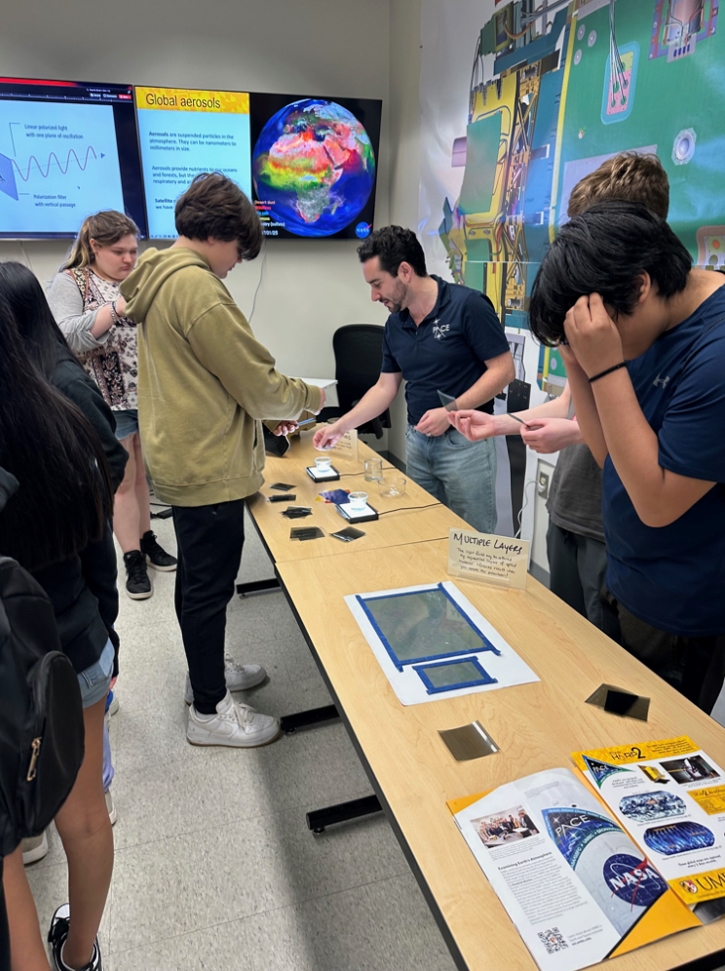
Photo: Dr. Brent McBride chats with several students about the difference between corn syrup and vegetable oil under polarized light. Photo Credit: Sarah Gardenghi/DPS.
The students used linear polarizer sheets to change the
light passing through common household objects, such as transparent cutlery,
corn syrup, and vegetable oil. Depending on the material, the color of these
objects changed dramatically or had no effect at all when a polarizer was
rotated in front of it. For example, rotating a polarizer in front of the
cutlery produced beautiful rainbow-like stress patterns. Dr. McBride put
transparent packing tape in various directions over a glass plate, as well. When
observed through a polarizer, a mosaic of rainbow shapes and polygons appeared.
These colors changed from teal to purple and orange as the observing polarizer
was rotated (see photo).
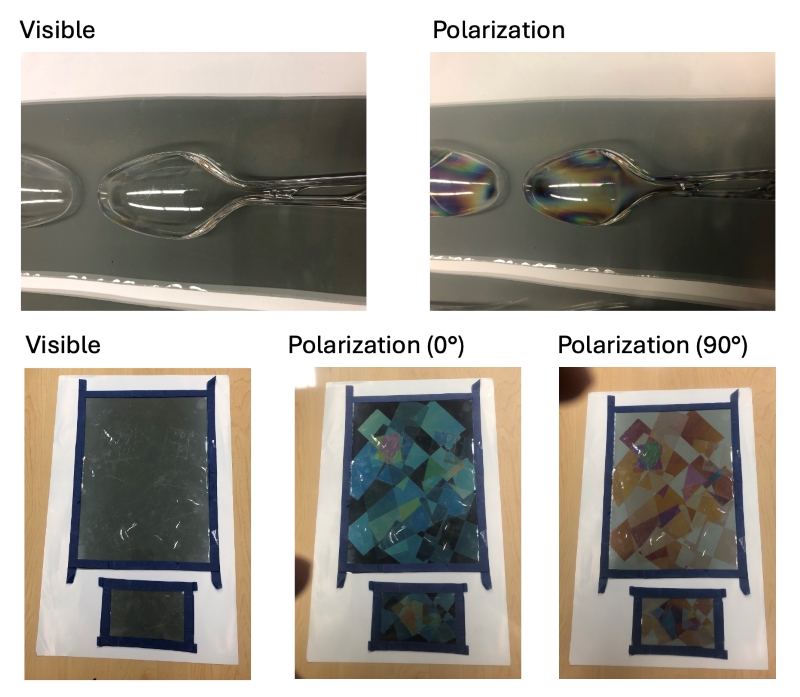
Photo: The spoon observed in visible (top left) and between polarizing filters (top right), and the tape mosaic observed in visible (bottom left) and polarized light (bottom center/right). Rotating the observing polarizer (in front of the camera) to different angles creates a different color pattern. Photo Credit: Brent McBride/ESI.
The tape, transparent plastic, and corn syrup can act as wave
plates. These filters alter how much and the content of the light that
passes through based on the wavelength of the light. The differing index of
refraction between the objects and the air, as well as their molecular
composition and surface shape, can also impact how much color or brightness is
observed.
Polarization imaging technology is currently used by ESI’s
HARP2 instrument on NASA’s Plankton Aerosol Cloud ocean Ecosystem (PACE)
mission. Climate scientists can use HARP2 polarized imagery to distinguish dust
vs. smoke, liquid water droplets vs. ice crystals, and surface or ocean signals
from the atmosphere in both familiar and new ways.
]]>
On April 4, 2025, 8th grade students from Queen Anne’s County visited UMBC's campus as part of a broader campus tour. The youth visit was led by Dr. Sarah Gardenghi, Assistant Vice Provost of...
Photo
https://assets1-beta.my.umbc.edu/system/shared/attachments/e3d0e111c30b8b710a0ad5e0e1f343ff/69f7312c/news/000/149/295/9106f20ec0407152b603895dd2390786/McBride_ESI_QACstudents web.jpg?1745263734
https://beta.my.umbc.edu/api/v0/pixel/news/149295/guest@my.umbc.edu/4dce540b2bc2b5441383393142938737/api/pixel
esi
Earth and Space Institute
https://beta.my.umbc.edu/groups/esi
https://assets4-beta.my.umbc.edu/system/shared/avatars/groups/000/002/124/0edf78e65ae95730e0c3687aa55486c5/xsmall.png?1708376163
https://assets1-beta.my.umbc.edu/system/shared/avatars/groups/000/002/124/0edf78e65ae95730e0c3687aa55486c5/original.png?1708376163
https://assets3-beta.my.umbc.edu/system/shared/avatars/groups/000/002/124/0edf78e65ae95730e0c3687aa55486c5/xxlarge.png?1708376163
https://assets3-beta.my.umbc.edu/system/shared/avatars/groups/000/002/124/0edf78e65ae95730e0c3687aa55486c5/xlarge.png?1708376163
https://assets3-beta.my.umbc.edu/system/shared/avatars/groups/000/002/124/0edf78e65ae95730e0c3687aa55486c5/large.png?1708376163
https://assets4-beta.my.umbc.edu/system/shared/avatars/groups/000/002/124/0edf78e65ae95730e0c3687aa55486c5/medium.png?1708376163
https://assets3-beta.my.umbc.edu/system/shared/avatars/groups/000/002/124/0edf78e65ae95730e0c3687aa55486c5/small.png?1708376163
https://assets4-beta.my.umbc.edu/system/shared/avatars/groups/000/002/124/0edf78e65ae95730e0c3687aa55486c5/xsmall.png?1708376163
https://assets4-beta.my.umbc.edu/system/shared/avatars/groups/000/002/124/0edf78e65ae95730e0c3687aa55486c5/xxsmall.png?1708376163
Earth and Space Institute
https://assets3-beta.my.umbc.edu/system/shared/thumbnails/news/000/149/295/72ccd3ee41835791860d313232ab1f41/xxlarge.jpg?1745264452
https://assets4-beta.my.umbc.edu/system/shared/thumbnails/news/000/149/295/72ccd3ee41835791860d313232ab1f41/xlarge.jpg?1745264452
https://assets4-beta.my.umbc.edu/system/shared/thumbnails/news/000/149/295/72ccd3ee41835791860d313232ab1f41/large.jpg?1745264452
https://assets2-beta.my.umbc.edu/system/shared/thumbnails/news/000/149/295/72ccd3ee41835791860d313232ab1f41/medium.jpg?1745264452
https://assets4-beta.my.umbc.edu/system/shared/thumbnails/news/000/149/295/72ccd3ee41835791860d313232ab1f41/small.jpg?1745264452
https://assets2-beta.my.umbc.edu/system/shared/thumbnails/news/000/149/295/72ccd3ee41835791860d313232ab1f41/xsmall.jpg?1745264452
https://assets1-beta.my.umbc.edu/system/shared/thumbnails/news/000/149/295/72ccd3ee41835791860d313232ab1f41/xxsmall.jpg?1745264452
12
0
false
Mon, 21 Apr 2025 15:44:07 -0400
ESI leads re-calibration activities for its AirHARP2 Suite at NASA’s GLAMR lab
From March 10 - 14, 2025, UMBC Atmospheric Physics graduate student
Rachel Smith and ESI mechanical engineers
CJ Escobar and
Ian Decker calibrated ESI’s AirHARP2 ultraviolet spectrometer (AH2-UV) and shortwave-infrared imager (AH2-SWIR) instruments at the NASA Goddard Space Flight Center's (GSFC) Goddard Laser for Absolute Measurement of Radiance
(GLAMR) laboratory. GLAMR is a specialized integrating sphere, a device that generates a spatially uniform and depolarized light field. GLAMR can also produce calibrated light fields from the ultraviolet to the shortwave-infrared, and at high spectral precision (1 nanometer steps or less!).
The ESI team took GLAMR measurements with the AH2-UV and AH2-SWIR to evaluate the spectral response function (SRF) of the instruments. The SRF tells us which wavelengths of light meaningfully contribute to information measured at the detector. The more accurately we can characterize the SRF, the more accurately we can use the measurements of the AH2-UV and AH2-SWIR to infer climate-relevant properties of Earth’s atmosphere and surface.
The AirHARP2 suite contains four compact remote sensors that can all image the same scene on the ground at the same time. The lead instrument is a copy of the HARP2 polarimeter on the NASA Plankton Aerosol Cloud ocean Ecosystem
(PACE) mission. The combination of all four instruments, which also includes a spectrometer that images in the visible and near-infrared, increases the amount of information content that is possible in a single observation of clouds, aerosol, land, ocean, or atmosphere. The four instruments took over 75 legs of data (i.e., uninterrupted stretches of data) during NASA’s
PACE-PAX campaign last fall. ESI members are currently hard at work converting this calibration data into meaningful and physical imagery for the climate community to use.
Interested in the data from the AirHARP2 suite during PACE-PAX? The ESI team is releasing science-ready datasets from the polarimeter on Monday, March 31, 2025 via the
NASA Langley Atmospheric Science Data Center. Data from the other instruments will come at a later date.
Photo (left): The AH2-UV instrument (gold box) is centered on the aperture of the GLAMR integrating sphere at NASA GSFC prior to calibration. Credit: GLAMR Team.
Photo (right): A preliminary SRF for one of the spectral filters in the AH2-SWIR instrument. Black curve is for visual guidance only. Credit: B. McBride/ESI.