<?xml version="1.0"?>
<News hasArchived="true" page="133" pageCount="255" pageSize="10" timestamp="Fri, 24 Apr 2026 14:42:26 -0400" url="https://beta.my.umbc.edu/groups/ene/posts.xml?page=133">
<NewsItem contentIssues="false" id="97342" important="false" status="posted" url="https://beta.my.umbc.edu/groups/ene/posts/97342">
<Title>Resolved but Not Rejoicing: A Reflection after Election 2020</Title>
<Body>
<![CDATA[
    <div class="html-content"><div><strong>by Charis Lawson, '21, English</strong></div><div><strong>Civic Literacy Intern, Center for Democracy and Civic Life</strong></div><div><br></div><div>My relief is tainted. When I first realized that Joe Biden was probably going to be President of the United States, I had an overwhelming sense of accomplishment that was almost immediately mellowed. In the back of my mind, I kept hearing Biden’s voice from the video clip that swirled around the internet where he stated, “If you have a problem figuring out whether you're for me or Trump, then you ain't black.” This message to the black community is disheartening because plenty of candidates claiming to represent us have failed to deliver on their promises. Their rhetoric has implied that we shouldn’t ask questions, just be satisfied with the lesser of two evils. The black community is often left with the bare minimum, and then asked why we aren’t happy.  Yet as the weekend progressed, everyone’s joy seeped into my own soul, giving me a sense of warmth that I hadn’t felt in years. I wanted to hold on to the feeling of togetherness and accomplishment of the people around me. </div><div><br></div><div>While I am happy with the outcome of the election I am not ecstatic. This election did not diminish my resolve to work for positive change. I want people to know that the fight for justice isn’t over, and want to be sure they are not lulled into a false sense of safety just because we have someone who knows how to speak coherently leading us. While of course, it goes deeper than that, I am afraid that by comparing Biden to someone I have would describe as incompetent we place him on a pedestal he doesn’t deserve.</div><div><br></div><div>I am motivated to continue to have deep conversations with peers and those with more knowledge than me about the problems that have plagued this country since its founding. I am determined to find unity amidst the chaos because I do not believe that all people who disagree with me are filled with hate. For me, that means starting locally because that is all that I feel equipped to handle. At this point, I have met all of the representatives from my Maryland General Assembly district and talked to them about the policies they see as important and am in the process of educating myself on those issues so I feel more equipped to form my own opinions. </div><div><br></div><div>I hate the idea that one party is inherently moral and the other is inherently evil. Both parties have work to do. Figuring out exactly what I want to accomplish is evolving with the knowledge that I gain from my representatives and my own research and discussion with my peers.  I am determined to work toward the world as I imagine it: the world as it could be. </div><div><br></div><div><strong>Contact the author, Charis Lawson, at <a href="mailto:chala1@UMBC.edu">chala1@UMBC.edu</a>.</strong></div></div>
]]>
</Body>
<Summary>by Charis Lawson, '21, English  Civic Literacy Intern, Center for Democracy and Civic Life     My relief is tainted. When I first realized that Joe Biden was probably going to be President of the...</Summary>
<TrackingUrl>https://beta.my.umbc.edu/api/v0/pixel/news/97342/guest@my.umbc.edu/3d1ef22527b5ec73eb96d6f60a170a10/api/pixel</TrackingUrl>
<Tag>election2020</Tag>
<Group token="civiclife">Center for Democracy and Civic Life</Group>
<GroupUrl>https://beta.my.umbc.edu/groups/civiclife</GroupUrl>
<AvatarUrl>https://assets1-beta.my.umbc.edu/system/shared/avatars/groups/000/001/462/3559ec2c1c4f29266d1c1eb0f1164549/xsmall.png?1554944150</AvatarUrl>
<AvatarUrl size="original">https://assets2-beta.my.umbc.edu/system/shared/avatars/groups/000/001/462/3559ec2c1c4f29266d1c1eb0f1164549/original.png?1554944150</AvatarUrl>
<AvatarUrl size="xxlarge">https://assets1-beta.my.umbc.edu/system/shared/avatars/groups/000/001/462/3559ec2c1c4f29266d1c1eb0f1164549/xxlarge.png?1554944150</AvatarUrl>
<AvatarUrl size="xlarge">https://assets1-beta.my.umbc.edu/system/shared/avatars/groups/000/001/462/3559ec2c1c4f29266d1c1eb0f1164549/xlarge.png?1554944150</AvatarUrl>
<AvatarUrl size="large">https://assets3-beta.my.umbc.edu/system/shared/avatars/groups/000/001/462/3559ec2c1c4f29266d1c1eb0f1164549/large.png?1554944150</AvatarUrl>
<AvatarUrl size="medium">https://assets1-beta.my.umbc.edu/system/shared/avatars/groups/000/001/462/3559ec2c1c4f29266d1c1eb0f1164549/medium.png?1554944150</AvatarUrl>
<AvatarUrl size="small">https://assets3-beta.my.umbc.edu/system/shared/avatars/groups/000/001/462/3559ec2c1c4f29266d1c1eb0f1164549/small.png?1554944150</AvatarUrl>
<AvatarUrl size="xsmall">https://assets1-beta.my.umbc.edu/system/shared/avatars/groups/000/001/462/3559ec2c1c4f29266d1c1eb0f1164549/xsmall.png?1554944150</AvatarUrl>
<AvatarUrl size="xxsmall">https://assets4-beta.my.umbc.edu/system/shared/avatars/groups/000/001/462/3559ec2c1c4f29266d1c1eb0f1164549/xxsmall.png?1554944150</AvatarUrl>
<Sponsor>Center for Democracy and Civic Life</Sponsor>
<PawCount>22</PawCount>
<CommentCount>24</CommentCount>
<CommentsAllowed>true</CommentsAllowed>
<PostedAt>Tue, 10 Nov 2020 17:29:35 -0500</PostedAt>
<EditAt>Tue, 10 Nov 2020 17:29:55 -0500</EditAt>
</NewsItem>

<NewsItem contentIssues="false" id="97341" important="false" status="posted" url="https://beta.my.umbc.edu/groups/ene/posts/97341">
<Title>No Labels Virtual Event</Title>
<Tagline>Bi Partisan Discussion</Tagline>
<Body>
<![CDATA[
    <div class="html-content">Hey Political Science Students,<div><br></div><div><span>No
    Labels, a non-profit bipartisan organization based in DC, is holding a virtual
    discussion. For more information on how to take part in the discussion, see their invitation and attached flyer below.</span></div><div><span><br></span></div><div><div><p><em>Our generation has grown up with a dysfunctional political
    system that seems exhausting. But it wasn't always like this. Our parents and
    grandparents remember the days when Democrats and Republicans could sit down
    and actually talk with each other.<br>
    <br>
    But let's face it, if there is one thing we can all agree on it's this: we are
    tired of the partisan fighting. Now more than ever, we need to bring fellow
    Americans and our leaders together to solve problems after this election.<br>
    On Saturday, November 14th at 2PM ET, Youth Congress members will take part in
    a conversation with No Labels Chief Strategist Ryan Clancy and two members of
    Congress from the House Problem Solvers Caucus- a group of 25 Democratic and 25
    Republican House members who work together to put country over party. From
    there, we'll get to know each other through an interactive breakout session
    before receiving a post-election briefing from Ryan Clancy.<br>
    The No Labels Youth Congress provides a rare opportunity for tomorrow's leaders
    (ages 16-35) to learn from and with each other and to help grow a movement
    whose mission - of bringing our leaders together to solve problems - suddenly
    has a new urgency.<br>Register here for this free, virtual event: <a href="https://www.nolabels.org/uni_nlyc" rel="nofollow external" class="bo">https://www.nolabels.org/uni_nlyc</a></em></p><br></div></div></div>
]]>
</Body>
<Summary>Hey Political Science Students,    No Labels, a non-profit bipartisan organization based in DC, is holding a virtual discussion. For more information on how to take part in the discussion, see...</Summary>
<AttachmentKind>Flyer</AttachmentKind>
<AttachmentUrl>https://assets3-beta.my.umbc.edu/system/shared/attachments/799e8453e4f26cb6d67093298a127e48/69ebb992/news/000/097/341/8c3fd8b7d87a3036af991a24120f0775/Copy of NLYC Samples- Sophia (8).jpg?1605046226</AttachmentUrl>
<Attachments>
<Attachment kind="Flyer" url="https://beta.my.umbc.edu/groups/ene/posts/97341/attachments/37899"></Attachment>
</Attachments>
<TrackingUrl>https://beta.my.umbc.edu/api/v0/pixel/news/97341/guest@my.umbc.edu/07ecf9f4cf128dcb1165a3f0c04b952c/api/pixel</TrackingUrl>
<Group token="poli">Political Science</Group>
<GroupUrl>https://beta.my.umbc.edu/groups/poli</GroupUrl>
<AvatarUrl>https://assets1-beta.my.umbc.edu/system/shared/avatars/groups/000/000/617/47f5d6b9ad18d16095cd0d4fc758b168/xsmall.png?1368723437</AvatarUrl>
<AvatarUrl size="original">https://assets4-beta.my.umbc.edu/system/shared/avatars/groups/000/000/617/47f5d6b9ad18d16095cd0d4fc758b168/original.png?1368723437</AvatarUrl>
<AvatarUrl size="xxlarge">https://assets4-beta.my.umbc.edu/system/shared/avatars/groups/000/000/617/47f5d6b9ad18d16095cd0d4fc758b168/xxlarge.png?1368723437</AvatarUrl>
<AvatarUrl size="xlarge">https://assets1-beta.my.umbc.edu/system/shared/avatars/groups/000/000/617/47f5d6b9ad18d16095cd0d4fc758b168/xlarge.png?1368723437</AvatarUrl>
<AvatarUrl size="large">https://assets3-beta.my.umbc.edu/system/shared/avatars/groups/000/000/617/47f5d6b9ad18d16095cd0d4fc758b168/large.png?1368723437</AvatarUrl>
<AvatarUrl size="medium">https://assets3-beta.my.umbc.edu/system/shared/avatars/groups/000/000/617/47f5d6b9ad18d16095cd0d4fc758b168/medium.png?1368723437</AvatarUrl>
<AvatarUrl size="small">https://assets2-beta.my.umbc.edu/system/shared/avatars/groups/000/000/617/47f5d6b9ad18d16095cd0d4fc758b168/small.png?1368723437</AvatarUrl>
<AvatarUrl size="xsmall">https://assets1-beta.my.umbc.edu/system/shared/avatars/groups/000/000/617/47f5d6b9ad18d16095cd0d4fc758b168/xsmall.png?1368723437</AvatarUrl>
<AvatarUrl size="xxsmall">https://assets1-beta.my.umbc.edu/system/shared/avatars/groups/000/000/617/47f5d6b9ad18d16095cd0d4fc758b168/xxsmall.png?1368723437</AvatarUrl>
<Sponsor>Political Science</Sponsor>
<PawCount>0</PawCount>
<CommentCount>0</CommentCount>
<CommentsAllowed>true</CommentsAllowed>
<PostedAt>Tue, 10 Nov 2020 17:10:48 -0500</PostedAt>
<EditAt>Wed, 11 Nov 2020 12:07:38 -0500</EditAt>
</NewsItem>

<NewsItem contentIssues="false" id="97291" important="false" status="posted" url="https://beta.my.umbc.edu/groups/ene/posts/97291">
<Title>Thoughts on Post-Election Safety</Title>
<Body>
<![CDATA[
    <div class="html-content"><div><strong>by Jasmine Lee, Ph.D.</strong></div><div><strong>Director of Inclusive Excellence and Initiatives for Identity, Inclusion, and Belonging</strong></div><div><strong>Division of Student Affairs</strong></div><div><br></div><div>I woke up this morning thinking about the election and thinking about safety. The “Election” took place on Tuesday evening, but it took us days to determine the final outcome. So many of us were anxiously checking the count and religiously reviewing credible sources, as we worked to get our heads wrapped around what our “tomorrow” would look like.</div><div><br></div><div>I am positive that we have all likely been anxious to some degree leading up to this year’s Presidential election. No matter what political leaning we each may have, which candidate we support, or which issues are important to us, the road to this year’s presidential election has been long and trying. Not just the election, but all that we’ve lived through in 2020 – uprisings in response to historical and present day racial injustice, natural disasters impacted by changes to our climate, and a global pandemic – has brought all of us to this same exact moment. What I also know is that the outcome of this election will impact each of us differently, and some of us disproportionately. Some of us are considering the outcome as connected to our political ideology, community values, and thoughts on government involvement, while others are thinking about the outcome as connected to our daily ability to safely live whole, full, and free lives. More than just the outcome of the final vote count, many of us are thinking about safety in the days ahead. </div><div><br></div><div>At UMBC we value our diverse community and diverse perspectives. We also know that because we are a global community, guaranteeing safety for all can be challenging, unless we all commit to supporting one another. Acknowledging the inability to guarantee safety should not be a cause for concern, but an acknowledgement that we each experience the world differently, and that we should think proactively about engaging in self- and community-care. Safety as I’m talking about it here falls into three different categories:</div><div><ul><li>Psychological safety is being able to show and employ one's self without fear of negative consequences to self-image, status or career. It can be defined as a shared belief that the community is safe for interpersonal risk taking. If you have not already done so, begin thinking about your psychological safety. Develop a list of people in your work space, home, friend, or allied community, you talk to when you’re feeling nervous about sharing your opinions or thoughts at work, at your internship, or in your organization meeting. I absolutely encourage dialogue and discourse across difference, but NOT when it places you in psychological harm. Saying no, or choosing not to engage in dialogue is an act of radical self-care.</li></ul></div><div><ul><li>Emotional safety refers to an emotional state achieved in communal relationships wherein each individual is open and vulnerable, and feels free to be so. Over the next few weeks, you or folks in your community may experience a number of reactions. Emotional reactions are normal and expected. On many occasions emotional aftershocks or stress reactions appear immediately and some may appear in a few hours or several days/weeks after. If and when this happens, I encourage you to reach out to talk to someone. It may be helpful to talk to someone who is not experiencing the same feelings as you. <a href="https://counseling.umbc.edu/" rel="nofollow external" class="bo">Our Counseling Center staff are here to help</a>. In addition to talking to someone, consider making plans to surround yourself with affirming peers, to listen to music or talks that nourish your soul, or to simply press pause on media outlets when you feel overwhelmed. </li></ul></div><div><ul><li>Physical safety is the absence of harm or injury that can be experienced by any person from a physical object or practices that include a physical object. Physical safety is also about protecting yourself and others. Between now and the inauguration, there could be any number of celebrations, demonstrations, uprisings, protests, or counter-protests for different reasons. I encourage all UMBC community members to participate in activism and civic engagement in any way that best fits your needs. Planning around safety should include following COVID-19 protocols, having emergency contact numbers readily available, and sharing your safety plan with loved ones in advance. If you plan to engage in protests or demonstrations, here are some tips you may want to keep in mind:</li><ul><li><span>Be aware of the behavior of those around you and report suspicious behavior. </span></li><li><span>Monitor traffic reports, weather reports, and emergency notifications.</span></li><li><span>Dress for the weather and your comfort and consider wearing layers of clothing.</span></li><li><span>Let someone who is not going with your group know your plan.  </span></li><li><span>Stay with your group. Have a predetermined plan on where to meet if you get separated.</span></li><li><span>Stay hydrated and bring snacks/food with you as many businesses may close. </span></li><li><span>Have a secondary communication plan in case cell phone signals are limited. </span></li><li><span><a href="https://goop.com/wellness/health/how-to-protest-safely-during-a-pandemic/" rel="nofollow external" class="bo">More things to consider safety in protesting</a>. </span></li></ul></ul></div><div><span>As you are thinking about your own plan for safety in the days ahead, consider some of the recommendations provided by the Women’s Center and University Health Services. Would you like help developing a safety plan? Initiatives for Identity, Inclusion &amp; Belonging (i3b) is here to help (<a href="mailto:i3b@umbc.edu">i3b@umbc.edu</a>)!</span></div><div><br></div><div>No matter what, know that you are not alone. We are not all in the same boat … but we are certainly all weathering the same storm. What makes UMBC unique is our ability to keep our shared values and connected relationships at the center of all that we do - even weathering a challenging 2020 Presidential Election. As a UMBC student, faculty, staff member, or alum, you can find support from our community. There are a number of ways to engage in listening and dialogue with one another in the coming weeks ahead. As you weigh your capacity to engage with our community, your own family/friends, or even strangers from the internet, always make sure your safety (psychological, emotional, and/or physical) is your top priority. In the days ahead, commit to spending some time to think about how you will engage in self-care, community-care, and safety planning.</div><div><br></div><div><strong>Contact the author, Jasmine Lee, at <a href="mailto:jaslee@UMBC.edu">jaslee@UMBC.edu</a>.</strong></div></div>
]]>
</Body>
<Summary>by Jasmine Lee, Ph.D.  Director of Inclusive Excellence and Initiatives for Identity, Inclusion, and Belonging  Division of Student Affairs     I woke up this morning thinking about the election...</Summary>
<TrackingUrl>https://beta.my.umbc.edu/api/v0/pixel/news/97291/guest@my.umbc.edu/0624ae8c9b770f3eed8f41bd688f61cf/api/pixel</TrackingUrl>
<Tag>election2020</Tag>
<Group token="civiclife">Center for Democracy and Civic Life</Group>
<GroupUrl>https://beta.my.umbc.edu/groups/civiclife</GroupUrl>
<AvatarUrl>https://assets1-beta.my.umbc.edu/system/shared/avatars/groups/000/001/462/3559ec2c1c4f29266d1c1eb0f1164549/xsmall.png?1554944150</AvatarUrl>
<AvatarUrl size="original">https://assets2-beta.my.umbc.edu/system/shared/avatars/groups/000/001/462/3559ec2c1c4f29266d1c1eb0f1164549/original.png?1554944150</AvatarUrl>
<AvatarUrl size="xxlarge">https://assets1-beta.my.umbc.edu/system/shared/avatars/groups/000/001/462/3559ec2c1c4f29266d1c1eb0f1164549/xxlarge.png?1554944150</AvatarUrl>
<AvatarUrl size="xlarge">https://assets1-beta.my.umbc.edu/system/shared/avatars/groups/000/001/462/3559ec2c1c4f29266d1c1eb0f1164549/xlarge.png?1554944150</AvatarUrl>
<AvatarUrl size="large">https://assets3-beta.my.umbc.edu/system/shared/avatars/groups/000/001/462/3559ec2c1c4f29266d1c1eb0f1164549/large.png?1554944150</AvatarUrl>
<AvatarUrl size="medium">https://assets1-beta.my.umbc.edu/system/shared/avatars/groups/000/001/462/3559ec2c1c4f29266d1c1eb0f1164549/medium.png?1554944150</AvatarUrl>
<AvatarUrl size="small">https://assets3-beta.my.umbc.edu/system/shared/avatars/groups/000/001/462/3559ec2c1c4f29266d1c1eb0f1164549/small.png?1554944150</AvatarUrl>
<AvatarUrl size="xsmall">https://assets1-beta.my.umbc.edu/system/shared/avatars/groups/000/001/462/3559ec2c1c4f29266d1c1eb0f1164549/xsmall.png?1554944150</AvatarUrl>
<AvatarUrl size="xxsmall">https://assets4-beta.my.umbc.edu/system/shared/avatars/groups/000/001/462/3559ec2c1c4f29266d1c1eb0f1164549/xxsmall.png?1554944150</AvatarUrl>
<Sponsor>Center for Democracy and Civic Life</Sponsor>
<PawCount>7</PawCount>
<CommentCount>3</CommentCount>
<CommentsAllowed>true</CommentsAllowed>
<PostedAt>Mon, 09 Nov 2020 13:08:37 -0500</PostedAt>
<EditAt>Mon, 09 Nov 2020 13:09:25 -0500</EditAt>
</NewsItem>

<NewsItem contentIssues="true" id="97050" important="false" status="posted" url="https://beta.my.umbc.edu/groups/ene/posts/97050">
<Title>Fall 2020 Econ/Public Policy Seminar Series</Title>
<Tagline>November 11th @noon via Webex</Tagline>
<Body>
<![CDATA[
    <div class="html-content"><div><span>Join us on Wednesday, November 11th for the next lecture in the Fall 2020 Econ/Public Policy Seminar Series:  </span></div><div><span><br></span></div><h5><span>Featuring Jamil Scott from Georgetown University</span></h5><div><span><br></span></div><h5><span>"Mass Acceptance of Women in Politics in the U.S. States and its Consequences for Women Candidacies."</span></h5><div><p><strong><br></strong></p><p><a href="https://umbc.webex.com/umbc/j.php?MTID=m95ecbea5cae6069ac81832600a8a6189" rel="nofollow external" class="bo">Click here for the Webex Link.</a></p></div></div>
]]>
</Body>
<Summary>Join us on Wednesday, November 11th for the next lecture in the Fall 2020 Econ/Public Policy Seminar Series:       Featuring Jamil Scott from Georgetown University     "Mass Acceptance of Women in...</Summary>
<TrackingUrl>https://beta.my.umbc.edu/api/v0/pixel/news/97050/guest@my.umbc.edu/83df2af803154561c24eeab76a907e3d/api/pixel</TrackingUrl>
<Group token="csss">Center for Social Science Scholarship</Group>
<GroupUrl>https://beta.my.umbc.edu/groups/csss</GroupUrl>
<AvatarUrl>https://assets4-beta.my.umbc.edu/system/shared/avatars/groups/000/000/825/333a55a4dd50a0fafb33f7e2e5b0df03/xsmall.png?1544752142</AvatarUrl>
<AvatarUrl size="original">https://assets2-beta.my.umbc.edu/system/shared/avatars/groups/000/000/825/333a55a4dd50a0fafb33f7e2e5b0df03/original.png?1544752142</AvatarUrl>
<AvatarUrl size="xxlarge">https://assets3-beta.my.umbc.edu/system/shared/avatars/groups/000/000/825/333a55a4dd50a0fafb33f7e2e5b0df03/xxlarge.png?1544752142</AvatarUrl>
<AvatarUrl size="xlarge">https://assets3-beta.my.umbc.edu/system/shared/avatars/groups/000/000/825/333a55a4dd50a0fafb33f7e2e5b0df03/xlarge.png?1544752142</AvatarUrl>
<AvatarUrl size="large">https://assets4-beta.my.umbc.edu/system/shared/avatars/groups/000/000/825/333a55a4dd50a0fafb33f7e2e5b0df03/large.png?1544752142</AvatarUrl>
<AvatarUrl size="medium">https://assets1-beta.my.umbc.edu/system/shared/avatars/groups/000/000/825/333a55a4dd50a0fafb33f7e2e5b0df03/medium.png?1544752142</AvatarUrl>
<AvatarUrl size="small">https://assets2-beta.my.umbc.edu/system/shared/avatars/groups/000/000/825/333a55a4dd50a0fafb33f7e2e5b0df03/small.png?1544752142</AvatarUrl>
<AvatarUrl size="xsmall">https://assets4-beta.my.umbc.edu/system/shared/avatars/groups/000/000/825/333a55a4dd50a0fafb33f7e2e5b0df03/xsmall.png?1544752142</AvatarUrl>
<AvatarUrl size="xxsmall">https://assets3-beta.my.umbc.edu/system/shared/avatars/groups/000/000/825/333a55a4dd50a0fafb33f7e2e5b0df03/xxsmall.png?1544752142</AvatarUrl>
<Sponsor>Center for Social Science Scholarship</Sponsor>
<ThumbnailUrl size="xxlarge">https://assets1-beta.my.umbc.edu/system/shared/thumbnails/news/000/097/050/7f87bb91e1944c0485c54044a3d85c44/xxlarge.jpg?1604004192</ThumbnailUrl>
<ThumbnailUrl size="xlarge">https://assets2-beta.my.umbc.edu/system/shared/thumbnails/news/000/097/050/7f87bb91e1944c0485c54044a3d85c44/xlarge.jpg?1604004192</ThumbnailUrl>
<ThumbnailUrl size="large">https://assets4-beta.my.umbc.edu/system/shared/thumbnails/news/000/097/050/7f87bb91e1944c0485c54044a3d85c44/large.jpg?1604004192</ThumbnailUrl>
<ThumbnailUrl size="medium">https://assets2-beta.my.umbc.edu/system/shared/thumbnails/news/000/097/050/7f87bb91e1944c0485c54044a3d85c44/medium.jpg?1604004192</ThumbnailUrl>
<ThumbnailUrl size="small">https://assets3-beta.my.umbc.edu/system/shared/thumbnails/news/000/097/050/7f87bb91e1944c0485c54044a3d85c44/small.jpg?1604004192</ThumbnailUrl>
<ThumbnailUrl size="xsmall">https://assets1-beta.my.umbc.edu/system/shared/thumbnails/news/000/097/050/7f87bb91e1944c0485c54044a3d85c44/xsmall.jpg?1604004192</ThumbnailUrl>
<ThumbnailUrl size="xxsmall">https://assets3-beta.my.umbc.edu/system/shared/thumbnails/news/000/097/050/7f87bb91e1944c0485c54044a3d85c44/xxsmall.jpg?1604004192</ThumbnailUrl>
<PawCount>0</PawCount>
<CommentCount>0</CommentCount>
<CommentsAllowed>false</CommentsAllowed>
<PostedAt>Mon, 09 Nov 2020 09:00:16 -0500</PostedAt>
<EditAt>Thu, 12 Nov 2020 08:49:06 -0500</EditAt>
</NewsItem>

<NewsItem contentIssues="true" id="97276" important="false" status="posted" url="https://beta.my.umbc.edu/groups/ene/posts/97276">
<Title>Virtual Social Science Coffee Hour</Title>
<Tagline>REMINDER:  Tuesday, November 10th @10am</Tagline>
<Body>
<![CDATA[
    <div class="html-content"><h4><span>Join the</span><span> Center for Social Science Scholarship for a virtual social science coffee hour</span></h4><h4><span><br></span></h4><h5><span><span>B</span>ring your own beverage and <span>stay connected with the social science community.  This will be a drop-in, open hour to share perspectives and chat with friends and colleagues. </span></span></h5><div><span><span><br></span></span></div><div><span><span><strong><a href="https://my3.my.umbc.edu/groups/csss/events/88536/join_meeting" rel="nofollow external" class="bo">Click here for the Webex link.</a></strong></span></span></div></div>
]]>
</Body>
<Summary>Join the Center for Social Science Scholarship for a virtual social science coffee hour     Bring your own beverage and stay connected with the social science community.  This will be a drop-in,...</Summary>
<Website>https://my3.my.umbc.edu/groups/csss/events/88536</Website>
<TrackingUrl>https://beta.my.umbc.edu/api/v0/pixel/news/97276/guest@my.umbc.edu/99e673ff0b776b059880e30ff44ad767/api/pixel</TrackingUrl>
<Group token="csss">Center for Social Science Scholarship</Group>
<GroupUrl>https://beta.my.umbc.edu/groups/csss</GroupUrl>
<AvatarUrl>https://assets4-beta.my.umbc.edu/system/shared/avatars/groups/000/000/825/333a55a4dd50a0fafb33f7e2e5b0df03/xsmall.png?1544752142</AvatarUrl>
<AvatarUrl size="original">https://assets2-beta.my.umbc.edu/system/shared/avatars/groups/000/000/825/333a55a4dd50a0fafb33f7e2e5b0df03/original.png?1544752142</AvatarUrl>
<AvatarUrl size="xxlarge">https://assets3-beta.my.umbc.edu/system/shared/avatars/groups/000/000/825/333a55a4dd50a0fafb33f7e2e5b0df03/xxlarge.png?1544752142</AvatarUrl>
<AvatarUrl size="xlarge">https://assets3-beta.my.umbc.edu/system/shared/avatars/groups/000/000/825/333a55a4dd50a0fafb33f7e2e5b0df03/xlarge.png?1544752142</AvatarUrl>
<AvatarUrl size="large">https://assets4-beta.my.umbc.edu/system/shared/avatars/groups/000/000/825/333a55a4dd50a0fafb33f7e2e5b0df03/large.png?1544752142</AvatarUrl>
<AvatarUrl size="medium">https://assets1-beta.my.umbc.edu/system/shared/avatars/groups/000/000/825/333a55a4dd50a0fafb33f7e2e5b0df03/medium.png?1544752142</AvatarUrl>
<AvatarUrl size="small">https://assets2-beta.my.umbc.edu/system/shared/avatars/groups/000/000/825/333a55a4dd50a0fafb33f7e2e5b0df03/small.png?1544752142</AvatarUrl>
<AvatarUrl size="xsmall">https://assets4-beta.my.umbc.edu/system/shared/avatars/groups/000/000/825/333a55a4dd50a0fafb33f7e2e5b0df03/xsmall.png?1544752142</AvatarUrl>
<AvatarUrl size="xxsmall">https://assets3-beta.my.umbc.edu/system/shared/avatars/groups/000/000/825/333a55a4dd50a0fafb33f7e2e5b0df03/xxsmall.png?1544752142</AvatarUrl>
<Sponsor>Center for Social Science Scholarship</Sponsor>
<ThumbnailUrl size="xxlarge">https://assets2-beta.my.umbc.edu/system/shared/thumbnails/news/000/097/276/286e1870546f78335f2d9f99a899be7c/xxlarge.jpg?1604928027</ThumbnailUrl>
<ThumbnailUrl size="xlarge">https://assets2-beta.my.umbc.edu/system/shared/thumbnails/news/000/097/276/286e1870546f78335f2d9f99a899be7c/xlarge.jpg?1604928027</ThumbnailUrl>
<ThumbnailUrl size="large">https://assets3-beta.my.umbc.edu/system/shared/thumbnails/news/000/097/276/286e1870546f78335f2d9f99a899be7c/large.jpg?1604928027</ThumbnailUrl>
<ThumbnailUrl size="medium">https://assets1-beta.my.umbc.edu/system/shared/thumbnails/news/000/097/276/286e1870546f78335f2d9f99a899be7c/medium.jpg?1604928027</ThumbnailUrl>
<ThumbnailUrl size="small">https://assets1-beta.my.umbc.edu/system/shared/thumbnails/news/000/097/276/286e1870546f78335f2d9f99a899be7c/small.jpg?1604928027</ThumbnailUrl>
<ThumbnailUrl size="xsmall">https://assets2-beta.my.umbc.edu/system/shared/thumbnails/news/000/097/276/286e1870546f78335f2d9f99a899be7c/xsmall.jpg?1604928027</ThumbnailUrl>
<ThumbnailUrl size="xxsmall">https://assets4-beta.my.umbc.edu/system/shared/thumbnails/news/000/097/276/286e1870546f78335f2d9f99a899be7c/xxsmall.jpg?1604928027</ThumbnailUrl>
<PawCount>0</PawCount>
<CommentCount>0</CommentCount>
<CommentsAllowed>true</CommentsAllowed>
<PostedAt>Mon, 09 Nov 2020 08:59:47 -0500</PostedAt>
<EditAt>Thu, 12 Nov 2020 08:49:15 -0500</EditAt>
</NewsItem>

<NewsItem contentIssues="false" id="97275" important="false" status="posted" url="https://beta.my.umbc.edu/groups/ene/posts/97275">
<Title>Fellowships in the Social Sciences: A Faculty Panel</Title>
<Tagline>Reminder:  November 12th @10am</Tagline>
<Body>
<![CDATA[
    <div class="html-content"><p><span>In this workshop, panelists will share their advice, tips, suggestions, and experiences on how to apply for fellowships in the social sciences and the benefits of participating in such fellowships. Panelists will speak for about 30 minutes, followed by Q&amp;A. This event is geared toward faculty at all ranks, as well as advanced graduate students.</span></p><div><strong><a href="https://my3.my.umbc.edu/groups/csss/events/88044/join_meeting" rel="nofollow external" class="bo">Click here for the Webex link</a>.</strong></div><br><p><span><strong>Topics to be covered include:</strong></span></p><ul><li><p><span>Types of fellowships- policy, research, experience, etc.</span></p></li><li><p><span>Career stage considerations </span></p></li><li><p><span>Pros and cons of different fellowships-- full time, part time, etc.</span></p></li><li><p><span>Relationship of fellowship to scholarly productivity/advancement/promotion &amp; tenure</span></p></li><li><p><span>What to expect during a fellowship</span></p></li><li><p><span>What to discuss with your department chair</span></p></li></ul><br><p><span><strong>Panelists:</strong></span></p><ul><li><p><span><a href="https://socialwork.umbc.edu/sowk-faculty-and-staff/faculty/" rel="nofollow external" class="bo"><strong>Nancy Kusmaul</strong></a></span>, Associate Professor of Social Work, 2019-2020 <a href="https://www.healthandagingpolicy.org/" rel="nofollow external" class="bo">Health and Aging Policy Fellow</a> and <a href="https://www.apsanet.org/cfp" rel="nofollow external" class="bo">American Political Science Association Congressional Fellow</a><span>.  Placed with Centers for Medicare and Medicaid Services and Senator Ron Wyden.  </span></p></li><li><p><span><a href="https://history.umbc.edu/facultystaff/full-time/christy-ford-chapin/" rel="nofollow external" class="bo"><strong>Christy Chapin</strong></a></span>, Associate Professor of History, 2017-2018 Fellow with the <a href="https://www.loc.gov/programs/john-w-kluge-center/chairs-fellowships/fellowships/kluge-fellowships/" rel="nofollow external" class="bo">Library of Congress John W. Kluge Center</a>, and 2020-2021 Fellow with the <span><a href="https://www.acls.org/programs/acls/" rel="nofollow external" class="bo">American Council of Learned Societies (ACLS)</a></span></p></li><li><p><span><a href="https://dreshercenter.umbc.edu/dresher-center-staff/" rel="nofollow external" class="bo"><strong>Rachel Brubaker</strong></a>, </span>Assistant Director, Grants &amp; Program Development, <span>Dresher Center for the Humanities</span></p></li></ul><br><p><span>This event will be recorded. Following the event, the recording will be available on CS3's </span><a href="https://www.youtube.com/channel/UCwkQD_btcPYTiE5yDuLHhiw?view_as=subscriber" rel="nofollow external" class="bo">YouTube channel. </a><span>  </span></p></div>
]]>
</Body>
<Summary>In this workshop, panelists will share their advice, tips, suggestions, and experiences on how to apply for fellowships in the social sciences and the benefits of participating in such...</Summary>
<Website>https://my3.my.umbc.edu/groups/csss/events/88044/join_meeting</Website>
<TrackingUrl>https://beta.my.umbc.edu/api/v0/pixel/news/97275/guest@my.umbc.edu/9e471a97bc97d184021a582926a16990/api/pixel</TrackingUrl>
<Group token="csss">Center for Social Science Scholarship</Group>
<GroupUrl>https://beta.my.umbc.edu/groups/csss</GroupUrl>
<AvatarUrl>https://assets4-beta.my.umbc.edu/system/shared/avatars/groups/000/000/825/333a55a4dd50a0fafb33f7e2e5b0df03/xsmall.png?1544752142</AvatarUrl>
<AvatarUrl size="original">https://assets2-beta.my.umbc.edu/system/shared/avatars/groups/000/000/825/333a55a4dd50a0fafb33f7e2e5b0df03/original.png?1544752142</AvatarUrl>
<AvatarUrl size="xxlarge">https://assets3-beta.my.umbc.edu/system/shared/avatars/groups/000/000/825/333a55a4dd50a0fafb33f7e2e5b0df03/xxlarge.png?1544752142</AvatarUrl>
<AvatarUrl size="xlarge">https://assets3-beta.my.umbc.edu/system/shared/avatars/groups/000/000/825/333a55a4dd50a0fafb33f7e2e5b0df03/xlarge.png?1544752142</AvatarUrl>
<AvatarUrl size="large">https://assets4-beta.my.umbc.edu/system/shared/avatars/groups/000/000/825/333a55a4dd50a0fafb33f7e2e5b0df03/large.png?1544752142</AvatarUrl>
<AvatarUrl size="medium">https://assets1-beta.my.umbc.edu/system/shared/avatars/groups/000/000/825/333a55a4dd50a0fafb33f7e2e5b0df03/medium.png?1544752142</AvatarUrl>
<AvatarUrl size="small">https://assets2-beta.my.umbc.edu/system/shared/avatars/groups/000/000/825/333a55a4dd50a0fafb33f7e2e5b0df03/small.png?1544752142</AvatarUrl>
<AvatarUrl size="xsmall">https://assets4-beta.my.umbc.edu/system/shared/avatars/groups/000/000/825/333a55a4dd50a0fafb33f7e2e5b0df03/xsmall.png?1544752142</AvatarUrl>
<AvatarUrl size="xxsmall">https://assets3-beta.my.umbc.edu/system/shared/avatars/groups/000/000/825/333a55a4dd50a0fafb33f7e2e5b0df03/xxsmall.png?1544752142</AvatarUrl>
<Sponsor>Center for Social Science Scholarship</Sponsor>
<PawCount>0</PawCount>
<CommentCount>0</CommentCount>
<CommentsAllowed>true</CommentsAllowed>
<PostedAt>Mon, 09 Nov 2020 08:58:57 -0500</PostedAt>
</NewsItem>

<NewsItem contentIssues="false" id="97231" important="false" status="posted" url="https://beta.my.umbc.edu/groups/ene/posts/97231">
<Title>Tips for Difficult Classroom Discussions about Politics</Title>
<Body>
<![CDATA[
    <div class="html-content"><div><strong>by Laura S. Hussey, Ph.D.</strong><br></div><div><strong>Director, Sondheim Public Affairs Scholars Program</strong></div><div><strong>Associate Professor, Department of Political Science</strong></div><div><span><div><span><strong><br></strong></span></div><div><span><span><p><span>Some nervousness about discussing the election in class is understandable. But chances are that if you are a UMBC professor (because this is how we are!) you have already developed healthy relationships with your students that have shown them that you care for them and respect them as people, and you have established a classroom culture that encourages others to do the same. If this is the case, you are already a good part of the way to having a productive discussion on a difficult topic.</span></p><p><span><strong>Getting Started</strong></span></p><ul><li><p><span>Spend some time as you prepare for the discussion thinking about the range of perspectives that you know (or might imagine) to be represented by the students in your class.</span></p></li><li><p><span>Challenge yourself to try to view the election as they might view it. </span></p></li><ul><li><p><span>What are they likely to see as most at stake for themselves and the important people in their lives? </span></p></li><li><p><span>What are the aspects of their identities and life stories that might have contributed to their political preference? </span></p></li><li><p><span>What emotions are they likely to be experiencing? </span></p></li><li><p><span>What is the experience of discussing the election in your classroom likely to feel like for them? </span></p></li></ul><li><p><span>Spend extra time in this empathy exercise on students whose identities or political views are most distant from your own. </span></p></li><li><p><span>Keep in mind that our political institutions are designed in a way that virtually forces people to choose between just two viable candidate options, but, based on public opinion data, most people:</span></p></li><ul><li><p><span>Are more complex in their motivations than popular caricatures of liberals and conservatives might have us believe. </span></p></li><li><p><span>Have views that are less extreme than those of political elites and social media activists. </span></p></li><li><p><span>Have policy and other views that don’t line up perfectly with those of the Democratic or Republican candidate.</span></p></li></ul></ul><p><span><strong>Creating a Productive Discussion Space</strong></span></p><ul><li><p><span>Set (tentative) goals for the discussion.</span></p></li><ul><li><p><span>Think about your own goals for your class, as well as what your students might be seeking from the discussion. </span></p></li><li><p><span>Consider either before or early in the discussion asking the students what they would like to accomplish there. </span></p></li></ul><li><p><span>Collaborate with the students to write and agree on ground rules for the discussion. If you did this already at the start of the semester, bring a copy of the rules to refresh everyone’s memory.</span></p></li><li><p><span>In my experience, students do an excellent job of proposing their own ground rules. But if you are looking for some concrete ideas to come in with, consider </span><a href="https://livingroomconversations.org/conversation_agreements/" rel="nofollow external" class="bo"><span>ones like these</span></a><span>.</span></p></li><li><p><span>You may wish to give everyone space for emotional expression, and there’s nothing wrong with that, but I also recommend coming prepared with a more analytical learning objective related to the subject matter of your course.</span></p></li><ul><li><p><span>Some students seem to be more comfortable speaking up in discussions of this nature, and some might be feeling emotionally overloaded from the election while still intellectually curious. </span></p></li><li><p><span>An analytical topic could serve a useful cooling-off purpose, if needed, and might also provide a way of modeling how people can discuss political matters productively in spite of their personal differences. </span></p></li><li><p><span>For example, in the first session of my class on the public policy-making process that I taught after the 2016 election, an analytical question I brought with me was one that solicited students’ predictions about how public policy would change (or not) as a result of Donald Trump’s election. </span></p></li><li><p><span>It was a rich discussion because of what we had already covered over the semester about the large variety of factors that can facilitate or, perhaps more likely, frustrate policy change.</span></p></li></ul><li><p><span>Consider taking your students’ emotional pulse at the start of a discussion, to see how they are feeling about the prospect of the discussion and/or about the election itself. </span></p></li><ul><li><p><span>I like to anonymize this as best as I can. </span></p></li><li><p><span>For a few years now I have been using the polling tool, PollEverywhere, which can be used for instant polling from students’ smartphones or computers via text or web browser. Keep in mind that the free version of it limits you to 25 responses per question. </span></p></li><li><p><span>I take emotional pulses with a word cloud question; the resulting picture of emotional words—sometimes with a few nonsense words thrown in—often makes for an interesting conversation starter. </span></p></li><li><p><span>Don’t be afraid to, quoting my friends at UMBC’s Center for Democracy and Civic Life, “show up as a human being” by speaking frankly about your own anxieties, hopes, or other emotions in relation to the discussion. I find this freeing.</span></p></li></ul><li><p><span>It’s also a good idea to be transparent with your students about the values or teaching philosophy that you are bringing into the discussion. If this is something you already do at the start of a semester, which is my approach, a reminder of the most important and relevant ones might be reassuring.  </span></p></li></ul><p><span><strong>Ensuring Productive, Respectful Civic Discourse</strong></span></p><ul><li><p><span>My own view, though I acknowledge those who respectfully disagree, is that judgment of a position should not be conflated with judgment of a person. </span></p></li><li><p><span>While I rarely find this to be a problem, I stay ready as a discussion proceeds to redirect the framing should criticism start to get personal. </span></p></li><ul><li><p><span>“Why might somebody believe that?” is a question I sometimes find useful. </span></p></li><li><p><span>This strategy reflects my great hopefulness about the power of positive personal relationships and a seek-to-understand approach to be conduits for long-term social change as well as short-term harmony, but again, I acknowledge those who respectfully disagree.</span></p></li></ul><li><p><span>Various generic guidelines for healthy communication also apply to difficult classroom discussions. </span></p></li><ul><li><p><span>These include demonstrating with your eye contact, vocal tone, facial expression, and other body language that you are authentically interested in and listening to what another has to say, and being attuned to the signals others are sending through such means. </span></p></li><li><p><span>Sometimes if I am not sure that I understand the point someone is trying to make, I will put it into my own words and ask the person to correct me if I am wrong before I proceed to respond or to invite others to respond.</span></p></li></ul></ul><p><span>In practice, I have found that discussions about politics in my classes rarely turn out to be difficult. Maybe this means I am doing something wrong. To some extent, it may reflect that my students tend to share a lot of political common ground. But I think our UMBC values are a big part of it, too, along with the desire that I think most of us have deep down to connect with and get along with each other as people.</span></p><p><span><strong>Contact the author, Laura Hussey, at <a href="mailto:lhussey@umbc.edu" rel="nofollow external" class="bo">lhussey@umbc.edu</a>.</strong></span></p></span></span></div></span></div></div>
]]>
</Body>
<Summary>by Laura S. Hussey, Ph.D.   Director, Sondheim Public Affairs Scholars Program  Associate Professor, Department of Political Science       Some nervousness about discussing the election in class...</Summary>
<TrackingUrl>https://beta.my.umbc.edu/api/v0/pixel/news/97231/guest@my.umbc.edu/3cdc07cd42e3eec0ba21ab87f07bd4c1/api/pixel</TrackingUrl>
<Tag>election2020</Tag>
<Group token="civiclife">Center for Democracy and Civic Life</Group>
<GroupUrl>https://beta.my.umbc.edu/groups/civiclife</GroupUrl>
<AvatarUrl>https://assets1-beta.my.umbc.edu/system/shared/avatars/groups/000/001/462/3559ec2c1c4f29266d1c1eb0f1164549/xsmall.png?1554944150</AvatarUrl>
<AvatarUrl size="original">https://assets2-beta.my.umbc.edu/system/shared/avatars/groups/000/001/462/3559ec2c1c4f29266d1c1eb0f1164549/original.png?1554944150</AvatarUrl>
<AvatarUrl size="xxlarge">https://assets1-beta.my.umbc.edu/system/shared/avatars/groups/000/001/462/3559ec2c1c4f29266d1c1eb0f1164549/xxlarge.png?1554944150</AvatarUrl>
<AvatarUrl size="xlarge">https://assets1-beta.my.umbc.edu/system/shared/avatars/groups/000/001/462/3559ec2c1c4f29266d1c1eb0f1164549/xlarge.png?1554944150</AvatarUrl>
<AvatarUrl size="large">https://assets3-beta.my.umbc.edu/system/shared/avatars/groups/000/001/462/3559ec2c1c4f29266d1c1eb0f1164549/large.png?1554944150</AvatarUrl>
<AvatarUrl size="medium">https://assets1-beta.my.umbc.edu/system/shared/avatars/groups/000/001/462/3559ec2c1c4f29266d1c1eb0f1164549/medium.png?1554944150</AvatarUrl>
<AvatarUrl size="small">https://assets3-beta.my.umbc.edu/system/shared/avatars/groups/000/001/462/3559ec2c1c4f29266d1c1eb0f1164549/small.png?1554944150</AvatarUrl>
<AvatarUrl size="xsmall">https://assets1-beta.my.umbc.edu/system/shared/avatars/groups/000/001/462/3559ec2c1c4f29266d1c1eb0f1164549/xsmall.png?1554944150</AvatarUrl>
<AvatarUrl size="xxsmall">https://assets4-beta.my.umbc.edu/system/shared/avatars/groups/000/001/462/3559ec2c1c4f29266d1c1eb0f1164549/xxsmall.png?1554944150</AvatarUrl>
<Sponsor>Center for Democracy and Civic Life</Sponsor>
<PawCount>12</PawCount>
<CommentCount>4</CommentCount>
<CommentsAllowed>true</CommentsAllowed>
<PostedAt>Thu, 05 Nov 2020 20:35:08 -0500</PostedAt>
<EditAt>Thu, 05 Nov 2020 20:36:19 -0500</EditAt>
</NewsItem>

<NewsItem contentIssues="true" id="97203" important="false" status="posted" url="https://beta.my.umbc.edu/groups/ene/posts/97203">
<Title>Burnt out? Me too.</Title>
<Body>
<![CDATA[
    <div class="html-content"><p><em>Amelia Meman, GWST ’15, is the Assistant Director of the Women’s Center.  Amelia uses they/them and she/her pronouns.</em></p>


    <p><strong>Burnt out? Me too.</strong></p>


    <p>This is not a new feeling for me. I have gotten to this same point during other parts of my academic and now professional career. This apex where I thought that if I was able to give it enough gas, stomp on the accelerator, and shut my eyes I could sail across the swiftly oncoming ravine. </p>


    <div><a href="https://womenscenteratumbc.files.wordpress.com/2020/11/greasecarflying.gif" rel="nofollow external" class="bo"><img src="https://womenscenteratumbc.files.wordpress.com/2020/11/greasecarflying.gif?w=480" alt="" style="max-width: 100%; height: auto;"></a>This is how I would like to navigate burnout. Goodbye, plebeian worries! <br>[Image description: a GIF from the movie Grease wherein main characters Sandy and Danny drive off into the sky in a red convertible. Sandy turns back to wave goodbye to the crowd.]</div>


    <p>Let me tell you… I’ve never been able to sail over the ravine.</p>


    <div><a href="https://womenscenteratumbc.files.wordpress.com/2020/11/car-off-cliff.gif" rel="nofollow external" class="bo"><img src="https://womenscenteratumbc.files.wordpress.com/2020/11/car-off-cliff.gif?w=480" alt="" width="480" height="270" style="max-width: 100%; height: auto;"></a>This is me. [Image description: a GIF of a small green car spinning out and finally falling off a small cliff.]</div>


    <p>Burn out is unavoidable sometimes. Especially when we do not give ourselves the time and space to feel what we need to feel. It can come along for anyone doing anything. Maybe you don’t have the best apartment for experiencing alone time. Maybe you have way too many things going on between teaching your kids and managing online classes.</p>


    <p>In my case, I just work. I work and work and work. My ridiculous proclivity for work inspired Rihanna’s classic. No joke! (I’m lying.)</p>


    <p>I work because I really love my job and I feel a great sense of joy from having a purpose. I also work, because it’s my way of exerting control–and when you’re in a pandemic that has no end in sight, you crave a sense of control. So for this latest trip to Burnout Town, I have pushed aside my feelings and any sense of personal boundaries, so that I could focus on getting tasks and projects finished. </p>


    <p>I’m going to be using this ongoing metaphor of traveling on a road trip, so back to me in my car on a cliff: I pushed my car to its zenith mechanically and I also got a little (or maybe a lot) lost. The road was bumpy and dust was flying everywhere. The steering wheel was vibrating and I don’t remember when I last refueled, but all I wanted to do was get out of the rough patch we call Burnout Town by rocketing over the oncoming gulch. </p>


    <p>And now here I am, relating to you how to navigate Burnout Town, because I’m here now and it’s as crummy as the reviews it’s received on Yelp. </p>


    <h3><strong><em>Maybe you’re predisposed to burnout?</em></strong></h3>


    <p>Before I get into the roadmap, this wouldn’t be a Women’s Center blog if I didn’t also mention how identity connects to burnout. Recently, I attended a presentation about the impact of COVID-19 on women in higher education. Needless to say, the numbers are fairly depressing, but they’re important to witness, because there is a sharp divide along gender lines and along racial lines (and disability lines and class lines, etc.).</p>


    <p>The people who are doing both their professional work and family work are most often women. The people who feel most exhausted/overwhelmed are most often women. The people who are, in addition to working or searching for work, looking after children or elderly family members are, you guessed it, most often women. </p>


    <p><strong><em>Ultimately, women are predisposed to burn out. </em></strong></p>


    <p>And people with other marginalized identities are similarly situated. For example, women might bear the weight of stressors disproportionately to men, but when we dissect groups of women by race, we see that stressors are also disproportionately carried by women of color–especially Black women. </p>


    <p>Some might recall Sheryl Sandberg’s pop feminist concept of “lean in,” wherein, if you are a powerful woman at the top of your game, the feminist thing to do is to lean in and empower the other women around you rather than succumbing to the whitecisheterocapitalist competitive individuality that is typically ingrained in our definitions of success. What isn’t talked about is how white women frequently lean ON women of color for their social, emotional support. </p>


    <p>I appreciate what Loretta Ross said when she spoke out against racist/sexist stereotypes via the <a href="https://womenscenter.umbc.edu/tellingourstories/" rel="nofollow external" class="bo">Women’s Center’s Telling Our Stories campaign</a>; she said, “I am not your Tit,” which is to say: “I am not the person you can come to when you need to be nurtured, babied, supported unconditionally,” because as a Black woman, Loretta Ross doesn’t owe anyone that access to her energy, body, and psyche. Especially considering the long history of Black women being exploited as caretakers and caricatured as such (see <a href="https://theconversation.com/i-am-not-your-nice-mammy-how-racist-stereotypes-still-impact-women-111028" rel="nofollow external" class="bo">“I am not your nice Mammy” by Cheryl Thomson</a>). </p>


    <div><a href="https://womenscenteratumbc.files.wordpress.com/2020/11/loretta-poster.jpg" rel="nofollow external" class="bo"><img src="https://womenscenteratumbc.files.wordpress.com/2020/11/loretta-poster.jpg?w=768" alt="" style="max-width: 100%; height: auto;"></a>Loretta Ross’s Telling Our Stories poster. [Image description: a graphic poster in yellow and navy blue. Top text reads “Women of Color: Telling Our Stories.” Below a cut out image of a Black woman wearing a bright red dress and red patterned vest is smiling. Next to her image reads, “My name is Loretta and I’m not your Tit.”]</div>


    <p>It’s not just annoyance or an unwillingness to get things done that makes stress such an issue for women and other minoritized folks: it’s really that consistently high levels of stress are deadly.</p>


    <h3><strong><em>Stress is killing marginalized people</em></strong></h3>


    <p>First, I should name that I am operating from the assumption that those with target identities face more stress than those with agent identities. The sociological concept that I am referring to here is called <a href="https://www.ncbi.nlm.nih.gov/pmc/articles/PMC2072932/" rel="nofollow external" class="bo">“minority stress theory,”</a> which posits that minorities experience heightened amounts of stressors by virtue of living in a systemically oppressive society.</p>


    <p>When we think about stress and where it lives in the body, I think many folks would locate stress in our minds. Stress, for us, is that little (or big) voice that tugs at your mind saying, “Hey, loser. Heads up: you have a huge project due tomorrow, you need to buy groceries, and all of your pandemic plants are dying!” In reality, though, everything is connected and stress manifests throughout a body. When we take in stressful inputs, or “stressors,” we might be <em>thinking</em> about a lot of things but we also might <em>feel our heart rate go up, our breath catch more often, or our insomnia gets the best of us.</em> Stressors impacting a body might also cause our necks and shoulders to get stiff with tension, as well as strengthen the headache making its way around your skull. </p>


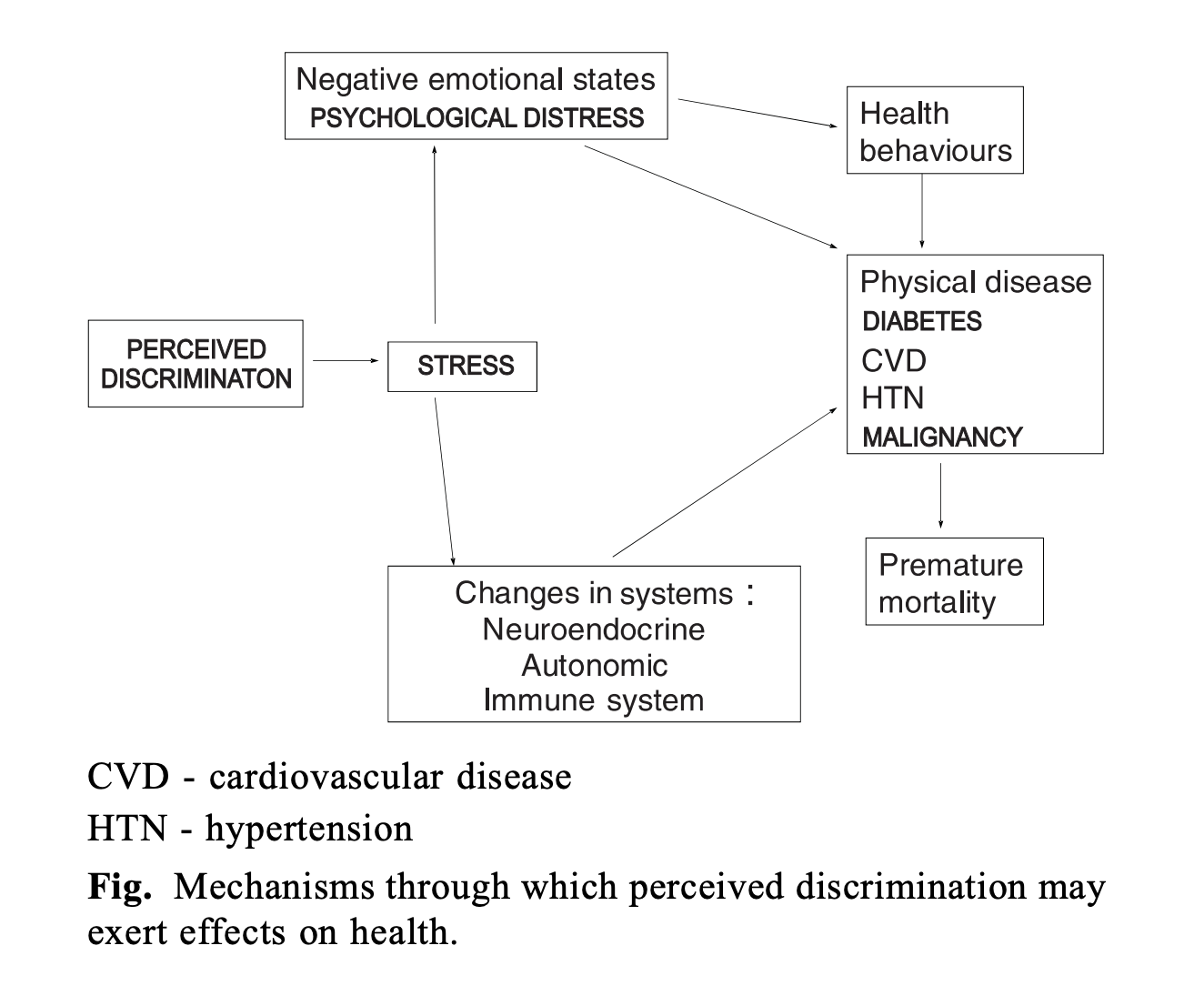
    <p>Ultimately, stress has inextricably holistic effects and at high, prolonged levels, the effects of stress add up. In a 2007 article on the connections between racial bias and health outcomes, a team of scholars (Ahmed, Mohammed, and Williams) synthesized the many patterns and trends to form the conclusion that <strong><em>bias is not just a social and political issue, but a public health issue.</em></strong> This is an excerpt from the Ahmed, et al. paper that outlines the pathways from racial bias incident to adverse health outcomes (the figure below visualizes this relationship):</p>


    <blockquote><p>Allostasis is the body’s ability to maintain homeostasis and to adapt to stressful events by appropriately activating the neuroendocrine, autonomic, and immune systems, and then to return to the basal state when the stressful event is past. While allostasis is adaptive in the short term, the cumulative burden of cycles of allostasis in response to repeated or chronic stress can be damaging and lead to multiple disease states. The concept of “allostatic load” refers to the cumulative wear and tear that the body experiences on these multiple regulatory systems as a result of repeated cycles of allostasis as well as the inefficient regulation of these cycles… High allostatic load is associated with the metabolic syndrome, and predicts mortality, cardiovascular disease incidence, and decline in cognitive and physical function.</p><cite>Williams, D. R., &amp; Mohammed, S. A. (2009). <a href="https://scholar.harvard.edu/davidrwilliams/dwilliam/publications/discrimination-and-racial-disparities-health-evidence-and-needed-research" rel="nofollow external" class="bo">Discrimination and Racial Disparities in Health: Evidence and Needed Research</a>. Journal of Behavioral Medicine , 32, 20-47.</cite></blockquote>


    <img src="https://lh3.googleusercontent.com/p391nMwLv1Q6Zlg78t7GIFSA4Y_ci0bHER_pUC8jWaMxBWS9fN89xwWXgN_LaG8BuxCsRl-gRNIHDRFC_AxIVAX9Gyl8xojPqHlJNAWN4ISXHpu9dY3U_rVBdPbhn5M519lyVJzf" alt="" style="max-width: 100%; height: auto;">Figure from Williams and Mohammed (2009). [Image description: a diagram describing the relationship between bias-based stressors and physical diseases.]


    <p>I don’t share this information with the intention of being a harbinger of death nor am I trying to scare everyone into therapy. I talk about this stuff because it not only puts into perspective the vast importance of mental health and wellbeing but also the ways in which <strong><em>oppression impacts a body at a biological level.</em></strong> <strong><em>Burnout and stress and anxiety and depression are social justice issues, because we live in a socially unjust world</em></strong>–so in doing this critical social justice work, we need to continue to center the oppressed and bring an intentional, critical awareness to the fact that being well and surviving burnout hinges on being able to survive constant systemic violence.</p>


    <h3>Roadmap through Burnout Town</h3>


    <p>Okay, so enough with my TED Talk, you’ve reached the point where we can roll up our sleeves and return to this grand road trip metaphor I teased at the beginning of this blog. Let’s put the pedal to the metal… or… actually…</p>


    <h4>STEP 1: Notice where you are, how you are feeling</h4>


    <div><a href="https://womenscenteratumbc.files.wordpress.com/2020/11/johntravolta.gif" rel="nofollow external" class="bo"><img src="https://womenscenteratumbc.files.wordpress.com/2020/11/johntravolta.gif?w=358" alt="" style="max-width: 100%; height: auto;"></a>I didn’t know I was going to rely so heavily on John Travolta for this blog, but here we are. [Image description: a GIF of John Travolta a la <em>Pulp Fiction </em>looking around as if he is lost. He is superimposed over a browser window that reads, “Unable to connect to the Internet.]</div>


    <p>Burnout, for me, often exists in tension with my own sense of perfectionism and anxiety. This is to the point that I often don’t notice how I’m feeling until I’m crashing. You might do this, too: At noon, I promise myself that if I just get my inbox down to zero, I’ll be able to get up from my computer and eat my lunch. Cut to 3:58 pm where I am bent over my keyboard and finalizing the last reply to an email and feeling mighty resentful that I have a meeting from 4 to 5, and my lunch is still in the office fridge.</p>


    <p>It’s really hard to know when to stop. </p>


    <p>Beyond the fact that we live in a Western, capitalist society that places value in the white knuckle pluck it takes to do the impossible–we’re just not always tuned into our bodies. That’s why this first step is the hardest because we have to learn what burnout feels like in our bodies and when to take notice. </p>


    <p>I am by no means perfect at this, but some things that have helped me come into a more compassionate awareness of my body and my feelings are things like mindfulness and grounding activities. I’m particularly fond of the “body scan,” which asks you to check in with each part of your body to see how you’re doing. </p>


    <p>There are <a href="https://www.healthline.com/health/grounding-techniques#physical-techniques" rel="nofollow external" class="bo">a lot of grounding techniques and they’re all a little bit different</a>, so if you haven’t found the one that resonates with you, fear not. Experiment and enjoy the process of finding what works for you.</p>


    <h4>STEP 2: Pull off the road and put the car in park</h4>


    <div><a href="https://womenscenteratumbc.files.wordpress.com/2020/11/stop.gif" rel="nofollow external" class="bo"><img src="https://womenscenteratumbc.files.wordpress.com/2020/11/stop.gif?w=351" alt="" style="max-width: 100%; height: auto;"></a>This is me. [Image description: a GIF of a child getting frustrated and repeatedly asking a person moving around in front of them to stop.]</div>


    <p>Okay, so you’ve identified that something feels wrong and you’ve stopped your car. AWESOME! I mean, not awesome that something is wrong, but… well, you know. </p>


    <p>If it feels weird for me to celebrate your having to stop what you’re doing due to burnout, I want to be sorry, but I’m not. <strong><em>Here’s my thing: we don’t applaud saying “no” enough. </em></strong></p>


    <p>Saying “no” is boundary-making/-maintaining and it’s critical to protecting your energy. Some may react to your boundaries with negativity. The classic, “What is wrong with you? Why don’t you want to come with me to the Chipotle grand opening?” But when you make the decision to stop because you’re being compassionate toward yourself, it’s the next step in working through the burnout. </p>


    <p>I don’t have much advice to share with you on this (other than to celebrate people’s “no” moments more often), but remember that even when you stop, it doesn’t mean you’re stopping for forever. It doesn’t even have to mean you’re stopping for the day. It just means you are striving to be present with yourself and that is a really good thing.</p>


    <h4>STEP 3: Take your time in running diagnostics and ask for help if you need it</h4>


    <p>Process, process, process. Lots of mental health professionals (including my therapists) will ask if you’ve <em>processed these emotions</em>–but what the heck does that mean? Well, I’ll tell you!</p>


    <p>Processing emotion <strong><em>is</em></strong>.</p>


    <p>It just is. We’re doing it all the time, we just don’t know it until we have some big bad emotion we don’t want to feel. We might be processing joy as we watch our kid giggle at something mundane. We might be processing anger as we get cut off by someone driving erratically. The process is the doing and emotion is always going through you.</p>


    <p>But if you’re having trouble, start with noticing what’s happening in your body. For example, let’s try right now: take a breath and scan throughout your body; are your feet on the ground flat or are they bouncing? Are your shoulders up near your ears or are they drawn down? Do you feel more weight on one side of your body than another? Are your eyelids feeling heavy?</p>


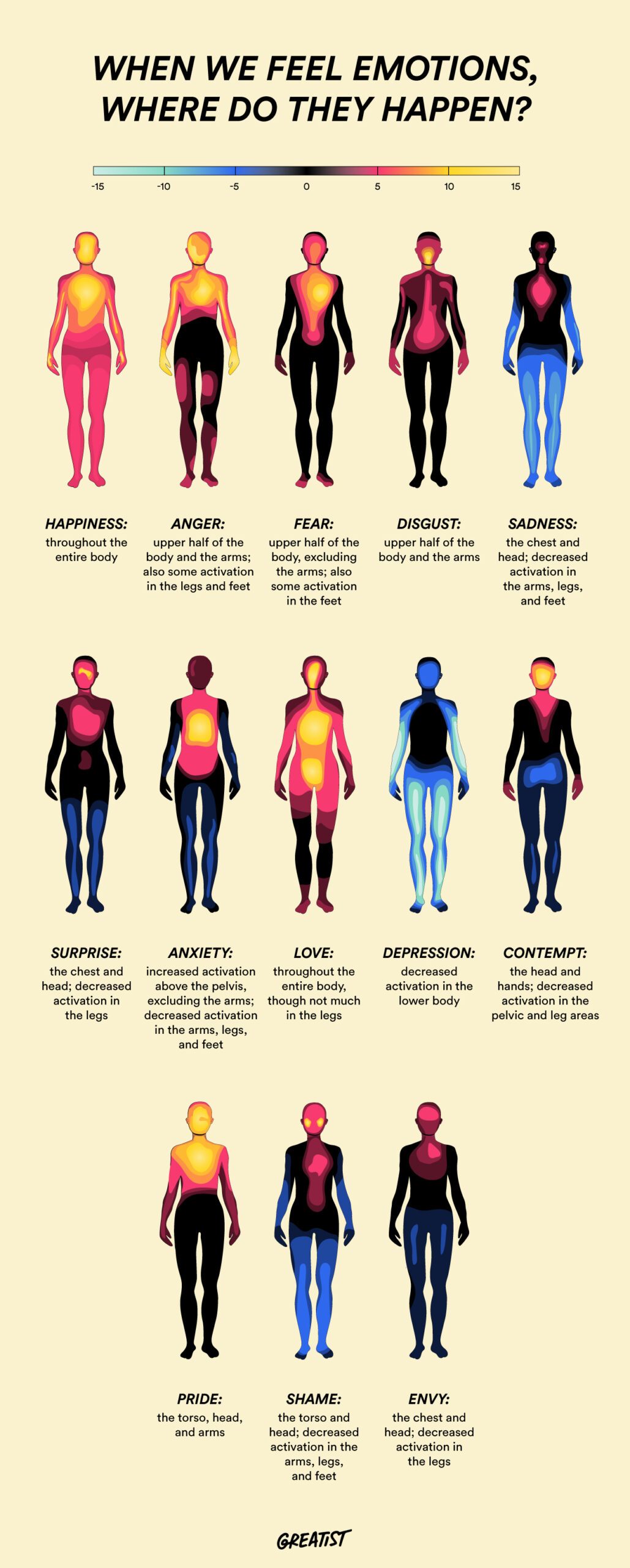
    <p>When we check in with our body, we can usually get a better idea of what’s happening. If your all tensed up around your shoulders and gritting your teeth, you might be angry. If you’re stomach hurts and your breathing a little heavier, you’re probably nervous. There’s a <a href="https://www.pnas.org/content/115/37/9198" rel="nofollow external" class="bo">whole science to this “emotional sensations” stuff:</a></p>


    <div><a href="https://womenscenteratumbc.files.wordpress.com/2020/11/187598-not-sure-what-youre-feeling_-maybe-this-body-chart-will-help-1296x3223-body-2-scaled-1.jpg" rel="nofollow external" class="bo"><img src="https://womenscenteratumbc.files.wordpress.com/2020/11/187598-not-sure-what-youre-feeling_-maybe-this-body-chart-will-help-1296x3223-body-2-scaled-1.jpg?w=412" alt="" width="579" height="1440" style="max-width: 100%; height: auto;"></a>Full article from <em>Greatist</em> is here: <a href="https://greatist.com/connect/emotional-body-maps-infographic" rel="nofollow external" class="bo">Where Are Emotions Felt in the Body?</a> [Image description: an infographic showing representations of emotion as they are felt through the body.]</div>


    <p>And yeah, maybe you already knew that tears coming out of your eyes meant that you were feeling sad, fair enough, but the next step of understanding your emotions is to work through it. You can do so by talking it out, writing about it, doing some movement-based thing like dancing or walking, hugging a loved one for a long time. There are a whole bunch of things that you can do to work through your emotions. </p>


    <p>But what I really want to point out is that, foundationally,<strong><em> “processing emotion” is just feeling emotions. It’s not about expelling them, wringing them out of our bodies, or fixing our brains. Feelings are normal and valid and important–and try as we might, we cannot escape them, so we better get comfortable with having them along for the ride.</em></strong></p>


    <h4>STEP 4: Get back in the car, and go where you need to go whether that’s a rest stop, the McDonalds drive-thru, your grandma’s house, or a gas station</h4>


    <a href="https://womenscenteratumbc.files.wordpress.com/2020/11/img_2784.jpg" rel="nofollow external" class="bo"><img src="https://womenscenteratumbc.files.wordpress.com/2020/11/img_2784.jpg?w=879" alt="" style="max-width: 100%; height: auto;"></a>From Kate Allan (Instagram: @TheLatestKate). [Image description: a comic of a kiwi bird. The panels read, “A bit lost, over-tired, crying a lot, and handlin it.”]


    <p>Once you’ve done your body scan and taken the time to identify the emotion(s) or stressors that are impacting you, go take care of yourself. I know I just said this piece can be as simple as taking a walk, but there is a little more maintenance and intentionality involved.</p>


    <p>You have to actually slow down and make a plan to get better. For me, that sometimes just means blocking off time in my calendar for human moments like going to the bathroom, eating my lunch, or talking to a friend (usually not all three at once, though). For others, maintenance might be finding a therapist, taking a nap, or finally making the doctor’s appointment you need to make. Regardless of what it is, make a plan to do it and then… do it. </p>


    <p>Follow through with your care plans and maintain their value. Others might question your priorities or consider it too “woo” to take a 10 minute meditation break–but their judgment isn’t helping you feel better so why listen to it?</p>


    <p>I also understand that not everyone has understanding bosses or even the private space to meditate–and that’s why it’s important to create a plan that takes into consideration access, compatibility, and any communication that needs to happen beforehand. Normalize burnout, anxiety, depression, etc. Normalize the need to take time for yourself and to be curious about your healing journey. You’re worth it.</p>


    <h4>STEP 5: Know that it’s okay to get lost</h4>


    <p>I’m ending this blog here, with the sentiment that it’s okay to get lost. It’s okay to be burnt out. It’s okay to discover your rock bottom. It’s okay that this is hard freaking work. We’re in a pandemic, for goodness sake; and COVID-19 is not a scapegoat. It’s genuinely a massive shift to the gravity of our lives. </p>


    <p>And regardless of worldwide killer viruses, our lives are always complex. Burnout is just another means to learn more about our bodies, emotions, and human needs. <strong><em>Getting lost is just another form of discovery.</em></strong></p>


    <p>Burnout, stress, emotional angst–it’s real, it happens, and the important thing to know is that:</p>


    <ul><li>this is temporary</li><li>you’re not alone</li><li>it’s not over, and </li><li>getting lost is sometimes part of the journey.</li></ul>


    <p><strong><em>Regardless of where you are, you can find yourself. </em></strong></p>


    <p>So even if you’re gunning the engine to get over the cliff or beyond the next highway or just out of this weird muddy rut, you can still slow down. Pull over. Take a beat to look up and be curious about the resilience of stars. Be in awe of the innumerable possibilities of where a breath can take you next. You got this.</p>


    <a href="https://womenscenteratumbc.files.wordpress.com/2020/11/img_2785.jpg" rel="nofollow external" class="bo"><img src="https://womenscenteratumbc.files.wordpress.com/2020/11/img_2785.jpg?w=1024" alt="" style="max-width: 100%; height: auto;"></a>A post from Seerut K. Chawla (Instagram/Twitter: @SeerutKChawla). [Image description: a tweet reading, “<em>Let it be</em> is such an underrated intervention. Everything does not need to be dissected or analysed. It’s okay to allow thoughts, feelings, reactions, sensations, to arise and let them run their own course. Name them if you want to. Let them be. And carry on living your life.” ]</div>
]]>
</Body>
<Summary>Amelia Meman, GWST ’15, is the Assistant Director of the Women’s Center.  Amelia uses they/them and she/her pronouns.      Burnt out? Me too.      This is not a new feeling for me. I have gotten...</Summary>
<Website>https://womenscenteratumbc.wordpress.com/2020/11/04/burnt-out-me-too/</Website>
<TrackingUrl>https://beta.my.umbc.edu/api/v0/pixel/news/97203/guest@my.umbc.edu/707e6ee4917f12fc5c6d731cbe1aca51/api/pixel</TrackingUrl>
<Tag>anxiety</Tag>
<Tag>burnout</Tag>
<Tag>diversity-and-inclusion-issues</Tag>
<Tag>emotions</Tag>
<Tag>grounding</Tag>
<Tag>health-disparities</Tag>
<Tag>intersectionality</Tag>
<Tag>issues</Tag>
<Tag>mental-health</Tag>
<Tag>minorities</Tag>
<Tag>recovery</Tag>
<Tag>stress</Tag>
<Tag>therapeutic</Tag>
<Tag>therapy</Tag>
<Tag>uncategorized</Tag>
<Group token="womenscenter">Women's, Gender, &amp;amp; Equity Center</Group>
<GroupUrl>https://beta.my.umbc.edu/groups/womenscenter</GroupUrl>
<AvatarUrl>https://assets2-beta.my.umbc.edu/system/shared/avatars/groups/000/000/125/78272a4842689b30dbf74672182b78f8/xsmall.png?1750974263</AvatarUrl>
<AvatarUrl size="original">https://assets1-beta.my.umbc.edu/system/shared/avatars/groups/000/000/125/78272a4842689b30dbf74672182b78f8/original.png?1750974263</AvatarUrl>
<AvatarUrl size="xxlarge">https://assets1-beta.my.umbc.edu/system/shared/avatars/groups/000/000/125/78272a4842689b30dbf74672182b78f8/xxlarge.png?1750974263</AvatarUrl>
<AvatarUrl size="xlarge">https://assets1-beta.my.umbc.edu/system/shared/avatars/groups/000/000/125/78272a4842689b30dbf74672182b78f8/xlarge.png?1750974263</AvatarUrl>
<AvatarUrl size="large">https://assets1-beta.my.umbc.edu/system/shared/avatars/groups/000/000/125/78272a4842689b30dbf74672182b78f8/large.png?1750974263</AvatarUrl>
<AvatarUrl size="medium">https://assets2-beta.my.umbc.edu/system/shared/avatars/groups/000/000/125/78272a4842689b30dbf74672182b78f8/medium.png?1750974263</AvatarUrl>
<AvatarUrl size="small">https://assets1-beta.my.umbc.edu/system/shared/avatars/groups/000/000/125/78272a4842689b30dbf74672182b78f8/small.png?1750974263</AvatarUrl>
<AvatarUrl size="xsmall">https://assets2-beta.my.umbc.edu/system/shared/avatars/groups/000/000/125/78272a4842689b30dbf74672182b78f8/xsmall.png?1750974263</AvatarUrl>
<AvatarUrl size="xxsmall">https://assets3-beta.my.umbc.edu/system/shared/avatars/groups/000/000/125/78272a4842689b30dbf74672182b78f8/xxsmall.png?1750974263</AvatarUrl>
<Sponsor>Women's Center</Sponsor>
<PawCount>6</PawCount>
<CommentCount>0</CommentCount>
<CommentsAllowed>false</CommentsAllowed>
<PostedAt>Wed, 04 Nov 2020 14:46:07 -0500</PostedAt>
<EditAt>Wed, 04 Nov 2020 14:46:07 -0500</EditAt>
</NewsItem>

<NewsItem contentIssues="true" id="97180" important="false" status="posted" url="https://beta.my.umbc.edu/groups/ene/posts/97180">
<Title>Together Beyond November: Post-Election Conversations</Title>
<Body>
<![CDATA[
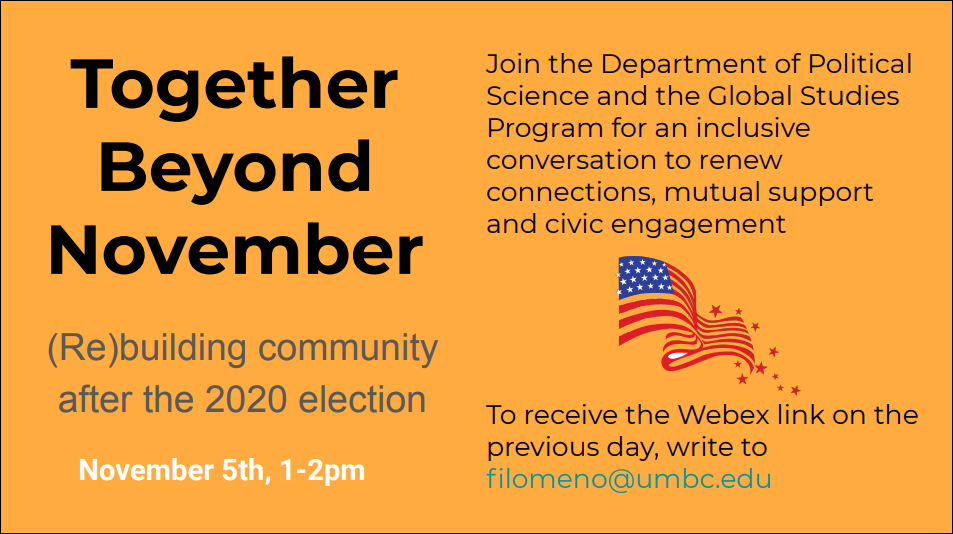
    <div class="html-content"><span><p><span>Together Beyond November: (Re)building Community after Election 2020</span><span> is a series of inclusive post-election conversations hosted by UMBC departments and organizations. Their purpose is to help members of the UMBC community renew their connections and support each other in this challenging time. The Center for Democracy and Civic Life, Initiatives for Identity, Inclusion, and Belonging (I3B), the Counseling Center, and leading campus educators in the use of restorative practices have trained student, faculty, and staff facilitators to guide these conversations, as a part of the Cast Your Whole Vote campaign. </span></p><p><span>This is an unprecedented election year in which all of us are experiencing overlapping crises, including a global pandemic. Tensions are high even as people crave the feeling of connection. Members of our UMBC community may feel isolated, uncertain, or uncomfortable sharing their honest views. These healing, empowering conversations can help us navigate the post-election period together.</span></p><p><span>See below for a list of upcoming Together Beyond November conversations that are open to any member of the UMBC community.  We will update this list as new conversations are scheduled.</span></p><div><span><span><ul><li><p><span><strong>November 4, 12-1 p.m.: </strong></span><a href="https://my3.my.umbc.edu/groups/civiclife/events/84373" rel="nofollow external" class="bo"><span>After the Election: A Community Gathering</span></a><span>, hosted by the Center for Democracy and Civic Life</span></p></li><li><p><span><strong>November 4, 5:30-7 p.m.: </strong></span><a href="https://i3b.umbc.edu/programs-events/?id=88835" rel="nofollow external" class="bo"><span>Together Beyond November: Post-Election Dialogue Centering the Election, COVID, Injustice &amp; Radical Self-Care</span></a><span>, hosted by Initiatives for Identity, Inclusion, and Belonging</span></p></li><li><p><span><strong>November 5, 1-2 p.m.: </strong></span><a href="https://politicalscience.umbc.edu/files/2020/10/POLI-GLBL-Post-election-event.png" rel="nofollow external" class="bo"><span>Together Beyond November: (Re)building Community After the 2020 Election</span></a><span>, hosted by Political Science and Global Studies</span></p></li><li><p><span><strong>November 5, 4-5:30 p.m.: </strong></span><a href="https://docs.google.com/forms/d/e/1FAIpQLScdSz9gfrPsJQaUsZ82MVkZAYorsM7rU5mrrjEE_qMyPsvRAw/viewform" rel="nofollow external" class="bo"><span>Together Beyond November: (Re)building Community after Election 2020</span></a><span>, hosted by the Student Government Association &amp; Campus Life</span></p></li><li><p><span><strong>November 6, 5-6:30 p.m.: </strong></span><a href="https://docs.google.com/forms/d/e/1FAIpQLScdSz9gfrPsJQaUsZ82MVkZAYorsM7rU5mrrjEE_qMyPsvRAw/viewform" rel="nofollow external" class="bo"><span>Together Beyond November: (Re)building Community after Election 2020</span></a><span>, hosted by the Student Government Association &amp; Campus Life</span></p></li><li><p><span><span><strong>November 9, 5:10-6:10 p.m.: </strong></span><a href="https://my3.my.umbc.edu/groups/adjuncts/events/88834" rel="nofollow external" class="bo"><span>A Post-Election Conversation: A Bi-Partisan Look at Moving Forward</span></a><span>, hosted by the Adjunct Faculty Advisory Committee</span></span></p></li><li><p><span><span><strong>November 10, 12-1 p.m.: </strong></span></span><span><a href="https://www.google.com/url?q=https://umbc.webex.com/umbc/j.php?MTID%3Dmbed3713fcdc212a38ae8c1fd6ac8d9af&amp;sa=D&amp;source=calendar&amp;ust=1605120346593000&amp;usg=AOvVaw3tUP1mTQekBtubIIZyxF_P" rel="nofollow external" class="bo">Together Beyond November: Our Commitment to Building Community</a>, hosted by the Graduate Student Association</span></p></li><li><p><span><strong>November 10, 5-6 p.m.: </strong></span><span><a href="https://my3.my.umbc.edu/groups/will/events/88541" rel="nofollow external" class="bo">A Post-Election Facilitated Listening Session with Dr. Kate</a>, hosted by WILL+</span></p></li><li><p><span><strong>November 10, 6-7:15 p.m.: </strong></span><a href="https://my3.my.umbc.edu/groups/womenscenter/events/88845" rel="nofollow external" class="bo"><span>Post-Election Dialogue</span></a><span>, hosted by the Women’s Center</span></p></li></ul><div><span><br></span></div><div><span>In addition, the following departments and organizations are hosting Together Beyond November gatherings for staff and members:</span></div><div><ul><li><div><span>College of Engineering and Information Technology (hosted by the Center for Women in Technology)</span></div></li><li><span><div><span>Grand Challenges Scholars Program</span></div></span></li><li><div><span><span>Office of Sustainability</span></span></div></li><li><div><span><span>PLACE Project Fellows</span></span></div></li><li><div><span><span>Residential Life</span></span></div></li><li><div><span><span>(seb) Student Events Board</span></span></div></li><li><div><span><span>Sherman Scholars Program</span></span></div></li><li><div><span><span>Sondheim Public Affairs Scholars Program</span></span></div></li></ul></div></span></span></div></span></div>
]]>
</Body>
<Summary>Together Beyond November: (Re)building Community after Election 2020 is a series of inclusive post-election conversations hosted by UMBC departments and organizations. Their purpose is to help...</Summary>
<TrackingUrl>https://beta.my.umbc.edu/api/v0/pixel/news/97180/guest@my.umbc.edu/cee74c8c1c10feb1f312e3e1529abf30/api/pixel</TrackingUrl>
<Tag>election2020</Tag>
<Group token="civiclife">Center for Democracy and Civic Life</Group>
<GroupUrl>https://beta.my.umbc.edu/groups/civiclife</GroupUrl>
<AvatarUrl>https://assets1-beta.my.umbc.edu/system/shared/avatars/groups/000/001/462/3559ec2c1c4f29266d1c1eb0f1164549/xsmall.png?1554944150</AvatarUrl>
<AvatarUrl size="original">https://assets2-beta.my.umbc.edu/system/shared/avatars/groups/000/001/462/3559ec2c1c4f29266d1c1eb0f1164549/original.png?1554944150</AvatarUrl>
<AvatarUrl size="xxlarge">https://assets1-beta.my.umbc.edu/system/shared/avatars/groups/000/001/462/3559ec2c1c4f29266d1c1eb0f1164549/xxlarge.png?1554944150</AvatarUrl>
<AvatarUrl size="xlarge">https://assets1-beta.my.umbc.edu/system/shared/avatars/groups/000/001/462/3559ec2c1c4f29266d1c1eb0f1164549/xlarge.png?1554944150</AvatarUrl>
<AvatarUrl size="large">https://assets3-beta.my.umbc.edu/system/shared/avatars/groups/000/001/462/3559ec2c1c4f29266d1c1eb0f1164549/large.png?1554944150</AvatarUrl>
<AvatarUrl size="medium">https://assets1-beta.my.umbc.edu/system/shared/avatars/groups/000/001/462/3559ec2c1c4f29266d1c1eb0f1164549/medium.png?1554944150</AvatarUrl>
<AvatarUrl size="small">https://assets3-beta.my.umbc.edu/system/shared/avatars/groups/000/001/462/3559ec2c1c4f29266d1c1eb0f1164549/small.png?1554944150</AvatarUrl>
<AvatarUrl size="xsmall">https://assets1-beta.my.umbc.edu/system/shared/avatars/groups/000/001/462/3559ec2c1c4f29266d1c1eb0f1164549/xsmall.png?1554944150</AvatarUrl>
<AvatarUrl size="xxsmall">https://assets4-beta.my.umbc.edu/system/shared/avatars/groups/000/001/462/3559ec2c1c4f29266d1c1eb0f1164549/xxsmall.png?1554944150</AvatarUrl>
<Sponsor>Center for Democracy and Civic Life</Sponsor>
<ThumbnailUrl size="xxlarge">https://assets4-beta.my.umbc.edu/system/shared/thumbnails/news/000/097/180/5ed6a4f0f50c48c42fc926e3a999a6ac/xxlarge.jpg?1604446574</ThumbnailUrl>
<ThumbnailUrl size="xlarge">https://assets2-beta.my.umbc.edu/system/shared/thumbnails/news/000/097/180/5ed6a4f0f50c48c42fc926e3a999a6ac/xlarge.jpg?1604446574</ThumbnailUrl>
<ThumbnailUrl size="large">https://assets3-beta.my.umbc.edu/system/shared/thumbnails/news/000/097/180/5ed6a4f0f50c48c42fc926e3a999a6ac/large.jpg?1604446574</ThumbnailUrl>
<ThumbnailUrl size="medium">https://assets3-beta.my.umbc.edu/system/shared/thumbnails/news/000/097/180/5ed6a4f0f50c48c42fc926e3a999a6ac/medium.jpg?1604446574</ThumbnailUrl>
<ThumbnailUrl size="small">https://assets3-beta.my.umbc.edu/system/shared/thumbnails/news/000/097/180/5ed6a4f0f50c48c42fc926e3a999a6ac/small.jpg?1604446574</ThumbnailUrl>
<ThumbnailUrl size="xsmall">https://assets3-beta.my.umbc.edu/system/shared/thumbnails/news/000/097/180/5ed6a4f0f50c48c42fc926e3a999a6ac/xsmall.jpg?1604446574</ThumbnailUrl>
<ThumbnailUrl size="xxsmall">https://assets2-beta.my.umbc.edu/system/shared/thumbnails/news/000/097/180/5ed6a4f0f50c48c42fc926e3a999a6ac/xxsmall.jpg?1604446574</ThumbnailUrl>
<PawCount>13</PawCount>
<CommentCount>0</CommentCount>
<CommentsAllowed>true</CommentsAllowed>
<PostedAt>Tue, 03 Nov 2020 18:36:29 -0500</PostedAt>
<EditAt>Fri, 13 Nov 2020 10:29:57 -0500</EditAt>
</NewsItem>

<NewsItem contentIssues="false" id="97150" important="false" status="posted" url="https://beta.my.umbc.edu/groups/ene/posts/97150">
<Title>Election 2020: In Community</Title>
<Body>
<![CDATA[
    <div class="html-content"><div><span>Dear Members of the UMBC Community,</span></div><div><span><br></span></div><div><span>On this Election Day, we see the importance of using our voices and taking action toward a safer and more just America. The vast majority of Americans agree that voting is one of our most important civic responsibilities. Participating in elections can unite rather than divide us.</span></div><div><span><br></span></div><div><span>During these extraordinarily challenging times, we are inspired by members of our UMBC community, including some ineligible to vote themselves, who have worked on behalf of candidates and causes and promoted civic engagement through the Center for Democracy and Civic Life and their own organizations and networks. It is heartening to see people who are passionate about the direction of our nation and communities encouraging everyone, including those with whom they disagree, to “<a href="https://t.e2ma.net/click/jhvzlf/3s5adbc/v2jqb3" rel="nofollow external" class="bo">cast [their] whole vote</a>.” On behalf of the Center staff, we want to thank all of the individuals, departments, and campus organizations collaborating with us on Election 2020 events and programs.</span></div><div><span><br></span></div><div><span>If you are voting today, <a href="https://t.e2ma.net/click/jhvzlf/3s5adbc/bvkqb3" rel="nofollow external" class="bo">this message</a> from the Governor of Maryland notes options for in-person voting at one of the voting centers that are open across the state. Detailed information about voting is available at <a href="https://t.e2ma.net/click/jhvzlf/3s5adbc/rnlqb3" rel="nofollow external" class="bo">elections.maryland.gov/2020</a>.</span></div><div><span><br></span></div><div><span>This unusually divisive election season coincides with a pandemic, economic uncertainty, new reminders of the prevalence and legacies of institutional racism, and violence and unrest around the world. The consequences of the election outcomes will affect each of us differently, in part because we are not equally vulnerable to the repercussions of public officials’ decisions and actions. These differences can weigh heavily on us and easily pull us apart. </span></div><div><span><br></span></div><div><span>We know we may face more challenges in the days ahead as the process of determining the election’s outcome is likely to extend beyond Election Night. It is important that every vote be counted. It is also more important than ever that all of us care for ourselves and one another, engage in civil dialogue, practice the art of listening, and—even with our differences—find ways to weather this time together. We are an inclusive community of inquiring minds, and we will continue to be a community after the election.</span></div><div><span><br></span></div><div><span>In that spirit, we hope students, faculty, staff, and alumni will join us for the following events:</span></div><ul><li><span><strong>Tonight, 7 p.m. – midnight: <a href="https://t.e2ma.net/click/jhvzlf/3s5adbc/7fmqb3" rel="nofollow external" class="bo">Election Night Extravaganza</a></strong>, a UMBC tradition that brings together members of our community to watch and discuss election results in real time. RSVP <a href="https://t.e2ma.net/click/jhvzlf/3s5adbc/n8mqb3" rel="nofollow external" class="bo">here</a>.</span><br><br></li><li><span><strong>November 4, noon – 1 p.m.: <a href="https://t.e2ma.net/click/jhvzlf/3s5adbc/30nqb3" rel="nofollow external" class="bo">After the Election: A Community Gathering</a></strong>, to reflect on the challenging months leading up to the 2020 election, discuss the status of the election results, and envision the road ahead. RSVP <a href="https://t.e2ma.net/click/jhvzlf/3s5adbc/jtoqb3" rel="nofollow external" class="bo">here</a>.</span></li></ul><div><span>In addition, a number of UMBC departments and organizations will host <strong>Together Beyond November</strong> events in the coming days. These will be small group conversations facilitated by UMBC community members to support participants in renewing connections, reflecting on the election and its aftermath, and helping each other through challenging times. Keep an eye out for details and invitations.</span></div><div><span><br></span></div><div><span>You can find additional resources on the <a href="https://t.e2ma.net/click/jhvzlf/3s5adbc/zlpqb3" rel="nofollow external" class="bo">Center for Democracy and Civic Life website</a>, and follow our <a href="https://t.e2ma.net/click/jhvzlf/3s5adbc/feqqb3" rel="nofollow external" class="bo">myUMBC group</a> for the latest events and information. We look forward to being in community with you and to doing this important work together in the days ahead.<br><span><em><br></em></span></span></div><div><span><span><em>David Hoffman, Director, Center for Democracy and Civic Life<br>Romy Hübler, Assistant Director, Center for Democracy and Civic Life</em></span></span></div></div>
]]>
</Body>
<Summary>Dear Members of the UMBC Community,     On this Election Day, we see the importance of using our voices and taking action toward a safer and more just America. The vast majority of Americans agree...</Summary>
<TrackingUrl>https://beta.my.umbc.edu/api/v0/pixel/news/97150/guest@my.umbc.edu/fd838eb85b4c6b07c6e08db4d39bea3a/api/pixel</TrackingUrl>
<Tag>election2020</Tag>
<Group token="civiclife">Center for Democracy and Civic Life</Group>
<GroupUrl>https://beta.my.umbc.edu/groups/civiclife</GroupUrl>
<AvatarUrl>https://assets1-beta.my.umbc.edu/system/shared/avatars/groups/000/001/462/3559ec2c1c4f29266d1c1eb0f1164549/xsmall.png?1554944150</AvatarUrl>
<AvatarUrl size="original">https://assets2-beta.my.umbc.edu/system/shared/avatars/groups/000/001/462/3559ec2c1c4f29266d1c1eb0f1164549/original.png?1554944150</AvatarUrl>
<AvatarUrl size="xxlarge">https://assets1-beta.my.umbc.edu/system/shared/avatars/groups/000/001/462/3559ec2c1c4f29266d1c1eb0f1164549/xxlarge.png?1554944150</AvatarUrl>
<AvatarUrl size="xlarge">https://assets1-beta.my.umbc.edu/system/shared/avatars/groups/000/001/462/3559ec2c1c4f29266d1c1eb0f1164549/xlarge.png?1554944150</AvatarUrl>
<AvatarUrl size="large">https://assets3-beta.my.umbc.edu/system/shared/avatars/groups/000/001/462/3559ec2c1c4f29266d1c1eb0f1164549/large.png?1554944150</AvatarUrl>
<AvatarUrl size="medium">https://assets1-beta.my.umbc.edu/system/shared/avatars/groups/000/001/462/3559ec2c1c4f29266d1c1eb0f1164549/medium.png?1554944150</AvatarUrl>
<AvatarUrl size="small">https://assets3-beta.my.umbc.edu/system/shared/avatars/groups/000/001/462/3559ec2c1c4f29266d1c1eb0f1164549/small.png?1554944150</AvatarUrl>
<AvatarUrl size="xsmall">https://assets1-beta.my.umbc.edu/system/shared/avatars/groups/000/001/462/3559ec2c1c4f29266d1c1eb0f1164549/xsmall.png?1554944150</AvatarUrl>
<AvatarUrl size="xxsmall">https://assets4-beta.my.umbc.edu/system/shared/avatars/groups/000/001/462/3559ec2c1c4f29266d1c1eb0f1164549/xxsmall.png?1554944150</AvatarUrl>
<Sponsor>Center for Democracy and Civic Life</Sponsor>
<PawCount>4</PawCount>
<CommentCount>0</CommentCount>
<CommentsAllowed>true</CommentsAllowed>
<PostedAt>Tue, 03 Nov 2020 08:09:33 -0500</PostedAt>
<EditAt>Tue, 03 Nov 2020 08:12:53 -0500</EditAt>
</NewsItem>

</News>