URCAD Presenters: MLLI
URCAD is Wednesday, April 22, 2026 in the RAC!
For the full schedule see:
Alexis Gantt | From Minjung to Candlelight: Cultural Transformation and Collective Political Identity in Korean Protest Movements | Kyung-Eun Yoon | Modern Languages, Linguistics, and Intercultural Communication | RAC Arena, 10-11am, Poster #39
Sarah Haines | Reconstructing Identity: The Sociocultural Transition of North Korean Defectors in South Korea | Kyung-Eun Yoon | Modern Languages, Linguistics, and Intercultural Communication | RAC Arena, 2-3pm, Poster #27
Camryn Sydnor | From Page to Space: Reinterpreting 20th-Century Spanish Literature with Augmented Reality | Erin Hogan | Modern Languages, Linguistics, and Intercultural Communication | Film Presentation
By: Bekkah West, Social Work Major & WGEC Intern, Psychology Minor
Growing up, I did not understand the gravity of how symbols of hate could tangibly impact a person; how they justify violence, hostility, stigma, and prejudice. You can attribute that to my ignorance, privilege, the developing brain, social conditioning, the predominantly white, rural, and conservative area I grew up in. Whatever the root may be, what is important is that I do now (and have for some time) grasp how crucial it is to not just spout promises of inclusivity and diversity, but to do your best to prove it in action through various means, like through curating a culturally responsive physical environment or following through on committing to advocating for those who are marginalized—or at the very least, not putting them in harm’s way. I fear we as an institution are failing the LGBTQIA2S+ population we serve and our value of inclusive excellence by allowing private corporations such as Chick-fil-A to establish ground here and profit off our student body who may have to compromise their morals and/or sense of safety for an edible meal. It is not “just about chicken” and it is quite literally that deep; or perhaps only as deep as people feel comfortable exploring themselves, their values, and living them fully.
To give a little background for those who may not know, along with over a dozen employment discrimination filings between 1988 and 2007, Chick-fil-A has a long and extensive history opposing gay marriage, publicly denying the validity of the LGBTQIA2S+ community, and donating millions to various organizations set on endangering this population by denying them their human rights and legal protections. Such organizations include the American Family Association (AFA), the Family Research Council (FRC), Exodus International, the Salvation Army, and the Marriage & Family Foundation. The company attempts to conceal their heterosexist views and intentions through the veil of conservative, Christian principles. CEO, Dan Cathy incited protests in 2012 nationwide for encouraging the “biblical definition of the family unit.” It was not until around seven to eight years later that the bad press and pressure would fold Cathy, at least in part, with him officially announcing his discontinuation of donations to organizations with “political agendas.”
In all reality, Dan Cathy just stopped publicly donating to hateful organizations and instead created a private arm of Chick-fil-A, “WinShape”, where he donates to others such as the National Christian Charitable Foundation, who actively opposes the Equality Act, which could amend the current laws to protect LGBTQIA2S+ individuals from discrimination based on how they identify or what their sexual orientation may be. This was only discovered after financial reports were released, and Chick-fil-A and its affiliates appear to continue to dodge any real answers to questioning on these deceitful means of abating public disapproval. Without this as public of an issue as it once was, people may not know that they are still giving their money to a company that has every intention of investing in the devaluing and oppression of the LGBTQIA2S+ community. This is where you, like I once did in my teens, may be thinking to yourself that your individual contribution could not possibly make a difference in the grand scheme of things. This is also where I was, and you very well could be, perpetrating harm unintentionally, in complacency. Just as we see, at times, in our country’s voting process, or in action and lack of consistent progress toward any other pertinent social issue that does not typically impact the majority and/or one directly.
This shortfall in collective action by our campus community can mean Chick-fil-A’s presence on campus leaves some LGBTQIA2S+ students feeling rejected, unsafe, and/or at the very least, uncomfortable. This company is a national symbol of violent discrimination, conversion therapy, trauma, abandonment, and anti-LGBTQIA2S+ rhetoric. Their existence says to LGBTQIA2S+ community members that you are never fully protected or accepted here, in this world, even with offices set up specifically for your population on the exact same campus. It says, a chicken sandwich holds more weight to this institution than the rights and sentiments of the LGBTQIA2S+ students, staff, faculty, and allies on this campus. How can one feel comfortable expressing their true selves fully, with safety and dignity, on a campus that would proudly set such an establishment up—one that vehemently denies their right to exist and love as they please? To overlook this would go against much of what UMBC’s mission and vision is.
This discussion cannot be had without the acknowledgement that 1) there is no entirely ethical consumption under capitalism and 2) there are people of low-SES who may not have a choice between eating what is available and choosing something more ethical. It is a privilege to be able to consume ethically nowadays. That said, there are ways of minimizing harm that we should all try our best to accomplish. There are many different on- and off- campus options outside of Chick-fil-A, and many potential opportunities to partner with new companies, local and otherwise, of equal or lesser cost to the institution. Redirecting funds to finding other non-discriminatory options and the university upholding its statements on inclusion and social justice is possible, shown through many other college campus experiences across the country, and even here in Maryland, such as at St. Mary’s College. We should hold our partners to the same standards we hold ourselves and our community.
There are many ways we can come together as a community to resolve this issue, and I encourage fellow students at UMBC to think about and engage in these ways, if possible. Organizing a campus forum, where students, staff, faculty, dining services, and other administrators can make their voices heard would be valuable. Petitions could be started to collect signatures for the partnership to be discontinued. The Student Government Association could potentially get involved, structuring this in a way that is sound and getting people together in a concentrated effort. Educating each other on the dishonest and harmful background of Chick-fil-A is crucial, as well, even if it can be uncomfortable—your cisgender and heterosexual peers will never know what it is like to have to worry about being and/or feeling victimized in this way.
I am making a call for action not just as an advocate to the LGBTQIA2S+ community or because it is the right thing to do, but as an identifying member myself. We should follow in former Washington D.C. mayor Vincent C. Gray’s footsteps, letting Chick-fil-A know it is not welcome in our city, dubbing it “hate chicken.” Do not get me wrong, I do not think poorly of the students and staff who work hard every day to serve students food at Chick-fil-A here on campus, as they may just need the income, location, and a schedule that works for them. There are larger powers at play here who are more responsible for creating an inclusive and socially just environment for said people to work within. What I believe was part of my responsibility was to bring attention to this issue, firstly, and now to observe how my community will move with me from here. Similar attitudes have been shared with me on campus in the last year and a half I have been here, and I am grateful to have a platform to bring light to such concerns.
]]>
By: Bekkah West, Social Work Major & WGEC Intern, Psychology Minor Growing up, I did not understand the gravity of how symbols of hate could tangibly impact a person; how they justify...
https://womenscenteratumbc.wordpress.com/2025/12/15/its-not-just-about-chicken/
https://beta.my.umbc.edu/api/v0/pixel/news/155330/guest@my.umbc.edu/8053fe57ee658a57e7d76d37549adab2/api/pixel
activism
community
critical-social-justice
diversity
diversity-and-inclusion-issues
inclusion
social-justice
staff
student-life
umbc
Women's, Gender, & Equity Center
https://beta.my.umbc.edu/groups/womenscenter
https://assets2-beta.my.umbc.edu/system/shared/avatars/groups/000/000/125/78272a4842689b30dbf74672182b78f8/xsmall.png?1750974263
https://assets1-beta.my.umbc.edu/system/shared/avatars/groups/000/000/125/78272a4842689b30dbf74672182b78f8/original.png?1750974263
https://assets1-beta.my.umbc.edu/system/shared/avatars/groups/000/000/125/78272a4842689b30dbf74672182b78f8/xxlarge.png?1750974263
https://assets1-beta.my.umbc.edu/system/shared/avatars/groups/000/000/125/78272a4842689b30dbf74672182b78f8/xlarge.png?1750974263
https://assets1-beta.my.umbc.edu/system/shared/avatars/groups/000/000/125/78272a4842689b30dbf74672182b78f8/large.png?1750974263
https://assets2-beta.my.umbc.edu/system/shared/avatars/groups/000/000/125/78272a4842689b30dbf74672182b78f8/medium.png?1750974263
https://assets1-beta.my.umbc.edu/system/shared/avatars/groups/000/000/125/78272a4842689b30dbf74672182b78f8/small.png?1750974263
https://assets2-beta.my.umbc.edu/system/shared/avatars/groups/000/000/125/78272a4842689b30dbf74672182b78f8/xsmall.png?1750974263
https://assets3-beta.my.umbc.edu/system/shared/avatars/groups/000/000/125/78272a4842689b30dbf74672182b78f8/xxsmall.png?1750974263
Women's Center
16
0
false
Mon, 15 Dec 2025 16:14:37 -0500
Mon, 15 Dec 2025 16:14:37 -0500
Tribe or Trap – The Difference Between Community & High Control
-By Amy Taylor, Social Work/Music Major
Humans are wired for belonging. We crave connection, shared purpose, and safety within groups. But not every group that promises community delivers it. Some take that longing and twist it into control. It often happens slowly, without people inside the group noticing. Nobody is immune to these organizations because they prey on people who are going through any sort of life change or who feel alone. As a college student, being away from family and friends for the first time can make one vulnerable to groups that offer “instant community.” College is a time when many students are rebuilding their sense of belonging from scratch, which makes it both exciting and vulnerable terrain.
Born Into Control
I learned about community and control during my earliest years, primarily through what community was not. I was born into a family of eight kids, the third-born and oldest girl. For the first 20 years of my life, my parents raised my siblings and me in a high-control organization (HCO). I knew nothing about a healthy community because the HCO dictated where we went to church, what type of education we received or did not, what we wore, what we did with our time and money, and who we would associate with.
Identity and Expression
High-control organizations prescribe identities to their members, leaving little room for self-expression or discovery. As a child, I was forced to wear clothes I hated, such as long skirts (never pants) that swept the floor in length. My parents made sure that I was painfully modest, wearing baggy shirts that covered any indication that I was a woman, including my collarbone. At the large HCO conferences my family frequented, we had to wear white tops and long navy skirts. The message to me as a woman was clear: ‘cover up, sit down, shut up.’ I am thrilled to say that I overthrew their control, and today I enjoy putting outfits together that express who I am. I dress in vibrant colors and patterns, and even sport blue hair. These little things express my freedom as an individual; they bring me joy and, in a way, make up for lost time. I learned, through contrast, that true community embraces individual expression and differences. In a good community, you can be yourself, because conformity isn’t a value or a virtue.
Leadership and Power
In a healthy community, leadership styles are transparent, service-oriented, and accountable. High control organizations are authoritarian, hierarchical, and unquestionable. The leader of our HCO was not a musician, but he would put families on a pedestal if they were. They were treated with more respect and admiration than other members of the organization. Until they slipped up, of course, if one member of the family committed some faux pas, they were publicly shamed, shunned, and/or banished from the graces of the HCO. To this day, I don’t enjoy being placed on a pedestal for any reason, especially music. While I believe that music is a gift to be shared, I refuse to believe that I am ‘special’ because I’m a musician.
Information and Education
Access to information is, undeniably, a fundamental human right. In a healthy community, that right is expressed through open communication and transparency as well as access to all information. This was not my experience growing up in a high-control organization. All children were restricted to be “homeschooled” for all 12 grades and even beyond. I put the word homeschooled in quotation marks to avoid confusion. I did not receive a proper education.
My days were spent absorbing propaganda released by the high-control organization. This propaganda was designed to distort our thinking by twisting history, science, or any other “school” subject into wild and wrong teachings for us to assimilate into our lives. When I wasn’t busy poring over propaganda, I was taught to read, write, and perform simple arithmetic. That’s all. When it came time for me to learn algebra, I didn’t understand what the book was telling me, and I went to my mother and asked to be placed in tutoring. Her response aligned with the HCO’s teaching; she ripped the book out of my hands and said, “One day you are going to be a wife and a mother; you don’t need to learn algebra.” At the age of thirty, I enrolled in community college, received some tutoring, and crushed four semesters of algebra, a fact that still makes me proud today.
My mother’s censorship reached into what we read as well as what we watched. Each book that entered our house had to be approved by both my parents and the high-control organization. Once, I was given a Molly American Girl Doll book. My parents declared it evil and threw it out the day I got it. Most books I wanted to read got thrown out. We were, instead, encouraged to read about Christian martyrs, all of them coated with the subtextual suggestion that I would perhaps one day face the same fate. While I hope most parents would protect their young children from witnessing violence in movies, my parents were obsessed with it. I was banned from watching Disney movies (I saw my first one at the age of 21), but I was encouraged to watch Christians being burned at the stake (because that might be me one day). My earliest memory of films is watching a movie about Dutch nazi resistor Corrie ten Boom and her time in a concentration camp – incredibly violent, and totally inappropriate for a six-year-old. Instead of having access to age-appropriate material for learning and growing, I was being inundated with frightening messages about what my future would hold. Fear is the glue that holds high-control organizations together.
In a high-control organization, information is controlled, restricted, or distorted in some way. It might not look exactly like my story. Still, censorship and the fear of information are a dark road meant to keep people ingesting pre-selected information while discouraging critical thinking.
Freedom of Thought
Freedom of thought is essential to healthy communities; these communities encourage questioning, critical thinking, and dialogue. In a high-control organization, doubt, dissent, or independent thinking is discouraged and even punished. Thinking for myself was considered dangerous because groupthink was the only acceptable way to exist in the high-control organization. As a Christian, I was heavily shamed for asking questions and threatened with ostracism from my church and the HCO.
Leaving the Trap
That being said, my diaries were my place of refuge. I wrote endless questions in there, and I compared what I was experiencing in my family to other families or individuals I encountered. I felt safe writing in these diaries because no one ever read them. I was able to think critically about all my experiences, and even at the tender age of ten, I was aware that something in my little world wasn’t quite right.
Often, people ask me, “How did you get out?” The answer starts with those diaries and a kids’ radio program that depicted children who liked being near their parents (shocker) because their parents were kind to them. I was afraid of my parents. To me, these programs were a stark contrast to the way I was being raised, and I started journaling, ‘Do I deserve to be treated better?’ Eventually, I came to the conclusion that my parents were never going to care for, protect, or provide for me the way I needed. When two of my brothers planned to move out, I moved out with them.
Building True Community
The ramifications of leaving both the family and the high-control organization were daunting. I was threatened with excommunication, and while that was painful, it no longer felt like annihilation because I was ready to start creating a community of my own. Eventually, I learned through trial and error that the best communities are the ones you forge on your own, not pre-packaged ones that offer instant friendships, pre-made activities, and, eventually, a boatload of hidden rules and restrictions. Today my community is thriving. I have friends and family who are close to me; we stay in regular contact, and together we support each other through all of life’s ups and downs. I am open and friendly with many people, but I have a close circle of friends who are my ride-or-die. I’m thrilled that that circle of friends does not have a leader lording themselves over us. It feels good to be free.
What I’ve noticed about belonging and inclusion is that while high-control organizations accept people conditionally based on conformity and a twisted sense of loyalty, healthy communities base them on empathy, diversity, inclusion, and respect. Today, I get to choose the people in my circle. We laugh, cry, and grow together. There is no hierarchy, no hidden rules, no fear. Just connection. That’s what community should be.
Coming and Going
So if high-control organizations are so awful, why do people join? Answer? They don’t. No one wakes up one day and says, “I wanna join a cult” or “I want someone else to prescribe my identity” or “I want some leader to dictate everything I do.” People don’t willingly or naturally give up their freedoms. There are well-defined psychological, physical, emotional, and social manipulations that lure people into these organizations. In the beginning, it’s all very exciting because we think we’ve found our tribe. Only time reveals the trap: HCOs want to use you and discard you. When it comes to exits and boundaries, an HCO will leave you feeling discouraged, shamed, or punished. Sometimes, the threat of losing everyone in the group is a powerful manipulation to make you stay. However, healthy groups allow people to leave freely without stigma or threats.
What About You?
College is often a time of transition, self-discovery, and searching for belonging. You might meet groups that promise friendship, meaning, grandiose purpose, and “instant community,” but it’s important to pause and think critically. Healthy communities celebrate your individuality, encourage your questions, and let you come and go freely. High-control organizations, on the other hand, disguise control as care and conformity as commitment. Before giving away your trust, ask yourself: Can I be fully myself here? Can I speak up, disagree, or walk away without fear or shame? If the answer is no, then it’s not a tribe, it’s a trap. You deserve relationships and spaces where your freedom, curiosity, and identity are safe. True community doesn’t require you to shrink, it helps you grow. In the end, the difference between a tribe and a trap is freedom – the freedom to think, to question, to express, and to leave. True community doesn’t demand your loyalty; it earns your trust and your love.
If you are caught up in a high-control organization, remember there is hope, help, and resources on the other side. There are many people (including me) waiting to support and encourage you on your journey to find a healthy community. Leaving is hard; it’s easy to feel really alone, especially if your family or close friends stay in the HCO. But I’d encourage you to remember that your journey is just starting. The world is full of many people waiting to connect with you. Get some support, tell your story, and stay free.
Resources
International Cultic Studies Association https://www.icsahome.com/
Freedom of Mind Resource Center (founded by Steven Hassan, cult expert and former member of the Moonies)
freedomofmind.com
The Open Minds Foundation
openmindsfoundation.org
Focuses on education and awareness about undue influence, manipulation, and coercive control.
]]>
-By Amy Taylor, Social Work/Music Major Humans are wired for belonging. We crave connection, shared purpose, and safety within groups. But not every group that promises community delivers it....
https://womenscenteratumbc.wordpress.com/2025/12/11/tribe-or-trap-the-difference-between-community-high-control/
https://beta.my.umbc.edu/api/v0/pixel/news/155264/guest@my.umbc.edu/f9b92062fa7e95f04323bdc65df673cc/api/pixel
community
critical-social-justice
cult
education
family
freedom
identity
intersectionality
issues
life
love
mental-health
social-justice
staff
umbc
women
writing
Women's, Gender, & Equity Center
https://beta.my.umbc.edu/groups/womenscenter
https://assets2-beta.my.umbc.edu/system/shared/avatars/groups/000/000/125/78272a4842689b30dbf74672182b78f8/xsmall.png?1750974263
https://assets1-beta.my.umbc.edu/system/shared/avatars/groups/000/000/125/78272a4842689b30dbf74672182b78f8/original.png?1750974263
https://assets1-beta.my.umbc.edu/system/shared/avatars/groups/000/000/125/78272a4842689b30dbf74672182b78f8/xxlarge.png?1750974263
https://assets1-beta.my.umbc.edu/system/shared/avatars/groups/000/000/125/78272a4842689b30dbf74672182b78f8/xlarge.png?1750974263
https://assets1-beta.my.umbc.edu/system/shared/avatars/groups/000/000/125/78272a4842689b30dbf74672182b78f8/large.png?1750974263
https://assets2-beta.my.umbc.edu/system/shared/avatars/groups/000/000/125/78272a4842689b30dbf74672182b78f8/medium.png?1750974263
https://assets1-beta.my.umbc.edu/system/shared/avatars/groups/000/000/125/78272a4842689b30dbf74672182b78f8/small.png?1750974263
https://assets2-beta.my.umbc.edu/system/shared/avatars/groups/000/000/125/78272a4842689b30dbf74672182b78f8/xsmall.png?1750974263
https://assets3-beta.my.umbc.edu/system/shared/avatars/groups/000/000/125/78272a4842689b30dbf74672182b78f8/xxsmall.png?1750974263
Women's Center
7
0
false
Thu, 11 Dec 2025 15:49:25 -0500
Thu, 11 Dec 2025 15:49:25 -0500
Beginning Again
By: Margot Anthony, WGEC Student Staff Member and Social Work Student
Main theme: Letting yourself be vulnerable again in a relationship after gender-based harm.
Trauma from gender-based harm and healing from that trauma is a topic that is discussed a lot at the Women’s, Gender, and Equity Center (WGEC); we even have a weekly discussion group about it called “We Believe You.” It is through this group that I have been thinking about the healing process, and how in all of the books that I have read about healing from gender-based harm it is never discussed how to navigate beginning a new relationship and letting yourself be vulnerable again.
Since I had experienced my trauma, when I was 17 and 19, I had never been in a relationship after that. I am 23 years old now. The thought of letting myself become that vulnerable again was terrifying, and right now it still is. I had a decision to make, I could live in a world of fear and what if’s or I could take small steps into letting myself fully live my life again, on my own terms.
That’s what I decided to do. I began slowly. I was hanging out with some of my friends and we had the great idea to make an account for me on a dating app. Let’s just say there were some highs and many lows. It took me almost three years to even be comfortable with the idea of seeing if I wanted to go out on dates with people. It took me almost four years to actually go on a date with someone. It took 13 first dates going wrong in some way to find someone that seemed like they understood and respected boundaries.
After some self-care and some journaling I decided that it was time to try again, and that I would give this person a chance; and so far I am really glad that I did. The fear is still there, and will continue to be there for a long time, but he seems to understand that. He encourages me to assert my own boundaries and does not take silence as a yes. Will this last forever? I don’t know and right now that is okay for me. Through this I am learning that there are people who do understand that setting boundaries isn’t presenting a challenge or saying ask me again. There are people that will understand some of your boundaries and limits without you having to say anything and without you having to explain anything to them.
This was a difficult step for me to take because I was putting myself into a situation where I did not know what the outcome would be. I still don’t know what the outcome will be, and I’m beginning to realize that that is okay.
Healing and starting to trust people and be vulnerable again is not a linear process, there are ups and downs. I wish that I could say that there were concrete steps that I took to get to this point. I wish I could say that I’m not scared anymore, but that would be a complete lie. I’m still scared. That is something I don’t think will change. What I am learning is that fear does not have to control everything.
Making sure fear does not control your life and keep you from experiencing new things is easier said than done. Some steps that I take include:
- Sharing my location when I go on dates.
- Giving trusted people the name of the person that I am going on a date with and a picture.
- Meeting someone at a location for a date and not being picked up by them.
- Telling people what the plan for the date is, and informing them if anything changes.
- What time and where we are meeting.
- What time the date is likely to end.
- Places we may be going other than the place that we meet.
- Being clear about boundaries when needed.
- This is one of the hardest things to do. It’s scary. But it’s important. If you get invited to do something you don’t want to do or don’t feel comfortable doing, SAY NO. YOU DO NOT HAVE TO EXPLAIN YOURSELF! NO IS A COMPLETE SENTENCE!
- Trust your gut! – If you feel uncomfortable, leave. Even if it is something small.
Your journey is yours and yours alone. There is no specific timeline. Dating is hard and scary. One thing that I have learned is that while first dates are scary, the dates after can be even more nerve wracking. The important thing to remember is to make decisions that are good for you, and be willing to communicate your needs with people. The biggest thing that I have learned and that I will leave you all with is the fact that you do not have to be perfect to be in a relationship you just have to be trying.
]]>
By: Margot Anthony, WGEC Student Staff Member and Social Work Student Main theme: Letting yourself be vulnerable again in a relationship after gender-based harm. Trauma from...
https://womenscenteratumbc.wordpress.com/2025/12/11/beginning-again/
https://beta.my.umbc.edu/api/v0/pixel/news/155254/guest@my.umbc.edu/1a96bbc29bf3858ce6f9ec4fbeeb4a00/api/pixel
feminism
healing
relationships
sexual-assault
umbc
uncategorized
women
womens-center-staff
Women's, Gender, & Equity Center
https://beta.my.umbc.edu/groups/womenscenter
https://assets2-beta.my.umbc.edu/system/shared/avatars/groups/000/000/125/78272a4842689b30dbf74672182b78f8/xsmall.png?1750974263
https://assets1-beta.my.umbc.edu/system/shared/avatars/groups/000/000/125/78272a4842689b30dbf74672182b78f8/original.png?1750974263
https://assets1-beta.my.umbc.edu/system/shared/avatars/groups/000/000/125/78272a4842689b30dbf74672182b78f8/xxlarge.png?1750974263
https://assets1-beta.my.umbc.edu/system/shared/avatars/groups/000/000/125/78272a4842689b30dbf74672182b78f8/xlarge.png?1750974263
https://assets1-beta.my.umbc.edu/system/shared/avatars/groups/000/000/125/78272a4842689b30dbf74672182b78f8/large.png?1750974263
https://assets2-beta.my.umbc.edu/system/shared/avatars/groups/000/000/125/78272a4842689b30dbf74672182b78f8/medium.png?1750974263
https://assets1-beta.my.umbc.edu/system/shared/avatars/groups/000/000/125/78272a4842689b30dbf74672182b78f8/small.png?1750974263
https://assets2-beta.my.umbc.edu/system/shared/avatars/groups/000/000/125/78272a4842689b30dbf74672182b78f8/xsmall.png?1750974263
https://assets3-beta.my.umbc.edu/system/shared/avatars/groups/000/000/125/78272a4842689b30dbf74672182b78f8/xxsmall.png?1750974263
Women's Center
7
0
false
Thu, 11 Dec 2025 13:47:27 -0500
Thu, 11 Dec 2025 13:47:27 -0500
The Science of Care: How Feminism Shaped the Way I See the Brain
By: Ashwathi Menon, Bioinformatics & Public Health Major
When I first entered the world of neuroscience lab work, science seemed to be all about being objective: clean lines, sharp corners, and no emotion involved whatsoever. It all seemed to point to the notion that too much emotion clouds one’s vision; you didn’t want emotion near your microscope. But as I stood at my lab bench operating my RT-PCRs on rat hypothalamus samples, it hit me just how much emotion was already infused into everything we did. It takes patience to accurately pipette one perfect microliter of liquid. It takes collaboration to run repeated tests. It takes the knowledge and obligation to know your own scientific pursuits may one day impact an individual’s life; the entire point being care is not the opposite of science but its pulse instead.
This is not something one can read in books or lectures. It is something my grandmother taught me: my Achamma. She suffered from a stroke just over a year ago, and since then, I have been assisting my family with her care. Watching her relearn to move her arm or to pronounce a few words sparked my own interest in the same paths inside her mind because these paths looked just like what we discussed and viewed in class, but instead of graphs or PowerPoint presentations, they were hers.
In science, we’re expected to measure everything: voltage, pH levels, and reaction time. But there is no measuring the act of holding someone’s hand while they forget your name, or the strength required to continue to come back to them anyway. This is the kind of labor women have always done. Unacknowledged labor, uncounted labor, but vital labor nonetheless. It is this kind of labor, the kind of labor devalued by society as care, that fuels scientific progress itself. This is one thing feminism helped me recognize.
As someone who works in scientific research, I have been struck by how often science attempts to polarize emotion and intellect. You’re legitimate if you’re logical, but weak if you’re empathetic. But beyond just hurting women in science, this kind of false dichotomy also hurts science itself. The questions we ask in scientific research come from who we are. When more women, and especially women of color, enter science, we bring questions that have never before been asked.
One thing feminist theory often addresses is “ethics of care,” because care is not something to be scorned but rather something to do with moral and intellectual power. This is what I think of every time I go to lab work. This is what I do every time I label a vial of cells or give a presentation or stand up to talk about my findings: practice care for my field and help to transform it from something that once made me feel small to something that contains care.
When I first embarked on my research internship at the Walter Reed Army Institute of Research, I noticed that I was among the youngest individuals in the lab setting. And yes, I recall wondering whether my voice would really carry any weight or whether anyone would take me seriously at all. But every time I decided to speak out or share my thoughts on whether to use this or that approach, I realized that confidence didn’t lie in being loud but in being anchored to my values instead. And this is something feminism showed me before science did.
It is to walk a high wire between precision and patience, between brains and intuition, and between being strong and being soft. But it seems to me now that these things are no longer on one side or the other of any kind of divide. The most excellent scientific minds happen to approach things whole-brained or whole-hearted, asking “who” questions. Who is helped? Who is hurt? Who is not being allowed to participate in this conversation?
At times, I wonder what my Achamma would have thought if she were to witness me now in my lab setting, my gloved hands steady and strong around my work involving data and fluorescence. But she would smile and remark matter-of-factly, “You’re still taking care of people.” And she would be right because science is nothing but another expression of “caring for others” or our “world” around us.
Perhaps care itself is not what serves as a distraction from science but is rather what makes science human. Perhaps future generations of women pursuing science can forget having to choose between being kind and being smart because we have always been both.
]]>
By: Ashwathi Menon, Bioinformatics & Public Health Major When I first entered the world of neuroscience lab work, science seemed to be all about being objective: clean lines, sharp...
https://womenscenteratumbc.wordpress.com/2025/12/11/the-science-of-care-how-feminism-shaped-the-way-i-see-the-brain/
https://beta.my.umbc.edu/api/v0/pixel/news/155248/guest@my.umbc.edu/b437b4d9e5a5f190b47ebaa15b52bfe7/api/pixel
activism
diversity
feminism
life
research
science
social-justice
staff
student-life
umbc
womens-center-staff
writing
Women's, Gender, & Equity Center
https://beta.my.umbc.edu/groups/womenscenter
https://assets2-beta.my.umbc.edu/system/shared/avatars/groups/000/000/125/78272a4842689b30dbf74672182b78f8/xsmall.png?1750974263
https://assets1-beta.my.umbc.edu/system/shared/avatars/groups/000/000/125/78272a4842689b30dbf74672182b78f8/original.png?1750974263
https://assets1-beta.my.umbc.edu/system/shared/avatars/groups/000/000/125/78272a4842689b30dbf74672182b78f8/xxlarge.png?1750974263
https://assets1-beta.my.umbc.edu/system/shared/avatars/groups/000/000/125/78272a4842689b30dbf74672182b78f8/xlarge.png?1750974263
https://assets1-beta.my.umbc.edu/system/shared/avatars/groups/000/000/125/78272a4842689b30dbf74672182b78f8/large.png?1750974263
https://assets2-beta.my.umbc.edu/system/shared/avatars/groups/000/000/125/78272a4842689b30dbf74672182b78f8/medium.png?1750974263
https://assets1-beta.my.umbc.edu/system/shared/avatars/groups/000/000/125/78272a4842689b30dbf74672182b78f8/small.png?1750974263
https://assets2-beta.my.umbc.edu/system/shared/avatars/groups/000/000/125/78272a4842689b30dbf74672182b78f8/xsmall.png?1750974263
https://assets3-beta.my.umbc.edu/system/shared/avatars/groups/000/000/125/78272a4842689b30dbf74672182b78f8/xxsmall.png?1750974263
Women's Center
3
0
false
Thu, 11 Dec 2025 12:00:36 -0500
Thu, 11 Dec 2025 12:00:36 -0500
International Day of Persons with Disabilities 2025 (UN)
Disability Inclusion Matters
December 3 is the UN International Day of Persons with Disabilities, honoring the United Nation's commitment for promoting the rights and well-being of persons with disabilities - more than 1 billion people worldwide are in this demographic, the world's largest minority. The day raises awareness of the political, economic, social and cultural aspects of disability that affects people around the world.
The theme for 2025 is: Fostering Disability-Inclusive Societies for Advancing Social Progress, reaffirming the commitment to building a just, inclusive and equitable world. The theme the important role that persons with disabilities play in creating a more inclusive and accessible world for all. It also emphasizes the importance of the participation of persons with disabilities in decision-making processes that affect their lives. More information about the UN In-Person New York Commemoration event is from 10-11a. You can watch it live at the following link: https://zoom.us/j/91600322753.
Working toward an accessible future is everyone's responsibility. As a campus, we engage together to create a future which insists that people are not needlessly excluded due to health conditions that create substantial limitations in how people engage with the world. Currently some ways that campus members can participate are:
]]>
December 3 is the UN International Day of Persons with Disabilities, honoring the United Nation's commitment for promoting the rights and well-being of persons with disabilities - more than 1...
https://www.un.org/en/observances/day-of-persons-with-disabilities
https://beta.my.umbc.edu/api/v0/pixel/news/153952/guest@my.umbc.edu/01b405f7bad912ce22afc463c4a06cb4/api/pixel
access
accessibility
accommodation
day
disability
international
nations
person
service
technology
umbc
united
Office of Accessibility & Disability Services
https://beta.my.umbc.edu/groups/accessibility
https://assets4-beta.my.umbc.edu/system/shared/avatars/groups/000/001/480/1109171419a1b66ae0d9168429adfb61/xsmall.png?1565792941
https://assets1-beta.my.umbc.edu/system/shared/avatars/groups/000/001/480/1109171419a1b66ae0d9168429adfb61/original.jpg?1565792941
https://assets1-beta.my.umbc.edu/system/shared/avatars/groups/000/001/480/1109171419a1b66ae0d9168429adfb61/xxlarge.png?1565792941
https://assets4-beta.my.umbc.edu/system/shared/avatars/groups/000/001/480/1109171419a1b66ae0d9168429adfb61/xlarge.png?1565792941
https://assets3-beta.my.umbc.edu/system/shared/avatars/groups/000/001/480/1109171419a1b66ae0d9168429adfb61/large.png?1565792941
https://assets1-beta.my.umbc.edu/system/shared/avatars/groups/000/001/480/1109171419a1b66ae0d9168429adfb61/medium.png?1565792941
https://assets1-beta.my.umbc.edu/system/shared/avatars/groups/000/001/480/1109171419a1b66ae0d9168429adfb61/small.png?1565792941
https://assets4-beta.my.umbc.edu/system/shared/avatars/groups/000/001/480/1109171419a1b66ae0d9168429adfb61/xsmall.png?1565792941
https://assets1-beta.my.umbc.edu/system/shared/avatars/groups/000/001/480/1109171419a1b66ae0d9168429adfb61/xxsmall.png?1565792941
Office of Accessibility & Disability Services
https://assets1-beta.my.umbc.edu/system/shared/thumbnails/news/000/153/952/9f14509818671f23f24c973a4d2af8cb/xxlarge.jpg?1761609670
https://assets3-beta.my.umbc.edu/system/shared/thumbnails/news/000/153/952/9f14509818671f23f24c973a4d2af8cb/xlarge.jpg?1761609670
https://assets2-beta.my.umbc.edu/system/shared/thumbnails/news/000/153/952/9f14509818671f23f24c973a4d2af8cb/large.jpg?1761609670
https://assets3-beta.my.umbc.edu/system/shared/thumbnails/news/000/153/952/9f14509818671f23f24c973a4d2af8cb/medium.jpg?1761609670
https://assets1-beta.my.umbc.edu/system/shared/thumbnails/news/000/153/952/9f14509818671f23f24c973a4d2af8cb/small.jpg?1761609670
https://assets3-beta.my.umbc.edu/system/shared/thumbnails/news/000/153/952/9f14509818671f23f24c973a4d2af8cb/xsmall.jpg?1761609670
https://assets1-beta.my.umbc.edu/system/shared/thumbnails/news/000/153/952/9f14509818671f23f24c973a4d2af8cb/xxsmall.jpg?1761609670
the United Nations building with two rows of member-country flags in the foreground
4
0
false
Wed, 03 Dec 2025 08:24:41 -0500
Fri, 05 Dec 2025 11:26:07 -0500
November is American Diabetes Month!
85 Years of Progress, Hope, and Action
Since 1940, the American Diabetes Association (ADA) has been a relentless force for change and fighting for those affected by diabetes through research, advocacy, education, and community. This American Diabetes Month, we reflect on the journey that has transformed lives and continues to inspire progress.
A Legacy of Breakthroughs and Compassion
- 1940: The American Diabetes Association (ADA) is born—finally giving Americans with diabetes an organization devoted to their health.
- 1949:
American Diabetes Association (ADA) creates the first camps where kids with diabetes can safely enjoy summer like everyone else.
- 1952: The American Diabetes Association (ADA) Research Program is founded, accelerating innovation and saving lives.
- 1963: Scientists invent the first wearable insulin pump, transforming diabetes care forever.
The Good Fight: It All Matters
Eighty-five years later, the ADA remains at the forefront of the fight to end diabetes. From improving access to care and advocating for equitable treatment, to funding cutting-edge research and building supportive communities—the mission endures.
This American Diabetes Month, we celebrate the courage, resilience, and unity of everyone impacted by diabetes—those who live with it, those who support loved ones, and the healthcare heroes who dedicate their lives to care and research.
Supporting Our Community During Diabetes Awareness Month
For UMBC students and employees who are managing diabetes, whether newly diagnosed or navigating ongoing treatment, please know that Student Disability Services (SDS) is here to support you. Diabetes has a broad global impact and meets the definition of a disability. At times, concerns about managing its flares—especially for individuals with Type 1 diabetes—arise, so we encourage students and staff to seek on-campus resources such as:
If your health needs are affecting your academics or work, we encourage you to register with Student Disability Services (SDS) to explore available accommodations and support options. We're committed to ensuring you have access, understanding, and the resources you need to thrive.
Get involved and make a difference!
Expanding Awareness Beyond Diabetes
While we honor American Diabetes Month, November also highlights many important causes that intersect with accessibility, inclusion, and health. As we enter a month known for travel, shared meals, and family gatherings, let's make our celebrations more inclusive and disability-friendly with thoughtful approaches to dining and travel.
Inclusive Celebrations and Accessible Cooking
People with disabilities also host fabulous meals and lead the way in accessible cooking:
Want to bring some disability-friendly ideas into kitchens this season? Check out cooking hacks for chefs with disabilities and Fall recipes from The Accessible Chef to inspire your table.
Accessible Travel and Broader Awareness
Travel is also a highlight of this season—so here's a more inclusive list of tips to ease travel hassles for all kinds of disabilities.
And as we raise awareness this month, we also recognize:
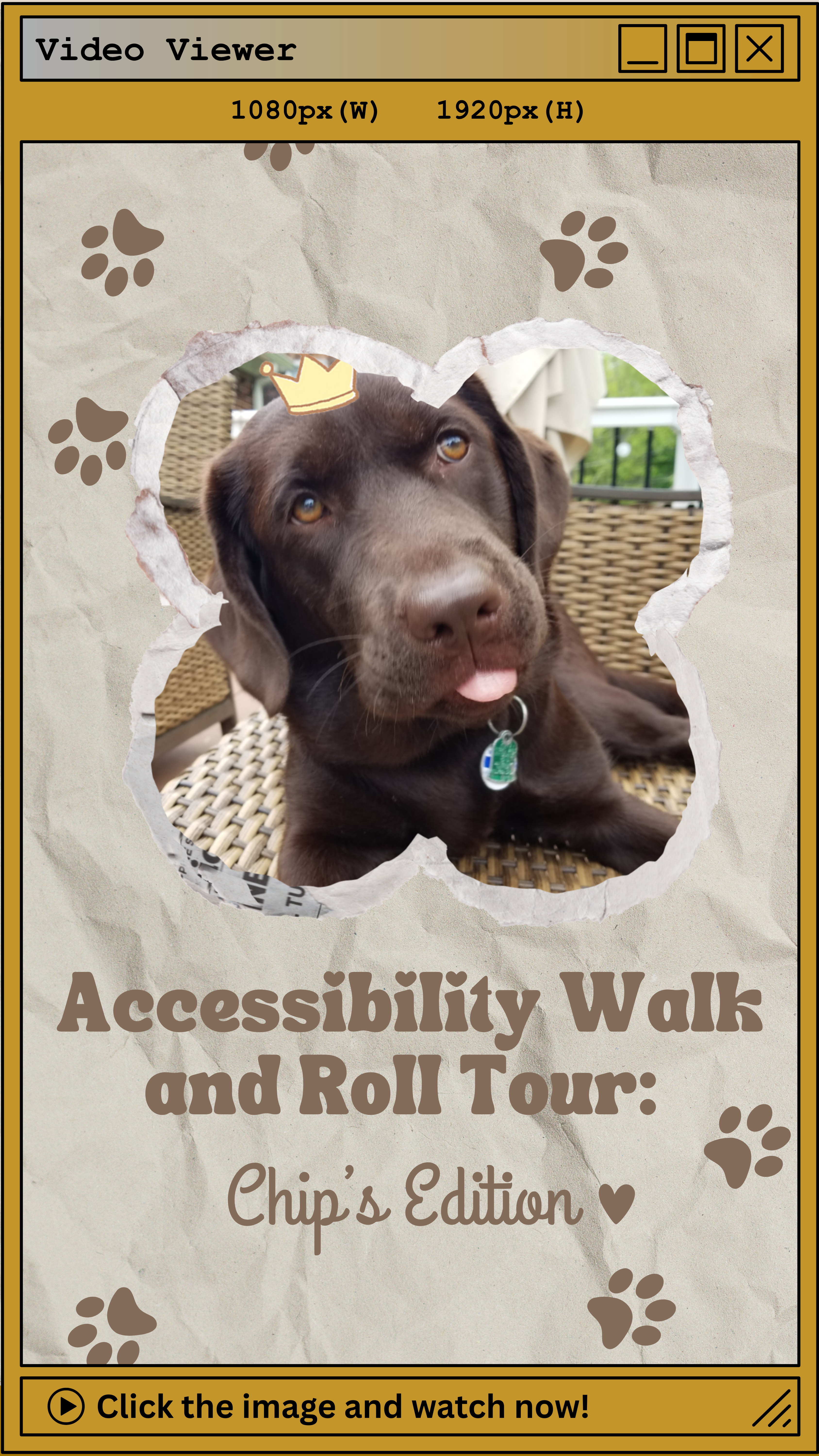
October was Disability Identity and Awareness Month, and SDS was bustling with exciting events! One of the highlights was welcoming our special guest, Chip, who joined us for one of our monthly Accessibility Walk & Roll Tours.
We're thrilled to share this video showcasing Chip as she explores and demonstrates some of the accessible routes around campus. If you missed this one, don't worry! There are more opportunities to join us. Our next tours will take place on
November 10
and
November 19
at 12 PM.
Click on the image below to watch it!
What are the features? We have
many, including a Skywalk and several upgrades (lecture halls and elevators) and more on the way.
We will gather in the ADS Conference Room - learn the skywalk and tunnel connections within the Academic Core, review Adaptive Computing within the Library, and visit the reception area of Retriever Integrated Health - which supports both physical and mental health. The tour is limited to a small group, and please know that mask use is VERY WELCOME.
UMBC is committed to creating an accessible and inclusive environment for all. To request accommodation(s) or to inquire about event accessibility, please contact us via slazar@umbc.edu with "November 10/11 Accessibility Tour" in the subject line.
Can't make the day or time? More tours are planned. Have a (small) group? Email us to set up a day and time that works for the occasion.
Come learn, explore, and experience how accessibility shapes our campus community. See you then!
]]>
October was Disability Identity and Awareness Month, and SDS was bustling with exciting events! One of the highlights was welcoming our special guest, Chip, who joined us for one of our monthly...
https://youtu.be/3JazufjGmGQ
Image
https://assets3-beta.my.umbc.edu/system/shared/attachments/6c088f03cde1efb1e9f36b7fa3a51615/69f43157/news/000/154/242/0bdd1cb57527f67d1aa5c42088e517cd/Press Play (1).png?1762366108
https://beta.my.umbc.edu/api/v0/pixel/news/154242/guest@my.umbc.edu/54ae28f82f058b6d3b2f6c0021c10836/api/pixel
accessibility
accessible
and
assistive
awareness
campus
chip
chips
community
design
disability
diversity
dog
education
for
inclusion
inclusive
life
mission
paws
pride
retriever
sds
service
services
student
technology
the
tour
umbc
universal
Office of Accessibility & Disability Services
https://beta.my.umbc.edu/groups/accessibility
https://assets4-beta.my.umbc.edu/system/shared/avatars/groups/000/001/480/1109171419a1b66ae0d9168429adfb61/xsmall.png?1565792941
https://assets1-beta.my.umbc.edu/system/shared/avatars/groups/000/001/480/1109171419a1b66ae0d9168429adfb61/original.jpg?1565792941
https://assets1-beta.my.umbc.edu/system/shared/avatars/groups/000/001/480/1109171419a1b66ae0d9168429adfb61/xxlarge.png?1565792941
https://assets4-beta.my.umbc.edu/system/shared/avatars/groups/000/001/480/1109171419a1b66ae0d9168429adfb61/xlarge.png?1565792941
https://assets3-beta.my.umbc.edu/system/shared/avatars/groups/000/001/480/1109171419a1b66ae0d9168429adfb61/large.png?1565792941
https://assets1-beta.my.umbc.edu/system/shared/avatars/groups/000/001/480/1109171419a1b66ae0d9168429adfb61/medium.png?1565792941
https://assets1-beta.my.umbc.edu/system/shared/avatars/groups/000/001/480/1109171419a1b66ae0d9168429adfb61/small.png?1565792941
https://assets4-beta.my.umbc.edu/system/shared/avatars/groups/000/001/480/1109171419a1b66ae0d9168429adfb61/xsmall.png?1565792941
https://assets1-beta.my.umbc.edu/system/shared/avatars/groups/000/001/480/1109171419a1b66ae0d9168429adfb61/xxsmall.png?1565792941
Office of Accessibility & Disability Services
https://assets3-beta.my.umbc.edu/system/shared/thumbnails/news/000/154/242/46b1539379b29b6e9d169cdca128e84c/xxlarge.jpg?1762362221
https://assets2-beta.my.umbc.edu/system/shared/thumbnails/news/000/154/242/46b1539379b29b6e9d169cdca128e84c/xlarge.jpg?1762362221
https://assets1-beta.my.umbc.edu/system/shared/thumbnails/news/000/154/242/46b1539379b29b6e9d169cdca128e84c/large.jpg?1762362221
https://assets1-beta.my.umbc.edu/system/shared/thumbnails/news/000/154/242/46b1539379b29b6e9d169cdca128e84c/medium.jpg?1762362221
https://assets2-beta.my.umbc.edu/system/shared/thumbnails/news/000/154/242/46b1539379b29b6e9d169cdca128e84c/small.jpg?1762362221
https://assets2-beta.my.umbc.edu/system/shared/thumbnails/news/000/154/242/46b1539379b29b6e9d169cdca128e84c/xsmall.jpg?1762362221
https://assets3-beta.my.umbc.edu/system/shared/thumbnails/news/000/154/242/46b1539379b29b6e9d169cdca128e84c/xxsmall.jpg?1762362221
A picture of Chip posing with the True Grit Statue.
8
0
false
Wed, 05 Nov 2025 12:14:15 -0500
Sun, 07 Dec 2025 17:43:13 -0500
Get Ready for a More Inclusive Halloween with the Teal Pumpkin Project!
Because every kid deserves a treat they can enjoy!
Halloween is a time of excitement, costumes, and community fun — but for children with food allergies, it can also be stressful and even dangerous. The Teal Pumpkin Project, an initiative by FARE (Food Allergy Research & Education), helps make Halloween safer and more inclusive for all trick-or-treaters.
By placing a teal pumpkin on your porch or displaying one of FARE's printable signs, you signal that you are offering non-food treats — such as stickers, small toys, bubbles, or glow sticks — in addition to traditional candy. This simple act ensures that children with food allergies or dietary restrictions can enjoy the fun of Halloween without fear of an allergic reaction.
Help all trick-or-treaters have fun without worrying about accidental exposure to allergens!
Always check labels carefully, and when in doubt, contact the manufacturer before consuming.
-
Candy Corn: Often contains egg whites and sometimes sesame oil. If labeled egg-free, double-check for other potential allergens.
-
Mini or "Fun Size" Candy: May have different ingredients than full-size versions. Always read the label.
-
Last Year's Favorites: Ingredients can change — a candy that was safe last year might not be this year.
-
Candy Without Labels: If the product isn't clearly identified, it's safest to discard it or trade it for another treat.
-
Licorice: Often contains wheat as a binding ingredient — check labels if you have a wheat allergy.
-
"Allergy-Free" Candy: There is no such thing as completely "allergy-free" candy. While the top nine allergens cause most reactions, over 200 allergens have been reported.
-
Dark Chocolate: Can contain traces of milk, which are unsafe for those with milk allergies, even if tolerated by those with lactose intolerance.
How You Can Participate:
-
Add your home or event to the official Teal Pumpkin Project Map so families can plan allergy-safe routes.
-
Display a teal pumpkin or sign to show your participation.
-
Provide non-food treats in a separate bowl from candy to ensure safety and inclusion.
-
Encourage friends and neighbors to join the movement and help spread awareness.
Together, we can make Halloween a time of joy and inclusion for every child.
Learn more here and add your home to the map!
Let's bring the magic of Halloween to everyone — one teal pumpkin at a time!
]]>
Halloween is a time of excitement, costumes, and community fun — but for children with food allergies, it can also be stressful and even dangerous. The Teal Pumpkin Project, an initiative by FARE...
https://beta.my.umbc.edu/api/v0/pixel/news/153919/guest@my.umbc.edu/0f09236ca55b9d544e7aadb38df19258/api/pixel
accessibility
allergyawareness
allergyfriendly
campusaccessibility
communityinclusion
fare
foodallergyawareness
halloweensafety
hiddendisabilities
inclusivehalloween
nonfoodtreats
safetreats
sds
studentdisabilityservices
tealpumpkinproject
trickortreat
umbc
Office of Accessibility & Disability Services
https://beta.my.umbc.edu/groups/accessibility
https://assets4-beta.my.umbc.edu/system/shared/avatars/groups/000/001/480/1109171419a1b66ae0d9168429adfb61/xsmall.png?1565792941
https://assets1-beta.my.umbc.edu/system/shared/avatars/groups/000/001/480/1109171419a1b66ae0d9168429adfb61/original.jpg?1565792941
https://assets1-beta.my.umbc.edu/system/shared/avatars/groups/000/001/480/1109171419a1b66ae0d9168429adfb61/xxlarge.png?1565792941
https://assets4-beta.my.umbc.edu/system/shared/avatars/groups/000/001/480/1109171419a1b66ae0d9168429adfb61/xlarge.png?1565792941
https://assets3-beta.my.umbc.edu/system/shared/avatars/groups/000/001/480/1109171419a1b66ae0d9168429adfb61/large.png?1565792941
https://assets1-beta.my.umbc.edu/system/shared/avatars/groups/000/001/480/1109171419a1b66ae0d9168429adfb61/medium.png?1565792941
https://assets1-beta.my.umbc.edu/system/shared/avatars/groups/000/001/480/1109171419a1b66ae0d9168429adfb61/small.png?1565792941
https://assets4-beta.my.umbc.edu/system/shared/avatars/groups/000/001/480/1109171419a1b66ae0d9168429adfb61/xsmall.png?1565792941
https://assets1-beta.my.umbc.edu/system/shared/avatars/groups/000/001/480/1109171419a1b66ae0d9168429adfb61/xxsmall.png?1565792941
Office of Accessibility & Disability Services
https://assets3-beta.my.umbc.edu/system/shared/thumbnails/news/000/153/919/23736f4ad9ebdd2b4ae773263f4a94a5/xxlarge.jpg?1761579433
https://assets2-beta.my.umbc.edu/system/shared/thumbnails/news/000/153/919/23736f4ad9ebdd2b4ae773263f4a94a5/xlarge.jpg?1761579433
https://assets4-beta.my.umbc.edu/system/shared/thumbnails/news/000/153/919/23736f4ad9ebdd2b4ae773263f4a94a5/large.jpg?1761579433
https://assets4-beta.my.umbc.edu/system/shared/thumbnails/news/000/153/919/23736f4ad9ebdd2b4ae773263f4a94a5/medium.jpg?1761579433
https://assets1-beta.my.umbc.edu/system/shared/thumbnails/news/000/153/919/23736f4ad9ebdd2b4ae773263f4a94a5/small.jpg?1761579433
https://assets3-beta.my.umbc.edu/system/shared/thumbnails/news/000/153/919/23736f4ad9ebdd2b4ae773263f4a94a5/xsmall.jpg?1761579433
https://assets1-beta.my.umbc.edu/system/shared/thumbnails/news/000/153/919/23736f4ad9ebdd2b4ae773263f4a94a5/xxsmall.jpg?1761579433
Kids dressed up in Halloween costumes, with the heading "Let's make Halloween Teal".
2
0
false
Mon, 27 Oct 2025 11:38:55 -0400
Invisible Disabilities Week: Celebrating Strength You Can’t Always See (Oct 19-25)
Show your support — wear the Sunflower, share understanding.
Did You Know Not All Disabilities Are Visible?
This week (October 19–25) is Invisible Disabilities Week — a time to raise awareness and support for those living with non-visible conditions.
An invisible disability is a physical, mental, or neurological condition that may not be apparent from the outside but can significantly affect a person's daily life, movements, senses, or activities.
The Hidden Disabilities Sunflower is a simple yet powerful symbol that lets people discreetly share that they have an invisible disability and may need extra time, understanding, or support. The movement began in the United Kingdom and is now recognized across Great Britain, Ireland, and Scotland — and it's spreading worldwide.
If you notice someone wearing the Hidden Disabilities Sunflower, please show kindness, patience, and understanding. Displaying a sunflower symbol on your office door, reception area, or workspace helps communicate that people with hidden disabilities are welcome and supported.
Living with a hidden disability can make everyday life more challenging — and these challenges are not always easy to recognize or understand. Wearing the Sunflower is a way to promote empathy and inclusion.
The Hidden Disabilities Sunflower Program officially launched at UMBC in Spring 2025!
Learn how you can get a sunflower sticker or button to show your support for hidden disabilities here: https://sds.umbc.edu/umbc-sunflower-program/. You can also follow the UMBC Sunflower group here. Spotlight on Maryland: "Eric's ID Law"
Maryland has also made great strides in recognizing invisible disabilities thanks to Eric's ID Law.
On October 1, 2025, several people gathered at the MVA's White Oak location to celebrate the launch of new Maryland ID cards featuring a butterfly logo above the words "Hidden Disability." The first card was issued to Eric Carpenter-Grantham, a Montgomery College student with high-functioning autism who inspired the law.
Eric's advocacy reminds us that awareness, empathy, and education can transform lives — one symbol at a time. Read the full story here.
Image Credit:
Hidden Disabilities Sunflower