UMBC faculty Karimi and Yus help team win 2nd place in Sandpit Challenge on Digital Trust
A research team that includes UMBC CSEE faculty Naghmeh Karimi and Roberto Yus won the second place prize in the 2022 INCS-CoE Sandpit Challenge on Digital Trust. The International Cyber Security Center of Excellence (INCS-CoE) is an international collaboration of government, industry, and academic organizations that have partnered to explore pioneering efforts to address cybersecurity challenges created by a growing borderless digital society. UMBC is a charter member of INCS-CoE.
The INCS-COE Sandpit Challenge invited self-assembled teams to compete for seed research funding prizes to pursue their work further. The UMBC faculty teamed up with researchers from Royal Holloway (UK) and Keio University (Japan). They were awarded second prize for their proposal to deal with challenges associated with developing an International Digital Trust Framework. In particular, their project proposal focused on designing an ontology-based interoperability solution amongst the US, UK, and Japan for mutual recognition of trust, capturing private and public sector use cases with different assurance levels.
The post UMBC faculty Karimi and Yus help team win 2nd place in Sandpit Challenge on Digital Trust appeared first on Department of Computer Science and Electrical Engineering.
]]>
A research team that includes UMBC CSEE faculty Naghmeh Karimi and Roberto Yus won the second place prize in the 2022 INCS-CoE Sandpit Challenge on Digital Trust. The International Cyber Security...
https://redirect.cs.umbc.edu/2022/05/umbc-faculty-karimi-and-yus-help-team-win-2nd-place-in-sandpit-challenge-on-digital-trust/
https://beta.my.umbc.edu/api/v0/pixel/news/129849/guest@my.umbc.edu/054141cebdddea3f80c53202e6f2fcca/api/pixel
cybersecurity
faculty-and-staff
research
UMBC Cybersecurity Institute Group
https://beta.my.umbc.edu/groups/cybersecurity
https://assets3-beta.my.umbc.edu/system/shared/avatars/groups/000/000/485/196da6a7ec6f4c31eab2e474c17a9ab7/xsmall.png?1734891477
https://assets3-beta.my.umbc.edu/system/shared/avatars/groups/000/000/485/196da6a7ec6f4c31eab2e474c17a9ab7/original.png?1734891477
https://assets4-beta.my.umbc.edu/system/shared/avatars/groups/000/000/485/196da6a7ec6f4c31eab2e474c17a9ab7/xxlarge.png?1734891477
https://assets4-beta.my.umbc.edu/system/shared/avatars/groups/000/000/485/196da6a7ec6f4c31eab2e474c17a9ab7/xlarge.png?1734891477
https://assets2-beta.my.umbc.edu/system/shared/avatars/groups/000/000/485/196da6a7ec6f4c31eab2e474c17a9ab7/large.png?1734891477
https://assets3-beta.my.umbc.edu/system/shared/avatars/groups/000/000/485/196da6a7ec6f4c31eab2e474c17a9ab7/medium.png?1734891477
https://assets3-beta.my.umbc.edu/system/shared/avatars/groups/000/000/485/196da6a7ec6f4c31eab2e474c17a9ab7/small.png?1734891477
https://assets3-beta.my.umbc.edu/system/shared/avatars/groups/000/000/485/196da6a7ec6f4c31eab2e474c17a9ab7/xsmall.png?1734891477
https://assets3-beta.my.umbc.edu/system/shared/avatars/groups/000/000/485/196da6a7ec6f4c31eab2e474c17a9ab7/xxsmall.png?1734891477
UMBC Center for Cybersecurity
0
0
false
Wed, 11 May 2022 15:58:56 -0400
Wed, 11 May 2022 15:58:56 -0400
UMBC faculty Karimi and Yus help team win 2nd place in Sandpit Challenge on Digital Trust
A research team that includes UMBC CSEE faculty Naghmeh Karimi and Roberto Yus won the second place prize in the 2022 INCS-CoE Sandpit Challenge on Digital Trust. The International Cyber Security Center of Excellence (INCS-CoE) is an international collaboration of government, industry, and academic organizations that have partnered to explore pioneering efforts to address cybersecurity challenges created by a growing borderless digital society. UMBC is a charter member of INCS-CoE.
The INCS-COE Sandpit Challenge invited self-assembled teams to compete for seed research funding prizes to pursue their work further. The UMBC faculty teamed up with researchers from Royal Holloway (UK) and Keio University (Japan). They were awarded second prize for their proposal to deal with challenges associated with developing an International Digital Trust Framework. In particular, their project proposal focused on designing an ontology-based interoperability solution amongst the US, UK, and Japan for mutual recognition of trust, capturing private and public sector use cases with different assurance levels.
The post UMBC faculty Karimi and Yus help team win 2nd place in Sandpit Challenge on Digital Trust appeared first on Department of Computer Science and Electrical Engineering.
]]>
A research team that includes UMBC CSEE faculty Naghmeh Karimi and Roberto Yus won the second place prize in the 2022 INCS-CoE Sandpit Challenge on Digital Trust. The International Cyber Security...
https://www.csee.umbc.edu/2022/05/umbc-faculty-karimi-and-yus-help-team-win-2nd-place-in-sandpit-challenge-on-digital-trust/
https://beta.my.umbc.edu/api/v0/pixel/news/119374/guest@my.umbc.edu/eb26bcdf880a3fe5213800c1a4319984/api/pixel
cybersecurity
faculty-and-staff
research
UMBC Cybersecurity Institute Group
https://beta.my.umbc.edu/groups/cybersecurity
https://assets3-beta.my.umbc.edu/system/shared/avatars/groups/000/000/485/196da6a7ec6f4c31eab2e474c17a9ab7/xsmall.png?1734891477
https://assets3-beta.my.umbc.edu/system/shared/avatars/groups/000/000/485/196da6a7ec6f4c31eab2e474c17a9ab7/original.png?1734891477
https://assets4-beta.my.umbc.edu/system/shared/avatars/groups/000/000/485/196da6a7ec6f4c31eab2e474c17a9ab7/xxlarge.png?1734891477
https://assets4-beta.my.umbc.edu/system/shared/avatars/groups/000/000/485/196da6a7ec6f4c31eab2e474c17a9ab7/xlarge.png?1734891477
https://assets2-beta.my.umbc.edu/system/shared/avatars/groups/000/000/485/196da6a7ec6f4c31eab2e474c17a9ab7/large.png?1734891477
https://assets3-beta.my.umbc.edu/system/shared/avatars/groups/000/000/485/196da6a7ec6f4c31eab2e474c17a9ab7/medium.png?1734891477
https://assets3-beta.my.umbc.edu/system/shared/avatars/groups/000/000/485/196da6a7ec6f4c31eab2e474c17a9ab7/small.png?1734891477
https://assets3-beta.my.umbc.edu/system/shared/avatars/groups/000/000/485/196da6a7ec6f4c31eab2e474c17a9ab7/xsmall.png?1734891477
https://assets3-beta.my.umbc.edu/system/shared/avatars/groups/000/000/485/196da6a7ec6f4c31eab2e474c17a9ab7/xxsmall.png?1734891477
UMBC Center for Cybersecurity
0
0
false
Wed, 11 May 2022 15:58:56 -0400
Wed, 11 May 2022 15:58:56 -0400
UMBC’s Naghmeh Karimi receives NSF CAREER Award to develop long-lasting security for cryptographic chips

Naghmeh Karimi receives NSF CAREER award to develop long-lasting security for cryptographic chips
Naghmeh Karimi is the most recent UMBC faculty member to receive a prestigious CAREER Award from the National Science Foundation (NSF). The grant, totaling approximately $500,000 over five years, will support her work to investigate how device-aging related risks compromise the security of cryptographic devices.
Karimi explains that cryptographic chips offer continued advances in authenticating messages and devices as well as preserving the integrity and confidentiality of sensitive information. They do so by implementing cryptographic algorithms in hardware. These chips combine the benefits of cryptographic applications with the speed and power advantage of hardware implementations.
Despite their significant benefits, cryptographic chips can be compromised by adversaries who have gained physical access to the chips. Current protections against such attacks do not consider the aging of devices, which can shift device parameters over time.
Addressing security vulnerabilities
Aging makes cryptographic chips operate slower and, ultimately, results in their malfunction, says Karimi. She explains that the typical lifetime of integrated circuits is 7 to 8 years. As the devices age, their performance decreases. Karimi is exploring the specific security vulnerabilities of aged devices and how they can be protected.
“We want to preserve the security of devices over their lifetime,” Karimi says.
Karimi and her research team will study whether the success of the side-channel analysis and fault-injection attacks increase in older devices. Karimi will create and test several countermeasures to protect devices against such attacks.
Connecting students with opportunities in tech security
The CAREER Award funding will support several UMBC undergraduate and graduate student researchers working with Karimi to develop long-lasting security solutions for hardware platforms.
At the same time, Karimi will also develop and launch a new course in UMBC’s computer science and electrical engineering department on cryptography, hardware security, and testing. She will also work with the UMBC Cyber Scholars Program to connect students with internship opportunities focused on hardware security, to give them additional hands-on experience in the field.
“The success of this project will enable us to develop long-lasting security for trusted hardware platforms,” Karimi says. “This will result in aging-resistant security solutions that benefit society through devices that remain secure over their lifetime.”
Adapted from a UMBC News article by Megan Hanks. Banner image: UMBC’s ITE building. Photo by Marlayna Demond ’11 for UMBC.
The post UMBC’s Naghmeh Karimi receives NSF CAREER Award to develop long-lasting security for cryptographic chips appeared first on Department of Computer Science and Electrical Engineering.
]]>
Naghmeh Karimi receives NSF CAREER award to develop long-lasting security for cryptographic chips Naghmeh Karimi is the most recent UMBC faculty member to receive a prestigious CAREER...
https://www.csee.umbc.edu/2020/05/umbcs-naghmeh-karimi-receives-nsf-career-award-to-develop-long-lasting-security-for-cryptographic-chips/
https://beta.my.umbc.edu/api/v0/pixel/news/93179/guest@my.umbc.edu/f6f37c77b75fc26257558718b90de96e/api/pixel
computer-engineering
cybersecurity
faculty-and-staff
news
research-awards
UMBC Cybersecurity Institute Group
https://beta.my.umbc.edu/groups/cybersecurity
https://assets3-beta.my.umbc.edu/system/shared/avatars/groups/000/000/485/196da6a7ec6f4c31eab2e474c17a9ab7/xsmall.png?1734891477
https://assets3-beta.my.umbc.edu/system/shared/avatars/groups/000/000/485/196da6a7ec6f4c31eab2e474c17a9ab7/original.png?1734891477
https://assets4-beta.my.umbc.edu/system/shared/avatars/groups/000/000/485/196da6a7ec6f4c31eab2e474c17a9ab7/xxlarge.png?1734891477
https://assets4-beta.my.umbc.edu/system/shared/avatars/groups/000/000/485/196da6a7ec6f4c31eab2e474c17a9ab7/xlarge.png?1734891477
https://assets2-beta.my.umbc.edu/system/shared/avatars/groups/000/000/485/196da6a7ec6f4c31eab2e474c17a9ab7/large.png?1734891477
https://assets3-beta.my.umbc.edu/system/shared/avatars/groups/000/000/485/196da6a7ec6f4c31eab2e474c17a9ab7/medium.png?1734891477
https://assets3-beta.my.umbc.edu/system/shared/avatars/groups/000/000/485/196da6a7ec6f4c31eab2e474c17a9ab7/small.png?1734891477
https://assets3-beta.my.umbc.edu/system/shared/avatars/groups/000/000/485/196da6a7ec6f4c31eab2e474c17a9ab7/xsmall.png?1734891477
https://assets3-beta.my.umbc.edu/system/shared/avatars/groups/000/000/485/196da6a7ec6f4c31eab2e474c17a9ab7/xxsmall.png?1734891477
UMBC Center for Cybersecurity
0
0
false
Fri, 15 May 2020 15:53:54 -0400
Fri, 15 May 2020 15:53:54 -0400
Prof. Naghmeh Karimi receives NSF CAREER award for research on the security of cryptographic chips
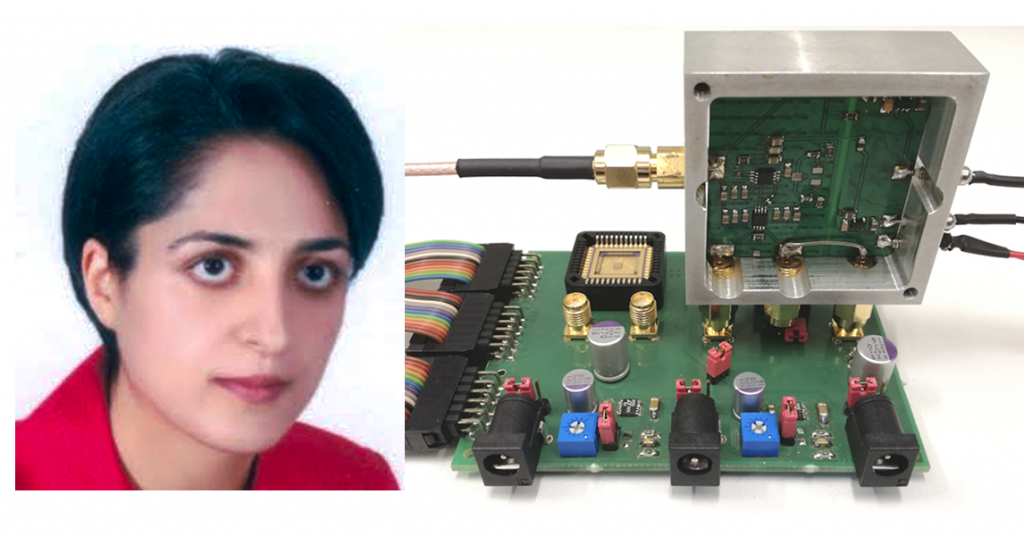 Professor Karimi and a custom measurement board developed by her collaborators at the University of Buchum, Germany that is being used to test a 65 nm application-specific integrated circuit sample
Investigating the Impact of Device Aging on the Security of Cryptographic Chips
Professor Naghmeh Karimi received a prestigious NSF CAREER award to support her research on Investigating the impact of device aging on the security of cryptographic chips.
CAREER awards are among NFS’s most prestigious awards and are intended to support early-career faculty who have the potential to serve as academic role models in research and education and to lead advances in the mission of their department or organization.
Cryptographic chips implement cryptographic functions in hardware for better performance. Despite the significant performance benefits, cryptographic chips can be compromised by the adversaries via monitoring their power-consumption, tampering their logic or placing the chips under stress to generate erroneous outputs to infer sensitive data. The current protections against such attacks do not consider the aging of the devices that can cause a parametric shift of device parameters over time which can compromise device security.
Supported by this five-year award, Professor Karimi and her students will investigate the effects of device aging on the security of cryptographic devices, particularly those with protection against physical attacks, and develop solutions to ensure security when device aging comes into account. Her work will help enable the development of long-lasting security for trusted hardware platforms, and result in aging-resistant security solutions that benefit the society via devices that remain secure over their lifetime.
The post Prof. Naghmeh Karimi receives NSF CAREER award for research on the security of cryptographic chips appeared first on Department of Computer Science and Electrical Engineering.
]]>
Professor Karimi and a custom measurement board developed by her collaborators at the University of Buchum, Germany that is being used to test a 65 nm application-specific integrated circuit...
https://www.csee.umbc.edu/2020/04/prof-naghmeh-karimi-receives-nsf-career-award-for-research-on-the-security-of-cryptographic-chips/
https://beta.my.umbc.edu/api/v0/pixel/news/91866/guest@my.umbc.edu/fea8ee82fd9fa8dfa31576a865a16e24/api/pixel
computer-engineering
cryptographic-chips
cybersecurity
device-aging
faculty-and-staff
hardware-security
news
research
research-awards
UMBC Cybersecurity Institute Group
https://beta.my.umbc.edu/groups/cybersecurity
https://assets3-beta.my.umbc.edu/system/shared/avatars/groups/000/000/485/196da6a7ec6f4c31eab2e474c17a9ab7/xsmall.png?1734891477
https://assets3-beta.my.umbc.edu/system/shared/avatars/groups/000/000/485/196da6a7ec6f4c31eab2e474c17a9ab7/original.png?1734891477
https://assets4-beta.my.umbc.edu/system/shared/avatars/groups/000/000/485/196da6a7ec6f4c31eab2e474c17a9ab7/xxlarge.png?1734891477
https://assets4-beta.my.umbc.edu/system/shared/avatars/groups/000/000/485/196da6a7ec6f4c31eab2e474c17a9ab7/xlarge.png?1734891477
https://assets2-beta.my.umbc.edu/system/shared/avatars/groups/000/000/485/196da6a7ec6f4c31eab2e474c17a9ab7/large.png?1734891477
https://assets3-beta.my.umbc.edu/system/shared/avatars/groups/000/000/485/196da6a7ec6f4c31eab2e474c17a9ab7/medium.png?1734891477
https://assets3-beta.my.umbc.edu/system/shared/avatars/groups/000/000/485/196da6a7ec6f4c31eab2e474c17a9ab7/small.png?1734891477
https://assets3-beta.my.umbc.edu/system/shared/avatars/groups/000/000/485/196da6a7ec6f4c31eab2e474c17a9ab7/xsmall.png?1734891477
https://assets3-beta.my.umbc.edu/system/shared/avatars/groups/000/000/485/196da6a7ec6f4c31eab2e474c17a9ab7/xxsmall.png?1734891477
UMBC Center for Cybersecurity
1
0
false
Mon, 06 Apr 2020 12:14:01 -0400
Mon, 06 Apr 2020 12:14:01 -0400
Dr. Forno discusses the Baltimore Ransomware attack on Maryland Public TV program

Maryland Public Television’s Charles Robinson reports on how Baltimore continues to recover after city computers were infected with ransomware in the May 2019 Baltimore ransomware attack and interviews Dr. Rick Forno, associate director of the UMBC Center for Cybersecurity and graduate director of UMBC’s Cybersecurity MPS degree program.
From Wikipedia: On May 7th 2019, most of Baltimore’s government computer systems were infected with a new and aggressive ransomware variant named RobbinHood. All servers, with the exception of essential services, were taken offline. In a ransom note, hackers demanded 13 bitcoin (roughly $76,280) in exchange for keys to restore access. The note also stated that if the demands were not met within four days, the price would increase and within ten days the city would permanently lose all of the data.
As of May 13, 2019 all systems remained down for city employees. It is estimated that it will take weeks to recover. According to Mayor Jack Young, US Federal Law enforcement continue to investigate the attack.
The attack had a negative impact on the real estate market as property transfers could not be completed until the system was restored on May 20th. However, the restoration of all systems was, as of May 20, 2019, estimated to take weeks more.
Baltimore was susceptible to such an attack due to its IT practices, which included decentralized control of its technology budget and a failure to allocate money its information security manager wanted to fund cyberattack insurance. The attack has been compared to a previous ransomware attack on Atlanta the previous year, and was the second major use of the RobbinHood ransomware on an American city in 2019, as Greenville, North Carolina was also impacted in April.
The post Dr. Forno discusses the Baltimore Ransomware attack on Maryland Public TV program appeared first on Department of Computer Science and Electrical Engineering.
]]>
Maryland Public Television’s Charles Robinson reports on how Baltimore continues to recover after city computers were infected with ransomware in the May 2019 Baltimore ransomware attack and...
https://www.csee.umbc.edu/2019/10/umbc-forno-discusses-the-baltimore-vity-ransomware-attack-on-maryland-public-television-interview-cybersecurity/
https://beta.my.umbc.edu/api/v0/pixel/news/87745/guest@my.umbc.edu/3c5c6263104860363c1cedd4c1398da0/api/pixel
cybersecurity
faculty-and-staff
news
UMBC Cybersecurity Institute Group
https://beta.my.umbc.edu/groups/cybersecurity
https://assets3-beta.my.umbc.edu/system/shared/avatars/groups/000/000/485/196da6a7ec6f4c31eab2e474c17a9ab7/xsmall.png?1734891477
https://assets3-beta.my.umbc.edu/system/shared/avatars/groups/000/000/485/196da6a7ec6f4c31eab2e474c17a9ab7/original.png?1734891477
https://assets4-beta.my.umbc.edu/system/shared/avatars/groups/000/000/485/196da6a7ec6f4c31eab2e474c17a9ab7/xxlarge.png?1734891477
https://assets4-beta.my.umbc.edu/system/shared/avatars/groups/000/000/485/196da6a7ec6f4c31eab2e474c17a9ab7/xlarge.png?1734891477
https://assets2-beta.my.umbc.edu/system/shared/avatars/groups/000/000/485/196da6a7ec6f4c31eab2e474c17a9ab7/large.png?1734891477
https://assets3-beta.my.umbc.edu/system/shared/avatars/groups/000/000/485/196da6a7ec6f4c31eab2e474c17a9ab7/medium.png?1734891477
https://assets3-beta.my.umbc.edu/system/shared/avatars/groups/000/000/485/196da6a7ec6f4c31eab2e474c17a9ab7/small.png?1734891477
https://assets3-beta.my.umbc.edu/system/shared/avatars/groups/000/000/485/196da6a7ec6f4c31eab2e474c17a9ab7/xsmall.png?1734891477
https://assets3-beta.my.umbc.edu/system/shared/avatars/groups/000/000/485/196da6a7ec6f4c31eab2e474c17a9ab7/xxsmall.png?1734891477
UMBC Center for Cybersecurity
0
0
false
Sun, 20 Oct 2019 18:57:06 -0400
Sun, 20 Oct 2019 18:57:06 -0400

Global Impact, Promise & Perils of Blockchain
UMBC Professors Haibin Zhang (Computer Science and Electrical Engineering) and Karuna Joshi (Information Systems) will be panelists for an event focused on the impact, promise and perils of blockchain technologies at the bwtech@UMBC Research & Technology Park. The event will take place from 8:15 to 11:15am on Tuesday, March 20 2018 at and will include breakfast and time for networking. They will be joined on the panel by Marcus Edwards, from Northrop Grumman’s Cyber & Intelligence Mission Solutions, Steve Cook of Verizon Enterprise Solutions, Sean Manion of Science Distributed and moderator Razvan Miutescu of Whiteford, Taylor & Preston, LLP. For more information and tickets are available on eventbrite.
8:15 – 11:15 Tuesday, March 20, 2018
bwtech@UMBC Research & Technology Park
5520 Research Park Drive, Baltimore, MD 21228
Cryptocurrency market capitalizations have soared over the past year and new innovative blockchain applications are continuing to emerge seemingly by the day. However, the average end-user is left to singularly make sense of a vast and global marketplace that is rapidly converging the core tenets of economics and technology development. The future prospects of traditional business and financial models is uncertain as blockchain technology leaves key decision makers in an untenable position to either adopt and adapt or simply be left behind. Industry and academic experts in the field will discuss the pros and cons and opportunities and challenges of this disruptive technology movement.
The post 🗣️ CyberInnovation Briefing: Global Impact, Promise & Perils of Blockchain appeared first on Department of Computer Science and Electrical Engineering.
]]>
Global Impact, Promise & Perils of Blockchain UMBC Professors Haibin Zhang (Computer Science and Electrical Engineering) and Karuna Joshi (Information Systems) will be panelists for an event...
https://www.csee.umbc.edu/2018/03/umbc-cyberinnovation-briefing-global-impact-promise-perils-of-blockchain/
https://beta.my.umbc.edu/api/v0/pixel/news/74886/guest@my.umbc.edu/071b57ec9d7f66fc52ec392277325cb1/api/pixel
computer-science
cybersecurity
data-science
events
faculty-and-staff
news
UMBC Cybersecurity Institute Group
https://beta.my.umbc.edu/groups/cybersecurity
https://assets3-beta.my.umbc.edu/system/shared/avatars/groups/000/000/485/196da6a7ec6f4c31eab2e474c17a9ab7/xsmall.png?1734891477
https://assets3-beta.my.umbc.edu/system/shared/avatars/groups/000/000/485/196da6a7ec6f4c31eab2e474c17a9ab7/original.png?1734891477
https://assets4-beta.my.umbc.edu/system/shared/avatars/groups/000/000/485/196da6a7ec6f4c31eab2e474c17a9ab7/xxlarge.png?1734891477
https://assets4-beta.my.umbc.edu/system/shared/avatars/groups/000/000/485/196da6a7ec6f4c31eab2e474c17a9ab7/xlarge.png?1734891477
https://assets2-beta.my.umbc.edu/system/shared/avatars/groups/000/000/485/196da6a7ec6f4c31eab2e474c17a9ab7/large.png?1734891477
https://assets3-beta.my.umbc.edu/system/shared/avatars/groups/000/000/485/196da6a7ec6f4c31eab2e474c17a9ab7/medium.png?1734891477
https://assets3-beta.my.umbc.edu/system/shared/avatars/groups/000/000/485/196da6a7ec6f4c31eab2e474c17a9ab7/small.png?1734891477
https://assets3-beta.my.umbc.edu/system/shared/avatars/groups/000/000/485/196da6a7ec6f4c31eab2e474c17a9ab7/xsmall.png?1734891477
https://assets3-beta.my.umbc.edu/system/shared/avatars/groups/000/000/485/196da6a7ec6f4c31eab2e474c17a9ab7/xxsmall.png?1734891477
UMBC Center for Cybersecurity
1
0
true
Fri, 16 Mar 2018 08:34:37 -0400
Fri, 16 Mar 2018 08:34:37 -0400
UMBC’s Haibin Zhang shares tips to secure data in the cloud

UMBC’s Haibin Zhang shares tips to secure data in the cloud
As more consumers rely on cloud-based data storage for everything from family photos to financial information, both experts and general users have voiced concerns about cloud security. In a new Conversation article recently published by Scientific American, Haibin Zhang, assistant professor of computer science and electrical engineering, explains precautions consumers can take to protect their files in the cloud.
Zhang explains that data stored and secured using commercial cloud storage systems is encrypted, which means that without the key, the information looks like a series of meaningless characters. Encryption keys have the potential to be misused, if they end up in the wrong hands, which can compromise the security of files stored in a cloud.
“Just like regular keys, if someone else has them, they might be stolen or misused without the data owner knowing,” says Zhang. “And some services might have flaws in their security practices that leave users’ data vulnerable.”
Zhang notes that some cloud services allow customers to maintain their encryption key themselves, which give the consumer the control in ensuring that their data remains safe. Other services keep the encryption keys internally and manage the security for their customers. He says that while each option has benefits, it is important to recognize that “some services might have flaws in their security practices that leave users’ data vulnerable.”
To keep data secure in the cloud, Zhang suggests using enhanced security features offered by cloud storage companies and taking additional precautions that are available to individual customers. He recommends that people use a cloud storage service that allows customers to encrypt their data before uploading it for storage, and to rely on services that have been “validated by independent security researchers.”
Read “How secure is your data when it’s stored in the cloud?” in The Conversation for Zhang’s additional recommendations on securing data on the cloud. The piece also appeared in Scientific American, and has so far been read nearly 20,000 times.
Adapted from a UMBC News article by Megan Hanks. Photo by Yuri Samoilov, CC by 2.0.
The post UMBC’s Haibin Zhang shares tips to secure data in the cloud appeared first on Department of Computer Science and Electrical Engineering.
]]>
UMBC’s Haibin Zhang shares tips to secure data in the cloud As more consumers rely on cloud-based data storage for everything from family photos to financial information, both experts and...
https://www.csee.umbc.edu/2018/02/umbc-haibin-zhang-tips-secure-data-cloud-cybersecurity-computer-security/
https://beta.my.umbc.edu/api/v0/pixel/news/73767/guest@my.umbc.edu/ac1cc011dc557e189defafd6aae1fa07/api/pixel
computer-science
cybersecurity
faculty-and-staff
UMBC Cybersecurity Institute Group
https://beta.my.umbc.edu/groups/cybersecurity
https://assets3-beta.my.umbc.edu/system/shared/avatars/groups/000/000/485/196da6a7ec6f4c31eab2e474c17a9ab7/xsmall.png?1734891477
https://assets3-beta.my.umbc.edu/system/shared/avatars/groups/000/000/485/196da6a7ec6f4c31eab2e474c17a9ab7/original.png?1734891477
https://assets4-beta.my.umbc.edu/system/shared/avatars/groups/000/000/485/196da6a7ec6f4c31eab2e474c17a9ab7/xxlarge.png?1734891477
https://assets4-beta.my.umbc.edu/system/shared/avatars/groups/000/000/485/196da6a7ec6f4c31eab2e474c17a9ab7/xlarge.png?1734891477
https://assets2-beta.my.umbc.edu/system/shared/avatars/groups/000/000/485/196da6a7ec6f4c31eab2e474c17a9ab7/large.png?1734891477
https://assets3-beta.my.umbc.edu/system/shared/avatars/groups/000/000/485/196da6a7ec6f4c31eab2e474c17a9ab7/medium.png?1734891477
https://assets3-beta.my.umbc.edu/system/shared/avatars/groups/000/000/485/196da6a7ec6f4c31eab2e474c17a9ab7/small.png?1734891477
https://assets3-beta.my.umbc.edu/system/shared/avatars/groups/000/000/485/196da6a7ec6f4c31eab2e474c17a9ab7/xsmall.png?1734891477
https://assets3-beta.my.umbc.edu/system/shared/avatars/groups/000/000/485/196da6a7ec6f4c31eab2e474c17a9ab7/xxsmall.png?1734891477
UMBC Center for Cybersecurity
2
0
true
Wed, 07 Feb 2018 14:14:06 -0500