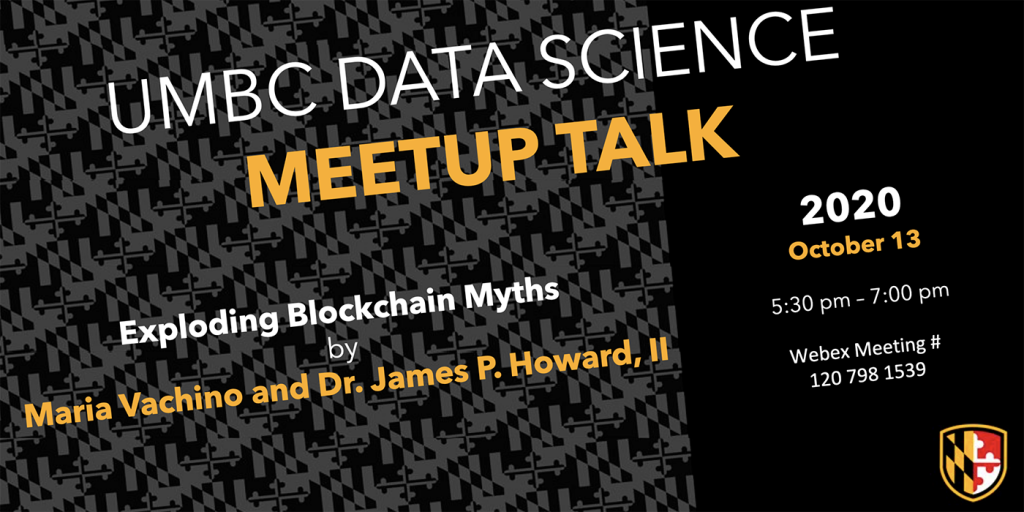
In this talk, Maria Vachino from Easy Dynamics and Dr. James P. Howard from APL will provide an overview of what blockchain is and isn’t, focusing on non-cryptocurrency use cases, will explain the results of their research for the DHS S&T Cybersecurity Directorate, and will provide insight into the value (or lack therefore) of the technology.
Maria Vachino is the Director of Digital Identity at Easy Dynamics where she is focused on Identity Credential & Access Management (ICAM) technologies, policies, & standards, Cybersecurity, and IT modernization for the US Federal Government. She started investigating applications for blockchain technology in 2015 as the Technical and Government Engagement Lead for the DHS S&T Cyber Security Directorate’s Identity Management Research & Development Program while a member of the Senior Professional Staff at the Johns Hopkins Applied Physics Lab. Maria has a BS in Computer Science from UMBC and an MS in Cybersecurity.
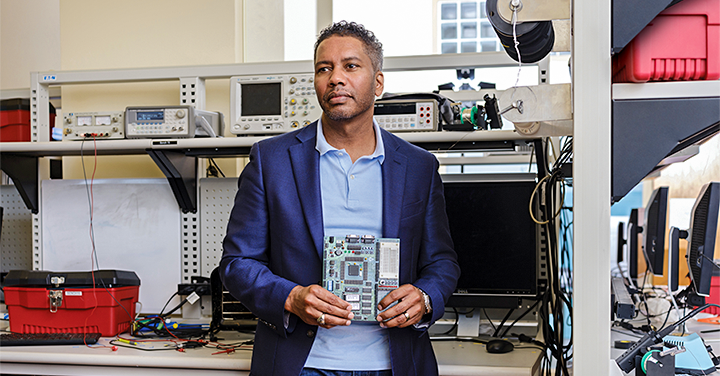
Dr. James P. Howard, II (UMBC Ph.D. ’14) is a scientist at the Johns Hopkins Applied Physics Laboratory. Previously, he was a consultant to numerous government agencies, including the Securities and Exchange Commission, the Executive Office of the President, and the United States Department of Homeland Security, and worked for the Board of Governors of the Federal Reserve System as an internal consultant on scientific computing. He is a passionate educator, teaching mathematics and statistics at the University of Maryland Global Campus since 2010 and has taught public management at Central Michigan University, Penn State, and the University of Baltimore. His most recent work has modeled the spread of infectious respiratory diseases and Ebolavirus, predicted global disruptive events, researched using blockchain for government services, and created devices for rescuing victims of building collapse. He is the author of two books.
]]>
UMBC Data Science Meetup Talk Exploding Blockchain Myths Maria Vachino and Dr. James P. Howard 5:30-7:00pm Tuesday, 13 October 2020 In this talk, Maria Vachino from Easy Dynamics and Dr....https://www.csee.umbc.edu/2020/10/talk-exploding-blockchain-myths-530pm-tue-10-13/https://beta.my.umbc.edu/api/v0/pixel/news/96415/guest@my.umbc.edu/097b844dc5ba2983199d05604cc47309/api/pixelalumnicomputer-sciencecybersecuritydata-sciencenewstalksUMBC Cybersecurity Institute Grouphttps://beta.my.umbc.edu/groups/cybersecurityhttps://assets3-beta.my.umbc.edu/system/shared/avatars/groups/000/000/485/196da6a7ec6f4c31eab2e474c17a9ab7/xsmall.png?1734891477https://assets3-beta.my.umbc.edu/system/shared/avatars/groups/000/000/485/196da6a7ec6f4c31eab2e474c17a9ab7/original.png?1734891477https://assets4-beta.my.umbc.edu/system/shared/avatars/groups/000/000/485/196da6a7ec6f4c31eab2e474c17a9ab7/xxlarge.png?1734891477https://assets4-beta.my.umbc.edu/system/shared/avatars/groups/000/000/485/196da6a7ec6f4c31eab2e474c17a9ab7/xlarge.png?1734891477https://assets2-beta.my.umbc.edu/system/shared/avatars/groups/000/000/485/196da6a7ec6f4c31eab2e474c17a9ab7/large.png?1734891477https://assets3-beta.my.umbc.edu/system/shared/avatars/groups/000/000/485/196da6a7ec6f4c31eab2e474c17a9ab7/medium.png?1734891477https://assets3-beta.my.umbc.edu/system/shared/avatars/groups/000/000/485/196da6a7ec6f4c31eab2e474c17a9ab7/small.png?1734891477https://assets3-beta.my.umbc.edu/system/shared/avatars/groups/000/000/485/196da6a7ec6f4c31eab2e474c17a9ab7/xsmall.png?1734891477https://assets3-beta.my.umbc.edu/system/shared/avatars/groups/000/000/485/196da6a7ec6f4c31eab2e474c17a9ab7/xxsmall.png?1734891477UMBC Center for Cybersecurity00falseTue, 06 Oct 2020 20:58:09 -0400Tue, 06 Oct 2020 20:58:09 -0400Webex talk: John Mitchell: Will Blockchain Change Everything? Fri 3/27 1-2pm
Lockheed Martin Distinguished Speaker Series
Will Blockchain Change Everything?
Dr. John Mitchell Mary and Gordon Crary Family Professor Departments of Computer Science & Electrical Engineering Stanford University
Far from serving only as a foundation for cryptocurrency, blockchain technology provides a general framework for trusted distributed ledgers. Over the past few years, their popularity has grown tremendously, as shown by the number of companies and efforts associated with the Linux Foundation’s Hyperledger project, for example. From a technical standpoint, a blockchain combines a storage layer, networking protocols, a consensus layer, and a programmable transaction layer, leveraging cryptographic operations. The distributed state machine paradigm provides atomicity and transaction rollback, while consensus supports distributed availability as well as certain forms of fair access. From an applications perspective, blockchains appeal to distributed networks of independent agents, as arise in supply chain, credentialing, and decentralized financial services. The talk will look at the potential for radical change as well as specific technical challenges associated with verifiable consensus protocols and trustworthy smart contracts.
John Mitchell is the Mary and Gordon Crary Family Professor in the School of Engineering, Professor of Computer Science, co-director of the Stanford Computer Security Lab, and Professor (by courtesy) of Education. He was Vice Provost at Stanford University from 2012 to 2018. Mitchell’s research focusses on programming languages, computer, and network security, privacy, and education. He has published over 200 research papers, served as editor of eleven journals, including Editor-in-Chief of the Journal of Computer Security, and written two books. He has led research projects funded by numerous organizations and served as advisor and consultant to successful small and large companies. His first research project in online learning started in 2009 when he and six undergraduate students built Stanford CourseWare, an innovative platform that served as the foundation for initial flipped classroom experiments at Stanford and helped inspire the first massive open online courses (MOOCs) from Stanford. Professor Mitchell currently serves as Chair of the Stanford Department of Computer Science.
]]>
Lockheed Martin Distinguished Speaker Series Will Blockchain Change Everything? Dr. John Mitchell Mary and Gordon Crary Family Professor Departments of Computer Science &...https://www.csee.umbc.edu/2020/03/webex-talk-john-mitchell-will-blockchain-change-everything-fri-3-27-1-2pm/https://beta.my.umbc.edu/api/v0/pixel/news/91356/guest@my.umbc.edu/98a6a027f52a1e7e10d749e5648e138a/api/pixelcomputer-engineeringcomputer-sciencecybersecuritydata-scienceeventstalksUMBC Cybersecurity Institute Grouphttps://beta.my.umbc.edu/groups/cybersecurityhttps://assets3-beta.my.umbc.edu/system/shared/avatars/groups/000/000/485/196da6a7ec6f4c31eab2e474c17a9ab7/xsmall.png?1734891477https://assets3-beta.my.umbc.edu/system/shared/avatars/groups/000/000/485/196da6a7ec6f4c31eab2e474c17a9ab7/original.png?1734891477https://assets4-beta.my.umbc.edu/system/shared/avatars/groups/000/000/485/196da6a7ec6f4c31eab2e474c17a9ab7/xxlarge.png?1734891477https://assets4-beta.my.umbc.edu/system/shared/avatars/groups/000/000/485/196da6a7ec6f4c31eab2e474c17a9ab7/xlarge.png?1734891477https://assets2-beta.my.umbc.edu/system/shared/avatars/groups/000/000/485/196da6a7ec6f4c31eab2e474c17a9ab7/large.png?1734891477https://assets3-beta.my.umbc.edu/system/shared/avatars/groups/000/000/485/196da6a7ec6f4c31eab2e474c17a9ab7/medium.png?1734891477https://assets3-beta.my.umbc.edu/system/shared/avatars/groups/000/000/485/196da6a7ec6f4c31eab2e474c17a9ab7/small.png?1734891477https://assets3-beta.my.umbc.edu/system/shared/avatars/groups/000/000/485/196da6a7ec6f4c31eab2e474c17a9ab7/xsmall.png?1734891477https://assets3-beta.my.umbc.edu/system/shared/avatars/groups/000/000/485/196da6a7ec6f4c31eab2e474c17a9ab7/xxsmall.png?1734891477UMBC Center for Cybersecurity10falseSun, 15 Mar 2020 17:27:52 -0400
Lockheed Martin Distinguished Speaker Series
Designing Secure Hardware Systems
Shawn Blanton
Trustee Professor, Electrical and Computer Engineering Carnegie Mellon University
1:00-2:00pm Friday 7 Feb. 2020
Commons 329, UMBC University Center Ballroom
On October 29, 2018, DARPA issued an RFI that stated: “This Request for Information (RFI) from the Defense Advanced Research Projects Agency’s (DARPA) Microsystems Technology Office (MTO) seeks information on technology, concepts, and approaches to support the integration of security capabilities directly into System on Chip (SoC) system design and to enable the autonomous integration and assembly of SoCs.
This RFI and the tens of millions of dollars that the US government has already invested in hardware security research and development is based on the fact that the fabrication of state-of-the-art electronics is now mostly overseas. With the recent announcement that GLOBALFOUNDRIES is going to stop all 7nm development, there is now only one company in the US that continues to pursue advanced semiconductors (Intel). Unfortunately, Intel does not have the same experience of making chips for third parties as does Samsung and (most importantly) TSMC (Taiwan Semiconductor Manufacturing Corporation). As a result, the US government believes it will be forced to fabricate advanced, sensitive electronics overseas in untrusted fabrication facilities. As a result, there is keen interest in design methodologies that mitigate reverse engineering, tampering, counterfeiting, etc.
In this talk, an overview of hardware security will be presented followed by a discussion on a concept called logic locking. This approach will be described and the “back and forth” that is now occurring in the research community involving: (i) vulnerability discovery and (ii) logic locking improvement.
Shawn Blanton is a professor in the Electrical and Computer Engineering Department at Carnegie Mellon University and Associate Director of the SYSU-CMU Joint Institute of Engineering (JIE). In 1995 he received his Ph.D. in Electrical Engineering and Computer Science from the University of Michigan, Ann Arbor. His research interests include various aspects of integrated system tests, testable design, and test methodology development. He has consulted for various companies and is the founder of TestWorks, a Carnegie Mellon University spinout focused on information extraction from IC test data. He is a Fellow of the IEEE and Senior Member of the ACM and served as the program chair for the 2011 International Test Conference.
]]>
Lockheed Martin Distinguished Speaker Series Designing Secure Hardware Systems Shawn Blanton Trustee Professor, Electrical and Computer Engineering Carnegie Mellon University...https://www.csee.umbc.edu/2020/02/talk-shawn-blanton-cmu-on-designing-secure-hardware-systems-1pm-fri-2-7/https://beta.my.umbc.edu/api/v0/pixel/news/90162/guest@my.umbc.edu/8136f036ce8ed4c55bc786ea98ddc9df/api/pixelcomputer-engineeringcomputer-sciencecybersecuritydata-scienceelectrical-engineeringeventsnewsUMBC Cybersecurity Institute Grouphttps://beta.my.umbc.edu/groups/cybersecurityhttps://assets3-beta.my.umbc.edu/system/shared/avatars/groups/000/000/485/196da6a7ec6f4c31eab2e474c17a9ab7/xsmall.png?1734891477https://assets3-beta.my.umbc.edu/system/shared/avatars/groups/000/000/485/196da6a7ec6f4c31eab2e474c17a9ab7/original.png?1734891477https://assets4-beta.my.umbc.edu/system/shared/avatars/groups/000/000/485/196da6a7ec6f4c31eab2e474c17a9ab7/xxlarge.png?1734891477https://assets4-beta.my.umbc.edu/system/shared/avatars/groups/000/000/485/196da6a7ec6f4c31eab2e474c17a9ab7/xlarge.png?1734891477https://assets2-beta.my.umbc.edu/system/shared/avatars/groups/000/000/485/196da6a7ec6f4c31eab2e474c17a9ab7/large.png?1734891477https://assets3-beta.my.umbc.edu/system/shared/avatars/groups/000/000/485/196da6a7ec6f4c31eab2e474c17a9ab7/medium.png?1734891477https://assets3-beta.my.umbc.edu/system/shared/avatars/groups/000/000/485/196da6a7ec6f4c31eab2e474c17a9ab7/small.png?1734891477https://assets3-beta.my.umbc.edu/system/shared/avatars/groups/000/000/485/196da6a7ec6f4c31eab2e474c17a9ab7/xsmall.png?1734891477https://assets3-beta.my.umbc.edu/system/shared/avatars/groups/000/000/485/196da6a7ec6f4c31eab2e474c17a9ab7/xxsmall.png?1734891477UMBC Center for Cybersecurity00falseWed, 05 Feb 2020 09:56:00 -0500Wed, 05 Feb 2020 09:56:00 -0500JHU/APL CIRCUIT internship program information session, 3pm Fri 1/31
JHU/APL CIRCUIT internship program information session
3:00-4:00 pm Friday, 31 January 2020
ITE 459, UMBC
There will be a special information session on the JHU/APL CIRCUIT internship program from 3:00 pm to 4:30 pm on Friday, 31 January 2020 in room ITE 459.
This session is for undergraduates who want to spend their summer (June through August) getting paid to do mentored research at the Johns Hopkins University Applied Physics Lab. The research areas include AI, data science, cybersecurity, precision medicine, and planetary exploration.
Interns selected for the program will do mission-oriented research on-site at JHU/APL in Laurel MD mentored by STEM professionals. There will also be year-round opportunities for engagement and enrichment. The selection for an internship will be based on a combination of potential, need and commitment.
Email *protected email* or *protected email* with questions.
]]>
JHU/APL CIRCUIT internship program information session 3:00-4:00 pm Friday, 31 January 2020 ITE 459, UMBC There will be a special information session on the JHU/APL CIRCUIT...https://www.csee.umbc.edu/2020/01/jhu-apl-circuit-internship-program-information-session-3pm-fri-1-31/https://beta.my.umbc.edu/api/v0/pixel/news/89804/guest@my.umbc.edu/78328c3f0e19647545384211b4aa76f6/api/pixelaicomputer-engineeringcomputer-sciencecybersecuritydata-sciencemachine-learningnewsresearchstudentsuncategorizedundergraduateUMBC Cybersecurity Institute Grouphttps://beta.my.umbc.edu/groups/cybersecurityhttps://assets3-beta.my.umbc.edu/system/shared/avatars/groups/000/000/485/196da6a7ec6f4c31eab2e474c17a9ab7/xsmall.png?1734891477https://assets3-beta.my.umbc.edu/system/shared/avatars/groups/000/000/485/196da6a7ec6f4c31eab2e474c17a9ab7/original.png?1734891477https://assets4-beta.my.umbc.edu/system/shared/avatars/groups/000/000/485/196da6a7ec6f4c31eab2e474c17a9ab7/xxlarge.png?1734891477https://assets4-beta.my.umbc.edu/system/shared/avatars/groups/000/000/485/196da6a7ec6f4c31eab2e474c17a9ab7/xlarge.png?1734891477https://assets2-beta.my.umbc.edu/system/shared/avatars/groups/000/000/485/196da6a7ec6f4c31eab2e474c17a9ab7/large.png?1734891477https://assets3-beta.my.umbc.edu/system/shared/avatars/groups/000/000/485/196da6a7ec6f4c31eab2e474c17a9ab7/medium.png?1734891477https://assets3-beta.my.umbc.edu/system/shared/avatars/groups/000/000/485/196da6a7ec6f4c31eab2e474c17a9ab7/small.png?1734891477https://assets3-beta.my.umbc.edu/system/shared/avatars/groups/000/000/485/196da6a7ec6f4c31eab2e474c17a9ab7/xsmall.png?1734891477https://assets3-beta.my.umbc.edu/system/shared/avatars/groups/000/000/485/196da6a7ec6f4c31eab2e474c17a9ab7/xxsmall.png?1734891477UMBC Center for Cybersecurity10falseWed, 22 Jan 2020 16:05:36 -0500Wed, 01 Jan 2020 16:05:36 -0500talk: Security for Smart Cyber-Physical Systems, 12-1 5/3, ITE 227
UMBC Cyber Defense Lab
Security for Smart Cyber-Physical Systems
Prof. Anupam Joshi, UMBC
12:00–1:00pm, Friday, 3 May 2019, ITE 227
Smart Cyber-Physical Systems (CPS) are increasingly embedded in our everyday life. Security incidents involving them are often high-profile because of their ability to control critical infrastructure. Stuxnet and the Ukrainian power-grid attack are some notorious attacks reported against CPS which impacted governmental programs to ordinary users. In addition to the deliberate attacks, device malfunction and human error can also result in incidents with grave consequences. Hence the detection and mitigation of abnormal behaviors resulting from security incidents is imperative for the trustworthiness and broader acceptance of smart cyber-physical systems. We propose an automatic behavioral abstraction technique, ABATe, which automatically learns their typical behavior by finding the latent “context” space using available operational data and is used to discern anomalies. We evaluate our technique using two real-world datasets (a sewage water treatment plant dataset and an automotive dataset) to demonstrate the multi-domain adaptability and efficacy of our approach.
Anupam Joshi is the Oros Family Professor and Chair of Computer Science and Electrical Engineering Department at the University of Maryland, Baltimore County(UMBC). He is the Director of UMBC’s Center for Cybersecurity, and one of the USM leads for the National Cybersecurity FFRDC. He is a Fellow of IEEE. Dr. Joshi obtained a B.Tech degree from IIT Delhi in 1989, and a Masters and Ph.D. from Purdue University in 1991 and 1993 respectively. His research interests are in the broad area of networked computing and intelligent systems. His primary focus has been on data management and security/privacy in mobile/pervasive computing environments, and policy driven approaches to security and privacy. He is also interested in Semantic Web and Data/Text/Web Analytics, especially their applications to (cyber) security. He has published over 250 technical papers with an h-index of 79 and over 23,250 citations (per Google scholar), filed and been granted several patents, and has obtained research support from National Science Foundation (NSF), NASA, Defense Advanced Research Projects Agency (DARPA), US Dept of Defense (DoD), NIST, IBM, Microsoft, Qualcom, Northrop Grumman, and Lockheed Martin amongst others
]]>
UMBC Cyber Defense Lab Security for Smart Cyber-Physical Systems Prof. Anupam Joshi, UMBC 12:00–1:00pm, Friday, 3 May 2019, ITE 227 Smart Cyber-Physical Systems (CPS) are...https://www.csee.umbc.edu/2019/05/umbc-talk-cybersecurity-smart-cyber-physical-systems-cps/https://beta.my.umbc.edu/api/v0/pixel/news/86106/guest@my.umbc.edu/2e4bbb97c805f4fd3d6ecbc7c7020288/api/pixelcomputer-engineeringcomputer-sciencecybersecuritydata-scienceeventsnewstalksUMBC Cybersecurity Institute Grouphttps://beta.my.umbc.edu/groups/cybersecurityhttps://assets3-beta.my.umbc.edu/system/shared/avatars/groups/000/000/485/196da6a7ec6f4c31eab2e474c17a9ab7/xsmall.png?1734891477https://assets3-beta.my.umbc.edu/system/shared/avatars/groups/000/000/485/196da6a7ec6f4c31eab2e474c17a9ab7/original.png?1734891477https://assets4-beta.my.umbc.edu/system/shared/avatars/groups/000/000/485/196da6a7ec6f4c31eab2e474c17a9ab7/xxlarge.png?1734891477https://assets4-beta.my.umbc.edu/system/shared/avatars/groups/000/000/485/196da6a7ec6f4c31eab2e474c17a9ab7/xlarge.png?1734891477https://assets2-beta.my.umbc.edu/system/shared/avatars/groups/000/000/485/196da6a7ec6f4c31eab2e474c17a9ab7/large.png?1734891477https://assets3-beta.my.umbc.edu/system/shared/avatars/groups/000/000/485/196da6a7ec6f4c31eab2e474c17a9ab7/medium.png?1734891477https://assets3-beta.my.umbc.edu/system/shared/avatars/groups/000/000/485/196da6a7ec6f4c31eab2e474c17a9ab7/small.png?1734891477https://assets3-beta.my.umbc.edu/system/shared/avatars/groups/000/000/485/196da6a7ec6f4c31eab2e474c17a9ab7/xsmall.png?1734891477https://assets3-beta.my.umbc.edu/system/shared/avatars/groups/000/000/485/196da6a7ec6f4c31eab2e474c17a9ab7/xxsmall.png?1734891477UMBC Center for Cybersecurity00falseWed, 01 May 2019 23:29:49 -0400talk: Using Deep Learning in Identifying Network Intrusions, 10:30am Mon 2/11, UMBC
Using Deep Learning in Identifying Network Intrusions
Dr. Rajeev Agrawal
Information Technology Laboratory
US Army Engineer Research and Development Center
10:30-11:30 Monday, February 11, 2019, ITE325
Deep Learning algorithms have been very successful in computer vision, natural language processing, and speech recognition. However, there is a big challenge in applying it in cyber security domain due to non‐availability of ‘real’ cybersecurity data. Many researchers have tried using synthetic data such as KDD‐NSL or newer UNSW-NB15 network intrusion datasets, however, it is difficult to determine the performance of the proposed research on a dataset captured from an enterprise network. The DoD’s High Performance Computing Modernization Program (HPCMP) operates Defense Research Engineering network (DREN), which has multiple security software and hardware tools installed across the network. A variety of cybersecurity logs are captured using these tools. We use a TensorFlow based framework to analyze DREN’s Bro alert data generated under Cybersecurity Environment for Detection, Analysis and Reporting (CEDAR) project. These alerts are marked as bad or normal by the cybersecurity analysts and used as ground truths. This labeled data is used to measure the performance of our approach in identifying network intrusions. We are able to achieve high level accuracy by tuning hyper-parameters used in any deep learning approach. In this presentation, we will discuss the results of our approach which harnesses the power of HPC systems to train our proposed model.
Dr. Rajeev Agrawal joined Cyber Engineering and Analysis branch (CEAB), Information Technology Laboratory in 2016. He is the Data Science lead of the High Performance Computing Architecture (HPC) for Cyber Situational Awareness (HACSAW) Project. The goal of this project is to analyze the cybersecurity data captured across Defense Research and Engineering Network (DREN). He is also a member of the HPC-based deep learning project team and exploring deep learning applicability in cybersecurity domain. Dr. Agrawal received his Ph.D. in Computer Science with minor in Engineering from Wayne State University in 2009. Prior to joining ITL, he was an Associate Professor in the Department of Computer Systems Technology at North Carolina A&T State University. Dr. Agrawal’s research interests include Deep Learning, Cyber Security, SCADA/ICS, Machine Learning and Pattern Recognition. He has published more than 80 technical papers and book chapters in refereed conferences and journals in these areas. He was selected a Data Science Fellow by the National Consortium of Data Science (NCDS) in 2014. His research has been funded by NSF, US Army, John Deere, ACM, RedHat, National Consortium of Data Science and Michigan State University.
]]>
Using Deep Learning in Identifying Network Intrusions Dr. Rajeev Agrawal Information Technology Laboratory US Army Engineer Research and Development Center 10:30-11:30 Monday, February...https://www.csee.umbc.edu/2019/01/talk-using-deep-learning-in-identifying-network-intrusions-1030am-mon-2-11-umbc/https://beta.my.umbc.edu/api/v0/pixel/news/81612/guest@my.umbc.edu/e67516e735d4bb31c91bfecf68c17168/api/pixelcomputer-sciencecybersecuritydata-scienceeventstalksUMBC Cybersecurity Institute Grouphttps://beta.my.umbc.edu/groups/cybersecurityhttps://assets3-beta.my.umbc.edu/system/shared/avatars/groups/000/000/485/196da6a7ec6f4c31eab2e474c17a9ab7/xsmall.png?1734891477https://assets3-beta.my.umbc.edu/system/shared/avatars/groups/000/000/485/196da6a7ec6f4c31eab2e474c17a9ab7/original.png?1734891477https://assets4-beta.my.umbc.edu/system/shared/avatars/groups/000/000/485/196da6a7ec6f4c31eab2e474c17a9ab7/xxlarge.png?1734891477https://assets4-beta.my.umbc.edu/system/shared/avatars/groups/000/000/485/196da6a7ec6f4c31eab2e474c17a9ab7/xlarge.png?1734891477https://assets2-beta.my.umbc.edu/system/shared/avatars/groups/000/000/485/196da6a7ec6f4c31eab2e474c17a9ab7/large.png?1734891477https://assets3-beta.my.umbc.edu/system/shared/avatars/groups/000/000/485/196da6a7ec6f4c31eab2e474c17a9ab7/medium.png?1734891477https://assets3-beta.my.umbc.edu/system/shared/avatars/groups/000/000/485/196da6a7ec6f4c31eab2e474c17a9ab7/small.png?1734891477https://assets3-beta.my.umbc.edu/system/shared/avatars/groups/000/000/485/196da6a7ec6f4c31eab2e474c17a9ab7/xsmall.png?1734891477https://assets3-beta.my.umbc.edu/system/shared/avatars/groups/000/000/485/196da6a7ec6f4c31eab2e474c17a9ab7/xxsmall.png?1734891477UMBC Center for Cybersecurity20trueThu, 24 Jan 2019 15:58:15 -0500Thu, 24 Jan 2019 15:58:15 -0500Maryland Data Science Conference, Fri. 1/25, UMBC (new date)
Miner & Kasch, a AI and data science consulting firm founded by two UMBC alumni, will hold a one-day Data Science Conference at UMBC on Friday, January 25 in the Linehan Concert Hall of the UMBC Performing Arts & Humanities Building. A limited number of free tickets are available for current UMBC students. To attend, you need to register here.
The event was originally scheduled for January 14, but had to be rescheduled due to inclement weather. If you had registered and obtained a ticket earlier, you will need to re-register.
The event brings together local companies and professionals to share what new and exciting things they are doing with their data. It will be attended by business managers, startup founders, software engineers, data scientists, students, and other curious people that want to learn more about the cutting edge of data science, machine learning, and AI. See the conference website for topics and speakers.
]]>
MD Data Science Conference Friday, 25 January, PAH Concert Hall, UMBC Miner & Kasch, a AI and data science consulting firm founded by two UMBC alumni, will hold a one-day Data Science...https://www.csee.umbc.edu/2019/01/maryland-data-science-conference-fri-1-25-umbc-new-date/https://beta.my.umbc.edu/api/v0/pixel/news/81499/guest@my.umbc.edu/a7c10e8671c1c437df7c93a02b6663ae/api/pixelcomputer-engineeringcomputer-sciencecybersecuritydata-scienceeventsnewsUMBC Cybersecurity Institute Grouphttps://beta.my.umbc.edu/groups/cybersecurityhttps://assets3-beta.my.umbc.edu/system/shared/avatars/groups/000/000/485/196da6a7ec6f4c31eab2e474c17a9ab7/xsmall.png?1734891477https://assets3-beta.my.umbc.edu/system/shared/avatars/groups/000/000/485/196da6a7ec6f4c31eab2e474c17a9ab7/original.png?1734891477https://assets4-beta.my.umbc.edu/system/shared/avatars/groups/000/000/485/196da6a7ec6f4c31eab2e474c17a9ab7/xxlarge.png?1734891477https://assets4-beta.my.umbc.edu/system/shared/avatars/groups/000/000/485/196da6a7ec6f4c31eab2e474c17a9ab7/xlarge.png?1734891477https://assets2-beta.my.umbc.edu/system/shared/avatars/groups/000/000/485/196da6a7ec6f4c31eab2e474c17a9ab7/large.png?1734891477https://assets3-beta.my.umbc.edu/system/shared/avatars/groups/000/000/485/196da6a7ec6f4c31eab2e474c17a9ab7/medium.png?1734891477https://assets3-beta.my.umbc.edu/system/shared/avatars/groups/000/000/485/196da6a7ec6f4c31eab2e474c17a9ab7/small.png?1734891477https://assets3-beta.my.umbc.edu/system/shared/avatars/groups/000/000/485/196da6a7ec6f4c31eab2e474c17a9ab7/xsmall.png?1734891477https://assets3-beta.my.umbc.edu/system/shared/avatars/groups/000/000/485/196da6a7ec6f4c31eab2e474c17a9ab7/xxsmall.png?1734891477UMBC Center for Cybersecurity00trueFri, 18 Jan 2019 10:24:02 -0500Fri, 18 Jan 2019 10:24:02 -0500Countering Russian disinformation the Baltic nations’ way
Countering Russian disinformation the Baltic nations’ way
As the new Congress begins, it will soon discuss the comprehensive reports to the U.S. Senate on the disinformation campaign of half-truths, outright fabrications and misleading posts made by agents of the Russian government on social media in the run-up to the 2016 presidential election.
After years of anemic responses to Russian influence efforts, official U.S. government policy now includes taking action to combat disinformation campaigns sponsored by Russia or other countries. In May 2018, the Senate Intelligence Committee endorsed the concept of treating attacks on the nation’s election infrastructure as hostile acts to which the U.S. “will respond accordingly.” In June, the Pentagon unleashed U.S. Cyber Command to respond to cyberattacks more aggressively, and the National Cyber Strategy published in September 2018 clarified that “all instruments of national power are available to prevent, respond to, and deter malicious cyber activity against the United States.”
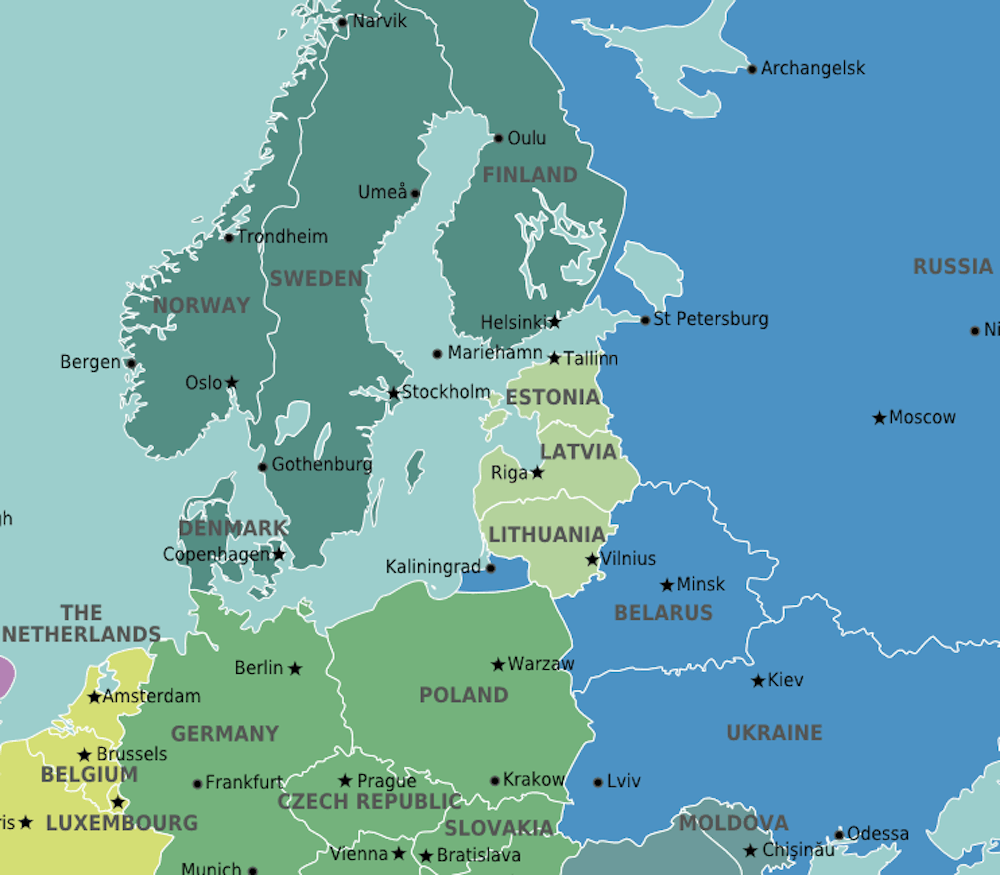
There are already indications that Cyber Command conducted operations against Russian disinformation on social media, including warning specific Russians not to interfere with the 2018 elections. However, low-level cyberwarfare is not necessarily the best way. European countries, especially the Baltic states of Estonia, Latvia and Lithuania, have confronted Russian disinformation campaigns for decades. Their experience may offer useful lessons as the U.S. joins the battle.
The Baltic Sea region of northern Europe. Estonia, Latvia and Lithuania are in light green in the center, west of Russia in blue. Stefan Ertmann/ Wikimedia Commons, CC BY-SA
The Baltic experience
Beginning in 1940 and continuing until they declared independence in the early 1990s, the Baltic countries were subjected to systematic Russian gaslighting designed to make people doubt their national history, culture and economic development.
The Soviets rewrote history books to falsely emphasize Russian protection of the Baltic people from invading hordes in the Middle Ages, and to convey the impression that the cultural evolution of the three countries was enabled by their allegiance and close ties to Russia. Even their national anthems were rewritten to pay homage to Soviet influence.
Since the fall of the Soviet Union and the independence of the Baltic countries, the Russian Federation has continued to deliver disinformation to the region, making extensive use of Russian-language social media. Some themes characterize the Baltic people as ungrateful for Soviet investment and aid after World War II. Another common message criticizes Baltic historians for “falsification of history” when really they are describing the real nature of the Soviet occupation.
A massive Russian attack
After independence, and as the internet grew, Estonia led the way in applying technology to accelerate economic development. The country created systems for a wide range of government and commercial services, including voting, banking and filing tax returns electronically. Today, Estonia’s innovative e-residency system is being adopted in many other countries.
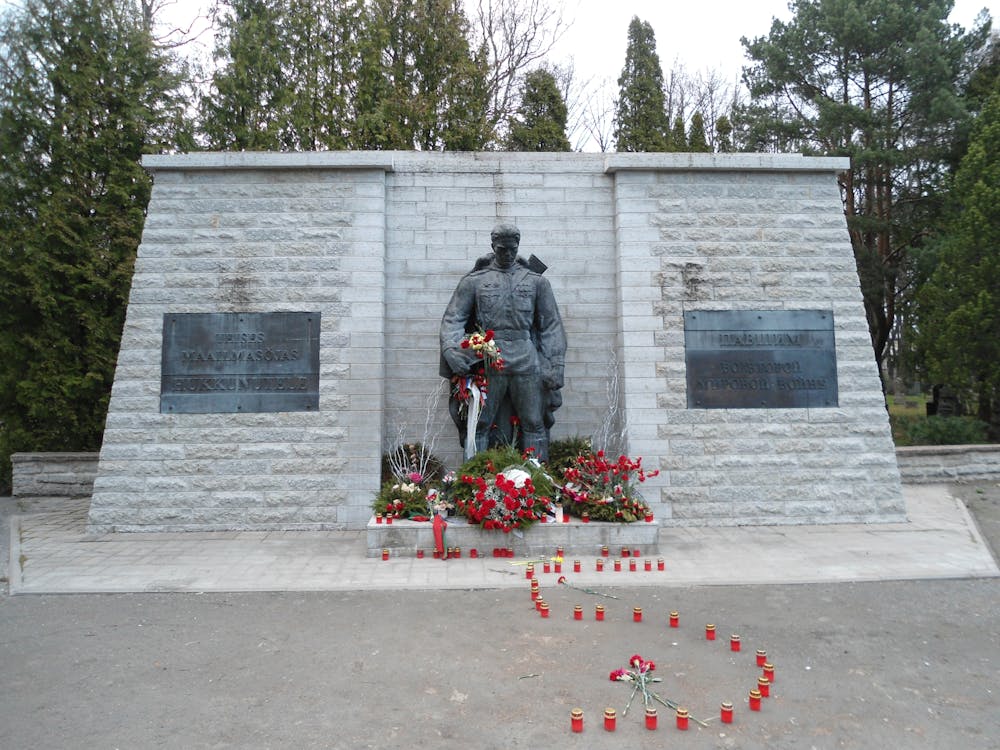
These advances made the Baltics a prime target for cyberattacks. In the spring of 2007, the Russians struck. When Estonia moved a monument memorializing Soviet soldiers from downtown Tallinn, the country’s capital, to a military cemetery a couple of miles away, it provoked the ire of ethnic Russians living in Estonia as well as the Russian government.
For three weeks, Estonian government, financial and media computer systems were bombarded with enormous amounts of internet traffic in a “distributed denial of service” attack. In these situations, an attacker sends overwhelming amounts of data to the targeted internet servers, clogging them up with traffic and either slowing them down or knocking them offline entirely. Despite concerns about the first “cyber war,” however, these attacks resulted in little damage. Although Estonia was cut off from the global internet temporarily, the country’s economy suffered no lasting harm.
These attacks could have severely damaged the country’s financial system or power grid. But Estonia was prepared. The country’s history with Russian disinformation had led Estonia to expect Russian attacks on computer and information systems. In anticipation, the government spearheaded partnerships with banks, internet service providers and other organizations to coordinate responses to cyberattacks. In 2006, Estonia was one of the first countries to create a Computer Emergency Response Team to manage security incidents.
The Baltic response
After the 2007 attack, the Baltic countries upped their game even more. For example, Estonia created the Cyber Defense League, an army of volunteer specialists in information technology. These experts focus on sharing threat information, preparing society for responding to cyber incidents and participating in international cyber defense activities.
Internationally, Estonia gained approval in 2008 to establish NATO’s Cooperative Cyber Defense Center of Excellence in Tallinn. Its comprehensive research into global cyber activities helps identify best practices in cyber defense and training for NATO members.
In 2014, Riga, the capital of neighboring Latvia, became home to another NATO organization combating Russian influence, the Strategic Communications Center of Excellence. It publishes reports on Russian disinformation activities, such as the May 2018 study of the “Virtual Russian World in the Baltics.” That report analyzes Russian social media activities targeting Baltic nations with a “toxic mix of disinformation and propaganda.” It also provides insight into identifying and detecting Russian disinformation campaigns.
The Baltic countries also rely on a European Union agency formed in 2015 to combat Russian disinformation campaigns directed against the EU. The agency identifies disinformation efforts and publicizes accurate information that the Russians are seeking to undermine. A new effort will issue rapid alerts to the public when potential disinformation is directed against the 2019 European Parliament elections.
Will the ‘Baltic model’ work in the US?
Because of their political acknowledgment of threats and actions taken by their governments to fight disinformation, a 2018 study rated Estonia, Latvia and Lithuania the three European Union members best at responding to Russian disinformation.
]]>
Countering Russian disinformation the Baltic nations’ way Terry Thompson, University of Maryland, Baltimore County As the new Congress begins, it will soon discuss the comprehensive...https://www.csee.umbc.edu/2019/01/countering-russian-disinformation-the-baltic-nations-way/https://beta.my.umbc.edu/api/v0/pixel/news/81375/guest@my.umbc.edu/a350d593836de7c81b20d53551d95590/api/pixelcybersecuritydata-sciencenewsUMBC Cybersecurity Institute Grouphttps://beta.my.umbc.edu/groups/cybersecurityhttps://assets3-beta.my.umbc.edu/system/shared/avatars/groups/000/000/485/196da6a7ec6f4c31eab2e474c17a9ab7/xsmall.png?1734891477https://assets3-beta.my.umbc.edu/system/shared/avatars/groups/000/000/485/196da6a7ec6f4c31eab2e474c17a9ab7/original.png?1734891477https://assets4-beta.my.umbc.edu/system/shared/avatars/groups/000/000/485/196da6a7ec6f4c31eab2e474c17a9ab7/xxlarge.png?1734891477https://assets4-beta.my.umbc.edu/system/shared/avatars/groups/000/000/485/196da6a7ec6f4c31eab2e474c17a9ab7/xlarge.png?1734891477https://assets2-beta.my.umbc.edu/system/shared/avatars/groups/000/000/485/196da6a7ec6f4c31eab2e474c17a9ab7/large.png?1734891477https://assets3-beta.my.umbc.edu/system/shared/avatars/groups/000/000/485/196da6a7ec6f4c31eab2e474c17a9ab7/medium.png?1734891477https://assets3-beta.my.umbc.edu/system/shared/avatars/groups/000/000/485/196da6a7ec6f4c31eab2e474c17a9ab7/small.png?1734891477https://assets3-beta.my.umbc.edu/system/shared/avatars/groups/000/000/485/196da6a7ec6f4c31eab2e474c17a9ab7/xsmall.png?1734891477https://assets3-beta.my.umbc.edu/system/shared/avatars/groups/000/000/485/196da6a7ec6f4c31eab2e474c17a9ab7/xxsmall.png?1734891477UMBC Center for Cybersecurity41trueThu, 10 Jan 2019 22:25:39 -0500Thu, 10 Jan 2019 22:25:39 -0500talk: Challenges of Smart Cities Cybersecurity and Privacy with Blockchain, 11am Thr 11/15
The Challenges of Smart Cities Cybersecurity and Privacy with Blockchain
Dr. Jacob Mendel, Tel Aviv University
11:00am Thursday, 15 November 2018, ITE 459, UMBC
The last decades have witnessed unprecedented population and urbanization growth with the implication that today, for the first time in human history, more than half of the world’s population lives in cities. The consequences of the cybersecurity threats of this urbanization trend along with the notion of smart cities are the main subject of this session. The smart city (system of systems) integrates Big-data and the Internet of Things (IoT) to optimize the operation cost, efficiency and to provide a better services to the residents. Smart cities worldwide are checking blockchain as the foundation for urban living. Using blockchain technology in smart city can create a marketplace for Smart Grid.
The increased complexity of smart cities (system of systems), globally connected, economic and political systems has increased the cybersecurity vulnerability. The cybersecurity threats get magnified by the city big-data and its dependency on the technology. The cybersecurity challenges that smart cities faces demand for research and investment in physical security and economic security. In this session we will highlight various cybersecurity and blockchain parameters of a smart city, existing cybersecurity challenges and possible solutions.
Dr. Jacob Mandel is The Moshe Hogeg Blockchain Research Institute managing director at the Tel Aviv University, and former the General Manager Cyber Security COE at Intel. He is a serial cyber security entrepreneur; He has been the CEO and Co-Founder of SCsquare Ltd., where he founded a business enabler for cybersecurity technologies. Dr. Jacob holds 16 approved patents in the area of cybersecurity. His career in cybersecurity over the past 20 years is a unique mixture of broad practical experience and research expertise. His practice included extensive involvement in cybersecurity offensive projects (software and hardware), business development and product management. Proven worldwide track records in secure operating systems, digital rights management, security certification (CC, FIPS), penetration test, reverses engineering, Machine Learning, Blockchain, IoT security and Smart Grid cybersecurity.
His current main research interest is on The Economic Perspective on Smart Grid Cybersecurity and Blockchain technology with a special focus on malware attacks, privacy issues and business continuation. He holds a PhD in Economics from Poznan University of Economics and Business, Poland and Masters of Business Administration (MBA) degree from Ben-Gurion University of the Negev, Israel.
]]>
The Challenges of Smart Cities Cybersecurity and Privacy with Blockchain Dr. Jacob Mendel, Tel Aviv University 11:00am Thursday, 15 November 2018, ITE 459, UMBC The last decades have...https://www.csee.umbc.edu/2018/11/talk-challenges-of-smart-cities-cybersecurity-and-privacy-with-blockchain-11am-thr-11-15/https://beta.my.umbc.edu/api/v0/pixel/news/80330/guest@my.umbc.edu/2a2bf81bd171488351077035c9b9804a/api/pixelcomputer-sciencecybersecuritydata-sciencenewsUMBC Cybersecurity Institute Grouphttps://beta.my.umbc.edu/groups/cybersecurityhttps://assets3-beta.my.umbc.edu/system/shared/avatars/groups/000/000/485/196da6a7ec6f4c31eab2e474c17a9ab7/xsmall.png?1734891477https://assets3-beta.my.umbc.edu/system/shared/avatars/groups/000/000/485/196da6a7ec6f4c31eab2e474c17a9ab7/original.png?1734891477https://assets4-beta.my.umbc.edu/system/shared/avatars/groups/000/000/485/196da6a7ec6f4c31eab2e474c17a9ab7/xxlarge.png?1734891477https://assets4-beta.my.umbc.edu/system/shared/avatars/groups/000/000/485/196da6a7ec6f4c31eab2e474c17a9ab7/xlarge.png?1734891477https://assets2-beta.my.umbc.edu/system/shared/avatars/groups/000/000/485/196da6a7ec6f4c31eab2e474c17a9ab7/large.png?1734891477https://assets3-beta.my.umbc.edu/system/shared/avatars/groups/000/000/485/196da6a7ec6f4c31eab2e474c17a9ab7/medium.png?1734891477https://assets3-beta.my.umbc.edu/system/shared/avatars/groups/000/000/485/196da6a7ec6f4c31eab2e474c17a9ab7/small.png?1734891477https://assets3-beta.my.umbc.edu/system/shared/avatars/groups/000/000/485/196da6a7ec6f4c31eab2e474c17a9ab7/xsmall.png?1734891477https://assets3-beta.my.umbc.edu/system/shared/avatars/groups/000/000/485/196da6a7ec6f4c31eab2e474c17a9ab7/xxsmall.png?1734891477UMBC Center for Cybersecurity00trueTue, 13 Nov 2018 08:15:00 -0500Tue, 13 Nov 2018 08:15:00 -0500talk: Legal Aspects of Privacy and Data Protection, 12-1 Fri 11/9
The UMBC Cyber Defense Lab presents
Legal Aspects of Privacy and Data Protection
Razvan Miutescu
Privacy Counsel, Whiteford, Taylor & Preston
12:00–1:00pm Friday, 9 November 2018, ITE 227, UMBC
Privacy and data security continue to be topics of interest for organizations of all sizes. In addition to being concerned about cyber crimes and data breaches occurring more frequently and with higher operational impact, consumers and regulators around the world are focusing on privacy. Individuals are becoming increasingly aware of the value and the use of the information that identifies them or analyzes their conduct and behavior. Privacy laws around the world are becoming stricter. The European Union’s General Data Protection Regulation (GDPR) is viewed as a flagship law that imposes data protection requirements well beyond the borders of the European Economic Area. California recently passed its Consumer Privacy Act, which borrows concepts from the GDPR, leaving no doubt that privacy laws in the United States are also on track to become more complex. In this context, we will discuss practical legal approaches to an organization’s privacy and data security program.
Razvan Miutescu is a technology and information governance attorney with Whiteford, Taylor & Preston. His practice focuses on privacy and data security, information technology transactions and licensing, intellectual property, and data management, including data broker transactions, cloud services, distributed ledgers/blockchain, and related regulatory and compliance matters. Email: *protected email*
]]>
The UMBC Cyber Defense Lab presents Legal Aspects of Privacy and Data Protection Razvan Miutescu Privacy Counsel, Whiteford, Taylor & Preston 12:00–1:00pm Friday, 9 November 2018, ITE...https://www.csee.umbc.edu/2018/11/talk-legal-aspects-of-privacy-and-data-protection-12-1-fri-11-9/https://beta.my.umbc.edu/api/v0/pixel/news/80114/guest@my.umbc.edu/e8a22fb19468481f39cdcfa024b0c615/api/pixelcomputer-sciencecybersecuritydata-scienceeventstalksUMBC Cybersecurity Institute Grouphttps://beta.my.umbc.edu/groups/cybersecurityhttps://assets3-beta.my.umbc.edu/system/shared/avatars/groups/000/000/485/196da6a7ec6f4c31eab2e474c17a9ab7/xsmall.png?1734891477https://assets3-beta.my.umbc.edu/system/shared/avatars/groups/000/000/485/196da6a7ec6f4c31eab2e474c17a9ab7/original.png?1734891477https://assets4-beta.my.umbc.edu/system/shared/avatars/groups/000/000/485/196da6a7ec6f4c31eab2e474c17a9ab7/xxlarge.png?1734891477https://assets4-beta.my.umbc.edu/system/shared/avatars/groups/000/000/485/196da6a7ec6f4c31eab2e474c17a9ab7/xlarge.png?1734891477https://assets2-beta.my.umbc.edu/system/shared/avatars/groups/000/000/485/196da6a7ec6f4c31eab2e474c17a9ab7/large.png?1734891477https://assets3-beta.my.umbc.edu/system/shared/avatars/groups/000/000/485/196da6a7ec6f4c31eab2e474c17a9ab7/medium.png?1734891477https://assets3-beta.my.umbc.edu/system/shared/avatars/groups/000/000/485/196da6a7ec6f4c31eab2e474c17a9ab7/small.png?1734891477https://assets3-beta.my.umbc.edu/system/shared/avatars/groups/000/000/485/196da6a7ec6f4c31eab2e474c17a9ab7/xsmall.png?1734891477https://assets3-beta.my.umbc.edu/system/shared/avatars/groups/000/000/485/196da6a7ec6f4c31eab2e474c17a9ab7/xxsmall.png?1734891477UMBC Center for Cybersecurity00trueTue, 06 Nov 2018 12:26:47 -0500Tue, 06 Nov 2018 12:26:47 -0500