UMBC’s Naghmeh Karimi receives NSF CAREER Award to develop long-lasting security for cryptographic chips

Naghmeh Karimi receives NSF CAREER award to develop long-lasting security for cryptographic chips
Naghmeh Karimi is the most recent UMBC faculty member to receive a prestigious CAREER Award from the National Science Foundation (NSF). The grant, totaling approximately $500,000 over five years, will support her work to investigate how device-aging related risks compromise the security of cryptographic devices.
Karimi explains that cryptographic chips offer continued advances in authenticating messages and devices as well as preserving the integrity and confidentiality of sensitive information. They do so by implementing cryptographic algorithms in hardware. These chips combine the benefits of cryptographic applications with the speed and power advantage of hardware implementations.
Despite their significant benefits, cryptographic chips can be compromised by adversaries who have gained physical access to the chips. Current protections against such attacks do not consider the aging of devices, which can shift device parameters over time.
Addressing security vulnerabilities
Aging makes cryptographic chips operate slower and, ultimately, results in their malfunction, says Karimi. She explains that the typical lifetime of integrated circuits is 7 to 8 years. As the devices age, their performance decreases. Karimi is exploring the specific security vulnerabilities of aged devices and how they can be protected.
“We want to preserve the security of devices over their lifetime,” Karimi says.
Karimi and her research team will study whether the success of the side-channel analysis and fault-injection attacks increase in older devices. Karimi will create and test several countermeasures to protect devices against such attacks.
Connecting students with opportunities in tech security
The CAREER Award funding will support several UMBC undergraduate and graduate student researchers working with Karimi to develop long-lasting security solutions for hardware platforms.
At the same time, Karimi will also develop and launch a new course in UMBC’s computer science and electrical engineering department on cryptography, hardware security, and testing. She will also work with the UMBC Cyber Scholars Program to connect students with internship opportunities focused on hardware security, to give them additional hands-on experience in the field.
“The success of this project will enable us to develop long-lasting security for trusted hardware platforms,” Karimi says. “This will result in aging-resistant security solutions that benefit society through devices that remain secure over their lifetime.”
Adapted from a UMBC News article by Megan Hanks. Banner image: UMBC’s ITE building. Photo by Marlayna Demond ’11 for UMBC.
The post UMBC’s Naghmeh Karimi receives NSF CAREER Award to develop long-lasting security for cryptographic chips appeared first on Department of Computer Science and Electrical Engineering.
]]>
Naghmeh Karimi receives NSF CAREER award to develop long-lasting security for cryptographic chips Naghmeh Karimi is the most recent UMBC faculty member to receive a prestigious CAREER...
https://www.csee.umbc.edu/2020/05/umbcs-naghmeh-karimi-receives-nsf-career-award-to-develop-long-lasting-security-for-cryptographic-chips/
https://beta.my.umbc.edu/api/v0/pixel/news/93179/guest@my.umbc.edu/f6f37c77b75fc26257558718b90de96e/api/pixel
computer-engineering
cybersecurity
faculty-and-staff
news
research-awards
UMBC Cybersecurity Institute Group
https://beta.my.umbc.edu/groups/cybersecurity
https://assets3-beta.my.umbc.edu/system/shared/avatars/groups/000/000/485/196da6a7ec6f4c31eab2e474c17a9ab7/xsmall.png?1734891477
https://assets3-beta.my.umbc.edu/system/shared/avatars/groups/000/000/485/196da6a7ec6f4c31eab2e474c17a9ab7/original.png?1734891477
https://assets4-beta.my.umbc.edu/system/shared/avatars/groups/000/000/485/196da6a7ec6f4c31eab2e474c17a9ab7/xxlarge.png?1734891477
https://assets4-beta.my.umbc.edu/system/shared/avatars/groups/000/000/485/196da6a7ec6f4c31eab2e474c17a9ab7/xlarge.png?1734891477
https://assets2-beta.my.umbc.edu/system/shared/avatars/groups/000/000/485/196da6a7ec6f4c31eab2e474c17a9ab7/large.png?1734891477
https://assets3-beta.my.umbc.edu/system/shared/avatars/groups/000/000/485/196da6a7ec6f4c31eab2e474c17a9ab7/medium.png?1734891477
https://assets3-beta.my.umbc.edu/system/shared/avatars/groups/000/000/485/196da6a7ec6f4c31eab2e474c17a9ab7/small.png?1734891477
https://assets3-beta.my.umbc.edu/system/shared/avatars/groups/000/000/485/196da6a7ec6f4c31eab2e474c17a9ab7/xsmall.png?1734891477
https://assets3-beta.my.umbc.edu/system/shared/avatars/groups/000/000/485/196da6a7ec6f4c31eab2e474c17a9ab7/xxsmall.png?1734891477
UMBC Center for Cybersecurity
0
0
false
Fri, 15 May 2020 15:53:54 -0400
Fri, 15 May 2020 15:53:54 -0400
CyberCorps SFS Spring Meeting at UMBC
 The Scholarship for Service (SFS) Program is designed to recruit and train the next generation of cybersecurity professionals to meet the needs of Federal, State, local, and tribal government.
CyberCorps SFS Spring Meeting at UMBC
10:00am-2:00pm Friday, 22 May 2020
Open to the public
via: https://umbc.webex.com/meet/sherman
UMBC’s Spring CyberCorps Scholarship for Service meeting will take place from 10 am to 2 pm on Friday, 22 May 2020. It will feature a discussion with Dr. Dan Guernsey (NSA) on Ghidra, Software Reverse Engineering, and Cybersecurity Careers at NSA, presentations by SFS students, and a hands-on Capture the Flag exercise.
10:00-10:30 Student presentations
Scholarship for Service (SFS) students from UMBC, Montgomery College (MC), and Prince George’s Community College (PGCC) will present their results solving IT security problems for their universities, county governments, and local companies. This activity is part of a pioneering program centered at UMBC to extend SFS scholarships to community college students. In January 2020, all SFS scholars at UMBC, PGCC, and MC worked collaboratively to analyze the security of a custom shadow-IT software application to query research grant information
10:30-11:30 Discussion with Dr. Dan Guernsey (NSA)
Learn about Ghidra, software reverse engineering, and cybersecurity careers at NSA. Ghidra is a software reverse engineering framework developed by NSA’s Research Directorate for NSA’s cybersecurity mission. It helps analyze malicious code and malware like viruses, and can give cybersecurity professionals a better understanding of potential vulnerabilities in their networks and systems (GitHub).
11:30-12:30 Lunch and discussion among attendees
12:30-2:00 Hands-on cyber defense exercise
Sharpen your cybersecurity skills by participating in a hands-on Capture the Flag exercise developed by the UMBC Cyber Dawgs and Cyrus Bonyadi, an SFS scholar and a member of the Cyber Dawgs, whose cyberdefense team won first place at the Mid-Atlantic Collegiate Cyber Defense Competition (MACCDC) in April 2020 and is competing in the National Collegiate Cyber Defense Competition (NCCDC).
Participants and organizers
Dr. Dan Guernsey earned the Ph.D in Computer Science from the University of Tulsa. Since 2011, he worked at the Department of Defense as a Computer Scientist and Architectures Researcher. During his studies at Tulsa, Dr. Guernsey contracted with the DoD Office of the Inspector General, the U.S. Secret Service, and local law firms. He performed reverse engineering and authored software analysis tools for product evaluation and digital forensics. His work helped solve criminal cases and helped resolve civil disputes involving software copyrights. Dr. Guernsey is an Adjunct Instructor at UMBC in the graduate Cybersecurity Program.
Host Alan T. Sherman (*protected email*) is a professor of computer science and Director of the UMBC Center for Information Security and Assurance, which center is responsible for UMBC’s designation as a National Center of Academic Excellence in Cyber Defense Education and Cyber Defense Research.
Richard Forno is a senior lecturer, Director of the UMBC Graduate Cybersecurity Program, and Assistant Director of the UMBC Center for Cybersecurity.
Casey W. O’Brien is Executive Director and Principal Investigator of the National CyberWatch Center, Prince George’s Community College.
Joe Roundy is the Cybersecurity Program Manager at Montgomery College, Germantown.
Support for this event is provided in part by the National Science Foundation under SFS grant DGE-1753681 and by the Department of Defense under CySP grant H98230-19-1-0308.
The post CyberCorps SFS Spring Meeting at UMBC appeared first on Department of Computer Science and Electrical Engineering.
]]>
The Scholarship for Service (SFS) Program is designed to recruit and train the next generation of cybersecurity professionals to meet the needs of Federal, State, local, and tribal government....
https://www.csee.umbc.edu/2020/05/cybercorps-sfs-spring-meeting-at-umbc/
https://beta.my.umbc.edu/api/v0/pixel/news/93018/guest@my.umbc.edu/bb27d6581cff14ea903a83ad23c21eb5/api/pixel
cybersecurity
news
students
UMBC Cybersecurity Institute Group
https://beta.my.umbc.edu/groups/cybersecurity
https://assets3-beta.my.umbc.edu/system/shared/avatars/groups/000/000/485/196da6a7ec6f4c31eab2e474c17a9ab7/xsmall.png?1734891477
https://assets3-beta.my.umbc.edu/system/shared/avatars/groups/000/000/485/196da6a7ec6f4c31eab2e474c17a9ab7/original.png?1734891477
https://assets4-beta.my.umbc.edu/system/shared/avatars/groups/000/000/485/196da6a7ec6f4c31eab2e474c17a9ab7/xxlarge.png?1734891477
https://assets4-beta.my.umbc.edu/system/shared/avatars/groups/000/000/485/196da6a7ec6f4c31eab2e474c17a9ab7/xlarge.png?1734891477
https://assets2-beta.my.umbc.edu/system/shared/avatars/groups/000/000/485/196da6a7ec6f4c31eab2e474c17a9ab7/large.png?1734891477
https://assets3-beta.my.umbc.edu/system/shared/avatars/groups/000/000/485/196da6a7ec6f4c31eab2e474c17a9ab7/medium.png?1734891477
https://assets3-beta.my.umbc.edu/system/shared/avatars/groups/000/000/485/196da6a7ec6f4c31eab2e474c17a9ab7/small.png?1734891477
https://assets3-beta.my.umbc.edu/system/shared/avatars/groups/000/000/485/196da6a7ec6f4c31eab2e474c17a9ab7/xsmall.png?1734891477
https://assets3-beta.my.umbc.edu/system/shared/avatars/groups/000/000/485/196da6a7ec6f4c31eab2e474c17a9ab7/xxsmall.png?1734891477
UMBC Center for Cybersecurity
2
0
false
Sat, 09 May 2020 14:52:08 -0400
Sat, 09 May 2020 14:52:08 -0400
talk: Identifying and Addressing Concerning Behavior in the Digital Age, 12-1 Fri 5/8

The UMBC Cyber Defense Lab presents
Identifying and Addressing Concerning
Behavior in the Digital Age
Jason W. Wells
Graduate Student, Cybersecurity MPS
University of Maryland, Baltimore County
12:00–1pm Friday, 8 May 2020, webex
The United States Secret Service (USSS) is widely known as the premier law enforcement agency that is charged with protecting some of the most important political figures in the world. Some of these protectees include the President of the United States, the Vice-President, the First Family and Second Family, and Heads of State visiting the United States, to name a few. A major part of the protective mission of the USSS is focused around “protective intelligence,” where agents are trained to identify concerning and threatening behavioral indicators in others, and then to address those issues in a proactive and positive manner and ensure that the community is safe from harm. This proactive methodology has been researched and applied for decades and has a very high rate of success. Now, other law enforcement agencies throughout the country have started to apply this training to their agents and officers. Can these methodologies be used and/or modified to recognize threats in cyberspace as well?
Jason Wells is a former special agent with the United States Secret Service, where he served for nine years from 2005 – 2014. During that time, Mr. Wells was extensively trained in identifying and addressing threat-related and concerning behavioral indicators, and how to address those behaviors in a positive and proactive manner. In 2016, Mr. Wells published his first book Our Path to Safety: A U.S. Secret Service Agent’s Guide to Creating Safe Communities (ISBN-13: 978-0-9982488-0-6) on how the community can identify these behavioral conditions in the same way that federal law enforcement does every day. Mr. Wells earned his undergraduate degree from the Virginia Military Institute and his first graduate degree from Henley-Putnam University in Strategic Security and Protection Management in 2014. Additionally, Mr. Wells has published 11 editorial articles in print media on improving safety and security methodologies in schools and businesses. Currently, he is an SFS scholarship graduate student at UMBC with plans to complete his degree in spring 2020. He and his wife, Blythe, have two children and have lived in Baltimore County since 2008.
Host: Alan T. Sherman, *protected email* Support for this event was provided in part by the National Science Foundation under SFS grant DGE-1753681. The UMBC Cyber Defense Lab meets biweekly Fridays. All meetings are open to the public. Upcoming CDL Meetings: May 22, Spring SFS Meeting at UMBC, 9:30am-2pm, via WebEx.
The post talk: Identifying and Addressing Concerning Behavior in the Digital Age, 12-1 Fri 5/8 appeared first on Department of Computer Science and Electrical Engineering.
]]>
The UMBC Cyber Defense Lab presents Identifying and Addressing Concerning Behavior in the Digital Age Jason W. Wells Graduate Student, Cybersecurity MPS University of Maryland, Baltimore...
https://www.csee.umbc.edu/2020/05/talk-identifying-and-addressing-concerning-behavior-in-the-digital-age-12-1-fri-5-8/
https://beta.my.umbc.edu/api/v0/pixel/news/92799/guest@my.umbc.edu/c57f1df02979ddc3394e4b7f0292a546/api/pixel
cybersecurity
events
news
talks
uncategorized
UMBC Cybersecurity Institute Group
https://beta.my.umbc.edu/groups/cybersecurity
https://assets3-beta.my.umbc.edu/system/shared/avatars/groups/000/000/485/196da6a7ec6f4c31eab2e474c17a9ab7/xsmall.png?1734891477
https://assets3-beta.my.umbc.edu/system/shared/avatars/groups/000/000/485/196da6a7ec6f4c31eab2e474c17a9ab7/original.png?1734891477
https://assets4-beta.my.umbc.edu/system/shared/avatars/groups/000/000/485/196da6a7ec6f4c31eab2e474c17a9ab7/xxlarge.png?1734891477
https://assets4-beta.my.umbc.edu/system/shared/avatars/groups/000/000/485/196da6a7ec6f4c31eab2e474c17a9ab7/xlarge.png?1734891477
https://assets2-beta.my.umbc.edu/system/shared/avatars/groups/000/000/485/196da6a7ec6f4c31eab2e474c17a9ab7/large.png?1734891477
https://assets3-beta.my.umbc.edu/system/shared/avatars/groups/000/000/485/196da6a7ec6f4c31eab2e474c17a9ab7/medium.png?1734891477
https://assets3-beta.my.umbc.edu/system/shared/avatars/groups/000/000/485/196da6a7ec6f4c31eab2e474c17a9ab7/small.png?1734891477
https://assets3-beta.my.umbc.edu/system/shared/avatars/groups/000/000/485/196da6a7ec6f4c31eab2e474c17a9ab7/xsmall.png?1734891477
https://assets3-beta.my.umbc.edu/system/shared/avatars/groups/000/000/485/196da6a7ec6f4c31eab2e474c17a9ab7/xxsmall.png?1734891477
UMBC Center for Cybersecurity
2
0
false
Sun, 03 May 2020 20:41:58 -0400
Sun, 03 May 2020 20:41:58 -0400
talk: Cybersecurity during COVID-19 and other emergencies, 12-1 Tue May 5

The UMBC Center for Cybersecurity (UCYBR) Presents
Cybersecurity during COVID-19 and other emergencies
Dr. Richard Forno
Senior Lecturer, Computer Science & Electrical Engineering
Director, UMBC Graduate Cybersecurity Program & Assistant Director, UMBC Center for Cybersecurity
12–1 pm Tuesday, 5 May 2020
online via webex
‘Cyber’ touches many, if not all, parts of society and organizations. However, even in 2020, cybersecurity often still is seen as exclusively a function of IT and not a function of enterprise mission assurance or operational resiliency. Accordingly, operational performance can be compromised by a failure to consider, if not embrace, cybersecurity principles and concerns during crisis planning – which can significantly impede effective crisis response and incident management during actual events and make a bad situation even worse. This talk will discuss the role of cybersecurity and cybersecurity thinking within crisis management and incident handling, with a particular emphasis on maintaining operational resiliency and mission assurance during the ongoing COVID-19 pandemic.
Dr. Richard Forno is a Senior Lecturer in the UMBC Department of Computer Science and Electrical Engineering, where he directs the UMBC Graduate Cybersecurity Program and serves as the Assistant Director of UMBC’s Center for Cybersecurity. Prior to joining UMBC in 2010, his twenty-year career in operational cybersecurity spanned the government, military, and private sector, including helping build a formal cybersecurity program for the US House of Representatives, serving as the first Chief Security Officer for Network Solutions (then, the global center of the internet DNS system), consulting to Fortune 100 companies, and more. From 2005-12 he was a Visiting Scientist at the Software Engineering Institute at Carnegie Mellon University, where he taught courses on incident handling for the CERT Coordination Center (CERT/CC).
The post talk: Cybersecurity during COVID-19 and other emergencies, 12-1 Tue May 5 appeared first on Department of Computer Science and Electrical Engineering.
]]>
The UMBC Center for Cybersecurity (UCYBR) Presents Cybersecurity during COVID-19 and other emergencies Dr. Richard Forno Senior Lecturer, Computer Science & Electrical Engineering Director,...
https://www.csee.umbc.edu/2020/04/talk-cybersecurity-during-covid-19-and-other-emergencies/
https://beta.my.umbc.edu/api/v0/pixel/news/92644/guest@my.umbc.edu/4dedfebfbd0eb9440f728609f77e20f9/api/pixel
cybersecurity
news
talks
UMBC Cybersecurity Institute Group
https://beta.my.umbc.edu/groups/cybersecurity
https://assets3-beta.my.umbc.edu/system/shared/avatars/groups/000/000/485/196da6a7ec6f4c31eab2e474c17a9ab7/xsmall.png?1734891477
https://assets3-beta.my.umbc.edu/system/shared/avatars/groups/000/000/485/196da6a7ec6f4c31eab2e474c17a9ab7/original.png?1734891477
https://assets4-beta.my.umbc.edu/system/shared/avatars/groups/000/000/485/196da6a7ec6f4c31eab2e474c17a9ab7/xxlarge.png?1734891477
https://assets4-beta.my.umbc.edu/system/shared/avatars/groups/000/000/485/196da6a7ec6f4c31eab2e474c17a9ab7/xlarge.png?1734891477
https://assets2-beta.my.umbc.edu/system/shared/avatars/groups/000/000/485/196da6a7ec6f4c31eab2e474c17a9ab7/large.png?1734891477
https://assets3-beta.my.umbc.edu/system/shared/avatars/groups/000/000/485/196da6a7ec6f4c31eab2e474c17a9ab7/medium.png?1734891477
https://assets3-beta.my.umbc.edu/system/shared/avatars/groups/000/000/485/196da6a7ec6f4c31eab2e474c17a9ab7/small.png?1734891477
https://assets3-beta.my.umbc.edu/system/shared/avatars/groups/000/000/485/196da6a7ec6f4c31eab2e474c17a9ab7/xsmall.png?1734891477
https://assets3-beta.my.umbc.edu/system/shared/avatars/groups/000/000/485/196da6a7ec6f4c31eab2e474c17a9ab7/xxsmall.png?1734891477
UMBC Center for Cybersecurity
1
0
false
Mon, 27 Apr 2020 18:13:32 -0400
Mon, 27 Apr 2020 18:13:32 -0400
UMBC Cyber Dawgs rank #1 among university teams at annual Capture the Flag event

UMBC Cyber Dawgs #1 among university
teams at annual Capture the Flag event
The UMBC Cyber Dawgs ranked #1 among university teams in a challenging cybersecurity competition hosted virtually by the University of Maryland, College Park on April 18.
The Capture the Flag event was designed to test teams’ abilities to solve a variety of realistic cybersecurity problems. UMBC went head to head with more than 300 teams from both colleges and industry, placing third overall and #1 among the universities.
Charles Nicholas, professor of computer science and electrical engineering and a Cyber Dawgs faculty advisor, says that the team’s win shows how well-prepared UMBC students are for careers in cybersecurity, and how committed they are to excelling in intercollegiate competition. “It speaks volumes about our students, their enthusiasm, and their character,” he says.
Reflecting on the Cyber Dawgs’ #3 overall finish, Nicholas shares, “The teams that beat us are made up of experienced cyber professionals, who do this sort of work for a living.” To end the competition as the leading university team and trailing just two professional teams was quite a feat, he notes, saying, “Our faculty and our university are very proud of these students.”
The Cyber Dawgs recently won the Mid-Atlantic Collegiate Cyber Defense Competition. They are preparing for the National Collegiate Cyber Defense Competition, which will be held virtually in May.
Adapted from a UMBC News article written by Megan Hanks. Banner image: A person typing on a computer. Photo by Marlayna Demond ’11 for UMBC.
The post UMBC Cyber Dawgs rank #1 among university teams at annual Capture the Flag event appeared first on Department of Computer Science and Electrical Engineering.
]]>
UMBC Cyber Dawgs #1 among university teams at annual Capture the Flag event The UMBC Cyber Dawgs ranked #1 among university teams in a challenging cybersecurity competition hosted...
https://www.csee.umbc.edu/2020/04/umbc-cyber-dawgs-rank-1-among-university-teams-at-annual-capture-the-flag-event/
https://beta.my.umbc.edu/api/v0/pixel/news/92572/guest@my.umbc.edu/12762cf8000fbec29e409aa47a78ad34/api/pixel
cybersecurity
events
news
students
UMBC Cybersecurity Institute Group
https://beta.my.umbc.edu/groups/cybersecurity
https://assets3-beta.my.umbc.edu/system/shared/avatars/groups/000/000/485/196da6a7ec6f4c31eab2e474c17a9ab7/xsmall.png?1734891477
https://assets3-beta.my.umbc.edu/system/shared/avatars/groups/000/000/485/196da6a7ec6f4c31eab2e474c17a9ab7/original.png?1734891477
https://assets4-beta.my.umbc.edu/system/shared/avatars/groups/000/000/485/196da6a7ec6f4c31eab2e474c17a9ab7/xxlarge.png?1734891477
https://assets4-beta.my.umbc.edu/system/shared/avatars/groups/000/000/485/196da6a7ec6f4c31eab2e474c17a9ab7/xlarge.png?1734891477
https://assets2-beta.my.umbc.edu/system/shared/avatars/groups/000/000/485/196da6a7ec6f4c31eab2e474c17a9ab7/large.png?1734891477
https://assets3-beta.my.umbc.edu/system/shared/avatars/groups/000/000/485/196da6a7ec6f4c31eab2e474c17a9ab7/medium.png?1734891477
https://assets3-beta.my.umbc.edu/system/shared/avatars/groups/000/000/485/196da6a7ec6f4c31eab2e474c17a9ab7/small.png?1734891477
https://assets3-beta.my.umbc.edu/system/shared/avatars/groups/000/000/485/196da6a7ec6f4c31eab2e474c17a9ab7/xsmall.png?1734891477
https://assets3-beta.my.umbc.edu/system/shared/avatars/groups/000/000/485/196da6a7ec6f4c31eab2e474c17a9ab7/xxsmall.png?1734891477
UMBC Center for Cybersecurity
1
0
false
Fri, 24 Apr 2020 16:00:35 -0400
Fri, 24 Apr 2020 16:00:35 -0400
UMBC Cyber Dawgs win Mid-Atlantic Collegiate Cyber Defense Competition

UMBC Cyber Dawgs win Mid-Atlantic Collegiate Cyber Defense Competition
Last weekend, the UMBC Cyber Dawgs took first place in the Mid-Atlantic Collegiate Cyber Defense Competition (MACCDC), which was held virtually. UMBC’s team was one of eight that participated in the competition, fighting to protect their networks efficiently and effectively from simulated cyber threats and attacks. The team topped Penn State; the University of Maryland, College Park; and University of Virginia, which won the national championship for the past two years.
UMBC’s Cyber Dawgs will move on to compete in the National Collegiate Cyber Defense Competition (NCCDC). Due to COVID-19, the competition will be held remotely this year.
How does the competition work?
These regional and national competitions attract leading collegiate cybersecurity teams from across the nation. They put teams in situations that mimic scenarios they might encounter working to secure and protect online systems for government agencies and companies. Throughout each challenge, teammates work together to protect their systems from hackers and cyber attacks. At the same time, they keep their networks accessible to the users relying on them.
Meet the team
The MACCDC was about 14 hours long, and was held over two days. During the competition, the teams were not permitted to interact with their coaches Charles Nicholas, professor of computer science and electrical engineering (CSEE), and Rick Forno, senior lecturer in CSEE.
The winning UMBC team included Anna Staats ‘20, computer science; RJ Joyce ‘18, M.S. ‘20, computer science; Cyrus Bonyadi, Ph.D. ‘23, computer science; Drew Barrett ‘20, computer science; Seamus Burke ‘20, computer science; Henry Budris ‘22, computer science; Chris Skane ‘21, computer science; and Nikola Bura ‘21, computer science.
“We are so proud of our team, and their ability to work together as a team under such extraordinary conditions,” says Nicholas.
This is the third time in six years that the Cyber Dawgs have won the MACCDC. The UMBC team won the national championship in 2017.
Adapted from a UMBC News article by Megan Hanks. Banner image: Student using a computer. Photo by Marlayna Demond ’11 for UMBC.
The post UMBC Cyber Dawgs win Mid-Atlantic Collegiate Cyber Defense Competition appeared first on Department of Computer Science and Electrical Engineering.
]]>
UMBC Cyber Dawgs win Mid-Atlantic Collegiate Cyber Defense Competition Last weekend, the UMBC Cyber Dawgs took first place in the Mid-Atlantic Collegiate Cyber Defense Competition...
https://www.csee.umbc.edu/2020/04/umbc-cyber-dawgs-win-mid-atlantic-collegiate-cyber-defense-competition/
https://beta.my.umbc.edu/api/v0/pixel/news/92108/guest@my.umbc.edu/485f14121c68bc1bebb82c903f4cfa33/api/pixel
cybersecurity
events
news
students
UMBC Cybersecurity Institute Group
https://beta.my.umbc.edu/groups/cybersecurity
https://assets3-beta.my.umbc.edu/system/shared/avatars/groups/000/000/485/196da6a7ec6f4c31eab2e474c17a9ab7/xsmall.png?1734891477
https://assets3-beta.my.umbc.edu/system/shared/avatars/groups/000/000/485/196da6a7ec6f4c31eab2e474c17a9ab7/original.png?1734891477
https://assets4-beta.my.umbc.edu/system/shared/avatars/groups/000/000/485/196da6a7ec6f4c31eab2e474c17a9ab7/xxlarge.png?1734891477
https://assets4-beta.my.umbc.edu/system/shared/avatars/groups/000/000/485/196da6a7ec6f4c31eab2e474c17a9ab7/xlarge.png?1734891477
https://assets2-beta.my.umbc.edu/system/shared/avatars/groups/000/000/485/196da6a7ec6f4c31eab2e474c17a9ab7/large.png?1734891477
https://assets3-beta.my.umbc.edu/system/shared/avatars/groups/000/000/485/196da6a7ec6f4c31eab2e474c17a9ab7/medium.png?1734891477
https://assets3-beta.my.umbc.edu/system/shared/avatars/groups/000/000/485/196da6a7ec6f4c31eab2e474c17a9ab7/small.png?1734891477
https://assets3-beta.my.umbc.edu/system/shared/avatars/groups/000/000/485/196da6a7ec6f4c31eab2e474c17a9ab7/xsmall.png?1734891477
https://assets3-beta.my.umbc.edu/system/shared/avatars/groups/000/000/485/196da6a7ec6f4c31eab2e474c17a9ab7/xxsmall.png?1734891477
UMBC Center for Cybersecurity
4
0
false
Sun, 12 Apr 2020 16:33:39 -0400
Sun, 12 Apr 2020 16:33:39 -0400
Talk: Lance Hoffman (GWU) Cyber Policy Challenges, 12-1pm 4/24 online

The UMBC Cyber Defense Lab presents
Cyber Policy Challenges
Lance J. Hoffman
Distinguished Professor, George Washington University
12–1:00 pm, Friday, 24 April 2020
System attackers and defenders operate on a constantly changing battlefield, and some of the more serious conflicts involving nation-states could be considered acts of war, though we are still in the early stages of defining war in cyberspace. Policies for security and privacy can vary wildly, and have important personal, national, and global consequences for privacy, free speech, censorship, and other issues. Things get even more complicated with the advent of the Internet of Things, where (mostly unsophisticated) users may think they have more control than they actually do and can make bad mistakes. Various ethical issues related to the development of these systems, including bias in artificial intelligence and what harm to choose when harm is unavoidable have only started to be examined. This talk will provide both historical context and some discussion of topical issues such as Zoombombing and the security of electronic voting systems as compared to mail ballots and traditional voting.
Professor Lance J. Hoffman is the author or editor of numerous articles and five books on computer security and privacy. He developed the first regularly offered course on computer security at the University of California, Berkeley in 1970. A Fellow of the Association for Computing Machinery and a member of the Cyber Security Hall of Fame, Dr. Hoffman institutionalized the ACM Conference on Computers, Freedom, and Privacy. He has served on a number of Advisory Committees including those of Federal Trade Commission and the Department of Homeland Security and has testified before Congress on security and privacy-related issues. He is the principal investigator of the CyberCorps program at GWU. Dr. Hoffman earned his Ph. D. in Computer Science from Stanford University, after a B.S. in Mathematics from Carnegie Mellon University.
Host: Alan T. Sherman, *protected email* Support for this event was provided in part by the National Science Foundation under SFS grant DGE-1753681. The UMBC Cyber Defense Lab meets biweekly Fridays. All meetings are open to the public. Upcoming CDL meetings: May 8, Jason Wells (UMBC SFS scholar) law enforcement; May 22, Spring SFS Meeting at UMBC, 9:30am-2pm, ITE456
The post Talk: Lance Hoffman (GWU) Cyber Policy Challenges, 12-1pm 4/24 online appeared first on Department of Computer Science and Electrical Engineering.
]]>
The UMBC Cyber Defense Lab presents Cyber Policy Challenges Lance J. Hoffman Distinguished Professor, George Washington University 12–1:00 pm, Friday, 24 April 2020 remotely via WebEx...
https://www.csee.umbc.edu/2020/04/talk-lance-hoffman-gwu-cyber-policy-challenges/
https://beta.my.umbc.edu/api/v0/pixel/news/92101/guest@my.umbc.edu/82505162580cdf42c92f5a6e2c15d321/api/pixel
cybersecurity
news
talks
uncategorized
UMBC Cybersecurity Institute Group
https://beta.my.umbc.edu/groups/cybersecurity
https://assets3-beta.my.umbc.edu/system/shared/avatars/groups/000/000/485/196da6a7ec6f4c31eab2e474c17a9ab7/xsmall.png?1734891477
https://assets3-beta.my.umbc.edu/system/shared/avatars/groups/000/000/485/196da6a7ec6f4c31eab2e474c17a9ab7/original.png?1734891477
https://assets4-beta.my.umbc.edu/system/shared/avatars/groups/000/000/485/196da6a7ec6f4c31eab2e474c17a9ab7/xxlarge.png?1734891477
https://assets4-beta.my.umbc.edu/system/shared/avatars/groups/000/000/485/196da6a7ec6f4c31eab2e474c17a9ab7/xlarge.png?1734891477
https://assets2-beta.my.umbc.edu/system/shared/avatars/groups/000/000/485/196da6a7ec6f4c31eab2e474c17a9ab7/large.png?1734891477
https://assets3-beta.my.umbc.edu/system/shared/avatars/groups/000/000/485/196da6a7ec6f4c31eab2e474c17a9ab7/medium.png?1734891477
https://assets3-beta.my.umbc.edu/system/shared/avatars/groups/000/000/485/196da6a7ec6f4c31eab2e474c17a9ab7/small.png?1734891477
https://assets3-beta.my.umbc.edu/system/shared/avatars/groups/000/000/485/196da6a7ec6f4c31eab2e474c17a9ab7/xsmall.png?1734891477
https://assets3-beta.my.umbc.edu/system/shared/avatars/groups/000/000/485/196da6a7ec6f4c31eab2e474c17a9ab7/xxsmall.png?1734891477
UMBC Center for Cybersecurity
1
0
false
Sat, 11 Apr 2020 12:15:46 -0400
Sat, 11 Apr 2020 12:15:46 -0400
online talk: Opal Hard Drives for Ransomware Resilience

The UMBC Cyber Defense Lab presents
Opal Hard Drives for Ransomware Resilience
Russ Fink, Ph.D.
Senior Staff, the Johns Hopkins University / Applied Physics Laboratory
Ransomware is crippling industry and government alike. Paying the ransom doesn’t guarantee you’ll get your files back, but it funds the criminals who will continue on. Restoring from traditional network backups takes time, and never gets you back to the system you had before the attack. In response, we have developed a resilient, local malware restore and recovery capability, capable of quickly restoring OS images onto “bare metal” after an attack or misconfiguration, useful for many applications.
I will discuss the technical details, including a description of the Opal hard drive specification, the Trusted Computing Group’s Trusted Platform Module (TPM), and how we secure secrets needed for WUBU – Wake-Up-Back-Up. I’ll talk through some of the open-source technologies that we used to build our solution. WebEx willing, I will give a live demonstration of a ShinoLocker ransomware infection, followed by an “as if nothing ever happened” recovery that takes only ten minutes.
Russ Fink is a senior staff member at the Johns Hopkins University / Applied Physics Laboratory. His research interests include computational private information retrieval, trusted computing applications, applied cryptography, and enterprise and mission cyber resiliency techniques. He earned a Ph.D. in computer science from UMBC in 2010 working with Dr. Alan Sherman. email: *protected email*
Host: Alan T. Sherman, *protected email*. Support for this event was provided in part by the National Science Foundation under SFS grant DGE-1753681. The UMBC Cyber Defense Lab meets biweekly Fridays. All meetings are open to the public. Upcoming CDL Meetings:
- Apr 24, Lance Hoffman (GWU), policy
- May 8, Jason Wells (UMBC SFS scholar), law enforcement
- May 22, Spring SFS Meeting at UMBC, 9:30am-2pm, ITE 456
The post online talk: Opal Hard Drives for Ransomware Resilience appeared first on Department of Computer Science and Electrical Engineering.
]]>
The UMBC Cyber Defense Lab presents Opal Hard Drives for Ransomware Resilience Russ Fink, Ph.D. Senior Staff, the Johns Hopkins University / Applied Physics Laboratory 12:00–1 pm, Friday, 10...
https://www.csee.umbc.edu/2020/04/online-talk-opal-hard-drives-for-ransomware-resilience/
https://beta.my.umbc.edu/api/v0/pixel/news/92012/guest@my.umbc.edu/f3fa76f5ca100a5158da1e1a80870c9e/api/pixel
computer-science
cybersecurity
news
research
talks
UMBC Cybersecurity Institute Group
https://beta.my.umbc.edu/groups/cybersecurity
https://assets3-beta.my.umbc.edu/system/shared/avatars/groups/000/000/485/196da6a7ec6f4c31eab2e474c17a9ab7/xsmall.png?1734891477
https://assets3-beta.my.umbc.edu/system/shared/avatars/groups/000/000/485/196da6a7ec6f4c31eab2e474c17a9ab7/original.png?1734891477
https://assets4-beta.my.umbc.edu/system/shared/avatars/groups/000/000/485/196da6a7ec6f4c31eab2e474c17a9ab7/xxlarge.png?1734891477
https://assets4-beta.my.umbc.edu/system/shared/avatars/groups/000/000/485/196da6a7ec6f4c31eab2e474c17a9ab7/xlarge.png?1734891477
https://assets2-beta.my.umbc.edu/system/shared/avatars/groups/000/000/485/196da6a7ec6f4c31eab2e474c17a9ab7/large.png?1734891477
https://assets3-beta.my.umbc.edu/system/shared/avatars/groups/000/000/485/196da6a7ec6f4c31eab2e474c17a9ab7/medium.png?1734891477
https://assets3-beta.my.umbc.edu/system/shared/avatars/groups/000/000/485/196da6a7ec6f4c31eab2e474c17a9ab7/small.png?1734891477
https://assets3-beta.my.umbc.edu/system/shared/avatars/groups/000/000/485/196da6a7ec6f4c31eab2e474c17a9ab7/xsmall.png?1734891477
https://assets3-beta.my.umbc.edu/system/shared/avatars/groups/000/000/485/196da6a7ec6f4c31eab2e474c17a9ab7/xxsmall.png?1734891477
UMBC Center for Cybersecurity
1
0
false
Thu, 09 Apr 2020 11:33:17 -0400
Thu, 09 Apr 2020 11:33:17 -0400
Prof. Naghmeh Karimi receives NSF CAREER award for research on the security of cryptographic chips
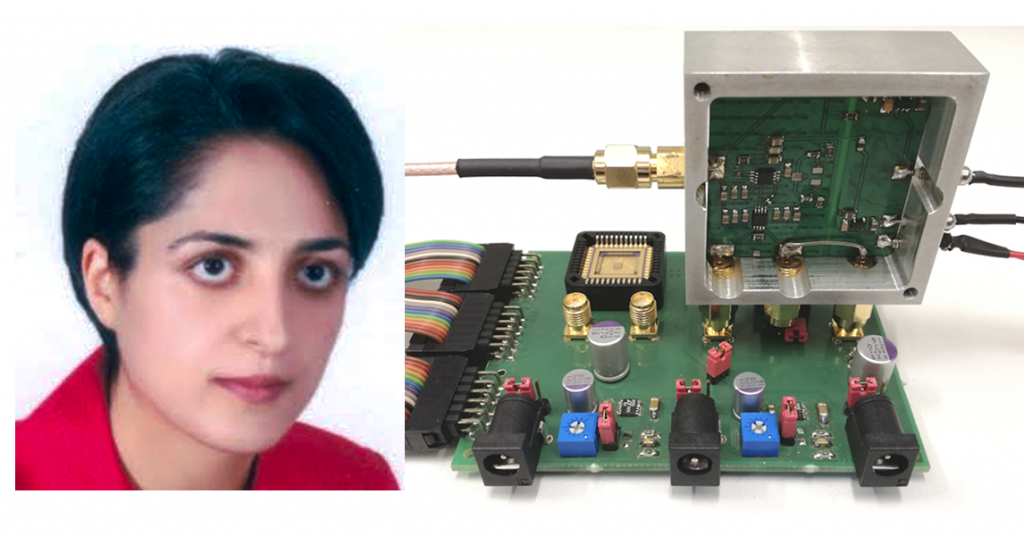 Professor Karimi and a custom measurement board developed by her collaborators at the University of Buchum, Germany that is being used to test a 65 nm application-specific integrated circuit sample
Investigating the Impact of Device Aging on the Security of Cryptographic Chips
Professor Naghmeh Karimi received a prestigious NSF CAREER award to support her research on Investigating the impact of device aging on the security of cryptographic chips.
CAREER awards are among NFS’s most prestigious awards and are intended to support early-career faculty who have the potential to serve as academic role models in research and education and to lead advances in the mission of their department or organization.
Cryptographic chips implement cryptographic functions in hardware for better performance. Despite the significant performance benefits, cryptographic chips can be compromised by the adversaries via monitoring their power-consumption, tampering their logic or placing the chips under stress to generate erroneous outputs to infer sensitive data. The current protections against such attacks do not consider the aging of the devices that can cause a parametric shift of device parameters over time which can compromise device security.
Supported by this five-year award, Professor Karimi and her students will investigate the effects of device aging on the security of cryptographic devices, particularly those with protection against physical attacks, and develop solutions to ensure security when device aging comes into account. Her work will help enable the development of long-lasting security for trusted hardware platforms, and result in aging-resistant security solutions that benefit the society via devices that remain secure over their lifetime.
The post Prof. Naghmeh Karimi receives NSF CAREER award for research on the security of cryptographic chips appeared first on Department of Computer Science and Electrical Engineering.
]]>
Professor Karimi and a custom measurement board developed by her collaborators at the University of Buchum, Germany that is being used to test a 65 nm application-specific integrated circuit...
https://www.csee.umbc.edu/2020/04/prof-naghmeh-karimi-receives-nsf-career-award-for-research-on-the-security-of-cryptographic-chips/
https://beta.my.umbc.edu/api/v0/pixel/news/91866/guest@my.umbc.edu/fea8ee82fd9fa8dfa31576a865a16e24/api/pixel
computer-engineering
cryptographic-chips
cybersecurity
device-aging
faculty-and-staff
hardware-security
news
research
research-awards
UMBC Cybersecurity Institute Group
https://beta.my.umbc.edu/groups/cybersecurity
https://assets3-beta.my.umbc.edu/system/shared/avatars/groups/000/000/485/196da6a7ec6f4c31eab2e474c17a9ab7/xsmall.png?1734891477
https://assets3-beta.my.umbc.edu/system/shared/avatars/groups/000/000/485/196da6a7ec6f4c31eab2e474c17a9ab7/original.png?1734891477
https://assets4-beta.my.umbc.edu/system/shared/avatars/groups/000/000/485/196da6a7ec6f4c31eab2e474c17a9ab7/xxlarge.png?1734891477
https://assets4-beta.my.umbc.edu/system/shared/avatars/groups/000/000/485/196da6a7ec6f4c31eab2e474c17a9ab7/xlarge.png?1734891477
https://assets2-beta.my.umbc.edu/system/shared/avatars/groups/000/000/485/196da6a7ec6f4c31eab2e474c17a9ab7/large.png?1734891477
https://assets3-beta.my.umbc.edu/system/shared/avatars/groups/000/000/485/196da6a7ec6f4c31eab2e474c17a9ab7/medium.png?1734891477
https://assets3-beta.my.umbc.edu/system/shared/avatars/groups/000/000/485/196da6a7ec6f4c31eab2e474c17a9ab7/small.png?1734891477
https://assets3-beta.my.umbc.edu/system/shared/avatars/groups/000/000/485/196da6a7ec6f4c31eab2e474c17a9ab7/xsmall.png?1734891477
https://assets3-beta.my.umbc.edu/system/shared/avatars/groups/000/000/485/196da6a7ec6f4c31eab2e474c17a9ab7/xxsmall.png?1734891477
UMBC Center for Cybersecurity
1
0
false
Mon, 06 Apr 2020 12:14:01 -0400
Mon, 06 Apr 2020 12:14:01 -0400
UMBC Cyber Dawgs win 15th Mid-Atlantic Collegiate Cyber Defense Competition
UMBC Cyber Dawgs place first in
15th Mid-Atlantic Collegiate Cyber Defense Competition
Congratulations to the UMBC Cyber Dawgs for winning the 15th Mid-Atlantic Collegiate Cyber Defense Competition (MACCDC) which was held this Friday and Saturday. UMBC placed first in a field of teams from eight Universities who made the regional finals out of an initial set of 27 qualifying teams. By winning the regional competition, UMBC will represent the Mid-Atlantic states in the National Collegiate Cyber Defense Competition to be held on May 22-24, 2020.
The MACCDC has been held annually since 2006. Each year, it develops a new realistic challenge using the latest technologies currently in use. This year’s scenario involves student teams working for a fictitious Artificially Intelligent Institute (AII), a multinational corporation with offices in the Mid-Atlantic region. It was described as follows.
“As a leading provider of advanced AI surveillance tools to intelligence and law enforcement agencies, as well as private-sector organizations, the main business driver of AII is to show how new surveillance capabilities are transforming government’s and organization’s monitoring capabilities. As part of their duties, Blue Teams are expected to defend their systems against aggressors. Early intelligence reports suggest that rouge Hackistanian antagonist are interested in stealing AII’s intellectual property, source code, and customer database. Hackers contracted and working directly for the country of Hackistan are also interested in disrupting IoT devices on-premises at the various AII regional offices.”
The MACCDC team was chosen from members of the CyberDawgs student group, composed of students from a variety of majors who share a common interest in computer and network security. No prior experience is required to join and any UMBC students who want to learn more about cybersecurity and learn new skills in the field are encouraged to subscribe to its mailing list and attend meetings.
The CyberDawgs group is advised by CSEE faculty Charles Nicholas and Richard Forno.
The post UMBC Cyber Dawgs win 15th Mid-Atlantic Collegiate Cyber Defense Competition appeared first on Department of Computer Science and Electrical Engineering.
]]>
UMBC Cyber Dawgs place first in 15th Mid-Atlantic Collegiate Cyber Defense Competition Congratulations to the UMBC Cyber Dawgs for winning the 15th Mid-Atlantic Collegiate Cyber...
https://www.csee.umbc.edu/2020/04/umbc-cyber-dawgs-win-15th-mid-atlantic-collegiate-cyber-defense-competition/
https://beta.my.umbc.edu/api/v0/pixel/news/91842/guest@my.umbc.edu/b092929dadc39b44c9577f4657fa1c2d/api/pixel
cybersecurity
news
students
UMBC Cybersecurity Institute Group
https://beta.my.umbc.edu/groups/cybersecurity
https://assets3-beta.my.umbc.edu/system/shared/avatars/groups/000/000/485/196da6a7ec6f4c31eab2e474c17a9ab7/xsmall.png?1734891477
https://assets3-beta.my.umbc.edu/system/shared/avatars/groups/000/000/485/196da6a7ec6f4c31eab2e474c17a9ab7/original.png?1734891477
https://assets4-beta.my.umbc.edu/system/shared/avatars/groups/000/000/485/196da6a7ec6f4c31eab2e474c17a9ab7/xxlarge.png?1734891477
https://assets4-beta.my.umbc.edu/system/shared/avatars/groups/000/000/485/196da6a7ec6f4c31eab2e474c17a9ab7/xlarge.png?1734891477
https://assets2-beta.my.umbc.edu/system/shared/avatars/groups/000/000/485/196da6a7ec6f4c31eab2e474c17a9ab7/large.png?1734891477
https://assets3-beta.my.umbc.edu/system/shared/avatars/groups/000/000/485/196da6a7ec6f4c31eab2e474c17a9ab7/medium.png?1734891477
https://assets3-beta.my.umbc.edu/system/shared/avatars/groups/000/000/485/196da6a7ec6f4c31eab2e474c17a9ab7/small.png?1734891477
https://assets3-beta.my.umbc.edu/system/shared/avatars/groups/000/000/485/196da6a7ec6f4c31eab2e474c17a9ab7/xsmall.png?1734891477
https://assets3-beta.my.umbc.edu/system/shared/avatars/groups/000/000/485/196da6a7ec6f4c31eab2e474c17a9ab7/xxsmall.png?1734891477
UMBC Center for Cybersecurity
1
0
false
Sat, 04 Apr 2020 21:51:13 -0400
Sat, 04 Apr 2020 21:51:13 -0400