talk: Results of a student study of UMBC computer systems security

The UMBC Cyber Defense Lab presents
Results from the January 2018 SFS Research Study at UMBC
Enis Golaszewski, CSEE, UMBC
12:00-1:00pm Friday, 12 October 2018, ITE 227
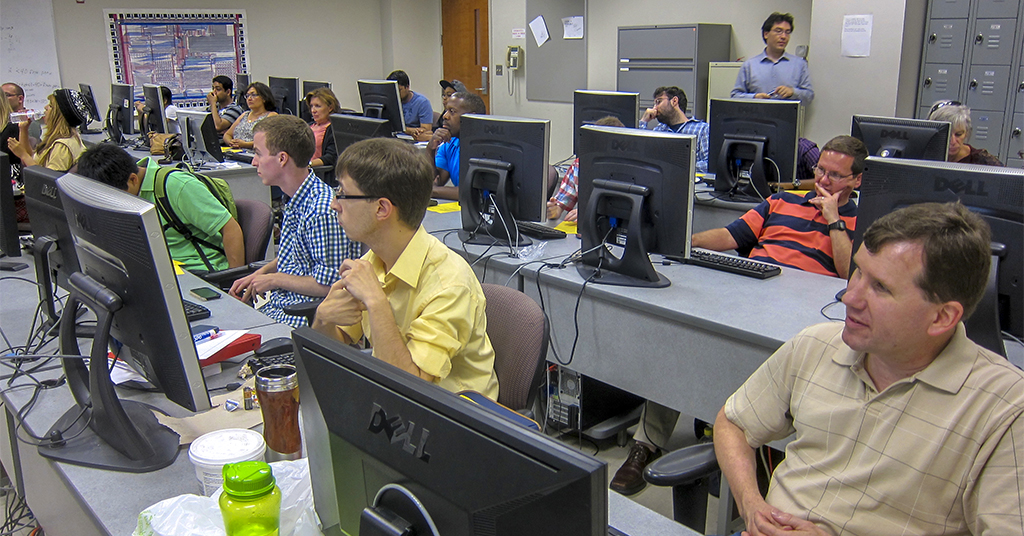
January 22-26, 2018, UMBC SFS scholars worked collaboratively to analyze the security of a targeted aspect of the UMBC computer system. The focus of this year’s study was the WebAdmin module that enables users to perform various functions on their accounts, including changing the password. Students identified vulnerabilities involving failure to sanitize user input properly and suggested mitigations. Participants comprised BS, MS, MPS, and PhD students studying computer science, computer engineering, information systems, and cybersecurity, including SFS scholars who transferred from Montgomery College (MC) and Prince George’s Community College (PGCC) to complete their four-year degrees at UMBC. We hope that other universities can benefit from our motivational and educational strategy of cooperating with the university’s IT staff to engage students in active project-based learning centering on focused questions about the university computer system.
Enis Golaszewski is a PhD student and SFS scholar in computer science working with Dr. Sherman on blockchain, protocol analysis, and the security of software-defined networks.
This project was supported in part by the National Science Foundation under SFS grant 1241576.
Host: Alan T. Sherman, *protected email*
The UMBC Cyber Defense Lab meets biweekly Fridays. All meetings are open to the public.
The post talk: Results of a student study of UMBC computer systems security appeared first on Department of Computer Science and Electrical Engineering.
]]>
The UMBC Cyber Defense Lab presents Results from the January 2018 SFS Research Study at UMBC Enis Golaszewski, CSEE, UMBC 12:00-1:00pm Friday, 12 October 2018, ITE 227 January 22-26,...
https://www.csee.umbc.edu/2018/10/talk-results-of-a-student-study-of-umbc-computer-systems-security/
https://beta.my.umbc.edu/api/v0/pixel/news/79376/guest@my.umbc.edu/6d0ccf28223fa07d9b9e974e1d9d28cb/api/pixel
computer-science
cybersecurity
students
talks
UMBC Cybersecurity Institute Group
https://beta.my.umbc.edu/groups/cybersecurity
https://assets3-beta.my.umbc.edu/system/shared/avatars/groups/000/000/485/196da6a7ec6f4c31eab2e474c17a9ab7/xsmall.png?1734891477
https://assets3-beta.my.umbc.edu/system/shared/avatars/groups/000/000/485/196da6a7ec6f4c31eab2e474c17a9ab7/original.png?1734891477
https://assets4-beta.my.umbc.edu/system/shared/avatars/groups/000/000/485/196da6a7ec6f4c31eab2e474c17a9ab7/xxlarge.png?1734891477
https://assets4-beta.my.umbc.edu/system/shared/avatars/groups/000/000/485/196da6a7ec6f4c31eab2e474c17a9ab7/xlarge.png?1734891477
https://assets2-beta.my.umbc.edu/system/shared/avatars/groups/000/000/485/196da6a7ec6f4c31eab2e474c17a9ab7/large.png?1734891477
https://assets3-beta.my.umbc.edu/system/shared/avatars/groups/000/000/485/196da6a7ec6f4c31eab2e474c17a9ab7/medium.png?1734891477
https://assets3-beta.my.umbc.edu/system/shared/avatars/groups/000/000/485/196da6a7ec6f4c31eab2e474c17a9ab7/small.png?1734891477
https://assets3-beta.my.umbc.edu/system/shared/avatars/groups/000/000/485/196da6a7ec6f4c31eab2e474c17a9ab7/xsmall.png?1734891477
https://assets3-beta.my.umbc.edu/system/shared/avatars/groups/000/000/485/196da6a7ec6f4c31eab2e474c17a9ab7/xxsmall.png?1734891477
UMBC Center for Cybersecurity
0
0
true
Thu, 11 Oct 2018 10:25:13 -0400
MD-AI Meetup holds 1st event at UMBC 6-8pm Wed 10/3, 7th floor library
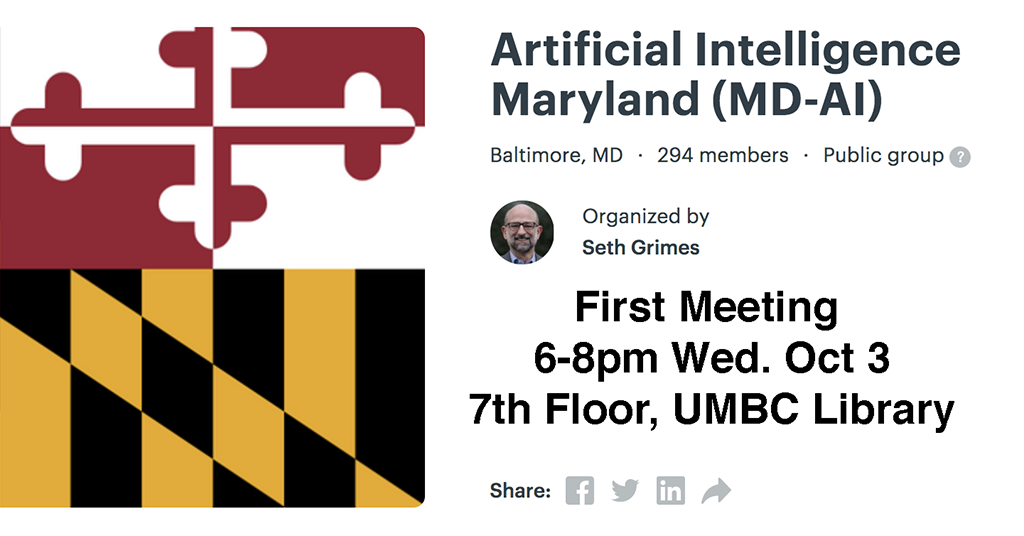
MD-AI Meetup holds 1st event at UMBC
6-8pm Wed 10/3, 7th floor library
A new Maryland-based meetup interest group has been established for Artificial Intelligence (MD-AI Meetup) and will have its first meeting at UMBC this coming Wednesday (Oct 3) from 6:00-8:00pm in the 7th floor of the library. The first meeting will feature a talk by UMCP Professor Phil Resnik on the state of NLP and an AI research agenda. Refreshments will be provided. The meetup is organized by Seth Grimes and supported by TEDCO, local AI startup RedShred, and the Maryland Tech Council.
If you are interested in attending this and possibly future meetings (which will probably be monthly), go to the Meetup site and join (it’s free) and RSVP to attend this meeting (if there’s still room). If you join the meetup and RSVP, you can see who’s registered to attend.
These meetups are good opportunities to meet and network with people in the area who share interests. It’s a great opportunity for students who are will be looking for internships or jobs in the coming year.
The post MD-AI Meetup holds 1st event at UMBC 6-8pm Wed 10/3, 7th floor library appeared first on Department of Computer Science and Electrical Engineering.
]]>
MD-AI Meetup holds 1st event at UMBC 6-8pm Wed 10/3, 7th floor library A new Maryland-based meetup interest group has been established for Artificial Intelligence (MD-AI Meetup) and will...
https://www.csee.umbc.edu/2018/09/md-ai-meetup-holds-1st-event-at-umbc-6-8pm-wed-10-3-7th-floor-library/
https://beta.my.umbc.edu/api/v0/pixel/news/78988/guest@my.umbc.edu/9f971bc6300fd641f11e4a00be96e2fb/api/pixel
ai
computer-engineering
computer-science
cybersecurity
data-science
events
nlp
robotics
talks
UMBC Cybersecurity Institute Group
https://beta.my.umbc.edu/groups/cybersecurity
https://assets3-beta.my.umbc.edu/system/shared/avatars/groups/000/000/485/196da6a7ec6f4c31eab2e474c17a9ab7/xsmall.png?1734891477
https://assets3-beta.my.umbc.edu/system/shared/avatars/groups/000/000/485/196da6a7ec6f4c31eab2e474c17a9ab7/original.png?1734891477
https://assets4-beta.my.umbc.edu/system/shared/avatars/groups/000/000/485/196da6a7ec6f4c31eab2e474c17a9ab7/xxlarge.png?1734891477
https://assets4-beta.my.umbc.edu/system/shared/avatars/groups/000/000/485/196da6a7ec6f4c31eab2e474c17a9ab7/xlarge.png?1734891477
https://assets2-beta.my.umbc.edu/system/shared/avatars/groups/000/000/485/196da6a7ec6f4c31eab2e474c17a9ab7/large.png?1734891477
https://assets3-beta.my.umbc.edu/system/shared/avatars/groups/000/000/485/196da6a7ec6f4c31eab2e474c17a9ab7/medium.png?1734891477
https://assets3-beta.my.umbc.edu/system/shared/avatars/groups/000/000/485/196da6a7ec6f4c31eab2e474c17a9ab7/small.png?1734891477
https://assets3-beta.my.umbc.edu/system/shared/avatars/groups/000/000/485/196da6a7ec6f4c31eab2e474c17a9ab7/xsmall.png?1734891477
https://assets3-beta.my.umbc.edu/system/shared/avatars/groups/000/000/485/196da6a7ec6f4c31eab2e474c17a9ab7/xxsmall.png?1734891477
UMBC Center for Cybersecurity
0
0
true
Sat, 29 Sep 2018 23:50:53 -0400
Sat, 29 Sep 2018 23:50:53 -0400
Machine learning and AI for cybersecurity: a technical chat with DISA

The UMBC Cyber Defense Lab
Machine Learning and Artificial Intelligence: A Technical Chat with the Defense Information Systems Agency
James Curry
Lead Engineer–DoD Cyber Security Range
Defense Information Systems Agency (DISA)
12:00–1:00pm Friday, 28 September 2018, ITE 227, UMBC
A broad reaching brief on the scope and scale of the DISA Mission, followed by a dive into DISA’s efforts to develop Machine Learning and Artificial Intelligence to help defend the nation’s cyber infrastructure. Attendees are highly encouraged to ask questions.
James Curry is the Lead Engineer of the DoD Cyber Security Range (CSR). The CSR’s mission is to replicate the DoD Information Network (DODIN) environment at lab scale, while maintaining high-fidelity realism. As Lead Engineer, Mr. Curry led the design, acquisition, and implementation of two first-of-its-kind technologies: a Virtual Internet Access Point (vIAP) and a Virtual Joint Regional Security Stack (vJRSS). These technologies enable the DoD Workforce to train in an IaaS-on-demand environment that realistically matches DISA’s core infrastructure. Mr. Curry is a Scholarship for Service (SFS) recipient (2008-2009) and received his masters and bachelors of science in computer science from New Mexico Tech. Email: *protected email*
Host: Alan T. Sherman, *protected email*
The UMBC Cyber Defense Lab meets biweekly Fridays. All meetings are open to the public. Upcoming meetings for Fall 2018 include the following.
- Oct 12 Enis Golaszewski, The 2018 UMBC SFS study
- Oct 26 Enis Golaszewski, Using tools in the formal analysis of cryptographic protocols
- Nov 9 Razvan Mintesu, Legal aspects privacy
- Dec 7 Tim Finin, A knowledge graph for cyber threat intelligence
The post Machine learning and AI for cybersecurity: a technical chat with DISA appeared first on Department of Computer Science and Electrical Engineering.
]]>
The UMBC Cyber Defense Lab Machine Learning and Artificial Intelligence: A Technical Chat with the Defense Information Systems Agency James Curry Lead Engineer–DoD Cyber Security Range...
https://www.csee.umbc.edu/2018/09/machine-learning-and-ai-for-cybersecurity-a-technical-chat-with-disa/
https://beta.my.umbc.edu/api/v0/pixel/news/78945/guest@my.umbc.edu/1d7e79c959c784379822047cd7dd1737/api/pixel
ai
computer-engineering
computer-science
cybersecurity
data-science
machine-learning
UMBC Cybersecurity Institute Group
https://beta.my.umbc.edu/groups/cybersecurity
https://assets3-beta.my.umbc.edu/system/shared/avatars/groups/000/000/485/196da6a7ec6f4c31eab2e474c17a9ab7/xsmall.png?1734891477
https://assets3-beta.my.umbc.edu/system/shared/avatars/groups/000/000/485/196da6a7ec6f4c31eab2e474c17a9ab7/original.png?1734891477
https://assets4-beta.my.umbc.edu/system/shared/avatars/groups/000/000/485/196da6a7ec6f4c31eab2e474c17a9ab7/xxlarge.png?1734891477
https://assets4-beta.my.umbc.edu/system/shared/avatars/groups/000/000/485/196da6a7ec6f4c31eab2e474c17a9ab7/xlarge.png?1734891477
https://assets2-beta.my.umbc.edu/system/shared/avatars/groups/000/000/485/196da6a7ec6f4c31eab2e474c17a9ab7/large.png?1734891477
https://assets3-beta.my.umbc.edu/system/shared/avatars/groups/000/000/485/196da6a7ec6f4c31eab2e474c17a9ab7/medium.png?1734891477
https://assets3-beta.my.umbc.edu/system/shared/avatars/groups/000/000/485/196da6a7ec6f4c31eab2e474c17a9ab7/small.png?1734891477
https://assets3-beta.my.umbc.edu/system/shared/avatars/groups/000/000/485/196da6a7ec6f4c31eab2e474c17a9ab7/xsmall.png?1734891477
https://assets3-beta.my.umbc.edu/system/shared/avatars/groups/000/000/485/196da6a7ec6f4c31eab2e474c17a9ab7/xxsmall.png?1734891477
UMBC Center for Cybersecurity
0
0
true
Thu, 27 Sep 2018 12:49:08 -0400
talk: Phishing in an Academic Community, a Study of User Susceptibility and Behavior

The UMBC Cyber Defense Lab
Phishing in an Academic Community:
a Study of User Susceptibility and Behavior
Alejandra Diaz
University of Maryland, Baltimore County
12:00–1:00pm, Friday, 14 September 2018, ITE 227
(joint work with Alan T. Sherman Anupam Joshi)
We present an observational study on the relationship between demographic factors and phishing susceptibility at the University of Maryland, Baltimore County (UMBC). From March through May 2018, we performed three experiments that delivered phishing attacks to 450 randomly-selected students on three different days (1,350 students total) to examine user click rates and demographics within UMBC’s undergraduate student population. The participants were initially unaware of the study. We deployed the Billing Problem, Contest Winner, and Expiration Date phishing tactics. Experiment 1 impersonated banking authorities; Experiment 2 enticed users with monetary rewards; and Experiment 3 threatened users with account cancellation.
We found correlations resulting in lowered susceptibility based on college affiliation, academic year progression, cyber training, involvement in cyber clubs or cyber scholarship programs, amount of time spent on the computer, and age demographics. We found no significant correlation between gender and susceptibility. Contrary to our expectations, we observed an inverse correlation between phishing awareness and student resistance to clicking a phishing link. Students who identified themselves as understanding the definition of phishing had a higher susceptibility rate than did their peers who were merely aware of phishing attacks, with both groups of students having a higher susceptibility rate than those with no knowledge whatsoever. Overall, approximately 70% of the students who opened a phishing email clicked on it.
Alejandra Diaz (*protected email*) is a cyber software engineer at Northrop Grumman. She earned her BS in computer science from UMBC with a concentration in cybersecurity in May 2017, and her MS in computer science in August 2018. As a Cyber Scholar and a Society of Women Studying Information Security Scholar, she has a special interest in the human aspects of cybersecurity.
Host: Alan T. Sherman, *protected email*
Support for this research was provided in part by the National Science Foundation under SFS grant 1241576, the U.S. Department of Defense under CAE grant H988230-17-1-0349, and IBM.
The post talk: Phishing in an Academic Community, a Study of User Susceptibility and Behavior appeared first on Department of Computer Science and Electrical Engineering.
]]>
The UMBC Cyber Defense Lab Phishing in an Academic Community: a Study of User Susceptibility and Behavior Alejandra Diaz University of Maryland, Baltimore County 12:00–1:00pm, Friday, 14...
https://www.csee.umbc.edu/2018/09/talk-phishing-in-an-academic-community-a-study-of-user-susceptibility-and-behavior/
https://beta.my.umbc.edu/api/v0/pixel/news/78459/guest@my.umbc.edu/239c541864336c1f8378903a30fe9277/api/pixel
computer-science
cybersecurity
news
talks
UMBC Cybersecurity Institute Group
https://beta.my.umbc.edu/groups/cybersecurity
https://assets3-beta.my.umbc.edu/system/shared/avatars/groups/000/000/485/196da6a7ec6f4c31eab2e474c17a9ab7/xsmall.png?1734891477
https://assets3-beta.my.umbc.edu/system/shared/avatars/groups/000/000/485/196da6a7ec6f4c31eab2e474c17a9ab7/original.png?1734891477
https://assets4-beta.my.umbc.edu/system/shared/avatars/groups/000/000/485/196da6a7ec6f4c31eab2e474c17a9ab7/xxlarge.png?1734891477
https://assets4-beta.my.umbc.edu/system/shared/avatars/groups/000/000/485/196da6a7ec6f4c31eab2e474c17a9ab7/xlarge.png?1734891477
https://assets2-beta.my.umbc.edu/system/shared/avatars/groups/000/000/485/196da6a7ec6f4c31eab2e474c17a9ab7/large.png?1734891477
https://assets3-beta.my.umbc.edu/system/shared/avatars/groups/000/000/485/196da6a7ec6f4c31eab2e474c17a9ab7/medium.png?1734891477
https://assets3-beta.my.umbc.edu/system/shared/avatars/groups/000/000/485/196da6a7ec6f4c31eab2e474c17a9ab7/small.png?1734891477
https://assets3-beta.my.umbc.edu/system/shared/avatars/groups/000/000/485/196da6a7ec6f4c31eab2e474c17a9ab7/xsmall.png?1734891477
https://assets3-beta.my.umbc.edu/system/shared/avatars/groups/000/000/485/196da6a7ec6f4c31eab2e474c17a9ab7/xxsmall.png?1734891477
UMBC Center for Cybersecurity
0
0
true
Sun, 09 Sep 2018 13:40:05 -0400
NSA highlights strong partnership with UMBC through Featured School campaign

NSA highlights strong partnership with UMBC in Featured School campaign
Over the past two decades, UMBC and the National Security Agency (NSA) have developed a strong relationship, which has led to research, internship, and career opportunities for faculty, students, and alumni. UMBC is the first institution to be highlighted in NSA’s Featured School Series, which launched on September 4.
“UMBC’s long-standing partnership with NSA has provided valuable experiences for our students, faculty, and alumni to pursue internships, careers, and collaborative research opportunities,” said President Freeman Hrabowski. “Through this work we are helping to address the need for well-trained cyber professionals by creating a network of talented people to protect the state, nation, and world.”
More than 1100 NSA employees are UMBC alumni, including Darniet Jennings ‘98, M.S. ‘99, Ph.D. ‘03, information systems management. Jennings continued his dissertation research when he took a job at NSA, where he developed a system to manage big data effectively, which was patented in 2010.
The opportunities at NSA include careers in a broad range of disciplines including cybersecurity, engineering, computer science, language, and biological and chemical sciences. Regina Hambleton ‘87, mathematics, has held a number of positions at NSA and is currently the Agency’s deputy director of Engagement and Policy. She began working at NSA while she was a student at UMBC, and participated in a program that allowed her to spend a semester at UMBC taking courses followed by a semester working at NSA.
The partnership between NSA and UMBC also helps prepare an increasing number of graduates for careers in cybersecurity-related fields, to protect the nation from cyber threats.
Charles Nicholas, professor of computer science and electrical engineering, is also highlighted in the Featured School Series campaign. He has spent two sabbaticals at NSA during his time at UMBC, and has mentored students who completed NSA internships, in addition to students who went on to pursue careers at NSA. Nicholas is interested in the intersection of cybersecurity and data science, and the tools that are used to compare malware specimens.
“There are so many opportunities in the intelligence community, including at NSA,” Nicholas says. “It is important for students interested in those careers to develop technical ability, as well as critical and creative thinking, and I enjoy the chance to help them grow those skills.”
For more information about the partnership, and a few UMBC alumni who work at NSA, visit the UMBC page on the NSA website.
Adapted from a UMBC News article by Megan Hanks. Banner image by Marlayna Demond for UMBC.
The post NSA highlights strong partnership with UMBC through Featured School campaign appeared first on Department of Computer Science and Electrical Engineering.
]]>
NSA highlights strong partnership with UMBC in Featured School campaign Over the past two decades, UMBC and the National Security Agency (NSA) have developed a strong relationship, which has...
https://www.csee.umbc.edu/2018/09/nsa-highlights-strong-partnership-with-umbc-through-featured-school-campaign/
https://beta.my.umbc.edu/api/v0/pixel/news/78345/guest@my.umbc.edu/937bbb0918436a7c5bf367c07f1e6516/api/pixel
computer-engineering
computer-science
cybersecurity
data-science
electrical-engineering
news
UMBC Cybersecurity Institute Group
https://beta.my.umbc.edu/groups/cybersecurity
https://assets3-beta.my.umbc.edu/system/shared/avatars/groups/000/000/485/196da6a7ec6f4c31eab2e474c17a9ab7/xsmall.png?1734891477
https://assets3-beta.my.umbc.edu/system/shared/avatars/groups/000/000/485/196da6a7ec6f4c31eab2e474c17a9ab7/original.png?1734891477
https://assets4-beta.my.umbc.edu/system/shared/avatars/groups/000/000/485/196da6a7ec6f4c31eab2e474c17a9ab7/xxlarge.png?1734891477
https://assets4-beta.my.umbc.edu/system/shared/avatars/groups/000/000/485/196da6a7ec6f4c31eab2e474c17a9ab7/xlarge.png?1734891477
https://assets2-beta.my.umbc.edu/system/shared/avatars/groups/000/000/485/196da6a7ec6f4c31eab2e474c17a9ab7/large.png?1734891477
https://assets3-beta.my.umbc.edu/system/shared/avatars/groups/000/000/485/196da6a7ec6f4c31eab2e474c17a9ab7/medium.png?1734891477
https://assets3-beta.my.umbc.edu/system/shared/avatars/groups/000/000/485/196da6a7ec6f4c31eab2e474c17a9ab7/small.png?1734891477
https://assets3-beta.my.umbc.edu/system/shared/avatars/groups/000/000/485/196da6a7ec6f4c31eab2e474c17a9ab7/xsmall.png?1734891477
https://assets3-beta.my.umbc.edu/system/shared/avatars/groups/000/000/485/196da6a7ec6f4c31eab2e474c17a9ab7/xxsmall.png?1734891477
UMBC Center for Cybersecurity
2
0
true
Wed, 05 Sep 2018 09:12:55 -0400
Wed, 05 Sep 2018 09:12:55 -0400
UMBC’s Sherman receives $5.4m in funding for cybersecurity research and scholarships
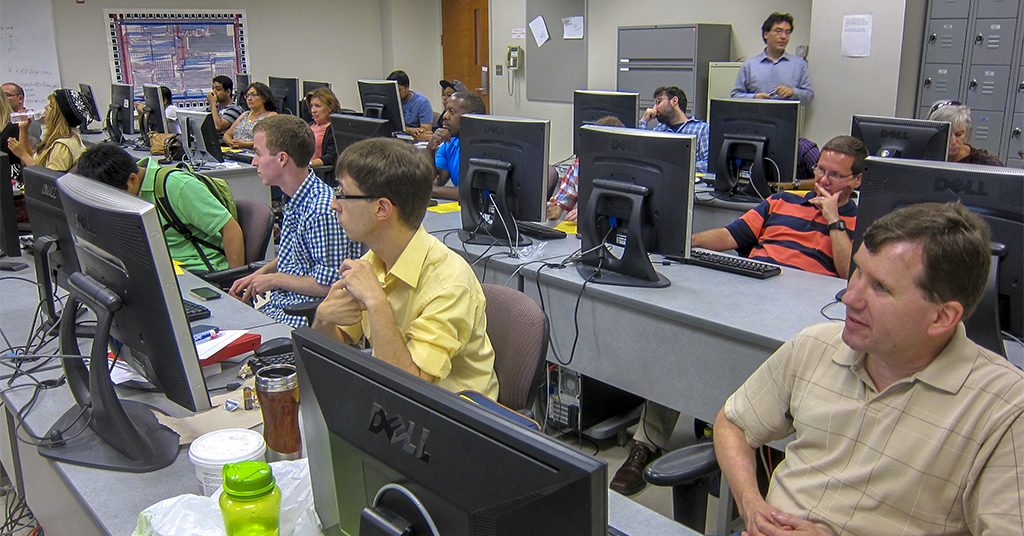
UMBC receives $5.4m in funding for new cybersecurity projects
NSF and NSA Fund Three Cybersecurity Projects by Prof. Alan Sherman
Professor Alan Sherman and colleagues were recently awarded more than $5.4 million dollars in three new grants to support cybersecurity research and education at UMBC, including two from the National Science Foundation (NSF) and one from the National Security Agency (NSA). Dr. Sherman leads UMBC’s Center for Information Security and Assurance which was responsible for UMBC’s designation as a National Center of Academic Excellence in Cybersecurity Research and Education.
This summer, NSF funded Sherman’s second CyberCorps Scholarship for Service (SFS) grant (Richard Forno, CoPI) that will fund 34 cybersecurity scholars over five years and support research at UMBC and in the Cyber Defense Lab (CDL). The $5 million award supports scholarships for BS, MS, MPS, and PhD students to study cybersecurity through UMBC degree programs in computer science, computer engineering, cyber, or information systems. SFS scholars receive tuition, books, health benefits, professional expenses, and an annual stipend ($22,500 for undergraduates, $34,000 for graduate students). In return, each scholar must engage in a summer internship and work for government (federal, state, local, or tribal) for one year for each year of support. The program is highly competitive and many of the graduates now work for the NSA.
A novel aspect of UMBC’s SFS program is that it builds connections with two nearby community colleges—Montgomery College (MC) and Prince Georges Community College (PGCC). Each year, one student from each of these schools is selected for a scholarship. Upon graduation from community college, the student transfers to UMBC to complete their four-year degree. In doing so, UMBC taps into a significant pool of talent and increases the number of cybersecurity professionals who will enter government service. Each January, all SFS scholars from UMBC, MC, and PGCC engage in a one-week research study. Working collaboratively, they analyze a targeted aspect of the security of the UMBC computer system. The students enjoy the hands-on experience while helping to improve UMBC’s computer security. Students interested in applying for an SFS scholarship should consult the CISA SFS page and contact Professor Sherman. The next application deadline is November 15.
With $310,000 of support from NSF, Sherman and his CoPIs, Drs. Dhananjay Phatak and Linda Oliva, are developing educational Cybersecurity Assessment Tools (CATS) to measure student understanding of cybersecurity concepts. In particular, they are developing and validating two concept inventories: one for any first course in cybersecurity, and one for college graduates beginning a career in cybersecurity. These inventories will provide science-based criteria by which different approaches to cybersecurity education can be assessed (e.g., competition, gaming, hands-on exercises, and traditional classroom). This project is collaborative with the University of Illinois at Urbana-Champaign.
With $97,000 of support from NSA, Sherman is developing a virtual Protocol Analysis Lab that uses state-of-the-art tools to analyze cryptographic protocols for structural weaknesses. Protocols are the structured communications that take place when computers interact with each other, as for example happens when a browser visits a web page. Experience has shown that protocols are so complicated to analyze that there is tremendous value in studying them using formal methods. Sherman and his graduate students are making it easier to use existing tools including CPSA, Maude NPA, and Tamerin, applying them to analyze particular protocols, and developing associated educational materials.
The post UMBC’s Sherman receives $5.4m in funding for cybersecurity research and scholarships appeared first on Department of Computer Science and Electrical Engineering.
]]>
UMBC receives $5.4m in funding for new cybersecurity projects NSF and NSA Fund Three Cybersecurity Projects by Prof. Alan Sherman Professor Alan Sherman and colleagues were recently awarded...
https://www.csee.umbc.edu/2018/07/nsf-and-nsa-fund-three-cybersecurity-projects-by-prof-alan-sherman/
https://beta.my.umbc.edu/api/v0/pixel/news/77651/guest@my.umbc.edu/9b6126873c3cb88cd9ccd6c5510f4393/api/pixel
computer-science
cybersecurity
news
research
students
UMBC Cybersecurity Institute Group
https://beta.my.umbc.edu/groups/cybersecurity
https://assets3-beta.my.umbc.edu/system/shared/avatars/groups/000/000/485/196da6a7ec6f4c31eab2e474c17a9ab7/xsmall.png?1734891477
https://assets3-beta.my.umbc.edu/system/shared/avatars/groups/000/000/485/196da6a7ec6f4c31eab2e474c17a9ab7/original.png?1734891477
https://assets4-beta.my.umbc.edu/system/shared/avatars/groups/000/000/485/196da6a7ec6f4c31eab2e474c17a9ab7/xxlarge.png?1734891477
https://assets4-beta.my.umbc.edu/system/shared/avatars/groups/000/000/485/196da6a7ec6f4c31eab2e474c17a9ab7/xlarge.png?1734891477
https://assets2-beta.my.umbc.edu/system/shared/avatars/groups/000/000/485/196da6a7ec6f4c31eab2e474c17a9ab7/large.png?1734891477
https://assets3-beta.my.umbc.edu/system/shared/avatars/groups/000/000/485/196da6a7ec6f4c31eab2e474c17a9ab7/medium.png?1734891477
https://assets3-beta.my.umbc.edu/system/shared/avatars/groups/000/000/485/196da6a7ec6f4c31eab2e474c17a9ab7/small.png?1734891477
https://assets3-beta.my.umbc.edu/system/shared/avatars/groups/000/000/485/196da6a7ec6f4c31eab2e474c17a9ab7/xsmall.png?1734891477
https://assets3-beta.my.umbc.edu/system/shared/avatars/groups/000/000/485/196da6a7ec6f4c31eab2e474c17a9ab7/xxsmall.png?1734891477
UMBC Center for Cybersecurity
1
0
true
Wed, 25 Jul 2018 22:15:49 -0400
talk: Robot Governance – Institutions and Issues, 10:30 Tue 7/24, ITR346

Robot Governance – Institutions and Issues
Dr. Aaron Mannes, ISHPI Information Technologies
10:30-11:30 Tuesday, 24 July 2018, ITE 346
Inexpensive sensors and information storage and processing have enabled the large-scale production of robots: autonomous systems capable of acting on the world. These systems represent an enormous technological and economic opportunity that will change society in countless and unpredictable ways. They will also bring new policy challenges. This presentation examines the missions the government will need to undertake to address the challenges raised by this new technology, identifies critical gaps the government faces in carrying out these missions, and discusses institutional options to address these gaps.
Dr. Aaron Mannes is the Senior Policy Advisor at ISHPI Information Technologies, where he supports the Apex Data Analytics Engine (DA-E) at the Department of Homeland Security Science and Technology Directorate. In supporting DA-E, Dr. Mannes collaborates on big data projects that support the Homeland Security Enterprise and researches technology policy. He started at DHS as an American Association for the Advancement of Science Policy Fellow in September 2015. From 2004 to 2015, Dr. Mannes was a researcher at the University of Maryland Institute for Advanced Computer Studies (UMIACS) where he was the subject matter expert on terrorism and international affairs collaborating with a team of inter-disciplinary scientists to build computational tools to support decision-makers facing 21st century security and development problems. Dr. Mannes earned his Ph.D. at the University of Maryland’s School of Public Policy in 2014. His dissertation topic was the evolving national security role of the vice president.
Dr. Mannes is the author or co-author of four books on terrorism and has written scores of articles, papers, and book chapters on an array of topics including Middle East affairs, terrorism, technology, and other international security issues for popular and scholarly publications including Politico, Policy Review, The Wall Street Journal, Foreign Policy, The Journal of International Security Affairs, The Huffington Post, The National Interest, The Jerusalem Post, and The Guardian.
This research was conducted with the support of the Apex Data Analytics Engine in the Department of Homeland Security (DHS) Science and Technology Directorate (S&T). In no way should anything stated in this seminar be construed as representing the official position of DHS S&T or any other component of DHS. Opinions and findings expressed in this seminar, as well as any errors and omissions, are the responsibility of the presenter alone.
The post talk: Robot Governance – Institutions and Issues, 10:30 Tue 7/24, ITR346 appeared first on Department of Computer Science and Electrical Engineering.
]]>
Robot Governance – Institutions and Issues Dr. Aaron Mannes, ISHPI Information Technologies 10:30-11:30 Tuesday, 24 July 2018, ITE 346 Inexpensive sensors and information storage...
https://www.csee.umbc.edu/2018/07/talk-robot-governance-institutions-and-issues-1030-tue-7-24-itr346/
https://beta.my.umbc.edu/api/v0/pixel/news/77606/guest@my.umbc.edu/eb929b4718ba6f9af0b285ec85f5cf78/api/pixel
computer-engineering
computer-science
cybersecurity
news
talks
UMBC Cybersecurity Institute Group
https://beta.my.umbc.edu/groups/cybersecurity
https://assets3-beta.my.umbc.edu/system/shared/avatars/groups/000/000/485/196da6a7ec6f4c31eab2e474c17a9ab7/xsmall.png?1734891477
https://assets3-beta.my.umbc.edu/system/shared/avatars/groups/000/000/485/196da6a7ec6f4c31eab2e474c17a9ab7/original.png?1734891477
https://assets4-beta.my.umbc.edu/system/shared/avatars/groups/000/000/485/196da6a7ec6f4c31eab2e474c17a9ab7/xxlarge.png?1734891477
https://assets4-beta.my.umbc.edu/system/shared/avatars/groups/000/000/485/196da6a7ec6f4c31eab2e474c17a9ab7/xlarge.png?1734891477
https://assets2-beta.my.umbc.edu/system/shared/avatars/groups/000/000/485/196da6a7ec6f4c31eab2e474c17a9ab7/large.png?1734891477
https://assets3-beta.my.umbc.edu/system/shared/avatars/groups/000/000/485/196da6a7ec6f4c31eab2e474c17a9ab7/medium.png?1734891477
https://assets3-beta.my.umbc.edu/system/shared/avatars/groups/000/000/485/196da6a7ec6f4c31eab2e474c17a9ab7/small.png?1734891477
https://assets3-beta.my.umbc.edu/system/shared/avatars/groups/000/000/485/196da6a7ec6f4c31eab2e474c17a9ab7/xsmall.png?1734891477
https://assets3-beta.my.umbc.edu/system/shared/avatars/groups/000/000/485/196da6a7ec6f4c31eab2e474c17a9ab7/xxsmall.png?1734891477
UMBC Center for Cybersecurity
1
0
true
Mon, 23 Jul 2018 17:27:32 -0400
UMBC launches cybersecurity research collaboration with Japanese and UK partners
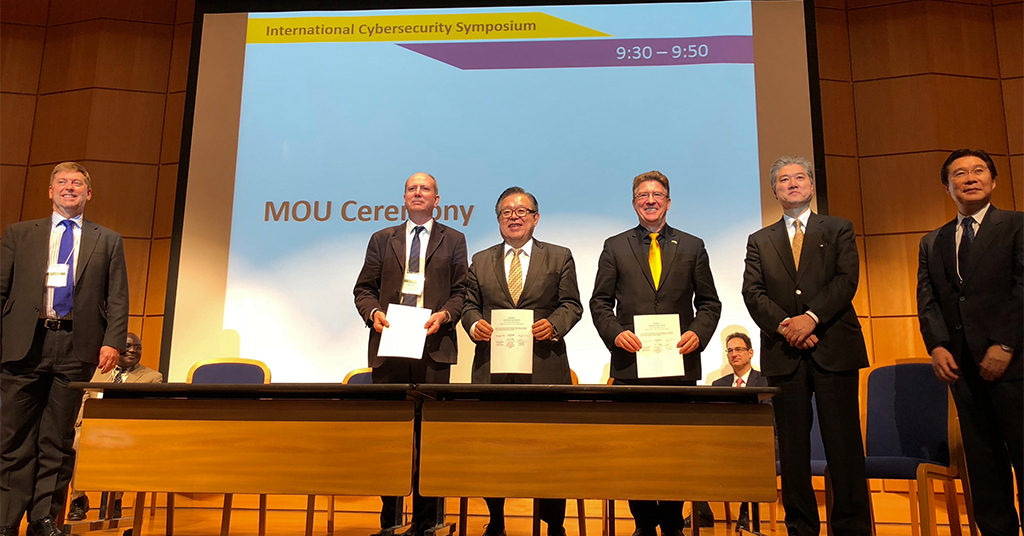
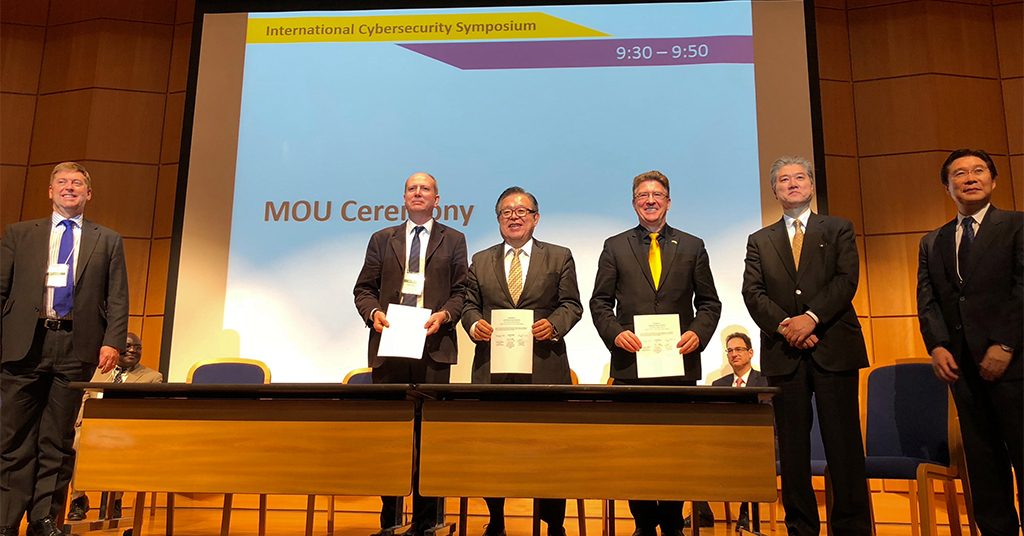 University leaders, including Karl V. Steiner, third from right, signed the three-nation agreement in a ceremony at the sixth International Cybersecurity Symposium in Japan. Photo courtesy of Karl V. Steiner
UMBC launches infrastructure-focused cybersecurity research collaboration with Japanese and UK partners
UMBC is one of three leading academic institutions collaborating on a new research initiative focused on cybersecurity for critical national infrastructures, including information technology, public transit, and financial services. University leaders signed the three-nation agreement in a ceremony at the sixth International Cybersecurity Symposium in Japan.
UMBC, Keio Research Institute (KRIS) in Japan, and Royal Holloway University of London (RHUL) in the UK will partner to investigate the use of common system simulation tools for modeling critical national infrastructure. This partnership is part of a broader international collaboration, the International Cybersecurity Center of Excellence (INCS-COE). It will also involve Hitachi, an international operator in power systems, telecommunication, railways, and other core infrastructure areas.
Because cybersecurity attacks may not be limited to national borders, this collaboration argues that defense against such attacks should not be siloed either.
“Cybersecurity can no longer be treated as a national issue,” emphasizes Karl V. Steiner, vice president for research at UMBC. “Long-term and productive international collaborations are needed to make significant progress.”
Jun Murai, professor of environment and information studies at Keio University, notes, “We look forward to working with our research colleagues in the UK and U.S. to help address the increasingly challenging cyber threats to the security of our respective critical national infrastructures.”
Working with a common toolset will enable mixed nationality teams to run simulations together. This will help cybersecurity experts learn how to more effectively address human factors, including cultural differences, in predicting how attacks and responses to those attacks might play out across different geographies.
“We are excited to participate in this new research collaboration with our colleagues in Japan and the UK to help us better understand and address some of the key cybersecurity challenges that our nations face from increasingly aggressive international adversaries,” says Anupam Joshi, director of UMBC’s Center for Cybersecurity.
The partners in this research see the modeling of system security as increasingly vital for industry and government, for both training purposes and vulnerability analysis.
“This initiative creates many future opportunities including, for example, the opportunity to address the impact on critical national infrastructure security of the exponential growth of the internet of things, and for potential exchanges of expert staff and students,” explains Keith Mayes, head of the Information Security Group (ISG) at Royal Holloway University.
Steiner shares Mayes’s excitement about expanding opportunities for both established and emerging researchers in this growing field. Thanks to leading academic programs in cybersecurity, the bwtech@UMBC Cyber Incubator, and UMBC’s internationally-known Center for Cybersecurity, he says, “UMBC is uniquely positioned in Maryland to become a major global force for research in cybersecurity.”
“This partnership,” says Steiner, “builds important connections to move this essential work forward.”
Adapted from a UMBC News article written by Megan Hanks. Photo by Marlayna Demond ’11 for UMBC.
The post UMBC launches cybersecurity research collaboration with Japanese and UK partners appeared first on Department of Computer Science and Electrical Engineering.
]]>
University leaders, including Karl V. Steiner, third from right, signed the three-nation agreement in a ceremony at the sixth International Cybersecurity Symposium in Japan. Photo courtesy of Karl...
https://www.csee.umbc.edu/2018/07/umbc-cybersecurity-research-collaboration-japanese-uk-partners/
https://beta.my.umbc.edu/api/v0/pixel/news/77417/guest@my.umbc.edu/fb69bb7ce9baa05f22981b1dd26cee4d/api/pixel
computer-engineering
computer-science
cybersecurity
research
UMBC Cybersecurity Institute Group
https://beta.my.umbc.edu/groups/cybersecurity
https://assets3-beta.my.umbc.edu/system/shared/avatars/groups/000/000/485/196da6a7ec6f4c31eab2e474c17a9ab7/xsmall.png?1734891477
https://assets3-beta.my.umbc.edu/system/shared/avatars/groups/000/000/485/196da6a7ec6f4c31eab2e474c17a9ab7/original.png?1734891477
https://assets4-beta.my.umbc.edu/system/shared/avatars/groups/000/000/485/196da6a7ec6f4c31eab2e474c17a9ab7/xxlarge.png?1734891477
https://assets4-beta.my.umbc.edu/system/shared/avatars/groups/000/000/485/196da6a7ec6f4c31eab2e474c17a9ab7/xlarge.png?1734891477
https://assets2-beta.my.umbc.edu/system/shared/avatars/groups/000/000/485/196da6a7ec6f4c31eab2e474c17a9ab7/large.png?1734891477
https://assets3-beta.my.umbc.edu/system/shared/avatars/groups/000/000/485/196da6a7ec6f4c31eab2e474c17a9ab7/medium.png?1734891477
https://assets3-beta.my.umbc.edu/system/shared/avatars/groups/000/000/485/196da6a7ec6f4c31eab2e474c17a9ab7/small.png?1734891477
https://assets3-beta.my.umbc.edu/system/shared/avatars/groups/000/000/485/196da6a7ec6f4c31eab2e474c17a9ab7/xsmall.png?1734891477
https://assets3-beta.my.umbc.edu/system/shared/avatars/groups/000/000/485/196da6a7ec6f4c31eab2e474c17a9ab7/xxsmall.png?1734891477
UMBC Center for Cybersecurity
1
0
true
Sun, 08 Jul 2018 09:06:00 -0400
talk: SPARCLE: Practical Homomorphic Encryption, 12pm Fri 4/27

UMBC Cyber Defense Lab
SPARCLE: Practical Homomorphic Encryption
Russ Fink
Senior Scientist
Johns Hopkins University / Applied Physics Laboratory
12:00–1:00pm Friday, April 27, 2018, ITE 237, UMBC
In the newly coined Privacy Age, researchers are building systems with homomorphic algorithms that enable “never decrypt” operations on sensitive data in applications such as computational private information retrieval (cPIR). The trouble is, the leading algorithms incur significant computational and space challenges, relegating them mainly to large cloud computing platforms. We have invented a special-purpose, ring-homomorphic (aka, “fully homomorphic”) algorithm that, owing to some specializing assumptions, trades general-purpose cryptographic utility for linear performance in speed and space.
We will present the cryptosystem and discuss several current challenges. We will also throw in a fun, simple, tactile concept demonstration of PIR for those just generally curious about what all this is, hopefully demystifying how you can enable a server to search for something without knowing what it’s looking for, and without knowing what (if any) results it found.
Russ Fink (UMBC ’10) is a senior scientist at the Johns Hopkins University / Applied Physics Laboratory. His current research interests include private information retrieval, applied cryptography, and cyber security.
Host: Alan T. Sherman, *protected email*
The post talk: SPARCLE: Practical Homomorphic Encryption, 12pm Fri 4/27 appeared first on Department of Computer Science and Electrical Engineering.
]]>
UMBC Cyber Defense Lab SPARCLE: Practical Homomorphic Encryption Russ Fink Senior Scientist Johns Hopkins University / Applied Physics Laboratory 12:00–1:00pm Friday, April 27, 2018, ITE...
https://www.csee.umbc.edu/2018/04/umbc-cybersecurity-talk-sparcle-practical-homomorphic-encryption-12pm-fri-4-27/
https://beta.my.umbc.edu/api/v0/pixel/news/76057/guest@my.umbc.edu/ddd021406cf0d2d9753550e1189845d6/api/pixel
alumni
computer-science
cybersecurity
news
talks
UMBC Cybersecurity Institute Group
https://beta.my.umbc.edu/groups/cybersecurity
https://assets3-beta.my.umbc.edu/system/shared/avatars/groups/000/000/485/196da6a7ec6f4c31eab2e474c17a9ab7/xsmall.png?1734891477
https://assets3-beta.my.umbc.edu/system/shared/avatars/groups/000/000/485/196da6a7ec6f4c31eab2e474c17a9ab7/original.png?1734891477
https://assets4-beta.my.umbc.edu/system/shared/avatars/groups/000/000/485/196da6a7ec6f4c31eab2e474c17a9ab7/xxlarge.png?1734891477
https://assets4-beta.my.umbc.edu/system/shared/avatars/groups/000/000/485/196da6a7ec6f4c31eab2e474c17a9ab7/xlarge.png?1734891477
https://assets2-beta.my.umbc.edu/system/shared/avatars/groups/000/000/485/196da6a7ec6f4c31eab2e474c17a9ab7/large.png?1734891477
https://assets3-beta.my.umbc.edu/system/shared/avatars/groups/000/000/485/196da6a7ec6f4c31eab2e474c17a9ab7/medium.png?1734891477
https://assets3-beta.my.umbc.edu/system/shared/avatars/groups/000/000/485/196da6a7ec6f4c31eab2e474c17a9ab7/small.png?1734891477
https://assets3-beta.my.umbc.edu/system/shared/avatars/groups/000/000/485/196da6a7ec6f4c31eab2e474c17a9ab7/xsmall.png?1734891477
https://assets3-beta.my.umbc.edu/system/shared/avatars/groups/000/000/485/196da6a7ec6f4c31eab2e474c17a9ab7/xxsmall.png?1734891477
UMBC Center for Cybersecurity
1
0
true
Wed, 25 Apr 2018 14:09:26 -0400

The UMBC Cyber Defense Lab presents
Human Factors in Cyber Security
Dr. Josiah Dykstra
Cyber Security Researcher, US Department of Defense
12:00–1:00pm Friday, 13 April 2018, ITE 229, UMBC
Humans play many roles in the effectiveness of cyber security. While users are often blamed for security compromises, human strengths and weaknesses also affect people who perform design, implementation, configuration, monitoring, analysis, and response. The fields of human computer interaction generally, and usable security specifically, have drawn attention and research to some aspects of human factors, but many opportunities remain for future work.
In this talk, I describe several of my research projects related to human factors in cyber security. The first was a study of how individual differences affect cyber security behavior, and active follow-on research to predict users who might become victimized. The second was a study of stress and fatigue in security operations centers, including a new survey instrument for collecting data in tactical environments. The third was a research prototype using augmented reality to assist humans in cyber security analysis, and an analysis of preliminary results.
Finally, I will present and invite discussion about a new idea for improving security by making it “disappear.” Despite decades of tools and techniques for secure development, and valiant work at adoption and usability, it is clear that many users cannot or will not avail themselves of appropriate cyber security options. It may be time to rethink the amount of interaction required for most users, and if hands-off, behind-the-scenes cyber defense should be the norm.
Josiah Dykstra serves as a Senior Executive Service government civilian and Subject Matter Expert for Computer Network Operations research in the Laboratory for Telecommunication Sciences within the Research Directorate of the National Security Agency. His research includes human augmentation, cyber risk assessment, and cyber effects. He is an active collaborator with academic, industry, and government researchers around the country. Dykstra earned the PhD degree in computer science at UMBC in 2013 studying under Alan T. Sherman. Dr. Dykstra is the author of the 2016 O’Reilly book, Essential Cybersecurity Science, Fellow of the American Academy of Forensic Sciences, and winner of the Presidential Early Career Award for Scientists and Engineers.
Host: Alan T. Sherman, *protected email*
The UMBC Cyber Defense Lab meets biweekly Fridays. All meetings are open to the public.
The post 🗣️ talk: Human Factors in Cyber Security, 12-1 Fri 4/13, ITE 229, UMBC appeared first on Department of Computer Science and Electrical Engineering.
]]>
The UMBC Cyber Defense Lab presents Human Factors in Cyber Security Dr. Josiah Dykstra Cyber Security Researcher, US Department of Defense 12:00–1:00pm Friday, 13 April 2018, ITE 229, UMBC...
https://www.csee.umbc.edu/2018/04/umbc-talk-human-factors-in-cybersecurity-josiah-dykstra-hci/
https://beta.my.umbc.edu/api/v0/pixel/news/75472/guest@my.umbc.edu/ae3856ee524c6c1193b62d7d794add15/api/pixel
computer-science
cybersecurity
news
talks
UMBC Cybersecurity Institute Group
https://beta.my.umbc.edu/groups/cybersecurity
https://assets3-beta.my.umbc.edu/system/shared/avatars/groups/000/000/485/196da6a7ec6f4c31eab2e474c17a9ab7/xsmall.png?1734891477
https://assets3-beta.my.umbc.edu/system/shared/avatars/groups/000/000/485/196da6a7ec6f4c31eab2e474c17a9ab7/original.png?1734891477
https://assets4-beta.my.umbc.edu/system/shared/avatars/groups/000/000/485/196da6a7ec6f4c31eab2e474c17a9ab7/xxlarge.png?1734891477
https://assets4-beta.my.umbc.edu/system/shared/avatars/groups/000/000/485/196da6a7ec6f4c31eab2e474c17a9ab7/xlarge.png?1734891477
https://assets2-beta.my.umbc.edu/system/shared/avatars/groups/000/000/485/196da6a7ec6f4c31eab2e474c17a9ab7/large.png?1734891477
https://assets3-beta.my.umbc.edu/system/shared/avatars/groups/000/000/485/196da6a7ec6f4c31eab2e474c17a9ab7/medium.png?1734891477
https://assets3-beta.my.umbc.edu/system/shared/avatars/groups/000/000/485/196da6a7ec6f4c31eab2e474c17a9ab7/small.png?1734891477
https://assets3-beta.my.umbc.edu/system/shared/avatars/groups/000/000/485/196da6a7ec6f4c31eab2e474c17a9ab7/xsmall.png?1734891477
https://assets3-beta.my.umbc.edu/system/shared/avatars/groups/000/000/485/196da6a7ec6f4c31eab2e474c17a9ab7/xxsmall.png?1734891477
UMBC Center for Cybersecurity
1
0
true
Sun, 08 Apr 2018 16:27:11 -0400
Sun, 08 Apr 2018 16:27:11 -0400