Online Talks Double Feature: Blockchain and Network Defense, 12-2 Fri 3/27, UMBC
UMBC will hold a double feature with two online security-oriented talks from 12:00 pm to 2:00 pm EDT on Friday, March 27. Both talks will be shared via Webex.
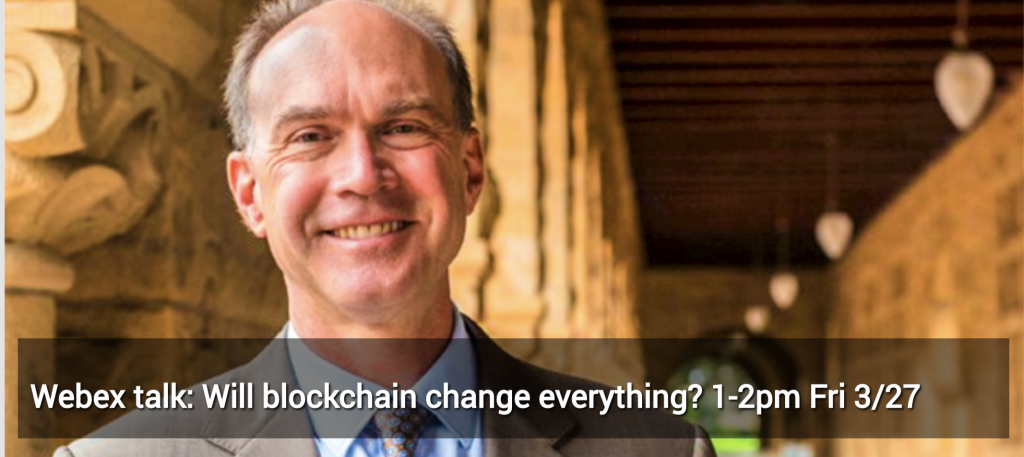
From 1:00-2:00 pm, Professor Dr. John Mitchell of Stanford University will give a Lockheed Martin Distinguished lecture on “Will Blockchain Change Everything“. Join the presentation online at 1:00 pm EDT at https://umbc.webex.com/meet/joshi.
Far from serving only as a foundation for cryptocurrency, blockchain technology provides a general framework for trusted distributed ledgers. Over the past few years, their popularity has grown tremendously, as shown by the number of companies and efforts associated with the Linux Foundation’s Hyperledger project, for example. From a technical standpoint, a blockchain combines a storage layer, networking protocols, a consensus layer, and a programmable transaction layer, leveraging cryptographic operations. The distributed state machine paradigm provides atomicity and transaction rollback, while consensus supports distributed availability as well as certain forms of fair access. From an applications perspective, blockchains appeal to distributed networks of independent agents, as arise in supply chain, credentialing, and decentralized financial services. The talk will look at the potential for radical change as well as specific technical challenges associated with verifiable consensus protocols and trustworthy smart contracts.
From 12:00-1:00 pm EDT Col. Dan Yaroslaski, a former operations officer at the Marine Forces Cyberspace Command will talk on “Hard-Learned Lesson in Defense of a Network“. You can join the presentation online at 12:00 pm at https://umbc.webex.com/meet/sherman.
Often network defenders fail to take into account organizational culture when attempting to provide a secure, reliable, and usable enterprise network. Users and process leaders often fall victim to the false allure of the value of networked systems, without asking the question, “Should this be networked?” Collectively, organizations also forget that networks are a combination of the humans who use the network, the personas we all have to form to gain access to this manmade domain, and the interplay of logical and physical network architecture manifested in geographical locations. The value of some simple military principles—including defense-in-depth, mission focus, redundancy, and resiliency versus efficiency—can help a network defender better advise everyone from the “C Suite” decision-makers to the average network user, on how to have a secure network while accepting reasonable limitations.
The post Online Talks Double Feature: Blockchain and Network Defense, 12-2 Fri 3/27, UMBC appeared first on Department of Computer Science and Electrical Engineering.
]]>
UMBC will hold a double feature with two online security-oriented talks from 12:00 pm to 2:00 pm EDT on Friday, March 27. Both talks will be shared via Webex. From 1:00-2:00 pm,...
https://www.csee.umbc.edu/2020/03/online-talks-double-feature-blockchain-and-network-defense-12-2-fri-3-27-umbc/
https://beta.my.umbc.edu/api/v0/pixel/news/91615/guest@my.umbc.edu/02d72add2655694ae942c1b404c60363/api/pixel
computer-science
cybersecurity
news
talks
uncategorized
UMBC Cybersecurity Institute Group
https://beta.my.umbc.edu/groups/cybersecurity
https://assets3-beta.my.umbc.edu/system/shared/avatars/groups/000/000/485/196da6a7ec6f4c31eab2e474c17a9ab7/xsmall.png?1734891477
https://assets3-beta.my.umbc.edu/system/shared/avatars/groups/000/000/485/196da6a7ec6f4c31eab2e474c17a9ab7/original.png?1734891477
https://assets4-beta.my.umbc.edu/system/shared/avatars/groups/000/000/485/196da6a7ec6f4c31eab2e474c17a9ab7/xxlarge.png?1734891477
https://assets4-beta.my.umbc.edu/system/shared/avatars/groups/000/000/485/196da6a7ec6f4c31eab2e474c17a9ab7/xlarge.png?1734891477
https://assets2-beta.my.umbc.edu/system/shared/avatars/groups/000/000/485/196da6a7ec6f4c31eab2e474c17a9ab7/large.png?1734891477
https://assets3-beta.my.umbc.edu/system/shared/avatars/groups/000/000/485/196da6a7ec6f4c31eab2e474c17a9ab7/medium.png?1734891477
https://assets3-beta.my.umbc.edu/system/shared/avatars/groups/000/000/485/196da6a7ec6f4c31eab2e474c17a9ab7/small.png?1734891477
https://assets3-beta.my.umbc.edu/system/shared/avatars/groups/000/000/485/196da6a7ec6f4c31eab2e474c17a9ab7/xsmall.png?1734891477
https://assets3-beta.my.umbc.edu/system/shared/avatars/groups/000/000/485/196da6a7ec6f4c31eab2e474c17a9ab7/xxsmall.png?1734891477
UMBC Center for Cybersecurity
0
0
false
Thu, 26 Mar 2020 22:50:30 -0400
Webex talk: John Mitchell: Will Blockchain Change Everything? Fri 3/27 1-2pm

Lockheed Martin Distinguished Speaker Series
Will Blockchain Change Everything?
Dr. John Mitchell
Mary and Gordon Crary Family Professor
Departments of Computer Science & Electrical Engineering
Stanford University
1:00-2:00pm EST, Friday, 27 March 2020
Webex meeting hosted by Anupam Joshi
https://umbc.webex.com/meet/joshi
Far from serving only as a foundation for cryptocurrency, blockchain technology provides a general framework for trusted distributed ledgers. Over the past few years, their popularity has grown tremendously, as shown by the number of companies and efforts associated with the Linux Foundation’s Hyperledger project, for example. From a technical standpoint, a blockchain combines a storage layer, networking protocols, a consensus layer, and a programmable transaction layer, leveraging cryptographic operations. The distributed state machine paradigm provides atomicity and transaction rollback, while consensus supports distributed availability as well as certain forms of fair access. From an applications perspective, blockchains appeal to distributed networks of independent agents, as arise in supply chain, credentialing, and decentralized financial services. The talk will look at the potential for radical change as well as specific technical challenges associated with verifiable consensus protocols and trustworthy smart contracts.
John Mitchell is the Mary and Gordon Crary Family Professor in the School of Engineering, Professor of Computer Science, co-director of the Stanford Computer Security Lab, and Professor (by courtesy) of Education. He was Vice Provost at Stanford University from 2012 to 2018. Mitchell’s research focusses on programming languages, computer, and network security, privacy, and education. He has published over 200 research papers, served as editor of eleven journals, including Editor-in-Chief of the Journal of Computer Security, and written two books. He has led research projects funded by numerous organizations and served as advisor and consultant to successful small and large companies. His first research project in online learning started in 2009 when he and six undergraduate students built Stanford CourseWare, an innovative platform that served as the foundation for initial flipped classroom experiments at Stanford and helped inspire the first massive open online courses (MOOCs) from Stanford. Professor Mitchell currently serves as Chair of the Stanford Department of Computer Science.
The post Webex talk: John Mitchell: Will Blockchain Change Everything? Fri 3/27 1-2pm appeared first on Department of Computer Science and Electrical Engineering.
]]>
Lockheed Martin Distinguished Speaker Series Will Blockchain Change Everything? Dr. John Mitchell Mary and Gordon Crary Family Professor Departments of Computer Science &...
https://www.csee.umbc.edu/2020/03/webex-talk-john-mitchell-will-blockchain-change-everything-fri-3-27-1-2pm/
https://beta.my.umbc.edu/api/v0/pixel/news/91356/guest@my.umbc.edu/98a6a027f52a1e7e10d749e5648e138a/api/pixel
computer-engineering
computer-science
cybersecurity
data-science
events
talks
UMBC Cybersecurity Institute Group
https://beta.my.umbc.edu/groups/cybersecurity
https://assets3-beta.my.umbc.edu/system/shared/avatars/groups/000/000/485/196da6a7ec6f4c31eab2e474c17a9ab7/xsmall.png?1734891477
https://assets3-beta.my.umbc.edu/system/shared/avatars/groups/000/000/485/196da6a7ec6f4c31eab2e474c17a9ab7/original.png?1734891477
https://assets4-beta.my.umbc.edu/system/shared/avatars/groups/000/000/485/196da6a7ec6f4c31eab2e474c17a9ab7/xxlarge.png?1734891477
https://assets4-beta.my.umbc.edu/system/shared/avatars/groups/000/000/485/196da6a7ec6f4c31eab2e474c17a9ab7/xlarge.png?1734891477
https://assets2-beta.my.umbc.edu/system/shared/avatars/groups/000/000/485/196da6a7ec6f4c31eab2e474c17a9ab7/large.png?1734891477
https://assets3-beta.my.umbc.edu/system/shared/avatars/groups/000/000/485/196da6a7ec6f4c31eab2e474c17a9ab7/medium.png?1734891477
https://assets3-beta.my.umbc.edu/system/shared/avatars/groups/000/000/485/196da6a7ec6f4c31eab2e474c17a9ab7/small.png?1734891477
https://assets3-beta.my.umbc.edu/system/shared/avatars/groups/000/000/485/196da6a7ec6f4c31eab2e474c17a9ab7/xsmall.png?1734891477
https://assets3-beta.my.umbc.edu/system/shared/avatars/groups/000/000/485/196da6a7ec6f4c31eab2e474c17a9ab7/xxsmall.png?1734891477
UMBC Center for Cybersecurity
1
0
false
Sun, 15 Mar 2020 17:27:52 -0400
Webex Talk: Hard-Learned Lesson in Defense of a Network, 12-1 Fri 3/27

The UMBC Cyber Defense Lab presents
Hard-Learned Lesson in Defense of a Network
Dan Yaroslaski
Former Operations Officer at Marine Forces Cyberspace Command, Colonel, USMC
Often network defenders fail to take into account organizational culture when attempting to provide a secure, reliable, and usable enterprise network. Users and process leaders often fall victim to the false allure of the value of networked systems, without asking the question, “Should this be networked?” Collectively, organizations also forget that networks are a combination of the humans who use the network, the personas we all have to form to gain access to this manmade domain, and the interplay of logical and physical network architecture manifested in geographical locations. The value of some simple military principles—including defense-in-depth, mission focus, redundancy, and resiliency versus efficiency—can help a network defender better advise everyone from the “C Suite” decision-makers to the average network user, on how to have a secure network while accepting reasonable limitations.
Colonel Dan Yaroslaski is a career Marine with over 30 years of service to the nation. He started as an enlisted anti-armor missileman, who then became an Assault Amphibian Vehicle Officer (AAV’s are 27 Ton armored amphibious descendants of the WW II vehicles used from Tarawa to Iwo Jima). He has made a career of integrating technology and human beings to form cohesive combat organizations. Dan’s diverse career placed him at the forefront of high-end, top-secret compartmentalized planning and execution, to the extremely human act of advising an Afghan National Army Kandak (Battalion). During his five-year tenure at Marine Forces Cyberspace Command, he successfully architected new techniques that took advantage of boundary defenses, to new and innovative ways to integrate traditional warfare methods with cyberspace operations, as highlighted in a recent NPR story about USCYBERCOM’s Operation GLOWING SYMPHONY. Dan also spent time creating effective policy directing network operations and defense, to include an extremely frustrating year negotiating the interplay of network operations, operations in the information environment, and Marine Corps culture. Dan and his wife are now empty nesters, so they spend an enormous amount of time nurturing two dogs to fill the void left by their children. As the Rolling Stones point out, “What a drag it is getting old.”
Host: Alan T. Sherman, *protected email*
Support for this event was provided in part by the National Science Foundation under SFS grant DGE-1753681. The UMBC Cyber Defense Lab meets biweekly Fridays. All meetings are open to the public. Upcoming CDL Meetings:
- Apr 10, Russ Fink (APL), ransomware
- Apr 24, Lance Hoffman (GWU), policy
- May 8, Jason Wells (UMBC SFS scholar), law enforcement
- May 22, Spring SFS Meeting at UMBC, 9:30am-2pm, ITE 456
The post Webex Talk: Hard-Learned Lesson in Defense of a Network, 12-1 Fri 3/27 appeared first on Department of Computer Science and Electrical Engineering.
]]>
The UMBC Cyber Defense Lab presents Hard-Learned Lesson in Defense of a Network Dan Yaroslaski Former Operations Officer at Marine Forces Cyberspace Command, Colonel, USMC...
https://www.csee.umbc.edu/2020/03/webex-talk-hard-learned-lesson-in-defense-of-a-network-12-1-fri-3-27/
https://beta.my.umbc.edu/api/v0/pixel/news/91355/guest@my.umbc.edu/74d59cee6e5929961f6c25d66d715cd0/api/pixel
computer-science
cybersecurity
events
news
talks
UMBC Cybersecurity Institute Group
https://beta.my.umbc.edu/groups/cybersecurity
https://assets3-beta.my.umbc.edu/system/shared/avatars/groups/000/000/485/196da6a7ec6f4c31eab2e474c17a9ab7/xsmall.png?1734891477
https://assets3-beta.my.umbc.edu/system/shared/avatars/groups/000/000/485/196da6a7ec6f4c31eab2e474c17a9ab7/original.png?1734891477
https://assets4-beta.my.umbc.edu/system/shared/avatars/groups/000/000/485/196da6a7ec6f4c31eab2e474c17a9ab7/xxlarge.png?1734891477
https://assets4-beta.my.umbc.edu/system/shared/avatars/groups/000/000/485/196da6a7ec6f4c31eab2e474c17a9ab7/xlarge.png?1734891477
https://assets2-beta.my.umbc.edu/system/shared/avatars/groups/000/000/485/196da6a7ec6f4c31eab2e474c17a9ab7/large.png?1734891477
https://assets3-beta.my.umbc.edu/system/shared/avatars/groups/000/000/485/196da6a7ec6f4c31eab2e474c17a9ab7/medium.png?1734891477
https://assets3-beta.my.umbc.edu/system/shared/avatars/groups/000/000/485/196da6a7ec6f4c31eab2e474c17a9ab7/small.png?1734891477
https://assets3-beta.my.umbc.edu/system/shared/avatars/groups/000/000/485/196da6a7ec6f4c31eab2e474c17a9ab7/xsmall.png?1734891477
https://assets3-beta.my.umbc.edu/system/shared/avatars/groups/000/000/485/196da6a7ec6f4c31eab2e474c17a9ab7/xxsmall.png?1734891477
UMBC Center for Cybersecurity
1
0
false
Sun, 15 Mar 2020 14:42:11 -0400
talk: Autonomous Agents, Deep Learning, and Graphs for Cyber Defense, 12-1 Fri. 3/13
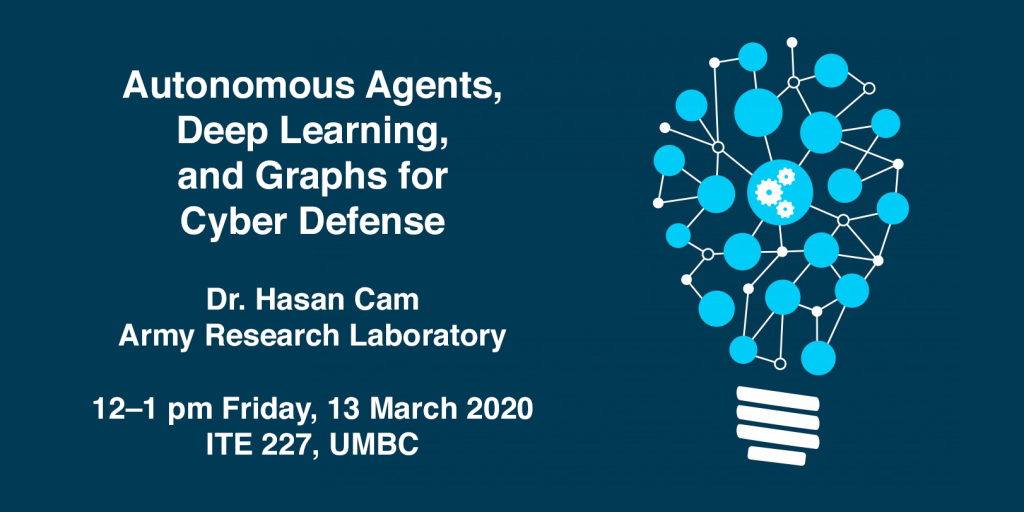
The UMBC Cyber Defense Lab presents
Autonomous Agents, Deep Learning,
and Graphs for Cyber Defense
Dr. Hasan Cam
Army Research Laboratory
12–1 pm Friday, 13 March 2020, ITE 227, UMBC
Cyber resilience usually refers to the ability of an entity to detect, respond to, and recover from cybersecurity attacks to the extent that the entity can continuously deliver the intended outcome despite their presence. Cybersecurity tools such as intrusion detection and prevention systems usually generate far too many alerts, indicators or log data, many of which do not have obvious security implications unless their correlations and temporal causality relationships are determined. In this talk, I will present methods to first estimate the infected and exploited assets and then take recovery and preventive actions using autonomous agents, deep learning, and graphs. Autonomous adversary and defender agents are designed such that the adversary agent can infer the adversary activities and intentions, based on cybersecurity observations and measurements, while the defender agent aims at estimating the best reactive and pro-active actions to protect assets and mitigate the adversary activities. The graph thinking and causality analysis of cyber infection and exploitation helps predict the infection states of some assets. This prediction data of infections is taken as input data by deep reinforcement learning to train agents for determining effective actions. This talk will discuss some preliminary results from the development of building an automated system of autonomous agents to provide cyber resiliency over networks.
Hasan Cam is a Computer Scientist at US Army Research Laboratory. He currently works on the projects involved with autonomous agents, active malware defense, cyber resiliency, and risk assessment over wired, mobile, and tactical networks. His research interests include cybersecurity, machine learning, data analytics, networks, algorithms, and parallel processing. He served as the government lead for the Risk area in Cyber Collaborative Research Alliance. He has previously worked as a faculty member in academia and a senior research scientist in the industry. He has served as an editorial member of two journals, a guest editor of two special issues of journals, an organizer of symposiums and workshops, and a Technical Program Committee Member in numerous conferences. He received a Ph.D. degree in electrical and computer engineering from Purdue University, and an M.S. degree in computer science from Polytechnic University, New York. He is a Senior Member of IEEE.
Host: Alan T. Sherman, *protected email*
Support for this event was provided in part by the National Science Foundation under SFS grant DGE-1753681. The UMBC Cyber Defense Lab meets biweekly Fridays. All meetings are open to the public. Upcoming CDL Meetings:
- Mar 27, Dan Yaroslaski, cybercommand
- Apr 10, Russ Fink (APL), ransomware
- Apr 24, Lance Hoffman (GWU), policy
- May 8, Jason Wells, law enforcement
- May 22, Spring SFS Meeting at UMBC, 9:30-2, ITE 456
The post talk: Autonomous Agents, Deep Learning, and Graphs for Cyber Defense, 12-1 Fri. 3/13 appeared first on Department of Computer Science and Electrical Engineering.
]]>
The UMBC Cyber Defense Lab presents Autonomous Agents, Deep Learning, and Graphs for Cyber Defense Dr. Hasan Cam Army Research Laboratory 12–1 pm Friday, 13 March 2020, ITE...
https://www.csee.umbc.edu/2020/03/talk-autonomous-agents-deep-learning-and-graphs-for-cyber-defense-12-1-fri-3-13/
https://beta.my.umbc.edu/api/v0/pixel/news/91103/guest@my.umbc.edu/4cdbd1c2dfd69476b76f6d340e202dc6/api/pixel
computer-engineering
computer-science
cybersecurity
events
news
talks
UMBC Cybersecurity Institute Group
https://beta.my.umbc.edu/groups/cybersecurity
https://assets3-beta.my.umbc.edu/system/shared/avatars/groups/000/000/485/196da6a7ec6f4c31eab2e474c17a9ab7/xsmall.png?1734891477
https://assets3-beta.my.umbc.edu/system/shared/avatars/groups/000/000/485/196da6a7ec6f4c31eab2e474c17a9ab7/original.png?1734891477
https://assets4-beta.my.umbc.edu/system/shared/avatars/groups/000/000/485/196da6a7ec6f4c31eab2e474c17a9ab7/xxlarge.png?1734891477
https://assets4-beta.my.umbc.edu/system/shared/avatars/groups/000/000/485/196da6a7ec6f4c31eab2e474c17a9ab7/xlarge.png?1734891477
https://assets2-beta.my.umbc.edu/system/shared/avatars/groups/000/000/485/196da6a7ec6f4c31eab2e474c17a9ab7/large.png?1734891477
https://assets3-beta.my.umbc.edu/system/shared/avatars/groups/000/000/485/196da6a7ec6f4c31eab2e474c17a9ab7/medium.png?1734891477
https://assets3-beta.my.umbc.edu/system/shared/avatars/groups/000/000/485/196da6a7ec6f4c31eab2e474c17a9ab7/small.png?1734891477
https://assets3-beta.my.umbc.edu/system/shared/avatars/groups/000/000/485/196da6a7ec6f4c31eab2e474c17a9ab7/xsmall.png?1734891477
https://assets3-beta.my.umbc.edu/system/shared/avatars/groups/000/000/485/196da6a7ec6f4c31eab2e474c17a9ab7/xxsmall.png?1734891477
UMBC Center for Cybersecurity
1
0
false
Sun, 08 Mar 2020 13:06:35 -0400
talk: Hardware Security Kernel for Managing Memory and Instruction Execution, 12pm Fri 2/28
The UMBC Cyber Defense Lab presents
Hardware Security Kernel for Managing Memory and Instruction Execution
Patrick Jungwirth, PhD
Computational and Information Sciences Directorate
Army Research Lab, Aberdeen Proving Ground, USA
12–1 pm Friday, 28 February 2020, ITE 227, UMBC
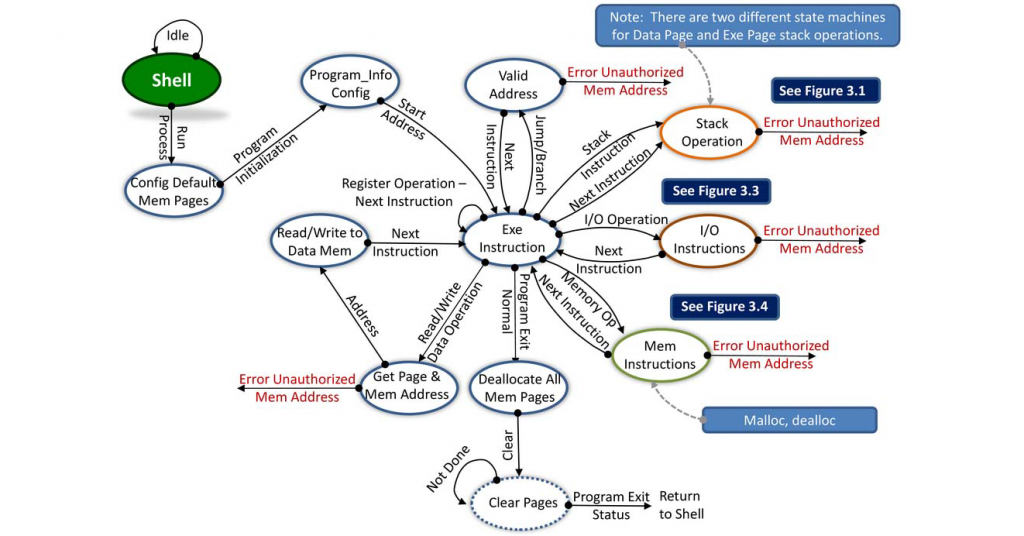
The cybersecurity world faces multiple attack vectors from hardware-level exploits, including cache bank malicious operations, rowhammer, Spectre, Meltdown, and Foreshadow attacks, and software-based attacks including buffer-overflows, et al. Hardware-level exploits bypass protections provided by software-based separation kernels. Current microprocessor execution pipelines are not designed to understand security: they treat malicious instructions, software bugs, and harmless code the same. This presentation explores adding a hardware-level security monitor below the execution pipeline [1,2,3].
[1] P. Jungwirth, et al.: “Hardware security kernel for cyber-defense,” Proc. SPIE 11013, Disruptive Technologies in Information Sciences II, 110130J, Baltimore 10 May 2019); https://doi.org/10.1117/12.2513224
[2] P. Jungwirth, and J. Ross: “Security Tag Fields and Control Flow Management,” IEEE SouthEastCon 2019, Huntsville, AL, April 2019.
[3] P. Jungwirth and D. Hahs: “Transfer Entropy Quantifies Information Leakage,” IEEE SouthEastCon 2019, Huntsville, AL, April 2019.
About the Speaker. Dr. Jungwirth is a computer architecture researcher at the Army Research Lab. Previously he worked for the Aviation and Missile, RDEC in Huntsville, AL. Currently, he is researching hardware state machines to provide simple operating system support (monitor) and control flow integrity in hardware. Dr. Jungwirth is co-inventor of the OS Friendly Microprocessor Architecture, US Patent 9122610. The OS Friendly Microprocessor Architecture includes hardware security features for an operating system and supports near single-cycle context switches in hardware. Email: *protected email*
Host: Alan T. Sherman, *protected email*
Support for this event was provided in part by the National Science Foundation under SFS grant DGE-1753681.
The UMBC Cyber Defense Lab meets biweekly Fridays. All meetings are open to the public.
Upcoming CDL Meetings:
Mar 13, Hasan Cam, autonomous agents
Mar 27, Dan Yaroslaski, cybercommand
Apr 10, Russ Fink (APL), ransomware
Apr 24, TBA
May 8, Jason Wells, law enforcement
May 22, Spring SFS Meeting at UMBC, 9:30am-2pm, ITE 456
The post talk: Hardware Security Kernel for Managing Memory and Instruction Execution, 12pm Fri 2/28 appeared first on Department of Computer Science and Electrical Engineering.
]]>
The UMBC Cyber Defense Lab presents Hardware Security Kernel for Managing Memory and Instruction Execution Patrick Jungwirth, PhD Computational and Information Sciences Directorate...
https://www.csee.umbc.edu/2020/02/talk-hardware-security-kernel-for-managing-memory-and-instruction-execution-12pm-fri-2-28/
https://beta.my.umbc.edu/api/v0/pixel/news/90623/guest@my.umbc.edu/73a2ef9aadd73410c584e89816bb8157/api/pixel
computer-engineering
computer-science
cybersecurity
events
talks
UMBC Cybersecurity Institute Group
https://beta.my.umbc.edu/groups/cybersecurity
https://assets3-beta.my.umbc.edu/system/shared/avatars/groups/000/000/485/196da6a7ec6f4c31eab2e474c17a9ab7/xsmall.png?1734891477
https://assets3-beta.my.umbc.edu/system/shared/avatars/groups/000/000/485/196da6a7ec6f4c31eab2e474c17a9ab7/original.png?1734891477
https://assets4-beta.my.umbc.edu/system/shared/avatars/groups/000/000/485/196da6a7ec6f4c31eab2e474c17a9ab7/xxlarge.png?1734891477
https://assets4-beta.my.umbc.edu/system/shared/avatars/groups/000/000/485/196da6a7ec6f4c31eab2e474c17a9ab7/xlarge.png?1734891477
https://assets2-beta.my.umbc.edu/system/shared/avatars/groups/000/000/485/196da6a7ec6f4c31eab2e474c17a9ab7/large.png?1734891477
https://assets3-beta.my.umbc.edu/system/shared/avatars/groups/000/000/485/196da6a7ec6f4c31eab2e474c17a9ab7/medium.png?1734891477
https://assets3-beta.my.umbc.edu/system/shared/avatars/groups/000/000/485/196da6a7ec6f4c31eab2e474c17a9ab7/small.png?1734891477
https://assets3-beta.my.umbc.edu/system/shared/avatars/groups/000/000/485/196da6a7ec6f4c31eab2e474c17a9ab7/xsmall.png?1734891477
https://assets3-beta.my.umbc.edu/system/shared/avatars/groups/000/000/485/196da6a7ec6f4c31eab2e474c17a9ab7/xxsmall.png?1734891477
UMBC Center for Cybersecurity
0
0
false
Thu, 20 Feb 2020 11:57:26 -0500
TALK: Reasoning About Time in a Crypto Protocol Analysis Tool

The UMBC Cyber Defense Lab presents
Reasoning About Time in a Crypto Protocol Analysis Tool
Dr. Catherine Meadows, Naval Research Laboratory
12:00–1:00pm Friday, 15 November 2019, ITE 227
The ability to guarantee timing properties, and in turn to use assumption about time to guarantee the security of protocols, is important to many of the applications we rely upon. For example, to compute locations, GPS depends on time synchronization between entities. Blockchain protocols require loose time synchronization to guarantee agreement on block timestamps. Distance-bounding protocols use the roundtrip time of an RF signal to enforce constraints on location. To analyze these types protocols formally, it is necessary to reason about time. This talk describes recent research in extending the Maude-NPA cryptographic protocol analysis tool to reason about cryptographic protocols that rely on or enforce timing properties. We describe the timing model we have created for the tool. We show how we we represent timing properties as constraints, whose solution is outsourced to an SMT solver. We also discuss our experimental results.
Catherine Meadows is a senior researcher in computer security at the Center for High Assurance Systems at the Naval Research Laboratory and heads that group’s Formal Methods Section. She was the principal developer of the NRL Protocol Analyzer (NPA), which was one of the first software tools to find previously undiscovered flaws in cryptographic protocols, and was used successfully in the analysis of a number of protocol standards. She is also leading, or has recently led, a number of projects related to the design and analysis of cryptographic protocols, including one focused the development of an analysis tool, Maude-NPA, that takes into account the the complex algebraic properties of cryptosystems, another that is focusing on the automatic generation of secure cryptosystems, and another devoted to formal methods for the design of cyber-physical systems with legacy components.
This work was supported by ONR 321 (*protected email*)
Host: Alan T. Sherman, *protected email* Support for this event was provided in part by the National Science Foundation under SFS grant 175368. The UMBC Cyber Defense Lab meets biweekly Fridays. All meetings are open to the public. Upcoming CDL Events:
- December 6, Karl Henderson, Verisign
- 9am—5pm daily, January 13-17, UMBC SFS/CySP Research Study, ITE 456
- January 31, 2020, TBA, biweekly CDL talks resume
The post TALK: Reasoning About Time in a Crypto Protocol Analysis Tool appeared first on Department of Computer Science and Electrical Engineering.
]]>
The UMBC Cyber Defense Lab presents Reasoning About Time in a Crypto Protocol Analysis Tool Dr. Catherine Meadows, Naval Research Laboratory 12:00–1:00pm Friday, 15 November 2019,...
https://www.csee.umbc.edu/2019/11/talk-reasoning-about-time-in-a-crypto-protocol-analysis-tool-catherine-meadows-naval-research-laboratory/
https://beta.my.umbc.edu/api/v0/pixel/news/88326/guest@my.umbc.edu/5ee2a03aa6c8d943d63ec889fe036f2e/api/pixel
computer-science
cybersecurity
news
talks
UMBC Cybersecurity Institute Group
https://beta.my.umbc.edu/groups/cybersecurity
https://assets3-beta.my.umbc.edu/system/shared/avatars/groups/000/000/485/196da6a7ec6f4c31eab2e474c17a9ab7/xsmall.png?1734891477
https://assets3-beta.my.umbc.edu/system/shared/avatars/groups/000/000/485/196da6a7ec6f4c31eab2e474c17a9ab7/original.png?1734891477
https://assets4-beta.my.umbc.edu/system/shared/avatars/groups/000/000/485/196da6a7ec6f4c31eab2e474c17a9ab7/xxlarge.png?1734891477
https://assets4-beta.my.umbc.edu/system/shared/avatars/groups/000/000/485/196da6a7ec6f4c31eab2e474c17a9ab7/xlarge.png?1734891477
https://assets2-beta.my.umbc.edu/system/shared/avatars/groups/000/000/485/196da6a7ec6f4c31eab2e474c17a9ab7/large.png?1734891477
https://assets3-beta.my.umbc.edu/system/shared/avatars/groups/000/000/485/196da6a7ec6f4c31eab2e474c17a9ab7/medium.png?1734891477
https://assets3-beta.my.umbc.edu/system/shared/avatars/groups/000/000/485/196da6a7ec6f4c31eab2e474c17a9ab7/small.png?1734891477
https://assets3-beta.my.umbc.edu/system/shared/avatars/groups/000/000/485/196da6a7ec6f4c31eab2e474c17a9ab7/xsmall.png?1734891477
https://assets3-beta.my.umbc.edu/system/shared/avatars/groups/000/000/485/196da6a7ec6f4c31eab2e474c17a9ab7/xxsmall.png?1734891477
UMBC Center for Cybersecurity
0
0
false
Sun, 10 Nov 2019 15:12:03 -0500
talk: Analysis of the Secure Remote Password (SRP) Protocol Using CPSA

The UMBC Cyber Defense Lab presents
Analysis of the Secure Remote Password (SRP) Protocol Using CPSA
Erin Lanus, UMBC Cyber Defense Lab
12:00–1:00pm, Friday, 6 September 2019, ITE 227, UMBC
Joint work with Alan Sherman, Richard Chang, Enis Golaszewski, Ryan Wnuk-Fink, Cyrus Bonyadi, Mario Costa, Moses Liskov, and Edward Zieglar
Secure Remote Password (SRP) is a widely deployed password authenticated key exchange (PAKE) protocol used in products such as 1Password and iCloud Keychain. As with other PAKE protocols, the two participants in SRP use knowledge of a pre-shared password to authenticate each other and establish a session key. I will explain the SRP protocol and security goals it seeks to achieve. I will demonstrate how to model the protocol using the Cryptographic Protocol Shapes Analyzer (CPSA) tool and present my analysis of the shapes produced by CPSA.
Erin Lanus earned her Ph.D. in computer science in May 2019 from Arizona State University. Dr. Lanus is currently conducting research with Professor Sherman’s Protocol Analysis Lab at UMBC. Her previous results include how to use state to enable CPSA to reason about time in forced-latency protocols. Her research also explored algorithmic approaches to constructing combinatorial arrays employed in interaction testing and the creation of a new type of array for attribute distribution to achieve anonymous authorization in attribute-based systems. In October she will begin as a research assistant professor at Virginia Tech’s Hume Center in Northern Virginia. email: *protected email*
Support for this research was provided in part by grants to CISA from the Department of Defense, CySP grants H98230-17-1-0387 and H98230-18-0321.
The post talk: Analysis of the Secure Remote Password (SRP) Protocol Using CPSA appeared first on Department of Computer Science and Electrical Engineering.
]]>
The UMBC Cyber Defense Lab presents Analysis of the Secure Remote Password (SRP) Protocol Using CPSA Erin Lanus, UMBC Cyber Defense Lab 12:00–1:00pm, Friday, 6 September 2019, ITE...
https://www.csee.umbc.edu/2019/09/talk-analysis-of-secure-remote-password-srp-protocol-using-cpsa-umbc-cybersecurity/
https://beta.my.umbc.edu/api/v0/pixel/news/86326/guest@my.umbc.edu/fa69f8ed49100aecdbfa8e0cfc867b00/api/pixel
cybersecurity
news
talks
uncategorized
UMBC Cybersecurity Institute Group
https://beta.my.umbc.edu/groups/cybersecurity
https://assets3-beta.my.umbc.edu/system/shared/avatars/groups/000/000/485/196da6a7ec6f4c31eab2e474c17a9ab7/xsmall.png?1734891477
https://assets3-beta.my.umbc.edu/system/shared/avatars/groups/000/000/485/196da6a7ec6f4c31eab2e474c17a9ab7/original.png?1734891477
https://assets4-beta.my.umbc.edu/system/shared/avatars/groups/000/000/485/196da6a7ec6f4c31eab2e474c17a9ab7/xxlarge.png?1734891477
https://assets4-beta.my.umbc.edu/system/shared/avatars/groups/000/000/485/196da6a7ec6f4c31eab2e474c17a9ab7/xlarge.png?1734891477
https://assets2-beta.my.umbc.edu/system/shared/avatars/groups/000/000/485/196da6a7ec6f4c31eab2e474c17a9ab7/large.png?1734891477
https://assets3-beta.my.umbc.edu/system/shared/avatars/groups/000/000/485/196da6a7ec6f4c31eab2e474c17a9ab7/medium.png?1734891477
https://assets3-beta.my.umbc.edu/system/shared/avatars/groups/000/000/485/196da6a7ec6f4c31eab2e474c17a9ab7/small.png?1734891477
https://assets3-beta.my.umbc.edu/system/shared/avatars/groups/000/000/485/196da6a7ec6f4c31eab2e474c17a9ab7/xsmall.png?1734891477
https://assets3-beta.my.umbc.edu/system/shared/avatars/groups/000/000/485/196da6a7ec6f4c31eab2e474c17a9ab7/xxsmall.png?1734891477
UMBC Center for Cybersecurity
1
0
false
Tue, 03 Sep 2019 22:21:17 -0400
Tue, 03 Sep 2019 22:21:17 -0400
talk: Security for Smart Cyber-Physical Systems, 12-1 5/3, ITE 227

UMBC Cyber Defense Lab
Security for Smart Cyber-Physical Systems
Prof. Anupam Joshi, UMBC
12:00–1:00pm, Friday, 3 May 2019, ITE 227
Smart Cyber-Physical Systems (CPS) are increasingly embedded in our everyday life. Security incidents involving them are often high-profile because of their ability to control critical infrastructure. Stuxnet and the Ukrainian power-grid attack are some notorious attacks reported against CPS which impacted governmental programs to ordinary users. In addition to the deliberate attacks, device malfunction and human error can also result in incidents with grave consequences. Hence the detection and mitigation of abnormal behaviors resulting from security incidents is imperative for the trustworthiness and broader acceptance of smart cyber-physical systems. We propose an automatic behavioral abstraction technique, ABATe, which automatically learns their typical behavior by finding the latent “context” space using available operational data and is used to discern anomalies. We evaluate our technique using two real-world datasets (a sewage water treatment plant dataset and an automotive dataset) to demonstrate the multi-domain adaptability and efficacy of our approach.
Anupam Joshi is the Oros Family Professor and Chair of Computer Science and Electrical Engineering Department at the University of Maryland, Baltimore County(UMBC). He is the Director of UMBC’s Center for Cybersecurity, and one of the USM leads for the National Cybersecurity FFRDC. He is a Fellow of IEEE. Dr. Joshi obtained a B.Tech degree from IIT Delhi in 1989, and a Masters and Ph.D. from Purdue University in 1991 and 1993 respectively. His research interests are in the broad area of networked computing and intelligent systems. His primary focus has been on data management and security/privacy in mobile/pervasive computing environments, and policy driven approaches to security and privacy. He is also interested in Semantic Web and Data/Text/Web Analytics, especially their applications to (cyber) security. He has published over 250 technical papers with an h-index of 79 and over 23,250 citations (per Google scholar), filed and been granted several patents, and has obtained research support from National Science Foundation (NSF), NASA, Defense Advanced Research Projects Agency (DARPA), US Dept of Defense (DoD), NIST, IBM, Microsoft, Qualcom, Northrop Grumman, and Lockheed Martin amongst others
The post talk: Security for Smart Cyber-Physical Systems, 12-1 5/3, ITE 227 appeared first on Department of Computer Science and Electrical Engineering.
]]>
UMBC Cyber Defense Lab Security for Smart Cyber-Physical Systems Prof. Anupam Joshi, UMBC 12:00–1:00pm, Friday, 3 May 2019, ITE 227 Smart Cyber-Physical Systems (CPS) are...
https://www.csee.umbc.edu/2019/05/umbc-talk-cybersecurity-smart-cyber-physical-systems-cps/
https://beta.my.umbc.edu/api/v0/pixel/news/86106/guest@my.umbc.edu/2e4bbb97c805f4fd3d6ecbc7c7020288/api/pixel
computer-engineering
computer-science
cybersecurity
data-science
events
news
talks
UMBC Cybersecurity Institute Group
https://beta.my.umbc.edu/groups/cybersecurity
https://assets3-beta.my.umbc.edu/system/shared/avatars/groups/000/000/485/196da6a7ec6f4c31eab2e474c17a9ab7/xsmall.png?1734891477
https://assets3-beta.my.umbc.edu/system/shared/avatars/groups/000/000/485/196da6a7ec6f4c31eab2e474c17a9ab7/original.png?1734891477
https://assets4-beta.my.umbc.edu/system/shared/avatars/groups/000/000/485/196da6a7ec6f4c31eab2e474c17a9ab7/xxlarge.png?1734891477
https://assets4-beta.my.umbc.edu/system/shared/avatars/groups/000/000/485/196da6a7ec6f4c31eab2e474c17a9ab7/xlarge.png?1734891477
https://assets2-beta.my.umbc.edu/system/shared/avatars/groups/000/000/485/196da6a7ec6f4c31eab2e474c17a9ab7/large.png?1734891477
https://assets3-beta.my.umbc.edu/system/shared/avatars/groups/000/000/485/196da6a7ec6f4c31eab2e474c17a9ab7/medium.png?1734891477
https://assets3-beta.my.umbc.edu/system/shared/avatars/groups/000/000/485/196da6a7ec6f4c31eab2e474c17a9ab7/small.png?1734891477
https://assets3-beta.my.umbc.edu/system/shared/avatars/groups/000/000/485/196da6a7ec6f4c31eab2e474c17a9ab7/xsmall.png?1734891477
https://assets3-beta.my.umbc.edu/system/shared/avatars/groups/000/000/485/196da6a7ec6f4c31eab2e474c17a9ab7/xxsmall.png?1734891477
UMBC Center for Cybersecurity
0
0
false
Wed, 01 May 2019 23:29:49 -0400
talk: The Evolution of Mobile Authentication, 1pm 4/30, ITE325, UMBC

The Evolution of Mobile Authentication
Prof. Keith Mayes, Royal Holloway University of London
1:00pm Tuesday 30 April 2019, ITE325, UMBC
Mobile communication is an essential part or modern life, however it is dependent on some fundamental security technologies. Critical amongst these technologies, is mobile authentication, the ability to identify valid users (and networks) and enable their secure usage of communication services. In the GSM standards and the 3GPP standards that evolved from them, the subscriber-side security has been founded on a removable, attack-resistant smart card known as a SIM (or USIM) card. The presentation explains how this situation came about, and how and why the protocols and algorithms have improved over time. It will cover some work by the author on a recent algorithm for 3GPP and then discuss how Machine-to-Machine and IoT considerations have led to new standards, which may herald the demise of the conventional removable SIM, in favour of an embedded eSIM.
Professor Keith Mayes B.Sc. Ph.D. CEng FIET A.Inst.ISP, is a professor of information security within the Information Security Group (ISG) at Royal Holloway University of London. Prior to his sabbatical, he was the Director of the ISG and Head of the School of Mathematics and Information Security. He is an active researcher/author with 100+ publications in numerous conferences, books and journals. His current research interests are diverse, including, mobile communications, smart cards/RFIDS, the Internet of Things, and embedded systems. Keith joined the ISG in 2002, originally as the Founder Director of the ISG Smart Card Centre, following a career in industry working for Pye TVT, Honeywell Aerospace and Defence, Racal Research and Vodafone. Keith is a Chartered Engineer, a Fellow of the Institution of Engineering and Technology, a Founder Associate Member of the Institute of Information Security Professionals, a Member of the Licensing Executives Society and an experienced company director and consultant. He is active in the UK All Party Parliamentary Group (APPG) on Cyber Security and is an adjunct professor at UMBC.
The post talk: The Evolution of Mobile Authentication, 1pm 4/30, ITE325, UMBC appeared first on Department of Computer Science and Electrical Engineering.
]]>
The Evolution of Mobile Authentication Prof. Keith Mayes, Royal Holloway University of London 1:00pm Tuesday 30 April 2019, ITE325, UMBC Mobile communication is an essential part or...
https://www.csee.umbc.edu/2019/04/talk-the-evolution-of-mobile-authentication-1pm-4-30-ite325-umbc-3gpp-esim/
https://beta.my.umbc.edu/api/v0/pixel/news/86107/guest@my.umbc.edu/f459a33f3816eb7fdefc2ff80cc3a4b5/api/pixel
computer-engineering
computer-science
cybersecurity
events
talks
UMBC Cybersecurity Institute Group
https://beta.my.umbc.edu/groups/cybersecurity
https://assets3-beta.my.umbc.edu/system/shared/avatars/groups/000/000/485/196da6a7ec6f4c31eab2e474c17a9ab7/xsmall.png?1734891477
https://assets3-beta.my.umbc.edu/system/shared/avatars/groups/000/000/485/196da6a7ec6f4c31eab2e474c17a9ab7/original.png?1734891477
https://assets4-beta.my.umbc.edu/system/shared/avatars/groups/000/000/485/196da6a7ec6f4c31eab2e474c17a9ab7/xxlarge.png?1734891477
https://assets4-beta.my.umbc.edu/system/shared/avatars/groups/000/000/485/196da6a7ec6f4c31eab2e474c17a9ab7/xlarge.png?1734891477
https://assets2-beta.my.umbc.edu/system/shared/avatars/groups/000/000/485/196da6a7ec6f4c31eab2e474c17a9ab7/large.png?1734891477
https://assets3-beta.my.umbc.edu/system/shared/avatars/groups/000/000/485/196da6a7ec6f4c31eab2e474c17a9ab7/medium.png?1734891477
https://assets3-beta.my.umbc.edu/system/shared/avatars/groups/000/000/485/196da6a7ec6f4c31eab2e474c17a9ab7/small.png?1734891477
https://assets3-beta.my.umbc.edu/system/shared/avatars/groups/000/000/485/196da6a7ec6f4c31eab2e474c17a9ab7/xsmall.png?1734891477
https://assets3-beta.my.umbc.edu/system/shared/avatars/groups/000/000/485/196da6a7ec6f4c31eab2e474c17a9ab7/xxsmall.png?1734891477
UMBC Center for Cybersecurity
0
0
false
Mon, 29 Apr 2019 18:34:04 -0400
talk: Using CPSA to Analyze Force-Latency Protocols, 12-1 4/19
Using CPSA to Analyze Force-Latency Protocols
Dr. Edward Zieglar, National Security Agency
12-1 Friday, 19 April 19, ITE 227
Several cryptographic protocols have been proposed to address the Man-in-the-Middle attack without the prior exchange of keys. This talk will describe a formal analysis of one such protocol proposed by Zooko Wilcox-O’Hearn, the forced-latency defense against the chess grandmaster attack. Using the Cryptographic Protocol Shapes Analyzer (CPSA), we validate the security properties of the protocol through the novel use of CPSA’s state features to represent time. We also describe a small message space attack that highlights how assumptions made in protocol design can affect the security of a protocol in use, even for a protocol with proven security properties.
Edward Zieglar is a security researcher in the Research Directorate of the National Security Agency, where he concentrates on formal analysis and verification of cryptographic protocols and network security. He is also an adjunct professor at UMBC where he teaches courses in networking and network security. He received his master’s and doctoral degrees in computer science from UMBC.
Host: Alan T. Sherman, *protected email*
The post talk: Using CPSA to Analyze Force-Latency Protocols, 12-1 4/19 appeared first on Department of Computer Science and Electrical Engineering.
]]>
UMBC Cyber Defense Lab Using CPSA to Analyze Force-Latency Protocols Dr. Edward Zieglar, National Security Agency 12-1 Friday, 19 April 19, ITE 227 Several cryptographic protocols have...
https://www.csee.umbc.edu/2019/04/talk-using-cpsa-to-analyze-force-latency-protocols-12-1-4-19/
https://beta.my.umbc.edu/api/v0/pixel/news/83868/guest@my.umbc.edu/f354661fc2364d2b95d67f287e25fe8c/api/pixel
cybersecurity
news
talks
uncategorized
UMBC Cybersecurity Institute Group
https://beta.my.umbc.edu/groups/cybersecurity
https://assets3-beta.my.umbc.edu/system/shared/avatars/groups/000/000/485/196da6a7ec6f4c31eab2e474c17a9ab7/xsmall.png?1734891477
https://assets3-beta.my.umbc.edu/system/shared/avatars/groups/000/000/485/196da6a7ec6f4c31eab2e474c17a9ab7/original.png?1734891477
https://assets4-beta.my.umbc.edu/system/shared/avatars/groups/000/000/485/196da6a7ec6f4c31eab2e474c17a9ab7/xxlarge.png?1734891477
https://assets4-beta.my.umbc.edu/system/shared/avatars/groups/000/000/485/196da6a7ec6f4c31eab2e474c17a9ab7/xlarge.png?1734891477
https://assets2-beta.my.umbc.edu/system/shared/avatars/groups/000/000/485/196da6a7ec6f4c31eab2e474c17a9ab7/large.png?1734891477
https://assets3-beta.my.umbc.edu/system/shared/avatars/groups/000/000/485/196da6a7ec6f4c31eab2e474c17a9ab7/medium.png?1734891477
https://assets3-beta.my.umbc.edu/system/shared/avatars/groups/000/000/485/196da6a7ec6f4c31eab2e474c17a9ab7/small.png?1734891477
https://assets3-beta.my.umbc.edu/system/shared/avatars/groups/000/000/485/196da6a7ec6f4c31eab2e474c17a9ab7/xsmall.png?1734891477
https://assets3-beta.my.umbc.edu/system/shared/avatars/groups/000/000/485/196da6a7ec6f4c31eab2e474c17a9ab7/xxsmall.png?1734891477
UMBC Center for Cybersecurity
0
0
true
Thu, 18 Apr 2019 12:34:38 -0400