Diet Culture v. The Cultural Diet
 Positionality Statement: This post is written by Ojus Phogat, a second-year student at UMBC and a student-staff member at the Women’s Center. I am a South Asian American woman who has felt the persistent effects of diet culture first-hand. In writing this blog, I hope to identify these impacts and uncover the systems of oppression that keep them afloat. As a reader, I wish to encourage you to alter the way you pass judgment on yourself and others. The more we engage in fatphobic rhetoric, which stems from white supremacy and the patriarchy, the more we uphold these oppressive systems. To all my fellow women of color who have ever been made to feel like less because of the way you look: I hope you learn that you have always been enough.
When I was nine years old, I went to India for my grandfather’s funeral. After the cremation ritual, I was gathered into a room of extended family (most of whom were strangers to me) where the following conversation took place:
Random Uncle: “Do you ever walk on the treadmill?”
Me, a fairly active kid who did hours of dance, basketball, and swimming, and was yes chubby: “Hain Ji?” *yes sir*
Random Uncle: “At what speed? ZERO!”
*eruption of laughter from the surrounding guests*
His Wife: “Take it from me; all the housework you’ll have to do when you’re married will keep it off, but it’s better to start now. We only care about you.”
Image Description: Picture of Oprah wearing a purple sweater and white button-down. Saying “what?”. This image was a snippet from Oprah’s interview with Meghan Markle.
While this was not the first time I heard these kinds of comments from family members, I was crushed. And I sat crying at my grandfather’s funeral, not out of the sadness of his passing (because, to be honest, I didn’t know him very well), but because relatives I didn’t even know decided their opinions on my body were so profound that they had a dire need to communicate them with all the surrounding patrons and me IMMEDIATELY.
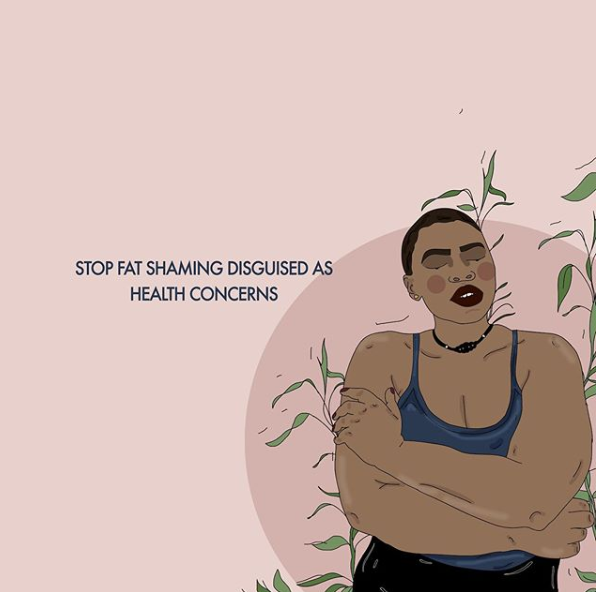
Image Description: Pictured is a graphic design from @recipiesforselflove on Instagram. The image displays a pale pink background and the text “stop fat-shaming disguised as health concerns” is placed slightly left of center. A black woman is illustrated in the bottom right-hand corner wearing a blue tank top and black pants. She is encompassed in a greyish-pink circle and surrounded by tall green plants.
From the first moment of our consciousness, we (women of color) are raised to think of weight as one of our defining characteristics. Something that measures how much human decency we will be allotted, how many people will treat us with respect, and of course, “most importantly” (as many of my fellow South Asian women have been told) how many marriage proposals we will receive when we are older. It does not matter how much we work out or eat nutrient-rich meals; if we do not visually conform to society’s standard of the ideal body, we are not only ridiculed for it, but our existence itself is categorized as inferior. We are silenced, shunned, and demonized for simply existing in non-white, fat bodies. Whether it is from how we observe the world or how we are treated within it, we grow to learn that being fat equates with being of less value, and so we turn to the alternative: ensuring “smallness” by any means necessary.
In order to contextualize western diet culture’s impact on specifically women of color, it is critical to understand its origin as being one compounded by systems of white supremacy and the patriarchy. These systems feed into the creation of a diet culture stemming from anti-blackness that is used as a tool to pit women and groups of color against one another.
Diet Culture & Women of Color
For many communities of color, the discrepancy between how we are taught to consume food—in schools and from our friends—and the cultural foods we enjoy in the comfort of our own homes cultivates a relationship with food defined by confusion, embarrassment, and shame. We are taught that things like carbs and “fatty” oils are the devil incarnate, and for cultural diets—defined by dishes artfully composed of rice and noodles—this can be detrimental. The Indian meals of my childhood like khichdi, pulao, and pav bhaji—rich in spices and made with a foundation of rice or bread—would be considered “unhealthy” because of the carbs and oil they contain. These very meals that nursed me back to health when I fell sick and energized me after hours of dance practice; would also be the source of my shame during school lunch periods and visits to the doctor’s office. Any nutritional value and traditional significance of these and other cultural dishes are often overshadowed by a mistaken idea of what is “healthy”—which in this case really equates to practices that result in supposed physical “smallness.”
The need to conform society to one idea of “health”—which standardizes a “correct” diet —controls how communities of color and communities of women form their relationships with food and nourishment. Health, in this case, becomes a concept encompassing what patterned behaviors keeps one from becoming fat. It dictates how individuals must engage in nutrition in exchange for societal acceptance. This phenomenon, while detrimental to all people—in this case explicitly discussing those impacted by Western practices of diet culture—affects women of color differently as they live in the limbo of two different, often competing cultural identities, each with their own social diet pressures, in conjunction with the necessary pursuit of femininity.
To center white-ness when creating the standard and “correct” American diet, colonizes nutrition and manipulates the mentality around health. It serves to Other* various cultural diets by making Western “health foods” the norm and vilifying any foods that stray from these guidelines. In turn, society claims that the very recipes that strengthened our ancestors, the very recipes that have quite literally borne and sustained our lineages are unacceptable. In reality, what is unacceptable is the rhetoric of disgust and inferiority that often marks cultural food sources. The idea that one should not consume the traditional dishes of their ancestry because of the “white” ideal diet is racist.
Take, for instance, the narrative surrounding MSG (monosodium glutamate)—a food additive utilized in many foods and “naturally found in foods like tomatoes and cheese”(Yeung, 2020), but ridiculed because of its use in traditional Chinese meals. The media has marked MSG as a dangerous and unhealthy ingredient and has linked it to conditions like asthma, drowsiness, and headaches (but not by any scientific backing). This racist rhetoric has steered people away from MSG and has forced the Chinese American community to be mindful of the backlash they may face in using the ingredient, especially for restaurant owners. The overall stigma that surrounds this ingredient displays just how much power white institutions have in dispelling the use of products, especially when those products hold a particular significance in BI-POC cultural cuisines.
The Implications of the Small Feminine Body
There is also a physical element to the requirement of smallness for feminine bodies. It operates under the assumption that women should occupy as little space as physically possible so as to keep their positions of power stifled. The presumption is that women—as the “submissive” gender—must bolster male masculinity by embodying the opposite characteristics of what men possess. By this “rule,” if men are meant to be large to monopolize space and contribute to their dominance, women must then be as small as possible to make “smaller” men adhere to this expectation. Women alone must assume the burden of changing themselves to allow for men to conform to the ideals they have set. Straying away from this ideal—embodying fatness and taking up greater space as a woman—means undermining these systems of the patriarchy that award men greater dominion over the world.
For women of color who reside in the western world, the pursuit of femininity means the expectation of smallness is compounded by the need (for survival purposes) to shed their melanin and present as light-skinned as possible. Because society masculinizes women of color, specifically brown and black women, they must pursue femininity more extremely because of their skin color. If not, they are ridiculed and solidify their low position on the social ladder. Because of this they feel a greater emphasis to conform to the ideals of western femininity, which encompasses the prerequisite of smallness. In doing so, they may often feel at odds with connecting to the traditional cultural foods they grew up with and abiding by the rules of the society in which they reside.
Imperialism's production of the beauty standard—the necessity of thinness and whiteness—for women and girls in places like India portrays this phenomenon at work. The colonial impact left by Persia and Britain in South Asia has ingrained ideologies about correct body shape, colorism, and anti-blackness. 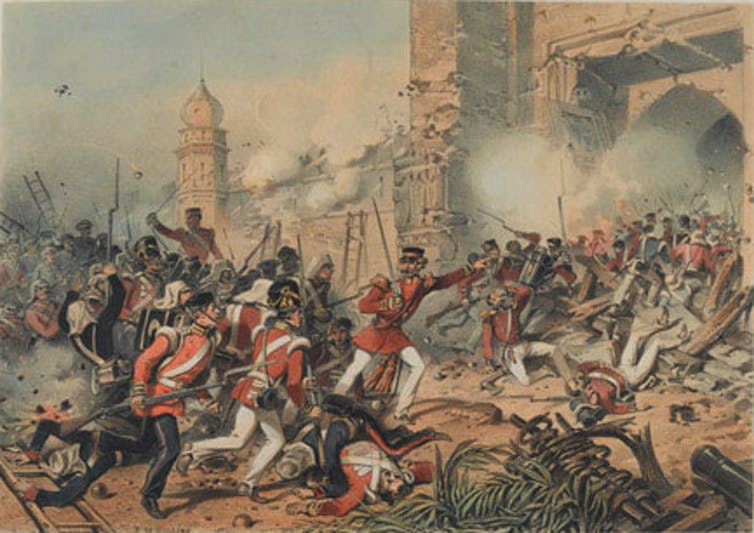
Image Description: Pictured is a scene from the era of British rule in India. Depicted are British soldiers, dressed in red and white garments, invading an Indian palace. The soldiers hold rifles and clouds of smoke surround them.
Since the reign of the Mughals and later the British East India Company, Indian culture has been defined by the idea that the highest cultural capital** is awarded to those of lighter skin and less weight. Because conforming more to this ideal cultural behavior meant increasing one's socio-economic status, adhering to the beauty standard was a matter of SURVIVAL. It meant that the closer you were to being this standard the better you would be treated by the foreigners who had come to rule your land and who controlled economic and social production within it.
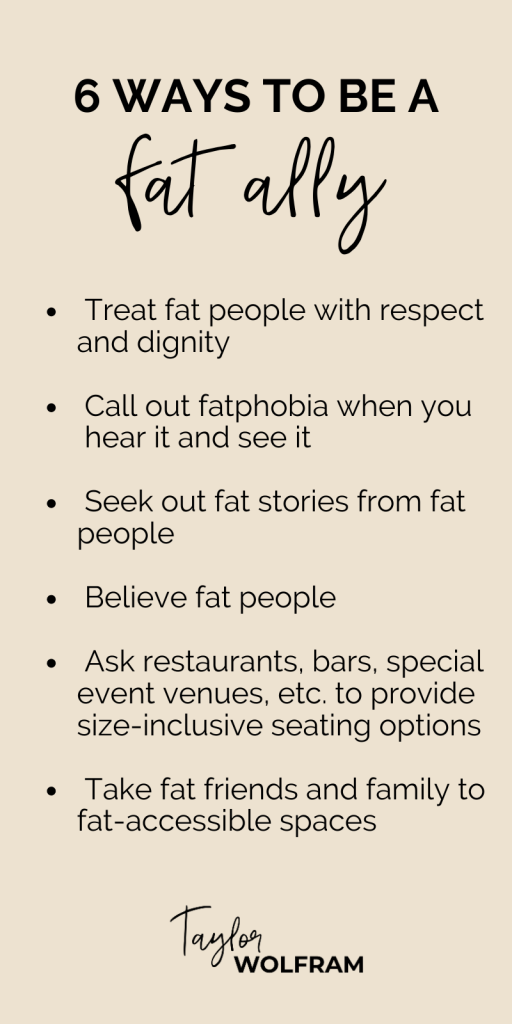
Image Description: Pictured is an infographic made up of a light tan background created by Taylor Wolfram. It says “6 Ways to Be a Fat Ally”. And lists “ treat fat people with respect and dignity, call out fatphobia when you hear it and see it, seek out fat stories from fat people, believe fat people, ask restaurants, bars, special event venues, etc, to provide size-inclusive seating options, take fat friends and family to fat-accessible spaces”.
So with these foundational elements of diet culture’s impact in mind, we can then ask ourselves:
What can we do to mitigate and reverse the rather negative ramifications of this mindset?
We can change the way we think and talk about bodies
They are vessels that carry us through our day, why must we comment on every one we see ...?
We can advocate for ourselves and others when disrespectful rhetoric is used
You deserve to be vocal and correct disrespect even if it is viewed as normalized.
And maybe most importantly we can learn to view ourselves from a neutral lens
Your body is none other than how you move physically from place to place. To frame it in this way may help the preoccupation with how we are perceived because of it.
I know what you’re thinking: these tips are much easier said than done. And you are correct! But, this doesn’t mean we shouldn’t hold ourselves accountable when we say or think about bodies negatively. It also means that if you are being degraded for your appearance: STAND UP FOR YOURSELF! Real change can only be possible when we—women of color—learn that we are worthy of taking up space in this world.
Footnotes
* The act of alienating something by highlighting its “abnormal” characteristics
** The amount of societal status one is given based on various factors (i.e., education, skills, wealth, and discussed the most in this case appearance)
Resources and recommendations you should be sure to check out:
CNN: MSG in Chinese Food Isn't Unhealthy -- You're Just Racist, Activists Say.
Yeung, Jessie. “MSG in Chinese Food Isn't Unhealthy -- You're Just Racist, Activists Say.” CNN, Cable News Network, 19 Jan. 2020, https://www.cnn.com/2020/01/18/asia/chinese-restaurant-syndrome-msg-intl-hnk-scli/index.html.
Harvard University: Occidentalisation of Beauty Standards: Eurocentrism in Asia
Chen, Toby, et al. “Occidentalisation of Beauty Standards: Eurocentrism in Asia.” Zenodo, Harvard University , 16 Dec. 2020, https://zenodo.org/record/4325856#.YZvkpr1Ki3I.
Gloria Lucas: Nalgona Positivity Pride
Yesika Salgado: What Comes After Loving Yourself? Advice from a Fat Fly Brown Girl
Yeskia Selgado: The Hunger
Teen Vogue: Fat is Not a Bad Word
Taylor Wolfram: 6 ways to Be a Fat Ally
Allison Rachel: Recipes for Self-Love
NPR: Code Switch- Is Beauty In The Eyes of The Colonizer
]]>
Positionality Statement: This post is written by Ojus Phogat, a second-year student at UMBC and a student-staff member at the Women’s Center. I am a South Asian American woman who has felt the...
https://womenscenteratumbc.wordpress.com/2021/11/22/diet-culture-v-the-cultural-diet%ef%bf%bc/
https://beta.my.umbc.edu/api/v0/pixel/news/115239/guest@my.umbc.edu/e00d00eebc2a6392d75a92315047070c/api/pixel
acceptance
beauty-standards
body-consciousness
body-neutrality
body-positivity
diversity
diversity-and-inclusion-issues
fatness
feminism
femmes
intersectionality
minorities
people-of-color
self-advocacy
social-awareness
south-asian-voices
women
women-of-color
Women's, Gender, & Equity Center
https://beta.my.umbc.edu/groups/womenscenter
https://assets2-beta.my.umbc.edu/system/shared/avatars/groups/000/000/125/78272a4842689b30dbf74672182b78f8/xsmall.png?1750974263
https://assets1-beta.my.umbc.edu/system/shared/avatars/groups/000/000/125/78272a4842689b30dbf74672182b78f8/original.png?1750974263
https://assets1-beta.my.umbc.edu/system/shared/avatars/groups/000/000/125/78272a4842689b30dbf74672182b78f8/xxlarge.png?1750974263
https://assets1-beta.my.umbc.edu/system/shared/avatars/groups/000/000/125/78272a4842689b30dbf74672182b78f8/xlarge.png?1750974263
https://assets1-beta.my.umbc.edu/system/shared/avatars/groups/000/000/125/78272a4842689b30dbf74672182b78f8/large.png?1750974263
https://assets2-beta.my.umbc.edu/system/shared/avatars/groups/000/000/125/78272a4842689b30dbf74672182b78f8/medium.png?1750974263
https://assets1-beta.my.umbc.edu/system/shared/avatars/groups/000/000/125/78272a4842689b30dbf74672182b78f8/small.png?1750974263
https://assets2-beta.my.umbc.edu/system/shared/avatars/groups/000/000/125/78272a4842689b30dbf74672182b78f8/xsmall.png?1750974263
https://assets3-beta.my.umbc.edu/system/shared/avatars/groups/000/000/125/78272a4842689b30dbf74672182b78f8/xxsmall.png?1750974263
Women's Center
6
0
false
Mon, 22 Nov 2021 17:04:31 -0500
Mon, 22 Nov 2021 17:07:26 -0500
Diet Culture v. The Cultural Diet

Image description: A formal headshot of the author.
Positionality Statement: This post is written by Ojus Phogat, a second-year student at UMBC and a student-staff member at the Women’s Center. I am a South Asian American woman who has felt the persistent effects of diet culture first-hand. In writing this blog, I hope to identify these impacts and uncover the systems of oppression that keep them afloat. As a reader, I wish to encourage you to alter the way you pass judgment on yourself and others. The more we engage in fatphobic rhetoric, which stems from white supremacy and the patriarchy, the more we uphold these oppressive systems. To all my fellow women of color who have ever been made to feel like less because of the way you look: I hope you learn that you have always been enough.
When I was nine years old, I went to India for my grandfather’s funeral. After the cremation ritual, I was gathered into a room of extended family (most of whom were strangers to me) where the following conversation took place:
Random Uncle: “Do you ever walk on the treadmill?”
Me, a fairly active kid who did hours of dance, basketball, and swimming, and was yes chubby: “Hain Ji?” *yes sir*
Random Uncle: “At what speed? ZERO!”
*eruption of laughter from the surrounding guests*
His Wife: “Take it from me; all the housework you’ll have to do when you’re married will keep it off, but it’s better to start now. We only care about you.”
Image Description: GIF of Oprah wearing a purple sweater and white button-down. Saying “what?”. This image was a snippet from Oprah’s interview with Meghan Markle.
While this was not the first time I heard these kinds of comments from family members, I was crushed. And I sat crying at my grandfather’s funeral, not out of the sadness of his passing (because, to be honest, I didn’t know him very well), but because relatives I didn’t even know decided their opinions on my body were so profound that they had a dire need to communicate them with all the surrounding patrons and me IMMEDIATELY.
Image Description: Pictured is a graphic design from @recipiesforselflove on Instagram. The image displays a pale pink background and the text “stop fat-shaming disguised as health concerns” is placed slightly left of center. A black woman is illustrated in the bottom right-hand corner wearing a blue tank top and black pants. She is encompassed in a greyish-pink circle and surrounded by tall green plants.
From the first moment of our consciousness, we (women of color) are raised to think of weight as one of our defining characteristics. Something that measures how much human decency we will be allotted, how many people will treat us with respect, and of course, “most importantly” (as many of my fellow South Asian women have been told) how many marriage proposals we will receive when we are older. It does not matter how much we work out or eat nutrient-rich meals; if we do not visually conform to society’s standard of the ideal body, we are not only ridiculed for it, but our existence itself is categorized as inferior. We are silenced, shunned, and demonized for simply existing in non-white, fat bodies. Whether it is from how we observe the world or how we are treated within it, we grow to learn that being fat equates with being of less value, and so we turn to the alternative: ensuring “smallness” by any means necessary.
In order to contextualize western diet culture’s impact on specifically women of color, it is critical to understand its origin as being one compounded by systems of white supremacy and the patriarchy. These systems feed into the creation of a diet culture stemming from anti-blackness that is used as a tool to pit women and groups of color against one another.
Diet Culture & Women of Color
For many communities of color, the discrepancy between how we are taught to consume food—in schools and from our friends—and the cultural foods we enjoy in the comfort of our own homes cultivates a relationship with food defined by confusion, embarrassment, and shame. We are taught that things like carbs and “fatty” oils are the devil incarnate, and for cultural diets—defined by dishes artfully composed of rice and noodles—this can be detrimental. The Indian meals of my childhood like khichdi, pulao, and pav bhaji—rich in spices and made with a foundation of rice or bread—would be considered “unhealthy” because of the carbs and oil they contain. These very meals that nursed me back to health when I fell sick and energized me after hours of dance practice; would also be the source of my shame during school lunch periods and visits to the doctor’s office. Any nutritional value and traditional significance of these and other cultural dishes are often overshadowed by a mistaken idea of what is “healthy”—which in this case really equates to practices that result in supposed physical “smallness.”
The need to conform society to one idea of “health”—which standardizes a “correct” diet —controls how communities of color and communities of women form their relationships with food and nourishment. Health, in this case, becomes a concept encompassing what patterned behaviors keeps one from becoming fat. It dictates how individuals must engage in nutrition in exchange for societal acceptance. This phenomenon, while detrimental to all people—in this case explicitly discussing those impacted by Western practices of diet culture—affects women of color differently as they live in the limbo of two different, often competing cultural identities, each with their own social diet pressures, in conjunction with the necessary pursuit of femininity.
To center white-ness when creating the standard and “correct” American diet, colonizes nutrition and manipulates the mentality around health. It serves to Other* various cultural diets by making Western “health foods” the norm and vilifying any foods that stray from these guidelines. In turn, society claims that the very recipes that strengthened our ancestors, the very recipes that have quite literally borne and sustained our lineages are unacceptable. In reality, what is unacceptable is the rhetoric of disgust and inferiority that often marks cultural food sources. The idea that one should not consume the traditional dishes of their ancestry because of the “white” ideal diet is racist.
Take, for instance, the narrative surrounding MSG (monosodium glutamate)—a food additive utilized in many foods and “naturally found in foods like tomatoes and cheese”(Yeung, 2020), but ridiculed because of its use in traditional Chinese meals. The media has marked MSG as a dangerous and unhealthy ingredient and has linked it to conditions like asthma, drowsiness, and headaches (but not by any scientific backing). This racist rhetoric has steered people away from MSG and has forced the Chinese American community to be mindful of the backlash they may face in using the ingredient, especially for restaurant owners. The overall stigma that surrounds this ingredient displays just how much power white institutions have in dispelling the use of products, especially when those products hold a particular significance in BI-POC cultural cuisines.
The Implications of the Small Feminine Body
There is also a physical element to the requirement of smallness for feminine bodies. It operates under the assumption that women should occupy as little space as physically possible so as to keep their positions of power stifled. The presumption is that women—as the “submissive” gender—must bolster male masculinity by embodying the opposite characteristics of what men possess. By this “rule,” if men are meant to be large to monopolize space and contribute to their dominance, women must then be as small as possible to make “smaller” men adhere to this expectation. Women alone must assume the burden of changing themselves to allow for men to conform to the ideals they have set. Straying away from this ideal—embodying fatness and taking up greater space as a woman—means undermining these systems of the patriarchy that award men greater dominion over the world.
For women of color who reside in the western world, the pursuit of femininity means the expectation of smallness is compounded by the need (for survival purposes) to shed their melanin and present as light-skinned as possible. Because society masculinizes women of color, specifically brown and black women, they must pursue femininity more extremely because of their skin color. If not, they are ridiculed and solidify their low position on the social ladder. Because of this they feel a greater emphasis to conform to the ideals of western femininity, which encompasses the prerequisite of smallness. In doing so, they may often feel at odds with connecting to the traditional cultural foods they grew up with and abiding by the rules of the society in which they reside.
Imperialism’s production of the beauty standard—the necessity of thinness and whiteness—for women and girls in places like India portrays this phenomenon at work. The colonial impact left by Persia and Britain in South Asia has ingrained ideologies about correct body shape, colorism, and anti-blackness.
Image Description: Pictured is a scene from the era of British rule in India. Depicted are British soldiers, dressed in red and white garments, invading an Indian palace. The soldiers hold rifles and clouds of smoke surround them.
Since the reign of the Mughals and later the British East India Company, Indian culture has been defined by the idea that the highest cultural capital** is awarded to those of lighter skin and less weight. Because conforming more to this ideal cultural behavior meant increasing one’s socio-economic status, adhering to the beauty standard was a matter of SURVIVAL. It meant that the closer you were to being this standard the better you would be treated by the foreigners who had come to rule your land and who controlled economic and social production within it.
Image Description: Pictured is an infographic made up of a light tan background created by Taylor Wolfram. It says “6 Ways to Be a Fat Ally”. And lists “ treat fat people with respect and dignity, call out fatphobia when you hear it and see it, seek out fat stories from fat people, believe fat people, ask restaurants, bars, special event venues, etc, to provide size-inclusive seating options, take fat friends and family to fat-accessible spaces”.
So with these foundational elements of diet culture’s impact in mind, we can then ask ourselves:
What can we do to mitigate and reverse the rather negative ramifications of this mindset?
We can change the way we think and talk about bodies
They are vessels that carry us through our day, why must we comment on every one we see …?
We can advocate for ourselves and others when disrespectful rhetoric is used
You deserve to be vocal and correct disrespect even if it is viewed as normalized.
And maybe most importantly we can learn to view ourselves from a neutral lens
Your body is none other than how you move physically from place to place. To frame it in this way may help the preoccupation with how we are perceived because of it.
I know what you’re thinking: these tips are much easier said than done. And you are correct! But, this doesn’t mean we shouldn’t hold ourselves accountable when we say or think about bodies negatively. It also means that if you are being degraded for your appearance: STAND UP FOR YOURSELF! Real change can only be possible when we—women of color—learn that we are worthy of taking up space in this world.
Footnotes
* The act of alienating something by highlighting its “abnormal” characteristics
** The amount of societal status one is given based on various factors (i.e., education, skills, wealth, and discussed the most in this case appearance)
Resources and recommendations you should be sure to check out:
CNN: MSG in Chinese Food Isn’t Unhealthy — You’re Just Racist, Activists Say.
Yeung, Jessie. “MSG in Chinese Food Isn’t Unhealthy — You’re Just Racist, Activists Say.” CNN, Cable News Network, 19 Jan. 2020, https://www.cnn.com/2020/01/18/asia/chinese-restaurant-syndrome-msg-intl-hnk-scli/index.html.
Harvard University: Occidentalisation of Beauty Standards: Eurocentrism in Asia
Chen, Toby, et al. “Occidentalisation of Beauty Standards: Eurocentrism in Asia.” Zenodo, Harvard University , 16 Dec. 2020, https://zenodo.org/record/4325856#.YZvkpr1Ki3I.
Gloria Lucas: Nalgona Positivity Pride
Yesika Salgado: What Comes After Loving Yourself? Advice from a Fat Fly Brown Girl
Yeskia Selgado: The Hunger
Teen Vogue: Fat is Not a Bad Word
Taylor Wolfram: 6 ways to Be a Fat Ally
Allison Rachel: Recipes for Self-Love
NPR: Code Switch- Is Beauty In The Eyes of The Colonizer
Image description: A formal headshot of the author.
Positionality Statement: This post is written by Ojuswani Phogat, a second-year student at UMBC and a student-staff member at the Women’s Center. I am a South Asian American woman who has felt the persistent effects of diet culture first-hand. In writing this blog, I hope to identify these impacts and uncover the systems of oppression that keep them afloat. As a reader, I wish to encourage you to alter the way you pass judgment on yourself and others. The more we engage in fatphobic rhetoric, which stems from white supremacy and the patriarchy, the more we uphold these oppressive systems. To all my fellow women of color who have ever been made to feel like less because of the way you look: I hope you learn that you have always been enough.
When I was nine years old, I went to India for my grandfather’s funeral. After the cremation ritual, I was gathered into a room of extended family (most of whom were strangers to me) where the following conversation took place:
Random Uncle: “Do you ever walk on the treadmill?”
Me, a fairly active kid who did hours of dance, basketball, and swimming, and was yes chubby: “Hain Ji?” *yes sir*
Random Uncle: “At what speed? ZERO!”
*eruption of laughter from the surrounding guests*
His Wife: “Take it from me; all the housework you’ll have to do when you’re married will keep it off, but it’s better to start now. We only care about you.”
Image Description: GIF of Oprah wearing a purple sweater and white button-down. Saying “what?”. This image was a snippet from Oprah’s interview with Meghan Markle.
While this was not the first time I heard these kinds of comments from family members, I was crushed. And I sat crying at my grandfather’s funeral, not out of the sadness of his passing (because, to be honest, I didn’t know him very well), but because relatives I didn’t even know decided their opinions on my body were so profound that they had a dire need to communicate them with all the surrounding patrons and me IMMEDIATELY.
Image Description: Pictured is a graphic design from @recipiesforselflove on Instagram. The image displays a pale pink background and the text “stop fat-shaming disguised as health concerns” is placed slightly left of center. A black woman is illustrated in the bottom right-hand corner wearing a blue tank top and black pants. She is encompassed in a greyish-pink circle and surrounded by tall green plants.
From the first moment of our consciousness, we (women of color) are raised to think of weight as one of our defining characteristics. Something that measures how much human decency we will be allotted, how many people will treat us with respect, and of course, “most importantly” (as many of my fellow South Asian women have been told) how many marriage proposals we will receive when we are older. It does not matter how much we work out or eat nutrient-rich meals; if we do not visually conform to society’s standard of the ideal body, we are not only ridiculed for it, but our existence itself is categorized as inferior. We are silenced, shunned, and demonized for simply existing in non-white, fat bodies. Whether it is from how we observe the world or how we are treated within it, we grow to learn that being fat equates with being of less value, and so we turn to the alternative: ensuring “smallness” by any means necessary.
In order to contextualize western diet culture’s impact on specifically women of color, it is critical to understand its origin as being one compounded by systems of white supremacy and the patriarchy. These systems feed into the creation of a diet culture stemming from anti-blackness that is used as a tool to pit women and groups of color against one another.
Diet Culture & Women of Color
For many communities of color, the discrepancy between how we are taught to consume food—in schools and from our friends—and the cultural foods we enjoy in the comfort of our own homes cultivates a relationship with food defined by confusion, embarrassment, and shame. We are taught that things like carbs and “fatty” oils are the devil incarnate, and for cultural diets—defined by dishes artfully composed of rice and noodles—this can be detrimental. The Indian meals of my childhood like khichdi, pulao, and pav bhaji—rich in spices and made with a foundation of rice or bread—would be considered “unhealthy” because of the carbs and oil they contain. These very meals that nursed me back to health when I fell sick and energized me after hours of dance practice; would also be the source of my shame during school lunch periods and visits to the doctor’s office. Any nutritional value and traditional significance of these and other cultural dishes are often overshadowed by a mistaken idea of what is “healthy”—which in this case really equates to practices that result in supposed physical “smallness.”
The need to conform society to one idea of “health”—which standardizes a “correct” diet —controls how communities of color and communities of women form their relationships with food and nourishment. Health, in this case, becomes a concept encompassing what patterned behaviors keeps one from becoming fat. It dictates how individuals must engage in nutrition in exchange for societal acceptance. This phenomenon, while detrimental to all people—in this case explicitly discussing those impacted by Western practices of diet culture—affects women of color differently as they live in the limbo of two different, often competing cultural identities, each with their own social diet pressures, in conjunction with the necessary pursuit of femininity.
To center white-ness when creating the standard and “correct” American diet, colonizes nutrition and manipulates the mentality around health. It serves to Other* various cultural diets by making Western “health foods” the norm and vilifying any foods that stray from these guidelines. In turn, society claims that the very recipes that strengthened our ancestors, the very recipes that have quite literally borne and sustained our lineages are unacceptable. In reality, what is unacceptable is the rhetoric of disgust and inferiority that often marks cultural food sources. The idea that one should not consume the traditional dishes of their ancestry because of the “white” ideal diet is racist.
Take, for instance, the narrative surrounding MSG (monosodium glutamate)—a food additive utilized in many foods and “naturally found in foods like tomatoes and cheese”(Yeung, 2020), but ridiculed because of its use in traditional Chinese meals. The media has marked MSG as a dangerous and unhealthy ingredient and has linked it to conditions like asthma, drowsiness, and headaches (but not by any scientific backing). This racist rhetoric has steered people away from MSG and has forced the Chinese American community to be mindful of the backlash they may face in using the ingredient, especially for restaurant owners. The overall stigma that surrounds this ingredient displays just how much power white institutions have in dispelling the use of products, especially when those products hold a particular significance in BI-POC cultural cuisines.
The Implications of the Small Feminine Body
There is also a physical element to the requirement of smallness for feminine bodies. It operates under the assumption that women should occupy as little space as physically possible so as to keep their positions of power stifled. The presumption is that women—as the “submissive” gender—must bolster male masculinity by embodying the opposite characteristics of what men possess. By this “rule,” if men are meant to be large to monopolize space and contribute to their dominance, women must then be as small as possible to make “smaller” men adhere to this expectation. Women alone must assume the burden of changing themselves to allow for men to conform to the ideals they have set. Straying away from this ideal—embodying fatness and taking up greater space as a woman—means undermining these systems of the patriarchy that award men greater dominion over the world.
For women of color who reside in the western world, the pursuit of femininity means the expectation of smallness is compounded by the need (for survival purposes) to shed their melanin and present as light-skinned as possible. Because society masculinizes women of color, specifically brown and black women, they must pursue femininity more extremely because of their skin color. If not, they are ridiculed and solidify their low position on the social ladder. Because of this they feel a greater emphasis to conform to the ideals of western femininity, which encompasses the prerequisite of smallness. In doing so, they may often feel at odds with connecting to the traditional cultural foods they grew up with and abiding by the rules of the society in which they reside.
Imperialism’s production of the beauty standard—the necessity of thinness and whiteness—for women and girls in places like India portrays this phenomenon at work. The colonial impact left by Persia and Britain in South Asia has ingrained ideologies about correct body shape, colorism, and anti-blackness.
Image Description: Pictured is a scene from the era of British rule in India. Depicted are British soldiers, dressed in red and white garments, invading an Indian palace. The soldiers hold rifles and clouds of smoke surround them.
Since the reign of the Mughals and later the British East India Company, Indian culture has been defined by the idea that the highest cultural capital** is awarded to those of lighter skin and less weight. Because conforming more to this ideal cultural behavior meant increasing one’s socio-economic status, adhering to the beauty standard was a matter of SURVIVAL. It meant that the closer you were to being this standard the better you would be treated by the foreigners who had come to rule your land and who controlled economic and social production within it.
Image Description: Pictured is an infographic made up of a light tan background created by Taylor Wolfram. It says “6 Ways to Be a Fat Ally”. And lists “ treat fat people with respect and dignity, call out fatphobia when you hear it and see it, seek out fat stories from fat people, believe fat people, ask restaurants, bars, special event venues, etc, to provide size-inclusive seating options, take fat friends and family to fat-accessible spaces”.
So with these foundational elements of diet culture’s impact in mind, we can then ask ourselves:
What can we do to mitigate and reverse the rather negative ramifications of this mindset?
We can change the way we think and talk about bodies
They are vessels that carry us through our day, why must we comment on every one we see …?
We can advocate for ourselves and others when disrespectful rhetoric is used
You deserve to be vocal and correct disrespect even if it is viewed as normalized.
And maybe most importantly we can learn to view ourselves from a neutral lens
Your body is none other than how you move physically from place to place. To frame it in this way may help the preoccupation with how we are perceived because of it.
I know what you’re thinking: these tips are much easier said than done. And you are correct! But, this doesn’t mean we shouldn’t hold ourselves accountable when we say or think about bodies negatively. It also means that if you are being degraded for your appearance: STAND UP FOR YOURSELF! Real change can only be possible when we—women of color—learn that we are worthy of taking up space in this world.
Footnotes
* The act of alienating something by highlighting its “abnormal” characteristics
** The amount of societal status one is given based on various factors (i.e., education, skills, wealth, and discussed the most in this case appearance)
Resources and recommendations you should be sure to check out:
CNN: MSG in Chinese Food Isn’t Unhealthy — You’re Just Racist, Activists Say.
Yeung, Jessie. “MSG in Chinese Food Isn’t Unhealthy — You’re Just Racist, Activists Say.” CNN, Cable News Network, 19 Jan. 2020, https://www.cnn.com/2020/01/18/asia/chinese-restaurant-syndrome-msg-intl-hnk-scli/index.html.
Harvard University: Occidentalisation of Beauty Standards: Eurocentrism in Asia
Chen, Toby, et al. “Occidentalisation of Beauty Standards: Eurocentrism in Asia.” Zenodo, Harvard University , 16 Dec. 2020, https://zenodo.org/record/4325856#.YZvkpr1Ki3I.
Gloria Lucas: Nalgona Positivity Pride
Yesika Salgado: What Comes After Loving Yourself? Advice from a Fat Fly Brown Girl
Yeskia Selgado: The Hunger
Teen Vogue: Fat is Not a Bad Word
Taylor Wolfram: 6 ways to Be a Fat Ally
Allison Rachel: Recipes for Self-Love
NPR: Code Switch- Is Beauty In The Eyes of The Colonizer
If interested, the deadline to submit your design for the t-shirt is December 3 by 11:59 PM. The link to submit is-
]]>
Hi everyone! This year, CWIT Student Council will be sending out t-shirts to our community over winter break. We would love to have the design be created by YOU! If interested, the deadline to...
Flyer
https://assets4-beta.my.umbc.edu/system/shared/attachments/b55b23b9a5cc04fcbad76639470a7e4b/69fe4b8a/news/000/115/228/6798acf8da0458e3299ad2a1f4e7c2bf/Capture.PNG?1637605418
https://beta.my.umbc.edu/api/v0/pixel/news/115228/guest@my.umbc.edu/cf7b521f091fd8391ce7226c66526884/api/pixel
CWIT Student Council
https://beta.my.umbc.edu/groups/cwitstudentcouncil
https://assets2-beta.my.umbc.edu/system/shared/avatars/groups/000/000/700/b3d24d90af6f625d0dbf0337837c9aa8/xsmall.png?1607110247
https://assets4-beta.my.umbc.edu/system/shared/avatars/groups/000/000/700/b3d24d90af6f625d0dbf0337837c9aa8/original.png?1607110247
https://assets1-beta.my.umbc.edu/system/shared/avatars/groups/000/000/700/b3d24d90af6f625d0dbf0337837c9aa8/xxlarge.png?1607110247
https://assets4-beta.my.umbc.edu/system/shared/avatars/groups/000/000/700/b3d24d90af6f625d0dbf0337837c9aa8/xlarge.png?1607110247
https://assets1-beta.my.umbc.edu/system/shared/avatars/groups/000/000/700/b3d24d90af6f625d0dbf0337837c9aa8/large.png?1607110247
https://assets3-beta.my.umbc.edu/system/shared/avatars/groups/000/000/700/b3d24d90af6f625d0dbf0337837c9aa8/medium.png?1607110247
https://assets1-beta.my.umbc.edu/system/shared/avatars/groups/000/000/700/b3d24d90af6f625d0dbf0337837c9aa8/small.png?1607110247
https://assets2-beta.my.umbc.edu/system/shared/avatars/groups/000/000/700/b3d24d90af6f625d0dbf0337837c9aa8/xsmall.png?1607110247
https://assets2-beta.my.umbc.edu/system/shared/avatars/groups/000/000/700/b3d24d90af6f625d0dbf0337837c9aa8/xxsmall.png?1607110247
CWIT Student Council
0
0
true
Mon, 22 Nov 2021 13:25:01 -0500
GBM Today!
Need a GBM for class? Come hang out with us!
Hey everyone,
Happy Monday. We are pleased to announce that we are having a GBM today at 3PM on our
Discord. This will be a fun way to destress before break, and can be used for any class GBM requirements. We hope to see you there.
-EWB E-Board.
]]>
Hey everyone, Happy Monday. We are pleased to announce that we are having a GBM today at 3PM on our Discord. This will be a fun way to destress before break, and can be used for any class GBM...
https://beta.my.umbc.edu/api/v0/pixel/news/115221/guest@my.umbc.edu/f3ba8dd93d9f430ae09126b3c05750fb/api/pixel
Engineers Without Borders
https://beta.my.umbc.edu/groups/ewb-umbc
https://assets3-beta.my.umbc.edu/system/shared/avatars/groups/000/000/782/bd47dc58209bc820d555f935bf055e40/xsmall.png?1516293783
https://assets3-beta.my.umbc.edu/system/shared/avatars/groups/000/000/782/bd47dc58209bc820d555f935bf055e40/original.jpg?1516293783
https://assets3-beta.my.umbc.edu/system/shared/avatars/groups/000/000/782/bd47dc58209bc820d555f935bf055e40/xxlarge.png?1516293783
https://assets3-beta.my.umbc.edu/system/shared/avatars/groups/000/000/782/bd47dc58209bc820d555f935bf055e40/xlarge.png?1516293783
https://assets2-beta.my.umbc.edu/system/shared/avatars/groups/000/000/782/bd47dc58209bc820d555f935bf055e40/large.png?1516293783
https://assets4-beta.my.umbc.edu/system/shared/avatars/groups/000/000/782/bd47dc58209bc820d555f935bf055e40/medium.png?1516293783
https://assets4-beta.my.umbc.edu/system/shared/avatars/groups/000/000/782/bd47dc58209bc820d555f935bf055e40/small.png?1516293783
https://assets3-beta.my.umbc.edu/system/shared/avatars/groups/000/000/782/bd47dc58209bc820d555f935bf055e40/xsmall.png?1516293783
https://assets4-beta.my.umbc.edu/system/shared/avatars/groups/000/000/782/bd47dc58209bc820d555f935bf055e40/xxsmall.png?1516293783
Engineers Without Borders
0
0
true
Mon, 22 Nov 2021 12:10:26 -0500
PAID summer internship opportunities
Rising Juniors & Seniors (& some Grads) of ALL MAJORS!!!
These paid summer internship opportunities are open to students of all majors from every institution in Maryland, as well as Maryland residents attending school out of state.
The application opens NEXT Wed., December 1st, 2021. Get a head start over break - connect with your recommenders and begin your personal statements.
Colleagues, please share with your networks!!!! For more info, see the flyer below and/or website.
From Mindi B. Levin, MS, CHES ® | Founder and Director
SOURCE | The Community Engagement and Service-Learning Center
Johns Hopkins University Schools of Public Health, Nursing, and Medicine
615 N. Wolfe St., Suite W1600, Baltimore, MD 21205
P. 410-955-3880 | E. mlevin@jhu.edu:
We are searching for our next team member to join JHU SOURCE, the community engagement and service-learning center for the health professional schools. We’d love to find someone who has Baltimore roots and is already connected to the community, experienced with working with students, and committed to social justice. Please forward to any interested colleagues and help us find another amazing person to join our efforts. Priority application deadline is Sun, December 12, 2021. Thanks so much!
--------------------------------------------------------
Come join our team at Johns Hopkins University (JHU) SOURCE, the community engagement and service-learning center for the JHU health professional schools (Public Health, Nursing, and Medicine).
We are hiring for the role of Assistant Director (Co-Curricular Programs). The Assistant Director supports the growth and effectiveness of community involvement initiatives. The Assistant Director works closely with students and student leaders, and assists them in developing community outreach skills, exploring and understanding social justice issues, accessing community service resources, and making connections to the Baltimore community, particularly as it relates to students’ future roles as health professionals.
The Assistant Director is expected to model and encourage involvement in the community and effective program planning. All responsibilities require close collaboration with SOURCE’s Director and staff, students and student leaders, student governments, Student Affairs deans, campus colleagues, and community-based organizations.
The Assistant Director functions as a counselor/educator; providing programs and services that embrace the values of social justice, citizenship, ethical decision-making, diversity and service to others. Specifically, the duties include: counseling, educational program management, event planning, advising, and community partnership coordination.
Apply online at: http://jobs.jhu.edu, requisition #70843. Please include both a cover letter and resume or CV.Starting salary range: $50,000 - $65,000 (commensurate with experience).Priority application deadline is Sun, December 12, 2021.
Full job description and online application information is available below:
]]>
From Mindi B. Levin, MS, CHES ® | Founder and Director SOURCE | The Community Engagement and Service-Learning Center Johns Hopkins University Schools of Public Health, Nursing, and Medicine 615...
https://jobs.jhu.edu/job/Baltimore-Assistant-Director%2C-SOURCE-MD-21205/814729300/
https://beta.my.umbc.edu/api/v0/pixel/news/115211/guest@my.umbc.edu/310b17f05b87e87e86a47ab2d8e7011b/api/pixel
The Shriver Center
https://beta.my.umbc.edu/groups/shriver
https://assets2-beta.my.umbc.edu/system/shared/avatars/groups/000/000/008/0bfad113286cf6b1bc6dedbdbfc7e5ef/xsmall.png?1441293069
https://assets1-beta.my.umbc.edu/system/shared/avatars/groups/000/000/008/0bfad113286cf6b1bc6dedbdbfc7e5ef/original.jpg?1441293069
https://assets3-beta.my.umbc.edu/system/shared/avatars/groups/000/000/008/0bfad113286cf6b1bc6dedbdbfc7e5ef/xxlarge.png?1441293069
https://assets2-beta.my.umbc.edu/system/shared/avatars/groups/000/000/008/0bfad113286cf6b1bc6dedbdbfc7e5ef/xlarge.png?1441293069
https://assets1-beta.my.umbc.edu/system/shared/avatars/groups/000/000/008/0bfad113286cf6b1bc6dedbdbfc7e5ef/large.png?1441293069
https://assets1-beta.my.umbc.edu/system/shared/avatars/groups/000/000/008/0bfad113286cf6b1bc6dedbdbfc7e5ef/medium.png?1441293069
https://assets4-beta.my.umbc.edu/system/shared/avatars/groups/000/000/008/0bfad113286cf6b1bc6dedbdbfc7e5ef/small.png?1441293069
https://assets2-beta.my.umbc.edu/system/shared/avatars/groups/000/000/008/0bfad113286cf6b1bc6dedbdbfc7e5ef/xsmall.png?1441293069
https://assets3-beta.my.umbc.edu/system/shared/avatars/groups/000/000/008/0bfad113286cf6b1bc6dedbdbfc7e5ef/xxsmall.png?1441293069
The Shriver Center supports JHU SOURCE
0
0
true
Mon, 22 Nov 2021 10:54:21 -0500
Intern of the Week: Hope Timoll for MCS!
Check out Hope's internship with Clare Boothe Luce Center!
Name: Hope Timoll
Internship, Co-op, or Research Site: Clare Boothe Luce Center for Conservative Women
Position Title: Summer Fellow
Major or Program: Media and Communication Studies
Current Class Level: Senior
Work Term: Summer 2021
Tell us about your internship, co-op, or research opportunity, including your day-to-day responsibilities.
I wrote op-eds on public policy issues and current events, hosted and attended D.C. local seminars, received media training, created social media content, introduced speakers, and developed business strategies.
Describe the process of obtaining your position. When did you hear of the position and submit your application?
I heard of the position in late 2018 through the internet and decided to apply last Spring when I was enrolled in MCS 144. I used resources from that class to prepare my application, in addition to the Career Center’s drop-in resume sessions.
What have you enjoyed the most about your position or organization?
As an intern for this organization, I can truly see how the staff wants to help other college students like me in entering the workforce. I don't feel like another intern at all. They truly want to see me put my best foot forward and are willing to assist me in any way to complete that endeavor and reach my career goals. I enjoyed having a mentor in the office to talk with and using my writing skills. The intern program is a phenomenal experience.
How do you believe you have made an impact through your work?
I believe I made an impact on people through my various writing activities, helping them to understand certain policies and current events better.
What advice would you give to another student who is seeking an internship or similar experience?
Be proactive and be open to a flexible schedule. Every day was so different, I always had to be prepared for anything that came my way!
Please provide a short reflection or quote about what you liked most about your position / earning internship credit / working with the Career Center.
This internship helped me to understand a lot about myself and my career goals. What I learned during my time as an intern was just as important as what I am learning in the classroom. I enjoyed being able to earn academic credit while working over the summer, and the Career Center guaranteed that I was obtaining the most out of my internship by ensuring that I was up to date on various forms and I had appointments to discuss the status of the internship and learned skills that I believe will last a lifetime.
Check out this post on our social media platforms!
#UMBCintern
Want to be the next Intern of the Week? Make sure to fill out
this form and stay tuned. New interns are announced every Monday!
]]>
Name: Hope Timoll Internship, Co-op, or Research Site: Clare Boothe Luce Center for Conservative Women Position Title: Summer Fellow Major or Program: Media and Communication Studies...
https://beta.my.umbc.edu/api/v0/pixel/news/115200/guest@my.umbc.edu/afebfa95f7cc176fbef134edba19188b/api/pixel
career
intern
intern-of-the-week
internship
job
student
student-success
umbc-intern
umbc-internship
Career Center
https://beta.my.umbc.edu/groups/careers
https://assets2-beta.my.umbc.edu/system/shared/avatars/groups/000/000/018/729f2c7eeeab66f50f4ab3677539a585/xsmall.png?1411655278
https://assets4-beta.my.umbc.edu/system/shared/avatars/groups/000/000/018/729f2c7eeeab66f50f4ab3677539a585/original.jpg?1411655278
https://assets2-beta.my.umbc.edu/system/shared/avatars/groups/000/000/018/729f2c7eeeab66f50f4ab3677539a585/xxlarge.png?1411655278
https://assets1-beta.my.umbc.edu/system/shared/avatars/groups/000/000/018/729f2c7eeeab66f50f4ab3677539a585/xlarge.png?1411655278
https://assets2-beta.my.umbc.edu/system/shared/avatars/groups/000/000/018/729f2c7eeeab66f50f4ab3677539a585/large.png?1411655278
https://assets3-beta.my.umbc.edu/system/shared/avatars/groups/000/000/018/729f2c7eeeab66f50f4ab3677539a585/medium.png?1411655278
https://assets3-beta.my.umbc.edu/system/shared/avatars/groups/000/000/018/729f2c7eeeab66f50f4ab3677539a585/small.png?1411655278
https://assets2-beta.my.umbc.edu/system/shared/avatars/groups/000/000/018/729f2c7eeeab66f50f4ab3677539a585/xsmall.png?1411655278
https://assets2-beta.my.umbc.edu/system/shared/avatars/groups/000/000/018/729f2c7eeeab66f50f4ab3677539a585/xxsmall.png?1411655278
Career Center
https://assets3-beta.my.umbc.edu/system/shared/thumbnails/news/000/115/200/a99af54b321e1c9f9a49ea8faa6c0d48/xxlarge.jpg?1637587255
https://assets2-beta.my.umbc.edu/system/shared/thumbnails/news/000/115/200/a99af54b321e1c9f9a49ea8faa6c0d48/xlarge.jpg?1637587255
https://assets1-beta.my.umbc.edu/system/shared/thumbnails/news/000/115/200/a99af54b321e1c9f9a49ea8faa6c0d48/large.jpg?1637587255
https://assets2-beta.my.umbc.edu/system/shared/thumbnails/news/000/115/200/a99af54b321e1c9f9a49ea8faa6c0d48/medium.jpg?1637587255
https://assets1-beta.my.umbc.edu/system/shared/thumbnails/news/000/115/200/a99af54b321e1c9f9a49ea8faa6c0d48/small.jpg?1637587255
https://assets1-beta.my.umbc.edu/system/shared/thumbnails/news/000/115/200/a99af54b321e1c9f9a49ea8faa6c0d48/xsmall.jpg?1637587255
https://assets1-beta.my.umbc.edu/system/shared/thumbnails/news/000/115/200/a99af54b321e1c9f9a49ea8faa6c0d48/xxsmall.jpg?1637587255
0
0
true
Mon, 22 Nov 2021 08:23:39 -0500
GBM Tomorrow!
Need a GBM for class? Come hang out with us!
Hey everyone,
We have almost made it to Thanksgiving Break. We are going to have a fun de-stressing GBM tomorrow at 3PM on our Discord. We are going to be playing a fun home made game for this GBM. This is a great way to knock off any GBM assignments that you may have due for the semester. We can't wait to see you there.
-EWB E-Board.
]]>
Hey everyone, We have almost made it to Thanksgiving Break. We are going to have a fun de-stressing GBM tomorrow at 3PM on our Discord. We are going to be playing a fun home made game for this...
https://beta.my.umbc.edu/api/v0/pixel/news/115191/guest@my.umbc.edu/f63afd7230821dca0cd0091ce7165977/api/pixel
Engineers Without Borders
https://beta.my.umbc.edu/groups/ewb-umbc
https://assets3-beta.my.umbc.edu/system/shared/avatars/groups/000/000/782/bd47dc58209bc820d555f935bf055e40/xsmall.png?1516293783
https://assets3-beta.my.umbc.edu/system/shared/avatars/groups/000/000/782/bd47dc58209bc820d555f935bf055e40/original.jpg?1516293783
https://assets3-beta.my.umbc.edu/system/shared/avatars/groups/000/000/782/bd47dc58209bc820d555f935bf055e40/xxlarge.png?1516293783
https://assets3-beta.my.umbc.edu/system/shared/avatars/groups/000/000/782/bd47dc58209bc820d555f935bf055e40/xlarge.png?1516293783
https://assets2-beta.my.umbc.edu/system/shared/avatars/groups/000/000/782/bd47dc58209bc820d555f935bf055e40/large.png?1516293783
https://assets4-beta.my.umbc.edu/system/shared/avatars/groups/000/000/782/bd47dc58209bc820d555f935bf055e40/medium.png?1516293783
https://assets4-beta.my.umbc.edu/system/shared/avatars/groups/000/000/782/bd47dc58209bc820d555f935bf055e40/small.png?1516293783
https://assets3-beta.my.umbc.edu/system/shared/avatars/groups/000/000/782/bd47dc58209bc820d555f935bf055e40/xsmall.png?1516293783
https://assets4-beta.my.umbc.edu/system/shared/avatars/groups/000/000/782/bd47dc58209bc820d555f935bf055e40/xxsmall.png?1516293783
Engineers Without Borders
0
0
true
Sun, 21 Nov 2021 18:07:05 -0500
Do you have an interest in Becoming a Nonprofit Leader?
Apply to be a Paid Shattuck Intern w/a Nonprofit by 12/8
Are you ready to intern with a Nonprofit or Social Venture this Spring?
If yes, apply to the Shattuck Family Internship Program for Entrepreneurship Innovation and Social Change.
The Shattuck Family Internship Program for Entrepreneurship Innovation and Social Change prepares UMBC students for the rigors and rewards of entrepreneurship and social innovation. This program places highly-motivated students from diverse backgrounds in mentored internships (remote and/or onsite) to better prepare them to launch nonprofit or social ventures. Students get training and experience to empower them to become the next generation of social entrepreneurs–working largely in the not-for-profit world, developing and delivering innovative solutions to some of our region’s most urgent social problems.
Internships last one semester (15 weeks) and students will work, on average, 8 to 10 hours per week. Students receive a stipend of $1,500 toward their compensation. In addition to the internship, students engage in projects and activities that further expose them to the social entrepreneurial mindset.
DEADLINE TO APPLY: Wednesday, 12/8
Why Participate?- Earn a competitive stipend of $1,500
- Gain valuable experience in your career field by interning 120 hours over the course of the semester (8-10 hours per week)
- Be exposed to the knowledge, skills, and mindset required to successfully launch and manage a nonprofit/social venture
- Develop a network of contacts in the nonprofit community for future references and opportunities
- Apply classroom knowledge in a realistic work environment and apply lessons learned in the workplace to academic coursework
TO APPLY:Interested students are asked to submit a Resume and a Cover Letter answering the following questions:
Discuss your interest in both entrepreneurship and this intern program. What has been your entrepreneurial involvement thus far such as coursework, seminars, etc. (if applicable)? What type of nonprofit would you like to intern for and why?
Your resume and cover letter can be submitted via UMBCworks, position
Christine Routzahn
Director
Career Center, UMBC
DEADLINE TO APPLY: Wednesday, 12/8
]]>
Are you ready to intern with a Nonprofit or Social Venture this Spring? If yes, apply to the Shattuck Family Internship Program for Entrepreneurship Innovation and Social Change. The...
https://beta.my.umbc.edu/api/v0/pixel/news/115187/guest@my.umbc.edu/4f7c2ab7cf2a819fcf9d8f66989980a2/api/pixel
Career Center
https://beta.my.umbc.edu/groups/careers
https://assets2-beta.my.umbc.edu/system/shared/avatars/groups/000/000/018/729f2c7eeeab66f50f4ab3677539a585/xsmall.png?1411655278
https://assets4-beta.my.umbc.edu/system/shared/avatars/groups/000/000/018/729f2c7eeeab66f50f4ab3677539a585/original.jpg?1411655278
https://assets2-beta.my.umbc.edu/system/shared/avatars/groups/000/000/018/729f2c7eeeab66f50f4ab3677539a585/xxlarge.png?1411655278
https://assets1-beta.my.umbc.edu/system/shared/avatars/groups/000/000/018/729f2c7eeeab66f50f4ab3677539a585/xlarge.png?1411655278
https://assets2-beta.my.umbc.edu/system/shared/avatars/groups/000/000/018/729f2c7eeeab66f50f4ab3677539a585/large.png?1411655278
https://assets3-beta.my.umbc.edu/system/shared/avatars/groups/000/000/018/729f2c7eeeab66f50f4ab3677539a585/medium.png?1411655278
https://assets3-beta.my.umbc.edu/system/shared/avatars/groups/000/000/018/729f2c7eeeab66f50f4ab3677539a585/small.png?1411655278
https://assets2-beta.my.umbc.edu/system/shared/avatars/groups/000/000/018/729f2c7eeeab66f50f4ab3677539a585/xsmall.png?1411655278
https://assets2-beta.my.umbc.edu/system/shared/avatars/groups/000/000/018/729f2c7eeeab66f50f4ab3677539a585/xxsmall.png?1411655278
Career Center
https://assets4-beta.my.umbc.edu/system/shared/thumbnails/news/000/115/187/8c61675d93f2f1a4d49f731aa1e7db96/xxlarge.jpg?1637438541
https://assets2-beta.my.umbc.edu/system/shared/thumbnails/news/000/115/187/8c61675d93f2f1a4d49f731aa1e7db96/xlarge.jpg?1637438541
https://assets4-beta.my.umbc.edu/system/shared/thumbnails/news/000/115/187/8c61675d93f2f1a4d49f731aa1e7db96/large.jpg?1637438541
https://assets1-beta.my.umbc.edu/system/shared/thumbnails/news/000/115/187/8c61675d93f2f1a4d49f731aa1e7db96/medium.jpg?1637438541
https://assets1-beta.my.umbc.edu/system/shared/thumbnails/news/000/115/187/8c61675d93f2f1a4d49f731aa1e7db96/small.jpg?1637438541
https://assets1-beta.my.umbc.edu/system/shared/thumbnails/news/000/115/187/8c61675d93f2f1a4d49f731aa1e7db96/xsmall.jpg?1637438541
https://assets1-beta.my.umbc.edu/system/shared/thumbnails/news/000/115/187/8c61675d93f2f1a4d49f731aa1e7db96/xxsmall.jpg?1637438541
1
0
true
Sat, 20 Nov 2021 15:05:51 -0500
Tue, 30 Nov 2021 10:59:18 -0500
