<?xml version="1.0"?>
<News hasArchived="false" page="1" pageCount="1" pageSize="10" timestamp="Tue, 21 Apr 2026 18:04:14 -0400" url="https://beta.my.umbc.edu/groups/csee/posts.xml?tag=ml">
<NewsItem contentIssues="false" id="149507" important="false" status="posted" url="https://beta.my.umbc.edu/groups/csee/posts/149507">
<Title>talk: Why and How to Teach Yourself Data Science</Title>
<Tagline>Prof. Ergun Simsek, UMBC Data Science program director</Tagline>
<Body>
<![CDATA[
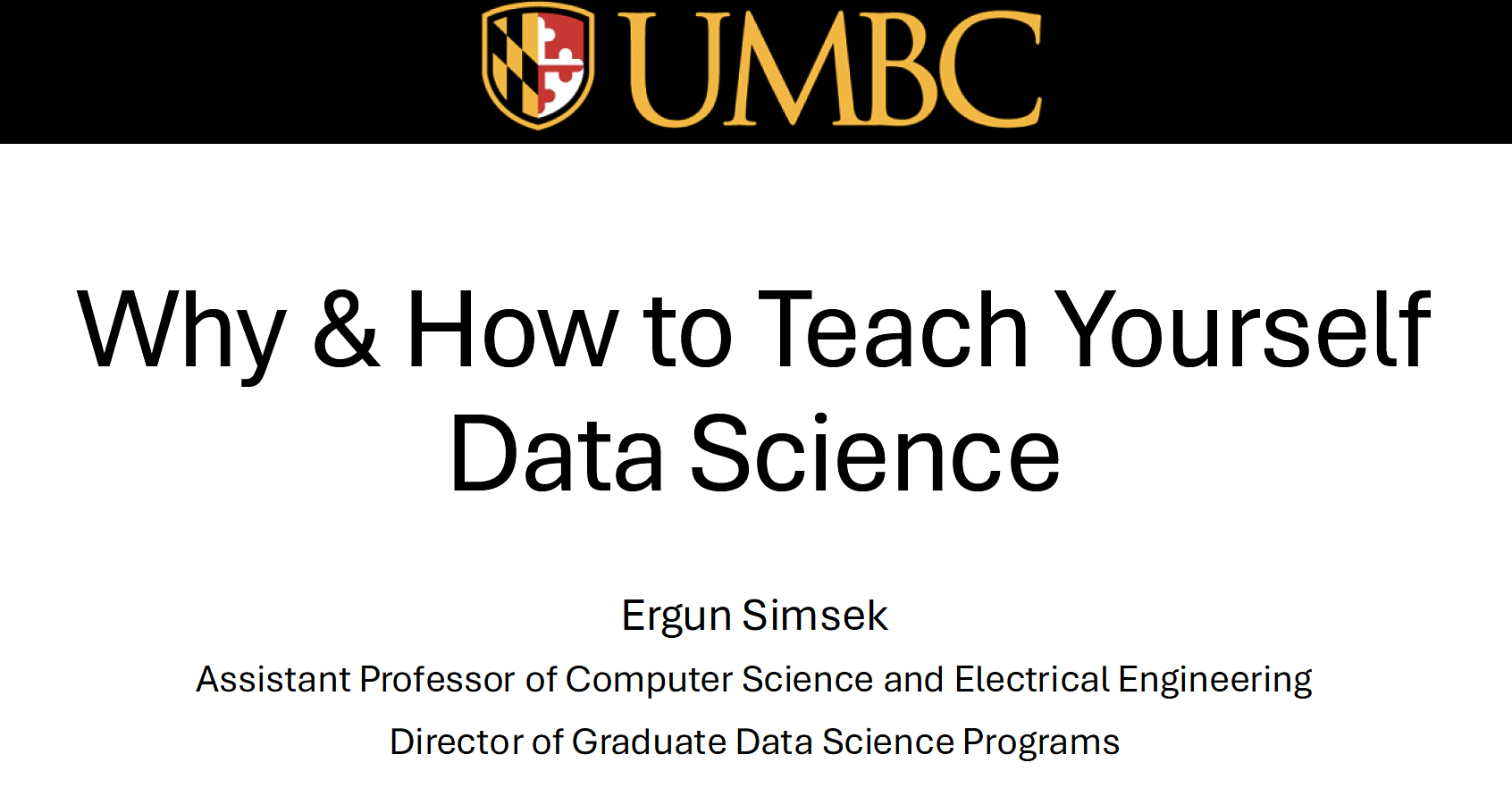
    <div class="html-content"><div><a href="https://www.youtube.com/watch?v=Mrhzi5OmjpQ" rel="nofollow external" class="bo"><img src="https://www.csee.umbc.edu/wp-content/uploads/sites/659/2025/04/simsek_data_science.png" alt="copy of the first slide in the presentation" style="max-width: 100%; height: auto;"></a></div><div><br></div><div>In a recent Paws and Pivot online seminar, Dr. Ergun Simsek gave a presentation on "Why and How to Teach Yourself Data Science.  <a href="https://www.csee.umbc.edu/people/faculty/ergun-simsek/" rel="nofollow external" class="bo"><strong>Dr. Simsek </strong></a>is a professor in the CSEE department and the Program Director of UMBC’s <a href="https://professionalprograms.umbc.edu/data-science/" rel="nofollow external" class="bo"><strong>Data Science graduate program</strong></a>.</div><div><br></div><div>The <a href="https://www.youtube.com/watch?v=Mrhzi5OmjpQ" rel="nofollow external" class="bo"><strong>video</strong></a> of his talk and his presentation <a href="https://github.com/simsekergun/DATA601/blob/main/TYDS.pdf" rel="nofollow external" class="bo"><strong>slides</strong></a> are now available.  Watch his presentation to discover practical strategies and tools for building your data science skills independently and better prepare for in-demand technical careers.</div><div><br></div><div><br></div></div>
]]>
</Body>
<Summary>In a recent Paws and Pivot online seminar, Dr. Ergun Simsek gave a presentation on "Why and How to Teach Yourself Data Science.  Dr. Simsek is a professor in the CSEE department and the Program...</Summary>
<Website>https://www.youtube.com/watch?v=Mrhzi5OmjpQ</Website>
<TrackingUrl>https://beta.my.umbc.edu/api/v0/pixel/news/149507/guest@my.umbc.edu/dc08acf6c993d72ee8d745f811d5ed4d/api/pixel</TrackingUrl>
<Tag>ai</Tag>
<Tag>data-science</Tag>
<Tag>ml</Tag>
<Group token="csee">Computer Science and Electrical Engineering</Group>
<GroupUrl>https://beta.my.umbc.edu/groups/csee</GroupUrl>
<AvatarUrl>https://assets3-beta.my.umbc.edu/system/shared/avatars/groups/000/000/099/d117dca133c64bf78a4b7696dd007189/xsmall.png?1314043393</AvatarUrl>
<AvatarUrl size="original">https://assets1-beta.my.umbc.edu/system/shared/avatars/groups/000/000/099/d117dca133c64bf78a4b7696dd007189/original.png?1314043393</AvatarUrl>
<AvatarUrl size="xxlarge">https://assets1-beta.my.umbc.edu/system/shared/avatars/groups/000/000/099/d117dca133c64bf78a4b7696dd007189/xxlarge.png?1314043393</AvatarUrl>
<AvatarUrl size="xlarge">https://assets4-beta.my.umbc.edu/system/shared/avatars/groups/000/000/099/d117dca133c64bf78a4b7696dd007189/xlarge.png?1314043393</AvatarUrl>
<AvatarUrl size="large">https://assets3-beta.my.umbc.edu/system/shared/avatars/groups/000/000/099/d117dca133c64bf78a4b7696dd007189/large.png?1314043393</AvatarUrl>
<AvatarUrl size="medium">https://assets1-beta.my.umbc.edu/system/shared/avatars/groups/000/000/099/d117dca133c64bf78a4b7696dd007189/medium.png?1314043393</AvatarUrl>
<AvatarUrl size="small">https://assets2-beta.my.umbc.edu/system/shared/avatars/groups/000/000/099/d117dca133c64bf78a4b7696dd007189/small.png?1314043393</AvatarUrl>
<AvatarUrl size="xsmall">https://assets3-beta.my.umbc.edu/system/shared/avatars/groups/000/000/099/d117dca133c64bf78a4b7696dd007189/xsmall.png?1314043393</AvatarUrl>
<AvatarUrl size="xxsmall">https://assets3-beta.my.umbc.edu/system/shared/avatars/groups/000/000/099/d117dca133c64bf78a4b7696dd007189/xxsmall.png?1314043393</AvatarUrl>
<Sponsor>Computer Science and Electrical Engineering</Sponsor>
<PawCount>0</PawCount>
<CommentCount>0</CommentCount>
<CommentsAllowed>true</CommentsAllowed>
<PostedAt>Sun, 27 Apr 2025 11:19:29 -0400</PostedAt>
<EditAt>Sun, 27 Apr 2025 11:22:58 -0400</EditAt>
</NewsItem>

<NewsItem contentIssues="true" id="135530" important="false" status="posted" url="https://beta.my.umbc.edu/groups/csee/posts/135530">
<Title>talk: Privacy in ML/AI in Smart Environments, 2-3pm Tue 9/19</Title>
<Tagline>ITE 325b ITE, UMBC</Tagline>
<Body>
<![CDATA[
    <div class="html-content"><div><strong>IEEE Sponsored Event</strong></div><div><strong><br></strong></div><div><strong>Bringing Privacy into the Picture: New Optimization </strong><strong>Goals for ML/AI in Smart Environments</strong></div><div><strong><br></strong></div><div><strong><a href="https://www.cs.ucf.edu/person/damla-turgut/" rel="nofollow external" class="bo">Dr. Damla Turgut</a></strong></div><div><strong>University of Central Florida</strong></div><div><br></div><div><strong>2:00-3:00pm ET, Tuesday, Sept 19, 2023 </strong></div><div><strong>ITE 325b ITE, UMBC</strong></div><div><strong><br></strong></div><div><strong>check back for online link</strong></div><div><br></div><div>Smart assistive environments adapt to the needs and preferences of disabled or elderly users who need help with the activities of daily living. However, the needs and requests of users vary greatly, both due to personal preferences and type of disability. As handcrafting an environment is prohibitively expensive, in recent years significant research was done in systems that use machine learning to create a predictive model of the user. Machine learning, however, typically requires large amounts of data. A stand-alone smart environment, however, only has access to the data collected from its user since it was deployed. A possible solution is to perform centralized, cloud-based learning by pooling the training data collected from multiple users. However, uploading data collected from the personal habits of elderly and disabled users creates significant security and privacy concerns.</div><div><br></div><div>In this talk, we investigate the type of data sharing necessary for learning user models in smart environments and propose several novel considerations. We point out that data sharing is only ethical if the user derives a benefit from it. This implies that the decision to share data must be periodically revisited, it is not a commitment extending indefinitely in the future. We study the data sharing decisions made by users under several machine learning frameworks: local, cloud, and federated learning. We show that most users only benefit from data sharing for a limited interval after the deployment of the system. We also investigate machine learning techniques that predict whether the user will benefit from sharing the data before the data is shared.</div><div><br></div><div><a href="https://www.cs.ucf.edu/person/damla-turgut/" rel="nofollow external" class="bo"><strong>Damla Turgut</strong></a> is Charles Millican Professor and Chair of Computer Science at the University of Central Florida (UCF). She is the co-director of the <a href="https://www.cs.ucf.edu/aithings/" rel="nofollow external" class="bo">AI Things Laboratory</a>. She held visiting researcher positions at the University of Rome ``La Sapienza'', Imperial College of London, and KTH Royal Institute of Technology, Sweden. Her research interests include wireless ad hoc, sensor, underwater, vehicular, and social networks, edge/cloud computing, smart cities, smart grids, IoT-enabled healthcare and augmented reality, as well as considerations of privacy in the Internet of Things. Dr. Turgut serves on several editorial boards and program committees of prestigious ACM and IEEE journals and conferences. Her most recent honors include the NCWIT 2021 Mentoring Award for Undergraduate Research (MAUR), the UCF Research Incentive Award, and the UCF Women of Distinction Award. Since 2019, she serves as the N2Women Board Co-Chair where she co-leads the activities of the N2Women Board in supporting female researchers in the fields of networking and communications. She is an IEEE ComSoc Distinguished Lecturer, IEEE Senior Member, ACM Senior Member, the Chair of the IEEE Technical Committee on Social Networks, and the Chair of the IEEE Technical Community on Computer Communications (TCCC).<br></div></div>
]]>
</Body>
<Summary>IEEE Sponsored Event     Bringing Privacy into the Picture: New Optimization Goals for ML/AI in Smart Environments     Dr. Damla Turgut  University of Central Florida     2:00-3:00pm ET, Tuesday,...</Summary>
<Website>https://events.vtools.ieee.org/m/374300</Website>
<TrackingUrl>https://beta.my.umbc.edu/api/v0/pixel/news/135530/guest@my.umbc.edu/6907a80f1fe26ca8fcdb6833f1341fc2/api/pixel</TrackingUrl>
<Tag>ai</Tag>
<Tag>ieee</Tag>
<Tag>iot</Tag>
<Tag>ml</Tag>
<Tag>privacy</Tag>
<Group token="csee">Computer Science and Electrical Engineering</Group>
<GroupUrl>https://beta.my.umbc.edu/groups/csee</GroupUrl>
<AvatarUrl>https://assets3-beta.my.umbc.edu/system/shared/avatars/groups/000/000/099/d117dca133c64bf78a4b7696dd007189/xsmall.png?1314043393</AvatarUrl>
<AvatarUrl size="original">https://assets1-beta.my.umbc.edu/system/shared/avatars/groups/000/000/099/d117dca133c64bf78a4b7696dd007189/original.png?1314043393</AvatarUrl>
<AvatarUrl size="xxlarge">https://assets1-beta.my.umbc.edu/system/shared/avatars/groups/000/000/099/d117dca133c64bf78a4b7696dd007189/xxlarge.png?1314043393</AvatarUrl>
<AvatarUrl size="xlarge">https://assets4-beta.my.umbc.edu/system/shared/avatars/groups/000/000/099/d117dca133c64bf78a4b7696dd007189/xlarge.png?1314043393</AvatarUrl>
<AvatarUrl size="large">https://assets3-beta.my.umbc.edu/system/shared/avatars/groups/000/000/099/d117dca133c64bf78a4b7696dd007189/large.png?1314043393</AvatarUrl>
<AvatarUrl size="medium">https://assets1-beta.my.umbc.edu/system/shared/avatars/groups/000/000/099/d117dca133c64bf78a4b7696dd007189/medium.png?1314043393</AvatarUrl>
<AvatarUrl size="small">https://assets2-beta.my.umbc.edu/system/shared/avatars/groups/000/000/099/d117dca133c64bf78a4b7696dd007189/small.png?1314043393</AvatarUrl>
<AvatarUrl size="xsmall">https://assets3-beta.my.umbc.edu/system/shared/avatars/groups/000/000/099/d117dca133c64bf78a4b7696dd007189/xsmall.png?1314043393</AvatarUrl>
<AvatarUrl size="xxsmall">https://assets3-beta.my.umbc.edu/system/shared/avatars/groups/000/000/099/d117dca133c64bf78a4b7696dd007189/xxsmall.png?1314043393</AvatarUrl>
<Sponsor>Computer Science and Electrical Engineering</Sponsor>
<ThumbnailUrl size="xxlarge">https://assets3-beta.my.umbc.edu/system/shared/thumbnails/news/000/135/530/56fdce423e03aacde0b74a35ee3559f2/xxlarge.jpg?1695069160</ThumbnailUrl>
<ThumbnailUrl size="xlarge">https://assets3-beta.my.umbc.edu/system/shared/thumbnails/news/000/135/530/56fdce423e03aacde0b74a35ee3559f2/xlarge.jpg?1695069160</ThumbnailUrl>
<ThumbnailUrl size="large">https://assets2-beta.my.umbc.edu/system/shared/thumbnails/news/000/135/530/56fdce423e03aacde0b74a35ee3559f2/large.jpg?1695069160</ThumbnailUrl>
<ThumbnailUrl size="medium">https://assets1-beta.my.umbc.edu/system/shared/thumbnails/news/000/135/530/56fdce423e03aacde0b74a35ee3559f2/medium.jpg?1695069160</ThumbnailUrl>
<ThumbnailUrl size="small">https://assets4-beta.my.umbc.edu/system/shared/thumbnails/news/000/135/530/56fdce423e03aacde0b74a35ee3559f2/small.jpg?1695069160</ThumbnailUrl>
<ThumbnailUrl size="xsmall">https://assets3-beta.my.umbc.edu/system/shared/thumbnails/news/000/135/530/56fdce423e03aacde0b74a35ee3559f2/xsmall.jpg?1695069160</ThumbnailUrl>
<ThumbnailUrl size="xxsmall">https://assets1-beta.my.umbc.edu/system/shared/thumbnails/news/000/135/530/56fdce423e03aacde0b74a35ee3559f2/xxsmall.jpg?1695069160</ThumbnailUrl>
<PawCount>0</PawCount>
<CommentCount>0</CommentCount>
<CommentsAllowed>true</CommentsAllowed>
<PostedAt>Mon, 18 Sep 2023 16:43:47 -0400</PostedAt>
</NewsItem>

</News>