UMBC to receive over $63 million in NASA renewal of CRESST II space science consortium
 NASA’s MAVEN spacecraft orbits Mars in this visualization. A 2019 research paper in
 Science
led by CSST’s Mehdi Benna mapped Mars’s global wind patterns, the first time that had been done on any planet (including Earth). Visualization courtesy of NASA.
UMBC to receive over $63 million in NASA renewal of CRESST II space science consortium
Adapted from a UMBC News article written by Sarah Hansen.
NASA has committed $178 million to extend support for the Center for Research and Exploration in Space Science & Technology II (CRESST II) through 2027. Founded in 2006 and renewed in 2016, CRESST II is a partnership between NASA’s Goddard Space Flight Center and four universities. UMBC and the University of Maryland, College Park (UMD) are the two primary funding recipients, with UMD leading the consortium. CRESST II also supports researchers at Catholic University of America, Howard University, and the Southeastern Universities Research Association.
New UMBC funding to support these projects will be more than $63 million over five years under the CRESST II renewal. Since the last renewal in 2016, the UMBC arm of the partnership, the Center for Space Sciences and Technology (CSST), has focused on offering additional training for budding space scientists. Graduate students with NASA fellowships are co-advised by UMBC faculty and NASA scientists, undergraduates have internship opportunities on-site at Goddard, and post-baccalaureate programs offer recent grads a chance to get more experience before applying to jobs or graduate school. Career workshops are available to all.
“We’re trying to do more to support their growth, and also prepare them to move on to other things afterwards,” says Don Engel, director of CSST and assistant professor of computer science and electrical engineering. “We’re building more infrastructure around career support for our scientists, especially those at earlier levels.”

Don Engel, director of the Center for Space Sciences and Technology, UMBC’s arm of the CRESST II partnership, in the Imaging Research Center at UMBC. Photo by Marlayna Demond ’11 for UMBC.
Engel has also been leading an effort to engage more departments at UMBC in the partnership. Physics is the most involved so far, but researchers in computer science and electrical engineering, mechanical engineering, information systems, and even geography and environmental systems have connected with CSST, meaning the Center spans all three UMBC colleges.
Read the full article on UMBC News.
The post UMBC to receive over $63 million in NASA renewal of CRESST II space science consortium appeared first on Department of Computer Science and Electrical Engineering.
]]>
NASA’s MAVEN spacecraft orbits Mars in this visualization. A 2019 research paper in Science led by CSST’s Mehdi Benna mapped Mars’s global wind patterns, the first time that had been done on any...
https://www.csee.umbc.edu/2021/05/umbc-to-receive-over-63-million-in-nasa-renewal-of-cresst-ii-space-science-consortium/
https://beta.my.umbc.edu/api/v0/pixel/news/101897/guest@my.umbc.edu/6a1300ad48f7aad02a8f35a7ec4c6848/api/pixel
csee
news
research
Computer Science and Electrical Engineering
https://beta.my.umbc.edu/groups/csee
https://assets3-beta.my.umbc.edu/system/shared/avatars/groups/000/000/099/d117dca133c64bf78a4b7696dd007189/xsmall.png?1314043393
https://assets1-beta.my.umbc.edu/system/shared/avatars/groups/000/000/099/d117dca133c64bf78a4b7696dd007189/original.png?1314043393
https://assets1-beta.my.umbc.edu/system/shared/avatars/groups/000/000/099/d117dca133c64bf78a4b7696dd007189/xxlarge.png?1314043393
https://assets4-beta.my.umbc.edu/system/shared/avatars/groups/000/000/099/d117dca133c64bf78a4b7696dd007189/xlarge.png?1314043393
https://assets3-beta.my.umbc.edu/system/shared/avatars/groups/000/000/099/d117dca133c64bf78a4b7696dd007189/large.png?1314043393
https://assets1-beta.my.umbc.edu/system/shared/avatars/groups/000/000/099/d117dca133c64bf78a4b7696dd007189/medium.png?1314043393
https://assets2-beta.my.umbc.edu/system/shared/avatars/groups/000/000/099/d117dca133c64bf78a4b7696dd007189/small.png?1314043393
https://assets3-beta.my.umbc.edu/system/shared/avatars/groups/000/000/099/d117dca133c64bf78a4b7696dd007189/xsmall.png?1314043393
https://assets3-beta.my.umbc.edu/system/shared/avatars/groups/000/000/099/d117dca133c64bf78a4b7696dd007189/xxsmall.png?1314043393
Computer Science and Electrical Engineering
0
0
false
Fri, 21 May 2021 19:31:35 -0400
UMBC to receive over $63 million in NASA renewal of CRESST II space science consortium
NASA’s MAVEN spacecraft orbits Mars in this visualization. A 2019 research paper in Science
led by CSST’s Mehdi Benna mapped Mars’s global wind patterns, the first time that had been done on any planet (including Earth). Visualization courtesy of NASA.
UMBC to receive over $63 million in NASA renewal of CRESST II space science consortium
Adapted from a UMBC News article written by Sarah Hansen.
NASA has committed $178 million to extend support for the Center for Research and Exploration in Space Science & Technology II (CRESST II) through 2027. Founded in 2006 and renewed in 2016, CRESST II is a partnership between NASA’s Goddard Space Flight Center and four universities. UMBC and the University of Maryland, College Park (UMD) are the two primary funding recipients, with UMD leading the consortium. CRESST II also supports researchers at Catholic University of America, Howard University, and the Southeastern Universities Research Association.
New UMBC funding to support these projects will be more than $63 million over five years under the CRESST II renewal. Since the last renewal in 2016, the UMBC arm of the partnership, the Center for Space Sciences and Technology (CSST), has focused on offering additional training for budding space scientists. Graduate students with NASA fellowships are co-advised by UMBC faculty and NASA scientists, undergraduates have internship opportunities on-site at Goddard, and post-baccalaureate programs offer recent grads a chance to get more experience before applying to jobs or graduate school. Career workshops are available to all.
“We’re trying to do more to support their growth, and also prepare them to move on to other things afterwards,” says Don Engel, director of CSST and assistant professor of computer science and electrical engineering. “We’re building more infrastructure around career support for our scientists, especially those at earlier levels.”
Don Engel, director of the Center for Space Sciences and Technology, UMBC’s arm of the CRESST II partnership, in the Imaging Research Center at UMBC. Photo by Marlayna Demond ’11 for UMBC.
Engel has also been leading an effort to engage more departments at UMBC in the partnership. Physics is the most involved so far, but researchers in computer science and electrical engineering, mechanical engineering, information systems, and even geography and environmental systems have connected with CSST, meaning the Center spans all three UMBC colleges.
Read the full article on UMBC News.
The post UMBC to receive over $63 million in NASA renewal of CRESST II space science consortium appeared first on Department of Computer Science and Electrical Engineering.
]]>
NASA’s MAVEN spacecraft orbits Mars in this visualization. A 2019 research paper in Science led by CSST’s Mehdi Benna mapped Mars’s global wind patterns, the first time that had been done on any...
https://redirect.cs.umbc.edu/2021/05/umbc-to-receive-over-63-million-in-nasa-renewal-of-cresst-ii-space-science-consortium/
https://beta.my.umbc.edu/api/v0/pixel/news/129845/guest@my.umbc.edu/0c4805376ca862e2ff50ac3e44de0cf0/api/pixel
csee
news
research
Computer Science and Electrical Engineering
https://beta.my.umbc.edu/groups/csee
https://assets3-beta.my.umbc.edu/system/shared/avatars/groups/000/000/099/d117dca133c64bf78a4b7696dd007189/xsmall.png?1314043393
https://assets1-beta.my.umbc.edu/system/shared/avatars/groups/000/000/099/d117dca133c64bf78a4b7696dd007189/original.png?1314043393
https://assets1-beta.my.umbc.edu/system/shared/avatars/groups/000/000/099/d117dca133c64bf78a4b7696dd007189/xxlarge.png?1314043393
https://assets4-beta.my.umbc.edu/system/shared/avatars/groups/000/000/099/d117dca133c64bf78a4b7696dd007189/xlarge.png?1314043393
https://assets3-beta.my.umbc.edu/system/shared/avatars/groups/000/000/099/d117dca133c64bf78a4b7696dd007189/large.png?1314043393
https://assets1-beta.my.umbc.edu/system/shared/avatars/groups/000/000/099/d117dca133c64bf78a4b7696dd007189/medium.png?1314043393
https://assets2-beta.my.umbc.edu/system/shared/avatars/groups/000/000/099/d117dca133c64bf78a4b7696dd007189/small.png?1314043393
https://assets3-beta.my.umbc.edu/system/shared/avatars/groups/000/000/099/d117dca133c64bf78a4b7696dd007189/xsmall.png?1314043393
https://assets3-beta.my.umbc.edu/system/shared/avatars/groups/000/000/099/d117dca133c64bf78a4b7696dd007189/xxsmall.png?1314043393
Computer Science and Electrical Engineering
0
0
false
Fri, 21 May 2021 19:31:35 -0400
Fri, 21 May 2021 19:31:35 -0400
talk: Thinking Like an Attacker: Towards a Definition and Non-Technical Assessment of Adversarial Thinking, 12-1pm ET 4/30
The UMBC Cyber Defense Lab presents
Thinking Like an Attacker:
Towards a Definition and Non-Technical Assessment of Adversarial Thinking
Prof. Peter A. H. Peterson
Department of Computer Science
University of Minnesota Duluth
12:00–1:00 pm ET, Friday, 30 April 2021
via WebEx
“Adversarial thinking” (AT), sometimes called the “security mindset” or described as the ability to “think like an attacker,” is widely accepted in the computer security community as an essential ability for successful cybersecurity practice. Supported by intuition and anecdotes, many in the community stress the importance of AT, and multiple projects have produced interventions explicitly intended to strengthen individual AT skills to improve security in general. However, there is no agreed-upon definition of “adversarial thinking” or its components, and accordingly, no test for it. Because of this absence, it is impossible to meaningfully quantify AT in subjects, AT’s importance for cybersecurity practitioners, or the effectiveness of interventions designed to improve AT. Working towards the goal of a characterization of AT in cybersecurity and a non-technical test for AT that anyone can take, I will discuss existing conceptions of AT from the security community, as well as ideas about AT in other fields with adversarial aspects including war, politics, law, critical thinking, and games. I will also describe some of the unique difficulties of creating a non-technical test for AT, compare and contrast this effort to our work on the CATS and Security Misconceptions projects, and describe some potential solutions. I will explore potential uses for such an instrument, including measuring a student’s change in AT over time, measuring the effectiveness of interventions meant to improve AT, comparing AT in different populations (e.g., security professionals vs. software engineers), and identifying individuals from all walks of life with strong AT skills—people who might help meet our world’s pressing need for skilled and insightful security professionals and researchers. Along the way, I will give some sample non-technical adversarial thinking challenges and describe how they might be graded and validated.
Peter A. H. Peterson is an assistant professor of computer science at the University of Minnesota Duluth, where he teaches and directs the Laboratory for Advanced Research in Systems (LARS), a group dedicated to research in operating systems and security, with a special focus on research and development to make security education more effective and accessible. He is an active member of the Cybersecurity Assessment Tools (CATS) project working to create and validate two concept inventories for cybersecurity, is working on an NSF-funded grant to identify and remediate commonsense misconceptions about cybersecurity, and is also the author of several hands-on security exercises for Deterlab that have been used at many institutions around the world. He earned his Ph.D. from the University of California, Los Angeles for work on “adaptive compression”—systems that make compression decisions dynamically to improve efficiency. He can be reached at *protected email*.
Host: Alan T. Sherman, *protected email* Support for this event was provided in part by the National Science Foundation under SFS grant DGE-1753681. The UMBC Cyber Defense Lab meets biweekly Fridays. All meetings are open to the public. Upcoming CDL Meetings: May 7, Farid Javani (UMBC), Anonymization by oblivious transfer
The post talk: Thinking Like an Attacker: Towards a Definition and Non-Technical Assessment of Adversarial Thinking, 12-1pm ET 4/30 appeared first on Department of Computer Science and Electrical Engineering.
]]>
The UMBC Cyber Defense Lab presents Thinking Like an Attacker: Towards a Definition and Non-Technical Assessment of Adversarial Thinking Prof. Peter A. H. Peterson Department...
https://news.cs.umbc.edu/2021/04/talk-thinking-like-an-attacker-towards-a-definition-and-non-technical-assessment-of-adversarial-thinking-1-2pm-et-4-23/
https://beta.my.umbc.edu/api/v0/pixel/news/142857/guest@my.umbc.edu/9bda426fa5a3600326578e7642c0d075/api/pixel
cybersecurity
news
research
talks
Computer Science and Electrical Engineering
https://beta.my.umbc.edu/groups/csee
https://assets3-beta.my.umbc.edu/system/shared/avatars/groups/000/000/099/d117dca133c64bf78a4b7696dd007189/xsmall.png?1314043393
https://assets1-beta.my.umbc.edu/system/shared/avatars/groups/000/000/099/d117dca133c64bf78a4b7696dd007189/original.png?1314043393
https://assets1-beta.my.umbc.edu/system/shared/avatars/groups/000/000/099/d117dca133c64bf78a4b7696dd007189/xxlarge.png?1314043393
https://assets4-beta.my.umbc.edu/system/shared/avatars/groups/000/000/099/d117dca133c64bf78a4b7696dd007189/xlarge.png?1314043393
https://assets3-beta.my.umbc.edu/system/shared/avatars/groups/000/000/099/d117dca133c64bf78a4b7696dd007189/large.png?1314043393
https://assets1-beta.my.umbc.edu/system/shared/avatars/groups/000/000/099/d117dca133c64bf78a4b7696dd007189/medium.png?1314043393
https://assets2-beta.my.umbc.edu/system/shared/avatars/groups/000/000/099/d117dca133c64bf78a4b7696dd007189/small.png?1314043393
https://assets3-beta.my.umbc.edu/system/shared/avatars/groups/000/000/099/d117dca133c64bf78a4b7696dd007189/xsmall.png?1314043393
https://assets3-beta.my.umbc.edu/system/shared/avatars/groups/000/000/099/d117dca133c64bf78a4b7696dd007189/xxsmall.png?1314043393
Computer Science and Electrical Engineering
0
0
false
Fri, 16 Apr 2021 22:05:06 -0400
talk: Thinking Like an Attacker: Towards a Definition and Non-Technical Assessment of Adversarial Thinking, 12-1pm ET 4/30

The UMBC Cyber Defense Lab presents
Thinking Like an Attacker:
Towards a Definition and Non-Technical Assessment of Adversarial Thinking
Prof. Peter A. H. Peterson
Department of Computer Science
University of Minnesota Duluth
12:00–1:00 pm ET, Friday, 30 April 2021
via WebEx
“Adversarial thinking” (AT), sometimes called the “security mindset” or described as the ability to “think like an attacker,” is widely accepted in the computer security community as an essential ability for successful cybersecurity practice. Supported by intuition and anecdotes, many in the community stress the importance of AT, and multiple projects have produced interventions explicitly intended to strengthen individual AT skills to improve security in general. However, there is no agreed-upon definition of “adversarial thinking” or its components, and accordingly, no test for it. Because of this absence, it is impossible to meaningfully quantify AT in subjects, AT’s importance for cybersecurity practitioners, or the effectiveness of interventions designed to improve AT. Working towards the goal of a characterization of AT in cybersecurity and a non-technical test for AT that anyone can take, I will discuss existing conceptions of AT from the security community, as well as ideas about AT in other fields with adversarial aspects including war, politics, law, critical thinking, and games. I will also describe some of the unique difficulties of creating a non-technical test for AT, compare and contrast this effort to our work on the CATS and Security Misconceptions projects, and describe some potential solutions. I will explore potential uses for such an instrument, including measuring a student’s change in AT over time, measuring the effectiveness of interventions meant to improve AT, comparing AT in different populations (e.g., security professionals vs. software engineers), and identifying individuals from all walks of life with strong AT skills—people who might help meet our world’s pressing need for skilled and insightful security professionals and researchers. Along the way, I will give some sample non-technical adversarial thinking challenges and describe how they might be graded and validated.
Peter A. H. Peterson is an assistant professor of computer science at the University of Minnesota Duluth, where he teaches and directs the Laboratory for Advanced Research in Systems (LARS), a group dedicated to research in operating systems and security, with a special focus on research and development to make security education more effective and accessible. He is an active member of the Cybersecurity Assessment Tools (CATS) project working to create and validate two concept inventories for cybersecurity, is working on an NSF-funded grant to identify and remediate commonsense misconceptions about cybersecurity, and is also the author of several hands-on security exercises for Deterlab that have been used at many institutions around the world. He earned his Ph.D. from the University of California, Los Angeles for work on “adaptive compression”—systems that make compression decisions dynamically to improve efficiency. He can be reached at pahp@d.umn.edu.
Host: Alan T. Sherman, sherman@umbc.edu. Support for this event was provided in part by the National Science Foundation under SFS grant DGE-1753681. The UMBC Cyber Defense Lab meets biweekly Fridays. All meetings are open to the public. Upcoming CDL Meetings: May 7, Farid Javani (UMBC), Anonymization by oblivious transfer
The post talk: Thinking Like an Attacker: Towards a Definition and Non-Technical Assessment of Adversarial Thinking, 12-1pm ET 4/30 appeared first on Department of Computer Science and Electrical Engineering.
]]>
The UMBC Cyber Defense Lab presents Thinking Like an Attacker: Towards a Definition and Non-Technical Assessment of Adversarial Thinking Prof. Peter A. H. Peterson Department of Computer...
https://redirect.cs.umbc.edu/2021/04/talk-thinking-like-an-attacker-towards-a-definition-and-non-technical-assessment-of-adversarial-thinking-1-2pm-et-4-23/
https://beta.my.umbc.edu/api/v0/pixel/news/129846/guest@my.umbc.edu/bfddc42ffdc8b41913edb07e7072ac74/api/pixel
cybersecurity
news
research
talks
Computer Science and Electrical Engineering
https://beta.my.umbc.edu/groups/csee
https://assets3-beta.my.umbc.edu/system/shared/avatars/groups/000/000/099/d117dca133c64bf78a4b7696dd007189/xsmall.png?1314043393
https://assets1-beta.my.umbc.edu/system/shared/avatars/groups/000/000/099/d117dca133c64bf78a4b7696dd007189/original.png?1314043393
https://assets1-beta.my.umbc.edu/system/shared/avatars/groups/000/000/099/d117dca133c64bf78a4b7696dd007189/xxlarge.png?1314043393
https://assets4-beta.my.umbc.edu/system/shared/avatars/groups/000/000/099/d117dca133c64bf78a4b7696dd007189/xlarge.png?1314043393
https://assets3-beta.my.umbc.edu/system/shared/avatars/groups/000/000/099/d117dca133c64bf78a4b7696dd007189/large.png?1314043393
https://assets1-beta.my.umbc.edu/system/shared/avatars/groups/000/000/099/d117dca133c64bf78a4b7696dd007189/medium.png?1314043393
https://assets2-beta.my.umbc.edu/system/shared/avatars/groups/000/000/099/d117dca133c64bf78a4b7696dd007189/small.png?1314043393
https://assets3-beta.my.umbc.edu/system/shared/avatars/groups/000/000/099/d117dca133c64bf78a4b7696dd007189/xsmall.png?1314043393
https://assets3-beta.my.umbc.edu/system/shared/avatars/groups/000/000/099/d117dca133c64bf78a4b7696dd007189/xxsmall.png?1314043393
Computer Science and Electrical Engineering
0
0
false
Fri, 16 Apr 2021 22:05:06 -0400
Fri, 16 Apr 2021 22:05:06 -0400
talk: Thinking Like an Attacker: Towards a Definition and Non-Technical Assessment of Adversarial Thinking, 12-1pm ET 4/30
The UMBC Cyber Defense Lab presents
Thinking Like an Attacker:
Towards a Definition and Non-Technical Assessment of Adversarial Thinking
Prof. Peter A. H. Peterson
Department of Computer Science
University of Minnesota Duluth
12:00–1:00 pm ET, Friday, 30 April 2021
via WebEx
“Adversarial thinking” (AT), sometimes called the “security mindset” or described as the ability to “think like an attacker,” is widely accepted in the computer security community as an essential ability for successful cybersecurity practice. Supported by intuition and anecdotes, many in the community stress the importance of AT, and multiple projects have produced interventions explicitly intended to strengthen individual AT skills to improve security in general. However, there is no agreed-upon definition of “adversarial thinking” or its components, and accordingly, no test for it. Because of this absence, it is impossible to meaningfully quantify AT in subjects, AT’s importance for cybersecurity practitioners, or the effectiveness of interventions designed to improve AT. Working towards the goal of a characterization of AT in cybersecurity and a non-technical test for AT that anyone can take, I will discuss existing conceptions of AT from the security community, as well as ideas about AT in other fields with adversarial aspects including war, politics, law, critical thinking, and games. I will also describe some of the unique difficulties of creating a non-technical test for AT, compare and contrast this effort to our work on the CATS and Security Misconceptions projects, and describe some potential solutions. I will explore potential uses for such an instrument, including measuring a student’s change in AT over time, measuring the effectiveness of interventions meant to improve AT, comparing AT in different populations (e.g., security professionals vs. software engineers), and identifying individuals from all walks of life with strong AT skills—people who might help meet our world’s pressing need for skilled and insightful security professionals and researchers. Along the way, I will give some sample non-technical adversarial thinking challenges and describe how they might be graded and validated.
Peter A. H. Peterson is an assistant professor of computer science at the University of Minnesota Duluth, where he teaches and directs the Laboratory for Advanced Research in Systems (LARS), a group dedicated to research in operating systems and security, with a special focus on research and development to make security education more effective and accessible. He is an active member of the Cybersecurity Assessment Tools (CATS) project working to create and validate two concept inventories for cybersecurity, is working on an NSF-funded grant to identify and remediate commonsense misconceptions about cybersecurity, and is also the author of several hands-on security exercises for Deterlab that have been used at many institutions around the world. He earned his Ph.D. from the University of California, Los Angeles for work on “adaptive compression”—systems that make compression decisions dynamically to improve efficiency. He can be reached at *protected email*.
Host: Alan T. Sherman, *protected email* Support for this event was provided in part by the National Science Foundation under SFS grant DGE-1753681. The UMBC Cyber Defense Lab meets biweekly Fridays. All meetings are open to the public. Upcoming CDL Meetings: May 7, Farid Javani (UMBC), Anonymization by oblivious transfer
The post talk: Thinking Like an Attacker: Towards a Definition and Non-Technical Assessment of Adversarial Thinking, 12-1pm ET 4/30 appeared first on Department of Computer Science and Electrical Engineering.
]]>
The UMBC Cyber Defense Lab presents Thinking Like an Attacker: Towards a Definition and Non-Technical Assessment of Adversarial Thinking Prof. Peter A. H. Peterson Department of Computer...
https://www.csee.umbc.edu/2021/04/talk-thinking-like-an-attacker-towards-a-definition-and-non-technical-assessment-of-adversarial-thinking-1-2pm-et-4-23/
https://beta.my.umbc.edu/api/v0/pixel/news/100999/guest@my.umbc.edu/5fc161da080caa44677da279edaa7b56/api/pixel
cybersecurity
news
research
talks
Computer Science and Electrical Engineering
https://beta.my.umbc.edu/groups/csee
https://assets3-beta.my.umbc.edu/system/shared/avatars/groups/000/000/099/d117dca133c64bf78a4b7696dd007189/xsmall.png?1314043393
https://assets1-beta.my.umbc.edu/system/shared/avatars/groups/000/000/099/d117dca133c64bf78a4b7696dd007189/original.png?1314043393
https://assets1-beta.my.umbc.edu/system/shared/avatars/groups/000/000/099/d117dca133c64bf78a4b7696dd007189/xxlarge.png?1314043393
https://assets4-beta.my.umbc.edu/system/shared/avatars/groups/000/000/099/d117dca133c64bf78a4b7696dd007189/xlarge.png?1314043393
https://assets3-beta.my.umbc.edu/system/shared/avatars/groups/000/000/099/d117dca133c64bf78a4b7696dd007189/large.png?1314043393
https://assets1-beta.my.umbc.edu/system/shared/avatars/groups/000/000/099/d117dca133c64bf78a4b7696dd007189/medium.png?1314043393
https://assets2-beta.my.umbc.edu/system/shared/avatars/groups/000/000/099/d117dca133c64bf78a4b7696dd007189/small.png?1314043393
https://assets3-beta.my.umbc.edu/system/shared/avatars/groups/000/000/099/d117dca133c64bf78a4b7696dd007189/xsmall.png?1314043393
https://assets3-beta.my.umbc.edu/system/shared/avatars/groups/000/000/099/d117dca133c64bf78a4b7696dd007189/xxsmall.png?1314043393
Computer Science and Electrical Engineering
0
0
false
Fri, 16 Apr 2021 22:05:06 -0400
Fri, 16 Apr 2021 22:05:06 -0400
Talk: Cyber Lessons, Learned and Unlearned, 1-2 pm ET 4/20/21

The UMBC Center for Cybersecurity (UCYBR) & The Department of Computer Science & Electrical Engineering (CSEE) Present:
“Cyber Lessons, Learned and Unlearned”
Professor Eugene Spafford
Professor of Computer Science & Executive Director Emeritus of the Purdue CERIAS (Center for Education and Research in Information Assurance and Security)
Purdue University
Tuesday 20 April 2021 1-2PM ET
WHERE
https://umbc.webex.com/umbc/j.php?MTID=m576a3dada9e0c63c07beb51fedbff3d1
Dr. Eugene Spafford is a professor with an appointment in Computer Science at Purdue University, where he has served on the faculty since 1987. He is also a professor of Philosophy (courtesy), a professor of Communication (courtesy), a professor of Electrical and Computer Engineering (courtesy) and a Professor of Political Science (courtesy). He serves on a number of advisory and editorial boards. Spafford’s current research interests are primarily in the areas of information security, computer crime investigation and information ethics. He is generally recognized as one of the senior leaders in the field of computing.
Among other things, Spaf (as he is known to his friends, colleagues, and students) is Executive Director Emeritus of the Purdue CERIAS (Center for Education and Research in Information Assurance and Security), and was the founder and director of the (superseded) COAST Laboratory. He is Editor-on-Chief of the Elsevier journal Computers & Security, the oldest journal in the field of information security, and the official outlet of IFIP TC-11.
Spaf has been a student and researcher in computing for over 40 years, 35 of which have been in security-related areas. During that time, computing has evolved from mainframes to the Internet of Things. Of course, along with these changes in computing have been changes in technology, access, and both how we use and misuse computing resources. Who knows what the future holds?
In this UCYBR talk, Spaf will reflect upon this evolution and trends and discuss what he sees as significant “lessons learned” from history. Will we learn from our past? Or are we destined to repeat history (again!) and never break free from the many cybersecurity challenges that continue to impact our world? Join UCYBR and CSEE for an engaging and informative presentation from one of the most respected luminaries of the cybersecurity field!
More information about Spaf’s distinguished career in cybersecurity, his publications, talks, and more can be found at https://spaf.cerias.purdue.edu/.
Host: Dr. Richard Forno (*protected email*)
The post Talk: Cyber Lessons, Learned and Unlearned, 1-2 pm ET 4/20/21 appeared first on Department of Computer Science and Electrical Engineering.
]]>
The UMBC Center for Cybersecurity (UCYBR) & The Department of Computer Science & Electrical Engineering (CSEE) Present: “Cyber Lessons, Learned and Unlearned” Professor Eugene Spafford...
https://www.csee.umbc.edu/2021/04/talk-cyber-lessons-learned-and-unlearned-4-20-21-1-2pm/
https://beta.my.umbc.edu/api/v0/pixel/news/100992/guest@my.umbc.edu/7f4feaa68f3e7f42e8726c0c18f4a1a1/api/pixel
cybersecurity
news
talks
Computer Science and Electrical Engineering
https://beta.my.umbc.edu/groups/csee
https://assets3-beta.my.umbc.edu/system/shared/avatars/groups/000/000/099/d117dca133c64bf78a4b7696dd007189/xsmall.png?1314043393
https://assets1-beta.my.umbc.edu/system/shared/avatars/groups/000/000/099/d117dca133c64bf78a4b7696dd007189/original.png?1314043393
https://assets1-beta.my.umbc.edu/system/shared/avatars/groups/000/000/099/d117dca133c64bf78a4b7696dd007189/xxlarge.png?1314043393
https://assets4-beta.my.umbc.edu/system/shared/avatars/groups/000/000/099/d117dca133c64bf78a4b7696dd007189/xlarge.png?1314043393
https://assets3-beta.my.umbc.edu/system/shared/avatars/groups/000/000/099/d117dca133c64bf78a4b7696dd007189/large.png?1314043393
https://assets1-beta.my.umbc.edu/system/shared/avatars/groups/000/000/099/d117dca133c64bf78a4b7696dd007189/medium.png?1314043393
https://assets2-beta.my.umbc.edu/system/shared/avatars/groups/000/000/099/d117dca133c64bf78a4b7696dd007189/small.png?1314043393
https://assets3-beta.my.umbc.edu/system/shared/avatars/groups/000/000/099/d117dca133c64bf78a4b7696dd007189/xsmall.png?1314043393
https://assets3-beta.my.umbc.edu/system/shared/avatars/groups/000/000/099/d117dca133c64bf78a4b7696dd007189/xxsmall.png?1314043393
Computer Science and Electrical Engineering
0
0
false
Fri, 16 Apr 2021 15:56:21 -0400
Fri, 16 Apr 2021 15:56:21 -0400
UMBC’s Grand Challenge Scholars Program, apply by May 3
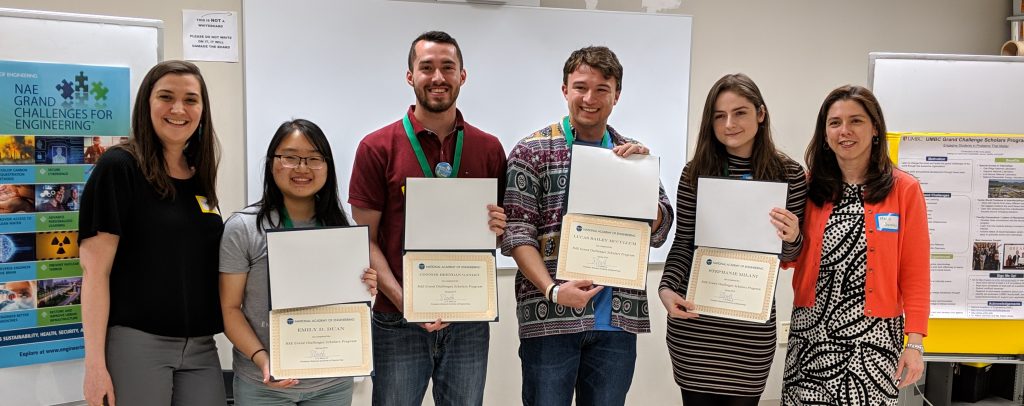
UMBC’s Grand Challenge Scholars Program, apply by May 3
UMBC’s Grand Challenge Scholars Program is designed for students from all majors who are interested in solving important societal problems. The program fosters a vibrant interdisciplinary community to help tackle the National Academy of Engineering’s (NAE) Grand Challenges and gives students experiences and skills to create solutions to some of the most pressing challenges of the 21st century.
The Grand Challenges are 14 broad problems in the areas of sustainability, health, security, and knowledge. Solutions to these issues require interdisciplinary teamwork and years of sustained effort.
The program aims to recruit a cohort of 20 undergraduates from a diverse pool of disciplines for Fall semester 2021. Ideal candidates are students starting their junior year in order to complete the requirements of the program during their last two years at UMBC. Although there is no financial support provided, the students will have the opportunity to incorporate five experiences into their undergraduate studies that will give them valuable interdisciplinary experiences they can bring to the workplace or graduate school, as well as recognition from the National Academy of Engineering upon successful completion of the program.
Read more about the program and find out how to join at the UMBC GCSP site and via a virtual informational session at 5:00 pm on Wednesday, April 28.
The post UMBC’s Grand Challenge Scholars Program, apply by May 3 appeared first on Department of Computer Science and Electrical Engineering.
]]>
UMBC’s Grand Challenge Scholars Program, apply by May 3 virtual informational session 5:00 pm, Wednesday, April 28 UMBC’s Grand Challenge Scholars Program is designed for students from all...
https://www.csee.umbc.edu/2021/04/umbcs-grand-challenge-scholars-program/
https://beta.my.umbc.edu/api/v0/pixel/news/100809/guest@my.umbc.edu/3a4bf64e5ded6d6c44d9719ed31e24b6/api/pixel
coeit
education
news
students
undergraduate
Computer Science and Electrical Engineering
https://beta.my.umbc.edu/groups/csee
https://assets3-beta.my.umbc.edu/system/shared/avatars/groups/000/000/099/d117dca133c64bf78a4b7696dd007189/xsmall.png?1314043393
https://assets1-beta.my.umbc.edu/system/shared/avatars/groups/000/000/099/d117dca133c64bf78a4b7696dd007189/original.png?1314043393
https://assets1-beta.my.umbc.edu/system/shared/avatars/groups/000/000/099/d117dca133c64bf78a4b7696dd007189/xxlarge.png?1314043393
https://assets4-beta.my.umbc.edu/system/shared/avatars/groups/000/000/099/d117dca133c64bf78a4b7696dd007189/xlarge.png?1314043393
https://assets3-beta.my.umbc.edu/system/shared/avatars/groups/000/000/099/d117dca133c64bf78a4b7696dd007189/large.png?1314043393
https://assets1-beta.my.umbc.edu/system/shared/avatars/groups/000/000/099/d117dca133c64bf78a4b7696dd007189/medium.png?1314043393
https://assets2-beta.my.umbc.edu/system/shared/avatars/groups/000/000/099/d117dca133c64bf78a4b7696dd007189/small.png?1314043393
https://assets3-beta.my.umbc.edu/system/shared/avatars/groups/000/000/099/d117dca133c64bf78a4b7696dd007189/xsmall.png?1314043393
https://assets3-beta.my.umbc.edu/system/shared/avatars/groups/000/000/099/d117dca133c64bf78a4b7696dd007189/xxsmall.png?1314043393
Computer Science and Electrical Engineering
0
0
false
Mon, 12 Apr 2021 12:37:00 -0400
talk: MeetingMayhem: Teaching Adversarial Thinking through a Web-Based Game, 12-1 ET 4/9

The UMBC Cyber Defense Lab presents
MeetingMayhem: Teaching Adversarial Thinking through a Web-Based Game
Akriti Anand, Richard Baldwin, Sudha, Kosuri, Julie Nau, and Ryan Wunk-Fink
UMBC Cyber Defense Lab
joint work with Alan Sherman, Marc Olano, Linda Oliva, Edward Zieglar, and Enis Golazewski
12:00 noon–1 pm ET, Friday, 9 April 2021
online via WebEx
We present our progress and plans in developing MeetingMayhem, a new web-based educational exercise that helps students learn adversarial thinking in communication networks. The goal of the exercise is to arrange a meeting time and place by sending and receiving messages through an insecure network that is under the control of a malicious adversary. Players can assume the role of participants or an adversary. The adversary can disrupt the efforts of the participants by intercepting, modifying, blocking, replaying, and injecting messages. Through this engaging authentic challenge, students learn the dangers of the network, and in particular, the Dolev-Yao network intruder model. They also learn the value and subtleties of using cryptography (including encryption, digital signatures, and hashing), and protocols to mitigate these dangers. Our team is developing the exercise in spring 2021 and will evaluate its educational effectiveness.
Akriti Anand (*protected email*) is an MS student in computer science working with Alan Sherman. She is the lead software engineer and focuses on the web frontend. Richard Baldwin (*protected email*) is a BS student in computer science, a member of Cyberdawgs, and lab manager for the Cyber Defense Lab. Sudha Kosuri (*protected email*) is a MS student in computer science. She is working on the frontend (using React and Flask) and its integration with the backend. Julie Nau (*protected email*) is a BS student in computer science. She is working on the backend and on visualizations. Ryan Wunk-Fink (*protected email*) is a PhD student in computer science working with Alan Sherman. He is developing the backend.
Host: Alan T. Sherman, *protected email* Support for this event was provided in part by the National Science Foundation under SFS grant DGE-1753681. The UMBC Cyber Defense Lab meets biweekly Fridays. All meetings are open to the public.
Upcoming CDL Meetings: April 23, Peter Peterson (Univ. of Minnesota Duluth), Adversarial thinking; May 7, Farid Javani (UMBC), Anonymization by oblivious transfer
The post talk: MeetingMayhem: Teaching Adversarial Thinking through a Web-Based Game, 12-1 ET 4/9 appeared first on Department of Computer Science and Electrical Engineering.
]]>
The UMBC Cyber Defense Lab presents MeetingMayhem: Teaching Adversarial Thinking through a Web-Based Game Akriti Anand, Richard Baldwin, Sudha, Kosuri, Julie Nau, and Ryan Wunk-Fink UMBC...
https://www.csee.umbc.edu/2021/04/talk-meetingmayhem-teaching-adversarial-thinking-through-a-web-based-game/
https://beta.my.umbc.edu/api/v0/pixel/news/100548/guest@my.umbc.edu/db67a213237e61290a3198b9ff644faf/api/pixel
cybersecurity
news
research
talks
Computer Science and Electrical Engineering
https://beta.my.umbc.edu/groups/csee
https://assets3-beta.my.umbc.edu/system/shared/avatars/groups/000/000/099/d117dca133c64bf78a4b7696dd007189/xsmall.png?1314043393
https://assets1-beta.my.umbc.edu/system/shared/avatars/groups/000/000/099/d117dca133c64bf78a4b7696dd007189/original.png?1314043393
https://assets1-beta.my.umbc.edu/system/shared/avatars/groups/000/000/099/d117dca133c64bf78a4b7696dd007189/xxlarge.png?1314043393
https://assets4-beta.my.umbc.edu/system/shared/avatars/groups/000/000/099/d117dca133c64bf78a4b7696dd007189/xlarge.png?1314043393
https://assets3-beta.my.umbc.edu/system/shared/avatars/groups/000/000/099/d117dca133c64bf78a4b7696dd007189/large.png?1314043393
https://assets1-beta.my.umbc.edu/system/shared/avatars/groups/000/000/099/d117dca133c64bf78a4b7696dd007189/medium.png?1314043393
https://assets2-beta.my.umbc.edu/system/shared/avatars/groups/000/000/099/d117dca133c64bf78a4b7696dd007189/small.png?1314043393
https://assets3-beta.my.umbc.edu/system/shared/avatars/groups/000/000/099/d117dca133c64bf78a4b7696dd007189/xsmall.png?1314043393
https://assets3-beta.my.umbc.edu/system/shared/avatars/groups/000/000/099/d117dca133c64bf78a4b7696dd007189/xxsmall.png?1314043393
Computer Science and Electrical Engineering
0
0
false
Sun, 04 Apr 2021 20:20:01 -0400
talk: Human-in-the-Loop Entity Mining from Noisy Web Data, 1-2 4/6

Human-in-the-Loop Entity Mining from Noisy Web Data
Professor Eduard Dragut, Temple University
1-2 pm, Tuesday, 6 April 2021
online via WebEx
Recognizing entities that follow or closely resemble a regular expression (regex) pattern is an important task in information extraction. Due to a vast diversity of web documents and ways in which they are generated, even seemingly straightforward tasks such as identifying mentions of date in a document becomes very challenging. It is reasonable to claim that it is impossible to create a regex that is capable of identifying such entities from web documents with perfect precision and recall. Rather than abandoning regex as a go-to approach for entity detection, we present methods to combine the expressive power of regexes, the ability of deep learning to learn from large data, and the human-in-the-loop approach into a new integrated framework for entity identification from web data. The framework starts by creating or collecting the existing regexes for a particular type of entity. Those regexes are then used over a large document corpus to collect weak labels for the entity mentions and a neural network is trained to predict those regex-generated weak labels. Finally, a human expert is asked to label a set of documents and the neural network is fine-tuned on those documents.
While human effort is critical to build an entity recognition model, surprisingly little is known about how to best invest that effort given a limited time budget. Should a human’s effort be spent on writing a regex recognizing an entity or on manually label entity mentions in a document corpus? When a user is allowed to choose between regex construction and manual labeling, we discover that (1) if the time budget is low, spending all time for regex construction is often advantageous, (2) if the time budget is high, spending all time for manual labeling seems to be superior, and (3) between those two extremes, writing regexes followed by manual labeling is typically the best approach. I will also give an overview of the ongoing and future projects.
Eduard Dragut is an Associate Professor in the Computer and Information Sciences Department at Temple University. He received his Ph.D. degree in Computer Science from the University of Illinois at Chicago. He previously was a Postdoctoral Research Associate at Purdue University, Discovery Park, Cyber Center. His main area of research is Web data management, e.g., retrieval, extraction, representation, cleaning, analysis, and integration. He is actively pursuing projects in Data Cleaning, Social Media Mining (e.g., user behavior and fake news), the Future of Work, and Cyber-Infrastructure for Scientific Research. He is co-author of a book on Deep Web data integration, Deep Web Query Interface Understanding, and Integration.
The post talk: Human-in-the-Loop Entity Mining from Noisy Web Data, 1-2 4/6 appeared first on Department of Computer Science and Electrical Engineering.
]]>
Human-in-the-Loop Entity Mining from Noisy Web Data Professor Eduard Dragut, Temple University 1-2 pm, Tuesday, 6 April 2021 online via WebEx Recognizing entities that follow or closely...
https://www.csee.umbc.edu/2021/04/talk-human-in-the-loop-entity-mining-from-noisy-web-data-1-2-4-6/
https://beta.my.umbc.edu/api/v0/pixel/news/100545/guest@my.umbc.edu/060a55af954a29dec58412243e4a057a/api/pixel
ai
machine-learning
news
nlp
Computer Science and Electrical Engineering
https://beta.my.umbc.edu/groups/csee
https://assets3-beta.my.umbc.edu/system/shared/avatars/groups/000/000/099/d117dca133c64bf78a4b7696dd007189/xsmall.png?1314043393
https://assets1-beta.my.umbc.edu/system/shared/avatars/groups/000/000/099/d117dca133c64bf78a4b7696dd007189/original.png?1314043393
https://assets1-beta.my.umbc.edu/system/shared/avatars/groups/000/000/099/d117dca133c64bf78a4b7696dd007189/xxlarge.png?1314043393
https://assets4-beta.my.umbc.edu/system/shared/avatars/groups/000/000/099/d117dca133c64bf78a4b7696dd007189/xlarge.png?1314043393
https://assets3-beta.my.umbc.edu/system/shared/avatars/groups/000/000/099/d117dca133c64bf78a4b7696dd007189/large.png?1314043393
https://assets1-beta.my.umbc.edu/system/shared/avatars/groups/000/000/099/d117dca133c64bf78a4b7696dd007189/medium.png?1314043393
https://assets2-beta.my.umbc.edu/system/shared/avatars/groups/000/000/099/d117dca133c64bf78a4b7696dd007189/small.png?1314043393
https://assets3-beta.my.umbc.edu/system/shared/avatars/groups/000/000/099/d117dca133c64bf78a4b7696dd007189/xsmall.png?1314043393
https://assets3-beta.my.umbc.edu/system/shared/avatars/groups/000/000/099/d117dca133c64bf78a4b7696dd007189/xxsmall.png?1314043393
Computer Science and Electrical Engineering
0
0
false
Sun, 04 Apr 2021 11:47:46 -0400
UMBC Cyber Dawgs win 2021 Mid-Atlantic Collegiate Cyber Defense Competition
 Photo by Marlayna Demond ’11 for UMBC
Congratulation to the UMBC Cyber Dawgs team, which took first place in the 2021 Mid-Atlantic Collegiate Cyber Defense Competition (MACCDC) finals. UMBC’s team was one of eight teams out of an initial 23 that qualified for the final competition. UMBC’s Cyber Dawgs will move on to compete in the National Collegiate Cyber Defense Competition (NCCDC), which will be held April 23-25, 2021.
The 2021 MACCDC regional final took place online April 1-3 and had teams fighting to protect their networks efficiently and effectively from simulated cyber threats and attacks using a scenario based on the COVID-19 global pandemic for its competition events.
The National Emergency Response Division (N.E.R.D.) is a data science-focused group within the Big Time Health Organization (BTHO), a multinational entity headquartered in Bethesda, Maryland. N.E.R.D. employees have been exceptionally busy dealing with the global health pandemic. As such, they have had to not only shift to work from home, but also expand the number of employees to support the inordinate amounts of data that is flooding each of its eight geographic locations throughout the U.S. Protecting the integrity of the data is critical, but when the data affects the delivery of health services to the public, the job of N.E.R.D. becomes even more mission critical.
The student teams will stand on the front lines of technology, alongside various healthcare providers. The main task at hand will be to ensure that pandemic-related data from state departments of health are accurate and delivered quickly. Information on outbreak locations, promising interventions, efficacy of testing, mortality rates, and other related statistics are critical so physicians, public health officials, and government entities can make informed decisions about resource allocations. Loss or inaccurate information can lead to tragic consequences. Vigilance is a must – be smart, be strong, be safe.
These regional and national competitions attract leading collegiate cybersecurity teams from across the nation. They put teams in situations that mimic scenarios they might encounter working to secure and protect online systems for government agencies and companies. Throughout each challenge, teammates work together to protect their systems from hackers and cyber attacks. At the same time, they keep their networks accessible to the users relying on them.
The UMBC Cyber Dawgs team won the MACCDC regionals last year and were national champions in 2017. In this year’s MACCDC, George Mason placed second and Liberty University third. Good luck to the Cyber Dawgs as they compete with the winners of nine other regional competitions in the National Collegiate Cyber Defense Competition later this month.
The post UMBC Cyber Dawgs win 2021 Mid-Atlantic Collegiate Cyber Defense Competition appeared first on Department of Computer Science and Electrical Engineering.
]]>
Photo by Marlayna Demond ’11 for UMBC Congratulation to the UMBC Cyber Dawgs team, which took first place in the 2021 Mid-Atlantic Collegiate Cyber Defense Competition (MACCDC) finals. UMBC’s...
https://www.csee.umbc.edu/2021/04/umbc-cyber-dawgs-win-2021-mid-atlantic-collegiate-cyber-defense-competition/
https://beta.my.umbc.edu/api/v0/pixel/news/100542/guest@my.umbc.edu/5bee7718f789574f25bc449cdef7a3e4/api/pixel
cybersecurity
news
students
Computer Science and Electrical Engineering
https://beta.my.umbc.edu/groups/csee
https://assets3-beta.my.umbc.edu/system/shared/avatars/groups/000/000/099/d117dca133c64bf78a4b7696dd007189/xsmall.png?1314043393
https://assets1-beta.my.umbc.edu/system/shared/avatars/groups/000/000/099/d117dca133c64bf78a4b7696dd007189/original.png?1314043393
https://assets1-beta.my.umbc.edu/system/shared/avatars/groups/000/000/099/d117dca133c64bf78a4b7696dd007189/xxlarge.png?1314043393
https://assets4-beta.my.umbc.edu/system/shared/avatars/groups/000/000/099/d117dca133c64bf78a4b7696dd007189/xlarge.png?1314043393
https://assets3-beta.my.umbc.edu/system/shared/avatars/groups/000/000/099/d117dca133c64bf78a4b7696dd007189/large.png?1314043393
https://assets1-beta.my.umbc.edu/system/shared/avatars/groups/000/000/099/d117dca133c64bf78a4b7696dd007189/medium.png?1314043393
https://assets2-beta.my.umbc.edu/system/shared/avatars/groups/000/000/099/d117dca133c64bf78a4b7696dd007189/small.png?1314043393
https://assets3-beta.my.umbc.edu/system/shared/avatars/groups/000/000/099/d117dca133c64bf78a4b7696dd007189/xsmall.png?1314043393
https://assets3-beta.my.umbc.edu/system/shared/avatars/groups/000/000/099/d117dca133c64bf78a4b7696dd007189/xxsmall.png?1314043393
Computer Science and Electrical Engineering
1
0
false
Sat, 03 Apr 2021 22:52:33 -0400
Sat, 03 Apr 2021 22:52:33 -0400
 NASA’s MAVEN spacecraft orbits Mars in this visualization. A 2019 research paper in Science led by CSST’s Mehdi Benna mapped Mars’s global wind patterns, the first time that had been done on any planet (including Earth). Visualization courtesy of NASA.
 Don Engel, director of the Center for Space Sciences and Technology, UMBC’s arm of the CRESST II partnership, in the Imaging Research Center at UMBC. Photo by Marlayna Demond ’11 for UMBC.