Mulwad, Van Tassel, and Ordonez win poster competition at CSEE Research Review

Congratulations to the three winners of the poster competition at the Computer Science and Electrical Engineering Department's annual Research Review, which took place in the UMBC Technology Center's business incubator and accelerator building last Friday. Winners were chosen by UMBC faculty who scored their top five choices with [-9, +9] range voting.
1st place (26 points):
Varish Mulwad (CS, Ph.D.) "A Probabilistic Model for Generating Linked Data from Tables"
Advisor: Tim Finin
Vast amount of information is encoded in tables found in documents, on the Web, and in spreadsheets or databases. Integrating or searching over this information benefits from understanding its intended meaning and making it explicit in a semantic representation language like RDF. Most current approaches to generating Semantic Web representations from tables requires human input to create schemas and often results in graphs that do not follow best practices for linked data. Evidence for a table's meaning can be found in its column headers, cell values, implicit relations between columns, caption and surrounding text but also requires general and domain-specific background knowledge. Approaches that work well for one domain, may not necessarily work well for others. We describe a domain independent framework for interpreting the intended meaning of tables and representing it as Linked Data. At the core of the framework are techniques grounded in graphical models and probabilistic reasoning to infer meaning associated with a table. Using background knowledge from resources in the Linked Open Data cloud, we jointly infer the semantics of column headers, table cell values (e.g., strings and numbers) and relations between columns and represent the inferred meaning as graph of RDF triples. A table's meaning is thus captured by mapping columns to classes in an appropriate ontology, linking cell values to literal constants, implied measurements, or entities in the linked data cloud (existing or new) and discovering or and identifying relations between columns.
2nd place (18 points):
Richard Van Tassel (CS, M.S.) "Visual Obstruction Resistance for Emotion Detection"
Advisor: Marie desJardins
There is an increasing interest in developing systems that can determine a user's emotion by analyzing a video feed of the user's face. However, it cannot always be assumed that the user's face will be completely unobstructed by facial hair or apparel. If the system is a recreational or consumer good, it could be considered too restrictive to require a perfect view of the face at all times. Obstructions can prevent the system from identifying all of the facial expression components, called action units, present in the input face. It is therefore important that such emotion detection systems are capable of coping with partially obstructed faces. I propose a technique for reducing the effect of face obstructions. The technique will learn association rules between sets of action units from a set of unobstructed faces. Then, for a given input obstructed face, the technique will infer what action units are likely to be obstructed based on the visible ones, and will use this hypothetical set of action units to infer the emotion. This technique is tested on real face data, with simulated face obstructions. It will provide a statistically significant improvement in emotion detection accuracy over the same process without the technique applied.
3rd place (16 points):
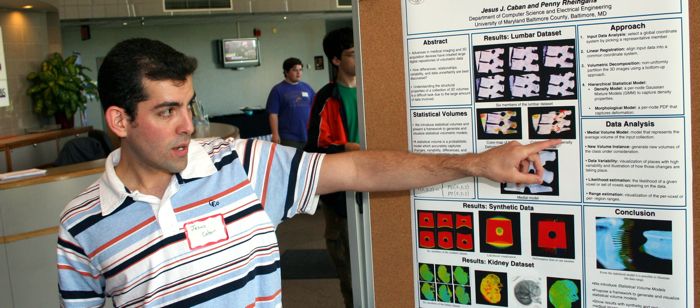
Patricia Ordonez (CS, Ph.D) (pictured) "Multivariate Time Series Analysis of Physiological and Clinical Data"
Advisor: Marie desJardins, Tim Oates
The complexity and volume of collected medical data is greater now than at any point in the history of medicine. Providers are expected to examine large volumes of data and identify correlations between parameters based on their own clinical experience to detect significant medical events. The information overload that providers face may hinder the diagnostic process. Existing visualizations to assist the provider in analyzing information consist mainly of tables or plots of values for a particular parameter over time. Multivariate Time Series Amalgams (MTSAs) provide an integrated, multivariate approach to represent clinical and physiological data. The hybrid representation automates the personalization of baselines and threshold values based on a patient’s medical history, while also incorporating traditional baselines and thresholds. MTSA visualizations capture the rate of change of provider-selected parameters and the relationships among them.
The second half of my research consists of developing automated techniques for discovering correlations among parameters over time to assist providers in making a diagnosis. The underlying premise of my research is that the complexity of a highly integrated system such as a human being is better captured by examining patterns as multivariate temporal abstractions as opposed to conjunctions of univariate ones — the more common approach for multivariate time series analysis and in medicine. The objective of such an approach is to assist in the identification of latent patterns within the data associated with specific medical conditions or significant medical events. Thus, in addition to the MTSA visualizations, I will present two novel multivariate time series representations, Stacked Bags-of-Patterns and Multivariate Bag-of-Patterns, which have been effective at classifying medical data. These representations are more compact than the raw multivariate time series and would facilitate the retrieval of patients from large medical databases based on physiological similarity and ideally on the presence of similar medically significant events or medical conditions. These techniques been compared to two other multivariate versions of univariate time series representations, Piecewise Dynamic Time Warping and Ensemble Voting using Bag-of-Patterns. Results demonstrate the potential of using these representations for multivariate time series analysis.
]]>
Congratulations to the three winners of the poster competition at the Computer Science and Electrical Engineering Department's annual Research Review, which took place in the UMBC Technology...
http://www.csee.umbc.edu/2012/05/mulwad-van-tassel-and-ordonez-win-poster-competition-at-csee-research-review/
https://beta.my.umbc.edu/api/v0/pixel/news/14896/guest@my.umbc.edu/e24e60fe3be602d12f8eed9401bf0f7d/api/pixel
graduate
news
research
Computer Science and Electrical Engineering
https://beta.my.umbc.edu/groups/csee
https://assets3-beta.my.umbc.edu/system/shared/avatars/groups/000/000/099/d117dca133c64bf78a4b7696dd007189/xsmall.png?1314043393
https://assets1-beta.my.umbc.edu/system/shared/avatars/groups/000/000/099/d117dca133c64bf78a4b7696dd007189/original.png?1314043393
https://assets1-beta.my.umbc.edu/system/shared/avatars/groups/000/000/099/d117dca133c64bf78a4b7696dd007189/xxlarge.png?1314043393
https://assets4-beta.my.umbc.edu/system/shared/avatars/groups/000/000/099/d117dca133c64bf78a4b7696dd007189/xlarge.png?1314043393
https://assets3-beta.my.umbc.edu/system/shared/avatars/groups/000/000/099/d117dca133c64bf78a4b7696dd007189/large.png?1314043393
https://assets1-beta.my.umbc.edu/system/shared/avatars/groups/000/000/099/d117dca133c64bf78a4b7696dd007189/medium.png?1314043393
https://assets2-beta.my.umbc.edu/system/shared/avatars/groups/000/000/099/d117dca133c64bf78a4b7696dd007189/small.png?1314043393
https://assets3-beta.my.umbc.edu/system/shared/avatars/groups/000/000/099/d117dca133c64bf78a4b7696dd007189/xsmall.png?1314043393
https://assets3-beta.my.umbc.edu/system/shared/avatars/groups/000/000/099/d117dca133c64bf78a4b7696dd007189/xxsmall.png?1314043393
Computer Science and Electrical Engineering
6
1
true
Mon, 07 May 2012 09:01:52 -0400
MS defense: A Modular, Power-Intelligent Wireless Sensor Node Architecture
MS Thesis Defense
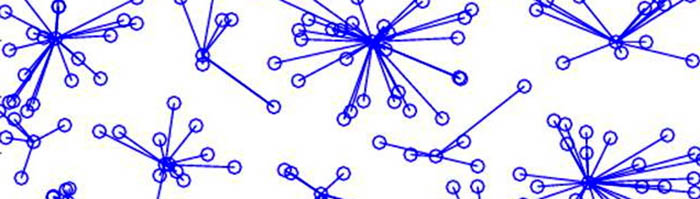
A Modular, Power-Intelligent Wireless Sensor Node Architecture
David Riley
10:30am Monday, 7 May 2012, ITE 346
The current state of the art in wireless sensor nodes, both in academia and the commercial world, is a fractured landscape of designs which mostly address individual problems. The most common commercial design derives directly from a mote developed at the University of California, Berkeley around 1999, and presents only moderate, incremental improvements over the original design. No designs yet present a comprehensive, intelligent design befitting a modern system.
By using dynamic power management, deep system configurability, autonomous peripheral modules, and multiple CPU architectures, this thesis presents a flexible and efficient node architecture. Modules in a system communicate between each other to coordinate their activities and power levels. Special attention is given to power sourcing and distribution. Individual peripheral boards supply their own drivers to the CPU using architecture-independent code. The platform may be configured to work with most networks, sensor types and power sources due to its improved connectivity and hierarchical design.
The resulting Configurable Sensor Node (CoSeN) architecture is competitive with existing designs on price, size and power while greatly exceeding most of them on performance, configurability and application potential. The CoSeN architecture is validated through a prototype implementation.
Committee: Professors Mohammed Younis, Tim Oates and Gymama Slaughter
]]>
MS Thesis Defense A Modular, Power-Intelligent Wireless Sensor Node Architecture David Riley 10:30am Monday, 7 May 2012, ITE 346 The current state of the art in wireless sensor nodes, both...
http://www.csee.umbc.edu/2012/05/ms-defense-a-modular-power-intelligent-wireless-sensor-node-architecture/
https://beta.my.umbc.edu/api/v0/pixel/news/14857/guest@my.umbc.edu/f427a3f41f050886a6f6e314bbe9cab4/api/pixel
graduate
news
research
talks
Computer Science and Electrical Engineering
https://beta.my.umbc.edu/groups/csee
https://assets3-beta.my.umbc.edu/system/shared/avatars/groups/000/000/099/d117dca133c64bf78a4b7696dd007189/xsmall.png?1314043393
https://assets1-beta.my.umbc.edu/system/shared/avatars/groups/000/000/099/d117dca133c64bf78a4b7696dd007189/original.png?1314043393
https://assets1-beta.my.umbc.edu/system/shared/avatars/groups/000/000/099/d117dca133c64bf78a4b7696dd007189/xxlarge.png?1314043393
https://assets4-beta.my.umbc.edu/system/shared/avatars/groups/000/000/099/d117dca133c64bf78a4b7696dd007189/xlarge.png?1314043393
https://assets3-beta.my.umbc.edu/system/shared/avatars/groups/000/000/099/d117dca133c64bf78a4b7696dd007189/large.png?1314043393
https://assets1-beta.my.umbc.edu/system/shared/avatars/groups/000/000/099/d117dca133c64bf78a4b7696dd007189/medium.png?1314043393
https://assets2-beta.my.umbc.edu/system/shared/avatars/groups/000/000/099/d117dca133c64bf78a4b7696dd007189/small.png?1314043393
https://assets3-beta.my.umbc.edu/system/shared/avatars/groups/000/000/099/d117dca133c64bf78a4b7696dd007189/xsmall.png?1314043393
https://assets3-beta.my.umbc.edu/system/shared/avatars/groups/000/000/099/d117dca133c64bf78a4b7696dd007189/xxsmall.png?1314043393
Computer Science and Electrical Engineering
2
0
true
Fri, 04 May 2012 00:11:35 -0400
Josiah Dykstra and Han Dong awarded for best Computer Science research
 Congratulations to CSEE graduate students Josiah Dykstra (Computer Science, Ph.D.) and Han Dong (Computer Science, M.S.) for winning the Computer Science and Electrical Engineering (CSEE) Department's 2011-2012 awards for best research by a Ph.D. student and best research by an M.S. student, respectively.
Winners were chosen based on the scientific merit (significance, originality, notriviality, correctness) and the writing style of their research papers.
Josiah's (pictured left) research, entitled "Acquiring Forensic Evidence from Infrastructure-as-a-Service Cloud Computing: Exploring and Evaluating Tools, Trust, and Techniques", deals with digital forensics for cloud computing, including frameworks, tools, and legal analysis to facilitate forensic investigations of remote Infrastructure-as-a-Service clouds. You can read Josiah's full paper here.
Han's (pictured right) research, entitled "Cross-Platform OpenCL Code and Performance Portability for CPU and GPU Architectures Investigated with a Climate and Weather Physics Model", investigates the portability of OpenCL across CPU and GPU architectures in terms of code and performance via a
 representative NASA GEOS-5 climate and weather physics model. Han discovered that OpenCL's vector-oriented programming paradigm assists compilers with implicit vectorization and creates significant performance gains. You can read Han's full paper here.
CSEE graduate students Karuna Joshi (Computer Science, Ph.D.) and James MacGlashan (Computer Science, Ph.D.) were awarded honorable mention.
As this year's winners, both Josiah and Han will present their work at this year's CSEE Research Review, which takes place this Friday, May 4 from 9 a.m. to 4 p.m. in the large conference room of the UMBC Technology Center's business incubator and accelerator building.
]]>
Congratulations to CSEE graduate students Josiah Dykstra (Computer Science, Ph.D.) and Han Dong (Computer Science, M.S.) for winning the Computer Science and Electrical Engineering (CSEE)...
http://www.csee.umbc.edu/2012/05/josiah-dykstra-and-han-dong-awarded-for-best-computer-science-research/
https://beta.my.umbc.edu/api/v0/pixel/news/14779/guest@my.umbc.edu/e72051707ae72791d94a41caff53bee4/api/pixel
events
graduate
news
Computer Science and Electrical Engineering
https://beta.my.umbc.edu/groups/csee
https://assets3-beta.my.umbc.edu/system/shared/avatars/groups/000/000/099/d117dca133c64bf78a4b7696dd007189/xsmall.png?1314043393
https://assets1-beta.my.umbc.edu/system/shared/avatars/groups/000/000/099/d117dca133c64bf78a4b7696dd007189/original.png?1314043393
https://assets1-beta.my.umbc.edu/system/shared/avatars/groups/000/000/099/d117dca133c64bf78a4b7696dd007189/xxlarge.png?1314043393
https://assets4-beta.my.umbc.edu/system/shared/avatars/groups/000/000/099/d117dca133c64bf78a4b7696dd007189/xlarge.png?1314043393
https://assets3-beta.my.umbc.edu/system/shared/avatars/groups/000/000/099/d117dca133c64bf78a4b7696dd007189/large.png?1314043393
https://assets1-beta.my.umbc.edu/system/shared/avatars/groups/000/000/099/d117dca133c64bf78a4b7696dd007189/medium.png?1314043393
https://assets2-beta.my.umbc.edu/system/shared/avatars/groups/000/000/099/d117dca133c64bf78a4b7696dd007189/small.png?1314043393
https://assets3-beta.my.umbc.edu/system/shared/avatars/groups/000/000/099/d117dca133c64bf78a4b7696dd007189/xsmall.png?1314043393
https://assets3-beta.my.umbc.edu/system/shared/avatars/groups/000/000/099/d117dca133c64bf78a4b7696dd007189/xxsmall.png?1314043393
Computer Science and Electrical Engineering
2
1
true
Tue, 01 May 2012 08:23:38 -0400
talk: Research vs. Development: Building A Career in the Modern Tech Industry
EE Graduate Seminar
Research vs. Development: Building a
Career in the Modern Tech Industry
Christopher Morris
Fellow Engineer, Northrop Grumman Corp
PhD (CS) Student, CSEE Dept/UMBC
11:30am-12:45pm, Friday, 4 May 2012, ITE 237, UMBC
With the uncertainty present in todays job market, technical college graduates are under increasing pressure to choose a career path that not only fits their personal strengths and interests. but is sustainable. Jobs and employees are becoming more transient and it is seemingly more difficult to establish a career with longevity. In this talk, we will discuss what a recent graduate can look forward to in various technical career paths, specifically a career in research versus a career in development. I will draw upon personal experience to provide an overview of what a student may expect when entering these careers. Lastly, we will discuss how one can prepare to make the most out of their career choice and handle the volatility of the industry.
Christopher (Chris) Morris is currently a Fellow Engineer at the Northrop Grumman Corporation where he is a member of the Teton Project team. The team is charged with research and development of Open Architecture (OA) Processing solutions for distributed, real-time, embedded (DRE) systems. Prior to joining Northrop Grumman in 2009, Chris was an Advisory Staff Engineer in the Visualization Systems Group at IBM Research in Westchester County, New York, where he researched and developed distributed rendering and visualization systems. He holds a BSME from UMBC (`96), a MSME in from Stanford University (`98), and a MSCS from UMBC (`01). Currently, he is a PhD (CS) Candidate at UMBC. His research interests are computer graphics and scientific visualization.
Host: Prof. Joel M. Morris
]]>
EE Graduate Seminar Research vs. Development: Building a Career in the Modern Tech Industry Christopher Morris Fellow Engineer, Northrop Grumman Corp PhD (CS) Student, CSEE Dept/UMBC...
http://www.csee.umbc.edu/2012/04/talk-research-vs-development-building-a-career-in-the-modern-tech-industry/
https://beta.my.umbc.edu/api/v0/pixel/news/14776/guest@my.umbc.edu/164cb04f6ca502aaf3bf2f3579dfc7bc/api/pixel
electrical-engineering
news
talks
Computer Science and Electrical Engineering
https://beta.my.umbc.edu/groups/csee
https://assets3-beta.my.umbc.edu/system/shared/avatars/groups/000/000/099/d117dca133c64bf78a4b7696dd007189/xsmall.png?1314043393
https://assets1-beta.my.umbc.edu/system/shared/avatars/groups/000/000/099/d117dca133c64bf78a4b7696dd007189/original.png?1314043393
https://assets1-beta.my.umbc.edu/system/shared/avatars/groups/000/000/099/d117dca133c64bf78a4b7696dd007189/xxlarge.png?1314043393
https://assets4-beta.my.umbc.edu/system/shared/avatars/groups/000/000/099/d117dca133c64bf78a4b7696dd007189/xlarge.png?1314043393
https://assets3-beta.my.umbc.edu/system/shared/avatars/groups/000/000/099/d117dca133c64bf78a4b7696dd007189/large.png?1314043393
https://assets1-beta.my.umbc.edu/system/shared/avatars/groups/000/000/099/d117dca133c64bf78a4b7696dd007189/medium.png?1314043393
https://assets2-beta.my.umbc.edu/system/shared/avatars/groups/000/000/099/d117dca133c64bf78a4b7696dd007189/small.png?1314043393
https://assets3-beta.my.umbc.edu/system/shared/avatars/groups/000/000/099/d117dca133c64bf78a4b7696dd007189/xsmall.png?1314043393
https://assets3-beta.my.umbc.edu/system/shared/avatars/groups/000/000/099/d117dca133c64bf78a4b7696dd007189/xxsmall.png?1314043393
Computer Science and Electrical Engineering
1
0
true
Mon, 30 Apr 2012 23:37:07 -0400
Bridging the gender gap in computer science and engineering
Judy Woodruff interviews Harvey Mudd College president Maria Klawe on PBS NewsHour.
Watch Why More Women Aren't Computer Scientists, Engineers on PBS. See more from PBS NewsHour.
Harvey Mudd College president Maria Klawe is seeking to close the gender gap in the hard sciences, which she attributes to young women's perception of such fields as uninteresting, beyond their capabilities, and being conducive to unappealing people. The concept of computing and other hard sciences as a strictly male-oriented domain is a major impediment, Klawe notes. However, she says hard science careers are actually very appealing to women for a number of reasons, including the incredible opportunities for jobs that pay very well, and with the flexibility to balance work and family. Klawe also notes that products and innovations stand to benefit from a feminine perspective. One key to attracting more women into science and engineering careers is changing the image of such careers as promoted and entrenched by the popular media, according to Klawe. She recommends that young women's interest in hard sciences should be nurtured when they enter college. "You get them into an intro computer science course that is absolutely fascinating and fun and creative," Klawe suggests. "And you have them have so much fun, that they just can't believe that this is really computer science."
summary via ACm news
]]>
Judy Woodruff interviews Harvey Mudd College president Maria Klawe on PBS NewsHour. Watch Why More Women Aren't Computer Scientists, Engineers on PBS. See more from PBS NewsHour. Harvey Mudd...
http://www.csee.umbc.edu/2012/04/bridging-the-gender-gap-in-computer-science-and-engineering/
https://beta.my.umbc.edu/api/v0/pixel/news/14771/guest@my.umbc.edu/e61b392ef11fa91d92162de2d816680e/api/pixel
news
students
Computer Science and Electrical Engineering
https://beta.my.umbc.edu/groups/csee
https://assets3-beta.my.umbc.edu/system/shared/avatars/groups/000/000/099/d117dca133c64bf78a4b7696dd007189/xsmall.png?1314043393
https://assets1-beta.my.umbc.edu/system/shared/avatars/groups/000/000/099/d117dca133c64bf78a4b7696dd007189/original.png?1314043393
https://assets1-beta.my.umbc.edu/system/shared/avatars/groups/000/000/099/d117dca133c64bf78a4b7696dd007189/xxlarge.png?1314043393
https://assets4-beta.my.umbc.edu/system/shared/avatars/groups/000/000/099/d117dca133c64bf78a4b7696dd007189/xlarge.png?1314043393
https://assets3-beta.my.umbc.edu/system/shared/avatars/groups/000/000/099/d117dca133c64bf78a4b7696dd007189/large.png?1314043393
https://assets1-beta.my.umbc.edu/system/shared/avatars/groups/000/000/099/d117dca133c64bf78a4b7696dd007189/medium.png?1314043393
https://assets2-beta.my.umbc.edu/system/shared/avatars/groups/000/000/099/d117dca133c64bf78a4b7696dd007189/small.png?1314043393
https://assets3-beta.my.umbc.edu/system/shared/avatars/groups/000/000/099/d117dca133c64bf78a4b7696dd007189/xsmall.png?1314043393
https://assets3-beta.my.umbc.edu/system/shared/avatars/groups/000/000/099/d117dca133c64bf78a4b7696dd007189/xxsmall.png?1314043393
Computer Science and Electrical Engineering
5
5
true
Mon, 30 Apr 2012 16:20:47 -0400
Smithsonian Explores The Art of Video Games
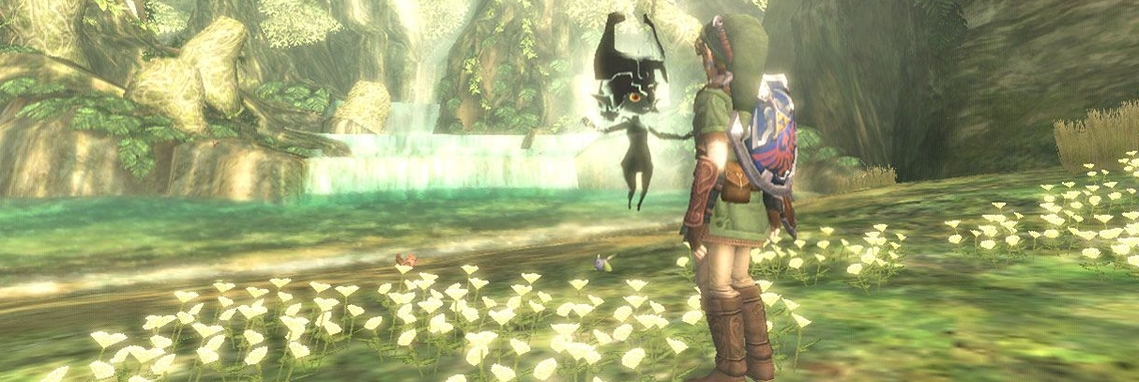 photo courtesy Nintendo
What do The Legend of Zelda, Halo 2, and Super Mario World have in common?
They're all featured video games in the Smithsonian American Art Museum's latest exhibition The Art of Video Games.
The exhibition–which celebrates 40 years of video game history–takes a look at 80 video games that pushed the artistic and technological boundaries of their era. The ubiquitous Atari VCS classic Pac-Man makes the list, along with standbys like Tomb Raider, Fable, and Myst. Games were chosen by a public vote from a list of 240 titles compiled by exhibit curator Chris Melissinos, and come from twenty gaming systems ranging from the SNES to Playstation 3. In an NPR interview, Melissinos, founder of Past Pixels and an avid video game collector, demystifies why Mario resembles an Italian plumber, and offers a theory about how Pac-Man was conceived.
A select five games can be played during the exhibit: Pac-Man, Super Mario Brothers, The Secret of Monkey Island, Myst, and Flower. The exhibition also features video interviews with video game developers and artists, historic game consoles, and photos of in-game screen shots.
Catch the exhibit at the Smithsonian American Art Museum until September 30, before it heads out on an across-country tour. On May 4, the museum is hosting Beyond Play: Video Games at Work, a series of free exhibition-inspired talks. At 1 p.m. "Video Games at Work" looks at the influence of video games on areas like health care, education, civics, journalism, and national defense. At 3 p.m. "Game Change: Society and Culture" looks at the impact of video games on our society and culture.
For more information about The Art of Video Games, visit www.americanart.si.edu
]]>
photo courtesy Nintendo What do The Legend of Zelda, Halo 2, and Super Mario World have in common? They're all featured video games in the Smithsonian American Art Museum's latest exhibition...
http://www.csee.umbc.edu/2012/04/smithsonian-explores-the-art-of-video-games/
https://beta.my.umbc.edu/api/v0/pixel/news/14750/guest@my.umbc.edu/b3d939f2637e6c7f1012dce32c468c5f/api/pixel
events
game-track
news
Computer Science and Electrical Engineering
https://beta.my.umbc.edu/groups/csee
https://assets3-beta.my.umbc.edu/system/shared/avatars/groups/000/000/099/d117dca133c64bf78a4b7696dd007189/xsmall.png?1314043393
https://assets1-beta.my.umbc.edu/system/shared/avatars/groups/000/000/099/d117dca133c64bf78a4b7696dd007189/original.png?1314043393
https://assets1-beta.my.umbc.edu/system/shared/avatars/groups/000/000/099/d117dca133c64bf78a4b7696dd007189/xxlarge.png?1314043393
https://assets4-beta.my.umbc.edu/system/shared/avatars/groups/000/000/099/d117dca133c64bf78a4b7696dd007189/xlarge.png?1314043393
https://assets3-beta.my.umbc.edu/system/shared/avatars/groups/000/000/099/d117dca133c64bf78a4b7696dd007189/large.png?1314043393
https://assets1-beta.my.umbc.edu/system/shared/avatars/groups/000/000/099/d117dca133c64bf78a4b7696dd007189/medium.png?1314043393
https://assets2-beta.my.umbc.edu/system/shared/avatars/groups/000/000/099/d117dca133c64bf78a4b7696dd007189/small.png?1314043393
https://assets3-beta.my.umbc.edu/system/shared/avatars/groups/000/000/099/d117dca133c64bf78a4b7696dd007189/xsmall.png?1314043393
https://assets3-beta.my.umbc.edu/system/shared/avatars/groups/000/000/099/d117dca133c64bf78a4b7696dd007189/xxsmall.png?1314043393
Computer Science and Electrical Engineering
1
0
true
Mon, 30 Apr 2012 11:09:24 -0400
Mon, 30 Apr 2012 11:09:24 -0400
CSEE Research Review, Fri 5/4
The CSEE Department will hold its annual CSEE Research Review day from 9:30am to 4:00pm on Friday, May 4, 2012. Faculty, research staff and students from the Computer Science, Computer Engineering and Electrical Engineering programs will present and discuss their latest research results via short oral presentations and a poster session.
The event is open to the public and is a good way for prospective collaborators and students to find out about the research our department is doing and meet and network with current faculty and students. See pictures from CRR-06, CRR-08, CRR-09, CRR-10 and CRR-11 to get an idea of what goes on at this event.
The 2012 CSEE Research Review (CRR-12) will take place in the large conference room of the UMBC Technology Center's business Incubator and Accelerator building on South Campus. There is ample free parking and refreshments and a free buffet lunch will be provided.
|
Schedule
|
| 9:30-10:40 |
Talks |
| 11:00-12:00 |
Poster Session |
| 12:00-1:00 |
Lunch (free) |
| 1:00-2:10 |
Talks |
| 2:30-3:40 |
Talks |
For more information, contact the CRR-11 General Chair, Professor Alan Sherman, Sorry, you need javascript to view this email address.
]]>
The CSEE Department will hold its annual CSEE Research Review day from 9:30am to 4:00pm on Friday, May 4, 2012. Faculty, research staff and students from the Computer Science, Computer Engineering...
http://www.csee.umbc.edu/2012/04/csee-research-review-fri-may-4/
https://beta.my.umbc.edu/api/v0/pixel/news/14740/guest@my.umbc.edu/0e5c3a18283e8e9a9b2cbc64f0bafd08/api/pixel
news
research
Computer Science and Electrical Engineering
https://beta.my.umbc.edu/groups/csee
https://assets3-beta.my.umbc.edu/system/shared/avatars/groups/000/000/099/d117dca133c64bf78a4b7696dd007189/xsmall.png?1314043393
https://assets1-beta.my.umbc.edu/system/shared/avatars/groups/000/000/099/d117dca133c64bf78a4b7696dd007189/original.png?1314043393
https://assets1-beta.my.umbc.edu/system/shared/avatars/groups/000/000/099/d117dca133c64bf78a4b7696dd007189/xxlarge.png?1314043393
https://assets4-beta.my.umbc.edu/system/shared/avatars/groups/000/000/099/d117dca133c64bf78a4b7696dd007189/xlarge.png?1314043393
https://assets3-beta.my.umbc.edu/system/shared/avatars/groups/000/000/099/d117dca133c64bf78a4b7696dd007189/large.png?1314043393
https://assets1-beta.my.umbc.edu/system/shared/avatars/groups/000/000/099/d117dca133c64bf78a4b7696dd007189/medium.png?1314043393
https://assets2-beta.my.umbc.edu/system/shared/avatars/groups/000/000/099/d117dca133c64bf78a4b7696dd007189/small.png?1314043393
https://assets3-beta.my.umbc.edu/system/shared/avatars/groups/000/000/099/d117dca133c64bf78a4b7696dd007189/xsmall.png?1314043393
https://assets3-beta.my.umbc.edu/system/shared/avatars/groups/000/000/099/d117dca133c64bf78a4b7696dd007189/xxsmall.png?1314043393
Computer Science and Electrical Engineering
3
0
true
Mon, 30 Apr 2012 08:29:28 -0400
Mon, 30 Apr 2012 23:38:28 -0400
MS Defense: Chandler on Efficient Network on Chip for a Low-Power, Low-Area Homogeneous Many-Core DSP Platform
MS Thesis Defense
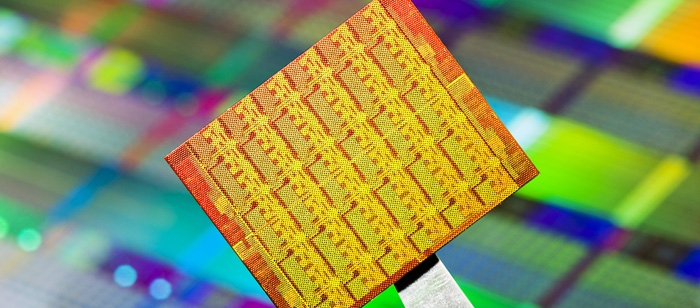
An Efficient Network on Chip (NoC) for a Low-Power,
Low-Area Homogeneous Many-Core DSP Platform
James Chandler
10:30am Monday, 30 April 30 2012, ITE 325b
This thesis presents an NoC architecture that is optimized for a course-grained, deterministic many core DSP platform supporting up to 256 cores. The proposed network supports both local and long-distance communication in the event that large applications or multiple smaller applications are mapped onto the platform by means of a hierarchical cluster topology. The NoC is designed to optimize the area- and power-to-performance ratio through implementing the following key characteristics: low hop-count long distance communication, optimized flit buffer size, efficient virtual channel implementation, and a highly restricted virtual channel flow control.
The NoC architecture is implemented in 65 nm CMOS technology with a nominal supply voltage of 1V. Place and Route results show that the proposed architecture saves up to 33% in area and up to 87.6% in energy-per-flit in comparison to some currently-implemented NoCs. Through several traffic pattern tests on a network of 16 cores, the NoC attains a throughput of up to 21.7Gbps. A 256-point FFT mapped onto 16 cores executes in 4.3$us and dissipates 0.649W. This is an improvement of 187% and 508% in latency and power dissipation over a 256-point Xilinx FFT IP Core implemented on a Virtex 6 FPGA.
Committee: Professors Tinoosh Mohsenin (chair), Dr. Chintan Patel and Mohamed Younis
]]>
MS Thesis Defense An Efficient Network on Chip (NoC) for a Low-Power, Low-Area Homogeneous Many-Core DSP Platform James Chandler 10:30am Monday, 30 April 30 2012, ITE 325b This thesis...
http://www.csee.umbc.edu/2012/04/ms-defense-chandler-on-efficient-network-on-chip-for-a-low-power-low-area-homogeneous-many-core-dsp-platform/
https://beta.my.umbc.edu/api/v0/pixel/news/14716/guest@my.umbc.edu/e685c6c18d31e058edf670ec5663a5d3/api/pixel
computer-engineering
news
research
students
talks
Computer Science and Electrical Engineering
https://beta.my.umbc.edu/groups/csee
https://assets3-beta.my.umbc.edu/system/shared/avatars/groups/000/000/099/d117dca133c64bf78a4b7696dd007189/xsmall.png?1314043393
https://assets1-beta.my.umbc.edu/system/shared/avatars/groups/000/000/099/d117dca133c64bf78a4b7696dd007189/original.png?1314043393
https://assets1-beta.my.umbc.edu/system/shared/avatars/groups/000/000/099/d117dca133c64bf78a4b7696dd007189/xxlarge.png?1314043393
https://assets4-beta.my.umbc.edu/system/shared/avatars/groups/000/000/099/d117dca133c64bf78a4b7696dd007189/xlarge.png?1314043393
https://assets3-beta.my.umbc.edu/system/shared/avatars/groups/000/000/099/d117dca133c64bf78a4b7696dd007189/large.png?1314043393
https://assets1-beta.my.umbc.edu/system/shared/avatars/groups/000/000/099/d117dca133c64bf78a4b7696dd007189/medium.png?1314043393
https://assets2-beta.my.umbc.edu/system/shared/avatars/groups/000/000/099/d117dca133c64bf78a4b7696dd007189/small.png?1314043393
https://assets3-beta.my.umbc.edu/system/shared/avatars/groups/000/000/099/d117dca133c64bf78a4b7696dd007189/xsmall.png?1314043393
https://assets3-beta.my.umbc.edu/system/shared/avatars/groups/000/000/099/d117dca133c64bf78a4b7696dd007189/xxsmall.png?1314043393
Computer Science and Electrical Engineering
3
0
true
Fri, 27 Apr 2012 13:32:31 -0400
MS defense: More on Situation Aware Intrusion Detection, 9am Fri 4/27
MS Thesis Defense
Situation Aware Intrusion Detection Model
Sumit More
9:00am Friday, 27 April 2012, ITE 346, UMBC
Today, information technology and cyber-services have become the foundation pillars of every business and manufacturing industry. The importance of cyber-services and their extensive use by every section of the society has paved the way for cyber-crimes like espionage, politically motivated attacks, credit card frauds, unauthorized infrastructure access, denial-of-service attacks, and stealing of valuable data. Intrusion Detection Systems (IDS) are applications which monitor cyber-systems to identify any malicious activities, generate an alert when such an activity is detected, and redress the problem if possible. Most of the intrusion detection/prevention systems available today are based on rule-based or signature based activity monitoring which detect threats and vulnerabilities by cross-referencing the threat or vulnerability signatures in their databases. These Intrusion Detection Systems (IDS) face limitations in detecting newly published attacks or variants of existing attacks. They are also point solutions that focus on a single system/component.
We argue that integrating information coming from multiple data channels can lead to a better threat detection model. Data source of web including blogs, chat-rooms, forums etc. can be a good source of information for upcoming attacks or attacks whose signatures have not yet been tracked for the intrusion detection systems to catch. Semantic integration of the data sources from web, information from IDS/IPS modules at the network and host level, and the expert knowledge can be used to create a ‘Situation Aware Intrusion Detection Model’ which can lead to better intrusion detection and prevention results. In this work, we present such a system which makes use of semantic web technologies to find relationships between the information gathered from the web, sensor data coming from IDS/IPS modules and network activity monitors, and reasons over this data and expert provided rules in-order to detect possibility of a cyber attack.
Thesis Committee: Professors Anupam Joshi (chair), Tim Finin and Yelena Yesha
]]>
MS Thesis Defense Situation Aware Intrusion Detection Model Sumit More 9:00am Friday, 27 April 2012, ITE 346, UMBC Today, information technology and cyber-services have become the...
http://www.csee.umbc.edu/2012/04/ms-defense-more-on-situation-aware-intrusion-detection-9am-fri-427/
https://beta.my.umbc.edu/api/v0/pixel/news/14691/guest@my.umbc.edu/9e2c7702b9843e0f817d9330d209d566/api/pixel
graduate
news
research
talks
Computer Science and Electrical Engineering
https://beta.my.umbc.edu/groups/csee
https://assets3-beta.my.umbc.edu/system/shared/avatars/groups/000/000/099/d117dca133c64bf78a4b7696dd007189/xsmall.png?1314043393
https://assets1-beta.my.umbc.edu/system/shared/avatars/groups/000/000/099/d117dca133c64bf78a4b7696dd007189/original.png?1314043393
https://assets1-beta.my.umbc.edu/system/shared/avatars/groups/000/000/099/d117dca133c64bf78a4b7696dd007189/xxlarge.png?1314043393
https://assets4-beta.my.umbc.edu/system/shared/avatars/groups/000/000/099/d117dca133c64bf78a4b7696dd007189/xlarge.png?1314043393
https://assets3-beta.my.umbc.edu/system/shared/avatars/groups/000/000/099/d117dca133c64bf78a4b7696dd007189/large.png?1314043393
https://assets1-beta.my.umbc.edu/system/shared/avatars/groups/000/000/099/d117dca133c64bf78a4b7696dd007189/medium.png?1314043393
https://assets2-beta.my.umbc.edu/system/shared/avatars/groups/000/000/099/d117dca133c64bf78a4b7696dd007189/small.png?1314043393
https://assets3-beta.my.umbc.edu/system/shared/avatars/groups/000/000/099/d117dca133c64bf78a4b7696dd007189/xsmall.png?1314043393
https://assets3-beta.my.umbc.edu/system/shared/avatars/groups/000/000/099/d117dca133c64bf78a4b7696dd007189/xxsmall.png?1314043393
Computer Science and Electrical Engineering
2
0
true
Thu, 26 Apr 2012 18:18:50 -0400
talk: Todros on Canonical Correlation Analysis, 2pm Wed 5/2
On Measure Transformed Canonical Correlation Analysis
Dr. Koby Todros, University of Michigan
2:00pm Wednesday, 2 May 2012, ITE 325b
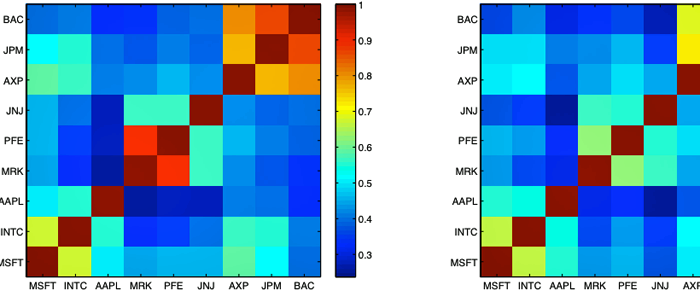
In this work linear canonical correlation analysis (LCCA) is generalized by applying a structured transform to the joint probability distribution of the considered pair of random vectors, i.e., a transformation of the joint probability measure defined on their joint observation space. This framework, called measure transformed canonical correlation analysis (MTCCA), applies LCCA to the data after transformation of the joint probability measure. We show that judicious choice of the transform leads to a modified canonical correlation analysis, which, in contrast to LCCA, is capable of detecting non-linear relationships between the considered pair of random vectors. Unlike kernel canonical correlation analysis, where the transformation is applied to the random vectors, in MTCCA the transformation is applied to their joint probability distribution. This results in performance advantages and reduced implementation complexity. The proposed approach is illustrated for graphical model selection in simulated data having non-linear dependencies, and for measuring long-term associations between companies traded in the NASDAQ and NYSE stock markets.
Koby Todros was born in Ashkelon, Israel, in 1974. He received his B.Sc., M.Sc., and Ph.D. degrees in electrical engineering at 2000, 2006, and 2011, respectively, from the Ben-Gurion University of the Negev. He is currently a post-doctoral fellow with the Department of Electrical Engineering and Computer Science, in the University of Michigan. His research interests include statistical signal processing and estimation theory with focus on association analysis, uniformly optimal estimation in the non-Bayesian theory, performance bounds for parameter estimation, blind source separation, and biomedical signal processing.
]]>
On Measure Transformed Canonical Correlation Analysis Dr. Koby Todros, University of Michigan 2:00pm Wednesday, 2 May 2012, ITE 325b In this work linear canonical correlation analysis (LCCA)...
http://www.csee.umbc.edu/2012/04/talk-todros-on-canonical-correlation-analysis-2pm-wed-52/
https://beta.my.umbc.edu/api/v0/pixel/news/14683/guest@my.umbc.edu/b816eb65a9fde4f69f08f899eba23a8b/api/pixel
graduate
news
research
talks
Computer Science and Electrical Engineering
https://beta.my.umbc.edu/groups/csee
https://assets3-beta.my.umbc.edu/system/shared/avatars/groups/000/000/099/d117dca133c64bf78a4b7696dd007189/xsmall.png?1314043393
https://assets1-beta.my.umbc.edu/system/shared/avatars/groups/000/000/099/d117dca133c64bf78a4b7696dd007189/original.png?1314043393
https://assets1-beta.my.umbc.edu/system/shared/avatars/groups/000/000/099/d117dca133c64bf78a4b7696dd007189/xxlarge.png?1314043393
https://assets4-beta.my.umbc.edu/system/shared/avatars/groups/000/000/099/d117dca133c64bf78a4b7696dd007189/xlarge.png?1314043393
https://assets3-beta.my.umbc.edu/system/shared/avatars/groups/000/000/099/d117dca133c64bf78a4b7696dd007189/large.png?1314043393
https://assets1-beta.my.umbc.edu/system/shared/avatars/groups/000/000/099/d117dca133c64bf78a4b7696dd007189/medium.png?1314043393
https://assets2-beta.my.umbc.edu/system/shared/avatars/groups/000/000/099/d117dca133c64bf78a4b7696dd007189/small.png?1314043393
https://assets3-beta.my.umbc.edu/system/shared/avatars/groups/000/000/099/d117dca133c64bf78a4b7696dd007189/xsmall.png?1314043393
https://assets3-beta.my.umbc.edu/system/shared/avatars/groups/000/000/099/d117dca133c64bf78a4b7696dd007189/xxsmall.png?1314043393
Computer Science and Electrical Engineering
1
0
true
Thu, 26 Apr 2012 14:44:21 -0400