Ph.D. Funding Opportunity - Fall 2025MODELING OF URBAN HYDROLOGIC SYSTEMS with Dr. Welty
Ph.D. Funding Opportunity:
MODELING OF URBAN HYDROLOGIC SYSTEMS
Description
The DOE-supported Baltimore Social-Environmental Collaborative (BSEC) Integrated Field Laboratory seeks applicants to the UMBC Ph.D. program in Environmental Engineering to carry out hydrologic modeling of urban groundwater-surface water systems at the watershed scale. A background in engineering or earth science that includes numerical analysis is required. Work will be carried out in collaboration with a multidisciplinary team of co-PIs across eight institutions, spanning earth science and engineering disciplines.
Benefits
The Ph.D. graduate assistantship appointment is through the Department of Chemical, Biochemical, and Environmental Engineering in affiliation with the Center for Urban Environmental Research and Education at UMBC. The Ph.D. graduate assistantship appointment includes a stipend plus tuition remission and health insurance.
Application
Interested applicants should contact Dr. Claire Welty with a statement of relevant background and career goals at weltyc@umbc.edu before applying to the program.
Application details
Deadline for Ph.D. programs: January 7
Application fee waivers: available by emailing cbeegrad@umbc.edu Contacting an potential advisor: Students interested in applying are welcome to reach out directly to the faculty members whose research aligns with your specific research interests. Applicants are not required to secure an advisor prior to applying to the program for Fall admission. Applicants should identify which faculty they would like to work with in your 'Statement of academic goals and research interests'
UMBC is an affirmative action/equal opportunity employer.
]]>
Ph.D. Funding Opportunity: MODELING OF URBAN HYDROLOGIC SYSTEMS Description The DOE-supported Baltimore Social-Environmental Collaborative (BSEC) Integrated Field Laboratory seeks applicants...https://beta.my.umbc.edu/api/v0/pixel/news/145928/guest@my.umbc.edu/1dfdc2d8e7d5f87422f22f8fca941b87/api/pixelassistantshipfall-2025fundingphdweltyChemical, Biochemical and Environmental Engineeringhttps://beta.my.umbc.edu/groups/cbeehttps://assets4-beta.my.umbc.edu/system/shared/avatars/groups/000/000/771/b5e579e81b2e3624611890fa3ca2716a/xsmall.png?1746794587https://assets2-beta.my.umbc.edu/system/shared/avatars/groups/000/000/771/b5e579e81b2e3624611890fa3ca2716a/original.png?1746794587https://assets1-beta.my.umbc.edu/system/shared/avatars/groups/000/000/771/b5e579e81b2e3624611890fa3ca2716a/xxlarge.png?1746794587https://assets2-beta.my.umbc.edu/system/shared/avatars/groups/000/000/771/b5e579e81b2e3624611890fa3ca2716a/xlarge.png?1746794587https://assets2-beta.my.umbc.edu/system/shared/avatars/groups/000/000/771/b5e579e81b2e3624611890fa3ca2716a/large.png?1746794587https://assets4-beta.my.umbc.edu/system/shared/avatars/groups/000/000/771/b5e579e81b2e3624611890fa3ca2716a/medium.png?1746794587https://assets1-beta.my.umbc.edu/system/shared/avatars/groups/000/000/771/b5e579e81b2e3624611890fa3ca2716a/small.png?1746794587https://assets4-beta.my.umbc.edu/system/shared/avatars/groups/000/000/771/b5e579e81b2e3624611890fa3ca2716a/xsmall.png?1746794587https://assets1-beta.my.umbc.edu/system/shared/avatars/groups/000/000/771/b5e579e81b2e3624611890fa3ca2716a/xxsmall.png?1746794587Chemical, Biochemical and Environmental Engineeringhttps://assets2-beta.my.umbc.edu/system/shared/thumbnails/news/000/145/928/324fd03958724e32847aa8b8e35b511f/xxlarge.jpg?1733164668https://assets2-beta.my.umbc.edu/system/shared/thumbnails/news/000/145/928/324fd03958724e32847aa8b8e35b511f/xlarge.jpg?1733164668https://assets1-beta.my.umbc.edu/system/shared/thumbnails/news/000/145/928/324fd03958724e32847aa8b8e35b511f/large.jpg?1733164668https://assets2-beta.my.umbc.edu/system/shared/thumbnails/news/000/145/928/324fd03958724e32847aa8b8e35b511f/medium.jpg?1733164668https://assets4-beta.my.umbc.edu/system/shared/thumbnails/news/000/145/928/324fd03958724e32847aa8b8e35b511f/small.jpg?1733164668https://assets4-beta.my.umbc.edu/system/shared/thumbnails/news/000/145/928/324fd03958724e32847aa8b8e35b511f/xsmall.jpg?1733164668https://assets1-beta.my.umbc.edu/system/shared/thumbnails/news/000/145/928/324fd03958724e32847aa8b8e35b511f/xxsmall.jpg?173316466800trueTue, 26 Nov 2024 14:24:03 -0500Mon, 02 Dec 2024 13:39:20 -0500UMBC air pollution researchers leapt into actionfrom UMBC NEWS
As summer wildfire smoke choked Baltimore, UMBC air pollution researchers leapt into action
Starting this May, a series of wildfires in Eastern Canada sent enormous smoke clouds wafting into the U.S., triggering air quality warnings in cities from the Midwest to the Northeast. For days, orange skies backdropped landscapes clouded by acrid air. People who could hunkered inside with the doors and windows shut. Those who had to go out faced itchy eyes, burning throats, and worse.
As a resident of the Baltimore area—which was blanketed with particularly bad smoke in both early and late June—UMBC Professor Chris Hennigan looked at the haze with dismay. But as an environmental engineer who studies air pollution, he had an additional thought: “We were looking at the air quality forecasts, and we thought ‘We have to gather data,’” he says.
The public found many colorful words to describe the summer’s unwanted smoke: brutal, eerie, dystopian.
Hennigan and his team have been working to put numbers to the adjectives. On the roof of the engineering building, the researchers installed a squat, white sensor that monitors the levels of tiny particles in the air, particularly those measuring 2.5 micrometers in diameter or less—smaller than most bacteria. Called PM2.5, these particles are released in large numbers during fires. They are dangerous to human health because they can work their way into the deepest parts of the lungs and even enter the bloodstream.
Chris Hennigan, Joel Tyson, Ph.D. ’23, and Luis Rodriguez ’25 (left to right) on the roof of the engineering building next to an air quality sensor. (Marlayna Demond ’11/UMBC)
The sensor showed huge spikes in PM2.5 when the smoke blew through, on some days reaching levels considered unhealthy for anyone to breathe.
The researchers also set up equipment to filter particles out of the air. After 24 hours, they collected the filters, which they are storing, neatly labeled, in a refrigerator in Hennigan’s lab.
Hennigan shows samples of smoke particles collected this summer. (Marlayna Demond ’11/UMBC)
The filtered samples will advance at least two ongoing investigations, Hennigan says. In one avenue of inquiry, Joel Tyson, Ph.D. ’23, biochemical engineering, is studying how tiny particles can harm human lung cells. Before this year’s smoky summer, Tyson had been studying the toxic effects of particulate matter normally found in the Baltimore air. With the new smoke samples, he will start to investigate whether wildfire smoke particles, per unit, are more toxic than regular urban particulate matter, which comes from sources such as cars and power plants. Some studies have indicated that wildfire particulate matter is indeed more toxic, but more research is needed before any definitive conclusions can be reached.
In another line of research, Hennigan is also studying how particles in the air, including from smoke, may affect the climate. Undergraduate chemical engineering students Danielle Larios ’25 and Luis Rodriguez ’25 are assisting in the investigations.
The researchers study how particles of brown-colored carbon-containing material absorb light. Burning vegetation sends large amounts of this brown carbon into the atmosphere. It’s possible that the particles are trapping significant heat from the sun, accelerating the pace of planetary warming. Such effects are not normally included in global climate models, and better understanding of the process could improve humanity’s ability to predict, and manage, the coming years of climate upheaval.
Rodriguez, Danielle Larios ’25 and Hennigan (left to right) discuss research in the lab. (Marlayna Demond ’11/UMBC)Hennigan and Tyson in the lab. (Marlayna Demond ’11/UMBC)
Climate change and wildfires are intimately linked. This summer was not only smoky, but also scorching. July marked the hottest month ever recorded, and scientists predict that as the world continues to warm, wildfires will continue to increase in quantity and intensity. “Smokeageddon,” as headlines put it, may become the new normal.
Hennigan says recent research illuminates how much wildfire smoke has contributed to air pollution trends. He points to a paper published in September in the scientific journal Nature that estimated that since 2016, wildfire smoke in the contiguous United States has undone around 25% of the progress in air quality made between 2000 and 2016.
For the researchers in Hennigan’s lab, those effects have been felt personally.
Rodriguez recalled how in June he had to go out to buy a fresh pack of N95 masks. “The smoke was just awful,” he says. Larios says she felt a burning at the back of her throat in just 15 minutes walking to her car.
For Tyson, the effects of the smoke were so bad that at one point he struggled to breathe and had to visit the doctor. The episode, he says, drove home the importance of his toxicology research.
All three note both the complexity of the systems they are studying and the importance of discovering new knowledge that might help society handle the environmental challenges it faces.
“Our work can have real-world impact, and that’s exciting,” says Larios.
]]>
As summer wildfire smoke choked Baltimore, UMBC air pollution researchers leapt into action By: Catherine Meyers | Published: Dec 7, 2023 | UMBC NEWS Starting this May, a series of...https://beta.my.umbc.edu/api/v0/pixel/news/137634/guest@my.umbc.edu/a05c2d461ebbba5380b8b9fbd01aa9c8/api/pixelfacultygradhennigannewsphdresearchugugradChemical, Biochemical and Environmental Engineeringhttps://beta.my.umbc.edu/groups/cbeehttps://assets4-beta.my.umbc.edu/system/shared/avatars/groups/000/000/771/b5e579e81b2e3624611890fa3ca2716a/xsmall.png?1746794587https://assets2-beta.my.umbc.edu/system/shared/avatars/groups/000/000/771/b5e579e81b2e3624611890fa3ca2716a/original.png?1746794587https://assets1-beta.my.umbc.edu/system/shared/avatars/groups/000/000/771/b5e579e81b2e3624611890fa3ca2716a/xxlarge.png?1746794587https://assets2-beta.my.umbc.edu/system/shared/avatars/groups/000/000/771/b5e579e81b2e3624611890fa3ca2716a/xlarge.png?1746794587https://assets2-beta.my.umbc.edu/system/shared/avatars/groups/000/000/771/b5e579e81b2e3624611890fa3ca2716a/large.png?1746794587https://assets4-beta.my.umbc.edu/system/shared/avatars/groups/000/000/771/b5e579e81b2e3624611890fa3ca2716a/medium.png?1746794587https://assets1-beta.my.umbc.edu/system/shared/avatars/groups/000/000/771/b5e579e81b2e3624611890fa3ca2716a/small.png?1746794587https://assets4-beta.my.umbc.edu/system/shared/avatars/groups/000/000/771/b5e579e81b2e3624611890fa3ca2716a/xsmall.png?1746794587https://assets1-beta.my.umbc.edu/system/shared/avatars/groups/000/000/771/b5e579e81b2e3624611890fa3ca2716a/xxsmall.png?1746794587Chemical, Biochemical and Environmental Engineeringhttps://assets1-beta.my.umbc.edu/system/shared/thumbnails/news/000/137/634/6b23f7999debbc216e1a292c3352b8b5/xxlarge.jpg?1702060952https://assets4-beta.my.umbc.edu/system/shared/thumbnails/news/000/137/634/6b23f7999debbc216e1a292c3352b8b5/xlarge.jpg?1702060952https://assets2-beta.my.umbc.edu/system/shared/thumbnails/news/000/137/634/6b23f7999debbc216e1a292c3352b8b5/large.jpg?1702060952https://assets1-beta.my.umbc.edu/system/shared/thumbnails/news/000/137/634/6b23f7999debbc216e1a292c3352b8b5/medium.jpg?1702060952https://assets4-beta.my.umbc.edu/system/shared/thumbnails/news/000/137/634/6b23f7999debbc216e1a292c3352b8b5/small.jpg?1702060952https://assets4-beta.my.umbc.edu/system/shared/thumbnails/news/000/137/634/6b23f7999debbc216e1a292c3352b8b5/xsmall.jpg?1702060952https://assets2-beta.my.umbc.edu/system/shared/thumbnails/news/000/137/634/6b23f7999debbc216e1a292c3352b8b5/xxsmall.jpg?170206095200trueFri, 08 Dec 2023 13:48:32 -0500Fri, 08 Dec 2023 14:18:12 -0500PHD GRADUATE ASSISTANTSHIP - Fall 2024MODELING OF URBAN HYDROLOGIC SYSTEMS
PHD GRADUATE ASSISTANTSHIP IN MODELING OF URBAN HYDROLOGIC SYSTEMS
Description
The DOE-supported Baltimore Social-Environmental Collaborative (BSEC) Integrated Field Laboratory seeks applicants to the UMBC Ph.D. program in Environmental Engineering to carry out hydrologic modeling of urban groundwater-surface water systems at the watershed scale. A background in engineering or earth science that includes numerical analysis is required. Work will be carried out in collaboration with a multidisciplinary team of co-PIs across eight institutions, spanning earth science and engineering disciplines.
Benefits
The Ph.D. graduate assistantship appointment is through the Department of Chemical, Biochemical, and Environmental Engineering in affiliation with the Center for Urban Environmental Research and Education at UMBC. The Ph.D. graduate assistantship appointment includes a stipend plus tuition remission and health insurance. The Fall 2024 PhD stipend is $38,766.19/year.
Application
Interested applicants should contact Dr. Claire Welty with a statement of relevant background and career goals at weltyc@umbc.edu before applying to the program. Complete applications are due on January 7, 2024 for consideration for admission to the graduate program for fall 2024. The link to application materials can be found here: https://cbee.umbc.edu/academics/graduate-application/. Review of applications will begin on January 7, 2024.
UMBC is an affirmative action/equal opportunity employer.
]]>
PHD GRADUATE ASSISTANTSHIP IN MODELING OF URBAN HYDROLOGIC SYSTEMS Description The DOE-supported Baltimore Social-Environmental Collaborative (BSEC) Integrated Field Laboratory seeks...Flyerhttps://assets3-beta.my.umbc.edu/system/shared/attachments/87cb381576e4537effc368e3d2ac5298/69e512a1/news/000/137/131/23374054b380f49d8a0ff440963ecf9b/2023.11.16_Welty-Assistantship Fall 2024.pdf?1700147460https://beta.my.umbc.edu/api/v0/pixel/news/137131/guest@my.umbc.edu/ecdd46fb954944103c8d19f1bb18def7/api/pixelassistantshipfall-2024fundingphdweltyChemical, Biochemical and Environmental Engineeringhttps://beta.my.umbc.edu/groups/cbeehttps://assets4-beta.my.umbc.edu/system/shared/avatars/groups/000/000/771/b5e579e81b2e3624611890fa3ca2716a/xsmall.png?1746794587https://assets2-beta.my.umbc.edu/system/shared/avatars/groups/000/000/771/b5e579e81b2e3624611890fa3ca2716a/original.png?1746794587https://assets1-beta.my.umbc.edu/system/shared/avatars/groups/000/000/771/b5e579e81b2e3624611890fa3ca2716a/xxlarge.png?1746794587https://assets2-beta.my.umbc.edu/system/shared/avatars/groups/000/000/771/b5e579e81b2e3624611890fa3ca2716a/xlarge.png?1746794587https://assets2-beta.my.umbc.edu/system/shared/avatars/groups/000/000/771/b5e579e81b2e3624611890fa3ca2716a/large.png?1746794587https://assets4-beta.my.umbc.edu/system/shared/avatars/groups/000/000/771/b5e579e81b2e3624611890fa3ca2716a/medium.png?1746794587https://assets1-beta.my.umbc.edu/system/shared/avatars/groups/000/000/771/b5e579e81b2e3624611890fa3ca2716a/small.png?1746794587https://assets4-beta.my.umbc.edu/system/shared/avatars/groups/000/000/771/b5e579e81b2e3624611890fa3ca2716a/xsmall.png?1746794587https://assets1-beta.my.umbc.edu/system/shared/avatars/groups/000/000/771/b5e579e81b2e3624611890fa3ca2716a/xxsmall.png?1746794587Chemical, Biochemical and Environmental Engineeringhttps://assets2-beta.my.umbc.edu/system/shared/thumbnails/news/000/137/131/25570cf7ea945fcf9207ec48a2fa84b7/xxlarge.jpg?1700147326https://assets1-beta.my.umbc.edu/system/shared/thumbnails/news/000/137/131/25570cf7ea945fcf9207ec48a2fa84b7/xlarge.jpg?1700147326https://assets4-beta.my.umbc.edu/system/shared/thumbnails/news/000/137/131/25570cf7ea945fcf9207ec48a2fa84b7/large.jpg?1700147326https://assets4-beta.my.umbc.edu/system/shared/thumbnails/news/000/137/131/25570cf7ea945fcf9207ec48a2fa84b7/medium.jpg?1700147326https://assets3-beta.my.umbc.edu/system/shared/thumbnails/news/000/137/131/25570cf7ea945fcf9207ec48a2fa84b7/small.jpg?1700147326https://assets3-beta.my.umbc.edu/system/shared/thumbnails/news/000/137/131/25570cf7ea945fcf9207ec48a2fa84b7/xsmall.jpg?1700147326https://assets2-beta.my.umbc.edu/system/shared/thumbnails/news/000/137/131/25570cf7ea945fcf9207ec48a2fa84b7/xxsmall.jpg?170014732600trueThu, 16 Nov 2023 10:10:16 -0500Fri, 18 Oct 2024 13:50:57 -0400Meet a CBEE-er: Kelsey GrayPh.D. Student in Chemical and Biochemical Engineering
Meet a CBEE-er! Kelsey Gray is a Ph.D. Student in Chemical and Biochemical Engineering at UMBC. Hear about why he chose UMBC, what research he's working on, and what he loves about the chemical and biochemical engineering program at UMBC!
“When I visited this place it felt like home. The support, the way I was welcomed, I knew I had to be here.” -- Kelsey Gray, Ph.D. student, Chemical and Biochemical Engineering
To learn more about Graduate Programs in UMBC's Department of Chemical, Biochemical, and Environmental Engineering, visit us at: https://cbee.umbc.edu/grad/
]]>
Meet a CBEE-er! Kelsey Gray is a Ph.D. Student in Chemical and Biochemical Engineering at UMBC. Hear about why he chose UMBC, what research he's working on, and what he loves about the chemical...https://beta.my.umbc.edu/api/v0/pixel/news/137034/guest@my.umbc.edu/ce2a2502cd844dca24174241ac6b9cd3/api/pixelcbee-erfall-2023gradmartenphdreserachChemical, Biochemical and Environmental Engineeringhttps://beta.my.umbc.edu/groups/cbeehttps://assets4-beta.my.umbc.edu/system/shared/avatars/groups/000/000/771/b5e579e81b2e3624611890fa3ca2716a/xsmall.png?1746794587https://assets2-beta.my.umbc.edu/system/shared/avatars/groups/000/000/771/b5e579e81b2e3624611890fa3ca2716a/original.png?1746794587https://assets1-beta.my.umbc.edu/system/shared/avatars/groups/000/000/771/b5e579e81b2e3624611890fa3ca2716a/xxlarge.png?1746794587https://assets2-beta.my.umbc.edu/system/shared/avatars/groups/000/000/771/b5e579e81b2e3624611890fa3ca2716a/xlarge.png?1746794587https://assets2-beta.my.umbc.edu/system/shared/avatars/groups/000/000/771/b5e579e81b2e3624611890fa3ca2716a/large.png?1746794587https://assets4-beta.my.umbc.edu/system/shared/avatars/groups/000/000/771/b5e579e81b2e3624611890fa3ca2716a/medium.png?1746794587https://assets1-beta.my.umbc.edu/system/shared/avatars/groups/000/000/771/b5e579e81b2e3624611890fa3ca2716a/small.png?1746794587https://assets4-beta.my.umbc.edu/system/shared/avatars/groups/000/000/771/b5e579e81b2e3624611890fa3ca2716a/xsmall.png?1746794587https://assets1-beta.my.umbc.edu/system/shared/avatars/groups/000/000/771/b5e579e81b2e3624611890fa3ca2716a/xxsmall.png?1746794587Chemical, Biochemical and Environmental Engineeringhttps://assets2-beta.my.umbc.edu/system/shared/thumbnails/news/000/137/034/0a772e8cc7cb2516f6c79b1be1a44e9e/xxlarge.jpg?1699900969https://assets4-beta.my.umbc.edu/system/shared/thumbnails/news/000/137/034/0a772e8cc7cb2516f6c79b1be1a44e9e/xlarge.jpg?1699900969https://assets4-beta.my.umbc.edu/system/shared/thumbnails/news/000/137/034/0a772e8cc7cb2516f6c79b1be1a44e9e/large.jpg?1699900969https://assets2-beta.my.umbc.edu/system/shared/thumbnails/news/000/137/034/0a772e8cc7cb2516f6c79b1be1a44e9e/medium.jpg?1699900969https://assets4-beta.my.umbc.edu/system/shared/thumbnails/news/000/137/034/0a772e8cc7cb2516f6c79b1be1a44e9e/small.jpg?1699900969https://assets3-beta.my.umbc.edu/system/shared/thumbnails/news/000/137/034/0a772e8cc7cb2516f6c79b1be1a44e9e/xsmall.jpg?1699900969https://assets1-beta.my.umbc.edu/system/shared/thumbnails/news/000/137/034/0a772e8cc7cb2516f6c79b1be1a44e9e/xxsmall.jpg?169990096900trueMon, 13 Nov 2023 13:41:05 -0500Mon, 13 Nov 2023 13:45:20 -0500Students discover the beauty of mold and mentorship
Students discover the beauty of mold and mentorship in Mark Marten’s UMBC lab
Mold on your bread or bathroom tiles can be a nuisance. Mold in a scientific lab can be a marvel.
Up close, the growth of mold becomes living artwork—white, feathery shoots morphing into undulating waves of color. And molds can be amazingly useful.
“They are used to ferment food, make laundry detergent enzymes, and help produce pharmaceuticals,” explains Garrett Hill ’24, biochemistry and molecular biology, who has been working with molds in the research lab of UMBC chemical engineering professor Mark Marten for more than four years. “It’s surprising how ubiquitous they are in industry.”
Molds (along with mushrooms) belong to a group of organisms more technically known as filamentous fungi. One of the oldest and largest living organisms in the world is a filamentous fungus, nicknamed the “Humongous Fungus,” that has likely been spreading across the Blue Mountains in eastern Oregon for more than 2,000 years, and has come to occupy an area of more than 2,000 acres.
The Humongous Fungus grew (and grew) through an enormous network of interconnected thread-like structures called hyphae that gather and share vital nutrients.
Networks—of a different sort—are also vitally important to the students studying fungi in Marten’s lab. Lab members, from high schoolers to Ph.D. students, work together on projects. Marten offers advice not only on research questions, but also on skills such as communication. Support flows in from the university, in the form of research awards, scholar programs, and more. It’s tied together with a simple philosophy that helps everyone flourish: “Mentorship is the magic ingredient,” Marten says.
High school research leads to UMBC
Hill found his way to Marten’s lab through a program in nearby Howard County Public Schools called the Biotechnology Career Academy. As part of the program, he earned credit for conducting research in the lab. After high school graduation, he enrolled at UMBC and has continued his work in Marten’s lab every year since.
“UMBC has a culture that emphasizes supporting students,” says Hill. “This was something that initially attracted me to the school, and something that I’ve absolutely experienced during my time here.”
In Marten’s lab, Hill has been working on research that investigates how a fungus called Aspergillus nidulans repairs damaged cell walls. Armed with a better understanding of the complicated cascade of biochemical reactions triggered when the fungal cell wall is damaged, scientists could possibly manipulate the process to use molds more effectively (or in the case of harmful molds, eradicate them more effectively.)
To untangle the hidden and complicated inner workings of the fungus, the researchers deploy an arsenal of analytical tools and methods.
“When I started in the lab, I spent a lot of time learning the background and standard lab techniques,” Hill says. “But now that I’ve had a few years to acclimate, I have the foundation to support my own project.”
As part of that project, Hill has been investigating how to use the Nobel Prize-winning gene editing tool called CRISPR to create fungal cells with inner elements that light up. The light provides a beacon for researchers to track how those elements move as the cell experiences stress or initiates repairs.
“The sense of project ownership has been one of the most rewarding parts of my research experience,” Hill says. “When my graduate mentor and I first discussed the possibility of leading my own project, I had a brief moment of doubt. But I chose to not listen to that voice.”
Networks nourish growth
Hill says he was attracted to the beauty and power of science from a young age, even though no one in his family had a scientific career. UMBC has provided the resources and counsel to help him chart his path.
Within Marten’s lab, Hill says more experienced researchers were always willing to help. When Hill first joined as a high schooler, fellow lab member Ryland Spence ’19, biological sciences, who is now a medical student at Brown University, trained him on techniques.
“Mentorship has been so important for me, so I am always happy to provide mentorship to others whenever I get the chance,” Spence says. “A supportive environment that values diversity is very much a part of UMBC.”
Marten himself also provided enormous guidance and support. “Dr. Marten has been the strongest mentor I’ve had, helping me even before I came to UMBC,” Hill says. “He’s taught me not only about fungus, but also about how to think like a researcher, how to present research, and how to be a good student.”
University-wide programs provided Hill with additional research support. He was awarded multiple Undergraduate Research Awards (URAs), which provide financial assistance for research projects and opportunities to practice skills such as presenting research.
Hill is also part of the nationally renowned Meyerhoff Scholar Program, which seeks to increase diversity among future leaders in science, technology, engineering, and mathematics by supporting students who intend to pursue a Ph.D. or combined M.D./Ph.D. in STEM and are interested in the advancement of minorities in those fields.
“A lot of my best friends are from the program,” says Hill. “It’s been great to have that community.”
Now that he is applying to graduate schools, Hill says the Meyerhoff program provides detailed guidance through the process. “They have been an invaluable resource, and a rock really. They make sure I know what I need to do now to ensure I have opportunities in the future.”
A closing chapter and a new beginning
As the fall semester of his senior year kicks off, Hill says that he’s feeling confident and excited.
“I find myself frequently looking back on how I felt on my first day in the lab, during my first lab meeting presentation, or during my first day of classes, and realizing how much I’ve grown these past few years,” he says. “What once used to really shake me, I am now able to do with confidence—that tells me a lot about what I’ve gained from my research experience.”
As Hill gears up for grad school, he is passing the baton to other UMBC students like Matthew Quintanilla ’27, chemical engineering, a first-year student whose journey shares many similarities with Hill’s. The first in his family to pursue a scientific career, Quintanilla also started work in Marten’s lab as a high-schooler and decided to enroll at UMBC. In Marten’s lab, Quintanilla is working with Ph.D. student Alex Doan, who attended the same high school and embraced the opportunity to mentor fellow students.
“It’s been great catching up on high school news, but more importantly helping students grow,” says Doan.
Quintanilla is also a URA-recipient and Meyerhoff Scholar, and says he is excited for the new school year.
“I am eager to start my academic career at UMBC, meet many others, and integrate my knowledge from courses into my lab work,” he says.
“Matthew and Garrett are both really talented individuals,” says Marten. “Having them in the lab has been a win-win situation.”
April Householder ’95, the director of undergraduate research and prestigious scholarships at UMBC, looks at Marten’s lab as a microcosm of the vibrant UMBC research environment. “These two students—Garrett and Matthew—represent two ends of the research spectrum. One is just getting started, and the other is a four-time URA Scholar,” she says.
“The support these students receive from the mentorship in their lab is invaluable, but also as important is the peer-to-peer support they will get from one another. It’s this type of academic community building that gets student researchers excited about being a part of UMBC.”
PHOTO CREDIT: Matthew Quintanilla (left), Garrett Hill (center) and Mark Marten (right) in the lab. (Marlayna Demond '11/UMBC)
]]>
Students discover the beauty of mold and mentorship in Mark Marten’s UMBC lab By: Catherine Meyers | UMBC NEWS | Published: Sep 22, 2023 Excerpt from...https://beta.my.umbc.edu/api/v0/pixel/news/136897/guest@my.umbc.edu/cf052004f11598478e03acc65426b2a9/api/pixelfall-2023gradmartenphdugugradChemical, Biochemical and Environmental Engineeringhttps://beta.my.umbc.edu/groups/cbeehttps://assets4-beta.my.umbc.edu/system/shared/avatars/groups/000/000/771/b5e579e81b2e3624611890fa3ca2716a/xsmall.png?1746794587https://assets2-beta.my.umbc.edu/system/shared/avatars/groups/000/000/771/b5e579e81b2e3624611890fa3ca2716a/original.png?1746794587https://assets1-beta.my.umbc.edu/system/shared/avatars/groups/000/000/771/b5e579e81b2e3624611890fa3ca2716a/xxlarge.png?1746794587https://assets2-beta.my.umbc.edu/system/shared/avatars/groups/000/000/771/b5e579e81b2e3624611890fa3ca2716a/xlarge.png?1746794587https://assets2-beta.my.umbc.edu/system/shared/avatars/groups/000/000/771/b5e579e81b2e3624611890fa3ca2716a/large.png?1746794587https://assets4-beta.my.umbc.edu/system/shared/avatars/groups/000/000/771/b5e579e81b2e3624611890fa3ca2716a/medium.png?1746794587https://assets1-beta.my.umbc.edu/system/shared/avatars/groups/000/000/771/b5e579e81b2e3624611890fa3ca2716a/small.png?1746794587https://assets4-beta.my.umbc.edu/system/shared/avatars/groups/000/000/771/b5e579e81b2e3624611890fa3ca2716a/xsmall.png?1746794587https://assets1-beta.my.umbc.edu/system/shared/avatars/groups/000/000/771/b5e579e81b2e3624611890fa3ca2716a/xxsmall.png?1746794587Chemical, Biochemical and Environmental Engineeringhttps://assets1-beta.my.umbc.edu/system/shared/thumbnails/news/000/136/897/25eb23f44e344a9318a659692e8e407e/xxlarge.jpg?1699383016https://assets3-beta.my.umbc.edu/system/shared/thumbnails/news/000/136/897/25eb23f44e344a9318a659692e8e407e/xlarge.jpg?1699383016https://assets2-beta.my.umbc.edu/system/shared/thumbnails/news/000/136/897/25eb23f44e344a9318a659692e8e407e/large.jpg?1699383016https://assets1-beta.my.umbc.edu/system/shared/thumbnails/news/000/136/897/25eb23f44e344a9318a659692e8e407e/medium.jpg?1699383016https://assets4-beta.my.umbc.edu/system/shared/thumbnails/news/000/136/897/25eb23f44e344a9318a659692e8e407e/small.jpg?1699383016https://assets4-beta.my.umbc.edu/system/shared/thumbnails/news/000/136/897/25eb23f44e344a9318a659692e8e407e/xsmall.jpg?1699383016https://assets3-beta.my.umbc.edu/system/shared/thumbnails/news/000/136/897/25eb23f44e344a9318a659692e8e407e/xxsmall.jpg?169938301600trueTue, 07 Nov 2023 13:53:45 -0500Tue, 07 Nov 2023 14:00:26 -0500Available Ph.D. Positions at UMBCDr. Capraz - AMEE LabJob Description: We are looking for a motivated student who can start ASAP or in 2024 in the Department of Chemical, Biochemical and Environmental Engineering at the University of Maryland - Baltimore County (UMBC). Ph.D. students will work on the investigation of interfacial properties of Na-ion cathodes in collaboration with Dr. Noked from Bar-Ilan University. The project is funded by NSF-BSF project. Detailed project descriptions and planning will be undertaken directly with the successful candidates. Students with Chemical Engineering, Mechanical Engineering, Materials Science, Chemistry or Physics background are encouraged to apply.
Our Offer: The student will develop exceptional skills and expertise in the areas of electrochemistry, defect chemistry, mechanics of materials, and material fabrication during his/her/their studies. The student will learn operando techniques to monitor stress /strain evolution in the cathode materials. The selected candidate will present their work at international conferences such as AlCHE and ECS. The student will also have opportunities to closely work with scientists at Pacific Northwest National Laboratory, Argonne National Laboratory and Bar-Ilan University.
About Our Group: Advanced Materials & Electrochemistry for Energy (AMEE) Research Group is established by Prof. Özgür Çapraz and is recently relocated to Chemical, Biochemical and Environmental Engineering in the University of Maryland Baltimore County. The group has been funded by various agencies such as NSF, DOE, NASA, Air Force, and BSF. Students in our group has published in high impact factor journals such as Advanced Energy Materials, Nano Letters and J. Power Sources. The group alumni are currently working as either scientists in National Laboratories or engineers in battery companies. For more information about the group, please visit, www.ameelab.com.
About the University: University of Maryland, Baltimore County (UMBC) is a top-ranked university with an inclusive culture that connects innovative teaching and learning, research across disciplines, and civic engagement. The university is located in the suburb of vibrant Baltimore city. The location offers direct access to wonderful outdoor activities (beaches, mountains, forest and state parks), museums in DC - Baltimore area and international airports. Also, it is close to government agencies and industrial companies.
How to Apply: Interested candidates are encouraged to send their CV, transcript and a short cover letter to capraz@umbc.edu with the title of “Application to PhD position in AMEE Lab”.
]]>
Job Description: We are looking for a motivated student who can start ASAP or in 2024 in the Department of Chemical, Biochemical and Environmental Engineering at the University of Maryland -...https://beta.my.umbc.edu/api/v0/pixel/news/134824/guest@my.umbc.edu/5c382f9cde5cefe077968ad5c23d3fe8/api/pixelcaprazfall-2023gradphdChemical, Biochemical and Environmental Engineeringhttps://beta.my.umbc.edu/groups/cbeehttps://assets4-beta.my.umbc.edu/system/shared/avatars/groups/000/000/771/b5e579e81b2e3624611890fa3ca2716a/xsmall.png?1746794587https://assets2-beta.my.umbc.edu/system/shared/avatars/groups/000/000/771/b5e579e81b2e3624611890fa3ca2716a/original.png?1746794587https://assets1-beta.my.umbc.edu/system/shared/avatars/groups/000/000/771/b5e579e81b2e3624611890fa3ca2716a/xxlarge.png?1746794587https://assets2-beta.my.umbc.edu/system/shared/avatars/groups/000/000/771/b5e579e81b2e3624611890fa3ca2716a/xlarge.png?1746794587https://assets2-beta.my.umbc.edu/system/shared/avatars/groups/000/000/771/b5e579e81b2e3624611890fa3ca2716a/large.png?1746794587https://assets4-beta.my.umbc.edu/system/shared/avatars/groups/000/000/771/b5e579e81b2e3624611890fa3ca2716a/medium.png?1746794587https://assets1-beta.my.umbc.edu/system/shared/avatars/groups/000/000/771/b5e579e81b2e3624611890fa3ca2716a/small.png?1746794587https://assets4-beta.my.umbc.edu/system/shared/avatars/groups/000/000/771/b5e579e81b2e3624611890fa3ca2716a/xsmall.png?1746794587https://assets1-beta.my.umbc.edu/system/shared/avatars/groups/000/000/771/b5e579e81b2e3624611890fa3ca2716a/xxsmall.png?1746794587Chemical, Biochemical and Environmental Engineeringhttps://assets4-beta.my.umbc.edu/system/shared/thumbnails/news/000/134/824/3e192389b58087a6ea4731249315c9ee/xxlarge.jpg?1692983693https://assets1-beta.my.umbc.edu/system/shared/thumbnails/news/000/134/824/3e192389b58087a6ea4731249315c9ee/xlarge.jpg?1692983693https://assets1-beta.my.umbc.edu/system/shared/thumbnails/news/000/134/824/3e192389b58087a6ea4731249315c9ee/large.jpg?1692983693https://assets1-beta.my.umbc.edu/system/shared/thumbnails/news/000/134/824/3e192389b58087a6ea4731249315c9ee/medium.jpg?1692983693https://assets3-beta.my.umbc.edu/system/shared/thumbnails/news/000/134/824/3e192389b58087a6ea4731249315c9ee/small.jpg?1692983693https://assets1-beta.my.umbc.edu/system/shared/thumbnails/news/000/134/824/3e192389b58087a6ea4731249315c9ee/xsmall.jpg?1692983693https://assets4-beta.my.umbc.edu/system/shared/thumbnails/news/000/134/824/3e192389b58087a6ea4731249315c9ee/xxsmall.jpg?169298369310trueFri, 25 Aug 2023 13:15:21 -0400Fri, 25 Aug 2023 13:51:48 -0400Meet a CBEE-er: Meet Samiha SharlinPh.D. student, chemical and biochemical engineering
by: Arya Honraopatil
Meet Samiha Sharlin.
Samiha Sharlin is a chemical and biochemical engineering doctoral student in the department of Chemical, Biochemical and Environmental Engineering. Samiha received her B.S. in Chemical Engineering from Bangladesh University of Engineering and Technology (BUET) in 2017. She is now pursuing her Ph.D. in the ATOMS Lab under the supervision of Prof. Tyler Josephson, where her research focuses on enhancing simulation methods for adsorption in porous materials using machine learning. In her free time, she enjoys exploring nature and tuning in to spiritual podcasts.
Tell us about your path to UMBC.
After completing my engineering degree, I entered the workforce and found myself in a job not aligned with my academic background. Despite being promised a research-oriented position, I ended up in Supply Chain Management, which left me feeling unfulfilled and disconnected from my passion for research and engineering. Additionally, the majority of the industry jobs I desired were located in unsafe areas on the outskirts of the country, creating further challenges and concerns. These experiences sparked a profound realization that I wanted to be in academics and continue my studies.
In my search for the right institution, I sought recommendations from trusted sources, and one of my friends from undergrad school spoke highly about her experiences at UMBC. As I researched colleges in the USA, UMBC consistently stood out to me as an inclusive and supportive community. UMBC has not only provided me with a platform to explore and grow academically but has also offered a supportive and inspiring community that has truly enriched my journey.
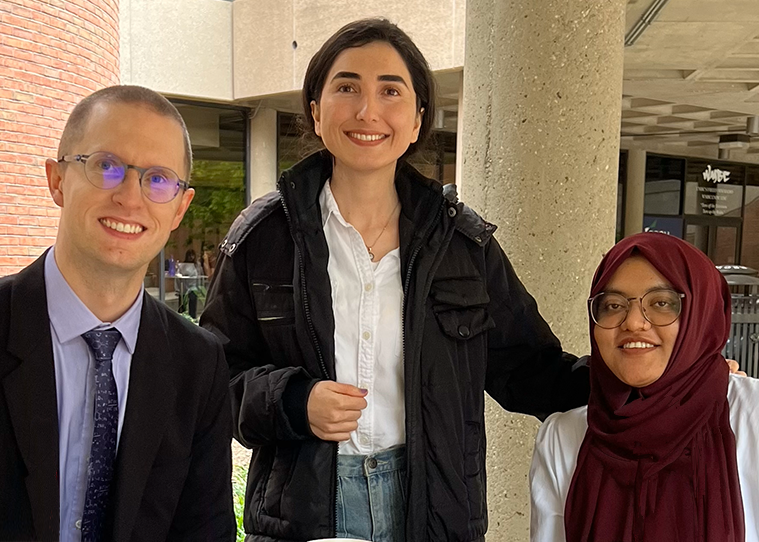
left to right: Dr. Josephson, Parivash Feyzishendi & Samiha Sharlin outside of UMBC's University Center in Spring/Summer 2023. Photo Credit: Sharlin Sharlin
What do you love about CBEE?
"Prioritize people over projects” - I have always believed in this! And especially in graduate school, the journey can be long, and being in a supportive environment is crucial. At CBEE, I've found the best of both worlds – a community that values individuals and fosters meaningful projects. The warmth and close-knit community in this department is truly special. You instantly feel connected with the professors, and they genuinely listen and value your input.
Let me share a heartwarming incident that illustrates this point - When I first arrived, I had come in quite late - just one day before classes began. Unfortunately, I missed orientation and also hadn't registered for classes. I wasn’t sure if I could attend classes without registration which resulted in me missing my first class. However, when Dr. Raikar saw me wandering in the department hallway, she already knew my name and warmly approached me. To my surprise and delight, she graciously shared the notes for the class I had missed without hesitation. It made me feel incredibly welcomed and supported right from the start. This kind of caring and personal attention has been a consistent experience throughout my time at CBEE, and it has deepened my appreciation for this wonderful community.
What do you love about your academic program?
One of the things that sets CBEE apart is its unique combination of biochemical, chemical, and environmental disciplines within the same department, which is a rarity among engineering programs. This was especially beneficial for me because I was uncertain about which track to pursue for graduate school. CBEE offered the opportunity to do rotations, allowing me to explore different options before committing to a specific research direction. As an international student, it was challenging to visit labs beforehand, and CBEE's approach gave me the freedom to make an informed decision.
Another invaluable aspect of CBEE is its mentor-mentee program, through which I had the privilege of connecting with Maisha, a UMBC alumnus now who was also an international student from Bangladesh. Maisha’s support and guidance were exceptional – she assisted me not only in academic matters but also in various smaller details I was unfamiliar with, including documentation and personal chores. Her willingness to help and incredible support made my transition to UMBC and the graduate program much smoother. The sense of camaraderie and support within CBEE truly made all the difference in my graduate school experience.
Additionally, CBEE also places emphasis on networking to cultivate strong professional connections and provides us with opportunities to meet alumni and industry professionals through career development events throughout the academic year. My advisor has also consistently encouraged me to attend conferences, allowing me to network with leaders in my field of research while also presenting my work. Last year, I had the opportunity to present at an AIChE conference in Phoenix, and this summer, I participated in a week-long program at the Micron School of Materials Science and Engineering at Boise State University to learn the applications of quantum chemistry. Through this, I have had the privilege of getting to know many talented individuals in my discipline who are working on exciting research projects. I always come away from these experiences with meaningful connections and inspiring ideas that drive me to work harder and approach my projects in creative ways.
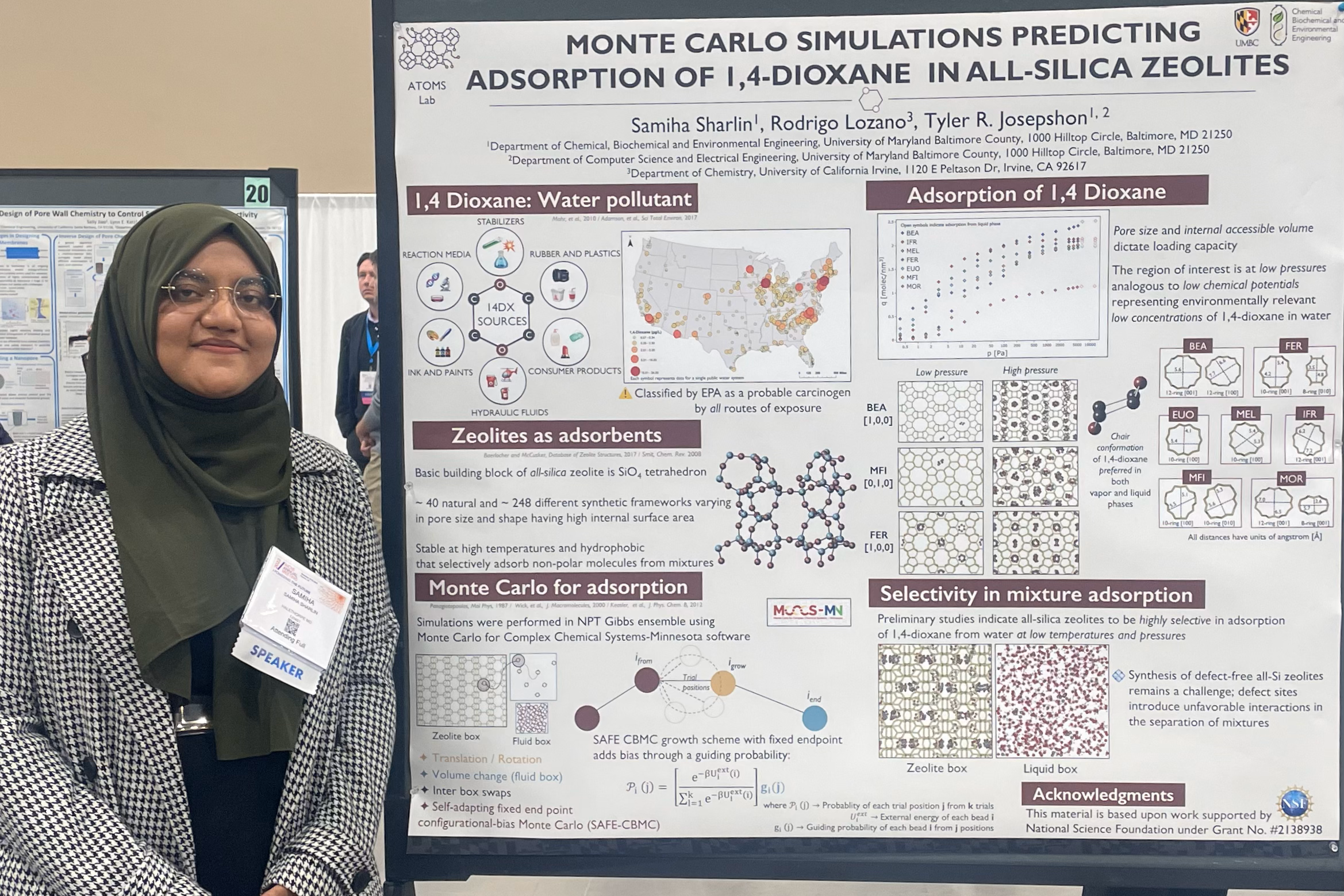
Samiha Sharlin standing beside her poster at the 2022 AICHE Annual Meeting in Phoenix, Arizona. The poster is titled MONTE CARLO SIMULATIONS PREDICTING ADSORPTION OF 1,4-DIOXANE IN ALL-SILICA ZEOLITES. Photo Credit: Samiha Sharlin
Tell us about someone in the department who has inspired you or supported you & how did they do it?
Andrea [Miller, Graduate Program Coordinator] has been an incredible support throughout my time at CBEE. With her, I never hesitate to seek advice or ask questions because she creates a comfortable and open atmosphere. Despite usually struggling to ask for help, I've never felt that hesitation in her presence.
Dr. Leach, as the Graduate Program Director, was also a significant source of support for me during the lab rotations. And, of course, I can't speak highly enough about my advisor, Dr. Josephson. He has consistently gone above and beyond to understand and assist me, particularly considering the challenges of being a first-gen international student. In fact, the entire department has been incredibly supportive, and I've always felt their genuine dedication to helping students succeed.
What’s the one thing you’d want someone who hasn’t joined the UMBC community to know about the support you find here?
As I've emphasized earlier, the people you surround yourself with are of utmost importance. At CBEE, you'll discover an environment that is truly conducive to learning and growth - supporting you academically, professionally, and personally. UMBC also offers a wide range of student organizations that cater to diverse student interests. UMBC MSA (Muslim Student Association) has given me a sense of belonging and comfort that I did not expect to find in college. I am grateful for the wonderful people I have met through them and the positive and uplifting atmosphere they foster.
What would you tell others who are in your shoes at UMBC?
After coming here, I felt like I was in a race at first, and I couldn't help but feel that I was falling behind in every aspect of life. However, as I looked around and saw the diverse backgrounds and unique stories of everyone, I had a deep realization and learned to make peace with my timeline and embrace the individuality of my path. Now, this experience has transformed into a truly rewarding journey.
Embarking on this adventure of pursuing my dreams in a foreign land, far away from my family and friends, was a daunting decision. Yet, with time, I discovered my way and something truly special: a new family of friends who have made this journey far more meaningful and fulfilling!
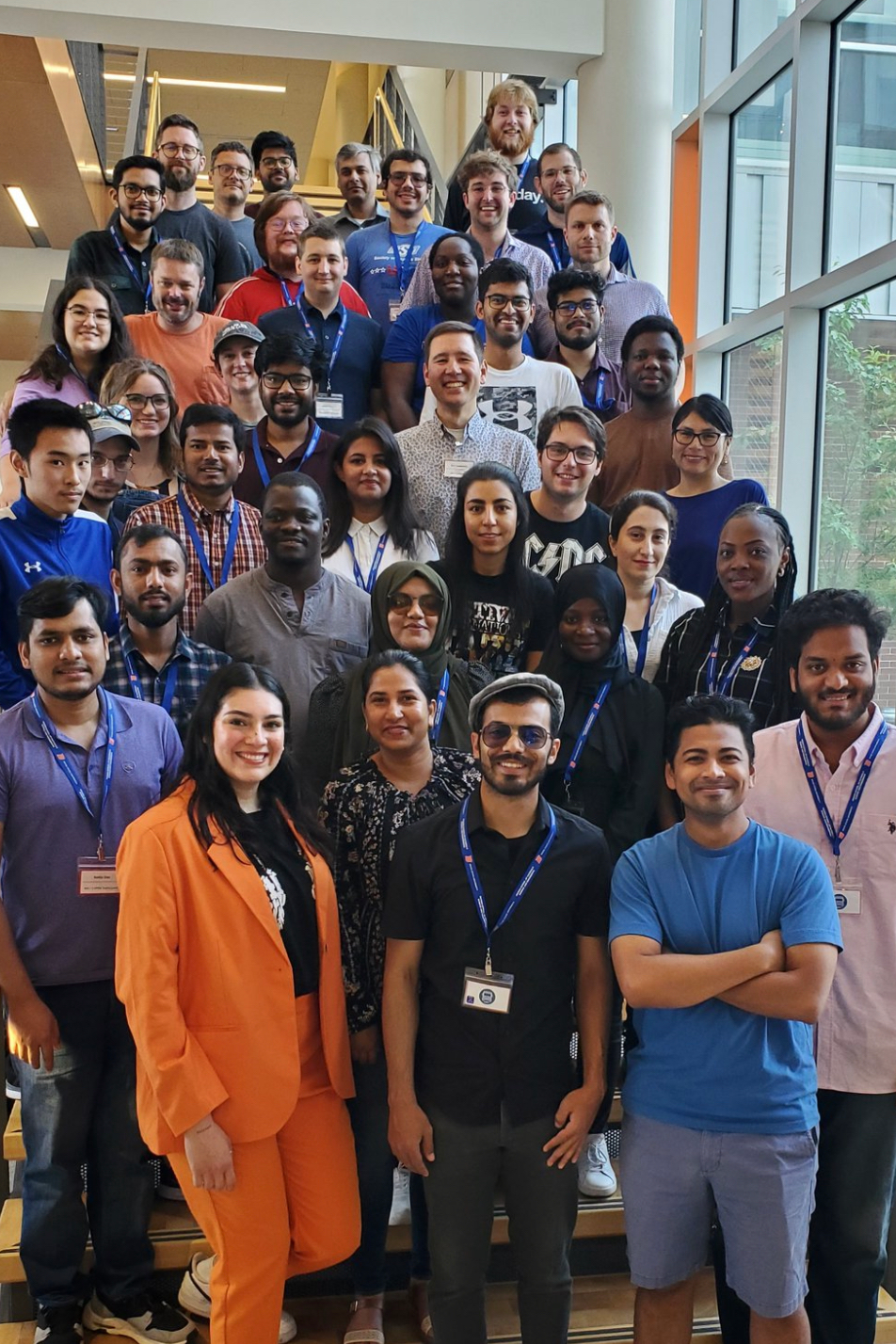
The 2023 participants for the I-COMSE workshop on Fundamentals and Applications of Density Functional Theory at the Micron School of Materials Science and Engineering at Boise State University. Photo provided by Samiha Sharlin.
]]>
by: Arya Honraopatil Meet Samiha Sharlin. Samiha Sharlin is a chemical and biochemical engineering doctoral student in the department of Chemical, Biochemical and Environmental Engineering....https://beta.my.umbc.edu/api/v0/pixel/news/134758/guest@my.umbc.edu/0723abda75e8b928f7c0bc1358c1703b/api/pixelcbee-erfall-2023gradjosephsonphdChemical, Biochemical and Environmental Engineeringhttps://beta.my.umbc.edu/groups/cbeehttps://assets4-beta.my.umbc.edu/system/shared/avatars/groups/000/000/771/b5e579e81b2e3624611890fa3ca2716a/xsmall.png?1746794587https://assets2-beta.my.umbc.edu/system/shared/avatars/groups/000/000/771/b5e579e81b2e3624611890fa3ca2716a/original.png?1746794587https://assets1-beta.my.umbc.edu/system/shared/avatars/groups/000/000/771/b5e579e81b2e3624611890fa3ca2716a/xxlarge.png?1746794587https://assets2-beta.my.umbc.edu/system/shared/avatars/groups/000/000/771/b5e579e81b2e3624611890fa3ca2716a/xlarge.png?1746794587https://assets2-beta.my.umbc.edu/system/shared/avatars/groups/000/000/771/b5e579e81b2e3624611890fa3ca2716a/large.png?1746794587https://assets4-beta.my.umbc.edu/system/shared/avatars/groups/000/000/771/b5e579e81b2e3624611890fa3ca2716a/medium.png?1746794587https://assets1-beta.my.umbc.edu/system/shared/avatars/groups/000/000/771/b5e579e81b2e3624611890fa3ca2716a/small.png?1746794587https://assets4-beta.my.umbc.edu/system/shared/avatars/groups/000/000/771/b5e579e81b2e3624611890fa3ca2716a/xsmall.png?1746794587https://assets1-beta.my.umbc.edu/system/shared/avatars/groups/000/000/771/b5e579e81b2e3624611890fa3ca2716a/xxsmall.png?1746794587Chemical, Biochemical and Environmental Engineeringhttps://assets2-beta.my.umbc.edu/system/shared/thumbnails/news/000/134/758/eaac6118ca92f37eac1a30cb0427378b/xxlarge.jpg?1692301891https://assets1-beta.my.umbc.edu/system/shared/thumbnails/news/000/134/758/eaac6118ca92f37eac1a30cb0427378b/xlarge.jpg?1692301891https://assets3-beta.my.umbc.edu/system/shared/thumbnails/news/000/134/758/eaac6118ca92f37eac1a30cb0427378b/large.jpg?1692301891https://assets2-beta.my.umbc.edu/system/shared/thumbnails/news/000/134/758/eaac6118ca92f37eac1a30cb0427378b/medium.jpg?1692301891https://assets4-beta.my.umbc.edu/system/shared/thumbnails/news/000/134/758/eaac6118ca92f37eac1a30cb0427378b/small.jpg?1692301891https://assets3-beta.my.umbc.edu/system/shared/thumbnails/news/000/134/758/eaac6118ca92f37eac1a30cb0427378b/xsmall.jpg?1692301891https://assets1-beta.my.umbc.edu/system/shared/thumbnails/news/000/134/758/eaac6118ca92f37eac1a30cb0427378b/xxsmall.jpg?169230189120trueThu, 17 Aug 2023 16:12:28 -0400Thu, 09 Nov 2023 13:28:38 -0500Summer 2022 Doctoral Internship: GenentechRevati Kadolkar, Ph.D. student,
Revati Kadolkar, doctoral student in chemical and biochemical engineering
When was your internship?
Summer 2022
Where was your internship?
Genentech at Hillsboro Individualized Therapies in Hillsboro, Oregon
What is the focus of your research/internship?
Technology transfer of purification processes for cell and gene therapies. Revati performed technical evaluations of various chromatography and filtration methods through experiment planning, data collection & analysis.
Revati was one of the winners for the Intern Project Showcase at Genentech + Roche.
A total of 10 winners were selected amongst 300 interns in four different categories (research, operations, commercial, business, etc.) through a voting process across all locations in the US. She received first prize in the 'Operations and Quality' category, and was rewarded with a cash prize.
All participants were required to make a poster and a presentation, along with a short video for explaining the experiments and our overall experience during the 3-day event.
What advice do you have for students who are interested in getting involved in research or an internship?
While it's very tough to crack an internship or a job, I do recommend not settling on the work profile that you receive. When you find what you love to do, most of the professional growth follows evidently.
Are you a member of any clubs/campus organizations?
Vice President of CBEE GSO.
What are your goals after graduation?
Work as a purification development scientist (downstream processing) in industry.
]]>
Revati Kadolkar, doctoral student in chemical and biochemical engineering When was your internship? Summer 2022 Where was your internship? Genentech at Hillsboro Individualized Therapies...https://beta.my.umbc.edu/api/v0/pixel/news/128127/guest@my.umbc.edu/1f5b0816930890312e1fc3ffda03fa7c/api/pixelinternshipphdsummer-2022Chemical, Biochemical and Environmental Engineeringhttps://beta.my.umbc.edu/groups/cbeehttps://assets4-beta.my.umbc.edu/system/shared/avatars/groups/000/000/771/b5e579e81b2e3624611890fa3ca2716a/xsmall.png?1746794587https://assets2-beta.my.umbc.edu/system/shared/avatars/groups/000/000/771/b5e579e81b2e3624611890fa3ca2716a/original.png?1746794587https://assets1-beta.my.umbc.edu/system/shared/avatars/groups/000/000/771/b5e579e81b2e3624611890fa3ca2716a/xxlarge.png?1746794587https://assets2-beta.my.umbc.edu/system/shared/avatars/groups/000/000/771/b5e579e81b2e3624611890fa3ca2716a/xlarge.png?1746794587https://assets2-beta.my.umbc.edu/system/shared/avatars/groups/000/000/771/b5e579e81b2e3624611890fa3ca2716a/large.png?1746794587https://assets4-beta.my.umbc.edu/system/shared/avatars/groups/000/000/771/b5e579e81b2e3624611890fa3ca2716a/medium.png?1746794587https://assets1-beta.my.umbc.edu/system/shared/avatars/groups/000/000/771/b5e579e81b2e3624611890fa3ca2716a/small.png?1746794587https://assets4-beta.my.umbc.edu/system/shared/avatars/groups/000/000/771/b5e579e81b2e3624611890fa3ca2716a/xsmall.png?1746794587https://assets1-beta.my.umbc.edu/system/shared/avatars/groups/000/000/771/b5e579e81b2e3624611890fa3ca2716a/xxsmall.png?1746794587Chemical, Biochemical and Environmental Engineeringhttps://assets4-beta.my.umbc.edu/system/shared/thumbnails/news/000/128/127/2107fc34d8ce5fd13fa6dbb899c0aa56/xxlarge.jpg?1664814488https://assets2-beta.my.umbc.edu/system/shared/thumbnails/news/000/128/127/2107fc34d8ce5fd13fa6dbb899c0aa56/xlarge.jpg?1664814488https://assets2-beta.my.umbc.edu/system/shared/thumbnails/news/000/128/127/2107fc34d8ce5fd13fa6dbb899c0aa56/large.jpg?1664814488https://assets2-beta.my.umbc.edu/system/shared/thumbnails/news/000/128/127/2107fc34d8ce5fd13fa6dbb899c0aa56/medium.jpg?1664814488https://assets2-beta.my.umbc.edu/system/shared/thumbnails/news/000/128/127/2107fc34d8ce5fd13fa6dbb899c0aa56/small.jpg?1664814488https://assets4-beta.my.umbc.edu/system/shared/thumbnails/news/000/128/127/2107fc34d8ce5fd13fa6dbb899c0aa56/xsmall.jpg?1664814488https://assets4-beta.my.umbc.edu/system/shared/thumbnails/news/000/128/127/2107fc34d8ce5fd13fa6dbb899c0aa56/xxsmall.jpg?166481448850trueMon, 03 Oct 2022 12:30:02 -0400Mon, 03 Oct 2022 13:40:32 -0400New hope for drug to help with spinal injuriesResearch by Dr. Balasubramanian, Leach Lab PhD '14
Dr. Swarna Balasubramanian, Chemical and Biochemical Engineering PhD '14,is the Associate Director of Emerging Innovations at AstraZeneca. She received exciting news stemming from her 2014 prize about treatments for spinal cord injury from the Open Innovation Program at AstraZeneca. Her ideas were followed up by AstraZeneca in collaboration with University of Birmingham -- preclinical work showing its promise has been published in Clinical and Translational Medicine. Dr. Balasubramanian's PhD mentor was Dr. Jennie Leach.
]]>
Dr. Swarna Balasubramanian, Chemical and Biochemical Engineering PhD '14, is the Associate Director of Emerging Innovations at AstraZeneca. She received exciting news stemming from her 2014 prize...https://beta.my.umbc.edu/api/v0/pixel/news/125632/guest@my.umbc.edu/c56a6c3ba86859c383c5937f32ec4566/api/pixelalumnialumni-updateleachphdspring-2022Chemical, Biochemical and Environmental Engineeringhttps://beta.my.umbc.edu/groups/cbeehttps://assets4-beta.my.umbc.edu/system/shared/avatars/groups/000/000/771/b5e579e81b2e3624611890fa3ca2716a/xsmall.png?1746794587https://assets2-beta.my.umbc.edu/system/shared/avatars/groups/000/000/771/b5e579e81b2e3624611890fa3ca2716a/original.png?1746794587https://assets1-beta.my.umbc.edu/system/shared/avatars/groups/000/000/771/b5e579e81b2e3624611890fa3ca2716a/xxlarge.png?1746794587https://assets2-beta.my.umbc.edu/system/shared/avatars/groups/000/000/771/b5e579e81b2e3624611890fa3ca2716a/xlarge.png?1746794587https://assets2-beta.my.umbc.edu/system/shared/avatars/groups/000/000/771/b5e579e81b2e3624611890fa3ca2716a/large.png?1746794587https://assets4-beta.my.umbc.edu/system/shared/avatars/groups/000/000/771/b5e579e81b2e3624611890fa3ca2716a/medium.png?1746794587https://assets1-beta.my.umbc.edu/system/shared/avatars/groups/000/000/771/b5e579e81b2e3624611890fa3ca2716a/small.png?1746794587https://assets4-beta.my.umbc.edu/system/shared/avatars/groups/000/000/771/b5e579e81b2e3624611890fa3ca2716a/xsmall.png?1746794587https://assets1-beta.my.umbc.edu/system/shared/avatars/groups/000/000/771/b5e579e81b2e3624611890fa3ca2716a/xxsmall.png?1746794587Chemical, Biochemical and Environmental Engineeringhttps://assets4-beta.my.umbc.edu/system/shared/thumbnails/news/000/125/632/23761b13b4c0c8e30ad7740d924f17d2/xxlarge.jpg?1653655717https://assets3-beta.my.umbc.edu/system/shared/thumbnails/news/000/125/632/23761b13b4c0c8e30ad7740d924f17d2/xlarge.jpg?1653655717https://assets4-beta.my.umbc.edu/system/shared/thumbnails/news/000/125/632/23761b13b4c0c8e30ad7740d924f17d2/large.jpg?1653655717https://assets2-beta.my.umbc.edu/system/shared/thumbnails/news/000/125/632/23761b13b4c0c8e30ad7740d924f17d2/medium.jpg?1653655717https://assets3-beta.my.umbc.edu/system/shared/thumbnails/news/000/125/632/23761b13b4c0c8e30ad7740d924f17d2/small.jpg?1653655717https://assets4-beta.my.umbc.edu/system/shared/thumbnails/news/000/125/632/23761b13b4c0c8e30ad7740d924f17d2/xsmall.jpg?1653655717https://assets1-beta.my.umbc.edu/system/shared/thumbnails/news/000/125/632/23761b13b4c0c8e30ad7740d924f17d2/xxsmall.jpg?165365571710trueFri, 27 May 2022 08:49:35 -0400Fri, 27 May 2022 10:40:38 -0400PhD Student Research AssistantshipFall 2022 - AI & Theory-Oriented Molecular Science
A PhD student is sought for Fall 2022 to carry out a PhD project under Dr. Tyler Josephson's guidance on developing and applying molecular simulation techniques and artificial intelligence tools to gain molecular-scale insights on processes in the environment to enable new solutions for cleaner air and water.
Applicants should have a Masters or Bachelor’s degree in a related field and can apply to either the Environmental Engineering PhD program or the Chemical & Biochemical Engineering PhD program
Applicant's prior coursework must include the completion of key prerequisites courses with a B or better. The prospective students must be admitted to the Environmental Engineering Doctoral program at University of Maryland, Baltimore County in the Department of Chemical, Biochemical and Environmental Engineering
Applicant's prior coursework must include the completion of key prerequisites courses with a B or better. The prospective students must be admitted to the Chemical & Biochemical Engineering Doctoral program at University of Maryland, Baltimore County in the Department of Chemical, Biochemical and Environmental Engineering
Benefits:
Full-time PhD students admitted to the department are paid a stipend plus tuition remission and health insurance. The Fall 2022 PhD stipend is of $34,967/year.
~~ UMBC is an EEO/AA employer. Individuals with disabilities, veterans, women and minorities are encouraged to apply. ~~
]]>
A PhD student is sought for Fall 2022 to carry out a PhD project under Dr. Tyler Josephson's guidance on developing and applying molecular simulation techniques and artificial intelligence tools...https://beta.my.umbc.edu/api/v0/pixel/news/114885/guest@my.umbc.edu/65615b03ab277d8c3a820da610c9b295/api/pixelassistantshipassistantship-2022chemeenvironmental-engineeringfall-2021gradhenniganphdresearchChemical, Biochemical and Environmental Engineeringhttps://beta.my.umbc.edu/groups/cbeehttps://assets4-beta.my.umbc.edu/system/shared/avatars/groups/000/000/771/b5e579e81b2e3624611890fa3ca2716a/xsmall.png?1746794587https://assets2-beta.my.umbc.edu/system/shared/avatars/groups/000/000/771/b5e579e81b2e3624611890fa3ca2716a/original.png?1746794587https://assets1-beta.my.umbc.edu/system/shared/avatars/groups/000/000/771/b5e579e81b2e3624611890fa3ca2716a/xxlarge.png?1746794587https://assets2-beta.my.umbc.edu/system/shared/avatars/groups/000/000/771/b5e579e81b2e3624611890fa3ca2716a/xlarge.png?1746794587https://assets2-beta.my.umbc.edu/system/shared/avatars/groups/000/000/771/b5e579e81b2e3624611890fa3ca2716a/large.png?1746794587https://assets4-beta.my.umbc.edu/system/shared/avatars/groups/000/000/771/b5e579e81b2e3624611890fa3ca2716a/medium.png?1746794587https://assets1-beta.my.umbc.edu/system/shared/avatars/groups/000/000/771/b5e579e81b2e3624611890fa3ca2716a/small.png?1746794587https://assets4-beta.my.umbc.edu/system/shared/avatars/groups/000/000/771/b5e579e81b2e3624611890fa3ca2716a/xsmall.png?1746794587https://assets1-beta.my.umbc.edu/system/shared/avatars/groups/000/000/771/b5e579e81b2e3624611890fa3ca2716a/xxsmall.png?1746794587Chemical, Biochemical and Environmental Engineering00trueTue, 09 Nov 2021 07:33:54 -0500Tue, 09 Nov 2021 07:34:27 -0500
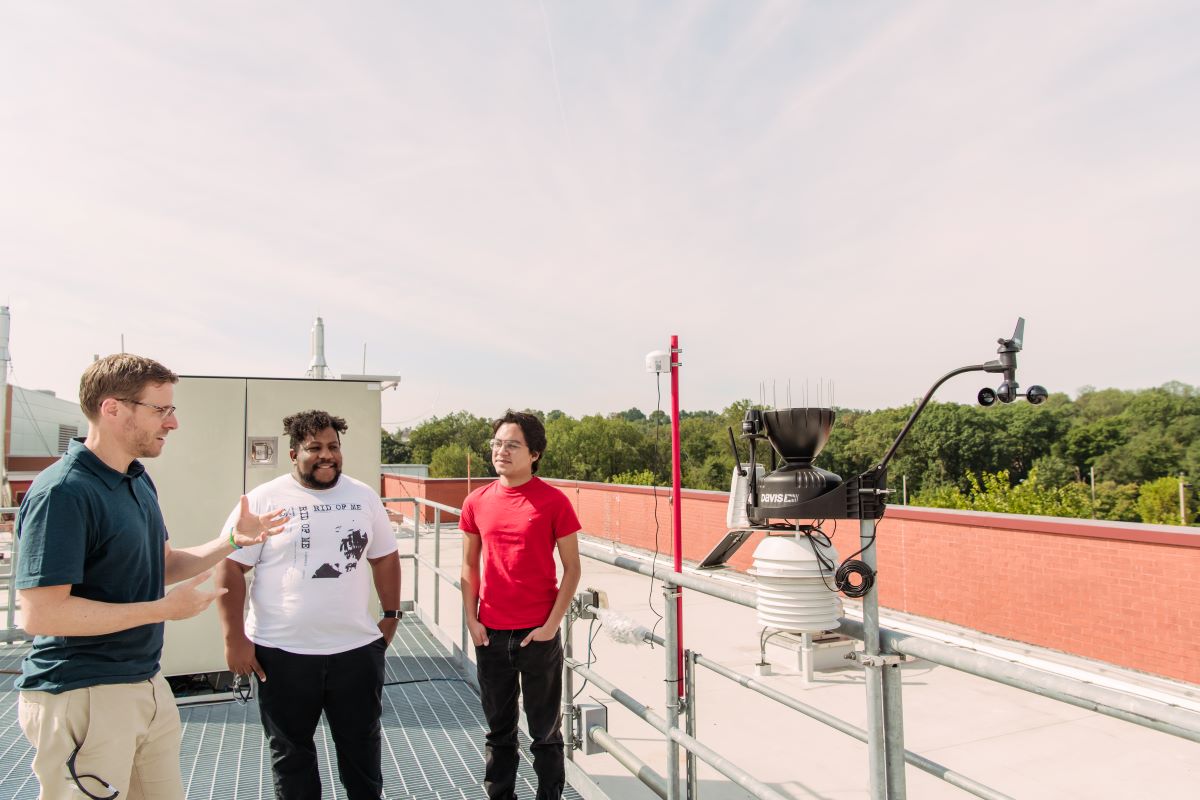 Chris Hennigan, Joel Tyson, Ph.D. ’23, and Luis Rodriguez ’25 (left to right) on the roof of the engineering building next to an air quality sensor. (Marlayna Demond ’11/UMBC)
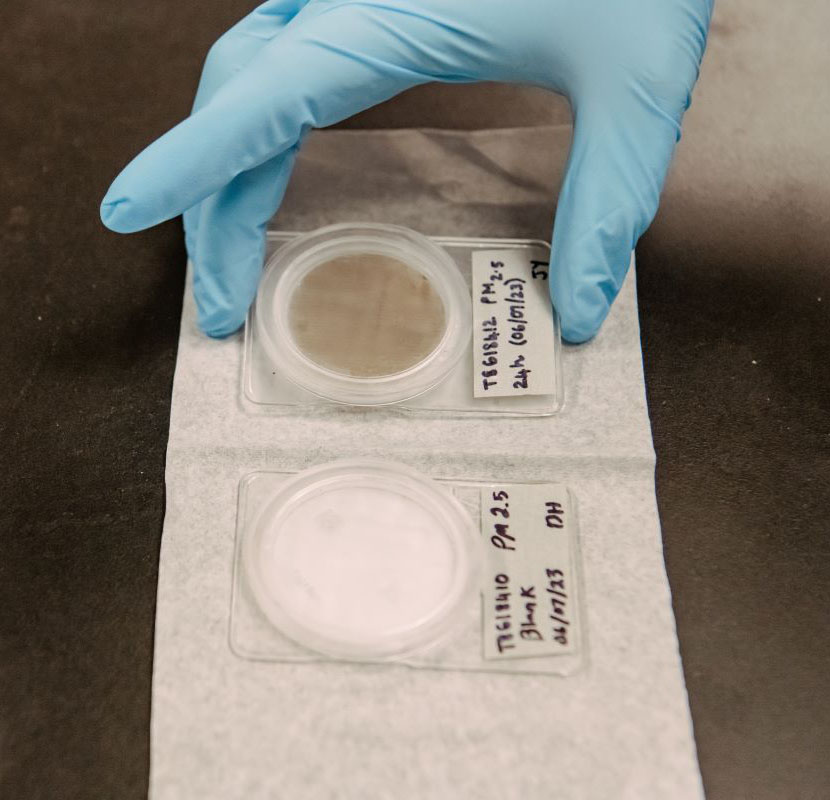 Hennigan shows samples of smoke particles collected this summer. (Marlayna Demond ’11/UMBC)
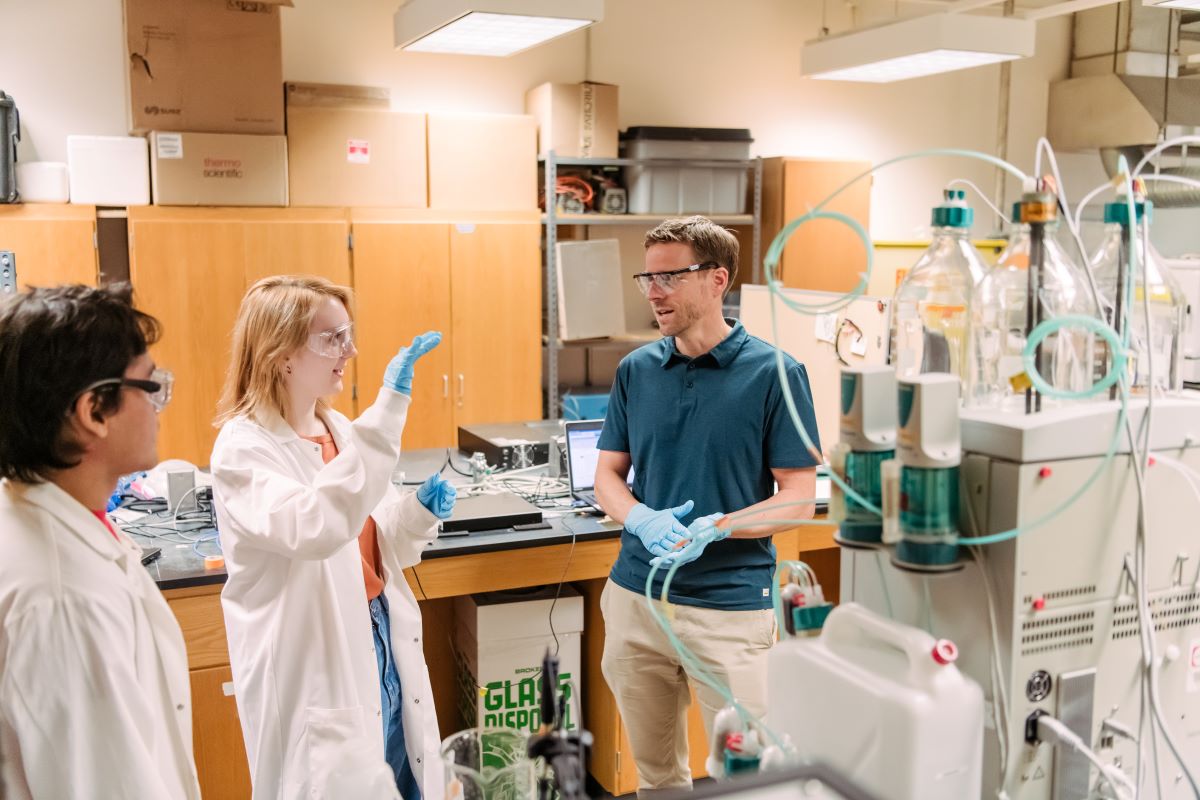 Rodriguez, Danielle Larios ’25 and Hennigan (left to right) discuss research in the lab. (Marlayna Demond ’11/UMBC)
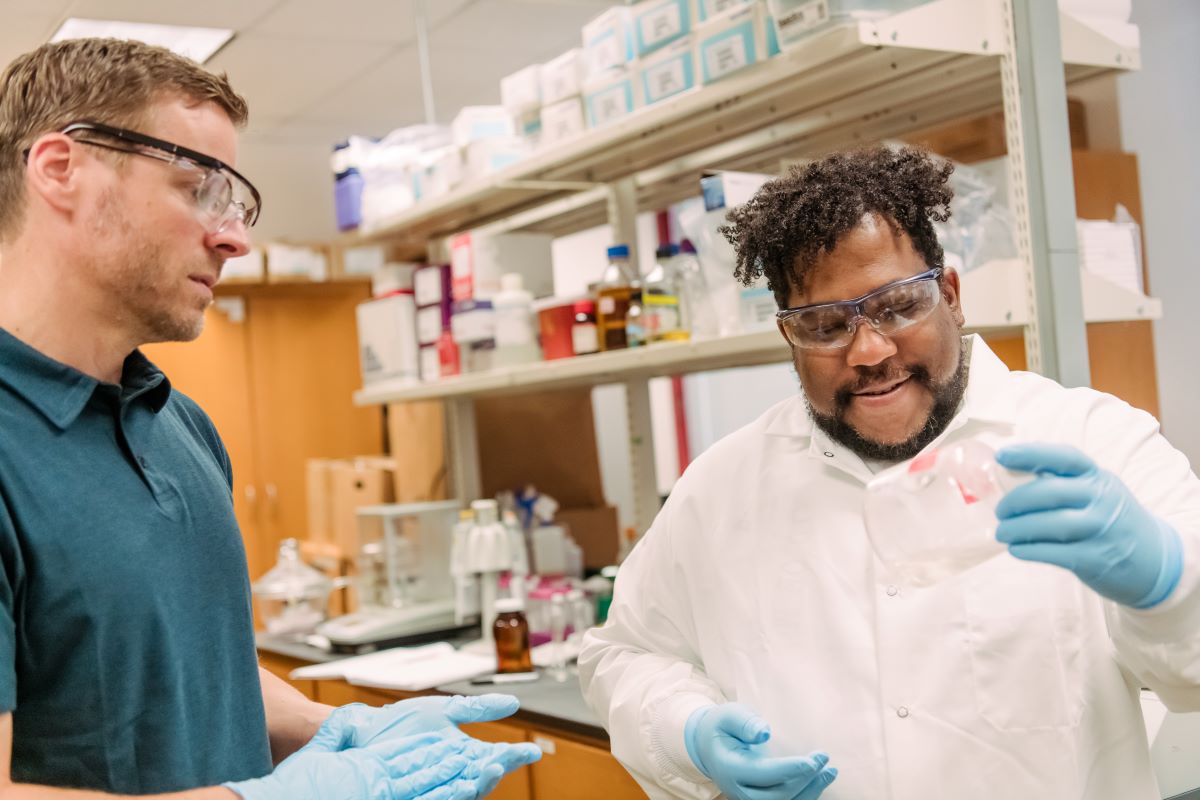 Hennigan and Tyson in the lab. (Marlayna Demond ’11/UMBC)