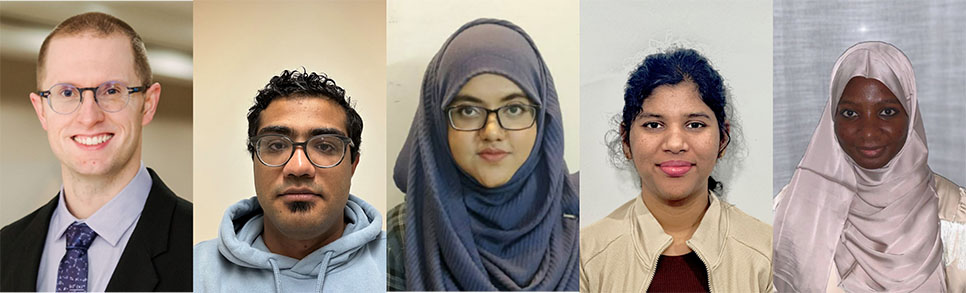
CBEE 2025 CIDER Recipients
Reposted from UMBC News:https://umbc.edu/stories/cider-program-hilltop-medicaid-study/
UMBC’s CIDER program supports new Hilltop Institute-led Medicaid study, other cross-collaborative projects
By: Adriana Fraser
UMBC researchers are collaborating on a study that takes a closer look at specific diagnosis coding patterns that focus on societal factors that potentially influence the health of Maryland’s Medicaid recipients.
Morgan Henderson, director of analytics and research at UMBC’s The Hilltop Institute, and Jun Chu, assistant professor of public health, are among the five cross-collaborative teams selected to receive funding from UMBC’s Center and Institute Departmentally-Engaged Research (CIDER) program. Henderson and Chu’s CIDER-supported project will investigate potential “z code” patterns of the state’s Medicaid recipients. Z codes are a set of diagnosis codes that refer to factors influencing a patient’s health status beyond diseases or injuries, called social determinants of health.
“These specific diagnosis codes indicate certain social determinants of health-related factors, not just traditionally medical things,” explains Henderson, principal investigator of the study. Z code data indicates if a patient has an issue that’s related to social risk factors, such as unstable housing, lack of food, hazardous living environments, and employment status.
“There hasn’t been much analysis of z code patterns and we aim to lay a good foundation for better understanding these diagnosis codes within Maryland’s Medicaid data,” says Henderson.
A deeper look into z code diagnosing could be a useful identification “to bring extra resources to Medicaid recipients who are in need,” says Chu.
Analyzing Medicaid data
The study coincides with recent news of potential billion-dollar federal budget cuts to Maryland’s Medicaid program, which currently supports about 1.7 million Maryland residents. The Hilltop Institute specializes in working with the state’s Medicaid data. According to the institute’s Maryland Medicaid DataPort, two in five of those in Medicaid are children and Medicaid pays for 60 percent of nursing home stays.
Chu’s research has largely focused on social determinants of health with a particular focus on immigrant communities and Medicaid recipients who are children. Henderson helped to develop and currently manages Hilltop’s predictive modeling portfolio. These predictive models, which also utilize z code data, use a variety of risk factors derived from Medicare and Medicaid claims data to estimate the probability that a given patient incurs certain outcomes in the near future.
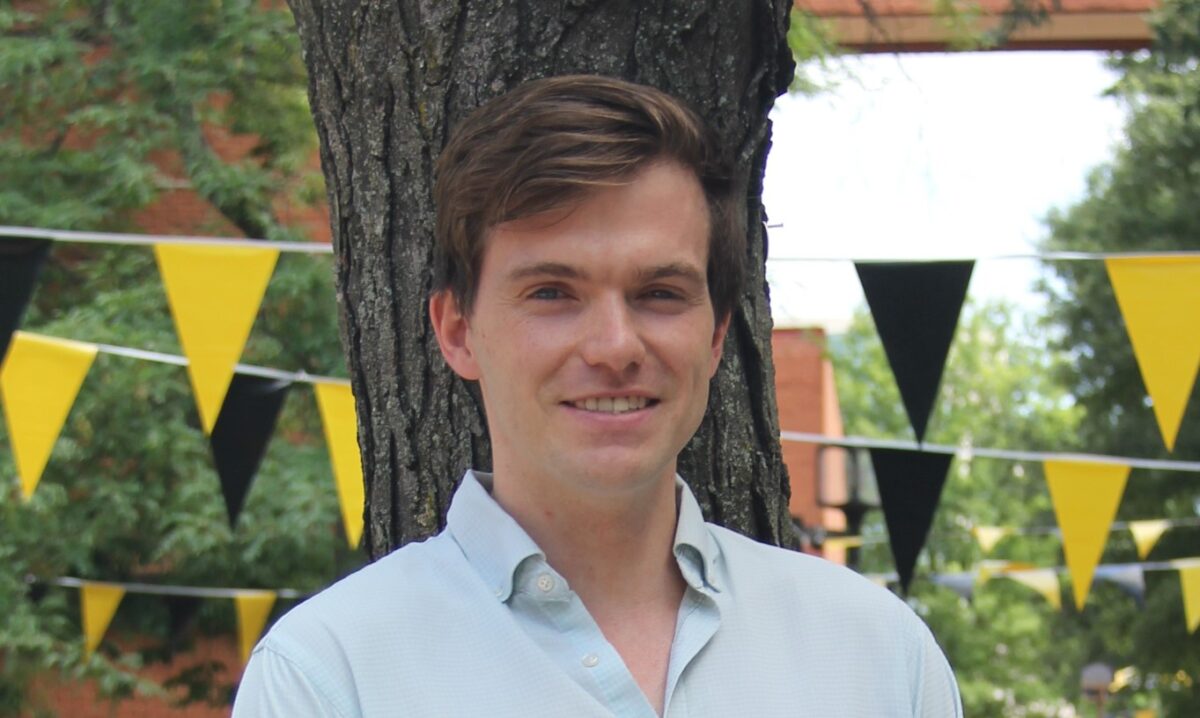
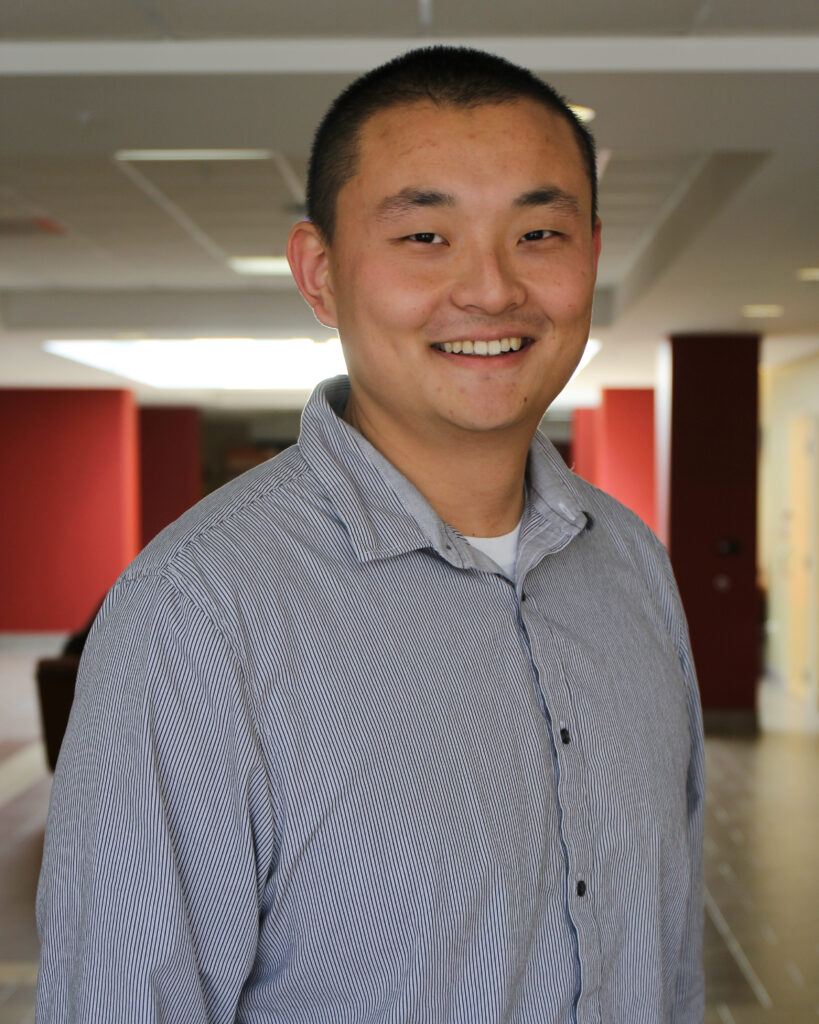 Principal investigator Morgan Henderson (left) and co-investigator Jun Chu of the CIDER Program study, “Analysis of Social Determinant of Health Diagnosis Coding Patterns Among Medicaid Recipients and Providers in Maryland.” (Photos courtesy of The Hilltop Institute and Jun Chu)
The pair’s project will include two studies: one study will focus specifically on the patients ascribed z codes to determine what patterns arise based on patient-specific factors such as demographics, health care utilization, or geography.
The second study will focus on analyzing the characteristics of the healthcare providers that indicate the z codes on Medicaid claims.
“Patient claims are the engine that so much of health analysis relies upon. It’s the decision of the provider on which coding diagnoses to include—it’s not a completely standardized process,” says Henderson.
CIDER 2025 recipients
The CIDER program’s goal includes supporting and promoting collaborative research between scholars based in one of UMBC’s affiliate centers and institutes and the university’s faculty researchers. Selected proposals are awarded up to $50,000 in seed funding for 18 months.
The 2025 CIDER program recipients include:
- Anin Puthukkudy, Earth and Space Institute, and Vanderlei Martins, professor of physics
- Jessica Sutton, Goddard Earth Sciences Technology and Research (GESTAR) II, Tejas Gokhale, assistant professor of computer science and electrical engineering, and Thomas Stanley, GESTAR II
- Kaur Kullman, the Center for Space Sciences and Technology, Alan Sherman, Roberto Yus, and Enis Golaszewski, professors of computer science and electrical engineering
- Morgan Henderson, The Hilltop Institute at UMBC, and Jun Chu, assistant professor of public health
- Venkatesh Srinivasan, Center for Advanced Sensor Technology, Tyler Josephson, assistant professor of chemical, biochemical, and environmental engineering
Don Engel, associate vice president for research development, shares that the CIDER program was created to foster collaborations that draw on the full range of UMBC’s strengths in research and creative achievement.
“CIDER helps connect faculty in our research centers with colleagues in degree-granting departments to pursue work with real impact—work that informs policy, advances knowledge, and ultimately serves the public good,” says Engel.
]]>
Reposted from UMBC News:https://umbc.edu/stories/cider-program-hilltop-medicaid-study/ UMBC’s CIDER program supports new Hilltop Institute-led Medicaid study, other cross-collaborative...
https://beta.my.umbc.edu/api/v0/pixel/news/149919/guest@my.umbc.edu/1096da6a681a960a8521dd4139f8dc81/api/pixel
grad
josephson
research
spring-2025
srinivasan
ug
ugrad
Chemical, Biochemical and Environmental Engineering
https://beta.my.umbc.edu/groups/cbee
https://assets4-beta.my.umbc.edu/system/shared/avatars/groups/000/000/771/b5e579e81b2e3624611890fa3ca2716a/xsmall.png?1746794587
https://assets2-beta.my.umbc.edu/system/shared/avatars/groups/000/000/771/b5e579e81b2e3624611890fa3ca2716a/original.png?1746794587
https://assets1-beta.my.umbc.edu/system/shared/avatars/groups/000/000/771/b5e579e81b2e3624611890fa3ca2716a/xxlarge.png?1746794587
https://assets2-beta.my.umbc.edu/system/shared/avatars/groups/000/000/771/b5e579e81b2e3624611890fa3ca2716a/xlarge.png?1746794587
https://assets2-beta.my.umbc.edu/system/shared/avatars/groups/000/000/771/b5e579e81b2e3624611890fa3ca2716a/large.png?1746794587
https://assets4-beta.my.umbc.edu/system/shared/avatars/groups/000/000/771/b5e579e81b2e3624611890fa3ca2716a/medium.png?1746794587
https://assets1-beta.my.umbc.edu/system/shared/avatars/groups/000/000/771/b5e579e81b2e3624611890fa3ca2716a/small.png?1746794587
https://assets4-beta.my.umbc.edu/system/shared/avatars/groups/000/000/771/b5e579e81b2e3624611890fa3ca2716a/xsmall.png?1746794587
https://assets1-beta.my.umbc.edu/system/shared/avatars/groups/000/000/771/b5e579e81b2e3624611890fa3ca2716a/xxsmall.png?1746794587
Chemical, Biochemical and Environmental Engineering
https://assets3-beta.my.umbc.edu/system/shared/thumbnails/news/000/149/919/e3b8d38e9d4981563c9a47bc8102e4dc/xxlarge.jpg?1746714078
https://assets1-beta.my.umbc.edu/system/shared/thumbnails/news/000/149/919/e3b8d38e9d4981563c9a47bc8102e4dc/xlarge.jpg?1746714078
https://assets1-beta.my.umbc.edu/system/shared/thumbnails/news/000/149/919/e3b8d38e9d4981563c9a47bc8102e4dc/large.jpg?1746714078
https://assets3-beta.my.umbc.edu/system/shared/thumbnails/news/000/149/919/e3b8d38e9d4981563c9a47bc8102e4dc/medium.jpg?1746714078
https://assets2-beta.my.umbc.edu/system/shared/thumbnails/news/000/149/919/e3b8d38e9d4981563c9a47bc8102e4dc/small.jpg?1746714078
https://assets2-beta.my.umbc.edu/system/shared/thumbnails/news/000/149/919/e3b8d38e9d4981563c9a47bc8102e4dc/xsmall.jpg?1746714078
https://assets3-beta.my.umbc.edu/system/shared/thumbnails/news/000/149/919/e3b8d38e9d4981563c9a47bc8102e4dc/xxsmall.jpg?1746714078
0
0
true
Thu, 08 May 2025 10:24:11 -0400
Wed, 14 May 2025 09:49:56 -0400
Congratulations to the CBEE Student Presenters at URCAD
On April 16, 2025, over 300 undergraduate students shared their research and achievements through oral presentations, poster presentations, artistic exhibits, performances, films, interactive games, and more in the University Center.
Congratulations to all CBEE students who participated in the event!
Oral Presentations
Evalynn Ellison | Ultrasound-Responsive Phospholipid-Coated Microbubbles for Controlled Drug Delivery Across Mucosa | Chemical, Biochemical, and Environmental Engineering | Canan Dagdeviren
Poster Presentations
Shashane Anderson | Formal Verification of Thermodynamic Models With Lean 4 | Chemical, Biochemical, and Environmental Engineering | Tyler Josephson
Alvin Bett | Detecting PFAS in Baltimore Harbor Using Novel Passive Samplers | Chemical, Biochemical, and Environmental Engineering | Lee Blaney
Jacob Craft | Measuring the Selectivity Coefficients of 19 PFAS With Four Anion-Exchange Membranes | Chemical, Biochemical, and Environmental Engineering | Lee Blaney
Joshua Dayie | Engineering CRBN for Improved Assay and Structural Enablement Using DeNovo Protein Scaffolds | Chemical, Biochemical, and Environmental Engineering | Nicole LaRonde
Trevor Gibson | Hybrid Anion-Exchange Resins Improve the Uptake and Selectivity for (Ultra)Short-Chain PFAS in Drinking Water | Chemical, Biochemical, and Environmental Engineering | Lee Blaney
Elias Gilotte | Uncovering The Relationship Between Oxygen Availability and Energy Sources in Cell-free Protein Synthesis | Chemical, Biochemical, and Environmental Engineering | Govind Rao
Alexander Haibel | GraphARC: An AI Benchmark for Chemical Reasoning | Chemical, Biochemical, and Environmental Engineering | Tyler Josephson
Sydney Hofstetter | Sucrose Density Gradient Centrifugation Versus Anion Exchange for Exosome Sample Purification | Chemical, Biochemical, and Environmental Engineering | Jorge Almodovar
Jasmine Ives | Polychlorinated Biphenyl Monitoring in Maryland Fish | Chemical, Biochemical, and Environmental Engineering | Upal Ghosh
Tonderai Kodzwa | Effect Of Temperature On Aqueous Zinc Ion Batteries | Chemical, Biochemical, and Environmental Engineering | Ozgur Capraz
Peter Lombardo | Percent Viability Screens To Confirm Integral Cell Wall Signaling Kinases In Aspergillus Nidulans | Chemical, Biochemical, and Environmental Engineering | Mark Marten
Terra Miley | Optimization Of Cell-Free Protein Synthesis Bioreactors With the Use of a Fluorescent Magnesium Biosensor | Chemical, Biochemical, and Environmental Engineering | Govind Rao
Meredith Morse | Characterizing The Aspergillus Nidulans Kinase Deletion Library | Chemical, Biochemical, and Environmental Engineering | Mark Marten
Tithi Prajapati | Noninvasive Wearable Device For Transcutaneous CO2 Based Early Detection Of Opioid-Induced Respiratory Depression | Chemical, Biochemical, and Environmental Engineering | Venkatesh Srinivasan
Matthew Quintanilla | Characterization Of Transmembrane Transporters Linked To Cell Wall Stress Response | Chemical, Biochemical, and Environmental Engineering | Mark Marten
Jessica Slaughter | Suite Of Bioinformatic-Analysis Apps For Better Understanding Dynamic Omics Data | Chemical, Biochemical, and Environmental Engineering | Mark Marten
Maaike Swaters | Measuring Ion-exchange Membrane Properties That Control Nutrient Recovery By Donnan Dialysis | Chemical, Biochemical, and Environmental Engineering | Lee Blaney
Greeshma Tarimala | Using Gene Editing And Fluorescent Microscopy To Characterize The PrkA Kinase In Aspergillus Nidulans | Chemical, Biochemical, and Environmental Engineering | Mark Marten
Julia Van Der Marel | Monitoring Of NADH Concentrations In Cell-Free Systems | Chemical, Biochemical, and Environmental Engineering | Govind Rao
Benjamin Welling | Fabrications Of An Autonomous Chemically Powered Vehicle: (AIChE Chem-E Car) | Chemical, Biochemical, and Environmental Engineering | Neha Raikar
Zorah Williams | Utilizing Manganese-Oxide As An Electrode Material For Aqueous Zn-ion Batteries. | Chemical, Biochemical, and Environmental Engineering | Ozgur Capraz
Ariel Wilson-Gray | Production Of Extracellular Vesicles From Mammalian Cells Modulated By A Biomimetic Surface | Chemical, Biochemical, and Environmental Engineering | Jorge Almodovar
]]>
On April 16, 2025, over 300 undergraduate students shared their research and achievements through oral presentations, poster presentations, artistic exhibits, performances, films, interactive...
https://beta.my.umbc.edu/api/v0/pixel/news/149178/guest@my.umbc.edu/05c0dcd6350cfb00b8616eb5a85d9ad2/api/pixel
almodovar
blaney
capraz
ghosh
josephson
marten
raikar
rao
research
spring-2025
ug
ugrad
urcad
Chemical, Biochemical and Environmental Engineering
https://beta.my.umbc.edu/groups/cbee
https://assets4-beta.my.umbc.edu/system/shared/avatars/groups/000/000/771/b5e579e81b2e3624611890fa3ca2716a/xsmall.png?1746794587
https://assets2-beta.my.umbc.edu/system/shared/avatars/groups/000/000/771/b5e579e81b2e3624611890fa3ca2716a/original.png?1746794587
https://assets1-beta.my.umbc.edu/system/shared/avatars/groups/000/000/771/b5e579e81b2e3624611890fa3ca2716a/xxlarge.png?1746794587
https://assets2-beta.my.umbc.edu/system/shared/avatars/groups/000/000/771/b5e579e81b2e3624611890fa3ca2716a/xlarge.png?1746794587
https://assets2-beta.my.umbc.edu/system/shared/avatars/groups/000/000/771/b5e579e81b2e3624611890fa3ca2716a/large.png?1746794587
https://assets4-beta.my.umbc.edu/system/shared/avatars/groups/000/000/771/b5e579e81b2e3624611890fa3ca2716a/medium.png?1746794587
https://assets1-beta.my.umbc.edu/system/shared/avatars/groups/000/000/771/b5e579e81b2e3624611890fa3ca2716a/small.png?1746794587
https://assets4-beta.my.umbc.edu/system/shared/avatars/groups/000/000/771/b5e579e81b2e3624611890fa3ca2716a/xsmall.png?1746794587
https://assets1-beta.my.umbc.edu/system/shared/avatars/groups/000/000/771/b5e579e81b2e3624611890fa3ca2716a/xxsmall.png?1746794587
Chemical, Biochemical and Environmental Engineering
https://assets2-beta.my.umbc.edu/system/shared/thumbnails/news/000/149/178/0cc2d9648fdd924523c80803702f0073/xxlarge.jpg?1744895017
https://assets3-beta.my.umbc.edu/system/shared/thumbnails/news/000/149/178/0cc2d9648fdd924523c80803702f0073/xlarge.jpg?1744895017
https://assets2-beta.my.umbc.edu/system/shared/thumbnails/news/000/149/178/0cc2d9648fdd924523c80803702f0073/large.jpg?1744895017
https://assets2-beta.my.umbc.edu/system/shared/thumbnails/news/000/149/178/0cc2d9648fdd924523c80803702f0073/medium.jpg?1744895017
https://assets1-beta.my.umbc.edu/system/shared/thumbnails/news/000/149/178/0cc2d9648fdd924523c80803702f0073/small.jpg?1744895017
https://assets3-beta.my.umbc.edu/system/shared/thumbnails/news/000/149/178/0cc2d9648fdd924523c80803702f0073/xsmall.jpg?1744895017
https://assets3-beta.my.umbc.edu/system/shared/thumbnails/news/000/149/178/0cc2d9648fdd924523c80803702f0073/xxsmall.jpg?1744895017
URCAD 2025 Logo
1
0
true
Thu, 17 Apr 2025 09:10:27 -0400
Fri, 25 Apr 2025 10:53:06 -0400
UMBC team leads research into AI tools that can assess the feasibility of scientific claims
Reposted from UMBC News: https://umbc.edu/quick-posts/students-celebrate-engineering-and-computing-week-with-fun-and-networking/
A multidisciplinary team of UMBC researchers was recently awarded $3.8 million from the Defense Advanced Research Projects Agency (DARPA) to develop new computational methods for assessing the feasibility of scientific claims. The project is motivated by the speed and volume of new developments in science and the need for tools to help evaluate the soundness of new claims.
“Some scientific claims are peer reviewed by independent experts, but others, such as from company press releases, or papers posted to pre-prints sites, are not,” says Frank Ferraro, an associate professor of computer science and lead researcher on the award. And even when science is peer-reviewed, there can still be errors, Ferraro notes. For example, recent research highlighting the danger of flame retardant chemicals leaching from black plastic into food was widely reported on, before it was discovered that an error in the paper led to a significant overstating of the exposure risk.
An AI science assistant
The idea of an AI assistant specifically designed to tackle complex research questions has been catching on recently. OpenAI, the creators of ChatGPT, recently debuted their “DeepResearch” tool, which the company says can use reasoning to synthesize large amounts of online information and complete multi-step research tasks.
Ferraro says the tool he and his colleagues hope to develop should stand-out from other approaches by employing a strongly iterative process, necessary to really take apart and analyze claims. The tool will break down a scientific claim into constituent sub-claims, and apply a wide range of evidence and reasoning approaches to assess the feasibility of each one.
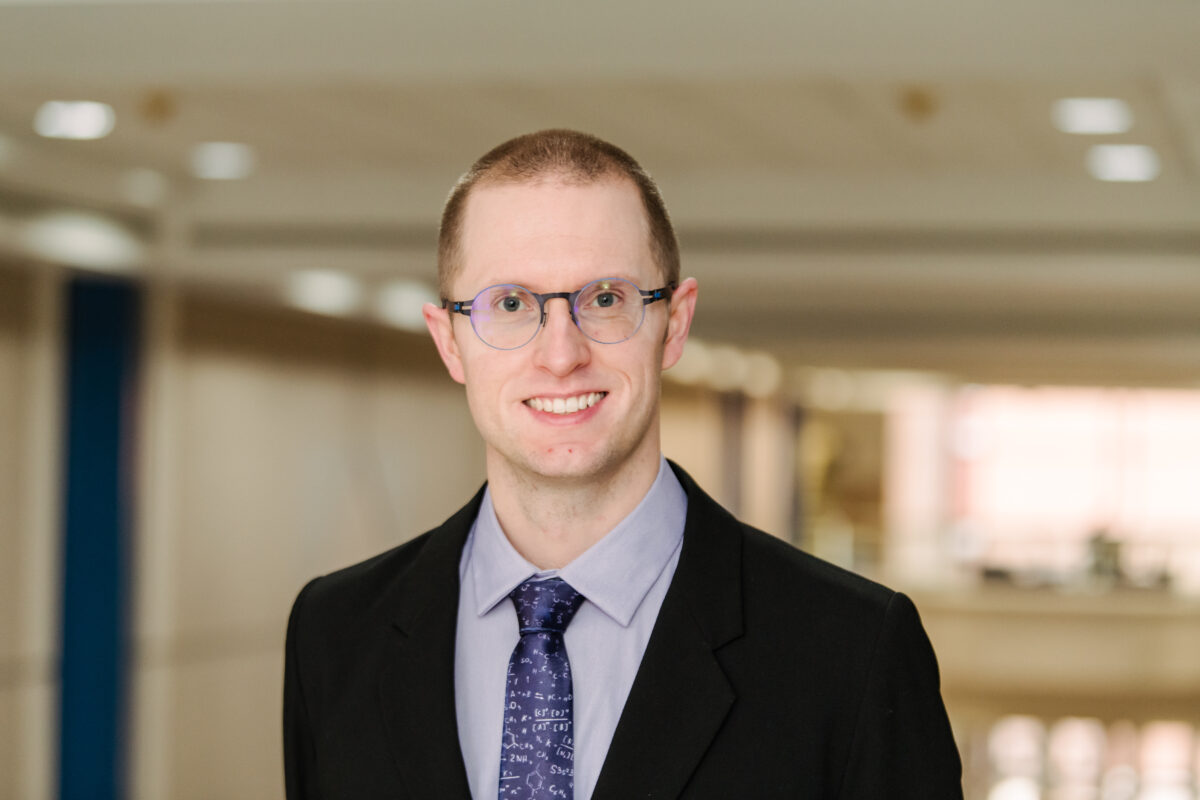 Tyler Josephson (Marlayna Demond ’11/UMBC)
The team, which includes UMBC faculty Tejas Gokhale, computer science and electrical engineering, and Tyler Josephson, chemical, biochemical, and environmental engineering, as well as colleagues from Stony Brook University, the University of Texas at Austin, and the University of Cambridge, will develop and test the tool on three leading areas of scientific research: materials science, AI, and quantum computing.
“It’s a little meta that the AI will be analyzing AI,” Ferraro says. More than 20 UMBC undergrads, grad students, and post-docs will take part in the project. “They’ll get opportunities to network with peers on a highly relevant topic,” Ferraro says. “They’ll be helping guide the national conversation on these issues.”
]]>
Reposted from UMBC News: https://umbc.edu/quick-posts/students-celebrate-engineering-and-computing-week-with-fun-and-networking/ A multidisciplinary team of UMBC researchers was recently...
https://beta.my.umbc.edu/api/v0/pixel/news/148688/guest@my.umbc.edu/bcc7656879b3313598e09a461360c64e/api/pixel
grad
josephson
research
spring-2025
ug
ugrad
Chemical, Biochemical and Environmental Engineering
https://beta.my.umbc.edu/groups/cbee
https://assets4-beta.my.umbc.edu/system/shared/avatars/groups/000/000/771/b5e579e81b2e3624611890fa3ca2716a/xsmall.png?1746794587
https://assets2-beta.my.umbc.edu/system/shared/avatars/groups/000/000/771/b5e579e81b2e3624611890fa3ca2716a/original.png?1746794587
https://assets1-beta.my.umbc.edu/system/shared/avatars/groups/000/000/771/b5e579e81b2e3624611890fa3ca2716a/xxlarge.png?1746794587
https://assets2-beta.my.umbc.edu/system/shared/avatars/groups/000/000/771/b5e579e81b2e3624611890fa3ca2716a/xlarge.png?1746794587
https://assets2-beta.my.umbc.edu/system/shared/avatars/groups/000/000/771/b5e579e81b2e3624611890fa3ca2716a/large.png?1746794587
https://assets4-beta.my.umbc.edu/system/shared/avatars/groups/000/000/771/b5e579e81b2e3624611890fa3ca2716a/medium.png?1746794587
https://assets1-beta.my.umbc.edu/system/shared/avatars/groups/000/000/771/b5e579e81b2e3624611890fa3ca2716a/small.png?1746794587
https://assets4-beta.my.umbc.edu/system/shared/avatars/groups/000/000/771/b5e579e81b2e3624611890fa3ca2716a/xsmall.png?1746794587
https://assets1-beta.my.umbc.edu/system/shared/avatars/groups/000/000/771/b5e579e81b2e3624611890fa3ca2716a/xxsmall.png?1746794587
Chemical, Biochemical and Environmental Engineering
https://assets1-beta.my.umbc.edu/system/shared/thumbnails/news/000/148/688/0171ccdce6d00d1547a5fbeeb1fbaa53/xxlarge.jpg?1743774253
https://assets3-beta.my.umbc.edu/system/shared/thumbnails/news/000/148/688/0171ccdce6d00d1547a5fbeeb1fbaa53/xlarge.jpg?1743774253
https://assets4-beta.my.umbc.edu/system/shared/thumbnails/news/000/148/688/0171ccdce6d00d1547a5fbeeb1fbaa53/large.jpg?1743774253
https://assets3-beta.my.umbc.edu/system/shared/thumbnails/news/000/148/688/0171ccdce6d00d1547a5fbeeb1fbaa53/medium.jpg?1743774253
https://assets1-beta.my.umbc.edu/system/shared/thumbnails/news/000/148/688/0171ccdce6d00d1547a5fbeeb1fbaa53/small.jpg?1743774253
https://assets4-beta.my.umbc.edu/system/shared/thumbnails/news/000/148/688/0171ccdce6d00d1547a5fbeeb1fbaa53/xsmall.jpg?1743774253
https://assets4-beta.my.umbc.edu/system/shared/thumbnails/news/000/148/688/0171ccdce6d00d1547a5fbeeb1fbaa53/xxsmall.jpg?1743774253
0
0
true
Fri, 04 Apr 2025 09:46:01 -0400
Tue, 08 Apr 2025 12:11:43 -0400
McDonogh High School Students Learn About Engineering at CBEE
McDonogh High School Visit to CBEE
Students from McDonogh High School’s Chemical Engineering class visited the Department of Chemical, Biochemical and Environmental Engineering (CBEE) on February 27th. They toured lab spaces, heard from faculty and students about their innovative research, and learned about CBEE’s academic program. They were accompanied by Dr. Melanie Batarseh, an Upper School Science Teacher, and Jennifer Little, an Academic Dean.
The visit began with Dr. Marten, the Chair of CBEE, sharing insights about the department’s academic offerings and research projects. McDonogh students shared about the chemical engineering projects they were working on and asked questions about CBEE. COEIT Advisor, Hailey Turney, joined to give an overview of the application process for the CBEE program. Students enjoyed breakfast and won UMBC swag by answering questions about CBEE.
Then, students toured the laboratories of Dr. Josephson, Dr. Almodovar, and Dr. Hennigan. During the tours, ongoing research projects were discussed, equipment demonstrations were given, and lab samples were passed around to inspire curiosity amongst students.
This visit was a great opportunity for high school students to connect with CBEE faculty and students, explore potential engineering career paths, and better understand the real-world impact of chemical, biochemical, and environmental engineering.
]]>
Students from McDonogh High School’s Chemical Engineering class visited the Department of Chemical, Biochemical and Environmental Engineering (CBEE) on February 27th. They toured lab spaces, heard...
https://beta.my.umbc.edu/api/v0/pixel/news/148052/guest@my.umbc.edu/65a00615a6fc3e3d1a163b6eb8d079bf/api/pixel
almodovar
hennigan
high-school
josephson
marten
prospective-student
recruitment
spring-2025
ug
ugrad
Chemical, Biochemical and Environmental Engineering
https://beta.my.umbc.edu/groups/cbee
https://assets4-beta.my.umbc.edu/system/shared/avatars/groups/000/000/771/b5e579e81b2e3624611890fa3ca2716a/xsmall.png?1746794587
https://assets2-beta.my.umbc.edu/system/shared/avatars/groups/000/000/771/b5e579e81b2e3624611890fa3ca2716a/original.png?1746794587
https://assets1-beta.my.umbc.edu/system/shared/avatars/groups/000/000/771/b5e579e81b2e3624611890fa3ca2716a/xxlarge.png?1746794587
https://assets2-beta.my.umbc.edu/system/shared/avatars/groups/000/000/771/b5e579e81b2e3624611890fa3ca2716a/xlarge.png?1746794587
https://assets2-beta.my.umbc.edu/system/shared/avatars/groups/000/000/771/b5e579e81b2e3624611890fa3ca2716a/large.png?1746794587
https://assets4-beta.my.umbc.edu/system/shared/avatars/groups/000/000/771/b5e579e81b2e3624611890fa3ca2716a/medium.png?1746794587
https://assets1-beta.my.umbc.edu/system/shared/avatars/groups/000/000/771/b5e579e81b2e3624611890fa3ca2716a/small.png?1746794587
https://assets4-beta.my.umbc.edu/system/shared/avatars/groups/000/000/771/b5e579e81b2e3624611890fa3ca2716a/xsmall.png?1746794587
https://assets1-beta.my.umbc.edu/system/shared/avatars/groups/000/000/771/b5e579e81b2e3624611890fa3ca2716a/xxsmall.png?1746794587
Chemical, Biochemical and Environmental Engineering
https://assets1-beta.my.umbc.edu/system/shared/thumbnails/news/000/148/052/9f224d89a48876e66f05d01bd6bb1e16/xxlarge.jpg?1741804479
https://assets2-beta.my.umbc.edu/system/shared/thumbnails/news/000/148/052/9f224d89a48876e66f05d01bd6bb1e16/xlarge.jpg?1741804479
https://assets4-beta.my.umbc.edu/system/shared/thumbnails/news/000/148/052/9f224d89a48876e66f05d01bd6bb1e16/large.jpg?1741804479
https://assets4-beta.my.umbc.edu/system/shared/thumbnails/news/000/148/052/9f224d89a48876e66f05d01bd6bb1e16/medium.jpg?1741804479
https://assets2-beta.my.umbc.edu/system/shared/thumbnails/news/000/148/052/9f224d89a48876e66f05d01bd6bb1e16/small.jpg?1741804479
https://assets4-beta.my.umbc.edu/system/shared/thumbnails/news/000/148/052/9f224d89a48876e66f05d01bd6bb1e16/xsmall.jpg?1741804479
https://assets1-beta.my.umbc.edu/system/shared/thumbnails/news/000/148/052/9f224d89a48876e66f05d01bd6bb1e16/xxsmall.jpg?1741804479
0
0
true
Wed, 12 Mar 2025 14:41:40 -0400
PHD GRADUATE ASSISTANTSHIP - Spring 2025: Develop new algorithms for artificial intelligence and molecular simulations.
ATOMS Lab with Dr. Tyler Josephson
The AI & Theory-Oriented Molecular Science (ATOMS) Lab with Dr. Tyler Josephson has two fully-funded positions, to start in
Spring 2025 or sooner.
Project Titles
- Simulation methods for multicomponent adsorption of water pollutants
- Logic and LLMs for Evaluating Scientific Claims
Application
Applications will be reviewed starting November 1. To apply send
resume/CV, unoMicial transcript, research statement, and 1-2 page letter describing your interest in
the ATOMS Lab to
atoms@umbc.edu. Specify which project below most interests you (and why),
and what degree you would be pursuing at UMBC.
About ATOMS Lab & UMBC
The ATOMS Lab develops new algorithms for artificial intelligence and molecular simulations. Learn
more about our supportive culture and our lab policies
here. We’re based in the Department of
Chemical, Biochemical, and Environmental Engineering at the University of Maryland, Baltimore
County, just outside of Baltimore and about an hour north of Washington, DC.
]]>
The AI & Theory-Oriented Molecular Science (ATOMS) Lab with Dr. Tyler Josephson has two fully-funded positions, to start in Spring 2025 or sooner. Project Titles Simulation methods for...
https://beta.my.umbc.edu/api/v0/pixel/news/145031/guest@my.umbc.edu/731bfd576ee347e722ac7bdc6db26684/api/pixel
assistantship
atoms
grad
josephson
spring-2025
Chemical, Biochemical and Environmental Engineering
https://beta.my.umbc.edu/groups/cbee
https://assets4-beta.my.umbc.edu/system/shared/avatars/groups/000/000/771/b5e579e81b2e3624611890fa3ca2716a/xsmall.png?1746794587
https://assets2-beta.my.umbc.edu/system/shared/avatars/groups/000/000/771/b5e579e81b2e3624611890fa3ca2716a/original.png?1746794587
https://assets1-beta.my.umbc.edu/system/shared/avatars/groups/000/000/771/b5e579e81b2e3624611890fa3ca2716a/xxlarge.png?1746794587
https://assets2-beta.my.umbc.edu/system/shared/avatars/groups/000/000/771/b5e579e81b2e3624611890fa3ca2716a/xlarge.png?1746794587
https://assets2-beta.my.umbc.edu/system/shared/avatars/groups/000/000/771/b5e579e81b2e3624611890fa3ca2716a/large.png?1746794587
https://assets4-beta.my.umbc.edu/system/shared/avatars/groups/000/000/771/b5e579e81b2e3624611890fa3ca2716a/medium.png?1746794587
https://assets1-beta.my.umbc.edu/system/shared/avatars/groups/000/000/771/b5e579e81b2e3624611890fa3ca2716a/small.png?1746794587
https://assets4-beta.my.umbc.edu/system/shared/avatars/groups/000/000/771/b5e579e81b2e3624611890fa3ca2716a/xsmall.png?1746794587
https://assets1-beta.my.umbc.edu/system/shared/avatars/groups/000/000/771/b5e579e81b2e3624611890fa3ca2716a/xxsmall.png?1746794587
Chemical, Biochemical and Environmental Engineering
https://assets1-beta.my.umbc.edu/system/shared/thumbnails/news/000/145/031/faa638c6b7aedda8df96880747a95fbd/xxlarge.jpg?1729773691
https://assets1-beta.my.umbc.edu/system/shared/thumbnails/news/000/145/031/faa638c6b7aedda8df96880747a95fbd/xlarge.jpg?1729773691
https://assets4-beta.my.umbc.edu/system/shared/thumbnails/news/000/145/031/faa638c6b7aedda8df96880747a95fbd/large.jpg?1729773691
https://assets4-beta.my.umbc.edu/system/shared/thumbnails/news/000/145/031/faa638c6b7aedda8df96880747a95fbd/medium.jpg?1729773691
https://assets3-beta.my.umbc.edu/system/shared/thumbnails/news/000/145/031/faa638c6b7aedda8df96880747a95fbd/small.jpg?1729773691
https://assets4-beta.my.umbc.edu/system/shared/thumbnails/news/000/145/031/faa638c6b7aedda8df96880747a95fbd/xsmall.jpg?1729773691
https://assets1-beta.my.umbc.edu/system/shared/thumbnails/news/000/145/031/faa638c6b7aedda8df96880747a95fbd/xxsmall.jpg?1729773691
0
0
true
Thu, 24 Oct 2024 08:58:30 -0400
Wed, 30 Oct 2024 09:48:54 -0400
New Publication by CBEE Faculty
ATOMS lab with Dr. Tyler Josephson
Dr. Tyler R Josephson, Assistant Professor, Chemical, Biochemical, and Environmental Engineering department at the University of Maryland, Baltimore County, along with UMBC student and alumni, Charles Fox, Neil D Tran, F Nikki Nacion, and Samiha Sharlin, have a new publication in Machine Learning: Science and Technology titled "Incorporating background knowledge in symbolic regression using a computer algebra system."
The article is available here:
Incorporating background knowledge in symbolic regression using a computer algebra system - IOPscience
DOI 10.1088/2632-2153/ad4a1e
Abstract:
Symbolic regression (SR) can generate interpretable, concise expressions that fit a given dataset, allowing for more human understanding of the structure than black-box approaches. The addition of background knowledge (in the form of symbolic mathematical constraints) allows for the generation of expressions that are meaningful with respect to theory while also being consistent with data. We specifically examine the addition of constraints to traditional genetic algorithm (GA) based SR (PySR) as well as a Markov-chain Monte Carlo (MCMC) based Bayesian SR architecture (Bayesian Machine Scientist), and apply these to rediscovering adsorption equations from experimental, historical datasets. We find that, while hard constraints prevent GA and MCMC SR from searching, soft constraints can lead to improved performance both in terms of search effectiveness and model meaningfulness, with computational costs increasing by about an order of magnitude. If the constraints do not correlate well with the dataset or expected models, they can hinder the search of expressions. We find incorporating these constraints in Bayesian SR (as the Bayesian prior) is better than by modifying the fitness function in the GA.
]]>
Dr. Tyler R Josephson, Assistant Professor, Chemical, Biochemical, and Environmental Engineering department at the University of Maryland, Baltimore County, along with UMBC student and alumni,...
https://beta.my.umbc.edu/api/v0/pixel/news/142548/guest@my.umbc.edu/eea75f122d055ffcc373f822592f2a5d/api/pixel
faculty
josephson
research
spring-2024
Chemical, Biochemical and Environmental Engineering
https://beta.my.umbc.edu/groups/cbee
https://assets4-beta.my.umbc.edu/system/shared/avatars/groups/000/000/771/b5e579e81b2e3624611890fa3ca2716a/xsmall.png?1746794587
https://assets2-beta.my.umbc.edu/system/shared/avatars/groups/000/000/771/b5e579e81b2e3624611890fa3ca2716a/original.png?1746794587
https://assets1-beta.my.umbc.edu/system/shared/avatars/groups/000/000/771/b5e579e81b2e3624611890fa3ca2716a/xxlarge.png?1746794587
https://assets2-beta.my.umbc.edu/system/shared/avatars/groups/000/000/771/b5e579e81b2e3624611890fa3ca2716a/xlarge.png?1746794587
https://assets2-beta.my.umbc.edu/system/shared/avatars/groups/000/000/771/b5e579e81b2e3624611890fa3ca2716a/large.png?1746794587
https://assets4-beta.my.umbc.edu/system/shared/avatars/groups/000/000/771/b5e579e81b2e3624611890fa3ca2716a/medium.png?1746794587
https://assets1-beta.my.umbc.edu/system/shared/avatars/groups/000/000/771/b5e579e81b2e3624611890fa3ca2716a/small.png?1746794587
https://assets4-beta.my.umbc.edu/system/shared/avatars/groups/000/000/771/b5e579e81b2e3624611890fa3ca2716a/xsmall.png?1746794587
https://assets1-beta.my.umbc.edu/system/shared/avatars/groups/000/000/771/b5e579e81b2e3624611890fa3ca2716a/xxsmall.png?1746794587
Chemical, Biochemical and Environmental Engineering
https://assets4-beta.my.umbc.edu/system/shared/thumbnails/news/000/142/548/d0524fd7b6e224cd6d2010ec323034df/xxlarge.jpg?1719324186
https://assets1-beta.my.umbc.edu/system/shared/thumbnails/news/000/142/548/d0524fd7b6e224cd6d2010ec323034df/xlarge.jpg?1719324186
https://assets2-beta.my.umbc.edu/system/shared/thumbnails/news/000/142/548/d0524fd7b6e224cd6d2010ec323034df/large.jpg?1719324186
https://assets2-beta.my.umbc.edu/system/shared/thumbnails/news/000/142/548/d0524fd7b6e224cd6d2010ec323034df/medium.jpg?1719324186
https://assets2-beta.my.umbc.edu/system/shared/thumbnails/news/000/142/548/d0524fd7b6e224cd6d2010ec323034df/small.jpg?1719324186
https://assets4-beta.my.umbc.edu/system/shared/thumbnails/news/000/142/548/d0524fd7b6e224cd6d2010ec323034df/xsmall.jpg?1719324186
https://assets1-beta.my.umbc.edu/system/shared/thumbnails/news/000/142/548/d0524fd7b6e224cd6d2010ec323034df/xxsmall.jpg?1719324186
0
0
true
Tue, 25 Jun 2024 10:03:30 -0400
Thu, 27 Jun 2024 13:42:05 -0400
In the News: UMBC Advance ChemCatBio Research
Novel Symbolic Regression To Speedup Surface Chem Simulation
Excerpt from:
Two Minority Serving Universities Advance ChemCatBio Research Priorities With New Funding
~~ Published in: January, 2024
Catalyst deactivation and slow computational research methods are recognized barriers for rapidly moving catalyst-driven bioenergy technologies from discovery to scale-up. But researchers are closer to mitigating both challenges thanks to two university-led projects in partnership with the Chemical Catalysis for Bioenergy Consortium (ChemCatBio).
The University of New Mexico and University of Maryland, Baltimore County were awarded funding from the U.S. Department of Energy Bioenergy Technologies Office and the Minority Serving Institution STEM Research & Development Consortium as part of a funding call for ChemCatBio. The funding partnership aims to reduce barriers of entry for minority serving institutions and increase bioenergy research collaboration.
According to ChemCatBio Director Josh Schaidle, the projects are part of a consortium strategy to synchronize catalyst innovation and diversity, equity, and inclusion.
"We are excited to partner with both universities and tap the unique expertise they bring to addressing catalyst deactivation and speeding catalyst discovery," he said. "These diverse institutions, people, and perspectives are essential to realizing the vision of ChemCatBio, which is the rapid decarbonization of our economy."
University of Maryland, Baltimore County - Applying a Novel Symbolic Regression To Speed Up Surface Chemistry Simulations
From left: Tyler Josephson, Kianoush Ramezani Shabolaghi, Samiha Sharlin, Charishma Puli, and Fariha Agbere. Photos courtesy of Tyler, Kianoush, Samiha, Charishma, and Fariha, respectively.
Collaborators:
Tyler Josephson, assistant professor
Kianoush Ramezani Shabolaghi, chemical engineering Ph.D. candidate
Samiha Sharlin, Ph.D. candidate
Charishma Puli, data science M.S. student
Fariha Agbere, chemical engineering B.S. student
ChemCatBio researchers are developing methods for upgrading biomass into a feedstock of mixed olefins, which can be upgraded into energy-dense sustainable aviation fuel using zeolite catalysts. However, questions remain on how the molecular shape of the catalyst - especially the porosity of the catalyst - affects the efficiency of those reactions.
In the past, quantum chemistry has been used to study such chemical reactions, but those methods are slow and expensive when scaled up to large systems. To speed up the rate of discovery, a team from the Department of Chemical, Biochemical, and Environmental Engineering at University of Maryland, Baltimore County are using machine learning to learn how the interactions work at the quantum chemistry scale.
"With our new methods, we aim to study larger systems and more realistic conditions," explained Tyler Josephson, the principal investigator, who was recently awarded a NSF career award. "If we can predict in the computer that this zeolite architecture works better than that zeolite architecture, that's useful information for experimentalists."
Josephson said that the project complements broader research work in the ATOMS Lab to bring machine learning and automated reasoning into chemical engineering.
by: Arya Honraopatil
Meet Samiha Sharlin.
Samiha Sharlin is a chemical and biochemical engineering doctoral student in the department of Chemical, Biochemical and Environmental Engineering. Samiha received her B.S. in Chemical Engineering from Bangladesh University of Engineering and Technology (BUET) in 2017. She is now pursuing her Ph.D. in the ATOMS Lab under the supervision of Prof. Tyler Josephson, where her research focuses on enhancing simulation methods for adsorption in porous materials using machine learning. In her free time, she enjoys exploring nature and tuning in to spiritual podcasts.
Tell us about your path to UMBC.
After completing my engineering degree, I entered the workforce and found myself in a job not aligned with my academic background. Despite being promised a research-oriented position, I ended up in Supply Chain Management, which left me feeling unfulfilled and disconnected from my passion for research and engineering. Additionally, the majority of the industry jobs I desired were located in unsafe areas on the outskirts of the country, creating further challenges and concerns. These experiences sparked a profound realization that I wanted to be in academics and continue my studies.
In my search for the right institution, I sought recommendations from trusted sources, and one of my friends from undergrad school spoke highly about her experiences at UMBC. As I researched colleges in the USA, UMBC consistently stood out to me as an inclusive and supportive community. UMBC has not only provided me with a platform to explore and grow academically but has also offered a supportive and inspiring community that has truly enriched my journey.
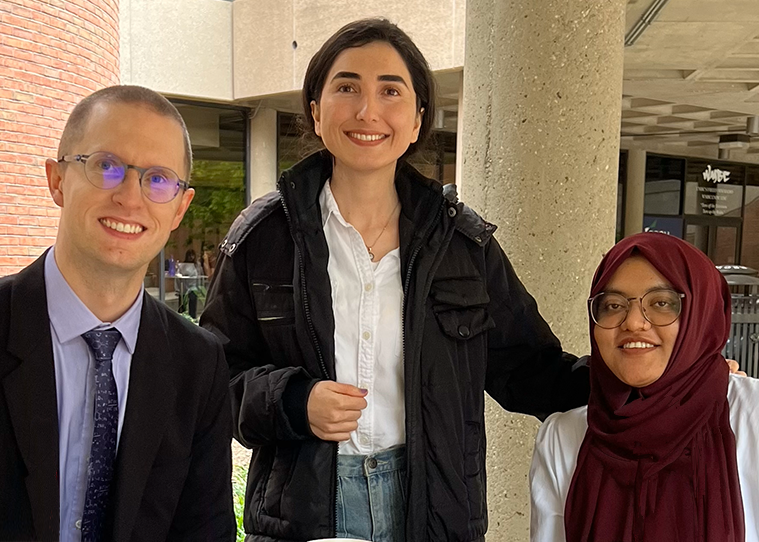
left to right: Dr. Josephson, Parivash Feyzishendi & Samiha Sharlin outside of UMBC's University Center in Spring/Summer 2023. Photo Credit: Sharlin Sharlin
What do you love about CBEE?
"Prioritize people over projects” - I have always believed in this! And especially in graduate school, the journey can be long, and being in a supportive environment is crucial. At CBEE, I've found the best of both worlds – a community that values individuals and fosters meaningful projects. The warmth and close-knit community in this department is truly special. You instantly feel connected with the professors, and they genuinely listen and value your input.
Let me share a heartwarming incident that illustrates this point - When I first arrived, I had come in quite late - just one day before classes began. Unfortunately, I missed orientation and also hadn't registered for classes. I wasn’t sure if I could attend classes without registration which resulted in me missing my first class. However, when Dr. Raikar saw me wandering in the department hallway, she already knew my name and warmly approached me. To my surprise and delight, she graciously shared the notes for the class I had missed without hesitation. It made me feel incredibly welcomed and supported right from the start. This kind of caring and personal attention has been a consistent experience throughout my time at CBEE, and it has deepened my appreciation for this wonderful community.
What do you love about your academic program?
One of the things that sets CBEE apart is its unique combination of biochemical, chemical, and environmental disciplines within the same department, which is a rarity among engineering programs. This was especially beneficial for me because I was uncertain about which track to pursue for graduate school. CBEE offered the opportunity to do rotations, allowing me to explore different options before committing to a specific research direction. As an international student, it was challenging to visit labs beforehand, and CBEE's approach gave me the freedom to make an informed decision.
Another invaluable aspect of CBEE is its mentor-mentee program, through which I had the privilege of connecting with Maisha, a UMBC alumnus now who was also an international student from Bangladesh. Maisha’s support and guidance were exceptional – she assisted me not only in academic matters but also in various smaller details I was unfamiliar with, including documentation and personal chores. Her willingness to help and incredible support made my transition to UMBC and the graduate program much smoother. The sense of camaraderie and support within CBEE truly made all the difference in my graduate school experience.
Additionally, CBEE also places emphasis on networking to cultivate strong professional connections and provides us with opportunities to meet alumni and industry professionals through career development events throughout the academic year. My advisor has also consistently encouraged me to attend conferences, allowing me to network with leaders in my field of research while also presenting my work. Last year, I had the opportunity to present at an AIChE conference in Phoenix, and this summer, I participated in a week-long program at the Micron School of Materials Science and Engineering at Boise State University to learn the applications of quantum chemistry. Through this, I have had the privilege of getting to know many talented individuals in my discipline who are working on exciting research projects. I always come away from these experiences with meaningful connections and inspiring ideas that drive me to work harder and approach my projects in creative ways.
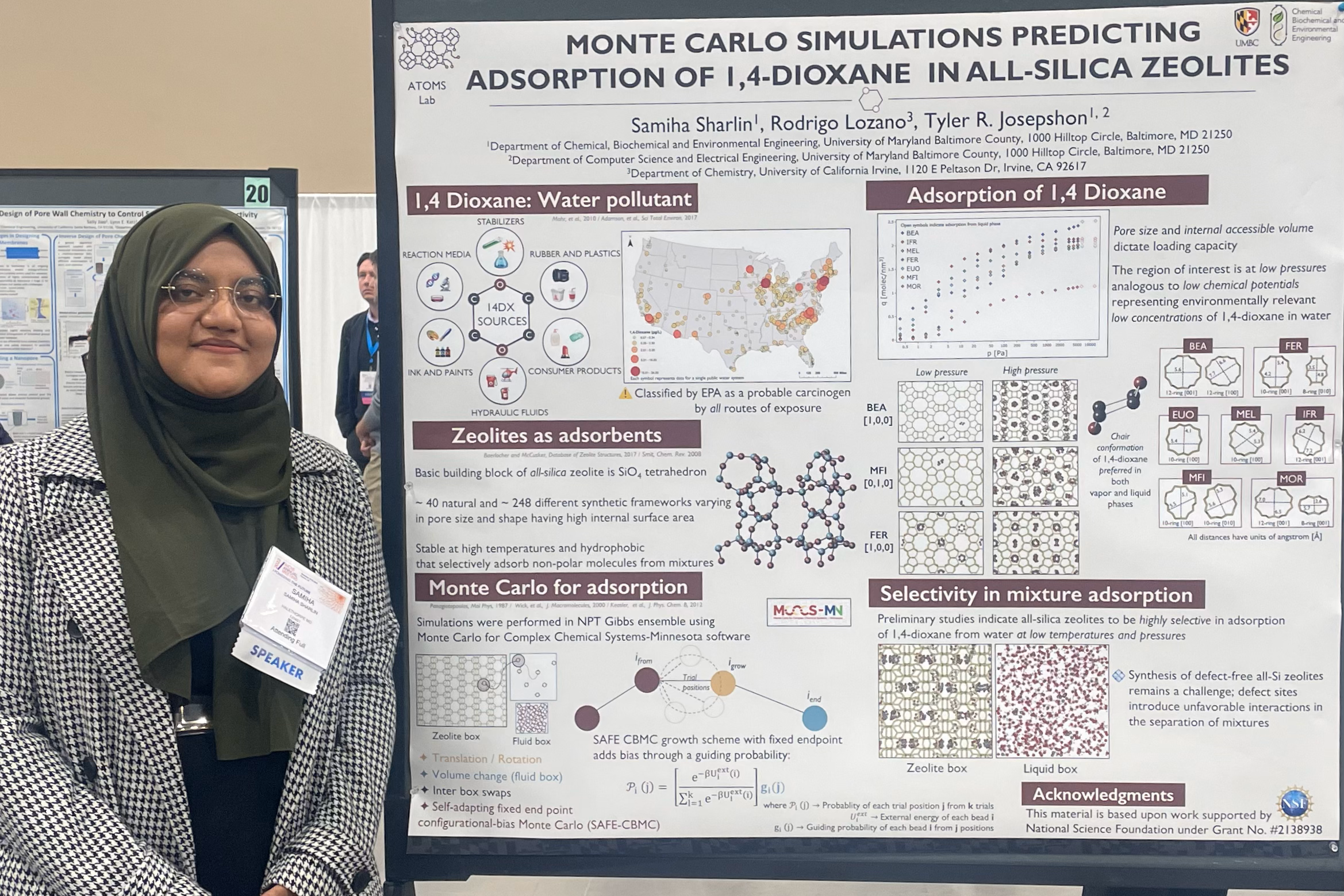
Samiha Sharlin standing beside her poster at the 2022 AICHE Annual Meeting in Phoenix, Arizona. The poster is titled MONTE CARLO SIMULATIONS PREDICTING ADSORPTION OF 1,4-DIOXANE IN ALL-SILICA ZEOLITES. Photo Credit: Samiha Sharlin
Tell us about someone in the department who has inspired you or supported you & how did they do it?
Andrea [Miller, Graduate Program Coordinator] has been an incredible support throughout my time at CBEE. With her, I never hesitate to seek advice or ask questions because she creates a comfortable and open atmosphere. Despite usually struggling to ask for help, I've never felt that hesitation in her presence.
Dr. Leach, as the Graduate Program Director, was also a significant source of support for me during the lab rotations. And, of course, I can't speak highly enough about my advisor, Dr. Josephson. He has consistently gone above and beyond to understand and assist me, particularly considering the challenges of being a first-gen international student. In fact, the entire department has been incredibly supportive, and I've always felt their genuine dedication to helping students succeed.
What’s the one thing you’d want someone who hasn’t joined the UMBC community to know about the support you find here?
As I've emphasized earlier, the people you surround yourself with are of utmost importance. At CBEE, you'll discover an environment that is truly conducive to learning and growth - supporting you academically, professionally, and personally. UMBC also offers a wide range of student organizations that cater to diverse student interests. UMBC MSA (Muslim Student Association) has given me a sense of belonging and comfort that I did not expect to find in college. I am grateful for the wonderful people I have met through them and the positive and uplifting atmosphere they foster.
What would you tell others who are in your shoes at UMBC?
After coming here, I felt like I was in a race at first, and I couldn't help but feel that I was falling behind in every aspect of life. However, as I looked around and saw the diverse backgrounds and unique stories of everyone, I had a deep realization and learned to make peace with my timeline and embrace the individuality of my path. Now, this experience has transformed into a truly rewarding journey.
Embarking on this adventure of pursuing my dreams in a foreign land, far away from my family and friends, was a daunting decision. Yet, with time, I discovered my way and something truly special: a new family of friends who have made this journey far more meaningful and fulfilling!
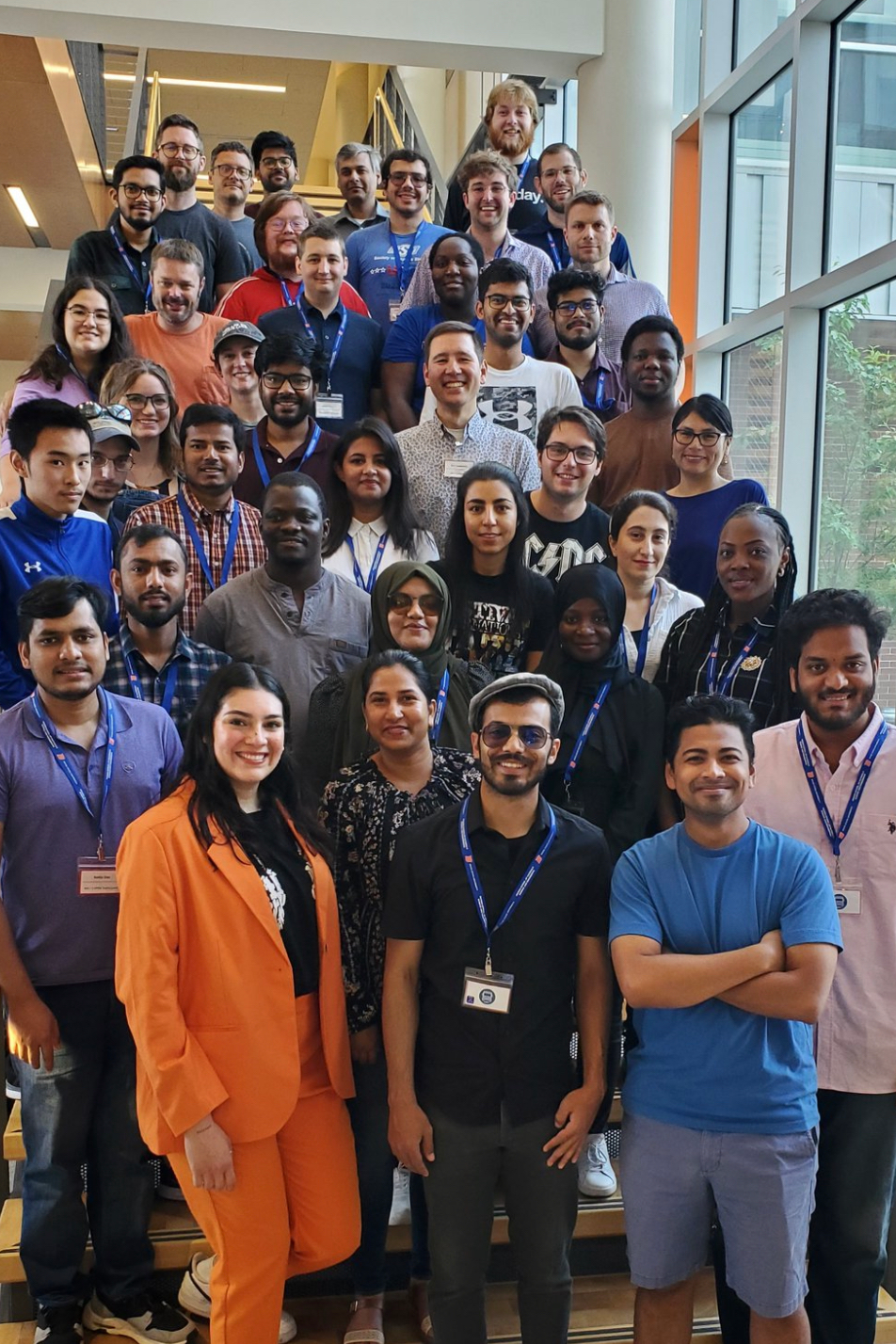
The 2023 participants for the I-COMSE workshop on Fundamentals and Applications of Density Functional Theory at the Micron School of Materials Science and Engineering at Boise State University. Photo provided by Samiha Sharlin.
]]>
by: Arya Honraopatil Meet Samiha Sharlin. Samiha Sharlin is a chemical and biochemical engineering doctoral student in the department of Chemical, Biochemical and Environmental Engineering....
https://beta.my.umbc.edu/api/v0/pixel/news/134758/guest@my.umbc.edu/0723abda75e8b928f7c0bc1358c1703b/api/pixel
cbee-er
fall-2023
grad
josephson
phd
Chemical, Biochemical and Environmental Engineering
https://beta.my.umbc.edu/groups/cbee
https://assets4-beta.my.umbc.edu/system/shared/avatars/groups/000/000/771/b5e579e81b2e3624611890fa3ca2716a/xsmall.png?1746794587
https://assets2-beta.my.umbc.edu/system/shared/avatars/groups/000/000/771/b5e579e81b2e3624611890fa3ca2716a/original.png?1746794587
https://assets1-beta.my.umbc.edu/system/shared/avatars/groups/000/000/771/b5e579e81b2e3624611890fa3ca2716a/xxlarge.png?1746794587
https://assets2-beta.my.umbc.edu/system/shared/avatars/groups/000/000/771/b5e579e81b2e3624611890fa3ca2716a/xlarge.png?1746794587
https://assets2-beta.my.umbc.edu/system/shared/avatars/groups/000/000/771/b5e579e81b2e3624611890fa3ca2716a/large.png?1746794587
https://assets4-beta.my.umbc.edu/system/shared/avatars/groups/000/000/771/b5e579e81b2e3624611890fa3ca2716a/medium.png?1746794587
https://assets1-beta.my.umbc.edu/system/shared/avatars/groups/000/000/771/b5e579e81b2e3624611890fa3ca2716a/small.png?1746794587
https://assets4-beta.my.umbc.edu/system/shared/avatars/groups/000/000/771/b5e579e81b2e3624611890fa3ca2716a/xsmall.png?1746794587
https://assets1-beta.my.umbc.edu/system/shared/avatars/groups/000/000/771/b5e579e81b2e3624611890fa3ca2716a/xxsmall.png?1746794587
Chemical, Biochemical and Environmental Engineering
https://assets2-beta.my.umbc.edu/system/shared/thumbnails/news/000/134/758/eaac6118ca92f37eac1a30cb0427378b/xxlarge.jpg?1692301891
https://assets1-beta.my.umbc.edu/system/shared/thumbnails/news/000/134/758/eaac6118ca92f37eac1a30cb0427378b/xlarge.jpg?1692301891
https://assets3-beta.my.umbc.edu/system/shared/thumbnails/news/000/134/758/eaac6118ca92f37eac1a30cb0427378b/large.jpg?1692301891
https://assets2-beta.my.umbc.edu/system/shared/thumbnails/news/000/134/758/eaac6118ca92f37eac1a30cb0427378b/medium.jpg?1692301891
https://assets4-beta.my.umbc.edu/system/shared/thumbnails/news/000/134/758/eaac6118ca92f37eac1a30cb0427378b/small.jpg?1692301891
https://assets3-beta.my.umbc.edu/system/shared/thumbnails/news/000/134/758/eaac6118ca92f37eac1a30cb0427378b/xsmall.jpg?1692301891
https://assets1-beta.my.umbc.edu/system/shared/thumbnails/news/000/134/758/eaac6118ca92f37eac1a30cb0427378b/xxsmall.jpg?1692301891
2
0
true
Thu, 17 Aug 2023 16:12:28 -0400
Thu, 09 Nov 2023 13:28:38 -0500
Tyler Josephson advances research with NSF CAREER AWARD
Creating “AI Scientists”
from UMBC NEWS, "Creating “AI Scientists”: Tyler Josephson advances a new field of research through $650,000 NSF CAREER award", by Catherine Meyers on Published: May 12, 2023
Tyler Josephson’s lab sits off a main corridor in the department of chemical, biochemical and environmental engineering at UMBC. Open the door, though, and you’ll see nary a beaker, chemical closet, or lab coat. Inside, a few computers sit on tables. You might see equations scrawled on the white board or a few students poring over lines of code.
Using this modest setup, Josephson has launched an ambitious project to equip computers to make scientific discoveries—starting in the realm of chemistry. This March he won a prestigious NSF CAREER award to advance the project.
The goal of the work is ultimately to speed up the process of science, which should in turn give humanity new knowledge and tools to face down big challenges such as climate change and environmental degradation.
As Josephson and his students dive into the work, they are bringing together techniques from across mathematics, computer science, and chemical engineering. Their first step is to translate chemical theories into a rigorous mathematical language that a computer can understand.
Math as the language of science
In 1623, the Italian natural philosopher Galileo Galilei wrote an essay in which he described nature as a book written in “the language of mathematics.” Many scientists since have puzzled over the mysterious power of math to describe physical phenomena.
Josephson and his students are tapping into this power. They are using a tool developed by researchers at Microsoft called the Lean theorem prover. Lean is both a computer language and a program for checking each step of a rigorous mathematical proof.
“Formal proofs, which are verified by a computer, differ from the informal, handwritten versions often used by scientists,” says Josephson. Informal proofs are easier to write, but they usually skip logical steps, assuming a human reader will have the knowledge and skill to follow along. This means that errors can creep in undetected.
On the other hand, if a proof has been written and checked in Lean, it is guaranteed to be correct as long as the stated assumptions are true.
A community of Lean programmers
Lean has a dedicated community of volunteer developers who have built a large library of mathematical proofs, each of which can then serve as a building block for more complicated proofs. They aim to digitize mathematics, starting with the entirety of the undergraduate math curriculum, which will lay the foundation for formal proofs in advanced modern mathematics.
Josephson plans to build a similar library with formally correct derivations in science and engineering, starting with chemical concepts such as the thermodynamic behavior of gases and of molecules sticking and unsticking from surfaces.
He and his students describe their approach in a first paper on the subject, and are in the process of submitting it to journals.
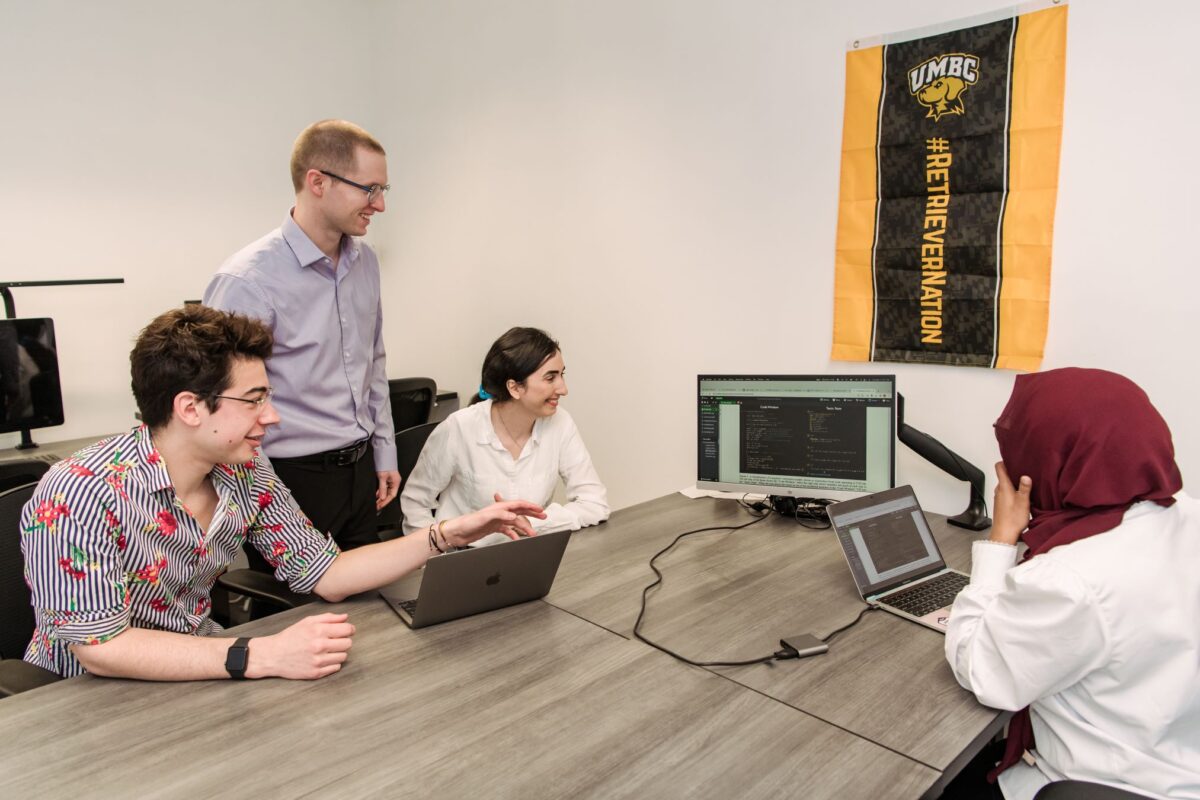 Tyler Josephson (standing) and students Max Bobbin (left), Parivash Feyzishendi (center), and Samiha Sharlin (right) in the lab. (Marlayna Demond ’11/UMBC)
The power of the work will multiply as more of the foundations of science are translated into Lean, so a large part of the team’s work will also be to recruit, inspire, and train fellow proof creators. They will hold workshops to showcase Lean for scientists and engineers, and they plan to create fun and educational games that will teach Lean-programming skills to newcomers.
“I’m really excited to share this tool with students and the scientific community,” Josephson says.
Building better scientific computing tools
Josephson’s goal to formally verify scientific theories isn’t just an intellectual exercise—it’s a means of building better tools for better science. One such tool he plans to create with NSF CAREER award support is Lean-based computer software that can simulate the behavior of molecules under a range of conditions.
Scientists often use such software to test theories as an alternative to physical experiments. It can be easier to run simulations of reactions on a computer, for example, than to mix real chemicals again and again, and some molecular phenomena may happen so fast, or under such extreme conditions, that current experimental tools cannot capture them.
However, bugs can mar the performance of the software. For example, starting in 2011, a hidden coding error fueled a seven-year “war over supercooled water,” in which two scientific groups disagreed about what happens to ultrapure water when it is cooled significantly below the freezing point of normal water, and then suddenly crystallizes.
Code written in Lean is unique from that written in the programming languages commonly used in scientific computing, since it can be provably free of such math errors, Josephson says.
As more scientists and engineers learn to write code and proofs in Lean, others will be able to write bug-free software for applications as diverse as weather forecasting, drug discovery, and predicting material performance.
“AI scientists” who reason on their own
Ultimately, Josephson hopes to use a Lean-based library of scientific knowledge to train computers as fellow scientists. For example, large language models, such as the recently popularized ChatGPT, might be trained on a library of scientific proofs and gain the ability to “autocomplete” proofs on their own, translate informal proofs from the literature into formal ones, and even discover entirely new scientific theories, which could then be checked for correctness by Lean.
A tool like this might revolutionize science. In Galileo’s time, a single person could master large portions of human scientific knowledge, but now scientists usually go to school for decades to become experts in a tiny subfield, Josephson says.
AI scientists capable of digesting a database of thousands of scientific proofs in multiple disciplines might draw connections across them to reveal new discoveries. “Such a tool could lead to an AI-powered Renaissance in interdisciplinary scientific discovery,” says Josephson.
While such lofty goals remain in the future, Josephson and his students are energized by the possibilities. As they embark on an exciting scientific journey, they are thrilled to bring as many people as possible along on the ride.
]]>
from UMBC NEWS, "Creating “AI Scientists”: Tyler Josephson advances a new field of research through $650,000 NSF CAREER award", by Catherine Meyers on Published: May 12, 2023 Tyler...
https://beta.my.umbc.edu/api/v0/pixel/news/133064/guest@my.umbc.edu/3d87a874ac5b8c8fc9d5e108c4749646/api/pixel
award
faculty
josephson
spring-2023
Chemical, Biochemical and Environmental Engineering
https://beta.my.umbc.edu/groups/cbee
https://assets4-beta.my.umbc.edu/system/shared/avatars/groups/000/000/771/b5e579e81b2e3624611890fa3ca2716a/xsmall.png?1746794587
https://assets2-beta.my.umbc.edu/system/shared/avatars/groups/000/000/771/b5e579e81b2e3624611890fa3ca2716a/original.png?1746794587
https://assets1-beta.my.umbc.edu/system/shared/avatars/groups/000/000/771/b5e579e81b2e3624611890fa3ca2716a/xxlarge.png?1746794587
https://assets2-beta.my.umbc.edu/system/shared/avatars/groups/000/000/771/b5e579e81b2e3624611890fa3ca2716a/xlarge.png?1746794587
https://assets2-beta.my.umbc.edu/system/shared/avatars/groups/000/000/771/b5e579e81b2e3624611890fa3ca2716a/large.png?1746794587
https://assets4-beta.my.umbc.edu/system/shared/avatars/groups/000/000/771/b5e579e81b2e3624611890fa3ca2716a/medium.png?1746794587
https://assets1-beta.my.umbc.edu/system/shared/avatars/groups/000/000/771/b5e579e81b2e3624611890fa3ca2716a/small.png?1746794587
https://assets4-beta.my.umbc.edu/system/shared/avatars/groups/000/000/771/b5e579e81b2e3624611890fa3ca2716a/xsmall.png?1746794587
https://assets1-beta.my.umbc.edu/system/shared/avatars/groups/000/000/771/b5e579e81b2e3624611890fa3ca2716a/xxsmall.png?1746794587
Chemical, Biochemical and Environmental Engineering
https://assets1-beta.my.umbc.edu/system/shared/thumbnails/news/000/133/064/f3c6a66c048263f2b362db019ca84932/xxlarge.jpg?1684341161
https://assets4-beta.my.umbc.edu/system/shared/thumbnails/news/000/133/064/f3c6a66c048263f2b362db019ca84932/xlarge.jpg?1684341161
https://assets4-beta.my.umbc.edu/system/shared/thumbnails/news/000/133/064/f3c6a66c048263f2b362db019ca84932/large.jpg?1684341161
https://assets1-beta.my.umbc.edu/system/shared/thumbnails/news/000/133/064/f3c6a66c048263f2b362db019ca84932/medium.jpg?1684341161
https://assets1-beta.my.umbc.edu/system/shared/thumbnails/news/000/133/064/f3c6a66c048263f2b362db019ca84932/small.jpg?1684341161
https://assets4-beta.my.umbc.edu/system/shared/thumbnails/news/000/133/064/f3c6a66c048263f2b362db019ca84932/xsmall.jpg?1684341161
https://assets3-beta.my.umbc.edu/system/shared/thumbnails/news/000/133/064/f3c6a66c048263f2b362db019ca84932/xxsmall.jpg?1684341161
0
0
true
Wed, 17 May 2023 12:37:43 -0400
Mon, 29 Apr 2024 12:36:11 -0400
Dr. Josephson interviewed on Quirks & Quarks
Dr. Tyler Josephson, assistant professor of Chemical, Biochemical and Environmental Engineering at UMBC, is interviewed on Canadian Broadcasting Corporation science show "Quirks and Quarks".
Humans are no longer the only ones capable of making scientific discoveries. Kepler's third law of planetary motion has been re-discovered centuries after it was first described – but this time, an artificial intelligence system is taking the credit.
Dubbed AI-Descartes, this "AI scientist" was developed by a team of researchers from IBM Research, Samsung AI, and the University of Maryland, Baltimore County (UMBC).
"I think scientists have so many different problems to solve. And if we solve them faster with AI, they just open up brand new questions for us to go after next," Tyler Josephson told Quirks & Quarks host Bob McDonald.
FULL ARTICLE & PODCAST :
Image Credit:
Artist's concept of our solar system showing a sense of scale and distance.
The planets and dwarf planet Pluto are shown in their correct order of distance from the sun, their correct relative sizes and their correct relative orbital distances. The sizes of the bodies are greatly exaggerated relative to the orbital distances.
The faint rings of Jupiter, Uranus and Neptune are not shown. Eris, Haumea and Makemake do not appear in the illustration owing to their highly tilted orbits. The dwarf planet Ceres is not shown separately; it resides in the asteroid belt between Mars and Jupiter.
#BBD0E0 »
]]>
Dr. Tyler Josephson, assistant professor of Chemical, Biochemical and Environmental Engineering at UMBC, is interviewed on Canadian Broadcasting Corporation science show "Quirks and Quarks". ...
https://beta.my.umbc.edu/api/v0/pixel/news/132687/guest@my.umbc.edu/ccedc3deaf1efc87ccfd7e85fc6b3ed3/api/pixel
faculty
josephson
spring-2023
Chemical, Biochemical and Environmental Engineering
https://beta.my.umbc.edu/groups/cbee
https://assets4-beta.my.umbc.edu/system/shared/avatars/groups/000/000/771/b5e579e81b2e3624611890fa3ca2716a/xsmall.png?1746794587
https://assets2-beta.my.umbc.edu/system/shared/avatars/groups/000/000/771/b5e579e81b2e3624611890fa3ca2716a/original.png?1746794587
https://assets1-beta.my.umbc.edu/system/shared/avatars/groups/000/000/771/b5e579e81b2e3624611890fa3ca2716a/xxlarge.png?1746794587
https://assets2-beta.my.umbc.edu/system/shared/avatars/groups/000/000/771/b5e579e81b2e3624611890fa3ca2716a/xlarge.png?1746794587
https://assets2-beta.my.umbc.edu/system/shared/avatars/groups/000/000/771/b5e579e81b2e3624611890fa3ca2716a/large.png?1746794587
https://assets4-beta.my.umbc.edu/system/shared/avatars/groups/000/000/771/b5e579e81b2e3624611890fa3ca2716a/medium.png?1746794587
https://assets1-beta.my.umbc.edu/system/shared/avatars/groups/000/000/771/b5e579e81b2e3624611890fa3ca2716a/small.png?1746794587
https://assets4-beta.my.umbc.edu/system/shared/avatars/groups/000/000/771/b5e579e81b2e3624611890fa3ca2716a/xsmall.png?1746794587
https://assets1-beta.my.umbc.edu/system/shared/avatars/groups/000/000/771/b5e579e81b2e3624611890fa3ca2716a/xxsmall.png?1746794587
Chemical, Biochemical and Environmental Engineering
https://assets2-beta.my.umbc.edu/system/shared/thumbnails/news/000/132/687/3e8773a5d2f360213b09c01c950245f3/xxlarge.jpg?1681742769
https://assets4-beta.my.umbc.edu/system/shared/thumbnails/news/000/132/687/3e8773a5d2f360213b09c01c950245f3/xlarge.jpg?1681742769
https://assets4-beta.my.umbc.edu/system/shared/thumbnails/news/000/132/687/3e8773a5d2f360213b09c01c950245f3/large.jpg?1681742769
https://assets4-beta.my.umbc.edu/system/shared/thumbnails/news/000/132/687/3e8773a5d2f360213b09c01c950245f3/medium.jpg?1681742769
https://assets3-beta.my.umbc.edu/system/shared/thumbnails/news/000/132/687/3e8773a5d2f360213b09c01c950245f3/small.jpg?1681742769
https://assets2-beta.my.umbc.edu/system/shared/thumbnails/news/000/132/687/3e8773a5d2f360213b09c01c950245f3/xsmall.jpg?1681742769
https://assets4-beta.my.umbc.edu/system/shared/thumbnails/news/000/132/687/3e8773a5d2f360213b09c01c950245f3/xxsmall.jpg?1681742769
0
0
true
Mon, 17 Apr 2023 10:46:33 -0400