CBEE Graduate Students recognized for excellence in leadership and research
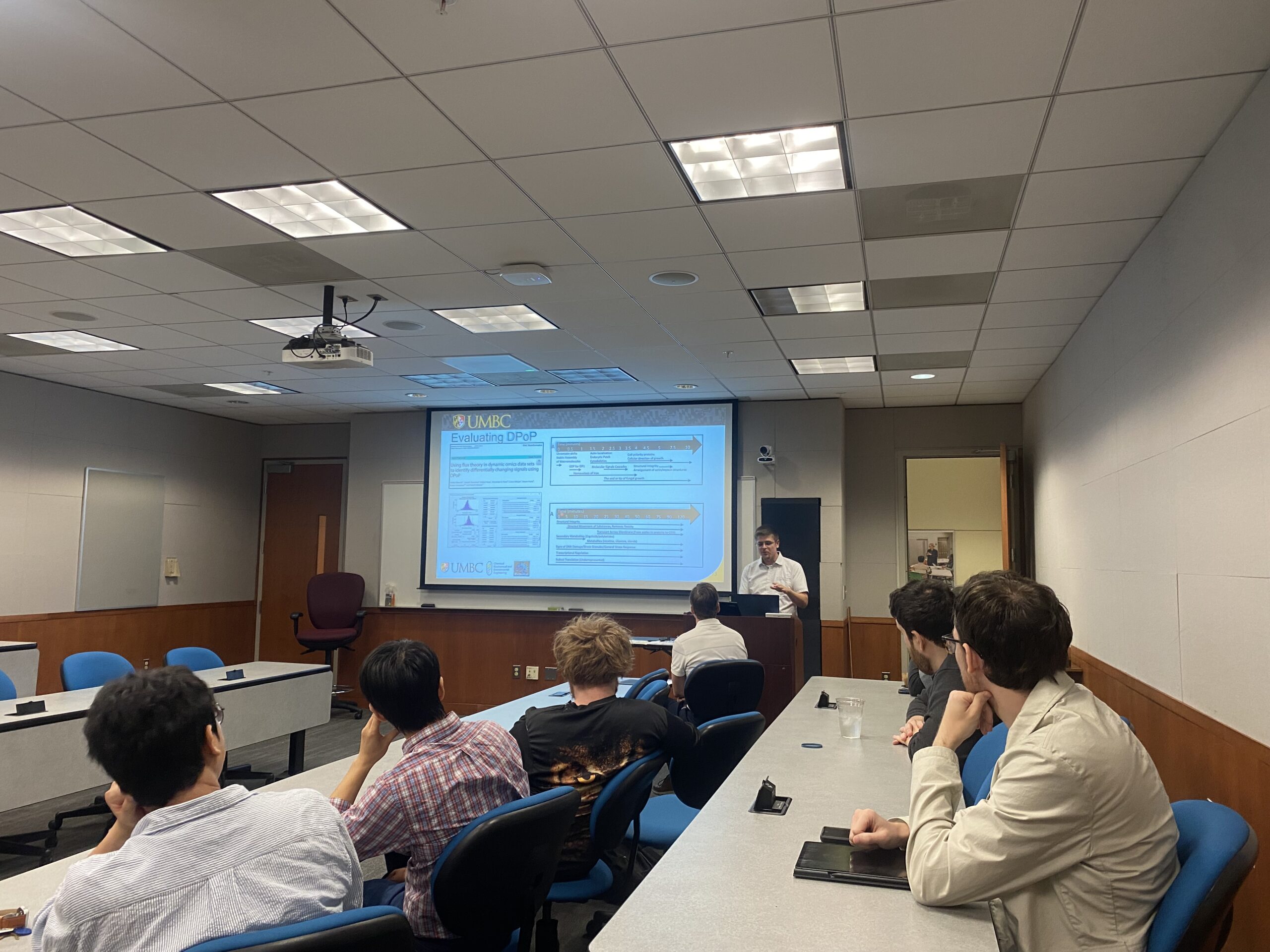
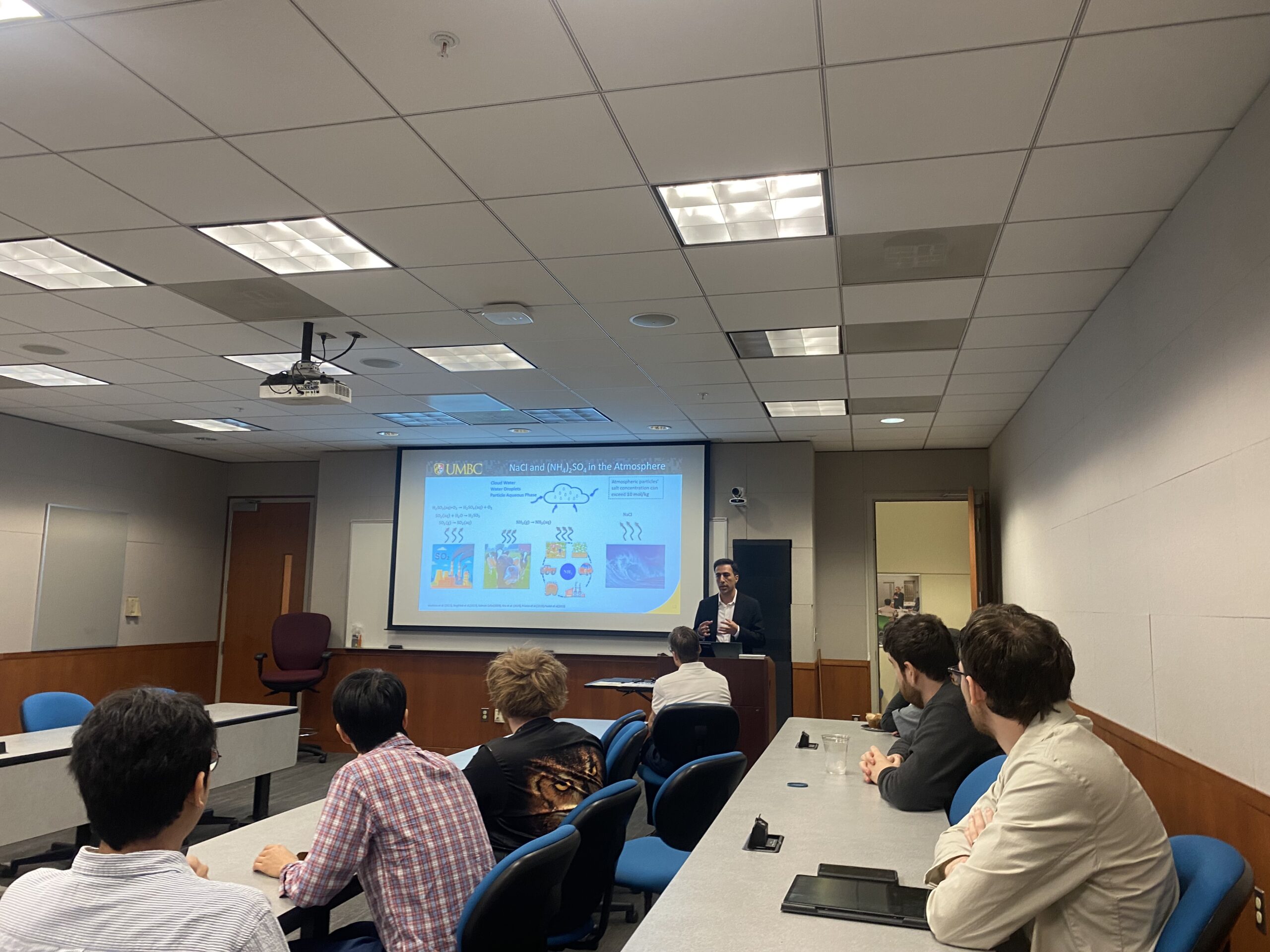
On Friday, September 12, 2025, CBEE celebrated two outstanding graduate students who have demonstrated exceptional commitment to research and leadership. During the ceremony, the awardees shared brief presentations about their current research.
Congratulations to this year's award winners!
Excellence in Doctoral Research
Dr. Harley Edwards
Ph.D. Chemical Engineering
Advisor: Dr. Mark Marten
This award recognizes a CBEE Doctoral Student for outstanding performance in research.
Excellence in Leadership
Amir Babaei Gharehbagh
Ph.D. student, Environmental Engineering
Advisory: Dr. Chris Hennigan
This award recognizes a CBEE Graduate Student for outstanding leadership demonstrated in service to the department, college, or their fellow students.
Award recipients were nominated by CBEE faculty, staff, or students (graduate or undergraduate). The nominations were reviewed and selected by CBEE’s Graduate program Committee.
]]>
On Friday, September 12, 2025, CBEE celebrated two outstanding graduate students who have demonstrated exceptional commitment to research and leadership. During the ceremony, the awardees shared...
https://beta.my.umbc.edu/api/v0/pixel/news/152476/guest@my.umbc.edu/c39207641a35ab957911b3b29ef9792d/api/pixel
award
fall-2025
grad
grad-awards
hennigan
marten
research
Chemical, Biochemical and Environmental Engineering
https://beta.my.umbc.edu/groups/cbee
https://assets4-beta.my.umbc.edu/system/shared/avatars/groups/000/000/771/b5e579e81b2e3624611890fa3ca2716a/xsmall.png?1746794587
https://assets2-beta.my.umbc.edu/system/shared/avatars/groups/000/000/771/b5e579e81b2e3624611890fa3ca2716a/original.png?1746794587
https://assets1-beta.my.umbc.edu/system/shared/avatars/groups/000/000/771/b5e579e81b2e3624611890fa3ca2716a/xxlarge.png?1746794587
https://assets2-beta.my.umbc.edu/system/shared/avatars/groups/000/000/771/b5e579e81b2e3624611890fa3ca2716a/xlarge.png?1746794587
https://assets2-beta.my.umbc.edu/system/shared/avatars/groups/000/000/771/b5e579e81b2e3624611890fa3ca2716a/large.png?1746794587
https://assets4-beta.my.umbc.edu/system/shared/avatars/groups/000/000/771/b5e579e81b2e3624611890fa3ca2716a/medium.png?1746794587
https://assets1-beta.my.umbc.edu/system/shared/avatars/groups/000/000/771/b5e579e81b2e3624611890fa3ca2716a/small.png?1746794587
https://assets4-beta.my.umbc.edu/system/shared/avatars/groups/000/000/771/b5e579e81b2e3624611890fa3ca2716a/xsmall.png?1746794587
https://assets1-beta.my.umbc.edu/system/shared/avatars/groups/000/000/771/b5e579e81b2e3624611890fa3ca2716a/xxsmall.png?1746794587
Chemical, Biochemical and Environmental Engineering
https://assets2-beta.my.umbc.edu/system/shared/thumbnails/news/000/152/476/dc1d2a884defb4e2cf98fdb63e830158/xxlarge.jpg?1757952112
https://assets2-beta.my.umbc.edu/system/shared/thumbnails/news/000/152/476/dc1d2a884defb4e2cf98fdb63e830158/xlarge.jpg?1757952112
https://assets2-beta.my.umbc.edu/system/shared/thumbnails/news/000/152/476/dc1d2a884defb4e2cf98fdb63e830158/large.jpg?1757952112
https://assets1-beta.my.umbc.edu/system/shared/thumbnails/news/000/152/476/dc1d2a884defb4e2cf98fdb63e830158/medium.jpg?1757952112
https://assets3-beta.my.umbc.edu/system/shared/thumbnails/news/000/152/476/dc1d2a884defb4e2cf98fdb63e830158/small.jpg?1757952112
https://assets4-beta.my.umbc.edu/system/shared/thumbnails/news/000/152/476/dc1d2a884defb4e2cf98fdb63e830158/xsmall.jpg?1757952112
https://assets1-beta.my.umbc.edu/system/shared/thumbnails/news/000/152/476/dc1d2a884defb4e2cf98fdb63e830158/xxsmall.jpg?1757952112
24-25 CBEE Graduate Awardees
0
0
true
Tue, 16 Sep 2025 11:11:46 -0400
CBEE Student Wins 2025 Bioremediation Symposium Award
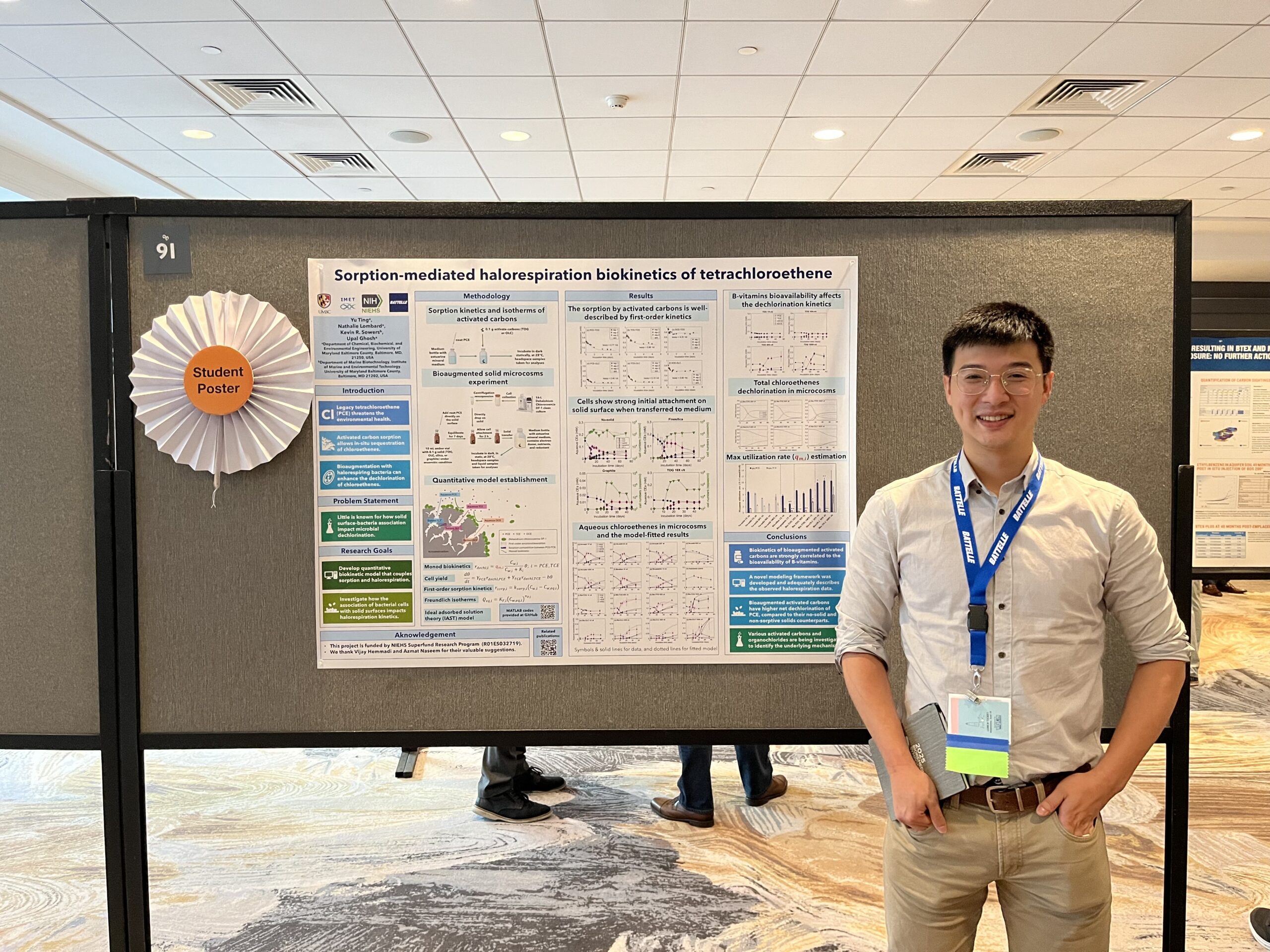
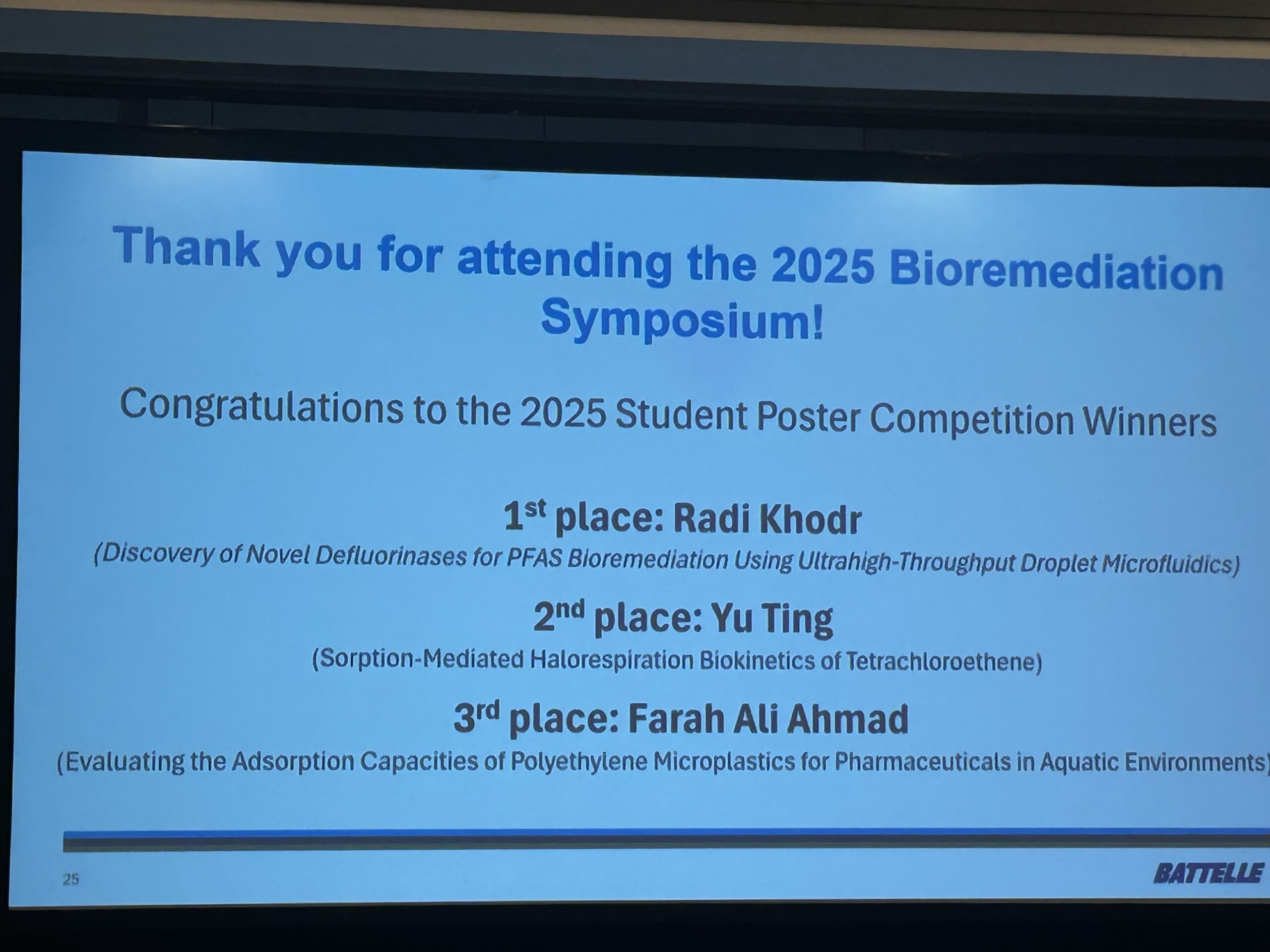
Yu Ting (Environmental Engineering Ph.D. student with Dr. Ghosh) attended and presented his poster at the 2025 International Symposium on Bioremediation and Environmental Biotechnology in Boston from June 23-26, and earned 2nd place in the poster contest.
This premiere conference on environmental bioremediation is held bi-annually, and is a convergence of experts and innovators in the field, showcasing the latest advancements and research. Yu Ting's work has been recognized among many outstanding contributions, reflecting his commitment to solving complex environmental challenges. Congratulations to Yu Ting!
]]>
Yu Ting (Environmental Engineering Ph.D. student with Dr. Ghosh) attended and presented his poster at the 2025 International Symposium on Bioremediation and Environmental Biotechnology in Boston...
https://beta.my.umbc.edu/api/v0/pixel/news/150843/guest@my.umbc.edu/05cacc9c53a76317ab3c6e227e4e8ce9/api/pixel
award
bioremediation
ghosh
grad
research
summer-2025
symposium
Chemical, Biochemical and Environmental Engineering
https://beta.my.umbc.edu/groups/cbee
https://assets4-beta.my.umbc.edu/system/shared/avatars/groups/000/000/771/b5e579e81b2e3624611890fa3ca2716a/xsmall.png?1746794587
https://assets2-beta.my.umbc.edu/system/shared/avatars/groups/000/000/771/b5e579e81b2e3624611890fa3ca2716a/original.png?1746794587
https://assets1-beta.my.umbc.edu/system/shared/avatars/groups/000/000/771/b5e579e81b2e3624611890fa3ca2716a/xxlarge.png?1746794587
https://assets2-beta.my.umbc.edu/system/shared/avatars/groups/000/000/771/b5e579e81b2e3624611890fa3ca2716a/xlarge.png?1746794587
https://assets2-beta.my.umbc.edu/system/shared/avatars/groups/000/000/771/b5e579e81b2e3624611890fa3ca2716a/large.png?1746794587
https://assets4-beta.my.umbc.edu/system/shared/avatars/groups/000/000/771/b5e579e81b2e3624611890fa3ca2716a/medium.png?1746794587
https://assets1-beta.my.umbc.edu/system/shared/avatars/groups/000/000/771/b5e579e81b2e3624611890fa3ca2716a/small.png?1746794587
https://assets4-beta.my.umbc.edu/system/shared/avatars/groups/000/000/771/b5e579e81b2e3624611890fa3ca2716a/xsmall.png?1746794587
https://assets1-beta.my.umbc.edu/system/shared/avatars/groups/000/000/771/b5e579e81b2e3624611890fa3ca2716a/xxsmall.png?1746794587
Chemical, Biochemical and Environmental Engineering
https://assets1-beta.my.umbc.edu/system/shared/thumbnails/news/000/150/843/a577c4583cd6abda9034068c1bae81cc/xxlarge.jpg?1751033686
https://assets4-beta.my.umbc.edu/system/shared/thumbnails/news/000/150/843/a577c4583cd6abda9034068c1bae81cc/xlarge.jpg?1751033686
https://assets4-beta.my.umbc.edu/system/shared/thumbnails/news/000/150/843/a577c4583cd6abda9034068c1bae81cc/large.jpg?1751033686
https://assets4-beta.my.umbc.edu/system/shared/thumbnails/news/000/150/843/a577c4583cd6abda9034068c1bae81cc/medium.jpg?1751033686
https://assets2-beta.my.umbc.edu/system/shared/thumbnails/news/000/150/843/a577c4583cd6abda9034068c1bae81cc/small.jpg?1751033686
https://assets3-beta.my.umbc.edu/system/shared/thumbnails/news/000/150/843/a577c4583cd6abda9034068c1bae81cc/xsmall.jpg?1751033686
https://assets3-beta.my.umbc.edu/system/shared/thumbnails/news/000/150/843/a577c4583cd6abda9034068c1bae81cc/xxsmall.jpg?1751033686
CBEE Student Wins 2025 Bioremediation Symposium Award
0
0
true
Fri, 27 Jun 2025 11:59:33 -0400
Research days foster collaboration and showcase research across COEIT
COEIT spotlights student and faculty research, builds ties
On April 11, the second annual COEIT Research Day brought together more than 180 students and faculty from COEIT’s four academic departments, as well as outside speakers and visitors. Attendance increased by around 20 percent from last year’s inaugural Research Day.
More than 100 researchers presented either talks or posters at the meeting, and several students won awards for their posters and were recognized at the COEIT Awards and Celebration event on May 4.
“A major success of this year’s Research Day was the presence of visitors and speakers from industry, nonprofits, and government,” says Vandana Janeja, the associate dean for research in COEIT. “The event gave these guests an opportunity to visit UMBC and to engage in the vibrant research happening within COEIT, making connections with our research community that we hope to see grow into long-lasting partnerships.”
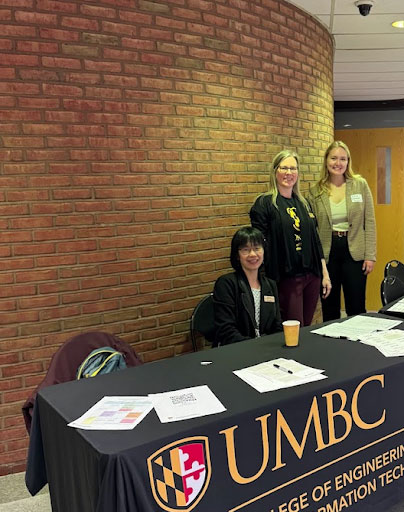
COEIT dean’s office staff Emily Tien, Amy Heckhaus, and Chloe Evered at COEIT Research Day. (Image courtesy of Vandana Janeja)
The college also launched a new call for COEIT Interdisciplinary Proposals. Last year, COEIT funded 11 projects from teams made up of researchers from two or more academic departments. The teams presented their results at this year’s event, on topics ranging from cybersecurity in manufacturing to thermally stable energy-harvesting materials.
On May 2, the Department of Computer Science and Electrical Engineering also hosted its annual research day, bringing together faculty, staff, and students to highlight the department’s latest advancements in research, from robotics to AI weather forecasting.
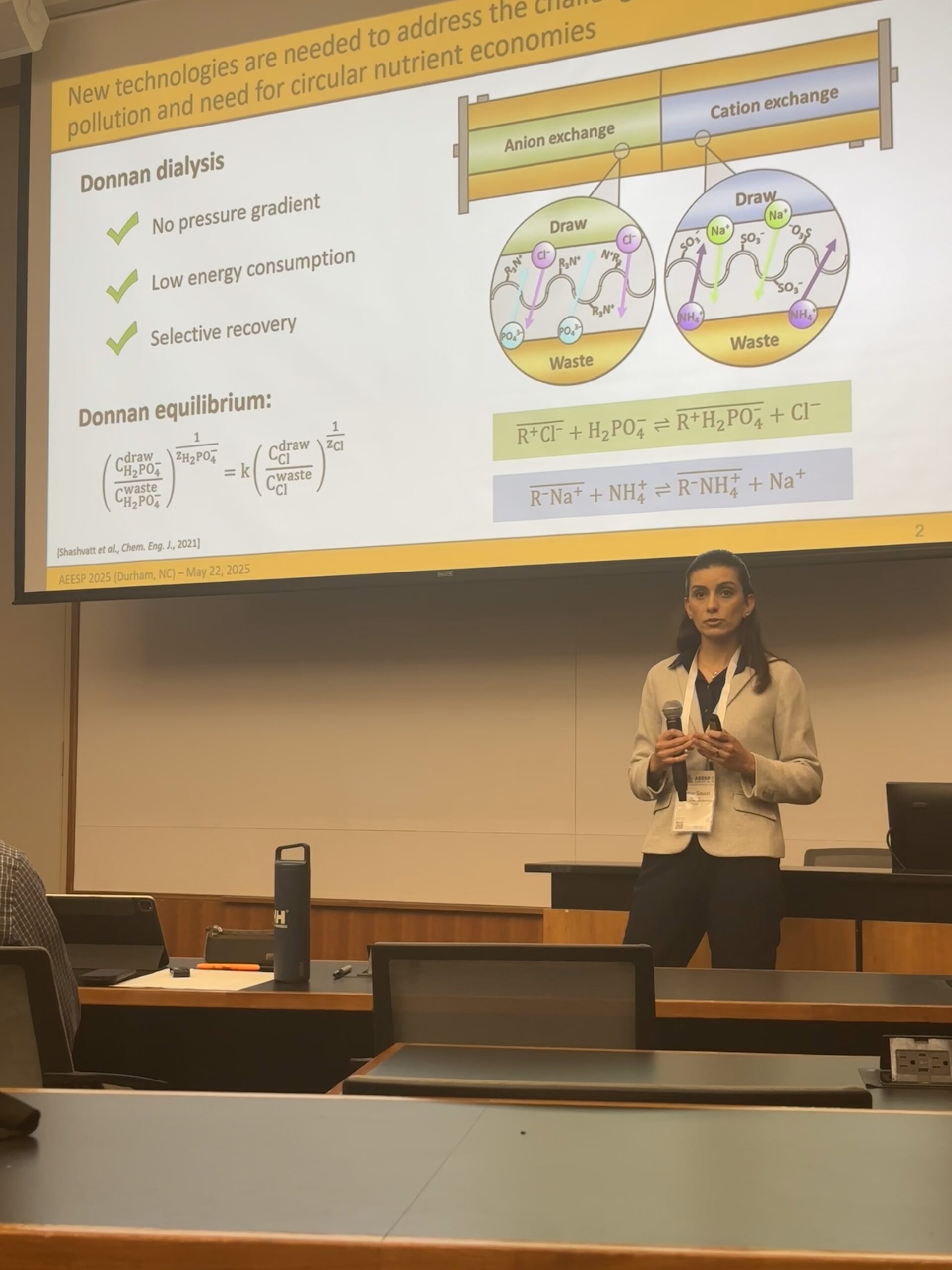
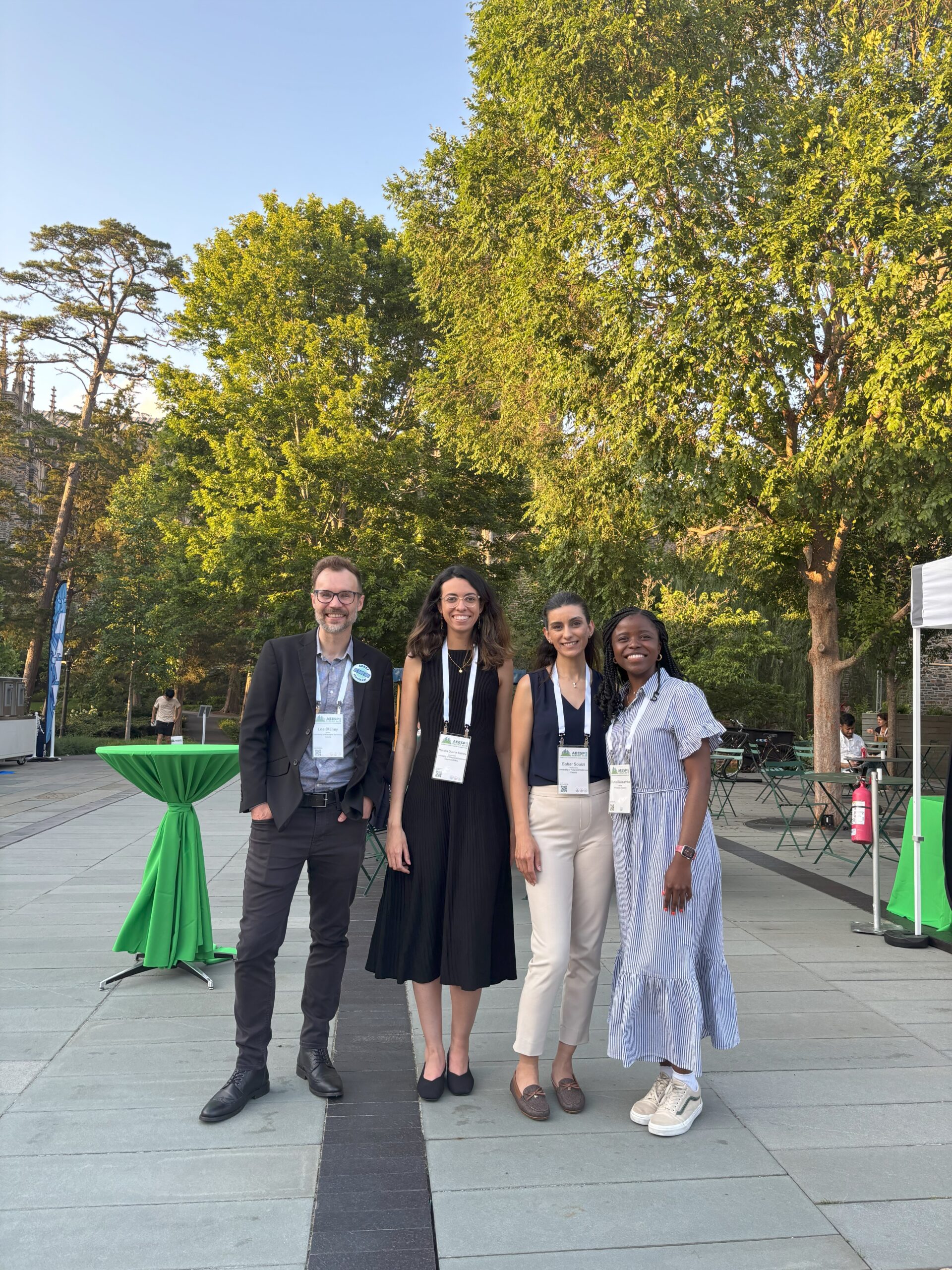
Sahar Souizi, Marylia Duarte Batista (Environmental Engineering Ph.D. students with Dr. Blaney), and Dr. Blaney attended the AEESP 2025 Research and Education Conference at Duke University from May 20-22. With over 1,000 attendees, the event featured oral presentations, poster sessions, plenary talks, workshops, and networking opportunities. Marylia presented her research titled “Development of hybrid anion-exchange resins with enhanced selectivity and capacity for (ultra)short-chain PFAS” in the “Advances in PFAS Treatment and Destruction” session. Sahar shared her work on “Sustainable nutrient recovery from poultry litter using an enhanced tube-in-tube Donnan dialysis system” during the “Resource Recovery from Waste Streams Towards Circular Economy” session. Both students enjoyed the opportunities to connect with fellow PhD students, post-doctoral researchers, and professors in the field.
The conference also offered opportunities for reconnections, such as with Ouriel Ndalamba, a former undergraduate lab member now a PhD student at Princeton.
Additional details and links to Sahar and Marylia's submitted abstracts: https://lee-blaney.squarespace.com/news
]]>
Sahar Souizi, Marylia Duarte Batista (Environmental Engineering Ph.D. students with Dr. Blaney), and Dr. Blaney attended the AEESP 2025 Research and Education Conference at Duke University from...
https://beta.my.umbc.edu/api/v0/pixel/news/150469/guest@my.umbc.edu/ab2920d2874e456a3c6ebbbe62918c6f/api/pixel
aeesp
blaney
grad
research
spring-2025
Chemical, Biochemical and Environmental Engineering
https://beta.my.umbc.edu/groups/cbee
https://assets4-beta.my.umbc.edu/system/shared/avatars/groups/000/000/771/b5e579e81b2e3624611890fa3ca2716a/xsmall.png?1746794587
https://assets2-beta.my.umbc.edu/system/shared/avatars/groups/000/000/771/b5e579e81b2e3624611890fa3ca2716a/original.png?1746794587
https://assets1-beta.my.umbc.edu/system/shared/avatars/groups/000/000/771/b5e579e81b2e3624611890fa3ca2716a/xxlarge.png?1746794587
https://assets2-beta.my.umbc.edu/system/shared/avatars/groups/000/000/771/b5e579e81b2e3624611890fa3ca2716a/xlarge.png?1746794587
https://assets2-beta.my.umbc.edu/system/shared/avatars/groups/000/000/771/b5e579e81b2e3624611890fa3ca2716a/large.png?1746794587
https://assets4-beta.my.umbc.edu/system/shared/avatars/groups/000/000/771/b5e579e81b2e3624611890fa3ca2716a/medium.png?1746794587
https://assets1-beta.my.umbc.edu/system/shared/avatars/groups/000/000/771/b5e579e81b2e3624611890fa3ca2716a/small.png?1746794587
https://assets4-beta.my.umbc.edu/system/shared/avatars/groups/000/000/771/b5e579e81b2e3624611890fa3ca2716a/xsmall.png?1746794587
https://assets1-beta.my.umbc.edu/system/shared/avatars/groups/000/000/771/b5e579e81b2e3624611890fa3ca2716a/xxsmall.png?1746794587
Chemical, Biochemical and Environmental Engineering
https://assets2-beta.my.umbc.edu/system/shared/thumbnails/news/000/150/469/bc01f5ac3e8a111b115fa373b16108a7/xxlarge.jpg?1748611320
https://assets2-beta.my.umbc.edu/system/shared/thumbnails/news/000/150/469/bc01f5ac3e8a111b115fa373b16108a7/xlarge.jpg?1748611320
https://assets1-beta.my.umbc.edu/system/shared/thumbnails/news/000/150/469/bc01f5ac3e8a111b115fa373b16108a7/large.jpg?1748611320
https://assets1-beta.my.umbc.edu/system/shared/thumbnails/news/000/150/469/bc01f5ac3e8a111b115fa373b16108a7/medium.jpg?1748611320
https://assets4-beta.my.umbc.edu/system/shared/thumbnails/news/000/150/469/bc01f5ac3e8a111b115fa373b16108a7/small.jpg?1748611320
https://assets4-beta.my.umbc.edu/system/shared/thumbnails/news/000/150/469/bc01f5ac3e8a111b115fa373b16108a7/xsmall.jpg?1748611320
https://assets1-beta.my.umbc.edu/system/shared/thumbnails/news/000/150/469/bc01f5ac3e8a111b115fa373b16108a7/xxsmall.jpg?1748611320
Marylia Duarte Batista presents her research at AEESP 2025 Conference.
1
0
true
Fri, 30 May 2025 09:19:51 -0400
Fri, 30 May 2025 09:22:30 -0400
Finding the harmony within art and science
Joshua Dayie - '25 Chemical Engineering
Excerpt from from UMBC News: Finding The Harmony Within Art And Science - UMBC: University Of Maryland, Baltimore County
At UMBC, undergraduate students are redefining the boundaries of scientific and artistic pursuits. From a chemical engineer who graces the stage with his cello to a bioinformatician who paints and a biochemist who ignites the dance floor with Latin rhythms, these scholars thrive in an environment that celebrates their diverse passions.
This spring, several U-RISE Scholars—NIH’s Undergraduate Research Training Initiative for Student Enhancement—shared their multidisciplinary interests with their U-RISE advisors. As a result, the advisors started asking how the arts and science blend in these students’ lives, and presented the findings at an academic conference this spring. What they learned was that here, rigorous research and creative expression intertwine, fostering a vibrant community where students explore every dimension of their talents.
For Joshua Dayie, a senior chemical engineering major, both discipline and creativity are required for his research and his art—playing the cello. “You really have to strike a balance between them to make any meaningful progress,” he says. Practicing cello requires hours of repetition, until technical passages flow out of his fingers from muscle memory alone. In the lab, sometimes experiments must be repeated many times before they’re successful—that’s the discipline.
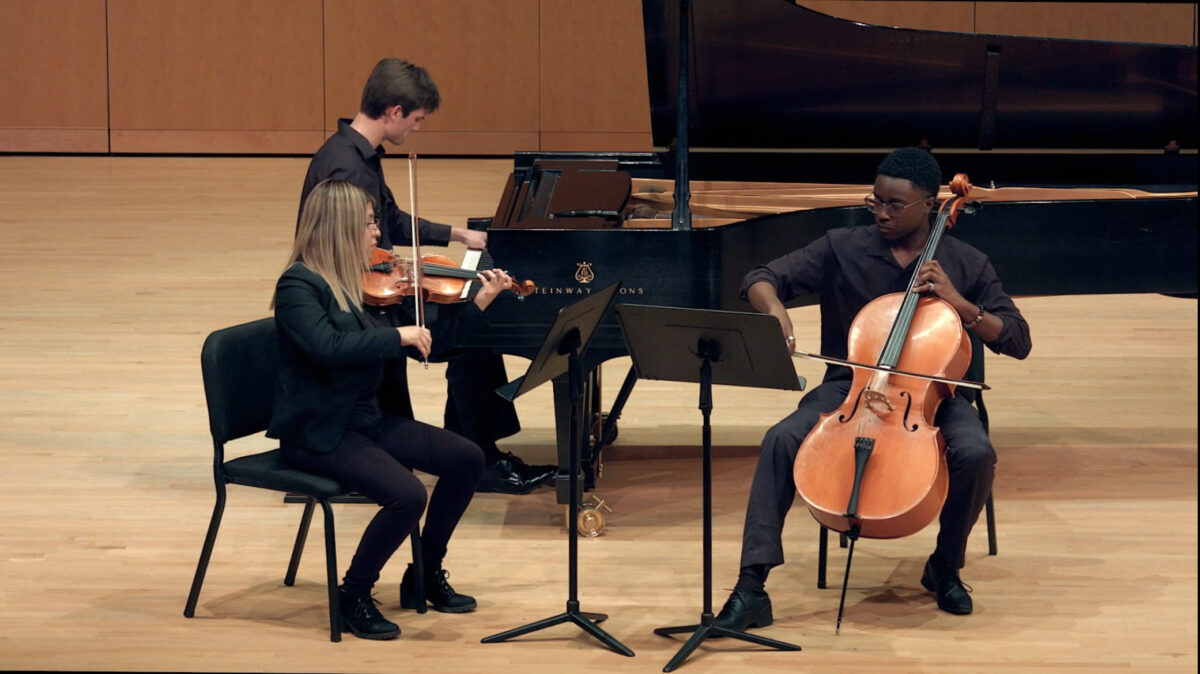
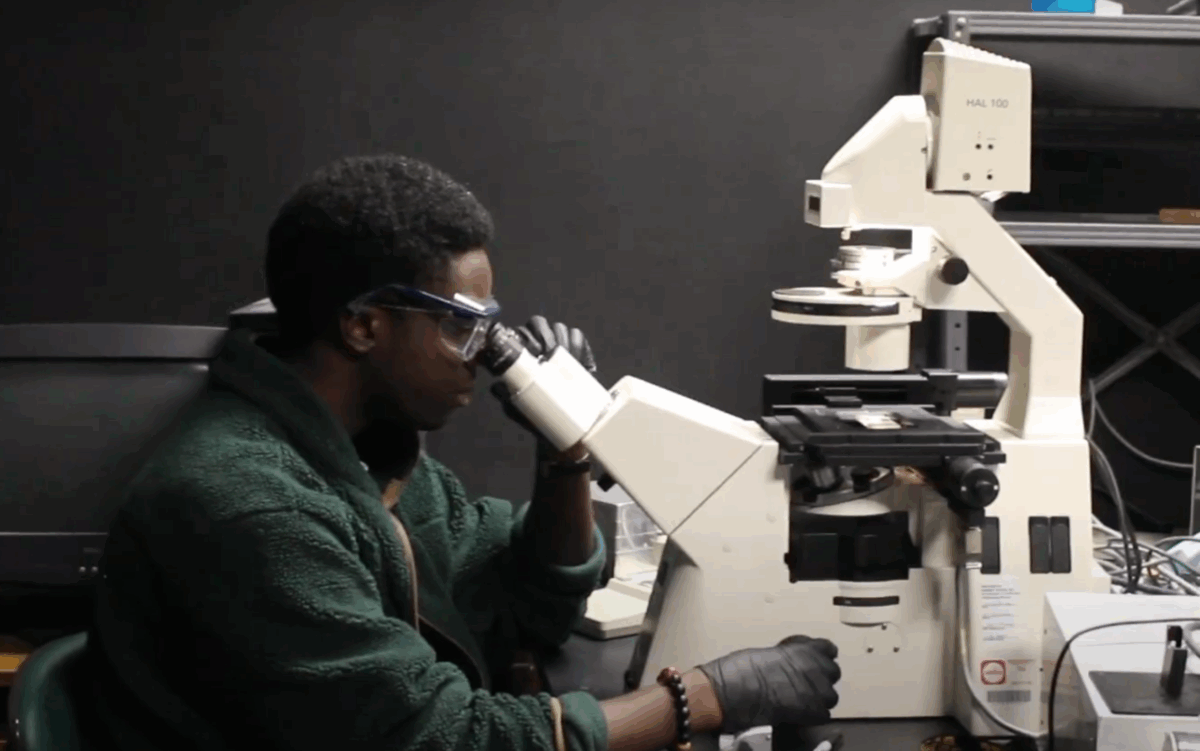 Playing the cello and conducting research makes Joshua Dayie feel “more whole.” (Melissa Penley Cormier, M.F.A. ’17/UMBC)
Dayie applies that discipline to his research with Mark Marten, professor of chemical, biochemical, and environmental engineering, on characterizing signaling pathways in fungi that activate in response to environmental stressors.
Then comes the creativity. Only after someone masters the fundamentals can they explore nuance in the tone or emotion conveyed on the cello, Dayie says. Similarly, in science “a lot of the innovation that you generate is really only meaningful after you’ve spent a lot of time understanding the core scientific concepts behind everything.”
“I think that’s been the most surprising thing: The creativity that comes from a very sound foundation of discipline is something that is translatable pretty much anywhere,” Dayie reflects.
As an added bonus, “Music has been a really nice outlet for me to use a different part of my brain, just to express myself in a different way,” he adds. “I feel like it makes me a little bit more whole.”
]]>
Excerpt from from UMBC News: Finding The Harmony Within Art And Science - UMBC: University Of Maryland, Baltimore County At UMBC, undergraduate students are redefining the boundaries of...
https://beta.my.umbc.edu/api/v0/pixel/news/150126/guest@my.umbc.edu/cf114a239d36963ab692f25aa8a2673e/api/pixel
grad
research
spring-2025
ug
ugrad
Chemical, Biochemical and Environmental Engineering
https://beta.my.umbc.edu/groups/cbee
https://assets4-beta.my.umbc.edu/system/shared/avatars/groups/000/000/771/b5e579e81b2e3624611890fa3ca2716a/xsmall.png?1746794587
https://assets2-beta.my.umbc.edu/system/shared/avatars/groups/000/000/771/b5e579e81b2e3624611890fa3ca2716a/original.png?1746794587
https://assets1-beta.my.umbc.edu/system/shared/avatars/groups/000/000/771/b5e579e81b2e3624611890fa3ca2716a/xxlarge.png?1746794587
https://assets2-beta.my.umbc.edu/system/shared/avatars/groups/000/000/771/b5e579e81b2e3624611890fa3ca2716a/xlarge.png?1746794587
https://assets2-beta.my.umbc.edu/system/shared/avatars/groups/000/000/771/b5e579e81b2e3624611890fa3ca2716a/large.png?1746794587
https://assets4-beta.my.umbc.edu/system/shared/avatars/groups/000/000/771/b5e579e81b2e3624611890fa3ca2716a/medium.png?1746794587
https://assets1-beta.my.umbc.edu/system/shared/avatars/groups/000/000/771/b5e579e81b2e3624611890fa3ca2716a/small.png?1746794587
https://assets4-beta.my.umbc.edu/system/shared/avatars/groups/000/000/771/b5e579e81b2e3624611890fa3ca2716a/xsmall.png?1746794587
https://assets1-beta.my.umbc.edu/system/shared/avatars/groups/000/000/771/b5e579e81b2e3624611890fa3ca2716a/xxsmall.png?1746794587
Chemical, Biochemical and Environmental Engineering
https://assets2-beta.my.umbc.edu/system/shared/thumbnails/news/000/150/126/11c6593795a1809c8a85f311622686fe/xxlarge.jpg?1747230457
https://assets2-beta.my.umbc.edu/system/shared/thumbnails/news/000/150/126/11c6593795a1809c8a85f311622686fe/xlarge.jpg?1747230457
https://assets1-beta.my.umbc.edu/system/shared/thumbnails/news/000/150/126/11c6593795a1809c8a85f311622686fe/large.jpg?1747230457
https://assets3-beta.my.umbc.edu/system/shared/thumbnails/news/000/150/126/11c6593795a1809c8a85f311622686fe/medium.jpg?1747230457
https://assets4-beta.my.umbc.edu/system/shared/thumbnails/news/000/150/126/11c6593795a1809c8a85f311622686fe/small.jpg?1747230457
https://assets4-beta.my.umbc.edu/system/shared/thumbnails/news/000/150/126/11c6593795a1809c8a85f311622686fe/xsmall.jpg?1747230457
https://assets3-beta.my.umbc.edu/system/shared/thumbnails/news/000/150/126/11c6593795a1809c8a85f311622686fe/xxsmall.jpg?1747230457
3
0
true
Wed, 14 May 2025 09:50:28 -0400
Wed, 21 May 2025 07:43:38 -0400
CBEE 2025 CIDER Recipients
Reposted from UMBC News:https://umbc.edu/stories/cider-program-hilltop-medicaid-study/
UMBC’s CIDER program supports new Hilltop Institute-led Medicaid study, other cross-collaborative projects
By: Adriana Fraser
UMBC researchers are collaborating on a study that takes a closer look at specific diagnosis coding patterns that focus on societal factors that potentially influence the health of Maryland’s Medicaid recipients.
Morgan Henderson, director of analytics and research at UMBC’s The Hilltop Institute, and Jun Chu, assistant professor of public health, are among the five cross-collaborative teams selected to receive funding from UMBC’s Center and Institute Departmentally-Engaged Research (CIDER) program. Henderson and Chu’s CIDER-supported project will investigate potential “z code” patterns of the state’s Medicaid recipients. Z codes are a set of diagnosis codes that refer to factors influencing a patient’s health status beyond diseases or injuries, called social determinants of health.
“These specific diagnosis codes indicate certain social determinants of health-related factors, not just traditionally medical things,” explains Henderson, principal investigator of the study. Z code data indicates if a patient has an issue that’s related to social risk factors, such as unstable housing, lack of food, hazardous living environments, and employment status.
“There hasn’t been much analysis of z code patterns and we aim to lay a good foundation for better understanding these diagnosis codes within Maryland’s Medicaid data,” says Henderson.
A deeper look into z code diagnosing could be a useful identification “to bring extra resources to Medicaid recipients who are in need,” says Chu.
Analyzing Medicaid data
The study coincides with recent news of potential billion-dollar federal budget cuts to Maryland’s Medicaid program, which currently supports about 1.7 million Maryland residents. The Hilltop Institute specializes in working with the state’s Medicaid data. According to the institute’s Maryland Medicaid DataPort, two in five of those in Medicaid are children and Medicaid pays for 60 percent of nursing home stays.
Chu’s research has largely focused on social determinants of health with a particular focus on immigrant communities and Medicaid recipients who are children. Henderson helped to develop and currently manages Hilltop’s predictive modeling portfolio. These predictive models, which also utilize z code data, use a variety of risk factors derived from Medicare and Medicaid claims data to estimate the probability that a given patient incurs certain outcomes in the near future.
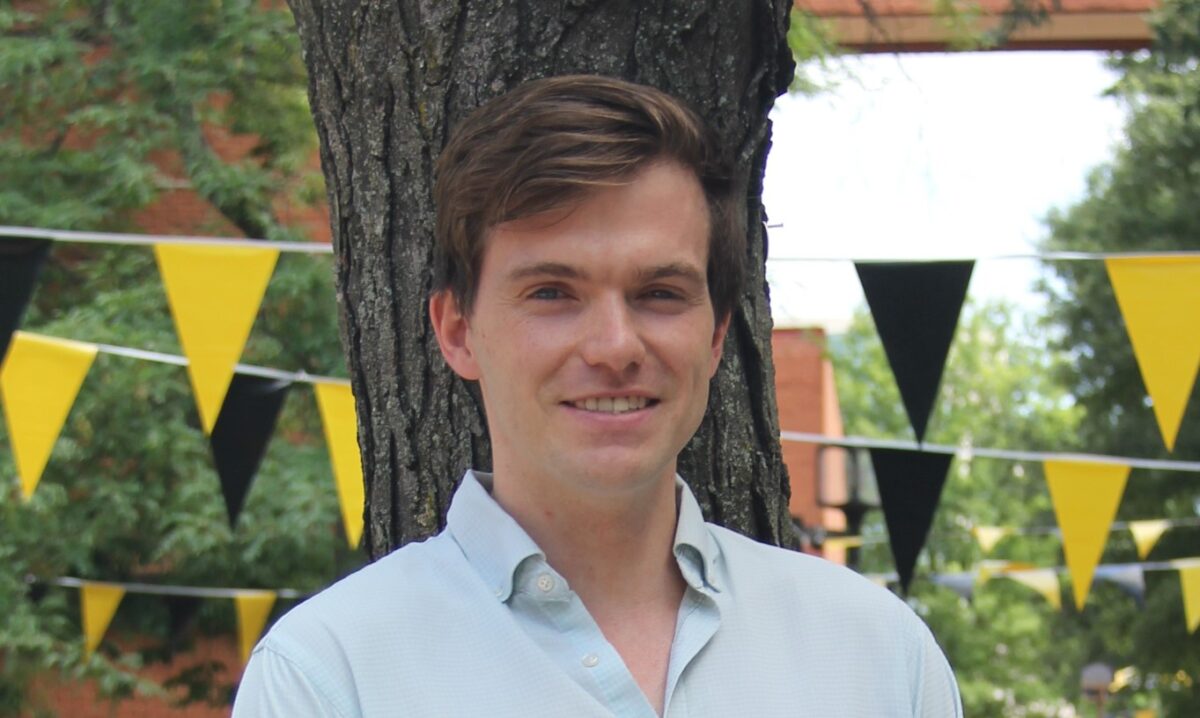
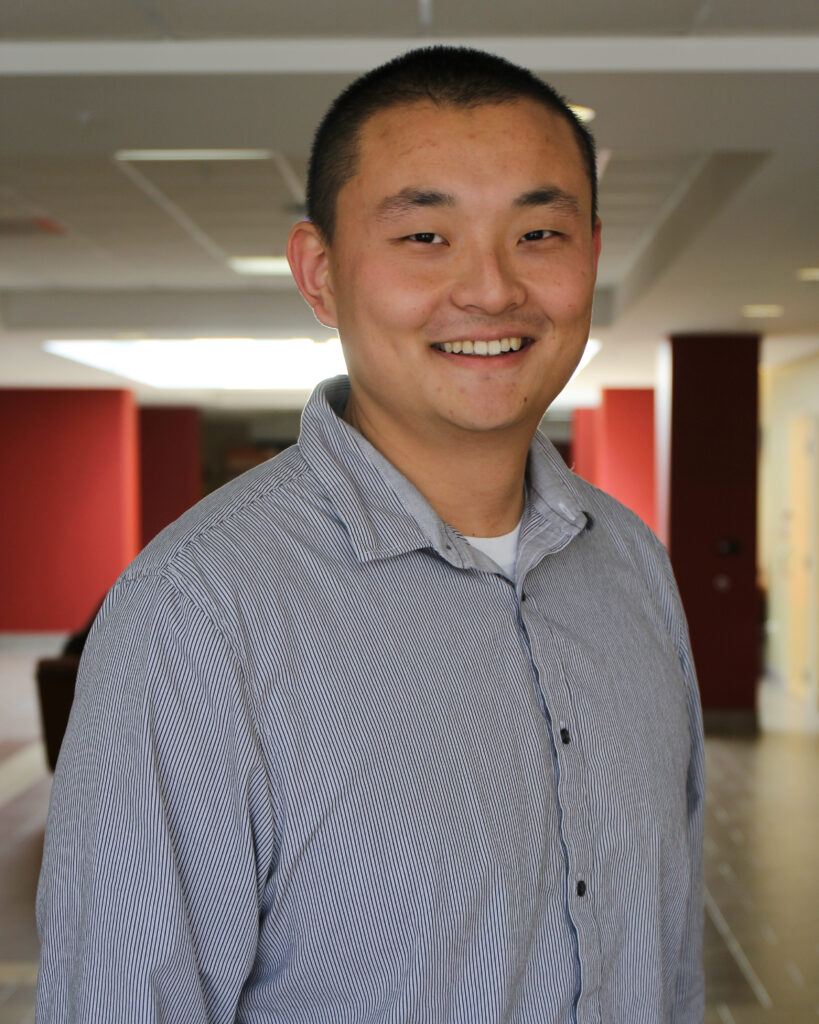 Principal investigator Morgan Henderson (left) and co-investigator Jun Chu of the CIDER Program study, “Analysis of Social Determinant of Health Diagnosis Coding Patterns Among Medicaid Recipients and Providers in Maryland.” (Photos courtesy of The Hilltop Institute and Jun Chu)
The pair’s project will include two studies: one study will focus specifically on the patients ascribed z codes to determine what patterns arise based on patient-specific factors such as demographics, health care utilization, or geography.
The second study will focus on analyzing the characteristics of the healthcare providers that indicate the z codes on Medicaid claims.
“Patient claims are the engine that so much of health analysis relies upon. It’s the decision of the provider on which coding diagnoses to include—it’s not a completely standardized process,” says Henderson.
CIDER 2025 recipients
The CIDER program’s goal includes supporting and promoting collaborative research between scholars based in one of UMBC’s affiliate centers and institutes and the university’s faculty researchers. Selected proposals are awarded up to $50,000 in seed funding for 18 months.
The 2025 CIDER program recipients include:
- Anin Puthukkudy, Earth and Space Institute, and Vanderlei Martins, professor of physics
- Jessica Sutton, Goddard Earth Sciences Technology and Research (GESTAR) II, Tejas Gokhale, assistant professor of computer science and electrical engineering, and Thomas Stanley, GESTAR II
- Kaur Kullman, the Center for Space Sciences and Technology, Alan Sherman, Roberto Yus, and Enis Golaszewski, professors of computer science and electrical engineering
- Morgan Henderson, The Hilltop Institute at UMBC, and Jun Chu, assistant professor of public health
- Venkatesh Srinivasan, Center for Advanced Sensor Technology, Tyler Josephson, assistant professor of chemical, biochemical, and environmental engineering
Don Engel, associate vice president for research development, shares that the CIDER program was created to foster collaborations that draw on the full range of UMBC’s strengths in research and creative achievement.
“CIDER helps connect faculty in our research centers with colleagues in degree-granting departments to pursue work with real impact—work that informs policy, advances knowledge, and ultimately serves the public good,” says Engel.
]]>
Reposted from UMBC News:https://umbc.edu/stories/cider-program-hilltop-medicaid-study/ UMBC’s CIDER program supports new Hilltop Institute-led Medicaid study, other cross-collaborative...
https://beta.my.umbc.edu/api/v0/pixel/news/149919/guest@my.umbc.edu/1096da6a681a960a8521dd4139f8dc81/api/pixel
grad
josephson
research
spring-2025
srinivasan
ug
ugrad
Chemical, Biochemical and Environmental Engineering
https://beta.my.umbc.edu/groups/cbee
https://assets4-beta.my.umbc.edu/system/shared/avatars/groups/000/000/771/b5e579e81b2e3624611890fa3ca2716a/xsmall.png?1746794587
https://assets2-beta.my.umbc.edu/system/shared/avatars/groups/000/000/771/b5e579e81b2e3624611890fa3ca2716a/original.png?1746794587
https://assets1-beta.my.umbc.edu/system/shared/avatars/groups/000/000/771/b5e579e81b2e3624611890fa3ca2716a/xxlarge.png?1746794587
https://assets2-beta.my.umbc.edu/system/shared/avatars/groups/000/000/771/b5e579e81b2e3624611890fa3ca2716a/xlarge.png?1746794587
https://assets2-beta.my.umbc.edu/system/shared/avatars/groups/000/000/771/b5e579e81b2e3624611890fa3ca2716a/large.png?1746794587
https://assets4-beta.my.umbc.edu/system/shared/avatars/groups/000/000/771/b5e579e81b2e3624611890fa3ca2716a/medium.png?1746794587
https://assets1-beta.my.umbc.edu/system/shared/avatars/groups/000/000/771/b5e579e81b2e3624611890fa3ca2716a/small.png?1746794587
https://assets4-beta.my.umbc.edu/system/shared/avatars/groups/000/000/771/b5e579e81b2e3624611890fa3ca2716a/xsmall.png?1746794587
https://assets1-beta.my.umbc.edu/system/shared/avatars/groups/000/000/771/b5e579e81b2e3624611890fa3ca2716a/xxsmall.png?1746794587
Chemical, Biochemical and Environmental Engineering
https://assets3-beta.my.umbc.edu/system/shared/thumbnails/news/000/149/919/e3b8d38e9d4981563c9a47bc8102e4dc/xxlarge.jpg?1746714078
https://assets1-beta.my.umbc.edu/system/shared/thumbnails/news/000/149/919/e3b8d38e9d4981563c9a47bc8102e4dc/xlarge.jpg?1746714078
https://assets1-beta.my.umbc.edu/system/shared/thumbnails/news/000/149/919/e3b8d38e9d4981563c9a47bc8102e4dc/large.jpg?1746714078
https://assets3-beta.my.umbc.edu/system/shared/thumbnails/news/000/149/919/e3b8d38e9d4981563c9a47bc8102e4dc/medium.jpg?1746714078
https://assets2-beta.my.umbc.edu/system/shared/thumbnails/news/000/149/919/e3b8d38e9d4981563c9a47bc8102e4dc/small.jpg?1746714078
https://assets2-beta.my.umbc.edu/system/shared/thumbnails/news/000/149/919/e3b8d38e9d4981563c9a47bc8102e4dc/xsmall.jpg?1746714078
https://assets3-beta.my.umbc.edu/system/shared/thumbnails/news/000/149/919/e3b8d38e9d4981563c9a47bc8102e4dc/xxsmall.jpg?1746714078
0
0
true
Thu, 08 May 2025 10:24:11 -0400
Wed, 14 May 2025 09:49:56 -0400
CBEE Students Among Award Winners at 2025 UMBC Research Symposium and 3MT
CBEE Students Among Award Winners at GEARS and 3MT
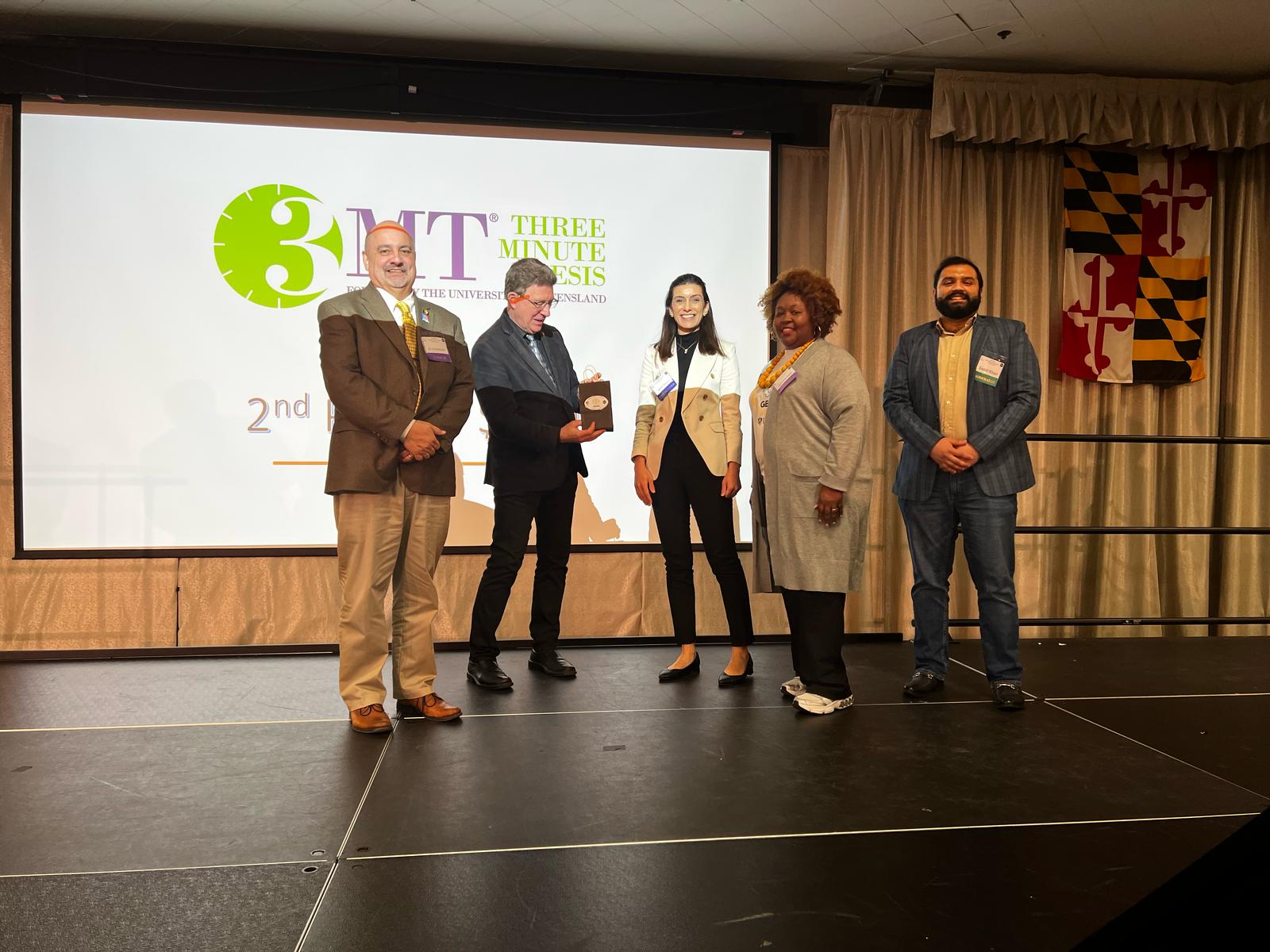
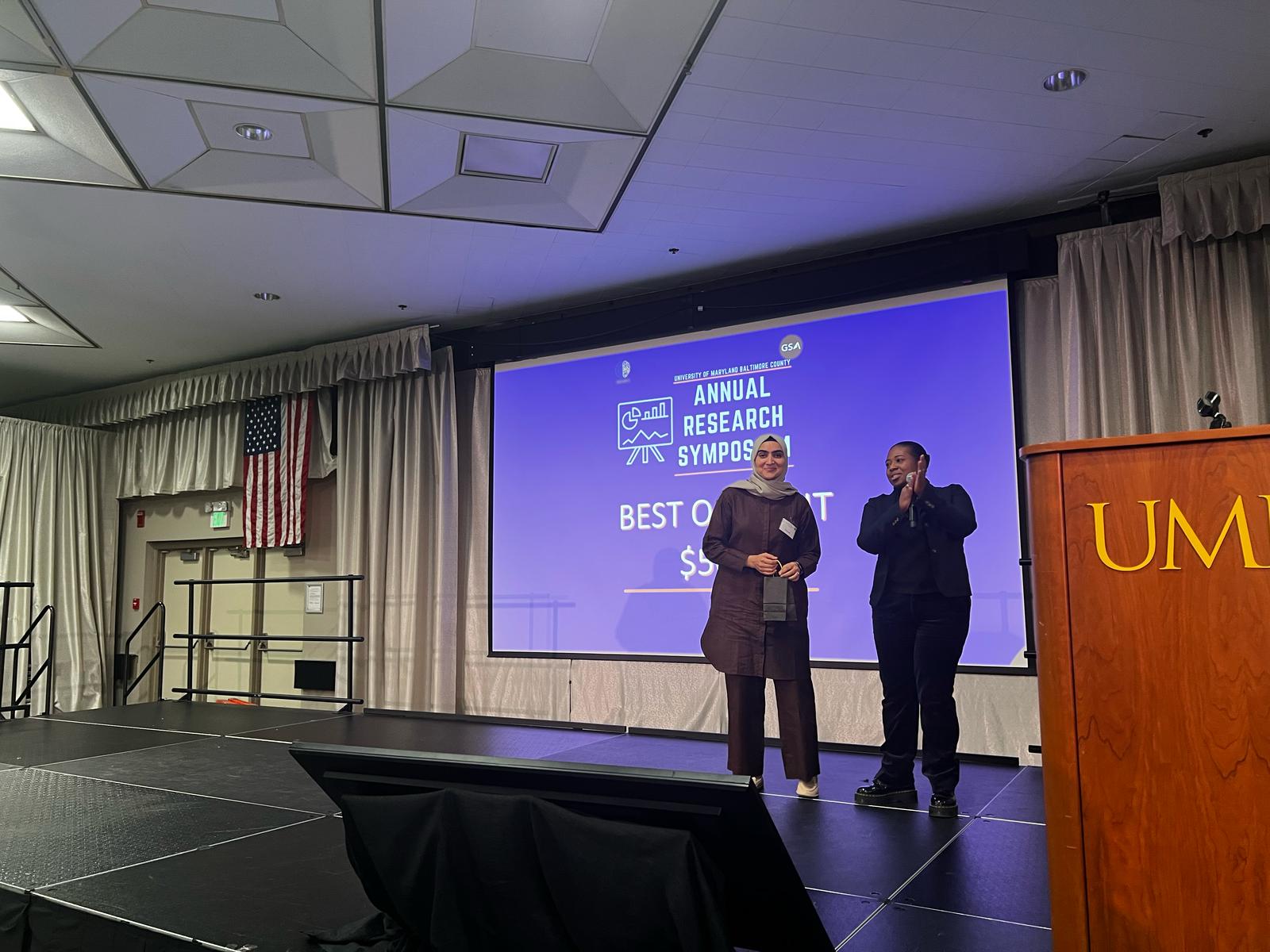
 Azmat Naseem, Environmental Engineering PhD student with Dr. Ghosh, was awarded the best poster presentation for COEIT and Sahar Souizi, Chemical and Biochemical Engineering Ph.D. student with Dr. Blaney, won the runner-up award for the 3 Minute Thesis competition (3MT). Congratulations!
GEARS GSA proudly hosted the 2025 Research Symposium and Three Minute Thesis (3MT) competition, celebrating the innovation, passion, and dedication of our student researchers across disciplines.
Research Symposium Winners
Each awarded $500 for excellence in research:
-
Best of CAHSS: Diane Placide
-
Best of CNMS: Lekan Ajiboye
-
Best of COEIT: Azmat Naseem
-
People's Choice Award: Navya Sree Manikonda
3MT Competition Winners
-
Winner: Prajna Bhandary ($500)
-
Runner-Up: Sahar Souizi ($250)
-
People's Choice Award: Seraj Mostafa ($250)
Congratulations to all participants for showcasing the power of research and storytelling. Your work continues to inspire and elevate the UMBC community.
See you all next year!
To access all pictures of the events, go to the following links:
Research Symposium Pictures
3MT Pictures
Original Post: https://my3.my.umbc.edu/groups/gsa/posts/149026
]]>
Azmat Naseem, Environmental Engineering PhD student with Dr. Ghosh, was awarded the best poster presentation for COEIT and Sahar Souizi, Chemical and Biochemical Engineering Ph.D. student with Dr....
https://beta.my.umbc.edu/api/v0/pixel/news/149029/guest@my.umbc.edu/207e0fdc313f2fb1afacd7ea002169cf/api/pixel
3mt
award
blaney
gears
ghosh
grad
research
spring-2025
Chemical, Biochemical and Environmental Engineering
https://beta.my.umbc.edu/groups/cbee
https://assets4-beta.my.umbc.edu/system/shared/avatars/groups/000/000/771/b5e579e81b2e3624611890fa3ca2716a/xsmall.png?1746794587
https://assets2-beta.my.umbc.edu/system/shared/avatars/groups/000/000/771/b5e579e81b2e3624611890fa3ca2716a/original.png?1746794587
https://assets1-beta.my.umbc.edu/system/shared/avatars/groups/000/000/771/b5e579e81b2e3624611890fa3ca2716a/xxlarge.png?1746794587
https://assets2-beta.my.umbc.edu/system/shared/avatars/groups/000/000/771/b5e579e81b2e3624611890fa3ca2716a/xlarge.png?1746794587
https://assets2-beta.my.umbc.edu/system/shared/avatars/groups/000/000/771/b5e579e81b2e3624611890fa3ca2716a/large.png?1746794587
https://assets4-beta.my.umbc.edu/system/shared/avatars/groups/000/000/771/b5e579e81b2e3624611890fa3ca2716a/medium.png?1746794587
https://assets1-beta.my.umbc.edu/system/shared/avatars/groups/000/000/771/b5e579e81b2e3624611890fa3ca2716a/small.png?1746794587
https://assets4-beta.my.umbc.edu/system/shared/avatars/groups/000/000/771/b5e579e81b2e3624611890fa3ca2716a/xsmall.png?1746794587
https://assets1-beta.my.umbc.edu/system/shared/avatars/groups/000/000/771/b5e579e81b2e3624611890fa3ca2716a/xxsmall.png?1746794587
Chemical, Biochemical and Environmental Engineering
https://assets3-beta.my.umbc.edu/system/shared/thumbnails/news/000/149/029/1593524605d0a750cc30f5a002214faf/xxlarge.jpg?1744639532
https://assets2-beta.my.umbc.edu/system/shared/thumbnails/news/000/149/029/1593524605d0a750cc30f5a002214faf/xlarge.jpg?1744639532
https://assets2-beta.my.umbc.edu/system/shared/thumbnails/news/000/149/029/1593524605d0a750cc30f5a002214faf/large.jpg?1744639532
https://assets3-beta.my.umbc.edu/system/shared/thumbnails/news/000/149/029/1593524605d0a750cc30f5a002214faf/medium.jpg?1744639532
https://assets4-beta.my.umbc.edu/system/shared/thumbnails/news/000/149/029/1593524605d0a750cc30f5a002214faf/small.jpg?1744639532
https://assets3-beta.my.umbc.edu/system/shared/thumbnails/news/000/149/029/1593524605d0a750cc30f5a002214faf/xsmall.jpg?1744639532
https://assets3-beta.my.umbc.edu/system/shared/thumbnails/news/000/149/029/1593524605d0a750cc30f5a002214faf/xxsmall.jpg?1744639532
0
0
true
Mon, 14 Apr 2025 11:30:18 -0400
Mon, 14 Apr 2025 12:46:30 -0400
NEW PUBLICATION: Probing Electrochemical Strain Generation in Vanadium Oxide Cathodes during Cycling of Aqueous Zinc-Ion Batteries via Imaging Technique
Bret Marckx, PhD student ‘27; Dr. Capraz, PhD Advisor
Congratulations to Bret Marckx!
His paper is highlighted as "ACS Editor's Choice", meaning that in the entire ACS database, his paper was selected to be highlighted on the day it was published.
Authors:
Bret A. Marckx, Hunter Maclennan, and Ömer Özgür Capraz
Title:
Probing Electrochemical Strain Generation in Vanadium Oxide Cathodes during Cycling of Aqueous Zinc-Ion Batteries via Imaging Technique
Abstract:
Aqueous batteries have received a great deal of attention for grid-scale energy storage applications but suffer from low-capacity retention and utilization. A lack of understanding of chemomechanical instabilities and charge storage mechanisms in cathodes limits the development of advanced aqueous batteries. To shed light on these instabilities, operando techniques are necessary to probe the complex interplay between electrochemistry and mechanics during cycling. Here, we report an operando technique to probe electrochemical strains in cathodes in aqueous electrolytes during battery cycling via optical imaging and digital image correlation. Operando mechanical measurements indicate that the cathode undergoes positive strain generation during discharge and negative generation during charge. Strain derivatives reveal a close correlation between electrochemical and mechanical behaviors, highlighting the connection between electrochemistry and mechanics. This operando imaging technique is broadly applicable and paves the way for a deeper understanding of deformation mechanisms in aqueous, multivalent ion battery materials.
full article:https://pubs.acs.org/doi/10.1021/cbmi.5c00003
]]>
Congratulations to Bret Marckx! His paper is highlighted as "ACS Editor's Choice", meaning that in the entire ACS database, his paper was selected to be highlighted on the day it was published....
https://beta.my.umbc.edu/api/v0/pixel/news/148819/guest@my.umbc.edu/020be0de4fb37398d2f93afbe0904c2b/api/pixel
capraz
grad
research
spring-2025
Chemical, Biochemical and Environmental Engineering
https://beta.my.umbc.edu/groups/cbee
https://assets4-beta.my.umbc.edu/system/shared/avatars/groups/000/000/771/b5e579e81b2e3624611890fa3ca2716a/xsmall.png?1746794587
https://assets2-beta.my.umbc.edu/system/shared/avatars/groups/000/000/771/b5e579e81b2e3624611890fa3ca2716a/original.png?1746794587
https://assets1-beta.my.umbc.edu/system/shared/avatars/groups/000/000/771/b5e579e81b2e3624611890fa3ca2716a/xxlarge.png?1746794587
https://assets2-beta.my.umbc.edu/system/shared/avatars/groups/000/000/771/b5e579e81b2e3624611890fa3ca2716a/xlarge.png?1746794587
https://assets2-beta.my.umbc.edu/system/shared/avatars/groups/000/000/771/b5e579e81b2e3624611890fa3ca2716a/large.png?1746794587
https://assets4-beta.my.umbc.edu/system/shared/avatars/groups/000/000/771/b5e579e81b2e3624611890fa3ca2716a/medium.png?1746794587
https://assets1-beta.my.umbc.edu/system/shared/avatars/groups/000/000/771/b5e579e81b2e3624611890fa3ca2716a/small.png?1746794587
https://assets4-beta.my.umbc.edu/system/shared/avatars/groups/000/000/771/b5e579e81b2e3624611890fa3ca2716a/xsmall.png?1746794587
https://assets1-beta.my.umbc.edu/system/shared/avatars/groups/000/000/771/b5e579e81b2e3624611890fa3ca2716a/xxsmall.png?1746794587
Chemical, Biochemical and Environmental Engineering
https://assets1-beta.my.umbc.edu/system/shared/thumbnails/news/000/148/819/6e6d0bd324309652b3ef45514be1e9a4/xxlarge.jpg?1744121377
https://assets1-beta.my.umbc.edu/system/shared/thumbnails/news/000/148/819/6e6d0bd324309652b3ef45514be1e9a4/xlarge.jpg?1744121377
https://assets1-beta.my.umbc.edu/system/shared/thumbnails/news/000/148/819/6e6d0bd324309652b3ef45514be1e9a4/large.jpg?1744121377
https://assets1-beta.my.umbc.edu/system/shared/thumbnails/news/000/148/819/6e6d0bd324309652b3ef45514be1e9a4/medium.jpg?1744121377
https://assets1-beta.my.umbc.edu/system/shared/thumbnails/news/000/148/819/6e6d0bd324309652b3ef45514be1e9a4/small.jpg?1744121377
https://assets2-beta.my.umbc.edu/system/shared/thumbnails/news/000/148/819/6e6d0bd324309652b3ef45514be1e9a4/xsmall.jpg?1744121377
https://assets3-beta.my.umbc.edu/system/shared/thumbnails/news/000/148/819/6e6d0bd324309652b3ef45514be1e9a4/xxsmall.jpg?1744121377
0
0
true
Tue, 08 Apr 2025 12:14:05 -0400
UMBC team leads research into AI tools that can assess the feasibility of scientific claims
Reposted from UMBC News: https://umbc.edu/quick-posts/students-celebrate-engineering-and-computing-week-with-fun-and-networking/
A multidisciplinary team of UMBC researchers was recently awarded $3.8 million from the Defense Advanced Research Projects Agency (DARPA) to develop new computational methods for assessing the feasibility of scientific claims. The project is motivated by the speed and volume of new developments in science and the need for tools to help evaluate the soundness of new claims.
“Some scientific claims are peer reviewed by independent experts, but others, such as from company press releases, or papers posted to pre-prints sites, are not,” says Frank Ferraro, an associate professor of computer science and lead researcher on the award. And even when science is peer-reviewed, there can still be errors, Ferraro notes. For example, recent research highlighting the danger of flame retardant chemicals leaching from black plastic into food was widely reported on, before it was discovered that an error in the paper led to a significant overstating of the exposure risk.
An AI science assistant
The idea of an AI assistant specifically designed to tackle complex research questions has been catching on recently. OpenAI, the creators of ChatGPT, recently debuted their “DeepResearch” tool, which the company says can use reasoning to synthesize large amounts of online information and complete multi-step research tasks.
Ferraro says the tool he and his colleagues hope to develop should stand-out from other approaches by employing a strongly iterative process, necessary to really take apart and analyze claims. The tool will break down a scientific claim into constituent sub-claims, and apply a wide range of evidence and reasoning approaches to assess the feasibility of each one.
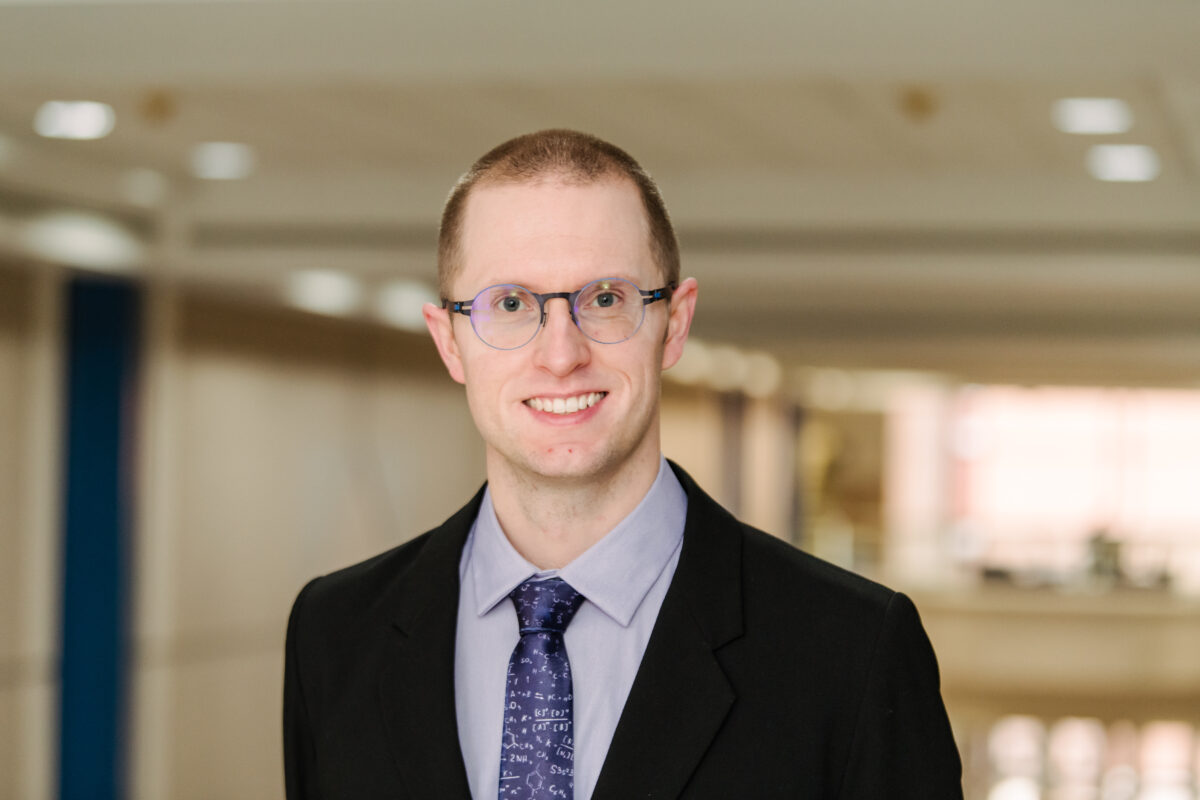 Tyler Josephson (Marlayna Demond ’11/UMBC)
The team, which includes UMBC faculty Tejas Gokhale, computer science and electrical engineering, and Tyler Josephson, chemical, biochemical, and environmental engineering, as well as colleagues from Stony Brook University, the University of Texas at Austin, and the University of Cambridge, will develop and test the tool on three leading areas of scientific research: materials science, AI, and quantum computing.
“It’s a little meta that the AI will be analyzing AI,” Ferraro says. More than 20 UMBC undergrads, grad students, and post-docs will take part in the project. “They’ll get opportunities to network with peers on a highly relevant topic,” Ferraro says. “They’ll be helping guide the national conversation on these issues.”
]]>
Reposted from UMBC News: https://umbc.edu/quick-posts/students-celebrate-engineering-and-computing-week-with-fun-and-networking/ A multidisciplinary team of UMBC researchers was recently...
https://beta.my.umbc.edu/api/v0/pixel/news/148688/guest@my.umbc.edu/bcc7656879b3313598e09a461360c64e/api/pixel
grad
josephson
research
spring-2025
ug
ugrad
Chemical, Biochemical and Environmental Engineering
https://beta.my.umbc.edu/groups/cbee
https://assets4-beta.my.umbc.edu/system/shared/avatars/groups/000/000/771/b5e579e81b2e3624611890fa3ca2716a/xsmall.png?1746794587
https://assets2-beta.my.umbc.edu/system/shared/avatars/groups/000/000/771/b5e579e81b2e3624611890fa3ca2716a/original.png?1746794587
https://assets1-beta.my.umbc.edu/system/shared/avatars/groups/000/000/771/b5e579e81b2e3624611890fa3ca2716a/xxlarge.png?1746794587
https://assets2-beta.my.umbc.edu/system/shared/avatars/groups/000/000/771/b5e579e81b2e3624611890fa3ca2716a/xlarge.png?1746794587
https://assets2-beta.my.umbc.edu/system/shared/avatars/groups/000/000/771/b5e579e81b2e3624611890fa3ca2716a/large.png?1746794587
https://assets4-beta.my.umbc.edu/system/shared/avatars/groups/000/000/771/b5e579e81b2e3624611890fa3ca2716a/medium.png?1746794587
https://assets1-beta.my.umbc.edu/system/shared/avatars/groups/000/000/771/b5e579e81b2e3624611890fa3ca2716a/small.png?1746794587
https://assets4-beta.my.umbc.edu/system/shared/avatars/groups/000/000/771/b5e579e81b2e3624611890fa3ca2716a/xsmall.png?1746794587
https://assets1-beta.my.umbc.edu/system/shared/avatars/groups/000/000/771/b5e579e81b2e3624611890fa3ca2716a/xxsmall.png?1746794587
Chemical, Biochemical and Environmental Engineering
https://assets1-beta.my.umbc.edu/system/shared/thumbnails/news/000/148/688/0171ccdce6d00d1547a5fbeeb1fbaa53/xxlarge.jpg?1743774253
https://assets3-beta.my.umbc.edu/system/shared/thumbnails/news/000/148/688/0171ccdce6d00d1547a5fbeeb1fbaa53/xlarge.jpg?1743774253
https://assets4-beta.my.umbc.edu/system/shared/thumbnails/news/000/148/688/0171ccdce6d00d1547a5fbeeb1fbaa53/large.jpg?1743774253
https://assets3-beta.my.umbc.edu/system/shared/thumbnails/news/000/148/688/0171ccdce6d00d1547a5fbeeb1fbaa53/medium.jpg?1743774253
https://assets1-beta.my.umbc.edu/system/shared/thumbnails/news/000/148/688/0171ccdce6d00d1547a5fbeeb1fbaa53/small.jpg?1743774253
https://assets4-beta.my.umbc.edu/system/shared/thumbnails/news/000/148/688/0171ccdce6d00d1547a5fbeeb1fbaa53/xsmall.jpg?1743774253
https://assets4-beta.my.umbc.edu/system/shared/thumbnails/news/000/148/688/0171ccdce6d00d1547a5fbeeb1fbaa53/xxsmall.jpg?1743774253
0
0
true
Fri, 04 Apr 2025 09:46:01 -0400
Tue, 08 Apr 2025 12:11:43 -0400
Students partner with Baltimore community members to measure ‘forever chemicals’ in local waters
Reposted from UMBC News: https://umbc.edu/stories/measuring-forever-chemicals-in-baltimore-waters/
On a sunny and unseasonably warm Halloween this past fall, a group of costumed UMBC students strolled the banks of the Inner Harbor in Baltimore. The costumes were in good fun, but the spirit driving them to the city that day was more scientific than spectral: They were there to check on samplers they had installed around the harbor to measure the concentrations of certain chemicals called per- and polyfluoroalkyl substances, or PFAS, in the water.
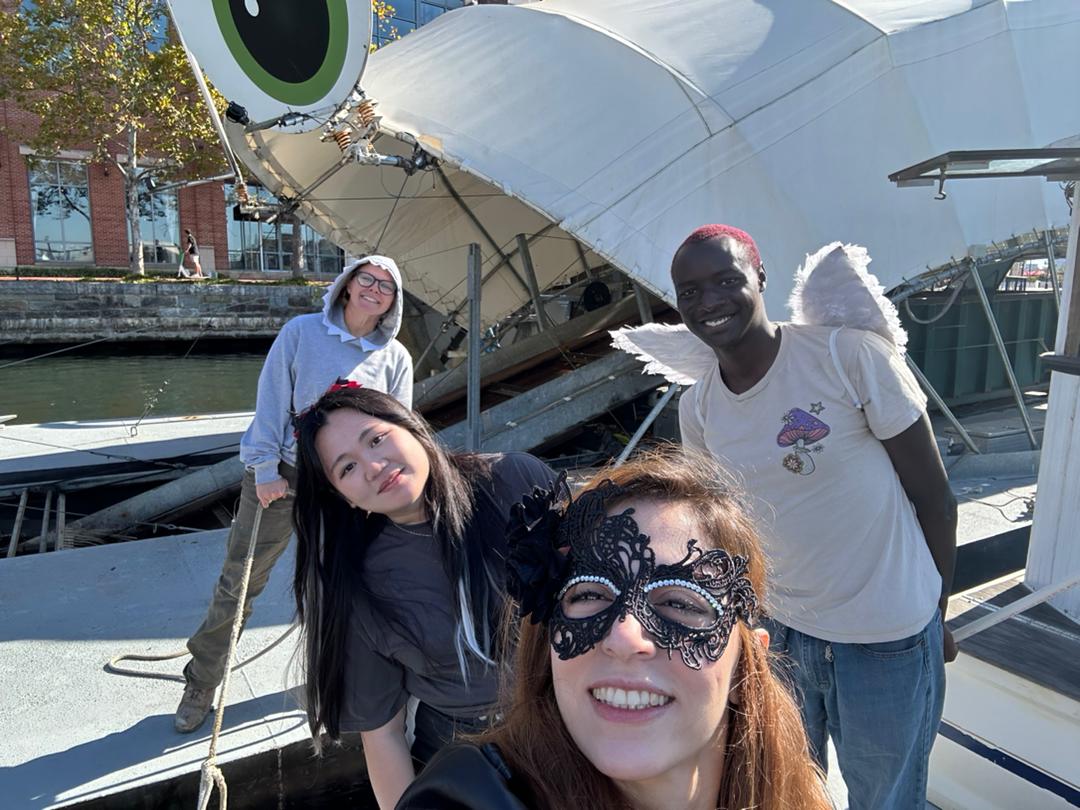 On Halloween, from right to left, Alvin Bett, an undergraduate student working in Blaney’s lab, Hamidi, Siao, and Leigh Auth, a boat captain with the Waterfront Partnership of Baltimore who helped the group access the trash wheels to install their PFAS sensors. (Image courtesy of Siao)
PFAS are used in a diverse range of products, including cleaning products, clothing, and fire-fighting foam, and have earned the nickname “forever chemicals” because of the way they persist in the environment. There are growing concerns about the health effects of the chemicals, and in recent years there have been efforts to eliminate PFAS from some consumer products and regulate their concentration in drinking water.
The UMBC students’ work to measure PFAS in Baltimore Harbor is one of the first projects aiming to get an understanding of how much of the chemicals are found in the waters around Baltimore and where they might be coming from. Margaret Siao, a master’s student in chemical engineering, took a lead role in the work as part of the ICARE program, which links researchers and Baltimore community members on environmental projects around the city.
Donya Hamidi, an environmental engineering Ph.D. student, also took part in the project, which served as a test case for a larger project she is working on, seeking to expand the utility of innovative passive samplers to measure PFAS in any water source.
“I’ve lived in Baltimore most of my life,” says Siao. “The harbor is a big part of the city, although many people don’t go out on the water. And that’s one of the reasons I wanted to look at the water quality.”
PFAS are everywhere
There are thousands of different PFAS chemicals. Because of their widespread use and resistance to degradation, they are found throughout the country in the water, soil, air, and food, and in the blood of humans and animals.
Exposure to some forms of PFAS has been linked to a range of health problems, including decreased fertility in women, developmental effects in children, reduced immune function, and increased risk of cancer and obesity.
“The PFAS issue just gets more and more complicated by the day,” says Lee Blaney, the environmental engineering professor who leads the lab where Siao and Hamidi work. He notes the EPA recently released an initial risk assessment for certain PFAS found in biosolids, which are a byproduct of wastewater treatment and are sometimes applied to agricultural land as fertilizer. “It’s a big, far-reaching issue.”
Partnering with the community
Blaney is an expert on PFAS, and as concerns about the prevalence and potential health effects of the chemicals have grown, his lab has been a leading partner with Baltimore community members who advocate for and are responsible for the quality of the water.
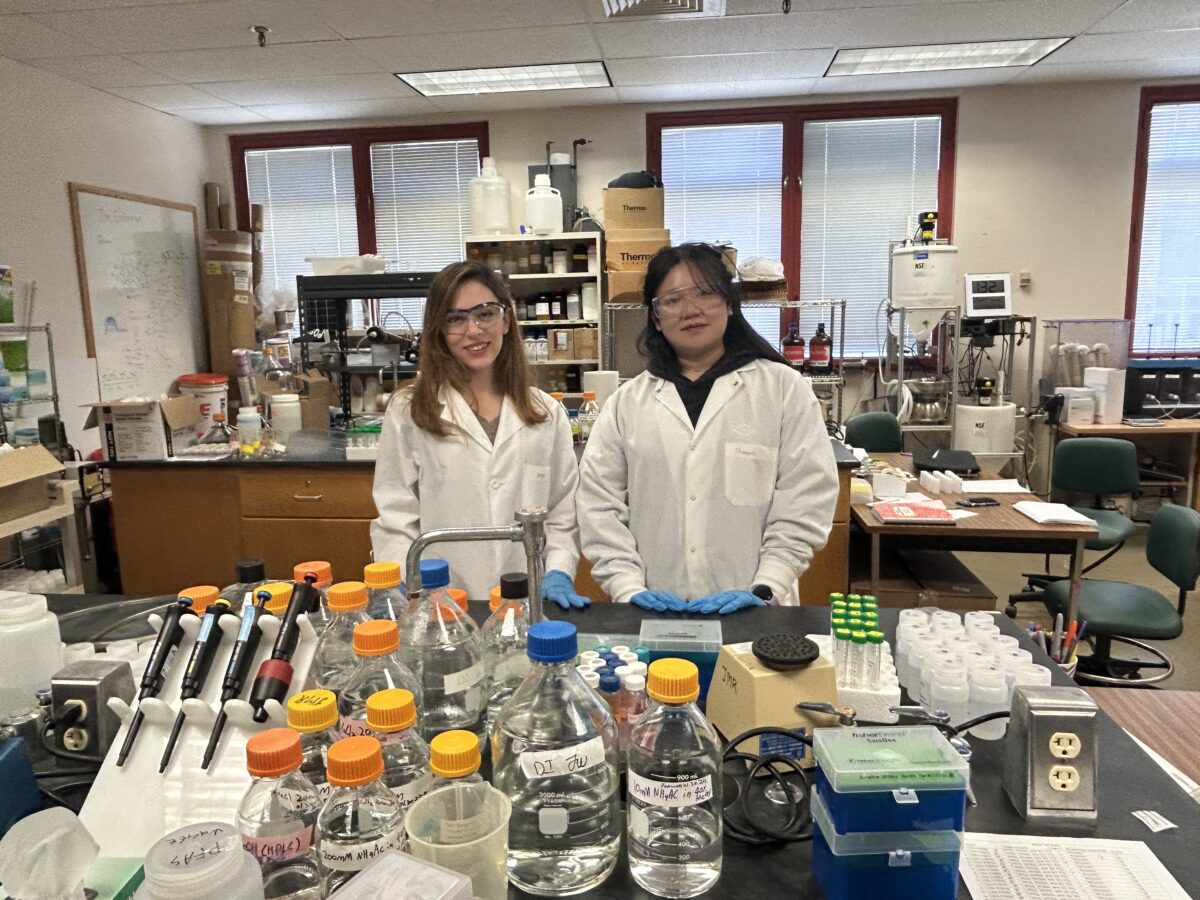 Hamidi (left) and Siao in the lab where they analyze samples for PFAS concentrations. (Image courtesy of Hamidi)
Siao’s ICARE project was a partnership with the United States Geological Survey Maryland-Delaware-D.C. Water Science Center and Blue Water Baltimore, a non-profit organization with the mission to restore the quality of Baltimore’s rivers, streams, and harbor. Blue Water Baltimore shared their knowledge of the harbor and area waterways and their connections with the community, while lab members shared their expertise and will share their PFAS data once it has been analyzed.
“PFAS is a hot topic, so Margaret’s project is really good timing,” says Barbara Johnson, who was Siao’s mentor at Blue Water Baltimore. “I think her data will be very useful for us in helping the public understand what PFAS are, for example just understanding how many different kinds there are. Margaret has taught me so much about PFAS.”
As part of the field work, Siao and Hamidi also sampled water at the outlet of the Patapsco Wastewater Treatment Plant in Baltimore. That partnership arose when Mohammed Almafrachi, who works as an engineer for the Baltimore City Department of Public Works, became interested in the PFAS issue and sought out a local expert.
“Last year, I found Dr. Blaney’s name on the internet. I drove to the campus, found his office, and he was there. I introduced myself as an engineer at the city of Baltimore, and we sat down and started talking,” Almafrachi says. From that conversation grew not only the collaboration to measure PFAS at the wastewater treatment plant, but also a tour of Baltimore’s largest drinking water treatment plant that Almafrachi gave students in Blaney’s class on environmental physicochemical processes last spring. Almafrachi said he was happy to provide students with a window on a real-world workplace where their skills might one day be applied.
“If you have not gone to the field, then you are not yet a full engineer,” says Almafrachi. “We can talk about theories and textbooks endlessly, but the field is where you really test your skills.”
The value of field work
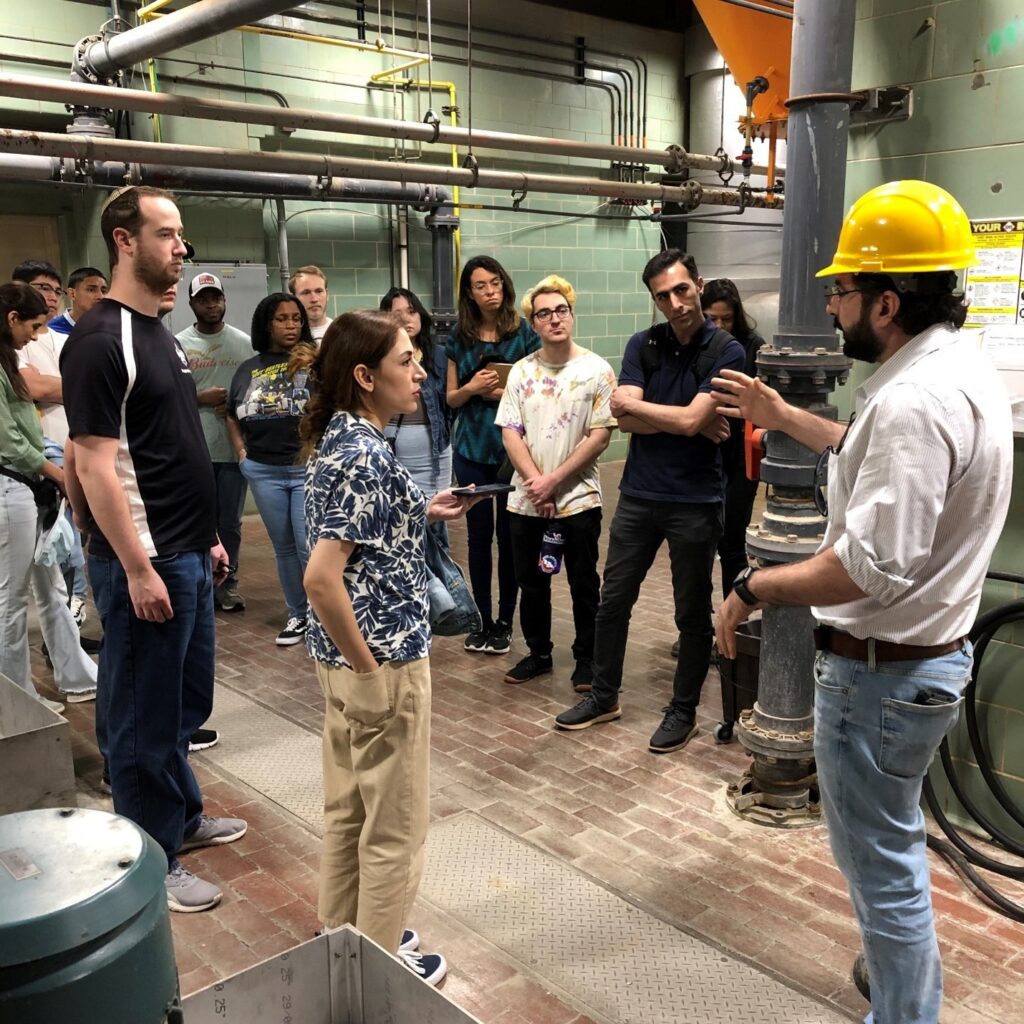 Almafrachi (right) led a tour of the Ashburton Filtration Plant, Baltimore’s largest drinking water treatment plant, for students in Blaney’s environmental physicochemical processes class. (Photo courtesy of Blaney)
Siao and Hamidi agree with Almafrachi about the value of field work. They installed their PFAS samplers at three of the four trash wheels around Baltimore Harbor—personified contraptions named Mr. Trash Wheel, Professor Trash Wheel, and Gwynnda the Good Wheel of the West that collect floating trash and keep it from dirtying the harbor. To get to the trash wheels, they took a flat-bottomed wooden boat, “more like a floating platform with a little cabin,” Siao says.
“Almost every time we collected a sampler, we saw something new or unexpected, for example algae growing on the sampler, and we had to figure out what was going on at that particular site,” says Hamidi. The team’s work and the measurements they collected and are currently analyzing will serve as a foundation for future studies about PFAS in the local environment.
Both Hamidi and Siao say they valued the teamwork of their trips, and the chance to meet people in the community impacted by their research.
“If you are stuck in a lab all day, it’s easy to forget why you’re doing research,” says Siao. “This project gave me a chance to interact with people outside of academia, to learn about what’s important to them, and to learn how to communicate about science with them, which is a really important skill.”
]]>
Reposted from UMBC News: https://umbc.edu/stories/measuring-forever-chemicals-in-baltimore-waters/ On a sunny and unseasonably warm Halloween this past fall, a group of costumed UMBC students...
https://beta.my.umbc.edu/api/v0/pixel/news/148667/guest@my.umbc.edu/978de2125f50821bcc23d58ba8401811/api/pixel
blaney
grad
research
spring-2025
ug
ugrad
Chemical, Biochemical and Environmental Engineering
https://beta.my.umbc.edu/groups/cbee
https://assets4-beta.my.umbc.edu/system/shared/avatars/groups/000/000/771/b5e579e81b2e3624611890fa3ca2716a/xsmall.png?1746794587
https://assets2-beta.my.umbc.edu/system/shared/avatars/groups/000/000/771/b5e579e81b2e3624611890fa3ca2716a/original.png?1746794587
https://assets1-beta.my.umbc.edu/system/shared/avatars/groups/000/000/771/b5e579e81b2e3624611890fa3ca2716a/xxlarge.png?1746794587
https://assets2-beta.my.umbc.edu/system/shared/avatars/groups/000/000/771/b5e579e81b2e3624611890fa3ca2716a/xlarge.png?1746794587
https://assets2-beta.my.umbc.edu/system/shared/avatars/groups/000/000/771/b5e579e81b2e3624611890fa3ca2716a/large.png?1746794587
https://assets4-beta.my.umbc.edu/system/shared/avatars/groups/000/000/771/b5e579e81b2e3624611890fa3ca2716a/medium.png?1746794587
https://assets1-beta.my.umbc.edu/system/shared/avatars/groups/000/000/771/b5e579e81b2e3624611890fa3ca2716a/small.png?1746794587
https://assets4-beta.my.umbc.edu/system/shared/avatars/groups/000/000/771/b5e579e81b2e3624611890fa3ca2716a/xsmall.png?1746794587
https://assets1-beta.my.umbc.edu/system/shared/avatars/groups/000/000/771/b5e579e81b2e3624611890fa3ca2716a/xxsmall.png?1746794587
Chemical, Biochemical and Environmental Engineering
https://assets1-beta.my.umbc.edu/system/shared/thumbnails/news/000/148/667/feec7735d4b19844b2402c58183036a0/xxlarge.jpg?1743702048
https://assets1-beta.my.umbc.edu/system/shared/thumbnails/news/000/148/667/feec7735d4b19844b2402c58183036a0/xlarge.jpg?1743702048
https://assets3-beta.my.umbc.edu/system/shared/thumbnails/news/000/148/667/feec7735d4b19844b2402c58183036a0/large.jpg?1743702048
https://assets2-beta.my.umbc.edu/system/shared/thumbnails/news/000/148/667/feec7735d4b19844b2402c58183036a0/medium.jpg?1743702048
https://assets4-beta.my.umbc.edu/system/shared/thumbnails/news/000/148/667/feec7735d4b19844b2402c58183036a0/small.jpg?1743702048
https://assets3-beta.my.umbc.edu/system/shared/thumbnails/news/000/148/667/feec7735d4b19844b2402c58183036a0/xsmall.jpg?1743702048
https://assets1-beta.my.umbc.edu/system/shared/thumbnails/news/000/148/667/feec7735d4b19844b2402c58183036a0/xxsmall.jpg?1743702048
0
0
true
Thu, 03 Apr 2025 13:59:12 -0400
Thu, 03 Apr 2025 14:19:28 -0400