<?xml version="1.0"?>
<News hasArchived="false" page="1" pageCount="4" pageSize="10" timestamp="Mon, 20 Apr 2026 09:19:41 -0400" url="https://beta.my.umbc.edu/groups/cbee/posts.xml?tag=ghosh">
<NewsItem contentIssues="false" id="150843" important="false" status="posted" url="https://beta.my.umbc.edu/groups/cbee/posts/150843">
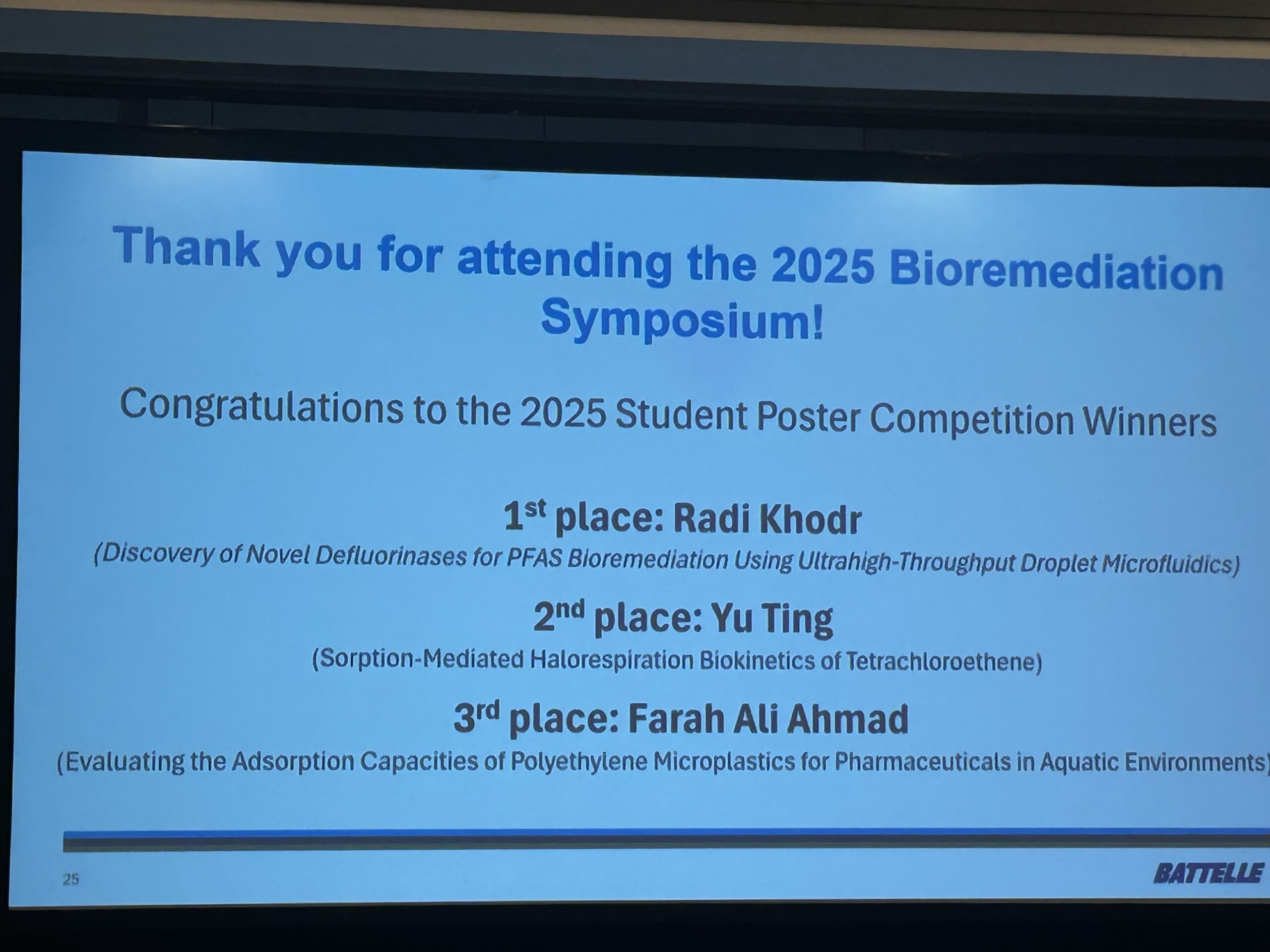
<Title>CBEE Student Wins 2025 Bioremediation Symposium Award</Title>
<Body>
<![CDATA[
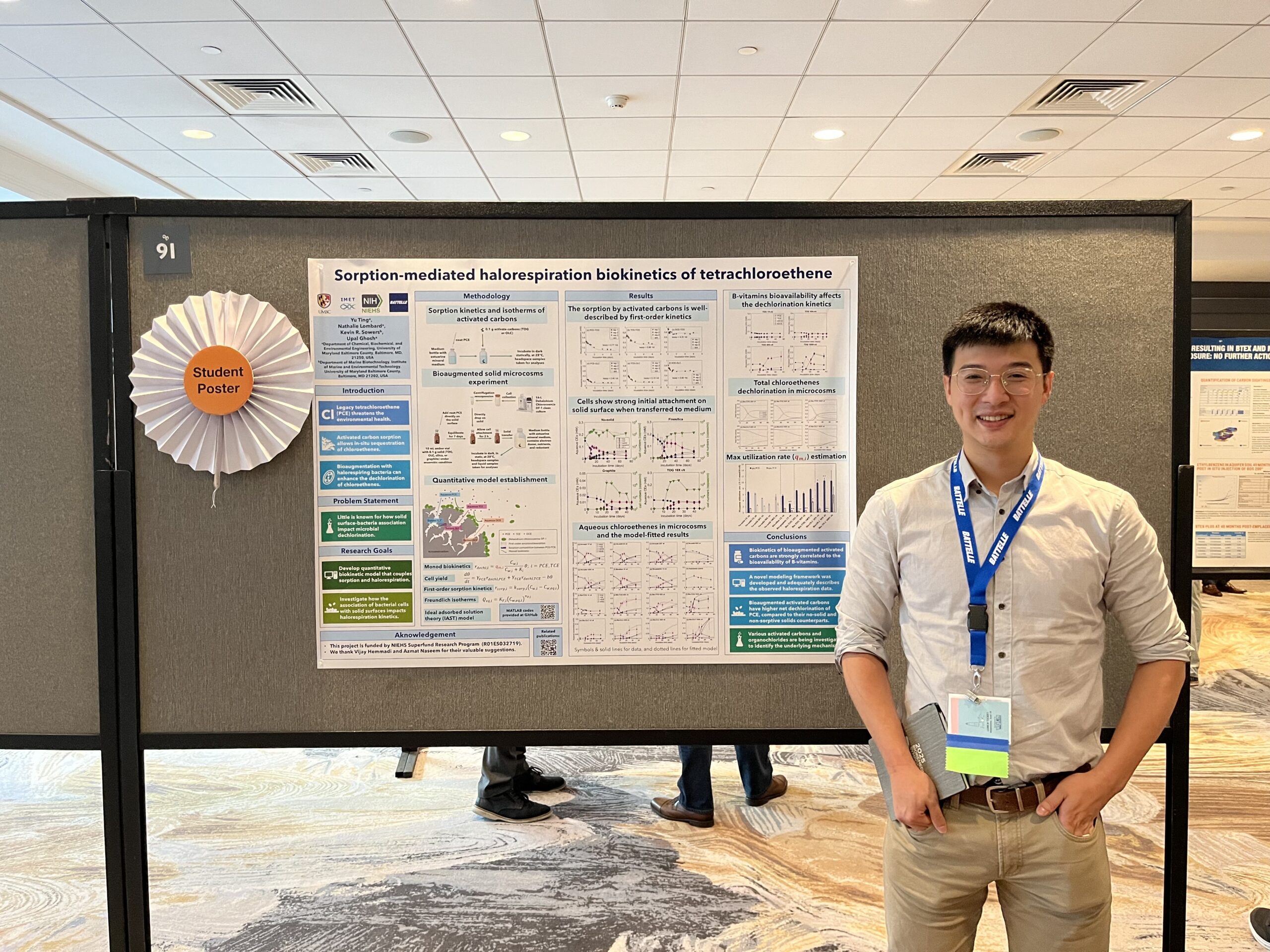
    <div class="html-content">Yu Ting (Environmental Engineering Ph.D. student with Dr. Ghosh) attended and presented his poster at the 2025 International Symposium on Bioremediation and Environmental Biotechnology in Boston from June 23-26, and earned 2nd place in the poster contest. <div><br></div><div>This premiere conference on environmental bioremediation is held bi-annually, and is a convergence of experts and innovators in the field, showcasing the latest advancements and research. Yu Ting's work has been recognized among many outstanding contributions, reflecting his commitment to solving complex environmental challenges. Congratulations to Yu Ting!</div><div><br></div><div>Additional details about the  International Symposium on Bioremediation and Environmental Biotechnology can be found here: <a href="https://www.battelle.org/conferences/bioremediation-symposium" rel="nofollow external" class="bo">https://www.battelle.org/conferences/bioremediation-symposium</a></div><div><br></div><div><img src="https://cbee.umbc.edu/wp-content/uploads/sites/312/2025/06/IMG_8317-scaled.jpeg" alt="CBEE Student Yu Ting with his poster" style="max-width: 100%; height: auto;"></div><div><img src="https://cbee.umbc.edu/wp-content/uploads/sites/312/2025/06/IMG_4368-scaled.jpeg" alt="CBEE Student Wins 2025 Bioremediation Symposium Award" style="max-width: 100%; height: auto;"></div></div>
]]>
</Body>
<Summary>Yu Ting (Environmental Engineering Ph.D. student with Dr. Ghosh) attended and presented his poster at the 2025 International Symposium on Bioremediation and Environmental Biotechnology in Boston...</Summary>
<TrackingUrl>https://beta.my.umbc.edu/api/v0/pixel/news/150843/guest@my.umbc.edu/05cacc9c53a76317ab3c6e227e4e8ce9/api/pixel</TrackingUrl>
<Tag>award</Tag>
<Tag>bioremediation</Tag>
<Tag>ghosh</Tag>
<Tag>grad</Tag>
<Tag>research</Tag>
<Tag>summer-2025</Tag>
<Tag>symposium</Tag>
<Group token="cbee">Chemical, Biochemical and Environmental Engineering</Group>
<GroupUrl>https://beta.my.umbc.edu/groups/cbee</GroupUrl>
<AvatarUrl>https://assets4-beta.my.umbc.edu/system/shared/avatars/groups/000/000/771/b5e579e81b2e3624611890fa3ca2716a/xsmall.png?1746794587</AvatarUrl>
<AvatarUrl size="original">https://assets2-beta.my.umbc.edu/system/shared/avatars/groups/000/000/771/b5e579e81b2e3624611890fa3ca2716a/original.png?1746794587</AvatarUrl>
<AvatarUrl size="xxlarge">https://assets1-beta.my.umbc.edu/system/shared/avatars/groups/000/000/771/b5e579e81b2e3624611890fa3ca2716a/xxlarge.png?1746794587</AvatarUrl>
<AvatarUrl size="xlarge">https://assets2-beta.my.umbc.edu/system/shared/avatars/groups/000/000/771/b5e579e81b2e3624611890fa3ca2716a/xlarge.png?1746794587</AvatarUrl>
<AvatarUrl size="large">https://assets2-beta.my.umbc.edu/system/shared/avatars/groups/000/000/771/b5e579e81b2e3624611890fa3ca2716a/large.png?1746794587</AvatarUrl>
<AvatarUrl size="medium">https://assets4-beta.my.umbc.edu/system/shared/avatars/groups/000/000/771/b5e579e81b2e3624611890fa3ca2716a/medium.png?1746794587</AvatarUrl>
<AvatarUrl size="small">https://assets1-beta.my.umbc.edu/system/shared/avatars/groups/000/000/771/b5e579e81b2e3624611890fa3ca2716a/small.png?1746794587</AvatarUrl>
<AvatarUrl size="xsmall">https://assets4-beta.my.umbc.edu/system/shared/avatars/groups/000/000/771/b5e579e81b2e3624611890fa3ca2716a/xsmall.png?1746794587</AvatarUrl>
<AvatarUrl size="xxsmall">https://assets1-beta.my.umbc.edu/system/shared/avatars/groups/000/000/771/b5e579e81b2e3624611890fa3ca2716a/xxsmall.png?1746794587</AvatarUrl>
<Sponsor>Chemical, Biochemical and Environmental Engineering</Sponsor>
<ThumbnailUrl size="xxlarge">https://assets1-beta.my.umbc.edu/system/shared/thumbnails/news/000/150/843/a577c4583cd6abda9034068c1bae81cc/xxlarge.jpg?1751033686</ThumbnailUrl>
<ThumbnailUrl size="xlarge">https://assets4-beta.my.umbc.edu/system/shared/thumbnails/news/000/150/843/a577c4583cd6abda9034068c1bae81cc/xlarge.jpg?1751033686</ThumbnailUrl>
<ThumbnailUrl size="large">https://assets4-beta.my.umbc.edu/system/shared/thumbnails/news/000/150/843/a577c4583cd6abda9034068c1bae81cc/large.jpg?1751033686</ThumbnailUrl>
<ThumbnailUrl size="medium">https://assets4-beta.my.umbc.edu/system/shared/thumbnails/news/000/150/843/a577c4583cd6abda9034068c1bae81cc/medium.jpg?1751033686</ThumbnailUrl>
<ThumbnailUrl size="small">https://assets2-beta.my.umbc.edu/system/shared/thumbnails/news/000/150/843/a577c4583cd6abda9034068c1bae81cc/small.jpg?1751033686</ThumbnailUrl>
<ThumbnailUrl size="xsmall">https://assets3-beta.my.umbc.edu/system/shared/thumbnails/news/000/150/843/a577c4583cd6abda9034068c1bae81cc/xsmall.jpg?1751033686</ThumbnailUrl>
<ThumbnailUrl size="xxsmall">https://assets3-beta.my.umbc.edu/system/shared/thumbnails/news/000/150/843/a577c4583cd6abda9034068c1bae81cc/xxsmall.jpg?1751033686</ThumbnailUrl>
<ThumbnailAltText>CBEE Student Wins 2025 Bioremediation Symposium Award</ThumbnailAltText>
<PawCount>0</PawCount>
<CommentCount>0</CommentCount>
<CommentsAllowed>true</CommentsAllowed>
<PostedAt>Fri, 27 Jun 2025 11:59:33 -0400</PostedAt>
</NewsItem>

<NewsItem contentIssues="false" id="149178" important="false" status="posted" url="https://beta.my.umbc.edu/groups/cbee/posts/149178">
<Title>Congratulations to the CBEE Student Presenters at URCAD</Title>
<Body>
<![CDATA[
    <div class="html-content"><p>On April 16, 2025, over 300 undergraduate students shared their research and achievements through oral presentations, poster presentations, artistic exhibits, performances, films, interactive games, and more in the University Center.</p>
    <p>Congratulations to all CBEE students who participated in the event!</p>
    <p><br></p>
    <h3><strong><u>Oral Presentations</u></strong></h3>
    <p><strong>Evalynn Ellison</strong> | Ultrasound-Responsive Phospholipid-Coated Microbubbles for Controlled Drug Delivery Across Mucosa | Chemical, Biochemical, and Environmental Engineering | Canan Dagdeviren</p>
    <p><br></p>
    <h3><strong><u>Poster Presentations</u></strong></h3>
    <p><strong>Shashane Anderson</strong> | Formal Verification of Thermodynamic Models With Lean 4 | Chemical, Biochemical, and Environmental Engineering |<strong> Tyler Josephson</strong></p>
    <p><strong>Alvin Bett </strong>| Detecting PFAS in Baltimore Harbor Using Novel Passive Samplers | Chemical, Biochemical, and Environmental Engineering | <strong>Lee Blaney</strong></p>
    <p><strong>Jacob Craft</strong> | Measuring the Selectivity Coefficients of 19 PFAS With Four Anion-Exchange Membranes | Chemical, Biochemical, and Environmental Engineering | <strong>Lee Blaney</strong></p>
    <p><strong>Joshua Dayie</strong> | Engineering CRBN for Improved Assay and Structural Enablement Using DeNovo Protein Scaffolds | Chemical, Biochemical, and Environmental Engineering | Nicole LaRonde</p>
    <p><strong>Trevor Gibson</strong> | Hybrid Anion-Exchange Resins Improve the Uptake and Selectivity for (Ultra)Short-Chain PFAS in Drinking Water | Chemical, Biochemical, and Environmental Engineering | <strong>Lee Blaney</strong></p>
    <p><strong>Elias Gilotte </strong>| Uncovering The Relationship Between Oxygen Availability and Energy Sources in Cell-free Protein Synthesis | Chemical, Biochemical, and Environmental Engineering | <strong>Govind Rao</strong></p>
    <p><strong>Alexander Haibel</strong> | GraphARC: An AI Benchmark for Chemical Reasoning | Chemical, Biochemical, and Environmental Engineering |<strong> Tyler Josephson</strong></p>
    <p><strong>Sydney Hofstetter</strong> | Sucrose Density Gradient Centrifugation Versus Anion Exchange for Exosome Sample Purification | Chemical, Biochemical, and Environmental Engineering | <strong>Jorge Almodovar</strong></p>
    <p><strong>Jasmine Ives </strong>| Polychlorinated Biphenyl Monitoring in Maryland Fish | Chemical, Biochemical, and Environmental Engineering |<strong> Upal Ghosh</strong></p>
    <p><strong>Tonderai Kodzwa </strong>| Effect Of Temperature On Aqueous Zinc Ion Batteries | Chemical, Biochemical, and Environmental Engineering | <strong>Ozgur Capraz</strong></p>
    <p><strong>Peter Lombardo</strong> | Percent Viability Screens To Confirm Integral Cell Wall Signaling Kinases In Aspergillus Nidulans | Chemical, Biochemical, and Environmental Engineering | <strong>Mark Marten</strong></p>
    <p><strong>Terra Miley</strong> | Optimization Of Cell-Free Protein Synthesis Bioreactors With the Use of a Fluorescent Magnesium Biosensor | Chemical, Biochemical, and Environmental Engineering |<strong> Govind Rao</strong></p>
    <p><strong>Meredith Morse</strong> | Characterizing The Aspergillus Nidulans Kinase Deletion Library | Chemical, Biochemical, and Environmental Engineering |<strong> Mark Marten</strong></p>
    <p><strong>Tithi Prajapati </strong>| Noninvasive Wearable Device For Transcutaneous CO2 Based Early Detection Of Opioid-Induced Respiratory Depression | Chemical, Biochemical, and Environmental Engineering | <strong>Venkatesh Srinivasan</strong></p>
    <p><strong>Matthew Quintanilla </strong>| Characterization Of Transmembrane Transporters Linked To Cell Wall Stress Response | Chemical, Biochemical, and Environmental Engineering | <strong>Mark Marten</strong></p>
    
    <p><strong>Jessica Slaughter</strong> | Suite Of Bioinformatic-Analysis Apps For Better Understanding Dynamic Omics Data | Chemical, Biochemical, and Environmental Engineering | <strong>Mark Marten</strong></p>
    <p><strong>Maaike Swaters</strong> | Measuring Ion-exchange Membrane Properties That Control Nutrient Recovery By Donnan Dialysis | Chemical, Biochemical, and Environmental Engineering | <strong>Lee Blaney</strong></p>
    <p><strong>Greeshma Tarimala</strong> | Using Gene Editing And Fluorescent Microscopy To Characterize The PrkA Kinase In Aspergillus Nidulans | Chemical, Biochemical, and Environmental Engineering |<strong> Mark Marten</strong></p>
    <p><strong>Julia Van Der Marel</strong> | Monitoring Of NADH Concentrations In Cell-Free Systems | Chemical, Biochemical, and Environmental Engineering | <strong>Govind Rao</strong></p>
    <p><strong>Benjamin Welling </strong>| Fabrications Of An Autonomous Chemically Powered Vehicle: (AIChE Chem-E Car) | Chemical, Biochemical, and Environmental Engineering | <strong>Neha Raikar</strong></p>
    <p><strong>Zorah Williams</strong> | Utilizing Manganese-Oxide As An Electrode Material For Aqueous Zn-ion Batteries. | Chemical, Biochemical, and Environmental Engineering |<strong> Ozgur Capraz</strong></p>
    <p><strong>Ariel Wilson-Gray</strong> | Production Of Extracellular Vesicles From Mammalian Cells Modulated By A Biomimetic Surface | Chemical, Biochemical, and Environmental Engineering |<strong> Jorge Almodovar</strong></p></div>
]]>
</Body>
<Summary>On April 16, 2025, over 300 undergraduate students shared their research and achievements through oral presentations, poster presentations, artistic exhibits, performances, films, interactive...</Summary>
<TrackingUrl>https://beta.my.umbc.edu/api/v0/pixel/news/149178/guest@my.umbc.edu/05c0dcd6350cfb00b8616eb5a85d9ad2/api/pixel</TrackingUrl>
<Tag>almodovar</Tag>
<Tag>blaney</Tag>
<Tag>capraz</Tag>
<Tag>ghosh</Tag>
<Tag>josephson</Tag>
<Tag>marten</Tag>
<Tag>raikar</Tag>
<Tag>rao</Tag>
<Tag>research</Tag>
<Tag>spring-2025</Tag>
<Tag>ug</Tag>
<Tag>ugrad</Tag>
<Tag>urcad</Tag>
<Group token="cbee">Chemical, Biochemical and Environmental Engineering</Group>
<GroupUrl>https://beta.my.umbc.edu/groups/cbee</GroupUrl>
<AvatarUrl>https://assets4-beta.my.umbc.edu/system/shared/avatars/groups/000/000/771/b5e579e81b2e3624611890fa3ca2716a/xsmall.png?1746794587</AvatarUrl>
<AvatarUrl size="original">https://assets2-beta.my.umbc.edu/system/shared/avatars/groups/000/000/771/b5e579e81b2e3624611890fa3ca2716a/original.png?1746794587</AvatarUrl>
<AvatarUrl size="xxlarge">https://assets1-beta.my.umbc.edu/system/shared/avatars/groups/000/000/771/b5e579e81b2e3624611890fa3ca2716a/xxlarge.png?1746794587</AvatarUrl>
<AvatarUrl size="xlarge">https://assets2-beta.my.umbc.edu/system/shared/avatars/groups/000/000/771/b5e579e81b2e3624611890fa3ca2716a/xlarge.png?1746794587</AvatarUrl>
<AvatarUrl size="large">https://assets2-beta.my.umbc.edu/system/shared/avatars/groups/000/000/771/b5e579e81b2e3624611890fa3ca2716a/large.png?1746794587</AvatarUrl>
<AvatarUrl size="medium">https://assets4-beta.my.umbc.edu/system/shared/avatars/groups/000/000/771/b5e579e81b2e3624611890fa3ca2716a/medium.png?1746794587</AvatarUrl>
<AvatarUrl size="small">https://assets1-beta.my.umbc.edu/system/shared/avatars/groups/000/000/771/b5e579e81b2e3624611890fa3ca2716a/small.png?1746794587</AvatarUrl>
<AvatarUrl size="xsmall">https://assets4-beta.my.umbc.edu/system/shared/avatars/groups/000/000/771/b5e579e81b2e3624611890fa3ca2716a/xsmall.png?1746794587</AvatarUrl>
<AvatarUrl size="xxsmall">https://assets1-beta.my.umbc.edu/system/shared/avatars/groups/000/000/771/b5e579e81b2e3624611890fa3ca2716a/xxsmall.png?1746794587</AvatarUrl>
<Sponsor>Chemical, Biochemical and Environmental Engineering</Sponsor>
<ThumbnailUrl size="xxlarge">https://assets2-beta.my.umbc.edu/system/shared/thumbnails/news/000/149/178/0cc2d9648fdd924523c80803702f0073/xxlarge.jpg?1744895017</ThumbnailUrl>
<ThumbnailUrl size="xlarge">https://assets3-beta.my.umbc.edu/system/shared/thumbnails/news/000/149/178/0cc2d9648fdd924523c80803702f0073/xlarge.jpg?1744895017</ThumbnailUrl>
<ThumbnailUrl size="large">https://assets2-beta.my.umbc.edu/system/shared/thumbnails/news/000/149/178/0cc2d9648fdd924523c80803702f0073/large.jpg?1744895017</ThumbnailUrl>
<ThumbnailUrl size="medium">https://assets2-beta.my.umbc.edu/system/shared/thumbnails/news/000/149/178/0cc2d9648fdd924523c80803702f0073/medium.jpg?1744895017</ThumbnailUrl>
<ThumbnailUrl size="small">https://assets1-beta.my.umbc.edu/system/shared/thumbnails/news/000/149/178/0cc2d9648fdd924523c80803702f0073/small.jpg?1744895017</ThumbnailUrl>
<ThumbnailUrl size="xsmall">https://assets3-beta.my.umbc.edu/system/shared/thumbnails/news/000/149/178/0cc2d9648fdd924523c80803702f0073/xsmall.jpg?1744895017</ThumbnailUrl>
<ThumbnailUrl size="xxsmall">https://assets3-beta.my.umbc.edu/system/shared/thumbnails/news/000/149/178/0cc2d9648fdd924523c80803702f0073/xxsmall.jpg?1744895017</ThumbnailUrl>
<ThumbnailAltText>URCAD 2025 Logo</ThumbnailAltText>
<PawCount>1</PawCount>
<CommentCount>0</CommentCount>
<CommentsAllowed>true</CommentsAllowed>
<PostedAt>Thu, 17 Apr 2025 09:10:27 -0400</PostedAt>
<EditAt>Fri, 25 Apr 2025 10:53:06 -0400</EditAt>
</NewsItem>

<NewsItem contentIssues="true" id="149029" important="false" status="posted" url="https://beta.my.umbc.edu/groups/cbee/posts/149029">
<Title>CBEE Students Among Award Winners at 2025 UMBC Research Symposium and 3MT</Title>
<Tagline>CBEE Students Among Award Winners at GEARS and 3MT</Tagline>
<Body>
<![CDATA[
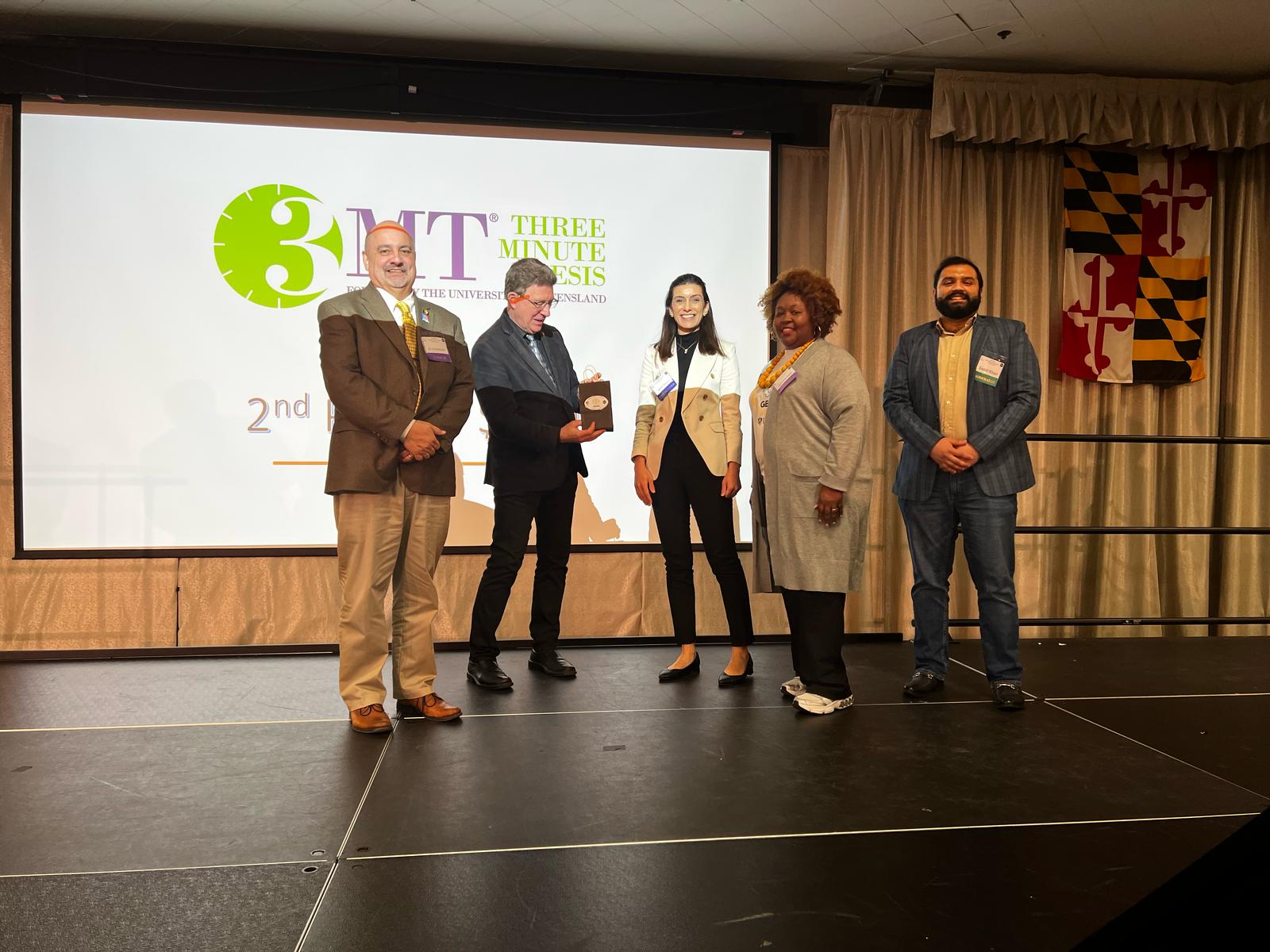
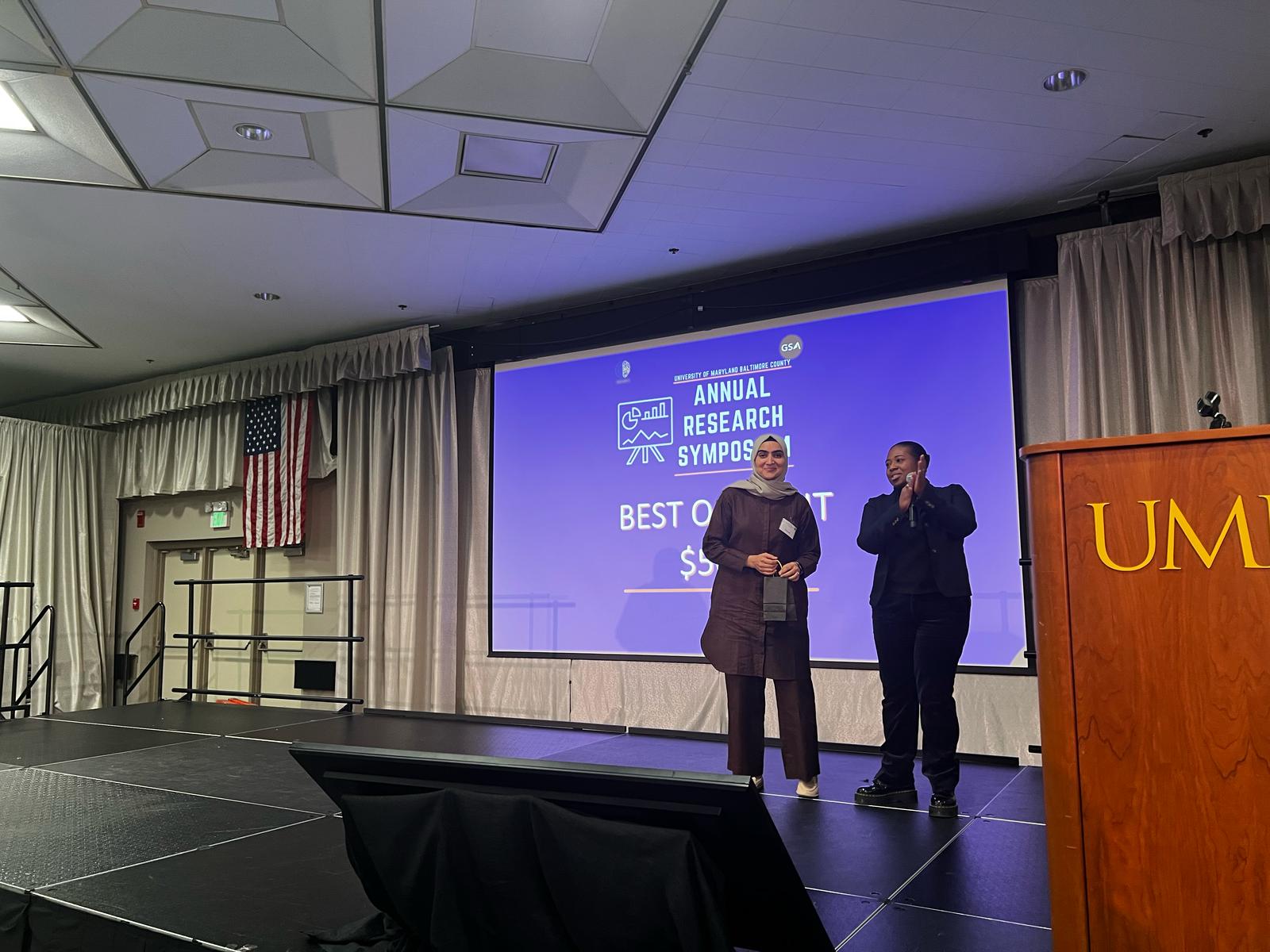
    <div class="html-content"><p><img src="https://drive.google.com/file/d/1lZj_IO2FZ5QKMReLUR9P_sRBOmkpo4hc/view?usp=sharing" alt="" style="max-width: 100%; height: auto;"><strong>Azmat Naseem</strong>, Environmental Engineering PhD student with Dr. Ghosh, was awarded the best poster presentation for COEIT and <strong>Sahar Souizi</strong>, Chemical and Biochemical Engineering Ph.D. student with Dr. Blaney, won the runner-up award for the 3 Minute Thesis competition (3MT). Congratulations!</p>
    <p> </p>
    <p> </p>
    <p>GEARS GSA proudly hosted the 2025 Research Symposium and Three Minute Thesis (3MT) competition, celebrating the innovation, passion, and dedication of our student researchers across disciplines.</p>
    <p><strong>Research Symposium Winners</strong><br>Each awarded $500 for excellence in research:</p>
    <ul>
    <li>
    <p><strong>Best of CAHSS: </strong>Diane Placide</p>
    </li>
    <li>
    <p><strong>Best of CNMS:</strong> Lekan Ajiboye</p>
    </li>
    <li>
    <p><strong>Best of COEIT: </strong>Azmat Naseem</p>
    </li>
    <li>
    <p><strong>People's Choice Award:</strong> Navya Sree Manikonda</p>
    </li>
    </ul>
    <p><strong>3MT Competition Winners</strong></p>
    <ul>
    <li>
    <p><strong>Winner:</strong> Prajna Bhandary ($500)</p>
    </li>
    <li>
    <p><strong>Runner-Up:</strong> Sahar Souizi ($250)</p>
    </li>
    <li>
    <p><strong>People's Choice Award: </strong>Seraj Mostafa ($250)</p>
    </li>
    </ul>
    <p>Congratulations to all participants for showcasing the power of research and storytelling. Your work continues to inspire and elevate the UMBC community.</p>
    <p>See you all next year!</p>
    <p>To access all pictures of the events, go to the following links:</p>
    <p><a href="https://my3.my.umbc.edu/groups/gsa/posts/149026/7ae8e/35c34189600e3cb8170c754742161a2f/web/link?link=https%3A%2F%2Fdrive.google.com%2Fdrive%2Ffolders%2F1GxhybqeDq2BPVcwVWVMB1eXVRFqna-sC%3Fusp%3Dsharing" rel="nofollow external" class="bo">Research Symposium Pictures</a></p>
    <p><a href="https://my3.my.umbc.edu/groups/gsa/posts/149026/7ae8e/b711bfafd42947778b622c516c15bc75/web/link?link=https%3A%2F%2Fdrive.google.com%2Fdrive%2Ffolders%2F11sTXpnT7ShR8u-_3Rk-KAPdBKIq8klPW%3Fusp%3Dsharing" rel="nofollow external" class="bo">3MT Pictures</a></p>
    <p>Original Post: <a href="https://my3.my.umbc.edu/groups/gsa/posts/149026" rel="nofollow external" class="bo">https://my3.my.umbc.edu/groups/gsa/posts/149026</a></p><p><img src="https://cbee.umbc.edu/wp-content/uploads/sites/312/2025/04/Sahar-Souizi-3MT.jpg" style="max-width: 100%; height: auto;"></p><p><img src="https://cbee.umbc.edu/wp-content/uploads/sites/312/2025/04/Azmat-Naseem-Best-of-COEIT-Poster.jpg" style="max-width: 100%; height: auto;"></p></div>
]]>
</Body>
<Summary>Azmat Naseem, Environmental Engineering PhD student with Dr. Ghosh, was awarded the best poster presentation for COEIT and Sahar Souizi, Chemical and Biochemical Engineering Ph.D. student with Dr....</Summary>
<TrackingUrl>https://beta.my.umbc.edu/api/v0/pixel/news/149029/guest@my.umbc.edu/207e0fdc313f2fb1afacd7ea002169cf/api/pixel</TrackingUrl>
<Tag>3mt</Tag>
<Tag>award</Tag>
<Tag>blaney</Tag>
<Tag>gears</Tag>
<Tag>ghosh</Tag>
<Tag>grad</Tag>
<Tag>research</Tag>
<Tag>spring-2025</Tag>
<Group token="cbee">Chemical, Biochemical and Environmental Engineering</Group>
<GroupUrl>https://beta.my.umbc.edu/groups/cbee</GroupUrl>
<AvatarUrl>https://assets4-beta.my.umbc.edu/system/shared/avatars/groups/000/000/771/b5e579e81b2e3624611890fa3ca2716a/xsmall.png?1746794587</AvatarUrl>
<AvatarUrl size="original">https://assets2-beta.my.umbc.edu/system/shared/avatars/groups/000/000/771/b5e579e81b2e3624611890fa3ca2716a/original.png?1746794587</AvatarUrl>
<AvatarUrl size="xxlarge">https://assets1-beta.my.umbc.edu/system/shared/avatars/groups/000/000/771/b5e579e81b2e3624611890fa3ca2716a/xxlarge.png?1746794587</AvatarUrl>
<AvatarUrl size="xlarge">https://assets2-beta.my.umbc.edu/system/shared/avatars/groups/000/000/771/b5e579e81b2e3624611890fa3ca2716a/xlarge.png?1746794587</AvatarUrl>
<AvatarUrl size="large">https://assets2-beta.my.umbc.edu/system/shared/avatars/groups/000/000/771/b5e579e81b2e3624611890fa3ca2716a/large.png?1746794587</AvatarUrl>
<AvatarUrl size="medium">https://assets4-beta.my.umbc.edu/system/shared/avatars/groups/000/000/771/b5e579e81b2e3624611890fa3ca2716a/medium.png?1746794587</AvatarUrl>
<AvatarUrl size="small">https://assets1-beta.my.umbc.edu/system/shared/avatars/groups/000/000/771/b5e579e81b2e3624611890fa3ca2716a/small.png?1746794587</AvatarUrl>
<AvatarUrl size="xsmall">https://assets4-beta.my.umbc.edu/system/shared/avatars/groups/000/000/771/b5e579e81b2e3624611890fa3ca2716a/xsmall.png?1746794587</AvatarUrl>
<AvatarUrl size="xxsmall">https://assets1-beta.my.umbc.edu/system/shared/avatars/groups/000/000/771/b5e579e81b2e3624611890fa3ca2716a/xxsmall.png?1746794587</AvatarUrl>
<Sponsor>Chemical, Biochemical and Environmental Engineering</Sponsor>
<ThumbnailUrl size="xxlarge">https://assets3-beta.my.umbc.edu/system/shared/thumbnails/news/000/149/029/1593524605d0a750cc30f5a002214faf/xxlarge.jpg?1744639532</ThumbnailUrl>
<ThumbnailUrl size="xlarge">https://assets2-beta.my.umbc.edu/system/shared/thumbnails/news/000/149/029/1593524605d0a750cc30f5a002214faf/xlarge.jpg?1744639532</ThumbnailUrl>
<ThumbnailUrl size="large">https://assets2-beta.my.umbc.edu/system/shared/thumbnails/news/000/149/029/1593524605d0a750cc30f5a002214faf/large.jpg?1744639532</ThumbnailUrl>
<ThumbnailUrl size="medium">https://assets3-beta.my.umbc.edu/system/shared/thumbnails/news/000/149/029/1593524605d0a750cc30f5a002214faf/medium.jpg?1744639532</ThumbnailUrl>
<ThumbnailUrl size="small">https://assets4-beta.my.umbc.edu/system/shared/thumbnails/news/000/149/029/1593524605d0a750cc30f5a002214faf/small.jpg?1744639532</ThumbnailUrl>
<ThumbnailUrl size="xsmall">https://assets3-beta.my.umbc.edu/system/shared/thumbnails/news/000/149/029/1593524605d0a750cc30f5a002214faf/xsmall.jpg?1744639532</ThumbnailUrl>
<ThumbnailUrl size="xxsmall">https://assets3-beta.my.umbc.edu/system/shared/thumbnails/news/000/149/029/1593524605d0a750cc30f5a002214faf/xxsmall.jpg?1744639532</ThumbnailUrl>
<PawCount>0</PawCount>
<CommentCount>0</CommentCount>
<CommentsAllowed>true</CommentsAllowed>
<PostedAt>Mon, 14 Apr 2025 11:30:18 -0400</PostedAt>
<EditAt>Mon, 14 Apr 2025 12:46:30 -0400</EditAt>
</NewsItem>

<NewsItem contentIssues="true" id="147680" important="false" status="posted" url="https://beta.my.umbc.edu/groups/cbee/posts/147680">
<Title>UMBC Delegates Strengthen Global Ties at Prestigious Tech Conference in India</Title>
<Tagline>UMBC team builds global ties at PIWOT conference in India</Tagline>
<Body>
<![CDATA[
    <div class="html-content"><p><strong>Reposted from UMBC News:<a href="https://umbc.edu/quick-posts/umbc-delegates-conference-in-india/" rel="nofollow external" class="bo"> https://umbc.edu/quick-posts/umbc-delegates-conference-in-india/</a></strong></p><hr><p>Photo credit: <em>The UMBC team of (left to right) Ramana Vinjamuri, Anupam Joshi, Upal Ghosh, Karuna Pande Joshi, Govind Rao, and David Di Maria at the PIWOT conference. (Photo courtesy of Karuna Joshi)</em></p>
    <p>A six-person UMBC team built international connections at the “PIWOT – World of Technology” conference, held in late January in Mumbai, India. The conference is organized by the alumni association for graduates of the prestigious Indian Institutes of Technology (IITs), and attracts many of the leaders in science and technology in India and around the world. The CEO of Alphabet, Inc. (Google’s parent company), the co-founder of Sun Microsystems, and the CEO of IBM are all graduates of IITs. </p>
    <p>UMBC was represented at the conference by Anupam Joshi, acting dean of the College of Engineering and Information Technology; Upal Ghosh, professor in the Department of Chemical, Biochemical and Environmental Engineering; Ramana Vinjamuri, associate professor in the Department of Computer Science and Electrical Engineering and director of the <a href="http://nsfbrain.org/" rel="nofollow external" class="bo">NSF IUCRC BRAIN Center</a>; Govind Rao, director of the <a href="https://cast.umbc.edu/" rel="nofollow external" class="bo">Center for Advanced Sensor Technology</a> and professor in the Department of Chemical, Biochemical and Environmental Engineering; Karuna Pande Joshi, professor in the Department of Information Systems and director of the <a href="http://carta.umbc.edu/" rel="nofollow external" class="bo">NSF IUCRC Center for Accelerated Real Time Analytics</a>; and David Di Maria, senior international officer and associate vice provost for international education at UMBC. </p>
    <p><img src="https://umbc.edu/wp-content/uploads/2025/02/Anupam-Joshi-presenting-e1739980232380-1200x600.jpg" alt="" width="872" height="436" style="max-width: 100%; height: auto;"><em>Dean Joshi spoke at the conference about the impact of technology on education. (Photo courtesy of Govind Rao)</em></p>
    <p>The UMBC team staffed a well-trafficked booth in the Expo Hall. As an extension of the meeting, they also visited IITs at Mumbai, Hyderabad, and Tirupati, and met with the directors of these institutions to discuss institutional agreements and lay the groundwork for international faculty and student exchanges. </p>
    <p>This year’s PIWOT conference focused on the impact of technology across multiple dimensions of life, from the professional to the personal. Dean Joshi took part as a speaker on a panel about the impact of technology on education. The UMBC booth also displayed the<a href="https://umbc.edu/stories/low-cost-infant-incubator-developed-at-umbc-completes-successful-clinical-trial-in-india/" rel="nofollow external" class="bo"> low-cost infant incubator</a> developed by Professor Govind Rao</p>
    <p><img src="https://umbc.edu/wp-content/uploads/2025/02/Incubator-at-booth-768x576.jpg" alt="" width="768" height="576" style="max-width: 100%; height: auto;"></p>
    <p><em>The UMBC booth displayed the low-cost infant incubator developed by Professor Govind Rao. (Photo courtesy of Karuna Joshi)</em></p></div>
]]>
</Body>
<Summary>Reposted from UMBC News: https://umbc.edu/quick-posts/umbc-delegates-conference-in-india/   Photo credit: The UMBC team of (left to right) Ramana Vinjamuri, Anupam Joshi, Upal Ghosh, Karuna Pande...</Summary>
<TrackingUrl>https://beta.my.umbc.edu/api/v0/pixel/news/147680/guest@my.umbc.edu/c62db79718f126d7abc555914520f4c1/api/pixel</TrackingUrl>
<Tag>ghosh</Tag>
<Tag>grad</Tag>
<Tag>rao</Tag>
<Tag>research</Tag>
<Tag>spring-2025</Tag>
<Group token="cbee">Chemical, Biochemical and Environmental Engineering</Group>
<GroupUrl>https://beta.my.umbc.edu/groups/cbee</GroupUrl>
<AvatarUrl>https://assets4-beta.my.umbc.edu/system/shared/avatars/groups/000/000/771/b5e579e81b2e3624611890fa3ca2716a/xsmall.png?1746794587</AvatarUrl>
<AvatarUrl size="original">https://assets2-beta.my.umbc.edu/system/shared/avatars/groups/000/000/771/b5e579e81b2e3624611890fa3ca2716a/original.png?1746794587</AvatarUrl>
<AvatarUrl size="xxlarge">https://assets1-beta.my.umbc.edu/system/shared/avatars/groups/000/000/771/b5e579e81b2e3624611890fa3ca2716a/xxlarge.png?1746794587</AvatarUrl>
<AvatarUrl size="xlarge">https://assets2-beta.my.umbc.edu/system/shared/avatars/groups/000/000/771/b5e579e81b2e3624611890fa3ca2716a/xlarge.png?1746794587</AvatarUrl>
<AvatarUrl size="large">https://assets2-beta.my.umbc.edu/system/shared/avatars/groups/000/000/771/b5e579e81b2e3624611890fa3ca2716a/large.png?1746794587</AvatarUrl>
<AvatarUrl size="medium">https://assets4-beta.my.umbc.edu/system/shared/avatars/groups/000/000/771/b5e579e81b2e3624611890fa3ca2716a/medium.png?1746794587</AvatarUrl>
<AvatarUrl size="small">https://assets1-beta.my.umbc.edu/system/shared/avatars/groups/000/000/771/b5e579e81b2e3624611890fa3ca2716a/small.png?1746794587</AvatarUrl>
<AvatarUrl size="xsmall">https://assets4-beta.my.umbc.edu/system/shared/avatars/groups/000/000/771/b5e579e81b2e3624611890fa3ca2716a/xsmall.png?1746794587</AvatarUrl>
<AvatarUrl size="xxsmall">https://assets1-beta.my.umbc.edu/system/shared/avatars/groups/000/000/771/b5e579e81b2e3624611890fa3ca2716a/xxsmall.png?1746794587</AvatarUrl>
<Sponsor>Chemical, Biochemical and Environmental Engineering</Sponsor>
<ThumbnailUrl size="xxlarge">https://assets3-beta.my.umbc.edu/system/shared/thumbnails/news/000/147/680/3dd0379bdd2beeb13c573c1527d27bbc/xxlarge.jpg?1740604258</ThumbnailUrl>
<ThumbnailUrl size="xlarge">https://assets3-beta.my.umbc.edu/system/shared/thumbnails/news/000/147/680/3dd0379bdd2beeb13c573c1527d27bbc/xlarge.jpg?1740604258</ThumbnailUrl>
<ThumbnailUrl size="large">https://assets1-beta.my.umbc.edu/system/shared/thumbnails/news/000/147/680/3dd0379bdd2beeb13c573c1527d27bbc/large.jpg?1740604258</ThumbnailUrl>
<ThumbnailUrl size="medium">https://assets1-beta.my.umbc.edu/system/shared/thumbnails/news/000/147/680/3dd0379bdd2beeb13c573c1527d27bbc/medium.jpg?1740604258</ThumbnailUrl>
<ThumbnailUrl size="small">https://assets4-beta.my.umbc.edu/system/shared/thumbnails/news/000/147/680/3dd0379bdd2beeb13c573c1527d27bbc/small.jpg?1740604258</ThumbnailUrl>
<ThumbnailUrl size="xsmall">https://assets1-beta.my.umbc.edu/system/shared/thumbnails/news/000/147/680/3dd0379bdd2beeb13c573c1527d27bbc/xsmall.jpg?1740604258</ThumbnailUrl>
<ThumbnailUrl size="xxsmall">https://assets4-beta.my.umbc.edu/system/shared/thumbnails/news/000/147/680/3dd0379bdd2beeb13c573c1527d27bbc/xxsmall.jpg?1740604258</ThumbnailUrl>
<PawCount>0</PawCount>
<CommentCount>0</CommentCount>
<CommentsAllowed>true</CommentsAllowed>
<PostedAt>Wed, 26 Feb 2025 16:11:15 -0500</PostedAt>
<EditAt>Thu, 03 Apr 2025 12:28:37 -0400</EditAt>
</NewsItem>

<NewsItem contentIssues="true" id="146910" important="false" status="posted" url="https://beta.my.umbc.edu/groups/cbee/posts/146910">
<Title>NEW PUBLICATION: Modeling time scale of integration in equilibrium passive sampling</Title>
<Tagline>Oindrila Ghosh, PhD &#8216;24 environmental engineering,Upal Ghosh</Tagline>
<Body>
<![CDATA[
    <div class="html-content"><br><p>Congratulations to Oindrila Ghosh, Ph.D. ‘24 environmental engineering! </p>
    <p>The first chapter of her PhD Dissertation was published in the Environmental Toxicology and Chemistry Journal, in January 2025. This paper, 'Modeling time scale of integration in equilibrium passive sampling', started as a simple modeling exercise. In the end, the team discovered the potential of this mathematical model to interpret 'time-integration' provided by Passive Samplers and its role as a helpful tool that can be used to strategize sampling practices for specific objectives. </p>
    <h1><strong>Authors: </strong></h1>
    <p>Oindrila Ghosh, Songjing Yan, Mandar Bokare, Upal Ghosh</p>
    <h1>Title:</h1>
    <p><strong> Modeling time scale of integration in equilibrium passive sampling</strong></p>
    <h1>Abstract:</h1>
    <p>Passive samplers (PSs) deployed in the field for several months provide a time-averaged measurement of the freely dissolved concentration of pollutants, which is important for assessing ecological exposure and estimating pollutant loads. A comprehensive theoretical modeling assessment of the sampling time scale of integration (TSI) of an equilibrium PS is required to correctly interpret the results. We address this knowledge gap by modeling exchange kinetics of polychlorinated biphenyl congeners in low-density polyethylene (PE) PS based on diffusive transport and first-order kinetics. We evaluate the sampling TSI by analyzing the response of the PS to simulated pulsed concentration increases in the water column that lasted for 1 day in a total sampling period of 90 days. More hydrophobic compounds experience slower transfer into the sampler and show a longer TSI compared with less hydrophobic compounds. Similarly, a thick sampler shows longer TSI than a thinner sampler. The sampling TSI for a typical 25.4 μm PE sheet ranged widely from 14–15 days for a dichlorobiphenyl to 43–45 days for a hexachlorobiphenyl. We show that strategic deployment of a thick and thin passive sampler can be used to narrow the range of TSIs for all congeners and used to simultaneously capture episodic events along with long-term averages.</p>
    <p>full article: <a href="https://doi.org/10.1093/etojnl/vgae003">https://doi.org/10.1093/etojnl/vgae003</a></p></div>
]]>
</Body>
<Summary>Congratulations to Oindrila Ghosh, Ph.D. ‘24 environmental engineering!    The first chapter of her PhD Dissertation was published in the Environmental Toxicology and Chemistry Journal, in January...</Summary>
<TrackingUrl>https://beta.my.umbc.edu/api/v0/pixel/news/146910/guest@my.umbc.edu/3dab7e88869b6ab029f6b64e86830f44/api/pixel</TrackingUrl>
<Tag>ghosh</Tag>
<Tag>grad</Tag>
<Tag>research</Tag>
<Tag>spring-2025</Tag>
<Tag>upal</Tag>
<Group token="cbee">Chemical, Biochemical and Environmental Engineering</Group>
<GroupUrl>https://beta.my.umbc.edu/groups/cbee</GroupUrl>
<AvatarUrl>https://assets4-beta.my.umbc.edu/system/shared/avatars/groups/000/000/771/b5e579e81b2e3624611890fa3ca2716a/xsmall.png?1746794587</AvatarUrl>
<AvatarUrl size="original">https://assets2-beta.my.umbc.edu/system/shared/avatars/groups/000/000/771/b5e579e81b2e3624611890fa3ca2716a/original.png?1746794587</AvatarUrl>
<AvatarUrl size="xxlarge">https://assets1-beta.my.umbc.edu/system/shared/avatars/groups/000/000/771/b5e579e81b2e3624611890fa3ca2716a/xxlarge.png?1746794587</AvatarUrl>
<AvatarUrl size="xlarge">https://assets2-beta.my.umbc.edu/system/shared/avatars/groups/000/000/771/b5e579e81b2e3624611890fa3ca2716a/xlarge.png?1746794587</AvatarUrl>
<AvatarUrl size="large">https://assets2-beta.my.umbc.edu/system/shared/avatars/groups/000/000/771/b5e579e81b2e3624611890fa3ca2716a/large.png?1746794587</AvatarUrl>
<AvatarUrl size="medium">https://assets4-beta.my.umbc.edu/system/shared/avatars/groups/000/000/771/b5e579e81b2e3624611890fa3ca2716a/medium.png?1746794587</AvatarUrl>
<AvatarUrl size="small">https://assets1-beta.my.umbc.edu/system/shared/avatars/groups/000/000/771/b5e579e81b2e3624611890fa3ca2716a/small.png?1746794587</AvatarUrl>
<AvatarUrl size="xsmall">https://assets4-beta.my.umbc.edu/system/shared/avatars/groups/000/000/771/b5e579e81b2e3624611890fa3ca2716a/xsmall.png?1746794587</AvatarUrl>
<AvatarUrl size="xxsmall">https://assets1-beta.my.umbc.edu/system/shared/avatars/groups/000/000/771/b5e579e81b2e3624611890fa3ca2716a/xxsmall.png?1746794587</AvatarUrl>
<Sponsor>Chemical, Biochemical and Environmental Engineering</Sponsor>
<ThumbnailUrl size="xxlarge">https://assets3-beta.my.umbc.edu/system/shared/thumbnails/news/000/146/910/e03b799d3d11840e00ea98a44e31035e/xxlarge.jpg?1738262689</ThumbnailUrl>
<ThumbnailUrl size="xlarge">https://assets3-beta.my.umbc.edu/system/shared/thumbnails/news/000/146/910/e03b799d3d11840e00ea98a44e31035e/xlarge.jpg?1738262689</ThumbnailUrl>
<ThumbnailUrl size="large">https://assets2-beta.my.umbc.edu/system/shared/thumbnails/news/000/146/910/e03b799d3d11840e00ea98a44e31035e/large.jpg?1738262689</ThumbnailUrl>
<ThumbnailUrl size="medium">https://assets1-beta.my.umbc.edu/system/shared/thumbnails/news/000/146/910/e03b799d3d11840e00ea98a44e31035e/medium.jpg?1738262689</ThumbnailUrl>
<ThumbnailUrl size="small">https://assets2-beta.my.umbc.edu/system/shared/thumbnails/news/000/146/910/e03b799d3d11840e00ea98a44e31035e/small.jpg?1738262689</ThumbnailUrl>
<ThumbnailUrl size="xsmall">https://assets2-beta.my.umbc.edu/system/shared/thumbnails/news/000/146/910/e03b799d3d11840e00ea98a44e31035e/xsmall.jpg?1738262689</ThumbnailUrl>
<ThumbnailUrl size="xxsmall">https://assets4-beta.my.umbc.edu/system/shared/thumbnails/news/000/146/910/e03b799d3d11840e00ea98a44e31035e/xxsmall.jpg?1738262689</ThumbnailUrl>
<PawCount>0</PawCount>
<CommentCount>0</CommentCount>
<CommentsAllowed>true</CommentsAllowed>
<PostedAt>Thu, 30 Jan 2025 13:46:24 -0500</PostedAt>
</NewsItem>

<NewsItem contentIssues="true" id="145190" important="false" status="posted" url="https://beta.my.umbc.edu/groups/cbee/posts/145190">
<Title>PHD GRADUATE ASSISTANTSHIP OPPORTUNITIES - Fall 2025</Title>
<Body>
<![CDATA[
    <div class="html-content"><h2>Chemical Biochemical and Environmental Engineering (CBEE)</h2>
        <h3>Fall 2025 PhD Funding Opportunities</h3><div><em>The following CBEE faculty members expect to have openings for new PhD student for Fall 2025. </em></div><div><div><p><br></p></div></div>
        
        <p><strong>Jorge Almodovar, Ph.D.</strong><br>
        Engineering polymeric biomaterials for cell manufacturing, tissue repair, and drug delivery<br>
        Website: <a href="https://cbee.umbc.edu/faculty/jorge-almodovar/" rel="nofollow external" class="bo">https://cbee.umbc.edu/faculty/jorge-almodovar/</a></p>
        
        <p><strong>Özgür Çapraz, Ph.D.</strong><br>
        Performance of materials for electrochemical energy storage and conversion systems<br>
        Website: <a href="https://cbee.umbc.edu/faculty/ozgur-capraz/" rel="nofollow external" class="bo">https://cbee.umbc.edu/faculty/ozgur-capraz/</a></p>
        
        <p><strong>Corine Jackman Burden, Ph.D.</strong><br>
        Bioinformatics, synthetic biology, microfluidics, vaginal microbiome, infectious disease<br>
        Website: <a href="https://cbee.umbc.edu/faculty/corine-jackman-burden/" rel="nofollow external" class="bo">https://cbee.umbc.edu/faculty/corine-jackman-burden/</a></p>
        
        <p><strong>Christopher Hennigan, Ph.D.</strong><br>
        Aerosol science, health effects, climate change, atmospheric chemistry<br>
        Website: <a href="https://cbee.umbc.edu/faculty/christopher-hennigan/" rel="nofollow external" class="bo">https://cbee.umbc.edu/faculty/christopher-hennigan/</a></p>
        
        <p><strong>Claire Welty, Ph.D. <br></strong>Coupled groundwater/surface water modeling of urban systems. <br>Website: <a href="https://urbanhydrology.umbc.edu/" rel="nofollow external" class="bo">https://urbanhydrology.umbc.edu/</a></p><p><strong>Upal Ghosh, Ph.D.</strong><br>
        Pollutant fate and bioavailability in soils, sediments, and aquatic environments<br>
        Website: <a href="https://cbee.umbc.edu/faculty/upal-ghosh/" rel="nofollow external" class="bo">https://cbee.umbc.edu/faculty/upal-ghosh/</a></p>
        
        <p><strong>Lee Blaney, Ph.D.</strong><br>
        Occurrence, fate/treatment, and transport of contaminants of emerging concern<br>
        Website: <a href="https://cbee.umbc.edu/faculty/lee-blaney/" rel="nofollow external" class="bo">https://cbee.umbc.edu/faculty/lee-blaney/</a></p>
        
        <p><strong>Tyler Josephson, Ph.D.</strong><br>
        Develop AI and LLM tools and use molecular simulations to understand chemistry in the environment<br>
        Website: <a href="https://cbee.umbc.edu/faculty/tyler-josephson/" rel="nofollow external" class="bo">https://cbee.umbc.edu/faculty/tyler-josephson/</a></p>
    
        <h4>Application details:</h4>
        <p><strong>Deadline for Ph.D. programs:</strong> January 7<br><strong>
        Application fee waivers: </strong>available by emailing <a href="mailto:cbeegrad@umbc.edu">cbeegrad@umbc.edu</a><br><strong>Contacting an potential advisor: </strong>Students interested in applying are welcome to reach out directly to the faculty members<span> whose research aligns with your specific research interests. Applicants are not </span><span>required to secure an advisor prior to applying to the program for Fall admission. Applicants </span><span>should identify which faculty they would like to work with in your '</span>Statement of academic goals and research interests'</p><p><strong>More details on Application process: <a href="https://cbee.umbc.edu/academics/graduate-application/" rel="nofollow external" class="bo">https://cbee.umbc.edu/academics/graduate-application/</a></strong></p>
    
        <h4>PhD Stipend</h4>
        <p>$39K+<br>
        ($39,900/year for 2025–2026; plus tuition remission and health insurance for full-time PhD students)</p><p><span>Learn more about CBEE's graduate progams:  </span><a href="https://cbee.umbc.edu/grad" rel="nofollow external" class="bo">https://cbee.umbc.edu/grad</a></p></div>
]]>
</Body>
<Summary>Chemical Biochemical and Environmental Engineering (CBEE)       Fall 2025 PhD Funding Opportunities  The following CBEE faculty members expect to have openings for new PhD student for Fall 2025. ...</Summary>
<Website>https://cbee.umbc.edu/grad</Website>
<TrackingUrl>https://beta.my.umbc.edu/api/v0/pixel/news/145190/guest@my.umbc.edu/8351a21e8aa0bda8038506d7fc636f31/api/pixel</TrackingUrl>
<Tag>almodovar</Tag>
<Tag>assistantship</Tag>
<Tag>blaney</Tag>
<Tag>capraz</Tag>
<Tag>fall-2025</Tag>
<Tag>ghosh</Tag>
<Tag>grad</Tag>
<Tag>hennigan</Tag>
<Tag>jackman-burden</Tag>
<Group token="cbee">Chemical, Biochemical and Environmental Engineering</Group>
<GroupUrl>https://beta.my.umbc.edu/groups/cbee</GroupUrl>
<AvatarUrl>https://assets4-beta.my.umbc.edu/system/shared/avatars/groups/000/000/771/b5e579e81b2e3624611890fa3ca2716a/xsmall.png?1746794587</AvatarUrl>
<AvatarUrl size="original">https://assets2-beta.my.umbc.edu/system/shared/avatars/groups/000/000/771/b5e579e81b2e3624611890fa3ca2716a/original.png?1746794587</AvatarUrl>
<AvatarUrl size="xxlarge">https://assets1-beta.my.umbc.edu/system/shared/avatars/groups/000/000/771/b5e579e81b2e3624611890fa3ca2716a/xxlarge.png?1746794587</AvatarUrl>
<AvatarUrl size="xlarge">https://assets2-beta.my.umbc.edu/system/shared/avatars/groups/000/000/771/b5e579e81b2e3624611890fa3ca2716a/xlarge.png?1746794587</AvatarUrl>
<AvatarUrl size="large">https://assets2-beta.my.umbc.edu/system/shared/avatars/groups/000/000/771/b5e579e81b2e3624611890fa3ca2716a/large.png?1746794587</AvatarUrl>
<AvatarUrl size="medium">https://assets4-beta.my.umbc.edu/system/shared/avatars/groups/000/000/771/b5e579e81b2e3624611890fa3ca2716a/medium.png?1746794587</AvatarUrl>
<AvatarUrl size="small">https://assets1-beta.my.umbc.edu/system/shared/avatars/groups/000/000/771/b5e579e81b2e3624611890fa3ca2716a/small.png?1746794587</AvatarUrl>
<AvatarUrl size="xsmall">https://assets4-beta.my.umbc.edu/system/shared/avatars/groups/000/000/771/b5e579e81b2e3624611890fa3ca2716a/xsmall.png?1746794587</AvatarUrl>
<AvatarUrl size="xxsmall">https://assets1-beta.my.umbc.edu/system/shared/avatars/groups/000/000/771/b5e579e81b2e3624611890fa3ca2716a/xxsmall.png?1746794587</AvatarUrl>
<Sponsor>Chemical, Biochemical and Environmental Engineering</Sponsor>
<ThumbnailUrl size="xxlarge">https://assets4-beta.my.umbc.edu/system/shared/thumbnails/news/000/145/190/74df0f0efabaa854cc7d8bd6e65452e7/xxlarge.jpg?1730294426</ThumbnailUrl>
<ThumbnailUrl size="xlarge">https://assets1-beta.my.umbc.edu/system/shared/thumbnails/news/000/145/190/74df0f0efabaa854cc7d8bd6e65452e7/xlarge.jpg?1730294426</ThumbnailUrl>
<ThumbnailUrl size="large">https://assets2-beta.my.umbc.edu/system/shared/thumbnails/news/000/145/190/74df0f0efabaa854cc7d8bd6e65452e7/large.jpg?1730294426</ThumbnailUrl>
<ThumbnailUrl size="medium">https://assets2-beta.my.umbc.edu/system/shared/thumbnails/news/000/145/190/74df0f0efabaa854cc7d8bd6e65452e7/medium.jpg?1730294426</ThumbnailUrl>
<ThumbnailUrl size="small">https://assets1-beta.my.umbc.edu/system/shared/thumbnails/news/000/145/190/74df0f0efabaa854cc7d8bd6e65452e7/small.jpg?1730294426</ThumbnailUrl>
<ThumbnailUrl size="xsmall">https://assets4-beta.my.umbc.edu/system/shared/thumbnails/news/000/145/190/74df0f0efabaa854cc7d8bd6e65452e7/xsmall.jpg?1730294426</ThumbnailUrl>
<ThumbnailUrl size="xxsmall">https://assets4-beta.my.umbc.edu/system/shared/thumbnails/news/000/145/190/74df0f0efabaa854cc7d8bd6e65452e7/xxsmall.jpg?1730294426</ThumbnailUrl>
<PawCount>0</PawCount>
<CommentCount>0</CommentCount>
<CommentsAllowed>true</CommentsAllowed>
<PostedAt>Wed, 30 Oct 2024 09:31:17 -0400</PostedAt>
<EditAt>Tue, 26 Nov 2024 13:29:09 -0500</EditAt>
</NewsItem>

<NewsItem contentIssues="true" id="144104" important="false" status="posted" url="https://beta.my.umbc.edu/groups/cbee/posts/144104">
<Title>FROM NIEHS: Path to environmental engineering</Title>
<Tagline>NIEHS Director's converstaion with Dr. Ghosh</Tagline>
<Body>
<![CDATA[
    <div class="html-content"><div>
    <h3>Path to environmental engineering</h3>
    <p>By Rick Woychik | <a href="https://factor.niehs.nih.gov/2024/9/feature/4-feature-innovative-environmental-remediation" rel="nofollow external" class="bo">Environmental Factor</a> | September 2024</p>
    </div>
    <div>Rick Woychik: What inspired you to pursue a research career?</div>
    <div>
    <div>Upal Ghosh: If I go back and think about it, my early childhood played a big role. My father worked in a research institute in a coal mining town called Dhanbad in Bihar, India. He was the head of the Health Division at the Mining Research Institute.</div>
    <div>My father was a chemist by training, and he was researching the correlation between air pollution and cardiovascular disease in miners. I remember he had a jar with a preserved lung of a coal miner, and it was black from the coal dust. Seeing that black lung left a big imprint on me.</div>
    <div>I watched my father on local rooftops, conducting air sampling, and then going to hospitals to collect data on cardiovascular disease to correlate with mining activities. I’m sure that had an impact on how I viewed the relationship between environmental health and human health. That interest grew over time.</div>
    <div>I went on to study chemical engineering in Bombay. I’m an undergraduate chemical engineer by training, but I didn’t want to work in industry. I became more interested in the environment and nature, and I joined the nature club. My experiences led me to pursue environmental engineering.</div>
    <div>I completed my master’s and Ph.D. in environmental engineering at the State University of New York at Buffalo. Then I spent a few years at Stanford University with Dick Luthy, who was one of my greatest mentors, before being hired here at UMBC to start our environmental engineering program. We’ve made great strides over the past 22 years, and we have built a strong program here.</div>
    </div>
    <div>
    
    <p>(Rick Woychik, Ph.D., directs NIEHS and the National Toxicology Program.)</p>
    </div>
    <p>Read Original Post from Environmental FactorEnvironmental Factor<br>Your Online Source for NIEHS News: <a href="https://factor.niehs.nih.gov/2024/9/feature/4-feature-innovative-environmental-remediation" rel="nofollow external" class="bo">https://factor.niehs.nih.gov/2024/9/feature/4-feature-innovative-environmental-remediation</a></p>
    <div><br>
    <div>Photo credit: Rick Woychik, Ph.D., directs NIEHS and the National Toxicology Program. (Image courtesy of NIEHS)</div>
    </div></div>
]]>
</Body>
<Summary>Path to environmental engineering   By Rick Woychik | Environmental Factor | September 2024     Rick Woychik: What inspired you to pursue a research career?     Upal Ghosh: If I go back and think...</Summary>
<TrackingUrl>https://beta.my.umbc.edu/api/v0/pixel/news/144104/guest@my.umbc.edu/652367c23d279509987138e8e9b7d924/api/pixel</TrackingUrl>
<Tag>faculty</Tag>
<Tag>fall-2024</Tag>
<Tag>ghosh</Tag>
<Tag>news</Tag>
<Tag>research</Tag>
<Group token="cbee">Chemical, Biochemical and Environmental Engineering</Group>
<GroupUrl>https://beta.my.umbc.edu/groups/cbee</GroupUrl>
<AvatarUrl>https://assets4-beta.my.umbc.edu/system/shared/avatars/groups/000/000/771/b5e579e81b2e3624611890fa3ca2716a/xsmall.png?1746794587</AvatarUrl>
<AvatarUrl size="original">https://assets2-beta.my.umbc.edu/system/shared/avatars/groups/000/000/771/b5e579e81b2e3624611890fa3ca2716a/original.png?1746794587</AvatarUrl>
<AvatarUrl size="xxlarge">https://assets1-beta.my.umbc.edu/system/shared/avatars/groups/000/000/771/b5e579e81b2e3624611890fa3ca2716a/xxlarge.png?1746794587</AvatarUrl>
<AvatarUrl size="xlarge">https://assets2-beta.my.umbc.edu/system/shared/avatars/groups/000/000/771/b5e579e81b2e3624611890fa3ca2716a/xlarge.png?1746794587</AvatarUrl>
<AvatarUrl size="large">https://assets2-beta.my.umbc.edu/system/shared/avatars/groups/000/000/771/b5e579e81b2e3624611890fa3ca2716a/large.png?1746794587</AvatarUrl>
<AvatarUrl size="medium">https://assets4-beta.my.umbc.edu/system/shared/avatars/groups/000/000/771/b5e579e81b2e3624611890fa3ca2716a/medium.png?1746794587</AvatarUrl>
<AvatarUrl size="small">https://assets1-beta.my.umbc.edu/system/shared/avatars/groups/000/000/771/b5e579e81b2e3624611890fa3ca2716a/small.png?1746794587</AvatarUrl>
<AvatarUrl size="xsmall">https://assets4-beta.my.umbc.edu/system/shared/avatars/groups/000/000/771/b5e579e81b2e3624611890fa3ca2716a/xsmall.png?1746794587</AvatarUrl>
<AvatarUrl size="xxsmall">https://assets1-beta.my.umbc.edu/system/shared/avatars/groups/000/000/771/b5e579e81b2e3624611890fa3ca2716a/xxsmall.png?1746794587</AvatarUrl>
<Sponsor>Chemical, Biochemical and Environmental Engineering</Sponsor>
<ThumbnailUrl size="xxlarge">https://assets1-beta.my.umbc.edu/system/shared/thumbnails/news/000/144/104/55a9af419f6612eb59fcd2309144ec38/xxlarge.jpg?1726852384</ThumbnailUrl>
<ThumbnailUrl size="xlarge">https://assets3-beta.my.umbc.edu/system/shared/thumbnails/news/000/144/104/55a9af419f6612eb59fcd2309144ec38/xlarge.jpg?1726852384</ThumbnailUrl>
<ThumbnailUrl size="large">https://assets3-beta.my.umbc.edu/system/shared/thumbnails/news/000/144/104/55a9af419f6612eb59fcd2309144ec38/large.jpg?1726852384</ThumbnailUrl>
<ThumbnailUrl size="medium">https://assets4-beta.my.umbc.edu/system/shared/thumbnails/news/000/144/104/55a9af419f6612eb59fcd2309144ec38/medium.jpg?1726852384</ThumbnailUrl>
<ThumbnailUrl size="small">https://assets1-beta.my.umbc.edu/system/shared/thumbnails/news/000/144/104/55a9af419f6612eb59fcd2309144ec38/small.jpg?1726852384</ThumbnailUrl>
<ThumbnailUrl size="xsmall">https://assets2-beta.my.umbc.edu/system/shared/thumbnails/news/000/144/104/55a9af419f6612eb59fcd2309144ec38/xsmall.jpg?1726852384</ThumbnailUrl>
<ThumbnailUrl size="xxsmall">https://assets1-beta.my.umbc.edu/system/shared/thumbnails/news/000/144/104/55a9af419f6612eb59fcd2309144ec38/xxsmall.jpg?1726852384</ThumbnailUrl>
<PawCount>0</PawCount>
<CommentCount>0</CommentCount>
<CommentsAllowed>true</CommentsAllowed>
<PostedAt>Fri, 20 Sep 2024 13:14:27 -0400</PostedAt>
<EditAt>Fri, 20 Sep 2024 13:16:13 -0400</EditAt>
</NewsItem>

<NewsItem contentIssues="true" id="144102" important="false" status="posted" url="https://beta.my.umbc.edu/groups/cbee/posts/144102">
<Title>FROM NIEHS: Chemical contamination reduced by grantee&#8217;s innovative technology</Title>
<Tagline>NIEHS Director's converstaion with Dr. Ghosh</Tagline>
<Body>
<![CDATA[
    <div class="html-content"><div><h3>Chemical contamination reduced by grantee’s innovative technology</h3><p><strong>I spoke with Upal Ghosh, Ph.D., about how effective environmental remediation requires rigorous exposure science, engineering.</strong></p><div><br></div><div>By Rick Woychik | <a href="https://factor.niehs.nih.gov/2024/9/feature/4-feature-innovative-environmental-remediation" rel="nofollow external" class="bo">Environmental Factor</a> | September 2024</div></div><div><br></div><div>
    <div>
    <p>Environmental contamination is a pressing challenge in parts of the U.S. and in many places around the world, affecting ecosystems, wildlife, and human health. From legacy pollutants like PCBs (polychlorinated biphenyls) to emerging contaminants such as PFAS (per- and polyfluoroalkyl substances), the complexity and scale of exposures is often daunting. But within these challenges lies opportunity for innovation, where it is possible to harness scientific and engineering breakthroughs to clean up contamination and protect public health. Recently, I had the privilege of speaking with someone who has dedicated his career to doing just that.</p>
    <hr>
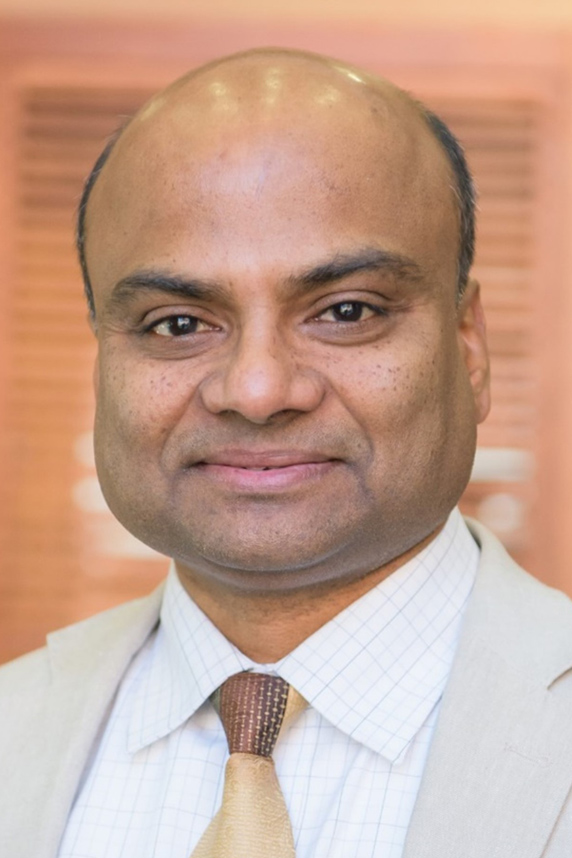
    <img src="https://factor.niehs.nih.gov/sites/niehs-factor/files/2024/08/feature/innovative-environmental-remediation-body1.jpg" alt="Upal Ghosh, Ph.D." style="max-width: 100%; height: auto;">
    “Anytime a new technology is created, there may be some risk,” noted Ghosh. “But being able to take a risk on something that theoretically could work creates a situation where technologies can flourish and move from the lab to the field. Throughout my career, I’ve been fortunate to find enabling environments that allow new ideas to be tested.” (Photo courtesy of Upal Ghosh)
    
    <hr>
    
    <p>NIEHS grant recipient <a href="https://cbee.umbc.edu/upal-ghosh/" rel="nofollow external" class="bo">Upal Ghosh, Ph.D.</a>, is a professor of environmental engineering at the University of Maryland, Baltimore County, who has developed practical, scalable solutions to some of the toughest contamination problems we face. Much of his work focuses on reducing the bioavailability of pollutants — preventing them from entering the food web and reaching humans — in bodies of water such as lakes and rivers. SediMite, a technology he helped to create and commercialize, offers a sustainable solution to environmental cleanup of PCBs.</p>
    <p>Beyond his efforts in the lab, Dr. Ghosh works closely with communities disproportionately affected by contamination. His projects in places like Washington, D.C., Baltimore, and Delaware have demonstrated the benefits of his remediation technology, helping to reduce fish consumption advisories, restore wetlands, and strengthen resiliency among residents.</p>
    <p>In our conversation, Dr. Ghosh shared insights into the scale of environmental contamination globally and the evolving landscape of remediation technologies. He discussed the importance of understanding how exposures in a water body can lead to exposures in humans, as that knowledge is crucial to developing effective cleanup approaches. Dr. Ghosh also described his early interest in science and what inspired him to pursue a research career.</p>
    <h2>Economy and environment</h2>
    <p><strong>Rick Woychik</strong>: Thank you, Dr. Ghosh, for taking the time to speak with me. Can you provide an overview of the scale of environmental contamination problems, both in the U.S. and globally?</p>
    <p><strong>Upal Ghosh</strong>: Sure. The way I think about it, the scale of environmental problems is related to the scale of the economy. A lot of the problems we discuss — from <a href="https://www.epa.gov/superfund/what-superfund" rel="nofollow external" class="bo">Superfund sites</a> such as Love Canal to current challenges around <a href="https://www.niehs.nih.gov/health/topics/agents/pfc" rel="nofollow external" class="bo">PFAS contamination</a> — are tied to how productive an economy is, and how production and usage practices have caused leakages.</p>
    <p>The U.S. was the largest manufacturing center for many products, and we’re seeing the footprint of that. Love Canal is a prime example. All of these Superfund sites are remnants of an era where laws weren’t in place to internalize costs and reduce externalities, and now we’re realizing that.</p>
    <hr>
    <img src="https://factor.niehs.nih.gov/sites/niehs-factor/files/2024/08/feature/innovative-environmental-remediation-body2.jpg" alt="Ghosh on boat" style="max-width: 100%; height: auto;">
    Ghosh is shown here collecting sediments from the Fort Eustis Superfund site in Virginia. “Working at PCB-contaminated sites like this makes you think, ‘How can we reduce human and ecological exposure without destroying vibrant wetland ecosystems?’” said Ghosh. (Image courtesy of Upal Ghosh)
    
    <hr>
    <p>I also travel internationally, and I see the same trends in developing countries. In India, they're ramping up production, and China has already reached high levels of industrial production. They’re starting to face challenges associated with manufacturing, transporting, and using large volumes of chemicals to provide their populations with a quality of life they expect and deserve.</p>
    <p>In pharmaceutical production, we’re seeing leakages of pharmaceuticals, and with large-volume chemicals like petroleum and pesticides, every functioning economy creates this footprint. So, in short, the scale of the problem has often been tied to the scale of the economy. But I believe that new technologies will help to create a better dynamic, allowing for both strong economic growth and strong environmental health.</p>
    <h2>To solve the problem, first define it</h2>
    <p><strong>RW</strong>: How do you go about developing remediation approaches?</p>
    <p><strong>UG</strong>: Environmental contamination poses an interesting challenge for scientists and engineers because the problem is often poorly defined. If I put PCB molecules in a beaker of clean water, as a scientist, I can describe the behavior accurately. But when I deal with a river, lake, or coastal bay, the matrix is much more complicated. For a variety of reasons, such as complex geochemistry, hydrodynamics, air-water exchange, and so forth, the attributes of contamination are not uniform. The behavior of compounds in that matrix becomes much more difficult to describe.</p>
    <p>For example, in the PCB cases I’ve worked on, we have to try to understand not just what’s happening in a complex body of water, but also a complex ecological system that ultimately leads to human exposure via the food web. So, defining the problem is the first part of effective technology development, and in fact I think that’s where many technology needs lie: accurately defining exposure. We can’t solve the problem unless we do so.</p>
    <hr>
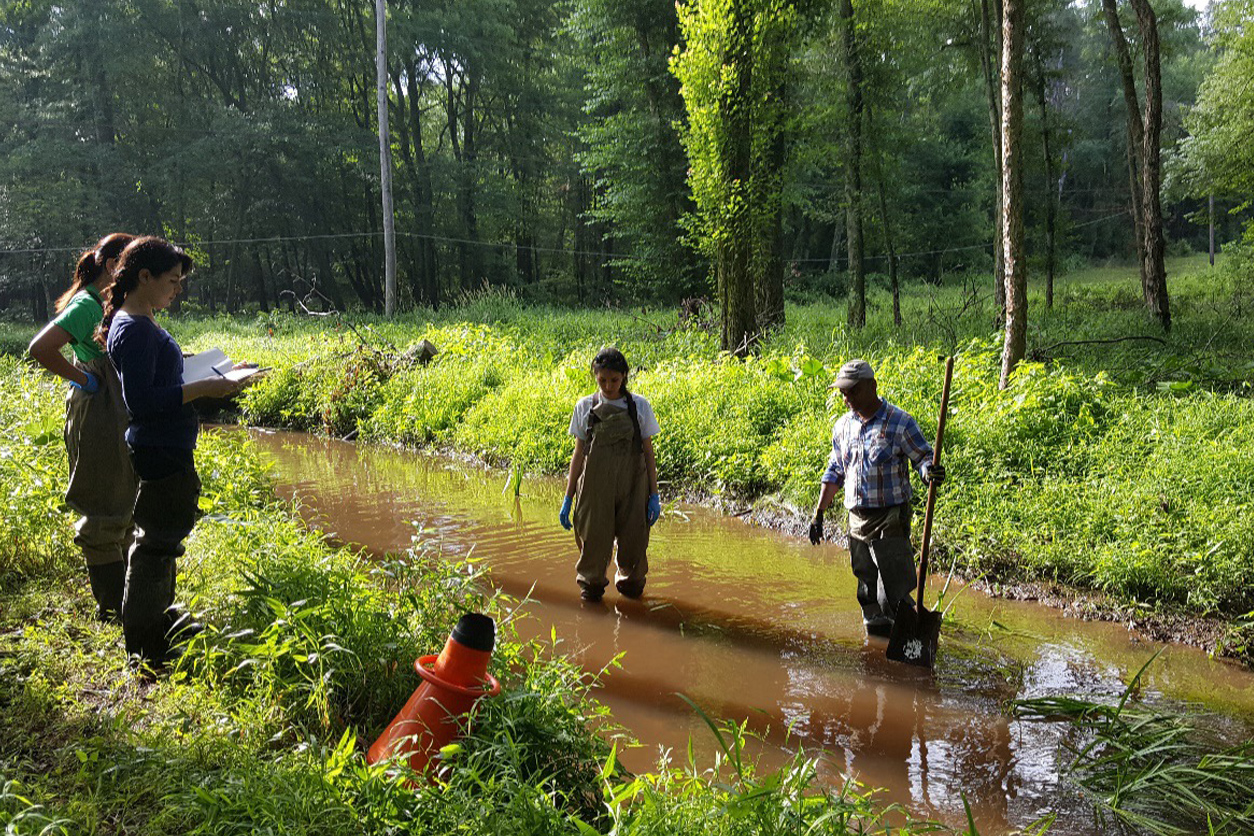
    <img src="https://factor.niehs.nih.gov/sites/niehs-factor/files/2024/08/feature/innovative-environmental-remediation-body3.jpg" alt="Ghosh and team standing in the river" style="max-width: 100%; height: auto;">
    Ghosh, right, is shown here installing passive samplers with students at a tributary of the Anacostia River in Washington, D.C., to help local decisionmakers better define the PCB and pesticide pollution problem and refine their remediation approach. (Photo courtesy of Upal Ghosh)
    
    <hr>
    <p>A lot of my work, and much of my colleagues’ work, falls under this category of accurately defining exposure, of understanding the bioavailability of pollutants in the soil or sediment environment. Once we understand the exposure — and the dominant exposure pathways — then I can bring in engineers, communities, and policymakers to create effective solutions.</p>
    <h2>Discovering black carbon’s key role</h2>
    <p><strong>RW</strong>: This is very interesting. If I’m understanding you correctly, the goal is to not just determine PCB levels in the soil of a riverbed, for example, but also to assess how much PCB in the soil of the riverbed will make it into the water and be ingested by fish, or absorbed through their gills, and eventually consumed by humans. Is that what you’re getting at?</p>
    <p><strong>UG</strong>: That’s exactly right. It’s not just about measuring contamination in sediments but understanding how it moves through the aquatic environment and enters the food web. Once we can accurately define the dominant exposure pathways, we can tailor our remediation efforts to address the most critical sources of exposure. To that end, we’ve adopted passive sampling techniques and environmental modeling methods to better assess the movement and exposures.</p>
    <p>Early in my research, when I was at Stanford working with my colleague and mentor Dr. Dick Luthy, we were studying the bioavailability of pollutants, looking specifically at PAHs [polycyclic aromatic hydrocarbons] and PCBs in sediments. The question we were asking was: Why is the bioavailability so different across sites? For example, when I took sediments from the Baltimore harbor versus sediments from the Milwaukee harbor, they didn’t behave the same.</p>
    <p>Just looking at the organic matter content, mineral content, and particle size wasn’t explaining the differences, which were sometimes more than an order of magnitude. In some sediments, pollutants like PAHs and PCBs were bound up much more strongly than we would predict. So, we started looking at that more carefully and discovered that in sediments where pollutants were strongly bound and less bioavailable, black carbon was present. Black carbon, the graphitic form of carbon, occurs naturally and can also come from things like forest fires, coal coke, and soot.</p>
    <p>We showed that these naturally present black carbon particles were binding PAHs and PCBs with affinities two orders of magnitude stronger than organic materials of plant origin. That was interesting because we could now explain the difference across our study sites. Some of our early papers focused on these natural differences in organic matter geochemistry, explaining the differences in bioavailability. Of course, we didn’t stop at just understanding the science — we wanted to use that knowledge to develop remediation technology.</p>
    <h2>Pellets pack a punch</h2>
    <p><strong>RW</strong>: And this is where the product you helped to develop, SediMite, comes into play. Can you explain the technology behind it?</p>
    <hr>
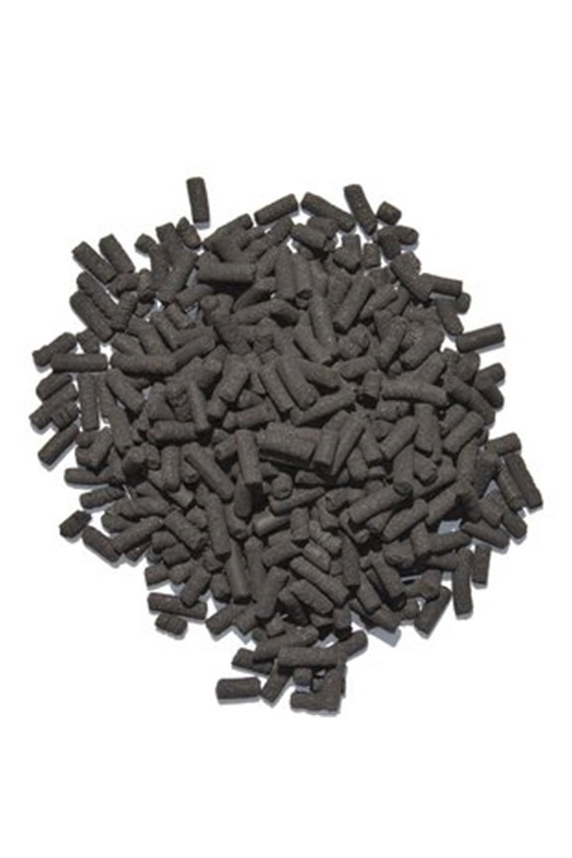
    <img src="https://factor.niehs.nih.gov/sites/niehs-factor/files/2024/08/feature/innovative-environmental-remediation-body4.jpg" alt="SediMite pellets" style="max-width: 100%; height: auto;">
    Ghosh patented SediMite in 2010 and created a university spin-off company to produce it at scale. (Photo courtesy of Sediment Solutions)
    
    <hr>
    <p><strong>UG</strong>: SediMite works by binding contaminants in sediments, reducing their availability to organisms in the food web. The product consists of activated carbon packaged into pellets, which makes it easy to handle and apply in the field. Once dispersed in sediments, the activated carbon binds to hydrophobic pollutants like PCBs, making them less bioavailable to aquatic organisms. It can apply to a whole range of hydrophobic chemicals — pesticides, dioxins, and even PFAS. It works for some metals, too. We have done some work with mercury, and it binds strongly.</p>
    <p>What sets this technology apart from traditional methods like dredging is that it minimizes environmental disruption. Dredging can release buried contaminants into the water, potentially exacerbating the problem. With SediMite, we’re able to stabilize contaminants in place, reducing the risk of exposure without disturbing the ecosystem. Additionally, this method is often more cost-effective than large-scale dredging and landfill disposal. SediMite can also be adjusted, so we can blend new formulations of absorbents in our pellets to target different pollutants.</p>
    <h2>Targeting contamination hotspots</h2>
    <p><strong>RW</strong>: It sounds like this technology has the potential to significantly improve remediation efforts. How scalable is it? Could it be applied to larger bodies of water, like Lake Michigan?</p>
    <p><strong>UG</strong>: Scaling is always a consideration, and while SediMite can be successfully applied to larger areas, it’s often most effective in targeted locations where contamination levels are highest. With targeted dispersal, we have been able to reduce PCB bioavailability by 80% or more. We’ve successfully applied this technology in places like Mirror Lake in Delaware, where it helped to reduce concentrations in fish to levels below consumption advisory guidelines.</p>
    <p>The broader notion of introducing activated carbon in a contaminated site, demonstrated successfully through our research, has now become mainstream technology. For example, the technique has been applied at multiple Superfund sites, such as the <a href="https://semspub.epa.gov/work/02/580386.pdf" rel="nofollow external" class="bo">Passaic River</a> in New Jersey.</p>
    <p>In a large body of water like Lake Michigan, the focus would likely be on contaminated hotspots near industrial sites rather than attempting to treat the entire lake. This targeted approach allows for more efficient use of resources while still achieving significant risk reduction.</p>
    <p>Recently, the U.S. Environmental Protection Agency used our product in Minnesota’s Scanlon Reservoir to clean up dioxins, and they covered about 15 acres. They used SediMite to reduce bioavailability in shoreline areas with wetlands without destroying the wetlands.</p>
    <h2>Using microbes to degrade contaminants</h2>
    <p><strong>RW</strong>: One intriguing aspect of your work involves microbial degradation of contaminants. Can you tell us more about that?</p>
    <p><strong>UG</strong>: Absolutely. Microbial degradation is the ultimate solution — finding ways to not only bind contaminants but also break them down over time. In the case of PCBs, there are naturally occurring microorganisms that can dechlorinate these compounds, making them less harmful. We’ve worked with my microbiologist colleague Dr. Kevin Sowers to isolate these organisms, grow them in the lab, and then reintroduce them into contaminated environments as microbial catalysts. This process enhances the natural degradation of contaminants, further reducing their impact over time.</p>
    <h2>For the benefit of communities</h2>
    <p><strong>RW</strong>: It’s inspiring to see remediation technologies applied in the real world. Could you share some examples of how your work has benefited communities disproportionately affected by environmental contamination?</p>
    <p><strong>UG</strong>: One project that stands out is the Middle Branch Resiliency Initiative in Southwest Baltimore, a community that faces multiple environmental challenges, including contaminated sediments and coastal flooding. By using SediMite to treat nearby sediments and creating elevated wetlands, we’re not only improving environmental conditions but also helping to protect the community from future flooding events. This project shows how environmental remediation can be integrated with broader resilience and restoration efforts, ultimately enhancing the quality of life for residents.</p>
    </div>
    <p>(Rick Woychik, Ph.D., directs NIEHS and the National Toxicology Program.)</p>
    <h5><br></h5></div>Read Original Post from Environmental FactorEnvironmental Factor<br>Your Online Source for NIEHS News: <a href="https://factor.niehs.nih.gov/2024/9/feature/4-feature-innovative-environmental-remediation" rel="nofollow external" class="bo">https://factor.niehs.nih.gov/2024/9/feature/4-feature-innovative-environmental-remediation</a><div><br></div><div>Photo credit: Rick Woychik, Ph.D., directs NIEHS and the National Toxicology Program. (Image courtesy of NIEHS)</div></div>
]]>
</Body>
<Summary>Chemical contamination reduced by grantee’s innovative technology  I spoke with Upal Ghosh, Ph.D., about how effective environmental remediation requires rigorous exposure science, engineering....</Summary>
<TrackingUrl>https://beta.my.umbc.edu/api/v0/pixel/news/144102/guest@my.umbc.edu/2c601ff79b1021d3edd14fba422a7a16/api/pixel</TrackingUrl>
<Tag>faculty</Tag>
<Tag>fall-2024</Tag>
<Tag>ghosh</Tag>
<Tag>news</Tag>
<Tag>research</Tag>
<Group token="cbee">Chemical, Biochemical and Environmental Engineering</Group>
<GroupUrl>https://beta.my.umbc.edu/groups/cbee</GroupUrl>
<AvatarUrl>https://assets4-beta.my.umbc.edu/system/shared/avatars/groups/000/000/771/b5e579e81b2e3624611890fa3ca2716a/xsmall.png?1746794587</AvatarUrl>
<AvatarUrl size="original">https://assets2-beta.my.umbc.edu/system/shared/avatars/groups/000/000/771/b5e579e81b2e3624611890fa3ca2716a/original.png?1746794587</AvatarUrl>
<AvatarUrl size="xxlarge">https://assets1-beta.my.umbc.edu/system/shared/avatars/groups/000/000/771/b5e579e81b2e3624611890fa3ca2716a/xxlarge.png?1746794587</AvatarUrl>
<AvatarUrl size="xlarge">https://assets2-beta.my.umbc.edu/system/shared/avatars/groups/000/000/771/b5e579e81b2e3624611890fa3ca2716a/xlarge.png?1746794587</AvatarUrl>
<AvatarUrl size="large">https://assets2-beta.my.umbc.edu/system/shared/avatars/groups/000/000/771/b5e579e81b2e3624611890fa3ca2716a/large.png?1746794587</AvatarUrl>
<AvatarUrl size="medium">https://assets4-beta.my.umbc.edu/system/shared/avatars/groups/000/000/771/b5e579e81b2e3624611890fa3ca2716a/medium.png?1746794587</AvatarUrl>
<AvatarUrl size="small">https://assets1-beta.my.umbc.edu/system/shared/avatars/groups/000/000/771/b5e579e81b2e3624611890fa3ca2716a/small.png?1746794587</AvatarUrl>
<AvatarUrl size="xsmall">https://assets4-beta.my.umbc.edu/system/shared/avatars/groups/000/000/771/b5e579e81b2e3624611890fa3ca2716a/xsmall.png?1746794587</AvatarUrl>
<AvatarUrl size="xxsmall">https://assets1-beta.my.umbc.edu/system/shared/avatars/groups/000/000/771/b5e579e81b2e3624611890fa3ca2716a/xxsmall.png?1746794587</AvatarUrl>
<Sponsor>Chemical, Biochemical and Environmental Engineering</Sponsor>
<ThumbnailUrl size="xxlarge">https://assets3-beta.my.umbc.edu/system/shared/thumbnails/news/000/144/102/eacf9b2d0a66c0730b01eb78ad35fbe9/xxlarge.jpg?1726851683</ThumbnailUrl>
<ThumbnailUrl size="xlarge">https://assets2-beta.my.umbc.edu/system/shared/thumbnails/news/000/144/102/eacf9b2d0a66c0730b01eb78ad35fbe9/xlarge.jpg?1726851683</ThumbnailUrl>
<ThumbnailUrl size="large">https://assets3-beta.my.umbc.edu/system/shared/thumbnails/news/000/144/102/eacf9b2d0a66c0730b01eb78ad35fbe9/large.jpg?1726851683</ThumbnailUrl>
<ThumbnailUrl size="medium">https://assets2-beta.my.umbc.edu/system/shared/thumbnails/news/000/144/102/eacf9b2d0a66c0730b01eb78ad35fbe9/medium.jpg?1726851683</ThumbnailUrl>
<ThumbnailUrl size="small">https://assets1-beta.my.umbc.edu/system/shared/thumbnails/news/000/144/102/eacf9b2d0a66c0730b01eb78ad35fbe9/small.jpg?1726851683</ThumbnailUrl>
<ThumbnailUrl size="xsmall">https://assets2-beta.my.umbc.edu/system/shared/thumbnails/news/000/144/102/eacf9b2d0a66c0730b01eb78ad35fbe9/xsmall.jpg?1726851683</ThumbnailUrl>
<ThumbnailUrl size="xxsmall">https://assets1-beta.my.umbc.edu/system/shared/thumbnails/news/000/144/102/eacf9b2d0a66c0730b01eb78ad35fbe9/xxsmall.jpg?1726851683</ThumbnailUrl>
<PawCount>0</PawCount>
<CommentCount>0</CommentCount>
<CommentsAllowed>true</CommentsAllowed>
<PostedAt>Fri, 20 Sep 2024 13:07:06 -0400</PostedAt>
<EditAt>Fri, 20 Sep 2024 13:17:00 -0400</EditAt>
</NewsItem>

<NewsItem contentIssues="true" id="144072" important="false" status="posted" url="https://beta.my.umbc.edu/groups/cbee/posts/144072">
<Title>Upal Ghosh appointed to D.C. mayor&#8217;s Leadership Council for a Cleaner Anacostia River</Title>
<Tagline>from UMBC News</Tagline>
<Body>
<![CDATA[
    <div class="html-content"><p><a href="https://umbc.edu/quick-posts/upal-ghosh-leadership-council-for-a-cleaner-anacostia-river/" rel="nofollow external" class="bo"> UMBC News</a> | Published: Sep 18, 2024 |By:<a href="https://umbc.edu/author/cmeyers2/" rel="nofollow external" class="bo"><strong>Catherine Meyers</strong></a></p>
    <p>On September 12, UMBC’s <strong><a href="https://cbee.umbc.edu/upal-ghosh/" rel="nofollow external" class="bo">Upal Ghosh</a></strong>, from the Department of Chemical, Biochemical, and Environmental Engineering, was sworn in as a member of the Washington, D.C., mayor’s Leadership Council for a Cleaner Anacostia River (LCCAR). The council consists of 25 high-level government officials, community leaders, and environmental experts who support the vision of a swimmable and fishable Anacostia River. The members meet quarterly to advise the D.C. government on ongoing restoration projects. </p>
    <p>The Anacostia River, which runs from Prince George’s County in Maryland into Washington, D.C., before joining the Potomac River and ultimately flowing into the Chesapeake Bay, has historically suffered from high levels of industrial pollution and contamination from sewage overflow. In recent years, government officials have been making concerted efforts to clean up the river. UMBC was invited to sit on the council, with Ghosh as the representative, based on the university’s key contributions to these clean-up efforts. </p>
    <img src="https://umbc.edu/wp-content/uploads/2024/09/LCCAR-swearing-in_Sept.-12.png" alt="Screen shots shows people on conference call on top and agenda for meeting below. Some people raise their hands for a swearing in." width="601" height="485" style="max-width: 100%; height: auto;">
    On Sept. 12, Upal Ghosh (top left) and other members of the LCCAR were sworn in during a virtual meeting of the council. (Image courtesy of Ghosh)
    
    <p><br>Since 2016, Ghosh and his UMBC colleagues and students have developed innovative methods of measuring contaminants in the river and created models to elucidate where the contaminants come from and how they travel through and accumulate in the water, sediment, and aquatic life, such as fish. <strong><a href="https://imet.usmd.edu/directory/nathalie-lombard" rel="nofollow external" class="bo">Nathalie Lombard</a></strong>, a research assistant professor at UMBC who has played a significant role in the projects, will serve as the alternate representative on the LLCAR when Ghosh cannot attend. </p>
    <p><br>In addition to his work on the Anacostia, Ghosh and his students have studied and contributed to the cleanup of the <a href="https://factor.niehs.nih.gov/2024/9/feature/4-feature-innovative-environmental-remediation" rel="nofollow external" class="bo">waterways throughout Maryland, Delaware, and across the country</a>. “Students learn a lot from being out in the field,” Ghosh says. “They learn how the science and engineering we do helps guide major decisions. Our ultimate goal is making a positive difference in the health of the river, lake, or bay. That gives me a lot of excitement, and it really motivates the students too.”</p>
    <p>Read original post via UMBC NEWS: <a href="https://umbc.edu/quick-posts/upal-ghosh-leadership-council-for-a-cleaner-anacostia-river/" rel="nofollow external" class="bo">Upal Ghosh Appointed To D.C. Mayor’s Leadership Council For A Cleaner Anacostia River - UMBC</a></p></div>
]]>
</Body>
<Summary>UMBC News | Published: Sep 18, 2024 |By:Catherine Meyers   On September 12, UMBC’s Upal Ghosh, from the Department of Chemical, Biochemical, and Environmental Engineering, was sworn in as a member...</Summary>
<TrackingUrl>https://beta.my.umbc.edu/api/v0/pixel/news/144072/guest@my.umbc.edu/8f57de1fd5874947076a22abb7de8539/api/pixel</TrackingUrl>
<Tag>cbee</Tag>
<Tag>coeit</Tag>
<Tag>faculty</Tag>
<Tag>fall-2024</Tag>
<Tag>ghosh</Tag>
<Tag>news</Tag>
<Group token="cbee">Chemical, Biochemical and Environmental Engineering</Group>
<GroupUrl>https://beta.my.umbc.edu/groups/cbee</GroupUrl>
<AvatarUrl>https://assets4-beta.my.umbc.edu/system/shared/avatars/groups/000/000/771/b5e579e81b2e3624611890fa3ca2716a/xsmall.png?1746794587</AvatarUrl>
<AvatarUrl size="original">https://assets2-beta.my.umbc.edu/system/shared/avatars/groups/000/000/771/b5e579e81b2e3624611890fa3ca2716a/original.png?1746794587</AvatarUrl>
<AvatarUrl size="xxlarge">https://assets1-beta.my.umbc.edu/system/shared/avatars/groups/000/000/771/b5e579e81b2e3624611890fa3ca2716a/xxlarge.png?1746794587</AvatarUrl>
<AvatarUrl size="xlarge">https://assets2-beta.my.umbc.edu/system/shared/avatars/groups/000/000/771/b5e579e81b2e3624611890fa3ca2716a/xlarge.png?1746794587</AvatarUrl>
<AvatarUrl size="large">https://assets2-beta.my.umbc.edu/system/shared/avatars/groups/000/000/771/b5e579e81b2e3624611890fa3ca2716a/large.png?1746794587</AvatarUrl>
<AvatarUrl size="medium">https://assets4-beta.my.umbc.edu/system/shared/avatars/groups/000/000/771/b5e579e81b2e3624611890fa3ca2716a/medium.png?1746794587</AvatarUrl>
<AvatarUrl size="small">https://assets1-beta.my.umbc.edu/system/shared/avatars/groups/000/000/771/b5e579e81b2e3624611890fa3ca2716a/small.png?1746794587</AvatarUrl>
<AvatarUrl size="xsmall">https://assets4-beta.my.umbc.edu/system/shared/avatars/groups/000/000/771/b5e579e81b2e3624611890fa3ca2716a/xsmall.png?1746794587</AvatarUrl>
<AvatarUrl size="xxsmall">https://assets1-beta.my.umbc.edu/system/shared/avatars/groups/000/000/771/b5e579e81b2e3624611890fa3ca2716a/xxsmall.png?1746794587</AvatarUrl>
<Sponsor>Chemical, Biochemical and Environmental Engineering</Sponsor>
<ThumbnailUrl size="xxlarge">https://assets2-beta.my.umbc.edu/system/shared/thumbnails/news/000/144/072/6ae323c355a16250b66c41004a6f7c0e/xxlarge.jpg?1726777022</ThumbnailUrl>
<ThumbnailUrl size="xlarge">https://assets2-beta.my.umbc.edu/system/shared/thumbnails/news/000/144/072/6ae323c355a16250b66c41004a6f7c0e/xlarge.jpg?1726777022</ThumbnailUrl>
<ThumbnailUrl size="large">https://assets1-beta.my.umbc.edu/system/shared/thumbnails/news/000/144/072/6ae323c355a16250b66c41004a6f7c0e/large.jpg?1726777022</ThumbnailUrl>
<ThumbnailUrl size="medium">https://assets1-beta.my.umbc.edu/system/shared/thumbnails/news/000/144/072/6ae323c355a16250b66c41004a6f7c0e/medium.jpg?1726777022</ThumbnailUrl>
<ThumbnailUrl size="small">https://assets1-beta.my.umbc.edu/system/shared/thumbnails/news/000/144/072/6ae323c355a16250b66c41004a6f7c0e/small.jpg?1726777022</ThumbnailUrl>
<ThumbnailUrl size="xsmall">https://assets1-beta.my.umbc.edu/system/shared/thumbnails/news/000/144/072/6ae323c355a16250b66c41004a6f7c0e/xsmall.jpg?1726777022</ThumbnailUrl>
<ThumbnailUrl size="xxsmall">https://assets2-beta.my.umbc.edu/system/shared/thumbnails/news/000/144/072/6ae323c355a16250b66c41004a6f7c0e/xxsmall.jpg?1726777022</ThumbnailUrl>
<PawCount>0</PawCount>
<CommentCount>0</CommentCount>
<CommentsAllowed>true</CommentsAllowed>
<PostedAt>Thu, 19 Sep 2024 16:19:54 -0400</PostedAt>
<EditAt>Fri, 20 Sep 2024 10:14:46 -0400</EditAt>
</NewsItem>

<NewsItem contentIssues="true" id="142482" important="false" status="posted" url="https://beta.my.umbc.edu/groups/cbee/posts/142482">
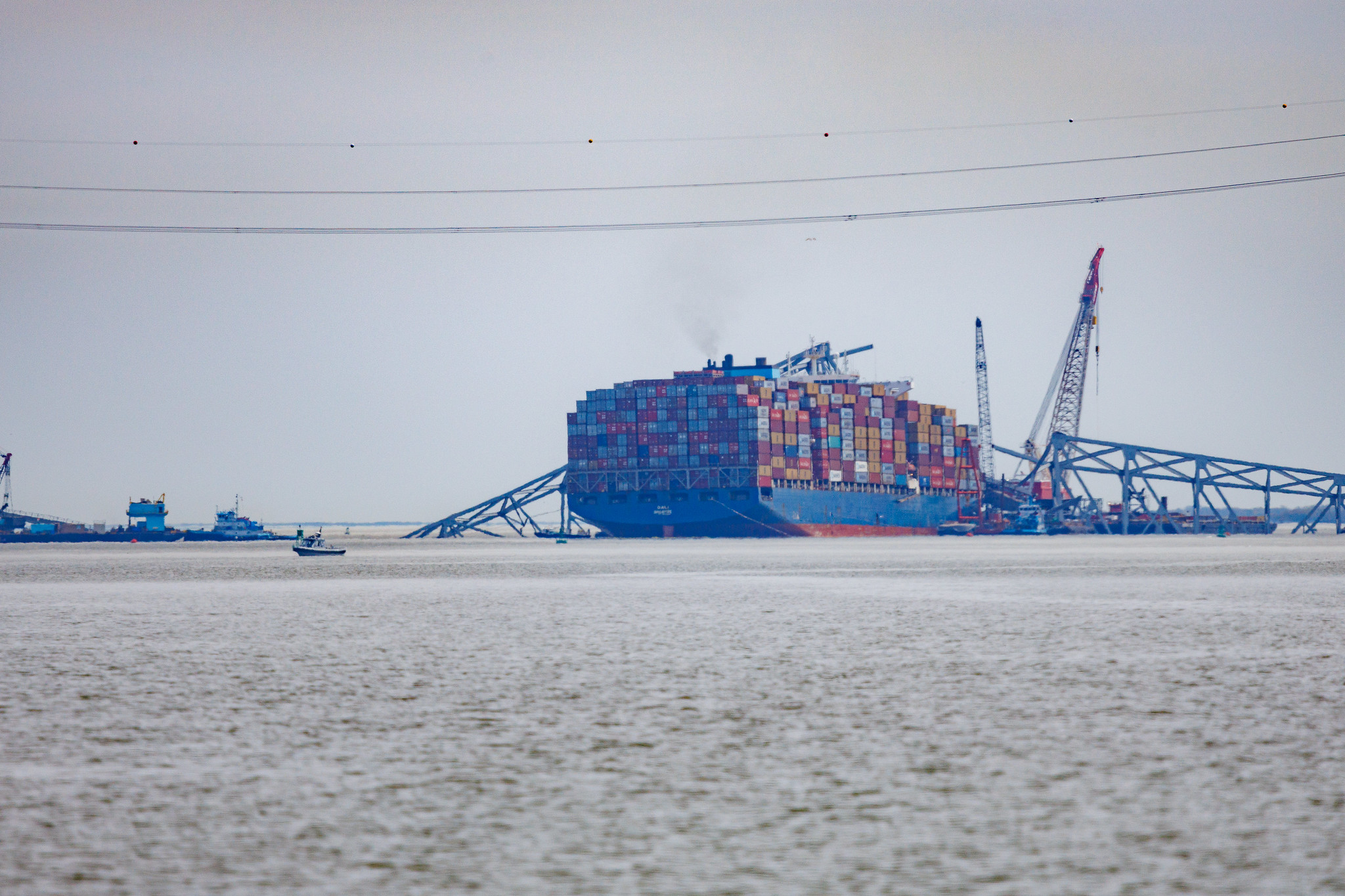
<Title>Dr. Ghosh assesses environmental impact of bridge collapse</Title>
<Tagline>Excerpt UMBC Magazine</Tagline>
<Body>
<![CDATA[
    <div class="html-content">In response to the tragic collapse of the Francis Scott Key Bridge, Dr. Upal Ghosh, professorCBEE, assesses potential environmental impacts, particularly concerning the hazardous materials aboard the cargo ship. His insights into the potential ecological repercussions underscored the department's commitment to safeguarding the Patapsco River and surrounding communities.<br><br><em>Excerpt from UMBC Magazine “<a href="https://umbc.edu/stories/support-after-key-bridge-collapse/" rel="nofollow external" class="bo"><strong>Infrastructure of support after Key Bridge collapse</strong></a><strong>”</strong> by Adriana Fraser, published on June 13, 2024</em>
    <p><img src="https://umbc.edu/wp-content/uploads/2024/05/Key-Bridge-Collapse.jpg" alt="The remains of the Francis Scott Key Bridge after a collision with a malfunctioning cargo ship on March 26. (Photo source: Corey Jennings '10, Maryland Comptroller/Flickr)" width="928" height="619" style="max-width: 100%; height: auto;"><em>The remains of the Francis Scott Key Bridge after a collision with a malfunctioning cargo ship on March 26. (Photo source: Corey Jennings '10, Maryland Comptroller/Flickr)</em></p><p><strong>Examining the environmental impacts of the collapse </strong></p><p>The ship that collided into the bridge was carrying 56 containers of hazardous materials, including corrosives, flammables, and lithium-ion batteries. The cargo ship was also carrying more than one million gallons of fuel at the time of the impact. City officials began their investigations into the incident, which included determining the environmental impacts to the Patapsco River and surrounding communities. </p>
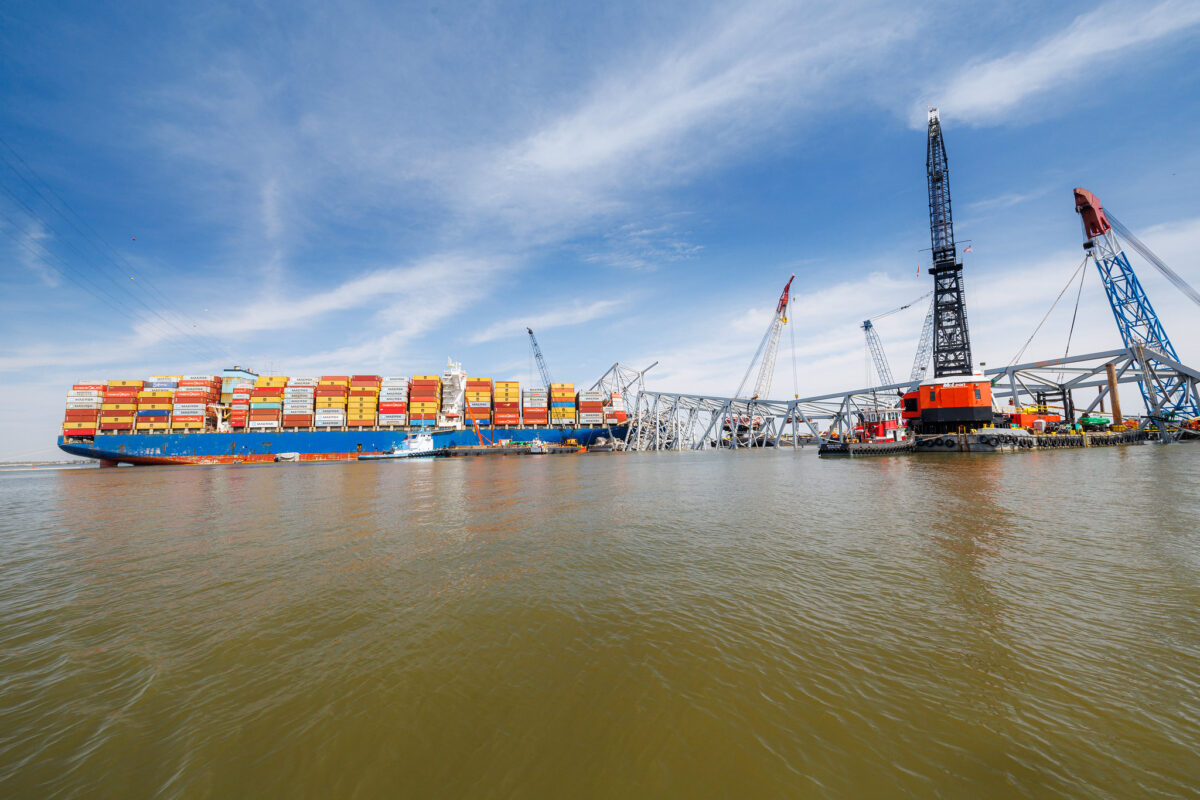
    <p><strong>Upal Ghosh</strong>, professor of chemical, biochemical, and environmental engineering, whose research includes examining the effects of toxic pollutants in soils, sediments, and aquatic environments, was among the experts who weighed in on assessing the potentially hazardous effects of the containers that were resting at the bottom of the river. <br><br><img src="https://umbc.edu/wp-content/uploads/2024/05/Key-Bridge-Collapse-2-1200x800.jpg" alt="" width="800" height="460" style="max-width: 100%; height: auto;"><em>Maryland Comptroller Brooke Lierman and representatives of the Office of the Governor take a tour of the Francis Scott Key Bridge collapse site on a Maryland Department of Natural Resources police boat. (Photo source: Corey Jennings ’10, <a href="https://flickr.com/photos/mdcomptroller/53643621629/in/album-72177720316111136/" rel="nofollow external" class="bo">Maryland Comptroller/Flickr</a>)</em></p>
    <p>Ghosh told the <em>Baltimore Sun</em> days after the collapse that environmental officials’ first priority would likely be making sure none of the intact containers were breached.</p>
    <p>“If you have containers that contain oily material, those things will, if they are breached, be releasing over time,” Ghosh said. “I would think if there is a release that goes down into the sediments under the water, it would be a local impact right there.” </p>
    <p><strong>Farah Nibbs</strong>, assistant professor of emergency and disaster health systems, is also thinking about future ways to contain the effects of similar disasters. Contributing factors to the bridge’s collapse, she says, can be tied to the 2012 expansion and modernization of the Port of Baltimore. Those changes did not happen hand in hand with improvements in safety management needed to accommodate ships of such huge sizes that now were able to port in the city. Risks from collisions, fuel spills, and contamination still lack proper oversight and regulation.</p>
    <p>“A novel approach for decision-makers may be to view Maryland’s emergency management and transportation experts and service providers—as well as the physical bridge infrastructure itself—as part of the community’s lifeline systems,” said Nibbs. </p><p><strong><em>~~</em></strong></p><p><strong><em>Read the full article: <a href="https://umbc.edu/stories/support-after-key-bridge-collapse/" rel="nofollow external" class="bo">Infrastructure Of Support After Key Bridge Collapse - UMBC: University Of Maryland, Baltimore County</a></em></strong></p></div>
]]>
</Body>
<Summary>In response to the tragic collapse of the Francis Scott Key Bridge, Dr. Upal Ghosh, professorCBEE, assesses potential environmental impacts, particularly concerning the hazardous materials aboard...</Summary>
<TrackingUrl>https://beta.my.umbc.edu/api/v0/pixel/news/142482/guest@my.umbc.edu/07e4001c5ec8f5aca841833b20e59429/api/pixel</TrackingUrl>
<Tag>faculty</Tag>
<Tag>ghosh</Tag>
<Tag>news</Tag>
<Tag>spring-2024</Tag>
<Group token="cbee">Chemical, Biochemical and Environmental Engineering</Group>
<GroupUrl>https://beta.my.umbc.edu/groups/cbee</GroupUrl>
<AvatarUrl>https://assets4-beta.my.umbc.edu/system/shared/avatars/groups/000/000/771/b5e579e81b2e3624611890fa3ca2716a/xsmall.png?1746794587</AvatarUrl>
<AvatarUrl size="original">https://assets2-beta.my.umbc.edu/system/shared/avatars/groups/000/000/771/b5e579e81b2e3624611890fa3ca2716a/original.png?1746794587</AvatarUrl>
<AvatarUrl size="xxlarge">https://assets1-beta.my.umbc.edu/system/shared/avatars/groups/000/000/771/b5e579e81b2e3624611890fa3ca2716a/xxlarge.png?1746794587</AvatarUrl>
<AvatarUrl size="xlarge">https://assets2-beta.my.umbc.edu/system/shared/avatars/groups/000/000/771/b5e579e81b2e3624611890fa3ca2716a/xlarge.png?1746794587</AvatarUrl>
<AvatarUrl size="large">https://assets2-beta.my.umbc.edu/system/shared/avatars/groups/000/000/771/b5e579e81b2e3624611890fa3ca2716a/large.png?1746794587</AvatarUrl>
<AvatarUrl size="medium">https://assets4-beta.my.umbc.edu/system/shared/avatars/groups/000/000/771/b5e579e81b2e3624611890fa3ca2716a/medium.png?1746794587</AvatarUrl>
<AvatarUrl size="small">https://assets1-beta.my.umbc.edu/system/shared/avatars/groups/000/000/771/b5e579e81b2e3624611890fa3ca2716a/small.png?1746794587</AvatarUrl>
<AvatarUrl size="xsmall">https://assets4-beta.my.umbc.edu/system/shared/avatars/groups/000/000/771/b5e579e81b2e3624611890fa3ca2716a/xsmall.png?1746794587</AvatarUrl>
<AvatarUrl size="xxsmall">https://assets1-beta.my.umbc.edu/system/shared/avatars/groups/000/000/771/b5e579e81b2e3624611890fa3ca2716a/xxsmall.png?1746794587</AvatarUrl>
<Sponsor>Chemical, Biochemical and Environmental Engineering</Sponsor>
<PawCount>0</PawCount>
<CommentCount>0</CommentCount>
<CommentsAllowed>true</CommentsAllowed>
<PostedAt>Mon, 17 Jun 2024 13:40:07 -0400</PostedAt>
<EditAt>Mon, 17 Jun 2024 15:01:09 -0400</EditAt>
</NewsItem>

</News>