CBEE Students Present at AEESP 2025 Research and Education Conference
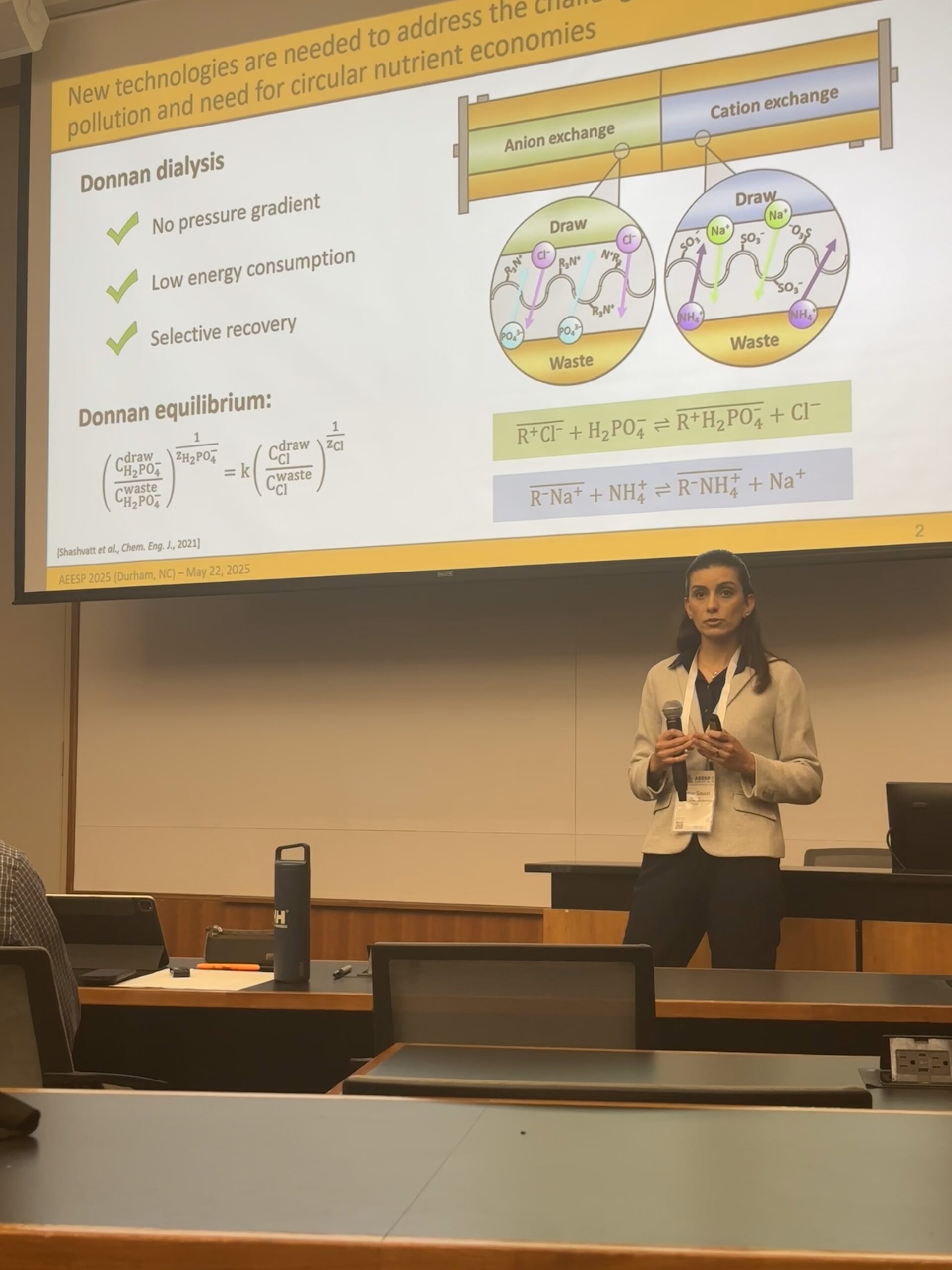
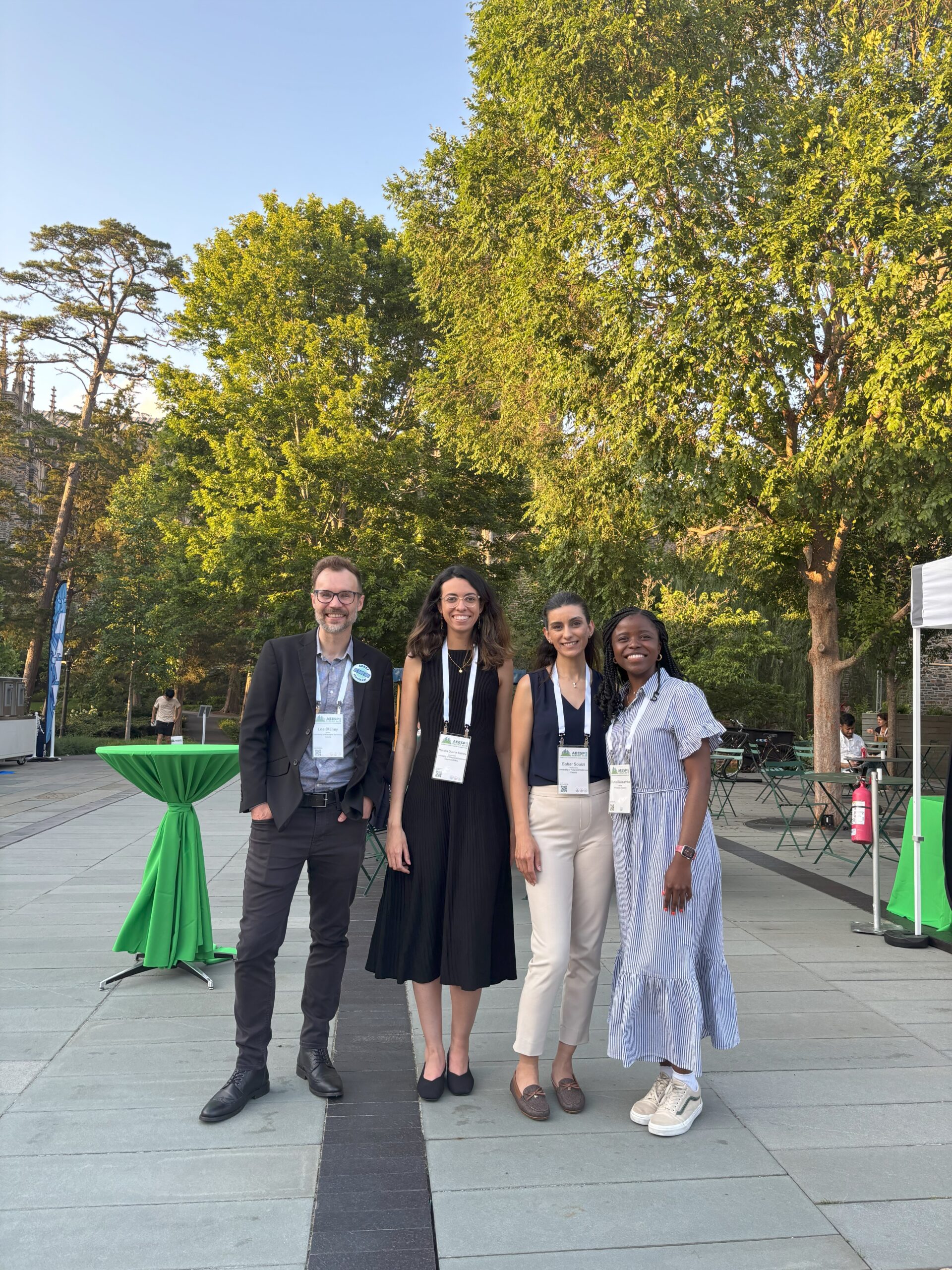
Sahar Souizi, Marylia Duarte Batista (Environmental Engineering Ph.D. students with Dr. Blaney), and Dr. Blaney attended the AEESP 2025 Research and Education Conference at Duke University from May 20-22. With over 1,000 attendees, the event featured oral presentations, poster sessions, plenary talks, workshops, and networking opportunities. Marylia presented her research titled “Development of hybrid anion-exchange resins with enhanced selectivity and capacity for (ultra)short-chain PFAS” in the “Advances in PFAS Treatment and Destruction” session. Sahar shared her work on “Sustainable nutrient recovery from poultry litter using an enhanced tube-in-tube Donnan dialysis system” during the “Resource Recovery from Waste Streams Towards Circular Economy” session. Both students enjoyed the opportunities to connect with fellow PhD students, post-doctoral researchers, and professors in the field.
The conference also offered opportunities for reconnections, such as with Ouriel Ndalamba, a former undergraduate lab member now a PhD student at Princeton.
Additional details and links to Sahar and Marylia's submitted abstracts: https://lee-blaney.squarespace.com/news
]]>
Sahar Souizi, Marylia Duarte Batista (Environmental Engineering Ph.D. students with Dr. Blaney), and Dr. Blaney attended the AEESP 2025 Research and Education Conference at Duke University from...
https://beta.my.umbc.edu/api/v0/pixel/news/150469/guest@my.umbc.edu/ab2920d2874e456a3c6ebbbe62918c6f/api/pixel
aeesp
blaney
grad
research
spring-2025
Chemical, Biochemical and Environmental Engineering
https://beta.my.umbc.edu/groups/cbee
https://assets4-beta.my.umbc.edu/system/shared/avatars/groups/000/000/771/b5e579e81b2e3624611890fa3ca2716a/xsmall.png?1746794587
https://assets2-beta.my.umbc.edu/system/shared/avatars/groups/000/000/771/b5e579e81b2e3624611890fa3ca2716a/original.png?1746794587
https://assets1-beta.my.umbc.edu/system/shared/avatars/groups/000/000/771/b5e579e81b2e3624611890fa3ca2716a/xxlarge.png?1746794587
https://assets2-beta.my.umbc.edu/system/shared/avatars/groups/000/000/771/b5e579e81b2e3624611890fa3ca2716a/xlarge.png?1746794587
https://assets2-beta.my.umbc.edu/system/shared/avatars/groups/000/000/771/b5e579e81b2e3624611890fa3ca2716a/large.png?1746794587
https://assets4-beta.my.umbc.edu/system/shared/avatars/groups/000/000/771/b5e579e81b2e3624611890fa3ca2716a/medium.png?1746794587
https://assets1-beta.my.umbc.edu/system/shared/avatars/groups/000/000/771/b5e579e81b2e3624611890fa3ca2716a/small.png?1746794587
https://assets4-beta.my.umbc.edu/system/shared/avatars/groups/000/000/771/b5e579e81b2e3624611890fa3ca2716a/xsmall.png?1746794587
https://assets1-beta.my.umbc.edu/system/shared/avatars/groups/000/000/771/b5e579e81b2e3624611890fa3ca2716a/xxsmall.png?1746794587
Chemical, Biochemical and Environmental Engineering
https://assets2-beta.my.umbc.edu/system/shared/thumbnails/news/000/150/469/bc01f5ac3e8a111b115fa373b16108a7/xxlarge.jpg?1748611320
https://assets2-beta.my.umbc.edu/system/shared/thumbnails/news/000/150/469/bc01f5ac3e8a111b115fa373b16108a7/xlarge.jpg?1748611320
https://assets1-beta.my.umbc.edu/system/shared/thumbnails/news/000/150/469/bc01f5ac3e8a111b115fa373b16108a7/large.jpg?1748611320
https://assets1-beta.my.umbc.edu/system/shared/thumbnails/news/000/150/469/bc01f5ac3e8a111b115fa373b16108a7/medium.jpg?1748611320
https://assets4-beta.my.umbc.edu/system/shared/thumbnails/news/000/150/469/bc01f5ac3e8a111b115fa373b16108a7/small.jpg?1748611320
https://assets4-beta.my.umbc.edu/system/shared/thumbnails/news/000/150/469/bc01f5ac3e8a111b115fa373b16108a7/xsmall.jpg?1748611320
https://assets1-beta.my.umbc.edu/system/shared/thumbnails/news/000/150/469/bc01f5ac3e8a111b115fa373b16108a7/xxsmall.jpg?1748611320
Marylia Duarte Batista presents her research at AEESP 2025 Conference.
1
0
true
Fri, 30 May 2025 09:19:51 -0400
Fri, 30 May 2025 09:22:30 -0400
Congratulations to the CBEE Student Presenters at URCAD
On April 16, 2025, over 300 undergraduate students shared their research and achievements through oral presentations, poster presentations, artistic exhibits, performances, films, interactive games, and more in the University Center.
Congratulations to all CBEE students who participated in the event!
Oral Presentations
Evalynn Ellison | Ultrasound-Responsive Phospholipid-Coated Microbubbles for Controlled Drug Delivery Across Mucosa | Chemical, Biochemical, and Environmental Engineering | Canan Dagdeviren
Poster Presentations
Shashane Anderson | Formal Verification of Thermodynamic Models With Lean 4 | Chemical, Biochemical, and Environmental Engineering | Tyler Josephson
Alvin Bett | Detecting PFAS in Baltimore Harbor Using Novel Passive Samplers | Chemical, Biochemical, and Environmental Engineering | Lee Blaney
Jacob Craft | Measuring the Selectivity Coefficients of 19 PFAS With Four Anion-Exchange Membranes | Chemical, Biochemical, and Environmental Engineering | Lee Blaney
Joshua Dayie | Engineering CRBN for Improved Assay and Structural Enablement Using DeNovo Protein Scaffolds | Chemical, Biochemical, and Environmental Engineering | Nicole LaRonde
Trevor Gibson | Hybrid Anion-Exchange Resins Improve the Uptake and Selectivity for (Ultra)Short-Chain PFAS in Drinking Water | Chemical, Biochemical, and Environmental Engineering | Lee Blaney
Elias Gilotte | Uncovering The Relationship Between Oxygen Availability and Energy Sources in Cell-free Protein Synthesis | Chemical, Biochemical, and Environmental Engineering | Govind Rao
Alexander Haibel | GraphARC: An AI Benchmark for Chemical Reasoning | Chemical, Biochemical, and Environmental Engineering | Tyler Josephson
Sydney Hofstetter | Sucrose Density Gradient Centrifugation Versus Anion Exchange for Exosome Sample Purification | Chemical, Biochemical, and Environmental Engineering | Jorge Almodovar
Jasmine Ives | Polychlorinated Biphenyl Monitoring in Maryland Fish | Chemical, Biochemical, and Environmental Engineering | Upal Ghosh
Tonderai Kodzwa | Effect Of Temperature On Aqueous Zinc Ion Batteries | Chemical, Biochemical, and Environmental Engineering | Ozgur Capraz
Peter Lombardo | Percent Viability Screens To Confirm Integral Cell Wall Signaling Kinases In Aspergillus Nidulans | Chemical, Biochemical, and Environmental Engineering | Mark Marten
Terra Miley | Optimization Of Cell-Free Protein Synthesis Bioreactors With the Use of a Fluorescent Magnesium Biosensor | Chemical, Biochemical, and Environmental Engineering | Govind Rao
Meredith Morse | Characterizing The Aspergillus Nidulans Kinase Deletion Library | Chemical, Biochemical, and Environmental Engineering | Mark Marten
Tithi Prajapati | Noninvasive Wearable Device For Transcutaneous CO2 Based Early Detection Of Opioid-Induced Respiratory Depression | Chemical, Biochemical, and Environmental Engineering | Venkatesh Srinivasan
Matthew Quintanilla | Characterization Of Transmembrane Transporters Linked To Cell Wall Stress Response | Chemical, Biochemical, and Environmental Engineering | Mark Marten
Jessica Slaughter | Suite Of Bioinformatic-Analysis Apps For Better Understanding Dynamic Omics Data | Chemical, Biochemical, and Environmental Engineering | Mark Marten
Maaike Swaters | Measuring Ion-exchange Membrane Properties That Control Nutrient Recovery By Donnan Dialysis | Chemical, Biochemical, and Environmental Engineering | Lee Blaney
Greeshma Tarimala | Using Gene Editing And Fluorescent Microscopy To Characterize The PrkA Kinase In Aspergillus Nidulans | Chemical, Biochemical, and Environmental Engineering | Mark Marten
Julia Van Der Marel | Monitoring Of NADH Concentrations In Cell-Free Systems | Chemical, Biochemical, and Environmental Engineering | Govind Rao
Benjamin Welling | Fabrications Of An Autonomous Chemically Powered Vehicle: (AIChE Chem-E Car) | Chemical, Biochemical, and Environmental Engineering | Neha Raikar
Zorah Williams | Utilizing Manganese-Oxide As An Electrode Material For Aqueous Zn-ion Batteries. | Chemical, Biochemical, and Environmental Engineering | Ozgur Capraz
Ariel Wilson-Gray | Production Of Extracellular Vesicles From Mammalian Cells Modulated By A Biomimetic Surface | Chemical, Biochemical, and Environmental Engineering | Jorge Almodovar
]]>
On April 16, 2025, over 300 undergraduate students shared their research and achievements through oral presentations, poster presentations, artistic exhibits, performances, films, interactive...
https://beta.my.umbc.edu/api/v0/pixel/news/149178/guest@my.umbc.edu/05c0dcd6350cfb00b8616eb5a85d9ad2/api/pixel
almodovar
blaney
capraz
ghosh
josephson
marten
raikar
rao
research
spring-2025
ug
ugrad
urcad
Chemical, Biochemical and Environmental Engineering
https://beta.my.umbc.edu/groups/cbee
https://assets4-beta.my.umbc.edu/system/shared/avatars/groups/000/000/771/b5e579e81b2e3624611890fa3ca2716a/xsmall.png?1746794587
https://assets2-beta.my.umbc.edu/system/shared/avatars/groups/000/000/771/b5e579e81b2e3624611890fa3ca2716a/original.png?1746794587
https://assets1-beta.my.umbc.edu/system/shared/avatars/groups/000/000/771/b5e579e81b2e3624611890fa3ca2716a/xxlarge.png?1746794587
https://assets2-beta.my.umbc.edu/system/shared/avatars/groups/000/000/771/b5e579e81b2e3624611890fa3ca2716a/xlarge.png?1746794587
https://assets2-beta.my.umbc.edu/system/shared/avatars/groups/000/000/771/b5e579e81b2e3624611890fa3ca2716a/large.png?1746794587
https://assets4-beta.my.umbc.edu/system/shared/avatars/groups/000/000/771/b5e579e81b2e3624611890fa3ca2716a/medium.png?1746794587
https://assets1-beta.my.umbc.edu/system/shared/avatars/groups/000/000/771/b5e579e81b2e3624611890fa3ca2716a/small.png?1746794587
https://assets4-beta.my.umbc.edu/system/shared/avatars/groups/000/000/771/b5e579e81b2e3624611890fa3ca2716a/xsmall.png?1746794587
https://assets1-beta.my.umbc.edu/system/shared/avatars/groups/000/000/771/b5e579e81b2e3624611890fa3ca2716a/xxsmall.png?1746794587
Chemical, Biochemical and Environmental Engineering
https://assets2-beta.my.umbc.edu/system/shared/thumbnails/news/000/149/178/0cc2d9648fdd924523c80803702f0073/xxlarge.jpg?1744895017
https://assets3-beta.my.umbc.edu/system/shared/thumbnails/news/000/149/178/0cc2d9648fdd924523c80803702f0073/xlarge.jpg?1744895017
https://assets2-beta.my.umbc.edu/system/shared/thumbnails/news/000/149/178/0cc2d9648fdd924523c80803702f0073/large.jpg?1744895017
https://assets2-beta.my.umbc.edu/system/shared/thumbnails/news/000/149/178/0cc2d9648fdd924523c80803702f0073/medium.jpg?1744895017
https://assets1-beta.my.umbc.edu/system/shared/thumbnails/news/000/149/178/0cc2d9648fdd924523c80803702f0073/small.jpg?1744895017
https://assets3-beta.my.umbc.edu/system/shared/thumbnails/news/000/149/178/0cc2d9648fdd924523c80803702f0073/xsmall.jpg?1744895017
https://assets3-beta.my.umbc.edu/system/shared/thumbnails/news/000/149/178/0cc2d9648fdd924523c80803702f0073/xxsmall.jpg?1744895017
URCAD 2025 Logo
1
0
true
Thu, 17 Apr 2025 09:10:27 -0400
Fri, 25 Apr 2025 10:53:06 -0400
CBEE Students Among Award Winners at 2025 UMBC Research Symposium and 3MT
CBEE Students Among Award Winners at GEARS and 3MT
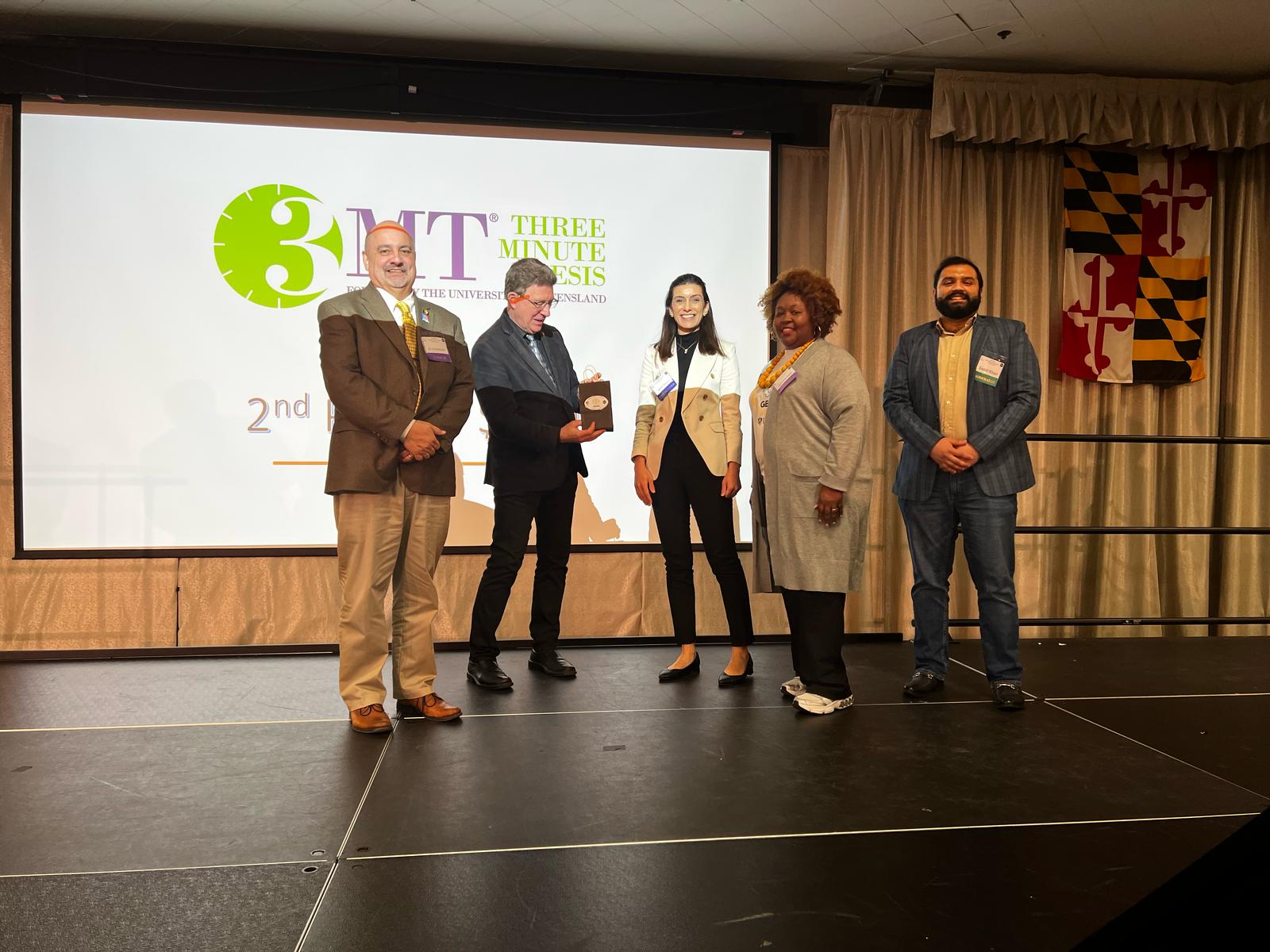
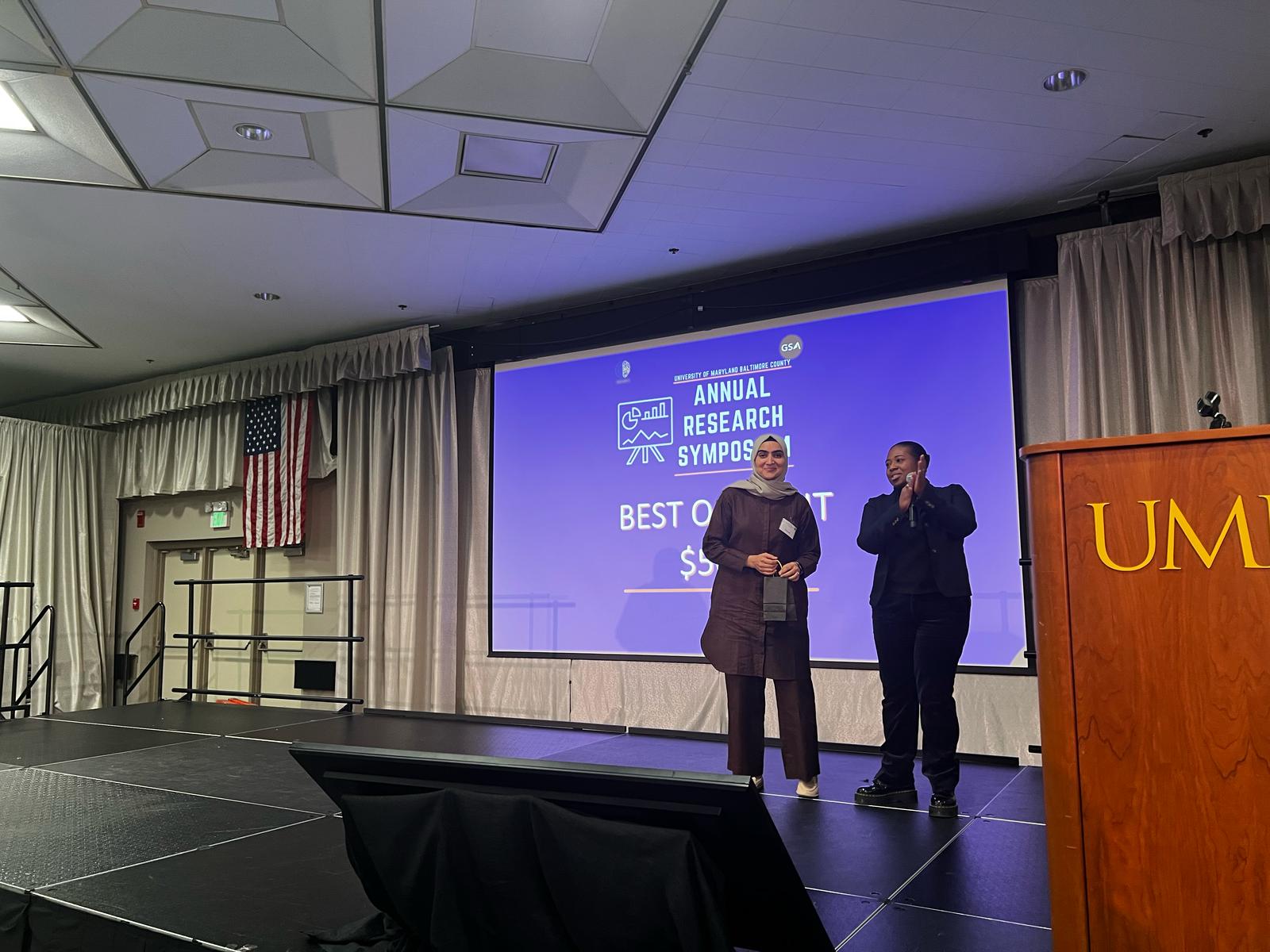
 Azmat Naseem, Environmental Engineering PhD student with Dr. Ghosh, was awarded the best poster presentation for COEIT and Sahar Souizi, Chemical and Biochemical Engineering Ph.D. student with Dr. Blaney, won the runner-up award for the 3 Minute Thesis competition (3MT). Congratulations!
GEARS GSA proudly hosted the 2025 Research Symposium and Three Minute Thesis (3MT) competition, celebrating the innovation, passion, and dedication of our student researchers across disciplines.
Research Symposium Winners
Each awarded $500 for excellence in research:
-
Best of CAHSS: Diane Placide
-
Best of CNMS: Lekan Ajiboye
-
Best of COEIT: Azmat Naseem
-
People's Choice Award: Navya Sree Manikonda
3MT Competition Winners
-
Winner: Prajna Bhandary ($500)
-
Runner-Up: Sahar Souizi ($250)
-
People's Choice Award: Seraj Mostafa ($250)
Congratulations to all participants for showcasing the power of research and storytelling. Your work continues to inspire and elevate the UMBC community.
See you all next year!
To access all pictures of the events, go to the following links:
Research Symposium Pictures
3MT Pictures
Original Post: https://my3.my.umbc.edu/groups/gsa/posts/149026
]]>
Azmat Naseem, Environmental Engineering PhD student with Dr. Ghosh, was awarded the best poster presentation for COEIT and Sahar Souizi, Chemical and Biochemical Engineering Ph.D. student with Dr....
https://beta.my.umbc.edu/api/v0/pixel/news/149029/guest@my.umbc.edu/207e0fdc313f2fb1afacd7ea002169cf/api/pixel
3mt
award
blaney
gears
ghosh
grad
research
spring-2025
Chemical, Biochemical and Environmental Engineering
https://beta.my.umbc.edu/groups/cbee
https://assets4-beta.my.umbc.edu/system/shared/avatars/groups/000/000/771/b5e579e81b2e3624611890fa3ca2716a/xsmall.png?1746794587
https://assets2-beta.my.umbc.edu/system/shared/avatars/groups/000/000/771/b5e579e81b2e3624611890fa3ca2716a/original.png?1746794587
https://assets1-beta.my.umbc.edu/system/shared/avatars/groups/000/000/771/b5e579e81b2e3624611890fa3ca2716a/xxlarge.png?1746794587
https://assets2-beta.my.umbc.edu/system/shared/avatars/groups/000/000/771/b5e579e81b2e3624611890fa3ca2716a/xlarge.png?1746794587
https://assets2-beta.my.umbc.edu/system/shared/avatars/groups/000/000/771/b5e579e81b2e3624611890fa3ca2716a/large.png?1746794587
https://assets4-beta.my.umbc.edu/system/shared/avatars/groups/000/000/771/b5e579e81b2e3624611890fa3ca2716a/medium.png?1746794587
https://assets1-beta.my.umbc.edu/system/shared/avatars/groups/000/000/771/b5e579e81b2e3624611890fa3ca2716a/small.png?1746794587
https://assets4-beta.my.umbc.edu/system/shared/avatars/groups/000/000/771/b5e579e81b2e3624611890fa3ca2716a/xsmall.png?1746794587
https://assets1-beta.my.umbc.edu/system/shared/avatars/groups/000/000/771/b5e579e81b2e3624611890fa3ca2716a/xxsmall.png?1746794587
Chemical, Biochemical and Environmental Engineering
https://assets3-beta.my.umbc.edu/system/shared/thumbnails/news/000/149/029/1593524605d0a750cc30f5a002214faf/xxlarge.jpg?1744639532
https://assets2-beta.my.umbc.edu/system/shared/thumbnails/news/000/149/029/1593524605d0a750cc30f5a002214faf/xlarge.jpg?1744639532
https://assets2-beta.my.umbc.edu/system/shared/thumbnails/news/000/149/029/1593524605d0a750cc30f5a002214faf/large.jpg?1744639532
https://assets3-beta.my.umbc.edu/system/shared/thumbnails/news/000/149/029/1593524605d0a750cc30f5a002214faf/medium.jpg?1744639532
https://assets4-beta.my.umbc.edu/system/shared/thumbnails/news/000/149/029/1593524605d0a750cc30f5a002214faf/small.jpg?1744639532
https://assets3-beta.my.umbc.edu/system/shared/thumbnails/news/000/149/029/1593524605d0a750cc30f5a002214faf/xsmall.jpg?1744639532
https://assets3-beta.my.umbc.edu/system/shared/thumbnails/news/000/149/029/1593524605d0a750cc30f5a002214faf/xxsmall.jpg?1744639532
0
0
true
Mon, 14 Apr 2025 11:30:18 -0400
Mon, 14 Apr 2025 12:46:30 -0400
Students partner with Baltimore community members to measure ‘forever chemicals’ in local waters
Reposted from UMBC News: https://umbc.edu/stories/measuring-forever-chemicals-in-baltimore-waters/
On a sunny and unseasonably warm Halloween this past fall, a group of costumed UMBC students strolled the banks of the Inner Harbor in Baltimore. The costumes were in good fun, but the spirit driving them to the city that day was more scientific than spectral: They were there to check on samplers they had installed around the harbor to measure the concentrations of certain chemicals called per- and polyfluoroalkyl substances, or PFAS, in the water.
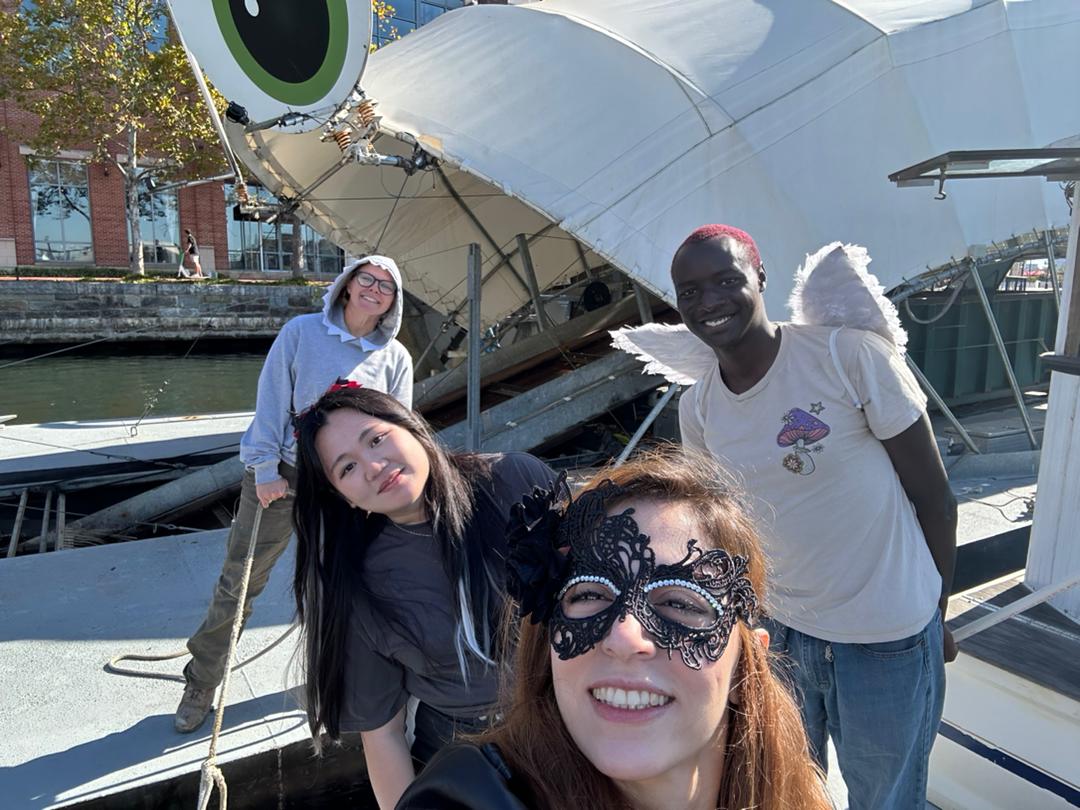 On Halloween, from right to left, Alvin Bett, an undergraduate student working in Blaney’s lab, Hamidi, Siao, and Leigh Auth, a boat captain with the Waterfront Partnership of Baltimore who helped the group access the trash wheels to install their PFAS sensors. (Image courtesy of Siao)
PFAS are used in a diverse range of products, including cleaning products, clothing, and fire-fighting foam, and have earned the nickname “forever chemicals” because of the way they persist in the environment. There are growing concerns about the health effects of the chemicals, and in recent years there have been efforts to eliminate PFAS from some consumer products and regulate their concentration in drinking water.
The UMBC students’ work to measure PFAS in Baltimore Harbor is one of the first projects aiming to get an understanding of how much of the chemicals are found in the waters around Baltimore and where they might be coming from. Margaret Siao, a master’s student in chemical engineering, took a lead role in the work as part of the ICARE program, which links researchers and Baltimore community members on environmental projects around the city.
Donya Hamidi, an environmental engineering Ph.D. student, also took part in the project, which served as a test case for a larger project she is working on, seeking to expand the utility of innovative passive samplers to measure PFAS in any water source.
“I’ve lived in Baltimore most of my life,” says Siao. “The harbor is a big part of the city, although many people don’t go out on the water. And that’s one of the reasons I wanted to look at the water quality.”
PFAS are everywhere
There are thousands of different PFAS chemicals. Because of their widespread use and resistance to degradation, they are found throughout the country in the water, soil, air, and food, and in the blood of humans and animals.
Exposure to some forms of PFAS has been linked to a range of health problems, including decreased fertility in women, developmental effects in children, reduced immune function, and increased risk of cancer and obesity.
“The PFAS issue just gets more and more complicated by the day,” says Lee Blaney, the environmental engineering professor who leads the lab where Siao and Hamidi work. He notes the EPA recently released an initial risk assessment for certain PFAS found in biosolids, which are a byproduct of wastewater treatment and are sometimes applied to agricultural land as fertilizer. “It’s a big, far-reaching issue.”
Partnering with the community
Blaney is an expert on PFAS, and as concerns about the prevalence and potential health effects of the chemicals have grown, his lab has been a leading partner with Baltimore community members who advocate for and are responsible for the quality of the water.
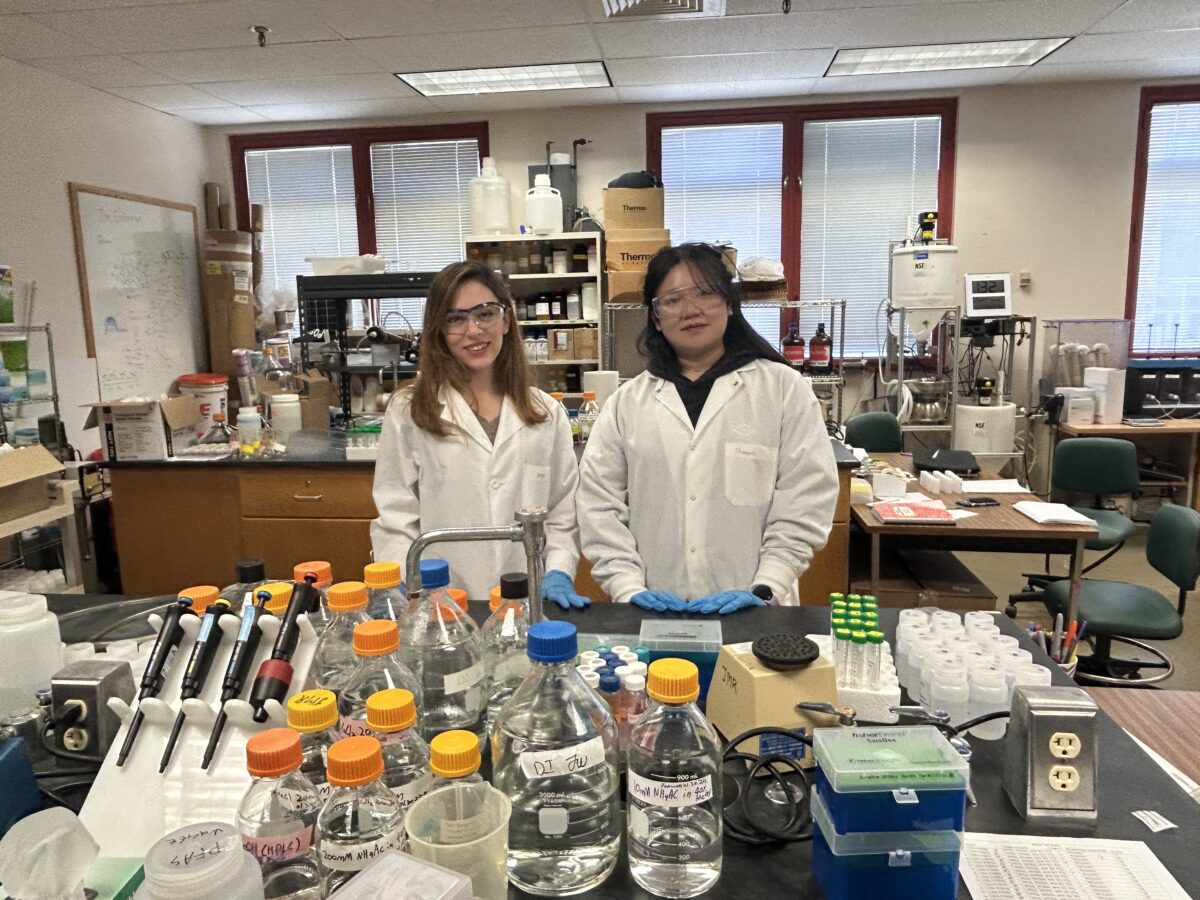 Hamidi (left) and Siao in the lab where they analyze samples for PFAS concentrations. (Image courtesy of Hamidi)
Siao’s ICARE project was a partnership with the United States Geological Survey Maryland-Delaware-D.C. Water Science Center and Blue Water Baltimore, a non-profit organization with the mission to restore the quality of Baltimore’s rivers, streams, and harbor. Blue Water Baltimore shared their knowledge of the harbor and area waterways and their connections with the community, while lab members shared their expertise and will share their PFAS data once it has been analyzed.
“PFAS is a hot topic, so Margaret’s project is really good timing,” says Barbara Johnson, who was Siao’s mentor at Blue Water Baltimore. “I think her data will be very useful for us in helping the public understand what PFAS are, for example just understanding how many different kinds there are. Margaret has taught me so much about PFAS.”
As part of the field work, Siao and Hamidi also sampled water at the outlet of the Patapsco Wastewater Treatment Plant in Baltimore. That partnership arose when Mohammed Almafrachi, who works as an engineer for the Baltimore City Department of Public Works, became interested in the PFAS issue and sought out a local expert.
“Last year, I found Dr. Blaney’s name on the internet. I drove to the campus, found his office, and he was there. I introduced myself as an engineer at the city of Baltimore, and we sat down and started talking,” Almafrachi says. From that conversation grew not only the collaboration to measure PFAS at the wastewater treatment plant, but also a tour of Baltimore’s largest drinking water treatment plant that Almafrachi gave students in Blaney’s class on environmental physicochemical processes last spring. Almafrachi said he was happy to provide students with a window on a real-world workplace where their skills might one day be applied.
“If you have not gone to the field, then you are not yet a full engineer,” says Almafrachi. “We can talk about theories and textbooks endlessly, but the field is where you really test your skills.”
The value of field work
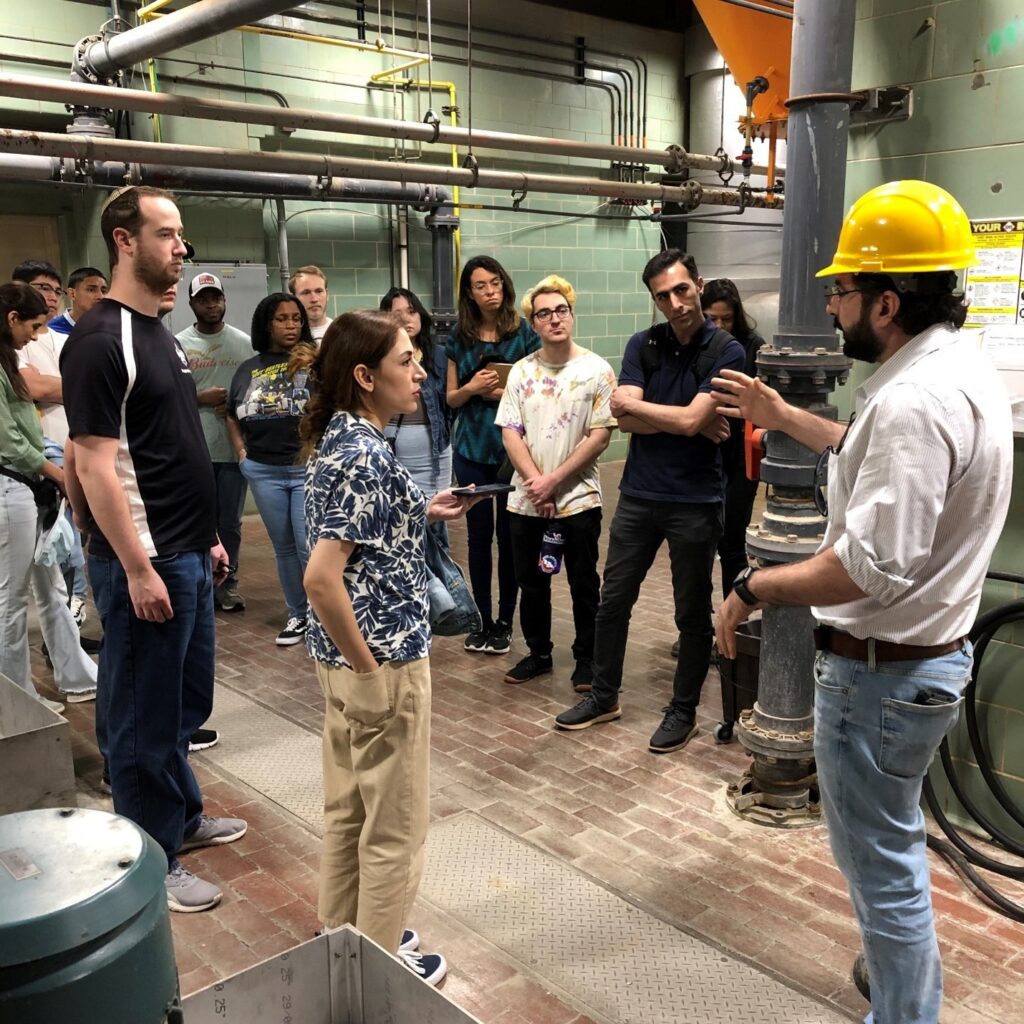 Almafrachi (right) led a tour of the Ashburton Filtration Plant, Baltimore’s largest drinking water treatment plant, for students in Blaney’s environmental physicochemical processes class. (Photo courtesy of Blaney)
Siao and Hamidi agree with Almafrachi about the value of field work. They installed their PFAS samplers at three of the four trash wheels around Baltimore Harbor—personified contraptions named Mr. Trash Wheel, Professor Trash Wheel, and Gwynnda the Good Wheel of the West that collect floating trash and keep it from dirtying the harbor. To get to the trash wheels, they took a flat-bottomed wooden boat, “more like a floating platform with a little cabin,” Siao says.
“Almost every time we collected a sampler, we saw something new or unexpected, for example algae growing on the sampler, and we had to figure out what was going on at that particular site,” says Hamidi. The team’s work and the measurements they collected and are currently analyzing will serve as a foundation for future studies about PFAS in the local environment.
Both Hamidi and Siao say they valued the teamwork of their trips, and the chance to meet people in the community impacted by their research.
“If you are stuck in a lab all day, it’s easy to forget why you’re doing research,” says Siao. “This project gave me a chance to interact with people outside of academia, to learn about what’s important to them, and to learn how to communicate about science with them, which is a really important skill.”
]]>
Reposted from UMBC News: https://umbc.edu/stories/measuring-forever-chemicals-in-baltimore-waters/ On a sunny and unseasonably warm Halloween this past fall, a group of costumed UMBC students...
https://beta.my.umbc.edu/api/v0/pixel/news/148667/guest@my.umbc.edu/978de2125f50821bcc23d58ba8401811/api/pixel
blaney
grad
research
spring-2025
ug
ugrad
Chemical, Biochemical and Environmental Engineering
https://beta.my.umbc.edu/groups/cbee
https://assets4-beta.my.umbc.edu/system/shared/avatars/groups/000/000/771/b5e579e81b2e3624611890fa3ca2716a/xsmall.png?1746794587
https://assets2-beta.my.umbc.edu/system/shared/avatars/groups/000/000/771/b5e579e81b2e3624611890fa3ca2716a/original.png?1746794587
https://assets1-beta.my.umbc.edu/system/shared/avatars/groups/000/000/771/b5e579e81b2e3624611890fa3ca2716a/xxlarge.png?1746794587
https://assets2-beta.my.umbc.edu/system/shared/avatars/groups/000/000/771/b5e579e81b2e3624611890fa3ca2716a/xlarge.png?1746794587
https://assets2-beta.my.umbc.edu/system/shared/avatars/groups/000/000/771/b5e579e81b2e3624611890fa3ca2716a/large.png?1746794587
https://assets4-beta.my.umbc.edu/system/shared/avatars/groups/000/000/771/b5e579e81b2e3624611890fa3ca2716a/medium.png?1746794587
https://assets1-beta.my.umbc.edu/system/shared/avatars/groups/000/000/771/b5e579e81b2e3624611890fa3ca2716a/small.png?1746794587
https://assets4-beta.my.umbc.edu/system/shared/avatars/groups/000/000/771/b5e579e81b2e3624611890fa3ca2716a/xsmall.png?1746794587
https://assets1-beta.my.umbc.edu/system/shared/avatars/groups/000/000/771/b5e579e81b2e3624611890fa3ca2716a/xxsmall.png?1746794587
Chemical, Biochemical and Environmental Engineering
https://assets1-beta.my.umbc.edu/system/shared/thumbnails/news/000/148/667/feec7735d4b19844b2402c58183036a0/xxlarge.jpg?1743702048
https://assets1-beta.my.umbc.edu/system/shared/thumbnails/news/000/148/667/feec7735d4b19844b2402c58183036a0/xlarge.jpg?1743702048
https://assets3-beta.my.umbc.edu/system/shared/thumbnails/news/000/148/667/feec7735d4b19844b2402c58183036a0/large.jpg?1743702048
https://assets2-beta.my.umbc.edu/system/shared/thumbnails/news/000/148/667/feec7735d4b19844b2402c58183036a0/medium.jpg?1743702048
https://assets4-beta.my.umbc.edu/system/shared/thumbnails/news/000/148/667/feec7735d4b19844b2402c58183036a0/small.jpg?1743702048
https://assets3-beta.my.umbc.edu/system/shared/thumbnails/news/000/148/667/feec7735d4b19844b2402c58183036a0/xsmall.jpg?1743702048
https://assets1-beta.my.umbc.edu/system/shared/thumbnails/news/000/148/667/feec7735d4b19844b2402c58183036a0/xxsmall.jpg?1743702048
0
0
true
Thu, 03 Apr 2025 13:59:12 -0400
Thu, 03 Apr 2025 14:19:28 -0400
PHD GRADUATE ASSISTANTSHIP OPPORTUNITIES - Fall 2025
Chemical Biochemical and Environmental Engineering (CBEE)
Fall 2025 PhD Funding Opportunities
The following CBEE faculty members expect to have openings for new PhD student for Fall 2025.
Jorge Almodovar, Ph.D.
Engineering polymeric biomaterials for cell manufacturing, tissue repair, and drug delivery
Website: https://cbee.umbc.edu/faculty/jorge-almodovar/
Özgür Çapraz, Ph.D.
Performance of materials for electrochemical energy storage and conversion systems
Website: https://cbee.umbc.edu/faculty/ozgur-capraz/
Corine Jackman Burden, Ph.D.
Bioinformatics, synthetic biology, microfluidics, vaginal microbiome, infectious disease
Website: https://cbee.umbc.edu/faculty/corine-jackman-burden/
Christopher Hennigan, Ph.D.
Aerosol science, health effects, climate change, atmospheric chemistry
Website: https://cbee.umbc.edu/faculty/christopher-hennigan/
Claire Welty, Ph.D.
Coupled groundwater/surface water modeling of urban systems.
Website: https://urbanhydrology.umbc.edu/
Upal Ghosh, Ph.D.
Pollutant fate and bioavailability in soils, sediments, and aquatic environments
Website: https://cbee.umbc.edu/faculty/upal-ghosh/
Lee Blaney, Ph.D.
Occurrence, fate/treatment, and transport of contaminants of emerging concern
Website: https://cbee.umbc.edu/faculty/lee-blaney/
Tyler Josephson, Ph.D.
Develop AI and LLM tools and use molecular simulations to understand chemistry in the environment
Website: https://cbee.umbc.edu/faculty/tyler-josephson/
Application details:
Deadline for Ph.D. programs: January 7
Application fee waivers: available by emailing cbeegrad@umbc.edu
Contacting an potential advisor: Students interested in applying are welcome to reach out directly to the faculty members whose research aligns with your specific research interests. Applicants are not required to secure an advisor prior to applying to the program for Fall admission. Applicants should identify which faculty they would like to work with in your 'Statement of academic goals and research interests'
More details on Application process: https://cbee.umbc.edu/academics/graduate-application/
PhD Stipend
$39K+
($39,900/year for 2025–2026; plus tuition remission and health insurance for full-time PhD students)
Learn more about CBEE's graduate progams: https://cbee.umbc.edu/grad
]]>
Chemical Biochemical and Environmental Engineering (CBEE) Fall 2025 PhD Funding Opportunities The following CBEE faculty members expect to have openings for new PhD student for Fall 2025. ...
https://cbee.umbc.edu/grad
https://beta.my.umbc.edu/api/v0/pixel/news/145190/guest@my.umbc.edu/8351a21e8aa0bda8038506d7fc636f31/api/pixel
almodovar
assistantship
blaney
capraz
fall-2025
ghosh
grad
hennigan
jackman-burden
Chemical, Biochemical and Environmental Engineering
https://beta.my.umbc.edu/groups/cbee
https://assets4-beta.my.umbc.edu/system/shared/avatars/groups/000/000/771/b5e579e81b2e3624611890fa3ca2716a/xsmall.png?1746794587
https://assets2-beta.my.umbc.edu/system/shared/avatars/groups/000/000/771/b5e579e81b2e3624611890fa3ca2716a/original.png?1746794587
https://assets1-beta.my.umbc.edu/system/shared/avatars/groups/000/000/771/b5e579e81b2e3624611890fa3ca2716a/xxlarge.png?1746794587
https://assets2-beta.my.umbc.edu/system/shared/avatars/groups/000/000/771/b5e579e81b2e3624611890fa3ca2716a/xlarge.png?1746794587
https://assets2-beta.my.umbc.edu/system/shared/avatars/groups/000/000/771/b5e579e81b2e3624611890fa3ca2716a/large.png?1746794587
https://assets4-beta.my.umbc.edu/system/shared/avatars/groups/000/000/771/b5e579e81b2e3624611890fa3ca2716a/medium.png?1746794587
https://assets1-beta.my.umbc.edu/system/shared/avatars/groups/000/000/771/b5e579e81b2e3624611890fa3ca2716a/small.png?1746794587
https://assets4-beta.my.umbc.edu/system/shared/avatars/groups/000/000/771/b5e579e81b2e3624611890fa3ca2716a/xsmall.png?1746794587
https://assets1-beta.my.umbc.edu/system/shared/avatars/groups/000/000/771/b5e579e81b2e3624611890fa3ca2716a/xxsmall.png?1746794587
Chemical, Biochemical and Environmental Engineering
https://assets4-beta.my.umbc.edu/system/shared/thumbnails/news/000/145/190/74df0f0efabaa854cc7d8bd6e65452e7/xxlarge.jpg?1730294426
https://assets1-beta.my.umbc.edu/system/shared/thumbnails/news/000/145/190/74df0f0efabaa854cc7d8bd6e65452e7/xlarge.jpg?1730294426
https://assets2-beta.my.umbc.edu/system/shared/thumbnails/news/000/145/190/74df0f0efabaa854cc7d8bd6e65452e7/large.jpg?1730294426
https://assets2-beta.my.umbc.edu/system/shared/thumbnails/news/000/145/190/74df0f0efabaa854cc7d8bd6e65452e7/medium.jpg?1730294426
https://assets1-beta.my.umbc.edu/system/shared/thumbnails/news/000/145/190/74df0f0efabaa854cc7d8bd6e65452e7/small.jpg?1730294426
https://assets4-beta.my.umbc.edu/system/shared/thumbnails/news/000/145/190/74df0f0efabaa854cc7d8bd6e65452e7/xsmall.jpg?1730294426
https://assets4-beta.my.umbc.edu/system/shared/thumbnails/news/000/145/190/74df0f0efabaa854cc7d8bd6e65452e7/xxsmall.jpg?1730294426
0
0
true
Wed, 30 Oct 2024 09:31:17 -0400
Tue, 26 Nov 2024 13:29:09 -0500
Lee Blaney assumes presidency of the Association of Environmental Engineering and Science Professors
From UMBC News
From UMBC News | By: Catherine Meyers | Published: Sep 16, 2024
Professor Lee Blaney, in the Department of Chemical, Biochemical, and Environmental Engineering, formally assumed the role of president of the Association of Environmental Engineering and Science Professors (AEESP) at a board of directors meeting in early September.
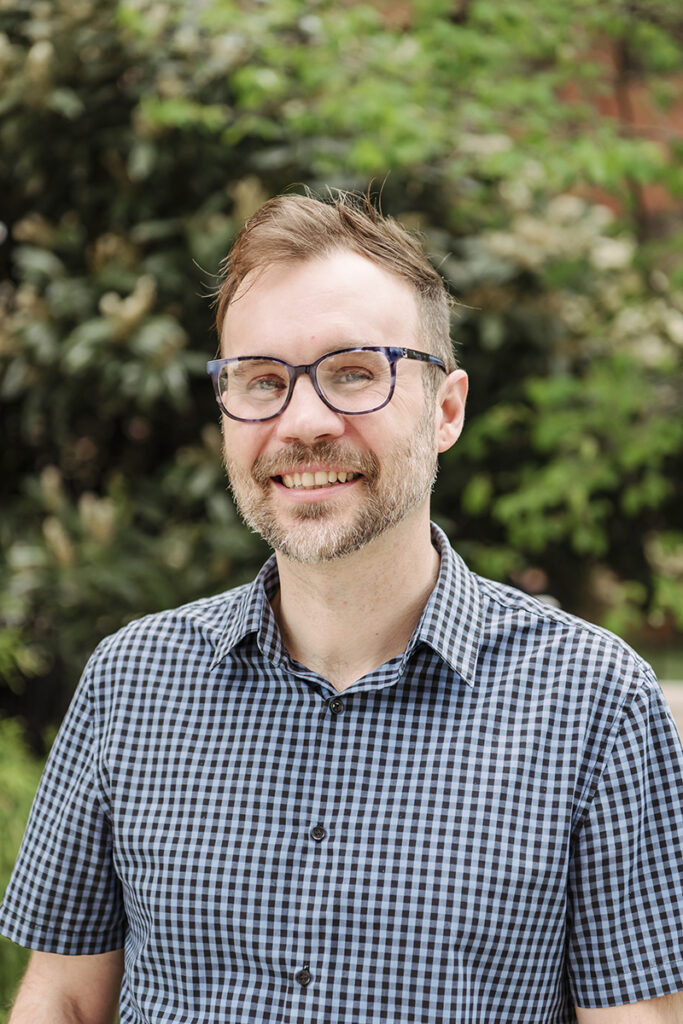
Lee Blaney (Marlayna Demond ’11/UMBC)
AEESP is a nonprofit organization founded in 1963 to foster inclusive connections between environmental engineering and science researchers and educators. It provides programs for members to develop the academic networks and career skills needed for professional success, increase equitable societal impact of environmental engineering and science scholarship and creative expression, and reimagine the skills necessary for environmental engineers and scientists to provide solutions that benefit regional, national, and global communities.
The association currently has more than 1000 members from universities around the world. AEESP assists its members in improving education and research programs, encourages graduate education, and provides information to government agencies and the public. The biennial AEESP Research and Education Conference brings the field together to share research, teaching, and outreach outcomes. Blaney’s term as president will include the next conference, which is scheduled to occur in May 2025 at Duke University.
“We’re excited about Dr. Blaney’s new role as president of AEESP,” says Mark Marten, the chair of the Department of Chemical, Biochemical, and Environmental Engineering. “His deep involvement with this organization not only makes a positive impact in our discipline, but also raises awareness of our department and UMBC in this influential community.”
Blaney and his research group study environmental contaminants of emerging concern, such as per- and polyfluoroalkyl substances, or PFAS, which are sometimes called “forever chemicals” because of the way they persist in the environment. They also research how to recover vital resources, such as nitrogen and phosphorus, from waste streams to improve water quality and ensure sustainable development. Blaney was a winner of the 2021 James J. Morgan Early Career Award from the American Chemical Society, and has also been recognized for the quality of his teaching and mentorship.
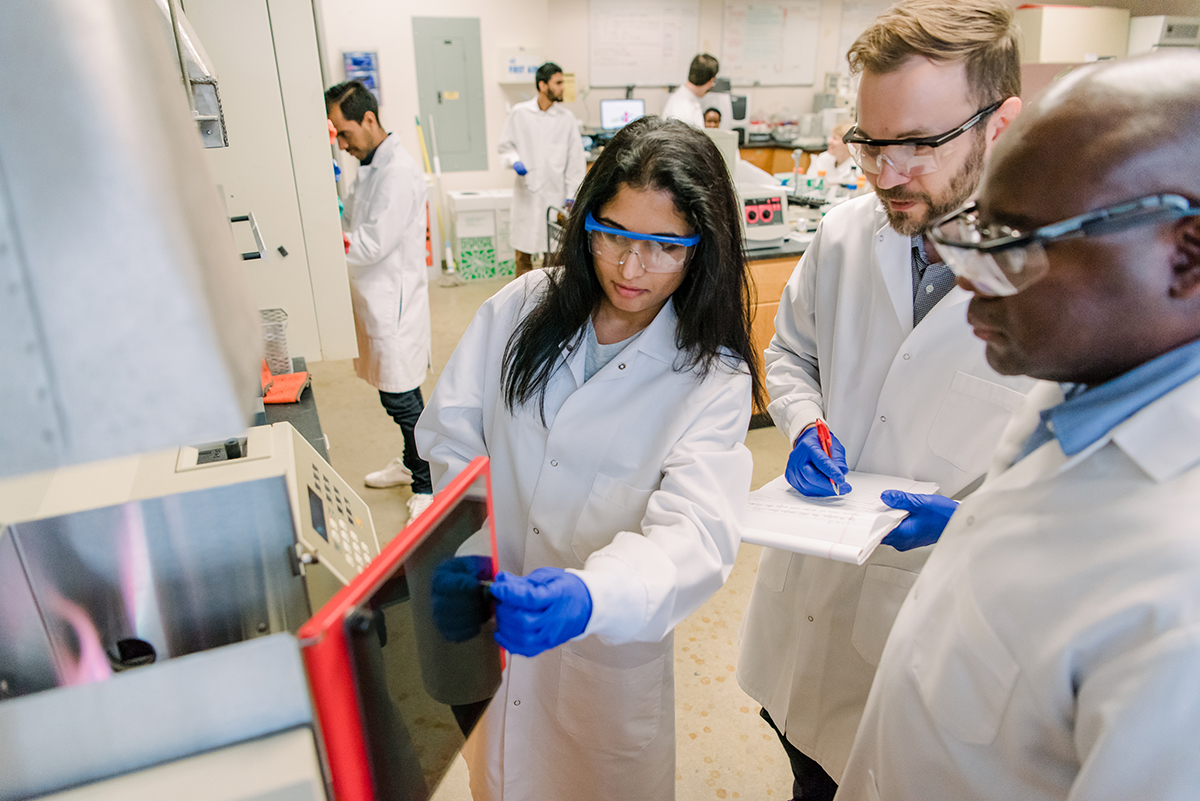 Lee Blaney (center) in his UMBC lab in 2019. (Marlayna Demond ’11/UMBC)
Blaney joined AEESP in 2012 after starting as an assistant professor at UMBC. He quickly joined and became chair of the AEESP Membership & Demographics Committee, through which he led efforts to initiate a student video competition (check out this winning video from UMBC). He also led efforts to document the demographics of environmental engineering faculty and students in reports such as “Trends in Population and Demographics of U.S. Environmental Engineering Students and Faculty from 2005 to 2013” and “Another Grand Challenge: Diversity in Environmental Engineering.”
In 2021, Blaney was elected to the AEESP board of directors. Since that time, he has led a number of initiatives aimed at improving inclusion. During his one-year term as president, he will lead the board and executive committee, provide new charges to standing committees, correspond with members, represent AEESP at conferences and meetings, and drive new initiatives to grow the organization and support its members.
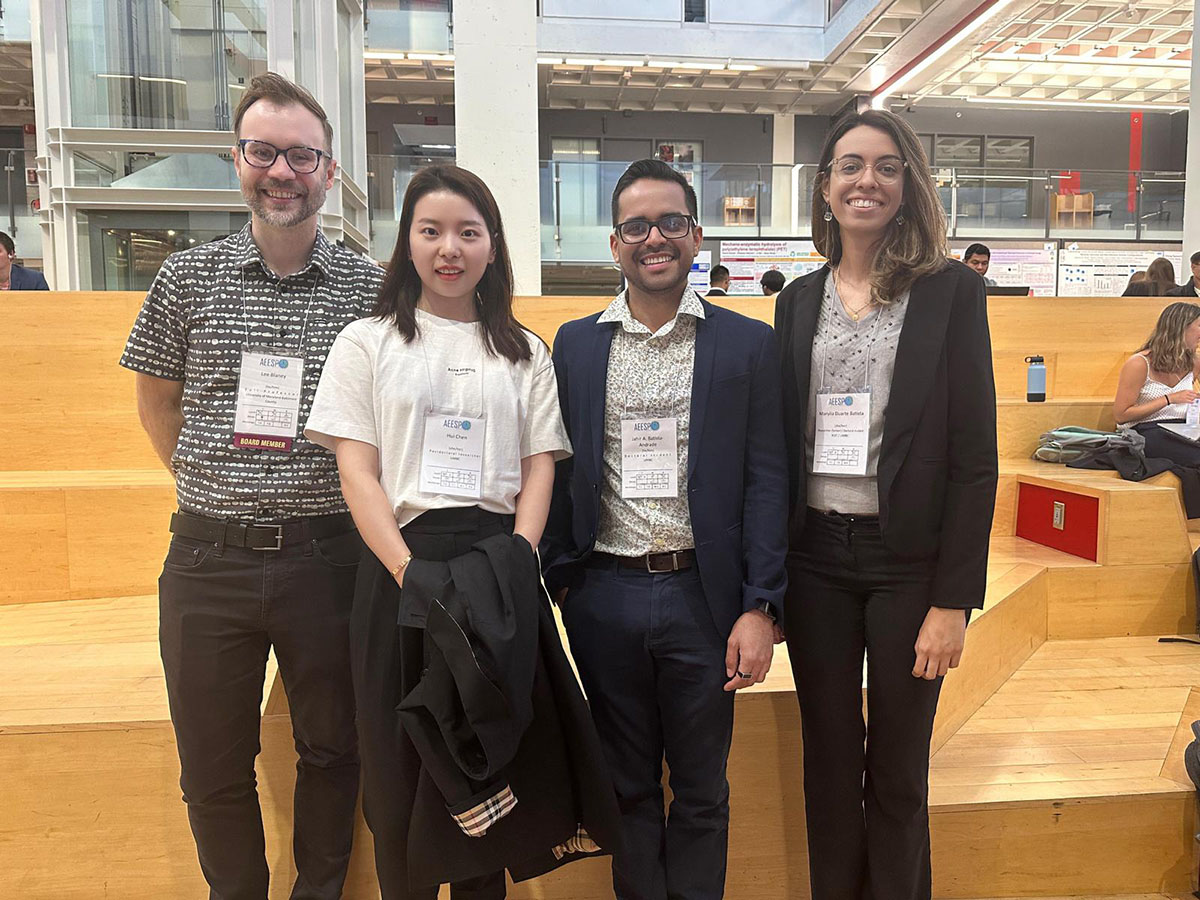 Lee Blaney (left) and his group members (left to right), Hui Chen (completed postdoc in 2024, now assistant professor at James Madison University), Jahir Batista Andrade, Ph.D. ’23, (now postdoc at University of Minnesota), and Marylia Duarte Batista (current Ph.D. student), at the 2023 AEESP Research and Education Conference in Boston. (Photo courtesy of Blaney)
In his first presidential address to AEESP, given in June, Blaney told members of how he found direction as an undergraduate student after attending a talk by environmental engineer Arup SenGupta, who spoke of efforts to remove arsenic from contaminated groundwater in rural villages in India.
“His passion and dedication to helping those without other resources inspired me, set me on the path to becoming an environmental engineer, and helped me to become a better person,” Blaney said. He hopes to bring these same values to AEESP and its members.
As president of AEESP, Blaney plans to develop an “AEESP Experts” program, which will connect environmental experts with reporters, and also an “AEESP Communities of Practice” initiative, which will gather small groups of AEESP members to develop new resources, such as new course material on climate change or best practices for graduate student recruitment, which can be shared with the whole community.
Read original post via UMBC NEWS: Lee Blaney assumes presidency of the Association of Environmental Engineering and Science Professors
]]>
From UMBC News | By: Catherine Meyers | Published: Sep 16, 2024 Professor Lee Blaney, in the Department of Chemical, Biochemical, and Environmental Engineering, formally assumed the role of...
https://beta.my.umbc.edu/api/v0/pixel/news/144012/guest@my.umbc.edu/22bd330d437a3e89a2c8510cd58b6f79/api/pixel
blaney
faculty
fall-2024
marten
news
Chemical, Biochemical and Environmental Engineering
https://beta.my.umbc.edu/groups/cbee
https://assets4-beta.my.umbc.edu/system/shared/avatars/groups/000/000/771/b5e579e81b2e3624611890fa3ca2716a/xsmall.png?1746794587
https://assets2-beta.my.umbc.edu/system/shared/avatars/groups/000/000/771/b5e579e81b2e3624611890fa3ca2716a/original.png?1746794587
https://assets1-beta.my.umbc.edu/system/shared/avatars/groups/000/000/771/b5e579e81b2e3624611890fa3ca2716a/xxlarge.png?1746794587
https://assets2-beta.my.umbc.edu/system/shared/avatars/groups/000/000/771/b5e579e81b2e3624611890fa3ca2716a/xlarge.png?1746794587
https://assets2-beta.my.umbc.edu/system/shared/avatars/groups/000/000/771/b5e579e81b2e3624611890fa3ca2716a/large.png?1746794587
https://assets4-beta.my.umbc.edu/system/shared/avatars/groups/000/000/771/b5e579e81b2e3624611890fa3ca2716a/medium.png?1746794587
https://assets1-beta.my.umbc.edu/system/shared/avatars/groups/000/000/771/b5e579e81b2e3624611890fa3ca2716a/small.png?1746794587
https://assets4-beta.my.umbc.edu/system/shared/avatars/groups/000/000/771/b5e579e81b2e3624611890fa3ca2716a/xsmall.png?1746794587
https://assets1-beta.my.umbc.edu/system/shared/avatars/groups/000/000/771/b5e579e81b2e3624611890fa3ca2716a/xxsmall.png?1746794587
Chemical, Biochemical and Environmental Engineering
https://assets2-beta.my.umbc.edu/system/shared/thumbnails/news/000/144/012/f2220563be1e736a340793e0622087f8/xxlarge.jpg?1726673870
https://assets2-beta.my.umbc.edu/system/shared/thumbnails/news/000/144/012/f2220563be1e736a340793e0622087f8/xlarge.jpg?1726673870
https://assets1-beta.my.umbc.edu/system/shared/thumbnails/news/000/144/012/f2220563be1e736a340793e0622087f8/large.jpg?1726673870
https://assets1-beta.my.umbc.edu/system/shared/thumbnails/news/000/144/012/f2220563be1e736a340793e0622087f8/medium.jpg?1726673870
https://assets2-beta.my.umbc.edu/system/shared/thumbnails/news/000/144/012/f2220563be1e736a340793e0622087f8/small.jpg?1726673870
https://assets4-beta.my.umbc.edu/system/shared/thumbnails/news/000/144/012/f2220563be1e736a340793e0622087f8/xsmall.jpg?1726673870
https://assets4-beta.my.umbc.edu/system/shared/thumbnails/news/000/144/012/f2220563be1e736a340793e0622087f8/xxsmall.jpg?1726673870
1
0
true
Wed, 18 Sep 2024 11:38:00 -0400
Thu, 19 Sep 2024 15:49:23 -0400
CBEE Graduate Students recognized for excellence in leadership and research
CBEE hosted the 2024 CBEE Graduate Student Awards on Friday, August 30, 2024 where graduate students were formally recognized for their research and leadership. During the awards ceremony, each awardee gave a 10-minute presentation on their current research.
Congratulations to the award recipients.
Excellence in Master's Research
Margaret Siao
’23, M.S. student, Environmental Engineering
Advisor: Dr. Lee Blaney
This award recognizes a CBEE Master’s Student for outstanding performance in research.
Excellence in Doctoral Research
Chad Sundberg
Ph.D. student, Environmental Engineering
Advisor: Dr. Govind Rao
This award recognizes a CBEE Doctoral Student for outstanding performance in research.
Excellence in Leadership
Alex Doan
Ph.D. student, Chemical and Biochemical Engineering
This award recognizes a CBEE Graduate Student for outstanding leadership demonstrated in service to the department, college, or their fellow students.
Award recipients were nominated by CBEE faculty, staff, or students (graduate or undergraduate). The nominations were reviewed and selected by CBEE’s Graduate program Committee.
]]>
CBEE hosted the 2024 CBEE Graduate Student Awards on Friday, August 30, 2024 where graduate students were formally recognized for their research and leadership. During the awards ceremony, each...
https://beta.my.umbc.edu/api/v0/pixel/news/143534/guest@my.umbc.edu/e839f4f72a7d7a71f4e7e32687fef448/api/pixel
award
blaney
fall-2024
grad
grad-awards
marten
rao
research
Chemical, Biochemical and Environmental Engineering
https://beta.my.umbc.edu/groups/cbee
https://assets4-beta.my.umbc.edu/system/shared/avatars/groups/000/000/771/b5e579e81b2e3624611890fa3ca2716a/xsmall.png?1746794587
https://assets2-beta.my.umbc.edu/system/shared/avatars/groups/000/000/771/b5e579e81b2e3624611890fa3ca2716a/original.png?1746794587
https://assets1-beta.my.umbc.edu/system/shared/avatars/groups/000/000/771/b5e579e81b2e3624611890fa3ca2716a/xxlarge.png?1746794587
https://assets2-beta.my.umbc.edu/system/shared/avatars/groups/000/000/771/b5e579e81b2e3624611890fa3ca2716a/xlarge.png?1746794587
https://assets2-beta.my.umbc.edu/system/shared/avatars/groups/000/000/771/b5e579e81b2e3624611890fa3ca2716a/large.png?1746794587
https://assets4-beta.my.umbc.edu/system/shared/avatars/groups/000/000/771/b5e579e81b2e3624611890fa3ca2716a/medium.png?1746794587
https://assets1-beta.my.umbc.edu/system/shared/avatars/groups/000/000/771/b5e579e81b2e3624611890fa3ca2716a/small.png?1746794587
https://assets4-beta.my.umbc.edu/system/shared/avatars/groups/000/000/771/b5e579e81b2e3624611890fa3ca2716a/xsmall.png?1746794587
https://assets1-beta.my.umbc.edu/system/shared/avatars/groups/000/000/771/b5e579e81b2e3624611890fa3ca2716a/xxsmall.png?1746794587
Chemical, Biochemical and Environmental Engineering
https://assets3-beta.my.umbc.edu/system/shared/thumbnails/news/000/143/534/9af1e0b3da01ddc7825487fec3c80073/xxlarge.jpg?1725378392
https://assets4-beta.my.umbc.edu/system/shared/thumbnails/news/000/143/534/9af1e0b3da01ddc7825487fec3c80073/xlarge.jpg?1725378392
https://assets4-beta.my.umbc.edu/system/shared/thumbnails/news/000/143/534/9af1e0b3da01ddc7825487fec3c80073/large.jpg?1725378392
https://assets3-beta.my.umbc.edu/system/shared/thumbnails/news/000/143/534/9af1e0b3da01ddc7825487fec3c80073/medium.jpg?1725378392
https://assets3-beta.my.umbc.edu/system/shared/thumbnails/news/000/143/534/9af1e0b3da01ddc7825487fec3c80073/small.jpg?1725378392
https://assets3-beta.my.umbc.edu/system/shared/thumbnails/news/000/143/534/9af1e0b3da01ddc7825487fec3c80073/xsmall.jpg?1725378392
https://assets4-beta.my.umbc.edu/system/shared/thumbnails/news/000/143/534/9af1e0b3da01ddc7825487fec3c80073/xxsmall.jpg?1725378392
0
0
true
Tue, 03 Sep 2024 11:53:25 -0400
Thu, 13 Feb 2025 10:50:11 -0500
CBEE students visit the Ashburton Filtration Plant
Spring 2024 - Environmental Physicochemical Process
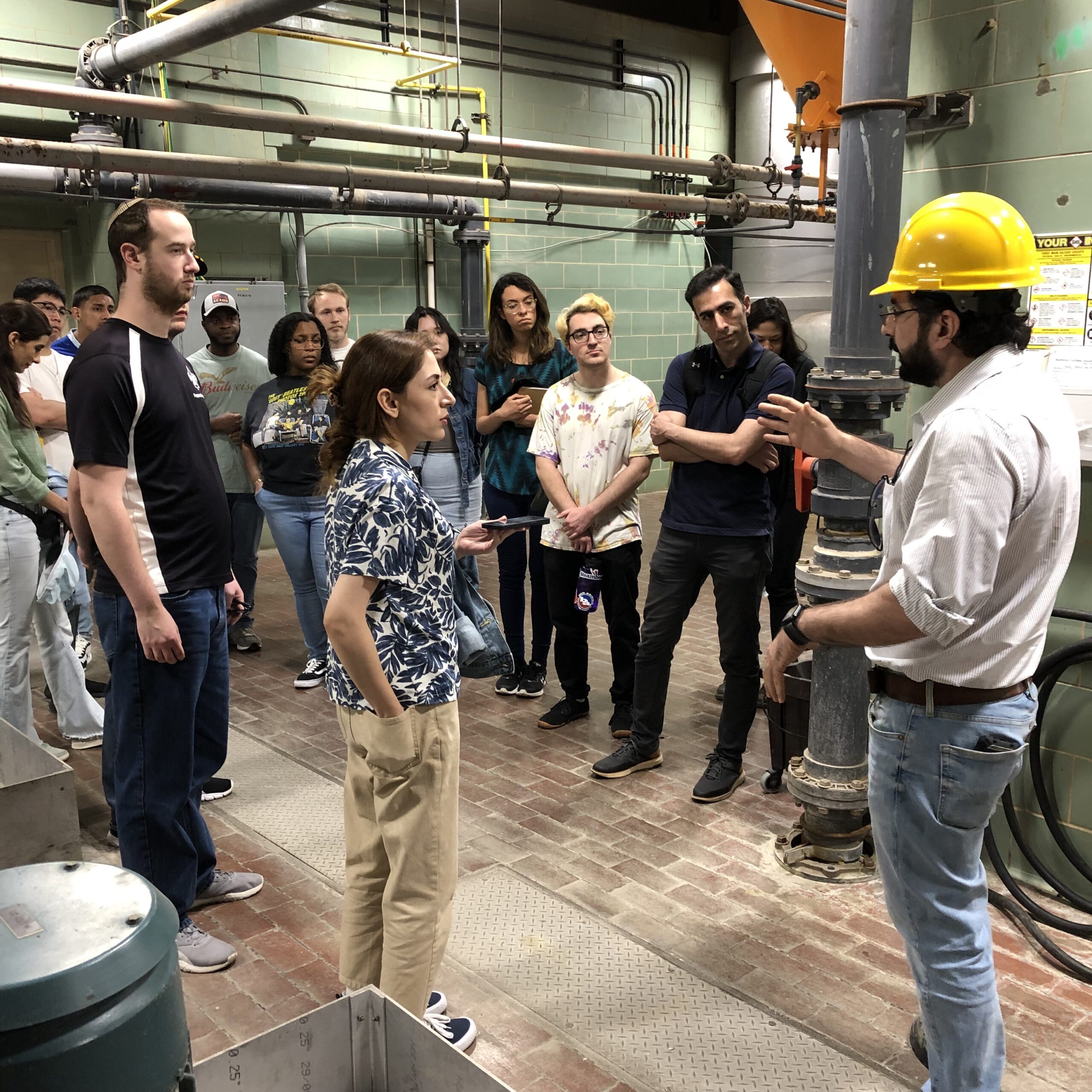
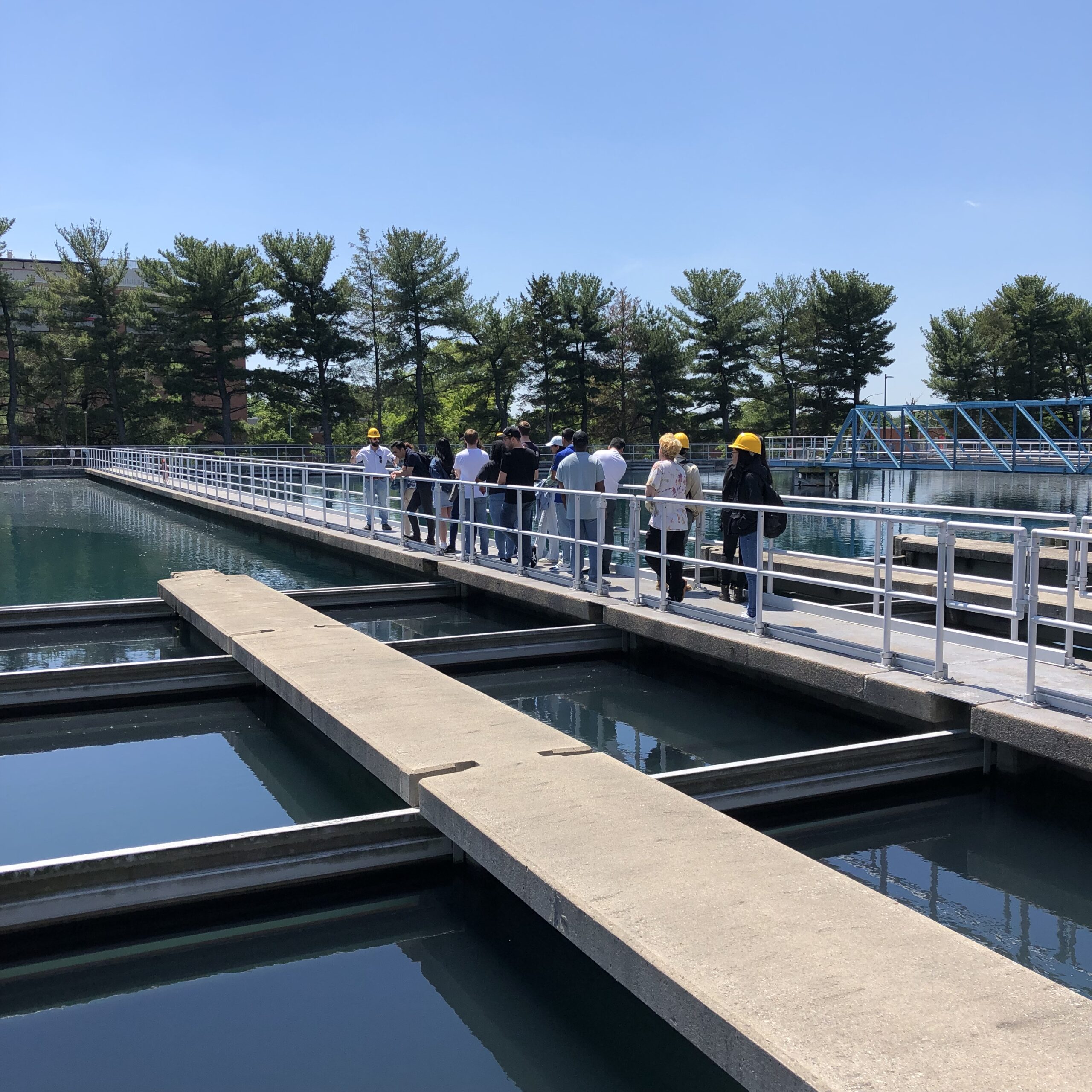
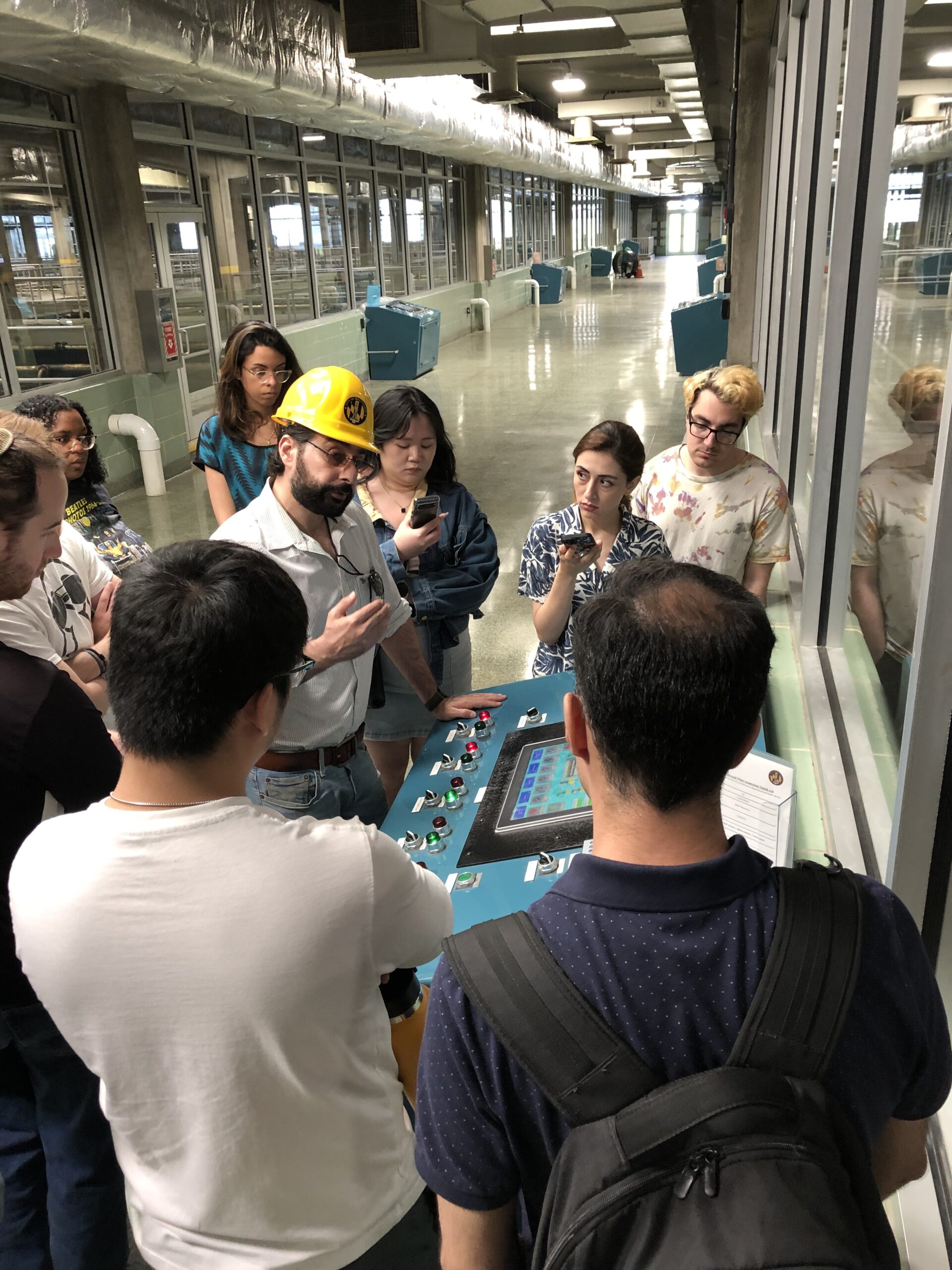
At the end of the Spring 2024 semester, Dr. Blaney’s Environmental Physicochemical Processes course (ENCH 412 and ENEN 612) visited the Ashburton Filtration Plant, Baltimore’s largest drinking water treatment plant. Students had the chance to see how the processes they learned about in class, namely coagulation, flocculation, sedimentation, granular media filtration, and disinfection, treat 165 million gallons of drinking water for Baltimore every day.
Mohammed Almafrachi, Engineering Manager for the Baltimore City Department of Public Works, gave an excellent tour. His in-depth knowledge of the treatment processes and on-the-ground experience managing the facility helped students understand how the concepts that they learned in class provide clean drinking water to Baltimore residents. He stressed the importance of being adaptable to challenges, telling the students “You can’t troubleshoot without trouble.”
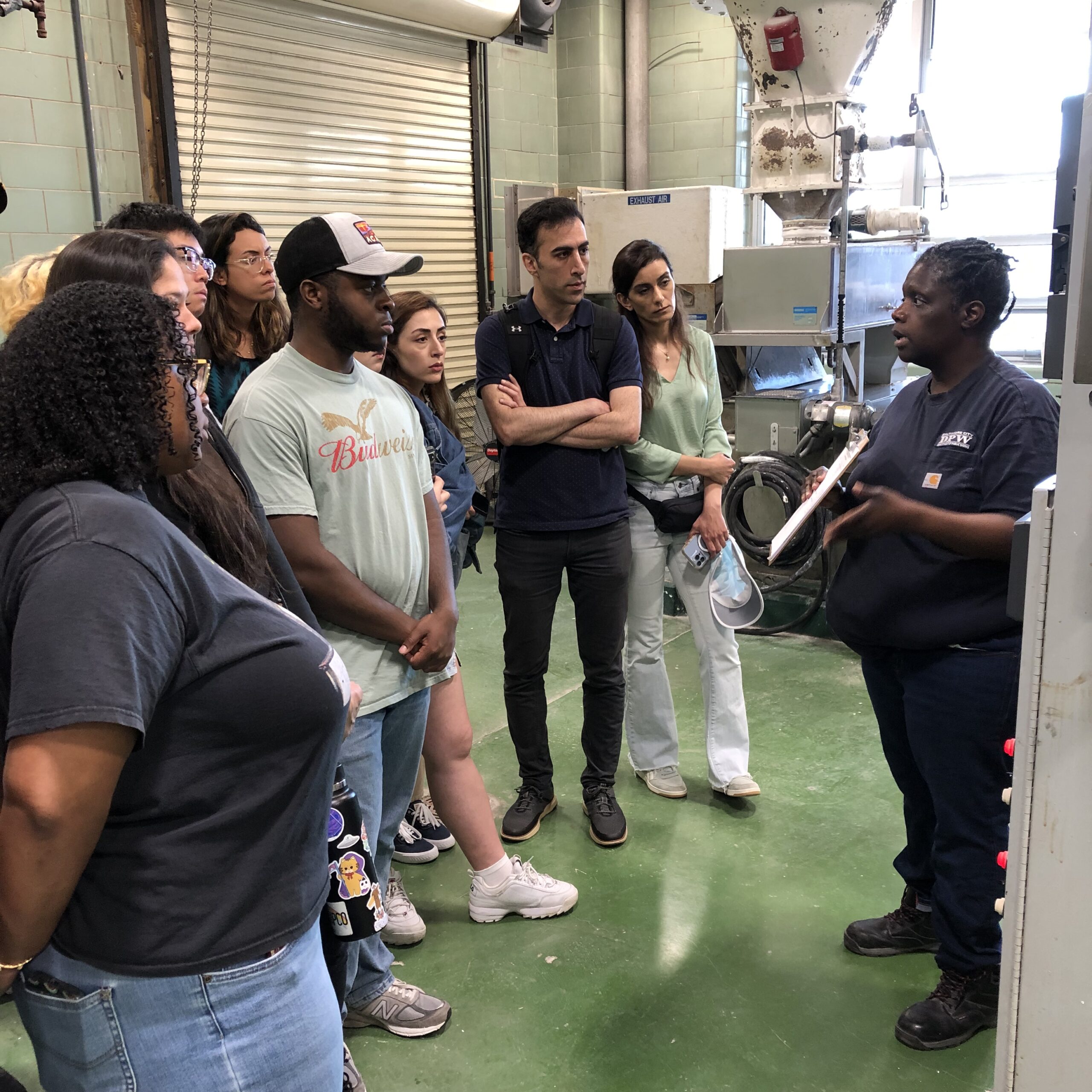
We also enjoyed learning about the importance of water quality testing throughout the distribution system from Deneen Gordon, the Laboratory Technical Administrator for Baltimore’s drinking water treatment plants. She emphasized the new challenges awaiting the next generation of water quality engineers and motivated our students to tackle those challenges head on.
Thanks to all of the other Ashburton staff members that shared their expertise with us during the visit. We left inspired by your commitment to ensuring the health and safety of Baltimore residents. Thank you for your service!
]]>
At the end of the Spring 2024 semester, Dr. Blaney’s Environmental Physicochemical Processes course (ENCH 412 and ENEN 612) visited the Ashburton Filtration Plant, Baltimore’s largest drinking...
https://beta.my.umbc.edu/api/v0/pixel/news/143458/guest@my.umbc.edu/dfd0e58b3f20c92625eee2addfdb8a1f/api/pixel
blaney
grad
spring-2024
ug
ugrad
Chemical, Biochemical and Environmental Engineering
https://beta.my.umbc.edu/groups/cbee
https://assets4-beta.my.umbc.edu/system/shared/avatars/groups/000/000/771/b5e579e81b2e3624611890fa3ca2716a/xsmall.png?1746794587
https://assets2-beta.my.umbc.edu/system/shared/avatars/groups/000/000/771/b5e579e81b2e3624611890fa3ca2716a/original.png?1746794587
https://assets1-beta.my.umbc.edu/system/shared/avatars/groups/000/000/771/b5e579e81b2e3624611890fa3ca2716a/xxlarge.png?1746794587
https://assets2-beta.my.umbc.edu/system/shared/avatars/groups/000/000/771/b5e579e81b2e3624611890fa3ca2716a/xlarge.png?1746794587
https://assets2-beta.my.umbc.edu/system/shared/avatars/groups/000/000/771/b5e579e81b2e3624611890fa3ca2716a/large.png?1746794587
https://assets4-beta.my.umbc.edu/system/shared/avatars/groups/000/000/771/b5e579e81b2e3624611890fa3ca2716a/medium.png?1746794587
https://assets1-beta.my.umbc.edu/system/shared/avatars/groups/000/000/771/b5e579e81b2e3624611890fa3ca2716a/small.png?1746794587
https://assets4-beta.my.umbc.edu/system/shared/avatars/groups/000/000/771/b5e579e81b2e3624611890fa3ca2716a/xsmall.png?1746794587
https://assets1-beta.my.umbc.edu/system/shared/avatars/groups/000/000/771/b5e579e81b2e3624611890fa3ca2716a/xxsmall.png?1746794587
Chemical, Biochemical and Environmental Engineering
https://assets3-beta.my.umbc.edu/system/shared/thumbnails/news/000/143/458/5090980d0e46a13f1548e1586afe24a7/xxlarge.jpg?1725023160
https://assets4-beta.my.umbc.edu/system/shared/thumbnails/news/000/143/458/5090980d0e46a13f1548e1586afe24a7/xlarge.jpg?1725023160
https://assets3-beta.my.umbc.edu/system/shared/thumbnails/news/000/143/458/5090980d0e46a13f1548e1586afe24a7/large.jpg?1725023160
https://assets2-beta.my.umbc.edu/system/shared/thumbnails/news/000/143/458/5090980d0e46a13f1548e1586afe24a7/medium.jpg?1725023160
https://assets4-beta.my.umbc.edu/system/shared/thumbnails/news/000/143/458/5090980d0e46a13f1548e1586afe24a7/small.jpg?1725023160
https://assets1-beta.my.umbc.edu/system/shared/thumbnails/news/000/143/458/5090980d0e46a13f1548e1586afe24a7/xsmall.jpg?1725023160
https://assets2-beta.my.umbc.edu/system/shared/thumbnails/news/000/143/458/5090980d0e46a13f1548e1586afe24a7/xxsmall.jpg?1725023160
1
0
true
Fri, 30 Aug 2024 08:56:28 -0400
Fri, 30 Aug 2024 09:12:45 -0400
Blaney Lab presents at 2024 ACS Conference
Four group members from the Blaney Lab attended the 2024 ACS conference in Denver, CO. All four gave excellent oral presentations (see attached photos) on the following topics:
- Sahar Souizi, Ph.D. student, Environmental Engineering - Enhanced Donnan dialysis for nutrient recovery via tube-in-tube reactors: Impact of operating conditions and application to real waste
- Marylia Duarte Batista , Ph.D. student, Environmental Engineering - Hybrid anion-exchange resins with enhanced selectivity for (ultra)short-chain PFAS
- Margaret Siao, '22 chemical engineering, M.S. student environmental engineering - Influence of solution pH and dissolved organic matter on PFAS uptake by ion-exchange membrane-based passive samplers
- Donya Hamidi, Ph.D. student, Environmental Engineering - Salting out of PFAS anions: Calculation of Setschenow constants
The article link is available here: Inside the Laboratory: The Blaney Laboratory at the University of Maryland Baltimore County (chromatographyonline.com)
"Inside the Laboratory" is a series in collaboration with LCGC and Spectroscopy, highlighting the pioneering work of analytical scientists worldwide. In this edition, we delve into the groundbreaking research of Dr. Lee Blaney from the University of Maryland, Baltimore County (UMBC). Dr. Blaney, a Professor and Associate Director of Sustainability Engineering, leads his team in developing advanced methods using liquid chromatography (LC) techniques to analyze contaminants of emerging concern (CECs) in environmental samples.
Environmental analysis is a field where chromatography plays an integral role. Detecting, identifying, and quantifying per- and polyfluoroalkyl substances (PFAS) and contaminants of emerging concern (CECs) are currently hot topics in environmental analysis, mostly because it affects both the environment and natural resources humans regularly use. Chromatographic techniques like liquid chromatography coupled to tandem mass spectrometry (LC–MS/MS) offer unparalleled sensitivity and specificity in separating and identifying PFAS within complex matrices, such as water, soil, and biological samples. Through chromatographic separation, PFAS are eluted based on their unique physicochemical properties, allowing accurate and precise quantification by downstream detectors. This analytical approach not only aids in assessing environmental contamination, but also contributes significantly to understanding the exposure pathways and potential health risks associated with PFAS.
Dr. Lee Blaney is a Professor and Associate Director of Sustainability Engineering at the University of Maryland Baltimore County. He received his BS and MS in Environmental Engineering at Lehigh University before completing his PhD in Civil Engineering at the University of Texas at Austin. His laboratory is primarily focused on studying CECs, including developing advanced analytical methods that can better improve detection and quantification of CECs in the environment, as well as developing new treatment technologies for diverse contaminants in water and wastewater.
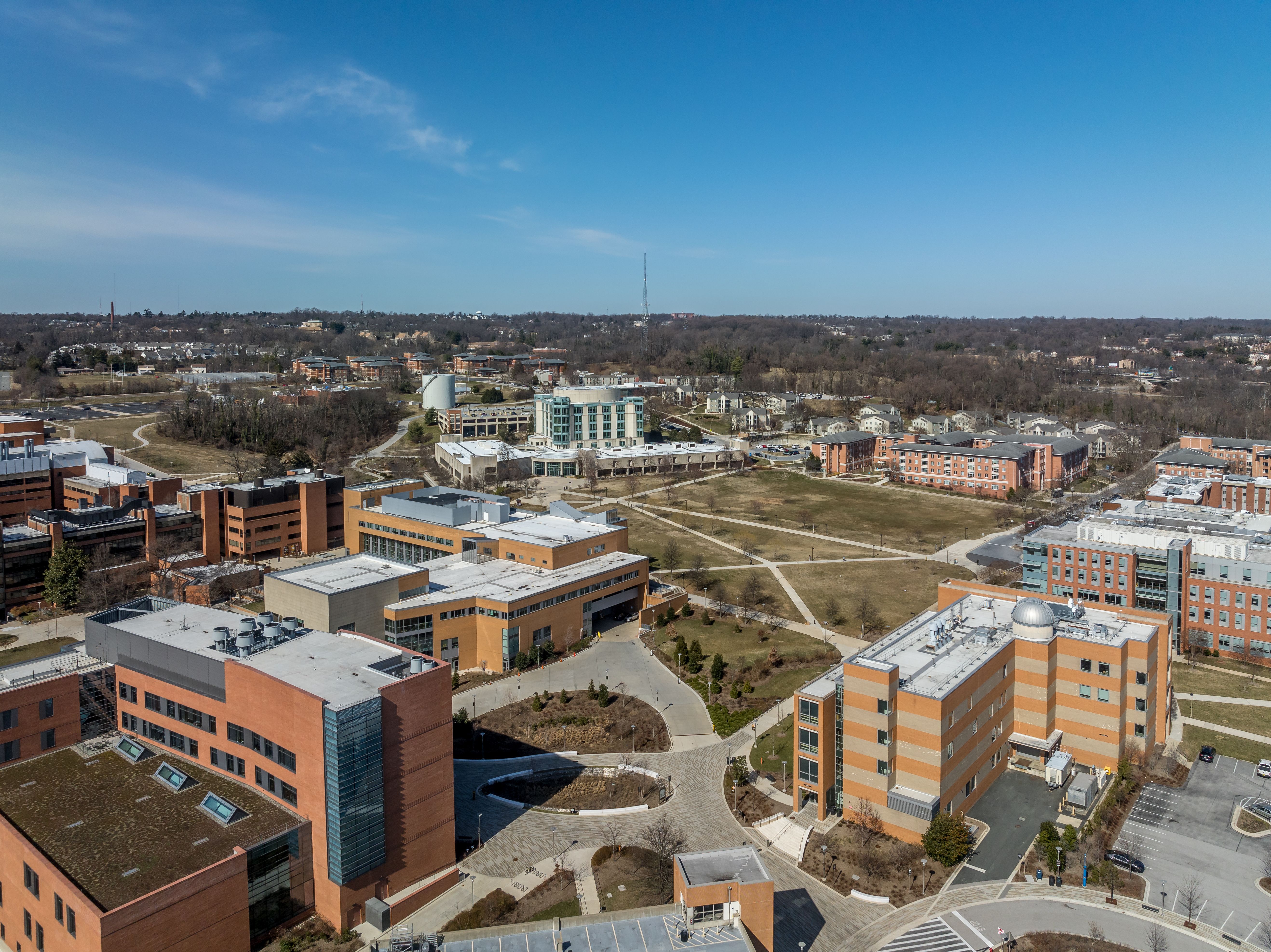
Aerial view of University of Maryland Baltimore County UMBC Catonsville | Image Credit: © vitanovski - stock.adobe.com
Recently, LCGC International spoke to Dr. Blaney about his laboratory’s work with PFAS and CEC analysis, as well as the current research projects they are working on.

Dr. Lee Blaney of the University of Maryland, Baltimore County | Photo Credit: © Lee Blaney
Can you tell me about the research that your laboratory group is working on currently?
Most of our research involves contaminants of emerging concern (CECs), such as pharmaceuticals, hormones, and personal care products. These are chemicals that we use every day to improve our quality of life, but we don’t really think about them as “pollution." Nevertheless, every chemical that we use ultimately makes its way into the aquatic environment, where it can have unintended consequences. When we take an antibiotic to fight an infection, some fraction of the antibiotic gets excreted into our toilets without undergoing any chemical changes. Wastewater treatment plants were not designed to remove pharmaceuticals, causing antibiotics to be discharged into the environment, where they can accelerate the development and spread of antimicrobial resistance. Similar concerns abound for other CECs. For this reason, our group focuses on developing (i) new analytical methods to measure CECs in the aquatic environment and (ii) new treatment technologies to ensure CEC removal from both drinking water and wastewater.

Blaney (left) with undergraduate researcher Ouriel Ndalamba (center) and PhD candidate Jahir Antonio Batista-Andrade (right) discuss an LC-MS/MS method for CEC measurement in Baltimore streams. Photo Credit: © Lee Blaney
In the research that you and your group does, what particular analytical techniques do you normally use?
Our laboratory primarily employs liquid chromatography (LC) coupled to ultraviolet (UV), fluorescence (FL), and triple quadrupole tandem mass spectrometry (MS/MS) detectors. Some CECs have strong absorbance and/or fluorescence properties that allow us to measure their concentrations using high performance liquid chromatography (HPLC) with UV or FL detection in relatively clean samples, such as those produced during laboratory experiments. However, real environmental samples contain dozens of CECs at concentrations of 1–1000 ng/L (that is, 1–1000 parts per trillion). Real samples also contain much higher concentrations of natural organic matter and background ions. With appropriate pretreatment via solid-phase extraction, we can not only concentrate the analytes, but also remove some of the interfering substances. Nevertheless, the large number of CECs in real samples mandates the use of LC–MS/MS, which can concurrently measure analytes with similar retention times. During LC–MS/MS analysis, we have several analytical criteria that ensure highly selective and sensitive measurement of each CEC. In particular, we need to match the LC retention time of our chemical standards for each CEC, produce the same MS-1 ion during electrospray ionization, and generate the same MS-2 ions for analyte quantitation and confirmation by the triple quadrupole MS/MS detector. The fast scan times of the MS/MS detector allow us to measure dozens of CECs in the same method. These aspects make LC–MS/MS the go-to technology for environmental analytical chemists and engineers studying CECs.

Blaney (second from left) with undergraduate researchers Bridget Anger (left) and Lauren Harris (right) and PhD candidate Mamatha Hopanna (second from right) discuss photochemical treatment of antibiotics in water. Photo Credit: © Lee Blaney
What’s the difference between CECs and PFAS?
Contaminants of emerging concern is an umbrella term for all contaminants that have been identified as having potentially harmful effects on the environment or humans. The “emerging” concern means that we do not yet fully understand the toxicity of these chemicals in the environment or people. Per- and polyfluoroalkyl substances (PFAS) are a class of almost 15,000 fluorinated chemicals used in fire-fighting foams, nonstick cookware, fast food wrappers, and many other industrial and consumer products. Even though there are many PFAS, you can consider them to be a subcategory of CECs. Due to the chemical and thermal stability of the carbon-fluorine bonds in PFAS, these chemicals do not readily degrade during wastewater treatment or in the environment. In the last few years, we have learned about a number of harmful outcomes of PFAS in humans. As a result, new drinking water regulations were recently approved for six PFAS in drinking water. In a sense, some PFAS have therefore transcended the concept of “contaminants of emerging concern” and have just become “regulated contaminants." The new regulations for PFAS will also spur the growth and development of analytical contract labs to meet the demand for regular analysis of PFAS in drinking water across the country.
Going back to LC–MS methodologies, are there any limitations of using that technique right now that are kind of preventing you and your group from figuring some things out in your research or?
The biggest limitation is the large number of CECs. Right now, we are only measuring a small fraction of the specialty chemicals employed in everyday life. For example, our lab has developed methods for dozens of antibiotics, but each of those compounds undergo chemical transformations in natural and engineered systems. These reactions produce several unknown transformation products that may still retain antimicrobial properties. Without chemical standards, it is difficult to employ targeted LC–MS/MS methods to measure these transformation products. As another example, the latest EPA method measures 40 PFAS, which accounts for less than 1% of the estimated 15,000 PFAS. If we extrapolate this issue across the full suite of CECs, the number of individual chemicals becomes staggering. For this reason, we have prioritized certain chemicals that represent the most concern, but new approaches will be needed in the future to best safeguard environmental and public health.

Blaney (right) with undergraduate researchers Fabian Amurrio (left) and Lauren Harris (second from right) and PhD candidate Utsav Shashvatt (second from left) discuss ion chromatography results related to a project focused on nutrient recovery from waste streams. | Photo Credit: © Lee Blaney
With all the advancements that are going on in with the techniques and the technologies, how does you and your group stay on top of all the developments going on in this space?
We regularly go to conferences and meetings focused on the latest developments in CEC analysis. Several of our current projects are funded by the Strategic Environmental Research and Development Program (SERDP), which holds regular meetings for PFAS-related research. These conferences and meetings are great opportunities to share our work, receive feedback, learn about the work of other groups, and share notes to advance knowledge in the environmental analytical chemistry and environmental engineering fields. In addition, I serve as an executive editor at the Journal of Hazardous Materials. While it is a demanding job to keep up with all the manuscripts submitted by authors, this role also gives me a chance to read the latest work from around the world to learn about the latest updates and findings.
Are there any upcoming research projects on your end that you’re excited about?
Our best available technologies for PFAS treatment work well for long-chain PFAS, such as perfluorooctanoic acid (PFOA) and perfluorooctane sulfonic acid (PFOS), which contain eight carbon atoms in their chemical structures. Short- and ultrashort-chain PFAS, which contain less than eight carbons, pose challenges to conventional treatment technologies. Many of these compounds are also not included in current analytical methods. Our new SERDP project will focus on developing novel hybrid anion-exchange resins to remove these challenging contaminants from water. We’re excited about our materials and the promising preliminary data, and we’ll look forward to sharing our findings with the environmental community to continue to address the challenges associated with PFAS treatment and remediation.
This interview has been edited for clarity.
About the Interviewee
Lee Blaney, PhD, is a Professor and Associate Director of Sustainability Engineering at the University of Maryland Baltimore County.
]]>
The article link is available here: Inside the Laboratory: The Blaney Laboratory at the University of Maryland Baltimore County (chromatographyonline.com) "Inside the Laboratory" is a series in...
https://beta.my.umbc.edu/api/v0/pixel/news/142551/guest@my.umbc.edu/0764332abe72ebbfcf624befb64b81ad/api/pixel
blaney
lab
research
spring-2024
Chemical, Biochemical and Environmental Engineering
https://beta.my.umbc.edu/groups/cbee
https://assets4-beta.my.umbc.edu/system/shared/avatars/groups/000/000/771/b5e579e81b2e3624611890fa3ca2716a/xsmall.png?1746794587
https://assets2-beta.my.umbc.edu/system/shared/avatars/groups/000/000/771/b5e579e81b2e3624611890fa3ca2716a/original.png?1746794587
https://assets1-beta.my.umbc.edu/system/shared/avatars/groups/000/000/771/b5e579e81b2e3624611890fa3ca2716a/xxlarge.png?1746794587
https://assets2-beta.my.umbc.edu/system/shared/avatars/groups/000/000/771/b5e579e81b2e3624611890fa3ca2716a/xlarge.png?1746794587
https://assets2-beta.my.umbc.edu/system/shared/avatars/groups/000/000/771/b5e579e81b2e3624611890fa3ca2716a/large.png?1746794587
https://assets4-beta.my.umbc.edu/system/shared/avatars/groups/000/000/771/b5e579e81b2e3624611890fa3ca2716a/medium.png?1746794587
https://assets1-beta.my.umbc.edu/system/shared/avatars/groups/000/000/771/b5e579e81b2e3624611890fa3ca2716a/small.png?1746794587
https://assets4-beta.my.umbc.edu/system/shared/avatars/groups/000/000/771/b5e579e81b2e3624611890fa3ca2716a/xsmall.png?1746794587
https://assets1-beta.my.umbc.edu/system/shared/avatars/groups/000/000/771/b5e579e81b2e3624611890fa3ca2716a/xxsmall.png?1746794587
Chemical, Biochemical and Environmental Engineering
https://assets2-beta.my.umbc.edu/system/shared/thumbnails/news/000/142/551/013fe9a1aa45d5462e015bd03d9ac4ae/xxlarge.jpg?1719339836
https://assets1-beta.my.umbc.edu/system/shared/thumbnails/news/000/142/551/013fe9a1aa45d5462e015bd03d9ac4ae/xlarge.jpg?1719339836
https://assets3-beta.my.umbc.edu/system/shared/thumbnails/news/000/142/551/013fe9a1aa45d5462e015bd03d9ac4ae/large.jpg?1719339836
https://assets1-beta.my.umbc.edu/system/shared/thumbnails/news/000/142/551/013fe9a1aa45d5462e015bd03d9ac4ae/medium.jpg?1719339836
https://assets2-beta.my.umbc.edu/system/shared/thumbnails/news/000/142/551/013fe9a1aa45d5462e015bd03d9ac4ae/small.jpg?1719339836
https://assets2-beta.my.umbc.edu/system/shared/thumbnails/news/000/142/551/013fe9a1aa45d5462e015bd03d9ac4ae/xsmall.jpg?1719339836
https://assets1-beta.my.umbc.edu/system/shared/thumbnails/news/000/142/551/013fe9a1aa45d5462e015bd03d9ac4ae/xxsmall.jpg?1719339836
3
0
true
Tue, 25 Jun 2024 14:25:54 -0400
Thu, 27 Jun 2024 13:42:38 -0400