CWIT Donor-Supported Scholarship Applications Open Now!
COEIT Students: Apply via Scholarship Retriever by May 31
The Center for Women in Technology periodically receives donations from individuals and organizations who want to support students through scholarships. We are currently accepting applications for these Donor-Supported Scholarships for the 2023-24 academic year. Current COEIT undergraduate students of all genders in good academic standing are welcome to apply. The awards will be made by the beginning of the Fall 2023 semester, and range in amount from $1000 to $3000 for the academic year. Eligible students will be able to view the opportunity in Scholarship Retriever: https://umbc.academicworks.com/
The deadline to apply is May 31, 2023. Questions? Contact Dr. Seaman at cseaman@umbc.edu.
]]>
The Center for Women in Technology periodically receives donations from individuals and organizations who want to support students through scholarships. We are currently accepting applications for...
https://umbc.academicworks.com/
https://beta.my.umbc.edu/api/v0/pixel/news/133625/guest@my.umbc.edu/1fde116e6f73ab779a1d2116838497f1/api/pixel
scholarships
spring
ug
Chemical, Biochemical and Environmental Engineering
https://beta.my.umbc.edu/groups/cbee
https://assets4-beta.my.umbc.edu/system/shared/avatars/groups/000/000/771/b5e579e81b2e3624611890fa3ca2716a/xsmall.png?1746794587
https://assets2-beta.my.umbc.edu/system/shared/avatars/groups/000/000/771/b5e579e81b2e3624611890fa3ca2716a/original.png?1746794587
https://assets1-beta.my.umbc.edu/system/shared/avatars/groups/000/000/771/b5e579e81b2e3624611890fa3ca2716a/xxlarge.png?1746794587
https://assets2-beta.my.umbc.edu/system/shared/avatars/groups/000/000/771/b5e579e81b2e3624611890fa3ca2716a/xlarge.png?1746794587
https://assets2-beta.my.umbc.edu/system/shared/avatars/groups/000/000/771/b5e579e81b2e3624611890fa3ca2716a/large.png?1746794587
https://assets4-beta.my.umbc.edu/system/shared/avatars/groups/000/000/771/b5e579e81b2e3624611890fa3ca2716a/medium.png?1746794587
https://assets1-beta.my.umbc.edu/system/shared/avatars/groups/000/000/771/b5e579e81b2e3624611890fa3ca2716a/small.png?1746794587
https://assets4-beta.my.umbc.edu/system/shared/avatars/groups/000/000/771/b5e579e81b2e3624611890fa3ca2716a/xsmall.png?1746794587
https://assets1-beta.my.umbc.edu/system/shared/avatars/groups/000/000/771/b5e579e81b2e3624611890fa3ca2716a/xxsmall.png?1746794587
Chemical, Biochemical and Environmental Engineering
0
0
true
Fri, 19 May 2023 10:40:02 -0400
Tyler Josephson advances research with NSF CAREER AWARD
Creating “AI Scientists”
from UMBC NEWS, "Creating “AI Scientists”: Tyler Josephson advances a new field of research through $650,000 NSF CAREER award", by Catherine Meyers on Published: May 12, 2023
Tyler Josephson’s lab sits off a main corridor in the department of chemical, biochemical and environmental engineering at UMBC. Open the door, though, and you’ll see nary a beaker, chemical closet, or lab coat. Inside, a few computers sit on tables. You might see equations scrawled on the white board or a few students poring over lines of code.
Using this modest setup, Josephson has launched an ambitious project to equip computers to make scientific discoveries—starting in the realm of chemistry. This March he won a prestigious NSF CAREER award to advance the project.
The goal of the work is ultimately to speed up the process of science, which should in turn give humanity new knowledge and tools to face down big challenges such as climate change and environmental degradation.
As Josephson and his students dive into the work, they are bringing together techniques from across mathematics, computer science, and chemical engineering. Their first step is to translate chemical theories into a rigorous mathematical language that a computer can understand.
Math as the language of science
In 1623, the Italian natural philosopher Galileo Galilei wrote an essay in which he described nature as a book written in “the language of mathematics.” Many scientists since have puzzled over the mysterious power of math to describe physical phenomena.
Josephson and his students are tapping into this power. They are using a tool developed by researchers at Microsoft called the Lean theorem prover. Lean is both a computer language and a program for checking each step of a rigorous mathematical proof.
“Formal proofs, which are verified by a computer, differ from the informal, handwritten versions often used by scientists,” says Josephson. Informal proofs are easier to write, but they usually skip logical steps, assuming a human reader will have the knowledge and skill to follow along. This means that errors can creep in undetected.
On the other hand, if a proof has been written and checked in Lean, it is guaranteed to be correct as long as the stated assumptions are true.
A community of Lean programmers
Lean has a dedicated community of volunteer developers who have built a large library of mathematical proofs, each of which can then serve as a building block for more complicated proofs. They aim to digitize mathematics, starting with the entirety of the undergraduate math curriculum, which will lay the foundation for formal proofs in advanced modern mathematics.
Josephson plans to build a similar library with formally correct derivations in science and engineering, starting with chemical concepts such as the thermodynamic behavior of gases and of molecules sticking and unsticking from surfaces.
He and his students describe their approach in a first paper on the subject, and are in the process of submitting it to journals.
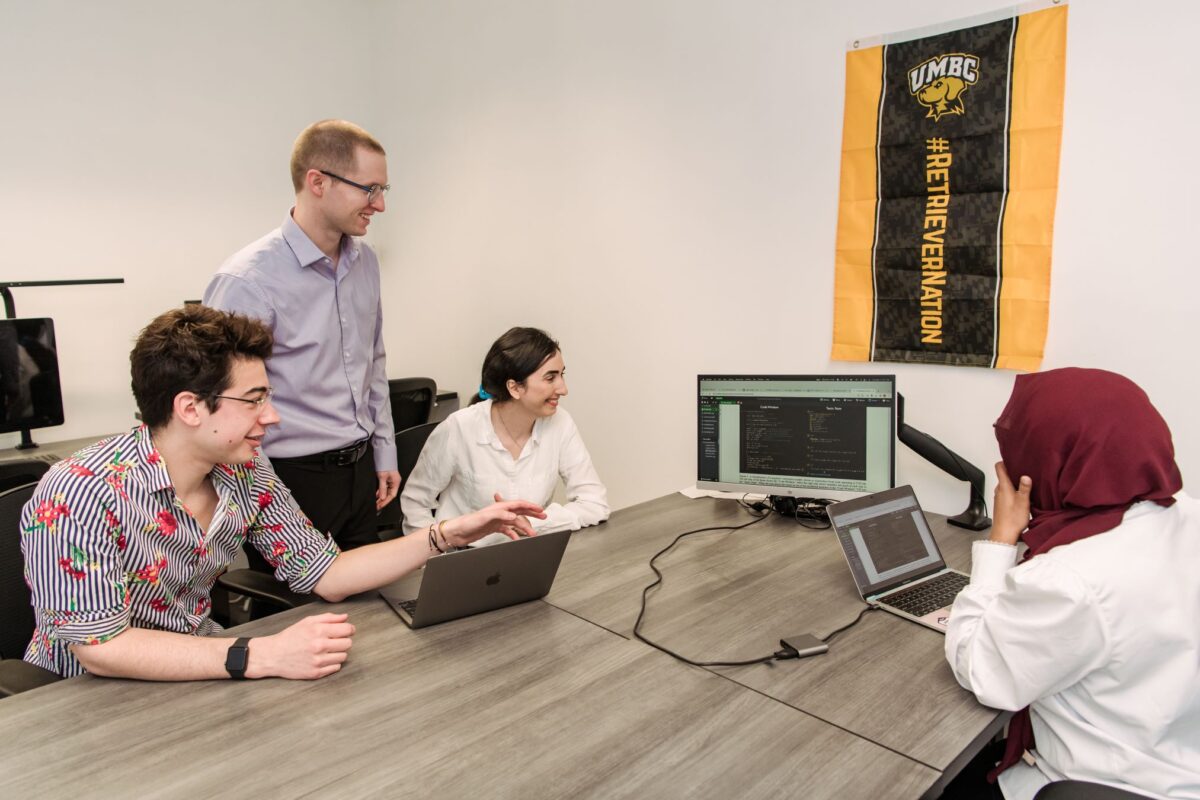 Tyler Josephson (standing) and students Max Bobbin (left), Parivash Feyzishendi (center), and Samiha Sharlin (right) in the lab. (Marlayna Demond ’11/UMBC)
The power of the work will multiply as more of the foundations of science are translated into Lean, so a large part of the team’s work will also be to recruit, inspire, and train fellow proof creators. They will hold workshops to showcase Lean for scientists and engineers, and they plan to create fun and educational games that will teach Lean-programming skills to newcomers.
“I’m really excited to share this tool with students and the scientific community,” Josephson says.
Building better scientific computing tools
Josephson’s goal to formally verify scientific theories isn’t just an intellectual exercise—it’s a means of building better tools for better science. One such tool he plans to create with NSF CAREER award support is Lean-based computer software that can simulate the behavior of molecules under a range of conditions.
Scientists often use such software to test theories as an alternative to physical experiments. It can be easier to run simulations of reactions on a computer, for example, than to mix real chemicals again and again, and some molecular phenomena may happen so fast, or under such extreme conditions, that current experimental tools cannot capture them.
However, bugs can mar the performance of the software. For example, starting in 2011, a hidden coding error fueled a seven-year “war over supercooled water,” in which two scientific groups disagreed about what happens to ultrapure water when it is cooled significantly below the freezing point of normal water, and then suddenly crystallizes.
Code written in Lean is unique from that written in the programming languages commonly used in scientific computing, since it can be provably free of such math errors, Josephson says.
As more scientists and engineers learn to write code and proofs in Lean, others will be able to write bug-free software for applications as diverse as weather forecasting, drug discovery, and predicting material performance.
“AI scientists” who reason on their own
Ultimately, Josephson hopes to use a Lean-based library of scientific knowledge to train computers as fellow scientists. For example, large language models, such as the recently popularized ChatGPT, might be trained on a library of scientific proofs and gain the ability to “autocomplete” proofs on their own, translate informal proofs from the literature into formal ones, and even discover entirely new scientific theories, which could then be checked for correctness by Lean.
A tool like this might revolutionize science. In Galileo’s time, a single person could master large portions of human scientific knowledge, but now scientists usually go to school for decades to become experts in a tiny subfield, Josephson says.
AI scientists capable of digesting a database of thousands of scientific proofs in multiple disciplines might draw connections across them to reveal new discoveries. “Such a tool could lead to an AI-powered Renaissance in interdisciplinary scientific discovery,” says Josephson.
While such lofty goals remain in the future, Josephson and his students are energized by the possibilities. As they embark on an exciting scientific journey, they are thrilled to bring as many people as possible along on the ride.
]]>
from UMBC NEWS, "Creating “AI Scientists”: Tyler Josephson advances a new field of research through $650,000 NSF CAREER award", by Catherine Meyers on Published: May 12, 2023 Tyler...
https://beta.my.umbc.edu/api/v0/pixel/news/133064/guest@my.umbc.edu/3d87a874ac5b8c8fc9d5e108c4749646/api/pixel
award
faculty
josephson
spring-2023
Chemical, Biochemical and Environmental Engineering
https://beta.my.umbc.edu/groups/cbee
https://assets4-beta.my.umbc.edu/system/shared/avatars/groups/000/000/771/b5e579e81b2e3624611890fa3ca2716a/xsmall.png?1746794587
https://assets2-beta.my.umbc.edu/system/shared/avatars/groups/000/000/771/b5e579e81b2e3624611890fa3ca2716a/original.png?1746794587
https://assets1-beta.my.umbc.edu/system/shared/avatars/groups/000/000/771/b5e579e81b2e3624611890fa3ca2716a/xxlarge.png?1746794587
https://assets2-beta.my.umbc.edu/system/shared/avatars/groups/000/000/771/b5e579e81b2e3624611890fa3ca2716a/xlarge.png?1746794587
https://assets2-beta.my.umbc.edu/system/shared/avatars/groups/000/000/771/b5e579e81b2e3624611890fa3ca2716a/large.png?1746794587
https://assets4-beta.my.umbc.edu/system/shared/avatars/groups/000/000/771/b5e579e81b2e3624611890fa3ca2716a/medium.png?1746794587
https://assets1-beta.my.umbc.edu/system/shared/avatars/groups/000/000/771/b5e579e81b2e3624611890fa3ca2716a/small.png?1746794587
https://assets4-beta.my.umbc.edu/system/shared/avatars/groups/000/000/771/b5e579e81b2e3624611890fa3ca2716a/xsmall.png?1746794587
https://assets1-beta.my.umbc.edu/system/shared/avatars/groups/000/000/771/b5e579e81b2e3624611890fa3ca2716a/xxsmall.png?1746794587
Chemical, Biochemical and Environmental Engineering
https://assets1-beta.my.umbc.edu/system/shared/thumbnails/news/000/133/064/f3c6a66c048263f2b362db019ca84932/xxlarge.jpg?1684341161
https://assets4-beta.my.umbc.edu/system/shared/thumbnails/news/000/133/064/f3c6a66c048263f2b362db019ca84932/xlarge.jpg?1684341161
https://assets4-beta.my.umbc.edu/system/shared/thumbnails/news/000/133/064/f3c6a66c048263f2b362db019ca84932/large.jpg?1684341161
https://assets1-beta.my.umbc.edu/system/shared/thumbnails/news/000/133/064/f3c6a66c048263f2b362db019ca84932/medium.jpg?1684341161
https://assets1-beta.my.umbc.edu/system/shared/thumbnails/news/000/133/064/f3c6a66c048263f2b362db019ca84932/small.jpg?1684341161
https://assets4-beta.my.umbc.edu/system/shared/thumbnails/news/000/133/064/f3c6a66c048263f2b362db019ca84932/xsmall.jpg?1684341161
https://assets3-beta.my.umbc.edu/system/shared/thumbnails/news/000/133/064/f3c6a66c048263f2b362db019ca84932/xxsmall.jpg?1684341161
0
0
true
Wed, 17 May 2023 12:37:43 -0400
Mon, 29 Apr 2024 12:36:11 -0400
The value of supporting through research mentorship
Joana Hernandez, '23 Chemical Engineering
McNair Scholar reflects on the power of research mentorship and leadership through supporting others, by Adriana Fraser, Published: May 9, 2023
Joana Hernandez
Degree: B.S., Chemical Engineering, biotechnology & bioengineering track
Hometown: Hyattsville, MD
Post-grad plans: Applying to biochemical engineering Ph.D. programs
McNair Scholar Joana Hernandez is a research enthusiast who found her interest in scientific exploration and mentorship while at UMBC. Since 2019, Hernandez has worked as a research assistant in the lab of Fernando Vonhoff, assistant professor of biological sciences. The lab uses fruit flies as a model to study human neurological diseases. It was in Vonhoff’s lab where she realized that there were opportunities to turn her love of learning into a career in research.
Hernandez has taken her interest in conducting research to the next level by helping to guide fellow students who may be unfamiliar with the academic research process. As a teaching fellow in the McNair Scholars Program, Hernandez led workshops in a class dedicated to teaching students how to develop research proposals. During these workshops, she presented on topics ranging from how to give a research presentation to how to apply to Research Experiences for Undergraduates (REUs).
Hernadez shares that she’s proud to be a McNair Scholar. “As a first-generation college student, it can be difficult to navigate academic spaces and obtain resources on applying to graduate programs,” Hernandez says. “McNair welcomed me with open arms and helped grow my confidence by providing me with opportunities to conduct research and present at national conferences.”
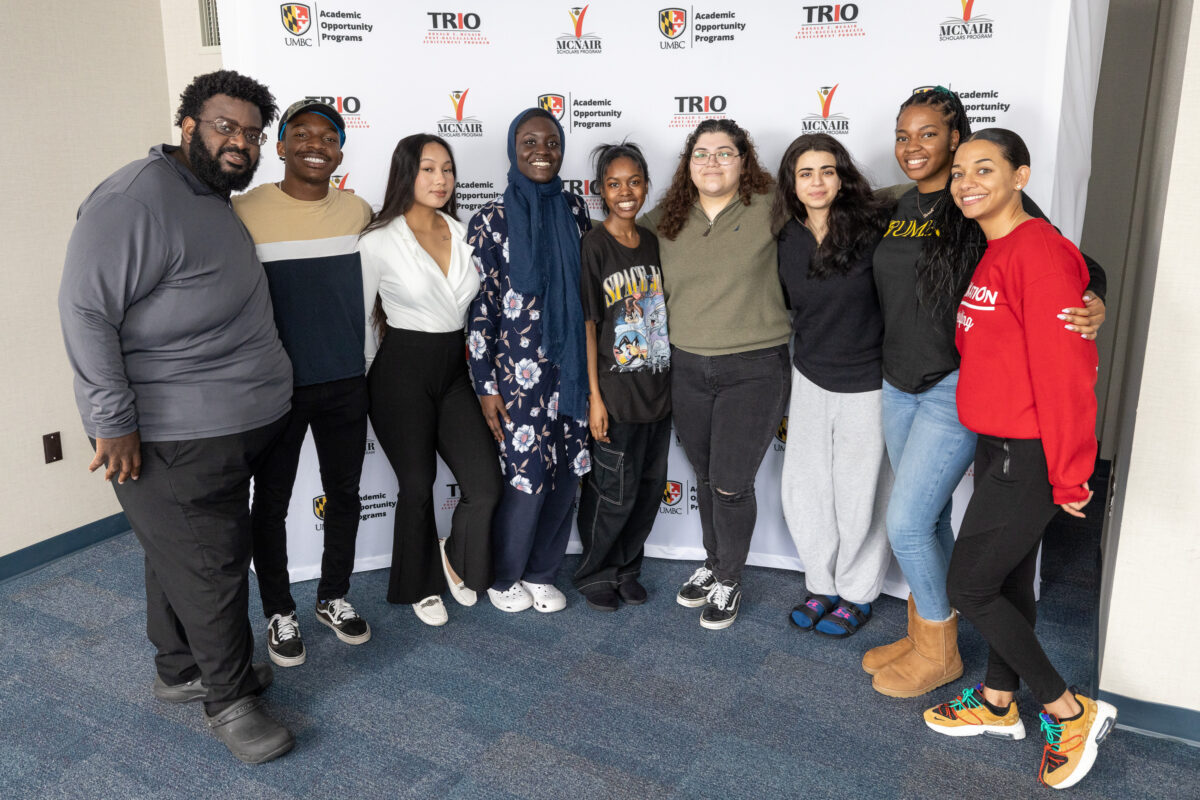 Joana Hernandez (fourth from the right, in glasses) with fellow McNair Scholars and Michael Hunt (far left), director of UMBC’s McNair Scholars Program. (Photo courtesy of Joana Hernandez)
Has there been a mentor or fellow student who influenced your time at UMBC?
“My mentors Fernando Vonhoff and María Célleri, assistant professor of gender, women’s, and sexuality studies, have both had a positive influence on me. As a first-generation college student, I was unaware that undergraduates could participate in research or present at research conferences. When Dr. Vonhoff enabled me to join his lab my freshman year, it opened the doors to a lot of future opportunities. I am very grateful to have had a research mentor that was so understanding and encouraging.
“Dr. Celleri, my McNair mentor, is someone I can always count on to give me advice about navigating academic spaces as a Latina, and how to balance my life between my immigrant household and school. I appreciate all the wisdom I have gathered from her.”
What academic achievement are you most proud of?
“I am most proud of when I presented the research I did in the Vonhoff lab at the 2019 Annual Biomedical Research Conference for Minoritized Scientists (ABRCMS). That was the first time that I had attended a national conference and flew out to the West Coast. It was an eye-opening experience being able to see other undergraduate researchers from diverse backgrounds who were also just as passionate about communicating their work.”
]]>
FROM UMBC NEWS, McNair Scholar reflects on the power of research mentorship and leadership through supporting others, by Adriana Fraser, Published: May 9, 2023 Joana Hernandez...
https://beta.my.umbc.edu/api/v0/pixel/news/133546/guest@my.umbc.edu/685ef4bb305d381c7d754f84560b9e77/api/pixel
research
spring-2023
ug
ugrad
Chemical, Biochemical and Environmental Engineering
https://beta.my.umbc.edu/groups/cbee
https://assets4-beta.my.umbc.edu/system/shared/avatars/groups/000/000/771/b5e579e81b2e3624611890fa3ca2716a/xsmall.png?1746794587
https://assets2-beta.my.umbc.edu/system/shared/avatars/groups/000/000/771/b5e579e81b2e3624611890fa3ca2716a/original.png?1746794587
https://assets1-beta.my.umbc.edu/system/shared/avatars/groups/000/000/771/b5e579e81b2e3624611890fa3ca2716a/xxlarge.png?1746794587
https://assets2-beta.my.umbc.edu/system/shared/avatars/groups/000/000/771/b5e579e81b2e3624611890fa3ca2716a/xlarge.png?1746794587
https://assets2-beta.my.umbc.edu/system/shared/avatars/groups/000/000/771/b5e579e81b2e3624611890fa3ca2716a/large.png?1746794587
https://assets4-beta.my.umbc.edu/system/shared/avatars/groups/000/000/771/b5e579e81b2e3624611890fa3ca2716a/medium.png?1746794587
https://assets1-beta.my.umbc.edu/system/shared/avatars/groups/000/000/771/b5e579e81b2e3624611890fa3ca2716a/small.png?1746794587
https://assets4-beta.my.umbc.edu/system/shared/avatars/groups/000/000/771/b5e579e81b2e3624611890fa3ca2716a/xsmall.png?1746794587
https://assets1-beta.my.umbc.edu/system/shared/avatars/groups/000/000/771/b5e579e81b2e3624611890fa3ca2716a/xxsmall.png?1746794587
Chemical, Biochemical and Environmental Engineering
https://assets2-beta.my.umbc.edu/system/shared/thumbnails/news/000/133/546/6f4a037577471bd4dd8ee2729f909b38/xxlarge.jpg?1684262656
https://assets1-beta.my.umbc.edu/system/shared/thumbnails/news/000/133/546/6f4a037577471bd4dd8ee2729f909b38/xlarge.jpg?1684262656
https://assets3-beta.my.umbc.edu/system/shared/thumbnails/news/000/133/546/6f4a037577471bd4dd8ee2729f909b38/large.jpg?1684262656
https://assets2-beta.my.umbc.edu/system/shared/thumbnails/news/000/133/546/6f4a037577471bd4dd8ee2729f909b38/medium.jpg?1684262656
https://assets1-beta.my.umbc.edu/system/shared/thumbnails/news/000/133/546/6f4a037577471bd4dd8ee2729f909b38/small.jpg?1684262656
https://assets3-beta.my.umbc.edu/system/shared/thumbnails/news/000/133/546/6f4a037577471bd4dd8ee2729f909b38/xsmall.jpg?1684262656
https://assets3-beta.my.umbc.edu/system/shared/thumbnails/news/000/133/546/6f4a037577471bd4dd8ee2729f909b38/xxsmall.jpg?1684262656
0
0
true
Tue, 16 May 2023 14:45:19 -0400
Working to diversify and advance environmental science
UMBC, USGS and EPA sign new agreement
CBEE faculty, Dr. Claire Welty, Professor of Department of Chemical, Biochemical and Environmental Engineering and Director of Center for Urban Environmental Research and Education, Drs. Lee Blaney, Upal Ghosh, Chris Hennigan, Brian Reed, Claire Welty, are also affiliated with the Interdisciplinary Consortium for Applied Research in the Environment (ICARE) are beneficiaries of successful collaborations between the three organizations.
]]>
On a recent Friday, representatives of UMBC, the U.S. Geological Survey and the U.S. Environmental Protection Agency gathered in UMBC’s Albin O. Kuhn Library Gallery and pledged to work together...
https://beta.my.umbc.edu/api/v0/pixel/news/133435/guest@my.umbc.edu/fd829d8fd572efa3ed4d0ec8236f6fed/api/pixel
blaney
faculty
ghosh
hennigan
reed
research
spring-2023
welty
Chemical, Biochemical and Environmental Engineering
https://beta.my.umbc.edu/groups/cbee
https://assets4-beta.my.umbc.edu/system/shared/avatars/groups/000/000/771/b5e579e81b2e3624611890fa3ca2716a/xsmall.png?1746794587
https://assets2-beta.my.umbc.edu/system/shared/avatars/groups/000/000/771/b5e579e81b2e3624611890fa3ca2716a/original.png?1746794587
https://assets1-beta.my.umbc.edu/system/shared/avatars/groups/000/000/771/b5e579e81b2e3624611890fa3ca2716a/xxlarge.png?1746794587
https://assets2-beta.my.umbc.edu/system/shared/avatars/groups/000/000/771/b5e579e81b2e3624611890fa3ca2716a/xlarge.png?1746794587
https://assets2-beta.my.umbc.edu/system/shared/avatars/groups/000/000/771/b5e579e81b2e3624611890fa3ca2716a/large.png?1746794587
https://assets4-beta.my.umbc.edu/system/shared/avatars/groups/000/000/771/b5e579e81b2e3624611890fa3ca2716a/medium.png?1746794587
https://assets1-beta.my.umbc.edu/system/shared/avatars/groups/000/000/771/b5e579e81b2e3624611890fa3ca2716a/small.png?1746794587
https://assets4-beta.my.umbc.edu/system/shared/avatars/groups/000/000/771/b5e579e81b2e3624611890fa3ca2716a/xsmall.png?1746794587
https://assets1-beta.my.umbc.edu/system/shared/avatars/groups/000/000/771/b5e579e81b2e3624611890fa3ca2716a/xxsmall.png?1746794587
Chemical, Biochemical and Environmental Engineering
0
0
true
Thu, 11 May 2023 11:26:41 -0400
Ellington wins awards at 2023 CPRC-HDC Joint Spring Meeting
The Society of Environmental Toxicology and Chemistry 2nd Annual Hudson-Delaware & Chesapeake-Potomac Regional Chapter Joint Spring Meeting was held in Easton, Maryland from April 17 - 28, 2023.
In preparation for the 2023 CPRC-HDC Joint Spring Meeting, Marriah Ellington, M.S. chemical and biochemical engineering ' 23, received a travel award to attend the conference to presenter the research she conducted under the mentorship of Dr. Lee Blaney, Professor of Chemical, Biochemical and Environmental Engineering.
During the meeting, Ellington won the 2nd place poster presentation award for her poster titled "Improving transformation efficiency, recovery efficiency, and throughput for total oxidizable precursor analysis of PFAS in soil"
Authors: Marriah Ellington, Ke He, Margaret Siao, Jiabao Liang, Lee Blaney
Abstract: Per- and polyfluoroalkyl substances (PFAS) comprise more than 10,000 compounds with variable physicochemical properties. Targeted analytical approaches require standards that are limited, expensive, or unavailable. The total oxidizable precursor (TOP) assay represents one option to address the complexity associated with unknown PFAS precursors. In particular, the TOP assay transforms precursors into perfluoroalkyl acid (PFAA) endpoints via hydroxyl and sulfate radical-driven reactions. Solid samples, such as soil, sediment, and biosolids, contain high concentrations of reactive species scavengers that inhibit precursor oxidation; furthermore, PFAS extraction from solids involves solvent addition, which increases the potential for reactive species scavenging and necessitates further processing steps. The objective of this work was to improve the transformation efficiency, recovery efficiency, and throughput of the TOP assay for soil samples. Recovery efficiency was tracked via mass-labeled PFAA surrogates, which were not oxidized in TOP. Transformation efficiency was evaluated by introducing the M8-PFOSA surrogate standard into the original sample before extraction. PFAS, precursors, and mass-labeled surrogates were extracted with methanol, and the extracts were diluted with deionized water to 20% methanol. To improve transformation efficiency, solid-phase extraction with weak-anion exchange cartridges was used to remove background organic matter. Precursors were eluted with acetonitrile, evaporated, and reconstituted with TOP reagents. After 24 h at 85 °C, the PFAA end-products were present in saline water, affecting analytical compatibility and complicating enrichment. A QuEChERS extraction was employed by adding acetonitrile, magnesium sulfate, and sodium chloride. The acetonitrile-based extract was evaporated, reconstituted with internal standards, and analyzed for targeted PFAS. Recovery efficiency was dependent on chain length and ranged from 64 to 115%. The M8-PFOSA transformation efficiency was greater than 75% for over 20 soil samples from a PFAS-impacted site. Results showed ng g-1 quantitation of over 30 PFAS, highlighting the strong performance of this modified TOP assay for real solid samples.
]]>
The Society of Environmental Toxicology and Chemistry 2nd Annual Hudson-Delaware & Chesapeake-Potomac Regional Chapter Joint Spring Meeting was held in Easton, Maryland from April 17 - 28,...
https://beta.my.umbc.edu/api/v0/pixel/news/133356/guest@my.umbc.edu/8e326e4445bce880c5515e0e3d6fdb99/api/pixel
award
blaney
faculty
grad
spring-2023
Chemical, Biochemical and Environmental Engineering
https://beta.my.umbc.edu/groups/cbee
https://assets4-beta.my.umbc.edu/system/shared/avatars/groups/000/000/771/b5e579e81b2e3624611890fa3ca2716a/xsmall.png?1746794587
https://assets2-beta.my.umbc.edu/system/shared/avatars/groups/000/000/771/b5e579e81b2e3624611890fa3ca2716a/original.png?1746794587
https://assets1-beta.my.umbc.edu/system/shared/avatars/groups/000/000/771/b5e579e81b2e3624611890fa3ca2716a/xxlarge.png?1746794587
https://assets2-beta.my.umbc.edu/system/shared/avatars/groups/000/000/771/b5e579e81b2e3624611890fa3ca2716a/xlarge.png?1746794587
https://assets2-beta.my.umbc.edu/system/shared/avatars/groups/000/000/771/b5e579e81b2e3624611890fa3ca2716a/large.png?1746794587
https://assets4-beta.my.umbc.edu/system/shared/avatars/groups/000/000/771/b5e579e81b2e3624611890fa3ca2716a/medium.png?1746794587
https://assets1-beta.my.umbc.edu/system/shared/avatars/groups/000/000/771/b5e579e81b2e3624611890fa3ca2716a/small.png?1746794587
https://assets4-beta.my.umbc.edu/system/shared/avatars/groups/000/000/771/b5e579e81b2e3624611890fa3ca2716a/xsmall.png?1746794587
https://assets1-beta.my.umbc.edu/system/shared/avatars/groups/000/000/771/b5e579e81b2e3624611890fa3ca2716a/xxsmall.png?1746794587
Chemical, Biochemical and Environmental Engineering
https://assets2-beta.my.umbc.edu/system/shared/thumbnails/news/000/133/356/dc21b508147255d7f6deda0eccd1fad1/xxlarge.jpg?1683648095
https://assets2-beta.my.umbc.edu/system/shared/thumbnails/news/000/133/356/dc21b508147255d7f6deda0eccd1fad1/xlarge.jpg?1683648095
https://assets1-beta.my.umbc.edu/system/shared/thumbnails/news/000/133/356/dc21b508147255d7f6deda0eccd1fad1/large.jpg?1683648095
https://assets2-beta.my.umbc.edu/system/shared/thumbnails/news/000/133/356/dc21b508147255d7f6deda0eccd1fad1/medium.jpg?1683648095
https://assets2-beta.my.umbc.edu/system/shared/thumbnails/news/000/133/356/dc21b508147255d7f6deda0eccd1fad1/small.jpg?1683648095
https://assets1-beta.my.umbc.edu/system/shared/thumbnails/news/000/133/356/dc21b508147255d7f6deda0eccd1fad1/xsmall.jpg?1683648095
https://assets4-beta.my.umbc.edu/system/shared/thumbnails/news/000/133/356/dc21b508147255d7f6deda0eccd1fad1/xxsmall.jpg?1683648095
3
0
true
Tue, 09 May 2023 11:37:04 -0400
Wed, 10 May 2023 10:17:51 -0400
Applying philosophy to excel in chemical engineering
Class of 2023 Profiles: Max Bobbin
from
UMBC NEWS by Sarah Hansen, M.S. '15, Published: May 1, 2023
Applying philosophy to excel in chemical engineering
Max Bobbin
Degree: B.S., Chemical Engineering; B.A., Philosophy
Hometown: Joppa, MD
Post-grad plans: Ph.D. in chemical engineering, University of Delaware
Max Bobbin may still be an undergraduate, but he’s already made significant research contributions in the Artificial Intelligence and Theory-Oriented Molecular Science (ATOMS) lab, led byTyler Josephson, assistant professor of chemical, biochemical, and environmental engineering. Bobbin was the first in the research group to develop expertise in the programming language Lean. He took on a leadership role, teaching other lab members, including Josephson, about new ways to use Lean. He also selected appropriate projects for new team members, helped the group prepare for Josephson’s parental leave, and initiated new directions for the lab’s work.
Bobbin believes his additional philosophy major supported his engineering work in important ways. “For an engineer, the most important skills are problem-solving, critical thinking, and communication,” he says, “and philosophy is a major built around those three ideas.”
Bobbin also served as vice president of the UMBC American Institute of Chemical Engineers (AIChE) student chapter and led UMBC to the AIChE Jeopardy national championship in 2022.
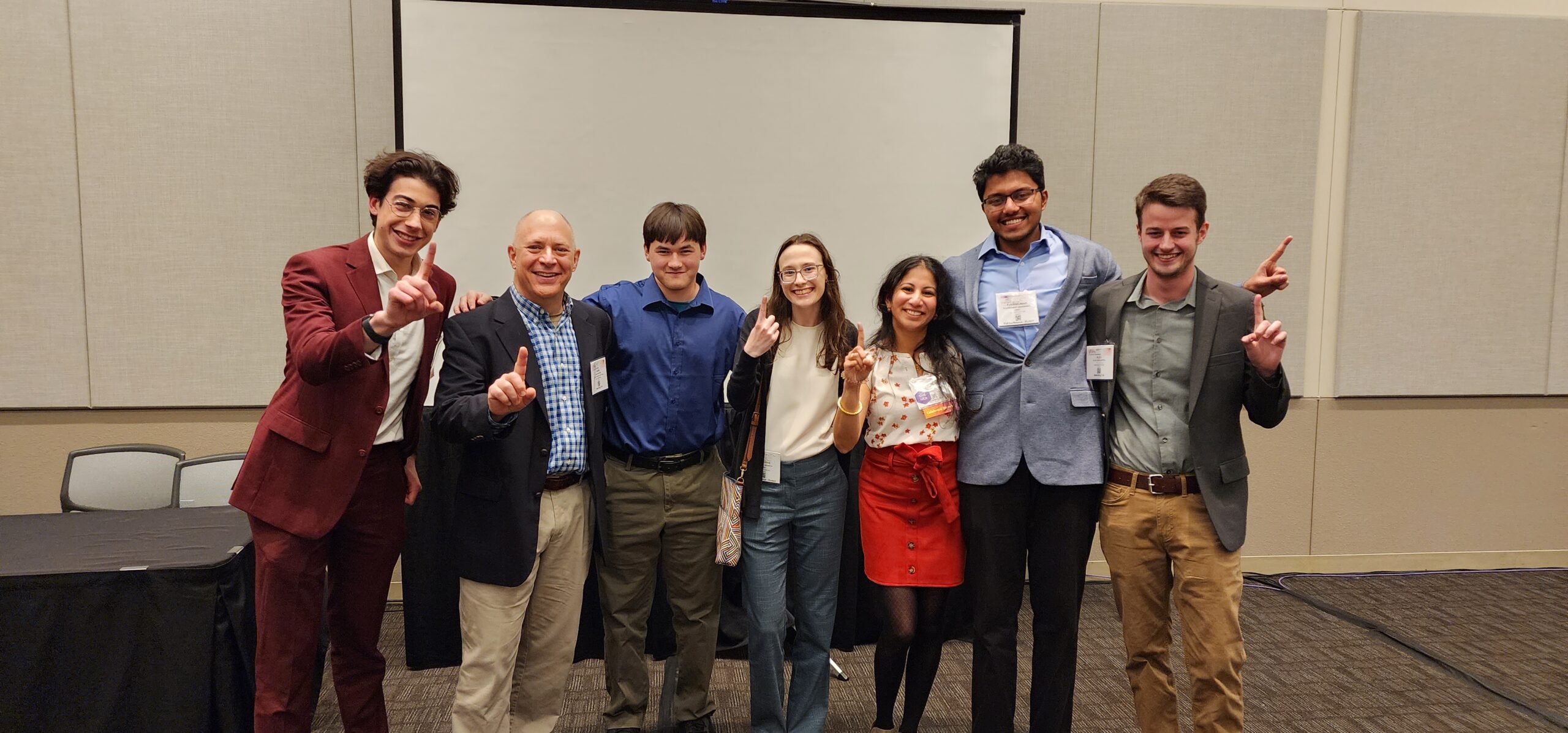
Photo credit: L-R, Max Bobbin, Dr. Mark Marten, Colin Jones, Catherine Wraback, Dr. Neha Raikar, Pavan Umashankar, Alex Von Gunten B.S. '20 chemical engineering
Photo credit: Max Bobbin (Marlayna Demond '11/UMBC)
]]>
from UMBC NEWS by Sarah Hansen, M.S. '15, Published: May 1, 2023 Applying philosophy to excel in chemical engineering Max Bobbin Degree: B.S., Chemical Engineering; B.A., Philosophy...
https://beta.my.umbc.edu/api/v0/pixel/news/133310/guest@my.umbc.edu/b156b7e7a58e348d7c68c5e074a1a6a5/api/pixel
graduation
seniors
spring-2023
ug
ugrad
Chemical, Biochemical and Environmental Engineering
https://beta.my.umbc.edu/groups/cbee
https://assets4-beta.my.umbc.edu/system/shared/avatars/groups/000/000/771/b5e579e81b2e3624611890fa3ca2716a/xsmall.png?1746794587
https://assets2-beta.my.umbc.edu/system/shared/avatars/groups/000/000/771/b5e579e81b2e3624611890fa3ca2716a/original.png?1746794587
https://assets1-beta.my.umbc.edu/system/shared/avatars/groups/000/000/771/b5e579e81b2e3624611890fa3ca2716a/xxlarge.png?1746794587
https://assets2-beta.my.umbc.edu/system/shared/avatars/groups/000/000/771/b5e579e81b2e3624611890fa3ca2716a/xlarge.png?1746794587
https://assets2-beta.my.umbc.edu/system/shared/avatars/groups/000/000/771/b5e579e81b2e3624611890fa3ca2716a/large.png?1746794587
https://assets4-beta.my.umbc.edu/system/shared/avatars/groups/000/000/771/b5e579e81b2e3624611890fa3ca2716a/medium.png?1746794587
https://assets1-beta.my.umbc.edu/system/shared/avatars/groups/000/000/771/b5e579e81b2e3624611890fa3ca2716a/small.png?1746794587
https://assets4-beta.my.umbc.edu/system/shared/avatars/groups/000/000/771/b5e579e81b2e3624611890fa3ca2716a/xsmall.png?1746794587
https://assets1-beta.my.umbc.edu/system/shared/avatars/groups/000/000/771/b5e579e81b2e3624611890fa3ca2716a/xxsmall.png?1746794587
Chemical, Biochemical and Environmental Engineering
https://assets2-beta.my.umbc.edu/system/shared/thumbnails/news/000/133/310/6d37cbe3d3d65de034416abf50412d9c/xxlarge.jpg?1683558340
https://assets2-beta.my.umbc.edu/system/shared/thumbnails/news/000/133/310/6d37cbe3d3d65de034416abf50412d9c/xlarge.jpg?1683558340
https://assets2-beta.my.umbc.edu/system/shared/thumbnails/news/000/133/310/6d37cbe3d3d65de034416abf50412d9c/large.jpg?1683558340
https://assets1-beta.my.umbc.edu/system/shared/thumbnails/news/000/133/310/6d37cbe3d3d65de034416abf50412d9c/medium.jpg?1683558340
https://assets4-beta.my.umbc.edu/system/shared/thumbnails/news/000/133/310/6d37cbe3d3d65de034416abf50412d9c/small.jpg?1683558340
https://assets4-beta.my.umbc.edu/system/shared/thumbnails/news/000/133/310/6d37cbe3d3d65de034416abf50412d9c/xsmall.jpg?1683558340
https://assets2-beta.my.umbc.edu/system/shared/thumbnails/news/000/133/310/6d37cbe3d3d65de034416abf50412d9c/xxsmall.jpg?1683558340
3
0
true
Mon, 08 May 2023 11:06:39 -0400
Wed, 10 May 2023 10:16:27 -0400
2023 COEIT Celebration- recognizes award winning students!
Sunday, May 7⋅2:00 – 3:00pm, RAC
On Sunday, May 7, 2023, the College of Engineering and Informational Technology will celebrate the achievements of graduates across the college.
The department of Chemical, Biochemical and Environmental Engineering will recognize the following award-winning students and staff:
Outstanding Seniors in Chemical Engineering
Highest academic achievement of seniors majoring in
chemical engineering
- Bobbin, Max
- Donyaee, Sarah
- Iglesias Vega, Diego
- Kiguru, Joy
- McLaren, Madison
- McLaughlin, Thomas W.
- Myers, Rachel K.
- Nolan, Mary E.
- Oyinloye, Precious
- Serafin, Shawn K.
- Thomas, Jenny
- Thompson, Troy
- Thorwart, Samantha E.
- Wilson, Christina M.
- Wraback, Catherine M.
Student Leadership Award
- Serafin, Shawn K.
- Wraback, Catherine M.
Undergraduate Research Award
- Andrea Miller, Graduate Program Coordinator
Matthew Stromberg, environmental engineering Ph.D. student, was recently mentioned in the Science article, "OCEANS AWAY: Is raising salmon on land the next big thing in farming fish?" by Erik Stokstad. Stomberg is co-advised by Dr. Ghosh, professor of chemical, biochemical, and environmental engineering and Dr. Zohar, professor of marine biotechnology.
The article explores the emerging trend of land-based fish farming, specifically focusing on Superior Fresh, a Wisconsin-based farm that raises Atlantic salmon. The farm's unique approach to raising fish in tanks and integrating them with its greenhouse operations has attracted attention from investors and customers looking for locally produced and high-quality fish.
The article highlights the challenges associated with land-based fish farming, including the high costs of equipment and infrastructure, potential environmental impacts, and the need to address fish health and welfare. To address some of these challenges, the farm has implemented various innovative practices, such as using ultraviolet light to purify water and using antisense RNA to prevent salmon from sexually maturing and ensuring larger filets.
Stromberg is testing a system that uses ultraviolet light and titanium electrodes to break down water-borne chemicals that can give land-reared salmon a muddy flavor. Their research is crucial in ensuring the long-term success of land-based fish farming.
Image Credit: University of Wisconsin-Stevens Point
]]>
Matthew Stromberg, environmental engineering Ph.D. student, was recently mentioned in the Science article, "OCEANS AWAY: Is raising salmon on land the next big thing in farming fish?" by Erik...
https://beta.my.umbc.edu/api/v0/pixel/news/133019/guest@my.umbc.edu/48874c0286a1a51a932bd93bd8b2bbf6/api/pixel
ghosh
grad
research
spring-2023
Chemical, Biochemical and Environmental Engineering
https://beta.my.umbc.edu/groups/cbee
https://assets4-beta.my.umbc.edu/system/shared/avatars/groups/000/000/771/b5e579e81b2e3624611890fa3ca2716a/xsmall.png?1746794587
https://assets2-beta.my.umbc.edu/system/shared/avatars/groups/000/000/771/b5e579e81b2e3624611890fa3ca2716a/original.png?1746794587
https://assets1-beta.my.umbc.edu/system/shared/avatars/groups/000/000/771/b5e579e81b2e3624611890fa3ca2716a/xxlarge.png?1746794587
https://assets2-beta.my.umbc.edu/system/shared/avatars/groups/000/000/771/b5e579e81b2e3624611890fa3ca2716a/xlarge.png?1746794587
https://assets2-beta.my.umbc.edu/system/shared/avatars/groups/000/000/771/b5e579e81b2e3624611890fa3ca2716a/large.png?1746794587
https://assets4-beta.my.umbc.edu/system/shared/avatars/groups/000/000/771/b5e579e81b2e3624611890fa3ca2716a/medium.png?1746794587
https://assets1-beta.my.umbc.edu/system/shared/avatars/groups/000/000/771/b5e579e81b2e3624611890fa3ca2716a/small.png?1746794587
https://assets4-beta.my.umbc.edu/system/shared/avatars/groups/000/000/771/b5e579e81b2e3624611890fa3ca2716a/xsmall.png?1746794587
https://assets1-beta.my.umbc.edu/system/shared/avatars/groups/000/000/771/b5e579e81b2e3624611890fa3ca2716a/xxsmall.png?1746794587
Chemical, Biochemical and Environmental Engineering
https://assets3-beta.my.umbc.edu/system/shared/thumbnails/news/000/133/019/38cde54d2f4eb4367d4d141f58817ee5/xxlarge.jpg?1682607300
https://assets4-beta.my.umbc.edu/system/shared/thumbnails/news/000/133/019/38cde54d2f4eb4367d4d141f58817ee5/xlarge.jpg?1682607300
https://assets4-beta.my.umbc.edu/system/shared/thumbnails/news/000/133/019/38cde54d2f4eb4367d4d141f58817ee5/large.jpg?1682607300
https://assets2-beta.my.umbc.edu/system/shared/thumbnails/news/000/133/019/38cde54d2f4eb4367d4d141f58817ee5/medium.jpg?1682607300
https://assets3-beta.my.umbc.edu/system/shared/thumbnails/news/000/133/019/38cde54d2f4eb4367d4d141f58817ee5/small.jpg?1682607300
https://assets1-beta.my.umbc.edu/system/shared/thumbnails/news/000/133/019/38cde54d2f4eb4367d4d141f58817ee5/xsmall.jpg?1682607300
https://assets4-beta.my.umbc.edu/system/shared/thumbnails/news/000/133/019/38cde54d2f4eb4367d4d141f58817ee5/xxsmall.jpg?1682607300
0
0
true
Wed, 26 Apr 2023 21:07:21 -0400
Thu, 27 Apr 2023 10:55:24 -0400
CBEE students win regional AIChE Jeopardy competition
Team qualifies for National competition, four years running
UMBC chemical engineering students win first place in the 2023 Mid-Atlantic Regional AIChE ChemE Jeopardy Competition. Thus, qualifying for the 2023 National AIChE ChemE Jeopardy Competition in Orlando, FL in November as part of the AIChE National Conference. This is the fourth year in a row a UMBC team qualified for the National AIChE ChemE Jeopardy Competition.
Eighteen teams competed during the AIChE ChemE Jeopardy Mid-Atlantic Competition held at Virginia Tech in Blacksburg, VA, including two teams from UMBC. After the preliminary rounds, the UMBC teams placed first and second in the semi-finals, tied at 9 points each. The semifinal round was a knockout round, and UMBC’s ‘Team One’ advanced to the finals. The final round of competition was between UMBC, Johns Hopkins University (2nd place) and Stony Brook University (3rd place).
The success of both teams is the result of consistent hard work and support from the teams’ faculty advisors are Dr. Neha Raikar and Dr. Mariajosé Castellanos as well as other students. Taylor deSilva, chemical engineering ‘23, is instrumental in preparing the teams for competition by organizing weekly practices including setting up sample game boards.
Team One
- Ethan Banks, chemical engineering, traditional track ‘24
- Paul Loberg, chemical engineering, biotechnology and bioengineering track ‘24
- Max Bobbin, chemical engineering, environmental engineering & sustainability track ‘23
- Catherine Wraback - chemical engineering, traditional track ‘23
Team Two
- Pavan Umashankar, chemical engineering, biotechnology and bioengineering track ‘24
- Colin Jones, chemical engineering, biotechnology and bioengineering track ‘25
- Jacob Craft, chemical engineering, environmental engineering & sustainability track ‘24
- Zachary Bogart, chemical engineering, environmental engineering & sustainability track ‘23
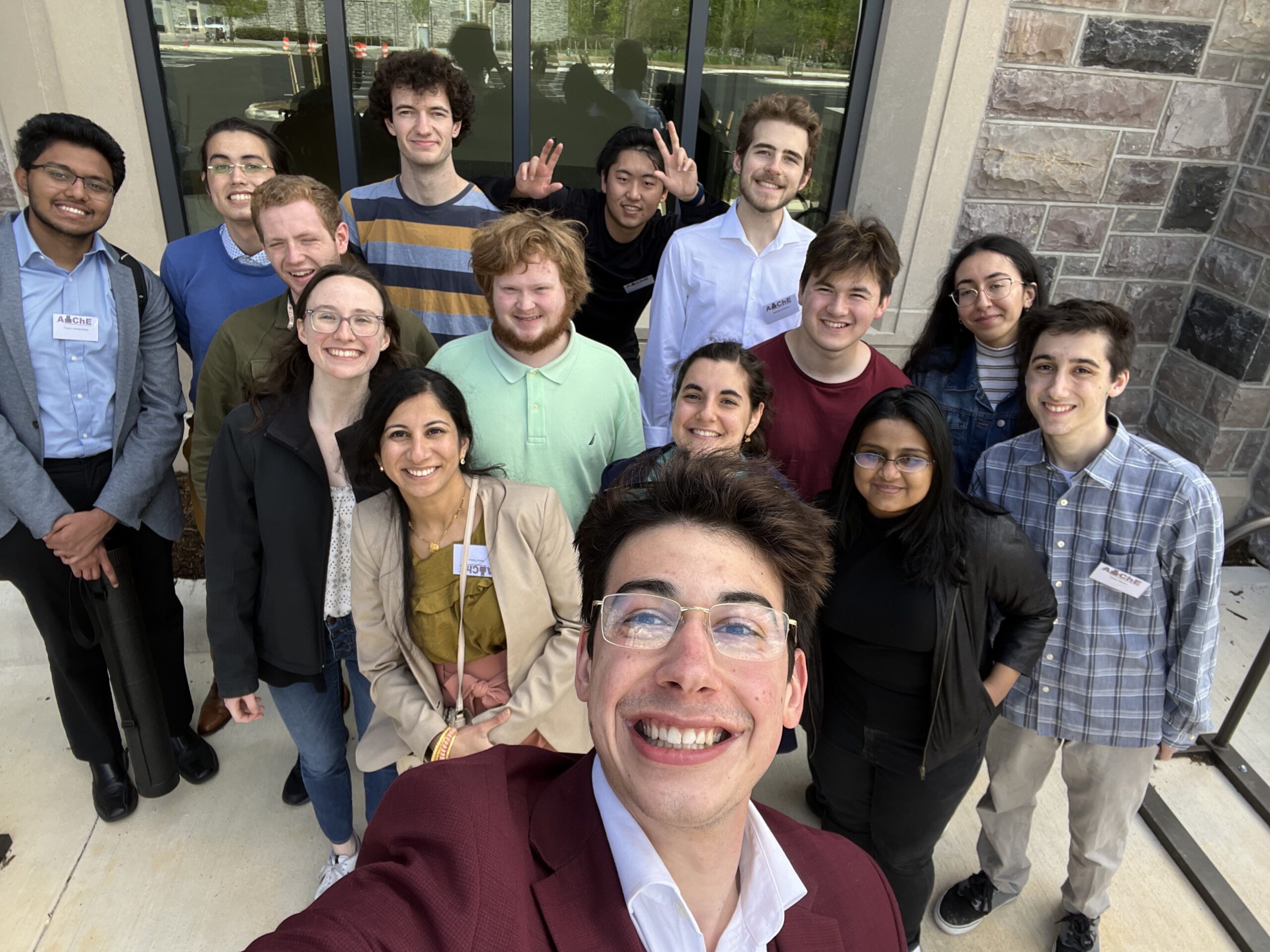
UMBC CBEE students and advisor at the AIChE 2023 Mid-Atlantic Student Regional Conference, April 22-23
Photo Credit: Max Bobbin
Back to front; Pavan Umashankar, Paul Loberg, Caton , David Ni, Zachary Bogart, Ben Willing, Catherine Wraback, Jacob Craft, Colin Jones, Neha Sian, Dr. Neha Raikar, Sarah Donyaee, Afrah Ahmed, Ethan Banks, Max Bobbin.
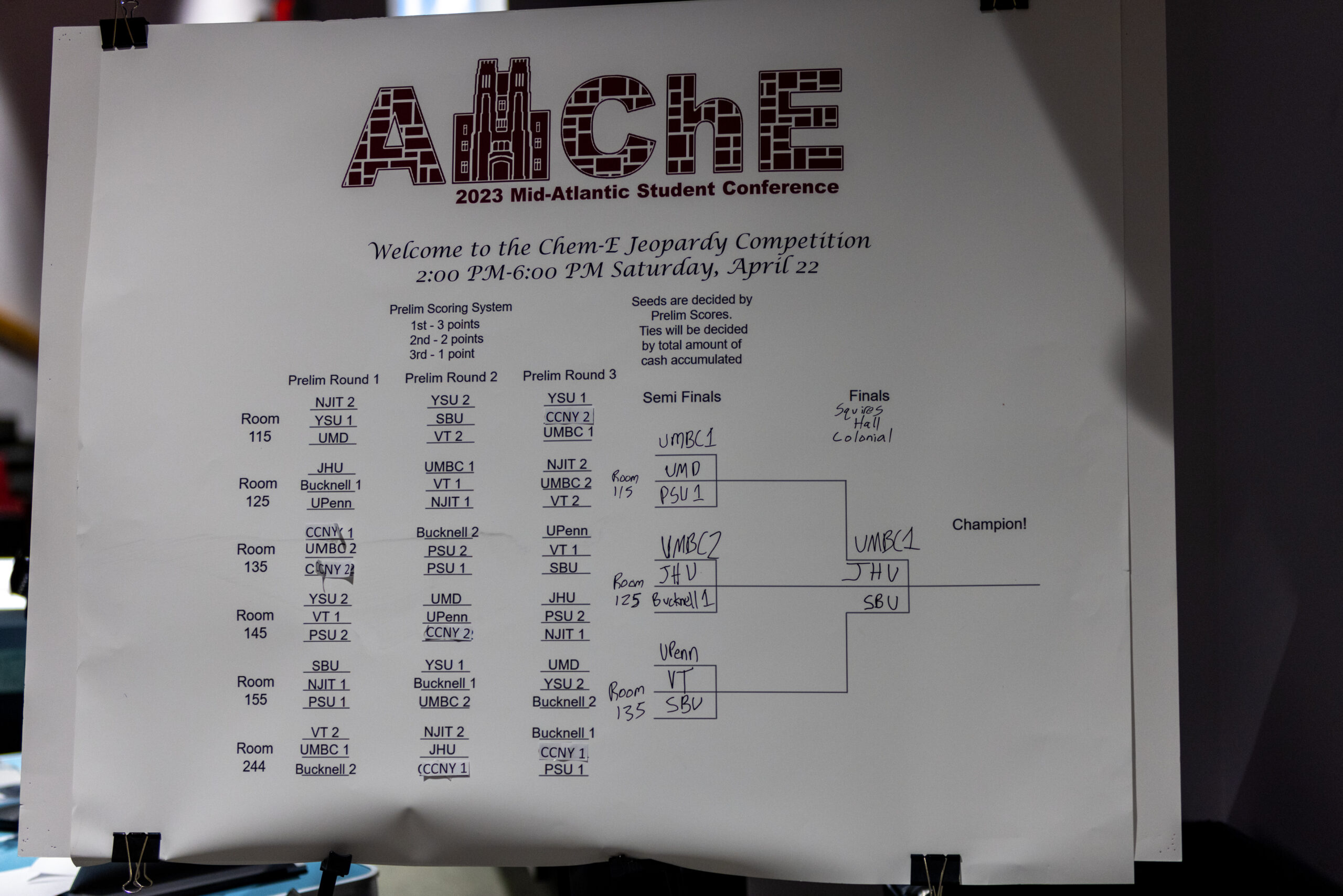
AIChE Conference Chem-E Jeopardy Competition Bracket
UMBC teams placed 1st and 2nd in the Semi Finals round, tied at 9 points.
]]>
UMBC chemical engineering students win first place in the 2023 Mid-Atlantic Regional AIChE ChemE Jeopardy Competition. Thus, qualifying for the 2023 National AIChE ChemE Jeopardy Competition in...
https://beta.my.umbc.edu/api/v0/pixel/news/132968/guest@my.umbc.edu/b383b0d62af4910bf3fa3b38d89da732/api/pixel
castellanos
faculty
jeopardy
raikar
ug
ugrad
Chemical, Biochemical and Environmental Engineering
https://beta.my.umbc.edu/groups/cbee
https://assets4-beta.my.umbc.edu/system/shared/avatars/groups/000/000/771/b5e579e81b2e3624611890fa3ca2716a/xsmall.png?1746794587
https://assets2-beta.my.umbc.edu/system/shared/avatars/groups/000/000/771/b5e579e81b2e3624611890fa3ca2716a/original.png?1746794587
https://assets1-beta.my.umbc.edu/system/shared/avatars/groups/000/000/771/b5e579e81b2e3624611890fa3ca2716a/xxlarge.png?1746794587
https://assets2-beta.my.umbc.edu/system/shared/avatars/groups/000/000/771/b5e579e81b2e3624611890fa3ca2716a/xlarge.png?1746794587
https://assets2-beta.my.umbc.edu/system/shared/avatars/groups/000/000/771/b5e579e81b2e3624611890fa3ca2716a/large.png?1746794587
https://assets4-beta.my.umbc.edu/system/shared/avatars/groups/000/000/771/b5e579e81b2e3624611890fa3ca2716a/medium.png?1746794587
https://assets1-beta.my.umbc.edu/system/shared/avatars/groups/000/000/771/b5e579e81b2e3624611890fa3ca2716a/small.png?1746794587
https://assets4-beta.my.umbc.edu/system/shared/avatars/groups/000/000/771/b5e579e81b2e3624611890fa3ca2716a/xsmall.png?1746794587
https://assets1-beta.my.umbc.edu/system/shared/avatars/groups/000/000/771/b5e579e81b2e3624611890fa3ca2716a/xxsmall.png?1746794587
Chemical, Biochemical and Environmental Engineering
https://assets1-beta.my.umbc.edu/system/shared/thumbnails/news/000/132/968/0776e7de98944c15b7a6b61fe85e0199/xxlarge.jpg?1682511687
https://assets3-beta.my.umbc.edu/system/shared/thumbnails/news/000/132/968/0776e7de98944c15b7a6b61fe85e0199/xlarge.jpg?1682511687
https://assets1-beta.my.umbc.edu/system/shared/thumbnails/news/000/132/968/0776e7de98944c15b7a6b61fe85e0199/large.jpg?1682511687
https://assets4-beta.my.umbc.edu/system/shared/thumbnails/news/000/132/968/0776e7de98944c15b7a6b61fe85e0199/medium.jpg?1682511687
https://assets4-beta.my.umbc.edu/system/shared/thumbnails/news/000/132/968/0776e7de98944c15b7a6b61fe85e0199/small.jpg?1682511687
https://assets1-beta.my.umbc.edu/system/shared/thumbnails/news/000/132/968/0776e7de98944c15b7a6b61fe85e0199/xsmall.jpg?1682511687
https://assets3-beta.my.umbc.edu/system/shared/thumbnails/news/000/132/968/0776e7de98944c15b7a6b61fe85e0199/xxsmall.jpg?1682511687
0
0
true
Wed, 26 Apr 2023 09:08:00 -0400
Wed, 26 Apr 2023 21:13:29 -0400
Three CBEE researchers selected as NYU First Look Fellows
Preparing diverse, talented scholars for faculty careers
On Friday, March 31, 2023, three CBEE researchers joined five other Fellows at the NYU Tandon School of Engineering to participate in the Tandon Faculty First Look Fellowship program, which aims to prepare diverse, talented scholars for faculty careers.
The three Fellows from CBEE:
- Jahir Antonio Batista Andrade, environmental engineering Ph.D. candidate, Blaney Lab
- Hui Chen, postdoctoral researcher, Blaney Lab
- Michael Fleming, environmental engineering Ph.D. candidate, Blaney Lab
The Fellows spent one day at NYU to present and receive feedback on their ongoing research, engaged with NYU faculty from a range of engineering disciplines, and participated in workshops designed to help them advance their careers.
Fellow Profiles
Jahir Antonio Batista Andrade
How did you become interested in STEM topics?
I grew up in Panama, in a family of very modest means, and while I very much wanted to learn to swim, there was no money for lessons. I decided to teach myself, in a small stream near our home. I practiced swimming, and my siblings sometimes caught fish and crayfish my mother could prepare for our dinners.
When a neighbor upstream began farming, he allowed untreated animal waste to enter the stream, so that it was no longer possible to swim in it or eat the fish from it. That sparked my interest in chemistry and environmental engineering at a young age.
Describe your academic journey and research up until now.
I earned a B.S. in Industrial Chemistry from the University of Panama thanks to a government scholarship; I was the first person in my family to graduate from college. After being out in the work world as a lab technician for a while, I started a master's degree program in Environmental Chemistry at the Federal University of Rio Grande, in Brazil. Upon my return to Panama, I applied successfully to the Fulbright Foreign program for Ph.D. study in the U.S. Thanks to that, I embarked upon a doctoral program at the University of Maryland, Baltimore County, and in July of 2023, I expect to earn my Ph.D. in Environmental Engineering.
My dissertation is titled “Identifying Wastewater Inputs to Urban Streams by Monitoring Dissolved Organic Matter Fluorescence and Contaminants of Emerging Concerns.” In lay terms what that means is taking a chemical approach to identifying pollutants. If, for example, you test spring water and it shows the same chemical signatures for things that can be found in nearby sewage water, like artificial sweeteners, hormones, or antibiotics, then we can pinpoint and mitigate those contaminants. With sewer infrastructure in the U.S. aging rapidly, that’s very important, and work like mine could even affect public policy one day.
How do you feel about participating in the Faculty First Look program?
This has been a great year for me: I started it with a new journal publication and accepted talks at American Chemical Society and Association of Environmental Engineering and Science Professors conferences; I won a 2023 Graduate Student Award from the American Chemical Society; and I was chosen to take part in Faculty First Look.
I hope to get feedback on my work from faculty members at NYU Tandon who I know are focused on water-related issues and sustainability-focused research issues. Because the program also encompasses writing help, I’d like to work on my vision statement too; I have a definite vision, and I want to get it down in a succinct and compelling way.
What are your ultimate goals?
I taught back in Panama and loved it, so ultimately I’d like to divide my time between the lab, doing socially beneficial research with practical application, and the classroom. I identify as both Latino and a member of the LGBTQ community, and I think it’s important for students from underrepresented groups to see themselves represented in their school’s faculty.
Hui Chen
How did you become interested in STEM topics?
My father ran a business that involved filtration systems, and I had always been good at science and math, so when I entered Nanjing Normal University, in my native China, I opted to study chemistry. After earning my undergraduate degree in 2016, I had to carefully consider what my next steps would be, and I decided that I wanted to come to the U.S. I’m am only child, and I knew my parents would be upset at the prospect of me living that far away, but once I was accepted to various programs, I was determined to go. As I expected, they were not fully happy about my decision to attend Stony Brook, but they eventually came around, and they’re very proud of me now. I earned my Ph.D. in Chemistry in 2021 and have since written several papers and given multiple conference presentations.
Describe your academic journey and research up until now.
I’m currently a post-doctoral research assistant at the University of Maryland, Baltimore County, where I study the possibilities of recovering nutrients from urine using a tubular membrane reactor. I’m also working on a USDA-funded project aimed at efficient nutrient recovery from animal manure using hollow-fiber ion exchange membranes.
How do you feel about participating in the Faculty First Look program?
At the University of Maryland, Baltimore County, I work in the lab run by Professor Lee Blaney, whose focus is on the intersection of fundamental and applied aspects of analytical, environmental, inorganic, organic, and toxicological chemistry. A few of us in the lab applied to Faculty First Look–unbeknowst to the others. It seemed so lucky when we all got accepted, and I know Professor Blaney feels very proud of all of us. I hope to learn more about the different stages of the job application process, from writing statements to giving a compelling job talk.
What are your ultimate goals?
I was a teaching assistant at Stony Brook, and I’ve lectured in Baltimore County, and I love that aspect of being in academia, I;ve mentored about a dozen students during my journey so far, from high school students exploring STEM to Ph.D. candidates. My ideal job would encompass teaching, mentoring, and research.
Michael Fleming
How did you become interested in STEM topics?
I had always loved math and science, and while I was a bit fuzzy about engineering as a field, I hit upon the idea that electrical engineering would allow me to have a computer on my desk, which I had always wanted. When I got to Howard University, I realized that any engineering discipline would allow me to work on a computer every day, and thanks to a mentor, Professor Taft Broome, I made the switch to civil engineering. I decided to focus on issues related to access to clean water – a topic that would enable me to lead a purposeful life.
Describe your academic journey and research up until now.
After earning a B.S. from Howard in 1998, I considered teaching, but my mother, who was a teacher, convinced me that it wasn’t for me. I took a job at the U.S, Patent and Trademark Office as a patent examiner before returning back to my native South Carolina. My mother was ill at that time, and I wanted to be closer to home, so I took on engineering posts at the state’s Department of Transportation, where I worked on bridge design since there were no environmental engineering jobs available at the time. I subsequently moved on to the Department of Labor, Licensing, and Regulation and the Department of Health and Environmental Control, but I ultimately decided to return to school.
In 2014 I earned a master’s in paralegal studies from George Washington University, and the following year I received my master’s in environmental engineering from Johns Hopkins. I expect to earn my Ph.D. this year from the University of Maryland, Baltimore County, where I won a Meyerhoff fellowship, aimed at promoting cultural diversity in STEM fields at the graduate level; I also sit on the Meyerhoff advisory board.
I’m working with Professor Lee Blaney on sustainably recovering ammonium from agricultural and municipal wastes by using a technique called Donnan dialysis. Ammonium is a form of nitrogen that can be used in fertilizer if treated. The issue is that ammonia production is a very intensive process that currently takes a full 1 percent of the world’s energy resources because it requires heat of 400 degrees Celsius and a great deal of pressure. If you can get it from waste sources and use Donnan dialysis, a technique involving a semipermeable member and a concentrated salt solution that was developed back in the 1920s, the process would be much more sustainable. Although Donnan dialysis has previously been used for ammonium recovery from wastewater, we have modified Donnan dialysis in a manner than has never been used before for agricultural waste.
How do you feel about participating in the Faculty First Look program?
I think the program will provide me with a window into NYU culture and help me understand how I can meet what’s expected of faculty members. I’m a relatively nontraditional student, because I’m married with three children and also already hold a professional engineer (PE) license, so this is a totally new endeavor for me.
What are your ultimate goals?
My ultimate goals are becoming a tenure-track faculty member and providing access to clean water. I want the research I conduct to be actionable and applicable to the engineering “Grand Challenges” that have long been important to me: clean water for all and the management of the nitrogen cycle. I also want to remain in academia because mentoring underrepresented students is highly important to me.