IN THE NEWS: Low-Cost Technology Cleans Up Environment
NIEHS highlights impacts of research on public health
Low-Cost Technology Cleans Up Contaminated Sites
An innovative technology, developed with funding from the NIEHS Superfund Research Program (SRP), can deliver amendments that immobilize and degrade polychlorinated biphenyls (PCBs) in aquatic environments. The technology has proven effective in the field and resulted in millions of dollars in estimated cost savings at cleanup sites.
The Problem:
PCBs are a large and complex group of chemicals that were used in insulation, coolants, and electrical equipment. Although commercial production of PCBs was banned in the United States in 1979, they persist in the environment because of their stable chemical structure. PCBs can also accumulate in the aquatic food web, where they can pose a threat to human health.
SRP Solutions:
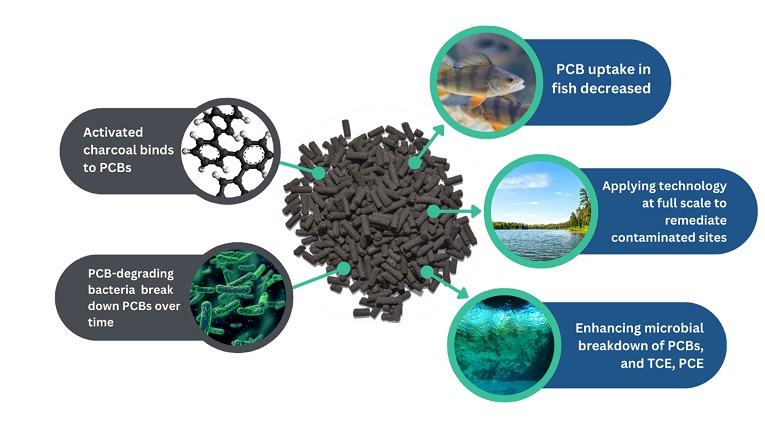
SediMite, developed by Upal Ghosh, Ph.D., of the University of Maryland, Baltimore County, and collaborators, uses activated carbon in the form of specialized pellets to bind to PCBs and reduce their bioavailability, or uptake by fish and other aquatic organisms. The technology can also be combined with microbes that break down PCBs, reducing their toxicity.
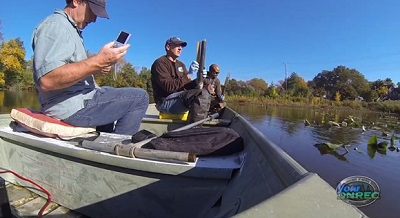 Ghosh, right, and colleagues collect sediment samples to measure PCBs. (Image from the DNRECYouTube videohighlighting the work at the Christina River)
Documenting Effectiveness in the Field
- The approach reduces PCBs in sediment porewater and surface water in the field
- The technology lowers PCB levels measured in lake fish
Ghosh and his team collaborated with the Delaware Department of Natural Resources and Environmental Control (DNREC) to use the technology at Mirror Lake. They demonstrated that between 2013 and 2018, PCB concentrations in sediment porewater decreased by about 80% after applying SediMite. They also measured a 70% reduction in PCB levels in the lake’s fish.
Their success has important implications for human health because PCB contamination is the primary reason that fish consumption advisories are issued by DNREC and the Delaware Division of Public Health.
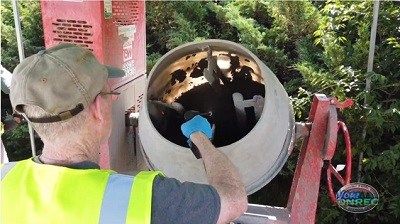 Sowers sprays PCB-degrading microorganisms onto activated carbon pellets to clean up PCBs and keep them from contaminating the Christina River. (Image from the DNREC YouTube video highlighting the work at the Christina River)
Building on this achievement, DNREC used an enhanced version of the SediMite technology in a new project to reduce PBCs in the Christina River. Ghosh and colleague Kevin Sowers, Ph.D., combined the activated carbon with microorganisms that can break down PCBs to both immobilize PCBs in the sediment and degrade them over time. After five months, SediMite enhanced with PCB-degrading microbes reduced the amount of PCBs in the sediment by approximately 25%. PCB concentrations decreased by around 35% in the surface water and 64% in sediment porewater.
Videos developed by DNREC depict the successes at Mirror Lake and the Christina River projects.
Building the Foundation
- Activated carbon reduces PCB bioavailability in the lab
- The technology offers significant cost savings compared to other clean-up methods
The technology builds on years of research by Ghosh and colleagues. SediMite was initially developed in part with SRP funding in an early project focused on optimizing the delivery method to apply activated carbon pellets to contaminated sites.
Ghosh had previously collaborated with Richard Luthy, Ph.D., an SRP grant recipient at Stanford University, to develop the novel concept of amending sediments with sorbents to reduce pollutant bioavailability. Their initial studies resulted in a method, patented in 2006, to stabilize persistent organic contaminants using carbon as sorbents and laid much of the groundwork for identifying potential barriers and future research needs to make the technology a viable reality, including the need for efficient methods to deliver the sorbents to sediment.
Ghosh then collaborated with Charlie Menzie, Ph.D., to develop SediMite to efficiently deliver amendments to sediments through a U.S. EPA Small Business Innovation Research program grant. Initial tests demonstrated that it was a feasible technology for use in the field. With SRP funding, the researchers scaled up their method to deliver activated carbon pellets from the lab to the field and patented SediMite in 2010.
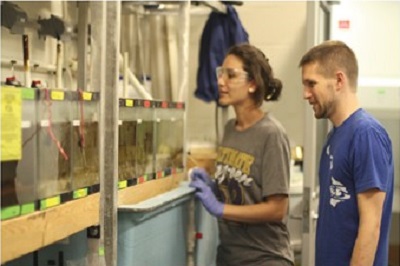 SRP trainees in Ghosh's lab measure PCB levels in water and fish during early lab experiments with activated carbon. (Photo courtesy of Upal Ghosh)
Ghosh continued his research in a second SRP-funded project aimed at evaluating whether fish uptake less PCBs after remediation with activated carbon. The team used lab studies and modeling approaches to demonstrate that fish can reduced their PCB uptake by as much as 87% after 90 days of treatment with activated carbon.
They also showed that SediMite decreased the assimilation efficiency of PCBs by up to 93%. Assimilation efficiency measures the amount of the contaminant that remains in the body compared to the amount that is excreted. This early work by the scientists included scaling up their remediation work to the field study at Mirror Lake.
The technology was implemented in full-scale to remediate a five-acre lake in Dover, Delaware in 2013. It was also selected as a component of the cleanup strategy for a contaminated sediment site in Middle River, Maryland, where the approach was estimated to cost approximately $22 million less than traditional methods, such as dredging and hauling.
Optimizing for Use at Scale
- Scaling up bacteria growth, dispersal, and deployment.
- Demonstrating effectiveness in the field.
- Collaborating in full-scale remediation projects.
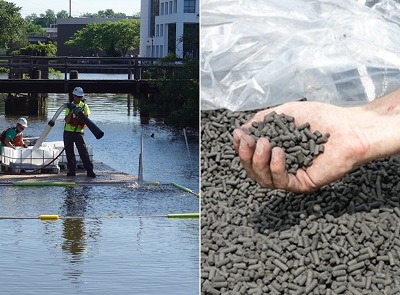 The activated carbon pellets can easily deliver microorganisms across large areas of contaminated sediment to both sequester and degrade PCBs. (Photos courtesy of RemBac)
While developing and patenting SediMite, the researchers identified some limitations to large-scale application of the technology. To address these limitations, Ghosh and Sowers, in collaboration with environmental scientist Bennett Amos, founded RemBac Environmental to enhance the SediMite carbon pellets with PCB-degrading microorganisms. Rembac was funded in 2020 through an SRP small business grant.
In the first phase of their project, they tested methods to optimize growing and storing large volumes of PCB-degrading organisms over time. They also developed and tested methods to apply the microbes more uniformly and cost-effectively to high volumes of activated carbon pellets, enabling them to scale up their technology to broader commercial use.
In the second phase of their project, the team plans to field test the effectiveness and utility of their technology at the New Bedford Harbor Superfund site. They hope their findings will inform regulators and other stakeholders as different PCB clean-up strategies are considered.
In 2022, the Elizabeth River Project started using SediMite to remediate Paradise Creek, a 14-acre tributary to the Elizabeth River in Virginia that is contaminated with PCBs. Another full-scale project, led by EPA, is using SediMite to remove dioxin from sediments in the Scanlon Reservoir in Minnesota.
SRP Funding Creates Synergy
The successful field trial at the Christina River and the newer SRP-funded projects represent a synergy between Ghosh’s development of SediMite and Sower’s early SRP-funded work that demonstrated that using specific microorganisms and conditions to stimulate them resulted in 80% of PCBs being degraded in Superfund sediments under realistic conditions.
New Directions
In 2021, Ghosh and team were awarded a four-year SRP grant to develop carbon-based sorbent materials to enhance the ability of bacteria to break down PCBs in sediments and mixtures of tetrachloroethylene (PCE) and trichloroethylene (TCE) in groundwater. PCE and TCE are chemicals often used in manufacturing and are the most frequently detected volatile organic chemicals in groundwater.
By understanding the interaction between surface chemistry and microbial degradation, the team expects to develop new technologies to remediate PCBs, PCE, TCE, and other chlorinated contaminants often found in the environment.
link to full article:
https://www.niehs.nih.gov/research/supported/centers/srp/phi/archives/remediation/sedimite
]]>
Excerpt from February 2024 - National Institute of Health (NIH), National Institute of Environmental Health Science (NIEHS) Superfund Research Program, Public Health Impact Story Low-Cost...
https://beta.my.umbc.edu/api/v0/pixel/news/138951/guest@my.umbc.edu/7bba21e8254f99b1175cc1ca6219698e/api/pixel
ghosh
research
spring-2024
Chemical, Biochemical and Environmental Engineering
https://beta.my.umbc.edu/groups/cbee
https://assets4-beta.my.umbc.edu/system/shared/avatars/groups/000/000/771/b5e579e81b2e3624611890fa3ca2716a/xsmall.png?1746794587
https://assets2-beta.my.umbc.edu/system/shared/avatars/groups/000/000/771/b5e579e81b2e3624611890fa3ca2716a/original.png?1746794587
https://assets1-beta.my.umbc.edu/system/shared/avatars/groups/000/000/771/b5e579e81b2e3624611890fa3ca2716a/xxlarge.png?1746794587
https://assets2-beta.my.umbc.edu/system/shared/avatars/groups/000/000/771/b5e579e81b2e3624611890fa3ca2716a/xlarge.png?1746794587
https://assets2-beta.my.umbc.edu/system/shared/avatars/groups/000/000/771/b5e579e81b2e3624611890fa3ca2716a/large.png?1746794587
https://assets4-beta.my.umbc.edu/system/shared/avatars/groups/000/000/771/b5e579e81b2e3624611890fa3ca2716a/medium.png?1746794587
https://assets1-beta.my.umbc.edu/system/shared/avatars/groups/000/000/771/b5e579e81b2e3624611890fa3ca2716a/small.png?1746794587
https://assets4-beta.my.umbc.edu/system/shared/avatars/groups/000/000/771/b5e579e81b2e3624611890fa3ca2716a/xsmall.png?1746794587
https://assets1-beta.my.umbc.edu/system/shared/avatars/groups/000/000/771/b5e579e81b2e3624611890fa3ca2716a/xxsmall.png?1746794587
Chemical, Biochemical and Environmental Engineering
https://assets4-beta.my.umbc.edu/system/shared/thumbnails/news/000/138/951/a0e85fc0f0bf840f0c5ba49e650339f9/xxlarge.jpg?1707841196
https://assets4-beta.my.umbc.edu/system/shared/thumbnails/news/000/138/951/a0e85fc0f0bf840f0c5ba49e650339f9/xlarge.jpg?1707841196
https://assets3-beta.my.umbc.edu/system/shared/thumbnails/news/000/138/951/a0e85fc0f0bf840f0c5ba49e650339f9/large.jpg?1707841196
https://assets3-beta.my.umbc.edu/system/shared/thumbnails/news/000/138/951/a0e85fc0f0bf840f0c5ba49e650339f9/medium.jpg?1707841196
https://assets3-beta.my.umbc.edu/system/shared/thumbnails/news/000/138/951/a0e85fc0f0bf840f0c5ba49e650339f9/small.jpg?1707841196
https://assets3-beta.my.umbc.edu/system/shared/thumbnails/news/000/138/951/a0e85fc0f0bf840f0c5ba49e650339f9/xsmall.jpg?1707841196
https://assets2-beta.my.umbc.edu/system/shared/thumbnails/news/000/138/951/a0e85fc0f0bf840f0c5ba49e650339f9/xxsmall.jpg?1707841196
1
0
true
Tue, 13 Feb 2024 10:57:30 -0500
Tue, 13 Feb 2024 11:20:07 -0500
Undergraduate Research: Hennigan Lab
‘25 Chemical Engineering-Environmental & Sustainability
Benjamin Welling - '25 Chemical Engineering - Environmental Engineering & Sustainability Track
When did you do your Research?
Summer 2023
Where was your Research?
Hennigan Lab
What is the focus of your Research?
Developing new methods to measure atmospheric gas-phase ammonia
What are you looking forward to the most about your Research?
I am excited to deploy the instrumentation that we have been working on to collect data. It will be satisfying to see real tangible results come from something that I have worked on with other students!
What was the best part of your Research OR What was the biggest learning moment of your Research ?
The best part of my research is the people I work with, everybody in the lab is excited to be here and work on their respective projects.
What advice do you have for students who are interested in getting involved in research or an internship?
Search for faculty and read about their research through their website or their department website. Then send an email to a professor who does research that speaks to you and/or aligns with your career goals.
Are you a member of any clubs/campus organizations?
AIChE ChemE Car Team Lead
What are your goals after graduation?
Industry or M.S. in Chemical Engineering
Learn more about Benjamin Welling:
https://www.linkedin.com/in/ben-welling-352602248/
]]>
Benjamin Welling - '25 Chemical Engineering - Environmental Engineering & Sustainability Track When did you do your Research? Summer 2023 Where was your Research? Hennigan Lab What...
https://beta.my.umbc.edu/api/v0/pixel/news/138334/guest@my.umbc.edu/a3d0767c6b704d657e4ad9a5596cf8fc/api/pixel
internship
research
student-highlight
summer-2023
ug
ugrad
Chemical, Biochemical and Environmental Engineering
https://beta.my.umbc.edu/groups/cbee
https://assets4-beta.my.umbc.edu/system/shared/avatars/groups/000/000/771/b5e579e81b2e3624611890fa3ca2716a/xsmall.png?1746794587
https://assets2-beta.my.umbc.edu/system/shared/avatars/groups/000/000/771/b5e579e81b2e3624611890fa3ca2716a/original.png?1746794587
https://assets1-beta.my.umbc.edu/system/shared/avatars/groups/000/000/771/b5e579e81b2e3624611890fa3ca2716a/xxlarge.png?1746794587
https://assets2-beta.my.umbc.edu/system/shared/avatars/groups/000/000/771/b5e579e81b2e3624611890fa3ca2716a/xlarge.png?1746794587
https://assets2-beta.my.umbc.edu/system/shared/avatars/groups/000/000/771/b5e579e81b2e3624611890fa3ca2716a/large.png?1746794587
https://assets4-beta.my.umbc.edu/system/shared/avatars/groups/000/000/771/b5e579e81b2e3624611890fa3ca2716a/medium.png?1746794587
https://assets1-beta.my.umbc.edu/system/shared/avatars/groups/000/000/771/b5e579e81b2e3624611890fa3ca2716a/small.png?1746794587
https://assets4-beta.my.umbc.edu/system/shared/avatars/groups/000/000/771/b5e579e81b2e3624611890fa3ca2716a/xsmall.png?1746794587
https://assets1-beta.my.umbc.edu/system/shared/avatars/groups/000/000/771/b5e579e81b2e3624611890fa3ca2716a/xxsmall.png?1746794587
Chemical, Biochemical and Environmental Engineering
https://assets2-beta.my.umbc.edu/system/shared/thumbnails/news/000/138/334/6fa9ec36c7f7ccdaab932967f8caee1f/xxlarge.jpg?1705953617
https://assets4-beta.my.umbc.edu/system/shared/thumbnails/news/000/138/334/6fa9ec36c7f7ccdaab932967f8caee1f/xlarge.jpg?1705953617
https://assets4-beta.my.umbc.edu/system/shared/thumbnails/news/000/138/334/6fa9ec36c7f7ccdaab932967f8caee1f/large.jpg?1705953617
https://assets1-beta.my.umbc.edu/system/shared/thumbnails/news/000/138/334/6fa9ec36c7f7ccdaab932967f8caee1f/medium.jpg?1705953617
https://assets1-beta.my.umbc.edu/system/shared/thumbnails/news/000/138/334/6fa9ec36c7f7ccdaab932967f8caee1f/small.jpg?1705953617
https://assets4-beta.my.umbc.edu/system/shared/thumbnails/news/000/138/334/6fa9ec36c7f7ccdaab932967f8caee1f/xsmall.jpg?1705953617
https://assets4-beta.my.umbc.edu/system/shared/thumbnails/news/000/138/334/6fa9ec36c7f7ccdaab932967f8caee1f/xxsmall.jpg?1705953617
0
0
true
Mon, 22 Jan 2024 15:02:56 -0500
Wed, 10 Sep 2025 11:52:01 -0400
Applications Open: BEMORE REU Summer 2024
We are now accepting applications for the third cohort of the BEMORE REU program at UMBC.
Application Deadline:
For best consideration, please submit your applications by March 1, 2024.
The BEMORE REU program prepares students to address knowledge gaps, develop new technologies, and bring unique perspectives to complex problems in biochemical and environmental engineering and science.
Students that join the BEMORE REU Site will gain the interdisciplinary knowledge, skills, and training to address a variety of grand challenges.
Research Topics:
- water pollution & treatment
- sustainable plastic replacements
- smart polymers
- urban air quality
- novel biomaterials
- sustainable batteries and more.
Additional details are available at https://bemore.umbc.edu/
Program details:
- June 3, 2024 to August 9, 2024
- $6000 stipend, travel allowance, and free on-campus housing
- Access to state-of-the-art laboratories
- Work with a diverse team of faculty and other students
- Learn about current issues in biochemical and environmental engineering and science
- Enjoy field trips, group activities, and our awards banquet
Eligibility:
- All majors are welcome to apply
- Current student at a two- or four-year college or university
- US citizen or permanent resident
]]>
We are now accepting applications for the third cohort of the BEMORE REU program at UMBC. Application Deadline: For best consideration, please submit your applications by March 1, 2024....
https://beta.my.umbc.edu/api/v0/pixel/news/138171/guest@my.umbc.edu/3223e9900b7870457f1197f33210e6c8/api/pixel
almodovar
bemorereu
blaney
capraz
hennigan
spring-2024
ug
ugrad
Chemical, Biochemical and Environmental Engineering
https://beta.my.umbc.edu/groups/cbee
https://assets4-beta.my.umbc.edu/system/shared/avatars/groups/000/000/771/b5e579e81b2e3624611890fa3ca2716a/xsmall.png?1746794587
https://assets2-beta.my.umbc.edu/system/shared/avatars/groups/000/000/771/b5e579e81b2e3624611890fa3ca2716a/original.png?1746794587
https://assets1-beta.my.umbc.edu/system/shared/avatars/groups/000/000/771/b5e579e81b2e3624611890fa3ca2716a/xxlarge.png?1746794587
https://assets2-beta.my.umbc.edu/system/shared/avatars/groups/000/000/771/b5e579e81b2e3624611890fa3ca2716a/xlarge.png?1746794587
https://assets2-beta.my.umbc.edu/system/shared/avatars/groups/000/000/771/b5e579e81b2e3624611890fa3ca2716a/large.png?1746794587
https://assets4-beta.my.umbc.edu/system/shared/avatars/groups/000/000/771/b5e579e81b2e3624611890fa3ca2716a/medium.png?1746794587
https://assets1-beta.my.umbc.edu/system/shared/avatars/groups/000/000/771/b5e579e81b2e3624611890fa3ca2716a/small.png?1746794587
https://assets4-beta.my.umbc.edu/system/shared/avatars/groups/000/000/771/b5e579e81b2e3624611890fa3ca2716a/xsmall.png?1746794587
https://assets1-beta.my.umbc.edu/system/shared/avatars/groups/000/000/771/b5e579e81b2e3624611890fa3ca2716a/xxsmall.png?1746794587
Chemical, Biochemical and Environmental Engineering
https://assets3-beta.my.umbc.edu/system/shared/thumbnails/news/000/138/171/d978d6890a8046cfff4760d5b472b789/xxlarge.jpg?1705092013
https://assets4-beta.my.umbc.edu/system/shared/thumbnails/news/000/138/171/d978d6890a8046cfff4760d5b472b789/xlarge.jpg?1705092013
https://assets2-beta.my.umbc.edu/system/shared/thumbnails/news/000/138/171/d978d6890a8046cfff4760d5b472b789/large.jpg?1705092013
https://assets1-beta.my.umbc.edu/system/shared/thumbnails/news/000/138/171/d978d6890a8046cfff4760d5b472b789/medium.jpg?1705092013
https://assets1-beta.my.umbc.edu/system/shared/thumbnails/news/000/138/171/d978d6890a8046cfff4760d5b472b789/small.jpg?1705092013
https://assets3-beta.my.umbc.edu/system/shared/thumbnails/news/000/138/171/d978d6890a8046cfff4760d5b472b789/xsmall.jpg?1705092013
https://assets4-beta.my.umbc.edu/system/shared/thumbnails/news/000/138/171/d978d6890a8046cfff4760d5b472b789/xxsmall.jpg?1705092013
0
0
true
Fri, 12 Jan 2024 15:43:50 -0500
Undergraduate Internship: USALCO
‘24 Chemical Engineering-Biotechnology &Bioengineering
Paul Loberg, '24 Chemical Engineering - Biotechnology & Bioengineering Track
When did you do your Internship?
Summer 2023 and Winter 2023-2024
Where was your Internship?
USALCO in Baltimore, Maryland
What is the focus of your Internship?
The focus of my internship was to develop an economical way to produce dry aluminum chloralhydrate. I am helping design and conduct experiments which would be used to advance the current R&D project through the pilot phase to a scaled up industrial version. I also did lab work to prepare and test the samples we collected from the experiments.
What are you looking forward to the most about your Internship?
I am looking forward to returning in the winter and seeing how the project has progressed and working on it further.
What was the best part of your Internship?
The best part of my internship was the level of autonomy I was given, as an intern, by my bosses and co-workers. We had a voice during all discussions, we could make designs and sketches independently, and give our personal feedback on the project and the direction we thought it should move.
What advice do you have for students who are interested in getting involved in research or an internship?
My advice would be, even if it's late in the spring and you haven't managed to find an internship, keep applying to postings you want. I got the text for an interview during finals week while I was taking my last exam. Definitely start applying earlier if you can but don't let rejections or a lack of responses stop you.
Are you a member of any clubs/campus organizations?
I am the Treasurer of UMBC's student chapter of AIChE as well as a member of the Chemical Engineering Jeopardy team. I play basketball for the intramural CBEE team formed by ChemE students.
What are your goals after graduation?
I want to do R&D or process engineering full time.
]]>
Paul Loberg, '24 Chemical Engineering - Biotechnology & Bioengineering Track When did you do your Internship? Summer 2023 and Winter 2023-2024 Where was your Internship? USALCO in...
https://beta.my.umbc.edu/api/v0/pixel/news/138166/guest@my.umbc.edu/8d3dc078b14ff1f27ababb030955c88c/api/pixel
internship
research
student-highlight
summer-2023
ug
ugrad
Chemical, Biochemical and Environmental Engineering
https://beta.my.umbc.edu/groups/cbee
https://assets4-beta.my.umbc.edu/system/shared/avatars/groups/000/000/771/b5e579e81b2e3624611890fa3ca2716a/xsmall.png?1746794587
https://assets2-beta.my.umbc.edu/system/shared/avatars/groups/000/000/771/b5e579e81b2e3624611890fa3ca2716a/original.png?1746794587
https://assets1-beta.my.umbc.edu/system/shared/avatars/groups/000/000/771/b5e579e81b2e3624611890fa3ca2716a/xxlarge.png?1746794587
https://assets2-beta.my.umbc.edu/system/shared/avatars/groups/000/000/771/b5e579e81b2e3624611890fa3ca2716a/xlarge.png?1746794587
https://assets2-beta.my.umbc.edu/system/shared/avatars/groups/000/000/771/b5e579e81b2e3624611890fa3ca2716a/large.png?1746794587
https://assets4-beta.my.umbc.edu/system/shared/avatars/groups/000/000/771/b5e579e81b2e3624611890fa3ca2716a/medium.png?1746794587
https://assets1-beta.my.umbc.edu/system/shared/avatars/groups/000/000/771/b5e579e81b2e3624611890fa3ca2716a/small.png?1746794587
https://assets4-beta.my.umbc.edu/system/shared/avatars/groups/000/000/771/b5e579e81b2e3624611890fa3ca2716a/xsmall.png?1746794587
https://assets1-beta.my.umbc.edu/system/shared/avatars/groups/000/000/771/b5e579e81b2e3624611890fa3ca2716a/xxsmall.png?1746794587
Chemical, Biochemical and Environmental Engineering
https://assets3-beta.my.umbc.edu/system/shared/thumbnails/news/000/138/166/c876ea272ac4059855c8f1f3b6d58834/xxlarge.jpg?1705076442
https://assets4-beta.my.umbc.edu/system/shared/thumbnails/news/000/138/166/c876ea272ac4059855c8f1f3b6d58834/xlarge.jpg?1705076442
https://assets4-beta.my.umbc.edu/system/shared/thumbnails/news/000/138/166/c876ea272ac4059855c8f1f3b6d58834/large.jpg?1705076442
https://assets1-beta.my.umbc.edu/system/shared/thumbnails/news/000/138/166/c876ea272ac4059855c8f1f3b6d58834/medium.jpg?1705076442
https://assets4-beta.my.umbc.edu/system/shared/thumbnails/news/000/138/166/c876ea272ac4059855c8f1f3b6d58834/small.jpg?1705076442
https://assets3-beta.my.umbc.edu/system/shared/thumbnails/news/000/138/166/c876ea272ac4059855c8f1f3b6d58834/xsmall.jpg?1705076442
https://assets1-beta.my.umbc.edu/system/shared/thumbnails/news/000/138/166/c876ea272ac4059855c8f1f3b6d58834/xxsmall.jpg?1705076442
0
0
true
Fri, 12 Jan 2024 11:23:11 -0500
Wed, 10 Sep 2025 11:52:13 -0400
Undergraduate Internship: Blaney Lab, UMBC
Yoonjin Cho, ‘24 Chemical Engineering
Yoonjin Cho,
‘24 chemical engineering at Chung-Ang University, South Korea
When did you do your Internship?
Summer 2023
Where was your Internship?
Blaney Lab, UMBC
What is the focus of your Internship?
We are working to develop sampling methods for certain PFAS compounds. This is necessary as governments and regulatory agencies are actively evaluating and implementing measures to restrict the use of certain PFAS compounds and set acceptable exposure limits.
Specifically, I am working on the following projects:
-Detection of per- and polyfluoroalkyl substances (PFAS) in wastewater, and biosolids samples.
-Researching the impact of solution pH, temperature, and salt concentration on KPFAS Cl using membranes for passive sampler
What are you looking forward to the most about your Internship?
I look forward to improving my ability to read papers effectively and efficiently, as well as gaining practical experience in a laboratory setting and enhancing my data analysis skills.
What was the best part of your Internship OR What was the biggest learning moment of your Internship ?
I gave a presentation about the calibration curve and internal standard during a group meeting. At first, it was challenging to understand the concept, but through the process of looking things up in English and asking questions to team mates, it became fulfilling. Additionally, presenting in front of my colleagues in the lab pushed me out of my comfort zone.
What advice do you have for students who are interested in getting involved in research or an internship?
Use diverse sources, including not only academic papers but also platforms like YouTube and blogs, to gain an understanding of the topic you're interested in.
Take your time looking for fields you would like but don't hesitate to take action!
Are you a member of any clubs/campus organizations?
University of Maryland-Baltimore County(exchange student)
Chung-Ang University, Korea(senior majoring in chemical engineering)
What are your goals after graduation?
Pursuing master's degree
]]>
Yoonjin Cho, ‘24 chemical engineering at Chung-Ang University, South Korea When did you do your Internship? Summer 2023 Where was your Internship? Blaney Lab, UMBC What is the focus...
https://beta.my.umbc.edu/api/v0/pixel/news/138164/guest@my.umbc.edu/e7cc782a172084b05f87c76df4dce31e/api/pixel
internship
research
student-highlight
summer-2023
ug
ugrad
Chemical, Biochemical and Environmental Engineering
https://beta.my.umbc.edu/groups/cbee
https://assets4-beta.my.umbc.edu/system/shared/avatars/groups/000/000/771/b5e579e81b2e3624611890fa3ca2716a/xsmall.png?1746794587
https://assets2-beta.my.umbc.edu/system/shared/avatars/groups/000/000/771/b5e579e81b2e3624611890fa3ca2716a/original.png?1746794587
https://assets1-beta.my.umbc.edu/system/shared/avatars/groups/000/000/771/b5e579e81b2e3624611890fa3ca2716a/xxlarge.png?1746794587
https://assets2-beta.my.umbc.edu/system/shared/avatars/groups/000/000/771/b5e579e81b2e3624611890fa3ca2716a/xlarge.png?1746794587
https://assets2-beta.my.umbc.edu/system/shared/avatars/groups/000/000/771/b5e579e81b2e3624611890fa3ca2716a/large.png?1746794587
https://assets4-beta.my.umbc.edu/system/shared/avatars/groups/000/000/771/b5e579e81b2e3624611890fa3ca2716a/medium.png?1746794587
https://assets1-beta.my.umbc.edu/system/shared/avatars/groups/000/000/771/b5e579e81b2e3624611890fa3ca2716a/small.png?1746794587
https://assets4-beta.my.umbc.edu/system/shared/avatars/groups/000/000/771/b5e579e81b2e3624611890fa3ca2716a/xsmall.png?1746794587
https://assets1-beta.my.umbc.edu/system/shared/avatars/groups/000/000/771/b5e579e81b2e3624611890fa3ca2716a/xxsmall.png?1746794587
Chemical, Biochemical and Environmental Engineering
https://assets4-beta.my.umbc.edu/system/shared/thumbnails/news/000/138/164/329ce4112b05eb4b52ebc16090487f2e/xxlarge.jpg?1705074810
https://assets2-beta.my.umbc.edu/system/shared/thumbnails/news/000/138/164/329ce4112b05eb4b52ebc16090487f2e/xlarge.jpg?1705074810
https://assets2-beta.my.umbc.edu/system/shared/thumbnails/news/000/138/164/329ce4112b05eb4b52ebc16090487f2e/large.jpg?1705074810
https://assets4-beta.my.umbc.edu/system/shared/thumbnails/news/000/138/164/329ce4112b05eb4b52ebc16090487f2e/medium.jpg?1705074810
https://assets3-beta.my.umbc.edu/system/shared/thumbnails/news/000/138/164/329ce4112b05eb4b52ebc16090487f2e/small.jpg?1705074810
https://assets2-beta.my.umbc.edu/system/shared/thumbnails/news/000/138/164/329ce4112b05eb4b52ebc16090487f2e/xsmall.jpg?1705074810
https://assets3-beta.my.umbc.edu/system/shared/thumbnails/news/000/138/164/329ce4112b05eb4b52ebc16090487f2e/xxsmall.jpg?1705074810
0
0
true
Fri, 12 Jan 2024 10:56:15 -0500
Wed, 10 Sep 2025 11:52:25 -0400
Undergraduate Internship: W.R. Grace
Ethan Banks, ‘24 Chemical Engineering - Traditional Track
Ethan Banks, ‘24 Chemical Engineering - Traditional Track
When did you do your Internship?
Summer 2023
Where was your Internship?
W.R. Grace in Curtis Bay, Maryland
What is the focus of your Internship?
Correlating laboratory results to easily measured in-process variables in order to improve the efficiency of production in a specialty catalyst plant.
What are you looking forward to the most about your Internship?
Getting to learn new things in a real working environment
What was the best part of your Internship OR What was the biggest learning moment of your Internship ?
Getting to work in a manufacturing environment everyday and applying the skills learned in my classes to the real world. I really enjoyed seeing all of the unit operations and core concepts I've learned about come to life.
What advice do you have for students who are interested in getting involved in research or an internship?
Apply early and often! It can't hurt to apply to any opportunity that you may be interested in. Also, be sure to leverage your network. If you know somebody that works at a company you are interested in, don't be afraid to reach out.
Are you a member of any clubs/campus organizations?
Vice President of UMBC's student chapter of AIChE, ChemE Jeopardy Team Member, Current Teaching fellow for ENCH300, Past Teaching Fellow for ENCH225L and ENCH215, Subject Tutor for Chemical Engineering Classes at UMBC's Academic Success Center.
What are your goals after graduation?
Get a full time job in industry
Learn more about Ethan Banks:
https://www.linkedin.com/in/ethan-banks-b3622521b/
]]>
Ethan Banks, ‘24 Chemical Engineering - Traditional Track When did you do your Internship? Summer 2023 Where was your Internship? W.R. Grace in Curtis Bay, Maryland What is the focus of...
https://beta.my.umbc.edu/api/v0/pixel/news/138163/guest@my.umbc.edu/f674e3a950f78269058174c04c819d8a/api/pixel
internship
research
student-highlight
summer-2023
ug
ugrad
Chemical, Biochemical and Environmental Engineering
https://beta.my.umbc.edu/groups/cbee
https://assets4-beta.my.umbc.edu/system/shared/avatars/groups/000/000/771/b5e579e81b2e3624611890fa3ca2716a/xsmall.png?1746794587
https://assets2-beta.my.umbc.edu/system/shared/avatars/groups/000/000/771/b5e579e81b2e3624611890fa3ca2716a/original.png?1746794587
https://assets1-beta.my.umbc.edu/system/shared/avatars/groups/000/000/771/b5e579e81b2e3624611890fa3ca2716a/xxlarge.png?1746794587
https://assets2-beta.my.umbc.edu/system/shared/avatars/groups/000/000/771/b5e579e81b2e3624611890fa3ca2716a/xlarge.png?1746794587
https://assets2-beta.my.umbc.edu/system/shared/avatars/groups/000/000/771/b5e579e81b2e3624611890fa3ca2716a/large.png?1746794587
https://assets4-beta.my.umbc.edu/system/shared/avatars/groups/000/000/771/b5e579e81b2e3624611890fa3ca2716a/medium.png?1746794587
https://assets1-beta.my.umbc.edu/system/shared/avatars/groups/000/000/771/b5e579e81b2e3624611890fa3ca2716a/small.png?1746794587
https://assets4-beta.my.umbc.edu/system/shared/avatars/groups/000/000/771/b5e579e81b2e3624611890fa3ca2716a/xsmall.png?1746794587
https://assets1-beta.my.umbc.edu/system/shared/avatars/groups/000/000/771/b5e579e81b2e3624611890fa3ca2716a/xxsmall.png?1746794587
Chemical, Biochemical and Environmental Engineering
https://assets3-beta.my.umbc.edu/system/shared/thumbnails/news/000/138/163/27cbc7c573cc40a4b5f68608192437e6/xxlarge.jpg?1705072100
https://assets4-beta.my.umbc.edu/system/shared/thumbnails/news/000/138/163/27cbc7c573cc40a4b5f68608192437e6/xlarge.jpg?1705072100
https://assets4-beta.my.umbc.edu/system/shared/thumbnails/news/000/138/163/27cbc7c573cc40a4b5f68608192437e6/large.jpg?1705072100
https://assets3-beta.my.umbc.edu/system/shared/thumbnails/news/000/138/163/27cbc7c573cc40a4b5f68608192437e6/medium.jpg?1705072100
https://assets1-beta.my.umbc.edu/system/shared/thumbnails/news/000/138/163/27cbc7c573cc40a4b5f68608192437e6/small.jpg?1705072100
https://assets3-beta.my.umbc.edu/system/shared/thumbnails/news/000/138/163/27cbc7c573cc40a4b5f68608192437e6/xsmall.jpg?1705072100
https://assets3-beta.my.umbc.edu/system/shared/thumbnails/news/000/138/163/27cbc7c573cc40a4b5f68608192437e6/xxsmall.jpg?1705072100
1
0
true
Fri, 12 Jan 2024 10:09:19 -0500
Wed, 10 Sep 2025 11:52:40 -0400
New Publication: Wearable Transdermal Biosensors
Chapter in Wearable Biosensing in Medicine and Healthcare
The team at the Center for Advanced Sensor Technology, University of Maryland Baltimore County and our collaborators, are excited to share the recent publication of the book chapter titled “Wearable Transdermal Biosensors," in Springer. This chapter delves into the fascinating world of biosensors and their potential to revolutionize healthcare.
We are proud of the CAST team for their contributed to the growing body of research in this field and invite you to read our chapter at the link below.
Book Title: Wearable Biosensing in Medicine and Healthcare
Chapter Title: Wearable Transdermal Biosensors
Authors: Govind Rao, Venkatesh Srinivasan, Zach Sheffield, Preety Ahuja, Sanjeev Kumar, Xudong Ge, Ketan Dighe & Chad Sundberg
First Online: 04 January 2024
Keywords:
Wearable sensors
Biomedical diagnostics
Point-of-care
Transdermal sensors
Biosensing
About this book:
This book contains chapters on wearable biomedical sensors and their assistive technologies for promoting behavioral change in medical and health care. Part I reviews several wearable biomedical sensors based on biocompatible materials and nano and micro-electromechanical systems (MEMS) technologies in the medical and dental fields. Part II introduces the latest approaches to wearable biosensing using unique devices for various skin targets such as sweat, interstitial fluid, and transcutaneous gases. Part III presents technologies supporting wearable sensors, including soft and flexible materials, manufacturing methods, skin volatile-marker imaging, and energy harvesting devices.
This book is intended for graduate students, academic researchers, and professors that work in medical and healthcare research fields, as well as industry professionals involved in the development of wearable and flexible sensing devices and measurement systems for human bio/chemical sensing, medical monitoring, and healthcare services, and for medical professionals and government officials who are driving behavior change in health care.
Excerpt from:
Two Minority Serving Universities Advance ChemCatBio Research Priorities With New Funding
~~ Published in: January, 2024
Catalyst deactivation and slow computational research methods are recognized barriers for rapidly moving catalyst-driven bioenergy technologies from discovery to scale-up. But researchers are closer to mitigating both challenges thanks to two university-led projects in partnership with the Chemical Catalysis for Bioenergy Consortium (ChemCatBio).
The University of New Mexico and University of Maryland, Baltimore County were awarded funding from the U.S. Department of Energy Bioenergy Technologies Office and the Minority Serving Institution STEM Research & Development Consortium as part of a funding call for ChemCatBio. The funding partnership aims to reduce barriers of entry for minority serving institutions and increase bioenergy research collaboration.
According to ChemCatBio Director Josh Schaidle, the projects are part of a consortium strategy to synchronize catalyst innovation and diversity, equity, and inclusion.
"We are excited to partner with both universities and tap the unique expertise they bring to addressing catalyst deactivation and speeding catalyst discovery," he said. "These diverse institutions, people, and perspectives are essential to realizing the vision of ChemCatBio, which is the rapid decarbonization of our economy."
University of Maryland, Baltimore County - Applying a Novel Symbolic Regression To Speed Up Surface Chemistry Simulations
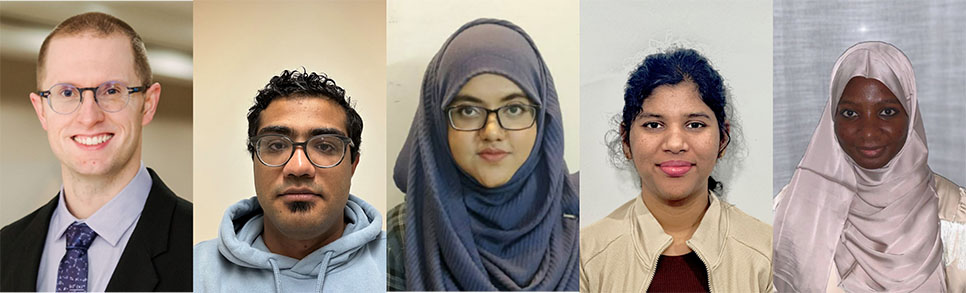
From left: Tyler Josephson, Kianoush Ramezani Shabolaghi, Samiha Sharlin, Charishma Puli, and Fariha Agbere. Photos courtesy of Tyler, Kianoush, Samiha, Charishma, and Fariha, respectively.
Collaborators:
Tyler Josephson, assistant professor
Kianoush Ramezani Shabolaghi, chemical engineering Ph.D. candidate
Samiha Sharlin, Ph.D. candidate
Charishma Puli, data science M.S. student
Fariha Agbere, chemical engineering B.S. student
ChemCatBio researchers are developing methods for upgrading biomass into a feedstock of mixed olefins, which can be upgraded into energy-dense sustainable aviation fuel using zeolite catalysts. However, questions remain on how the molecular shape of the catalyst - especially the porosity of the catalyst - affects the efficiency of those reactions.
In the past, quantum chemistry has been used to study such chemical reactions, but those methods are slow and expensive when scaled up to large systems. To speed up the rate of discovery, a team from the Department of Chemical, Biochemical, and Environmental Engineering at University of Maryland, Baltimore County are using machine learning to learn how the interactions work at the quantum chemistry scale.
"With our new methods, we aim to study larger systems and more realistic conditions," explained Tyler Josephson, the principal investigator, who was recently awarded a NSF career award. "If we can predict in the computer that this zeolite architecture works better than that zeolite architecture, that's useful information for experimentalists."
Josephson said that the project complements broader research work in the ATOMS Lab to bring machine learning and automated reasoning into chemical engineering.
UMBC chapter of National Society of Black Engineers (NSBE) shines at regional conference
By: Sarah Hansen, M.S. ' 15, | Published: December 5, 2023 | UMBC News
Members of UMBC’s chapter of the National Society of Black Engineers (NSBE) traveled to Norfolk, Virginia for their annual regional conference in November and came home with numerous awards.
The UMBC team defeated Carnegie Mellon University and North Carolina State University to win the Tech Bowl competition, a Jeopardy-style game that tests teams’ knowledge of fundamental engineering principles. UMBC also claimed first through third place in the research poster presentation contest, which involved a 10-minute technical research talk followed by questions from the judges and audience.
The team relied on prior knowledge to excel in the Tech Bowl, only having decided to participate upon arriving at the conference. “It was really exciting getting so many questions right with our only practice being from our coursework,” shares UMBC NSBE chapter president Nelanne Bolima ’24, chemical engineering. “That just goes to show how well UMBC’s College of Engineering and IT prepares students to succeed.”
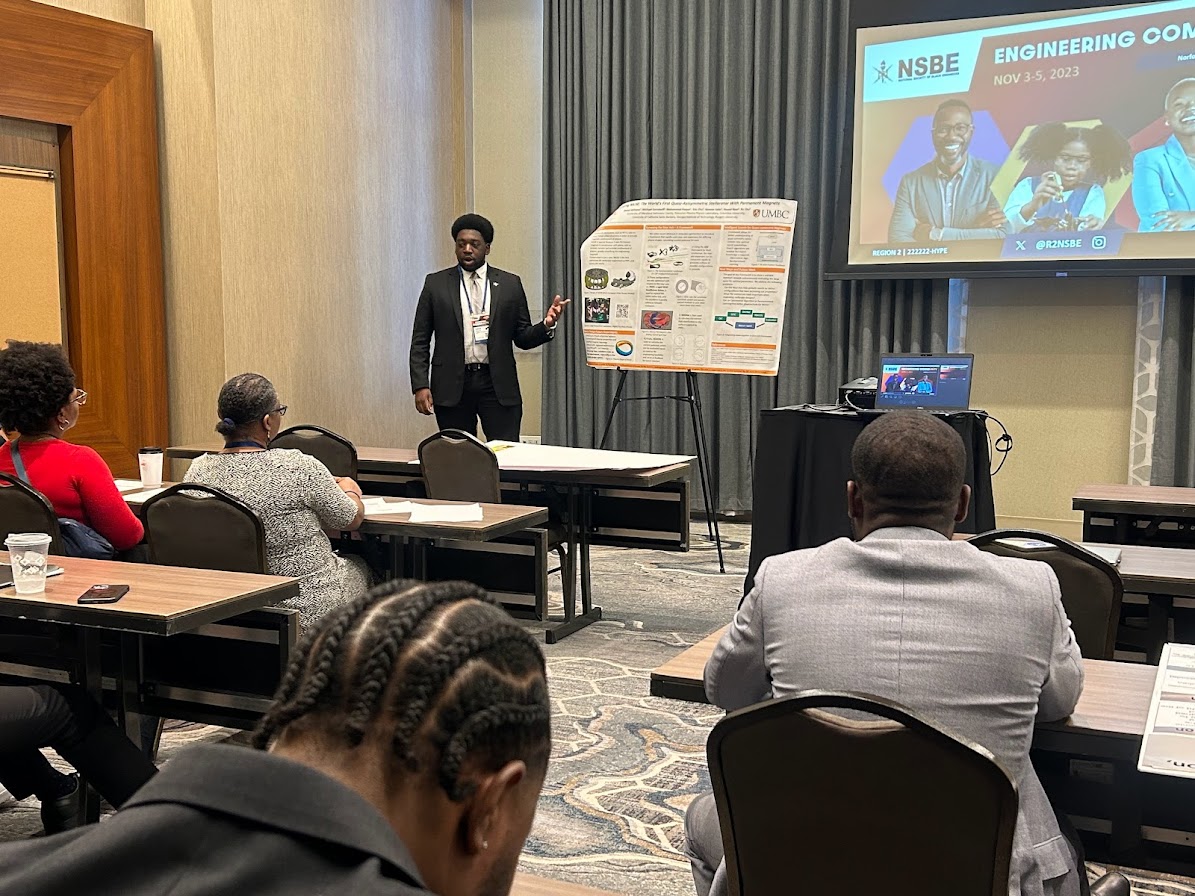 Daniel Williams gives his research presentation at the NSBE conference. (Image by Nelanne Bolima)
In addition to Bolima, the Tech Bowl team members included Kayla Magruder ’26, chemical engineering; Saleem Lawal ’25, computer science; and Daniel Williams ’24, computer science. Presentation winners were Williams (first), Bolima (second), and Christopher Appiah ’24, mechanical engineering (third). Keith Harmon, director of the UMBC Meyerhoff Scholars Program, serves as the chapter advisor.
“We are so proud of the UMBC NSBE Chapter,” Harmon shares. “They do tremendous work supporting UMBC STEM majors and offering service impacting youth in the Baltimore-Washington corridor.”
Students supporting students
NSBE is a completely student-run organization, creating leadership opportunities for hundreds of students across the country. UMBC’s NSBE chapter supports members through activities such as mentoring initiatives, conference preparation, networking opportunities, and leadership development programming. The chapter also focuses on community outreach, such as visiting high schools, collaborating with non-profits, and welcoming younger students to shadow the chapter’s board meetings.
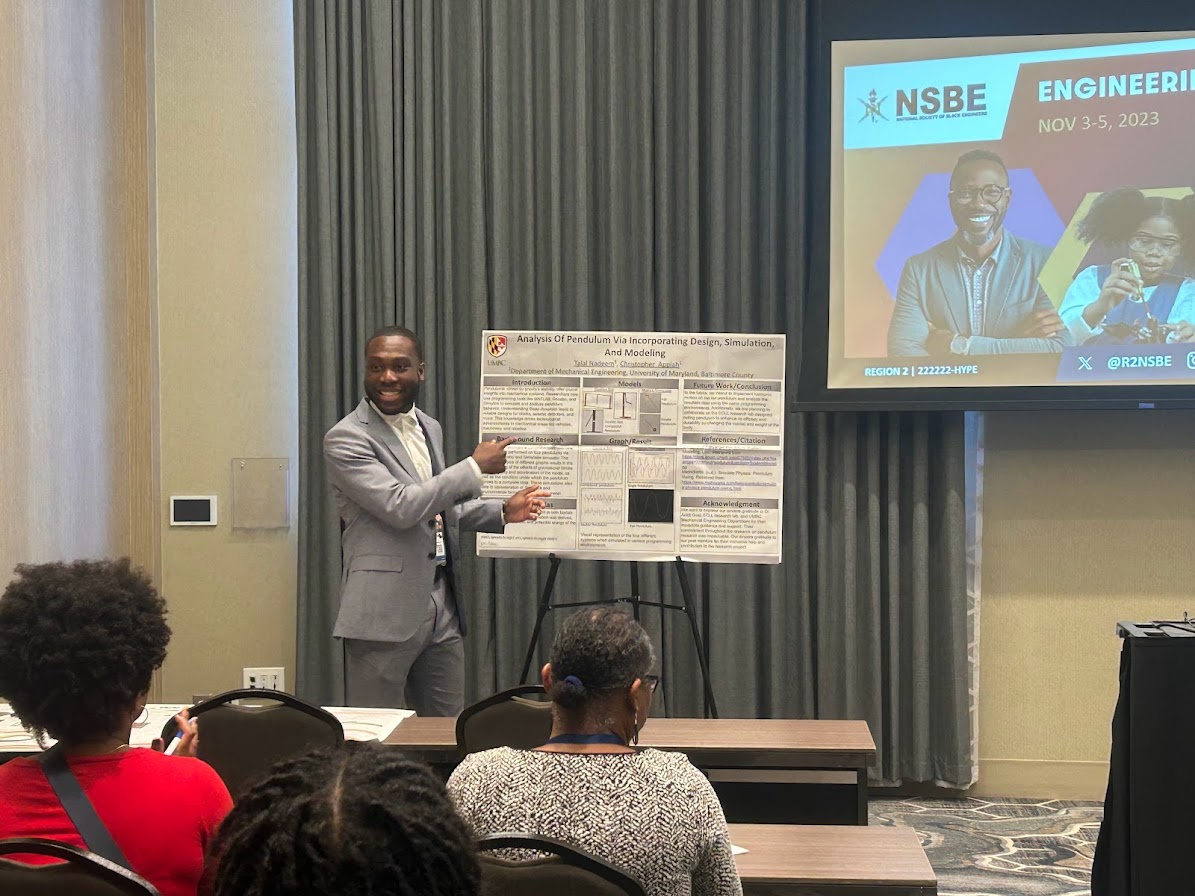 Christopher Appiah gives his research presentation at the NSBE conference. (Image by Nelanne Bolima)
“I have benefitted from being a member of this team by gaining invaluable public speaking and collaboration skills,” Appiah shares. “I learned how to effectively present, detailing the broader impact of research I have done.” Appiah conducts research with Ankit Goel, assistant professor of mechanical engineering. Goel’s group works on complex applications of control theory in robotics and autonomous systems.
For Jaden Somerville ’25, mechanical engineering, “the competition not only improved my technical skills, but also taught me teamwork, problem-solving, and effective time management.”
In March 2024, the chapter will take its talents to the 50th annual NSBE convention in Atlanta, Georgia.
Photo credit: UMBC attendees at the regional National Society of Black Engineers conference show off their official conference name badges. From left to right: Daniel Williams, Saleem Lawal, Kayla MaGruder, Nelanne Bolima, and Belin Tirfe. (Image courtesy of Nelanne Bolima)
]]>
UMBC chapter of National Society of Black Engineers (NSBE) shines at regional conference By: Sarah Hansen, M.S. ' 15, | Published: December 5, 2023 | UMBC News Members of UMBC’s...
https://beta.my.umbc.edu/api/v0/pixel/news/137636/guest@my.umbc.edu/8a6d5359954a80a904f4e5c50d970e99/api/pixel
nsbe
ug
ugrad
Chemical, Biochemical and Environmental Engineering
https://beta.my.umbc.edu/groups/cbee
https://assets4-beta.my.umbc.edu/system/shared/avatars/groups/000/000/771/b5e579e81b2e3624611890fa3ca2716a/xsmall.png?1746794587
https://assets2-beta.my.umbc.edu/system/shared/avatars/groups/000/000/771/b5e579e81b2e3624611890fa3ca2716a/original.png?1746794587
https://assets1-beta.my.umbc.edu/system/shared/avatars/groups/000/000/771/b5e579e81b2e3624611890fa3ca2716a/xxlarge.png?1746794587
https://assets2-beta.my.umbc.edu/system/shared/avatars/groups/000/000/771/b5e579e81b2e3624611890fa3ca2716a/xlarge.png?1746794587
https://assets2-beta.my.umbc.edu/system/shared/avatars/groups/000/000/771/b5e579e81b2e3624611890fa3ca2716a/large.png?1746794587
https://assets4-beta.my.umbc.edu/system/shared/avatars/groups/000/000/771/b5e579e81b2e3624611890fa3ca2716a/medium.png?1746794587
https://assets1-beta.my.umbc.edu/system/shared/avatars/groups/000/000/771/b5e579e81b2e3624611890fa3ca2716a/small.png?1746794587
https://assets4-beta.my.umbc.edu/system/shared/avatars/groups/000/000/771/b5e579e81b2e3624611890fa3ca2716a/xsmall.png?1746794587
https://assets1-beta.my.umbc.edu/system/shared/avatars/groups/000/000/771/b5e579e81b2e3624611890fa3ca2716a/xxsmall.png?1746794587
Chemical, Biochemical and Environmental Engineering
https://assets2-beta.my.umbc.edu/system/shared/thumbnails/news/000/137/636/1587bec3b22f28d20976841d3ea23ebf/xxlarge.jpg?1702064880
https://assets3-beta.my.umbc.edu/system/shared/thumbnails/news/000/137/636/1587bec3b22f28d20976841d3ea23ebf/xlarge.jpg?1702064880
https://assets3-beta.my.umbc.edu/system/shared/thumbnails/news/000/137/636/1587bec3b22f28d20976841d3ea23ebf/large.jpg?1702064880
https://assets4-beta.my.umbc.edu/system/shared/thumbnails/news/000/137/636/1587bec3b22f28d20976841d3ea23ebf/medium.jpg?1702064880
https://assets3-beta.my.umbc.edu/system/shared/thumbnails/news/000/137/636/1587bec3b22f28d20976841d3ea23ebf/small.jpg?1702064880
https://assets4-beta.my.umbc.edu/system/shared/thumbnails/news/000/137/636/1587bec3b22f28d20976841d3ea23ebf/xsmall.jpg?1702064880
https://assets3-beta.my.umbc.edu/system/shared/thumbnails/news/000/137/636/1587bec3b22f28d20976841d3ea23ebf/xxsmall.jpg?1702064880
0
0
true
Fri, 08 Dec 2023 15:24:10 -0500
UMBC air pollution researchers leapt into action
from UMBC NEWS
As summer wildfire smoke choked Baltimore, UMBC air pollution researchers leapt into action
By: Catherine Meyers | Published: Dec 7, 2023 | UMBC NEWS
Starting this May, a series of wildfires in Eastern Canada sent enormous smoke clouds wafting into the U.S., triggering air quality warnings in cities from the Midwest to the Northeast. For days, orange skies backdropped landscapes clouded by acrid air. People who could hunkered inside with the doors and windows shut. Those who had to go out faced itchy eyes, burning throats, and worse.
As a resident of the Baltimore area—which was blanketed with particularly bad smoke in both early and late June—UMBC Professor Chris Hennigan looked at the haze with dismay. But as an environmental engineer who studies air pollution, he had an additional thought: “We were looking at the air quality forecasts, and we thought ‘We have to gather data,’” he says.
The public found many colorful words to describe the summer’s unwanted smoke: brutal, eerie, dystopian.
Hennigan and his team have been working to put numbers to the adjectives. On the roof of the engineering building, the researchers installed a squat, white sensor that monitors the levels of tiny particles in the air, particularly those measuring 2.5 micrometers in diameter or less—smaller than most bacteria. Called PM2.5, these particles are released in large numbers during fires. They are dangerous to human health because they can work their way into the deepest parts of the lungs and even enter the bloodstream.
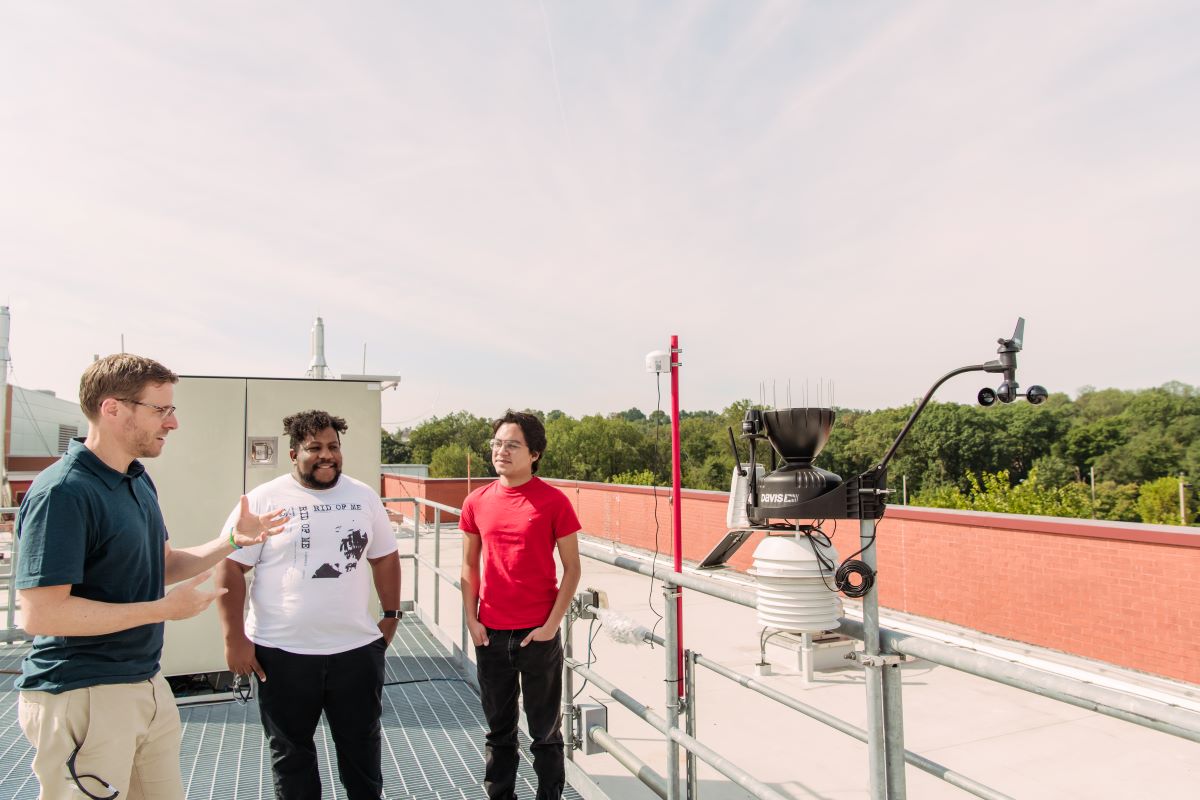 Chris Hennigan, Joel Tyson, Ph.D. ’23, and Luis Rodriguez ’25 (left to right) on the roof of the engineering building next to an air quality sensor. (Marlayna Demond ’11/UMBC)
The sensor showed huge spikes in PM2.5 when the smoke blew through, on some days reaching levels considered unhealthy for anyone to breathe.
The researchers also set up equipment to filter particles out of the air. After 24 hours, they collected the filters, which they are storing, neatly labeled, in a refrigerator in Hennigan’s lab.
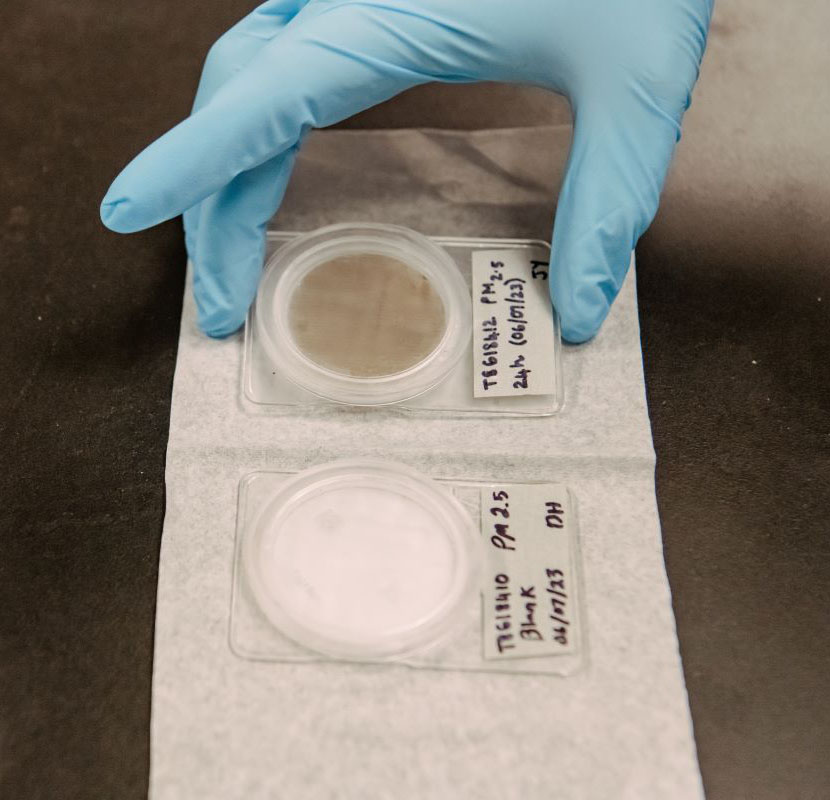 Hennigan shows samples of smoke particles collected this summer. (Marlayna Demond ’11/UMBC)
The filtered samples will advance at least two ongoing investigations, Hennigan says. In one avenue of inquiry, Joel Tyson, Ph.D. ’23, biochemical engineering, is studying how tiny particles can harm human lung cells. Before this year’s smoky summer, Tyson had been studying the toxic effects of particulate matter normally found in the Baltimore air. With the new smoke samples, he will start to investigate whether wildfire smoke particles, per unit, are more toxic than regular urban particulate matter, which comes from sources such as cars and power plants. Some studies have indicated that wildfire particulate matter is indeed more toxic, but more research is needed before any definitive conclusions can be reached.
In another line of research, Hennigan is also studying how particles in the air, including from smoke, may affect the climate. Undergraduate chemical engineering students Danielle Larios ’25 and Luis Rodriguez ’25 are assisting in the investigations.
The researchers study how particles of brown-colored carbon-containing material absorb light. Burning vegetation sends large amounts of this brown carbon into the atmosphere. It’s possible that the particles are trapping significant heat from the sun, accelerating the pace of planetary warming. Such effects are not normally included in global climate models, and better understanding of the process could improve humanity’s ability to predict, and manage, the coming years of climate upheaval.
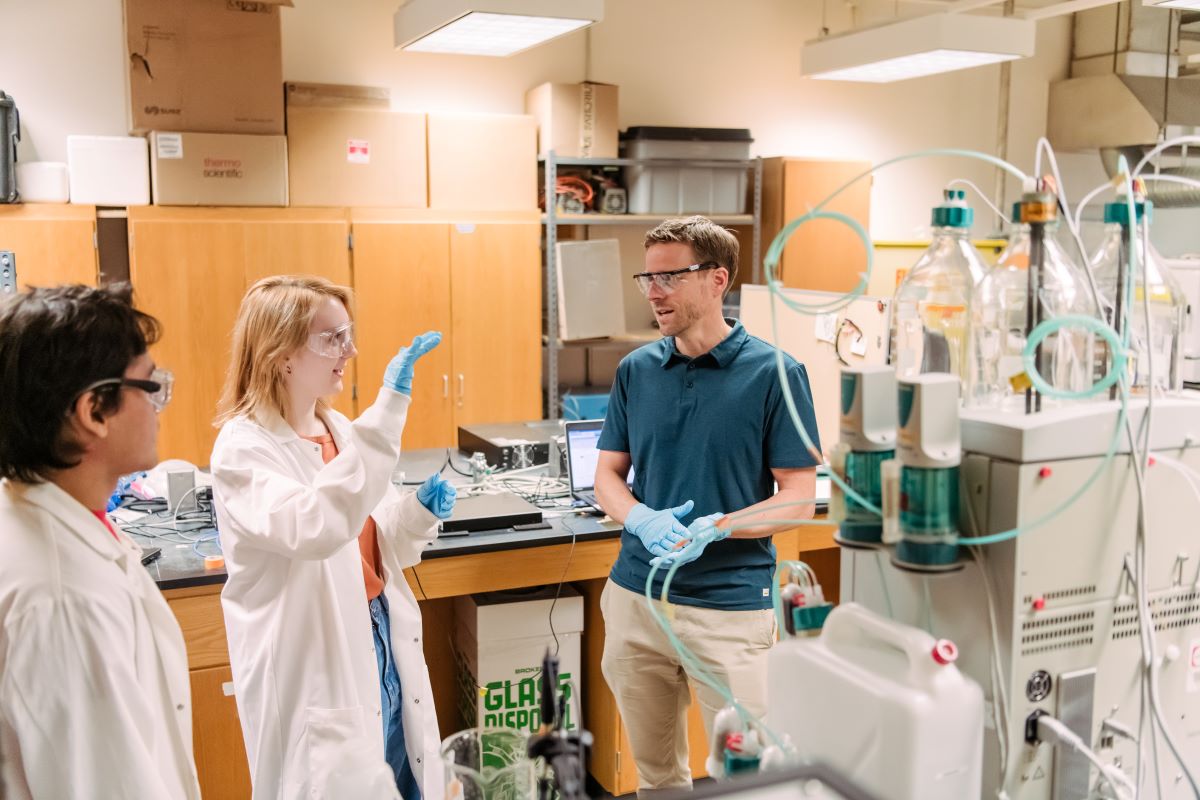 Rodriguez, Danielle Larios ’25 and Hennigan (left to right) discuss research in the lab. (Marlayna Demond ’11/UMBC)
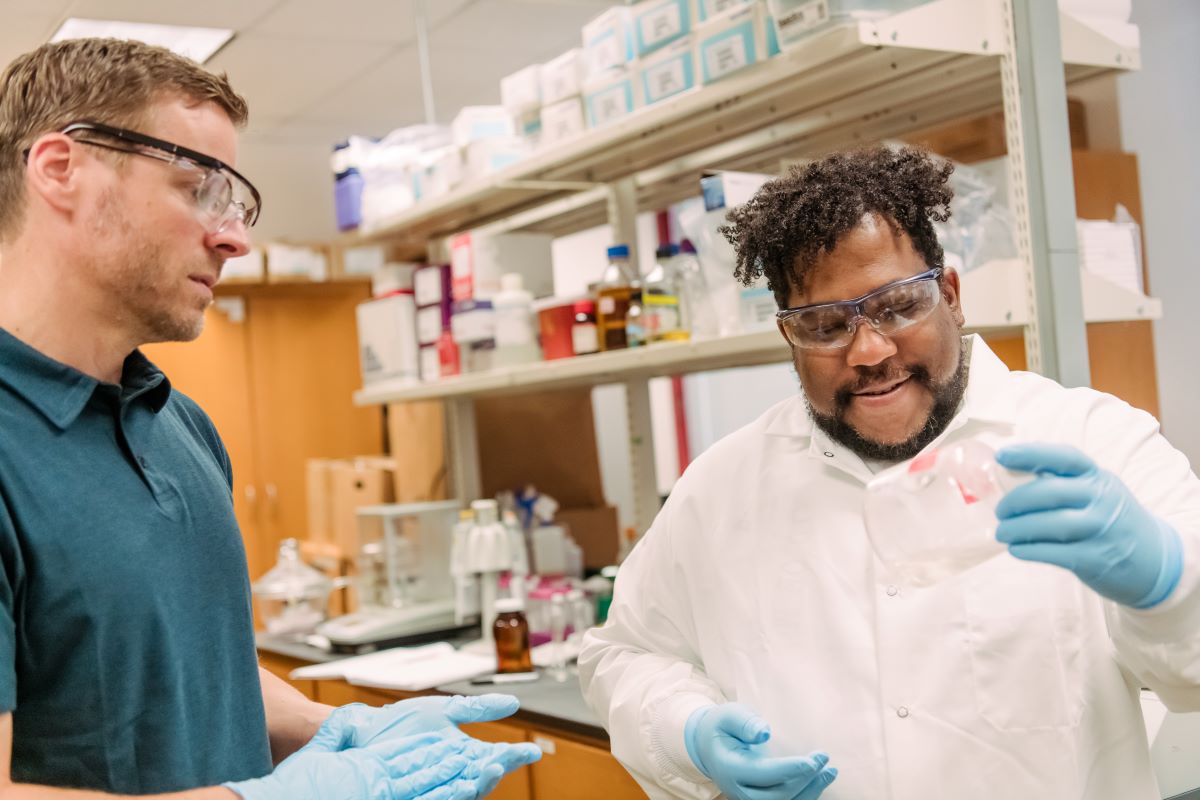 Hennigan and Tyson in the lab. (Marlayna Demond ’11/UMBC)
Climate change and wildfires are intimately linked. This summer was not only smoky, but also scorching. July marked the hottest month ever recorded, and scientists predict that as the world continues to warm, wildfires will continue to increase in quantity and intensity. “Smokeageddon,” as headlines put it, may become the new normal.
Hennigan says recent research illuminates how much wildfire smoke has contributed to air pollution trends. He points to a paper published in September in the scientific journal Nature that estimated that since 2016, wildfire smoke in the contiguous United States has undone around 25% of the progress in air quality made between 2000 and 2016.
For the researchers in Hennigan’s lab, those effects have been felt personally.
Rodriguez recalled how in June he had to go out to buy a fresh pack of N95 masks. “The smoke was just awful,” he says. Larios says she felt a burning at the back of her throat in just 15 minutes walking to her car.
For Tyson, the effects of the smoke were so bad that at one point he struggled to breathe and had to visit the doctor. The episode, he says, drove home the importance of his toxicology research.
All three note both the complexity of the systems they are studying and the importance of discovering new knowledge that might help society handle the environmental challenges it faces.
“Our work can have real-world impact, and that’s exciting,” says Larios.
]]>
As summer wildfire smoke choked Baltimore, UMBC air pollution researchers leapt into action By: Catherine Meyers | Published: Dec 7, 2023 | UMBC NEWS Starting this May, a series of...
https://beta.my.umbc.edu/api/v0/pixel/news/137634/guest@my.umbc.edu/a05c2d461ebbba5380b8b9fbd01aa9c8/api/pixel
faculty
grad
hennigan
news
phd
research
ug
ugrad
Chemical, Biochemical and Environmental Engineering
https://beta.my.umbc.edu/groups/cbee
https://assets4-beta.my.umbc.edu/system/shared/avatars/groups/000/000/771/b5e579e81b2e3624611890fa3ca2716a/xsmall.png?1746794587
https://assets2-beta.my.umbc.edu/system/shared/avatars/groups/000/000/771/b5e579e81b2e3624611890fa3ca2716a/original.png?1746794587
https://assets1-beta.my.umbc.edu/system/shared/avatars/groups/000/000/771/b5e579e81b2e3624611890fa3ca2716a/xxlarge.png?1746794587
https://assets2-beta.my.umbc.edu/system/shared/avatars/groups/000/000/771/b5e579e81b2e3624611890fa3ca2716a/xlarge.png?1746794587
https://assets2-beta.my.umbc.edu/system/shared/avatars/groups/000/000/771/b5e579e81b2e3624611890fa3ca2716a/large.png?1746794587
https://assets4-beta.my.umbc.edu/system/shared/avatars/groups/000/000/771/b5e579e81b2e3624611890fa3ca2716a/medium.png?1746794587
https://assets1-beta.my.umbc.edu/system/shared/avatars/groups/000/000/771/b5e579e81b2e3624611890fa3ca2716a/small.png?1746794587
https://assets4-beta.my.umbc.edu/system/shared/avatars/groups/000/000/771/b5e579e81b2e3624611890fa3ca2716a/xsmall.png?1746794587
https://assets1-beta.my.umbc.edu/system/shared/avatars/groups/000/000/771/b5e579e81b2e3624611890fa3ca2716a/xxsmall.png?1746794587
Chemical, Biochemical and Environmental Engineering
https://assets1-beta.my.umbc.edu/system/shared/thumbnails/news/000/137/634/6b23f7999debbc216e1a292c3352b8b5/xxlarge.jpg?1702060952
https://assets4-beta.my.umbc.edu/system/shared/thumbnails/news/000/137/634/6b23f7999debbc216e1a292c3352b8b5/xlarge.jpg?1702060952
https://assets2-beta.my.umbc.edu/system/shared/thumbnails/news/000/137/634/6b23f7999debbc216e1a292c3352b8b5/large.jpg?1702060952
https://assets1-beta.my.umbc.edu/system/shared/thumbnails/news/000/137/634/6b23f7999debbc216e1a292c3352b8b5/medium.jpg?1702060952
https://assets4-beta.my.umbc.edu/system/shared/thumbnails/news/000/137/634/6b23f7999debbc216e1a292c3352b8b5/small.jpg?1702060952
https://assets4-beta.my.umbc.edu/system/shared/thumbnails/news/000/137/634/6b23f7999debbc216e1a292c3352b8b5/xsmall.jpg?1702060952
https://assets2-beta.my.umbc.edu/system/shared/thumbnails/news/000/137/634/6b23f7999debbc216e1a292c3352b8b5/xxsmall.jpg?1702060952
0
0
true
Fri, 08 Dec 2023 13:48:32 -0500
Fri, 08 Dec 2023 14:18:12 -0500