June 2024- CBEE Alumni Update
Career Updates
Are you a CBEE Alumni? Stay connected via LinkedIn
Let us know what you're doing now and share an update
here.
Rose Taylor
M.S '23, Environmental Engineering
Advisor: Chris Hennigan
Rose Taylor is an UMBC alumna who graduated in 2024 with her master's in Environmental Engineering. After graduation, Rose started a permanent full-time position in the Maryland Department of the Environment's Water Supply Program as a Regulatory and Compliance Engineer in the Engineering and Technical Assistance Division. She works with public water systems across the state to ensure compliance with EPA standards, respond to deficiencies and emergencies, and provide recommendations for optimization.
(Image: This list of UMBC Alumni employers should not be construed as sponsorship, affiliation, or approval by the trademark owner.)
Excerpt from UMBC Magazine “Infrastructure of support after Key Bridge collapse” by Adriana Fraser, published on June 13, 2024
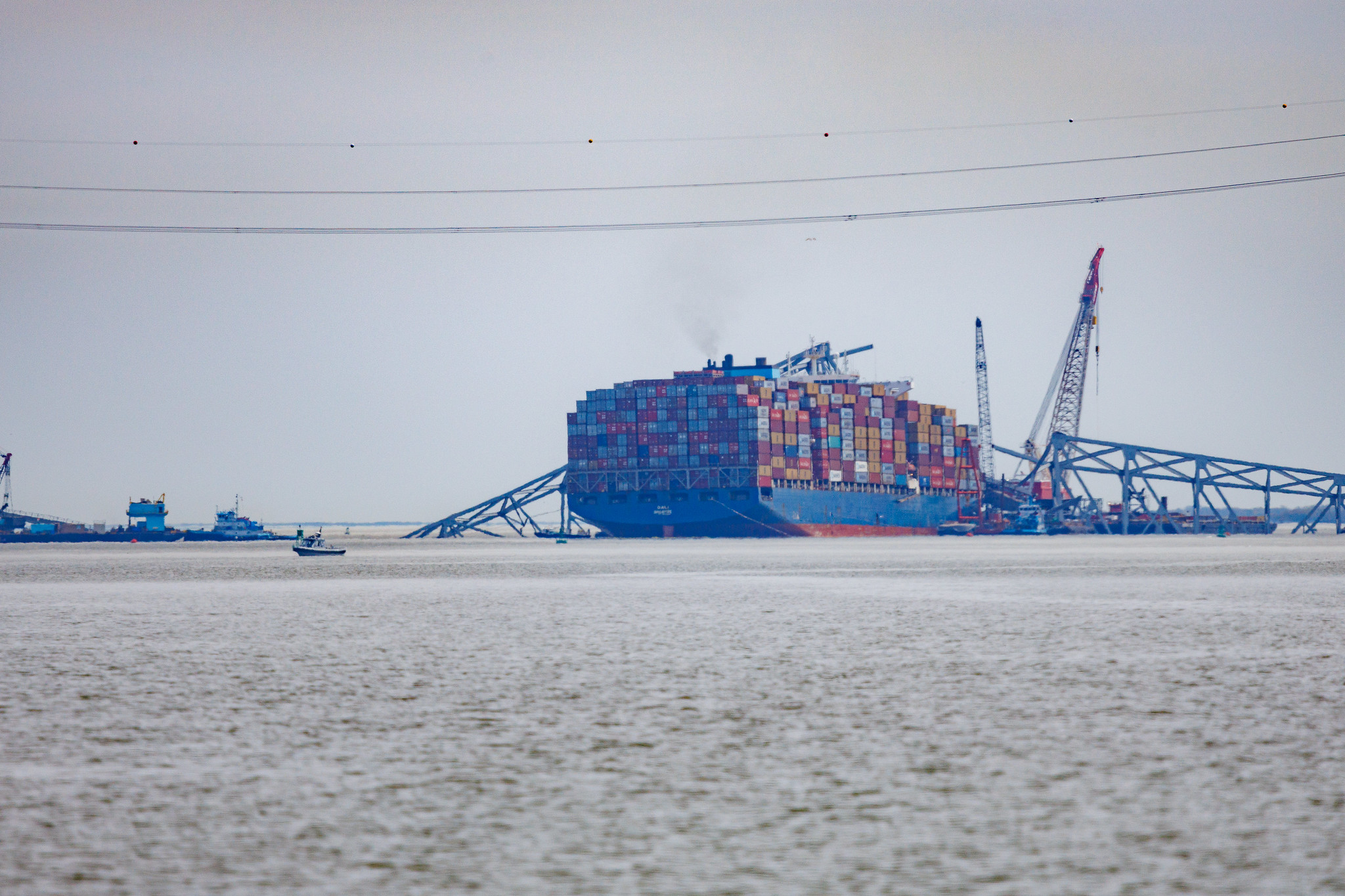 The remains of the Francis Scott Key Bridge after a collision with a malfunctioning cargo ship on March 26. (Photo source: Corey Jennings '10, Maryland Comptroller/Flickr)
Examining the environmental impacts of the collapse
The ship that collided into the bridge was carrying 56 containers of hazardous materials, including corrosives, flammables, and lithium-ion batteries. The cargo ship was also carrying more than one million gallons of fuel at the time of the impact. City officials began their investigations into the incident, which included determining the environmental impacts to the Patapsco River and surrounding communities.
Upal Ghosh, professor of chemical, biochemical, and environmental engineering, whose research includes examining the effects of toxic pollutants in soils, sediments, and aquatic environments, was among the experts who weighed in on assessing the potentially hazardous effects of the containers that were resting at the bottom of the river.
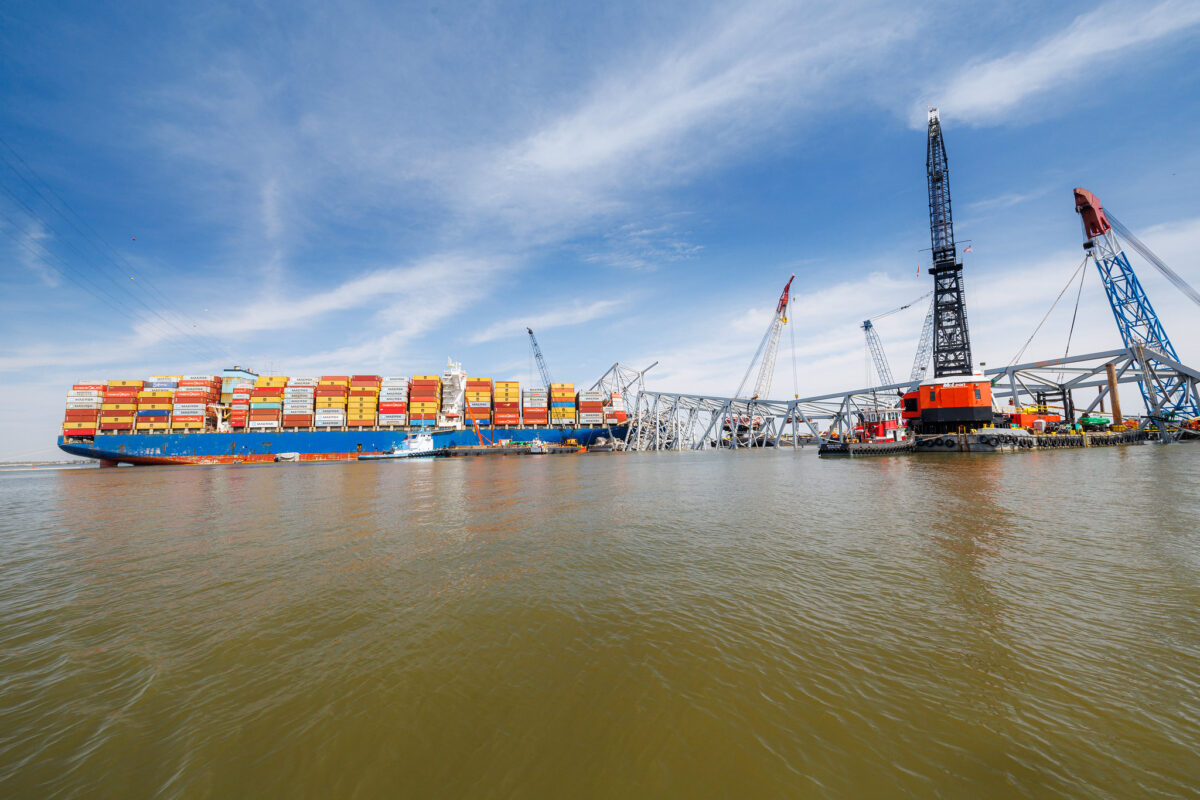 Maryland Comptroller Brooke Lierman and representatives of the Office of the Governor take a tour of the Francis Scott Key Bridge collapse site on a Maryland Department of Natural Resources police boat. (Photo source: Corey Jennings ’10, Maryland Comptroller/Flickr)
Ghosh told the Baltimore Sun days after the collapse that environmental officials’ first priority would likely be making sure none of the intact containers were breached.
“If you have containers that contain oily material, those things will, if they are breached, be releasing over time,” Ghosh said. “I would think if there is a release that goes down into the sediments under the water, it would be a local impact right there.”
Farah Nibbs, assistant professor of emergency and disaster health systems, is also thinking about future ways to contain the effects of similar disasters. Contributing factors to the bridge’s collapse, she says, can be tied to the 2012 expansion and modernization of the Port of Baltimore. Those changes did not happen hand in hand with improvements in safety management needed to accommodate ships of such huge sizes that now were able to port in the city. Risks from collisions, fuel spills, and contamination still lack proper oversight and regulation.
“A novel approach for decision-makers may be to view Maryland’s emergency management and transportation experts and service providers—as well as the physical bridge infrastructure itself—as part of the community’s lifeline systems,” said Nibbs.
~~
Read the full article: Infrastructure Of Support After Key Bridge Collapse - UMBC: University Of Maryland, Baltimore County
]]>
In response to the tragic collapse of the Francis Scott Key Bridge, Dr. Upal Ghosh, professorCBEE, assesses potential environmental impacts, particularly concerning the hazardous materials aboard...
https://beta.my.umbc.edu/api/v0/pixel/news/142482/guest@my.umbc.edu/07e4001c5ec8f5aca841833b20e59429/api/pixel
faculty
ghosh
news
spring-2024
Chemical, Biochemical and Environmental Engineering
https://beta.my.umbc.edu/groups/cbee
https://assets4-beta.my.umbc.edu/system/shared/avatars/groups/000/000/771/b5e579e81b2e3624611890fa3ca2716a/xsmall.png?1746794587
https://assets2-beta.my.umbc.edu/system/shared/avatars/groups/000/000/771/b5e579e81b2e3624611890fa3ca2716a/original.png?1746794587
https://assets1-beta.my.umbc.edu/system/shared/avatars/groups/000/000/771/b5e579e81b2e3624611890fa3ca2716a/xxlarge.png?1746794587
https://assets2-beta.my.umbc.edu/system/shared/avatars/groups/000/000/771/b5e579e81b2e3624611890fa3ca2716a/xlarge.png?1746794587
https://assets2-beta.my.umbc.edu/system/shared/avatars/groups/000/000/771/b5e579e81b2e3624611890fa3ca2716a/large.png?1746794587
https://assets4-beta.my.umbc.edu/system/shared/avatars/groups/000/000/771/b5e579e81b2e3624611890fa3ca2716a/medium.png?1746794587
https://assets1-beta.my.umbc.edu/system/shared/avatars/groups/000/000/771/b5e579e81b2e3624611890fa3ca2716a/small.png?1746794587
https://assets4-beta.my.umbc.edu/system/shared/avatars/groups/000/000/771/b5e579e81b2e3624611890fa3ca2716a/xsmall.png?1746794587
https://assets1-beta.my.umbc.edu/system/shared/avatars/groups/000/000/771/b5e579e81b2e3624611890fa3ca2716a/xxsmall.png?1746794587
Chemical, Biochemical and Environmental Engineering
0
0
true
Mon, 17 Jun 2024 13:40:07 -0400
Mon, 17 Jun 2024 15:01:09 -0400
CBEE mourns the passing of Dr. António (Tony) Moreira
The Department of Chemical, Biochemical and Environmental Engineering (CBEE) at UMBC mourns the passing of Dr. António (Tony) Moreira. Tony was a former CBEE Department Chair and long-serving Vice Provost for Academic Affairs, as well as a mentor, colleague, and friend. He passed away on May 21 after a brief battle with pancreatic cancer. His death represents a profound loss for CBEE and UMBC, institutions he loved and dutifully served for over three decades.
From his arrival at UMBC in 1990 as a professor and chair of the Chemical and Biochemical Engineering Program to his leadership as vice provost since 1997, Dr. Moreira's brilliance, integrity, and devotion to academic excellence permeated every aspect of his work. His profound impact resonates across the campus landscape he helped thoughtfully shape through the various roles he held. Prior to UMBC, Dr. Moreira's trailblazing career included faculty positions at Colorado State University and a decade-long leadership role in biotechnology development at Merck, where he spearheaded bringing alpha interferon to market.
Through all these experiences, empowering the next generation remained one of Dr. Moreira's core driving principles. As an educator, he maintained an active role teaching and mentoring graduate students in chemical engineering throughout his administrative tenure. He played a major role in promoting UMBC's international reputation, spearheading research and scholarly collaboration with the University of Porto and the country of Portugal. And he was honored by the president of Portugal with the National Order of Public Education and awarded the title of Comendador.
Behind his many accomplishments and accolades, we knew Tony as a man defined by humility, kindness, and an unwavering compassion for student success. Dr. Moreira's caring spirit left an indelible imprint on all who knew him. As UMBC mourns this devastating loss, CBEE and the entire university community celebrate his enduring legacy.
Additional tributes for Dr. Moreira can be found online:
]]>
The Department of Chemical, Biochemical and Environmental Engineering (CBEE) at UMBC mourns the passing of Dr. António (Tony) Moreira. Tony was a former CBEE Department Chair and long-serving Vice...
https://beta.my.umbc.edu/api/v0/pixel/news/142398/guest@my.umbc.edu/53bdb4b2e73d975d4a1ce69bd774b7eb/api/pixel
Chemical, Biochemical and Environmental Engineering
https://beta.my.umbc.edu/groups/cbee
https://assets4-beta.my.umbc.edu/system/shared/avatars/groups/000/000/771/b5e579e81b2e3624611890fa3ca2716a/xsmall.png?1746794587
https://assets2-beta.my.umbc.edu/system/shared/avatars/groups/000/000/771/b5e579e81b2e3624611890fa3ca2716a/original.png?1746794587
https://assets1-beta.my.umbc.edu/system/shared/avatars/groups/000/000/771/b5e579e81b2e3624611890fa3ca2716a/xxlarge.png?1746794587
https://assets2-beta.my.umbc.edu/system/shared/avatars/groups/000/000/771/b5e579e81b2e3624611890fa3ca2716a/xlarge.png?1746794587
https://assets2-beta.my.umbc.edu/system/shared/avatars/groups/000/000/771/b5e579e81b2e3624611890fa3ca2716a/large.png?1746794587
https://assets4-beta.my.umbc.edu/system/shared/avatars/groups/000/000/771/b5e579e81b2e3624611890fa3ca2716a/medium.png?1746794587
https://assets1-beta.my.umbc.edu/system/shared/avatars/groups/000/000/771/b5e579e81b2e3624611890fa3ca2716a/small.png?1746794587
https://assets4-beta.my.umbc.edu/system/shared/avatars/groups/000/000/771/b5e579e81b2e3624611890fa3ca2716a/xsmall.png?1746794587
https://assets1-beta.my.umbc.edu/system/shared/avatars/groups/000/000/771/b5e579e81b2e3624611890fa3ca2716a/xxsmall.png?1746794587
Chemical, Biochemical and Environmental Engineering
https://assets3-beta.my.umbc.edu/system/shared/thumbnails/news/000/142/398/94f4df968cf1302015c5769891fc1a16/xxlarge.jpg?1718116986
https://assets1-beta.my.umbc.edu/system/shared/thumbnails/news/000/142/398/94f4df968cf1302015c5769891fc1a16/xlarge.jpg?1718116986
https://assets4-beta.my.umbc.edu/system/shared/thumbnails/news/000/142/398/94f4df968cf1302015c5769891fc1a16/large.jpg?1718116986
https://assets1-beta.my.umbc.edu/system/shared/thumbnails/news/000/142/398/94f4df968cf1302015c5769891fc1a16/medium.jpg?1718116986
https://assets2-beta.my.umbc.edu/system/shared/thumbnails/news/000/142/398/94f4df968cf1302015c5769891fc1a16/small.jpg?1718116986
https://assets1-beta.my.umbc.edu/system/shared/thumbnails/news/000/142/398/94f4df968cf1302015c5769891fc1a16/xsmall.jpg?1718116986
https://assets1-beta.my.umbc.edu/system/shared/thumbnails/news/000/142/398/94f4df968cf1302015c5769891fc1a16/xxsmall.jpg?1718116986
1
0
true
Tue, 11 Jun 2024 10:46:48 -0400
Tue, 11 Jun 2024 14:09:18 -0400
Chemical Engineering Club shines with Student Conference
From UMBC NEWS
On the first weekend of April, hundreds of chemical engineering students from across the Mid-Atlantic converged on the UMBC campus for two days of learning, networking, and friendly competition. They heard talks from academic and industry leaders, attended workshops and a career fair, competed in rounds of ChemE Jeopardy, mixed chemicals to power small cars along a track in the ChemE Car competition, and mingled over catered lunches, dinners, and cups of evening hot cocoa.
The activities were all part of the 2024 Mid-Atlantic Student Regional Conference of the American Institute of Chemical Engineers (AIChE)—hosted by the UMBC student chapter of the national group. Around 400 people attended the event, an increase from last year’s conference at Virginia Tech. Organizing the logistics, recruiting speakers and sponsors, securing rooms, and ordering thousands of plates worth of food presented a formidable challenge—one that the UMBC students tackled with aplomb.
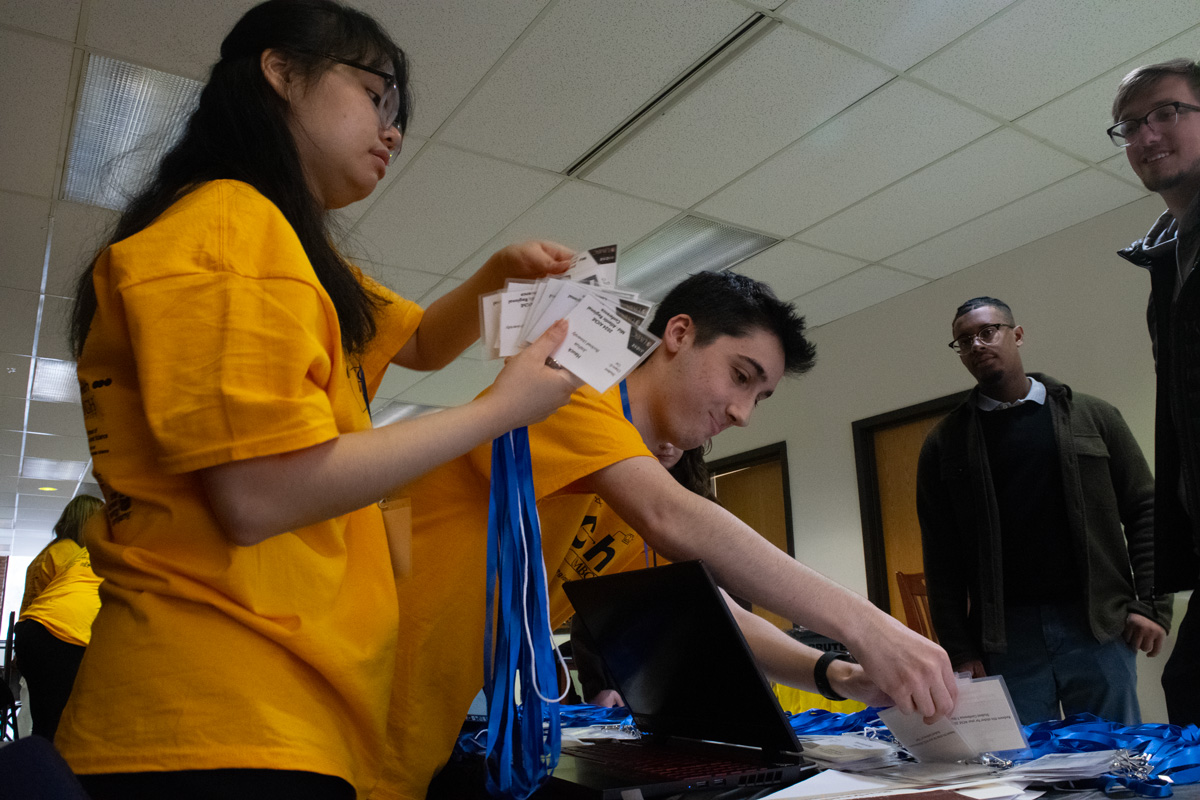 Managing check-in. (Photo by Danielle Clark)
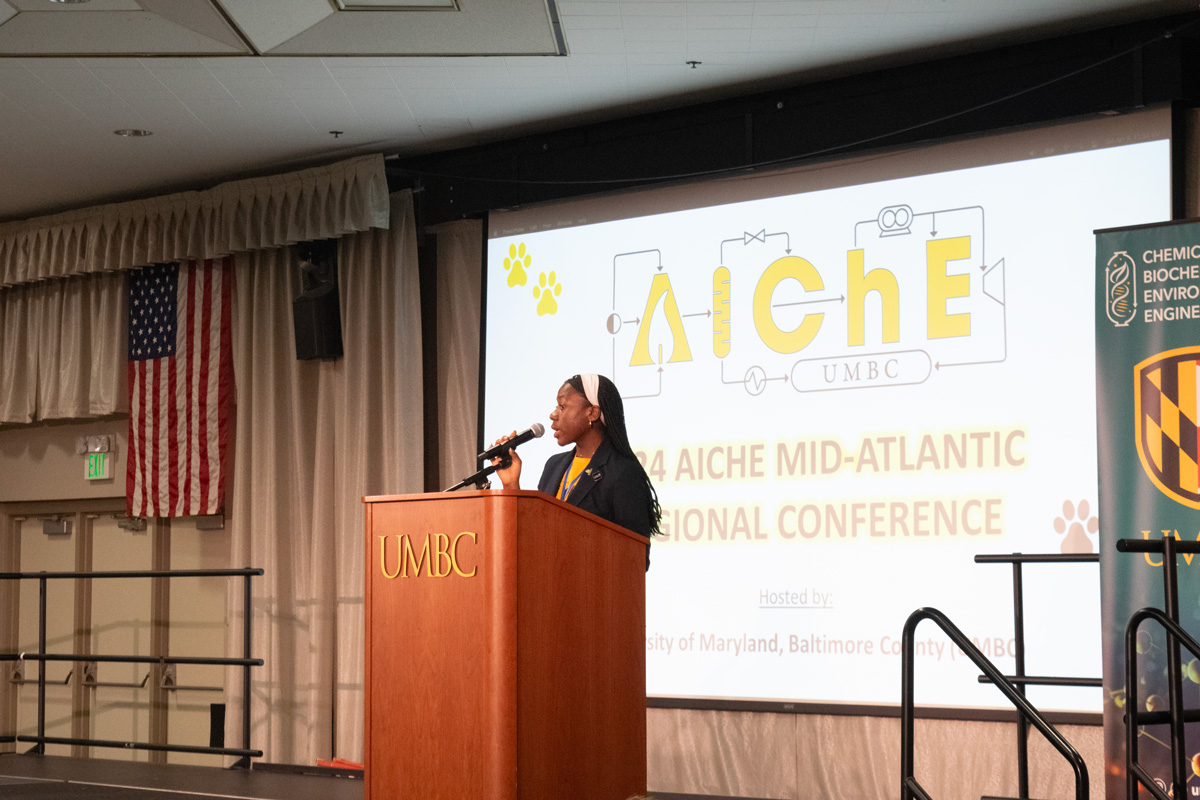 Welcoming attendees. (Photo by Danielle Clark)
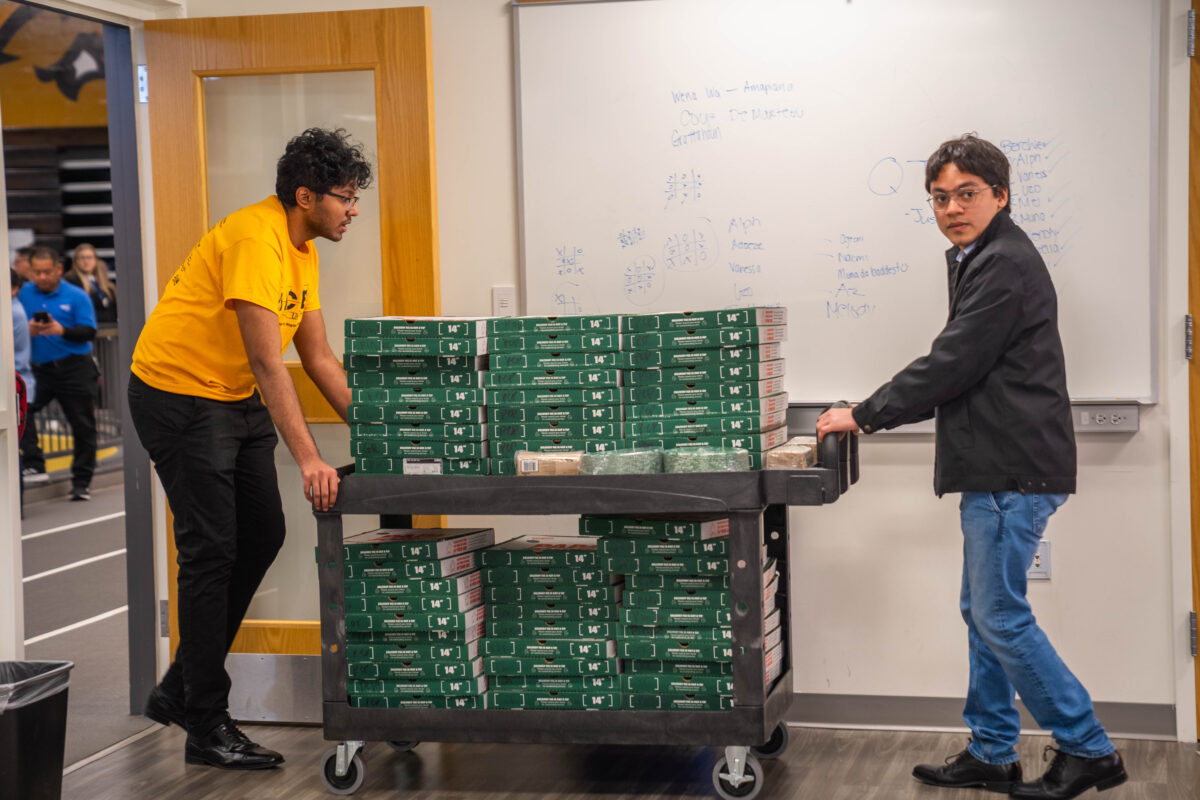 Delivering pizza. (Photo by Julianna Falconer)
“I am feeling fantastic after the conference,” says Pavan Umashankar ’25, chemical engineering and biochemistry and molecular biology, who served as the chair of the conference organizing committee. “I am super proud of everyone’s commitment and dedication to make it a resounding success.”
“Truly, I could gush about the UMBC conference planning team all day,” says Alyssa Block, the membership associate of ChemE student programs for AIChE. “These students really are the future leaders of their profession and of AIChE: engaged, excited, collaborative, supportive of each other, and willing to lend a hand.”
A club on the upswing
Hosting an AIChE regional conference for the first time at UMBC marked a milestone for a student club that has seen increasing levels of engagement and success in recent years. While many college clubs across the country are in decline post-Covid, UMBC’s AIChE student chapter is on a clear upward trajectory. The club sent its first team to compete in ChemE Jeopardy at the spring 2019 AIChE regional meeting. Just three years later, the UMBC team won the national ChemE Jeopardy competition.
Neha Raikar, a senior lecturer in the Department of Chemical, Biochemical, and Environmental Engineering (CBEE) and one of the advisors to the student AIChE chapter, remembers attending the 2019 meeting: “Back then, we wondered if we would ever be able to host a regional conference at UMBC,” she says. “We’ve achieved that goal.”
It was especially remarkable, she adds, to see some members of UMBC’s first ChemE Jeopardy and ChemE car teams return to this year’s conference as industry representatives.
Strong attendance and smooth conference logistics weren’t the only successes of the weekend—UMBC also triumphed in the ChemE Jeopardy and ChemE car competitions.
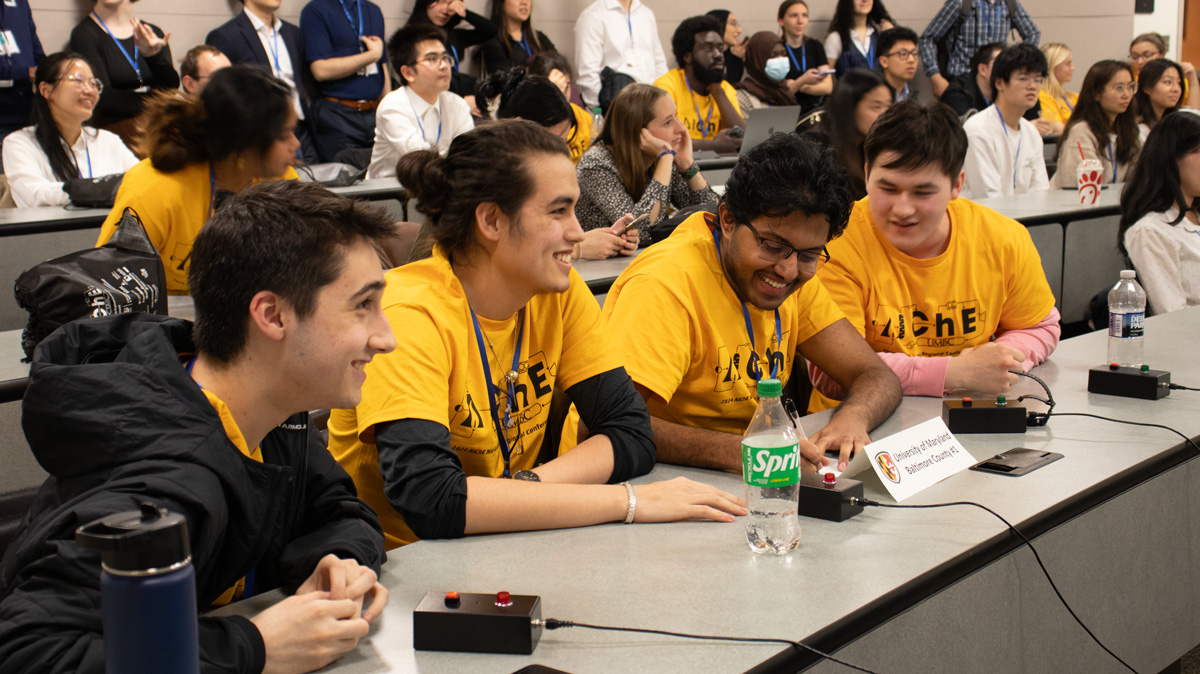 The UMBC #1 Jeopardy team during a preliminary round. (Photo by Patch Hatley)
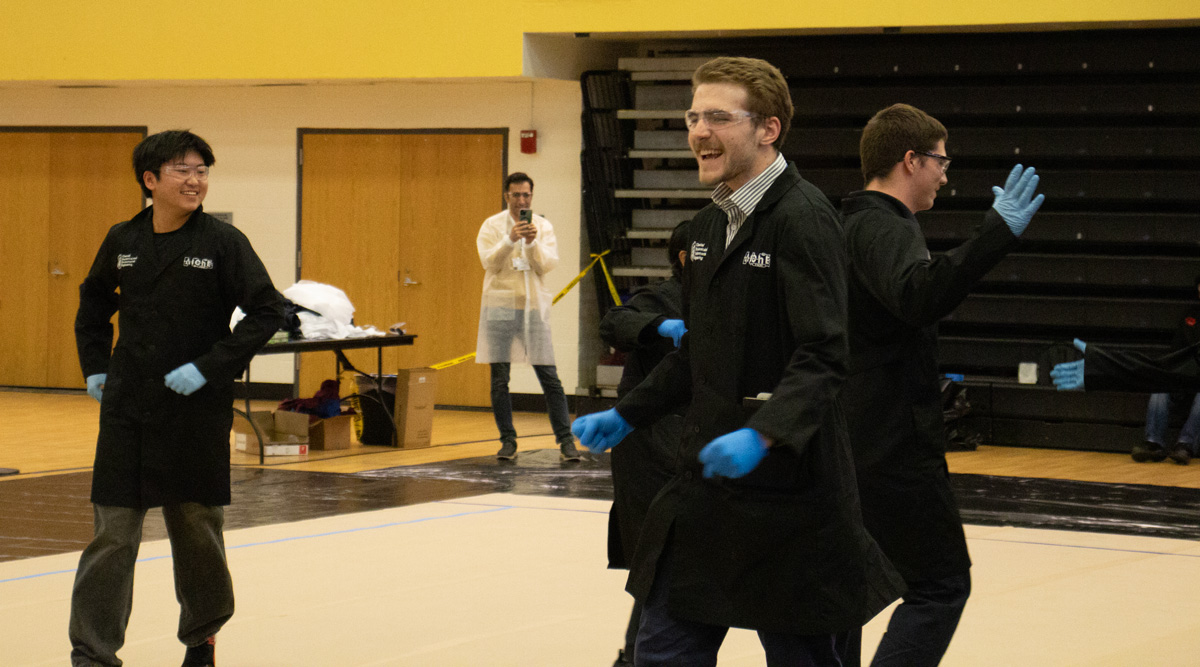 The UMBC ChemE Car team celebrates a good run. (Photo by Patch Hatley)
“Planning for the conference was already a significant undertaking, and on top of that, many of our students participated, and excelled, in the competitions,” says Raikar. “Their achievements not only showcased their individual capabilities but also the strength of our club as a whole, which is growing and thriving.”
A winning formula
AIChE chapter members and their advisors ascribe the club’s success to the hard work and dedication of the students coupled with the support of the CBEE department, college, and university. Thirteen CBEE students formed the conference planning committee, which met regularly to ensure all conference planning efforts were on track. An additional 37 students and 14 faculty and staff also volunteered their time—as check-in staff, poster and presentation judges, and more. About 10 UMBC alumni actively participated in the conference, and others contributed to fundraising efforts, helping the organizing committee secure sponsorships from notable companies such as AstraZeneca, ExxonMobil, Advanced Thermal Batteries, and Astek Diagnostics and from the chemical engineering department of Columbia University.
An Dang ’24, chemical engineering, led the fundraising efforts. She gamely approached industry representatives at the UMBC career fair and made the pitch. “I’m not an extrovert, and being in these roles forced me to go out of my comfort zone,” she says.
“Securing sponsorships was vital for making the conference possible, and An did a remarkable job” says Mariajosé Castellanos, another CBEE faculty who advises the AIChE chapter. Castellanos also praised the management skills of conference planning committee chair Umashankar. “Despite his modesty, Pavan is a true mastermind in everything he does,” she says.
For their part, the students applauded the support of the CBEE department, especially the work of their two advisors, Raikar and Castellanos, and the event planning support of Andrea Miller, the CBEE graduate program coordinator.
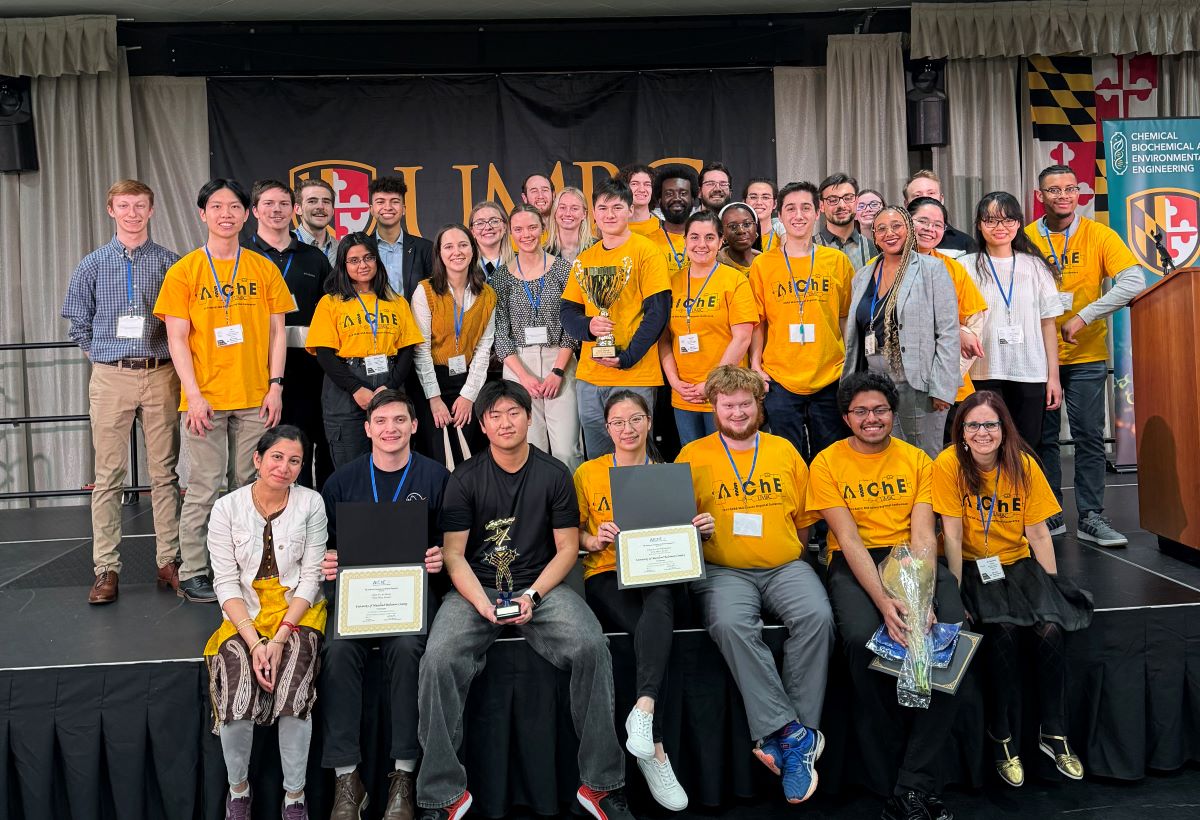 UMBC AIChE chapter students and faculty advisors pose for a group photo after a successful conference. (Photo courtesy of Mariajosé Castellanos.)
The conference was both a marker of the club’s success and an opportunity for individual students to grow their skill sets.
“I have developed leadership and project management skills, which will be incredibly useful throughout my professional career,” says Umashankar.
Ben Welling ’25, chemical engineering, the leader of the UMBC ChemE car team, believes his experience with the competition helped him land internships. “I talked about it extensively with employers. They like leadership experience and it shows you are willing to do more than is required.”
Raikar sees a bright future for the student stars of this year’s conference and for the club as a whole. “I hope the conference will boost the club membership and participation of students in other AIChE activities,” she says. And, she adds, the conference shows that with support, “UMBC students can accomplish any task.”
]]>
On the first weekend of April, hundreds of chemical engineering students from across the Mid-Atlantic converged on the UMBC campus for two days of learning, networking, and friendly competition....
https://beta.my.umbc.edu/api/v0/pixel/news/142271/guest@my.umbc.edu/3d6571baf24e193bd86ca74684041696/api/pixel
aiche
news
research
ug
ugrad
Chemical, Biochemical and Environmental Engineering
https://beta.my.umbc.edu/groups/cbee
https://assets4-beta.my.umbc.edu/system/shared/avatars/groups/000/000/771/b5e579e81b2e3624611890fa3ca2716a/xsmall.png?1746794587
https://assets2-beta.my.umbc.edu/system/shared/avatars/groups/000/000/771/b5e579e81b2e3624611890fa3ca2716a/original.png?1746794587
https://assets1-beta.my.umbc.edu/system/shared/avatars/groups/000/000/771/b5e579e81b2e3624611890fa3ca2716a/xxlarge.png?1746794587
https://assets2-beta.my.umbc.edu/system/shared/avatars/groups/000/000/771/b5e579e81b2e3624611890fa3ca2716a/xlarge.png?1746794587
https://assets2-beta.my.umbc.edu/system/shared/avatars/groups/000/000/771/b5e579e81b2e3624611890fa3ca2716a/large.png?1746794587
https://assets4-beta.my.umbc.edu/system/shared/avatars/groups/000/000/771/b5e579e81b2e3624611890fa3ca2716a/medium.png?1746794587
https://assets1-beta.my.umbc.edu/system/shared/avatars/groups/000/000/771/b5e579e81b2e3624611890fa3ca2716a/small.png?1746794587
https://assets4-beta.my.umbc.edu/system/shared/avatars/groups/000/000/771/b5e579e81b2e3624611890fa3ca2716a/xsmall.png?1746794587
https://assets1-beta.my.umbc.edu/system/shared/avatars/groups/000/000/771/b5e579e81b2e3624611890fa3ca2716a/xxsmall.png?1746794587
Chemical, Biochemical and Environmental Engineering
https://assets4-beta.my.umbc.edu/system/shared/thumbnails/news/000/142/271/71c5d282380dec4ba167cdacffba8fe1/xxlarge.jpg?1717184352
https://assets2-beta.my.umbc.edu/system/shared/thumbnails/news/000/142/271/71c5d282380dec4ba167cdacffba8fe1/xlarge.jpg?1717184352
https://assets4-beta.my.umbc.edu/system/shared/thumbnails/news/000/142/271/71c5d282380dec4ba167cdacffba8fe1/large.jpg?1717184352
https://assets1-beta.my.umbc.edu/system/shared/thumbnails/news/000/142/271/71c5d282380dec4ba167cdacffba8fe1/medium.jpg?1717184352
https://assets1-beta.my.umbc.edu/system/shared/thumbnails/news/000/142/271/71c5d282380dec4ba167cdacffba8fe1/small.jpg?1717184352
https://assets2-beta.my.umbc.edu/system/shared/thumbnails/news/000/142/271/71c5d282380dec4ba167cdacffba8fe1/xsmall.jpg?1717184352
https://assets2-beta.my.umbc.edu/system/shared/thumbnails/news/000/142/271/71c5d282380dec4ba167cdacffba8fe1/xxsmall.jpg?1717184352
3
0
true
Fri, 31 May 2024 15:40:38 -0400
Fri, 31 May 2024 15:42:00 -0400
Dr. Gautom Das receives promotion to Senior Lecturer
Congratulations Dr. Gautom Das on the successful promotion to the rank of Senior Lecturer!
]]>
Congratulations Dr. Gautom Das on the successful promotion to the rank of Senior Lecturer!
https://beta.my.umbc.edu/api/v0/pixel/news/142270/guest@my.umbc.edu/3f94acb2cd65032d2aff8cb47a34f38c/api/pixel
award
das
faculty
spring-2024
Chemical, Biochemical and Environmental Engineering
https://beta.my.umbc.edu/groups/cbee
https://assets4-beta.my.umbc.edu/system/shared/avatars/groups/000/000/771/b5e579e81b2e3624611890fa3ca2716a/xsmall.png?1746794587
https://assets2-beta.my.umbc.edu/system/shared/avatars/groups/000/000/771/b5e579e81b2e3624611890fa3ca2716a/original.png?1746794587
https://assets1-beta.my.umbc.edu/system/shared/avatars/groups/000/000/771/b5e579e81b2e3624611890fa3ca2716a/xxlarge.png?1746794587
https://assets2-beta.my.umbc.edu/system/shared/avatars/groups/000/000/771/b5e579e81b2e3624611890fa3ca2716a/xlarge.png?1746794587
https://assets2-beta.my.umbc.edu/system/shared/avatars/groups/000/000/771/b5e579e81b2e3624611890fa3ca2716a/large.png?1746794587
https://assets4-beta.my.umbc.edu/system/shared/avatars/groups/000/000/771/b5e579e81b2e3624611890fa3ca2716a/medium.png?1746794587
https://assets1-beta.my.umbc.edu/system/shared/avatars/groups/000/000/771/b5e579e81b2e3624611890fa3ca2716a/small.png?1746794587
https://assets4-beta.my.umbc.edu/system/shared/avatars/groups/000/000/771/b5e579e81b2e3624611890fa3ca2716a/xsmall.png?1746794587
https://assets1-beta.my.umbc.edu/system/shared/avatars/groups/000/000/771/b5e579e81b2e3624611890fa3ca2716a/xxsmall.png?1746794587
Chemical, Biochemical and Environmental Engineering
https://assets1-beta.my.umbc.edu/system/shared/thumbnails/news/000/142/270/3b236ac147de99af619804c83acca965/xxlarge.jpg?1717180315
https://assets2-beta.my.umbc.edu/system/shared/thumbnails/news/000/142/270/3b236ac147de99af619804c83acca965/xlarge.jpg?1717180315
https://assets3-beta.my.umbc.edu/system/shared/thumbnails/news/000/142/270/3b236ac147de99af619804c83acca965/large.jpg?1717180315
https://assets2-beta.my.umbc.edu/system/shared/thumbnails/news/000/142/270/3b236ac147de99af619804c83acca965/medium.jpg?1717180315
https://assets2-beta.my.umbc.edu/system/shared/thumbnails/news/000/142/270/3b236ac147de99af619804c83acca965/small.jpg?1717180315
https://assets2-beta.my.umbc.edu/system/shared/thumbnails/news/000/142/270/3b236ac147de99af619804c83acca965/xsmall.jpg?1717180315
https://assets2-beta.my.umbc.edu/system/shared/thumbnails/news/000/142/270/3b236ac147de99af619804c83acca965/xxsmall.jpg?1717180315
11
0
true
Fri, 31 May 2024 13:42:23 -0400
Fri, 31 May 2024 14:32:10 -0400
CBEE wins first and second place in research competition
2024 (CSAWWA/CWEA) Joint Spring Meeting
Two students working with Dr. Lee Blaney, professor in chemical, biochemical and environmental engineering, participated in the student poster competition at the 2024 Chesapeake American Water Work Association and Chesapeake Water Environment Association (CSAWWA/CWEA) Joint Spring Meeting in Perryville, MD in May.
The students received the top two awards in the poster presentation competition.
First Place -- Sahar Souizi, environmental engineering doctoral student
Second Place -- Margaret Siao,’23 chemical engineering biotechnology and bioengineering track, chemical and biochemical engineering master’s student and an ICARE fellow.
Sahar Souizi
Poster Title: Sustainable and rapid nutrient recovery by advanced Donnan dialysis reactors.
Authors: Sahar Souizi, An Hong Dang, Hui Chen, Lee Blaney
Abstract: Donnan dialysis leverages electrochemical potential gradients across ion-exchange membranes to selectively separate nutrients from wastewater. This project aimed to improve the rate of nutrient recovery and scale-up potential through development of novel Donnan dialysis reactors.
A batch-recycle system was used to evaluate the impacts of mixing, flow rate, and waste-to-draw solution volume ratio. With the optimal conditions, 90% orthophosphate recovery was achieved, and nutrient flux was increased by 30%. These results informed development of modular, tube- in-tube Donnan dialysis reactors, which enabled rapid nutrient recovery as struvite. These results support the role of Donnan dialysis systems to achieve circular nutrient economies.
Margaret Siao
Poster title: Influence of water quality on PFAS uptake by ion-exchange membrane-based passive samplers.
Authors: Margaret Siao, Donya Hamidi, Alvin Bett, Ke He, Lee Blaney
Abstract: Recently, per- and polyfluoroalkyl substances (PFAS) were regulated in drinking water. Many monitoring studies have reported variable PFAS concentrations in water resources. To inform the long-term, average PFAS levels, we developed and validated the performance of a novel passive sampling device comprised of anion-exchange membranes. Impacts of solution pH, salinity, and dissolved organic matter were evaluated for over 20 PFAS. Equilibrium PFAS and chloride concentrations were measured in the water and membrane phases and used to calculate selectivity coefficients. Trends between selectivity coefficients and PFAS properties enabled generation of a universal calibration for passive sampler deployment in different water sources.
]]>
Two students working with Dr. Lee Blaney, professor in chemical, biochemical and environmental engineering, participated in the student poster competition at the 2024 Chesapeake American Water...
https://beta.my.umbc.edu/api/v0/pixel/news/142269/guest@my.umbc.edu/8293780266723d9181af4e0c9e3764d5/api/pixel
award
blaney
faculty
grad
research
Chemical, Biochemical and Environmental Engineering
https://beta.my.umbc.edu/groups/cbee
https://assets4-beta.my.umbc.edu/system/shared/avatars/groups/000/000/771/b5e579e81b2e3624611890fa3ca2716a/xsmall.png?1746794587
https://assets2-beta.my.umbc.edu/system/shared/avatars/groups/000/000/771/b5e579e81b2e3624611890fa3ca2716a/original.png?1746794587
https://assets1-beta.my.umbc.edu/system/shared/avatars/groups/000/000/771/b5e579e81b2e3624611890fa3ca2716a/xxlarge.png?1746794587
https://assets2-beta.my.umbc.edu/system/shared/avatars/groups/000/000/771/b5e579e81b2e3624611890fa3ca2716a/xlarge.png?1746794587
https://assets2-beta.my.umbc.edu/system/shared/avatars/groups/000/000/771/b5e579e81b2e3624611890fa3ca2716a/large.png?1746794587
https://assets4-beta.my.umbc.edu/system/shared/avatars/groups/000/000/771/b5e579e81b2e3624611890fa3ca2716a/medium.png?1746794587
https://assets1-beta.my.umbc.edu/system/shared/avatars/groups/000/000/771/b5e579e81b2e3624611890fa3ca2716a/small.png?1746794587
https://assets4-beta.my.umbc.edu/system/shared/avatars/groups/000/000/771/b5e579e81b2e3624611890fa3ca2716a/xsmall.png?1746794587
https://assets1-beta.my.umbc.edu/system/shared/avatars/groups/000/000/771/b5e579e81b2e3624611890fa3ca2716a/xxsmall.png?1746794587
Chemical, Biochemical and Environmental Engineering
https://assets3-beta.my.umbc.edu/system/shared/thumbnails/news/000/142/269/59295c6c3284dfa6690df4f79d987b20/xxlarge.jpg?1717174847
https://assets1-beta.my.umbc.edu/system/shared/thumbnails/news/000/142/269/59295c6c3284dfa6690df4f79d987b20/xlarge.jpg?1717174847
https://assets2-beta.my.umbc.edu/system/shared/thumbnails/news/000/142/269/59295c6c3284dfa6690df4f79d987b20/large.jpg?1717174847
https://assets3-beta.my.umbc.edu/system/shared/thumbnails/news/000/142/269/59295c6c3284dfa6690df4f79d987b20/medium.jpg?1717174847
https://assets1-beta.my.umbc.edu/system/shared/thumbnails/news/000/142/269/59295c6c3284dfa6690df4f79d987b20/small.jpg?1717174847
https://assets1-beta.my.umbc.edu/system/shared/thumbnails/news/000/142/269/59295c6c3284dfa6690df4f79d987b20/xsmall.jpg?1717174847
https://assets2-beta.my.umbc.edu/system/shared/thumbnails/news/000/142/269/59295c6c3284dfa6690df4f79d987b20/xxsmall.jpg?1717174847
1
0
true
Fri, 31 May 2024 13:04:48 -0400
Fri, 31 May 2024 13:29:34 -0400
CBEE wins AIChE Mid-Atlantic Regional Competitions
Teams earn spots in the National Competition
We are excited to share the astounding success of multiple CBEE teams who competed in intellectual competitions at the AIChE 2024 Mid-Atlantic Student Conference April 6-7, 2024 at UMBC.
UMBC teams, consisting of chemical engineering majors,placed first place in both the ChemE Jeopardy and Chem-E-Car competitions. Thus, both teams earned a spot in the national competition at the 2024 AIChE Annual Meeting in San Diego, CA in October.
ChemE Jeopardy
ChemE Jeopardy is a trivia competition that utilizes questions from Chemical Engineering undergraduate coursework. Teams compete at regional competitions to earn a spot in the national competition held during AIChE’s annual meeting.
Two UMBC teams competed at the AIChE 2024 Mid-Atlantic Student Conference. UMBC Team #1 won first place in the competition. With the first place in by UMBC Team #1, UMBC will compete in the National ChemE Jeopardy competition for the fifth year in a row.
UMBC Team #2 made it to the semifinals but narrowly missed a spot in the final by 100 points. We are so proud of Team #2 strong showing during their first competition together.
UMBC Team # 1:
- Ethan Banks, chemical engineering, traditional track ‘24
- Colin Jones (Jeopardy Chair), chemical engineering, biotechnology and bioengineering track ‘25
- Paul Loberg - chemical engineering, biotechnology and bioengineering track ‘24
- Pavan Umashankar chemical engineering, biotechnology and bioengineering track ‘25
UMBC Team #2:
- Jacob Craft, chemical engineering, environmental engineering track
- Joshua Lewis, chemical engineering, biotechnology and bioengineering track
- Dylan Hildt, chemical engineering, traditional track
- Jonathan Wu, chemical engineering, traditional track
Chem-E-Car
Chem-E-Car is a design and construction competition where teams develop small-scale automobiles that operate by chemical means, along with a poster describing their research. Each aspect of the competition is judged and awarded separately. During the poster presentations the team members explain the chemical engineering principles behind the design and the construction of the team’s car with the use of visualization on the poster. During the competition, teams must drive their car a fixed distance. One hour prior to the beginning of the first run, teams are informed of the specific distance and the payload for the competition. Each team is given two runs for their car. The teams are judged based on the closest to the finish line.
UMBC’s Chem-E-Car team, VoltsMaxxing, won the Chem-E-Car competition and placed 3rd in the poster presentations. During the Chem-E-Car competition the team’s car stopped 1.3 m away from the target distance of 24.8 m. This is UMBC’s first Chem-E-Car win and only the second year UMBC competed in Chem-E-Car.
VoltsMaxxing team members:
- Afrah Ahmed, chemical engineering
- Jacob Craft, chemical engineering, environmental engineering track
- Michael Dinan, environmental engineering
- Dylan Hildt, chemical engineering, traditional track
- Danny Miranda, chemical engineering, traditional track
- David Ni, chemical engineering, traditional track
- Jemma Przybocki, chemical engineering, biotechnology and bioengineering track
- Ben Welling (Chem-E-car Captain), chemical engineering, environmental engineering track
- Jonathan Wu chemical engineering, traditional track
In addition to the amazing achievements of our students, we must also acknowledge the efforts of Dr. Neha Raikar, who worked closely with the teams in preparation for the competitions.
]]>
We are excited to share the astounding success of multiple CBEE teams who competed in intellectual competitions at the AIChE 2024 Mid-Atlantic Student Conference April 6-7, 2024 at UMBC. UMBC...
https://beta.my.umbc.edu/api/v0/pixel/news/142258/guest@my.umbc.edu/5b281e8b9cf3053448c0a65a16a43c59/api/pixel
aiche
award
chemecar
faculty
jeopardy
raikar
spring-2024
ug
ugrad
Chemical, Biochemical and Environmental Engineering
https://beta.my.umbc.edu/groups/cbee
https://assets4-beta.my.umbc.edu/system/shared/avatars/groups/000/000/771/b5e579e81b2e3624611890fa3ca2716a/xsmall.png?1746794587
https://assets2-beta.my.umbc.edu/system/shared/avatars/groups/000/000/771/b5e579e81b2e3624611890fa3ca2716a/original.png?1746794587
https://assets1-beta.my.umbc.edu/system/shared/avatars/groups/000/000/771/b5e579e81b2e3624611890fa3ca2716a/xxlarge.png?1746794587
https://assets2-beta.my.umbc.edu/system/shared/avatars/groups/000/000/771/b5e579e81b2e3624611890fa3ca2716a/xlarge.png?1746794587
https://assets2-beta.my.umbc.edu/system/shared/avatars/groups/000/000/771/b5e579e81b2e3624611890fa3ca2716a/large.png?1746794587
https://assets4-beta.my.umbc.edu/system/shared/avatars/groups/000/000/771/b5e579e81b2e3624611890fa3ca2716a/medium.png?1746794587
https://assets1-beta.my.umbc.edu/system/shared/avatars/groups/000/000/771/b5e579e81b2e3624611890fa3ca2716a/small.png?1746794587
https://assets4-beta.my.umbc.edu/system/shared/avatars/groups/000/000/771/b5e579e81b2e3624611890fa3ca2716a/xsmall.png?1746794587
https://assets1-beta.my.umbc.edu/system/shared/avatars/groups/000/000/771/b5e579e81b2e3624611890fa3ca2716a/xxsmall.png?1746794587
Chemical, Biochemical and Environmental Engineering
https://assets3-beta.my.umbc.edu/system/shared/thumbnails/news/000/142/258/888bb4fe4d86c492550b1619ba6f8c7e/xxlarge.jpg?1717095971
https://assets3-beta.my.umbc.edu/system/shared/thumbnails/news/000/142/258/888bb4fe4d86c492550b1619ba6f8c7e/xlarge.jpg?1717095971
https://assets3-beta.my.umbc.edu/system/shared/thumbnails/news/000/142/258/888bb4fe4d86c492550b1619ba6f8c7e/large.jpg?1717095971
https://assets4-beta.my.umbc.edu/system/shared/thumbnails/news/000/142/258/888bb4fe4d86c492550b1619ba6f8c7e/medium.jpg?1717095971
https://assets3-beta.my.umbc.edu/system/shared/thumbnails/news/000/142/258/888bb4fe4d86c492550b1619ba6f8c7e/small.jpg?1717095971
https://assets2-beta.my.umbc.edu/system/shared/thumbnails/news/000/142/258/888bb4fe4d86c492550b1619ba6f8c7e/xsmall.jpg?1717095971
https://assets4-beta.my.umbc.edu/system/shared/thumbnails/news/000/142/258/888bb4fe4d86c492550b1619ba6f8c7e/xxsmall.jpg?1717095971
1
0
true
Thu, 30 May 2024 15:02:56 -0400
Mon, 04 Nov 2024 14:25:37 -0500
IN THE NEWS - CBEE pioneers PFAS Analysis in Chesapeake
Excerpt from: "Strong, Sticky, and Tricky to Measure"
CBEE IN THE NEWS:
Chesapeake Quarterly‘s Complicated Contaminants: Finding PFAS in the Chesapeake Bay, Volume 23, Number 1 | May 2024
EXCERPT FROM: Strong, Sticky, and Tricky to Measure
By Madeleine Jepsen | April 25, 2024
….
A Breakdown of the Chemicals that Don’t Break Down
The namesake chemical bond found in all PFAS—a fluorine atom bonded to a carbon atom—is one of the strongest organic bonds found in nature. The strength of this bond is the main reason why PFAS can linger in the water or soil and make their way into fish tissue—and into the birds or humans eating those fish.
Although plants like marigolds can produce toxic pesticides naturally as a defense mechanism against deer and other predators, there’s a natural pathway for these molecules to break down. Then, the molecule’s components can be reassembled and recycled for other uses.
“All of these chemicals that are produced in nature have a pathway of recycling where the carbon goes back to carbon dioxide, the hydrogen and oxygen goes back to water, and then something else reproduces those chemicals from the basic elements,” says Upal Ghosh, a professor of chemical and environmental engineering at the University of Maryland, Baltimore County.
Unlike other human-introduced contaminants in the environment, such as hydrophobic PCBs that only accumulate in fish fat, many of the common PFAS also have components that allow them to interact with both water and fats.
PFAS with eight or more carbon atoms linked together to form a molecular “tail” have been found to accumulate in fish and humans more readily and can interfere with human health. There are two main components of these longer PFAS—the molecule’s “head” with the carbon-fluorine bond that can interact with water, and the chain of carbons that form the “tail.” Combined, these traits allow PFAS to move through soils and waterways into organisms without breaking down.
In this way, PFAS are almost like a strong magnet, with two sides that each have opposite pulls. This allows PFAS to interact with a wider variety of molecules in fish and humans—in particular, proteins and blood. Unlike most pesticides, whose shapes are designed to bind to specific proteins and inhibit specific functions, PFAS can bind to many proteins.
….
Passive Sampling Provides a Panoramic Picture of PFAS
To get a more holistic sense of the average PFAS concentrations in a water body over time, environmental engineer Lee Blaney and his laboratory are developing passive samplers. These circular devices remain in the water for a longer stretch of time. As the samplers remain in the water, they record PFAS concentrations in the water that reflect a longer stretch of time: a panorama compared to the one-time snapshot of a grab sample.
The ion-exchange membranes Blaney’s team uses contain positive charges that are anchored to a membrane on the device. Initially, the fixed positive charges in the membrane contain chloride, an ion commonly found in Bay water. When the passive sampler is set in the water, PFAS molecules with a higher affinity for the positively charged sites replace chloride and bind to the membrane. This same ion-exchange chemistry is employed in some filters to treat PFAS-impacted drinking water.
Back in the lab, researchers use the corresponding chemical reactions to release PFAS from the sampler, measure PFAS levels, and back-calculate the PFAS concentrations in the water body where the sampler was deployed.
Part of the challenge is developing passive samplers that accumulate all PFAS of concern. Short-chain PFAS don’t have the same affinity for conventional passive samplers that work well to capture long-chain PFAS. Blaney and his lab are testing new ion-exchange membranes that improve uptake of short-chain PFAS, so that their concentrations in water bodies can be more accurately and sensitively measured.
To develop additional compounds that can catch PFAS in passive samplers, Upal Ghosh has taken another chemical engineering approach. Ghosh has used molecules that are known to bind to PFAS in organisms, like components of pig blood, isolated these compounds, and used them to bind PFAS in passive samplers.
While passive samplers provide researchers with a better understanding of overall PFAS levels in a water body, they aren’t perfect. They require calibration, since the researchers calculate the concentrations of PFAS in the water based on chemical reaction rates of PFAS binding to the passive sampler, which depend on temperature, flow, pH, and salinity of the water.
Passive samplers can also smooth out “spikes” in PFAS levels, meaning the peaks in PFAS levels that are recorded by the sampler are not as large as the true peak level in the water body. Still, Lee says, passive samplers have a higher chance of capturing a spike in PFAS levels than a one-off grab sample because of their longer timeframe in the water.
….
Back in the Lab
Not all labs are equipped to process PFAS samples—and those that can have undergone rigorous review to ensure that any PFAS they detect are coming from the samples they process, and not residual PFAS from the equipment they’re using.
The “gold standard” of analysis used by federal agencies, commercial labs, and most academic labs for detecting and identifying PFAS is liquid chromatography paired with tandem mass spectrometry. These two analytical methods combined, often referred to as LC-MS/MS, allow researchers to separate out the different molecular components of a sample, and then analyze the mass of a particular molecule to determine its chemical structure and quantity in the sample.
Liquid chromatography with tandem mass spectrometry allows researchers to measure how much of a particular PFAS is in a sample, even in very small quantities. To identify and distinguish different compounds, researchers compare their samples against standards with pure, known quantities of specific PFAS. Researchers can also use these standards to compare against an unknown sample to determine the exact concentrations of PFAS in field samples. This method can be useful for researchers like Blaney, who needs to identify the different types of PFAS present in a sample.
“One of the things I'm really interested in is sampling from places where you don't expect to find contaminants, because maybe there's something there that we're missing,” Blaney says.
A limiting factor in PFAS analysis is that there are thousands of variations of PFAS, but standards for only about 200 specific compounds. Although these standards include many of the PFAS that are known to affect human health, additional standards could help researchers gain a more holistic understanding of the compounds circulating in the water or sediment. Researchers can run the standards through their own instruments so they know exactly how each PFAS would appear in the readouts, adding additional certainty to their measurements.
For even more refined analysis, some researchers like Carrie McDonough, an assistant professor of chemistry at Carnegie Mellon University, turn to another spectrometry method called high-resolution mass spectrometry. This method allows researchers to differentiate between molecules with similar masses, and can help to identify compounds that don’t have analytical standards, like many types of PFAS. Similar to how a microscope at higher resolution allows researchers to get a more in-depth view, high-resolution mass spectrometry gives researchers more refined peaks from their samples. The refined analysis also allows researchers to work toward identifying unknown PFAS without a standard.
Through new field sampling methods like passive sampling and detailed laboratory analysis, researchers are gaining a better understanding of PFAS in the Bay. With these technological developments, PFAS are steadily becoming less tricky to measure.
Read full article
Photo Credit: Chesapeake Quarterly Cover photo by Jay Fleming
]]>
CBEE IN THE NEWS: Chesapeake Quarterly‘s Complicated Contaminants: Finding PFAS in the Chesapeake Bay, Volume 23, Number 1 | May 2024 EXCERPT FROM: Strong, Sticky, and Tricky to Measure By...
https://beta.my.umbc.edu/api/v0/pixel/news/142239/guest@my.umbc.edu/570e73ceaaea93e46333ecd3355223bb/api/pixel
blaney
faculty
ghosh
research
spring-2024
Chemical, Biochemical and Environmental Engineering
https://beta.my.umbc.edu/groups/cbee
https://assets4-beta.my.umbc.edu/system/shared/avatars/groups/000/000/771/b5e579e81b2e3624611890fa3ca2716a/xsmall.png?1746794587
https://assets2-beta.my.umbc.edu/system/shared/avatars/groups/000/000/771/b5e579e81b2e3624611890fa3ca2716a/original.png?1746794587
https://assets1-beta.my.umbc.edu/system/shared/avatars/groups/000/000/771/b5e579e81b2e3624611890fa3ca2716a/xxlarge.png?1746794587
https://assets2-beta.my.umbc.edu/system/shared/avatars/groups/000/000/771/b5e579e81b2e3624611890fa3ca2716a/xlarge.png?1746794587
https://assets2-beta.my.umbc.edu/system/shared/avatars/groups/000/000/771/b5e579e81b2e3624611890fa3ca2716a/large.png?1746794587
https://assets4-beta.my.umbc.edu/system/shared/avatars/groups/000/000/771/b5e579e81b2e3624611890fa3ca2716a/medium.png?1746794587
https://assets1-beta.my.umbc.edu/system/shared/avatars/groups/000/000/771/b5e579e81b2e3624611890fa3ca2716a/small.png?1746794587
https://assets4-beta.my.umbc.edu/system/shared/avatars/groups/000/000/771/b5e579e81b2e3624611890fa3ca2716a/xsmall.png?1746794587
https://assets1-beta.my.umbc.edu/system/shared/avatars/groups/000/000/771/b5e579e81b2e3624611890fa3ca2716a/xxsmall.png?1746794587
Chemical, Biochemical and Environmental Engineering
https://assets3-beta.my.umbc.edu/system/shared/thumbnails/news/000/142/239/7e10a27b305449df35773ad35f924319/xxlarge.jpg?1716999433
https://assets1-beta.my.umbc.edu/system/shared/thumbnails/news/000/142/239/7e10a27b305449df35773ad35f924319/xlarge.jpg?1716999433
https://assets4-beta.my.umbc.edu/system/shared/thumbnails/news/000/142/239/7e10a27b305449df35773ad35f924319/large.jpg?1716999433
https://assets4-beta.my.umbc.edu/system/shared/thumbnails/news/000/142/239/7e10a27b305449df35773ad35f924319/medium.jpg?1716999433
https://assets3-beta.my.umbc.edu/system/shared/thumbnails/news/000/142/239/7e10a27b305449df35773ad35f924319/small.jpg?1716999433
https://assets4-beta.my.umbc.edu/system/shared/thumbnails/news/000/142/239/7e10a27b305449df35773ad35f924319/xsmall.jpg?1716999433
https://assets4-beta.my.umbc.edu/system/shared/thumbnails/news/000/142/239/7e10a27b305449df35773ad35f924319/xxsmall.jpg?1716999433
0
0
true
Wed, 29 May 2024 12:17:58 -0400
Wed, 29 May 2024 12:52:42 -0400
Dr. Lee Blaney Leading PFAS Removal Research
From UMBC NEWS
Post from: UMBC News
Lee Blaney awarded funding to develop new ways to remove “forever chemicals” from water
By: Catherine Meyers | Published: May 16, 2024
Professor Lee Blaney, in the Department of Chemical, Biochemical, and Environmental Engineering, received $750,000 in funding from the Department of Defense’s Strategic Environmental Research and Development Program (SERDP) to develop new ways to remove substances dubbed “forever chemicals” from water.
Per- and polyfluoroalkyl substances, or PFAS, are used in products ranging from cleaning products and clothing to fire-fighting foam. They earned the nickname “forever chemicals” because of the way they persist in the environment. PFAS have been linked to decreased fertility in women, developmental effects in children, reduced immune function, and increased risk of cancer and obesity. The Environmental Protection Agency recently announced limitations on the amount of certain PFAS in drinking water.
Current technology such as activated carbon and anion-exchange resins can effectively remove the most common PFAS found in water, but do not perform well at removing short- and ultrashort-chain PFAS (which have fewer than eight carbon atoms in their chemical structure.)
The award from SERDP will fund Blaney’s work to develop materials called adsorbents specifically designed for treatment of these short-chain PFAS. Blaney’s colleagues on the project include Ke He, Ph.D. ’17, chemical and biochemical engineering, an assistant research scientist at UMBC, Wenqing Xu, an associate professor in civil and environmental engineering at Villanova University, and Jessica Ray, an assistant professor in civil and environmental engineering at the University of Washington.
Photo Credit: Lee Blaney (Marlayna Demond '11/UMBC)
]]>
Post from: UMBC News Lee Blaney awarded funding to develop new ways to remove “forever chemicals” from water By: Catherine Meyers | Published: May 16, 2024 Professor Lee Blaney, in the...
https://beta.my.umbc.edu/api/v0/pixel/news/142237/guest@my.umbc.edu/39e07ba239a5ca79c5c80331d0c3e2d8/api/pixel
award
blaney
faculty
research
spring-2024
Chemical, Biochemical and Environmental Engineering
https://beta.my.umbc.edu/groups/cbee
https://assets4-beta.my.umbc.edu/system/shared/avatars/groups/000/000/771/b5e579e81b2e3624611890fa3ca2716a/xsmall.png?1746794587
https://assets2-beta.my.umbc.edu/system/shared/avatars/groups/000/000/771/b5e579e81b2e3624611890fa3ca2716a/original.png?1746794587
https://assets1-beta.my.umbc.edu/system/shared/avatars/groups/000/000/771/b5e579e81b2e3624611890fa3ca2716a/xxlarge.png?1746794587
https://assets2-beta.my.umbc.edu/system/shared/avatars/groups/000/000/771/b5e579e81b2e3624611890fa3ca2716a/xlarge.png?1746794587
https://assets2-beta.my.umbc.edu/system/shared/avatars/groups/000/000/771/b5e579e81b2e3624611890fa3ca2716a/large.png?1746794587
https://assets4-beta.my.umbc.edu/system/shared/avatars/groups/000/000/771/b5e579e81b2e3624611890fa3ca2716a/medium.png?1746794587
https://assets1-beta.my.umbc.edu/system/shared/avatars/groups/000/000/771/b5e579e81b2e3624611890fa3ca2716a/small.png?1746794587
https://assets4-beta.my.umbc.edu/system/shared/avatars/groups/000/000/771/b5e579e81b2e3624611890fa3ca2716a/xsmall.png?1746794587
https://assets1-beta.my.umbc.edu/system/shared/avatars/groups/000/000/771/b5e579e81b2e3624611890fa3ca2716a/xxsmall.png?1746794587
Chemical, Biochemical and Environmental Engineering
https://assets4-beta.my.umbc.edu/system/shared/thumbnails/news/000/142/237/0bac2137a9882735af6f5195b11dfd67/xxlarge.jpg?1716998939
https://assets1-beta.my.umbc.edu/system/shared/thumbnails/news/000/142/237/0bac2137a9882735af6f5195b11dfd67/xlarge.jpg?1716998939
https://assets1-beta.my.umbc.edu/system/shared/thumbnails/news/000/142/237/0bac2137a9882735af6f5195b11dfd67/large.jpg?1716998939
https://assets4-beta.my.umbc.edu/system/shared/thumbnails/news/000/142/237/0bac2137a9882735af6f5195b11dfd67/medium.jpg?1716998939
https://assets4-beta.my.umbc.edu/system/shared/thumbnails/news/000/142/237/0bac2137a9882735af6f5195b11dfd67/small.jpg?1716998939
https://assets4-beta.my.umbc.edu/system/shared/thumbnails/news/000/142/237/0bac2137a9882735af6f5195b11dfd67/xsmall.jpg?1716998939
https://assets2-beta.my.umbc.edu/system/shared/thumbnails/news/000/142/237/0bac2137a9882735af6f5195b11dfd67/xxsmall.jpg?1716998939
0
0
true
Wed, 29 May 2024 12:09:35 -0400
IN THE NEWS: “doctors of the environment” clean up PFAS
Dr. Ghosh and team in Chesapeake Quarterly
CBEE IN THE NEWS:
Chesapeake Quarterly‘s Complicated Contaminants: Finding PFAS in the Chesapeake Bay - Volume 23, Number 1 | May 2024
EXCERPT FROM: Diagnosing the PFAS Problem: Scientists Investigate So-Called ‘Forever Chemicals’ in the Chesapeake Bay
By Ashley Goetz | May 8, 2024
“We kind of think of ourselves as the doctors of the environment,” says Upal Ghosh, a professor of chemical and environmental engineering at the University of Maryland, Baltimore County. In order to make a diagnosis, a doctor might study your symptoms, order tests, and review your medical reports. Similarly, when there are signs of sickness in an ecosystem, scientists start with the Symptoms.
They formulate ways to gather information—collecting field samples, analyzing them in a lab, running experiments, and using mathematical models. And, like doctors, only once they learn enough to diagnose the problem can they begin to offer remedies.
For per- and polyfluoroalkyl substances, or PFAS, science is still largely in the diagnosis stage.
PFAS, perhaps most commonly known by their nickname, “forever chemicals,” are a vast group of human-made chemicals found in common household products, like nonstick pans, carpets, cosmetics, and fast-food packaging. They are widespread, long-lasting, and in some cases, toxic. Studies have shown that even at very low levels, certain PFAS can harm people and wildlife.
….
Although PFOA and PFOS are no longer made in the United States, they are still regularly detected in water and soil samples. That’s because PFAS don’t get recycled in the environment. The carbon-fluorine bond in PFAS is one of the strongest in chemistry, making PFAS super-stable. “People have called the perfluorochemicals molecular rebars,” says Ghosh. “They don’t break down.” Over time, PFAS have escaped from the places they were made, used, and thrown away into the soil, air, and water that support life on Earth. And once introduced, PFAS tend to stick around.
….
Fate and Forecast
When it comes to PFAS, nearly every researcher will tell you, “It’s complicated.” And they’re right. Thousands of chemicals are classified as PFAS. They are seemingly everywhere, and they behave unlike many of the contaminants researchers and regulators have dealt with before.
Yet, buoyed by increasing public interest and concern, researchers continue to seek answers about PFAS. “How do you design a remedy? It really starts with defining the problem correctly,” says Upal Ghosh. Only then, he says, can we turn our attention toward the interventions and engineering needed to treat the issue.
Read full article
]]>
CBEE IN THE NEWS: Chesapeake Quarterly‘s Complicated Contaminants: Finding PFAS in the Chesapeake Bay - Volume 23, Number 1 | May 2024 EXCERPT FROM: Diagnosing the PFAS Problem: Scientists...
https://beta.my.umbc.edu/api/v0/pixel/news/142226/guest@my.umbc.edu/0e62eeaaf490dd2bc7a9a2e8325dbb5f/api/pixel
ghosh
news
research
spring-2024
Chemical, Biochemical and Environmental Engineering
https://beta.my.umbc.edu/groups/cbee
https://assets4-beta.my.umbc.edu/system/shared/avatars/groups/000/000/771/b5e579e81b2e3624611890fa3ca2716a/xsmall.png?1746794587
https://assets2-beta.my.umbc.edu/system/shared/avatars/groups/000/000/771/b5e579e81b2e3624611890fa3ca2716a/original.png?1746794587
https://assets1-beta.my.umbc.edu/system/shared/avatars/groups/000/000/771/b5e579e81b2e3624611890fa3ca2716a/xxlarge.png?1746794587
https://assets2-beta.my.umbc.edu/system/shared/avatars/groups/000/000/771/b5e579e81b2e3624611890fa3ca2716a/xlarge.png?1746794587
https://assets2-beta.my.umbc.edu/system/shared/avatars/groups/000/000/771/b5e579e81b2e3624611890fa3ca2716a/large.png?1746794587
https://assets4-beta.my.umbc.edu/system/shared/avatars/groups/000/000/771/b5e579e81b2e3624611890fa3ca2716a/medium.png?1746794587
https://assets1-beta.my.umbc.edu/system/shared/avatars/groups/000/000/771/b5e579e81b2e3624611890fa3ca2716a/small.png?1746794587
https://assets4-beta.my.umbc.edu/system/shared/avatars/groups/000/000/771/b5e579e81b2e3624611890fa3ca2716a/xsmall.png?1746794587
https://assets1-beta.my.umbc.edu/system/shared/avatars/groups/000/000/771/b5e579e81b2e3624611890fa3ca2716a/xxsmall.png?1746794587
Chemical, Biochemical and Environmental Engineering
https://assets1-beta.my.umbc.edu/system/shared/thumbnails/news/000/142/226/5310f969b64707705f14aa0f165d663e/xxlarge.jpg?1716926867
https://assets4-beta.my.umbc.edu/system/shared/thumbnails/news/000/142/226/5310f969b64707705f14aa0f165d663e/xlarge.jpg?1716926867
https://assets1-beta.my.umbc.edu/system/shared/thumbnails/news/000/142/226/5310f969b64707705f14aa0f165d663e/large.jpg?1716926867
https://assets3-beta.my.umbc.edu/system/shared/thumbnails/news/000/142/226/5310f969b64707705f14aa0f165d663e/medium.jpg?1716926867
https://assets2-beta.my.umbc.edu/system/shared/thumbnails/news/000/142/226/5310f969b64707705f14aa0f165d663e/small.jpg?1716926867
https://assets3-beta.my.umbc.edu/system/shared/thumbnails/news/000/142/226/5310f969b64707705f14aa0f165d663e/xsmall.jpg?1716926867
https://assets1-beta.my.umbc.edu/system/shared/thumbnails/news/000/142/226/5310f969b64707705f14aa0f165d663e/xxsmall.jpg?1716926867
3
0
true
Tue, 28 May 2024 16:09:47 -0400
Wed, 29 May 2024 09:19:00 -0400